EP3187567A1 - Method for producing renewable middle-distillate composition, use of the composition and fuel containing the same - Google Patents
Method for producing renewable middle-distillate composition, use of the composition and fuel containing the same Download PDFInfo
- Publication number
- EP3187567A1 EP3187567A1 EP15202931.0A EP15202931A EP3187567A1 EP 3187567 A1 EP3187567 A1 EP 3187567A1 EP 15202931 A EP15202931 A EP 15202931A EP 3187567 A1 EP3187567 A1 EP 3187567A1
- Authority
- EP
- European Patent Office
- Prior art keywords
- fuel
- middle distillate
- distillate composition
- levulinic acid
- astm
- Prior art date
- Legal status (The legal status is an assumption and is not a legal conclusion. Google has not performed a legal analysis and makes no representation as to the accuracy of the status listed.)
- Granted
Links
Images
Classifications
-
- C—CHEMISTRY; METALLURGY
- C10—PETROLEUM, GAS OR COKE INDUSTRIES; TECHNICAL GASES CONTAINING CARBON MONOXIDE; FUELS; LUBRICANTS; PEAT
- C10L—FUELS NOT OTHERWISE PROVIDED FOR; NATURAL GAS; SYNTHETIC NATURAL GAS OBTAINED BY PROCESSES NOT COVERED BY SUBCLASSES C10G OR C10K; LIQUIFIED PETROLEUM GAS; USE OF ADDITIVES TO FUELS OR FIRES; FIRE-LIGHTERS
- C10L10/00—Use of additives to fuels or fires for particular purposes
- C10L10/14—Use of additives to fuels or fires for particular purposes for improving low temperature properties
-
- C—CHEMISTRY; METALLURGY
- C10—PETROLEUM, GAS OR COKE INDUSTRIES; TECHNICAL GASES CONTAINING CARBON MONOXIDE; FUELS; LUBRICANTS; PEAT
- C10L—FUELS NOT OTHERWISE PROVIDED FOR; NATURAL GAS; SYNTHETIC NATURAL GAS OBTAINED BY PROCESSES NOT COVERED BY SUBCLASSES C10G OR C10K; LIQUIFIED PETROLEUM GAS; USE OF ADDITIVES TO FUELS OR FIRES; FIRE-LIGHTERS
- C10L1/00—Liquid carbonaceous fuels
- C10L1/04—Liquid carbonaceous fuels essentially based on blends of hydrocarbons
-
- C—CHEMISTRY; METALLURGY
- C10—PETROLEUM, GAS OR COKE INDUSTRIES; TECHNICAL GASES CONTAINING CARBON MONOXIDE; FUELS; LUBRICANTS; PEAT
- C10G—CRACKING HYDROCARBON OILS; PRODUCTION OF LIQUID HYDROCARBON MIXTURES, e.g. BY DESTRUCTIVE HYDROGENATION, OLIGOMERISATION, POLYMERISATION; RECOVERY OF HYDROCARBON OILS FROM OIL-SHALE, OIL-SAND, OR GASES; REFINING MIXTURES MAINLY CONSISTING OF HYDROCARBONS; REFORMING OF NAPHTHA; MINERAL WAXES
- C10G50/00—Production of liquid hydrocarbon mixtures from lower carbon number hydrocarbons, e.g. by oligomerisation
-
- B—PERFORMING OPERATIONS; TRANSPORTING
- B01—PHYSICAL OR CHEMICAL PROCESSES OR APPARATUS IN GENERAL
- B01J—CHEMICAL OR PHYSICAL PROCESSES, e.g. CATALYSIS OR COLLOID CHEMISTRY; THEIR RELEVANT APPARATUS
- B01J23/00—Catalysts comprising metals or metal oxides or hydroxides, not provided for in group B01J21/00
- B01J23/38—Catalysts comprising metals or metal oxides or hydroxides, not provided for in group B01J21/00 of noble metals
- B01J23/40—Catalysts comprising metals or metal oxides or hydroxides, not provided for in group B01J21/00 of noble metals of the platinum group metals
- B01J23/44—Palladium
-
- B—PERFORMING OPERATIONS; TRANSPORTING
- B01—PHYSICAL OR CHEMICAL PROCESSES OR APPARATUS IN GENERAL
- B01J—CHEMICAL OR PHYSICAL PROCESSES, e.g. CATALYSIS OR COLLOID CHEMISTRY; THEIR RELEVANT APPARATUS
- B01J35/00—Catalysts, in general, characterised by their form or physical properties
- B01J35/50—Catalysts, in general, characterised by their form or physical properties characterised by their shape or configuration
- B01J35/58—Fabrics or filaments
- B01J35/59—Membranes
-
- C—CHEMISTRY; METALLURGY
- C07—ORGANIC CHEMISTRY
- C07C—ACYCLIC OR CARBOCYCLIC COMPOUNDS
- C07C51/00—Preparation of carboxylic acids or their salts, halides or anhydrides
- C07C51/347—Preparation of carboxylic acids or their salts, halides or anhydrides by reactions not involving formation of carboxyl groups
- C07C51/353—Preparation of carboxylic acids or their salts, halides or anhydrides by reactions not involving formation of carboxyl groups by isomerisation; by change of size of the carbon skeleton
-
- C—CHEMISTRY; METALLURGY
- C10—PETROLEUM, GAS OR COKE INDUSTRIES; TECHNICAL GASES CONTAINING CARBON MONOXIDE; FUELS; LUBRICANTS; PEAT
- C10G—CRACKING HYDROCARBON OILS; PRODUCTION OF LIQUID HYDROCARBON MIXTURES, e.g. BY DESTRUCTIVE HYDROGENATION, OLIGOMERISATION, POLYMERISATION; RECOVERY OF HYDROCARBON OILS FROM OIL-SHALE, OIL-SAND, OR GASES; REFINING MIXTURES MAINLY CONSISTING OF HYDROCARBONS; REFORMING OF NAPHTHA; MINERAL WAXES
- C10G3/00—Production of liquid hydrocarbon mixtures from oxygen-containing organic materials, e.g. fatty oils, fatty acids
- C10G3/42—Catalytic treatment
- C10G3/44—Catalytic treatment characterised by the catalyst used
-
- C—CHEMISTRY; METALLURGY
- C10—PETROLEUM, GAS OR COKE INDUSTRIES; TECHNICAL GASES CONTAINING CARBON MONOXIDE; FUELS; LUBRICANTS; PEAT
- C10G—CRACKING HYDROCARBON OILS; PRODUCTION OF LIQUID HYDROCARBON MIXTURES, e.g. BY DESTRUCTIVE HYDROGENATION, OLIGOMERISATION, POLYMERISATION; RECOVERY OF HYDROCARBON OILS FROM OIL-SHALE, OIL-SAND, OR GASES; REFINING MIXTURES MAINLY CONSISTING OF HYDROCARBONS; REFORMING OF NAPHTHA; MINERAL WAXES
- C10G3/00—Production of liquid hydrocarbon mixtures from oxygen-containing organic materials, e.g. fatty oils, fatty acids
- C10G3/42—Catalytic treatment
- C10G3/44—Catalytic treatment characterised by the catalyst used
- C10G3/45—Catalytic treatment characterised by the catalyst used containing iron group metals or compounds thereof
-
- C—CHEMISTRY; METALLURGY
- C10—PETROLEUM, GAS OR COKE INDUSTRIES; TECHNICAL GASES CONTAINING CARBON MONOXIDE; FUELS; LUBRICANTS; PEAT
- C10G—CRACKING HYDROCARBON OILS; PRODUCTION OF LIQUID HYDROCARBON MIXTURES, e.g. BY DESTRUCTIVE HYDROGENATION, OLIGOMERISATION, POLYMERISATION; RECOVERY OF HYDROCARBON OILS FROM OIL-SHALE, OIL-SAND, OR GASES; REFINING MIXTURES MAINLY CONSISTING OF HYDROCARBONS; REFORMING OF NAPHTHA; MINERAL WAXES
- C10G3/00—Production of liquid hydrocarbon mixtures from oxygen-containing organic materials, e.g. fatty oils, fatty acids
- C10G3/42—Catalytic treatment
- C10G3/44—Catalytic treatment characterised by the catalyst used
- C10G3/45—Catalytic treatment characterised by the catalyst used containing iron group metals or compounds thereof
- C10G3/46—Catalytic treatment characterised by the catalyst used containing iron group metals or compounds thereof in combination with chromium, molybdenum, tungsten metals or compounds thereof
-
- C—CHEMISTRY; METALLURGY
- C10—PETROLEUM, GAS OR COKE INDUSTRIES; TECHNICAL GASES CONTAINING CARBON MONOXIDE; FUELS; LUBRICANTS; PEAT
- C10G—CRACKING HYDROCARBON OILS; PRODUCTION OF LIQUID HYDROCARBON MIXTURES, e.g. BY DESTRUCTIVE HYDROGENATION, OLIGOMERISATION, POLYMERISATION; RECOVERY OF HYDROCARBON OILS FROM OIL-SHALE, OIL-SAND, OR GASES; REFINING MIXTURES MAINLY CONSISTING OF HYDROCARBONS; REFORMING OF NAPHTHA; MINERAL WAXES
- C10G3/00—Production of liquid hydrocarbon mixtures from oxygen-containing organic materials, e.g. fatty oils, fatty acids
- C10G3/42—Catalytic treatment
- C10G3/44—Catalytic treatment characterised by the catalyst used
- C10G3/47—Catalytic treatment characterised by the catalyst used containing platinum group metals or compounds thereof
-
- C—CHEMISTRY; METALLURGY
- C10—PETROLEUM, GAS OR COKE INDUSTRIES; TECHNICAL GASES CONTAINING CARBON MONOXIDE; FUELS; LUBRICANTS; PEAT
- C10G—CRACKING HYDROCARBON OILS; PRODUCTION OF LIQUID HYDROCARBON MIXTURES, e.g. BY DESTRUCTIVE HYDROGENATION, OLIGOMERISATION, POLYMERISATION; RECOVERY OF HYDROCARBON OILS FROM OIL-SHALE, OIL-SAND, OR GASES; REFINING MIXTURES MAINLY CONSISTING OF HYDROCARBONS; REFORMING OF NAPHTHA; MINERAL WAXES
- C10G3/00—Production of liquid hydrocarbon mixtures from oxygen-containing organic materials, e.g. fatty oils, fatty acids
- C10G3/50—Production of liquid hydrocarbon mixtures from oxygen-containing organic materials, e.g. fatty oils, fatty acids in the presence of hydrogen, hydrogen donors or hydrogen generating compounds
-
- C—CHEMISTRY; METALLURGY
- C10—PETROLEUM, GAS OR COKE INDUSTRIES; TECHNICAL GASES CONTAINING CARBON MONOXIDE; FUELS; LUBRICANTS; PEAT
- C10L—FUELS NOT OTHERWISE PROVIDED FOR; NATURAL GAS; SYNTHETIC NATURAL GAS OBTAINED BY PROCESSES NOT COVERED BY SUBCLASSES C10G OR C10K; LIQUIFIED PETROLEUM GAS; USE OF ADDITIVES TO FUELS OR FIRES; FIRE-LIGHTERS
- C10L1/00—Liquid carbonaceous fuels
- C10L1/04—Liquid carbonaceous fuels essentially based on blends of hydrocarbons
- C10L1/08—Liquid carbonaceous fuels essentially based on blends of hydrocarbons for compression ignition
-
- C—CHEMISTRY; METALLURGY
- C10—PETROLEUM, GAS OR COKE INDUSTRIES; TECHNICAL GASES CONTAINING CARBON MONOXIDE; FUELS; LUBRICANTS; PEAT
- C10L—FUELS NOT OTHERWISE PROVIDED FOR; NATURAL GAS; SYNTHETIC NATURAL GAS OBTAINED BY PROCESSES NOT COVERED BY SUBCLASSES C10G OR C10K; LIQUIFIED PETROLEUM GAS; USE OF ADDITIVES TO FUELS OR FIRES; FIRE-LIGHTERS
- C10L10/00—Use of additives to fuels or fires for particular purposes
- C10L10/08—Use of additives to fuels or fires for particular purposes for improving lubricity; for reducing wear
-
- C—CHEMISTRY; METALLURGY
- C07—ORGANIC CHEMISTRY
- C07C—ACYCLIC OR CARBOCYCLIC COMPOUNDS
- C07C13/00—Cyclic hydrocarbons containing rings other than, or in addition to, six-membered aromatic rings
- C07C13/02—Monocyclic hydrocarbons or acyclic hydrocarbon derivatives thereof
- C07C13/08—Monocyclic hydrocarbons or acyclic hydrocarbon derivatives thereof with a five-membered ring
- C07C13/10—Monocyclic hydrocarbons or acyclic hydrocarbon derivatives thereof with a five-membered ring with a cyclopentane ring
-
- C—CHEMISTRY; METALLURGY
- C07—ORGANIC CHEMISTRY
- C07C—ACYCLIC OR CARBOCYCLIC COMPOUNDS
- C07C13/00—Cyclic hydrocarbons containing rings other than, or in addition to, six-membered aromatic rings
- C07C13/28—Polycyclic hydrocarbons or acyclic hydrocarbon derivatives thereof
- C07C13/32—Polycyclic hydrocarbons or acyclic hydrocarbon derivatives thereof with condensed rings
- C07C13/45—Polycyclic hydrocarbons or acyclic hydrocarbon derivatives thereof with condensed rings with a bicyclo ring system containing nine carbon atoms
-
- C—CHEMISTRY; METALLURGY
- C07—ORGANIC CHEMISTRY
- C07C—ACYCLIC OR CARBOCYCLIC COMPOUNDS
- C07C9/00—Aliphatic saturated hydrocarbons
- C07C9/14—Aliphatic saturated hydrocarbons with five to fifteen carbon atoms
- C07C9/16—Branched-chain hydrocarbons
-
- C—CHEMISTRY; METALLURGY
- C10—PETROLEUM, GAS OR COKE INDUSTRIES; TECHNICAL GASES CONTAINING CARBON MONOXIDE; FUELS; LUBRICANTS; PEAT
- C10G—CRACKING HYDROCARBON OILS; PRODUCTION OF LIQUID HYDROCARBON MIXTURES, e.g. BY DESTRUCTIVE HYDROGENATION, OLIGOMERISATION, POLYMERISATION; RECOVERY OF HYDROCARBON OILS FROM OIL-SHALE, OIL-SAND, OR GASES; REFINING MIXTURES MAINLY CONSISTING OF HYDROCARBONS; REFORMING OF NAPHTHA; MINERAL WAXES
- C10G2300/00—Aspects relating to hydrocarbon processing covered by groups C10G1/00 - C10G99/00
- C10G2300/20—Characteristics of the feedstock or the products
- C10G2300/201—Impurities
- C10G2300/202—Heteroatoms content, i.e. S, N, O, P
-
- C—CHEMISTRY; METALLURGY
- C10—PETROLEUM, GAS OR COKE INDUSTRIES; TECHNICAL GASES CONTAINING CARBON MONOXIDE; FUELS; LUBRICANTS; PEAT
- C10G—CRACKING HYDROCARBON OILS; PRODUCTION OF LIQUID HYDROCARBON MIXTURES, e.g. BY DESTRUCTIVE HYDROGENATION, OLIGOMERISATION, POLYMERISATION; RECOVERY OF HYDROCARBON OILS FROM OIL-SHALE, OIL-SAND, OR GASES; REFINING MIXTURES MAINLY CONSISTING OF HYDROCARBONS; REFORMING OF NAPHTHA; MINERAL WAXES
- C10G2400/00—Products obtained by processes covered by groups C10G9/00 - C10G69/14
- C10G2400/02—Gasoline
-
- C—CHEMISTRY; METALLURGY
- C10—PETROLEUM, GAS OR COKE INDUSTRIES; TECHNICAL GASES CONTAINING CARBON MONOXIDE; FUELS; LUBRICANTS; PEAT
- C10G—CRACKING HYDROCARBON OILS; PRODUCTION OF LIQUID HYDROCARBON MIXTURES, e.g. BY DESTRUCTIVE HYDROGENATION, OLIGOMERISATION, POLYMERISATION; RECOVERY OF HYDROCARBON OILS FROM OIL-SHALE, OIL-SAND, OR GASES; REFINING MIXTURES MAINLY CONSISTING OF HYDROCARBONS; REFORMING OF NAPHTHA; MINERAL WAXES
- C10G2400/00—Products obtained by processes covered by groups C10G9/00 - C10G69/14
- C10G2400/04—Diesel oil
-
- C—CHEMISTRY; METALLURGY
- C10—PETROLEUM, GAS OR COKE INDUSTRIES; TECHNICAL GASES CONTAINING CARBON MONOXIDE; FUELS; LUBRICANTS; PEAT
- C10L—FUELS NOT OTHERWISE PROVIDED FOR; NATURAL GAS; SYNTHETIC NATURAL GAS OBTAINED BY PROCESSES NOT COVERED BY SUBCLASSES C10G OR C10K; LIQUIFIED PETROLEUM GAS; USE OF ADDITIVES TO FUELS OR FIRES; FIRE-LIGHTERS
- C10L2200/00—Components of fuel compositions
- C10L2200/04—Organic compounds
- C10L2200/0407—Specifically defined hydrocarbon fractions as obtained from, e.g. a distillation column
- C10L2200/0438—Middle or heavy distillates, heating oil, gasoil, marine fuels, residua
- C10L2200/0446—Diesel
-
- C—CHEMISTRY; METALLURGY
- C10—PETROLEUM, GAS OR COKE INDUSTRIES; TECHNICAL GASES CONTAINING CARBON MONOXIDE; FUELS; LUBRICANTS; PEAT
- C10L—FUELS NOT OTHERWISE PROVIDED FOR; NATURAL GAS; SYNTHETIC NATURAL GAS OBTAINED BY PROCESSES NOT COVERED BY SUBCLASSES C10G OR C10K; LIQUIFIED PETROLEUM GAS; USE OF ADDITIVES TO FUELS OR FIRES; FIRE-LIGHTERS
- C10L2200/00—Components of fuel compositions
- C10L2200/04—Organic compounds
- C10L2200/0461—Fractions defined by their origin
- C10L2200/0469—Renewables or materials of biological origin
-
- C—CHEMISTRY; METALLURGY
- C10—PETROLEUM, GAS OR COKE INDUSTRIES; TECHNICAL GASES CONTAINING CARBON MONOXIDE; FUELS; LUBRICANTS; PEAT
- C10L—FUELS NOT OTHERWISE PROVIDED FOR; NATURAL GAS; SYNTHETIC NATURAL GAS OBTAINED BY PROCESSES NOT COVERED BY SUBCLASSES C10G OR C10K; LIQUIFIED PETROLEUM GAS; USE OF ADDITIVES TO FUELS OR FIRES; FIRE-LIGHTERS
- C10L2270/00—Specifically adapted fuels
- C10L2270/02—Specifically adapted fuels for internal combustion engines
- C10L2270/026—Specifically adapted fuels for internal combustion engines for diesel engines, e.g. automobiles, stationary, marine
-
- C—CHEMISTRY; METALLURGY
- C10—PETROLEUM, GAS OR COKE INDUSTRIES; TECHNICAL GASES CONTAINING CARBON MONOXIDE; FUELS; LUBRICANTS; PEAT
- C10L—FUELS NOT OTHERWISE PROVIDED FOR; NATURAL GAS; SYNTHETIC NATURAL GAS OBTAINED BY PROCESSES NOT COVERED BY SUBCLASSES C10G OR C10K; LIQUIFIED PETROLEUM GAS; USE OF ADDITIVES TO FUELS OR FIRES; FIRE-LIGHTERS
- C10L2270/00—Specifically adapted fuels
- C10L2270/04—Specifically adapted fuels for turbines, planes, power generation
-
- C—CHEMISTRY; METALLURGY
- C10—PETROLEUM, GAS OR COKE INDUSTRIES; TECHNICAL GASES CONTAINING CARBON MONOXIDE; FUELS; LUBRICANTS; PEAT
- C10L—FUELS NOT OTHERWISE PROVIDED FOR; NATURAL GAS; SYNTHETIC NATURAL GAS OBTAINED BY PROCESSES NOT COVERED BY SUBCLASSES C10G OR C10K; LIQUIFIED PETROLEUM GAS; USE OF ADDITIVES TO FUELS OR FIRES; FIRE-LIGHTERS
- C10L2290/00—Fuel preparation or upgrading, processes or apparatus therefore, comprising specific process steps or apparatus units
- C10L2290/54—Specific separation steps for separating fractions, components or impurities during preparation or upgrading of a fuel
- C10L2290/543—Distillation, fractionation or rectification for separating fractions, components or impurities during preparation or upgrading of a fuel
-
- Y—GENERAL TAGGING OF NEW TECHNOLOGICAL DEVELOPMENTS; GENERAL TAGGING OF CROSS-SECTIONAL TECHNOLOGIES SPANNING OVER SEVERAL SECTIONS OF THE IPC; TECHNICAL SUBJECTS COVERED BY FORMER USPC CROSS-REFERENCE ART COLLECTIONS [XRACs] AND DIGESTS
- Y02—TECHNOLOGIES OR APPLICATIONS FOR MITIGATION OR ADAPTATION AGAINST CLIMATE CHANGE
- Y02E—REDUCTION OF GREENHOUSE GAS [GHG] EMISSIONS, RELATED TO ENERGY GENERATION, TRANSMISSION OR DISTRIBUTION
- Y02E50/00—Technologies for the production of fuel of non-fossil origin
- Y02E50/10—Biofuels, e.g. bio-diesel
-
- Y—GENERAL TAGGING OF NEW TECHNOLOGICAL DEVELOPMENTS; GENERAL TAGGING OF CROSS-SECTIONAL TECHNOLOGIES SPANNING OVER SEVERAL SECTIONS OF THE IPC; TECHNICAL SUBJECTS COVERED BY FORMER USPC CROSS-REFERENCE ART COLLECTIONS [XRACs] AND DIGESTS
- Y02—TECHNOLOGIES OR APPLICATIONS FOR MITIGATION OR ADAPTATION AGAINST CLIMATE CHANGE
- Y02P—CLIMATE CHANGE MITIGATION TECHNOLOGIES IN THE PRODUCTION OR PROCESSING OF GOODS
- Y02P30/00—Technologies relating to oil refining and petrochemical industry
- Y02P30/20—Technologies relating to oil refining and petrochemical industry using bio-feedstock
-
- Y—GENERAL TAGGING OF NEW TECHNOLOGICAL DEVELOPMENTS; GENERAL TAGGING OF CROSS-SECTIONAL TECHNOLOGIES SPANNING OVER SEVERAL SECTIONS OF THE IPC; TECHNICAL SUBJECTS COVERED BY FORMER USPC CROSS-REFERENCE ART COLLECTIONS [XRACs] AND DIGESTS
- Y02—TECHNOLOGIES OR APPLICATIONS FOR MITIGATION OR ADAPTATION AGAINST CLIMATE CHANGE
- Y02T—CLIMATE CHANGE MITIGATION TECHNOLOGIES RELATED TO TRANSPORTATION
- Y02T50/00—Aeronautics or air transport
- Y02T50/60—Efficient propulsion technologies, e.g. for aircraft
- Y02T50/678—Aviation using fuels of non-fossil origin
Definitions
- the present invention relates to a method for producing a renewable middle-distillate hydrocarbon composition, use of the composition and fuel containing the composition.
- the present invention relates to hydrocarbon compositions obtained by hydrotreatment of levulinic acid dimers/oligomers derived from renewable sources for the production of fuel or fuel components, to fuel containing these hydrocarbon compositions and to the use of these hydrocarbon compositions as aviation fuel.
- US 2012/0283493 A1 discloses various methods for treatment of fatty acids and lignocellulosic material, including a hydrodeoxygenation treatment.
- WO 2006/067171 A1 discloses conversion of a reactant selected from a lactone, a carboxylic acid having a ⁇ -keto group or its ester to a non-cyclic saturated carboxylic acid or ester, wherein the non-cyclic saturated esters can be used in diesel fuel.
- the present invention relates to a method for producing a renewable middle-distillate hydrocarbon composition, use of the composition and fuel containing the composition.
- the composition is particularly suitable as a component in aviation fuel/jet fuel, but may be used in diesel range fuel as well.
- the present invention relates to compositions obtained by hydrotreatment of levulinic acid dimers/oligomers derived from renewable sources for the production of fuel or fuel components, to fuel containing these compositions and to the use of these compositions as aviation fuel.
- the present invention provides middle-distillate compositions which can be used as fuel components without further purification due to their low content of undesired components.
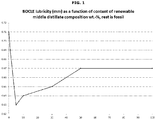
- Fig 1 shows BOCLE lubricity (mm) as a function of the content of renewable middle distillate composition of the present invention in blends with fossil fuel (Ex.3)
- the present invention relates to a renewable middle-distillate composition usable as a component of aviation fuel or diesel fuel, which is obtained by hydrotreatment of levulinic acid dimers/oligomers which are obtained from a renewable source.
- the present invention relates to a fuel comprising the renewable middle distillate composition, wherein the renewable middle distillate composition is obtainable by hydrodeoxygenation (or hydrotreatment) of a feedstock comprising levulinic acid dimers/oligomers, followed by fractionated distillation.
- the fractionated distillation is carried out so as to obtain the middle distillate fraction from the product obtained after hydrodeoxygenation.
- the renewable middle distillate composition contains less than 10.0 wt.-% of aromatics, as determined in accordance with ASTM D2425.
- the renewable middle distillate composition preferably contains at most 9.5 wt.-%, at most 9.3 wt.-%, at most 9.0 wt.-%, at most 8.0 wt.-%, at most 7.0 wt.-%, at most 6.0 wt.-%, at most 5.0 wt.-%, at most 4.0 wt.-%, or at most 3.0 wt.-% of aromatics, as determined in accordance with ASTM D2425.
- the present inventors surprisingly found that a middle distillate fraction having very low aromatics content can be produced from levulinic acid dimers/oligomers. Low aromatics content is favourable in view of emissions and combustion characteristics.
- the product distribution is narrow and the product properties can be controlled in a well specified range.
- the resulting product i.e. the middle distillate fraction
- the cloud point of diesel fuel is very low as well when employing the middle distillate as an admixture.
- high-quality fuel can be produced using lignocellulosic material as a renewable source which is available in large amounts.
- the levulinic acid may be employed in acid form or as a derivative selected from the group of esters of levulinic acid and/or lactones of levulinic acid.
- the levulinic acid dimers/oligomers include all kinds of dimers/oligomers obtained from levulinic acid (free acid form) alone, levulinic acid esters alone, levulinic acid lactones alone and mixed dimers/oligomers of these.
- the expression "containing levulinic acid dimers / oligomers" means that at least one kind of levulinic acid dimer/oligomer is contained.
- the levulinic acid dimer/oligomer further includes all compounds directly obtainable from a levulinic acid dimer/oligomer by other reactions under the conditions of a C-C-coupling reaction or distillation, such as (internal) lactonisation and dehydation and further condensation reactions producing e.g. LA-trimers.
- Examples of levulinic acid dimers/oligomers according to the invention are shown by the following formulas, using free acid dimers as examples:
- the freezing point of the renewable middle distillate composition is preferably -70°C or lower. Further, the freezing point of the renewable middle distillate composition may be -80°C or lower, -90°C or lower, or -95°C or lower.
- the inventors of the present invention surprisingly found that a middle distillate composition obtained form levulinic acid dimers/oligomers provides an extremely low freezing point, which makes it particularly suitable as an aviation fuel component or as a winter diesel component.
- the "middle distillate composition” generally relates to the middle distillate fraction contained in the fuel of the present invention, to the middle distillate fraction produced by the process of the present invention and to the middle distillate fraction used in accordance with the present invention. Further, the middle distillate fraction may be a diesel range fraction or an aviation fuel range fraction, and is preferably an aviation fuel range fraction.
- the renewable middle distillate composition contains at least 50 wt.-%, preferably at least 55 wt.-%, more preferably at least 60 wt.-%, or at least 65 wt.-% of cycloparaffins, as determined in accordance with ASTM D2425.
- High a content of cycloparaffins surprisingly provides good fuel properties (such as low freezing point and low cloud point) and can be achieved when using levulinic acid dimers/oligomers as a feedstock material by appropriately adjusting the HDO conditions.
- the renewable middle distillate composition suitably contains at most 80 wt.-%, preferably at most 75 wt.-%, more preferably at most 72 wt.-%, or at most 70 wt.-% of cycloparaffins, as determined in accordance with ASTM D2425.
- paraffin hydrocarbons offer the most desirable combustion cleanliness characteristics for jet fuels and diesel fuels.
- Cycloparaffins are the next most desirable hydrocarbons for this use.
- the content of the middle distillate fraction in the fuel of the present invention is not particularly limited and may be in the range of 0.01 wt.-% to 100 wt.-% (neat middle distillate fraction), in view of adjusting the fuel properties (such as density, lubricity, viscosity, freezing point, and so on) to desired values (and or to meet regulatory requirements), it can be desirable to blend the middle distillate fraction with fossil fuel and/or with other renewable fuel (other than renewable fuel derived from HDO of a feedstock containing levulinic acid dimers/oligomers).
- the fuel may further contain fossil fuel, HEFA (hydroprocessed ester and fatty acids) fuel and/or HVO (hydrotreated vegetable oil) fuel.
- HEFA hydroprocessed ester and fatty acids
- HVO hydrotreated vegetable oil
- the BOCLE lubricity of the renewable middle distillate composition may be 0.75 mm or less, preferably 0.72 mm or less, more preferably 0.70 mm or less, 0.69 mm or less, 0.68 mm or less, or 0.67 mm or less, as determined in accordance with ASTM D5001-10 (2014).
- One of the surprising findings of the present inventors is that the BOCLE lubricity of the middle distillate fraction, particularly of the aviation fuel fraction (LBAF; levulinic acid based aviation fuel fraction), is highly favourable, i.e. the middle distillate fraction achieves very low wear values.
- a blend of LBAF and fossil aviation fuel can achieve even lower BOCLE values, in particular for blends containing 1.5 wt.-% LBAF or more, preferably 2.5 wt.-% LBAF or more, 3.0 wt.-% LBAF of more, or 4.0 wt.-% LBAF or more.
- the effect is well pronounced even if the content of LBAF in the blend is 40.0 wt.-% or less, preferably 30.0 wt.-% or less, 20.0 wt.-% or less, 15.0 wt.-% or less, 12.0 wt.-% or less or 10.0 wt.-% or less.
- the BOCLE lubricity of the fuel of the present invention is 0.70 mm or less, preferably 0.67 mm or less, more preferably 0.66 mm or less, 0.65 mm or less, or 0.64 mm or less, as determined in accordance with ASTM D5001-10 (2014). Lubricity is a very important property in diesel fuels but also in military jet fuel use.
- the present invention thus suitably provides an aviation fuel component having highly favourable BOCLE lubricity while at the same time allowing desirable swelling of seal/gasket elastomers and cleaner combustion due to low aromatics content.
- the middle distillate fraction contained in the fuel of the present invention is preferably produced by the method of the present invention. Further, the middle distillate fraction produced by the method preferably has the properties of the middle distillate fraction, as defined above for the middle distillate fraction contained in the fuel of the present invention.
- the method for production of a renewable middle distillate composition comprises the steps of subjecting a feedstock comprising levulinic acid dimers/oligomers to at least one hydrodeoxygenation (HDO) reaction (HDO step), and fractionating (e.g. fractionated distillation) the resulting HDO product to obtain the middle distillate composition (fractionation step).
- HDO hydrodeoxygenation
- the middle distillate composition of the present invention is particularly suited as aviation and/or diesel fuel component. That is, the composition contains high an amount of paraffinic hydrocarbons (having high a content of cycloparaffins and isoparaffins) having 8 to 15 carbon atoms, wherein the majority (50 % by weight or more) of the product has 9 or 10 carbon atoms.
- the method of the present invention provides products having a high content (usually more than 50%) of paraffinic hydrocarbons derived from levulinic acid dimers/oligomers, i.e. having 8 to 10 carbon atoms.
- 10 is the total number of two levulinic acid carbon chains and the reduction by 1 to 2 carbon atoms takes account of carbon loss (e.g. decarboxylation) reactions occurring in a C-C-coupling step or in the HDO step.
- a certain amount of higher molecular weight compounds namely hydrocarbons derived from levulinic acid trimers
- the middle distillate of the present invention has a boiling point range of 150°C to 370°C, more preferably 150°C to 285°C, 155°C to 260°C, or 180°C to 285°C.
- the range below 285°C is generally suitable as aviation fuel, which is preferred in the present invention, wherein the fraction boiling in the range of 155°C to 260°C is particularly preferable.
- the levulinic acid dimers/oligomers may be obtained by dimerization/oligomerization of levulinic acid. Therefore, the method of the present invention may comprise a step of subjecting a raw material comprising at least levulinic acid to a C-C coupling reaction so as to produce the levulinic acid dimers/oligomers (C-C-coupling step).
- the levulinic acid may be in any form, such as free acid form, ester form or lactone form.
- the C-C-coupling reaction may be conducted at a temperature in the range of 100-200°C, preferably 120-180°C, more preferably 120-160°C, most preferably 120-140°C, especially when the C-C coupling reaction is carried out in the presence of hydrogen and using an acidic ion exchange resin (IER).
- IER acidic ion exchange resin
- the present invention provides a method of producing the middle distillate fraction starting from levulinic acid.
- the method comprises the steps of providing a raw material comprising at least levulinic acid (preparation step), subjecting the raw material to a C-C coupling reaction so as to produce a C-C-coupling product containing levulinic acid dimers/oligomers (the above-mentioned C-C-coupling step), wherein the C-C coupling reaction is carried out in the presence of hydrogen and using an acidic ion exchange resin (IER) carrying a hydrogenating metal as a catalyst, subjecting a feedstock comprising at least the levulinic acid dimers/oligomers to a hydrodeoxygenation reaction to produce a HDO product (the above-mentioned HDO step), and fractionating the HDO product to obtain the middle distillate composition (the above-mentioned fractionation step).
- IER acidic ion exchange resin
- This method is particularly preferable because it ensures that high an amount of levulinic acid dimers is produced in the C-C-coupling step in addition to a favourable amount of trimers and higher oligomers, so that the HDO step can be carried out without further purification/separation or with only minor purification/separation (such as removal of levulinic acid monomer, gaseous reaction products and/or water).
- the invention is not limited to this method and any method for producing the levulinic acid dimers/oligomers can be applied or the levulinic acid dimers/oligomers may be purchased.
- purification/separation of the levulinic acid dimers/oligomers e.g. fractionation
- the levulinic acid undergoes a C-C-coupling reaction with another levulinic acid present in the feedstock so as to produce a levulinic acid dimer/oligomer.
- the levulinic acid may undergo different C-C-coupling reactions.
- the C-C-coupling reactions may be ketonisation reactions or reactions proceeding through an enol or enolate intermediate.
- the C-C-coupling reactions may be aldol-type reactions and condensations, ketonisations, reactions where the C-C-coupling involves an alkene, as well as other dimerization/oligomerization reactions.
- decarboxylation, dehydration and/or hydrogenation may occur during or after the C-C-coupling reaction, thus providing a dimer/oligomer derivative having less oxygen and/or carbon atoms than expected from the C-C-coupling reaction alone.
- an acidic IER ion exchange resin
- an acidic IER (ion exchange resin) catalyst catalyses mainly aldol condensation reactions of levulinic acid. Under the reaction conditions of the C-C-coupling reaction, the resulting dimers/oligomers easily undergo lactonisation.
- the hydrodeoxygenation (HDO) reaction may be carried out at any temperature, preferably at a temperature of at least 200°C, at least 250°C, at least 270°C, at least 290°C, at least 300°C, at least 305°C, or at least 310°C.
- a temperature of 280°C or more in the HDO step leads to further (thermal) C-C-coupling reactions (further oligomerization reactions) in the HDO step.
- the pressure values in the present invention relate to absolute pressures. Further, when speaking of hydrogen pressure or pressure of a specific gas in general, the partial pressure of hydrogen (or the specific gas) is meant.
- levulinic acid dimers/oligomers in the feedstock may contain a keto group, an aldehyde group, an acid group (free acid form, ester form or lactone form) and/or a hydroxyl group.
- feedstock includes all non-gaseous material fed to the reactor, except for the material constituting the catalyst system.
- the calculation of the levulinic acid dimer/oligomer content in the feedstock does not consider the amount of catalyst.
- the method of the present invention may further comprise a step of removing unreacted levulinic acid and other monomers (separation step) before carrying out the HDO reaction.
- a dimerization/oligomerization reaction using an acidic IER catalyst system reaches a turnover of levulinic acid of about 50% by weight.
- about 50% by weight of the C-C-coupling reaction product consist of unreacted levulinic acid (monomer).
- This monomer is preferably removed before the HDO step. Most suitably, the monomer is removed immediately after the C-C-coupling reaction.
- Distillation is a suitable method for removing the monomer, but other methods may be employed as well.
- the C-C-coupling reaction product may be fractionated to remove potential unreacted levulinic acid monomers and other light components such as water and CO 2 formed in the C-C-coupling.
- the unreacted levulinic acid (monomer) may be recycled and combined with the raw material.
- the hydrogenation / hydrodeoxygenation reactions during levulinic acid condensation step may be carried out using a hydrogenating metal as a catalyst, wherein the hydrogenating metal is selected from metals of the Group VIII of the Periodic Table of Elements, preferably Co, Ni, Ru, Rh, Pd, and Pt, more preferably Pd, or a combination thereof.
- the present invention further relates to a use of a renewable middle distillate composition obtainable by hydrodeoxygenation of levulinic acid dimers/oligomers, followed by fractionated distillation, as an aviation fuel or aviation fuel component.
- a renewable middle distillate composition obtainable by hydrodeoxygenation of levulinic acid dimers/oligomers, followed by fractionated distillation, as an aviation fuel or aviation fuel component.
- the middle distillate fraction is prepared as an aviation fuel fraction, i.e. having a boiling point range in the aviation fuel range.
- the renewable middle distillate composition can be used as a diesel fuel or diesel fuel component as well, in particular as a winter diesel fuel component.
- the renewable middle distillate composition in accordance with the above-mentioned use is obtainable by the method of the present invention and/or has the properties as recited for the middle distillate fraction contained in the fuel of the present invention.
- the middle distillate compositions of the fuel, the method and the use of the present invention are the same.
- the hydrogen may be mixed with one or more other gases (dilution gas), preferably an inert gas such as nitrogen, argon, helium or another of the noble gases, or gas behaving inertly to the reaction conditions of the present invention.
- an inert gas such as nitrogen, argon, helium or another of the noble gases
- gas behaving inertly it is meant that the gas should not to a major extent participate as a reaction member, and preferably the inert gas should participate as little as possible, such as not participate at all.
- the hydrogen pressure in this embodiment of the C-C-coupling step is preferably at least 35 bar, more preferably at least 40 bar, further preferably in the range of 45 to 55 bar.
- the upper hydrogen pressure is not necessarily limited and may be 200 bar or less, 100 bar or less, 80 bar or les, 70 bar or less, or 60 bar or less.
- the C-C-coupling reaction can be controlled by adjusting several parameters, including by selection of reaction conditions such as weight hourly space velocity (WHSV) (kg feedstock/kg catalyst per hour).
- WHSV weight hourly space velocity
- the raw material may be obtained from processing of lignocellulosic material, and such processed material may be used directly, or purified to varying degrees before being used as a raw material in the method of the present invention.
- the levulinic acid may be produced e.g. with the Biofine method disclosed in US 5608105 .
- a HDO catalyst which comprises a metal having hydrogenation catalyst function on a support, such as for example a HDO catalyst metal selected from a group consisting of Pd, Pt, Ni, Co, Mo, Ru, Rh, W or any combination of these.
- the metal having hydrogenation catalyst function may be carried on a support, preferably an inorganic oxide support, more preferably silica, alumina, titania, zirconia, carbon or a combination thereof.
- a highly preferable HDO catalyst comprises sulfided NiMo, which is preferably supported on an inorganic oxide such as alumina.
- the hydrodeoxygenation step may be conducted at a temperature of up to 500°C and at a pressure of 10-150 bar.
- the method of the present invention may be carried out in a reactor, such as a stirred tank reactor, preferably a continuous stirred tank reactor, or a tubular flow reactor, preferably a continuous flow reactor. Further, the individual steps of the present invention may be carried out in the same reactor or in different reactors. Preferably, the C-C-coupling step and the HDO step are carried out in different reactors.
- the product of the HDO step may optionally be subjected to an isomerization step in the presence of hydrogen and an isomerization catalyst.
- Both the HDO step and isomerisation step may be conducted in the same reactor.
- the isomerisation catalyst is a noble metal bifunctional catalyst, for example Pt-SAPO or Pt-ZSM-catalyst.
- the isomerization step may for example be conducted at a temperature of 200-400 °C and at a pressure of 20-150 bar. Fractionation may be carried out before or after isomerization, but is preferably carried out after isomerization. Preferably, no isomerization treatment is carried out.
- a raw material containing 98 wt.-parts commercial grade levulinic acid (97 wt-% purity) and 2 wt.-parts water was provided.
- the raw material and hydrogen were fed to a tubular reactor supporting Amberlyst CH-34 catalyst (trade name; Pd doped ion exchange resin).
- the temperature in the reactor was adjusted to 130°C, the hydrogen pressure was 20 bar, WHSV was 0.2 h -1 and hydrogen to raw material (liquid raw material) flow ratio was 1170 Nl/l.
- the C-C-coupling product obtained after the tubular reactor contained 44 wt.-% non-reacted levulinic acid (LA) and ⁇ -valerolactone (GVL), 53 wt.-% dimers and about 2 wt.-% oligomers.
- LA levulinic acid
- VDL ⁇ -valerolactone
- the non-reacted LA (+GVL) as well as light reaction products (e.g. CO 2 ) and water were separated by distillation.
- the distilled product (C-C-coupling) had a LA dimer content of 95 wt.-%.
- Example 1 The product of Example 1 was subjected to HDO in a tubular reactor at a hydrogen pressure of 80 bar, a temperature of 306°C, and WHSV of 0.3 h -1 , using a sulfided NiMo hydrogenation catalyst supported on alumina and a flow rate of hydrogen to C-C-coupling of 2100 Nl/l.
- the HDO product was fractionated and the composition of the thus obtained LBAF fraction (levulinic acid based aviation fuel fraction) (155-260°C) was evaluated.
- Table 1 further shows typical properties of fossil Jet A-1 fuel (by Neste), and HEFA component Jet fuel requirements (ASTM D7566 specification) and conventional Jet A1 requirements.
- the latter covers also Jet A1 fuel containing synthesized hydrocarbons (i.e. HEFA component).
- the viscosity of the fuel is closely related to the pumpability over the temperature range and consistency of nozzle spray patterns.
- the main Jet fuel specifications allow a maximum viscosity (at -20°C) of 8 mm 2 /s.
- a maximum viscosity value of 12 mm 2 /s at -40°C is an operating limit provided by some of the aviation OEM's.
- test results comply with JET A-1 requirements, while the lubricity is even better than that of conventional fossil fuel.
- any new production route and component will anyways require ASTM certification.
- LBAF was prepared in the same manner as in Example 2. Blends of fossil Jet A-1 fuel (by Neste) and LBAF were tested for their freezing points and BOCLE lubricity. The results are shown in Table 2 and Fig. 1 .
- LBAF was prepared in the same manner as in Example 2, except for using an aviation fuel fraction having a boiling point range of 180-285°C.
- Blends of NEXBTL jet fuel 1 (HEFA-SPK Jet A-1 fuel by Neste; produced in accordance with Example 1 of EP 2141217 B1 ) and LBAF were tested and the results are shown in Table 3.
- LA based diesel was prepared in the same manner as in Example 2, except for using a diesel fuel fraction having a boiling point range of 180-360°C. Test results are shown in Table 4.
- Table 1 Analysis Test method LBAF (Ex. 2) ASTM D7566 A2 (HEFA component) JET A-1 requirement Neste Fossil JET A-1 (typical values) Density, kg/m 3 ASTM D4052 785.4 730-770 775-840 789.9 viscosity -20°C, mm 2 /s ASTM D445 2.849 - max 8 2.828 viscosity -40°C, mm 2 /s ASTM D445 5.056 - - - Freezing point, °C IP 529 ⁇ -80 *) max -40 max -47 -68.7 distillation °C: 10 vol-% 164.9 max 205 max 205 163.6 FBP ASTM D86 247.2 max 300 max 300 233.3 residue, vol-% 1.3 max 1.5 max 1.5 1.3 loss vol-%
- Aromatics 11.8 wt-% PROPERTIES Cetane Number 47 Density 15 °C 854 kg/m 3 Cloud point ⁇ -95°C Viscosity 40 °C 3.6 mm 2 /s Gross heating value 45.9 MJ/kg HFRR 496 ⁇ m (micro-m) TAN ⁇ 0.1 mg KOH/g
Landscapes
- Chemical & Material Sciences (AREA)
- Oil, Petroleum & Natural Gas (AREA)
- Organic Chemistry (AREA)
- Engineering & Computer Science (AREA)
- Chemical Kinetics & Catalysis (AREA)
- General Chemical & Material Sciences (AREA)
- Combustion & Propulsion (AREA)
- Materials Engineering (AREA)
- Organic Low-Molecular-Weight Compounds And Preparation Thereof (AREA)
Abstract
Description
- The present invention relates to a method for producing a renewable middle-distillate hydrocarbon composition, use of the composition and fuel containing the composition. In particular, the present invention relates to hydrocarbon compositions obtained by hydrotreatment of levulinic acid dimers/oligomers derived from renewable sources for the production of fuel or fuel components, to fuel containing these hydrocarbon compositions and to the use of these hydrocarbon compositions as aviation fuel.
-
US 2012/0283493 A1 discloses various methods for treatment of fatty acids and lignocellulosic material, including a hydrodeoxygenation treatment. -
WO 2006/067171 A1 discloses conversion of a reactant selected from a lactone, a carboxylic acid having a γ-keto group or its ester to a non-cyclic saturated carboxylic acid or ester, wherein the non-cyclic saturated esters can be used in diesel fuel. - The present invention relates to a method for producing a renewable middle-distillate hydrocarbon composition, use of the composition and fuel containing the composition. The composition is particularly suitable as a component in aviation fuel/jet fuel, but may be used in diesel range fuel as well. In particular, the present invention relates to compositions obtained by hydrotreatment of levulinic acid dimers/oligomers derived from renewable sources for the production of fuel or fuel components, to fuel containing these compositions and to the use of these compositions as aviation fuel.
- Up to date, there are three ASTM-certified production paths for renewable aviation fuel: Fischer-Tropsch synthesis, hydroprocessing of esters and fatty acids (HEFA) and direct sugar to hydrocarbon (DSHC) conversion. According to a vision of the Ministry of Transport and Communication in Finland, 40% of currently used aviation fuels will be replaced by biokerosine in 2050. This large amount requires alternative sources for the production of renewable aviation fuel, in particular high-quality fuel meeting highest demands.
- Accordingly, the production of high-quality aviation fuel from renewable sources which are available in large amounts is still a problem to be solved. Further, the increasing use of bio-diesel poses the problem of finding suitable sources for the production of bio-diesel or bio-diesel additives having desirable fuel characteristics.
- These problems are solved by the methods, the products and the use as defined in the appended claims.
- Specifically, the present invention provides middle-distillate compositions which can be used as fuel components without further purification due to their low content of undesired components.
-
Fig 1 shows BOCLE lubricity (mm) as a function of the content of renewable middle distillate composition of the present invention in blends with fossil fuel (Ex.3) - The present invention relates to a renewable middle-distillate composition usable as a component of aviation fuel or diesel fuel, which is obtained by hydrotreatment of levulinic acid dimers/oligomers which are obtained from a renewable source.
- Specifically, the present invention relates to a fuel comprising the renewable middle distillate composition, wherein the renewable middle distillate composition is obtainable by hydrodeoxygenation (or hydrotreatment) of a feedstock comprising levulinic acid dimers/oligomers, followed by fractionated distillation. The fractionated distillation is carried out so as to obtain the middle distillate fraction from the product obtained after hydrodeoxygenation. The renewable middle distillate composition contains less than 10.0 wt.-% of aromatics, as determined in accordance with ASTM D2425.
- The renewable middle distillate composition preferably contains at most 9.5 wt.-%, at most 9.3 wt.-%, at most 9.0 wt.-%, at most 8.0 wt.-%, at most 7.0 wt.-%, at most 6.0 wt.-%, at most 5.0 wt.-%, at most 4.0 wt.-%, or at most 3.0 wt.-% of aromatics, as determined in accordance with ASTM D2425. The present inventors surprisingly found that a middle distillate fraction having very low aromatics content can be produced from levulinic acid dimers/oligomers. Low aromatics content is favourable in view of emissions and combustion characteristics.
- Due to the use of the feedstock containing levulinic acid dimers/oligomers, the product distribution is narrow and the product properties can be controlled in a well specified range. Furthermore, the resulting product (i.e. the middle distillate fraction) provides a very low freezing point when used alone or in combination with conventional fuel. Furthermore, the cloud point of diesel fuel is very low as well when employing the middle distillate as an admixture. Thus, high-quality fuel can be produced using lignocellulosic material as a renewable source which is available in large amounts.
- In the present invention, the levulinic acid may be employed in acid form or as a derivative selected from the group of esters of levulinic acid and/or lactones of levulinic acid. Accordingly, the levulinic acid dimers/oligomers include all kinds of dimers/oligomers obtained from levulinic acid (free acid form) alone, levulinic acid esters alone, levulinic acid lactones alone and mixed dimers/oligomers of these. In the present invention, the expression "containing levulinic acid dimers/oligomers" means that at least one kind of levulinic acid dimer/oligomer is contained.
- The levulinic acid dimer/oligomer further includes all compounds directly obtainable from a levulinic acid dimer/oligomer by other reactions under the conditions of a C-C-coupling reaction or distillation, such as (internal) lactonisation and dehydation and further condensation reactions producing e.g. LA-trimers. Examples of levulinic acid dimers/oligomers according to the invention are shown by the following formulas, using free acid dimers as examples:


- In the present invention, the freezing point of the renewable middle distillate composition is preferably -70°C or lower. Further, the freezing point of the renewable middle distillate composition may be -80°C or lower, -90°C or lower, or -95°C or lower. The inventors of the present invention surprisingly found that a middle distillate composition obtained form levulinic acid dimers/oligomers provides an extremely low freezing point, which makes it particularly suitable as an aviation fuel component or as a winter diesel component.
- In the present invention, the "middle distillate composition" generally relates to the middle distillate fraction contained in the fuel of the present invention, to the middle distillate fraction produced by the process of the present invention and to the middle distillate fraction used in accordance with the present invention. Further, the middle distillate fraction may be a diesel range fraction or an aviation fuel range fraction, and is preferably an aviation fuel range fraction.
- Preferably the renewable middle distillate composition contains at least 50 wt.-%, preferably at least 55 wt.-%, more preferably at least 60 wt.-%, or at least 65 wt.-% of cycloparaffins, as determined in accordance with ASTM D2425.
- High a content of cycloparaffins surprisingly provides good fuel properties (such as low freezing point and low cloud point) and can be achieved when using levulinic acid dimers/oligomers as a feedstock material by appropriately adjusting the HDO conditions.
- The renewable middle distillate composition suitably contains at most 80 wt.-%, preferably at most 75 wt.-%, more preferably at most 72 wt.-%, or at most 70 wt.-% of cycloparaffins, as determined in accordance with ASTM D2425. In general, paraffin hydrocarbons offer the most desirable combustion cleanliness characteristics for jet fuels and diesel fuels. Cycloparaffins are the next most desirable hydrocarbons for this use.
- Although the content of the middle distillate fraction in the fuel of the present invention is not particularly limited and may be in the range of 0.01 wt.-% to 100 wt.-% (neat middle distillate fraction), in view of adjusting the fuel properties (such as density, lubricity, viscosity, freezing point, and so on) to desired values (and or to meet regulatory requirements), it can be desirable to blend the middle distillate fraction with fossil fuel and/or with other renewable fuel (other than renewable fuel derived from HDO of a feedstock containing levulinic acid dimers/oligomers).
- Particularly, the fuel may further contain fossil fuel, HEFA (hydroprocessed ester and fatty acids) fuel and/or HVO (hydrotreated vegetable oil) fuel.
- The BOCLE lubricity of the renewable middle distillate composition may be 0.75 mm or less, preferably 0.72 mm or less, more preferably 0.70 mm or less, 0.69 mm or less, 0.68 mm or less, or 0.67 mm or less, as determined in accordance with ASTM D5001-10 (2014). One of the surprising findings of the present inventors is that the BOCLE lubricity of the middle distillate fraction, particularly of the aviation fuel fraction (LBAF; levulinic acid based aviation fuel fraction), is highly favourable, i.e. the middle distillate fraction achieves very low wear values.
- Furthermore, a blend of LBAF and fossil aviation fuel can achieve even lower BOCLE values, in particular for blends containing 1.5 wt.-% LBAF or more, preferably 2.5 wt.-% LBAF or more, 3.0 wt.-% LBAF of more, or 4.0 wt.-% LBAF or more. The effect is well pronounced even if the content of LBAF in the blend is 40.0 wt.-% or less, preferably 30.0 wt.-% or less, 20.0 wt.-% or less, 15.0 wt.-% or less, 12.0 wt.-% or less or 10.0 wt.-% or less. Preferably, the BOCLE lubricity of the fuel of the present invention is 0.70 mm or less, preferably 0.67 mm or less, more preferably 0.66 mm or less, 0.65 mm or less, or 0.64 mm or less, as determined in accordance with ASTM D5001-10 (2014). Lubricity is a very important property in diesel fuels but also in military jet fuel use.
- The present invention thus suitably provides an aviation fuel component having highly favourable BOCLE lubricity while at the same time allowing desirable swelling of seal/gasket elastomers and cleaner combustion due to low aromatics content.
- Next a method for producing a middle distillate fraction is described. The middle distillate fraction contained in the fuel of the present invention is preferably produced by the method of the present invention. Further, the middle distillate fraction produced by the method preferably has the properties of the middle distillate fraction, as defined above for the middle distillate fraction contained in the fuel of the present invention.
- The method for production of a renewable middle distillate composition comprises the steps of subjecting a feedstock comprising levulinic acid dimers/oligomers to at least one hydrodeoxygenation (HDO) reaction (HDO step), and fractionating (e.g. fractionated distillation) the resulting HDO product to obtain the middle distillate composition (fractionation step).
- By employing levulinic acid dimers/oligomers, the middle distillate composition of the present invention is particularly suited as aviation and/or diesel fuel component. That is, the composition contains high an amount of paraffinic hydrocarbons (having high a content of cycloparaffins and isoparaffins) having 8 to 15 carbon atoms, wherein the majority (50 % by weight or more) of the product has 9 or 10 carbon atoms.
- Specifically, the method of the present invention provides products having a high content (usually more than 50%) of paraffinic hydrocarbons derived from levulinic acid dimers/oligomers, i.e. having 8 to 10 carbon atoms. Here, 10 is the total number of two levulinic acid carbon chains and the reduction by 1 to 2 carbon atoms takes account of carbon loss (e.g. decarboxylation) reactions occurring in a C-C-coupling step or in the HDO step. In this respect, a certain amount of higher molecular weight compounds (namely hydrocarbons derived from levulinic acid trimers) can be favourable in particular for fuel applications, since such a carbon number distribution mimics that of fossil oil fractions (fossil fuel).
- Preferably, the middle distillate of the present invention has a boiling point range of 150°C to 370°C, more preferably 150°C to 285°C, 155°C to 260°C, or 180°C to 285°C. The range below 285°C is generally suitable as aviation fuel, which is preferred in the present invention, wherein the fraction boiling in the range of 155°C to 260°C is particularly preferable.
- The levulinic acid dimers/oligomers may be obtained by dimerization/oligomerization of levulinic acid. Therefore, the method of the present invention may comprise a step of subjecting a raw material comprising at least levulinic acid to a C-C coupling reaction so as to produce the levulinic acid dimers/oligomers (C-C-coupling step). As said above, the levulinic acid may be in any form, such as free acid form, ester form or lactone form.
- The C-C-coupling reaction may be conducted at a temperature in the range of 100-200°C, preferably 120-180°C, more preferably 120-160°C, most preferably 120-140°C, especially when the C-C coupling reaction is carried out in the presence of hydrogen and using an acidic ion exchange resin (IER). This temperature range was found to be particularly suitable for obtaining a high yield of levulinic acid dimers/oligomers which are suitable to be used in the feedstock.
- It is to be noted that the upper limits and the lower limits of each range mentioned in the present description or claims may be combined to give new ranges which are intended to be comprised in the disclosure of the present invention.
- In an embodiment, the present invention provides a method of producing the middle distillate fraction starting from levulinic acid. The method comprises the steps of providing a raw material comprising at least levulinic acid (preparation step), subjecting the raw material to a C-C coupling reaction so as to produce a C-C-coupling product containing levulinic acid dimers/oligomers (the above-mentioned C-C-coupling step), wherein the C-C coupling reaction is carried out in the presence of hydrogen and using an acidic ion exchange resin (IER) carrying a hydrogenating metal as a catalyst, subjecting a feedstock comprising at least the levulinic acid dimers/oligomers to a hydrodeoxygenation reaction to produce a HDO product (the above-mentioned HDO step), and fractionating the HDO product to obtain the middle distillate composition (the above-mentioned fractionation step).
- This method is particularly preferable because it ensures that high an amount of levulinic acid dimers is produced in the C-C-coupling step in addition to a favourable amount of trimers and higher oligomers, so that the HDO step can be carried out without further purification/separation or with only minor purification/separation (such as removal of levulinic acid monomer, gaseous reaction products and/or water). However, the invention is not limited to this method and any method for producing the levulinic acid dimers/oligomers can be applied or the levulinic acid dimers/oligomers may be purchased. As the case may be, purification/separation of the levulinic acid dimers/oligomers (e.g. fractionation) may be desirable to achieve favourable contents of levulinic acid dimers/oligomers in the feedstock.
- In the step of subjecting the feedstock to the C-C-coupling reaction, the levulinic acid undergoes a C-C-coupling reaction with another levulinic acid present in the feedstock so as to produce a levulinic acid dimer/oligomer.
- Depending on the actual reaction conditions, the levulinic acid may undergo different C-C-coupling reactions. In particular the C-C-coupling reactions may be ketonisation reactions or reactions proceeding through an enol or enolate intermediate. Accordingly, the C-C-coupling reactions may be aldol-type reactions and condensations, ketonisations, reactions where the C-C-coupling involves an alkene, as well as other dimerization/oligomerization reactions. Further, decarboxylation, dehydration and/or hydrogenation may occur during or after the C-C-coupling reaction, thus providing a dimer/oligomer derivative having less oxygen and/or carbon atoms than expected from the C-C-coupling reaction alone.
- Without wanting to be bound to theory, it is considered that an acidic IER (ion exchange resin) catalyst catalyses mainly aldol condensation reactions of levulinic acid. Under the reaction conditions of the C-C-coupling reaction, the resulting dimers/oligomers easily undergo lactonisation.
- The hydrodeoxygenation (HDO) reaction may be carried out at any temperature, preferably at a temperature of at least 200°C, at least 250°C, at least 270°C, at least 290°C, at least 300°C, at least 305°C, or at least 310°C. A temperature of 280°C or more in the HDO step leads to further (thermal) C-C-coupling reactions (further oligomerization reactions) in the HDO step.
- Unless explicitly stated, the pressure values in the present invention relate to absolute pressures. Further, when speaking of hydrogen pressure or pressure of a specific gas in general, the partial pressure of hydrogen (or the specific gas) is meant.
- Furthermore, levulinic acid dimers/oligomers in the feedstock may contain a keto group, an aldehyde group, an acid group (free acid form, ester form or lactone form) and/or a hydroxyl group.
- In the present invention, it is to be noted that the term "feedstock" includes all non-gaseous material fed to the reactor, except for the material constituting the catalyst system. Thus, the calculation of the levulinic acid dimer/oligomer content in the feedstock does not consider the amount of catalyst. The same applies to the amounts of reactants fed in the HDO step or any other step of the methods of the present invention.
- The method of the present invention may further comprise a step of removing unreacted levulinic acid and other monomers (separation step) before carrying out the HDO reaction.
- Under practical reaction conditions, a dimerization/oligomerization reaction using an acidic IER catalyst system reaches a turnover of levulinic acid of about 50% by weight. Thus, about 50% by weight of the C-C-coupling reaction product consist of unreacted levulinic acid (monomer). This monomer is preferably removed before the HDO step. Most suitably, the monomer is removed immediately after the C-C-coupling reaction.
- Distillation is a suitable method for removing the monomer, but other methods may be employed as well. Specifically, the C-C-coupling reaction product may be fractionated to remove potential unreacted levulinic acid monomers and other light components such as water and CO2 formed in the C-C-coupling. The unreacted levulinic acid (monomer) may be recycled and combined with the raw material.
- The hydrogenation / hydrodeoxygenation reactions during levulinic acid condensation step may be carried out using a hydrogenating metal as a catalyst, wherein the hydrogenating metal is selected from metals of the Group VIII of the Periodic Table of Elements, preferably Co, Ni, Ru, Rh, Pd, and Pt, more preferably Pd, or a combination thereof.
- These metals, in particular Pd, has been found to provide good hydrogenation properties and being well compatible with the requirements of the C-C-coupling reaction using an IER.
- The present invention further relates to a use of a renewable middle distillate composition obtainable by hydrodeoxygenation of levulinic acid dimers/oligomers, followed by fractionated distillation, as an aviation fuel or aviation fuel component. When used as aviation fuel, the middle distillate fraction is prepared as an aviation fuel fraction, i.e. having a boiling point range in the aviation fuel range. The renewable middle distillate composition can be used as a diesel fuel or diesel fuel component as well, in particular as a winter diesel fuel component.
- Preferably, the renewable middle distillate composition in accordance with the above-mentioned use is obtainable by the method of the present invention and/or has the properties as recited for the middle distillate fraction contained in the fuel of the present invention. In other words, it is preferable that the middle distillate compositions of the fuel, the method and the use of the present invention are the same.
- Further aspects of the present invention are described in the following, while all of these aspects can be combined with the above-mentioned aspects without limitation.
- In the method step employing hydrogen, the hydrogen may be mixed with one or more other gases (dilution gas), preferably an inert gas such as nitrogen, argon, helium or another of the noble gases, or gas behaving inertly to the reaction conditions of the present invention. By behaving inertly it is meant that the gas should not to a major extent participate as a reaction member, and preferably the inert gas should participate as little as possible, such as not participate at all.
- While high a hydrogen pressure in the C-C-coupling step requires more sophisticated equipment, it is nevertheless possible to omit the mild hydrogenation step without needing to use long reaction times or highly reactive catalysts. Furthermore, a high hydrogen pressure in the C-C-coupling step was surprisingly found to shift the C-C-coupling reaction product (dimer/oligomer) from the lactone form to the diacid form. Since the lactone form dimers/oligomers tend to result in naphthenic or aromatic products after HDO, this embodiment is particularly suitable for the production of gasoline, Jet fuel components and chemical components.
- The hydrogen pressure in this embodiment of the C-C-coupling step is preferably at least 35 bar, more preferably at least 40 bar, further preferably in the range of 45 to 55 bar. However, the upper hydrogen pressure is not necessarily limited and may be 200 bar or less, 100 bar or less, 80 bar or les, 70 bar or less, or 60 bar or less.
- The C-C-coupling reaction can be controlled by adjusting several parameters, including by selection of reaction conditions such as weight hourly space velocity (WHSV) (kg feedstock/kg catalyst per hour).
- The raw material may be obtained from processing of lignocellulosic material, and such processed material may be used directly, or purified to varying degrees before being used as a raw material in the method of the present invention. The levulinic acid may be produced e.g. with the Biofine method disclosed in
US 5608105 . - Preferably, in the hydrodeoxygenation step, a HDO catalyst is employed which comprises a metal having hydrogenation catalyst function on a support, such as for example a HDO catalyst metal selected from a group consisting of Pd, Pt, Ni, Co, Mo, Ru, Rh, W or any combination of these. The metal having hydrogenation catalyst function may be carried on a support, preferably an inorganic oxide support, more preferably silica, alumina, titania, zirconia, carbon or a combination thereof. A highly preferable HDO catalyst comprises sulfided NiMo, which is preferably supported on an inorganic oxide such as alumina.
- The hydrodeoxygenation step may be conducted at a temperature of up to 500°C and at a pressure of 10-150 bar.
- The method of the present invention may be carried out in a reactor, such as a stirred tank reactor, preferably a continuous stirred tank reactor, or a tubular flow reactor, preferably a continuous flow reactor. Further, the individual steps of the present invention may be carried out in the same reactor or in different reactors. Preferably, the C-C-coupling step and the HDO step are carried out in different reactors.
- The product of the HDO step may optionally be subjected to an isomerization step in the presence of hydrogen and an isomerization catalyst. Both the HDO step and isomerisation step may be conducted in the same reactor. In some embodiments, the isomerisation catalyst is a noble metal bifunctional catalyst, for example Pt-SAPO or Pt-ZSM-catalyst. The isomerization step may for example be conducted at a temperature of 200-400 °C and at a pressure of 20-150 bar. Fractionation may be carried out before or after isomerization, but is preferably carried out after isomerization. Preferably, no isomerization treatment is carried out.
- A raw material containing 98 wt.-parts commercial grade levulinic acid (97 wt-% purity) and 2 wt.-parts water was provided. The raw material and hydrogen were fed to a tubular reactor supporting Amberlyst CH-34 catalyst (trade name; Pd doped ion exchange resin). The temperature in the reactor was adjusted to 130°C, the hydrogen pressure was 20 bar, WHSV was 0.2 h-1 and hydrogen to raw material (liquid raw material) flow ratio was 1170 Nl/l.
- The C-C-coupling product obtained after the tubular reactor contained 44 wt.-% non-reacted levulinic acid (LA) and γ-valerolactone (GVL), 53 wt.-% dimers and about 2 wt.-% oligomers. The non-reacted LA (+GVL) as well as light reaction products (e.g. CO2) and water were separated by distillation.
- The distilled product (C-C-coupling) had a LA dimer content of 95 wt.-%.
- The product of Example 1 was subjected to HDO in a tubular reactor at a hydrogen pressure of 80 bar, a temperature of 306°C, and WHSV of 0.3 h-1, using a sulfided NiMo hydrogenation catalyst supported on alumina and a flow rate of hydrogen to C-C-coupling of 2100 Nl/l.
- The HDO product was fractionated and the composition of the thus obtained LBAF fraction (levulinic acid based aviation fuel fraction) (155-260°C) was evaluated. The results are shown in Table 1, which further shows typical properties of fossil Jet A-1 fuel (by Neste), and HEFA component Jet fuel requirements (ASTM D7566 specification) and conventional Jet A1 requirements. The latter covers also Jet A1 fuel containing synthesized hydrocarbons (i.e. HEFA component).
- The viscosity of the fuel is closely related to the pumpability over the temperature range and consistency of nozzle spray patterns. The main Jet fuel specifications allow a maximum viscosity (at -20°C) of 8 mm2/s. A maximum viscosity value of 12 mm2/s at -40°C is an operating limit provided by some of the aviation OEM's.
- As can be seen, the test results comply with JET A-1 requirements, while the lubricity is even better than that of conventional fossil fuel. However, any new production route and component will anyways require ASTM certification.
- LBAF was prepared in the same manner as in Example 2. Blends of fossil Jet A-1 fuel (by Neste) and LBAF were tested for their freezing points and BOCLE lubricity. The results are shown in Table 2 and
Fig. 1 . - LBAF was prepared in the same manner as in Example 2, except for using an aviation fuel fraction having a boiling point range of 180-285°C. Blends of NEXBTL jet fuel 1 (HEFA-SPK Jet A-1 fuel by Neste; produced in accordance with Example 1 of
EP 2141217 B1 ) and LBAF were tested and the results are shown in Table 3. - LA based diesel was prepared in the same manner as in Example 2, except for using a diesel fuel fraction having a boiling point range of 180-360°C. Test results are shown in Table 4.
Table 1 Analysis Test method LBAF (Ex. 2) ASTM D7566 A2 (HEFA component) JET A-1 requirement Neste Fossil JET A-1 (typical values) Density, kg/m3 ASTM D4052 785.4 730-770 775-840 789.9 viscosity -20°C, mm2/s ASTM D445 2.849 - max 8 2.828 viscosity -40°C, mm2/s ASTM D445 5.056 - - - Freezing point, °C IP 529 <-80 *) max -40 max -47 -68.7 distillation °C: 10 vol-% 164.9 max 205 max 205 163.6 FBP ASTM D86 247.2 max 300 max 300 233.3 residue, vol-% 1.3 max 1.5 max 1.5 1.3 loss vol-% 0.6 max 1.5 max 1.5 0,6 Existent gum, mg/100ml IP 540 5 max 7 max 7 1 BOCLE lubricity, mm ASTM D5001 0.67 - max 0.85 0.79 HFRR lubricity µm/60°C ENISO12156-1 679 - - - Paraffins, wt.-% ASTM D2425 30.0 reported Cycloparaffins/naphthenes wt.-% ASTM D2425 67.4 max 15 Aromatics, wt.-% ASTM D2425 2.6 max 0.5 Olefins, wt.-% ASTM D2425 <0.1 *) Crystal not detected till -100 °C Table 2 LBAF Ex. 3 (rest is fossil) BOCLE (mm) 100 wt.-% 0.67 70 wt.-% - 50 wt.-% 0.67 30 wt.-% 0.65 15 wt.-% - 10 wt.-% 0.64 5 wt.-% 0.63 1 wt.-% 0.69 0 wt.-% 0.71 Table 3 Property Method NEXBTL jet LBAF (Ex 3) 80% NEXBTL jet 20% LBAF Total aromatics, wt-% EN12916, ASTM D2425 <0.5 7.6 1.52 (calculated) Monoaromatics, wt-% EN12916 N/A 7.6 Di-aromatics, wt-% EN12916 N/A <0.1 Tri+aromatics, wt-% EN12916 N/A <0.1 Naphthenes, wt-% ASTM D2425 0.88 61.1 12.92 (calculated) Density, kg/m3 ENISO12185, ASTM D4052 769.3 N/A 781.6 Freezing point, °C IP529 -51.8 N/A -54.1 Distillation ASTM D7345, ASTM D86 N/A IBP N/A N/A 155.1 10% (T10) 185.8 N/A 185.4 50% (T50) 260.1 N/A 253.7 90% (T90) 281.4 N/A 282.7 FBP 289.2 N/A 300.0 residue 1.3 N/A 1.5 loss 1.2 N/A 0.5 T90-T10 95.6 N/A 97.3 Table 4 COMPOSITION Ex. 5 Aromatics 11.8 wt-% PROPERTIES Cetane Number 47 Density 15 °C 854 kg/m3 Cloud point <-95°C Viscosity 40 °C 3.6 mm2/s Gross heating value 45.9 MJ/kg HFRR 496 µm (micro-m) TAN <0.1 mg KOH/g
Claims (14)
- A fuel comprising a renewable middle distillate composition, characterized in that the renewable middle distillate composition is obtainable by hydrodeoxygenation of a feedstock comprising levulinic acid dimers/oligomers, followed by fractionated distillation wherein the renewable middle distillate composition contains less than 10.0 wt.-% aromatics, as determined in accordance with ASTM D2425.
- The fuel according to claim 1, wherein the renewable middle distillate composition contains at most 9.5 wt.-%, at most 9.3 wt.-%, at most 9.0 wt.-%, at most 8.0 wt.-%, at most 7.0 wt.-%, at most 6.0 wt.-%, at most 5.0 wt.-%, at most 4.0 wt.-%, or at most 3.0 wt.-% of aromatics, as determined in accordance with ASTM D2425.
- The fuel according to claim 1 or 2, wherein the freezing point of the renewable middle distillate composition is -70°C or lower, -80°C or lower, - 90°C or lower, or -95°C or lower.
- The fuel according to any one of claims 1 to 3, wherein the renewable middle distillate composition contains at least 50 wt.-%, preferably at least 55 wt.-%, more preferably at least 60 wt.-%, or at least 65 wt.-% of cycloparaffins, as determined in accordance with ASTM D2425.
- The fuel according to any one of claims 1 to 4, wherein the renewable middle distillate composition contains at most 80 wt.-%, preferably at most 75 wt.-%, more preferably at most 72 wt.-%, or at most 70 wt.-% of cycloparaffins, as determined in accordance with ASTM D2425.
- The fuel according to any one of claims 1 to 5, wherein the fuel further contains fossil fuel, HEFA (hydroprocessed ester and fatty acids) fuel and/or HVO (hydrotreated vegetable oil) fuel.
- The fuel according to any one of claims 1 to 6, wherein the BOCLE lubricity of the renewable middle distillate composition is 0.75 mm or less, preferably 0.72 mm or less, more preferably 0.70 mm or less, 0.69 mm or less, 0.68 mm or less, or 0.67 mm or less, as determined in accordance with ASTM D5001-10 (2014).
- A method for production of a renewable middle distillate composition, the method comprising the steps ofsubjecting a feedstock comprising levulinic acid dimers/oligomers to at least one hydrodeoxygenation (HDO) reaction, andfractionating the resulting HDO product to obtain the middle distillate composition,wherein the renewable middle distillate composition contains less than 10.0 wt.-% aromatics, as determined in accordance with ASTM D2425.
- The method according to claim 8, wherein the renewable middle distillate composition contains at most 9.5 wt.-%, at most 9.3 wt.-%, at most 9.0 wt.-%, at most 8.0 wt.-%, at most 7.0 wt.-%, at most 6.0 wt.-%, at most 5.0 wt.-%, at most 4.0 wt.-%, or at most 3.0 wt.-% of aromatics, as determined in accordance with ASTM D2425.
- The method according to claim 8 or 9, further comprising the step ofsubjecting a raw material comprising at least levulinic acid to a C-C coupling reaction so as to produce the levulinic acid dimers/oligomers.
- The method according to claim 10, wherein the C-C-coupling reaction is conducted at a temperature in the range of 100-200°C, preferably 120-180°C, more preferably 120-160°C, most preferably 120-140°C.
- The method according to any one of claims 8 to 11, comprising the steps ofproviding a raw material comprising at least levulinic acid,subjecting the raw material to a C-C coupling reaction, wherein the C-C coupling reaction is carried out in the presence of hydrogen and using an acidic ion exchange resin carrying a hydrogenating metal as a catalyst, so as to produce a C-C-coupling containing levulinic acid dimer/oligomer,subjecting a feedstock comprising at least the levulinic acid dimers/oligomers to a hydrodeoxygenation (HDO) reaction to produce a HDO product, andfractionating the HDO product to obtain the middle distillate composition.
- The fuel according to any one of claims 1 to 7, wherein the middle distillate composition is obtainable by the method according to any one of claims 8 to 12.
- A use of a renewable middle distillate composition obtainable by hydrodeoxygenation of levulinic acid dimers/oligomers, followed by fractionated distillation, as an aviation fuel or aviation fuel component, wherein the renewable middle distillate composition contains less than 10.0 wt.-%, as determined in accordance with ASTM D2425.
Priority Applications (6)
| Application Number | Priority Date | Filing Date | Title |
|---|---|---|---|
| EP15202931.0A EP3187567B1 (en) | 2015-12-29 | 2015-12-29 | Method for producing renewable middle-distillate composition, use of the composition and fuel containing the same |
| ES15202931T ES2866043T3 (en) | 2015-12-29 | 2015-12-29 | Method for producing a renewable middle distillate composition, use of the composition and fuel that contains it |
| CA2952512A CA2952512A1 (en) | 2015-12-29 | 2016-12-23 | Method for producing renewable middle-distillate composition, use of the composition and fuel containing the same |
| US15/392,849 US10640721B2 (en) | 2015-12-29 | 2016-12-28 | Method for producing renewable middle-distillate composition, use of the composition and fuel containing the same |
| BR102016030777-5A BR102016030777B1 (en) | 2015-12-29 | 2016-12-28 | FUEL, METHOD FOR THE PRODUCTION OF A DISTILLE COMPOSITION AND USE OF A DISTILLE COMPOSITION |
| CN201611248585.4A CN106929094A (en) | 2015-12-29 | 2016-12-29 | The method for producing renewable middle distillate composition, the purposes of said composition and the fuel containing said composition |
Applications Claiming Priority (1)
| Application Number | Priority Date | Filing Date | Title |
|---|---|---|---|
| EP15202931.0A EP3187567B1 (en) | 2015-12-29 | 2015-12-29 | Method for producing renewable middle-distillate composition, use of the composition and fuel containing the same |
Publications (2)
| Publication Number | Publication Date |
|---|---|
| EP3187567A1 true EP3187567A1 (en) | 2017-07-05 |
| EP3187567B1 EP3187567B1 (en) | 2021-03-31 |
Family
ID=55173750
Family Applications (1)
| Application Number | Title | Priority Date | Filing Date |
|---|---|---|---|
| EP15202931.0A Active EP3187567B1 (en) | 2015-12-29 | 2015-12-29 | Method for producing renewable middle-distillate composition, use of the composition and fuel containing the same |
Country Status (6)
| Country | Link |
|---|---|
| US (1) | US10640721B2 (en) |
| EP (1) | EP3187567B1 (en) |
| CN (1) | CN106929094A (en) |
| BR (1) | BR102016030777B1 (en) |
| CA (1) | CA2952512A1 (en) |
| ES (1) | ES2866043T3 (en) |
Cited By (2)
| Publication number | Priority date | Publication date | Assignee | Title |
|---|---|---|---|---|
| US11377608B2 (en) | 2017-12-28 | 2022-07-05 | Neste Oyj | Preparation of an aviation fuel composition |
| US11859143B2 (en) | 2019-11-19 | 2024-01-02 | Neste Oyj | Hydrocarbon composition |
Families Citing this family (2)
| Publication number | Priority date | Publication date | Assignee | Title |
|---|---|---|---|---|
| FI20186074A1 (en) * | 2018-12-13 | 2020-06-14 | Neste Oyj | Mixture of renewable fuels |
| WO2021094645A1 (en) | 2019-11-15 | 2021-05-20 | Neste Oyj | Production of paraffinic products |
Citations (7)
| Publication number | Priority date | Publication date | Assignee | Title |
|---|---|---|---|---|
| US5608105A (en) | 1995-06-07 | 1997-03-04 | Biofine Incorporated | Production of levulinic acid from carbohydrate-containing materials |
| WO2006067171A1 (en) | 2004-12-23 | 2006-06-29 | Shell Internationale Research Maatschappij B.V. | A process for the hydrogenation of a lactone or of a carboxylic acid or an ester having a gamma-carbonyl group |
| US20110277378A1 (en) * | 2010-05-12 | 2011-11-17 | Shell Oil Company | Process for liquefying a cellulosic material and its products |
| US20120283493A1 (en) | 2009-06-05 | 2012-11-08 | Olson Edwin S | Multiproduct biorefinery for synthesis of fuel components and chemicals from lignocellulosics via levulinate condensations |
| EP2141217B1 (en) | 2008-07-01 | 2015-03-25 | Neste Oil Oyj | Process for the manufacture of aviation fuel or blending stocks for aviation fuel of biological origin |
| EP2924097A2 (en) * | 2014-03-26 | 2015-09-30 | Neste Oil Oyj | Method for Catalytic Conversion of Ketoacids and Hydrotreatment to Hydrocarbons |
| WO2015144994A1 (en) * | 2014-03-26 | 2015-10-01 | Neste Oil Oyj | Method for thermal conversion of ketoacids and hydrotreatment to hydrocarbons |
Family Cites Families (7)
| Publication number | Priority date | Publication date | Assignee | Title |
|---|---|---|---|---|
| US20060135793A1 (en) | 2004-11-26 | 2006-06-22 | Blessing Robert W | Process for the dimerisation of levulinic acid, dimers obtainable by such process and esters of such dimers |
| US7888542B2 (en) * | 2005-12-12 | 2011-02-15 | Neste Oil Oyj | Process for producing a saturated hydrocarbon component |
| US8039682B2 (en) * | 2008-03-17 | 2011-10-18 | Uop Llc | Production of aviation fuel from renewable feedstocks |
| ES2658695T3 (en) * | 2011-10-25 | 2018-03-12 | Shell Internationale Research Maatschappij B.V. | Process to prepare fuels for airplanes and their products |
| US20130144094A1 (en) * | 2011-12-06 | 2013-06-06 | Phillips 66 Company | Renewable gas oil derived from biomass |
| US8629310B2 (en) * | 2012-03-09 | 2014-01-14 | Phillips 66 Company | Transportation fuels from biomass oxygenates |
| FI126331B (en) * | 2013-04-02 | 2016-10-14 | Upm Kymmene Corp | Renewable hydrocarbon composition |
-
2015
- 2015-12-29 EP EP15202931.0A patent/EP3187567B1/en active Active
- 2015-12-29 ES ES15202931T patent/ES2866043T3/en active Active
-
2016
- 2016-12-23 CA CA2952512A patent/CA2952512A1/en active Pending
- 2016-12-28 BR BR102016030777-5A patent/BR102016030777B1/en not_active IP Right Cessation
- 2016-12-28 US US15/392,849 patent/US10640721B2/en active Active
- 2016-12-29 CN CN201611248585.4A patent/CN106929094A/en active Pending
Patent Citations (7)
| Publication number | Priority date | Publication date | Assignee | Title |
|---|---|---|---|---|
| US5608105A (en) | 1995-06-07 | 1997-03-04 | Biofine Incorporated | Production of levulinic acid from carbohydrate-containing materials |
| WO2006067171A1 (en) | 2004-12-23 | 2006-06-29 | Shell Internationale Research Maatschappij B.V. | A process for the hydrogenation of a lactone or of a carboxylic acid or an ester having a gamma-carbonyl group |
| EP2141217B1 (en) | 2008-07-01 | 2015-03-25 | Neste Oil Oyj | Process for the manufacture of aviation fuel or blending stocks for aviation fuel of biological origin |
| US20120283493A1 (en) | 2009-06-05 | 2012-11-08 | Olson Edwin S | Multiproduct biorefinery for synthesis of fuel components and chemicals from lignocellulosics via levulinate condensations |
| US20110277378A1 (en) * | 2010-05-12 | 2011-11-17 | Shell Oil Company | Process for liquefying a cellulosic material and its products |
| EP2924097A2 (en) * | 2014-03-26 | 2015-09-30 | Neste Oil Oyj | Method for Catalytic Conversion of Ketoacids and Hydrotreatment to Hydrocarbons |
| WO2015144994A1 (en) * | 2014-03-26 | 2015-10-01 | Neste Oil Oyj | Method for thermal conversion of ketoacids and hydrotreatment to hydrocarbons |
Non-Patent Citations (1)
| Title |
|---|
| MARK MASCAL ET AL: "Hydrodeoxygenation of the Angelica Lactone Dimer, a Cellulose-Based Feedstock: Simple, High-Yield Synthesis of Branched C 7 -C 10 Gasoline-like Hydrocarbons", ANGEWANDTE CHEMIE INTERNATIONAL EDITION, vol. 53, no. 7, 10 February 2014 (2014-02-10), DE, pages 1854 - 1857, XP055260582, ISSN: 1433-7851, DOI: 10.1002/anie.201308143 * |
Cited By (5)
| Publication number | Priority date | Publication date | Assignee | Title |
|---|---|---|---|---|
| US11377608B2 (en) | 2017-12-28 | 2022-07-05 | Neste Oyj | Preparation of an aviation fuel composition |
| US11773339B2 (en) | 2017-12-28 | 2023-10-03 | Neste Oyj | Preparation of an aviation fuel composition |
| US11859143B2 (en) | 2019-11-19 | 2024-01-02 | Neste Oyj | Hydrocarbon composition |
| SE545870C2 (en) * | 2019-11-19 | 2024-02-27 | Neste Oyj | A hydrocarbon composition |
| US12241028B2 (en) | 2019-11-19 | 2025-03-04 | Neste Oyj | Hydrocarbon composition |
Also Published As
| Publication number | Publication date |
|---|---|
| CA2952512A1 (en) | 2017-06-29 |
| US20170183593A1 (en) | 2017-06-29 |
| BR102016030777B1 (en) | 2021-07-13 |
| US10640721B2 (en) | 2020-05-05 |
| EP3187567B1 (en) | 2021-03-31 |
| CN106929094A (en) | 2017-07-07 |
| ES2866043T3 (en) | 2021-10-19 |
| BR102016030777A2 (en) | 2017-07-11 |
Similar Documents
| Publication | Publication Date | Title |
|---|---|---|
| EP3652278B1 (en) | Multi-stage upgrading pyrolysis tar products | |
| KR102581308B1 (en) | Manufacturing processes for renewable base oils, diesel and naphtha | |
| US10550062B2 (en) | Method for catalytic conversion of ketoacids and hydrotreament to hydrocarbons | |
| KR101335925B1 (en) | Process for the manufacture of hydrocarbons of biological origin | |
| EP3187567B1 (en) | Method for producing renewable middle-distillate composition, use of the composition and fuel containing the same | |
| EP3301142B1 (en) | Upgrading 5-nonanone | |
| EP3187570B1 (en) | Method for producing a fuel blend | |
| US10968397B2 (en) | Renewable hydrocarbons, method for producing the same and use thereof | |
| EP3187569B1 (en) | Renewable diesel fuel composition | |
| WO2026104268A1 (en) | Process for introducing biogenic carbon into kerosene fossil fuel by co-processing hydrotreatment using at least one hydroisomerisation catalyst | |
| US20150011808A1 (en) | Renewable High-Density, High-Octane Fuels |
Legal Events
| Date | Code | Title | Description |
|---|---|---|---|
| PUAI | Public reference made under article 153(3) epc to a published international application that has entered the european phase |
Free format text: ORIGINAL CODE: 0009012 |
|
| STAA | Information on the status of an ep patent application or granted ep patent |
Free format text: STATUS: THE APPLICATION HAS BEEN PUBLISHED |
|
| AK | Designated contracting states |
Kind code of ref document: A1 Designated state(s): AL AT BE BG CH CY CZ DE DK EE ES FI FR GB GR HR HU IE IS IT LI LT LU LV MC MK MT NL NO PL PT RO RS SE SI SK SM TR |
|
| AX | Request for extension of the european patent |
Extension state: BA ME |
|
| STAA | Information on the status of an ep patent application or granted ep patent |
Free format text: STATUS: REQUEST FOR EXAMINATION WAS MADE |
|
| 17P | Request for examination filed |
Effective date: 20180105 |
|
| RBV | Designated contracting states (corrected) |
Designated state(s): AL AT BE BG CH CY CZ DE DK EE ES FI FR GB GR HR HU IE IS IT LI LT LU LV MC MK MT NL NO PL PT RO RS SE SI SK SM TR |
|
| STAA | Information on the status of an ep patent application or granted ep patent |
Free format text: STATUS: EXAMINATION IS IN PROGRESS |
|
| 17Q | First examination report despatched |
Effective date: 20190701 |
|
| RIC1 | Information provided on ipc code assigned before grant |
Ipc: C10L 1/04 20060101ALI20190917BHEP Ipc: C10L 10/08 20060101ALI20190917BHEP Ipc: B01J 23/44 20060101ALI20190917BHEP Ipc: C10L 10/14 20060101ALI20190917BHEP Ipc: B01J 35/06 20060101ALI20190917BHEP Ipc: C10G 3/00 20060101AFI20190917BHEP Ipc: C10L 1/08 20060101ALI20190917BHEP |
|
| GRAP | Despatch of communication of intention to grant a patent |
Free format text: ORIGINAL CODE: EPIDOSNIGR1 |
|
| STAA | Information on the status of an ep patent application or granted ep patent |
Free format text: STATUS: GRANT OF PATENT IS INTENDED |
|
| INTG | Intention to grant announced |
Effective date: 20191113 |
|
| GRAJ | Information related to disapproval of communication of intention to grant by the applicant or resumption of examination proceedings by the epo deleted |
Free format text: ORIGINAL CODE: EPIDOSDIGR1 |
|
| STAA | Information on the status of an ep patent application or granted ep patent |
Free format text: STATUS: EXAMINATION IS IN PROGRESS |
|
| GRAP | Despatch of communication of intention to grant a patent |
Free format text: ORIGINAL CODE: EPIDOSNIGR1 |
|
| INTC | Intention to grant announced (deleted) | ||
| RIN1 | Information on inventor provided before grant (corrected) |
Inventor name: LINDBLAD, MARINA Inventor name: KIISKI, ULLA Inventor name: SANDBERG, KATI Inventor name: MYLLYOJA, JUKKA |
|
| STAA | Information on the status of an ep patent application or granted ep patent |
Free format text: STATUS: GRANT OF PATENT IS INTENDED |
|
| INTG | Intention to grant announced |
Effective date: 20201008 |
|
| GRAS | Grant fee paid |
Free format text: ORIGINAL CODE: EPIDOSNIGR3 |
|
| GRAA | (expected) grant |
Free format text: ORIGINAL CODE: 0009210 |
|
| STAA | Information on the status of an ep patent application or granted ep patent |
Free format text: STATUS: THE PATENT HAS BEEN GRANTED |
|
| AK | Designated contracting states |
Kind code of ref document: B1 Designated state(s): AL AT BE BG CH CY CZ DE DK EE ES FI FR GB GR HR HU IE IS IT LI LT LU LV MC MK MT NL NO PL PT RO RS SE SI SK SM TR |
|
| REG | Reference to a national code |
Ref country code: GB Ref legal event code: FG4D Ref country code: CH Ref legal event code: EP |
|
| REG | Reference to a national code |
Ref country code: AT Ref legal event code: REF Ref document number: 1376926 Country of ref document: AT Kind code of ref document: T Effective date: 20210415 |
|
| REG | Reference to a national code |
Ref country code: DE Ref legal event code: R096 Ref document number: 602015067420 Country of ref document: DE |
|
| REG | Reference to a national code |
Ref country code: IE Ref legal event code: FG4D |
|
| REG | Reference to a national code |
Ref country code: FI Ref legal event code: FGE |
|
| REG | Reference to a national code |
Ref country code: NL Ref legal event code: FP |
|
| REG | Reference to a national code |
Ref country code: SE Ref legal event code: TRGR |
|
| REG | Reference to a national code |
Ref country code: LT Ref legal event code: MG9D |
|
| PG25 | Lapsed in a contracting state [announced via postgrant information from national office to epo] |
Ref country code: BG Free format text: LAPSE BECAUSE OF FAILURE TO SUBMIT A TRANSLATION OF THE DESCRIPTION OR TO PAY THE FEE WITHIN THE PRESCRIBED TIME-LIMIT Effective date: 20210630 Ref country code: HR Free format text: LAPSE BECAUSE OF FAILURE TO SUBMIT A TRANSLATION OF THE DESCRIPTION OR TO PAY THE FEE WITHIN THE PRESCRIBED TIME-LIMIT Effective date: 20210331 |
|
| REG | Reference to a national code |
Ref country code: NO Ref legal event code: T2 Effective date: 20210331 |
|
| PG25 | Lapsed in a contracting state [announced via postgrant information from national office to epo] |
Ref country code: LV Free format text: LAPSE BECAUSE OF FAILURE TO SUBMIT A TRANSLATION OF THE DESCRIPTION OR TO PAY THE FEE WITHIN THE PRESCRIBED TIME-LIMIT Effective date: 20210331 Ref country code: RS Free format text: LAPSE BECAUSE OF FAILURE TO SUBMIT A TRANSLATION OF THE DESCRIPTION OR TO PAY THE FEE WITHIN THE PRESCRIBED TIME-LIMIT Effective date: 20210331 |
|
| REG | Reference to a national code |
Ref country code: AT Ref legal event code: MK05 Ref document number: 1376926 Country of ref document: AT Kind code of ref document: T Effective date: 20210331 |
|
| REG | Reference to a national code |
Ref country code: ES Ref legal event code: FG2A Ref document number: 2866043 Country of ref document: ES Kind code of ref document: T3 Effective date: 20211019 |
|
| PG25 | Lapsed in a contracting state [announced via postgrant information from national office to epo] |
Ref country code: LT Free format text: LAPSE BECAUSE OF FAILURE TO SUBMIT A TRANSLATION OF THE DESCRIPTION OR TO PAY THE FEE WITHIN THE PRESCRIBED TIME-LIMIT Effective date: 20210331 Ref country code: CZ Free format text: LAPSE BECAUSE OF FAILURE TO SUBMIT A TRANSLATION OF THE DESCRIPTION OR TO PAY THE FEE WITHIN THE PRESCRIBED TIME-LIMIT Effective date: 20210331 Ref country code: EE Free format text: LAPSE BECAUSE OF FAILURE TO SUBMIT A TRANSLATION OF THE DESCRIPTION OR TO PAY THE FEE WITHIN THE PRESCRIBED TIME-LIMIT Effective date: 20210331 Ref country code: SM Free format text: LAPSE BECAUSE OF FAILURE TO SUBMIT A TRANSLATION OF THE DESCRIPTION OR TO PAY THE FEE WITHIN THE PRESCRIBED TIME-LIMIT Effective date: 20210331 Ref country code: AT Free format text: LAPSE BECAUSE OF FAILURE TO SUBMIT A TRANSLATION OF THE DESCRIPTION OR TO PAY THE FEE WITHIN THE PRESCRIBED TIME-LIMIT Effective date: 20210331 |
|
| PG25 | Lapsed in a contracting state [announced via postgrant information from national office to epo] |
Ref country code: IS Free format text: LAPSE BECAUSE OF FAILURE TO SUBMIT A TRANSLATION OF THE DESCRIPTION OR TO PAY THE FEE WITHIN THE PRESCRIBED TIME-LIMIT Effective date: 20210731 Ref country code: SK Free format text: LAPSE BECAUSE OF FAILURE TO SUBMIT A TRANSLATION OF THE DESCRIPTION OR TO PAY THE FEE WITHIN THE PRESCRIBED TIME-LIMIT Effective date: 20210331 Ref country code: RO Free format text: LAPSE BECAUSE OF FAILURE TO SUBMIT A TRANSLATION OF THE DESCRIPTION OR TO PAY THE FEE WITHIN THE PRESCRIBED TIME-LIMIT Effective date: 20210331 Ref country code: PT Free format text: LAPSE BECAUSE OF FAILURE TO SUBMIT A TRANSLATION OF THE DESCRIPTION OR TO PAY THE FEE WITHIN THE PRESCRIBED TIME-LIMIT Effective date: 20210802 Ref country code: PL Free format text: LAPSE BECAUSE OF FAILURE TO SUBMIT A TRANSLATION OF THE DESCRIPTION OR TO PAY THE FEE WITHIN THE PRESCRIBED TIME-LIMIT Effective date: 20210331 |
|
| REG | Reference to a national code |
Ref country code: DE Ref legal event code: R097 Ref document number: 602015067420 Country of ref document: DE |
|
| PG25 | Lapsed in a contracting state [announced via postgrant information from national office to epo] |
Ref country code: DK Free format text: LAPSE BECAUSE OF FAILURE TO SUBMIT A TRANSLATION OF THE DESCRIPTION OR TO PAY THE FEE WITHIN THE PRESCRIBED TIME-LIMIT Effective date: 20210331 Ref country code: AL Free format text: LAPSE BECAUSE OF FAILURE TO SUBMIT A TRANSLATION OF THE DESCRIPTION OR TO PAY THE FEE WITHIN THE PRESCRIBED TIME-LIMIT Effective date: 20210331 |
|
| PLBE | No opposition filed within time limit |
Free format text: ORIGINAL CODE: 0009261 |
|
| STAA | Information on the status of an ep patent application or granted ep patent |
Free format text: STATUS: NO OPPOSITION FILED WITHIN TIME LIMIT |
|
| 26N | No opposition filed |
Effective date: 20220104 |
|
| PG25 | Lapsed in a contracting state [announced via postgrant information from national office to epo] |
Ref country code: IS Free format text: LAPSE BECAUSE OF FAILURE TO SUBMIT A TRANSLATION OF THE DESCRIPTION OR TO PAY THE FEE WITHIN THE PRESCRIBED TIME-LIMIT Effective date: 20210731 |
|
| PG25 | Lapsed in a contracting state [announced via postgrant information from national office to epo] |
Ref country code: MC Free format text: LAPSE BECAUSE OF FAILURE TO SUBMIT A TRANSLATION OF THE DESCRIPTION OR TO PAY THE FEE WITHIN THE PRESCRIBED TIME-LIMIT Effective date: 20210331 |
|
| REG | Reference to a national code |
Ref country code: CH Ref legal event code: PL |
|
| PG25 | Lapsed in a contracting state [announced via postgrant information from national office to epo] |
Ref country code: LU Free format text: LAPSE BECAUSE OF NON-PAYMENT OF DUE FEES Effective date: 20211229 Ref country code: IE Free format text: LAPSE BECAUSE OF NON-PAYMENT OF DUE FEES Effective date: 20211229 |
|
| PG25 | Lapsed in a contracting state [announced via postgrant information from national office to epo] |
Ref country code: LI Free format text: LAPSE BECAUSE OF NON-PAYMENT OF DUE FEES Effective date: 20211231 Ref country code: CH Free format text: LAPSE BECAUSE OF NON-PAYMENT OF DUE FEES Effective date: 20211231 |
|
| PGFP | Annual fee paid to national office [announced via postgrant information from national office to epo] |
Ref country code: SE Payment date: 20221110 Year of fee payment: 8 Ref country code: NO Payment date: 20221208 Year of fee payment: 8 Ref country code: NL Payment date: 20221114 Year of fee payment: 8 Ref country code: IT Payment date: 20221111 Year of fee payment: 8 Ref country code: GB Payment date: 20221110 Year of fee payment: 8 Ref country code: FR Payment date: 20221122 Year of fee payment: 8 Ref country code: FI Payment date: 20221209 Year of fee payment: 8 Ref country code: DE Payment date: 20221102 Year of fee payment: 8 |
|
| PGFP | Annual fee paid to national office [announced via postgrant information from national office to epo] |
Ref country code: BE Payment date: 20221118 Year of fee payment: 8 |
|
| PGFP | Annual fee paid to national office [announced via postgrant information from national office to epo] |
Ref country code: ES Payment date: 20230112 Year of fee payment: 8 |
|
| PG25 | Lapsed in a contracting state [announced via postgrant information from national office to epo] |
Ref country code: HU Free format text: LAPSE BECAUSE OF FAILURE TO SUBMIT A TRANSLATION OF THE DESCRIPTION OR TO PAY THE FEE WITHIN THE PRESCRIBED TIME-LIMIT; INVALID AB INITIO Effective date: 20151229 |
|
| P01 | Opt-out of the competence of the unified patent court (upc) registered |
Effective date: 20230421 |
|
| PG25 | Lapsed in a contracting state [announced via postgrant information from national office to epo] |
Ref country code: CY Free format text: LAPSE BECAUSE OF FAILURE TO SUBMIT A TRANSLATION OF THE DESCRIPTION OR TO PAY THE FEE WITHIN THE PRESCRIBED TIME-LIMIT Effective date: 20210331 |
|
| PG25 | Lapsed in a contracting state [announced via postgrant information from national office to epo] |
Ref country code: GR Free format text: LAPSE BECAUSE OF FAILURE TO SUBMIT A TRANSLATION OF THE DESCRIPTION OR TO PAY THE FEE WITHIN THE PRESCRIBED TIME-LIMIT Effective date: 20210331 |
|
| PG25 | Lapsed in a contracting state [announced via postgrant information from national office to epo] |
Ref country code: MK Free format text: LAPSE BECAUSE OF FAILURE TO SUBMIT A TRANSLATION OF THE DESCRIPTION OR TO PAY THE FEE WITHIN THE PRESCRIBED TIME-LIMIT Effective date: 20210331 |
|
| REG | Reference to a national code |
Ref country code: DE Ref legal event code: R119 Ref document number: 602015067420 Country of ref document: DE |
|
| REG | Reference to a national code |
Ref country code: SE Ref legal event code: EUG |
|
| PG25 | Lapsed in a contracting state [announced via postgrant information from national office to epo] |
Ref country code: FI Free format text: LAPSE BECAUSE OF NON-PAYMENT OF DUE FEES Effective date: 20231229 |
|
| REG | Reference to a national code |
Ref country code: NL Ref legal event code: MM Effective date: 20240101 |
|
| GBPC | Gb: european patent ceased through non-payment of renewal fee |
Effective date: 20231229 |
|
| REG | Reference to a national code |
Ref country code: BE Ref legal event code: MM Effective date: 20231231 |
|
| PG25 | Lapsed in a contracting state [announced via postgrant information from national office to epo] |
Ref country code: NL Free format text: LAPSE BECAUSE OF NON-PAYMENT OF DUE FEES Effective date: 20240101 |
|
| PG25 | Lapsed in a contracting state [announced via postgrant information from national office to epo] |
Ref country code: NL Free format text: LAPSE BECAUSE OF NON-PAYMENT OF DUE FEES Effective date: 20240101 Ref country code: MT Free format text: LAPSE BECAUSE OF FAILURE TO SUBMIT A TRANSLATION OF THE DESCRIPTION OR TO PAY THE FEE WITHIN THE PRESCRIBED TIME-LIMIT Effective date: 20210331 |
|
| PG25 | Lapsed in a contracting state [announced via postgrant information from national office to epo] |
Ref country code: DE Free format text: LAPSE BECAUSE OF NON-PAYMENT OF DUE FEES Effective date: 20240702 |
|
| PG25 | Lapsed in a contracting state [announced via postgrant information from national office to epo] |
Ref country code: GB Free format text: LAPSE BECAUSE OF NON-PAYMENT OF DUE FEES Effective date: 20231229 |
|
| PG25 | Lapsed in a contracting state [announced via postgrant information from national office to epo] |
Ref country code: BE Free format text: LAPSE BECAUSE OF NON-PAYMENT OF DUE FEES Effective date: 20231231 |
|
| PG25 | Lapsed in a contracting state [announced via postgrant information from national office to epo] |
Ref country code: FR Free format text: LAPSE BECAUSE OF NON-PAYMENT OF DUE FEES Effective date: 20231231 |
|
| PG25 | Lapsed in a contracting state [announced via postgrant information from national office to epo] |
Ref country code: NO Free format text: LAPSE BECAUSE OF NON-PAYMENT OF DUE FEES Effective date: 20231231 Ref country code: GB Free format text: LAPSE BECAUSE OF NON-PAYMENT OF DUE FEES Effective date: 20231229 Ref country code: FR Free format text: LAPSE BECAUSE OF NON-PAYMENT OF DUE FEES Effective date: 20231231 Ref country code: DE Free format text: LAPSE BECAUSE OF NON-PAYMENT OF DUE FEES Effective date: 20240702 Ref country code: BE Free format text: LAPSE BECAUSE OF NON-PAYMENT OF DUE FEES Effective date: 20231231 |
|
| REG | Reference to a national code |
Ref country code: ES Ref legal event code: FD2A Effective date: 20250206 |
|
| PG25 | Lapsed in a contracting state [announced via postgrant information from national office to epo] |
Ref country code: ES Free format text: LAPSE BECAUSE OF NON-PAYMENT OF DUE FEES Effective date: 20231230 |
|
| PG25 | Lapsed in a contracting state [announced via postgrant information from national office to epo] |
Ref country code: IT Free format text: LAPSE BECAUSE OF NON-PAYMENT OF DUE FEES Effective date: 20231229 |
|
| PG25 | Lapsed in a contracting state [announced via postgrant information from national office to epo] |
Ref country code: SE Free format text: LAPSE BECAUSE OF NON-PAYMENT OF DUE FEES Effective date: 20231230 |
|
| PG25 | Lapsed in a contracting state [announced via postgrant information from national office to epo] |
Ref country code: TR Free format text: LAPSE BECAUSE OF FAILURE TO SUBMIT A TRANSLATION OF THE DESCRIPTION OR TO PAY THE FEE WITHIN THE PRESCRIBED TIME-LIMIT Effective date: 20210331 |