EP3187500A1 - Method for producing antitumor agent using homogenizer - Google Patents
Method for producing antitumor agent using homogenizer Download PDFInfo
- Publication number
- EP3187500A1 EP3187500A1 EP15836991.8A EP15836991A EP3187500A1 EP 3187500 A1 EP3187500 A1 EP 3187500A1 EP 15836991 A EP15836991 A EP 15836991A EP 3187500 A1 EP3187500 A1 EP 3187500A1
- Authority
- EP
- European Patent Office
- Prior art keywords
- group
- reaction
- formula
- compound
- compound represented
- Prior art date
- Legal status (The legal status is an assumption and is not a legal conclusion. Google has not performed a legal analysis and makes no representation as to the accuracy of the status listed.)
- Granted
Links
- 238000004519 manufacturing process Methods 0.000 title claims abstract description 48
- 239000002246 antineoplastic agent Substances 0.000 title description 2
- 150000001875 compounds Chemical class 0.000 claims abstract description 60
- 150000001845 chromium compounds Chemical class 0.000 claims abstract description 39
- 238000000034 method Methods 0.000 claims abstract description 39
- 125000002887 hydroxy group Chemical group [H]O* 0.000 claims abstract description 25
- 150000003839 salts Chemical class 0.000 claims abstract description 24
- PWHULOQIROXLJO-UHFFFAOYSA-N Manganese Chemical compound [Mn] PWHULOQIROXLJO-UHFFFAOYSA-N 0.000 claims abstract description 22
- 229960003649 eribulin Drugs 0.000 claims abstract description 13
- 239000000376 reactant Substances 0.000 claims abstract description 9
- 238000006243 chemical reaction Methods 0.000 claims description 93
- 125000001424 substituent group Chemical group 0.000 claims description 29
- UFNVPOGXISZXJD-JBQZKEIOSA-N eribulin Chemical compound C([C@H]1CC[C@@H]2O[C@@H]3[C@H]4O[C@@H]5C[C@](O[C@H]4[C@H]2O1)(O[C@@H]53)CC[C@@H]1O[C@H](C(C1)=C)CC1)C(=O)C[C@@H]2[C@@H](OC)[C@@H](C[C@H](O)CN)O[C@H]2C[C@@H]2C(=C)[C@H](C)C[C@H]1O2 UFNVPOGXISZXJD-JBQZKEIOSA-N 0.000 claims description 20
- 125000006239 protecting group Chemical group 0.000 claims description 20
- QSWDMMVNRMROPK-UHFFFAOYSA-K chromium(3+) trichloride Chemical compound [Cl-].[Cl-].[Cl-].[Cr+3] QSWDMMVNRMROPK-UHFFFAOYSA-K 0.000 claims description 13
- 125000001072 heteroaryl group Chemical group 0.000 claims description 13
- 125000003118 aryl group Chemical group 0.000 claims description 12
- 229910021555 Chromium Chloride Inorganic materials 0.000 claims description 9
- 229960000439 eribulin mesylate Drugs 0.000 claims description 6
- 150000002816 nickel compounds Chemical class 0.000 claims description 6
- 125000001981 tert-butyldimethylsilyl group Chemical group [H]C([H])([H])[Si]([H])(C([H])([H])[H])[*]C(C([H])([H])[H])(C([H])([H])[H])C([H])([H])[H] 0.000 claims description 4
- 230000003197 catalytic effect Effects 0.000 claims description 3
- 238000003756 stirring Methods 0.000 abstract description 16
- UFNVPOGXISZXJD-XJPMSQCNSA-N eribulin Chemical compound C([C@H]1CC[C@@H]2O[C@@H]3[C@H]4O[C@H]5C[C@](O[C@H]4[C@H]2O1)(O[C@@H]53)CC[C@@H]1O[C@H](C(C1)=C)CC1)C(=O)C[C@@H]2[C@@H](OC)[C@@H](C[C@H](O)CN)O[C@H]2C[C@@H]2C(=C)[C@H](C)C[C@H]1O2 UFNVPOGXISZXJD-XJPMSQCNSA-N 0.000 abstract 1
- WYURNTSHIVDZCO-UHFFFAOYSA-N Tetrahydrofuran Chemical compound C1CCOC1 WYURNTSHIVDZCO-UHFFFAOYSA-N 0.000 description 42
- YMWUJEATGCHHMB-UHFFFAOYSA-N Dichloromethane Chemical compound ClCCl YMWUJEATGCHHMB-UHFFFAOYSA-N 0.000 description 37
- IMNFDUFMRHMDMM-UHFFFAOYSA-N N-Heptane Chemical compound CCCCCCC IMNFDUFMRHMDMM-UHFFFAOYSA-N 0.000 description 30
- 239000011541 reaction mixture Substances 0.000 description 22
- UIIMBOGNXHQVGW-UHFFFAOYSA-M Sodium bicarbonate Chemical compound [Na+].OC([O-])=O UIIMBOGNXHQVGW-UHFFFAOYSA-M 0.000 description 20
- WEVYAHXRMPXWCK-UHFFFAOYSA-N Acetonitrile Chemical compound CC#N WEVYAHXRMPXWCK-UHFFFAOYSA-N 0.000 description 18
- OKKJLVBELUTLKV-UHFFFAOYSA-N Methanol Chemical compound OC OKKJLVBELUTLKV-UHFFFAOYSA-N 0.000 description 18
- YXFVVABEGXRONW-UHFFFAOYSA-N Toluene Chemical compound CC1=CC=CC=C1 YXFVVABEGXRONW-UHFFFAOYSA-N 0.000 description 18
- KRKNYBCHXYNGOX-UHFFFAOYSA-N citric acid Chemical compound OC(=O)CC(O)(C(O)=O)CC(O)=O KRKNYBCHXYNGOX-UHFFFAOYSA-N 0.000 description 18
- 239000002904 solvent Substances 0.000 description 18
- -1 benzoxadiazolyl group Chemical group 0.000 description 17
- 239000012044 organic layer Substances 0.000 description 17
- YLQBMQCUIZJEEH-UHFFFAOYSA-N tetrahydrofuran Natural products C=1C=COC=1 YLQBMQCUIZJEEH-UHFFFAOYSA-N 0.000 description 17
- 239000010410 layer Substances 0.000 description 15
- 239000007864 aqueous solution Substances 0.000 description 14
- 239000000243 solution Substances 0.000 description 13
- TXNLQUKVUJITMX-UHFFFAOYSA-N 4-tert-butyl-2-(4-tert-butylpyridin-2-yl)pyridine Chemical group CC(C)(C)C1=CC=NC(C=2N=CC=C(C=2)C(C)(C)C)=C1 TXNLQUKVUJITMX-UHFFFAOYSA-N 0.000 description 11
- 239000000203 mixture Substances 0.000 description 11
- XKRFYHLGVUSROY-UHFFFAOYSA-N Argon Chemical compound [Ar] XKRFYHLGVUSROY-UHFFFAOYSA-N 0.000 description 10
- 239000011651 chromium Substances 0.000 description 10
- 229910000030 sodium bicarbonate Inorganic materials 0.000 description 10
- ZMXDDKWLCZADIW-UHFFFAOYSA-N N,N-Dimethylformamide Chemical compound CN(C)C=O ZMXDDKWLCZADIW-UHFFFAOYSA-N 0.000 description 9
- 230000000694 effects Effects 0.000 description 9
- AFVFQIVMOAPDHO-UHFFFAOYSA-N Methanesulfonic acid Chemical class CS(O)(=O)=O AFVFQIVMOAPDHO-UHFFFAOYSA-N 0.000 description 8
- BZLVMXJERCGZMT-UHFFFAOYSA-N Methyl tert-butyl ether Chemical compound COC(C)(C)C BZLVMXJERCGZMT-UHFFFAOYSA-N 0.000 description 8
- PMZURENOXWZQFD-UHFFFAOYSA-L Sodium Sulfate Chemical compound [Na+].[Na+].[O-]S([O-])(=O)=O PMZURENOXWZQFD-UHFFFAOYSA-L 0.000 description 8
- 235000017557 sodium bicarbonate Nutrition 0.000 description 8
- 229910052938 sodium sulfate Inorganic materials 0.000 description 8
- 235000011152 sodium sulphate Nutrition 0.000 description 8
- XTHFKEDIFFGKHM-UHFFFAOYSA-N Dimethoxyethane Chemical compound COCCOC XTHFKEDIFFGKHM-UHFFFAOYSA-N 0.000 description 7
- 229910052748 manganese Inorganic materials 0.000 description 7
- 239000011572 manganese Substances 0.000 description 7
- 239000002245 particle Substances 0.000 description 7
- 239000000843 powder Substances 0.000 description 7
- XLYOFNOQVPJJNP-UHFFFAOYSA-N water Substances O XLYOFNOQVPJJNP-UHFFFAOYSA-N 0.000 description 7
- 229910021556 Chromium(III) chloride Inorganic materials 0.000 description 6
- VEXZGXHMUGYJMC-UHFFFAOYSA-N Hydrochloric acid Chemical compound Cl VEXZGXHMUGYJMC-UHFFFAOYSA-N 0.000 description 6
- 229910021586 Nickel(II) chloride Inorganic materials 0.000 description 6
- OFBQJSOFQDEBGM-UHFFFAOYSA-N Pentane Chemical compound CCCCC OFBQJSOFQDEBGM-UHFFFAOYSA-N 0.000 description 6
- 239000011636 chromium(III) chloride Substances 0.000 description 6
- 239000006185 dispersion Substances 0.000 description 6
- 239000003446 ligand Substances 0.000 description 6
- QMMRZOWCJAIUJA-UHFFFAOYSA-L nickel dichloride Chemical compound Cl[Ni]Cl QMMRZOWCJAIUJA-UHFFFAOYSA-L 0.000 description 6
- 229910052786 argon Inorganic materials 0.000 description 5
- 239000007789 gas Substances 0.000 description 5
- FPGGTKZVZWFYPV-UHFFFAOYSA-M tetrabutylammonium fluoride Chemical compound [F-].CCCC[N+](CCCC)(CCCC)CCCC FPGGTKZVZWFYPV-UHFFFAOYSA-M 0.000 description 5
- IJGRMHOSHXDMSA-UHFFFAOYSA-N Atomic nitrogen Chemical compound N#N IJGRMHOSHXDMSA-UHFFFAOYSA-N 0.000 description 4
- CDBYLPFSWZWCQE-UHFFFAOYSA-L Sodium Carbonate Chemical compound [Na+].[Na+].[O-]C([O-])=O CDBYLPFSWZWCQE-UHFFFAOYSA-L 0.000 description 4
- RTAQQCXQSZGOHL-UHFFFAOYSA-N Titanium Chemical compound [Ti] RTAQQCXQSZGOHL-UHFFFAOYSA-N 0.000 description 4
- 125000002777 acetyl group Chemical group [H]C([H])([H])C(*)=O 0.000 description 4
- 229910052804 chromium Inorganic materials 0.000 description 4
- 230000000052 comparative effect Effects 0.000 description 4
- QRUYYSPCOGSZGQ-UHFFFAOYSA-L cyclopentane;dichlorozirconium Chemical compound Cl[Zr]Cl.[CH]1[CH][CH][CH][CH]1.[CH]1[CH][CH][CH][CH]1 QRUYYSPCOGSZGQ-UHFFFAOYSA-L 0.000 description 4
- 125000005843 halogen group Chemical group 0.000 description 4
- 239000007787 solid Substances 0.000 description 4
- 239000000758 substrate Substances 0.000 description 4
- 229910052719 titanium Inorganic materials 0.000 description 4
- 239000010936 titanium Substances 0.000 description 4
- JOXIMZWYDAKGHI-UHFFFAOYSA-N toluene-4-sulfonic acid Chemical compound CC1=CC=C(S(O)(=O)=O)C=C1 JOXIMZWYDAKGHI-UHFFFAOYSA-N 0.000 description 4
- 150000003755 zirconium compounds Chemical class 0.000 description 4
- VPGLGRNSAYHXPY-UHFFFAOYSA-L zirconium(2+);dichloride Chemical compound Cl[Zr]Cl VPGLGRNSAYHXPY-UHFFFAOYSA-L 0.000 description 4
- PDVFSPNIEOYOQL-UHFFFAOYSA-N (4-methylphenyl)sulfonyl 4-methylbenzenesulfonate Chemical compound C1=CC(C)=CC=C1S(=O)(=O)OS(=O)(=O)C1=CC=C(C)C=C1 PDVFSPNIEOYOQL-UHFFFAOYSA-N 0.000 description 3
- QTBSBXVTEAMEQO-UHFFFAOYSA-N Acetic acid Chemical compound CC(O)=O QTBSBXVTEAMEQO-UHFFFAOYSA-N 0.000 description 3
- 0 C*C(CC(C1)O[C@@](C[C@](C([C@](C)C2)=C)OC2CC[C@@](C(C2)=C)O[C@@]2CC[*@@](C)C=CC(*)C(C(*)C2*)OC(CC3)C2OC3C2)C1CC2=O)CO Chemical compound C*C(CC(C1)O[C@@](C[C@](C([C@](C)C2)=C)OC2CC[C@@](C(C2)=C)O[C@@]2CC[*@@](C)C=CC(*)C(C(*)C2*)OC(CC3)C2OC3C2)C1CC2=O)CO 0.000 description 3
- 125000000041 C6-C10 aryl group Chemical group 0.000 description 3
- WPYMKLBDIGXBTP-UHFFFAOYSA-N benzoic acid Chemical compound OC(=O)C1=CC=CC=C1 WPYMKLBDIGXBTP-UHFFFAOYSA-N 0.000 description 3
- SOGFSQSGBFDQFA-OFNDNPAQSA-N chembl185856 Chemical compound C([C@H]1CC[C@@H]2OC3[C@H]4O[C@H]5C[C@](O[C@H]4[C@H]2O1)(O[C@@H]53)CC[C@@H]1O[C@H](C(C1)=C)CC1)C(=O)C[C@@H]2[C@@H](OC)[C@@H](C[C@H](O)CO)O[C@H]2C[C@@H]2C(=C)[C@H](C)C[C@H]1O2 SOGFSQSGBFDQFA-OFNDNPAQSA-N 0.000 description 3
- 229910052801 chlorine Inorganic materials 0.000 description 3
- 125000001309 chloro group Chemical group Cl* 0.000 description 3
- RTZKZFJDLAIYFH-UHFFFAOYSA-N ether Substances CCOCC RTZKZFJDLAIYFH-UHFFFAOYSA-N 0.000 description 3
- 239000000463 material Substances 0.000 description 3
- IYRGXJIJGHOCFS-UHFFFAOYSA-N neocuproine Chemical compound C1=C(C)N=C2C3=NC(C)=CC=C3C=CC2=C1 IYRGXJIJGHOCFS-UHFFFAOYSA-N 0.000 description 3
- ZDYVRSLAEXCVBX-UHFFFAOYSA-N pyridinium p-toluenesulfonate Chemical compound C1=CC=[NH+]C=C1.CC1=CC=C(S([O-])(=O)=O)C=C1 ZDYVRSLAEXCVBX-UHFFFAOYSA-N 0.000 description 3
- 125000004076 pyridyl group Chemical group 0.000 description 3
- 125000001567 quinoxalinyl group Chemical group N1=C(C=NC2=CC=CC=C12)* 0.000 description 3
- 238000010898 silica gel chromatography Methods 0.000 description 3
- 239000007858 starting material Substances 0.000 description 3
- FGTJJHCZWOVVNH-UHFFFAOYSA-N tert-butyl-[tert-butyl(dimethyl)silyl]oxy-dimethylsilane Chemical compound CC(C)(C)[Si](C)(C)O[Si](C)(C)C(C)(C)C FGTJJHCZWOVVNH-UHFFFAOYSA-N 0.000 description 3
- YBYIRNPNPLQARY-UHFFFAOYSA-N 1H-indene Natural products C1=CC=C2CC=CC2=C1 YBYIRNPNPLQARY-UHFFFAOYSA-N 0.000 description 2
- GALLWSLKCWDSLT-UHFFFAOYSA-N 3-methyl-2-(3-methylpyridin-2-yl)pyridine Chemical group CC1=CC=CN=C1C1=NC=CC=C1C GALLWSLKCWDSLT-UHFFFAOYSA-N 0.000 description 2
- DHDHJYNTEFLIHY-UHFFFAOYSA-N 4,7-diphenyl-1,10-phenanthroline Chemical compound C1=CC=CC=C1C1=CC=NC2=C1C=CC1=C(C=3C=CC=CC=3)C=CN=C21 DHDHJYNTEFLIHY-UHFFFAOYSA-N 0.000 description 2
- VHJFWJXYEWHCGD-UHFFFAOYSA-N 4-nonyl-2-(4-nonylpyridin-2-yl)pyridine Chemical group CCCCCCCCCC1=CC=NC(C=2N=CC=C(CCCCCCCCC)C=2)=C1 VHJFWJXYEWHCGD-UHFFFAOYSA-N 0.000 description 2
- OXMSMRJQZMTIMT-UHFFFAOYSA-N 4-phenyl-2-(4-phenylpyridin-2-yl)pyridine Chemical group C1=CC=CC=C1C1=CC=NC(C=2N=CC=C(C=2)C=2C=CC=CC=2)=C1 OXMSMRJQZMTIMT-UHFFFAOYSA-N 0.000 description 2
- 239000005725 8-Hydroxyquinoline Substances 0.000 description 2
- VHUUQVKOLVNVRT-UHFFFAOYSA-N Ammonium hydroxide Chemical compound [NH4+].[OH-] VHUUQVKOLVNVRT-UHFFFAOYSA-N 0.000 description 2
- WKBOTKDWSSQWDR-UHFFFAOYSA-N Bromine atom Chemical group [Br] WKBOTKDWSSQWDR-UHFFFAOYSA-N 0.000 description 2
- VEXZGXHMUGYJMC-UHFFFAOYSA-M Chloride anion Chemical compound [Cl-] VEXZGXHMUGYJMC-UHFFFAOYSA-M 0.000 description 2
- 229910021554 Chromium(II) chloride Inorganic materials 0.000 description 2
- 229910021560 Chromium(III) bromide Inorganic materials 0.000 description 2
- VZCYOOQTPOCHFL-OWOJBTEDSA-N Fumaric acid Chemical compound OC(=O)\C=C\C(O)=O VZCYOOQTPOCHFL-OWOJBTEDSA-N 0.000 description 2
- KFZMGEQAYNKOFK-UHFFFAOYSA-N Isopropanol Chemical compound CC(C)O KFZMGEQAYNKOFK-UHFFFAOYSA-N 0.000 description 2
- 101100272976 Panax ginseng CYP716A53v2 gene Proteins 0.000 description 2
- NBIIXXVUZAFLBC-UHFFFAOYSA-N Phosphoric acid Chemical compound OP(O)(O)=O NBIIXXVUZAFLBC-UHFFFAOYSA-N 0.000 description 2
- JUJWROOIHBZHMG-UHFFFAOYSA-N Pyridine Chemical compound C1=CC=NC=C1 JUJWROOIHBZHMG-UHFFFAOYSA-N 0.000 description 2
- QAOWNCQODCNURD-UHFFFAOYSA-N Sulfuric acid Chemical compound OS(O)(=O)=O QAOWNCQODCNURD-UHFFFAOYSA-N 0.000 description 2
- QCWXUUIWCKQGHC-UHFFFAOYSA-N Zirconium Chemical group [Zr] QCWXUUIWCKQGHC-UHFFFAOYSA-N 0.000 description 2
- DGEZNRSVGBDHLK-UHFFFAOYSA-N [1,10]phenanthroline Chemical compound C1=CN=C2C3=NC=CC=C3C=CC2=C1 DGEZNRSVGBDHLK-UHFFFAOYSA-N 0.000 description 2
- 230000002378 acidificating effect Effects 0.000 description 2
- 125000000217 alkyl group Chemical group 0.000 description 2
- XXROGKLTLUQVRX-UHFFFAOYSA-N allyl alcohol Chemical compound OCC=C XXROGKLTLUQVRX-UHFFFAOYSA-N 0.000 description 2
- 150000001412 amines Chemical class 0.000 description 2
- 235000001014 amino acid Nutrition 0.000 description 2
- 150000001413 amino acids Chemical class 0.000 description 2
- 239000008346 aqueous phase Substances 0.000 description 2
- 239000012298 atmosphere Substances 0.000 description 2
- 125000001164 benzothiazolyl group Chemical group S1C(=NC2=C1C=CC=C2)* 0.000 description 2
- 125000004432 carbon atom Chemical group C* 0.000 description 2
- IJOOHPMOJXWVHK-UHFFFAOYSA-N chlorotrimethylsilane Chemical compound C[Si](C)(C)Cl IJOOHPMOJXWVHK-UHFFFAOYSA-N 0.000 description 2
- 150000001844 chromium Chemical class 0.000 description 2
- BFGKITSFLPAWGI-UHFFFAOYSA-N chromium(3+) Chemical compound [Cr+3] BFGKITSFLPAWGI-UHFFFAOYSA-N 0.000 description 2
- XBWRJSSJWDOUSJ-UHFFFAOYSA-L chromium(ii) chloride Chemical compound Cl[Cr]Cl XBWRJSSJWDOUSJ-UHFFFAOYSA-L 0.000 description 2
- UZDWIWGMKWZEPE-UHFFFAOYSA-K chromium(iii) bromide Chemical compound [Cr+3].[Br-].[Br-].[Br-] UZDWIWGMKWZEPE-UHFFFAOYSA-K 0.000 description 2
- 125000000058 cyclopentadienyl group Chemical group C1(=CC=CC1)* 0.000 description 2
- 238000005688 desulfonylation reaction Methods 0.000 description 2
- MIILMDFFARLWKZ-UHFFFAOYSA-L dichlorozirconium;1,2,3,4,5-pentamethylcyclopentane Chemical compound [Cl-].[Cl-].CC1=C(C)C(C)=C(C)C1(C)[Zr+2]C1(C)C(C)=C(C)C(C)=C1C MIILMDFFARLWKZ-UHFFFAOYSA-L 0.000 description 2
- IVTQDRJBWSBJQM-UHFFFAOYSA-L dichlorozirconium;indene Chemical compound C1=CC2=CC=CC=C2C1[Zr](Cl)(Cl)C1C2=CC=CC=C2C=C1 IVTQDRJBWSBJQM-UHFFFAOYSA-L 0.000 description 2
- LOKCKYUBKHNUCV-UHFFFAOYSA-L dichlorozirconium;methylcyclopentane Chemical compound Cl[Zr]Cl.C[C]1[CH][CH][CH][CH]1.C[C]1[CH][CH][CH][CH]1 LOKCKYUBKHNUCV-UHFFFAOYSA-L 0.000 description 2
- ZSWFCLXCOIISFI-UHFFFAOYSA-N endo-cyclopentadiene Natural products C1C=CC=C1 ZSWFCLXCOIISFI-UHFFFAOYSA-N 0.000 description 2
- 150000002148 esters Chemical class 0.000 description 2
- 229910052735 hafnium Inorganic materials 0.000 description 2
- VBJZVLUMGGDVMO-UHFFFAOYSA-N hafnium atom Chemical group [Hf] VBJZVLUMGGDVMO-UHFFFAOYSA-N 0.000 description 2
- 150000002363 hafnium compounds Chemical class 0.000 description 2
- UQEAIHBTYFGYIE-UHFFFAOYSA-N hexamethyldisiloxane Chemical compound C[Si](C)(C)O[Si](C)(C)C UQEAIHBTYFGYIE-UHFFFAOYSA-N 0.000 description 2
- XMBWDFGMSWQBCA-UHFFFAOYSA-N hydrogen iodide Chemical group I XMBWDFGMSWQBCA-UHFFFAOYSA-N 0.000 description 2
- RAXXELZNTBOGNW-UHFFFAOYSA-N imidazole Natural products C1=CNC=N1 RAXXELZNTBOGNW-UHFFFAOYSA-N 0.000 description 2
- 125000003454 indenyl group Chemical group C1(C=CC2=CC=CC=C12)* 0.000 description 2
- 239000000543 intermediate Substances 0.000 description 2
- JVTAAEKCZFNVCJ-UHFFFAOYSA-N lactic acid Chemical compound CC(O)C(O)=O JVTAAEKCZFNVCJ-UHFFFAOYSA-N 0.000 description 2
- 239000007788 liquid Substances 0.000 description 2
- 229940098779 methanesulfonic acid Drugs 0.000 description 2
- 150000007522 mineralic acids Chemical class 0.000 description 2
- 229910052757 nitrogen Inorganic materials 0.000 description 2
- 150000007524 organic acids Chemical class 0.000 description 2
- 125000004430 oxygen atom Chemical group O* 0.000 description 2
- 229960003540 oxyquinoline Drugs 0.000 description 2
- 125000001997 phenyl group Chemical group [H]C1=C([H])C([H])=C(*)C([H])=C1[H] 0.000 description 2
- 125000003373 pyrazinyl group Chemical group 0.000 description 2
- MCJGNVYPOGVAJF-UHFFFAOYSA-N quinolin-8-ol Chemical compound C1=CN=C2C(O)=CC=CC2=C1 MCJGNVYPOGVAJF-UHFFFAOYSA-N 0.000 description 2
- 125000005493 quinolyl group Chemical group 0.000 description 2
- 238000010008 shearing Methods 0.000 description 2
- 229910000029 sodium carbonate Inorganic materials 0.000 description 2
- 239000000126 substance Substances 0.000 description 2
- 239000000725 suspension Substances 0.000 description 2
- ILMRJRBKQSSXGY-UHFFFAOYSA-N tert-butyl(dimethyl)silicon Chemical compound C[Si](C)C(C)(C)C ILMRJRBKQSSXGY-UHFFFAOYSA-N 0.000 description 2
- VZCYOOQTPOCHFL-UHFFFAOYSA-N trans-butenedioic acid Natural products OC(=O)C=CC(O)=O VZCYOOQTPOCHFL-UHFFFAOYSA-N 0.000 description 2
- LGSAOJLQTXCYHF-UHFFFAOYSA-N tri(propan-2-yl)-tri(propan-2-yl)silyloxysilane Chemical compound CC(C)[Si](C(C)C)(C(C)C)O[Si](C(C)C)(C(C)C)C(C)C LGSAOJLQTXCYHF-UHFFFAOYSA-N 0.000 description 2
- WILBTFWIBAOWLN-UHFFFAOYSA-N triethyl(triethylsilyloxy)silane Chemical compound CC[Si](CC)(CC)O[Si](CC)(CC)CC WILBTFWIBAOWLN-UHFFFAOYSA-N 0.000 description 2
- IVZTVZJLMIHPEY-UHFFFAOYSA-N triphenyl(triphenylsilyloxy)silane Chemical compound C=1C=CC=CC=1[Si](C=1C=CC=CC=1)(C=1C=CC=CC=1)O[Si](C=1C=CC=CC=1)(C=1C=CC=CC=1)C1=CC=CC=C1 IVZTVZJLMIHPEY-UHFFFAOYSA-N 0.000 description 2
- 238000002525 ultrasonication Methods 0.000 description 2
- 229910052726 zirconium Inorganic materials 0.000 description 2
- SODPIMGUZLOIPE-UHFFFAOYSA-N (4-chlorophenoxy)acetic acid Chemical compound OC(=O)COC1=CC=C(Cl)C=C1 SODPIMGUZLOIPE-UHFFFAOYSA-N 0.000 description 1
- 125000004191 (C1-C6) alkoxy group Chemical group 0.000 description 1
- 125000004169 (C1-C6) alkyl group Chemical group 0.000 description 1
- 125000005913 (C3-C6) cycloalkyl group Chemical group 0.000 description 1
- ITFCEERPJPLHPQ-UHFFFAOYSA-N 1,3-dichloro-2-[(2,6-dichlorophenyl)methoxymethyl]benzene Chemical compound ClC1=CC=CC(Cl)=C1COCC1=C(Cl)C=CC=C1Cl ITFCEERPJPLHPQ-UHFFFAOYSA-N 0.000 description 1
- VAYTZRYEBVHVLE-UHFFFAOYSA-N 1,3-dioxol-2-one Chemical compound O=C1OC=CO1 VAYTZRYEBVHVLE-UHFFFAOYSA-N 0.000 description 1
- ZOGFSCGASAHYLU-UHFFFAOYSA-N 1-cyclopentyl-1h-indene Chemical compound C1CCCC1C1C2=CC=CC=C2C=C1 ZOGFSCGASAHYLU-UHFFFAOYSA-N 0.000 description 1
- GPAAEZIXSQCCES-UHFFFAOYSA-N 1-methoxy-2-(2-methoxyethoxymethoxymethoxy)ethane Chemical compound COCCOCOCOCCOC GPAAEZIXSQCCES-UHFFFAOYSA-N 0.000 description 1
- SDTORDSXCYSNTD-UHFFFAOYSA-N 1-methoxy-4-[(4-methoxyphenyl)methoxymethyl]benzene Chemical compound C1=CC(OC)=CC=C1COCC1=CC=C(OC)C=C1 SDTORDSXCYSNTD-UHFFFAOYSA-N 0.000 description 1
- LNETULKMXZVUST-UHFFFAOYSA-M 1-naphthoate Chemical compound C1=CC=C2C(C(=O)[O-])=CC=CC2=C1 LNETULKMXZVUST-UHFFFAOYSA-M 0.000 description 1
- 125000001637 1-naphthyl group Chemical group [H]C1=C([H])C([H])=C2C(*)=C([H])C([H])=C([H])C2=C1[H] 0.000 description 1
- ARARQWKFKMWCDL-UHFFFAOYSA-N 1-nitro-2-[(2-nitrophenyl)methoxymethyl]benzene Chemical compound [O-][N+](=O)C1=CC=CC=C1COCC1=CC=CC=C1[N+]([O-])=O ARARQWKFKMWCDL-UHFFFAOYSA-N 0.000 description 1
- VJJRVNGOHNKPHB-UHFFFAOYSA-N 1-nitro-4-[(4-nitrophenyl)methoxymethyl]benzene Chemical compound C1=CC([N+](=O)[O-])=CC=C1COCC1=CC=C([N+]([O-])=O)C=C1 VJJRVNGOHNKPHB-UHFFFAOYSA-N 0.000 description 1
- JDIIGWSSTNUWGK-UHFFFAOYSA-N 1h-imidazol-3-ium;chloride Chemical compound [Cl-].[NH2+]1C=CN=C1 JDIIGWSSTNUWGK-UHFFFAOYSA-N 0.000 description 1
- BGUAPYRHJPWVEM-UHFFFAOYSA-N 2,2-dimethyl-4-pentenoic acid Chemical compound OC(=O)C(C)(C)CC=C BGUAPYRHJPWVEM-UHFFFAOYSA-N 0.000 description 1
- FFFIRKXTFQCCKJ-UHFFFAOYSA-M 2,4,6-trimethylbenzoate Chemical compound CC1=CC(C)=C(C([O-])=O)C(C)=C1 FFFIRKXTFQCCKJ-UHFFFAOYSA-M 0.000 description 1
- PGTRXPWCFSKHIL-UHFFFAOYSA-N 2-(benzenesulfonyl)ethyl hydrogen carbonate Chemical compound OC(=O)OCCS(=O)(=O)C1=CC=CC=C1 PGTRXPWCFSKHIL-UHFFFAOYSA-N 0.000 description 1
- 125000001622 2-naphthyl group Chemical group [H]C1=C([H])C([H])=C2C([H])=C(*)C([H])=C([H])C2=C1[H] 0.000 description 1
- LDZNCSVWVMBVST-UHFFFAOYSA-N 2-trimethylsilylethyl hydrogen carbonate Chemical compound C[Si](C)(C)CCOC(O)=O LDZNCSVWVMBVST-UHFFFAOYSA-N 0.000 description 1
- GPVOTFQILZVCFP-UHFFFAOYSA-N 2-trityloxyacetic acid Chemical compound C=1C=CC=CC=1C(C=1C=CC=CC=1)(OCC(=O)O)C1=CC=CC=C1 GPVOTFQILZVCFP-UHFFFAOYSA-N 0.000 description 1
- BMYNFMYTOJXKLE-UHFFFAOYSA-N 3-azaniumyl-2-hydroxypropanoate Chemical compound NCC(O)C(O)=O BMYNFMYTOJXKLE-UHFFFAOYSA-N 0.000 description 1
- XMIIGOLPHOKFCH-UHFFFAOYSA-M 3-phenylpropionate Chemical compound [O-]C(=O)CCC1=CC=CC=C1 XMIIGOLPHOKFCH-UHFFFAOYSA-M 0.000 description 1
- ATVJXMYDOSMEPO-UHFFFAOYSA-N 3-prop-2-enoxyprop-1-ene Chemical compound C=CCOCC=C ATVJXMYDOSMEPO-UHFFFAOYSA-N 0.000 description 1
- JTSSUEWTRDWHGY-UHFFFAOYSA-N 4-(pyridin-4-ylmethoxymethyl)pyridine Chemical compound C=1C=NC=CC=1COCC1=CC=NC=C1 JTSSUEWTRDWHGY-UHFFFAOYSA-N 0.000 description 1
- KTFBMMKWTQVUIV-UHFFFAOYSA-N 4-[(3,4-dimethoxyphenyl)methoxymethyl]-1,2-dimethoxybenzene Chemical compound C1=C(OC)C(OC)=CC=C1COCC1=CC=C(OC)C(OC)=C1 KTFBMMKWTQVUIV-UHFFFAOYSA-N 0.000 description 1
- GYAVWCQUWMBKPL-UHFFFAOYSA-N 4-[(4-cyanophenyl)methoxymethyl]benzonitrile Chemical compound C1=CC(C#N)=CC=C1COCC1=CC=C(C#N)C=C1 GYAVWCQUWMBKPL-UHFFFAOYSA-N 0.000 description 1
- ZEYHEAKUIGZSGI-UHFFFAOYSA-N 4-methoxybenzoic acid Chemical compound COC1=CC=C(C(O)=O)C=C1 ZEYHEAKUIGZSGI-UHFFFAOYSA-N 0.000 description 1
- JOOXCMJARBKPKM-UHFFFAOYSA-M 4-oxopentanoate Chemical compound CC(=O)CCC([O-])=O JOOXCMJARBKPKM-UHFFFAOYSA-M 0.000 description 1
- QTBSBXVTEAMEQO-UHFFFAOYSA-M Acetate Chemical compound CC([O-])=O QTBSBXVTEAMEQO-UHFFFAOYSA-M 0.000 description 1
- 239000005711 Benzoic acid Substances 0.000 description 1
- 206010006187 Breast cancer Diseases 0.000 description 1
- 208000026310 Breast neoplasm Diseases 0.000 description 1
- LCGLNKUTAGEVQW-UHFFFAOYSA-N Dimethyl ether Chemical compound COC LCGLNKUTAGEVQW-UHFFFAOYSA-N 0.000 description 1
- BDAGIHXWWSANSR-UHFFFAOYSA-M Formate Chemical compound [O-]C=O BDAGIHXWWSANSR-UHFFFAOYSA-M 0.000 description 1
- WHUUTDBJXJRKMK-UHFFFAOYSA-N Glutamic acid Natural products OC(=O)C(N)CCC(O)=O WHUUTDBJXJRKMK-UHFFFAOYSA-N 0.000 description 1
- CKLJMWTZIZZHCS-REOHCLBHSA-N L-aspartic acid Chemical compound OC(=O)[C@@H](N)CC(O)=O CKLJMWTZIZZHCS-REOHCLBHSA-N 0.000 description 1
- 102000029749 Microtubule Human genes 0.000 description 1
- 108091022875 Microtubule Proteins 0.000 description 1
- GRYLNZFGIOXLOG-UHFFFAOYSA-N Nitric acid Chemical compound O[N+]([O-])=O GRYLNZFGIOXLOG-UHFFFAOYSA-N 0.000 description 1
- OFOBLEOULBTSOW-UHFFFAOYSA-N Propanedioic acid Natural products OC(=O)CC(O)=O OFOBLEOULBTSOW-UHFFFAOYSA-N 0.000 description 1
- 235000021355 Stearic acid Nutrition 0.000 description 1
- KDYFGRWQOYBRFD-UHFFFAOYSA-N Succinic acid Natural products OC(=O)CCC(O)=O KDYFGRWQOYBRFD-UHFFFAOYSA-N 0.000 description 1
- FEWJPZIEWOKRBE-UHFFFAOYSA-N Tartaric acid Natural products [H+].[H+].[O-]C(=O)C(O)C(O)C([O-])=O FEWJPZIEWOKRBE-UHFFFAOYSA-N 0.000 description 1
- DTQVDTLACAAQTR-UHFFFAOYSA-M Trifluoroacetate Chemical compound [O-]C(=O)C(F)(F)F DTQVDTLACAAQTR-UHFFFAOYSA-M 0.000 description 1
- XXFXTBNFFMQVKJ-UHFFFAOYSA-N [diphenyl(trityloxy)methyl]benzene Chemical compound C=1C=CC=CC=1C(C=1C=CC=CC=1)(C=1C=CC=CC=1)OC(C=1C=CC=CC=1)(C=1C=CC=CC=1)C1=CC=CC=C1 XXFXTBNFFMQVKJ-UHFFFAOYSA-N 0.000 description 1
- DHKHKXVYLBGOIT-UHFFFAOYSA-N acetaldehyde Diethyl Acetal Natural products CCOC(C)OCC DHKHKXVYLBGOIT-UHFFFAOYSA-N 0.000 description 1
- 150000001241 acetals Chemical class 0.000 description 1
- 150000001242 acetic acid derivatives Chemical class 0.000 description 1
- 150000005215 alkyl ethers Chemical class 0.000 description 1
- 229910000147 aluminium phosphate Inorganic materials 0.000 description 1
- 238000005576 amination reaction Methods 0.000 description 1
- 239000000908 ammonium hydroxide Substances 0.000 description 1
- 150000008064 anhydrides Chemical class 0.000 description 1
- HOPRXXXSABQWAV-UHFFFAOYSA-N anhydrous collidine Natural products CC1=CC=NC(C)=C1C HOPRXXXSABQWAV-UHFFFAOYSA-N 0.000 description 1
- 239000012300 argon atmosphere Substances 0.000 description 1
- 125000002029 aromatic hydrocarbon group Chemical group 0.000 description 1
- 235000003704 aspartic acid Nutrition 0.000 description 1
- 125000004429 atom Chemical group 0.000 description 1
- 125000003785 benzimidazolyl group Chemical group N1=C(NC2=C1C=CC=C2)* 0.000 description 1
- 125000004618 benzofuryl group Chemical group O1C(=CC2=C1C=CC=C2)* 0.000 description 1
- 235000010233 benzoic acid Nutrition 0.000 description 1
- 125000005874 benzothiadiazolyl group Chemical group 0.000 description 1
- 125000004196 benzothienyl group Chemical group S1C(=CC2=C1C=CC=C2)* 0.000 description 1
- 125000004541 benzoxazolyl group Chemical group O1C(=NC2=C1C=CC=C2)* 0.000 description 1
- OQFSQFPPLPISGP-UHFFFAOYSA-N beta-carboxyaspartic acid Natural products OC(=O)C(N)C(C(O)=O)C(O)=O OQFSQFPPLPISGP-UHFFFAOYSA-N 0.000 description 1
- XMIIGOLPHOKFCH-UHFFFAOYSA-N beta-phenylpropanoic acid Natural products OC(=O)CCC1=CC=CC=C1 XMIIGOLPHOKFCH-UHFFFAOYSA-N 0.000 description 1
- IEPBPSSCIZTJIF-UHFFFAOYSA-N bis(2,2,2-trichloroethyl) carbonate Chemical compound ClC(Cl)(Cl)COC(=O)OCC(Cl)(Cl)Cl IEPBPSSCIZTJIF-UHFFFAOYSA-N 0.000 description 1
- JKJWYKGYGWOAHT-UHFFFAOYSA-N bis(prop-2-enyl) carbonate Chemical compound C=CCOC(=O)OCC=C JKJWYKGYGWOAHT-UHFFFAOYSA-N 0.000 description 1
- JZUVESQYEHERMD-UHFFFAOYSA-N bis[(4-nitrophenyl)methyl] carbonate Chemical compound C1=CC([N+](=O)[O-])=CC=C1COC(=O)OCC1=CC=C([N+]([O-])=O)C=C1 JZUVESQYEHERMD-UHFFFAOYSA-N 0.000 description 1
- 239000000872 buffer Substances 0.000 description 1
- KDYFGRWQOYBRFD-NUQCWPJISA-N butanedioic acid Chemical compound O[14C](=O)CC[14C](O)=O KDYFGRWQOYBRFD-NUQCWPJISA-N 0.000 description 1
- 150000004649 carbonic acid derivatives Chemical class 0.000 description 1
- 230000032823 cell division Effects 0.000 description 1
- FOCAUTSVDIKZOP-UHFFFAOYSA-M chloroacetate Chemical compound [O-]C(=O)CCl FOCAUTSVDIKZOP-UHFFFAOYSA-M 0.000 description 1
- 229940089960 chloroacetate Drugs 0.000 description 1
- HMPHJJBZKIZRHG-UHFFFAOYSA-M chloromethanesulfonate Chemical compound [O-]S(=O)(=O)CCl HMPHJJBZKIZRHG-UHFFFAOYSA-M 0.000 description 1
- 125000003016 chromanyl group Chemical group O1C(CCC2=CC=CC=C12)* 0.000 description 1
- 125000004230 chromenyl group Chemical group O1C(C=CC2=CC=CC=C12)* 0.000 description 1
- 125000000259 cinnolinyl group Chemical group N1=NC(=CC2=CC=CC=C12)* 0.000 description 1
- UTBIMNXEDGNJFE-UHFFFAOYSA-N collidine Natural products CC1=CC=C(C)C(C)=N1 UTBIMNXEDGNJFE-UHFFFAOYSA-N 0.000 description 1
- LDHQCZJRKDOVOX-NSCUHMNNSA-N crotonic acid Chemical compound C\C=C\C(O)=O LDHQCZJRKDOVOX-NSCUHMNNSA-N 0.000 description 1
- 239000013058 crude material Substances 0.000 description 1
- 125000000113 cyclohexyl group Chemical group [H]C1([H])C([H])([H])C([H])([H])C([H])(*)C([H])([H])C1([H])[H] 0.000 description 1
- IDASTKMEQGPVRR-UHFFFAOYSA-N cyclopenta-1,3-diene;zirconium(2+) Chemical compound [Zr+2].C=1C=C[CH-]C=1.C=1C=C[CH-]C=1 IDASTKMEQGPVRR-UHFFFAOYSA-N 0.000 description 1
- 125000001559 cyclopropyl group Chemical group [H]C1([H])C([H])([H])C1([H])* 0.000 description 1
- 238000010511 deprotection reaction Methods 0.000 description 1
- NKLCNNUWBJBICK-UHFFFAOYSA-N dess–martin periodinane Chemical compound C1=CC=C2I(OC(=O)C)(OC(C)=O)(OC(C)=O)OC(=O)C2=C1 NKLCNNUWBJBICK-UHFFFAOYSA-N 0.000 description 1
- AQEFLFZSWDEAIP-UHFFFAOYSA-N di-tert-butyl ether Chemical compound CC(C)(C)OC(C)(C)C AQEFLFZSWDEAIP-UHFFFAOYSA-N 0.000 description 1
- MHDVGSVTJDSBDK-UHFFFAOYSA-N dibenzyl ether Chemical compound C=1C=CC=CC=1COCC1=CC=CC=C1 MHDVGSVTJDSBDK-UHFFFAOYSA-N 0.000 description 1
- 230000008034 disappearance Effects 0.000 description 1
- KPUWHANPEXNPJT-UHFFFAOYSA-N disiloxane Chemical class [SiH3]O[SiH3] KPUWHANPEXNPJT-UHFFFAOYSA-N 0.000 description 1
- 239000003814 drug Substances 0.000 description 1
- 150000002118 epoxides Chemical class 0.000 description 1
- CCIVGXIOQKPBKL-UHFFFAOYSA-M ethanesulfonate Chemical compound CCS([O-])(=O)=O CCIVGXIOQKPBKL-UHFFFAOYSA-M 0.000 description 1
- 150000002170 ethers Chemical class 0.000 description 1
- 125000001301 ethoxy group Chemical group [H]C([H])([H])C([H])([H])O* 0.000 description 1
- 125000001495 ethyl group Chemical group [H]C([H])([H])C([H])([H])* 0.000 description 1
- 238000001914 filtration Methods 0.000 description 1
- 238000003818 flash chromatography Methods 0.000 description 1
- 229910052731 fluorine Inorganic materials 0.000 description 1
- 125000001153 fluoro group Chemical group F* 0.000 description 1
- 239000006260 foam Substances 0.000 description 1
- 150000004675 formic acid derivatives Chemical class 0.000 description 1
- 239000001530 fumaric acid Substances 0.000 description 1
- 125000003838 furazanyl group Chemical group 0.000 description 1
- 125000002541 furyl group Chemical group 0.000 description 1
- 235000013922 glutamic acid Nutrition 0.000 description 1
- 239000004220 glutamic acid Substances 0.000 description 1
- 125000005842 heteroatom Chemical group 0.000 description 1
- 150000002460 imidazoles Chemical class 0.000 description 1
- 125000002883 imidazolyl group Chemical group 0.000 description 1
- 238000011065 in-situ storage Methods 0.000 description 1
- 125000003453 indazolyl group Chemical group N1N=C(C2=C1C=CC=C2)* 0.000 description 1
- 125000001041 indolyl group Chemical group 0.000 description 1
- 239000003112 inhibitor Substances 0.000 description 1
- 238000003402 intramolecular cyclocondensation reaction Methods 0.000 description 1
- 125000000904 isoindolyl group Chemical group C=1(NC=C2C=CC=CC12)* 0.000 description 1
- 125000003253 isopropoxy group Chemical group [H]C([H])([H])C([H])(O*)C([H])([H])[H] 0.000 description 1
- 125000001449 isopropyl group Chemical group [H]C([H])([H])C([H])(*)C([H])([H])[H] 0.000 description 1
- 125000005956 isoquinolyl group Chemical group 0.000 description 1
- 125000001786 isothiazolyl group Chemical group 0.000 description 1
- 125000000842 isoxazolyl group Chemical group 0.000 description 1
- 239000004310 lactic acid Substances 0.000 description 1
- 235000014655 lactic acid Nutrition 0.000 description 1
- VZCYOOQTPOCHFL-UPHRSURJSA-N maleic acid Chemical compound OC(=O)\C=C/C(O)=O VZCYOOQTPOCHFL-UPHRSURJSA-N 0.000 description 1
- 239000011976 maleic acid Substances 0.000 description 1
- 125000000956 methoxy group Chemical group [H]C([H])([H])O* 0.000 description 1
- NSPJNIDYTSSIIY-UHFFFAOYSA-N methoxy(methoxymethoxy)methane Chemical compound COCOCOC NSPJNIDYTSSIIY-UHFFFAOYSA-N 0.000 description 1
- RMIODHQZRUFFFF-UHFFFAOYSA-M methoxyacetate Chemical compound COCC([O-])=O RMIODHQZRUFFFF-UHFFFAOYSA-M 0.000 description 1
- CXHHBNMLPJOKQD-UHFFFAOYSA-M methyl carbonate Chemical compound COC([O-])=O CXHHBNMLPJOKQD-UHFFFAOYSA-M 0.000 description 1
- 125000002496 methyl group Chemical group [H]C([H])([H])* 0.000 description 1
- CPZBTYRIGVOOMI-UHFFFAOYSA-N methylsulfanyl(methylsulfanylmethoxy)methane Chemical compound CSCOCSC CPZBTYRIGVOOMI-UHFFFAOYSA-N 0.000 description 1
- 210000004688 microtubule Anatomy 0.000 description 1
- 230000008880 microtubule cytoskeleton organization Effects 0.000 description 1
- 238000012544 monitoring process Methods 0.000 description 1
- CQDGTJPVBWZJAZ-UHFFFAOYSA-N monoethyl carbonate Chemical compound CCOC(O)=O CQDGTJPVBWZJAZ-UHFFFAOYSA-N 0.000 description 1
- 125000003506 n-propoxy group Chemical group [H]C([H])([H])C([H])([H])C([H])([H])O* 0.000 description 1
- 125000004123 n-propyl group Chemical group [H]C([H])([H])C([H])([H])C([H])([H])* 0.000 description 1
- 229910017604 nitric acid Inorganic materials 0.000 description 1
- 239000012299 nitrogen atmosphere Substances 0.000 description 1
- QIQXTHQIDYTFRH-UHFFFAOYSA-N octadecanoic acid Chemical compound CCCCCCCCCCCCCCCCCC(O)=O QIQXTHQIDYTFRH-UHFFFAOYSA-N 0.000 description 1
- OQCDKBAXFALNLD-UHFFFAOYSA-N octadecanoic acid Natural products CCCCCCCC(C)CCCCCCCCC(O)=O OQCDKBAXFALNLD-UHFFFAOYSA-N 0.000 description 1
- 125000001715 oxadiazolyl group Chemical group 0.000 description 1
- 125000002971 oxazolyl group Chemical group 0.000 description 1
- 230000003647 oxidation Effects 0.000 description 1
- 238000007254 oxidation reaction Methods 0.000 description 1
- 239000012071 phase Substances 0.000 description 1
- FAQJJMHZNSSFSM-UHFFFAOYSA-N phenylglyoxylic acid Chemical compound OC(=O)C(=O)C1=CC=CC=C1 FAQJJMHZNSSFSM-UHFFFAOYSA-N 0.000 description 1
- TYZYRCHEVXXLSJ-UHFFFAOYSA-N phenylmethoxymethoxymethoxymethylbenzene Chemical compound C=1C=CC=CC=1COCOCOCC1=CC=CC=C1 TYZYRCHEVXXLSJ-UHFFFAOYSA-N 0.000 description 1
- 125000005547 pivalate group Chemical group 0.000 description 1
- 230000001681 protective effect Effects 0.000 description 1
- 125000001042 pteridinyl group Chemical group N1=C(N=CC2=NC=CN=C12)* 0.000 description 1
- 125000000561 purinyl group Chemical group N1=C(N=C2N=CNC2=C1)* 0.000 description 1
- 125000003226 pyrazolyl group Chemical group 0.000 description 1
- 125000002098 pyridazinyl group Chemical group 0.000 description 1
- UMJSCPRVCHMLSP-UHFFFAOYSA-N pyridine Natural products COC1=CC=CN=C1 UMJSCPRVCHMLSP-UHFFFAOYSA-N 0.000 description 1
- 125000000714 pyrimidinyl group Chemical group 0.000 description 1
- 125000000168 pyrrolyl group Chemical group 0.000 description 1
- 125000002294 quinazolinyl group Chemical group N1=C(N=CC2=CC=CC=C12)* 0.000 description 1
- 125000002943 quinolinyl group Chemical group N1=C(C=CC2=CC=CC=C12)* 0.000 description 1
- 229920006395 saturated elastomer Polymers 0.000 description 1
- 239000012453 solvate Substances 0.000 description 1
- 239000008117 stearic acid Substances 0.000 description 1
- 239000011550 stock solution Substances 0.000 description 1
- 150000003871 sulfonates Chemical class 0.000 description 1
- 125000001273 sulfonato group Chemical group [O-]S(*)(=O)=O 0.000 description 1
- GFYHSKONPJXCDE-UHFFFAOYSA-N sym-collidine Natural products CC1=CN=C(C)C(C)=C1 GFYHSKONPJXCDE-UHFFFAOYSA-N 0.000 description 1
- 238000003786 synthesis reaction Methods 0.000 description 1
- 239000011975 tartaric acid Substances 0.000 description 1
- 235000002906 tartaric acid Nutrition 0.000 description 1
- XKXIQBVKMABYQJ-UHFFFAOYSA-M tert-butyl carbonate Chemical compound CC(C)(C)OC([O-])=O XKXIQBVKMABYQJ-UHFFFAOYSA-M 0.000 description 1
- KJTULOVPMGUBJS-UHFFFAOYSA-N tert-butyl-[tert-butyl(diphenyl)silyl]oxy-diphenylsilane Chemical compound C=1C=CC=CC=1[Si](C=1C=CC=CC=1)(C(C)(C)C)O[Si](C(C)(C)C)(C=1C=CC=CC=1)C1=CC=CC=C1 KJTULOVPMGUBJS-UHFFFAOYSA-N 0.000 description 1
- 125000000037 tert-butyldiphenylsilyl group Chemical group [H]C1=C([H])C([H])=C([H])C([H])=C1[Si]([H])([*]C(C([H])([H])[H])(C([H])([H])[H])C([H])([H])[H])C1=C([H])C([H])=C([H])C([H])=C1[H] 0.000 description 1
- 125000003831 tetrazolyl group Chemical group 0.000 description 1
- 125000001113 thiadiazolyl group Chemical group 0.000 description 1
- 125000000335 thiazolyl group Chemical group 0.000 description 1
- 125000004589 thienofuryl group Chemical group O1C(=CC2=C1C=CS2)* 0.000 description 1
- 125000004588 thienopyridyl group Chemical group S1C(=CC2=C1C=CC=N2)* 0.000 description 1
- 125000001544 thienyl group Chemical group 0.000 description 1
- 125000004306 triazinyl group Chemical group 0.000 description 1
- 125000001425 triazolyl group Chemical group 0.000 description 1
- ITMCEJHCFYSIIV-UHFFFAOYSA-M triflate Chemical compound [O-]S(=O)(=O)C(F)(F)F ITMCEJHCFYSIIV-UHFFFAOYSA-M 0.000 description 1
- QWEJGTIVESCYNM-UHFFFAOYSA-N trimethyl-[2-(2-trimethylsilylethoxymethoxymethoxy)ethyl]silane Chemical compound C[Si](C)(C)CCOCOCOCC[Si](C)(C)C QWEJGTIVESCYNM-UHFFFAOYSA-N 0.000 description 1
- 125000002221 trityl group Chemical group [H]C1=C([H])C([H])=C([H])C([H])=C1C([*])(C1=C(C(=C(C(=C1[H])[H])[H])[H])[H])C1=C([H])C([H])=C([H])C([H])=C1[H] 0.000 description 1
- NQPDZGIKBAWPEJ-UHFFFAOYSA-N valeric acid Chemical compound CCCCC(O)=O NQPDZGIKBAWPEJ-UHFFFAOYSA-N 0.000 description 1
- QMBQEXOLIRBNPN-UHFFFAOYSA-L zirconocene dichloride Chemical compound [Cl-].[Cl-].[Zr+4].C=1C=C[CH-]C=1.C=1C=C[CH-]C=1 QMBQEXOLIRBNPN-UHFFFAOYSA-L 0.000 description 1
Classifications
-
- C—CHEMISTRY; METALLURGY
- C07—ORGANIC CHEMISTRY
- C07D—HETEROCYCLIC COMPOUNDS
- C07D493/00—Heterocyclic compounds containing oxygen atoms as the only ring hetero atoms in the condensed system
- C07D493/22—Heterocyclic compounds containing oxygen atoms as the only ring hetero atoms in the condensed system in which the condensed system contains four or more hetero rings
-
- C—CHEMISTRY; METALLURGY
- C07—ORGANIC CHEMISTRY
- C07F—ACYCLIC, CARBOCYCLIC OR HETEROCYCLIC COMPOUNDS CONTAINING ELEMENTS OTHER THAN CARBON, HYDROGEN, HALOGEN, OXYGEN, NITROGEN, SULFUR, SELENIUM OR TELLURIUM
- C07F7/00—Compounds containing elements of Groups 4 or 14 of the Periodic Table
- C07F7/02—Silicon compounds
- C07F7/08—Compounds having one or more C—Si linkages
- C07F7/18—Compounds having one or more C—Si linkages as well as one or more C—O—Si linkages
- C07F7/1804—Compounds having Si-O-C linkages
-
- Y—GENERAL TAGGING OF NEW TECHNOLOGICAL DEVELOPMENTS; GENERAL TAGGING OF CROSS-SECTIONAL TECHNOLOGIES SPANNING OVER SEVERAL SECTIONS OF THE IPC; TECHNICAL SUBJECTS COVERED BY FORMER USPC CROSS-REFERENCE ART COLLECTIONS [XRACs] AND DIGESTS
- Y02—TECHNOLOGIES OR APPLICATIONS FOR MITIGATION OR ADAPTATION AGAINST CLIMATE CHANGE
- Y02P—CLIMATE CHANGE MITIGATION TECHNOLOGIES IN THE PRODUCTION OR PROCESSING OF GOODS
- Y02P20/00—Technologies relating to chemical industry
- Y02P20/50—Improvements relating to the production of bulk chemicals
- Y02P20/55—Design of synthesis routes, e.g. reducing the use of auxiliary or protecting groups
Definitions
- This invention relates to methods for industrial manufacturing of an anticancer agent
- Eribulin represented by a following formula (I) is a microtubule dynamics inhibitor which inhibits microtubule elongation and arrests cell division, and is used as a medicine for treatment of breast cancer.
- Patent Literature 1 Eribulin and pharmaceutically acceptable salt thereof and methods for manufacturing them are disclosed in Patent Literature 1. And methods for manufacturing Eribulin and its methanesulfonic acid salt are disclosed in Patent Literature 2 and 3.
- Patent Literature 4 novel intermediates for manufacturing of Eribulin and its methanesulfonic acid salt, and in Patent Literature 4 and 5, methods using novel desulfonylation reaction for application to these intermediates are disclosed.
- One of objectives of this invention is to provide methods for manufacturing Eribulin and Eribulin mesylate effectively and in good yield.
- the present invention relates to:
- Methods of the present invention for manufacturing of Eribirlin and salt thereof achieve completion of the reaction promptly even though the reaction scale is far more than the laboratory scale, and can manufacture the Eribulin and salt thereof efficiently and in good yield.
- C 6-10 aryl group used in this specification means an aromatic hydrocarbon group having 6 to 10 carbon atoms.
- Exemplary such C 6-10 aryl groups include a phenyl group, a 1-naphthyl group and a 2-naphthyl group, and it is preferably a phenyl group.
- a "C 1-9 heteroaryl group” used in this specification means an aryl group having 1 to 9 carbon atoms forming a ring and having 1 to 5 hetero atoms as atoms forming the ring, exemplary such groups include a furyl group, a thienyl group, a pyrrolyl group, an imidazolyl group, a triazolyl group, a tetrazolyl group, a thiazolyl group, a pyrazolyl group, an oxazolyl group, an isoxazolyl group, an isothiazolyl group, a furazanyl group, a thiadiazolyl group, an oxadiazolyl group, a pyridyl group, a pyrazinyl group, a pyridazinyl group, a pyrimidinyl group a triazinyl group, a purinyl group, a pteridinyl group, a
- substituent groups in this specification means that it is not substituted with any substituent groups or substituted with some substituent groups.
- the substituent groups are not particularly limited, but exemplary such substituent groups include a halogen atom such as a fluorine atom, a chlorine atom and the like, a C 1-6 alkyl group such as a methyl group, an ethyl group, a n-propyl group, an isopropyl group and the like, a C 3-6 cycloalkyl group such as a cyclopropyl group, a cyclohexyl group and the like, and a C 1-6 alkoxy group such as a methoxy group, an ethoxy group, a n-propoxy group, an isopropoxy group and the like, and it is preferably unsubstituted.
- a protective group of a hydroxyl group used in this specification includes protective groups described in " Protecting Groups in Organic Synthesis, Greene 4th edition, John Wiley & Sons, Inc. ".
- PG 1 , PG 2 and PG 3 are independently selected, as a group containing the oxygen atom to which they are attached, from esters, ethers, silylethers, alkylethers, aralkylethers, and alkoxyalkylethers.
- esters include formates, acetates, carbonates, and sulfonates.
- Specific examples thereof include formate, benzoylformate, acetate, chloroacetate, trifluoroacetate, methoxyacetate, triphenylmethoxyacetate, p-chlorophenoxyacetate, 3-phenylpropionate, 4-oxopentanoate, 4,4-(ethylenedithio)pentanoate, pivaloate (Piv), vinylpivaloate, crotonate, 4-methoxy-crotonate,1-naphthoate, 2-naphtoate, benzoate, p-methoxybenzoate, 2,4,6-trimethylbenzoate, methylcarbonate, 9-fluorenylmethycarbonatel, ethylcarbonate, 2,2,2-trichloroethylcarbonate, 2-(trimethylsilyl)ethylcarbonate, 2-(phenylsulfonyl)ethylcarbonate, vinylcarbonate, allylcarbonate, tert-but
- PG1 and PG2 may form a diol protective group such as acetal or ketal together with the oxygen atom to which they are attached.
- the diol protective group include methylene, ethylidene, enzylindene, isopropylidene, cyclohexylidene, and cyclopentylindene.
- a “leaving group” used in this specification means a sulfonate group, a halogen atom or the like.
- Exemplary such leaving groups include a mesylate, a tosylate, a triflate, a chloromethanesulfonate, a chlorine atom, a bromine atom, an iodide atom and the like, and it is preferably an iodide atom.
- the compound (I) or salt thereof may be an anhydride, a hydrate or a solvate.
- the salt of the compound (I) is not limited.
- Exemplary such salts include a salt with inorganic acid, salts with organic acid, salt with acidic amino acid, or the like.
- salts with inorganic acid include a salt with a hydrochloric acid, a hydrobromic acid, a sulfuric acid, a nitric acid or a phosphoric acid.
- Such salts with organic acid include a salt with an acetic acid, a succinic acid, a fumaric acid, a maleic acid, a tartaric acid, a citric acid, a lactic acid, a stearic acid, a benzoic acid, a methanesulfonic acid, an ethanesulfonic acid, p-toluenesulfonic acid and the like, and it is preferably a salt with methanesulfonic acid.
- salts with acidic amino acid include a salt with an aspartic acid and a glutamic acid.
- One embodiment of this invention is shown as a following scheme.
- Ar represents a C 6-10 aryl group which may have substituent groups or a C 1-9 ) heteroaryl group which may have substituent groups
- PG 1 , PG 2 and PG 3 each independently, represent a protection group of hydroxyl group and LG represents a leaving group.
- the step A1 or A2 is a step to manufacture the compound represented by the formula (IV) or (II) conducting a intramolecular cyclization reaction of the compound represented by the formula (III) or (V) stirring with homogenizer in the presence of manganese powder, chromium compound and nickel compound.
- a solvent used in this step is not particularly limited as long as it dissolves a starting material to some extent and does not inhibit the reaction, and exemplary such solvents include a toluene, a tetrahydrofuran a dimethoxyethane, a methyl tert-butyl ether, a dimethylformamide, a methanol, and an acetonitrile.
- the solvent can be used alone or as the mixture of the two or more solvents.
- a mixture of water and one or more solvents also can be used as a solvent of this invention.
- the amount of the solvent is not particularly limited, and arbitrary amount of the solvent can be used as long as the reaction proceeds.
- a chromium compound is used in the reaction of this step.
- a trivalent chromium compound or a divalent chromium compound can be used, and both of an organic chromium compound or an inorganic chromium compound also can be used. It is preferably an inorganic chromium compound.
- More preferable chromium compound is a halogenated chromium, a chromium carboxylate (III) or a chromium carboxylate (II), which is represented by the formula Cr(III)X 3 or Cr(II)X 2 , wherein X represents a halogen atom or organo-carboxylate.
- X is preferably chlorine atom or bromine atom.
- trivalent chromium compound is CrCl 3 anhydride, CrCl 3 /6H 2 O, CrBr 3 /6H 2 O, CrCl 3 /3THF or Cr(OAc) 3 , wherein Ac represents an acetyl group.
- divalent chromium compound is CrCl 2 or Cr(OAc) 2 , wherein Ac represents an acetyl group.
- the amount of the trivalent or divalent chromium compound can be determined arbitrarily so as to permit the reaction to proceed, and it is not particularly limited. 0.01 to 10 equivalent amount for compound represented by the formula (III) or (V) can be used. Catalytic amount is preferable, 0.05 to 0.5 equivalent is more preferable, and 0.05 to 0.2 equivalent is particularly preferable.
- Manganese powder is used with the aforesaid chromium compound in the reaction of this step.
- the amount of the manganese powder can be determined arbitrarily so as to permit the reaction to proceed, and it is not particularly limited. 1 to 10 equivalent amount for compound represented by the formula (III) or (V) can be used. 2 to 5 equivalent is preferable, and 3 to 5 equivalent is particularly preferable.
- a "homogenizer” used in this specification means an equipment which can add mechanical shearing action to liquid-solid or liquid-liquid phasic flow by a rotary blade, ultra sonication, pressure, high-frequency wave or the like. But it is not particularly limited as long as it can produce a well-established dispersion effect and breakup effect, such as a dispersion pump and a breakup pump is also included Preferably, it is a homogenizer which uses the rotary blade. Various homogenizers which can control circumferential velocity of the rotary blade within a range of about 0 to 40 m/s are available.
- Circumferential velocity of the rotary blade of the homogenizer to stir can be determined arbitrarily so as to permit the reaction to proceed, and it is not particularly limited, it is preferably more than 1.0 m/s, particularly preferably more than 2.0 m/s. Considering dispersion effect and breakup effect, high circumferential velocity is preferable, but the maximum circumferential velocity is about 10 to 40 m/s in a usually obtainable homogenizer.
- Ni-neo complex Ni-neo complex
- Ni-neo complex can be prepared with NiCl 2 or NlCl 2 /DME and 2,9-dimethyl-1,10-phenanthroline in advance and can be used in the reaction.
- the amount of the nickel compound can be determined arbitrarily so as to permit the reaction to proceed, and it is not particularly limited, it is preferably 0.01 to 0.5 equivalent amount for compound represented by the formula (III) or (V), more preferably 0.05 to 0.2 equivalent.
- the ligand used in this step is not particularly limited so as to permit the reaction to proceed, it include such 4-4'-dialkyl/diaryl-2,2'-bipyridyl, 3,3'-dialkyl-2,2'-bipyridyl, a kind of phenanthroline or hydroxyqunoline, and the like.
- the amount of the ligand can be determined arbitrarily so as to permit the reaction to proceed, and it is not particularly limited, it can be used 0.01 to 10 equivalent amount for compound represented by the formula (III) or (V), it is preferably 0.05 to 0.5 equivalent, more particularly preferably 0.05 to 0.2 equivalent
- a metallocene compound can further be added to this reaction.
- the reaction can progress even though the amount of the chromium compound for the compound represented by the formula (III) or (V) is less than one equivalent by using the metallocene compound.
- the metallocene compounds include zirconium compounds including a bis(mono or poly alkyl substituted cyclopentadienyl)zirconium dichloride such as a bis(cyclopentadienyl)zirconium dichloride, a bis(methylcyclopentadienyl)zirconium chloride and a bis(pentamethylcyclopentadienyl)zirconium chloride, a bis(indenyl)zirconium dichloride, a bis(mono or poly alkyl substituted indenyl)zirconium dichloride and the like, and titanium or hafnium compounds which have a chemical structure in which a zirconium atom of metallocene compounds is replaced by a titanium
- a zirconium compound is preferable and a bis(cyclopentadienyl)zirconium dichloride is particularly preferable.
- a halogenated silyl compound such as trimethylsilyl chloride also can be used in the reaction.
- the amount of these compounds can be determined arbitrarily so as to permit the reaction to proceed, and it is not particularly limited. It can be used 1 to 5 equivalent amount for compound represented by the formula (III) or (V), it is preferably 1 to 2 equivalent, particularly preferably 1 to 1.5 equivalent
- the reaction can be carried out at 5 to 50 °C, preferably 15 to 40 °C, more preferably 25 to 35 °C, but the reaction temperature is not particularly limited. Furthermore, it is preferable to conduct the reaction under inactive gas such as nitrogen or argon.
- Ar represents a aryl group which may have substituent groups or a heteroaryl group which may have substituent groups
- PG 1 , PG 2 and PG 3 each independently, represent a protection group of hydroxyl group.
- a solvent used in this step is not particularly limited as long as it dissolves a starting material to some extent and does not inhibit the reaction, and exemplary preferred solvents include a toluene, a tetrahydrofuran a dimethoxyethane, a methyl tert-butyl ether, a dimethylformamide, a methanol, and an acetonitrile.
- the solvent can be used alone or as the mixture of the two or more solvents.
- a mixture of water and one or more solvents also can be used as a solvent of this invention.
- the solvent is a tetrahydrofuran, a methanol, an acetonitrile, a dimethylformamide and a mixture of two or more solvents as above.
- the amount of the solvent is not particularly limited, and arbitrary amount of the solvent can be used as long as the reaction proceeds.
- a chromium compound is used in the reaction of this step.
- a trivalent chromium compound or a divalent chromium compound can be used, and both of an organic chromium compound or an inorganic chromium compound also can be used. It is preferably an inorganic chromium compound. More preferable chromium compound is a halogenated chromium, a chromium carboxylate (III) or a chromium carboxylate (II), which is represented by the formula Cr(III)X 3 or Cr(II)X 2 , wherein X represents a halogen atom or organo-carboxylate.
- trivalent chromium compound is CrCl 3 anhydride, CrCl 3 /6H 2 O, CrBr 3 /6H 2 O, CrCl 3 /3THF, or Cr(OAc) 3 , wherein Ac represents an acetyl group.
- divalent chromium compound is CrCl 2 or Cr(OAc) 2 , wherein Ac represents an acetyl group.
- the amount of the trivalent or divalent chromium compound can be determined arbitrarily so as to permit the reaction to proceed, and it is not particularly limited. 0.1 to 5 equivalent amount for compound represented by the formula (IV) can be used, 0.5 to 3 equivalent is preferable and 1 to 2 equivalent is particularly preferable.
- Manganese powder is used with the aforesaid chromium compound in the reaction of this step.
- the amount of the manganese powder can be determined arbitrarily so as to permit the reaction to proceed, and it is not particularly limited. 1 to 20 equivalent amount for compound represented by the formula (IV) can be used, 1 to 10 equivalent is preferable, and 2 to 5 equivalent is particularly preferable.
- a "homogenizer” used in this specification means an equipment which can add mechanical shearing action to liquid-solid or liquid-liquid phasic flow by a rotary blade, ultra sonication, pressure, high-frequency wave or the like. And it is not particularly limited as long as it can produce a well-established dispersion effect and breakup effect, such as a dispersion pump and a breakup pump is also included. It is preferably a homogenizer which uses the rotary blade. Various homogenizers which can control circumferential velocity of the rotary blade within a range of about 0 to 40 m/s are available.
- Circumferential velocity of the rotary blade of the homogenizer to stir can be determined arbitrarily so as to permit the reaction to proceed, and it is not particularly limited, it is preferably more than 1.0 m/s, particularly preferably more than 2.0 m/s. Considering dispersion effect and breakup effect, high circumferential velocity is preferable, but the maximum circumferential velocity is about 10 to 40 m/s in a usually obtainable homogenizer.
- the ligand used in this step is not particularly limited so as to permit the reaction to proceed, and it include 4-4'-dialkyl/diaryl-2,2'-bipyridyl, 3,3'-dialkyl-2,2'-bipyridyl, a kind of phenanthroline or hydroxyqunoline and the like.
- the amount of the ligand can be determined arbitrarily so as to permit the reaction to proceed, and it is not particularly limited, it can be used 0.1 to 5 equivalent amount for compound represented by the formula (IV), it is preferably 0.5 to 3 equivalent, particularly preferably 1 to 2 equivalent
- a metallocene compound can further be added to this reaction.
- the reaction can progress even though the amount of the chromium compound for the compound represented by the formula (IV) is less than one equivalent by using the metallocene compound.
- the metallocene compounds include zirconium compounds including a bis(mono or polyalkyl substituted cyclopentadienyl)zirconium dichloride such as a bis(cyclopentadienyl)zirconium dichloride, a bis(methylcyclopentadienyl)zirconium chloride and a bis(pentamethylcyclopentadienyl)zirconium chloride, a bis(indenyl)zirconium dichloride, a bis(mono or polyalkyl substituted indenyl)zirconium dichloride and the like, and titanium or hafnium compounds which have a chemical structure in which a zirconium atom of metallocene compounds is replaced by a titanium or a ha
- a zirconium compound is preferable and a bis(cyclopentadienyl)zirconium dichloride is particularly preferable.
- a halogenated silyl compound such as trimethylsilyl chloride also can be used in the reaction.
- the amount of these compounds can be determined arbitrarily so as to permit the reaction to proceed, and it is not particularly limited, it can be used 1 to 5 equivalent amount for compound represented by the formula (IV), it is preferably 1 to 2 equivalent
- the reaction can be done at the reaction temperature 5 to 50 °C, preferably 15 to 40 °C, more preferably 25 to 35 °C, but it is not particularly limited. Furthermore, it is preferable to conduct the reaction under inactive gas such as nitrogen or argon.
- Another embodiment of this invention is a method for manufacturing the compound represented by the formula (VII), after the aforementioned step A1 and/or A3 or A2, further conducting an oxidation step shown as the following step B for the compound represented by the formula (II).
- Another embodiment of this invention is a method for manufacturing the compound represented by the formula (VIII), after the aforementioned step A1 and/or A3 or A2, and B, further conducting a deprotection reaction of the protecting group of hydroxyl group as the following step C for the compound represented by the formula (VII).
- the protection group can be removed arbitrarily by the known method disclosed in Green's PROTECTIVE GROUP IN ORGANIC CHEMISTRY fourth edition, JOHN WILEY& SONS, INC or the like.
- Another embodiment of this invention is a method for manufacturing the compound represented by the formula (IX), after the aforementioned step A1 and/or A3 or A2, B and C, further conducting an amination reaction of step D for the compound represented by the formula (VIII).
- Another embodiment of this invention is a method for manufacturing Eribulin mesylate represented by the formula (X), after the aforementioned step A1 and/or A3 or A2, then B, C and D, further conducting a salification of the compound represented by the formula (IX) as shown following Step E.
- the compound represented by the formula (IX) is treated with MsOH and NH 4 OH in water and acetonitrile, then, concentrated residue of the reaction mixture is dissolved with DCM and pentane, then adding absolute pentane to the solution and precipitated residue is filtered and dried under high reduced pressure, can afford Eribulin mesylate.
- step B, C, D and E also can be conducted according to methods described in WO99/065894 , WO2005/118565 and WO2011/094339 .
- the compound represented by the following formula (III) which is one of starting material of the manufacturing methods can be obtained according to methods described in WO99/065894 , WO2005/118565 , WO2009/064029 and WO2011/094339 .
- Ar represents an aryl group which may have substituent groups or a heteroaryl group which may have substituent groups
- PG 1 , PG 2 and PG 3 each independently, represent a protection group of hydroxyl group
- LG represents a leaving group.
- a homogenizer (Body; IKA T25 digital ULTRA TURRAX, Shaft; IKA S25N-25F) was used to stir the reaction.
- a solution of ER-804030 (2.5 g, 1.59 mmol) in tetrahydrofuran (75 mL) was added dropwise over 15minutes at room temperature. After completion of addition, the mixture was stirred for 1 hour with circumferential velocity 5.34 m/s at the same temperature.
- heptane 50 mL was added, and then the reaction vessel was gotten out of the glove box.
- 10% citric acid aqueous solution 25 mL was added and stirred for 40 minutes at room temperature. The aqueous layer was removed and the layer was re-extracted with heptane.
- a homogenizer (Body; IKA T65 digital ULTRA TURRAX, Shaft; IKA S65KG-HH-G65F) was used to stir the reaction.
- a reaction vessel with chromium chloride (III) (3.66 g), 4,4'-di-tert-butyl-2,2'-bipyridyl (620 g), zirconocene dichloride (74.3 g) and manganese (powder, particle size;75 micrometer, 50.8 g) was filled with argon gas.
- tetrahydrofuran (7340 mL) was added, and then stirred for 1 hour by the homogenizer with circumferential velocity 2.67 m/s.
- a homogenizer (Body; IKA T25 digital ULTRA TURRAX, Shaft; IKA S25N-25F) was used to stir the reaction.
- ER-413207 (5.0 g, 3.45 mmol), chromium chloride (III) 6 hydrate (1.1 g), 4,4'-di-tert-butyl-2,2'-bipyridyl (1.1 g) and manganese (powder, particle size;75 micrometer, 751 mg) were added, and then the reaction vessel was moved in a glove box.
- Tetrahydrofuran (100 mL) was added to the reaction vessel, and then stirred for 2 hours by the homogenizer with circumferential velocity 5.34 m/s.
- the reaction vessel was gotten out of the glove box, then, to the reaction mixture, heptane (100mL) was added.
- a homogenizer (Body; IKA T25 digital ULTRA TURRAX, Shaft; IKA S25N-25F) was used to stir the reaction.
- ER-413207 (12.0 g, 8.21 mmol), chromium chloride (III) 6 hydrate (2.6 g), 4,4'-di-tert-butyl-2,2'-bipyridyl (2.6 g) and manganese (powder, particle size;75 micrometer, 1.8 g) were added, and then the reaction vessel was moved in a glove box.
- Tetrahydrofuran (240 mL) was added to the reaction vessel, and then stirred for 2 hours and 30 minutes by the homogenizer with circumferential velocity 2.85 to 4.63 m/s.
- the reaction vessel was gotten out of the glove box, then, to the reaction mixture, heptane (240mL) was added.
- a homogenizer (Body; IKA T65 digital ULTRA TURRAX, Shaft; IKA S65KG-HH-G65F) was used to stir the reaction.
- a reaction vessel with chromium chloride (III) 6 hydrate (71.5 g), 4,4'-di-tert-butyl-2,2'-bipyridyl (72.0 g) and manganese (powder, particle size;75 micrometer, 49.2 g) was filled with argon gas.
- tetrahydrofuran 3000 mL
- a solution of ER-413207 (327 g, 223 mmol) in tetrahydrofuran (3500mL) was added, and then stirred for 5 hours by the homogenizer with circumferential velocity 5.0 to 7.6 m/s.
- heptane 6000 mL was added.
- a reaction vessel with chromium chloride (III) (29.9 mg), 4,4'-di-tert-butyl-2,2'-bipyridyl (50.7 mg), zinconocene chloride (607.0 mg) and manganese (powder, particle size;75 micrometer, 415.0 mg) was filled with argon gas.
- tetrahydrofuran (30 mL) was added, and then stirred for 8 hours by a stirring blade with 450 rpm.
- a suspension of Ni-neo complex (63.0 mg) in tetrahydrofuran (5 ml) was added and then stirred for 10 minutes by the stirring blade with 450 rpm.
- Eribulin represented by the formula (I) was manufactured according to the manufacturing examples as follows. And Eribulin mesylate can be obtained from ER-086526 which is obtained by the manufacturing example 4 according to the aforementioned method of step E.
- the crude material was purified by flash chromatography (prepped with 3 CV (1:1 (V/V) DCM/heptane, the material was loaded with 1:1 DCM/heptane then eluted with 10/10/1 heptane/DCM/MTBE).
- the product-containing fractions were concentrated and stored under inert atmosphere at 20 °C.
- reaction solution was loaded onto a column and purified by silica gel chromatography.
- the dried ER-118064 residue was dissolved in anhydrous dichloromethane (28 vol) under a nitrogen atmosphere and treated with PPTS (1.0 wt, 5.2 eq) in one portion. After 30-90 minutes, the reaction mixture was directly loaded atop of a column in an appropriate manner and purified by silica gel chromatography. The desired fractions of ER-076349 were concentrated in vacuo. The material resulting from the concentration was azeotroped twice from toluene (20 vol), affording ER-076349 as a crunchy colorless solid/foam (0.44 wt, 0.79 eq after collection of residual toluene).
- Vessel C In a clean dry reaction vessel (Vessel C) ER-076349(1 wt, 1 eq) was dissolved in anhydrous toluene (20 vol) and concentrated to dryness under reduced pressure. The substrate was re-dissolved in anhydrous toluene (20 vol) and concentrated to dryness. The substrate was dissolved in DCM (5 vol), and the solution was placed under an argon atmosphere. Collidine (0.66 wts, 4.0 eq) was added as a single portion. Pyridine, as a solution in DCM (Vessel B), was added as a single portion (5 mole %). The resulting mixture in Vessel C was cooled to an internal temperature of - 20 to - 25 °C.
- the reaction was stirred at room temperature for 15-36 hours, monitoring for the disappearance of the tosylate (ER-082892) and epoxide (ER-809681) which formed in situ.
- the reaction was concentrated to dryness or near dryness at reduced pressure.
- the resulting material was diluted with DCM (25-40 vol) and washed pH 10 buffer (NaHCO 3 /Na 2 CO 3 (aq), 10 vol).
- the aqueous phase was back extracted with 25 vol of DCM and the combined organic layers were concentrated to dryness.
- the resulting free amine was purified by silica gel chromatography using a buffered ACN/water mobile phase. The pooled fractions were concentrated at reduced pressure to remove ACN.
- the resulting aqueous layer was diluted with DCM (40 vol) and with 30 vol of a pH 10 buffered stock solution (NaHCO 3 /Na 2 CO 3 ). The layers were mixed well and separated. The aqueous phase was back extracted with 25 vol of DCM and the combined organic layers were concentrated to dryness. The resulting free amine was filtered as a solution in 3:1 DCM/pentane and concentrated to dryness (0.80 wts) to afford ER-086526.
- Example 1 and 2 showed that the time to complete the reactions is 1 hour and the reactions have completed within shorter time than comparative Example 1. Furthermore, as shown in Example 3 to 5, the reactions have completed within shorter time than Comparative Example 2, and also they provide substantial improvements in the yields as 94.3% to 96.6%.
- the reaction progressed in short time and in good yield using the homogenizer in the reaction, even though the reaction is such as manufacturing scale far more than the laboratory scale.
- this invention provides manufacturing methods of Eribulin and pharmaceutically acceptable salt thereof efficiently and in good yield.
Landscapes
- Chemical & Material Sciences (AREA)
- Organic Chemistry (AREA)
- Organic Low-Molecular-Weight Compounds And Preparation Thereof (AREA)
- Pharmaceuticals Containing Other Organic And Inorganic Compounds (AREA)
- Low-Molecular Organic Synthesis Reactions Using Catalysts (AREA)
- Heterocyclic Carbon Compounds Containing A Hetero Ring Having Oxygen Or Sulfur (AREA)
Abstract

Description
- This invention relates to methods for industrial manufacturing of an anticancer agent
- Eribulin represented by a following formula (I) is a microtubule dynamics inhibitor which inhibits microtubule elongation and arrests cell division, and is used as a medicine for treatment of breast cancer.

- Eribulin and pharmaceutically acceptable salt thereof and methods for manufacturing them are disclosed in Patent Literature 1. And methods for manufacturing Eribulin and its methanesulfonic acid salt are disclosed in Patent Literature 2 and 3. In Patent Literature 4, novel intermediates for manufacturing of Eribulin and its methanesulfonic acid salt, and in Patent Literature 4 and 5, methods using novel desulfonylation reaction for application to these intermediates are disclosed.
-
- Patent Literature 1: International Publication
WO 99/065894 - Patent Literature 2: International Publication
WO 2005/118565 - Patent Literature 3: International Publication
WO 2011/094339 - Patent Literature 4: International Publication
WO 2009/064029 - Patent Literature 5: Japanese Patent Application Laid-Open Publication No.
2010-285428 - One of objectives of this invention is to provide methods for manufacturing Eribulin and Eribulin mesylate effectively and in good yield.
- As results of extensive research efforts to achieve the foregoing objectives, the present inventors have found that the reaction has been completed promptly with stirring the reaction system by a homogenizer, and accomplished this invention.
- Specifically, the present invention relates to:
- [1] A method for manufacturing a compound represented by a formula (II) or salt thereof,

from a compound represented by a formula (III),
comprising a reaction step where a reactant is stirred with homogenizer, in the presence of manganese powder and chromium compound, - [2] The method according to [1], wherein the chromium compound is chromium chloride (III),
- [3] The method according to [1] or [2], wherein the step where the reactant is stirred with homogenizer in the presence of manganese powder and chromium compound is a step for manufacturing a compound represented by a formula (IV),

from a compound represented by a formula (III),
- [4] The method according to any one of [1] to [3], wherein the step where the reactant is stirred with homogenizer in the presence of manganese powder and chromium compound is a step for manufacturing a compound represented by a formula (II),

from a compound represented by a formula (IV),
- [5] The method according to [1] or [2], wherein the step where the reactant is stirred with homogenizer in the presence of manganese powder and chromium compound is a step for manufacturing a compound represented by a formula (II),

from a compound represented by a formula (V),
- [6] The method according to [3] or [5], wherein conducting the reaction in the presence of nickel compound in the reaction step,
- [7] The method according to any one of [1] to [6], wherein catalytic amount of chromium compound is used,
- [8] The method according to any one of [1] to [7], wherein PG1, PG2 and PG3 are tert-butyldimethylsilyl (TBS) group,
- [9] A method for manufacturing Eribulin or the salt thereof, comprising the method according to the any one of [1] to [8],
- [10] The method according to [9], wherein the salt of Eribulin is Eribulin mesylate.
- Methods of the present invention for manufacturing of Eribirlin and salt thereof achieve completion of the reaction promptly even though the reaction scale is far more than the laboratory scale, and can manufacture the Eribulin and salt thereof efficiently and in good yield.
- Now, the definitions of symbols and terms used herein are described in details.
- A "C6-10 aryl group" used in this specification means an aromatic hydrocarbon group having 6 to 10 carbon atoms. Exemplary such C6-10 aryl groups include a phenyl group, a 1-naphthyl group and a 2-naphthyl group, and it is preferably a phenyl group.
- A "C1-9 heteroaryl group" used in this specification means an aryl group having 1 to 9 carbon atoms forming a ring and having 1 to 5 hetero atoms as atoms forming the ring, exemplary such groups include a furyl group, a thienyl group, a pyrrolyl group, an imidazolyl group, a triazolyl group, a tetrazolyl group, a thiazolyl group, a pyrazolyl group, an oxazolyl group, an isoxazolyl group, an isothiazolyl group, a furazanyl group, a thiadiazolyl group, an oxadiazolyl group, a pyridyl group, a pyrazinyl group, a pyridazinyl group, a pyrimidinyl group a triazinyl group, a purinyl group, a pteridinyl group, a quinolyl group, an isoquinolyl group, a naphthidinyl group, a quinoxalinyl group, a cinnolinyl group, a quinazolinyl group, aphthalazinyl group, an imizazopyridyl group, an imizazothiazolyl group, an imidazoxazolyl group, a benzothiazolyl group, a benzoxazolyl group, a benzimidazolyl group, an indolyl group, an isoindolyl group, an indazolyl group, a pyrolopyridyl group, a thienopyridyl group, a fucopyridyl group, a benzothiadiazolyl group, a benzoxadiazolyl group, a pyridopyrimidinyl group, a benzofuryl group, a benzothienyl group, a benzo[1,3]dioxolyl group, a thienofuryl group, a chromenyl group, a chromanyl group, a cumarinyl group, a quinolonyl group and the like, and it is preferably a pyridyl group, a pyrazinyl group, a quinolyl group, a quinoxalinyl group, a benzothiazolyl group, a cumarinyl group, a quinolonyl group and the like, more preferably a pyridyl group, a quinolinyl group, a quinoxalinyl group and the like.
- The description, "may have substituent groups" in this specification means that it is not substituted with any substituent groups or substituted with some substituent groups. The substituent groups are not particularly limited, but exemplary such substituent groups include a halogen atom such as a fluorine atom, a chlorine atom and the like, a C1-6 alkyl group such as a methyl group, an ethyl group, a n-propyl group, an isopropyl group and the like, a C3-6 cycloalkyl group such as a cyclopropyl group, a cyclohexyl group and the like, and a C1-6 alkoxy group such as a methoxy group, an ethoxy group, a n-propoxy group, an isopropoxy group and the like, and it is preferably unsubstituted.
- Exemplary such "a protective group of a hydroxyl group" used in this specification includes protective groups described in "Protecting Groups in Organic Synthesis, Greene 4th edition, John Wiley & Sons, Inc.". In specific embodiments, PG1, PG2 and PG3 are independently selected, as a group containing the oxygen atom to which they are attached, from esters, ethers, silylethers, alkylethers, aralkylethers, and alkoxyalkylethers. Examples of the esters include formates, acetates, carbonates, and sulfonates. Specific examples thereof include formate, benzoylformate, acetate, chloroacetate, trifluoroacetate, methoxyacetate, triphenylmethoxyacetate, p-chlorophenoxyacetate, 3-phenylpropionate, 4-oxopentanoate, 4,4-(ethylenedithio)pentanoate, pivaloate (Piv), vinylpivaloate, crotonate, 4-methoxy-crotonate,1-naphthoate, 2-naphtoate, benzoate, p-methoxybenzoate, 2,4,6-trimethylbenzoate, methylcarbonate, 9-fluorenylmethycarbonatel, ethylcarbonate, 2,2,2-trichloroethylcarbonate, 2-(trimethylsilyl)ethylcarbonate, 2-(phenylsulfonyl)ethylcarbonate, vinylcarbonate, allylcarbonate, tert-butylcarbonate p-nitrobenzylcarbonate, methyl ether, tert-butyl ether, allyl ether , methoxymethyl ether, methylthiomethyl ether, (2-methoxyethoxy)methyl ether, β-(trimethylsilyl)ethoxymethyl ether, benzyl ether, p-methoxybenzyl ether (MPM), 3,4-dimethoxybenzyl ether, triphenylmethyl ether (trityl), o-nitrobenzyl ether, p-nitrobenzyl ether, p-halobenzyl ether, 2,6-dichlorobenzyl ether, p-cyanobenzyl ether, naphtylmethyl ether, 2-picolyl esther, 4-picolyl ether, trimethylsilyl ether (TMS), triethylsilyl ether (TES), tert-butyldimethylsilyl ether (IBS), tert-butyldiphenylsilyl ether (TBDPS), triisopropylsilyl ether (TIPS), triphenylsilyl ether (TPS), benzyloxymethyl ether and the like. It is preferably tert-butyldimethylsilyl ether (TBS). And, PG1 and PG2 may form a diol protective group such as acetal or ketal together with the oxygen atom to which they are attached. Examples of the diol protective group include methylene, ethylidene, enzylindene, isopropylidene, cyclohexylidene, and cyclopentylindene.
- A "leaving group" used in this specification means a sulfonate group, a halogen atom or the like. Exemplary such leaving groups include a mesylate, a tosylate, a triflate, a chloromethanesulfonate, a chlorine atom, a bromine atom, an iodide atom and the like, and it is preferably an iodide atom.
- The compound (I) or salt thereof may be an anhydride, a hydrate or a solvate.
- The salt of the compound (I) is not limited. Exemplary such salts include a salt with inorganic acid, salts with organic acid, salt with acidic amino acid, or the like.
- Specific preferable examples of such salts with inorganic acid include a salt with a hydrochloric acid, a hydrobromic acid, a sulfuric acid, a nitric acid or a phosphoric acid.
- Specific preferable examples of such salts with organic acid include a salt with an acetic acid, a succinic acid, a fumaric acid, a maleic acid, a tartaric acid, a citric acid, a lactic acid, a stearic acid, a benzoic acid, a methanesulfonic acid, an ethanesulfonic acid, p-toluenesulfonic acid and the like, and it is preferably a salt with methanesulfonic acid.
- Specific preferable examples of such salts with acidic amino acid include a salt with an aspartic acid and a glutamic acid.
- One embodiment of this invention is shown as a following scheme.
-

- Another embodiment of this invention is shown as a following scheme,
-

- The step A1 or A2 is a step to manufacture the compound represented by the formula (IV) or (II) conducting a intramolecular cyclization reaction of the compound represented by the formula (III) or (V) stirring with homogenizer in the presence of manganese powder, chromium compound and nickel compound.
- A solvent used in this step is not particularly limited as long as it dissolves a starting material to some extent and does not inhibit the reaction, and exemplary such solvents include a toluene, a tetrahydrofuran a dimethoxyethane, a methyl tert-butyl ether, a dimethylformamide, a methanol, and an acetonitrile. The solvent can be used alone or as the mixture of the two or more solvents. A mixture of water and one or more solvents also can be used as a solvent of this invention. The amount of the solvent is not particularly limited, and arbitrary amount of the solvent can be used as long as the reaction proceeds.
- A chromium compound is used in the reaction of this step. A trivalent chromium compound or a divalent chromium compound can be used, and both of an organic chromium compound or an inorganic chromium compound also can be used. It is preferably an inorganic chromium compound. More preferable chromium compound is a halogenated chromium, a chromium carboxylate (III) or a chromium carboxylate (II), which is represented by the formula Cr(III)X3 or Cr(II)X2, wherein X represents a halogen atom or organo-carboxylate. X is preferably chlorine atom or bromine atom. Particularly preferable trivalent chromium compound is CrCl3 anhydride, CrCl3/6H2O, CrBr3/6H2O, CrCl3/3THF or Cr(OAc)3, wherein Ac represents an acetyl group. And particularly preferable divalent chromium compound is CrCl2 or Cr(OAc)2, wherein Ac represents an acetyl group. The amount of the trivalent or divalent chromium compound can be determined arbitrarily so as to permit the reaction to proceed, and it is not particularly limited. 0.01 to 10 equivalent amount for compound represented by the formula (III) or (V) can be used. Catalytic amount is preferable, 0.05 to 0.5 equivalent is more preferable, and 0.05 to 0.2 equivalent is particularly preferable.
- Manganese powder is used with the aforesaid chromium compound in the reaction of this step. The amount of the manganese powder can be determined arbitrarily so as to permit the reaction to proceed, and it is not particularly limited. 1 to 10 equivalent amount for compound represented by the formula (III) or (V) can be used. 2 to 5 equivalent is preferable, and 3 to 5 equivalent is particularly preferable.
- The reaction system is stirred with homogenizer in the reaction of this step. A "homogenizer" used in this specification means an equipment which can add mechanical shearing action to liquid-solid or liquid-liquid phasic flow by a rotary blade, ultra sonication, pressure, high-frequency wave or the like. But it is not particularly limited as long as it can produce a well-established dispersion effect and breakup effect, such as a dispersion pump and a breakup pump is also included Preferably, it is a homogenizer which uses the rotary blade. Various homogenizers which can control circumferential velocity of the rotary blade within a range of about 0 to 40 m/s are available. Circumferential velocity of the rotary blade of the homogenizer to stir can be determined arbitrarily so as to permit the reaction to proceed, and it is not particularly limited, it is preferably more than 1.0 m/s, particularly preferably more than 2.0 m/s. Considering dispersion effect and breakup effect, high circumferential velocity is preferable, but the maximum circumferential velocity is about 10 to 40 m/s in a usually obtainable homogenizer.
- The reaction is conducted with a nickel compound in this step. As a nickel compound, NiCl2 or a nickel chloride complex, such as NiCl2/DME, NiCl2/2,9-dimethyl-1,10-phenanthroline complex (Ni-neo complex) or the like are exemplified. Ni-neo complex can be prepared with NiCl2 or NlCl2/DME and 2,9-dimethyl-1,10-phenanthroline in advance and can be used in the reaction. The amount of the nickel compound can be determined arbitrarily so as to permit the reaction to proceed, and it is not particularly limited, it is preferably 0.01 to 0.5 equivalent amount for compound represented by the formula (III) or (V), more preferably 0.05 to 0.2 equivalent.
- Use of a ligand is preferable in this reaction. The ligand used in this step is not particularly limited so as to permit the reaction to proceed, it include such 4-4'-dialkyl/diaryl-2,2'-bipyridyl, 3,3'-dialkyl-2,2'-bipyridyl, a kind of phenanthroline or hydroxyqunoline, and the like. It is exemplified such as 4,4'-di-tert-butyl-2,2'-bipyridyl, 4,4'-diphenyl-2,2'-bipyridyl, 4,4'-dinonyl-2,2'-bipyridyl, 3,3'-dimethyl-2,2'-bipyridyl, 8-hydroxyquinoline, 4,7-diphenyl-1,10-phenanthroline or the like, it is particularly preferably 4,4'-di- tert-butyl-2,2'-bipyridyl. The amount of the ligand can be determined arbitrarily so as to permit the reaction to proceed, and it is not particularly limited, it can be used 0.01 to 10 equivalent amount for compound represented by the formula (III) or (V), it is preferably 0.05 to 0.5 equivalent, more particularly preferably 0.05 to 0.2 equivalent
- A metallocene compound can further be added to this reaction. The reaction can progress even though the amount of the chromium compound for the compound represented by the formula (III) or (V) is less than one equivalent by using the metallocene compound. Exemplary such the metallocene compounds include zirconium compounds including a bis(mono or poly alkyl substituted cyclopentadienyl)zirconium dichloride such as a bis(cyclopentadienyl)zirconium dichloride, a bis(methylcyclopentadienyl)zirconium chloride and a bis(pentamethylcyclopentadienyl)zirconium chloride, a bis(indenyl)zirconium dichloride, a bis(mono or poly alkyl substituted indenyl)zirconium dichloride and the like, and titanium or hafnium compounds which have a chemical structure in which a zirconium atom of metallocene compounds is replaced by a titanium or a hafnium atom. As the metallocene compound used for this invention, a zirconium compound is preferable and a bis(cyclopentadienyl)zirconium dichloride is particularly preferable. Instead of the metallocene compound, a halogenated silyl compound such as trimethylsilyl chloride also can be used in the reaction. The amount of these compounds can be determined arbitrarily so as to permit the reaction to proceed, and it is not particularly limited. It can be used 1 to 5 equivalent amount for compound represented by the formula (III) or (V), it is preferably 1 to 2 equivalent, particularly preferably 1 to 1.5 equivalent
- The reaction can be carried out at 5 to 50 °C, preferably 15 to 40 °C, more preferably 25 to 35 °C, but the reaction temperature is not particularly limited. Furthermore, it is preferable to conduct the reaction under inactive gas such as nitrogen or argon.
- Another embodiment of this invention is shown as a following scheme,
-

- This is a step to manufacture the compound represented by the formula (II) conducting a desulfonylation reaction of the compound represented by the formula (IV) stirring with homogenizer in the presence of manganese powder and chromium compound.
- A solvent used in this step is not particularly limited as long as it dissolves a starting material to some extent and does not inhibit the reaction, and exemplary preferred solvents include a toluene, a tetrahydrofuran a dimethoxyethane, a methyl tert-butyl ether, a dimethylformamide, a methanol, and an acetonitrile. The solvent can be used alone or as the mixture of the two or more solvents. A mixture of water and one or more solvents also can be used as a solvent of this invention. Particularly preferably, the solvent is a tetrahydrofuran, a methanol, an acetonitrile, a dimethylformamide and a mixture of two or more solvents as above. The amount of the solvent is not particularly limited, and arbitrary amount of the solvent can be used as long as the reaction proceeds.
- A chromium compound is used in the reaction of this step. A trivalent chromium compound or a divalent chromium compound can be used, and both of an organic chromium compound or an inorganic chromium compound also can be used. It is preferably an inorganic chromium compound. More preferable chromium compound is a halogenated chromium, a chromium carboxylate (III) or a chromium carboxylate (II), which is represented by the formula Cr(III)X3 or Cr(II)X2, wherein X represents a halogen atom or organo-carboxylate. Particularly preferable trivalent chromium compound is CrCl3 anhydride, CrCl3/6H2O, CrBr3/6H2O, CrCl3/3THF, or Cr(OAc)3, wherein Ac represents an acetyl group. And particularly preferable divalent chromium compound is CrCl2 or Cr(OAc)2, wherein Ac represents an acetyl group. The amount of the trivalent or divalent chromium compound can be determined arbitrarily so as to permit the reaction to proceed, and it is not particularly limited. 0.1 to 5 equivalent amount for compound represented by the formula (IV) can be used, 0.5 to 3 equivalent is preferable and 1 to 2 equivalent is particularly preferable.
- Manganese powder is used with the aforesaid chromium compound in the reaction of this step. The amount of the manganese powder can be determined arbitrarily so as to permit the reaction to proceed, and it is not particularly limited. 1 to 20 equivalent amount for compound represented by the formula (IV) can be used, 1 to 10 equivalent is preferable, and 2 to 5 equivalent is particularly preferable.
- The reaction system is stirred with homogenizer in this reaction step. A "homogenizer" used in this specification means an equipment which can add mechanical shearing action to liquid-solid or liquid-liquid phasic flow by a rotary blade, ultra sonication, pressure, high-frequency wave or the like. And it is not particularly limited as long as it can produce a well-established dispersion effect and breakup effect, such as a dispersion pump and a breakup pump is also included. It is preferably a homogenizer which uses the rotary blade. Various homogenizers which can control circumferential velocity of the rotary blade within a range of about 0 to 40 m/s are available. Circumferential velocity of the rotary blade of the homogenizer to stir can be determined arbitrarily so as to permit the reaction to proceed, and it is not particularly limited, it is preferably more than 1.0 m/s, particularly preferably more than 2.0 m/s. Considering dispersion effect and breakup effect, high circumferential velocity is preferable, but the maximum circumferential velocity is about 10 to 40 m/s in a usually obtainable homogenizer.
- Use of a ligand is preferable in this reaction. The ligand used in this step is not particularly limited so as to permit the reaction to proceed, and it include 4-4'-dialkyl/diaryl-2,2'-bipyridyl, 3,3'-dialkyl-2,2'-bipyridyl, a kind of phenanthroline or hydroxyqunoline and the like. It is exemplified such as 4,4'-di-tert-butyl-2,2'-bipyridyl, 4,4'-diphenyl-2,2'-bipyridyl, 4,4'-dinonyl-2,2'-bipyridyl, 3,3'-dimethyl-2,2'-bipyridyl, 8-hydroxyquinoline, 4,7-diphenyl-1,10-phenanthroline or the like, it is particularly preferably 4,4'-di-tert-butyl-2,2'-bipyridyl. The amount of the ligand can be determined arbitrarily so as to permit the reaction to proceed, and it is not particularly limited, it can be used 0.1 to 5 equivalent amount for compound represented by the formula (IV), it is preferably 0.5 to 3 equivalent, particularly preferably 1 to 2 equivalent
- A metallocene compound can further be added to this reaction. The reaction can progress even though the amount of the chromium compound for the compound represented by the formula (IV) is less than one equivalent by using the metallocene compound. Exemplary such the metallocene compounds include zirconium compounds including a bis(mono or polyalkyl substituted cyclopentadienyl)zirconium dichloride such as a bis(cyclopentadienyl)zirconium dichloride, a bis(methylcyclopentadienyl)zirconium chloride and a bis(pentamethylcyclopentadienyl)zirconium chloride, a bis(indenyl)zirconium dichloride, a bis(mono or polyalkyl substituted indenyl)zirconium dichloride and the like, and titanium or hafnium compounds which have a chemical structure in which a zirconium atom of metallocene compounds is replaced by a titanium or a hafnium atom. As the metallocene compound used for this invention, a zirconium compound is preferable and a bis(cyclopentadienyl)zirconium dichloride is particularly preferable. Instead of the metallocene compound, a halogenated silyl compound such as trimethylsilyl chloride also can be used in the reaction. The amount of these compounds can be determined arbitrarily so as to permit the reaction to proceed, and it is not particularly limited, it can be used 1 to 5 equivalent amount for compound represented by the formula (IV), it is preferably 1 to 2 equivalent
- The reaction can be done at the reaction temperature 5 to 50 °C, preferably 15 to 40 °C, more preferably 25 to 35 °C, but it is not particularly limited. Furthermore, it is preferable to conduct the reaction under inactive gas such as nitrogen or argon.
- Another embodiment of this invention is a method for manufacturing the compound represented by the formula (VII), after the aforementioned step A1 and/or A3 or A2, further conducting an oxidation step shown as the following step B for the compound represented by the formula (II).
-

- Another embodiment of this invention is a method for manufacturing the compound represented by the formula (VIII), after the aforementioned step A1 and/or A3 or A2, and B, further conducting a deprotection reaction of the protecting group of hydroxyl group as the following step C for the compound represented by the formula (VII). The protection group can be removed arbitrarily by the known method disclosed in Green's PROTECTIVE GROUP IN ORGANIC CHEMISTRY fourth edition, JOHN WILEY& SONS, INC or the like.
-

- Another embodiment of this invention is a method for manufacturing the compound represented by the formula (IX), after the aforementioned step A1 and/or A3 or A2, B and C, further conducting an amination reaction of step D for the compound represented by the formula (VIII).
-

- Another embodiment of this invention is a method for manufacturing Eribulin mesylate represented by the formula (X), after the aforementioned step A1 and/or A3 or A2, then B, C and D, further conducting a salification of the compound represented by the formula (IX) as shown following Step E.
-

- In this step, the compound represented by the formula (IX) is treated with MsOH and NH4OH in water and acetonitrile, then, concentrated residue of the reaction mixture is dissolved with DCM and pentane, then adding absolute pentane to the solution and precipitated residue is filtered and dried under high reduced pressure, can afford Eribulin mesylate.
- Aforementioned manufacturing methods of step B, C, D and E also can be conducted according to methods described in
WO99/065894 WO2005/118565 andWO2011/094339 . - Hereinafter, the manufacturing methods of this invention are described circumstantially.
- The compound represented by the following formula (III) which is one of starting material of the manufacturing methods can be obtained according to methods described in
WO99/065894 WO2005/118565 ,WO2009/064029 andWO2011/094339 .
- And the compound represented by the following formula (IV) which is one of reaction substrates of the manufacturing methods also can be obtained according to methods described in
WO99/065894 WO2005/118565 , andWO2009/064029 .
- Furthermore, the compound represented by the following formula (V) which is one of reaction substrates of the manufacturing methods can be obtained according to methods described in
WO99/065894 WO2005/118565 .
- In case both PG1, PG2 and PG3 are tert-butyldimethylsilyl ether (TBS) in the formula (II), it corresponds to the compound represented by the following formula (VI).

- Hereinafter, it is explained circumstantially with examples, but this invention is not limited to the examples. In this specification, the following abbreviations are used.
- ACN: Acetonitrile
- DCM: Dichloromethane
- DME: Dimethoxyethane
- IPA: Isopropanol
- MTBE: Methyl tert-butyl ether
- TBAF: Tetrabutylammonium fluoride
- THF: Tetrahydrofuran
- Ts2O: p-Toluenesulfonic acid anhydride
- PPTS: Pyridinium p-toluenesulfonate
- To a solution of 2,9-dimethyl-1,10-phenanthroline 0.5 hydrate (23.7g) in acetonitrile (1475mL), was added NiCl2/DME(25.0g), and the mixture was stirred for 1.5 hours. A precipitated solid was collected by filtration and dried to afford the Ni-neo complex (30.8g).
-

- A homogenizer (Body; IKA T25 digital ULTRA TURRAX, Shaft; IKA S25N-25F) was used to stir the reaction.
- In a glove box, to a reaction vessel with chromium chloride (III) (24.9 mg), 4,4'-di-tert-butyl-2,2'-bipyridyl (42.2 mg), zirconocene chloride (506.1 mg) and manganese (powder, particle size; 75 micrometer, 345.9 mg), tetrahydrofuran (25 mL) was added, and then stirred for 30 minutes by the homogenizer with circumferential velocity 2.85 m/s. To the reaction mixture, Ni-neo complex (53 2 mg) was added and stirred for 15 minutes by the homogenizer with circumferential velocity 2.85 m/s. To the reaction mixture, a solution of ER-804030 (2.5 g, 1.59 mmol) in tetrahydrofuran (75 mL) was added dropwise over 15minutes at room temperature. After completion of addition, the mixture was stirred for 1 hour with circumferential velocity 5.34 m/s at the same temperature. To the reaction mixture, heptane (50 mL) was added, and then the reaction vessel was gotten out of the glove box. To the reaction mixture, 10% citric acid aqueous solution (25 mL) was added and stirred for 40 minutes at room temperature. The aqueous layer was removed and the layer was re-extracted with heptane. The organic layers were combined and washed with aqueous solution of 5% sodium bicarbonate and 10% sodium sulfate (25mL). The organic layer was concentrated to afford ER-413207 (2.0 g, 1.38 mmol, yield 86.8%) and ER-118047/48 (162.2 mg, 0.124 mmol, yield 7.8%).
-

- A homogenizer (Body; IKA T65 digital ULTRA TURRAX, Shaft; IKA S65KG-HH-G65F) was used to stir the reaction.
- A reaction vessel with chromium chloride (III) (3.66 g), 4,4'-di-tert-butyl-2,2'-bipyridyl (620 g), zirconocene dichloride (74.3 g) and manganese (powder, particle size;75 micrometer, 50.8 g) was filled with argon gas. To the reaction vessel, tetrahydrofuran (7340 mL) was added, and then stirred for 1 hour by the homogenizer with circumferential velocity 2.67 m/s. To the reaction mixture, a suspension of Ni-neo complex (7.80 g) in tetrahydrofuran (367 mL) was added and stirred for 5 minutes with circumferential velocity 5.0 m/s. To the reaction mixture, a solution of ER-804030 (367 g, 231 mmol) in tetrahydrofuran (6970ml) was added dropwise over 1hr at 28 °C. After completion of addition, the mixture was stirred for 1 hour with circumferential velocity 2.67 m/s at the same temperature. To the reaction mixture, heptane (7340ml) was added. To the reaction mixture, 10% citric acid aqueous solution (3670g) was added and stirred for 15 minutes at room temperature. The aqueous layer was removed and the layer was re-extracted with heptane (3670ml). The organic layers were combined and washed with aqueous solution of 5% sodium bicarbonate and 10% sodium sulfate (3000ml). The organic layer was concentrated to afford ER-413207 (322 g, 220 mmol, yield 95.2%).
-

- A homogenizer (Body; IKA T25 digital ULTRA TURRAX, Shaft; IKA S25N-25F) was used to stir the reaction.
- To a reaction vessel, ER-413207 (5.0 g, 3.45 mmol), chromium chloride (III) 6 hydrate (1.1 g), 4,4'-di-tert-butyl-2,2'-bipyridyl (1.1 g) and manganese (powder, particle size;75 micrometer, 751 mg) were added, and then the reaction vessel was moved in a glove box. Tetrahydrofuran (100 mL) was added to the reaction vessel, and then stirred for 2 hours by the homogenizer with circumferential velocity 5.34 m/s. The reaction vessel was gotten out of the glove box, then, to the reaction mixture, heptane (100mL) was added. To the reaction mixture, methanol (50mL) and 0.5N hydrochloric acid aqueous solution (50 mL) was added and stirred for 40 minutes at room temperature. The aqueous layer was removed and the layer was extracted with heptane (100mL). The organic layers were combined and washed with aqueous solution of 5% sodium bicarbonate and 10% sodium sulfate (50mL). The organic layer was concentrated to afford ER-118047/48 (4.5 g, 3.43 mmol, yield 96.6%).
-

- A homogenizer (Body; IKA T25 digital ULTRA TURRAX, Shaft; IKA S25N-25F) was used to stir the reaction.
- To a reaction vessel, ER-413207 (12.0 g, 8.21 mmol), chromium chloride (III) 6 hydrate (2.6 g), 4,4'-di-tert-butyl-2,2'-bipyridyl (2.6 g) and manganese (powder, particle size;75 micrometer, 1.8 g) were added, and then the reaction vessel was moved in a glove box. Tetrahydrofuran (240 mL) was added to the reaction vessel, and then stirred for 2 hours and 30 minutes by the homogenizer with circumferential velocity 2.85 to 4.63 m/s. The reaction vessel was gotten out of the glove box, then, to the reaction mixture, heptane (240mL) was added. To the reaction mixture, methanol (60 mL) and 10% citric acid aqueous solution (120 mL) was added and stirred for 45 minutes at room temperature. The aqueous layer was removed and the organic layer was washed with aqueous solution of 5% sodium bicarbonate and 10% sodium sulfate (120 mL). The organic layer was concentrated to afford ER-118047/48 (10.2 g, 7.74 mmol, yield 94.3%).
-

- A homogenizer (Body; IKA T65 digital ULTRA TURRAX, Shaft; IKA S65KG-HH-G65F) was used to stir the reaction.
- A reaction vessel with chromium chloride (III) 6 hydrate (71.5 g), 4,4'-di-tert-butyl-2,2'-bipyridyl (72.0 g) and manganese (powder, particle size;75 micrometer, 49.2 g) was filled with argon gas. To the reaction vessel, tetrahydrofuran (3000 mL) was added. To the reaction mixture, a solution of ER-413207 (327 g, 223 mmol) in tetrahydrofuran (3500mL) was added, and then stirred for 5 hours by the homogenizer with circumferential velocity 5.0 to 7.6 m/s. To the reaction mixture, heptane (6000 mL) was added. To the reaction mixture, methanol (1640 mL) and 10% citric acid aqueous solution (3270 g) was added and stirred for 1 hour at room temperature. The aqueous layer was removed. The organic layer was washed with aqueous solution of 5% sodium bicarbonate and 10% sodium sulfate (3270 g). The organic layer was concentrated to afford ER-118047/48 (279 g, 211 mmol, yield 94.3%).
-

- A reaction vessel with chromium chloride (III) (29.9 mg), 4,4'-di-tert-butyl-2,2'-bipyridyl (50.7 mg), zinconocene chloride (607.0 mg) and manganese (powder, particle size;75 micrometer, 415.0 mg) was filled with argon gas. To the reaction vessel, tetrahydrofuran (30 mL) was added, and then stirred for 8 hours by a stirring blade with 450 rpm. To the reaction mixture, a suspension of Ni-neo complex (63.0 mg) in tetrahydrofuran (5 ml) was added and then stirred for 10 minutes by the stirring blade with 450 rpm. To the reaction mixture, a solution of ER-804030 (3.0 g, 1.91 mmol) in Tetrahydrofuran (85 ml) was added dropwise over 15 minutes at room temperature. After completion of addition, the mixture was stirred for 11 hours by the stirring blade with 450 rpm at the same temperature. To the reaction mixture, heptane (60 ml) and 10% citric acid aqueous solution (30 mL) were added and stirred for 40 minutes at room temperature. The aqueous layer was removed and the layer was re-extracted with heptane (30ml). The organic layers were combined and washed with aqueous solution of 5% sodium bicarbonate and 10% sodium sulfate (30ml). The organic layer was concentrated to afford ER-413207 (2.6 g, 1.75 mmol, yield 92.8%).
-

- In a glove box, to a reaction vessel, ER-413207 (1.5 g, 1.03 mmol), chromium chloride (III) 6 hydrate (302 mg), 4,4'-di-tert-butyl-2,2'-bipyridyl (304 mg), manganese (powder, particle size;75 micrometer, 208 mg) and Tetrahydrofuran (30mL) were added, and then the reaction vessel was gotten out of the glove box. After stirring for 9 hours by the stirring blade with 500 rpm, it was stirred for another 3 hours with 550 rpm, and further stirred for another 13 hours with 750 rpm. To the reaction mixture, heptane (30 mL) and 0.5N hydrochloric acid aqueous solution (15 mL) were added and stirred for 1 hour at room temperature. The aqueous layer was removed and the layer was re-extracted with heptane (30 mL). The organic layers were combined and washed with aqueous solution of 5% sodium bicarbonate and 10% sodium sulfate (15 mL). The organic layer was concentrated to afford ER-118047/48 (1.0 g, 0.763 mmol, yield 74.1%).
- Eribulin represented by the formula (I) was manufactured according to the manufacturing examples as follows. And Eribulin mesylate can be obtained from ER-086526 which is obtained by the manufacturing example 4 according to the aforementioned method of step E.
-

- Allyl alcohol ER-118047/48 was dissolved in dichloromethane (0.04 wt % water, 9 vol) and the reactor was placed in a water bath (20 °C) and the solution was treated with Dess-Martin Reagent (0.48 wt, 1.5 eq). The reaction mixture was treated with saturated aqueous sodium bicarbonate (9 vol) and 10 wt % aqueous sodium sulfate (9 vol) then stirred for 20 minutes and transferred to a separatory funnel with DCM (10 vol). The aqueous layer was discarded, and the organic layer was evaporated to obtain a residue. The crude material was purified by flash chromatography (prepped with 3 CV (1:1 (V/V) DCM/heptane, the material was loaded with 1:1 DCM/heptane then eluted with 10/10/1 heptane/DCM/MTBE). The product-containing fractions were concentrated and stored under inert atmosphere at 20 °C.
-
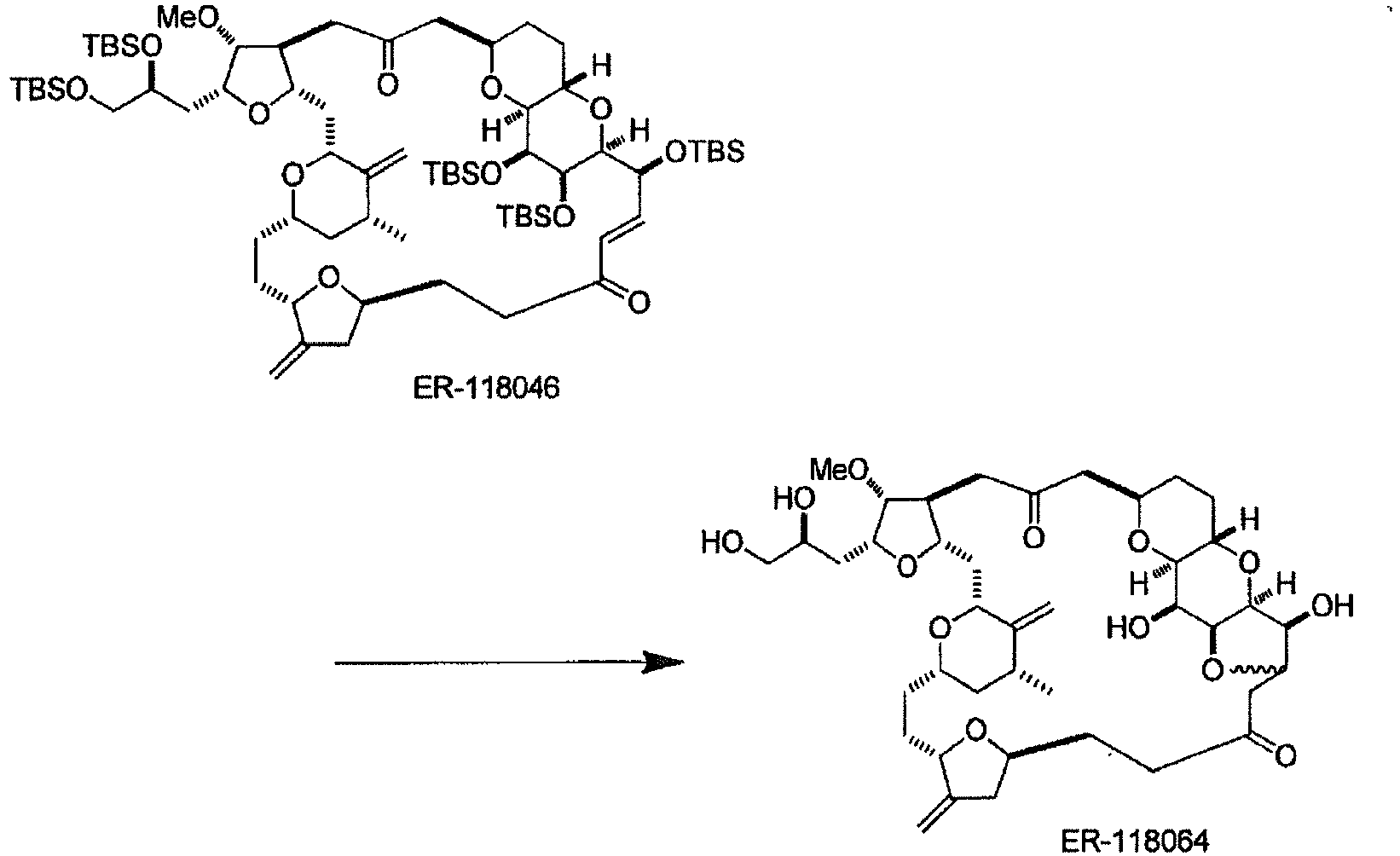
- Into an appropriately sized reaction vessel (Vessel A) was charged imidazole hydrochloride (0.39 wt, 5 eq) followed by 1 M TBAF in THF (7.6 vol, 10 eq) at ambient temperature. The resulting mixture was stirred until it was homogeneous (15-30 minutes). Into a second reaction vessel (Vessel B) was charged ER-118046 (1 wt, 1 eq) and THF (33 vol). The contents of Vessel B were placed under an inert atmosphere and stirred until ER-118046 was fully dissolved. The contents of Vessel A (TBAF/Imidazole) were charged as a single portion into Vessel B (ER-118046/THF). After 3-4 days, the reaction solution was loaded onto a column and purified by silica gel chromatography.
-

- The dried ER-118064 residue was dissolved in anhydrous dichloromethane (28 vol) under a nitrogen atmosphere and treated with PPTS (1.0 wt, 5.2 eq) in one portion. After 30-90 minutes, the reaction mixture was directly loaded atop of a column in an appropriate manner and purified by silica gel chromatography. The desired fractions of ER-076349 were concentrated in vacuo. The material resulting from the concentration was azeotroped twice from toluene (20 vol), affording ER-076349 as a crunchy colorless solid/foam (0.44 wt, 0.79 eq after collection of residual toluene).
-

- In a clean dry reaction vessel (Vessel C) ER-076349(1 wt, 1 eq) was dissolved in anhydrous toluene (20 vol) and concentrated to dryness under reduced pressure. The substrate was re-dissolved in anhydrous toluene (20 vol) and concentrated to dryness. The substrate was dissolved in DCM (5 vol), and the solution was placed under an argon atmosphere. Collidine (0.66 wts, 4.0 eq) was added as a single portion. Pyridine, as a solution in DCM (Vessel B), was added as a single portion (5 mole %). The resulting mixture in Vessel C was cooled to an internal temperature of - 20 to - 25 °C. A DCM solution of Ts2O (1.02 eq) was added dropwise while the internal temperature was maintained below - 16 °C. The reaction was stirred at - 20 to - 25 °C for 80 minutes then warmed to 0 °C over 20 minutes and stirred for an additional 20 minutes. The reaction was quenched with water (2 vol). The bath was removed, and the reaction allowed to warm to room temperature (15-20 °C) and stirred (20 minutes). The reaction was rinsed to a larger vessel using the IPA (100 vol) and aqueous ammonium hydroxide (100 vol) was added to the reaction. The reaction was stirred at room temperature for 15-36 hours, monitoring for the disappearance of the tosylate (ER-082892) and epoxide (ER-809681) which formed in situ. The reaction was concentrated to dryness or near dryness at reduced pressure. The resulting material was diluted with DCM (25-40 vol) and washed pH 10 buffer (NaHCO3/Na2CO3 (aq), 10 vol). The aqueous phase was back extracted with 25 vol of DCM and the combined organic layers were concentrated to dryness. The resulting free amine was purified by silica gel chromatography using a buffered ACN/water mobile phase. The pooled fractions were concentrated at reduced pressure to remove ACN. The resulting aqueous layer was diluted with DCM (40 vol) and with 30 vol of a pH 10 buffered stock solution (NaHCO3/Na2CO3). The layers were mixed well and separated. The aqueous phase was back extracted with 25 vol of DCM and the combined organic layers were concentrated to dryness. The resulting free amine was filtered as a solution in 3:1 DCM/pentane and concentrated to dryness (0.80 wts) to afford ER-086526.
- Example 1 and 2 showed that the time to complete the reactions is 1 hour and the reactions have completed within shorter time than comparative Example 1. Furthermore, as shown in Example 3 to 5, the reactions have completed within shorter time than Comparative Example 2, and also they provide substantial improvements in the yields as 94.3% to 96.6%.
- As above, the reaction progressed in short time and in good yield using the homogenizer in the reaction, even though the reaction is such as manufacturing scale far more than the laboratory scale. Thereby this invention provides manufacturing methods of Eribulin and pharmaceutically acceptable salt thereof efficiently and in good yield.
Claims (10)
- A method for manufacturing a compound represented by a formula (II) or salt thereof,

from a compound represented by a formula (III),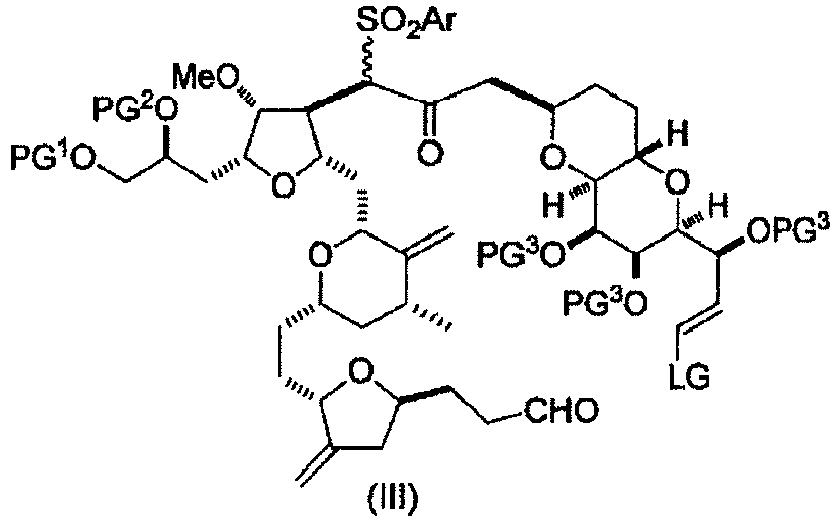
comprising a reaction step where a reactant is stirred with homogenizer in the presence of manganese powder and chromium compound. - The method according to claim 1, wherein the chromium compound is chromium chloride (III).
- The method according to claim 1 or 2, wherein the step where the reactant is stirred with homogenizer in the presence of manganese powder and chromium compound is a step for manufacturing a compound represented by a formula (IV),

from a compound represented by a formula (III)
- The method according to any one of claim 1 to 3, wherein the step where the reactant is stirred with homogenizer in the presence of manganese powder and chromium compound is a step for manufacturing a compound represented by a formula (II),

from a compound represented by a formula (IV),
- The method according to claims 1 or 2, wherein the step where the reactant is stirred with homogenizer in the presence of manganese powder and chromium compound is a step for manufacturing a compound represented by a formula (II),

from a compound represented by a formula (V),
- The method according to claims 3 or 5, wherein conducting the reaction in the presence of nickel compound in the reaction step.
- The method according to any one of claims 1 to 6, wherein catalytic amount of chromium compound is used.
- The method according to any one of claims 1 to 7, wherein PG1, PG2 and PG3 are tert-butyldimethylsilyl (TBS) group.
- A method for manufacturing Eribulin or the salt thereof, comprising the method according to the any one of claims 1 to 8.
- The method according to claim 9, wherein the salt of Eribulin is Eribulin mesylate.
Applications Claiming Priority (2)
| Application Number | Priority Date | Filing Date | Title |
|---|---|---|---|
| JP2014173033A JP2017206439A (en) | 2014-08-27 | 2014-08-27 | Method for producing antitumor agent using homogenizer |
| PCT/JP2015/073787 WO2016031796A1 (en) | 2014-08-27 | 2015-08-25 | Method for producing antitumor agent using homogenizer |
Publications (3)
| Publication Number | Publication Date |
|---|---|
| EP3187500A1 true EP3187500A1 (en) | 2017-07-05 |
| EP3187500A4 EP3187500A4 (en) | 2018-01-10 |
| EP3187500B1 EP3187500B1 (en) | 2019-01-02 |
Family
ID=55399683
Family Applications (1)
| Application Number | Title | Priority Date | Filing Date |
|---|---|---|---|
| EP15836991.8A Not-in-force EP3187500B1 (en) | 2014-08-27 | 2015-08-25 | Method for producing antitumor agent using a homogenizer |
Country Status (3)
| Country | Link |
|---|---|
| EP (1) | EP3187500B1 (en) |
| JP (1) | JP2017206439A (en) |
| WO (1) | WO2016031796A1 (en) |
Cited By (2)
| Publication number | Priority date | Publication date | Assignee | Title |
|---|---|---|---|---|
| CN109694379A (en) * | 2017-10-24 | 2019-04-30 | 江苏恒瑞医药股份有限公司 | It is used to prepare the intermediate and preparation method thereof of eribulin |
| EP3823973A4 (en) * | 2018-07-20 | 2022-09-21 | Dr. Reddy's Laboratories Limited | PURIFICATION PROCESSES FOR THE MANUFACTURE OF ERIBULIN AND INTERMEDIATE PRODUCTS THEREOF |
Families Citing this family (4)
| Publication number | Priority date | Publication date | Assignee | Title |
|---|---|---|---|---|
| CN106946906A (en) * | 2017-05-05 | 2017-07-14 | 重庆泰濠制药有限公司 | A kind of compound and its preparation method and application |
| EP3713565A1 (en) | 2017-11-20 | 2020-09-30 | Basilea Pharmaceutica International AG | Pharmaceutical combinations for use in the treatment of neoplastic diseases |
| CN110684036B (en) * | 2019-11-22 | 2022-04-12 | 江苏慧聚药业股份有限公司 | Method for preparing eribulin mesylate |
| CN113354659B (en) * | 2021-06-08 | 2022-04-08 | 江苏慧聚药业股份有限公司 | Synthesis of eribulin mesylate |
Family Cites Families (4)
| Publication number | Priority date | Publication date | Assignee | Title |
|---|---|---|---|---|
| JPH10128113A (en) * | 1996-10-29 | 1998-05-19 | Daicel Chem Ind Ltd | Manganese dioxide catalyst, its production and production of carboxylic amide using the same |
| US6433208B1 (en) * | 1999-11-04 | 2002-08-13 | Oxy Vinyls Lp | Method for producing stable, dilute, aqueous, emulsified peroxydicarbonates by homogenization |
| US20090203771A1 (en) * | 2007-11-16 | 2009-08-13 | Eisai R&D Management Co., Ltd. | Novel intermediate for halichondrin b analog synthesis and novel desulfonylation reaction used for the intermediate |
| JP2010285428A (en) * | 2009-05-15 | 2010-12-24 | Eisai R & D Management Co Ltd | New method for removing substituent having hetero atom at alpha position of carbonyl group |
-
2014
- 2014-08-27 JP JP2014173033A patent/JP2017206439A/en active Pending
-
2015
- 2015-08-25 EP EP15836991.8A patent/EP3187500B1/en not_active Not-in-force
- 2015-08-25 WO PCT/JP2015/073787 patent/WO2016031796A1/en not_active Ceased
Cited By (3)
| Publication number | Priority date | Publication date | Assignee | Title |
|---|---|---|---|---|
| CN109694379A (en) * | 2017-10-24 | 2019-04-30 | 江苏恒瑞医药股份有限公司 | It is used to prepare the intermediate and preparation method thereof of eribulin |
| CN109694379B (en) * | 2017-10-24 | 2020-09-11 | 江苏恒瑞医药股份有限公司 | Intermediate for preparing eribulin and preparation method thereof |
| EP3823973A4 (en) * | 2018-07-20 | 2022-09-21 | Dr. Reddy's Laboratories Limited | PURIFICATION PROCESSES FOR THE MANUFACTURE OF ERIBULIN AND INTERMEDIATE PRODUCTS THEREOF |
Also Published As
| Publication number | Publication date |
|---|---|
| EP3187500B1 (en) | 2019-01-02 |
| EP3187500A4 (en) | 2018-01-10 |
| WO2016031796A1 (en) | 2016-03-03 |
| JP2017206439A (en) | 2017-11-24 |
Similar Documents
| Publication | Publication Date | Title |
|---|---|---|
| EP3187500B1 (en) | Method for producing antitumor agent using a homogenizer | |
| US9856276B2 (en) | Compounds useful in the synthesis of halichondrin B analogs | |
| JP5134686B2 (en) | Novel intermediates for the synthesis of halichondrin B analogues and novel desulfonylation reactions for use in said intermediates | |
| JP5264561B2 (en) | Highly lipophilic camptothecin derivative | |
| Li et al. | Synthesis and biological activities of dithiocarbamates containing 1, 2, 3-triazoles group | |
| EP3480201A1 (en) | New analogs as androgen receptor and glucocorticoid receptor modulators | |
| US20040063976A1 (en) | Conversion 9-dihydro-13-acetylbaccatin iii into 10-deacetylbaccatin iii | |
| TW201206895A (en) | Taxane compounds, compositions and methods | |
| EP3986414A1 (en) | Semi-synthetic analogues of epipolythiodioxopiperazine alkaloids | |
| WO2013162922A1 (en) | Taxane compounds, compositions and methods | |
| CN101889005A (en) | Intermediates in the Synthesis of Zearalenone Macrolide Analogues | |
| CN104530066A (en) | Novel homocamptothecin derivative and preparation method and application of novel homocamptothecin derivative | |
| US9284327B2 (en) | Taxane compounds, compositions and methods | |
| JPH04338399A (en) | Condensed quinoline derivative | |
| WO2017156688A1 (en) | Preparation method for nitroolefin derivative | |
| CN106478477A (en) | Enzalutamide intermediate compound and preparation method thereof |
Legal Events
| Date | Code | Title | Description |
|---|---|---|---|
| STAA | Information on the status of an ep patent application or granted ep patent |
Free format text: STATUS: THE INTERNATIONAL PUBLICATION HAS BEEN MADE |
|
| PUAI | Public reference made under article 153(3) epc to a published international application that has entered the european phase |
Free format text: ORIGINAL CODE: 0009012 |
|
| STAA | Information on the status of an ep patent application or granted ep patent |
Free format text: STATUS: REQUEST FOR EXAMINATION WAS MADE |
|
| 17P | Request for examination filed |
Effective date: 20170215 |
|
| AK | Designated contracting states |
Kind code of ref document: A1 Designated state(s): AL AT BE BG CH CY CZ DE DK EE ES FI FR GB GR HR HU IE IS IT LI LT LU LV MC MK MT NL NO PL PT RO RS SE SI SK SM TR |
|
| AX | Request for extension of the european patent |
Extension state: BA ME |
|
| REG | Reference to a national code |
Ref country code: DE Ref legal event code: R079 Ref document number: 602015022997 Country of ref document: DE Free format text: PREVIOUS MAIN CLASS: C07F0007180000 Ipc: C07D0493040000 |
|
| DAV | Request for validation of the european patent (deleted) | ||
| DAX | Request for extension of the european patent (deleted) | ||
| A4 | Supplementary search report drawn up and despatched |
Effective date: 20171212 |
|
| RIC1 | Information provided on ipc code assigned before grant |
Ipc: C07D 493/22 20060101ALI20171205BHEP Ipc: C07D 493/04 20060101AFI20171205BHEP Ipc: C07F 7/18 20060101ALI20171205BHEP Ipc: C07B 61/00 20060101ALI20171205BHEP |
|
| GRAP | Despatch of communication of intention to grant a patent |
Free format text: ORIGINAL CODE: EPIDOSNIGR1 |
|
| STAA | Information on the status of an ep patent application or granted ep patent |
Free format text: STATUS: GRANT OF PATENT IS INTENDED |
|
| INTG | Intention to grant announced |
Effective date: 20180816 |
|
| GRAS | Grant fee paid |
Free format text: ORIGINAL CODE: EPIDOSNIGR3 |
|
| GRAA | (expected) grant |
Free format text: ORIGINAL CODE: 0009210 |
|
| STAA | Information on the status of an ep patent application or granted ep patent |
Free format text: STATUS: THE PATENT HAS BEEN GRANTED |
|
| AK | Designated contracting states |
Kind code of ref document: B1 Designated state(s): AL AT BE BG CH CY CZ DE DK EE ES FI FR GB GR HR HU IE IS IT LI LT LU LV MC MK MT NL NO PL PT RO RS SE SI SK SM TR |
|
| REG | Reference to a national code |
Ref country code: GB Ref legal event code: FG4D |
|
| REG | Reference to a national code |
Ref country code: CH Ref legal event code: EP Ref country code: AT Ref legal event code: REF Ref document number: 1084219 Country of ref document: AT Kind code of ref document: T Effective date: 20190115 |
|
| REG | Reference to a national code |
Ref country code: IE Ref legal event code: FG4D |
|
| REG | Reference to a national code |
Ref country code: DE Ref legal event code: R096 Ref document number: 602015022997 Country of ref document: DE |
|
| REG | Reference to a national code |
Ref country code: NL Ref legal event code: MP Effective date: 20190102 |
|
| REG | Reference to a national code |
Ref country code: LT Ref legal event code: MG4D |
|
| REG | Reference to a national code |
Ref country code: AT Ref legal event code: MK05 Ref document number: 1084219 Country of ref document: AT Kind code of ref document: T Effective date: 20190102 |
|
| PG25 | Lapsed in a contracting state [announced via postgrant information from national office to epo] |
Ref country code: NL Free format text: LAPSE BECAUSE OF FAILURE TO SUBMIT A TRANSLATION OF THE DESCRIPTION OR TO PAY THE FEE WITHIN THE PRESCRIBED TIME-LIMIT Effective date: 20190102 |
|
| PG25 | Lapsed in a contracting state [announced via postgrant information from national office to epo] |
Ref country code: PL Free format text: LAPSE BECAUSE OF FAILURE TO SUBMIT A TRANSLATION OF THE DESCRIPTION OR TO PAY THE FEE WITHIN THE PRESCRIBED TIME-LIMIT Effective date: 20190102 Ref country code: NO Free format text: LAPSE BECAUSE OF FAILURE TO SUBMIT A TRANSLATION OF THE DESCRIPTION OR TO PAY THE FEE WITHIN THE PRESCRIBED TIME-LIMIT Effective date: 20190402 Ref country code: FI Free format text: LAPSE BECAUSE OF FAILURE TO SUBMIT A TRANSLATION OF THE DESCRIPTION OR TO PAY THE FEE WITHIN THE PRESCRIBED TIME-LIMIT Effective date: 20190102 Ref country code: PT Free format text: LAPSE BECAUSE OF FAILURE TO SUBMIT A TRANSLATION OF THE DESCRIPTION OR TO PAY THE FEE WITHIN THE PRESCRIBED TIME-LIMIT Effective date: 20190502 Ref country code: SE Free format text: LAPSE BECAUSE OF FAILURE TO SUBMIT A TRANSLATION OF THE DESCRIPTION OR TO PAY THE FEE WITHIN THE PRESCRIBED TIME-LIMIT Effective date: 20190102 Ref country code: ES Free format text: LAPSE BECAUSE OF FAILURE TO SUBMIT A TRANSLATION OF THE DESCRIPTION OR TO PAY THE FEE WITHIN THE PRESCRIBED TIME-LIMIT Effective date: 20190102 Ref country code: LT Free format text: LAPSE BECAUSE OF FAILURE TO SUBMIT A TRANSLATION OF THE DESCRIPTION OR TO PAY THE FEE WITHIN THE PRESCRIBED TIME-LIMIT Effective date: 20190102 |
|
| PG25 | Lapsed in a contracting state [announced via postgrant information from national office to epo] |
Ref country code: RS Free format text: LAPSE BECAUSE OF FAILURE TO SUBMIT A TRANSLATION OF THE DESCRIPTION OR TO PAY THE FEE WITHIN THE PRESCRIBED TIME-LIMIT Effective date: 20190102 Ref country code: HR Free format text: LAPSE BECAUSE OF FAILURE TO SUBMIT A TRANSLATION OF THE DESCRIPTION OR TO PAY THE FEE WITHIN THE PRESCRIBED TIME-LIMIT Effective date: 20190102 Ref country code: GR Free format text: LAPSE BECAUSE OF FAILURE TO SUBMIT A TRANSLATION OF THE DESCRIPTION OR TO PAY THE FEE WITHIN THE PRESCRIBED TIME-LIMIT Effective date: 20190403 Ref country code: BG Free format text: LAPSE BECAUSE OF FAILURE TO SUBMIT A TRANSLATION OF THE DESCRIPTION OR TO PAY THE FEE WITHIN THE PRESCRIBED TIME-LIMIT Effective date: 20190402 Ref country code: LV Free format text: LAPSE BECAUSE OF FAILURE TO SUBMIT A TRANSLATION OF THE DESCRIPTION OR TO PAY THE FEE WITHIN THE PRESCRIBED TIME-LIMIT Effective date: 20190102 Ref country code: IS Free format text: LAPSE BECAUSE OF FAILURE TO SUBMIT A TRANSLATION OF THE DESCRIPTION OR TO PAY THE FEE WITHIN THE PRESCRIBED TIME-LIMIT Effective date: 20190502 |
|
| REG | Reference to a national code |
Ref country code: DE Ref legal event code: R097 Ref document number: 602015022997 Country of ref document: DE |
|
| PG25 | Lapsed in a contracting state [announced via postgrant information from national office to epo] |
Ref country code: CZ Free format text: LAPSE BECAUSE OF FAILURE TO SUBMIT A TRANSLATION OF THE DESCRIPTION OR TO PAY THE FEE WITHIN THE PRESCRIBED TIME-LIMIT Effective date: 20190102 Ref country code: AL Free format text: LAPSE BECAUSE OF FAILURE TO SUBMIT A TRANSLATION OF THE DESCRIPTION OR TO PAY THE FEE WITHIN THE PRESCRIBED TIME-LIMIT Effective date: 20190102 Ref country code: RO Free format text: LAPSE BECAUSE OF FAILURE TO SUBMIT A TRANSLATION OF THE DESCRIPTION OR TO PAY THE FEE WITHIN THE PRESCRIBED TIME-LIMIT Effective date: 20190102 Ref country code: DK Free format text: LAPSE BECAUSE OF FAILURE TO SUBMIT A TRANSLATION OF THE DESCRIPTION OR TO PAY THE FEE WITHIN THE PRESCRIBED TIME-LIMIT Effective date: 20190102 Ref country code: AT Free format text: LAPSE BECAUSE OF FAILURE TO SUBMIT A TRANSLATION OF THE DESCRIPTION OR TO PAY THE FEE WITHIN THE PRESCRIBED TIME-LIMIT Effective date: 20190102 Ref country code: IT Free format text: LAPSE BECAUSE OF FAILURE TO SUBMIT A TRANSLATION OF THE DESCRIPTION OR TO PAY THE FEE WITHIN THE PRESCRIBED TIME-LIMIT Effective date: 20190102 Ref country code: EE Free format text: LAPSE BECAUSE OF FAILURE TO SUBMIT A TRANSLATION OF THE DESCRIPTION OR TO PAY THE FEE WITHIN THE PRESCRIBED TIME-LIMIT Effective date: 20190102 Ref country code: SK Free format text: LAPSE BECAUSE OF FAILURE TO SUBMIT A TRANSLATION OF THE DESCRIPTION OR TO PAY THE FEE WITHIN THE PRESCRIBED TIME-LIMIT Effective date: 20190102 |
|
| PLBE | No opposition filed within time limit |
Free format text: ORIGINAL CODE: 0009261 |
|
| STAA | Information on the status of an ep patent application or granted ep patent |
Free format text: STATUS: NO OPPOSITION FILED WITHIN TIME LIMIT |
|
| PG25 | Lapsed in a contracting state [announced via postgrant information from national office to epo] |
Ref country code: SM Free format text: LAPSE BECAUSE OF FAILURE TO SUBMIT A TRANSLATION OF THE DESCRIPTION OR TO PAY THE FEE WITHIN THE PRESCRIBED TIME-LIMIT Effective date: 20190102 |
|
| 26N | No opposition filed |
Effective date: 20191003 |
|
| PG25 | Lapsed in a contracting state [announced via postgrant information from national office to epo] |
Ref country code: SI Free format text: LAPSE BECAUSE OF FAILURE TO SUBMIT A TRANSLATION OF THE DESCRIPTION OR TO PAY THE FEE WITHIN THE PRESCRIBED TIME-LIMIT Effective date: 20190102 |
|
| PG25 | Lapsed in a contracting state [announced via postgrant information from national office to epo] |
Ref country code: TR Free format text: LAPSE BECAUSE OF FAILURE TO SUBMIT A TRANSLATION OF THE DESCRIPTION OR TO PAY THE FEE WITHIN THE PRESCRIBED TIME-LIMIT Effective date: 20190102 |
|
| PG25 | Lapsed in a contracting state [announced via postgrant information from national office to epo] |
Ref country code: MC Free format text: LAPSE BECAUSE OF FAILURE TO SUBMIT A TRANSLATION OF THE DESCRIPTION OR TO PAY THE FEE WITHIN THE PRESCRIBED TIME-LIMIT Effective date: 20190102 Ref country code: LU Free format text: LAPSE BECAUSE OF NON-PAYMENT OF DUE FEES Effective date: 20190825 Ref country code: CH Free format text: LAPSE BECAUSE OF NON-PAYMENT OF DUE FEES Effective date: 20190831 Ref country code: LI Free format text: LAPSE BECAUSE OF NON-PAYMENT OF DUE FEES Effective date: 20190831 |
|
| REG | Reference to a national code |
Ref country code: BE Ref legal event code: MM Effective date: 20190831 |
|
| PG25 | Lapsed in a contracting state [announced via postgrant information from national office to epo] |
Ref country code: IE Free format text: LAPSE BECAUSE OF NON-PAYMENT OF DUE FEES Effective date: 20190825 |
|
| PG25 | Lapsed in a contracting state [announced via postgrant information from national office to epo] |
Ref country code: BE Free format text: LAPSE BECAUSE OF NON-PAYMENT OF DUE FEES Effective date: 20190831 |
|
| PGFP | Annual fee paid to national office [announced via postgrant information from national office to epo] |
Ref country code: DE Payment date: 20200819 Year of fee payment: 6 Ref country code: FR Payment date: 20200821 Year of fee payment: 6 Ref country code: GB Payment date: 20200826 Year of fee payment: 6 |
|
| PG25 | Lapsed in a contracting state [announced via postgrant information from national office to epo] |
Ref country code: CY Free format text: LAPSE BECAUSE OF FAILURE TO SUBMIT A TRANSLATION OF THE DESCRIPTION OR TO PAY THE FEE WITHIN THE PRESCRIBED TIME-LIMIT Effective date: 20190102 |
|
| PG25 | Lapsed in a contracting state [announced via postgrant information from national office to epo] |
Ref country code: MT Free format text: LAPSE BECAUSE OF FAILURE TO SUBMIT A TRANSLATION OF THE DESCRIPTION OR TO PAY THE FEE WITHIN THE PRESCRIBED TIME-LIMIT Effective date: 20190102 Ref country code: HU Free format text: LAPSE BECAUSE OF FAILURE TO SUBMIT A TRANSLATION OF THE DESCRIPTION OR TO PAY THE FEE WITHIN THE PRESCRIBED TIME-LIMIT; INVALID AB INITIO Effective date: 20150825 |
|
| REG | Reference to a national code |
Ref country code: DE Ref legal event code: R119 Ref document number: 602015022997 Country of ref document: DE |
|
| GBPC | Gb: european patent ceased through non-payment of renewal fee |
Effective date: 20210825 |
|
| PG25 | Lapsed in a contracting state [announced via postgrant information from national office to epo] |
Ref country code: MK Free format text: LAPSE BECAUSE OF FAILURE TO SUBMIT A TRANSLATION OF THE DESCRIPTION OR TO PAY THE FEE WITHIN THE PRESCRIBED TIME-LIMIT Effective date: 20190102 |
|
| PG25 | Lapsed in a contracting state [announced via postgrant information from national office to epo] |
Ref country code: GB Free format text: LAPSE BECAUSE OF NON-PAYMENT OF DUE FEES Effective date: 20210825 Ref country code: FR Free format text: LAPSE BECAUSE OF NON-PAYMENT OF DUE FEES Effective date: 20210831 Ref country code: DE Free format text: LAPSE BECAUSE OF NON-PAYMENT OF DUE FEES Effective date: 20220301 |