EP3187251A1 - Polymer and method for preparing the same - Google Patents
Polymer and method for preparing the same Download PDFInfo
- Publication number
- EP3187251A1 EP3187251A1 EP16172017.2A EP16172017A EP3187251A1 EP 3187251 A1 EP3187251 A1 EP 3187251A1 EP 16172017 A EP16172017 A EP 16172017A EP 3187251 A1 EP3187251 A1 EP 3187251A1
- Authority
- EP
- European Patent Office
- Prior art keywords
- repeat unit
- polymer
- monomer
- independently
- butyl
- Prior art date
- Legal status (The legal status is an assumption and is not a legal conclusion. Google has not performed a legal analysis and makes no representation as to the accuracy of the status listed.)
- Granted
Links
- 0 CC(C)N*C(*)** Chemical compound CC(C)N*C(*)** 0.000 description 19
Classifications
-
- C—CHEMISTRY; METALLURGY
- C08—ORGANIC MACROMOLECULAR COMPOUNDS; THEIR PREPARATION OR CHEMICAL WORKING-UP; COMPOSITIONS BASED THEREON
- C08F—MACROMOLECULAR COMPOUNDS OBTAINED BY REACTIONS ONLY INVOLVING CARBON-TO-CARBON UNSATURATED BONDS
- C08F232/00—Copolymers of cyclic compounds containing no unsaturated aliphatic radicals in a side chain, and having one or more carbon-to-carbon double bonds in a carbocyclic ring system
- C08F232/08—Copolymers of cyclic compounds containing no unsaturated aliphatic radicals in a side chain, and having one or more carbon-to-carbon double bonds in a carbocyclic ring system having condensed rings
-
- B—PERFORMING OPERATIONS; TRANSPORTING
- B01—PHYSICAL OR CHEMICAL PROCESSES OR APPARATUS IN GENERAL
- B01J—CHEMICAL OR PHYSICAL PROCESSES, e.g. CATALYSIS OR COLLOID CHEMISTRY; THEIR RELEVANT APPARATUS
- B01J41/00—Anion exchange; Use of material as anion exchangers; Treatment of material for improving the anion exchange properties
- B01J41/08—Use of material as anion exchangers; Treatment of material for improving the anion exchange properties
- B01J41/12—Macromolecular compounds
- B01J41/14—Macromolecular compounds obtained by reactions only involving unsaturated carbon-to-carbon bonds
-
- B—PERFORMING OPERATIONS; TRANSPORTING
- B01—PHYSICAL OR CHEMICAL PROCESSES OR APPARATUS IN GENERAL
- B01D—SEPARATION
- B01D71/00—Semi-permeable membranes for separation processes or apparatus characterised by the material; Manufacturing processes specially adapted therefor
- B01D71/06—Organic material
- B01D71/44—Polymers obtained by reactions only involving carbon-to-carbon unsaturated bonds, not provided for in a single one of groups B01D71/26-B01D71/42
-
- B—PERFORMING OPERATIONS; TRANSPORTING
- B01—PHYSICAL OR CHEMICAL PROCESSES OR APPARATUS IN GENERAL
- B01D—SEPARATION
- B01D71/00—Semi-permeable membranes for separation processes or apparatus characterised by the material; Manufacturing processes specially adapted therefor
- B01D71/06—Organic material
- B01D71/76—Macromolecular material not specifically provided for in a single one of groups B01D71/08 - B01D71/74
- B01D71/82—Macromolecular material not specifically provided for in a single one of groups B01D71/08 - B01D71/74 characterised by the presence of specified groups, e.g. introduced by chemical after-treatment
-
- C—CHEMISTRY; METALLURGY
- C07—ORGANIC CHEMISTRY
- C07C—ACYCLIC OR CARBOCYCLIC COMPOUNDS
- C07C2/00—Preparation of hydrocarbons from hydrocarbons containing a smaller number of carbon atoms
-
- C—CHEMISTRY; METALLURGY
- C07—ORGANIC CHEMISTRY
- C07D—HETEROCYCLIC COMPOUNDS
- C07D233/00—Heterocyclic compounds containing 1,3-diazole or hydrogenated 1,3-diazole rings, not condensed with other rings
- C07D233/54—Heterocyclic compounds containing 1,3-diazole or hydrogenated 1,3-diazole rings, not condensed with other rings having two double bonds between ring members or between ring members and non-ring members
- C07D233/56—Heterocyclic compounds containing 1,3-diazole or hydrogenated 1,3-diazole rings, not condensed with other rings having two double bonds between ring members or between ring members and non-ring members with only hydrogen atoms or radicals containing only hydrogen and carbon atoms, attached to ring carbon atoms
- C07D233/58—Heterocyclic compounds containing 1,3-diazole or hydrogenated 1,3-diazole rings, not condensed with other rings having two double bonds between ring members or between ring members and non-ring members with only hydrogen atoms or radicals containing only hydrogen and carbon atoms, attached to ring carbon atoms with only hydrogen atoms or radicals containing only hydrogen and carbon atoms, attached to ring nitrogen atoms
-
- C—CHEMISTRY; METALLURGY
- C07—ORGANIC CHEMISTRY
- C07D—HETEROCYCLIC COMPOUNDS
- C07D233/00—Heterocyclic compounds containing 1,3-diazole or hydrogenated 1,3-diazole rings, not condensed with other rings
- C07D233/54—Heterocyclic compounds containing 1,3-diazole or hydrogenated 1,3-diazole rings, not condensed with other rings having two double bonds between ring members or between ring members and non-ring members
- C07D233/64—Heterocyclic compounds containing 1,3-diazole or hydrogenated 1,3-diazole rings, not condensed with other rings having two double bonds between ring members or between ring members and non-ring members with substituted hydrocarbon radicals attached to ring carbon atoms, e.g. histidine
-
- C—CHEMISTRY; METALLURGY
- C08—ORGANIC MACROMOLECULAR COMPOUNDS; THEIR PREPARATION OR CHEMICAL WORKING-UP; COMPOSITIONS BASED THEREON
- C08F—MACROMOLECULAR COMPOUNDS OBTAINED BY REACTIONS ONLY INVOLVING CARBON-TO-CARBON UNSATURATED BONDS
- C08F232/00—Copolymers of cyclic compounds containing no unsaturated aliphatic radicals in a side chain, and having one or more carbon-to-carbon double bonds in a carbocyclic ring system
- C08F232/02—Copolymers of cyclic compounds containing no unsaturated aliphatic radicals in a side chain, and having one or more carbon-to-carbon double bonds in a carbocyclic ring system having no condensed rings
- C08F232/04—Copolymers of cyclic compounds containing no unsaturated aliphatic radicals in a side chain, and having one or more carbon-to-carbon double bonds in a carbocyclic ring system having no condensed rings having one carbon-to-carbon double bond
-
- C—CHEMISTRY; METALLURGY
- C08—ORGANIC MACROMOLECULAR COMPOUNDS; THEIR PREPARATION OR CHEMICAL WORKING-UP; COMPOSITIONS BASED THEREON
- C08G—MACROMOLECULAR COMPOUNDS OBTAINED OTHERWISE THAN BY REACTIONS ONLY INVOLVING UNSATURATED CARBON-TO-CARBON BONDS
- C08G61/00—Macromolecular compounds obtained by reactions forming a carbon-to-carbon link in the main chain of the macromolecule
- C08G61/02—Macromolecular compounds containing only carbon atoms in the main chain of the macromolecule, e.g. polyxylylenes
- C08G61/04—Macromolecular compounds containing only carbon atoms in the main chain of the macromolecule, e.g. polyxylylenes only aliphatic carbon atoms
- C08G61/06—Macromolecular compounds containing only carbon atoms in the main chain of the macromolecule, e.g. polyxylylenes only aliphatic carbon atoms prepared by ring-opening of carbocyclic compounds
- C08G61/08—Macromolecular compounds containing only carbon atoms in the main chain of the macromolecule, e.g. polyxylylenes only aliphatic carbon atoms prepared by ring-opening of carbocyclic compounds of carbocyclic compounds containing one or more carbon-to-carbon double bonds in the ring
-
- C—CHEMISTRY; METALLURGY
- C08—ORGANIC MACROMOLECULAR COMPOUNDS; THEIR PREPARATION OR CHEMICAL WORKING-UP; COMPOSITIONS BASED THEREON
- C08J—WORKING-UP; GENERAL PROCESSES OF COMPOUNDING; AFTER-TREATMENT NOT COVERED BY SUBCLASSES C08B, C08C, C08F, C08G or C08H
- C08J5/00—Manufacture of articles or shaped materials containing macromolecular substances
- C08J5/20—Manufacture of shaped structures of ion-exchange resins
- C08J5/22—Films, membranes or diaphragms
-
- C—CHEMISTRY; METALLURGY
- C08—ORGANIC MACROMOLECULAR COMPOUNDS; THEIR PREPARATION OR CHEMICAL WORKING-UP; COMPOSITIONS BASED THEREON
- C08J—WORKING-UP; GENERAL PROCESSES OF COMPOUNDING; AFTER-TREATMENT NOT COVERED BY SUBCLASSES C08B, C08C, C08F, C08G or C08H
- C08J5/00—Manufacture of articles or shaped materials containing macromolecular substances
- C08J5/20—Manufacture of shaped structures of ion-exchange resins
- C08J5/22—Films, membranes or diaphragms
- C08J5/2206—Films, membranes or diaphragms based on organic and/or inorganic macromolecular compounds
- C08J5/2218—Synthetic macromolecular compounds
- C08J5/2256—Synthetic macromolecular compounds based on macromolecular compounds obtained by reactions other than those involving carbon-to-carbon bonds, e.g. obtained by polycondensation
-
- H—ELECTRICITY
- H01—ELECTRIC ELEMENTS
- H01M—PROCESSES OR MEANS, e.g. BATTERIES, FOR THE DIRECT CONVERSION OF CHEMICAL ENERGY INTO ELECTRICAL ENERGY
- H01M8/00—Fuel cells; Manufacture thereof
- H01M8/08—Fuel cells with aqueous electrolytes
- H01M8/083—Alkaline fuel cells
-
- H—ELECTRICITY
- H01—ELECTRIC ELEMENTS
- H01M—PROCESSES OR MEANS, e.g. BATTERIES, FOR THE DIRECT CONVERSION OF CHEMICAL ENERGY INTO ELECTRICAL ENERGY
- H01M8/00—Fuel cells; Manufacture thereof
- H01M8/10—Fuel cells with solid electrolytes
- H01M8/1016—Fuel cells with solid electrolytes characterised by the electrolyte material
- H01M8/1018—Polymeric electrolyte materials
- H01M8/102—Polymeric electrolyte materials characterised by the chemical structure of the main chain of the ion-conducting polymer
- H01M8/1023—Polymeric electrolyte materials characterised by the chemical structure of the main chain of the ion-conducting polymer having only carbon, e.g. polyarylenes, polystyrenes or polybutadiene-styrenes
-
- B—PERFORMING OPERATIONS; TRANSPORTING
- B01—PHYSICAL OR CHEMICAL PROCESSES OR APPARATUS IN GENERAL
- B01D—SEPARATION
- B01D2325/00—Details relating to properties of membranes
- B01D2325/16—Membrane materials having positively charged functional groups
-
- B—PERFORMING OPERATIONS; TRANSPORTING
- B01—PHYSICAL OR CHEMICAL PROCESSES OR APPARATUS IN GENERAL
- B01D—SEPARATION
- B01D2325/00—Details relating to properties of membranes
- B01D2325/42—Ion-exchange membranes
-
- C—CHEMISTRY; METALLURGY
- C08—ORGANIC MACROMOLECULAR COMPOUNDS; THEIR PREPARATION OR CHEMICAL WORKING-UP; COMPOSITIONS BASED THEREON
- C08G—MACROMOLECULAR COMPOUNDS OBTAINED OTHERWISE THAN BY REACTIONS ONLY INVOLVING UNSATURATED CARBON-TO-CARBON BONDS
- C08G2261/00—Macromolecular compounds obtained by reactions forming a carbon-to-carbon link in the main chain of the macromolecule
- C08G2261/10—Definition of the polymer structure
- C08G2261/12—Copolymers
- C08G2261/122—Copolymers statistical
-
- C—CHEMISTRY; METALLURGY
- C08—ORGANIC MACROMOLECULAR COMPOUNDS; THEIR PREPARATION OR CHEMICAL WORKING-UP; COMPOSITIONS BASED THEREON
- C08G—MACROMOLECULAR COMPOUNDS OBTAINED OTHERWISE THAN BY REACTIONS ONLY INVOLVING UNSATURATED CARBON-TO-CARBON BONDS
- C08G2261/00—Macromolecular compounds obtained by reactions forming a carbon-to-carbon link in the main chain of the macromolecule
- C08G2261/10—Definition of the polymer structure
- C08G2261/13—Morphological aspects
- C08G2261/135—Cross-linked structures
-
- C—CHEMISTRY; METALLURGY
- C08—ORGANIC MACROMOLECULAR COMPOUNDS; THEIR PREPARATION OR CHEMICAL WORKING-UP; COMPOSITIONS BASED THEREON
- C08G—MACROMOLECULAR COMPOUNDS OBTAINED OTHERWISE THAN BY REACTIONS ONLY INVOLVING UNSATURATED CARBON-TO-CARBON BONDS
- C08G2261/00—Macromolecular compounds obtained by reactions forming a carbon-to-carbon link in the main chain of the macromolecule
- C08G2261/10—Definition of the polymer structure
- C08G2261/14—Side-groups
- C08G2261/141—Side-chains having aliphatic units
- C08G2261/1412—Saturated aliphatic units
-
- C—CHEMISTRY; METALLURGY
- C08—ORGANIC MACROMOLECULAR COMPOUNDS; THEIR PREPARATION OR CHEMICAL WORKING-UP; COMPOSITIONS BASED THEREON
- C08G—MACROMOLECULAR COMPOUNDS OBTAINED OTHERWISE THAN BY REACTIONS ONLY INVOLVING UNSATURATED CARBON-TO-CARBON BONDS
- C08G2261/00—Macromolecular compounds obtained by reactions forming a carbon-to-carbon link in the main chain of the macromolecule
- C08G2261/10—Definition of the polymer structure
- C08G2261/14—Side-groups
- C08G2261/149—Side-chains having heteroaromatic units
-
- C—CHEMISTRY; METALLURGY
- C08—ORGANIC MACROMOLECULAR COMPOUNDS; THEIR PREPARATION OR CHEMICAL WORKING-UP; COMPOSITIONS BASED THEREON
- C08G—MACROMOLECULAR COMPOUNDS OBTAINED OTHERWISE THAN BY REACTIONS ONLY INVOLVING UNSATURATED CARBON-TO-CARBON BONDS
- C08G2261/00—Macromolecular compounds obtained by reactions forming a carbon-to-carbon link in the main chain of the macromolecule
- C08G2261/30—Monomer units or repeat units incorporating structural elements in the main chain
- C08G2261/33—Monomer units or repeat units incorporating structural elements in the main chain incorporating non-aromatic structural elements in the main chain
- C08G2261/332—Monomer units or repeat units incorporating structural elements in the main chain incorporating non-aromatic structural elements in the main chain containing only carbon atoms
- C08G2261/3324—Monomer units or repeat units incorporating structural elements in the main chain incorporating non-aromatic structural elements in the main chain containing only carbon atoms derived from norbornene
-
- C—CHEMISTRY; METALLURGY
- C08—ORGANIC MACROMOLECULAR COMPOUNDS; THEIR PREPARATION OR CHEMICAL WORKING-UP; COMPOSITIONS BASED THEREON
- C08G—MACROMOLECULAR COMPOUNDS OBTAINED OTHERWISE THAN BY REACTIONS ONLY INVOLVING UNSATURATED CARBON-TO-CARBON BONDS
- C08G2261/00—Macromolecular compounds obtained by reactions forming a carbon-to-carbon link in the main chain of the macromolecule
- C08G2261/40—Polymerisation processes
- C08G2261/41—Organometallic coupling reactions
- C08G2261/418—Ring opening metathesis polymerisation [ROMP]
-
- C—CHEMISTRY; METALLURGY
- C08—ORGANIC MACROMOLECULAR COMPOUNDS; THEIR PREPARATION OR CHEMICAL WORKING-UP; COMPOSITIONS BASED THEREON
- C08G—MACROMOLECULAR COMPOUNDS OBTAINED OTHERWISE THAN BY REACTIONS ONLY INVOLVING UNSATURATED CARBON-TO-CARBON BONDS
- C08G2261/00—Macromolecular compounds obtained by reactions forming a carbon-to-carbon link in the main chain of the macromolecule
- C08G2261/50—Physical properties
- C08G2261/51—Charge transport
- C08G2261/516—Charge transport ion-conductive
-
- C—CHEMISTRY; METALLURGY
- C08—ORGANIC MACROMOLECULAR COMPOUNDS; THEIR PREPARATION OR CHEMICAL WORKING-UP; COMPOSITIONS BASED THEREON
- C08G—MACROMOLECULAR COMPOUNDS OBTAINED OTHERWISE THAN BY REACTIONS ONLY INVOLVING UNSATURATED CARBON-TO-CARBON BONDS
- C08G2261/00—Macromolecular compounds obtained by reactions forming a carbon-to-carbon link in the main chain of the macromolecule
- C08G2261/70—Post-treatment
- C08G2261/76—Post-treatment crosslinking
-
- C—CHEMISTRY; METALLURGY
- C08—ORGANIC MACROMOLECULAR COMPOUNDS; THEIR PREPARATION OR CHEMICAL WORKING-UP; COMPOSITIONS BASED THEREON
- C08J—WORKING-UP; GENERAL PROCESSES OF COMPOUNDING; AFTER-TREATMENT NOT COVERED BY SUBCLASSES C08B, C08C, C08F, C08G or C08H
- C08J2345/00—Characterised by the use of homopolymers or copolymers of compounds having no unsaturated aliphatic radicals in side chain, and having one or more carbon-to-carbon double bonds in a carbocyclic or in a heterocyclic ring system; Derivatives of such polymers
-
- C—CHEMISTRY; METALLURGY
- C08—ORGANIC MACROMOLECULAR COMPOUNDS; THEIR PREPARATION OR CHEMICAL WORKING-UP; COMPOSITIONS BASED THEREON
- C08J—WORKING-UP; GENERAL PROCESSES OF COMPOUNDING; AFTER-TREATMENT NOT COVERED BY SUBCLASSES C08B, C08C, C08F, C08G or C08H
- C08J2365/00—Characterised by the use of macromolecular compounds obtained by reactions forming a carbon-to-carbon link in the main chain; Derivatives of such polymers
-
- Y—GENERAL TAGGING OF NEW TECHNOLOGICAL DEVELOPMENTS; GENERAL TAGGING OF CROSS-SECTIONAL TECHNOLOGIES SPANNING OVER SEVERAL SECTIONS OF THE IPC; TECHNICAL SUBJECTS COVERED BY FORMER USPC CROSS-REFERENCE ART COLLECTIONS [XRACs] AND DIGESTS
- Y02—TECHNOLOGIES OR APPLICATIONS FOR MITIGATION OR ADAPTATION AGAINST CLIMATE CHANGE
- Y02E—REDUCTION OF GREENHOUSE GAS [GHG] EMISSIONS, RELATED TO ENERGY GENERATION, TRANSMISSION OR DISTRIBUTION
- Y02E60/00—Enabling technologies; Technologies with a potential or indirect contribution to GHG emissions mitigation
- Y02E60/30—Hydrogen technology
- Y02E60/50—Fuel cells
Definitions
- the technical field relates to a polymer and a method for preparing the same.
- Ion exchange membranes are widely used in electrodialysis purification, fuel cells, electroplating, and the food industry.
- An ion exchange membrane includes a polymer material having negatively charged groups or positively charged groups serving as the film body, and migratable cations or anions under electrical or chemical potential.
- a cation exchange membrane has negatively charged groups fixed on the polymer and migratable cations.
- an anion exchange membrane has positively charged groups fixed on the polymer and migratable cations.
- the characteristics of the ion exchange membrane are determined by the number, type, and distribution of the fixed charged group.
- Anion exchange membranes made of conventional polymer material are not suitable for use in an ion exchange membrane fuel cell, due to the poor solubility, mechanical strength, and solvent selectivity of the conventional polymer material.
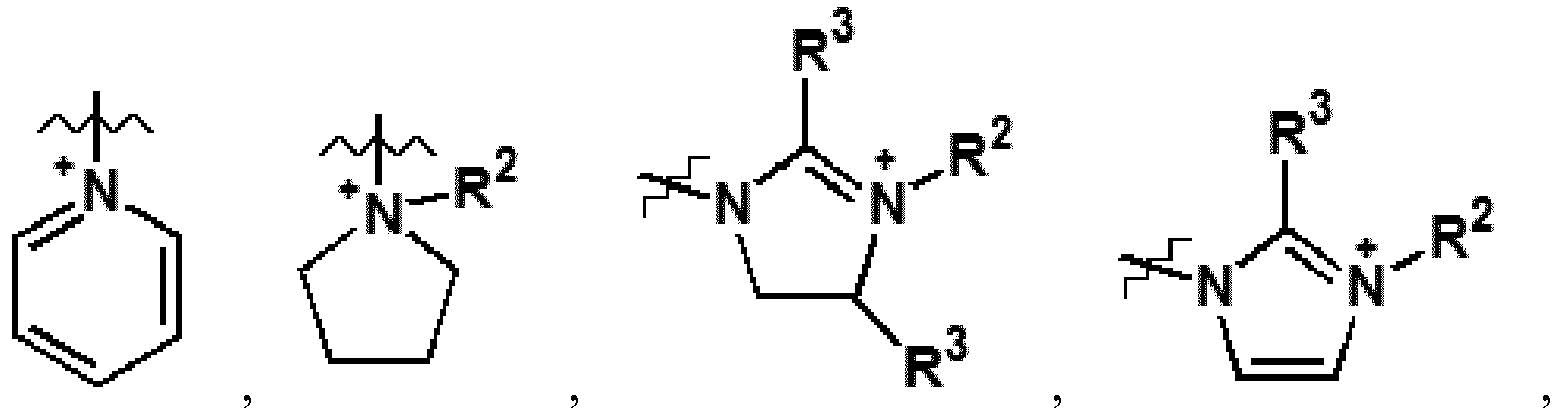
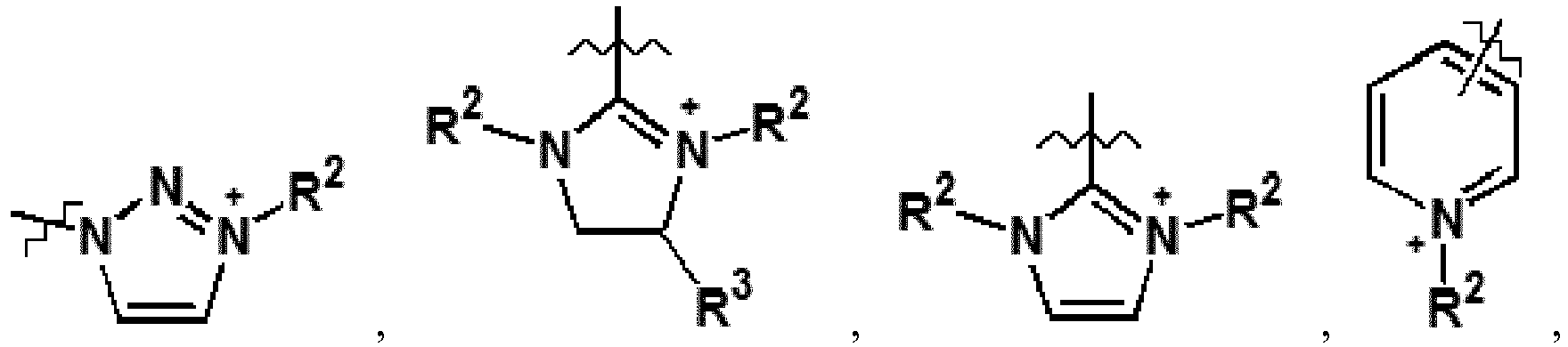
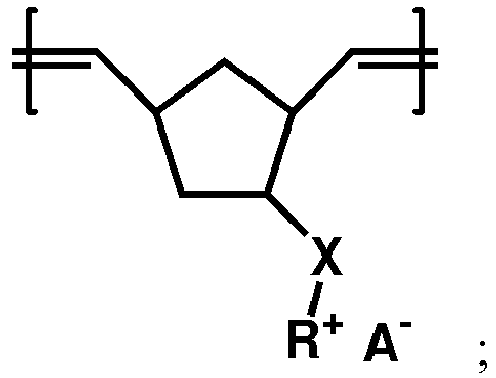
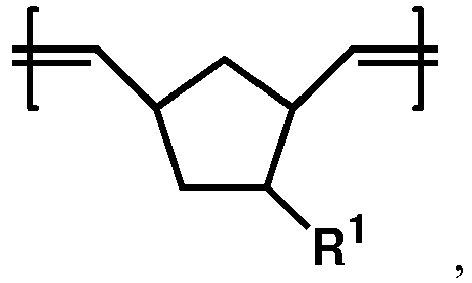
- the disclosure provides a polymer including a first repeat unit and a second repeat unit, wherein the first repeat unit can be the second repeat unit can be wherein R + can be A - can be F - , Cl - , Br - , I - , OH - , HCO 3 - , HSO 4 - , SbF 6 - , BF 4 - , H 2 PO 4 - , H 2 PO 3 - , or H 2 PO 2 - ; X can be i and j can be independently 0, or an integer from 1 to 6, Y can be -O-, -S-, -CH 2 -, or -NH-; R 1 can be independently C 1-8 alkyl group; and, R 2 and R 3 can be independently hydrogen, or C 1-8 alkyl group.
- the disclosure provides a method for preparing the aforementioned polymer.
- the method includes subjecting a composition to a polymerization.
- the composition includes a first monomer having a structure of Formula (I) and a second monomer having a structure of Formula (II) , wherein R + can be or A - can be F - , Cl - , Br - , I - , OH - , HCO 3 - , HSO 4 - , SbF 6 - , BF 4 - , H 2 PO 4 - , H 2 PO 3 - , or H 2 PO 2 - ;
- X can be i and j can be independently 0, or an integer from 1 to 6,
- Y can be -O-, -S-, -CH 2 -, or -NH-;
- R 1 can be independently C 1-8 alkyl group; and, R 2 and R 3 can be independently hydrogen, or C 1-8 alkyl group.
- the disclosure provides a polymer and a method for preparing the same.
- the polymer of the disclosure can be a polymer with a cationic group (such as a highly stable cyclic conjugated cationic group) and non-ionic group (such as long-chain group).
- a cationic group such as a highly stable cyclic conjugated cationic group
- non-ionic group such as long-chain group.
- the polymer of the disclosure in order to enhance the electrical conductivity of the polymer, has a repeat unit with a cationic group.
- the polymer of the disclosure has a repeat unit with a non-ionic group, in order to prevent the solubility of the polymer having cationic groups from decreasing when dissolving in a solvent.
- the polymer of the disclosure besides the high solubility, the polymer of the disclosure exhibits improved mechanical strength and increased solvent selectivity.
- the polymer of the disclosure includes a first repeat unit and a second repeat unit.
- the first repeat unit can be wherein R + can be or A - can be F - , Cl - , Br - , I - , OH - , HCO 3 - , HSO 4 - , SbF 6 - , BF 4 - , H 2 PO 4 - , H 2 PO 3 - , or H 2 PO 2 - ;
- X is i and j can be independently 0, or an integer from 1 to 6,
- Y can be -O-, -S-, -CH 2 -, or -NH-; and, R 2 and R 3 can be independently hydrogen, or C 1-8 alkyl group (such as : methyl, ethyl, propyl, isopropyl, n-butyl, sec-butyl, isobutyl, tert-butyl, pentyl, hexyl, cycl
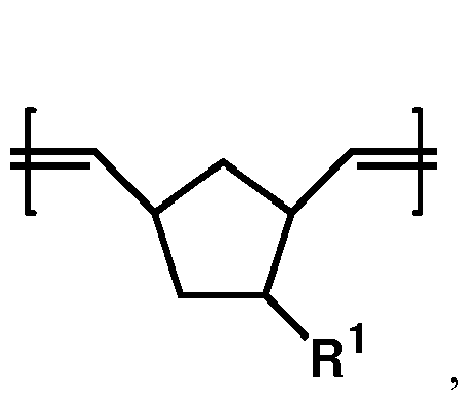
- the second repeat unit can be wherein R 1 can be independently C 1-8 alkyl group (such as methyl, ethyl, propyl, isopropyl, n-butyl, sec-butyl, isobutyl, tert-butyl, pentyl, hexyl, cyclohexyl, cyclopentyl, heptyl, or octyl).
- R 1 can be independently C 1-8 alkyl group (such as methyl, ethyl, propyl, isopropyl, n-butyl, sec-butyl, isobutyl, tert-butyl, pentyl, hexyl, cyclohexyl, cyclopentyl, heptyl, or octyl).
- the first repeat unit can be wherein R + can be (such as (such as );
- a - can be F - , Cl - , Br - , I - , OH - , HCO 3 - , HSO 4 - , SbF 6 - , BF 4 - , H 2 PO 4 - , H 2 PO 3 - , or H 2 PO 2 - ;
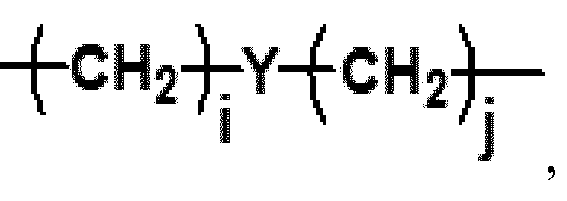
- X is ( ⁇ CH 2 ) ⁇ i Y( ⁇ CH 2 ) ⁇ j ;
- Y can be -O-, -S-, -CH 2 -, or -NH-;
- i and j can be independently 0, or an integer from 1 to 6; and,
- R 2 and R 3 can be independently hydrogen, or C 1-8 alkyl group.
- the polymer of the disclosure has a molecular weight (such as number average molecular weight) between about 100, 000 and 250,000.
- the second repeat unit can be or
- the ratio between the first repeat unit and the second repeat unit of the polymer can be adjusted to achieve the desired characteristics of the polymer.
- the ratio between the first repeat unit and the second repeat unit can be increased in order to enhance the electrical conductivity and the anion exchange capacity of the polymer.
- the ratio between the first repeat unit and the second repeat unit can be decreased in order to enhance the solubility, the mechanical strength, and the solvent selectivity of the polymer.
- the ratio between the first repeat unit and the second repeat unit can be between about 1:99 and 99:1, such as between about 10:90 and 90:10, between about 20:80 and 80:20, or between about 30:70 and 70:30.
- the polymer of the disclosure can further include a third repeat unit, wherein the third repeat unit can be The portion represented by of the first repeat unit, the second repeat unit, or the third repeat unit is bonded to the portion represented by of the other first repeat unit, the other second repeat unit, or the other third repeat unit.
- the first repeat unit, the second repeat unit, and the third repeat unit can be arranged in a random fashion.
- the polymer of the disclosure can have a moiety represented by a moiety represented by or a moiety represented by
- the ratio between the third repeat unit and the sum of the first repeat unit and the second repeat unit can be between about 0.1:100 and 5:100, such as between about 0.5:100 and 4:100, or between about 0.5:100 and 3:100. Due to the introduction of the third repeat unit, the polymer can have improved cross-linking degree and mechanical strength by adopting the third repeat unit. In addition, when the ratio between the third repeat unit and the sum of the first repeat unit and the second repeat unit is too high, the polymer would have too high a cross-linking degree and too high a molecular weight and cannot be redissolved in the subsequent process solvent.
- the disclosure provides a method for preparing the aforementioned polymer.
- the method includes subjecting a composition to a polymerization, such as a ring opening metathesis polymerization (ROMP).
- the composition can include a first monomer having a structure of Formula (I) and a second monomer having a structure of Formula (II) wherein, R + can be A - can be F - , Cl - , Br - , I - , OH - , HCO 3 - , HSO 4 - , SbF 6 - , BF 4 - , H 2 PO 4 - , H 2 PO 3 - , or H 2 PO 2 - ;
- X can be i and j can be independently 0, or an integer from 1 to 6,
- Y can be -O-, -S-, -CH 2 -, or -NH-;
- R 1 can be independently C 1-8 alkyl group; and, R 2 and R 3 can be independently hydrogen
- the first monomer can be wherein, R + can be A - can be F - , Cl - , Br - , I - , OH - , HCO 3 - , HSO 4 - , SbF 6 - , BF 4 - , H 2 PO 4 - , H 2 PO 3 - , or H 2 PO 2 - ;
- X can be i and j can be independently 0, or an integer from 1 to 6,
- Y is -O-, -S-, -CH 2 -, or -NH-; and, R 2 and R 3 are independently hydrogen, or C 1-8 alkyl group (such as : methyl, ethyl, propyl, isopropyl, n-butyl, sec-butyl, isobutyl, tert-butyl, pentyl, hexyl, cyclohexyl, cyclopentyl, heptyl, or
- the molar ratio between the first monomer and the second monomer can be between about 1:99 and 99:1, such as between about 10:90 and 90:10, between about 20:80 and 80:20, or between about 30:70 and 70:30.
- the composition can further include a third monomer, wherein the third monomer can be The molar ratio between the third monomer and the sum of the first monomer and the second monomer can be between about 0.1:100 and 5:100, such as between about 0.5:100 and 4:100, or between about 0.5:100 and 3:100.
- the polymer of the disclosure can be used to prepare an ion exchange membrane.
- the method for preparing the ion exchange membrane includes the following steps. First, a composition is provided, wherein the composition includes the aforementioned polymer and a cross-linking agent. In addition, the composition can further include a solvent, and the composition has a solid content between about 5wt% and 50 wt%.
- the cross-linking agent can has a weight percentage between about 1wt% and 30wt% (such as between about 5wt% and 30wt%, or between about 5wt% and 25wt%), based on the weight of the polymer.
- the composition is subjected to a mixing and distributing process.
- the composition is coated on a substrate (such as a glass substrate) to form a coating.
- a substrate such as a glass substrate
- the coating is baked to remove most of the solvent.
- the coating formed on the substrate is baked in a high temperature oven to remove residual solvent.
- the coating is immersed in potassium hydroxide aqueous solution and deionized water for 1-3 hours sequentially. After drying, the ion exchange membrane of the disclosure is obtained.
- the cross-linking agent can be a compound having at least two maleimide groups.
- the cross-linking agent can be a compound having two maleimide groups.
- the compound having two maleimide groups can be wherein Z can be or wherein Y 1 can be single bond, -O-, -S-, -CH 2 -, or -NH-, R 4 can be independently hydrogen, or C 1-4 alkyl group; n ⁇ 1; x can be an integer from 1 to 12, y and z can be independently an integer from 1 to 5.
- the cross-linking agent can be
- the cross-linking agent can be a polymeric cross-linking agent having at least two maleimide groups.
- the polymeric cross-linking agent can be a reaction product of a compound (a) and a compound (b).
- the compound (a) can be wherein Z can be or wherein Y 1 can be single bond, -O-, -S-, -CH 2 -, or -NH-, R 4 can be independently hydrogen, or C 1-4 alkyl group; and, n ⁇ 1; x can be an integer from 1 to 12; and, y and z can be independently an integer from 1 to 5.
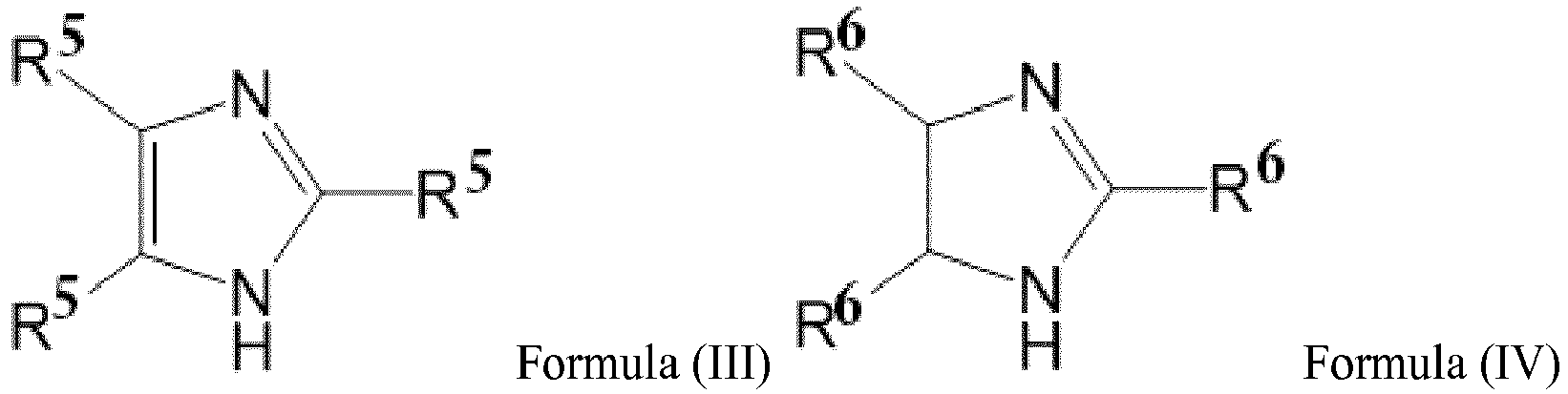
- the compound (b) can be a compound represented by Formula (III) or Formula (IV) , wherein R 5 is independently hydrogen, or C 1-4 alkyl group; and, R 6 is independently hydrogen, or C 1-4 alkyl group.
- R 5 is independently hydrogen, or C 1-4 alkyl group
- R 6 is independently hydrogen, or C 1-4 alkyl group.
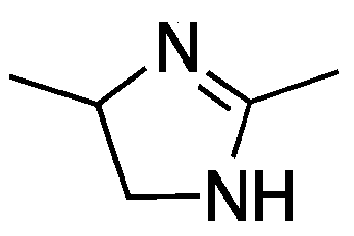
- the compound (b) can be or
- the polymeric cross-linking agent and the polymer can form an interpenetrating polymer network, thereby enhancing the mechanical strength and dimensional stability.
- Polymer (1) (having a repeat unit represented by and a repeat unit represented by wherein the ratio of the repeat unit represented by and the repeat unit represented by was about 9:1) was obtained. After measurement, the number average molecular weight (Mn) of Polymer (1) is about 110, 000, and the polydispersity index (PDI) of Polymer (1) is about 1.4.
- Example 2 was performed in the same manner as in Example 1 except that the molar ratio of Compound (2) and Compound (5) was about 8:2, obtaining Polymer (2) (the ratio of the repeat unit represented by and the repeat unit represented by was about 8:2).
- Example 3 was performed in the same manner as in Example 1 except that the molar ratio of Compound (2) and Compound (5) was about 7:3, obtaining Polymer (3) (the ratio of the repeat unit represented by and the repeat unit represented by was about 7:3).
- Example 4 was performed in the same manner as in Example 1 except that the molar ratio of Compound (2) and Compound (5) was about 4:6, obtaining Polymer (4) (the ratio of the repeat unit represented by and the repeat unit represented by was about 4:6).
- Example 5 was performed in the same manner as in Example 1 except that the molar ratio of Compound (2) and Compound (5) was about 2:8, obtaining Polymer (5) (the ratio of the repeat unit represented by and the repeat unit represented by was about 2:8).
- Example 7 was performed in the same manner as in Example 6 except that the molar ratio of Compound (4) and Compound (5) was about 6:4, obtaining Polymer (7) (the ratio of the repeat unit represented by and the repeat unit represented by was about 6:4).
- Example 8 was performed in the same manner as in Example 6 except that the molar ratio of Compound (4) and Compound (5) was about 3:7, obtaining Polymer (8) (the ratio of the repeat unit represented by and the repeat unit represented by was about 3:7).
- polymer (1) prepared from Example 1
- DMAc dimethylacetamide
- polymeric cross-linking agent (1) prepared from Preparation Example 4
- the result was mixed and distributed via a high speed homogenizer, and then defoamed, obtaining a solution.
- the solution was coated on a glass substrate via spin coating, forming a coating.
- the coating was baked at 40-150°Cto remove most of the solvent.
- the coating was baked at 120-200°C for 1-6 hours to remove residual solvent.
- Examples 11-14 were performed in the same manner as in Example 10 except that Polymers (2)-(5) were substituted for Polymer (1) respectively, obtaining Anion exchange membranes (2)-(5).
- the ionic conductivity of Anion exchange membranes (2)-(5) were measured, and the results are shown in Table 1.
- the tensile strength and anti-rupture strength of Anion exchange membrane (3) were measured according to ASTM D882-02, and the result is shown in Table 2.
- Table 1 ratio of the repeat unit represented by and the repeat unit represented by ionic conductivity (S/cm) Anion exchange membrane (1) 9:1 0.13 Anion exchange membrane (2) 8:2 -- Anion exchange membrane (3) 7:3 0.06
- Example 15 was performed in the same manner as in Example 12 except that 7 parts by weight of Polymeric cross-linking agent (1) was substituted for 10 parts by weight of Polymeric cross-linking agent (1), obtaining Anion exchange membrane (6).
- the tensile strength and anti-rupture strength of Anion exchange membrane (6) were measured according to ASTM D882-02, and the result is shown in Table 2.
- Example 16 was performed in the same manner as in Example 12 except that 20 parts by weight of Polymeric cross-linking agent (1) was substituted for 10 parts by weight of Polymeric cross-linking agent (1), obtaining Anion exchange membrane (7). Next, the tensile strength and anti-rupture strength of Anion exchange membrane (7) were measured according to ASTM D882-02, and the result is shown in Table 2.
- Example 17 was performed in the same manner as in Example 12 except that 25 parts by weight of Polymeric cross-linking agent (1) was substituted for 10 parts by weight of Polymeric cross-linking agent (1), obtaining Anion exchange membrane (8).
- the tensile strength and anti-rupture strength of Anion exchange membrane (8) were measured according to ASTM D882-02, and the result is shown in Table 2.
- Table 2 polymeric cross- linking agent (parts by weight) tensile strength (MPa) anti-rupture strength (MPa) Anion exchange membrane (3) 10 25.59 36.57 Anion exchange membrane (6) 7 32.51 44.35 Anion exchange membrane (7) 20 30.19 45.77 Anion exchange membrane (8) 25 35.22 47.32
- the anion exchange membrane of the disclosure exhibits superior ionic conductivity and mechanical strength.
- polymer (6) (prepared from Example 6) was added into a reaction bottle, and dissolved in 667 parts by weight of dimethylacetamide (DMAc).
- DMAc dimethylacetamide
- Polymeric cross-linking agent (1) (prepared from Preparation Example 4) was added into the reaction bottle.
- the result was mixed and distributed via a high speed homogenizer, and then defoamed, obtaining a solution.
- the solution was coated on a glass substrate via spin coating, forming a coating.
- the coating was baked at 40-150°Cto remove most of the solvent.
- the coating was baked at 120-200°C for 1-6 hours to remove residual solvent.
- Examples 19-20 were performed in the same manner as in Example 18 except that Polymers (7) and (8) were substituted for Polymer (6) respectively, obtaining Anion exchange membranes (10) and (11).
- the ionic conductivity and dimensional stability of Anion exchange membranes (10) and (11) were measured, and the results are shown in Table 3.
- Table 3 ionic conductivity (S/cm) dimensional shrinkage (%) (measured at 25°C) dimensional shrinkage (%) (measured at 80°C) area thickness area thickness anion exchange membrane (9) 0.09 20 9 24 31 anion exchange membrane (10) 0.02 0 13 0 4 anion exchange membrane (11) 0.004 15 6 4.5 21
- the anion exchange membrane of the disclosure also exhibits high dimensional stability.
- the polymer of the disclosure exhibits high ionic conductivity. Furthermore, due to the introduction of non-ionic group simultaneously, the polymer of the disclosure also exhibits high solubility, mechanical strength, and solvent selectivity.
Landscapes
- Chemical & Material Sciences (AREA)
- Organic Chemistry (AREA)
- Chemical Kinetics & Catalysis (AREA)
- Engineering & Computer Science (AREA)
- Manufacturing & Machinery (AREA)
- Polymers & Plastics (AREA)
- Health & Medical Sciences (AREA)
- Medicinal Chemistry (AREA)
- Sustainable Development (AREA)
- Life Sciences & Earth Sciences (AREA)
- Sustainable Energy (AREA)
- Electrochemistry (AREA)
- General Chemical & Material Sciences (AREA)
- Materials Engineering (AREA)
- Crystallography & Structural Chemistry (AREA)
- Inorganic Chemistry (AREA)
- Addition Polymer Or Copolymer, Post-Treatments, Or Chemical Modifications (AREA)
- Polyoxymethylene Polymers And Polymers With Carbon-To-Carbon Bonds (AREA)
Abstract


Description
- The technical field relates to a polymer and a method for preparing the same.
- Ion exchange membranes are widely used in electrodialysis purification, fuel cells, electroplating, and the food industry.
- An ion exchange membrane includes a polymer material having negatively charged groups or positively charged groups serving as the film body, and migratable cations or anions under electrical or chemical potential. A cation exchange membrane has negatively charged groups fixed on the polymer and migratable cations. Identically, an anion exchange membrane has positively charged groups fixed on the polymer and migratable cations. In general, the characteristics of the ion exchange membrane are determined by the number, type, and distribution of the fixed charged group. Anion exchange membranes made of conventional polymer material are not suitable for use in an ion exchange membrane fuel cell, due to the poor solubility, mechanical strength, and solvent selectivity of the conventional polymer material.
- According to an embodiment of the disclosure, the disclosure provides a polymer including a first repeat unit and a second repeat unit, wherein the first repeat unit can be


- According to other embodiments of the disclosure, the disclosure provides a method for preparing the aforementioned polymer. The method includes subjecting a composition to a polymerization. In particular, the composition includes a first monomer having a structure of Formula (I) and a second monomer having a structure of Formula (II)


- A detailed description is given in the following embodiments with reference to the accompanying drawings.
- In the following detailed description, for purposes of explanation, numerous specific details are set forth in order to provide a thorough understanding of the disclosed embodiments. It will be apparent, however, that one or more embodiments may be practiced without these specific details.
- The disclosure provides a polymer and a method for preparing the same. The polymer of the disclosure can be a polymer with a cationic group (such as a highly stable cyclic conjugated cationic group) and non-ionic group (such as long-chain group). In the chemical structure design, in order to enhance the electrical conductivity of the polymer, the polymer of the disclosure has a repeat unit with a cationic group. In addition, the polymer of the disclosure has a repeat unit with a non-ionic group, in order to prevent the solubility of the polymer having cationic groups from decreasing when dissolving in a solvent. According to embodiments of the disclosure, besides the high solubility, the polymer of the disclosure exhibits improved mechanical strength and increased solvent selectivity.
- According to an embodiment of the disclosure, the polymer of the disclosure includes a first repeat unit and a second repeat unit. The first repeat unit can be


- According to embodiments of the disclosure, the first repeat unit can be


- According to embodiments of the disclosure, the polymer of the disclosure has a molecular weight (such as number average molecular weight) between about 100, 000 and 250,000.
- According to embodiments of the disclosure, the second repeat unit can be


- According to embodiments of the disclosure, the ratio between the first repeat unit and the second repeat unit of the polymer can be adjusted to achieve the desired characteristics of the polymer. For example, the ratio between the first repeat unit and the second repeat unit can be increased in order to enhance the electrical conductivity and the anion exchange capacity of the polymer. On the other hand, the ratio between the first repeat unit and the second repeat unit can be decreased in order to enhance the solubility, the mechanical strength, and the solvent selectivity of the polymer. The ratio between the first repeat unit and the second repeat unit can be between about 1:99 and 99:1, such as between about 10:90 and 90:10, between about 20:80 and 80:20, or between about 30:70 and 70:30.
- According to embodiments of the disclosure, the polymer of the disclosure can further include a third repeat unit, wherein the third repeat unit can be
 of the first repeat unit, the second repeat unit, or the third repeat unit is bonded to the portion represented by
 of the other first repeat unit, the other second repeat unit, or the other third repeat unit. In addition, the first repeat unit, the second repeat unit, and the third repeat unit can be arranged in a random fashion. For example, the polymer of the disclosure can have a moiety represented by


- According to embodiments of the disclosure, the ratio between the third repeat unit and the sum of the first repeat unit and the second repeat unit can be between about 0.1:100 and 5:100, such as between about 0.5:100 and 4:100, or between about 0.5:100 and 3:100. Due to the introduction of the third repeat unit, the polymer can have improved cross-linking degree and mechanical strength by adopting the third repeat unit. In addition, when the ratio between the third repeat unit and the sum of the first repeat unit and the second repeat unit is too high, the polymer would have too high a cross-linking degree and too high a molecular weight and cannot be redissolved in the subsequent process solvent.
- According to embodiments of the disclosure, the disclosure provides a method for preparing the aforementioned polymer. The method includes subjecting a composition to a polymerization, such as a ring opening metathesis polymerization (ROMP). The composition can include a first monomer having a structure of Formula (I) and a second monomer having a structure of Formula (II)


- According to embodiments of the disclosure, the first monomer can be


- According to embodiments of the disclosure, the molar ratio between the first monomer and the second monomer can be between about 1:99 and 99:1, such as between about 10:90 and 90:10, between about 20:80 and 80:20, or between about 30:70 and 70:30.
- In addition, according to embodiments of the disclosure, the composition can further include a third monomer, wherein the third monomer can be

- According to embodiments of the disclosure, the polymer of the disclosure can be used to prepare an ion exchange membrane. The method for preparing the ion exchange membrane includes the following steps. First, a composition is provided, wherein the composition includes the aforementioned polymer and a cross-linking agent. In addition, the composition can further include a solvent, and the composition has a solid content between about 5wt% and 50 wt%. In the composition, the cross-linking agent can has a weight percentage between about 1wt% and 30wt% (such as between about 5wt% and 30wt%, or between about 5wt% and 25wt%), based on the weight of the polymer. Next, the composition is subjected to a mixing and distributing process. Next, the composition is coated on a substrate (such as a glass substrate) to form a coating. Next, the coating is baked to remove most of the solvent. Next, the coating formed on the substrate is baked in a high temperature oven to remove residual solvent. Finally, the coating is immersed in potassium hydroxide aqueous solution and deionized water for 1-3 hours sequentially. After drying, the ion exchange membrane of the disclosure is obtained.
- The cross-linking agent can be a compound having at least two maleimide groups. For example, the cross-linking agent can be a compound having two maleimide groups. According to embodiments of the disclosure, the compound having two maleimide groups can be


- In addition, according to embodiments of the disclosure, the cross-linking agent can be a polymeric cross-linking agent having at least two maleimide groups. The polymeric cross-linking agent can be a reaction product of a compound (a) and a compound (b). The compound (a) can be




- The polymeric cross-linking agent and the polymer can form an interpenetrating polymer network, thereby enhancing the mechanical strength and dimensional stability.
- Below, exemplary embodiments will be described in detail so as to be easily realized by a person having ordinary knowledge in the art. The disclosure concept may be embodied in various forms without being limited to the exemplary embodiments set forth herein. Descriptions of well-known parts are omitted for clarity.
- 10ml of dicyclopentadiene (0.074 mmol) and 20.15ml of 1-allylimidazole (0.186 mmol) were added into a high-pressure reactor. After stirring at 180°C for 8 hours, the result was purified by fractionation and column chromatography (using ethyl acetate (EA) and hexane (9:1) as the eluent), obtaining Compound (1) (colorless transparent viscous liquid). The synthesis pathway of the above reaction was as follows:

- Compound (1) was analyzed by nuclear magnetic resonance (NMR) spectroscopy and the result is as follows: 1H NMR (300 MHz, CDCl3): δ 7.46 (d, J = 15.3, 1H), 6.98 (m, 2H), 6.12 (m, 2H), 3.79 (m, 2H), 2.66 (m, 3H), 1.89 (m, 1H), 1.33 (m, 2H), 0.62 (m, 1H).
- Next, 0.5g of Compound (1) (2.87 mmol) and 0.268 ml of methyl iodide (4.30 mmol) were added into a reaction bottle. After stirring at room temperature (about 25°C) for 8 hours and then removing residual methyl iodide by vacuum distillation, Compound (2) (yellow viscous liquid) was obtained. The synthesis pathway of the above reaction was as follows:

- Compound (2) was analyzed by nuclear magnetic resonance (NMR) spectroscopy and the result is as follows: 1H NMR (300 MHz, CDCl3): δ 10.03 (d, J = 12.0 Hz, 1H), 7.42 (m, 2H), 6.21 (m, 2H), 4.19 (m, 5H), 2.74 (m, 3H), 1.99 (m, 1H), 1.41 (m, 2H), 0.67 (m, 1H)
- 15ml of dimethylformamide (DMF) was added into a reaction bottle. Next, 1.7g of sodium hydride (NaH) (0.00427 mol) was added into the reaction bottle at 0°C. Next, 2.122g of 5-Norbornene-2-methanol (0.0171 mol) was added into the reaction bottle at 0°C. After stirring, 2g of 1-methyl-2-(chloromethyl) imidazole (0.0154 mol) was added into the reaction bottle. After stirring for 12 hours, water was added into the reaction bottle to quench the reaction, and then the result was extracted by dichloromethane. After concentration, the result was purified by fractionation, obtaining Compound (3). The synthesis pathway of the above reaction was as follows:
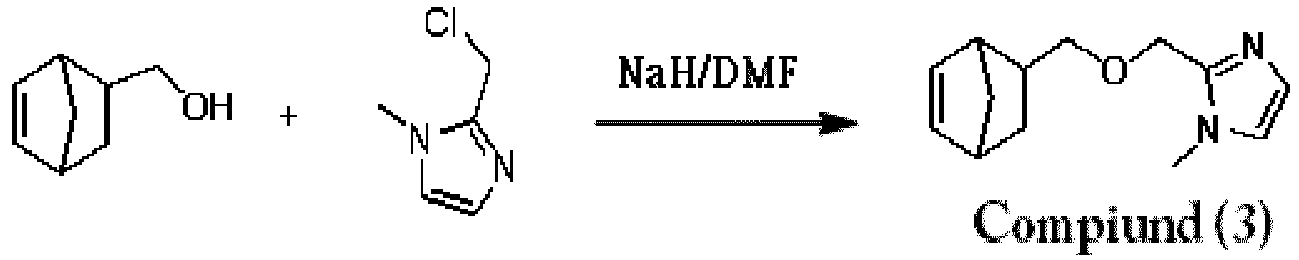
- Compound (3) was analyzed by nuclear magnetic resonance (NMR) spectroscopy and the result is as follows: 1H NMR (300 MHz, CDCl3): δ 6.90 (s, 2H), 6.10-5.76 (m, 2H), 4.59-4.81 (m, 2H), 3.71 (s, 3H), 3.51-3.00(m, 2H), 2.86-2.69(m, 2H), 2.33(m, 1H), 1.84-1.66 (m, 1H), 1.41-1.10(m, 2H), 0.47-0.43(m, 1H)
- Next, 2g of Compound (3) (9 mmol) was added into a reaction bottle and dissolved in dichloromethane. Next, 1 ml of methyl iodide (17 mmol) was added into the reaction bottle. After stirring at room temperature for 12 hours, residual methyl iodide and solvent were removed, obtaining Compound (4) (yellow viscous liquid). The synthesis pathway of the above reaction was as follows:

- Compound (4) was analyzed by nuclear magnetic resonance (NMR) spectroscopy and the result is as follows: 1H NMR (300 MHz, CDCl3): δ 7.45 (s, 2H), 6.18-5.84(m, 2H), 4.90(s, 2H), 3.98(s, 6H), 3.68-3.20(m, 2H), 2.35(m, 1H), 1.86-1.78(m, 1H), 1.46-1.14(m, 4H), 0.52-0.51(m, 1H)
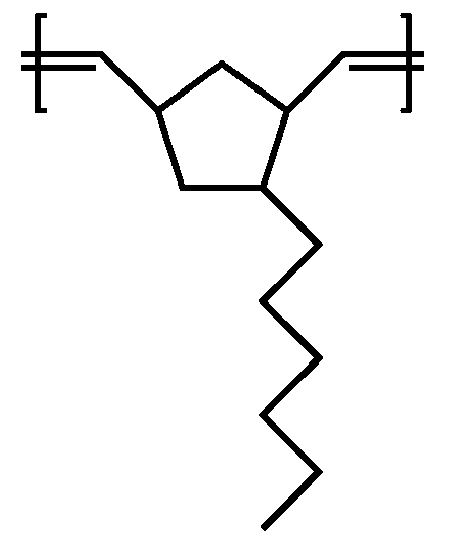
- 13.4ml of dicyclopentadiene (0.1 mmol) and 36ml of 1-octene (0.23 mmol) were added into a high-pressure reactor. After stirring at 240°C for 12 hours, the result was filtered through neutral alumina to remove the yellow suspension. Next, the result was purified by fractionation, obtaining Compound (5) (colorless transparent viscous liquid). The synthesis pathway of the above reaction was as follows:

- Compound (5) was analyzed by nuclear magnetic resonance (NMR) spectroscopy and the result is as follows: 1H NMR (300 MHz, CDCl3): δ 6.08 (m, 1H, endo), 6.04 (m, 1H, exo), 5.90 (m, 1H, endo), 2.67-2.77 (m, 2H), 2.48 (m, 1H, exo), 1.97 (m, 1H, endo), 1.80 (m, 1H, endo), 1.14-1.38 (m, 11H), 0.82-0.90(m, 3H), 0.43-0.50(m, 1H, endo)
- 2.73g of



- 3.08g of Compound (2) (9.74 mmole) and 0.19g of Compound (5) (1.08 mmole) were added into a reaction bottle under a nitrogen atmosphere, wherein the molar ratio of Compound (2) and Compound (5) was about 9:1. Next, 30 ml of dichloromethane was added into the reaction bottle. Next, Grubbs's solution (9.2mg, dissolved in 6ml of dichloromethane) was slowly added into the reaction bottle at 30°C. After stirring for 4 hours, the result was slowly added into 250 ml of ethyl ether. After stirring for about 30 minutes and concentration, the result was washed with 100ml of acetone, and then the solid was collected. After drying, Polymer (1) (having a repeat unit represented by


- Example 2 was performed in the same manner as in Example 1 except that the molar ratio of Compound (2) and Compound (5) was about 8:2, obtaining Polymer (2) (the ratio of the repeat unit represented by


- Example 3 was performed in the same manner as in Example 1 except that the molar ratio of Compound (2) and Compound (5) was about 7:3, obtaining Polymer (3) (the ratio of the repeat unit represented by


- Example 4 was performed in the same manner as in Example 1 except that the molar ratio of Compound (2) and Compound (5) was about 4:6, obtaining Polymer (4) (the ratio of the repeat unit represented by


- Example 5 was performed in the same manner as in Example 1 except that the molar ratio of Compound (2) and Compound (5) was about 2:8, obtaining Polymer (5) (the ratio of the repeat unit represented by


- 3.53g of Compound (4) (9.74 mmole) and 0.19g of Compound (5) (1.08 mmole) were added into a reaction bottle under a nitrogen atmosphere, wherein the molar ratio of Compound (4) and Compound (5) was about 9:1. Next, 30 ml of dichloromethane was added into the reaction bottle. Next, Grubbs's solution (9.2mg, dissolved in 6ml of dichloromethane) was slowly added into the reaction bottle at 30°C. After stirring for 4 hours, the result was slowly added into 250 ml of ethyl ether. After stirring for about 30 minutes and concentration, the result was washed with 100ml of acetone, and then the solid was collected. After drying, Polymer (6) (having a repeat unit represented by


- Example 7 was performed in the same manner as in Example 6 except that the molar ratio of Compound (4) and Compound (5) was about 6:4, obtaining Polymer (7) (the ratio of the repeat unit represented by


- Example 8 was performed in the same manner as in Example 6 except that the molar ratio of Compound (4) and Compound (5) was about 3:7, obtaining Polymer (8) (the ratio of the repeat unit represented by


- 3.08g of Compound (2) (9.74 mmole), 0.19g of Compound (5) (1.08 mmole), and 12mg of dicyclopentadiene (0.097 mmole) were added into a reaction bottle under a nitrogen atmosphere, wherein the molar ratio of Compound (2), Compound (5), and dicyclopentadiene was about 9:1:0.09. Next, 30 ml of dichloromethane was added into the reaction bottle. Next, Grubbs's solution (9.2mg, dissolved in 6ml of dichloromethane) was slowly added into the reaction bottle at 30°C. After stirring for 4 hours, the result was slowly added into 250 ml of ethyl ether. After stirring for about 30 minutes and concentration, the result was washed with 100ml of acetone, and then the solid was collected. After drying, Polymer (9) (having a repeat unit represented by


- 100 parts by weight of polymer (1) (prepared from Example 1) was added into a reaction bottle, and dissolved in 667 parts by weight of dimethylacetamide (DMAc). Next, 10 parts by weight of polymeric cross-linking agent (1) (prepared from Preparation Example 4) was added into the reaction bottle. Next, the result was mixed and distributed via a high speed homogenizer, and then defoamed, obtaining a solution. Next, the solution was coated on a glass substrate via spin coating, forming a coating. Next, the coating was baked at 40-150°Cto remove most of the solvent. Next, the coating was baked at 120-200°C for 1-6 hours to remove residual solvent. Next, the coating was immersed in potassium hydroxide aqueous solution at room temperature for 1.5 hours and deionized water at room temperature for 1.5 hours sequentially to ensure no solvent remained in the coating. After drying, Anion exchange membrane (1) was obtained. Next, the ionic conductivity of Anion exchange membrane (1) was measured, and the result is shown in Table 1.
- Examples 11-14 were performed in the same manner as in Example 10 except that Polymers (2)-(5) were substituted for Polymer (1) respectively, obtaining Anion exchange membranes (2)-(5). Next, the ionic conductivity of Anion exchange membranes (2)-(5) were measured, and the results are shown in Table 1. Furthermore, the tensile strength and anti-rupture strength of Anion exchange membrane (3) were measured according to ASTM D882-02, and the result is shown in Table 2.
Table 1 ratio of the repeat unit represented by 
ionic conductivity (S/cm) Anion exchange membrane (1) 9:1 0.13 Anion exchange membrane (2) 8:2 -- Anion exchange membrane (3) 7:3 0.06 Anion exchange membrane (4) 4:6 0.05 Anion exchange membrane (5) 2:8 0.005 - As shown in Table 1, with the increase of the ratio of the repeat unit represented by


- Example 15 was performed in the same manner as in Example 12 except that 7 parts by weight of Polymeric cross-linking agent (1) was substituted for 10 parts by weight of Polymeric cross-linking agent (1), obtaining Anion exchange membrane (6). Next, the tensile strength and anti-rupture strength of Anion exchange membrane (6) were measured according to ASTM D882-02, and the result is shown in Table 2.
- Example 16 was performed in the same manner as in Example 12 except that 20 parts by weight of Polymeric cross-linking agent (1) was substituted for 10 parts by weight of Polymeric cross-linking agent (1), obtaining Anion exchange membrane (7). Next, the tensile strength and anti-rupture strength of Anion exchange membrane (7) were measured according to ASTM D882-02, and the result is shown in Table 2.
- Example 17 was performed in the same manner as in Example 12 except that 25 parts by weight of Polymeric cross-linking agent (1) was substituted for 10 parts by weight of Polymeric cross-linking agent (1), obtaining Anion exchange membrane (8). Next, the tensile strength and anti-rupture strength of Anion exchange membrane (8) were measured according to ASTM D882-02, and the result is shown in Table 2.
Table 2 polymeric cross- linking agent (parts by weight) tensile strength (MPa) anti-rupture strength (MPa) Anion exchange membrane (3) 10 25.59 36.57 Anion exchange membrane (6) 7 32.51 44.35 Anion exchange membrane (7) 20 30.19 45.77 Anion exchange membrane (8) 25 35.22 47.32 - As shown in Table 2, with the increase of the concentration of the polymeric cross-linking agent, the mechanical strength (such as tensile strength and anti-rupture strength) is improved. Therefore, according to Tables 1 and 2, the anion exchange membrane of the disclosure exhibits superior ionic conductivity and mechanical strength.
- 100 parts by weight of polymer (6) (prepared from Example 6) was added into a reaction bottle, and dissolved in 667 parts by weight of dimethylacetamide (DMAc). Next, 10 parts by weight of Polymeric cross-linking agent (1) (prepared from Preparation Example 4) was added into the reaction bottle. Next, the result was mixed and distributed via a high speed homogenizer, and then defoamed, obtaining a solution. Next, the solution was coated on a glass substrate via spin coating, forming a coating. Next, the coating was baked at 40-150°Cto remove most of the solvent. Next, the coating was baked at 120-200°C for 1-6 hours to remove residual solvent. Next, the coating was immersed in potassium hydroxide aqueous solution at room temperature for 1.5 hours and deionized water at room temperature for 1.5 hours sequentially to ensure no solvent remained in the coating. After drying, Anion exchange membrane (9) was obtained. Next, the ionic conductivity and dimensional stability of Anion exchange membrane (9) was measured, and the result is shown in Table 3.
- Examples 19-20 were performed in the same manner as in Example 18 except that Polymers (7) and (8) were substituted for Polymer (6) respectively, obtaining Anion exchange membranes (10) and (11). Next, the ionic conductivity and dimensional stability of Anion exchange membranes (10) and (11) were measured, and the results are shown in Table 3.
Table 3 ionic conductivity (S/cm) dimensional shrinkage (%) (measured at 25°C) dimensional shrinkage (%) (measured at 80°C) area thickness area thickness anion exchange membrane (9) 0.09 20 9 24 31 anion exchange membrane (10) 0.02 0 13 0 4 anion exchange membrane (11) 0.004 15 6 4.5 21 - As shown in Table 3, with the increase of the ratio of the repeat unit represented by


- Accordingly, due to the introduction of stably cationic group, the polymer of the disclosure exhibits high ionic conductivity. Furthermore, due to the introduction of non-ionic group simultaneously, the polymer of the disclosure also exhibits high solubility, mechanical strength, and solvent selectivity.
- It will be clear that various modifications and variations can be made to the disclosed methods and materials. It is intended that the specification and examples be considered as exemplary only, with the true scope of the disclosure being indicated by the following claims and their equivalents.
Claims (18)
- A polymer, comprising a first repeat unit and a second repeat unit, wherein the first repeat unit is


- The polymer as claimed in claim 1, wherein the ratio between the first repeat unit and the second repeat unit is between 1:99 and 99:1.
- The polymer as claimed in claim 1 or 2, wherein R1 is methyl, ethyl, propyl, isopropyl, n-butyl, sec-butyl, isobutyl, tert-butyl, pentyl, hexyl, cyclohexyl, cyclopentyl, heptyl, or octyl.
- The polymer as claimed in any of claims 1 to 3, wherein R2 and R3 are independently hydrogen, methyl, ethyl, propyl, isopropyl, n-butyl, sec-butyl, isobutyl, tert-butyl, pentyl, hexyl, cyclohexyl, cyclopentyl, heptyl, or octyl.
- The polymer as claimed in any of claims 1 to 4, wherein the first repeat unit is


- The polymer as claimed in any of claims 1 to 4, wherein the first repeat unit is


- The polymer as claimed in any of claims 1 to 6, wherein the second repeat unit is


- The polymer as claimed in any of claims 1 to 7, wherein the polymer further comprising a third repeat unit, wherein the third repeat unit is

- The polymer as claimed in claim 8, wherein the ratio between the third repeat unit and the sum of the first repeat unit and the second repeat unit is between 0.1:100 and 5:100.
- A method for preparing the polymer as claimed in claim 1, comprising:subjecting a composition to a polymerization, wherein the composition comprises a first monomer having a structure of Formula (I), and a second monomer having a structure of Formula (II)


- The method as claimed in claim 10, wherein the molar ratio between the first monomer and the second monomer is between 1:99 and 99:1.
- The method as claimed in claims 10 or 11, wherein R1 is methyl, ethyl, propyl, isopropyl, n-butyl, sec-butyl, isobutyl, tert-butyl, pentyl, hexyl, cyclohexyl, cyclopentyl, heptyl, or octyl.
- The method as claimed in any of claims 10 to 12, wherein R2 and R3 are independently hydrogen, methyl, ethyl, propyl, isopropyl, n-butyl, sec-butyl, isobutyl, tert-butyl, pentyl, hexyl, cyclohexyl, cyclopentyl, heptyl, or octyl.
- The method as claimed in any of claims 10 to 13, wherein the first monomer is


- The method as claimed in any of claims 10 to 13, wherein the first monomer is


- The method as claimed in any of claims 10 to 15, wherein the second monomer is


- The method as claimed in any of claims 10 to 16, wherein the composition further comprises a third monomer, wherein the third monomer is

- The method as claimed in claim 17, wherein the molar ratio between the third monomer and the sum of the first monomer and the second monomer is between 0.1:100 and 5:100.
Applications Claiming Priority (1)
| Application Number | Priority Date | Filing Date | Title |
|---|---|---|---|
| TW104143989A TWI583708B (en) | 2015-12-28 | 2015-12-28 | Polymer and method for preparing the same |
Publications (2)
| Publication Number | Publication Date |
|---|---|
| EP3187251A1 true EP3187251A1 (en) | 2017-07-05 |
| EP3187251B1 EP3187251B1 (en) | 2020-09-09 |
Family
ID=56119309
Family Applications (1)
| Application Number | Title | Priority Date | Filing Date |
|---|---|---|---|
| EP16172017.2A Active EP3187251B1 (en) | 2015-12-28 | 2016-05-30 | Polymer and method for preparing the same |
Country Status (6)
| Country | Link |
|---|---|
| US (1) | US10150113B2 (en) |
| EP (1) | EP3187251B1 (en) |
| JP (1) | JP6374459B2 (en) |
| CN (1) | CN106916251B (en) |
| DK (1) | DK3187251T3 (en) |
| TW (1) | TWI583708B (en) |
Families Citing this family (3)
| Publication number | Priority date | Publication date | Assignee | Title |
|---|---|---|---|---|
| CN110007558A (en) * | 2017-12-29 | 2019-07-12 | 财团法人工业技术研究院 | Composition, insulating materials and its preparation method comprising it |
| CN116284691B (en) * | 2023-03-27 | 2023-11-17 | 天津大学 | An ionic cyclic olefin copolymer with antibacterial properties and high transparency and its preparation method |
| EP4720172A1 (en) * | 2023-05-26 | 2026-04-08 | Forschungszentrum Jülich GmbH | Side-chain functionalized polynorbornenes as ionomers and as membrane materials for alkaline electrolysis of water, and fuel cell |
Citations (2)
| Publication number | Priority date | Publication date | Assignee | Title |
|---|---|---|---|---|
| EP2270104A1 (en) * | 2008-03-27 | 2011-01-05 | Sumitomo Chemical Company, Limited | Polymer electrolyte composition |
| US20110244368A1 (en) * | 2009-12-11 | 2011-10-06 | Promerus Llc | Norbornene-type polymers having quaternary ammonium functionality |
Family Cites Families (13)
| Publication number | Priority date | Publication date | Assignee | Title |
|---|---|---|---|---|
| DE10006694A1 (en) | 2000-02-15 | 2001-08-16 | Basf Ag | New norbornenyl and 7-oxa- or 7-aza-bicyclo(2.2.1(hept-2-enyl N-heterocyclic compounds are useful as intermediates for active materials or other organic fine chemicals and in homo- and co-polymer production |
| JP4682358B2 (en) | 2005-04-05 | 2011-05-11 | 独立行政法人 日本原子力研究開発機構 | Method for producing functional inorganic / graft polymer hybrid ion exchange membrane and electrolyte membrane for fuel cell |
| TWI342082B (en) * | 2005-12-30 | 2011-05-11 | Ind Tech Res Inst | Electrode structure |
| US8223472B1 (en) | 2008-11-14 | 2012-07-17 | Sandia Corporation | Norbornylene-based polymer systems for dielectric applications |
| EP2510036A2 (en) * | 2009-12-11 | 2012-10-17 | Promerus LLC | Norbornene-type polymers having quaternary ammonium functionality |
| CN102049202B (en) | 2010-11-03 | 2012-10-31 | 厦门大学 | A kind of fluorine-containing imidazolium salt polymer anion exchange membrane and its preparation method |
| WO2012075574A1 (en) * | 2010-12-09 | 2012-06-14 | Queen's University At Kingston | Azolium ionomer derivatives of halogenated polymers |
| JP6565680B2 (en) | 2013-12-20 | 2019-08-28 | 日本ゼオン株式会社 | Resin material and resin film |
| KR101542839B1 (en) * | 2014-02-12 | 2015-08-10 | 광주과학기술원 | Organic-inorganic composite anion exchange membrane containing polyvinylidene fluoride polymer for non-aqueous redox flow battery and method for preparing the same |
| US9328206B2 (en) * | 2014-05-30 | 2016-05-03 | Pall Corporation | Self-assembling polymers—III |
| US9169361B1 (en) * | 2014-05-30 | 2015-10-27 | Pall Corporation | Self-assembling polymers—VI |
| CN104693423B (en) | 2015-02-02 | 2017-04-19 | 华东师范大学 | Cross-linkable high dielectric norbornene copolymer and norbornene cross-linked polymer and preparation methods thereof |
| TWI579333B (en) * | 2015-12-28 | 2017-04-21 | 財團法人工業技術研究院 | Ion exchange membrane |
-
2015
- 2015-12-28 TW TW104143989A patent/TWI583708B/en active
-
2016
- 2016-02-04 CN CN201610078291.5A patent/CN106916251B/en active Active
- 2016-04-22 US US15/135,851 patent/US10150113B2/en active Active
- 2016-05-30 DK DK16172017.2T patent/DK3187251T3/en active
- 2016-05-30 EP EP16172017.2A patent/EP3187251B1/en active Active
- 2016-09-09 JP JP2016176356A patent/JP6374459B2/en active Active
Patent Citations (2)
| Publication number | Priority date | Publication date | Assignee | Title |
|---|---|---|---|---|
| EP2270104A1 (en) * | 2008-03-27 | 2011-01-05 | Sumitomo Chemical Company, Limited | Polymer electrolyte composition |
| US20110244368A1 (en) * | 2009-12-11 | 2011-10-06 | Promerus Llc | Norbornene-type polymers having quaternary ammonium functionality |
Non-Patent Citations (3)
| Title |
|---|
| ERIN F. WIESENAUER ET AL: "Imidazolium-containing, hydrophobic-ionic-hydrophilic ABC triblock copolymers: synthesis, ordered phase-separation, and supported membrane fabrication", SOFT MATTER, vol. 9, no. 33, 18 July 2013 (2013-07-18), GB, pages 7923, XP055288143, ISSN: 1744-683X, DOI: 10.1039/c3sm51085a * |
| ROBERTSON N J ET AL: "Tunable High Performance Cross-Linked Alkaline Anion Exchange Membranes for Fuel Cell Applications", JOURNAL OF THE AMERICAN CHEMICAL SOCIETY, AMERICAN CHEMICAL SOCIETY, US, vol. 132, no. 10, 17 March 2010 (2010-03-17), pages 3400 - 3404, XP002638474, ISSN: 0002-7863, [retrieved on 20100223], DOI: 10.1021/JA908638D * |
| YAKOV S. VYGODSKII ET AL: "Conductive Polymer Electrolytes Derived from Poly(norbornene)s with Pendant Ionic Imidazolium Moieties", MACROMOLECULAR CHEMISTRY AND PHYSICS., vol. 209, no. 1, 4 January 2008 (2008-01-04), DE, pages 40 - 51, XP055288146, ISSN: 1022-1352, DOI: 10.1002/macp.200700378 * |
Also Published As
| Publication number | Publication date |
|---|---|
| JP6374459B2 (en) | 2018-08-15 |
| DK3187251T3 (en) | 2020-09-21 |
| US10150113B2 (en) | 2018-12-11 |
| TWI583708B (en) | 2017-05-21 |
| CN106916251B (en) | 2019-08-02 |
| EP3187251B1 (en) | 2020-09-09 |
| TW201723009A (en) | 2017-07-01 |
| US20170182487A1 (en) | 2017-06-29 |
| JP2017119822A (en) | 2017-07-06 |
| CN106916251A (en) | 2017-07-04 |
Similar Documents
| Publication | Publication Date | Title |
|---|---|---|
| EP3190146B1 (en) | Ion exchange membrane | |
| KR101745513B1 (en) | Hydrophilically modified fluorinated membrane (iv) | |
| EP3187251B1 (en) | Polymer and method for preparing the same | |
| DE60020430T2 (en) | Perfluoro group-containing compounds and cured polymer of these | |
| US20100292515A1 (en) | Purification method of high-molecular-weight polyethylene glycol compound | |
| BR112019015180A2 (en) | PROCESS FOR THE MANUFACTURE OF AN ALCOXYLATED POLYALKYLENEIMINE AND ALCOXYLATED POLYALKYLENEIMINE | |
| DE112016002429T5 (en) | ISATINCOPOLYMERS WITH INTRINSIC MICROPOROSITY | |
| CN108503837B (en) | A kind of method for preparing hydrogen-containing silicone oil from solid acid | |
| WO2018141743A1 (en) | Method for the production of polyoxazolidinone polymer compounds | |
| KR20190078592A (en) | New high molecular weight polymers from waste materials | |
| KR101780380B1 (en) | Hydrophilically modified fluorinated membrane (ii) | |
| EP2739656B1 (en) | An oxazolidone ring containing vinyl ester resin and products therefrom | |
| DE102011116764A1 (en) | New cationic polymer comprising polycationic section and uncharged water-soluble section obtained by polycondensing amine or heteroaryl with epihalohydrin in water and reacting with polyol, useful e.g. as additives in galvanic copper baths | |
| JP2009185179A (en) | Multi-branched polymer and method for producing the same | |
| EP2750798B1 (en) | Catalysts for producing carbonates from epoxides and co2 | |
| KR101828825B1 (en) | Cell-membrane mimicking brush polymers and a method for preparaing thereof | |
| CN106543424A (en) | A kind of poly (propylene carbonate)/POSS hybrid materials and preparation method thereof | |
| JP7826430B1 (en) | Norbornene copolymer, its production method and use | |
| KR20220057932A (en) | Chain-extended polyol composition and surfactant using the same | |
| Kumbhar | Synthesis and Characterization of Charged Polyethers for Membrane Materials and to Study Polyelectrolyte Self-Assembly | |
| CN116333294B (en) | Catalyst for preparing block polyether and preparation method of block polyether | |
| TW202611140A (en) | A method to prepare co-poly(norbornene) derivatives and their applications | |
| CN113348191B (en) | Haze-free polyurethane formulation | |
| KR102914611B1 (en) | Purification process of polyether polyol | |
| JP2023547362A (en) | polyurethane composition |
Legal Events
| Date | Code | Title | Description |
|---|---|---|---|
| PUAI | Public reference made under article 153(3) epc to a published international application that has entered the european phase |
Free format text: ORIGINAL CODE: 0009012 |
|
| STAA | Information on the status of an ep patent application or granted ep patent |
Free format text: STATUS: REQUEST FOR EXAMINATION WAS MADE |
|
| 17P | Request for examination filed |
Effective date: 20161209 |
|
| AK | Designated contracting states |
Kind code of ref document: A1 Designated state(s): AL AT BE BG CH CY CZ DE DK EE ES FI FR GB GR HR HU IE IS IT LI LT LU LV MC MK MT NL NO PL PT RO RS SE SI SK SM TR |
|
| AX | Request for extension of the european patent |
Extension state: BA ME |
|
| STAA | Information on the status of an ep patent application or granted ep patent |
Free format text: STATUS: EXAMINATION IS IN PROGRESS |
|
| STAA | Information on the status of an ep patent application or granted ep patent |
Free format text: STATUS: REQUEST FOR EXAMINATION WAS MADE |
|
| STAA | Information on the status of an ep patent application or granted ep patent |
Free format text: STATUS: EXAMINATION IS IN PROGRESS |
|
| 17Q | First examination report despatched |
Effective date: 20190722 |
|
| GRAP | Despatch of communication of intention to grant a patent |
Free format text: ORIGINAL CODE: EPIDOSNIGR1 |
|
| STAA | Information on the status of an ep patent application or granted ep patent |
Free format text: STATUS: GRANT OF PATENT IS INTENDED |
|
| INTG | Intention to grant announced |
Effective date: 20200403 |
|
| GRAS | Grant fee paid |
Free format text: ORIGINAL CODE: EPIDOSNIGR3 |
|
| GRAA | (expected) grant |
Free format text: ORIGINAL CODE: 0009210 |
|
| STAA | Information on the status of an ep patent application or granted ep patent |
Free format text: STATUS: THE PATENT HAS BEEN GRANTED |
|
| AK | Designated contracting states |
Kind code of ref document: B1 Designated state(s): AL AT BE BG CH CY CZ DE DK EE ES FI FR GB GR HR HU IE IS IT LI LT LU LV MC MK MT NL NO PL PT RO RS SE SI SK SM TR |
|
| REG | Reference to a national code |
Ref country code: GB Ref legal event code: FG4D |
|
| REG | Reference to a national code |
Ref country code: AT Ref legal event code: REF Ref document number: 1310858 Country of ref document: AT Kind code of ref document: T Effective date: 20200915 Ref country code: CH Ref legal event code: EP |
|
| REG | Reference to a national code |
Ref country code: DK Ref legal event code: T3 Effective date: 20200915 |
|
| REG | Reference to a national code |
Ref country code: DE Ref legal event code: R096 Ref document number: 602016043571 Country of ref document: DE |
|
| REG | Reference to a national code |
Ref country code: IE Ref legal event code: FG4D |
|
| REG | Reference to a national code |
Ref country code: NO Ref legal event code: T2 Effective date: 20200909 |
|
| REG | Reference to a national code |
Ref country code: LT Ref legal event code: MG4D |
|
| PG25 | Lapsed in a contracting state [announced via postgrant information from national office to epo] |
Ref country code: GR Free format text: LAPSE BECAUSE OF FAILURE TO SUBMIT A TRANSLATION OF THE DESCRIPTION OR TO PAY THE FEE WITHIN THE PRESCRIBED TIME-LIMIT Effective date: 20201210 Ref country code: FI Free format text: LAPSE BECAUSE OF FAILURE TO SUBMIT A TRANSLATION OF THE DESCRIPTION OR TO PAY THE FEE WITHIN THE PRESCRIBED TIME-LIMIT Effective date: 20200909 Ref country code: SE Free format text: LAPSE BECAUSE OF FAILURE TO SUBMIT A TRANSLATION OF THE DESCRIPTION OR TO PAY THE FEE WITHIN THE PRESCRIBED TIME-LIMIT Effective date: 20200909 Ref country code: BG Free format text: LAPSE BECAUSE OF FAILURE TO SUBMIT A TRANSLATION OF THE DESCRIPTION OR TO PAY THE FEE WITHIN THE PRESCRIBED TIME-LIMIT Effective date: 20201209 Ref country code: LT Free format text: LAPSE BECAUSE OF FAILURE TO SUBMIT A TRANSLATION OF THE DESCRIPTION OR TO PAY THE FEE WITHIN THE PRESCRIBED TIME-LIMIT Effective date: 20200909 Ref country code: HR Free format text: LAPSE BECAUSE OF FAILURE TO SUBMIT A TRANSLATION OF THE DESCRIPTION OR TO PAY THE FEE WITHIN THE PRESCRIBED TIME-LIMIT Effective date: 20200909 |
|
| REG | Reference to a national code |
Ref country code: AT Ref legal event code: MK05 Ref document number: 1310858 Country of ref document: AT Kind code of ref document: T Effective date: 20200909 |
|
| REG | Reference to a national code |
Ref country code: NL Ref legal event code: MP Effective date: 20200909 |
|
| PG25 | Lapsed in a contracting state [announced via postgrant information from national office to epo] |
Ref country code: PL Free format text: LAPSE BECAUSE OF FAILURE TO SUBMIT A TRANSLATION OF THE DESCRIPTION OR TO PAY THE FEE WITHIN THE PRESCRIBED TIME-LIMIT Effective date: 20200909 Ref country code: RS Free format text: LAPSE BECAUSE OF FAILURE TO SUBMIT A TRANSLATION OF THE DESCRIPTION OR TO PAY THE FEE WITHIN THE PRESCRIBED TIME-LIMIT Effective date: 20200909 Ref country code: LV Free format text: LAPSE BECAUSE OF FAILURE TO SUBMIT A TRANSLATION OF THE DESCRIPTION OR TO PAY THE FEE WITHIN THE PRESCRIBED TIME-LIMIT Effective date: 20200909 |
|
| PG25 | Lapsed in a contracting state [announced via postgrant information from national office to epo] |
Ref country code: EE Free format text: LAPSE BECAUSE OF FAILURE TO SUBMIT A TRANSLATION OF THE DESCRIPTION OR TO PAY THE FEE WITHIN THE PRESCRIBED TIME-LIMIT Effective date: 20200909 Ref country code: CZ Free format text: LAPSE BECAUSE OF FAILURE TO SUBMIT A TRANSLATION OF THE DESCRIPTION OR TO PAY THE FEE WITHIN THE PRESCRIBED TIME-LIMIT Effective date: 20200909 Ref country code: RO Free format text: LAPSE BECAUSE OF FAILURE TO SUBMIT A TRANSLATION OF THE DESCRIPTION OR TO PAY THE FEE WITHIN THE PRESCRIBED TIME-LIMIT Effective date: 20200909 Ref country code: PT Free format text: LAPSE BECAUSE OF FAILURE TO SUBMIT A TRANSLATION OF THE DESCRIPTION OR TO PAY THE FEE WITHIN THE PRESCRIBED TIME-LIMIT Effective date: 20210111 Ref country code: SM Free format text: LAPSE BECAUSE OF FAILURE TO SUBMIT A TRANSLATION OF THE DESCRIPTION OR TO PAY THE FEE WITHIN THE PRESCRIBED TIME-LIMIT Effective date: 20200909 |
|
| PG25 | Lapsed in a contracting state [announced via postgrant information from national office to epo] |
Ref country code: AL Free format text: LAPSE BECAUSE OF FAILURE TO SUBMIT A TRANSLATION OF THE DESCRIPTION OR TO PAY THE FEE WITHIN THE PRESCRIBED TIME-LIMIT Effective date: 20200909 Ref country code: AT Free format text: LAPSE BECAUSE OF FAILURE TO SUBMIT A TRANSLATION OF THE DESCRIPTION OR TO PAY THE FEE WITHIN THE PRESCRIBED TIME-LIMIT Effective date: 20200909 Ref country code: ES Free format text: LAPSE BECAUSE OF FAILURE TO SUBMIT A TRANSLATION OF THE DESCRIPTION OR TO PAY THE FEE WITHIN THE PRESCRIBED TIME-LIMIT Effective date: 20200909 Ref country code: IS Free format text: LAPSE BECAUSE OF FAILURE TO SUBMIT A TRANSLATION OF THE DESCRIPTION OR TO PAY THE FEE WITHIN THE PRESCRIBED TIME-LIMIT Effective date: 20210109 |
|
| REG | Reference to a national code |
Ref country code: DE Ref legal event code: R097 Ref document number: 602016043571 Country of ref document: DE |
|
| PG25 | Lapsed in a contracting state [announced via postgrant information from national office to epo] |
Ref country code: SK Free format text: LAPSE BECAUSE OF FAILURE TO SUBMIT A TRANSLATION OF THE DESCRIPTION OR TO PAY THE FEE WITHIN THE PRESCRIBED TIME-LIMIT Effective date: 20200909 |
|
| PLBE | No opposition filed within time limit |
Free format text: ORIGINAL CODE: 0009261 |
|
| STAA | Information on the status of an ep patent application or granted ep patent |
Free format text: STATUS: NO OPPOSITION FILED WITHIN TIME LIMIT |
|
| 26N | No opposition filed |
Effective date: 20210610 |
|
| PG25 | Lapsed in a contracting state [announced via postgrant information from national office to epo] |
Ref country code: SI Free format text: LAPSE BECAUSE OF FAILURE TO SUBMIT A TRANSLATION OF THE DESCRIPTION OR TO PAY THE FEE WITHIN THE PRESCRIBED TIME-LIMIT Effective date: 20200909 |
|
| PG25 | Lapsed in a contracting state [announced via postgrant information from national office to epo] |
Ref country code: IT Free format text: LAPSE BECAUSE OF FAILURE TO SUBMIT A TRANSLATION OF THE DESCRIPTION OR TO PAY THE FEE WITHIN THE PRESCRIBED TIME-LIMIT Effective date: 20200909 |
|
| REG | Reference to a national code |
Ref country code: CH Ref legal event code: PL |
|
| PG25 | Lapsed in a contracting state [announced via postgrant information from national office to epo] |
Ref country code: LU Free format text: LAPSE BECAUSE OF NON-PAYMENT OF DUE FEES Effective date: 20210530 Ref country code: LI Free format text: LAPSE BECAUSE OF NON-PAYMENT OF DUE FEES Effective date: 20210531 Ref country code: MC Free format text: LAPSE BECAUSE OF FAILURE TO SUBMIT A TRANSLATION OF THE DESCRIPTION OR TO PAY THE FEE WITHIN THE PRESCRIBED TIME-LIMIT Effective date: 20200909 Ref country code: CH Free format text: LAPSE BECAUSE OF NON-PAYMENT OF DUE FEES Effective date: 20210531 |
|
| REG | Reference to a national code |
Ref country code: BE Ref legal event code: MM Effective date: 20210531 |
|
| PG25 | Lapsed in a contracting state [announced via postgrant information from national office to epo] |
Ref country code: IE Free format text: LAPSE BECAUSE OF NON-PAYMENT OF DUE FEES Effective date: 20210530 |
|
| PG25 | Lapsed in a contracting state [announced via postgrant information from national office to epo] |
Ref country code: FR Free format text: LAPSE BECAUSE OF NON-PAYMENT OF DUE FEES Effective date: 20210531 |
|
| PG25 | Lapsed in a contracting state [announced via postgrant information from national office to epo] |
Ref country code: BE Free format text: LAPSE BECAUSE OF NON-PAYMENT OF DUE FEES Effective date: 20210531 |
|
| PG25 | Lapsed in a contracting state [announced via postgrant information from national office to epo] |
Ref country code: HU Free format text: LAPSE BECAUSE OF FAILURE TO SUBMIT A TRANSLATION OF THE DESCRIPTION OR TO PAY THE FEE WITHIN THE PRESCRIBED TIME-LIMIT; INVALID AB INITIO Effective date: 20160530 |
|
| PG25 | Lapsed in a contracting state [announced via postgrant information from national office to epo] |
Ref country code: NL Free format text: LAPSE BECAUSE OF NON-PAYMENT OF DUE FEES Effective date: 20200923 Ref country code: CY Free format text: LAPSE BECAUSE OF FAILURE TO SUBMIT A TRANSLATION OF THE DESCRIPTION OR TO PAY THE FEE WITHIN THE PRESCRIBED TIME-LIMIT Effective date: 20200909 |
|
| PG25 | Lapsed in a contracting state [announced via postgrant information from national office to epo] |
Ref country code: MK Free format text: LAPSE BECAUSE OF FAILURE TO SUBMIT A TRANSLATION OF THE DESCRIPTION OR TO PAY THE FEE WITHIN THE PRESCRIBED TIME-LIMIT Effective date: 20200909 |
|
| PG25 | Lapsed in a contracting state [announced via postgrant information from national office to epo] |
Ref country code: TR Free format text: LAPSE BECAUSE OF FAILURE TO SUBMIT A TRANSLATION OF THE DESCRIPTION OR TO PAY THE FEE WITHIN THE PRESCRIBED TIME-LIMIT Effective date: 20200909 |
|
| PG25 | Lapsed in a contracting state [announced via postgrant information from national office to epo] |
Ref country code: MT Free format text: LAPSE BECAUSE OF FAILURE TO SUBMIT A TRANSLATION OF THE DESCRIPTION OR TO PAY THE FEE WITHIN THE PRESCRIBED TIME-LIMIT Effective date: 20200909 |
|
| PGFP | Annual fee paid to national office [announced via postgrant information from national office to epo] |
Ref country code: DE Payment date: 20250529 Year of fee payment: 10 |
|
| PGFP | Annual fee paid to national office [announced via postgrant information from national office to epo] |
Ref country code: GB Payment date: 20250527 Year of fee payment: 10 Ref country code: DK Payment date: 20250526 Year of fee payment: 10 |
|
| PGFP | Annual fee paid to national office [announced via postgrant information from national office to epo] |
Ref country code: NO Payment date: 20250530 Year of fee payment: 10 |