EP3185343A1 - Catalyst composition for alkaline electrochemical energy conversion reaction and use thereof - Google Patents
Catalyst composition for alkaline electrochemical energy conversion reaction and use thereof Download PDFInfo
- Publication number
- EP3185343A1 EP3185343A1 EP16206930.6A EP16206930A EP3185343A1 EP 3185343 A1 EP3185343 A1 EP 3185343A1 EP 16206930 A EP16206930 A EP 16206930A EP 3185343 A1 EP3185343 A1 EP 3185343A1
- Authority
- EP
- European Patent Office
- Prior art keywords
- catalyst composition
- energy conversion
- electrochemical energy
- alloy
- catalyst
- Prior art date
- Legal status (The legal status is an assumption and is not a legal conclusion. Google has not performed a legal analysis and makes no representation as to the accuracy of the status listed.)
- Granted
Links
Images




Classifications
-
- B—PERFORMING OPERATIONS; TRANSPORTING
- B01—PHYSICAL OR CHEMICAL PROCESSES OR APPARATUS IN GENERAL
- B01J—CHEMICAL OR PHYSICAL PROCESSES, e.g. CATALYSIS OR COLLOID CHEMISTRY; THEIR RELEVANT APPARATUS
- B01J23/00—Catalysts comprising metals or metal oxides or hydroxides, not provided for in group B01J21/00
- B01J23/70—Catalysts comprising metals or metal oxides or hydroxides, not provided for in group B01J21/00 of the iron group metals or copper
- B01J23/89—Catalysts comprising metals or metal oxides or hydroxides, not provided for in group B01J21/00 of the iron group metals or copper combined with noble metals
- B01J23/892—Nickel and noble metals
-
- H—ELECTRICITY
- H01—ELECTRIC ELEMENTS
- H01M—PROCESSES OR MEANS, e.g. BATTERIES, FOR THE DIRECT CONVERSION OF CHEMICAL ENERGY INTO ELECTRICAL ENERGY
- H01M4/00—Electrodes
- H01M4/86—Inert electrodes with catalytic activity, e.g. for fuel cells
- H01M4/90—Selection of catalytic material
- H01M4/92—Metals of platinum group
- H01M4/921—Alloys or mixtures with metallic elements
-
- B—PERFORMING OPERATIONS; TRANSPORTING
- B01—PHYSICAL OR CHEMICAL PROCESSES OR APPARATUS IN GENERAL
- B01J—CHEMICAL OR PHYSICAL PROCESSES, e.g. CATALYSIS OR COLLOID CHEMISTRY; THEIR RELEVANT APPARATUS
- B01J35/00—Catalysts, in general, characterised by their form or physical properties
- B01J35/30—Catalysts, in general, characterised by their form or physical properties characterised by their physical properties
- B01J35/33—Electric or magnetic properties
-
- C—CHEMISTRY; METALLURGY
- C25—ELECTROLYTIC OR ELECTROPHORETIC PROCESSES; APPARATUS THEREFOR
- C25B—ELECTROLYTIC OR ELECTROPHORETIC PROCESSES FOR THE PRODUCTION OF COMPOUNDS OR NON-METALS; APPARATUS THEREFOR
- C25B1/00—Electrolytic production of inorganic compounds or non-metals
- C25B1/01—Products
- C25B1/02—Hydrogen or oxygen
- C25B1/04—Hydrogen or oxygen by electrolysis of water
-
- C—CHEMISTRY; METALLURGY
- C25—ELECTROLYTIC OR ELECTROPHORETIC PROCESSES; APPARATUS THEREFOR
- C25B—ELECTROLYTIC OR ELECTROPHORETIC PROCESSES FOR THE PRODUCTION OF COMPOUNDS OR NON-METALS; APPARATUS THEREFOR
- C25B1/00—Electrolytic production of inorganic compounds or non-metals
- C25B1/50—Processes
- C25B1/55—Photoelectrolysis
-
- C—CHEMISTRY; METALLURGY
- C25—ELECTROLYTIC OR ELECTROPHORETIC PROCESSES; APPARATUS THEREFOR
- C25B—ELECTROLYTIC OR ELECTROPHORETIC PROCESSES FOR THE PRODUCTION OF COMPOUNDS OR NON-METALS; APPARATUS THEREFOR
- C25B11/00—Electrodes; Manufacture thereof not otherwise provided for
- C25B11/04—Electrodes; Manufacture thereof not otherwise provided for characterised by the material
-
- C—CHEMISTRY; METALLURGY
- C25—ELECTROLYTIC OR ELECTROPHORETIC PROCESSES; APPARATUS THEREFOR
- C25B—ELECTROLYTIC OR ELECTROPHORETIC PROCESSES FOR THE PRODUCTION OF COMPOUNDS OR NON-METALS; APPARATUS THEREFOR
- C25B11/00—Electrodes; Manufacture thereof not otherwise provided for
- C25B11/04—Electrodes; Manufacture thereof not otherwise provided for characterised by the material
- C25B11/051—Electrodes formed of electrocatalysts on a substrate or carrier
-
- C—CHEMISTRY; METALLURGY
- C25—ELECTROLYTIC OR ELECTROPHORETIC PROCESSES; APPARATUS THEREFOR
- C25B—ELECTROLYTIC OR ELECTROPHORETIC PROCESSES FOR THE PRODUCTION OF COMPOUNDS OR NON-METALS; APPARATUS THEREFOR
- C25B11/00—Electrodes; Manufacture thereof not otherwise provided for
- C25B11/04—Electrodes; Manufacture thereof not otherwise provided for characterised by the material
- C25B11/051—Electrodes formed of electrocatalysts on a substrate or carrier
- C25B11/073—Electrodes formed of electrocatalysts on a substrate or carrier characterised by the electrocatalyst material
- C25B11/091—Electrodes formed of electrocatalysts on a substrate or carrier characterised by the electrocatalyst material consisting of at least one catalytic element and at least one catalytic compound; consisting of two or more catalytic elements or catalytic compounds
- C25B11/097—Electrodes formed of electrocatalysts on a substrate or carrier characterised by the electrocatalyst material consisting of at least one catalytic element and at least one catalytic compound; consisting of two or more catalytic elements or catalytic compounds comprising two or more noble metals or noble metal alloys
-
- G—PHYSICS
- G01—MEASURING; TESTING
- G01N—INVESTIGATING OR ANALYSING MATERIALS BY DETERMINING THEIR CHEMICAL OR PHYSICAL PROPERTIES
- G01N27/00—Investigating or analysing materials by the use of electric, electrochemical, or magnetic means
- G01N27/26—Investigating or analysing materials by the use of electric, electrochemical, or magnetic means by investigating electrochemical variables; by using electrolysis or electrophoresis
- G01N27/28—Electrolytic cell components
- G01N27/30—Electrodes, e.g. test electrodes; Half-cells
-
- H—ELECTRICITY
- H01—ELECTRIC ELEMENTS
- H01M—PROCESSES OR MEANS, e.g. BATTERIES, FOR THE DIRECT CONVERSION OF CHEMICAL ENERGY INTO ELECTRICAL ENERGY
- H01M4/00—Electrodes
- H01M4/86—Inert electrodes with catalytic activity, e.g. for fuel cells
- H01M4/88—Processes of manufacture
- H01M4/8825—Methods for deposition of the catalytic active composition
- H01M4/8842—Coating using a catalyst salt precursor in solution followed by evaporation and reduction of the precursor
-
- H—ELECTRICITY
- H01—ELECTRIC ELEMENTS
- H01M—PROCESSES OR MEANS, e.g. BATTERIES, FOR THE DIRECT CONVERSION OF CHEMICAL ENERGY INTO ELECTRICAL ENERGY
- H01M4/00—Electrodes
- H01M4/86—Inert electrodes with catalytic activity, e.g. for fuel cells
- H01M4/90—Selection of catalytic material
- H01M4/92—Metals of platinum group
- H01M4/925—Metals of platinum group supported on carriers, e.g. powder carriers
-
- H—ELECTRICITY
- H01—ELECTRIC ELEMENTS
- H01M—PROCESSES OR MEANS, e.g. BATTERIES, FOR THE DIRECT CONVERSION OF CHEMICAL ENERGY INTO ELECTRICAL ENERGY
- H01M4/00—Electrodes
- H01M4/86—Inert electrodes with catalytic activity, e.g. for fuel cells
- H01M4/90—Selection of catalytic material
- H01M4/92—Metals of platinum group
- H01M4/925—Metals of platinum group supported on carriers, e.g. powder carriers
- H01M4/926—Metals of platinum group supported on carriers, e.g. powder carriers on carbon or graphite
-
- H—ELECTRICITY
- H01—ELECTRIC ELEMENTS
- H01M—PROCESSES OR MEANS, e.g. BATTERIES, FOR THE DIRECT CONVERSION OF CHEMICAL ENERGY INTO ELECTRICAL ENERGY
- H01M8/00—Fuel cells; Manufacture thereof
- H01M8/08—Fuel cells with aqueous electrolytes
- H01M8/083—Alkaline fuel cells
-
- Y—GENERAL TAGGING OF NEW TECHNOLOGICAL DEVELOPMENTS; GENERAL TAGGING OF CROSS-SECTIONAL TECHNOLOGIES SPANNING OVER SEVERAL SECTIONS OF THE IPC; TECHNICAL SUBJECTS COVERED BY FORMER USPC CROSS-REFERENCE ART COLLECTIONS [XRACs] AND DIGESTS
- Y02—TECHNOLOGIES OR APPLICATIONS FOR MITIGATION OR ADAPTATION AGAINST CLIMATE CHANGE
- Y02E—REDUCTION OF GREENHOUSE GAS [GHG] EMISSIONS, RELATED TO ENERGY GENERATION, TRANSMISSION OR DISTRIBUTION
- Y02E60/00—Enabling technologies; Technologies with a potential or indirect contribution to GHG emissions mitigation
- Y02E60/30—Hydrogen technology
- Y02E60/36—Hydrogen production from non-carbon containing sources, e.g. by water electrolysis
-
- Y—GENERAL TAGGING OF NEW TECHNOLOGICAL DEVELOPMENTS; GENERAL TAGGING OF CROSS-SECTIONAL TECHNOLOGIES SPANNING OVER SEVERAL SECTIONS OF THE IPC; TECHNICAL SUBJECTS COVERED BY FORMER USPC CROSS-REFERENCE ART COLLECTIONS [XRACs] AND DIGESTS
- Y02—TECHNOLOGIES OR APPLICATIONS FOR MITIGATION OR ADAPTATION AGAINST CLIMATE CHANGE
- Y02E—REDUCTION OF GREENHOUSE GAS [GHG] EMISSIONS, RELATED TO ENERGY GENERATION, TRANSMISSION OR DISTRIBUTION
- Y02E60/00—Enabling technologies; Technologies with a potential or indirect contribution to GHG emissions mitigation
- Y02E60/30—Hydrogen technology
- Y02E60/50—Fuel cells
-
- Y—GENERAL TAGGING OF NEW TECHNOLOGICAL DEVELOPMENTS; GENERAL TAGGING OF CROSS-SECTIONAL TECHNOLOGIES SPANNING OVER SEVERAL SECTIONS OF THE IPC; TECHNICAL SUBJECTS COVERED BY FORMER USPC CROSS-REFERENCE ART COLLECTIONS [XRACs] AND DIGESTS
- Y02—TECHNOLOGIES OR APPLICATIONS FOR MITIGATION OR ADAPTATION AGAINST CLIMATE CHANGE
- Y02P—CLIMATE CHANGE MITIGATION TECHNOLOGIES IN THE PRODUCTION OR PROCESSING OF GOODS
- Y02P20/00—Technologies relating to chemical industry
- Y02P20/10—Process efficiency
- Y02P20/133—Renewable energy sources, e.g. sunlight
Definitions
- the disclosure relates to a catalyst composition for an alkaline electrochemical energy conversion reaction and a use thereof.
- the hydrogen economy is a delivering energy system by using hydrogen.
- the hydrogen can function as an energy storage medium, and it is generated by renewable energy and then stored until a fuel cell converts it back to electricity, which be able to replace the current petroleum economic system.
- the renewable energy is, for instance, electrolysis of water by using solar power, wind power, tidal power hydro power, or geothermal power.
- the electrochemical energy conversion devices such as fuel cells, electrolysers, solar hydrogen generators, or electrochemical sensors have reached to commercialization stage, but high cost and limited amount Pt catalyst hinder the development in acidic media. To overcome this issue, the Pt free catalyst is alternative. However, the energy conversion efficiency of the Pt free catalyst is too low due to the slower kinetics thereof in alkaline media. Therefore, the enhancement of the electrochemical reaction rate of the Pt free catalyst becomes very important.
- HOR hydrogen oxidation reaction
- HER hydrogen evolution reaction
- the catalyst composition for an alkaline electrochemical energy conversion reaction of the disclosure includes a support and at least one Ru X M Y alloy attached to the surface of the support, wherein M is a transition metal and X ⁇ Y.
- the method of electrochemical energy conversion of the disclosure in which an electrochemical energy conversion reaction is produced by using the catalyst composition in an alkaline media.
- the disclosure relates to a catalyst composition for an alkaline electrochemical energy conversion reaction that can increase the efficiency of an electrochemical energy conversion reaction in an alkaline media.
- the catalyst composition of the disclosure includes a support and at least one Ru X M Y alloy attached to the surface of the support, wherein M is a transition metal and X ⁇ Y.
- alkaline electrochemical energy conversion reaction refers to produce an electrochemical energy conversion reaction, such as a hydrogen oxidation reaction (HOR) or a hydrogen evolution reaction (HER), in an alkaline media.
- HOR hydrogen oxidation reaction
- HER hydrogen evolution reaction
- the X/Y in the Ru X M Y alloy can be between 1 and 50, such as between 1 and 35. In one embodiment of the disclosure, the Ru X M Y alloy can be 0.5 w% (weight percent) to 85 w% of the total mass of the catalyst composition, such as10 w% to 40 w% of the total mass of the catalyst composition. In one embodiment of the disclosure, the M in the Ru X M Y alloy can be nickel (Ni), cobalt (Co), iron (Fe), manganese (Mn), chromium (Cr), vanadium (V), titanium (Ti), copper (Cu), or zinc (Zn). Therefore, the Ru X M Y alloy can include, for instance, a Ru-Ni, Ru-Co, Ru-Fe, Ru-Mn, Ru-Cr, Ru-V, Ru-Ti, Ru-Cu, or Ru-Zn alloy.
- the support can be a conductive material or a corrosion-resistant material; for instance, the support includes a carbon material, metal oxide, or metal material.
- the catalyst composition of the disclosure can be applied in an electrochemical energy conversion reaction containing, for instance, used in fuel cells, electrolysers, solar hydrogen productions, or electrochemical sensors. Therefore, the disclosure further provides a method of electrochemical energy conversion of the disclosure, in which an electrochemical energy conversion reaction is produced by the catalyst composition in alkaline media.
- the electrochemical energy conversion reaction such as a hydrogen oxidation reaction (HOR)
- HOR hydrogen oxidation reaction
- HOR H 2 +2OH - ⁇ 2H 2 O+2e -
- HER hydrogen evolution reaction
- the catalyst was prepared by using a modified Watanabe method. After a suitable amount of aqueous NiCl 2 -6H 2 O solution was added in H 2 O 2 , the pH value was adjusted to 6 using 1 M NaOH to form solution A. A suitable amount of an aqueous RuCl 3 -3H 2 O solution was used, and the solution pH value was adjusted to 4 with 0.6 M Na 2 CO 3 . Then, a suitable amount of NaHSO 3 was added, and the mixture was reacted at 80 °C for 30 minutes to form solution B. A suitable amount of carbon black ECP300 and solution B were mixed to form solution C.
- the catalyst compositions of preparation examples 1 to 10 of Table 2 were made according to the preparation method above and the material weights in Table 1 below, wherein in the catalyst compositions of preparation examples 1 to 7, the Ru X M Y alloy were 20 w% (weight percent) of the total mass of the catalyst composition, and in the catalyst compositions of preparation example 8, preparation example 9, and preparation example 10, the Ru X M Y alloy were 10 w%, 30 w%, and 40 w% (weight percent) of the total mass of the catalyst composition.
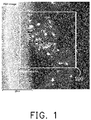
- Elemental mapping analysis of electron energy loss spectroscopy was performed on the catalyst composition containing a Ru-Ni alloy obtained in preparation example 4, wherein an analysis region 100 is as shown in FIG. 1 .
- FIG. 2A and FIG. 2B respectively show the element distributions of Ru and Ni, wherein the bright region is the site in which a single element is present, and the dark region is the site of other elements. It can be seen from FIG. 1 that the analysis region contains a number of the catalyst composition, the same sites can be obtained by comparing the results of FIG. 2A and FIG. 2B , and Ru and Ni are both present, and therefore it can be determined that the Ru-Ni alloy is present on the surface of the support.
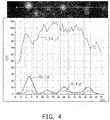
- FIG. 4 is a line profile image analysis diagram, and the bright region in the analysis region 300 in the top is the site of the Ru-Ni alloy. It can be learned from FIG. 4 that, the bright region in the analysis region 300 does contain both Ru and Ni elements, and therefore the component on the surface of the support is indeed a Ru-Ni alloy.
- the 3.92 mg catalyst was stirred and dispersed by using a 1 mL solvent of water and PA, and then 10 microliters was taken and added dropwise on a glassy carbon (GC) substrate of the RDE. After vacuum drying, the following tests were performed.
- GC glassy carbon
- the catalytic activity of the catalyst electrode was tested by linear sweep voltammetry (LSV) with a rotating disk electrode (RDE).
- the catalyst electrode for testing was in 0.1 M KOH electrolyte solution at room temperature (about 27 °C). After hydrogen (H 2 ) was continuously introduced for 1 hour, the rotation speed of the RDE was kept at 1600 rpm, and the linear sweep voltammetry (LSV) scan conditions are as follows:
- HOR Hydrogen oxidation reaction
- LSV linear sweep voltammetry
- RDE rotating disk electrode
- HER Hydrogen evolution reaction
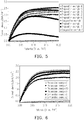
- FIG. 5 is a HOR test result for the catalyst composition of Ru X M Y alloy in different X/Y mole ratio proportions in preparation examples 1 to 7.
- FIG. 6 shows that the HOR reactivity of preparation examples 4 and 8 to 10 is significantly higher than that of Comparative Examples 1 to 2.
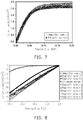
- FIG. 8 is a HER test result for the catalyst composition of Ru X M Y alloy in different X/Y mole ratio proportions in preparation examples 1 to 7.
- the HER test results for 20 w% pure Ru and pure Ni catalyst compositions are shown in FIG. 8 .
- FIG. 8 shows that the HER reactivity of preparations 1 to 7 is higher than that of comparative example 2, and that of preparation examples 1 to 6 is higher than that of comparative example 1.
- HER test results with the preparations example 4 and 8 to 10, which is different weight percent for the Ru X M Y alloy catalyst compositions, are shown in Fig 9 .
- HER comparison results of comparative examples 1 to 2 are shown in FIG. 9 .
- FIG. 9 shows that the HER reactivity of preparation examples 4 and 8 to 10 is significantly higher than that of Comparative Examples 1 to 2.
- the HER test results for commercially JM Hispec 3000 Pt and preparation examples 8 are shown in FIG. 10 .
- the HOR reactivity of preparation example 8 is very close to the reactivity of comparative example 3, and the cost of the catalyst composition of preparation example 8 is much less than that of the Pt catalyst, indicating the catalyst composition containing the Ru X M Y alloy has HER application development potential.
- Ru X M Y alloys used in preparation examples 1 to 10 are Ru-Ni alloys, the disclosure is not limited thereto.
- FIG. 11 is the crystal structure schematic diagram at different lattice sites for the Ru 3 M 1 alloy surface.
- FIG. 12 is a simulation diagram of hydrogen atoms absorbing free energy ( ⁇ G H ) at different lattice sites with the Ru 3 M 1 alloy surface for FIG. 11 .
- the metal atoms in the lattice are 3 Ru and 1 M, and therefore in addition to consider p-Top, p-B, p-FCC, and p-HCP of Ru, then the top site of M (m-top), the bridge site (m-B) between Ru and M, the FCC hollow of M (m-FCC) (i.e., the hollow in the middle of Ru-Ru-M), and the HCP hollow of M (m-HCP) (i.e., the hollow in the middle of Ru-Ru-M) also need to be considered.
- FIG. 12 shows that the ⁇ G H of at least one lattice site in RuNi, RuCo, RuFe, RuMn, RuCr, RuV, RuTi, RuCu, and RuZn is less than zero, indicating M in the Ru X M Y alloy can also be Ni, Co, Fe, Mn, Cr, V, Ti, Cu, or Zn.
- ⁇ G H of pure Ni is less than zero, the hydrogen adsorption energy of a too low ⁇ G H is too high to desorb hydrogen.
- the disclosure provides a catalyst composition formed by at least one Ru X M Y alloy attached to the support that can be used in an alkaline electrochemical energy conversion reaction such as fuel cells, electrolysers, solar hydrogen productions, or electrochemical sensors and has high reactivity and reduced catalyst cost.
- an alkaline electrochemical energy conversion reaction such as fuel cells, electrolysers, solar hydrogen productions, or electrochemical sensors and has high reactivity and reduced catalyst cost.
Landscapes
- Chemical & Material Sciences (AREA)
- Chemical Kinetics & Catalysis (AREA)
- Engineering & Computer Science (AREA)
- Electrochemistry (AREA)
- Materials Engineering (AREA)
- Organic Chemistry (AREA)
- Metallurgy (AREA)
- General Chemical & Material Sciences (AREA)
- Inorganic Chemistry (AREA)
- Life Sciences & Earth Sciences (AREA)
- Manufacturing & Machinery (AREA)
- Health & Medical Sciences (AREA)
- Sustainable Energy (AREA)
- Sustainable Development (AREA)
- Physics & Mathematics (AREA)
- General Health & Medical Sciences (AREA)
- General Physics & Mathematics (AREA)
- Immunology (AREA)
- Pathology (AREA)
- Biochemistry (AREA)
- Analytical Chemistry (AREA)
- Molecular Biology (AREA)
- Catalysts (AREA)
- Inert Electrodes (AREA)
- Fuel Cell (AREA)
- Electrodes For Compound Or Non-Metal Manufacture (AREA)
- Electrolytic Production Of Non-Metals, Compounds, Apparatuses Therefor (AREA)
Abstract
Description
- The disclosure relates to a catalyst composition for an alkaline electrochemical energy conversion reaction and a use thereof.
- The hydrogen economy is a delivering energy system by using hydrogen. The hydrogen can function as an energy storage medium, and it is generated by renewable energy and then stored until a fuel cell converts it back to electricity, which be able to replace the current petroleum economic system. The renewable energy is, for instance, electrolysis of water by using solar power, wind power, tidal power hydro power, or geothermal power. The electrochemical energy conversion devices such as fuel cells, electrolysers, solar hydrogen generators, or electrochemical sensors have reached to commercialization stage, but high cost and limited amount Pt catalyst hinder the development in acidic media. To overcome this issue, the Pt free catalyst is alternative. However, the energy conversion efficiency of the Pt free catalyst is too low due to the slower kinetics thereof in alkaline media. Therefore, the enhancement of the electrochemical reaction rate of the Pt free catalyst becomes very important.
- One of the key challenges of the development of fuel cells, electrolysers, solar hydrogen generators, and electrochemical sensors in alkaline media is an electrode reaction for hydrogen. The hydrogen oxidation reaction (HOR) and hydrogen evolution reaction (HER) have faster reaction kinetics in acidic media. However, the HOR and HER have slower reaction kinetics in alkaline media.
- Therefore, the development of high activity catalyst for hydrogen oxidation reaction and hydrogen evolution reaction is a top priority for fuel cells, electrolysers, solar hydrogen generators, and electrochemical sensors in alkaline media.
- The invention is defined in the independent claims. The dependent claims define preferred embodiments. The catalyst composition for an alkaline electrochemical energy conversion reaction of the disclosure includes a support and at least one RuXMY alloy attached to the surface of the support, wherein M is a transition metal and X≥Y.
- The method of electrochemical energy conversion of the disclosure is provided, in which an electrochemical energy conversion reaction is produced by using the catalyst composition in an alkaline media.
- Several exemplary embodiments accompanied with figures are described in detail below to further describe the disclosure in details.
- The accompanying drawings are included to provide further understanding, and are incorporated in and constitute a part of this specification. The drawings illustrate exemplary embodiments and, together with the description, serve to explain the principles of the disclosure.
-
FIG. 1 is a TEM image of a catalyst composition containing a ruthenium (Ru)-nickel (Ni) alloy in a preparation example of the disclosure. -
FIG. 2A is a Ru element distribution mapping of the catalyst composition forFIG. 1 . -
FIG. 2B is a Ni element distribution mapping of the catalyst composition forFIG. 1 . -
FIG. 3 is another TEM image of a catalyst composition containing a ruthenium (Ru)-nickel (Ni) alloy in a preparation example of the disclosure. -
FIG. 4 is a line profile image of the catalyst composition forFIG. 3 . -
FIG. 5 is a diagram showing the relationship between oxidation current density and potential for comparative examples 1 to 2 and the Ru-Ni alloys of preparation examples 1 to 7. -
FIG. 6 is a diagram showing the relationship between oxidation current density and potential for comparative examples 1 to 2 and the Ru-Ni alloys of preparation examples 4 and 8 to 10. -
FIG. 7 is a diagram showing the relationship between oxidation current density and potential for comparative example 3 and the Ru-Ni alloy of preparation example 8. -
FIG. 8 is a diagram showing the relationship between HER current density and potential for comparative examples 1 to 2 and the Ru-Ni alloys of preparation examples 1 to 7. -
FIG. 9 is a diagram showing the relationship between HER current density and potential for comparative examples 1 to 2 and the Ru-Ni alloys of preparation examples 4 and 8 to 10. -
FIG. 10 is a diagram showing the relationship between HER current density and potential for comparative example 3 and the Ru-Ni alloy of preparation example 8. -
FIG. 11 is the crystal structure schematic diagram at different lattice sites of the Ru3M1 alloy surface. -
FIG. 12 is a simulation diagram of hydrogen atoms absorbing free energy (ΔGH) at different lattice sites with the Ru3M1 alloy surface forFIG. 11 . - The disclosure relates to a catalyst composition for an alkaline electrochemical energy conversion reaction that can increase the efficiency of an electrochemical energy conversion reaction in an alkaline media. The catalyst composition of the disclosure includes a support and at least one RuXMY alloy attached to the surface of the support, wherein M is a transition metal and X≥Y.
- The "alkaline electrochemical energy conversion reaction" of the disclosure refers to produce an electrochemical energy conversion reaction, such as a hydrogen oxidation reaction (HOR) or a hydrogen evolution reaction (HER), in an alkaline media.
- In one embodiment of the disclosure, the X/Y in the RuXMY alloy can be between 1 and 50, such as between 1 and 35. In one embodiment of the disclosure, the RuXMY alloy can be 0.5 w% (weight percent) to 85 w% of the total mass of the catalyst composition, such as10 w% to 40 w% of the total mass of the catalyst composition. In one embodiment of the disclosure, the M in the RuXMY alloy can be nickel (Ni), cobalt (Co), iron (Fe), manganese (Mn), chromium (Cr), vanadium (V), titanium (Ti), copper (Cu), or zinc (Zn). Therefore, the RuXMY alloy can include, for instance, a Ru-Ni, Ru-Co, Ru-Fe, Ru-Mn, Ru-Cr, Ru-V, Ru-Ti, Ru-Cu, or Ru-Zn alloy.
- The support can be a conductive material or a corrosion-resistant material; for instance, the support includes a carbon material, metal oxide, or metal material.
- The catalyst composition of the disclosure can be applied in an electrochemical energy conversion reaction containing, for instance, used in fuel cells, electrolysers, solar hydrogen productions, or electrochemical sensors. Therefore, the disclosure further provides a method of electrochemical energy conversion of the disclosure, in which an electrochemical energy conversion reaction is produced by the catalyst composition in alkaline media.
- For instance, the electrochemical energy conversion reaction, such as a hydrogen oxidation reaction (HOR), is produced in the alkaline media. HOR: H2+2OH-→2H2O+2e-. Alternatively, other electrochemical energy conversion reaction is a hydrogen evolution reaction (HER) in the alkaline media. HER: 2H2O+2e-→H2+2OH-.
- A number of experimental examples are provided below to demonstrate the efficacy of the disclosure, but the experimental examples are not intended to limit the scope of the disclosure.
- The catalyst was prepared by using a modified Watanabe method. After a suitable amount of aqueous NiCl2-6H2O solution was added in H2O2, the pH value was adjusted to 6 using 1 M NaOH to form solution A. A suitable amount of an aqueous RuCl3-3H2O solution was used, and the solution pH value was adjusted to 4 with 0.6 M Na2CO3. Then, a suitable amount of NaHSO3 was added, and the mixture was reacted at 80 °C for 30 minutes to form solution B. A suitable amount of carbon black ECP300 and solution B were mixed to form solution C. After solution C was dispersed by ultrasound for 30 minutes, solution A was added in solution C and the two were uniformly mixed, and then the solution pH was adjusted to 6 using 1M NaOH. After reflux and heating at 100 °C for 8 hours, the catalyst powder was separated by centrifuge and dried in an oven at 80 °C. Lastly, the catalyst powder was reduced in a hydrogen environment (10% H2/Ar) at 500 °C for 2 hours to obtain the catalyst composition containing the RuXMY alloy.
- The catalyst compositions of preparation examples 1 to 10 of Table 2 were made according to the preparation method above and the material weights in Table 1 below, wherein in the catalyst compositions of preparation examples 1 to 7, the RuXMY alloy were 20 w% (weight percent) of the total mass of the catalyst composition, and in the catalyst compositions of preparation example 8, preparation example 9, and preparation example 10, the RuXMY alloy were 10 w%, 30 w%, and 40 w% (weight percent) of the total mass of the catalyst composition.
Table 1 NiCl2-6H2O (g) RuCl3-3H2O (g) ECP300 (g) Preparation example 1 0.0618 0.0227 0.096 Preparation example 2 0.0357 0.0392 0.096 Preparation example 3 0.0158 0.052 0.096 Preparation example 4 0.0123 0.0542 0.096 Preparation example 5 0.01 0.0556 0.096 Preparation example 6 0.0085 0.0565 0.096 Preparation example 7 0.0816 0.00996 0.096 Preparation 0.0123 0.0542 0.216 example 8 Preparation example 9 0.0092 0.0406 0.042 Preparation example 10 0.0246 0.1084 0.072 Table 2 Weight percent (w%) of RuXMY alloy in total mass of catalyst composition Preparation example 1 20 Preparation example 2 20 Preparation example 3 20 Preparation example 4 20 Preparation example 5 20 Preparation example 6 20 Preparation example 7 20 Preparation example 8 10 Preparation example 9 30 Preparation example 10 40 - Elemental mapping analysis of electron energy loss spectroscopy (EELS) was performed on the catalyst composition containing a Ru-Ni alloy obtained in preparation example 4, wherein an
analysis region 100 is as shown inFIG. 1 .FIG. 2A and FIG. 2B respectively show the element distributions of Ru and Ni, wherein the bright region is the site in which a single element is present, and the dark region is the site of other elements. It can be seen fromFIG. 1 that the analysis region contains a number of the catalyst composition, the same sites can be obtained by comparing the results ofFIG. 2A and FIG. 2B , and Ru and Ni are both present, and therefore it can be determined that the Ru-Ni alloy is present on the surface of the support. - Moreover, the line profile image analysis was performed on the same catalyst composition, wherein an
analysis region 300 is as shown inFIG. 3 .FIG. 4 is a line profile image analysis diagram, and the bright region in theanalysis region 300 in the top is the site of the Ru-Ni alloy. It can be learned fromFIG. 4 that, the bright region in theanalysis region 300 does contain both Ru and Ni elements, and therefore the component on the surface of the support is indeed a Ru-Ni alloy. - Moreover, X/Y of the RuXMY alloy in the catalyst compositions of preparation examples 1 to 7 were analyzed by X-ray absorption spectroscopy (XAS), and the data is recorded in Table 3 below.
Table 3 X/Y (mole ratio) Preparation example 1 1.6 Preparation example 2 11.7 Preparation example 3 19.5 Preparation example 4 23.9 Preparation example 5 29.8 Preparation example 6 34.9 Preparation example 7 0.1 - The 3.92 mg catalyst was stirred and dispersed by using a 1 mL solvent of water and PA, and then 10 microliters was taken and added dropwise on a glassy carbon (GC) substrate of the RDE. After vacuum drying, the following tests were performed.
- The catalytic activity of the catalyst electrode was tested by linear sweep voltammetry (LSV) with a rotating disk electrode (RDE). The catalyst electrode for testing was in 0.1 M KOH electrolyte solution at room temperature (about 27 °C). After hydrogen (H2) was continuously introduced for 1 hour, the rotation speed of the RDE was kept at 1600 rpm, and the linear sweep voltammetry (LSV) scan conditions are as follows:
- Scan rate: 10 mV/s;
- Potential range: 0 to 0.2 V, versus the Reversible Hydrogen Electrode (RHE).
- The evaluation performance method of Hydrogen oxidation reaction (HOR) was utilized to compare the current value of the same potential, wherein the greater positive value corresponds to a greater oxidation current, indicating the higher HOR activity.
- The catalytic activity of the catalyst electrode was tested by linear sweep voltammetry (LSV) with a rotating disk electrode (RDE). A catalyst electrode for testing was in 0.1 M KOH electrolyte solution at room temperature (about 27 °C), the rotation speed of the RDE was kept at 1600 rpm, and the linear sweep voltammetry (LSV) scan conditions are as follows:
- Scan rate: 10 mV/s;
- Potential range: 0 to -0.4 V, versus the Reversible Hydrogen Electrode (RHE).
- The evaluation performance method of Hydrogen evolution reaction (HER) was utilized to compare the current value of the same potential, wherein the greater negative value corresponds to a greater reduction current, indicating higher HER activity.
-
FIG. 5 is a HOR test result for the catalyst composition of RuXMY alloy in different X/Y mole ratio proportions in preparation examples 1 to 7. - The HOR test results for 20 w% pure Ru and pure Ni catalyst compositions are shown in
FIG. 5 . - In a cell, there will be an electrode potential for the cathode, and an electrode potential for the anode. The difference in potentials between the two electrodes equals the cell potential, so the lower anode potential is desired. From
FIG. 5 , it is shown that the reactivities ofPreparations 1 to 7 are both higher than that of pure Ni, and the reactivities of Preparative Examples 1 to 6 are also higher than that of pure Ru. Since Ni itself is extremely poor in reactivity, it is generally recognized that the addition of Ni to Ru may reduce the reactivity. However, it was confirmed by experiments that the alloying of Ru and Ni enhances the reactivity and is superior to the pure Ru of Comparative Example 1. - The HOR test results with the preparations example 4 and 8 to 10, which is different weight percent for the RuXMY alloy catalyst compositions, are shown in
Fig 6 . - Moreover, the HOR comparison results of comparative Examples 1 to 2 are shown in
FIG. 6 . -
FIG. 6 shows that the HOR reactivity of preparation examples 4 and 8 to 10 is significantly higher than that of Comparative Examples 1 to 2. - The HOR test results for commercially JM Hispec 3000 Pt and preparation examples 8 are shown in
FIG. 7 . - It can be known from
FIG. 7 that, the HOR reactivity of preparation example 8 is very close to the reactivity of comparative example 3, and the cost of the catalyst composition of preparation example 8 is much less than that of the Pt catalyst, indicating the catalyst composition containing the RuXMY alloy has HOR application development potential. -
FIG. 8 is a HER test result for the catalyst composition of RuXMY alloy in different X/Y mole ratio proportions in preparation examples 1 to 7. - The HER test results for 20 w% pure Ru and pure Ni catalyst compositions are shown in
FIG. 8 . -
FIG. 8 shows that the HER reactivity ofpreparations 1 to 7 is higher than that of comparative example 2, and that of preparation examples 1 to 6 is higher than that of comparative example 1. - The HER test results with the preparations example 4 and 8 to 10, which is different weight percent for the RuXMY alloy catalyst compositions, are shown in
Fig 9 . Moreover, the HER comparison results of comparative examples 1 to 2 are shown inFIG. 9 . -
FIG. 9 shows that the HER reactivity of preparation examples 4 and 8 to 10 is significantly higher than that of Comparative Examples 1 to 2. - The HER test results for commercially JM Hispec 3000 Pt and preparation examples 8 are shown in
FIG. 10 . - It can be known from
FIG. 10 that, the HOR reactivity of preparation example 8 is very close to the reactivity of comparative example 3, and the cost of the catalyst composition of preparation example 8 is much less than that of the Pt catalyst, indicating the catalyst composition containing the RuXMY alloy has HER application development potential. - Although the RuXMY alloys used in preparation examples 1 to 10 are Ru-Ni alloys, the disclosure is not limited thereto.
-
FIG. 11 is the crystal structure schematic diagram at different lattice sites for the Ru3M1 alloy surface.FIG. 12 is a simulation diagram of hydrogen atoms absorbing free energy (ΔGH) at different lattice sites with the Ru3M1 alloy surface forFIG. 11 . - In
FIG. 11 , in the case of a pure metal (such as Pt, Ru, or Ni), all of the metal atoms in the lattice are the same, and therefore only the ΔGH of the top site of the metal atoms and the surrounding sites thereof need to be considered, which are respectively the top site (p-top) of the metal atoms, the bridge site (p-B) between the metal atoms, the FCC hollow (p-FCC) of the metal atoms, and the HCP hollow (p-HCP) of the metal atoms. In the case of a Ru3M1 alloy, the metal atoms in the lattice are 3 Ru and 1 M, and therefore in addition to consider p-Top, p-B, p-FCC, and p-HCP of Ru, then the top site of M (m-top), the bridge site (m-B) between Ru and M, the FCC hollow of M (m-FCC) (i.e., the hollow in the middle of Ru-Ru-M), and the HCP hollow of M (m-HCP) (i.e., the hollow in the middle of Ru-Ru-M) also need to be considered. - The results based on the density functional theory (DFT) calculation of ΔGH are shown in
FIG. 12 , and the adsorption free energy (ΔGH) of platinum is used for hydrogen atoms as a target to evaluate whether RuXMY alloys can be used as potential HER and HOR catalysts.FIG. 12 shows that the ΔGH of at least one lattice site in RuNi, RuCo, RuFe, RuMn, RuCr, RuV, RuTi, RuCu, and RuZn is less than zero, indicating M in the RuXMY alloy can also be Ni, Co, Fe, Mn, Cr, V, Ti, Cu, or Zn. In comparison to pure Pt, the distribution range of ΔGH thereof is similar, and therefore similar hydrogen adsorption energy and hydrogen desorption energy are obtained. Although ΔGH of pure Ni is less than zero, the hydrogen adsorption energy of a too low ΔGH is too high to desorb hydrogen. - Based on the above, the disclosure provides a catalyst composition formed by at least one RuXMY alloy attached to the support that can be used in an alkaline electrochemical energy conversion reaction such as fuel cells, electrolysers, solar hydrogen productions, or electrochemical sensors and has high reactivity and reduced catalyst cost. As a result, the energy conversion efficiency of the electrochemical energy conversion reaction can be increased, and material costs can be significantly reduced.
Claims (10)
- A catalyst composition, comprising:a support; andat least one RuXMY alloy attached to a surface of the support, wherein M is a transition metal, and X≥Y,the catalyst composition is used in an alkaline electrochemical energy conversion reaction.
- The catalyst composition of claim 1, wherein X/Y of the RuXMY alloy is 1 to 50.
- The catalyst composition of claim 1, wherein the RuXMY alloy is 0.5 w% to 85 w% of a total mass of the catalyst composition.
- The catalyst composition of claim 1, wherein M in the RuXMY alloy comprises nickel (Ni), cobalt (Co), iron (Fe), manganese (Mn), chromium (Cr), vanadium (V), titanium (Ti), copper (Cu), or zinc (Zn).
- The catalyst composition of claim 1, wherein the support is a conductive material or a corrosion-resistant material.
- The catalyst composition of claim 1, wherein the support comprises a carbon material, metal oxide, or metal material.
- The catalyst composition of claim 1 used in fuel cells, electrolysers, solar hydrogen productions, or electrochemical sensors.
- A method of electrochemical energy conversion, comprising: producing an electrochemical energy conversion reaction by using the catalyst composition of one of claims 1-7 in an alkaline media.
- The method of electrochemical energy conversion of claim 8, wherein the electrochemical energy conversion reaction comprises a hydrogen oxidation reaction.
- The method of electrochemical energy conversion of claim 8, wherein the electrochemical energy conversion reaction comprises a hydrogen evolution reaction.
Applications Claiming Priority (3)
| Application Number | Priority Date | Filing Date | Title |
|---|---|---|---|
| US201562271310P | 2015-12-27 | 2015-12-27 | |
| US201662383609P | 2016-09-06 | 2016-09-06 | |
| TW105140556A TWI651129B (en) | 2015-12-27 | 2016-12-08 | Catalyst composition for alkaline electrochemical energy conversion reaction and use thereof |
Publications (2)
| Publication Number | Publication Date |
|---|---|
| EP3185343A1 true EP3185343A1 (en) | 2017-06-28 |
| EP3185343B1 EP3185343B1 (en) | 2019-01-30 |
Family
ID=57614234
Family Applications (1)
| Application Number | Title | Priority Date | Filing Date |
|---|---|---|---|
| EP16206930.6A Active EP3185343B1 (en) | 2015-12-27 | 2016-12-27 | Method of alkaline electrochemical energy conversion reaction and use of a catalyst composition for an alkaline electrochemical energy conversion reaction |
Country Status (4)
| Country | Link |
|---|---|
| US (1) | US10637071B2 (en) |
| EP (1) | EP3185343B1 (en) |
| JP (1) | JP6363688B2 (en) |
| CN (1) | CN106914254B (en) |
Families Citing this family (14)
| Publication number | Priority date | Publication date | Assignee | Title |
|---|---|---|---|---|
| KR100331969B1 (en) | 1999-07-23 | 2002-04-17 | 최홍기 | An apparatus and method for multi-step grouting using FRP tube |
| US11142836B2 (en) | 2018-11-29 | 2021-10-12 | Industrial Technology Research Institute | Catalyst material and method for manufacturing the same |
| US10900133B2 (en) | 2018-11-30 | 2021-01-26 | Industrial Technology Research Institute | Nitride catalyst and method for manufacturing the same |
| US10914011B2 (en) * | 2018-11-30 | 2021-02-09 | Industrial Technology Research Institute | Membrane electrode assembly and method for hydrogen evolution by electrolysis |
| TWI659780B (en) * | 2018-11-30 | 2019-05-21 | 財團法人工業技術研究院 | Nitride catalyst and method for manufacturing the same |
| EP3683875A1 (en) * | 2019-01-15 | 2020-07-22 | simatec ag | Electrochemical gas development cell, in particular mercury-free hydrogen development cell |
| US12191502B2 (en) * | 2019-04-02 | 2025-01-07 | Eenotech, Inc. | pH-universal aqueous rechargeable hydrogen batteries |
| CN110993972B (en) * | 2019-12-17 | 2021-07-20 | 北京化工大学 | A kind of hydrogen oxidation reaction catalyst for alkaline medium and synthesis method thereof |
| TWI883100B (en) | 2020-01-24 | 2025-05-11 | 英商億諾斯技術有限公司 | Electrode assembly, electrolyser, process for electrolysis, use of electrocatalytic layer on electrode, and method for producing hydrogen |
| CN111519133B (en) * | 2020-05-19 | 2022-03-04 | 昆明贵金属研究所 | Ti material with good-binding-property antioxidant coating and preparation method thereof |
| US11549188B2 (en) | 2021-04-28 | 2023-01-10 | Industrial Technology Research Institute | Membrane electrode assembly and method for hydrogen evolution by electrolysis |
| CN113363510B (en) * | 2021-06-02 | 2022-10-28 | 中国科学技术大学 | Hydrogen oxidation and reduction dual-function catalytic electrode and preparation method thereof |
| CN114737216B (en) * | 2022-02-28 | 2023-05-23 | 湖南大学深圳研究院 | Hydrogen evolution catalyst active material for electrolyzed water and preparation method thereof |
| FR3150964A1 (en) | 2023-07-12 | 2025-01-17 | Universite Paris Cite | Use of a heterostructured nickel-ruthenium catalyst for the electrocatalytic reduction of water |
Citations (2)
| Publication number | Priority date | Publication date | Assignee | Title |
|---|---|---|---|---|
| US20060105226A1 (en) * | 2004-11-16 | 2006-05-18 | Samsung Sdi Co., Ltd | Metal catalyst and fuel cell with electrode including the same |
| CN104022293A (en) * | 2014-05-07 | 2014-09-03 | 南通大学 | A TiO2@C loaded RuNi direct methanol fuel cell anode catalyst and its preparation method |
Family Cites Families (24)
| Publication number | Priority date | Publication date | Assignee | Title |
|---|---|---|---|---|
| US4430186A (en) | 1979-03-29 | 1984-02-07 | Olin Corporation | Electrolytic cell with improved hydrogen evolution cathode |
| US4425203A (en) | 1979-03-29 | 1984-01-10 | Olin Corporation | Hydrogen evolution cathode |
| US4466868A (en) | 1979-03-29 | 1984-08-21 | Olin Corporation | Electrolytic cell with improved hydrogen evolution cathode |
| US4419208A (en) | 1981-11-23 | 1983-12-06 | Olin Corporation | Raney alloy coated cathode for chlor-alkali cells |
| US4450056A (en) | 1981-11-23 | 1984-05-22 | Olin Corporation | Raney alloy coated cathode for chlor-alkali cells |
| US4401529A (en) | 1981-12-23 | 1983-08-30 | Olin Corporation | Raney nickel hydrogen evolution cathode |
| JPH0935723A (en) * | 1995-07-20 | 1997-02-07 | Toyota Motor Corp | Alloy catalyst for electrodes and fuel cell |
| JP2001256982A (en) * | 2000-03-13 | 2001-09-21 | Equos Research Co Ltd | Electrode for fuel cell and fuel cell |
| JP4061575B2 (en) | 2001-06-01 | 2008-03-19 | ソニー株式会社 | Conductive catalyst particles and method for producing the same, gas diffusive catalyst electrode, and electrochemical device |
| WO2004058633A2 (en) | 2002-12-20 | 2004-07-15 | Honda Giken Kogyo Kabushiki Kaisha | Platinum-free ruthenium-cobalt catalyst formulations for hydrogen generation |
| TWI301001B (en) | 2004-05-25 | 2008-09-11 | Lg Chemical Ltd | Ruthenium-rhodium alloy electrode catalyst and fuel cell comprising the same |
| US20060014637A1 (en) * | 2004-07-16 | 2006-01-19 | Lixin Cao | Metal alloy for electrochemical oxidation reactions and method of production thereof |
| JP2006120407A (en) * | 2004-10-20 | 2006-05-11 | Hitachi Maxell Ltd | Fuel cell catalyst, fuel cell and membrane electrode assembly using the catalyst |
| US20060293173A1 (en) | 2005-06-28 | 2006-12-28 | Qinglin Zhang | Hydrogen generation catalysts and systems for hydrogen generation |
| WO2007002357A2 (en) | 2005-06-28 | 2007-01-04 | Millennium Cell, Inc. | Hydrogen generation catalysys and system for hydrogen generation |
| US20060292067A1 (en) | 2005-06-28 | 2006-12-28 | Qinglin Zhang | Hydrogen generation catalysts and methods for hydrogen generation |
| US20070172417A1 (en) | 2005-06-28 | 2007-07-26 | Qinglin Zhang | Hydrogen generation catalysts and systems for hydrogen generation |
| EP1911170B1 (en) | 2005-08-05 | 2011-11-23 | Nokia Corporation | Preamble length for discontinuous control channel transmission |
| CN101162651B (en) | 2007-09-27 | 2010-06-02 | 南京航空航天大学 | Aqueous ruthenium-based composite metal oxide supercapacitor |
| CN102870259A (en) * | 2010-01-25 | 2013-01-09 | 雷蒙特亚特特拉维夫大学有限公司 | Catalysts and electrodes for fuel cells |
| US20130295485A1 (en) | 2012-05-07 | 2013-11-07 | Cellera, Inc. | Anode Electro-Catalysts for Alkaline Membrane Fuel Cells |
| GB201309513D0 (en) | 2013-05-28 | 2013-07-10 | Ilika Technologies Ltd | Metal alloy catalysts for fuel cell anodes |
| US20140370421A1 (en) * | 2013-06-18 | 2014-12-18 | Uchicago Argonne, Llc | Hydrogen oxidation reaction rate by promotion of hydroxyl adsorption |
| CN104022289B (en) * | 2014-05-07 | 2017-01-04 | 南通大学 | A RuNi/TiO2 nanotube electrode for direct methanol fuel cell and its preparation method |
-
2016
- 2016-12-26 CN CN201611215580.1A patent/CN106914254B/en active Active
- 2016-12-27 US US15/390,741 patent/US10637071B2/en active Active
- 2016-12-27 JP JP2016254409A patent/JP6363688B2/en active Active
- 2016-12-27 EP EP16206930.6A patent/EP3185343B1/en active Active
Patent Citations (2)
| Publication number | Priority date | Publication date | Assignee | Title |
|---|---|---|---|---|
| US20060105226A1 (en) * | 2004-11-16 | 2006-05-18 | Samsung Sdi Co., Ltd | Metal catalyst and fuel cell with electrode including the same |
| CN104022293A (en) * | 2014-05-07 | 2014-09-03 | 南通大学 | A TiO2@C loaded RuNi direct methanol fuel cell anode catalyst and its preparation method |
Non-Patent Citations (4)
| Title |
|---|
| A. YU. TSIVADZE ET AL: "Prospects of low-temperature platinum-free fuel cells", RUSSIAN JOURNAL OF GENERAL CHEMISTRY., vol. 77, no. 4, 1 April 2007 (2007-04-01), RU, pages 783 - 789, XP055364019, ISSN: 1070-3632, DOI: 10.1134/S1070363207040391 * |
| GIOVANNI P RACHIERO ET AL: "Bimetallic RuCo and RuCu catalysts supported on [gamma]-Al 2O3. A comparative study of their activity in hydrolysis of ammonia-borane", INTERNATIONAL JOURNAL OF HYDROGEN ENERGY, ELSEVIER SCIENCE PUBLISHERS B.V., BARKING, GB, vol. 36, no. 12, 1 June 2011 (2011-06-01), pages 7051 - 7065, XP002664995, ISSN: 0360-3199, [retrieved on 20110408], DOI: 10.1016/J.IJHYDENE.2011.03.009 * |
| MODESTOV A D ET AL: "MEA for alkaline direct ethanol fuel cell with alkali doped PBI membrane and non-platinum electrodes", JOURNAL OF POWER SOURCES, ELSEVIER SA, CH, vol. 188, no. 2, 15 March 2009 (2009-03-15), pages 502 - 506, XP025988446, ISSN: 0378-7753, [retrieved on 20081206], DOI: 10.1016/J.JPOWSOUR.2008.11.118 * |
| TARASEVICH M R ET AL: "Kinetics of ethanol electrooxidation at RuNi catalysts", ELECTROCHEMISTRY COMMUNICATIONS, ELSEVIER, AMSTERDAM, NL, vol. 7, no. 2, 1 February 2005 (2005-02-01), pages 141 - 146, XP027706410, ISSN: 1388-2481, [retrieved on 20050201] * |
Also Published As
| Publication number | Publication date |
|---|---|
| CN106914254B (en) | 2019-08-23 |
| US20170187046A1 (en) | 2017-06-29 |
| US10637071B2 (en) | 2020-04-28 |
| CN106914254A (en) | 2017-07-04 |
| JP6363688B2 (en) | 2018-07-25 |
| JP2017170426A (en) | 2017-09-28 |
| EP3185343B1 (en) | 2019-01-30 |
Similar Documents
| Publication | Publication Date | Title |
|---|---|---|
| EP3185343B1 (en) | Method of alkaline electrochemical energy conversion reaction and use of a catalyst composition for an alkaline electrochemical energy conversion reaction | |
| Yi et al. | Co-CoO-Co3O4/N-doped carbon derived from metal-organic framework: The addition of carbon black for boosting oxygen electrocatalysis and Zn-Air battery | |
| Ramos-Sánchez et al. | PdNi electrocatalyst for oxygen reduction in acid media | |
| Ball et al. | An investigation into factors affecting the stability of carbons and carbon supported platinum and platinum/cobalt alloy catalysts during 1.2 V potentiostatic hold regimes at a range of temperatures | |
| CN109065897B (en) | Phosphorus-doped porous carbon-coated tricobalt tetroxide oxygen reduction catalyst and preparation method and application thereof | |
| Hegazy et al. | FeNi2S4–a potent bifunctional efficient electrocatalyst for the overall electrochemical water splitting in alkaline electrolyte | |
| CN110102331B (en) | A high-performance oxygen evolution cobalt diselenide/nickel tetraselenide@NC/C composite catalyst and its preparation method and application | |
| Yi et al. | Carbon nanotube-supported binary silver-based nanocatalysts for oxygen reduction reaction in alkaline media | |
| Choi et al. | Multicomponent nonprecious hydrogen evolution catalysts for high performance and durable proton exchange membrane water electrolyzer | |
| Tang et al. | Scalable synthesis of heterostructure molybdenum and nickel sulfides nanosheets for efficient hydrogen generation in alkaline electrolyte | |
| Zhao et al. | Tungsten doped Co–Se nanocomposites as an efficient non precious metal catalyst for oxygen reduction | |
| Wu et al. | PtxNi alloy nanoparticles as cathode catalyst for PEM fuel cells with enhanced catalytic activity | |
| Stephens et al. | Correlating microstructure and activity for polysulfide reduction and oxidation at WS2 electrocatalysts | |
| US11276866B2 (en) | Catalyst for solid polymer fuel cells and method for producing the same | |
| Jo et al. | Bi/BiFe (oxy) hydroxide for sustainable lattice oxygen-boosted electrocatalysis at a practical high current density | |
| He et al. | The studies of performance of the Au electrode modified by Zn as the anode electrocatalyst of direct borohydride fuel cell | |
| CN111933961A (en) | Binary CoFe alloy loaded g-C3N4Catalyst and preparation method thereof | |
| KR20220081891A (en) | Rhenium molybdenum sulfide alloyed nanosheet having enhanced catalytic activity on hydrogen evolution reaction and preparation method thereof | |
| JP5056257B2 (en) | ELECTRODE CATALYST FOR FUEL CELL, METHOD FOR EVALUATING PERFORMANCE OF OXYGEN REDUCTION CATALYST, AND SOLID POLYMER FUEL CELL | |
| Kumari et al. | Excellent ethanol oxidation and oxygen evolution reaction from ultrafine nickel hydroxide nanorods stabilized at room temperature | |
| Zhang et al. | A convenient method for synthesis of Fe3O4/FeS2 as high-performance electrocatalysts for oxygen evolution reaction and zinc-air batteries | |
| Suárez‐Alcántara et al. | Evaluation of RuxWySez catalyst as a cathode electrode in a polymer electrolyte membrane fuel cell | |
| JP2021186750A (en) | Catalyst for oxygen evolution reaction and method for producing the same | |
| KR20220016605A (en) | Rhenium molybdenum selenide alloyed nanosheet having enhanced catalytic activity on hydrogen evolution reaction and preparation method thereof | |
| US10879539B2 (en) | Mixed metal oxide compounds and electrocatalytic compositions, devices and processes using the same |
Legal Events
| Date | Code | Title | Description |
|---|---|---|---|
| PUAI | Public reference made under article 153(3) epc to a published international application that has entered the european phase |
Free format text: ORIGINAL CODE: 0009012 |
|
| STAA | Information on the status of an ep patent application or granted ep patent |
Free format text: STATUS: REQUEST FOR EXAMINATION WAS MADE |
|
| 17P | Request for examination filed |
Effective date: 20161227 |
|
| AK | Designated contracting states |
Kind code of ref document: A1 Designated state(s): AL AT BE BG CH CY CZ DE DK EE ES FI FR GB GR HR HU IE IS IT LI LT LU LV MC MK MT NL NO PL PT RO RS SE SI SK SM TR |
|
| AX | Request for extension of the european patent |
Extension state: BA ME |
|
| RBV | Designated contracting states (corrected) |
Designated state(s): AL AT BE BG CH CY CZ DE DK EE ES FI FR GB GR HR HU IE IS IT LI LT LU LV MC MK MT NL NO PL PT RO RS SE SI SK SM TR |
|
| STAA | Information on the status of an ep patent application or granted ep patent |
Free format text: STATUS: EXAMINATION IS IN PROGRESS |
|
| 17Q | First examination report despatched |
Effective date: 20180212 |
|
| GRAP | Despatch of communication of intention to grant a patent |
Free format text: ORIGINAL CODE: EPIDOSNIGR1 |
|
| STAA | Information on the status of an ep patent application or granted ep patent |
Free format text: STATUS: GRANT OF PATENT IS INTENDED |
|
| RIC1 | Information provided on ipc code assigned before grant |
Ipc: H01M 8/083 20160101ALI20180628BHEP Ipc: H01M 4/92 20060101AFI20180628BHEP Ipc: C25B 11/04 20060101ALI20180628BHEP Ipc: H01M 4/88 20060101ALI20180628BHEP Ipc: C25B 1/04 20060101ALI20180628BHEP Ipc: C25B 1/00 20060101ALI20180628BHEP |
|
| INTG | Intention to grant announced |
Effective date: 20180801 |
|
| GRAS | Grant fee paid |
Free format text: ORIGINAL CODE: EPIDOSNIGR3 |
|
| GRAA | (expected) grant |
Free format text: ORIGINAL CODE: 0009210 |
|
| STAA | Information on the status of an ep patent application or granted ep patent |
Free format text: STATUS: THE PATENT HAS BEEN GRANTED |
|
| AK | Designated contracting states |
Kind code of ref document: B1 Designated state(s): AL AT BE BG CH CY CZ DE DK EE ES FI FR GB GR HR HU IE IS IT LI LT LU LV MC MK MT NL NO PL PT RO RS SE SI SK SM TR |
|
| REG | Reference to a national code |
Ref country code: GB Ref legal event code: FG4D |
|
| REG | Reference to a national code |
Ref country code: CH Ref legal event code: EP |
|
| REG | Reference to a national code |
Ref country code: AT Ref legal event code: REF Ref document number: 1093974 Country of ref document: AT Kind code of ref document: T Effective date: 20190215 |
|
| REG | Reference to a national code |
Ref country code: IE Ref legal event code: FG4D |
|
| REG | Reference to a national code |
Ref country code: DE Ref legal event code: R096 Ref document number: 602016009639 Country of ref document: DE |
|
| REG | Reference to a national code |
Ref country code: NO Ref legal event code: T2 Effective date: 20190130 |
|
| REG | Reference to a national code |
Ref country code: LT Ref legal event code: MG4D |
|
| REG | Reference to a national code |
Ref country code: NL Ref legal event code: MP Effective date: 20190130 |
|
| PG25 | Lapsed in a contracting state [announced via postgrant information from national office to epo] |
Ref country code: NL Free format text: LAPSE BECAUSE OF FAILURE TO SUBMIT A TRANSLATION OF THE DESCRIPTION OR TO PAY THE FEE WITHIN THE PRESCRIBED TIME-LIMIT Effective date: 20190130 Ref country code: SE Free format text: LAPSE BECAUSE OF FAILURE TO SUBMIT A TRANSLATION OF THE DESCRIPTION OR TO PAY THE FEE WITHIN THE PRESCRIBED TIME-LIMIT Effective date: 20190130 Ref country code: LT Free format text: LAPSE BECAUSE OF FAILURE TO SUBMIT A TRANSLATION OF THE DESCRIPTION OR TO PAY THE FEE WITHIN THE PRESCRIBED TIME-LIMIT Effective date: 20190130 Ref country code: ES Free format text: LAPSE BECAUSE OF FAILURE TO SUBMIT A TRANSLATION OF THE DESCRIPTION OR TO PAY THE FEE WITHIN THE PRESCRIBED TIME-LIMIT Effective date: 20190130 Ref country code: PT Free format text: LAPSE BECAUSE OF FAILURE TO SUBMIT A TRANSLATION OF THE DESCRIPTION OR TO PAY THE FEE WITHIN THE PRESCRIBED TIME-LIMIT Effective date: 20190530 Ref country code: PL Free format text: LAPSE BECAUSE OF FAILURE TO SUBMIT A TRANSLATION OF THE DESCRIPTION OR TO PAY THE FEE WITHIN THE PRESCRIBED TIME-LIMIT Effective date: 20190130 Ref country code: FI Free format text: LAPSE BECAUSE OF FAILURE TO SUBMIT A TRANSLATION OF THE DESCRIPTION OR TO PAY THE FEE WITHIN THE PRESCRIBED TIME-LIMIT Effective date: 20190130 |
|
| REG | Reference to a national code |
Ref country code: AT Ref legal event code: MK05 Ref document number: 1093974 Country of ref document: AT Kind code of ref document: T Effective date: 20190130 |
|
| PG25 | Lapsed in a contracting state [announced via postgrant information from national office to epo] |
Ref country code: BG Free format text: LAPSE BECAUSE OF FAILURE TO SUBMIT A TRANSLATION OF THE DESCRIPTION OR TO PAY THE FEE WITHIN THE PRESCRIBED TIME-LIMIT Effective date: 20190430 Ref country code: HR Free format text: LAPSE BECAUSE OF FAILURE TO SUBMIT A TRANSLATION OF THE DESCRIPTION OR TO PAY THE FEE WITHIN THE PRESCRIBED TIME-LIMIT Effective date: 20190130 Ref country code: RS Free format text: LAPSE BECAUSE OF FAILURE TO SUBMIT A TRANSLATION OF THE DESCRIPTION OR TO PAY THE FEE WITHIN THE PRESCRIBED TIME-LIMIT Effective date: 20190130 Ref country code: GR Free format text: LAPSE BECAUSE OF FAILURE TO SUBMIT A TRANSLATION OF THE DESCRIPTION OR TO PAY THE FEE WITHIN THE PRESCRIBED TIME-LIMIT Effective date: 20190501 Ref country code: IS Free format text: LAPSE BECAUSE OF FAILURE TO SUBMIT A TRANSLATION OF THE DESCRIPTION OR TO PAY THE FEE WITHIN THE PRESCRIBED TIME-LIMIT Effective date: 20190530 Ref country code: LV Free format text: LAPSE BECAUSE OF FAILURE TO SUBMIT A TRANSLATION OF THE DESCRIPTION OR TO PAY THE FEE WITHIN THE PRESCRIBED TIME-LIMIT Effective date: 20190130 |
|
| PG25 | Lapsed in a contracting state [announced via postgrant information from national office to epo] |
Ref country code: AL Free format text: LAPSE BECAUSE OF FAILURE TO SUBMIT A TRANSLATION OF THE DESCRIPTION OR TO PAY THE FEE WITHIN THE PRESCRIBED TIME-LIMIT Effective date: 20190130 Ref country code: IT Free format text: LAPSE BECAUSE OF FAILURE TO SUBMIT A TRANSLATION OF THE DESCRIPTION OR TO PAY THE FEE WITHIN THE PRESCRIBED TIME-LIMIT Effective date: 20190130 Ref country code: DK Free format text: LAPSE BECAUSE OF FAILURE TO SUBMIT A TRANSLATION OF THE DESCRIPTION OR TO PAY THE FEE WITHIN THE PRESCRIBED TIME-LIMIT Effective date: 20190130 Ref country code: SK Free format text: LAPSE BECAUSE OF FAILURE TO SUBMIT A TRANSLATION OF THE DESCRIPTION OR TO PAY THE FEE WITHIN THE PRESCRIBED TIME-LIMIT Effective date: 20190130 Ref country code: EE Free format text: LAPSE BECAUSE OF FAILURE TO SUBMIT A TRANSLATION OF THE DESCRIPTION OR TO PAY THE FEE WITHIN THE PRESCRIBED TIME-LIMIT Effective date: 20190130 Ref country code: RO Free format text: LAPSE BECAUSE OF FAILURE TO SUBMIT A TRANSLATION OF THE DESCRIPTION OR TO PAY THE FEE WITHIN THE PRESCRIBED TIME-LIMIT Effective date: 20190130 Ref country code: CZ Free format text: LAPSE BECAUSE OF FAILURE TO SUBMIT A TRANSLATION OF THE DESCRIPTION OR TO PAY THE FEE WITHIN THE PRESCRIBED TIME-LIMIT Effective date: 20190130 |
|
| REG | Reference to a national code |
Ref country code: DE Ref legal event code: R097 Ref document number: 602016009639 Country of ref document: DE |
|
| PG25 | Lapsed in a contracting state [announced via postgrant information from national office to epo] |
Ref country code: SM Free format text: LAPSE BECAUSE OF FAILURE TO SUBMIT A TRANSLATION OF THE DESCRIPTION OR TO PAY THE FEE WITHIN THE PRESCRIBED TIME-LIMIT Effective date: 20190130 |
|
| PLBE | No opposition filed within time limit |
Free format text: ORIGINAL CODE: 0009261 |
|
| STAA | Information on the status of an ep patent application or granted ep patent |
Free format text: STATUS: NO OPPOSITION FILED WITHIN TIME LIMIT |
|
| PG25 | Lapsed in a contracting state [announced via postgrant information from national office to epo] |
Ref country code: AT Free format text: LAPSE BECAUSE OF FAILURE TO SUBMIT A TRANSLATION OF THE DESCRIPTION OR TO PAY THE FEE WITHIN THE PRESCRIBED TIME-LIMIT Effective date: 20190130 |
|
| 26N | No opposition filed |
Effective date: 20191031 |
|
| PG25 | Lapsed in a contracting state [announced via postgrant information from national office to epo] |
Ref country code: SI Free format text: LAPSE BECAUSE OF FAILURE TO SUBMIT A TRANSLATION OF THE DESCRIPTION OR TO PAY THE FEE WITHIN THE PRESCRIBED TIME-LIMIT Effective date: 20190130 |
|
| PG25 | Lapsed in a contracting state [announced via postgrant information from national office to epo] |
Ref country code: TR Free format text: LAPSE BECAUSE OF FAILURE TO SUBMIT A TRANSLATION OF THE DESCRIPTION OR TO PAY THE FEE WITHIN THE PRESCRIBED TIME-LIMIT Effective date: 20190130 |
|
| REG | Reference to a national code |
Ref country code: CH Ref legal event code: PL |
|
| REG | Reference to a national code |
Ref country code: BE Ref legal event code: MM Effective date: 20191231 |
|
| PG25 | Lapsed in a contracting state [announced via postgrant information from national office to epo] |
Ref country code: MC Free format text: LAPSE BECAUSE OF FAILURE TO SUBMIT A TRANSLATION OF THE DESCRIPTION OR TO PAY THE FEE WITHIN THE PRESCRIBED TIME-LIMIT Effective date: 20190130 |
|
| PG25 | Lapsed in a contracting state [announced via postgrant information from national office to epo] |
Ref country code: IE Free format text: LAPSE BECAUSE OF NON-PAYMENT OF DUE FEES Effective date: 20191227 Ref country code: LU Free format text: LAPSE BECAUSE OF NON-PAYMENT OF DUE FEES Effective date: 20191227 |
|
| PG25 | Lapsed in a contracting state [announced via postgrant information from national office to epo] |
Ref country code: BE Free format text: LAPSE BECAUSE OF NON-PAYMENT OF DUE FEES Effective date: 20191231 Ref country code: CH Free format text: LAPSE BECAUSE OF NON-PAYMENT OF DUE FEES Effective date: 20191231 Ref country code: LI Free format text: LAPSE BECAUSE OF NON-PAYMENT OF DUE FEES Effective date: 20191231 |
|
| PG25 | Lapsed in a contracting state [announced via postgrant information from national office to epo] |
Ref country code: CY Free format text: LAPSE BECAUSE OF FAILURE TO SUBMIT A TRANSLATION OF THE DESCRIPTION OR TO PAY THE FEE WITHIN THE PRESCRIBED TIME-LIMIT Effective date: 20190130 |
|
| PG25 | Lapsed in a contracting state [announced via postgrant information from national office to epo] |
Ref country code: MT Free format text: LAPSE BECAUSE OF FAILURE TO SUBMIT A TRANSLATION OF THE DESCRIPTION OR TO PAY THE FEE WITHIN THE PRESCRIBED TIME-LIMIT Effective date: 20190130 Ref country code: HU Free format text: LAPSE BECAUSE OF FAILURE TO SUBMIT A TRANSLATION OF THE DESCRIPTION OR TO PAY THE FEE WITHIN THE PRESCRIBED TIME-LIMIT; INVALID AB INITIO Effective date: 20161227 Ref country code: FR Free format text: LAPSE BECAUSE OF NON-PAYMENT OF DUE FEES Effective date: 20191231 |
|
| PG25 | Lapsed in a contracting state [announced via postgrant information from national office to epo] |
Ref country code: MK Free format text: LAPSE BECAUSE OF FAILURE TO SUBMIT A TRANSLATION OF THE DESCRIPTION OR TO PAY THE FEE WITHIN THE PRESCRIBED TIME-LIMIT Effective date: 20190130 |
|
| PGFP | Annual fee paid to national office [announced via postgrant information from national office to epo] |
Ref country code: GB Payment date: 20251229 Year of fee payment: 10 |
|
| PGFP | Annual fee paid to national office [announced via postgrant information from national office to epo] |
Ref country code: NO Payment date: 20251231 Year of fee payment: 10 |
|
| PGFP | Annual fee paid to national office [announced via postgrant information from national office to epo] |
Ref country code: DE Payment date: 20251229 Year of fee payment: 10 |