EP3185207A1 - Image processing device, image processing method, and image processing program - Google Patents
Image processing device, image processing method, and image processing program Download PDFInfo
- Publication number
- EP3185207A1 EP3185207A1 EP15833368.2A EP15833368A EP3185207A1 EP 3185207 A1 EP3185207 A1 EP 3185207A1 EP 15833368 A EP15833368 A EP 15833368A EP 3185207 A1 EP3185207 A1 EP 3185207A1
- Authority
- EP
- European Patent Office
- Prior art keywords
- luminance
- frequency
- distribution
- frequency distribution
- image processing
- Prior art date
- Legal status (The legal status is an assumption and is not a legal conclusion. Google has not performed a legal analysis and makes no representation as to the accuracy of the status listed.)
- Withdrawn
Links
Images

Classifications
-
- A—HUMAN NECESSITIES
- A61—MEDICAL OR VETERINARY SCIENCE; HYGIENE
- A61B—DIAGNOSIS; SURGERY; IDENTIFICATION
- A61B1/00—Instruments for performing medical examinations of the interior of cavities or tubes of the body by visual or photographical inspection, e.g. endoscopes; Illuminating arrangements therefor
- A61B1/00002—Operational features of endoscopes
- A61B1/00004—Operational features of endoscopes characterised by electronic signal processing
- A61B1/00009—Operational features of endoscopes characterised by electronic signal processing of image signals during a use of endoscope
- A61B1/000095—Operational features of endoscopes characterised by electronic signal processing of image signals during a use of endoscope for image enhancement
-
- A—HUMAN NECESSITIES
- A61—MEDICAL OR VETERINARY SCIENCE; HYGIENE
- A61B—DIAGNOSIS; SURGERY; IDENTIFICATION
- A61B1/00—Instruments for performing medical examinations of the interior of cavities or tubes of the body by visual or photographical inspection, e.g. endoscopes; Illuminating arrangements therefor
- A61B1/04—Instruments for performing medical examinations of the interior of cavities or tubes of the body by visual or photographical inspection, e.g. endoscopes; Illuminating arrangements therefor combined with photographic or television appliances
-
- G—PHYSICS
- G06—COMPUTING OR CALCULATING; COUNTING
- G06T—IMAGE DATA PROCESSING OR GENERATION, IN GENERAL
- G06T11/00—Two-dimensional [2D] image generation
- G06T11/10—Texturing; Colouring; Generation of textures or colours
-
- G—PHYSICS
- G06—COMPUTING OR CALCULATING; COUNTING
- G06T—IMAGE DATA PROCESSING OR GENERATION, IN GENERAL
- G06T5/00—Image enhancement or restoration
- G06T5/40—Image enhancement or restoration using histogram techniques
-
- G—PHYSICS
- G06—COMPUTING OR CALCULATING; COUNTING
- G06T—IMAGE DATA PROCESSING OR GENERATION, IN GENERAL
- G06T5/00—Image enhancement or restoration
- G06T5/90—Dynamic range modification of images or parts thereof
- G06T5/94—Dynamic range modification of images or parts thereof based on local image properties, e.g. for local contrast enhancement
-
- G—PHYSICS
- G06—COMPUTING OR CALCULATING; COUNTING
- G06T—IMAGE DATA PROCESSING OR GENERATION, IN GENERAL
- G06T7/00—Image analysis
- G06T7/90—Determination of colour characteristics
-
- H—ELECTRICITY
- H04—ELECTRIC COMMUNICATION TECHNIQUE
- H04N—PICTORIAL COMMUNICATION, e.g. TELEVISION
- H04N1/00—Scanning, transmission or reproduction of documents or the like, e.g. facsimile transmission; Details thereof
- H04N1/40—Picture signal circuits
- H04N1/407—Control or modification of tonal gradation or of extreme levels, e.g. background level
-
- H—ELECTRICITY
- H04—ELECTRIC COMMUNICATION TECHNIQUE
- H04N—PICTORIAL COMMUNICATION, e.g. TELEVISION
- H04N1/00—Scanning, transmission or reproduction of documents or the like, e.g. facsimile transmission; Details thereof
- H04N1/40—Picture signal circuits
- H04N1/407—Control or modification of tonal gradation or of extreme levels, e.g. background level
- H04N1/4072—Control or modification of tonal gradation or of extreme levels, e.g. background level dependent on the contents of the original
- H04N1/4074—Control or modification of tonal gradation or of extreme levels, e.g. background level dependent on the contents of the original using histograms
-
- G—PHYSICS
- G06—COMPUTING OR CALCULATING; COUNTING
- G06T—IMAGE DATA PROCESSING OR GENERATION, IN GENERAL
- G06T2207/00—Indexing scheme for image analysis or image enhancement
- G06T2207/10—Image acquisition modality
- G06T2207/10024—Color image
-
- G—PHYSICS
- G06—COMPUTING OR CALCULATING; COUNTING
- G06T—IMAGE DATA PROCESSING OR GENERATION, IN GENERAL
- G06T2207/00—Indexing scheme for image analysis or image enhancement
- G06T2207/20—Special algorithmic details
- G06T2207/20172—Image enhancement details
- G06T2207/20208—High dynamic range [HDR] image processing
Definitions
- the present invention relates to an image processing apparatus, an image processing method, and an image processing program.
- the present invention has been conceived in light of the above circumstances, and an object thereof is to provide an image processing apparatus, an image processing method, and an image processing program with which it is possible to obtain a high-quality image in which glare due to high-luminance bright spots is suppressed, while maintaining the sense of sharpness and resolution of the image as a whole.
- the present invention provides the following solutions.
- An aspect of the present invention provides: an image processing apparatus comprising: a high-luminance-pixel identifying unit that identifies pixels having luminance values equal to or greater than a prescribed threshold in an input image; a frequency-distribution creating unit that creates a frequency distribution of the luminance values of all of the pixels identified by the high-luminance-pixel identifying unit; a storage unit that stores a target frequency distribution; and a luminance correcting unit that corrects the luminance values of the pixels identified by the high-luminance-pixel identifying unit so that the frequency distribution created by the frequency-distribution creating unit approaches the target frequency distribution stored in the storage unit.
- pixels having luminance values equal to or greater than a prescribed threshold are identified from the input image by the high-luminance-pixel identifying unit, and a frequency distribution of the luminance values of all of the identified pixels is created by the frequency-distribution creating unit. Then, with the luminance correcting unit, the created frequency distribution and the target frequency distribution stored in the storage unit are compared, and the luminance values of the pixels identified by the high-luminance-pixel identifying unit are corrected so that the created frequency distribution approaches the target frequency distribution.
- the luminance correcting unit may perform gamma correction on the basis of the frequency distribution created by the frequency-distribution creating unit.
- the luminance correcting unit may perform gamma correction on the basis of the gradient of the frequency distribution created by the frequency-distribution creating unit.
- Another aspect of the present invention provides an image processing method comprising: a high-luminance-pixel identifying step of identifying pixels having a luminance value equal to or greater than a prescribed threshold in an input image; a frequency-distribution creating step of creating a frequency distribution of the luminance values of all of the pixels identified in the high-luminance-pixel identifying step; and a luminance correcting step of correcting the luminance values of the pixels identified in the high-luminance-pixel identifying step so that the frequency distribution created in the frequency-distribution creating step approaches a target frequency distribution.
- gamma correction may be performed on the basis of the frequency distribution created in the frequency-distribution creating step.
- gamma correction may be performed on the basis of the gradient of the frequency distribution created in the frequency-distribution creating step.
- Another aspect of the present invention provides an image processing program that enables a computer to execute: a high-luminance-pixel identifying step of identifying pixels having a luminance value equal to or greater than a prescribed threshold in an input image; a frequency-distribution creating step of creating a frequency distribution of the luminance values of all of the pixels identified in the high-luminance-pixel identifying step; and a luminance correcting step of correcting the luminance values of the pixels identified in the high-luminance-pixel identifying step so that the frequency distribution created in the frequency-distribution creating step approaches a target frequency distribution.
- the present invention affords an advantage in that it is possible to obtain a high-quality image in which glare due to high-luminance bright spots is suppressed, while maintaining the sense of sharpness and resolution of the image as a whole.
- An image processing apparatus 1 is applied to processing of an image obtained by an endoscope or the like and, as shown in Fig. 1 , includes: a high-luminance-pixel identifying unit 2 that identifies, in an input image, pixels having a luminance value equal to or greater than a prescribed threshold; a frequency-distribution creating unit 3 that creates a frequency distribution of the luminance values of all of the identified pixels; a storage unit 4 that stores a target frequency distribution; and a luminance correcting unit 5 that corrects luminance values of the pixels identified by the high-luminance-pixel identifying unit 2 so that the frequency distribution created by the frequency-distribution creating unit 3 approaches the target frequency distribution stored in the storage unit 4.
- the high-luminance-pixel identifying unit 2 compares the input image with a prescribed threshold to identify pixels having a luminance value greater than or equal to the threshold.
- a prescribed threshold for example, an image signal in which the luminance is represented by 8 bits is input, and in the high-luminance-pixel identifying unit 2, by binarizing the image with a gradation value of 190 serving as the threshold, pixels having a high luminance greater than or equal to a gradation value of 190 are extracted.
- the frequency-distribution creating unit 3 For all pixels identified in the high-luminance-pixel identifying unit 2, the frequency-distribution creating unit 3 counts the numbers of pixels having a luminance value equal or greater than the threshold while gradually varying the threshold and stores the numbers in association with the thresholds. Accordingly, it is possible to obtain a frequency distribution of the luminance values of high-luminance pixels.
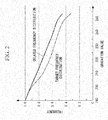
- An example of the frequency distribution created by the frequency-distribution creating unit 3 is shown by the solid line in Fig. 2.
- Fig. 2 is a frequency distribution in which the frequencies of the luminances are normalized to the frequency at a gradation value of 190.
- the storage unit 4 stores a target frequency distribution, as shown by the broken line in Fig. 2 , for example.
- This frequency distribution is a frequency distribution of an image considered to be a low-glare, high-quality vivid image by processing an image obtained from the same observed scene.
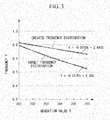
- the luminance correcting unit 5 corrects the coefficient of gamma correction to be applied to the image so that the frequency distribution created by the frequency-distribution creating unit 3 approaches the target frequency distribution stored in the storage unit 4. More specifically, as shown in Fig. 3 , only the luminance band that influences the amount of glare is approximated by a straight line.
- the 200-210 nm range is approximated by a straight line.
- the luminance correcting unit 5 is configured to set the gamma correction coefficient so that the gradient of the approximating straight line of the created frequency distribution approaches the gradient of the approximating straight line of the target frequency distribution.
- the luminance correcting unit 5 compares the gradient of the approximating straight line of the created frequency distribution and the gradient of the approximating straight line of the target frequency distribution and calculates an adjustment amount for the gamma correction coefficient according to the difference therebetween.
- the acquired image is input to the high-luminance-pixel identifying unit 2, and pixels having gradation values of 190 and higher are extracted (high-luminance-pixel identifying step).
- the extracted high-luminance pixels are input to the frequency-distribution creating unit 3, and a frequency distribution for each gradation value is created (frequency-distribution creating step).
- the created frequency distribution is sent to the luminance correcting unit 5.
- the target frequency distribution stored in the storage unit 4 is also input to the luminance correcting unit 5.
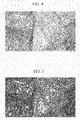
- the luminance correcting unit 5 compares the frequency distribution created by the frequency-distribution creating unit 3 and the target frequency distribution stored in the storage unit 4, and sets the gamma correction coefficient so that the created frequency distribution approaches the target frequency distribution. Then, the input endoscope image is processed in accordance with the set gamma correction coefficient (luminance correcting step). Accordingly, it is possible to obtain a corrected image by image processing, as shown in Fig. 5 .
- This corrected endoscope image is a high-quality image having few high-luminance bright spots and no glare.
- high-luminance bright spots do not disappear, but frequency changes in the high-luminance region are large, while high-luminance bright spots remain at about the same level; that is to say, an advantage is afforded in that, it is possible to produce a vivid final image by reducing the fraction of the number of glare points having the same luminance in the high-luminance region.
- high-luminance pixels in the entire input image are counted, instead of this, a specific region in the image may be specified, high-luminance pixels in the specified region may be counted, and the coefficient for gamma correction to be applied only to that region may be set, and processing carried out.
- the luminance correcting unit determines the gamma correction coefficient according to the gradient of the frequency distribution created by the frequency-distribution creating unit, it may determine the gamma correction coefficient according to the frequency distribution itself.
- the image processing method according to this embodiment can also be realized in the form of an image processing program that can be executed on a computer.
Landscapes
- Engineering & Computer Science (AREA)
- Health & Medical Sciences (AREA)
- Life Sciences & Earth Sciences (AREA)
- Physics & Mathematics (AREA)
- Surgery (AREA)
- General Physics & Mathematics (AREA)
- Theoretical Computer Science (AREA)
- Signal Processing (AREA)
- Radiology & Medical Imaging (AREA)
- Veterinary Medicine (AREA)
- Optics & Photonics (AREA)
- Pathology (AREA)
- Biophysics (AREA)
- Nuclear Medicine, Radiotherapy & Molecular Imaging (AREA)
- Biomedical Technology (AREA)
- Heart & Thoracic Surgery (AREA)
- Medical Informatics (AREA)
- Molecular Biology (AREA)
- Animal Behavior & Ethology (AREA)
- General Health & Medical Sciences (AREA)
- Public Health (AREA)
- Multimedia (AREA)
- Computer Vision & Pattern Recognition (AREA)
- Image Processing (AREA)
- Facsimile Image Signal Circuits (AREA)
Abstract
Description
- The present invention relates to an image processing apparatus, an image processing method, and an image processing program.
- In the related art, with the aim of improving, in an image, the contrast representation of a portion that should be displayed at high luminance, there is a known technique in which high-luminance gamma correction is performed on a high-luminance region or a region in which the amount of change in luminance is large, in order to further increase the luminance, and in which basic gamma correction is performed on regions other than these regions (for example, see Patent Literature 1).
- {PTL 1}
Japanese Unexamined Patent Application, Publication No.2010-38954 - However, in cases such as those in which illumination light is reflected at indentations and protrusions on blood vessels or tissue, and many small high-luminance bright spots exist, such as, for example, endoscope images in which the inner wall of the body cavity is acquired, with the technique in
Patent Literature 1, the glare caused by the high-luminance bright spots is not improved, and the quality of the endoscope image decreases. - The present invention has been conceived in light of the above circumstances, and an object thereof is to provide an image processing apparatus, an image processing method, and an image processing program with which it is possible to obtain a high-quality image in which glare due to high-luminance bright spots is suppressed, while maintaining the sense of sharpness and resolution of the image as a whole.
- In order to realize the above object, the present invention provides the following solutions.
- An aspect of the present invention provides: an image processing apparatus comprising: a high-luminance-pixel identifying unit that identifies pixels having luminance values equal to or greater than a prescribed threshold in an input image; a frequency-distribution creating unit that creates a frequency distribution of the luminance values of all of the pixels identified by the high-luminance-pixel identifying unit; a storage unit that stores a target frequency distribution; and a luminance correcting unit that corrects the luminance values of the pixels identified by the high-luminance-pixel identifying unit so that the frequency distribution created by the frequency-distribution creating unit approaches the target frequency distribution stored in the storage unit.
- With this aspect, pixels having luminance values equal to or greater than a prescribed threshold are identified from the input image by the high-luminance-pixel identifying unit, and a frequency distribution of the luminance values of all of the identified pixels is created by the frequency-distribution creating unit. Then, with the luminance correcting unit, the created frequency distribution and the target frequency distribution stored in the storage unit are compared, and the luminance values of the pixels identified by the high-luminance-pixel identifying unit are corrected so that the created frequency distribution approaches the target frequency distribution.
- It is possible to make the frequency distribution of the luminance values of the identified high-luminance pixels approach the target frequency distribution, and it is possible to obtain a high-quality image in which glare due do high-luminance points is suppressed, while maintaining the sense of sharpness and resolution of the image as a whole.
- In the above-described aspect, the luminance correcting unit may perform gamma correction on the basis of the frequency distribution created by the frequency-distribution creating unit.
- In the above-described aspect, the luminance correcting unit may perform gamma correction on the basis of the gradient of the frequency distribution created by the frequency-distribution creating unit.
- Another aspect of the present invention provides an image processing method comprising: a high-luminance-pixel identifying step of identifying pixels having a luminance value equal to or greater than a prescribed threshold in an input image; a frequency-distribution creating step of creating a frequency distribution of the luminance values of all of the pixels identified in the high-luminance-pixel identifying step; and a luminance correcting step of correcting the luminance values of the pixels identified in the high-luminance-pixel identifying step so that the frequency distribution created in the frequency-distribution creating step approaches a target frequency distribution.
- In the above-described aspect, in the luminance correcting step, gamma correction may be performed on the basis of the frequency distribution created in the frequency-distribution creating step.
- In the above-described aspect, in the luminance correcting step, gamma correction may be performed on the basis of the gradient of the frequency distribution created in the frequency-distribution creating step.
- Another aspect of the present invention provides an image processing program that enables a computer to execute: a high-luminance-pixel identifying step of identifying pixels having a luminance value equal to or greater than a prescribed threshold in an input image; a frequency-distribution creating step of creating a frequency distribution of the luminance values of all of the pixels identified in the high-luminance-pixel identifying step; and a luminance correcting step of correcting the luminance values of the pixels identified in the high-luminance-pixel identifying step so that the frequency distribution created in the frequency-distribution creating step approaches a target frequency distribution.
- The present invention affords an advantage in that it is possible to obtain a high-quality image in which glare due to high-luminance bright spots is suppressed, while maintaining the sense of sharpness and resolution of the image as a whole.
-
- {
Fig. 1} Fig. 1 is a diagram showing the overall configuration of an image processing apparatus according to an embodiment of the present invention. - {
Fig. 2} Fig. 2 is a graph showing a frequency distribution created by the frequency-distribution creating unit in the image processing apparatus inFig. 1 and a target frequency distribution stored in a storage unit. - {
Fig. 3} Fig. 3 is a graph showing a state in which the frequency distribution inFig. 2 is approximated by a straight line. - {
Fig. 4} Fig. 4 is a diagram showing an endoscope image before image processing. - {
Fig. 5} Fig. 5 is a diagram showing an endoscope image after image processing by the image processing apparatus inFig. 1 . - An image processing apparatus and an image processing method according to an embodiment of the present invention will be described below with reference to the drawings.
- An
image processing apparatus 1 according to this embodiment is applied to processing of an image obtained by an endoscope or the like and, as shown inFig. 1 , includes: a high-luminance-pixel identifying unit 2 that identifies, in an input image, pixels having a luminance value equal to or greater than a prescribed threshold; a frequency-distribution creating unit 3 that creates a frequency distribution of the luminance values of all of the identified pixels; astorage unit 4 that stores a target frequency distribution; and a luminance correcting unit 5 that corrects luminance values of the pixels identified by the high-luminance-pixel identifying unit 2 so that the frequency distribution created by the frequency-distribution creating unit 3 approaches the target frequency distribution stored in thestorage unit 4. - The high-luminance-
pixel identifying unit 2 compares the input image with a prescribed threshold to identify pixels having a luminance value greater than or equal to the threshold. In this embodiment, for example, an image signal in which the luminance is represented by 8 bits is input, and in the high-luminance-pixel identifying unit 2, by binarizing the image with a gradation value of 190 serving as the threshold, pixels having a high luminance greater than or equal to a gradation value of 190 are extracted. - For all pixels identified in the high-luminance-
pixel identifying unit 2, the frequency-distribution creating unit 3 counts the numbers of pixels having a luminance value equal or greater than the threshold while gradually varying the threshold and stores the numbers in association with the thresholds. Accordingly, it is possible to obtain a frequency distribution of the luminance values of high-luminance pixels. An example of the frequency distribution created by the frequency-distribution creating unit 3 is shown by the solid line inFig. 2. Fig. 2 is a frequency distribution in which the frequencies of the luminances are normalized to the frequency at a gradation value of 190. - The
storage unit 4 stores a target frequency distribution, as shown by the broken line inFig. 2 , for example. This frequency distribution is a frequency distribution of an image considered to be a low-glare, high-quality vivid image by processing an image obtained from the same observed scene. - The luminance correcting unit 5 corrects the coefficient of gamma correction to be applied to the image so that the frequency distribution created by the frequency-
distribution creating unit 3 approaches the target frequency distribution stored in thestorage unit 4. More specifically, as shown inFig. 3 , only the luminance band that influences the amount of glare is approximated by a straight line. Here, as an example, the 200-210 nm range is approximated by a straight line. - As a result, the gradient of the approximating straight line (broken line) in the above wavelength range of the created frequency distribution (solid line) was -0.0079, whereas the gradient of the approximating straight line (broken line) for the target frequency distribution (solid line) became -0.0175.
- Thus, the luminance correcting unit 5 is configured to set the gamma correction coefficient so that the gradient of the approximating straight line of the created frequency distribution approaches the gradient of the approximating straight line of the target frequency distribution.
- In other words, the luminance correcting unit 5 compares the gradient of the approximating straight line of the created frequency distribution and the gradient of the approximating straight line of the target frequency distribution and calculates an adjustment amount for the gamma correction coefficient according to the difference therebetween.
- In other words, when the difference between the gradients of the approximating straight lines is large, by correcting the gamma curve so that the change in the gamma correction coefficient in the high-luminance band becomes larger, a clear difference can be provided between the frequency distribution at a wavelength of 200 nm and the frequency distribution at a wavelength of 210 nm, and by means of the luminance difference, it is possible to correct the gamma curve to produce a vivid image. In the example shown in
Fig. 3 , before correction, because the difference between the frequency distribution at the wavelength of 200 nm and the frequency distribution at the wavelength of 210 nm is small, the image is not vivid and has the impression that white bright points are spread throughout the entire screen. - An image processing method used in the thus-configured
image processing apparatus 1 according to this embodiment will be described below. - To perform image processing using the
image processing apparatus 1 according to this embodiment, the acquired image is input to the high-luminance-pixel identifying unit 2, and pixels having gradation values of 190 and higher are extracted (high-luminance-pixel identifying step). Next, the extracted high-luminance pixels are input to the frequency-distribution creating unit 3, and a frequency distribution for each gradation value is created (frequency-distribution creating step). - In the case of an endoscope image, as shown in
Fig. 4 , illumination light emitted from the endoscope onto indentations and projections on blood vessels or tissue is reflected, causing small, high-luminance bright spots, and thus, a low-quality endoscope image is obtained. The frequency distribution of such an endoscope image is represented by the solid line inFig. 2 . - The created frequency distribution is sent to the luminance correcting unit 5. The target frequency distribution stored in the
storage unit 4 is also input to the luminance correcting unit 5. - The luminance correcting unit 5 compares the frequency distribution created by the frequency-
distribution creating unit 3 and the target frequency distribution stored in thestorage unit 4, and sets the gamma correction coefficient so that the created frequency distribution approaches the target frequency distribution. Then, the input endoscope image is processed in accordance with the set gamma correction coefficient (luminance correcting step). Accordingly, it is possible to obtain a corrected image by image processing, as shown inFig. 5 . - This corrected endoscope image is a high-quality image having few high-luminance bright spots and no glare. In other words, with the image processing apparatus and the image processing method according to this embodiment, high-luminance bright spots do not disappear, but frequency changes in the high-luminance region are large, while high-luminance bright spots remain at about the same level; that is to say, an advantage is afforded in that, it is possible to produce a vivid final image by reducing the fraction of the number of glare points having the same luminance in the high-luminance region.
- In this embodiment, although high-luminance pixels in the entire input image are counted, instead of this, a specific region in the image may be specified, high-luminance pixels in the specified region may be counted, and the coefficient for gamma correction to be applied only to that region may be set, and processing carried out.
- In this embodiment, although the luminance correcting unit determines the gamma correction coefficient according to the gradient of the frequency distribution created by the frequency-distribution creating unit, it may determine the gamma correction coefficient according to the frequency distribution itself.
- In addition, the image processing method according to this embodiment can also be realized in the form of an image processing program that can be executed on a computer.
-
- 1
- image processing apparatus
- 2
- high-luminance-pixel identifying unit
- 3
- frequency-distribution creating unit
- 4
- storage unit
- 5
- luminance correcting unit
Claims (7)
- An image processing apparatus comprising:a high-luminance-pixel identifying unit that identifies pixels having luminance values equal to or greater than a prescribed threshold in an input image;a frequency-distribution creating unit that creates a frequency distribution of the luminance values of all of the pixels identified by the high-luminance-pixel identifying unit;a storage unit that stores a target frequency distribution; anda luminance correcting unit that corrects the luminance values of the pixels identified by the high-luminance-pixel identifying unit so that the frequency distribution created by the frequency-distribution creating unit approaches the target frequency distribution stored in the storage unit.
- An image processing apparatus according to claim 1, wherein the luminance correcting unit performs gamma correction on the basis of the frequency distribution created by the frequency-distribution creating unit.
- An image processing apparatus according to claim 2, wherein the luminance correcting unit performs gamma correction on the basis of the gradient of the frequency distribution created by the frequency-distribution creating unit.
- An image processing method comprising:a high-luminance-pixel identifying step of identifying pixels having a luminance value equal to or greater than a prescribed threshold in an input image;a frequency-distribution creating step of creating a frequency distribution of the luminance values of all of the pixels identified in the high-luminance-pixel identifying step; anda luminance correcting step of correcting the luminance values of the pixels identified in the high-luminance-pixel identifying step so that the frequency distribution created in the frequency-distribution creating step approaches a target frequency distribution.
- An image processing method according to claim 4, wherein in the luminance correcting step, gamma correction is performed on the basis of the frequency distribution created in the frequency-distribution creating step.
- An image processing method according to claim 5, wherein in the luminance correcting step, gamma correction is performed on the basis of the gradient of the frequency distribution created in the frequency-distribution creating step.
- An image processing program that enables a computer to execute:a high-luminance-pixel identifying step of identifying pixels having a luminance value equal to or greater than a prescribed threshold in an input image;a frequency-distribution creating step of creating a frequency distribution of the luminance values of all of the pixels identified in the high-luminance-pixel identifying step; anda luminance correcting step of correcting the luminance values of the pixels identified in the high-luminance-pixel identifying step so that the frequency distribution created in the frequency-distribution creating step approaches a target frequency distribution.
Applications Claiming Priority (2)
| Application Number | Priority Date | Filing Date | Title |
|---|---|---|---|
| JP2014169409 | 2014-08-22 | ||
| PCT/JP2015/072449 WO2016027693A1 (en) | 2014-08-22 | 2015-08-07 | Image processing device, image processing method, and image processing program |
Publications (2)
| Publication Number | Publication Date |
|---|---|
| EP3185207A1 true EP3185207A1 (en) | 2017-06-28 |
| EP3185207A4 EP3185207A4 (en) | 2018-09-19 |
Family
ID=55350639
Family Applications (1)
| Application Number | Title | Priority Date | Filing Date |
|---|---|---|---|
| EP15833368.2A Withdrawn EP3185207A4 (en) | 2014-08-22 | 2015-08-07 | Image processing device, image processing method, and image processing program |
Country Status (4)
| Country | Link |
|---|---|
| US (1) | US20170161920A1 (en) |
| EP (1) | EP3185207A4 (en) |
| JP (1) | JP6049955B2 (en) |
| WO (1) | WO2016027693A1 (en) |
Family Cites Families (13)
| Publication number | Priority date | Publication date | Assignee | Title |
|---|---|---|---|---|
| JPH0256175A (en) * | 1988-08-22 | 1990-02-26 | Dainippon Screen Mfg Co Ltd | Method for setting reference density point |
| JP3772133B2 (en) * | 2001-06-14 | 2006-05-10 | 松下電器産業株式会社 | Automatic gradation correction device, automatic gradation correction method, and automatic gradation correction program recording medium |
| TWI231701B (en) * | 2001-06-14 | 2005-04-21 | Matsushita Electric Industrial Co Ltd | Automatic tone correction device, automatic tone correction method, and tone correction program recording medium |
| JP3888456B2 (en) * | 2002-09-10 | 2007-03-07 | ソニー株式会社 | Digital still camera |
| US8073233B2 (en) * | 2005-01-31 | 2011-12-06 | Olympus Corporation | Image processor, microscope system, and area specifying program |
| WO2006103835A1 (en) * | 2005-03-25 | 2006-10-05 | Mitsubishi Denki Kabushiki Kaisha | Image processing device, image display device, and image display method |
| JP2009244253A (en) * | 2008-03-10 | 2009-10-22 | Sysmex Corp | Particle analyzer, method for analyzing particles, and computer program |
| JP2009290660A (en) * | 2008-05-30 | 2009-12-10 | Seiko Epson Corp | Image processing apparatus, image processing method, image processing program and printer |
| JP4872982B2 (en) * | 2008-07-31 | 2012-02-08 | ソニー株式会社 | Image processing circuit and image display device |
| JP4531853B2 (en) * | 2008-09-17 | 2010-08-25 | パナソニック株式会社 | Image processing apparatus, imaging apparatus, and evaluation apparatus |
| JP5031877B2 (en) * | 2010-01-06 | 2012-09-26 | キヤノン株式会社 | Image processing apparatus and image processing method |
| JP2012058850A (en) * | 2010-09-06 | 2012-03-22 | Sony Corp | Information processing device and method, and program |
| KR20130015179A (en) * | 2011-08-02 | 2013-02-13 | 삼성디스플레이 주식회사 | Display apparatus and method for driving the same |
-
2015
- 2015-08-07 WO PCT/JP2015/072449 patent/WO2016027693A1/en not_active Ceased
- 2015-08-07 JP JP2016543250A patent/JP6049955B2/en active Active
- 2015-08-07 EP EP15833368.2A patent/EP3185207A4/en not_active Withdrawn
-
2017
- 2017-02-15 US US15/433,671 patent/US20170161920A1/en not_active Abandoned
Also Published As
| Publication number | Publication date |
|---|---|
| EP3185207A4 (en) | 2018-09-19 |
| US20170161920A1 (en) | 2017-06-08 |
| JP6049955B2 (en) | 2016-12-21 |
| WO2016027693A1 (en) | 2016-02-25 |
| JPWO2016027693A1 (en) | 2017-04-27 |
Similar Documents
| Publication | Publication Date | Title |
|---|---|---|
| US10475403B2 (en) | Display device and control method thereof with brightness and transmittance control | |
| CN109325922B (en) | Image self-adaptive enhancement method and device and image processing equipment | |
| KR102307501B1 (en) | Optical compensation system and Optical compensation method thereof | |
| JP5212380B2 (en) | Image correction apparatus, image correction program, and image correction method | |
| JP2008035518A (en) | Shadow region compensation method, medium and system | |
| US9336571B2 (en) | Method and device of skin tone optimization in a color gamut mapping system | |
| EP3068122A1 (en) | Image processing apparatus and image processing method | |
| US11657484B2 (en) | Image processing apparatus to enhance contrast of image, image processing method, and non-transitory computer-readable storage medium | |
| US9571744B2 (en) | Video processing method and apparatus | |
| WO2019160041A1 (en) | Image processing device, microscope system, image processing method and image processing program | |
| JP2019165832A (en) | Image processing method | |
| JP2015231140A (en) | Image processing apparatus, image processing method, and program | |
| US10896505B2 (en) | Method and system for applying filters for dental CT imaging | |
| CN113808045B (en) | Image brightness adjusting method and device | |
| JP2014171133A (en) | Imaging apparatus, imaging system, and imaging method | |
| US20160133229A1 (en) | Signal processing device and signal processing method | |
| EP3185207A1 (en) | Image processing device, image processing method, and image processing program | |
| US10386624B2 (en) | Microscope-image processing apparatus, microscope-image processing method, and microscope-image processing program | |
| US9721492B2 (en) | Image display apparatus and method of controlling image display apparatus | |
| EP3360321B1 (en) | Projection apparatus, projection system, program, and non-transitory computer-readable recording medium | |
| JP2009200884A (en) | Image data processor and image data processing method | |
| US20170061899A1 (en) | Image display apparatus, image-processing apparatus, method of controlling image display apparatus, and method of controlling image-processing apparatus | |
| US20180063380A1 (en) | Image processing device | |
| JP6484244B2 (en) | Image processing method for maintaining small color / gray difference | |
| CN103685867A (en) | Backlight compensation method and device |
Legal Events
| Date | Code | Title | Description |
|---|---|---|---|
| STAA | Information on the status of an ep patent application or granted ep patent |
Free format text: STATUS: THE INTERNATIONAL PUBLICATION HAS BEEN MADE |
|
| PUAI | Public reference made under article 153(3) epc to a published international application that has entered the european phase |
Free format text: ORIGINAL CODE: 0009012 |
|
| STAA | Information on the status of an ep patent application or granted ep patent |
Free format text: STATUS: REQUEST FOR EXAMINATION WAS MADE |
|
| 17P | Request for examination filed |
Effective date: 20170315 |
|
| AK | Designated contracting states |
Kind code of ref document: A1 Designated state(s): AL AT BE BG CH CY CZ DE DK EE ES FI FR GB GR HR HU IE IS IT LI LT LU LV MC MK MT NL NO PL PT RO RS SE SI SK SM TR |
|
| AX | Request for extension of the european patent |
Extension state: BA ME |
|
| DAV | Request for validation of the european patent (deleted) | ||
| DAX | Request for extension of the european patent (deleted) | ||
| A4 | Supplementary search report drawn up and despatched |
Effective date: 20180820 |
|
| RIC1 | Information provided on ipc code assigned before grant |
Ipc: A61B 1/04 20060101ALI20180813BHEP Ipc: G06T 5/00 20060101AFI20180813BHEP Ipc: H04N 1/407 20060101ALI20180813BHEP |
|
| STAA | Information on the status of an ep patent application or granted ep patent |
Free format text: STATUS: THE APPLICATION IS DEEMED TO BE WITHDRAWN |
|
| 18D | Application deemed to be withdrawn |
Effective date: 20190301 |