EP3183893B1 - Toolkit handling on multi-application integrated circuit cards with two or more card applications active simultaneously - Google Patents
Toolkit handling on multi-application integrated circuit cards with two or more card applications active simultaneously Download PDFInfo
- Publication number
- EP3183893B1 EP3183893B1 EP14900123.2A EP14900123A EP3183893B1 EP 3183893 B1 EP3183893 B1 EP 3183893B1 EP 14900123 A EP14900123 A EP 14900123A EP 3183893 B1 EP3183893 B1 EP 3183893B1
- Authority
- EP
- European Patent Office
- Prior art keywords
- rat
- communication device
- mobile communication
- icc
- camped
- Prior art date
- Legal status (The legal status is an assumption and is not a legal conclusion. Google has not performed a legal analysis and makes no representation as to the accuracy of the status listed.)
- Not-in-force
Links
Images



Classifications
-
- H—ELECTRICITY
- H04—ELECTRIC COMMUNICATION TECHNIQUE
- H04W—WIRELESS COMMUNICATION NETWORKS
- H04W4/00—Services specially adapted for wireless communication networks; Facilities therefor
- H04W4/60—Subscription-based services using application servers or record carriers, e.g. SIM application toolkits
-
- H—ELECTRICITY
- H04—ELECTRIC COMMUNICATION TECHNIQUE
- H04W—WIRELESS COMMUNICATION NETWORKS
- H04W8/00—Network data management
- H04W8/18—Processing of user or subscriber data, e.g. subscribed services, user preferences or user profiles; Transfer of user or subscriber data
- H04W8/183—Processing at user equipment or user record carrier
Definitions
- SIM Toolkit proactive commands are dependent on the technology. These commands/responses will be different for 3GPP2 and 3GPP technologies, and some of these commands are not supported in 3GPP2 technologies.
- some 2G integrated circuit cards ICCs
- ICCs i.e., ICCs with the capability of latching on multiple technologies, for example 3GPP and 3GPP2
- RUIM Removable User Interface Module
- DF Removable User Interface Module
- STK SIM Toolkit
- STK SIM Toolkit
- RAT Code Division Multiple Access
- SIM DF Global System for Mobile communications
- GSM Global System for Mobile communications
- Document EP 2 757 835 A1 discloses a system for automatic SIM card selection
- the GSM SIM card comprises SIM application toolkit (SAT) commands
- the USIM card comprises USIM Application Toolkit (USAT) commands.
- SAT SIM application toolkit
- USAT USIM Application Toolkit
- a method for managing SIM Toolkit (STK) application behavior for a multi-DF integrated circuit card may include: obtaining radio access technology (RAT) information for a RAT on which a mobile communication device is camped; and selecting a directory file (DF) in the multi-DF ICC corresponding to the RAT on which the mobile communication device is camped.
- RAT radio access technology
- DF directory file
- the mobile communication device may include: an input device configured to input a SIM Toolkit (STK) command; and a control unit.
- STK SIM Toolkit
- the control unit may be configured to: obtain radio access technology (RAT) information for a RAT on which a mobile communication device is camped; and cause a multi-directory file (DF) integrated circuit card (multi-DF ICC) to select a DF corresponding to the RAT on which the mobile communication device is camped.
- RAT radio access technology
- DF multi-directory file
- a method for performing a SIM Toolkit (STK) command may include: displaying an STK menu; selecting an STK command from the STK menu; obtaining radio access technology (RAT) information for a RAT on which a mobile communication device is camped; causing a multi-directory file (DF) integrated circuit card (multi-DF ICC) to select a DF corresponding to the RAT on which the mobile communication device is camped; and executing the STK command using the selected DF.
- RAT radio access technology
- DF multi-directory file integrated circuit card
- the mobile communication device may include: a display device configured to display a SIM Toolkit (STK) menu; an input device configured to permit a user to select an STK command from the STK menu; and a control unit.
- STK SIM Toolkit
- the control unit may be configured to: obtain radio access technology (RAT) information for a RAT on which the mobile communication device is camped; and cause a multi-directory file (DF) integrated circuit card (multi-DF ICC) to select a DF corresponding to the RAT on which the mobile communication device is camped.
- RAT radio access technology
- DF multi-directory file
- a multi-DF ICC may have both an RUIM DF for CDMA (i.e., CDMA DF) and a SIM for GSM (i.e., GSM DF), and both of the DFs may be active.
- a SIM Application Toolkit STK may consist of a set of proactive commands programmed into the SIM that define how the SIM should interact directly with the outside world. The STK may initiate commands independently of the mobile communication device and the network. The STK proactive commands may be constructed based on the current DF selected on the card.
- the SIM Application Toolkit may communicate with both the SIM (GSM DF) and RUIM (CDMA DF).
- FIG. 1 is a block diagram illustrating a mobile communication device 100 according to various embodiments.
- the mobile communication device 100 may include a control unit 110, a first communications unit 120, a second communications unit 125, a first antenna 130, a second antenna 135, a multi-DF ICC 160 having a GSM DF 140 and a CDMA DF 150, a user interface device 170, and a storage 180.
- the mobile communication device 100 may be, for example but not limited to, a mobile telephone, smartphone, tablet, computer, etc., capable of communications with one or more wireless networks.
- a mobile telephone capable of communications with one or more wireless networks.
- the mobile communication device 100 may include one or more transceivers or communications units and may interface with one or more antennas without departing from the scope of the present inventive concept.
- the first communications unit 120 may include, for example, but not limited to, a first transceiver (not shown).
- the second communications unit 125 may include, for example, but not limited to, a second transceiver (not shown).
- active mode a transceiver receives and transmits signals.
- idle mode a transceiver receives but does not transmit signals.
- the GSM DF 140 may associate the first communications unit 120 with a first subscription (Sub1) 192, for example a GSM subscription, on a first communication network 190 and the CDMA DF 150 may associate the second communications unit 125 with a second subscription (Sub2) 197, for example a CDMA subscription, on a second communication network 195.
- the multi-DF ICC 160 may be configured to incorporate the GSM DF 140 and the CDMA DF 150. In active mode, a communications unit receives and transmits signals. In idle mode, a communications unit receives but does not transmit signals.
- Sub1 is associated with the first communications unit 120 and Sub2 is associated with the second communications unit 125.
- Sub2 is associated with the second communications unit 125.
- either subscription may be associated with either communications unit without departing from the scope of the present inventive concept.
- the first communication network 190 and the second communication network 195 may be operated by the same or different service providers, and may support different radio access technologies (RATs), for example, but not limited to, CDMA and GSM.
- RATs radio access technologies
- the user interface device 170 may include an input device 172, for example, but not limited to a keyboard, touch panel, or other human interface device, and a display device 174, for example, but not limited to, a liquid crystal display (LCD), light emitting diode (LED) display, or other video display.
- an input device 172 for example, but not limited to a keyboard, touch panel, or other human interface device
- a display device 174 for example, but not limited to, a liquid crystal display (LCD), light emitting diode (LED) display, or other video display.
- LCD liquid crystal display
- LED light emitting diode
- the control unit 110 may be configured to control overall operation of the mobile communication device 100 including control of the first and second communications units 120, 125, the user interface device 170, and the storage 180.
- the control unit 110 may be a programmable device, for example, but not limited to, a microprocessor or microcontroller.
- the storage 180 may be configured to store application programs necessary for operation of the mobile communication device 100 that are executed by the control unit 110, as well as application data and user data.
- the multi-DF ICC 160 may request and receive current RAT information from the mobile communication device 100.
- the control unit 110 may cause the multi-DF ICC 160 to select a DF corresponding to the RAT on which the mobile communication device 100 is camped.
- multi-DF ICCs e.g., multi-DF ICC 160
- multiple RATs for example, but not limited to, a CDMA DF 150 that supports CDMA and a GSM DF 150 that supports GSM.
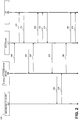
- FIG. 2 is a sequence diagram 200 according to various embodiments.
- the mobile communication device e.g., mobile communication device 100
- a first network e.g., the first communication network 190
- a first RAT e.g., GSM
- a second RAT e.g., CDMA
- the mobile communication device 100 may select (205), via the ICC drivers, the GSM DF 140 on the multi-DF ICC 160 to execute commands (210).
- the multi-DF ICC 160 may issue a proactive command, for example a Display text proactive command, in GSM format (215) that is communicated to the mobile communication device 100 by the ICC driver 201 (220).
- the mobile communication device 100 may process the command, for example the Display text command, and after processing the command may send a terminal response (TR) to the ICC driver 201 (225).
- TR terminal response
- the mobile communication device 100 may camp on a CDMA communication network (second RAT network 202).
- the TR may trigger a SendSMS proactive command by the multi-DF ICC 160.
- the CDMA DF 150 may be selected (230) before the TR to the Display text proactive command is transmitted from the ICC driver 201 to the multi-DF ICC 160 (235).
- the multi-DF ICC 160 may then send the SendSMS request to the ICC driver 201 in CDMA format using the CDMA DF 150 (240).
- the ICC driver 201 may send the SMS request to the mobile communication device 100 (245), and the mobile communication device 100 may send the SMS request to the CDMA communication network 202 (250), which understands the SMS request.
- Success responses may be returned from the CDMA communication network 202 to the mobile communication device 100 (255) and from the mobile communication device 100 to the ICC driver 201 (260).
- the CDMA DF 150 Prior to transmitting the success response to the multi-DF ICC 160, the CDMA DF 150 is selected (265) since the response is in CDMA format, and the success response is transmitted to the multi-DF ICC 160 (270).
- FIG. 3 is a flowchart of a method 300 according to various embodiments.
- the control unit 110 may cause the mobile communication device 100 to perform a terminal profile download to the multi-DF ICC 160 including information about the RAT which the mobile communication device 100 is camped on (310).
- RAT information may be obtained from user settings or the RAT may be selected based on a last successful RAT communication.
- the multi-DF ICC 160 may contain a plurality of DFs corresponding to a plurality of RATs. For example, if the mobile communication device 100 is camped on a GSM communication network, the multi-DF ICC 160 may be caused to select the GSM DF 140, and if the mobile communication device 100 is camped on a CDMA communication network the multi-DF ICC 160 may be caused to select the CDMA DF 150. STK commands may then be issued using the appropriate DF for the camped on RAT. If the mobile communication device 100 remains camped on the communication network, no change of RAT occurs (320-N).
- the control unit 110 may cause the multi-DF ICC 160 to select the appropriate DF for the RAT that the mobile communication device 100 is camped on (330) and may cause the mobile communication device 100 to perform a terminal profile download to obtain a new STK setup menu corresponding to the changed RAT from the multi-DF ICC 160 (340). STK commands may then be issued using the appropriate DF for the camped on RAT.
- FIG. 4 is a flowchart of a method 400 according to various embodiments.
- the control unit 110 may cause an STK menu to be displayed on the display device 174 of the user interface device 170 (410).
- An STK menu item may be selected from the STK menu via the input device 172 (420).
- the multi-DF ICC 160 may contain a plurality of DFs corresponding to a plurality of RATs.
- the control unit 110 may cause the multi-DF ICC 160 to select the DF for the RAT the mobile communication device 100 is camped on based on the current RAT information (430) and execute the STK command using the DF for the current RAT (440).
- the mobile communication device 100 may receive a response to the STK command from the network (450). Prior to transmitting the network response to the multi-DF ICC 160 may cause the multi-DF ICC 160 to select the DF for the RAT the mobile communication device 100 is camped on based on the current RAT information to interpret the network response (460).
- proper STK application behavior is provided by selecting the DF (e.g., CDMA DF 150 for CDMA or GSM DF 140 for GSM) based on the RAT (e.g., CDMA or GSM) that the mobile communication device 100 is camped on before triggering STK commands to the multi-DF ICC 160.
- the DF e.g., CDMA DF 150 for CDMA or GSM DF 140 for GSM
- the RAT e.g., CDMA or GSM
- the example apparatuses, methods, and systems disclosed herein can be applied to multi-SIM wireless devices subscribing to multiple communication networks and/or communication technologies.
- the various components illustrated in the figures may be implemented as, for example, but not limited to, software and/or firmware on a processor, ASIC/FPGA/DSP, or dedicated hardware.
- the features and attributes of the specific example embodiments disclosed above may be combined in different ways to form additional embodiments, all of which fall within the scope of the present disclosure.
- DSP digital signal processor
- ASIC application specific integrated circuit
- FPGA field programmable gate array
- a general-purpose processor may be a microprocessor, but, in the alternative, the processor may be any conventional processor, controller, microcontroller, or state machine.
- a processor may also be implemented as a combination of receiver devices, e.g., a combination of a DSP and a microprocessor, a plurality of microprocessors, one or more microprocessors in conjunction with a DSP core, or any other such configuration. Alternatively, some steps or methods may be performed by circuitry that is specific to a given function.
- the functions described may be implemented in hardware, software, firmware, or any combination thereof. If implemented in software, the functions may be stored as one or more instructions or code on a non-transitory computer-readable storage medium or non-transitory processor-readable storage medium. The steps of a method or algorithm disclosed herein may be embodied in processor-executable instructions that may reside on a non-transitory computer-readable or processor-readable storage medium. Non-transitory computer-readable or processor-readable storage media may be any storage media that may be accessed by a computer or a processor.
- non-transitory computer-readable or processor-readable storage media may include RAM, ROM, EEPROM, FLASH memory, CD-ROM or other optical disk storage, magnetic disk storage or other magnetic storage devices, or any other medium that may be used to store desired program code in the form of instructions or data structures and that may be accessed by a computer.
- Disk and disc includes compact disc (CD), laser disc, optical disc, digital versatile disc (DVD), floppy disk, and Blu-ray disc where disks usually reproduce data magnetically, while discs reproduce data optically with lasers. Combinations of the above are also included within the scope of non-transitory computer-readable and processor-readable media.
- the operations of a method or algorithm may reside as one or any combination or set of codes and/or instructions on a non-transitory processor-readable storage medium and/or computer-readable storage medium, which may be incorporated into a computer program product.
Landscapes
- Engineering & Computer Science (AREA)
- Computer Networks & Wireless Communication (AREA)
- Signal Processing (AREA)
- Databases & Information Systems (AREA)
- Telephone Function (AREA)
Description
- Some Subscriber Identity Module (SIM) Toolkit proactive commands are dependent on the technology. These commands/responses will be different for 3GPP2 and 3GPP technologies, and some of these commands are not supported in 3GPP2 technologies. In order to support multiple modes on mobile communication devices, some 2G integrated circuit cards (ICCs), i.e., ICCs with the capability of latching on multiple technologies, for example 3GPP and 3GPP2, have both a Removable User Interface Module (RUIM) directory file (DF) for executing SIM Toolkit (STK) commands when connected to a network using Code Division Multiple Access (CDMA) radio access technology (RAT) and a SIM DF for executing commands when connected to a network using Global System for Mobile communications (GSM) RAT. When the ICC sends a proactive command for the CDMA RAT while the mobile communication device is camped on a GSM network, or vice-versa, the mobile communication device may not understand the command.
- Document
EP 2 757 835 A1 discloses a system for automatic SIM card selection, the GSM SIM card comprises SIM application toolkit (SAT) commands, the USIM card comprises USIM Application Toolkit (USAT) commands. Camping on a first PLMN using a first RAT and camping on the second PLMN using the second RAT. - Apparatuses and methods for enabling proper SIM Toolkit application behavior for a multi-DF integrated circuit card are provided. The invention is defined by the independent claims. Further embodiments are defined by the dependent claims.
- According to various embodiments there is provided a method for managing SIM Toolkit (STK) application behavior for a multi-DF integrated circuit card (multi-DF ICC). The method may include: obtaining radio access technology (RAT) information for a RAT on which a mobile communication device is camped; and selecting a directory file (DF) in the multi-DF ICC corresponding to the RAT on which the mobile communication device is camped.
- According to various embodiments there is provided a mobile communication device. The mobile communication device may include: an input device configured to input a SIM Toolkit (STK) command; and a control unit.
- The control unit may be configured to: obtain radio access technology (RAT) information for a RAT on which a mobile communication device is camped; and cause a multi-directory file (DF) integrated circuit card (multi-DF ICC) to select a DF corresponding to the RAT on which the mobile communication device is camped.
- According to various embodiments there is provided a method for performing a SIM Toolkit (STK) command. The method may include: displaying an STK menu; selecting an STK command from the STK menu; obtaining radio access technology (RAT) information for a RAT on which a mobile communication device is camped; causing a multi-directory file (DF) integrated circuit card (multi-DF ICC) to select a DF corresponding to the RAT on which the mobile communication device is camped; and executing the STK command using the selected DF.
- According to various embodiments there is provided a mobile communication device. The mobile communication device may include: a display device configured to display a SIM Toolkit (STK) menu; an input device configured to permit a user to select an STK command from the STK menu; and a control unit.
- The control unit may be configured to: obtain radio access technology (RAT) information for a RAT on which the mobile communication device is camped; and cause a multi-directory file (DF) integrated circuit card (multi-DF ICC) to select a DF corresponding to the RAT on which the mobile communication device is camped.
- Other features and advantages of the present inventive concept should be apparent from the following description which illustrates by way of example aspects of the present inventive concept.
- Aspects and features of the present inventive concept will be more apparent by describing example embodiments with reference to the accompanying drawings, in which:
-
FIG. 1 is a block diagram illustrating a mobile communication device according to various embodiments; -
FIG. 2 is a sequence diagram according to various embodiments; -
FIG. 3 is a flowchart of a method according to various embodiments; and -
FIG. 4 is a flowchart of a method according to various embodiments. - While certain embodiments are described, these embodiments are presented by way of example only, and are not intended to limit the scope of protection. The apparatuses, methods, and systems described herein may be embodied in a variety of other forms. Furthermore, various omissions, substitutions, and changes in the form of the example methods and systems described herein may be made without departing from the scope of protection.
- A multi-DF ICC may have both an RUIM DF for CDMA (i.e., CDMA DF) and a SIM for GSM (i.e., GSM DF), and both of the DFs may be active. A SIM Application Toolkit (STK) may consist of a set of proactive commands programmed into the SIM that define how the SIM should interact directly with the outside world. The STK may initiate commands independently of the mobile communication device and the network. The STK proactive commands may be constructed based on the current DF selected on the card. The SIM Application Toolkit may communicate with both the SIM (GSM DF) and RUIM (CDMA DF).
-
FIG. 1 is a block diagram illustrating amobile communication device 100 according to various embodiments. As illustrated inFIG. 1 , themobile communication device 100 may include acontrol unit 110, afirst communications unit 120, asecond communications unit 125, afirst antenna 130, asecond antenna 135, amulti-DF ICC 160 having a GSM DF 140 and a CDMA DF 150, auser interface device 170, and astorage 180. - The
mobile communication device 100 may be, for example but not limited to, a mobile telephone, smartphone, tablet, computer, etc., capable of communications with one or more wireless networks. One of ordinary skill in the art will appreciate that themobile communication device 100 may include one or more transceivers or communications units and may interface with one or more antennas without departing from the scope of the present inventive concept. - The
first communications unit 120 may include, for example, but not limited to, a first transceiver (not shown). Thesecond communications unit 125 may include, for example, but not limited to, a second transceiver (not shown). In active mode, a transceiver receives and transmits signals. In idle mode, a transceiver receives but does not transmit signals. - The GSM DF 140 may associate the
first communications unit 120 with a first subscription (Sub1) 192, for example a GSM subscription, on afirst communication network 190 and the CDMA DF 150 may associate thesecond communications unit 125 with a second subscription (Sub2) 197, for example a CDMA subscription, on asecond communication network 195. Themulti-DF ICC 160 may be configured to incorporate the GSM DF 140 and the CDMA DF 150. In active mode, a communications unit receives and transmits signals. In idle mode, a communications unit receives but does not transmit signals. - For convenience, throughout this disclosure Sub1 is associated with the
first communications unit 120 and Sub2 is associated with thesecond communications unit 125. One of ordinary skill in the art will appreciate that either subscription may be associated with either communications unit without departing from the scope of the present inventive concept. - The
first communication network 190 and thesecond communication network 195 may be operated by the same or different service providers, and may support different radio access technologies (RATs), for example, but not limited to, CDMA and GSM. - The
user interface device 170 may include aninput device 172, for example, but not limited to a keyboard, touch panel, or other human interface device, and adisplay device 174, for example, but not limited to, a liquid crystal display (LCD), light emitting diode (LED) display, or other video display. One of ordinary skill in the art will appreciate that other input and display devices may be used without departing from the scope of the present inventive concept. - The
control unit 110 may be configured to control overall operation of themobile communication device 100 including control of the first andsecond communications units user interface device 170, and thestorage 180. Thecontrol unit 110 may be a programmable device, for example, but not limited to, a microprocessor or microcontroller. - The
storage 180 may be configured to store application programs necessary for operation of themobile communication device 100 that are executed by thecontrol unit 110, as well as application data and user data. - During power up of the
mobile communication device 100, themulti-DF ICC 160 may request and receive current RAT information from themobile communication device 100. Thecontrol unit 110 may cause themulti-DF ICC 160 to select a DF corresponding to the RAT on which themobile communication device 100 is camped. - Various embodiments enable proper STK application behavior for multi-DF ICCs (e.g., multi-DF ICC 160) that support multiple RATs, for example, but not limited to, a CDMA DF 150 that supports CDMA and a GSM DF 150 that supports GSM.
-
FIG. 2 is a sequence diagram 200 according to various embodiments. Referring toFIGS. 1 and2 , the mobile communication device (e.g., mobile communication device 100) may have powered up on a first network (e.g., the first communication network 190) that supports a first RAT (e.g., GSM), but themobile communication device 100 may subsequently be camped on a second network (e.g., the second communication network 195) that supports a second RAT (e.g., CDMA). - Since the
mobile communication device 100 powered up on a GSM communication network, themobile communication device 100 may select (205), via the ICC drivers, the GSM DF 140 on themulti-DF ICC 160 to execute commands (210). Themulti-DF ICC 160 may issue a proactive command, for example a Display text proactive command, in GSM format (215) that is communicated to themobile communication device 100 by the ICC driver 201 (220). Themobile communication device 100 may process the command, for example the Display text command, and after processing the command may send a terminal response (TR) to the ICC driver 201 (225). During the processing of a Display text proactive command, themobile communication device 100 may camp on a CDMA communication network (second RAT network 202). The TR may trigger a SendSMS proactive command by themulti-DF ICC 160. However, since the currently selected DF on themulti-DF ICC 160 is theGSM DF 140 but themobile communication device 100 is camped on a CDMA communication network, theCDMA DF 150 may be selected (230) before the TR to the Display text proactive command is transmitted from theICC driver 201 to the multi-DF ICC 160 (235). - The
multi-DF ICC 160 may then send the SendSMS request to theICC driver 201 in CDMA format using the CDMA DF 150 (240). TheICC driver 201 may send the SMS request to the mobile communication device 100 (245), and themobile communication device 100 may send the SMS request to the CDMA communication network 202 (250), which understands the SMS request. Success responses may be returned from the CDMA communication network 202 to the mobile communication device 100 (255) and from themobile communication device 100 to the ICC driver 201 (260). Prior to transmitting the success response to themulti-DF ICC 160, theCDMA DF 150 is selected (265) since the response is in CDMA format, and the success response is transmitted to the multi-DF ICC 160 (270). -
FIG. 3 is a flowchart of amethod 300 according to various embodiments. Referring toFIGS. 1-3 , at power up thecontrol unit 110 may cause themobile communication device 100 to perform a terminal profile download to themulti-DF ICC 160 including information about the RAT which themobile communication device 100 is camped on (310). Alternatively, RAT information may be obtained from user settings or the RAT may be selected based on a last successful RAT communication. - The
multi-DF ICC 160 may contain a plurality of DFs corresponding to a plurality of RATs. For example, if themobile communication device 100 is camped on a GSM communication network, themulti-DF ICC 160 may be caused to select theGSM DF 140, and if themobile communication device 100 is camped on a CDMA communication network themulti-DF ICC 160 may be caused to select theCDMA DF 150. STK commands may then be issued using the appropriate DF for the camped on RAT. If themobile communication device 100 remains camped on the communication network, no change of RAT occurs (320-N). - Thereafter, if the RAT that the
mobile communication device 100 is camped on changes (320-Y), for example, themobile communication device 100 moves from an area covered by a GSM communication network to an area covered by a CDMA communication network, or vice-versa, thecontrol unit 110 may cause themulti-DF ICC 160 to select the appropriate DF for the RAT that themobile communication device 100 is camped on (330) and may cause themobile communication device 100 to perform a terminal profile download to obtain a new STK setup menu corresponding to the changed RAT from the multi-DF ICC 160 (340). STK commands may then be issued using the appropriate DF for the camped on RAT. -
FIG. 4 is a flowchart of amethod 400 according to various embodiments. Referring toFIGS. 1-4 , thecontrol unit 110 may cause an STK menu to be displayed on thedisplay device 174 of the user interface device 170 (410). An STK menu item may be selected from the STK menu via the input device 172 (420). - The
multi-DF ICC 160 may contain a plurality of DFs corresponding to a plurality of RATs. Thecontrol unit 110 may cause themulti-DF ICC 160 to select the DF for the RAT themobile communication device 100 is camped on based on the current RAT information (430) and execute the STK command using the DF for the current RAT (440). Themobile communication device 100 may receive a response to the STK command from the network (450). Prior to transmitting the network response to themulti-DF ICC 160 may cause themulti-DF ICC 160 to select the DF for the RAT themobile communication device 100 is camped on based on the current RAT information to interpret the network response (460). - Thus, according to various embodiments, proper STK application behavior is provided by selecting the DF (e.g.,
CDMA DF 150 for CDMA orGSM DF 140 for GSM) based on the RAT (e.g., CDMA or GSM) that themobile communication device 100 is camped on before triggering STK commands to themulti-DF ICC 160. - The accompanying claims and their equivalents are intended to cover such forms or modifications as would fall within the scope and spirit of the protection. For example, the example apparatuses, methods, and systems disclosed herein can be applied to multi-SIM wireless devices subscribing to multiple communication networks and/or communication technologies. The various components illustrated in the figures may be implemented as, for example, but not limited to, software and/or firmware on a processor, ASIC/FPGA/DSP, or dedicated hardware. Also, the features and attributes of the specific example embodiments disclosed above may be combined in different ways to form additional embodiments, all of which fall within the scope of the present disclosure.
- The foregoing method descriptions and the process flow diagrams are provided merely as illustrative examples and are not intended to require or imply that the steps of the various embodiments must be performed in the order presented. As will be appreciated by one of skill in the art the order of steps in the foregoing embodiments may be performed in any order. Words such as "thereafter," "then," "next," etc. are not intended to limit the order of the steps; these words are simply used to guide the reader through the description of the methods. Further, any reference to claim elements in the singular, for example, using the articles "a," "an," or "the" is not to be construed as limiting the element to the singular.
- The various illustrative logical blocks, modules, circuits, and algorithm steps described in connection with the embodiments disclosed herein may be implemented as electronic hardware, computer software, or combinations of both. To clearly illustrate this interchangeability of hardware and software, various illustrative components, blocks, modules, circuits, and steps have been described above generally in terms of their functionality. Whether such functionality is implemented as hardware or software depends upon the particular application and design constraints imposed on the overall system. Skilled artisans may implement the described functionality in varying ways for each particular application, but such implementation decisions should not be interpreted as causing a departure from the scope of the present invention.
- The hardware used to implement the various illustrative logics, logical blocks, modules, and circuits described in connection with the aspects disclosed herein may be implemented or performed with a general purpose processor, a digital signal processor (DSP), an application specific integrated circuit (ASIC), a field programmable gate array (FPGA) or other programmable logic device, discrete gate or transistor logic, discrete hardware components, or any combination thereof designed to perform the functions described herein. A general-purpose processor may be a microprocessor, but, in the alternative, the processor may be any conventional processor, controller, microcontroller, or state machine. A processor may also be implemented as a combination of receiver devices, e.g., a combination of a DSP and a microprocessor, a plurality of microprocessors, one or more microprocessors in conjunction with a DSP core, or any other such configuration. Alternatively, some steps or methods may be performed by circuitry that is specific to a given function.
- In one or more exemplary aspects, the functions described may be implemented in hardware, software, firmware, or any combination thereof. If implemented in software, the functions may be stored as one or more instructions or code on a non-transitory computer-readable storage medium or non-transitory processor-readable storage medium. The steps of a method or algorithm disclosed herein may be embodied in processor-executable instructions that may reside on a non-transitory computer-readable or processor-readable storage medium. Non-transitory computer-readable or processor-readable storage media may be any storage media that may be accessed by a computer or a processor. By way of example but not limitation, such non-transitory computer-readable or processor-readable storage media may include RAM, ROM, EEPROM, FLASH memory, CD-ROM or other optical disk storage, magnetic disk storage or other magnetic storage devices, or any other medium that may be used to store desired program code in the form of instructions or data structures and that may be accessed by a computer. Disk and disc, as used herein, includes compact disc (CD), laser disc, optical disc, digital versatile disc (DVD), floppy disk, and Blu-ray disc where disks usually reproduce data magnetically, while discs reproduce data optically with lasers. Combinations of the above are also included within the scope of non-transitory computer-readable and processor-readable media. Additionally, the operations of a method or algorithm may reside as one or any combination or set of codes and/or instructions on a non-transitory processor-readable storage medium and/or computer-readable storage medium, which may be incorporated into a computer program product.
- Although the present disclosure provides certain example embodiments and applications, other embodiments that are apparent to those of ordinary skill in the art, including embodiments which do not provide all of the features and advantages set forth herein, are also within the scope of this disclosure. Accordingly, the scope of the present disclosure is intended to be defined only by reference to the appended claims.
Claims (15)
- A method for managing SIM Toolkit, STK, application behavior for a multi-directory file, DF, integrated circuit card, multi-DF ICC, the method comprising:obtaining (310) radio access technology, RAT, information for a first RAT on which a mobile communication device (100) is camped;selecting (330) a first DF in the multi-DF ICC corresponding to the first RAT on which the mobile communication device (100) is camped;issuing an STK command to the mobile communication device (100) by the multi-DF ICC in a format of the DF corresponding to the first RAT;camping on a second RAT (195) during processing of the command;selecting a second DF in the multi-DF ICC corresponding to the second RAT (195) on which the mobile communication device (100) is camped; andcompleting the processing of the STK command in a format of the second DF in the multi-DF ICC corresponding to the second RAT (195).
- The method of claim 1,
wherein the multi-DF ICC comprises a plurality of DFs; and
wherein the selecting a DF comprises selecting one of the plurality of DFs in the multi-DF ICC that corresponds to a RAT on which the mobile communication device (100) is camped. - The method of claim 2, wherein the selecting a DF comprises:selecting a Code Division Multiple Access, CDMA, DF if the RAT on which the mobile communication device (100) is camped is CDMA; andselecting a Global System for Mobile communications, GSM, DF if the RAT on which the mobile communication device (100) is camped is GSM.
- The method of claim 2, wherein the selecting a DF comprises:selecting a first DF if the RAT on which the mobile communication device (100) is camped is a first network; andselecting a second DF if the RAT on which the mobile communication device (100) is camped is a second network;wherein the first DF is different from the second DF, and the first network is a different technology from that of the second network.
- The method of claim 1, wherein the multi-DF ICC obtains an STK menu based on the RAT information.
- The method of claim 1, wherein the obtaining RAT information comprises determining the RAT information based on a last successful RAT communication or user settings.
- The method of claim 1, further comprising:determining whether a RAT on which the mobile communication device (100) is camped has changed;causing the multi-DF ICC to select a DF corresponding to a new RAT on which the mobile communication device (100) is camped if the RAT has changed; andperforming (340) a terminal profile download to the multi-DF ICC to obtain a new STK menu corresponding to the new RAT information if the RAT has changed.
- A mobile communication device (100), comprising:an input device configured to input a SIM Toolkit, STK, command; anda control unit (110) configured to:obtain radio access technology, RAT, information for a first RAT on which a mobile communication device (100) is camped;cause a multi-directory file, DF, integrated circuit card, multi-DF ICC, to select a first DF corresponding to the first RAT on which the mobile communication device (100) is camped;receive an STK command to the mobile communication device (100) issued by the multi-DF ICC in a format of the DF corresponding to the first RAT;cause the mobile communication device (100) to camp on a second RAT (195) during processing of the command;cause the multi-DF ICC to select a second DF in the multi-DF ICC corresponding to the second RAT (195) on which the mobile communication device (100) is camped; andcomplete the processing of the STK command in a format of the second DF in the multi-DF ICC corresponding to the second RAT (195).
- The mobile communication device of claim 8,
wherein the multi-DF ICC comprises a plurality of DFs, and
wherein the control unit (110) is configured to cause the multi-DF ICC to select one of the plurality of DFs in the multi-DF ICC that corresponds to the a RAT on which the mobile communication device (100) is camped. - The mobile communication device of claim 9, wherein the control unit (110) is configured to cause the multi-DF ICC to:select a Code Division Multiple Access, CDMA, DF if the RAT on which the mobile communication device (100) is camped is CDMA; andselect a Global System for Mobile communications, GSM, DF if the RAT on which the mobile communication device (100) is camped is GSM; orselect a first DF if the RAT on which the mobile communication device (100) is camped is a first network; andselect a second DF if the RAT on which the mobile communication device (100) is camped is a second network;wherein the first DF is different from the second DF, and the first network is a different technology from that of the second network.
- The mobile communication device of claim 8, wherein the control unit (110) is configured to:cause the multi-DF ICC to obtain an STK menu based on the RAT information; ordetermine the RAT information based on a last successful RAT communication; ordetermine the RAT information based on user settings.
- The mobile communication device of claim 8, wherein the control unit (110) is configured to:determine whether the a RAT on which the mobile communication device (100) is camped changed;cause the multi-DF ICC to select a DF corresponding to the a new RAT on which the mobile communication device (100) is camped if the RAT has changed; andperform a terminal profile download to the multi-DF ICC to obtain a new STK menu corresponding to the new RAT information if the RAT changed; andcause the multi-DF ICC to select a DF corresponding to the new RAT on which the mobile communication device (100) is camped.
- A method for performing a SIM Toolkit, STK, command, the method comprising:displaying (410) an STK menu;selecting (420) an STK menu item from the STK menu;obtaining radio access technology, RAT, information for a first RAT on which a mobile communication device (100) is camped;causing (430) a multi-directory file, DF, integrated circuit card, multi-DF ICC, to select a DF corresponding to the first RAT on which the mobile communication device (100) is camped;issuing (440) an STK command to the mobile communication device (100) by the multi-DF ICC in a format of the DF corresponding to the first RAT;camping on a second RAT (195) during processing of the command;selecting a second DF in the multi-DF ICC corresponding to the second RAT (195) on which the mobile communication device (100) is camped; andcompleting the processing of the STK command in a format of the second DF in the multi-DF ICC corresponding to the second RAT (195).
- The method of claim 13, further comprising:receiving (450) a network response to the STK command; andcausing (460) the multi-DF ICC to select the DF corresponding to a RAT on which the mobile communication device (100) is camped to interpret the network response.
- The method of claim 13, wherein the causing a multi-DF ICC to select a DF comprises:causing the multi-DF ICC to select a Code Division Multiple Access, CDMA, DF if the RAT on which the mobile communication device (100) is camped is CDMA; andcausing the multi-DF ICC to select a Global System for Mobile communications (GSM) DF if the RAT on which the mobile communication device (100) is camped is GSM; orcausing the multi-DF ICC to select a first DF if the RAT on which the mobile communication device (100) is camped is a first network; andcausing the multi-DF ICC to select a second DF if the RAT on which the mobile communication device (100) is camped is a second network;wherein the first DF is different from the second DF, and the first network is a different technology from that of the second network.
Applications Claiming Priority (1)
| Application Number | Priority Date | Filing Date | Title |
|---|---|---|---|
| PCT/CN2014/084692 WO2016026079A1 (en) | 2014-08-19 | 2014-08-19 | Toolkit handling on multi-application integrated circuit cards with two or more card applications active simultaneously |
Publications (3)
| Publication Number | Publication Date |
|---|---|
| EP3183893A1 EP3183893A1 (en) | 2017-06-28 |
| EP3183893A4 EP3183893A4 (en) | 2018-04-18 |
| EP3183893B1 true EP3183893B1 (en) | 2019-05-08 |
Family
ID=55350072
Family Applications (1)
| Application Number | Title | Priority Date | Filing Date |
|---|---|---|---|
| EP14900123.2A Not-in-force EP3183893B1 (en) | 2014-08-19 | 2014-08-19 | Toolkit handling on multi-application integrated circuit cards with two or more card applications active simultaneously |
Country Status (3)
| Country | Link |
|---|---|
| EP (1) | EP3183893B1 (en) |
| CN (1) | CN106664505A (en) |
| WO (1) | WO2016026079A1 (en) |
Family Cites Families (6)
| Publication number | Priority date | Publication date | Assignee | Title |
|---|---|---|---|---|
| US20050277432A1 (en) * | 2003-11-26 | 2005-12-15 | Viana Rodrigo B D | Dynamic display generation for mobile communication devices |
| CA2476914A1 (en) * | 2004-08-09 | 2006-02-09 | Research In Motion Limited | System and method for certificate searching and retrieval |
| CN101083806A (en) * | 2006-05-30 | 2007-12-05 | 英华达(南京)科技有限公司 | Method for dual-mode mobile phone to connect respectively with plurality of telecom network |
| CN1904923B (en) * | 2006-08-08 | 2017-02-08 | 北京握奇数据系统有限公司 | Method for implementing space transference and apparatus thereof |
| CN102098808B (en) * | 2011-02-12 | 2012-11-07 | 华为终端有限公司 | Data card and method for connecting data card to network |
| US20140200048A1 (en) * | 2013-01-17 | 2014-07-17 | Acer Incorporated | Method of automatic sim card selection according to network environment |
-
2014
- 2014-08-19 WO PCT/CN2014/084692 patent/WO2016026079A1/en not_active Ceased
- 2014-08-19 EP EP14900123.2A patent/EP3183893B1/en not_active Not-in-force
- 2014-08-19 CN CN201480081286.9A patent/CN106664505A/en active Pending
Non-Patent Citations (1)
| Title |
|---|
| None * |
Also Published As
| Publication number | Publication date |
|---|---|
| EP3183893A4 (en) | 2018-04-18 |
| CN106664505A (en) | 2017-05-10 |
| WO2016026079A1 (en) | 2016-02-25 |
| EP3183893A1 (en) | 2017-06-28 |
Similar Documents
| Publication | Publication Date | Title |
|---|---|---|
| US12137499B2 (en) | Operating method for communication profile and electronic device supporting the same | |
| US10820188B2 (en) | Electronic device and method for providing communication service based on subscriber identity information in electronic device | |
| KR102048643B1 (en) | Methods, procedures, and framework for achieving multi-SIM that can provision eSIM and use primary account information | |
| EP2735180B1 (en) | Application selection for multi-sim environment | |
| US8798581B2 (en) | Terminal and method for binding SIM card | |
| JP6744393B2 (en) | Reduction of call failure rate in devices supporting multiple subscriber identification modules | |
| US20160088467A1 (en) | Simulating multi-sim multi-subscription functionality on different mobile equipment using short range communication technologies | |
| WO2009091787A2 (en) | Wireless network communications system and method | |
| JP2021002793A (en) | Communication system and communication method | |
| KR20160061846A (en) | Operating method for communication profile and electronic device supporting the same | |
| US20160021520A1 (en) | Allowing emergency call when no service in ue in case of shared bands | |
| WO2015187252A1 (en) | Enhanced opportunistic mobile receive diversity for dual-sim dual-active mobile device | |
| CN106211132B (en) | Virtual SIM card identification method and terminal | |
| CN104244447B (en) | Communication terminal and the method and apparatus for remotely accessing its subscriber identification module | |
| WO2016022259A1 (en) | Method to accelerate manual public land mobile network search in dual-sim dual-active devices | |
| JP6518731B2 (en) | Manual Public Land Mobile Network Search Prioritization | |
| US8494578B2 (en) | Method for display of dual standby portable terminal and apparatus thereof | |
| US9172418B1 (en) | User identity module protocol switch | |
| US20170064761A1 (en) | Optimized selection of technology to decode cell broadcast message in multi-sim mobile communication device to improve system performance | |
| WO2016026079A1 (en) | Toolkit handling on multi-application integrated circuit cards with two or more card applications active simultaneously | |
| US20180160386A1 (en) | Effective scanning solution during multi-sim roaming | |
| US20200267532A1 (en) | Method and device for performing communication in wireless communication system | |
| US20160373965A1 (en) | Mobile communication device performance improvement by optimizing channel hashing | |
| KR20090039017A (en) | Method and system for downloading content reservation using mobile terminal and mobile terminal therefor | |
| EP3499938A1 (en) | Method of managing a tamper-proof device comprising a plurality of software containers |
Legal Events
| Date | Code | Title | Description |
|---|---|---|---|
| STAA | Information on the status of an ep patent application or granted ep patent |
Free format text: STATUS: THE INTERNATIONAL PUBLICATION HAS BEEN MADE |
|
| PUAI | Public reference made under article 153(3) epc to a published international application that has entered the european phase |
Free format text: ORIGINAL CODE: 0009012 |
|
| STAA | Information on the status of an ep patent application or granted ep patent |
Free format text: STATUS: REQUEST FOR EXAMINATION WAS MADE |
|
| 17P | Request for examination filed |
Effective date: 20170110 |
|
| AK | Designated contracting states |
Kind code of ref document: A1 Designated state(s): AL AT BE BG CH CY CZ DE DK EE ES FI FR GB GR HR HU IE IS IT LI LT LU LV MC MK MT NL NO PL PT RO RS SE SI SK SM TR |
|
| AX | Request for extension of the european patent |
Extension state: BA ME |
|
| DAX | Request for extension of the european patent (deleted) | ||
| A4 | Supplementary search report drawn up and despatched |
Effective date: 20180319 |
|
| RIC1 | Information provided on ipc code assigned before grant |
Ipc: H04W 36/14 20090101ALI20180313BHEP Ipc: H04W 4/60 20180101AFI20180313BHEP |
|
| REG | Reference to a national code |
Ref country code: DE Ref legal event code: R079 Ref document number: 602014046651 Country of ref document: DE Free format text: PREVIOUS MAIN CLASS: H04W0004000000 Ipc: H04W0004600000 |
|
| GRAP | Despatch of communication of intention to grant a patent |
Free format text: ORIGINAL CODE: EPIDOSNIGR1 |
|
| STAA | Information on the status of an ep patent application or granted ep patent |
Free format text: STATUS: GRANT OF PATENT IS INTENDED |
|
| RIC1 | Information provided on ipc code assigned before grant |
Ipc: H04W 36/14 20090101ALI20181102BHEP Ipc: H04W 4/60 20170628AFI20181102BHEP Ipc: H04W 8/18 20090101ALI20181102BHEP |
|
| INTG | Intention to grant announced |
Effective date: 20181123 |
|
| RIC1 | Information provided on ipc code assigned before grant |
Ipc: H04W 36/14 20090101ALI20181102BHEP Ipc: H04W 4/60 20180101AFI20181102BHEP Ipc: H04W 8/18 20090101ALI20181102BHEP |
|
| RIC1 | Information provided on ipc code assigned before grant |
Ipc: H04W 4/60 20180101AFI20181102BHEP Ipc: H04W 8/18 20090101ALI20181102BHEP Ipc: H04W 36/14 20090101ALI20181102BHEP |
|
| GRAS | Grant fee paid |
Free format text: ORIGINAL CODE: EPIDOSNIGR3 |
|
| GRAA | (expected) grant |
Free format text: ORIGINAL CODE: 0009210 |
|
| STAA | Information on the status of an ep patent application or granted ep patent |
Free format text: STATUS: THE PATENT HAS BEEN GRANTED |
|
| AK | Designated contracting states |
Kind code of ref document: B1 Designated state(s): AL AT BE BG CH CY CZ DE DK EE ES FI FR GB GR HR HU IE IS IT LI LT LU LV MC MK MT NL NO PL PT RO RS SE SI SK SM TR |
|
| REG | Reference to a national code |
Ref country code: GB Ref legal event code: FG4D |
|
| REG | Reference to a national code |
Ref country code: CH Ref legal event code: EP Ref country code: AT Ref legal event code: REF Ref document number: 1132118 Country of ref document: AT Kind code of ref document: T Effective date: 20190515 |
|
| REG | Reference to a national code |
Ref country code: DE Ref legal event code: R096 Ref document number: 602014046651 Country of ref document: DE Ref country code: IE Ref legal event code: FG4D |
|
| REG | Reference to a national code |
Ref country code: NL Ref legal event code: MP Effective date: 20190508 |
|
| REG | Reference to a national code |
Ref country code: LT Ref legal event code: MG4D |
|
| PG25 | Lapsed in a contracting state [announced via postgrant information from national office to epo] |
Ref country code: ES Free format text: LAPSE BECAUSE OF FAILURE TO SUBMIT A TRANSLATION OF THE DESCRIPTION OR TO PAY THE FEE WITHIN THE PRESCRIBED TIME-LIMIT Effective date: 20190508 Ref country code: NL Free format text: LAPSE BECAUSE OF FAILURE TO SUBMIT A TRANSLATION OF THE DESCRIPTION OR TO PAY THE FEE WITHIN THE PRESCRIBED TIME-LIMIT Effective date: 20190508 Ref country code: PT Free format text: LAPSE BECAUSE OF FAILURE TO SUBMIT A TRANSLATION OF THE DESCRIPTION OR TO PAY THE FEE WITHIN THE PRESCRIBED TIME-LIMIT Effective date: 20190908 Ref country code: SE Free format text: LAPSE BECAUSE OF FAILURE TO SUBMIT A TRANSLATION OF THE DESCRIPTION OR TO PAY THE FEE WITHIN THE PRESCRIBED TIME-LIMIT Effective date: 20190508 Ref country code: AL Free format text: LAPSE BECAUSE OF FAILURE TO SUBMIT A TRANSLATION OF THE DESCRIPTION OR TO PAY THE FEE WITHIN THE PRESCRIBED TIME-LIMIT Effective date: 20190508 Ref country code: HR Free format text: LAPSE BECAUSE OF FAILURE TO SUBMIT A TRANSLATION OF THE DESCRIPTION OR TO PAY THE FEE WITHIN THE PRESCRIBED TIME-LIMIT Effective date: 20190508 Ref country code: LT Free format text: LAPSE BECAUSE OF FAILURE TO SUBMIT A TRANSLATION OF THE DESCRIPTION OR TO PAY THE FEE WITHIN THE PRESCRIBED TIME-LIMIT Effective date: 20190508 Ref country code: FI Free format text: LAPSE BECAUSE OF FAILURE TO SUBMIT A TRANSLATION OF THE DESCRIPTION OR TO PAY THE FEE WITHIN THE PRESCRIBED TIME-LIMIT Effective date: 20190508 Ref country code: NO Free format text: LAPSE BECAUSE OF FAILURE TO SUBMIT A TRANSLATION OF THE DESCRIPTION OR TO PAY THE FEE WITHIN THE PRESCRIBED TIME-LIMIT Effective date: 20190808 |
|
| PG25 | Lapsed in a contracting state [announced via postgrant information from national office to epo] |
Ref country code: RS Free format text: LAPSE BECAUSE OF FAILURE TO SUBMIT A TRANSLATION OF THE DESCRIPTION OR TO PAY THE FEE WITHIN THE PRESCRIBED TIME-LIMIT Effective date: 20190508 Ref country code: GR Free format text: LAPSE BECAUSE OF FAILURE TO SUBMIT A TRANSLATION OF THE DESCRIPTION OR TO PAY THE FEE WITHIN THE PRESCRIBED TIME-LIMIT Effective date: 20190809 Ref country code: LV Free format text: LAPSE BECAUSE OF FAILURE TO SUBMIT A TRANSLATION OF THE DESCRIPTION OR TO PAY THE FEE WITHIN THE PRESCRIBED TIME-LIMIT Effective date: 20190508 Ref country code: BG Free format text: LAPSE BECAUSE OF FAILURE TO SUBMIT A TRANSLATION OF THE DESCRIPTION OR TO PAY THE FEE WITHIN THE PRESCRIBED TIME-LIMIT Effective date: 20190808 |
|
| REG | Reference to a national code |
Ref country code: AT Ref legal event code: MK05 Ref document number: 1132118 Country of ref document: AT Kind code of ref document: T Effective date: 20190508 |
|
| PG25 | Lapsed in a contracting state [announced via postgrant information from national office to epo] |
Ref country code: AT Free format text: LAPSE BECAUSE OF FAILURE TO SUBMIT A TRANSLATION OF THE DESCRIPTION OR TO PAY THE FEE WITHIN THE PRESCRIBED TIME-LIMIT Effective date: 20190508 Ref country code: DK Free format text: LAPSE BECAUSE OF FAILURE TO SUBMIT A TRANSLATION OF THE DESCRIPTION OR TO PAY THE FEE WITHIN THE PRESCRIBED TIME-LIMIT Effective date: 20190508 Ref country code: SK Free format text: LAPSE BECAUSE OF FAILURE TO SUBMIT A TRANSLATION OF THE DESCRIPTION OR TO PAY THE FEE WITHIN THE PRESCRIBED TIME-LIMIT Effective date: 20190508 Ref country code: RO Free format text: LAPSE BECAUSE OF FAILURE TO SUBMIT A TRANSLATION OF THE DESCRIPTION OR TO PAY THE FEE WITHIN THE PRESCRIBED TIME-LIMIT Effective date: 20190508 Ref country code: CZ Free format text: LAPSE BECAUSE OF FAILURE TO SUBMIT A TRANSLATION OF THE DESCRIPTION OR TO PAY THE FEE WITHIN THE PRESCRIBED TIME-LIMIT Effective date: 20190508 Ref country code: EE Free format text: LAPSE BECAUSE OF FAILURE TO SUBMIT A TRANSLATION OF THE DESCRIPTION OR TO PAY THE FEE WITHIN THE PRESCRIBED TIME-LIMIT Effective date: 20190508 |
|
| REG | Reference to a national code |
Ref country code: DE Ref legal event code: R097 Ref document number: 602014046651 Country of ref document: DE |
|
| PG25 | Lapsed in a contracting state [announced via postgrant information from national office to epo] |
Ref country code: IT Free format text: LAPSE BECAUSE OF FAILURE TO SUBMIT A TRANSLATION OF THE DESCRIPTION OR TO PAY THE FEE WITHIN THE PRESCRIBED TIME-LIMIT Effective date: 20190508 Ref country code: SM Free format text: LAPSE BECAUSE OF FAILURE TO SUBMIT A TRANSLATION OF THE DESCRIPTION OR TO PAY THE FEE WITHIN THE PRESCRIBED TIME-LIMIT Effective date: 20190508 |
|
| PLBE | No opposition filed within time limit |
Free format text: ORIGINAL CODE: 0009261 |
|
| STAA | Information on the status of an ep patent application or granted ep patent |
Free format text: STATUS: NO OPPOSITION FILED WITHIN TIME LIMIT |
|
| PG25 | Lapsed in a contracting state [announced via postgrant information from national office to epo] |
Ref country code: TR Free format text: LAPSE BECAUSE OF FAILURE TO SUBMIT A TRANSLATION OF THE DESCRIPTION OR TO PAY THE FEE WITHIN THE PRESCRIBED TIME-LIMIT Effective date: 20190508 |
|
| 26N | No opposition filed |
Effective date: 20200211 |
|
| PG25 | Lapsed in a contracting state [announced via postgrant information from national office to epo] |
Ref country code: PL Free format text: LAPSE BECAUSE OF FAILURE TO SUBMIT A TRANSLATION OF THE DESCRIPTION OR TO PAY THE FEE WITHIN THE PRESCRIBED TIME-LIMIT Effective date: 20190508 |
|
| PG25 | Lapsed in a contracting state [announced via postgrant information from national office to epo] |
Ref country code: LI Free format text: LAPSE BECAUSE OF NON-PAYMENT OF DUE FEES Effective date: 20190831 Ref country code: CH Free format text: LAPSE BECAUSE OF NON-PAYMENT OF DUE FEES Effective date: 20190831 Ref country code: SI Free format text: LAPSE BECAUSE OF FAILURE TO SUBMIT A TRANSLATION OF THE DESCRIPTION OR TO PAY THE FEE WITHIN THE PRESCRIBED TIME-LIMIT Effective date: 20190508 Ref country code: MC Free format text: LAPSE BECAUSE OF FAILURE TO SUBMIT A TRANSLATION OF THE DESCRIPTION OR TO PAY THE FEE WITHIN THE PRESCRIBED TIME-LIMIT Effective date: 20190508 Ref country code: LU Free format text: LAPSE BECAUSE OF NON-PAYMENT OF DUE FEES Effective date: 20190819 |
|
| REG | Reference to a national code |
Ref country code: BE Ref legal event code: MM Effective date: 20190831 |
|
| PG25 | Lapsed in a contracting state [announced via postgrant information from national office to epo] |
Ref country code: IE Free format text: LAPSE BECAUSE OF NON-PAYMENT OF DUE FEES Effective date: 20190819 Ref country code: FR Free format text: LAPSE BECAUSE OF NON-PAYMENT OF DUE FEES Effective date: 20190831 |
|
| PG25 | Lapsed in a contracting state [announced via postgrant information from national office to epo] |
Ref country code: BE Free format text: LAPSE BECAUSE OF NON-PAYMENT OF DUE FEES Effective date: 20190831 |
|
| PG25 | Lapsed in a contracting state [announced via postgrant information from national office to epo] |
Ref country code: CY Free format text: LAPSE BECAUSE OF FAILURE TO SUBMIT A TRANSLATION OF THE DESCRIPTION OR TO PAY THE FEE WITHIN THE PRESCRIBED TIME-LIMIT Effective date: 20190508 |
|
| PG25 | Lapsed in a contracting state [announced via postgrant information from national office to epo] |
Ref country code: IS Free format text: LAPSE BECAUSE OF FAILURE TO SUBMIT A TRANSLATION OF THE DESCRIPTION OR TO PAY THE FEE WITHIN THE PRESCRIBED TIME-LIMIT Effective date: 20190908 |
|
| PG25 | Lapsed in a contracting state [announced via postgrant information from national office to epo] |
Ref country code: HU Free format text: LAPSE BECAUSE OF FAILURE TO SUBMIT A TRANSLATION OF THE DESCRIPTION OR TO PAY THE FEE WITHIN THE PRESCRIBED TIME-LIMIT; INVALID AB INITIO Effective date: 20140819 Ref country code: MT Free format text: LAPSE BECAUSE OF FAILURE TO SUBMIT A TRANSLATION OF THE DESCRIPTION OR TO PAY THE FEE WITHIN THE PRESCRIBED TIME-LIMIT Effective date: 20190508 |
|
| PG25 | Lapsed in a contracting state [announced via postgrant information from national office to epo] |
Ref country code: MK Free format text: LAPSE BECAUSE OF FAILURE TO SUBMIT A TRANSLATION OF THE DESCRIPTION OR TO PAY THE FEE WITHIN THE PRESCRIBED TIME-LIMIT Effective date: 20190508 |
|
| PGFP | Annual fee paid to national office [announced via postgrant information from national office to epo] |
Ref country code: GB Payment date: 20230712 Year of fee payment: 10 |
|
| PGFP | Annual fee paid to national office [announced via postgrant information from national office to epo] |
Ref country code: DE Payment date: 20230711 Year of fee payment: 10 |
|
| REG | Reference to a national code |
Ref country code: DE Ref legal event code: R119 Ref document number: 602014046651 Country of ref document: DE |
|
| GBPC | Gb: european patent ceased through non-payment of renewal fee |
Effective date: 20240819 |
|
| PG25 | Lapsed in a contracting state [announced via postgrant information from national office to epo] |
Ref country code: DE Free format text: LAPSE BECAUSE OF NON-PAYMENT OF DUE FEES Effective date: 20250301 |
|
| PG25 | Lapsed in a contracting state [announced via postgrant information from national office to epo] |
Ref country code: GB Free format text: LAPSE BECAUSE OF NON-PAYMENT OF DUE FEES Effective date: 20240819 |