EP3183760B1 - Oxygen substituted benzoclobutenes derived compositions for electronic devices - Google Patents
Oxygen substituted benzoclobutenes derived compositions for electronic devices Download PDFInfo
- Publication number
- EP3183760B1 EP3183760B1 EP15760329.1A EP15760329A EP3183760B1 EP 3183760 B1 EP3183760 B1 EP 3183760B1 EP 15760329 A EP15760329 A EP 15760329A EP 3183760 B1 EP3183760 B1 EP 3183760B1
- Authority
- EP
- European Patent Office
- Prior art keywords
- substituted
- term
- refers
- polymer
- heteroatom
- Prior art date
- Legal status (The legal status is an assumption and is not a legal conclusion. Google has not performed a legal analysis and makes no representation as to the accuracy of the status listed.)
- Active
Links
Classifications
-
- H—ELECTRICITY
- H10—SEMICONDUCTOR DEVICES; ELECTRIC SOLID-STATE DEVICES NOT OTHERWISE PROVIDED FOR
- H10K—ORGANIC ELECTRIC SOLID-STATE DEVICES
- H10K85/00—Organic materials used in the body or electrodes of devices covered by this subclass
- H10K85/10—Organic polymers or oligomers
- H10K85/111—Organic polymers or oligomers comprising aromatic, heteroaromatic, or aryl chains, e.g. polyaniline, polyphenylene or polyphenylene vinylene
-
- H—ELECTRICITY
- H10—SEMICONDUCTOR DEVICES; ELECTRIC SOLID-STATE DEVICES NOT OTHERWISE PROVIDED FOR
- H10K—ORGANIC ELECTRIC SOLID-STATE DEVICES
- H10K85/00—Organic materials used in the body or electrodes of devices covered by this subclass
- H10K85/10—Organic polymers or oligomers
- H10K85/141—Organic polymers or oligomers comprising aliphatic or olefinic chains, e.g. poly N-vinylcarbazol, PVC or PTFE
-
- C—CHEMISTRY; METALLURGY
- C08—ORGANIC MACROMOLECULAR COMPOUNDS; THEIR PREPARATION OR CHEMICAL WORKING-UP; COMPOSITIONS BASED THEREON
- C08G—MACROMOLECULAR COMPOUNDS OBTAINED OTHERWISE THAN BY REACTIONS ONLY INVOLVING UNSATURATED CARBON-TO-CARBON BONDS
- C08G73/00—Macromolecular compounds obtained by reactions forming a linkage containing nitrogen with or without oxygen or carbon in the main chain of the macromolecule, not provided for in groups C08G12/00 - C08G71/00
- C08G73/06—Polycondensates having nitrogen-containing heterocyclic rings in the main chain of the macromolecule
- C08G73/0666—Polycondensates containing five-membered rings, condensed with other rings, with nitrogen atoms as the only ring hetero atoms
- C08G73/0672—Polycondensates containing five-membered rings, condensed with other rings, with nitrogen atoms as the only ring hetero atoms with only one nitrogen atom in the ring
-
- H—ELECTRICITY
- H10—SEMICONDUCTOR DEVICES; ELECTRIC SOLID-STATE DEVICES NOT OTHERWISE PROVIDED FOR
- H10K—ORGANIC ELECTRIC SOLID-STATE DEVICES
- H10K50/00—Organic light-emitting devices
- H10K50/10—OLEDs or polymer light-emitting diodes [PLED]
- H10K50/14—Carrier transporting layers
- H10K50/15—Hole transporting layers
-
- H—ELECTRICITY
- H10—SEMICONDUCTOR DEVICES; ELECTRIC SOLID-STATE DEVICES NOT OTHERWISE PROVIDED FOR
- H10K—ORGANIC ELECTRIC SOLID-STATE DEVICES
- H10K85/00—Organic materials used in the body or electrodes of devices covered by this subclass
- H10K85/10—Organic polymers or oligomers
- H10K85/151—Copolymers
-
- H—ELECTRICITY
- H10—SEMICONDUCTOR DEVICES; ELECTRIC SOLID-STATE DEVICES NOT OTHERWISE PROVIDED FOR
- H10K—ORGANIC ELECTRIC SOLID-STATE DEVICES
- H10K71/00—Manufacture or treatment specially adapted for the organic devices covered by this subclass
- H10K71/10—Deposition of organic active material
- H10K71/12—Deposition of organic active material using liquid deposition, e.g. spin coating
Definitions
- OLEDs are display devices that employ stacks of films containing organic aromatic compounds as electron transport layers (ETLs) and hole transport layers (HTLs).
- ETLs electron transport layers
- HTLs hole transport layers
- New material discovery for electron transport layer (ETL) and hole transport layers (HTL) in organic light emitting diodes (OLEDs) have been targeted to improve device performance and lifetimes.
- ETL electron transport layer
- HTL hole transport layers
- Methods for depositing the HTL layer in small display applications, involve evaporation of a small organic compound, with a fine metal mask, to direct the deposition. In the case of large displays, this approach is not practical from a material usage and high throughput perspective.
- BCB Benzocyclobutene chemistries and their use in OLEDs are described in the following: US20040004433 , US20080315757 , US20080309229 , US20100133566 , US20110095278 , US20110065222 , US20110198573 , US20110042661 , JP2010062120 , US7893160 , US20110089411 , US20070181874 , US20070096082 , CN102329411 , US20120003790 , WO2012052704 , WO2012175975 , WO2013007966 , International Application No. PCT/CN14/084915 (filed 8/21/14) and International Application No.
- US 2014/0193937 relates to a method of forming a layer of an electronic device.
- US 2011/198573 relates to a charge-transporting polymer, a composition for organic electroluminescent element which contains the charge-transporting polymer, and an organic electroluminescent element.
- a light emitting device comprising a polymeric charge transfer layer, wherein the polymeric charge transfer layer is formed from a composition comprising a polymer, said polymer comprising one or more units of, in polymerized form, Structure A, wherein Structure A is selected from the following A1) - A8): wherein O is oxygen; and wherein Q is selected from the following: hydrogen, deuterium, a hydrocarbyl, a substituted hydrocarbyl, a heterohydrocarbyl, a substituted heterohydrocarbyl, a halogen, a cyano, an aryl, a substituted aryl, a heteroaryl, a substituted heteroaryl; and wherein the polymer further comprises one or more polymerized units derived from a cross-linking agent selected from the following 1i) - 8i):
- compositions have been discovered that reduce the drawbacks of the art discussed above. It has been discovered that by using one attachment point on the molecule, we can minimize the energy required for rearrangement during oxidation. Furthermore, this flexibility will also lead to more efficient chain stacking, which can bring the molecular cores into close proximity to each other. This approach will improve hole transport in the HTL layer via thru-space interactions. Furthermore, the chemistry described in this invention can also satisfy temperature and time considerations relating to desirable process conditions. See, for example, schematics 1 and 2 below.
- the substitution of an oxygen donor results in a significant reduction in the ring opening temperatures to values between 100-120°C, which has significant process advantages over conventional chemistry of the art.
- composition can be used as hole transporting materials in OLEDs, and achieves high efficiency, without a second organic charge transport compound.
- composition can be used be used as hole transporting layers in solution-processed OLEDs.
- composition can be used as hole transporting materials in OLED devices.
- an film can be cross linked thermally and/or with radiation, and further, without a crosslinking agent.
- the invention provides, in a first aspect, a light emitting device comprising a polymeric charge transfer layer, wherein the polymeric charge transfer layer is formed from a composition comprising a polymer, said polymer comprising one or more units of, in polymerized form, Structure A, as described above.
- An inventive device may comprise a combination of two or more embodiments as described herein.
- Structure A may comprise a combination of two or more embodiments as described herein.
- R1 R 1
- R2 R 2
- R3 R 3
- the polymer further comprises one or more polymerized units derived from a cross-linking agent.
- the cross-linking agent is selected from the following 1i) - 8i):
- Structure A is selected from the following A1) - A8): +
- composition comprising a polymer, which comprises one or more polymerized units derived from Structure A: wherein for Structure A, A is selected from an aromatic moiety or a heteroaromatic moiety.
- composition comprising a polymer which comprises one or more polymerized units derived from Structure A: wherein for Structure A, A is selected from a substituted aromatic moiety or a substituted heteroaromatic moiety.
- the cross-linking agent is selected from the following 1i) - 8i):
- the term "light emitting device,” as used herein, refers to a device that emits light when an electrical current is applied across two electrodes.
- polymeric charge transfer layer refers to a polymeric material that can transport charge carrying moieties, either holes or electrons.
- cross-linking monomer refers to an organic or inorganic molecule that can join adjacent chains of a polymer by creating covalent bonds.
- hole transporting solution-processed layer refers to a hole transporting layer which can be processed by solution-based methods, such as spin-coating, inkjet printing, and screen printing.
- hole injection solution-processed layer refers to a hole injection layer which can be processed by solution-based methods, such as spin-coating, inkjet printing, and screen printing.
- emissive solution-processed layer refers to an emissive layer which can be processed by solution-based methods, such as spin-coating, inkjet printing, and screen printing.
- solvent-borne organic material refers to an organic compound that is dissolved or suspended in a solvent, whereby the solvent can be made volatile and evaporated.
- the term "electronic device,” as used herein, refers to a device which depends on the principles of electronics, and uses the manipulation of electron flow for its operation.
- alkoxy refers to a moiety containing a univalent organic radical consisting of an alkyl group attached oxygen.
- aryloxy refers to a moiety containing a univalent organic radical consisting of an aryl group attached to oxygen
- charge transporting film refers to a film whereby charge is transported either intra- or inter-molecularly between one or more molecules.
- hydrocarbyl refers to a chemical group containing only hydrogen and carbon atoms. As used herein, hydrocarbyl includes monovalent, divalent, or higher valent groups. The valency of a hydrocarbyl can be determined by the chemical structure of the molecule comprising the hydrocarbyl.
- substituted hydrocarbyl refers to a hydrocarbyl in which at least one hydrogen atom is substituted with a heteroatom or a chemical group containing at least one heteroatom.
- Heteroatoms include O, N, P and S.
- heterohydrocarbyl refers to a chemical group containing hydrogen and carbon atoms, and wherein at least one carbon atom or CH group or CH2 group is substituted with a heteroatom or a chemical group containing at least one heteroatom. Heteroatoms include O, N, P and S. As used herein, heterohydrocarbyl includes monovalent, divalent, or higher valent groups. The valency of a heterohydrocarbyl can be determined by the chemical structure of the molecule comprising the heterohydrocarbyl.
- substituted heterohydrocarbyl refers to a heterohydrocarbyl in which at least one hydrogen atom is substituted with a heteroatom or a chemical group containing at least one heteroatom.
- Heteroatoms include O, N, P and S.
- aromatic moiety refers to an organic moiety derived from aromatic hydrocarbon by deleting at least one hydrogen atom therefrom.
- An aromatic moiety may be a monocyclic and/or fused ring system, each ring of which suitably contains from 4 to 7, preferably from 5 or 6 atoms. Structures wherein two or more aromatic moieties are combined through single bond(s) are also included.
- the naphthyl may be 1-naphthyl or 2-naphthyl
- the anthryl may be 1-anthryl, 2-anthryl or 9-anthryl
- the fluorenyl may be any one of 1-fluorenyl, 2-fluorenyl, 3-fluorenyl, 4-fluorenyl and 9-fluorenyl.
- the valency of the aromatic moiety can be determined by the chemical structure of the molecule comprising the aromatic moiety.
- substituted aromatic moiety refers to an aromatic moiety in which at least one hydrogen atom is substituted with a heteroatom or a chemical group containing at least one heteroatom.
- Heteroatoms include O, N, P and S.
- the heteroaromatic moiety may be a 5- or 6-membered monocyclic heteroaryl, or a polycyclic heteroaryl which is fused with one or more benzene ring(s), and may be partially saturated.
- the structures having one or more heteroaromatic moieties bonded through a single bond are also included.
- monocyclic heteroaryl groups such as furyl, thiophenyl, pyrrolyl, imidazolyl, pyrazolyl, thiazolyl, thiadiazolyl, isothiazolyl, isoxazolyl, oxazolyl, oxadiazolyl, triazinyl, tetrazinyl, triazolyl, tetrazolyl, furazanyl, pyridyl, pyrazinyl, pyrimidinyl, pyridazinyl; polycyclic heteroaryl groups, such as benzofuranyl, fluoreno[4, 3-b]benzofuranyl, benzothiophenyl, fluoreno[4, 3-b]benzothiophenyl, isobenzofuranyl, benzimidazolyl, benzothiazolyl, benzisothiazolyl, benzisoxazolyl, benzoxazolyl, isoindo
- substituted heteroaromatic moiety refers to a heteroaromatic moiety in which at least one hydrogen atom is substituted with a heteroatom or a chemical group containing at least one heteroatom.
- Heteroatoms include O, N, P and S.
- aryl refers to an organic radical derived from aromatic hydrocarbon by deleting one hydrogen atom therefrom.
- An aryl group may be a monocyclic and/or fused ring system, each ring of which suitably contains from 4 to 7, preferably from 5 or 6 atoms. Structures wherein two or more aryl groups are combined through single bond(s) are also included. Specific examples include phenyl, naphthyl, biphenyl, anthryl, indenyl, fluorenyl, benzofluorenyl, phenanthryl, triphenylenyl, pyrenyl, perylenyl, chrysenyl, naphtacenyl and fluoranthenyl.
- the naphthyl may be 1-naphthyl or 2-naphthyl
- the anthryl may be 1-anthryl, 2-anthryl or 9-anthryl
- the fluorenyl may be any one of 1-fluorenyl, 2-fluorenyl, 3-fluorenyl, 4-fluorenyl and 9-fluorenyl.
- substituted aryl refers to an aryl in which at least one hydrogen atom is substituted with a heteroatom or a chemical group containing at least one heteroatom.
- Heteroatoms include O, N, P and S.
- the heteroaryl may be a 5- or 6-membered monocyclic heteroaryl or a polycyclic heteroaryl which is fused with one or more benzene ring(s), and may be partially saturated.
- the structures having one or more heteroaryl group(s) bonded through a single bond are also included.
- the heteroaryl groups may include divalent aryl groups of which the heteroatoms are oxidized or quarternized to form N -oxides or quaternary salts.
- Specific examples include monocyclic heteroaryl groups, such as furyl, thiophenyl, pyrrolyl, imidazolyl, pyrazolyl, thiazolyl, thiadiazolyl, isothiazolyl, isoxazolyl, oxazolyl, oxadiazolyl, triazinyl, tetrazinyl, triazolyl, tetrazolyl, furazanyl, pyridyl, pyrazinyl, pyrimidinyl, pyridazinyl; polycyclic heteroaryl groups, such as benzofuranyl, fluoreno[4, 3-b]benzofuranyl, benzothiophenyl, fluoreno[4, 3-b]benzothiophenyl, isobenzofuranyl
- substituted heteroaryl refers to a heteroaryl in which at least one hydrogen atom is substituted with a heteroatom or a chemical group containing at least one heteroatom.
- Heteroatoms include O, N, P and S.
- polymer refers to a polymeric compound prepared by polymerizing monomers, whether of the same or a different type.
- the generic term polymer thus embraces the term homopolymer (employed to refer to polymers prepared from only one type of monomer, with the understanding that trace amounts of impurities can be incorporated into and/or within the polymer structure), and the term interpolymer as defined hereinafter.
- interpolymer refers to polymers prepared by the polymerization of at least two different types of monomers.
- the generic term interpolymer thus includes copolymers (employed to refer to polymers prepared from two different types of monomers), and polymers prepared from more than two different types of monomers.
- the mixture was heated to 90°C for 12 hours.
- the reaction was cooled to room temperature, and concentrated under vacuum.
- the resulting residue was diluted into methylene chloride, and washed with water.
- the organic phase was dried over Na 2 SO 4 , and concentrated.
- the resulting residue was purified via silica gel chromatography to afford the desired product as a white solid.
- the mixture was stirred for 5 minutes, and N , N' -dimethylcyclohexane-1,2-diamine (0.5 equiv) added, dropwise, to the stirring mixture.
- the mixture was heated to 70°C for two days. After cooling to room temperature, the solvent was removed by rotary evaporation, and extracted with CH 2 Cl 2 and water. The aqueous volume was further extracted with CH 2 Cl 2 twice. The organic fractions were combined, washed with brine, and dried with MgSO 4 . The organic fractions were filtered, and the solvent removed to yield the crude product. The resulting residue was purified via silica gel chromatography, to afford the desired product as a white solid.
- compositions can be used to form hole-transporting materials for use in electroluminescent devices.
- a composition can be used to form a "light emitting device as follows.
- An indium tin oxide (ITO) glass substrate (2 ⁇ 2cm) can be cleaned, and then treated with a UV Ozone cleaner for 15 minutes.
- the hole injection layer (HIL) material can be spin-coated, from a water solution, onto the ITO substrates, in a glovebox (for example, Argon atmosphere), and annealed at 150°C for 20 minutes.
- the substrate can be transferred into a thermal evaporator for the deposition of an HTL layer.
- the composition can be deposited from anisole solution, and annealed at 150°C for 10 minutes, to remove organic solvent. After that, the crosslinking of polymeric HTL can be carried out on a hotplate, in a glovebox, at 205°C for 10 minutes. Then an emitting layer (EML), an electron transfer layer (ETL), and a cathode can be sequentially deposited. Finally the device can be hermetically sealed, prior to testing.
- EML emitting layer
- ETL electron transfer layer
- cathode a cathode
Landscapes
- Chemical & Material Sciences (AREA)
- Engineering & Computer Science (AREA)
- Materials Engineering (AREA)
- Optics & Photonics (AREA)
- Physics & Mathematics (AREA)
- Polymers & Plastics (AREA)
- Organic Chemistry (AREA)
- Medicinal Chemistry (AREA)
- Chemical Kinetics & Catalysis (AREA)
- Health & Medical Sciences (AREA)
- Electroluminescent Light Sources (AREA)
- Compositions Of Macromolecular Compounds (AREA)
- Organic Low-Molecular-Weight Compounds And Preparation Thereof (AREA)
- Polyoxymethylene Polymers And Polymers With Carbon-To-Carbon Bonds (AREA)
Description
- Organic light emitting diodes (OLEDs) are display devices that employ stacks of films containing organic aromatic compounds as electron transport layers (ETLs) and hole transport layers (HTLs). New material discovery for electron transport layer (ETL) and hole transport layers (HTL) in organic light emitting diodes (OLEDs) have been targeted to improve device performance and lifetimes. In the case of the HTL layer, the process, by which the layer is deposited, is critical for its end-use application. Methods for depositing the HTL layer, in small display applications, involve evaporation of a small organic compound, with a fine metal mask, to direct the deposition. In the case of large displays, this approach is not practical from a material usage and high throughput perspective. With these findings in mind, new processes are needed to deposit HTLs that satisfy these challenges, and which can be directly applied to large display applications.
- One approach that appears promising is a solution process which involves the deposition of a small molecule, followed by crosslinking or polymerization chemistry. There have been extensive efforts in this area, along these lines; however these approaches have their own shortcomings. In particular, the mobility of the charges in the HTL layer becomes reduced, as a result of crosslinking or polymerization chemistry. This reduced hole mobility leads to poor device lifetime and difficulty in maintaining a charge balanced device. This imbalance can also lead to device efficiency issues. Also, the current technology can hardly produce an insoluble HTL film, with few to no reactive end groups, at desirable process conditions.
- Benzocyclobutene (BCB) chemistries and their use in OLEDs are described in the following:
US20040004433 ,US20080315757 ,US20080309229 ,US20100133566 ,US20110095278 ,US20110065222 ,US20110198573 ,US20110042661 ,JP2010062120 US7893160 ,US20110089411 ,US20070181874 ,US20070096082 ,CN102329411 ,US20120003790 ,WO2012052704 ,WO2012175975 ,WO2013007966 , International Application No.PCT/CN14/084915 (filed 8/21/14) and International Application No.PCT/CN14/084918 (filed 8/21/14).US 2014/0193937 relates to a method of forming a layer of an electronic device.US 2011/198573 relates to a charge-transporting polymer, a composition for organic electroluminescent element which contains the charge-transporting polymer, and an organic electroluminescent element. - However, there remains a need for new compositions for improved hole-transporting materials, and for improved processing of the same. These needs have been met by the following invention.
- In the first aspect of the invention there is provided a light emitting device comprising a polymeric charge transfer layer, wherein the polymeric charge transfer layer is formed from a composition comprising a polymer,
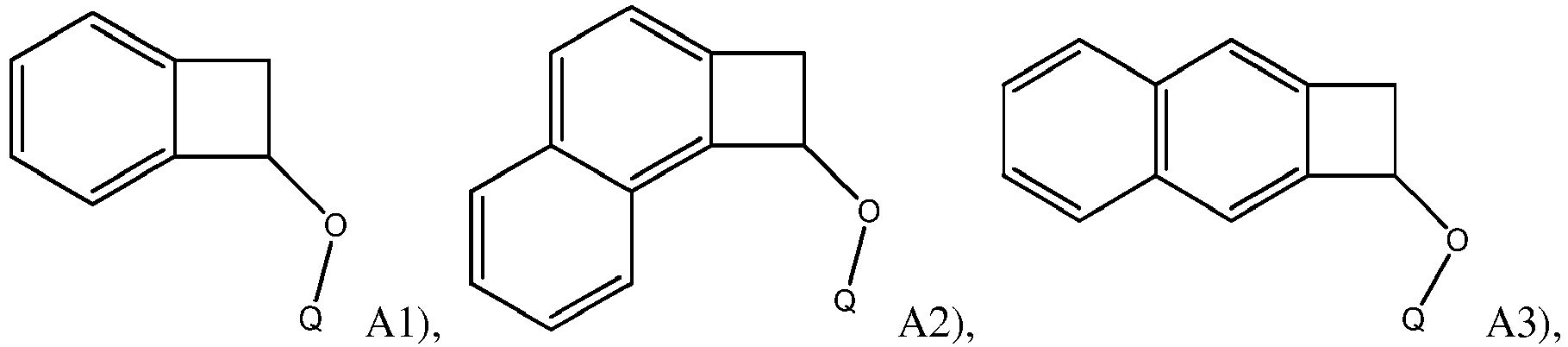
said polymer comprising one or more units of, in polymerized form, Structure A, wherein Structure A is selected from the following A1) - A8):


wherein Q is selected from the following: hydrogen, deuterium, a hydrocarbyl, a substituted hydrocarbyl, a heterohydrocarbyl, a substituted heterohydrocarbyl, a halogen, a cyano, an aryl, a substituted aryl, a heteroaryl, a substituted heteroaryl; and
wherein the polymer further comprises one or more polymerized units derived from a cross-linking agent selected from the following 1i) - 8i):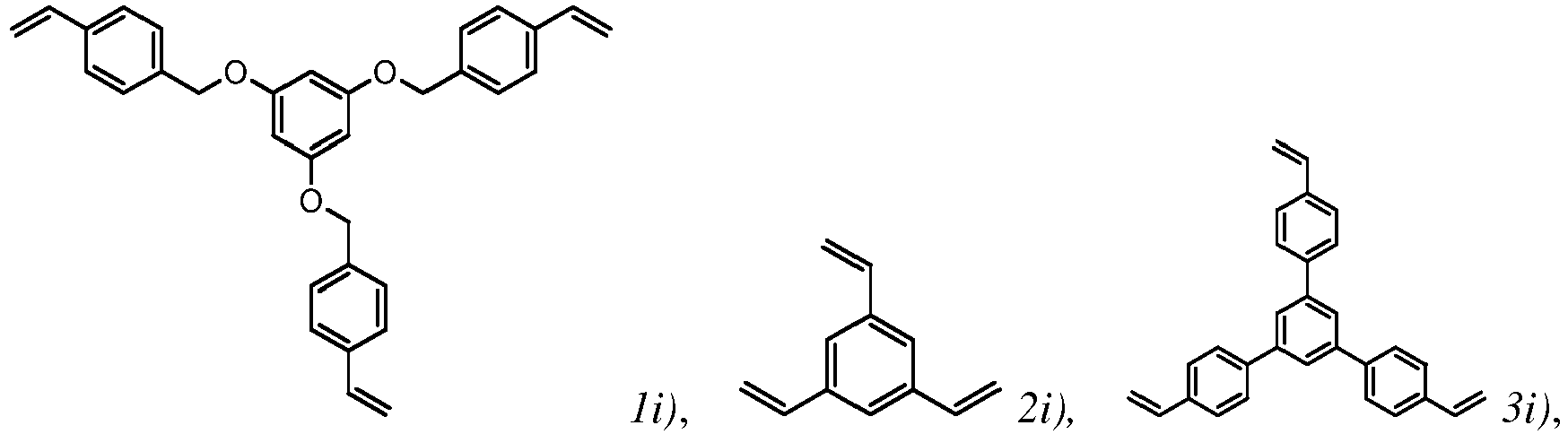


- Compositions have been discovered that reduce the drawbacks of the art discussed above. It has been discovered that by using one attachment point on the molecule, we can minimize the energy required for rearrangement during oxidation. Furthermore, this flexibility will also lead to more efficient chain stacking, which can bring the molecular cores into close proximity to each other. This approach will improve hole transport in the HTL layer via thru-space interactions. Furthermore, the chemistry described in this invention can also satisfy temperature and time considerations relating to desirable process conditions. See, for example, schematics 1 and 2 below.


- In comparison to other prior art that utilizes BCB chemistry, it has been discovered that the invention describes chemistry that can be used at substantially lower temperatures. It is been documented in the open literature that the substitution of oxygen-based donors, at the R1-R4 positions above, has a dramatic effect on the ring-opening temperature of the BCB (Dobish, J.N.; Hamilton, S.K.; Harth, E. Polymer Chemistry 2012, 3, 857-860); this phenomenon has yet to be utilized for OLED-based applications. With unsubstituted BCB derivatives, the ring opening temperatures has been noted to occur at temperatures ∼ 250°C (Kirchhoff, R.A.; Bruza, K.J. Progress in Polymer Science 1993, 18, 85-185). In this invention, the substitution of an oxygen donor results in a significant reduction in the ring opening temperatures to values between 100-120°C, which has significant process advantages over conventional chemistry of the art. Once a reactive o-quinodimethane moiety has been formed, Diels-Alder reactions can occur to generate new C-C bonds in either a 1- or 2-component approach. Furthermore, it has been discovered the two-component approach, as described herein, with a reactive o-quinodimethane moiety and polydienophile has yet to be reported.
- It has been discovered that the composition can be used as hole transporting materials in OLEDs, and achieves high efficiency, without a second organic charge transport compound.
- It has been discovered that the composition can be used be used as hole transporting layers in solution-processed OLEDs.
- It has been discovered that the composition can be used as hole transporting materials in OLED devices.
- It has been discovered that an film can be cross linked thermally and/or with radiation, and further, without a crosslinking agent.
- As discussed above, the invention provides, in a first aspect, a light emitting device comprising a polymeric charge transfer layer, wherein the polymeric charge transfer layer is formed from a composition comprising a polymer, said polymer comprising one or more units of, in polymerized form, Structure A, as described above.
- An inventive device may comprise a combination of two or more embodiments as described herein.
- Structure A may comprise a combination of two or more embodiments as described herein.
- As used herein, R1 = R1, R2 = R2, R3 = R3, and so forth.
- The polymer further comprises one or more polymerized units derived from a cross-linking agent.
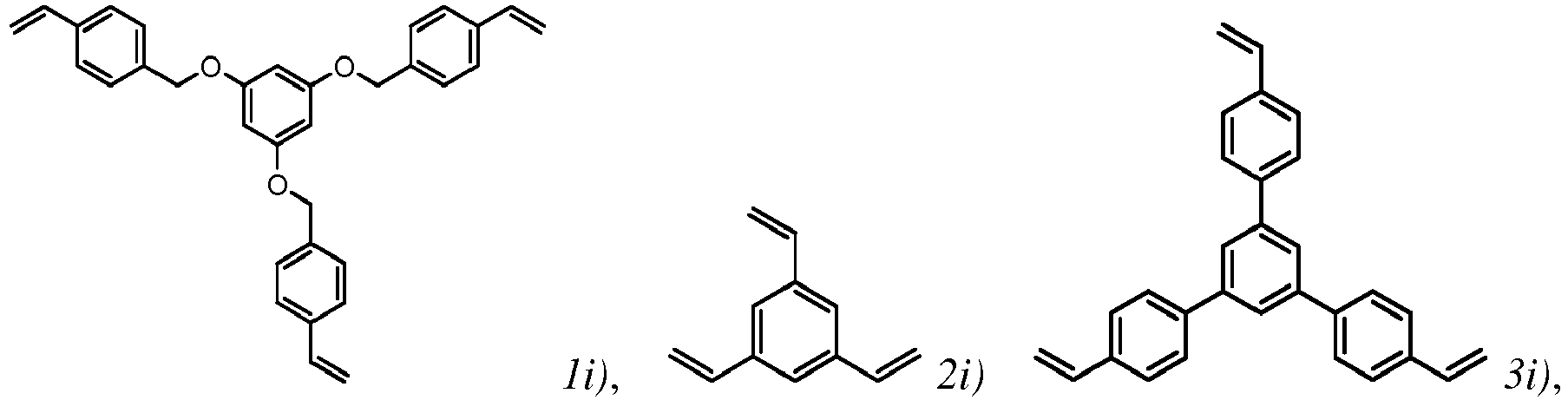
- The cross-linking agent is selected from the following 1i) - 8i):


- Structure A is selected from the following A1) - A8):

- In one embodiment, Structure A comprises at least one, further at least two, further at three six C=C double bonds. In a further embodiment, Structure A comprises less than 50, further less than 40, and further less than 30 carbon atoms.
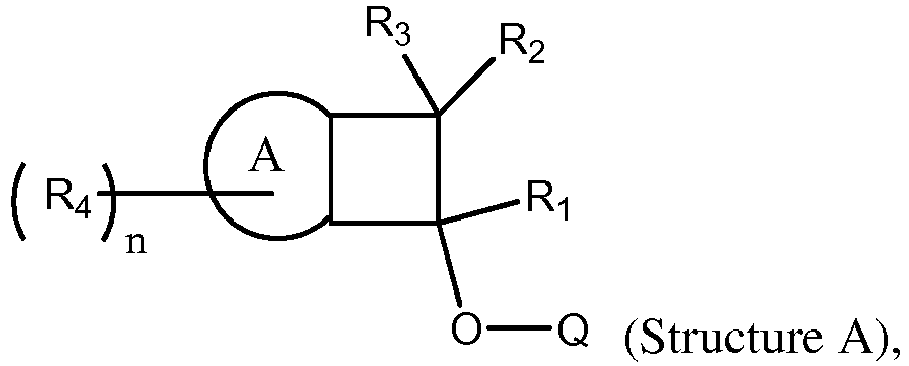
- There is also disclosed a composition (not in accordance with the invention) comprising a polymer, which comprises one or more polymerized units derived from Structure A:

- There is also disclosed a composition comprising a polymer which comprises one or more polymerized units derived from Structure A:
- The cross-linking agent is selected from the following 1i) - 8i):


- As used herein, the term "light emitting device," as used herein, refers to a device that emits light when an electrical current is applied across two electrodes.
- As used herein, the term "polymeric charge transfer layer," as used herein, refers to a polymeric material that can transport charge carrying moieties, either holes or electrons.
- As used herein, the term "cross-linking monomer," as used herein, refers to an organic or inorganic molecule that can join adjacent chains of a polymer by creating covalent bonds.
- As used herein, the term "hole transporting solution-processed layer," as used herein, refers to a hole transporting layer which can be processed by solution-based methods, such as spin-coating, inkjet printing, and screen printing.
- As used herein, the term "hole injection solution-processed layer," as used herein, refers to a hole injection layer which can be processed by solution-based methods, such as spin-coating, inkjet printing, and screen printing.
- As used herein, the term "emissive solution-processed layer," as used herein, refers to an emissive layer which can be processed by solution-based methods, such as spin-coating, inkjet printing, and screen printing.
- As used herein, the term "solvent-borne organic material," as used herein, refers to an organic compound that is dissolved or suspended in a solvent, whereby the solvent can be made volatile and evaporated.
- As used herein, the term "electronic device," as used herein, refers to a device which depends on the principles of electronics, and uses the manipulation of electron flow for its operation.
- As used herein, the term "alkoxy," as used herein, refers to a moiety containing a univalent organic radical consisting of an alkyl group attached oxygen.
- As used herein, the term "aryloxy," as used herein, refers to a moiety containing a univalent organic radical consisting of an aryl group attached to oxygen
- As used herein, the term "charge transporting film," as used herein, refers to a film whereby charge is transported either intra- or inter-molecularly between one or more molecules.
- The term "hydrocarbyl," as used herein, refers to a chemical group containing only hydrogen and carbon atoms. As used herein, hydrocarbyl includes monovalent, divalent, or higher valent groups. The valency of a hydrocarbyl can be determined by the chemical structure of the molecule comprising the hydrocarbyl.
- The term "substituted hydrocarbyl," as used herein, refers to a hydrocarbyl in which at least one hydrogen atom is substituted with a heteroatom or a chemical group containing at least one heteroatom. Heteroatoms include O, N, P and S. Substituents include OR', NR'2, PR'2, P(=O)R'2, SiR'3; where each R' is a C1-C20 hydrocarbyl group.
- The term "heterohydrocarbyl," as used herein, refers to a chemical group containing hydrogen and carbon atoms, and wherein at least one carbon atom or CH group or CH2 group is substituted with a heteroatom or a chemical group containing at least one heteroatom. Heteroatoms include O, N, P and S. As used herein, heterohydrocarbyl includes monovalent, divalent, or higher valent groups. The valency of a heterohydrocarbyl can be determined by the chemical structure of the molecule comprising the heterohydrocarbyl.
- The term "substituted heterohydrocarbyl," as used herein, refers to a heterohydrocarbyl in which at least one hydrogen atom is substituted with a heteroatom or a chemical group containing at least one heteroatom. Heteroatoms include O, N, P and S. Substituents include OR', NR'2, PR'2, P(=O)R'2, SiR'3; where each R' is a C1-C20 hydrocarbyl group.
- The term "aromatic moiety, " as described herein, refers to an organic moiety derived from aromatic hydrocarbon by deleting at least one hydrogen atom therefrom. An aromatic moiety may be a monocyclic and/or fused ring system, each ring of which suitably contains from 4 to 7, preferably from 5 or 6 atoms. Structures wherein two or more aromatic moieties are combined through single bond(s) are also included. Specific examples include phenyl, naphthyl, biphenyl, anthryl, indenyl, fluorenyl, benzofluorenyl, phenanthryl, triphenylenyl, pyrenyl, perylenyl, chrysenyl, naphtacenyl and fluoranthenyl. The naphthyl may be 1-naphthyl or 2-naphthyl, the anthryl may be 1-anthryl, 2-anthryl or 9-anthryl, and the fluorenyl may be any one of 1-fluorenyl, 2-fluorenyl, 3-fluorenyl, 4-fluorenyl and 9-fluorenyl. The valency of the aromatic moiety can be determined by the chemical structure of the molecule comprising the aromatic moiety.
- The term "substituted aromatic moiety," as used herein, refers to an aromatic moiety in which at least one hydrogen atom is substituted with a heteroatom or a chemical group containing at least one heteroatom. Heteroatoms include O, N, P and S.
Substituents include OR', NR'2, PR'2, P(=O)R'2, SiR'3; where each R' is a C30-C100 hydrocarbyl group. - The term "heteroaromatic moiety, " as described herein, refers to an aromatic moiety, in which at least one carbon atom or CH group or CH2 group is substituted with a heteroatom (for example, B, N, O, S, P(=O), Si and P) or a chemical group containing at least one heteroatom. The heteroaromatic moiety may be a 5- or 6-membered monocyclic heteroaryl, or a polycyclic heteroaryl which is fused with one or more benzene ring(s), and may be partially saturated. The structures having one or more heteroaromatic moieties bonded through a single bond are also included. Specific examples include monocyclic heteroaryl groups, such as furyl, thiophenyl, pyrrolyl, imidazolyl, pyrazolyl, thiazolyl, thiadiazolyl, isothiazolyl, isoxazolyl, oxazolyl, oxadiazolyl, triazinyl, tetrazinyl, triazolyl, tetrazolyl, furazanyl, pyridyl, pyrazinyl, pyrimidinyl, pyridazinyl; polycyclic heteroaryl groups, such as benzofuranyl, fluoreno[4, 3-b]benzofuranyl, benzothiophenyl, fluoreno[4, 3-b]benzothiophenyl, isobenzofuranyl, benzimidazolyl, benzothiazolyl, benzisothiazolyl, benzisoxazolyl, benzoxazolyl, isoindolyl, indolyl, indazolyl, benzothia- diazolyl, quinolyl, isoquinolyl, cinnolinyl, quinazolinyl, quinoxalinyl, carbazolyl, phenanthridinyl and benzodioxolyl. The valency of the heteroaromatic moiety can be determined by the chemical structure of the molecule comprising the heteroaromatic moiety.
- The term "substituted heteroaromatic moiety," as used herein, refers to a heteroaromatic moiety in which at least one hydrogen atom is substituted with a heteroatom or a chemical group containing at least one heteroatom. Heteroatoms include O, N, P and S. Substituents include OR', NR'2, PR'2, P(=O)R'2, SiR'3; where each R' is a C30-C100 hydrocarbyl group.
- The term "aryl" as described herein, refers to an organic radical derived from aromatic hydrocarbon by deleting one hydrogen atom therefrom. An aryl group may be a monocyclic and/or fused ring system, each ring of which suitably contains from 4 to 7, preferably from 5 or 6 atoms. Structures wherein two or more aryl groups are combined through single bond(s) are also included. Specific examples include phenyl, naphthyl, biphenyl, anthryl, indenyl, fluorenyl, benzofluorenyl, phenanthryl, triphenylenyl, pyrenyl, perylenyl, chrysenyl, naphtacenyl and fluoranthenyl. The naphthyl may be 1-naphthyl or 2-naphthyl, the anthryl may be 1-anthryl, 2-anthryl or 9-anthryl, and the fluorenyl may be any one of 1-fluorenyl, 2-fluorenyl, 3-fluorenyl, 4-fluorenyl and 9-fluorenyl.
- The term "substituted aryl," as used herein, refers to an aryl in which at least one hydrogen atom is substituted with a heteroatom or a chemical group containing at least one heteroatom. Heteroatoms include O, N, P and S. Substituents include OR', NR'2, PR'2, P(=O)R'2, SiR'3; where each R' is a C1-C20 hydrocarbyl group.
- The terms "heteroaryl" as described herein, refers to an aryl group, in which at least one carbon atom or CH group or CH2 group is substituted with a heteroatom (for example, B, N, O, S, P(=O), Si and P) or a chemical group containing at least one heteroatom. The heteroaryl may be a 5- or 6-membered monocyclic heteroaryl or a polycyclic heteroaryl which is fused with one or more benzene ring(s), and may be partially saturated. The structures having one or more heteroaryl group(s) bonded through a single bond are also included. The heteroaryl groups may include divalent aryl groups of which the heteroatoms are oxidized or quarternized to form N-oxides or quaternary salts. Specific examples include monocyclic heteroaryl groups, such as furyl, thiophenyl, pyrrolyl, imidazolyl, pyrazolyl, thiazolyl, thiadiazolyl, isothiazolyl, isoxazolyl, oxazolyl, oxadiazolyl, triazinyl, tetrazinyl, triazolyl, tetrazolyl, furazanyl, pyridyl, pyrazinyl, pyrimidinyl, pyridazinyl; polycyclic heteroaryl groups, such as benzofuranyl, fluoreno[4, 3-b]benzofuranyl, benzothiophenyl, fluoreno[4, 3-b]benzothiophenyl, isobenzofuranyl, benzimidazolyl, benzothiazolyl, benzisothiazolyl, benzisoxazolyl, benzoxazolyl, isoindolyl, indolyl, indazolyl, benzothia- diazolyl, quinolyl, isoquinolyl, cinnolinyl, quinazolinyl, quinoxalinyl, carbazolyl, phenanthridinyl and benzodioxolyl; and corresponding N-oxides (for example, pyridyl N-oxide, quinolyl N-oxide) and quaternary salts thereof.
- The term "substituted heteroaryl," as used herein, refers to a heteroaryl in which at least one hydrogen atom is substituted with a heteroatom or a chemical group containing at least one heteroatom. Heteroatoms include O, N, P and S. Substituents include OR', NR'2, PR'2, P(=O)R'2, SiR'3; where each R' is a C1-C20 hydrocarbyl group.
- The term "polymer," as used herein, refers to a polymeric compound prepared by polymerizing monomers, whether of the same or a different type. The generic term polymer thus embraces the term homopolymer (employed to refer to polymers prepared from only one type of monomer, with the understanding that trace amounts of impurities can be incorporated into and/or within the polymer structure), and the term interpolymer as defined hereinafter.
- The term "interpolymer," as used herein, refers to polymers prepared by the polymerization of at least two different types of monomers. The generic term interpolymer thus includes copolymers (employed to refer to polymers prepared from two different types of monomers), and polymers prepared from more than two different types of monomers.
- All solvents and reagents were obtained from commercial vendors (for example, Sigma-Aldrich, TCI, and Alfa Aesar), and were used in the highest available purities, and/or when necessary, recrystallized before use. Dry solvents were obtained from in-house purification/dispensing system (hexane, toluene, and tetrahydrofuran), or purchased from Sigma-Aldrich. All experiments involving "water sensitive compounds" were conducted in "oven dried" glassware, under nitrogen atmosphere, or in a glovebox. Reactions were monitored by analytical, thin-layer chromatography (TLC) on precoated aluminum plates (VWR 60 F254), and visualized by UV light and/or potassium permanganate staining. Flash chromatography was performed on an ISCO COMBIFLASH system with GRACERESOLV cartridges.
- 1H-NMR-spectra (500 MHz or 400 MHz) were obtained on a Varian VNMRS-500 or VNMRS-400 spectrometer, at 30°C, unless otherwise noted. The chemical shifts were referenced to TMS (δ=0.00) in CDCl3.
- 13C-NMR spectra (125 MHz or 100 MHz) were obtained on a Varian VNMRS-500 or VNRMS-400 spectrometer, and referenced to TMS (δ=0.00) in CDCl3.
-

- To a flask, charged with 3-iodoresorcinol (1 equiv) and K2CO3 (4 equiv), was added DMF. The solution was stirred at room temperature, and 7-bromobicyclo[4.2.0]octa-1,3,5-triene (2.5 equiv) was added dropwise as a DMF solution. The mixture was heated to 70°C for two days. After cooling to room temperature, the mixture was poured into water (100 mL), and extracted several times with diethyl ether. The organic fractions were collected, washed with brine, and dried with MgSO4. The organic fraction was filtered, and the solvent removed to provide a yellow oil. After recrystallization from methanol, a pale yellow solid was recovered; this was identified by NMR spectroscopy and consistent with the formation of the product.
-

- To a flask, charged with N-([1,1'-biphenyl]-4-yl)-9,9-dimethyl-9H-fluoren-2-amine (1.0 equiv), 1,4-dibromobenzene (2.0 equiv), Pd2dba3 (0.02 equiv), tri-ortho-toluyl phosphine (0.06 equiv) and sodium tert-butoxide (2.0 equiv), was added toluene. The mixture was heated to reflux for 18 hours. The reaction was cooled to room temperature, and washed with water and brine. The organic phase was dried over MgSO4, and concentrated. The resulting residue was purified, via a silica gel column, to afford the desired product as a white solid.
-

- The compound was synthesized using a previously published procedure disclosed in Midya et al. Chem. Commun. 2010, 46, 2091.
-

- The compound was synthesized using a previously published procedure disclosed in U.S. Patent Application
US2005/0137204 A1 . -

- To a flask, charged with N-([1,1'-biphenyl]-4-yl)-N-(4-bromophenyl)-9,9-dimethyl-9H-fluoren-2-amine (1.2 equiv) and palladium tetrakis(triphenylphsophine) (0.03 equiv), in toluene (0.2 M), under N2, was added, 3-(4,4,5,5-tetramethyl-1,3,2-dioxaborolan-2-yl)-9H-carbazole (1.0 equiv), in ethanol (0.17 M), and an aqueous potassium carbonate solution (4.0 equiv, 2.0 M). The mixture was heated to 90°C for 12 hours. The reaction was cooled to room temperature, and concentrated under vacuum. The resulting residue was diluted into methylene chloride, and washed with water. The organic phase was dried over Na2SO4, and concentrated. The resulting residue was purified via silica gel chromatography to afford the desired product as a white solid.
-

- To a flask, charged with N-(4-(9H-carbazol-3-yl)phenyl)-N-([1,1'-biphenyl]-4-yl)-9,9-dimethyl-9H-fluoren-2-amine(1 equiv), 1,3-bis(bicyclo[4.2.0]octa-1(6),2,4-trien-7-yloxy)-5-iodobenzene (1.1 equiv), copper iodide (0.25 equiv), and K3PO4 (3 equiv), was added dioxane.
- The mixture was stirred for 5 minutes, and N,N'-dimethylcyclohexane-1,2-diamine (0.5 equiv) added, dropwise, to the stirring mixture. The mixture was heated to 70°C for two days. After cooling to room temperature, the solvent was removed by rotary evaporation, and extracted with CH2Cl2 and water. The aqueous volume was further extracted with CH2Cl2 twice. The organic fractions were combined, washed with brine, and dried with MgSO4. The organic fractions were filtered, and the solvent removed to yield the crude product. The resulting residue was purified via silica gel chromatography, to afford the desired product as a white solid.
- The compositions can be used to form hole-transporting materials for use in electroluminescent devices. For example, a composition can be used to form a "light emitting device as follows. An indium tin oxide (ITO) glass substrate (2∗2cm) can be cleaned, and then treated with a UV Ozone cleaner for 15 minutes. The hole injection layer (HIL) material can be spin-coated, from a water solution, onto the ITO substrates, in a glovebox (for example, Argon atmosphere), and annealed at 150°C for 20 minutes. The substrate can be transferred into a thermal evaporator for the deposition of an HTL layer. For a composition (HTL), the composition can be deposited from anisole solution, and annealed at 150°C for 10 minutes, to remove organic solvent. After that, the crosslinking of polymeric HTL can be carried out on a hotplate, in a glovebox, at 205°C for 10 minutes. Then an emitting layer (EML), an electron transfer layer (ETL), and a cathode can be sequentially deposited. Finally the device can be hermetically sealed, prior to testing.
Claims (1)
- A light emitting device comprising a polymeric charge transfer layer, wherein the polymeric charge transfer layer is formed from a composition comprising a polymer, said polymer comprising one or more units of, in polymerized form, Structure A, characterized in that Structure A is selected from the following A1) - A8):

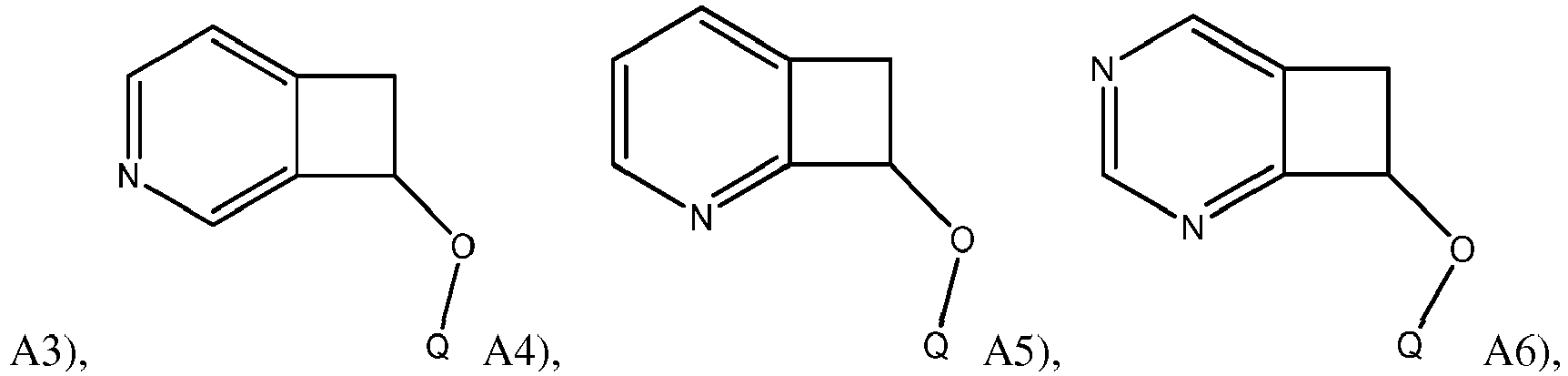

wherein Q is selected from the following: hydrogen, deuterium, a hydrocarbyl, a substituted hydrocarbyl, a heterohydrocarbyl, a substituted heterohydrocarbyl, a halogen, a cyano, an aryl, a substituted aryl, a heteroaryl, a substituted heteroaryl; and
wherein the polymer further comprises one or more polymerized units derived from a cross-linking agent selected from the following 1i) - 8i):


Priority Applications (1)
| Application Number | Priority Date | Filing Date | Title |
|---|---|---|---|
| EP18186853.0A EP3413370B1 (en) | 2014-08-21 | 2015-08-19 | Oxygen substituted benzoclobutenes derived compositions for electronic devices |
Applications Claiming Priority (2)
| Application Number | Priority Date | Filing Date | Title |
|---|---|---|---|
| US201462039935P | 2014-08-21 | 2014-08-21 | |
| PCT/US2015/045923 WO2016028906A1 (en) | 2014-08-21 | 2015-08-19 | Oxygen substituted benzoclobutenes derived compositions for electronic devices |
Related Child Applications (2)
| Application Number | Title | Priority Date | Filing Date |
|---|---|---|---|
| EP18186853.0A Division EP3413370B1 (en) | 2014-08-21 | 2015-08-19 | Oxygen substituted benzoclobutenes derived compositions for electronic devices |
| EP18186853.0A Division-Into EP3413370B1 (en) | 2014-08-21 | 2015-08-19 | Oxygen substituted benzoclobutenes derived compositions for electronic devices |
Publications (2)
| Publication Number | Publication Date |
|---|---|
| EP3183760A1 EP3183760A1 (en) | 2017-06-28 |
| EP3183760B1 true EP3183760B1 (en) | 2019-09-25 |
Family
ID=54065459
Family Applications (2)
| Application Number | Title | Priority Date | Filing Date |
|---|---|---|---|
| EP15760329.1A Active EP3183760B1 (en) | 2014-08-21 | 2015-08-19 | Oxygen substituted benzoclobutenes derived compositions for electronic devices |
| EP18186853.0A Active EP3413370B1 (en) | 2014-08-21 | 2015-08-19 | Oxygen substituted benzoclobutenes derived compositions for electronic devices |
Family Applications After (1)
| Application Number | Title | Priority Date | Filing Date |
|---|---|---|---|
| EP18186853.0A Active EP3413370B1 (en) | 2014-08-21 | 2015-08-19 | Oxygen substituted benzoclobutenes derived compositions for electronic devices |
Country Status (7)
| Country | Link |
|---|---|
| US (1) | US10297755B2 (en) |
| EP (2) | EP3183760B1 (en) |
| JP (1) | JP2017533576A (en) |
| KR (1) | KR20170045241A (en) |
| CN (1) | CN106575705A (en) |
| TW (1) | TW201612228A (en) |
| WO (1) | WO2016028906A1 (en) |
Families Citing this family (8)
| Publication number | Priority date | Publication date | Assignee | Title |
|---|---|---|---|---|
| WO2016026122A1 (en) | 2014-08-21 | 2016-02-25 | Dow Global Technologies Llc | Benzocyclobutenes derived compositions, and electronic devices containing the same |
| WO2016026123A1 (en) * | 2014-08-21 | 2016-02-25 | Dow Global Technologies Llc | Compositions comprising oxygen substituted benzocyclobutenes and dienophiles, and electronic devices containing same |
| CN107108499A (en) * | 2014-12-29 | 2017-08-29 | 陶氏环球技术有限责任公司 | Composition with triarylamine derivatives and the OLED device containing it |
| CN107406382A (en) * | 2014-12-29 | 2017-11-28 | 陶氏环球技术有限责任公司 | Composition and the display device that is produced from it of 2,3 disubstituted indoles as charge transport materials |
| EP3243226A4 (en) * | 2015-01-08 | 2018-08-15 | Dow Global Technologies LLC | Polymeric charge transfer layer and organic electronic device containing same |
| KR102121433B1 (en) * | 2017-09-01 | 2020-06-10 | 주식회사 엘지화학 | Novel compound and organic light emitting device comprising the same |
| KR102377025B1 (en) * | 2020-03-11 | 2022-03-21 | 한국생산기술연구원 | Compound for organic electronic element having benzocyclobutene functional group for cross-linked bond, organic electronic element using the same, and an electronic device thereof |
| CN114914382B (en) * | 2022-04-02 | 2025-10-28 | 滇西应用技术大学 | Application of low-temperature, short-time thermally crosslinkable materials as hole transport materials, hole transport layers, and PhOLED devices |
Family Cites Families (27)
| Publication number | Priority date | Publication date | Assignee | Title |
|---|---|---|---|---|
| US20040004433A1 (en) | 2002-06-26 | 2004-01-08 | 3M Innovative Properties Company | Buffer layers for organic electroluminescent devices and methods of manufacture and use |
| TWI365218B (en) | 2003-11-17 | 2012-06-01 | Sumitomo Chemical Co | Conjugated oligomers or polymers based on crosslinkable arylamine compounds |
| DE112004002221T5 (en) | 2003-11-17 | 2007-01-18 | Sumitomo Chemical Company, Ltd. | Crosslinkable substituted fluorene linkages and conjugated oligomers or polymers based thereon |
| JP4420660B2 (en) * | 2003-12-11 | 2010-02-24 | セントラル硝子株式会社 | Organic borazine compound and process for producing the same |
| US20050137204A1 (en) | 2003-12-22 | 2005-06-23 | Abbott Laboratories | Fused bicycloheterocycle substituted quinuclidine derivatives |
| US20070181874A1 (en) | 2004-12-30 | 2007-08-09 | Shiva Prakash | Charge transport layers and organic electron devices comprising same |
| US7888859B2 (en) | 2005-03-02 | 2011-02-15 | Konica Minolta Holdings Inc. | Organic electroluminescence element, display device and lighting device |
| GB2433509A (en) | 2005-12-22 | 2007-06-27 | Cambridge Display Tech Ltd | Arylamine polymer |
| GB0526185D0 (en) | 2005-12-22 | 2006-02-01 | Cambridge Display Tech Ltd | Electronic device |
| DE102006006412A1 (en) | 2006-02-13 | 2007-08-16 | Merck Patent Gmbh | Electronic component, process for its production and its use |
| JP5262014B2 (en) * | 2006-08-07 | 2013-08-14 | 三菱化学株式会社 | Organic compound having a crosslinking group, composition for organic electroluminescence device, and organic electroluminescence device |
| GB0620045D0 (en) | 2006-10-10 | 2006-11-22 | Cdt Oxford Ltd | Otpo-electrical devices and methods of making the same |
| KR101323557B1 (en) | 2008-02-15 | 2013-10-29 | 미쓰비시 가가꾸 가부시키가이샤 | Conjugated polymer, insolubilized polymer, organic electroluminescent device material, composition for organic electroluminescent device, method for producing polymer, organic electroluminescent device, organic el display, and organic el illuminator |
| JP2011525918A (en) | 2008-06-27 | 2011-09-29 | ユニバーサル ディスプレイ コーポレイション | Crosslinkable ion dopant |
| JP2010062120A (en) | 2008-08-06 | 2010-03-18 | Mitsubishi Chemicals Corp | Photosensitive composition for barrier rib of organic electroluminescent element, and organic electroluminescent display device |
| JP5491796B2 (en) * | 2008-08-11 | 2014-05-14 | 三菱化学株式会社 | Charge transporting polymer, composition for organic electroluminescent device, organic electroluminescent device, organic EL display and organic EL lighting |
| CN107068914B (en) * | 2010-07-02 | 2020-05-08 | 日产化学工业株式会社 | Hole transport compositions and related devices and methods (I) |
| GB2485001A (en) | 2010-10-19 | 2012-05-02 | Cambridge Display Tech Ltd | OLEDs |
| GB201110564D0 (en) | 2011-06-22 | 2011-08-03 | Cambridge Display Tech Ltd | Polymer and optoelectronic device |
| WO2013005031A1 (en) * | 2011-07-04 | 2013-01-10 | Cambridge Display Technology Limited | Organic light emitting device and method |
| GB201111742D0 (en) | 2011-07-08 | 2011-08-24 | Cambridge Display Tech Ltd | Solution |
| CN102329411B (en) | 2011-07-25 | 2013-07-03 | 华南理工大学 | Water/alcohol-soluble conjugated polymer material containing crosslinkable groups and application thereof |
| JP5955660B2 (en) * | 2012-06-20 | 2016-07-20 | 住友化学株式会社 | Composition, polymer compound and light emitting device using them |
| GB2509718A (en) * | 2013-01-09 | 2014-07-16 | Cambridge Display Tech Ltd | Method for forming a layer of an electronic device and appropriate precursor compounds |
| JP6034326B2 (en) * | 2014-03-26 | 2016-11-30 | 富士フイルム株式会社 | Semiconductor device and composition for forming insulating layer |
| WO2016026123A1 (en) | 2014-08-21 | 2016-02-25 | Dow Global Technologies Llc | Compositions comprising oxygen substituted benzocyclobutenes and dienophiles, and electronic devices containing same |
| WO2016026122A1 (en) | 2014-08-21 | 2016-02-25 | Dow Global Technologies Llc | Benzocyclobutenes derived compositions, and electronic devices containing the same |
-
2015
- 2015-08-19 US US15/318,407 patent/US10297755B2/en not_active Expired - Fee Related
- 2015-08-19 EP EP15760329.1A patent/EP3183760B1/en active Active
- 2015-08-19 WO PCT/US2015/045923 patent/WO2016028906A1/en not_active Ceased
- 2015-08-19 CN CN201580044625.0A patent/CN106575705A/en active Pending
- 2015-08-19 KR KR1020177006336A patent/KR20170045241A/en not_active Withdrawn
- 2015-08-19 EP EP18186853.0A patent/EP3413370B1/en active Active
- 2015-08-19 JP JP2017510294A patent/JP2017533576A/en not_active Ceased
- 2015-08-20 TW TW104127139A patent/TW201612228A/en unknown
Non-Patent Citations (1)
| Title |
|---|
| None * |
Also Published As
| Publication number | Publication date |
|---|---|
| US20170170398A1 (en) | 2017-06-15 |
| TW201612228A (en) | 2016-04-01 |
| CN106575705A8 (en) | 2017-07-11 |
| US10297755B2 (en) | 2019-05-21 |
| KR20170045241A (en) | 2017-04-26 |
| WO2016028906A1 (en) | 2016-02-25 |
| EP3183760A1 (en) | 2017-06-28 |
| CN106575705A (en) | 2017-04-19 |
| EP3413370A1 (en) | 2018-12-12 |
| JP2017533576A (en) | 2017-11-09 |
| EP3413370B1 (en) | 2019-09-25 |
Similar Documents
| Publication | Publication Date | Title |
|---|---|---|
| JP6640189B2 (en) | Composition containing benzocyclobutene-substituted carbazole and electronic device containing the same | |
| EP3413370B1 (en) | Oxygen substituted benzoclobutenes derived compositions for electronic devices | |
| JP6613298B2 (en) | Polymer charge transport layer and organic electronic device comprising the same | |
| WO2016026451A1 (en) | Compositions comprising oxygen substituted benzocyclobutenes and dienophiles, and electronic devices containing same | |
| WO2017107117A1 (en) | Polymeric layer and organic electronic device comprising same. | |
| WO2017031622A1 (en) | Polymeric charge transfer layer and organic electronic device containing same | |
| CN107112438B (en) | Polymeric charge transfer layer and organic electronic device containing same | |
| TW201627306A (en) | Heterocyclic compound and organic light-emitting device using same | |
| EP3242866A1 (en) | Organic compound and electronic device comprising organic layer comprising thereof | |
| WO2019090462A1 (en) | Polymeric charge transfer layer and organic electronic device comprising the same |
Legal Events
| Date | Code | Title | Description |
|---|---|---|---|
| STAA | Information on the status of an ep patent application or granted ep patent |
Free format text: STATUS: THE INTERNATIONAL PUBLICATION HAS BEEN MADE |
|
| PUAI | Public reference made under article 153(3) epc to a published international application that has entered the european phase |
Free format text: ORIGINAL CODE: 0009012 |
|
| STAA | Information on the status of an ep patent application or granted ep patent |
Free format text: STATUS: REQUEST FOR EXAMINATION WAS MADE |
|
| 17P | Request for examination filed |
Effective date: 20170320 |
|
| AK | Designated contracting states |
Kind code of ref document: A1 Designated state(s): AL AT BE BG CH CY CZ DE DK EE ES FI FR GB GR HR HU IE IS IT LI LT LU LV MC MK MT NL NO PL PT RO RS SE SI SK SM TR |
|
| AX | Request for extension of the european patent |
Extension state: BA ME |
|
| DAV | Request for validation of the european patent (deleted) | ||
| DAX | Request for extension of the european patent (deleted) | ||
| STAA | Information on the status of an ep patent application or granted ep patent |
Free format text: STATUS: EXAMINATION IS IN PROGRESS |
|
| 17Q | First examination report despatched |
Effective date: 20180222 |
|
| GRAP | Despatch of communication of intention to grant a patent |
Free format text: ORIGINAL CODE: EPIDOSNIGR1 |
|
| STAA | Information on the status of an ep patent application or granted ep patent |
Free format text: STATUS: GRANT OF PATENT IS INTENDED |
|
| INTG | Intention to grant announced |
Effective date: 20190529 |
|
| GRAS | Grant fee paid |
Free format text: ORIGINAL CODE: EPIDOSNIGR3 |
|
| GRAA | (expected) grant |
Free format text: ORIGINAL CODE: 0009210 |
|
| STAA | Information on the status of an ep patent application or granted ep patent |
Free format text: STATUS: THE PATENT HAS BEEN GRANTED |
|
| AK | Designated contracting states |
Kind code of ref document: B1 Designated state(s): AL AT BE BG CH CY CZ DE DK EE ES FI FR GB GR HR HU IE IS IT LI LT LU LV MC MK MT NL NO PL PT RO RS SE SI SK SM TR |
|
| REG | Reference to a national code |
Ref country code: GB Ref legal event code: FG4D |
|
| REG | Reference to a national code |
Ref country code: CH Ref legal event code: EP |
|
| REG | Reference to a national code |
Ref country code: AT Ref legal event code: REF Ref document number: 1184704 Country of ref document: AT Kind code of ref document: T Effective date: 20191015 |
|
| REG | Reference to a national code |
Ref country code: IE Ref legal event code: FG4D |
|
| REG | Reference to a national code |
Ref country code: DE Ref legal event code: R096 Ref document number: 602015038694 Country of ref document: DE |
|
| REG | Reference to a national code |
Ref country code: NL Ref legal event code: MP Effective date: 20190925 |
|
| PG25 | Lapsed in a contracting state [announced via postgrant information from national office to epo] |
Ref country code: FI Free format text: LAPSE BECAUSE OF FAILURE TO SUBMIT A TRANSLATION OF THE DESCRIPTION OR TO PAY THE FEE WITHIN THE PRESCRIBED TIME-LIMIT Effective date: 20190925 Ref country code: NO Free format text: LAPSE BECAUSE OF FAILURE TO SUBMIT A TRANSLATION OF THE DESCRIPTION OR TO PAY THE FEE WITHIN THE PRESCRIBED TIME-LIMIT Effective date: 20191225 Ref country code: BG Free format text: LAPSE BECAUSE OF FAILURE TO SUBMIT A TRANSLATION OF THE DESCRIPTION OR TO PAY THE FEE WITHIN THE PRESCRIBED TIME-LIMIT Effective date: 20191225 Ref country code: SE Free format text: LAPSE BECAUSE OF FAILURE TO SUBMIT A TRANSLATION OF THE DESCRIPTION OR TO PAY THE FEE WITHIN THE PRESCRIBED TIME-LIMIT Effective date: 20190925 Ref country code: LT Free format text: LAPSE BECAUSE OF FAILURE TO SUBMIT A TRANSLATION OF THE DESCRIPTION OR TO PAY THE FEE WITHIN THE PRESCRIBED TIME-LIMIT Effective date: 20190925 Ref country code: HR Free format text: LAPSE BECAUSE OF FAILURE TO SUBMIT A TRANSLATION OF THE DESCRIPTION OR TO PAY THE FEE WITHIN THE PRESCRIBED TIME-LIMIT Effective date: 20190925 |
|
| REG | Reference to a national code |
Ref country code: LT Ref legal event code: MG4D |
|
| PG25 | Lapsed in a contracting state [announced via postgrant information from national office to epo] |
Ref country code: RS Free format text: LAPSE BECAUSE OF FAILURE TO SUBMIT A TRANSLATION OF THE DESCRIPTION OR TO PAY THE FEE WITHIN THE PRESCRIBED TIME-LIMIT Effective date: 20190925 Ref country code: GR Free format text: LAPSE BECAUSE OF FAILURE TO SUBMIT A TRANSLATION OF THE DESCRIPTION OR TO PAY THE FEE WITHIN THE PRESCRIBED TIME-LIMIT Effective date: 20191226 Ref country code: LV Free format text: LAPSE BECAUSE OF FAILURE TO SUBMIT A TRANSLATION OF THE DESCRIPTION OR TO PAY THE FEE WITHIN THE PRESCRIBED TIME-LIMIT Effective date: 20190925 |
|
| REG | Reference to a national code |
Ref country code: AT Ref legal event code: MK05 Ref document number: 1184704 Country of ref document: AT Kind code of ref document: T Effective date: 20190925 |
|
| PG25 | Lapsed in a contracting state [announced via postgrant information from national office to epo] |
Ref country code: EE Free format text: LAPSE BECAUSE OF FAILURE TO SUBMIT A TRANSLATION OF THE DESCRIPTION OR TO PAY THE FEE WITHIN THE PRESCRIBED TIME-LIMIT Effective date: 20190925 Ref country code: PL Free format text: LAPSE BECAUSE OF FAILURE TO SUBMIT A TRANSLATION OF THE DESCRIPTION OR TO PAY THE FEE WITHIN THE PRESCRIBED TIME-LIMIT Effective date: 20190925 Ref country code: AL Free format text: LAPSE BECAUSE OF FAILURE TO SUBMIT A TRANSLATION OF THE DESCRIPTION OR TO PAY THE FEE WITHIN THE PRESCRIBED TIME-LIMIT Effective date: 20190925 Ref country code: ES Free format text: LAPSE BECAUSE OF FAILURE TO SUBMIT A TRANSLATION OF THE DESCRIPTION OR TO PAY THE FEE WITHIN THE PRESCRIBED TIME-LIMIT Effective date: 20190925 Ref country code: PT Free format text: LAPSE BECAUSE OF FAILURE TO SUBMIT A TRANSLATION OF THE DESCRIPTION OR TO PAY THE FEE WITHIN THE PRESCRIBED TIME-LIMIT Effective date: 20200127 Ref country code: AT Free format text: LAPSE BECAUSE OF FAILURE TO SUBMIT A TRANSLATION OF THE DESCRIPTION OR TO PAY THE FEE WITHIN THE PRESCRIBED TIME-LIMIT Effective date: 20190925 Ref country code: IT Free format text: LAPSE BECAUSE OF FAILURE TO SUBMIT A TRANSLATION OF THE DESCRIPTION OR TO PAY THE FEE WITHIN THE PRESCRIBED TIME-LIMIT Effective date: 20190925 Ref country code: RO Free format text: LAPSE BECAUSE OF FAILURE TO SUBMIT A TRANSLATION OF THE DESCRIPTION OR TO PAY THE FEE WITHIN THE PRESCRIBED TIME-LIMIT Effective date: 20190925 Ref country code: NL Free format text: LAPSE BECAUSE OF FAILURE TO SUBMIT A TRANSLATION OF THE DESCRIPTION OR TO PAY THE FEE WITHIN THE PRESCRIBED TIME-LIMIT Effective date: 20190925 |
|
| PG25 | Lapsed in a contracting state [announced via postgrant information from national office to epo] |
Ref country code: SK Free format text: LAPSE BECAUSE OF FAILURE TO SUBMIT A TRANSLATION OF THE DESCRIPTION OR TO PAY THE FEE WITHIN THE PRESCRIBED TIME-LIMIT Effective date: 20190925 Ref country code: SM Free format text: LAPSE BECAUSE OF FAILURE TO SUBMIT A TRANSLATION OF THE DESCRIPTION OR TO PAY THE FEE WITHIN THE PRESCRIBED TIME-LIMIT Effective date: 20190925 Ref country code: CZ Free format text: LAPSE BECAUSE OF FAILURE TO SUBMIT A TRANSLATION OF THE DESCRIPTION OR TO PAY THE FEE WITHIN THE PRESCRIBED TIME-LIMIT Effective date: 20190925 Ref country code: IS Free format text: LAPSE BECAUSE OF FAILURE TO SUBMIT A TRANSLATION OF THE DESCRIPTION OR TO PAY THE FEE WITHIN THE PRESCRIBED TIME-LIMIT Effective date: 20200224 |
|
| REG | Reference to a national code |
Ref country code: DE Ref legal event code: R097 Ref document number: 602015038694 Country of ref document: DE |
|
| PG2D | Information on lapse in contracting state deleted |
Ref country code: IS |
|
| PG25 | Lapsed in a contracting state [announced via postgrant information from national office to epo] |
Ref country code: DK Free format text: LAPSE BECAUSE OF FAILURE TO SUBMIT A TRANSLATION OF THE DESCRIPTION OR TO PAY THE FEE WITHIN THE PRESCRIBED TIME-LIMIT Effective date: 20190925 Ref country code: IS Free format text: LAPSE BECAUSE OF FAILURE TO SUBMIT A TRANSLATION OF THE DESCRIPTION OR TO PAY THE FEE WITHIN THE PRESCRIBED TIME-LIMIT Effective date: 20200126 |
|
| PLBE | No opposition filed within time limit |
Free format text: ORIGINAL CODE: 0009261 |
|
| STAA | Information on the status of an ep patent application or granted ep patent |
Free format text: STATUS: NO OPPOSITION FILED WITHIN TIME LIMIT |
|
| 26N | No opposition filed |
Effective date: 20200626 |
|
| PG25 | Lapsed in a contracting state [announced via postgrant information from national office to epo] |
Ref country code: SI Free format text: LAPSE BECAUSE OF FAILURE TO SUBMIT A TRANSLATION OF THE DESCRIPTION OR TO PAY THE FEE WITHIN THE PRESCRIBED TIME-LIMIT Effective date: 20190925 |
|
| REG | Reference to a national code |
Ref country code: DE Ref legal event code: R119 Ref document number: 602015038694 Country of ref document: DE |
|
| PG25 | Lapsed in a contracting state [announced via postgrant information from national office to epo] |
Ref country code: MC Free format text: LAPSE BECAUSE OF FAILURE TO SUBMIT A TRANSLATION OF THE DESCRIPTION OR TO PAY THE FEE WITHIN THE PRESCRIBED TIME-LIMIT Effective date: 20190925 |
|
| REG | Reference to a national code |
Ref country code: CH Ref legal event code: PL |
|
| GBPC | Gb: european patent ceased through non-payment of renewal fee |
Effective date: 20200819 |
|
| PG25 | Lapsed in a contracting state [announced via postgrant information from national office to epo] |
Ref country code: CH Free format text: LAPSE BECAUSE OF NON-PAYMENT OF DUE FEES Effective date: 20200831 Ref country code: LU Free format text: LAPSE BECAUSE OF NON-PAYMENT OF DUE FEES Effective date: 20200819 Ref country code: LI Free format text: LAPSE BECAUSE OF NON-PAYMENT OF DUE FEES Effective date: 20200831 |
|
| REG | Reference to a national code |
Ref country code: BE Ref legal event code: MM Effective date: 20200831 |
|
| PG25 | Lapsed in a contracting state [announced via postgrant information from national office to epo] |
Ref country code: DE Free format text: LAPSE BECAUSE OF NON-PAYMENT OF DUE FEES Effective date: 20210302 Ref country code: FR Free format text: LAPSE BECAUSE OF NON-PAYMENT OF DUE FEES Effective date: 20200831 |
|
| PG25 | Lapsed in a contracting state [announced via postgrant information from national office to epo] |
Ref country code: BE Free format text: LAPSE BECAUSE OF NON-PAYMENT OF DUE FEES Effective date: 20200831 Ref country code: GB Free format text: LAPSE BECAUSE OF NON-PAYMENT OF DUE FEES Effective date: 20200819 Ref country code: IE Free format text: LAPSE BECAUSE OF NON-PAYMENT OF DUE FEES Effective date: 20200819 |
|
| PG25 | Lapsed in a contracting state [announced via postgrant information from national office to epo] |
Ref country code: TR Free format text: LAPSE BECAUSE OF FAILURE TO SUBMIT A TRANSLATION OF THE DESCRIPTION OR TO PAY THE FEE WITHIN THE PRESCRIBED TIME-LIMIT Effective date: 20190925 Ref country code: MT Free format text: LAPSE BECAUSE OF FAILURE TO SUBMIT A TRANSLATION OF THE DESCRIPTION OR TO PAY THE FEE WITHIN THE PRESCRIBED TIME-LIMIT Effective date: 20190925 Ref country code: CY Free format text: LAPSE BECAUSE OF FAILURE TO SUBMIT A TRANSLATION OF THE DESCRIPTION OR TO PAY THE FEE WITHIN THE PRESCRIBED TIME-LIMIT Effective date: 20190925 |
|
| PG25 | Lapsed in a contracting state [announced via postgrant information from national office to epo] |
Ref country code: MK Free format text: LAPSE BECAUSE OF FAILURE TO SUBMIT A TRANSLATION OF THE DESCRIPTION OR TO PAY THE FEE WITHIN THE PRESCRIBED TIME-LIMIT Effective date: 20190925 |