EP3182334A1 - License plate recognition using coarse-to-fine cascade adaptations of convolutional neural networks - Google Patents
License plate recognition using coarse-to-fine cascade adaptations of convolutional neural networks Download PDFInfo
- Publication number
- EP3182334A1 EP3182334A1 EP16202552.2A EP16202552A EP3182334A1 EP 3182334 A1 EP3182334 A1 EP 3182334A1 EP 16202552 A EP16202552 A EP 16202552A EP 3182334 A1 EP3182334 A1 EP 3182334A1
- Authority
- EP
- European Patent Office
- Prior art keywords
- neural network
- license plate
- recognition
- training
- adapting
- Prior art date
- Legal status (The legal status is an assumption and is not a legal conclusion. Google has not performed a legal analysis and makes no representation as to the accuracy of the status listed.)
- Granted
Links
Images

Classifications
-
- G—PHYSICS
- G06—COMPUTING OR CALCULATING; COUNTING
- G06V—IMAGE OR VIDEO RECOGNITION OR UNDERSTANDING
- G06V20/00—Scenes; Scene-specific elements
- G06V20/60—Type of objects
- G06V20/62—Text, e.g. of license plates, overlay texts or captions on TV images
-
- G—PHYSICS
- G06—COMPUTING OR CALCULATING; COUNTING
- G06V—IMAGE OR VIDEO RECOGNITION OR UNDERSTANDING
- G06V10/00—Arrangements for image or video recognition or understanding
- G06V10/70—Arrangements for image or video recognition or understanding using pattern recognition or machine learning
- G06V10/82—Arrangements for image or video recognition or understanding using pattern recognition or machine learning using neural networks
-
- G—PHYSICS
- G06—COMPUTING OR CALCULATING; COUNTING
- G06V—IMAGE OR VIDEO RECOGNITION OR UNDERSTANDING
- G06V30/00—Character recognition; Recognising digital ink; Document-oriented image-based pattern recognition
- G06V30/10—Character recognition
- G06V30/18—Extraction of features or characteristics of the image
- G06V30/1801—Detecting partial patterns, e.g. edges or contours, or configurations, e.g. loops, corners, strokes or intersections
- G06V30/18019—Detecting partial patterns, e.g. edges or contours, or configurations, e.g. loops, corners, strokes or intersections by matching or filtering
- G06V30/18038—Biologically-inspired filters, e.g. difference of Gaussians [DoG], Gabor filters
- G06V30/18048—Biologically-inspired filters, e.g. difference of Gaussians [DoG], Gabor filters with interaction between the responses of different filters, e.g. cortical complex cells
- G06V30/18057—Integrating the filters into a hierarchical structure, e.g. convolutional neural networks [CNN]
-
- G—PHYSICS
- G06—COMPUTING OR CALCULATING; COUNTING
- G06V—IMAGE OR VIDEO RECOGNITION OR UNDERSTANDING
- G06V20/00—Scenes; Scene-specific elements
- G06V20/60—Type of objects
- G06V20/62—Text, e.g. of license plates, overlay texts or captions on TV images
- G06V20/625—License plates
-
- G—PHYSICS
- G06—COMPUTING OR CALCULATING; COUNTING
- G06V—IMAGE OR VIDEO RECOGNITION OR UNDERSTANDING
- G06V30/00—Character recognition; Recognising digital ink; Document-oriented image-based pattern recognition
- G06V30/10—Character recognition
Definitions
- Embodiments are generally related to the field of image processing. Embodiments also relate to object recognition. Embodiments further relate to license plate recognition and neural networks.
- LPR Local Area Network Recognition
- ALPR Automatic License Plate Recognition
- a license plate recognition operation can be performed by locating a license plate in an image, segmenting the characters in the captured image of the plate, and performing an OCR (Optical Character Recognition) operation with respect to the characters identified.
- the ALPR problem is often decomposed into a sequence of image processing operations: locating the sub-image containing the license plate (i.e., plate localization), extracting images of individual characters (i.e., segmentation), and performing optical character recognition (OCR) on these character images.
- OCR optical character recognition
- the first trend is based on the aforementioned OCR, which is inspired by traditional word recognition methods in documents. Given a word image, individual characters of the word can first be localized and then recognized via a number of approaches. Although these techniques can obtain very good recognition results, they are not exempt of problems. For example, millions of training words need to be annotated with character bounding boxes to achieve a high accuracy, and the individual characters in the word localized - which is slow and error prone, particularly in the case of license plate recognition, where even the license plate itself may not have been localized and cropped with high accuracy.
- the second trend inspired by recent computer vision techniques, describes word images with global signatures (e.g., bag of words or Fisher vector encodings on top of SIFT or other learned local features) without explicitly detecting the individual characters.
- global signatures e.g., bag of words or Fisher vector encodings on top of SIFT or other learned local features
- a neural network can be generated.
- the neural network is then subject to operations involving iteratively training and adapting the neural network for a particular task such as, for example, text recognition in the context of a license plate recognition application.
- the neural network is trained to perform generic text recognition utilizing a plurality of training samples.
- the neural network can be applied to a cropped image of a license plate in order to recognize text and produce a license plate transcription with respect to the license plate.
- the neural network can be implemented as a CNN (Convolutional Neural Network). Iteratively learning and adapting the neural network can involve iteratively learning and adapting the neural network by fine-tuning the neural network. Fine-tuning of the neural network in some embodiments can involve the use of a cascade of coarse-to-fine adaptations so as to iteratively learn and adapt the neural network.
- the neural network is also adapted to perform tasks increasingly similar to license plate recognition in a target set as a part of the training of the neural network.
- the disclosed embodiments adapt a generic text recognition convolutional network (e.g., convnet) for License Plate (LP) image recognition.
- convnet a generic text recognition convolutional network
- LP License Plate
- the disclosed approach overcomes the large domain gap between the synthetic text images and the LP ones by using a standard convnet model adaptation technique: fine-tuning. This is crucial for performance and can be further improved by subsequent fine-tuning on specific subsets of the target data (e.g., city or parking-specific data to tailor the model to particular conditions).
- Benefits of this approach include the application of text-image convnets to the problem of License Plate (LP) recognition.
- the simple yet efficient domain adaptation techniques required for the successful transfer from text images to LP, based on fine-tuning is very useful.
- CNNs have shown outstanding results for many tasks related to computer vision, including text recognition without a lexicon, but have not yet been utilized in the context of the task of license plate recognition.
- One of the main difficulties in training CNNs is the large amount of annotated training data needed to learn a good model.
- For license plate recognition gathering and annotating the large amounts of license plate images necessary for training an accurate CNN model from scratch is unfortunately not feasible.
- a synthetic dataset containing millions of text images suitable for training is available, and models learned on this dataset have been shown to generalize well to real images and obtain state-of-the-art results on standard text recognition benchmarks. Still, such models perform poorly on the specific task of license plate recognition due to the domain drift.
- the disclosed embodiments therefore consider the task of learning a model for license plate recognition as one of supervised domain adaptation, where one tries to adapt a model that performs very well in the task of generic text recognition to the particular task of license plate recognition, for which little training data is available.
- a technique can be implemented to iteratively learn and adapt a CNN with a cascade of coarse-to-fine adaptations, where the network is first trained to perform generic text recognition, leveraging millions of training samples, and then adapted to perform tasks more and more similar to the license plate recognition in the target dataset.
- Such an iterative fine-tuning can decrease the error between a 5% and a 10% relative with respect to learning the models using a more standard fine-tuning.
- the final results significantly outperform prior solutions, both in accuracy and in speed.
- One of the main advantages of this approach is that it can perform license plate recognition with high accuracy using a limited amount of annotated license plates, while the original network is only trained for text recognition and performs poorly on the task of license plate recognition.
- the disclosed approach leverages extra training data, even if it i) comes from a different domain, ii) is faster at testing time, and iii) leads to better accuracy.
- CNNs Convolutional Neural Networks
- This accuracy comes at a cost.
- CNNs need to be trained in a supervised manner with huge amounts of labeled training data, which may be unfeasible depending on the task (e.g., license plate recognition).
- a network pre-trained with enough training data from a "similar" domain e.g., a network trained on the ImageNet dataset
- a network pre-trained with enough training data from a "similar" domain e.g., a network trained on the ImageNet dataset
- one can adapt the network i.e., fine-tune it, as it is known in the community
- This can be achieved very easily as CNNs are trained by back propagation.
- the source and target tasks are the same (e.g., classification into 20 predefined classes) and only a domain shift is available, one can simply update the network weights by back propagation using the target domain training samples. If the tasks are different, one may need to replace entire layers of the network and train those from scratch. Still, results using pre-trained networks from a similar domain tend to yield much better results than learning from scratch with limited training data.
- the target domain actually consists of several different sub domains. These sub domains are more related between them than with the source domain, but are still quite different between them.
- the disclosed approach can be implemented based on coarse-to-fine adaptation to leverage this hierarchy of target domains and improve the accuracy of the recognition method.
- both approaches can be complementary (e.g., training on abundant synthetic data and then performing a fine-tuning for the real target domain).
- the CNN objective is non-convex and is usually solved with Stochastic Gradient Descend. If the objective was convex, directly fine-tuning a network on the target domain would erase all previous knowledge of the source domain unless other techniques (involving, e.g., regularization) were simultaneously used.
- the non-convex objective is precisely what renders the fine-tuning task easy and effective for CNNs.
- the disclosed embodiments focus primarily on the problem of license plate recognition, for which limited annotated training data is available.
- Text images and license plates are different both in statistics (e.g., license plates contain plenty of digits and have similar lengths, while dictionary words do not) and in capturing conditions (e.g., license plates may be captured with difficult angles, illumination conditions, and the background texture may be different, etc.).
- the domain of license plate images can be considered as a collection of more fine-grained subdomains.
- the license plate images captured by a camera on a parking in Paris will differ from the license plates captured in a highway in the south of France, where both the position and type of the camera and the type of vehicles captured will be different. This immediately begs the question of what should be the target domain. Should one train on all license plates available, independently of them being from different subdomains? Should one only train on the license plates of the subdomain of relevance? Or, a combination of both?
- the network can thus be trained in a coarse-to-fine manner.
- the network can be trained utilizing as much available data as possible from the source domain (e.g., in an experimental embodiment, around 10 million synthetic images of dictionary words).
- the network can be fine-tuned utilizing all the available samples from the target domain(s), in this case, license plate images, even if they are derived from very different scenarios.
- the network can be fine-tuned again with respect to only the target subdomain that we want to recognize.
- the Oxford Synthetic (OS) dataset contains approximately 10 million synthetic images with a coverage of approximately 90,000 different words extracted from a dictionary.
- the dataset also contains about 1 million validation images (which can be used to validate the parameters of the model) and about 1 million testing images (which are not used).
- the images are synthetic, they are generated in a very realistic manner applying different types of transformations and distortions.
- Models learned utilizing this dataset generalize very well to real data, obtaining state-of-the-art results in text recognition tasks. It should be noted, however, that as the dataset contains only words from a dictionary, characters are much more common than digits, which are underrepresented. Therefore, we expect a model learned solely on this dataset to perform poorly on the task of license plate recognition, where digits are just as common as characters.
- Wa-dataset contains 4,215 training images and 4,215 testing images with 3,282 unique license plates. These license plates are automatically localized and cropped from images capturing the whole vehicle and an automatic perspective transformation has been applied to straighten them. Very bad detections can be manually removed, but license plates partly cropped, misaligned, badly straightened, or with other problems kept in place.
- the Cl-dataset (Cl) contains 2,867 training images and 1,381 testing images with 1,891 unique license plates captured in a similar manner than in the Wa-dataset.
- the quality of the license plate images of the Cl-dataset is much worse than that of the Wa-dataset, suffering more problems due to bad detections or misalignments.
- all license plates in both datasets contain between 4 and 8 characters.
- both license plate datasets contain a limited number of training samples: training a CNN using only these training samples will lead to subpar results.
- neither Wa nor Cl contain validation sets.
- the only parameter to adjust here is the number of iterations for fine-tuning. Fortunately, the performance on the test set essentially converges after a number of iterations. Therefore, the network can be trained until such a convergence is observed.
- the network can take as input gray images resized to 32x100 pixels (without preserving the aspect ratio) and run them through a series of convolutions and fully connected layers.
- the output of the network can be a matrix of size 37x23, wherein every cell denotes the probability of finding each of the 37 possible symbols (e.g., 10 digits, 26 characters, and the NULL symbol) at position 1, 2, ... , 23 in the license plate 1. Given the output of a network, one can easily obtain the transcription by moving through the 23 columns and taking the symbol with the highest probability in each column.
- the exact architecture of the network is a conv64-5, conv128-5, conv256-3, conv512-3, conv512-3, fc4096, fc4096, fc (32x23), where convX-Y denotes a convolution with X filters of size YxY, and fcX is a fully connected layer which produces an output of X dimensions.
- the convolutional filters have a stride of 1 and are padded to preserve the map size.
- a max-pooling of size 2x2 with a stride of 2 follows convolutional layers 1, 2, and 4. ReLU non-linearities are applied between each pair of layers.
- the network ends in 23 independent classifiers (one for each position) that perform a softmax and use a cross-entropy loss for training. Although the classifiers are independent of each other, they can be trained jointly together with the remaining parameters of the network.
- the network can also be trained by SGD with a momentum of 0.9, fixed learning rate of 5x10 -5 and weight decay of 5x10 -4 , with mini batches of size 128.
- the network is trained for several epochs on Oxford Synthetic until convergence of accuracy on a validation set. When fine-tuning on Wa and Cl, the network is trained for a few hundreds of epochs. It has been observed experimentally that the accuracy of the networks reached a plateau after that point.
- the disclosed approach can be evaluated on test sets of Wa and Cl.
- two measures may be reported: a recognition rate (the percentage of license plates that are transcribed exactly) and a normalized CER (Character Error Rate), i.e., the edit distance between the transcription and the ground truth annotation divided by the maximum of their lengths.
- a recognition rate the percentage of license plates that are transcribed exactly
- a normalized CER Charge Error Rate
- Example results are shown in Table 1 below.
- Test Dataset Test Dataset Trained Model Wa Cl Trained Model Wa Cl (a) OCR 88.59 57.13 (a) OCR 2.21 25.41 (b) Other 90.05 78.00 (b) Other 2.1 7.0 (c) OS 0.00 0.00 (c) OS 70.37 71.52 (d) OS + Wa + Cl 2.75 2.02 (d) OS + Wa + Cl 40.65 47.97 (e) W 84.91 (e) W 3.78 (f) a 51.41 (f) a 18.03 (g) Wa + Cl 87.88 66.52 (g) Wa + Cl 3.00 10.91 (h) OS ⁇ Wa 95.14 (h) OS ⁇ Wa 1.16 (i) OS ⁇ Cl 80.62 (i) OS ⁇ Cl 6.00 (j) OS ⁇ Wa+Cl 95.42 84.53 (j) OS ⁇ Wa+Cl 1.06 4.57 (k) OS ⁇ Wa + Cl ⁇ Wa 95.80 (k) OS
- Fine-tuning operations are denoted with arrows, while merging of datasets can be denoted with a plus sign.
- OS -> Wa + Cl denotes a model that was first trained on "Oxford Synthetic” (i.e., OS) and then fine-tuned on a dataset that combines both Wa and Cl. The missing values belong to setups where the testing dataset is not related to the training dataset and where one does not expect a high accuracy.
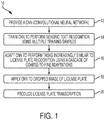
- FIG. 1 illustrates a high-level flow chart of operations depicting logical operational steps of a method 10 for coarse-to-fine cascade of adaptations for license plate recognition with a CNN, in accordance with one example embodiment.
- the method 10 depicted in FIG. 1 considers the task of learning a model for license plate recognition as one of supervised domain adaptation, where one tries to adapt a model that performs very well in the task of generic text recognition to the particular task of license plate recognition, for which little training data is available.
- a standard CNN fine-tuning strategy one can already obtain excellent accuracy on the task of license plate recognition, improving over previous work.
- the approach of method 10 includes steps or logical operations of providing a CNN, as indicated at block 12. Thereafter, as depicted at block 14, the CNN can be trained to perform generic text recognition by leveraging multiple (e.g., millions) training samples.
- the operations shown at blocks 12 and 14 involve training of the CNN. This operation (i.e., the training) occurs once.
- the operations shown at blocks 16, 18, 20, however, may occur many times (e.g., at testing times).
- a step or logical operation can be implemented to adapt the CNN to perform tasks increasingly similar to license plate recognition utilizing a cascade of coarse-to-fine adaptations.
- the resulting CNN can then be applied as shown at block 18 to a cropped image of a license plate to produce, as shown at block 20, a license plate transcription.
- the training operations occur only once (i.e., at training time). That is, one first trains the CNN using first the generic text examples and then the license plate images. These operations are performed only once. Then, one can apply the trained CNN to any number of cropped images of new license plates to obtain their transcriptions, with no need to retrain the network each time.
- computer program code for carrying out operations of the disclosed embodiments may be written in an object oriented programming language (e.g., Java, C#, C++, etc.).
- object oriented programming language e.g., Java, C#, C++, etc.
- Such computer program code, however, for carrying out operations of particular embodiments can also be written in conventional procedural programming languages, such as the "C" programming language or in a visually oriented programming environment, such as, for example, Visual Basic.
- the program code may execute entirely on the user's computer, partly on the user's computer, as a stand-alone software package, partly on the user's computer and partly on a remote computer, or entirely on the remote computer.
- the remote computer may be connected to a user's computer through a local area network (LAN) or a wide area network (WAN), wireless data network e.g., Wi-Fi, Wimax, 802.xx, and cellular network, or the connection may be made to an external computer via most third party supported networks (e.g., through the Internet via an Internet Service Provider).
- LAN local area network
- WAN wide area network
- wireless data network e.g., Wi-Fi, Wimax, 802.xx, and cellular network
- These computer program instructions may also be stored in a computer-readable memory that can direct a computer or other programmable data processing apparatus to function in a particular manner, such that the instructions stored in the computer-readable memory produce an article of manufacture including instruction means which implement the function/act specified in the various block or blocks, flowcharts, and other architecture illustrated and described herein.
- the computer program instructions may also be loaded onto a computer or other programmable data processing apparatus to cause a series of operational steps to be performed on the computer or other programmable apparatus to produce a computer implemented process such that the instructions which execute on the computer or other programmable apparatus provide steps for implementing the functions/acts specified in the block or blocks.
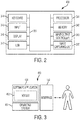
- FIGS. 2-3 are provided as exemplary diagrams of data-processing environments in which embodiments may be implemented. It should be appreciated that FIGS. 2-3 are only exemplary and are not intended to assert or imply any limitation with regard to the environments in which aspects or embodiments of the disclosed embodiments may be implemented. Many modifications to the depicted environments may be made without departing from the spirit and scope of the disclosed embodiments.
- a data-processing system 400 can include one or more processors such as processor 341, a memory 342, a controller 343 (e.g., an input/output controller), a peripheral USB (Universal Serial Bus) connection 347, a keyboard 344 (e.g., a physical keyboard or a touchscreen graphically displayed keyboard), an input component 345 (e.g., a pointing device, such as a mouse, track ball, pen device, which may be utilized in association or with the keyboard 344, etc.), a display 346, and in some cases, an image-capturing unit 332 (e.g., a digital video camera, an ALPR camera, etc.).
- processors such as processor 341, a memory 342, a controller 343 (e.g., an input/output controller), a peripheral USB (Universal Serial Bus) connection 347, a keyboard 344 (e.g., a physical keyboard or a touchscreen graphically displayed keyboard), an input component 345 (e.g., a pointing device, such as
- Data-processing system 400 may be, for example, a client computing device (e.g., a client PC, laptop, tablet computing device, etc.), which communicates with peripheral devices (not shown) via a client-server network (e.g., wireless and/or wired).
- client-server network e.g., wireless and/or wired
- the data-processing system may be a server in the context of a client-server network or other server-based network implementation.
- the various components of data-processing system 400 can communicate electronically through a system bus 351 or other similar architecture.
- the system bus 351 may be, for example, a subsystem that transfers data between, for example, computer components within data-processing system 400 or to and from other data-processing devices, components, computers, etc.
- Data-processing system 400 may be implemented as, for example, a server in a client-server based network (e.g., the Internet) or can be implemented in the context of a client and a server (i.e., where aspects are practiced on the client and the server).
- Data-processing system 400 may be, for example, a standalone desktop computer, a laptop computer, a Smartphone, a pad computing device, a server, and so on.
- FIG. 3 illustrates a computer software system 450 for directing the operation of the data-processing system 400 shown in FIG. 2 .
- Software application 454 stored for example in memory 342, generally includes a kernel or operating system 451 and a shell or interface 453.
- One or more application programs, such as software application 454 may be "loaded” (i.e., transferred from, for example, memory 342 or another memory location) for execution by the data-processing system 400.
- the data-processing system 400 can receive user commands and data through the interface 453; these inputs may then be acted upon by the data-processing system 400 in accordance with instructions from operating system 451 and/or software application 454.
- the interface 453, in some embodiments, can serve to display results, whereupon a user may supply additional inputs or terminate a session.
- the software application 454 can include one or more modules such as, for example, a module 452, which can, for example, implement instructions or operations such as those described herein. Examples of instructions that can be implemented by module 452 include steps or operations such as those shown and described herein with respect to blocks 12, 14, 16, 18, 20 of FIG. 1 and described elsewhere herein. Note that module 452 may be composed of sub-modules, such as, for example, the modules 232, 234, 236, 238, and/or 239 described herein with respect to FIG. 4 .
- a “module” such as module 452 shown in FIG. 3 constitutes a software application.
- a module may also be composed of, for example, electronic and/or computer hardware or such hardware in combination with software.
- a “module” can also constitute a database and/or electronic hardware and software that interact with such a database.
- program modules include, but are not limited to, routines, subroutines, software applications, programs, objects, components, data structures, etc., that perform particular tasks or implement particular abstract data types and instructions.
- program modules include, but are not limited to, routines, subroutines, software applications, programs, objects, components, data structures, etc., that perform particular tasks or implement particular abstract data types and instructions.
- program modules include, but are not limited to, routines, subroutines, software applications, programs, objects, components, data structures, etc., that perform particular tasks or implement particular abstract data types and instructions.
- program modules include, but are not limited to, routines, subroutines, software applications, programs, objects, components, data structures, etc., that perform particular tasks or implement particular abstract data types and instructions.
- program modules include, but are not limited to, routines, subroutines, software applications, programs, objects, components, data structures, etc., that perform particular tasks or implement particular abstract data types and instructions.
- program modules include, but are not limited to, routines, sub
- module can refer to a collection of routines and data structures that perform a particular task or implement a particular abstract data type. Modules may be composed of two parts: an interface, which lists the constants, data types, variable, and routines that can be accessed by other modules or routines; and an implementation, which is typically private (accessible only to that module) and which includes source code that actually implements the routines in the module.
- the term module may also simply refer to an application, such as a computer program designed to assist in the performance of a specific task, such as word processing, accounting, inventory management, etc.
- the instructions or steps such as those shown in FIG. 1 , for example, and discussed elsewhere herein can be implemented in the context of such a module or modules, sub-modules, and so on.
- FIGS. 2-3 are thus intended as examples and not as architectural limitations of disclosed embodiments. Additionally, such embodiments are not limited to any particular application or computing or data processing environment. Instead, those skilled in the art will appreciate that the disclosed approach may be advantageously applied to a variety of systems and application software. Moreover, the disclosed embodiments can be embodied on a variety of different computing platforms, including, for example, Windows, Macintosh, UNIX, LINUX, and the like.
- FIG. 4 illustrates a block diagram of a system 200 for license plate recognition, which can be implemented in accordance with an example embodiment.
- the system 200 generally includes an image-capturing unit 108, which communicates either directly (e.g., wired connection) or wirelessly with a network 220.
- the network 220 shown in FIG. 4 may employ any network topology, transmission medium, or network protocol.
- Network 220 may include connections such as wire, wireless communication links, fiber optic cables, and so forth.
- Network 220 can also be an Internet representing a worldwide collection of networks and gateways that use the Transmission Control Protocol/Internet Protocol (TCP/IP) suite of protocols to communicate with one another.
- TCP/IP Transmission Control Protocol/Internet Protocol
- At the heart of the Internet is a backbone of high-speed data communication lines between major nodes or host computers consisting of thousands of commercial, government, educational, and other computer systems that route data and messages.
- the network 220 (e.g., a wireless "WiFi" network, a cellular communications network, the Internet, etc.) can communicate directly (e.g., wired connection) or via wireless communications with an ALPR unit, which in some embodiments, can be a data-processing system 400 such as disclosed in FIGS. 2-3 .
- the ALPR unit can include an ALPR module 452.
- Such an ALPR module 452 can be stored in, for example, a memory such as memory 342 shown in FIG. 2 and processed via a processor such as, for example, processor 341 also depicted in FIG. 2 .
- the image-capturing unit 108 can be, for example, an ALPR camera or other digital video camera and can capture an image 210 of, for example, a license plate 211 of a vehicle 205.
- the image 210 may be provided to the ALPR module 452 as a cropped image or an uncropped image, depending upon design considerations.
- image 210 can be transmitted via the network 220 to the ALPR unit for processing by the ALPR module 452.
- the ALPR module 452 includes one or more modules (or sub-modules), such as, for example, a neural network 232 (e.g., a CNN as described previously or another type of neural network) and a training module 234 for training such a neural network to perform generic text recognition utilizing a plurality of training samples as discussed previously herein.
- the ALPR module 452 can further include a learning/adapting module 236 for iteratively learning and adapting the neural network.
- the ALPR module 452 can also include an application module 238 for applying the neural network to a cropped image of the license plate 211 in order to recognize text and produce a license plate transcription 240 with respect to the license plate 211. Assuming that the image 210 of the license plate 211 is provided to the ALPR module 452 as an uncropped image, an image cropping module 239 can be utilized via the ALPR module 452 to crop such an image which is then subject to processing by the other modules 232, 234, 236, and/or 238 of the ALPR module 452.
- the training operations occur only once (i.e., at training time). That is, one first trains the neural network 232 utilizing first the generic text examples and then the license plate images. These operations are performed only once. Then, one can apply the trained neural network 232 to any number of cropped images of new license plates to obtain the license plate transcription, with no need to retrain the neural network 232 each time.
- a method for license plate recognition can include steps or logical operations for generating a neural network; training the neural network to perform generic text recognition utilizing a plurality of training samples; iteratively learning and adapting the neural network; and applying the neural network to a cropped image of a license plate in order to recognize text and produce a license plate transcription with respect to the license plate.
- the aforementioned neural network 232 can be a CNN (Convolutional Neural Network). It can be appreciated, of course, that other types of neural networks can be implemented in lieu of a CNN.
- a step or operation can be implemented for adapting the neural network to perform tasks increasingly similar to license plate recognition in a target set as a part of training the neural network.
- the step or logical operation of iteratively learning and adapting the neural network can involve a step or logical operation of iteratively learning and adapting the neural network by fine-tuning the neural network.
- the step or logical operation of fine-tuning the neural network can include a step or logical operation for utilizing a cascade of coarse-to-fine adaptations so as to iteratively learn and adapt the neural network.
- a step or logical operation can be provided for adapting the neural network to perform tasks increasingly similar to license plate recognition in a target set as a part of training the neural network.
- a system for license plate recognition can be implemented.
- a system can include, for example, at least one processor and a computer-usable medium embodying computer program code, the computer-usable medium capable of communicating with the processor (or processors).
- the computer program code can include instructions executable by the processor and configured for: generating a neural network; training the neural network to perform generic text recognition utilizing a plurality of training samples; iteratively learning and adapting the neural network; and applying the neural network to a cropped image of a license plate in order to recognize text and produce a license plate transcription with respect to the license plate.
- a non-transitory processor-readable medium storing code representing instructions to cause a process for license plate recognition.
- code can include code to, for example: generate a neural network; train the neural network to perform generic text recognition utilizing a plurality of training samples; iteratively learn and adapt the neural network; and apply the neural network to a cropped image of a license plate in order to recognize text and produce a license plate transcription with respect to the license plate.
Landscapes
- Engineering & Computer Science (AREA)
- Theoretical Computer Science (AREA)
- Physics & Mathematics (AREA)
- Evolutionary Computation (AREA)
- Multimedia (AREA)
- General Physics & Mathematics (AREA)
- Artificial Intelligence (AREA)
- Health & Medical Sciences (AREA)
- General Health & Medical Sciences (AREA)
- Computer Vision & Pattern Recognition (AREA)
- Biodiversity & Conservation Biology (AREA)
- Molecular Biology (AREA)
- Biomedical Technology (AREA)
- Life Sciences & Earth Sciences (AREA)
- Computing Systems (AREA)
- Databases & Information Systems (AREA)
- Medical Informatics (AREA)
- Software Systems (AREA)
- Image Analysis (AREA)
- Character Discrimination (AREA)
Abstract
Description
- Embodiments are generally related to the field of image processing. Embodiments also relate to object recognition. Embodiments further relate to license plate recognition and neural networks.
- LPR (License Plate Recognition) or ALPR (Automatic License Plate Recognition) is a computer vision technology that typically includes image-processing operations with functions as the core module of "intelligent" transportation infrastructure applications. License plate recognition techniques, such as ALPR, can be employed to identify a vehicle by automatically reading a license plate utilizing image processing and character recognition technologies. A license plate recognition operation can be performed by locating a license plate in an image, segmenting the characters in the captured image of the plate, and performing an OCR (Optical Character Recognition) operation with respect to the characters identified.
- The ALPR problem is often decomposed into a sequence of image processing operations: locating the sub-image containing the license plate (i.e., plate localization), extracting images of individual characters (i.e., segmentation), and performing optical character recognition (OCR) on these character images. Thus, LPR and ALPR technologies involve the problem not just of object recognition, but also text image recognition.
- One of the problems with license plate image recognition is that given a cropped image of a license plate, we are interested in producing its transcription. Two main trends exist to address the problem of license plate/text image recognition.
- The first trend is based on the aforementioned OCR, which is inspired by traditional word recognition methods in documents. Given a word image, individual characters of the word can first be localized and then recognized via a number of approaches. Although these techniques can obtain very good recognition results, they are not exempt of problems. For example, millions of training words need to be annotated with character bounding boxes to achieve a high accuracy, and the individual characters in the word localized - which is slow and error prone, particularly in the case of license plate recognition, where even the license plate itself may not have been localized and cropped with high accuracy.
- The second trend, inspired by recent computer vision techniques, describes word images with global signatures (e.g., bag of words or Fisher vector encodings on top of SIFT or other learned local features) without explicitly detecting the individual characters. With such approaches, one can simultaneously embed word images and text strings in a common space with an associated similarity metric, which allows one to cast the recognition of a word image as a retrieval problem: given a word image, one can rank all possible transcriptions (e.g., the lexicon) and utilize the most similar one to the image word as the predicted transcription.
- Although this offers advantages in many domains, for some particular tasks such as license plate recognition, where the number of possible transcriptions is vast, this is not practical, and it is of paramount importance to perform recognition without a known lexicon, a much more difficult task. Some techniques utilize global image signatures, but cast the problem not as retrieval but as an optimization, attempting to find the transcription that maximizes the compatibility function. This method has obtained very good results on internal license plate datasets with no need of a lexicon, although the results were, as expected, not as accurate and efficient as when using a lexicon. In a similar direction, a Convolutional Neural Network can be trained, which learns how to map images of text into a text embedding space from where the actual text string can be easily recovered. In practice, this allows one to perform text image classification if huge amounts of labeled training data are available, but this is typically not the case, particularly with license plate images.
- Given the importance of license plate recognition for different areas of transportation, a solution to recognize license plates with no lexicon in a more accurate and efficient manner that does not require vast amounts of annotated training data is sought.
- The following summary is provided to facilitate an understanding of some of the innovative features unique to the disclosed embodiments and is not intended to be a full description. A full appreciation of the various aspects of the embodiments disclosed herein can be gained by taking the entire specification, claims, drawings, and abstract as a whole.
- It is, therefore, one aspect of the disclosed embodiments to provide for improved methods and systems for object recognition.
- It is another aspect of the disclosed embodiments to provide methods and systems for license plate recognition and text recognition thereof.
- It is yet another aspect of the disclosed embodiments to provide for recognizing text in cropped images.
- The aforementioned aspects and other objectives and advantages can now be achieved as described herein. Methods and systems are disclosed for license plate recognition utilizing a trained neural network. In an example embodiment, a neural network can be generated. The neural network is then subject to operations involving iteratively training and adapting the neural network for a particular task such as, for example, text recognition in the context of a license plate recognition application. The neural network is trained to perform generic text recognition utilizing a plurality of training samples. The neural network can be applied to a cropped image of a license plate in order to recognize text and produce a license plate transcription with respect to the license plate.
- In some example embodiments, the neural network can be implemented as a CNN (Convolutional Neural Network). Iteratively learning and adapting the neural network can involve iteratively learning and adapting the neural network by fine-tuning the neural network. Fine-tuning of the neural network in some embodiments can involve the use of a cascade of coarse-to-fine adaptations so as to iteratively learn and adapt the neural network. The neural network is also adapted to perform tasks increasingly similar to license plate recognition in a target set as a part of the training of the neural network.
- The accompanying figures, in which like reference numerals refer to identical or functionally-similar elements throughout the separate views and which are incorporated in and form a part of the specification, further illustrate the present invention and, together with the detailed description of the invention, serve to explain the principles of the present invention.
-
FIG. 1 illustrates a high-level flow chart of operations depicting logical operational steps of a method for coarse-to-fine cascade of adaptations for license plate recognition with a CNN, in accordance with an example embodiment; -
FIG. 2 illustrates a schematic view of a computer system, in accordance with an example embodiment; -
FIG. 3 illustrates a schematic view of a software system including a module, an operating system, and a user interface, in accordance with an example embodiment; and -
FIG. 4 illustrates a block diagram of a system for license plate recognition, which can be implemented in accordance with an example embodiment. - The particular values and configurations discussed in these non-limiting examples can be varied and are cited merely to illustrate one or more embodiments and are not intended to limit the scope thereof.
- Subject matter will now be described more fully hereinafter with reference to the accompanying drawings, which form a part hereof, and which show, by way of illustration, specific example embodiments. Subject matter may, however, be embodied in a variety of different forms and, therefore, covered or claimed subject matter is intended to be construed as not being limited to any example embodiments set forth herein; example embodiments are provided merely to be illustrative. Likewise, a reasonably broad scope for claimed or covered subject matter is intended. Among other things, for example, subject matter may be embodied as methods, devices, components, or systems. Accordingly, embodiments may, for example, take the form of hardware, software, firmware or any combination thereof (other than software per se). The following detailed description is, therefore, not intended to be interpreted in a limiting sense.
- Throughout the specification and claims, terms may have nuanced meanings suggested or implied in context beyond an explicitly stated meaning. Likewise, the phrase "in one embodiment" as used herein does not necessarily refer to the same embodiment and the phrase "in another embodiment" as used herein does not necessarily refer to a different embodiment. It is intended, for example, that claimed subject matter include combinations of example embodiments in whole or in part.
- In general, terminology may be understood, at least in part, from usage in context. For example, terms such as "and", "or", or "and/or" as used herein may include a variety of meanings that may depend, at least in part, upon the context in which such terms are used. Typically, "or" if used to associate a list, such as A, B, or C, is intended to mean A, B, and C, here used in the inclusive sense, as well as A, B, or C, here used in the exclusive sense. In addition, the term "one or more" as used herein, depending at least in part upon context, may be used to describe any feature, structure, or characteristic in a singular sense or may be used to describe combinations of features, structures, or characteristics in a plural sense. Similarly, terms such as "a", "an", or "the", again, may be understood to convey a singular usage or to convey a plural usage, depending at least in part upon context. In addition, the term "based on" may be understood as not necessarily intended to convey an exclusive set of factors and may, instead, allow for existence of additional factors not necessarily expressly described, again, depending at least in part on context.
- The disclosed embodiments adapt a generic text recognition convolutional network (e.g., convnet) for License Plate (LP) image recognition. Re-using a standard text convnet architecture, for example, and a large-scale synthetic text image dataset yields excellent performance results. The disclosed approach overcomes the large domain gap between the synthetic text images and the LP ones by using a standard convnet model adaptation technique: fine-tuning. This is crucial for performance and can be further improved by subsequent fine-tuning on specific subsets of the target data (e.g., city or parking-specific data to tailor the model to particular conditions). Benefits of this approach include the application of text-image convnets to the problem of License Plate (LP) recognition. In addition, the simple yet efficient domain adaptation techniques required for the successful transfer from text images to LP, based on fine-tuning is very useful.
- An example embodiment can be implemented, which involves learning a Convolutional Neural Network (CNN) for the task of license plate recognition. CNNs have shown outstanding results for many tasks related to computer vision, including text recognition without a lexicon, but have not yet been utilized in the context of the task of license plate recognition. One of the main difficulties in training CNNs is the large amount of annotated training data needed to learn a good model. In particular, for license plate recognition, gathering and annotating the large amounts of license plate images necessary for training an accurate CNN model from scratch is unfortunately not feasible. However, for the related task of text recognition, a synthetic dataset containing millions of text images suitable for training is available, and models learned on this dataset have been shown to generalize well to real images and obtain state-of-the-art results on standard text recognition benchmarks. Still, such models perform poorly on the specific task of license plate recognition due to the domain drift.
- The disclosed embodiments therefore consider the task of learning a model for license plate recognition as one of supervised domain adaptation, where one tries to adapt a model that performs very well in the task of generic text recognition to the particular task of license plate recognition, for which little training data is available. In particular, we initially demonstrate that utilizing a standard CNN fine-tuning strategy one can already obtain excellent accuracy on the task of license plate recognition, improving over previous approaches.
- Such fine-tuning techniques have not been utilized for the complex task of license plate recognition. Note, however, that considering this problem one of source target domain adaptation may be simplistic. One may instead see the target domain of license plate images as a collection of more fine-grained sub domains. For example, license plate images captured by a camera on a parking in Paris will differ from the license plates captured in a highway in the south of France, where both the position and type of the camera and the type of vehicles captured will be different. Although there are clear differences between text and license plates, there are also clear differences between the two sub domains of license plates. Even if learning a generic license plate recognizer is desirable, one may also be interested in specializing the recognizer in a particular sub domain to obtain higher accuracies in that specific sub domain.
- In an example embodiment, a technique can be implemented to iteratively learn and adapt a CNN with a cascade of coarse-to-fine adaptations, where the network is first trained to perform generic text recognition, leveraging millions of training samples, and then adapted to perform tasks more and more similar to the license plate recognition in the target dataset. Such an iterative fine-tuning can decrease the error between a 5% and a 10% relative with respect to learning the models using a more standard fine-tuning. The final results significantly outperform prior solutions, both in accuracy and in speed.
- One of the main advantages of this approach is that it can perform license plate recognition with high accuracy using a limited amount of annotated license plates, while the original network is only trained for text recognition and performs poorly on the task of license plate recognition. The disclosed approach leverages extra training data, even if it i) comes from a different domain, ii) is faster at testing time, and iii) leads to better accuracy.
- Convolutional Neural Networks (CNNs) can yield outstanding results in many tasks related to computer vision, and, amongst them, text recognition. This accuracy, however, comes at a cost. In order to achieve good performance, CNNs need to be trained in a supervised manner with huge amounts of labeled training data, which may be unfeasible depending on the task (e.g., license plate recognition).
- For this problem, two standard solutions exist: training on synthetic data and adapting a pre-trained network to the target domain. Regarding training on synthetic data, one can generate realistic synthetic data and use it for training purposes. This approach can be utilized in a variety of domains (e.g., pedestrian localization) and, more related to the disclosed problem, text recognition.
- Regarding adapting a pre-trained network to the target domain, if one has access to a network pre-trained with enough training data from a "similar" domain (e.g., a network trained on the ImageNet dataset) and some labeled training samples from the target domain, one can adapt the network (i.e., fine-tune it, as it is known in the community) to the target domain. This can be achieved very easily as CNNs are trained by back propagation. If the source and target tasks are the same (e.g., classification into 20 predefined classes) and only a domain shift is available, one can simply update the network weights by back propagation using the target domain training samples. If the tasks are different, one may need to replace entire layers of the network and train those from scratch. Still, results using pre-trained networks from a similar domain tend to yield much better results than learning from scratch with limited training data.
- For some scenarios involving adaptation, the target domain actually consists of several different sub domains. These sub domains are more related between them than with the source domain, but are still quite different between them. The disclosed approach can be implemented based on coarse-to-fine adaptation to leverage this hierarchy of target domains and improve the accuracy of the recognition method.
- Note that both approaches can be complementary (e.g., training on abundant synthetic data and then performing a fine-tuning for the real target domain). Also note that one of the reasons this simple fine-tuning works well is because the CNN objective is non-convex and is usually solved with Stochastic Gradient Descend. If the objective was convex, directly fine-tuning a network on the target domain would erase all previous knowledge of the source domain unless other techniques (involving, e.g., regularization) were simultaneously used. The non-convex objective is precisely what renders the fine-tuning task easy and effective for CNNs.
- The disclosed embodiments focus primarily on the problem of license plate recognition, for which limited annotated training data is available. On the other hand, we have access to large amounts of annotated synthetic training data for word image recognition. One can see how both tasks are essentially the same - recognizing the contents of a text image -- and that there is a severe domain drift. Text images and license plates are different both in statistics (e.g., license plates contain plenty of digits and have similar lengths, while dictionary words do not) and in capturing conditions (e.g., license plates may be captured with difficult angles, illumination conditions, and the background texture may be different, etc.).
- In reference to an experimental embodiment, it can be first demonstrated that learning a network on a synthetic dataset of text images and then fine-tuning on two license plate datasets leads to very good results. Note, however, that although this can be seen as standard fine tuning, there is no prior use of CNNs for the task of license plate recognition, neither directly nor by leveraging a text image datasets for pre-training and performing fine-tuning.
- Second, it can be demonstrated that one should carefully define exactly what is the target domain, and that fine-tuning a network directly to that target domain may not be the best strategy. The domain of license plate images can be considered as a collection of more fine-grained subdomains. For example, the license plate images captured by a camera on a parking in Paris will differ from the license plates captured in a highway in the south of France, where both the position and type of the camera and the type of vehicles captured will be different. This immediately begs the question of what should be the target domain. Should one train on all license plates available, independently of them being from different subdomains? Should one only train on the license plates of the subdomain of relevance? Or, a combination of both?
- The network can thus be trained in a coarse-to-fine manner. First, the network can be trained utilizing as much available data as possible from the source domain (e.g., in an experimental embodiment, around 10 million synthetic images of dictionary words). Then, the network can be fine-tuned utilizing all the available samples from the target domain(s), in this case, license plate images, even if they are derived from very different scenarios. Finally, the network can be fine-tuned again with respect to only the target subdomain that we want to recognize.
- Experiments can demonstrate that this coarse-to-fine strategy is consistently better than an approaching that involves learning from scratch or fine-tuning only once to a specific dataset or datasets. Although fine-tuning is now standard practice in the computer vision community, prior work does not exist, which performs iterative fine tuning in a coarse-to-fine manner, neither with CNNs nor with more standard domain adaptation techniques.
- Three datasets can be utilized in the context of an experimental embodiment. One of the datasets contains synthetic text images and is used only for training purposes. The other two are in-house datasets of license-place images captured in real scenarios. Such datasets are now described in more detail. It can be appreciated that reference to specific datasets herein is provided for exemplary purposes only and are not considered limiting features of the disclosed embodiments.
- The Oxford Synthetic (OS) dataset contains approximately 10 million synthetic images with a coverage of approximately 90,000 different words extracted from a dictionary. The dataset also contains about 1 million validation images (which can be used to validate the parameters of the model) and about 1 million testing images (which are not used). Although the images are synthetic, they are generated in a very realistic manner applying different types of transformations and distortions. Models learned utilizing this dataset generalize very well to real data, obtaining state-of-the-art results in text recognition tasks. It should be noted, however, that as the dataset contains only words from a dictionary, characters are much more common than digits, which are underrepresented. Therefore, we expect a model learned solely on this dataset to perform poorly on the task of license plate recognition, where digits are just as common as characters.
- The Wa-dataset (Wa) contains 4,215 training images and 4,215 testing images with 3,282 unique license plates. These license plates are automatically localized and cropped from images capturing the whole vehicle and an automatic perspective transformation has been applied to straighten them. Very bad detections can be manually removed, but license plates partly cropped, misaligned, badly straightened, or with other problems kept in place.
- The Cl-dataset (Cl) contains 2,867 training images and 1,381 testing images with 1,891 unique license plates captured in a similar manner than in the Wa-dataset. However, in general, the quality of the license plate images of the Cl-dataset is much worse than that of the Wa-dataset, suffering more problems due to bad detections or misalignments. Except for two customized license plates of 11 characters, all license plates in both datasets contain between 4 and 8 characters.
- Note that both license plate datasets contain a limited number of training samples: training a CNN using only these training samples will lead to subpar results. Also worth mentioning is that neither Wa nor Cl contain validation sets. For training purposes, we use the same parameters used in the Oxford Synthetic dataset. The only parameter to adjust here is the number of iterations for fine-tuning. Fortunately, the performance on the test set essentially converges after a number of iterations. Therefore, the network can be trained until such a convergence is observed.
- In an example embodiment, the network can take as input gray images resized to 32x100 pixels (without preserving the aspect ratio) and run them through a series of convolutions and fully connected layers. In such an example embodiment, the output of the network can be a matrix of size 37x23, wherein every cell denotes the probability of finding each of the 37 possible symbols (e.g., 10 digits, 26 characters, and the NULL symbol) at position 1, 2, ... , 23 in the license plate 1. Given the output of a network, one can easily obtain the transcription by moving through the 23 columns and taking the symbol with the highest probability in each column.
- The exact architecture of the network is a conv64-5, conv128-5, conv256-3, conv512-3, conv512-3, fc4096, fc4096, fc (32x23), where convX-Y denotes a convolution with X filters of size YxY, and fcX is a fully connected layer which produces an output of X dimensions. The convolutional filters have a stride of 1 and are padded to preserve the map size. A max-pooling of size 2x2 with a stride of 2 follows convolutional layers 1, 2, and 4. ReLU non-linearities are applied between each pair of layers. The network ends in 23 independent classifiers (one for each position) that perform a softmax and use a cross-entropy loss for training. Although the classifiers are independent of each other, they can be trained jointly together with the remaining parameters of the network.
- The network can also be trained by SGD with a momentum of 0.9, fixed learning rate of 5x10⁻⁵ and weight decay of 5x10⁻⁴, with mini batches of size 128. The network is trained for several epochs on Oxford Synthetic until convergence of accuracy on a validation set. When fine-tuning on Wa and Cl, the network is trained for a few hundreds of epochs. It has been observed experimentally that the accuracy of the networks reached a plateau after that point.
- In some example embodiments, the disclosed approach can be evaluated on test sets of Wa and Cl. In such a scenario, two measures may be reported: a recognition rate (the percentage of license plates that are transcribed exactly) and a normalized CER (Character Error Rate), i.e., the edit distance between the transcription and the ground truth annotation divided by the maximum of their lengths. Models learned in different setups (e.g., learned from scratch, fine-tuned from Oxford Synthetic, and iteratively fine-tuned) can be evaluated and compared with previous works.
- Example results are shown in Table 1 below.
Test Dataset Test Dataset Trained Model Wa Cl Trained Model Wa Cl (a) OCR 88.59 57.13 (a) OCR 2.21 25.41 (b) Other 90.05 78.00 (b) Other 2.1 7.0 (c) OS 0.00 0.00 (c) OS 70.37 71.52 (d) OS + Wa + Cl 2.75 2.02 (d) OS + Wa + Cl 40.65 47.97 (e) W 84.91 (e) W 3.78 (f) a 51.41 (f) a 18.03 (g) Wa + Cl 87.88 66.52 (g) Wa + Cl 3.00 10.91 (h) OS → Wa 95.14 (h) OS → Wa 1.16 (i) OS → Cl 80.62 (i) OS → Cl 6.00 (j) OS → Wa+Cl 95.42 84.53 (j) OS → Wa+Cl 1.06 4.57 (k) OS → Wa + Cl → Wa 95.80 (k) OS → Wa + Cl → Wa 1.00 (l) OS → Wa + Cl → Cl 84.96 (l) OS → Wa + Cl → Cl 4.41 - Fine-tuning operations are denoted with arrows, while merging of datasets can be denoted with a plus sign. For example, "OS -> Wa + Cl" denotes a model that was first trained on "Oxford Synthetic" (i.e., OS) and then fine-tuned on a dataset that combines both Wa and Cl. The missing values belong to setups where the testing dataset is not related to the training dataset and where one does not expect a high accuracy.
- The following example results are noted. First, a model trained exclusively on OS (c) does not perform well at all in the task of license plate recognition, achieving 0% recognition accuracy and about a 70 CER. Learning on a combined dataset of OS + Wa + Cl (d) does also lead to terrible results (although slightly better). This is not surprising as there are very few license plates compared to the amount of text data in OS.
- Second, training on license plate datasets from scratch (e, f, g) performs much better, particularly when both Wa and Cl datasets are combined. However, this does not leverage all the knowledge that could be obtained from OS and the results are still below what was achieved in previous works.
- Learning a model on OS and then fine-tuning on the license plate datasets (h, i, j) leads to superior results and outperforms previous work. For (j), we improve the accuracy of the system by almost 6 points in Wa and Cl and reduce the CER by almost 50%. Interestingly, fine-tuning the model on Wa+Cl lead to superior results both on Wa and Cl (j), despite forcing the model to learn to recognize license plates that will not be similar to the ones seen at testing time. We believe that this is because more training data is available and the fine-tuning can take advantage of it.
- Iterative fine-tuning (k, I), where the network learned on OS is first fine-tuned on Wa + Cl and then fine-tuned again on Wa or Cl leads to the best results. Intuitively, the network leveraged all the information about text in general provided by OS, all the information about license plates in general provided by Wa+Cl, and finally specialized on the actual target task, obtaining the best results. This approach further reduces the recognition error by almost a 10% relative on Wa (k) and by a 3% relative on Cl (I). Similar improvements can be observed for the CER.
-
FIG. 1 illustrates a high-level flow chart of operations depicting logical operational steps of amethod 10 for coarse-to-fine cascade of adaptations for license plate recognition with a CNN, in accordance with one example embodiment. Themethod 10 depicted inFIG. 1 considers the task of learning a model for license plate recognition as one of supervised domain adaptation, where one tries to adapt a model that performs very well in the task of generic text recognition to the particular task of license plate recognition, for which little training data is available. As indicated previously, by using a standard CNN fine-tuning strategy one can already obtain excellent accuracy on the task of license plate recognition, improving over previous work. - The approach of
method 10 includes steps or logical operations of providing a CNN, as indicated atblock 12. Thereafter, as depicted atblock 14, the CNN can be trained to perform generic text recognition by leveraging multiple (e.g., millions) training samples. The operations shown atblocks blocks - Thus, as illustrated at
block 16, a step or logical operation can be implemented to adapt the CNN to perform tasks increasingly similar to license plate recognition utilizing a cascade of coarse-to-fine adaptations. The resulting CNN can then be applied as shown atblock 18 to a cropped image of a license plate to produce, as shown atblock 20, a license plate transcription. To be clear, the training operations occur only once (i.e., at training time). That is, one first trains the CNN using first the generic text examples and then the license plate images. These operations are performed only once. Then, one can apply the trained CNN to any number of cropped images of new license plates to obtain their transcriptions, with no need to retrain the network each time. - Note that in some embodiments, computer program code for carrying out operations of the disclosed embodiments may be written in an object oriented programming language (e.g., Java, C#, C++, etc.). Such computer program code, however, for carrying out operations of particular embodiments can also be written in conventional procedural programming languages, such as the "C" programming language or in a visually oriented programming environment, such as, for example, Visual Basic.
- The program code may execute entirely on the user's computer, partly on the user's computer, as a stand-alone software package, partly on the user's computer and partly on a remote computer, or entirely on the remote computer. In the latter scenario, the remote computer may be connected to a user's computer through a local area network (LAN) or a wide area network (WAN), wireless data network e.g., Wi-Fi, Wimax, 802.xx, and cellular network, or the connection may be made to an external computer via most third party supported networks (e.g., through the Internet via an Internet Service Provider). An example of such a network is the
network 220 shown inFIG. 4 . - The embodiments are described at least in part herein with reference to flowchart illustrations and/or block diagrams of methods, systems, and computer program products and data structures according to embodiments of the invention. It will be understood that each block of the illustrations, and combinations of blocks, can be implemented by computer program instructions. These computer program instructions may be provided to a processor of a general-purpose computer, special purpose computer, or other programmable data processing apparatus to produce a machine, such that the instructions, which execute via the processor of the computer or other programmable data processing apparatus, create means for implementing the functions/acts specified in the block or blocks.
- These computer program instructions may also be stored in a computer-readable memory that can direct a computer or other programmable data processing apparatus to function in a particular manner, such that the instructions stored in the computer-readable memory produce an article of manufacture including instruction means which implement the function/act specified in the various block or blocks, flowcharts, and other architecture illustrated and described herein.
- The computer program instructions may also be loaded onto a computer or other programmable data processing apparatus to cause a series of operational steps to be performed on the computer or other programmable apparatus to produce a computer implemented process such that the instructions which execute on the computer or other programmable apparatus provide steps for implementing the functions/acts specified in the block or blocks.
-
FIGS. 2-3 are provided as exemplary diagrams of data-processing environments in which embodiments may be implemented. It should be appreciated thatFIGS. 2-3 are only exemplary and are not intended to assert or imply any limitation with regard to the environments in which aspects or embodiments of the disclosed embodiments may be implemented. Many modifications to the depicted environments may be made without departing from the spirit and scope of the disclosed embodiments. - As illustrated in
FIG. 2 , some embodiments may be implemented in the context of a data-processing system 400 that can include one or more processors such asprocessor 341, amemory 342, a controller 343 (e.g., an input/output controller), a peripheral USB (Universal Serial Bus)connection 347, a keyboard 344 (e.g., a physical keyboard or a touchscreen graphically displayed keyboard), an input component 345 (e.g., a pointing device, such as a mouse, track ball, pen device, which may be utilized in association or with thekeyboard 344, etc.), adisplay 346, and in some cases, an image-capturing unit 332 (e.g., a digital video camera, an ALPR camera, etc.). Data-processing system 400 may be, for example, a client computing device (e.g., a client PC, laptop, tablet computing device, etc.), which communicates with peripheral devices (not shown) via a client-server network (e.g., wireless and/or wired). In another embodiment, the data-processing system may be a server in the context of a client-server network or other server-based network implementation. - As illustrated, the various components of data-
processing system 400 can communicate electronically through asystem bus 351 or other similar architecture. Thesystem bus 351 may be, for example, a subsystem that transfers data between, for example, computer components within data-processing system 400 or to and from other data-processing devices, components, computers, etc. Data-processing system 400 may be implemented as, for example, a server in a client-server based network (e.g., the Internet) or can be implemented in the context of a client and a server (i.e., where aspects are practiced on the client and the server). Data-processing system 400 may be, for example, a standalone desktop computer, a laptop computer, a Smartphone, a pad computing device, a server, and so on. -
FIG. 3 illustrates acomputer software system 450 for directing the operation of the data-processing system 400 shown inFIG. 2 .Software application 454, stored for example inmemory 342, generally includes a kernel oroperating system 451 and a shell orinterface 453. One or more application programs, such assoftware application 454, may be "loaded" (i.e., transferred from, for example,memory 342 or another memory location) for execution by the data-processing system 400. The data-processing system 400 can receive user commands and data through theinterface 453; these inputs may then be acted upon by the data-processing system 400 in accordance with instructions fromoperating system 451 and/orsoftware application 454. Theinterface 453, in some embodiments, can serve to display results, whereupon a user may supply additional inputs or terminate a session. - The
software application 454 can include one or more modules such as, for example, amodule 452, which can, for example, implement instructions or operations such as those described herein. Examples of instructions that can be implemented bymodule 452 include steps or operations such as those shown and described herein with respect toblocks FIG. 1 and described elsewhere herein. Note thatmodule 452 may be composed of sub-modules, such as, for example, themodules FIG. 4 . - The following discussion is intended to provide a brief, general description of suitable computing environments in which the system and method may be implemented. Although not required, the disclosed embodiments will be described in the general context of computer-executable instructions, such as program modules, being executed by a single computer. In most instances, a "module" such as
module 452 shown inFIG. 3 constitutes a software application. However, a module may also be composed of, for example, electronic and/or computer hardware or such hardware in combination with software. In some cases, a "module" can also constitute a database and/or electronic hardware and software that interact with such a database. - Generally, program modules include, but are not limited to, routines, subroutines, software applications, programs, objects, components, data structures, etc., that perform particular tasks or implement particular abstract data types and instructions. Moreover, those skilled in the art will appreciate that the disclosed method and system may be practiced with other computer system configurations, such as, for example, hand-held devices, multi-processor systems, data networks, microprocessor-based or programmable consumer electronics, networked PCs, minicomputers, mainframe computers, servers, and the like.
- Note that the term module as utilized herein can refer to a collection of routines and data structures that perform a particular task or implement a particular abstract data type. Modules may be composed of two parts: an interface, which lists the constants, data types, variable, and routines that can be accessed by other modules or routines; and an implementation, which is typically private (accessible only to that module) and which includes source code that actually implements the routines in the module. The term module may also simply refer to an application, such as a computer program designed to assist in the performance of a specific task, such as word processing, accounting, inventory management, etc. Thus, the instructions or steps such as those shown in
FIG. 1 , for example, and discussed elsewhere herein can be implemented in the context of such a module or modules, sub-modules, and so on. -
FIGS. 2-3 are thus intended as examples and not as architectural limitations of disclosed embodiments. Additionally, such embodiments are not limited to any particular application or computing or data processing environment. Instead, those skilled in the art will appreciate that the disclosed approach may be advantageously applied to a variety of systems and application software. Moreover, the disclosed embodiments can be embodied on a variety of different computing platforms, including, for example, Windows, Macintosh, UNIX, LINUX, and the like. -
FIG. 4 illustrates a block diagram of asystem 200 for license plate recognition, which can be implemented in accordance with an example embodiment. Thesystem 200 generally includes an image-capturingunit 108, which communicates either directly (e.g., wired connection) or wirelessly with anetwork 220. Thenetwork 220 shown inFIG. 4 may employ any network topology, transmission medium, or network protocol.Network 220 may include connections such as wire, wireless communication links, fiber optic cables, and so forth.Network 220 can also be an Internet representing a worldwide collection of networks and gateways that use the Transmission Control Protocol/Internet Protocol (TCP/IP) suite of protocols to communicate with one another. At the heart of the Internet is a backbone of high-speed data communication lines between major nodes or host computers consisting of thousands of commercial, government, educational, and other computer systems that route data and messages. - The network 220 (e.g., a wireless "WiFi" network, a cellular communications network, the Internet, etc.) can communicate directly (e.g., wired connection) or via wireless communications with an ALPR unit, which in some embodiments, can be a data-
processing system 400 such as disclosed inFIGS. 2-3 . The ALPR unit can include anALPR module 452. Such anALPR module 452 can be stored in, for example, a memory such asmemory 342 shown inFIG. 2 and processed via a processor such as, for example,processor 341 also depicted inFIG. 2 . - The image-capturing
unit 108 can be, for example, an ALPR camera or other digital video camera and can capture animage 210 of, for example, alicense plate 211 of avehicle 205. Theimage 210 may be provided to theALPR module 452 as a cropped image or an uncropped image, depending upon design considerations. - In the example shown in
FIG. 4 ,image 210 can be transmitted via thenetwork 220 to the ALPR unit for processing by theALPR module 452. TheALPR module 452 includes one or more modules (or sub-modules), such as, for example, a neural network 232 (e.g., a CNN as described previously or another type of neural network) and atraining module 234 for training such a neural network to perform generic text recognition utilizing a plurality of training samples as discussed previously herein. TheALPR module 452 can further include a learning/adapting module 236 for iteratively learning and adapting the neural network. TheALPR module 452 can also include anapplication module 238 for applying the neural network to a cropped image of thelicense plate 211 in order to recognize text and produce alicense plate transcription 240 with respect to thelicense plate 211. Assuming that theimage 210 of thelicense plate 211 is provided to theALPR module 452 as an uncropped image, animage cropping module 239 can be utilized via theALPR module 452 to crop such an image which is then subject to processing by theother modules ALPR module 452. - As indicated previously, the training operations occur only once (i.e., at training time). That is, one first trains the
neural network 232 utilizing first the generic text examples and then the license plate images. These operations are performed only once. Then, one can apply the trainedneural network 232 to any number of cropped images of new license plates to obtain the license plate transcription, with no need to retrain theneural network 232 each time. - Note that one non-limiting example of an image cropping approach that can be utilized to implement the
image cropping module 239 is disclosed inU.S. Patent Application Publication No. 2015/0294175 , which is incorporated herein by reference in its entirety and is entitled "Methods and Systems for Efficient Image Cropping and Analysis," which published on October 15, 2015 to Raja Bala et al., and is assigned to Xerox Corporation. - Based on the foregoing, it can be appreciated that a number of example preferred and alternative embodiments are disclosed herein. In one example embodiment, a method for license plate recognition is disclosed. Such a method can include steps or logical operations for generating a neural network; training the neural network to perform generic text recognition utilizing a plurality of training samples; iteratively learning and adapting the neural network; and applying the neural network to a cropped image of a license plate in order to recognize text and produce a license plate transcription with respect to the license plate. In a preferred example embodiment, the aforementioned
neural network 232 can be a CNN (Convolutional Neural Network). It can be appreciated, of course, that other types of neural networks can be implemented in lieu of a CNN. - In another example embodiment, a step or operation can be implemented for adapting the neural network to perform tasks increasingly similar to license plate recognition in a target set as a part of training the neural network. In some example embodiment, the step or logical operation of iteratively learning and adapting the neural network can involve a step or logical operation of iteratively learning and adapting the neural network by fine-tuning the neural network. In another example embodiment, the step or logical operation of fine-tuning the neural network can include a step or logical operation for utilizing a cascade of coarse-to-fine adaptations so as to iteratively learn and adapt the neural network. In still another example embodiment, a step or logical operation can be provided for adapting the neural network to perform tasks increasingly similar to license plate recognition in a target set as a part of training the neural network.
- In another example embodiment, a system for license plate recognition can be implemented. Such a system can include, for example, at least one processor and a computer-usable medium embodying computer program code, the computer-usable medium capable of communicating with the processor (or processors). The computer program code can include instructions executable by the processor and configured for: generating a neural network; training the neural network to perform generic text recognition utilizing a plurality of training samples; iteratively learning and adapting the neural network; and applying the neural network to a cropped image of a license plate in order to recognize text and produce a license plate transcription with respect to the license plate.
- In yet another example embodiment, a non-transitory processor-readable medium storing code representing instructions to cause a process for license plate recognition can be implemented. Such code can include code to, for example: generate a neural network; train the neural network to perform generic text recognition utilizing a plurality of training samples; iteratively learn and adapt the neural network; and apply the neural network to a cropped image of a license plate in order to recognize text and produce a license plate transcription with respect to the license plate.
- It will be appreciated that variations of the above-disclosed and other features and functions, or alternatives thereof, may be desirably combined into many other different systems or applications. It will also be appreciated that various presently unforeseen or unanticipated alternatives, modifications, variations or improvements therein may be subsequently made by those skilled in the art which are also intended to be encompassed by the following claims.
Claims (10)
- A method for license plate recognition, said method comprising:generating a neural network;training said neural network to perform generic text recognition utilizing a plurality of training samples;iteratively learning and adapting said neural network; andapplying said neural network to a cropped image of a license plate in order to recognize text and produce a license plate transcription with respect to said license plate.
- The method of claim 1 wherein said neural network comprises a CNN (Convolutional Neural Network).
- A system for license plate recognition, said system comprising:at least one processor; anda computer-usable medium embodying computer program code, said computer-usable medium capable of communicating with said at least one processor, said computer program code comprising instructions executable by said at least one processor and configured for:generating a neural network;training said neural network to perform generic text recognition utilizing a plurality of training samples;iteratively learning and adapting said neural network; andapplying said neural network to a cropped image of a license plate in order to recognize text and produce a license plate transcription with respect to said license plate.
- The system of claim 3 wherein said neural network comprises a CNN (Convolutional Neural Network).
- The system of claim 3 wherein said instructions are further configured for adapting said neural network to perform tasks increasingly similar to license plate recognition in a target set as a part of training said neural network.
- The system of claim 3 wherein said instructions for iteratively learning and adapting said neural network, further comprises instructions configured for iteratively learning and adapting said neural network by fine tuning said neural network.
- A processor-readable medium storing code representing instructions to cause a process for license plate recognition, said code including code to:generate a neural network;train said neural network to perform generic text recognition utilizing a plurality of training samples;iteratively learn and adapt said neural network; andapply said neural network to a cropped image of a license plate in order to recognize text and produce a license plate transcription with respect to said license plate.
- The processor-readable medium of claim 7 wherein said neural network comprises a CNN (Convolutional Neural Network).
- The processor-readable medium of claim 7 wherein said code further includes code to adapt said neural network to perform tasks increasingly similar to license plate recognition in a target set as a part of training said neural network.
- The processor-readable medium of claim 7 wherein iteratively learning and adapting said neural network, further comprises: iteratively learning and adapting said neural network by fine tuning said neural network.
Applications Claiming Priority (1)
| Application Number | Priority Date | Filing Date | Title |
|---|---|---|---|
| US14/972,481 US9785855B2 (en) | 2015-12-17 | 2015-12-17 | Coarse-to-fine cascade adaptations for license plate recognition with convolutional neural networks |
Publications (3)
| Publication Number | Publication Date |
|---|---|
| EP3182334A1 true EP3182334A1 (en) | 2017-06-21 |
| EP3182334C0 EP3182334C0 (en) | 2024-01-24 |
| EP3182334B1 EP3182334B1 (en) | 2024-01-24 |
Family
ID=57530519
Family Applications (1)
| Application Number | Title | Priority Date | Filing Date |
|---|---|---|---|
| EP16202552.2A Active EP3182334B1 (en) | 2015-12-17 | 2016-12-06 | License plate recognition using coarse-to-fine cascade adaptations of a convolutional neural network |
Country Status (3)
| Country | Link |
|---|---|
| US (1) | US9785855B2 (en) |
| EP (1) | EP3182334B1 (en) |
| JP (1) | JP6831682B2 (en) |
Cited By (21)
| Publication number | Priority date | Publication date | Assignee | Title |
|---|---|---|---|---|
| CN107273832A (en) * | 2017-06-06 | 2017-10-20 | 青海省交通科学研究院 | Licence plate recognition method and system based on integrating channel feature and convolutional neural networks |
| CN107506765A (en) * | 2017-10-13 | 2017-12-22 | 厦门大学 | A kind of method of the license plate sloped correction based on neutral net |
| CN107944450A (en) * | 2017-11-16 | 2018-04-20 | 深圳市华尊科技股份有限公司 | A kind of licence plate recognition method and device |
| CN109447069A (en) * | 2018-10-31 | 2019-03-08 | 沈阳工业大学 | Collecting vehicle information recognition methods and system towards intelligent terminal |
| CN109657596A (en) * | 2018-12-12 | 2019-04-19 | 天津卡达克数据有限公司 | A kind of vehicle appearance component identification method based on deep learning |
| WO2019066641A3 (en) * | 2017-09-29 | 2019-06-27 | Mimos Berhad | A system and method for recognising license plate |
| WO2019129985A1 (en) * | 2017-12-29 | 2019-07-04 | Bull Sas | Method for forming a neural network for the recognition of a sequence of characters, and associated recognition method |
| CN109977941A (en) * | 2018-12-21 | 2019-07-05 | 北京融链科技有限公司 | License plate recognition method and device |
| CN110399800A (en) * | 2019-06-28 | 2019-11-01 | 智慧眼科技股份有限公司 | Detection method of license plate and system, storage medium based on deep learning VGG16 frame |
| CN110490179A (en) * | 2018-05-15 | 2019-11-22 | 杭州海康威视数字技术股份有限公司 | License plate recognition method, device and storage medium |
| EP3588388A1 (en) * | 2018-05-31 | 2020-01-01 | Seoul National University R&DB Foundation | Apparatus and method for training facial locality super resolution deep neural network |
| CN110688999A (en) * | 2019-10-08 | 2020-01-14 | 郑州迈拓信息技术有限公司 | Mach Band Effect Simulation Method for Detection of Metal Stenciled Characters with Point Light Source |
| EP3599572A1 (en) * | 2018-07-27 | 2020-01-29 | JENOPTIK Traffic Solutions UK Ltd | Method and apparatus for recognizing a license plate of a vehicle |
| CN111507337A (en) * | 2020-04-10 | 2020-08-07 | 河海大学 | License plate recognition method based on hybrid neural network |
| CN111898497A (en) * | 2020-07-16 | 2020-11-06 | 济南博观智能科技有限公司 | License plate detection method, system, equipment and readable storage medium |
| EP3798897A1 (en) * | 2019-09-30 | 2021-03-31 | JENOPTIK Traffic Solutions UK Ltd | Methods for artificial neural networks |
| CN112926610A (en) * | 2019-12-06 | 2021-06-08 | 顺丰科技有限公司 | Construction method of license plate image screening model and license plate image screening method |
| CN113052174A (en) * | 2021-03-26 | 2021-06-29 | 北京百度网讯科技有限公司 | License plate data sample generation method and device, electronic equipment and storage medium |
| CN115050028A (en) * | 2022-06-15 | 2022-09-13 | 松立控股集团股份有限公司 | Sample vehicle license plate detection method in severe weather |
| CN117234077A (en) * | 2018-11-15 | 2023-12-15 | 灵动科技(北京)有限公司 | Automatic Guided Vehicles and Methods of Training Automatic Guided Vehicles |
| TWI869931B (en) * | 2023-07-14 | 2025-01-11 | 艾陽科技股份有限公司 | License plate recognition system and method thereof |
Families Citing this family (72)
| Publication number | Priority date | Publication date | Assignee | Title |
|---|---|---|---|---|
| US9990564B2 (en) * | 2016-03-29 | 2018-06-05 | Wipro Limited | System and method for optical character recognition |
| US9904871B2 (en) | 2016-04-14 | 2018-02-27 | Microsoft Technologies Licensing, LLC | Deep convolutional neural network prediction of image professionalism |
| US10043240B2 (en) * | 2016-04-14 | 2018-08-07 | Microsoft Technology Licensing, Llc | Optimal cropping of digital image based on professionalism score of subject |
| US10043254B2 (en) | 2016-04-14 | 2018-08-07 | Microsoft Technology Licensing, Llc | Optimal image transformation based on professionalism score of subject |
| US11475276B1 (en) | 2016-11-07 | 2022-10-18 | Apple Inc. | Generating more realistic synthetic data with adversarial nets |
| TWI607387B (en) * | 2016-11-25 | 2017-12-01 | 財團法人工業技術研究院 | Character recognition system and its character recognition method |
| US10984289B2 (en) * | 2016-12-23 | 2021-04-20 | Shenzhen Institute Of Advanced Technology | License plate recognition method, device thereof, and user equipment |
| CN108664957B (en) * | 2017-03-31 | 2021-08-24 | 杭州海康威视数字技术股份有限公司 | License plate number matching method and device, character information matching method and device |
| CN107563385B (en) * | 2017-09-02 | 2019-10-25 | 西安电子科技大学 | License plate character recognition method based on deep convolutional generative adversarial network |
| CN108108746B (en) * | 2017-09-13 | 2021-04-09 | 湖南理工学院 | License plate character recognition method based on Caffe deep learning framework |
| CN107704857B (en) * | 2017-09-25 | 2020-07-24 | 北京邮电大学 | End-to-end lightweight license plate recognition method and device |
| US11222162B2 (en) | 2017-09-29 | 2022-01-11 | Dropbox, Inc. | Managing content item collections |
| US10592595B2 (en) | 2017-09-29 | 2020-03-17 | Dropbox, Inc. | Maintaining multiple versions of a collection of content items |
| US10922426B2 (en) | 2017-09-29 | 2021-02-16 | Dropbox, Inc. | Managing content item collections |
| US11038973B2 (en) | 2017-10-19 | 2021-06-15 | Dropbox, Inc. | Contact event feeds and activity updates |
| CN107886082B (en) * | 2017-11-24 | 2023-07-04 | 腾讯科技(深圳)有限公司 | Method, device, computer equipment and storage medium for detecting mathematical formulas in images |
| US11030466B2 (en) | 2018-02-11 | 2021-06-08 | Nortek Security & Control Llc | License plate detection and recognition system |
| RU2716322C2 (en) * | 2018-03-23 | 2020-03-11 | Общество с ограниченной ответственностью "Аби Продакшн" | Reproducing augmentation of image data |
| CN108509912B (en) * | 2018-04-03 | 2021-09-28 | 深圳市智绘科技有限公司 | License plate recognition method and system for multi-channel network video stream |
| US10783400B2 (en) | 2018-04-06 | 2020-09-22 | Dropbox, Inc. | Generating searchable text for documents portrayed in a repository of digital images utilizing orientation and text prediction neural networks |
| US11875582B2 (en) * | 2018-07-04 | 2024-01-16 | Mitsubishi Heavy Industries Machinery Systems, Ltd. | Vehicle number identification device, vehicle number identification method, and program |
| US10740643B2 (en) * | 2018-08-28 | 2020-08-11 | Sony Corporation | Automatic license plate recognition based on augmented datasets |
| JP2020046858A (en) * | 2018-09-18 | 2020-03-26 | ソニーセミコンダクタソリューションズ株式会社 | Information processing method, program, and information processing system |
| TWI677826B (en) * | 2018-09-19 | 2019-11-21 | 國家中山科學研究院 | License plate recognition system and method |
| CN111027555B (en) * | 2018-10-09 | 2023-09-26 | 杭州海康威视数字技术股份有限公司 | A license plate recognition method, device and electronic equipment |
| US11663910B2 (en) | 2018-11-20 | 2023-05-30 | Laser Technology, Inc. | Handheld laser-based vehicle speed measurement device incorporating an automatic number plate recognition (ANPR) function |
| US12379500B2 (en) | 2018-11-20 | 2025-08-05 | Laser Technology, Inc. | Laser ranging and speed measurement device incorporating on-board data storage with GPS, compass, excessive panning detection and voice recognition technology |
| RU2697613C9 (en) * | 2018-11-20 | 2022-04-15 | Хуавей Текнолоджис Ко., Лтд. | Method of objects recognition using neural networks |
| KR102234936B1 (en) * | 2019-03-26 | 2021-04-01 | (주)아이에스인텍 | Apparatus and method for recognizing license plates in real time |
| CN110210475B (en) * | 2019-05-06 | 2021-05-18 | 浙江大学 | License plate character image segmentation method based on non-binarization and edge detection |
| US11164028B2 (en) * | 2019-06-18 | 2021-11-02 | Nortek Security & Control Llc | License plate detection system |
| CN110414507B (en) * | 2019-07-11 | 2022-07-26 | 深圳智优停科技有限公司 | License plate recognition method and device, computer equipment and storage medium |
| US11853863B2 (en) | 2019-08-12 | 2023-12-26 | Micron Technology, Inc. | Predictive maintenance of automotive tires |
| US11586194B2 (en) | 2019-08-12 | 2023-02-21 | Micron Technology, Inc. | Storage and access of neural network models of automotive predictive maintenance |
| US11635893B2 (en) | 2019-08-12 | 2023-04-25 | Micron Technology, Inc. | Communications between processors and storage devices in automotive predictive maintenance implemented via artificial neural networks |
| US11586943B2 (en) | 2019-08-12 | 2023-02-21 | Micron Technology, Inc. | Storage and access of neural network inputs in automotive predictive maintenance |
| US12061971B2 (en) | 2019-08-12 | 2024-08-13 | Micron Technology, Inc. | Predictive maintenance of automotive engines |
| US12249189B2 (en) | 2019-08-12 | 2025-03-11 | Micron Technology, Inc. | Predictive maintenance of automotive lighting |
| US11775816B2 (en) | 2019-08-12 | 2023-10-03 | Micron Technology, Inc. | Storage and access of neural network outputs in automotive predictive maintenance |
| US11748626B2 (en) | 2019-08-12 | 2023-09-05 | Micron Technology, Inc. | Storage devices with neural network accelerators for automotive predictive maintenance |
| US12497055B2 (en) | 2019-08-21 | 2025-12-16 | Micron Technology, Inc. | Monitoring controller area network bus for vehicle control |
| US10993647B2 (en) | 2019-08-21 | 2021-05-04 | Micron Technology, Inc. | Drowsiness detection for vehicle control |
| US11702086B2 (en) | 2019-08-21 | 2023-07-18 | Micron Technology, Inc. | Intelligent recording of errant vehicle behaviors |
| US11498388B2 (en) | 2019-08-21 | 2022-11-15 | Micron Technology, Inc. | Intelligent climate control in vehicles |
| US11361552B2 (en) | 2019-08-21 | 2022-06-14 | Micron Technology, Inc. | Security operations of parked vehicles |
| US11042350B2 (en) | 2019-08-21 | 2021-06-22 | Micron Technology, Inc. | Intelligent audio control in vehicles |
| US11436076B2 (en) | 2019-09-05 | 2022-09-06 | Micron Technology, Inc. | Predictive management of failing portions in a data storage device |
| US11650746B2 (en) | 2019-09-05 | 2023-05-16 | Micron Technology, Inc. | Intelligent write-amplification reduction for data storage devices configured on autonomous vehicles |
| US11435946B2 (en) | 2019-09-05 | 2022-09-06 | Micron Technology, Inc. | Intelligent wear leveling with reduced write-amplification for data storage devices configured on autonomous vehicles |
| US11409654B2 (en) | 2019-09-05 | 2022-08-09 | Micron Technology, Inc. | Intelligent optimization of caching operations in a data storage device |
| US12210401B2 (en) | 2019-09-05 | 2025-01-28 | Micron Technology, Inc. | Temperature based optimization of data storage operations |
| US11693562B2 (en) | 2019-09-05 | 2023-07-04 | Micron Technology, Inc. | Bandwidth optimization for different types of operations scheduled in a data storage device |
| JP7564616B2 (en) | 2019-11-21 | 2024-10-09 | オムロン株式会社 | MODEL GENERATION DEVICE, ESTIMATION DEVICE, MODEL GENERATION METHOD, AND MODEL GENERATION PROGRAM |
| JP7434829B2 (en) | 2019-11-21 | 2024-02-21 | オムロン株式会社 | Model generation device, estimation device, model generation method, and model generation program |
| US11250648B2 (en) | 2019-12-18 | 2022-02-15 | Micron Technology, Inc. | Predictive maintenance of automotive transmission |
| CN111160353A (en) * | 2019-12-27 | 2020-05-15 | 广州亚信技术有限公司 | License plate recognition method, device and equipment |
| US11481691B2 (en) | 2020-01-16 | 2022-10-25 | Hyper Labs, Inc. | Machine learning-based text recognition system with fine-tuning model |
| US11709625B2 (en) | 2020-02-14 | 2023-07-25 | Micron Technology, Inc. | Optimization of power usage of data storage devices |
| US11531339B2 (en) | 2020-02-14 | 2022-12-20 | Micron Technology, Inc. | Monitoring of drive by wire sensors in vehicles |
| US11704804B2 (en) | 2020-04-02 | 2023-07-18 | GE Precision Healthcare LLC | Domain adaptation using post-processing model correction |
| CN111800604A (en) * | 2020-06-12 | 2020-10-20 | 深圳英飞拓科技股份有限公司 | Method and device for detecting human shape and human face data based on gun and ball linkage |
| CN111800605A (en) * | 2020-06-15 | 2020-10-20 | 深圳英飞拓科技股份有限公司 | Gun-ball linkage based vehicle shape and license plate transmission method, system and equipment |
| US11176362B1 (en) | 2020-06-24 | 2021-11-16 | Bank Of America Corporation | System for character recognition in a digital image processing environment |
| TWI790471B (en) * | 2020-08-26 | 2023-01-21 | 財團法人工業技術研究院 | Image correction method and system based on deep learning |
| CN112200193B (en) * | 2020-12-03 | 2021-03-16 | 中国科学院自动化研究所 | Distributed license plate recognition method, system and device based on multi-attribute fusion |
| CN112669219A (en) * | 2021-01-21 | 2021-04-16 | 深圳市爱培科技术股份有限公司 | Three-dimensional 360-degree panoramic image splicing method and device |
| US12591915B2 (en) * | 2021-03-19 | 2026-03-31 | Capital One Services, Llc | Methods and systems for determining recommendations based on real-time optimization of machine learning models |
| CN112906643A (en) * | 2021-03-22 | 2021-06-04 | 高新兴科技集团股份有限公司 | License plate number identification method and device |
| US12333821B2 (en) | 2021-04-28 | 2025-06-17 | Hayden Ai Technologies, Inc. | Systems and methods for enforcing traffic congestion pricing |
| CN114913515B (en) * | 2021-12-31 | 2024-04-02 | 北方工业大学 | End-to-end license plate recognition network construction method |
| WO2024167422A1 (en) | 2023-02-07 | 2024-08-15 | Dcx Innovations Spolka Z Ograniczona Odpowedzielnoscia | System for automatically detecting objects of interest and determining their geographic positions |
| US20240346836A1 (en) * | 2023-04-10 | 2024-10-17 | Urbanchain Group Limited | Algorithmic pipeline and general principles of cost-efficient automatic plate recognition system for resource-constrained embedded devices |
Citations (1)
| Publication number | Priority date | Publication date | Assignee | Title |
|---|---|---|---|---|
| US20150294175A1 (en) | 2014-04-10 | 2015-10-15 | Xerox Corporation | Methods and systems for efficient image cropping and analysis |
Family Cites Families (13)
| Publication number | Priority date | Publication date | Assignee | Title |
|---|---|---|---|---|
| JP2893948B2 (en) * | 1990-11-30 | 1999-05-24 | 富士電機株式会社 | License plate recognition device |
| JPH09231079A (en) * | 1996-02-28 | 1997-09-05 | Hitachi Ltd | Fuzzy reasoning system and fuzzy rule construction system |
| US6038337A (en) | 1996-03-29 | 2000-03-14 | Nec Research Institute, Inc. | Method and apparatus for object recognition |
| US6564198B1 (en) * | 2000-02-16 | 2003-05-13 | Hrl Laboratories, Llc | Fuzzy expert system for interpretable rule extraction from neural networks |
| US7016529B2 (en) | 2002-03-15 | 2006-03-21 | Microsoft Corporation | System and method facilitating pattern recognition |
| US7499588B2 (en) * | 2004-05-20 | 2009-03-03 | Microsoft Corporation | Low resolution OCR for camera acquired documents |
| US7747070B2 (en) | 2005-08-31 | 2010-06-29 | Microsoft Corporation | Training convolutional neural networks on graphics processing units |
| EP2064653A4 (en) | 2006-09-01 | 2012-09-05 | Sensen Networks Pty Ltd | Method and system of identifying one or more features represented in a plurality of sensor acquired data sets |
| US8704889B2 (en) | 2010-03-16 | 2014-04-22 | Hi-Tech Solutions Ltd. | Method and apparatus for acquiring images of car license plates |
| US9092979B2 (en) | 2010-12-14 | 2015-07-28 | Xerox Corporation | Automated license plate recognition system and method using human-in-the-loop based adaptive learning |
| US9008429B2 (en) | 2013-02-01 | 2015-04-14 | Xerox Corporation | Label-embedding for text recognition |
| CN104346622A (en) | 2013-07-31 | 2015-02-11 | 富士通株式会社 | Convolutional neural network classifier, and classifying method and training method thereof |
| US9412031B2 (en) | 2013-10-16 | 2016-08-09 | Xerox Corporation | Delayed vehicle identification for privacy enforcement |
-
2015
- 2015-12-17 US US14/972,481 patent/US9785855B2/en active Active
-
2016
- 2016-11-30 JP JP2016233642A patent/JP6831682B2/en not_active Expired - Fee Related
- 2016-12-06 EP EP16202552.2A patent/EP3182334B1/en active Active
Patent Citations (1)
| Publication number | Priority date | Publication date | Assignee | Title |
|---|---|---|---|---|
| US20150294175A1 (en) | 2014-04-10 | 2015-10-15 | Xerox Corporation | Methods and systems for efficient image cropping and analysis |
Non-Patent Citations (5)
| Title |
|---|
| ANKUSH ROY ET AL: "Number Plate Recognition for use in different countries using an improved segmentation", PROCEEDINGS 2011 2ND NATIONAL CONFERENCE ON EMERGING TRENDS AND APPLICATIONS IN COMPUTER SCIENCE, 1 March 2011 (2011-03-01), IEEE, Piscataway, NJ, USA, pages 1 - 5, XP055363102, ISBN: 978-1-4244-9578-8, DOI: 10.1109/NCETACS.2011.5751407 * |
| LIU PAN ET AL: "Low-quality License Plate Character Recognition Based on CNN", 2015 8TH INTERNATIONAL SYMPOSIUM ON COMPUTATIONAL INTELLIGENCE AND DESIGN (ISCID), vol. 2, 12 December 2015 (2015-12-12), IEEE, Piscataway, NJ, USA, pages 53 - 58, XP032899833, ISBN: 978-1-4673-9586-1, [retrieved on 20160511], DOI: 10.1109/ISCID.2015.153 * |
| MENOTTI D ET AL: "Vehicle License Plate Recognition With Random Convolutional Networks", 2014 27TH SIBGRAPI CONFERENCE ON GRAPHICS, PATTERNS AND IMAGES, IEEE, 26 August 2014 (2014-08-26), pages 298 - 303, XP032653567, DOI: 10.1109/SIBGRAPI.2014.52 * |
| NEUBAUER C ET AL: "LICENSE PLATE RECOGNITION WITH AN INTELLIGENT CAMERA", PROCEEDINGS OF THE SPIE - THE INTERNATIONAL SOCIETY FOR OPTICAL ENGINEERING, vol. 3838, 1 September 1999 (1999-09-01), SPIE-Int. Soc. Opt. Eng.- USA, pages 29 - 38, XP009023372, ISBN: 978-1-62841-730-2, DOI: 10.1117/12.369265 * |
| ZHIHONG ZHAO ET AL: "Chinese License Plate Recognition Using a Convolutional Neural Network", COMPUTATIONAL INTELLIGENCE AND INDUSTRIAL APPLICATION, 2008, 19 December 2008 (2008-12-19), IEEE, PISCATAWAY, NJ, USA, pages 27 - 30, XP031409735, ISBN: 978-0-7695-3490-9 * |
Cited By (38)
| Publication number | Priority date | Publication date | Assignee | Title |
|---|---|---|---|---|
| CN107273832A (en) * | 2017-06-06 | 2017-10-20 | 青海省交通科学研究院 | Licence plate recognition method and system based on integrating channel feature and convolutional neural networks |
| WO2019066641A3 (en) * | 2017-09-29 | 2019-06-27 | Mimos Berhad | A system and method for recognising license plate |
| CN107506765A (en) * | 2017-10-13 | 2017-12-22 | 厦门大学 | A kind of method of the license plate sloped correction based on neutral net |
| CN107506765B (en) * | 2017-10-13 | 2020-09-01 | 厦门大学 | License plate inclination correction method based on neural network |
| CN107944450B (en) * | 2017-11-16 | 2020-04-24 | 深圳市华尊科技股份有限公司 | License plate recognition method and device |
| CN107944450A (en) * | 2017-11-16 | 2018-04-20 | 深圳市华尊科技股份有限公司 | A kind of licence plate recognition method and device |
| WO2019129985A1 (en) * | 2017-12-29 | 2019-07-04 | Bull Sas | Method for forming a neural network for the recognition of a sequence of characters, and associated recognition method |
| FR3076378A1 (en) * | 2017-12-29 | 2019-07-05 | Bull Sas | METHOD OF FORMING NEURON NETWORK FOR RECOGNITION OF CHARACTER SEQUENCE AND ASSOCIATED RECOGNITION METHOD |
| EP3506170A3 (en) * | 2017-12-29 | 2019-09-04 | Bull SAS | Method for forming a neural network for recognising a sequence of characters and associated recognition method |
| US11748979B2 (en) | 2017-12-29 | 2023-09-05 | Bull Sas | Method for training a neural network for recognition of a character sequence and associated recognition method |
| CN110490179B (en) * | 2018-05-15 | 2022-08-05 | 杭州海康威视数字技术股份有限公司 | License plate recognition method and device and storage medium |
| CN110490179A (en) * | 2018-05-15 | 2019-11-22 | 杭州海康威视数字技术股份有限公司 | License plate recognition method, device and storage medium |
| EP3588388A1 (en) * | 2018-05-31 | 2020-01-01 | Seoul National University R&DB Foundation | Apparatus and method for training facial locality super resolution deep neural network |
| US11288546B2 (en) | 2018-05-31 | 2022-03-29 | Seoul National University R&Db Foundation | Apparatus and method for training facial locality super resolution deep neural network |
| AU2019204641B2 (en) * | 2018-07-27 | 2020-10-29 | Jenoptik UK Ltd. | Method and apparatus for recognizing a license plate of a vehicle |
| EP3599572A1 (en) * | 2018-07-27 | 2020-01-29 | JENOPTIK Traffic Solutions UK Ltd | Method and apparatus for recognizing a license plate of a vehicle |
| CN110781880A (en) * | 2018-07-27 | 2020-02-11 | 业纳交通解决方案英国有限公司 | Method and apparatus for recognizing vehicle license plates |
| US10963722B2 (en) | 2018-07-27 | 2021-03-30 | Jenoptik Traffic Solutions Uk Ltd. | Method and apparatus for recognizing a license plate of a vehicle |
| CN109447069A (en) * | 2018-10-31 | 2019-03-08 | 沈阳工业大学 | Collecting vehicle information recognition methods and system towards intelligent terminal |
| CN117234077A (en) * | 2018-11-15 | 2023-12-15 | 灵动科技(北京)有限公司 | Automatic Guided Vehicles and Methods of Training Automatic Guided Vehicles |
| CN109657596A (en) * | 2018-12-12 | 2019-04-19 | 天津卡达克数据有限公司 | A kind of vehicle appearance component identification method based on deep learning |
| CN109977941A (en) * | 2018-12-21 | 2019-07-05 | 北京融链科技有限公司 | License plate recognition method and device |
| CN110399800A (en) * | 2019-06-28 | 2019-11-01 | 智慧眼科技股份有限公司 | Detection method of license plate and system, storage medium based on deep learning VGG16 frame |
| CN110399800B (en) * | 2019-06-28 | 2021-05-07 | 智慧眼科技股份有限公司 | License plate detection method and system based on deep learning VGG16 framework and storage medium |
| EP3798897A1 (en) * | 2019-09-30 | 2021-03-31 | JENOPTIK Traffic Solutions UK Ltd | Methods for artificial neural networks |
| AU2020233747A1 (en) * | 2019-09-30 | 2021-04-15 | Jenoptik UK Ltd. | Methods for artificial neural networks |
| AU2020233747B2 (en) * | 2019-09-30 | 2021-07-22 | Jenoptik UK Ltd. | Methods for artificial neural networks |
| CN110688999B (en) * | 2019-10-08 | 2020-08-28 | 合肥海诺恒信息科技有限公司 | Mach Band Effect Simulation Method for Detection of Metal Stenciled Characters with Point Light Source |
| CN110688999A (en) * | 2019-10-08 | 2020-01-14 | 郑州迈拓信息技术有限公司 | Mach Band Effect Simulation Method for Detection of Metal Stenciled Characters with Point Light Source |
| CN112926610A (en) * | 2019-12-06 | 2021-06-08 | 顺丰科技有限公司 | Construction method of license plate image screening model and license plate image screening method |
| CN111507337A (en) * | 2020-04-10 | 2020-08-07 | 河海大学 | License plate recognition method based on hybrid neural network |
| CN111898497A (en) * | 2020-07-16 | 2020-11-06 | 济南博观智能科技有限公司 | License plate detection method, system, equipment and readable storage medium |
| CN111898497B (en) * | 2020-07-16 | 2024-05-10 | 济南博观智能科技有限公司 | License plate detection method, system, device and readable storage medium |
| CN113052174A (en) * | 2021-03-26 | 2021-06-29 | 北京百度网讯科技有限公司 | License plate data sample generation method and device, electronic equipment and storage medium |
| CN113052174B (en) * | 2021-03-26 | 2023-08-11 | 北京百度网讯科技有限公司 | License plate data sample generation method and device, electronic equipment and storage medium |
| CN115050028A (en) * | 2022-06-15 | 2022-09-13 | 松立控股集团股份有限公司 | Sample vehicle license plate detection method in severe weather |
| CN115050028B (en) * | 2022-06-15 | 2024-03-29 | 松立控股集团股份有限公司 | Small sample license plate detection method in severe weather |
| TWI869931B (en) * | 2023-07-14 | 2025-01-11 | 艾陽科技股份有限公司 | License plate recognition system and method thereof |
Also Published As
| Publication number | Publication date |
|---|---|
| US9785855B2 (en) | 2017-10-10 |
| EP3182334C0 (en) | 2024-01-24 |
| EP3182334B1 (en) | 2024-01-24 |
| JP6831682B2 (en) | 2021-02-17 |
| JP2017111806A (en) | 2017-06-22 |
| US20170177965A1 (en) | 2017-06-22 |
Similar Documents
| Publication | Publication Date | Title |
|---|---|---|
| EP3182334B1 (en) | License plate recognition using coarse-to-fine cascade adaptations of a convolutional neural network | |
| US10803359B2 (en) | Image recognition method, apparatus, server, and storage medium | |
| CN111027563B (en) | A text detection method, device and recognition system | |
| CN110570433B (en) | Image semantic segmentation model construction method and device based on generation countermeasure network | |
| CN109145759B (en) | Vehicle attribute identification method, device, server and storage medium | |
| EP3679525B1 (en) | Generating object embeddings from images | |
| US20230267273A1 (en) | Machine learning methods and systems for extracting entities from semi-structured enterprise documents | |
| US20120263352A1 (en) | Methods and systems for verifying automatic license plate recognition results | |
| WO2022017245A1 (en) | Text recognition network, neural network training method, and related device | |
| US11928872B2 (en) | Methods and apparatuses for recognizing text, recognition devices and storage media | |
| EP3844669A1 (en) | Method and system for facilitating recognition of vehicle parts based on a neural network | |
| US20210312173A1 (en) | Method, apparatus and device for recognizing bill and storage medium | |
| WO2017079529A1 (en) | Universal correspondence network | |
| CN111027605A (en) | Fine-grained image recognition method and device based on deep learning | |
| CN111738403A (en) | A neural network optimization method and related equipment | |
| EP3992861A1 (en) | System and method for parameter compression of capsule networks using deep features | |
| CN112567398A (en) | Techniques for matching different input data | |
| US20230245483A1 (en) | Handwriting recognition method and apparatus, and electronic device and storage medium | |
| CN112396059A (en) | Certificate identification method and device, computer equipment and storage medium | |
| CN111027480A (en) | Power component identification method and device and computer equipment | |
| CN118226421A (en) | LiDAR-Camera Online Calibration Method and System Based on Reflectivity Map | |
| Zhang et al. | A small target detection algorithm based on improved YOLOv5 in aerial image | |
| US20220351495A1 (en) | Method for matching image feature point, electronic device and storage medium | |
| CN110263779A (en) | Text area detection method and device, text detection method, and computer readable medium | |
| Meng et al. | IRIS: smart phone aided intelligent reimbursement system using deep learning |
Legal Events
| Date | Code | Title | Description |
|---|---|---|---|
| STAA | Information on the status of an ep patent application or granted ep patent |
Free format text: STATUS: UNKNOWN |
|
| PUAI | Public reference made under article 153(3) epc to a published international application that has entered the european phase |
Free format text: ORIGINAL CODE: 0009012 |
|
| STAA | Information on the status of an ep patent application or granted ep patent |
Free format text: STATUS: THE APPLICATION HAS BEEN PUBLISHED |
|
| AK | Designated contracting states |
Kind code of ref document: A1 Designated state(s): AL AT BE BG CH CY CZ DE DK EE ES FI FR GB GR HR HU IE IS IT LI LT LU LV MC MK MT NL NO PL PT RO RS SE SI SK SM TR |
|
| AX | Request for extension of the european patent |
Extension state: BA ME |
|
| STAA | Information on the status of an ep patent application or granted ep patent |
Free format text: STATUS: REQUEST FOR EXAMINATION WAS MADE |
|
| 17P | Request for examination filed |
Effective date: 20171218 |
|
| RBV | Designated contracting states (corrected) |
Designated state(s): AL AT BE BG CH CY CZ DE DK EE ES FI FR GB GR HR HU IE IS IT LI LT LU LV MC MK MT NL NO PL PT RO RS SE SI SK SM TR |
|
| RAP1 | Party data changed (applicant data changed or rights of an application transferred) |
Owner name: CONDUENT BUSINESS SERVICES, LLC |
|
| STAA | Information on the status of an ep patent application or granted ep patent |
Free format text: STATUS: EXAMINATION IS IN PROGRESS |
|
| 17Q | First examination report despatched |
Effective date: 20200415 |
|
| REG | Reference to a national code |
Ref country code: DE Ref legal event code: R079 Free format text: PREVIOUS MAIN CLASS: G06K0009320000 Ipc: G06V0010820000 Ref country code: DE Ref legal event code: R079 Ref document number: 602016085454 Country of ref document: DE Free format text: PREVIOUS MAIN CLASS: G06K0009320000 Ipc: G06V0010820000 |
|
| GRAP | Despatch of communication of intention to grant a patent |
Free format text: ORIGINAL CODE: EPIDOSNIGR1 |
|
| STAA | Information on the status of an ep patent application or granted ep patent |
Free format text: STATUS: GRANT OF PATENT IS INTENDED |
|
| RIC1 | Information provided on ipc code assigned before grant |
Ipc: G06V 20/62 20220101ALI20230719BHEP Ipc: G06V 30/18 20220101ALI20230719BHEP Ipc: G06V 10/82 20220101AFI20230719BHEP |
|
| INTG | Intention to grant announced |
Effective date: 20230803 |
|
| GRAS | Grant fee paid |
Free format text: ORIGINAL CODE: EPIDOSNIGR3 |
|
| GRAA | (expected) grant |
Free format text: ORIGINAL CODE: 0009210 |
|
| STAA | Information on the status of an ep patent application or granted ep patent |
Free format text: STATUS: THE PATENT HAS BEEN GRANTED |
|
| AK | Designated contracting states |
Kind code of ref document: B1 Designated state(s): AL AT BE BG CH CY CZ DE DK EE ES FI FR GB GR HR HU IE IS IT LI LT LU LV MC MK MT NL NO PL PT RO RS SE SI SK SM TR |
|
| REG | Reference to a national code |
Ref country code: GB Ref legal event code: FG4D |
|
| REG | Reference to a national code |
Ref country code: CH Ref legal event code: EP |
|
| REG | Reference to a national code |
Ref country code: DE Ref legal event code: R096 Ref document number: 602016085454 Country of ref document: DE |
|
| REG | Reference to a national code |
Ref country code: IE Ref legal event code: FG4D |
|
| U01 | Request for unitary effect filed |
Effective date: 20240207 |
|
| U07 | Unitary effect registered |
Designated state(s): AT BE BG DE DK EE FI FR IT LT LU LV MT NL PT SE SI Effective date: 20240216 |
|
| PG25 | Lapsed in a contracting state [announced via postgrant information from national office to epo] |
Ref country code: IS Free format text: LAPSE BECAUSE OF FAILURE TO SUBMIT A TRANSLATION OF THE DESCRIPTION OR TO PAY THE FEE WITHIN THE PRESCRIBED TIME-LIMIT Effective date: 20240524 |
|
| PG25 | Lapsed in a contracting state [announced via postgrant information from national office to epo] |
Ref country code: GR Free format text: LAPSE BECAUSE OF FAILURE TO SUBMIT A TRANSLATION OF THE DESCRIPTION OR TO PAY THE FEE WITHIN THE PRESCRIBED TIME-LIMIT Effective date: 20240425 |
|
| PG25 | Lapsed in a contracting state [announced via postgrant information from national office to epo] |
Ref country code: RS Free format text: LAPSE BECAUSE OF FAILURE TO SUBMIT A TRANSLATION OF THE DESCRIPTION OR TO PAY THE FEE WITHIN THE PRESCRIBED TIME-LIMIT Effective date: 20240424 Ref country code: HR Free format text: LAPSE BECAUSE OF FAILURE TO SUBMIT A TRANSLATION OF THE DESCRIPTION OR TO PAY THE FEE WITHIN THE PRESCRIBED TIME-LIMIT Effective date: 20240124 |
|
| PG25 | Lapsed in a contracting state [announced via postgrant information from national office to epo] |
Ref country code: ES Free format text: LAPSE BECAUSE OF FAILURE TO SUBMIT A TRANSLATION OF THE DESCRIPTION OR TO PAY THE FEE WITHIN THE PRESCRIBED TIME-LIMIT Effective date: 20240124 |
|
| PG25 | Lapsed in a contracting state [announced via postgrant information from national office to epo] |
Ref country code: RS Free format text: LAPSE BECAUSE OF FAILURE TO SUBMIT A TRANSLATION OF THE DESCRIPTION OR TO PAY THE FEE WITHIN THE PRESCRIBED TIME-LIMIT Effective date: 20240424 Ref country code: NO Free format text: LAPSE BECAUSE OF FAILURE TO SUBMIT A TRANSLATION OF THE DESCRIPTION OR TO PAY THE FEE WITHIN THE PRESCRIBED TIME-LIMIT Effective date: 20240424 Ref country code: IS Free format text: LAPSE BECAUSE OF FAILURE TO SUBMIT A TRANSLATION OF THE DESCRIPTION OR TO PAY THE FEE WITHIN THE PRESCRIBED TIME-LIMIT Effective date: 20240524 Ref country code: HR Free format text: LAPSE BECAUSE OF FAILURE TO SUBMIT A TRANSLATION OF THE DESCRIPTION OR TO PAY THE FEE WITHIN THE PRESCRIBED TIME-LIMIT Effective date: 20240124 Ref country code: GR Free format text: LAPSE BECAUSE OF FAILURE TO SUBMIT A TRANSLATION OF THE DESCRIPTION OR TO PAY THE FEE WITHIN THE PRESCRIBED TIME-LIMIT Effective date: 20240425 Ref country code: ES Free format text: LAPSE BECAUSE OF FAILURE TO SUBMIT A TRANSLATION OF THE DESCRIPTION OR TO PAY THE FEE WITHIN THE PRESCRIBED TIME-LIMIT Effective date: 20240124 |
|
| PG25 | Lapsed in a contracting state [announced via postgrant information from national office to epo] |
Ref country code: PL Free format text: LAPSE BECAUSE OF FAILURE TO SUBMIT A TRANSLATION OF THE DESCRIPTION OR TO PAY THE FEE WITHIN THE PRESCRIBED TIME-LIMIT Effective date: 20240124 |
|
| PG25 | Lapsed in a contracting state [announced via postgrant information from national office to epo] |
Ref country code: PL Free format text: LAPSE BECAUSE OF FAILURE TO SUBMIT A TRANSLATION OF THE DESCRIPTION OR TO PAY THE FEE WITHIN THE PRESCRIBED TIME-LIMIT Effective date: 20240124 |
|
| PG25 | Lapsed in a contracting state [announced via postgrant information from national office to epo] |
Ref country code: SM Free format text: LAPSE BECAUSE OF FAILURE TO SUBMIT A TRANSLATION OF THE DESCRIPTION OR TO PAY THE FEE WITHIN THE PRESCRIBED TIME-LIMIT Effective date: 20240124 |
|
| PG25 | Lapsed in a contracting state [announced via postgrant information from national office to epo] |
Ref country code: CZ Free format text: LAPSE BECAUSE OF FAILURE TO SUBMIT A TRANSLATION OF THE DESCRIPTION OR TO PAY THE FEE WITHIN THE PRESCRIBED TIME-LIMIT Effective date: 20240124 |
|
| REG | Reference to a national code |
Ref country code: DE Ref legal event code: R097 Ref document number: 602016085454 Country of ref document: DE |
|
| PG25 | Lapsed in a contracting state [announced via postgrant information from national office to epo] |
Ref country code: SK Free format text: LAPSE BECAUSE OF FAILURE TO SUBMIT A TRANSLATION OF THE DESCRIPTION OR TO PAY THE FEE WITHIN THE PRESCRIBED TIME-LIMIT Effective date: 20240124 |
|
| PG25 | Lapsed in a contracting state [announced via postgrant information from national office to epo] |
Ref country code: SM Free format text: LAPSE BECAUSE OF FAILURE TO SUBMIT A TRANSLATION OF THE DESCRIPTION OR TO PAY THE FEE WITHIN THE PRESCRIBED TIME-LIMIT Effective date: 20240124 Ref country code: SK Free format text: LAPSE BECAUSE OF FAILURE TO SUBMIT A TRANSLATION OF THE DESCRIPTION OR TO PAY THE FEE WITHIN THE PRESCRIBED TIME-LIMIT Effective date: 20240124 Ref country code: RO Free format text: LAPSE BECAUSE OF FAILURE TO SUBMIT A TRANSLATION OF THE DESCRIPTION OR TO PAY THE FEE WITHIN THE PRESCRIBED TIME-LIMIT Effective date: 20240124 Ref country code: CZ Free format text: LAPSE BECAUSE OF FAILURE TO SUBMIT A TRANSLATION OF THE DESCRIPTION OR TO PAY THE FEE WITHIN THE PRESCRIBED TIME-LIMIT Effective date: 20240124 |
|
| PLBE | No opposition filed within time limit |
Free format text: ORIGINAL CODE: 0009261 |
|
| STAA | Information on the status of an ep patent application or granted ep patent |
Free format text: STATUS: NO OPPOSITION FILED WITHIN TIME LIMIT |
|
| U20 | Renewal fee for the european patent with unitary effect paid |
Year of fee payment: 9 Effective date: 20241121 |
|
| 26N | No opposition filed |
Effective date: 20241025 |
|
| PG25 | Lapsed in a contracting state [announced via postgrant information from national office to epo] |
Ref country code: MC Free format text: LAPSE BECAUSE OF FAILURE TO SUBMIT A TRANSLATION OF THE DESCRIPTION OR TO PAY THE FEE WITHIN THE PRESCRIBED TIME-LIMIT Effective date: 20240124 |
|
| REG | Reference to a national code |
Ref country code: CH Ref legal event code: PL |
|
| GBPC | Gb: european patent ceased through non-payment of renewal fee |
Effective date: 20241206 |
|
| REG | Reference to a national code |
Ref country code: GB Ref legal event code: S28 Free format text: APPLICATION FILED |
|
| PG25 | Lapsed in a contracting state [announced via postgrant information from national office to epo] |
Ref country code: GB Free format text: LAPSE BECAUSE OF NON-PAYMENT OF DUE FEES Effective date: 20241206 |
|
| PG25 | Lapsed in a contracting state [announced via postgrant information from national office to epo] |
Ref country code: CH Free format text: LAPSE BECAUSE OF NON-PAYMENT OF DUE FEES Effective date: 20241231 |
|
| PG25 | Lapsed in a contracting state [announced via postgrant information from national office to epo] |
Ref country code: IE Free format text: LAPSE BECAUSE OF NON-PAYMENT OF DUE FEES Effective date: 20241206 |
|
| U20 | Renewal fee for the european patent with unitary effect paid |
Year of fee payment: 10 Effective date: 20251119 |
|
| REG | Reference to a national code |
Ref country code: GB Ref legal event code: S28 Free format text: RESTORATION ALLOWED Effective date: 20260205 |
|
| PG25 | Lapsed in a contracting state [announced via postgrant information from national office to epo] |
Ref country code: CY Free format text: LAPSE BECAUSE OF FAILURE TO SUBMIT A TRANSLATION OF THE DESCRIPTION OR TO PAY THE FEE WITHIN THE PRESCRIBED TIME-LIMIT; INVALID AB INITIO Effective date: 20161206 |
|
| PG25 | Lapsed in a contracting state [announced via postgrant information from national office to epo] |
Ref country code: GB Free format text: LAPSE BECAUSE OF NON-PAYMENT OF DUE FEES Effective date: 20241206 |
|
| PGFP | Annual fee paid to national office [announced via postgrant information from national office to epo] |
Ref country code: GB Payment date: 20260105 Year of fee payment: 10 |
|
| PGRI | Patent reinstated in contracting state [announced from national office to epo] |
Ref country code: GB Effective date: 20260205 |