EP3182134A1 - Method for restoring settings of an instrument for processing a sample or a reagent, and system comprising an instrument for processing a sample or reagent - Google Patents
Method for restoring settings of an instrument for processing a sample or a reagent, and system comprising an instrument for processing a sample or reagent Download PDFInfo
- Publication number
- EP3182134A1 EP3182134A1 EP15201311.6A EP15201311A EP3182134A1 EP 3182134 A1 EP3182134 A1 EP 3182134A1 EP 15201311 A EP15201311 A EP 15201311A EP 3182134 A1 EP3182134 A1 EP 3182134A1
- Authority
- EP
- European Patent Office
- Prior art keywords
- instrument
- storage medium
- script
- settings
- restoring
- Prior art date
- Legal status (The legal status is an assumption and is not a legal conclusion. Google has not performed a legal analysis and makes no representation as to the accuracy of the status listed.)
- Withdrawn
Links
Images

Classifications
-
- G—PHYSICS
- G06—COMPUTING OR CALCULATING; COUNTING
- G06F—ELECTRIC DIGITAL DATA PROCESSING
- G06F21/00—Security arrangements for protecting computers, components thereof, programs or data against unauthorised activity
- G06F21/60—Protecting data
- G06F21/602—Providing cryptographic facilities or services
-
- G—PHYSICS
- G06—COMPUTING OR CALCULATING; COUNTING
- G06F—ELECTRIC DIGITAL DATA PROCESSING
- G06F21/00—Security arrangements for protecting computers, components thereof, programs or data against unauthorised activity
- G06F21/50—Monitoring users, programs or devices to maintain the integrity of platforms, e.g. of processors, firmware or operating systems
- G06F21/57—Certifying or maintaining trusted computer platforms, e.g. secure boots or power-downs, version controls, system software checks, secure updates or assessing vulnerabilities
- G06F21/575—Secure boot
-
- G—PHYSICS
- G01—MEASURING; TESTING
- G01N—INVESTIGATING OR ANALYSING MATERIALS BY DETERMINING THEIR CHEMICAL OR PHYSICAL PROPERTIES
- G01N35/00—Automatic analysis not limited to methods or materials provided for in any single one of groups G01N1/00 - G01N33/00; Handling materials therefor
- G01N35/00584—Control arrangements for automatic analysers
-
- G—PHYSICS
- G01—MEASURING; TESTING
- G01N—INVESTIGATING OR ANALYSING MATERIALS BY DETERMINING THEIR CHEMICAL OR PHYSICAL PROPERTIES
- G01N35/00—Automatic analysis not limited to methods or materials provided for in any single one of groups G01N1/00 - G01N33/00; Handling materials therefor
- G01N35/00584—Control arrangements for automatic analysers
- G01N35/00594—Quality control, including calibration or testing of components of the analyser
- G01N35/00613—Quality control
-
- G—PHYSICS
- G01—MEASURING; TESTING
- G01N—INVESTIGATING OR ANALYSING MATERIALS BY DETERMINING THEIR CHEMICAL OR PHYSICAL PROPERTIES
- G01N35/00—Automatic analysis not limited to methods or materials provided for in any single one of groups G01N1/00 - G01N33/00; Handling materials therefor
- G01N35/00584—Control arrangements for automatic analysers
- G01N35/00594—Quality control, including calibration or testing of components of the analyser
- G01N35/00712—Automatic status testing, e.g. at start-up or periodic
-
- G—PHYSICS
- G01—MEASURING; TESTING
- G01N—INVESTIGATING OR ANALYSING MATERIALS BY DETERMINING THEIR CHEMICAL OR PHYSICAL PROPERTIES
- G01N35/00—Automatic analysis not limited to methods or materials provided for in any single one of groups G01N1/00 - G01N33/00; Handling materials therefor
- G01N35/00584—Control arrangements for automatic analysers
- G01N35/00722—Communications; Identification
- G01N35/00732—Identification of carriers, materials or components in automatic analysers
-
- G—PHYSICS
- G06—COMPUTING OR CALCULATING; COUNTING
- G06F—ELECTRIC DIGITAL DATA PROCESSING
- G06F11/00—Error detection; Error correction; Monitoring
-
- G—PHYSICS
- G06—COMPUTING OR CALCULATING; COUNTING
- G06F—ELECTRIC DIGITAL DATA PROCESSING
- G06F11/00—Error detection; Error correction; Monitoring
- G06F11/07—Responding to the occurrence of a fault, e.g. fault tolerance
- G06F11/14—Error detection or correction of the data by redundancy in operations
-
- G—PHYSICS
- G06—COMPUTING OR CALCULATING; COUNTING
- G06F—ELECTRIC DIGITAL DATA PROCESSING
- G06F11/00—Error detection; Error correction; Monitoring
- G06F11/07—Responding to the occurrence of a fault, e.g. fault tolerance
- G06F11/14—Error detection or correction of the data by redundancy in operations
- G06F11/1402—Saving, restoring, recovering or retrying
- G06F11/1415—Saving, restoring, recovering or retrying at system level
- G06F11/1417—Boot up procedures
-
- G—PHYSICS
- G06—COMPUTING OR CALCULATING; COUNTING
- G06F—ELECTRIC DIGITAL DATA PROCESSING
- G06F11/00—Error detection; Error correction; Monitoring
- G06F11/07—Responding to the occurrence of a fault, e.g. fault tolerance
- G06F11/14—Error detection or correction of the data by redundancy in operations
- G06F11/1446—Point-in-time backing up or restoration of persistent data
- G06F11/1448—Management of the data involved in backup or backup restore
-
- G—PHYSICS
- G06—COMPUTING OR CALCULATING; COUNTING
- G06F—ELECTRIC DIGITAL DATA PROCESSING
- G06F11/00—Error detection; Error correction; Monitoring
- G06F11/07—Responding to the occurrence of a fault, e.g. fault tolerance
- G06F11/14—Error detection or correction of the data by redundancy in operations
- G06F11/1446—Point-in-time backing up or restoration of persistent data
- G06F11/1458—Management of the backup or restore process
- G06F11/1464—Management of the backup or restore process for networked environments
-
- G—PHYSICS
- G06—COMPUTING OR CALCULATING; COUNTING
- G06F—ELECTRIC DIGITAL DATA PROCESSING
- G06F11/00—Error detection; Error correction; Monitoring
- G06F11/07—Responding to the occurrence of a fault, e.g. fault tolerance
- G06F11/14—Error detection or correction of the data by redundancy in operations
- G06F11/1446—Point-in-time backing up or restoration of persistent data
- G06F11/1458—Management of the backup or restore process
- G06F11/1469—Backup restoration techniques
-
- G—PHYSICS
- G06—COMPUTING OR CALCULATING; COUNTING
- G06F—ELECTRIC DIGITAL DATA PROCESSING
- G06F21/00—Security arrangements for protecting computers, components thereof, programs or data against unauthorised activity
- G06F21/50—Monitoring users, programs or devices to maintain the integrity of platforms, e.g. of processors, firmware or operating systems
- G06F21/51—Monitoring users, programs or devices to maintain the integrity of platforms, e.g. of processors, firmware or operating systems at application loading time, e.g. accepting, rejecting, starting or inhibiting executable software based on integrity or source reliability
-
- G—PHYSICS
- G06—COMPUTING OR CALCULATING; COUNTING
- G06F—ELECTRIC DIGITAL DATA PROCESSING
- G06F21/00—Security arrangements for protecting computers, components thereof, programs or data against unauthorised activity
- G06F21/50—Monitoring users, programs or devices to maintain the integrity of platforms, e.g. of processors, firmware or operating systems
- G06F21/57—Certifying or maintaining trusted computer platforms, e.g. secure boots or power-downs, version controls, system software checks, secure updates or assessing vulnerabilities
- G06F21/572—Secure firmware programming, e.g. of basic input output system [BIOS]
-
- G—PHYSICS
- G06—COMPUTING OR CALCULATING; COUNTING
- G06F—ELECTRIC DIGITAL DATA PROCESSING
- G06F21/00—Security arrangements for protecting computers, components thereof, programs or data against unauthorised activity
- G06F21/60—Protecting data
- G06F21/64—Protecting data integrity, e.g. using checksums, certificates or signatures
-
- G—PHYSICS
- G06—COMPUTING OR CALCULATING; COUNTING
- G06F—ELECTRIC DIGITAL DATA PROCESSING
- G06F8/00—Arrangements for software engineering
- G06F8/60—Software deployment
- G06F8/65—Updates
-
- G—PHYSICS
- G06—COMPUTING OR CALCULATING; COUNTING
- G06F—ELECTRIC DIGITAL DATA PROCESSING
- G06F9/00—Arrangements for program control, e.g. control units
- G06F9/06—Arrangements for program control, e.g. control units using stored programs, i.e. using an internal store of processing equipment to receive or retain programs
- G06F9/44—Arrangements for executing specific programs
- G06F9/4401—Bootstrapping
-
- G—PHYSICS
- G06—COMPUTING OR CALCULATING; COUNTING
- G06F—ELECTRIC DIGITAL DATA PROCESSING
- G06F9/00—Arrangements for program control, e.g. control units
- G06F9/06—Arrangements for program control, e.g. control units using stored programs, i.e. using an internal store of processing equipment to receive or retain programs
- G06F9/44—Arrangements for executing specific programs
- G06F9/455—Emulation; Interpretation; Software simulation, e.g. virtualisation or emulation of application or operating system execution engines
- G06F9/45504—Abstract machines for program code execution, e.g. Java virtual machine [JVM], interpreters or emulators
- G06F9/45508—Runtime interpretation or emulation, e g. emulator loops, bytecode interpretation
- G06F9/45512—Command shells
-
- G—PHYSICS
- G16—INFORMATION AND COMMUNICATION TECHNOLOGY [ICT] SPECIALLY ADAPTED FOR SPECIFIC APPLICATION FIELDS
- G16H—HEALTHCARE INFORMATICS, i.e. INFORMATION AND COMMUNICATION TECHNOLOGY [ICT] SPECIALLY ADAPTED FOR THE HANDLING OR PROCESSING OF MEDICAL OR HEALTHCARE DATA
- G16H10/00—ICT specially adapted for the handling or processing of patient-related medical or healthcare data
- G16H10/40—ICT specially adapted for the handling or processing of patient-related medical or healthcare data for data related to laboratory analysis, e.g. patient specimen analysis
-
- G—PHYSICS
- G16—INFORMATION AND COMMUNICATION TECHNOLOGY [ICT] SPECIALLY ADAPTED FOR SPECIFIC APPLICATION FIELDS
- G16H—HEALTHCARE INFORMATICS, i.e. INFORMATION AND COMMUNICATION TECHNOLOGY [ICT] SPECIALLY ADAPTED FOR THE HANDLING OR PROCESSING OF MEDICAL OR HEALTHCARE DATA
- G16H10/00—ICT specially adapted for the handling or processing of patient-related medical or healthcare data
- G16H10/60—ICT specially adapted for the handling or processing of patient-related medical or healthcare data for patient-specific data, e.g. for electronic patient records
-
- G—PHYSICS
- G16—INFORMATION AND COMMUNICATION TECHNOLOGY [ICT] SPECIALLY ADAPTED FOR SPECIFIC APPLICATION FIELDS
- G16H—HEALTHCARE INFORMATICS, i.e. INFORMATION AND COMMUNICATION TECHNOLOGY [ICT] SPECIALLY ADAPTED FOR THE HANDLING OR PROCESSING OF MEDICAL OR HEALTHCARE DATA
- G16H40/00—ICT specially adapted for the management or administration of healthcare resources or facilities; ICT specially adapted for the management or operation of medical equipment or devices
- G16H40/60—ICT specially adapted for the management or administration of healthcare resources or facilities; ICT specially adapted for the management or operation of medical equipment or devices for the operation of medical equipment or devices
- G16H40/63—ICT specially adapted for the management or administration of healthcare resources or facilities; ICT specially adapted for the management or operation of medical equipment or devices for the operation of medical equipment or devices for local operation
-
- G—PHYSICS
- G16—INFORMATION AND COMMUNICATION TECHNOLOGY [ICT] SPECIALLY ADAPTED FOR SPECIFIC APPLICATION FIELDS
- G16Z—INFORMATION AND COMMUNICATION TECHNOLOGY [ICT] SPECIALLY ADAPTED FOR SPECIFIC APPLICATION FIELDS, NOT OTHERWISE PROVIDED FOR
- G16Z99/00—Subject matter not provided for in other main groups of this subclass
-
- H—ELECTRICITY
- H04—ELECTRIC COMMUNICATION TECHNIQUE
- H04L—TRANSMISSION OF DIGITAL INFORMATION, e.g. TELEGRAPHIC COMMUNICATION
- H04L9/00—Cryptographic mechanisms or cryptographic arrangements for secret or secure communications; Network security protocols
- H04L9/32—Cryptographic mechanisms or cryptographic arrangements for secret or secure communications; Network security protocols including means for verifying the identity or authority of a user of the system or for message authentication, e.g. authorization, entity authentication, data integrity or data verification, non-repudiation, key authentication or verification of credentials
- H04L9/3247—Cryptographic mechanisms or cryptographic arrangements for secret or secure communications; Network security protocols including means for verifying the identity or authority of a user of the system or for message authentication, e.g. authorization, entity authentication, data integrity or data verification, non-repudiation, key authentication or verification of credentials involving digital signatures
-
- G—PHYSICS
- G06—COMPUTING OR CALCULATING; COUNTING
- G06F—ELECTRIC DIGITAL DATA PROCESSING
- G06F11/00—Error detection; Error correction; Monitoring
- G06F11/07—Responding to the occurrence of a fault, e.g. fault tolerance
- G06F11/14—Error detection or correction of the data by redundancy in operations
- G06F11/1446—Point-in-time backing up or restoration of persistent data
Definitions
- Disclosed herein is a method for restoring settings of an instrument for processing a sample or reagent, and a system comprising an instrument for processing a sample or reagent and a storage medium.
- In vitro diagnostic testing has a major effect on clinical decisions, providing physicians with pivotal information. Particularly there is great emphasis on providing quick and accurate test results in critical care settings.
- In vitro diagnostic testing is usually performed using instruments operable to execute one or more processing steps /workflow steps on one or more biological samples and/or one or more reagents, such as pre-analytical instruments, post-analytical instruments and also analytical instruments.
- Analytical instruments / analyzers are configured to obtain a measurement value.
- An analyzer is operable to determine via various chemical, biological, physical, optical or other technical procedures a parameter value of the sample or a component thereof.
- An analyzer may be operable to measure said parameter of the sample or of at least one analyte and return the obtained measurement value.
- the list of possible analysis results returned by the analyzer comprises, without limitation, concentrations of the analyte in the sample, a digital (yes or no) result indicating the existence of the analyte in the sample (corresponding to a concentration above the detection level), optical parameters, DNA or RNA sequences, data obtained from mass spectroscopy of proteins or metabolites and physical or chemical parameters of various types.
- An analytical instrument may comprise units assisting with the pipetting, dosing, and mixing of samples and/or reagents.
- the analyzer may comprise a reagent holding unit for holding reagents to perform the assays.
- Reagents may be arranged for example in the form of containers or cassettes containing individual reagents or group of reagents, placed in appropriate receptacles or positions within a storage compartment or conveyor. It may comprise a consumable feeding unit.
- the analyzer may comprise a process and detection system whose workflow is optimized for certain types of analysis. Examples of such analyzer are clinical chemistry analyzers, coagulation chemistry analyzers, immunochemistry analyzers, urine analyzers, nucleic acid analyzers, used to detect the result of chemical or biological reactions or to monitor the progress of chemical or biological reactions.
- restoring data for restoring settings of the instrument are stored on a storage medium communicatively connected to the instrument. This is usually performed in a so-called backup operation carried out regularly.
- Known instruments are configured to receive a storage medium with restoring data and to recover the instrument settings therefrom.
- One known solution is that the instrument software is provided with a feature to read the restoring data and restore the instrument settings accordingly.
- the instrument software itself becomes inoperable and/or inaccessible so that even the feature to recover the instrument settings is unavailable and/or unreliable.
- prior art instruments which are configured to receive a bootable recovery media and boot up the instrument from said bootable recovery media, the later comprising functionality to recover the instrument settings.
- Embodiments of the disclosed method and system aim to provide a safe and reliable way for restoring settings of an instrument.
- Disclosed herein are a method for restoring settings of an apparatus for processing a sample or reagent and a system comprising an apparatus for processing a sample or reagent and a storage medium that provide an efficient, flexible and secure backup procedure of an apparatus for processing a sample or reagent, particularly of an off-line apparatus, such as a medical device, in case of a system failure.
- Embodiments of the disclosed method for restoring settings of an apparatus for processing a sample or reagent and a system comprising an apparatus for processing a sample or reagent and a storage medium have the features of the independent claims. Further embodiments of the invention, which may be realized in an isolated way or in any arbitrary combination, are disclosed in the dependent claims.
- the terms “have”, “comprise” or “include” or any arbitrary grammatical variations thereof are used in a non-exclusive way. Thus, these terms may both refer to a situation in which, besides the feature introduced by these terms, no further features are present in the entity described in this context and to a situation in which one or more further features are present.
- the expressions “A has B”, “A comprises B” and “A includes B” may both refer to a situation in which, besides B, no other element is present in A (i.e. a situation in which A solely and exclusively consists of B) and to a situation in which, besides B, one or more further elements are present in entity A, such as element C, elements C and D or even further elements.
- the terms "at least one”, “one or more” or similar expressions indicating that a feature or element may be present once or more than once typically will be used only once when introducing the respective feature or element.
- the expressions “at least one” or “one or more” will not be repeated, non-withstanding the fact that the respective feature or element may be present once or more than once.
- a method for restoring settings of an instrument for processing a sample or reagent comprises a control unit and an operating system.
- a storage medium is provided, wherein the storage medium comprises a script.
- the storage medium also comprises restoring data for restoring settings of the instrument.
- the script is encrypted and/or digitally signed.
- the instrument receives the storage medium.
- An identity and/or integrity of the script is verified, wherein the script is executed in case the identity and/or integrity of the script corresponds to an identity and/or integrity of the instrument.
- the script is executed upon starting the instrument by means of the operating system with the storage medium received by the instrument.
- An input menu is provided by means of the control unit for allowing a user to input a saving and/or restoring command.
- the settings of the instrument are saved on the storage medium and/or the settings of the instrument are restored from the storage medium by means of the restoring data corresponding to the saving and/or restoring command.
- the settings of the instrument are saved on the storage medium and/or the settings of the instrument are restored from the storage medium by means of the restoring data dependent on whether the saving and/or restoring command has been input.
- instrument refers to any apparatus or apparatus component operable to execute one or more processing steps / workflow steps on one or more biological samples and/or one or more reagents.
- the expression 'processing steps' thereby refers to physically executed processing steps such as centrifugation, aliquotation, sample analysis and the like.
- instrument' covers pre-analytical instruments, post-analytical instruments and also analytical instruments. Thus, the term “instrument” is used synonymous with the term “laboratory instrument”.
- the term 'analyzer' / 'analytical instrument' as used herein encompasses any apparatus or apparatus component configured to obtain a measurement value.
- An analyzer is operable to determine via various chemical, biological, physical, optical or other technical procedures a parameter value of the sample or a component thereof.
- An analyzer may be operable to measure said parameter of the sample or of at least one analyte and return the obtained measurement value.
- the list of possible analysis results returned by the analyzer comprises, without limitation, concentrations of the analyte in the sample, a digital (yes or no) result indicating the existence of the analyte in the sample (corresponding to a concentration above the detection level), optical parameters, DNA or RNA sequences, data obtained from mass spectroscopy of proteins or metabolites and physical or chemical parameters of various types.
- An analytical instrument may comprise units assisting with the pipetting, dosing, and mixing of samples and/or reagents.
- the analyzer may comprise a reagent holding unit for holding reagents to perform the assays.
- Reagents may be arranged for example in the form of containers or cassettes containing individual reagents or group of reagents, placed in appropriate receptacles or positions within a storage compartment or conveyor. It may comprise a consumable feeding unit.
- the analyzer may comprise a process and detection system whose workflow is optimized for certain types of analysis. Examples of such analyzer are clinical chemistry analyzers, coagulation chemistry analyzers, immunochemistry analyzers, urine analyzers, nucleic acid analyzers, used to detect the result of chemical or biological reactions or to monitor the progress of chemical or biological reactions.
- script refers to a program written in a scripting language and that is written so that the operating system of the instrument can interpret and execute the instructions of the script.
- normal programs are typically written in a compiled language and distributed in machine code form. Due to the nature of the script, modifications can be introduced with very little effort whereas a program based approach requires more significant changes and recompilation of the software. A script is therefore a list of instructions to be executed.
- control unit' encompasses any physical or virtual processing device configurable to control a laboratory instrument / or system comprising one or more laboratory instruments in a way that workflow(s) and workflow step(s) are conducted by the laboratory instrument / system.
- the control unit may, for example, instruct the laboratory instrument / system to conduct pre-analytical, post analytical and analytical work-flow(s)/ workflow step(s).
- the control unit may receive information from a data management unit regarding which steps need to be performed with a certain sample.
- the control unit might be integral with a data management unit, may be comprised by a server computer and/or be part of one laboratory instrument or even distributed across multiple instruments of the laboratory system.
- the control unit may, for instance, be embodied as a programmable logic controller running a computer-readable program provided with instructions to perform operations.
- the method includes a step of verifying an identity of the script.
- This step as used herein refers to a part of an authentication process of the script.
- Authentication is the act of confirming the truth of an attribute of a single piece of data claimed true by an entity.
- authentication involves verifying the validity of identification of the script.
- the operating system compares information concerning allowable scripts stored on the instrument with information given by the script. If the comparison reveals a match of information, authenticity of the script is verified, i.e. proofed. In this case, the script is allowed to be executed.
- the method includes a step of verifying an integrity of the script.
- This step refers to a part of a process for checking of completeness and/or intactness.
- data of the script are checked which have been stored on the storage medium beforehand by means of a comparison based on redundancy such as a checksum added to reference data.
- a checksum may be a digital signature. If this check reveals that the script is complete and intact, the script is allowed to be executed.
- settings refers to a configuration of the instrument, i.e. an arrangement of functional units according to their nature, number, and chief characteristics.
- the configuration affects the function and performance of the instrument and includes at least instructions according to which the instrument acts.
- the method provides flexibility and security as using a script instead of a software based approach provides platform and device type independence. This means, it can be run on an arm, x86, power pc etc. without the need to distribute different versions.
- the script is encrypted and/or digitally signed, security of the data transmission is provided.
- the script may be password free and data transmission is yet secured as the script is only executed if the identity and/or integrity of the script is verified.
- a backup can be created at anytime, even after a failure of the instrument when the normal software doesn't boot, as long as the instrument hardware is healthy.
- the storage medium is not bootable.
- bootable refers to a device that can be booted. Analogously, the term “not bootable” indicates the avoiding of a bootable drive to prevent any operating system to be booted.
- 'boot' refers to an initialization of a computerized system from a switched-off state. Booting typically involves performing a power-on self-test, locating and initializing peripheral devices, and then finding, loading and starting an operating system
- a storage medium being not bootable removes the risk of using a malicious bootable medium to access the data. It allows a simple identification of the authenticity of the stick using signing.
- the script may be encrypted by means of a signature.
- a simple identification of the authenticity of the storage medium may be provided using signing.
- the method may further comprise decrypting the script in case the identity and/or integrity of the script corresponds to the identity and/or integrity of the instrument.
- the script cannot be viewed nor changed due to encryption but only after decryption.
- Restoring settings of the instrument from the storage medium may include copying the restoring data from the storage medium to the instrument.
- a full data backup or update is allowed which is particularly relevant for debugging purposes wherein an issue could be caused due to unknown data.
- Restoring of settings of the instrument from the storage medium may include decrypting the restoring data from the storage medium.
- Saving settings of the instrument may include copying settings data on the storage medium. Thus, backup data may be generated and the settings may be duplicated.
- Saving settings of the instrument on the storage medium may include encrypting settings data on the storage medium. Thus, the settings are securely stored.
- the settings of the instrument may be stored in a database. Saving settings may include copying the database on the storage medium. Thus, a generation of full backup data is possible contrary to using a compact flash card, wherein only a partial backup data generation is possible.
- the database may be compressed before being copied on the storage medium. Thus, the data amount may be reduced.
- the database may be protected by means of a password.
- the script cannot be viewed nor changed due to encryption.
- the password may be created by the operating system. Thus, a simple way of protecting the settings data is provided.
- Starting of the instrument may include booting of the instrument.
- Booting of the instrument may include detecting whether the storage medium is received by the instrument.
- normal booting of the instrument includes looking for the script.
- Booting of the instrument may be disabled when the script is executed. Thus, normal booting of the instrument from a storage medium is disabled but the boot sequence of the instrument looks for the script and allows the same to be executed.
- the storage medium may be given an identification number which is logged. Thus, logging all data extractions is provided.
- Restoring settings of the instrument may include inputting of a password by a user. Thus, restoring or updating of the settings is only carried out if an operator or user is inclined to do so.
- the instrument may comprise a display device, wherein the input menu may be provided on the display device.
- the input menu may be provided on the display device.
- the input menu may be configured to allow a user to exit the input menu without inputting the saving and/or restoring command, wherein the instrument is booted in case of an exit of the input menu.
- execution of the script may be prevented by the user of the instrument in order to allow booting of the instrument.
- the storage medium may be an USB storage device such as an USB stick.
- a common storage device may be used to sore the script. Accordingly, as USB connection devices are common to most instrument in the field of the disclosed method / system, the method may be carried out with almost every instrument in the field of the disclosed method / system.
- a system comprising an instrument for processing a sample or reagent.
- the instrument comprises a control unit and an operating system.
- the system further comprises a storage medium.
- the storage medium comprises a script.
- the script comprises restoring data for restoring settings of the instrument.
- the instrument is configured to carry out each step of the method as described above.
- the instrument may comprise a connection device configured to receive the storage medium.
- the connection device allows an user to insert the storage medium into the instrument.
- the operating system may be configured to start the instrument with the storage medium received by the instrument.
- the script may be encrypted and/or digitally signed.
- the operating system may be configured to verify an identity and/or integrity of the script.
- the instrument may be configured to execute the script in case the identity and/or integrity of the script corresponds to an identity and/or integrity of the instrument.
- the control unit may be configured to provide an input menu for allowing a user inputting a saving and/or restoring command.
- the instrument may be configured to save settings of the instrument on the storage medium and/or to restore settings of the instrument from the storage medium by means of the restoring data corresponding to or dependent on the saving and/or restoring command.
- the system provides flexibility and security as using a script instead of a software based approach provides platform and device type independence. This means, it can be run on an arm, x86, power pc etc. without the need to distribute different versions.
- the script is encrypted and/or digitally signed, security of the data transmission is provided.
- the script may be password free and data transmission is yet secured as the script is only executed if the identity and/or integrity of the script is verified.
- a backup can be created at anytime, even after a failure of the instrument when the normal software doesn't boot, as long as the instrument hardware is healthy.
- the storage medium may not be bootable.
- a storage medium being not bootable removes the risk of using a malicious bootable medium to access the data. It allows a simple identification of the authenticity of the stick using signing.
- the script may be encrypted by means of a signature.
- a simple identification of the authenticity of the storage medium may be provided using signing.
- the operating system may be configured to decrypt the script in case the identity and/or integrity of the script corresponds to the identity and/or integrity of the instrument. Thus, the script cannot be viewed nor changed due to encryption but only after decryption.
- the operating system may be configured to copy the restoring data from the storage medium to the instrument for restoring settings of the instrument from the storage medium.
- the system allows a full data backup or update which is particularly relevant for debugging purposes wherein an issue could be caused due to unknown data.
- the operating system may be configured to decrypt the restoring data from the storage medium for restoring settings of the instrument from the storage medium.
- the operating system may be configured to copy settings data on the storage medium for saving settings of the instrument on the storage medium.
- backup data may be generated and the settings may be duplicated.
- the operating system may be configured to encrypt settings data on the storage medium for saving settings of the instrument on the storage medium.
- system allows the settings to be securely stored.
- the instrument may be configured to store the settings in a database.
- the operating system may be configured to copy the database on the storage medium for saving the settings.
- the operating system may be configured to compress the database before being copied on the storage medium. Thus, the data amount may be reduced.
- the instrument may be configured to protect the database by means of a password.
- the script cannot be viewed nor changed due to encryption.
- the operating system may be configured to create the password. Thus, a simple way of protecting the settings data is provided.
- the operating system may be configured to boot the instrument for starting of the instrument.
- the operating system may be configured to detect whether the storage medium is received by the instrument during booting of the instrument. Thus, instrument looks for the script during normal booting.
- Booting of the instrument may be disabled when the script is executed. Thus, normal booting of the instrument from a storage medium is disabled but the boot sequence of the instrument looks for the script and allows the same to be executed.
- the storage medium may be given an identification number which is logged. Thus, logging all data extractions is provided.
- the control unit may be configured to require inputting of a password by a user for restoring settings of the instrument. Thus, restoring or updating of the settings is only carried out if an user is inclined to do so.
- the storage medium may be a USB storage device such as an USB stick.
- a common storage device may be used to sore the script. Accordingly, as USB connection devices are common to most instrument in the field of the disclosed method / system, the method may be carried out with almost every instrument in the field of the disclosed method / system.
- the instrument may comprise a display device.
- the control unit is configured to provide the input menu on the display device.
- a user friendly handling of the script is provided.
- the input menu may be configured to allow a user to exit the input menu without inputting the saving and/or restoring command, wherein the operating system is configured to boot the instrument in case of an exit of the input menu.
- execution of the script may be prevented by the user of the instrument in order to allow booting of the instrument.
- the invention further discloses and proposes a computer script including computer-executable instructions for performing the method according to the disclosed method / system in one or more of the embodiments enclosed herein when the script is executed on a computer or computer network.
- the computer script may be stored on a computer-readable data carrier.
- one, more than one or even all of the method steps as indicated above may be performed by using a computer or a computer network, in particular by using a computer script.
- the invention further discloses and proposes a computer script product having script code means, in order to perform the method according to the disclosed method / system in one or more of the embodiments enclosed herein when the script is executed on a computer or computer network.
- the script code means may be stored on a computer-readable data carrier.
- the invention discloses and proposes a data carrier having a data structure stored thereon, which, after loading into a computer or computer network, such as into a working memory or main memory of the computer or computer network, may execute the method according to one or more of the embodiments disclosed herein.
- the invention further proposes and discloses a computer script product with script code means stored on a machine-readable carrier, in order to perform the method according to one or more of the embodiments disclosed herein, when the script is executed on a computer or computer network.
- a computer script product refers to the script as a tradable product.
- the product may generally exist in an arbitrary format, such as in a paper format, or on a computer-readable data carrier. Specifically, the computer script product may be distributed over a data network.
- the invention proposes and discloses a modulated data signal which contains instructions readable by a computer system or computer network, for performing the method according to one or more of the embodiments disclosed herein.
- one or more of the method steps or even all of the method steps of the method according to one or more of the embodiments disclosed herein may be performed by using a computer or computer network.
- any of the method steps including provision and/or manipulation of data may be performed by using a computer or computer network.
- these method steps may include any of the method steps, typically except for method steps requiring manual work, such as providing the samples and/or certain aspects of performing the actual measurements.
- the disclosed method / system further discloses:
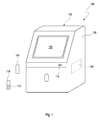
- Figure 1 shows a perspective view of a system 100 comprising an instrument 102 for processing a sample 104 or reagent.
- the instrument 102 comprises a control unit 106 and an operating system 108.
- the control unit 106 may be a commercially available PC or the like on which the operating system 108 runs.
- the system 100 further comprises a not bootable storage medium 110.
- the storage medium 110 may be a USB stick or the like.
- the storage medium 110 may be given an identification number which is logged.
- the storage medium 110 comprises a script 112.
- the script 112 comprises restoring data for restoring settings of the instrument 102.
- the script 112 is encrypted. Alternatively or in addition, the script 112 may be digitally signed. More particularly, the script 112 is encrypted by means of a signature.
- the instrument 102 further comprises a connection device 114 configured to receive the storage medium 110.
- the connection device 114 allows an user to insert the storage medium 110 into the instrument 102.
- the connection device 114 may be an USB slot.
- the instrument 102 further comprises a display device 116.
- the display device 116 may be a monitor.
- the display device 116 may comprise a graphical interface such as a touch screen for allowing a user to communicate with the instrument 102 by means of inputting commands and instructions, respectively.
- the instrument 102 may also be called a laboratory instrument.
- the instrument 102 is an analyzer or analytical instrument.
- the analyzer is configured to obtain a measurement value form the sample 104.
- the analyzer is operable to determine a parameter value of the sample 104 or a component thereof.
- the analyzer is configured to be used at a so-called point of care testing.
- Point of care testing encompasses analysis of one or more patient sample(s) at or near the site of patient care, i.e. a healthcare setting where medical or medically related services are provided, such as emergency departments, intensive care units; primary care setting; medical centers. Point of care testing is often accomplished through the use of transportable, portable, and handheld instruments, but small bench analyzers or fixed equipment can also be used when a handheld device is not available.
- the goal is to collect the patient sample and obtain the analytical data in a very short period of time at or near the location of the patient.
- the patient may be a human person
- the sample may be human blood and the analyzer may be configured to detect blood glucose value as measuring data.
- the instrument 102 is configured to obtain measuring data from the sample 104.
- the so obtained measuring data are stored in the control unit 106.
- the instrument 102 is configured to carry out the analyzing process according to the settings thereof.
- the settings of the instrument 102 comprise further or other data for operating the instrument 102.
- the settings may be stored in a database of the instrument 102.
- the database may be protected by means of a password created by the operating system 108.
- FIG. 2 shows a flow chart of a method for saving and/or restoring settings of the instrument 102.
- each of the method steps described below may be carried out by the instrument 102.
- the instrument 102 is started by the operating system 108.
- the operating system 102 begins to boot and to launch a storage medium detection script. With other words, when the instrument 102 is booted, it begins to execute a storage medium script for detecting a receipt of the storage medium 110.
- the operating system 108 detects whether the storage medium 110 is inserted into or received by the instrument 102 and the connection device 114, respectively.
- step S4 the method proceeds to step S4, wherein the instrument 102 is regularly or normally booted.
- step S5 the storage medium 110 is received by the instrument 102 and the connection device 114, respectively.
- step S6 the operating system 108 verifies an identity and/or integrity of the script 112. With other words, the operating system 108 checks whether a correctly named and encrypted script file is found on the storage medium 110. If the identity and/or integrity of the script 112 does not correspond to an identity and/or integrity of the instrument 102, i.e. the script 112 is not the correct one, the method returns to step S4. i.e. the instrument 102 is booted normally.
- step S7 the script 112 is decrypted and executed by the operating system 108.
- the script 112 is executed, booting of the instrument 102 is disabled.
- the instrument 102 is not booted from the storage medium 110 as it is a not bootable storage medium 110.
- step S8 the control unit 106 provides an input menu on the display device 116.
- the user may input commands within the input menu by means of the graphical interface of the display device 116.
- the input menu allows an user to make a selection. More particularly, the user may select between three options inputted in step S9. As a first option, the user may exit the input menu without inputting any other command than an exit command. In this case, the method proceeds to step S4.
- the input menu allows the user to input a saving command.
- the input menu allows the user to input a restoring command.
- step S9 the method proceeds to step S10, wherein the settings data are copied from the instrument 102 to the storage medium 110 by means of the operating system 108 for saving settings of the instrument 102. More particularly, the operating system 108 copies the database, in which the settings are stored, on the storage medium 110. The operating system 108 may compress the database before being copied on the storage medium 110. The settings data may be encrypted. For example, the instrument 102 may protect the database by means of a password created by the operating system 108. Subsequently, the method returns to step S9.
- step S9 the method proceeds to step S11, wherein the restoring data are copied from the storage medium 110 to the instrument 102. More particularly, the control unit 106 requires inputting of a password by a user for restoring settings of the instrument 102 in order to decrypt the restoring data for restoring settings of the instrument 102 from the storage medium 110. Then the settings of the instrument 102 are restored.
- the restoring process may also include an update process. Subsequently, the method returns to step S9.
Landscapes
- Engineering & Computer Science (AREA)
- Theoretical Computer Science (AREA)
- Software Systems (AREA)
- Physics & Mathematics (AREA)
- General Physics & Mathematics (AREA)
- General Engineering & Computer Science (AREA)
- Computer Security & Cryptography (AREA)
- Health & Medical Sciences (AREA)
- General Health & Medical Sciences (AREA)
- Computer Hardware Design (AREA)
- Quality & Reliability (AREA)
- Immunology (AREA)
- Chemical & Material Sciences (AREA)
- Life Sciences & Earth Sciences (AREA)
- Analytical Chemistry (AREA)
- Biochemistry (AREA)
- Pathology (AREA)
- Public Health (AREA)
- Primary Health Care (AREA)
- Medical Informatics (AREA)
- Epidemiology (AREA)
- Biomedical Technology (AREA)
- Bioethics (AREA)
- Computer Networks & Wireless Communication (AREA)
- Signal Processing (AREA)
- General Business, Economics & Management (AREA)
- Business, Economics & Management (AREA)
- Automatic Analysis And Handling Materials Therefor (AREA)
- Storage Device Security (AREA)
Abstract
Description
- Disclosed herein is a method for restoring settings of an instrument for processing a sample or reagent, and a system comprising an instrument for processing a sample or reagent and a storage medium.
- In vitro diagnostic testing has a major effect on clinical decisions, providing physicians with pivotal information. Particularly there is great emphasis on providing quick and accurate test results in critical care settings. In vitro diagnostic testing is usually performed using instruments operable to execute one or more processing steps /workflow steps on one or more biological samples and/or one or more reagents, such as pre-analytical instruments, post-analytical instruments and also analytical instruments.
- Analytical instruments / analyzers are configured to obtain a measurement value. An analyzer is operable to determine via various chemical, biological, physical, optical or other technical procedures a parameter value of the sample or a component thereof. An analyzer may be operable to measure said parameter of the sample or of at least one analyte and return the obtained measurement value. The list of possible analysis results returned by the analyzer comprises, without limitation, concentrations of the analyte in the sample, a digital (yes or no) result indicating the existence of the analyte in the sample (corresponding to a concentration above the detection level), optical parameters, DNA or RNA sequences, data obtained from mass spectroscopy of proteins or metabolites and physical or chemical parameters of various types. An analytical instrument may comprise units assisting with the pipetting, dosing, and mixing of samples and/or reagents. The analyzer may comprise a reagent holding unit for holding reagents to perform the assays. Reagents may be arranged for example in the form of containers or cassettes containing individual reagents or group of reagents, placed in appropriate receptacles or positions within a storage compartment or conveyor. It may comprise a consumable feeding unit. The analyzer may comprise a process and detection system whose workflow is optimized for certain types of analysis. Examples of such analyzer are clinical chemistry analyzers, coagulation chemistry analyzers, immunochemistry analyzers, urine analyzers, nucleic acid analyzers, used to detect the result of chemical or biological reactions or to monitor the progress of chemical or biological reactions.
- In order to ensure proper operation of the instruments and a way to restore setting of the instrument in case of a malfunction / defect, restoring data for restoring settings of the instrument are stored on a storage medium communicatively connected to the instrument. This is usually performed in a so-called backup operation carried out regularly.
- Known instruments are configured to receive a storage medium with restoring data and to recover the instrument settings therefrom. One known solution is that the instrument software is provided with a feature to read the restoring data and restore the instrument settings accordingly. However, there are cases when the instrument software itself becomes inoperable and/or inaccessible so that even the feature to recover the instrument settings is unavailable and/or unreliable.
- In order to address such cases, prior art instruments are known which are configured to receive a bootable recovery media and boot up the instrument from said bootable recovery media, the later comprising functionality to recover the instrument settings.
- However, configuring an instrument to accept bootable recovery media and boot therefrom introduces a major security vulnerability as it leaves open the option to boot from malicious bootable media. For example such malicious bootable media comprises software code which is designed to circumvent the data protection and /or the authentication-authorization mechanisms of the instrument.
- Embodiments of the disclosed method and system aim to provide a safe and reliable way for restoring settings of an instrument.
- Disclosed herein are a method for restoring settings of an apparatus for processing a sample or reagent and a system comprising an apparatus for processing a sample or reagent and a storage medium that provide an efficient, flexible and secure backup procedure of an apparatus for processing a sample or reagent, particularly of an off-line apparatus, such as a medical device, in case of a system failure.
- Embodiments of the disclosed method for restoring settings of an apparatus for processing a sample or reagent and a system comprising an apparatus for processing a sample or reagent and a storage medium have the features of the independent claims. Further embodiments of the invention, which may be realized in an isolated way or in any arbitrary combination, are disclosed in the dependent claims.
- As used in the following, the terms "have", "comprise" or "include" or any arbitrary grammatical variations thereof are used in a non-exclusive way. Thus, these terms may both refer to a situation in which, besides the feature introduced by these terms, no further features are present in the entity described in this context and to a situation in which one or more further features are present. As an example, the expressions "A has B", "A comprises B" and "A includes B" may both refer to a situation in which, besides B, no other element is present in A (i.e. a situation in which A solely and exclusively consists of B) and to a situation in which, besides B, one or more further elements are present in entity A, such as element C, elements C and D or even further elements.
- Further, it shall be noted that the terms "at least one", "one or more" or similar expressions indicating that a feature or element may be present once or more than once typically will be used only once when introducing the respective feature or element. In the following, in most cases, when referring to the respective feature or element, the expressions "at least one" or "one or more" will not be repeated, non-withstanding the fact that the respective feature or element may be present once or more than once.
- Further, as used in the following, the terms "particularly", "more particularly", "specifically", "more specifically" or similar terms are used in conjunction with additional / alternative features, without restricting alternative possibilities. Thus, features introduced by these terms are additional / alternative features and are not intended to restrict the scope of the claims in any way. The invention may, as the skilled person will recognize, be performed by using alternative features. Similarly, features introduced by "in an embodiment of the invention" or similar expressions are intended to be additional / alternative features, without any restriction regarding alternative embodiments of the invention, without any restrictions regarding the scope of the invention and without any restriction regarding the possibility of combining the features introduced in such way with other additional / alternative or non-additional / alternative features of the invention.
- According to the disclosed method / system, a method for restoring settings of an instrument for processing a sample or reagent is disclosed. The instrument comprises a control unit and an operating system. A storage medium is provided, wherein the storage medium comprises a script. The storage medium also comprises restoring data for restoring settings of the instrument. The script is encrypted and/or digitally signed. The instrument receives the storage medium. An identity and/or integrity of the script is verified, wherein the script is executed in case the identity and/or integrity of the script corresponds to an identity and/or integrity of the instrument. The script is executed upon starting the instrument by means of the operating system with the storage medium received by the instrument. An input menu is provided by means of the control unit for allowing a user to input a saving and/or restoring command. The settings of the instrument are saved on the storage medium and/or the settings of the instrument are restored from the storage medium by means of the restoring data corresponding to the saving and/or restoring command. With other words, the settings of the instrument are saved on the storage medium and/or the settings of the instrument are restored from the storage medium by means of the restoring data dependent on whether the saving and/or restoring command has been input.
- The term "instrument" as used herein refers to any apparatus or apparatus component operable to execute one or more processing steps / workflow steps on one or more biological samples and/or one or more reagents. The expression 'processing steps' thereby refers to physically executed processing steps such as centrifugation, aliquotation, sample analysis and the like. The term 'instrument' covers pre-analytical instruments, post-analytical instruments and also analytical instruments. Thus, the term "instrument" is used synonymous with the term "laboratory instrument".
- The term 'analyzer' / 'analytical instrument' as used herein encompasses any apparatus or apparatus component configured to obtain a measurement value. An analyzer is operable to determine via various chemical, biological, physical, optical or other technical procedures a parameter value of the sample or a component thereof. An analyzer may be operable to measure said parameter of the sample or of at least one analyte and return the obtained measurement value. The list of possible analysis results returned by the analyzer comprises, without limitation, concentrations of the analyte in the sample, a digital (yes or no) result indicating the existence of the analyte in the sample (corresponding to a concentration above the detection level), optical parameters, DNA or RNA sequences, data obtained from mass spectroscopy of proteins or metabolites and physical or chemical parameters of various types. An analytical instrument may comprise units assisting with the pipetting, dosing, and mixing of samples and/or reagents. The analyzer may comprise a reagent holding unit for holding reagents to perform the assays. Reagents may be arranged for example in the form of containers or cassettes containing individual reagents or group of reagents, placed in appropriate receptacles or positions within a storage compartment or conveyor. It may comprise a consumable feeding unit. The analyzer may comprise a process and detection system whose workflow is optimized for certain types of analysis. Examples of such analyzer are clinical chemistry analyzers, coagulation chemistry analyzers, immunochemistry analyzers, urine analyzers, nucleic acid analyzers, used to detect the result of chemical or biological reactions or to monitor the progress of chemical or biological reactions.
- The term "script" as used herein refers to a program written in a scripting language and that is written so that the operating system of the instrument can interpret and execute the instructions of the script. By contrast, normal programs are typically written in a compiled language and distributed in machine code form. Due to the nature of the script, modifications can be introduced with very little effort whereas a program based approach requires more significant changes and recompilation of the software. A script is therefore a list of instructions to be executed.
- The term 'control unit' as used herein encompasses any physical or virtual processing device configurable to control a laboratory instrument / or system comprising one or more laboratory instruments in a way that workflow(s) and workflow step(s) are conducted by the laboratory instrument / system. The control unit may, for example, instruct the laboratory instrument / system to conduct pre-analytical, post analytical and analytical work-flow(s)/ workflow step(s). The control unit may receive information from a data management unit regarding which steps need to be performed with a certain sample. In some embodiments, the control unit might be integral with a data management unit, may be comprised by a server computer and/or be part of one laboratory instrument or even distributed across multiple instruments of the laboratory system. The control unit may, for instance, be embodied as a programmable logic controller running a computer-readable program provided with instructions to perform operations.
- As mentioned above, the method includes a step of verifying an identity of the script. This step as used herein refers to a part of an authentication process of the script. Authentication is the act of confirming the truth of an attribute of a single piece of data claimed true by an entity. In the disclosed method / system, authentication involves verifying the validity of identification of the script. With other words, the operating system compares information concerning allowable scripts stored on the instrument with information given by the script. If the comparison reveals a match of information, authenticity of the script is verified, i.e. proofed. In this case, the script is allowed to be executed.
- Alternatively or in addition, the method includes a step of verifying an integrity of the script. This step as used herein refers to a part of a process for checking of completeness and/or intactness. With this process, data of the script are checked which have been stored on the storage medium beforehand by means of a comparison based on redundancy such as a checksum added to reference data. Such a checksum may be a digital signature. If this check reveals that the script is complete and intact, the script is allowed to be executed.
- The term "settings" as used herein refers to a configuration of the instrument, i.e. an arrangement of functional units according to their nature, number, and chief characteristics. The configuration affects the function and performance of the instrument and includes at least instructions according to which the instrument acts.
- The method provides flexibility and security as using a script instead of a software based approach provides platform and device type independence. This means, it can be run on an arm, x86, power pc etc. without the need to distribute different versions. Further, as the script is encrypted and/or digitally signed, security of the data transmission is provided. Particularly, the script may be password free and data transmission is yet secured as the script is only executed if the identity and/or integrity of the script is verified. Furthermore, a backup can be created at anytime, even after a failure of the instrument when the normal software doesn't boot, as long as the instrument hardware is healthy.
- Particularly, the storage medium is not bootable.
- The term "bootable" as used herein refers to a device that can be booted. Analogously, the term "not bootable" indicates the avoiding of a bootable drive to prevent any operating system to be booted. The term 'boot' as used herein refers to an initialization of a computerized system from a switched-off state. Booting typically involves performing a power-on self-test, locating and initializing peripheral devices, and then finding, loading and starting an operating system
- A storage medium being not bootable removes the risk of using a malicious bootable medium to access the data. It allows a simple identification of the authenticity of the stick using signing.
- The script may be encrypted by means of a signature. Thus, a simple identification of the authenticity of the storage medium may be provided using signing.
- The method may further comprise decrypting the script in case the identity and/or integrity of the script corresponds to the identity and/or integrity of the instrument. Thus, the script cannot be viewed nor changed due to encryption but only after decryption.
- Restoring settings of the instrument from the storage medium may include copying the restoring data from the storage medium to the instrument. Thus, a full data backup or update is allowed which is particularly relevant for debugging purposes wherein an issue could be caused due to unknown data.
- Restoring of settings of the instrument from the storage medium may include decrypting the restoring data from the storage medium. Thus, it is ensured that the restoring data are only copied to the instrument if the identity and/or integrity of the script corresponds to the identity and/or integrity of the instrument as only in this case the restoring data are decrypted. Thus, security of the restoring data is increased.
- Saving settings of the instrument may include copying settings data on the storage medium. Thus, backup data may be generated and the settings may be duplicated.
- Saving settings of the instrument on the storage medium may include encrypting settings data on the storage medium. Thus, the settings are securely stored.
- The settings of the instrument may be stored in a database. Saving settings may include copying the database on the storage medium. Thus, a generation of full backup data is possible contrary to using a compact flash card, wherein only a partial backup data generation is possible.
- The database may be compressed before being copied on the storage medium. Thus, the data amount may be reduced.
- The database may be protected by means of a password. Thus, the script cannot be viewed nor changed due to encryption.
- The password may be created by the operating system. Thus, a simple way of protecting the settings data is provided.
- Starting of the instrument may include booting of the instrument. Booting of the instrument may include detecting whether the storage medium is received by the instrument. Thus, normal booting of the instrument includes looking for the script.
- Booting of the instrument may be disabled when the script is executed. Thus, normal booting of the instrument from a storage medium is disabled but the boot sequence of the instrument looks for the script and allows the same to be executed.
- The storage medium may be given an identification number which is logged. Thus, logging all data extractions is provided.
- Restoring settings of the instrument may include inputting of a password by a user. Thus, restoring or updating of the settings is only carried out if an operator or user is inclined to do so.
- The instrument may comprise a display device, wherein the input menu may be provided on the display device. Thus, a user friendly handling of the script is provided.
- The input menu may be configured to allow a user to exit the input menu without inputting the saving and/or restoring command, wherein the instrument is booted in case of an exit of the input menu. Thus, execution of the script may be prevented by the user of the instrument in order to allow booting of the instrument.
- The storage medium may be an USB storage device such as an USB stick. Thus, a common storage device may be used to sore the script. Accordingly, as USB connection devices are common to most instrument in the field of the disclosed method / system, the method may be carried out with almost every instrument in the field of the disclosed method / system.
- Further, according to the disclosed method / system, a system comprising an instrument for processing a sample or reagent is disclosed. The instrument comprises a control unit and an operating system. The system further comprises a storage medium. The storage medium comprises a script. The script comprises restoring data for restoring settings of the instrument. The instrument is configured to carry out each step of the method as described above.
- The instrument may comprise a connection device configured to receive the storage medium. Thus, the connection device allows an user to insert the storage medium into the instrument. The operating system may be configured to start the instrument with the storage medium received by the instrument. The script may be encrypted and/or digitally signed. The operating system may be configured to verify an identity and/or integrity of the script. The instrument may be configured to execute the script in case the identity and/or integrity of the script corresponds to an identity and/or integrity of the instrument. The control unit may be configured to provide an input menu for allowing a user inputting a saving and/or restoring command. Further, the instrument may be configured to save settings of the instrument on the storage medium and/or to restore settings of the instrument from the storage medium by means of the restoring data corresponding to or dependent on the saving and/or restoring command.
- Thus, the system provides flexibility and security as using a script instead of a software based approach provides platform and device type independence. This means, it can be run on an arm, x86, power pc etc. without the need to distribute different versions. Further, as the script is encrypted and/or digitally signed, security of the data transmission is provided. Particularly, the script may be password free and data transmission is yet secured as the script is only executed if the identity and/or integrity of the script is verified. Furthermore, a backup can be created at anytime, even after a failure of the instrument when the normal software doesn't boot, as long as the instrument hardware is healthy.
- The storage medium may not be bootable. A storage medium being not bootable removes the risk of using a malicious bootable medium to access the data. It allows a simple identification of the authenticity of the stick using signing.
- The script may be encrypted by means of a signature. Thus, a simple identification of the authenticity of the storage medium may be provided using signing.
- The operating system may be configured to decrypt the script in case the identity and/or integrity of the script corresponds to the identity and/or integrity of the instrument. Thus, the script cannot be viewed nor changed due to encryption but only after decryption.
- The operating system may be configured to copy the restoring data from the storage medium to the instrument for restoring settings of the instrument from the storage medium. Thus, the system allows a full data backup or update which is particularly relevant for debugging purposes wherein an issue could be caused due to unknown data.
- The operating system may be configured to decrypt the restoring data from the storage medium for restoring settings of the instrument from the storage medium. Thus, it is ensured that the restoring data are only copied to the instrument if the identity and/or integrity of the script corresponds to the identity and/or integrity of the instrument as only in this case the restoring data are decrypted. Thus, security of the restoring data is increased.
- The operating system may be configured to copy settings data on the storage medium for saving settings of the instrument on the storage medium. Thus, backup data may be generated and the settings may be duplicated.
- The operating system may be configured to encrypt settings data on the storage medium for saving settings of the instrument on the storage medium. Thus, system allows the settings to be securely stored.
- The instrument may be configured to store the settings in a database. The operating system may be configured to copy the database on the storage medium for saving the settings. Thus, a generation of full backup data is possible
- The operating system may be configured to compress the database before being copied on the storage medium. Thus, the data amount may be reduced.
- The instrument may be configured to protect the database by means of a password. Thus, the script cannot be viewed nor changed due to encryption.
- The operating system may be configured to create the password. Thus, a simple way of protecting the settings data is provided.
- The operating system may be configured to boot the instrument for starting of the instrument. The operating system may be configured to detect whether the storage medium is received by the instrument during booting of the instrument. Thus, instrument looks for the script during normal booting.
- Booting of the instrument may be disabled when the script is executed. Thus, normal booting of the instrument from a storage medium is disabled but the boot sequence of the instrument looks for the script and allows the same to be executed.
- The storage medium may be given an identification number which is logged. Thus, logging all data extractions is provided.
- The control unit may be configured to require inputting of a password by a user for restoring settings of the instrument. Thus, restoring or updating of the settings is only carried out if an user is inclined to do so.
- The storage medium may be a USB storage device such as an USB stick. Thus, a common storage device may be used to sore the script. Accordingly, as USB connection devices are common to most instrument in the field of the disclosed method / system, the method may be carried out with almost every instrument in the field of the disclosed method / system.
- The instrument may comprise a display device. The control unit is configured to provide the input menu on the display device. Thus, a user friendly handling of the script is provided.
- The input menu may be configured to allow a user to exit the input menu without inputting the saving and/or restoring command, wherein the operating system is configured to boot the instrument in case of an exit of the input menu. Thus, execution of the script may be prevented by the user of the instrument in order to allow booting of the instrument.
- The invention further discloses and proposes a computer script including computer-executable instructions for performing the method according to the disclosed method / system in one or more of the embodiments enclosed herein when the script is executed on a computer or computer network. Specifically, the computer script may be stored on a computer-readable data carrier. Thus, specifically, one, more than one or even all of the method steps as indicated above may be performed by using a computer or a computer network, in particular by using a computer script.
- The invention further discloses and proposes a computer script product having script code means, in order to perform the method according to the disclosed method / system in one or more of the embodiments enclosed herein when the script is executed on a computer or computer network. Specifically, the script code means may be stored on a computer-readable data carrier.
- Further, the invention discloses and proposes a data carrier having a data structure stored thereon, which, after loading into a computer or computer network, such as into a working memory or main memory of the computer or computer network, may execute the method according to one or more of the embodiments disclosed herein.
- The invention further proposes and discloses a computer script product with script code means stored on a machine-readable carrier, in order to perform the method according to one or more of the embodiments disclosed herein, when the script is executed on a computer or computer network. As used herein, a computer script product refers to the script as a tradable product. The product may generally exist in an arbitrary format, such as in a paper format, or on a computer-readable data carrier. Specifically, the computer script product may be distributed over a data network.
- Finally, the invention proposes and discloses a modulated data signal which contains instructions readable by a computer system or computer network, for performing the method according to one or more of the embodiments disclosed herein.
- Referring to the computer-implemented aspects of the invention, one or more of the method steps or even all of the method steps of the method according to one or more of the embodiments disclosed herein may be performed by using a computer or computer network. Thus, generally, any of the method steps including provision and/or manipulation of data may be performed by using a computer or computer network. Generally, these method steps may include any of the method steps, typically except for method steps requiring manual work, such as providing the samples and/or certain aspects of performing the actual measurements.
- Specifically, the disclosed method / system further discloses:
- A computer or computer network comprising at least one processor, wherein the processor is adapted to perform the method according to one of the embodiments described in this description,
- a computer loadable data structure that is adapted to perform the method according to one of the embodiments described in this description while the data structure is being executed on a computer,
- a computer script, wherein the computer script is adapted to perform the method according to one of the embodiments described in this description while the script is being executed on a computer,
- a computer script comprising script means for performing the method according to one of the embodiments described in this description while the computer script is being executed on a computer or on a computer network,
- a computer script comprising script means according to the preceding embodiment, wherein the script means are stored on a storage medium readable to a computer,
- a storage medium, wherein a data structure is stored on the storage medium and wherein the data structure is adapted to perform the method according to one of the embodiments described in this description after having been loaded into a main and/or working storage of a computer or of a computer network, and
- a computer script product having script code means, wherein the script code means can be stored or are stored on a storage medium, for performing the method according to one of the embodiments described in this description, if the script code means are executed on a computer or on a computer network.
- Summarizing the findings of the disclosed method / system, the following embodiments are disclosed:
- Embodiment 1: Method for restoring settings of an instrument for processing a sample or reagent, wherein the instrument comprises a control unit and an operating system, wherein the method comprises:
- providing a storage medium, wherein the storage medium comprises a script, wherein the script comprises restoring data for restoring settings of the instrument, wherein the script is encrypted/ digitally signed,
- the instrument receiving the storage medium,
- verifying an identity and/or integrity of the script,
- executing the script upon starting the instrument by means of the operating system with the storage medium received by the instrument in case the identity and/or integrity of the script corresponds to an identity and/or integrity of the instrument,
- providing an input menu by means of the control unit for allowing a user inputting a restoring command, and
- saving settings of the instrument on the storage medium and/or restoring settings of the instrument from the storage medium by means of the restoring data corresponding to the restoring command.
- Embodiment 2: Method according to the preceding embodiment, wherein the storage medium is not bootable.
- Embodiment 3: Method according to the preceding embodiment, wherein the script is encrypted by means of a signature.
- Embodiment 4: Method according to any of the two preceding embodiments, further comprising decrypting the script in case the identity of the script corresponds to the identity of the instrument.
- Embodiment 5: Method according to any preceding embodiment, wherein restoring settings of the instrument from the storage medium includes copying the restoring data from the storage medium to the instrument.
- Embodiment 6: Method according to any preceding embodiments, wherein restoring settings of the instrument from the storage medium includes decrypting the restoring data from the storage medium.
- Embodiment 7: Method according to any preceding embodiment, wherein saving settings of the instrument on the storage medium includes copying settings data on the storage medium.
- Embodiment 8: Method according to any preceding embodiment, wherein saving settings of the instrument on the storage medium includes encrypting settings data on the storage medium.
- Embodiment 9: Method according to any preceding embodiment, wherein the settings of the instrument are stored in a database, wherein saving setting includes copying the database on the storage medium.
- Embodiment 10: Method according to the preceding embodiment, wherein the database is compressed before being copied on the storage medium.
- Embodiment 11: Method according to any of the two preceding embodiments, wherein the database is protected by means of a password.
- Embodiment 12: Method according to the preceding embodiment, wherein the password is created by the operating system.
- Embodiment 13: Method according to any preceding embodiment, wherein starting of the instrument includes booting of the instrument, wherein booting of the instrument includes detecting whether the storage medium is inserted into the instrument.
- Embodiment 14: Method according to the preceding embodiment, wherein booting of the instrument is disabled when the script is executed.
- Embodiment 15: Method according to any preceding embodiment, wherein the storage medium is given an identification number which is logged.
- Embodiment 16: Method according to any preceding c embodiment, wherein restoring settings of the instrument includes inputting of a password by a user.
- Embodiment 17: Method according to any preceding embodiment, wherein the storage medium is an USB storage device.
- Embodiment 18: Method according to any preceding embodiment, wherein the instrument comprises a display device, wherein the input menu is provided on the display device.
- Embodiment 19: Method according to any preceding embodiment, wherein the input menu is configured to allow a user to exit the input menu without inputting the restoring command, wherein the instrument is booted in case of an exit of the input menu.
- Embodiment 20: System comprising an instrument for processing a sample or reagent, wherein the instrument comprises a control unit and an operating system, and a storage medium, wherein the storage medium comprises a script, wherein the script comprises restoring data for restoring settings of the instrument, wherein the instrument is configured to carry out each step of the method according to any preceding embodiment.
- Embodiment 21: System according to the embodiment 20, wherein the instrument comprises a connection device configured to allow the storage medium to be inserted into the instrument, wherein the operating system is configured to start the instrument with the storage medium inserted into the instrument and to execute the script, wherein the control unit is configured to provide an input menu for allowing a user inputting a saving and/or restoring command, and the instrument is configured to save settings of the instrument on the storage medium and/or to restore settings of the instrument from the storage medium by means of the restoring data corresponding to the saving and/or restoring command.
- Embodiment 22: System according to any one of embodiments 20 to 21, wherein the storage medium is not bootable.
- Embodiment 23: System according to any one of embodiments 20 to 22, wherein the script is encrypted by means of a signature.
- Embodiment 24: System according to any one of embodiments 20 to 23, wherein the operating system is configured to decrypt the script in case the identity of the script corresponds to the identity of the instrument.
- Embodiment 25: System according to any one of embodiments 20 to 24, wherein the operating system is configured to copy the restoring data from the storage medium to the instrument for restoring settings of the instrument from the storage medium.
- Embodiment 26: System according to any one of embodiments 20 to 25, wherein the operating system is configured to decrypt the restoring data from the storage medium for restoring settings of the instrument from the storage medium.
- Embodiment 27: System according to any one of embodiments 20 to 26, wherein the operating system is con-figured to copy settings data on the storage medium for saving settings of the instrument on the storage medium.
- Embodiment 28: System according to any one of embodiments 20 to 27, wherein the operating system is con-figured to encrypt settings data on the storage medium for saving settings of the instrument on the storage medium.
- Embodiment 29: System according to any one of embodiments 20 to 28, wherein the instrument is configured to store the settings in a database, wherein the operating system is configured to copy the database on the storage medium for saving the settings.
- Embodiment 30: System according to embodiment 29, wherein the operating system is configured to compress the database before being copied on the storage medium.
- Embodiment 31: System according to any one of embodiments 29 to 30, wherein the instrument is configured to protect the database by means of a password.
- Embodiment 32: System according to embodiment 31, wherein the operating system is configured to create the password.
- Embodiment 33: System according to any one of embodiments 20 to 32, wherein the operating system is configured to boot the instrument for starting of the instrument, wherein the operating system is configured detect whether the storage medium is inserted into the instrument during booting of the instrument.
- Embodiment 34: System according to embodiment 33, wherein booting of the instrument is disabled when the script is executed.
- Embodiment 35: System according to any one of embodiments 20 to 34, wherein the storage medium is given an identification number which is logged.
- Embodiment 36: System according to any one of embodiments 20 to 35, wherein the control unit is configured to require inputting of a password by a user for restoring settings of the instrument.
- Embodiment 37: System according to any one of embodiments 20 to 36, wherein the storage medium is an USB storage device.
- Embodiment 38: System according to any one of embodiments 20 to 37, wherein the instrument comprises a display device, wherein control unit is configured to provide the input menu on the display device.
- Embodiment 39: System according to any one of embodiments 20 to 38, wherein the input menu is configured to allow a user to exit the input menu without inputting the saving and/or restoring command, wherein operating system is configured to boot the instrument in case of an exit of the input menu.
- Embodiment 40: System according to any one of embodiments 20 to 39, wherein the storage medium is an USB storage device.
- Further features and embodiments of the invention will be disclosed in more detail in the subsequent description, particularly in conjunction with the dependent claims. Therein the respective features may be realized in an isolated fashion as well as in any arbitrary feasible combination, as a skilled person will realize. The embodiments are schematically depicted in the figures. Therein, identical reference numbers in these figures refer to identical elements or functionally identical elements.
- In the figures:
-
Figure 1 shows a perspective view of a system comprising an instrument for processing a sample or a reagent and a storage medium, and -
Figure 2 shows a flowchart of a method according to the disclosed method / system. -
Figure 1 shows a perspective view of asystem 100 comprising aninstrument 102 for processing asample 104 or reagent. Theinstrument 102 comprises acontrol unit 106 and anoperating system 108. Thecontrol unit 106 may be a commercially available PC or the like on which theoperating system 108 runs. Thesystem 100 further comprises a notbootable storage medium 110. Thestorage medium 110 may be a USB stick or the like. Thestorage medium 110 may be given an identification number which is logged. Thestorage medium 110 comprises ascript 112. Thescript 112 comprises restoring data for restoring settings of theinstrument 102. Thescript 112 is encrypted. Alternatively or in addition, thescript 112 may be digitally signed. More particularly, thescript 112 is encrypted by means of a signature. - The
instrument 102 further comprises aconnection device 114 configured to receive thestorage medium 110. Theconnection device 114 allows an user to insert thestorage medium 110 into theinstrument 102. For example, theconnection device 114 may be an USB slot. Theinstrument 102 further comprises adisplay device 116. Thedisplay device 116 may be a monitor. Thedisplay device 116 may comprise a graphical interface such as a touch screen for allowing a user to communicate with theinstrument 102 by means of inputting commands and instructions, respectively. - The
instrument 102 may also be called a laboratory instrument. For example, theinstrument 102 is an analyzer or analytical instrument. As such the analyzer is configured to obtain a measurement value form thesample 104. The analyzer is operable to determine a parameter value of thesample 104 or a component thereof. For example, the analyzer is configured to be used at a so-called point of care testing. - The term "point of care testing" as used herein encompasses analysis of one or more patient sample(s) at or near the site of patient care, i.e. a healthcare setting where medical or medically related services are provided, such as emergency departments, intensive care units; primary care setting; medical centers. Point of care testing is often accomplished through the use of transportable, portable, and handheld instruments, but small bench analyzers or fixed equipment can also be used when a handheld device is not available. The goal is to collect the patient sample and obtain the analytical data in a very short period of time at or near the location of the patient. For example, the patient may be a human person, the sample may be human blood and the analyzer may be configured to detect blood glucose value as measuring data.
- Thus, the
instrument 102 is configured to obtain measuring data from thesample 104. The so obtained measuring data are stored in thecontrol unit 106. Theinstrument 102 is configured to carry out the analyzing process according to the settings thereof. Needless to say, the settings of theinstrument 102 comprise further or other data for operating theinstrument 102. The settings may be stored in a database of theinstrument 102. The database may be protected by means of a password created by theoperating system 108. -
Figure 2 shows a flow chart of a method for saving and/or restoring settings of theinstrument 102. Basically, each of the method steps described below may be carried out by theinstrument 102. In step S1, theinstrument 102 is started by theoperating system 108. In step S2, theoperating system 102 begins to boot and to launch a storage medium detection script. With other words, when theinstrument 102 is booted, it begins to execute a storage medium script for detecting a receipt of thestorage medium 110. In step S3, theoperating system 108 detects whether thestorage medium 110 is inserted into or received by theinstrument 102 and theconnection device 114, respectively. - If the
storage medium 110 is not received by theinstrument 102, the method proceeds to step S4, wherein theinstrument 102 is regularly or normally booted. In case thestorage medium 110 is detected, the method proceeds to step S5, wherein thestorage medium 110 is received by theinstrument 102 and theconnection device 114, respectively. In step S6, theoperating system 108 verifies an identity and/or integrity of thescript 112. With other words, theoperating system 108 checks whether a correctly named and encrypted script file is found on thestorage medium 110. If the identity and/or integrity of thescript 112 does not correspond to an identity and/or integrity of theinstrument 102, i.e. thescript 112 is not the correct one, the method returns to step S4. i.e. theinstrument 102 is booted normally. If the identity and/or integrity of thescript 112 corresponds to an identity and/or integrity of theinstrument 102, i.e. thescript 112 is the correct one, the method proceeds to step S7, wherein thescript 112 is decrypted and executed by theoperating system 108. When thescript 112 is executed, booting of theinstrument 102 is disabled. Theinstrument 102 is not booted from thestorage medium 110 as it is a notbootable storage medium 110. - Subsequently, the method proceeds to step S8, wherein the
control unit 106 provides an input menu on thedisplay device 116. The user may input commands within the input menu by means of the graphical interface of thedisplay device 116. The input menu allows an user to make a selection. More particularly, the user may select between three options inputted in step S9. As a first option, the user may exit the input menu without inputting any other command than an exit command. In this case, the method proceeds to step S4. As a second option, the input menu allows the user to input a saving command. As a third option, the input menu allows the user to input a restoring command. If the user inputs a saving command in step S9, the method proceeds to step S10, wherein the settings data are copied from theinstrument 102 to thestorage medium 110 by means of theoperating system 108 for saving settings of theinstrument 102. More particularly, theoperating system 108 copies the database, in which the settings are stored, on thestorage medium 110. Theoperating system 108 may compress the database before being copied on thestorage medium 110. The settings data may be encrypted. For example, theinstrument 102 may protect the database by means of a password created by theoperating system 108. Subsequently, the method returns to step S9. - If the user inputs a restoring command in step S9, the method proceeds to step S11, wherein the restoring data are copied from the
storage medium 110 to theinstrument 102. More particularly, thecontrol unit 106 requires inputting of a password by a user for restoring settings of theinstrument 102 in order to decrypt the restoring data for restoring settings of theinstrument 102 from thestorage medium 110. Then the settings of theinstrument 102 are restored. The restoring process may also include an update process. Subsequently, the method returns to step S9. -
- 100
- system
- 102
- instrument
- 104
- sample
- 106
- control unit
- 108
- operating system
- 110
- storage medium
- 112
- script
- 114
- connection device
- 116
- display device
Claims (15)
- Method for restoring settings of an instrument (102) for processing a sample (104) or reagent, wherein the instrument (102) comprises a control unit (106) and an operating system (108), wherein the method comprises:- providing a storage medium (110), wherein the storage medium (110) comprises a script (112) and restoring data for restoring settings of the instrument (102), wherein the script (112) is encrypted/ digitally signed,- the instrument (102) receiving the storage medium (110),- verifying an identity and/or integrity of the script (112),- executing the script (112) upon starting the instrument (102) by means of the operating system (108) with the storage medium (110) received by the instrument (102) in case the identity and/or integrity of the script (112) corresponds to an identity of the instrument (102),- providing an input menu by means of the control unit (106) for allowing a user inputting a saving and/or restoring command, and- saving settings of the instrument (102) on the storage medium (110) and/or restoring settings of the instrument (102) from the storage medium (110) by means of the restoring data corresponding to the saving and/or restoring command.
- Method according to the preceding claim, wherein the storage medium (110) is not bootable.
- Method according to any preceding claim, further comprising decrypting the script (112) in case the identity and/or integrity of the script (112) corresponds to the identity and/or integrity of the instrument (102).
- Method according to any preceding claim, wherein restoring settings of the instrument (102) from the storage medium (110) includes copying and decrypting the restoring data from the storage medium (110) to the instrument (102).
- Method according to any preceding claim, wherein saving settings of the instrument (102) on the storage medium (110) includes copying and encrypting settings data on the storage medium (110).
- Method according to any preceding claim, wherein the settings of the instrument (102) are stored in a database, wherein saving setting includes copying the database on the storage medium (110), wherein the database is compressed before being copied on the storage medium (110).
- Method according to any preceding claim, wherein starting of the instrument (102) includes booting of the instrument (102), wherein booting of the instrument (102) includes detecting whether the storage medium (110) is inserted into the instrument (102).
- Method according to the preceding claim, wherein booting of the instrument (102) is disabled when the script (112) is executed.
- System (100) comprising an instrument (102) for processing a sample (104) or reagent and a storage medium (110), wherein the instrument (102) comprises a control unit (106) and an operating system (108), wherein the storage medium (110) comprises a script (112), wherein the script (112) comprises restoring data for restoring settings of the instrument (102), wherein the script (112) is encrypted and/or digitally signed, wherein the instrument (102) is configured to carry out each step of the method according to any preceding claim.
- System (100) according to the preceding claim, wherein the instrument (102) comprises a connection device (114) configured to allow the storage medium (110) to be received by the instrument (102), wherein the operating system (108) is configured to start the instrument (102) with the storage medium (110) received by the instrument (102), wherein the operating system (108) is configured to verify an identity and/or integrity of the script (112) and to execute the script (112) in case the identity and/or integrity of the script (112) corresponds to an identity and/or integrity of the instrument (102), wherein the control unit (106) is configured to provide an input menu for allowing a user inputting a saving and/or restoring command, and the instrument (102) is configured to save settings of the instrument (102) on the storage medium (110) and/or to restore settings of the instrument (102) from the storage medium (110) by means of the restoring data corresponding to the saving and/or restoring command.
- System (100) according to any one of claims 9 to 10, wherein the storage medium (110) is not bootable.
- System (100) according to any one of claims 9 to 11, wherein the operating system (108) is configured to decrypt the script (112) in case the identity of the script (112) corresponds to the identity of the instrument (102).
- System (100) according to any one of claims 9 to 12, wherein the operating system (108) is configured to copy and decrypt the restoring data from the storage medium (110) to the instrument (102) for restoring settings of the instrument (102) from the storage medium (110).
- System (100) according to any one of claims 9 to 13, wherein the operating system (108) is configured to copy and encrypt settings data on the storage medium (110) for saving settings of the instrument (102) on the storage medium (110).
- System (100) according to any one of claims 9 to 14, wherein the instrument (102) comprises a display device (116), wherein control unit (106) is configured to provide the input menu on the display device (116).
Priority Applications (5)
| Application Number | Priority Date | Filing Date | Title |
|---|---|---|---|
| EP15201311.6A EP3182134A1 (en) | 2015-12-18 | 2015-12-18 | Method for restoring settings of an instrument for processing a sample or a reagent, and system comprising an instrument for processing a sample or reagent |
| JP2016242803A JP6908375B2 (en) | 2015-12-18 | 2016-12-15 | A method for restoring equipment settings for processing a sample or reagent, and a system containing equipment for processing the sample or reagent. |
| US15/379,934 US10146946B2 (en) | 2015-12-18 | 2016-12-15 | Method of restoring settings of an instrument for processing a sample or a reagent and a system for processing a sample or reagent |
| CN201611166007.6A CN107038379B (en) | 2015-12-18 | 2016-12-16 | Method and system for restoring settings of instruments used to process samples or reagents |
| US16/174,972 US11200326B2 (en) | 2015-12-18 | 2018-10-30 | Method of restoring settings of an instrument for processing a sample or a reagent and a system for processing a sample or reagent |
Applications Claiming Priority (1)
| Application Number | Priority Date | Filing Date | Title |
|---|---|---|---|
| EP15201311.6A EP3182134A1 (en) | 2015-12-18 | 2015-12-18 | Method for restoring settings of an instrument for processing a sample or a reagent, and system comprising an instrument for processing a sample or reagent |
Publications (1)
| Publication Number | Publication Date |
|---|---|
| EP3182134A1 true EP3182134A1 (en) | 2017-06-21 |
Family
ID=54850448
Family Applications (1)
| Application Number | Title | Priority Date | Filing Date |
|---|---|---|---|
| EP15201311.6A Withdrawn EP3182134A1 (en) | 2015-12-18 | 2015-12-18 | Method for restoring settings of an instrument for processing a sample or a reagent, and system comprising an instrument for processing a sample or reagent |
Country Status (4)
| Country | Link |
|---|---|
| US (2) | US10146946B2 (en) |
| EP (1) | EP3182134A1 (en) |
| JP (1) | JP6908375B2 (en) |
| CN (1) | CN107038379B (en) |
Cited By (2)
| Publication number | Priority date | Publication date | Assignee | Title |
|---|---|---|---|---|
| CN109241752A (en) * | 2018-08-08 | 2019-01-18 | 北京君瑞立信科技有限公司 | A kind of own data do not leak to the data interaction system and method for partner |
| CN109959799A (en) * | 2017-12-21 | 2019-07-02 | 泰肯贸易股份公司 | Laboratory automation equipment is monitored via simulation model |
Citations (6)
| Publication number | Priority date | Publication date | Assignee | Title |
|---|---|---|---|---|
| US7565544B1 (en) * | 2005-04-04 | 2009-07-21 | Landesk Software, Inc. | Systems and methods for verifying the trustworthiness of a file comprising computer instructions |
| US7797285B1 (en) * | 2007-09-28 | 2010-09-14 | Symantec Corporation | Method and apparatus for restoring backup data to a computer |
| US20110289497A1 (en) * | 2010-05-24 | 2011-11-24 | Abbott Diabetes Care Inc. | Method and System for Updating a Medical Device |
| EP2674887A1 (en) * | 2012-06-13 | 2013-12-18 | F. Hoffmann-La Roche AG | Controlling an analysis system of biological samples |
| US20140370609A1 (en) * | 2013-04-05 | 2014-12-18 | Roche Molecular Systems, Inc. | Analysis system for a biological sample |
| US20150067342A1 (en) * | 2013-09-03 | 2015-03-05 | Red Hat, Inc. | Systems and methods for executing compliance verification or remediation scripts |
Family Cites Families (28)
| Publication number | Priority date | Publication date | Assignee | Title |
|---|---|---|---|---|
| JP3951364B2 (en) * | 1997-06-26 | 2007-08-01 | 株式会社日立製作所 | Software maintenance method and apparatus |
| ATE531162T1 (en) | 1999-12-23 | 2011-11-15 | Accenture Global Services Ltd | METHOD FOR CONTROLLING DATA COLLECTION, DATA MANIPULATION AND STORAGE IN A NETWORK WITH ASSURED SERVICE QUALITY |
| US20040117636A1 (en) * | 2002-09-25 | 2004-06-17 | David Cheng | System, method and apparatus for secure two-tier backup and retrieval of authentication information |
| CN1220945C (en) * | 2002-12-31 | 2005-09-28 | 联想(北京)有限公司 | Computer system backup and restoring method |
| JP4045999B2 (en) * | 2003-04-11 | 2008-02-13 | 株式会社島津製作所 | Data analysis device for instrument analysis |
| US20050132178A1 (en) * | 2003-12-12 | 2005-06-16 | Sridhar Balasubramanian | Removable flash backup for storage controllers |
| US7546447B2 (en) * | 2004-05-08 | 2009-06-09 | Intel Corporation | Firmware interface runtime environment protection field |
| US7650356B2 (en) * | 2004-08-24 | 2010-01-19 | Microsoft Corporation | Generating an optimized restore plan |
| DE102005000653A1 (en) | 2005-01-04 | 2006-07-13 | Robert Bosch Gmbh | Script-based software installation via broadcast transport media |
| CN1877539A (en) * | 2005-06-07 | 2006-12-13 | 英业达股份有限公司 | Data backup/recovery system in cold start mode and its implementation method |
| CN100371847C (en) | 2005-09-22 | 2008-02-27 | 深圳市江波龙电子有限公司 | Method for ciphering and diciphering of file, safety managing storage apparatus and system method thereof |
| EP1958738B1 (en) * | 2007-02-13 | 2013-08-14 | Abb Research Ltd. | Remote diagnostic system for robots |
| JP5192168B2 (en) * | 2007-03-30 | 2013-05-08 | シスメックス株式会社 | Setting information management system, setting information management method, backup program, and storage medium |
| TW200847021A (en) * | 2007-05-17 | 2008-12-01 | Asustek Comp Inc | Automatic backup, restore and update BIOS computer system |
| ATE508568T1 (en) * | 2007-06-15 | 2011-05-15 | Research In Motion Ltd | METHOD AND DEVICE FOR PROVIDING A SECURE DATA BACKUP FROM A MOBILE COMMUNICATIONS DEVICE TO AN EXTERNAL COMPUTING DEVICE |
| JP2009163348A (en) | 2007-12-28 | 2009-07-23 | Hitachi Ltd | Information recording / reproducing apparatus and backup copy method |
| CN100585609C (en) * | 2008-04-30 | 2010-01-27 | 北京飞天诚信科技有限公司 | A system and method for securing an operating environment |
| US20090286484A1 (en) * | 2008-05-19 | 2009-11-19 | Lgc Wireless, Inc. | Method and system for performing onsite maintenance of wireless communication systems |
| CN101639882B (en) * | 2009-08-28 | 2011-09-21 | 华中科技大学 | Database security system based on storage encryption |
| CN102479115A (en) * | 2010-11-23 | 2012-05-30 | 鸿富锦精密工业(深圳)有限公司 | Data backup and recovery system and data backup and recovery method |
| EP2503481A1 (en) | 2011-03-24 | 2012-09-26 | F. Hoffmann-La Roche AG | Blood sugar measuring device and method for reading blood sugar readings |
| JP5772316B2 (en) * | 2011-07-08 | 2015-09-02 | ソニー株式会社 | Information processing apparatus, information processing method, and computer program |
| CN102662796B (en) * | 2012-03-28 | 2014-06-18 | 深圳万兴信息科技股份有限公司 | Method and system for recovering data |
| CN102880828B (en) * | 2012-09-07 | 2015-02-04 | 普华基础软件股份有限公司 | Intrusion detection and recovery system aiming at virtualization support environment |
| JP6139335B2 (en) * | 2013-08-28 | 2017-05-31 | 京セラドキュメントソリューションズ株式会社 | Maintenance method and electronic device |
| JP6165964B2 (en) * | 2014-03-07 | 2017-07-19 | 株式会社日立製作所 | calculator |
| TW201541352A (en) * | 2014-04-29 | 2015-11-01 | Ibm | System management controller and method of configuration file backup and recovery |
| CN104133737A (en) * | 2014-06-27 | 2014-11-05 | 小米科技有限责任公司 | Data backup method, backup data recovery method, data backup device and backup data recovery device |
-
2015
- 2015-12-18 EP EP15201311.6A patent/EP3182134A1/en not_active Withdrawn
-
2016
- 2016-12-15 JP JP2016242803A patent/JP6908375B2/en not_active Expired - Fee Related
- 2016-12-15 US US15/379,934 patent/US10146946B2/en active Active
- 2016-12-16 CN CN201611166007.6A patent/CN107038379B/en not_active Expired - Fee Related
-
2018
- 2018-10-30 US US16/174,972 patent/US11200326B2/en not_active Expired - Fee Related
Patent Citations (6)
| Publication number | Priority date | Publication date | Assignee | Title |
|---|---|---|---|---|
| US7565544B1 (en) * | 2005-04-04 | 2009-07-21 | Landesk Software, Inc. | Systems and methods for verifying the trustworthiness of a file comprising computer instructions |
| US7797285B1 (en) * | 2007-09-28 | 2010-09-14 | Symantec Corporation | Method and apparatus for restoring backup data to a computer |
| US20110289497A1 (en) * | 2010-05-24 | 2011-11-24 | Abbott Diabetes Care Inc. | Method and System for Updating a Medical Device |
| EP2674887A1 (en) * | 2012-06-13 | 2013-12-18 | F. Hoffmann-La Roche AG | Controlling an analysis system of biological samples |
| US20140370609A1 (en) * | 2013-04-05 | 2014-12-18 | Roche Molecular Systems, Inc. | Analysis system for a biological sample |
| US20150067342A1 (en) * | 2013-09-03 | 2015-03-05 | Red Hat, Inc. | Systems and methods for executing compliance verification or remediation scripts |
Cited By (3)
| Publication number | Priority date | Publication date | Assignee | Title |
|---|---|---|---|---|
| CN109959799A (en) * | 2017-12-21 | 2019-07-02 | 泰肯贸易股份公司 | Laboratory automation equipment is monitored via simulation model |
| CN109959799B (en) * | 2017-12-21 | 2024-05-03 | 帝肯贸易股份公司 | Monitoring laboratory automation equipment via simulation model |
| CN109241752A (en) * | 2018-08-08 | 2019-01-18 | 北京君瑞立信科技有限公司 | A kind of own data do not leak to the data interaction system and method for partner |
Also Published As
| Publication number | Publication date |
|---|---|
| JP2017111146A (en) | 2017-06-22 |
| CN107038379A (en) | 2017-08-11 |
| US20170177880A1 (en) | 2017-06-22 |
| JP6908375B2 (en) | 2021-07-28 |
| CN107038379B (en) | 2021-07-02 |
| US20190073482A1 (en) | 2019-03-07 |
| US10146946B2 (en) | 2018-12-04 |
| US11200326B2 (en) | 2021-12-14 |
Similar Documents
| Publication | Publication Date | Title |
|---|---|---|
| Basnight et al. | Firmware modification attacks on programmable logic controllers | |
| EP2754085B1 (en) | Verifying firmware integrity of a device | |
| US8996878B2 (en) | Controlling an analysis system of biological samples | |
| JP2010092488A (en) | Gravimetric measuring instrument and system for allowing rule-compliant performance of application program | |
| US11200326B2 (en) | Method of restoring settings of an instrument for processing a sample or a reagent and a system for processing a sample or reagent | |
| EP2339337A2 (en) | System for reading analyte test elements and for other uses | |
| US10311205B2 (en) | Analysis system for analyzing biological samples with multiple operating environments | |
| JP7507217B2 (en) | Supplementing the results of automated analyzers | |
| KR20220085290A (en) | Method for verifying software and apparatus therefor | |
| Basnight | Firmware counterfeiting and modification attacks on programmable logic controllers | |
| BR112021012570A2 (en) | QUANTIFICATION OF SEQUENCING INSTRUMENTS AND REAGENTS FOR USE IN MOLECULAR DIAGNOSIS METHODS | |
| Owen et al. | Liver function testing on the Abaxis Piccolo Xpress: Use in Ebola virus disease protocols | |
| JPWO2018037537A1 (en) | Automatic analysis system | |
| JP2016538572A (en) | Hardware key system for device protection | |
| US10439824B2 (en) | Method for authenticating an instrument for processing a biological sample or reagent and system comprising an instrument for processing a biological sample or reagent | |
| US12603171B2 (en) | Facilitating remote configuration | |
| Carey et al. | Performance characteristics of several rules for self-interpretation of proficiency testing data | |
| Moyer et al. | Laboratory considerations for releasing next-generation sequencing data to patients | |
| US20190121944A1 (en) | Insurance-compliant electronic ordering of biological sample testing | |
| WO2005064473A1 (en) | Safety test support system, method, and program | |
| US20250390613A1 (en) | Methods and apparatus for verification of on-chip security features for field programmable gate arrays | |
| JP7092203B2 (en) | Eligibility automatic judgment system | |
| US20240256676A1 (en) | Method for identifying one or more exploitable vulnerabilities in device firmware of an iot device | |
| Studiawan et al. | Setting Up a Drone Forensics Laboratory | |
| EP1672552A1 (en) | Independently installable component for measurement device |
Legal Events
| Date | Code | Title | Description |
|---|---|---|---|
| PUAI | Public reference made under article 153(3) epc to a published international application that has entered the european phase |
Free format text: ORIGINAL CODE: 0009012 |
|
| STAA | Information on the status of an ep patent application or granted ep patent |
Free format text: STATUS: THE APPLICATION HAS BEEN PUBLISHED |
|
| AK | Designated contracting states |
Kind code of ref document: A1 Designated state(s): AL AT BE BG CH CY CZ DE DK EE ES FI FR GB GR HR HU IE IS IT LI LT LU LV MC MK MT NL NO PL PT RO RS SE SI SK SM TR |
|
| AX | Request for extension of the european patent |
Extension state: BA ME |
|
| STAA | Information on the status of an ep patent application or granted ep patent |
Free format text: STATUS: REQUEST FOR EXAMINATION WAS MADE |
|
| 17P | Request for examination filed |
Effective date: 20171212 |
|
| RBV | Designated contracting states (corrected) |
Designated state(s): AL AT BE BG CH CY CZ DE DK EE ES FI FR GB GR HR HU IE IS IT LI LT LU LV MC MK MT NL NO PL PT RO RS SE SI SK SM TR |
|
| STAA | Information on the status of an ep patent application or granted ep patent |
Free format text: STATUS: EXAMINATION IS IN PROGRESS |
|
| 17Q | First examination report despatched |
Effective date: 20191114 |
|
| STAA | Information on the status of an ep patent application or granted ep patent |
Free format text: STATUS: THE APPLICATION IS DEEMED TO BE WITHDRAWN |
|
| 18D | Application deemed to be withdrawn |
Effective date: 20230127 |