EP3181626A1 - Rubber composition with improved bis-silane reinforcement - Google Patents
Rubber composition with improved bis-silane reinforcement Download PDFInfo
- Publication number
- EP3181626A1 EP3181626A1 EP17151599.2A EP17151599A EP3181626A1 EP 3181626 A1 EP3181626 A1 EP 3181626A1 EP 17151599 A EP17151599 A EP 17151599A EP 3181626 A1 EP3181626 A1 EP 3181626A1
- Authority
- EP
- European Patent Office
- Prior art keywords
- bis
- rubber composition
- tire rubber
- group
- disulfide
- Prior art date
- Legal status (The legal status is an assumption and is not a legal conclusion. Google has not performed a legal analysis and makes no representation as to the accuracy of the status listed.)
- Granted
Links
- 229920001971 elastomer Polymers 0.000 title claims abstract description 199
- 239000000203 mixture Substances 0.000 title claims abstract description 136
- 239000005060 rubber Substances 0.000 title claims abstract description 123
- 229910000077 silane Inorganic materials 0.000 title description 6
- 230000002787 reinforcement Effects 0.000 title description 4
- VYPSYNLAJGMNEJ-UHFFFAOYSA-N Silicium dioxide Chemical compound O=[Si]=O VYPSYNLAJGMNEJ-UHFFFAOYSA-N 0.000 claims abstract description 194
- 239000000945 filler Substances 0.000 claims abstract description 112
- 239000000377 silicon dioxide Substances 0.000 claims abstract description 88
- 239000012744 reinforcing agent Substances 0.000 claims abstract description 75
- 239000000178 monomer Substances 0.000 claims abstract description 51
- 239000007822 coupling agent Substances 0.000 claims abstract description 48
- 239000000806 elastomer Substances 0.000 claims abstract description 48
- 238000000034 method Methods 0.000 claims abstract description 24
- 125000004432 carbon atom Chemical group C* 0.000 claims abstract description 15
- 150000001993 dienes Chemical class 0.000 claims abstract description 15
- 229920002554 vinyl polymer Polymers 0.000 claims abstract description 15
- 238000002156 mixing Methods 0.000 claims description 27
- -1 2-triethoxysilylethyl Chemical group 0.000 claims description 24
- 125000003118 aryl group Chemical group 0.000 claims description 17
- 125000000217 alkyl group Chemical group 0.000 claims description 15
- 239000004594 Masterbatch (MB) Substances 0.000 claims description 14
- KAKZBPTYRLMSJV-UHFFFAOYSA-N butadiene group Chemical group C=CC=C KAKZBPTYRLMSJV-UHFFFAOYSA-N 0.000 claims description 14
- 150000001336 alkenes Chemical class 0.000 claims description 13
- PPBRXRYQALVLMV-UHFFFAOYSA-N Styrene Natural products C=CC1=CC=CC=C1 PPBRXRYQALVLMV-UHFFFAOYSA-N 0.000 claims description 12
- 125000001931 aliphatic group Chemical group 0.000 claims description 11
- TXDNPSYEJHXKMK-UHFFFAOYSA-N sulfanylsilane Chemical class S[SiH3] TXDNPSYEJHXKMK-UHFFFAOYSA-N 0.000 claims description 8
- JPPLPDOXWBVPCW-UHFFFAOYSA-N s-(3-triethoxysilylpropyl) octanethioate Chemical compound CCCCCCCC(=O)SCCC[Si](OCC)(OCC)OCC JPPLPDOXWBVPCW-UHFFFAOYSA-N 0.000 claims description 5
- DVNPFNZTPMWRAX-UHFFFAOYSA-N 2-triethoxysilylethanethiol Chemical compound CCO[Si](CCS)(OCC)OCC DVNPFNZTPMWRAX-UHFFFAOYSA-N 0.000 claims description 3
- KQVVPOMBWBKNRS-UHFFFAOYSA-N 3-(1,3-benzothiazol-2-yl)propyl-triethoxysilane Chemical compound C1=CC=C2SC(CCC[Si](OCC)(OCC)OCC)=NC2=C1 KQVVPOMBWBKNRS-UHFFFAOYSA-N 0.000 claims description 3
- IABJHLPWGMWHLX-UHFFFAOYSA-N 3-(1,3-benzothiazol-2-yl)propyl-trimethoxysilane Chemical compound C1=CC=C2SC(CCC[Si](OC)(OC)OC)=NC2=C1 IABJHLPWGMWHLX-UHFFFAOYSA-N 0.000 claims description 3
- MBNRBJNIYVXSQV-UHFFFAOYSA-N 3-[diethoxy(methyl)silyl]propane-1-thiol Chemical compound CCO[Si](C)(OCC)CCCS MBNRBJNIYVXSQV-UHFFFAOYSA-N 0.000 claims description 3
- DCQBZYNUSLHVJC-UHFFFAOYSA-N 3-triethoxysilylpropane-1-thiol Chemical compound CCO[Si](OCC)(OCC)CCCS DCQBZYNUSLHVJC-UHFFFAOYSA-N 0.000 claims description 3
- FSPIGXNLDXWYKZ-UHFFFAOYSA-N CCO[Si](CCC[S+]=C(N(C)C)SSSSC(N(C)C)=[S+]CCC[Si](OCC)(OCC)OCC)(OCC)OCC Chemical compound CCO[Si](CCC[S+]=C(N(C)C)SSSSC(N(C)C)=[S+]CCC[Si](OCC)(OCC)OCC)(OCC)OCC FSPIGXNLDXWYKZ-UHFFFAOYSA-N 0.000 claims description 3
- SKFGZHGVWONCTD-UHFFFAOYSA-N CN(C)C(SSSSC(N(C)C)=[S+]CCC[Si](OC)(OC)OC)=[S+]CCC[Si](OC)(OC)OC Chemical compound CN(C)C(SSSSC(N(C)C)=[S+]CCC[Si](OC)(OC)OC)=[S+]CCC[Si](OC)(OC)OC SKFGZHGVWONCTD-UHFFFAOYSA-N 0.000 claims description 3
- 125000004356 hydroxy functional group Chemical group O* 0.000 claims description 3
- 229920001021 polysulfide Polymers 0.000 claims description 3
- 239000005077 polysulfide Substances 0.000 claims description 3
- 150000008117 polysulfides Polymers 0.000 claims description 3
- 125000003011 styrenyl group Chemical group [H]\C(*)=C(/[H])C1=C([H])C([H])=C([H])C([H])=C1[H] 0.000 claims description 3
- VTHOKNTVYKTUPI-UHFFFAOYSA-N triethoxy-[3-(3-triethoxysilylpropyltetrasulfanyl)propyl]silane Chemical compound CCO[Si](OCC)(OCC)CCCSSSSCCC[Si](OCC)(OCC)OCC VTHOKNTVYKTUPI-UHFFFAOYSA-N 0.000 claims description 3
- JTTSZDBCLAKKAY-UHFFFAOYSA-N trimethoxy-[3-(3-trimethoxysilylpropyltetrasulfanyl)propyl]silane Chemical compound CO[Si](OC)(OC)CCCSSSSCCC[Si](OC)(OC)OC JTTSZDBCLAKKAY-UHFFFAOYSA-N 0.000 claims description 3
- JXNPYDJBQLMKJP-UHFFFAOYSA-N 18-[chloro(diethoxy)silyl]octadecane-1-thiol Chemical compound CCO[Si](Cl)(OCC)CCCCCCCCCCCCCCCCCCS JXNPYDJBQLMKJP-UHFFFAOYSA-N 0.000 claims description 2
- 125000000753 cycloalkyl group Chemical group 0.000 claims description 2
- XSIGLRIVXRKQRA-UHFFFAOYSA-N triethoxysilylmethanethiol Chemical compound CCO[Si](CS)(OCC)OCC XSIGLRIVXRKQRA-UHFFFAOYSA-N 0.000 claims description 2
- 125000003342 alkenyl group Chemical group 0.000 claims 1
- 239000004615 ingredient Substances 0.000 description 31
- 150000001875 compounds Chemical class 0.000 description 27
- 238000006116 polymerization reaction Methods 0.000 description 15
- 230000000052 comparative effect Effects 0.000 description 14
- 238000012360 testing method Methods 0.000 description 12
- 239000006229 carbon black Substances 0.000 description 10
- 235000019241 carbon black Nutrition 0.000 description 10
- BWGNESOTFCXPMA-UHFFFAOYSA-N Dihydrogen disulfide Chemical compound SS BWGNESOTFCXPMA-UHFFFAOYSA-N 0.000 description 9
- 239000003921 oil Substances 0.000 description 9
- 235000019198 oils Nutrition 0.000 description 9
- MZRVEZGGRBJDDB-UHFFFAOYSA-N N-Butyllithium Chemical compound [Li]CCCC MZRVEZGGRBJDDB-UHFFFAOYSA-N 0.000 description 8
- 238000010539 anionic addition polymerization reaction Methods 0.000 description 8
- 238000006243 chemical reaction Methods 0.000 description 8
- 238000012718 coordination polymerization Methods 0.000 description 8
- 239000003505 polymerization initiator Substances 0.000 description 7
- 238000012545 processing Methods 0.000 description 7
- 230000003014 reinforcing effect Effects 0.000 description 7
- OKTJSMMVPCPJKN-UHFFFAOYSA-N Carbon Chemical compound [C] OKTJSMMVPCPJKN-UHFFFAOYSA-N 0.000 description 6
- ZMANZCXQSJIPKH-UHFFFAOYSA-N Triethylamine Chemical compound CCN(CC)CC ZMANZCXQSJIPKH-UHFFFAOYSA-N 0.000 description 6
- XLOMVQKBTHCTTD-UHFFFAOYSA-N Zinc monoxide Chemical compound [Zn]=O XLOMVQKBTHCTTD-UHFFFAOYSA-N 0.000 description 6
- YRKCREAYFQTBPV-UHFFFAOYSA-N acetylacetone Chemical compound CC(=O)CC(C)=O YRKCREAYFQTBPV-UHFFFAOYSA-N 0.000 description 6
- 239000003795 chemical substances by application Substances 0.000 description 6
- 238000001723 curing Methods 0.000 description 6
- 125000005842 heteroatom Chemical group 0.000 description 6
- 229920003048 styrene butadiene rubber Polymers 0.000 description 6
- 238000004073 vulcanization Methods 0.000 description 6
- 239000002879 Lewis base Substances 0.000 description 5
- 150000002430 hydrocarbons Chemical class 0.000 description 5
- 150000007527 lewis bases Chemical class 0.000 description 5
- 238000005259 measurement Methods 0.000 description 5
- 230000007246 mechanism Effects 0.000 description 5
- 229920000642 polymer Polymers 0.000 description 5
- 239000010734 process oil Substances 0.000 description 5
- 150000002909 rare earth metal compounds Chemical class 0.000 description 5
- 238000005096 rolling process Methods 0.000 description 5
- 239000002904 solvent Substances 0.000 description 5
- OWRCNXZUPFZXOS-UHFFFAOYSA-N 1,3-diphenylguanidine Chemical compound C=1C=CC=CC=1NC(=N)NC1=CC=CC=C1 OWRCNXZUPFZXOS-UHFFFAOYSA-N 0.000 description 4
- 241001441571 Hiodontidae Species 0.000 description 4
- JUJWROOIHBZHMG-UHFFFAOYSA-N Pyridine Chemical compound C1=CC=NC=C1 JUJWROOIHBZHMG-UHFFFAOYSA-N 0.000 description 4
- BLRPTPMANUNPDV-UHFFFAOYSA-N Silane Chemical group [SiH4] BLRPTPMANUNPDV-UHFFFAOYSA-N 0.000 description 4
- NINIDFKCEFEMDL-UHFFFAOYSA-N Sulfur Chemical compound [S] NINIDFKCEFEMDL-UHFFFAOYSA-N 0.000 description 4
- WYURNTSHIVDZCO-UHFFFAOYSA-N Tetrahydrofuran Chemical compound C1CCOC1 WYURNTSHIVDZCO-UHFFFAOYSA-N 0.000 description 4
- 125000003545 alkoxy group Chemical group 0.000 description 4
- 229910052799 carbon Inorganic materials 0.000 description 4
- AFZSMODLJJCVPP-UHFFFAOYSA-N dibenzothiazol-2-yl disulfide Chemical compound C1=CC=C2SC(SSC=3SC4=CC=CC=C4N=3)=NC2=C1 AFZSMODLJJCVPP-UHFFFAOYSA-N 0.000 description 4
- 229910052744 lithium Inorganic materials 0.000 description 4
- 239000000126 substance Substances 0.000 description 4
- 229910052717 sulfur Inorganic materials 0.000 description 4
- 239000011593 sulfur Substances 0.000 description 4
- OSAJVUUALHWJEM-UHFFFAOYSA-N triethoxy(8-triethoxysilyloctyl)silane Chemical compound CCO[Si](OCC)(OCC)CCCCCCCC[Si](OCC)(OCC)OCC OSAJVUUALHWJEM-UHFFFAOYSA-N 0.000 description 4
- UHOVQNZJYSORNB-UHFFFAOYSA-N Benzene Chemical compound C1=CC=CC=C1 UHOVQNZJYSORNB-UHFFFAOYSA-N 0.000 description 3
- 239000004215 Carbon black (E152) Substances 0.000 description 3
- LFQSCWFLJHTTHZ-UHFFFAOYSA-N Ethanol Chemical compound CCO LFQSCWFLJHTTHZ-UHFFFAOYSA-N 0.000 description 3
- ZMXDDKWLCZADIW-UHFFFAOYSA-N N,N-Dimethylformamide Chemical compound CN(C)C=O ZMXDDKWLCZADIW-UHFFFAOYSA-N 0.000 description 3
- SJRJJKPEHAURKC-UHFFFAOYSA-N N-Methylmorpholine Chemical compound CN1CCOCC1 SJRJJKPEHAURKC-UHFFFAOYSA-N 0.000 description 3
- 229910052779 Neodymium Inorganic materials 0.000 description 3
- 235000021355 Stearic acid Nutrition 0.000 description 3
- 239000002174 Styrene-butadiene Substances 0.000 description 3
- 239000006236 Super Abrasion Furnace Substances 0.000 description 3
- YXFVVABEGXRONW-UHFFFAOYSA-N Toluene Chemical compound CC1=CC=CC=C1 YXFVVABEGXRONW-UHFFFAOYSA-N 0.000 description 3
- 230000008901 benefit Effects 0.000 description 3
- 238000010276 construction Methods 0.000 description 3
- 238000010528 free radical solution polymerization reaction Methods 0.000 description 3
- 229910052736 halogen Inorganic materials 0.000 description 3
- 150000002367 halogens Chemical class 0.000 description 3
- 229930195733 hydrocarbon Natural products 0.000 description 3
- 238000004519 manufacturing process Methods 0.000 description 3
- 150000002736 metal compounds Chemical class 0.000 description 3
- QEFYFXOXNSNQGX-UHFFFAOYSA-N neodymium atom Chemical compound [Nd] QEFYFXOXNSNQGX-UHFFFAOYSA-N 0.000 description 3
- QIQXTHQIDYTFRH-UHFFFAOYSA-N octadecanoic acid Chemical compound CCCCCCCCCCCCCCCCCC(O)=O QIQXTHQIDYTFRH-UHFFFAOYSA-N 0.000 description 3
- OQCDKBAXFALNLD-UHFFFAOYSA-N octadecanoic acid Natural products CCCCCCCC(C)CCCCCCCCC(O)=O OQCDKBAXFALNLD-UHFFFAOYSA-N 0.000 description 3
- 239000000047 product Substances 0.000 description 3
- 239000008117 stearic acid Substances 0.000 description 3
- 238000003878 thermal aging Methods 0.000 description 3
- 238000013191 viscoelastic testing Methods 0.000 description 3
- XLYOFNOQVPJJNP-UHFFFAOYSA-N water Substances O XLYOFNOQVPJJNP-UHFFFAOYSA-N 0.000 description 3
- 229910001868 water Inorganic materials 0.000 description 3
- 239000011787 zinc oxide Substances 0.000 description 3
- VXNZUUAINFGPBY-UHFFFAOYSA-N 1-Butene Chemical compound CCC=C VXNZUUAINFGPBY-UHFFFAOYSA-N 0.000 description 2
- LIKMAJRDDDTEIG-UHFFFAOYSA-N 1-hexene Chemical compound CCCCC=C LIKMAJRDDDTEIG-UHFFFAOYSA-N 0.000 description 2
- SDJHPPZKZZWAKF-UHFFFAOYSA-N 2,3-dimethylbuta-1,3-diene Chemical compound CC(=C)C(C)=C SDJHPPZKZZWAKF-UHFFFAOYSA-N 0.000 description 2
- RYPKRALMXUUNKS-UHFFFAOYSA-N 2-Hexene Natural products CCCC=CC RYPKRALMXUUNKS-UHFFFAOYSA-N 0.000 description 2
- RCJMVGJKROQDCB-UHFFFAOYSA-N 2-methylpenta-1,3-diene Chemical compound CC=CC(C)=C RCJMVGJKROQDCB-UHFFFAOYSA-N 0.000 description 2
- CJSBUWDGPXGFGA-UHFFFAOYSA-N 4-methylpenta-1,3-diene Chemical compound CC(C)=CC=C CJSBUWDGPXGFGA-UHFFFAOYSA-N 0.000 description 2
- LZZYPRNAOMGNLH-UHFFFAOYSA-M Cetrimonium bromide Chemical compound [Br-].CCCCCCCCCCCCCCCC[N+](C)(C)C LZZYPRNAOMGNLH-UHFFFAOYSA-M 0.000 description 2
- ZAMOUSCENKQFHK-UHFFFAOYSA-N Chlorine atom Chemical compound [Cl] ZAMOUSCENKQFHK-UHFFFAOYSA-N 0.000 description 2
- YNQLUTRBYVCPMQ-UHFFFAOYSA-N Ethylbenzene Chemical compound CCC1=CC=CC=C1 YNQLUTRBYVCPMQ-UHFFFAOYSA-N 0.000 description 2
- 239000006238 High Abrasion Furnace Substances 0.000 description 2
- VQTUBCCKSQIDNK-UHFFFAOYSA-N Isobutene Chemical compound CC(C)=C VQTUBCCKSQIDNK-UHFFFAOYSA-N 0.000 description 2
- RRHGJUQNOFWUDK-UHFFFAOYSA-N Isoprene Chemical compound CC(=C)C=C RRHGJUQNOFWUDK-UHFFFAOYSA-N 0.000 description 2
- WHXSMMKQMYFTQS-UHFFFAOYSA-N Lithium Chemical compound [Li] WHXSMMKQMYFTQS-UHFFFAOYSA-N 0.000 description 2
- TWRXJAOTZQYOKJ-UHFFFAOYSA-L Magnesium chloride Chemical compound [Mg+2].[Cl-].[Cl-] TWRXJAOTZQYOKJ-UHFFFAOYSA-L 0.000 description 2
- OFBQJSOFQDEBGM-UHFFFAOYSA-N Pentane Chemical compound CCCCC OFBQJSOFQDEBGM-UHFFFAOYSA-N 0.000 description 2
- 239000005062 Polybutadiene Substances 0.000 description 2
- ATUOYWHBWRKTHZ-UHFFFAOYSA-N Propane Chemical compound CCC ATUOYWHBWRKTHZ-UHFFFAOYSA-N 0.000 description 2
- QQONPFPTGQHPMA-UHFFFAOYSA-N Propene Chemical compound CC=C QQONPFPTGQHPMA-UHFFFAOYSA-N 0.000 description 2
- 239000006242 Semi-Reinforcing Furnace Substances 0.000 description 2
- YTPLMLYBLZKORZ-UHFFFAOYSA-N Thiophene Chemical compound C=1C=CSC=1 YTPLMLYBLZKORZ-UHFFFAOYSA-N 0.000 description 2
- NTYDXFVCCCPXRG-UHFFFAOYSA-N [Li]C(C)(C)CC(C)(C)C Chemical compound [Li]C(C)(C)CC(C)(C)C NTYDXFVCCCPXRG-UHFFFAOYSA-N 0.000 description 2
- SHJXVDAAVHAKFB-UHFFFAOYSA-N [Li]CCCCCCCCCC Chemical compound [Li]CCCCCCCCCC SHJXVDAAVHAKFB-UHFFFAOYSA-N 0.000 description 2
- 125000005234 alkyl aluminium group Chemical group 0.000 description 2
- 125000002947 alkylene group Chemical group 0.000 description 2
- 229910052782 aluminium Inorganic materials 0.000 description 2
- XAGFODPZIPBFFR-UHFFFAOYSA-N aluminium Chemical compound [Al] XAGFODPZIPBFFR-UHFFFAOYSA-N 0.000 description 2
- 125000000129 anionic group Chemical group 0.000 description 2
- 239000003963 antioxidant agent Substances 0.000 description 2
- 230000003078 antioxidant effect Effects 0.000 description 2
- 238000012662 bulk polymerization Methods 0.000 description 2
- UBAZGMLMVVQSCD-UHFFFAOYSA-N carbon dioxide;molecular oxygen Chemical compound O=O.O=C=O UBAZGMLMVVQSCD-UHFFFAOYSA-N 0.000 description 2
- 239000000460 chlorine Substances 0.000 description 2
- 229910052801 chlorine Inorganic materials 0.000 description 2
- 238000007906 compression Methods 0.000 description 2
- 230000006835 compression Effects 0.000 description 2
- 229920001577 copolymer Polymers 0.000 description 2
- MGNZXYYWBUKAII-UHFFFAOYSA-N cyclohexa-1,3-diene Chemical compound C1CC=CC=C1 MGNZXYYWBUKAII-UHFFFAOYSA-N 0.000 description 2
- USIUVYZYUHIAEV-UHFFFAOYSA-N diphenyl ether Chemical compound C=1C=CC=CC=1OC1=CC=CC=C1 USIUVYZYUHIAEV-UHFFFAOYSA-N 0.000 description 2
- 238000005516 engineering process Methods 0.000 description 2
- 125000003700 epoxy group Chemical group 0.000 description 2
- BLHLJVCOVBYQQS-UHFFFAOYSA-N ethyllithium Chemical compound [Li]CC BLHLJVCOVBYQQS-UHFFFAOYSA-N 0.000 description 2
- NNPPMTNAJDCUHE-UHFFFAOYSA-N isobutane Chemical compound CC(C)C NNPPMTNAJDCUHE-UHFFFAOYSA-N 0.000 description 2
- QWTDNUCVQCZILF-UHFFFAOYSA-N isopentane Chemical compound CCC(C)C QWTDNUCVQCZILF-UHFFFAOYSA-N 0.000 description 2
- 230000000670 limiting effect Effects 0.000 description 2
- 239000007788 liquid Substances 0.000 description 2
- WGOPGODQLGJZGL-UHFFFAOYSA-N lithium;butane Chemical compound [Li+].CC[CH-]C WGOPGODQLGJZGL-UHFFFAOYSA-N 0.000 description 2
- SZAVVKVUMPLRRS-UHFFFAOYSA-N lithium;propane Chemical compound [Li+].C[CH-]C SZAVVKVUMPLRRS-UHFFFAOYSA-N 0.000 description 2
- XBEREOHJDYAKDA-UHFFFAOYSA-N lithium;propane Chemical compound [Li+].CC[CH2-] XBEREOHJDYAKDA-UHFFFAOYSA-N 0.000 description 2
- IUJLOAKJZQBENM-UHFFFAOYSA-N n-(1,3-benzothiazol-2-ylsulfanyl)-2-methylpropan-2-amine Chemical compound C1=CC=C2SC(SNC(C)(C)C)=NC2=C1 IUJLOAKJZQBENM-UHFFFAOYSA-N 0.000 description 2
- VLKZOEOYAKHREP-UHFFFAOYSA-N n-Hexane Chemical compound CCCCCC VLKZOEOYAKHREP-UHFFFAOYSA-N 0.000 description 2
- 230000006855 networking Effects 0.000 description 2
- 239000002245 particle Substances 0.000 description 2
- YWAKXRMUMFPDSH-UHFFFAOYSA-N pentene Chemical compound CCCC=C YWAKXRMUMFPDSH-UHFFFAOYSA-N 0.000 description 2
- QMMOXUPEWRXHJS-UHFFFAOYSA-N pentene-2 Natural products CCC=CC QMMOXUPEWRXHJS-UHFFFAOYSA-N 0.000 description 2
- 239000013500 performance material Substances 0.000 description 2
- 229920002857 polybutadiene Polymers 0.000 description 2
- 229920001195 polyisoprene Polymers 0.000 description 2
- UMJSCPRVCHMLSP-UHFFFAOYSA-N pyridine Natural products COC1=CC=CN=C1 UMJSCPRVCHMLSP-UHFFFAOYSA-N 0.000 description 2
- 229910052761 rare earth metal Inorganic materials 0.000 description 2
- 239000012763 reinforcing filler Substances 0.000 description 2
- 239000011347 resin Substances 0.000 description 2
- 229920005989 resin Polymers 0.000 description 2
- FJDAAUABGSPSKH-UHFFFAOYSA-N s-(4-tert-butyl-1,3-benzothiazol-2-yl)thiohydroxylamine Chemical compound CC(C)(C)C1=CC=CC2=C1N=C(SN)S2 FJDAAUABGSPSKH-UHFFFAOYSA-N 0.000 description 2
- RMAQACBXLXPBSY-UHFFFAOYSA-N silicic acid Chemical compound O[Si](O)(O)O RMAQACBXLXPBSY-UHFFFAOYSA-N 0.000 description 2
- 235000012239 silicon dioxide Nutrition 0.000 description 2
- 125000006850 spacer group Chemical group 0.000 description 2
- 239000007858 starting material Substances 0.000 description 2
- 238000010408 sweeping Methods 0.000 description 2
- YLQBMQCUIZJEEH-UHFFFAOYSA-N tetrahydrofuran Natural products C=1C=COC=1 YLQBMQCUIZJEEH-UHFFFAOYSA-N 0.000 description 2
- FOQJQXVUMYLJSU-UHFFFAOYSA-N triethoxy(1-triethoxysilylethyl)silane Chemical compound CCO[Si](OCC)(OCC)C(C)[Si](OCC)(OCC)OCC FOQJQXVUMYLJSU-UHFFFAOYSA-N 0.000 description 2
- PGVSPORIGRCPMG-UHFFFAOYSA-N triethoxy(1-triethoxysilylhexyl)silane Chemical compound CCCCCC([Si](OCC)(OCC)OCC)[Si](OCC)(OCC)OCC PGVSPORIGRCPMG-UHFFFAOYSA-N 0.000 description 2
- 229910052720 vanadium Inorganic materials 0.000 description 2
- 239000012808 vapor phase Substances 0.000 description 2
- JIAARYAFYJHUJI-UHFFFAOYSA-L zinc dichloride Chemical compound [Cl-].[Cl-].[Zn+2] JIAARYAFYJHUJI-UHFFFAOYSA-L 0.000 description 2
- RRKODOZNUZCUBN-CCAGOZQPSA-N (1z,3z)-cycloocta-1,3-diene Chemical compound C1CC\C=C/C=C\C1 RRKODOZNUZCUBN-CCAGOZQPSA-N 0.000 description 1
- APPOKADJQUIAHP-GGWOSOGESA-N (2e,4e)-hexa-2,4-diene Chemical compound C\C=C\C=C\C APPOKADJQUIAHP-GGWOSOGESA-N 0.000 description 1
- BOGRNZQRTNVZCZ-AATRIKPKSA-N (3e)-3-methylpenta-1,3-diene Chemical compound C\C=C(/C)C=C BOGRNZQRTNVZCZ-AATRIKPKSA-N 0.000 description 1
- AHAREKHAZNPPMI-AATRIKPKSA-N (3e)-hexa-1,3-diene Chemical compound CC\C=C\C=C AHAREKHAZNPPMI-AATRIKPKSA-N 0.000 description 1
- PMJHHCWVYXUKFD-SNAWJCMRSA-N (E)-1,3-pentadiene Chemical compound C\C=C\C=C PMJHHCWVYXUKFD-SNAWJCMRSA-N 0.000 description 1
- RRTXJIGIYBBROT-UHFFFAOYSA-N 1,1,1-triethoxyoctane Chemical compound CCCCCCCC(OCC)(OCC)OCC RRTXJIGIYBBROT-UHFFFAOYSA-N 0.000 description 1
- HIACAHMKXQESOV-UHFFFAOYSA-N 1,2-bis(prop-1-en-2-yl)benzene Chemical compound CC(=C)C1=CC=CC=C1C(C)=C HIACAHMKXQESOV-UHFFFAOYSA-N 0.000 description 1
- BOGRNZQRTNVZCZ-UHFFFAOYSA-N 1,2-dimethyl-butadiene Natural products CC=C(C)C=C BOGRNZQRTNVZCZ-UHFFFAOYSA-N 0.000 description 1
- YJTKZCDBKVTVBY-UHFFFAOYSA-N 1,3-Diphenylbenzene Chemical group C1=CC=CC=C1C1=CC=CC(C=2C=CC=CC=2)=C1 YJTKZCDBKVTVBY-UHFFFAOYSA-N 0.000 description 1
- GWYPDXLJACEENP-UHFFFAOYSA-N 1,3-cycloheptadiene Chemical compound C1CC=CC=CC1 GWYPDXLJACEENP-UHFFFAOYSA-N 0.000 description 1
- UYMQPNRUQXPLCY-UHFFFAOYSA-N 1-(2-piperidin-1-ylethyl)piperidine Chemical compound C1CCCCN1CCN1CCCCC1 UYMQPNRUQXPLCY-UHFFFAOYSA-N 0.000 description 1
- CBXRMKZFYQISIV-UHFFFAOYSA-N 1-n,1-n,1-n',1-n',2-n,2-n,2-n',2-n'-octamethylethene-1,1,2,2-tetramine Chemical compound CN(C)C(N(C)C)=C(N(C)C)N(C)C CBXRMKZFYQISIV-UHFFFAOYSA-N 0.000 description 1
- IGGDKDTUCAWDAN-UHFFFAOYSA-N 1-vinylnaphthalene Chemical compound C1=CC=C2C(C=C)=CC=CC2=C1 IGGDKDTUCAWDAN-UHFFFAOYSA-N 0.000 description 1
- CRWNQZTZTZWPOF-UHFFFAOYSA-N 2-methyl-4-phenylpyridine Chemical compound C1=NC(C)=CC(C=2C=CC=CC=2)=C1 CRWNQZTZTZWPOF-UHFFFAOYSA-N 0.000 description 1
- DTGZORBDGLEVNY-UHFFFAOYSA-N 2-propyloxolane Chemical compound CCCC1CCCO1 DTGZORBDGLEVNY-UHFFFAOYSA-N 0.000 description 1
- IGLWCQMNTGCUBB-UHFFFAOYSA-N 3-methylidenepent-1-ene Chemical compound CCC(=C)C=C IGLWCQMNTGCUBB-UHFFFAOYSA-N 0.000 description 1
- JLBJTVDPSNHSKJ-UHFFFAOYSA-N 4-Methylstyrene Chemical compound CC1=CC=C(C=C)C=C1 JLBJTVDPSNHSKJ-UHFFFAOYSA-N 0.000 description 1
- VXEGSRKPIUDPQT-UHFFFAOYSA-N 4-[4-(4-methoxyphenyl)piperazin-1-yl]aniline Chemical compound C1=CC(OC)=CC=C1N1CCN(C=2C=CC(N)=CC=2)CC1 VXEGSRKPIUDPQT-UHFFFAOYSA-N 0.000 description 1
- UZGARMTXYXKNQR-UHFFFAOYSA-K 7,7-dimethyloctanoate;neodymium(3+) Chemical compound [Nd+3].CC(C)(C)CCCCCC([O-])=O.CC(C)(C)CCCCCC([O-])=O.CC(C)(C)CCCCCC([O-])=O UZGARMTXYXKNQR-UHFFFAOYSA-K 0.000 description 1
- ZCYVEMRRCGMTRW-UHFFFAOYSA-N 7553-56-2 Chemical compound [I] ZCYVEMRRCGMTRW-UHFFFAOYSA-N 0.000 description 1
- 238000004438 BET method Methods 0.000 description 1
- WKBOTKDWSSQWDR-UHFFFAOYSA-N Bromine atom Chemical compound [Br] WKBOTKDWSSQWDR-UHFFFAOYSA-N 0.000 description 1
- 0 C*(C1)C1N* Chemical compound C*(C1)C1N* 0.000 description 1
- RFVYQWYNYFCXQL-UHFFFAOYSA-N C1=CC=CC2=CC([Li])=CC=C21 Chemical compound C1=CC=CC2=CC([Li])=CC=C21 RFVYQWYNYFCXQL-UHFFFAOYSA-N 0.000 description 1
- VEXZGXHMUGYJMC-UHFFFAOYSA-M Chloride anion Chemical compound [Cl-] VEXZGXHMUGYJMC-UHFFFAOYSA-M 0.000 description 1
- XDTMQSROBMDMFD-UHFFFAOYSA-N Cyclohexane Chemical compound C1CCCCC1 XDTMQSROBMDMFD-UHFFFAOYSA-N 0.000 description 1
- XTHFKEDIFFGKHM-UHFFFAOYSA-N Dimethoxyethane Chemical compound COCCOC XTHFKEDIFFGKHM-UHFFFAOYSA-N 0.000 description 1
- 241000868214 Dynastes Species 0.000 description 1
- 229920002943 EPDM rubber Polymers 0.000 description 1
- 239000004593 Epoxy Substances 0.000 description 1
- PXGOKWXKJXAPGV-UHFFFAOYSA-N Fluorine Chemical compound FF PXGOKWXKJXAPGV-UHFFFAOYSA-N 0.000 description 1
- 229910052688 Gadolinium Inorganic materials 0.000 description 1
- 244000043261 Hevea brasiliensis Species 0.000 description 1
- KWYHDKDOAIKMQN-UHFFFAOYSA-N N,N,N',N'-tetramethylethylenediamine Chemical compound CN(C)CCN(C)C KWYHDKDOAIKMQN-UHFFFAOYSA-N 0.000 description 1
- LVDRREOUMKACNJ-BKMJKUGQSA-N N-[(2R,3S)-2-(4-chlorophenyl)-1-(1,4-dimethyl-2-oxoquinolin-7-yl)-6-oxopiperidin-3-yl]-2-methylpropane-1-sulfonamide Chemical compound CC(C)CS(=O)(=O)N[C@H]1CCC(=O)N([C@@H]1c1ccc(Cl)cc1)c1ccc2c(C)cc(=O)n(C)c2c1 LVDRREOUMKACNJ-BKMJKUGQSA-N 0.000 description 1
- 239000006057 Non-nutritive feed additive Substances 0.000 description 1
- CTQNGGLPUBDAKN-UHFFFAOYSA-N O-Xylene Chemical compound CC1=CC=CC=C1C CTQNGGLPUBDAKN-UHFFFAOYSA-N 0.000 description 1
- 229910019142 PO4 Inorganic materials 0.000 description 1
- 229910052777 Praseodymium Inorganic materials 0.000 description 1
- 229910052772 Samarium Inorganic materials 0.000 description 1
- 229910021627 Tin(IV) chloride Inorganic materials 0.000 description 1
- ZEDXYOJKIFJKHK-UHFFFAOYSA-N [Li]CCCCC1=CC=CC=C1 Chemical compound [Li]CCCCC1=CC=CC=C1 ZEDXYOJKIFJKHK-UHFFFAOYSA-N 0.000 description 1
- VBSKMKYTRASRSY-UHFFFAOYSA-N [Li]c1ccccc1CCCC Chemical compound [Li]c1ccccc1CCCC VBSKMKYTRASRSY-UHFFFAOYSA-N 0.000 description 1
- YKTSYUJCYHOUJP-UHFFFAOYSA-N [O--].[Al+3].[Al+3].[O-][Si]([O-])([O-])[O-] Chemical compound [O--].[Al+3].[Al+3].[O-][Si]([O-])([O-])[O-] YKTSYUJCYHOUJP-UHFFFAOYSA-N 0.000 description 1
- 230000009471 action Effects 0.000 description 1
- 150000001335 aliphatic alkanes Chemical class 0.000 description 1
- 150000004703 alkoxides Chemical class 0.000 description 1
- 125000002877 alkyl aryl group Chemical group 0.000 description 1
- XYLMUPLGERFSHI-UHFFFAOYSA-N alpha-Methylstyrene Chemical compound CC(=C)C1=CC=CC=C1 XYLMUPLGERFSHI-UHFFFAOYSA-N 0.000 description 1
- HSFWRNGVRCDJHI-UHFFFAOYSA-N alpha-acetylene Natural products C#C HSFWRNGVRCDJHI-UHFFFAOYSA-N 0.000 description 1
- AZDRQVAHHNSJOQ-UHFFFAOYSA-N alumane Chemical compound [AlH3] AZDRQVAHHNSJOQ-UHFFFAOYSA-N 0.000 description 1
- 150000001450 anions Chemical class 0.000 description 1
- 239000010692 aromatic oil Substances 0.000 description 1
- AGEZXYOZHKGVCM-UHFFFAOYSA-N benzyl bromide Chemical compound BrCC1=CC=CC=C1 AGEZXYOZHKGVCM-UHFFFAOYSA-N 0.000 description 1
- KCXMKQUNVWSEMD-UHFFFAOYSA-N benzyl chloride Chemical compound ClCC1=CC=CC=C1 KCXMKQUNVWSEMD-UHFFFAOYSA-N 0.000 description 1
- 229940073608 benzyl chloride Drugs 0.000 description 1
- GDTBXPJZTBHREO-UHFFFAOYSA-N bromine Substances BrBr GDTBXPJZTBHREO-UHFFFAOYSA-N 0.000 description 1
- 229910052794 bromium Inorganic materials 0.000 description 1
- RTACIUYXLGWTAE-UHFFFAOYSA-N buta-1,3-diene;2-methylbuta-1,3-diene;styrene Chemical compound C=CC=C.CC(=C)C=C.C=CC1=CC=CC=C1 RTACIUYXLGWTAE-UHFFFAOYSA-N 0.000 description 1
- YPEWLXGESTWIDH-UHFFFAOYSA-N butan-1-olate;neodymium(3+) Chemical compound [Nd+3].CCCC[O-].CCCC[O-].CCCC[O-] YPEWLXGESTWIDH-UHFFFAOYSA-N 0.000 description 1
- 229920005549 butyl rubber Polymers 0.000 description 1
- 239000000378 calcium silicate Substances 0.000 description 1
- 229910052918 calcium silicate Inorganic materials 0.000 description 1
- OYACROKNLOSFPA-UHFFFAOYSA-N calcium;dioxido(oxo)silane Chemical compound [Ca+2].[O-][Si]([O-])=O OYACROKNLOSFPA-UHFFFAOYSA-N 0.000 description 1
- 125000005626 carbonium group Chemical group 0.000 description 1
- 150000007942 carboxylates Chemical class 0.000 description 1
- 239000004359 castor oil Substances 0.000 description 1
- 125000002091 cationic group Chemical group 0.000 description 1
- 150000001768 cations Chemical class 0.000 description 1
- 239000007795 chemical reaction product Substances 0.000 description 1
- IAQRGUVFOMOMEM-ARJAWSKDSA-N cis-but-2-ene Chemical compound C\C=C/C IAQRGUVFOMOMEM-ARJAWSKDSA-N 0.000 description 1
- HGCIXCUEYOPUTN-UHFFFAOYSA-N cis-cyclohexene Natural products C1CCC=CC1 HGCIXCUEYOPUTN-UHFFFAOYSA-N 0.000 description 1
- 238000012669 compression test Methods 0.000 description 1
- LEKSIJZGSFETSJ-UHFFFAOYSA-N cyclohexane;lithium Chemical compound [Li]C1CCCCC1 LEKSIJZGSFETSJ-UHFFFAOYSA-N 0.000 description 1
- ZSWFCLXCOIISFI-UHFFFAOYSA-N cyclopentadiene Chemical compound C1C=CC=C1 ZSWFCLXCOIISFI-UHFFFAOYSA-N 0.000 description 1
- GOCHHRLSLORYER-UHFFFAOYSA-N dibutoxy-[1-(3-dibutoxysilylpentyldisulfanyl)pentan-3-yl]silane Chemical compound C(C)C(CCSSCCC([SiH](OCCCC)OCCCC)CC)[SiH](OCCCC)OCCCC GOCHHRLSLORYER-UHFFFAOYSA-N 0.000 description 1
- 235000014113 dietary fatty acids Nutrition 0.000 description 1
- SBZXBUIDTXKZTM-UHFFFAOYSA-N diglyme Chemical compound COCCOCCOC SBZXBUIDTXKZTM-UHFFFAOYSA-N 0.000 description 1
- AFABGHUZZDYHJO-UHFFFAOYSA-N dimethyl butane Natural products CCCC(C)C AFABGHUZZDYHJO-UHFFFAOYSA-N 0.000 description 1
- 239000006185 dispersion Substances 0.000 description 1
- 238000006073 displacement reaction Methods 0.000 description 1
- 238000007720 emulsion polymerization reaction Methods 0.000 description 1
- 125000005677 ethinylene group Chemical group [*:2]C#C[*:1] 0.000 description 1
- 238000001125 extrusion Methods 0.000 description 1
- 239000000194 fatty acid Substances 0.000 description 1
- 229930195729 fatty acid Natural products 0.000 description 1
- 150000004665 fatty acids Chemical class 0.000 description 1
- 229910052731 fluorine Inorganic materials 0.000 description 1
- 239000011737 fluorine Substances 0.000 description 1
- 238000009472 formulation Methods 0.000 description 1
- 229910021485 fumed silica Inorganic materials 0.000 description 1
- 239000006232 furnace black Substances 0.000 description 1
- UIWYJDYFSGRHKR-UHFFFAOYSA-N gadolinium atom Chemical compound [Gd] UIWYJDYFSGRHKR-UHFFFAOYSA-N 0.000 description 1
- 229920005555 halobutyl Polymers 0.000 description 1
- 238000010438 heat treatment Methods 0.000 description 1
- 125000004051 hexyl group Chemical group [H]C([H])([H])C([H])([H])C([H])([H])C([H])([H])C([H])([H])C([H])([H])* 0.000 description 1
- 125000001183 hydrocarbyl group Chemical group 0.000 description 1
- 239000011261 inert gas Substances 0.000 description 1
- 230000002401 inhibitory effect Effects 0.000 description 1
- 239000011630 iodine Substances 0.000 description 1
- 229910052740 iodine Inorganic materials 0.000 description 1
- 150000008040 ionic compounds Chemical class 0.000 description 1
- 239000001282 iso-butane Substances 0.000 description 1
- 229920003049 isoprene rubber Polymers 0.000 description 1
- 238000004898 kneading Methods 0.000 description 1
- 229910052746 lanthanum Inorganic materials 0.000 description 1
- FZLIPJUXYLNCLC-UHFFFAOYSA-N lanthanum atom Chemical compound [La] FZLIPJUXYLNCLC-UHFFFAOYSA-N 0.000 description 1
- 239000007791 liquid phase Substances 0.000 description 1
- 150000002642 lithium compounds Chemical class 0.000 description 1
- IQEMUADSVZEVNV-UHFFFAOYSA-N lithium;cyclopentane Chemical compound [Li+].C1CC[CH-]C1 IQEMUADSVZEVNV-UHFFFAOYSA-N 0.000 description 1
- 229910001629 magnesium chloride Inorganic materials 0.000 description 1
- HCWCAKKEBCNQJP-UHFFFAOYSA-N magnesium orthosilicate Chemical compound [Mg+2].[Mg+2].[O-][Si]([O-])([O-])[O-] HCWCAKKEBCNQJP-UHFFFAOYSA-N 0.000 description 1
- 239000000391 magnesium silicate Substances 0.000 description 1
- 229910052919 magnesium silicate Inorganic materials 0.000 description 1
- 235000019792 magnesium silicate Nutrition 0.000 description 1
- 239000000463 material Substances 0.000 description 1
- 125000002496 methyl group Chemical group [H]C([H])([H])* 0.000 description 1
- 239000003607 modifier Substances 0.000 description 1
- 238000010068 moulding (rubber) Methods 0.000 description 1
- IJDNQMDRQITEOD-UHFFFAOYSA-N n-butane Chemical compound CCCC IJDNQMDRQITEOD-UHFFFAOYSA-N 0.000 description 1
- 229920003052 natural elastomer Polymers 0.000 description 1
- 229920001194 natural rubber Polymers 0.000 description 1
- 150000002896 organic halogen compounds Chemical class 0.000 description 1
- 150000002903 organophosphorus compounds Chemical class 0.000 description 1
- 239000010690 paraffinic oil Substances 0.000 description 1
- TZRHLKRLEZJVIJ-UHFFFAOYSA-N parecoxib Chemical compound C1=CC(S(=O)(=O)NC(=O)CC)=CC=C1C1=C(C)ON=C1C1=CC=CC=C1 TZRHLKRLEZJVIJ-UHFFFAOYSA-N 0.000 description 1
- 229960004662 parecoxib Drugs 0.000 description 1
- 150000002978 peroxides Chemical class 0.000 description 1
- NHKJPPKXDNZFBJ-UHFFFAOYSA-N phenyllithium Chemical compound [Li]C1=CC=CC=C1 NHKJPPKXDNZFBJ-UHFFFAOYSA-N 0.000 description 1
- NBIIXXVUZAFLBC-UHFFFAOYSA-K phosphate Chemical compound [O-]P([O-])([O-])=O NBIIXXVUZAFLBC-UHFFFAOYSA-K 0.000 description 1
- 239000010452 phosphate Substances 0.000 description 1
- OJMIONKXNSYLSR-UHFFFAOYSA-N phosphorous acid Chemical compound OP(O)O OJMIONKXNSYLSR-UHFFFAOYSA-N 0.000 description 1
- PMJHHCWVYXUKFD-UHFFFAOYSA-N piperylene Natural products CC=CC=C PMJHHCWVYXUKFD-UHFFFAOYSA-N 0.000 description 1
- 230000000379 polymerizing effect Effects 0.000 description 1
- LPNYRYFBWFDTMA-UHFFFAOYSA-N potassium tert-butoxide Chemical compound [K+].CC(C)(C)[O-] LPNYRYFBWFDTMA-UHFFFAOYSA-N 0.000 description 1
- ZRLVQFQTCMUIRM-UHFFFAOYSA-N potassium;2-methylbutan-2-olate Chemical compound [K+].CCC(C)(C)[O-] ZRLVQFQTCMUIRM-UHFFFAOYSA-N 0.000 description 1
- PUDIUYLPXJFUGB-UHFFFAOYSA-N praseodymium atom Chemical compound [Pr] PUDIUYLPXJFUGB-UHFFFAOYSA-N 0.000 description 1
- 238000002360 preparation method Methods 0.000 description 1
- 239000011164 primary particle Substances 0.000 description 1
- 230000008569 process Effects 0.000 description 1
- 239000001294 propane Substances 0.000 description 1
- 150000003254 radicals Chemical class 0.000 description 1
- 230000009467 reduction Effects 0.000 description 1
- 230000000717 retained effect Effects 0.000 description 1
- 238000010061 rubber shaping Methods 0.000 description 1
- KZUNJOHGWZRPMI-UHFFFAOYSA-N samarium atom Chemical compound [Sm] KZUNJOHGWZRPMI-UHFFFAOYSA-N 0.000 description 1
- 150000004756 silanes Chemical class 0.000 description 1
- 239000005049 silicon tetrachloride Substances 0.000 description 1
- 125000003808 silyl group Chemical group [H][Si]([H])([H])[*] 0.000 description 1
- CGRKYEALWSRNJS-UHFFFAOYSA-N sodium;2-methylbutan-2-olate Chemical compound [Na+].CCC(C)(C)[O-] CGRKYEALWSRNJS-UHFFFAOYSA-N 0.000 description 1
- 239000007787 solid Substances 0.000 description 1
- 239000012798 spherical particle Substances 0.000 description 1
- 238000010561 standard procedure Methods 0.000 description 1
- 230000003068 static effect Effects 0.000 description 1
- 125000004354 sulfur functional group Chemical group 0.000 description 1
- 238000010557 suspension polymerization reaction Methods 0.000 description 1
- 238000009864 tensile test Methods 0.000 description 1
- RKSOPLXZQNSWAS-UHFFFAOYSA-N tert-butyl bromide Chemical compound CC(C)(C)Br RKSOPLXZQNSWAS-UHFFFAOYSA-N 0.000 description 1
- NBRKLOOSMBRFMH-UHFFFAOYSA-N tert-butyl chloride Chemical compound CC(C)(C)Cl NBRKLOOSMBRFMH-UHFFFAOYSA-N 0.000 description 1
- 150000005377 tertiary alkyl halides Chemical class 0.000 description 1
- 229920001187 thermosetting polymer Polymers 0.000 description 1
- 229930192474 thiophene Natural products 0.000 description 1
- HPGGPRDJHPYFRM-UHFFFAOYSA-J tin(iv) chloride Chemical compound Cl[Sn](Cl)(Cl)Cl HPGGPRDJHPYFRM-UHFFFAOYSA-J 0.000 description 1
- IAQRGUVFOMOMEM-ONEGZZNKSA-N trans-but-2-ene Chemical compound C\C=C\C IAQRGUVFOMOMEM-ONEGZZNKSA-N 0.000 description 1
- HHSJTOPMYBJDPV-UHFFFAOYSA-N tributoxy(1-tributoxysilyldecyl)silane Chemical compound CCCCCCCCCC([Si](OCCCC)(OCCCC)OCCCC)[Si](OCCCC)(OCCCC)OCCCC HHSJTOPMYBJDPV-UHFFFAOYSA-N 0.000 description 1
- ZMQUGUDDFAJVJH-UHFFFAOYSA-N tributoxy(1-tributoxysilyldodecyl)silane Chemical compound CCCCCCCCCCCC([Si](OCCCC)(OCCCC)OCCCC)[Si](OCCCC)(OCCCC)OCCCC ZMQUGUDDFAJVJH-UHFFFAOYSA-N 0.000 description 1
- AWPLPHSSLZXKHL-UHFFFAOYSA-N tributoxy(1-tributoxysilylethyl)silane Chemical compound CCCCO[Si](OCCCC)(OCCCC)C(C)[Si](OCCCC)(OCCCC)OCCCC AWPLPHSSLZXKHL-UHFFFAOYSA-N 0.000 description 1
- NCQCNZLBOGWBOS-UHFFFAOYSA-N tributoxy(1-tributoxysilylhexyl)silane Chemical compound CCCCO[Si](OCCCC)(OCCCC)C(CCCCC)[Si](OCCCC)(OCCCC)OCCCC NCQCNZLBOGWBOS-UHFFFAOYSA-N 0.000 description 1
- TZFUCWAQBRWXQD-UHFFFAOYSA-N tributoxy(1-tributoxysilyloctadecyl)silane Chemical compound CCCCCCCCCCCCCCCCCC([Si](OCCCC)(OCCCC)OCCCC)[Si](OCCCC)(OCCCC)OCCCC TZFUCWAQBRWXQD-UHFFFAOYSA-N 0.000 description 1
- JTPDVCUBZOBXLM-UHFFFAOYSA-N tributoxy(1-tributoxysilyloctyl)silane Chemical compound CCCCCCCC([Si](OCCCC)(OCCCC)OCCCC)[Si](OCCCC)(OCCCC)OCCCC JTPDVCUBZOBXLM-UHFFFAOYSA-N 0.000 description 1
- UUVKDYWMBGFFAT-UHFFFAOYSA-N tributoxy(1-tributoxysilyltetradecyl)silane Chemical compound CCCCCCCCCCCCCC([Si](OCCCC)(OCCCC)OCCCC)[Si](OCCCC)(OCCCC)OCCCC UUVKDYWMBGFFAT-UHFFFAOYSA-N 0.000 description 1
- UWLWMBCDDGTARD-UHFFFAOYSA-N tributoxy(2-tributoxysilylpropan-2-yl)silane Chemical compound C(CCC)O[Si](OCCCC)(OCCCC)C(C)(C)[Si](OCCCC)(OCCCC)OCCCC UWLWMBCDDGTARD-UHFFFAOYSA-N 0.000 description 1
- ZGSIXKHZBGIYNB-UHFFFAOYSA-N tributoxy(3-tributoxysilylbutan-2-yl)silane Chemical compound C(CCC)O[Si](OCCCC)(OCCCC)C(C(C)[Si](OCCCC)(OCCCC)OCCCC)C ZGSIXKHZBGIYNB-UHFFFAOYSA-N 0.000 description 1
- IZEWJWAKOQTMRC-UHFFFAOYSA-N tributoxy(4-tributoxysilylheptan-4-yl)silane Chemical compound C(CCC)O[Si](OCCCC)(OCCCC)C(CCC)(CCC)[Si](OCCCC)(OCCCC)OCCCC IZEWJWAKOQTMRC-UHFFFAOYSA-N 0.000 description 1
- DLEKQYZDIPMFDN-UHFFFAOYSA-N tributoxy(5-tributoxysilylnonan-5-yl)silane Chemical compound C(CCC)O[Si](OCCCC)(OCCCC)C(CCCC)(CCCC)[Si](OCCCC)(OCCCC)OCCCC DLEKQYZDIPMFDN-UHFFFAOYSA-N 0.000 description 1
- QTMRGVPEKFBONG-UHFFFAOYSA-N tributoxy-(1-tributoxysilylcyclohexyl)silane Chemical compound CCCCO[Si](OCCCC)(OCCCC)C1([Si](OCCCC)(OCCCC)OCCCC)CCCCC1 QTMRGVPEKFBONG-UHFFFAOYSA-N 0.000 description 1
- ALZWPWTXZQHIOC-UHFFFAOYSA-N tributoxy-(2-methyl-1-tributoxysilylpropyl)silane Chemical compound CCCCO[Si](OCCCC)(OCCCC)C(C(C)C)[Si](OCCCC)(OCCCC)OCCCC ALZWPWTXZQHIOC-UHFFFAOYSA-N 0.000 description 1
- LNOCCKQRSVTOEL-UHFFFAOYSA-N triethoxy(1-triethoxysilyldecyl)silane Chemical compound CCCCCCCCCC([Si](OCC)(OCC)OCC)[Si](OCC)(OCC)OCC LNOCCKQRSVTOEL-UHFFFAOYSA-N 0.000 description 1
- ZFNAIRQZVFZTTC-UHFFFAOYSA-N triethoxy(1-triethoxysilyldodecyl)silane Chemical compound CCCCCCCCCCCC([Si](OCC)(OCC)OCC)[Si](OCC)(OCC)OCC ZFNAIRQZVFZTTC-UHFFFAOYSA-N 0.000 description 1
- SIRUCILCCGLRQU-UHFFFAOYSA-N triethoxy(1-triethoxysilyloctadecyl)silane Chemical compound CCCCCCCCCCCCCCCCCC([Si](OCC)(OCC)OCC)[Si](OCC)(OCC)OCC SIRUCILCCGLRQU-UHFFFAOYSA-N 0.000 description 1
- FJYFPOSTNXGNNE-UHFFFAOYSA-N triethoxy(1-triethoxysilyltetradecyl)silane Chemical compound CCCCCCCCCCCCCC([Si](OCC)(OCC)OCC)[Si](OCC)(OCC)OCC FJYFPOSTNXGNNE-UHFFFAOYSA-N 0.000 description 1
- LMEKMHPYJBYBEV-UHFFFAOYSA-N triethoxy(2-triethoxysilylpropan-2-yl)silane Chemical compound CCO[Si](OCC)(OCC)C(C)(C)[Si](OCC)(OCC)OCC LMEKMHPYJBYBEV-UHFFFAOYSA-N 0.000 description 1
- IDGYYGWFOFXISD-UHFFFAOYSA-N triethoxy(3-triethoxysilylbutan-2-yl)silane Chemical compound C(C)O[Si](OCC)(OCC)C(C)C(C)[Si](OCC)(OCC)OCC IDGYYGWFOFXISD-UHFFFAOYSA-N 0.000 description 1
- REHNGZXNSDPATK-UHFFFAOYSA-N triethoxy(4-triethoxysilylheptan-4-yl)silane Chemical compound C(C)O[Si](OCC)(OCC)C(CCC)(CCC)[Si](OCC)(OCC)OCC REHNGZXNSDPATK-UHFFFAOYSA-N 0.000 description 1
- QHRPMSHTURCGJV-UHFFFAOYSA-N triethoxy(5-triethoxysilylnonan-5-yl)silane Chemical compound C(C)O[Si](OCC)(OCC)C(CCCC)(CCCC)[Si](OCC)(OCC)OCC QHRPMSHTURCGJV-UHFFFAOYSA-N 0.000 description 1
- NIINUVYELHEORX-UHFFFAOYSA-N triethoxy(triethoxysilylmethyl)silane Chemical compound CCO[Si](OCC)(OCC)C[Si](OCC)(OCC)OCC NIINUVYELHEORX-UHFFFAOYSA-N 0.000 description 1
- GEUTZGDMAQBSDN-UHFFFAOYSA-N triethoxy-(1-triethoxysilylcyclohexyl)silane Chemical compound CCO[Si](OCC)(OCC)C1([Si](OCC)(OCC)OCC)CCCCC1 GEUTZGDMAQBSDN-UHFFFAOYSA-N 0.000 description 1
- KSVGRSBRXDIQCL-UHFFFAOYSA-N triethoxy-(2-methyl-1-triethoxysilylpropyl)silane Chemical compound CCO[Si](OCC)(OCC)C(C(C)C)[Si](OCC)(OCC)OCC KSVGRSBRXDIQCL-UHFFFAOYSA-N 0.000 description 1
- HCLYZHGNBAMPQZ-UHFFFAOYSA-N trimethoxy(1-trimethoxysilyldecyl)silane Chemical compound CCCCCCCCCC([Si](OC)(OC)OC)[Si](OC)(OC)OC HCLYZHGNBAMPQZ-UHFFFAOYSA-N 0.000 description 1
- JSOPTJTYIPIDNM-UHFFFAOYSA-N trimethoxy(1-trimethoxysilyldodecyl)silane Chemical compound CCCCCCCCCCCC([Si](OC)(OC)OC)[Si](OC)(OC)OC JSOPTJTYIPIDNM-UHFFFAOYSA-N 0.000 description 1
- JBYXACURRYATNJ-UHFFFAOYSA-N trimethoxy(1-trimethoxysilylhexyl)silane Chemical compound CCCCCC([Si](OC)(OC)OC)[Si](OC)(OC)OC JBYXACURRYATNJ-UHFFFAOYSA-N 0.000 description 1
- ZLDMJNUPPZPMBK-UHFFFAOYSA-N trimethoxy(1-trimethoxysilyloctadecyl)silane Chemical compound CCCCCCCCCCCCCCCCCC([Si](OC)(OC)OC)[Si](OC)(OC)OC ZLDMJNUPPZPMBK-UHFFFAOYSA-N 0.000 description 1
- XLUIBHBNUCWHGE-UHFFFAOYSA-N trimethoxy(1-trimethoxysilyloctyl)silane Chemical compound CCCCCCCC([Si](OC)(OC)OC)[Si](OC)(OC)OC XLUIBHBNUCWHGE-UHFFFAOYSA-N 0.000 description 1
- WGUISIBZFQKBPC-UHFFFAOYSA-N trimethoxy(1-trimethoxysilylpropyl)silane Chemical compound CO[Si](OC)(OC)C(CC)[Si](OC)(OC)OC WGUISIBZFQKBPC-UHFFFAOYSA-N 0.000 description 1
- YOUVHODSLXMCTB-UHFFFAOYSA-N trimethoxy(1-trimethoxysilyltetradecyl)silane Chemical compound CCCCCCCCCCCCCC([Si](OC)(OC)OC)[Si](OC)(OC)OC YOUVHODSLXMCTB-UHFFFAOYSA-N 0.000 description 1
- JCGDCINCKDQXDX-UHFFFAOYSA-N trimethoxy(2-trimethoxysilylethyl)silane Chemical compound CO[Si](OC)(OC)CC[Si](OC)(OC)OC JCGDCINCKDQXDX-UHFFFAOYSA-N 0.000 description 1
- QRTOPPGMVFGMNI-UHFFFAOYSA-N trimethoxy(3-trimethoxysilylbutan-2-yl)silane Chemical compound CO[Si](OC)(OC)C(C(C)[Si](OC)(OC)OC)C QRTOPPGMVFGMNI-UHFFFAOYSA-N 0.000 description 1
- VCYIQHANEDIOMB-UHFFFAOYSA-N trimethoxy(4-trimethoxysilylheptan-4-yl)silane Chemical compound CO[Si](OC)(OC)C(CCC)(CCC)[Si](OC)(OC)OC VCYIQHANEDIOMB-UHFFFAOYSA-N 0.000 description 1
- BSNAHZCVWXDRTK-UHFFFAOYSA-N trimethoxy(5-trimethoxysilylnonan-5-yl)silane Chemical compound CO[Si](OC)(OC)C(CCCC)(CCCC)[Si](OC)(OC)OC BSNAHZCVWXDRTK-UHFFFAOYSA-N 0.000 description 1
- LKXYIPHHGIGPNK-UHFFFAOYSA-N trimethoxy-(1-trimethoxysilylcyclohexyl)silane Chemical compound CO[Si](OC)(OC)C1([Si](OC)(OC)OC)CCCCC1 LKXYIPHHGIGPNK-UHFFFAOYSA-N 0.000 description 1
- JFOHDXOSGBNQQA-UHFFFAOYSA-N trimethoxy-(2-methyl-1-trimethoxysilylpropyl)silane Chemical compound CO[Si](OC)(OC)C(C(C)C)[Si](OC)(OC)OC JFOHDXOSGBNQQA-UHFFFAOYSA-N 0.000 description 1
- YIRZROVNUPFFNZ-UHFFFAOYSA-N trimethoxy-(4-trimethoxysilylphenyl)silane Chemical compound CO[Si](OC)(OC)C1=CC=C([Si](OC)(OC)OC)C=C1 YIRZROVNUPFFNZ-UHFFFAOYSA-N 0.000 description 1
- MAFQBSQRZKWGGE-UHFFFAOYSA-N trimethoxy-[2-[4-(2-trimethoxysilylethyl)phenyl]ethyl]silane Chemical compound CO[Si](OC)(OC)CCC1=CC=C(CC[Si](OC)(OC)OC)C=C1 MAFQBSQRZKWGGE-UHFFFAOYSA-N 0.000 description 1
- 235000015112 vegetable and seed oil Nutrition 0.000 description 1
- 239000008158 vegetable oil Substances 0.000 description 1
- ABDKAPXRBAPSQN-UHFFFAOYSA-N veratrole Chemical compound COC1=CC=CC=C1OC ABDKAPXRBAPSQN-UHFFFAOYSA-N 0.000 description 1
- 239000001993 wax Substances 0.000 description 1
- 239000008096 xylene Substances 0.000 description 1
- 239000011592 zinc chloride Substances 0.000 description 1
- 235000005074 zinc chloride Nutrition 0.000 description 1
Images


Classifications
-
- C—CHEMISTRY; METALLURGY
- C08—ORGANIC MACROMOLECULAR COMPOUNDS; THEIR PREPARATION OR CHEMICAL WORKING-UP; COMPOSITIONS BASED THEREON
- C08K—Use of inorganic or non-macromolecular organic substances as compounding ingredients
- C08K3/00—Use of inorganic substances as compounding ingredients
- C08K3/34—Silicon-containing compounds
- C08K3/36—Silica
-
- B—PERFORMING OPERATIONS; TRANSPORTING
- B60—VEHICLES IN GENERAL
- B60C—VEHICLE TYRES; TYRE INFLATION; TYRE CHANGING; CONNECTING VALVES TO INFLATABLE ELASTIC BODIES IN GENERAL; DEVICES OR ARRANGEMENTS RELATED TO TYRES
- B60C1/00—Tyres characterised by the chemical composition or the physical arrangement or mixture of the composition
-
- C—CHEMISTRY; METALLURGY
- C08—ORGANIC MACROMOLECULAR COMPOUNDS; THEIR PREPARATION OR CHEMICAL WORKING-UP; COMPOSITIONS BASED THEREON
- C08K—Use of inorganic or non-macromolecular organic substances as compounding ingredients
- C08K5/00—Use of organic ingredients
- C08K5/54—Silicon-containing compounds
- C08K5/541—Silicon-containing compounds containing oxygen
- C08K5/5415—Silicon-containing compounds containing oxygen containing at least one Si—O bond
- C08K5/5419—Silicon-containing compounds containing oxygen containing at least one Si—O bond containing at least one Si—C bond
-
- C—CHEMISTRY; METALLURGY
- C08—ORGANIC MACROMOLECULAR COMPOUNDS; THEIR PREPARATION OR CHEMICAL WORKING-UP; COMPOSITIONS BASED THEREON
- C08K—Use of inorganic or non-macromolecular organic substances as compounding ingredients
- C08K5/00—Use of organic ingredients
- C08K5/54—Silicon-containing compounds
- C08K5/548—Silicon-containing compounds containing sulfur
-
- C—CHEMISTRY; METALLURGY
- C08—ORGANIC MACROMOLECULAR COMPOUNDS; THEIR PREPARATION OR CHEMICAL WORKING-UP; COMPOSITIONS BASED THEREON
- C08L—COMPOSITIONS OF MACROMOLECULAR COMPOUNDS
- C08L7/00—Compositions of natural rubber
-
- C—CHEMISTRY; METALLURGY
- C08—ORGANIC MACROMOLECULAR COMPOUNDS; THEIR PREPARATION OR CHEMICAL WORKING-UP; COMPOSITIONS BASED THEREON
- C08L—COMPOSITIONS OF MACROMOLECULAR COMPOUNDS
- C08L9/00—Compositions of homopolymers or copolymers of conjugated diene hydrocarbons
-
- C—CHEMISTRY; METALLURGY
- C08—ORGANIC MACROMOLECULAR COMPOUNDS; THEIR PREPARATION OR CHEMICAL WORKING-UP; COMPOSITIONS BASED THEREON
- C08L—COMPOSITIONS OF MACROMOLECULAR COMPOUNDS
- C08L9/00—Compositions of homopolymers or copolymers of conjugated diene hydrocarbons
- C08L9/06—Copolymers with styrene
-
- C—CHEMISTRY; METALLURGY
- C08—ORGANIC MACROMOLECULAR COMPOUNDS; THEIR PREPARATION OR CHEMICAL WORKING-UP; COMPOSITIONS BASED THEREON
- C08K—Use of inorganic or non-macromolecular organic substances as compounding ingredients
- C08K2201/00—Specific properties of additives
- C08K2201/014—Additives containing two or more different additives of the same subgroup in C08K
Definitions
- the embodiments of the present application relate to a silica-containing tire rubber composition comprised of at least one rubbery polymer, a bi-functional silica coupling agent, and a non-elastomer reactive reinforcing agent capable of reacting with at least two silica particles and to methods for preparing the tire rubber composition.
- the embodiments described herein relate to a silica-containing tire rubber composition comprised of at least one rubbery polymer, a bi-functional silica coupling agent, and a non-elastomer reactive reinforcing agent capable of reacting with at least two silica particles and to methods for preparing the rubber composition.
- the tire rubber composition includes at least one rubbery polymer (which itself comprises 10-100 weight % of monomer units derived from conjugated diene monomer having between 4 and 8 carbon atoms and 0-90 weight % of monomer units derived from vinyl aromatic monomer), 0.5 to 100 phr of silica filler, 0.05 to 20 phr of a bi-functional silica coupling agent, and 1 to 30 phr of a non-elastomer reactive filler reinforcing agent capable of interacting with at least two silica particles.
- the bi-functional silica coupling agent and the filler reinforcing agent are utilized in a weight ratio of from 1:100 to 1:0.2.
- the non-elastomer reactive filler reinforcing agent has formula (I) as follows: (Y)G(Z).
- G is a separating group selected from the group consisting of C 1 -C 50 straight chain and branched alkyl, C 2 -C 50 straight chain and branched, C 6 -C 50 aromatics, each optionally containing a heteroatom selected from the group consisting of one or more O, one or more N, one S, and combinations thereof
- Y and Z can be the same or different and each independently comprise a silica-reactive group of the formula Si(R 1 ) p (OR 2 ) 3-p where each R 1 independently comprises C 1 -C 20 aliphatic, cycloaliphatic or aromatic, R 2 is C 1 -C 6 aliphatic or cycloaliphatic and p is an integer from 0 to 2.
- the (Y)G(Z) formula of the non-elastomer reactive filler reinforcing agent is such that G is selected from the group consisting of C 2 -C 20 alkanes, alkenes and aromatics, and optionally contains a heteroatom selected from the group consisting of one or more O, one or more N, one S, and combinations thereof; and Y and Z can be the same or different and each independently comprise a silica-reactive group of the formula Si(R 1 ) p (OR 2 ) 3-p with each R 1 independently comprising C 1 -C 20 aliphatic, cycloaliphatic or aromatic, R 2 being C 1 -C 6 aliphatic or cycloaliphatic and p an integer from 0 to 2.
- the (Y)G(Z) formula of the non-elastomer reactive filler reinforcing agent is such that G is selected from the group consisting of C 1 -C 50 straight-chain and branched alkyl and C 2 -C 50 straight-chain and branched alkenes either optionally containing additional carbon atoms in the form of one or more aromatic rings;
- V and W can be the same or different and independently comprise a silica-reactive group of the formula SiR 4 p (OR 3 ) 3-p ; each R 4 independently comprises C 1 -C 20 aliphatic, cycloaliphatic or aromatic; and R 3 independently comprises C 1 -C 20 aliphatic or cycloaliphatic and p is an integer from 0 to 2.
- all aliphatic groups mentioned herein include both straight-chain and branched embodiments.
- inventions disclosed herein include methods for preparing a tire rubber composition including the steps of mixing in at least one non-productive master-batch stage at least one rubbery polymer having (1) from 10 to 100 weight percent of monomer units derived from conjugated diene monomer having between 4 and 8 carbon atoms and (2) from 0 to 90 weight percent of monomer units derived from vinyl aromatic monomer, with from 0.5 to 100 phr of silica filler, from 0.05 to 20 phr of a bi-functional silica coupling agent, and from 1 to 30 phr of a non-elastomer reactive filler reinforcing agent of formula (I) that is capable of reacting with at least two silica particle.
- the resulting product is mixed in a final productive stage with at least one curative.
- the present disclosure relates to a silica-containing tire rubber composition comprised of at least one rubbery polymer, a bi-functional silica coupling agent, and a non-elastomer reactive reinforcing agent capable of reacting with at least two silica particles and to methods for preparing the tire rubber composition.
- the tire rubber composition includes at least one rubbery polymer (which itself comprises 10-100 weight % of monomer units derived from conjugated diene monomer having between 4 and 8 carbon atoms and 0-90 weight % of monomer units derived from vinyl aromatic monomer), 0.5 to 100 phr of silica filler, 0.05 to 20 phr of a bi-functional silica coupling agent, and 1 to 30 phr of a non-elastomer reactive filler reinforcing agent capable of interacting with at least two silica particles.
- the bi-functional silica coupling agent and the filler reinforcing agent are utilized in a weight ratio of from 1:100 to 1:0.2. In other embodiments, the bi-functional silica coupling agent and the filler reinforcing agent are utilized in a weight ratio of from 4:1 to 1:4, 2:1 to 1:2 or from 0.8:1 to 1.2:1.
- the at least one rubbery polymer may be a polymer or a copolymer, or a combination thereof when more than one rubbery polymer is utilized.
- the rubbery polymer is not functionalized. Even more preferably, the rubbery polymer does not contain any hydroxy functional group.
- conjugated diene monomer for use in the rubbery polymer examples include, but are not limited to, 1,3 butadiene, isoprene, 1,3-pentadiene, 1,3-hexadiene, 2,3-dimethyl-1,3-butadiene, 2-ethyl-1,3-butadiene, 2-methyl-1,3-pentadiene, 3-methyl-1,3-pentadiene, 4-methyl-1,3-pentadiene, 2,4-hexadiene, 1,3-cyclopentanediene, 1,3-cyclohexadiene, 1,3-cycloheptadiene, and 1,3-cyclooctadiene, and derivatives thereof.
- Mixtures of two or more conjugated dienes may be utilized.
- the vinyl aromatic monomer when utilized in the rubbery polymer include, but are not limited to, styrene, ⁇ -methyl styrene, p -methylstyrene, and vinylnaphthalene. Mixtures of two or more vinyl aromatic monomers may be utilized.
- Non-limiting examples of rubbery polymers include styrene-butadiene rubber, polybutadiene and polyisoprene.
- the at least one rubbery polymer may be prepared and recovered according to various suitable methods such as batch, semi-continuous, or continuous operations.
- the polymerization can also be carried out in a number of different polymerization reactor systems, including but not limited to bulk polymerization, vapor phase polymerization, solution polymerization, suspension polymerization, coordination polymerization and emulsion polymerization.
- the polymerization may be carried out using a free radical mechanism, an anionic mechanism, a cationic mechanism, or a coordination mechanism. All of the above polymerization methods are well known to persons skilled in the art. However, for exemplary purposes, a short description of anionic and coordination mechanisms is given.
- a polymerization initiator is preferably used an organic alkaline metal compound, and more preferably a lithium-containing compound.
- the lithium-containing compound include, but are not limited to, a hydrocarbyl lithium, a lithium amide compound and so on.
- the amount of the lithium compound used as the polymerization initiator is preferably within a range of 0.2 to 20 mmol per 100 g of the monomer.
- Non-limiting examples of a hydrocarbyl lithium include ethyl lithium, n -propyl lithium, isopropyl lithium, n -butyl lithium, sec -butyl lithium, tert -octyl lithium, n -decyl lithium, phenyl lithium, 2-naphthyl lithium, 2-butyl-phenyl lithium, 4-phenyl-butyl lithium, cyclohexyl lithium, cyclopentyl lithium, a reaction product of diisopropenylbenzene and butyl lithium and so on.
- alkyl lithiums such as ethyl lithium, n -propyl lithium, isopropyl lithium, n- butyl lithium, sec -butyl lithium, tert -octyl lithium, n -decyl lithium and so on are preferable, and n -butyl lithium is particularly preferable.
- the method for producing the at least one rubbery polymer through the anionic polymerization using as the polymerization initiator the organic alkaline metal compound or the like is not particularly limited.
- the at least one rubbery polymer can be produced by polymerizing the conjugated diene monomer alone or a mixture of the conjugated diene monomer and aromatic vinyl compound in a hydrocarbon solvent inactive to the polymerization reaction.
- Non-limiting examples of the hydrocarbon solvent inactive to the polymerization reaction include propane, n -butane, isobutane, n -pentane, isopentane, n- hexane, cyclohexane, propene, 1-butene, isobutene, trans -2-butene, cis -2-butene, 1-pentene, 2-pentene, 1-hexene, 2-hexene, benzene, toluene, xylene, ethylbenzene and so on. They may be used alone or in a combination of two or more.
- the anionic polymerization may be carried out in the presence of a randomizer.
- the randomizer can control the microstructure of the conjugated diene compound, and has an action that 1,2-bond content in butadiene unit of the polymer using, for example, butadiene as a monomer is controlled, and butadiene unit and styrene unit in the copolymer using butadiene and styrene as a monomer are randomized, or the like.
- Non-limiting examples of the randomizer include dimethoxybenzene, tetrahydrofuran, dimethoxyethane, diethylene glycol dibutyl ether, diethylene glycol dimethyl ether, bis tetrahydrofuryl propane, triethylamine, pyridine, N -methylmorpholine, N,N,N',N' -tetramethyl ethylenediamine, 1,2-dipiperidinoethane, potassium- t -amylate, potassium- t -butoxide, sodium- t -amylate and so on.
- the amount of the randomizer used is preferably within a range of 0.01 to 100 molar equivalent per 1 mol of the organic alkaline metal compound as a polymerization initiator.
- the anionic polymerization may be carried out through any of solution polymerization, vapor phase polymerization and bulk polymerization.
- the concentration of the monomer in the solution is preferably within a range of 5 to 50% by mass, more preferably 10 to 30% by mass.
- the content of the vinyl aromatic monomer in the mixture is preferably within a range of 3 to 50% by mass, more preferably 4 to 45% by mass.
- the polymerization system is not particularly limited and may be a batch system or a continuous system.
- the polymerization temperature in the anionic polymerization is preferably within a range of 0 to 150° C., more preferably 20 to 130° C. Also, such a polymerization may be carried out under a generating pressure, but it is preferable to be usually conducted under a pressure enough to keep the monomers used at substantially a liquid phase. When the polymerization reaction is carried out under a pressure higher than the generating pressure, the reaction system is preferable to be pressurized with an inert gas. Moreover, the starting materials used in the polymerization such as monomers, polymerization initiator, solvent and the like are preferable to be used after the reaction obstructing substances such as water, oxygen, carbon dioxide, protonic compound and the like are previously removed.
- the polymerization initiator is preferably used a rare-earth metal compound, more preferably a combination of the following ingredients (a), (b) and (c).
- the ingredient (a) used in the coordination polymerization is selected from the rare-earth metal compound, a complex compound of the rare-earth metal compound and a Lewis base, and so on.
- the rare-earth metal compound include, but are not limited to, carboxylate, alkoxide, ⁇ -diketone complex, phosphate, phosphite and the like of the rare-earth element.
- the Lewis base include, but are not limited to, acetylacetone, tetrahydrofuran, pyridine, N,N -dimethylformamide, thiophene, diphenyl ether, triethylamine, organophosphorus compound, monohydric or dihydric alcohol and so on.
- the rare-earth element of the rare-earth metal compound are preferred lanthanum, neodymium, praseodymium, samarium and gadolinium. Among these, neodymium is particularly preferable.
- Specific examples of the ingredient (a) include neodymium tri-2-ethylhexanoate and a complex compound with acetylacetone thereof, neodymium tri-neodecanoate and a complex compound with acetylacetone thereof, neodymium tri-n-butoxide and so on. These ingredients (a) may be used alone or in a combination of two or more.
- the ingredient (b) used in the coordination polymerization is generally selected from organoaluminum compounds.
- organoaluminum compounds include trihydrocarbyl aluminum represented by the formula: (R 9 ) 3 Al, a hydrocarbyl aluminum hydride represented by the formula: (R 9 ) 2 AlH or R 9 AlH 2 (wherein R 9 is independently a hydrocarbon group having a carbon number of 1-30), a hydrocarbyl aluminoxane with a hydrocarbon group having a carbon number of 1-30 and so on.
- organoaluminum compound include trialkyl aluminum, dialkyl aluminum hydride, alkyl aluminum dihydride, alkyl aluminoxane and so on. These compounds may be used alone or in a combination of two or more.
- the ingredient (b) is preferably used a combination of the aluminoxane and another organoaluminum compound.
- the ingredient (c) used in the coordination polymerization is selected from a hydrolyzable halogen-containing compound or a complex compound with the Lewis base thereof; organohalogen compounds having a tertiary alkyl halide, benzyl halide or allyl halide; ionic compounds composed of a non-coordinative anion and a counter cation; and so on.
- Nonlimiting examples of the ingredient (c) include alkylaluminum dichloride, dialkylaluminum chloride, silicon tetrachloride, tin tetrachloride, a complex of zinc chloride and a Lewis base such as alcohol or the like, a complex of magnesium chloride and a Lewis base such as alcohol or the like, benzyl chloride, t -butyl chloride, benzyl bromide, t -butyl bromide, triphenyl carbonium tetrakis(pentafluorophenyl)borate and so on. These ingredients (c) may be used alone or in a combination of two or more.
- the polymerization initiator may be previously prepared by using the above-described ingredients (a), (b) and (c), and if necessary the same conjugated diene compound as the monomer for the polymerization and/or an unconjugated diene compound. Moreover, it may be used by supporting a part or whole of the ingredient (a) or (c) on an inactive solid.
- the amount of each ingredient used may be properly set, but the amount of the ingredient (a) is typically 0.001 to 0.5 mmol per 100 g of the monomer.
- a molar ratio of the ingredient (b)/ingredient (a) is preferably 5 to 1000
- a molar ratio of the ingredient (c)/ingredient (a) is preferably 0.5 to 10.
- the polymerization temperature in the coordination polymerization is preferably within a range of -80 to 150° C., more preferably -20 to 120° C.
- the solvent used in the coordination polymerization may be used the hydrocarbon solvent inactive to the reaction as mentioned in the anionic polymerization.
- the concentration of the monomer in the reaction solution is the same as in the case of the anionic polymerization.
- the reaction pressure in the coordination polymerization is the same as in the anionic polymerization, and the starting materials used in the reaction are also preferable to be ones from which the reaction obstructing substances such as water, oxygen, carbon dioxide, protonic compound and the like are substantially removed.
- the non-elastomer reactive filler reinforcing agent has at least two functional silane groups that are capable of reacting with the surface of silica particles and lacks any moiety (e.g ., mercapto, amino, vinyl, epoxy group) that is capable of reacting with an elastomer or rubbery polymer.
- the non-elastomer reactive filler reinforcing agent is used in the tire rubber composition in an amount of 1 to 30 phr. In other embodiments, the non-elastomer reactive filler reinforcing agent is used in an amount of 2 to 20 phr or 3 to 15 phr.
- the non-elastomer reactive filler reinforcing agent has formula (I) as follows: (Y)G(Z).
- G is a separating group selected from the group consisting of C 1 -C 50 straight chain and branched alkyl, C 2 -C 50 straight chain and branched, C 6 -C 50 aromatics, each optionally containing a heteroatom selected from the group consisting of one or more O, one or more N, one S, and combinations thereof
- Y and Z can be the same or different and each independently comprise a silica-reactive group of the formula Si(R 1 ) p (OR 2 ) 3-p where each R 1 independently comprises C 1 -C 20 aliphatic, cycloaliphatic or aromatic, R 2 is C 1 -C 6 aliphatic or cycloaliphatic and p is an integer from 0 to 2.
- the non-elastomer reactive filler reinforcing agent of formula (Y)G(Z) is such that G is selected from the group consisting of C 2 -C 20 alkanes, alkenes and aromatics, and optionally contains a heteroatom selected from the group consisting of one or more O, one or more N, one S, and combinations thereof; and Y and Z can be the same or different and each of Y and Z, when present, independently comprise a silica-reactive group of the formula Si(R 1 ) p (OR 2 ) 3-p with each R 1 independently comprising C 1 -C 20 aliphatic (branched or straight chain), cycloaliphatic or aromatic, R 2 being C 1 -C 6 aliphatic (branched or straight chain) or cycloaliphatic, and p an integer from 0 to 2.
- the non-elastomer reactive filler reinforcing agent does not contain any sulfur.
- the separating group G is selected from the group consisting of C 4 to C 12 or C 6 to C 10 alkanes, alkenes and aromatics.
- the non-elastomer reactive filler reinforcing agent is a bis (trialkoxy) silane with the carbon portion of the alkoxy selected from the group consisting of C 1 to C 6 ( i.e ., methyl to hexyl), preferably C 1 to C 3 and even more preferably C 1 to C 2 .
- bis (trialkoxy)silanes that may be used as the non-elastomer reactive filler reinforcing agent in certain embodiments include, but are not limited to, bis (trimethoxysilyl)ethane, bis (triethoxysilyl)ethane, bis (tributoxysilyl)ethane, bis (triethoxysilyl)propane, bis (trimethoxysilyl)propane, bis (tributoxysilyl)propane, bis (triethoxysilyl)butane, bis (trimethoxysilyl)butane, bis (tributoxysilyl)butane, bis (triethoxysilyl)isobutane, bis (trimethoxysilyl)isobutane, bis (tributoxysilyl)isobutane, bis (triethoxysilyl)hexane, bis( trimethoxysilyl)hexane, bis (tributoxysilyl)
- the non-elastomer reactive filler reinforcing agent of formula (Y)G(Z) is such that G is selected from the group consisting of C 1 -C 50 straight-chain and branched alkyl and C 2 -C 50 straight-chain and branched alkenes either optionally containing additional carbon atoms in the form of one or more aromatic rings;
- V and W can be the same or different and each independently comprise a silica-reactive group of the formula SiR 4 p (OR 3 ) 3-p ; each R 4 independently comprises C 1 -C 20 aliphatic, cycloaliphatic or aromatic; and R 3 independently comprises C 1 -C 20 aliphatic, or cycloaliphatic and p is an integer from 0 to 2.
- the separating group G is selected from the group consisting of C 4 -C 20 straight-chain and branched alkyl and C 4 -C 20 straight-chain and branched alkenes either optionally containing additional carbon atoms in the form of one or more aromatic rings. In other embodiments, the separating group G is selected from the group consisting of C 4 -C 8 straight-chain and branched alkyl and C 4 -C 8 straight-chain and branched alkenes either optionally containing additional carbon atoms in the form of one or more aromatic rings. In certain embodiments, the separating group G is selected from the group consisting of C 6 -C 20 and each R 3 is selected from the group consisting of C 1 to C 6 aliphatic.
- non-limiting examples of compounds that meet the immediately preceding description and may be used as non-elastomer reactive filler reinforcing agents include, but are not limited to, bis (triethoxysilyl)octane, bis (triethoxysilyl)ethane, bis (triethoxysilyl)methane, bis (triethoxysilyl)hexane, 1,4- bis (trimethoxysilylethyl)benzene and 1,4- bis (trimethoxysilyl)benzene.
- the bi-functional silica coupling agent and the non-elastomer reactive filler reinforcing agent are used in a weight ratio of 1:100 to 1:0.2.
- the conjugated diene monomer used in the tire rubber composition comprises butadiene
- the vinyl aromatic monomer comprises styrene
- the Mooney viscosity of the resulting rubber composition is between 30 and 80 and in other embodiments between 50 and 70.
- the overall tire rubber composition is prepared using less than 20 phr of oil.
- the bi-functional silica coupling agent is utilized in the tire rubber composition in an amount of 0.05 to 20 phr. In other embodiments, the bi-functional silica coupling agent is utilized in an amount of 0.1 to 15 phr or 0.5 to 10 phr.
- the bi-functional silica coupling agent is a silica coupling agent having at least one moiety or functionality (e.g ., a silyl group) that is reactive with the surface of a silica particle, and at least one moiety or functionality (e.g ., a mercapto, amino, vinyl, epoxy or sulfur group) that binds to the elastomer. See, e.g ., US 6,608,145 at col.
- bi-functional silica coupling agents are known.
- the bi-functional silica coupling agent is selected from the group consisting of mercaptosilanes, bis (trialkoxysilylorgano) polysulfides, and combinations thereof.
- Mercaptosilanes suitable for use in the tire rubber composition disclosed herein have the general formula HS-R-Si(X n )(R' 3-n ) where X is a halogen or an alkoxy (if an alkoxy, of the formula OR" where R" is C 1 to C 6 aliphatic, cycloaliphatic or aromatic); R is C 1 to C 4 alkylene; R' is independently C 1 to C 30 alkyl, C 7 to C 30 alkaryl, C 5 to C 30 cycloaliphatic or C 6 or C 20 aromatic; and n is an integer from 1 to 3.
- X is a halogen, it can be selected from the group consisting of chlorine, bromine, iodine and fluorine, preferably chlorine.
- R is preferably C 1 to C 3 alkylene
- X is preferably an alkoxy (with carbon portion of C 1 to C 6 )
- n is preferably 3.
- the mercaptosilane is a blocked mercaptosilane.
- the bi-functional silica coupling agent is selected from the group consisting of 3-octanoylthio-1-propyltriethoxysilane, 3-mercaptopropyltriethoxysilane, 1-mercaptomethyltriethoxysilane, 2-mercaptoethyltriethoxysilane, 3-mercaptopropylmethyldiethoxysilane, 2-mercaptoethyltriproproxysilane, 18-mercaptooctadecyldiethoxychlorosilane, 3,3'- bis (triethoxysilylpropyl) disulfide, 3,3'- bis (trimethoxysilylpropyl) disulfide, 3,3'- bis (tributoxysilyl-propyl) disulfide, 3,3'- bis (tripropoxylpropyl) disulfide, 3,3'- bis (trihexoxysilylpropyl) disulfide, 2,2'-bis (trie
- the amount of bi-functional silica coupling agent used in the tire rubber composition may vary. In certain embodiments, the bi-functional silica coupling agent is utilized in an amount of 1%-40% by weight of silica filler. In other embodiments, the bi-functional silica coupling agent is utilized in an amount of 1-30%, 2-40% or 4-30% by weight of silica filler.
- the overall composition contains 10 to 100 phr of the tire rubber composition disclosed herein and 0 to 90 phr of one or more additional rubbery polymer(s).
- the one or more additional rubbery polymers suitable for use are varied and include those polymers frequently used in tire rubber compositions, including, but not limited to, styrene-butadiene rubber, polybutadiene, natural rubber, polyisoprene, butyl rubber, halogenated butyl rubber, ethylene-propylene-diene rubber and styrene-butadiene-isoprene rubber.
- Suitable silica fillers for use in the tire rubber composition are well known. Examples include precipitated amorphous silica, wet silica (hydrated silicic acid), dry silica (anhydrous silicic acid), fumed silica, calcium silicate and the like. Other suitable fillers include aluminum silicate, magnesium silicate, and the like. Among the listed silica fillers, precipitated amorphous wet-process, hydrated silicas are preferred. Such silica fillers are produced by a chemical reaction in water, from which they are precipitated as ultrafine, spherical particles, with primary particles strongly associated into aggregates, which in turn combine less strongly into agglomerates.
- the surface area gives the best measure of the reinforcing character of different silica fillers.
- the surface area of the silica filler is about 32 m 2 /g to about 400m 2 /g, with the range of about 100 m 2 /g to about 250m 2 /g being preferred, and the range of about 150m 2 /g to about 220 2 /g being most preferred.
- the pH of the silica filler is generally about 55 to about 7 or slightly over, preferably about 5.5 to about 6.8.
- the silica filler can be employed in the amount of 0.5 to about 100 parts by weight per hundred parts of the at least one rubbery polymer (phr), preferably in an amount of five to 80 phr and, more preferably, in an amount of 30 to 80 phr.
- the useful upper range is limited by the high viscosity imparted by fillers of this type.
- Some of the commercially available silicas which can be used include, but are not limited to, Hi-Sil ® 190, Hi-Sil ® 210, Hi-Sil ® 215, Hi-Sil ® 233, Hi-Sil ® 243, and the like, produced by PPG Industries (Pittsburgh, Pa.).
- a number of useful commercial grades of different silicas are also available from Degussa Corporation (e.g ., VN2, VN3), Rhone Poulenc (e.g ., Zeosil TM 1165MP), and J. M. Huber Corporation.
- the tire rubber composition may also optionally include one or more carbon blacks.
- the carbon black when present is generally used in an amount of from one to 50 phr, with five to 35 phr being preferred.
- the carbon black can include any of the commonly available, commercially-produced carbon blacks, but those having a surface area (EMSA) of at least 20 2 /g and, more preferably, at least 35 m 2 /g up to 200 m 2 /g or higher are preferred.
- ESA surface area
- Surface area values used in this application are determined by ASTM D-1765 using the cetyltrimethyl-ammonium bromide (CTAB) technique.
- CTAB cetyltrimethyl-ammonium bromide
- the useful carbon blacks are furnace black, channel blacks and lamp blacks.
- examples of useful carbon blacks include super abrasion furnace (SAF) blacks, high abrasion furnace (HAF) blacks, fast extrusion furnace (FEF) blacks, fine furnace (FF) blacks, intermediate super abrasion furnace (ISAF) blacks, semi-reinforcing furnace (SRF) blacks, medium processing channel blacks, hard processing channel blacks and conducting channel blacks.
- SAF super abrasion furnace
- HAF high abrasion furnace
- FEF fast extrusion furnace
- FF fine furnace
- ISRF intermediate super abrasion furnace
- SRF semi-reinforcing furnace
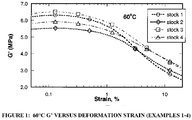
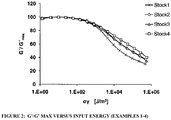
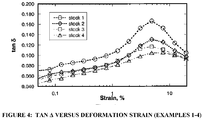
- the bi-functional silica coupling agent, non-elastomer reactive reinforcing agent capable of reacting with at least two silica particles and silica filler in the at least one rubber polymer can produce a tire rubber composition with improved properties. More specifically, the tire rubber composition can maintain a relatively consistent Mooney viscosity and tan ⁇ while achieving a dynamic stiffness (G') that is higher than a comparative rubber composition lacking the non-elastomer reactive filler reinforcing agent.
- G' dynamic stiffness
- the resulting tire rubber composition has a tan ⁇ that is within ⁇ 10%, a Mooney viscosity ML 1+4 that is at least 10% lower and a dynamic stiffness (G') at least 10% higher than a comparative rubber composition that lacks the non-elastomer reactive filler reinforcing agent.
- the resulting tire rubber composition has a tan ⁇ that is at least 10% lower and/or a dynamic stiffness at 60 °C (G') at least 10% higher than a comparative rubber composition that lacks the non-elastomer reactive filler reinforcing agent.
- the resulting tire rubber composition has a tan ⁇ that is at least 20% lower, at least 30% lower, at least 40% lower or at least 50% lower and/or a dynamic stiffness at 60 °C (G') at least 20% higher, at least 30% higher, at least 40% higher or at least 50% higher than a comparative rubber composition that lacks the non-elastomer reactive filler reinforcing agent.
- G' dynamic stiffness at 60 °C
- the comparative rubber composition is a rubber composition that is identical both in chemical composition and in the mixing process by which the ingredients contained therein are combined and mixed to the tire rubber composition disclosed herein, except that the comparative rubber composition lacks any non-elastomer reactive filler reinforcing agent.
- a multitude of rubber curing agents may be employed in the tire rubber compositions.
- sulfur or peroxide-based curing systems may be employed.
- Kirk-Othmer ENCYCLOPEDIA OF CHEMICAL TECHNOLOGY, 3rd Edition, Wiley Interscience, New York 1982, Vol. 20, pp. 365-468, particularly VULCANIZATION AGENTS AND AUXILIARY MATERIALS pp. 390-402 , or Vulcanization by A. Y. Coran, ENCYCLOPEDIA OF POLYMER SCIENCE AND ENGINEERING, 2nd Edition, John Wiley & Sons, Inc., 1989 , which are incorporated herein by reference.
- Vulcanizing agents may be used alone or in combination. In one or more embodiments, the preparation of vulcanizable compositions and the construction and curing of the tire is not affected.
- oils include paraffinic oils, aromatic oils, naphthenic oils, vegetable oils other than castor oils, and low PCA oils including MES, TDAE, SRAE, heavy naphthenic oils, and black oils.
- the tire rubber composition may generally be formed by mixing the ingredients together by methods known in the art, such as, for example, by kneading the ingredients together in a Banbury mixer or on a milled roll.
- the methods generally include at least one non-productive master-batch mixing stage and a final productive mixing stage.
- the term non-productive master-batch stage is known to those of skill in the art and generally understood to be a mixing stage where no vulcanizing agents or vulcanization accelerators are added. In certain embodiments, more than one non-productive master-batch mixing stage may be used.
- the term final productive mixing stage is also known to those of skill in the art and generally understood to be the mixing stage where the vulcanizing agents and vulcanization accelerators are added into the rubber composition.
- the non-productive master batch mixing stage(s) may be conducted at a temperature of about 130°C to about 200°C.
- the final productive mixing stage may be conducted at a temperature below the vulcanization temperature in order to avoid unwanted pre-cure of the rubber composition. Therefore, the temperature of the productive mixing stage should not exceed about 120°C and is typically about 40°C to about 120°C, or about 60°C to about 110°C and, especially, about 75°C to about 100°C.
- the method includes the steps of mixing in at least one non-productive master-batch stage: at least one rubbery polymer having (1) from 10 to 100 weight percent of monomer units derived from conjugated diene monomer having between 4 and 8 carbon atoms and (2) from 0 to 90 weight percent of monomer units derived from vinyl aromatic monomer, from 0.5 to 100 phr of silica filler, from 0.05 to 20 phr of a bi-functional silica coupling agent, from 1 to 30 phr of a non-elastomer reactive filler reinforcing agent capable of reacting with at least two silica particles; and then mixing the resulting product in a final productive stage along with at least one curative.
- at least one rubbery polymer having (1) from 10 to 100 weight percent of monomer units derived from conjugated diene monomer having between 4 and 8 carbon atoms and (2) from 0 to 90 weight percent of monomer units derived from vinyl aromatic monomer, from 0.5 to 100 phr of silica filler, from
- tire rubber compositions disclosed herein When the tire rubber compositions disclosed herein are employed in the manufacture of tires, these compositions can be processed into tire components according to ordinary tire manufacturing techniques including standard rubber shaping, molding and curing techniques. Any of the various rubber tire components can be fabricated including, but not limited to, treads, sidewalls, belt skims, and carcass.
- vulcanization is effected by heating the vulcanizable composition in a mold; e.g ., it may be heated to about 140°C to about 180°C.
- Cured or crosslinked rubber compositions may be referred to as vulcanizates, which generally contain three-dimensional polymeric networks that are thermoset.
- the other ingredients, such as processing aides and fillers, may be evenly dispersed throughout the vulcanized network.
- Pneumatic tires can be made as discussed in U.S. Patent Nos. 5,866,171 , 5,876,527 , 5,931,211 , and 5,971,046 , which are incorporated herein by reference.
- Mooney viscosity (ML1+4) values are determined with an Alpha Technologies Mooney viscometer (with a large rotor) The sample is preheated at 130°C for 1 minute before the rotor starts. The Mooney Viscosity measurement is recorded as the torque after the rotor has rotated 4 minutes at 130°C.
- Viscoelastic properties of cured rubber compounds are measured by three different methods.
- the first method is a temperature sweep test conducted with an Advanced Rheometric Expansion System (ARES) from TA Instruments.
- the test specimen has a rectangular geometry having a length of 47 mm, a thickness of 2 mm, and a width of 12.7 mm.
- the length of specimen between the grips on the test machine, i.e ., the gap, is approximately 27 mm.
- the test is conducted using a frequency of 3.14 rad/sec.
- the temperature is started at -100°C and increased to 100°C.
- the strain is 0.5% for the temperature range of -100°C to -21°C, and 2% for the temperature range of -20°C to 100°C.
- the second viscoelastic test is a strain sweep conducted with an Advanced Rheometric Expansion System (ARES) from TA Instruments.
- the test specimen has a cylindrical button geometry having a diameter of 9.27 mm and a 15.6 mm length.
- the test is conducted using a frequency of 3.14 rad/sec.
- the temperature is held constant at the desired temperature, which was either 30°C or 60°C.
- the strain is swept from 0.25% to 14.75%.
- the third viscoelastic test is a dynamic compression test done with a DynastatTM mechanical spectrometer (Dynastatics Instruments Corp.; Albany, New York) using a cylindrical test specimen (9.27 mm diameter x 15.6 mm height). The sample is compressed under a static load of 2 kg before testing. After it reached an equilibrium state, the test started with a dynamic compression load of 1.25 kg at a frequency of 1 Hz. The sample was then dynamically compressed and then extended and the resultant displacement, K', K", and hysteresis (tangent delta) were then recorded.
- Tensile mechanical properties are determined following the guidelines, but not restricted to, the standard procedure described in ASTM-D412, using ring samples with a dimension of 1.27 mm in width and 1.91 mm in thickness. A specific gauge length of 25.4 mm is used for the tensile test. Specimens are strained at a constant rate and the resulting force is recorded as a function of extension (strain). Force readings are expressed as engineering-stresses by reference to the original cross-sectional area of the test piece. The specimens are tested at 25°C. For thermal aging tensile mechanical properties, the specimens are aged at 100°C for 24 hours before being tested at 25°C.
- Rubber compositions containing 45 phr of silica were formulated according to the formulation provided in Table A below. As described below, four separate rubber compositions were prepared, varying the amounts of bi-functional silica coupling agent, filler reinforcing agent and process oil as provided in Table 1 below.
- Example 1 is a comparative example and lacks any filler reinforcing agent. The total liquid content in each of Examples 1-4 was adjusted according to the presence of the filler reinforcing agent.
- the following mixing procedure was utilized to prepare each of Examples 1-4.
- the master batch was prepared by mixing the non-productive stage (master batch) ingredients listed in Table A in a Brabender mixer that had been preheated to a temperature of 130°C. Mixing was conducted and a drop temperature of 153°C was utilized. Next, a remill was used. Then, the cooled mixture along with the ingredients listed in Table A for the final productive stage were added into the mixer (preheated to 90°C) and the temperature was raised to 145°C with mixing to further homogenize the mixture. The drop temperature was 105°C. Curing was performed at 171°C for 15 minutes.
- the processing properties of the rubber compositions of Examples 1-4 was evaluated by measuring the Mooney viscosity of the compositions. Mooney viscosities of Examples 1-3 are considered to be. The Mooney viscosity of Example 4 is still within an acceptable range for good processing. Table 2 Mooney/Example # Example 1 Example 2 Example 3 Example 4 ML 33.4 33.8 37.7 42.7
- Example 3 Example 4 G' temp sweep 30°C, 2% strain 2.40 3.03 3.41 4.00 G' strain sweep 30°C, 2% strain 4.37 5.03 6.28 6.42 K' dynast 30°C 1.24 1.84 2.36 2.95 Modulus at 50% strain (25°C) 1.19 1.38 1.49 1.73 Modulus at 200% strain (25°C) 5.39 5.87 6.11 6.82 1 units in MPa
- Tire performance data were then predicted based on the measured dynamic mechanical properties. Resulting tan ⁇ are listed in Table 4 below. Lower 60°C tan ⁇ were found for bis -OTES containing rubber compositions (Examples 2-4). The value of 60°C tan ⁇ are often used to predict the rolling resistance (R.R.). Thus, it is predicted that a rubber composition mixed with the bis -OTES or other filler reinforcing agent will have improved rolling resistance.
- Table 4 Compound 60°C tan ⁇ Property/Example # Example 1
- Example 2 Example 3
- Example 4 Temp sweep 0.0704 0.0682 0.0591 0.0570 Strain sweep 0.127 0.100 0.101 0.0891
- Compression Dynastat 0.0455 0.0388 0.0318 0.0291 Average 60°C tan ⁇ 0.0809 0.0691 0.0639 0.0584
- the tensile mechanical test results for Examples 1-4 are shown in Table 5 below.
- the improved modulus at 50% strain and modulus at 200% strain by comparable mechanical properties including breaking strength (T b ), elongation at break (E b ) (%) and toughness are found for the bis -OTES containing rubber compositions.
- the mechanical strengths of T b and toughness are retained only in bis -OTES containing rubber compositions after they were thermally aged in 100°C for 24 hours.
- reinforcing filler network was demonstrated to enhance the compound modulus. More importantly, it strengthened the filler network and provided more resistance to the applied deformation. With the use of bis -silanes for silica filled rubber, the reinforcing filler network concept is not only confirmed, but also unexpectedly benefits a rubber composition with a comparable compound viscosity but higher modulus. Additional benefits of lower 60°C tan delta and improved thermally aged mechanical strengths were also found in the stock with well reinforced filler network.
- Examples 1A-9A are comparative examples with Ex. 1A containing no bi-functional silica coupling agent and no filler reinforcing agent and 2A containing no filler reinforcing agent.
- the master batch was prepared by mixing the non-productive stage (master batch) ingredients listed in Table 6 in a Brabender mixer that had been preheated to a temperature of 130°C. As indicated in Table 7, the total liquid content in each composition was adjusted corresponding to the amount of filler reinforcing agent utilized so as to maintain a constant amount of 8 phr (combined filler reinforcing agent + process oil).
- the filler network of the stocks containing more flexible bridging spacer in the filler reinforcing agent (e.g ., Example 3) was more resistant to the deformation amplitude when compared to those of the control and NXT-only containing stocks. This also indicated the addition of the filler reinforcing agent in silica-containing rubbers gave stronger filler networks by reinforcing the filler network.
- Figures 5 and 6 show graphs resulting from plotting the values of G' at 30 °C for the third sweep at 2% and 15% (more precisely 14.75%) strains and the values of ⁇ G' (first - third sweeps) at 30 °C at 2% and 15% strains. (Values plotted are show in Table 11, below.)
- values of G' for Examples 3A to 9A are higher (at both 2% and 15% strains) showing the reinforcing of the silica networks and less dependence on mechanical history. The more extended the bridging spacer in the non-elastomer reactive filler reinforcing agent, the better the silica reinforcement.
- values of ⁇ G' were lower for Examples 3A to 9A.
- the silica filler network appears to have been reinforced better and stronger in the stocks containing the non-elastomer reactive filler reinforcing agent than NXT and the control stock without the silane.
- Bis-silane reinforcing networks in the non-elastomer reactive filler reinforcing agent are more deformation resistant and show better G' sustension in wide strain range. This is expected to deliver more consistent performance under various driving conditions.
- Table 11 G' and ⁇ G' Values for Figures 5 and 6 Property/Example Ex. 1A Ex. 2A Ex. 3A Ex. 4A Ex. 5A Ex. 6A Ex. 7A Ex. 8A Ex.
Landscapes
- Chemical & Material Sciences (AREA)
- Health & Medical Sciences (AREA)
- Chemical Kinetics & Catalysis (AREA)
- Medicinal Chemistry (AREA)
- Polymers & Plastics (AREA)
- Organic Chemistry (AREA)
- Engineering & Computer Science (AREA)
- Mechanical Engineering (AREA)
- Compositions Of Macromolecular Compounds (AREA)
Abstract
Description
- The embodiments of the present application relate to a silica-containing tire rubber composition comprised of at least one rubbery polymer, a bi-functional silica coupling agent, and a non-elastomer reactive reinforcing agent capable of reacting with at least two silica particles and to methods for preparing the tire rubber composition.
- The embodiments described herein relate to a silica-containing tire rubber composition comprised of at least one rubbery polymer, a bi-functional silica coupling agent, and a non-elastomer reactive reinforcing agent capable of reacting with at least two silica particles and to methods for preparing the rubber composition. More specifically, the tire rubber composition includes at least one rubbery polymer (which itself comprises 10-100 weight % of monomer units derived from conjugated diene monomer having between 4 and 8 carbon atoms and 0-90 weight % of monomer units derived from vinyl aromatic monomer), 0.5 to 100 phr of silica filler, 0.05 to 20 phr of a bi-functional silica coupling agent, and 1 to 30 phr of a non-elastomer reactive filler reinforcing agent capable of interacting with at least two silica particles. The bi-functional silica coupling agent and the filler reinforcing agent are utilized in a weight ratio of from 1:100 to 1:0.2.
- The non-elastomer reactive filler reinforcing agent has formula (I) as follows: (Y)G(Z). In formula (I), G is a separating group selected from the group consisting of C1-C50 straight chain and branched alkyl, C2-C50 straight chain and branched, C6-C50 aromatics, each optionally containing a heteroatom selected from the group consisting of one or more O, one or more N, one S, and combinations thereof and Y and Z can be the same or different and each independently comprise a silica-reactive group of the formula Si(R1)p(OR2)3-p where each R1 independently comprises C1-C20 aliphatic, cycloaliphatic or aromatic, R2 is C1-C6 aliphatic or cycloaliphatic and p is an integer from 0 to 2.
- In certain embodiments, the (Y)G(Z) formula of the non-elastomer reactive filler reinforcing agent is such that G is selected from the group consisting of C2-C20 alkanes, alkenes and aromatics, and optionally contains a heteroatom selected from the group consisting of one or more O, one or more N, one S, and combinations thereof; and Y and Z can be the same or different and each independently comprise a silica-reactive group of the formula Si(R1)p(OR2)3-p with each R1 independently comprising C1-C20 aliphatic, cycloaliphatic or aromatic, R2 being C1-C6 aliphatic or cycloaliphatic and p an integer from 0 to 2.
- In other embodiments disclosed herein, the (Y)G(Z) formula of the non-elastomer reactive filler reinforcing agent is such that G is selected from the group consisting of C1-C50 straight-chain and branched alkyl and C2-C50 straight-chain and branched alkenes either optionally containing additional carbon atoms in the form of one or more aromatic rings; V and W can be the same or different and independently comprise a silica-reactive group of the formula SiR4 p(OR3)3-p; each R4 independently comprises C1-C20 aliphatic, cycloaliphatic or aromatic; and R3 independently comprises C1-C20 aliphatic or cycloaliphatic and p is an integer from 0 to 2. Unless stated otherwise, all aliphatic groups mentioned herein include both straight-chain and branched embodiments.
- Other embodiments disclosed herein include methods for preparing a tire rubber composition including the steps of mixing in at least one non-productive master-batch stage at least one rubbery polymer having (1) from 10 to 100 weight percent of monomer units derived from conjugated diene monomer having between 4 and 8 carbon atoms and (2) from 0 to 90 weight percent of monomer units derived from vinyl aromatic monomer, with from 0.5 to 100 phr of silica filler, from 0.05 to 20 phr of a bi-functional silica coupling agent, and from 1 to 30 phr of a non-elastomer reactive filler reinforcing agent of formula (I) that is capable of reacting with at least two silica particle. The resulting product is mixed in a final productive stage with at least one curative.
-
-
FIGURE 1 is a graph showing G' at 60 °C versus deformation strain for Examples 1-4. -
FIGURE 2 is a graph showing G'/G' max versus input energy for Examples 1-4. -
FIGURE 3 is a graph showing G"/G" max versus input energy for Examples 1-4. -
FIGURE 4 is a graph showing tan δ versus deformation strain for Examples 1-4. -
FIGURE 5 is a graph showing G' at 30 °C (3rd sweep) at 2% and 15% strains for Examples 1A-9A. -
FIGURE 6 is a graph showing ΔG' at 30 °C (1st-3rd sweeps) at 2% and 15% strains for Examples 1A-9A. - The present disclosure relates to a silica-containing tire rubber composition comprised of at least one rubbery polymer, a bi-functional silica coupling agent, and a non-elastomer reactive reinforcing agent capable of reacting with at least two silica particles and to methods for preparing the tire rubber composition. The tire rubber composition includes at least one rubbery polymer (which itself comprises 10-100 weight % of monomer units derived from conjugated diene monomer having between 4 and 8 carbon atoms and 0-90 weight % of monomer units derived from vinyl aromatic monomer), 0.5 to 100 phr of silica filler, 0.05 to 20 phr of a bi-functional silica coupling agent, and 1 to 30 phr of a non-elastomer reactive filler reinforcing agent capable of interacting with at least two silica particles. The bi-functional silica coupling agent and the filler reinforcing agent are utilized in a weight ratio of from 1:100 to 1:0.2. In other embodiments, the bi-functional silica coupling agent and the filler reinforcing agent are utilized in a weight ratio of from 4:1 to 1:4, 2:1 to 1:2 or from 0.8:1 to 1.2:1.
- The at least one rubbery polymer may be a polymer or a copolymer, or a combination thereof when more than one rubbery polymer is utilized. Preferably the rubbery polymer is not functionalized. Even more preferably, the rubbery polymer does not contain any hydroxy functional group. Examples of the conjugated diene monomer for use in the rubbery polymer include, but are not limited to, 1,3 butadiene, isoprene, 1,3-pentadiene, 1,3-hexadiene, 2,3-dimethyl-1,3-butadiene, 2-ethyl-1,3-butadiene, 2-methyl-1,3-pentadiene, 3-methyl-1,3-pentadiene, 4-methyl-1,3-pentadiene, 2,4-hexadiene, 1,3-cyclopentanediene, 1,3-cyclohexadiene, 1,3-cycloheptadiene, and 1,3-cyclooctadiene, and derivatives thereof. Mixtures of two or more conjugated dienes may be utilized. Examples of the vinyl aromatic monomer when utilized in the rubbery polymer include, but are not limited to, styrene, α-methyl styrene, p-methylstyrene, and vinylnaphthalene. Mixtures of two or more vinyl aromatic monomers may be utilized. Non-limiting examples of rubbery polymers include styrene-butadiene rubber, polybutadiene and polyisoprene.
- The at least one rubbery polymer may be prepared and recovered according to various suitable methods such as batch, semi-continuous, or continuous operations. The polymerization can also be carried out in a number of different polymerization reactor systems, including but not limited to bulk polymerization, vapor phase polymerization, solution polymerization, suspension polymerization, coordination polymerization and emulsion polymerization. The polymerization may be carried out using a free radical mechanism, an anionic mechanism, a cationic mechanism, or a coordination mechanism. All of the above polymerization methods are well known to persons skilled in the art. However, for exemplary purposes, a short description of anionic and coordination mechanisms is given.
- When the at least one rubbery polymer is produced through anionic polymerization, as a polymerization initiator is preferably used an organic alkaline metal compound, and more preferably a lithium-containing compound. Examples of the lithium-containing compound include, but are not limited to, a hydrocarbyl lithium, a lithium amide compound and so on. The amount of the lithium compound used as the polymerization initiator is preferably within a range of 0.2 to 20 mmol per 100 g of the monomer.
- Non-limiting examples of a hydrocarbyl lithium include ethyl lithium, n-propyl lithium, isopropyl lithium, n-butyl lithium, sec-butyl lithium, tert-octyl lithium, n-decyl lithium, phenyl lithium, 2-naphthyl lithium, 2-butyl-phenyl lithium, 4-phenyl-butyl lithium, cyclohexyl lithium, cyclopentyl lithium, a reaction product of diisopropenylbenzene and butyl lithium and so on. Among these, alkyl lithiums such as ethyl lithium, n-propyl lithium, isopropyl lithium, n-butyl lithium, sec-butyl lithium, tert-octyl lithium, n-decyl lithium and so on are preferable, and n-butyl lithium is particularly preferable.
- The method for producing the at least one rubbery polymer through the anionic polymerization using as the polymerization initiator the organic alkaline metal compound or the like is not particularly limited. For example, the at least one rubbery polymer can be produced by polymerizing the conjugated diene monomer alone or a mixture of the conjugated diene monomer and aromatic vinyl compound in a hydrocarbon solvent inactive to the polymerization reaction. Non-limiting examples of the hydrocarbon solvent inactive to the polymerization reaction include propane, n-butane, isobutane, n-pentane, isopentane, n-hexane, cyclohexane, propene, 1-butene, isobutene, trans-2-butene, cis-2-butene, 1-pentene, 2-pentene, 1-hexene, 2-hexene, benzene, toluene, xylene, ethylbenzene and so on. They may be used alone or in a combination of two or more.
- The anionic polymerization may be carried out in the presence of a randomizer. The randomizer can control the microstructure of the conjugated diene compound, and has an action that 1,2-bond content in butadiene unit of the polymer using, for example, butadiene as a monomer is controlled, and butadiene unit and styrene unit in the copolymer using butadiene and styrene as a monomer are randomized, or the like. Non-limiting examples of the randomizer include dimethoxybenzene, tetrahydrofuran, dimethoxyethane, diethylene glycol dibutyl ether, diethylene glycol dimethyl ether, bis tetrahydrofuryl propane, triethylamine, pyridine, N-methylmorpholine, N,N,N',N'-tetramethyl ethylenediamine, 1,2-dipiperidinoethane, potassium-t-amylate, potassium-t-butoxide, sodium-t-amylate and so on. The amount of the randomizer used is preferably within a range of 0.01 to 100 molar equivalent per 1 mol of the organic alkaline metal compound as a polymerization initiator.
- The anionic polymerization may be carried out through any of solution polymerization, vapor phase polymerization and bulk polymerization. In the solution polymerization, the concentration of the monomer in the solution is preferably within a range of 5 to 50% by mass, more preferably 10 to 30% by mass. When the conjugated diene monomer and vinyl aromatic monomer are used together, the content of the vinyl aromatic monomer in the mixture is preferably within a range of 3 to 50% by mass, more preferably 4 to 45% by mass. Also, the polymerization system is not particularly limited and may be a batch system or a continuous system.
- The polymerization temperature in the anionic polymerization is preferably within a range of 0 to 150° C., more preferably 20 to 130° C. Also, such a polymerization may be carried out under a generating pressure, but it is preferable to be usually conducted under a pressure enough to keep the monomers used at substantially a liquid phase. When the polymerization reaction is carried out under a pressure higher than the generating pressure, the reaction system is preferable to be pressurized with an inert gas. Moreover, the starting materials used in the polymerization such as monomers, polymerization initiator, solvent and the like are preferable to be used after the reaction obstructing substances such as water, oxygen, carbon dioxide, protonic compound and the like are previously removed.
- If the at least one rubbery polymer is produced through the coordination polymerization, as the polymerization initiator is preferably used a rare-earth metal compound, more preferably a combination of the following ingredients (a), (b) and (c).
- The ingredient (a) used in the coordination polymerization is selected from the rare-earth metal compound, a complex compound of the rare-earth metal compound and a Lewis base, and so on. Examples of the rare-earth metal compound include, but are not limited to, carboxylate, alkoxide, β-diketone complex, phosphate, phosphite and the like of the rare-earth element. Examples of the Lewis base include, but are not limited to, acetylacetone, tetrahydrofuran, pyridine, N,N-dimethylformamide, thiophene, diphenyl ether, triethylamine, organophosphorus compound, monohydric or dihydric alcohol and so on. For the rare-earth element of the rare-earth metal compound are preferred lanthanum, neodymium, praseodymium, samarium and gadolinium. Among these, neodymium is particularly preferable. Specific examples of the ingredient (a) include neodymium tri-2-ethylhexanoate and a complex compound with acetylacetone thereof, neodymium tri-neodecanoate and a complex compound with acetylacetone thereof, neodymium tri-n-butoxide and so on. These ingredients (a) may be used alone or in a combination of two or more.
- The ingredient (b) used in the coordination polymerization is generally selected from organoaluminum compounds. Examples of the organoaluminum compound include trihydrocarbyl aluminum represented by the formula: (R9)3Al, a hydrocarbyl aluminum hydride represented by the formula: (R9)2AlH or R9AlH2 (wherein R9 is independently a hydrocarbon group having a carbon number of 1-30), a hydrocarbyl aluminoxane with a hydrocarbon group having a carbon number of 1-30 and so on. More specifically, examples of the organoaluminum compound include trialkyl aluminum, dialkyl aluminum hydride, alkyl aluminum dihydride, alkyl aluminoxane and so on. These compounds may be used alone or in a combination of two or more. Moreover, as the ingredient (b) is preferably used a combination of the aluminoxane and another organoaluminum compound.
- The ingredient (c) used in the coordination polymerization is selected from a hydrolyzable halogen-containing compound or a complex compound with the Lewis base thereof; organohalogen compounds having a tertiary alkyl halide, benzyl halide or allyl halide; ionic compounds composed of a non-coordinative anion and a counter cation; and so on. Nonlimiting examples of the ingredient (c) include alkylaluminum dichloride, dialkylaluminum chloride, silicon tetrachloride, tin tetrachloride, a complex of zinc chloride and a Lewis base such as alcohol or the like, a complex of magnesium chloride and a Lewis base such as alcohol or the like, benzyl chloride, t-butyl chloride, benzyl bromide, t-butyl bromide, triphenyl carbonium tetrakis(pentafluorophenyl)borate and so on. These ingredients (c) may be used alone or in a combination of two or more.
- The polymerization initiator may be previously prepared by using the above-described ingredients (a), (b) and (c), and if necessary the same conjugated diene compound as the monomer for the polymerization and/or an unconjugated diene compound. Moreover, it may be used by supporting a part or whole of the ingredient (a) or (c) on an inactive solid. The amount of each ingredient used may be properly set, but the amount of the ingredient (a) is typically 0.001 to 0.5 mmol per 100 g of the monomer. Also, a molar ratio of the ingredient (b)/ingredient (a) is preferably 5 to 1000, and a molar ratio of the ingredient (c)/ingredient (a) is preferably 0.5 to 10.
- The polymerization temperature in the coordination polymerization is preferably within a range of -80 to 150° C., more preferably -20 to 120° C. As the solvent used in the coordination polymerization may be used the hydrocarbon solvent inactive to the reaction as mentioned in the anionic polymerization. Also, the concentration of the monomer in the reaction solution is the same as in the case of the anionic polymerization. Moreover, the reaction pressure in the coordination polymerization is the same as in the anionic polymerization, and the starting materials used in the reaction are also preferable to be ones from which the reaction obstructing substances such as water, oxygen, carbon dioxide, protonic compound and the like are substantially removed.
- The non-elastomer reactive filler reinforcing agent has at least two functional silane groups that are capable of reacting with the surface of silica particles and lacks any moiety (e.g., mercapto, amino, vinyl, epoxy group) that is capable of reacting with an elastomer or rubbery polymer. As stated above, the non-elastomer reactive filler reinforcing agent is used in the tire rubber composition in an amount of 1 to 30 phr. In other embodiments, the non-elastomer reactive filler reinforcing agent is used in an amount of 2 to 20 phr or 3 to 15 phr.
- The non-elastomer reactive filler reinforcing agent has formula (I) as follows: (Y)G(Z). In formula (I), G is a separating group selected from the group consisting of C1-C50 straight chain and branched alkyl, C2-C50 straight chain and branched, C6-C50 aromatics, each optionally containing a heteroatom selected from the group consisting of one or more O, one or more N, one S, and combinations thereof and Y and Z can be the same or different and each independently comprise a silica-reactive group of the formula Si(R1)p(OR2)3-p where each R1 independently comprises C1-C20 aliphatic, cycloaliphatic or aromatic, R2 is C1-C6 aliphatic or cycloaliphatic and p is an integer from 0 to 2.
- In certain embodiments, the non-elastomer reactive filler reinforcing agent of formula (Y)G(Z) is such that G is selected from the group consisting of C2-C20 alkanes, alkenes and aromatics, and optionally contains a heteroatom selected from the group consisting of one or more O, one or more N, one S, and combinations thereof; and Y and Z can be the same or different and each of Y and Z, when present, independently comprise a silica-reactive group of the formula Si(R1)p(OR2)3-p with each R1 independently comprising C1-C20 aliphatic (branched or straight chain), cycloaliphatic or aromatic, R2 being C1-C6 aliphatic (branched or straight chain) or cycloaliphatic, and p an integer from 0 to 2. In certain embodiments, the non-elastomer reactive filler reinforcing agent does not contain any sulfur. In certain embodiments, the separating group G is selected from the group consisting of C4 to C12 or C6 to C10 alkanes, alkenes and aromatics.
- In particular embodiments, the non-elastomer reactive filler reinforcing agent is a bis(trialkoxy) silane with the carbon portion of the alkoxy selected from the group consisting of C1 to C6 (i.e., methyl to hexyl), preferably C1 to C3 and even more preferably C1 to C2. Specific examples of bis(trialkoxy)silanes that may be used as the non-elastomer reactive filler reinforcing agent in certain embodiments include, but are not limited to, bis(trimethoxysilyl)ethane, bis(triethoxysilyl)ethane, bis(tributoxysilyl)ethane, bis(triethoxysilyl)propane, bis(trimethoxysilyl)propane, bis(tributoxysilyl)propane, bis(triethoxysilyl)butane, bis(trimethoxysilyl)butane, bis(tributoxysilyl)butane, bis(triethoxysilyl)isobutane, bis(trimethoxysilyl)isobutane, bis(tributoxysilyl)isobutane, bis(triethoxysilyl)hexane, bis(trimethoxysilyl)hexane, bis(tributoxysilyl)hexane, bis(triethoxysilyl)cyclohexane, bis(trimethoxysilyl)cyclohexane, bis(tributoxysilyl)cyclohexane, bis(trimethoxysilyl)heptane, bis(triethoxysilyl)heptane, bis(tributoxysilyl)heptane, bis(triethoxysilyl)octane, bis(trimethoxysilyl)octane, bis(tributoxysilyl)octane, bis(triethoxysilyl)nonane, bis(trimethoxysilyl)nonane, bis(tributoxysilyl)nonane, bis(triethoxysilyl)decane, bis(trimethoxysilyl)decane, bis(tributoxysilyl)decane, bis(triethoxysilyl)dodecane, bis(trimethoxysilyl)dodecane, bis(tributoxysilyl)dodecane, bis(triethoxysilyl)tetradecane, bis(trimethoxysilyl)tetradecane, bis(tributoxysilyl)tetradecane, bis(triethoxysilyl)octadecane, bis(trimethoxysilyl)octadecane, bis(tributoxysilyl)octadecane, and mixtures thereof.
- In other embodiments, the non-elastomer reactive filler reinforcing agent of formula (Y)G(Z) is such that G is selected from the group consisting of C1-C50 straight-chain and branched alkyl and C2-C50 straight-chain and branched alkenes either optionally containing additional carbon atoms in the form of one or more aromatic rings; V and W can be the same or different and each independently comprise a silica-reactive group of the formula SiR4 p(OR3)3-p; each R4 independently comprises C1-C20 aliphatic, cycloaliphatic or aromatic; and R3 independently comprises C1-C20 aliphatic, or cycloaliphatic and p is an integer from 0 to 2. In certain embodiments, the separating group G is selected from the group consisting of C4-C20 straight-chain and branched alkyl and C4-C20 straight-chain and branched alkenes either optionally containing additional carbon atoms in the form of one or more aromatic rings. In other embodiments, the separating group G is selected from the group consisting of C4-C8 straight-chain and branched alkyl and C4-C8 straight-chain and branched alkenes either optionally containing additional carbon atoms in the form of one or more aromatic rings. In certain embodiments, the separating group G is selected from the group consisting of C6-C20 and each R3 is selected from the group consisting of C1 to C6 aliphatic. Specific, non-limiting examples of compounds that meet the immediately preceding description and may be used as non-elastomer reactive filler reinforcing agents include, but are not limited to, bis(triethoxysilyl)octane, bis(triethoxysilyl)ethane, bis(triethoxysilyl)methane, bis(triethoxysilyl)hexane, 1,4-bis(trimethoxysilylethyl)benzene and 1,4-bis(trimethoxysilyl)benzene. In certain embodiments, the bi-functional silica coupling agent and the non-elastomer reactive filler reinforcing agent are used in a weight ratio of 1:100 to 1:0.2. In other embodiments, they are used in a weight ratio of 1:15 to 1:0.2 and in yet other embodiments in a weight ratio of 1:4 to 1:1. In certain preferred embodiments, the conjugated diene monomer used in the tire rubber composition comprises butadiene, the vinyl aromatic monomer comprises styrene and the Mooney viscosity of the resulting rubber composition is between 30 and 80 and in other embodiments between 50 and 70. In certain embodiments, the overall tire rubber composition is prepared using less than 20 phr of oil.
- As stated above, the bi-functional silica coupling agent is utilized in the tire rubber composition in an amount of 0.05 to 20 phr. In other embodiments, the bi-functional silica coupling agent is utilized in an amount of 0.1 to 15 phr or 0.5 to 10 phr. The bi-functional silica coupling agent is a silica coupling agent having at least one moiety or functionality (e.g., a silyl group) that is reactive with the surface of a silica particle, and at least one moiety or functionality (e.g., a mercapto, amino, vinyl, epoxy or sulfur group) that binds to the elastomer. See, e.g.,
US 6,608,145 at col. 1, lines 39-46. Various types of bi-functional silica coupling agents are known. In certain embodiments, the bi-functional silica coupling agent is selected from the group consisting of mercaptosilanes, bis(trialkoxysilylorgano) polysulfides, and combinations thereof. Mercaptosilanes suitable for use in the tire rubber composition disclosed herein have the general formula HS-R-Si(Xn)(R'3-n) where X is a halogen or an alkoxy (if an alkoxy, of the formula OR" where R" is C1 to C6 aliphatic, cycloaliphatic or aromatic); R is C1 to C4 alkylene; R' is independently C1 to C30 alkyl, C7 to C30 alkaryl, C5 to C30 cycloaliphatic or C6 or C20 aromatic; and n is an integer from 1 to 3. When X is a halogen, it can be selected from the group consisting of chlorine, bromine, iodine and fluorine, preferably chlorine. R is preferably C1 to C3 alkylene, X is preferably an alkoxy (with carbon portion of C1 to C6), and n is preferably 3. In some embodiments, the mercaptosilane is a blocked mercaptosilane. In certain embodiments, the bi-functional silica coupling agent is selected from the group consisting of 3-octanoylthio-1-propyltriethoxysilane, 3-mercaptopropyltriethoxysilane, 1-mercaptomethyltriethoxysilane, 2-mercaptoethyltriethoxysilane, 3-mercaptopropylmethyldiethoxysilane, 2-mercaptoethyltriproproxysilane, 18-mercaptooctadecyldiethoxychlorosilane, 3,3'-bis(triethoxysilylpropyl) disulfide, 3,3'-bis(trimethoxysilylpropyl) disulfide, 3,3'-bis(tributoxysilyl-propyl) disulfide, 3,3'-bis(tripropoxylpropyl) disulfide, 3,3'-bis(trihexoxysilylpropyl) disulfide, 2,2'-bis (dimethylmethoxysilylethyl) disulfide, 3,3'-bis(diphenylcyclohexoxysilylpropyl) disulfide, 3,3'-bis(ethyl-di-butoxysilylpropyl) disulfide, 3,3'-bis(propyldiethoxysilylpropyl) disulfide, 3,3'-bis(triisopropoxysilylpropyl) disulfide], 3,3'-bis(dimethoxyphenylsilyl-2-methylpropyl) disulfide, bis(3-triethoxysilylpropyl) tetrasulfide, bis(2-triethoxysilylethyl) tetrasufide, bis(3-trimethoxysilylpropyl) tetrasulfide, 3-trimethoxysilylpropyl-N,N-dimethylthiocarbamoyl tetrasulfide, 3-triethoxysilylpropyl-N,N-dimethylthiocarbamoyl tetrasulfide, 2-triethoxysilyl-N,N-dimethylthiocarbamoyl tetrasulfide, 3-trimethoxysilylpropyl-benzothiazole tetrasulfide, 3-triethoxysilylpropylbenzothiazole tetrasulfide, and mixtures thereof. Other specific examples of suitable bi-functional silica coupling agents are provided inU.S. Patent 7,256,231 (the entire disclosure of which is hereby incorporated by reference) beginning atcolumn 4,line 4. - The amount of bi-functional silica coupling agent used in the tire rubber composition may vary. In certain embodiments, the bi-functional silica coupling agent is utilized in an amount of 1%-40% by weight of silica filler. In other embodiments, the bi-functional silica coupling agent is utilized in an amount of 1-30%, 2-40% or 4-30% by weight of silica filler.
- Typically, in the tire rubber compositions disclosed herein, the overall composition contains 10 to 100 phr of the tire rubber composition disclosed herein and 0 to 90 phr of one or more additional rubbery polymer(s). The one or more additional rubbery polymers suitable for use are varied and include those polymers frequently used in tire rubber compositions, including, but not limited to, styrene-butadiene rubber, polybutadiene, natural rubber, polyisoprene, butyl rubber, halogenated butyl rubber, ethylene-propylene-diene rubber and styrene-butadiene-isoprene rubber.
- Suitable silica fillers for use in the tire rubber composition are well known. Examples include precipitated amorphous silica, wet silica (hydrated silicic acid), dry silica (anhydrous silicic acid), fumed silica, calcium silicate and the like. Other suitable fillers include aluminum silicate, magnesium silicate, and the like. Among the listed silica fillers, precipitated amorphous wet-process, hydrated silicas are preferred. Such silica fillers are produced by a chemical reaction in water, from which they are precipitated as ultrafine, spherical particles, with primary particles strongly associated into aggregates, which in turn combine less strongly into agglomerates. The surface area, as measured by the BET method gives the best measure of the reinforcing character of different silica fillers. In certain embodiments, the surface area of the silica filler is about 32 m2/g to about 400m2/g, with the range of about 100 m2/g to about 250m2/g being preferred, and the range of about 150m2/g to about 2202/g being most preferred. The pH of the silica filler is generally about 55 to about 7 or slightly over, preferably about 5.5 to about 6.8.
- The silica filler can be employed in the amount of 0.5 to about 100 parts by weight per hundred parts of the at least one rubbery polymer (phr), preferably in an amount of five to 80 phr and, more preferably, in an amount of 30 to 80 phr. The useful upper range is limited by the high viscosity imparted by fillers of this type. Some of the commercially available silicas which can be used include, but are not limited to, Hi-Sil®190, Hi-Sil®210, Hi-Sil®215, Hi-Sil®233, Hi-Sil®243, and the like, produced by PPG Industries (Pittsburgh, Pa.). A number of useful commercial grades of different silicas are also available from Degussa Corporation (e.g., VN2, VN3), Rhone Poulenc (e.g., Zeosil™ 1165MP), and J. M. Huber Corporation.
- The tire rubber composition may also optionally include one or more carbon blacks. The carbon black when present is generally used in an amount of from one to 50 phr, with five to 35 phr being preferred. The carbon black can include any of the commonly available, commercially-produced carbon blacks, but those having a surface area (EMSA) of at least 202/g and, more preferably, at least 35 m2/g up to 200 m2/g or higher are preferred. Surface area values used in this application are determined by ASTM D-1765 using the cetyltrimethyl-ammonium bromide (CTAB) technique. Among the useful carbon blacks are furnace black, channel blacks and lamp blacks. More specifically, examples of useful carbon blacks include super abrasion furnace (SAF) blacks, high abrasion furnace (HAF) blacks, fast extrusion furnace (FEF) blacks, fine furnace (FF) blacks, intermediate super abrasion furnace (ISAF) blacks, semi-reinforcing furnace (SRF) blacks, medium processing channel blacks, hard processing channel blacks and conducting channel blacks. Other carbon blacks which can be utilized include acetylene blacks. A mixture of two or more of the above blacks can be used. Typical suitable carbon blacks are N-110, N-220, N-339, N-330, N-351, N-550, N-660, as designated by ASTM D-1765-82a. The carbon blacks utilized can be in pelletized form or an unpelletized flocculent mass. Preferably, for more uniform mixing, unpelletized carbon black is preferred.
- Use of the bi-functional silica coupling agent, non-elastomer reactive reinforcing agent capable of reacting with at least two silica particles and silica filler in the at least one rubber polymer can produce a tire rubber composition with improved properties. More specifically, the tire rubber composition can maintain a relatively consistent Mooney viscosity and tan δ while achieving a dynamic stiffness (G') that is higher than a comparative rubber composition lacking the non-elastomer reactive filler reinforcing agent. More specifically, in certain embodiments, the resulting tire rubber composition has a tan δ that is within ± 10%, a Mooney viscosity ML1+4 that is at least 10% lower and a dynamic stiffness (G') at least 10% higher than a comparative rubber composition that lacks the non-elastomer reactive filler reinforcing agent. In certain embodiments, the resulting tire rubber composition has a tan δ that is at least 10% lower and/or a dynamic stiffness at 60 °C (G') at least 10% higher than a comparative rubber composition that lacks the non-elastomer reactive filler reinforcing agent. In other embodiments, the resulting tire rubber composition has a tan δ that is at least 20% lower, at least 30% lower, at least 40% lower or at least 50% lower and/or a dynamic stiffness at 60 °C (G') at least 20% higher, at least 30% higher, at least 40% higher or at least 50% higher than a comparative rubber composition that lacks the non-elastomer reactive filler reinforcing agent. Further information concerning exemplary properties of tire rubber compositions made using exemplary non-elastomer reactive filler reinforcing agents are provided in the Examples section, in particular Examples 1A to 9A. In all cases, the comparative rubber composition is a rubber composition that is identical both in chemical composition and in the mixing process by which the ingredients contained therein are combined and mixed to the tire rubber composition disclosed herein, except that the comparative rubber composition lacks any non-elastomer reactive filler reinforcing agent.
- As is well-known to those of skill in the art, a multitude of rubber curing agents may be employed in the tire rubber compositions. For example, sulfur or peroxide-based curing systems may be employed. Also, see Kirk-Othmer, ENCYCLOPEDIA OF CHEMICAL TECHNOLOGY, 3rd Edition, Wiley Interscience, New York 1982, Vol. 20, pp. 365-468, particularly VULCANIZATION AGENTS AND AUXILIARY MATERIALS pp. 390-402, or Vulcanization by A. Y. Coran, ENCYCLOPEDIA OF POLYMER SCIENCE AND ENGINEERING, 2nd Edition, John Wiley & Sons, Inc., 1989, which are incorporated herein by reference. Vulcanizing agents may be used alone or in combination. In one or more embodiments, the preparation of vulcanizable compositions and the construction and curing of the tire is not affected.
- Other ingredients that may be employed in the tire rubber composition are also well known to those of skill in the art and include accelerators, oils, waxes, scorch inhibiting agents, processing aids, zinc oxide, tackifying resins, reinforcing resins, fatty acids such as stearic acid, peptizers, and one or more additional rubbers. Examples of oils include paraffinic oils, aromatic oils, naphthenic oils, vegetable oils other than castor oils, and low PCA oils including MES, TDAE, SRAE, heavy naphthenic oils, and black oils.
- Also disclosed herein are methods for preparing a tire rubber composition. The tire rubber composition may generally be formed by mixing the ingredients together by methods known in the art, such as, for example, by kneading the ingredients together in a Banbury mixer or on a milled roll. The methods generally include at least one non-productive master-batch mixing stage and a final productive mixing stage. The term non-productive master-batch stage is known to those of skill in the art and generally understood to be a mixing stage where no vulcanizing agents or vulcanization accelerators are added. In certain embodiments, more than one non-productive master-batch mixing stage may be used. The term final productive mixing stage is also known to those of skill in the art and generally understood to be the mixing stage where the vulcanizing agents and vulcanization accelerators are added into the rubber composition. The non-productive master batch mixing stage(s) may be conducted at a temperature of about 130°C to about 200°C. The final productive mixing stage may be conducted at a temperature below the vulcanization temperature in order to avoid unwanted pre-cure of the rubber composition. Therefore, the temperature of the productive mixing stage should not exceed about 120°C and is typically about 40°C to about 120°C, or about 60°C to about 110°C and, especially, about 75°C to about 100°C. More specifically, the method includes the steps of mixing in at least one non-productive master-batch stage: at least one rubbery polymer having (1) from 10 to 100 weight percent of monomer units derived from conjugated diene monomer having between 4 and 8 carbon atoms and (2) from 0 to 90 weight percent of monomer units derived from vinyl aromatic monomer, from 0.5 to 100 phr of silica filler, from 0.05 to 20 phr of a bi-functional silica coupling agent, from 1 to 30 phr of a non-elastomer reactive filler reinforcing agent capable of reacting with at least two silica particles; and then mixing the resulting product in a final productive stage along with at least one curative.
- When the tire rubber compositions disclosed herein are employed in the manufacture of tires, these compositions can be processed into tire components according to ordinary tire manufacturing techniques including standard rubber shaping, molding and curing techniques. Any of the various rubber tire components can be fabricated including, but not limited to, treads, sidewalls, belt skims, and carcass. Typically, vulcanization is effected by heating the vulcanizable composition in a mold; e.g., it may be heated to about 140°C to about 180°C. Cured or crosslinked rubber compositions may be referred to as vulcanizates, which generally contain three-dimensional polymeric networks that are thermoset. The other ingredients, such as processing aides and fillers, may be evenly dispersed throughout the vulcanized network. Pneumatic tires can be made as discussed in
U.S. Patent Nos. 5,866,171 ,5,876,527 ,5,931,211 , and5,971,046 , which are incorporated herein by reference. - This application discloses several numerical range limitations that support any range within the disclosed numerical ranges even though a precise range limitation is not stated verbatim in the specification because the embodiments could be practiced throughout the disclosed numerical ranges. With respect to the use of substantially any plural and/or singular terms herein, those having skill in the art can translate from the plural to the singular and/or from the singular to the plural as is appropriate to the context and/or application. The various singular/plural permutations may be expressly set forth herein for sake of clarity.
- It will be understood by those within the art that, in general, terms used herein, and especially in the appended claims (e.g., bodies of the appended claims) are generally intended as "open" terms (e.g., the term "including" should be interpreted as "including but not limited to," the term "having" should be interpreted as "having at least," the term "includes" should be interpreted as "includes but is not limited to," etc.). It will be further understood by those within the art that if a specific number of an introduced claim recitation is intended, such an intent will be explicitly recited in the claim, and in the absence of such recitation no such intent is present. For example, as an aid to understanding, the following appended claims may contain usage of the introductory phrases "at least one" and "one or more" to introduce claim recitations. However, the use of such phrases should not be construed to imply that the introduction of a claim recitation by the indefinite articles "a" or "an" limits any particular claim containing such introduced claim recitation to inventions containing only one such recitation, even when the same claim includes the introductory phrases "one or more" or "at least one" and indefinite articles such as "a" or "an" (e.g., "a" and/or "an" should typically be interpreted to mean "at least one" or "one or more"); the same holds true for the use of definite articles used to introduce claim recitations. In addition, even if a specific number of an introduced claim recitation is explicitly recited, those skilled in the art will recognize that such recitation should typically be interpreted to mean at least the recited number (e.g., the bare recitation of "two recitations," without other modifiers, typically means at least two recitations, or two or more recitations). Furthermore, in those instances where a convention analogous to "at least one of A, B, and C, etc." is used, in general such a construction is intended in the sense one having skill in the art would understand the convention (e.g., " a system having at least one of A, B, and C" would include but not be limited to systems that have A alone, B alone, C alone, A and B together, A and C together, B and C together, and/or A, B, and C together, etc.). In those instances where a convention analogous to "at least one of A, B, or C, etc." is used, in general such a construction is intended in the sense one having skill in the art would understand the convention (e.g., "a system having at least one of A, B, or C" would include but not be limited to systems that have A alone, B alone, C alone, A and B together, A and C together, B and C together, and/or A, B, and C together, etc.). It will be further understood by those within the art that virtually any disjunctive word and/or phrase presenting two or more alternative terms, whether in the description, claims, or drawings, should be understood to contemplate the possibilities of including one of the terms, either of the terms, or both terms. For example, the phrase "A or B" will be understood to include the possibilities of "A" or "B" or "A and B."
- All references, including but not limited to patents, patent applications, and non-patent literature are hereby incorporated by reference herein in their entirety.
- While various aspects and embodiments have been disclosed herein, other aspects and embodiments will be apparent to those skilled in the art. The various aspects and embodiments disclosed herein are for purposes of illustration and are not intended to be limiting, with the true scope and spirit being indicated by the claims.
- Particular embodiments of the invention are as follows:
- 1. A tire rubber composition, comprising:
- (a) at least one rubbery polymer comprising
- (i) 10 to 100 weight percent of monomer units derived from conjugated diene monomer having between 4 and 8 carbon atoms;
- (ii) 0 to 90 weight percent of monomer units derived from vinyl aromatic monomer;
- (b) 0.5 to 100 phr of silica filler;
- (c) 0.05 to 20 phr of a bi-functional silica coupling agent; and
- (d) 1 to 30 phr of a non-elastomer reactive filler reinforcing agent capable of interacting with at least two silica particles and having the formula (I)
(Y)G(Z) (I)
- where G is a separating group selected from the group consisting of C1-C50 straight chain and branched alkyl, C2-C50 straight chain and branched , C6-C50 aromatics, each optionally containing a heteroatom selected from the group consisting of one or more O, one or more N, one S, and combinations thereof
- and
- Y and Z can be the same or different and each independently comprise a silica-reactive group of the formula Si(R1)p(OR2)3-p where each R1 independently comprises C1-C20 aliphatic, cycloaliphatic or aromatic, R2 is C1-C6 aliphatic or cycloaliphatic and p is an integer from 0 to 2; and
- (a) at least one rubbery polymer comprising
- 2. The tire rubber composition of
clause 1, where the G of the non-elastomer reactive filler reinforcing agent is selected from the group consisting of C2-C20 alkanes, alkenes and aromatics and optionally contains a heteroatom selected from the group consisting of one or more O, one or more N, one S, and combinations thereof. - 3. The tire rubber composition of
clause 1, where the G of the non-elastomer reactive filler reinforcing agent is selected from the group consisting of C1-C50 straight-chain, branched alkyl and cycloalkyl and C2-C50 straight chain and branched alkenes either optionally containing additional carbon atoms in the form of one or more aromatic rings. - 4. The tire rubber composition of any of clauses 1-3, where the rubbery polymer does not contain any hydroxy functional groups.
- 5. The tire rubber composition of any of clauses 1-4 where the bi-functional silica coupling agent and the filler reinforcing agent are utilized in a weight ratio of from 1:15 to 1:0.2.
- 6. The tire rubber composition of any of clauses 1-5 where the bi-functional silica coupling agent and the non-elastomer reactive filler reinforcing agent are utilized in a weight ratio of from 1:4 to 4:1.
- 7. The tire rubber composition of any of clauses 1-6 where the bi-functional silica coupling agent and non-elastomer reactive filler reinforcing agent are utilized in a weight ratio of from 0.8:1 to 1.2:1.
- 8. The tire rubber composition of any of clauses 1-7, where the bi-functional silica coupling agent present in an amount of 1-40% by weight of silica filler.
- 9. The rubber composition of any of clauses 1-8, where the bi-functional silica coupling agent is selected from the group consisting of mercaptosilanes, bis(trialkoxysilylorgano) polysulfides, and combinations thereof.
- 10. The rubber composition of any of clauses 1-9, where the bi-functional silica coupling agent is a blocked mercaptosilane.
- 11. The rubber composition of any of clauses 1-10, where the bi-functional silica coupling agent is selected from the group consisting of 3-octanoylthio-1-propyltriethoxysilane, 3-mercaptopropyltriethoxysilane, 1-mercaptomethyltriethoxysilane, 2-mercaptoethyltriethoxysilane, 3-mercaptopropylmethyldiethoxysilane, 2-mercaptoethyltriproproxysilane, 18-mercaptooctadecyldiethoxychlorosilane, 3,3'-bis (triethoxysilylpropyl) disulfide, 3,3'-bis (trimethoxysilylpropyl) disulfide, 3,3'-bis(tributoxysilyl-propyl) disulfide, 3,3'-bis(tripropoxysilylpropyl) disulfide, 3,3'-bis(trihexoxysilylpropyl) disulfide, 2,2'-bis (dimethylmethoxysilylethyl) disulfide, 3,3'-bis(diphenylcyclohexoxysilylpropyl) disulfide, 3,3'-bis(ethyl-di-butoxysilylpropyl) disulfide, 3,3'-bis(propyldiethoxysilylpropyl) disulfide, 3,3'-bis(triisopropoxysilylpropyl) disulfide, 3,3'-bis(dimethoxyphenylsilyl-2-methylpropyl) disulfide, bis(3-triethoxysilylpropyl) tetrasulfide, bis(2-triethoxysilylethyl) tetrasufide, bis(3-trimethoxysilylpropyl) tetrasulfide, 3-trimethoxysilylpropyl-N,N-dimethylthiocarbamoyl tetrasulfide, 3-triethoxysilylpropyl-N,N-dimethylthiocarbamoyl tetrasulfide, 2-triethoxysilyl-N,N-dimethylthiocarbamoyl tetrasulfide, 3-trimethoxysilylpropyl-benzothiazole tetrasulfide, 3-triethoxysilylpropylbenzothiazole tetrasulfide, and mixtures thereof.
- 12. The rubber composition of any of clauses 1-11, wherein the non-elastomer reactive filler reinforcing agent is a bis(trialkoxy) silane.
- 13. The rubber composition of any of clauses 1-12, meeting at least one of the following:
- (a) a tan δ that is at least 10% lower, (b) a Mooney viscosity ML1+4 that is within ± 10%, and (c) a dynamic stiffness (G') at least 10% higher than a comparative rubber composition that lacks the non-elastomer reactive filler reinforcing agent.
- 14. The tire rubber composition of any of clauses 1-13 where the non-elastomer reactive filler reinforcing agent has G selected from the group consisting of C4-C20 straight-chain and branched alkyl and C4-C20 straight-chain and branched alkenes either optionally containing additional carbon atoms in the form of one or more aromatic rings.
- 15. The tire rubber composition of any of clauses 1-14 where the conjugated diene monomer is butadiene and the vinyl aromatic monomer when present is styrene and the tire rubber composition has a Mooney viscosity of 30 to 80.
- 16. The tire rubber composition of any of clauses 1-15 containing less than 20 phr of oil.
- 17. The tire rubber composition of any of clauses 1-16 where G is selected from the group consisting of C6-C20 and each R3 is selected from the group consisting of C1 to C6 straight-chain and branched aliphatic.
- 18. A method of preparing the tire rubber composition of any of clauses 1-17, comprising the steps of:
- (a) mixing in at least one non-productive master-batch stage the (a), (b), (c) and (d) components; and
- (b) mixing in a final productive stage the product of step (a) and at least one curative.
- Mooney viscosity (ML1+4) values are determined with an Alpha Technologies Mooney viscometer (with a large rotor) The sample is preheated at 130°C for 1 minute before the rotor starts. The Mooney Viscosity measurement is recorded as the torque after the rotor has rotated 4 minutes at 130°C.
- Viscoelastic properties of cured rubber compounds are measured by three different methods. The first method is a temperature sweep test conducted with an Advanced Rheometric Expansion System (ARES) from TA Instruments. The test specimen has a rectangular geometry having a length of 47 mm, a thickness of 2 mm, and a width of 12.7 mm. The length of specimen between the grips on the test machine, i.e., the gap, is approximately 27 mm. The test is conducted using a frequency of 3.14 rad/sec. The temperature is started at -100°C and increased to 100°C. The strain is 0.5% for the temperature range of -100°C to -21°C, and 2% for the temperature range of -20°C to 100°C.
- The second viscoelastic test is a strain sweep conducted with an Advanced Rheometric Expansion System (ARES) from TA Instruments. The test specimen has a cylindrical button geometry having a diameter of 9.27 mm and a 15.6 mm length. The test is conducted using a frequency of 3.14 rad/sec. The temperature is held constant at the desired temperature, which was either 30°C or 60°C. The strain is swept from 0.25% to 14.75%.
- The third viscoelastic test is a dynamic compression test done with a Dynastat™ mechanical spectrometer (Dynastatics Instruments Corp.; Albany, New York) using a cylindrical test specimen (9.27 mm diameter x 15.6 mm height). The sample is compressed under a static load of 2 kg before testing. After it reached an equilibrium state, the test started with a dynamic compression load of 1.25 kg at a frequency of 1 Hz. The sample was then dynamically compressed and then extended and the resultant displacement, K', K", and hysteresis (tangent delta) were then recorded.
- The samples for all of the viscoelastic testing were cured for 15 minutes at 171°C.
- Tensile mechanical properties are determined following the guidelines, but not restricted to, the standard procedure described in ASTM-D412, using ring samples with a dimension of 1.27 mm in width and 1.91 mm in thickness. A specific gauge length of 25.4 mm is used for the tensile test. Specimens are strained at a constant rate and the resulting force is recorded as a function of extension (strain). Force readings are expressed as engineering-stresses by reference to the original cross-sectional area of the test piece. The specimens are tested at 25°C. For thermal aging tensile mechanical properties, the specimens are aged at 100°C for 24 hours before being tested at 25°C.
- Rubber compositions containing 45 phr of silica were formulated according to the formulation provided in Table A below. As described below, four separate rubber compositions were prepared, varying the amounts of bi-functional silica coupling agent, filler reinforcing agent and process oil as provided in Table 1 below. Example 1 is a comparative example and lacks any filler reinforcing agent. The total liquid content in each of Examples 1-4 was adjusted according to the presence of the filler reinforcing agent.
- The following mixing procedure was utilized to prepare each of Examples 1-4. The master batch was prepared by mixing the non-productive stage (master batch) ingredients listed in Table A in a Brabender mixer that had been preheated to a temperature of 130°C. Mixing was conducted and a drop temperature of 153°C was utilized. Next, a remill was used. Then, the cooled mixture along with the ingredients listed in Table A for the final productive stage were added into the mixer (preheated to 90°C) and the temperature was raised to 145°C with mixing to further homogenize the mixture. The drop temperature was 105°C. Curing was performed at 171°C for 15 minutes.
Table A Ingredient Amount (phr) non-productive stage (master batch) styrene- butadiene copolymer rubber 1100 silica (Hi-Sil™ 190) 45 stearic acid 2 bis(triethoxy)octane Varied as specified in Table 1 antioxidant 21 Oil Varied as specified in Table 1 final productive stage zinc Oxide 2.5 TBBS3 1.5 MBTS4 1.5 DPG (diphenyl guanidine) 1.5 sulfur 1 1 SBR (non-functionalized) containing 25% styrene, Tg of -45 °C.
2 6PPD
3 tert-butylbenzothiazole-2-sulfenamide
4 2,2'-dithiobis(benzothiazole)Table 1 Ingredient/amount (phr) Example 1 (Comparative) Example 2 Example 3 Example 4 NXT (bi-functional silica coupling agent)5 12.47 12.47 12.47 12.47 bis-OTES (filler reinforcing agent)6 0.00 3.75 7.50 11.25 Process oil 12.57 8.82 5.07 1.32 5 3-octanoylthio-1-propyltriethoxysilane, sold under tradename NXT by Momentive Performance Materials)
6 bis(triethoxysilyl)octane - The processing properties of the rubber compositions of Examples 1-4 was evaluated by measuring the Mooney viscosity of the compositions. Mooney viscosities of Examples 1-3 are considered to be. The Mooney viscosity of Example 4 is still within an acceptable range for good processing.
Table 2 Mooney/Example # Example 1 Example 2 Example 3 Example 4 ML 33.4 33.8 37.7 42.7 - Compound stiffness of the rubber compositions of Examples 1-4 was measured using the procedures described above (i.e., viscoelastic and tensile mechanical testing). Resulting properties are reported in Table 3 below. Higher compound G', K', modulus at 50% strain and modulus at 200% strain measured at room temperature (25-30°C) was unexpectedly found in Examples 2-4 with increasing content of bis-OTES. A plot of 60°C G' versus deformation strain (
Figure 1 ) shows the unexpected advantages of using bis-silane was obtained without significantly increasing compound Mooney viscosity. The higher strain G' (strain > 20%) of a bis-OTES containing stock (Example 2) is higher than the Comparative Example, but the G' is lower at lower strains. It is understood that the lower strain G' is dominated by the degree of filler networking and filler network strength will give higher G' at higher strain. Thus, it is apparent that the rubber composition of Example 2 is more resistant to the deformation amplitude when compared to the Comparative Example. The addition of bis-OTES unexpectedly gives the rubber composition of Example 2 stronger filler network by reinforcing the filler network. When the filler reinforcement exceeds certain levels, the compound G' are higher throughout the entire measured strain range such as those the rubber compositions of Examples 3 and 4. The Examples show that higher tensile moduli measured at 50% and 200% strains were obtained for the bis-OTES containing stocks. - The strain sweep data measured at 60°C were then re-plotted in the form of input energy and are shown in
Figure 2 where G' softening shifted to higher energy for bis-OTES containing rubber compositions in Examples 2-4. The G' onset softening is defined as the energy corresponding to the G' started to drop from the plateau. This is more clearly seen if G" (loss modulus) is plotted against the input deformation energy shown inFigure 3 where the shifting of G" maximum to higher energy was clearly seen in bis-OTES containing rubber compositions. It can be concluded from the data that the silica filler network is reinforced well and is stronger in bis-OTES containing rubber compositions than in the Comparative Example 1. It is also found that the G' measured at a higher strain (10% from strain sweep) is higher for bis-OTES containing rubber compositions. Therefore, the data shown here again provide the evidence of reinforced silica filler network from the use of bis-OTES and the concept of filler reinforcing. The 60°C hysteresis of the bis-OTES containing rubber compositions are all lower than the Comparative Example 1 in the entire measurement range (Figure 4 ).Table 3 1 Property/Example # Example 1 Example 2 Example 3 Example 4 G' temp sweep 30°C, 2% strain 2.40 3.03 3.41 4.00 G' strain sweep 30°C, 2% strain 4.37 5.03 6.28 6.42 K' dynast 30°C 1.24 1.84 2.36 2.95 Modulus at 50% strain (25°C) 1.19 1.38 1.49 1.73 Modulus at 200% strain (25°C) 5.39 5.87 6.11 6.82 1 units in MPa - Tire performance data were then predicted based on the measured dynamic mechanical properties. Resulting tan δ are listed in Table 4 below. Lower 60°C tan δ were found for bis-OTES containing rubber compositions (Examples 2-4). The value of 60°C tan δ are often used to predict the rolling resistance (R.R.). Thus, it is predicted that a rubber composition mixed with the bis-OTES or other filler reinforcing agent will have improved rolling resistance.
Table 4: Compound 60°C tan δ Property/Example # Example 1 Example 2 Example 3 Example 4 Temp sweep 0.0704 0.0682 0.0591 0.0570 Strain sweep 0.127 0.100 0.101 0.0891 Compression Dynastat 0.0455 0.0388 0.0318 0.0291 Average 60°C tan δ 0.0809 0.0691 0.0639 0.0584 - The tensile mechanical test results for Examples 1-4 are shown in Table 5 below. The improved modulus at 50% strain and modulus at 200% strain by comparable mechanical properties including breaking strength (Tb), elongation at break (Eb) (%) and toughness are found for the bis-OTES containing rubber compositions. The mechanical strengths of Tb and toughness are retained only in bis-OTES containing rubber compositions after they were thermally aged in 100°C for 24 hours.
Table 5: Tensile Mechanical Properties Before And After Thermal Aging at 100°C for 24 hours Property/Example # Example 1 Example 2 Example 3 Example 4 Ring Tensile (25°C) Modulus at 50% strain (MPa) 1.19 1.38 1.49 1.73 Modulus at 200% strain(MPa) 5.39 5.87 6.11 6.82 Modulus at 300% strain (MPa) 9.08 Tb (MPa) 8.82 8.91 8.71 8.75 E b (%) 291 278 268 247 Toughness (MPa) 11.51 11.33 10.895 10.43 Ring Tensile (25°C After thermal Aging at 100°C For 24 hours) Modulus at 50% strain (MPa) 1.27 1.47 1.71 2.16 Modulus at 200% strain (MPa) 6.18 6.46 7.01 8.37 Modulus at 300% strain (MPa) T b (MPa) 7.57 9.04 7.64 9.46 E b (%) 229 252 212 221 Toughness (MPa) 7.62 9.95 7.51 10 - From the Examples 1-4, the concept of reinforcing filler network was demonstrated to enhance the compound modulus. More importantly, it strengthened the filler network and provided more resistance to the applied deformation. With the use of bis-silanes for silica filled rubber, the reinforcing filler network concept is not only confirmed, but also unexpectedly benefits a rubber composition with a comparable compound viscosity but higher modulus. Additional benefits of lower 60°C tan delta and improved thermally aged mechanical strengths were also found in the stock with well reinforced filler network.
- Various silica-containing rubber compositions were formulated using the ingredients listed in Table 6. The following mixing procedure was utilized to prepare each of Examples 1A-9A. Examples 1A and 2A are comparative examples with Ex. 1A containing no bi-functional silica coupling agent and no filler reinforcing agent and 2A containing no filler reinforcing agent. The master batch was prepared by mixing the non-productive stage (master batch) ingredients listed in Table 6 in a Brabender mixer that had been preheated to a temperature of 130°C. As indicated in Table 7, the total liquid content in each composition was adjusted corresponding to the amount of filler reinforcing agent utilized so as to maintain a constant amount of 8 phr (combined filler reinforcing agent + process oil). Mixing was conducted and a drop temperature of 153°C was utilized. Next, a remill was used. Then, the cooled mixture along with the ingredients listed in Table 6 for the final productive stage were added into the mixer (preheated to 90°C) and the temperature was raised to 145°C with mixing to further homogenize the mixture. The drop temperature was 105°C. Curing was performed at 171°C for 15 minutes.
Table 6 Ingredient Amount (phr) non-productive stage (master batch) SBR 1100 stearic acid 2 silica (Hi-SilTM 190) 45 process oil varied as specified in Table 7 antioxidant 21 filler reinforcing agent varied as specified in Table 7 bi-functional silica coupling agent varied as specified in Table 7 final productive stage zinc oxide 2.5 TBBS3 1.5 MBTS4 1.5 DPG (diphenyl guanidine) 1.5 Sulfur 1.5 1 SBR (non-functionalized) containing 25% styrene, Tg of -45 °C
2 6PPD
3 tert-butylbenzothiazole-2-sulfenamide
4 2,2'-dithiobis(benzothiazole)Table 7 Ingredient/amount (phr) Ex. 1A Ex. 2A Ex. 3A Ex. 4A Ex. 5A Ex. 6A Ex. 7A Ex. 8A Ex. 9A NXT (bi-functional silica coupling agent)5 0 4.5 4.5 4.5 4.5 4.5 4.5 4.5 4.5 filler reinforcing agent/ amount 0 0 BOTES6 8 BETES7 6.47 BMTES8 6.21 BETMS9 4.93 BHTES10 5.96 BEPTMS11 6.83 BPTMS12 7.34 Process oil 12.5 8 0 1.53 1.79 3.07 2.05 1.17 0.66 5 3-octanoylthio-1-propyltriethoxysilane, sold under tradename NXT by Momentive Performance Materials)
6 C8H14(Si(OC2H5)3)2/ bis(triethoxysilyl)octane
7 C2H4(Si(OC2H5)3)2
8 C1H2(Si(OC2H5)3)2
9 C2H4(Si(OCH3)3)2
10 C6H12(Si(OC2H5)3)2
11 C6H4(CH2CH2Si(OCH3)3)2
12 C6H4(Si(OCH3)3)2 - Various properties of the rubber compositions of Examples 1A-9A were measured using the procedures described above in paragraphs 37-42. Mechanical properties of the rubber compositions are listed in Table 9 and compound modulus properties are listed in Table 10. Generally, as shown in Table 9, the addition of the filler reinforcing agent increased the hardness of the silica filled rubber composition. Also, in comparison to the
control rubber composition 1A and thereference rubber composition 2A, higher compound G', M50 and M200 along with lower Mooney viscosity were unpredictably found in the rubber compositions with the filler reinforcing agent. (Mooney viscosity data is shown in Table 8.) Use of the filler reinforcing agents unexpectedly allowed for a higher modulus compound without increasing compound viscosity. Usually, higher modulus in filler rubber compositions is accompanied by an increase in Mooney viscosity, often times leading to challenges in processing the higher viscosity rubber composition. Generally, the more extended (i.e., longer) the separating group in the filler reinforcing agent, the better the silica reinforcement. The reduction achieved in Δ tan δ and ΔG' with more flexible separating group in the filler reinforcing agent indicated better filler dispersion. Table 10 shows lower 60° C tan δ for the filler reinforcing agent-containing rubber compositions. As mentioned previously, the value of 60 °C tan δ is often used to predict the rolling resistance of a tire made using the rubber composition. Thus, it is predicted that rubber compositions containing filler reinforcing agent will result in improved rolling resistance in tires made using such compositions. Generally, the value of 0 °C tan δ is an indication of wet traction, the value of 30 °C tan δ is an indication of dry-handling and, as mentioned, the value of 60 °C tan δ is an indication of rolling resistance or hysteresis.Table 8. Green Stock Mooney Measurement (130 ° C) Property/ Example Ex. 1° Ex. 2° Ex. 3A Ex. 4A Ex. 5A Ex. 6A Ex. 7A Ex. 8A Ex. 9A Mooney Viscosity 83.7 47 50.4 69.7 67.2 73 63.9 66.4 70.1 T5 (minutes)1 8.83 15.43 10.68 12.17 13.95 11.8 9.27 9.78 12.88 1 scorch safety (indicative of processing safety time), measured using ASTM D 1646. Table 9. Mechanical Properties Property/Example Ex. 1A Ex. 2° Ex. 3A Ex. 4A Ex. 5A Ex. 6A Ex. 7A Ex. 8A Ex. 9A Hardness (Shore A) 66.8 64.7 75.9 74.3 72.2 73.3 75.9 76.7 76.2 M50 (MPa)1 0.78 1.06 1.69 1.52 1.33 1.58 1.63 1.72 1.65 M200 (MPa)2 2.57 4.5 6.98 6.74 5.86 7.01 8.16 7.94 7.26 Tb (MPa)3 5.46 10.65 10.35 10.75 10.90 9.98 9.13 9.24 12.24 Eb %4 396 353 269 280 311 261 217 223 290 Toughness (MPa) 10.68 15.68 12.71 13.36 14.57 11.77 8.79 9.31 15.6 1 Modulus at 50%
2 Modulus at 200%
3 Tensile strength
4 Elongation at breakTable 10. Compound Modulus Properties Property/ Example Ex. 1A Ex. 2A Ex. 3A Ex. 4° Ex. 5A Ex. 6A Ex. 7A Ex. 8A Ex. 9A Strain Sweep (5%, 0°C, final, ARES HT) G' (MPa) 4.773 3.306 5.586 5.431 5.157 5.029 5.466 6.740 7.359 G" (MPa) 0.696 0.511 0.653 0.742 0.743 0.676 0.701 0.900 0.938 tan δ 0.146 0.154 0.117 0.137 0.144 0.134 0.128 0.134 0.128 Strain Sweep (5%, 30°C, final, ARES HT) G' (MPa) 4.169 2.833 5.209 4.695 4.632 4.360 4.875 5.838 6.691 G" (MPa) 0.519 0.382 0.424 0.491 0.543 0.447 0.432 0.577 0.718 tan δ 0.125 0.135 0.081 0.105 0.117 0.103 0.089 0.099 0.107 Strain Sweep (5%, 60°C, final, ARES HT) G' (MPa) 4.091 2.681 4.838 4.514 4.251 4.376 4.357 5.335 5.984 G" (MPa) 0.492 0.315 0.267 0.430 0.465 0.446 0.288 0.388 0.634 tan δ 0.120 0.117 0.055 0.095 0.109 0.102 0.066 0.073 0.106 Δ G' (MPa) 2.679 1.610 1.625 2.628 2.684 2.461 1.730 2.374 4.083 Δ tan δ 0.06109 0.2213 0.01119 0.03941 0.0454 0.0322 0.01493 0.01498 0.05042 - In order to demonstrate the silica filler network that is reinforced by the addition of the filler reinforcing agent, the mechanical history dependence of the rubber stiffness was examined. The samples were deformed under a strain sweep measurement with a frequency of 3.14 rad/seconds and strain sweeping from 0.25% to 14.75% where samples were rested at this deformation for 3 minutes. A flowing strain sweep measurement on these samples at the same frequency with strain sweeping from 14.75% to 0.25% was then conducted. After the samples were rested at a strain of 0.25% for 3 minutes, they were deformed following the procedures previously described. It is believed that the low-strain G' is dominated by the degree of filler networking so that filler network strength gives higher G' at higher strain. The filler network of the stocks containing more flexible bridging spacer in the filler reinforcing agent (e.g., Example 3) was more resistant to the deformation amplitude when compared to those of the control and NXT-only containing stocks. This also indicated the addition of the filler reinforcing agent in silica-containing rubbers gave stronger filler networks by reinforcing the filler network.
-
Figures 5 and6 show graphs resulting from plotting the values of G' at 30 °C for the third sweep at 2% and 15% (more precisely 14.75%) strains and the values of ΔG' (first - third sweeps) at 30 °C at 2% and 15% strains. (Values plotted are show in Table 11, below.) As shown inFigure 5 , values of G' for Examples 3A to 9A are higher (at both 2% and 15% strains) showing the reinforcing of the silica networks and less dependence on mechanical history. The more extended the bridging spacer in the non-elastomer reactive filler reinforcing agent, the better the silica reinforcement. Generally, values of ΔG' were lower for Examples 3A to 9A. In conclusion, the silica filler network appears to have been reinforced better and stronger in the stocks containing the non-elastomer reactive filler reinforcing agent than NXT and the control stock without the silane. Bis-silane reinforcing networks in the non-elastomer reactive filler reinforcing agent are more deformation resistant and show better G' sustension in wide strain range. This is expected to deliver more consistent performance under various driving conditions.Table 11. G' and ΔG' Values for Figures 5 and6 Property/Example Ex. 1A Ex. 2A Ex. 3A Ex. 4A Ex. 5A Ex. 6A Ex. 7A Ex. 8A Ex. 9A G' at 30°C (2% strain, 1st sweep) 7 4.7 7.2 6.4 6.4 5.9 6 7.1 9.6 G' at 30°C (2% strain, 3rd sweep) 3.8 3.3 4.8 4.6 4.6 4.2 4.5 5.1 5.8 ΔG' at 30 °C (2% strain) 3.2 1.4 2.4 1.8 1.8 1.7 1.5 2 3.8 G'at30°C(15% strain, 1st sweep) 3.3 3 4.3 3.7 3.7 3.7 3.7 4.2 4.6 G'at30°C(15% strain, 3rd sweep) 2.5 2.4 3.3 3 3 3 3 3.1 3.5 ΔG' at 30 °C (15% strain) 0.8 0.6 1 0.7 0.7 0.7 0.7 1.1 1.1
Claims (16)
- A tire rubber composition, comprising:(a) at least one rubbery polymer comprising(i) 10 to 100 weight percent of monomer units derived from conjugated diene monomer having between 4 and 8 carbon atoms;(ii) 0 to 90 weight percent of monomer units derived from vinyl aromatic monomer;(b) 0.5 to 100 phr of silica filler;(c) 0.05 to 20 phr of a bi-functional silica coupling agent; and(d) 1 to 30 phr of a non-elastomer reactive filler reinforcing agent capable of interacting with at least two silica particles and having the formula (I)
(Y)G(Z) (I)
where G is a separating group selected from the group consisting of C1-C50 straight chain and branched alkyl, C2-C50 straight chain and branched alkenyl, C6-C50 aromatics and contains one S andY and Z can be the same or different and each independently consist of a silica-reactive group of the formula Si(R1)p(OR2)3-p where each R1 independently comprises C1-C20 aliphatic, cycloaliphatic or aromatic, R2 is C1-C6 aliphatic or cycloaliphatic and p is an integer from 0 to 2; andwhere the bi-functional silica coupling agent and the filler reinforcing agent are utilized in a weight ratio of from 1:100 to 1:0.2. - The tire rubber composition of claim 1, where the G of the non-elastomer reactive filler reinforcing agent is selected from the group consisting of C2-C20 alkanes, alkenes and aromatics.
- The tire rubber composition of claim 1, where the G of the non-elastomer reactive filler reinforcing agent is selected from the group consisting of C1-C50 straight-chain, branched alkyl and cycloalkyl and C2-C50 straight chain and branched alkenes either optionally containing additional carbon atoms in the form of one or more aromatic rings.
- The tire rubber composition of any of claims 1-3, where the rubbery polymer does not contain any hydroxy functional groups.
- The tire rubber composition of any of claims 1-4, where the bi-functional silica coupling agent and the filler reinforcing agent are utilized in a weight ratio of from 1:15 to 1:0.2.
- The tire rubber composition of any of claims 1-5, where the bi-functional silica coupling agent and the non-elastomer reactive filler reinforcing agent are utilized in a weight ratio of from 1:4 to 4:1.
- The tire rubber composition of any of claims 1-6, where the bi-functional silica coupling agent and non-elastomer reactive filler reinforcing agent are utilized in a weight ratio of from 0.8:1 to 1.2:1.
- The tire rubber composition of any of claims 1-7, where the bi-functional silica coupling agent is present in an amount of 1-40% by weight of silica filler.
- The tire rubber composition of any of claims 1-8, where the bi-functional silica coupling agent is selected from the group consisting of mercaptosilanes, bis(trialkoxysilylorgano) polysulfides, and combinations thereof.
- The tire rubber composition of any of claims 1-9, where the bi-functional silica coupling agent is a blocked mercaptosilane.
- The tire rubber composition of any of claims 1-10, where the bi-functional silica coupling agent is selected from the group consisting of 3-octanoylthio-1-propyltriethoxysilane, 3-mercaptopropyltriethoxysilane, 1-mercaptomethyltriethoxysilane, 2-mercaptoethyltriethoxysilane, 3-mercaptopropylmethyldiethoxysilane, 2-mercaptoethyltriproproxysilane, 18-mercaptooctadecyldiethoxychlorosilane, 3,3'-bis (triethoxysilylpropyl) disulfide, 3,3'-bis (trimethoxysilylpropyl) disulfide, 3,3'-bis(tributoxysilyl-propyl) disulfide, 3,3'-bis(tripropoxysilylpropyl) disulfide, 3,3'-bis(trihexoxysilylpropyl) disulfide, 2,2'-bis (dimethylmethoxysilylethyl) disulfide, 3,3'-bis(diphenylcyclohexoxysilylpropyl) disulfide, 3,3'-bis(ethyl-di-butoxysilylpropyl) disulfide, 3,3'-bis(propyldiethoxysilylpropyl) disulfide, 3,3'-bis(triisopropoxysilylpropyl) disulfide, 3,3'-bis(dimethoxyphenylsilyl-2-methylpropyl) disulfide, bis(3-triethoxysilylpropyl) tetrasulfide, bis(2-triethoxysilylethyl) tetrasufide, bis(3-trimethoxysilylpropyl) tetrasulfide, 3-trimethoxysilylpropyl-N,N-dimethylthiocarbamoyl tetrasulfide, 3-triethoxysilylpropyl-N,N-dimethylthiocarbamoyl tetrasulfide, 2-triethoxysilyl-N,N-dimethylthiocarbamoyl tetrasulfide, 3-trimethoxysilylpropyl-benzothiazole tetrasulfide, 3-triethoxysilylpropylbenzothiazole tetrasulfide, and mixtures thereof.
- The tire rubber composition of any of claims 1-11 where the non-elastomer reactive filler reinforcing agent has G selected from the group consisting of C4-C20 straight-chain and branched alkyl and C4-C20 straight-chain and branched alkenes either optionally containing additional carbon atoms in the form of one or more aromatic rings.
- The tire rubber composition of any of claims 1-12 where the conjugated diene monomer is butadiene and the vinyl aromatic monomer when present is styrene and the tire rubber composition has a Mooney viscosity ML1+4 of 30 to 80.
- The tire rubber composition of any of claims 1-13 containing less than 20 phr of oil.
- The tire rubber composition of any of claims 1-14 where G is selected from the group consisting of C6-C20 and each R3 is selected from the group consisting of C1 to C6 straight-chain and branched aliphatic.
- A method of preparing the tire rubber composition of any of claims 1-15, comprising the steps of:(b) mixing in at least one non-productive master-batch stage the (a), (b), (c) and (d) components; and(c) mixing in a final productive stage the product of step (a) and at least one curative.
Applications Claiming Priority (4)
| Application Number | Priority Date | Filing Date | Title |
|---|---|---|---|
| US201061428256P | 2010-12-30 | 2010-12-30 | |
| US201161529609P | 2011-08-31 | 2011-08-31 | |
| PCT/US2011/066458 WO2012092062A1 (en) | 2010-12-30 | 2011-12-21 | Rubber composition with improved bis-silane reinforcement |
| EP11813741.3A EP2658910B1 (en) | 2010-12-30 | 2011-12-21 | Rubber composition with improved bis-silane reinforcement |
Related Parent Applications (1)
| Application Number | Title | Priority Date | Filing Date |
|---|---|---|---|
| EP11813741.3A Division EP2658910B1 (en) | 2010-12-30 | 2011-12-21 | Rubber composition with improved bis-silane reinforcement |
Publications (2)
| Publication Number | Publication Date |
|---|---|
| EP3181626A1 true EP3181626A1 (en) | 2017-06-21 |
| EP3181626B1 EP3181626B1 (en) | 2018-10-03 |
Family
ID=45541073
Family Applications (2)
| Application Number | Title | Priority Date | Filing Date |
|---|---|---|---|
| EP11813741.3A Active EP2658910B1 (en) | 2010-12-30 | 2011-12-21 | Rubber composition with improved bis-silane reinforcement |
| EP17151599.2A Not-in-force EP3181626B1 (en) | 2010-12-30 | 2011-12-21 | Rubber composition with improved bis-silane reinforcement |
Family Applications Before (1)
| Application Number | Title | Priority Date | Filing Date |
|---|---|---|---|
| EP11813741.3A Active EP2658910B1 (en) | 2010-12-30 | 2011-12-21 | Rubber composition with improved bis-silane reinforcement |
Country Status (5)
| Country | Link |
|---|---|
| US (1) | US9018290B2 (en) |
| EP (2) | EP2658910B1 (en) |
| JP (2) | JP5986106B2 (en) |
| CN (1) | CN103298871B (en) |
| WO (1) | WO2012092062A1 (en) |
Families Citing this family (30)
| Publication number | Priority date | Publication date | Assignee | Title |
|---|---|---|---|---|
| FR3008980B1 (en) * | 2013-07-23 | 2016-09-30 | Bostik Sa | HYDROCARBON POLYMERS WITH TWO ALCOXYSILANE TERMINAL GROUPS |
| JP6181529B2 (en) | 2013-11-25 | 2017-08-16 | 住友ゴム工業株式会社 | Pneumatic tire |
| EP3197950A1 (en) | 2014-09-24 | 2017-08-02 | Bridgestone Americas Tire Operations, LLC | Silica-containing rubber compositions containing specified coupling agents and related methods |
| CN107001703B (en) * | 2014-11-27 | 2019-02-15 | 株式会社普利司通 | Rubber composition, method of making the same, and tire |
| US10479881B2 (en) | 2015-06-11 | 2019-11-19 | Bridgestone Americas Tire Operations, Llc | Rubber compositions containing viscosity modifier and related methods |
| ES2717151T3 (en) * | 2016-06-17 | 2019-06-19 | Trinseo Europe Gmbh | Silane-mediated potentiation of rubber storage stability |
| DE102017221272A1 (en) | 2017-11-28 | 2019-05-29 | Evonik Degussa Gmbh | Silane mixtures and process for their preparation |
| DE102017221233A1 (en) * | 2017-11-28 | 2019-05-29 | Continental Reifen Deutschland Gmbh | Sulfur crosslinkable rubber compound, vulcanizate of the rubber mixture and vehicle tires |
| DE102017221277A1 (en) | 2017-11-28 | 2019-05-29 | Evonik Degussa Gmbh | Silane mixtures and process for their preparation |
| DE102017221259A1 (en) | 2017-11-28 | 2019-05-29 | Evonik Degussa Gmbh | Silane mixtures and process for their preparation |
| DE102017221282A1 (en) | 2017-11-28 | 2019-05-29 | Evonik Degussa Gmbh | Silane mixtures and process for their preparation |
| DE102017221232A1 (en) | 2017-11-28 | 2019-05-29 | Continental Reifen Deutschland Gmbh | Sulfur crosslinkable rubber compound, vulcanizate of the rubber mixture and vehicle tires |
| DE102017221236A1 (en) | 2017-11-28 | 2019-05-29 | Continental Reifen Deutschland Gmbh | Sulfur crosslinkable rubber compound, vulcanizate of the rubber mixture and vehicle tires |
| DE102017221234A1 (en) | 2017-11-28 | 2019-05-29 | Continental Reifen Deutschland Gmbh | Sulfur crosslinkable rubber compound, vulcanizate of the rubber mixture and vehicle tires |
| DE102017221269A1 (en) | 2017-11-28 | 2019-05-29 | Evonik Degussa Gmbh | Silane mixtures and process for their preparation |
| JP6988418B2 (en) * | 2017-12-08 | 2022-01-05 | 住友ゴム工業株式会社 | Rubber composition for tires and pneumatic tires |
| CN108160055A (en) * | 2017-12-29 | 2018-06-15 | 阜阳欣奕华材料科技有限公司 | A kind of modified silica-gel and preparation method thereof and adsorption applications method |
| CN112118967B (en) * | 2018-04-11 | 2022-09-09 | 埃克森美孚化学专利公司 | Propylene-based polymer additive for improved tire tread properties |
| DE102018213774A1 (en) * | 2018-08-16 | 2020-02-20 | Evonik Operations Gmbh | rubber compounds |
| DE102019206000A1 (en) | 2019-04-26 | 2020-10-29 | Continental Reifen Deutschland Gmbh | Silane, rubber mixture containing the silane and vehicle tire which has the rubber mixture in at least one component and a method for producing the silane |
| EP4004101B1 (en) | 2019-07-24 | 2025-06-25 | Pirelli Tyre S.P.A. | Tyre for vehicle wheels |
| DE102020214280A1 (en) | 2020-11-13 | 2022-05-19 | Continental Reifen Deutschland Gmbh | Sulfur crosslinkable rubber compound, vulcanizate of the rubber compound and vehicle tires |
| DE102021203677A1 (en) | 2021-04-14 | 2022-10-20 | Continental Reifen Deutschland Gmbh | Sulfur crosslinkable rubber compound, vulcanizate of the rubber compound and vehicle tires |
| DE102021205543A1 (en) | 2021-05-31 | 2022-12-01 | Continental Reifen Deutschland Gmbh | Sulfur crosslinkable rubber compound, vulcanizate of the rubber compound and vehicle tires |
| US20230140989A1 (en) * | 2021-11-09 | 2023-05-11 | The Goodyear Tire & Rubber Company | Silica reinforced rubber composition and tire component |
| DE102021213846A1 (en) | 2021-12-06 | 2023-06-07 | Continental Reifen Deutschland Gmbh | Sulfur crosslinkable rubber compound, vulcanizate of the rubber compound and vehicle tires |
| DE102022210845A1 (en) | 2022-10-14 | 2024-04-25 | Continental Reifen Deutschland Gmbh | Sulfur-curable rubber compound, vulcanizate of the rubber compound and vehicle tires |
| DE102022212613A1 (en) | 2022-11-25 | 2024-05-29 | Continental Reifen Deutschland Gmbh | Sulfur-curable rubber compound, vulcanizate of the rubber compound and vehicle tires |
| DE102022212859A1 (en) | 2022-11-30 | 2024-06-06 | Continental Reifen Deutschland Gmbh | Sulfur-curable rubber compound, vulcanizate of the rubber compound and vehicle tires |
| DE102022212853A1 (en) | 2022-11-30 | 2024-06-06 | Continental Reifen Deutschland Gmbh | Sulfur-curable rubber compound, vulcanizate of the rubber compound and vehicle tires |
Citations (6)
| Publication number | Priority date | Publication date | Assignee | Title |
|---|---|---|---|---|
| US5866171A (en) | 1996-07-10 | 1999-02-02 | Bridgestone Corporation | Mold for tire vulcanization and manufacturing method thereof |
| US5876527A (en) | 1996-09-03 | 1999-03-02 | Bridgestone Corporation | Pneumatic radial tires with rubber filler composed of three rubber stocks |
| US5931211A (en) | 1995-06-19 | 1999-08-03 | Bridgestone Corporation | Radial tire with specified belt reinforcing layer cord |
| US5971046A (en) | 1997-09-17 | 1999-10-26 | Bridgestone/Firestone, Inc. | Method and apparatus for bonding an active tag to a patch and a tire |
| US6608145B1 (en) | 2000-10-13 | 2003-08-19 | Bridgestone Corporation | Silica-reinforced rubber compounded with an organosilane tetrasulfide silica coupling agent at high mixing temperature |
| US20060106143A1 (en) * | 2004-11-12 | 2006-05-18 | Bridgestone Corporation | Silica-reinforced rubber compounded with blocked mercaptosilanes and alkyl alkoxysilanes |
Family Cites Families (12)
| Publication number | Priority date | Publication date | Assignee | Title |
|---|---|---|---|---|
| US6172138B1 (en) * | 1998-11-12 | 2001-01-09 | The Goodyear Tire & Rubber Company | Reinforced elastomer preparation, elastomer composite and tire having component thereof |
| IT1320206B1 (en) | 2000-06-20 | 2003-11-26 | Bridgestone Firestone Tech | METHOD FOR THE PREPARATION OF VULCANIZABLE RUBBER MIXTURES CONTAINING SILICA FOR THE PRODUCTION OF TREAD BANDS. |
| US6433065B1 (en) | 2000-10-13 | 2002-08-13 | Bridgestone Corporation | Silica-reinforced rubber compounded with mercaptosilanes and alkyl alkoxysilanes |
| EP1675900B1 (en) * | 2003-10-20 | 2016-12-14 | Addivant Switzerland GmbH | Rubber compositions and methods for decreasing the tangent delta value and abrasion index |
| US9034962B2 (en) | 2004-04-27 | 2015-05-19 | Bridgestone Corporation | Method of producing a tire composition having improved silica reinforcement |
| JP5568860B2 (en) * | 2006-03-31 | 2014-08-13 | 日本ゼオン株式会社 | Method for producing tire rubber composition, tire rubber composition, and tire |
| WO2008071208A1 (en) | 2006-12-13 | 2008-06-19 | Pirelli Tyre S.P.A. | Tire and crosslinkable elastomeric composition |
| US7476708B2 (en) | 2006-12-21 | 2009-01-13 | The Goodyear Tire & Rubber Company | Tire with a component made of a rubber composition comprised of a rubber having pendant hydroxyl groups and a nonsulfur containing silane |
| US7662883B2 (en) * | 2006-12-28 | 2010-02-16 | The Goodyear Tire & Rubber Company | Rubbery block polymers containing polylactone and rubber compounds including the same |
| JP2009269981A (en) * | 2008-05-02 | 2009-11-19 | Yokohama Rubber Co Ltd:The | Rubber composition |
| EP2424740B1 (en) * | 2009-04-30 | 2013-10-16 | Dow Corning Corporation | Elastomer compositions modified by silanes |
| JP5584288B2 (en) * | 2010-04-16 | 2014-09-03 | 旭化成ケミカルズ株式会社 | Process for producing modified conjugated diene polymer, and modified conjugated diene polymer composition |
-
2011
- 2011-12-21 JP JP2013547558A patent/JP5986106B2/en active Active
- 2011-12-21 CN CN201180063201.0A patent/CN103298871B/en active Active
- 2011-12-21 EP EP11813741.3A patent/EP2658910B1/en active Active
- 2011-12-21 EP EP17151599.2A patent/EP3181626B1/en not_active Not-in-force
- 2011-12-21 US US13/976,217 patent/US9018290B2/en active Active
- 2011-12-21 WO PCT/US2011/066458 patent/WO2012092062A1/en not_active Ceased
-
2016
- 2016-08-03 JP JP2016152736A patent/JP6236126B2/en not_active Expired - Fee Related
Patent Citations (7)
| Publication number | Priority date | Publication date | Assignee | Title |
|---|---|---|---|---|
| US5931211A (en) | 1995-06-19 | 1999-08-03 | Bridgestone Corporation | Radial tire with specified belt reinforcing layer cord |
| US5866171A (en) | 1996-07-10 | 1999-02-02 | Bridgestone Corporation | Mold for tire vulcanization and manufacturing method thereof |
| US5876527A (en) | 1996-09-03 | 1999-03-02 | Bridgestone Corporation | Pneumatic radial tires with rubber filler composed of three rubber stocks |
| US5971046A (en) | 1997-09-17 | 1999-10-26 | Bridgestone/Firestone, Inc. | Method and apparatus for bonding an active tag to a patch and a tire |
| US6608145B1 (en) | 2000-10-13 | 2003-08-19 | Bridgestone Corporation | Silica-reinforced rubber compounded with an organosilane tetrasulfide silica coupling agent at high mixing temperature |
| US20060106143A1 (en) * | 2004-11-12 | 2006-05-18 | Bridgestone Corporation | Silica-reinforced rubber compounded with blocked mercaptosilanes and alkyl alkoxysilanes |
| US7256231B2 (en) | 2004-11-12 | 2007-08-14 | Bridgestone Corporation | Silica-reinforced rubber compounded with blocked mercaptosilanes and alkyl alkoxysilanes |
Non-Patent Citations (2)
| Title |
|---|
| A. Y. CORAN: "ENCYCLOPEDIA OF POLYMER SCIENCE AND ENGINEERING", 1989, JOHN WILEY & SONS, INC. |
| KIRK-OTHMER: "ENCYCLOPEDIA OF CHEMICAL TECHNOLOGY", vol. 20, 1982, WILEY INTERSCIENCE, pages: 365 - 468 |
Also Published As
| Publication number | Publication date |
|---|---|
| CN103298871A (en) | 2013-09-11 |
| JP2014502658A (en) | 2014-02-03 |
| JP2017025320A (en) | 2017-02-02 |
| US9018290B2 (en) | 2015-04-28 |
| EP2658910B1 (en) | 2017-01-25 |
| US20130281590A1 (en) | 2013-10-24 |
| WO2012092062A1 (en) | 2012-07-05 |
| JP5986106B2 (en) | 2016-09-06 |
| CN103298871B (en) | 2015-08-26 |
| EP3181626B1 (en) | 2018-10-03 |
| EP2658910A1 (en) | 2013-11-06 |
| JP6236126B2 (en) | 2017-11-22 |
Similar Documents
| Publication | Publication Date | Title |
|---|---|---|
| EP2658910B1 (en) | Rubber composition with improved bis-silane reinforcement | |
| EP3181631B1 (en) | Pneumatic tire | |
| JP5531036B2 (en) | Tire manufacturing method | |
| EP1761569B1 (en) | Method of producing a tire composition having improved silica reinforcement | |
| US7897661B2 (en) | Polymerized (substituted imidazolium) liquid ionomers for improved handling properties in silica-reinforced rubber compounds | |
| US7378468B2 (en) | Tire having component of rubber composition containing a carbonaceous filler composite of disturbed crystalline phrases and amorphous carbon phases | |
| US20230331965A1 (en) | Oil-containing rubber compositions and related methods | |
| CN111630075A (en) | Functionalized polymer, method for preparing the functionalized polymer, and rubber composition containing the functionalized polymer | |
| JP5840481B2 (en) | Pneumatic tire | |
| US11111338B2 (en) | Terminal-functionalized polymer and related methods | |
| US20230174752A1 (en) | Rubber mixtures with improved properties | |
| US11535725B1 (en) | Azodicarboxy additives for rubber compositions | |
| CN107949599B (en) | Desulfurizing agent for improving efficiency | |
| US9951208B2 (en) | Silica shielding agents and related methods | |
| JP2014125542A (en) | Rubber composition for base tread and pneumatic tire | |
| JP2015007154A (en) | Rubber composition for sidewall, and pneumatic tire | |
| JP2014105318A (en) | Rubber composition for base tread and pneumatic tire |
Legal Events
| Date | Code | Title | Description |
|---|---|---|---|
| PUAI | Public reference made under article 153(3) epc to a published international application that has entered the european phase |
Free format text: ORIGINAL CODE: 0009012 |
|
| AC | Divisional application: reference to earlier application |
Ref document number: 2658910 Country of ref document: EP Kind code of ref document: P |
|
| AK | Designated contracting states |
Kind code of ref document: A1 Designated state(s): AL AT BE BG CH CY CZ DE DK EE ES FI FR GB GR HR HU IE IS IT LI LT LU LV MC MK MT NL NO PL PT RO RS SE SI SK SM TR |
|
| 17P | Request for examination filed |
Effective date: 20171218 |
|
| RBV | Designated contracting states (corrected) |
Designated state(s): AL AT BE BG CH CY CZ DE DK EE ES FI FR GB GR HR HU IE IS IT LI LT LU LV MC MK MT NL NO PL PT RO RS SE SI SK SM TR |
|
| 17Q | First examination report despatched |
Effective date: 20180122 |
|
| GRAP | Despatch of communication of intention to grant a patent |
Free format text: ORIGINAL CODE: EPIDOSNIGR1 |
|
| INTG | Intention to grant announced |
Effective date: 20180504 |
|
| GRAS | Grant fee paid |
Free format text: ORIGINAL CODE: EPIDOSNIGR3 |
|
| GRAA | (expected) grant |
Free format text: ORIGINAL CODE: 0009210 |
|
| AC | Divisional application: reference to earlier application |
Ref document number: 2658910 Country of ref document: EP Kind code of ref document: P |
|
| AK | Designated contracting states |
Kind code of ref document: B1 Designated state(s): AL AT BE BG CH CY CZ DE DK EE ES FI FR GB GR HR HU IE IS IT LI LT LU LV MC MK MT NL NO PL PT RO RS SE SI SK SM TR |
|
| REG | Reference to a national code |
Ref country code: GB Ref legal event code: FG4D |
|
| REG | Reference to a national code |
Ref country code: CH Ref legal event code: EP Ref country code: AT Ref legal event code: REF Ref document number: 1048532 Country of ref document: AT Kind code of ref document: T Effective date: 20181015 |
|
| REG | Reference to a national code |
Ref country code: FR Ref legal event code: PLFP Year of fee payment: 8 |
|
| REG | Reference to a national code |
Ref country code: DE Ref legal event code: R096 Ref document number: 602011052685 Country of ref document: DE Ref country code: IE Ref legal event code: FG4D |
|
| REG | Reference to a national code |
Ref country code: NL Ref legal event code: MP Effective date: 20181003 |
|
| REG | Reference to a national code |
Ref country code: LT Ref legal event code: MG4D |
|
| REG | Reference to a national code |
Ref country code: AT Ref legal event code: MK05 Ref document number: 1048532 Country of ref document: AT Kind code of ref document: T Effective date: 20181003 |
|
| PG25 | Lapsed in a contracting state [announced via postgrant information from national office to epo] |
Ref country code: NL Free format text: LAPSE BECAUSE OF FAILURE TO SUBMIT A TRANSLATION OF THE DESCRIPTION OR TO PAY THE FEE WITHIN THE PRESCRIBED TIME-LIMIT Effective date: 20181003 |
|
| PG25 | Lapsed in a contracting state [announced via postgrant information from national office to epo] |
Ref country code: CZ Free format text: LAPSE BECAUSE OF FAILURE TO SUBMIT A TRANSLATION OF THE DESCRIPTION OR TO PAY THE FEE WITHIN THE PRESCRIBED TIME-LIMIT Effective date: 20181003 Ref country code: FI Free format text: LAPSE BECAUSE OF FAILURE TO SUBMIT A TRANSLATION OF THE DESCRIPTION OR TO PAY THE FEE WITHIN THE PRESCRIBED TIME-LIMIT Effective date: 20181003 Ref country code: LV Free format text: LAPSE BECAUSE OF FAILURE TO SUBMIT A TRANSLATION OF THE DESCRIPTION OR TO PAY THE FEE WITHIN THE PRESCRIBED TIME-LIMIT Effective date: 20181003 Ref country code: PL Free format text: LAPSE BECAUSE OF FAILURE TO SUBMIT A TRANSLATION OF THE DESCRIPTION OR TO PAY THE FEE WITHIN THE PRESCRIBED TIME-LIMIT Effective date: 20181003 Ref country code: LT Free format text: LAPSE BECAUSE OF FAILURE TO SUBMIT A TRANSLATION OF THE DESCRIPTION OR TO PAY THE FEE WITHIN THE PRESCRIBED TIME-LIMIT Effective date: 20181003 Ref country code: HR Free format text: LAPSE BECAUSE OF FAILURE TO SUBMIT A TRANSLATION OF THE DESCRIPTION OR TO PAY THE FEE WITHIN THE PRESCRIBED TIME-LIMIT Effective date: 20181003 Ref country code: AT Free format text: LAPSE BECAUSE OF FAILURE TO SUBMIT A TRANSLATION OF THE DESCRIPTION OR TO PAY THE FEE WITHIN THE PRESCRIBED TIME-LIMIT Effective date: 20181003 Ref country code: BG Free format text: LAPSE BECAUSE OF FAILURE TO SUBMIT A TRANSLATION OF THE DESCRIPTION OR TO PAY THE FEE WITHIN THE PRESCRIBED TIME-LIMIT Effective date: 20190103 Ref country code: IS Free format text: LAPSE BECAUSE OF FAILURE TO SUBMIT A TRANSLATION OF THE DESCRIPTION OR TO PAY THE FEE WITHIN THE PRESCRIBED TIME-LIMIT Effective date: 20190203 Ref country code: ES Free format text: LAPSE BECAUSE OF FAILURE TO SUBMIT A TRANSLATION OF THE DESCRIPTION OR TO PAY THE FEE WITHIN THE PRESCRIBED TIME-LIMIT Effective date: 20181003 Ref country code: NO Free format text: LAPSE BECAUSE OF FAILURE TO SUBMIT A TRANSLATION OF THE DESCRIPTION OR TO PAY THE FEE WITHIN THE PRESCRIBED TIME-LIMIT Effective date: 20190103 |
|
| PG25 | Lapsed in a contracting state [announced via postgrant information from national office to epo] |
Ref country code: AL Free format text: LAPSE BECAUSE OF FAILURE TO SUBMIT A TRANSLATION OF THE DESCRIPTION OR TO PAY THE FEE WITHIN THE PRESCRIBED TIME-LIMIT Effective date: 20181003 Ref country code: GR Free format text: LAPSE BECAUSE OF FAILURE TO SUBMIT A TRANSLATION OF THE DESCRIPTION OR TO PAY THE FEE WITHIN THE PRESCRIBED TIME-LIMIT Effective date: 20190104 Ref country code: PT Free format text: LAPSE BECAUSE OF FAILURE TO SUBMIT A TRANSLATION OF THE DESCRIPTION OR TO PAY THE FEE WITHIN THE PRESCRIBED TIME-LIMIT Effective date: 20190203 Ref country code: RS Free format text: LAPSE BECAUSE OF FAILURE TO SUBMIT A TRANSLATION OF THE DESCRIPTION OR TO PAY THE FEE WITHIN THE PRESCRIBED TIME-LIMIT Effective date: 20181003 Ref country code: SE Free format text: LAPSE BECAUSE OF FAILURE TO SUBMIT A TRANSLATION OF THE DESCRIPTION OR TO PAY THE FEE WITHIN THE PRESCRIBED TIME-LIMIT Effective date: 20181003 |
|
| REG | Reference to a national code |
Ref country code: DE Ref legal event code: R097 Ref document number: 602011052685 Country of ref document: DE |
|
| PG25 | Lapsed in a contracting state [announced via postgrant information from national office to epo] |
Ref country code: DK Free format text: LAPSE BECAUSE OF FAILURE TO SUBMIT A TRANSLATION OF THE DESCRIPTION OR TO PAY THE FEE WITHIN THE PRESCRIBED TIME-LIMIT Effective date: 20181003 |
|
| REG | Reference to a national code |
Ref country code: CH Ref legal event code: PL |
|
| PLBE | No opposition filed within time limit |
Free format text: ORIGINAL CODE: 0009261 |
|
| STAA | Information on the status of an ep patent application or granted ep patent |
Free format text: STATUS: NO OPPOSITION FILED WITHIN TIME LIMIT |
|
| PG25 | Lapsed in a contracting state [announced via postgrant information from national office to epo] |
Ref country code: SM Free format text: LAPSE BECAUSE OF FAILURE TO SUBMIT A TRANSLATION OF THE DESCRIPTION OR TO PAY THE FEE WITHIN THE PRESCRIBED TIME-LIMIT Effective date: 20181003 Ref country code: EE Free format text: LAPSE BECAUSE OF FAILURE TO SUBMIT A TRANSLATION OF THE DESCRIPTION OR TO PAY THE FEE WITHIN THE PRESCRIBED TIME-LIMIT Effective date: 20181003 Ref country code: LU Free format text: LAPSE BECAUSE OF NON-PAYMENT OF DUE FEES Effective date: 20181221 Ref country code: MC Free format text: LAPSE BECAUSE OF FAILURE TO SUBMIT A TRANSLATION OF THE DESCRIPTION OR TO PAY THE FEE WITHIN THE PRESCRIBED TIME-LIMIT Effective date: 20181003 Ref country code: SK Free format text: LAPSE BECAUSE OF FAILURE TO SUBMIT A TRANSLATION OF THE DESCRIPTION OR TO PAY THE FEE WITHIN THE PRESCRIBED TIME-LIMIT Effective date: 20181003 Ref country code: RO Free format text: LAPSE BECAUSE OF FAILURE TO SUBMIT A TRANSLATION OF THE DESCRIPTION OR TO PAY THE FEE WITHIN THE PRESCRIBED TIME-LIMIT Effective date: 20181003 |
|
| 26N | No opposition filed |
Effective date: 20190704 |
|
| REG | Reference to a national code |
Ref country code: IE Ref legal event code: MM4A |
|
| GBPC | Gb: european patent ceased through non-payment of renewal fee |
Effective date: 20190103 |
|
| REG | Reference to a national code |
Ref country code: BE Ref legal event code: MM Effective date: 20181231 |
|
| PG25 | Lapsed in a contracting state [announced via postgrant information from national office to epo] |
Ref country code: SI Free format text: LAPSE BECAUSE OF FAILURE TO SUBMIT A TRANSLATION OF THE DESCRIPTION OR TO PAY THE FEE WITHIN THE PRESCRIBED TIME-LIMIT Effective date: 20181003 Ref country code: IE Free format text: LAPSE BECAUSE OF NON-PAYMENT OF DUE FEES Effective date: 20181221 |
|
| PG25 | Lapsed in a contracting state [announced via postgrant information from national office to epo] |
Ref country code: BE Free format text: LAPSE BECAUSE OF NON-PAYMENT OF DUE FEES Effective date: 20181231 |
|
| PG25 | Lapsed in a contracting state [announced via postgrant information from national office to epo] |
Ref country code: LI Free format text: LAPSE BECAUSE OF NON-PAYMENT OF DUE FEES Effective date: 20181231 Ref country code: CH Free format text: LAPSE BECAUSE OF NON-PAYMENT OF DUE FEES Effective date: 20181231 Ref country code: GB Free format text: LAPSE BECAUSE OF NON-PAYMENT OF DUE FEES Effective date: 20190103 |
|
| PG25 | Lapsed in a contracting state [announced via postgrant information from national office to epo] |
Ref country code: MT Free format text: LAPSE BECAUSE OF NON-PAYMENT OF DUE FEES Effective date: 20181221 |
|
| PGFP | Annual fee paid to national office [announced via postgrant information from national office to epo] |
Ref country code: IT Payment date: 20191230 Year of fee payment: 9 |
|
| PG25 | Lapsed in a contracting state [announced via postgrant information from national office to epo] |
Ref country code: TR Free format text: LAPSE BECAUSE OF FAILURE TO SUBMIT A TRANSLATION OF THE DESCRIPTION OR TO PAY THE FEE WITHIN THE PRESCRIBED TIME-LIMIT Effective date: 20181003 |
|
| PG25 | Lapsed in a contracting state [announced via postgrant information from national office to epo] |
Ref country code: MK Free format text: LAPSE BECAUSE OF NON-PAYMENT OF DUE FEES Effective date: 20181003 Ref country code: HU Free format text: LAPSE BECAUSE OF FAILURE TO SUBMIT A TRANSLATION OF THE DESCRIPTION OR TO PAY THE FEE WITHIN THE PRESCRIBED TIME-LIMIT; INVALID AB INITIO Effective date: 20111221 Ref country code: CY Free format text: LAPSE BECAUSE OF FAILURE TO SUBMIT A TRANSLATION OF THE DESCRIPTION OR TO PAY THE FEE WITHIN THE PRESCRIBED TIME-LIMIT Effective date: 20181003 |
|
| PGFP | Annual fee paid to national office [announced via postgrant information from national office to epo] |
Ref country code: FR Payment date: 20201223 Year of fee payment: 10 Ref country code: DE Payment date: 20201211 Year of fee payment: 10 |
|
| PG25 | Lapsed in a contracting state [announced via postgrant information from national office to epo] |
Ref country code: IT Free format text: LAPSE BECAUSE OF NON-PAYMENT OF DUE FEES Effective date: 20201221 |
|
| REG | Reference to a national code |
Ref country code: DE Ref legal event code: R119 Ref document number: 602011052685 Country of ref document: DE |
|
| PG25 | Lapsed in a contracting state [announced via postgrant information from national office to epo] |
Ref country code: DE Free format text: LAPSE BECAUSE OF NON-PAYMENT OF DUE FEES Effective date: 20220701 |
|
| PG25 | Lapsed in a contracting state [announced via postgrant information from national office to epo] |
Ref country code: FR Free format text: LAPSE BECAUSE OF NON-PAYMENT OF DUE FEES Effective date: 20211231 |