EP3180785B1 - Systems and methods for speech transcription - Google Patents
Systems and methods for speech transcription Download PDFInfo
- Publication number
- EP3180785B1 EP3180785B1 EP15870817.2A EP15870817A EP3180785B1 EP 3180785 B1 EP3180785 B1 EP 3180785B1 EP 15870817 A EP15870817 A EP 15870817A EP 3180785 B1 EP3180785 B1 EP 3180785B1
- Authority
- EP
- European Patent Office
- Prior art keywords
- outputs
- neural network
- noise
- trained neural
- model
- Prior art date
- Legal status (The legal status is an assumption and is not a legal conclusion. Google has not performed a legal analysis and makes no representation as to the accuracy of the status listed.)
- Active
Links
Classifications
-
- G—PHYSICS
- G10—MUSICAL INSTRUMENTS; ACOUSTICS
- G10L—SPEECH ANALYSIS TECHNIQUES OR SPEECH SYNTHESIS; SPEECH RECOGNITION; SPEECH OR VOICE PROCESSING TECHNIQUES; SPEECH OR AUDIO CODING OR DECODING
- G10L15/00—Speech recognition
- G10L15/06—Creation of reference templates; Training of speech recognition systems, e.g. adaptation to the characteristics of the speaker's voice
- G10L15/063—Training
-
- G—PHYSICS
- G06—COMPUTING OR CALCULATING; COUNTING
- G06N—COMPUTING ARRANGEMENTS BASED ON SPECIFIC COMPUTATIONAL MODELS
- G06N3/00—Computing arrangements based on biological models
- G06N3/02—Neural networks
- G06N3/04—Architecture, e.g. interconnection topology
- G06N3/044—Recurrent networks, e.g. Hopfield networks
-
- G—PHYSICS
- G06—COMPUTING OR CALCULATING; COUNTING
- G06N—COMPUTING ARRANGEMENTS BASED ON SPECIFIC COMPUTATIONAL MODELS
- G06N3/00—Computing arrangements based on biological models
- G06N3/02—Neural networks
- G06N3/04—Architecture, e.g. interconnection topology
- G06N3/045—Combinations of networks
-
- G—PHYSICS
- G06—COMPUTING OR CALCULATING; COUNTING
- G06N—COMPUTING ARRANGEMENTS BASED ON SPECIFIC COMPUTATIONAL MODELS
- G06N3/00—Computing arrangements based on biological models
- G06N3/02—Neural networks
- G06N3/08—Learning methods
- G06N3/084—Backpropagation, e.g. using gradient descent
-
- G—PHYSICS
- G06—COMPUTING OR CALCULATING; COUNTING
- G06N—COMPUTING ARRANGEMENTS BASED ON SPECIFIC COMPUTATIONAL MODELS
- G06N3/00—Computing arrangements based on biological models
- G06N3/02—Neural networks
- G06N3/08—Learning methods
- G06N3/09—Supervised learning
-
- G—PHYSICS
- G10—MUSICAL INSTRUMENTS; ACOUSTICS
- G10L—SPEECH ANALYSIS TECHNIQUES OR SPEECH SYNTHESIS; SPEECH RECOGNITION; SPEECH OR VOICE PROCESSING TECHNIQUES; SPEECH OR AUDIO CODING OR DECODING
- G10L15/00—Speech recognition
- G10L15/08—Speech classification or search
- G10L15/16—Speech classification or search using artificial neural networks
-
- G—PHYSICS
- G10—MUSICAL INSTRUMENTS; ACOUSTICS
- G10L—SPEECH ANALYSIS TECHNIQUES OR SPEECH SYNTHESIS; SPEECH RECOGNITION; SPEECH OR VOICE PROCESSING TECHNIQUES; SPEECH OR AUDIO CODING OR DECODING
- G10L15/00—Speech recognition
- G10L15/26—Speech to text systems
Definitions
- the present disclosure relates to data processing. More particularly, the present disclosure relates to systems and methods for improving the transcription of speech into text.
- Computing devices have become increasingly more prevalent. Computing devices are used in diverse ways, in diverse settings, and appear in diverse form factors. For example, computing devices are used in appliances (such as televisions, refrigerators, and thermostats) and in mobile devices (such as smart phones and tablets), and in wearable devices (such as smart watches).
- appliances such as televisions, refrigerators, and thermostats
- mobile devices such as smart phones and tablets
- wearable devices such as smart watches
- Top speech recognition systems typically rely on sophisticated pipelines composed of multiple algorithms and hand-engineered processing stages.
- Traditional speech systems use many heavily engineered processing stages, including specialized input features, acoustic models, and Hidden Markov Models (HMMs).
- HMMs Hidden Markov Models
- domain experts generally invest a great deal of effort tuning their features and models.
- the introduction of deep learning algorithms has improved speech system performance, usually by improving acoustic models. While this improvement has been significant, deep learning still plays only a limited role in traditional speech pipelines.
- Jeffrey Dean et al. (“Large scale distributed deep networks”. The 26th annual conference on Neural Information Processing Systems (NIPS'25): 3-8 December 2012, 6 December 2012 (2012-12-06 )) disclose a software framework called DistBelief that can utilize computing clusters with thousands of machines to train large models.
- DistBelief a software framework that can utilize computing clusters with thousands of machines to train large models.
- Jeffrey Dean et al. have developed two algorithms for large-scale distributed training: (i) Downpour SGD, an asynchronous stochastic gradient descent procedure supporting a large number of model replicas, and (ii) Sandblaster, a framework that supports a variety of distributed batch optimization procedures, including a distributed implementation of L-BFGS.
- Sandblaster a framework that supports a variety of distributed batch optimization procedures, including a distributed implementation of L-BFGS.
- the disclosure provides a computer-implemented method for training a transcription model, a computer-implemented method for transcribing speech, and a non-transitory computer-readable medium or media.
- the computer-implemented method for training a transcription model comprises: for each of a set of utterances: inputting an utterance that comprises a set of spectrogram frames into a first layer of the transcription model that evaluates each of the spectrogram frames from the set of spectrogram frames with a context of one or more spectrogram frames; outputting from the transcription model a predicted character or character probabilities for the utterance; and computing a loss to measure error in prediction for the utterance; evaluating a gradient of predicted outputs of the transcription model given the ground-truth characters; and updating the transcription model using back-propagation; the method further comprises: jittering at least some of the set of utterances prior to inputting into the first layer of the transcription model, comprising: generating a jitter set of utterances for an utterance by translating an audio file of the utterance by one or more time values, the one or more time values are half a filter bank step size; converting the jitter
- the computer-implemented method for transcribing speech comprises: receiving an input audio from a user; normalizing the input audio to make a total power of the input audio consistent with a total power of a set of training samples used to train a trained neural network model; generating a jitter set of audio files from the normalized input audio by translating the normalized input audio by one or more time values; for each audio file from the jitter set of audio files, which includes the normalized input audio: generating a set of spectrogram frames for each audio file; inputting the audio file along with a context of spectrogram frames into a trained neural network; obtaining predicted character probabilities outputs from the trained neural network; and decoding a transcription of the input audio using the predicted character probabilities outputs from the trained neural network constrained by a language model that interprets a string of characters from the predicted character probabilities outputs as a word or words; the one or more time values are half a filter bank step size; and the obtaining predicted character probabilities outputs from the
- the non-transitory computer-readable medium or media comprises one or more sequences of instructions which, when executed by one or more processors, causes the steps to be performed comprising: receiving an input audio from a user; generating a set of spectrogram frames from the audio file; inputting the audio file along with a context of spectrogram frames into a set of trained neural networks; obtaining predicted character probabilities outputs from the set of trained neural network; and decoding a transcription of the input audio using the predicted character probabilities outputs from the set of trained neural networks constrained by a language model that interprets a string of characters from the predicted character probabilities outputs as a word or words; the steps further comprise: generating a jitter set of audio files from the normalized input audio by translating the normalized input audio by one or more time values, the one or more time values are half a filter bank step size; and the obtaining predicted character probabilities outputs from the set of trained neural network comprises: obtaining output results from the trained neural network for the set of spectr
- connections between components or systems within the figures are not intended to be limited to direct connections. Rather, data between these components may be modified, re-formatted, or otherwise changed by intermediary components. Also, additional or fewer connections may be used. It shall also be noted that the terms “coupled,” “connected,” or “communicatively coupled” shall be understood to include direct connections, indirect connections through one or more intermediary devices, and wireless connections.
- Deep Speech an end-to-end speech systems
- this approach combined with a language model, achieves higher performance than traditional methods on hard speech recognition tasks while also being much simpler.
- these results may be achieved by training a large recurrent neural network (RNN) using multiple graphics processing units (GPUs) and thousands of hours of data. Because embodiments of this system learn directly from data, specialized components for speaker adaptation or noise filtering are not required.
- RNN recurrent neural network
- GPUs graphics processing units
- embodiments of the present invention excels: as discussed further herein, Deep Speech outperforms previously published methods on the Switchboard Hub5'00 corpus, achieving 16.5% error, and performs better than commercial systems in noisy speech recognition tests.
- a recurrent neural network (RNN) model was developed specifically to map well to GPUs. And, in embodiments, a novel model partition scheme may be employed to improve parallelization. Additionally, in embodiments, processes were developed for assembling large quantities of labeled speech data exhibiting the distortions that systems should learn to handle. Using a combination of collected and synthesized data, embodiments of systems disclosed herein learned robustness to realistic noise and speaker variation (including Lombard Effect). These ideas built into embodiments of an end-to-end speech system yielded a system that is at once simpler than traditional pipelines yet also performs better on difficult speech tasks. An embodiment of the Deep Speech system achieved an error rate of 16.5% on the full Switchboard Hub5'00 test set-the best published result. Further, on a new noisy speech recognition dataset of the inventors' own construction, an embodiment of the Deep Speech system achieved a word error rate of 19.1%, where the best commercial systems achieved 30.5% error.
- RNN recurrent neural network
- spectrograms may be used as features, so x t , p i denotes the power of the p 'th frequency bin in the audio frame at time t.
- Figure 1 depicts methods for training a neural network model or set of neural network models according to embodiments of the present invention.
- an utterance, x that comprises a time-series of spectrogram frames, x ( t ) , is inputted (105) into a first layer of a recurrent neural network (RNN) model that evaluates at least some of the spectrogram frames with a context of C frames, wherein the utterance, x, has an associated ground-truth, or known, label, y.
- RNN recurrent neural network
- the RNN model may comprise five (5) layers of hidden units.
- the hidden units at layer l are denoted h ( l ) with the convention that h (0) is the input.
- the first three layers are not recurrent.
- the output depends on the spectrogram frame x t along with a context of C frames, which may be a context from one side or both sides.
- a context may comprise one or more spectrogram frames which occur before a spectrogram frame, after the frame, or both.
- the context may be from one side or may have data added to the missing side.
- the context of frames may be C ⁇ ⁇ 5, 7, 9 ⁇ , although other numbers of frames may be used.
- the RNN model calculates (110) through a plurality of hidden layers.
- the remaining non-recurrent layers operate on independent data for each time step.
- ReLu units are clipped to keep the activations in the recurrent layer from exploding; in practice the units rarely saturate at the upper bound.
- the fourth layer is a bi-directional recurrent network.
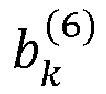
- x exp W k 6 h t 5 + b k 6 ⁇ j exp W j 6 h t 5 + b j 6 .
- W k 6 and b k 6 denote the k 'th column of the weight matrix and k 'th bias, respectively.
- a loss is calculated (120) to measure the error in prediction.
- CTC Connectionist Temporal Classification
- the gradient is evaluated (125) with respect to the network outputs given the ground-truth character sequence y. From this point, computing the gradient with respect to all of the model parameters may be done via back-propagation (130) through the rest of the network.
- Nesterov's Accelerated gradient method may be used for training, although other techniques may be employed.
- a momentum of 0.99 may be used and anneal the learning rate by a constant factor, chosen to yield the fastest convergence, after each epoch through the data.
- the model 205 comprises five (5) layers.
- the first three layers (first layer 210, second layer 215, and third layer 220) are non-recurrent layers, in which the input to the first layer 210 is the spectrogram frames x t 240 along with a context of C frames (e.g., C 245).
- the fourth layer 225 & 230 is a bi-directional recurrent network that comprises a set of hidden units with forward recurrence, h ( f ) 225 and a set of hidden units with backward recurrence, h ( b ) 230.
- the fifth layer 235 is a non-recurrent layer that receives as inputs the outputs of both the forward and backward units of the fourth layer 225 & 230, and outputs predicted character probabilities.
- LSTM cells require computing and storing multiple gating neuron responses at each step. Since the forward and backward recurrences are sequential, this small additional cost, in embodiments, may become a computational bottleneck.
- the computation of the recurrent activations are made efficient: computing the ReLu outputs involves only a few highly optimized Basic Linear Algebra Subprograms (BLAS) operations on the GPU and a single point-wise nonlinearity.
- BLAS Basic Linear Algebra Subprograms
- Embodiments of the models were trained using expanded datasets (embodiments of ways to generating datasets and expand datasets are discussed herein in Section 4), yet embodiments of the recurrent networks used herein are still adept at fitting the training data.
- several techniques may be employed.
- a dropout rate e.g., 5%
- dropout was applied in the feed-forward layers but not to the recurrent hidden activations.
- a commonly employed technique in computer vision during network evaluation is to randomly jitter inputs by translations or reflections, feed each jittered version through the network, and vote or average the results. This is not common in speech recognition, however; it was found that translating the raw audio files by 5 milliseconds (ms) (which represented half the filter bank step size used in embodiments herein) to the left and right, forward propagating the recomputed features, and averaging the results beneficial.
- ms milliseconds
- embodiments of the present invention include generating and using jitter sets of audio data.
- Figure 3 depicts a method for using jitter samples in training a model according to embodiments of the present invention.
- a jitter set of audio files for the audio file are generated (305) by translating an audio file by one or more time values. For example, the audio file may be moved by a few milliseconds (e.g., 5 ms) forward and back in time.
- the jitter set of audio files, including the corresponding original audio file are converted (310) into a set of spectrograms, which are inputted into a model or set of models.
- the output results from the model or set of models for the set of spectrograms are obtained (315).
- the output results for the set of spectrograms are blended (320) to obtain an output for the corresponding audio file.
- the blending may be done by averaging (e.g., taking a mean, median, or mode), weighted average, or voting.
- an ensemble of several RNNs may also be used.
- Using a set of models can achieve better results; however, there can be time shifts between the models.
- Figure 4 depicts methods for ensembling a set of neural network models according to embodiments of the present invention.
- issues of time shifts between neural network models when ensembling outputs of a set of neural network models may be addressed using one or more of the following approaches comprising: (a) using (405) neural network models that exhibit the same temporal shift; (b) shifting (410) the inputs into the various models to have aligned outputs; and (c) checking (415) alignment between output of models and shifting one or more of the outputs to align the outputs.
- the CTC loss function is agnostic to small time-shifts of the RNN output, and thus several equally good networks can yield shifted versions of essentially the same output probabilities. In isolation these networks perform well, but averaging the shifted probabilities no longer yields any variance reduction for estimates of and, in fact, usually causes performance to degrade. To resolve this, in embodiments, only models where the onset of the output transcriptions begin at the same time were combined. Though this could be achieved by shifting the outputs manually, enough networks have been trained that a collection with matching shifts is available for experiments.
- embodiments of the RNN model can learn to produce readable character-level transcriptions. Indeed for many of the transcriptions, the most likely character sequence predicted by embodiments of a trained RNN model is exactly correct without external language constraints. Errors made by the RNN tend to be phonetically plausible renderings of English words-Table 1 shows some examples. Table 1: Examples of transcriptions directly from an embodiment of a RNN (left) with errors that are fixed by addition of a language model (right). RNN Output Decoded Transcription what is the weather like in bostin right now what is the weather like in boston right now prime miniter nerenr modi prime minister narendra modi arther n tickets for the game are there any tickets for the game
- embodiments of the model include, or are integrated with, a language model.
- an N -gram language model is used since these models are easily trained from huge unlabeled text corpora.
- the N -gram language model used for the experiments in Section 6 is trained from a corpus of 220 million phrases, supporting a vocabulary of 495,000 words.
- Figure 5 depicts a method for constraining output of neural network model using a language model according to embodiments of the present invention.
- predicted character outputs, for an utterance, x are obtained (505).
- a search is performed (510) to find the sequence of characters c 1 , c 2 , ... that is most probable according to both the RNN output and the language model (where the language model interprets the string of characters as words).
- the aim is to find a sequence c that maximizes the combined objective:
- Q c log P c
- ⁇ and ⁇ are tunable parameters (set by cross-validation) that control the trade-off between the RNN, the language model constraint, and the length of the sentence.
- the term denotes the probability of the sequence c according to the N -gram model.
- this objective is maximized using a beam search algorithm, with a typical beam size in the range 1000-8000.
- one or more optimization may be employed to speed-up the operation of the model.
- Figure 6 depicts methods for improving performance of a neural network model according to embodiments of the present invention.
- one or more optimizations may be implemented (605) comprising: (a) one or more data parallelisms; (b) model parallelism; and (c) striding the input into the first layer of the model.
- embodiments include several design decisions to make the neural networks amenable to high speed execution, and thus fast training. For example, using homogeneous rectified linear networks that are simple to implement and depend on just a few highly-optimized BLAS calls helps the execution speed. When fully unrolled, embodiment of the networks include almost 5 billion connections for a typical utterance; and thus, efficient computation is important. In embodiments, multi-GPU training may be used but doing this effectively may require some additional work, as explained below.
- FIGS. 7A & 7B depict methods for data parallelization according to embodiments of the present invention.
- the GPU is most efficient when H t is relatively wide (e.g., 1000 examples or more), and thus it is preferred to process as many examples on one GPU as possible (e.g., up to the limit of GPU memory).
- each GPU combines (720) its computed gradient with its peers during each iteration.
- typically 2 ⁇ to 4 ⁇ data parallelism across GPUs were used for experiments by the inventors.
- Model parallelism Given multiples of the minibatch size (e.g., 2 to 4), but may face diminishing returns as batching more examples into a single gradient update fails to improve the training convergence rate. That is, processing 2 ⁇ as many examples on 2 ⁇ as many GPUs do not always yield a 2 ⁇ speedup in training. It can also be inefficient to fix the total minibatch size but spread out the examples to 2 ⁇ as many GPUs: as the minibatch within each GPU shrinks, most operations become memory-bandwidth limited. To scale further, in embodiments, parallelize by partitioning the model (“model parallelism") may be employed.
- Some embodiments of the model are challenging to parallelize due to the sequential nature of the recurrent layers. Since the bidirectional layer is comprised of a forward computation and a backward computation that are independent, it is possible to perform the two computations in parallel. Unfortunately, in embodiments, naively splitting the RNN to place h ( f ) and h ( b ) on separate GPUs involves significant data transfers when computing h (5) , which depends on both h ( f ) and h ( b ) . Thus, in embodiments, a different partitioning of work may be chosen that requires less communication for the models-the model may be divided in half along the time dimension.
- Figure 8 depicts a method for model parallelization according to embodiments of the present invention.
- the first GPU begins computing (805) the forward activations h ( f )
- the second begins computing (805) the backward activations h ( b ) .
- the two GPUs exchange (810) the intermediate activations, h T / 2 f and h T / 2 b and swap roles.
- the first GPU then finishes (815) the backward computation of h ( b ) and the second GPU finishes the forward computation of h ( f ) .
- embodiments of the present invention may include efforts to reduce the running time of the recurrent layers of embodiments of the RNN by taking "steps" (or strides).
- Figure 9 depicts a method for striding data according to embodiments of the present invention.
- processing time may be shorten for the recurrent layers by taking strides of a step size of q time slices (e.g., step size of 2) in the original input so that the unrolled RNN has fewer steps.
- This approach is similar to a convolutional network with a step-size of 2 in the first layer.
- the cuDNN library which is a set of optimized low-level primitives to boost the processing speed of deep neural networks (DNN) on CUDA®-compatible GPUs made by NVIDIA of Santa Clara, California, may be used to implement this first layer of convolution efficiently.
- speech data was recorded from paid volunteers through Amazon Mechanical Turk. Each volunteer (“Turker”) was instructed to read a short text prompt into a computer microphone. The recorded speech and matching text transcription were added to a dataset on the server. Since read speech created in this way sounds different from spontaneous speech heard in other contexts, Turkers were instructed to speak as naturally as possible. A separate team of trusted Turkers was occasionally tasked with quality control, verifying that recorded utterances and transcriptions matched. A cap on contributions of volunteers was enforced to ensure that the dataset contained a variety of speakers and was not overwhelmed by a few big contributors. In embodiments, noise was also played through the Turker's computer speakers or headset to induce the Lombard effect, which will be discussed in more detail below.
- Figure 10 depicts a method for collecting a set of noise audio clips according to embodiments of the present invention.
- a set of candidate "noise" clips are collected (1005), which may be collected from any of a number of sources, such as the Internet or other datasets.
- a candidate noise clip from the set of candidate noise clips may be selected (1010) for evaluation.
- a check is made (1015) to determine whether the candidate noise clip's average power in frequency bands differed significantly from average powers observed in real noise recordings. If the candidate noise clip's average powers in frequency bands differ significantly from average powers observed in real noise recordings, it is discarded (1030). If the candidate noise clip's average powers in frequency bands do not differ significantly from average powers observed in real noise recordings, it is added (1020) to a set of approved noise clips.
- Figure 11 depicts a method for generating synthesized noise samples according to embodiments of the present invention.
- one or more noise clips selected from the set of approved noise clips may be added (1105) together to form a noise track.
- the signal-to-noise ratio of the noise track is adjusted (1110) relative to an audio sample.
- the adjusted noise track is added (1115) to the audio sample to form a synthesized noise sample, and that synthesized noise sample is included (1120) in a set of training data.
- this process may be repeated (1125) until a satisfactory number of samples have been made, at which point the process ends (1130).
- FIG. 12 depicts a method for generating Lombard-Effect audio samples according to embodiments of the present invention.
- the person recording utterances is instructed to wear (1205) headphones.
- the Lombard Effect is intentionally induced during data collection by playing (1210) loud background noise through headphones worn by the person as they record an utterance.
- the noise induces them to inflect their voice, thus allowing for the capture (1215) of the Lombard Effect in training data.
- noise may also be played through speakers (and may be subtracted out of the captured audio); however, using headphones has the advantage that "clean" recordings without the background noise included are captures. Have clean recordings allows for other synthetic noise to be added afterwards.
- Figure 13 depicts methods for using a trained neural network model or set of neural network models according to embodiments of the present invention.
- an input audio is received (1305) from a user.
- the input audio may be normalized (1310) to make the total power consistent with the total power of training samples that were used to train the model or set of models.
- a jitter set of audio files may be generated (1315) from the normalized input audio by translating the normalized input audio by one or more time values.
- the jitter set of audio files may include the normalized input audio along with an audio file that is shifted by a few milliseconds forward in time and an audio file that is shifted by a few milliseconds backward in time.
- a set of spectrogram frames is generated (1320) by computing spectrograms of n linearly spaced log filter banks and an energy term from the jitter set of audio files, which includes the normalized input audio.
- the filter banks are computed over windows of p milliseconds (e.g., 20 ms) strided by q milliseconds (e.g., 10 ms).
- each of the spectrogram frame, x ( t ) , from the set of spectrogram frames is inputted (1325) into the trained neural network or networks.
- a spectrogram frame is input (1325) along with a context of C frames (e.g., 9 frames).
- the context of frames may be from one side of the spectrogram frame or from both sides.
- a plurality of trained neural networks are used and the predicted character probabilities outputs from the set of trained neural networks for the inputted spectrogram frames may be combined (1330), or ensembled, together. Ensembling may be performed using one or more of the methods described above with respect to Figure 4-although other methods may also be employed.
- a transcription of the input audio is obtained by decoding (1335) the ensemble predicted character probabilities outputs.
- the decoding processing may comprise using a trained N -gram language model to constrain, at a word level, the decoding of the ensemble predicted character probabilities outputs.
- Deep Speech embodiment Deep Speech model, Deep Speech network, Deep Speech system, or simply, Deep Speech
- Hub5'00 LDC2002S23
- the full set was used, which is the most challenging case and report the overall word error rate.
- the Deep Speech system was trained on only the 300 hour Switchboard conversational telephone speech dataset and trained on both Switchboard (SWB) and Fisher (FSH), a 2000 hour corpus collected in a similar manner as Switchboard. Many researchers evaluate models trained only with 300 hours from Switchboard conversational telephone speech when testing on Hub5'00. In part, this is because training on the full 2000 hour Fisher corpus is computationally difficult. Using the optimization techniques mentioned in Section 3, the Deep Speech system was able perform a full pass over the 2300 hours of data in just a few hours.
- Speaker adaptation can be important to the success of other current automatic speech recognition (ASR) systems, particularly when trained on 300 hour Switchboard.
- ASR automatic speech recognition
- a simple form of speaker adaptation was applied by normalizing the spectral features on a per speaker basis. Other than this, the input features were not modified in any way.
- the tested Deep Speech SWB model was a network of 5 hidden layers, each with 2048 neurons trained on only 300 hour switchboard.
- the Deep Speech SWB + FSH model was an ensemble of 5 RNNs, each with 5 hidden layers of 2304 neurons trained on the full 2300 hour combined corpus. All networks were trained on inputs of +/- 9 frames of context.
- the results are reported in Table 3.
- the model from Vesely et al. (DNN-HMM sMBR) used a sequence-based loss function on top of a DNN after using a typical hybrid DNN-HMM system to realign the training set.
- the performance of this model on the combined Hub5'00 test set was the best previously published result.
- the Deep Speech system improved upon this baseline by 1.9% absolute WER and 10.3% relative.
- the model from Maas et al. (DNN-HMM FSH) achieved 19.9% WER when trained on the Fisher 2000 hour corpus. That system was built using Kaldi, a state-of-the-art open source speech recognition software.
- Ref. B A. L. Maas, A. Y. Hannun, C. T. Lengerich, P. Qi, D. Jurafsky, and A. Y. Ng, "Increasing Deep Neural Network Acoustic Model Size for Large Vocabulary Continuous Speech Recognition," abs/1406.7806, 2014 (available at //arxiv.org/abs/1406.7806 ).
- the noise environments included a background radio or TV; washing dishes in a sink; a crowded cafeteria; a restaurant; and inside a car driving in the rain.
- the utterance text came primarily from web search queries and text messages, as well as news clippings, phone conversations, Internet comments, public speeches, and movie scripts. Precise control over the signal-to-noise ratio (SNR) of the noisy samples was not possible, but the SNR ratio target was between 6 and 2 dB.
- SNR signal-to-noise ratio
- embodiments of the RNNs were trained on all the datasets (more than 7000 hours) listed in Table 2. Since training was for 15 to 20 epochs with newly synthesized noise in each pass, the model learned from over 100,000 hours of novel data. Also, an ensemble of 6 networks, each with 5 hidden layers of 2560 neurons, was used. No form of speaker adaptation was applied to the training or evaluation sets. Training examples were normalized on a per utterance basis in order to make the total power of each example consistent. The features were 160 linearly spaced log filter banks computed over windows of 20 milliseconds strided by 10 milliseconds and an energy term. Audio files were resampled to 16 kHz prior to the featurization. Finally, from each frequency bin the experimenters removed the global mean over the training set and divided by the global standard deviation, primarily so the inputs are well scaled during the early stages of training.
- a 5-gram language model was used for the decoding.
- the language model was trained on 220 million phrases of the Common Crawl (available at commoncrawl.org), selected such that at least 95% of the characters of each phrase were in the alphabet. Only the most common 495,000 words were kept, the rest were remapped to an "UNKNOWN" token.
- the trained embodiment of the Deep Speech system was compared to several commercial speech systems: (1) wit.ai, (2) Google Speech API, (3) Bing Speech, and (4) Apple Dictation. Note that wit.ai and Google Speech each have HTTP-based APIs; to test Apple Dictation and Bing Speech, a kernel extension was used to loop audio output back to audio input and the OS X Dictation service as well as the Windows 8 Bing speech recognition API.
- ACM 2006
- CTC Connectionist Temporal Classification
- LSTM Long Short-Term Memory
- Embodiments presented herein similarly adopt the CTC loss for part of the training procedure but use much simpler recurrent networks with rectified-linear activations.
- Embodiment of the recurrent network may be considered to include some similarity to the bidirectional RNN used by Hannun et al. ( A. Y.
- novel disclosures herein provided novel and significant advances over the prior these approaches.
- novel systems and methods for creating, training, and using end-to-end deep learning-based speech systems capable of outperforming existing state-of-the-art recognition pipelines in at least two challenging scenarios: clear, conversational speech, and speech in noisy environments.
- Embodiments include multi-GPU training and also include unique data collection and synthesis strategies to build large training sets exhibiting the distortions systems should be able to handle (such as background noise and Lombard Effect).
- a computing system may include any instrumentality or aggregate of instrumentalities operable to compute, calculate, determine, classify, process, transmit, receive, retrieve, originate, route, store, display, communicate, manifest, detect, record, reproduce, handle, or utilize any form of information, intelligence, or data for business, scientific, control, or other purposes.
- a computing system may be a personal computer (e.g., desktop or laptop), tablet computer, mobile device (e.g., personal digital assistant (PDA) or smart phone), server (e.g., blade server or rack server), a network device, or any other suitable device and may vary in size, shape, performance, functionality, and price.
- PDA personal digital assistant
- the computing system may include random access memory (RAM), one or more processing resources such as a central processing unit (CPU) or hardware or software control logic, ROM, and/or other types of memory. Additional components of the computing system may include one or more disk drives, one or more network ports for communicating with external devices as well as various input and output (I/O) devices, such as a keyboard, a mouse, touchscreen and/or a video display.
- RAM random access memory
- processing resources such as a central processing unit (CPU) or hardware or software control logic, ROM, and/or other types of memory.
- Additional components of the computing system may include one or more disk drives, one or more network ports for communicating with external devices as well as various input and output (I/O) devices, such as a keyboard, a mouse, touchscreen and/or a video display.
- I/O input and output
- the computing system may also include one or more buses operable to transmit communications between the various hardware components.
- FIG 14 depicts a block diagram of a computing system 1400 according to embodiments of the present invention. It will be understood that the functionalities shown for the computing system 1400 may operate to support various embodiments of a computing system-although it shall be understood that a computing system may be differently configured and include different components.
- the computing system 1400 includes one or more central processing units (CPU) 1401 that provides computing resources and controls the computer. CPU 1401 may be implemented with a microprocessor or the like, and the computing system 1400 may also include one or more graphics processing units (GPU) 1417 and/or a floating point coprocessor for mathematical computations.
- the computing system 1400 may also include a system memory 1402, which may be in the form of random-access memory (RAM), read-only memory (ROM), or both.
- RAM random-access memory
- ROM read-only memory
- a number of controllers and peripheral devices may also be provided in the computing system 1400, as shown in Figure 14.
- An input controller 1403 represents an interface to various input device(s) 1404, such as a keyboard, mouse, or stylus.
- There may also be a scanner controller 1405, which communicates with a scanner 1406.
- the computing system 1400 may also include a storage controller 1407 for interfacing with one or more storage devices 1408 each of which includes a storage medium such as magnetic tape or disk, or an optical medium that might be used to record programs of instructions for operating systems, utilities, and applications, which may include embodiments of programs that implement various aspects of the present invention.
- Storage device(s) 1408 may also be used to store processed data or data to be processed in accordance with the invention.
- the computing system 1400 may also include a display controller 1409 for providing an interface to a display device 1411, which may be a cathode ray tube (CRT), a thin film transistor (TFT) display, or other type of display.
- the computing system 1400 may also include a printer controller 1412 for communicating with a printer 1413.
- a communications controller 1414 may interface with one or more communication devices 1415, which enables the computing system 1400 to connect to remote devices through any of a variety of networks including the Internet, an Ethernet cloud, an FCoE/DCB cloud, a local area network (LAN), a wide area network (WAN), a storage area network (SAN) or through any suitable electromagnetic carrier signals including infrared signals.
- bus 1416 which may represent more than one physical bus.
- various system components may or may not be in physical proximity to one another.
- input data and/or output data may be remotely transmitted from one physical location to another.
- programs that implement various aspects of this invention may be accessed from a remote location (e.g., a server) over a network.
- Such data and/or programs may be conveyed through any of a variety of machine-readable medium including, but are not limited to: magnetic media such as hard disks, floppy disks, and magnetic tape; optical media such as CD-ROMs and holographic devices; magneto-optical media; and hardware devices that are specially configured to store or to store and execute program code, such as application specific integrated circuits (ASICs), programmable logic devices (PLDs), flash memory devices, and ROM and RAM devices.
- ASICs application specific integrated circuits
- PLDs programmable logic devices
- flash memory devices ROM and RAM devices.
- Embodiments of the present invention may be encoded upon one or more non-transitory computer-readable media with instructions for one or more processors or processing units to cause steps to be performed.
- the one or more non-transitory computer-readable media shall include volatile and non-volatile memory.
- alternative implementations are possible, including a hardware implementation or a software/hardware implementation.
- Hardware-implemented functions may be realized using ASIC(s), programmable arrays, digital signal processing circuitry, or the like. Accordingly, the "means” terms in any claims are intended to cover both software and hardware implementations.
- the term "computer-readable medium or media” as used herein includes software and/or hardware having a program of instructions embodied thereon, or a combination thereof.
- embodiments of the present invention may further relate to computer products with a non-transitory, tangible computer-readable medium that have computer code thereon for performing various computer-implemented operations.
- the media and computer code may be those specially designed and constructed for the purposes of the present invention, or they may be of the kind known or available to those having skill in the relevant arts.
- Examples of tangible computer-readable media include, but are not limited to: magnetic media such as hard disks, floppy disks, and magnetic tape; optical media such as CD-ROMs and holographic devices; magneto-optical media; and hardware devices that are specially configured to store or to store and execute program code, such as application specific integrated circuits (ASICs), programmable logic devices (PLDs), flash memory devices, and ROM and RAM devices.
- ASICs application specific integrated circuits
- PLDs programmable logic devices
- flash memory devices and ROM and RAM devices.
- Examples of computer code include machine code, such as produced by a compiler, and files containing higher level code that are executed by a computer using an interpreter.
- Embodiments of the present invention may be implemented in whole or in part as machine-executable instructions that may be in program modules that are executed by a processing device.
- Examples of program modules include libraries, programs, routines, objects, components, and data structures. In distributed computing environments, program modules may be physically located in settings that are local, remote, or both.
Landscapes
- Engineering & Computer Science (AREA)
- Physics & Mathematics (AREA)
- Theoretical Computer Science (AREA)
- Computational Linguistics (AREA)
- Health & Medical Sciences (AREA)
- Artificial Intelligence (AREA)
- Evolutionary Computation (AREA)
- General Health & Medical Sciences (AREA)
- General Physics & Mathematics (AREA)
- Biophysics (AREA)
- Biomedical Technology (AREA)
- Molecular Biology (AREA)
- Computing Systems (AREA)
- General Engineering & Computer Science (AREA)
- Data Mining & Analysis (AREA)
- Mathematical Physics (AREA)
- Software Systems (AREA)
- Life Sciences & Earth Sciences (AREA)
- Audiology, Speech & Language Pathology (AREA)
- Human Computer Interaction (AREA)
- Acoustics & Sound (AREA)
- Multimedia (AREA)
- Machine Translation (AREA)
Description
- This application claims the priority benefit to commonly assigned and co-pending
U.S. Patent Application No. 14/735,002 U.S. Patent Application No. 62/092,251 U.S. Patent Application No. 62/093,057 - The present disclosure relates to data processing. More particularly, the present disclosure relates to systems and methods for improving the transcription of speech into text.
- Computing devices have become increasingly more prevalent. Computing devices are used in diverse ways, in diverse settings, and appear in diverse form factors. For example, computing devices are used in appliances (such as televisions, refrigerators, and thermostats) and in mobile devices (such as smart phones and tablets), and in wearable devices (such as smart watches).
- The ever-expanding form factors and uses of computing devices have also led to finding better ways to interface with these devices. Interface issues are particularly acute when dealing with computing devices that have limited space or limited input/output abilities.
- Also, regardless of the device's interface capabilities, there is always a need for improved interfaces. Making easier or more natural interfaces can provide a significant competitive advantage. One interface area that has undergone increased attention is the area of speech recognition.
- Top speech recognition systems typically rely on sophisticated pipelines composed of multiple algorithms and hand-engineered processing stages. Traditional speech systems use many heavily engineered processing stages, including specialized input features, acoustic models, and Hidden Markov Models (HMMs). To improve these pipelines, domain experts generally invest a great deal of effort tuning their features and models. The introduction of deep learning algorithms has improved speech system performance, usually by improving acoustic models. While this improvement has been significant, deep learning still plays only a limited role in traditional speech pipelines. As a result, to improve performance on a task such as recognizing speech in a noisy environment, one must laboriously engineer the rest of the system for robustness. Alex Graves et al. ("Towards End-to-End Speech Recognition with Recurrent Neural Networks", PROCEEDINGS OF THE 31ST INTERNATIONAL CONFERENCE ON MACHINE LEARNING, 1 January 2014 (2014-01-01), pages 1764-1772) disclose a speech recognition system that directly transcribes audio data with text, without requiring an intermediate phonetic representation. The system is based on a combination of the deep bidirectional LSTM recurrent neural network architecture and the Connectionist Temporal Classification objective function. A modification to the objective function is introduced that trains the network to minimise the expectation of an arbitrary transcription loss function. This allows a direct optimisation of the word error rate, even in the absence of a lexicon or language model. Ilya Sutskever et al. ("Sequence to Sequence Learning with Neural Networks", arXiv preprint, 10 September 2014 (2014-09-10)) disclose a general end-to-end approach to sequence learning that makes minimal assumptions on the sequence structure, which uses a multilayered Long Short-Term Memory (LSTM) to map the input sequence to a vector of a fixed dimensionality, and then another deep LSTM to decode the target sequence from the vector. Adam Coates et al. ("Deep learning with COTS HPC systems". Journal of Machine Learning Research, 21 June 2013 (2013-06-21), pages 1337-1345) disclose an own system based on Commodity Off-The-Shelf High Performance Computing (COTS HPC) technology: a cluster of GPU servers with Infiniband interconnects and MPI. Jeffrey Dean et al. ("Large scale distributed deep networks". The 26th annual conference on Neural Information Processing Systems (NIPS'25): 3-8 December 2012, 6 December 2012 (2012-12-06)) disclose a software framework called DistBelief that can utilize computing clusters with thousands of machines to train large models. Within this framework, Jeffrey Dean et al. have developed two algorithms for large-scale distributed training: (i) Downpour SGD, an asynchronous stochastic gradient descent procedure supporting a large number of model replicas, and (ii) Sandblaster, a framework that supports a variety of distributed batch optimization procedures, including a distributed implementation of L-BFGS. Sharan Chetlur et al. ("cuDNN: efficient primitives for deep learning", arXiv:1410.0759v3, 18 October 2014 (2014-10-18)) disclose a library similar in intent to BLAS, with optimized routines for deep learning workloads, which contains routines for GPUs, although similarly to the BLAS library, these routines could be implemented for other platforms.
- Accordingly, what is needed are systems and methods that provide improved speech-to-text conversion.
- The disclosure provides a computer-implemented method for training a transcription model, a computer-implemented method for transcribing speech, and a non-transitory computer-readable medium or media.
- In an aspect of the disclosure, the computer-implemented method for training a transcription model comprises: for each of a set of utterances: inputting an utterance that comprises a set of spectrogram frames into a first layer of the transcription model that evaluates each of the spectrogram frames from the set of spectrogram frames with a context of one or more spectrogram frames; outputting from the transcription model a predicted character or character probabilities for the utterance; and computing a loss to measure error in prediction for the utterance; evaluating a gradient of predicted outputs of the transcription model given the ground-truth characters; and updating the transcription model using back-propagation; the method further comprises: jittering at least some of the set of utterances prior to inputting into the first layer of the transcription model, comprising: generating a jitter set of utterances for an utterance by translating an audio file of the utterance by one or more time values, the one or more time values are half a filter bank step size; converting the jitter set of utterances and the utterance into a set of spectrograms; obtaining output results from the transcription model or from a set of transcription models for the set of spectrograms; and blending the output results for the set of spectrograms to obtain an output for the audio file.
- In another aspect of the disclosure, the computer-implemented method for transcribing speech comprises: receiving an input audio from a user; normalizing the input audio to make a total power of the input audio consistent with a total power of a set of training samples used to train a trained neural network model; generating a jitter set of audio files from the normalized input audio by translating the normalized input audio by one or more time values; for each audio file from the jitter set of audio files, which includes the normalized input audio: generating a set of spectrogram frames for each audio file; inputting the audio file along with a context of spectrogram frames into a trained neural network; obtaining predicted character probabilities outputs from the trained neural network; and decoding a transcription of the input audio using the predicted character probabilities outputs from the trained neural network constrained by a language model that interprets a string of characters from the predicted character probabilities outputs as a word or words; the one or more time values are half a filter bank step size; and the obtaining predicted character probabilities outputs from the trained neural network comprises: obtaining output results from the trained neural network for the set of spectrograms; and blending the output results for the set of spectrograms to obtain an output for the audio file.
- In still another aspect of the disclosure, the non-transitory computer-readable medium or media comprises one or more sequences of instructions which, when executed by one or more processors, causes the steps to be performed comprising: receiving an input audio from a user; generating a set of spectrogram frames from the audio file; inputting the audio file along with a context of spectrogram frames into a set of trained neural networks; obtaining predicted character probabilities outputs from the set of trained neural network; and decoding a transcription of the input audio using the predicted character probabilities outputs from the set of trained neural networks constrained by a language model that interprets a string of characters from the predicted character probabilities outputs as a word or words; the steps further comprise: generating a jitter set of audio files from the normalized input audio by translating the normalized input audio by one or more time values, the one or more time values are half a filter bank step size; and the obtaining predicted character probabilities outputs from the set of trained neural network comprises: obtaining output results from the trained neural network for the set of spectrograms; and blending the output results for the set of spectrograms to obtain an output for the audio file.
- References will be made to embodiments of the invention, examples of which may be illustrated in the accompanying figures. These figures are intended to be illustrative, not limiting. Although the invention is generally described in the context of these embodiments, it should be understood that it is not intended to limit the scope of the invention to these particular embodiments.
- Figure 1 ("FIG. 1") depicts methods for training a neural network model or set of neural network models according to embodiments of the present invention.
- FIG. 2 graphically represents a neural network model according to embodiments of the present invention.
- FIG. 3 depicts a method for using jitter samples in training a neural network model according to embodiments of the present invention.
- FIG. 4 depicts methods for ensembling a set of neural network models according to embodiments of the present invention.
- FIG. 5 depicts a method for constraining output of a neural network model using a language model according to embodiments of the present invention.
- FIG. 6 depicts methods for improving performance of a neural network model according to embodiments of the present invention.
- FIGS. 7A & 7B depict methods for data parallelization according to embodiments of the present invention.
- FIG. 8 depicts methods for model parallelization according to embodiments of the present invention.
- FIG. 9 depicts a method for striding data according to embodiments of the present invention.
- FIG. 10 depicts a method for collecting a set of noise audio clips according to embodiments of the present invention.
- FIG. 11 depicts a method for generating synthesized noise samples according to embodiments of the present invention.
- FIG. 12 depicts a method for generating Lombard-effect audio samples according to embodiments of the present invention.
- FIG. 13 depicts methods for using a trained neural network model or set of trained neural network models according to embodiments of the present invention.
- FIG. 14 depicts a simplified block diagram of a computing system according to embodiments of the present invention.
- In the following description, for purposes of explanation, specific details are set forth in order to provide an understanding of the invention. It will be apparent, however, to one skilled in the art that the invention can be practiced without these details. Furthermore, one skilled in the art will recognize that embodiments of the present invention, described below, may be implemented in a variety of ways, such as a process, an apparatus, a system, a device, or a method on a tangible computer-readable medium.
- Components, or modules, shown in diagrams are illustrative of exemplary embodiments of the invention and are meant to avoid obscuring the invention. It shall also be understood that throughout this discussion that components may be described as separate functional units, which may comprise sub-units, but those skilled in the art will recognize that various components, or portions thereof, may be divided into separate components or may be integrated together, including integrated within a single system or component. It should be noted that functions or operations discussed herein may be implemented as components. Components may be implemented in software, hardware, or a combination thereof.
- Furthermore, connections between components or systems within the figures are not intended to be limited to direct connections. Rather, data between these components may be modified, re-formatted, or otherwise changed by intermediary components. Also, additional or fewer connections may be used. It shall also be noted that the terms "coupled," "connected," or "communicatively coupled" shall be understood to include direct connections, indirect connections through one or more intermediary devices, and wireless connections.
- Reference in the specification to "one embodiment," "preferred embodiment," "an embodiment," or "embodiments" means that a particular feature, structure, characteristic, or function described in connection with the embodiment is included in at least one embodiment of the invention and may be in more than one embodiment. Also, the appearances of the above-noted phrases in various places in the specification are not necessarily all referring to the same embodiment or embodiments. Furthermore, the use of certain terms in various places in the specification is for illustration and should not be construed as limiting. Any headings used herein are for organizational purposes only and shall not be used to limit the scope of the description or the claims.
- Furthermore, it shall be noted that: (1) certain steps may optionally be performed; (2) steps may not be limited to the specific order set forth herein; (3) certain steps may be performed in different orders; and (4) certain steps may be done concurrently.
- Presented herein are embodiments of an end-to-end speech systems, which may be referred to herein as "Deep Speech," where deep learning supersedes the multiple algorithms and hand-engineered processing stages of prior approaches. In embodiments, this approach, combined with a language model, achieves higher performance than traditional methods on hard speech recognition tasks while also being much simpler. In embodiments, these results may be achieved by training a large recurrent neural network (RNN) using multiple graphics processing units (GPUs) and thousands of hours of data. Because embodiments of this system learn directly from data, specialized components for speaker adaptation or noise filtering are not required. In fact, in settings where robustness to speaker variation and noise are critical, embodiments of the present invention excels: as discussed further herein, Deep Speech outperforms previously published methods on the Switchboard Hub5'00 corpus, achieving 16.5% error, and performs better than commercial systems in noisy speech recognition tests.
- It should be noted that tapping the benefits of end-to-end deep learning, however, poses several challenges: (i) innovative ways were found to build large, labeled training sets, and (ii) ways were found to train networks that were large enough to effectively utilize all of this data. One challenge for handling labeled data in speech systems is finding the alignment of text transcripts with input speech. This problem has been previously addressed, thus enabling neural networks to easily consume unaligned, transcribed audio during training. Meanwhile, approaches for rapid training of large neural networks have been suggested, demonstrating the speed advantages of multi-GPU computation. In embodiments, these insights are leveraged to fulfill the vision of a generic learning system, based on large speech datasets and scalable RNN training, that can surpass more complicated traditional methods. This vision is inspired partly by the work that applied early unsupervised feature learning techniques to replace hand-built speech features.
- In embodiments, a recurrent neural network (RNN) model was developed specifically to map well to GPUs. And, in embodiments, a novel model partition scheme may be employed to improve parallelization. Additionally, in embodiments, processes were developed for assembling large quantities of labeled speech data exhibiting the distortions that systems should learn to handle. Using a combination of collected and synthesized data, embodiments of systems disclosed herein learned robustness to realistic noise and speaker variation (including Lombard Effect). These ideas built into embodiments of an end-to-end speech system yielded a system that is at once simpler than traditional pipelines yet also performs better on difficult speech tasks. An embodiment of the Deep Speech system achieved an error rate of 16.5% on the full Switchboard Hub5'00 test set-the best published result. Further, on a new noisy speech recognition dataset of the inventors' own construction, an embodiment of the Deep Speech system achieved a word error rate of 19.1%, where the best commercial systems achieved 30.5% error.
- Presented herein are embodiments of novel speech recognition systems and novel methods for training and for using the systems. Presented below are, first, embodiments of a recurrent neural network model and training framework, followed by a discussion of embodiments of optimizations, and embodiments of data capture and synthesis. Finally, usage and experimental results are presented that demonstrate the state-of-the-art performance of embodiments of a Deep Speech system.
- In embodiments, a recurrent neural network (RNN) is trained to ingest speech spectrograms and generate English text transcriptions. Let a single utterance x and label y be sampled from a training set:

- Each utterance, x (i), is a time-series of length T (i) where every time-slice is a vector of audio features,


- Figure 1 depicts methods for training a neural network model or set of neural network models according to embodiments of the present invention. In embodiments, an utterance, x, that comprises a time-series of spectrogram frames, x (t), is inputted (105) into a first layer of a recurrent neural network (RNN) model that evaluates at least some of the spectrogram frames with a context of C frames, wherein the utterance, x, has an associated ground-truth, or known, label, y.
- In embodiments, the RNN model may comprise five (5) layers of hidden units. For an input x, the hidden units at layer l are denoted h (l) with the convention that h (0) is the input. In embodiments, the first three layers are not recurrent. For the first layer, at each time t, the output depends on the spectrogram frame xt along with a context of C frames, which may be a context from one side or both sides. Thus, in embodiments, a context may comprise one or more spectrogram frames which occur before a spectrogram frame, after the frame, or both. It shall be noted that, in embodiments, if the spectrogram frame xt is at the edge of the clip, the context may be from one side or may have data added to the missing side. In embodiments, the context of frames may be C ∈ {5, 7, 9}, although other numbers of frames may be used.
- In embodiments, the RNN model calculates (110) through a plurality of hidden layers. For example, in embodiments, the remaining non-recurrent layers operate on independent data for each time step. Thus, for each time t, the first three (3) layers are computed by:

where g(z) = min{max{0, z}, 20} is the clipped rectified-linear (ReLu) activation function and W (l), b (l) are the weight matrix and bias parameters for layer l, respectively. It shall be noted that other activation functions may be employed. In embodiments, the ReLu units are clipped to keep the activations in the recurrent layer from exploding; in practice the units rarely saturate at the upper bound. - In embodiments, the fourth layer is a bi-directional recurrent network. In embodiments, this layer includes two sets of hidden units: a set with forward recurrence, h (f), and a set with backward recurrence h (b):


- Note that, in embodiments, h (f) is computed sequentially from t = 1 to t = T (i) for the i'th utterance, while the units h (b) is computed sequentially in reverse from t = T (i) to t = 1.
- In embodiments, a fifth (non-recurrent) layer takes both the forward and backward units as inputs:

- In embodiments, the output layer is a standard softmax function that yields (115) the predicted character probabilities for each time slice t and character k in the alphabet:

- Here

- Once a prediction forhas been computed (115), a loss is calculated (120) to measure the error in prediction. In embodiments, a Connectionist Temporal Classification (CTC) loss,
 may be used to measure the error in prediction, although other error measurement techniques may be employed. During training, the gradient
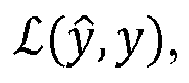 is evaluated (125) with respect to the network outputs given the ground-truth character sequence y. From this point, computing the gradient with respect to all of the model parameters may be done via back-propagation (130) through the rest of the network. In embodiments, Nesterov's Accelerated gradient method may be used for training, although other techniques may be employed. In embodiments, a momentum of 0.99 may be used and anneal the learning rate by a constant factor, chosen to yield the fastest convergence, after each epoch through the data.
- An embodiment of the complete RNN model is illustrated in Figure 2. As shown in the graphical representation of an embodiment of the RNN model, the model 205 comprises five (5) layers. The first three layers (first layer 210, second layer 215, and third layer 220) are non-recurrent layers, in which the input to the first layer 210 is the spectrogram frames xt 240 along with a context of C frames (e.g., C 245). The fourth layer 225 & 230 is a bi-directional recurrent network that comprises a set of hidden units with forward recurrence, h (f) 225 and a set of hidden units with backward recurrence, h (b) 230. Finally, as shown in Figure 2, the fifth layer 235 is a non-recurrent layer that receives as inputs the outputs of both the forward and backward units of the fourth layer 225 & 230, and outputs predicted character probabilities.
- It shall be noted that the structure depicted in Figure 2 is considerably simpler than other neural network models-the depicted embodiment has been limited to a single recurrent layer (which is the hardest to parallelize), and the model does not use Long-Short-Term-Memory (LSTM) circuits.
- One disadvantage of LSTM cells is that they require computing and storing multiple gating neuron responses at each step. Since the forward and backward recurrences are sequential, this small additional cost, in embodiments, may become a computational bottleneck. By using a homogeneous model in embodiments, the computation of the recurrent activations are made efficient: computing the ReLu outputs involves only a few highly optimized Basic Linear Algebra Subprograms (BLAS) operations on the GPU and a single point-wise nonlinearity.
- Embodiments of the models were trained using expanded datasets (embodiments of ways to generating datasets and expand datasets are discussed herein in Section 4), yet embodiments of the recurrent networks used herein are still adept at fitting the training data. In embodiments, to reduce variance further, several techniques may be employed. In embodiments, during training, a dropout rate (e.g., 5%) was applied. In embodiments, dropout was applied in the feed-forward layers but not to the recurrent hidden activations.
- A commonly employed technique in computer vision during network evaluation is to randomly jitter inputs by translations or reflections, feed each jittered version through the network, and vote or average the results. This is not common in speech recognition, however; it was found that translating the raw audio files by 5 milliseconds (ms) (which represented half the filter bank step size used in embodiments herein) to the left and right, forward propagating the recomputed features, and averaging the results beneficial.
- Accordingly, embodiments of the present invention include generating and using jitter sets of audio data. Figure 3 depicts a method for using jitter samples in training a model according to embodiments of the present invention. In embodiments, a jitter set of audio files for the audio file are generated (305) by translating an audio file by one or more time values. For example, the audio file may be moved by a few milliseconds (e.g., 5 ms) forward and back in time. The jitter set of audio files, including the corresponding original audio file, are converted (310) into a set of spectrograms, which are inputted into a model or set of models. In embodiments, the output results from the model or set of models for the set of spectrograms are obtained (315). The output results for the set of spectrograms are blended (320) to obtain an output for the corresponding audio file. In embodiments, the blending may be done by averaging (e.g., taking a mean, median, or mode), weighted average, or voting.
- In embodiments, at test time, an ensemble of several RNNs, averaging probabilities prior to decoding, may also be used. Using a set of models can achieve better results; however, there can be time shifts between the models. Figure 4 depicts methods for ensembling a set of neural network models according to embodiments of the present invention. As shown in Figure 4, issues of time shifts between neural network models when ensembling outputs of a set of neural network models may be addressed using one or more of the following approaches comprising: (a) using (405) neural network models that exhibit the same temporal shift; (b) shifting (410) the inputs into the various models to have aligned outputs; and (c) checking (415) alignment between output of models and shifting one or more of the outputs to align the outputs.
- For example, it should be noted that naive averaging of the RNN output probabilities may fail in a subtle way. In embodiments, the CTC loss function is agnostic to small time-shifts of the RNN output, and thus several equally good networks can yield shifted versions of essentially the same output probabilities. In isolation these networks perform well, but averaging the shifted probabilities no longer yields any variance reduction for estimates ofand, in fact, usually causes performance to degrade. To resolve this, in embodiments, only models where the onset of the output transcriptions begin at the same time were combined. Though this could be achieved by shifting the outputs manually, enough networks have been trained that a collection with matching shifts is available for experiments.

- When trained from large quantities of labeled speech data, embodiments of the RNN model can learn to produce readable character-level transcriptions. Indeed for many of the transcriptions, the most likely character sequence predicted by embodiments of a trained RNN model is exactly correct without external language constraints. Errors made by the RNN tend to be phonetically plausible renderings of English words-Table 1 shows some examples.
Table 1: Examples of transcriptions directly from an embodiment of a RNN (left) with errors that are fixed by addition of a language model (right). RNN Output Decoded Transcription what is the weather like in bostin right now what is the weather like in boston right now prime miniter nerenr modi prime minister narendra modi arther n tickets for the game are there any tickets for the game - Many of the errors occur on words that rarely or never appear in the training set. In practice, this is hard to avoid: training from enough speech data to hear all of the words or language constructions that the model might need to know is impractical. Therefore, embodiments of the model include, or are integrated with, a language model. In embodiments, an N-gram language model is used since these models are easily trained from huge unlabeled text corpora. For comparison, while our speech datasets typically include up to 3 million utterances, the N-gram language model used for the experiments in Section 6 is trained from a corpus of 220 million phrases, supporting a vocabulary of 495,000 words.
- Figure 5 depicts a method for constraining output of neural network model using a language model according to embodiments of the present invention. In embodiments, predicted character outputs,for an utterance, x, are obtained (505). Given the output
 of the RNN model or models, a search is performed (510) to find the sequence of characters c 1, c 2, ... that is most probable according to both the RNN output and the language model (where the language model interprets the string of characters as words). In embodiments, the aim is to find a sequence c that maximizes the combined objective:

where α and β are tunable parameters (set by cross-validation) that control the trade-off between the RNN, the language model constraint, and the length of the sentence. The termdenotes the probability of the sequence c according to the N-gram model. In embodiments, this objective is maximized using a beam search algorithm, with a typical beam size in the range 1000-8000.
- In embodiments, one or more optimization may be employed to speed-up the operation of the model. Figure 6 depicts methods for improving performance of a neural network model according to embodiments of the present invention. In embodiments, one or more optimizations may be implemented (605) comprising: (a) one or more data parallelisms; (b) model parallelism; and (c) striding the input into the first layer of the model.
- As noted previously, embodiments include several design decisions to make the neural networks amenable to high speed execution, and thus fast training. For example, using homogeneous rectified linear networks that are simple to implement and depend on just a few highly-optimized BLAS calls helps the execution speed. When fully unrolled, embodiment of the networks include almost 5 billion connections for a typical utterance; and thus, efficient computation is important. In embodiments, multi-GPU training may be used but doing this effectively may require some additional work, as explained below.
- In embodiments, to help process data efficiently, two levels of data parallelism may be used in which sets of data may be concurrently processed. Figures 7A & 7B depict methods for data parallelization according to embodiments of the present invention.
- First, as depicted in Figure 7A, each GPU may process (705) many examples in parallel. In embodiments, this may be done by concatenating many examples into a single matrix. For instance, rather than performing a single matrix-vector multiplication Wrht in the recurrent layer, many may be done in parallel by computing WrHt , where Ht =


- Second, when it is desired to use larger minibatches, or sets of data, than a single GPU can support on its own, data parallelism across multiple GPUs may be used, as illustrated in Figure 7B.
- As shown in Figure 7B, copies of the model are used (715) on different GPUs, with each GPU processing a separate minibatch of examples. Then, in embodiments, each GPU combines (720) its computed gradient with its peers during each iteration. In embodiments, typically 2× to 4× data parallelism across GPUs were used for experiments by the inventors.
- Data parallelism is not easily implemented, however, when utterances have different lengths since they cannot be combined into a single matrix multiplication. In embodiments, this problem was resolved by sorting training examples by length and combining only similarly-sized utterances into minibatches, padding with silence when necessary so that all utterances in a batch have the same length.
- Data parallelism yields training speed-ups for modest multiples of the minibatch size (e.g., 2 to 4), but may face diminishing returns as batching more examples into a single gradient update fails to improve the training convergence rate. That is, processing 2× as many examples on 2× as many GPUs do not always yield a 2× speedup in training. It can also be inefficient to fix the total minibatch size but spread out the examples to 2× as many GPUs: as the minibatch within each GPU shrinks, most operations become memory-bandwidth limited. To scale further, in embodiments, parallelize by partitioning the model ("model parallelism") may be employed.
- Some embodiments of the model are challenging to parallelize due to the sequential nature of the recurrent layers. Since the bidirectional layer is comprised of a forward computation and a backward computation that are independent, it is possible to perform the two computations in parallel. Unfortunately, in embodiments, naively splitting the RNN to place h (f) and h (b) on separate GPUs involves significant data transfers when computing h (5), which depends on both h (f) and h (b). Thus, in embodiments, a different partitioning of work may be chosen that requires less communication for the models-the model may be divided in half along the time dimension.
- Figure 8 depicts a method for model parallelization according to embodiments of the present invention. In embodiments, all layers except the recurrent layer may be trivially decomposed along the time dimension, with the first half of the time-series, from t = 1 to t = T (i)/2, assigned to one GPU and the second half to another GPU. In embodiments, when computing the recurrent layer activations, the first GPU begins computing (805) the forward activations h (f), while the second begins computing (805) the backward activations h (b). At the mid-point (t = T (i)/2), the two GPUs exchange (810) the intermediate activations,


- Because the recurrent layers are the hardest to parallelize, embodiments of the present invention may include efforts to reduce the running time of the recurrent layers of embodiments of the RNN by taking "steps" (or strides). Figure 9 depicts a method for striding data according to embodiments of the present invention.
- As shown in Figure 9, processing time may be shorten for the recurrent layers by taking strides of a step size of q time slices (e.g., step size of 2) in the original input so that the unrolled RNN has fewer steps. This approach is similar to a convolutional network with a step-size of 2 in the first layer. In embodiments, the cuDNN library, which is a set of optimized low-level primitives to boost the processing speed of deep neural networks (DNN) on CUDA®-compatible GPUs made by NVIDIA of Santa Clara, California, may be used to implement this first layer of convolution efficiently.
- Large-scale deep learning systems require an abundance of labeled data. For training embodiments of the system, many recorded utterances and corresponding English transcriptions are needed, but there are few public datasets of sufficient scale. To train embodiments of the models, an extensive dataset consisting of 5000 hours of read speech from 9600 speakers was collected. For comparison, Table 2 summarizes the labeled datasets that are available.
Table 2: A summary of the datasets used to train embodiment of Deep Speech. The Wall Street Journal, Switchboard, and Fisher corpora (see, C. Cieri, D. Miller, and K. Walker, "The Fisher corpus: a Resource for the Next Generations of Speech-to-Text," in Language Resources and Evaluation Conference (LREC), volume 4, pages 69-71, 2004, which is incorporated by reference herein in its entirety) are all published by the Linguistic Data Consortium. Dataset Type Hours Speakers WSJ read 80 280 Switchboard conversational 300 4000 Fisher conversational 2000 23000 Baidu read 5000 9600 - In embodiments, speech data was recorded from paid volunteers through Amazon Mechanical Turk. Each volunteer ("Turker") was instructed to read a short text prompt into a computer microphone. The recorded speech and matching text transcription were added to a dataset on the server. Since read speech created in this way sounds different from spontaneous speech heard in other contexts, Turkers were instructed to speak as naturally as possible. A separate team of trusted Turkers was occasionally tasked with quality control, verifying that recorded utterances and transcriptions matched. A cap on contributions of volunteers was enforced to ensure that the dataset contained a variety of speakers and was not overwhelmed by a few big contributors. In embodiments, noise was also played through the Turker's computer speakers or headset to induce the Lombard effect, which will be discussed in more detail below.
- In embodiments, to expand the potential training data even further, data synthesis was used. In embodiments, a goal was to improve performance in noisy environments where existing systems breakdown. Capturing labeled data (e.g., read speech) from noisy environments is not practical, however, and thus other ways, which are disclosed herein, were found to generate such data.
- To a first order, audio signals are generated through a process of superposition of source signals. This fact was used to synthesize noisy training data. For example, given a speech audio track x (i) and a "noise" audio track ξ (i), then a "noisy speech" track may be formed by x̂ (i) = x (i) + ξ (i) to simulate audio captured in a noisy environment. In embodiments, reverberations, echoes, or other forms of damping may be added to the power spectrum of x (i), ξ (i), or both and then added together to make fairly realistic audio scenes.
- It should be noted that there are, however, some risks in this approach. For example, in order to take 1000 hours clean speech and create 1000 hours noisy speech, unique noise tracks spanning roughly 1000 hours would normally be needed. It is not preferred to settle for, say, 10 hours of repeating noise, since it may become possible for the recurrent network to memorize the noise track and "subtract" it out of the synthesized data. Thus, instead of using a single noise source ξ (i) with a length of 1000 hours, in embodiments, a large number of shorter clips (which are easier to collect from public video sources) may instead be used and treat them as separate sources of noise before superimposing of them:

- Figure 10 depicts a method for collecting a set of noise audio clips according to embodiments of the present invention. In embodiments, a set of candidate "noise" clips are collected (1005), which may be collected from any of a number of sources, such as the Internet or other datasets.
- When superimposing many signals collected from audio or video clips, one can end up with "noise" sounds that are different from the kinds of noise recorded in real environments. To ensure a good match between synthetic data and real data, any candidate noise clips where the average power in each frequency band differed significantly from the average power observed in real noisy recordings may be rejected. Thus, in embodiments, a candidate noise clip from the set of candidate noise clips may be selected (1010) for evaluation. A check is made (1015) to determine whether the candidate noise clip's average power in frequency bands differed significantly from average powers observed in real noise recordings. If the candidate noise clip's average powers in frequency bands differ significantly from average powers observed in real noise recordings, it is discarded (1030). If the candidate noise clip's average powers in frequency bands do not differ significantly from average powers observed in real noise recordings, it is added (1020) to a set of approved noise clips.
- In embodiments, a determination is made (1025) whether there are more candidate noise clips to evaluate. If there are one or more candidate noise clips to evaluate, the process (steps 1010 - 1020) may be repeated. However, if there are not any more candidate noise clips to evaluate, the process ends (1035).
- Given the set of approved noise clips, a set of synthesized noise may be generated. Figure 11 depicts a method for generating synthesized noise samples according to embodiments of the present invention. In embodiments, one or more noise clips selected from the set of approved noise clips may be added (1105) together to form a noise track. In embodiments, the signal-to-noise ratio of the noise track is adjusted (1110) relative to an audio sample. The adjusted noise track is added (1115) to the audio sample to form a synthesized noise sample, and that synthesized noise sample is included (1120) in a set of training data. In embodiments, this process may be repeated (1125) until a satisfactory number of samples have been made, at which point the process ends (1130).
- One challenging effect encountered by speech recognition systems in noisy environments is the "Lombard Effect," in which speakers actively change the pitch or inflections of their voice to overcome noise around them. This (involuntary) effect does not show up in recorded speech datasets since they are collected in quiet environments. To ensure that the effect is represented in training data used in embodiments herein, the Lombard effect was intentionally induced during data collection. Figure 12 depicts a method for generating Lombard-Effect audio samples according to embodiments of the present invention.
- As depicted in the Figure 12, the person recording utterances is instructed to wear (1205) headphones. Then, the Lombard Effect is intentionally induced during data collection by playing (1210) loud background noise through headphones worn by the person as they record an utterance. The noise induces them to inflect their voice, thus allowing for the capture (1215) of the Lombard Effect in training data. It shall be noted that noise may also be played through speakers (and may be subtracted out of the captured audio); however, using headphones has the advantage that "clean" recordings without the background noise included are captures. Have clean recordings allows for other synthetic noise to be added afterwards.
- Figure 13 depicts methods for using a trained neural network model or set of neural network models according to embodiments of the present invention. In embodiments, an input audio is received (1305) from a user. As depicted in Figure 13, in embodiments, the input audio may be normalized (1310) to make the total power consistent with the total power of training samples that were used to train the model or set of models.
- In embodiments, a jitter set of audio files may be generated (1315) from the normalized input audio by translating the normalized input audio by one or more time values. For example, the jitter set of audio files may include the normalized input audio along with an audio file that is shifted by a few milliseconds forward in time and an audio file that is shifted by a few milliseconds backward in time.
- In embodiments, a set of spectrogram frames is generated (1320) by computing spectrograms of n linearly spaced log filter banks and an energy term from the jitter set of audio files, which includes the normalized input audio. In embodiments, the filter banks are computed over windows of p milliseconds (e.g., 20 ms) strided by q milliseconds (e.g., 10 ms).
- In embodiments, each of the spectrogram frame, x (t) , from the set of spectrogram frames is inputted (1325) into the trained neural network or networks. In embodiments, a spectrogram frame is input (1325) along with a context of C frames (e.g., 9 frames). The context of frames may be from one side of the spectrogram frame or from both sides.
- In embodiments, a plurality of trained neural networks are used and the predicted character probabilities outputs from the set of trained neural networks for the inputted spectrogram frames may be combined (1330), or ensembled, together. Ensembling may be performed using one or more of the methods described above with respect to Figure 4-although other methods may also be employed.
- Finally, in embodiments, a transcription of the input audio is obtained by decoding (1335) the ensemble predicted character probabilities outputs. In embodiments, the decoding processing may comprise using a trained N-gram language model to constrain, at a word level, the decoding of the ensemble predicted character probabilities outputs.
- Two sets of experiments were performed to evaluate embodiments of the model system. In both cases, an embodiment of the model as described in Section B was trained from a selection of the datasets in Table 2 to predict character-level transcriptions. The predicted probability vectors and language model were then fed into a decoder to yield a word-level transcription, which was compared with the ground truth transcription to yield the word error rate (WER). It shall be noted that these experiments and results are provided by way of illustration and were performed under specific conditions using an embodiment of the present invention; accordingly, neither these experiments nor their results shall be used to limit the scope of the present invention.
- To compare an embodiment system of the present invention (which may be referred to herein as the Deep Speech embodiment, Deep Speech model, Deep Speech network, Deep Speech system, or simply, Deep Speech) to prior research, an accepted but highly challenging test set, Hub5'00 (LDC2002S23), was used. Some researchers split this set into "easy" (Switchboard) and "hard" (CallHome) instances, often reporting new results on the easier portion alone. In the experiments presented herein, the full set was used, which is the most challenging case and report the overall word error rate.
- The Deep Speech system was trained on only the 300 hour Switchboard conversational telephone speech dataset and trained on both Switchboard (SWB) and Fisher (FSH), a 2000 hour corpus collected in a similar manner as Switchboard. Many researchers evaluate models trained only with 300 hours from Switchboard conversational telephone speech when testing on Hub5'00. In part, this is because training on the full 2000 hour Fisher corpus is computationally difficult. Using the optimization techniques mentioned in Section 3, the Deep Speech system was able perform a full pass over the 2300 hours of data in just a few hours.
- Since the Switchboard and Fisher corpora are distributed at a sample rate of 8kHz, spectrograms of 80 linearly spaced log filter banks and an energy term were computed. The filter banks were computed over windows of 20 ms strided by 10 ms. More sophisticated features, such as the mel-scale log filter banks or the mel-frequency cepstral coefficients, were not evaluated.
- Speaker adaptation can be important to the success of other current automatic speech recognition (ASR) systems, particularly when trained on 300 hour Switchboard. For the models tested on Hub5'00, a simple form of speaker adaptation was applied by normalizing the spectral features on a per speaker basis. Other than this, the input features were not modified in any way.
- For decoding, a 4-gram language model with a 30,000 word vocabulary trained on the Fisher and Switchboard transcriptions was used. Hyperparameters for the decoding objective were chosen via cross-validation on a held-out development set.
- The tested Deep Speech SWB model was a network of 5 hidden layers, each with 2048 neurons trained on only 300 hour switchboard. The Deep Speech SWB + FSH model was an ensemble of 5 RNNs, each with 5 hidden layers of 2304 neurons trained on the full 2300 hour combined corpus. All networks were trained on inputs of +/- 9 frames of context.
- The results are reported in Table 3. The model from Vesely et al. (DNN-HMM sMBR) used a sequence-based loss function on top of a DNN after using a typical hybrid DNN-HMM system to realign the training set. The performance of this model on the combined Hub5'00 test set was the best previously published result. When trained on the combined 2300 hours of data, the Deep Speech system improved upon this baseline by 1.9% absolute WER and 10.3% relative. The model from Maas et al. (DNN-HMM FSH) achieved 19.9% WER when trained on the Fisher 2000 hour corpus. That system was built using Kaldi, a state-of-the-art open source speech recognition software. This result was included to demonstrate that Deep Speech, when trained on a comparable amount of data, is competitive with the best existing ASR systems.
Table 3: Published error rates (%WER) on Switchboard dataset splits. The columns labeled "SWB" and "CH" are respectively the easy and hard subsets of Hub5'00. Model SWB CH Full Vesely et al. (GMM-HMM BMMI) [Ref. A] 18.6 33.0 25.8 Vesely et al. (DNN-HMM sMBR) [Ref. A] 12.6 24.1 18.4 Maas et al. (DNN-HMM SWB) [Ref. B] 14.6 26.3 20.5 Maas et al. (DNN-HMM FSH) [Ref. B] 16.0 23.7 19.9 Seide et al. (CD-DNN) [Ref. C] 16.1 n/a n/a Kingsbury et al. (DNN-HMM sMBR HF) [Ref. D] 13.3 n/a n/a Sainath et al. (CNN-HMM) [Ref. E] 11.5 n/a n/a Deep Speech SWB 20.0 31.8 25.9 Deep Speech SWB + FSH 13.1 19.9 16.5 - Ref. A: K. Vesely, A. Ghoshal, L. Burget, and D. Povey, "Sequence-Discriminative Training of Deep Neural Networks," in Proc. of Interspeech 2013, Lyon, France, Aug. 2013, pp. 2345-2349.
- Ref. B: A. L. Maas, A. Y. Hannun, C. T. Lengerich, P. Qi, D. Jurafsky, and A. Y. Ng, "Increasing Deep Neural Network Acoustic Model Size for Large Vocabulary Continuous Speech Recognition," abs/1406.7806, 2014 (available at //arxiv.org/abs/1406.7806).
- Ref. C: F. Seide, G. Li, X. Chen, D. Yu, "Feature Engineering in Context-Dependent Deep Neural Networks for Conversational Speech Transcription," in Proc. of IEEE Workshop on Automatic Speech Recognition and Understanding (ASRU) (Waikoloa, HI, USA, 11 December 2011), pp. 24-29.
- Ref. D: B. Kingsbury, T. N. Sainath, and H. Soltau, "Scalable Minimum Bayes Risk Training of Deep Neural Network Acoustic Models Using Distributed Hessian-free Optimization," in Proc. INTERSPEECH, September 2012.
- Ref. E: T. N. Sainath, A.-R. Mohamed, B. Kingsbury, and B. Ramabhadran, " Deep convolutional neural networks for LVCSR," in 2013 IEEE International Conference on Acoustics, Speech and Signal Processing (ICASSP), 201.
- Few standards exist for testing noisy speech performance, so an evaluation set of 100 noisy and 100 noise-free utterances from 10 speakers was constructed. The noise environments included a background radio or TV; washing dishes in a sink; a crowded cafeteria; a restaurant; and inside a car driving in the rain. The utterance text came primarily from web search queries and text messages, as well as news clippings, phone conversations, Internet comments, public speeches, and movie scripts. Precise control over the signal-to-noise ratio (SNR) of the noisy samples was not possible, but the SNR ratio target was between 6 and 2 dB.
- For the following experiments, embodiments of the RNNs were trained on all the datasets (more than 7000 hours) listed in Table 2. Since training was for 15 to 20 epochs with newly synthesized noise in each pass, the model learned from over 100,000 hours of novel data. Also, an ensemble of 6 networks, each with 5 hidden layers of 2560 neurons, was used. No form of speaker adaptation was applied to the training or evaluation sets. Training examples were normalized on a per utterance basis in order to make the total power of each example consistent. The features were 160 linearly spaced log filter banks computed over windows of 20 milliseconds strided by 10 milliseconds and an energy term. Audio files were resampled to 16 kHz prior to the featurization. Finally, from each frequency bin the experimenters removed the global mean over the training set and divided by the global standard deviation, primarily so the inputs are well scaled during the early stages of training.
- As described in Section B.2, a 5-gram language model was used for the decoding. The language model was trained on 220 million phrases of the Common Crawl (available at commoncrawl.org), selected such that at least 95% of the characters of each phrase were in the alphabet. Only the most common 495,000 words were kept, the rest were remapped to an "UNKNOWN" token.
- The trained embodiment of the Deep Speech system was compared to several commercial speech systems: (1) wit.ai, (2) Google Speech API, (3) Bing Speech, and (4) Apple Dictation. Note that wit.ai and Google Speech each have HTTP-based APIs; to test Apple Dictation and Bing Speech, a kernel extension was used to loop audio output back to audio input and the OS X Dictation service as well as the Windows 8 Bing speech recognition API.
- The test was designed to benchmark performance in noisy environments. This situation created challenges for evaluating the web speech APIs: these systems will give no result at all when the SNR is too low or in some cases when the utterance is too long. Therefore, the comparison was restricted to the subset of utterances for which all systems returned a non-empty result. This leads to much higher accuracies than would be reported if 100% error was attributed in cases where an API failed to respond. The results of evaluating each system on the test files appear in Table 4.
Table 4: Results (%WER) for 3 systems evaluated on the original audio. All systems were scored only on utterances with predictions given by all systems. The number in parenthesis next to each dataset, e.g. Clean (94), is the number of utterances scored. System Clean (94) Noisy (83) Combined (177) Apple Dictation 14.24 43.76 26.73 Bing Speech 11.73 36.12 22.05 Google API 6.64 30.47 16.72 wit.ai 7.94 35.06 19.41 Deep Speech 6.56 19.06 11.85 - To evaluate the efficacy of the noise synthesis techniques described in Section B.4, embodiments of two RNNs were trained, one on 5000 hours of raw data and the other trained on the same 5000 hours plus noise. On the 100 clean utterances both models performed about the same, 9.2% WER and 9.0% WER for the clean trained model and the noise trained model, respectively. However, on the 100 noisy utterances the noisy model achieves 22.6% WER over the clean model's 28.7% WER, a 6.1% absolute and 21.3% relative improvement.
- Several parts of embodiments presented herein expanded upon or were inspired by previous results. Neural network acoustic models and other connectionist approaches were first introduced to speech pipelines in the early 1990s. These systems, similar to deep neural network (DNN) acoustic models, replace only one stage of the speech recognition pipeline. Mechanically, embodiments of the systems presented herein may be considered to include some similarity to other efforts to build end-to-end speech systems from deep learning algorithms. For example, Graves et al. (A. Graves, S. Fernández, F. Gomez, and J. Schmidhuber, "Connectionist temporal classification: Labelling unsegmented sequence data with recurrent neural networks," in Proceedings of the 23rd International Conference on Machine Learning (ICML), pp. 369-376. ACM (2006), previously introduced the "Connectionist Temporal Classification" (CTC) loss function for scoring transcriptions produced by RNNs and, with Long Short-Term Memory (LSTM) networks, previously applied this approach to speech (see, A. Graves and N. Jaitly, "Towards end-to-end speech recognition with recurrent neural networks," in Proceedings of the 31st International Conference on Machine Learning (ICML), pp. 1764-1772, 2014). Embodiments presented herein similarly adopt the CTC loss for part of the training procedure but use much simpler recurrent networks with rectified-linear activations. Embodiment of the recurrent network may be considered to include some similarity to the bidirectional RNN used by Hannun et al. (A. Y. Hannun, A. L. Maas, D. Jurafsky, and A. Y. Ng, "First-pass large vocabulary continuous speech recognition using bi-directional recurrent DNNs," in The Computing Research Repository (CoRR) abs/1408.2873, 2014 (available at arxiv.org/abs/1408.2873), but with multiple changes to enhance its scalability. By focusing on scalability, it is shown herein that simpler networks can be effective even without the more complex LSTM machinery.
- Scalability to improve performance of deep learning (DL) algorithms has been previously considered, and the use of parallel processors (including GPUs) has been used in recent large-scale DL results. Early ports of DL algorithms to GPUs revealed significant speed gains. Researchers have also begun choosing designs that map well to GPU hardware to gain even more efficiency, including convolutional and locally connected networks, especially when optimized libraries like cuDNN (see, S. Chetlur, C. Woolley, P. Vandermersch, J. Cohen, J. Tran, B. Catanzaro, and E. Shelhamer, "cuDNN: Efficient primitives for deep learning," CoRR, abs/1410.0759, 2104 (available at arxiv.org/ abs/1410.0759) and BLAS are available. Indeed, using high-performance computing infrastructure, it is possible today to train neural networks with more than 10 billion connections using clusters of GPUs. These results inspired at least some of the embodiments herein to be developed by focusing on making scalable design choices to efficiently utilize many GPUs before trying to engineer the algorithms and models themselves.
- With the potential to train large models, there is a need for large training sets as well. In other fields, such as computer vision, large labeled training sets have enabled significant leaps in performance as they are used to feed larger and larger DL systems. In speech recognition, however, such large training sets are not common, with typical benchmarks having training sets ranging from tens of hours (e.g., the Wall Street Journal corpus with 80 hours) to several hundreds of hours (e.g. Switchboard and Broadcast News). Larger benchmark datasets, such as the Fisher corpus with 2000 hours of transcribed speech, are rare and only recently being studied. To fully utilize the expressive power of embodiments of the networks described herein, large sets of labeled utterances were not the only datasets that were relied upon, but also synthesis techniques were used to generate novel examples. A similar approach is known in computer vision, but it was found that, when done properly, synthesizing data can be especially convenient and effective for speech training.
- It shall be noted that the novel disclosures herein provided novel and significant advances over the prior these approaches. Presented herein are novel systems and methods for creating, training, and using end-to-end deep learning-based speech systems capable of outperforming existing state-of-the-art recognition pipelines in at least two challenging scenarios: clear, conversational speech, and speech in noisy environments. Embodiments include multi-GPU training and also include unique data collection and synthesis strategies to build large training sets exhibiting the distortions systems should be able to handle (such as background noise and Lombard Effect). These solutions allow for the building of a data-driven speech system that is at once better performing than existing methods while no longer relying on the complex processing stages that had stymied further progress.
- Aspects of the present patent document are directed to a computing system. For purposes of this disclosure, a computing system may include any instrumentality or aggregate of instrumentalities operable to compute, calculate, determine, classify, process, transmit, receive, retrieve, originate, route, store, display, communicate, manifest, detect, record, reproduce, handle, or utilize any form of information, intelligence, or data for business, scientific, control, or other purposes. For example, a computing system may be a personal computer (e.g., desktop or laptop), tablet computer, mobile device (e.g., personal digital assistant (PDA) or smart phone), server (e.g., blade server or rack server), a network device, or any other suitable device and may vary in size, shape, performance, functionality, and price. The computing system may include random access memory (RAM), one or more processing resources such as a central processing unit (CPU) or hardware or software control logic, ROM, and/or other types of memory. Additional components of the computing system may include one or more disk drives, one or more network ports for communicating with external devices as well as various input and output (I/O) devices, such as a keyboard, a mouse, touchscreen and/or a video display. The computing system may also include one or more buses operable to transmit communications between the various hardware components.
- Figure 14 depicts a block diagram of a computing system 1400 according to embodiments of the present invention. It will be understood that the functionalities shown for the computing system 1400 may operate to support various embodiments of a computing system-although it shall be understood that a computing system may be differently configured and include different components. As illustrated in Figure 14, the computing system 1400 includes one or more central processing units (CPU) 1401 that provides computing resources and controls the computer. CPU 1401 may be implemented with a microprocessor or the like, and the computing system 1400 may also include one or more graphics processing units (GPU) 1417 and/or a floating point coprocessor for mathematical computations. The computing system 1400 may also include a system memory 1402, which may be in the form of random-access memory (RAM), read-only memory (ROM), or both.
- A number of controllers and peripheral devices may also be provided in the computing system 1400, as shown in Figure 14. An input controller 1403 represents an interface to various input device(s) 1404, such as a keyboard, mouse, or stylus. There may also be a scanner controller 1405, which communicates with a scanner 1406. The computing system 1400 may also include a storage controller 1407 for interfacing with one or more storage devices 1408 each of which includes a storage medium such as magnetic tape or disk, or an optical medium that might be used to record programs of instructions for operating systems, utilities, and applications, which may include embodiments of programs that implement various aspects of the present invention. Storage device(s) 1408 may also be used to store processed data or data to be processed in accordance with the invention. The computing system 1400 may also include a display controller 1409 for providing an interface to a display device 1411, which may be a cathode ray tube (CRT), a thin film transistor (TFT) display, or other type of display. The computing system 1400 may also include a printer controller 1412 for communicating with a printer 1413. A communications controller 1414 may interface with one or more communication devices 1415, which enables the computing system 1400 to connect to remote devices through any of a variety of networks including the Internet, an Ethernet cloud, an FCoE/DCB cloud, a local area network (LAN), a wide area network (WAN), a storage area network (SAN) or through any suitable electromagnetic carrier signals including infrared signals.
- In the illustrated system, all major system components may connect to a bus 1416, which may represent more than one physical bus. However, various system components may or may not be in physical proximity to one another. For example, input data and/or output data may be remotely transmitted from one physical location to another. In addition, programs that implement various aspects of this invention may be accessed from a remote location (e.g., a server) over a network. Such data and/or programs may be conveyed through any of a variety of machine-readable medium including, but are not limited to: magnetic media such as hard disks, floppy disks, and magnetic tape; optical media such as CD-ROMs and holographic devices; magneto-optical media; and hardware devices that are specially configured to store or to store and execute program code, such as application specific integrated circuits (ASICs), programmable logic devices (PLDs), flash memory devices, and ROM and RAM devices.
- Embodiments of the present invention may be encoded upon one or more non-transitory computer-readable media with instructions for one or more processors or processing units to cause steps to be performed. It shall be noted that the one or more non-transitory computer-readable media shall include volatile and non-volatile memory. It shall be noted that alternative implementations are possible, including a hardware implementation or a software/hardware implementation. Hardware-implemented functions may be realized using ASIC(s), programmable arrays, digital signal processing circuitry, or the like. Accordingly, the "means" terms in any claims are intended to cover both software and hardware implementations. Similarly, the term "computer-readable medium or media" as used herein includes software and/or hardware having a program of instructions embodied thereon, or a combination thereof. With these implementation alternatives in mind, it is to be understood that the figures and accompanying description provide the functional information one skilled in the art would require to write program code (i.e., software) and/or to fabricate circuits (i.e., hardware) to perform the processing required.
- It shall be noted that embodiments of the present invention may further relate to computer products with a non-transitory, tangible computer-readable medium that have computer code thereon for performing various computer-implemented operations. The media and computer code may be those specially designed and constructed for the purposes of the present invention, or they may be of the kind known or available to those having skill in the relevant arts. Examples of tangible computer-readable media include, but are not limited to: magnetic media such as hard disks, floppy disks, and magnetic tape; optical media such as CD-ROMs and holographic devices; magneto-optical media; and hardware devices that are specially configured to store or to store and execute program code, such as application specific integrated circuits (ASICs), programmable logic devices (PLDs), flash memory devices, and ROM and RAM devices. Examples of computer code include machine code, such as produced by a compiler, and files containing higher level code that are executed by a computer using an interpreter. Embodiments of the present invention may be implemented in whole or in part as machine-executable instructions that may be in program modules that are executed by a processing device. Examples of program modules include libraries, programs, routines, objects, components, and data structures. In distributed computing environments, program modules may be physically located in settings that are local, remote, or both.
- One skilled in the art will recognize no computing system or programming language is critical to the practice of the present invention. One skilled in the art will also recognize that a number of the elements described above may be physically and/or functionally separated into sub-modules or combined together.
- It shall be noted that elements of the claims, below, may be arranged differently including having multiple dependencies, configurations, and combinations. For example, in embodiments, the subject matter of various claims may be combined with other claims.
Claims (14)
- A computer-implemented method for training a transcription model, the method comprising:for each of a set of utterances:inputting (105) an utterance that comprises a set of spectrogram frames into a first layer of the transcription model that evaluates each of the spectrogram frames from the set of spectrogram frames with a context of one or more spectrogram frames;outputting (115) from the transcription model a predicted character or character probabilities for the utterance; andcomputing (120) a loss to measure error in prediction for the utterance;evaluating (125) a gradient of predicted outputs of the transcription model given the ground-truth characters; andupdating (130) the transcription model using back-propagation;characterized in that the method further comprises:
jittering at least some of the set of utterances prior to inputting into the first layer of the transcription model, comprising:generating (305) a jitter set of utterances for an utterance by translating an audio file of the utterance by one or more time values, the one or more time values are half a filter bank step size;converting (310) the jitter set of utterances and the utterance into a set of spectrograms;obtaining (315) output results from the transcription model or from a set of transcription models for the set of spectrograms; andblending (320) the output results for the set of spectrograms to obtain an output for the audio file. - The computer-implemented method of Claim 1 wherein the blending (320) the output results for the set of spectrograms to obtain an output for the audio file comprises:
averaging the output results for the set of spectrograms to obtain an output for the audio file. - The computer-implemented method of Claim 2 further comprising:
generating one or more utterances for a set of training data for use in training the transcription model. - The computer-implemented method of Claim 3 wherein generating one or more utterances for the set of training data for using in training the transcription model comprises:having a person wear headphones as the person records an utterance;intentionally inducing a Lombard effect during data collection of the utterance by playing background noise through the headphones worn by the person; andcapturing the Lombard-effected utterance of the person via a microphone without capturing the background noise.
- The computer-implemented method of Claim 3 wherein generating one or more utterances for the set of training data for using in training the transcription model comprises:adding one or more noise clips selected from a set of approved noise clips to form a noise track;adjusting a signal-to-noise ratio of the noise track relative to an audio file;adding the adjusted noise track to the audio file to form a synthesized noise audio file; andadding the synthesized noise audio file to the set of training data,preferably, the set of approved noise clips are generated by performing the steps comprising:collecting a set of candidate noise clips; andrepeating the following steps until each noise clip from the set of candidate noise clips has been evaluated:selecting a candidate noise clip from the set of candidate noise clips for evaluation;responsive to the candidate noise clip's average powers in frequency bands not differing significantly from average powers in frequency bands observed in real noise recordings, adding the candidate noise clip to the set of approved noise clips; andresponsive to the candidate noise clip's average powers in frequency bands differing significantly from average powers observed in real noise recordings, discarding the candidate noise clip.
- The computer-implemented method of Claim 1 further comprising incorporating one or more optimizations in the training of the transcription model, comprising:incorporating one or more data parallelisms;incorporating a model parallelism; andstriding the input into the first layer of the transcription model.
- The computer-implemented method of Claim 6 wherein the step of incorporating one or more data parallelism comprises:using several copies of the transcription model across multiple processing units with each processing unit processing a separate minibatch of utterances; andcombining a computed gradient from a processing unit with its peers during each iteration, orwherein the step of incorporating one or more data parallelism comprises:having each processing unit process many utterances in parallel by concatenating many utterances into a single matrix; andsorting utterances by length and combining similarly-sized utterances into minibatches and padding utterances with silence so that all utterances in a given minibatch have the same length.
- A computer-implemented method for transcribing speech comprising:receiving (1305) an input audio from a user;normalizing (1310) the input audio to make a total power of the input audio consistent with a total power of a set of training samples used to train a trained neural network model;generating (1315) a jitter set of audio files from the normalized input audio by translating the normalized input audio by one or more time values;for each audio file from the jitter set of audio files, which includes the normalized input audio:generating (1320) a set of spectrogram frames for each audio file;inputting (1325) the audio file along with a context of spectrogram frames into a trained neural network;obtaining predicted character probabilities outputs from the trained neural network; anddecoding (1335) a transcription of the input audio using the predicted character probabilities outputs from the trained neural network constrained by a language model that interprets a string of characters from the predicted character probabilities outputs as a word or words;characterized in that the one or more time values are half a filter bank step size; andthe obtaining predicted character probabilities outputs from the trained neural network comprises:obtaining (315) output results from the trained neural network for the set of spectrograms; andblending (320) the output results for the set of spectrograms to obtain an output for the audio file.
- The computer-implemented method of Claim 8 wherein the step of generating a set of spectrogram frames for each audio file comprises:
generating spectrogram frames wherein each spectrogram frame comprises a set of linearly spaced log filter banks computed over windows of a first value of milliseconds strided by a second value of milliseconds. - The computer-implemented method of Claim 8 wherein:the step of inputting the audio file along with a context of spectrogram frames into a trained neural network comprises:
inputting the audio file along with a context of spectrogram frames into a plurality of trained neural network; andthe step of obtaining predicted character probabilities outputs from the trained neural network comprises:preferably, the step of ensembling predicted character probabilities outputs from the set of trained neural networks to obtain the predicted character probabilities comprises:
ensembling predicted character probabilities outputs from the set of trained neural networks to obtain the predicted character probabilities,
addressing time shifts between trained neural network models by using one or more of the following comprising:using neural network models that exhibit the same temporal shift;checking alignment between outputs of neural network models and shifting one or more of the outputs to align the outputs; andshifting the inputs into one or more of the neural network models to have aligned outputs. - The computer-implemented method of Claim 8 wherein the step of decoding a transcription of the input audio using the predicted character probabilities outputs from the trained neural network constrained by a language model that interprets the string of characters as a word or words comprises:
given the predicted character probabilities outputs from the trained neural network, performing a search to find a sequence of characters that is most probable according to both the predicted character probabilities outputs and a trained N-gram language model that interprets a string of characters from the predicted character probabilities outputs as a word or words, or
wherein the neural network model comprises a five-layer model comprising:a first set of three layers that are non-recurrent;a fourth layer that is a bi-directional recurrent network, which includes two sets of hidden units comprising a set with forward recurrence and a set with backward recurrence; anda fifth layer that is a non-recurrent layer, which takes outputs of forward and backward units from the fourth layer as inputs and outputs the predicted character probabilities. - A non-transitory computer-readable medium or media comprising one or more sequences of instructions which, when executed by one or more processors, causes steps to be performed, the steps comprising:receiving an input audio from a user;generating a set of spectrogram frames from the audio file;inputting the audio file along with a context of spectrogram frames into a set of trained neural networks;obtaining predicted character probabilities outputs from the set of trained neural network; anddecoding a transcription of the input audio using the predicted character probabilities outputs from the set of trained neural networks constrained by a language model that interprets a string of characters from the predicted character probabilities outputs as a word or words;characterized in that the steps further comprise:generating (1315) a jitter set of audio files from the normalized input audio by translating the normalized input audio by one or more time values, the one or more time values are half a filter bank step size; andthe obtaining predicted character probabilities outputs from the set of trained neural network comprises:obtaining (315) output results from the trained neural network for the set of spectrograms; andblending (320) the output results for the set of spectrograms to obtain an output for the audio file.
- The non-transitory computer-readable medium or media of Claim 12 wherein the step of generating a set of spectrogram frames comprises:
generating spectrogram frames wherein each spectrogram frame comprises a set of linearly spaced log filter banks computed over windows of a first value of milliseconds strided by a second value of milliseconds. - The non-transitory computer-readable medium or media of Claim 12 wherein the step of obtaining predicted character probabilities outputs from the set of trained neural network comprises:
ensembling predicted character probabilities outputs from the set of trained neural networks to obtain the predicted character probabilities,
preferably, the step of ensembling predicted character probabilities outputs from the set of trained neural networks to obtain the predicted character probabilities comprises:
addressing time shifts between trained neural network models by using one or more of the following comprising:using neural network models that exhibit the same temporal shift;checking alignment between outputs of neural network models and shifting one or more of the outputs to align the outputs; andshifting the inputs into one or more of the neural network models to have aligned outputs.
Applications Claiming Priority (4)
| Application Number | Priority Date | Filing Date | Title |
|---|---|---|---|
| US201462092251P | 2014-12-15 | 2014-12-15 | |
| US201462093057P | 2014-12-17 | 2014-12-17 | |
| US14/735,002 US10540957B2 (en) | 2014-12-15 | 2015-06-09 | Systems and methods for speech transcription |
| PCT/US2015/065617 WO2016100231A1 (en) | 2014-12-15 | 2015-12-14 | Systems and methods for speech transcription |
Publications (3)
| Publication Number | Publication Date |
|---|---|
| EP3180785A1 EP3180785A1 (en) | 2017-06-21 |
| EP3180785A4 EP3180785A4 (en) | 2018-08-22 |
| EP3180785B1 true EP3180785B1 (en) | 2020-08-05 |
Family
ID=56111776
Family Applications (1)
| Application Number | Title | Priority Date | Filing Date |
|---|---|---|---|
| EP15870817.2A Active EP3180785B1 (en) | 2014-12-15 | 2015-12-14 | Systems and methods for speech transcription |
Country Status (6)
| Country | Link |
|---|---|
| US (2) | US10540957B2 (en) |
| EP (1) | EP3180785B1 (en) |
| JP (1) | JP6435403B2 (en) |
| KR (1) | KR101991733B1 (en) |
| CN (1) | CN107077842B (en) |
| WO (1) | WO2016100231A1 (en) |
Cited By (1)
| Publication number | Priority date | Publication date | Assignee | Title |
|---|---|---|---|---|
| KR102363955B1 (en) * | 2021-07-28 | 2022-02-17 | 주식회사 자이냅스 | Method and system for evaluating the quality of recordingas |
Families Citing this family (116)
| Publication number | Priority date | Publication date | Assignee | Title |
|---|---|---|---|---|
| KR102371188B1 (en) * | 2015-06-30 | 2022-03-04 | 삼성전자주식회사 | Apparatus and method for speech recognition, and electronic device |
| KR102413692B1 (en) * | 2015-07-24 | 2022-06-27 | 삼성전자주식회사 | Apparatus and method for caculating acoustic score for speech recognition, speech recognition apparatus and method, and electronic device |
| KR102386854B1 (en) | 2015-08-20 | 2022-04-13 | 삼성전자주식회사 | Apparatus and method for speech recognition based on unified model |
| US10147442B1 (en) * | 2015-09-29 | 2018-12-04 | Amazon Technologies, Inc. | Robust neural network acoustic model with side task prediction of reference signals |
| KR102192678B1 (en) | 2015-10-16 | 2020-12-17 | 삼성전자주식회사 | Apparatus and method for normalizing input data of acoustic model, speech recognition apparatus |
| US10319374B2 (en) * | 2015-11-25 | 2019-06-11 | Baidu USA, LLC | Deployed end-to-end speech recognition |
| US10229672B1 (en) | 2015-12-31 | 2019-03-12 | Google Llc | Training acoustic models using connectionist temporal classification |
| US9799327B1 (en) * | 2016-02-26 | 2017-10-24 | Google Inc. | Speech recognition with attention-based recurrent neural networks |
| US9858340B1 (en) | 2016-04-11 | 2018-01-02 | Digital Reasoning Systems, Inc. | Systems and methods for queryable graph representations of videos |
| US20180005111A1 (en) * | 2016-06-30 | 2018-01-04 | International Business Machines Corporation | Generalized Sigmoids and Activation Function Learning |
| US9984683B2 (en) * | 2016-07-22 | 2018-05-29 | Google Llc | Automatic speech recognition using multi-dimensional models |
| US9959888B2 (en) * | 2016-08-11 | 2018-05-01 | Qualcomm Incorporated | System and method for detection of the Lombard effect |
| US10810482B2 (en) | 2016-08-30 | 2020-10-20 | Samsung Electronics Co., Ltd | System and method for residual long short term memories (LSTM) network |
| US10255910B2 (en) * | 2016-09-16 | 2019-04-09 | Apptek, Inc. | Centered, left- and right-shifted deep neural networks and their combinations |
| US10783430B2 (en) | 2016-09-26 | 2020-09-22 | The Boeing Company | Signal removal to examine a spectrum of another signal |
| JP6737956B2 (en) * | 2016-10-10 | 2020-08-12 | グーグル エルエルシー | Very deep convolutional neural networks for end-to-end speech recognition |
| JP6718787B2 (en) * | 2016-10-18 | 2020-07-08 | 日本放送協会 | Japanese speech recognition model learning device and program |
| WO2018074895A1 (en) | 2016-10-21 | 2018-04-26 | Samsung Electronics Co., Ltd. | Device and method for providing recommended words for character input |
| US11605081B2 (en) * | 2016-11-21 | 2023-03-14 | Samsung Electronics Co., Ltd. | Method and device applying artificial intelligence to send money by using voice input |
| CN108231089B (en) * | 2016-12-09 | 2020-11-03 | 百度在线网络技术(北京)有限公司 | Speech processing method and device based on artificial intelligence |
| KR102876305B1 (en) * | 2016-12-14 | 2025-10-24 | 삼성전자주식회사 | Method and device to recognize based on recurrent model and to train recurrent model |
| US10332520B2 (en) | 2017-02-13 | 2019-06-25 | Qualcomm Incorporated | Enhanced speech generation |
| US10657955B2 (en) * | 2017-02-24 | 2020-05-19 | Baidu Usa Llc | Systems and methods for principled bias reduction in production speech models |
| US10373610B2 (en) * | 2017-02-24 | 2019-08-06 | Baidu Usa Llc | Systems and methods for automatic unit selection and target decomposition for sequence labelling |
| CA3206209A1 (en) * | 2017-03-29 | 2018-10-04 | Google Llc | End-to-end text-to-speech conversion |
| US11934934B2 (en) * | 2017-04-17 | 2024-03-19 | Intel Corporation | Convolutional neural network optimization mechanism |
| US11138494B2 (en) * | 2017-05-02 | 2021-10-05 | International Business Machines Corporation | Storage controller acceleration for neural network training and inference |
| US11625572B2 (en) * | 2017-05-03 | 2023-04-11 | Google Llc | Recurrent neural networks for online sequence generation |
| US10614826B2 (en) * | 2017-05-24 | 2020-04-07 | Modulate, Inc. | System and method for voice-to-voice conversion |
| CN107331384B (en) * | 2017-06-12 | 2018-05-04 | 平安科技(深圳)有限公司 | Audio recognition method, device, computer equipment and storage medium |
| KR102410820B1 (en) * | 2017-08-14 | 2022-06-20 | 삼성전자주식회사 | Method and apparatus for recognizing based on neural network and for training the neural network |
| US10339922B2 (en) * | 2017-08-23 | 2019-07-02 | Sap Se | Thematic segmentation of long content using deep learning and contextual cues |
| DE102017216571B4 (en) | 2017-09-19 | 2022-10-06 | Volkswagen Aktiengesellschaft | motor vehicle |
| US10796686B2 (en) * | 2017-10-19 | 2020-10-06 | Baidu Usa Llc | Systems and methods for neural text-to-speech using convolutional sequence learning |
| US11556775B2 (en) | 2017-10-24 | 2023-01-17 | Baidu Usa Llc | Systems and methods for trace norm regularization and faster inference for embedded models |
| US10921422B2 (en) * | 2017-10-25 | 2021-02-16 | The Boeing Company | Below-noise after transmit (BAT) Chirp Radar |
| US20190130896A1 (en) * | 2017-10-26 | 2019-05-02 | Salesforce.Com, Inc. | Regularization Techniques for End-To-End Speech Recognition |
| US10971142B2 (en) * | 2017-10-27 | 2021-04-06 | Baidu Usa Llc | Systems and methods for robust speech recognition using generative adversarial networks |
| CN107945791B (en) * | 2017-12-05 | 2021-07-20 | 华南理工大学 | A speech recognition method based on deep learning target detection |
| TWI702557B (en) * | 2017-12-12 | 2020-08-21 | 浩霆 黃 | Financial risk forecast system and the method thereof |
| US10593321B2 (en) * | 2017-12-15 | 2020-03-17 | Mitsubishi Electric Research Laboratories, Inc. | Method and apparatus for multi-lingual end-to-end speech recognition |
| WO2019126881A1 (en) * | 2017-12-29 | 2019-07-04 | Fluent.Ai Inc. | System and method for tone recognition in spoken languages |
| CN108229659A (en) * | 2017-12-29 | 2018-06-29 | 陕西科技大学 | Piano singly-bound voice recognition method based on deep learning |
| CN108108357B (en) * | 2018-01-12 | 2022-08-09 | 京东方科技集团股份有限公司 | Accent conversion method and device and electronic equipment |
| WO2019176830A1 (en) * | 2018-03-12 | 2019-09-19 | 日本電信電話株式会社 | Learning voice data-generating device, method for generating learning voice data, and program |
| US10937438B2 (en) * | 2018-03-29 | 2021-03-02 | Ford Global Technologies, Llc | Neural network generative modeling to transform speech utterances and augment training data |
| CN108536688A (en) * | 2018-04-23 | 2018-09-14 | 苏州大学 | It was found that the whole network multi-language website and the method for obtaining parallel corpora |
| US11002819B2 (en) | 2018-04-24 | 2021-05-11 | The Boeing Company | Angular resolution of targets using separate radar receivers |
| US11462209B2 (en) * | 2018-05-18 | 2022-10-04 | Baidu Usa Llc | Spectrogram to waveform synthesis using convolutional networks |
| US11138471B2 (en) * | 2018-05-18 | 2021-10-05 | Google Llc | Augmentation of audiographic images for improved machine learning |
| US10540585B2 (en) * | 2018-05-23 | 2020-01-21 | Google Llc | Training sequence generation neural networks using quality scores |
| CN109147766B (en) * | 2018-07-06 | 2020-08-18 | 北京爱医声科技有限公司 | Speech recognition method and system based on end-to-end deep learning model |
| JP6864322B2 (en) * | 2018-07-19 | 2021-04-28 | 株式会社エーアイ | Voice processing device, voice processing program and voice processing method |
| US10380997B1 (en) * | 2018-07-27 | 2019-08-13 | Deepgram, Inc. | Deep learning internal state index-based search and classification |
| US20210259808A1 (en) * | 2018-07-31 | 2021-08-26 | 3M Innovative Properties Company | Method for automated generation of orthodontic treatment final setups |
| US10764246B2 (en) * | 2018-08-14 | 2020-09-01 | Didi Research America, Llc | System and method for detecting generated domain |
| US11004443B2 (en) * | 2018-08-30 | 2021-05-11 | Tencent America LLC | Multistage curriculum training framework for acoustic-to-word speech recognition |
| CN109446514B (en) * | 2018-09-18 | 2024-08-20 | 平安科技(深圳)有限公司 | News entity identification model construction method and device and computer equipment |
| EP3640856A1 (en) * | 2018-10-19 | 2020-04-22 | Fujitsu Limited | A method, apparatus and computer program to carry out a training procedure in a convolutional neural network |
| CN113015983A (en) * | 2018-10-24 | 2021-06-22 | Hrl实验室有限责任公司 | Autonomous system including continuous learning world model and related methods |
| US11526759B2 (en) * | 2018-11-05 | 2022-12-13 | International Business Machines Corporation | Large model support in deep learning |
| EP3877973B1 (en) * | 2018-12-12 | 2025-09-10 | Google LLC | Transliteration for speech recognition training and scoring |
| KR102824643B1 (en) | 2018-12-27 | 2025-06-25 | 삼성전자주식회사 | Text-to-speech method and apparatus |
| CN109614492B (en) * | 2018-12-29 | 2024-06-18 | 平安科技(深圳)有限公司 | Text data enhancement method, device, equipment and storage medium based on artificial intelligence |
| KR102025652B1 (en) * | 2019-01-21 | 2019-09-27 | 휴멜로 주식회사 | Method and apparatus for training sound event detection model |
| JP7218601B2 (en) * | 2019-02-12 | 2023-02-07 | 日本電信電話株式会社 | LEARNING DATA ACQUISITION DEVICE, MODEL LEARNING DEVICE, THEIR METHOD, AND PROGRAM |
| US11069359B2 (en) * | 2019-04-12 | 2021-07-20 | Microsoft Technology Licensing, Llc | Context-aware real-time meeting audio transcription |
| KR102803152B1 (en) * | 2019-05-10 | 2025-05-07 | 구글 엘엘씨 | Using context information with end-to-end models for speech recognition |
| CN112017676B (en) * | 2019-05-31 | 2024-07-16 | 京东科技控股股份有限公司 | Audio processing method, device and computer readable storage medium |
| GB201908530D0 (en) * | 2019-06-13 | 2019-07-31 | Microsoft Technology Licensing Llc | Robutness against manipulations n machine learning |
| KR102885234B1 (en) | 2019-07-19 | 2025-11-12 | 삼성전자주식회사 | Speech recognition method, learning method for speech recognition and apparatus thereof |
| CN110569338B (en) * | 2019-07-22 | 2022-05-03 | 中国科学院信息工程研究所 | A kind of generative dialogue system decoder training method and decoding method |
| US11609919B2 (en) * | 2019-07-30 | 2023-03-21 | Walmart Apollo, Llc | Methods and apparatus for automatically providing personalized search results |
| KR102824645B1 (en) | 2019-07-31 | 2025-06-24 | 삼성전자주식회사 | Decoding method and apparatus in artificial neural network for speech recognition |
| US11205444B2 (en) | 2019-08-16 | 2021-12-21 | Adobe Inc. | Utilizing bi-directional recurrent encoders with multi-hop attention for speech emotion recognition |
| US11158303B2 (en) * | 2019-08-27 | 2021-10-26 | International Business Machines Corporation | Soft-forgetting for connectionist temporal classification based automatic speech recognition |
| KR102397563B1 (en) * | 2019-09-20 | 2022-05-13 | 휴멜로 주식회사 | Method and apparatus for training sound event detection model |
| KR102172475B1 (en) * | 2019-09-20 | 2020-10-30 | 휴멜로 주식회사 | Method and apparatus for training sound event detection model |
| US10896664B1 (en) | 2019-10-14 | 2021-01-19 | International Business Machines Corporation | Providing adversarial protection of speech in audio signals |
| US11475312B2 (en) | 2019-11-18 | 2022-10-18 | Samsung Electronics Co., Ltd. | Method and apparatus with deep neural network model fusing |
| US12125482B2 (en) * | 2019-11-22 | 2024-10-22 | Intel Corporation | Adaptively recognizing speech using key phrases |
| US11514314B2 (en) * | 2019-11-25 | 2022-11-29 | International Business Machines Corporation | Modeling environment noise for training neural networks |
| KR102890111B1 (en) * | 2019-11-26 | 2025-11-24 | 삼성전자주식회사 | Electronic device and method for controlling the same, and storage medium |
| CN111292722B (en) * | 2019-12-13 | 2023-08-15 | 中国科学院深圳先进技术研究院 | Model training method, terminal, server and storage device of asynchronous joint architecture |
| CN111145729B (en) * | 2019-12-23 | 2022-10-28 | 厦门快商通科技股份有限公司 | Speech recognition model training method, system, mobile terminal and storage medium |
| CN111081256A (en) * | 2019-12-31 | 2020-04-28 | 苏州思必驰信息科技有限公司 | Digital string voiceprint password verification method and system |
| CN111081260A (en) * | 2019-12-31 | 2020-04-28 | 苏州思必驰信息科技有限公司 | Method and system for identifying voiceprint of awakening word |
| CN113111642B (en) * | 2020-01-13 | 2024-07-02 | 京东方科技集团股份有限公司 | Natural language recognition model generation and natural language processing method and equipment |
| CN111261192A (en) * | 2020-01-15 | 2020-06-09 | 厦门快商通科技股份有限公司 | Audio detection method based on LSTM network, electronic equipment and storage medium |
| US11232328B2 (en) * | 2020-01-31 | 2022-01-25 | Element Ai Inc. | Method of and system for joint data augmentation and classification learning |
| US12136411B2 (en) * | 2020-04-03 | 2024-11-05 | International Business Machines Corporation | Training of model for processing sequence data |
| CN111599338B (en) * | 2020-04-09 | 2023-04-18 | 云知声智能科技股份有限公司 | Stable and controllable end-to-end speech synthesis method and device |
| US12608641B2 (en) * | 2020-04-14 | 2026-04-21 | Rakuten Group, Inc. | Information processing apparatus and information processing method |
| KR102168529B1 (en) | 2020-05-29 | 2020-10-22 | 주식회사 수퍼톤 | Method and apparatus for synthesizing singing voice with artificial neural network |
| CN111694433B (en) * | 2020-06-11 | 2023-06-20 | 阿波罗智联(北京)科技有限公司 | Voice interaction method and device, electronic equipment and storage medium |
| JP2022037413A (en) * | 2020-08-25 | 2022-03-09 | 日本放送協会 | Voice recognition model learning device, voice recognition device and program |
| US20220076100A1 (en) * | 2020-09-10 | 2022-03-10 | Mitsubishi Electric Research Laboratories, Inc. | Multi-Dimensional Deep Neural Network |
| US12603081B2 (en) | 2020-09-15 | 2026-04-14 | Y.E. Hub Armenia LLC | Method and server for a text-to-speech processing |
| US11580959B2 (en) * | 2020-09-28 | 2023-02-14 | International Business Machines Corporation | Improving speech recognition transcriptions |
| US20220101835A1 (en) * | 2020-09-28 | 2022-03-31 | International Business Machines Corporation | Speech recognition transcriptions |
| CN116368563B (en) | 2020-10-15 | 2024-07-12 | 杜比国际公司 | Real-time Packet Loss Concealment Using Deep Generative Networks |
| CN112133289B (en) * | 2020-11-24 | 2021-02-26 | 北京远鉴信息技术有限公司 | Voiceprint identification model training method, voiceprint identification device, voiceprint identification equipment and voiceprint identification medium |
| JP7678131B2 (en) * | 2021-03-26 | 2025-05-15 | グーグル エルエルシー | Supervised and Unsupervised Training Using Contrastive Losses Across Sequences |
| CN113223502B (en) * | 2021-04-28 | 2024-01-30 | 平安科技(深圳)有限公司 | Speech recognition system optimization method, device, equipment and readable storage medium |
| US12217741B2 (en) | 2021-05-19 | 2025-02-04 | Cisco Technology, Inc. | Large scale privacy-preserving speech recognition system using federated learning |
| US12190871B1 (en) * | 2021-09-07 | 2025-01-07 | Amazon Technologies, Inc. | Deep learning-based automatic detection and labeling of dynamic advertisements in long-form audio content |
| CN113889092A (en) * | 2021-10-29 | 2022-01-04 | 北京达佳互联信息技术有限公司 | Training method, processing method and device of post-processing model of voice recognition result |
| CN114299977B (en) * | 2021-11-30 | 2022-11-25 | 北京百度网讯科技有限公司 | Method and device for processing reverberation voice, electronic equipment and storage medium |
| KR102591634B1 (en) * | 2021-12-08 | 2023-10-19 | 부산대학교 산학협력단 | Method and apparatus of signal classification with noise immunity, and uav signal classification system using the same |
| US12315496B2 (en) * | 2022-05-03 | 2025-05-27 | International Business Machines Corporation | Ontology driven contextual automated speech recognition |
| CN115312028B (en) * | 2022-08-05 | 2025-08-12 | 中国科学技术大学 | Speech recognition method, device, computer readable storage medium and computer equipment |
| US12154589B2 (en) * | 2022-09-08 | 2024-11-26 | Optum, Inc. | Systems and methods for processing bi-mode dual-channel sound data for automatic speech recognition models |
| WO2024086265A1 (en) * | 2022-10-20 | 2024-04-25 | Google Llc | Context-aware end-to-end asr fusion of context, acoustic and text representations |
| KR102752064B1 (en) | 2023-04-12 | 2025-01-09 | 주식회사 수퍼톤 | Method and apparatus for synthesizing unified voice wave based on self-supervised learning |
| US12443388B2 (en) * | 2023-06-13 | 2025-10-14 | Sony Group Corporation | Audio skip back response to noise interference |
| CN117786120B (en) * | 2024-02-28 | 2024-05-24 | 山东省计算中心(国家超级计算济南中心) | Text sentiment classification method and system based on hierarchical attention mechanism |
Family Cites Families (56)
| Publication number | Priority date | Publication date | Assignee | Title |
|---|---|---|---|---|
| EP0116324A1 (en) * | 1983-01-28 | 1984-08-22 | Texas Instruments Incorporated | Speaker-dependent connected speech word recognizer |
| JPH04281500A (en) * | 1991-03-11 | 1992-10-07 | Oki Electric Ind Co Ltd | Voiced sound phoneme recognition method |
| US5790754A (en) | 1994-10-21 | 1998-08-04 | Sensory Circuits, Inc. | Speech recognition apparatus for consumer electronic applications |
| US5640490A (en) * | 1994-11-14 | 1997-06-17 | Fonix Corporation | User independent, real-time speech recognition system and method |
| US5749066A (en) | 1995-04-24 | 1998-05-05 | Ericsson Messaging Systems Inc. | Method and apparatus for developing a neural network for phoneme recognition |
| JPH09212197A (en) * | 1996-01-31 | 1997-08-15 | Just Syst Corp | neural network |
| US5765130A (en) * | 1996-05-21 | 1998-06-09 | Applied Language Technologies, Inc. | Method and apparatus for facilitating speech barge-in in connection with voice recognition systems |
| JP2996926B2 (en) | 1997-03-11 | 2000-01-11 | 株式会社エイ・ティ・アール音声翻訳通信研究所 | Phoneme symbol posterior probability calculation device and speech recognition device |
| US6446040B1 (en) * | 1998-06-17 | 2002-09-03 | Yahoo! Inc. | Intelligent text-to-speech synthesis |
| US6292772B1 (en) | 1998-12-01 | 2001-09-18 | Justsystem Corporation | Method for identifying the language of individual words |
| JP4494561B2 (en) * | 1999-09-17 | 2010-06-30 | 徹 中川 | Pattern identification device |
| CN1123862C (en) * | 2000-03-31 | 2003-10-08 | 清华大学 | Speech recognition special-purpose chip based speaker-dependent speech recognition and speech playback method |
| US6505153B1 (en) * | 2000-05-22 | 2003-01-07 | Compaq Information Technologies Group, L.P. | Efficient method for producing off-line closed captions |
| US7035802B1 (en) | 2000-07-31 | 2006-04-25 | Matsushita Electric Industrial Co., Ltd. | Recognition system using lexical trees |
| ES2238054T3 (en) * | 2000-12-14 | 2005-08-16 | Siemens Aktiengesellschaft | PROCEDURE AND SYSTEM FOR VOICE RECOGNITION FOR A SMALL APPARATUS. |
| CA2359544A1 (en) | 2001-10-22 | 2003-04-22 | Dspfactory Ltd. | Low-resource real-time speech recognition system using an oversampled filterbank |
| US7487084B2 (en) | 2001-10-30 | 2009-02-03 | International Business Machines Corporation | Apparatus, program storage device and method for testing speech recognition in the mobile environment of a vehicle |
| US7082394B2 (en) | 2002-06-25 | 2006-07-25 | Microsoft Corporation | Noise-robust feature extraction using multi-layer principal component analysis |
| US7117153B2 (en) * | 2003-02-13 | 2006-10-03 | Microsoft Corporation | Method and apparatus for predicting word error rates from text |
| US20050114118A1 (en) * | 2003-11-24 | 2005-05-26 | Jeff Peck | Method and apparatus to reduce latency in an automated speech recognition system |
| US7219085B2 (en) | 2003-12-09 | 2007-05-15 | Microsoft Corporation | System and method for accelerating and optimizing the processing of machine learning techniques using a graphics processing unit |
| US20060031069A1 (en) | 2004-08-03 | 2006-02-09 | Sony Corporation | System and method for performing a grapheme-to-phoneme conversion |
| US7684988B2 (en) * | 2004-10-15 | 2010-03-23 | Microsoft Corporation | Testing and tuning of automatic speech recognition systems using synthetic inputs generated from its acoustic models |
| GB0507036D0 (en) | 2005-04-07 | 2005-05-11 | Ibm | Method and system for language identification |
| US8117032B2 (en) | 2005-11-09 | 2012-02-14 | Nuance Communications, Inc. | Noise playback enhancement of prerecorded audio for speech recognition operations |
| WO2009027980A1 (en) * | 2007-08-28 | 2009-03-05 | Yissum Research Development Company Of The Hebrew University Of Jerusalem | Method, device and system for speech recognition |
| JP4869268B2 (en) | 2008-03-04 | 2012-02-08 | 日本放送協会 | Acoustic model learning apparatus and program |
| US7688542B2 (en) | 2008-07-02 | 2010-03-30 | Samsung Electronics Co., Ltd. | Method to identify short spirals |
| US8781833B2 (en) | 2008-07-17 | 2014-07-15 | Nuance Communications, Inc. | Speech recognition semantic classification training |
| JP2010123072A (en) * | 2008-11-21 | 2010-06-03 | Nagoya Institute Of Technology | Back propagation learning method for pulse neuron model |
| US8560313B2 (en) * | 2010-05-13 | 2013-10-15 | General Motors Llc | Transient noise rejection for speech recognition |
| US8335689B2 (en) * | 2009-10-14 | 2012-12-18 | Cogi, Inc. | Method and system for efficient management of speech transcribers |
| US8438131B2 (en) * | 2009-11-06 | 2013-05-07 | Altus365, Inc. | Synchronization of media resources in a media archive |
| US8886531B2 (en) | 2010-01-13 | 2014-11-11 | Rovi Technologies Corporation | Apparatus and method for generating an audio fingerprint and using a two-stage query |
| US8972253B2 (en) * | 2010-09-15 | 2015-03-03 | Microsoft Technology Licensing, Llc | Deep belief network for large vocabulary continuous speech recognition |
| US9031844B2 (en) | 2010-09-21 | 2015-05-12 | Microsoft Technology Licensing, Llc | Full-sequence training of deep structures for speech recognition |
| IT1403658B1 (en) * | 2011-01-28 | 2013-10-31 | Universal Multimedia Access S R L | PROCEDURE AND MEANS OF SCANDING AND / OR SYNCHRONIZING AUDIO / VIDEO EVENTS |
| US20130317755A1 (en) | 2012-05-04 | 2013-11-28 | New York University | Methods, computer-accessible medium, and systems for score-driven whole-genome shotgun sequence assembly |
| US8914285B2 (en) * | 2012-07-17 | 2014-12-16 | Nice-Systems Ltd | Predicting a sales success probability score from a distance vector between speech of a customer and speech of an organization representative |
| US8527276B1 (en) * | 2012-10-25 | 2013-09-03 | Google Inc. | Speech synthesis using deep neural networks |
| US9418334B2 (en) * | 2012-12-06 | 2016-08-16 | Nuance Communications, Inc. | Hybrid pre-training of deep belief networks |
| US9177550B2 (en) | 2013-03-06 | 2015-11-03 | Microsoft Technology Licensing, Llc | Conservatively adapting a deep neural network in a recognition system |
| US9842585B2 (en) * | 2013-03-11 | 2017-12-12 | Microsoft Technology Licensing, Llc | Multilingual deep neural network |
| US9153231B1 (en) | 2013-03-15 | 2015-10-06 | Amazon Technologies, Inc. | Adaptive neural network speech recognition models |
| JP6234060B2 (en) * | 2013-05-09 | 2017-11-22 | インターナショナル・ビジネス・マシーンズ・コーポレーションInternational Business Machines Corporation | Generation method, generation apparatus, and generation program for target domain learning voice data |
| US9418650B2 (en) | 2013-09-25 | 2016-08-16 | Verizon Patent And Licensing Inc. | Training speech recognition using captions |
| CN103591637B (en) | 2013-11-19 | 2015-12-02 | 长春工业大学 | A kind of central heating secondary network runing adjustment method |
| US9189708B2 (en) | 2013-12-31 | 2015-11-17 | Google Inc. | Pruning and label selection in hidden markov model-based OCR |
| US9390712B2 (en) | 2014-03-24 | 2016-07-12 | Microsoft Technology Licensing, Llc. | Mixed speech recognition |
| US9183831B2 (en) * | 2014-03-27 | 2015-11-10 | International Business Machines Corporation | Text-to-speech for digital literature |
| US20150309987A1 (en) | 2014-04-29 | 2015-10-29 | Google Inc. | Classification of Offensive Words |
| CN103954304B (en) * | 2014-05-21 | 2016-09-21 | 北京航天自动控制研究所 | A kind of MEMS of being applied to is used to zero inclined shot and long term changing value method of testing of group |
| CN104035751B (en) | 2014-06-20 | 2016-10-12 | 深圳市腾讯计算机系统有限公司 | Data parallel processing method based on multi-graphics processor and device |
| US10733979B2 (en) | 2015-10-09 | 2020-08-04 | Google Llc | Latency constraints for acoustic modeling |
| US9984682B1 (en) * | 2016-03-30 | 2018-05-29 | Educational Testing Service | Computer-implemented systems and methods for automatically generating an assessment of oral recitations of assessment items |
| US10380997B1 (en) * | 2018-07-27 | 2019-08-13 | Deepgram, Inc. | Deep learning internal state index-based search and classification |
-
2015
- 2015-06-09 US US14/735,002 patent/US10540957B2/en active Active
- 2015-12-14 EP EP15870817.2A patent/EP3180785B1/en active Active
- 2015-12-14 KR KR1020177008484A patent/KR101991733B1/en not_active Expired - Fee Related
- 2015-12-14 WO PCT/US2015/065617 patent/WO2016100231A1/en not_active Ceased
- 2015-12-14 JP JP2017514295A patent/JP6435403B2/en not_active Expired - Fee Related
- 2015-12-14 CN CN201580052394.8A patent/CN107077842B/en active Active
-
2019
- 2019-08-15 US US16/542,243 patent/US11562733B2/en active Active
Non-Patent Citations (1)
| Title |
|---|
| None * |
Cited By (2)
| Publication number | Priority date | Publication date | Assignee | Title |
|---|---|---|---|---|
| KR102363955B1 (en) * | 2021-07-28 | 2022-02-17 | 주식회사 자이냅스 | Method and system for evaluating the quality of recordingas |
| KR102408638B1 (en) * | 2021-07-28 | 2022-06-15 | 주식회사 자이냅스 | Method and system for evaluating the quality of recordingas |
Also Published As
| Publication number | Publication date |
|---|---|
| CN107077842B (en) | 2020-10-20 |
| US11562733B2 (en) | 2023-01-24 |
| WO2016100231A1 (en) | 2016-06-23 |
| EP3180785A4 (en) | 2018-08-22 |
| EP3180785A1 (en) | 2017-06-21 |
| US20160171974A1 (en) | 2016-06-16 |
| US20190371298A1 (en) | 2019-12-05 |
| CN107077842A (en) | 2017-08-18 |
| JP2017538137A (en) | 2017-12-21 |
| KR101991733B1 (en) | 2019-06-21 |
| KR20170046751A (en) | 2017-05-02 |
| US10540957B2 (en) | 2020-01-21 |
| JP6435403B2 (en) | 2018-12-05 |
Similar Documents
| Publication | Publication Date | Title |
|---|---|---|
| US11562733B2 (en) | Deep learning models for speech recognition | |
| Hannun et al. | Deep speech: Scaling up end-to-end speech recognition | |
| Mohamed et al. | Self-supervised speech representation learning: A review | |
| US11545142B2 (en) | Using context information with end-to-end models for speech recognition | |
| US20230197057A1 (en) | Speech Recognition Using Unspoken Text and Speech Synthesis | |
| US11315548B1 (en) | Method and system for performing domain adaptation of end-to-end automatic speech recognition model | |
| Shahnawazuddin et al. | Voice Conversion Based Data Augmentation to Improve Children's Speech Recognition in Limited Data Scenario. | |
| US11594212B2 (en) | Attention-based joint acoustic and text on-device end-to-end model | |
| Hinsvark et al. | Accented speech recognition: A survey | |
| CN111429889A (en) | Method, apparatus, device and computer readable storage medium for real-time speech recognition based on truncated attention | |
| JP2024512071A (en) | Multilingual rescoring model for automatic speech recognition | |
| Du et al. | Noise-robust voice conversion with domain adversarial training | |
| EP4068279B1 (en) | Method and system for performing domain adaptation of end-to-end automatic speech recognition model | |
| Niu et al. | DCF-DS: Deep cascade fusion of diarization and separation for speech recognition under realistic single-channel conditions | |
| JP7423056B2 (en) | Reasoners and how to learn them | |
| US20250279089A1 (en) | Using Synthetic Data to Improve Word Error Rate of Differentially Private ASR Models | |
| Pour et al. | Persian automatic speech recognition by the use of whisper model | |
| Nayeem et al. | Automatic Speech Recognition in the Modern Era: Architectures, Training, and Evaluation | |
| Li et al. | Partially speaker-dependent automatic speech recognition using deep neural networks | |
| Savitha | Deep recurrent neural network based audio speech recognition system | |
| Bakheet | Improving speech recognition for arabic language using low amounts of labeled data | |
| Al-Rababah et al. | Automatic detection technique for speech recognition based on neural networks inter-disciplinary | |
| US20250285616A1 (en) | Quantization Aware Training for Universal Speech Models with Recurrent Neural Network-Transducer Decoders | |
| Protserov et al. | Segmentation of Noisy Speech Signals | |
| Esparza | Spanish and English Phoneme Recognition by Training on Simulated Classroom Audio Recordings of Collaborative Learning Environments |
Legal Events
| Date | Code | Title | Description |
|---|---|---|---|
| STAA | Information on the status of an ep patent application or granted ep patent |
Free format text: STATUS: THE INTERNATIONAL PUBLICATION HAS BEEN MADE |
|
| PUAI | Public reference made under article 153(3) epc to a published international application that has entered the european phase |
Free format text: ORIGINAL CODE: 0009012 |
|
| STAA | Information on the status of an ep patent application or granted ep patent |
Free format text: STATUS: REQUEST FOR EXAMINATION WAS MADE |
|
| 17P | Request for examination filed |
Effective date: 20170314 |
|
| AK | Designated contracting states |
Kind code of ref document: A1 Designated state(s): AL AT BE BG CH CY CZ DE DK EE ES FI FR GB GR HR HU IE IS IT LI LT LU LV MC MK MT NL NO PL PT RO RS SE SI SK SM TR |
|
| AX | Request for extension of the european patent |
Extension state: BA ME |
|
| DAV | Request for validation of the european patent (deleted) | ||
| DAX | Request for extension of the european patent (deleted) | ||
| RIC1 | Information provided on ipc code assigned before grant |
Ipc: G10L 15/00 20130101AFI20180314BHEP |
|
| A4 | Supplementary search report drawn up and despatched |
Effective date: 20180719 |
|
| RIC1 | Information provided on ipc code assigned before grant |
Ipc: G10L 15/00 20130101AFI20180713BHEP |
|
| GRAP | Despatch of communication of intention to grant a patent |
Free format text: ORIGINAL CODE: EPIDOSNIGR1 |
|
| STAA | Information on the status of an ep patent application or granted ep patent |
Free format text: STATUS: GRANT OF PATENT IS INTENDED |
|
| INTG | Intention to grant announced |
Effective date: 20200325 |
|
| GRAS | Grant fee paid |
Free format text: ORIGINAL CODE: EPIDOSNIGR3 |
|
| GRAA | (expected) grant |
Free format text: ORIGINAL CODE: 0009210 |
|
| STAA | Information on the status of an ep patent application or granted ep patent |
Free format text: STATUS: THE PATENT HAS BEEN GRANTED |
|
| AK | Designated contracting states |
Kind code of ref document: B1 Designated state(s): AL AT BE BG CH CY CZ DE DK EE ES FI FR GB GR HR HU IE IS IT LI LT LU LV MC MK MT NL NO PL PT RO RS SE SI SK SM TR |
|
| REG | Reference to a national code |
Ref country code: GB Ref legal event code: FG4D |
|
| REG | Reference to a national code |
Ref country code: CH Ref legal event code: EP |
|
| REG | Reference to a national code |
Ref country code: AT Ref legal event code: REF Ref document number: 1299820 Country of ref document: AT Kind code of ref document: T Effective date: 20200815 |
|
| REG | Reference to a national code |
Ref country code: DE Ref legal event code: R096 Ref document number: 602015057171 Country of ref document: DE |
|
| REG | Reference to a national code |
Ref country code: IE Ref legal event code: FG4D |
|
| REG | Reference to a national code |
Ref country code: LT Ref legal event code: MG4D |
|
| REG | Reference to a national code |
Ref country code: NL Ref legal event code: MP Effective date: 20200805 |
|
| REG | Reference to a national code |
Ref country code: AT Ref legal event code: MK05 Ref document number: 1299820 Country of ref document: AT Kind code of ref document: T Effective date: 20200805 |
|
| PG25 | Lapsed in a contracting state [announced via postgrant information from national office to epo] |
Ref country code: LT Free format text: LAPSE BECAUSE OF FAILURE TO SUBMIT A TRANSLATION OF THE DESCRIPTION OR TO PAY THE FEE WITHIN THE PRESCRIBED TIME-LIMIT Effective date: 20200805 Ref country code: PT Free format text: LAPSE BECAUSE OF FAILURE TO SUBMIT A TRANSLATION OF THE DESCRIPTION OR TO PAY THE FEE WITHIN THE PRESCRIBED TIME-LIMIT Effective date: 20201207 Ref country code: ES Free format text: LAPSE BECAUSE OF FAILURE TO SUBMIT A TRANSLATION OF THE DESCRIPTION OR TO PAY THE FEE WITHIN THE PRESCRIBED TIME-LIMIT Effective date: 20200805 Ref country code: SE Free format text: LAPSE BECAUSE OF FAILURE TO SUBMIT A TRANSLATION OF THE DESCRIPTION OR TO PAY THE FEE WITHIN THE PRESCRIBED TIME-LIMIT Effective date: 20200805 Ref country code: BG Free format text: LAPSE BECAUSE OF FAILURE TO SUBMIT A TRANSLATION OF THE DESCRIPTION OR TO PAY THE FEE WITHIN THE PRESCRIBED TIME-LIMIT Effective date: 20201105 Ref country code: AT Free format text: LAPSE BECAUSE OF FAILURE TO SUBMIT A TRANSLATION OF THE DESCRIPTION OR TO PAY THE FEE WITHIN THE PRESCRIBED TIME-LIMIT Effective date: 20200805 Ref country code: HR Free format text: LAPSE BECAUSE OF FAILURE TO SUBMIT A TRANSLATION OF THE DESCRIPTION OR TO PAY THE FEE WITHIN THE PRESCRIBED TIME-LIMIT Effective date: 20200805 Ref country code: GR Free format text: LAPSE BECAUSE OF FAILURE TO SUBMIT A TRANSLATION OF THE DESCRIPTION OR TO PAY THE FEE WITHIN THE PRESCRIBED TIME-LIMIT Effective date: 20201106 Ref country code: NO Free format text: LAPSE BECAUSE OF FAILURE TO SUBMIT A TRANSLATION OF THE DESCRIPTION OR TO PAY THE FEE WITHIN THE PRESCRIBED TIME-LIMIT Effective date: 20201105 Ref country code: FI Free format text: LAPSE BECAUSE OF FAILURE TO SUBMIT A TRANSLATION OF THE DESCRIPTION OR TO PAY THE FEE WITHIN THE PRESCRIBED TIME-LIMIT Effective date: 20200805 |
|
| PG25 | Lapsed in a contracting state [announced via postgrant information from national office to epo] |
Ref country code: IS Free format text: LAPSE BECAUSE OF FAILURE TO SUBMIT A TRANSLATION OF THE DESCRIPTION OR TO PAY THE FEE WITHIN THE PRESCRIBED TIME-LIMIT Effective date: 20201205 Ref country code: NL Free format text: LAPSE BECAUSE OF FAILURE TO SUBMIT A TRANSLATION OF THE DESCRIPTION OR TO PAY THE FEE WITHIN THE PRESCRIBED TIME-LIMIT Effective date: 20200805 Ref country code: RS Free format text: LAPSE BECAUSE OF FAILURE TO SUBMIT A TRANSLATION OF THE DESCRIPTION OR TO PAY THE FEE WITHIN THE PRESCRIBED TIME-LIMIT Effective date: 20200805 Ref country code: LV Free format text: LAPSE BECAUSE OF FAILURE TO SUBMIT A TRANSLATION OF THE DESCRIPTION OR TO PAY THE FEE WITHIN THE PRESCRIBED TIME-LIMIT Effective date: 20200805 Ref country code: PL Free format text: LAPSE BECAUSE OF FAILURE TO SUBMIT A TRANSLATION OF THE DESCRIPTION OR TO PAY THE FEE WITHIN THE PRESCRIBED TIME-LIMIT Effective date: 20200805 |
|
| PG25 | Lapsed in a contracting state [announced via postgrant information from national office to epo] |
Ref country code: RO Free format text: LAPSE BECAUSE OF FAILURE TO SUBMIT A TRANSLATION OF THE DESCRIPTION OR TO PAY THE FEE WITHIN THE PRESCRIBED TIME-LIMIT Effective date: 20200805 Ref country code: SM Free format text: LAPSE BECAUSE OF FAILURE TO SUBMIT A TRANSLATION OF THE DESCRIPTION OR TO PAY THE FEE WITHIN THE PRESCRIBED TIME-LIMIT Effective date: 20200805 Ref country code: EE Free format text: LAPSE BECAUSE OF FAILURE TO SUBMIT A TRANSLATION OF THE DESCRIPTION OR TO PAY THE FEE WITHIN THE PRESCRIBED TIME-LIMIT Effective date: 20200805 Ref country code: DK Free format text: LAPSE BECAUSE OF FAILURE TO SUBMIT A TRANSLATION OF THE DESCRIPTION OR TO PAY THE FEE WITHIN THE PRESCRIBED TIME-LIMIT Effective date: 20200805 Ref country code: CZ Free format text: LAPSE BECAUSE OF FAILURE TO SUBMIT A TRANSLATION OF THE DESCRIPTION OR TO PAY THE FEE WITHIN THE PRESCRIBED TIME-LIMIT Effective date: 20200805 |
|
| REG | Reference to a national code |
Ref country code: DE Ref legal event code: R097 Ref document number: 602015057171 Country of ref document: DE |
|
| PG25 | Lapsed in a contracting state [announced via postgrant information from national office to epo] |
Ref country code: AL Free format text: LAPSE BECAUSE OF FAILURE TO SUBMIT A TRANSLATION OF THE DESCRIPTION OR TO PAY THE FEE WITHIN THE PRESCRIBED TIME-LIMIT Effective date: 20200805 |
|
| PLBE | No opposition filed within time limit |
Free format text: ORIGINAL CODE: 0009261 |
|
| STAA | Information on the status of an ep patent application or granted ep patent |
Free format text: STATUS: NO OPPOSITION FILED WITHIN TIME LIMIT |
|
| PG25 | Lapsed in a contracting state [announced via postgrant information from national office to epo] |
Ref country code: SK Free format text: LAPSE BECAUSE OF FAILURE TO SUBMIT A TRANSLATION OF THE DESCRIPTION OR TO PAY THE FEE WITHIN THE PRESCRIBED TIME-LIMIT Effective date: 20200805 |
|
| 26N | No opposition filed |
Effective date: 20210507 |
|
| PG25 | Lapsed in a contracting state [announced via postgrant information from national office to epo] |
Ref country code: IT Free format text: LAPSE BECAUSE OF FAILURE TO SUBMIT A TRANSLATION OF THE DESCRIPTION OR TO PAY THE FEE WITHIN THE PRESCRIBED TIME-LIMIT Effective date: 20200805 |
|
| REG | Reference to a national code |
Ref country code: CH Ref legal event code: PL |
|
| PG25 | Lapsed in a contracting state [announced via postgrant information from national office to epo] |
Ref country code: MC Free format text: LAPSE BECAUSE OF FAILURE TO SUBMIT A TRANSLATION OF THE DESCRIPTION OR TO PAY THE FEE WITHIN THE PRESCRIBED TIME-LIMIT Effective date: 20200805 Ref country code: SI Free format text: LAPSE BECAUSE OF FAILURE TO SUBMIT A TRANSLATION OF THE DESCRIPTION OR TO PAY THE FEE WITHIN THE PRESCRIBED TIME-LIMIT Effective date: 20200805 |
|
| REG | Reference to a national code |
Ref country code: BE Ref legal event code: MM Effective date: 20201231 |
|
| PG25 | Lapsed in a contracting state [announced via postgrant information from national office to epo] |
Ref country code: IE Free format text: LAPSE BECAUSE OF NON-PAYMENT OF DUE FEES Effective date: 20201214 Ref country code: LU Free format text: LAPSE BECAUSE OF NON-PAYMENT OF DUE FEES Effective date: 20201214 |
|
| PG25 | Lapsed in a contracting state [announced via postgrant information from national office to epo] |
Ref country code: CH Free format text: LAPSE BECAUSE OF NON-PAYMENT OF DUE FEES Effective date: 20201231 Ref country code: LI Free format text: LAPSE BECAUSE OF NON-PAYMENT OF DUE FEES Effective date: 20201231 |
|
| PG25 | Lapsed in a contracting state [announced via postgrant information from national office to epo] |
Ref country code: TR Free format text: LAPSE BECAUSE OF FAILURE TO SUBMIT A TRANSLATION OF THE DESCRIPTION OR TO PAY THE FEE WITHIN THE PRESCRIBED TIME-LIMIT Effective date: 20200805 Ref country code: MT Free format text: LAPSE BECAUSE OF FAILURE TO SUBMIT A TRANSLATION OF THE DESCRIPTION OR TO PAY THE FEE WITHIN THE PRESCRIBED TIME-LIMIT Effective date: 20200805 Ref country code: CY Free format text: LAPSE BECAUSE OF FAILURE TO SUBMIT A TRANSLATION OF THE DESCRIPTION OR TO PAY THE FEE WITHIN THE PRESCRIBED TIME-LIMIT Effective date: 20200805 |
|
| PG25 | Lapsed in a contracting state [announced via postgrant information from national office to epo] |
Ref country code: MK Free format text: LAPSE BECAUSE OF FAILURE TO SUBMIT A TRANSLATION OF THE DESCRIPTION OR TO PAY THE FEE WITHIN THE PRESCRIBED TIME-LIMIT Effective date: 20200805 |
|
| PG25 | Lapsed in a contracting state [announced via postgrant information from national office to epo] |
Ref country code: BE Free format text: LAPSE BECAUSE OF NON-PAYMENT OF DUE FEES Effective date: 20201231 |
|
| P01 | Opt-out of the competence of the unified patent court (upc) registered |
Effective date: 20230526 |
|
| PGFP | Annual fee paid to national office [announced via postgrant information from national office to epo] |
Ref country code: GB Payment date: 20251111 Year of fee payment: 11 |
|
| PGFP | Annual fee paid to national office [announced via postgrant information from national office to epo] |
Ref country code: FR Payment date: 20251110 Year of fee payment: 11 |
|
| PGFP | Annual fee paid to national office [announced via postgrant information from national office to epo] |
Ref country code: DE Payment date: 20251222 Year of fee payment: 11 |