EP3180307B1 - Process for the synthesis of dapsone and its intermediates - Google Patents
Process for the synthesis of dapsone and its intermediates Download PDFInfo
- Publication number
- EP3180307B1 EP3180307B1 EP15744209.6A EP15744209A EP3180307B1 EP 3180307 B1 EP3180307 B1 EP 3180307B1 EP 15744209 A EP15744209 A EP 15744209A EP 3180307 B1 EP3180307 B1 EP 3180307B1
- Authority
- EP
- European Patent Office
- Prior art keywords
- formula
- compound
- group
- reaction
- process according
- Prior art date
- Legal status (The legal status is an assumption and is not a legal conclusion. Google has not performed a legal analysis and makes no representation as to the accuracy of the status listed.)
- Not-in-force
Links
- 238000000034 method Methods 0.000 title claims description 34
- MQJKPEGWNLWLTK-UHFFFAOYSA-N Dapsone Chemical compound C1=CC(N)=CC=C1S(=O)(=O)C1=CC=C(N)C=C1 MQJKPEGWNLWLTK-UHFFFAOYSA-N 0.000 title claims description 25
- 229960000860 dapsone Drugs 0.000 title claims description 22
- 230000015572 biosynthetic process Effects 0.000 title claims description 21
- 238000003786 synthesis reaction Methods 0.000 title claims description 21
- 239000000543 intermediate Substances 0.000 title description 5
- 150000001875 compounds Chemical class 0.000 claims description 50
- WEVYAHXRMPXWCK-UHFFFAOYSA-N Acetonitrile Chemical compound CC#N WEVYAHXRMPXWCK-UHFFFAOYSA-N 0.000 claims description 45
- XEKOWRVHYACXOJ-UHFFFAOYSA-N Ethyl acetate Chemical compound CCOC(C)=O XEKOWRVHYACXOJ-UHFFFAOYSA-N 0.000 claims description 45
- 238000006243 chemical reaction Methods 0.000 claims description 39
- YXFVVABEGXRONW-UHFFFAOYSA-N Toluene Chemical compound CC1=CC=CC=C1 YXFVVABEGXRONW-UHFFFAOYSA-N 0.000 claims description 38
- IAZDPXIOMUYVGZ-UHFFFAOYSA-N Dimethylsulphoxide Chemical compound CS(C)=O IAZDPXIOMUYVGZ-UHFFFAOYSA-N 0.000 claims description 29
- HEMHJVSKTPXQMS-UHFFFAOYSA-M Sodium hydroxide Chemical compound [OH-].[Na+] HEMHJVSKTPXQMS-UHFFFAOYSA-M 0.000 claims description 24
- XLYOFNOQVPJJNP-UHFFFAOYSA-N water Substances O XLYOFNOQVPJJNP-UHFFFAOYSA-N 0.000 claims description 23
- VHYFNPMBLIVWCW-UHFFFAOYSA-N 4-Dimethylaminopyridine Chemical group CN(C)C1=CC=NC=C1 VHYFNPMBLIVWCW-UHFFFAOYSA-N 0.000 claims description 22
- ZMXDDKWLCZADIW-UHFFFAOYSA-N N,N-Dimethylformamide Chemical compound CN(C)C=O ZMXDDKWLCZADIW-UHFFFAOYSA-N 0.000 claims description 18
- VLKZOEOYAKHREP-UHFFFAOYSA-N n-Hexane Chemical compound CCCCCC VLKZOEOYAKHREP-UHFFFAOYSA-N 0.000 claims description 18
- WYURNTSHIVDZCO-UHFFFAOYSA-N Tetrahydrofuran Chemical compound C1CCOC1 WYURNTSHIVDZCO-UHFFFAOYSA-N 0.000 claims description 14
- ZMANZCXQSJIPKH-UHFFFAOYSA-N Triethylamine Chemical compound CCN(CC)CC ZMANZCXQSJIPKH-UHFFFAOYSA-N 0.000 claims description 13
- 239000002904 solvent Substances 0.000 claims description 13
- OKKJLVBELUTLKV-UHFFFAOYSA-N Methanol Chemical compound OC OKKJLVBELUTLKV-UHFFFAOYSA-N 0.000 claims description 12
- KWYUFKZDYYNOTN-UHFFFAOYSA-M Potassium hydroxide Chemical compound [OH-].[K+] KWYUFKZDYYNOTN-UHFFFAOYSA-M 0.000 claims description 12
- BWHMMNNQKKPAPP-UHFFFAOYSA-L potassium carbonate Chemical compound [K+].[K+].[O-]C([O-])=O BWHMMNNQKKPAPP-UHFFFAOYSA-L 0.000 claims description 12
- LFQSCWFLJHTTHZ-UHFFFAOYSA-N Ethanol Chemical compound CCO LFQSCWFLJHTTHZ-UHFFFAOYSA-N 0.000 claims description 11
- JGFZNNIVVJXRND-UHFFFAOYSA-N N,N-Diisopropylethylamine (DIPEA) Chemical compound CCN(C(C)C)C(C)C JGFZNNIVVJXRND-UHFFFAOYSA-N 0.000 claims description 11
- VEXZGXHMUGYJMC-UHFFFAOYSA-N Hydrochloric acid Chemical compound Cl VEXZGXHMUGYJMC-UHFFFAOYSA-N 0.000 claims description 10
- WTDHULULXKLSOZ-UHFFFAOYSA-N Hydroxylamine hydrochloride Chemical compound Cl.ON WTDHULULXKLSOZ-UHFFFAOYSA-N 0.000 claims description 10
- 239000002798 polar solvent Substances 0.000 claims description 10
- 125000000008 (C1-C10) alkyl group Chemical group 0.000 claims description 8
- KFZMGEQAYNKOFK-UHFFFAOYSA-N Isopropanol Chemical compound CC(C)O KFZMGEQAYNKOFK-UHFFFAOYSA-N 0.000 claims description 8
- LRHPLDYGYMQRHN-UHFFFAOYSA-N N-Butanol Chemical compound CCCCO LRHPLDYGYMQRHN-UHFFFAOYSA-N 0.000 claims description 8
- XXROGKLTLUQVRX-UHFFFAOYSA-N allyl alcohol Chemical compound OCC=C XXROGKLTLUQVRX-UHFFFAOYSA-N 0.000 claims description 8
- 239000003795 chemical substances by application Substances 0.000 claims description 7
- YLQBMQCUIZJEEH-UHFFFAOYSA-N tetrahydrofuran Natural products C=1C=COC=1 YLQBMQCUIZJEEH-UHFFFAOYSA-N 0.000 claims description 7
- CSCPPACGZOOCGX-UHFFFAOYSA-N Acetone Chemical compound CC(C)=O CSCPPACGZOOCGX-UHFFFAOYSA-N 0.000 claims description 6
- WMFOQBRAJBCJND-UHFFFAOYSA-M Lithium hydroxide Chemical compound [Li+].[OH-] WMFOQBRAJBCJND-UHFFFAOYSA-M 0.000 claims description 6
- -1 activated aromatic halides Chemical class 0.000 claims description 6
- 150000001298 alcohols Chemical class 0.000 claims description 6
- PFKFTWBEEFSNDU-UHFFFAOYSA-N carbonyldiimidazole Chemical compound C1=CN=CN1C(=O)N1C=CN=C1 PFKFTWBEEFSNDU-UHFFFAOYSA-N 0.000 claims description 6
- 239000000203 mixture Substances 0.000 claims description 6
- 238000007254 oxidation reaction Methods 0.000 claims description 6
- 229910000027 potassium carbonate Inorganic materials 0.000 claims description 6
- 239000002253 acid Substances 0.000 claims description 5
- 239000003880 polar aprotic solvent Substances 0.000 claims description 5
- 239000003586 protic polar solvent Substances 0.000 claims description 5
- 229960001922 sodium perborate Drugs 0.000 claims description 5
- YKLJGMBLPUQQOI-UHFFFAOYSA-M sodium;oxidooxy(oxo)borane Chemical compound [Na+].[O-]OB=O YKLJGMBLPUQQOI-UHFFFAOYSA-M 0.000 claims description 5
- 150000003457 sulfones Chemical class 0.000 claims description 5
- YRIZYWQGELRKNT-UHFFFAOYSA-N 1,3,5-trichloro-1,3,5-triazinane-2,4,6-trione Chemical compound ClN1C(=O)N(Cl)C(=O)N(Cl)C1=O YRIZYWQGELRKNT-UHFFFAOYSA-N 0.000 claims description 4
- DLFVBJFMPXGRIB-UHFFFAOYSA-N Acetamide Chemical compound CC(N)=O DLFVBJFMPXGRIB-UHFFFAOYSA-N 0.000 claims description 4
- VEXZGXHMUGYJMC-UHFFFAOYSA-M Chloride anion Chemical compound [Cl-] VEXZGXHMUGYJMC-UHFFFAOYSA-M 0.000 claims description 4
- 238000006644 Lossen rearrangement reaction Methods 0.000 claims description 4
- 125000000217 alkyl group Chemical group 0.000 claims description 4
- 230000003197 catalytic effect Effects 0.000 claims description 4
- 125000004435 hydrogen atom Chemical group [H]* 0.000 claims description 4
- KZNICNPSHKQLFF-UHFFFAOYSA-N succinimide Chemical compound O=C1CCC(=O)N1 KZNICNPSHKQLFF-UHFFFAOYSA-N 0.000 claims description 4
- NEAQRZUHTPSBBM-UHFFFAOYSA-N 2-hydroxy-3,3-dimethyl-7-nitro-4h-isoquinolin-1-one Chemical compound C1=C([N+]([O-])=O)C=C2C(=O)N(O)C(C)(C)CC2=C1 NEAQRZUHTPSBBM-UHFFFAOYSA-N 0.000 claims description 3
- KWPQTFXULUUCGD-UHFFFAOYSA-N 3,4,5,7,8,9,10,10a-octahydropyrido[1,2-a][1,4]diazepine Chemical compound C1CCN=CC2CCCCN21 KWPQTFXULUUCGD-UHFFFAOYSA-N 0.000 claims description 3
- QOSSAOTZNIDXMA-UHFFFAOYSA-N Dicylcohexylcarbodiimide Chemical compound C1CCCCC1N=C=NC1CCCCC1 QOSSAOTZNIDXMA-UHFFFAOYSA-N 0.000 claims description 3
- 150000001412 amines Chemical class 0.000 claims description 3
- 238000010511 deprotection reaction Methods 0.000 claims description 3
- 238000006460 hydrolysis reaction Methods 0.000 claims description 3
- 238000007127 saponification reaction Methods 0.000 claims description 3
- 229950009390 symclosene Drugs 0.000 claims description 3
- 229910005948 SO2Cl Inorganic materials 0.000 claims description 2
- 239000005708 Sodium hypochlorite Substances 0.000 claims description 2
- 125000002777 acetyl group Chemical group [H]C([H])([H])C(*)=O 0.000 claims description 2
- 150000001266 acyl halides Chemical class 0.000 claims description 2
- 150000008064 anhydrides Chemical class 0.000 claims description 2
- 150000004982 aromatic amines Chemical class 0.000 claims description 2
- 229910052794 bromium Inorganic materials 0.000 claims description 2
- FJDQFPXHSGXQBY-UHFFFAOYSA-L caesium carbonate Chemical compound [Cs+].[Cs+].[O-]C([O-])=O FJDQFPXHSGXQBY-UHFFFAOYSA-L 0.000 claims description 2
- 229910000024 caesium carbonate Inorganic materials 0.000 claims description 2
- 239000003054 catalyst Substances 0.000 claims description 2
- 229910052801 chlorine Inorganic materials 0.000 claims description 2
- 238000006482 condensation reaction Methods 0.000 claims description 2
- VTIIJXUACCWYHX-UHFFFAOYSA-L disodium;carboxylatooxy carbonate Chemical compound [Na+].[Na+].[O-]C(=O)OOC([O-])=O VTIIJXUACCWYHX-UHFFFAOYSA-L 0.000 claims description 2
- 229910052731 fluorine Inorganic materials 0.000 claims description 2
- 125000000524 functional group Chemical group 0.000 claims description 2
- 229910052740 iodine Inorganic materials 0.000 claims description 2
- 239000012948 isocyanate Substances 0.000 claims description 2
- 150000002513 isocyanates Chemical class 0.000 claims description 2
- ZFSLODLOARCGLH-UHFFFAOYSA-N isocyanuric acid Chemical compound OC1=NC(O)=NC(O)=N1 ZFSLODLOARCGLH-UHFFFAOYSA-N 0.000 claims description 2
- WVDDGKGOMKODPV-ZQBYOMGUSA-N phenyl(114C)methanol Chemical compound O[14CH2]C1=CC=CC=C1 WVDDGKGOMKODPV-ZQBYOMGUSA-N 0.000 claims description 2
- SUKJFIGYRHOWBL-UHFFFAOYSA-N sodium hypochlorite Chemical compound [Na+].Cl[O-] SUKJFIGYRHOWBL-UHFFFAOYSA-N 0.000 claims description 2
- 229940045872 sodium percarbonate Drugs 0.000 claims description 2
- 125000003107 substituted aryl group Chemical group 0.000 claims description 2
- 229960002317 succinimide Drugs 0.000 claims description 2
- IMFACGCPASFAPR-UHFFFAOYSA-N tributylamine Chemical compound CCCCN(CCCC)CCCC IMFACGCPASFAPR-UHFFFAOYSA-N 0.000 claims description 2
- FYSNRJHAOHDILO-UHFFFAOYSA-N thionyl chloride Chemical compound ClS(Cl)=O FYSNRJHAOHDILO-UHFFFAOYSA-N 0.000 claims 2
- 229960005076 sodium hypochlorite Drugs 0.000 claims 1
- AKEJUJNQAAGONA-UHFFFAOYSA-N sulfur trioxide Chemical compound O=S(=O)=O AKEJUJNQAAGONA-UHFFFAOYSA-N 0.000 claims 1
- QTBSBXVTEAMEQO-UHFFFAOYSA-N Acetic acid Chemical compound CC(O)=O QTBSBXVTEAMEQO-UHFFFAOYSA-N 0.000 description 14
- 239000011541 reaction mixture Substances 0.000 description 11
- 206010024229 Leprosy Diseases 0.000 description 8
- 239000012074 organic phase Substances 0.000 description 8
- 239000008346 aqueous phase Substances 0.000 description 7
- ZWEHNKRNPOVVGH-UHFFFAOYSA-N 2-Butanone Chemical compound CCC(C)=O ZWEHNKRNPOVVGH-UHFFFAOYSA-N 0.000 description 6
- ALYNCZNDIQEVRV-UHFFFAOYSA-N 4-aminobenzoic acid Chemical compound NC1=CC=C(C(O)=O)C=C1 ALYNCZNDIQEVRV-UHFFFAOYSA-N 0.000 description 6
- WFDIJRYMOXRFFG-UHFFFAOYSA-N Acetic anhydride Chemical compound CC(=O)OC(C)=O WFDIJRYMOXRFFG-UHFFFAOYSA-N 0.000 description 6
- UIIMBOGNXHQVGW-UHFFFAOYSA-M Sodium bicarbonate Chemical compound [Na+].OC([O-])=O UIIMBOGNXHQVGW-UHFFFAOYSA-M 0.000 description 6
- SXUGSABALITULF-UHFFFAOYSA-N 4-(4-acetamidophenyl)sulfonylbenzoic acid Chemical compound C(C)(=O)NC1=CC=C(C=C1)S(=O)(=O)C1=CC=C(C(=O)O)C=C1 SXUGSABALITULF-UHFFFAOYSA-N 0.000 description 5
- 239000000243 solution Substances 0.000 description 5
- 238000011282 treatment Methods 0.000 description 5
- 238000001291 vacuum drying Methods 0.000 description 5
- QGZKDVFQNNGYKY-UHFFFAOYSA-N Ammonia Chemical compound N QGZKDVFQNNGYKY-UHFFFAOYSA-N 0.000 description 4
- GTEWNZMYTZFPTJ-UHFFFAOYSA-N methyl 4-(4-acetamidophenyl)sulfanylbenzoate Chemical compound C(C)(=O)NC1=CC=C(C=C1)SC1=CC=C(C(=O)OC)C=C1 GTEWNZMYTZFPTJ-UHFFFAOYSA-N 0.000 description 4
- KROOGRHFEMYRMC-UHFFFAOYSA-N methyl 4-(4-acetamidophenyl)sulfonylbenzoate Chemical compound C(C)(=O)NC1=CC=C(C=C1)S(=O)(=O)C1=CC=C(C(=O)OC)C=C1 KROOGRHFEMYRMC-UHFFFAOYSA-N 0.000 description 4
- 239000012047 saturated solution Substances 0.000 description 4
- 239000007787 solid Substances 0.000 description 4
- 238000003756 stirring Methods 0.000 description 4
- 125000003903 2-propenyl group Chemical group [H]C([*])([H])C([H])=C([H])[H] 0.000 description 3
- OFLJAIJBOOLJRK-UHFFFAOYSA-N 4-(4-acetamidophenyl)sulfanylbenzoic acid Chemical compound C1=CC(NC(=O)C)=CC=C1SC1=CC=C(C(O)=O)C=C1 OFLJAIJBOOLJRK-UHFFFAOYSA-N 0.000 description 3
- CLRAHAJMZBSRDK-UHFFFAOYSA-N 4-(4-acetamidophenyl)sulfonyl-N-hydroxybenzamide Chemical compound CC(=O)NC1=CC=C(C=C1)S(=O)(=O)C1=CC=C(C=C1)C(=O)NO CLRAHAJMZBSRDK-UHFFFAOYSA-N 0.000 description 3
- 238000004821 distillation Methods 0.000 description 3
- 208000015181 infectious disease Diseases 0.000 description 3
- NTOINHDULMUPSL-UHFFFAOYSA-N methyl 4-(4-aminophenyl)sulfanylbenzoate Chemical compound NC1=CC=C(C=C1)SC1=CC=C(C(=O)OC)C=C1 NTOINHDULMUPSL-UHFFFAOYSA-N 0.000 description 3
- WDOCBIHNYYQINH-UHFFFAOYSA-N monoacetyldapsone Chemical compound C1=CC(NC(=O)C)=CC=C1S(=O)(=O)C1=CC=C(N)C=C1 WDOCBIHNYYQINH-UHFFFAOYSA-N 0.000 description 3
- 229910000030 sodium bicarbonate Inorganic materials 0.000 description 3
- 235000017557 sodium bicarbonate Nutrition 0.000 description 3
- 206010002091 Anaesthesia Diseases 0.000 description 2
- 241000894006 Bacteria Species 0.000 description 2
- 206010024227 Lepromatous leprosy Diseases 0.000 description 2
- 241000186362 Mycobacterium leprae Species 0.000 description 2
- FAPWRFPIFSIZLT-UHFFFAOYSA-M Sodium chloride Chemical compound [Na+].[Cl-] FAPWRFPIFSIZLT-UHFFFAOYSA-M 0.000 description 2
- 229910021529 ammonia Inorganic materials 0.000 description 2
- 230000037005 anaesthesia Effects 0.000 description 2
- 230000001580 bacterial effect Effects 0.000 description 2
- WDQPAMHFFCXSNU-BGABXYSRSA-N clofazimine Chemical compound C12=CC=CC=C2N=C2C=C(NC=3C=CC(Cl)=CC=3)C(=N/C(C)C)/C=C2N1C1=CC=C(Cl)C=C1 WDQPAMHFFCXSNU-BGABXYSRSA-N 0.000 description 2
- 229960004287 clofazimine Drugs 0.000 description 2
- OVBPIULPVIDEAO-LBPRGKRZSA-N folic acid Chemical compound C=1N=C2NC(N)=NC(=O)C2=NC=1CNC1=CC=C(C(=O)N[C@@H](CCC(O)=O)C(O)=O)C=C1 OVBPIULPVIDEAO-LBPRGKRZSA-N 0.000 description 2
- MSEBQGULDWDIRW-UHFFFAOYSA-N methyl 4-fluorobenzoate Chemical compound COC(=O)C1=CC=C(F)C=C1 MSEBQGULDWDIRW-UHFFFAOYSA-N 0.000 description 2
- 125000002496 methyl group Chemical group [H]C([H])([H])* 0.000 description 2
- NFHFRUOZVGFOOS-UHFFFAOYSA-N palladium;triphenylphosphane Chemical compound [Pd].C1=CC=CC=C1P(C=1C=CC=CC=1)C1=CC=CC=C1.C1=CC=CC=C1P(C=1C=CC=CC=1)C1=CC=CC=C1.C1=CC=CC=C1P(C=1C=CC=CC=1)C1=CC=CC=C1.C1=CC=CC=C1P(C=1C=CC=CC=1)C1=CC=CC=C1 NFHFRUOZVGFOOS-UHFFFAOYSA-N 0.000 description 2
- 238000002360 preparation method Methods 0.000 description 2
- 229960001225 rifampicin Drugs 0.000 description 2
- 229940124530 sulfonamide Drugs 0.000 description 2
- 150000003456 sulfonamides Chemical class 0.000 description 2
- 201000006382 tuberculoid leprosy Diseases 0.000 description 2
- 238000005292 vacuum distillation Methods 0.000 description 2
- SQJQLYOMPSJVQS-UHFFFAOYSA-N 4-(4-carboxyphenyl)sulfonylbenzoic acid Chemical compound C1=CC(C(=O)O)=CC=C1S(=O)(=O)C1=CC=C(C(O)=O)C=C1 SQJQLYOMPSJVQS-UHFFFAOYSA-N 0.000 description 1
- WCDSVWRUXWCYFN-UHFFFAOYSA-N 4-aminobenzenethiol Chemical compound NC1=CC=C(S)C=C1 WCDSVWRUXWCYFN-UHFFFAOYSA-N 0.000 description 1
- JXRGUPLJCCDGKG-UHFFFAOYSA-N 4-nitrobenzenesulfonyl chloride Chemical compound [O-][N+](=O)C1=CC=C(S(Cl)(=O)=O)C=C1 JXRGUPLJCCDGKG-UHFFFAOYSA-N 0.000 description 1
- 241000238421 Arthropoda Species 0.000 description 1
- FGUUSXIOTUKUDN-IBGZPJMESA-N C1(=CC=CC=C1)N1C2=C(NC([C@H](C1)NC=1OC(=NN=1)C1=CC=CC=C1)=O)C=CC=C2 Chemical compound C1(=CC=CC=C1)N1C2=C(NC([C@H](C1)NC=1OC(=NN=1)C1=CC=CC=C1)=O)C=CC=C2 FGUUSXIOTUKUDN-IBGZPJMESA-N 0.000 description 1
- 206010006895 Cachexia Diseases 0.000 description 1
- 208000035473 Communicable disease Diseases 0.000 description 1
- 108700016256 Dihydropteroate synthases Proteins 0.000 description 1
- VYZAHLCBVHPDDF-UHFFFAOYSA-N Dinitrochlorobenzene Chemical compound [O-][N+](=O)C1=CC=C(Cl)C([N+]([O-])=O)=C1 VYZAHLCBVHPDDF-UHFFFAOYSA-N 0.000 description 1
- 108090000790 Enzymes Proteins 0.000 description 1
- 102000004190 Enzymes Human genes 0.000 description 1
- 206010053172 Fatal outcomes Diseases 0.000 description 1
- 206010017711 Gangrene Diseases 0.000 description 1
- 206010060891 General symptom Diseases 0.000 description 1
- 206010019233 Headaches Diseases 0.000 description 1
- 241000238631 Hexapoda Species 0.000 description 1
- OAKJQQAXSVQMHS-UHFFFAOYSA-N Hydrazine Chemical compound NN OAKJQQAXSVQMHS-UHFFFAOYSA-N 0.000 description 1
- AVXURJPOCDRRFD-UHFFFAOYSA-N Hydroxylamine Chemical compound ON AVXURJPOCDRRFD-UHFFFAOYSA-N 0.000 description 1
- DGAQECJNVWCQMB-PUAWFVPOSA-M Ilexoside XXIX Chemical compound C[C@@H]1CC[C@@]2(CC[C@@]3(C(=CC[C@H]4[C@]3(CC[C@@H]5[C@@]4(CC[C@@H](C5(C)C)OS(=O)(=O)[O-])C)C)[C@@H]2[C@]1(C)O)C)C(=O)O[C@H]6[C@@H]([C@H]([C@@H]([C@H](O6)CO)O)O)O.[Na+] DGAQECJNVWCQMB-PUAWFVPOSA-M 0.000 description 1
- OVBPIULPVIDEAO-UHFFFAOYSA-N N-Pteroyl-L-glutaminsaeure Natural products C=1N=C2NC(N)=NC(=O)C2=NC=1CNC1=CC=C(C(=O)NC(CCC(O)=O)C(O)=O)C=C1 OVBPIULPVIDEAO-UHFFFAOYSA-N 0.000 description 1
- 208000002193 Pain Diseases 0.000 description 1
- 241000721454 Pemphigus Species 0.000 description 1
- 206010037660 Pyrexia Diseases 0.000 description 1
- DKGAVHZHDRPRBM-UHFFFAOYSA-N Tert-Butanol Chemical compound CC(C)(C)O DKGAVHZHDRPRBM-UHFFFAOYSA-N 0.000 description 1
- 125000000218 acetic acid group Chemical group C(C)(=O)* 0.000 description 1
- 238000006640 acetylation reaction Methods 0.000 description 1
- 230000002378 acidificating effect Effects 0.000 description 1
- 229940081138 aczone Drugs 0.000 description 1
- 125000003277 amino group Chemical group 0.000 description 1
- 230000003444 anaesthetic effect Effects 0.000 description 1
- 230000000844 anti-bacterial effect Effects 0.000 description 1
- 230000003110 anti-inflammatory effect Effects 0.000 description 1
- 230000000340 anti-metabolite Effects 0.000 description 1
- 229940100197 antimetabolite Drugs 0.000 description 1
- 239000002256 antimetabolite Substances 0.000 description 1
- 239000007864 aqueous solution Substances 0.000 description 1
- 230000003385 bacteriostatic effect Effects 0.000 description 1
- WPYMKLBDIGXBTP-UHFFFAOYSA-N benzoic acid Chemical compound OC(=O)C1=CC=CC=C1 WPYMKLBDIGXBTP-UHFFFAOYSA-N 0.000 description 1
- 230000005540 biological transmission Effects 0.000 description 1
- JQXXHWHPUNPDRT-YOPQJBRCSA-N chembl1332716 Chemical compound O([C@](C1=O)(C)O\C=C/[C@@H]([C@H]([C@@H](OC(C)=O)[C@H](C)[C@H](O)[C@H](C)[C@@H](O)[C@@H](C)/C=C\C=C(C)/C(=O)NC=2C(O)=C3C(O)=C4C)C)OC)C4=C1C3=C(O)C=2\C=N\N1CCN(C)CC1 JQXXHWHPUNPDRT-YOPQJBRCSA-N 0.000 description 1
- 230000001684 chronic effect Effects 0.000 description 1
- 238000004440 column chromatography Methods 0.000 description 1
- 238000009096 combination chemotherapy Methods 0.000 description 1
- 201000010099 disease Diseases 0.000 description 1
- 208000037265 diseases, disorders, signs and symptoms Diseases 0.000 description 1
- 229940079593 drug Drugs 0.000 description 1
- 239000003814 drug Substances 0.000 description 1
- 208000001780 epistaxis Diseases 0.000 description 1
- PUSKHXMZPOMNTQ-UHFFFAOYSA-N ethyl 2,1,3-benzoselenadiazole-5-carboxylate Chemical compound CCOC(=O)C1=CC=C2N=[Se]=NC2=C1 PUSKHXMZPOMNTQ-UHFFFAOYSA-N 0.000 description 1
- 229960000304 folic acid Drugs 0.000 description 1
- 235000019152 folic acid Nutrition 0.000 description 1
- 239000011724 folic acid Substances 0.000 description 1
- 229910052736 halogen Inorganic materials 0.000 description 1
- 150000002367 halogens Chemical group 0.000 description 1
- 231100000869 headache Toxicity 0.000 description 1
- LFKYBJLFJOOKAE-UHFFFAOYSA-N imidazol-2-ylidenemethanone Chemical compound O=C=C1N=CC=N1 LFKYBJLFJOOKAE-UHFFFAOYSA-N 0.000 description 1
- 230000002519 immonomodulatory effect Effects 0.000 description 1
- 238000010348 incorporation Methods 0.000 description 1
- 238000011534 incubation Methods 0.000 description 1
- 238000011221 initial treatment Methods 0.000 description 1
- 230000009545 invasion Effects 0.000 description 1
- 210000003734 kidney Anatomy 0.000 description 1
- 210000004072 lung Anatomy 0.000 description 1
- 230000001404 mediated effect Effects 0.000 description 1
- 230000004048 modification Effects 0.000 description 1
- 238000012986 modification Methods 0.000 description 1
- LRMIGNJYNHKUPI-UHFFFAOYSA-N n-(2-sulfanylphenyl)acetamide Chemical compound CC(=O)NC1=CC=CC=C1S LRMIGNJYNHKUPI-UHFFFAOYSA-N 0.000 description 1
- 210000000056 organ Anatomy 0.000 description 1
- 230000036407 pain Effects 0.000 description 1
- 244000052769 pathogen Species 0.000 description 1
- 230000001717 pathogenic effect Effects 0.000 description 1
- 230000003285 pharmacodynamic effect Effects 0.000 description 1
- 206010037844 rash Diseases 0.000 description 1
- 229910052708 sodium Inorganic materials 0.000 description 1
- 239000011734 sodium Substances 0.000 description 1
- 239000011780 sodium chloride Substances 0.000 description 1
- 238000002560 therapeutic procedure Methods 0.000 description 1
- 125000003944 tolyl group Chemical group 0.000 description 1
- 210000001835 viscera Anatomy 0.000 description 1
Classifications
-
- C—CHEMISTRY; METALLURGY
- C07—ORGANIC CHEMISTRY
- C07C—ACYCLIC OR CARBOCYCLIC COMPOUNDS
- C07C315/00—Preparation of sulfones; Preparation of sulfoxides
- C07C315/02—Preparation of sulfones; Preparation of sulfoxides by formation of sulfone or sulfoxide groups by oxidation of sulfides, or by formation of sulfone groups by oxidation of sulfoxides
-
- B—PERFORMING OPERATIONS; TRANSPORTING
- B01—PHYSICAL OR CHEMICAL PROCESSES OR APPARATUS IN GENERAL
- B01J—CHEMICAL OR PHYSICAL PROCESSES, e.g. CATALYSIS OR COLLOID CHEMISTRY; THEIR RELEVANT APPARATUS
- B01J31/00—Catalysts comprising hydrides, coordination complexes or organic compounds
- B01J31/02—Catalysts comprising hydrides, coordination complexes or organic compounds containing organic compounds or metal hydrides
- B01J31/0234—Nitrogen-, phosphorus-, arsenic- or antimony-containing compounds
- B01J31/0235—Nitrogen containing compounds
- B01J31/0244—Nitrogen containing compounds with nitrogen contained as ring member in aromatic compounds or moieties, e.g. pyridine
-
- C—CHEMISTRY; METALLURGY
- C07—ORGANIC CHEMISTRY
- C07C—ACYCLIC OR CARBOCYCLIC COMPOUNDS
- C07C315/00—Preparation of sulfones; Preparation of sulfoxides
- C07C315/04—Preparation of sulfones; Preparation of sulfoxides by reactions not involving the formation of sulfone or sulfoxide groups
-
- C—CHEMISTRY; METALLURGY
- C07—ORGANIC CHEMISTRY
- C07C—ACYCLIC OR CARBOCYCLIC COMPOUNDS
- C07C319/00—Preparation of thiols, sulfides, hydropolysulfides or polysulfides
- C07C319/14—Preparation of thiols, sulfides, hydropolysulfides or polysulfides of sulfides
-
- C—CHEMISTRY; METALLURGY
- C07—ORGANIC CHEMISTRY
- C07C—ACYCLIC OR CARBOCYCLIC COMPOUNDS
- C07C319/00—Preparation of thiols, sulfides, hydropolysulfides or polysulfides
- C07C319/14—Preparation of thiols, sulfides, hydropolysulfides or polysulfides of sulfides
- C07C319/20—Preparation of thiols, sulfides, hydropolysulfides or polysulfides of sulfides by reactions not involving the formation of sulfide groups
-
- B—PERFORMING OPERATIONS; TRANSPORTING
- B01—PHYSICAL OR CHEMICAL PROCESSES OR APPARATUS IN GENERAL
- B01J—CHEMICAL OR PHYSICAL PROCESSES, e.g. CATALYSIS OR COLLOID CHEMISTRY; THEIR RELEVANT APPARATUS
- B01J2231/00—Catalytic reactions performed with catalysts classified in B01J31/00
- B01J2231/40—Substitution reactions at carbon centres, e.g. C-C or C-X, i.e. carbon-hetero atom, cross-coupling, C-H activation or ring-opening reactions
-
- B—PERFORMING OPERATIONS; TRANSPORTING
- B01—PHYSICAL OR CHEMICAL PROCESSES OR APPARATUS IN GENERAL
- B01J—CHEMICAL OR PHYSICAL PROCESSES, e.g. CATALYSIS OR COLLOID CHEMISTRY; THEIR RELEVANT APPARATUS
- B01J2531/00—Additional information regarding catalytic systems classified in B01J31/00
- B01J2531/001—General concepts, e.g. reviews, relating to catalyst systems and methods of making them, the concept being defined by a common material or method/theory
- B01J2531/002—Materials
Definitions
- the present invention refers to a process for the synthesis of Dapsone, and to intermediates for its preparation.
- Dapsone diamino-diphenyl sulfone
- MDT multidrug therapy
- Leprosy is a contagious infectious disease with a chronic course and generally with fatal outcome; it is also known as Hansen's Disease (HD), from the Norwegian physician who first isolated the pathogen in Mycobacterium leprae.
- HD Hansen's Disease
- the most common transmission is by direct interpersonal infection or mediated by insects, especially arthropods.
- An incubation period (from 1-2 to 30 years) is followed by a period of invasion that is often associated with general symptoms, such as fever, headache, epistaxis, and neuralgic pains.
- tuberculoid leprosy In a third time the characteristic manifestations of one of three forms appear: tuberculoid leprosy, lepromatous leprosy and mixed leprosy.
- the tuberculoid leprosy is characterized by the appearance on the skin and viscera of nodules of various volume, isolated or confluent and that can be reabsorbed, thus leaving as aftermath white patches as atrophic or pigmented or ulcerated.
- Dapsone is a sulfonamide used against leprosy since the Second World; it has a bacteriostatic action, due to its ability to substitute para-aminobenzoic acid (PABA), which becomes part of the structure of folic acid. Because of its replacement with the sulfonamide, the bacterial dihydropteroate synthetase, which is an enzyme present in bacteria and protozoa but absent in humans and that catalyzes the incorporation of PABA into the dehydrofolic acid, it can no longer synthesize the latter, with consequent stop of the bacterial multiplication.
- PABA para-aminobenzoic acid
- Dapsone acts as an antimetabolite, but it does not kill the bacteria, so that the patients were cured for all life long.
- Combination chemotherapy namely, the combined use of two or three drugs - Rifampicin, Clofazimine and Dapsone
- initial treatment lasted for periods varying from 1 to 3 years or more, but nowadays the duration of treatment has been reduced and varies from 6 to 12 months.
- Dapsone is also used in the treatment of dermatological diseases; in this case, its pharmacodynamics has not yet been well understood. Certainly, it appears to have antiinflammatory and immunomodulatory effects.
- Dapsone is a compound of formula (I) chemically known as 4,4'-diamino-diphenyl sulfone, described in FR 829 926 and marketed under the name of Aczone®.
- FR 829.926 discloses a process for the synthesis of Dapsone, as reported in Scheme 1: which is carried out in the presence of ammonia or an agent comprising ammonia or organic amines comprising at least one hydrogen atom bound to N, and wherein X is halogen.
- the present invention refers to a process for the synthesis of Dapsone and to its intermediates as per the appended set of claims.
- the present invention refers to a process for the synthesis of Dapsone comprising the following steps:
- the step a) of the process object of the present invention is carried out in the presence of a base in an aprotic polar solvent.
- the base is selected from the group consisting of potassium carbonate and cesium carbonate, preferably, the base is potassium carbonate.
- the aprotic polar solvent is selected from the group consisting of dimethylsulfoxide, acetonitrile, and N,N-dimethylformamide; preferably, the aprotic polar solvent is dimethylsulfoxide.
- the compound of formula (IV) is then obtained by an acetylation reaction of the amino group with acetic anhydride, in the presence of a catalytic amount of an amine, such as 4-dimethylaminopyridine (DMAP), in an apolar solvent selected from the group consisting of hexane, toluene, ethyl acetate, dimethyl sulfoxide, and tetrahydrofuran; preferably, the apolar solvent is toluene.
- an amine such as 4-dimethylaminopyridine (DMAP)
- an apolar solvent selected from the group consisting of hexane, toluene, ethyl acetate, dimethyl sulfoxide, and tetrahydrofuran; preferably, the apolar solvent is toluene.
- oxidation reactions of steps b.i) and b.ii) of the process object of the present invention are carried out with a compound selected from the group consisting of sodium perborate, which is the preferred embodiment, sodium hypochlorite, and sodium percarbonate, in a protic polar solvent and, optionally, in the presence of a compound selected from the group consisting of trichloroisocyanuric acid (TCCA), succinimide, acetamide and cyanuric acid.
- TCCA trichloroisocyanuric acid
- succinimide succinimide
- acetamide cyanuric acid
- the protic polar solvent is selected from the group consisting of acetic acid, alcohols and a mixture of polar solvents selected from the group consisting of water, alcohols and an apolar solvent selected from toluene, hexane, ethyl acetate, dimethyl sulfoxide, preferably a mixture of water and toluene; preferably, the protic polar solvent is acetic acid.
- the protic polar solvent is acetic acid.
- sodium perborate in acetic acid is used.
- the hydrolysis reaction of step b.i) and the saponification reaction of step b.ii) of the process object of the present invention are carried out in the presence of a base in a suitable solvent.
- the base is selected from the group consisting of sodium hydroxide, potassium hydroxide, and lithium hydroxide; preferably, the base is sodium hydroxide.
- the solvent is a mixture of water and a solvent selected from the group consisting of toluene, hexane, ethyl acetate, dimethyl sulfoxide, tetrahydrofuran and alcohols, such as methanol, ethanol, isopropanol and butanol.
- a mixture of tetrahydrofuran and water is used.
- the step c) of the process object of the present invention is carried out by reaction with hydroxylamine hydrochloride, in the presence of a condensing agent in a polar aprotic solvent.
- the condensing agent is selected from carbonyldiimidazolo (CDI), dicyclohexylcarbodimide (DCC), N-ethylcarbodimide hydrochloride (EDC.HCI), 2,4,6-tri-n-propyl-2-1,4,6-trioxo,3,5,2,4,6-trioxo-triphosphorinane (T3P®), preferably carbonyldiimidazole (CDI).
- CDI carbonyldiimidazolo
- DCC dicyclohexylcarbodimide
- EDC.HCI N-ethylcarbodimide hydrochloride
- T3P® 2,4,6-tri-n-propyl-2-1,4,6-trioxo,3,5,2,4,6
- the aprotic polar solvent is selected from the group consisting of acetone, acetonitrile, N,N-dimethylformamide, and dimethyl sulfoxide; preferably the aprotic polar solvent is acetonitrile.
- the step c) of the process object of the present invention is carried out by reaction with hydroxylamine hydrochloride, in the presence of carbonyldiimidazole in acetonitrile.
- the hydroxamic acid can be obtained directly from the compound of formula (VI) by treatment with hydroxylamine.
- the Lossen rearrangement reaction can be carried out by means of O-activation of the hydroxaminic acid of formula (VII) by reaction of anhydrides, acyl halides (R 4 COCl), R 4 SO 2 Cl orR 4 PO 2 Cl; -wherein R 4 is selected from the group consisting of a linear C 1-10 alkyl, branched C 1-10 alkyl, an optionally substituted aryl group, such as p-nitrobenzensolfonyl chloride, tionylchlorid, SO3*Et 3 N, dialkyl-carbodimides, activated aromatic halides (eg. 2,4-dinitrochlorobenzene), silylating agents, carbonyldiimidazole (CDI).
- anhydrides acyl halides (R 4 COCl), R 4 SO 2 Cl orR 4 PO 2 Cl
- R 4 is selected from the group consisting of a linear C 1-10 alkyl, branched C 1-10 alkyl, an optional
- a reaction with a base is followed, wherein the base is selected from the group consisting of sodium hydroxide, potassium hydroxide, 1,5-diazabicyclo (5.4.0) undec-5-ene (DBU), N, N,-diisopropylethylamine (DIPEA), triethylamine (TEA), tributylamine, in the presence of an aromatic amine catalyst, such as 4-dimethylaminopyridine (DMAP), in a polar aprotic solvent selected from the group consisting of dimethylsulfoxide, acetonitrile, N, N-dimethylformamide, preferably acetonitrile.
- DBU 1,5-diazabicyclo
- DIPEA N, N,-diisopropylethylamine
- TEA triethylamine
- tributylamine in the presence of an aromatic amine catalyst, such as 4-dimethylaminopyridine (DMAP), in a polar aprotic
- the step d) is carried out in the presence of p-nitrobenzylsolfonyl chloride, N, N-diisopropylethylamine (DIPEA) and catalytic 4-dimethylaminopyridine (DIMAO), in acetonitrile.
- DIPEA N, N-diisopropylethylamine
- DIMAO catalytic 4-dimethylaminopyridine
- the alcohol is selected from the group consisting of allyl alcohol, ter-butanol, benzyl alcohol, isopropanol, n-butanol, preferably, the alcohol is allyl alcohol.
- the compound of formula (X) is obtained by reacting the isocyanate of formula (VIII) with water.
- Dapsone is directly obtained from the compound of formula (IX) or from the compound of formula (X) by known deprotection methods of the functional groups.
- the deprotection is carried out with acidic water.
- the temperature was brought to 25°C, and then 40 ml of ethyl acetate and 35 ml of water were charged; the aqueous phase was extracted with ethyl acetate (1 x 20 ml) and the organic phase was washed with a saturated solution of sodium bicarbonate (2 x 60 ml).
- the formed solid was hot filtered, washed with water (2 x 1.5 ml) and dried in a vacuum drying oven at 45°C to give 0.200 g of 4-(4-acetamidophenylsulfonyl) benzoic acid.
- the temperature was brought to about 15°C, and then 200 ml of water and a solution of hydrochloric acid at 37% up to a pH value of 1 were added.
Landscapes
- Chemical & Material Sciences (AREA)
- Organic Chemistry (AREA)
- Chemical Kinetics & Catalysis (AREA)
- Engineering & Computer Science (AREA)
- Materials Engineering (AREA)
- Organic Low-Molecular-Weight Compounds And Preparation Thereof (AREA)
- Pharmaceuticals Containing Other Organic And Inorganic Compounds (AREA)
Description
- The present invention refers to a process for the synthesis of Dapsone, and to intermediates for its preparation.
- Dapsone (diamino-diphenyl sulfone) is an antibacterial most commonly used in combination with rifampicin and clofazimine as multidrug therapy (MDT) for the treatment of Mycobacterium leprae infections (leprosy).
- Leprosy is a contagious infectious disease with a chronic course and generally with fatal outcome; it is also known as Hansen's Disease (HD), from the Norwegian physician who first isolated the pathogen in Mycobacterium leprae.
- The most common transmission is by direct interpersonal infection or mediated by insects, especially arthropods.
- An incubation period (from 1-2 to 30 years) is followed by a period of invasion that is often associated with general symptoms, such as fever, headache, epistaxis, and neuralgic pains.
- In a third time the characteristic manifestations of one of three forms appear: tuberculoid leprosy, lepromatous leprosy and mixed leprosy.
- The tuberculoid leprosy is characterized by the appearance on the skin and viscera of nodules of various volume, isolated or confluent and that can be reabsorbed, thus leaving as aftermath white patches as atrophic or pigmented or ulcerated.
- In lepromatous leprosy eruptions of bubbles (pemphigus leprosum), achromic anesthetic belmishes, gangrenes, areas of anesthesia "strip", "boot" or "sleeve" anesthesia can appear. In the mixed leprosy can prevail one or the other form. Death occurs, after a course of variable length, for cachexia or kidney, lung, or other organs problems.
- Dapsone is a sulfonamide used against leprosy since the Second World; it has a bacteriostatic action, due to its ability to substitute para-aminobenzoic acid (PABA), which becomes part of the structure of folic acid. Because of its replacement with the sulfonamide, the bacterial dihydropteroate synthetase, which is an enzyme present in bacteria and protozoa but absent in humans and that catalyzes the incorporation of PABA into the dehydrofolic acid, it can no longer synthesize the latter, with consequent stop of the bacterial multiplication.
- Therefore, Dapsone acts as an antimetabolite, but it does not kill the bacteria, so that the patients were cured for all life long.
- Combination chemotherapy (namely, the combined use of two or three drugs - Rifampicin, Clofazimine and Dapsone) continues to be the most important treatment of leprosy in the world; initial treatment lasted for periods varying from 1 to 3 years or more, but nowadays the duration of treatment has been reduced and varies from 6 to 12 months.
- Dapsone is also used in the treatment of dermatological diseases; in this case, its pharmacodynamics has not yet been well understood. Certainly, it appears to have antiinflammatory and immunomodulatory effects.
- Dapsone is a compound of formula (I)

FR 829 926 -
FR 829.926 
-
US 7.531.694 discloses a process for the synthesis of Dapsone, as reported in Scheme 2:
-
US 6.998.490 discloses a process for the synthesis of Dapsone, as reported in Scheme 3:
- Meyer H.:"ZUR KENNTNIS DER AROMATISCHEN SULFOSAEUREN UND SULFONE", JUSTUS LIEBIGS ANNALEN PER CHEMIE, vol. 433, 1923, pages 327-350 discloses the preparation of Dapsone by a Hofmann process from 4,4'-sulfonyl-di-benzoic acid diamide.
- The present invention refers to a process for the synthesis of Dapsone and to its intermediates as per the appended set of claims.
- The present invention refers to a process for the synthesis of Dapsone comprising the following steps:
- a) a condensation reaction between a compound of formula (II)
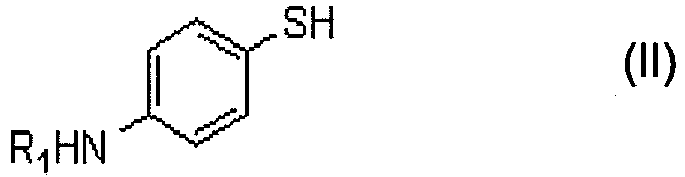


- R1 is selected from the group consisting of H atom and an acetyl group;
- X is selected from the group consisting of F, I, Cl and Br, preferably, X is F;
and - R2 is selected from the group consisting of a linear C1-10 alkyl and a branched C1-10 alkyl, preferably, R2 is methyl;
- b)
- b.i) - the oxidation reaction to sulfone of a compound of formula (IV), to give a compound of formula (V)

- the hydrolysis reaction of a compound of formula (V), to give a compound of formula (VI)

- the hydrolysis reaction of a compound of formula (V), to give a compound of formula (VI)
- b.ii) - a saponification reaction of the compound of formula (IV) to give the compound of formula (XIII)

- an oxidation reaction to sulfone of the compound of formula (XIII) to give the compound of formula (VI);
- b.i) - the oxidation reaction to sulfone of a compound of formula (IV), to give a compound of formula (V)
- c) the conversion of the compound of formula (VI) into the corresponding hydroxamic acid of formula (VII)

- d) the Lossen rearrangement reaction of the compound of formula (VII) to give the compound of formula (VIII)

- e) the reaction of the compound of formula (VIII) with:
- an alcohol to give a compound of formula (IX)

R3 is selected from the group consisting of a C1-10 linear alkyl and a C1-10 branched alkyl, preferably R3 is allyl;
or - with water to give the compound of formula (X)

- an alcohol to give a compound of formula (IX)
- f) the conversion of compound (IX) or (X) into Dapsone.
- The step a) of the process object of the present invention is carried out in the presence of a base in an aprotic polar solvent.
- The base is selected from the group consisting of potassium carbonate and cesium carbonate, preferably, the base is potassium carbonate.
- The aprotic polar solvent is selected from the group consisting of dimethylsulfoxide, acetonitrile, and N,N-dimethylformamide; preferably, the aprotic polar solvent is dimethylsulfoxide.
- When R1 represents a hydrogen atom, a compound of formula (IVa) is obtained

- The compound of formula (IV) is then obtained by an acetylation reaction of the amino group with acetic anhydride, in the presence of a catalytic amount of an amine, such as 4-dimethylaminopyridine (DMAP), in an apolar solvent selected from the group consisting of hexane, toluene, ethyl acetate, dimethyl sulfoxide, and tetrahydrofuran; preferably, the apolar solvent is toluene.
- The oxidation reactions of steps b.i) and b.ii) of the process object of the present invention are carried out with a compound selected from the group consisting of sodium perborate, which is the preferred embodiment, sodium hypochlorite, and sodium percarbonate, in a protic polar solvent and, optionally, in the presence of a compound selected from the group consisting of trichloroisocyanuric acid (TCCA), succinimide, acetamide and cyanuric acid.
- The protic polar solvent is selected from the group consisting of acetic acid, alcohols and a mixture of polar solvents selected from the group consisting of water, alcohols and an apolar solvent selected from toluene, hexane, ethyl acetate, dimethyl sulfoxide, preferably a mixture of water and toluene; preferably, the protic polar solvent is acetic acid. Preferably, sodium perborate in acetic acid is used.
- The hydrolysis reaction of step b.i) and the saponification reaction of step b.ii) of the process object of the present invention are carried out in the presence of a base in a suitable solvent. The base is selected from the group consisting of sodium hydroxide, potassium hydroxide, and lithium hydroxide; preferably, the base is sodium hydroxide. The solvent is a mixture of water and a solvent selected from the group consisting of toluene, hexane, ethyl acetate, dimethyl sulfoxide, tetrahydrofuran and alcohols, such as methanol, ethanol, isopropanol and butanol. Preferably, a mixture of tetrahydrofuran and water is used.
- The step c) of the process object of the present invention is carried out by reaction with hydroxylamine hydrochloride, in the presence of a condensing agent in a polar aprotic solvent. The condensing agent is selected from carbonyldiimidazolo (CDI), dicyclohexylcarbodimide (DCC), N-ethylcarbodimide hydrochloride (EDC.HCI), 2,4,6-tri-n-propyl-2-1,4,6-trioxo,3,5,2,4,6-trioxo-triphosphorinane (T3P®), preferably carbonyldiimidazole (CDI). The aprotic polar solvent is selected from the group consisting of acetone, acetonitrile, N,N-dimethylformamide, and dimethyl sulfoxide; preferably the aprotic polar solvent is acetonitrile.
- Preferably, the step c) of the process object of the present invention is carried out by reaction with hydroxylamine hydrochloride, in the presence of carbonyldiimidazole in acetonitrile.
- Alternatively, the hydroxamic acid can be obtained directly from the compound of formula (VI) by treatment with hydroxylamine.
- In the step d) of the process of the present invention, the Lossen rearrangement reaction can be carried out by means of O-activation of the hydroxaminic acid of formula (VII) by reaction of anhydrides, acyl halides (R4COCl), R4SO2Cl orR4PO2Cl;
-wherein R4 is selected from the group consisting of a linear C1-10 alkyl, branched C1-10 alkyl, an optionally substituted aryl group, such as p-nitrobenzensolfonyl chloride, tionylchlorid, SO3*Et3N, dialkyl-carbodimides, activated aromatic halides (eg. 2,4-dinitrochlorobenzene), silylating agents, carbonyldiimidazole (CDI). - Then, a reaction with a base is followed, wherein the base is selected from the group consisting of sodium hydroxide, potassium hydroxide, 1,5-diazabicyclo (5.4.0) undec-5-ene (DBU), N, N,-diisopropylethylamine (DIPEA), triethylamine (TEA), tributylamine, in the presence of an aromatic amine catalyst, such as 4-dimethylaminopyridine (DMAP), in a polar aprotic solvent selected from the group consisting of dimethylsulfoxide, acetonitrile, N, N-dimethylformamide, preferably acetonitrile.
- Preferably, the step d) is carried out in the presence of p-nitrobenzylsolfonyl chloride, N, N-diisopropylethylamine (DIPEA) and catalytic 4-dimethylaminopyridine (DIMAO), in acetonitrile.
- In step e) of the process of the present invention, the alcohol is selected from the group consisting of allyl alcohol, ter-butanol, benzyl alcohol, isopropanol, n-butanol, preferably, the alcohol is allyl alcohol.
- Alternatively, the compound of formula (X) is obtained by reacting the isocyanate of formula (VIII) with water.
- In step f) of the process of the present invention, Dapsone is directly obtained from the compound of formula (IX) or from the compound of formula (X) by known deprotection methods of the functional groups. Preferably, the deprotection is carried out with acidic water.
- The compounds of formula (IV), (V), (VI), (VII), (IX), are new intermediates which are useful in the Dapsone synthesis and they represent another object of the present invention.
- Although the invention has been described in its characteristic aspects, modifications and equivalents that are apparent to the person skilled in the art are included in the following invention.
- The present invention will now be illustrated by means of some examples, which should not be viewed as limiting the scope of the invention.
- All terms used in this application, unless otherwise stated, are to be understood in their common meaning as known in the art.
- Other more specific definitions for certain terms as used in this application, are highlighted below and apply consistently throughout the specification and claims, unless a different definition explicitly provides a broader definition.
- In a reaction flask 9.00 g of methyl4-fluorobenzoate (0.058 mol), 6.88 g of 4-aminothiophenol (0.055 mol), 55 ml of dimethyl sulfoxide, 8.43 g of potassium carbonate (0.061 mol) were charged, and the reaction mixture was left at a temperature of about 25° C for about two hours.
- At the end of the reaction, 200 ml of toluene were added in 200 ml of a saturated solution of sodium chloride, and the aqueous phases were extracted with toluene (1 x 140 ml). The combined organic phases were reduced to a residue by vacuum distillation to give 3.6 g of methyl4-(4-aminophenylthio)benzoate.
- In a reaction flask 3.6 g of methyl 4-(4-aminophenylthio)benzoate (0.014 mol), 24 ml of acetonitrile, 0.085 g of 4-dimethylaminopyridine (DMAP 0,007 mol), and, dropwise, 1.73 g of acetic anhydride (0,017 mol) were charged. The reaction mixture was left under stirring for about 1 hour.
- At the end of the reaction, the temperature was brought to 15°C, and thus the resulting solid was cold filtered with 4 ml of acetonitrile and then dried in a vacuum drying oven at 38°C to give 3.4 g of methyl 4-(4-acetamidophenylthio)benzoate.
- In a reaction flask 3.2 g of methyl 4-(4-acetamidophenylthio)benzoate (0,0106 mol), 32 ml of acetic acid, 5.3 g of sodium perborate (0.053 mol) were charged, the temperature was brought to about 45°C and the reaction mixture was left for about 1.5 hours in these conditions.
- At the end of the reaction, the temperature was brought to 25°C, and then 40 ml of ethyl acetate and 35 ml of water were charged; the aqueous phase was extracted with ethyl acetate (1 x 20 ml) and the organic phase was washed with a saturated solution of sodium bicarbonate (2 x 60 ml).
- The resulting product was filtered and dried in a vacuum drying oven at 45°C, to give 3.5 g of methyl 4-(4-acetamidophenylsulfonyl)benzoate.
- In a reaction flask 0.100 g of methyl 4-(4-acetamidophenylthio)benzoate (0.0003 mol), 2 ml of toluene, 0.007 g of trichloroisocyanuric acid (TCCA, 0.00003 mol) and 0.0560 g of an aqueous solution of sodium ipochlorite at 12% (0.0009 mol) were charged. The reaction mixture was left under stirring for 2 hours.
- At the end of the reaction, 3 ml of ethyl acetate and 2 ml of water were added; the aqueous phase was extracted with ethyl acetate (1 x 5 ml) and the collected organic phase was washed with a saturated solution of sodium bicarbonate (2 x 5 ml).
- The resulting product has been filtered and then dried in a vacuum drying oven at 45°C, to give 0.080 g of methyl 4-(4-acetamidophenylsulfonyl)benzoate.
- In a reaction flask 2.1 g of methyl 4-(4-acetamidophenylenilsulfonyl)benzoate (0.0062 mol), 10.5 ml of tetrahydrofuran, 3.6 ml of water, 0.907 g of sodium hydroxide at 30% (0.0068 mol) were charged, the temperature was brought at 30°C, and the reaction mixture was left under stirring for about 2 hours.
- At the end of the reaction, the temperature was brought to 25°C, and 18 ml of toluene and 12 ml of water were added. The aqueous phase was extracted with toluene (1 x 10 ml) and a 2 N solution of hydrochloric acid was added to reach a pH value of 1. The resulting solid was filtered and washed with water (2 x 3 ml) and then dried in a vacuum drying oven at 48°C to give 3.9 g of 4-(4-acetamidophenylsulfonyl)benzoic acid.
- In a reaction flask 0.300 g of 4-(4-acetamidophenylsulfonyl)benzoic acid (0.001 mol), 3 ml of acetonitrile, 0.195 g of carbonylimidazole (CDI, 0.0012 mol) and 0.087 g of hydroxylamine hydrochloride (0.0013 mol) were charged. The reaction mixture was left at room temperature for about 4 hours.
- At the end of the reaction, the solvent was removed by vacuum distillation and were added 3 ml of water, 5 ml of ethyl acetate and the pH was brought to a value of about 1 using hydrochloric acid solution 2 N. The collected organic phases were reduced to a residue by distillation under vacuum to give 0.250 g of 4-(4-acetamidophenylsulfonyl)-N-hydroxybenzamide.
- In a reaction flask 0.200 g of 4-(4-acetamidophenylsulfonyl)-N-hydroxybenzamide (0.0006 mol), 3.5 ml di tetrahydrofuran, 0.194 g of N,N-diisopropylethylamine (DIPEA, 0.0015 mol) were charged, the temperature was brought to about 0°C, 0.146 g of p-nitro-benzen-sulfonyl chloride were added (0.0007 mol), and the reaction mixture was left in these conditions for about 2.5 hours.
- At the end of the reaction, the temperature was brought to about 25°C, and then 0.015 g of 4-dimethylaminopyridine (DMAP, 0.0001 mol), 0.070 g of allyl-alcohol (0.0012 mol) were added and the reaction mixture was left under these conditions for about three hours.
- At the end of the reaction, 15 ml of ethyl acetate and 8 ml of water were added and the aqueous phase was extracted with ethyl acetate (1 x 6 ml). The organic phase was washed with a 2 N solution of hydrochloric acid (1 x 5 ml), water (1 x 5 ml) and a saturated solution of sodium bicarbonate (1 x 12 ml). The collected organic phases were purified by column chromatography, to give 0.080 g of allyl 4-(4-acetamidophenylsulfonyl)-phenylcarbamate.
- In a reaction flask 0.030 g of allyl 4-(4-acetammidophenylsulfonyl)-phenylcarbamate (0.00008 mol), 2.5 ml of methanol, 0.001 g of tetrakis(triphenylphosphine)palladium (0) (0.0000008 mol), 0.070 g of potassium carbonate (0.0005 mol) were charged, and the reaction mixture was kept at a temperature of 25 ° C for about twelve hours.
- At the end of the reaction, 3 ml of methyl ethyl ketone and 1.5 ml of water were added, the aqueous phase was extracted with methyl ethyl ketone (2 x 2 ml) and the combined organic phases were reduced to a residue by distillation under vacuum, to give 10 mg of N-(4-(4-aminophenylsulfonyl) phenyl) acetamide.
- In a reaction flask 0.300 g of 4-(4-acetamidophenylthio) benzoic acid (0.0011 mol), 4 ml of acetic acid, 0.550 g of sodium perborate (0.0055 mol) were charged, the temperature was raised to about 45 ° C and the reaction mixture was kept under these conditions for about an hour.
- At the end of the reaction, the formed solid was hot filtered, washed with water (2 x 1.5 ml) and dried in a vacuum drying oven at 45°C to give 0.200 g of 4-(4-acetamidophenylsulfonyl) benzoic acid.
- In a reaction flask 9.7 g of methyl 4-fluorobenzoate (0.063 mol), 10 g of acetamidothiophenol (0.060 mol), 50 ml of dimethylsulfoxide and 1.04 g of 1.5-diazabicyclo(5.4.0)undec-5-ene (DBU, 0.007 mol) were charged and the reaction was kept under stirring for about 3 hours.
- At the end of the reaction, 16.6 g of potassium carbonate, 3 ml of a solution of sodium hydroxide at 30% were added, and the temperature was brought to about 55°C and the reaction was kept under these conditions for about 3 hours.
- At the end of the reaction, the temperature was brought to about 15°C, and then 200 ml of water and a solution of hydrochloric acid at 37% up to a pH value of 1 were added.
- The precipitated solid was filtered and washed to give 12.1 g of 4-(4-acetamidophenylthio)benzoic acid.
- In a reaction flask 10 mg of N-(4-(4-aminophenylsulfonyl)phenyl)acetamide (0.00008 mol), 2 ml di methanol, 1 ml of water and 6 mg of NaOH (0.00016 mol) were charged, the temperature was brought to about 35°C and the reaction mixture was kept under in these conditions for about 2 hours.
- At the end of the reaction, 2 ml of ethyl acetate were added, the aqueous phase was extracted with ethyl acetate (1 x 1 ml), and the collected organic phases were reduced to a residue by distillation under vacuum to give 5 mg of Dapsone.
Claims (17)
- A process for the synthesis of Dapsone comprising the following steps:a) a condensation reaction between a compound of formula (II)


wherein:- R1 is selected from the group consisting of H atom and an acetyl group,- X is selected from the group consisting of F, I, Cl and Br,
and- R2 is selected from the group consisting of a linear C1-10 alkyl and a branched C1-10 alkyl;b)b.i)- the oxidation reaction to sulfone of a compound of formula (IV), to give a compound of formula (V) - the hydrolysis reaction of a compound of formula (V) to give a compound of formula (VI)
orb.ii)- a saponification reaction of the compound of formula (IV) to give the compound of formula (XIII)
and- an oxidation reaction to sulfone of the compound of formula (XIII) to give the compound of formula (VI);c) the conversion of the compound of formula (VI), into the corresponding hydroxamic acid of formula (VII) d) the Lossen rearrangement reaction of the compound of formula (VII) to give the compound of formula (VIII)
 e) the reaction of the compound of formula (VIII) with:- an alcohol to give a compound of formula (IX)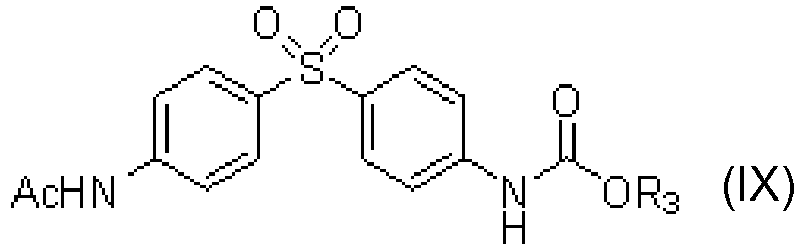
R3 is selected from the group consisting of a C1-10 linear alkyl and a C1-10 branched alkyl;
or- with water to give the compound of formula (X)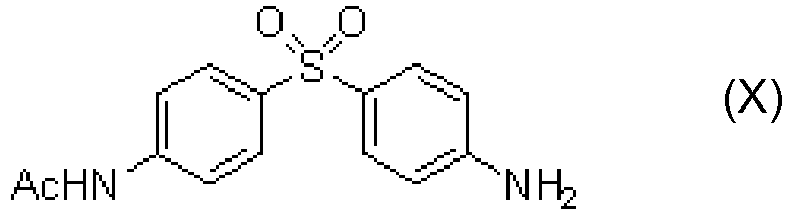 f) deprotection of the functional groups of compound of formula (IX) or (X) to give Dapsone.
 - The process according to claim 1) wherein in step a) the base is selected from the group consisting of potassium carbonate and cesium carbonate.
- The process according to claim 1) wherein in step a) the aprotic polar solvent is selected from the group consisting of dimethylsulfoxide, acetonitrile, and N,N-dimethylformamide.
- The process according to claim 1) wherein in step a) the catalytic amount of an amine is 4-dimethylaminopyridine.
- The process according to claim 1, wherein in step a) the apolar solvent is selected from the group consisting of hexane, toluene, ethyl acetate, dimethyl sulfoxide, and tetrahydrofuran.
- The process according to claim 1, wherein the oxidation reaction in steps b.i) and b.ii) is carried out with a compound selected from the group consisting of sodium perborate, sodium hypochlorite, and sodium percarbonate, in a protic polar solvent, optionally in the presence of a compound selected from the group consisting of trichloroisocyanuric acid, succinimide, acetamide and cyanuric acid.
- The process according to claim 6, wherein the protic polar solvent is selected from the group consisting of acetic, alcohols and a mixture of polar solvents selected from the group consisting of water, alcohols and an apolar solvent selected from toluene, hexane, ethyl acetate, dimethyl sulfoxide.
- The process according to claim 1 wherein in step b.i) and step b.ii) the base is selected from the group consisting of sodium hydroxide, potassium hydroxide, and lithium hydroxide.
- The process according to claim 1, wherein in step b.i) and b.ii) the solvent is a mixture of water and a solvent selected from the group consisting of toluene, hexane, ethyl acetate, dimethyl sulfoxide, tetrahydrofuran and alcohols selected from the group consisting of methanol, ethanol, isopropanol and butanol.
- The process according to claim 1, wherein in step c) the condensing agent is selected from the group consisting of carbonyldiimidazole, dicyclohexylcarbodimide, N-ethylcarbodimide hydrochloride, 2,4,6-tri-n-propyl-2-1,4,6-trioxo,3,5,2,4,6-trioxo-triphosphorinane.
- The process according to claim 1, wherein in step c) the aprotic polar solvent is selected from the group consisting of acetone, acetonitrile, N,N-dimethylformamide, and dimethyl sulfoxide.
- The process according to claim1, wherein step c) is carried out by reaction with hydroxylamine hydrochloride, in the presence of carbonyldiimidazole in acetonitrile.
- The process according to claim 1, wherein in step d) the the Lossen rearrangement reaction is carried out- by means of O-activation of the hydroxyl-aminic acid of formula (VII) by reaction of anhydrides, acyl halides, R4COCl, R4SO2Cl, R4PO2Cl; and- by a reaction with a base in the presence of an aromatic amine catalyst in a polar aprotic solvent;wherein:- R4 is selected from the group consisting of a linear C1-10 alkyl, branched C1-10 alkyl, an optionally substituted aryl group selected from the group consisting of p-nitrobenzensolfonyl chloride, thionylchloride, SO3*Et3N, dialkyl-carbodimmides, activated aromatic halides, silylating agents, carbonyldiimidazole;-the base is selected from the group consisting of sodium hydroxide, potassium hydroxide, 1,5-diazabicyclo(5.4.0)undec-5-ene, N,N,-diisopropylethylamine, triethylamine, tributylamine,--the polar aprotic solvent is selected from the group consisting of dimethylsulfoxide, acetonitrile, and N,N-dimethylformamide.
- The process according to claim 1, wherein step d) is carried out in the presence of p-nitrobenzylsolfonyl chloride, N,N-diisopropylethylamine and catalytic 4-dimetilamminapyridin, in acetonitrile.
- The process according to claim 1, wherein in step e) the alcohol is selected from the group consisting of allyl alcohol, ter-buthanol, benzyl alcohol, isopropanol, n-butanol.
- The process according to claim 1, wherein the step e) the compound of formula (X) is obtained by reacting isocyanate of formula (VIII) with water.
- Process for the synthesis of Dapsone making use of the compound of formula (IV), (V), (VI), (VII), or (IX).
Applications Claiming Priority (2)
| Application Number | Priority Date | Filing Date | Title |
|---|---|---|---|
| US201462032154P | 2014-08-01 | 2014-08-01 | |
| PCT/EP2015/067411 WO2016016321A1 (en) | 2014-08-01 | 2015-07-29 | Process for the synthesis of dapsone and its intermediates |
Publications (2)
| Publication Number | Publication Date |
|---|---|
| EP3180307A1 EP3180307A1 (en) | 2017-06-21 |
| EP3180307B1 true EP3180307B1 (en) | 2019-02-13 |
Family
ID=53761388
Family Applications (1)
| Application Number | Title | Priority Date | Filing Date |
|---|---|---|---|
| EP15744209.6A Not-in-force EP3180307B1 (en) | 2014-08-01 | 2015-07-29 | Process for the synthesis of dapsone and its intermediates |
Country Status (5)
| Country | Link |
|---|---|
| US (1) | US9845289B2 (en) |
| EP (1) | EP3180307B1 (en) |
| JP (1) | JP2017523216A (en) |
| CA (1) | CA2954566A1 (en) |
| WO (1) | WO2016016321A1 (en) |
Families Citing this family (2)
| Publication number | Priority date | Publication date | Assignee | Title |
|---|---|---|---|---|
| CA3126367A1 (en) | 2020-03-30 | 2021-09-30 | Pulmonem Inc. | Dapsone formulations and methods of using same |
| EP3911415A4 (en) | 2020-03-30 | 2022-10-12 | Pulmonem Inc. | DAPSONE FORMULATIONS AND METHODS OF USE THEREOF |
Family Cites Families (3)
| Publication number | Priority date | Publication date | Assignee | Title |
|---|---|---|---|---|
| FR829926A (en) | 1936-11-28 | 1938-07-11 | Ig Farbenindustrie Ag | Ortho and para-aminoarylsulfones and their preparation process |
| ITMI20030617A1 (en) | 2003-03-28 | 2004-09-29 | Dinamite Dipharma S P A In Forma A Bbreviata Diph | PROCEDURE FOR THE PREPARATION OF AN ORGANIC COMPOUND CONTAINING A SULFINYL OR SULFONYL GROUP |
| CA2573114C (en) | 2004-07-07 | 2012-08-14 | Lundbeck Pharmaceuticals Italy S.P.A. | Process for synthesis of 4-4'-diamino-diphenyl-sulfone |
-
2015
- 2015-07-29 JP JP2017506654A patent/JP2017523216A/en not_active Withdrawn
- 2015-07-29 CA CA2954566A patent/CA2954566A1/en not_active Abandoned
- 2015-07-29 EP EP15744209.6A patent/EP3180307B1/en not_active Not-in-force
- 2015-07-29 WO PCT/EP2015/067411 patent/WO2016016321A1/en not_active Ceased
- 2015-07-29 US US15/328,267 patent/US9845289B2/en not_active Expired - Fee Related
Non-Patent Citations (1)
| Title |
|---|
| None * |
Also Published As
| Publication number | Publication date |
|---|---|
| CA2954566A1 (en) | 2016-02-04 |
| EP3180307A1 (en) | 2017-06-21 |
| WO2016016321A1 (en) | 2016-02-04 |
| US20170217883A1 (en) | 2017-08-03 |
| JP2017523216A (en) | 2017-08-17 |
| US9845289B2 (en) | 2017-12-19 |
Similar Documents
| Publication | Publication Date | Title |
|---|---|---|
| CA2994688C (en) | 1,3,4-oxadiazole derivative compounds as histone deacetylase 6 inhibitor, and the pharmaceutical composition comprising the same | |
| JP6880127B2 (en) | Synthesis of polycyclic carbamoylpyridone compounds | |
| US9845289B2 (en) | Process for the synthesis of Dapsone and its intermediates | |
| WO2012148624A1 (en) | Synthesis of hydroxyalkyl amides from esters | |
| JP2011511053A (en) | New method for manufacturing vorinostat | |
| CN106800589B (en) | Cyclic peptide compounds, preparation method, pharmaceutical composition and application thereof | |
| CN102603553B (en) | Compound with collaborative antifungal effect and application thereof in pharmaceuticals | |
| KR101571915B1 (en) | Novel method for the production of sulphonylpyrroles as hdac inhibitors | |
| JPH0259806B2 (en) | ||
| CN101544669A (en) | Phenyl cyanoacrylate derivatives containing alpha-amino phosphonate ester and preparation method and application thereof | |
| CA2752198A1 (en) | Substituted 3-benzofuranyl-indol-2-one-3-acetamidopiperazine derivatives, preparation thereof, and therapeutic use thereof | |
| BR102013023418A2 (en) | IMPROVED PROCESS FOR PREPARING 2-AMINO-5,8-DIMETOXY [1,2,4] TRIAZOLE [1,5-c] PYRIMIDINE FROM 4-AMINO-2,5-DIMETOXYPYRIMIDINE | |
| FR2478629A1 (en) | 2-CYANO-ETHYL-2- (N-BENZOYLAMINO) ALKANOIC ACID DERIVATIVES, THEIR PREPARATION PROCESS AND THEIR THERAPEUTIC APPLICATION | |
| WO2014164844A1 (en) | Cathepsin inhibitors | |
| WO1998042700A1 (en) | N-(arginyl)benzenesulphonamide derivatives and use thereof as antithrombotic agents | |
| CN1308062A (en) | 1-substituted-N-sulfinyl-2-aziridine methylenimine and its preparation and use | |
| FR3010076A1 (en) | METALLOPROTEASE INHIBITORS, METHODS FOR PREPARING THEM AND THERAPEUTIC USES THEREOF | |
| HK40011503B (en) | Synthesis of polycyclic-carbamoylpyridone compounds | |
| JPH09241279A (en) | N-phosphoglucose-substituted amino acid ester derivative | |
| JPH09309868A (en) | Method for producing amide compound | |
| WO2016047428A1 (en) | Cyclic hemiacetal compound production method | |
| FR2940288A1 (en) | New phenyl-alkyl-piperazine compounds are TNF-alpha modulators useful to treat e.g. atherosclerosis, multiple sclerosis, asthma, osteoarthritis, gout, osteoporosis, septic shock, sepsis, heart failure, malaria, leprosy and psoriasis |
Legal Events
| Date | Code | Title | Description |
|---|---|---|---|
| STAA | Information on the status of an ep patent application or granted ep patent |
Free format text: STATUS: THE INTERNATIONAL PUBLICATION HAS BEEN MADE |
|
| PUAI | Public reference made under article 153(3) epc to a published international application that has entered the european phase |
Free format text: ORIGINAL CODE: 0009012 |
|
| STAA | Information on the status of an ep patent application or granted ep patent |
Free format text: STATUS: REQUEST FOR EXAMINATION WAS MADE |
|
| 17P | Request for examination filed |
Effective date: 20170224 |
|
| AK | Designated contracting states |
Kind code of ref document: A1 Designated state(s): AL AT BE BG CH CY CZ DE DK EE ES FI FR GB GR HR HU IE IS IT LI LT LU LV MC MK MT NL NO PL PT RO RS SE SI SK SM TR |
|
| AX | Request for extension of the european patent |
Extension state: BA ME |
|
| DAV | Request for validation of the european patent (deleted) | ||
| DAX | Request for extension of the european patent (deleted) | ||
| GRAP | Despatch of communication of intention to grant a patent |
Free format text: ORIGINAL CODE: EPIDOSNIGR1 |
|
| STAA | Information on the status of an ep patent application or granted ep patent |
Free format text: STATUS: GRANT OF PATENT IS INTENDED |
|
| INTG | Intention to grant announced |
Effective date: 20180817 |
|
| GRAS | Grant fee paid |
Free format text: ORIGINAL CODE: EPIDOSNIGR3 |
|
| GRAA | (expected) grant |
Free format text: ORIGINAL CODE: 0009210 |
|
| STAA | Information on the status of an ep patent application or granted ep patent |
Free format text: STATUS: THE PATENT HAS BEEN GRANTED |
|
| AK | Designated contracting states |
Kind code of ref document: B1 Designated state(s): AL AT BE BG CH CY CZ DE DK EE ES FI FR GB GR HR HU IE IS IT LI LT LU LV MC MK MT NL NO PL PT RO RS SE SI SK SM TR |
|
| REG | Reference to a national code |
Ref country code: GB Ref legal event code: FG4D |
|
| REG | Reference to a national code |
Ref country code: CH Ref legal event code: EP Ref country code: AT Ref legal event code: REF Ref document number: 1096124 Country of ref document: AT Kind code of ref document: T Effective date: 20190215 |
|
| REG | Reference to a national code |
Ref country code: IE Ref legal event code: FG4D |
|
| REG | Reference to a national code |
Ref country code: DE Ref legal event code: R096 Ref document number: 602015024610 Country of ref document: DE |
|
| REG | Reference to a national code |
Ref country code: LT Ref legal event code: MG4D |
|
| REG | Reference to a national code |
Ref country code: NL Ref legal event code: MP Effective date: 20190213 |
|
| PG25 | Lapsed in a contracting state [announced via postgrant information from national office to epo] |
Ref country code: NL Free format text: LAPSE BECAUSE OF FAILURE TO SUBMIT A TRANSLATION OF THE DESCRIPTION OR TO PAY THE FEE WITHIN THE PRESCRIBED TIME-LIMIT Effective date: 20190213 Ref country code: LT Free format text: LAPSE BECAUSE OF FAILURE TO SUBMIT A TRANSLATION OF THE DESCRIPTION OR TO PAY THE FEE WITHIN THE PRESCRIBED TIME-LIMIT Effective date: 20190213 Ref country code: FI Free format text: LAPSE BECAUSE OF FAILURE TO SUBMIT A TRANSLATION OF THE DESCRIPTION OR TO PAY THE FEE WITHIN THE PRESCRIBED TIME-LIMIT Effective date: 20190213 Ref country code: SE Free format text: LAPSE BECAUSE OF FAILURE TO SUBMIT A TRANSLATION OF THE DESCRIPTION OR TO PAY THE FEE WITHIN THE PRESCRIBED TIME-LIMIT Effective date: 20190213 Ref country code: NO Free format text: LAPSE BECAUSE OF FAILURE TO SUBMIT A TRANSLATION OF THE DESCRIPTION OR TO PAY THE FEE WITHIN THE PRESCRIBED TIME-LIMIT Effective date: 20190513 Ref country code: PT Free format text: LAPSE BECAUSE OF FAILURE TO SUBMIT A TRANSLATION OF THE DESCRIPTION OR TO PAY THE FEE WITHIN THE PRESCRIBED TIME-LIMIT Effective date: 20190613 |
|
| PG25 | Lapsed in a contracting state [announced via postgrant information from national office to epo] |
Ref country code: IS Free format text: LAPSE BECAUSE OF FAILURE TO SUBMIT A TRANSLATION OF THE DESCRIPTION OR TO PAY THE FEE WITHIN THE PRESCRIBED TIME-LIMIT Effective date: 20190613 Ref country code: LV Free format text: LAPSE BECAUSE OF FAILURE TO SUBMIT A TRANSLATION OF THE DESCRIPTION OR TO PAY THE FEE WITHIN THE PRESCRIBED TIME-LIMIT Effective date: 20190213 Ref country code: HR Free format text: LAPSE BECAUSE OF FAILURE TO SUBMIT A TRANSLATION OF THE DESCRIPTION OR TO PAY THE FEE WITHIN THE PRESCRIBED TIME-LIMIT Effective date: 20190213 Ref country code: GR Free format text: LAPSE BECAUSE OF FAILURE TO SUBMIT A TRANSLATION OF THE DESCRIPTION OR TO PAY THE FEE WITHIN THE PRESCRIBED TIME-LIMIT Effective date: 20190514 Ref country code: BG Free format text: LAPSE BECAUSE OF FAILURE TO SUBMIT A TRANSLATION OF THE DESCRIPTION OR TO PAY THE FEE WITHIN THE PRESCRIBED TIME-LIMIT Effective date: 20190513 Ref country code: RS Free format text: LAPSE BECAUSE OF FAILURE TO SUBMIT A TRANSLATION OF THE DESCRIPTION OR TO PAY THE FEE WITHIN THE PRESCRIBED TIME-LIMIT Effective date: 20190213 |
|
| REG | Reference to a national code |
Ref country code: AT Ref legal event code: MK05 Ref document number: 1096124 Country of ref document: AT Kind code of ref document: T Effective date: 20190213 |
|
| PG25 | Lapsed in a contracting state [announced via postgrant information from national office to epo] |
Ref country code: AL Free format text: LAPSE BECAUSE OF FAILURE TO SUBMIT A TRANSLATION OF THE DESCRIPTION OR TO PAY THE FEE WITHIN THE PRESCRIBED TIME-LIMIT Effective date: 20190213 Ref country code: CZ Free format text: LAPSE BECAUSE OF FAILURE TO SUBMIT A TRANSLATION OF THE DESCRIPTION OR TO PAY THE FEE WITHIN THE PRESCRIBED TIME-LIMIT Effective date: 20190213 Ref country code: ES Free format text: LAPSE BECAUSE OF FAILURE TO SUBMIT A TRANSLATION OF THE DESCRIPTION OR TO PAY THE FEE WITHIN THE PRESCRIBED TIME-LIMIT Effective date: 20190213 Ref country code: SK Free format text: LAPSE BECAUSE OF FAILURE TO SUBMIT A TRANSLATION OF THE DESCRIPTION OR TO PAY THE FEE WITHIN THE PRESCRIBED TIME-LIMIT Effective date: 20190213 Ref country code: RO Free format text: LAPSE BECAUSE OF FAILURE TO SUBMIT A TRANSLATION OF THE DESCRIPTION OR TO PAY THE FEE WITHIN THE PRESCRIBED TIME-LIMIT Effective date: 20190213 Ref country code: IT Free format text: LAPSE BECAUSE OF FAILURE TO SUBMIT A TRANSLATION OF THE DESCRIPTION OR TO PAY THE FEE WITHIN THE PRESCRIBED TIME-LIMIT Effective date: 20190213 Ref country code: EE Free format text: LAPSE BECAUSE OF FAILURE TO SUBMIT A TRANSLATION OF THE DESCRIPTION OR TO PAY THE FEE WITHIN THE PRESCRIBED TIME-LIMIT Effective date: 20190213 Ref country code: DK Free format text: LAPSE BECAUSE OF FAILURE TO SUBMIT A TRANSLATION OF THE DESCRIPTION OR TO PAY THE FEE WITHIN THE PRESCRIBED TIME-LIMIT Effective date: 20190213 |
|
| REG | Reference to a national code |
Ref country code: DE Ref legal event code: R097 Ref document number: 602015024610 Country of ref document: DE |
|
| PG25 | Lapsed in a contracting state [announced via postgrant information from national office to epo] |
Ref country code: SM Free format text: LAPSE BECAUSE OF FAILURE TO SUBMIT A TRANSLATION OF THE DESCRIPTION OR TO PAY THE FEE WITHIN THE PRESCRIBED TIME-LIMIT Effective date: 20190213 Ref country code: PL Free format text: LAPSE BECAUSE OF FAILURE TO SUBMIT A TRANSLATION OF THE DESCRIPTION OR TO PAY THE FEE WITHIN THE PRESCRIBED TIME-LIMIT Effective date: 20190213 |
|
| PLBE | No opposition filed within time limit |
Free format text: ORIGINAL CODE: 0009261 |
|
| STAA | Information on the status of an ep patent application or granted ep patent |
Free format text: STATUS: NO OPPOSITION FILED WITHIN TIME LIMIT |
|
| PG25 | Lapsed in a contracting state [announced via postgrant information from national office to epo] |
Ref country code: AT Free format text: LAPSE BECAUSE OF FAILURE TO SUBMIT A TRANSLATION OF THE DESCRIPTION OR TO PAY THE FEE WITHIN THE PRESCRIBED TIME-LIMIT Effective date: 20190213 |
|
| 26N | No opposition filed |
Effective date: 20191114 |
|
| REG | Reference to a national code |
Ref country code: DE Ref legal event code: R119 Ref document number: 602015024610 Country of ref document: DE |
|
| PG25 | Lapsed in a contracting state [announced via postgrant information from national office to epo] |
Ref country code: MC Free format text: LAPSE BECAUSE OF FAILURE TO SUBMIT A TRANSLATION OF THE DESCRIPTION OR TO PAY THE FEE WITHIN THE PRESCRIBED TIME-LIMIT Effective date: 20190213 Ref country code: SI Free format text: LAPSE BECAUSE OF FAILURE TO SUBMIT A TRANSLATION OF THE DESCRIPTION OR TO PAY THE FEE WITHIN THE PRESCRIBED TIME-LIMIT Effective date: 20190213 |
|
| REG | Reference to a national code |
Ref country code: CH Ref legal event code: PL |
|
| GBPC | Gb: european patent ceased through non-payment of renewal fee |
Effective date: 20190729 |
|
| PG25 | Lapsed in a contracting state [announced via postgrant information from national office to epo] |
Ref country code: TR Free format text: LAPSE BECAUSE OF FAILURE TO SUBMIT A TRANSLATION OF THE DESCRIPTION OR TO PAY THE FEE WITHIN THE PRESCRIBED TIME-LIMIT Effective date: 20190213 |
|
| REG | Reference to a national code |
Ref country code: BE Ref legal event code: MM Effective date: 20190731 |
|
| PG25 | Lapsed in a contracting state [announced via postgrant information from national office to epo] |
Ref country code: DE Free format text: LAPSE BECAUSE OF NON-PAYMENT OF DUE FEES Effective date: 20200201 Ref country code: GB Free format text: LAPSE BECAUSE OF NON-PAYMENT OF DUE FEES Effective date: 20190729 |
|
| PG25 | Lapsed in a contracting state [announced via postgrant information from national office to epo] |
Ref country code: LU Free format text: LAPSE BECAUSE OF NON-PAYMENT OF DUE FEES Effective date: 20190729 Ref country code: CH Free format text: LAPSE BECAUSE OF NON-PAYMENT OF DUE FEES Effective date: 20190731 Ref country code: BE Free format text: LAPSE BECAUSE OF NON-PAYMENT OF DUE FEES Effective date: 20190731 Ref country code: LI Free format text: LAPSE BECAUSE OF NON-PAYMENT OF DUE FEES Effective date: 20190731 |
|
| PG25 | Lapsed in a contracting state [announced via postgrant information from national office to epo] |
Ref country code: FR Free format text: LAPSE BECAUSE OF NON-PAYMENT OF DUE FEES Effective date: 20190731 |
|
| PG25 | Lapsed in a contracting state [announced via postgrant information from national office to epo] |
Ref country code: IE Free format text: LAPSE BECAUSE OF NON-PAYMENT OF DUE FEES Effective date: 20190729 |
|
| PG25 | Lapsed in a contracting state [announced via postgrant information from national office to epo] |
Ref country code: CY Free format text: LAPSE BECAUSE OF FAILURE TO SUBMIT A TRANSLATION OF THE DESCRIPTION OR TO PAY THE FEE WITHIN THE PRESCRIBED TIME-LIMIT Effective date: 20190213 |
|
| PG25 | Lapsed in a contracting state [announced via postgrant information from national office to epo] |
Ref country code: HU Free format text: LAPSE BECAUSE OF FAILURE TO SUBMIT A TRANSLATION OF THE DESCRIPTION OR TO PAY THE FEE WITHIN THE PRESCRIBED TIME-LIMIT; INVALID AB INITIO Effective date: 20150729 Ref country code: MT Free format text: LAPSE BECAUSE OF FAILURE TO SUBMIT A TRANSLATION OF THE DESCRIPTION OR TO PAY THE FEE WITHIN THE PRESCRIBED TIME-LIMIT Effective date: 20190213 |
|
| PG25 | Lapsed in a contracting state [announced via postgrant information from national office to epo] |
Ref country code: MK Free format text: LAPSE BECAUSE OF FAILURE TO SUBMIT A TRANSLATION OF THE DESCRIPTION OR TO PAY THE FEE WITHIN THE PRESCRIBED TIME-LIMIT Effective date: 20190213 |