EP3179998B1 - Compounds for the treatment of hpv-induced carcinoma - Google Patents
Compounds for the treatment of hpv-induced carcinoma Download PDFInfo
- Publication number
- EP3179998B1 EP3179998B1 EP15756943.5A EP15756943A EP3179998B1 EP 3179998 B1 EP3179998 B1 EP 3179998B1 EP 15756943 A EP15756943 A EP 15756943A EP 3179998 B1 EP3179998 B1 EP 3179998B1
- Authority
- EP
- European Patent Office
- Prior art keywords
- compound
- methyl
- tetrahydrofuran
- pent
- tert
- Prior art date
- Legal status (The legal status is an assumption and is not a legal conclusion. Google has not performed a legal analysis and makes no representation as to the accuracy of the status listed.)
- Active
Links
Images


Classifications
-
- C—CHEMISTRY; METALLURGY
- C07—ORGANIC CHEMISTRY
- C07D—HETEROCYCLIC COMPOUNDS
- C07D307/00—Heterocyclic compounds containing five-membered rings having one oxygen atom as the only ring hetero atom
- C07D307/02—Heterocyclic compounds containing five-membered rings having one oxygen atom as the only ring hetero atom not condensed with other rings
- C07D307/26—Heterocyclic compounds containing five-membered rings having one oxygen atom as the only ring hetero atom not condensed with other rings having one double bond between ring members or between a ring member and a non-ring member
- C07D307/30—Heterocyclic compounds containing five-membered rings having one oxygen atom as the only ring hetero atom not condensed with other rings having one double bond between ring members or between a ring member and a non-ring member with hetero atoms or with carbon atoms having three bonds to hetero atoms with at the most one bond to halogen, e.g. ester or nitrile radicals, directly attached to ring carbon atoms
- C07D307/32—Oxygen atoms
- C07D307/33—Oxygen atoms in position 2, the oxygen atom being in its keto or unsubstituted enol form
-
- A—HUMAN NECESSITIES
- A61—MEDICAL OR VETERINARY SCIENCE; HYGIENE
- A61K—PREPARATIONS FOR MEDICAL, DENTAL OR TOILETRY PURPOSES
- A61K31/00—Medicinal preparations containing organic active ingredients
- A61K31/33—Heterocyclic compounds
- A61K31/335—Heterocyclic compounds having oxygen as the only ring hetero atom, e.g. fungichromin
- A61K31/34—Heterocyclic compounds having oxygen as the only ring hetero atom, e.g. fungichromin having five-membered rings with one oxygen as the only ring hetero atom, e.g. isosorbide
-
- A—HUMAN NECESSITIES
- A61—MEDICAL OR VETERINARY SCIENCE; HYGIENE
- A61K—PREPARATIONS FOR MEDICAL, DENTAL OR TOILETRY PURPOSES
- A61K31/00—Medicinal preparations containing organic active ingredients
- A61K31/33—Heterocyclic compounds
- A61K31/335—Heterocyclic compounds having oxygen as the only ring hetero atom, e.g. fungichromin
- A61K31/365—Lactones
-
- A—HUMAN NECESSITIES
- A61—MEDICAL OR VETERINARY SCIENCE; HYGIENE
- A61P—SPECIFIC THERAPEUTIC ACTIVITY OF CHEMICAL COMPOUNDS OR MEDICINAL PREPARATIONS
- A61P31/00—Antiinfectives, i.e. antibiotics, antiseptics, chemotherapeutics
- A61P31/12—Antivirals
- A61P31/20—Antivirals for DNA viruses
-
- A—HUMAN NECESSITIES
- A61—MEDICAL OR VETERINARY SCIENCE; HYGIENE
- A61P—SPECIFIC THERAPEUTIC ACTIVITY OF CHEMICAL COMPOUNDS OR MEDICINAL PREPARATIONS
- A61P35/00—Antineoplastic agents
-
- A—HUMAN NECESSITIES
- A61—MEDICAL OR VETERINARY SCIENCE; HYGIENE
- A61P—SPECIFIC THERAPEUTIC ACTIVITY OF CHEMICAL COMPOUNDS OR MEDICINAL PREPARATIONS
- A61P43/00—Drugs for specific purposes, not provided for in groups A61P1/00-A61P41/00
-
- C—CHEMISTRY; METALLURGY
- C07—ORGANIC CHEMISTRY
- C07D—HETEROCYCLIC COMPOUNDS
- C07D307/00—Heterocyclic compounds containing five-membered rings having one oxygen atom as the only ring hetero atom
- C07D307/02—Heterocyclic compounds containing five-membered rings having one oxygen atom as the only ring hetero atom not condensed with other rings
- C07D307/04—Heterocyclic compounds containing five-membered rings having one oxygen atom as the only ring hetero atom not condensed with other rings having no double bonds between ring members or between ring members and non-ring members
- C07D307/18—Heterocyclic compounds containing five-membered rings having one oxygen atom as the only ring hetero atom not condensed with other rings having no double bonds between ring members or between ring members and non-ring members with hetero atoms or with carbon atoms having three bonds to hetero atoms with at the most one bond to halogen, e.g. ester or nitrile radicals, directly attached to ring carbon atoms
- C07D307/20—Oxygen atoms
Definitions
- the present invention relates to compounds I, II and III (see Figure 1 ) for use as medicaments.
- Cervical cancer is the second leading cause of cancer death in women and there are an estimated 529,000 new cases of cervical cancer and 275,000 deaths per year. In 2013, an estimated 12,340 new cases of invasive cervical cancer are expected to be diagnosed. In turn, the number of agents for the treatment of cervical cancer approved by the Food and Drug Administration (FDA) is very low, even with a dwindling trend over the past decade, (www.cancer.gov), demonstrating an urgent need for the development of new classes of compounds for treating cervical cancer. This need is accentuated by the predicted rise in cases of cervical cancer captured by improved screening and diagnostics, yielding an increase ranging from a few percent to 10% in all facets and stages of cervical cancer (www.bccresearch.com). This situation will not be alleviated by the ongoing anti-HPV vaccine trials, as the results of these will be seen only after several decades.
- FDA Food and Drug Administration
- HPV Human Papilloma Virus
- E6 also activates telomerase which prevents the erosion of telomeres and allows the host cell to continue through many rounds of division without damage to the DNA.
- E6 has also been reported to activate nuclear factor kappa B (NF- ⁇ B) leading to enhanced expression of Inhibitor of apoptosis protein 2 (IAP2) in HPV16 E6-immortalized human oral keratinocytes and primary human airway epithelial cells. It has also been observed that depletion of c-IAP2 leads to cell death, suggesting that HPV16-induced c-IAP2 expression is necessary for maintenance of the immortalized phenotype.
- NF- ⁇ B nuclear factor kappa B
- IAP2 Inhibitor of apoptosis protein 2
- the E7 oncoprotein has also been implicated in HPV-mediated cancers.
- the E7 oncoprotein interacts with the cell cycle regulator pRb, inducing its proteolytic degradation, thereby preventing its binding to and inhibiting of the cell cycle promoting transcription factor E2F, with consequent stimulatory effect on cell cycle progression.
- E7 stimulates the expression of the S-phase cyclins, E and A, interacts with cyclin-kinase complexes, and abrogates the inhibitory activities of CKIs, such as p21Cip and p27Kip.
- vaccines provide a valid strategy.
- WO 2014/033366 discloses the use of anisomelic acid, a diterpenoid isolated from Anisomeles malabarica (L.) R. Br., for anti- viral cancer treatment.
- anisomelic acid exhibits good efficiency in inducing apoptosis in HPV16 positive cervical cancer cells.
- Anisomelic acid inhibits protein level expression of E6 and E7, and thus is capable of acting as an anti-HPV agent.
- Anisomelic acid is a hydrophobic compound which dissolves in DMSO and hot ethanol, and is mostly insoluble in water or other aqueous solvents. Low aqueous solubility of a drug may be a concern as it leads to poor bioavailability, high intrasubject/intersubject variability and lack of dose proportionality.
- WO2014033366 discloses various approaches for achieving successful delivery of anisomelic acid containing drugs orally, such as solid dispersions, anti-solvents, complexation with cyclodextrin and lipid-based formulations, including lipid-based emulsion delivery systems, such as self-microemulsifying drug delivery systems (SMEDDS).
- SMEDDS self-microemulsifying drug delivery systems
- the present invention is based on the finding that Compounds I, II and III as defined in claim 1, exhibit good efficiency in inducing apoptosis in cervical cancer cells.
- Compounds I, II and III can be synthesized from suitable starting materials by synthesis routes described in the literature.
- Compounds I, II and III are also suitable as intermediates, prodrugs and precursors of other pharmaceutically active compounds.
- the present compounds exhibit good efficiency in inducing programmed cell death or apoptosis in cervical cancer cells and more specifically in HPV16-positive cervical cancer cells, as will be discussed in more detail below.
- the present compounds also exhibit good efficiency against oropharyngeal cancers.
- the mechanism of cell death has been found to be HPV-specific, as the same compound also inhibits protein level expression of E6 and cIAP2, both HPV-specific targets of HPV-positive cells. Therefore, the compound acts as an anti-HPV agent in HPV-positive cells.
- CAM chick chorioallantoic membrane
- anti-cancer and anti-viral activity is highly efficient at an early time point (2 hr).
- the present invention provides for novel compositions of compounds which can be used in anti-cancer therapy of HPV mediated cancers, in particular cervical cancer as well as head and neck cancers, such as oropharyngeal cancers.
- the compounds can also be employed for methods to treat Human Papilloma Virus associated diseases, for example benign or neoplastic genital Human Papilloma Virus associated diseases, in particular Human Papilloma Virus mediated warts, genital warts as well as nongenital warts, comprising administering a therapeutically effective amount of compound I, II or III or their salts or derivatives thereof to said mammal.
- Human Papilloma Virus associated diseases for example benign or neoplastic genital Human Papilloma Virus associated diseases, in particular Human Papilloma Virus mediated warts, genital warts as well as nongenital warts.
- Compounds I, II and III or their salts or derivatives thereof, can be topically administered to the mammal.
- Nanocarriers are available for the targeted delivery
- Isomers such as enantiomers, as well as racemic forms, and pharmaceutically acceptable salt of the compounds and enantiomers and racemic forms are also included.
- OTBS represents tert-butyldimethylsiloxy, a silyl group typically used as a protecting group. It can be removed to yield a hydroxyl group at the corresponding site.
- compounds I to III, as well as compound IV, are suitable also as precursors and prodrugs for therapeutically active compounds.
- the wiggly lines in Formulas I to IV indicate that the molecules are racemic mixtures.
- enantiomerically pure isomers of any compounds I, II and III are, however, also included, such as the R- and S-isomers of Formulas I to III.
- the term "pharmaceutically acceptable salt” means a salt prepared from a pharmaceutically acceptable non-toxic acid or base, of which examples include inorganic acids and bases and organic acids and bases.
- examples of the pharmaceutically acceptable base addition salt suitable for the compound of the present invention include, but not limited to, metal salts formed from aluminum, calcium, lithium, magnesium, potassium, sodium, and zinc; and organic salts formed from lysine, N,N'-dibenzylethylenediamine, chloroprocaine, choline, diethanolamine, ethylenediamine, meglumine (N-methylglucamine), and procaine.
- non-toxic acid examples include, but not limited to, inorganic and organic acids, such as acetic acid, alginic acid, anthranilic acid, benzenesulfonic acid, benzoic acid, camphorsulfonic acid, citric acid, ethenesulfonic acid, formic acid, fumaric acid, furoic acid, galacturonic acid, gluconic acid, glucuronic acid, glutamic acid, glycolic acid, hydrobromic acid, hydrochloric acid, isethionic acid, lactic acid, maleic acid, malic acid, mandelic acid, methanesulfonic acid, mucic acid, nitric acid, pamoic acid, pantothenic acid, phenylacetic acid, phosphoric acid, propionic acid, salicylic acid, stearic acid, succinic acid, sulfanilic acid, sulfuric acid, tartaric acid, and ptoluenesulfonic acid.
- inorganic and organic acids such as
- non-toxic acid examples include hydrochloric acid, hydrobromic acid, phosphoric acid, sulfuric acid, and methanesulfonic acid.
- specific examples of the salt include hydrochlorides and mesylates.
- Other salts are known in the art and are described in, for example, Remington's Pharmaceutical Sciences, 18th Eds.
- the compound or a pharmaceutically acceptable salt thereof of the present invention may be in a solvate, hydrate, or clathrate form.
- solvate means the compound or a salt thereof of the present invention further including a stoichiometric or non-stoichiometric amount of solvent bound by non-covalent intermolecular forces.
- the solvent is preferably volatile, non-toxic, and/or compatible with administration to human in a very small amount.
- hydrate means the compound or a salt thereof of the present invention further including a stoichiometric or non-stoichiometric amount of water bound by non-covalent intermolecular forces.
- enantiomer refers to one of two stereoisomers that have mirror images of one another.
- racemate refers to means a mixture of equal amounts of enantiomers of a chiral molecule.
- diastereomer refers to one of a class of stereoisomers that are not enantiomers, but that have different configurations at one or more of the equivalent chiral centers. Examples of diasteromers are epimers that differ in configuration of only one chiral center.
- stereoisomer refers to one of a class of isomeric molecules that have the same molecular formula and sequence of bonded atoms, but different three-dimensional orientations of their atoms in space.
- tautomer refers to isomeric molecules that readily interconvert by a chemical reaction. The reaction commonly results in the migration of a hydrogen atom, which results in a switch of a single bond and adjacent double bond.
- associated when used in connection with the expression "Human Papilloma Virus associated diseases” implies that there is a causal association between HPV and the diseases. Thus, “associated” covers various HPV-induced and HPV-mediated diseases. Such diseases are caused for example by an HPV infection.
- compounds I to III exhibit good efficiency in inducing apoptosis in HPV16-positive cancer cells, including cervical cancer cells and oropharyngeal cancer cells.
- the present compounds are also efficient in down-regulating viral oncoproteins E6 and E7 that are the oncoproteins responsible for HPV-mediated cervical carcinogenesis thus acting as an anti-HPV and anti-cancer agent.
- the present compounds are efficient in treatment of other HPV-mediated cancers, including oropharyngeal cancers.
- the present compounds, in particular compound III induce apoptosis by down-regulating cIAP2 at an early time point (2 hr).
- Compound III also induces apoptosis by activation of caspase 3 and PARP cleavage at an early time point (2 hr). Compound III effectively inhibits tumor growth on CAM model. Further, the present compounds can be used in methods of treating or preventing cancer or a similar condition in a mammal wherein the p53 pathway is deregulated by viral oncoproteins by administration of a therapeutically effective amount of compound I, II or III or their salts or derivatives thereof to said mammal.
- the compounds can also be used for down-regulating oncoproteins and cellular inhibitor of apoptosis protein 2 (c-IAP2).
- Cell cycle arrest can be reactivated by activating p53-p21 pathway and also inducing p53-independent apoptosis.
- the present compounds can be prepared and characterized based on the stereoselective method previously described by Marshall & DeHoff.
- Scheme 1 (below) illustrates a broad presentation of a mechanism of synthesizing various compounds of the disclosure.
- Scheme 2 (below) illustrates a broad presentation of a mechanism of synthesizing another related compound, compound IV.
- the active components are used in effective amounts.
- doses employed for humans typically are in the range of 0.001 mg/kg to about 1000 mg/kg per day, preferably in the range of about 0.1 mg/kg to about 500 mg/kg per dose of inhibitor.
- the present compounds are administered at 0.001 to 100 mg/kg body weight, for example at 0.01 to 50 mg/kg body weight.
- they can be employed in doses ranging from about 0.1 to about 50 mg/kg, about 0.5 to about 40 mg/kg or about 0.7 to about 30 mg/kg.
- Specific doses contemplated include sub-ranges of any of the foregoing ranges in 0.1 mg/kg increments.
- compositions will comprise the present compounds either as the primary or as the sole therapeutically efficient component (or agent). Therefore, within the scope of the present technology, compositions are also provided wherein the effective agent consists of or consists essentially of compounds I, II or III and salts thereof. Naturally, it is possible to combine compounds I, II and III with other anticarcinogenic compounds, such as tyrosine kinase inhibitors, such as Pazopanib, and angiogenetic agents, such as vascular endothelial growth factor inhibitors, e.g. Bevacizumab, and with anisomelic acid and derivatives thereof.
- anticarcinogenic compounds such as tyrosine kinase inhibitors, such as Pazopanib
- angiogenetic agents such as vascular endothelial growth factor inhibitors, e.g. Bevacizumab, and with anisomelic acid and derivatives thereof.
- compositions can be in any suitable form.
- Typical pharmaceutical forms include aqueous, oleaginous suspension, dispersions as well as sterile powders, which may be used for the extemporaneous preparation of injectable solutions or dispersions. It can be used for topical (e.g. intravaginal) application, for example in the form of intravaginal creams or by application of prolonged release solid preparations, such as sustained release pharmaceutical plasters.
- the compositions may also be solutions or suspensions in non-toxic diluents or solvents, e.g. as solutions in 1,3-butanediol.
- they can be prepared as microemulsions and administered, for example orally.
- the carrier can be a solvent or dispersion medium containing, for example, water, polyol (for example, glycerol, propylene glycol, and liquid polyethylene glycol, and the like), ethanol, and mixtures of the indicated components, various vegetable oils, Ringer's solution and isotonic sodium chloride solutions.
- polyol for example, glycerol, propylene glycol, and liquid polyethylene glycol, and the like
- ethanol and mixtures of the indicated components
- various vegetable oils for example, glycerol, propylene glycol, and liquid polyethylene glycol, and the like
- fixed oils may be employed as a solvent or suspending medium.
- Fixed oils that can be employed include synthetic mono- or diglycerides.
- fatty acids such as oleic acid find use in the preparation of injectables.
- the pharmaceutical composition may contain formulation materials for modifying, maintaining or preserving, for example, the pH, osmolality, viscosity, clarity, color, isotonicity, odor, sterility, stability, rate of dissolution or release, adsorption or penetration of the composition.
- formulation materials for modifying, maintaining or preserving for example, the pH, osmolality, viscosity, clarity, color, isotonicity, odor, sterility, stability, rate of dissolution or release, adsorption or penetration of the composition.
- compositions can also be selected for inhalation or for delivery through the digestive tract, such as orally.
- the preparation of such pharmaceutically acceptable compositions is within the skill of the art.
- the present compounds can be present in the same pharmaceutical composition. They can also be comprised in different pharmaceutical compositions which are, for example, supplied in the same package.
- compositions for veterinary use are also included herein.
- SiHa cervical cancer cells were and cultured in DMEM (Sigma-Aldrich, St Louis, MO, USA). The medium was supplemented with 10% fetal calf serum (BioClear, Wiltshire, UK), 2 mM Lglutamin, 100 U/ml penicillin, 100 ⁇ g/ml streptomycin (Sigma-Aldrich).
- SiHa cells were treated with 0-40 ⁇ M compounds. 24 hours later, the cells were collected and analyzed for apoptosis and/or necrosis.
- Activated caspase-3 in cells was labeled with phycoerythrin-conjugated antibody according to manufacturer's protocol (PE Active Caspase-3 Apoptosis Kit; BD Pharmingen, San Diego, CA) and analyzed by FACSCalibur flow cytometer (FL-2, FSC, BD Pharmingen).
- Flow cytometric analysis of apoptosis was performed on cells that were plated on a 96-well plate as triplicate samples.
- the cells were pretreated with different concentrations of compound III for 0-6 hour after which the plate was centrifuged with a culture plate rotor (1000 rpm, 5 minutes).
- PI propidium iodide
- PI propidium iodide
- Example 5 In ovo chick chorioallantoic membrane (CAM) model
- the CAM was prepared according to previously described method. Fertilized white leghorn chicken eggs were obtained from LSK Poulty Oy, Finland. The eggs were disinfected with 70 % ethanol and transferred into a hatching incubator (Savimat MG 200, Chauffry, FR) at 37 °C 65 % relative humidity with automatic turning for 3 days. On embryonic development day (EDD) 3, a hole of approximately 3 mm in diameter was drilled into the egg-shell and covered with Parafilm® (Pechiney, Menasha, USA) and then returned to the incubator until use. On EDD 8, the hole in the shell was extended to approximately 3 cm in order to provide better access for tumor cell implantation.
- EDD embryonic development day
- a polyethylene ring (approximately 0.5 mm think and 7 mm inner diameter) was deposited on the CAM. Then, 1.5 x 10 5 SiHa cells were seeded inside the ring on the CAM together with growth factor reduced Matrigel (BD Biosciences, USA) that had been mixed in a 1:1 ratio with serum free DMEM media. After implantation, the egg-shell was covered again and returned to the incubator.
- the different doses (0-6 mg/kg) of compound III were added topically (20 ⁇ L) to the CAM tumors from EDD 9-13, with additions taking place at the same time on all the days. The tumor xenografts were harvested from the CAM membrane and weighed on EDD 14. The results were repeated at least 3 times. In each experiment, the results of 7-10 eggs per compound dose were evaluated.
- Isotype and concentration matched primary antibodies were used as negative controls, and all were found to be negative.
- the embodiment of the present invention relates to novel use of compounds I, II and III or a pharmaceutically acceptable salt or a derivative thereof as an active ingredient; and use thereof for anti-cervical cancer and anti-oropharyngeal cancer treatment of HPV-mediated cancers and anti-HPV treatment in mammals.
- the CAM model can be employed to study the preliminary in vivo efficacy of compound III.
- the efficacy of compound III was tested by topical administration on cervical tumors (SiHa) grown on CAM.
- the dose-dependent inhibition of SiHa, cervical tumor growth on CAM by compound III is shown in Figure 4 . While the SiHa cells in the CAM model rapidly formed a prominent tumor, already a dose of 4 mg/kg inhibited the tumor growth and 6 mg/kg was able to deplete an already formed tumor ( Figure 4A ).
- the efficacy of compound III on tumor growth inhibit was further confirmed by hematoxylin/eosin (H&E) stainings as well as immunohistochemistry using proliferation and apoptotic markers ( Figure 4B-C and data not shown).
- the representative control section showed densely populated tumor cells all over the CAM tissue, while at doses 2 mg/ml of compound III, the regression of tumor growth was beginning to be evident.
- the compound III effect is in a dose-dependent manner as at 4 mg/ml tumor size was significantly smaller than control sample and at 6 mg/ml the tumor was almost completed regressed.
- the quantitation results from Figure 4C further confirmed that compound III induce cell apoptosis in a dose-dependent manner using an in ovo tumor model.
- the present molecules are suitable for preparation of pharmaceutically active compositions for use in anti-cervical cancer and anti-HPV treatment in mammals. Further, the present molecules are suitable for use in treatment and prevention of HPV-mediated head and neck cancers, such as oropharyngeal cancers. The present molecules are also useful as intermediates, precursors and prodrugs for compounds having such activity.
Landscapes
- Chemical & Material Sciences (AREA)
- Organic Chemistry (AREA)
- Health & Medical Sciences (AREA)
- Life Sciences & Earth Sciences (AREA)
- Animal Behavior & Ethology (AREA)
- Veterinary Medicine (AREA)
- Public Health (AREA)
- Medicinal Chemistry (AREA)
- General Health & Medical Sciences (AREA)
- Pharmacology & Pharmacy (AREA)
- Epidemiology (AREA)
- General Chemical & Material Sciences (AREA)
- Nuclear Medicine, Radiotherapy & Molecular Imaging (AREA)
- Chemical Kinetics & Catalysis (AREA)
- Engineering & Computer Science (AREA)
- Virology (AREA)
- Biotechnology (AREA)
- Molecular Biology (AREA)
- Communicable Diseases (AREA)
- Oncology (AREA)
- Bioinformatics & Cheminformatics (AREA)
- Pharmaceuticals Containing Other Organic And Inorganic Compounds (AREA)
Description
- The present invention relates to compounds I, II and III (see
Figure 1 ) for use as medicaments. - Cervical cancer is the second leading cause of cancer death in women and there are an estimated 529,000 new cases of cervical cancer and 275,000 deaths per year. In 2013, an estimated 12,340 new cases of invasive cervical cancer are expected to be diagnosed. In turn, the number of agents for the treatment of cervical cancer approved by the Food and Drug Administration (FDA) is very low, even with a dwindling trend over the past decade, (www.cancer.gov), demonstrating an urgent need for the development of new classes of compounds for treating cervical cancer. This need is accentuated by the predicted rise in cases of cervical cancer captured by improved screening and diagnostics, yielding an increase ranging from a few percent to 10% in all facets and stages of cervical cancer (www.bccresearch.com). This situation will not be alleviated by the ongoing anti-HPV vaccine trials, as the results of these will be seen only after several decades.
- The main risk factor in cervical cancer is the oncogenic Human Papilloma Virus (HPV). The mechanisms through which HPV interferes with the normal life cycle of infected epithelial cells vary profoundly between high- and low-risk genotypes. In the case of high-risk genotypes, the late-expressed viral E6 oncoprotein is thought to bind specifically to the proteins coded by a couple of genes (p53 and the retinoblastoma tumor suppressor gene), which play a major role in the regulation of the cell cycle.
- High-risk E6 also activates telomerase which prevents the erosion of telomeres and allows the host cell to continue through many rounds of division without damage to the DNA. E6 has also been reported to activate nuclear factor kappa B (NF-κB) leading to enhanced expression of Inhibitor of apoptosis protein 2 (IAP2) in HPV16 E6-immortalized human oral keratinocytes and primary human airway epithelial cells. It has also been observed that depletion of c-IAP2 leads to cell death, suggesting that HPV16-induced c-IAP2 expression is necessary for maintenance of the immortalized phenotype.
- The E7 oncoprotein has also been implicated in HPV-mediated cancers. The E7 oncoprotein interacts with the cell cycle regulator pRb, inducing its proteolytic degradation, thereby preventing its binding to and inhibiting of the cell cycle promoting transcription factor E2F, with consequent stimulatory effect on cell cycle progression. In addition, E7 stimulates the expression of the S-phase cyclins, E and A, interacts with cyclin-kinase complexes, and abrogates the inhibitory activities of CKIs, such as p21Cip and p27Kip.
- Therefore, blocking the activity of E6 and E7 oncoproteins serves as a prime therapeutic target in HPV-mediated cancers. Apart from cervical cancer, there is mounting evidence of HPV as a key causative agent in a number of other important cancers, including oral cancer, various head & neck cancers, as well as anogenital cancers. The established association of the E6 and E7 oncoproteins with many major types of cancer underscores the demand to find targeted treatments against these viral oncoproteins.
- There are only 3 drugs (Bleomycin, Cisplatin and Hycamtin) that are approved by FDA against cervical cancer, all of which are known for poor specificity and serious side-effects (www.cancer.gov).
- In terms of long-term cure of HPV-mediated cancers, vaccines provide a valid strategy. There are two vaccines (Gardasil and Cervarix) licensed and have been in the market (www.cancer.gov). These vaccines are efficient in preventing infection and, therefore, disease, but it will take decades before their real benefits are revealed and the vaccination coverage is restricted only to a number of well-developed countries. Patients not vaccinated who are already suffering from HPV-mediated cancers or who will still develop cancers, will have urgent needs for more efficient anti-cancer drugs. Due to recent misfortunes in the vaccine industry, the public acceptance for vaccination may also be rather variable. The vaccines will not have 100% penetrance, as they target do not cover all cancer-mediating HPVs.
- Therefore, only a partial protection against cancer can be expected. Finally, these vaccines are expensive and will not be affordable for the public health management in all countries, especially not in developing countries. All of these aspects warrant an acute need for implementation of novel and affordable strategies to treat HPV-mediated cancers in the post vaccine era.
-
WO 2014/033366 discloses the use of anisomelic acid, a diterpenoid isolated from Anisomeles malabarica (L.) R. Br., for anti- viral cancer treatment. InWO 2014/033366 , it is shown that anisomelic acid exhibits good efficiency in inducing apoptosis in HPV16 positive cervical cancer cells. Anisomelic acid inhibits protein level expression of E6 and E7, and thus is capable of acting as an anti-HPV agent. - Anisomelic acid is a hydrophobic compound which dissolves in DMSO and hot ethanol, and is mostly insoluble in water or other aqueous solvents. Low aqueous solubility of a drug may be a concern as it leads to poor bioavailability, high intrasubject/intersubject variability and lack of dose proportionality. To address that matter,
WO2014033366 discloses various approaches for achieving successful delivery of anisomelic acid containing drugs orally, such as solid dispersions, anti-solvents, complexation with cyclodextrin and lipid-based formulations, including lipid-based emulsion delivery systems, such as self-microemulsifying drug delivery systems (SMEDDS). - Another concern which relates to any natural substances is that synthesis of the molecules for the purpose of industrial-scale manufacture typically requires multistep processes with a number of separation and purification stages which influence the yield.
- It is an aim of the present invention to provide organic molecules, which can be used in anti-cancer therapy, in particular cervical cancer.
- It is another aim of the invention to provide organic molecules which exhibit at least as good pharmaceutical effect as, and potentially higher therapeutic index than, anisomelic acid.
- It is a third aim of the invention to provide organic molecules which exhibit at least as good pharmaceutical effect as, and potentially higher therapeutic index than, anisomelic acid and which in addition are more easily water-soluble.
- It is a fourth aim of the invention to provide organic molecules which meet any of the preceding aims and which can be readily synthesized.
- The present invention is based on the finding that Compounds I, II and III as defined in claim 1, exhibit good efficiency in inducing apoptosis in cervical cancer cells. Compounds I, II and III can be synthesized from suitable starting materials by synthesis routes described in the literature.
- Compounds I, II and III are also suitable as intermediates, prodrugs and precursors of other pharmaceutically active compounds.
- The verbs "to comprise" and "to include" are used in this document as open limitations that neither exclude nor require the existence of also un-recited features. The features recited in depending claims are mutually freely combinable unless otherwise explicitly stated. Furthermore, it is to be understood that the use of "a" or "an", i.e. a singular form, throughout this document does not exclude a plurality.
- The invention is defined by the claims. Any subject-matter falling outside the scope of the claims is provided for information purposes only.
- The present compounds exhibit good efficiency in inducing programmed cell death or apoptosis in cervical cancer cells and more specifically in HPV16-positive cervical cancer cells, as will be discussed in more detail below. The present compounds also exhibit good efficiency against oropharyngeal cancers. The mechanism of cell death has been found to be HPV-specific, as the same compound also inhibits protein level expression of E6 and cIAP2, both HPV-specific targets of HPV-positive cells. Therefore, the compound acts as an anti-HPV agent in HPV-positive cells.
- Apart from the cellular studies, it is shown in the present invention that the cervical tumor growth on in vivo chick chorioallantoic membrane (CAM) can be effectively inhibited by at least a part of the present compounds.
- For some embodiments it has been shown that anti-cancer and anti-viral activity is highly efficient at an early time point (2 hr).
- Based on these findings, the present invention provides for novel compositions of compounds which can be used in anti-cancer therapy of HPV mediated cancers, in particular cervical cancer as well as head and neck cancers, such as oropharyngeal cancers.
- The compounds can also be employed for methods to treat Human Papilloma Virus associated diseases, for example benign or neoplastic genital Human Papilloma Virus associated diseases, in particular Human Papilloma Virus mediated warts, genital warts as well as nongenital warts, comprising administering a therapeutically effective amount of compound I, II or III or their salts or derivatives thereof to said mammal.
- Compounds I, II and III or their salts or derivatives thereof, can be topically administered to the mammal.
- Furthermore, synthetic procedures are available which will help in synthesizing the present compounds with unprecedented efficiency. The present compounds are soluble in water. Nanocarriers are available for the targeted delivery
-
-
Figure 1A shows a general formula 1;Figure 1B shows the structures of compounds I to IV. -
Figure 2 . (A). SiHa cells were incubated with 40 µM of compounds I to IV for 24 h. After incubation, the percentage of apoptotic cells with propidium Iodine (PI) were detected by flow cytometry (B) Percentage of apoptosis (a) and necrosis (b) induced by compound III in a dose and time dependent manner in SiHa cells. (C) Caspase 3 activation by compound III in SiHa cells at 2 h. -
Figure 3 . Western blot analysis of various proteins after treatment with 40 µM compound III at 2h. -
Figure 4 . (A) Compound III inhibits the growth of SiHa cells in the CAM in vivo tumor growth model. (B) Representative pictures of H&E staining of SiHa tumor cells in the CAM in ovo tumor growth model upon different concentration of compound III treatment (± s.e.m.; n=4). (C) Quantification of SiHa tumor size indicated in panel. - As discussed above, compounds I, II and II as defined in claim 1 have been found to exhibit good efficiency in inducing apoptosis in cervical cancer cells and other HPV-mediated cancer cells.
- Isomers, such as enantiomers, as well as racemic forms, and pharmaceutically acceptable salt of the compounds and enantiomers and racemic forms are also included.
- Molecules of compounds I, and III are shown below. Formula IV is another related compound:

- Compound I: 5-[(E)-5-[tert-butyl(dimethyl)silyl]oxy-2-methyl-pent-1-enyl]-4-[(3E)-3-methylhexa-3,5-dienyl]tetrahydrofuran-2-ol;
- Compound II: tert-butyl-[(E)-5-[5-methoxy-3-[(3E)-3-methylhexa-3,5-dienyl]tetrahydrofuran-2-yl]-4-methyl-pent-4-enoxy]-dimethyl-silane; and
- Compound III: (E)-6-[2-[(E)-5-[tert-butyl(dimethyl)silyl]oxy-2-methyl-pent-1-enyl]-5-methoxy-tetrahydrofuran-3-yl]-4-methyl-hex-3-en-1-ol.
- Compound IV: (4S,5S)-5-[(E)-5-[(4-methoxyphenyl)methoxy]-2-methyl-pent-1-enyl]-4-[(3E)-3-methylhexa-3,5-dienyl]tetrahydrofuran-2-one and the enantiomer.
- In compounds I to III, OTBS represents tert-butyldimethylsiloxy, a silyl group typically used as a protecting group. It can be removed to yield a hydroxyl group at the corresponding site. Thus, compounds I to III, as well as compound IV, are suitable also as precursors and prodrugs for therapeutically active compounds.
- The wiggly lines in Formulas I to IV indicate that the molecules are racemic mixtures.
- Within the scope of the present invention, enantiomerically pure isomers of any compounds I, II and III are, however, also included, such as the R- and S-isomers of Formulas I to III.
- Throughout the description, the term "pharmaceutically acceptable salt" means a salt prepared from a pharmaceutically acceptable non-toxic acid or base, of which examples include inorganic acids and bases and organic acids and bases. Examples of the pharmaceutically acceptable base addition salt suitable for the compound of the present invention include, but not limited to, metal salts formed from aluminum, calcium, lithium, magnesium, potassium, sodium, and zinc; and organic salts formed from lysine, N,N'-dibenzylethylenediamine, chloroprocaine, choline, diethanolamine, ethylenediamine, meglumine (N-methylglucamine), and procaine.
- Examples of the suitable non-toxic acid include, but not limited to, inorganic and organic acids, such as acetic acid, alginic acid, anthranilic acid, benzenesulfonic acid, benzoic acid, camphorsulfonic acid, citric acid, ethenesulfonic acid, formic acid, fumaric acid, furoic acid, galacturonic acid, gluconic acid, glucuronic acid, glutamic acid, glycolic acid, hydrobromic acid, hydrochloric acid, isethionic acid, lactic acid, maleic acid, malic acid, mandelic acid, methanesulfonic acid, mucic acid, nitric acid, pamoic acid, pantothenic acid, phenylacetic acid, phosphoric acid, propionic acid, salicylic acid, stearic acid, succinic acid, sulfanilic acid, sulfuric acid, tartaric acid, and ptoluenesulfonic acid. Specific examples of the non-toxic acid include hydrochloric acid, hydrobromic acid, phosphoric acid, sulfuric acid, and methanesulfonic acid. Accordingly, specific examples of the salt include hydrochlorides and mesylates. Other salts are known in the art and are described in, for example, Remington's Pharmaceutical Sciences, 18th Eds.
- The compound or a pharmaceutically acceptable salt thereof of the present invention may be in a solvate, hydrate, or clathrate form.
Herein, the term "solvate" means the compound or a salt thereof of the present invention further including a stoichiometric or non-stoichiometric amount of solvent bound by non-covalent intermolecular forces. The solvent is preferably volatile, non-toxic, and/or compatible with administration to human in a very small amount.
The term "hydrate" means the compound or a salt thereof of the present invention further including a stoichiometric or non-stoichiometric amount of water bound by non-covalent intermolecular forces.
The term "enantiomer" refers to one of two stereoisomers that have mirror images of one another. - The term "racemate" refers to means a mixture of equal amounts of enantiomers of a chiral molecule.
The term "diastereomer" refers to one of a class of stereoisomers that are not enantiomers, but that have different configurations at one or more of the equivalent chiral centers. Examples of diasteromers are epimers that differ in configuration of only one chiral center. - The term "stereoisomer" refers to one of a class of isomeric molecules that have the same molecular formula and sequence of bonded atoms, but different three-dimensional orientations of their atoms in space.
The term "tautomer" refers to isomeric molecules that readily interconvert by a chemical reaction. The reaction commonly results in the migration of a hydrogen atom, which results in a switch of a single bond and adjacent double bond.
The term "associated" when used in connection with the expression "Human Papilloma Virus associated diseases" implies that there is a causal association between HPV and the diseases. Thus, "associated" covers various HPV-induced and HPV-mediated diseases. Such diseases are caused for example by an HPV infection. - As will become evident from the results section, compounds I to III exhibit good efficiency in inducing apoptosis in HPV16-positive cancer cells, including cervical cancer cells and oropharyngeal cancer cells.
The present compounds are also efficient in down-regulating viral oncoproteins E6 and E7 that are the oncoproteins responsible for HPV-mediated cervical carcinogenesis thus acting as an anti-HPV and anti-cancer agent. Similarly, the present compounds are efficient in treatment of other HPV-mediated cancers, including oropharyngeal cancers.
Further, the present compounds, in particular compound III, induce apoptosis by down-regulating cIAP2 at an early time point (2 hr).
Compound III also induces apoptosis by activation ofcaspase 3 and PARP cleavage at an early time point (2 hr). Compound III effectively inhibits tumor growth on CAM model. Further, the present compounds can be used in methods of treating or preventing cancer or a similar condition in a mammal wherein the p53 pathway is deregulated by viral oncoproteins by administration of a therapeutically effective amount of compound I, II or III or their salts or derivatives thereof to said mammal. - The compounds can also be used for down-regulating oncoproteins and cellular inhibitor of apoptosis protein 2 (c-IAP2).
- Cell cycle arrest can be reactivated by activating p53-p21 pathway and also inducing p53-independent apoptosis.
- The present compounds can be prepared and characterized based on the stereoselective method previously described by Marshall & DeHoff.
- Marshall & DeHoff (1986 and 1987) disclose compounds of the present invention for use as intermediates. However, the treatment of HPV and associated diseases is not disclosed or suggested.
- Scheme 1 (below) illustrates a broad presentation of a mechanism of synthesizing various compounds of the disclosure.
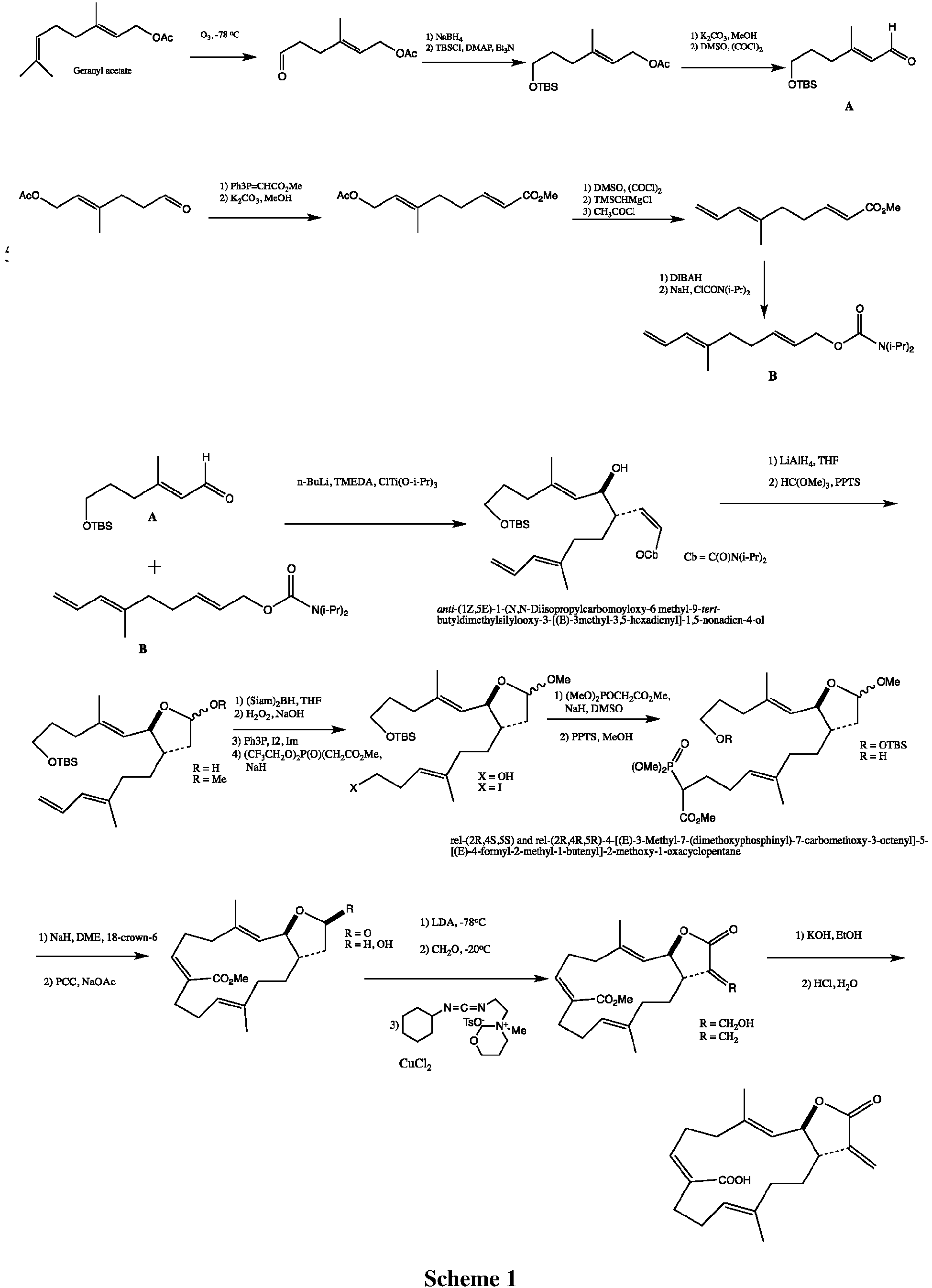
- Scheme 2 (below) illustrates a broad presentation of a mechanism of synthesizing another related compound, compound IV.

- The active components are used in effective amounts.
- The route of administration, the dosage as well as the exact formulation are chosen depending on the subject's condition. Thus, the interval can be adjusted individually to provide levels of the active compound in the blood plasma that are sufficient to maintain and obtain the desired therapeutic effects. In general, however, doses employed for humans typically are in the range of 0.001 mg/kg to about 1000 mg/kg per day, preferably in the range of about 0.1 mg/kg to about 500 mg/kg per dose of inhibitor.
- Typically, the present compounds are administered at 0.001 to 100 mg/kg body weight, for example at 0.01 to 50 mg/kg body weight. In some embodiments, they can be employed in doses ranging from about 0.1 to about 50 mg/kg, about 0.5 to about 40 mg/kg or about 0.7 to about 30 mg/kg. Specific doses contemplated include sub-ranges of any of the foregoing ranges in 0.1 mg/kg increments.
- The pharmaceutical composition will comprise the present compounds either as the primary or as the sole therapeutically efficient component (or agent). Therefore, within the scope of the present technology, compositions are also provided wherein the effective agent consists of or consists essentially of compounds I, II or III and salts thereof. Naturally, it is possible to combine compounds I, II and III with other anticarcinogenic compounds, such as tyrosine kinase inhibitors, such as Pazopanib, and angiogenetic agents, such as vascular endothelial growth factor inhibitors, e.g. Bevacizumab, and with anisomelic acid and derivatives thereof.
- The pharmaceutical compositions can be in any suitable form. Typical pharmaceutical forms include aqueous, oleaginous suspension, dispersions as well as sterile powders, which may be used for the extemporaneous preparation of injectable solutions or dispersions. It can be used for topical (e.g. intravaginal) application, for example in the form of intravaginal creams or by application of prolonged release solid preparations, such as sustained release pharmaceutical plasters. The compositions may also be solutions or suspensions in non-toxic diluents or solvents, e.g. as solutions in 1,3-butanediol.
- Alternatively, they can be prepared as microemulsions and administered, for example orally.
- The carrier can be a solvent or dispersion medium containing, for example, water, polyol (for example, glycerol, propylene glycol, and liquid polyethylene glycol, and the like), ethanol, and mixtures of the indicated components, various vegetable oils, Ringer's solution and isotonic sodium chloride solutions. In addition, fixed oils may be employed as a solvent or suspending medium. Fixed oils that can be employed include synthetic mono- or diglycerides. Further, fatty acids such as oleic acid find use in the preparation of injectables.
- As conventional, the pharmaceutical composition may contain formulation materials for modifying, maintaining or preserving, for example, the pH, osmolality, viscosity, clarity, color, isotonicity, odor, sterility, stability, rate of dissolution or release, adsorption or penetration of the composition.
- The pharmaceutical compositions can also be selected for inhalation or for delivery through the digestive tract, such as orally. The preparation of such pharmaceutically acceptable compositions is within the skill of the art. The present compounds can be present in the same pharmaceutical composition. They can also be comprised in different pharmaceutical compositions which are, for example, supplied in the same package.
- Although the above description primarily relates to human objects, pharmaceutical compositions for veterinary use are also included herein.
- The following non-limiting examples illustrate embodiments of the present technology.
- Unless otherwise stated, chemicals were obtained from commercial suppliers and used without further purification. THF was dried by the sodium-benzophenone method immediately prior to use. NMR spectra were recorded with Bruker Avance 600 MHz spectrometer using standard pulse sequences. LCMS data was obtained using Agilent 1100 equipped with Ion Trap mass detector with ESI (electrospray ionization) operated in positive mode. The reactions were monitored by TLC. Aluminum based TLC plates (Merck) silicagel 60 F254 were used.
- Compounds I to III were prepared based on the stereoselective method previously described by Marshall & DeHoff by using as starting materials a compound of building block A or B in Scheme 1. Both A and B are prepared from geranyl acetated by processes known in literature.
- Compound IV (Scheme 2) was prepared as follows.
- Intermediate INT1: Compound III (680 mg, 1.723 mmol) was dissolved in dichloromethane (20 ml) and Pyridinium chlorochromate (431 mg, 2 mmol) was added in one portion. The mixture was stirred for 3h at room temperature. Then the mixture was diluted with 30 ml of diethyl ether and filtered through a pad of celite and the filtrate was evaporated to dryness. The residue was purified by flash chromatography in chloroform to give compound INT1 (570 mg, 84.2 % yield) as a colorless oil.
- Intermediate INT2: Compound INT1 (570mg, 1.45 mmol) was dissolved in Tetrahydrofuran (50ml) and Tetrabutylammonium fluoride 1M solution in Tetrahydrofuran (2.9 ml, 2.9 mmol) was added in one portion. The reaction mixture was stirred overnight at room temperature. Then the reaction mixture was diluted with 50 ml of saturated ammonium chloride water solution and extracted with Ethyl acetate (3x50ml). The combined organic extracts were dried with sodium sulfate and concentrated in vacuo. The residue was purified by column chromatography on silica (eluent Chloroform/Acetone 10:1) to give the compound INT2 (309 mg, 76% yield) as colorless oil.
- Compound IV: Intermediate INT2 (200 mg, 0.68 mmol) was dissolved in Dimethylformamide (3 ml) and cooled down to -20°C. Then 1M solution of Lithium Bis(trimethylsilyl)amide in Tetrahydrofuran (0.68ml, 0.68 mmol) was added dropwise. The reaction mixture was stirred at -20°C for 20 min and then 4-methoxy-benzylbromide (128 mg, 0.75 mmol) was added. Cooling was removed and the reaction mixture was stirred overnight at room temperature and then diluted with water (15 ml) and extracted with Diethyl ether (3x15 ml). The organic extracts were combined, washed with water (3x30 ml) and brine (30 ml), dried with sodium sulfate and then concentrated to dryness. The residue was purified by column chromatography on silica (eluent Ethyl acetate/Hexanes 1:10) to give the compound IV (110 mg, 41.3 % yield) as colorless oil. 1H NMR (600 MHz, CDCl3) δ ppm 1.41 - 1.52 (m, 1 H) 1.61 - 1.71 (m, 1 H) 1.71 - 1.74 (m, 2H) 1.75 (s, 3 H) 1.76 (d, J=1.13 Hz, 3 H) 1.98 - 2.12 (m, 2 H) 2.16 (t, J=7.37 Hz, 2 H) 2.19 - 2.27 (m, 1 H) 2.34 - 2.39 (m, 1 H) 2.70 (dd, J=17.00, 7.93 Hz, 1 H) 3.45 (t, J=6.42 Hz, 2 H) 3.82 (s, 3 H) 4.41 - 4.46 (m, 2 H) 4.79 (t, J=8.69 Hz, 1 H) 4.97 - 5.07 (m, 1 H) 5.13 (d, J=16.62 Hz, 1 H) 5.19 (d, J=8.69 Hz, 1 H) 5.84 (d, J=10.58 Hz, 1 H) 6.56 (dt, J=16.71, 10.53 Hz, 1 H) 6.90 (dt, J=8.69, 2.27 Hz, 2 H) 7.27 (dt, J=8.70, 2.27 Hz, 2 H) 13C NMR (151 MHz, CDCl3) δ ppm 166.4, 17.0, 27.7, 30.0, 30.2, 30.3, 35.5, 36.0, 55.3, 69.2, 72.6, 82.2, 113.8, 113.8, 115.6, 122.0, 126.3, 129.3, 129.3, 130.6, 132.9, 137.7, 143.9, 159.2, 176.4
- A sample of compound IV was analyzed by LC-MS (column Agilent ZORBAX Eclipse XDB-C8; mobile phase: Acetonitrile (A), 0,5% TFA in H2O (B); flow rate: 0.7 ml/min) using linear gradient (50%-95%). (+)-ESI-MS (m/z 200-1600) of the most intense ion of the MS range (tR 10.8 min) m/z 399 [M+H] was obtained.
- SiHa cervical cancer cells were and cultured in DMEM (Sigma-Aldrich, St Louis, MO, USA). The medium was supplemented with 10% fetal calf serum (BioClear, Wiltshire, UK), 2 mM Lglutamin, 100 U/ml penicillin, 100µg/ml streptomycin (Sigma-Aldrich).
- SiHa cells were treated with 0-40 µM compounds. 24 hours later, the cells were collected and analyzed for apoptosis and/or necrosis. Activated caspase-3 in cells was labeled with phycoerythrin-conjugated antibody according to manufacturer's protocol (PE Active Caspase-3 Apoptosis Kit; BD Pharmingen, San Diego, CA) and analyzed by FACSCalibur flow cytometer (FL-2, FSC, BD Pharmingen).
- Flow cytometric analysis of apoptosis was performed on cells that were plated on a 96-well plate as triplicate samples. The cells were pretreated with different concentrations of compound III for 0-6 hour after which the plate was centrifuged with a culture plate rotor (1000 rpm, 5 minutes). For analysis of nuclear fragmentation, propidium iodide (PI) buffer (40 mM Na-citrate, 0.3 % Triton X-100, 50 µg/ml PI; Sigma) was added to the wells. After 10 minutes incubation at room temperature, the plate was analyzed with LSRII flow cytometer equipped with HTS platform (PE-A channel). The fraction of sub-GO/Gl events (nuclear fragmentation) was gated as a measure of apoptotic cell death.
- Whole cell lysates were prepared by lysing floating and attached cells in Laemmli sample buffer and boiling the samples for 10 minutes. Proteins were separated by SDS-PAGE and transferred on PVDF membrane (Millipore). Western blotting was performed using antibodies against Caspase 3 (Cell Signalling Technology), poly (ADP-ribose) polymerase (clone C-2-10; Sigma-Aldrich), HPV16 E6 (N-17) (Santa Cruz), cIAP2 (Santa Cruz) and Actin (clone AC-40; Sigma-Aldrich). HRP-conjugated secondary antibodies were from Southern Biotechnology Associates, Promega, and Amersham Biosciences. The results were visualized using the ECL method (Amersham Biosciences) on X-ray film.
- The CAM was prepared according to previously described method. Fertilized white leghorn chicken eggs were obtained from LSK Poulty Oy, Finland. The eggs were disinfected with 70 % ethanol and transferred into a hatching incubator (Savimat MG 200, Chauffry, FR) at 37 °C 65 % relative humidity with automatic turning for 3 days. On embryonic development day (EDD) 3, a hole of approximately 3 mm in diameter was drilled into the egg-shell and covered with Parafilm® (Pechiney, Menasha, USA) and then returned to the incubator until use. On EDD 8, the hole in the shell was extended to approximately 3 cm in order to provide better access for tumor cell implantation. A polyethylene ring (approximately 0.5 mm think and 7 mm inner diameter) was deposited on the CAM. Then, 1.5 x 10⁵ SiHa cells were seeded inside the ring on the CAM together with growth factor reduced Matrigel (BD Biosciences, USA) that had been mixed in a 1:1 ratio with serum free DMEM media. After implantation, the egg-shell was covered again and returned to the incubator. For the CAM assay, the different doses (0-6 mg/kg) of compound III were added topically (20µL) to the CAM tumors from EDD 9-13, with additions taking place at the same time on all the days. The tumor xenografts were harvested from the CAM membrane and weighed on EDD 14. The results were repeated at least 3 times. In each experiment, the results of 7-10 eggs per compound dose were evaluated.
- Five-micrometer-thick sections were taken perpendicularly from paraffin-fixed CAM tumors samples and processed for H&E staining. Images were taken with a DC300F digital camera attached to a DMLB microscope (Leica). For immunohistochemistry analysis of tissue sections, upon antigen revealing, tissues were immunohistochemically stained with HRP conjugated antibody and visualized by using ABC staining system (Vector lab, CA, USA). Finally all sections were counterstained with Mayers hematoxyline (Histolab, Gothenburg, Sweden).
- Isotype and concentration matched primary antibodies were used as negative controls, and all were found to be negative.
- The embodiment of the present invention relates to novel use of compounds I, II and III or a pharmaceutically acceptable salt or a derivative thereof as an active ingredient; and use thereof for anti-cervical cancer and anti-oropharyngeal cancer treatment of HPV-mediated cancers and anti-HPV treatment in mammals.
- In order to discover the capacity of compounds to sensitize HPV mediated SiHa cervical cancer cells to apoptosis, we assayed four compounds I, II, III and IV (
Figure 1B ). The cells were treated with compounds initially for 24h after which the cells were analyzed forcaspase 3 activation. The results reported herein show that all the three compounds are cytotoxic to SiHa (Figure 2A ). - However, compound III was found to be highly effective and hence was subjected to nuclear fragmentation assay using a LSRII flow cytometer HTS-unit in 96-well format for analyzing the effect in a time and dose dependent manner. The formation of propidium iodide labeled DNA fragments (
Figure 2 ) was used as the primary indicator of apoptotic cell death. To further confirm the apoptotic effect of compound III in SiHa cells, we performed Western blot to assess the proteolytic cleavage of procaspase-3, PARP and expression of the HPV oncoprotein, HPV16 E6. - The result demonstrates that 40 µM compound III cleaves caspase-3, PARP and downregulates E6 and cIAP2 at 2 h itself (
Figure 3 ), revealing the effect of compound III at an earlier time point. These results clearly show that compound III is highly effective in inducing apoptosis. - The CAM model can be employed to study the preliminary in vivo efficacy of compound III. The efficacy of compound III was tested by topical administration on cervical tumors (SiHa) grown on CAM. The dose-dependent inhibition of SiHa, cervical tumor growth on CAM by compound III is shown in
Figure 4 . While the SiHa cells in the CAM model rapidly formed a prominent tumor, already a dose of 4 mg/kg inhibited the tumor growth and 6 mg/kg was able to deplete an already formed tumor (Figure 4A ). The efficacy of compound III on tumor growth inhibit was further confirmed by hematoxylin/eosin (H&E) stainings as well as immunohistochemistry using proliferation and apoptotic markers (Figure 4B-C and data not shown). As shown in theFigure 4B , the representative control section showed densely populated tumor cells all over the CAM tissue, while atdoses 2 mg/ml of compound III, the regression of tumor growth was beginning to be evident.
The compound III effect is in a dose-dependent manner as at 4 mg/ml tumor size was significantly smaller than control sample and at 6 mg/ml the tumor was almost completed regressed. The quantitation results fromFigure 4C further confirmed that compound III induce cell apoptosis in a dose-dependent manner using an in ovo tumor model. - Reference throughout this specification to "one embodiment" or "an embodiment" means that a particular feature, structure, or characteristic described in connection with the embodiment is included in at least one embodiment of the present invention. Thus, appearances of the phrases "in one embodiment" or "in an embodiment" in various places throughout this specification are not necessarily all referring to the same embodiment. As used herein, a plurality of items, structural elements, compositional elements, and/or materials may be presented in a common list for convenience. However, these lists should be construed as though each member of the list is individually identified as a separate and unique member. Thus, no individual member of such list should be construed as a de facto equivalent of any other member of the same list solely based on their presentation in a common group without indications to the contrary. In addition, various embodiments and example of the present invention may be referred to herein along with alternatives for the various components thereof. It is understood that such embodiments, examples, and alternatives are not to be construed as de facto equivalents of one another, but are to be considered as separate and autonomous representations of the present invention. Furthermore, the described features, structures, or characteristics may be combined in any suitable manner in one or more embodiments. In the following description, numerous specific details are provided, such as examples of lengths, widths, shapes, etc., to provide a thorough understanding of embodiments of the invention. One skilled in the relevant art will recognize, however, that the invention can be practiced without one or more of the specific details, or with other methods, components, materials, etc. In other instances, well-known structures, materials, or operations are not shown or described in detail to avoid obscuring aspects of the invention.
- While the forgoing examples are illustrative of the principles of the present invention in one or more particular applications, it will be apparent to those of ordinary skill in the art that numerous modifications in form, usage and details of implementation can be made without the exercise of inventive faculty, and without departing from the principles and concepts of the invention. Accordingly, it is not intended that the invention be limited, except as by the claims set forth below.
- As will appear from the foregoing, the present molecules are suitable for preparation of pharmaceutically active compositions for use in anti-cervical cancer and anti-HPV treatment in mammals. Further, the present molecules are suitable for use in treatment and prevention of HPV-mediated head and neck cancers, such as oropharyngeal cancers. The present molecules are also useful as intermediates, precursors and prodrugs for compounds having such activity.
-
-
- 1. Bray F, Jemal A, Grey N, Ferlay J, Forman D. Global cancer transitions according to the human development index (2008-2030): a population-based study. Lancet. Oncol. 13 (2012) 790-801.
- 2. American Cancer Society (ACS) 2013. Cancer facts & figures 2013 .
- 3. Finzer P, Aguilarlemarroy A, Rosl F. The role of human papillomavirus oncoproteins E6 and E7 in apoptosis. Cancer Lett. 188 (2002) 15-24.
- 4. Marshall J.A., DeHoff B.S. Cembranolide total synthesis. Anisomelic acid. Tetrahedron 43 (1987) 4849-4860.
- 5. Marshall J.A., DeHoff BS. Stereoselective total synthesis of cembranolide diterpene anisomelic acid, Tetrahedron Lett., 1986, Vol. 27, No. 40, pp. 4873-6.
- 6. Zeisser-Labouèbe M, Delie F, Lange N. Screening of nanoparticle delivery systems for the photodection of cancer in a simple and cost-effective model. Nanomedicine 4 (2009) 135-143.
Claims (8)
- A compound selected from the group consisting of- Compound I: 5-[(E)-5-[tert-butyl(dimethyl)silyl]oxy-2-methyl-pent-1-enyl]-4-[(3E)-3-methylhexa-3,5-dienyl]tetrahydrofuran-2-ol;- Compound II: tert-butyl-[(E)-5-[5-methoxy-3-[(3E)-3-methylhexa-3,5-dienyl]tetrahydrofuran-2-yl]-4-methyl-pent-4-enoxy]-dimethyl-silane; and- Compound III: (E)-6-[2-[(E)-5-[tert-butyl(dimethyl)silyl]oxy-2-methyl-pent-1-enyl]-5-methoxy-tetrahydrofuran-3-yl]-4-methyl-hex-3-en-1-ol for use as a medicament.
- A compound according to claim 1
for use in treatment of Human Papilloma Virus mediated cancer in mammals,
for use in treatment or prevention of Human Papilloma Virus mediated cervical cancer or Human Papilloma Virus mediated oropharyngeal cancers, or
for use in treatment of Human Papilloma Virus mediated non-genital or genital warts. - The compound for use according to claim 1 or 2 in the form of a racemic mixture or as optically pure enantiomers.
- A pharmaceutical composition for use in anti-viral cancer treatment of Human Papilloma Virus mediated cancers in mammals, comprising a therapeutically effective amount of compound selected from the group consisting of- Compound I: 5-[(E)-5-[tert-butyl(dimethyl)silyl]oxy-2-methyl-pent-1-enyl]-4-[(3E)-3-methylhexa-3,5-dienyl]tetrahydrofuran-2-ol;- Compound II: tert-butyl-[(E)-5-[5-methoxy-3-[(3E)-3-methylhexa-3,5-dienyl]tetrahydrofuran-2-yl]-4-methyl-pent-4-enoxy]-dimethyl-silane; and- Compound III: (E)-6-[2-[(E)-5-[tert-butyl(dimethyl)silyl]oxy-2-methyl-pent-1-enyl]-5-methoxy-tetrahydrofuran-3-yl]-4-methyl-hex-3-en-1-ol and salts thereof.
- A pharmaceutical composition for use in treatment of Human Papilloma Virus mediated genital warts, as well as for use in treatment of non-genital warts, comprising a therapeutically effective amount of compound selected from the group consisting of- Compound I: 5-[(E)-5-[tert-butyl(dimethyl)silyl]oxy-2-methyl-pent-1-enyl]-4-[(3E)-3-methylhexa-3,5-dienyl]tetrahydrofuran-2-ol;- Compound II: tert-butyl-[(E)-5-[5-methoxy-3-[(3E)-3-methylhexa-3,5-dienyl]tetrahydrofuran-2-yl]-4-methyl-pent-4-enoxy]-dimethyl-silane; and- Compound III: (E)-6-[2-[(E)-5-[tert-butyl(dimethyl)silyl]oxy-2-methyl-pent-1-enyl]-5-methoxy-tetrahydrofuran-3-yl]-4-methyl-hex-3-en-1-ol,optionally in the form of racemic mixtures or enantiomers, or salts thereof.
- A pharmaceutical composition for use according to claims 4or 5, said composition being formulated for administering to a mammal in a dosage of 0.001 mg/kg to 1000 mg/kg body weight, preferably 0.1 mg/kg to 500 mg/kg body weight, in particular 0.001 to 100 mg/kg body weight, advantageously 0.01 to 50 mg/kg body weight per day.
- The compound for use according to any one of claims 1 to 3 in treating or preventing Human Papilloma Virus mediated cervical cancer or HPV-mediated oropharyngeal cancers.
- The compound for use according to any one of claims 1 to 3 in treating Human Papilloma Virus mediated cancer.
Applications Claiming Priority (2)
| Application Number | Priority Date | Filing Date | Title |
|---|---|---|---|
| FI20145726 | 2014-08-17 | ||
| PCT/FI2015/050532 WO2016027005A1 (en) | 2014-08-17 | 2015-08-17 | Compounds for the treatment of hpv-induced carcinoma |
Publications (2)
| Publication Number | Publication Date |
|---|---|
| EP3179998A1 EP3179998A1 (en) | 2017-06-21 |
| EP3179998B1 true EP3179998B1 (en) | 2021-05-05 |
Family
ID=54014844
Family Applications (1)
| Application Number | Title | Priority Date | Filing Date |
|---|---|---|---|
| EP15756943.5A Active EP3179998B1 (en) | 2014-08-17 | 2015-08-17 | Compounds for the treatment of hpv-induced carcinoma |
Country Status (5)
| Country | Link |
|---|---|
| US (1) | US10196371B2 (en) |
| EP (1) | EP3179998B1 (en) |
| CN (1) | CN107207451B (en) |
| DK (1) | DK3179998T3 (en) |
| WO (1) | WO2016027005A1 (en) |
Families Citing this family (2)
| Publication number | Priority date | Publication date | Assignee | Title |
|---|---|---|---|---|
| FI131137B1 (en) * | 2019-06-17 | 2024-10-24 | Anison Therapeutics Oy | Pharmaceutical compositions of Ovatodiolide and the use thereof |
| CN111171003B (en) * | 2020-01-06 | 2020-12-22 | 温州市中心医院 | As a compound for the prevention or treatment of cervical cancer induced by human papillomavirus (HPV) |
Family Cites Families (4)
| Publication number | Priority date | Publication date | Assignee | Title |
|---|---|---|---|---|
| WO2011109248A1 (en) | 2010-03-02 | 2011-09-09 | Hapten Pharmaceuticals, Llc | Effective sensitizing dose of a gelled immunomodulating topical composition |
| US9028673B2 (en) | 2011-11-09 | 2015-05-12 | Exxonmobil Research And Engineering Company | Production of low cloud point distillates |
| FI126047B (en) * | 2012-08-28 | 2016-06-15 | John Eriksson | Pharmaceutical compositions of anisomelic acid and their use |
| FR2994938B1 (en) | 2012-09-03 | 2014-09-12 | Decamp Paul Henri | PROPULSION WING OF SHIP |
-
2015
- 2015-08-17 DK DK15756943.5T patent/DK3179998T3/en active
- 2015-08-17 WO PCT/FI2015/050532 patent/WO2016027005A1/en not_active Ceased
- 2015-08-17 EP EP15756943.5A patent/EP3179998B1/en active Active
- 2015-08-17 CN CN201580056438.4A patent/CN107207451B/en active Active
- 2015-08-17 US US15/504,696 patent/US10196371B2/en active Active
Also Published As
| Publication number | Publication date |
|---|---|
| EP3179998A1 (en) | 2017-06-21 |
| US10196371B2 (en) | 2019-02-05 |
| CN107207451B (en) | 2020-07-24 |
| WO2016027005A1 (en) | 2016-02-25 |
| DK3179998T3 (en) | 2021-07-12 |
| US20170275263A1 (en) | 2017-09-28 |
| CN107207451A (en) | 2017-09-26 |
Similar Documents
| Publication | Publication Date | Title |
|---|---|---|
| JP7449913B2 (en) | Method of making oxathiazine-like compounds | |
| RU2664534C9 (en) | Tenofovir prodrug and pharmaceutical uses thereof | |
| CN114072396A (en) | Quinoline and cinnoline derivatives as DNA-PK inhibitors | |
| US20130281396A1 (en) | Treatment of diseases by epigenetic regulation | |
| JP7205830B2 (en) | Novel anthranilic acid compound, and Pin1 inhibitor, therapeutic agent for inflammatory disease, and therapeutic agent for cancer using the same | |
| EA023804B1 (en) | Oxabicycloheptanes, their preparation and use | |
| EA017806B1 (en) | Antimicrobial compounds, their synthesis and their use for treatment of mammalian infections | |
| KR20150081422A (en) | Compounds for the treatment of mtor pathway related diseases | |
| DK2804863T3 (en) | NEW FORMS AND SALTS OF A dihydropyrrolo- [1,2-C] IMIDAZOLYLALDOSTERONSYNTASE OR aromatase | |
| KR20210149763A (en) | Inhibitors of the N-terminal domain of the androgen receptor | |
| EP3922251B1 (en) | Cancer immunotheraphy adjuvant | |
| TW202045499A (en) | Amide derivatives useful in the treatment of hbv infection or hbv-induced diseases | |
| CN104869991A (en) | Medicinal composition and application of Fangfeng oxalic acid | |
| CN110325508B (en) | Inhibitors of the N-terminal domain of androgen receptor | |
| JP7229482B2 (en) | Novel amide-based compound, and Pin1 inhibitor, therapeutic agent for inflammatory disease, and therapeutic agent for cancer using the same | |
| CN105209037A (en) | Lipid furan, pyrrole and thiophene compounds for the treatment of cancer, neurological disorders and fibrotic conditions | |
| CN112105598B (en) | Compounds for preventing or treating obesity or metabolic syndrome and pharmaceutical compositions comprising the same | |
| US10196371B2 (en) | Compounds for the treatment of HPV-induced carcinoma | |
| WO2020023340A8 (en) | Single molecule compounds providing multi-target inhibition of btk and other proteins and methods of use thereof | |
| CA2868508A1 (en) | Schweinfurthin analogues | |
| RU2856587C2 (en) | Sesquiterpene derivative, its pharmaceutical composition, as well as method for their preparation and use | |
| EP3805192A1 (en) | Novel biphenyl derivative compound and use thereof | |
| CN100357284C (en) | Compounds against influenza virus and their preparing process and application | |
| KR101718242B1 (en) | Novel compound having HIV inhibitory activity and use thereof | |
| CN113549046B (en) | Bisbecklonin S derivative and preparation method and application thereof |
Legal Events
| Date | Code | Title | Description |
|---|---|---|---|
| STAA | Information on the status of an ep patent application or granted ep patent |
Free format text: STATUS: THE INTERNATIONAL PUBLICATION HAS BEEN MADE |
|
| PUAI | Public reference made under article 153(3) epc to a published international application that has entered the european phase |
Free format text: ORIGINAL CODE: 0009012 |
|
| STAA | Information on the status of an ep patent application or granted ep patent |
Free format text: STATUS: REQUEST FOR EXAMINATION WAS MADE |
|
| 17P | Request for examination filed |
Effective date: 20170317 |
|
| AK | Designated contracting states |
Kind code of ref document: A1 Designated state(s): AL AT BE BG CH CY CZ DE DK EE ES FI FR GB GR HR HU IE IS IT LI LT LU LV MC MK MT NL NO PL PT RO RS SE SI SK SM TR |
|
| AX | Request for extension of the european patent |
Extension state: BA ME |
|
| DAV | Request for validation of the european patent (deleted) | ||
| DAX | Request for extension of the european patent (deleted) | ||
| STAA | Information on the status of an ep patent application or granted ep patent |
Free format text: STATUS: EXAMINATION IS IN PROGRESS |
|
| 17Q | First examination report despatched |
Effective date: 20190205 |
|
| GRAP | Despatch of communication of intention to grant a patent |
Free format text: ORIGINAL CODE: EPIDOSNIGR1 |
|
| STAA | Information on the status of an ep patent application or granted ep patent |
Free format text: STATUS: GRANT OF PATENT IS INTENDED |
|
| RIC1 | Information provided on ipc code assigned before grant |
Ipc: A61K 31/365 20060101ALI20201214BHEP Ipc: A61P 43/00 20060101ALI20201214BHEP Ipc: A61P 35/00 20060101ALI20201214BHEP Ipc: C07D 307/20 20060101ALI20201214BHEP Ipc: A61P 31/20 20060101ALI20201214BHEP Ipc: C07D 307/00 20060101ALI20201214BHEP Ipc: C07D 307/33 20060101ALI20201214BHEP Ipc: A61K 31/34 20060101AFI20201214BHEP |
|
| INTG | Intention to grant announced |
Effective date: 20210118 |
|
| GRAS | Grant fee paid |
Free format text: ORIGINAL CODE: EPIDOSNIGR3 |
|
| GRAA | (expected) grant |
Free format text: ORIGINAL CODE: 0009210 |
|
| STAA | Information on the status of an ep patent application or granted ep patent |
Free format text: STATUS: THE PATENT HAS BEEN GRANTED |
|
| AK | Designated contracting states |
Kind code of ref document: B1 Designated state(s): AL AT BE BG CH CY CZ DE DK EE ES FI FR GB GR HR HU IE IS IT LI LT LU LV MC MK MT NL NO PL PT RO RS SE SI SK SM TR |
|
| REG | Reference to a national code |
Ref country code: GB Ref legal event code: FG4D |
|
| REG | Reference to a national code |
Ref country code: CH Ref legal event code: EP |
|
| REG | Reference to a national code |
Ref country code: AT Ref legal event code: REF Ref document number: 1388931 Country of ref document: AT Kind code of ref document: T Effective date: 20210515 |
|
| REG | Reference to a national code |
Ref country code: DE Ref legal event code: R096 Ref document number: 602015068968 Country of ref document: DE |
|
| REG | Reference to a national code |
Ref country code: IE Ref legal event code: FG4D |
|
| REG | Reference to a national code |
Ref country code: DK Ref legal event code: T3 Effective date: 20210708 |
|
| REG | Reference to a national code |
Ref country code: FI Ref legal event code: FGE |
|
| REG | Reference to a national code |
Ref country code: NL Ref legal event code: FP |
|
| REG | Reference to a national code |
Ref country code: SE Ref legal event code: TRGR |
|
| REG | Reference to a national code |
Ref country code: LT Ref legal event code: MG9D |
|
| REG | Reference to a national code |
Ref country code: AT Ref legal event code: MK05 Ref document number: 1388931 Country of ref document: AT Kind code of ref document: T Effective date: 20210505 |
|
| PG25 | Lapsed in a contracting state [announced via postgrant information from national office to epo] |
Ref country code: LT Free format text: LAPSE BECAUSE OF FAILURE TO SUBMIT A TRANSLATION OF THE DESCRIPTION OR TO PAY THE FEE WITHIN THE PRESCRIBED TIME-LIMIT Effective date: 20210505 Ref country code: BG Free format text: LAPSE BECAUSE OF FAILURE TO SUBMIT A TRANSLATION OF THE DESCRIPTION OR TO PAY THE FEE WITHIN THE PRESCRIBED TIME-LIMIT Effective date: 20210805 Ref country code: AT Free format text: LAPSE BECAUSE OF FAILURE TO SUBMIT A TRANSLATION OF THE DESCRIPTION OR TO PAY THE FEE WITHIN THE PRESCRIBED TIME-LIMIT Effective date: 20210505 Ref country code: HR Free format text: LAPSE BECAUSE OF FAILURE TO SUBMIT A TRANSLATION OF THE DESCRIPTION OR TO PAY THE FEE WITHIN THE PRESCRIBED TIME-LIMIT Effective date: 20210505 |
|
| PG25 | Lapsed in a contracting state [announced via postgrant information from national office to epo] |
Ref country code: LV Free format text: LAPSE BECAUSE OF FAILURE TO SUBMIT A TRANSLATION OF THE DESCRIPTION OR TO PAY THE FEE WITHIN THE PRESCRIBED TIME-LIMIT Effective date: 20210505 Ref country code: IS Free format text: LAPSE BECAUSE OF FAILURE TO SUBMIT A TRANSLATION OF THE DESCRIPTION OR TO PAY THE FEE WITHIN THE PRESCRIBED TIME-LIMIT Effective date: 20210905 Ref country code: GR Free format text: LAPSE BECAUSE OF FAILURE TO SUBMIT A TRANSLATION OF THE DESCRIPTION OR TO PAY THE FEE WITHIN THE PRESCRIBED TIME-LIMIT Effective date: 20210806 Ref country code: NO Free format text: LAPSE BECAUSE OF FAILURE TO SUBMIT A TRANSLATION OF THE DESCRIPTION OR TO PAY THE FEE WITHIN THE PRESCRIBED TIME-LIMIT Effective date: 20210805 Ref country code: PT Free format text: LAPSE BECAUSE OF FAILURE TO SUBMIT A TRANSLATION OF THE DESCRIPTION OR TO PAY THE FEE WITHIN THE PRESCRIBED TIME-LIMIT Effective date: 20210906 Ref country code: PL Free format text: LAPSE BECAUSE OF FAILURE TO SUBMIT A TRANSLATION OF THE DESCRIPTION OR TO PAY THE FEE WITHIN THE PRESCRIBED TIME-LIMIT Effective date: 20210505 Ref country code: RS Free format text: LAPSE BECAUSE OF FAILURE TO SUBMIT A TRANSLATION OF THE DESCRIPTION OR TO PAY THE FEE WITHIN THE PRESCRIBED TIME-LIMIT Effective date: 20210505 |
|
| PG25 | Lapsed in a contracting state [announced via postgrant information from national office to epo] |
Ref country code: SM Free format text: LAPSE BECAUSE OF FAILURE TO SUBMIT A TRANSLATION OF THE DESCRIPTION OR TO PAY THE FEE WITHIN THE PRESCRIBED TIME-LIMIT Effective date: 20210505 Ref country code: SK Free format text: LAPSE BECAUSE OF FAILURE TO SUBMIT A TRANSLATION OF THE DESCRIPTION OR TO PAY THE FEE WITHIN THE PRESCRIBED TIME-LIMIT Effective date: 20210505 Ref country code: CZ Free format text: LAPSE BECAUSE OF FAILURE TO SUBMIT A TRANSLATION OF THE DESCRIPTION OR TO PAY THE FEE WITHIN THE PRESCRIBED TIME-LIMIT Effective date: 20210505 Ref country code: EE Free format text: LAPSE BECAUSE OF FAILURE TO SUBMIT A TRANSLATION OF THE DESCRIPTION OR TO PAY THE FEE WITHIN THE PRESCRIBED TIME-LIMIT Effective date: 20210505 Ref country code: RO Free format text: LAPSE BECAUSE OF FAILURE TO SUBMIT A TRANSLATION OF THE DESCRIPTION OR TO PAY THE FEE WITHIN THE PRESCRIBED TIME-LIMIT Effective date: 20210505 Ref country code: ES Free format text: LAPSE BECAUSE OF FAILURE TO SUBMIT A TRANSLATION OF THE DESCRIPTION OR TO PAY THE FEE WITHIN THE PRESCRIBED TIME-LIMIT Effective date: 20210505 |
|
| REG | Reference to a national code |
Ref country code: DE Ref legal event code: R097 Ref document number: 602015068968 Country of ref document: DE |
|
| PLBE | No opposition filed within time limit |
Free format text: ORIGINAL CODE: 0009261 |
|
| STAA | Information on the status of an ep patent application or granted ep patent |
Free format text: STATUS: NO OPPOSITION FILED WITHIN TIME LIMIT |
|
| PG25 | Lapsed in a contracting state [announced via postgrant information from national office to epo] |
Ref country code: MC Free format text: LAPSE BECAUSE OF FAILURE TO SUBMIT A TRANSLATION OF THE DESCRIPTION OR TO PAY THE FEE WITHIN THE PRESCRIBED TIME-LIMIT Effective date: 20210505 |
|
| 26N | No opposition filed |
Effective date: 20220208 |
|
| REG | Reference to a national code |
Ref country code: BE Ref legal event code: MM Effective date: 20210831 |
|
| PG25 | Lapsed in a contracting state [announced via postgrant information from national office to epo] |
Ref country code: IS Free format text: LAPSE BECAUSE OF FAILURE TO SUBMIT A TRANSLATION OF THE DESCRIPTION OR TO PAY THE FEE WITHIN THE PRESCRIBED TIME-LIMIT Effective date: 20210905 Ref country code: LU Free format text: LAPSE BECAUSE OF NON-PAYMENT OF DUE FEES Effective date: 20210817 Ref country code: AL Free format text: LAPSE BECAUSE OF FAILURE TO SUBMIT A TRANSLATION OF THE DESCRIPTION OR TO PAY THE FEE WITHIN THE PRESCRIBED TIME-LIMIT Effective date: 20210505 |
|
| PG25 | Lapsed in a contracting state [announced via postgrant information from national office to epo] |
Ref country code: IT Free format text: LAPSE BECAUSE OF FAILURE TO SUBMIT A TRANSLATION OF THE DESCRIPTION OR TO PAY THE FEE WITHIN THE PRESCRIBED TIME-LIMIT Effective date: 20210505 Ref country code: IE Free format text: LAPSE BECAUSE OF NON-PAYMENT OF DUE FEES Effective date: 20210817 Ref country code: BE Free format text: LAPSE BECAUSE OF NON-PAYMENT OF DUE FEES Effective date: 20210831 |
|
| PG25 | Lapsed in a contracting state [announced via postgrant information from national office to epo] |
Ref country code: HU Free format text: LAPSE BECAUSE OF FAILURE TO SUBMIT A TRANSLATION OF THE DESCRIPTION OR TO PAY THE FEE WITHIN THE PRESCRIBED TIME-LIMIT; INVALID AB INITIO Effective date: 20150817 |
|
| PG25 | Lapsed in a contracting state [announced via postgrant information from national office to epo] |
Ref country code: CY Free format text: LAPSE BECAUSE OF FAILURE TO SUBMIT A TRANSLATION OF THE DESCRIPTION OR TO PAY THE FEE WITHIN THE PRESCRIBED TIME-LIMIT Effective date: 20210505 |
|
| P01 | Opt-out of the competence of the unified patent court (upc) registered |
Effective date: 20230525 |
|
| PG25 | Lapsed in a contracting state [announced via postgrant information from national office to epo] |
Ref country code: MK Free format text: LAPSE BECAUSE OF FAILURE TO SUBMIT A TRANSLATION OF THE DESCRIPTION OR TO PAY THE FEE WITHIN THE PRESCRIBED TIME-LIMIT Effective date: 20210505 |
|
| PG25 | Lapsed in a contracting state [announced via postgrant information from national office to epo] |
Ref country code: MT Free format text: LAPSE BECAUSE OF FAILURE TO SUBMIT A TRANSLATION OF THE DESCRIPTION OR TO PAY THE FEE WITHIN THE PRESCRIBED TIME-LIMIT Effective date: 20210505 |
|
| PGFP | Annual fee paid to national office [announced via postgrant information from national office to epo] |
Ref country code: NL Payment date: 20250821 Year of fee payment: 11 |
|
| PGFP | Annual fee paid to national office [announced via postgrant information from national office to epo] |
Ref country code: FI Payment date: 20250804 Year of fee payment: 11 |
|
| PGFP | Annual fee paid to national office [announced via postgrant information from national office to epo] |
Ref country code: DK Payment date: 20250825 Year of fee payment: 11 Ref country code: DE Payment date: 20250820 Year of fee payment: 11 |
|
| PGFP | Annual fee paid to national office [announced via postgrant information from national office to epo] |
Ref country code: GB Payment date: 20250820 Year of fee payment: 11 |
|
| PGFP | Annual fee paid to national office [announced via postgrant information from national office to epo] |
Ref country code: FR Payment date: 20250829 Year of fee payment: 11 |
|
| PGFP | Annual fee paid to national office [announced via postgrant information from national office to epo] |
Ref country code: SE Payment date: 20250820 Year of fee payment: 11 Ref country code: CH Payment date: 20250901 Year of fee payment: 11 |
|
| PG25 | Lapsed in a contracting state [announced via postgrant information from national office to epo] |
Ref country code: TR Free format text: LAPSE BECAUSE OF FAILURE TO SUBMIT A TRANSLATION OF THE DESCRIPTION OR TO PAY THE FEE WITHIN THE PRESCRIBED TIME-LIMIT Effective date: 20210505 |