EP3176163B1 - Novel indene derivative, preparation method for same, and pharmaceutical composition, for preventing or treating retinal diseases, containing same as active ingredient - Google Patents
Novel indene derivative, preparation method for same, and pharmaceutical composition, for preventing or treating retinal diseases, containing same as active ingredient Download PDFInfo
- Publication number
- EP3176163B1 EP3176163B1 EP15827408.4A EP15827408A EP3176163B1 EP 3176163 B1 EP3176163 B1 EP 3176163B1 EP 15827408 A EP15827408 A EP 15827408A EP 3176163 B1 EP3176163 B1 EP 3176163B1
- Authority
- EP
- European Patent Office
- Prior art keywords
- thiophene
- methanone
- benzo
- morpholino
- retinal
- Prior art date
- Legal status (The legal status is an assumption and is not a legal conclusion. Google has not performed a legal analysis and makes no representation as to the accuracy of the status listed.)
- Active
Links
- 0 CC1=N**C=C1*=C(*)N* Chemical compound CC1=N**C=C1*=C(*)N* 0.000 description 8
- UUDWYOXIHYEEQC-UHFFFAOYSA-N O=C(c([s]c1ccc2)cc1c2OCc(cc1)ccc1F)N1CCOCC1 Chemical compound O=C(c([s]c1ccc2)cc1c2OCc(cc1)ccc1F)N1CCOCC1 UUDWYOXIHYEEQC-UHFFFAOYSA-N 0.000 description 2
- HEHPMVYXOXUNEW-UHFFFAOYSA-N C[n]1c(C#N)ccc1-c1c(cc(C(N2CCOCC2)=O)[s]2)c2ccc1 Chemical compound C[n]1c(C#N)ccc1-c1c(cc(C(N2CCOCC2)=O)[s]2)c2ccc1 HEHPMVYXOXUNEW-UHFFFAOYSA-N 0.000 description 1
- TUYCLVFSSNWESB-UHFFFAOYSA-N Nc1cc(-c2cccc3c2cc(C(N2CCOCC2)=O)[s]3)ccc1 Chemical compound Nc1cc(-c2cccc3c2cc(C(N2CCOCC2)=O)[s]3)ccc1 TUYCLVFSSNWESB-UHFFFAOYSA-N 0.000 description 1
- JEDUXIWEPNNRAT-UHFFFAOYSA-N O=C(c([s]c1ccc2)cc1c2-c(cc1)cc2c1[nH]cc2)N1CCOCC1 Chemical compound O=C(c([s]c1ccc2)cc1c2-c(cc1)cc2c1[nH]cc2)N1CCOCC1 JEDUXIWEPNNRAT-UHFFFAOYSA-N 0.000 description 1
- QHMKBBNUEOLAQM-UHFFFAOYSA-N O=C(c([s]c1ccc2)cc1c2-c1ccc[s]1)N1CCOCC1 Chemical compound O=C(c([s]c1ccc2)cc1c2-c1ccc[s]1)N1CCOCC1 QHMKBBNUEOLAQM-UHFFFAOYSA-N 0.000 description 1
- DLOBAYAJOQWTKZ-UHFFFAOYSA-N O=C(c([s]c1ccc2)cc1c2NS(c(cc1)ccc1F)(=O)=O)N1CCOCC1 Chemical compound O=C(c([s]c1ccc2)cc1c2NS(c(cc1)ccc1F)(=O)=O)N1CCOCC1 DLOBAYAJOQWTKZ-UHFFFAOYSA-N 0.000 description 1
- SFEAVPXWZZHCNW-UHFFFAOYSA-N O=C(c([s]c1ccc2)cc1c2S(Cc(cc1)ccc1F)(=O)=O)N1CCOCC1 Chemical compound O=C(c([s]c1ccc2)cc1c2S(Cc(cc1)ccc1F)(=O)=O)N1CCOCC1 SFEAVPXWZZHCNW-UHFFFAOYSA-N 0.000 description 1
- WFBIIFWGYNTTMA-UHFFFAOYSA-N O=C(c([s]c1ccc2)cc1c2SCc(cc1)ccc1F)N1CCOCC1 Chemical compound O=C(c([s]c1ccc2)cc1c2SCc(cc1)ccc1F)N1CCOCC1 WFBIIFWGYNTTMA-UHFFFAOYSA-N 0.000 description 1
- HVQBAOORTVOHJP-UHFFFAOYSA-N O=C(c1cc(c(-c2cc(F)ccc2)ccc2)c2[s]1)N1CCOCC1 Chemical compound O=C(c1cc(c(-c2cc(F)ccc2)ccc2)c2[s]1)N1CCOCC1 HVQBAOORTVOHJP-UHFFFAOYSA-N 0.000 description 1
- MUSIJICACYNGCM-UHFFFAOYSA-N O=C(c1cc(cccc2-c(cc3)ccc3F)c2[s]1)N1CCOCC1 Chemical compound O=C(c1cc(cccc2-c(cc3)ccc3F)c2[s]1)N1CCOCC1 MUSIJICACYNGCM-UHFFFAOYSA-N 0.000 description 1
- LFTJAJWSLSWJNA-UHFFFAOYSA-N O=C(c1cc2c(Cc3cccc(F)c3)cccc2[s]1)N1CCOCC1 Chemical compound O=C(c1cc2c(Cc3cccc(F)c3)cccc2[s]1)N1CCOCC1 LFTJAJWSLSWJNA-UHFFFAOYSA-N 0.000 description 1
Images





Classifications
-
- C—CHEMISTRY; METALLURGY
- C07—ORGANIC CHEMISTRY
- C07D—HETEROCYCLIC COMPOUNDS
- C07D413/00—Heterocyclic compounds containing two or more hetero rings, at least one ring having nitrogen and oxygen atoms as the only ring hetero atoms
- C07D413/02—Heterocyclic compounds containing two or more hetero rings, at least one ring having nitrogen and oxygen atoms as the only ring hetero atoms containing two hetero rings
- C07D413/06—Heterocyclic compounds containing two or more hetero rings, at least one ring having nitrogen and oxygen atoms as the only ring hetero atoms containing two hetero rings linked by a carbon chain containing only aliphatic carbon atoms
-
- C—CHEMISTRY; METALLURGY
- C07—ORGANIC CHEMISTRY
- C07D—HETEROCYCLIC COMPOUNDS
- C07D495/00—Heterocyclic compounds containing in the condensed system at least one hetero ring having sulfur atoms as the only ring hetero atoms
- C07D495/02—Heterocyclic compounds containing in the condensed system at least one hetero ring having sulfur atoms as the only ring hetero atoms in which the condensed system contains two hetero rings
- C07D495/04—Ortho-condensed systems
-
- A—HUMAN NECESSITIES
- A23—FOODS OR FOODSTUFFS; TREATMENT THEREOF, NOT COVERED BY OTHER CLASSES
- A23L—FOODS, FOODSTUFFS OR NON-ALCOHOLIC BEVERAGES, NOT OTHERWISE PROVIDED FOR; PREPARATION OR TREATMENT THEREOF
- A23L33/00—Modifying nutritive qualities of foods; Dietetic products; Preparation or treatment thereof
- A23L33/10—Modifying nutritive qualities of foods; Dietetic products; Preparation or treatment thereof using additives
- A23L33/16—Inorganic salts, minerals or trace elements
-
- A—HUMAN NECESSITIES
- A23—FOODS OR FOODSTUFFS; TREATMENT THEREOF, NOT COVERED BY OTHER CLASSES
- A23L—FOODS, FOODSTUFFS OR NON-ALCOHOLIC BEVERAGES, NOT OTHERWISE PROVIDED FOR; PREPARATION OR TREATMENT THEREOF
- A23L33/00—Modifying nutritive qualities of foods; Dietetic products; Preparation or treatment thereof
- A23L33/40—Complete food formulations for specific consumer groups or specific purposes, e.g. infant formula
-
- A—HUMAN NECESSITIES
- A61—MEDICAL OR VETERINARY SCIENCE; HYGIENE
- A61K—PREPARATIONS FOR MEDICAL, DENTAL OR TOILETRY PURPOSES
- A61K31/00—Medicinal preparations containing organic active ingredients
- A61K31/33—Heterocyclic compounds
- A61K31/395—Heterocyclic compounds having nitrogen as a ring hetero atom, e.g. guanethidine or rifamycins
- A61K31/535—Heterocyclic compounds having nitrogen as a ring hetero atom, e.g. guanethidine or rifamycins having six-membered rings with at least one nitrogen and one oxygen as the ring hetero atoms, e.g. 1,2-oxazines
- A61K31/5375—1,4-Oxazines, e.g. morpholine
- A61K31/5377—1,4-Oxazines, e.g. morpholine not condensed and containing further heterocyclic rings, e.g. timolol
-
- A—HUMAN NECESSITIES
- A61—MEDICAL OR VETERINARY SCIENCE; HYGIENE
- A61P—SPECIFIC THERAPEUTIC ACTIVITY OF CHEMICAL COMPOUNDS OR MEDICINAL PREPARATIONS
- A61P27/00—Drugs for disorders of the senses
- A61P27/02—Ophthalmic agents
-
- A—HUMAN NECESSITIES
- A61—MEDICAL OR VETERINARY SCIENCE; HYGIENE
- A61P—SPECIFIC THERAPEUTIC ACTIVITY OF CHEMICAL COMPOUNDS OR MEDICINAL PREPARATIONS
- A61P27/00—Drugs for disorders of the senses
- A61P27/02—Ophthalmic agents
- A61P27/06—Antiglaucoma agents or miotics
-
- A—HUMAN NECESSITIES
- A61—MEDICAL OR VETERINARY SCIENCE; HYGIENE
- A61P—SPECIFIC THERAPEUTIC ACTIVITY OF CHEMICAL COMPOUNDS OR MEDICINAL PREPARATIONS
- A61P43/00—Drugs for specific purposes, not provided for in groups A61P1/00-A61P41/00
-
- C—CHEMISTRY; METALLURGY
- C07—ORGANIC CHEMISTRY
- C07D—HETEROCYCLIC COMPOUNDS
- C07D209/00—Heterocyclic compounds containing five-membered rings, condensed with other rings, with one nitrogen atom as the only ring hetero atom
- C07D209/02—Heterocyclic compounds containing five-membered rings, condensed with other rings, with one nitrogen atom as the only ring hetero atom condensed with one carbocyclic ring
- C07D209/04—Indoles; Hydrogenated indoles
- C07D209/30—Indoles; Hydrogenated indoles with hetero atoms or with carbon atoms having three bonds to hetero atoms with at the most one bond to halogen, directly attached to carbon atoms of the hetero ring
- C07D209/42—Carbon atoms having three bonds to hetero atoms with at the most one bond to halogen, e.g. ester or nitrile radicals
-
- C—CHEMISTRY; METALLURGY
- C07—ORGANIC CHEMISTRY
- C07D—HETEROCYCLIC COMPOUNDS
- C07D235/00—Heterocyclic compounds containing 1,3-diazole or hydrogenated 1,3-diazole rings, condensed with other rings
- C07D235/02—Heterocyclic compounds containing 1,3-diazole or hydrogenated 1,3-diazole rings, condensed with other rings condensed with carbocyclic rings or ring systems
- C07D235/04—Benzimidazoles; Hydrogenated benzimidazoles
- C07D235/24—Benzimidazoles; Hydrogenated benzimidazoles with hetero atoms or with carbon atoms having three bonds to hetero atoms with at the most one bond to halogen, e.g. ester or nitrile radicals, directly attached in position 2
-
- C—CHEMISTRY; METALLURGY
- C07—ORGANIC CHEMISTRY
- C07D—HETEROCYCLIC COMPOUNDS
- C07D307/00—Heterocyclic compounds containing five-membered rings having one oxygen atom as the only ring hetero atom
- C07D307/77—Heterocyclic compounds containing five-membered rings having one oxygen atom as the only ring hetero atom ortho- or peri-condensed with carbocyclic rings or ring systems
- C07D307/78—Benzo [b] furans; Hydrogenated benzo [b] furans
- C07D307/82—Benzo [b] furans; Hydrogenated benzo [b] furans with hetero atoms or with carbon atoms having three bonds to hetero atoms with at the most one bond to halogen, e.g. ester or nitrile radicals, directly attached to carbon atoms of the hetero ring
- C07D307/84—Carbon atoms having three bonds to hetero atoms with at the most one bond to halogen
- C07D307/85—Carbon atoms having three bonds to hetero atoms with at the most one bond to halogen attached in position 2
-
- C—CHEMISTRY; METALLURGY
- C07—ORGANIC CHEMISTRY
- C07D—HETEROCYCLIC COMPOUNDS
- C07D333/00—Heterocyclic compounds containing five-membered rings having one sulfur atom as the only ring hetero atom
- C07D333/50—Heterocyclic compounds containing five-membered rings having one sulfur atom as the only ring hetero atom condensed with carbocyclic rings or ring systems
- C07D333/52—Benzo[b]thiophenes; Hydrogenated benzo[b]thiophenes
- C07D333/54—Benzo[b]thiophenes; Hydrogenated benzo[b]thiophenes with only hydrogen atoms, hydrocarbon or substituted hydrocarbon radicals, directly attached to carbon atoms of the hetero ring
- C07D333/58—Radicals substituted by nitrogen atoms
-
- C—CHEMISTRY; METALLURGY
- C07—ORGANIC CHEMISTRY
- C07D—HETEROCYCLIC COMPOUNDS
- C07D333/00—Heterocyclic compounds containing five-membered rings having one sulfur atom as the only ring hetero atom
- C07D333/50—Heterocyclic compounds containing five-membered rings having one sulfur atom as the only ring hetero atom condensed with carbocyclic rings or ring systems
- C07D333/52—Benzo[b]thiophenes; Hydrogenated benzo[b]thiophenes
- C07D333/54—Benzo[b]thiophenes; Hydrogenated benzo[b]thiophenes with only hydrogen atoms, hydrocarbon or substituted hydrocarbon radicals, directly attached to carbon atoms of the hetero ring
- C07D333/60—Radicals substituted by carbon atoms having three bonds to hetero atoms with at the most one bond to halogen, e.g. ester or nitrile radicals
-
- C—CHEMISTRY; METALLURGY
- C07—ORGANIC CHEMISTRY
- C07D—HETEROCYCLIC COMPOUNDS
- C07D333/00—Heterocyclic compounds containing five-membered rings having one sulfur atom as the only ring hetero atom
- C07D333/50—Heterocyclic compounds containing five-membered rings having one sulfur atom as the only ring hetero atom condensed with carbocyclic rings or ring systems
- C07D333/74—Naphthothiophenes
-
- C—CHEMISTRY; METALLURGY
- C07—ORGANIC CHEMISTRY
- C07D—HETEROCYCLIC COMPOUNDS
- C07D409/00—Heterocyclic compounds containing two or more hetero rings, at least one ring having sulfur atoms as the only ring hetero atoms
- C07D409/02—Heterocyclic compounds containing two or more hetero rings, at least one ring having sulfur atoms as the only ring hetero atoms containing two hetero rings
- C07D409/04—Heterocyclic compounds containing two or more hetero rings, at least one ring having sulfur atoms as the only ring hetero atoms containing two hetero rings directly linked by a ring-member-to-ring-member bond
-
- C—CHEMISTRY; METALLURGY
- C07—ORGANIC CHEMISTRY
- C07D—HETEROCYCLIC COMPOUNDS
- C07D409/00—Heterocyclic compounds containing two or more hetero rings, at least one ring having sulfur atoms as the only ring hetero atoms
- C07D409/02—Heterocyclic compounds containing two or more hetero rings, at least one ring having sulfur atoms as the only ring hetero atoms containing two hetero rings
- C07D409/06—Heterocyclic compounds containing two or more hetero rings, at least one ring having sulfur atoms as the only ring hetero atoms containing two hetero rings linked by a carbon chain containing only aliphatic carbon atoms
-
- A—HUMAN NECESSITIES
- A23—FOODS OR FOODSTUFFS; TREATMENT THEREOF, NOT COVERED BY OTHER CLASSES
- A23V—INDEXING SCHEME RELATING TO FOODS, FOODSTUFFS OR NON-ALCOHOLIC BEVERAGES AND LACTIC OR PROPIONIC ACID BACTERIA USED IN FOODSTUFFS OR FOOD PREPARATION
- A23V2002/00—Food compositions, function of food ingredients or processes for food or foodstuffs
Definitions
- R 1 is -H, methyl, methoxy, -OH, -Cl, -Br, -NH 2 , or
- Pd(PPh 3 ) 4 can be used as the catalyst.
- the present invention also provides a pharmaceutical composition for the prevention or treatment of retinal disease comprising the compound of claim 1, the optical isomer thereof, or the pharmaceutically acceptable salt of the same as an active ingredient.
- the recommended dose and administration times of the eye drop composition can be properly adjusted according to the symptoms in the range of 5 ⁇ 6 times of administration per day and 1 drop for one time administration.
- Example 39 Comparative Example 1 Comparative Example 2 Code No. F001 F002 F003 F004 F000 F000 F001 F002 Transcutol - 0.5 - 0.75 - - - 0.75 Kolliphor TPGS 4 - - - - - - Cremophor EL - 2 4 3 - - 4 3 Labrafil M1944CS - 2 - 3 - - - 3 Sodium chloride 0.734 0.6 85 0.41 - - 0.68 5 0.41 Citric acid hydrate 0.013 0.0128 - - 0.0128 Sodium citrate hydrate 0.45 0.45 - - 0.45 PEG400 (polyethylene glycol 400) 0.053 - 30 15 - propyleneglycol - 0.053 - - 0.053 Povidone K90 1.14 1.5 - - 1.5
- the compound represented by formula 1 of the present invention did not cause retinal degeneration but had excellent retinal pigment epithelial cell protection effect, so that the pharmaceutical composition comprising the compound above as an active ingredient can be effectively used as a pharmaceutical composition for the prevention or treatment of retinal disease.
Landscapes
- Chemical & Material Sciences (AREA)
- Organic Chemistry (AREA)
- Health & Medical Sciences (AREA)
- Life Sciences & Earth Sciences (AREA)
- Animal Behavior & Ethology (AREA)
- Veterinary Medicine (AREA)
- Public Health (AREA)
- General Health & Medical Sciences (AREA)
- Medicinal Chemistry (AREA)
- Pharmacology & Pharmacy (AREA)
- Engineering & Computer Science (AREA)
- Nuclear Medicine, Radiotherapy & Molecular Imaging (AREA)
- General Chemical & Material Sciences (AREA)
- Chemical Kinetics & Catalysis (AREA)
- Bioinformatics & Cheminformatics (AREA)
- Ophthalmology & Optometry (AREA)
- Epidemiology (AREA)
- Food Science & Technology (AREA)
- Mycology (AREA)
- Nutrition Science (AREA)
- Polymers & Plastics (AREA)
- Pediatric Medicine (AREA)
- Inorganic Chemistry (AREA)
- Pharmaceuticals Containing Other Organic And Inorganic Compounds (AREA)
- Heterocyclic Carbon Compounds Containing A Hetero Ring Having Oxygen Or Sulfur (AREA)
- Coloring Foods And Improving Nutritive Qualities (AREA)
- Furan Compounds (AREA)
- Plural Heterocyclic Compounds (AREA)
- Indole Compounds (AREA)
Description
- The present invention relates to a novel indene derivative, a preparation method for the same, and a pharmaceutical composition for use in preventing or treating retinal disease comprising the same as an active ingredient.
- The nerve tissue located in the center of the inner retina of the eye is called the macula. Most of the visual cells responding to the light stimulus are gathered here and the image of an object becomes focused in the center of the macula, suggesting that it plays a very important role in visual acuity. AMD (Age-related Macular Degeneration) is a chronic disease characterized by degeneration of macula pigment epithelium, Bruch's membrane, and choroidal capillaries of the macula. Anatomically, the neurosensory retina is located in front of the retinal pigment epithelium and depends on the retinal pigment epithelium for its nutrition, support, recirculation, and waste treatment. The said Bruch's membrane is a five-layered structure that is interposed between the choroid and the retinal pigment epithelium. The innermost layer is the basement membrane of the retinal pigment epithelium and the outermost layer is the basement membrane of the choroidal capillary endothelial cells. That is, AMD is a degenerative disease developed in the retinal pigment epithelium, Bruch's membrane and choroidal capillary complex.
- This disease mainly occurs in people aged 50 years or older. In the West, this disease is the main cause of blindness in people over 60 and it is increasing in Korea. The cause of AMD is not clearly understood yet, but aging is the most possible risk factor (since the disease rate rapidly increases in those over 75). The most possible environmental cause is smoking. In addition, hypertension, obesity, genetic predisposition, excessive UV exposure, Low serum antioxidant concentration, etc, are regarded as the causes.
- There are two types of macular degeneration, which are dry (nonexudative) macular degeneration and wet (exudative) macular degeneration. In the case of dry macular degeneration (dry AMD, nonexudative AMD, nonneovascular AMD), waste is deposited to form a yellow sediment called drusen under the retina and when this deposit is growing it disturbs blood flow to the retina particularly to the macula, resulting in the blurry vision and visual impairment. Dry macular degeneration does not cause sudden loss of vision, but it can progress to wet macular degeneration.
- Wet macular degeneration (wet AMD, exudative AMD, neovascular AMD) is caused when angiogenesis is developed in the choroid below the retina. When the weak new blood vessel is broken, it results in bleeding or extrusion that causes degeneration of the macula area of the retina to cause vision impairment. Wet macular degeneration progresses rapidly, so that the visual acuity worsens within weeks and blindness may occur between two months and three years.
- The treatment methods for macular degeneration known so far are photodynamic therapy (PDT) and anti-VEGF injection. In PDT, visudyne, the light-sensitive material is injected through blood vessel and when the light-sensitive material reaches to the newly formed blood vessels of the retina after a little while a special laser reacting to the light-sensitive material only is irradiated to the eyes to destroy the newly formed blood vessels selectively. However, there are many cases of recurrence even after this treatment, so it is often necessary to repeat the treatment. In the case of the repeated treatment, the retina itself may also be damaged.
- The antibody (anti-VEGF) injection is an intravitreal injection of an antibody (anti-VEGF) that inhibits the formation and proliferation of new blood vessels by selectively binding to vascular endothelial growth factor (VEGF), which is an important factor for the generation and progression of new blood vessels. The protein antibodies used for the anti-VEGF injection are Lucentis and Avastin. Lucentis is a drug approved by FDA for the treatment of wet macular degeneration agent. Avastin is a drug approved for the treatment of cancer and is used for eye disease. However, the anti-VEGF injection is costly and is inconvenient because it cannot be dropped or applied to the eye and instead requires direct injection through the eye. It also needs a regular treatment once a month, suggesting that there is a risk of bleeding, pain, infection, retinal detachment, etc.
- Therefore, studies to treat macular degeneration via different methods from the above have been going on. Recently, a strategy to develop a neuroprotectant that inhibits the death of the retinal nerve causing macular degeneration has been proposed (Retina today 2012. 64-65). Phosphorylation of RIPK1 (receptor-interacting serine/threonine-protein kinase 1) was observed in the retina of rats when the photoreceptor degeneration was induced by retinal detachment. It has been reported that the phosphorylation was reduced and the photoreceptor degeneration was also protected by the treatment of the RIPK1 enzyme activity inhibitor, Necrostain-1 (Nec-1) (Am J Pathol 2012. 181, 1634-1641).
- In addition, there are other papers published continuously about the protection of retinal degeneration by the RIPK1 inhibitor Nec-1 (J Neurosci, 2013. 33(44), 17458-17468; Am J Pathol 2012. 181,1634-1641; Oncotarget, 2011. 2(6), 497-509; Proc Natl Acad Sci USA, 2010. 107(50):21695-21700). This means that the RIPK1 enzyme activity inhibitor can be used as a macular degeneration treating agent. Further reference may be made to
WO2009/088531 . - Therefore, the present inventors confirmed that the novel indene derivative could inhibit RIPK1 enzyme activity when it was applied to the eye, suggesting that the novel indene derivative could be useful for the treatment of retinal disease such as macular degeneration, leading to the completion of the invention.
- It is an object of the present invention to provide a novel indene derivative, an optical isomer thereof, or a pharmaceutically acceptable salt of the same.
- It is another object of the present invention to provide a method for preparing the indene derivative above.
- It is also an object of the present invention to provide a pharmaceutical composition for use in the prevention or treatment of retinal disease comprising the indene derivative above as an active ingredient.
- It is further an object of the present invention to provide a health functional food for use in the prevention or improvement of retinal disease comprising the indene derivative above as an active ingredient.
- To achieve the above objects, the present invention provides a compound, an optical isomer, or a pharmaceutically acceptable salt of the same,
wherein the compound is selected from the group consisting of the following compounds: - (1) (4-bromo-7-chlorothieno[2,3-c]pyridine-2-yl)(morpholino)methanone;
- (2) (4-(4-fluorophenyl)thieno[2,3-c]pyridine-2-yl)(morpholino)methanone;
- (3) (4-bromothieno[2,3-c]pyridine-2-yl)(morpholino)methanone;
- (4) (4-(4-fluorophenyl)thieno[2,3-b]pyridine-2-yl)(morpholino)methanone;
- (5) (7-chloro-4-(4-fluorophenyl)thieno[2,3-c]pyridine-2-yl)(morpholino)methanone;
- (7) 4-((4-(4-fluorophenyl)benzo[b]thiophene-2-yl)methyl)morpholine;
- (8) 4-(4-(4-fluorophenyl)benzo[b]thiophene-2-carbonyl)morpholine-3-carboxylic acid;
- (9) (4-(1H-indole-5-yl)benzo[b]thiophene-2-yl)(morpholino)methanone;
- (10) N-(4-(2-(morpholine-4-carbonyl)benzo[b]thiophene-4-yl)phenyl)acetamide;
- (14) (5-bromo-1H-benzo[d]imidazole-2-yl)(morpholino)methanone;
- (17) (4,6-dimethylbenzo[b]thiophene-2-yl)(morpholino)methanone;
- (18) (6,7-dimethylbenzo[b]thiophene-2-yl)(morpholino)methanone;
- (19) (6-methoxybenzo[b]thiophene-2-yl)(morpholino)methanone;
- (20) N,N-diethyl-2-(morpholine-4-carbonyl)benzo[b]thiophene-4-carboxamide;
- (24) (5-methoxy-1H-benzo[d]imidazole-2-yl)(morpholino)methanone;
- (27) (6-methylbenzofuran-2-yl) (morpholino)methanone;
- (29) (7-bromobenzo[b]thiophene-2-yl)(morpholino)methanone;
- (30) (4-(2-fluorophenyl)benzo[b]thiophene-2-yl)(morpholino)methanone;
- (31) (4-(biphenyl-4-yl)benzo[b]thiophene-2-yl)(morpholino)methanone;
- (32)morpholino(4-p-tolylbenzo[b]thiophene-2-yl)methanone;
- (33) 4-(2-(morpholine-4-carbonyl)benzo[b]thiophene-4-yl)benzoic acid;
- (34) (4-(4-methoxyphenyl)benzo[b]thiophene-2-yl)(morpholino)methanone;
- (35) (4-(4-fluorophenyl)benzo[b]thiophene-2-yl)(pyrrolidine-1-yl)methanone;
- (36) (4-(3-fluorophenyl)benzo[b]thiophene-2-yl)(morpholino)methanone;
- (37) (4-aminopiperidine-1-yl)(4-(4-fluorophenyl)benzo[b]thiophene-2-yl)methanone hydrochloride;
- (38) (4-(4-fluorophenyl)benzo[b]thiophene-2-yl)(piperazine-1-yl)methanone hydrochloride;
- (39) (4-(4-fluorophenyl)benzo[b]thiophene-2-yl)(morpholino)methanone;
- (40) (5-(4-fluorophenyl)benzo[b]thiophene-2-yl)(morpholino)methanone;
- (41) (4-(biphenyl-3-yl)benzo[b]thiophene-2-yl)(morpholino)methanone;
- (42) (4-(3-aminophenyl)benzo[b]thiophene-2-yl)(morpholino)methanone;
- (43) 4-(2-(morpholine-4-carbonyl)benzo[b]thiophene-4-yl)benzamide;
- (44) (4-(4-hydroxyphenyl)benzo[b]thiophene-2-yl)(morpholino)methanone;
- (45) morpholino(4-(4-(trifluoromethoxy)phenyl)benzo[b]thiophene-2-yl)methanone;
- (46) (4-(4-fluorophenyl)benzo[b]thiophene-2-yl)(oxazolidine-3-yl)methanone;
- (47) (4-(4-fluorophenyl)benzo[b]thiophene-2-yl)(piperidine-1-yl)methanone;
- (48) (4-(4-fluorophenyl)benzo[b]thiophene-2-yl)(4-hydroxypiperidine-1-yl)methanone;
- (49) (4-(4-fluorophenyl)benzo[b]thiophene-2-yl)(4-methylpiperazine-1-yl)methanone hydrochloride;
- (50) (4-(4-(methylthio)phenyl)benzo[b]thiophene-2-yl)(morpholino)methanone;
- (51) (4-(4-fluorophenyl)benzo[b]thiophene-2-yl)(thiomorpholino)methanone;
- (52) (4-(4-fluorophenyl)benzo[b]thiophene-2-yl)(1,4-oxazepane-4-yl)methanone;
- (53) (7-chloro-4-(4-fluorophenyl)benzo[b]thiophene-2-yl)(morpholino)methanone;
- (54) (4-(4-bromophenyl)benzo[b]thiophene-2-yl)(morpholino)methanone;
- (55) (4-(6-methoxypyridine-3-yl)benzo[b]thiophene-2-yl)(morpholino)methanone;
- (56) (4-(3-fluorobenzyl)benzo[b]thiophene-2-yl)(morpholino)methanone;
- (57) (4-(2,4-difluorobenzyl)benzo[b]thiophene-2-yl)(morpholino)methanone;
- (58) (4-(2,4-difluorophenylamino)benzo[b]thiophene-2-yl)(morpholino)methanone;
- (59) (4-(4-fluorophenoxy)benzo[b]thiophene-2-yl)(morpholino)methanone;
- (60) (4-(4-fluorophenethyl)benzo[b]thiophene-2-yl)(morpholino)methanone;
- (61) (4-(4-fluorobenzyloxy)benzo[b]thiophene-2-yl)(morpholino)methanone;
- (62) (4-(4-fluorobenzylsulfonyl)benzo[b]thiophene-2-yl) (morpholino)methanone;
- (63) (4-(2,4-difluorophenyl)benzo[b]thiophene-2-yl)(morpholino)methanone;
- (64) methyl4-(2-(morpholine-4-carbonyl)benzo[b]thiophene-4-yl)benzene sulfiante;
- (65) (7-(4-fluorophenyl)benzo[b]thiophene-2-yl)(morpholino)methanone;
- (66) (4-(6-fluoropyridine-3-yl)benzo[b]thiophene-2-yl)(morpholino)methanone hydrochloride;
- (67) (4-(4-fluorobenzyl)benzo[b]thiophene-2-yl)(morpholino)methanone;
- (68) (4-(4-fluorophenylamino)benzo[b]thiophene-2-yl)(morpholino)methanone;
- (69) (4-((4-fluorophenyl)(methyl)amino)benzo[b]thiophene-2-yl)(morpholino)methanone;
- (70) 4-fluoro-N-(2-(morpholine-4-carbonyl)benzo[b]thiophene-4-yl)benzenesulfonamide;
- (71) (4-(4-fluorobenzylthio)benzo[b]thiophene-2-yl) (morpholino)methanone;
- (72) 1-methyl-5-(2-(morpholine-4-carbonyl)benzo[b]thiophene-4-yl)-1H-pyrrole-2-carbonitrile;
- (73) (4-(1-methyl-1H-pyrazol-4-yl)benzo[b]thiophene-2-yl)(morpholino)methanone;
- (74) morpholino(4-(thiophene-2-yl)benzo[b]thiophene-2-yl)methanone;
- (75) (4-(furan-3-yl)benzo[b]thiophene-2-yl)(morpholino)methanone; and
- (76) morpholino(4-(thiophene-3-yl)benzo[b]thiophene-2-yl)methanone.
- Described herein are compounds represented by
formula 1, an optical isomer, or a pharmaceutically acceptable salt of the same.

formula 1, - R1 is substituted 5-10 membered heteroaryl containing -H, -OH, -NH2, halogen, straight or branched C1-10 alkyl, straight or branched C1-10 alkoxy, -C(=O)NR5R6, -NR7R8, substituted C6-10 aryl, and one or more hetero atoms selected from the group consisting of N, O, and S, C6-10 aryl substituted straight or branched C1-10 alkyl, C6-10 aryl substituted straight or branched C1-10 alkoxy, substituted C6-10 aryloxy, C6-10 aryl substituted straight or branched C1-10 alkylsulfonyl, or C6-10 aryl substituted straight or branched C1-10 alkylthio,
- In the substituted 5-10 membered heteroaryl, C6-10 aryl substituted straight or branched C1-10 alkyl, C6-10 aryl substituted straight or branched C1-10 alkoxy, substituted C6-10 aryloxy, C6-10 aryl substituted straight or branched C1-10 alkylsulfonyl, or C6-10 aryl substituted straight or branched C1-10 alkylthio, one or more substituents selected from the group consisting of -OH, -NR9R10, straight or branched C1-5 alkyl, halogen, nitrile, straight or branched C1-5 alkoxy which is unsubstituted or substituted with one or more halogen, straight or branched C1-5 alkylthio, phenyl, -C(=O)OH, -S(=O)OCH3, and -C(=O)NH2 are substituted and 5-8 membered heteroaryl containing one or more heteroatoms selected from the group consisting of N, O, and S can be fused,
- Wherein R5 and R6 are independently -H, or straight or branched C1-5 alkyl,
- R7 and R8 are independently -H, straight or branched C1-5 alkyl, straight or branched C1-5 alkylcarbonyl, substituted C6-10 arylsulfonyl, or substituted C6-10 aryl. In the substituted C6-10 arylsulfonyl and substituted C6-10 aryl, one or more halogen atoms can be substituted,
- R9 and R10 are independently -H, straight or branched C1-5 alkyl, straight or branched C1-5 alkoxy, or straight or branched C1-5 alkylcarbonyl;
- R2 is -H, -OH, halogen, straight or branched C1-10 alkyl, or straight or branched C1-10 alkoxy,
- Wherein R1 and R2 can form C6-10 aryl along with carbon atoms which are conjugated to the same;
- R3 is -H, -OH, straight or branched C1-5 alkyl, amine, or -C(=O)OH;
- G is -O-, -CH2-, -NH-, -N(CH3 )-, or -S-;
- Y is -O-, -S-, or -NR4-,
- Wherein, R4 is -H, or straight or branched C1-5 alkyl;
- X, E, and A are independently -CH=, or -N=;
- Z is -C(=O)-, or -CH2-;
- N is an integer of 1-5.
- The present invention also provides a method for preparing any one of the compounds of
claim 1 containing the step of reacting the compound represented byformula 2 with the compound represented byformula 3 to give the compound represented by formula 1 (step 1) as shown in thebelow reaction formula 1.

reaction formula 1, R1, R2, R3, A, E, X, Y, Z, G, and n are as defined in formula 1). - The present invention also provides a method for preparing any one of the compounds of
claim 1 containing the step of reacting the compound represented byformula 4 with the compound represented by formula 5 to give the compound represented by formula 1 (step 1) as shown in thebelow reaction formula 2.
reaction formula 2, R1, R2, R3, A, E, X, Y, Z, G, and n are as defined in formula 1). - The present invention also provides a pharmaceutical composition for the prevention or treatment of retinal disease comprising the compound of
claim 1, the optical isomer thereof, or the pharmaceutically acceptable salt of the same as an active ingredient. - In addition, the present invention provides a health functional food for use in the prevention or improvement of retinal disease comprising the compound of
claim 1, the optical isomer thereof, or the pharmaceutically acceptable salt of the same as an active ingredient. - The novel indene derivative of the present invention, the optical isomer of the same, or the pharmaceutically acceptable salt of the same has excellent inhibitory efficiency of receptor-interacting serine/threonine-protein kinase 1 (RIPK1). Therefore, the composition containing the same as an active ingredient can be effectively used as a pharmaceutical composition for use in preventing or treating retinal disease exemplified by retinitis pigmentosa (RP), Leber congenital amaurosis (LCA), Stargardts disease, Usher syndrome, choroideremia, rod-cone or cone-rod dystrophy, ciliopathy, mitochondrial disorders, progressive retinal atrophy, degenerative retinal diseases, age-related macular degeneration (AMD), wet AMD, dry AMD, geographical atrophy, inherited or acquired macular degeneration, retinal photoreceptor diseases, retinal pigment epithelial diseases, diabetic retinopathy, cystic macular edema, uveitis, retinal detachment, traumatic retinal injury, iatrogenic retinal injury, macular holes, macular capillarectasia, ganglion cell diseases, optic nerve diseases, glaucoma, optic neuropathy, ischemic retinal diseases, retinopathy of prematurity, occlusion of retinal vessels, inherited macroaneurysm, retinal vascular diseases, ophthalmic vascular diseases, glaucomatous retinal neurodegeneration, ischemic optic neuropathy and the like.
- The application of the preferred embodiments of the present invention is best understood with reference to the accompanying drawings, wherein:
-
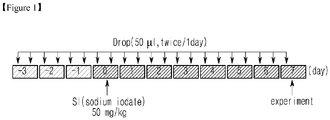
Figure 1 is a schematic diagram illustrating the construction of a dry macular degeneration rat model and the instillation of the compounds of examples; -
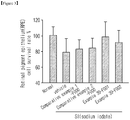
Figure 2 is an image illustrating the protecting effect of the compounds of examples on retinal degeneration in the dry macular degeneration rat model; -
Figure 3 is an image illustrating the protecting effect of the compounds of examples on retinal pigment epithelial cells in the dry macular degeneration rat model; -
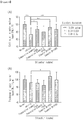
Figure 4(A) is a graph illustrating the results of counting the number of cells in the outer nuclear layer after the eye drop instillation of the compounds of examples of the invention to the dry macular degeneration rat model; -
Figure 4(B) is a graph illustrating the results of measuring the outer nuclear layer thickness (µm) after the instillation of the compounds of examples of the invention to the dry macular degeneration rat model; -
Figure 5 is a schematic diagram illustrating the construction of the dry macular degeneration rabbit model and eye drop instillation of the compounds of examples of the invention; -
Figure 6 is an image illustrating the results of MRI of the dry macular degeneration rabbit model after the instillation of the compounds of examples of the invention; -
Figure 7 is an image illustrating the results of observation of the retina of the dry macular degeneration rabbit model after H&E staining; -
Figure 8 is an image illustrating the results of measuring the outer nuclear layer thickness of the dry macular degeneration rabbit model; -
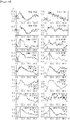
Figure 9 is an image illustrating the results of measuring the potential difference of the retina of the dry macular degeneration rabbit model by ERG (Electroretinography); -
Figure 10 is an image illustrating the protective effect of the compounds of examples on the retinal photoreceptor cell degeneration in the dry macular degeneration rabbit model which was investigated by ERG; -
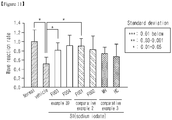
Figure 11 is a graph illustrating the protective effect of the compounds of examples on the retinal photoreceptor cell degeneration in the dry macular degeneration rabbit model which was investigated by ERG; -
Figure 12 is a schematic diagram illustrating the construction of the dry macular degeneration pig model and eye drop instillation of the compounds of examples of the invention; -
Figure 13 is a photograph of the fundus taken by Fundoscopy 7 days after eye drop instillation of the compounds of examples of the invention to the dry macular degeneration pig model (*: damaged area; ↙ : choroidal vessels); -
Figure 14 is an image illustrating the protective effect of the compounds of examples on the retinal photoreceptor cell degeneration in the dry macular degeneration pig model which was investigated by ERG; and -
Figure 15 is a graph illustrating the protective effect of the compounds of examples on the retinal photoreceptor cell degeneration in the dry macular degeneration pig model which was investigated by ERG. - Hereinafter, the present invention is described in detail.
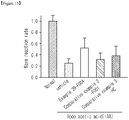
- Described herein is a compound represented by
formula 1, an optical isomer, or a pharmaceutically acceptable salt of the same.
formula 1, - R1 is substituted 5-10 membered heteroaryl containing -H, -OH, -NH2, halogen, straight or branched C1-10 alkyl, straight or branched C1-10 alkoxy, -C(=O)NR5R6, -NR7R8, substituted C6-10 aryl, and one or more hetero atoms selected from the group consisting of N, O, and S, C6-10 aryl substituted straight or branched C1-10 alkyl, C6-10 aryl substituted straight or branched C1-10 alkoxy, substituted C6-10 aryloxy, C6-10 aryl substituted straight or branched C1-10 alkylsulfonyl, or C6-10 aryl substituted straight or branched C1-10 alkylthio,
- In the substituted 5-10 membered heteroaryl, C6-10 aryl substituted straight or branched C1-10 alkyl, C6-10 aryl substituted straight or branched C1-10 alkoxy, substituted C6-10 aryloxy, C6-10 aryl substituted straight or branched C1-10 alkylsulfonyl, or C6-10 aryl substituted straight or branched C1-10 alkylthio, one or more substituents selected from the group consisting of -OH, -NR9R10, straight or branched C1-5 alkyl, halogen, nitrile, straight or branched C1-5 alkoxy which is unsubstituted or substituted with one or more halogen, straight or branched C1-5 alkylthio, phenyl, -C(=O)OH, -S(=O)OCH3, and -C(=O)NH2 are substituted and 5-8 membered heteroaryl containing one or more heteroatoms selected from the group consisting of N, O, and S can be fused,
- Wherein R5 and R6 are independently -H, or straight or branched C1-5 alkyl,
- R7 and R8 are independently -H, straight or branched C1-5 alkyl, straight or branched C1-5 alkylcarbonyl, substituted C6-10 arylsulfonyl, or substituted C6-10 aryl. In the substituted C6-10 arylsulfonyl and substituted C6-10 aryl, one or more halogen atoms can be substituted,
- R9 and R10 are independently -H, straight or branched C1-5 alkyl, straight or branched C1-5 alkoxy, or straight or branched C1-5 alkylcarbonyl;
- R2 is -H, -OH, halogen, straight or branched C1-10 alkyl, or straight or branched C1-10 alkoxy,
- Wherein R1 and R2 can form C6-10 aryl along with carbon atoms which are conjugated to the same;
- R3 is -H, -OH, straight or branched C1-5 alkyl, amine, or -C(=O)OH;
- G is -O-, -CH2-, -NH-, -N(CH3 )-, or -S-;
- Y is -O-, -S-, or -NR4-,
- Wherein, R4 is -H, or straight or branched C1-5 alkyl;
- X, E, and A are independently -CH=, or -N=;
- Z is -C(=O)-, or -CH2-;
- N is an integer of 1-5.
- At least one of the followings is preferably excluded;
X, E, and A are -CH=, Y is -NH-, Z is -C(=O)-, n is 2, G is -O-, R3 is -H, and one of R1 and R2 is -Cl, the other is -H;
X is -N=, E and A are -CH=, Y is -NH-, Z is-C(=O)-, n is 2, G is -O-, R3 is -H, and one of R1 and R2 is -CH3, the other is -H;
X is -N=, E and A are -CH=, Y is -NH-, Z is-C(=O)-, n is 2, G is -O-, R3 is -H, and R1 and R2 are both -H;
X, E, and A are -CH=, Y is -O-, Z is -C(=O)-, n is 2, G is -O-, R3 is -H, and R1 and R2 are both -H;
X, E, and A is -CH=, Y is -NCH3-, Z is -C(=O)-, n is 2, G is -O-, R3 is -H, and R1 and R2 are both -H;
X, E, and A is -CH=, Y is -S-, Z is -C(=O)-, n is 2, G is -O-, R3 is -H, and one of R1 and R2 is -NH2, the other is -H;
X, E, and A is -CH=, Y is -S-, Z is -C(=O)-, n is 2, G is -O-, R3 is -H, and R1 and R2 are phenyl along with carbon atoms which are conjugated to the same;
X, E, and A is -CH=, Y is -O-, Z is -C(=O)-, n is 2, G is -O-, R3 is -H, and one of R1 and R2 is -Br, the other is -H;
X, E, and A is -CH=, Y is -NH-, Z is -C(=O)-, n is 2, G is -O-, R3 is -H, and one of R1 and R2 is methyl, the other is -H;
X, E, and A is -CH=, Y is -NH-, Z is -C(=O)-, n is 2, G is -O-, R3 is -H, and one of R1 and R2 is methoxy, the other is -H; and
X, E, and A is -CH=, Y is -O-, Z is -C(=O)-, n is 2, G is -O-, R3 is -H, and one of R1 and R2 is methoxy, the other is -H. - Preferably,
R1 is substituted 5-8 membered heteroaryl containing -H, -OH, -NH2, halogen, straight or branched C1-5 alkyl, straight or branched C1-5 alkoxy, -C(=O)NR5R6, -NR7R8, substituted C6-8 aryl, and one or more hetero atoms selected from the group consisting of, N, O, and S, C6-8 aryl substituted straight or branched C1-5 alkyl, C6-8 aryl substituted straight or branched C1-5 alkoxy, substituted C6-8 aryloxy, C6-8 aryl substituted straight or branched C1-5 alkylsulfonyl, or C6-8 aryl substituted straight or branched C1-5 alkylthio,
In the substituted 5-8 membered heteroaryl, C6-8 aryl substituted straight or branched C1-5 alkyl, C6-8 aryl substituted straight or branched C1-5 alkoxy, substituted C6-8 aryloxy, C6-8 aryl substituted straight or branched C1-5 alkylsulfonyl, or C6-8 aryl substituted straight or branched C1-5 alkylthio, one or more substituents selected from the group consisting of-OH, -NR9R10, straight or branched C1-3 alkyl, halogen, nitrile, straight or branched C1-5 alkoxy which is unsubstituted or substituted with one or more halogen, straight or branched C1-5 alkylthio, phenyl, -C(=O)OH, -S(=O)OCH3, and -C(=O)NH2 are substituted and 5-6 membered heteroaryl containing one or more heteroatoms selected from the group consisting of N, O, and S can be fused,
Wherein R5 and R6 are independently -H, or straight or branched C1-3 alkyl,
R7 and R8 are independently -H, straight or branched C1-3 alkyl, straight or branched C1-5 alkylcarbonyl, substituted C6-8 arylsulfonyl, or substituted C6-10 aryl. In the substituted C6-8 arylsulfonyl and substituted C6-10 aryl, one or more halogen atoms can be substituted,
R9 and R10 are independently -H, straight or branched C1-5 alkyl, straight or branched C1-5 alkoxy, or straight or branched C1-5 alkylcarbonyl;
R2 is -H, -OH, halogen, straight or branched C1-5 alkyl, or straight or branched C1-5 alkoxy,
Wherein R1 and R2 can form C6-8 aryl along with carbon atoms which are conjugated to the same;
R3 is -H, -OH, straight or branched C1-3 alkyl, amine, or -C(=O)OH;
G is -O-, -CH2-, -NH-, -N(CH3)-, or -S-;
Y is -O-, -S-, or -NR4-,
Wherein, R4 is -H, or straight or branched C1-3 alkyl;
X, E, and A are independently -CH=, or -N=;
Z is -C(=O)-, or -CH2-;
N is an integer of 1-4. - At least one of the followings is preferably excluded;
X, E, and A are -CH=, Y is -NH-, Z is -C(=O)-, n is 2, G is -O-, R3 is -H, and one of R1 and R2 is -Cl, the other is -H;
X is -N=, E and A are -CH=, Y is -NH-, Z is-C(=O)-, n is 2, G is -O-, R3 is -H, and one of R1 and R2 is -CH3, the other is -H;
X is -N=, E and A are -CH=, Y is -NH-, Z is-C(=O)-, n is 2, G is -O-, R3 is -H, and R1 and R2 are both -H;
X, E, and A are -CH=, Y is -O-, Z is -C(=O)-, n is 2, G is -O-, R3 is -H, and R1 and R2 are both -H;
X, E, and A is -CH=, Y is -NCH3-, Z is -C(=O)-, n is 2, G is -O-, R3 is -H, and R1 and R2 are both -H;
X, E, and A is -CH=, Y is -S-, Z is -C(=O)-, n is 2, G is -O-, R3 is -H, and one of R1 and R2 is -NH2, the other is -H;
X, E, and A is -CH=, Y is -S-, Z is -C(=O)-, n is 2, G is -O-, R3 is -H, and R1 and R2 are phenyl along with carbon atoms which are conjugated to the same;
X, E, and A is -CH=, Y is -O-, Z is -C(=O)-, n is 2, G is -O-, R3 is -H, and one of R1 and R2 is -Br, the other is -H;
X, E, and A is -CH=, Y is -NH-, Z is -C(=O)-, n is 2, G is -O-, R3 is -H, and one of R1 and R2 is methyl, the other is -H;
X, E, and A is -CH=, Y is -NH-, Z is -C(=O)-, n is 2, G is -O-, R3 is -H, and one of R1 and R2 is methoxy, the other is -H; and
X, E, and A is -CH=, Y is -O-, Z is -C(=O)-, n is 2, G is -O-, R3 is -H, and one of R1 and R2 is methoxy, the other is -H. - More preferably,
R1 is -H, methyl, methoxy, -OH, -Cl, -Br, -NH2,


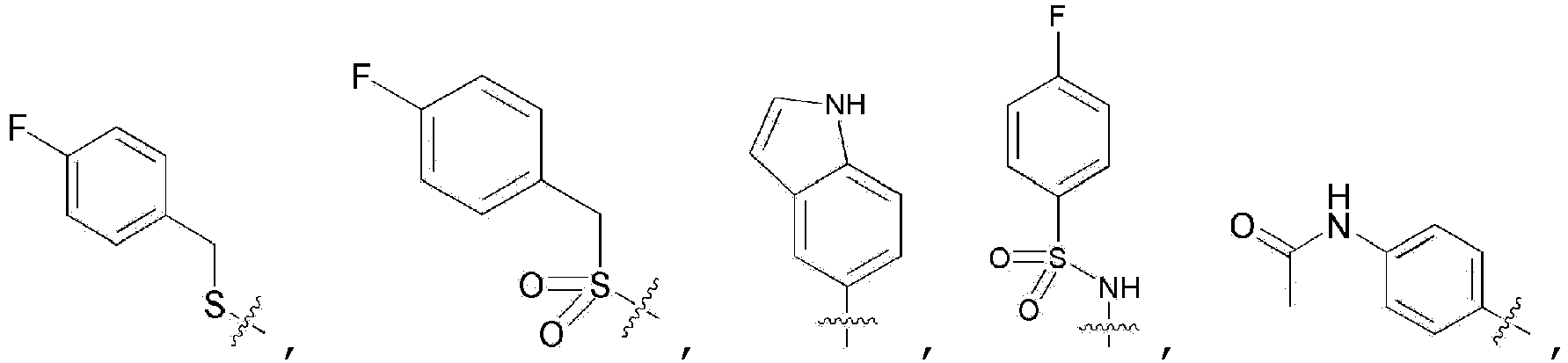

- R2 is -H, methyl, or -Cl,
- Wherein R1 and R2 can form phenyl along with carbon atoms which are conjugated to the same;
- R3 is -H, -OH, methyl, amine, or -C(=O)OH;
- G is -O-, -CH2-, -NH-, -N(CH3 )-, or -S-;
- Y is -O-, -S-, or -NR4-,
- Wherein, R4 is -H or methyl;
- X, E, and A are independently -CH= or -N=;
- Z is -C(=O)- or -CH2-;
- N is an integer of 1-3.
- At least one of the followings is preferably excluded;
X, E, and A are -CH=, Y is -NH-, Z is -C(=O)-, n is 2, G is -O-, R3 is -H, and one of R1 and R2 is -Cl, the other is -H;
X is -N=, E and A are -CH=, Y is -NH-, Z is-C(=O)-, n is 2, G is -O-, R3 is -H, and one of R1 and R2 is -CH3, the other is -H;
X is -N=, E and A are -CH=, Y is -NH-, Z is-C(=O)-, n is 2, G is -O-, R3 is -H, and R1 and R2 are both -H;
X, E, and A are -CH=, Y is -O-, Z is -C(=O)-, n is 2, G is -O-, R3 is -H, and R1 and R2 are both -H;
X, E, and A is -CH=, Y is -NCH3-, Z is -C(=O)-, n is 2, G is -O-, R3 is -H, and R1 and R2 are both -H;
X, E, and A is -CH=, Y is -S-, Z is -C(=O)-, n is 2, G is -O-, R3 is -H, and one of R1 and R2 is -NH2, the other is -H;
X, E, and A is -CH=, Y is -S-, Z is -C(=O)-, n is 2, G is -O-, R3 is -H, and R1 and R2 are phenyl along with carbon atoms which are conjugated to the same;
X, E, and A is -CH=, Y is -O-, Z is -C(=O)-, n is 2, G is -O-, R3 is -H, and one of R1 and R2 is -Br, the other is -H;
X, E, and A is -CH=, Y is -NH-, Z is -C(=O)-, n is 2, G is -O-, R3 is -H, and one of R1 and R2 is methyl, the other is -H;
X, E, and A is -CH=, Y is -NH-, Z is -C(=O)-, n is 2, G is -O-, R3 is -H, and one of R1 and R2 is methoxy, the other is -H; and
X, E, and A is -CH=, Y is -O-, Z is -C(=O)-, n is 2, G is -O-, R3 is -H, and one of R1 and R2 is methoxy, the other is -H. - The compound represented by
formula 1 can be exemplified by the following compounds: - (1) (4-bromo-7-chlorothieno[2,3-c]pyridine-2-yl)(morpholino)methanone;
- (2) (4-(4-fluorophenyl)thieno[2,3-c]pyridine-2-yl)(morpholino)methanone;
- (3) (4-bromothieno[2,3-c]pyridine-2-yl)(morpholino)methanone;
- (4) (4-(4-fluorophenyl)thieno[2,3-b]pyridine-2-yl)(morpholino)methanone;
- (5) (7-chloro-4-(4-fluorophenyl)thieno[2,3-c]pyridine-2-yl)(morpholino)methanone;
- (6) morpholino(naphtho[1,2-b]thiophene-2-yl)methanone;
- (7) 4-((4-(4-fluorophenyl)benzo[b]thiophene-2-yl)methyl)morpholine;
- (8) 4-(4-(4-fluorophenyl)benzo[b]thiophene-2-carbonyl)morpholine-3-carboxylic acid;
- (9) (4-(1H-indole-5-yl)benzo[b]thiophene-2-yl)(morpholino)methanone;
- (10) N-(4-(2-(morpholine-4-carbonyl)benzo[b]thiophene-4-yl)phenyl)acetamide;
- (11) (5-hydroxy-1H-indole-2-yl)(morpholino)methanone;
- (12) (5-chloro-1H-indole-2-yl)(morpholino)methanone;
- (13) (5-methyl-1H-benzo[d]imidazole-2-yl)(morpholino)methanone;
- (14) (5-bromo-1H-benzo[d]imidazole-2-yl)(morpholino)methanone;
- (15) benzofuran-2-yl(morpholino)methanone;
- (16) (5-bromobenzofuran-2-yl)(morpholino)methanone;
- (17) (4,6-dimethylbenzo[b]thiophene-2-yl)(morpholino)methanone;
- (18) (6,7-dimethylbenzo[b]thiophene-2-yl)(morpholino)methanone;
- (19) (6-methoxybenzo[b]thiophene-2-yl)(morpholino)methanone;
- (20) N,N-diethyl-2-(morpholine-4-carbonyl)benzo[b]thiophene-4-carboxamide;
- (21) (5-methyl-1H-indole-2-yl)(morpholino)methanone;
- (22) (5-methoxy-1H-indole-2-yl)(morpholino)methanone;
- (23) (1H-benzo[d]imidazole-2-yl)(morpholino)methanone;
- (24) (5-methoxy-1H-benzo[d]imidazole-2-yl)(morpholino)methanone;
- (25) (1-methyl-1H-indole-2-yl)(morpholino)methanone;
- (26) (5-methoxybenzofuran-2-yl)(morpholino)methanone;
- (27) (6-methylbenzofuran-2-yl)(morpholino)methanone;
- (28) (5-aminobenzo[b]thiophene-2-yl)(morpholino)methanone;
- (29) (7-bromobenzo[b]thiophene-2-yl)(morpholino)methanone;
- (30) (4-(2-fluorophenyl)benzo[b]thiophene-2-yl)(morpholino)methanone;
- (31) (4-(biphenyl-4-yl)benzo[b]thiophene-2-yl)(morpholino)methanone;
- (32) morpholino(4-p-tolylbenzo[b]thiophene-2-yl)methanone;
- (33) 4-(2-(morpholine-4-carbonyl)benzo[b]thiophene-4-yl)benzoic acid;
- (34) (4-(4-methoxyphenyl)benzo[b]thiophene-2-yl)(morpholino)methanone;
- (35) (4-(4-fluorophenyl)benzo[b]thiophene-2-yl)(pyrrolidine-1-yl)methanone;
- (36) (4-(3-fluorophenyl)benzo[b]thiophene-2 yl) (morpholino)methanone;
- (37) (4-aminopiperidine-1-yl)(4-(4-fluorophenyl)benzo[b]thiophene-2-yl)methanone hydrochloride;
- (38) (4-(4-fluorophenyl)benzo[b]thiophene-2-yl)(piperazine-1-yl)methanone hydrochloride;
- (39) (4-(4-fluorophenyl)benzo[b]thiophene-2-yl) (morpholino)methanone;
- (40) (5-(4-fluorophenyl)benzo[b]thiophene-2-yl) (morpholino)methanone;
- (41) (4-(biphenyl-3-yl)benzo[b]thiophene-2-yl) (morpholino)methanone;
- (42) (4-(3-aminophenyl)benzo[b]thiophene-2-yl) (morpholino)methanone;
- (43) 4-(2-(morpholine-4-carbonyl)benzo[b]thiophene-4-yl)benzamide;
- (44) (4-(4-hydroxyphenyl)benzo[b]thiophene-2-yl)(morpholino)methanone;
- (45) morpholino (4-(4-(trifluoromethoxy)phenyl)benzo[b]thiophene-2-yl)methanone;
- (46) (4-(4-fluorophenyl)benzo[b]thiophene-2-yl)(oxazolidine-3-yl)methanone;
- (47) (4-(4-fluorophenyl)benzo[b]thiophene-2-yl)(piperidine-1-yl)methanone;
- (48) (4-(4-fluorophenyl)benzo[b]thiophene-2-yl)(4-hydroxypiperidine-1-yl)methanone;
- (49) (4-(4-fluorophenyl)benzo[b]thiophene-2-yl)(4-methylpiperazine-1-yl)methanone hydrochloride;
- (50) (4-(4-(methylthio)phenyl)benzo[b]thiophene-2-yl)(morpholino)methanone;
- (51) (4-(4-fluorophenyl)benzo[b]thiophene-2-yl)(thiomorpholino)methanone;
- (52) (4-(4-fluorophenyl)benzo[b]thiophene-2-yl)(1,4-oxazepane-4-yl)methanone;
- (53) (7-chloro-4-(4-fluorophenyl)benzo[b]thiophene-2-yl)(morpholino)methanone;
- (54) (4-(4-bromophenyl)benzo[b]thiophene-2-yl)(morpholino)methanone;
- (55) (4-(6-methoxypyridine-3-yl)benzo[b]thiophene-2-yl)(morpholino)methanone;
- (56) (4-(3-fluorobenzyl)benzo[b]thiophene-2-yl)(morpholino)methanone;
- (57) (4-(2,4-difluorobenzyl)benzo[b]thiophene-2-yl)(morpholino)methanone;
- (58) (4-(2,4-difluorophenylamino)benzo[b]thiophene-2-yl)(morpholino)methanone;
- (59) (4-(4-fluorophenoxy)benzo[b]thiophene-2-yl)(morpholino)methanone;
- (60) (4-(4-fluorophenethyl)benzo[b]thiophene-2-yl)(morpholino)methanone;
- (61) (4-(4-fluorobenzyloxy)benzo[b]thiophene-2-yl)(morpholino)methanone;
- (62) (4-(4-fluorobenzylsulfonyl)benzo[b]thiophene-2-yl)(morpholino)methanone;
- (63) (4-(2,4-difluorophenyl)benzo[b]thiophene-2-yl)(morpholino)methanone;
- (64) methyl 4-(2-(morpholine-4-carbonyl)benzo[b]thiophene-4-yl)benzene sulfinate;
- (65) (7-(4-fluorophenyl)benzo[b]thiophene-2-yl)(morpholino)methanone;
- (66) (4-(6-fluoropyridine-3-yl)benzo[b]thiophene-2-yl)(morpholino)methanone hydrochloride;
- (67) (4-(4-fluorobenzyl)benzo[b]thiophene-2-yl)(morpholino)methanone;
- (68) (4-(4-fluorophenylamino)benzo[b]thiophene-2-yl)(morpholino)methanone;
- (69) (4-((4-fluorophenyl)(methyl)amino)benzo[b]thiophene-2-yl)(morpholino)methanone;
- (70) 4-fluoro-N-(2-(morpholine-4-carbonyl)benzo[b]thiophene-4-yl)benzenesulfonamide;
- (71) (4-(4-fluorobenzylthio)benzo[b]thiophene-2-yl)(morpholino)methanone;
- (72) 1-methyl-5-(2-(morpholine-4-carbonyl)benzo[b]thiophene-4-yl)-1H-pyrrole-2-carbonitrile;
- (73) (4-(1-methyl-1H-pyrazol-4-yl)benzo[b]thiophene-2-yl)(morpholino)methanone;
- (74) morpholino(4-(thiophene-2-yl)benzo[b]thiophene-2-yl)methanone;
- (75) (4-(furan-3-yl)benzo[b]thiophene-2-yl)(morpholino)methanone; and
- (76) morpholino(4-(thiophene-3-yl)benzo[b]thiophene-2-yl)methanone.
- Among the compounds of examples 1 ∼ 76, one or more compounds selected from the group consisting of the compounds of examples 6, 12, 13, 15, 16, 21, 22, 23, 25, 26, and 28 are excluded.
- The compound represented by
formula 1 can be used as a form of a pharmaceutically acceptable salt, in which the salt is preferably acid addition salt formed by pharmaceutically acceptable free acids. The acid addition salt herein can be obtained from inorganic acids such as hydrochloric acid, nitric acid, phosphoric acid, sulfuric acid, hydrobromic acid, hydriodic acid, nitrous acid, and phosphorous acid; non-toxic organic acids such as aliphatic mono/dicarboxylate, phenyl-substituted alkanoate, hydroxy alkanoate, alkandioate, aromatic acids, and aliphatic/aromatic sulfonic acids; or organic acids such as acetic acid, benzoic acid, citric acid, lactic acid, maleic acid, gluconic acid, methanesulfonic acid, 4-toluenesulfonic acid, tartaric acid, and fumaric acid. The pharmaceutically non-toxic salts are exemplified by sulfate, pyrosulfate, bisulfate, sulphite, bisulphite, nitrate, phosphate, monohydrogen phosphate, dihydrogen phosphate, metaphosphate, pyrophosphate, chloride, bromide, iodide, fluoride, acetate, propionate, decanoate, caprylate, acrylate, formate, isobutylate, caprate, heptanoate, propiolate, oxalate, malonate, succinate, suberate, cabacate, fumarate, maliate, butyne-1,4-dioate, hexane-1,6-dioate, benzoate, chlorobenzoate, methylbenzoate, dinitrobenzoate, hydroxybenzoate, methoxybenzoate, phthalate, terephthalate, benzenesulfonate, toluenesulfonate, chlorobenzenesulfonate, xylenesulfonate, phenylacetate, phenylpropionate, phenylbutylate, citrate, lactate, hydroxybutylate, glycolate, malate, tartrate, methanesulfonate, propanesulfonate, naphthalene-1-sulfonate, naphthalene-2-sulfonate, and mandelate. - The acid addition salt in this invention can be prepared by the conventional method known to those in the art. For example, the compound represented by
formula 1 is dissolved in an organic solvent such as methanol, ethanol, acetone, methylenechloride, or acetonitrile, to which organic acid or inorganic acid is added to induce precipitation. Then, the precipitate is filtered and dried to give the salt. Or the solvent and the excessive acid are distillated under reduced pressure, and dried to give the salt. Or the precipitate is crystallized in an organic solvent to give the same. - A pharmaceutically acceptable metal salt can be prepared by using a base. Alkali metal or alkali earth metal salt is obtained by the following processes: dissolving the compound in excessive alkali metal hydroxide or alkali earth metal hydroxide solution; filtering non-soluble compound salt; evaporating the remaining solution and drying thereof. At this time, the metal salt is preferably prepared in the pharmaceutically suitable form of sodium, potassium, or calcium salt. And the corresponding silver salt is prepared by the reaction of alkali metal or alkali earth metal salt with proper silver salt (ex; silver nitrate).
- The present disclosure includes not only the compound represented by
formula 1 but also a pharmaceutically acceptable salt thereof, and a solvate, an optical isomer, or a hydrate possibly produced from the same. - The present invention also provides a method for preparing any one of the compounds of
claim 1 containing the step of reacting the compound represented byformula 2 with the compound represented byformula 3 to give the compound represented by formula 1 (step 1) as shown in thebelow reaction formula 1.

reaction formula 1,
R1, R2, R3, A, E, X, Y, Z, G, and n are as defined informula 1. - Hereinafter, the method for preparing the compound represented by
formula 1 is described in more detail step by step. - In the method for preparing the compound represented by
formula 1,step 1 is to give the compound represented byformula 1 by reacting the compound represented byformula 2 with the compound represented byformula 3. More particularly, the compound represented byformula 2 was dissolved in an organic solvent, to which the compound represented byformula 3 and 1-ethyl-3-(3-dimethylaminopropyl)carbodiimide (EDC), 1-hydroxybenzotriazole (HOBT), and TEA were slowly added stepwise, followed by stirring to give the compound represented byformula 1. - At this time, the organic solvent above is preferably selected from the group consisting of dimethylformamide (DMF); ether solvents including dimethylene glycol ether (DME), ethyl ether, and 1,2-dimethoxyethane; lower alcohols including methanol, ethanol, propanol, and butanol; dimethylsulfoxide (DMSO), tetrahydrofuran, dioxane, acetonagensulfonate, toluenesulfonate, chlorobenzenesulfonate, xylensulfonate, phenylacetate, phenylpropionate, phenylbutylate, citrate, lactate, β-hydroxybutylate, glycolate, malate, tartrate, nethanesulfonate, propanesulfonate, naphthalene-1-sulfonate, naphathalene-2-sulfonate, and mandelate, and dimethylformamide is more preferred.
- The reaction temperature is preferably between 0°C and the boiling point of the solvent. The reaction time is not limited, but 0.5-10 hour reaction is preferred.
- The present invention also provides a method for preparing any one of the compounds of
claim 1 containing the step of reacting the compound represented byformula 4 with the compound represented by formula 5 to give the compound represented by formula 1 (step 1) as shown in thebelow reaction formula 2.

reaction formula 2,
R1, R2, R3, A, E, X, Y, Z, G, and n are as defined informula 1. - Hereinafter, the method for preparing the compound represented by
formula 1 is described in more detail step by step. - In the method for preparing the compound represented by
formula 1,step 1 is to give the compound represented byformula 1 by reacting the compound represented byformula 4 with the compound represented by formula 5. More particularly, the compound represented byformula 4 was dissolved in an organic solvent, to which the compound represented by formula 5, an catalyst, and a base were added, followed by stirring to give the compound represented byformula 1. - At this time, the organic solvent above is preferably selected from the group consisting of dimethylformamide (DMF); ether solvents including dimethylene glycol ether (DME), ethyl ether, and 1,2-dimethoxyethane; lower alcohols including methanol, ethanol, propanol, and butanol; dimethylsulfoxide (DMSO), tetrahydrofuran, dioxane, acetonagensulfonate, toluenesulfonate, chlorobenzenesulfonate, xylensulfonate, phenylacetate, phenylpropionate, phenylbutylate, citrate, lactate, β-hydroxybutylate, glycolate, malate, tartrate, nethanesulfonate, propanesulfonate, naphthalene-1-sulfonate, naphathalene-2-sulfonate, and mandelate, and dimethylformamide is more preferred.
- Pd(PPh3)4 can be used as the catalyst.
- The base used herein is selected from the group consisting of organic bases such as pyridine, triethylamine, N,N-diisopropylethylamine (DIPEA), and 1,8-diazabicyclo[5.4.0]-7-undecene (DBU); and inorganic bases such as sodium hydroxide, sodium carbonate, potassium carbonate, cesium carbonate, and sodium hydride, which can be used by equivalent or excessive amount.
- The reaction temperature is preferably between 0°C and the boiling point of the solvent. The reaction time is not limited, but 0.5-10 hour reaction is preferred.
- The present invention also provides a pharmaceutical composition for the prevention or treatment of retinal disease comprising the compound of
claim 1, the optical isomer thereof, or the pharmaceutically acceptable salt of the same as an active ingredient. - At this time, the pharmaceutical composition is characterized by the activity of inhibiting RIPK1 (receptor-interacting serine/threonine-protein kinase 1). More precisely, RIPK1 is autophosphorylated in disease condition, and is thereafter bound to RIPK3 (receptor-interacting serine-threonine kinase 3) to form a necrosome and to stimulate the downstream signal system with it. As a result, necroptosis is induced. The compound of the invention inhibits the autophosphorylation of RPIK1, the key protein involved in necroptosis, and also inhibits the downstream death signal transduction. In conclusion, the compound of the invention has the function of protecting retinal nerve cells from death.
- The retinal disease above can be retinitis pigmentosa (RP), Leber congenital amaurosis (LCA), Stargardts disease, Usher syndrome, choroideremia, rod-cone or cone-rod dystrophy, ciliopathy, mitochondrial disorders, progressive retinal atrophy, degenerative retinal diseases, age-related macular degeneration (AMD), wet AMD, dry AMD, geographical atrophy, inherited or acquired macular degeneration, retinal photoreceptor diseases, retinal pigment epithelial diseases, diabetic retinopathy, cystic macular edema, uveitis, retinal detachment, traumatic retinal injury, iatrogenic retinal injury, macular holes, macular capillarectasia, ganglion cell diseases, optic nerve diseases, glaucoma, optic neuropathy, ischemic retinal diseases, retinopathy of prematurity, occlusion of retinal vessels, inherited macroaneurysm, retinal vascular diseases, ophthalmic vascular diseases, glaucomatous retinal neurodegeneration, or ischemic optic neuropathy.
- The eye drop can be formulated as a preservative-containing eye drop or a preservative-free eye drop. The preservative herein can be one or more compounds selected from the group consisting of benzalkonium chloride, methylparaben, and ethylparaben. The content of the preservative is preferably 5 ∼ 15 weight part for 100 weight part of the main component.
- Further, the formulations of the eye drop can be, for example, aqueous solutions, suspensions, emulsions, etc., and aqueous solutions are more preferred. More particularly, when the eye drop formulation is an aqueous solution, a solvent is added to the eye drop composition, and sterilized purified water or distilled water for injection is preferably used as the solvent. In this case, it is necessary to adjust the amount of the solvent in the total amount of the final eye drop product. In the case of eye drop, the concentration of the eye drop is adjusted by the content of the solvent in addition to the eye drop composition.
- The recommended dose and administration times of the eye drop composition can be properly adjusted according to the symptoms in the range of 5 ∼ 6 times of administration per day and 1 drop for one time administration.
- The present invention also provides a health functional food for use in the prevention or improvement of retinal disease comprising the compound of
claim 1, the optical isomer thereof, or the pharmaceutically acceptable salt of the same as an active ingredient. - At this time, the retinal disease above can be retinitis pigmentosa (RP), Leber congenital amaurosis (LCA), Stargardts disease, Usher syndrome, choroideremia, rod-cone or cone-rod dystrophy, ciliopathy, mitochondrial disorders, progressive retinal atrophy, degenerative retinal diseases, age-related macular degeneration (AMD), wet AMD, dry AMD, geographical atrophy, inherited or acquired macular degeneration, retinal photoreceptor diseases, retinal pigment epithelial diseases, diabetic retinopathy, cystic macular edema, uveitis, retinal detachment, traumatic retinal injury, iatrogenic retinal injury, macular holes, macular capillarectasia, ganglion cell diseases, optic nerve diseases, glaucoma, optic neuropathy, ischemic retinal diseases, retinopathy of prematurity, occlusion of retinal vessels, inherited macroaneurysm, retinal vascular diseases, ophthalmic vascular diseases, glaucomatous retinal neurodegeneration, or ischemic optic neuropathy.
- Experiments were performed to evaluate the RIPK1 (receptor-interacting serine/threonine-protein kinase 1) inhibitory activity of the compounds of examples of the invention. As a result, the compounds of examples of the invention were confirmed to have RIPK1 inhibitory activity (see Experimental Example 1 Table 2).
- Experiments were performed to evaluate the protective effect of the compounds of examples of the invention on the retinal nerve under oxygen-glucose deprivation condition. As a result, the compounds of the invention were confirmed to have better retinal nerve protective effect at the concentration of 20 µM than the compounds of Comparative Example 1 and Comparative Example 2 (see Experimental Example 2 Table 3).
- In addition, experiments were performed to evaluate the protective effect of the compounds of examples of the invention on the retinal nerve under necroptosis inducing condition. As a result, the compounds of examples of the invention were confirmed to have retinal nerve protective effect at the concentration of 20 µM (see Experimental Example 3 Table 4).
- Experiments were performed to evaluate the IC50 concentration of the compound represented by
formula 1 of the present invention against RIPK1 (receptor-interacting serine/threonine-protein kinase 1). As a result, the compound of the invention was confirmed to have low IC50 concentration against RIPK1 (see Experimental Example 4 Table 5). - Experiments were performed with the 8-week-old dry macular degeneration rat model to evaluate the protective effect of the compound represented by
formula 1 of the invention on retinal pigment epithelial cells. As a result, the compounds of example 39 (F001 and F002) were confirmed to have a significantly higher retinal pigment epithelial cell protective effect than the compounds of Comparative Examples 1 and 2 (see Experimental Example 5 Table 6,Figures 1 ,2 , and3 ). - Experiments were performed with the 8-week-old dry macular degeneration rat model used in Experimental Example 5 to evaluate the protective effect of the compound represented by
formula 1 of the invention on retinal layer thickness reduction. As a result, the compounds of example 39 (F001 and F002) were confirmed to have better protective effect on retinal layer thickness reduction than the compounds of Comparative Examples 1 and 2 (see Experimental Example 6,Figure 4 ). - Further, experiments were performed with the 8-week-old dry macular degeneration rat model to evaluate the inhibitory effect of the compounds of the invention on retinal detachment. As a result, in the groups treated with the compounds of example 39 (F001 and F002), the retinal structure was maintained normally (see Experimental Example 7,
Figures 5 and6 ) . - Experiments were performed with the 8-week-old dry macular degeneration rat model used in Experimental Example 7 to evaluate the inhibitory effect of the compounds of the invention on retinal degeneration. As a result, in the groups treated with the compounds of example 39 (F001 and F002), the retinal structure was maintained normally (see Experimental Example 8,
Figure 7 ). - To evaluate the retinal layer thickness protective effect of the compounds of the invention, experiments were performed with the dry macular degeneration rat model used in Experimental Example 7. As a result, the compounds of example 39 were confirmed to have retinal thickness protection effect of 70 ∼ 80% (see Experimental Example 9,
Figure 8 ). - The drug efficacy of the compounds of the invention was investigated by retinal potential difference examination. ERG was measured in the retinal degeneration model using SI (Sodium Iodate). As a result, A wave was significantly reduced therein, which was decreased 50% by the normal level at 300 mcd. In particular, the retina protective effect of the instillated compound of example 39 (F004, 81%) was more significant than that of the orally-administered compound of Comparative Example 3 (HC (doxycycline), 31%) (Experimental Example 10 Table 7,
Figures 9 and10 ). - The retina protective effect of the compounds of example 39 (39-F003 and 39-F004) was respectively 81.9% and 91.2% by the normal control (100%), and the protective effect of those compounds of Comparative Examples (2-F001, 2-F002, 3-MH, and 3-HC) was 90.9%, 82.9%, 74.1%, and 66.9% by the normal control (100%). More specifically, the compounds of example 39 (39-F003 (81.9%) and 39-F004 (91.2%)) displayed higher protective effect than those of the compounds of Comparative Example 3 (3-MH (74.1%) and 3-HC (66.9%)) (see Experimental Example 10,
Figure 11 ). - To evaluate the drug efficacy of the compounds of the invention, experiments were performed with the dry macular degeneration pig model using retinal fundus photographs. In the non-treated group (Veh), retinal pigment epithelium was degenerated, so that choroidal vessels and bright areas were observed. In the groups treated with the compounds of Comparative Examples (2-F001 (eye drop instillation) and 3-HC (oral-administration)), damaged areas (*) were observed. However, in the group treated with the compound of example 39 (39-F004, eye drop instillation) of the invention, normal retina was observed (see Experimental 11,
Figures 12 and13 ). - To evaluate the drug efficacy of the compounds of the invention by retinal potential difference examination, experiments were performed with the dry macular degeneration pig model used in Experimental Example 11. As a result, A wave was observed in the normal group, but A wave was decreased in those groups treated with the compounds of Comparative Examples (2-F001 and 3-HC). In the meantime, A wave was well preserved in the group treated with the compound of example 39 (39-F004), suggesting that the compound of the present invention had better retina protective effect than those compounds of Comparative Examples (2-F001 and 3-HC) (see Experimental Example 12 Table 8,
Figures 14 and15 ). - Practical and presently preferred embodiments of the present invention are illustrative as shown in the following Examples.
-

- 4-bromo-7-chlorothieno[2,3-c]pyridine-2-carboxylic acid (1 eq) was dissolved in DMF, to which morpholine (1.01 eq), 1-ethyl-3-(3-dimethylaminopropyl)carbodiimide (EDC, 1.1 eq), 1-hydroxybenzotriazole (HOBT, 1.1 eq), and TEA (3 eq) were added stepwise, followed by stirring at room temperature for overnight. The reaction was terminated with a small amount of water, followed by extraction using water and EtOAc. The small amount of water remaining in the organic layer was dried over anhydrous MgSO4. The solvent was eliminated by vacuum distillation, followed by vacuum drying. Then, a target compound was obtained by column separation with the yield of 11%.
- 1H NMR (300MHz, DMSO-d6) δ 8.58 (s, 1H), 7.81 (s, 1H), 3.65 (s, 8H).
-

- 4-(4-fluorophenyl)thieno[2,3-c]pyridine-2-carboxylic acid (1 eq) was dissolved in DMF, to which morpholine (1.01 eq), 1-ethyl-3-(3-dimethylaminopropyl)carbodiimide (EDC, 1.1 eq), 1-hydroxybenzotriazole (HOBT, 1.1 eq), and TEA (3 eq) were added stepwise, followed by stirring at room temperature for overnight. The reaction was terminated with a small amount of water, followed by extraction using water and EtOAc. The small amount of water remaining in the organic layer was dried over anhydrous MgSO4. The solvent was eliminated by vacuum distillation, followed by vacuum drying. Then, a target compound was obtained by column separation with the yield of 13%.
- 1H NMR (300MHz, CDCl3) δ 9.13 (s, 1H), 8.52 (s, 1H), 7.55-7.51 (m, 3H), 7.26-7.20 (m, 2H), 3.72 (s, 8H).
-

- 4-bromothieno[2,3-c]pyridine-2-carboxylic acid (1 eq) was dissolved in DMF, to which morpholine (1.01 eq), 1-ethyl-3-(3-dimethylaminopropyl)carbodiimide (EDC, 1.1 eq), 1-hydroxybenzotriazole (HOBT, 1.1 eq), and TEA (3 eq) were added stepwise, followed by stirring at room temperature for overnight. The reaction was terminated with a small amount of water, followed by extraction using water and EtOAc. The small amount of water remaining in the organic layer was dried over anhydrous MgSO4. The solvent was eliminated by vacuum distillation, followed by vacuum drying. Then, a target compound was obtained by column separation with the yield of 9%.
- 1H NMR (300MHz, DMSO-d6) δ 9.30 (s, 1H), 8.67 (s, 1H), 8.67 (s, 1H), 7.70 (s, 1H), 3.65 (s, 8H).
-

- 4-(4-fluorophenyl)thieno[2,3-b]pyridine-2-carboxylic acid (1 eq) was dissolved in DMF, to which morpholine (1.01 eq), 1-ethyl-3-(3-dimethylaminopropyl)carbodiimide (EDC, 1.1 eq), 1-hydroxybenzotriazole (HOBT, 1.1 eq), and TEA (3 eq) were added stepwise, followed by stirring at room temperature for overnight. The reaction was terminated with a small amount of water, followed by extraction using water and EtOAc. The small amount of water remaining in the organic layer was dried over anhydrous MgSO4. The solvent was eliminated by vacuum distillation, followed by vacuum drying. Then, a target compound was obtained by column separation with the yield of 18%.
- 1H NMR (300MHz, CDCl3) δ 8.64 (d, 1H), 7.57-7.53 (m, 3H), 7.30 (d, 1H), 7.22 (t, 2H), 3.72 (s, 8H).
-

- 7-chloro-4-(4-fluorophenyl)thieno[2,3-c]pyridine-2-carboxylic acid (1 eq) was dissolved in DMF, to which morpholine (1.01 eq), 1-ethyl-3-(3-dimethylaminopropyl)carbodiimide (EDC, 1.1 eq), 1-hydroxybenzotriazole (HOBT, 1.1 eq), and TEA (3 eq) were added stepwise, followed by stirring at room temperature for overnight. The reaction was terminated with a small amount of water, followed by extraction using water and EtOAc. The small amount of water remaining in the organic layer was dried over anhydrous MgSO4. The solvent was eliminated by vacuum distillation, followed by vacuum drying. Then, a target compound was obtained by column separation with the yield of 9%.
- 1H NMR (300MHz, CDCl3) δ 8.30 (s, 1H), 7.57-7.47 (m, 3H), 7.25-7.19 (m, 2H), 3.72 (s, 8H).
-

- Naphtho[1,2-b]thiophene-2-carboxylic acid (1 eq) was dissolved in DMF, to which morpholine (1.01 eq), 1-ethyl-3-(3-dimethylaminopropyl)carbodiimide (EDC, 1.1 eq), 1-hydroxybenzotriazole (HOBT, 1.1 eq), and TEA (3 eq) were added stepwise, followed by stirring at room temperature for overnight. The reaction was terminated with a small amount of water, followed by extraction using water and EtOAc. The small amount of water remaining in the organic layer was dried over anhydrous MgSO4. The solvent was eliminated by vacuum distillation, followed by vacuum drying. Then, a target compound was obtained by column separation with the yield of 32%.
- 1H NMR (300MHz, CDCl3) δ 8.12 (d. 1H), 7.93 (d, 1H), 7.76 (s, 1H), 7.62 (s, 1H), 7.60-7.53 (m, 2H), 3.85-3.78 (m, 8H).
-

- 2-(chloromethyl)-4-(4-fluorophenyl)benzo[b]thiophene (1 eq) was dissolved in toluene, to which morpholine (1.04 eq) and Na2CO3 (2 eq) were added. The mixture was stirred for overnight with reflux. The mixture was washed and extracted with EtOAc and water. The small amount of water remaining in the organic layer was dried over MgSO4. The solvent was eliminated by vacuum distillation, followed by column chromatography for separation. As a result, a target compound was obtained with the yield of 35%.
- 1H NMR (300MHz, CDCl3) δ 7.79 (d, 1H), 7.52-7.48 (m, 2H), 7.36-7.31 (m, 1H), 7.27-7.25 (m, 2H), 7.19-7.16 (m, 2H), 3.75-3.70 (m, 6H), 2.53-2.50 (m, 4H).
-

- Methyl 4-(4-(4-fluorophenyl)benzo[b]thiophene-2-carbonyl)morpholine-3-carboxylate (1 eq) was dissolved in THF, to which 2 N sodium hydroxide (NaOH, 3 eq) was added., followed by stirring at 30°C. The reaction mixture was cooled down at room temperature. The reaction mixture was acidified, then washed and extracted with EtOAc. The small amount of water remaining in the organic layer was dried over anhydrous MgSO4. The solvent was eliminated by vacuum distillation, followed by vacuum drying. As a result, a target compound was obtained with the yield of 59%.
- 1H NMR (300MHz, DMSO-d6) δ 8.00-7.85 (m, 2H), 7.59-7.27 (m, 6H), 4.32 (brs, 1H), 4.02 (brs, 1H), 3.61-3.36 (m, 4H).
-

- (4-bromobenzo[b]thiophene-2-yl) (morpholino)methanone (1 eq) was dissolved in dimethylene glycol ether (DME), to which Pd(PPh3)4 (tetrakis (triphenylphosphine)palladium (0), 0.02 eq), 1H-indole-5-ylboronic acid (1.1 eq), and 2 M sodium carbonate (2M Na2CO3) solution (5 eq) were added, followed by stirring at 50°C for overnight. The reaction mixture was cooled down at room temperature, which was then passed through celite for filtration. The filtrate was washed and extracted with water and EtOAc. The small amount of water remaining in the organic layer was dried over anhydrous MgSO4. The solvent was eliminated by vacuum distillation, followed by column separation or by crystallization using a proper solvent. As a result, a target compound was obtained with the yield of 48%.
- 1H NMR (300MHz, CDCl3) δ 8.30 (brs, 1H), 7.82-7.80 (m, 2H), 7.66 (s, 1H), 7.52-7.43 (m, 3H), 7.37 (d, 1H), 7.30 (t, 1H), 6.63 (s, 1H), 3.72-3.70 (m, 8H).
-

- (4-bromobenzo[b]thiophene-2-yl)(morpholine)methanone (1 eq) was dissolved in dimethylene glycol ether (DME), to which Pd(PPh3)4 (tetrakis (triphenylphosphine)palladium (0), 0.02 eq), 4-acetamidophenylboronic acid (1.1 eq), and 2 M sodium carbonate (2M Na2CO3) solution (5 eq) were added, followed by stirring at 50°C for overnight. The reaction mixture was cooled down at room temperature, which was then passed through celite for filtration. The filtrate was washed and extracted with water and EtOAc. The small amount of water remaining in the organic layer was dried over anhydrous MgSO4. The solvent was eliminated by vacuum distillation, followed by column separation or by crystallization using a proper solvent. As a result, a target compound was obtained with the yield of 31%.
- 1H NMR (300MHz, CDCl3) δ 7.84 (d, 1H), 7.63-7.58 (m, 3H), 7.51-7.43 (m, 3H), 7.37 (d, 1H), 3.73 (d, 8H), 2.23 (s, 3H).
-

- 5-hydroxy-1H-indole-2-carboxylic acid (1 eq) was dissolved in DMF, to which morpholine (1.01 eq), 1-ethyl-3-(3-dimethylaminopropyl)carbodiimide (EDC, 1.1 eq), 1-hydroxybenzotriazole (HOBT, 1.1 eq), and TEA (3 eq) were added stepwise, followed by stirring at room temperature for overnight. The reaction was terminated with a small amount of water, followed by extraction using water and EtOAc. The small amount of water remaining in the organic layer was dried over anhydrous MgSO4. The solvent was eliminated by vacuum distillation, followed by vacuum drying. Then, a target compound was obtained by column separation with the yield of 43%.
- 1H NMR (300MHz, DMSO-d6) δ 11.80 (s, 1H), 7.64 (s, 1H), 7.44 (d, 1H), 7.20 (d, 1H), 6.79 (s, 1H), 3.74-3.66 (m, 8H).
-

- 5-chloro-1H-indole-2-carboxylic acid (1 eq) was dissolved in DMF, to which morpholine (1.01 eq), 1-ethyl-3-(3-dimethylaminopropyl)carbodiimide (EDC, 1.1 eq), 1-hydroxybenzotriazole (HOBT, 1.1 eq), and TEA (3 eq) were added stepwise, followed by stirring at room temperature for overnight. The reaction was terminated with a small amount of water, followed by extraction using water and EtOAc. The small amount of water remaining in the organic layer was dried over anhydrous MgSO4. The solvent was eliminated by vacuum distillation, followed by vacuum drying. Then, a target compound was obtained by column separation with the yield of 61%.
- 1H NMR (300MHz, DMSO-d6) δ 7.65 (d, 1H), 7.43 (d, 1H), 7.19 (dd, 1H), 6.79 (s, 1H), 3.74 (s, 4H), 3.66 (d, 4H) .
-

- 5-methyl-1H-benzo[d]imidazole-2-carboxylic acid (1 eq) was dissolved in DMF, to which morpholine (1.01 eq), 1-ethyl-3-(3-dimethylaminopropyl)carbodiimide (EDC, 1.1 eq), 1-hydroxybenzotriazole (HOBT, 1.1 eq), and TEA (3 eq) were added stepwise, followed by stirring at room temperature for overnight. The reaction was terminated with a small amount of water, followed by extraction using water and EtOAc. The small amount of water remaining in the organic layer was dried over anhydrous MgSO4. The solvent was eliminated by vacuum distillation, followed by vacuum drying. Then, a target compound was obtained by column separation with the yield of 8%.
- 1H NMR (300MHz, CDCl3) δ 7.68 (d. 1H), 7.40 (d, 1H), 7.31-7.13 (m, 2H), 3.83 (brs, 8H), 2.49 (d, 3H).
-

- 5-bromo-1H-benzo[d]imidazole-2-carboxylic acid (1 eq) was dissolved in DMF, to which morpholine (1.01 eq), 1-ethyl-3-(3-dimethylaminopropyl)carbodiimide (EDC, 1.1 eq), 1-hydroxybenzotriazole (HOBT, 1.1 eq), and TEA (3 eq) were added stepwise, followed by stirring at room temperature for overnight. The reaction was terminated with a small amount of water, followed by extraction using water and EtOAc. The small amount of water remaining in the organic layer was dried over anhydrous MgSO4. The solvent was eliminated by vacuum distillation, followed by vacuum drying. Then, a target compound was obtained by column separation with the yield of 29%.
- 1H NMR (300MHz, CDCl3) δ 7.77-7.65 (m. 1H), 7.43-7.41 (m, 2H), 3.85-3.82 (m, 8H).
-

- Benzofuran-2-carboxylic acid (1 eq) was dissolved in DMF, to which morpholine (1.01 eq), 1-ethyl-3-(3-dimethylaminopropyl)carbodiimide (EDC, 1.1 eq), 1-hydroxybenzotriazole (HOBT, 1.1 eq), and TEA (3 eq) were added stepwise, followed by stirring at room temperature for overnight. The reaction was terminated with a small amount of water, followed by extraction using water and EtOAc. The small amount of water remaining in the organic layer was dried over anhydrous MgSO4. The solvent was eliminated by vacuum distillation, followed by vacuum drying. Then, a target compound was obtained by column separation with the yield of 38%.
- 1H NMR (300MHz, CDCl3) δ 7.66 (d. 1H), 7.52 (d, 1H), 7.41 (t, 1H), 7.29 (s, 1H), 7.31 (t, 1H), 3.88 (brs, 4), 3.79 (d, 4H).
-

- 5-bromobenzofuran-2-carboxylic acid (1 eq) was dissolved in DMF, to which morpholine (1.01 eq), 1-ethyl-3-(3-dimethylaminopropyl)carbodiimide (EDC, 1.1 eq), 1-hydroxybenzotriazole (HOBT, 1.1 eq), and TEA (3 eq) were added stepwise, followed by stirring at room temperature for overnight. The reaction was terminated with a small amount of water, followed by extraction using water and EtOAc. The small amount of water remaining in the organic layer was dried over anhydrous MgSO4. The solvent was eliminated by vacuum distillation, followed by vacuum drying. Then, a target compound was obtained by column separation with the yield of 46%.
- 1H NMR (300MHz, CDCl3) δ 7.79 (d. 1H), 7.50 (dd, 1H), 7.40 (d, 1H), 7.27 (d, 1H), 3.86 (brs, 4H), 3.79 (brs, 4H).
-

- 4,6-dimethylbenzo[b]thiophene-2-carboxylic acid (1 eq) was dissolved in DMF, to which morpholine (1.01 eq), 1-ethyl-3-(3-dimethylaminopropyl)carbodiimide (EDC, 1.1 eq), 1-hydroxybenzotriazole (HOBT, 1.1 eq), and TEA (3 eq) were added stepwise, followed by stirring at room temperature for overnight. The reaction was terminated with a small amount of water, followed by extraction using water and EtOAc. The small amount of water remaining in the organic layer was dried over anhydrous MgSO4. The solvent was eliminated by vacuum distillation, followed by vacuum drying. Then, a target compound was obtained by column separation with the yield of 41%.
- 1H NMR (300MHz, CDC13) δ 7.53 (s, 1H), 7.46 (s, 1H), 7.00 (s, 1H), 3.79-3.74 (m, 8H), 2.56 (s, 3H), 2.43 (s, 3H).
-

- 6,7-dimethylbenzo[b]thiophene-2-carboxylic acid (1 eq) was dissolved in DMF, to which morpholine (1.01 eq), 1-ethyl-3-(3-dimethylaminopropyl)carbodiimide (EDC, 1.1 eq), 1-hydroxybenzotriazole (HOBT, 1.1 eq), and TEA (3 eq) were added stepwise, followed by stirring at room temperature for overnight. The reaction was terminated with a small amount of water, followed by extraction using water and EtOAc. The small amount of water remaining in the organic layer was dried over anhydrous MgSO4. The solvent was eliminated by vacuum distillation, followed by vacuum drying. Then, a target compound was obtained by column separation with the yield of 53%.
- 1H NMR (300MHz, CDC13) δ 7.56 (d, 1H), 7.45 (s, 1H), 7.22 (d, 1H), 3.81-3.74 (m, 8H), 2.47 (s, 3H), 2.42 (s, 3H).
-

- 6-methoxybenzo[b]thiophene-2-carboxylic acid (1 eq) was dissolved in DMF, to which morpholine (1.01 eq), 1-ethyl-3-(3-dimethylaminopropyl)carbodiimide (EDC, 1.1 eq), 1-hydroxybenzotriazole (HOBT, 1.1 eq), and TEA (3 eq) were added stepwise, followed by stirring at room temperature for overnight. The reaction was terminated with a small amount of water, followed by extraction using water and EtOAc. The small amount of water remaining in the organic layer was dried over anhydrous MgSO4. The solvent was eliminated by vacuum distillation, followed by vacuum drying. Then, a target compound was obtained by column separation with the yield of 33%.
- 1H NMR (300MHz, DMSO-d6) δ 7.18 (d, 1H), 7.67 (s, 1H), 7.58 (s, 1H), 7.06 (d, 1H), 3.83 (s, 3H), 3.68-3.66 (m, 8H).
-

- 4-(diethylcarbamoyl)benzo[b]thiophene-2-carboxylic acid (1 eq) was dissolved in DMF, to which morpholine (1.01 eq), 1-ethyl-3-(3-dimethylaminopropyl)carbodiimide (EDC, 1.1 eq), 1-hydroxybenzotriazole (HOBT, 1.1 eq), and TEA (3 eq) were added stepwise, followed by stirring at room temperature for overnight. The reaction was terminated with a small amount of water, followed by extraction using water and EtOAc. The small amount of water remaining in the organic layer was dried over anhydrous MgSO4. The solvent was eliminated by vacuum distillation, followed by vacuum drying. Then, a target compound was obtained by column separation with the yield of 20%.
- 1H NMR (300MHz, CDCl3) δ 7.86 (d, 1H), 7.41 (t, 2H), 7.32 (d, 1H), 3.73 (s, 8H), 3.63 (d, 2H), 3.16 (s, 2H), 1.28 (t, 3H), 1.04 (d, 3H).
-

- 5-methyl-1H-indole-2-carboxylic acid (1 eq) was dissolved in DMF, to which morpholine (1.01 eq), 1-ethyl-3-(3-dimethylaminopropyl)carbodiimide (EDC, 1.1 eq), 1-hydroxybenzotriazole (HOBT, 1.1 eq), and TEA (3 eq) were added stepwise, followed by stirring at room temperature for overnight. The reaction was terminated with a small amount of water, followed by extraction using water and EtOAc. The small amount of water remaining in the organic layer was dried over anhydrous MgSO4. The solvent was eliminated by vacuum distillation, followed by vacuum drying. Then, a target compound was obtained by column separation with the yield of 56%.
- 1H NMR (300MHz, DMSO-d6) δ 7.35 (s, 1H), 7.28 (d, 1H), 7.02 (d, 1H), 6.70 (s, 1H), 3.73-3.64 (m, 8H), 2.36 (s, 3H).
-

- 5-methoxy-1H-indole-2-carboxylic acid (1 eq) was dissolved in DMF, to which morpholine (1.01 eq), 1-ethyl-3-(3-dimethylaminopropyl)carbodiimide (EDC, 1.1 eq), 1-hydroxybenzotriazole (HOBT, 1.1 eq), and TEA (3 eq) were added stepwise, followed by stirring at room temperature for overnight. The reaction was terminated with a small amount of water, followed by extraction using water and EtOAc. The small amount of water remaining in the organic layer was dried over anhydrous MgSO4. The solvent was eliminated by vacuum distillation, followed by vacuum drying. Then, a target compound was obtained by column separation with the yield of 57%.
- 1H NMR (300MHz, DMSO-d6) δ 7.32 (d, 1H), 7.05 (s, 1H), 6.85 (d, 1H), 6.71 (s, 1H), 3.74 (s, 1H), 3.64 (s, 8H).
-

- 1H-benzo[d]imidazole-2-carboxylic acid (1 eq) was dissolved in DMF, to which morpholine (1.01 eq), 1-ethyl-3-(3-dimethylaminopropyl)carbodiimide (EDC, 1.1 eq), 1-hydroxybenzotriazole (HOBT, 1.1 eq), and TEA (3 eq) were added stepwise, followed by stirring at room temperature for overnight. The reaction was terminated with a small amount of water, followed by extraction using water and EtOAc. The small amount of water remaining in the organic layer was dried over anhydrous MgSO4. The solvent was eliminated by vacuum distillation, followed by vacuum drying. Then, a target compound was obtained by column separation with the yield of 22%.
- 1H NMR (300MHz, CDC13) δ 7.81 (d. 1H), 7.52 (d, 1H), 7.35 (t, 2H), 3.86-2.83 (m, 8H).
-
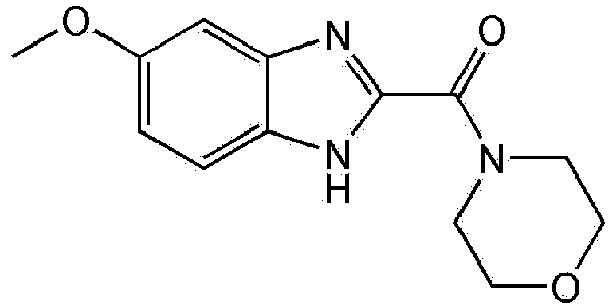
- 5-methoxy-1H-benzo[d]imidazole-2-carboxylic acid (1 eq) was dissolved in DMF, to which morpholine (1.01 eq), 1-ethyl-3-(3-dimethylaminopropyl)carbodiimide (EDC, 1.1 eq), 1-hydroxybenzotriazole (HOBT, 1.1 eq), and TEA (3 eq) were added stepwise, followed by stirring at room temperature for overnight. The reaction was terminated with a small amount of water, followed by extraction using water and EtOAc. The small amount of water remaining in the organic layer was dried over anhydrous MgSO4. The solvent was eliminated by vacuum distillation, followed by vacuum drying. Then, a target compound was obtained by column separation with the yield of 16%.
- 1H NMR (300MHz, CDC13) δ 7.67 (d. 1H), 6.97-6.93 (m, 2H), 3.87 (s, 3H), 3.83 (brs, 8H).
-

- 1-methyl-1H-indole-2-carboxylic acid (1 eq) was dissolved in DMF, to which morpholine (1.01 eq), 1-ethyl-3-(3-dimethylaminopropyl)carbodiimide (EDC, 1.1 eq), 1-hydroxybenzotriazole (HOBT, 1.1 eq), and TEA (3 eq) were added stepwise, followed by stirring at room temperature for overnight. The reaction was terminated with a small amount of water, followed by extraction using water and EtOAc. The small amount of water remaining in the organic layer was dried over anhydrous MgSO4. The solvent was eliminated by vacuum distillation, followed by vacuum drying. Then, a target compound was obtained by column separation with the yield of 29%.
- 1H NMR (300MHz, DMSO-d6) δ 7.59 (d, 2H), 7.50 (d, 2H), 7.23 (t, 1H), 7.07 (t, 1H), 3.74 (s, 1H), 3.62 (s, 8H).
-

- 5-methoxybenzofuran-2-carboxylic acid (1 eq) was dissolved in DMF, to which morpholine (1.01 eq), 1-ethyl-3-(3-dimethylaminopropyl)carbodiimide (EDC, 1.1 eq), 1-hydroxybenzotriazole (HOBT, 1.1 eq), and TEA (3 eq) were added stepwise, followed by stirring at room temperature for overnight. The reaction was terminated with a small amount of water, followed by extraction using water and EtOAc. The small amount of water remaining in the organic layer was dried over anhydrous MgSO4. The solvent was eliminated by vacuum distillation, followed by vacuum drying. Then, a target compound was obtained by column separation with the yield of 50%.
- 1H NMR (300MHz, CDC13) δ 7.40 (d. 1H), 7.29 (s, 1H), 7.06 (d, 1H), 7.01 (dd, 1H), 3.87 (brs, 4H), 3.85 (s, 3H), 3.79-3.76 (m, 4H).
-
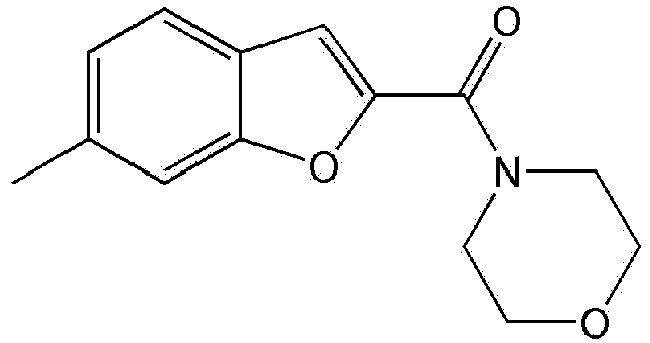
- 6-methylbenzofuran-2-carboxylic acid (1 eq) was dissolved in DMF, to which morpholine (1.01 eq), 1-ethyl-3-(3-dimethylaminopropyl)carbodiimide (EDC, 1.1 eq), 1-hydroxybenzotriazole (HOBT, 1.1 eq), and TEA (3 eq) were added stepwise, followed by stirring at room temperature for overnight. The reaction was terminated with a small amount of water, followed by extraction using water and EtOAc. The small amount of water remaining in the organic layer was dried over anhydrous MgSO4. The solvent was eliminated by vacuum distillation, followed by vacuum drying. Then, a target compound was obtained by column separation with the yield of 58%.
- 1H NMR (300MHz, CDC13) δ 7.52 (d. 1H), 7.32 (s, 1H), 7.30 (s, 1H), 7.12 (d, 1H), 3.88 (brs, 4H), 3.79-3.78 (m, 4H), 2.49 (s, 3H).
-
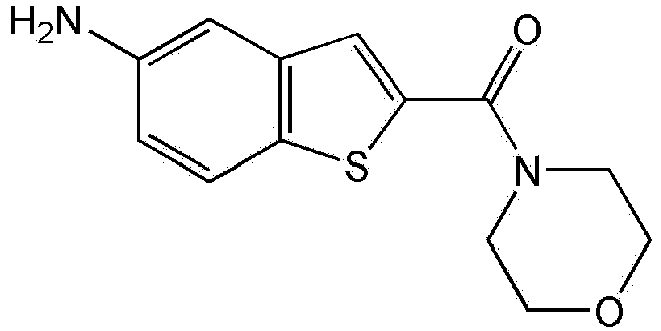
- 5-aminobenzo[b]thiophene-2-carboxylic acid (1 eq) was dissolved in DMF, to which morpholine (1.01 eq), 1-ethyl-3-(3-dimethylaminopropyl)carbodiimide (EDC, 1.1 eq), 1-hydroxybenzotriazole (HOBT, 1.1 eq), and TEA (3 eq) were added stepwise, followed by stirring at room temperature for overnight. The reaction was terminated with a small amount of water, followed by extraction using water and EtOAc. The small amount of water remaining in the organic layer was dried over anhydrous MgSO4. The solvent was eliminated by vacuum distillation, followed by vacuum drying. Then, a target compound was obtained by column separation with the yield of 38%.
- 1H NMR (300MHz, DMSO-d6) δ 7.58 (d, 1H), 7.42 (s, 1H), 6.96 (s, 1H), 6.79 (d, 1H), 5.15 (s, 2H), 3.62 (s, 8H).
-

- 7-bromobenzo[b]thiophene-2-carboxylic acid (1 eq) was dissolved in DMF, to which morpholine (1.01 eq), 1-ethyl-3-(3-dimethylaminopropyl)carbodiimide (EDC, 1.1 eq), 1-hydroxybenzotriazole (HOBT, 1.1 eq), and TEA (3 eq) were added stepwise, followed by stirring at room temperature for overnight. The reaction was terminated with a small amount of water, followed by extraction using water and EtOAc. The small amount of water remaining in the organic layer was dried over anhydrous MgSO4. The solvent was eliminated by vacuum distillation, followed by vacuum drying. Then, a target compound was obtained by column separation with the yield of 48%.
- 1H NMR (300MHz, DMSO-d6) δ 7.95 (d, 1H), 7.90 (s, 1H), 7.70 (d, 1H), 3.66-3.65 (m, 8H).
-

- 4-(2-fluorophenyl)benzo[b]thiophene-2-carboxylic acid (1 eq) was dissolved in DMF, to which morpholine (1.01 eq), 1-ethyl-3-(3-dimethylaminopropyl)carbodiimide (EDC, 1.1 eq), 1-hydroxybenzotriazole (HOBT, 1.1 eq), and TEA (3 eq) were added stepwise, followed by stirring at room temperature for overnight. The reaction was terminated with a small amount of water, followed by extraction using water and EtOAc. The small amount of water remaining in the organic layer was dried over anhydrous MgSO4. The solvent was eliminated by vacuum distillation, followed by vacuum drying. Then, a target compound was obtained by column separation with the yield of 33%.
- 1H NMR (300MHz, CDC13) δ 7.89-7.77 (m, 1H), 7.60-7.25 (m, 4H), 7.28-7.18 (m, 2H), 3.79-3.72 (m, 8H).
-

- 4-(biphenyl-4-yl)benzo[b]thiophene-2-carboxylic acid (1 eq) was dissolved in DMF, to which morpholine (1.01 eq), 1-ethyl-3-(3-dimethylaminopropyl)carbodiimide (EDC, 1.1 eq), 1-hydroxybenzotriazole (HOBT, 1.1 eq), and TEA (3 eq) were added stepwise, followed by stirring at room temperature for overnight. The reaction was terminated with a small amount of water, followed by extraction using water and EtOAc. The small amount of water remaining in the organic layer was dried over anhydrous MgSO4. The solvent was eliminated by vacuum distillation, followed by vacuum drying. Then, a target compound was obtained by column separation with the yield of 18%.
- 1H NMR (300MHz, DMSO-d6) δ 8.08 (d, 2H), 7.85 (d, 2H), 7.77 (d, 2H), 7.71 (d, 2H), 7.66 (s, 1H), 7.59-7.48 (m, 3H), 7.42-7.38 (m, 1H), 3.64-3.62 (m, 8H).
-

- (4-bromobenzo[b]thiophene-2-yl) (morpholino)methanone (1 eq) was dissolved in dimethylene glycol ether (DME), to which Pd(PPh3)4 (tetrakis (triphenylphosphine)palladium (0), 0.02 eq), p-tolylboronic acid (1.1 eq), and 2 M sodium carbonate (2M Na2CO3) solution (5 eq) were added, followed by stirring at 50°C for overnight. The reaction mixture was cooled down at room temperature, which was then passed through celite for filtration. The filtrate was washed and extracted with water and EtOAc. The small amount of water remaining in the organic layer was dried over anhydrous MgSO4. The solvent was eliminated by vacuum distillation, followed by column separation. As a result, a target compound was obtained with the yield of 56%.
- 1H NMR (300MHz, CDC13) δ 7.80 (t, 1H), 7.60 (s, 1H), 7.48-7.43 (m, 2H), 7.35 (d, 1H), 7.31-7.23 (m, 2H), 3.79-3.72 (m, 8H), 2.44 (s, 3H).
-

- (4-bromobenzo[b]thiophene-2-yl) (morpholino)methanone (1 eq) was dissolved in dimethylene glycol ether (DME), to which Pd(PPh3)4 (tetrakis (triphenylphosphine)palladium (0), 0.02 eq), 4-boronobenzoic acid (1.1 eq), and 2 M sodium carbonate (2M Na2CO3) solution (5 eq) were added, followed by stirring at 50°C for overnight. The reaction mixture was cooled down at room temperature, which was then passed through celite for filtration. The filtrate was washed and extracted with water and EtOAc. The small amount of water remaining in the organic layer was dried over anhydrous MgSO4. The solvent was eliminated by vacuum distillation, followed by column separation. As a result, a target compound was obtained with the yield of 57%.
- 1H NMR (300MHz, DMSO-d6) δ 8.10-7.93 (m, 3H), 7.57 (s, 1H), 7.53-7.39 (m, 4H), 3.60-3.58 (m, 8H).
-

- (4-bromobenzo[b]thiophene-2-yl) (morpholino)methanone (1 eq) was dissolved in dimethylene glycol ether (DME), to which Pd(PPh3)4 (tetrakis (triphenylphosphine)palladium (0), 0.02 eq), 4-methoxyphenylboronic acid (1.1 eq), and 2 M sodium carbonate (2M Na2CO3) solution (5 eq) were added, followed by stirring at 50°C for overnight. The reaction mixture was cooled down at room temperature, which was then passed through celite for filtration. The filtrate was washed and extracted with water and EtOAc. The small amount of water remaining in the organic layer was dried over anhydrous MgSO4. The solvent was eliminated by vacuum distillation, followed by column separation. As a result, a target compound was obtained with the yield of 50%.
- 1H NMR (300MHz, CDC13) δ 7.81 (d, 1H). 7.60 (s, 1H), 7.48 (m, 3H), 7.35 (d, 1H), 7.02 (d, 2H), 3.88 (s, 3H), 3.74-3.72 (m, 8H).
-
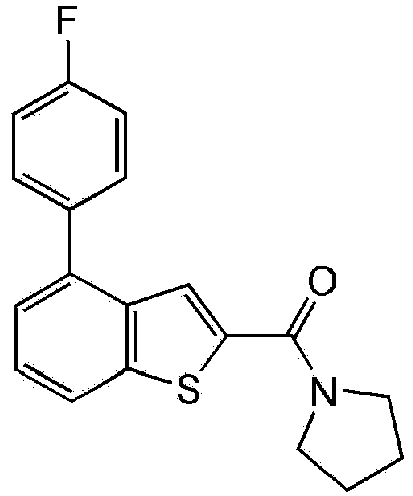
- 4-(4-fluorophenyl)benzo[b]thiophene-2-carboxylic acid (1 eq) was dissolved in DMF, to which morpholine (1.01 eq), 1-ethyl-3-(3-dimethylaminopropyl)carbodiimide (EDC, 1.1 eq), 1-hydroxybenzotriazole (HOBT, 1.1 eq), and TEA (3 eq) were added stepwise, followed by stirring at room temperature for overnight. The reaction was terminated with a small amount of water, followed by extraction using water and EtOAc. The small amount of water remaining in the organic layer was dried over anhydrous MgSO4. The solvent was eliminated by vacuum distillation, followed by vacuum drying. Then, a target compound was obtained by column separation with the yield of 23%.
- 1H NMR (300MHz, CDC13) δ 7.84 (d, 1H), 7.74 (s, 1H), 7.53-7.43 (m, 3H), 7.32 (d, 1H), 7.17 (t, 2H), 3.70 (t, 4H), 1.97 (s, 4H).
-

- (4-bromobenzo[b]thiophene-2-yl) (morpholino)methanone (1 eq) was dissolved in dimethylene glycol ether (DME), to which Pd(PPh3)4 (tetrakis (triphenylphosphine)palladium (0), 0.02 eq), 3-fluorophenylboronic acid (1.1 eq), and 2 M sodium carbonate (2M Na2CO3) solution (5 eq) were added, followed by stirring at 50°C for overnight. The reaction mixture was cooled down at room temperature, which was then passed through celite for filtration. The filtrate was washed and extracted with water and EtOAc. The small amount of water remaining in the organic layer was dried over anhydrous MgSO4. The solvent was eliminated by vacuum distillation, followed by column separation. As a result, a target compound was obtained with the yield of 53%.
- 1H NMR (300MHz, CDC13) δ 7.87 (d, 1H), 7.57 (s, 1H), 7.50-7.30 (m, 4H), 7.22-7.10 (m, 2H), 3.74-3.73 (m, 8H).
-

- 4-(4-fluorophenyl)benzo[b]thiophene-2-carboxylic acid (1 eq) was dissolved in DMF, to which piperidine-4-amine (1.01 eq), 1-ethyl-3-(3-dimethylaminopropyl)carbodiimide (EDC, 1.1 eq), 1-hydroxybenzotriazole (HOBT, 1.1 eq), and TEA (3 eq) were added stepwise, followed by stirring at room temperature for overnight. The reaction was terminated with a small amount of water, followed by extraction using water and EtOAc. The small amount of water remaining in the organic layer was dried over anhydrous MgSO4. The solvent was eliminated by vacuum distillation, followed by vacuum drying. Then, a target compound was obtained by column separation with the yield of 51%.
- 1H NMR (300MHz, DMSO-d6) δ 8.08 (d, 1H), 7.68-7.63 (m, 2H), 7.58-7.51 (m, 2H), 7.45-7.33 (m, 3H), 4.26 (brs, 2H), 3.30 (brs, 1H), 3.06-2.96 (m, 2H), 2.72-2.71 (m, 2H), 2.01-1.98 (m, 2H), 1.50-1.47 (m, 2H).
-

- 4-(4-fluorophenyl)benzo[b]thiophene-2-carboxylic acid (1 eq) was dissolved in DMF, to which piperazine hydrochloride (1.01 eq), 1-ethyl-3-(3-dimethylaminopropyl)carbodiimide (EDC, 1.1 eq), 1-hydroxybenzotriazole (HOBT, 1.1 eq), and TEA (3 eq) were added stepwise, followed by stirring at room temperature for overnight. The reaction was terminated with a small amount of water, followed by extraction using water and EtOAc. The small amount of water remaining in the organic layer was dried over anhydrous MgSO4. The solvent was eliminated by vacuum distillation, followed by vacuum drying. Then, a target compound was obtained by column separation with the yield of 51%.
- 1H NMR (300MHz, DMSO-d6) δ 9.03 (brs, 1H), 8.07 (d, 1H), 7.67-7.57 (m,2H), 7.54-7.51 (m, 1H), 7.44-7.32 (m, 2H), 3.83 (s, 2H), 3.38 (s, 2H), 3.15 (s, 2H), 2.48 (s, 2H).
-
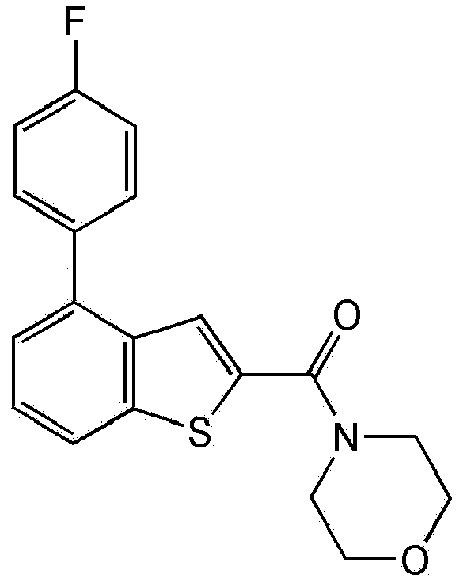
- 4-(4-fluorophenyl)benzo[b]thiophene-2-carboxylic acid (1 eq) was dissolved in DMF, to which morpholine (1.01 eq), 1-ethyl-3- (3-dimethylaminopropyl)carbodiimide (EDC, 1.1 eq), 1-hydroxybenzotriazole (HOBT, 1.1 eq), and TEA (3 eq) were added stepwise, followed by stirring at room temperature for overnight. The reaction was terminated with a small amount of water, followed by extraction using water and EtOAc. The small amount of water remaining in the organic layer was dried over anhydrous MgSO4. The solvent was eliminated by vacuum distillation, followed by vacuum drying. Then, a target compound was obtained by column separation with the yield of 89%.
- 1H NMR (300MHz, DMSO-d6) δ 8.08 (d, 1H), 7.67-7.63 (m, 2H), 7.57-7.52 (m, 2H), 7.45 (d, 1H), 7.40-7.34 (m, 2H), 3.64-3.62 (m, 8H).
-

- (5-bromobenzo[b]thiophene-2-yl) (morpholino)methanone (1 eq) was dissolved in dimethylene glycol ether (DME), to which Pd(PPh3)4 (tetrakis (triphenylphosphine)palladium (0), 0.02 eq), 4-fluorophenylboronic acid (1.1 eq), and 2 M sodium carbonate (2M Na2CO3) solution (5 eq) were added, followed by stirring at 50°C for overnight. The reaction mixture was cooled down at room temperature, which was then passed through celite for filtration. The filtrate was washed and extracted with water and EtOAc. The small amount of water remaining in the organic layer was dried over anhydrous MgSO4. The solvent was eliminated by vacuum distillation, followed by column separation. As a result, a target compound was obtained with the yield of 52%.
- 1H NMR (300MHz, CDC13) δ 7.94 (s, 1H), 7.91 (d, 1H), 7.61-7.56 (m, 3H), 7.52 (s, 1H), 7.18-7.12 (m, 2H), 3.79-3.70 (m, 8H).
-

- 4-(biphenyl-3-yl)benzo[b]thiophene-2-carboxylic acid (1 eq) was dissolved in DMF, to which morpholine (1.01 eq), 1-ethyl-3-(3-dimethylaminopropyl)carbodiimide (EDC, 1.1 eq), 1-hydroxybenzotriazole (HOBT, 1.1 eq), and TEA (3 eq) were added stepwise, followed by stirring at room temperature for overnight. The reaction was terminated with a small amount of water, followed by extraction using water and EtOAc. The small amount of water remaining in the organic layer was dried over anhydrous MgSO4. The solvent was eliminated by vacuum distillation, followed by vacuum drying. Then, a target compound was obtained by column separation with the yield of 21%.
- 1H NMR (300MHz, CDC13) δ 7.86 (d, 1H), 7.76 (s, 1H), 7.62 (t, 5H), 7.57-7.37 (m, 6H), 3.74 (t, 8H).
-

- 4-(3-aminophenyl)benzo[b]thiophene-2-carboxylic acid (1 eq) was dissolved in DMF, to which morpholine (1.01 eq), 1-ethyl-3-(3-dimethylaminopropyl)carbodiimide (EDC, 1.1 eq), 1-hydroxybenzotriazole (HOBT, 1.1 eq), and TEA (3 eq) were added stepwise, followed by stirring at room temperature for overnight. The reaction was terminated with a small amount of water, followed by extraction using water and EtOAc. The small amount of water remaining in the organic layer was dried over anhydrous MgSO4. The solvent was eliminated by vacuum distillation, followed by vacuum drying. Then, a target compound was obtained by column separation with the yield of 10%.
- 1H NMR (300MHz, DMSO-d6) δ 8.01 (d, 1H), 7.60 (s, 1H), 7.51 (t, 1H), 7.38 (d, 1H), 7.15 (t, 1H), 6.76-6.62 (m, 3H), 3.63 (m, 8H).
-

- (4-bromobenzo[b]thiophene-2-yl) (morpholino)methanone (1 eq) was dissolved in dimethylene glycol ether (DME), to which Pd(PPh3)4 (tetrakis (triphenylphosphine)palladium (0), 0.02 eq), 4-carbamoylphenylboronic acid (1.1 eq), and 2 M sodium carbonate (2M Na2CO3) solution (5 eq) were added, followed by stirring at 50°C for overnight. The reaction mixture was cooled down at room temperature, which was then passed through celite for filtration. The filtrate was washed and extracted with water and EtOAc. The small amount of water remaining in the organic layer was dried over anhydrous MgSO4. The solvent was eliminated by vacuum distillation, followed by column separation. As a result, a target compound was obtained with the yield of 50%.
- 1H NMR (300MHz, DMSO-d6) δ 8.11-8.08 (m, 2H), 8.05 (d, 2H), 7.70 (d, 2H), 7.60 (s, 1H), 7.57 (d, 1H), 7.50-7.46 (m, 2H), 3.64-3.62 (m, 8H).
-

- (4-bromobenzo[b]thiophene-2-yl) (morpholino)methanone (1 eq) was dissolved in dimethylene glycol ether (DME), to which Pd(PPh3)4 (tetrakis (triphenylphosphine)palladium (0), 0.02 eq), 4-hydroxyphenylboronic acid (1.1 eq), and 2 M sodium carbonate (2M Na2CO3) solution (5 eq) were added, followed by stirring at 50°C for overnight. The reaction mixture was cooled down at room temperature, which was then passed through celite for filtration. The filtrate was washed and extracted with water and EtOAc. The small amount of water remaining in the organic layer was dried over anhydrous MgSO4. The solvent was eliminated by vacuum distillation, followed by column separation. As a result, a target compound was obtained with the yield of 35%.
- 1H NMR (300MHz, CDC13) δ 7.81 (d, 1H), 7.60 (s, 1H), 7.46-7.29 (m, 4H), 6.95 (d, 2H), 3.73-3.72 (m, 8H).
-

- (4-bromobenzo[b]thiophene-2-yl) (morpholino)methanone (1 eq) was dissolved in dimethylene glycol ether (DME), to which Pd(PPh3)4 (tetrakis (triphenylphosphine)palladium (0), 0.02 eq), 4-(trifluoromethoxy)phenylboronic acid (1.1 eq), and 2 M sodium carbonate (2M Na2CO3) solution (5 eq) were added, followed by stirring at 50°C for overnight. The reaction mixture was cooled down at room temperature, which was then passed through celite for filtration. The filtrate was washed and extracted with water and EtOAc. The small amount of water remaining in the organic layer was dried over anhydrous MgSO4. The solvent was eliminated by vacuum distillation, followed by column separation. As a result, a target compound was obtained with the yield of 46%.
- 1H NMR (300MHz, CDC13) δ 7.86 (d, 1H), 7.57-7.54 (m, 3H), 7.48 (t, 1H), 7.37-7.32 (m, 3H), 3.73-3.72 (m, 8H).
-

- 4-(4-fluorophenyl)benzo[b]thiophene-2-carboxylic acid (1 eq) was dissolved in DMF, to which oxazolidine (1.01 eq), 1-ethyl-3-(3-dimethylaminopropyl)carbodiimide (EDC, 1.1 eq), 1-hydroxybenzotriazole (HOBT, 1.1 eq), and TEA (3 eq) were added stepwise, followed by stirring at room temperature for overnight. The reaction was terminated with a small amount of water, followed by extraction using water and EtOAc. The small amount of water remaining in the organic layer was dried over anhydrous MgSO4. The solvent was eliminated by vacuum distillation, followed by vacuum drying. Then, a target compound was obtained by column separation with the yield of 37%.
- 1H NMR (300MHz, CDC13) δ 7.84-7.80 (m, 1H), 7.65 (s, 1H), 7.51 (m, 3H), 7.33 (d, 1H), 7.16 (t, 2H), 3.86 (brs, 2H), 3.71 (t, 2H), 3.24 (brs, 2H).
-

- 4-(4-fluorophenyl)benzo[b]thiophene-2-carboxylic acid (1 eq) was dissolved in DMF, to which piperidine (1.01 eq), 1-ethyl-3-(3-dimethylaminopropyl)carbodiimide (EDC, 1.1 eq), 1-hydroxybenzotriazole (HOBT, 1.1 eq), and TEA (3 eq) were added stepwise, followed by stirring at room temperature for overnight. The reaction was terminated with a small amount of water, followed by extraction using water and EtOAc. The small amount of water remaining in the organic layer was dried over anhydrous MgSO4. The solvent was eliminated by vacuum distillation, followed by vacuum drying. Then, a target compound was obtained by column separation with the yield of 23%.
- 1H NMR (300MHz, DMSO-d6) δ 7.84 (d, 1H), 7.53-7.42 (m, 4H), 7.34-7.32 (m, 1H), 7.20-7.14 (m, 2H), 3.65 (s, 4H), 1.68 (m, 6H).
-

- 4-(4-fluorophenyl)benzo[b]thiophene-2-carboxylic acid (1 eq) was dissolved in DMF, to which piperidine-4-ol (1.01 eq), 1-ethyl-3-(3-dimethylaminopropyl)carbodiimide (EDC, 1.1 eq), 1-hydroxybenzotriazole (HOBT, 1.1 eq), and TEA (3 eq) were added stepwise, followed by stirring at room temperature for overnight. The reaction was terminated with a small amount of water, followed by extraction using water and EtOAc. The small amount of water remaining in the organic layer was dried over anhydrous MgSO4. The solvent was eliminated by vacuum distillation, followed by vacuum drying. Then, a target compound was obtained by column separation with the yield of 56%.
- 1H NMR (300MHz, CDCl3) δ 7.84 (d, 1H), 7.52-7.42 (m, 4H), 7.35 (d, 1H), 7.19-7.14 (m, 2H), 4.01-4.00 (m, 3H), 3.46-3.37 (m, 2H), 1.91 (brs, 2H), 1.57-1.51 (m, 2H).
-

- 4-(4-fluorophenyl)benzo[b]thiophene-2-carboxylic acid (1 eq) was dissolved in DMF, to which 1-methylpiperazine (1.01 eq), 1-ethyl-3-(3-dimethylaminopropyl)carbodiimide (EDC, 1.1 eq), 1-hydroxybenzotriazole (HOBT, 1.1 eq), and TEA (3 eq) were added stepwise, followed by stirring at room temperature for overnight. The reaction was terminated with a small amount of water, followed by extraction using water and EtOAc. The small amount of water remaining in the organic layer was dried over anhydrous MgSO4. The solvent was eliminated by vacuum distillation, followed by vacuum drying. Then, a target compound was obtained by column separation with the yield of 45%.
- 1H NMR (300MHz, DMSO-d6) δ 8.08 (d, 1H), 7.68-7.53 (m, 4H), 7.45-7.33 (m, 3H), 3.31 (s, 8H), 2.75 (s, 3H).
-

- (4-bromobenzo[b]thiophene-2-yl)(morpholino)methanone (1 eq) was dissolved in dimethylene glycol ether (DME), to which Pd(PPh3)4 (tetrakis (triphenylphosphine)palladium (0), 0.02 eq), 4-(methylthio)phenylboronic acid (1.1 eq), and 2 M sodium carbonate (2M Na2CO3) solution (5 eq) were added, followed by stirring at 50°C for overnight. The reaction mixture was cooled down at room temperature, which was then passed through celite for filtration. The filtrate was washed and extracted with water and EtOAc. The small amount of water remaining in the organic layer was dried over anhydrous MgSO4. The solvent was eliminated by vacuum distillation, followed by column separation. As a result, a target compound was obtained with the yield of 51%.
- 1H NMR (300MHz, CDCl3) δ 7.83 (d, 1H), 7.60-7.58 (m, 1), 7.49-7.44 (m, 3H), 7.38 (s, 2), 7.35 (s, 1H), 3.79-3.72 (m, 8H), 2.55 (s, 3H).
-

- 4-(4-fluorophenyl)benzo[b]thiophene-2-carboxylic acid (1 eq) was dissolved in DMF, to which thiomorpholine (1.01 eq), 1-ethyl-3-(3-dimethylaminopropyl)carbodiimide (EDC, 1.1 eq), 1-hydroxybenzotriazole (HOBT, 1.1 eq), and TEA (3 eq) were added stepwise, followed by stirring at room temperature for overnight. The reaction was terminated with a small amount of water, followed by extraction using water and EtOAc. The small amount of water remaining in the organic layer was dried over anhydrous MgSO4. The solvent was eliminated by vacuum distillation, followed by vacuum drying. Then, a target compound was obtained by column separation with the yield of 26%.
- 1H NMR (300MHz, DMSO-d6) δ 8.06 (d, 1H), 7.67-7.62 (m, 2H), 7.56-7.51 (m, 2H), 7.44-7.33 (m, 4H), 3.87-3.84 (m, 4H), 2.67-2.65 (m, 4H).
-

- 4-(4-fluorophenyl)benzo[b]thiophene-2-carboxylic acid (1 eq) was dissolved in DMF, to which 1,4-oxazepane (1.01 eq), 1-ethyl-3-(3-dimethylaminopropyl)carbodiimide (EDC, 1.1 eq), 1-hydroxybenzotriazole (HOBT, 1.1 eq), and TEA (3 eq) were added stepwise, followed by stirring at room temperature for overnight. The reaction was terminated with a small amount of water, followed by extraction using water and EtOAc. The small amount of water remaining in the organic layer was dried over anhydrous MgSO4. The solvent was eliminated by vacuum distillation, followed by vacuum drying. Then, a target compound was obtained by column separation with the yield of 36%.
- 1H NMR (300MHz, CDCl3) δ 7.85 (d, 1H), 7.56-7.43 (m, 4H), 7.35-7.33 (m, 1H), 7.20-7.14 (m, 2H), 3.89-3.77 (m, 10H).
-

- 7-chloro-4-(4-fluorophenyl)benzo[b]thiophene-2-carboxylic acid (1 eq) was dissolved in DMF, to which morpholine (1.01 eq), 1-ethyl-3-(3-dimethylaminopropyl)carbodiimide (EDC, 1.1 eq), 1-hydroxybenzotriazole (HOBT, 1.1 eq), and TEA (3 eq) were added stepwise, followed by stirring at room temperature for overnight. The reaction was terminated with a small amount of water, followed by extraction using water and EtOAc. The small amount of water remaining in the organic layer was dried over anhydrous MgSO4. The solvent was eliminated by vacuum distillation, followed by vacuum drying. Then, a target compound was obtained by column separation with the yield of 25%.
- 1H NMR (300MHz, CDCl3) δ 7.56 (s, 1H), 7.48 (t, 2H), 7.45 (d, 1H), 7.31 (d, 1H), 7.18 (t, 2H), 3.73 (s, 8H).
-

- (4-bromobenzo[b]thiophene-2-yl)(morpholino)methanone (1 eq) was dissolved in dimethylene glycol ether (DME), to which Pd(PPh3)4 (tetrakis(triphenylphosphine)palladium (0), 0.02 eq), 4-bromophenylboronic acid (1.1 eq), and 2 M sodium carbonate (2M Na2CO3) solution (5 eq) were added, followed by stirring at 50°C for overnight. The reaction mixture was cooled down at room temperature, which was then passed through celite for filtration. The filtrate was washed and extracted with water and EtOAc. The small amount of water remaining in the organic layer was dried over anhydrous MgSO4. The solvent was eliminated by vacuum distillation, followed by column separation. As a result, a target compound was obtained with the yield of 27%.
- 1H NMR (300MHz, CDCl3) δ 7.85 (d, 1H), 7.62 (d, 2H), 7.53 (s, 1H), 7.47 (t, 1H), 7.41 (d, 2H), 7.35 (d, 1H), 3.73 (s, 8H).
-

- (4-bromobenzo[b]thiophene-2-yl)(morpholino)methanone (1 eq) was dissolved in dimethylene glycol ether (DME), to which Pd(PPh3)4 (tetrakis (triphenylphosphine)palladium (0), 0.02 eq), 6-methoxypyridine-3-ylboronic acid (1.1 eq), and 2 M sodium carbonate (2M Na2CO3) solution (5 eq) were added, followed by stirring at 50°C for overnight. The reaction mixture was cooled down at room temperature, which was then passed through celite for filtration. The filtrate was washed and extracted with water and EtOAc. The small amount of water remaining in the organic layer was dried over anhydrous MgSO4. The solvent was eliminated by vacuum distillation, followed by column separation. As a result, a target compound was obtained with the yield of 31%.
- 1H NMR (300MHz, CDCl3) δ 8.33 (s. 1H), 7.85 (d, 1H), 7.75 (dd, 1H), 7.53 (s, 1H), 7.48 (t, 1H), 7.34 (d, 1H), 6.88 (d, 1H), 4.01 (s, 3H), 3.73 (d, 8H).
-

- 4-(3-fluorobenzyl)benzo[b]thiophene-2-carboxylic acid (1 eq) was dissolved in DMF, to which morpholine (1.01 eq), 1-ethyl-3-(3-dimethylaminopropyl)carbodiimide (EDC, 1.1 eq), 1-hydroxybenzotriazole (HOBT, 1.1 eq), and TEA (3 eq) were added stepwise, followed by stirring at room temperature for overnight. The reaction was terminated with a small amount of water, followed by extraction using water and EtOAc. The small amount of water remaining in the organic layer was dried over anhydrous MgSO4. The solvent was eliminated by vacuum distillation, followed by vacuum drying. Then, a target compound was obtained by column separation with the yield of 31%.
- 1H NMR (300MHz, CDCl3) δ 7.80 (d, 1H), 7.42 (q, 2H), 7.26 (t, 2H), 7.00 (d, 1H), 6.91 (q, 2H), 4.33 (s, 2H), 3.72 (s, 8H).
-

- 4-(2,4-difluorobenzyl)benzo[b]thiophene-2-carboxylic acid (1 eq) was dissolved in DMF, to which morpholine (1.01 eq), 1-ethyl-3-(3-dimethylaminopropyl)carbodiimide (EDC, 1.1 eq), 1-hydroxybenzotriazole (HOBT, 1.1 eq), and TEA (3 eq) were added stepwise, followed by stirring at room temperature for overnight. The reaction was terminated with a small amount of water, followed by extraction using water and EtOAc. The small amount of water remaining in the organic layer was dried over anhydrous MgSO4. The solvent was eliminated by vacuum distillation, followed by vacuum drying. Then, a target compound was obtained by column separation with the yield of 17%.
- 1H NMR (300MHz, CDCl3) δ 7.75 (d, 1H), 7.52 (s, 1H), 7.35 (t, 1H), 7.17 (d, 1H), 6.99 (t, 1H), 6.85-6.73 (m, 2H), 4.26 (s, 2H), 3.73 (s, 8H).
-

- 4-(2,4-difluorophenylamino)benzo[b]thiophene-2-carboxylic acid (1 eq) was dissolved in DMF, to which morpholine (1.01 eq), 1-ethyl-3-(3-dimethylaminopropyl)carbodiimide (EDC, 1.1 eq), 1-hydroxybenzotriazole (HOBT, 1.1 eq), and TEA (3 eq) were added stepwise, followed by stirring at room temperature for overnight. The reaction was terminated with a small amount of water, followed by extraction using water and EtOAc. The small amount of water remaining in the organic layer was dried over anhydrous MgSO4. The solvent was eliminated by vacuum distillation, followed by vacuum drying. Then, a target compound was obtained by column separation with the yield of 22%.
- 1H NMR (300MHz, CDCl3) δ 7.50 (d, 2H), 7.31 (t, 1H), 7.15-7.07 (m, 1H), 7.04 (d, 1H), 6.96-6.90 (td, 1H), 6.80 (t, 1H), 5.87 (s, 1H), 3.75 (d, 8H). 22%
-

- 4-(4-fluorophenoxy)benzo[b]thiophene-2-carboxylic acid (1 eq) was dissolved in DMF, to which morpholine (1.01 eq), 1-ethyl-3-(3-dimethylaminopropyl)carbodiimide (EDC, 1.1 eq), 1-hydroxybenzotriazole (HOBT, 1.1 eq), and TEA (3 eq) were added stepwise, followed by stirring at room temperature for overnight. The reaction was terminated with a small amount of water, followed by extraction using water and EtOAc. The small amount of water remaining in the organic layer was dried over anhydrous MgSO4. The solvent was eliminated by vacuum distillation, followed by vacuum drying. Then, a target compound was obtained by column separation with the yield of 52%.
- 1H NMR (300MHz, CDCl3) δ 7.57 (d, 2H), 7.30 (t, 1H), 7.06-7.03 (m, 4H), 6.74 (d, 1H), 3.79-3.73 (m, 8H).
-

- 4-(4-fluorophenethyl)benzo[b]thiophene-2-carboxylic acid (1 eq) was dissolved in DMF, to which morpholine (1.01 eq), 1-ethyl-3-(3-dimethylaminopropyl)carbodiimide (EDC, 1.1 eq), 1-hydroxybenzotriazole (HOBT, 1.1 eq), and TEA (3 eq) were added stepwise, followed by stirring at room temperature for overnight. The reaction was terminated with a small amount of water, followed by extraction using water and EtOAc. The small amount of water remaining in the organic layer was dried over anhydrous MgSO4. The solvent was eliminated by vacuum distillation, followed by vacuum drying. Then, a target compound was obtained by column separation with the yield of 9%.
- 1H NMR (300MHz, CDCl3) δ 7.57 (s, 1H), 7.41 (d, 1H), 7.34-7.10 (m, 4H), 7.01 (t, 1H), 6.74 (d, 1H), 4.30 (t, 2H), 3.77 (d, 3H), 3.16 (t, 2H).
-

- 4-(4-fluorobenzyloxy)benzo[b]thiophene-2-carboxylic acid (1 eq) was dissolved in DMF, to which morpholine (1.01 eq), 1-ethyl-3-(3-dimethylaminopropyl)carbodiimide (EDC, 1.1 eq), 1-hydroxybenzotriazole (HOBT, 1.1 eq), and TEA (3 eq) were added stepwise, followed by stirring at room temperature for overnight. The reaction was terminated with a small amount of water, followed by extraction using water and EtOAc. The small amount of water remaining in the organic layer was dried over anhydrous MgSO4. The solvent was eliminated by vacuum distillation, followed by vacuum drying. Then, a target compound was obtained by column separation with the yield of 60%.
- 1H NMR (300MHz, CDCl3) δ 7.69 (s, 1H), 7.45 (m, 3H), 7.34 (t, 1H), 7.11 (m, 2H), 6.85 (d, 1H), 5.19 (s, 2H), 3.80 (m, 8H).
-

- 4-(4-fluorobenzylsulfonyl)benzo[b]thiophene-2-carboxylic acid (1 eq) was dissolved in DMF, to which morpholine (1.01 eq), 1-ethyl-3-(3-dimethylaminopropyl)carbodiimide (EDC, 1.1 eq), 1-hydroxybenzotriazole (HOBT, 1.1 eq), and TEA (3 eq) were added stepwise, followed by stirring at room temperature for overnight. The reaction was terminated with a small amount of water, followed by extraction using water and EtOAc. The small amount of water remaining in the organic layer was dried over anhydrous MgSO4. The solvent was eliminated by vacuum distillation, followed by vacuum drying. Then, a target compound was obtained by column separation with the yield of 60.5%.
- 1H NMR (300MHz, CDCl3) δ 8.14 (d, 1H), 7.84 (s, 1H), 7.79 (d, 1H), 7.48 (t, 1H), 6.93 (m, 4H), 4.37 (s, 2H), 3.76 (s, 6H).
-

- (4-bromobenzo[b]thiophene-2-yl)(morpholino)methanone (1 eq) was dissolved in dimethylene glycol ether (DME), to which Pd(PPh3)4 (tetrakis (triphenylphosphine)palladium (0), 0.02 eq), 2,4-difluorophenylboronic acid (1.1 eq), and 2 M sodium carbonate (2M Na2CO3) solution (5 eq) were added, followed by stirring at 50°C for overnight. The reaction mixture was cooled down at room temperature, which was then passed through celite for filtration. The filtrate was washed and extracted with water and EtOAc. The small amount of water remaining in the organic layer was dried over anhydrous MgSO4. The solvent was eliminated by vacuum distillation, followed by column separation. As a result, a target compound was obtained with the yield of 51%.
- 1H NMR (300MHz, CDCl3) δ 7.89 (d, 1H), 7.79 (d, 1H), 7.60-7.55 (m, 1H), 7.50-7.23 (m, 4H), 3.79-3.72 (m, 8H).
-

- (4-bromobenzo[b]thiophene-2-yl)(morpholino)methanone (1 eq) was dissolved in dimethylene glycol ether (DME), to which Pd(PPh3)4 (tetrakis (triphenylphosphine)palladium (0), 0.02 eq), 4-(methoxysulfinyl)phenylboronic acid (1.1 eq), and 2 M sodium carbonate (2M Na2CO3) solution (5 eq) were added, followed by stirring at 50°C for overnight. The reaction mixture was cooled down at room temperature, which was then passed through celite for filtration. The filtrate was washed and extracted with water and EtOAc. The small amount of water remaining in the organic layer was dried over anhydrous MgSO4. The solvent was eliminated by vacuum distillation, followed by column separation. As a result, a target compound was obtained with the yield of 66%.
- 1H NMR (300MHz, CDCl3) δ 8.07 (d, 2H), 7.91 (d, 1H), 7.74 (d, 2H), 7.53-7.75 (m, 2H), 7.40 (d, 1H), 3.73 (brs, 8H), 3.14 (s, 3H).
-

- 7-(4-fluorophenyl)benzo[b]thiophene-2-carboxylic acid (1 eq) was dissolved in DMF, to which morpholine (1.01 eq), 1-ethyl-3-(3-dimethylaminopropyl)carbodiimide (EDC, 1.1 eq), 1-hydroxybenzotriazole (HOBT, 1.1 eq), and TEA (3 eq) were added stepwise, followed by stirring at room temperature for overnight. The reaction was terminated with a small amount of water, followed by extraction using water and EtOAc. The small amount of water remaining in the organic layer was dried over anhydrous MgSO4. The solvent was eliminated by vacuum distillation, followed by vacuum drying. Then, a target compound was obtained by column separation with the yield of 36%.
- 1H NMR (300MHz, DMSO-d6) δ 7.93 (d, 1H), 7.82 (s, 1H), 7.76-7.19 (m, 2H), 7.54 (t, 1H), 7.48 (d, 1H), 7.40-7.34 (m, 2H), 3.65-3.63 (m, 8H).
-

- (4-bromobenzo[b]thiophene-2-yl)(morpholino)methanone (1 eq) was dissolved in dimethylene glycol ether (DME), to which Pd(PPh3)4 (tetrakis (triphenylphosphine)palladium (0), 0.02 eq), 6-fluoropyridine-3-ylboronic acid hydrochloride (1.1 eq), and 2 M sodium carbonate (2M Na2CO3) solution (5 eq) were added, followed by stirring at 50°C for overnight. The reaction mixture was cooled down at room temperature, which was then passed through celite for filtration. The filtrate was washed and extracted with water and EtOAc. The small amount of water remaining in the organic layer was dried over anhydrous MgSO4. The solvent was eliminated by vacuum distillation, followed by column separation. As a result, a target compound was obtained with the yield of 54%.
- 8.39 (s, 1H), 7.99-7.89 (m, 2H), 7.53-7.47 (m, 2H), 7.37 (d, 1H), 7.10 (d, 1H), 3.73 (s, 8H).
-

- 4-(4-fluorobenzyl)benzo[b]thiophene-2-carboxylic acid (1 eq) was dissolved in DMF, to which morpholine (1.01 eq), 1-ethyl-3-(3-dimethylaminopropyl)carbodiimide (EDC, 1.1 eq), 1-hydroxybenzotriazole (HOBT, 1.1 eq), and TEA (3 eq) were added stepwise, followed by stirring at room temperature for overnight. The reaction was terminated with a small amount of water, followed by extraction using water and EtOAc. The small amount of water remaining in the organic layer was dried over anhydrous MgSO4. The solvent was eliminated by vacuum distillation, followed by vacuum drying. Then, a target compound was obtained by column separation with the yield of 51%.
- 1H NMR (300MHz, CDCl3) δ 7.74 (d, 1H), 7.42 (s, 1H), 7.35 (t, 1H), 7.18-7.10 (m, 4H), 6.95 (t, 1H), 4.27 (s, 2H), 3.68 (s, 8H).
-

- 4-(4-fluorophenylamino)benzo[b]thiophene-2-carboxylic acid (1 eq) was dissolved in DMF, to which morpholine (1.01 eq), 1-ethyl-3-(3-dimethylaminopropyl)carbodiimide (EDC, 1.1 eq), 1-hydroxybenzotriazole (HOBT, 1.1 eq), and TEA (3 eq) were added stepwise, followed by stirring at room temperature for overnight. The reaction was terminated with a small amount of water, followed by extraction using water and EtOAc. The small amount of water remaining in the organic layer was dried over anhydrous MgSO4. The solvent was eliminated by vacuum distillation, followed by vacuum drying. Then, a target compound was obtained by column separation with the yield of 26%.
- 1H NMR (300MHz, CDCl3) δ 7.48 (s, 1H), 7.43 (d, 1H), 7.29 (d, 1H), 7.01 (dd, 4H), 5.94 (s, 1H), 3.74 (d, 8H).
-

- (4-(4-fluorophenylamino)benzo[b]thiophene-2-yl) (morpholino)methanone (1 eq) was dissolved in THF, to which sodium hydride (NaH, 1.1 eq) was added at 0°C, followed by stirring. Methyl iodide (MeI, 1.1 eq) was added to the reaction mixture, followed by stirring at room temperature for overnight. The reaction mixture was washed and extracted with water and EtOAc. The small amount of water remaining in the organic layer was dried over anhydrous MgSO4. The solvent was eliminated by vacuum distillation, followed by column separation. As a result, a target compound was obtained with the yield of 69%.
- 1H NMR (300MHz, CDCl3) δ 7.61 (d, 1H), 7.41 (t, 1H), 7.14 (d, 1H), 6.99 (s, 1H), 6.91 (t, 2H), 6.77 (q, 2H), 3.62 (s, 8H), 3.39 (s, 3H).
-

- 4-(4-fluorophenylsulfonamide)benzo[b]thiophene-2-carboxylic acid (1 eq) was dissolved in DMF, to which morpholine (1.01 eq), 1-ethyl-3-(3-dimethylaminopropyl)carbodiimide (EDC, 1.1 eq), 1-hydroxybenzotriazole (HOBT, 1.1 eq), and TEA (3 eq) were added stepwise, followed by stirring at room temperature for overnight. The reaction was terminated with a small amount of water, followed by extraction using water and EtOAc. The small amount of water remaining in the organic layer was dried over anhydrous MgSO4. The solvent was eliminated by vacuum distillation, followed by vacuum drying. Then, a target compound was obtained by column separation with the yield of 19%.
- 1H NMR (300MHz, CDCl3) δ 8.00 (s. 1H), 7.71 (s, 1H), 7.66-7.60 (m, 3H), 7.29 (d, 1H), 7.17 (d, 1H), 6.93 (t, 2H), 3.74 (brs, 8H).
-

- 4-(4-fluorobenzylthio)benzo[b]thiophene-2-carboxylic acid (1 eq) was dissolved in DMF, to which morpholine (1.01 eq), 1-ethyl-3-(3-dimethylaminopropyl)carbodiimide (EDC, 1.1 eq), 1-hydroxybenzotriazole (HOBT, 1.1 eq), and TEA (3 eq) were added stepwise, followed by stirring at room temperature for overnight. The reaction was terminated with a small amount of water, followed by extraction using water and EtOAc. The small amount of water remaining in the organic layer was dried over anhydrous MgSO4. The solvent was eliminated by vacuum distillation, followed by vacuum drying. Then, a target compound was obtained by column separation with the yield of 58.8%.
- 1H NMR (300MHz, CDCl3) δ 7.75 (d, 1H), 7.63 (s, 1H), 7.33 (d, 2H), 7.16 (t, 2H), 6.93 (t, 2H), 4.12 (s, 2H), 3.77 (d, 8H).
-

- (4-bromobenzo[b]thiophene-2-yl)(morpholino)methanone (1 eq) was dissolved in dimethylene glycol ether (DME), to which Pd(PPh3)4 (tetrakis (triphenylphosphine)palladium (0), 0.02 eq), 5-cyano-1-methyl-1H-pyrrole-2-ylboronic acid (1.1 eq), and 2 M sodium carbonate (2M Na2CO3) solution (5 eq) were added, followed by stirring at 50°C for overnight. The reaction mixture was cooled down at room temperature, which was then passed through celite for filtration. The filtrate was washed and extracted with water and EtOAc. The small amount of water remaining in the organic layer was dried over anhydrous MgSO4. The solvent was eliminated by vacuum distillation, followed by column separation. As a result, a target compound was obtained with the yield of 39%.
- 1H NMR (300MHz, CDCl3) δ 7.93 (d, 1H), 7.49 (t, 1H), 7.36-7.31 (m, 2H), 6.93 (d, 1H), 6.31 (d, 1H), 3.74-3.63 (m, 11H).
-

- (4-bromobenzo[b]thiophene-2-yl)(morpholino)methanone (1 eq) was dissolved in dimethylene glycol ether (DME), to which Pd(PPh3)4 (tetrakis (triphenylphosphine)palladium (0), 0.02 eq), 1-methyl-1H-pyrazol-4-ylboronic acid (1.1 eq), and 2 M sodium carbonate (2M Na2CO3) solution (5 eq) were added, followed by stirring at 50°C for overnight. The reaction mixture was cooled down at room temperature, which was then passed through celite for filtration. The filtrate was washed and extracted with water and EtOAc. The small amount of water remaining in the organic layer was dried over anhydrous MgSO4. The solvent was eliminated by vacuum distillation, followed by column separation. As a result, a target compound was obtained with the yield of 45%.
- 1H NMR (300MHz, CDCl3) δ 7.93 (d, 1H), 7.61 (d, 1H), 7.49 (t, 1H), 7.36-7.35 (m, 2H), 6.39 (d, 1H), 3.78-3.73 (m, 11H).
-

- 4-(thiophene-2-yl)benzo[b]thiophene-2-carboxylic acid (1 eq) was dissolved in DMF, to which morpholine (1.01 eq), 1-ethyl-3-(3-dimethylaminopropyl)carbodiimide (EDC, 1.1 eq), 1-hydroxybenzotriazole (HOBT, 1.1 eq), and TEA (3 eq) were added stepwise, followed by stirring at room temperature for overnight. The reaction was terminated with a small amount of water, followed by extraction using water and EtOAc. The small amount of water remaining in the organic layer was dried over anhydrous MgSO4. The solvent was eliminated by vacuum distillation, followed by vacuum drying. Then, a target compound was obtained by column separation with the yield of 53%.
- 1H NMR (300MHz, CDCl3) δ 7.88 (s, 1H), 7.82 (d, 1H), 7.49 (t, 1H), 7.42 (d, 2H), 7.31 (s, 1H), 7.17 (t, 1H), 3.76 (d, 8H).
-

- 4-(furan-3-yl)benzo[b]thiophene-2-carboxylic acid (1 eq) was dissolved in DMF, to which morpholine (1.01 eq), 1-ethyl-3-(3-dimethylaminopropyl)carbodiimide (EDC, 1.1 eq), 1-hydroxybenzotriazole (HOBT, 1.1 eq), and TEA (3 eq) were added stepwise, followed by stirring at room temperature for overnight. The reaction was terminated with a small amount of water, followed by extraction using water and EtOAc. The small amount of water remaining in the organic layer was dried over anhydrous MgSO4. The solvent was eliminated by vacuum distillation, followed by vacuum drying. Then, a target compound was obtained by column separation with the yield of 71%.
- 1H NMR (300MHz, CDCl3) δ 7.79 (d, 1H), 7.71 (d, 2H), 7.57 (s, 1H), 7.42 (d, 2H), 6.72 (s, 1H), 3.76 (d, 8H).
-

- (4-bromobenzo[b]thiophene-2-yl)(morpholino)methanone (1 eq) was dissolved in dimethylene glycol ether (DME), to which Pd(PPh3)4 (tetrakis (triphenylphosphine)palladium (0), 0.02 eq), thiophene-3-ylboronic acid (1.1 eq), and 2 M sodium carbonate (2M Na2CO3) solution (5 eq) were added, followed by stirring at 50°C for overnight. The reaction mixture was cooled down at room temperature, which was then passed through celite for filtration. The filtrate was washed and extracted with water and EtOAc. The small amount of water remaining in the organic layer was dried over anhydrous MgSO4. The solvent was eliminated by vacuum distillation, followed by column separation. As a result, a target compound was obtained with the yield of 83%.
- 1H NMR (300MHz, CDCl3) δ 7.88 (s, 1H), 7.82 (d, 1H), 7.49 (t, 1H), 7.42 (d, 2H), 7.31 (s, 1H), 7.17 (t, 1H), 3.76 (d, 8H).
-

- The compound of Comparative Example 1 used herein was purchased from KDR Biotech.
-

- The compound of Comparative Example 2 used herein was purchased from Biovision.
-

- The compound of Comparative Example 3 used herein was purchased from Drug Store 24h.
- The chemical formulae of the compounds prepared in Examples 1 ∼ 76 are shown in Table 1.
[Table 1] Example Chemical Formula Example Chemical Formula 1 
40 
2 
41 
3 
42 
4 
43 
5 
44 
6 
45 
7 
46 
8 
47 
9 
48 
10 
49 
11 
50 
12 
51 
13 
52 
14 
53 
15 
54 
16 
55 
17 
56 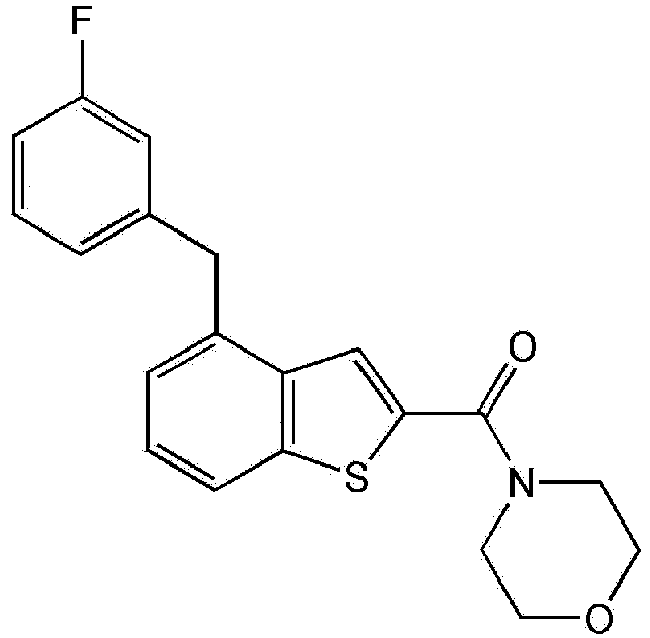
18 
57 
19 
58 
20 
59 
21 
60 
22 
61 
23 
62 
24 
63 
25 
64 
26 
65 
27 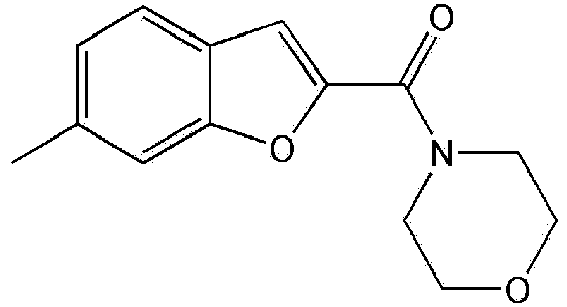
66 
28 
67 
29 
68 
30 
69 
31 
70 
32 
71 
33 
72 
34 
73 
35 
74 
36 
75 
37 
76 
38 
39 
- The following experiment was performed to evaluate RIPK1 (receptor-interacting serine/threonine-protein kinase 1) inhibitory activity of the compounds of examples of the invention.
- RIPK1 enzyme immuno-precipitated in HEK293 (Human Embryonic Kidney 293) cell lysate was used as kinase. The experiment was performed according to the method described in Cell.12;137(6):1112-23(2009). RIPK1 protein was over-expressed in HEK293 cell line, to which lysis buffer (50 mM Tris-Cl [pH 8.0], 150 mM NaCl, 1 mM EDTA, 1% NP-40, 0.4 mM phenylmethylsulfonyl fluoride (PMSF)) was added for cell lysis. Centrifugation was performed at 13,000 rpm for 10 minutes to separate the supernatant. RIPK1 monoclonal antibody (610459, BD Bioscience) and A/G agarose beads (sc-2003, Santa Cruz Biotechnology) were added thereto, followed by immuno-precipitation in a 4°C rotator for 12 hours.
- The immune complex was washed with lysis buffer twice and then washed with kinase assay buffer (20 mM HEPES [pH7.6], 2 mM DTT, 1 mM NaF, 1mM Na3Vo4, 20 mM β-glycerophosphate, 20 mM PNPP, 20 mM MgCl2, 20 mM MnCl2, 1 mM Benzamidie, and 1 mM EDTA) lastly. Kinase assay buffer and the compound were added to the RIPK1 immuno-precipitate, followed by reaction in a 24°C constant-temperature water bath for 15 minutes. Additional reaction was induced for 30 minutes at 30°C after 100 µM of ATP and 10 µCi[32P] γ-ATP were added thereto. The reaction mixture was washed with kinase assay buffer once, to which protein loading buffer was added, followed by heating at 100°C for 3 minutes. The reaction mixture was then loaded on 8% SDS-PAGE gel. Radioactive image of the phosphorylated RIPK1 was detected with FLA-7000 (GE healthcare). The image Quant TL program was used for the quantification. The results are shown in Table 2 below.
[Table 2] Example RIPK1 activity (%) 100 µM 1 52.5 ± 7.8 2 45.0 ± 12.7 3 52.0 ± 2.8 4 3.0 ± 1.4 5 85.1 ± 24.7 6 48.5 ± 23.3 7 87.1 ± 17.7 8 88.5 ± 16.3 9 76.0 ± 33.9 10 62.5 ± 16.8 11 70.7 ± 28.5 12 60.0 13 83.4 ± 16.1 14 62.0 ± 6.2 15 85.6 ± 26.7 16 88.0 ± 24.7 17 62.5 ± 16.8 18 76.5 ± 12.0 19 81.0 ± 26.9 20 77.0 ± 12.5 21 81.0 ± 17.0 22 43.5 ± 10.6 23 69.0 ± 24.5 24 52.0 ± 17.1 25 43.0 26 81.4 ± 29.3 27 86.0 ± 17.0 28 73.0 ± 38.2 29 82.5 ± 24.7 30 0.4 ± 0.1 31 85.2 ± 3.5 32 6.5 ± 4.9 33 90.0 ± 2.8 34 16.5 ± 7.8 35 3.5 ± 2.1 36 4.0 ± 2.8 37 25.5 ± 14.8 38 62.0 ± 12.0 39 3.7 ± 2.6 40 57.5 ± 12.0 41 84.7 ± 6.4 42 35.5 ± 3.9 43 58.5 ± 17.7 44 21.0 ± 17.0 45 86.7 ± 34.6 46 11.0 ± 5.7 47 20.0 ± 14.1 48 25.5 ± 0.7 49 27.0 ± 5.7 50 47.5 ± 2.1 51 2.5 ± 0.7 52 5.5 ± 4.9 53 70.0 ± 4.2 54 54.5 ± 37.5 55 43.0 ± 7.1 56 54.5 ± 37.5 57 20.0 ± 14.1 58 78.5 ± 30.4 59 21.0 ± 7.1 60 22.0 ± 15.6 61 22.5 ± 12.0 62 82.5 ± 5.0 63 1.5 ± 0.7 64 83.6 ± 12.7 65 67.0 ± 0.0 66 11.5 ± 4.9 67 49.5 ± 3.5 68 33.5 ± 12.0 69 22.5 ± 16.3 70 65.0 ± 32.5 71 87.0 ± 4.2 72 7.0 ± 8.5 73 22.0 ± 19.8 74 4.0 ± 0.0 75 3.5 ± 3.5 76 1.5 ± 0.7 - As shown in Table 2, the compounds of examples of the present invention were confirmed to have RIPK1 inhibitory activity. Particularly, the compounds of examples 2, 4, 6, 22, 25, 30, 32, 34, 35, 36, 37, 39, 42, 44, 46, 47, 48, 49, 50, 51, 52, 55, 57, 59, 60, 61, 63, 66, 67, 68, 69, 72, 73, 74, 75, and 76 were confirmed to inhibit RIPK1 at least 50%. More particularly, those compounds of examples 4, 30, 32, 34, 35, 36, 39, 46, 47, 51, 52, 57, 63, 66, 72, 74, 75, and 76 inhibited RIPK1 by 80% or more, indicating that the compounds had a very excellent inhibitory activity.
- The compound represented by
claim 1 of the invention is excellent in inhibiting RIPK1 (receptor-interacting serine/threonine-protein kinase 1) causing retinal disease. Therefore, the pharmaceutical composition comprising the compound above as an active ingredient can be advantageously used as a pharmaceutical composition for the prevention or treatment of retinal disease. - The following experiment was performed to evaluate the protective effect of the compounds of examples of the invention on the retinal nerve under oxygen-glucose deprivation condition.
- The retinal ganglion cell line RGC-5 (rat ganglion cell) was cultured in DMEM (Dulbecco's modified Eagle's medium) supplemented with 10% FBS (fetal bovine serum) and 1% penicillin/streptomycin. The cells were distributed in a 96-well plate at the density of 8×10³ cells/well, followed by culture in a 37°C, CO2 incubator for 12 hours. The cells were washed with PBS once and the medium was replaced with glucose free DMEM. The cells were treated with either DMSO (0.1%) alone (control) or with the compounds of examples (20 µM) shown in Table 3, followed by culture in an anaerobic incubator (10% H2, 5% CO2, 85% N2, 37°C, chamber (ThermoForma, USA)) for 15 hours to induce cell death.
- The level of cell death was measured by LDH (lactate dehydrogenase, Roche) assay. The LDH assay is a method for measuring the activity of LDH released from the damaged cells into the culture medium. NAD+ was reduced to NADH and H+ by LDH, and the bond of tetrazolium salt INT ring was cleaved by diaphorase to form formazan. Absorbance of the formazan was measured at 490 nm by using Victor 3 (PerkinElmer). The absorbance reflects the amount of dead cells.
- The level of the control LDH under oxygen-glucose deprivation condition was regarded as 100%, and the level of LDH in the cell group cultured in normal medium (10% FBS, DMEM) for the same time was regarded as 0%. Based on that, the levels of LDH of the cell groups treated with the compounds of the invention under oxygen-glucose deprivation condition were converted into the relative ratio of cell death. The compounds of examples of the invention were treated to wells, each compound for three wells, and then each experiment was performed in triplicate. The mean values are presented in Table 3.
[Table 3] Example Death of retinal nerve cell (%) 1 37.4 ± 1.3 2 47.4 ± 10.7 3 40.1 ± 18.6 4 57.8 ± 8.9 5 62.1 ± 3.7 6 30.7 ± 1.06 7 90.0 ± 3.3 8 52.3 ± 11.1 9 64.6 ± 9.5 10 49.0 ± 7.0 11 41.1 ± 3.1 12 35.7 ± 0.1 13 69.6 ± 2.0 14 82.1 ± 11.2 15 42.7 ± 2.0 16 19.3 ± 1.4 17 38.5 ± 5.5 18 37.0 ± 1.7 19 70.9 ± 9.7 20 43.6 ± 8.5 21 64.7 ± 7.1 22 78.6 ± 13.8 23 45.6 ± 3.6 24 76.4 ± 13.4 25 37.0 ± 1.2 26 48.6 ± 6.5 27 53.7 ± 9.1 28 60.0 ± 8.2 29 51.4 ± 10.9 30 51.0 ± 5.9 31 81.2 ± 8.3 32 64.6 ± 7.4 33 51.5 ± 7.0 34 55.4 ± 18.1 35 90.0 ± 3.3 36 58.0 ± 3.8 37 87.0 ± 13.2 38 59.9 ± 0.2 39 46.2 ± 0.8 40 68.2 ± 11.2 41 58.3 ± 6.5 42 57.2 ± 11.2 43 62.3 ± 1.7 44 81.1 ± 6.5 45 89.4 ± 14.0 46 55.4 ± 12.8 47 59.1 ± 1.6 48 47.7 ± 13.2 49 43.8 ± 13.7 50 57.2 ± 8.1 51 44.7 ± 6.3 52 52.8 ± 4.4 53 59.9 ± 9.7 54 74.3 ± 5.1 55 47.2 ± 12.4 56 81.0 ± 16.1 57 89.1 ± 16.9 58 89.4 ± 6.4 59 59.5 ± 14.7 60 89.8 ± 10.7 61 53.5 ± 14.5 62 59.3 ± 16.3 63 48.3 ± 13.7 64 63.0 ± 17.8 65 79.6 ± 5.5 66 45.2 ± 10.5 67 59.3 ± 14.9 68 58.3 ± 11.9 69 69.4 ± 10.9 70 48.7 ± 10.3 71 89.1 ± 14.9 72 58.5 ± 16.1 73 62.3 ± 10.1 74 51.4 ± 10.3 75 41.7 ± 7.0 76 43.6 ± 6.6 Comparative Example 1 89.5 ± 10.5 Comparative Example 2 73.5 ± 10.3 - As shown in Table 3, the compounds of examples of the invention showed better retinal nerve protection effect under oxygen glucose deprivation condition at the concentration of 20 µM than the compounds of Comparative Examples 1 and 2. In particular, the compounds of examples 1, 2, 3, and 76 demonstrated as low death rate of the retinal nerve cells as less than 50%. That is, those compounds induced cell death less than the compounds of Comparative Examples 1 (89.5%) and 2 (73.5%). So, the compounds of the invention were confirmed to have excellent retinal nerve cell protection effect.
- Therefore, it was confirmed that the compound represented by
claim 1 of the present invention had excellent retinal nerve cell protection effect under oxygen-glucose deprivation condition, so that the pharmaceutical composition comprising the compound above as an active ingredient can be effectively used as a pharmaceutical composition for the prevention or treatment of retinal disease. - The following experiment was performed to evaluate the retinal neuron protection effect of the compounds of the invention under necroptosis inducing condition.
- The retinal ganglion cell line RGC-5 (rat ganglion cell-5) was cultured in DMEM (Dulbecco's modified Eagle's medium) supplemented with 10% FBS (fetal bovine serum) and 1% penicillin/streptomycin. The cells were distributed in a 96-well plate at the density of 8×10³ cells/well, followed by culture in a 37°C, CO2 incubator for 12 hours. The medium supplemented with TNFα (10 ng/ml), cycloheximide (10 µg/ml), and zVAD (10 µM) (TCZ) was treated with DMSO (0.1%) alone (control) or with the compounds of the invention (20 µM), followed by additional culture in a 37°C, CO2 incubator for 15 hours to induce cell death.
- The level of cell death was measured by LDH (lactate dehydrogenase, Roche) assay. The level of the control LDH under TCZ condition was regarded as 100%, and the level of LDH in the cell group cultured in normal medium (10% FBS, DMEM) for the same time was used for the measurement of the relative rate of cell death. The compounds of examples of the invention were treated to wells, each compound for three wells, and then each experiment was performed in triplicate. The mean values are presented in Table 4.
[Table 4] Example Death of retinal nerve cell (%) 1 79.3 ± 3.2 2 - 3 79.6 ± 3.2 4 - 5 57.6 ± 19.2 6 36.9 ± 8.4 7 63.2 ± 3.9 8 - 9 - 10 - 11 26.7 ± 1.0 12 50.5 ± 7.4 13 71.2 ± 7.0 14 81.1 ± 15.2 15 72.6 ± 6.8 16 59.4 ± 11.3 17 47.3 ± 10.7 18 74.6 ± 8.2 19 71.6 ± 9.1 20 - 21 89.9 ± 19.4 22 69.5 ± 7.4 23 69.2 ± 4.2 24 66.6 ± 9.9 25 64.8 ± 11.2 26 75.9 ± 15.1 27 86.1 ± 1.3 28 84.3 ± 1.7 29 78.4 ± 6.5 30 - 31 - 32 - 33 - 34 - 35 89.2 ± 8.2 36 - 37 - 38 72.4 ± 7.5 39 74.9 ± 9.1 40 - 41 - 42 - 43 - 44 - 45 - 46 - 47 89.1 ± 1.2 48 - 49 - 50 - 51 - 52 80.8 ± 2.8 53 - 54 - 55 - 56 - 57 - 58 - 59 - 60 - 61 - 62 - 63 - 64 - 65 77.8 ± 9.6 66 - 67 - 68 - 69 - 70 - 71 - 72 - 73 - 74 - 75 - 76 - - In Table 4, - indicates that the experiment was not performed.
- As shown in Table 4, the compounds of examples of the invention displayed the retinal nerve cell protection effect at the concentration of 20 µM under necroptosis inducing (TCZ; TNFα+cycloheximide+zVAD) condition. In particular, the compounds of examples 6, 11, and 17 displayed as low death rate of the retinal nerve cells as less than 50%, suggesting that they had excellent retinal neuron protection effect.
- Therefore, it was confirmed that the compound represented by
claim 1 of the present invention had excellent retinal nerve cell protection effect under necroptosis inducing condition, so that the pharmaceutical composition comprising the compound above as an active ingredient can be effectively used as a pharmaceutical composition for the prevention or treatment of retinal disease. - RIPK1 enzyme immuno-precipitated in HEK293 (Human Embryonic Kidney 293) cell lysate was used as a kinase. The experiment was performed according to the method described in Cell.12;137(6):1112-23(2009).
- RIPK1 protein was over-expressed in HEK293 cell line, to which lysis buffer (50 mM Tris-Cl [pH 8.0], 150 mM NaCl, 1 mM EDTA, 1% NP-40, 0.4 mM phenylmethylsulfonyl fluoride (PMSF)) was added for cell lysis. Centrifugation was performed at 13,000 rpm for 10 minutes to separate the supernatant. RIPK1 monoclonal antibody (610459, BD Bioscience) and A/G agarose beads (sc-2003, Santa Cruz Biotechnology) were added thereto, followed by immuno-precipitation in a 4°C rotator for 12 hours.
- The compounds of examples of the invention were diluted at the different concentrations of 10 µM ∼ 0.05 µM (10, 5, 1, 0.5, 0.1, 0.05 uM) and mixed with the immuno-precipitated RIPK1 enzyme, followed by reaction in a 24°C constant-temperature water bath for 15 minutes. Additional reaction was induced for 30 minutes at 30°C after 100 µM of ATP and 10 µCi [32P] γ-ATP were added thereto. The reaction mixture was washed with buffer once, to which protein loading buffer was added, followed by heating at 100°C for 3 minutes. The reaction mixture was then loaded on 8% SDS-PAGE gel. Radioactive image of the phosphorylated RIPK1 was detected with FLA-7000 (GE healthcare). The image Quant TL program was used for the quantification. Based on the results, IC50 of the compound was calculated by using sigmaplot 10.0 program. The results are shown in Table 5.
[Table 5] Example IC50 (nM) 1 - 2 - 3 - 4 1,125 5 - 6 - 7 - 8 - 9 - 10 - 11 - 12 - 13 - 14 - 15 - 16 - 17 - 18 - 19 - 20 - 21 - 22 - 23 - 24 - 25 - 26 - 27 - 28 - 29 - 30 102.5 31 - 32 - 33 - 34 - 35 360.2 36 17.7 37 - 38 - 39 193.1 40 - 41 - 42 - 43 - 44 - 45 - 46 - 47 - 48 - 49 - 50 - 51 216.9 52 8,174.4 53 - 54 - 55 - 56 - 57 - 58 - 59 - 60 - 61 - 62 - 63 230.1 64 - 65 - 66 - 67 - 68 - 69 - 70 - 71 72 - 73 - 74 65.6 75 73.4 76 61.2 Comparative Example 1 95.5 - In Table 5, - indicates that the experiment was not performed.
- As shown in Table 5, the compounds of examples of the invention were confirmed to have low IC50 concentration against RIPK1 (receptor-interacting serine/threonine-protein kinase 1). Particularly, the compounds of examples 36, 74, 75, and 76 demonstrated 50% inhibition of RIPK1 (receptor-interacting serine/threonine-protein kinase 1) at a lower concentration than the compound of Comparative Example 1.
- Therefore, it was confirmed that the compound represented by
claim 1 of the present invention had excellent activity to inhibit RIPK1 (receptor-interacting serine/threonine-protein kinase 1) causing retinal disease even at a low concentration, so that the pharmaceutical composition comprising the compound above as an active ingredient can be effectively used as a pharmaceutical composition for the prevention or treatment of retinal disease. - The following experiment was performed to evaluate the retinal cell protection effect of the compound represented by
claim 1 of the invention. - First, eye drops of Example 39 and Comparative Examples 1 and 2 having the eye drop type composition (%) as shown in Table 6 below were prepared.
[Table 6] Compound Example 39 Compar ative Example 1 Comparative Example 2 Code No. F001 F002 F003 F004 F000 F000 F001 F002 Transcutol - 0.5 - 0.75 - - - 0.75 Kolliphor TPGS 4 - - - - - - - Cremophor EL - 2 4 3 - - 4 3 Labrafil M1944CS - 2 - 3 - - - 3 Sodium chloride 0.734 0.6 85 0.41 - - 0.68 5 0.41 Citric acid hydrate 0.013 0.0128 - - 0.0128 Sodium citrate hydrate 0.45 0.45 - - 0.45 PEG400 (polyethylene glycol 400) 0.053 - 30 15 - propyleneglycol - 0.053 - - 0.053 Povidone K90 1.14 1.5 - - 1.5 HCl proper amount proper amount - - proper amount NaOH proper amount proper amount - - proper amount DMSO - - 10 - - Glycerine - - - 12.5 - EDTA - - - 0.05 - Boric acid - - - 0.16 4 - Borax - - - 0.11 76 - Content (µg/ml) 335 .3 480 .1 313. 2 749 .6 1000 1000 334. 3 760. 6 - In Table 6, - indicates no addition.
- From 3 days before the administration of sodium iodate (SI) to the 8-week-old dry macular degeneration rat model, the compound of the invention was instillated twice a day (50 µl/each eye drop instillation) and SI (ip, 50 mg/kg) was administered once. Additionally, the compound was instillated twice a day for 7 days. 7 days later, the eyeballs were extracted, followed by H&E staining to investigate retinal cell protection effect (n=3, 6 eyes).
Figure 1 is a schematic diagram illustrating the construction of the dry macular degeneration rat model and the eye drop instillation of the compounds of the invention. - The eyeballs were extracted from the dry macular degeneration rat model constructed by the same manner as described in
Figure 1 , followed by histostaining. As a result, retina degeneration was not observed in those eyeballs eye drop instillated with the compounds of example 39 nor those of Comparative Examples 1 and 2. The results are shown inFigure 2 . - To measure the survival rate (%) of retinal pigment epithelial cells, the eyeballs extracted from the experimental rats were fixed in 4% glutaraldehyde solution for 4 hours and embedded in paraffin. Tissue sections were prepared in 5 µm thickness, followed by H&E (Hematoxylin and Eosin) staining. Photomicrographs were taken of 2-3 different areas within the RPE(retinal pigment epithelium) layer on 100x optical microscope (Leica), and the number of stained cells was counted. The number of RPE cells in the normal rat group was regarded as 100%, based on which the survival rate was calculated. The results are shown in
Figure 3 . - As shown in
Figure 3 , the compounds of example 39 (F001 and F002) of the invention displayed better retinal pigment epithelial cell protection effect than the compounds of Comparative Examples 1 and 2. - Therefore, it was confirmed that the compound represented by
formula 1 of the present invention did not cause retinal degeneration but had excellent retinal pigment epithelial cell protection effect, so that the pharmaceutical composition comprising the compound above as an active ingredient can be effectively used as a pharmaceutical composition for the prevention or treatment of retinal disease. - The following experiment was performed to evaluate the retinal layer thickness protection effect of the compounds of the invention.
- To measure the number (%) of ONL (outer nuclear layer) cells, the tissue sections of the eyeballs extracted from the rat used in Experimental Example 5 were stained with H&E solution. The number of stained cells in the outer nuclear layer was counted by photographing with optical microscope. 10 different areas were selected to count the cells for each retina. The cell number of the normal group was regarded as 100%. The results are shown in
Figure 4(A) .
As shown inFigure 4(A) , the compounds of example 39 (F001 and F002) of the invention displayed better ONL cell protection effect than the compounds of Comparative Examples 1 and 2. - To measure the thickness (µm) of ONL (outer nuclear layer), the tissue sections of the eyeballs extracted from the rat used in Experimental Example 5 were stained with H&E solution. Photographs were taken by optical microscope and the thickness of ONL was measured by using "image J" program. Ten different regions were analyzed for each retina. The thickness (µm) of ONL of the normal group was regarded as 100%. The results are shown in
Figure 4(B) . - As shown in
Figure 4(B) , the compounds of example 39 (F001 and F002) of the invention displayed better ONL thickness protection effect than the compounds of Comparative Examples 1 and 2. - Therefore, it was confirmed that the compound represented by
claim 1 of the present invention not only had the outer nuclear layer cell protection effect but also had outer nuclear layer thickness protection effect, so that the pharmaceutical composition comprising the same as an active ingredient can be effectively used as a pharmaceutical composition for the treatment of retinal disease. - The following experiment was performed to evaluate the retinal detachment inhibitory effect of the compounds of the invention.
- First, 1 ml of 60 mg/ml sodium iodate (SI) was intravenously injected into a brown rabbit (Chinchilla, male, 3 kg) to induce degeneration of retinal pigment epithelium and photoreceptor cells, resulting in the construction of a dry macular degeneration rabbit model. Retinal degeneration was observed (Eye 2005.19, 464-468) one week after the SI administration, and a schematic diagram illustrating the eye drop instillation of the compounds is shown in
Figure 5 . - The dry macular degeneration rabbit model was instillated with the compound of the invention for 7 days (100 µl, twice a day). On day 7, the eyeballs were photographed by MRI for small animals. As a result, as shown in
Figure 6 , retinal detachment was observed in the non-treated group, but the groups treated with the compounds of example 39 (F001 and F002) showed normal retinal structure. - Therefore, it was confirmed that the compound represented by
claim 1 of the present invention had excellent retinal detachment inhibitory effect, so that the pharmaceutical composition comprising the same as an active ingredient can be effectively used as a pharmaceutical composition for the treatment of retinal disease. - The following experiment was performed to evaluate the retinal degeneration inhibitory effect of the compounds of the invention.
- The eyeballs obtained from the dry macular degeneration rabbit model of Experimental Example 7 were fixed in 4% paraformaldehyde. The cornea and lens were eliminated, followed by dehydration with alcohol and then paraffin blocks were prepared. The tissue blocks were sectioned by using a microtome to prepare tissue slides. The tissue slides were stained with hematoxylin-eosin (H&E staining), followed by observation under optical microscope. The results are shown in
Figure 7 . - As shown in
Figure 7 , the retinal structure was changed and degenerated in the non-treated group. However, the retinal structure remained normal in the group treated with the compounds of example 39 (F001 and F002). - Therefore, it was confirmed that the compound represented by
claim 1 of the present invention had excellent retinal degeneration inhibitory effect, so that the pharmaceutical composition comprising the same as an active ingredient can be effectively used as a pharmaceutical composition for the treatment of retinal disease. - The following experiment was performed to evaluate the retinal layer thickness protection effect of the compounds of the invention.
- The eyeballs were extracted from the dry macular degeneration rabbit model used in Experimental Example 7, and the thickness of ONL was measured. As a result, the compounds of example 39 of the invention displayed 70-80% retinal layer thickness protection effect and the results are shown in
Figure 8 . - Therefore, it was confirmed that the compound represented by
claim 1 of the present invention had excellent retinal layer thickness protection effect, so that the pharmaceutical composition comprising the same as an active ingredient can be effectively used as a pharmaceutical composition for the treatment of retinal disease. - The following experiment was performed to evaluate the drug efficacy of the compound of the invention by ERG (Electroretinography).
- The normal rabbit was anesthetized, which was adapted for 20 minutes in a dark room. Retinal potential difference was measured by ERG equipment. Electroretinography is a method to observe the response of photoreceptor cells with two light intensities. Particularly, A and B waves were measured from 100 to 10000 mcd, and the retinal potential difference measured at 3000 mcd. The schematic diagram is shown in
Figure 9 . Drug efficacy was evaluated by observing the photoreceptor cells, for which the stronger response to wave A was selected. - Evaluation of candidate substances for dry macular degeneration was performed using a retinal degeneration rabbit model. The compounds of Comparative Examples 2 and 3 were used as comparative compounds. The compounds of example 39 of the invention and Comparative Example 2 were formulated as eye drops as shown in Table 2, which were instillated twice a day (100 µℓ/ eye drop instillation). The compound of Comparative Example 3 was orally administered once a day (10 mg/rabbit, dissolved in saline). One week later, ERG was performed and the results are shown in Table 7,
Figure 10 , andFigure 11 .[Table 7] Example Wave ratio Drug efficacy(%) Normal 1.00 100 Veh. 0.52 0 Example39-F003 0.82 62 Example39-F004 0.91 81 Comparative Example2-F001 0.91 81 Comparative Example2-F002 0.83 64 Comparative Example3-MH 0.74 46 Comparative Example3-HC 0.67 31 In Table 7,
MH indicates monohydrate which was used for oral administration because it was not dissolved in water; and
HC indicates hyclate which was used as injection/oral-preparation since it was well dissolved in water. - As shown in Table 7 and
Figure 10 , when ERG was performed with the SI (sodium iodate) induced retinal degeneration model, wave A was significantly reduced in the retinal degeneration model. It was reduced to 50% at 300 mcd, compared to normal. In particular, the drug efficacy of the compound of example 39-F004 (81%) was significantly higher than the compound of Comparative Example 3-HC (doxycycline, 31%) orally administered, suggesting that the compound of example 39 had better retinal protection effect. - As shown in
Figure 11 , the compounds of example 39-F003 and example 39-F004 were confirmed to exhibit 81.9% and 91.2% response compared to normal (100%), respectively. In the meantime, the compounds of Comparative Example 2-F001, Comparative Example 2-F002, Comparative Example 3-MH, and Comparative Example 3-HC were confirmed to exhibit 90.9%, 82.9%, 74.1%, and 66.9% response compared to normal (100%), respectively. More precisely, the compounds of example 39-F003 (81.9%) and example 39-F004 (91.2%) displayed significantly higher response strength than the compounds of Comparative Example 3-MH (74.1%) and Comparative Example 3-HC (66.9%). - Therefore, it was confirmed that the compound represented by
claim 1 of the present invention had excellent cell protection effect, so that the pharmaceutical composition comprising the same as an active ingredient can be effectively used as a pharmaceutical composition for the treatment of retinal disease. - To evaluate the drug efficacy of the compounds of the invention, the following experiment was performed using retinal fundus photographs.
- First, to construct a dry macular degeneration pig model, 10 mg/kg of iodoacetic acid (IAA) was dissolved in PBS (phosphate buffered saline) and injected intravenously to a mini pig (Yutacan Micropig). One week after the IAA administration, retinal degeneration was confirmed by retinal fundus photography and fluorescence (Experimental eye research 2012. 97, 137-147), and a schematic diagram illustrating the eye drop instillation of the compounds is shown in
Figure 12 . - The eye drop instillation of the compounds of the invention was performed from a day before the IAA administration as shown in
Figure 12 .7 days after the induction of retinal degeneration in the pig, retinal fundus photographs were taken and the results are shown inFigure 13 . - As shown in
Figure 13 , in the non-treated group (Veh), retinal pigment epithelium was degenerated, so that choroidal vessels and bright areas were observed. In the groups treated with the compounds of Comparative Examples (2-F001 (eye drop instillation) and 3-HC (oral-administration)), damaged areas (*) were observed. However, in the group treated with the compound of example 39 (39-F004, eye drop instillation) of the invention, normal retina was observed. - Therefore, it was confirmed that the compound represented by
claim 1 of the present invention had excellent retinal detachment inhibitory effect, so that the pharmaceutical composition comprising the same as an active ingredient can be effectively used as a pharmaceutical composition for the treatment of retinal disease. - The following experiment was performed to evaluate the drug efficacy of the compound of the invention by ERG (Electroretinography).
- The experiment was performed by the same manner as described in Experimental Example 10 except that a dry macular degeneration pig model was used instead of the dry macular degeneration rabbit model. The results are shown in Table 8,
Figure 14 , andFigure 15 .[Table 8] Example Wave ratio Drug efficacy (%) Normal 1.00 100 Veh. 0.25 0 Example39-F004 0.53 37 Comparative Example2-F001 0.32 10 Comparative Example3-HC 0.38 18 - In Table 8, the composition of the compound of Comparative Example 3-HC was saline (0.9%).
- As shown in Table 8,
Figure 14 , andFigure 15 , wave A response was observed in the normal group, but wave A response was reduced in the groups treated with the compounds of Comparative Examples (2-F001 and 3-HC). In the meantime, all A waves were preserved in the example 39-F004 treated group. It means that the compound of example 39 (F004) had better retinal protection effect than the compounds of Comparative Examples (2-F001 and 3-HC). - Therefore, it was confirmed that the compound represented by
claim 1 of the present invention had excellent cell protection effect, so that the pharmaceutical composition comprising the same as an active ingredient can be effectively used as a pharmaceutical composition for the treatment of retinal disease.<Manufacturing Example 1> preparation of eye drops Derivative represented by formula 10.1 g Aminoethylsulfonic acid 0.2 g Benzalkonium chloride 0.005 g Tyloxapol 0.02 g Povidone (K3O) 2.0 g Sodium acetate 0.02 g Conc. glycerin 2.2 g Sodium hydroxide proper amount Purified water proper amount Total 100 Mℓ - Eye drops were prepared by mixing all the above components by the conventional method for preparing eye drops.
<Manufacturing Example 2> preparation of health food Derivative represented by formula 1500 ng Vitamin complex proper amount Vitamin A acetate 70 mg Vitamin E 1.0 mg Vitamin B1 0.13 mg Vitamin B2 0.15 mg Vitamin B6 0.5 mg Vitamin B12 0.2 mg Vitamin C 10 mg Biotin 10 mg Nicotinic acid amide 1.7 mg Folic acid 50 mg Calcium pantothenate 0.5 mg Minerals proper amount Ferrous sulfate 1.75 mg Zinc oxide 0.82 mg Magnesium carbonate 25.3 mg Potassium phosphate monobasic 15 mg Potassium phosphate dibasic 55 mg Potassium citrate 90 mg Calcium carbonate 100 mg Magnesium chloride 24.8 mg - Vitamins and minerals were mixed according to the preferable composition rate for health food. However, the composition rate can be adjusted. The constituents were mixed according to the conventional method for preparing health food and then the composition for health food was prepared according to the conventional method.
<Manufacturing Example 3> preparation of health beverage Derivative represented by formula 1500 ng Citric acid 1000 mg Oligosaccharide 100 g Maesil (Prunus mume) extract 2 g Taurine 1 g Purified water up to 900 Mℓ - The above constituents were mixed according to the conventional method for preparing health beverages. The mixture was heated at 85°C for 1 hour with stirring and then filtered. The filtrate was loaded in 2 liter sterilized containers, which were sealed and sterilized again, stored in a refrigerator until they would be used for the preparation of a composition for health beverages.
- The constituents appropriate for favorite beverages were mixed according to the preferred mixing ratio but the composition ratio can be adjusted according to regional and national preferences, etc.
- The novel indene derivative of the present invention, the optical isomer of the same, or the pharmaceutically acceptable salts of the same have excellent inhibitory efficiency of receptor-interacting serine/threonine-protein kinase 1 (RIPK1). Therefore, the composition containing the same as an active ingredient can be effectively used as a pharmaceutical composition for preventing or treating retinal disease exemplified by retinitis pigmentosa (RP), Leber congenital amaurosis (LCA), Stargardts disease, Usher syndrome, choroideremia, rod-cone or cone-rod dystrophy, ciliopathy, mitochondrial disorders, progressive retinal atrophy, degenerative retinal diseases, age-related macular degeneration (AMD), wet AMD, dry AMD, geographical atrophy, inherited or acquired macular degeneration, retinal photoreceptor diseases, retinal pigment epithelial diseases, diabetic retinopathy, cystic macular edema, uveitis, retinal detachment, traumatic retinal injury, iatrogenic retinal injury, macular holes, macular capillarectasia, ganglion cell diseases, optic nerve diseases, glaucoma, optic neuropathy, ischemic retinal diseases, retinopathy of prematurity, occlusion of retinal vessels, inherited macroaneurysm, retinal vascular diseases, ophthalmic vascular diseases, glaucomatous retinal neurodegeneration, ischemic optic neuropathy and the like.
Claims (9)
- A compound, an optical isomer, or a pharmaceutically acceptable salt of the same,
wherein the compound is selected from the group consisting of the following compounds:(1) (4-bromo-7-chlorothieno[2,3-c]pyridine-2-yl) (morpholino)methanone;(2)(4-(4-fluorophenyl)thieno[2,3-c]pyridine-2-yl) (morpholino)methanone;(3) (4-bromothieno[2,3-c]pyridine-2-yl) (morpholino)methanone;(4)(4-(4-fluorophenyl)thieno[2,3-b]pyridine-2-yl) (morpholino)methanone;(5) (7-chloro-4-(4-fluorophenyl)thieno[2,3-c]pyridine-2-yl)(morpholino)methanone;(7)4-((4-(4-fluorophenyl)benzo[b]thiophene-2-yl)methyl)morpholine;(8)4-(4-(4-fluorophenyl)benzo[b]thiophene-2-carbonyl)morpholine-3-carboxylic acid;(9) (4-(1H-indole-5-yl)benzo[b]thiophene-2-yl) (morpholino)methanone;(10)N-(4-(2-(morpholine-4-carbonyl)benzo[b]thiophene-4-yl)phenyl)acetamide;(14) (5-bromo-1H-benzo[d]imidazole-2-yl)(morpholino)methanone ;(17) (4,6-dimethylbenzo[b]thiophene-2-yl)(morpholino)methanone;(18) (6,7-dimethylbenzo[b]thiophene-2-yl)(morpholino)methanone;(19) (6-methoxybenzo[b]thiophene-2-yl)(morpholino)methanone;(20)N,N-diethyl-2-(morpholine-4-carbonyl)benzo[b]thiophene-4-carboxamide;(24) (5-methoxy-1H-benzo[d]imidazole-2-yl)(morpholino)methanone;(27) (6-methylbenzofuran-2-yl)(morpholino)methanone;(29) (7-bromobenzo[b]thiophene-2-yl)(morpholino)methanone;(30) (4-(2-fluorophenyl)benzo[b]thiophene-2-yl)(morpholino)methanone;(31) (4-(biphenyl-4-yl)benzo[b]thiophene-2-yl)(morpholino)methanone;(32) morpholino(4-p-tolylbenzo[b]thiophene-2-yl)methanone;(33) 4-(2-(morpholine-4-carbonyl)benzo[b]thiophene-4-yl)benzoic acid;(34) (4-(4-methoxyphenyl)benzo[b]thiophene-2-yl) (morpholino)methanone;(35) (4-(4-fluorophenyl)benzo[b]thiophene-2-yl)(pyrrolidine-1-yl)methanone;(36) (4-(3-fluorophenyl)benzo[b]thiophene-2-yl) (morpholino)methanone;(37) (4-aminopiperidine-1-yl)(4-(4-fluorophenyl)benzo[b]thiophene-2-yl)methanone hydrochloride;(38) (4-(4-fluorophenyl)benzo[b]thiophene-2-yl) (piperazine-1-yl)methanone hydrochloride;(39) (4-(4-fluorophenyl)benzo[b]thiophene-2-yl) (morpholino)methanone;(40) (5-(4-fluorophenyl)benzo[b]thiophene-2-yl) (morpholino)methanone;(41) (4-(biphenyl-3-yl)benzo[b]thiophene-2-yl) (morpholino)methanone;(42) (4-(3-aminophenyl)benzo[b]thiophene-2-yl) (morpholino)methanone;(43)4-(2-(morpholine-4-carbonyl)benzo[b]thiophene-4-yl)benzamide;(44) (4-(4-hydroxyphenyl)benzo[b]thiophene-2-yl) (morpholino)methanone;(45)morpholino(4-(4-(trifluoromethoxy)phenyl)benzo[b]thiophene-2-yl)methanone;(46) (4-(4-fluorophenyl)benzo[b]thiophene-2-yl)(oxazolidine-3-yl)methanone;(47) (4-(4-fluorophenyl)benzo[b]thiophene-2-yl)(piperidine-1-yl)methanone;(48) (4-(4-fluorophenyl)benzo[b]thiophene-2-yl)(4-hydroxypiperidine-1-yl)methanone;(49) (4-(4-fluorophenyl)benzo[b]thiophene-2-yl)(4-methylpiperazine-1-yl)methanone hydrochloride;(50) (4-(4-(methylthio)phenyl)benzo[b]thiophene-2-yl)(morpholino)methanone;(51) (4-(4-fluorophenyl)benzo[b]thiophene-2-yl)(thiomorpholino)methanone;(52) (4-(4-fluorophenyl)benzo[b]thiophene-2-yl)(1,4-oxazepane-4-yl)methanone;(53) (7-chloro-4-(4-fluorophenyl)benzo[b]thiophene-2-yl)(morpholino)methanone;(54) (4-(4-bromophenyl)benzo[b]thiophene-2-yl)(morpholino)methanone;(55) (4-(6-methoxypyridine-3-yl)benzo[b]thiophene-2-yl)(morpholino)methanone;(56) (4-(3-fluorobenzyl)benzo[b]thiophene-2-yl) (morpholino)methanone;(57) (4-(2,4-difluorobenzyl)benzo[b]thiophene-2-yl) (morpholino)methanone;(58) (4-(2,4-difluorophenylamino)benzo[b]thiophene-2-yl) (morpholino)methanone;(59) (4-(4-fluorophenoxy)benzo[b]thiophene-2-yl) (morpholino)methanone;(60) (4-(4-fluorophenethyl)benzo[b]thiophene-2-yl) (morpholino)methanone;(61) (4-(4-fluorobenzyloxy)benzo[b]thiophene-2-yl) (morpholino)methanone;(62) (4-(4-fluorobenzylsulfonyl)benzo[b]thiophene-2-yl) (morpholino)methanone;(63) (4-(2,4-difluorophenyl)benzo[b]thiophene-2-yl) (morpholino)methanone;(64) methyl4-(2-(morpholine-4-carbonyl)benzo[b]thiophene-4-yl)benzene sulfiante;(65) (7-(4-fluorophenyl)benzo[b]thiophene-2-yl) (morpholino)methanone;(66) (4-(6-fluoropyridine-3-yl)benzo[b]thiophene-2-yl)(morpholino)methanone hydrochloride;(67) (4-(4-fluorobenzyl)benzo[b]thiophene-2-yl) (morpholino)methanone;(68) (4-(4-fluorophenylamino)benzo[b]thiophene-2-yl)(morpholino)methanone;(69) (4-((4-fluorophenyl)(methyl)amino)benzo[b]thiophene-2-yl)(morpholino)methanone;(70)4-fluoro-N-(2-(morpholine-4-carbonyl)benzo[b]thiophene-4-yl)benzenesulfonamide;(71) (4-(4-fluorobenzylthio)benzo[b]thiophene-2-yl)(morpholino)methanone;(72) 1-methyl-5-(2-(morpholine-4-carbonyl)benzo[b]thiophene-4-yl)-1H-pyrrole-2-carbonitrile;(73) (4-(1-methyl-1H-pyrazol-4-yl)benzo[b]thiophene-2-yl)(morpholino)methanone;(74) morpholino(4-(thiophene-2-yl)benzo[b]thiophene-2-yl)methanone;(75) (4-(furan-3-yl)benzo[b]thiophene-2-yl)(morpholino)methanone; and(76)morpholino(4-(thiophene-3-yl)benzo[b]thiophene-2-yl)methanone. - A method for preparing any one of the compound of claim 1 containing the step of reacting the compound represented by formula 2 with the compound represented by formula 3 to give the compound represented by formula 1 (step 1) as shown in the below reaction formula 1:

R1, R2, R3, A, E, X, Y, Z, G, and n are as defined by the compound of claim 1). - A method for preparing any one of the compound of claim 1 containing the step of reacting the compound represented by formula 4 with the compound represented by formula 5 to give the compound represented by formula 1 (step 1) as shown in the below reaction formula 2:


R1, R2, R3, A, E, X, Y, Z, G, and n are as defined by the compound of claim 1). - A pharmaceutical composition for use in the prevention or treatment of retinal disease comprising the compound of claim 1, the optical isomer thereof, or the pharmaceutically acceptable salt of the same as an active ingredient.
- The pharmaceutical composition for use in the prevention or treatment of retinal disease according to clam 4, wherein the retinal disease is selected from the group consisting of retinitis pigmentosa (RP), Leber congenital amaurosis (LCA), Stargardts disease, Usher syndrome, choroideremia, rod-cone or cone-rod dystrophy, ciliopathy, mitochondrial disorders, progressive retinal atrophy, degenerative retinal diseases, age-related macular degeneration (AMD), wet AMD, dry AMD, geographical atrophy, inherited or acquired macular degeneration, retinal photoreceptor diseases, retinal pigment epithelial diseases, diabetic retinopathy, cystic macular edema, uveitis, retinal detachment, traumatic retinal injury, iatrogenic retinal injury, macular holes, macular capillarectasia, ganglion cell diseases, optic nerve diseases, glaucoma, optic neuropathy, ischemic retinal diseases, retinopathy of prematurity, occlusion of retinal vessels, inherited macroaneurysm, retinal vascular diseases, ophthalmic vascular diseases, glaucomatous retinal neurodegeneration, and ischemic optic neuropathy.
- A health functional food for use in the prevention or improvement of retinal disease comprising the compound of claim 1, the optical isomer thereof, or the pharmaceutically acceptable salt of the same as an active ingredient.
- The health functional food for use in the prevention or improvement of retinal disease according to clam 6, wherein the retinal disease is selected from the group consisting of retinitis pigmentosa (RP), Leber congenital amaurosis (LCA), Stargardts disease, Usher syndrome, choroideremia, rod-cone or cone-rod dystrophy, ciliopathy, mitochondrial disorders, progressive retinal atrophy, degenerative retinal diseases, age-related macular degeneration (AMD), wet AMD, dry AMD, geographical atrophy, inherited or acquired macular degeneration, retinal photoreceptor diseases, retinal pigment epithelial diseases, diabetic retinopathy, cystic macular edema, uveitis, retinal detachment, traumatic retinal injury, iatrogenic retinal injury, macular holes, macular capillarectasia, ganglion cell diseases, optic nerve diseases, glaucoma, optic neuropathy, ischemic retinal diseases, retinopathy of prematurity, occlusion of retinal vessels, inherited macroaneurysm, retinal vascular diseases, ophthalmic vascular diseases, glaucomatous retinal neurodegeneration, and ischemic optic neuropathy.
- A compound, an optical isomer, or a pharmaceutically acceptable salt of the same for use in the prevention or treatment of a retinal disease,
wherein the compound is selected from the group consisting of the following compounds:(1) (4-bromo-7-chlorothieno[2,3-c]pyridine-2-yl)(morpholino)methanone;(2) (4-(4-fluorophenyl)thieno[2,3-c]pyridine-2-yl)(morpholino)methanone;(3)(4-bromothieno[2,3-c]pyridine-2-yl)(morpholino)methanone;(4)(4-(4-fluorophenyl)thieno[2,3-b]pyridine-2-yl)(morpholino)methanone;(5) (7-chloro-4-(4-fluorophenyl)thieno[2,3-c]pyridine-2-yl)(morpholino)methanone;(6) morpholino(naphtho[1,2-b]thiophene-2-yl)methanone;(7) 4-((4-(4-fluorophenyl)benzo[b]thiophene-2-yl)methyl)morpholine;(8) 4-(4-(4-fluorophenyl)benzo[b]thiophene-2-carbonyl)morpholine-3-carboxylic acid;(9) (4-(1H-indole-5-yl)benzo[b]thiophene-2-yl)(morpholino)methanone;(10) N-(4-(2-(morpholine-4-carbonyl)benzo[b]thiophene-4-yl)phenyl)acetamide;(11) (5-hydroxy-1H-indole-2-yl)(morpholino)methanone;(12) (5-chloro-1H-indole-2-yl)(morpholino)methanone;(13) (5-methyl-1H-benzo[d]imidazole-2-yl)(morpholino)methanone;(14) (5-bromo-1H-benzo[d]imidazole-2-yl)(morpholino)methanone;(15) benzofuran-2-yl(morpholino)methanone;(16) (5-bromobenzofuran-2-yl) (morpholino)methanone;(17) (4,6-dimethylbenzo[b]thiophene-2-yl) (morpholino)methanone;(18) (6,7-dimethylbenzo[b]thiophene-2-yl) (morpholino)methanone;(19) (6-methoxybenzo[b]thiophene-2-yl) (morpholino)methanone;(20)N,N-diethyl-2-(morpholine-4-carbonyl)benzo[b]thiophene-4-carboxamide;(21) (5-methyl-1H-indole-2-yl) (morpholino)methanone;(22) (5-methoxy-1H-indole-2-yl) (morpholino)methanone;(23) (1H-benzo[d]imidazole-2-yl) (morpholino)methanone;(24) (5-methoxy-1H-benzo[d]imidazole-2-yl) (morpholino)methanone;(25) (1-methyl-1H-indole-2-yl) (morpholino)methanone;(26) (5-methoxybenzofuran-2-yl) (morpholino)methanone;(27) (6-methylbenzofuran-2-yl) (morpholino)methanone;(28) (5-aminobenzo[b]thiophene-2-yl) (morpholino)methanone;(29) (7-bromobenzo[b]thiophene-2-yl) (morpholino)methanone;(30) (4-(2-fluorophenyl)benzo[b]thiophene-2-yl) (morpholino)methanone;(31) (4- (biphenyl-4-yl)benzo[b]thiophene-2-yl) (morpholino)methanone;(32) morpholino(4-p-tolylbenzo[b]thiophene-2-yl)methanone;(33) 4-(2-(morpholine-4-carbonyl)benzo[b]thiophene-4-yl)benzoic acid;(34) (4-(4-methoxyphenyl)benzo[b]thiophene-2-yl) (morpholino)methanone;(35) (4-(4-fluorophenyl)benzo[b]thiophene-2-yl) (pyrrolidine-1-yl)methanone;(36) (4-(3-fluorophenyl)benzo[b]thiophene-2-yl) (morpholino)methanone;(37) (4-aminopiperidine-1-yl)(4-(4-fluorophenyl)benzo[b]thiophene-2-yl)methanone hydrochloride;(38) (4-(4-fluorophenyl)benzo[b]thiophene-2-yl) (piperazine-1-yl)methanone hydrochloride;(39) (4-(4-fluorophenyl)benzo[b]thiophene-2-yl) (morpholino)methanone;(40) (5-(4-fluorophenyl)benzo[b]thiophene-2-yl) (morpholino)methanone;(41) (4-(biphenyl-3-yl)benzo[b]thiophene-2-yl) (morpholino)methanone;(42) (4-(3-aminophenyl)benzo[b]thiophene-2-yl) (morpholino)methanone;(43) 4-(2-(morpholine-4-carbonyl)benzo[b]thiophene-4-yl)benzamide;(44) (4-(4-hydroxyphenyl)benzo[b]thiophene-2-yl) (morpholino)methanone;(45) morpholino(4-(4-(trifluoromethoxy)phenyl)benzo[b]thiophene-2-yl)methanone;(46) (4-(4-fluorophenyl)benzo[b]thiophene-2-yl) (oxazolidine-3-yl)methanone;(47) (4-(4-fluorophenyl)benzo[b]thiophene-2-yl) (piperidine-1-yl)methanone;(48) (4-(4-fluorophenyl)benzo[b]thiophene-2-yl)(4-hydroxypiperidine-1-yl)methanone;(49) (4-(4-fluorophenyl)benzo[b]thiophene-2-yl)(4-methylpiperazine-1-yl)methanone hydrochloride;(50) (4-(4-(methylthio)phenyl)benzo[b]thiophene-2-yl) (morpholino)methanone;(51) (4-(4-fluorophenyl)benzo[b]thiophene-2-yl) (thiomorpholino)methanone;(52) (4-(4-fluorophenyl)benzo[b]thiophene-2-yl) (1,4-oxazepane-4-yl)methanone;(53) (7-chloro-4-(4-fluorophenyl)benzo[b]thiophene-2-yl) (morpholino)methanone;(54) (4-(4-bromophenyl)benzo[b]thiophene-2-yl) (morpholino)methanone;(55) (4-(6-methoxypyridine-3-yl)benzo[b]thiophene-2-yl) (morpholino)methanone;(56) (4-(3-fluorobenzyl)benzo[b]thiophene-2-yl) (morpholino)methanone;(57) (4-(2,4-difluorobenzyl)benzo[b]thiophene-2-yl) (morpholino)methanone;(58) (4-(2,4-difluorophenylamino)benzo[b]thiophene-2-yl) (morpholino)methanone;(59) (4-(4-fluorophenoxy)benzo[b]thiophene-2-yl) (morpholino)methanone;(60) (4-(4-fluorophenethyl)benzo[b]thiophene-2-yl) (morpholino)methanone;(61) (4-(4-fluorobenzyloxy)benzo[b]thiophene-2-yl) (morpholino)methanone;(62) (4-(4-fluorobenzylsulfonyl)benzo[b]thiophene-2-yl) (morpholino)methanone;(63) (4-(2,4-difluorophenyl)benzo[b]thiophene-2-yl)(morpholino)methanone;(64) methyl4-(2-(morpholine-4-carbonyl)benzo[b]thiophene-4-yl)benzene sulfiante;(65)(7-(4-fluorophenyl)benzo[b]thiophene-2-yl)(morpholino)methanone;(66) (4-(6-fluoropyridine-3-yl)benzo[b]thiophene-2-yl)(morpholino)methanone hydrochloride;(67) (4-(4-fluorobenzyl)benzo[b]thiophene-2-yl)(morpholino)methanone;(68) (4-(4-fluorophenylamino)benzo[b]thiophene-2-yl)(morpholino)methanone;(69) (4-((4-fluorophenyl)(methyl)amino)benzo[b]thiophene-2-yl)(morpholino)methanone;(70) 4-fluoro-N-(2-(morpholine-4-carbonyl)benzo[b]thiophene-4-yl)benzenesulfonamide;(71) (4-(4-fluorobenzylthio)benzo[b]thiophene-2-yl)(morpholino)methanone;(72) 1-methyl-5-(2-(morpholine-4-carbonyl)benzo[b]thiophene-4-yl)-1H-pyrrole-2-carbonitrile;(73) (4-(1-methyl-1H-pyrazol-4-yl)benzo[b]thiophene-2-yl)(morpholino)methanone;(74) morpholino(4-(thiophene-2-yl)benzo[b]thiophene-2-yl)methanone;(75) (4-(furan-3-yl)benzo[b]thiophene-2-yl)(morpholino)methanone; and(76)morpholino(4-(thiophene-3-yl)benzo[b]thiophene-2-yl)methanone. - The compound, the optical isomer, or the pharmaceutically acceptable salt of the same for use in the prevention or treatment of a retinal disease according to claim 8, wherein the retinal disease is selected from the group consisting of retinitis pigmentosa (RP), Leber congenital amaurosis (LCA), Stargardts disease, Usher syndrome, choroideremia, rod-cone or cone-rod dystrophy, ciliopathy, mitochondrial disorders, progressive retinal atrophy, degenerative retinal diseases, age-related macular degeneration (AMD), wet AMD, dry AMD, geographical atrophy, inherited or acquired macular degeneration, retinal photoreceptor diseases, retinal pigment epithelial diseases, diabetic retinopathy, cystic macular edema, uveitis, retinal detachment, traumatic retinal injury, iatrogenic retinal injury, macular holes, macular capillarectasia, ganglion cell diseases, optic nerve diseases, glaucoma, optic neuropathy, ischemic retinal diseases, retinopathy of prematurity, occlusion of retinal vessels, inherited macroaneurysm, retinal vascular diseases, ophthalmic vascular diseases, glaucomatous retinal neurodegeneration, and ischemic optic neuropathy.
Applications Claiming Priority (2)
| Application Number | Priority Date | Filing Date | Title |
|---|---|---|---|
| KR1020140095676A KR101551313B1 (en) | 2014-07-28 | 2014-07-28 | Novel indene derivatives, preparation method thereof, and pharmaceutical composition for use in preventing or treating blindness related diseases containing the same as an active ingredient |
| PCT/KR2015/007562 WO2016017980A1 (en) | 2014-07-28 | 2015-07-21 | Novel indene derivative, preparation method for same, and pharmaceutical composition, for preventing or treating retinal diseases, containing same as active ingredient |
Publications (3)
| Publication Number | Publication Date |
|---|---|
| EP3176163A1 EP3176163A1 (en) | 2017-06-07 |
| EP3176163A4 EP3176163A4 (en) | 2018-01-10 |
| EP3176163B1 true EP3176163B1 (en) | 2019-04-17 |
Family
ID=54247675
Family Applications (1)
| Application Number | Title | Priority Date | Filing Date |
|---|---|---|---|
| EP15827408.4A Active EP3176163B1 (en) | 2014-07-28 | 2015-07-21 | Novel indene derivative, preparation method for same, and pharmaceutical composition, for preventing or treating retinal diseases, containing same as active ingredient |
Country Status (6)
| Country | Link |
|---|---|
| US (1) | US10501473B2 (en) |
| EP (1) | EP3176163B1 (en) |
| JP (1) | JP6356334B2 (en) |
| KR (1) | KR101551313B1 (en) |
| CN (1) | CN106715422B (en) |
| WO (1) | WO2016017980A1 (en) |
Families Citing this family (12)
| Publication number | Priority date | Publication date | Assignee | Title |
|---|---|---|---|---|
| JO3637B1 (en) | 2015-04-28 | 2020-08-27 | Janssen Sciences Ireland Uc | Rsv antiviral pyrazolo- and triazolo-pyrimidine compounds |
| TW201932470A (en) | 2017-11-29 | 2019-08-16 | 愛爾蘭商健生科學愛爾蘭無限公司 | Pyrazolopyrimidines having activity against RSV |
| AU2019216260B2 (en) | 2018-01-31 | 2023-03-02 | Janssen Sciences Ireland Unlimited Company | Cycloalkyl substituted pyrazolopyrimidines having activity against RSV |
| CA3095277A1 (en) | 2018-04-23 | 2019-10-31 | Janssen Sciences Ireland Unlimited Company | Heteroaromatic compounds having activity against rsv |
| PH12021551324A1 (en) | 2019-01-08 | 2022-04-25 | Kyorin Seiyaku Kk | 15-pgdh inhibitor |
| US12304897B2 (en) | 2019-01-31 | 2025-05-20 | Kyorin Pharmaceutical Co., Ltd. | 15-PGDH inhibitors |
| CN113508109B (en) * | 2019-03-22 | 2023-02-10 | 劲方医药科技(上海)有限公司 | Substituted heterocyclic amide compound, its preparation method and medical application |
| KR102887186B1 (en) * | 2019-09-11 | 2025-11-19 | (주)애거슨바이오 | Benzothiophene derivatives and medical use thereof for treating or preventing retinal diseases |
| PH12022553263A1 (en) * | 2020-06-19 | 2024-02-19 | Endogena Therapeutics Inc | New compounds and their use as therapeutically active substances in the treatment and/or prevention of diseases involving the retinal pigment epithelium |
| EP4301744A1 (en) | 2021-08-10 | 2024-01-10 | AbbVie Inc. | Nicotinamide ripk1 inhibitors |
| KR102947860B1 (en) | 2023-06-27 | 2026-04-06 | 서울대학교병원 | Novel composition for preventing or treating retinal diseases |
| CN120036276A (en) * | 2024-12-31 | 2025-05-27 | 广州湾区生物医药研究院 | Construction and evaluation method of pig retina pigment degeneration disease model |
Family Cites Families (10)
| Publication number | Priority date | Publication date | Assignee | Title |
|---|---|---|---|---|
| JP2004509059A (en) * | 1999-06-03 | 2004-03-25 | アボット・ラボラトリーズ | Cell adhesion inhibitory anti-inflammatory compound |
| HU227197B1 (en) * | 2000-10-24 | 2010-10-28 | Richter Gedeon Nyrt | Nmda receptor antagonist carboxylic acid amide derivatives and pharmaceutical compositions containing them |
| AU2003274956A1 (en) * | 2002-09-06 | 2004-03-29 | Janssen Pharmaceutica, N.V. | Use of indolyl derivatives for the manufacture of a medicament for the treatment allergic rhinitis |
| JP2006522812A (en) * | 2003-04-11 | 2006-10-05 | スミスクライン ビーチャム コーポレーション | Heterocyclic MCHR1 antagonist |
| ES2306170T3 (en) * | 2004-06-21 | 2008-11-01 | F. Hoffmann-La Roche Ag | DERIVATIVES OF INDOL AS REDISTING ANTAGONISTS OF HISTAMINE. |
| MY148644A (en) * | 2005-07-18 | 2013-05-15 | Orion Corp | New pharmaceutical compounds |
| CN101460458A (en) * | 2006-02-15 | 2009-06-17 | 阿勒根公司 | Indole-3-carboxylic acid amide, ester, thioamide and thiol ester compounds bearing aryl or heteroaryl groups having sphingosine-1-phosphate (S1P) receptor antagonist biological activity |
| US7838542B2 (en) * | 2006-06-29 | 2010-11-23 | Kinex Pharmaceuticals, Llc | Bicyclic compositions and methods for modulating a kinase cascade |
| US8524917B2 (en) * | 2007-01-11 | 2013-09-03 | Allergan, Inc. | 6-substituted indole-3-carboxylic acid amide compounds having sphingosine-1-phosphate (S1P) receptor antagonist biological activity |
| US20110086834A1 (en) * | 2008-06-26 | 2011-04-14 | Amgen Inc. | Alkynyl alcohols as kinase inhibitors |
-
2014
- 2014-07-28 KR KR1020140095676A patent/KR101551313B1/en active Active
-
2015
- 2015-07-21 WO PCT/KR2015/007562 patent/WO2016017980A1/en not_active Ceased
- 2015-07-21 CN CN201580052263.XA patent/CN106715422B/en active Active
- 2015-07-21 JP JP2017505557A patent/JP6356334B2/en active Active
- 2015-07-21 EP EP15827408.4A patent/EP3176163B1/en active Active
-
2017
- 2017-01-27 US US15/417,724 patent/US10501473B2/en active Active
Non-Patent Citations (1)
| Title |
|---|
| None * |
Also Published As
| Publication number | Publication date |
|---|---|
| US10501473B2 (en) | 2019-12-10 |
| CN106715422A (en) | 2017-05-24 |
| KR101551313B1 (en) | 2015-09-09 |
| WO2016017980A1 (en) | 2016-02-04 |
| EP3176163A4 (en) | 2018-01-10 |
| EP3176163A1 (en) | 2017-06-07 |
| JP6356334B2 (en) | 2018-07-11 |
| US20170152268A1 (en) | 2017-06-01 |
| CN106715422B (en) | 2019-11-19 |
| JP2017523977A (en) | 2017-08-24 |
Similar Documents
| Publication | Publication Date | Title |
|---|---|---|
| EP3176163A1 (en) | Novel indene derivative, preparation method for same, and pharmaceutical composition, for preventing or treating retinal diseases, containing same as active ingredient | |
| DE60126997T2 (en) | NITROGEN-CONTAINING AROMATIC RING COMPOUNDS FOR THE TREATMENT OF TUMORARY DISEASES | |
| DE60316440T2 (en) | BENZO-CONDENSED HETEROARYLAMIDE DERIVATIVES OF THIENOPYRIDINES USEFUL AS THERAPEUTIC AGENTS, CORRESPONDING PHARMACEUTICAL COMPOSITIONS, AND METHODS OF THEIR USE | |
| DE60020941T2 (en) | CHINAZOLINE DERIVATIVES AS ANGIOGENESEHEMMER | |
| US20090192307A1 (en) | Inhibitors of protein kinases | |
| KR20170042790A (en) | Glycosidase inhibitors | |
| US11053225B2 (en) | Pyrimidine derivative compound, optical isomer thereof, or pharmaceutically acceptable salt thereof, and composition for preventing or treating Tyro 3 related disease comprising same as active ingredient | |
| JPWO2003026661A1 (en) | Insulin secretion promoter and novel pyrimidine derivatives | |
| EP1917248B1 (en) | 1-acyldihydropyrazol derivatives | |
| CN107428757A (en) | Heterocycle and glyoxaline compound, its pharmaceutical composition and its production and use | |
| US20250333395A1 (en) | Benzylamide derivatives as inhibitors of transforming growth factor-beta receptor i/alk5 | |
| US9062061B2 (en) | Compound having PARP inhibitory activity | |
| JP2004505983A (en) | Pyrazole-thiazole compounds, pharmaceutical compositions containing them, and methods for their use for inhibition of cyclin dependent kinases | |
| US20070185098A1 (en) | Inhibitors of protein kinases | |
| JP6025907B2 (en) | Thiazole derivatives for treating diseases such as cancer | |
| US10336765B2 (en) | Dihydropyranopyrimidinone derivatives, and use thereof | |
| KR101555033B1 (en) | Novel methanone derivatives, preparation method thereof, and pharmaceutical composition for use in preventing or treating blindness related diseases containing the same as an active ingredient | |
| US20090143380A1 (en) | 2h- or 3h-benzo[e]indazol-1-yl carbamate derivatives, the preparation and therapeutic use thereof | |
| KR101515985B1 (en) | Novel bezo[b]thiophene derivatives, preparation method thereof, and pharmaceutical composition for use in preventing or treating blindness related diseases containing the same as an active ingredient | |
| KR100755579B1 (en) | Diaminopyrroloquinazolines compounds as protein tyrosine phosphatase inhibitors | |
| JP2026503626A (en) | Crystalline forms and uses of parp7 inhibitors and their salts | |
| EP4422747A1 (en) | Imidazolone derivatives as inhibitors of protein kinases in particular dyrk1a, clk1 and/or clk4 | |
| DE102009004061A1 (en) | pyridazinone derivatives | |
| HK1215566B (en) | Anti-angiogenesis compound, intermediate and use thereof | |
| HK1215566A1 (en) | Anti-angiogenesis compound, intermediate and use thereof |
Legal Events
| Date | Code | Title | Description |
|---|---|---|---|
| STAA | Information on the status of an ep patent application or granted ep patent |
Free format text: STATUS: THE INTERNATIONAL PUBLICATION HAS BEEN MADE |
|
| 17P | Request for examination filed |
Effective date: 20170215 |
|
| AK | Designated contracting states |
Kind code of ref document: A1 Designated state(s): AL AT BE BG CH CY CZ DE DK EE ES FI FR GB GR HR HU IE IS IT LI LT LU LV MC MK MT NL NO PL PT RO RS SE SI SK SM TR |
|
| AX | Request for extension of the european patent |
Extension state: BA ME |
|
| PUAI | Public reference made under article 153(3) epc to a published international application that has entered the european phase |
Free format text: ORIGINAL CODE: 0009012 |
|
| STAA | Information on the status of an ep patent application or granted ep patent |
Free format text: STATUS: REQUEST FOR EXAMINATION WAS MADE |
|
| DAV | Request for validation of the european patent (deleted) | ||
| DAX | Request for extension of the european patent (deleted) | ||
| A4 | Supplementary search report drawn up and despatched |
Effective date: 20171212 |
|
| RIC1 | Information provided on ipc code assigned before grant |
Ipc: C07D 413/06 20060101AFI20171204BHEP Ipc: C07D 495/04 20060101ALI20171204BHEP Ipc: A61P 27/02 20060101ALI20171204BHEP Ipc: A61K 31/5377 20060101ALI20171204BHEP |
|
| STAA | Information on the status of an ep patent application or granted ep patent |
Free format text: STATUS: EXAMINATION IS IN PROGRESS |
|
| 17Q | First examination report despatched |
Effective date: 20181024 |
|
| GRAP | Despatch of communication of intention to grant a patent |
Free format text: ORIGINAL CODE: EPIDOSNIGR1 |
|
| STAA | Information on the status of an ep patent application or granted ep patent |
Free format text: STATUS: GRANT OF PATENT IS INTENDED |
|
| INTG | Intention to grant announced |
Effective date: 20181218 |
|
| GRAS | Grant fee paid |
Free format text: ORIGINAL CODE: EPIDOSNIGR3 |
|
| GRAA | (expected) grant |
Free format text: ORIGINAL CODE: 0009210 |
|
| STAA | Information on the status of an ep patent application or granted ep patent |
Free format text: STATUS: THE PATENT HAS BEEN GRANTED |
|
| AK | Designated contracting states |
Kind code of ref document: B1 Designated state(s): AL AT BE BG CH CY CZ DE DK EE ES FI FR GB GR HR HU IE IS IT LI LT LU LV MC MK MT NL NO PL PT RO RS SE SI SK SM TR |
|
| REG | Reference to a national code |
Ref country code: GB Ref legal event code: FG4D |
|
| REG | Reference to a national code |
Ref country code: CH Ref legal event code: EP |
|
| REG | Reference to a national code |
Ref country code: DE Ref legal event code: R096 Ref document number: 602015028622 Country of ref document: DE |
|
| REG | Reference to a national code |
Ref country code: AT Ref legal event code: REF Ref document number: 1121417 Country of ref document: AT Kind code of ref document: T Effective date: 20190515 Ref country code: IE Ref legal event code: FG4D |
|
| REG | Reference to a national code |
Ref country code: NL Ref legal event code: MP Effective date: 20190417 |
|
| REG | Reference to a national code |
Ref country code: LT Ref legal event code: MG4D |
|
| PG25 | Lapsed in a contracting state [announced via postgrant information from national office to epo] |
Ref country code: NL Free format text: LAPSE BECAUSE OF FAILURE TO SUBMIT A TRANSLATION OF THE DESCRIPTION OR TO PAY THE FEE WITHIN THE PRESCRIBED TIME-LIMIT Effective date: 20190417 |
|
| PG25 | Lapsed in a contracting state [announced via postgrant information from national office to epo] |
Ref country code: AL Free format text: LAPSE BECAUSE OF FAILURE TO SUBMIT A TRANSLATION OF THE DESCRIPTION OR TO PAY THE FEE WITHIN THE PRESCRIBED TIME-LIMIT Effective date: 20190417 Ref country code: PT Free format text: LAPSE BECAUSE OF FAILURE TO SUBMIT A TRANSLATION OF THE DESCRIPTION OR TO PAY THE FEE WITHIN THE PRESCRIBED TIME-LIMIT Effective date: 20190817 Ref country code: NO Free format text: LAPSE BECAUSE OF FAILURE TO SUBMIT A TRANSLATION OF THE DESCRIPTION OR TO PAY THE FEE WITHIN THE PRESCRIBED TIME-LIMIT Effective date: 20190717 Ref country code: FI Free format text: LAPSE BECAUSE OF FAILURE TO SUBMIT A TRANSLATION OF THE DESCRIPTION OR TO PAY THE FEE WITHIN THE PRESCRIBED TIME-LIMIT Effective date: 20190417 Ref country code: LT Free format text: LAPSE BECAUSE OF FAILURE TO SUBMIT A TRANSLATION OF THE DESCRIPTION OR TO PAY THE FEE WITHIN THE PRESCRIBED TIME-LIMIT Effective date: 20190417 Ref country code: SE Free format text: LAPSE BECAUSE OF FAILURE TO SUBMIT A TRANSLATION OF THE DESCRIPTION OR TO PAY THE FEE WITHIN THE PRESCRIBED TIME-LIMIT Effective date: 20190417 Ref country code: HR Free format text: LAPSE BECAUSE OF FAILURE TO SUBMIT A TRANSLATION OF THE DESCRIPTION OR TO PAY THE FEE WITHIN THE PRESCRIBED TIME-LIMIT Effective date: 20190417 |
|
| PG25 | Lapsed in a contracting state [announced via postgrant information from national office to epo] |
Ref country code: PL Free format text: LAPSE BECAUSE OF FAILURE TO SUBMIT A TRANSLATION OF THE DESCRIPTION OR TO PAY THE FEE WITHIN THE PRESCRIBED TIME-LIMIT Effective date: 20190417 Ref country code: LV Free format text: LAPSE BECAUSE OF FAILURE TO SUBMIT A TRANSLATION OF THE DESCRIPTION OR TO PAY THE FEE WITHIN THE PRESCRIBED TIME-LIMIT Effective date: 20190417 Ref country code: GR Free format text: LAPSE BECAUSE OF FAILURE TO SUBMIT A TRANSLATION OF THE DESCRIPTION OR TO PAY THE FEE WITHIN THE PRESCRIBED TIME-LIMIT Effective date: 20190718 Ref country code: BG Free format text: LAPSE BECAUSE OF FAILURE TO SUBMIT A TRANSLATION OF THE DESCRIPTION OR TO PAY THE FEE WITHIN THE PRESCRIBED TIME-LIMIT Effective date: 20190717 Ref country code: RS Free format text: LAPSE BECAUSE OF FAILURE TO SUBMIT A TRANSLATION OF THE DESCRIPTION OR TO PAY THE FEE WITHIN THE PRESCRIBED TIME-LIMIT Effective date: 20190417 |
|
| REG | Reference to a national code |
Ref country code: AT Ref legal event code: MK05 Ref document number: 1121417 Country of ref document: AT Kind code of ref document: T Effective date: 20190417 |
|
| PG25 | Lapsed in a contracting state [announced via postgrant information from national office to epo] |
Ref country code: IS Free format text: LAPSE BECAUSE OF FAILURE TO SUBMIT A TRANSLATION OF THE DESCRIPTION OR TO PAY THE FEE WITHIN THE PRESCRIBED TIME-LIMIT Effective date: 20190817 |
|
| REG | Reference to a national code |
Ref country code: DE Ref legal event code: R097 Ref document number: 602015028622 Country of ref document: DE |
|
| PG25 | Lapsed in a contracting state [announced via postgrant information from national office to epo] |
Ref country code: AT Free format text: LAPSE BECAUSE OF FAILURE TO SUBMIT A TRANSLATION OF THE DESCRIPTION OR TO PAY THE FEE WITHIN THE PRESCRIBED TIME-LIMIT Effective date: 20190417 Ref country code: RO Free format text: LAPSE BECAUSE OF FAILURE TO SUBMIT A TRANSLATION OF THE DESCRIPTION OR TO PAY THE FEE WITHIN THE PRESCRIBED TIME-LIMIT Effective date: 20190417 Ref country code: CZ Free format text: LAPSE BECAUSE OF FAILURE TO SUBMIT A TRANSLATION OF THE DESCRIPTION OR TO PAY THE FEE WITHIN THE PRESCRIBED TIME-LIMIT Effective date: 20190417 Ref country code: SK Free format text: LAPSE BECAUSE OF FAILURE TO SUBMIT A TRANSLATION OF THE DESCRIPTION OR TO PAY THE FEE WITHIN THE PRESCRIBED TIME-LIMIT Effective date: 20190417 Ref country code: EE Free format text: LAPSE BECAUSE OF FAILURE TO SUBMIT A TRANSLATION OF THE DESCRIPTION OR TO PAY THE FEE WITHIN THE PRESCRIBED TIME-LIMIT Effective date: 20190417 Ref country code: DK Free format text: LAPSE BECAUSE OF FAILURE TO SUBMIT A TRANSLATION OF THE DESCRIPTION OR TO PAY THE FEE WITHIN THE PRESCRIBED TIME-LIMIT Effective date: 20190417 |
|
| PLBE | No opposition filed within time limit |
Free format text: ORIGINAL CODE: 0009261 |
|
| STAA | Information on the status of an ep patent application or granted ep patent |
Free format text: STATUS: NO OPPOSITION FILED WITHIN TIME LIMIT |
|
| PG25 | Lapsed in a contracting state [announced via postgrant information from national office to epo] |
Ref country code: MC Free format text: LAPSE BECAUSE OF FAILURE TO SUBMIT A TRANSLATION OF THE DESCRIPTION OR TO PAY THE FEE WITHIN THE PRESCRIBED TIME-LIMIT Effective date: 20190417 Ref country code: IT Free format text: LAPSE BECAUSE OF FAILURE TO SUBMIT A TRANSLATION OF THE DESCRIPTION OR TO PAY THE FEE WITHIN THE PRESCRIBED TIME-LIMIT Effective date: 20190417 Ref country code: SM Free format text: LAPSE BECAUSE OF FAILURE TO SUBMIT A TRANSLATION OF THE DESCRIPTION OR TO PAY THE FEE WITHIN THE PRESCRIBED TIME-LIMIT Effective date: 20190417 |
|
| REG | Reference to a national code |
Ref country code: CH Ref legal event code: PL |
|
| 26N | No opposition filed |
Effective date: 20200120 |
|
| PG25 | Lapsed in a contracting state [announced via postgrant information from national office to epo] |
Ref country code: TR Free format text: LAPSE BECAUSE OF FAILURE TO SUBMIT A TRANSLATION OF THE DESCRIPTION OR TO PAY THE FEE WITHIN THE PRESCRIBED TIME-LIMIT Effective date: 20190417 |
|
| REG | Reference to a national code |
Ref country code: BE Ref legal event code: MM Effective date: 20190731 |
|
| PG25 | Lapsed in a contracting state [announced via postgrant information from national office to epo] |
Ref country code: LU Free format text: LAPSE BECAUSE OF NON-PAYMENT OF DUE FEES Effective date: 20190721 Ref country code: SI Free format text: LAPSE BECAUSE OF FAILURE TO SUBMIT A TRANSLATION OF THE DESCRIPTION OR TO PAY THE FEE WITHIN THE PRESCRIBED TIME-LIMIT Effective date: 20190417 Ref country code: CH Free format text: LAPSE BECAUSE OF NON-PAYMENT OF DUE FEES Effective date: 20190731 Ref country code: BE Free format text: LAPSE BECAUSE OF NON-PAYMENT OF DUE FEES Effective date: 20190731 Ref country code: LI Free format text: LAPSE BECAUSE OF NON-PAYMENT OF DUE FEES Effective date: 20190731 |
|
| PG25 | Lapsed in a contracting state [announced via postgrant information from national office to epo] |
Ref country code: IE Free format text: LAPSE BECAUSE OF NON-PAYMENT OF DUE FEES Effective date: 20190721 |
|
| PG25 | Lapsed in a contracting state [announced via postgrant information from national office to epo] |
Ref country code: ES Free format text: LAPSE BECAUSE OF FAILURE TO SUBMIT A TRANSLATION OF THE DESCRIPTION OR TO PAY THE FEE WITHIN THE PRESCRIBED TIME-LIMIT Effective date: 20190417 |
|
| PG25 | Lapsed in a contracting state [announced via postgrant information from national office to epo] |
Ref country code: CY Free format text: LAPSE BECAUSE OF FAILURE TO SUBMIT A TRANSLATION OF THE DESCRIPTION OR TO PAY THE FEE WITHIN THE PRESCRIBED TIME-LIMIT Effective date: 20190417 |
|
| PG25 | Lapsed in a contracting state [announced via postgrant information from national office to epo] |
Ref country code: HU Free format text: LAPSE BECAUSE OF FAILURE TO SUBMIT A TRANSLATION OF THE DESCRIPTION OR TO PAY THE FEE WITHIN THE PRESCRIBED TIME-LIMIT; INVALID AB INITIO Effective date: 20150721 Ref country code: MT Free format text: LAPSE BECAUSE OF FAILURE TO SUBMIT A TRANSLATION OF THE DESCRIPTION OR TO PAY THE FEE WITHIN THE PRESCRIBED TIME-LIMIT Effective date: 20190417 |
|
| REG | Reference to a national code |
Ref country code: DE Ref legal event code: R088 Ref document number: 602015028622 Country of ref document: DE |
|
| REG | Reference to a national code |
Ref country code: GB Ref legal event code: 732E Free format text: REGISTERED BETWEEN 20220324 AND 20220330 |
|
| PG25 | Lapsed in a contracting state [announced via postgrant information from national office to epo] |
Ref country code: MK Free format text: LAPSE BECAUSE OF FAILURE TO SUBMIT A TRANSLATION OF THE DESCRIPTION OR TO PAY THE FEE WITHIN THE PRESCRIBED TIME-LIMIT Effective date: 20190417 |
|
| PGFP | Annual fee paid to national office [announced via postgrant information from national office to epo] |
Ref country code: GB Payment date: 20250612 Year of fee payment: 11 |
|
| PGFP | Annual fee paid to national office [announced via postgrant information from national office to epo] |
Ref country code: FR Payment date: 20250623 Year of fee payment: 11 |
|
| PGFP | Annual fee paid to national office [announced via postgrant information from national office to epo] |
Ref country code: DE Payment date: 20250618 Year of fee payment: 11 |