EP3174014A1 - Location-based ticket-redemption - Google Patents
Location-based ticket-redemption Download PDFInfo
- Publication number
- EP3174014A1 EP3174014A1 EP16184093.9A EP16184093A EP3174014A1 EP 3174014 A1 EP3174014 A1 EP 3174014A1 EP 16184093 A EP16184093 A EP 16184093A EP 3174014 A1 EP3174014 A1 EP 3174014A1
- Authority
- EP
- European Patent Office
- Prior art keywords
- ticket
- token
- ingress
- customer
- redemption
- Prior art date
- Legal status (The legal status is an assumption and is not a legal conclusion. Google has not performed a legal analysis and makes no representation as to the accuracy of the status listed.)
- Granted
Links
Images


Classifications
-
- H—ELECTRICITY
- H04—ELECTRIC COMMUNICATION TECHNIQUE
- H04W—WIRELESS COMMUNICATION NETWORKS
- H04W4/00—Services specially adapted for wireless communication networks; Facilities therefor
- H04W4/02—Services making use of location information
-
- G—PHYSICS
- G06—COMPUTING OR CALCULATING; COUNTING
- G06Q—INFORMATION AND COMMUNICATION TECHNOLOGY [ICT] SPECIALLY ADAPTED FOR ADMINISTRATIVE, COMMERCIAL, FINANCIAL, MANAGERIAL OR SUPERVISORY PURPOSES; SYSTEMS OR METHODS SPECIALLY ADAPTED FOR ADMINISTRATIVE, COMMERCIAL, FINANCIAL, MANAGERIAL OR SUPERVISORY PURPOSES, NOT OTHERWISE PROVIDED FOR
- G06Q10/00—Administration; Management
- G06Q10/02—Reservations, e.g. for tickets, services or events
-
- G—PHYSICS
- G07—CHECKING-DEVICES
- G07B—TICKET-ISSUING APPARATUS; FARE-REGISTERING APPARATUS; FRANKING APPARATUS
- G07B15/00—Arrangements or apparatus for collecting fares, tolls or entrance fees at one or more control points
-
- G—PHYSICS
- G06—COMPUTING OR CALCULATING; COUNTING
- G06Q—INFORMATION AND COMMUNICATION TECHNOLOGY [ICT] SPECIALLY ADAPTED FOR ADMINISTRATIVE, COMMERCIAL, FINANCIAL, MANAGERIAL OR SUPERVISORY PURPOSES; SYSTEMS OR METHODS SPECIALLY ADAPTED FOR ADMINISTRATIVE, COMMERCIAL, FINANCIAL, MANAGERIAL OR SUPERVISORY PURPOSES, NOT OTHERWISE PROVIDED FOR
- G06Q50/00—Information and communication technology [ICT] specially adapted for implementation of business processes of specific business sectors, e.g. utilities or tourism
- G06Q50/10—Services
- G06Q50/14—Travel agencies
Definitions
- mobile tickets barcode based systems on mobile devices
- Such mobile tickets often include a barcode where the mobile device (typically a phone of the consumer) must be presented to a handheld or stationary scanner.
- the consumers are unable to do this themselves and elect to just hand their mobile devices over to an agent for proper scanning.
- the mobile devices may even be dropped in the process, resulting in damage to the consumers' mobile devices or at the very least contributing the queue length for ingress because of the added time that results when the agent is forced to process the scans on behalf of the consumers.
- NFC Near Field Communication
- NFC adds to the complexity because the consumer has to properly locate where the mobile device is to be tapped with the NFC-enabled ticket reader.
- methods and a system for location-based ticket redemption are provided.
- a method for location-based ticket redemption is provided. Specifically, a token is received that is initially acquired from a wireless beacon as a customer passes through an ingress point. Next, the token is validated for customer ingress at the ingress point; and an indication is provided at to the success or failure of validation to an ingress device.
- a method comprising: receiving a token that is initially acquired from a wireless beacon as a customer passes through an ingress point; validating the token for customer ingress at the ingress point; and providing an indication of success or failure of validation to an ingress device.
- the step of receiving a token optionally further includes receiving the token from the wireless beacon.
- the step of receiving a token optionally further includes receiving the token from the ingress terminal that obtains the token from a transmission of the wireless beacon.
- the step of receiving a token optionally further includes receiving the token from a wireless transmission of a portable device in possession of the customer and relayed from the wireless beacon as the customer passes through the ingress point.
- the step of validating the token optionally further includes mapping the token to ticket information for the customer and validating the ticket information.
- the step of validating the token optionally further includes passing the ticket information to a third-party reservation system for validation.
- the step of providing an indication of success or failure optionally further includes sending ticket information associated with a ticket of the customer to the ingress device when the token is successfully validated.
- the step of providing an indication of success or failure optionally further includes sending a distinctive tone that is played on an audio device of the ingress device as the indication.
- the step of providing an indication of success or failure optionally further includes sending a distinctive tone that is played on an audio device in proximity to but independent of the ingress device as the indication.
- the method optionally further comprises sending a redemption confirmation to a mobile application executing on a portable device that is possession of the customer when the token is successfully validated.
- a system comprising: a server; a ticket redemption manager configured to: i) execute on the processor, ii) receive a token that was originally obtained by a wireless beacon from a portable device of a customer as a customer passed through an ingress point, iii) validate the token for customer ingress at the ingress point, and iv) send an indication as to success or failure in validation of the token to an ingress device.
- the ingress point is optionally configured as a portal that includes the wireless beacon.
- the portable device is optionally a mobile phone in possession of the customer and the ingress device is a ticket redemption terminal at the ingress point being operated by a ticket redemption agent.
- a method comprising: receiving, on an ingress device, a token relayed from a wireless beacon and obtained by the wireless beacon from a transmission of a portable device that is in possession of a customer as the customer passes through a portal; forwarding, by the ingress device, the token to a ticket redemption system; and receiving, by the ingress device, an indication of success or failure in redeeming a ticket associated with the token from the ticket redemption system.
- the step of receiving a token optionally further includes receiving the token by listening on a wireless frequency for a beacon transmission that the wireless beacon uses to relay the token.
- the step of receiving a token optionally further includes presenting, on a display of the ingress device, ticket information for the ticket that accompanies the indication from the ticket redemption system when the ticket redemption system successfully redeems the ticket through validation of the token.
- the step of receiving a token optionally further includes playing the indication as a distinctive audio on an audio device interfaced to the ingress device, wherein the distinctive audio provides a distinctive audible sound that indicates success or failure in redeeming the ticket.
- the step of receiving a token optionally further includes wirelessly sending a distinctive audio file for immediate playing on an audio device in proximity to the portal, wherein the distinctive audio provides a distinctive audible sound that indicates success or failure based on the indication.
- the step of receiving a token optionally further includes wirelessly transmitting the indication to the wireless beacon for relaying to the portable device as the customer passes through the portal.
- the method optionally further comprises sending an alert to an agent device when the indication indicates that the ticket failed to be redeemed.
- a ticket redemption manager configured to: (i) execute on a processor, (ii) receive a token that was originally obtained by a wireless beacon from a portable device of a customer as a customer passed through an ingress point, (iii) validate the token for customer ingress at the ingress point, and (iv) send an indication as to success or failure in validation of the token to an ingress device.
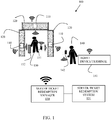
- FIG. 1 is a diagram illustrating components of a location-based ticket redemption system 100, according to an example embodiment. It is to be noted that the location-based ticket redemption system 100 is shown schematically in greatly simplified form, with only those components relevant to understanding of the embodiments being illustrated.
- the techniques and the systems presented herein and below may include all or some combination of the components shown with the system 100.
- the methods are programmed as executable instructions in memory and/or non-transitory computer-readable storage media and executed on one or more processors associated with the components/devices.
- the system 100 includes one or more two-way wireless beacons 110, an ingress portal 120, a server ticket redemption manager 130 (optionally a server ticket redemption system 131), an agent ticket redemption device/terminal 141 (optionally a portable agent ticket redemption device 142) operated by an ticket redemption agent 140, and a consumer portable device 151 in the possession of a consumer 150 (optionally the consumer 150 may have a bag 152).
- a server ticket redemption manager 130 optionally a server ticket redemption system 131
- an agent ticket redemption device/terminal 141 optionally a portable agent ticket redemption device 142 operated by an ticket redemption agent 140
- a consumer portable device 151 in the possession of a consumer 150 (optionally the consumer 150 may have a bag 152).
- the server ticket redemption manager 130 actually cooperates with a backend server that holds a specific ticket for redemption associated with the customer 150.
- the two-way wireless beacons 110 have a limited geographical range and limited ability to transfer and communicate data.
- the two-way wireless beacons 110 are Bluetooth® Low Energy (BLE) two-way beacons 110.
- BLE Bluetooth® Low Energy
- the two-way wireless beacons 110 transmit a signal indicating the presence of the beacons 110 that is automatically detected by the portable device 151 possessed by the consumer 150.
- the portable device 151 is in a pocket of the consumer 150 when the consumer 150 passes through the ingress portal 120.
- the portable device 151 is in the bag 152 when the consumer 150 passes through the ingress portal.
- the Operating System (OS) of the portable device 151 is configured to listen for the beacon transmission of the two-way beacons 110.
- the OS of Apple®-based devices provides such functionality.
- the OS detects the presence of the beacon 110 transmission (which may just include an identifier)
- the OS is configured to pass the identifier to a mobile application. If that mobile application is not resident (executing) on the portable device 151, then the OS initiates the mobile application on the portable device 151.
- the mobile application is already initiated and executing on the portable device 151 and is in a listening mode for any beacon identifier from the beacons 110. This can occur in a variety of manners.
- the consumer 150 may have initiated the mobile application and left it running on the portable device 151 at any time prior to the consumer 150 passing through the portal 120.
- the OS of the portable device 151 is configured to initiate the mobile application during any startup, power-up, or boot of the portable device 151, such that the mobile application is always running on the portable device 151 in the background.
- the OS is configured to detect the beacon transmission even when wireless features of the device are turned off, such as Bluetooth®. This is the case with newer versions of the Apple®-based OSs.
- a wireless or cellular-based location resolution service when a wireless or cellular-based location resolution service detects that the portable device 151 is within a preconfigured geographical area or geographical distance from a potential two-way wireless beacon 110, then that service automatically turns on BLE services of the portable device 151 and initiates the mobile application, such that the mobile application is in a listening mode for the beacon transmissions. It is noted, that this embodiment is similar to application notification services available on most mobile devices and the BLE services can be enabled through an interface to the OS of the portable device 151.
- the mobile application can directly detect the beacon identifier from the beacon.
- the mobile application is configured to map the beacon identifier to a specific ticket or token that identifies the specific ticket.
- the mobile application may also dynamically generate the token that uniquely identifies the ticket.
- the mobile application transmits (from the portable device 151) the token (or ticket information), which is received by the two-way wireless beacons 110 and relayed to a network connection or the agent device/terminal 141 (or agent portable device 142) within range of the beacons 110.
- the token is communicated from the network or from the agent device/terminal 141 (or the agent portable device 142) to the server ticket redemption manager 130.
- the token is used for security and when the beacons 110 are such that they can only handle a small amount of data and the actual ticket information is greater than that amount of information then the beacons 110 can handle.
- the token represents a smaller version of the ticket that can be mapped to the ticket and the ticket information itself.
- the token may be generated and supplied by the mobile application of the mobile device 151 based on the ticket information or ticket residing on the mobile device 151 and established ahead of time by the mobile application prior to passing through the portal 120.
- the token is passed to the server ticket redemption manager 130 and/or a backend ticket processing server (server ticket redemption system 131) where it is converted to actual ticket information or a corresponding ticket as it resides on the mobile application. So, the server ticket redemption manager 130 receives the token and, in an embodiment, passes it to a backend ticket processing server 131, which maps that token to the actual ticket information or the ticket.
- the beacons 110 are preconfigured to listen for transmissions identifying the beacon identifier and pass any data packet provided with the beacon identifier to a network address over a second network to the server ticket redemption manager 130.
- the beacons 110 are preconfigured to simply retransmit the data packet, which is detected by the agent device/terminal 141 (or the portable agent device 142) and then forwarded over a second network to the server ticket redemption manager 130.
- the server ticket redemption manager 130 receives the token or ticket information for the consumer 150, the token is matched to a specific ticket and a backend system for ticket redemption is accessed by the server ticket redemption manager 130 to verify the ticket for check-in that is being redeemed.
- a confirmation is forwarded from the server ticket redemption manager 130 to the agent device/terminal 141 (and/or the agent portable device 142).
- This permits the agent 140 to receive verification of the consumer's ticket and ticket information on a display associated with the agent device/terminal 141 (and/or the agent portable device 142).
- the agent device/terminal 141 of the agent portable device 142 sends a beacon identifier with a small confirmation to the beacon 110, which the beacon 110 simply retransmits.
- the consumer's portable device 151 picks up this signal (assuming within in range) through the mobile application and identifies within the mobile application on the portable device 151 that the ticket has been redeemed.
- the server ticket redemption manager 130 separately sends directly (over a cellular connection or any available WiFi signal a confirmation to the mobile application, so that the mobile application can show on the portable device 151 that the ticket was redeemed.
- the mobile application once it is able to obtain a cellular connection or WiFi signal (assuming one is unavailable to the portable device 151 at the time the ticket is successfully redeemed) synchronizes with the server ticket redemption manager 130 as soon as a wireless connection is available and receives an indication from the server ticket redemption manager 130 that the ticket was successfully redeemed.
- the portal 120 includes a chiming device that receives an indication to chime from the agent device/terminal 141 (and/or the agent portable device 142) when the device 141 and/or 142 receives a confirmation from the server ticket redemption manager 130 that the ticket was successfully redeemed.
- the agent 140 may not even have to look at a display of device(s) 141 and/or 142 to recognize that the ticket was successfully redeemed (indicating that the ticket in possession of the consumer 150 through the mobile application executing on the portable device 151) because the chiming device integrated within the portal 120 in proximity to the portal 120 will chime.
- the chiming device may provide a distinctive different tone in cases where the ticket was not successfully redeemed by the server ticket redemption manager 130. This permits the agent 140 to directly attend to the customer 150 to see what the issue may be with the ticket or lack thereof for the customer 150 to gain ingress into a transportation system (rail, bus, air, etc.) or into a venue (entertainment, etc.).
- the display of device(s) 141 and/or 142 provide a visual denial of the customer 150 ingress when the server ticket redemption manager 130 indicates that the ticket cannot be redeemed.
- both visual confirmation (on display(s) of devices 141 and/or 142) with customer ticket information and a distinctive tone (through a chiming device in vicinity of the portal 120) are provided as customer 150 passes through the portal 120.
- customers 150 can simply pass through a portal 120 with their ticket information accessible to a mobile application on their portable devices 151 and bot the agent 140 and the customers 150 can receive near instantaneous verification or denial of the customers' tickets for ingress. This can happen even when the customers 150 have their portable devices 151 stashed away and not out while passing through the portal 120 (as discussed above).
- the portal 120 includes three or more sides such as what is shown in the FIG. 1 .
- the portal 120 is a ticket stall with just two sides that the customers 150 pass through on ingress to a transportation system or venue.
- the portal 120 includes only a single side.
- the portal 120 is not a visible physical structure; rather it is any geofenced area in which the beacons 110 are situated (visible or not), such that the portal 120 may be a hallway, a doorway, a turnstile, a gate, etc.
- the portal 120 is narrowed to differentiate between ticket holders passing within the geofenced area.
- the beacon(s) 110 are affixed to, integrated into, or situated in close proximity to the portal 120.
- a single beacon 110 is used in the system 100.
- two or more beacons 110 are used in the system 100.
- three beacons 110 are used in the system 100 (as shown in the FIG. 1 ).
- the portal 120 is situated over doors of ingress to a movie theatre where a specific movie is showing.
- the ticket redemption may be used to automatically alert theatre personnel when a customer 150 is attempting to view a movie that the customer 150 did not pay for. This often occurs and causes loss of revenue for movie theatres when customers 150 successfully pay for a single movie and then watch multiple different movies. This can also be used to prevent minors from watching a movie that they are not authorized to watch (for example, the ticket server may include information with the ticket that can identify the purchaser as a minor. Alternatively, the mobile app may popup and require the customer 150 to enter a password when passing through the portal where to buy the ticket the purchaser was required to enter a password, etc.
- system 100 may be used for ingress to a transportation system or venue but the system 100 may be utilized for specific locations once the customers 150 are within the venue to ensure that the customers 150 are authorized for access to those specific locations.
- the portal 120 is any geofenced specific area or location having an ingress through which the customer 150 must pass.
- ticket/token validation for a ticket redemption some form of authentication is used, such as encryption or a digital signature, mobile device identifier, mobile application identifier, etc, by the server ticket redemption manager 130 (based on the forwarded information from the beacon 110 and supplied as a data packet(s) by the mobile application of the portable device 151.
- some form of authentication is used, such as encryption or a digital signature, mobile device identifier, mobile application identifier, etc, by the server ticket redemption manager 130 (based on the forwarded information from the beacon 110 and supplied as a data packet(s) by the mobile application of the portable device 151.
- FIGS. 2-4 These and other embodiments are now discussed with reference to the FIGS. 2-4 .
- FIG. 2 is a diagram of a method 200 for location-based ticket redemption, according to an example embodiment.
- the software module(s) that implements the method 200 is referred to as a "ticket redemption manager.”
- the ticket redemption manager is implemented as executable instructions programmed and residing within memory and/or a non-transitory computer-readable (processor-readable) storage medium and executed by one or more processors of a device.
- the processor(s) of the device that executes the ticket redemption manager are specifically configured and programmed to process the ticket redemption manager.
- the ticket redemption manager has access to a network during its processing.
- the network can be wired, wireless, or a combination of wired and wireless.
- the device that executes the ticket redemption manager is a cloud processing environment.
- the device that executes the ticket redemption manager is a remote server that is geographically remote to a consumer's ticket redemption venue.
- the device that executes the ticket redemption is a local server that is local to a consumer's ticket redemption venue.
- the ticket redemption manager is the server ticket redemption manager 130 of the FIG. 1 .
- the ticket redemption manager receives a token that is initially acquired from a wireless beacon as a customer passes through an ingress point.
- the ingress point is the portal 120 of the FIG. 1 .
- the token is a unique ticket number.
- the token is encrypted.
- the token includes a digital signature.
- the wireless beacon is the two-way wireless beacons 110 of the FIG. 1 .
- the ticket redemption manager receive the token directly from the wireless beacon over a network connection with which the wireless beacon has access to for accessing the ticket redemption manager.
- the ticket redemption manager receives the token from an ingress terminal/device that obtains the token from a transmission of the wireless beacon.
- the ingress terminal/device is the agent device/terminal 141 of the FIG. 1 .
- the ingress terminal/device is the agent portable device 142 of the FIG. 1 .
- the ticket redemption manager receives the token from a wireless transmission of a portable device in possession of the customer and relays from the wireless beacon as the customer passes through the ingress point.
- the portable device is one of: a mobile phone, a tablet, a laptop, and a wearable processing device.
- the customer does not have to be operating the portable device.
- the customer is not actively operating or holding in the customer's hand the portable device.
- the customer is operating the mobile device but accessing a different application from the mobile application that supplies the token to the wireless beacon.
- the portable device is in a pocket of the customer as the customer passes through the ingress point.
- the portable device is in a bag that is under the control of the customer as the customer passes through the ingress point.
- the ticket redemption manager validates the token for customer ingress at the ingress point.
- the ticket redemption manager maps the token to ticket information for a specific ticket of the customer that permits ingress at the ingress point.
- the ticket redemption manager then validates the ticket information for the customer.
- the ticket redemption manager passes the ticket information to a third-party reservation system to perform the ticket information validation on behalf of the ticket redemption manager.
- the third-party reservation system is the server ticket redemption system 131 of the FIG. 1 .
- the ticket redemption manager provides an indication of success or failure of the validation to an ingress device.
- the ingress device is the agent device/terminal 141 of the FIG. 1 .
- the ingress device is the agent portable device 142 of the FIG. 1 .
- the ticket redemption manager sends ticket information associated with a ticket of the customer to the ingress device when the token is successfully validated.
- the ticket redemption manager sends a distinctive tone that is played on an audio device of the ingress device as the indication of success or failure in validating the token.
- the ticket redemption manager sends a distinctive tone that is played on an audio device in proximity to but completely independent of the ingress device as the indication of success or failure in validating the token.
- the independent audio device then plays the distinctive tone over speakers as sounds audible to a human ear.
- the ticket redemption manager sends a redemption confirmation to a mobile application executing on a portable device that is in possession of the customer (but such mobile application does not have to be actively operated by the customer (although in some cases it may be)). This is done by the ticket redemption manager when the token is successfully validated. This can be done in any of the manners discussed above with reference to the FIG. 1 .
- FIG. 3 is a diagram of another method 300 for location-based ticket redemption, according to an example embodiment.
- the software module(s) that implements the method 300 is referred to as a "ticket redemption controller.”
- the ticket redemption controller is implemented as executable instructions programmed and residing within memory and/or a non-transitory computer-readable (processor-readable) storage medium and executed by one or more processors of a hardware device.
- the hardware processors that execute the ticket redemption controller are specifically configured and programmed to process the ticket redemption controller.
- the ticket redemption controller has access to one or more networks during its processing. Each network can be wired, wireless, or a combination of wired and wireless.
- the ticket redemption controller is the agent device/terminal 141 of the FIG. 1 .
- the ticket redemption controller is the agent portable device 142 of the FIG. 1 .
- the device that executes the ticket redemption controller is referred to as an ingress device and is the ingress device discussed above and below herein.
- the ticket redemption controller interacts and interfaces over a network connection (wired, wireless, or a combination of wired and wireless) with the method 200 of the FIG. 2 and/or the server ticket redemption manager 130 of the FIG. 1 .
- a network connection wireless, wireless, or a combination of wired and wireless
- the ticket redemption controller receives a token relayed from a wireless beacon and obtained by the wireless beacon from a transmission of a portable device that is in possession of a customer as the customer passes through a portal.
- the portal is the portal 120 of the FIG. 1 .
- the wireless beacon is the wireless beacons 110 of the FIG. 1 .
- the wireless beacon is the wireless beacon discussed above with reference to the FIG. 2 .
- the ticket redemption controller receives the token by listening on a wireless frequency for a beacon transmission that the wireless beacon uses to relay the token.
- the wireless beacon is a two-way BLE beacon.
- the ticket redemption controller presents on a display of the ingress device ticket information for a ticket that accompanies the indication (see 330 below) from the ticket redemption system (see 320 below) when the ticket redemption system successfully redeems the ticket through validation of the token.
- the ticket redemption controller plays the indication (see 330 below) as a distinctive audio file for immediate playing on an audio device.
- the distinctive audio file provides a distinctive audible sound when played that indicates success or failure in redeeming the ticket.
- the ticket redemption controller wirelessly sends a distinctive audio file for immediate playing on an audio device that is in proximity to the portal.
- the distinctive audio provides a distinctive audible sound that indicates success or failure based on the indication (see 330 below).
- the ticket redemption controller wirelessly transmits the indication (see 330 below) to the wireless beacon for relaying to the portable device as the customer passes through the portal. This permits the mobile application (discussed above with reference to the FIG. 1 ) of the customer and that is executing on the portable device to show the ticket as successfully redeemed.
- the ticket redemption controller forwards the token to a ticket redemption system.
- the ticket redemption system is the server ticket redemption manager 130 of the FIG. 1 .
- the ticket redemption system is the method 200 of the FIG. 2 .
- the ticket redemption system is the ticket redemption manager 402 of the FIG. 4 (below).
- the ticket redemption controller receives the indication (as discussed above) of success or failure in redeeming a ticket associated with the ticket information from the ticket redemption system.
- the ticket redemption controller sends an alert to an agent device (separate from the ingress device that is executing the ticket redemption controller) when the indication indicates that the ticket failed to be redeemed.
- an agent device separate from the ingress device that is executing the ticket redemption controller
- the indication indicates that the ticket failed to be redeemed. This may be useful in the movie theatre embodiment discussed above with reference to the FIG. 1 . It may also be useful for any venue for validating that the customer is authorized to have access to a specific location within that venue.
- FIG. 4 is a diagram of another location-based ticket redemption system 400, according to an example embodiment. Some components of the location-based ticket redemption system 400 are programmed and reside within memory and/or a non-transitory computer-readable medium and execute on one or more processors of the location-based ticket redemption system 400. The location-based ticket redemption system 400 communicates over one or more networks, which can be wired, wireless, or a combination of wired and wireless.
- the location-based ticket redemption system 400 is the system 100 of the FIG. 1 .
- the location-based ticket redemption system 400 implements, among other things, the processing discussed in the FIGS. 1 and 3 .
- the location-based ticket redemption system 400 includes a server 401 and a ticket redemption manager 402.
- the ticket redemption manager 402 is configured to: 1) execute on a processor of the server 401, 2) receive a token that was originally obtained by a wireless beacon from a portable device of a customer as a customer passed through an ingress point, 3) validate the token for customer ingress at the ingress point, and 4) send an indication as to success or failure in validation of the token to an ingress device.
- the ingress device is the agent device/terminal 141 of the FIG. 1 .
- the ingress device is the agent portable device 142 of the FIG. 1 .
- the ingress device is the device that executes the method 300 of the FIG. 3 .
- the ingress point is configured as a portal that includes the wireless beacon. In an embodiment, the ingress point is the portal 120 of the FIG. 1 .
- the portable device is a mobile phone in possession of the customer and the ingress device is a ticket redemption terminal at the ingress point being operated by a ticket redemption agent.
- the ticket redemption manager 402 is the server ticket redemption manager 130 of the FIG. 1 .
- the ticket redemption manager 402 implements the method 200 of the FIG. 2 .
- the device that is accessible to a consumer is a mobile device operated by the consumer.
- the mobile device is one of: a phone, a tablet, a wearable processing device, and the like.
- modules are illustrated as separate modules, but may be implemented as homogenous code, as individual components, some, but not all of these modules may be combined, or the functions may be implemented in software structured in any other convenient manner.
Landscapes
- Business, Economics & Management (AREA)
- Engineering & Computer Science (AREA)
- Tourism & Hospitality (AREA)
- Physics & Mathematics (AREA)
- General Physics & Mathematics (AREA)
- Marketing (AREA)
- Theoretical Computer Science (AREA)
- Economics (AREA)
- Human Resources & Organizations (AREA)
- Strategic Management (AREA)
- General Business, Economics & Management (AREA)
- Entrepreneurship & Innovation (AREA)
- Development Economics (AREA)
- Operations Research (AREA)
- Quality & Reliability (AREA)
- Finance (AREA)
- Computer Networks & Wireless Communication (AREA)
- Signal Processing (AREA)
- Health & Medical Sciences (AREA)
- General Health & Medical Sciences (AREA)
- Primary Health Care (AREA)
- Telephonic Communication Services (AREA)
Abstract
Description
- Not many travelers/consumers are fond of large queues to get into their venues. Travelers/consumers do not enjoy fumbling around in their pockets for boarding passes/tickets to provide at a gate or at an entry checkpoint for ingress. Moreover, even with mobile-based barcoded tickets, the travelers/consumers must still take their phones out of their bags or pockets, pull up the appropriate mobile application, locate their ticket barcode, and hand or provide to an agent or scanner for scanning. This is a cumbersome process (even with existing automation available) and contributes to the large queues associated with ingress to a transportation system or a venue. In addition, it places a burden on the proprietor to install scanning equipment at every point at a substantial cost.
- Additionally, consumers using mobile tickets (barcode based systems on mobile devices) often awkwardly struggle with the proper way to hold and present the mobile tickets for ticket redemption. Such mobile tickets often include a barcode where the mobile device (typically a phone of the consumer) must be presented to a handheld or stationary scanner. Sometimes, the consumers are unable to do this themselves and elect to just hand their mobile devices over to an agent for proper scanning. The mobile devices may even be dropped in the process, resulting in damage to the consumers' mobile devices or at the very least contributing the queue length for ingress because of the added time that results when the agent is forced to process the scans on behalf of the consumers.
- Sometimes, Near Field Communication (NFC) can be used as an alternative to scanning a mobile ticket from a mobile device's display. However, NFC adds to the complexity because the consumer has to properly locate where the mobile device is to be tapped with the NFC-enabled ticket reader. Most consumers struggle with simple display-based scanning and NFC reading is an even more challenging task for them, which means that queue lengths can become even worse for ingress with NFC-based solutions.
- In various embodiments, methods and a system for location-based ticket redemption are provided.
- According to an embodiment, a method for location-based ticket redemption is provided. Specifically, a token is received that is initially acquired from a wireless beacon as a customer passes through an ingress point. Next, the token is validated for customer ingress at the ingress point; and an indication is provided at to the success or failure of validation to an ingress device.
- According to a first aspect of the present invention there is provided a method comprising: receiving a token that is initially acquired from a wireless beacon as a customer passes through an ingress point; validating the token for customer ingress at the ingress point; and providing an indication of success or failure of validation to an ingress device.
- The step of receiving a token optionally further includes receiving the token from the wireless beacon.
- The step of receiving a token optionally further includes receiving the token from the ingress terminal that obtains the token from a transmission of the wireless beacon.
- The step of receiving a token optionally further includes receiving the token from a wireless transmission of a portable device in possession of the customer and relayed from the wireless beacon as the customer passes through the ingress point.
- The step of validating the token optionally further includes mapping the token to ticket information for the customer and validating the ticket information.
- The step of validating the token optionally further includes passing the ticket information to a third-party reservation system for validation.
- The step of providing an indication of success or failure optionally further includes sending ticket information associated with a ticket of the customer to the ingress device when the token is successfully validated.
- The step of providing an indication of success or failure optionally further includes sending a distinctive tone that is played on an audio device of the ingress device as the indication.
- The step of providing an indication of success or failure optionally further includes sending a distinctive tone that is played on an audio device in proximity to but independent of the ingress device as the indication.
- The method optionally further comprises sending a redemption confirmation to a mobile application executing on a portable device that is possession of the customer when the token is successfully validated.
- According to a second aspect of the present invention there is provided a system comprising: a server; a ticket redemption manager configured to: i) execute on the processor, ii) receive a token that was originally obtained by a wireless beacon from a portable device of a customer as a customer passed through an ingress point, iii) validate the token for customer ingress at the ingress point, and iv) send an indication as to success or failure in validation of the token to an ingress device.
- The ingress point is optionally configured as a portal that includes the wireless beacon.
- The portable device is optionally a mobile phone in possession of the customer and the ingress device is a ticket redemption terminal at the ingress point being operated by a ticket redemption agent.
- According to a third aspect of the present invention there is provided a method comprising: receiving, on an ingress device, a token relayed from a wireless beacon and obtained by the wireless beacon from a transmission of a portable device that is in possession of a customer as the customer passes through a portal; forwarding, by the ingress device, the token to a ticket redemption system; and receiving, by the ingress device, an indication of success or failure in redeeming a ticket associated with the token from the ticket redemption system.
- The step of receiving a token optionally further includes receiving the token by listening on a wireless frequency for a beacon transmission that the wireless beacon uses to relay the token.
- The step of receiving a token optionally further includes presenting, on a display of the ingress device, ticket information for the ticket that accompanies the indication from the ticket redemption system when the ticket redemption system successfully redeems the ticket through validation of the token.
- The step of receiving a token optionally further includes playing the indication as a distinctive audio on an audio device interfaced to the ingress device, wherein the distinctive audio provides a distinctive audible sound that indicates success or failure in redeeming the ticket.
- The step of receiving a token optionally further includes wirelessly sending a distinctive audio file for immediate playing on an audio device in proximity to the portal, wherein the distinctive audio provides a distinctive audible sound that indicates success or failure based on the indication.
- The step of receiving a token optionally further includes wirelessly transmitting the indication to the wireless beacon for relaying to the portable device as the customer passes through the portal.
- The method optionally further comprises sending an alert to an agent device when the indication indicates that the ticket failed to be redeemed.
- According to a fourth aspect of the present invention there is provided a ticket redemption manager configured to: (i) execute on a processor, (ii) receive a token that was originally obtained by a wireless beacon from a portable device of a customer as a customer passed through an ingress point, (iii) validate the token for customer ingress at the ingress point, and (iv) send an indication as to success or failure in validation of the token to an ingress device.
- These and other aspects of the present invention will be apparent from the following specific description, given by way of example, with reference to the accompanying drawings, in which:
-
FIG. 1 is a diagram illustrating components of a location-based ticket redemption system, according to an example embodiment; -
FIG. 2 is a diagram of a method for location-based ticket redemption, according to an example embodiment; -
FIG. 3 is a diagram of another method for location-based ticket redemption, according to an example embodiment; and -
FIG. 4 is a diagram of another location-based ticket redemption system, according to an example embodiment. - Reference is first made to
FIG. 1 , which is a diagram illustrating components of a location-basedticket redemption system 100, according to an example embodiment. It is to be noted that the location-basedticket redemption system 100 is shown schematically in greatly simplified form, with only those components relevant to understanding of the embodiments being illustrated. - Furthermore, the various components (that are identified in the
FIG. 1 ) are illustrated and the arrangement of the components is presented for purposes of illustration only. It is to be noted that other arrangements with more or less components are possible without departing from the teachings of automated location-based ticket redemption, presented herein and below. - Furthermore, the techniques and the systems presented herein and below (for automated location-based ticket redemption) may include all or some combination of the components shown with the
system 100. The methods are programmed as executable instructions in memory and/or non-transitory computer-readable storage media and executed on one or more processors associated with the components/devices. - Specifically, the
system 100 includes one or more two-waywireless beacons 110, aningress portal 120, a server ticket redemption manager 130 (optionally a server ticket redemption system 131), an agent ticket redemption device/terminal 141 (optionally a portable agent ticket redemption device 142) operated by anticket redemption agent 140, and a consumerportable device 151 in the possession of a consumer 150 (optionally theconsumer 150 may have a bag 152). It is to be noted that although a single server is shown in theFIG. 1 that multiple servers may exist for supporting where tickets are actually held for redemption, such that the server ticket redemption manager 130 actually cooperates with a backend server that holds a specific ticket for redemption associated with thecustomer 150. - The two-way
wireless beacons 110 have a limited geographical range and limited ability to transfer and communicate data. - In an embodiment, the two-way
wireless beacons 110 are Bluetooth® Low Energy (BLE) two-way beacons 110. - The two-way
wireless beacons 110 transmit a signal indicating the presence of thebeacons 110 that is automatically detected by theportable device 151 possessed by theconsumer 150. - In an embodiment, the
portable device 151 is in a pocket of theconsumer 150 when theconsumer 150 passes through theingress portal 120. - In an embodiment, the
portable device 151 is in thebag 152 when theconsumer 150 passes through the ingress portal. - In an embodiment, the Operating System (OS) of the
portable device 151 is configured to listen for the beacon transmission of the two-way beacons 110. For example, the OS of Apple®-based devices provides such functionality. When the OS detects the presence of thebeacon 110 transmission (which may just include an identifier), the OS is configured to pass the identifier to a mobile application. If that mobile application is not resident (executing) on theportable device 151, then the OS initiates the mobile application on theportable device 151. - In an embodiment, the mobile application is already initiated and executing on the
portable device 151 and is in a listening mode for any beacon identifier from thebeacons 110. This can occur in a variety of manners. For example, theconsumer 150 may have initiated the mobile application and left it running on theportable device 151 at any time prior to theconsumer 150 passing through theportal 120. In another case, the OS of theportable device 151 is configured to initiate the mobile application during any startup, power-up, or boot of theportable device 151, such that the mobile application is always running on theportable device 151 in the background. - In an embodiment, the OS is configured to detect the beacon transmission even when wireless features of the device are turned off, such as Bluetooth®. This is the case with newer versions of the Apple®-based OSs.
- In an embodiment, when a wireless or cellular-based location resolution service detects that the
portable device 151 is within a preconfigured geographical area or geographical distance from a potential two-way wireless beacon 110, then that service automatically turns on BLE services of theportable device 151 and initiates the mobile application, such that the mobile application is in a listening mode for the beacon transmissions. It is noted, that this embodiment is similar to application notification services available on most mobile devices and the BLE services can be enabled through an interface to the OS of theportable device 151. - Once the mobile application is automatically initiated on the portable device 151 (through any of the above-mentioned embodiments and other automatic initiation techniques), the mobile application can directly detect the beacon identifier from the beacon. The mobile application is configured to map the beacon identifier to a specific ticket or token that identifies the specific ticket. The mobile application may also dynamically generate the token that uniquely identifies the ticket. The mobile application then transmits (from the portable device 151) the token (or ticket information), which is received by the two-
way wireless beacons 110 and relayed to a network connection or the agent device/terminal 141 (or agent portable device 142) within range of thebeacons 110. The token is communicated from the network or from the agent device/terminal 141 (or the agent portable device 142) to the server ticket redemption manager 130. - It is to be noted that the token is used for security and when the
beacons 110 are such that they can only handle a small amount of data and the actual ticket information is greater than that amount of information then thebeacons 110 can handle. The token represents a smaller version of the ticket that can be mapped to the ticket and the ticket information itself. The token may be generated and supplied by the mobile application of themobile device 151 based on the ticket information or ticket residing on themobile device 151 and established ahead of time by the mobile application prior to passing through the portal 120. The token is passed to the server ticket redemption manager 130 and/or a backend ticket processing server (server ticket redemption system 131) where it is converted to actual ticket information or a corresponding ticket as it resides on the mobile application. So, the server ticket redemption manager 130 receives the token and, in an embodiment, passes it to a backendticket processing server 131, which maps that token to the actual ticket information or the ticket. - In an embodiment, the
beacons 110 are preconfigured to listen for transmissions identifying the beacon identifier and pass any data packet provided with the beacon identifier to a network address over a second network to the server ticket redemption manager 130. - In an embodiment, the
beacons 110 are preconfigured to simply retransmit the data packet, which is detected by the agent device/terminal 141 (or the portable agent device 142) and then forwarded over a second network to the server ticket redemption manager 130. - Once the server ticket redemption manager 130 receives the token or ticket information for the
consumer 150, the token is matched to a specific ticket and a backend system for ticket redemption is accessed by the server ticket redemption manager 130 to verify the ticket for check-in that is being redeemed. - When the server ticket redemption manager 130 successfully validates the ticket for redemption, a confirmation is forwarded from the server ticket redemption manager 130 to the agent device/terminal 141 (and/or the agent portable device 142). This permits the
agent 140 to receive verification of the consumer's ticket and ticket information on a display associated with the agent device/terminal 141 (and/or the agent portable device 142). - In an embodiment, the agent device/
terminal 141 of the agentportable device 142 sends a beacon identifier with a small confirmation to thebeacon 110, which thebeacon 110 simply retransmits. The consumer'sportable device 151 picks up this signal (assuming within in range) through the mobile application and identifies within the mobile application on theportable device 151 that the ticket has been redeemed. - In an embodiment, the server ticket redemption manager 130 separately sends directly (over a cellular connection or any available WiFi signal a confirmation to the mobile application, so that the mobile application can show on the
portable device 151 that the ticket was redeemed. - In an embodiment, the mobile application once it is able to obtain a cellular connection or WiFi signal (assuming one is unavailable to the
portable device 151 at the time the ticket is successfully redeemed) synchronizes with the server ticket redemption manager 130 as soon as a wireless connection is available and receives an indication from the server ticket redemption manager 130 that the ticket was successfully redeemed. - In an embodiment, the portal 120 includes a chiming device that receives an indication to chime from the agent device/terminal 141 (and/or the agent portable device 142) when the
device 141 and/or 142 receives a confirmation from the server ticket redemption manager 130 that the ticket was successfully redeemed. In this embodiment, theagent 140 may not even have to look at a display of device(s) 141 and/or 142 to recognize that the ticket was successfully redeemed (indicating that the ticket in possession of theconsumer 150 through the mobile application executing on the portable device 151) because the chiming device integrated within the portal 120 in proximity to the portal 120 will chime. - In an embodiment of the last embodiment, the chiming device may provide a distinctive different tone in cases where the ticket was not successfully redeemed by the server ticket redemption manager 130. This permits the
agent 140 to directly attend to thecustomer 150 to see what the issue may be with the ticket or lack thereof for thecustomer 150 to gain ingress into a transportation system (rail, bus, air, etc.) or into a venue (entertainment, etc.). - In an embodiment, the display of device(s) 141 and/or 142 provide a visual denial of the
customer 150 ingress when the server ticket redemption manager 130 indicates that the ticket cannot be redeemed. - In an embodiment, both visual confirmation (on display(s) of
devices 141 and/or 142) with customer ticket information and a distinctive tone (through a chiming device in vicinity of the portal 120) are provided ascustomer 150 passes through the portal 120. - It is apparent what the beneficial applications of the
system 100 may be. For example,customers 150 can simply pass through a portal 120 with their ticket information accessible to a mobile application on theirportable devices 151 and bot theagent 140 and thecustomers 150 can receive near instantaneous verification or denial of the customers' tickets for ingress. This can happen even when thecustomers 150 have theirportable devices 151 stashed away and not out while passing through the portal 120 (as discussed above). - In an embodiment, the portal 120 includes three or more sides such as what is shown in the
FIG. 1 . - In an embodiment, the portal 120 is a ticket stall with just two sides that the
customers 150 pass through on ingress to a transportation system or venue. - In an embodiment, the portal 120 includes only a single side.
- In an embodiment, the portal 120 is not a visible physical structure; rather it is any geofenced area in which the
beacons 110 are situated (visible or not), such that the portal 120 may be a hallway, a doorway, a turnstile, a gate, etc. The portal 120 is narrowed to differentiate between ticket holders passing within the geofenced area. - The beacon(s) 110 are affixed to, integrated into, or situated in close proximity to the portal 120.
- In an embodiment, a
single beacon 110 is used in thesystem 100. - In an embodiment, two or
more beacons 110 are used in thesystem 100. - In an embodiment, three
beacons 110 are used in the system 100 (as shown in theFIG. 1 ). - In an embodiment, the portal 120 is situated over doors of ingress to a movie theatre where a specific movie is showing. In this embodiment, the ticket redemption may be used to automatically alert theatre personnel when a
customer 150 is attempting to view a movie that thecustomer 150 did not pay for. This often occurs and causes loss of revenue for movie theatres whencustomers 150 successfully pay for a single movie and then watch multiple different movies. This can also be used to prevent minors from watching a movie that they are not authorized to watch (for example, the ticket server may include information with the ticket that can identify the purchaser as a minor. Alternatively, the mobile app may popup and require thecustomer 150 to enter a password when passing through the portal where to buy the ticket the purchaser was required to enter a password, etc. - Thus, not only may the
system 100 be used for ingress to a transportation system or venue but thesystem 100 may be utilized for specific locations once thecustomers 150 are within the venue to ensure that thecustomers 150 are authorized for access to those specific locations. - The portal 120 is any geofenced specific area or location having an ingress through which the
customer 150 must pass. - In an embodiment, during ticket/token validation for a ticket redemption some form of authentication is used, such as encryption or a digital signature, mobile device identifier, mobile application identifier, etc, by the server ticket redemption manager 130 (based on the forwarded information from the
beacon 110 and supplied as a data packet(s) by the mobile application of theportable device 151. - These and other embodiments are now discussed with reference to the
FIGS. 2-4 . -
FIG. 2 is a diagram of amethod 200 for location-based ticket redemption, according to an example embodiment. The software module(s) that implements themethod 200 is referred to as a "ticket redemption manager." The ticket redemption manager is implemented as executable instructions programmed and residing within memory and/or a non-transitory computer-readable (processor-readable) storage medium and executed by one or more processors of a device. The processor(s) of the device that executes the ticket redemption manager are specifically configured and programmed to process the ticket redemption manager. The ticket redemption manager has access to a network during its processing. The network can be wired, wireless, or a combination of wired and wireless. - In an embodiment, the device that executes the ticket redemption manager is a cloud processing environment.
- In an embodiment, the device that executes the ticket redemption manager is a remote server that is geographically remote to a consumer's ticket redemption venue.
- In an embodiment, the device that executes the ticket redemption is a local server that is local to a consumer's ticket redemption venue.
- In an embodiment, the ticket redemption manager is the server ticket redemption manager 130 of the
FIG. 1 . - At 210, the ticket redemption manager receives a token that is initially acquired from a wireless beacon as a customer passes through an ingress point.
- In an embodiment, the ingress point is the portal 120 of the
FIG. 1 . - In an embodiment, the token is a unique ticket number.
- In an embodiment, the token is encrypted.
- In an embodiment, the token includes a digital signature.
- In an embodiment, the wireless beacon is the two-
way wireless beacons 110 of theFIG. 1 . - According to an embodiment, at 211, the ticket redemption manager receive the token directly from the wireless beacon over a network connection with which the wireless beacon has access to for accessing the ticket redemption manager.
- In an embodiment, at 212, the ticket redemption manager receives the token from an ingress terminal/device that obtains the token from a transmission of the wireless beacon.
- In an embodiment, the ingress terminal/device is the agent device/
terminal 141 of theFIG. 1 . - In an embodiment, the ingress terminal/device is the agent
portable device 142 of theFIG. 1 . - In an embodiment, at 213, the ticket redemption manager receives the token from a wireless transmission of a portable device in possession of the customer and relays from the wireless beacon as the customer passes through the ingress point.
- In an embodiment, the portable device is one of: a mobile phone, a tablet, a laptop, and a wearable processing device.
- It is noted that the customer does not have to be operating the portable device. In fact, in an embodiment, the customer is not actively operating or holding in the customer's hand the portable device. In an embodiment, the customer is operating the mobile device but accessing a different application from the mobile application that supplies the token to the wireless beacon. In an embodiment, the portable device is in a pocket of the customer as the customer passes through the ingress point. In an embodiment, the portable device is in a bag that is under the control of the customer as the customer passes through the ingress point.
- At 220, the ticket redemption manager validates the token for customer ingress at the ingress point.
- According to an embodiment, at 221, the ticket redemption manager maps the token to ticket information for a specific ticket of the customer that permits ingress at the ingress point. The ticket redemption manager then validates the ticket information for the customer.
- In an embodiment of 221 and at 222, the ticket redemption manager passes the ticket information to a third-party reservation system to perform the ticket information validation on behalf of the ticket redemption manager.
- In an embodiment, the third-party reservation system is the server
ticket redemption system 131 of theFIG. 1 . - At 230, the ticket redemption manager provides an indication of success or failure of the validation to an ingress device.
- In an embodiment, the ingress device is the agent device/
terminal 141 of theFIG. 1 . - In an embodiment, the ingress device is the agent
portable device 142 of theFIG. 1 . - According to an embodiment, at 231, the ticket redemption manager sends ticket information associated with a ticket of the customer to the ingress device when the token is successfully validated.
- In an embodiment, at 232, the ticket redemption manager sends a distinctive tone that is played on an audio device of the ingress device as the indication of success or failure in validating the token.
- In an embodiment, at 233, the ticket redemption manager sends a distinctive tone that is played on an audio device in proximity to but completely independent of the ingress device as the indication of success or failure in validating the token. The independent audio device then plays the distinctive tone over speakers as sounds audible to a human ear.
- In an embodiment, at 240, the ticket redemption manager sends a redemption confirmation to a mobile application executing on a portable device that is in possession of the customer (but such mobile application does not have to be actively operated by the customer (although in some cases it may be)). This is done by the ticket redemption manager when the token is successfully validated. This can be done in any of the manners discussed above with reference to the
FIG. 1 . -
FIG. 3 is a diagram of anothermethod 300 for location-based ticket redemption, according to an example embodiment. The software module(s) that implements themethod 300 is referred to as a "ticket redemption controller." The ticket redemption controller is implemented as executable instructions programmed and residing within memory and/or a non-transitory computer-readable (processor-readable) storage medium and executed by one or more processors of a hardware device. The hardware processors that execute the ticket redemption controller are specifically configured and programmed to process the ticket redemption controller. The ticket redemption controller has access to one or more networks during its processing. Each network can be wired, wireless, or a combination of wired and wireless. - In an embodiment, the ticket redemption controller is the agent device/
terminal 141 of theFIG. 1 . - In an embodiment, the ticket redemption controller is the agent
portable device 142 of theFIG. 1 . - The device that executes the ticket redemption controller is referred to as an ingress device and is the ingress device discussed above and below herein.
- The ticket redemption controller interacts and interfaces over a network connection (wired, wireless, or a combination of wired and wireless) with the
method 200 of theFIG. 2 and/or the server ticket redemption manager 130 of theFIG. 1 . - At 310, the ticket redemption controller receives a token relayed from a wireless beacon and obtained by the wireless beacon from a transmission of a portable device that is in possession of a customer as the customer passes through a portal.
- In an embodiment, the portal is the portal 120 of the
FIG. 1 . - In an embodiment, the wireless beacon is the
wireless beacons 110 of theFIG. 1 . - In an embodiment, the wireless beacon is the wireless beacon discussed above with reference to the
FIG. 2 . - According to an embodiment, at 311, the ticket redemption controller receives the token by listening on a wireless frequency for a beacon transmission that the wireless beacon uses to relay the token.
- In an embodiment, the wireless beacon is a two-way BLE beacon.
- In an embodiment, at 312, the ticket redemption controller presents on a display of the ingress device ticket information for a ticket that accompanies the indication (see 330 below) from the ticket redemption system (see 320 below) when the ticket redemption system successfully redeems the ticket through validation of the token.
- In an embodiment, at 313, the ticket redemption controller plays the indication (see 330 below) as a distinctive audio file for immediate playing on an audio device. The distinctive audio file provides a distinctive audible sound when played that indicates success or failure in redeeming the ticket.
- In an embodiment, at 314, the ticket redemption controller wirelessly sends a distinctive audio file for immediate playing on an audio device that is in proximity to the portal. The distinctive audio provides a distinctive audible sound that indicates success or failure based on the indication (see 330 below).
- In an embodiment, at 315, the ticket redemption controller wirelessly transmits the indication (see 330 below) to the wireless beacon for relaying to the portable device as the customer passes through the portal. This permits the mobile application (discussed above with reference to the
FIG. 1 ) of the customer and that is executing on the portable device to show the ticket as successfully redeemed. - At 320, the ticket redemption controller forwards the token to a ticket redemption system.
- In an embodiment, the ticket redemption system is the server ticket redemption manager 130 of the
FIG. 1 . - In an embodiment, the ticket redemption system is the
method 200 of theFIG. 2 . - In an embodiment, the ticket redemption system is the
ticket redemption manager 402 of theFIG. 4 (below). - At 330, the ticket redemption controller receives the indication (as discussed above) of success or failure in redeeming a ticket associated with the ticket information from the ticket redemption system.
- In an embodiment, at 340, the ticket redemption controller sends an alert to an agent device (separate from the ingress device that is executing the ticket redemption controller) when the indication indicates that the ticket failed to be redeemed. This may be useful in the movie theatre embodiment discussed above with reference to the
FIG. 1 . It may also be useful for any venue for validating that the customer is authorized to have access to a specific location within that venue. -
FIG. 4 is a diagram of another location-basedticket redemption system 400, according to an example embodiment. Some components of the location-basedticket redemption system 400 are programmed and reside within memory and/or a non-transitory computer-readable medium and execute on one or more processors of the location-basedticket redemption system 400. The location-basedticket redemption system 400 communicates over one or more networks, which can be wired, wireless, or a combination of wired and wireless. - In an embodiment, the location-based
ticket redemption system 400 is thesystem 100 of theFIG. 1 . - In an embodiment, the location-based
ticket redemption system 400 implements, among other things, the processing discussed in theFIGS. 1 and3 . - The location-based
ticket redemption system 400 includes aserver 401 and aticket redemption manager 402. - The
ticket redemption manager 402 is configured to: 1) execute on a processor of theserver 401, 2) receive a token that was originally obtained by a wireless beacon from a portable device of a customer as a customer passed through an ingress point, 3) validate the token for customer ingress at the ingress point, and 4) send an indication as to success or failure in validation of the token to an ingress device. - In an embodiment, the ingress device is the agent device/
terminal 141 of theFIG. 1 . - In an embodiment, the ingress device is the agent
portable device 142 of theFIG. 1 . - In an embodiment, the ingress device is the device that executes the
method 300 of theFIG. 3 . - In an embodiment, the ingress point is configured as a portal that includes the wireless beacon. In an embodiment, the ingress point is the portal 120 of the
FIG. 1 . - In an embodiment, the portable device is a mobile phone in possession of the customer and the ingress device is a ticket redemption terminal at the ingress point being operated by a ticket redemption agent.
- In an embodiment, the
ticket redemption manager 402 is the server ticket redemption manager 130 of theFIG. 1 . - In an embodiment, the
ticket redemption manager 402 implements themethod 200 of theFIG. 2 . - In an embodiment, the device that is accessible to a consumer is a mobile device operated by the consumer. The mobile device is one of: a phone, a tablet, a wearable processing device, and the like.
- It should be appreciated that where software is described in a particular form (such as a component or module) this is merely to aid understanding and is not intended to limit how software that implements those functions may be architected or structured. For example, modules are illustrated as separate modules, but may be implemented as homogenous code, as individual components, some, but not all of these modules may be combined, or the functions may be implemented in software structured in any other convenient manner.
- Furthermore, although the software modules are illustrated as executing on one piece of hardware, the software may be distributed over multiple processors or in any other convenient manner.
- The above description is illustrative, and not restrictive. Many other embodiments will be apparent to those of skill in the art upon reviewing the above description. The scope of embodiments should therefore be determined with reference to the appended claims.
- In the foregoing description of the embodiments, various features are grouped together in a single embodiment for the purpose of streamlining the disclosure. This method of disclosure is not to be interpreted as reflecting that the claimed embodiments have more features than are expressly recited in each claim. Rather, as the following claims reflect, inventive subject matter lies in less than all features of a single disclosed embodiment.
Claims (13)
- A method (200) comprising:receiving a token that is initially acquired from a wireless beacon (110) as a customer passes through an ingress point (120) (step 210);validating the token for customer ingress at the ingress point (120) (step 220); andproviding an indication of success or failure of validation to an ingress device (141, 142) (step 230).
- The method of claim 1, wherein the step of receiving a token further includes receiving the token from the wireless beacon (110) (step 211).
- The method of claim 1, wherein the step of receiving a token further includes receiving the token from the ingress device (141, 142) that obtains the token from a transmission of the wireless beacon (110) (step 212).
- The method of claim 1, wherein the step of receiving a token further includes receiving the token from a wireless transmission of a portable device (151) in possession of the customer and relayed from the wireless beacon (110) as the customer passes through the ingress point (120) (step 213).
- The method of any preceding claim, wherein validating the token further includes mapping the token to ticket information for the customer and validating the ticket information (step 221).
- The method of claim 5, wherein validating the ticket information further includes passing the ticket information to a third-party reservation system for validation (step 222).
- The method of any preceding claim, wherein providing an indication of success or failure of validation further includes sending ticket information associated with a ticket of the customer to the ingress device (141, 142) when the token is successfully validated (step 231).
- The method of any preceding claim, wherein providing an indication of success or failure of validation further includes sending a distinctive tone that is played on an audio device of the ingress device (141, 142) as the indication (step 232).
- The method of any of claims 1 to 7, wherein providing an indication of success or failure of validation further includes sending a distinctive tone that is played on an audio device in proximity to but independent of the ingress device (141, 142) as the indication (step 233).
- The method of any preceding claim, further comprising sending a redemption confirmation to a mobile application executing on a portable device (151) that is possession of the customer when the token is successfully validated (step 240).
- A system comprising a ticket redemption manager (130, 402) configured to: (i) execute on a processor, (ii) receive a token that was originally obtained by a wireless beacon (110) from a portable device (151) of a customer as a customer passed through an ingress point (120), (iii) validate the token for customer ingress at the ingress point (120), and (iv) send an indication as to success or failure in validation of the token to an ingress device (141, 142).
- The system of claim 11, wherein the ingress point (120) is configured as a portal that includes the wireless beacon (110).
- The system of claim 11 or 12, wherein the portable device (151) is a mobile phone in possession of the customer and the ingress device (141, 142) is a ticket redemption terminal at the ingress point (120) being operated by a ticket redemption agent (140).
Applications Claiming Priority (1)
| Application Number | Priority Date | Filing Date | Title |
|---|---|---|---|
| US14/954,565 US10990905B2 (en) | 2015-11-30 | 2015-11-30 | Location-based ticket redemption |
Publications (2)
| Publication Number | Publication Date |
|---|---|
| EP3174014A1 true EP3174014A1 (en) | 2017-05-31 |
| EP3174014B1 EP3174014B1 (en) | 2024-05-29 |
Family
ID=56787279
Family Applications (1)
| Application Number | Title | Priority Date | Filing Date |
|---|---|---|---|
| EP16184093.9A Active EP3174014B1 (en) | 2015-11-30 | 2016-08-12 | Location-based ticket-redemption |
Country Status (3)
| Country | Link |
|---|---|
| US (1) | US10990905B2 (en) |
| EP (1) | EP3174014B1 (en) |
| CN (1) | CN107040883B (en) |
Cited By (1)
| Publication number | Priority date | Publication date | Assignee | Title |
|---|---|---|---|---|
| US20170316433A1 (en) * | 2016-04-29 | 2017-11-02 | Ncr Corporation | Identity aggregation and integration |
Families Citing this family (6)
| Publication number | Priority date | Publication date | Assignee | Title |
|---|---|---|---|---|
| CA2989051C (en) * | 2015-08-17 | 2024-05-28 | Bytemark, Inc. | Short range wireless translation methods and systems for hands-free fare validation |
| WO2020229859A1 (en) * | 2019-05-15 | 2020-11-19 | Кирилл КУЛАКОВСКИЙ | Method for registering the presence of a user in a given zone and system for the implementation thereof |
| DE102019114844A1 (en) * | 2019-06-03 | 2020-12-03 | VDV eTicket Service GmbH & Co. KG | Method and control device for the secure verification of an electronic ticket |
| CN112002025B (en) * | 2020-08-31 | 2022-05-31 | 盛威时代科技集团有限公司 | Ticket checking method and device, user equipment and ticket checking server |
| JPWO2022224585A1 (en) * | 2021-04-22 | 2022-10-27 | ||
| TWI897097B (en) * | 2023-11-15 | 2025-09-11 | 權可易資訊股份有限公司 | Ticket verification system and method |
Citations (4)
| Publication number | Priority date | Publication date | Assignee | Title |
|---|---|---|---|---|
| EP1335310A1 (en) * | 2000-10-19 | 2003-08-13 | James Jay Skinner | Electronic ticket issuing system |
| EP1439495A1 (en) * | 2003-01-17 | 2004-07-21 | Siemens Aktiengesellschaft | Electronic ticket, system and method for issuing electronic tickets, and devices and methods for using and performing operations on electronic tickets |
| US20150084741A1 (en) * | 2013-09-26 | 2015-03-26 | Bytemark, Inc. | Method and system for electronic ticket validation using proximity detection |
| EP2924661A1 (en) * | 2014-03-25 | 2015-09-30 | Movincom Servizi S.p.A. | Method for managing issue of an electronic ticket and corresponding system |
Family Cites Families (18)
| Publication number | Priority date | Publication date | Assignee | Title |
|---|---|---|---|---|
| US6999936B2 (en) * | 1997-05-06 | 2006-02-14 | Sehr Richard P | Electronic ticketing system and methods utilizing multi-service visitor cards |
| US6085976A (en) * | 1998-05-22 | 2000-07-11 | Sehr; Richard P. | Travel system and methods utilizing multi-application passenger cards |
| US6119096A (en) * | 1997-07-31 | 2000-09-12 | Eyeticket Corporation | System and method for aircraft passenger check-in and boarding using iris recognition |
| US20070150336A1 (en) * | 2005-12-22 | 2007-06-28 | Daniel Boily | System and method for controlling passage through a gate of a parking lot |
| CA2651543C (en) * | 2006-05-09 | 2016-02-16 | Ticketmaster | Apparatus for access control and processing |
| US20090276250A1 (en) * | 2008-05-01 | 2009-11-05 | Travel Tech Systems, Llc | Process and system to determine commercial airline arrivals |
| EP2629347A1 (en) | 2012-02-17 | 2013-08-21 | Nederlandse Organisatie voor toegepast -natuurwetenschappelijk onderzoek TNO | Opto-electric device and method for manufacturing the same |
| US20140067490A1 (en) * | 2012-08-30 | 2014-03-06 | Frias Transportation Infrastructure Llc | For-hire vehicle fare and parameter calculation system and method |
| JP5804398B2 (en) * | 2013-05-22 | 2015-11-04 | 株式会社Leonis&Co. | Electronic ticket system and program |
| US9355398B2 (en) * | 2013-08-13 | 2016-05-31 | Neology, Inc. | Systems and methods for managing an account |
| JP6449268B2 (en) * | 2013-10-17 | 2019-01-09 | ワイズ−セック・リミテッド | Wireless protocol message conversion device and method of using the same |
| AU2014342341B2 (en) * | 2013-10-29 | 2019-07-25 | Cubic Corporation | Fare collection using wireless beacons |
| US20150178698A1 (en) * | 2013-12-23 | 2015-06-25 | Egan Schulz | Systems and methods for transportation check-in and payment using beacons |
| US10891562B1 (en) * | 2014-01-10 | 2021-01-12 | Flash Seats Llc | Paperless venue entry and location-based services |
| ES2833428T3 (en) * | 2014-05-09 | 2021-06-15 | Citifyd Inc | Dynamic vehicle parking management platform |
| US9642173B2 (en) * | 2014-07-15 | 2017-05-02 | Paypal, Inc. | Systems and methods for reusing generic tokens using Bluetooth® low energy (BLE) beacons |
| US9922294B2 (en) * | 2014-08-25 | 2018-03-20 | Accenture Global Services Limited | Secure short-distance-based communication and enforcement system |
| US20180211021A1 (en) * | 2015-08-06 | 2018-07-26 | Mitsubishi Electric Corporation | Authentication device, authentication system, and authentication method |
-
2015
- 2015-11-30 US US14/954,565 patent/US10990905B2/en active Active
-
2016
- 2016-08-12 EP EP16184093.9A patent/EP3174014B1/en active Active
- 2016-09-29 CN CN201610866063.4A patent/CN107040883B/en active Active
Patent Citations (4)
| Publication number | Priority date | Publication date | Assignee | Title |
|---|---|---|---|---|
| EP1335310A1 (en) * | 2000-10-19 | 2003-08-13 | James Jay Skinner | Electronic ticket issuing system |
| EP1439495A1 (en) * | 2003-01-17 | 2004-07-21 | Siemens Aktiengesellschaft | Electronic ticket, system and method for issuing electronic tickets, and devices and methods for using and performing operations on electronic tickets |
| US20150084741A1 (en) * | 2013-09-26 | 2015-03-26 | Bytemark, Inc. | Method and system for electronic ticket validation using proximity detection |
| EP2924661A1 (en) * | 2014-03-25 | 2015-09-30 | Movincom Servizi S.p.A. | Method for managing issue of an electronic ticket and corresponding system |
Cited By (1)
| Publication number | Priority date | Publication date | Assignee | Title |
|---|---|---|---|---|
| US20170316433A1 (en) * | 2016-04-29 | 2017-11-02 | Ncr Corporation | Identity aggregation and integration |
Also Published As
| Publication number | Publication date |
|---|---|
| EP3174014B1 (en) | 2024-05-29 |
| US20170154284A1 (en) | 2017-06-01 |
| CN107040883B (en) | 2020-12-04 |
| CN107040883A (en) | 2017-08-11 |
| US10990905B2 (en) | 2021-04-27 |
Similar Documents
| Publication | Publication Date | Title |
|---|---|---|
| EP3174014B1 (en) | Location-based ticket-redemption | |
| US12300055B2 (en) | Systems and methods for short-range communication between devices | |
| US11397903B2 (en) | Short-range device communications for secured resource access | |
| US9571965B2 (en) | Verified check-in | |
| US10560455B2 (en) | Systems and methods for scalable-factor authentication | |
| EP2245790B1 (en) | Authentication mechanisms for wireless networks | |
| KR101937197B1 (en) | Identification, location and authentication systems and methods | |
| US11689584B2 (en) | Establishing communication links using routing protocols | |
| US9741022B2 (en) | Parental controls | |
| US8929807B2 (en) | Transmission of broadcasts based on recipient location | |
| CN104902434B (en) | A kind of information processing method, apparatus and system | |
| AU2014230474B2 (en) | Portable communication device and system and method therefor | |
| EP3289760A1 (en) | Systems and methods for connecting a mobile device to a communication system | |
| KR20170029238A (en) | Service providing device for canceling ticket, ticket cancel guide system comprising the same, control method thereof and computer readable medium having computer program recorded thereon | |
| US9860331B2 (en) | Game service system and game service method for global game service | |
| US20150339719A1 (en) | Interactive content delivery system and apparatus with global reach capability | |
| WO2017203246A1 (en) | A communication system and method | |
| US11556884B1 (en) | Privacy-preserving identity-validated transactions | |
| GB2633989A (en) | System for the fully automated acquisition of tickets | |
| KR20170035252A (en) | User equipment, service providing device, beacon, payment system comprising the same, control method thereof and computer readable medium having computer program recorded thereon | |
| KR20180045736A (en) | Method, system and non-transitory computer-readable recording medium for providing conents in airplane by using personal devices | |
| JP7407467B1 (en) | Server equipment and door unlocking system | |
| US20210360410A1 (en) | Identification and verification of associated devices using audio transmissions | |
| CN113129466B (en) | Check-in verification method, check-in verification device and electronic equipment |
Legal Events
| Date | Code | Title | Description |
|---|---|---|---|
| PUAI | Public reference made under article 153(3) epc to a published international application that has entered the european phase |
Free format text: ORIGINAL CODE: 0009012 |
|
| STAA | Information on the status of an ep patent application or granted ep patent |
Free format text: STATUS: THE APPLICATION HAS BEEN PUBLISHED |
|
| AK | Designated contracting states |
Kind code of ref document: A1 Designated state(s): AL AT BE BG CH CY CZ DE DK EE ES FI FR GB GR HR HU IE IS IT LI LT LU LV MC MK MT NL NO PL PT RO RS SE SI SK SM TR |
|
| AX | Request for extension of the european patent |
Extension state: BA ME |
|
| STAA | Information on the status of an ep patent application or granted ep patent |
Free format text: STATUS: REQUEST FOR EXAMINATION WAS MADE |
|
| 17P | Request for examination filed |
Effective date: 20171130 |
|
| RBV | Designated contracting states (corrected) |
Designated state(s): AL AT BE BG CH CY CZ DE DK EE ES FI FR GB GR HR HU IE IS IT LI LT LU LV MC MK MT NL NO PL PT RO RS SE SI SK SM TR |
|
| RAP1 | Party data changed (applicant data changed or rights of an application transferred) |
Owner name: NCR CORPORATION |
|
| STAA | Information on the status of an ep patent application or granted ep patent |
Free format text: STATUS: EXAMINATION IS IN PROGRESS |
|
| 17Q | First examination report despatched |
Effective date: 20191017 |
|
| P01 | Opt-out of the competence of the unified patent court (upc) registered |
Effective date: 20230505 |
|
| GRAP | Despatch of communication of intention to grant a patent |
Free format text: ORIGINAL CODE: EPIDOSNIGR1 |
|
| STAA | Information on the status of an ep patent application or granted ep patent |
Free format text: STATUS: GRANT OF PATENT IS INTENDED |
|
| INTG | Intention to grant announced |
Effective date: 20240103 |
|
| RAP3 | Party data changed (applicant data changed or rights of an application transferred) |
Owner name: NCR VOYIX CORPORATION |
|
| GRAS | Grant fee paid |
Free format text: ORIGINAL CODE: EPIDOSNIGR3 |
|
| GRAA | (expected) grant |
Free format text: ORIGINAL CODE: 0009210 |
|
| STAA | Information on the status of an ep patent application or granted ep patent |
Free format text: STATUS: THE PATENT HAS BEEN GRANTED |
|
| AK | Designated contracting states |
Kind code of ref document: B1 Designated state(s): AL AT BE BG CH CY CZ DE DK EE ES FI FR GB GR HR HU IE IS IT LI LT LU LV MC MK MT NL NO PL PT RO RS SE SI SK SM TR |
|
| REG | Reference to a national code |
Ref country code: GB Ref legal event code: FG4D |
|
| REG | Reference to a national code |
Ref country code: CH Ref legal event code: EP |
|
| REG | Reference to a national code |
Ref country code: IE Ref legal event code: FG4D |
|
| REG | Reference to a national code |
Ref country code: DE Ref legal event code: R084 Ref document number: 602016087708 Country of ref document: DE Ref country code: DE Ref legal event code: R096 Ref document number: 602016087708 Country of ref document: DE |
|
| REG | Reference to a national code |
Ref country code: GB Ref legal event code: 746 Effective date: 20240628 |
|
| REG | Reference to a national code |
Ref country code: LT Ref legal event code: MG9D |
|
| REG | Reference to a national code |
Ref country code: NL Ref legal event code: MP Effective date: 20240529 |
|
| PG25 | Lapsed in a contracting state [announced via postgrant information from national office to epo] |
Ref country code: IS Free format text: LAPSE BECAUSE OF FAILURE TO SUBMIT A TRANSLATION OF THE DESCRIPTION OR TO PAY THE FEE WITHIN THE PRESCRIBED TIME-LIMIT Effective date: 20240929 |
|
| PG25 | Lapsed in a contracting state [announced via postgrant information from national office to epo] |
Ref country code: BG Free format text: LAPSE BECAUSE OF FAILURE TO SUBMIT A TRANSLATION OF THE DESCRIPTION OR TO PAY THE FEE WITHIN THE PRESCRIBED TIME-LIMIT Effective date: 20240529 |
|
| PG25 | Lapsed in a contracting state [announced via postgrant information from national office to epo] |
Ref country code: FI Free format text: LAPSE BECAUSE OF FAILURE TO SUBMIT A TRANSLATION OF THE DESCRIPTION OR TO PAY THE FEE WITHIN THE PRESCRIBED TIME-LIMIT Effective date: 20240529 Ref country code: HR Free format text: LAPSE BECAUSE OF FAILURE TO SUBMIT A TRANSLATION OF THE DESCRIPTION OR TO PAY THE FEE WITHIN THE PRESCRIBED TIME-LIMIT Effective date: 20240529 |
|
| PG25 | Lapsed in a contracting state [announced via postgrant information from national office to epo] |
Ref country code: GR Free format text: LAPSE BECAUSE OF FAILURE TO SUBMIT A TRANSLATION OF THE DESCRIPTION OR TO PAY THE FEE WITHIN THE PRESCRIBED TIME-LIMIT Effective date: 20240830 |
|
| REG | Reference to a national code |
Ref country code: AT Ref legal event code: MK05 Ref document number: 1691296 Country of ref document: AT Kind code of ref document: T Effective date: 20240529 |
|
| PG25 | Lapsed in a contracting state [announced via postgrant information from national office to epo] |
Ref country code: ES Free format text: LAPSE BECAUSE OF FAILURE TO SUBMIT A TRANSLATION OF THE DESCRIPTION OR TO PAY THE FEE WITHIN THE PRESCRIBED TIME-LIMIT Effective date: 20240529 |
|
| PG25 | Lapsed in a contracting state [announced via postgrant information from national office to epo] |
Ref country code: AT Free format text: LAPSE BECAUSE OF FAILURE TO SUBMIT A TRANSLATION OF THE DESCRIPTION OR TO PAY THE FEE WITHIN THE PRESCRIBED TIME-LIMIT Effective date: 20240529 |
|
| PG25 | Lapsed in a contracting state [announced via postgrant information from national office to epo] |
Ref country code: PL Free format text: LAPSE BECAUSE OF FAILURE TO SUBMIT A TRANSLATION OF THE DESCRIPTION OR TO PAY THE FEE WITHIN THE PRESCRIBED TIME-LIMIT Effective date: 20240529 |
|
| PG25 | Lapsed in a contracting state [announced via postgrant information from national office to epo] |
Ref country code: LV Free format text: LAPSE BECAUSE OF FAILURE TO SUBMIT A TRANSLATION OF THE DESCRIPTION OR TO PAY THE FEE WITHIN THE PRESCRIBED TIME-LIMIT Effective date: 20240529 |
|
| PG25 | Lapsed in a contracting state [announced via postgrant information from national office to epo] |
Ref country code: PL Free format text: LAPSE BECAUSE OF FAILURE TO SUBMIT A TRANSLATION OF THE DESCRIPTION OR TO PAY THE FEE WITHIN THE PRESCRIBED TIME-LIMIT Effective date: 20240529 Ref country code: NO Free format text: LAPSE BECAUSE OF FAILURE TO SUBMIT A TRANSLATION OF THE DESCRIPTION OR TO PAY THE FEE WITHIN THE PRESCRIBED TIME-LIMIT Effective date: 20240829 Ref country code: LV Free format text: LAPSE BECAUSE OF FAILURE TO SUBMIT A TRANSLATION OF THE DESCRIPTION OR TO PAY THE FEE WITHIN THE PRESCRIBED TIME-LIMIT Effective date: 20240529 Ref country code: IS Free format text: LAPSE BECAUSE OF FAILURE TO SUBMIT A TRANSLATION OF THE DESCRIPTION OR TO PAY THE FEE WITHIN THE PRESCRIBED TIME-LIMIT Effective date: 20240929 Ref country code: HR Free format text: LAPSE BECAUSE OF FAILURE TO SUBMIT A TRANSLATION OF THE DESCRIPTION OR TO PAY THE FEE WITHIN THE PRESCRIBED TIME-LIMIT Effective date: 20240529 Ref country code: GR Free format text: LAPSE BECAUSE OF FAILURE TO SUBMIT A TRANSLATION OF THE DESCRIPTION OR TO PAY THE FEE WITHIN THE PRESCRIBED TIME-LIMIT Effective date: 20240830 Ref country code: FI Free format text: LAPSE BECAUSE OF FAILURE TO SUBMIT A TRANSLATION OF THE DESCRIPTION OR TO PAY THE FEE WITHIN THE PRESCRIBED TIME-LIMIT Effective date: 20240529 Ref country code: ES Free format text: LAPSE BECAUSE OF FAILURE TO SUBMIT A TRANSLATION OF THE DESCRIPTION OR TO PAY THE FEE WITHIN THE PRESCRIBED TIME-LIMIT Effective date: 20240529 Ref country code: BG Free format text: LAPSE BECAUSE OF FAILURE TO SUBMIT A TRANSLATION OF THE DESCRIPTION OR TO PAY THE FEE WITHIN THE PRESCRIBED TIME-LIMIT Effective date: 20240529 Ref country code: AT Free format text: LAPSE BECAUSE OF FAILURE TO SUBMIT A TRANSLATION OF THE DESCRIPTION OR TO PAY THE FEE WITHIN THE PRESCRIBED TIME-LIMIT Effective date: 20240529 Ref country code: RS Free format text: LAPSE BECAUSE OF FAILURE TO SUBMIT A TRANSLATION OF THE DESCRIPTION OR TO PAY THE FEE WITHIN THE PRESCRIBED TIME-LIMIT Effective date: 20240829 |
|
| PG25 | Lapsed in a contracting state [announced via postgrant information from national office to epo] |
Ref country code: NL Free format text: LAPSE BECAUSE OF FAILURE TO SUBMIT A TRANSLATION OF THE DESCRIPTION OR TO PAY THE FEE WITHIN THE PRESCRIBED TIME-LIMIT Effective date: 20240529 |
|
| PG25 | Lapsed in a contracting state [announced via postgrant information from national office to epo] |
Ref country code: NL Free format text: LAPSE BECAUSE OF FAILURE TO SUBMIT A TRANSLATION OF THE DESCRIPTION OR TO PAY THE FEE WITHIN THE PRESCRIBED TIME-LIMIT Effective date: 20240529 |
|
| PG25 | Lapsed in a contracting state [announced via postgrant information from national office to epo] |
Ref country code: DK Free format text: LAPSE BECAUSE OF FAILURE TO SUBMIT A TRANSLATION OF THE DESCRIPTION OR TO PAY THE FEE WITHIN THE PRESCRIBED TIME-LIMIT Effective date: 20240529 |
|
| PG25 | Lapsed in a contracting state [announced via postgrant information from national office to epo] |
Ref country code: EE Free format text: LAPSE BECAUSE OF FAILURE TO SUBMIT A TRANSLATION OF THE DESCRIPTION OR TO PAY THE FEE WITHIN THE PRESCRIBED TIME-LIMIT Effective date: 20240529 |
|
| PG25 | Lapsed in a contracting state [announced via postgrant information from national office to epo] |
Ref country code: CZ Free format text: LAPSE BECAUSE OF FAILURE TO SUBMIT A TRANSLATION OF THE DESCRIPTION OR TO PAY THE FEE WITHIN THE PRESCRIBED TIME-LIMIT Effective date: 20240529 |
|
| PG25 | Lapsed in a contracting state [announced via postgrant information from national office to epo] |
Ref country code: SK Free format text: LAPSE BECAUSE OF FAILURE TO SUBMIT A TRANSLATION OF THE DESCRIPTION OR TO PAY THE FEE WITHIN THE PRESCRIBED TIME-LIMIT Effective date: 20240529 Ref country code: RO Free format text: LAPSE BECAUSE OF FAILURE TO SUBMIT A TRANSLATION OF THE DESCRIPTION OR TO PAY THE FEE WITHIN THE PRESCRIBED TIME-LIMIT Effective date: 20240529 |
|
| PG25 | Lapsed in a contracting state [announced via postgrant information from national office to epo] |
Ref country code: SM Free format text: LAPSE BECAUSE OF FAILURE TO SUBMIT A TRANSLATION OF THE DESCRIPTION OR TO PAY THE FEE WITHIN THE PRESCRIBED TIME-LIMIT Effective date: 20240529 |
|
| PG25 | Lapsed in a contracting state [announced via postgrant information from national office to epo] |
Ref country code: SM Free format text: LAPSE BECAUSE OF FAILURE TO SUBMIT A TRANSLATION OF THE DESCRIPTION OR TO PAY THE FEE WITHIN THE PRESCRIBED TIME-LIMIT Effective date: 20240529 Ref country code: SK Free format text: LAPSE BECAUSE OF FAILURE TO SUBMIT A TRANSLATION OF THE DESCRIPTION OR TO PAY THE FEE WITHIN THE PRESCRIBED TIME-LIMIT Effective date: 20240529 Ref country code: RO Free format text: LAPSE BECAUSE OF FAILURE TO SUBMIT A TRANSLATION OF THE DESCRIPTION OR TO PAY THE FEE WITHIN THE PRESCRIBED TIME-LIMIT Effective date: 20240529 Ref country code: EE Free format text: LAPSE BECAUSE OF FAILURE TO SUBMIT A TRANSLATION OF THE DESCRIPTION OR TO PAY THE FEE WITHIN THE PRESCRIBED TIME-LIMIT Effective date: 20240529 Ref country code: DK Free format text: LAPSE BECAUSE OF FAILURE TO SUBMIT A TRANSLATION OF THE DESCRIPTION OR TO PAY THE FEE WITHIN THE PRESCRIBED TIME-LIMIT Effective date: 20240529 Ref country code: CZ Free format text: LAPSE BECAUSE OF FAILURE TO SUBMIT A TRANSLATION OF THE DESCRIPTION OR TO PAY THE FEE WITHIN THE PRESCRIBED TIME-LIMIT Effective date: 20240529 |
|
| PG25 | Lapsed in a contracting state [announced via postgrant information from national office to epo] |
Ref country code: IT Free format text: LAPSE BECAUSE OF FAILURE TO SUBMIT A TRANSLATION OF THE DESCRIPTION OR TO PAY THE FEE WITHIN THE PRESCRIBED TIME-LIMIT Effective date: 20240529 |
|
| REG | Reference to a national code |
Ref country code: DE Ref legal event code: R097 Ref document number: 602016087708 Country of ref document: DE |
|
| REG | Reference to a national code |
Ref country code: CH Ref legal event code: PL |
|
| PLBE | No opposition filed within time limit |
Free format text: ORIGINAL CODE: 0009261 |
|
| STAA | Information on the status of an ep patent application or granted ep patent |
Free format text: STATUS: NO OPPOSITION FILED WITHIN TIME LIMIT |
|
| PG25 | Lapsed in a contracting state [announced via postgrant information from national office to epo] |
Ref country code: LU Free format text: LAPSE BECAUSE OF NON-PAYMENT OF DUE FEES Effective date: 20240812 |
|
| PG25 | Lapsed in a contracting state [announced via postgrant information from national office to epo] |
Ref country code: MC Free format text: LAPSE BECAUSE OF FAILURE TO SUBMIT A TRANSLATION OF THE DESCRIPTION OR TO PAY THE FEE WITHIN THE PRESCRIBED TIME-LIMIT Effective date: 20240529 Ref country code: SI Free format text: LAPSE BECAUSE OF FAILURE TO SUBMIT A TRANSLATION OF THE DESCRIPTION OR TO PAY THE FEE WITHIN THE PRESCRIBED TIME-LIMIT Effective date: 20240529 Ref country code: CH Free format text: LAPSE BECAUSE OF NON-PAYMENT OF DUE FEES Effective date: 20240831 |
|
| 26N | No opposition filed |
Effective date: 20250303 |
|
| REG | Reference to a national code |
Ref country code: BE Ref legal event code: MM Effective date: 20240831 |
|
| PG25 | Lapsed in a contracting state [announced via postgrant information from national office to epo] |
Ref country code: BE Free format text: LAPSE BECAUSE OF NON-PAYMENT OF DUE FEES Effective date: 20240831 |
|
| PG25 | Lapsed in a contracting state [announced via postgrant information from national office to epo] |
Ref country code: IE Free format text: LAPSE BECAUSE OF NON-PAYMENT OF DUE FEES Effective date: 20240812 |
|
| PG25 | Lapsed in a contracting state [announced via postgrant information from national office to epo] |
Ref country code: SE Free format text: LAPSE BECAUSE OF FAILURE TO SUBMIT A TRANSLATION OF THE DESCRIPTION OR TO PAY THE FEE WITHIN THE PRESCRIBED TIME-LIMIT Effective date: 20240529 |
|
| PGFP | Annual fee paid to national office [announced via postgrant information from national office to epo] |
Ref country code: DE Payment date: 20250827 Year of fee payment: 10 |
|
| PGFP | Annual fee paid to national office [announced via postgrant information from national office to epo] |
Ref country code: GB Payment date: 20250827 Year of fee payment: 10 |
|
| PGFP | Annual fee paid to national office [announced via postgrant information from national office to epo] |
Ref country code: FR Payment date: 20250825 Year of fee payment: 10 |
|
| PG25 | Lapsed in a contracting state [announced via postgrant information from national office to epo] |
Ref country code: PT Free format text: LAPSE BECAUSE OF NON-PAYMENT OF DUE FEES Effective date: 20240529 |
|
| PG25 | Lapsed in a contracting state [announced via postgrant information from national office to epo] |
Ref country code: CY Free format text: LAPSE BECAUSE OF FAILURE TO SUBMIT A TRANSLATION OF THE DESCRIPTION OR TO PAY THE FEE WITHIN THE PRESCRIBED TIME-LIMIT; INVALID AB INITIO Effective date: 20160812 |
|
| PG25 | Lapsed in a contracting state [announced via postgrant information from national office to epo] |
Ref country code: HU Free format text: LAPSE BECAUSE OF FAILURE TO SUBMIT A TRANSLATION OF THE DESCRIPTION OR TO PAY THE FEE WITHIN THE PRESCRIBED TIME-LIMIT; INVALID AB INITIO Effective date: 20160812 |