EP3173961A1 - Method for storing user data and decoding information in synthesized oligos, apparatus and substance - Google Patents
Method for storing user data and decoding information in synthesized oligos, apparatus and substance Download PDFInfo
- Publication number
- EP3173961A1 EP3173961A1 EP15306886.1A EP15306886A EP3173961A1 EP 3173961 A1 EP3173961 A1 EP 3173961A1 EP 15306886 A EP15306886 A EP 15306886A EP 3173961 A1 EP3173961 A1 EP 3173961A1
- Authority
- EP
- European Patent Office
- Prior art keywords
- oligos
- subset
- code symbol
- group
- user data
- Prior art date
- Legal status (The legal status is an assumption and is not a legal conclusion. Google has not performed a legal analysis and makes no representation as to the accuracy of the status listed.)
- Withdrawn
Links
Images





Classifications
-
- G—PHYSICS
- G16—INFORMATION AND COMMUNICATION TECHNOLOGY [ICT] SPECIALLY ADAPTED FOR SPECIFIC APPLICATION FIELDS
- G16B—BIOINFORMATICS, i.e. INFORMATION AND COMMUNICATION TECHNOLOGY [ICT] SPECIALLY ADAPTED FOR GENETIC OR PROTEIN-RELATED DATA PROCESSING IN COMPUTATIONAL MOLECULAR BIOLOGY
- G16B40/00—ICT specially adapted for biostatistics; ICT specially adapted for bioinformatics-related machine learning or data mining, e.g. knowledge discovery or pattern finding
-
- G—PHYSICS
- G06—COMPUTING OR CALCULATING; COUNTING
- G06N—COMPUTING ARRANGEMENTS BASED ON SPECIFIC COMPUTATIONAL MODELS
- G06N3/00—Computing arrangements based on biological models
- G06N3/12—Computing arrangements based on biological models using genetic models
- G06N3/123—DNA computing
-
- G—PHYSICS
- G16—INFORMATION AND COMMUNICATION TECHNOLOGY [ICT] SPECIALLY ADAPTED FOR SPECIFIC APPLICATION FIELDS
- G16B—BIOINFORMATICS, i.e. INFORMATION AND COMMUNICATION TECHNOLOGY [ICT] SPECIALLY ADAPTED FOR GENETIC OR PROTEIN-RELATED DATA PROCESSING IN COMPUTATIONAL MOLECULAR BIOLOGY
- G16B30/00—ICT specially adapted for sequence analysis involving nucleotides or amino acids
-
- G—PHYSICS
- G16—INFORMATION AND COMMUNICATION TECHNOLOGY [ICT] SPECIALLY ADAPTED FOR SPECIFIC APPLICATION FIELDS
- G16B—BIOINFORMATICS, i.e. INFORMATION AND COMMUNICATION TECHNOLOGY [ICT] SPECIALLY ADAPTED FOR GENETIC OR PROTEIN-RELATED DATA PROCESSING IN COMPUTATIONAL MOLECULAR BIOLOGY
- G16B50/00—ICT programming tools or database systems specially adapted for bioinformatics
Definitions
- the present disclosure is related to an alternative storage/transmission application, where a plurality of copies of data packets exists.
- An example for such an application is the archiving of digital data by synthesizing, i.e. artificially creating nucleic acid sequences, such as DNA molecules.
- the present principles relate to the storing of user data, i.e. archival data, and a corresponding decoding manual, i.e. information for decoding said user data, in synthesized nucleic acid sequences, i.e. oligonucleotides or oligos.
- Nucleic acid sequences such as strands of DNA (Deoxyribonucleic Acid) or RNA (Ribonucleic Acid) fragments (oligonucleotides, short: oligos), can be generated or synthesized, using a nucleic acid synthesizer, as sequences of four different nucleotides identified by their respective nucleobases, namely Adenine, Thymine, Cytosine and Guanine, shortly denoted as A, T, C and G, for DNA, or, respectively, Adenine, Uracil, Cytosine and Guanine, shortly denoted as A, U, C and G, for RNA.
- Adenine, Thymine Cytosine and Guanine
- the order of the nucleotides forming the oligo is used to store code symbol sequences, for example sequences of quaternary code symbols, representing user data, for example provided as sequences of binary or quaternary code symbols.
- Nucleic acid sequencers are used to readout the sequence of nucleotides, i.e. to transform an oligo back into its corresponding code symbol sequence.
- the described biochemical processing usually requires multiple copies of the same oligo in order to function. Therefore, the processing comprises an amplification of the oligos, i.e. multiple duplication of the oligos, for example using Polymerase Chain Reaction (PCR).
- PCR Polymerase Chain Reaction
- DNA strands have proven to be very stable even over long time periods, so information stored in DNA is expected to be readable after hundreds, thousands or even millions of years. Nevertheless, the source or user data have to be encoded and/or modulated in a specific way. This comprises, e.g., how the user data are distributed to different packets, what kind of error protection is used etc. Therefore, for decoding the user data, it is necessary to know how the encoding was done. Hence, decoding information, i.e. a "manual”, is needed that describes, how the decoding can be performed and, e.g., how the encoding was done.
- Said decoding information or manual could be provided on a separate medium (e.g. on paper, a harddisc etc.), and stored near the nucleic acid storage container having stored therein the DNA strands carrying the user data encoded in their sequence of nucleotides.
- a separate medium e.g. on paper, a harddisc etc.
- the manual will survive as long as the DNA strands or that the technology for reading the storage medium for the manual will be available anymore, or that the DNA storage and the manual will still be available in combination, i.e. that the decoding manual will not have been disjoint from the DNA storage in the meantime.
- DNA as the substance that is carrying the biochemical information of living organisms will still be available, and there is a high probability that technologies for processing DNA will remain available, for example for sequencing, i.e. retrieving the sequences of nucleotides within DNA.
- a method for storing user data (e.g. archival data) and decoding information data in subsets of a plurality of synthesized oligos is provided, wherein the user data are stored together with the related decoding information data in a plurality of oligos. Further, a corresponding apparatus and a substance comprising at least said subsets are provided.
- a method for storing user data and decoding information data in subsets of a plurality of synthesized oligos comprises
- the first subset and the second subset are then stored together, for example in a nucleic acid storage container.
- the decoding information can comprise all information required to perform the actual decoding. In one embodiment it may, for example, comprise an information identifying an encoding scheme rather than the complete encoding scheme itself.
- specific property does not solely refer to a different content, but comprises at least one structural difference between the oligos of the second subset as compared to the oligos of the first subset, such as a different primer sequence, oligo length or a certain nucleotide pattern used when constructing the sequence of nucleotides.
- “Synthesizing" an oligo refers to generating or creating an oligo, i.e. a nucleotide sequence, by transforming a code symbol sequence into a corresponding nucleotide sequence using a nucleic acid synthesizer device, such as a DNA synthesizer.
- a code symbol sequence is a set of subsequent code symbols, e.g., in the form of an electronic signal, for example quaternary code symbols with each code symbol value corresponding to a nucleotide type.
- a code symbol sequence can also be a sequence of binary code symbols.
- User data and decoding information data are both part of payload data stored in a payload/data part of an oligo.
- the oligos comprise an address or index part as well as a primer sequence of nucleotides, which can be used when amplifying an oligo.
- the specific property is introduced when generating the sequences of code symbols to the synthesized as, i.e. to be transformed into, the corresponding oligos. In another embodiment, the specific property is introduced during the synthesizing, i.e. when transforming the sequences of code symbols into sequences of nucleotides.
- the second subset of oligos contains less oligos than the first subset refers to a clear, i.e. a clearly detectable, difference of the number of oligos of the first subset compared to the second subset.
- the difference is defined by a threshold, such as the number of oligos of the second subset being at least 5%, 10%, 20%, 30%, 40%, 50%, etc., or 90% or more smaller than the number of oligos contained in the first subset of oligos.
- the unequal distribution of oligos of the first and of the second subset of the plurality of oligos is achieved by generating different amounts of first and second code symbol sequences before synthesizing, i.e.
- the unequal distribution is achieved by amplifying the generated oligos of the first subset by a different amplification factor than the oligos of the second subset, thereby creating different amounts of copies of said oligos.
- an apparatus for storing user data and decoding information data in subsets of a plurality of synthesized oligos comprises
- An apparatus for storing user data and decoding information data in subsets of a plurality of synthesized oligos comprises an encoding device, such as a computer, or processor and a memory, or other device capable of processing and encoding the data.
- the apparatus comprises or is connected or connectable to the nucleic acid synthesizer device or module capable of transforming code symbol sequences into corresponding nucleotide sequences, which is connected or connectable to store the oligos, e.g. in a nucleic acid storage container.
- a non-transitory program storage device readable by a computer, tangibly embodies a program of instructions executable by the computer to perform, using a nucleic acid synthesizer device, a method for storing user data and decoding information data in subsets of a plurality of synthesized oligos according to the present principles.
- a substance comprises a plurality of synthesized oligos having stored therein user data and decoding information data, wherein
- the provided solution allows storing of decoding manual information as oligos together with the oligos carrying the user data, but in such a way that it can easily, without prior knowledge of the encoding strategy, be detected that there are two different subsets of oligos contained in the same nucleic acid storage. Once it has been discovered that there is a clearly identifiable second subset contained, the contained information can be accessed.
- the provided approach at least has the effect that there is a high probability that the stored manual or decoding information will be identified within the stored oligos.
- the contained decoding information can be used for decoding of the user data contained in the first subset, even if after a very long time, probably centuries, no separate decoding information is available anymore at the time of decoding.
- people in the future will try to decode data stored as sequences of nucleotides, such as DNA strands, they will assume, that the decoding method will also be described somewhere in the archived data.
- the specific property to distinguish between the first and second subset of the oligos is chosen such that a person using a sequencer device for retrieving the code symbol sequences from the stored plurality of nucleotide sequences or oligos will easily detect the specific property being different between the oligo subsets or, respectively, their corresponding read out subsets of code symbol sequences.
- the at least one specific property comprises an oligo length of the oligos of the second subset of oligos different from any oligo length of the oligos of the first subset of oligos.
- the oligo length refers to the number or amount of nucleotides forming the nucleotide sequence or oligo. This property is easy to detect, once the stored oligos are analyzed.
- the synthesizing comprises synthesizing each of the oligos of the plurality of oligos having at least one primer sequence, and wherein the at least one specific property comprises a primer sequence in the oligos of the second subset of oligos different from any primer sequence in the oligos of the first subset of oligos.
- the primer sequence will have to be read, this differing specific property will also easily be identified. Choosing a different primer as the specific property gives the possibility to amplify the related oligos of the second subset separately from the remaining oligos of the first subset.
- the at least one specific property comprises at least one nucleotide pattern in the oligos of the second subset of oligos different from any nucleotide pattern in the oligos of the first subset of oligos.
- a nucleotide pattern comprises that the oligos of the second subset comprise nucleotides arranged according to a specific pattern that should be discovered or identified with a high probability.
- the sequences of nucleotides may contain their nucleotides as consecutive pairs or triples of the same nucleotide type.
- an index or address will be used to allow to put the code symbol sequences carrying the decoding information into their correct order.
- This address part could be identified by an easily detectable encoding scheme different from that used for the data part, i.e. the coding scheme for the addressing part is chosen obviously different from the coding scheme for the manual data.
- the creating of the second subset of code symbol sequences comprises creating an address part encoded using a first coding scheme different from a second coding scheme used for encoding a data part of the code symbol sequences.
- the data part of the code symbol sequences corresponding to the second subset carries, i.e. has encoded, the decoding information.
- the code symbol sequences are generated from quaternary code symbols with two quaternary code symbol values representing a first binary value and two remaining code symbol values representing a second binary value different from the first binary value.
- This allows a direct mapping of quaternary code symbol values (and thereby nucleotides) and binary code symbol values.
- quaternary code symbol values can be named "A”, “T”, “C”, and “G” corresponding to the nucleotides of a DNA sequence, and wherein two quaternary code symbol values, e.g. A and T, represent binary code symbol value "0", whereas the remaining code symbol values C and G represent binary code symbol value "1 ".
- the address part is created by alternatingly concatenating pairs of code symbols of a first group and of a second group, while beginning the address part with a code symbol of the first group, the first group consisting of code symbols of two quaternary code symbol values representing the first binary value and the second binary value, the second group consisting of code symbols of two remaining quaternary code symbol values different from the two code symbol values of the first group and also representing the first binary value and the second binary value, and - according to the second coding scheme the data part is created by alternatingly concatenating pairs of code symbols of the second group and of the first group, while beginning the data part with a code symbol of the second group.
- the change of the coding scheme will be easily detectable when analyzing retrieved code symbol sequences after sequencing the stored oligos, as it will be identifiable as the only position in the sequence where two symbols belonging to the same group will follow each other directly, i.e. where the scheme of alternating symbol groups does not apply.
- the first group may consist of code symbols with values "A” and "C”
- the second group consists of code symbols with values "T” and "G”.
- Example code symbol sequences "ATCGATCGTAGCTCGAGA” and "CGATCGATGCGATCTAGC” then exhibit the following coding scheme exception: At the ninth position a quaternary code symbol of the group T/G follows a quaternary code symbol of the same group - only there.
- the address part is created by alternatingly concatenating a first number of code symbols of a first group with a same first number of code symbols of a second group, the first group consisting of code symbols of two quaternary code symbol values representing the first binary value and the second binary value, the second group consisting of code symbols of two remaining quaternary code symbol values different from the two code symbol values of the first group and also representing the first binary value and the second binary value, and - according to the second coding scheme the data part is created by alternatingly concatenating a second number of code symbols of the first group with a same second number of code symbols of the second group, wherein the second number differs from the first number.
- the change of the coding scheme will be easily detectable when analyzing retrieved code symbol sequences after sequencing the stored oligos, as it will be identifiable as the only position in the sequence where the scheme of a first amount of symbols, e.g. two, belonging to the same group followed by the same amount of symbols belonging the other group changes to a different scheme where a second amount of symbols, e.g. three, belonging to the same group is followed by the same amount of symbols belonging the other group.
- the first group may consist of code symbols with values "A" and "C”
- the second group consists of code symbols with values "T" and "G".
- example code symbol sequences such as "TGAAGTCATGTACCTTTACA” and “GGACTTACTTGAACGTGAAA" exhibit a detectable position, where the coding scheme changes.
- the manual data or decoding information data part contains the manual information encoded in a straightforward way.
- the oligos of the second subset of oligos contain the information for decoding the user data as a graphical representation.
- the graphical representation becomes visible after sequencing the oligos of the second subset and, for example, displaying the retrieved corresponding code symbol sequences.
- the graphically represented information becomes visible to a user (e.g. on a display screen or printout) after sorting the obtained code symbol sequences according to their (increasing) addresses encoded in the address parts.
- a "1" represents a white pixel, while a "0” represents a black one (or vice versa).
- a corresponding approach works with quaternary code symbols corresponding to the four nucleotides.
- the graphical data are encoded in a specific way, the correctly sorted code symbol sequences (according to the address or index) for the corresponding oligos already show graphical patterns, which are an indication that the data part contains graphical information.
- FIG. 1 an example of an embodiment of a method 10 for storing user data and decoding information data in subsets of a plurality of synthesized oligos is schematically illustrated.
- a first step 11 user data and decoding information data required for decoding the user data are obtained, for example from a data transmission channel or data storage.
- a first subset of code symbol sequences having encoded said user data and a second subset of code symbol sequences having encoded said decoding information data are created.
- a corresponding first subset of oligos is synthesized from said first subset of code symbol sequences and a corresponding second subset of oligos is synthesized from said second subset of code symbol sequences using a nucleic acid synthesizer device.
- the code symbol sequence creation step 12 and/or the synthesizing step 13 are adapted such that the second subset of oligos contains less oligos than the first subset of oligos, and that the oligos of the second subset of oligos exhibit at least one specific property not occurring in any oligo of the first subset of oligos.
- an address or index is included in the decoding information which allows for sorting the retrieved code symbol sequences corresponding to the oligos of the second subset correctly after sequencing.
- the content of the manual or decoding information is encoded in the data part of the oligo using a graphical representation:
- a 1 stands for a white pixel, while a 0 for a black one (or vice versa).
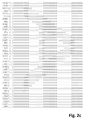
- Fig. 2A , Fig. 2B and Fig. 2C a first, a second and third part of an example of a plurality of binary encoded code symbol sequences comprising an address data part and a decoding information data part comprising information represented using a graphical representation, to be used for synthesizing oligos, are shown.
- the example illustrates the three letters "D", "N", "A” encoded as a graphical representation and serving as an example for any decoding information that could be stored in the second subset of the plurality of oligos.
- Each line represents the bits encoded in one code symbol sequence to be used for synthesizing a corresponding oligo.
- the first eight bits form the address or index, while the remaining 49 bits contain the data.
- a code symbol sequence and, respectively, a corresponding oligo will comprise an address part and a data part. This partitioning into two parts is made detectable by using different coding schemes for the two parts.
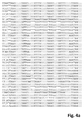
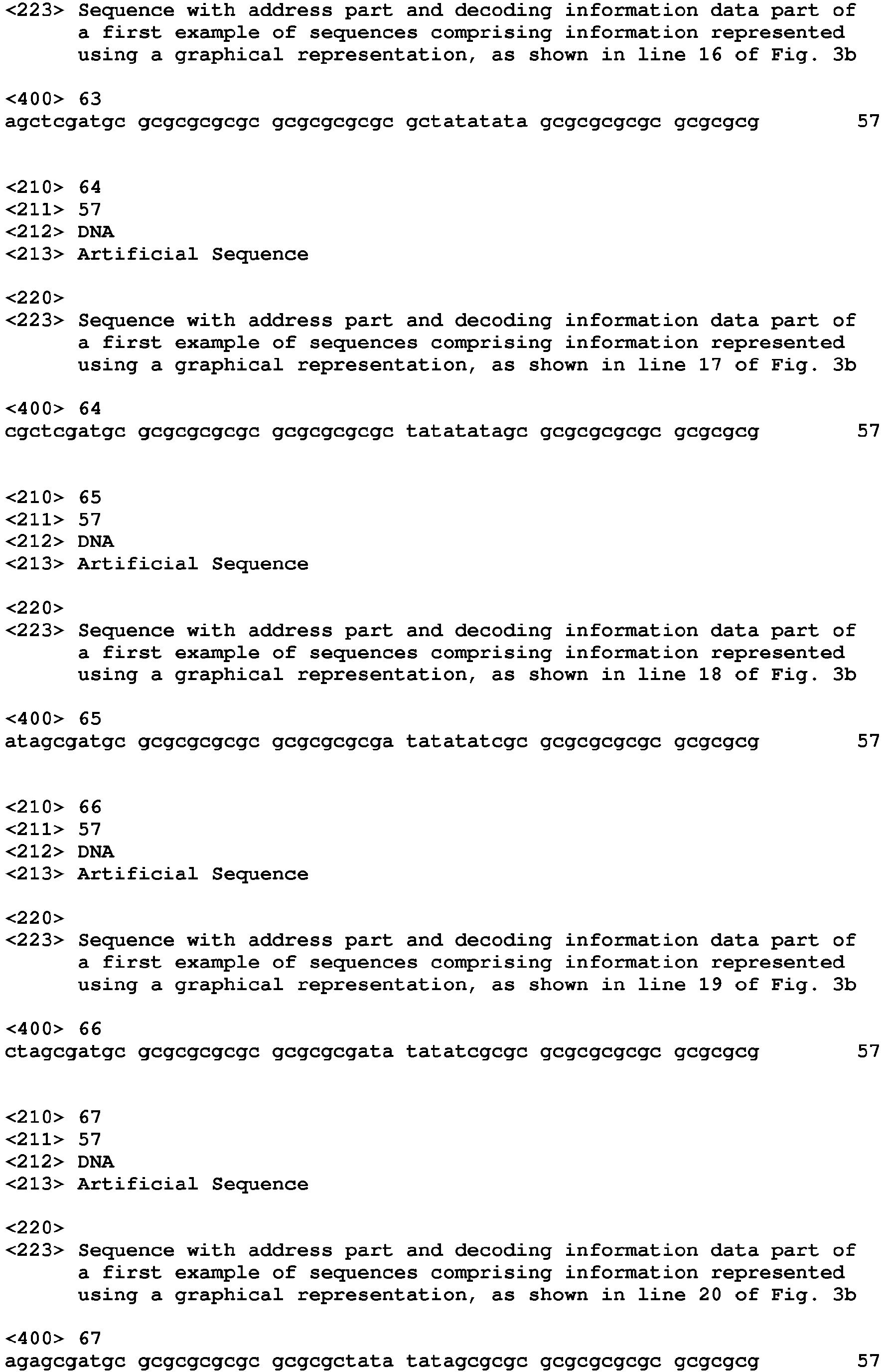
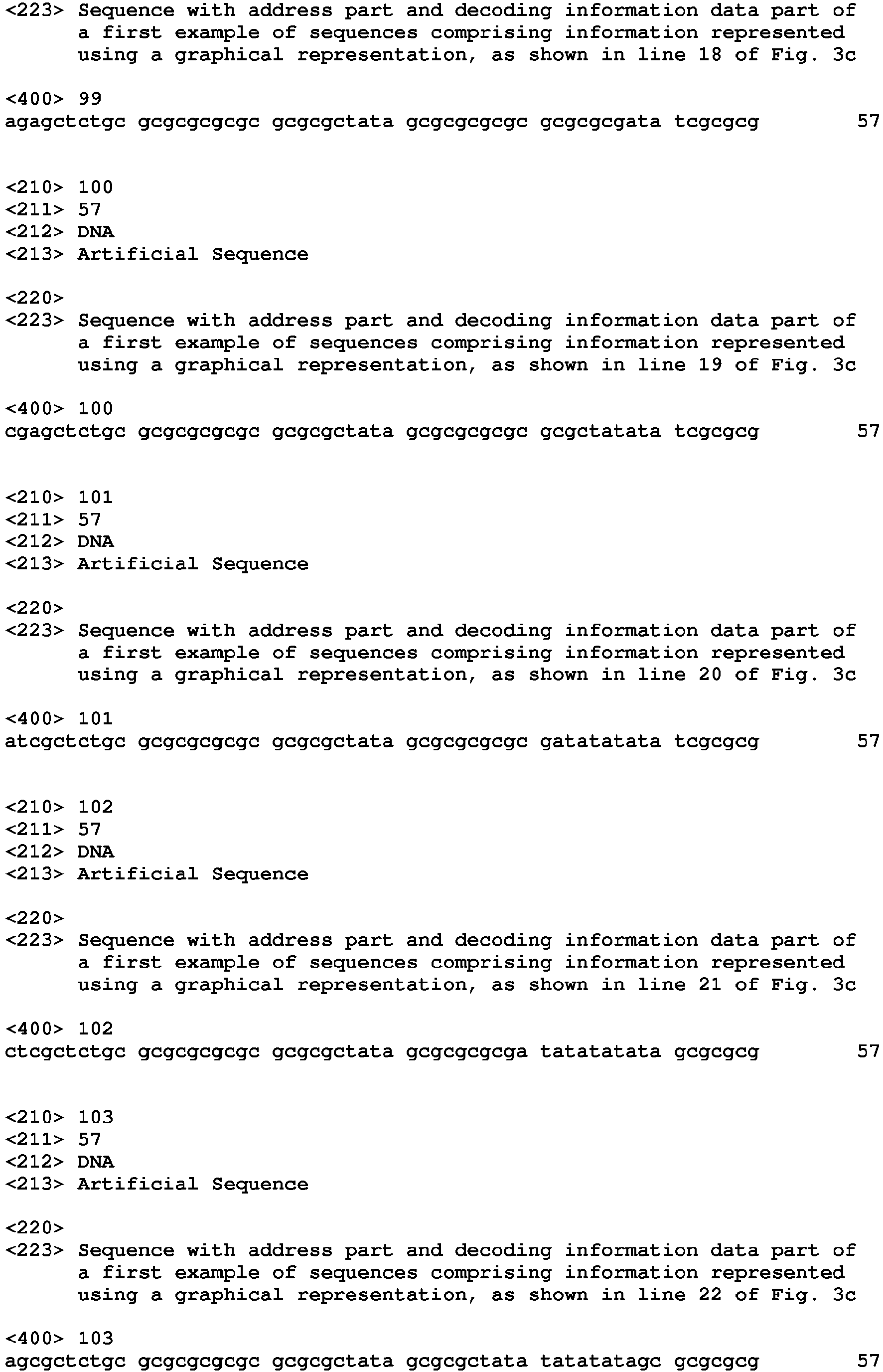
- a first, a second and third part of a first example of a plurality of quaternary encoded code symbol sequences comprising an address data part and a decoding information data part comprising information represented using a graphical representation, to be used for synthesizing oligos is illustrated.
- Each line represents one quaternary code symbol sequence to be used for synthesizing a corresponding oligo.
- quaternary code symbol sequences consisting of code symbols A, T, C and G, e.g. corresponding to the four types of nucleotides of a DNA sequence, are generated.
- the shown example is derived from the example shown in Figs.
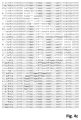
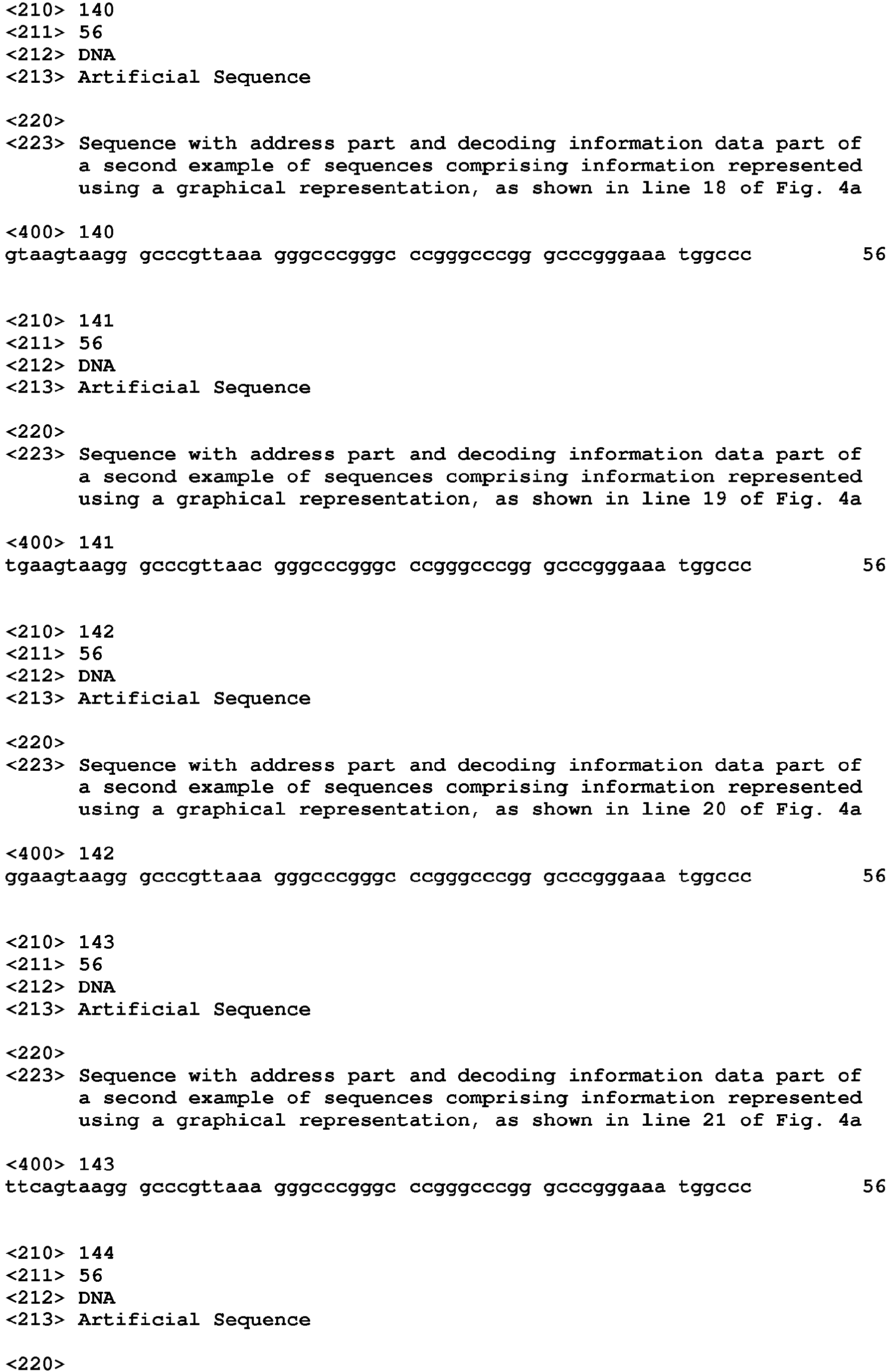
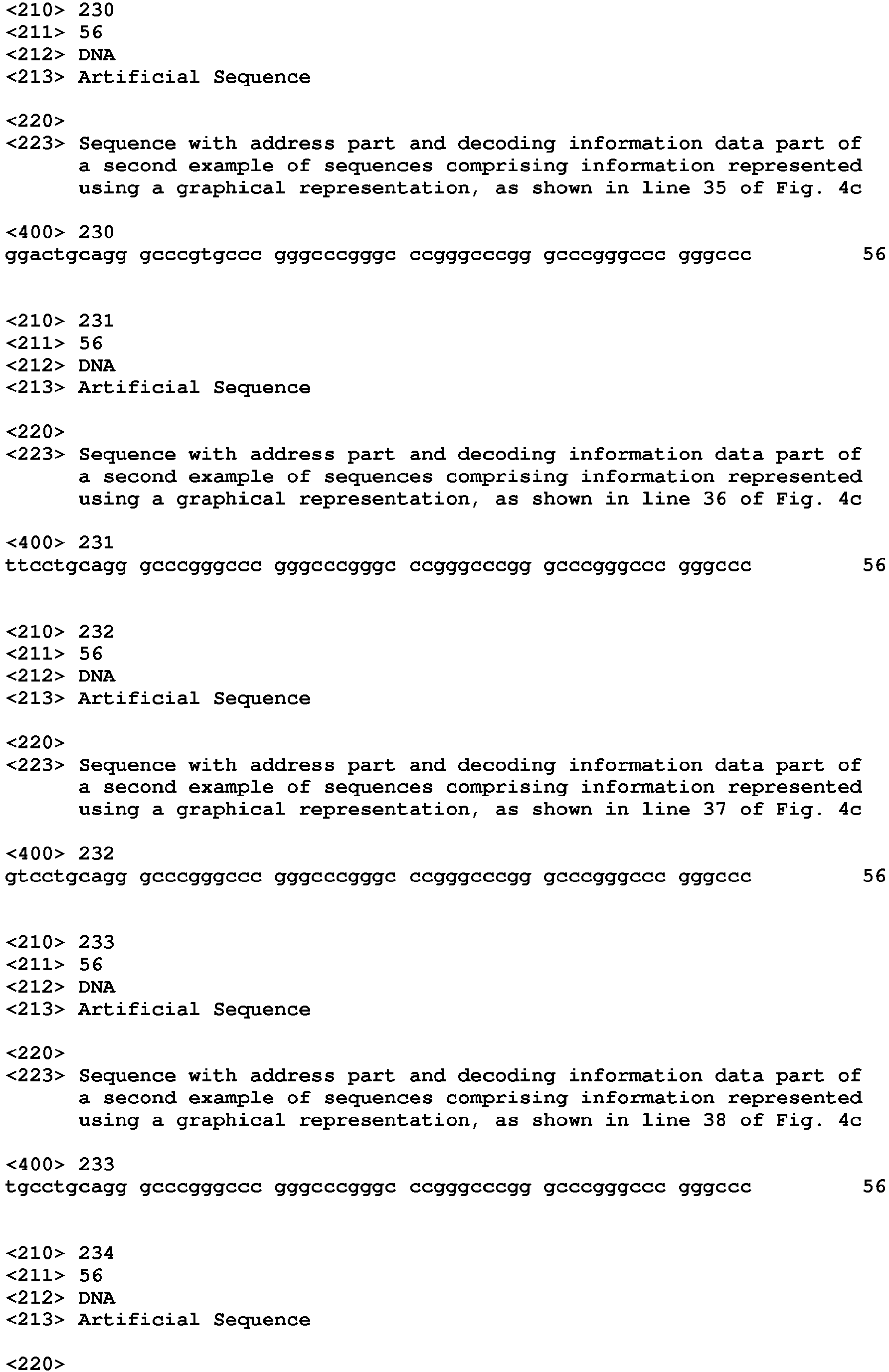
- a first, a second and third part of a second example of a plurality of quaternary encoded code symbol sequences comprising an address data part and a decoding information data part comprising information represented using a graphical representation, to be used for synthesizing oligos.
- Each line represents one quaternary code symbol sequence to be used for synthesizing a corresponding oligo.
- quaternary code symbol sequences consisting of code symbols A, T, C and G, e.g. corresponding to the four types of nucleotides of a DNA sequence, are generated.
- the shown example is also derived from the example shown in Figs.
- the index or address/ID which can be a contiguous number, can be encoded in the address part of the oligo as a standard binary number. In an embodiment it is determined if a MSB (most significant bit) first or LSB (least significant bit) first approach has been chosen: Following a statistical analysis on the different address bits, the MSB and LSB are found: For the LSB the probabilities of "0" and "1" are nearly identical, while for the MSB the probability of a "0" is much higher than the probability of a "1 ".
- This property can also be used to determine which code symbols, respectively nucleotides, were chosen to represent which binary value. Further, as the probability for a "0" is growing in a monotonous way from the LSB (where it is 0.5) to the MSB, the probability distribution is an indication that binary numbers were encoded in this part of the oligo.
- a manual as stored decoding information starts with a (graphical) description of the chosen language, as the language may probably not be known anymore at the time of decoding.
- a correction mechanism is applied, e.g. performing of majority decisions between oligos of a same address.
- a correction mechanism e.g. performing of majority decisions between oligos of a same address.
- FIG. 5 an example of an embodiment of an apparatus 50 for storing user data and decoding information data in subsets of a plurality of synthesized oligos is schematically illustrated.
- the apparatus 50 allows implementing the advantages and characteristics of the described method as part of an apparatus for storing user data and decoding information data in subsets of a plurality of synthesized oligos.
- the apparatus 50 comprises an encoding device 51 configured to obtain user data and decoding information data required for decoding the user data, and to encode said user data in a first subset of code symbol sequences and said decoding information data in a second subset of code symbol sequences.
- the decoding device 51 comprises an interface 52 for obtaining the user data and decoding information data as input from a data transmission channel or storage medium.
- the decoding device 51 is connected to (or comprises) a memory 53 for storing the obtained input data and encoded code symbol sequences.
- the apparatus 50 further comprises a nucleic acid synthesizer device 54, connected to receive the first and second subsets of code symbol sequences from the encoding device 51 and configured to synthesize a corresponding first subset of oligos from said first subset of code symbol sequences and a corresponding second subset of oligos from said second subset of code symbol sequences, wherein
- the shown nucleic acid synthesizer device 54 is connected to a nucleic acid storage container 55 for storing a substance comprising the plurality of synthesized oligos of the first and the second subsets.
- the nucleic acid synthesizer device 54 it is connectable to or comprises the storage container 55.
- the shown encoding device 51 and the nucleic acid synthesizer device 52 directly communicate with each other.
- the apparatus 50 comprises a controller device connected to one or more of the shown devices and controls their communication.
- the encoding device 51 and the nucleic acid sequencer device 54 are provided as separate devices or jointly as one device.
- the encoding device 51 is provided as (functionality carried out or implemented by) a processor, microprocessor, microcontroller or other processing device, computer or other programmable apparatus or processor assembly connected to or comprising the memory 53, and the memory device 53 stores instructions that, when executed, cause the apparatus to perform a method according to the present principles.
- the shown memory device 53 can be a non-transitory program storage device, tangibly embodying a program of instructions executable by a processor.
- aspects of the present principles can be embodied as a method, an apparatus, a system, a computer program product or a computer readable medium, i.e. aspects of the present principles may be implemented in various forms of hardware, software, firmware, special purpose processors, or a combination thereof. Accordingly, aspects of the present principles can take the form of a hardware embodiment, a software embodiment or an embodiment combining software and hardware aspects. Aspects of the present principles may, for example, at least partly be implemented in a computer program comprising code portions for performing steps of the method according to an embodiment of the present principles when run on a programmable apparatus or enabling a programmable apparatus to perform functions of an apparatus, device or system according to an embodiment of the present principles.
- the software is preferably implemented as an application program tangibly embodied on a program storage device.
- the application program may be uploaded to, and executed by, a machine comprising any suitable architecture.
- the machine is implemented on a computer platform having hardware such as one or more processors/central processing units (CPU), a random access memory (RAM), and input/output (I/O) interface(s).
- the computer platform also includes an operating system and microinstruction code.
- Various processes and functions described herein may either be part of the microinstruction code or part of the application program (or a combination thereof), which is executed via the operating system.
- various other devices may be connected to the computer platform such as the nucleic acid synthesizer device 54, a nucleic acid storage container 55, but also, e.g. an additional data storage device and a printing device.
Landscapes
- Physics & Mathematics (AREA)
- Life Sciences & Earth Sciences (AREA)
- Engineering & Computer Science (AREA)
- Health & Medical Sciences (AREA)
- Biophysics (AREA)
- Theoretical Computer Science (AREA)
- Bioinformatics & Cheminformatics (AREA)
- Bioinformatics & Computational Biology (AREA)
- Evolutionary Biology (AREA)
- General Health & Medical Sciences (AREA)
- Medical Informatics (AREA)
- Biotechnology (AREA)
- Spectroscopy & Molecular Physics (AREA)
- Databases & Information Systems (AREA)
- Bioethics (AREA)
- Analytical Chemistry (AREA)
- Data Mining & Analysis (AREA)
- Proteomics, Peptides & Aminoacids (AREA)
- Software Systems (AREA)
- Artificial Intelligence (AREA)
- Chemical & Material Sciences (AREA)
- Evolutionary Computation (AREA)
- Molecular Biology (AREA)
- Computational Linguistics (AREA)
- Biomedical Technology (AREA)
- Computing Systems (AREA)
- General Engineering & Computer Science (AREA)
- General Physics & Mathematics (AREA)
- Mathematical Physics (AREA)
- Genetics & Genomics (AREA)
- Computer Vision & Pattern Recognition (AREA)
- Epidemiology (AREA)
- Public Health (AREA)
- Measuring Or Testing Involving Enzymes Or Micro-Organisms (AREA)
Abstract
Description
- The present disclosure is related to an alternative storage/transmission application, where a plurality of copies of data packets exists. An example for such an application is the archiving of digital data by synthesizing, i.e. artificially creating nucleic acid sequences, such as DNA molecules. More particularly, the present principles relate to the storing of user data, i.e. archival data, and a corresponding decoding manual, i.e. information for decoding said user data, in synthesized nucleic acid sequences, i.e. oligonucleotides or oligos.
- An example for an application where a plurality of (possibly disturbed) copies of (initially identical) data packets exists is the archiving of digital data with synthetic, i.e. artificially generated DNA. Storing data in sequences of nucleotides of artificially generated DNA molecules has been investigated in "Next-generation digital information storage", Church et al., Science 337, 1628, 2012 [I], and in "Towards practical, high-capacity, low-maintenance information storage in synthesized DNA", Goldman et al., Nature, vol. 494, 2013 [II]. DNA as storage medium exhibits desired storage properties, such as longevity, huge storage density, and low-cost for maintenance.
- Nucleic acid sequences, such as strands of DNA (Deoxyribonucleic Acid) or RNA (Ribonucleic Acid) fragments (oligonucleotides, short: oligos), can be generated or synthesized, using a nucleic acid synthesizer, as sequences of four different nucleotides identified by their respective nucleobases, namely Adenine, Thymine, Cytosine and Guanine, shortly denoted as A, T, C and G, for DNA, or, respectively, Adenine, Uracil, Cytosine and Guanine, shortly denoted as A, U, C and G, for RNA. The order of the nucleotides forming the oligo is used to store code symbol sequences, for example sequences of quaternary code symbols, representing user data, for example provided as sequences of binary or quaternary code symbols. Nucleic acid sequencers are used to readout the sequence of nucleotides, i.e. to transform an oligo back into its corresponding code symbol sequence. The described biochemical processing usually requires multiple copies of the same oligo in order to function. Therefore, the processing comprises an amplification of the oligos, i.e. multiple duplication of the oligos, for example using Polymerase Chain Reaction (PCR).
- DNA strands have proven to be very stable even over long time periods, so information stored in DNA is expected to be readable after hundreds, thousands or even millions of years. Nevertheless, the source or user data have to be encoded and/or modulated in a specific way. This comprises, e.g., how the user data are distributed to different packets, what kind of error protection is used etc. Therefore, for decoding the user data, it is necessary to know how the encoding was done. Hence, decoding information, i.e. a "manual", is needed that describes, how the decoding can be performed and, e.g., how the encoding was done.
- Said decoding information or manual could be provided on a separate medium (e.g. on paper, a harddisc etc.), and stored near the nucleic acid storage container having stored therein the DNA strands carrying the user data encoded in their sequence of nucleotides. However, when targeting long preservation durations, there is no guarantee that the manual will survive as long as the DNA strands or that the technology for reading the storage medium for the manual will be available anymore, or that the DNA storage and the manual will still be available in combination, i.e. that the decoding manual will not have been disjoint from the DNA storage in the meantime.
- On the other hand, DNA as the substance that is carrying the biochemical information of living organisms will still be available, and there is a high probability that technologies for processing DNA will remain available, for example for sequencing, i.e. retrieving the sequences of nucleotides within DNA.
- There remains a need to preserve the decoding information, i.e. the manual, how to decode user data stored in synthesized DNA, over the same long time as the user data itself, identifiable as being the decoding information, and without losing the connection between the stored user data and its decoding information.
- A method for storing user data (e.g. archival data) and decoding information data in subsets of a plurality of synthesized oligos is provided, wherein the user data are stored together with the related decoding information data in a plurality of oligos. Further, a corresponding apparatus and a substance comprising at least said subsets are provided.
- According to one aspect of the present principles, a method for storing user data and decoding information data in subsets of a plurality of synthesized oligos comprises
- obtaining user data and decoding information data required for decoding the user data;
- creating a first subset of code symbol sequences having encoded said user data and a second subset of code symbol sequences having encoded said decoding information data;
- synthesizing a corresponding first subset of oligos from said first subset of code symbol sequences and a corresponding second subset of oligos from said second subset of code symbol sequences using a nucleic acid synthesizer device, wherein
- the second subset of oligos contains less oligos than the first subset of oligos, and
- the oligos of the second subset of oligos exhibit at least one specific property not occurring in any oligo of the first subset of oligos.
- The first subset and the second subset are then stored together, for example in a nucleic acid storage container.
- The decoding information can comprise all information required to perform the actual decoding. In one embodiment it may, for example, comprise an information identifying an encoding scheme rather than the complete encoding scheme itself.
- The term "specific property" does not solely refer to a different content, but comprises at least one structural difference between the oligos of the second subset as compared to the oligos of the first subset, such as a different primer sequence, oligo length or a certain nucleotide pattern used when constructing the sequence of nucleotides.
- "Synthesizing" an oligo refers to generating or creating an oligo, i.e. a nucleotide sequence, by transforming a code symbol sequence into a corresponding nucleotide sequence using a nucleic acid synthesizer device, such as a DNA synthesizer.
- A code symbol sequence is a set of subsequent code symbols, e.g., in the form of an electronic signal, for example quaternary code symbols with each code symbol value corresponding to a nucleotide type. As another example, a code symbol sequence can also be a sequence of binary code symbols.
- User data and decoding information data are both part of payload data stored in a payload/data part of an oligo. Further, the oligos comprise an address or index part as well as a primer sequence of nucleotides, which can be used when amplifying an oligo.
- In one embodiment, the specific property is introduced when generating the sequences of code symbols to the synthesized as, i.e. to be transformed into, the corresponding oligos. In another embodiment, the specific property is introduced during the synthesizing, i.e. when transforming the sequences of code symbols into sequences of nucleotides.
- The term "the second subset of oligos contains less oligos than the first subset" refers to a clear, i.e. a clearly detectable, difference of the number of oligos of the first subset compared to the second subset. In one embodiment, the difference is defined by a threshold, such as the number of oligos of the second subset being at least 5%, 10%, 20%, 30%, 40%, 50%, etc., or 90% or more smaller than the number of oligos contained in the first subset of oligos. In one embodiment, the unequal distribution of oligos of the first and of the second subset of the plurality of oligos is achieved by generating different amounts of first and second code symbol sequences before synthesizing, i.e. transforming the code symbol sequences into, corresponding amounts of oligos. In another embodiment, the unequal distribution is achieved by amplifying the generated oligos of the first subset by a different amplification factor than the oligos of the second subset, thereby creating different amounts of copies of said oligos.
- According to one aspect of the present principles, an apparatus for storing user data and decoding information data in subsets of a plurality of synthesized oligos comprises
- an encoding device configured to obtain user data and decoding information data required for decoding the user data, and to encode said user data in a first subset of code symbol sequences and said decoding information data in a second subset of code symbol sequences; and
- a nucleic acid synthesizer device configured to synthesize a corresponding first subset of oligos from said first subset of code symbol sequences and a corresponding second subset of oligos from said second subset of code symbol sequences, wherein
- the second subset of oligos contains less oligos than the first subset of oligos, and
- the oligos of the second subset of oligos exhibit at least one specific property not occurring in any oligo of the first subset of oligos.
- An apparatus for storing user data and decoding information data in subsets of a plurality of synthesized oligos comprises an encoding device, such as a computer, or processor and a memory, or other device capable of processing and encoding the data. The apparatus comprises or is connected or connectable to the nucleic acid synthesizer device or module capable of transforming code symbol sequences into corresponding nucleotide sequences, which is connected or connectable to store the oligos, e.g. in a nucleic acid storage container.
- According to another aspect of the present principles, a non-transitory program storage device, readable by a computer, tangibly embodies a program of instructions executable by the computer to perform, using a nucleic acid synthesizer device, a method for storing user data and decoding information data in subsets of a plurality of synthesized oligos according to the present principles.
- According to another aspect of the present principles, a substance comprises a plurality of synthesized oligos having stored therein user data and decoding information data, wherein
- a first subset of the plurality of synthesized oligos carries user data; and
- a second subset of the plurality of synthesized oligos carries information data required for decoding the user data; and wherein
- the second subset contains less oligos than the first subset, and
- the oligos of the second subset exhibit at least one specific property not occurring in any oligo of the first subset.
- The provided solution allows storing of decoding manual information as oligos together with the oligos carrying the user data, but in such a way that it can easily, without prior knowledge of the encoding strategy, be detected that there are two different subsets of oligos contained in the same nucleic acid storage. Once it has been discovered that there is a clearly identifiable second subset contained, the contained information can be accessed.
- The provided approach at least has the effect that there is a high probability that the stored manual or decoding information will be identified within the stored oligos. As that privileged information in the second subset can be found, the contained decoding information can be used for decoding of the user data contained in the first subset, even if after a very long time, probably centuries, no separate decoding information is available anymore at the time of decoding. When people in the future will try to decode data stored as sequences of nucleotides, such as DNA strands, they will assume, that the decoding method will also be described somewhere in the archived data. They will first try to find a manual within the plurality of oligos and the subset of the plurality of oligos containing the manual will be identified, as there will be much fewer of them than the total number of DNA strands and they will be provided having specific properties differentiating them from the other oligos.
- The specific property to distinguish between the first and second subset of the oligos is chosen such that a person using a sequencer device for retrieving the code symbol sequences from the stored plurality of nucleotide sequences or oligos will easily detect the specific property being different between the oligo subsets or, respectively, their corresponding read out subsets of code symbol sequences.
- In one embodiment the at least one specific property comprises an oligo length of the oligos of the second subset of oligos different from any oligo length of the oligos of the first subset of oligos.
The oligo length refers to the number or amount of nucleotides forming the nucleotide sequence or oligo. This property is easy to detect, once the stored oligos are analyzed. - In one embodiment the synthesizing comprises synthesizing each of the oligos of the plurality of oligos having at least one primer sequence, and wherein the at least one specific property comprises a primer sequence in the oligos of the second subset of oligos different from any primer sequence in the oligos of the first subset of oligos. As the primer sequence will have to be read, this differing specific property will also easily be identified. Choosing a different primer as the specific property gives the possibility to amplify the related oligos of the second subset separately from the remaining oligos of the first subset.
- In one embodiment the at least one specific property comprises at least one nucleotide pattern in the oligos of the second subset of oligos different from any nucleotide pattern in the oligos of the first subset of oligos. A nucleotide pattern comprises that the oligos of the second subset comprise nucleotides arranged according to a specific pattern that should be discovered or identified with a high probability. For example, the sequences of nucleotides may contain their nucleotides as consecutive pairs or triples of the same nucleotide type.
- The manual will be distributed across several oligos. Therefore, in an embodiment an index or address will be used to allow to put the code symbol sequences carrying the decoding information into their correct order. This address part could be identified by an easily detectable encoding scheme different from that used for the data part, i.e. the coding scheme for the addressing part is chosen obviously different from the coding scheme for the manual data.
- In one embodiment the creating of the second subset of code symbol sequences comprises creating an address part encoded using a first coding scheme different from a second coding scheme used for encoding a data part of the code symbol sequences. The data part of the code symbol sequences corresponding to the second subset carries, i.e. has encoded, the decoding information.
- In one embodiment, the code symbol sequences are generated from quaternary code symbols with two quaternary code symbol values representing a first binary value and two remaining code symbol values representing a second binary value different from the first binary value.This allows a direct mapping of quaternary code symbol values (and thereby nucleotides) and binary code symbol values. For example, quaternary code symbol values can be named "A", "T", "C", and "G" corresponding to the nucleotides of a DNA sequence, and wherein two quaternary code symbol values, e.g. A and T, represent binary code symbol value "0", whereas the remaining code symbol values C and G represent binary code symbol value "1 ".
- In one example embodiment, according to the first coding scheme the address part is created by alternatingly concatenating pairs of code symbols of a first group and of a second group, while beginning the address part with a code symbol of the first group, the first group consisting of code symbols of two quaternary code symbol values representing the first binary value and the second binary value, the second group consisting of code symbols of two remaining quaternary code symbol values different from the two code symbol values of the first group and also representing the first binary value and the second binary value, and
- according to the second coding scheme the data part is created by alternatingly concatenating pairs of code symbols of the second group and of the first group, while beginning the data part with a code symbol of the second group. The change of the coding scheme will be easily detectable when analyzing retrieved code symbol sequences after sequencing the stored oligos, as it will be identifiable as the only position in the sequence where two symbols belonging to the same group will follow each other directly, i.e. where the scheme of alternating symbol groups does not apply. For example, the first group may consist of code symbols with values "A" and "C", whereas the second group consists of code symbols with values "T" and "G". Example code symbol sequences "ATCGATCGTAGCTCGAGA" and "CGATCGATGCGATCTAGC" then exhibit the following coding scheme exception: At the ninth position a quaternary code symbol of the group T/G follows a quaternary code symbol of the same group - only there. - In another example embodiment, according to the first coding scheme the address part is created by alternatingly concatenating a first number of code symbols of a first group with a same first number of code symbols of a second group, the first group consisting of code symbols of two quaternary code symbol values representing the first binary value and the second binary value, the second group consisting of code symbols of two remaining quaternary code symbol values different from the two code symbol values of the first group and also representing the first binary value and the second binary value, and
- according to the second coding scheme the data part is created by alternatingly concatenating a second number of code symbols of the first group with a same second number of code symbols of the second group, wherein the second number differs from the first number. The change of the coding scheme will be easily detectable when analyzing retrieved code symbol sequences after sequencing the stored oligos, as it will be identifiable as the only position in the sequence where the scheme of a first amount of symbols, e.g. two, belonging to the same group followed by the same amount of symbols belonging the other group changes to a different scheme where a second amount of symbols, e.g. three, belonging to the same group is followed by the same amount of symbols belonging the other group. For example, the first group may consist of code symbols with values "A" and "C", whereas the second group consists of code symbols with values "T" and "G". If, for example, the used first number equals two and the second number equals three, example code symbol sequences, such as "TGAAGTCATGTACCTTTACA" and "GGACTTACTTGAACGTGAAA", exhibit a detectable position, where the coding scheme changes. - The manual data or decoding information data part contains the manual information encoded in a straightforward way. In one embodiment the oligos of the second subset of oligos contain the information for decoding the user data as a graphical representation. According to the embodiment, the graphical representation becomes visible after sequencing the oligos of the second subset and, for example, displaying the retrieved corresponding code symbol sequences. In an embodiment, the graphically represented information becomes visible to a user (e.g. on a display screen or printout) after sorting the obtained code symbol sequences according to their (increasing) addresses encoded in the address parts.
- According to an example embodiment, like in black and white images, a "1" represents a white pixel, while a "0" represents a black one (or vice versa). A corresponding approach works with quaternary code symbols corresponding to the four nucleotides. Although the graphical data are encoded in a specific way, the correctly sorted code symbol sequences (according to the address or index) for the corresponding oligos already show graphical patterns, which are an indication that the data part contains graphical information.
- There is a high probability that the manual or decoding information stored according to the present principles will be identified within the stored oligos and will be decodable even without prior knowledge about the coding scheme. This will allow decoding of the data even after very long preservation durations.
- While not explicitly described, the presented embodiments may be employed in any combination or sub-combination.
-
-
Fig. 1 schematically illustrates an example of an embodiment of a method for storing user data and decoding information data in subsets of a plurality of synthesized oligos; -
Fig. 2a ,2b and2c schematically illustrate a first, a second and third part of an example of a plurality of binary encoded code symbol sequences comprising an address data part and a decoding information data part comprising information represented using a graphical representation, to be used for synthesizing oligos; -
Fig. 3a ,3b and3c schematically illustrate a first, a second and third part of a first example of a plurality of quaternary encoded code symbol sequences comprising an address data part and a decoding information data part comprising information represented using a graphical representation, to be used for synthesizing oligos; -
Fig. 4a ,4b and4c schematically illustrate a first, a second and third part of a second example of a plurality of quaternary encoded code symbol sequences comprising an address data part and a decoding information data part comprising information represented using a graphical representation, to be used for synthesizing oligos; and -
Fig. 5 schematically illustrates an example of an embodiment of an apparatus for storing user data and decoding information data in subsets of a plurality of synthesized oligos. - For a better understanding of the principles, example embodiments are explained in more detail in the following description with reference to the figures. It is understood that the present solution is not limited to these exemplary embodiments and that specified features can also expediently be combined and/or modified without departing from the scope of the present principles as defined in the appended claims.
- Referring to
Fig. 1 , an example of an embodiment of amethod 10 for storing user data and decoding information data in subsets of a plurality of synthesized oligos is schematically illustrated. - In a
first step 11 user data and decoding information data required for decoding the user data are obtained, for example from a data transmission channel or data storage. - In a next step 12 a first subset of code symbol sequences having encoded said user data and a second subset of code symbol sequences having encoded said decoding information data are created.
- In a next step 13 a corresponding first subset of oligos is synthesized from said first subset of code symbol sequences and a corresponding second subset of oligos is synthesized from said second subset of code symbol sequences using a nucleic acid synthesizer device.
- The code symbol
sequence creation step 12 and/or the synthesizingstep 13 are adapted such that the second subset of oligos contains less oligos than the first subset of oligos, and that the oligos of the second subset of oligos exhibit at least one specific property not occurring in any oligo of the first subset of oligos. - Further, as the manual or decoding information is distributed over the oligos of the second subset, an address or index is included in the decoding information which allows for sorting the retrieved code symbol sequences corresponding to the oligos of the second subset correctly after sequencing.
- According to an embodiment, the content of the manual or decoding information is encoded in the data part of the oligo using a graphical representation: Like in black and white images a 1 stands for a white pixel, while a 0 for a black one (or vice versa). Referring to
Fig. 2A ,Fig. 2B andFig. 2C , a first, a second and third part of an example of a plurality of binary encoded code symbol sequences comprising an address data part and a decoding information data part comprising information represented using a graphical representation, to be used for synthesizing oligos, are shown. The example illustrates the three letters "D", "N", "A" encoded as a graphical representation and serving as an example for any decoding information that could be stored in the second subset of the plurality of oligos. Each line represents the bits encoded in one code symbol sequence to be used for synthesizing a corresponding oligo. The first eight bits form the address or index, while the remaining 49 bits contain the data. - As described above, a code symbol sequence and, respectively, a corresponding oligo will comprise an address part and a data part. This partitioning into two parts is made detectable by using different coding schemes for the two parts.
- Referring to
Fig. 3A ,Fig. 3B andFig. 3C , a first, a second and third part of a first example of a plurality of quaternary encoded code symbol sequences comprising an address data part and a decoding information data part comprising information represented using a graphical representation, to be used for synthesizing oligos, is illustrated. Each line represents one quaternary code symbol sequence to be used for synthesizing a corresponding oligo. For the shown example, quaternary code symbol sequences consisting of code symbols A, T, C and G, e.g. corresponding to the four types of nucleotides of a DNA sequence, are generated. The shown example is derived from the example shown inFigs. 2A ,2B and2C , wherein the binary code symbol "0" is encoded using quaternary code symbol "A" or "T" and the binary code symbol "1" is encoded using quaternary code symbol "C" or "G". Here, the code symbols A/C and T/G corresponding to nucleotides are used in alternating order. As an exception from that scheme, at one position within the code symbol sequence, there is no alteration. For example, the code symbol sequence "ATCGATCGTAGCTCGAGA" and "CGATCGATGCGATCTAGC" exhibit the following coding scheme exception: At the ninth position a quaternary code symbol of the group T/G follows a quaternary code symbol of the same group - only there. This can be discovered as an indication that this is a specific position partitioning the oligo into two parts. Further, choosing quaternary code symbols from different groups in an alternating manner also prohibits a runlength of more than three identical nucleotides when transforming said code symbol sequence into its corresponding nucleotide sequence, which might otherwise lead to problems in the nucleic acid sequencer. Again, the example illustrates that the three letters "D", "N", "A" remain visibly detectable as a graphical representation. - Referring to
Fig. 4A ,Fig. 4B andFig. 4C , a first, a second and third part of a second example of a plurality of quaternary encoded code symbol sequences comprising an address data part and a decoding information data part comprising information represented using a graphical representation, to be used for synthesizing oligos, is illustrated. Each line represents one quaternary code symbol sequence to be used for synthesizing a corresponding oligo. For the shown example, again quaternary code symbol sequences consisting of code symbols A, T, C and G, e.g. corresponding to the four types of nucleotides of a DNA sequence, are generated. The shown example is also derived from the example shown inFigs. 2A ,2B and2C , wherein the binary code symbol "0" is encoded using quaternary code symbol "A" or "T" and the binary code symbol "1" is encoded using quaternary code symbol "C" or "G". In the shown example, in a first part of the code symbol sequence, always two quaternary code symbols of the first group T/G to be transformed into corresponding nucleotides of type T/G are followed by two quaternary code symbols of the second group A/C to be transformed into a corresponding nucleotides of type A/C, while in a second part, three quaternary code symbols of the first group are followed by three quaternary code symbols of the second group. This coding scheme has also been applied in the following example code symbol sequences: "TGAAGTCATGTACCTTTACA" and "GGACTTACTTGAACGTGAAA". - The usage of groups of different length clearly separates the code symbol sequence and, therefore, the oligo synthesized from said code symbol sequence, in two parts containing different information. By limiting the group length to three, a runlength of more than three identical nucleotides is prevented.
- In order to provide an intuitive scheme that can be easily identified, the groups have been selected as described, as the corresponding nucleotides A and T resp. C and G are complementary to each other. It should be noted, that it is also possible to use different groups for representing "0" and "1" (e.g. "A" and "C" for "0", "T" and "G" for "1 ").
- The index or address/ID, which can be a contiguous number, can be encoded in the address part of the oligo as a standard binary number. In an embodiment it is determined if a MSB (most significant bit) first or LSB (least significant bit) first approach has been chosen: Following a statistical analysis on the different address bits, the MSB and LSB are found: For the LSB the probabilities of "0" and "1" are nearly identical, while for the MSB the probability of a "0" is much higher than the probability of a "1 ".
- This property can also be used to determine which code symbols, respectively nucleotides, were chosen to represent which binary value. Further, as the probability for a "0" is growing in a monotonous way from the LSB (where it is 0.5) to the MSB, the probability distribution is an indication that binary numbers were encoded in this part of the oligo.
- As shown in
Figs. 3A ,3B ,3C andFigs. 4A ,4B ,4C , although the graphical data are encoded in a specific way, the correctly sorted code symbol sequences (according to the address or index) already show graphical patterns "D", "N", "A". - Storing graphics is an intuitive approach that will be understood in the future. In other embodiments, for example specific text encoding algorithms (ASCII, UTF-8 etc.) can be used to store single letters in groups of bits, which results in a much smaller amount of oligos needed to represent the manual. The detection and decoding will be possible, if the chosen text encoding is still known at the time of decoding. In yet another embodiment both approaches are combined: In an initial graphical part the encoding is described that is used later.
- In another embodiment targeting at archiving for very long time periods, a manual as stored decoding information starts with a (graphical) description of the chosen language, as the language may probably not be known anymore at the time of decoding.
- When using the described storing method, there is a specific probability that single nucleotides are distorted during the process. In an embodiment, a correction mechanism is applied, e.g. performing of majority decisions between oligos of a same address. However, even without a correction, due to the graphical representation the result will most often remain readable for the human reader.
- Referring to
Fig. 5 , an example of an embodiment of anapparatus 50 for storing user data and decoding information data in subsets of a plurality of synthesized oligos is schematically illustrated. Theapparatus 50 allows implementing the advantages and characteristics of the described method as part of an apparatus for storing user data and decoding information data in subsets of a plurality of synthesized oligos. - The
apparatus 50 comprises anencoding device 51 configured to obtain user data and decoding information data required for decoding the user data, and to encode said user data in a first subset of code symbol sequences and said decoding information data in a second subset of code symbol sequences. In the shown example, thedecoding device 51 comprises aninterface 52 for obtaining the user data and decoding information data as input from a data transmission channel or storage medium. Further, thedecoding device 51 is connected to (or comprises) amemory 53 for storing the obtained input data and encoded code symbol sequences. - The
apparatus 50 further comprises a nucleicacid synthesizer device 54, connected to receive the first and second subsets of code symbol sequences from theencoding device 51 and configured to synthesize a corresponding first subset of oligos from said first subset of code symbol sequences and a corresponding second subset of oligos from said second subset of code symbol sequences, wherein - the second subset of oligos contains less oligos than the first subset of oligos, and
- the oligos of the second subset of oligos exhibit at least one specific property not occurring in any oligo of the first subset of oligos.
- The shown nucleic
acid synthesizer device 54 is connected to a nucleicacid storage container 55 for storing a substance comprising the plurality of synthesized oligos of the first and the second subsets. In other embodiments, the nucleicacid synthesizer device 54 it is connectable to or comprises thestorage container 55. - In the example embodiment shown in
Fig. 5 the shown encodingdevice 51 and the nucleicacid synthesizer device 52 directly communicate with each other. In another embodiment theapparatus 50 comprises a controller device connected to one or more of the shown devices and controls their communication. - Depending on the embodiment, the
encoding device 51 and the nucleicacid sequencer device 54 are provided as separate devices or jointly as one device. In one embodiment, theencoding device 51 is provided as (functionality carried out or implemented by) a processor, microprocessor, microcontroller or other processing device, computer or other programmable apparatus or processor assembly connected to or comprising thememory 53, and thememory device 53 stores instructions that, when executed, cause the apparatus to perform a method according to the present principles. - For this, (a part of) the shown
memory device 53 can be a non-transitory program storage device, tangibly embodying a program of instructions executable by a processor. - Aspects of the present principles can be embodied as a method, an apparatus, a system, a computer program product or a computer readable medium, i.e. aspects of the present principles may be implemented in various forms of hardware, software, firmware, special purpose processors, or a combination thereof. Accordingly, aspects of the present principles can take the form of a hardware embodiment, a software embodiment or an embodiment combining software and hardware aspects. Aspects of the present principles may, for example, at least partly be implemented in a computer program comprising code portions for performing steps of the method according to an embodiment of the present principles when run on a programmable apparatus or enabling a programmable apparatus to perform functions of an apparatus, device or system according to an embodiment of the present principles. Moreover, the software is preferably implemented as an application program tangibly embodied on a program storage device. The application program may be uploaded to, and executed by, a machine comprising any suitable architecture. Preferably, the machine is implemented on a computer platform having hardware such as one or more processors/central processing units (CPU), a random access memory (RAM), and input/output (I/O) interface(s). The computer platform also includes an operating system and microinstruction code. Various processes and functions described herein may either be part of the microinstruction code or part of the application program (or a combination thereof), which is executed via the operating system. In addition, various other devices may be connected to the computer platform such as the nucleic
acid synthesizer device 54, a nucleicacid storage container 55, but also, e.g. an additional data storage device and a printing device. - Unless stated otherwise, terms such as "first" and "second" are used to arbitrarily distinguish between the elements the terms describe and are not necessarily intended to indicate temporal or other prioritization of the elements. Any connection shown may be a direct connection or an indirect connection. Further, those skilled in the art will recognize that the boundaries between logic blocks are merely illustrative and that alternative embodiments may merge logic blocks or impose an alternate decomposition of functionality upon various logic blocks.
-
- [I] George M. Church, Yuan Gao, Sriram Kosuri, "Next-Generation Digital Information Storage in DNA", Science Vol. 337, 28 September 2012.
- [II] Nick Goldman et al., "Towards practical, high-capacity, low-maintenance information storage in synthesized DNA", Nature Vol. 494, January 2013.









Claims (15)
- A method (10) for storing user data and decoding information data in subsets of a plurality of synthesized oligos, comprising- obtaining (11) user data and decoding information data required for decoding the use data;- creating (12) a first subset of code symbol sequences having encoded said user data and a second subset of code symbol sequences having encoded said decoding information data;- synthesizing (13) a corresponding first subset of oligos from said first subset of code symbol sequences and a corresponding second subset of oligos from said second subset of code symbol sequences using a nucleic acid synthesizer device, wherein- the second subset of oligos contains less oligos than the first subset of oligos, and- the oligos of the second subset of oligos exhibit at least one specific property not occurring in any oligo of the first subset of oligos.
- The method according to claim 1, wherein the at least one specific property comprises an oligo length of the oligos of the second subset of oligos different from any oligo length of the oligos of the first subset of oligos.
- The method according to claim 1 or claim 2, wherein the synthesizing (13) comprises synthesizing each of the oligos of the plurality of oligos having at least one primer sequence, and wherein the at least one specific property comprises a primer sequence in the oligos of the second subset of oligos different from any primer sequence in the oligos of the first subset of oligos.
- The method according to any of the preceding claims, wherein the at least one specific property comprises at least one nucleotide pattern in the oligos of the second subset of oligos different from any nucleotide pattern in the oligos of the first subset of oligos.
- The method according to any of the preceding claims, wherein the creating of the second subset of code symbol sequences comprises creating an address part encoded using a first coding scheme different from a second coding scheme used for encoding a data part of the code symbol sequences.
- The method according to claim 5, wherein the code symbol sequences are generated from quaternary code symbols with two quaternary code symbol values representing a first binary value and two remaining code symbol values representing a second binary value different from the first binary value.
- The method according to claim 6, wherein- according to the first coding scheme the address part is created by alternatingly concatenating pairs of code symbols of a first group and of a second group, while beginning the address part with a code symbol of the first group, the first group consisting of code symbols of two quaternary code symbol values representing the first binary value and the second binary value, the second group consisting of code symbols of two remaining quaternary code symbol values different from the two code symbol values of the first group and also representing the first binary value and the second binary value, and wherein- according to the second coding scheme the data part is created by alternatingly concatenating pairs of code symbols of the second group and of the first group, while beginning the data part with a code symbol of the second group.
- The method according to claim 6, wherein- according to the first coding scheme the address part is created by alternatingly concatenating a first number of code symbols of a first group with a same first number of code symbols of a second group, the first group consisting of code symbols of two quaternary code symbol values representing the first binary value and the second binary value, the second group consisting of code symbols of two remaining quaternary code symbol values different from the two code symbol values of the first group and also representing the first binary value and the second binary value, and wherein- according to the second coding scheme the data part is created by alternatingly concatenating a second number of code symbols of the first group with a same second number of code symbols of the second group, wherein the second number differs from the first number.
- The method according to any of the preceding claims, wherein the oligos of the second subset of oligos contain the information for decoding the user data as a graphical representation.
- An apparatus (50) for storing user data and decoding information data in subsets of a plurality of synthesized oligos, comprising- an encoding device (51) configured to obtain user data and decoding information data required for decoding the user data, and to encode said user data in a first subset of code symbol sequences and said decoding information data in a second subset of code symbol sequences; and- a nucleic acid synthesizer device (54) configured to synthesize a corresponding firstsubset of oligos from said first subset of code symbol sequences and a corresponding second subset of oligos from said second subset of code symbol sequences, wherein- the second subset of oligos contains less oligos than the first subset of oligos, and- the oligos of the second subset of oligos exhibit at least one specific property not occurring in any oligo of the first subset of oligos.
- A substance comprising
a plurality of synthesized oligos having stored therein user data and decoding information data, wherein- a first subset of the plurality of synthesized oligos carries user data; and- a second subset of the plurality of synthesized oligos carries information data required for decoding the user data; and wherein- the second subset contains less oligos than the first subset, and- the oligos of the second subset exhibit at least one specific property not occurring in any oligo of the first subset. - The substance according to claim 11, wherein the at least one specific property comprises an oligo length of the oligos of the second subset of oligos different from any oligo length of the oligos of the first subset of oligos.
- The substance according to claim 11 or claim 12, wherein each of the oligos of the plurality of oligos comprises at least one primer sequence and the at least one specific property comprises a primer sequence in the oligos of the second subset of oligos different from any primer sequence in the oligos of the first subset of oligos.
- The substance according to any of claims 11 to 13, wherein the at least one specific property comprises at least one nucleotide pattern in the oligos of the second subset of oligos different from any nucleotide pattern in the oligos of the first subset of oligos.
- The substance according to any of claims 11 to 14, wherein the oligos of the second subset of oligos contain the information for decoding the user data as a graphical representation.
Priority Applications (1)
| Application Number | Priority Date | Filing Date | Title |
|---|---|---|---|
| EP15306886.1A EP3173961A1 (en) | 2015-11-27 | 2015-11-27 | Method for storing user data and decoding information in synthesized oligos, apparatus and substance |
Applications Claiming Priority (1)
| Application Number | Priority Date | Filing Date | Title |
|---|---|---|---|
| EP15306886.1A EP3173961A1 (en) | 2015-11-27 | 2015-11-27 | Method for storing user data and decoding information in synthesized oligos, apparatus and substance |
Publications (1)
| Publication Number | Publication Date |
|---|---|
| EP3173961A1 true EP3173961A1 (en) | 2017-05-31 |
Family
ID=54754569
Family Applications (1)
| Application Number | Title | Priority Date | Filing Date |
|---|---|---|---|
| EP15306886.1A Withdrawn EP3173961A1 (en) | 2015-11-27 | 2015-11-27 | Method for storing user data and decoding information in synthesized oligos, apparatus and substance |
Country Status (1)
| Country | Link |
|---|---|
| EP (1) | EP3173961A1 (en) |
Cited By (5)
| Publication number | Priority date | Publication date | Assignee | Title |
|---|---|---|---|---|
| WO2019224816A1 (en) | 2018-05-21 | 2019-11-28 | Technion Research And Development Foundation Ltd. | Molecular data storage systems and methods |
| WO2020239806A1 (en) | 2019-05-27 | 2020-12-03 | Vib Vzw | A method of storing digital information in pools of nucleic acid molecules |
| EP3659147A4 (en) * | 2017-07-25 | 2022-07-20 | Nanjing GenScript Biotech Co., Ltd. | STORAGE AND EXTRACTION OF DNA DATA |
| CN114822695A (en) * | 2022-04-25 | 2022-07-29 | 中国科学院深圳先进技术研究院 | Coding method and coding device for DNA storage |
| WO2023206023A1 (en) * | 2022-04-25 | 2023-11-02 | 中国科学院深圳先进技术研究院 | Encoding method and encoding device for dna storage |
Citations (2)
| Publication number | Priority date | Publication date | Assignee | Title |
|---|---|---|---|---|
| WO2013178801A2 (en) * | 2012-06-01 | 2013-12-05 | European Molecular Biology Laboratory | High-capacity storage of digital information in dna |
| WO2014014991A2 (en) * | 2012-07-19 | 2014-01-23 | President And Fellows Of Harvard College | Methods of storing information using nucleic acids |
-
2015
- 2015-11-27 EP EP15306886.1A patent/EP3173961A1/en not_active Withdrawn
Patent Citations (2)
| Publication number | Priority date | Publication date | Assignee | Title |
|---|---|---|---|---|
| WO2013178801A2 (en) * | 2012-06-01 | 2013-12-05 | European Molecular Biology Laboratory | High-capacity storage of digital information in dna |
| WO2014014991A2 (en) * | 2012-07-19 | 2014-01-23 | President And Fellows Of Harvard College | Methods of storing information using nucleic acids |
Non-Patent Citations (6)
| Title |
|---|
| CHURCH ET AL.: "Next-generation digital information storage", SCIENCE, vol. 337, 2012, pages 1628 |
| G. M. CHURCH ET AL: "Next-Generation Digital Information Storage in DNA", SCIENCE, vol. 337, no. 6102, 28 September 2012 (2012-09-28), pages 1628 - 1628, XP055082578, ISSN: 0036-8075, DOI: 10.1126/science.1226355 * |
| GEORGE M. CHURCH; YUAN GAO; SRIRAM KOSURI: "Next-Generation Digital Information Storage in DNA", SCIENCE, vol. 337, 28 September 2012 (2012-09-28) |
| GOLDMAN ET AL.: "Towards practical, high-capacity, low-maintenance information storage in synthesized DNA", NATURE, vol. 494, 2013 |
| NICK GOLDMAN ET AL.: "Towards practical, high-capacity, low-maintenance information storage in synthesized DNA", NATURE, vol. 494, January 2013 (2013-01-01) |
| NICK GOLDMAN ET AL: "Towards practical, high-capacity, low-maintenance information storage in synthesized DNA", NATURE, 1 January 2013 (2013-01-01), XP055050963, ISSN: 0028-0836, DOI: 10.1038/nature11875 * |
Cited By (9)
| Publication number | Priority date | Publication date | Assignee | Title |
|---|---|---|---|---|
| EP3659147A4 (en) * | 2017-07-25 | 2022-07-20 | Nanjing GenScript Biotech Co., Ltd. | STORAGE AND EXTRACTION OF DNA DATA |
| US12512185B2 (en) | 2017-07-25 | 2025-12-30 | Nanjing GenScript Biotech Co., Ltd. | DNA-based data storage and retrieval |
| WO2019224816A1 (en) | 2018-05-21 | 2019-11-28 | Technion Research And Development Foundation Ltd. | Molecular data storage systems and methods |
| EP3797473A4 (en) * | 2018-05-21 | 2021-09-01 | Technion Research and Development Foundation Ltd. | Molecular data storage systems and methods |
| US12443366B2 (en) | 2018-05-21 | 2025-10-14 | Technion Research And Development Foundation Ltd. | Molecular data storage systems and methods |
| WO2020239806A1 (en) | 2019-05-27 | 2020-12-03 | Vib Vzw | A method of storing digital information in pools of nucleic acid molecules |
| CN114822695A (en) * | 2022-04-25 | 2022-07-29 | 中国科学院深圳先进技术研究院 | Coding method and coding device for DNA storage |
| WO2023206023A1 (en) * | 2022-04-25 | 2023-11-02 | 中国科学院深圳先进技术研究院 | Encoding method and encoding device for dna storage |
| CN114822695B (en) * | 2022-04-25 | 2024-04-16 | 中国科学院深圳先进技术研究院 | Encoding method and encoding device for DNA storage |
Similar Documents
| Publication | Publication Date | Title |
|---|---|---|
| KR102806718B1 (en) | DNA-based data storage | |
| US9830553B2 (en) | Code generation method, code generating apparatus and computer readable storage medium | |
| KR102812665B1 (en) | Nucleic acid-based data storage | |
| US9774351B2 (en) | Method and apparatus for encoding information units in code word sequences avoiding reverse complementarity | |
| AU2018247323B2 (en) | High-Capacity Storage of Digital Information in DNA | |
| EP2947779A1 (en) | Method and apparatus for storing information units in nucleic acid molecules and nucleic acid storage system | |
| Vierna et al. | PCR cycles above routine numbers do not compromise high-throughput DNA barcoding results | |
| US20140220576A1 (en) | Combinatorial dna taggants and methods of preparation and use thereof | |
| WO2018014090A1 (en) | A method for amplification of nucleic acid sequences | |
| CN113744804A (en) | Method, device and storage device for data storage using DNA | |
| CA2799319A1 (en) | Systems and methods for genetic imaging | |
| WO2004009844A1 (en) | The use of nucleotide sequences as carrier of information | |
| NL2003311C2 (en) | Method for producing a biological pin code. | |
| Anavy et al. | Improved DNA based storage capacity and fidelity using composite DNA letters | |
| WO2020180659A1 (en) | Nucleic acid labeling methods and composition | |
| US12443366B2 (en) | Molecular data storage systems and methods | |
| EP2947589A1 (en) | Method and apparatus for controlling a decoding of information encoded in synthesized oligos | |
| WO2017009718A1 (en) | Automatic processing selection based on tagged genomic sequences | |
| CN107633158A (en) | The method and apparatus for being compressed and decompressing to gene order | |
| US12063300B2 (en) | Computer implemented methods, apparatuses and software for random number generation based on genetic information | |
| Yasrebi et al. | EMOTE-conv: a computational pipeline to convert exact mapping of transcriptome ends (EMOTE) data to the lists of quantified genomic positions correlated to related genomic information | |
| Pan | Topics in efficient and privacy-preserving storage system design | |
| WO2024013498A1 (en) | Computer implemented methods, apparatuses and software for random number generation based on genetic information | |
| GB2620600A (en) | Computer implemented methods, apparatuses and software for random number generation based on genetic information | |
| Meiser | Advancing Information Technology Using Synthetic DNA as an Alternative to Electronic-Based Media |
Legal Events
| Date | Code | Title | Description |
|---|---|---|---|
| PUAI | Public reference made under article 153(3) epc to a published international application that has entered the european phase |
Free format text: ORIGINAL CODE: 0009012 |
|
| AK | Designated contracting states |
Kind code of ref document: A1 Designated state(s): AL AT BE BG CH CY CZ DE DK EE ES FI FR GB GR HR HU IE IS IT LI LT LU LV MC MK MT NL NO PL PT RO RS SE SI SK SM TR |
|
| AX | Request for extension of the european patent |
Extension state: BA ME |
|
| 17P | Request for examination filed |
Effective date: 20171130 |
|
| RBV | Designated contracting states (corrected) |
Designated state(s): AL AT BE BG CH CY CZ DE DK EE ES FI FR GB GR HR HU IE IS IT LI LT LU LV MC MK MT NL NO PL PT RO RS SE SI SK SM TR |
|
| STAA | Information on the status of an ep patent application or granted ep patent |
Free format text: STATUS: THE APPLICATION HAS BEEN WITHDRAWN |
|
| 18W | Application withdrawn |
Effective date: 20190507 |