EP3173457A1 - Liquid-crystal composition and liquid-crystal display element obtained using same - Google Patents
Liquid-crystal composition and liquid-crystal display element obtained using same Download PDFInfo
- Publication number
- EP3173457A1 EP3173457A1 EP15824361.8A EP15824361A EP3173457A1 EP 3173457 A1 EP3173457 A1 EP 3173457A1 EP 15824361 A EP15824361 A EP 15824361A EP 3173457 A1 EP3173457 A1 EP 3173457A1
- Authority
- EP
- European Patent Office
- Prior art keywords
- group
- general formula
- liquid crystal
- compound represented
- optionally substituted
- Prior art date
- Legal status (The legal status is an assumption and is not a legal conclusion. Google has not performed a legal analysis and makes no representation as to the accuracy of the status listed.)
- Granted
Links
- 0 Cc(ccc(*)c1F)c1F Chemical compound Cc(ccc(*)c1F)c1F 0.000 description 9
- WUPCFMITFBVJMS-UHFFFAOYSA-N CC(C)(C1)N(C)C(C)(C)CC1OC(CC(C(CC(OC1CC(C)(C)N(C)C(C)(C)C1)=O)C(OC1CC(C)(C)N(C)C(C)(C)C1)=O)C(OC1CC(C)(C)N(C)C(C)(C)C1)=O)=O Chemical compound CC(C)(C1)N(C)C(C)(C)CC1OC(CC(C(CC(OC1CC(C)(C)N(C)C(C)(C)C1)=O)C(OC1CC(C)(C)N(C)C(C)(C)C1)=O)C(OC1CC(C)(C)N(C)C(C)(C)C1)=O)=O WUPCFMITFBVJMS-UHFFFAOYSA-N 0.000 description 1
- VDVUCLWJZJHFAV-UHFFFAOYSA-N CC(C)(C1)NC(C)(C)CC1O Chemical compound CC(C)(C1)NC(C)(C)CC1O VDVUCLWJZJHFAV-UHFFFAOYSA-N 0.000 description 1
- JWIXKBINYHTTOR-UHFFFAOYSA-N CC(C)(C1)NC(C)(C)CC1OC=O Chemical compound CC(C)(C1)NC(C)(C)CC1OC=O JWIXKBINYHTTOR-UHFFFAOYSA-N 0.000 description 1
Classifications
-
- C—CHEMISTRY; METALLURGY
- C09—DYES; PAINTS; POLISHES; NATURAL RESINS; ADHESIVES; COMPOSITIONS NOT OTHERWISE PROVIDED FOR; APPLICATIONS OF MATERIALS NOT OTHERWISE PROVIDED FOR
- C09K—MATERIALS FOR MISCELLANEOUS APPLICATIONS, NOT PROVIDED FOR ELSEWHERE
- C09K19/00—Liquid crystal materials
- C09K19/04—Liquid crystal materials characterised by the chemical structure of the liquid crystal components, e.g. by a specific unit
- C09K19/06—Non-steroidal liquid crystal compounds
- C09K19/32—Non-steroidal liquid crystal compounds containing condensed ring systems, i.e. fused, bridged or spiro ring systems
- C09K19/322—Compounds containing a naphthalene ring or a completely or partially hydrogenated naphthalene ring
-
- C—CHEMISTRY; METALLURGY
- C09—DYES; PAINTS; POLISHES; NATURAL RESINS; ADHESIVES; COMPOSITIONS NOT OTHERWISE PROVIDED FOR; APPLICATIONS OF MATERIALS NOT OTHERWISE PROVIDED FOR
- C09K—MATERIALS FOR MISCELLANEOUS APPLICATIONS, NOT PROVIDED FOR ELSEWHERE
- C09K19/00—Liquid crystal materials
- C09K19/04—Liquid crystal materials characterised by the chemical structure of the liquid crystal components, e.g. by a specific unit
- C09K19/42—Mixtures of liquid crystal compounds covered by two or more of the preceding groups C09K19/06 - C09K19/40
-
- C—CHEMISTRY; METALLURGY
- C09—DYES; PAINTS; POLISHES; NATURAL RESINS; ADHESIVES; COMPOSITIONS NOT OTHERWISE PROVIDED FOR; APPLICATIONS OF MATERIALS NOT OTHERWISE PROVIDED FOR
- C09K—MATERIALS FOR MISCELLANEOUS APPLICATIONS, NOT PROVIDED FOR ELSEWHERE
- C09K19/00—Liquid crystal materials
- C09K19/04—Liquid crystal materials characterised by the chemical structure of the liquid crystal components, e.g. by a specific unit
- C09K19/06—Non-steroidal liquid crystal compounds
- C09K19/08—Non-steroidal liquid crystal compounds containing at least two non-condensed rings
- C09K19/10—Non-steroidal liquid crystal compounds containing at least two non-condensed rings containing at least two benzene rings
- C09K19/12—Non-steroidal liquid crystal compounds containing at least two non-condensed rings containing at least two benzene rings at least two benzene rings directly linked, e.g. biphenyls
-
- C—CHEMISTRY; METALLURGY
- C09—DYES; PAINTS; POLISHES; NATURAL RESINS; ADHESIVES; COMPOSITIONS NOT OTHERWISE PROVIDED FOR; APPLICATIONS OF MATERIALS NOT OTHERWISE PROVIDED FOR
- C09K—MATERIALS FOR MISCELLANEOUS APPLICATIONS, NOT PROVIDED FOR ELSEWHERE
- C09K19/00—Liquid crystal materials
- C09K19/04—Liquid crystal materials characterised by the chemical structure of the liquid crystal components, e.g. by a specific unit
- C09K19/06—Non-steroidal liquid crystal compounds
- C09K19/08—Non-steroidal liquid crystal compounds containing at least two non-condensed rings
- C09K19/10—Non-steroidal liquid crystal compounds containing at least two non-condensed rings containing at least two benzene rings
- C09K19/14—Non-steroidal liquid crystal compounds containing at least two non-condensed rings containing at least two benzene rings linked by a carbon chain
-
- C—CHEMISTRY; METALLURGY
- C09—DYES; PAINTS; POLISHES; NATURAL RESINS; ADHESIVES; COMPOSITIONS NOT OTHERWISE PROVIDED FOR; APPLICATIONS OF MATERIALS NOT OTHERWISE PROVIDED FOR
- C09K—MATERIALS FOR MISCELLANEOUS APPLICATIONS, NOT PROVIDED FOR ELSEWHERE
- C09K19/00—Liquid crystal materials
- C09K19/04—Liquid crystal materials characterised by the chemical structure of the liquid crystal components, e.g. by a specific unit
- C09K19/06—Non-steroidal liquid crystal compounds
- C09K19/08—Non-steroidal liquid crystal compounds containing at least two non-condensed rings
- C09K19/10—Non-steroidal liquid crystal compounds containing at least two non-condensed rings containing at least two benzene rings
- C09K19/14—Non-steroidal liquid crystal compounds containing at least two non-condensed rings containing at least two benzene rings linked by a carbon chain
- C09K19/16—Non-steroidal liquid crystal compounds containing at least two non-condensed rings containing at least two benzene rings linked by a carbon chain the chain containing carbon-to-carbon double bonds, e.g. stilbenes
-
- C—CHEMISTRY; METALLURGY
- C09—DYES; PAINTS; POLISHES; NATURAL RESINS; ADHESIVES; COMPOSITIONS NOT OTHERWISE PROVIDED FOR; APPLICATIONS OF MATERIALS NOT OTHERWISE PROVIDED FOR
- C09K—MATERIALS FOR MISCELLANEOUS APPLICATIONS, NOT PROVIDED FOR ELSEWHERE
- C09K19/00—Liquid crystal materials
- C09K19/04—Liquid crystal materials characterised by the chemical structure of the liquid crystal components, e.g. by a specific unit
- C09K19/06—Non-steroidal liquid crystal compounds
- C09K19/08—Non-steroidal liquid crystal compounds containing at least two non-condensed rings
- C09K19/10—Non-steroidal liquid crystal compounds containing at least two non-condensed rings containing at least two benzene rings
- C09K19/14—Non-steroidal liquid crystal compounds containing at least two non-condensed rings containing at least two benzene rings linked by a carbon chain
- C09K19/18—Non-steroidal liquid crystal compounds containing at least two non-condensed rings containing at least two benzene rings linked by a carbon chain the chain containing carbon-to-carbon triple bonds, e.g. tolans
-
- C—CHEMISTRY; METALLURGY
- C09—DYES; PAINTS; POLISHES; NATURAL RESINS; ADHESIVES; COMPOSITIONS NOT OTHERWISE PROVIDED FOR; APPLICATIONS OF MATERIALS NOT OTHERWISE PROVIDED FOR
- C09K—MATERIALS FOR MISCELLANEOUS APPLICATIONS, NOT PROVIDED FOR ELSEWHERE
- C09K19/00—Liquid crystal materials
- C09K19/04—Liquid crystal materials characterised by the chemical structure of the liquid crystal components, e.g. by a specific unit
- C09K19/06—Non-steroidal liquid crystal compounds
- C09K19/08—Non-steroidal liquid crystal compounds containing at least two non-condensed rings
- C09K19/10—Non-steroidal liquid crystal compounds containing at least two non-condensed rings containing at least two benzene rings
- C09K19/20—Non-steroidal liquid crystal compounds containing at least two non-condensed rings containing at least two benzene rings linked by a chain containing carbon and oxygen atoms as chain links, e.g. esters or ethers
-
- C—CHEMISTRY; METALLURGY
- C09—DYES; PAINTS; POLISHES; NATURAL RESINS; ADHESIVES; COMPOSITIONS NOT OTHERWISE PROVIDED FOR; APPLICATIONS OF MATERIALS NOT OTHERWISE PROVIDED FOR
- C09K—MATERIALS FOR MISCELLANEOUS APPLICATIONS, NOT PROVIDED FOR ELSEWHERE
- C09K19/00—Liquid crystal materials
- C09K19/04—Liquid crystal materials characterised by the chemical structure of the liquid crystal components, e.g. by a specific unit
- C09K19/06—Non-steroidal liquid crystal compounds
- C09K19/08—Non-steroidal liquid crystal compounds containing at least two non-condensed rings
- C09K19/10—Non-steroidal liquid crystal compounds containing at least two non-condensed rings containing at least two benzene rings
- C09K19/24—Non-steroidal liquid crystal compounds containing at least two non-condensed rings containing at least two benzene rings linked by a chain containing nitrogen-to-nitrogen bonds
-
- C—CHEMISTRY; METALLURGY
- C09—DYES; PAINTS; POLISHES; NATURAL RESINS; ADHESIVES; COMPOSITIONS NOT OTHERWISE PROVIDED FOR; APPLICATIONS OF MATERIALS NOT OTHERWISE PROVIDED FOR
- C09K—MATERIALS FOR MISCELLANEOUS APPLICATIONS, NOT PROVIDED FOR ELSEWHERE
- C09K19/00—Liquid crystal materials
- C09K19/04—Liquid crystal materials characterised by the chemical structure of the liquid crystal components, e.g. by a specific unit
- C09K19/06—Non-steroidal liquid crystal compounds
- C09K19/08—Non-steroidal liquid crystal compounds containing at least two non-condensed rings
- C09K19/30—Non-steroidal liquid crystal compounds containing at least two non-condensed rings containing saturated or unsaturated non-aromatic rings, e.g. cyclohexane rings
-
- C—CHEMISTRY; METALLURGY
- C09—DYES; PAINTS; POLISHES; NATURAL RESINS; ADHESIVES; COMPOSITIONS NOT OTHERWISE PROVIDED FOR; APPLICATIONS OF MATERIALS NOT OTHERWISE PROVIDED FOR
- C09K—MATERIALS FOR MISCELLANEOUS APPLICATIONS, NOT PROVIDED FOR ELSEWHERE
- C09K19/00—Liquid crystal materials
- C09K19/04—Liquid crystal materials characterised by the chemical structure of the liquid crystal components, e.g. by a specific unit
- C09K19/06—Non-steroidal liquid crystal compounds
- C09K19/08—Non-steroidal liquid crystal compounds containing at least two non-condensed rings
- C09K19/30—Non-steroidal liquid crystal compounds containing at least two non-condensed rings containing saturated or unsaturated non-aromatic rings, e.g. cyclohexane rings
- C09K19/3001—Cyclohexane rings
- C09K19/3066—Cyclohexane rings in which the rings are linked by a chain containing carbon and oxygen atoms, e.g. esters or ethers
-
- C—CHEMISTRY; METALLURGY
- C09—DYES; PAINTS; POLISHES; NATURAL RESINS; ADHESIVES; COMPOSITIONS NOT OTHERWISE PROVIDED FOR; APPLICATIONS OF MATERIALS NOT OTHERWISE PROVIDED FOR
- C09K—MATERIALS FOR MISCELLANEOUS APPLICATIONS, NOT PROVIDED FOR ELSEWHERE
- C09K19/00—Liquid crystal materials
- C09K19/04—Liquid crystal materials characterised by the chemical structure of the liquid crystal components, e.g. by a specific unit
- C09K19/06—Non-steroidal liquid crystal compounds
- C09K19/32—Non-steroidal liquid crystal compounds containing condensed ring systems, i.e. fused, bridged or spiro ring systems
-
- C—CHEMISTRY; METALLURGY
- C09—DYES; PAINTS; POLISHES; NATURAL RESINS; ADHESIVES; COMPOSITIONS NOT OTHERWISE PROVIDED FOR; APPLICATIONS OF MATERIALS NOT OTHERWISE PROVIDED FOR
- C09K—MATERIALS FOR MISCELLANEOUS APPLICATIONS, NOT PROVIDED FOR ELSEWHERE
- C09K19/00—Liquid crystal materials
- C09K19/04—Liquid crystal materials characterised by the chemical structure of the liquid crystal components, e.g. by a specific unit
- C09K19/06—Non-steroidal liquid crystal compounds
- C09K19/34—Non-steroidal liquid crystal compounds containing at least one heterocyclic ring
-
- C—CHEMISTRY; METALLURGY
- C09—DYES; PAINTS; POLISHES; NATURAL RESINS; ADHESIVES; COMPOSITIONS NOT OTHERWISE PROVIDED FOR; APPLICATIONS OF MATERIALS NOT OTHERWISE PROVIDED FOR
- C09K—MATERIALS FOR MISCELLANEOUS APPLICATIONS, NOT PROVIDED FOR ELSEWHERE
- C09K19/00—Liquid crystal materials
- C09K19/04—Liquid crystal materials characterised by the chemical structure of the liquid crystal components, e.g. by a specific unit
- C09K19/38—Polymers
-
- C—CHEMISTRY; METALLURGY
- C09—DYES; PAINTS; POLISHES; NATURAL RESINS; ADHESIVES; COMPOSITIONS NOT OTHERWISE PROVIDED FOR; APPLICATIONS OF MATERIALS NOT OTHERWISE PROVIDED FOR
- C09K—MATERIALS FOR MISCELLANEOUS APPLICATIONS, NOT PROVIDED FOR ELSEWHERE
- C09K19/00—Liquid crystal materials
- C09K19/52—Liquid crystal materials characterised by components which are not liquid crystals, e.g. additives with special physical aspect: solvents, solid particles
- C09K19/54—Additives having no specific mesophase characterised by their chemical composition
- C09K19/542—Macromolecular compounds
-
- G—PHYSICS
- G02—OPTICS
- G02F—OPTICAL DEVICES OR ARRANGEMENTS FOR THE CONTROL OF LIGHT BY MODIFICATION OF THE OPTICAL PROPERTIES OF THE MEDIA OF THE ELEMENTS INVOLVED THEREIN; NON-LINEAR OPTICS; FREQUENCY-CHANGING OF LIGHT; OPTICAL LOGIC ELEMENTS; OPTICAL ANALOGUE/DIGITAL CONVERTERS
- G02F1/00—Devices or arrangements for the control of the intensity, colour, phase, polarisation or direction of light arriving from an independent light source, e.g. switching, gating or modulating; Non-linear optics
- G02F1/01—Devices or arrangements for the control of the intensity, colour, phase, polarisation or direction of light arriving from an independent light source, e.g. switching, gating or modulating; Non-linear optics for the control of the intensity, phase, polarisation or colour
- G02F1/13—Devices or arrangements for the control of the intensity, colour, phase, polarisation or direction of light arriving from an independent light source, e.g. switching, gating or modulating; Non-linear optics for the control of the intensity, phase, polarisation or colour based on liquid crystals, e.g. single liquid crystal display cells
-
- G—PHYSICS
- G02—OPTICS
- G02F—OPTICAL DEVICES OR ARRANGEMENTS FOR THE CONTROL OF LIGHT BY MODIFICATION OF THE OPTICAL PROPERTIES OF THE MEDIA OF THE ELEMENTS INVOLVED THEREIN; NON-LINEAR OPTICS; FREQUENCY-CHANGING OF LIGHT; OPTICAL LOGIC ELEMENTS; OPTICAL ANALOGUE/DIGITAL CONVERTERS
- G02F1/00—Devices or arrangements for the control of the intensity, colour, phase, polarisation or direction of light arriving from an independent light source, e.g. switching, gating or modulating; Non-linear optics
- G02F1/01—Devices or arrangements for the control of the intensity, colour, phase, polarisation or direction of light arriving from an independent light source, e.g. switching, gating or modulating; Non-linear optics for the control of the intensity, phase, polarisation or colour
- G02F1/13—Devices or arrangements for the control of the intensity, colour, phase, polarisation or direction of light arriving from an independent light source, e.g. switching, gating or modulating; Non-linear optics for the control of the intensity, phase, polarisation or colour based on liquid crystals, e.g. single liquid crystal display cells
- G02F1/1306—Details
- G02F1/1309—Repairing; Testing
-
- C—CHEMISTRY; METALLURGY
- C09—DYES; PAINTS; POLISHES; NATURAL RESINS; ADHESIVES; COMPOSITIONS NOT OTHERWISE PROVIDED FOR; APPLICATIONS OF MATERIALS NOT OTHERWISE PROVIDED FOR
- C09K—MATERIALS FOR MISCELLANEOUS APPLICATIONS, NOT PROVIDED FOR ELSEWHERE
- C09K19/00—Liquid crystal materials
- C09K19/04—Liquid crystal materials characterised by the chemical structure of the liquid crystal components, e.g. by a specific unit
- C09K2019/0444—Liquid crystal materials characterised by the chemical structure of the liquid crystal components, e.g. by a specific unit characterized by a linking chain between rings or ring systems, a bridging chain between extensive mesogenic moieties or an end chain group
- C09K2019/0448—Liquid crystal materials characterised by the chemical structure of the liquid crystal components, e.g. by a specific unit characterized by a linking chain between rings or ring systems, a bridging chain between extensive mesogenic moieties or an end chain group the end chain group being a polymerizable end group, e.g. -Sp-P or acrylate
-
- C—CHEMISTRY; METALLURGY
- C09—DYES; PAINTS; POLISHES; NATURAL RESINS; ADHESIVES; COMPOSITIONS NOT OTHERWISE PROVIDED FOR; APPLICATIONS OF MATERIALS NOT OTHERWISE PROVIDED FOR
- C09K—MATERIALS FOR MISCELLANEOUS APPLICATIONS, NOT PROVIDED FOR ELSEWHERE
- C09K19/00—Liquid crystal materials
- C09K19/04—Liquid crystal materials characterised by the chemical structure of the liquid crystal components, e.g. by a specific unit
- C09K19/06—Non-steroidal liquid crystal compounds
- C09K19/08—Non-steroidal liquid crystal compounds containing at least two non-condensed rings
- C09K19/10—Non-steroidal liquid crystal compounds containing at least two non-condensed rings containing at least two benzene rings
- C09K19/12—Non-steroidal liquid crystal compounds containing at least two non-condensed rings containing at least two benzene rings at least two benzene rings directly linked, e.g. biphenyls
- C09K2019/121—Compounds containing phenylene-1,4-diyl (-Ph-)
- C09K2019/122—Ph-Ph
-
- C—CHEMISTRY; METALLURGY
- C09—DYES; PAINTS; POLISHES; NATURAL RESINS; ADHESIVES; COMPOSITIONS NOT OTHERWISE PROVIDED FOR; APPLICATIONS OF MATERIALS NOT OTHERWISE PROVIDED FOR
- C09K—MATERIALS FOR MISCELLANEOUS APPLICATIONS, NOT PROVIDED FOR ELSEWHERE
- C09K19/00—Liquid crystal materials
- C09K19/04—Liquid crystal materials characterised by the chemical structure of the liquid crystal components, e.g. by a specific unit
- C09K19/06—Non-steroidal liquid crystal compounds
- C09K19/08—Non-steroidal liquid crystal compounds containing at least two non-condensed rings
- C09K19/10—Non-steroidal liquid crystal compounds containing at least two non-condensed rings containing at least two benzene rings
- C09K19/12—Non-steroidal liquid crystal compounds containing at least two non-condensed rings containing at least two benzene rings at least two benzene rings directly linked, e.g. biphenyls
- C09K2019/121—Compounds containing phenylene-1,4-diyl (-Ph-)
- C09K2019/123—Ph-Ph-Ph
-
- C—CHEMISTRY; METALLURGY
- C09—DYES; PAINTS; POLISHES; NATURAL RESINS; ADHESIVES; COMPOSITIONS NOT OTHERWISE PROVIDED FOR; APPLICATIONS OF MATERIALS NOT OTHERWISE PROVIDED FOR
- C09K—MATERIALS FOR MISCELLANEOUS APPLICATIONS, NOT PROVIDED FOR ELSEWHERE
- C09K19/00—Liquid crystal materials
- C09K19/04—Liquid crystal materials characterised by the chemical structure of the liquid crystal components, e.g. by a specific unit
- C09K19/06—Non-steroidal liquid crystal compounds
- C09K19/08—Non-steroidal liquid crystal compounds containing at least two non-condensed rings
- C09K19/30—Non-steroidal liquid crystal compounds containing at least two non-condensed rings containing saturated or unsaturated non-aromatic rings, e.g. cyclohexane rings
- C09K19/3001—Cyclohexane rings
- C09K19/3003—Compounds containing at least two rings in which the different rings are directly linked (covalent bond)
- C09K2019/3004—Cy-Cy
-
- C—CHEMISTRY; METALLURGY
- C09—DYES; PAINTS; POLISHES; NATURAL RESINS; ADHESIVES; COMPOSITIONS NOT OTHERWISE PROVIDED FOR; APPLICATIONS OF MATERIALS NOT OTHERWISE PROVIDED FOR
- C09K—MATERIALS FOR MISCELLANEOUS APPLICATIONS, NOT PROVIDED FOR ELSEWHERE
- C09K19/00—Liquid crystal materials
- C09K19/04—Liquid crystal materials characterised by the chemical structure of the liquid crystal components, e.g. by a specific unit
- C09K19/06—Non-steroidal liquid crystal compounds
- C09K19/08—Non-steroidal liquid crystal compounds containing at least two non-condensed rings
- C09K19/30—Non-steroidal liquid crystal compounds containing at least two non-condensed rings containing saturated or unsaturated non-aromatic rings, e.g. cyclohexane rings
- C09K19/3001—Cyclohexane rings
- C09K19/3003—Compounds containing at least two rings in which the different rings are directly linked (covalent bond)
- C09K2019/3009—Cy-Ph
-
- C—CHEMISTRY; METALLURGY
- C09—DYES; PAINTS; POLISHES; NATURAL RESINS; ADHESIVES; COMPOSITIONS NOT OTHERWISE PROVIDED FOR; APPLICATIONS OF MATERIALS NOT OTHERWISE PROVIDED FOR
- C09K—MATERIALS FOR MISCELLANEOUS APPLICATIONS, NOT PROVIDED FOR ELSEWHERE
- C09K19/00—Liquid crystal materials
- C09K19/04—Liquid crystal materials characterised by the chemical structure of the liquid crystal components, e.g. by a specific unit
- C09K19/06—Non-steroidal liquid crystal compounds
- C09K19/08—Non-steroidal liquid crystal compounds containing at least two non-condensed rings
- C09K19/30—Non-steroidal liquid crystal compounds containing at least two non-condensed rings containing saturated or unsaturated non-aromatic rings, e.g. cyclohexane rings
- C09K19/3001—Cyclohexane rings
- C09K19/3003—Compounds containing at least two rings in which the different rings are directly linked (covalent bond)
- C09K2019/301—Cy-Cy-Ph
-
- C—CHEMISTRY; METALLURGY
- C09—DYES; PAINTS; POLISHES; NATURAL RESINS; ADHESIVES; COMPOSITIONS NOT OTHERWISE PROVIDED FOR; APPLICATIONS OF MATERIALS NOT OTHERWISE PROVIDED FOR
- C09K—MATERIALS FOR MISCELLANEOUS APPLICATIONS, NOT PROVIDED FOR ELSEWHERE
- C09K19/00—Liquid crystal materials
- C09K19/04—Liquid crystal materials characterised by the chemical structure of the liquid crystal components, e.g. by a specific unit
- C09K19/06—Non-steroidal liquid crystal compounds
- C09K19/08—Non-steroidal liquid crystal compounds containing at least two non-condensed rings
- C09K19/30—Non-steroidal liquid crystal compounds containing at least two non-condensed rings containing saturated or unsaturated non-aromatic rings, e.g. cyclohexane rings
- C09K19/3001—Cyclohexane rings
- C09K19/3003—Compounds containing at least two rings in which the different rings are directly linked (covalent bond)
- C09K2019/3016—Cy-Ph-Ph
-
- C—CHEMISTRY; METALLURGY
- C09—DYES; PAINTS; POLISHES; NATURAL RESINS; ADHESIVES; COMPOSITIONS NOT OTHERWISE PROVIDED FOR; APPLICATIONS OF MATERIALS NOT OTHERWISE PROVIDED FOR
- C09K—MATERIALS FOR MISCELLANEOUS APPLICATIONS, NOT PROVIDED FOR ELSEWHERE
- C09K19/00—Liquid crystal materials
- C09K19/04—Liquid crystal materials characterised by the chemical structure of the liquid crystal components, e.g. by a specific unit
- C09K19/06—Non-steroidal liquid crystal compounds
- C09K19/08—Non-steroidal liquid crystal compounds containing at least two non-condensed rings
- C09K19/30—Non-steroidal liquid crystal compounds containing at least two non-condensed rings containing saturated or unsaturated non-aromatic rings, e.g. cyclohexane rings
- C09K19/3001—Cyclohexane rings
- C09K19/3003—Compounds containing at least two rings in which the different rings are directly linked (covalent bond)
- C09K2019/3027—Compounds comprising 1,4-cyclohexylene and 2,3-difluoro-1,4-phenylene
-
- C—CHEMISTRY; METALLURGY
- C09—DYES; PAINTS; POLISHES; NATURAL RESINS; ADHESIVES; COMPOSITIONS NOT OTHERWISE PROVIDED FOR; APPLICATIONS OF MATERIALS NOT OTHERWISE PROVIDED FOR
- C09K—MATERIALS FOR MISCELLANEOUS APPLICATIONS, NOT PROVIDED FOR ELSEWHERE
- C09K19/00—Liquid crystal materials
- C09K19/52—Liquid crystal materials characterised by components which are not liquid crystals, e.g. additives with special physical aspect: solvents, solid particles
- C09K19/54—Additives having no specific mesophase characterised by their chemical composition
- C09K19/542—Macromolecular compounds
- C09K2019/548—Macromolecular compounds stabilizing the alignment; Polymer stabilized alignment
-
- G—PHYSICS
- G02—OPTICS
- G02F—OPTICAL DEVICES OR ARRANGEMENTS FOR THE CONTROL OF LIGHT BY MODIFICATION OF THE OPTICAL PROPERTIES OF THE MEDIA OF THE ELEMENTS INVOLVED THEREIN; NON-LINEAR OPTICS; FREQUENCY-CHANGING OF LIGHT; OPTICAL LOGIC ELEMENTS; OPTICAL ANALOGUE/DIGITAL CONVERTERS
- G02F1/00—Devices or arrangements for the control of the intensity, colour, phase, polarisation or direction of light arriving from an independent light source, e.g. switching, gating or modulating; Non-linear optics
- G02F1/01—Devices or arrangements for the control of the intensity, colour, phase, polarisation or direction of light arriving from an independent light source, e.g. switching, gating or modulating; Non-linear optics for the control of the intensity, phase, polarisation or colour
- G02F1/13—Devices or arrangements for the control of the intensity, colour, phase, polarisation or direction of light arriving from an independent light source, e.g. switching, gating or modulating; Non-linear optics for the control of the intensity, phase, polarisation or colour based on liquid crystals, e.g. single liquid crystal display cells
- G02F1/133—Constructional arrangements; Operation of liquid crystal cells; Circuit arrangements
- G02F1/1333—Constructional arrangements; Manufacturing methods
- G02F1/1341—Filling or closing of cells
Definitions
- the present invention relates to a liquid crystal composition and liquid crystal display device which are useful for producing a liquid crystal display apparatus or another apparatus.
- Liquid crystal display devices are applied to, for example, watches, calculators, a variety of household electrical appliances, measuring equipment, panels used in automobiles, word processors, electronic notebooks, printers, computers, and television sets.
- types of liquid crystal display devices include a TN (twisted nematic) type, an STN (super twisted nematic) type, a DS (dynamic scattering) type, a GH (guest-host) type, an IPS (in-plane switching) type, an OCB (optically compensated birefringence) type, an ECB (electrically controlled birefringence) type, a VA (vertical alignment) type, a CSH (color super homeotropic) type, and an FLC (ferroelectric liquid crystal) type.
- Examples of a drive system include static driving, multiplex driving, a passive matrix, and an active matrix (AM) in which, for example, a TFT (thin film transistor) or a TFD (thin film diode) is used for driving
- an IPS type, an ECB type, a VA type, and a CSH type are characterized in that a liquid crystal material having a negative ⁇ is used.
- a VA type with AM driving is applied to display devices that need to quickly operate and to have a wide viewing angle, such as television sets.
- Nematic liquid crystal compositions used in, for instance, display devices of a VA type need to enable driving at low voltage, a quick response, and a broad range of operating temperature.
- a liquid crystal composition having a negative ⁇ with a large absolute value, low viscosity, and a high nematic phase-isotropic liquid phase transition temperature (T ni ) has been demanded.
- T ni nematic phase-isotropic liquid phase transition temperature
- ⁇ n x d that is the product of refractive index anisotropy ( ⁇ n) and a cell gap (d) to be a predetermined value
- the ⁇ n of a liquid crystal material needs to be adjusted to be in a proper range on the basis of the cell gap.
- a quick response is important in liquid crystal display devices applied to television sets or other apparatuses, which generates a need for a liquid crystal material having a low viscosity ( ⁇ ).
- any type of liquid crystal display devices needs to have a high reliability.
- Liquid crystal display devices are exposed to UV light in a production process thereof and in use thereof; however, such UV exposure should not cause any impairment, or, if any, display quality should not be affected.
- VHR voltage holding ratio
- Techniques for enhancing the reliability have been studied, in which a liquid crystal composition itself and compounds that are the components of the liquid crystal composition are purified to reduce impairment brought about by UV exposure (see Patent Literatures 1 to 3). Such studies can bring some enhancements in the reliability; however, a liquid crystal composition with further enhanced reliability needs to be developed as advanced liquid crystal display devices have been demanded these days.
- the inventors have studied the constitution of a variety of liquid crystal compositions and found that use of a specific liquid crystal compound enables the above-mentioned objects to be achieved, thereby accomplishing the present invention.
- the present invention provides a liquid crystal composition containing at least one compound represented by General Formula (a).
- R a1 and R a2 each independently represent an alkyl group having 1 to 10 carbon atoms or an alkenyl group having 2 to 10 carbon atoms; in the alkyl group or alkenyl group, one -CH 2 - or at least two -CH 2 -'s not adjoining each other are each independently optionally substituted with -O- or -S-, and one or more hydrogen atoms are each independently optionally substituted with a fluorine atom or a chlorine atom; M a1 and M a2 each independently represent a group selected from the group consisting of
- the liquid crystal composition of the present invention has the following properties without suffering reductions in refractive index anisotropy ( ⁇ n) and nematic phase-isotropic liquid phase transition temperature (Tni): sufficiently low viscosity ( ⁇ ), sufficiently low rotational viscosity ( ⁇ 1 ), a large elastic constant (K 33 ), a negative dielectric anisotropy ( ⁇ ) with a large absolute value, and a high voltage holding ratio (VHR); hence, a liquid crystal display device of a VA type, PSVA type, PSA type, or FFS type, which uses such a liquid crystal composition, has a high response speed and excellent display quality with defective display being eliminated or reduced.
- the liquid crystal composition of the present invention contains at least one compound represented by General Formula (a).
- the compound represented by General Formula (a) is preferably a compound having a negative ⁇ with an absolute value greater than three.
- R a1 is preferably an alkyl group having 1 to 8 carbon atoms, an alkoxy group having 1 to 8 carbon atoms, an alkenyl group having 2 to 8 carbon atoms, or an alkenyloxy group having 2 to 8 carbon atoms; also preferably an alkyl group having 1 to 5 carbon atoms, an alkoxy group having 1 to 5 carbon atoms, an alkenyl group having 2 to 5 carbon atoms, or an alkenyloxy group having 2 to 5 carbon atoms; more preferably an alkyl group having 1 to 5 carbon atoms or an alkenyl group having 2 to 5 carbon atoms; further preferably an alkyl group having 1 to 3 carbon atoms or an alkenyl group having 3 to 5 carbon atoms; and especially preferably an alkyl group having 1 carbon atom (methyl group), an alkyl group having 2 carbon atoms (ethyl group), an alkyl group having 3 carbon atoms (propyl group), an alkyl group having 1
- R a1 is preferably linear.
- R a2 is preferably an alkyl group having 1 to 8 carbon atoms, an alkoxy group having 1 to 8 carbon atoms, an alkenyl group having 2 to 8 carbon atoms, or an alkenyloxy group having 2 to 8 carbon atoms; also preferably an alkyl group having 1 to 5 carbon atoms, an alkoxy group having 1 to 5 carbon atoms, an alkenyl group having 2 to 5 carbon atoms, or an alkenyloxy group having 2 to 5 carbon atoms; and more preferably an alkoxy group having 1 to 4 carbon atoms.
- R a2 is preferably linear.
- the alkenyl group is preferably any group selected from groups represented by Formulae (R1) to (R9), and especially preferably the group represented by Formula (R8) or (R9) (the black point in each of the formulae represents the carbon atom of the ring structure to which R a1 or R a2 links).
- the alkenyloxy group is preferably any group selected from groups represented by Formulae (OR1) to (OR9), and especially preferably the group represented by Formula (OR8) or (OR9) (the black point in each of the formulae represents the carbon atom of the ring structure to which R a1 or R a2 links).
- Z a1 and Z a2 each independently represent a single bond or -CH 2 CH 2 -; however, at least any one of Z a1 and Z a2 is not a single bond. It is preferred that any one of Z a1 and Z a2 represent -CH 2 CH 2 - and that the other one represent a single bond, and it is also preferred that Z a1 represent -CH 2 CH 2 - and that Z a2 represent a single bond.
- M a1 and M a2 each independently represent a 1,4-phenylene group or a naphthalene-2,6-diyl group; in the case where these groups are each independently subjected to replacement of one hydrogen atom with a fluorine atom or a chlorine atom, such groups preferably have the following structures.
- M a1 and M a2 preferably each independently represent an unsubstituted 1,4-phenylene group or an unsubstituted naphthalene-2,6-diyl group; it is preferred that M a2 represent an unsubstituted 1,4-phenylene group or an unsubstituted naphthalene-2,6-diyl group, and it is more preferred that each of M a1 and M a2 represent an unsubstituted 1,4-phenylene group or an unsubstituted naphthalene-2,6-diyl group.
- M a1 and M a2 represent a 1,4-phenylene group, and it is more preferred that each of M a1 and M a2 represent a 1,4-phenylene group.
- the compound is preferably any of compounds represented by General Formula (a1).
- X a1 to X a4 each independently represent a hydrogen atom or a fluorine atom; at least any one of X a1 and X a2 represents a hydrogen atom; at least any one of X a3 and X a4 represents a hydrogen atom; and R a1 , R a2 , Z a1 , and Z a2 independently have the same meanings as R a1 , R a2 , Z a1 , and Z a2 in General Formula (a), respectively)
- each of X a3 and X a4 be a hydrogen atom, and it is more preferred that each of X a1 to X a4 be a hydrogen atom.
- the compound represented by General Formula (a1) is preferably any of compounds represented by General Formula (a11).
- R a3 represents an alkyl group having 2 to 8 carbon atoms
- X a1 to X a4 each independently represent a hydrogen atom or a fluorine atom
- at least any one of X a1 and X a2 represents a hydrogen atom
- at least any one of X a3 and X a4 represents a hydrogen atom
- R a1 , Z a1 , and Z a2 independently have the same meanings as R a1 , Z a1 , and Z a2 in General Formula (a), respectively
- At least one of such compounds is preferably used.
- At least one of compounds represented by General Formulae (a-1) to (a-8) is preferably used as the compound represented by General Formula (a).
- R a1 and R a2 independently have the same meanings as R a1 and R a2 in General Formula (a), respectively
- the liquid crystal composition of the present invention contains at least one compound represented by General Formula (a), and preferably two to ten compounds.
- the lower limit of the total amount of the compounds represented by General Formula (a) in the composition is preferably not less than 0.1 mass% (the term "%" used in the description of the composition hereinafter refers to mass%), also preferably not less than 0.5%, also preferably not less than 1%, also preferably not less than 3%, also preferably not less than 5%, also preferably not less than 10%, also preferably not less than 13%, also preferably not less than 15%, also preferably not less than 18%, also preferably not less than 20%, also preferably not less than 23%, also preferably not less than 25%, also preferably not less than 28%, also preferably not less than 30%, also preferably not less than 33%, also preferably not less than 35%, also preferably not less than 38%, and also preferably not less than 40%.
- the upper limit thereof is preferably not more than 70%, also preferably not more than 68%, also preferably not more than 65%, also preferably not more than 63%, also preferably not more than 60%, also preferably not more than 55%, also preferably not more than 50%, also preferably not more than 40%, also preferably not more than 38%, also preferably not more than 35%, also preferably not more than 33%, also preferably not more than 30%, also preferably not more than 28%, also preferably not more than 25%, also preferably not more than 23%, also preferably not more than 20%, also preferably not more than 18%, also preferably not more than 15%, and also preferably not more than 10%.
- the liquid crystal composition of the present invention preferably further contains at least one compound selected from the group consisting of compounds represented by General Formulae (LC3) to (LC5).
- the compounds represented by General Formulae (LC3), (LC4), and (LC5) are preferably compounds each having a negative ⁇ with an absolute value greater than three.
- R LC31 , R LC32 , R LC41 , R LC42 , R LC51 , and R LC52 in General Formulae (LC3), (LC4), and (LC5) are preferably each independently an alkyl group having 1 to 8 carbon atoms, an alkoxy group having 1 to 8 carbon atoms, an alkenyl group having 2 to 8 carbon atoms, or an alkenyloxy group having 2 to 8 carbon atoms; also preferably an alkyl group having 1 to 5 carbon atoms, an alkoxy group having 1 to 5 carbon atoms, an alkenyl group having 2 to 5 carbon atoms, or an alkenyloxy group having 2 to 5 carbon atoms; more preferably an alkyl group having 1 to 5 carbon atoms or an alkenyl group having 2 to 5 carbon atoms; further preferably an alkyl group having 2 to 5 carbon atoms or an alkenyl group having 2 or 3 carbon atoms; and especially preferably an alkenyl group having
- R LC31 , R LC32 , R LC91 , R LC42 , R LC51 , and R LC52 are phenyl groups (aromatic)
- R LC31 , R LC32 , R LC41 , R LC42 , R LC51 , and R LC52 are each preferably a linear alkyl group having 1 to 5 carbon atoms, a linear alkoxy group having 1 to 4 carbon atoms, or an alkenyl group having 4 or 5 carbon atoms; in the case where the ring structures bonded to them are saturated rings such as cyclohexane, pyran, and dioxane, they are each preferably a linear alkyl group having 1 to 5 carbon atoms, a linear alkoxy group having 1 to 4 carbon atoms, or a linear alkenyl group having 2 to 5 carbon atoms.
- the total number of carbon atoms or, if any, oxygen atoms is preferably five or less, and R LC31 , R LC32 , R LC41 , R LC92 , R LC51 , and R LC52 are preferably linear.
- the alkenyl group is preferably any group selected from groups represented by Formulae (R1) to (R9) (the black point in each of the formulae represents a carbon atom of the ring structure).
- a LC31 , A LC32, A LC41 , A LC42 , A LC51 , and A LC52 are preferably each independently aromatic for large ⁇ n or aliphatic for an improvement in the response speed. They are preferably each independently a trans-1,4-cyclohexylene group, a 1,4-phenylene group, a 2-fluoro-1,4-phenylene group, a 3-fluoro-1,4-phenylene group, a 3,5-difluoro-1,4-phenylene group, a 2,3-difluoro-1,4-phenylene group, a 1,4-cyclohexenylene group, a 1,4-bicyclo[2.2.2]octylene group, a piperidine-1,4-diyl group, a naphthalene-2,6-diyl group, a decahydronaphthalene-2,6-diyl group, or a 1,2,3,4-tetrahydr
- Z LC31 , Z LC32 , Z LC94 , Z LC42 , Z LC51 , and Z LC52 preferably each independently represent -CH 2 O-, -CF 2 O-, -CH 2 CH 2 -, -CF 2 CF 2 -, or a single bond; more preferably -CH 2 O-, -CH 2 CH 2 -, or a single bond; and especially preferably -CH 2 O- or a single bond.
- X LC41 is preferably a fluorine atom.
- Z 5 is preferably an oxygen atom.
- m LC31 + m LC32 , m LC41 + m LC42 , and m LC51 + m LC52 are each preferably 1 or 2; and preferred combinations are as follows: m LC31 of 1 and m LC32 of 0, m LC31 of 2 and m LC32 of 0, m LC31 of 1 and m LC32 of 1, m LC31 of 2 and m LC32 of 1, n N21 of 1 and n N22 of 0, n N21 of 2 and n N22 of 0, m LC41 of 1 and m LC42 of 0, and m LC51 of 2 and m LC52 of 0.
- the lower limit of the preferred amount of the compound represented by Formula (LC3) is 1%, 10%, 20%, 30%, 40%, 50%, 55%, 60%, 65%, 70%, 75%, or 80% relative to the amount of the whole composition of the present invention.
- the upper limit of the preferred amount is 95%, 85%, 75%, 65%, 55%, 45%, 35%, 25%, or 20%.
- the lower limit of the preferred amount of the compound represented by Formula (LC4) is 1%, 10%, 20%, 30%, 40%, 50%, 55%, 60%, 65%, 70%, 75%, or 80% relative to the amount of the whole composition of the present invention.
- the upper limit of the preferred amount is 95%, 85%, 75%, 65%, 55%, 45%, 35%, 25%, or 20%.
- the lower limit of the preferred amount of the compound represented by Formula (LC5) is 1%, 10%, 20%, 30%, 40%, 50%, 55%, 60%, 65%, 70%, 75%, or 80% relative to the amount of the whole composition of the present invention.
- the upper limit of the preferred amount is 95%, 85%, 75%, 65%, 55%, 45%, 35%, 25%, or 20%.
- the above-mentioned lower limit be low and that the upper limit be low.
- the above-mentioned lower limit be low and that the upper limit be low.
- the above-mentioned lower limit be high and that the upper limit be high.
- the liquid crystal composition of the present invention preferably contains at least one compound represented by General Formula (i) as the compound represented by General Formula (LC3).
- R i1 and R i2 each independently represent an alkyl group having 1 to 10 carbon atoms or an alkenyl group having 2 to 10 carbon atoms; in each of these groups, at least one -CH 2 - or two or more -CH 2 -'s not adjoining each other are each independently optionally substituted with -O- or -S-, and one or more hydrogen atoms are each independently optionally substituted with a fluorine atom or a chlorine atom;
- a i1 and A i2 each independently represent a group selected from the group consisting of
- the compound represented by General Formula (i) is preferably a compound having a negative dielectric anisotropy ( ⁇ ) with an absolute value greater than three.
- R i1 in General Formula (i) is preferably an alkyl group having 1 to 8 carbon atoms, an alkoxy group having 1 to 8 carbon atoms, an alkenyl group having 2 to 8 carbon atoms, or an alkenyloxy group having 2 to 8 carbon atoms; also preferably an alkyl group having 1 to 5 carbon atoms, an alkoxy group having 1 to 5 carbon atoms, an alkenyl group having 2 to 5 carbon atoms, or an alkenyloxy group having 2 to 5 carbon atoms; more preferably an alkyl group having 1 to 5 carbon atoms or an alkenyl group having 2 to 5 carbon atoms; further preferably an alkyl group having 2 to 5 carbon atoms or an alkenyl group having 2 or 3 carbon atoms; and especially preferably an alkenyl group having 3 carbon atoms (propenyl group).
- R i2 is preferably an alkyl group having 1 to 8 carbon atoms, an alkoxy group having 1 to 8 carbon atoms, an alkenyl group having 2 to 8 carbon atoms, or an alkenyloxy group having 2 to 8 carbon atoms; also preferably an alkyl group having 1 to 5 carbon atoms, an alkoxy group having 1 to 5 carbon atoms, an alkenyl group having 2 to 5 carbon atoms, or an alkenyloxy group having 2 to 5 carbon atoms; and further preferably an alkoxy group having 1 to 4 carbon atoms.
- an alkenyl group is preferred; in terms of reliability such as a voltage holding ratio, an alkyl group is preferred.
- the alkenyl group is preferably any group selected from groups represented by Formulae (R1) to (R9) (the black point in each of the formulae represents the linkage to the ring).
- a i1 and A i2 in General Formula (i) are preferably each independently a trans-1,4-cyclohexylene group, a 1,4-phenylene group, a 2-fluoro-1,4-phenylene group, a 3-fluoro-1,4-phenylene group, a 3,5-difluoro-1,4-phenylene group, a 2,3-difluoro-1,4-phenylene group, a 1,4-cyclohexenylene group, a 1,4-bicyclo[2.2.2]octylene group, a piperidine-1,4-diyl group, a naphthalene-2,6-diyl group, a decahydronaphthalene-2,6-diyl group, or a 1,2,3,4-tetrahydronaphthalene-2,6-diyl group; more preferably any of the following structures; and further preferably a trans-1,4-cyclohexylene group or
- Z i1 and Z i2 preferably each independently represent - CH 2 O-, -CF 2 O-, -CH 2 CH 2 -, -CF 2 CF 2 -, or a single bond; more preferably -CH 2 O-, -CH 2 CH 2 -, or a single bond; and especially preferably -CH 2 O- or a single bond.
- At least one Z i1 represents -OCH 2 -, -CH 2 O-, -OCF 2 -, -CF 2 O-, -CH 2 CH 2 -, or - CF 2 CF 2 -; preferably -CH 2 O-, -CF 2 O-, -CH 2 CH 2 -, or -CF 2 CF 2 ; more preferably -CH 2 O- or -CH 2 CH 2 -; and especially preferably - CH 2 O-.
- m i1 represents an integer from 1 to 3; m i2 each independently represents an integer from 0 to 3; m i1 + m i2 is 1, 2, or 3; and m i1 + m i2 is preferably 1 or 2.
- At least one compound represented by General Formula (i-1) is preferably used as the compound represented by General Formula (i).
- a i1 , A i12 , and A i13 each independently represent a 1,4-cyclohexylene group or a 1,4-phenylene group; in the 1,4-cyclohexylene group, one -CH 2 - or two or more -CH 2 -'s not adjoining each other are each optionally substituted with -O- or -S-; in the 1,4-phenylene group, one hydrogen atom is independently optionally substituted with a fluorine atom or a chlorine atom; m i11 and m i12 each independently represent 0 or 1; R i1 , R i2 , Z i1 , and Z i2 independently have the same meanings as R i1 , R i2 , Z i1 , and Z i2 in General Formula (i), respectively)
- the compound represented by General Formula (i-1) is preferably any of compounds represented by General Formulae (i-1A), (i-1B), and (i-1C).
- R i1 , R i2 , A i11 , and Z i1 independently have the same meanings as R i1 , R i2 , A i11 , and Z i1 in General Formula (i-1), respectively
- R i1 , R i2 , A i11 , A i12 , and Z i1 independently have the same meanings as R i1 , R i2 , A i11 , A i12 , and Z i1 in General Formula (i-1), respectively
- m i13 represents 1; and R i1 , R i2 , A i11 , A i12 , A i13 , Z i1 , Z i2 , and m i11 independently have the same meanings as R i
- the compound represented by General Formula (i-1A) is preferably any of compounds represented by General Formulae (i-1A-1) to (i-1A-4). (in each of the formulae, R i1 and R i2 independently have the same meanings as R i1 and R i2 in General Formula (i-1), respectively)
- the compound represented by General Formula (i-1B) is preferably any of compounds represented by General Formulae (i-1B-1) to (i-1B-6). (in each of the formulae, R i1 and R i2 independently have the same meanings as R i1 and R i2 in General Formula (i-1), respectively)
- the compound represented by General Formula (i-1C) is preferably any of compounds represented by General Formulae (i-1C-1) to (i-1C-4), and more preferably any of the compounds represented by General Formulae (i1C-1) and (i-1C-2). (in each of the formulae, R i1 and R i2 independently have the same meanings as R i1 and R i2 in General Formula (i-1), respectively)
- the liquid crystal composition of the present invention preferably contains at least one compound represented by General Formula (i); the liquid crystal composition may contain at least one compound selected from the group consisting of the compounds represented by General Formulae (i-1A), (i-1B), and (i-1C). Alternatively, at least one compound may be selected from each of the compounds represented by General Formula (i-1A), the compounds represented by General Formula (i-1B), and the compounds represented by General Formula (i-1C); and the liquid crystal composition may contain the selected ones. At least one compound selected from the compounds represented by General Formulae (i-1A) and (i-1B) is preferably used, and two to ten compounds selected therefrom are more preferably used.
- At least one compound is preferably selected from the group consisting of the compounds represented by General Formulae (i-1A-1), (i-1B-1), and (i-1C-1) as the compounds represented by General Formulae (i-1A), (i-1B), and (i-1C), respectively; and a combination of the compounds represented by General Formulae (i-1A-1) and (i-1B-1) is more preferably employed.
- the lower limit of the total amount of the compounds represented by General Formula (i) in the composition is preferably not less than 0.1 mass% (the term "%" used in the description of the composition hereinafter refers to mass%), also preferably not less than 0.5%, also preferably not less than 1%, also preferably not less than 3%, also preferably not less than 5%, also preferably not less than 10%, also preferably not less than 13%, also preferably not less than 15%, also preferably not less than 18%, also preferably not less than 20%, also preferably not less than 23%, also preferably not less than 25%, also preferably not less than 28%, also preferably not less than 30%, also preferably not less than 33%, also preferably not less than 35%, also preferably not less than 38%, and also preferably not less than 40%.
- the upper limit thereof is preferably not more than 95%, also preferably not more than 90%, also preferably not more than 88%, also preferably not more than 85%, also preferably not more than 83%, also preferably not more than 80%, also preferably not more than 78%, also preferably not more than 75%, also preferably not more than 73%, also preferably not more than 70%, also preferably not more than 68%, also preferably not more than 65%, also preferably not more than 63%, also preferably not more than 60%, also preferably not more than 55%, also preferably not more than 50%, also preferably not more than 40%, also preferably not more than 38%, also preferably not more than 35%, also preferably not more than 33%, also preferably not more than 30%, also preferably not more than 28%, also preferably not more than 25%, also preferably not more than 23%, also preferably not more than 20%, also preferably not more than 18%, also preferably not more than 15%, and also preferably not more than 10%.
- the liquid crystal composition of the present invention preferably contains at least one compound represented by General Formula (ii) as the compound represented by General Formula (LC3).
- At least one compound represented by General Formula (II-2) is preferably used as the compound represented by General Formula (ii).
- R ii1 , R ii2 , A ii1 , m ii1 have the same meanings as R ii1 , R ii2 , A ii1 , m ii1 in General Formula (ii), respectively)
- the compound represented by General Formula (II-2) is preferably any of compounds represented by General Formula (II-2A) or (II-2B).
- R ii1 , R ii2 , and A ii1 have the same meanings as R ii1 , R ii2 , A ii1 , and m ii1 in General Formula (ii)
- a ii11 and A ii11 each independently represent a group selected from the group consisting of
- the compound represented by General Formula (II-2A) is preferably any of compounds represented by General Formulae (II-2A-1) and (II-2A-2). (in each of the formulae, R ii1 and R ii2 have the same meanings as R ii1 and R ii2 in General Formula (II-2), respectively)
- the compound represented by General Formula (II-2B) is preferably any of compounds represented by General Formulae (II-2B-1) to (II-2B-3). (in each of the formulae, R ii1 and R ii2 have the same meanings as R ii1 and R ii2 in General Formula (II-2), respectively)
- the liquid crystal composition of the present invention preferably contains at least one compound represented by General Formula (ii); the liquid crystal composition may contain at least one compound selected from the group consisting of the compounds represented by General Formulae (II-2A) and (II-2B). Alternatively, at least one compound may be selected from each of the compounds represented by General Formula (II-2A) and the compounds represented by General Formula (II-2B), and the liquid crystal composition may contain the selected ones. Two to ten compounds selected from the compounds represented by General Formulae (II-2A) and (II-2B) are preferably used.
- the compound represented by General Formula (II-2A) is preferably at least one compound selected from the group consisting of the compounds represented by General Formula (II-2A-1), the compound represented by General Formula (II-2B) is preferably at least one compound selected from the group consisting of the compounds represented by General Formulae (II-2B-1) and (II-2B-2), and a combination of the compounds represented by General Formulae (II-2A-1) and (II-2B-1) is more preferably employed.
- At least one compound represented by General Formula (LC3-b) is preferably used as the compound represented by General Formula (LC3).
- R LC31 , R LC32 , A LC31 , A LC32 , and Z LC31 have the same meanings as R LC31 , R LC32 , A LC31 , A LC32 , and Z LC31 in General Formula (LC3), respectively;
- X LC3b1 to X LC3b4 each represent a hydrogen atom or a fluorine atom; at least either of a combination of X LC3b1 and X LC3b2 and a combination of X LC3b3 and X LC3b4 are fluorine atoms;
- m LC3b1 is 0 or 1; and the compound represented by General Formula (LC3-b) excludes the compounds represented by General Formulae (i) and (ii))
- the compound represented by General Formula (LC3-b) is preferably any of compounds represented by General Formulae (LC3-b1) to (LC3-b10).
- R LC33 and R LC34 each independently represent an alkyl group having 1 to 8 carbon atoms, an alkoxyl group having 1 to 8 carbon atoms, an alkenyl group having 2 to 8 carbon atoms, or an alkenyloxy group having 2 to 8 carbon atoms
- R LC33 and R LC34 can be any combination.
- both of them are alkyl groups or alkenyl groups; either of them is an alkyl group, and the other one thereof is an alkenyl group; either of them is an alkyl group, and the other one thereof is an alkoxy group; and either of them is an alkyl group, and the other one thereof is an alkenyloxy group. It is more preferred that both of R LC33 and R LC34 be alkyl groups or that both of R LC33 and R LC34 be alkenyl groups.
- the compound represented by General Formula (LC3-b) is preferably any of compounds represented by General Formula (LC3-c).
- R LC35 and R LC36 each independently represent an alkyl group having 1 to 8 carbon atoms, an alkoxyl group having 1 to 8 carbon atoms, an alkenyl group having 2 to 8 carbon atoms, or an alkenyloxy group having 2 to 8 carbon atoms
- the compound represented by General Formula (LC4) is preferably any of compounds represented by General Formulae (LC4-a) to (LC4-d).
- the compound represented by General Formula (LC4) is also preferably any of compounds represented by General Formulae (LC4-a1) to (LC4-d1). (in the formula, R LC41 , R LC42 , and X LC41 independently have the same meanings as R LC41 , R LC42 , and X LC41 in General Formula (LC4), respectively)
- the compound represented by General Formula (LC5) is preferably any of compounds represented by General Formulae (LC5-a) to (LC5-c).
- R LCS1 and R LC52 independently have the same meanings as R LCS1 and R LC52 in General Formula (LC5), respectively; and
- the compound represented by General Formula (LC5) is also preferably any of compounds represented by General Formulae (LC5-a1) to (LC5-c3). (in the formulae, R LC51 and R LC52 independently have the same meanings as R LC51 and R LC52 in General Formula (LC5), respectively)
- the liquid crystal composition of the present invention preferably further contains at least one compound represented by General Formula (L).
- the compound represented by General Formula (L) is a substantially dielectrically neutral compound ( ⁇ from -2 to 2).
- n L1 represents 0, 1, 2, or 3;
- a L1 , A L2 , and A L3 each independently represent a group selected from the group consisting of
- the compounds represented by General Formula (L) may be used alone or in combination. Such compounds can be used in any combination; a proper combination of the compounds is determined on the basis of predetermined properties such as solubility at low temperature, transition temperature, electric reliability, and birefringence. In an embodiment of the present invention, for example, one of such compounds is used. Furthermore, two of the compounds are used in another embodiment of the present invention, three of the compounds are used in another embodiment, four of the compounds are used in another embodiment, five of the compounds are used in another embodiment, six of the compounds are used in another embodiment, seven of the compounds are used in another embodiment, eight of the compounds are used in another embodiment, nine of the compounds are used in another embodiment, and ten or more of the compounds are used in another embodiment.
- the amount of the compound represented by General Formula (L) needs to be appropriately adjusted on the basis of the intended properties such as solubility at low temperature, transition temperature, electric reliability, birefringence, process adaptability, droplet stains, image-sticking, and dielectric anisotropy.
- the lower limit of the preferred amount of the compound represented by Formula (L) is 1%, 10%, 20%, 30%, 40%, 50%, 55%, 60%, 65%, 70%, 75%, or 80% relative to the amount of the whole composition of the present invention.
- the upper limit of the preferred amount is 95%, 85%, 75%, 65%, 55%, 45%, 35%, or 25%.
- the above-mentioned lower limit be high and that the upper limit be high.
- the above-mentioned lower limit be high and that the upper limit be high.
- the above-mentioned lower limit be low and that the upper limit be low.
- R L1 and R L2 are each preferably an alkyl group; in the case of focusing on a reduction in the volatility of the compound, they are each preferably an alkoxy group; and in the case of focusing on a reduction in the viscosity, at least one of them is preferably an alkenyl group.
- R L1 and R L2 are each preferably a linear alkyl group having 1 to 5 carbon atoms, a linear alkoxy group having 1 to 4 carbon atoms, or an alkenyl group having 4 or 5 carbon atoms; in the case where the ring structures bonded to R L1 and R L2 are saturated rings such as cyclohexane, pyran, and dioxane, R L1 and R L2 are each preferably a linear alkyl group having 1 to 5 carbon atoms, a linear alkoxy group having 1 to 4 carbon atoms, or a linear alkenyl group having 2 to 5 carbon atoms.
- the total number of carbon atoms or, if any, oxygen atoms is preferably five or less, and R L1 and R L2 are preferably linear.
- the alkenyl group is preferably any group selected from groups represented by Formulae (R1) to (R9) (the black point in each of the formulae represents a carbon atom of the ring structure).
- n L1 is preferably 0; in order to improve the upper limit of the temperature of the nematic phase, n L1 is preferably 2 or 3; and in order to take a balance therebetween, n L1 is preferably 1. In order to satisfy the properties necessary for the composition, compounds having a difference in n L1 are preferably used in combination.
- a Ll , A L2 , and A L3 are preferably aromatic for large ⁇ n or aliphatic for an improvement in the response speed. They are preferably each independently a trans-1,4-cyclohexylene group, a 1,4-phenylene group, a 2-fluoro-1,4-phenylene group, a 3-fluoro-1,4-phenylene group, a 3,5-difluoro-1,4-phenylene group, a 1,4-cyclohexenylene group, a 1,4-bicyclo[2.2.2]octylene group, a piperidine-1,4-diyl group, a naphthalene-2,6-diyl group, a decahydronaphthalene-2,6-diyl group, or a 1,2,3,4-tetrahydronaphthalene-2,6-diyl group; more preferably any of the following structures; and further preferably a trans-1,4-cyclohexylene
- Z L1 and Z L2 are each preferably a single bond in the case of focusing on the response speed.
- the number of halogen atoms per molecule is preferably zero or one.
- the compound represented by General Formula (L) is preferably a compound selected from the group consisting of compounds represented by General Formulae (L-1) to (L-7).
- R L11 and R L12 independently have the same meanings as R L1 and R L2 in General Formula (L), respectively
- R L11 and R L12 is each preferably a linear alkyl group having 1 to 10 carbon atoms, a linear alkoxy group having 1 to 9 carbon atoms, or a linear alkenyl group having 2 to 10 carbon atoms; also preferably a linear alkyl group having 1 to 8 carbon atoms, a linear alkoxy group having 1 to 7 carbon atoms, or a linear alkenyl group having 2 to 8 carbon atoms; and also preferably a linear alkyl group having 1 to 5 carbon atoms, a linear alkoxy group having 1 to 4 carbon atoms, or a linear alkenyl group having 2 to 5 carbon atoms.
- R L11 and R L12 are preferably linear alkenyl groups each having 2 to 8 carbon atoms, and more preferably linear alkenyl groups each having 2 to 5 carbon atoms. It is preferred that any one of R L11 and R L12 be a linear alkenyl group having 2 to 5 carbon atoms and that the other one thereof be a linear alkyl group having 1 to 5 carbon atoms.
- both of R L11 and R L12 be linear alkyl groups each having 1 to 8 carbon atoms or linear alkoxy groups each having 1 to 7 carbon atoms, and it is more preferred that both of them be linear alkyl groups each having 1 to 5 carbon atoms or linear alkoxy groups each having 1 to 4 carbon atoms. It is also preferred that any one of R L11 and R L12 be an alkyl group having 1 to 5 carbon atoms and that the other one thereof be an alkyl group having 1 to 5 carbon atoms or a linear alkoxy group having 1 to 4 carbon atoms, and it is more preferred that both of R L11 and R L12 be linear alkyl groups each having 1 to 5 carbon atoms.
- the compounds represented by General Formula (L-1) may be used alone or in combination. Such compounds can be used in any combination; a proper combination of the compounds is determined on the basis of the intended properties such as solubility at low temperature, transition temperature, electric reliability, and birefringence. For example, one of such compounds is used in an embodiment of the present invention, two of the compounds are used in another embodiment, three of the compounds are used in another embodiment, four of the compounds are used in another embodiment, and five or more of the compounds are used in another embodiment.
- the lower limit of the preferred amount of the compound is 1%, 2%, 3%, 5%, 7%, 10%, 15%, 20%, 25%, 30%, 35%, 40%, 45%, 50%, or 55% relative to the amount of the whole composition of the present invention.
- the upper limit of the preferred amount is 95%, 90%, 85%, 80%, 75%, 70%, 65%, 60%, 55%, 50%, 45%, 40%, 35%, 30%, or 25% relative to the amount of the whole composition of the present invention.
- the above-mentioned lower limit be high and that the upper limit be high.
- the above-mentioned lower limit be moderate and that the upper limit be moderate.
- the above-mentioned lower limit be low and that the upper limit be low.
- the compound represented by General Formula (L-1) is preferably a compound selected from the group consisting of compounds represented by General Formula (L-1-1). (in the formula, R L12 has the same meaning as that in General Formula (L-1))
- the compound represented by General Formula (L-1-1) is preferably a compound selected from the group consisting of compounds represented by Formulae (L-1-1.1) to (L-1-1.3), also preferably the compound represented by Formula (L-1-1.2) or (L-1-1.3), and especially preferably the compound represented by Formula (L-1-1.3).
- the lower limit of the preferred amount of the compound represented by Formula (L-1-1.3) is preferably 1%, 2%, 3%, 5%, 7%, or 10% relative to the amount of the whole composition of the present invention.
- the upper limit of the preferred amount is 20%, 15%, 13%, 10%, 8%, 7%, 6%, 5%, or 3% relative to the amount of the whole composition of the present invention.
- the compound represented by General Formula (L-1) is preferably a compound selected from the group consisting of compounds represented by General Formula (L-1-2). (in the formula, R L12 has the same meaning as that in General Formula (L-1))
- the lower limit of the preferred amount of the compound represented by Formula (L-1-2) is preferably 1%, 5%, 10%, 15%, 17%, 20%, 23%, 25%, 27%, 30%, or 35% relative to the amount of the whole composition of the present invention.
- the upper limit of the preferred amount is 60%, 55%, 50%, 45%, 42%, 40%, 38%, 35%, 33%, or 30% relative to the amount of the whole composition of the present invention.
- the compound represented by General Formula (L-1-2) is preferably a compound selected from the group consisting of compounds represented by Formulae (L-1-2.1) to (L-1-2.4), and also preferably any of the compounds represented by Formulae (L-1-2.2) to (L-1-2.4).
- the compound represented by Formula (L-1-2.2) is preferred because it especially enhances the response speed of the composition of the present invention.
- the compound represented by Formula (L-1-2.3) or (L-1-2.4) be employed.
- the amount of each of the compounds represented by Formulae (L-1-2.3) and (L-1-2.4) be less than 30%.
- the lower limit of the preferred amount of the compound represented by Formula (L-1-2.2) is 10%, 15%, 18%, 20%, 23%, 25%, 27%, 30%, 33%, 35%, 38%, or 40% relative to the amount of the whole composition of the present invention.
- the upper limit of the preferred amount is 60%, 55%, 50%, 45%, 43%, 40%, 38%, 35%, 32%, 30%, 27%, 25%, or 22% relative to the amount of the whole composition of the present invention.
- the composition of the present invention preferably contains the compounds represented by Formulae (L-1-1.3) and (L-1-2.2).
- the lower limit of the preferred amount of a combination of the compounds represented by Formulae (L-1-1.3) and (L-1-2.2) is 10%, 15%, 20%, 25%, 27%, 30%, 35%, or 40% relative to the amount of the whole composition of the present invention.
- the upper limit of the preferred amount is 60%, 55%, 50%, 45%, 43%, 40%, 38%, 35%, 32%, 30%, 27%, 25%, or 22% relative to the amount of the whole composition of the present invention.
- the compound represented by General Formula (L-1) is preferably a compound selected from the group consisting of compounds represented by General Formula (L-1-3).
- R L13 and R L14 each independently represent an alkyl group having 1 to 8 carbon atoms or an alkoxy group having 1 to 8 carbon atoms
- R L13 and R L14 are each preferably a linear alkyl group having 1 to 5 carbon atoms or a linear alkoxy group having 1 to 4 carbon atoms.
- the lower limit of the preferred amount of the compound represented by Formula (L-1-3) is 1%, 5%, 10%, 13%, 15%, 17%, 20%, 23%, 25%, or 30% relative to the amount of the whole composition of the present invention.
- the upper limit of the preferred amount is 60%, 55%, 50%, 45%, 40%, 37%, 35%, 33%, 30%, 27%, 25%, 23%, 20%, 17%, 15%, 13%, or 10% relative to the amount of the whole composition of the present invention.
- the compound represented by General Formula (L-1-3) is preferably a compound selected from the group consisting of compounds represented by Formulae (L-1-3.1) to (L-1-3.12), and also preferably any of the compounds represented by Formulae (L-1-3.1), (L-1-3.3), and (L-1-3.4).
- the compound represented by Formula (L-1-3.1) is preferred because it especially enhances the response speed of the composition of the present invention.
- the compound represented by Formula (L-1-3.3), (L-1-3.4), (L-1-3.11), or (L-1-3.12) be employed.
- the total amount of the compounds represented by Formulae (L-1-3.3), (L-1-3.4), (L-1-3.11), and (L-1-3.12) be less than 20%.
- the lower limit of the preferred amount of the compound represented by Formula (L-1-3.1) is 1%, 2%, 3%, 5%, 7%, 10%, 13%, 15%, 18%, or 20% relative to the amount of the whole composition of the present invention.
- the upper limit of the preferred amount is 20%, 17%, 15%, 13%, 10%, 8%, 7%, or 6% relative to the amount of the whole composition of the present invention.
- the compound represented by General Formula (L-1) is preferably a compound selected from the group consisting of compounds represented by General Formula (L-1-4) and/or General Formula (L-1-5).
- R L15 and R L16 each independently represent an alkyl group having 1 to 8 carbon atoms or an alkoxy group having 1 to 8 carbon atoms
- R L15 and R L16 are each preferably a linear alkyl group having 1 to 5 carbon atoms, a linear alkoxy group having 1 to 4 carbon atoms, or a linear alkenyl group having 2 to 5 carbon atoms.
- the lower limit of the preferred amount of the compound represented by Formula (L-1-4) is 1%, 5%, 10%, 13%, 15%, 17%, or 20% relative to the amount of the whole composition of the present invention.
- the upper limit of the preferred amount is 25%, 23%, 20%, 17%, 15%, 13%, or 10% relative to the amount of the whole composition of the present invention.
- the lower limit of the preferred amount of the compound represented by Formula (L-1-5) is 1%, 5%, 10%, 13%, 15%, 17%, or 20% relative to the amount of the whole composition of the present invention.
- the upper limit of the preferred amount is 25%, 23%, 20%, 17%, 15%, 13%, or 10% relative to the amount of the whole composition of the present invention.
- the compounds represented by General Formulae (L-1-4) and (L-1-5) are preferably compounds selected from the group consisting of compounds represented by Formulae (L-1-4.1) to (L-1-5.3), and also preferably the compounds represented by Formulae (L-1-4.2) and (L-1-5.2).
- the lower limit of the preferred amount of the compound represented by Formula (L-1-4.2) is 1%, 2%, 3%, 5%, 7%, 10%, 13%, 15%, 18%, or 20% relative to the amount of the whole composition of the present invention.
- the upper limit of the preferred amount is 20%, 17%, 15%, 13%, 10%, 8%, 7%, or 6% relative to the amount of the whole composition of the present invention.
- At least two compounds selected from the compounds represented by Formulae (L-1-1.3), (L-1-2.2), (L-1-3.1), (L-1-3.3), (L-1-3.4), (L-1-3.11), and (L-1-3.12) are preferably used in combination; and at least two compounds selected from the compounds represented by Formulae (L-1-1.3), (L-1-2.2), (L-1-3.1), (L-1-3.3), (L-1-3.4), and (L-1-4.2) are also preferably used in combination.
- the lower limit of the preferred amount of the compounds in each of such combinations is 1%, 2%, 3%, 5%, 7%, 10%, 13%, 15%, 18%, 20%, 23%, 25%, 27%, 30%, 33%, or 35% relative to the amount of the whole composition of the present invention.
- the upper limit thereof is 80%, 70%, 60%, 50%, 45%, 40%, 37%, 35%, 33%, 30%, 28%, 25%, 23%, or 20% relative to the amount of the whole composition of the present invention.
- two or more compounds selected from the compounds represented by Formulae (L-1-3.1), (L-1-3.3), and (L-1-3.4) are preferably used in combination; in the case of focusing on the response speed of the composition, two or more compounds selected from the compounds represented by Formulae (L-1-1.3) and (L-1-2.2) are preferably used in combination.
- R L21 and R L22 independently have the same meanings as R L1 and R L2 in General Formula (L), respectively
- R L21 is preferably an alkyl group having 1 to 5 carbon atoms or an alkenyl group having 2 to 5 carbon atoms
- R L22 is preferably an alkyl group having 1 to 5 carbon atoms, an alkenyl group having 4 or 5 carbon atoms, or an alkoxy group having 1 to 4 carbon atoms.
- the compounds represented by General Formula (L-1) may be used alone or in combination. Such compounds can be used in any combination; a proper combination of the compounds is determined on the basis of the intended properties such as solubility at low temperature, transition temperature, electric reliability, and birefringence. For example, one of such compounds is used in an embodiment of the present invention, two of the compounds are used in another embodiment, three of the compounds are used in another embodiment, four of the compounds are used in another embodiment, and five or more of the compounds are used in another embodiment.
- the amount is adjusted to be larger to produce a greater effect; in terms of response speed, the amount is adjusted to be smaller to produce a greater effect.
- the range of the amount is preferably adjusted to be intermediate.
- the lower limit of the preferred amount of the compound represented by Formula (L-2) is 1%, 2%, 3%, 5%, 7%, or 10% relative to the amount of the whole composition of the present invention.
- the upper limit of the preferred amount is 20%, 15%, 13%, 10%, 8%, 7%, 6%, 5%, or 3% relative to the amount of the whole composition of the present invention.
- the compound represented by General Formula (L-2) is preferably a compound selected from the group consisting of compounds represented by Formulae (L-2.1) to (L-2.6), and also preferably any of the compounds represented by Formulae (L-2.1), (L-2.3), (L-2.4), and (L-2.6).
- R L31 and R L32 independently have the same meanings as R L1 and R L2 in General Formula (L), respectively
- R L31 and R L32 are preferably each independently an alkyl group having 1 to 5 carbon atoms, an alkenyl group having 4 or 5 carbon atoms, or an alkoxy group having 1 to 4 carbon atoms.
- the compounds represented by General Formula (L-3) may be used alone or in combination. Such compounds can be used in any combination; a proper combination of the compounds is determined on the basis of the intended properties such as solubility at low temperature, transition temperature, electric reliability, and birefringence. For example, one of such compounds is used in an embodiment of the present invention, two of the compounds are used in another embodiment, three of the compounds are used in another embodiment, four of the compounds are used in another embodiment, and five or more of the compounds are used in another embodiment.
- the lower limit of the preferred amount of the compound represented by Formula (L-3) is 1%, 2%, 3%, 5%, 7%, or 10% relative to the amount of the whole composition of the present invention.
- the upper limit of the preferred amount is 20%, 15%, 13%, 10%, 8%, 7%, 6%, 5%, or 3% relative to the amount of the whole composition of the present invention.
- the amount is adjusted to be larger to produce a greater effect; in terms of high Tni, the amount is adjusted to be smaller to produce a greater effect.
- the range of the amount is preferably adjusted to be intermediate.
- the compound represented by General Formula (L-3) is preferably a compound selected from the group consisting of compounds represented by Formulae (L-3.1) to (L-3.9), also preferably any of the compounds represented by Formulae (L-3.1) to (L-3.7), and also preferably any of the compounds represented by Formulae (L-3.1), (L-3.2), (L-3.6), and (L-3.7).
- R L41 and R L42 independently have the same meanings as R L1 and R L2 in General Formula (L), respectively
- R L41 is preferably an alkyl group having 1 to 5 carbon atoms or an alkenyl group having 2 to 5 carbon atoms
- R L42 is preferably an alkyl group having 1 to 5 carbon atoms, an alkenyl group having 4 or 5 carbon atoms, or an alkoxy group having 1 to 4 carbon atoms.
- the compounds represented by General Formula (L-4) may be used alone or in combination. Such compounds can be used in any combination; a proper combination of the compounds is determined on the basis of the intended properties such as solubility at low temperature, transition temperature, electric reliability, and birefringence. For example, one of such compounds is used in an embodiment of the present invention, two of the compounds are used in another embodiment, three of the compounds are used in another embodiment, four of the compounds are used in another embodiment, and five or more of the compounds are used in another embodiment.
- the amount of the compound represented by General Formula (L-4) needs to be appropriately adjusted on the basis of the intended properties such as solubility at low temperature, transition temperature, electric reliability, birefringence, process adaptability, droplet stains, image-sticking, and dielectric anisotropy.
- the lower limit of the preferred amount of the compound represented by Formula (L-4) is 1%, 2%, 3%, 5%, 7%, 10%, 14%, 16%, 20%, 23%, 26%, 30%, 35%, or 40% relative to the amount of the whole composition of the present invention.
- the upper limit of the preferred amount of the compound represented by Formula (L-4) is 50%, 40%, 35%, 30%, 20%, 15%, 10%, or 5% relative to the amount of the whole composition of the present invention.
- the compound represented by General Formula (L-4) is, for example, preferably any of compounds represented by Formulae (L-4.1) to (L-4.3).
- the compound represented by Formula (L-4.1) may be used, the compound represented by Formula (L-4.2) may be used, both the compounds represented by Formulae (L-4.1) and (L-4.2) may be used, and all of the compounds represented by Formulae (L-4.1) to (L-4.3) may be used.
- the lower limit of the preferred amount of the compound represented by Formula (L-4.1) or (L-4.2) is 3%, 5%, 7%, 9%, 11%, 12%, 13%, 18%, or 21% relative to the amount of the whole composition of the present invention.
- the upper limit of the preferred amount is 45, 40%, 35%, 30%, 25%, 23%, 20%, 18%, 15%, 13%, 10%, or 8% relative to the amount of the whole composition of the present invention.
- the lower limit of the preferred amount thereof is 15%, 19%, 24%, or 30% relative to the amount of the whole composition of the present invention.
- the upper limit of the preferred amount is 45, 40%, 35%, 30%, 25%, 23%, 20%, 18%, 15%, or 13% relative to the amount of the whole composition of the present invention.
- the compound represented by General Formula (L-4) is, for instance, preferably any of compounds represented by Formulae (L-4.4) to (L-4.6), and also preferably the compound represented by Formula (L-4.4).
- the compound represented by Formula (L-4.4) may be used, the compound represented by Formula (L-4.5) may be used, and both the compounds represented by Formulae (L-4.4) and (L-4.5) may be used.
- the lower limit of the preferred amount of the compound represented by Formula (L-4.4) or (L-4.5) is 3%, 5%, 7%, 9%, 11%, 12%, 13%, 18%, or 21% relative to the amount of the whole composition of the present invention.
- the upper limit of the preferred amount is 45, 40%, 35%, 30%, 25%, 23%, 20%, 18%, 15%, 13%, 10%, or 8% relative to the amount of the whole composition of the present invention.
- the lower limit of the preferred amount thereof is 15%, 19%, 24%, or 30% relative to the amount of the whole composition of the present invention.
- the upper limit of the preferred amount is 45, 40%, 35%, 30%, 25%, 23%, 20%, 18%, 15%, or 13% relative to the amount of the whole composition of the present invention.
- the compound represented by General Formula (L-4) is preferably any of compounds represented by Formulae (L-4.7) to (L-4.10), and especially preferably the compound represented by Formula (L-4.9).
- R L51 and R L52 independently have the same meanings as R L1 and R L2 in General Formula (L), respectively
- R L51 is preferably an alkyl group having 1 to 5 carbon atoms or an alkenyl group having 2 to 5 carbon atoms
- R L52 is preferably an alkyl group having 1 to 5 carbon atoms, an alkenyl group having 4 or 5 carbon atoms, or an alkoxy group having 1 to 4 carbon atoms.
- the compounds represented by General Formula (L-5) may be used alone or in combination. Such compounds can be used in any combination; a proper combination of the compounds is determined on the basis of the intended properties such as solubility at low temperature, transition temperature, electric reliability, and birefringence. For example, one of such compounds is used in an embodiment of the present invention, two of the compounds are used in another embodiment, three of the compounds are used in another embodiment, four of the compounds are used in another embodiment, and five or more of the compounds are used in another embodiment.
- the amount of the compound represented by General Formula (L-5) needs to be appropriately adjusted on the basis of the intended properties such as solubility at low temperature, transition temperature, electric reliability, birefringence, process adaptability, droplet stains, image-sticking, and dielectric anisotropy.
- the lower limit of the preferred amount of the compound represented by Formula (L-5) is 1%, 2%, 3%, 5%, 7%, 10%, 14%, 16%, 20%, 23%, 26%, 30%, 35%, or 40% relative to the amount of the whole composition of the present invention.
- the upper limit of the preferred amount represented by Formula (L-5) is 50%, 40%, 35%, 30%, 20%, 15%, 10%, or 5% relative to the amount of the whole composition of the present invention.
- the compound represented by General Formula (L-5) is preferably a compound represented by Formula (L-5.1) or (L-5.2), and especially preferably the compound represented by Formula (L-5.1).
- the lower limit of the preferred amount of these compounds is 1%, 2%, 3%, 5%, or 7% relative to the amount of the whole composition of the present invention.
- the upper limit of the preferred amount thereof is 20%, 15%, 13%, 10%, or 9%.
- the compound represented by General Formula (L-5) is preferably a compound represented by Formula (L-5.3) or (L-5.4).
- the lower limit of the preferred amount of these compounds is 1%, 2%, 3%, 5%, or 7% relative to the amount of the whole composition of the present invention.
- the upper limit of the preferred amount thereof is 20%, 15%, 13%, 10%, or 9%.
- the compound represented by General Formula (L-5) is preferably a compound selected from the group consisting of compounds represented by Formulae (L-5.5) to (L-5.7), and especially preferably the compound represented by Formula (L-5.7).
- the lower limit of the preferred amount of these compounds is 1%, 2%, 3%, 5%, or 7% relative to the amount of the whole composition of the present invention.
- the upper limit of the preferred amount thereof is 20%, 15%, 13%, 10%, or 9%.
- R L61 and R L62 independently have the same meanings as R L1 and R L2 in General Formula (L), respectively; and X L61 and X L62 each independently represent a hydrogen atom or a fluorine atom
- R L61 and R L62 are preferably each independently an alkyl group having 1 to 5 carbon atoms or an alkenyl group having 2 to 5 carbon atoms, and it is preferred that one of X L61 and X L62 be a fluorine atom and that the other one thereof be a hydrogen atom.
- the compounds represented by General Formula (L-6) may be used alone or in combination. Such compounds can be used in any combination; a proper combination of the compounds is determined on the basis of the intended properties such as solubility at low temperature, transition temperature, electric reliability, and birefringence. For example, one of such compounds is used in an embodiment of the present invention, two of the compounds are used in another embodiment, three of the compounds are used in another embodiment, four of the compounds are used in another embodiment, and five or more of the compounds are used in another embodiment.
- the lower limit of the preferred amount of the compound represented by Formula (L-6) is 1%, 2%, 3%, 5%, 7%, 10%, 14%, 16%, 20%, 23%, 26%, 30%, 35%, or 40% relative to the amount of the whole composition of the present invention.
- the upper limit of the preferred amount of the compound represented by Formula (L-6) is 50%, 40%, 35%, 30%, 20%, 15%, 10%, or 5% relative to the amount of the whole composition of the present invention.
- the amount is preferably larger; in the case of focusing on precipitation at low temperature, the amount is preferably smaller.
- the compound represented by General Formula (L-6) is preferably any of compounds represented by Formulae (L-6.1) to (L-6.9).
- Such compounds can be used in any combination; one to three of the compounds are preferably used, and one to four of the compounds are more preferably used.
- Use of a compound having a broad molecular weight distribution is also effective in solubility; hence, a preferred example of use of these compounds is as follows: one compound is selected from the compounds represented by Formulae (L-6.1) and (L-6.2), one compound is selected from the compounds represented by Formulae (L-6.4) and (L-6.5), one compound is selected from the compounds represented by Formulae (L-6.6) and (L-6.7), one compound is selected from the compounds represented by Formulae (L-6.8) and (L-6.9), and a proper combination of the selected compounds is determined.
- the compound represented by General Formula (L-6) is, for instance, preferably any of compounds represented by Formulae (L-6.10) to (L-6.17); in particular, the compound represented by Formula (L-6.11) is preferred.
- the lower limit of the preferred amount of these compounds is 1%, 2%, 3%, 5%, or 7% relative to the amount of the whole composition of the present invention.
- the upper limit of the preferred amount thereof is 20%, 15%, 13%, 10%, or 9%.
- the compound represented by General Formula (L-7) is as follows. (in the formula, R L71 and R L72 independently have the same meanings as R L1 and R L2 in General Formula (L), respectively; A L71 and A L72 independently have the same meanings as A L2 and A L3 in General Formula (L), respectively; the hydrogen atoms of A L71 and A L72 are each independently optionally substituted with a fluorine atom; Z L71 have the same meaning as Z L2 in General Formula (L); and X L71 and X L72 each independently represent a fluorine atom or a hydrogen atom)
- R L71 and R L72 are preferably each independently an alkyl group having 1 to 5 carbon atoms, an alkenyl group having 2 to 5 carbon atoms, or an alkoxy group having 1 to 4 carbon atoms;
- a L71 and A L72 are preferably each independently a 1,4-cyclohexylene group or a 1,4-phenylene group;
- the hydrogen atoms of A L71 and A L72 are each independently optionally substituted with a fluorine atom;
- Q L71 is preferably a single bond or COO-, and preferably a single bond; and
- X L71 and X L72 are each preferably a hydrogen atom.
- Such compounds can be used in any combination; a combination of the compounds is determined on the basis of the intended properties such as solubility at low temperature, transition temperature, electric reliability, and birefringence.
- a combination of the compounds is determined on the basis of the intended properties such as solubility at low temperature, transition temperature, electric reliability, and birefringence.
- one of such compounds is used in an embodiment of the present invention, two of the compounds are used in another embodiment, three of the compounds are used in another embodiment, and four of the compounds are used in another embodiment.
- the amount of the compound represented by General Formula (L-7) needs to be appropriately adjusted on the basis of the intended properties such as solubility at low temperature, transition temperature, electric reliability, birefringence, process adaptability, droplet stains, image-sticking, and dielectric anisotropy.
- the lower limit of the preferred amount of the compound represented by Formula (L-7) is 1%, 2%, 3%, 5%, 7%, 10%, 14%, 16%, or 20% relative to the amount of the whole composition of the present invention.
- the upper limit of the preferred amount of a compound represented by Formula (L-7) is 30%, 25%, 23%, 20%, 18%, 15%, 10%, or 5% relative to the amount of the whole composition of the present invention.
- the amount of the compound represented by Formula (L-7) is preferably adjusted to be larger; in an embodiment in which the composition needs to have a low viscosity, the amount thereof is preferably adjusted to be smaller.
- the compound represented by General Formula (L-7) is preferably any of compounds represented by Formulae (L-7.1) to (L-7.4), and also preferably the compound represented by Formula (L-7.2).
- the compound represented by General Formula (L-7) is preferably any of compounds represented by Formulae (L-7.11) to (L-7.13), and also preferably the compound represented by Formula (L-7.11).
- the compound represented by General Formula (L-7) is any of compounds represented by Formulae (L-7.21) to (L-7.23), and preferably the compound represented by Formula (L-7.21).
- the compound represented by General Formula (L-7) is preferably any of compounds represented by Formulae (L-7.31) to (L-7.34), and also preferably the compound represented by Formula (L-7.31) and/or the compound represented by Formula (L-7.32).
- the compound represented by General Formula (L-7) is preferably any of compounds represented by Formulae (L-7.41) to (L-7.44), and also preferably the compound represented by Formula (L-7.41) and/or the compound represented by Formula (L-7.42).
- the lower limit of the amount of the compounds represented by General Formula (a) and General Formulae (LC3) to (LC5) in the composition is preferably not less than 5% (the term "%" used in the description of the composition hereinafter refers to mass%), also preferably not less than 10%, also preferably not less than 13%, also preferably not less than 15%, also preferably not less than 18%, also preferably not less than 20%, also preferably not less than 23%, also preferably not less than 25%, also preferably not less than 28%, also preferably not less than 30%, also preferably not less than 33%, also preferably not less than 35%, also preferably not less than 38%, or also preferably not less than 40%.
- the upper limit is preferably not more than 95%, also preferably not more than 90%, also preferably not more than 88%, also preferably not more than 85%, also preferably not more than 83%, also preferably not more than 80%, also preferably not more than 78%, also preferably not more than 75%, also preferably not more than 73%, also preferably not more than 70%, also preferably not more than 68%, also preferably not more than 65%, also preferably not more than 63%, also preferably not more than 60%, also preferably not more than 55%, also preferably not more than 50%, or also preferably not more than 40%.
- the liquid crystal composition of the present invention preferably contains the compound represented by General Formula (a) and the compound represented by General Formula (i).
- the lower limit of the total amount thereof in the composition is preferably not less than 1 mass%, also preferably not less than 3%, also preferably not less than 5%, also preferably not less than 10%, also preferably not less than 13%, also preferably not less than 15%, also preferably not less than 18%, also preferably not less than 20%, also preferably not less than 23%, also preferably not less than 25%, also preferably not less than 28%, also preferably not less than 30%, also preferably not less than 33%, also preferably not less than 35%, also preferably not less than 38%, or also preferably not less than 40%.
- the upper limit is preferably not more than 100%, also preferably not more than 99%, also preferably not more than 95%, also preferably not more than 90%, also preferably not more than 85%, also preferably not more than 80%, also preferably not more than 75%, also preferably not more than 70%, also preferably not more than 65%, also preferably not more than 60%, also preferably not more than 55%, also preferably not more than 50%, also preferably not more than 40%, also preferably not more than 38%, also preferably not more than 35%, also preferably not more than 33%, also preferably not more than 30%, also preferably not more than 28%, also preferably not more than 25%, also preferably not more than 23%, also preferably not more than 20%, also preferably not more than 18%, also preferably not more than 15%, or also preferably not more than 10%.
- the liquid crystal composition of the present invention preferably contains the compound represented by General Formula (a) and the compound represented by General Formula (ii).
- the lower limit of the total amount thereof in the composition is preferably not less than 1%, also preferably not less than 3%, also preferably not less than 5%, also preferably not less than 10%, also preferably not less than 13%, also preferably not less than 15%, also preferably not less than 18%, also preferably not less than 20%, also preferably not less than 23%, also preferably not less than 25%, also preferably not less than 28%, also preferably not less than 30%, also preferably not less than 33%, also preferably not less than 35%, also preferably not less than 38%, or also preferably not less than 40%.
- the upper limit is preferably not more than 100%, also preferably not more than 99%, also preferably not more than 95%, also preferably not more than 90%, also preferably not more than 85%, also preferably not more than 80%, also preferably not more than 75%, also preferably not more than 70%, also preferably not more than 65%, also preferably not more than 60%, also preferably not more than 55%, also preferably not more than 50%, also preferably not more than 40%, also preferably not more than 38%, also preferably not more than 35%, also preferably not more than 33%, also preferably not more than 30%, also preferably not more than 28%, also preferably not more than 25%, also preferably not more than 23%, also preferably not more than 20%, also preferably not more than 18%, also preferably not more than 15%, or also preferably not more than 10%.
- the liquid crystal composition of the present invention preferably contains the compound represented by General Formula (a) and the compound represented by General Formula (L).
- the lower limit of the total amount thereof in the composition is preferably not less than 5%, also preferably not less than 10%, also preferably not less than 13%, also preferably not less than 15%, also preferably not less than 18%, also preferably not less than 20%, also preferably not less than 23%, also preferably not less than 25%, also preferably not less than 28%, also preferably not less than 30%, also preferably not less than 33%, also preferably not less than 35%, also preferably not less than 38%, or also preferably not less than 40%.
- the upper limit is preferably not more than 95%, also preferably not more than 90%, also preferably not more than 88%, also preferably not more than 85%, also preferably not more than 83%, also preferably not more than 80%, also preferably not more than 78%, also preferably not more than 75%, also preferably not more than 73%, also preferably not more than 70%, also preferably not more than 68%, also preferably not more than 65%, also preferably not more than 63%, also preferably not more than 60%, also preferably not more than 55%, also preferably not more than 50%, or also preferably not more than 40%.
- the liquid crystal composition of the present invention preferably contains the compound represented by General Formula (a) and the compound represented by General Formula (L-1).
- the lower limit of the total amount thereof in the composition is preferably not less than 1%, also preferably not less than 3%, also preferably not less than 5%, also preferably not less than 10%, also preferably not less than 13%, also preferably not less than 15%, also preferably not less than 18%, also preferably not less than 20%, also preferably not less than 23%, also preferably not less than 25%, also preferably not less than 28%, also preferably not less than 30%, also preferably not less than 33%, also preferably not less than 35%, also preferably not less than 38%, or also preferably not less than 40%.
- the upper limit is preferably not more than 95%, also preferably not more than 90%, also preferably not more than 88%, also preferably not more than 85%, also preferably not more than 83%, also preferably not more than 80%, also preferably not more than 78%, also preferably not more than 75%, also preferably not more than 73%, also preferably not more than 70%, also preferably not more than 68%, also preferably not more than 65%, also preferably not more than 63%, also preferably not more than 60%, also preferably not more than 55%, also preferably not more than 50%, or also preferably not more than 40%.
- the total amount of the compounds represented by General Formulae (a), (LC3) to (LC5), and (L) is preferably in the range of 70 to 100 mass%, more preferably 80 to 100 mass%, further preferably 85 to 100 mass%, further preferably 90 to 100 mass%, and especially preferably 95 to 100 mass%.
- the dielectric anisotropy ( ⁇ ) of the liquid crystal composition of the present invention at 25°C is from -1.5 to -8.0, preferably -2.0 to -6.0, more preferably -2.0 to -5.0, and especially preferably -2.5 to -4.0.
- the refractive index anisotropy ( ⁇ n) of the liquid crystal composition of the present invention at 20°C is from 0.08 to 0.14, preferably 0.09 to 0.13, and especially preferably 0.09 to 0.12. More specifically, the refractive index anisotropy is preferably from 0.10 to 0.13 for a thin cell gap or preferably from 0.08 to 0.10 for a thick cell gap.
- the viscosity ( ⁇ ) of the liquid crystal composition of the present invention at 20°C is from 10 to 30 mPa ⁇ s, preferably 10 to 25 mPa ⁇ s, and especially preferably 10 to 22 mPa ⁇ s.
- the rotational viscosity ( ⁇ 1 ) of the liquid crystal composition of the present invention at 20°C is from 60 to 130 mPa ⁇ s, preferably 60 to 110 mPa ⁇ s, and especially preferably 60 to 100 mPa ⁇ s.
- the nematic phase-isotropic liquid phase transition temperature (T ni ) of the liquid crystal composition of the present invention is from 60°C to 120°C, preferably 70°C to 100°C, and especially preferably 70°C to 85°C.
- the liquid crystal composition of the present invention may contain general nematic liquid crystal, smectic liquid crystal, cholesteric liquid crystal, an antioxidant, an ultraviolet absorber, an infrared absorber, a polymerizable monomer, and a light stabilizer in addition to the above-mentioned compounds.
- the liquid crystal composition for example, contains 0.01 to 2 mass% of a polymerizable compound as a polymerizable monomer, such as a biphenyl derivative or a terphenyl derivative.
- the polymerizable monomer to be used may be at least one monofunctional polymerizable compound having one reactive group or at least one polyfunctional polymerizable compound having two or more reactive groups, such as difunctional or trifunctional polymerizable compound.
- the polymerizable compound having a reactive group may contain a mesogenic part or may be free therefrom.
- the reactive group is preferably a photopolymerizable substituent.
- the polymerizable compound used in the present invention is preferably a compound represented by General Formula (P).
- Z p1 is preferably -Sp p2 -R p2
- R 11 and R 12 are preferably each independently represented by Formula (R-1) or (R-3).
- m p1 + m p5 is preferably two or more.
- R p1 and R p2 being each independently represented by any of Formulae (R-1) to (R-15) are preferred.
- m p3 preferably represents 0, 1, 2, or 3; in the case where m p2 represents 1, L p1 is preferably a single bond; in the case where m p2 represents 2 or 3, at least one of the multiple L p1 's is preferably a single bond.
- m p3 preferably represents 0, 1, 2, or 3; in the case where m p3 represents 1, M p2 is preferably a 1,4-phenylene group; in the case where m p3 represents 2 or 3, at least one of the multiple M p2 's that is present close to M p1 with L p1 interposed therebetween is preferably a 1,4-phenylene group.
- m p3 preferably represents 0, 1, 2, or 3; and at least one M p2 is preferably a 1,4-phenylene group substituted with one or more fluorine atoms.
- m p4 preferably represents 0, 1, 2, or 3; and at least one M p3 is preferably a 1,4-phenylene group substituted with one or more fluorine atoms.
- the specific amount of the polymerizable monomer in the polymerizable-monomer-containing liquid crystal composition is preferably not more than 2%, more preferably not more than 1.5%, further preferably not more than 1%, especially preferably not more than 0.5%, and most preferably not more than 0.4%; namely, it is 2% or less.
- the polymerizable compound represented by General Formula (P) in the present invention is preferably at least one compound selected from the group consisting of compounds represented by General Formulae (P-a), (P-b), (P-c), and (P-d).
- R p1 and R p2 each independently represent any of Formulae (R-I) to (R-IX);
- n p6 and m p7 preferably each independently represent 0, 1, 2, or 3; and m p6 + m p7 is preferably from 2 to 5.
- n p8 and m p9 preferably each independently represent 1, 2, or 3; and m p6 + m p7 is preferably 2 or 3.
- m p10 and m p11 preferably each independently represent 0 or 1; and m p10 + m p11 is preferably 0 or 1. Since the structure represented by General Formula (P-c) has phenanthrene, it is believed that the composition is highly photosensitizing as a whole.
- m p12 and m p15 each independently represent 1, 2, or 3; m p13 preferably represents 0, 1, 2, or 3; and m p14 preferably represents 0, 1, or 2.
- m p12 + m p15 is preferably from 2 to 5.
- the multiple R p1' s may be the same as or different from each other; in the case where R p1 is multiple, the multiple R p1' s may be the same as or different from each other; in the case where R p2 is multiple, the multiple R p2' s may be the same as or different from each other; in the case where SP p1 is multiple, the multiple SP p1' s may be the same as or different from each other; in the case where SP p4 is multiple, the multiple SP p4' s may be the same as or different from each other; in the case where L p4 and L p5 are multiple, the corresponding ones of them may be the same as or different from each other; and in the case where the rings A to C are multiple, the corresponding ones of them may be the same as or different from each other.
- Preferred examples of the compound represented by General Formula (P-a) in the present invention include polymerizable compounds represented by Formulae (P-a-1) to (P-a-31).
- the specific amount of the polymerizable monomer represented by General Formula (P-a) is preferably not more than 5%, more preferably not more than 3%, further preferably not more than 2%, especially preferably not more than 1%, and most preferably not more than 0.8%.
- Preferred examples of the compound represented by General Formula (P-b) in the present invention include polymerizable compounds represented by Formulae (P-b-1) to (P-b-34).
- the specific amount of the polymerizable monomer represented by General Formula (P-b) is preferably not more than 5%, more preferably not more than 3%, further preferably not more than 2%, especially preferably not more than 1%, and most preferably not more than 0.8%.
- Preferred examples of the compound represented by General Formula (P-c) in the present invention include polymerizable compounds represented by Formulae (P-c-1) to (P-c-52).
- the specific amount of the polymerizable monomer represented by General Formula (P-c) is preferably not more than 5%, more preferably not more than 3%, further preferably not more than 2%, especially preferably not more than 1%, and most preferably not more than 0.8%.
- the compound represented by General Formula (P-d) in the present invention is preferably any of compounds represented by General Formula (P-d').
- m p10 preferably represents 2 or 3.
- the other signs have the same meanings as those in General Formula (p-d), and the description thereof is therefore omitted
- Preferred examples of the compound represented by General Formula (P-d) in the present invention include polymerizable compounds represented by Formulae (P-d-1) to (P-d-37).
- the specific amount of the polymerizable monomer represented by General Formula (P-d) is preferably not more than 5%, more preferably not more than 3%, further preferably not more than 2%, especially preferably not more than 1%, and most preferably not more than 0.8%.
- a liquid crystal display device using the liquid crystal composition of the present invention has an excellent display quality, responds at high speed, and can be particularly applied to active-matrix liquid crystal display devices of a VA type, PSVA type, PSA type, FFS type, IPS type, and ECB type.
- the test cell was irradiated with 60 J (365 nm) of UV under application of a square wave voltage of 10 V at a frequency of 100 Hz.
- the UV light source was a multilight manufactured by USHIO INC.
- test cell having a thickness of 3.5 ⁇ m and including an alignment film of JALS2096 was used, Vsel was 5 V, Vnsel was 1 V, measurement temperature was 20°C, and DMS301 manufactured by AUTRONIC-MELCHERS GmbH was used.
- UV resistance of a test cell UV was radiated at 100 mW/cm -2 for a predetermined time with SP-7 (manufactured by USHIO INC.), and VHRs before and after the UV radiation were measured.
- VHRs were measured with VHR-1 (manufactured by TOYO Corporation) at 1 V, 60 Hz, and 60°C.
- Liquid crystal compositions LC-A (Comparative Example 1), LC-A1 (Example 1-1), LC-A2 (Example 1-2), LC-A3 (Example 1-3), and LC-A4 (Example 1-4) were prepared.
- Table 1 shows the constitution and physical properties of the liquid crystal compositions.
- Each of the LC-A1, LC-A2, LC-A3, and LC-A4 as the liquid crystal composition of the present invention had a sufficiently small ⁇ 1 and large K 33 .
- ⁇ 1 /K 33 that is the indicator of response speed was clearly smaller than the LC-A as the comparative example.
- the response speed thereof was measured, and the result of the measurement showed an improvement in the response speed in a similar degree.
- the prepared liquid crystal compositions LC-A, LC-A1, LC-A2, LC-A3, and LC-A4 were vacuum-injected into test cells, and then the test cells were subjected to measurement of VHRs before and after UV radiation.
- Each of the LC-A1, LC-A2, LC-A3, and LC-A4 as the liquid crystal composition of the present invention had an approximately similar VHR to the LC-A as Comparative Example 1 after the UV radiation, which showed that the improvement in the response speed did not have any adverse effect on the UV resistance of the liquid crystal materials.
- the liquid crystal composition of the present invention had a sufficiently good nematic phase-isotropic liquid phase transition temperature (T ni ), refractive index anisotropy ( ⁇ n), dielectric anisotropy ( ⁇ ), rotational viscosity ( ⁇ 1 ), elastic constant (K 33 ), and UV resistance; and the liquid crystal display device of, for instance, a VA type that used such a liquid crystal composition had an excellent display quality.
- Liquid crystal compositions LC-B (Comparative Example 2), LC-B1 (Example 2-1), LC-B2 (Example 2-2), and LC-B3 (Example 2-3) were prepared.
- Table 2 shows the constitution and physical properties of the liquid crystal compositions.
- Each of the LC-B1, LC-B2, and LC-B3 as the liquid crystal composition of the present invention had a sufficiently small ⁇ 1 and large K 33 .
- ⁇ 1 /K 33 that is the indicator of response speed was clearly smaller than the LC-B as the comparative example.
- the response speed thereof was measured, and the result of the measurement showed an improvement in the response speed in a similar degree.
- the prepared liquid crystal compositions LC-B, LC-B1, LC-B2, and LC-B3 were vacuum-injected into test cells, and then the test cells were subjected to measurement of VHRs before and after UV radiation.
- Each of the LC-B1, LC-B2, and LC-B3 as the liquid crystal composition of the present invention had an approximately similar VHR to the LC-B as the comparative example after the UV radiation, which showed that the improvement in the response speed did not have any adverse effect on the UV resistance of the liquid crystal materials.
- the liquid crystal composition of the present invention had a sufficiently good nematic phase-isotropic liquid phase transition temperature (T ni ), refractive index anisotropy ( ⁇ n), dielectric anisotropy ( ⁇ ), rotational viscosity ( ⁇ 1 ), elastic constant (K 33 ), and UV resistance; and the liquid crystal display device of, for instance, a VA type that used such a liquid crystal composition had an excellent display quality.
- Liquid crystal compositions LC-C (Comparative Example 3), LC-C1 (Example 3-1), LC-C2 (Example 3-2), LC-C3 (Example 3-3), and LC-C4 (Example 3-4) were prepared.
- Table 3 shows the constitution and physical properties of the liquid crystal compositions.
- Each of the LC-C1, LC-C2, LC-C3, and LC-C4 as the liquid crystal composition of the present invention had a sufficiently small ⁇ 1 and large K 33 .
- ⁇ 1 /K 33 that is the indicator of response speed was clearly smaller than the LC-C as the comparative example.
- the response speed thereof was measured, and the result of the measurement showed an improvement in the response speed in a similar degree.
- the prepared liquid crystal compositions LC-C, LC-C1, LC-C2, LC-C3, and LC-C4 were vacuum-injected into test cells, and then the test cells were subjected to measurement of VHRs before and after UV radiation.
- Each of the LC-C1, LC-C2, LC-C3, and LC-C4 as the liquid crystal composition of the present invention had an approximately similar or improved VHR after the UV radiation as compared with the LC-C as the comparative example, which showed that the improvement in the response speed did not have any adverse effect on the UV resistance of the liquid crystal materials.
- the liquid crystal composition of the present invention had a sufficiently good nematic phase-isotropic liquid phase transition temperature (T ni ), refractive index anisotropy ( ⁇ n), dielectric anisotropy ( ⁇ ), rotational viscosity ( ⁇ 1 ), elastic constant (K 33 ), and UV resistance; and the liquid crystal display device of, for example, a VA type that used such a liquid crystal composition had an excellent display quality.
- Liquid crystal compositions LC-D (Comparative Example 4), LC-D1 (Example 4-1), LC-D2 (Example 4-2), LC-D3 (Example 4-3), and LC-D4 (Example 4-4) were prepared.
- Table 4 shows the constitution and physical properties of the liquid crystal compositions.
- Each of the LC-D1, LC-D2, LC-D3, and LC-D4 as the liquid crystal composition of the present invention had a sufficiently small ⁇ 1 and large K 33 .
- ⁇ 1 /K 33 that is the indicator of response speed was clearly smaller than the LC-D as the comparative example.
- the response speed thereof was measured, and the result of the measurement showed an improvement in the response speed in a similar degree.
- the prepared liquid crystal compositions LC-D, LC-D1, LC-D2, LC-D3, and LC-D4 were vacuum-injected into test cells, and the test cells were subjected to measurement of VHRs before and after UV radiation.
- Each of the LC-D1, LC-D2, LC-D3, and LC-D4 as the liquid crystal composition of the present invention had an approximately similar or improved VHR after the UV radiation as compared with the LC-D as the comparative example, which showed that the improvement in the response speed did not have any adverse effect on the UV resistance of the liquid crystal materials.
- the liquid crystal composition of the present invention had a sufficiently good nematic phase-isotropic liquid phase transition temperature (T ni ), refractive index anisotropy ( ⁇ n), dielectric anisotropy ( ⁇ ), rotational viscosity ( ⁇ 1 ), elastic constant (K 33 ), and UV resistance; and the liquid crystal display device of, for example, a VA type that used such a liquid crystal composition had an excellent display quality.
- Liquid crystal compositions LC-E (Comparative Example 5), LC-E1 (Example 5-1), LC-E2 (Example 5-2), LC-E3 (Example 5-3), and LC-E4 (Example 5-4) were prepared.
- Table 5 shows the constitution and physical properties of the liquid crystal compositions.
- Each of the LC-E1, LC-E2, LC-E3, and LC-E4 as the liquid crystal composition of the present invention had a sufficiently small ⁇ 1 and large K 33 .
- ⁇ 1 /K 33 that is the indicator of response speed was clearly smaller than the LC-E as the comparative example.
- the response speed thereof was measured, and the result of the measurement showed an improvement in the response speed in a similar degree.
- the prepared liquid crystal compositions LC-E, LC-E1, LC-E2, LC-E3, and LC-E4 were vacuum-injected into test cells, and then the test cells were subjected to measurement of VHRs before and after UV radiation.
- Each of the LC-E1, LC-E2, LC-E3, and LC-E4 as the liquid crystal composition of the present invention had an approximately similar or improved VHR after the UV radiation as compared with the LC-E as the comparative example, which showed that the improvement in the response speed did not have any adverse effect on the UV resistance of the liquid crystal materials.
- the liquid crystal composition of the present invention had a sufficiently good nematic phase-isotropic liquid phase transition temperature (T ni ), refractive index anisotropy ( ⁇ n), dielectric anisotropy ( ⁇ ), rotational viscosity ( ⁇ 1 ), elastic constant (K 33 ), and UV resistance; and the liquid crystal display device of, for instance, a VA type that used such a liquid crystal composition had an excellent display quality.
- Liquid crystal compositions MLC-A2 (Example 6-1), MLC-A4 (Example 6-2), MLC-B3 (Example 6-3), MLC-C1 (Example 6-4), MLC-D3 (Example 6-5), MLC-E2 (Example 6-6), MLC-E3 (Example 6-7), and MLC-E4 (Example 6-8) were prepared.
- Tables 6-1 and 6-2 show the constitution of the liquid crystal compositions.
- Example 6-1 Example 6-2
- Example 6-3 Example 6-4 MLC-A2 MLC-A4 MLC-B3 MLC-C1 Liquid crystal composition LC-A2 99.60% LC-A4 99.60% LC-B3 99.60% LC-C1 99.60%
- Polymerizable compound Formula (P-b-3) 0.40% 0.40% 0.40% 0.40% Total 100.00% 100.00% 100.00% 100.00%
- Example 6-5 Example 6-6
- Example 6-7 Example 6-8 MLC-D3 MLC-E2 MLC-E3 MLC-E4 Liquid crystal composition LC-D3 99.60% LC-E2 99.60% LC-E3 99.60% LC-E4 99.60%
- Polymerizable compound Formula (P-b-3) 0.40% 0.40% 0.40% 0.40% Total 100.00% 100.00% 100.00% 100.00% 100.00%
- Liquid crystal compositions MLC-E11 (Example 7-1), MLC-E12 (Example 7-2), MLC-E13 (Example 7-3), MLC-E14 (Example 7-4), MLC-E15 (Example 7-5), MLC-E16 (Example 7-6), and MLC-E17 (Example 7-7) were prepared.
- Tables 7-1 and 7-2 show the constitution of the liquid crystal compositions.
- Example 7-1 Example 7-2
- Example 7-3 Example 7-4 MLC-E11 MLC-E12 MLC-E13 MLC-E14 Liquid crystal composition LC-E1 99.70% 99.60% 99.60% 99.60% Polymerizable compound Formula (P-b-1) 0.30% Formula (P-b-3) 0.40% 0.35% Formula (P-a-31) 0.40% 0.05% Total 100.00% 100.00% 100.00% 100.00%
- Example 7-5 Example 7-6
- Example 7-7 MLC-E15 MLC-E16 MLC-E17 Liquid crystal composition LC-E1 99.60% 99.80% 99.60%
- Polymerizable compound Formula (P-d-29) 0.40% 0.35% Formula (P-d-37) 0.20% 0.05% Total 100.00% 100.00% 100.00% 100.00%
- Example 7-7 In each of the MLC-E11 (Example 7-1), MLC-E12 (Example 7-2), MLC-E13 (Example 7-3), MLC-E14 (Example 7-4), MLC-E15 (Example 7-5), MLC-E16 (Example 7-6), and MLC-E17 (Example 7-7) as the liquid crystal composition of the present invention, a proper pretilt angle ranging from 85 to 88° was generated in the test cell. Liquid crystal display devices of a PSVA or PSA type that used such liquid crystal compositions had an excellent display quality.
- Liquid crystal compositions LC-F (Comparative Example 6), LC-F1 (Example 8), LC-G (Comparative Example 7), and LC-G1 (Example 9) were prepared.
- Table 5 shows the constitution and physical properties of the liquid crystal compositions.
- Each of the LC-F1 and LC-G1 as the liquid crystal composition of the present invention had a sufficiently small ⁇ 1 and large K 33 .
- ⁇ 1 /K 33 that is the indicator of response speed was clearly smaller than the LC-F and LC-G as the comparative examples.
- the response speed thereof was measured, and the result of the measurement showed an improvement in the response speed in a similar degree.
- the prepared liquid crystal compositions LC-F, LC-F1, LC-G, and LC-G1 were vacuum-injected into test cells, and then the test cells were subjected to measurement of VHRs before and after UV radiation.
- the liquid crystal composition of the present invention had an approximately similar or improved VHR after the UV radiation as compared with the LC-F and LC-G as the comparative examples, which showed that the improvement in the response speed did not have any adverse effect on the UV resistance of the liquid crystal materials. Accordingly, the liquid crystal composition of the present invention had a sufficiently good nematic phase-isotropic liquid phase transition temperature (T ni , refractive index anisotropy ( ⁇ n), dielectric anisotropy ( ⁇ ), rotational viscosity ( ⁇ 1 ), elastic constant (K 33 ), and UV resistance; and the liquid crystal display device of, for example, a VA type that used such a liquid crystal composition had an excellent display quality.
- T ni refractive index anisotropy
- ⁇ n dielectric anisotropy
- K 33 elastic constant
- Liquid crystal compositions LC-H (Comparative Example 8), LC-H1 (Example 10-1), LC-H2 (Example 10-2), LC-I (Comparative Example 9), and LC-I1 (Comparative Example 11) were prepared.
- Table 11 shows the constitution and physical properties of the liquid crystal compositions.
- Each of the LC-H1, LC-H2, and LC-I1 as the liquid crystal composition of the present invention had a sufficiently small ⁇ 1 and large K 33 .
- y 1 /K 33 that is the indicator of response speed was clearly smaller than the LC-H and LC-I as the comparative examples.
- the response speed thereof was measured, and the result of the measurement showed an improvement in the response speed in a similar degree.
- the prepared liquid crystal compositions LC-H, LC-H1, LC-H2, LC-I, and LC-I1 were vacuum-injected into test cells, and then the test cells were subjected to measurement of VHRs before and after UV radiation.
- Each of the LC-H1 and LC-I1 as the liquid crystal composition of the present invention had an approximately similar or improved VHR after the UV radiation as compared with the LC-H and LC-I as the comparative examples, which showed that the improvement in the response speed did not have any adverse effect on the UV resistance of the liquid crystal materials.
- the liquid crystal composition of the present invention had a sufficiently good nematic phase-isotropic liquid phase transition temperature (T ni ), refractive index anisotropy ( ⁇ n), dielectric anisotropy ( ⁇ ), rotational viscosity ( ⁇ 1 ), elastic constant (K 33 ), and UV resistance; and the liquid crystal display device of, for instance, a VA type that used such a liquid crystal composition had an excellent display quality.
- T ni nematic phase-isotropic liquid phase transition temperature
- ⁇ n refractive index anisotropy
- ⁇ 1 dielectric anisotropy
- ⁇ 1 rotational viscosity
- K 33 elastic constant
- UV resistance nematic phase-isotropic liquid phase transition temperature
- the liquid crystal display device of, for instance, a VA type that used such a liquid crystal composition had an excellent display quality.
- Table 12 shows the constitution of the liquid crystal compositions.
- Example 12-1 Example 12-2
- Example 12-3 Example 12-4
- Example 12-5 MLC-F1 MLC-G1 MLC-H1 MLC-H2 MLC-I1 Liquid crystal composition LC-F1 99.80% LC-G1 99.80% LC-H1 99.70% LC-H2 99.70% LC-11 99.65%
- Polymerizable compound Formula (P-b-1) 0.20% 0.20% 0,30% 0.30% 0.35% Total 100.00% 100.00% 100.00% 100.00% 100.00% 100.00% 100.00% 100.00%
- liquid crystal composition of the present invention a proper pretilt angle ranging from 85 to 88° was generated in the test cell.
- Liquid crystal display devices of a PSVA or PSA type that used such liquid crystal compositions had an excellent display quality.
Landscapes
- Chemical & Material Sciences (AREA)
- Crystallography & Structural Chemistry (AREA)
- Engineering & Computer Science (AREA)
- Materials Engineering (AREA)
- Organic Chemistry (AREA)
- Physics & Mathematics (AREA)
- Nonlinear Science (AREA)
- General Physics & Mathematics (AREA)
- Optics & Photonics (AREA)
- Liquid Crystal Substances (AREA)
- Liquid Crystal (AREA)
Abstract
Description
- The present invention relates to a liquid crystal composition and liquid crystal display device which are useful for producing a liquid crystal display apparatus or another apparatus.
- Liquid crystal display devices are applied to, for example, watches, calculators, a variety of household electrical appliances, measuring equipment, panels used in automobiles, word processors, electronic notebooks, printers, computers, and television sets. Representative examples of types of liquid crystal display devices include a TN (twisted nematic) type, an STN (super twisted nematic) type, a DS (dynamic scattering) type, a GH (guest-host) type, an IPS (in-plane switching) type, an OCB (optically compensated birefringence) type, an ECB (electrically controlled birefringence) type, a VA (vertical alignment) type, a CSH (color super homeotropic) type, and an FLC (ferroelectric liquid crystal) type. Examples of a drive system include static driving, multiplex driving, a passive matrix, and an active matrix (AM) in which, for example, a TFT (thin film transistor) or a TFD (thin film diode) is used for driving.
- Among these types of liquid crystal display devices, an IPS type, an ECB type, a VA type, and a CSH type are characterized in that a liquid crystal material having a negative Δε is used. In particular, a VA type with AM driving is applied to display devices that need to quickly operate and to have a wide viewing angle, such as television sets.
- Nematic liquid crystal compositions used in, for instance, display devices of a VA type need to enable driving at low voltage, a quick response, and a broad range of operating temperature. In other words, a liquid crystal composition having a negative Δε with a large absolute value, low viscosity, and a high nematic phase-isotropic liquid phase transition temperature (Tni) has been demanded. In order to control Δn x d that is the product of refractive index anisotropy (Δn) and a cell gap (d) to be a predetermined value, the Δn of a liquid crystal material needs to be adjusted to be in a proper range on the basis of the cell gap. In addition, a quick response is important in liquid crystal display devices applied to television sets or other apparatuses, which generates a need for a liquid crystal material having a low viscosity (η).
- Any type of liquid crystal display devices needs to have a high reliability. Liquid crystal display devices are exposed to UV light in a production process thereof and in use thereof; however, such UV exposure should not cause any impairment, or, if any, display quality should not be affected. In order to produce a liquid crystal composition and liquid crystal display device having a high reliability that defective display, such as image-sticking and uneven display, does not occur or is less likely to occur, it is generally believed that a voltage holding ratio (VHR) needs to be kept high. Techniques for enhancing the reliability have been studied, in which a liquid crystal composition itself and compounds that are the components of the liquid crystal composition are purified to reduce impairment brought about by UV exposure (see Patent Literatures 1 to 3). Such studies can bring some enhancements in the reliability; however, a liquid crystal composition with further enhanced reliability needs to be developed as advanced liquid crystal display devices have been demanded these days.
-
- PTL 1:
U.S. Patent No. 5,204,019 - PTL 2:
U.S. Patent No. 5,279,764 - PTL 3: German Patent Application Publication No.
2290787 - It is an object of the present invention to provide a liquid crystal composition having the following properties without suffering reductions in refractive index anisotropy (Δn) and nematic phase-isotropic liquid phase transition temperature (Tni): sufficiently low viscosity (η), sufficiently low rotational viscosity (γ1), a large elastic constant (K33), a high voltage holding ratio after UV exposure (VHR (UV)), and a negative dielectric anisotropy (Δε) with a large absolute value. It is another object of the present invention to provide a liquid crystal display device of, for example, a VA type, PSVA type, PSA type, FFS type, IPS type, or ECB type that uses such a liquid crystal composition and that has a high response speed and excellent display quality with defective display being eliminated or reduced.
- The inventors have studied the constitution of a variety of liquid crystal compositions and found that use of a specific liquid crystal compound enables the above-mentioned objects to be achieved, thereby accomplishing the present invention.
- The present invention provides a liquid crystal composition containing at least one compound represented by General Formula (a).

Ma1 and Ma2 each independently represent a group selected from the group consisting of - (b) a 1,4-phenylene group (in which one -CH= or two or more -CH='s not adjoining each other are each optionally substituted with -N=), and
- (c) a naphthalene-2,6-diyl group (in which one -CH= or two or more -CH='s not adjoining each other are each optionally substituted with -N=);
- The liquid crystal composition of the present invention has the following properties without suffering reductions in refractive index anisotropy (Δn) and nematic phase-isotropic liquid phase transition temperature (Tni): sufficiently low viscosity (η), sufficiently low rotational viscosity (γ1), a large elastic constant (K33), a negative dielectric anisotropy (Δε) with a large absolute value, and a high voltage holding ratio (VHR); hence, a liquid crystal display device of a VA type, PSVA type, PSA type, or FFS type, which uses such a liquid crystal composition, has a high response speed and excellent display quality with defective display being eliminated or reduced.
- The liquid crystal composition of the present invention contains at least one compound represented by General Formula (a).

- The compound represented by General Formula (a) is preferably a compound having a negative Δε with an absolute value greater than three.
- In General Formula (a), Ra1 is preferably an alkyl group having 1 to 8 carbon atoms, an alkoxy group having 1 to 8 carbon atoms, an alkenyl group having 2 to 8 carbon atoms, or an alkenyloxy group having 2 to 8 carbon atoms; also preferably an alkyl group having 1 to 5 carbon atoms, an alkoxy group having 1 to 5 carbon atoms, an alkenyl group having 2 to 5 carbon atoms, or an alkenyloxy group having 2 to 5 carbon atoms; more preferably an alkyl group having 1 to 5 carbon atoms or an alkenyl group having 2 to 5 carbon atoms; further preferably an alkyl group having 1 to 3 carbon atoms or an alkenyl group having 3 to 5 carbon atoms; and especially preferably an alkyl group having 1 carbon atom (methyl group), an alkyl group having 2 carbon atoms (ethyl group), an alkyl group having 3 carbon atoms (propyl group), an alkenyl group having 4 carbon atoms (butenyl group), or an alkenyl group having 5 carbon atoms (pentenyl group). Ra1 is preferably linear. Ra2 is preferably an alkyl group having 1 to 8 carbon atoms, an alkoxy group having 1 to 8 carbon atoms, an alkenyl group having 2 to 8 carbon atoms, or an alkenyloxy group having 2 to 8 carbon atoms; also preferably an alkyl group having 1 to 5 carbon atoms, an alkoxy group having 1 to 5 carbon atoms, an alkenyl group having 2 to 5 carbon atoms, or an alkenyloxy group having 2 to 5 carbon atoms; and more preferably an alkoxy group having 1 to 4 carbon atoms. Ra2 is preferably linear.
- The alkenyl group is preferably any group selected from groups represented by Formulae (R1) to (R9), and especially preferably the group represented by Formula (R8) or (R9) (the black point in each of the formulae represents the carbon atom of the ring structure to which Ra1 or Ra2 links).


- The alkenyloxy group is preferably any group selected from groups represented by Formulae (OR1) to (OR9), and especially preferably the group represented by Formula (OR8) or (OR9) (the black point in each of the formulae represents the carbon atom of the ring structure to which Ra1 or Ra2 links).

- Za1 and Za2 each independently represent a single bond or -CH2CH2-; however, at least any one of Za1 and Za2 is not a single bond. It is preferred that any one of Za1 and Za2 represent -CH2CH2- and that the other one represent a single bond, and it is also preferred that Za1 represent -CH2CH2- and that Za2 represent a single bond.
- Ma1 and Ma2 each independently represent a 1,4-phenylene group or a naphthalene-2,6-diyl group; in the case where these groups are each independently subjected to replacement of one hydrogen atom with a fluorine atom or a chlorine atom, such groups preferably have the following structures.

- Ma1 and Ma2 preferably each independently represent an unsubstituted 1,4-phenylene group or an unsubstituted naphthalene-2,6-diyl group; it is preferred that Ma2 represent an unsubstituted 1,4-phenylene group or an unsubstituted naphthalene-2,6-diyl group, and it is more preferred that each of Ma1 and Ma2 represent an unsubstituted 1,4-phenylene group or an unsubstituted naphthalene-2,6-diyl group.
- In General Formula (a), it is preferred that at least any one of Ma1 and Ma2 represent a 1,4-phenylene group, and it is more preferred that each of Ma1 and Ma2 represent a 1,4-phenylene group. The compound is preferably any of compounds represented by General Formula (a1).

- It is preferred that each of Xa3 and Xa4 be a hydrogen atom, and it is more preferred that each of Xa1 to Xa4 be a hydrogen atom.
- The compound represented by General Formula (a1) is preferably any of compounds represented by General Formula (a11).


At least one of such compounds is preferably used. - In particular, at least one of compounds represented by General Formulae (a-1) to (a-8) is preferably used as the compound represented by General Formula (a).

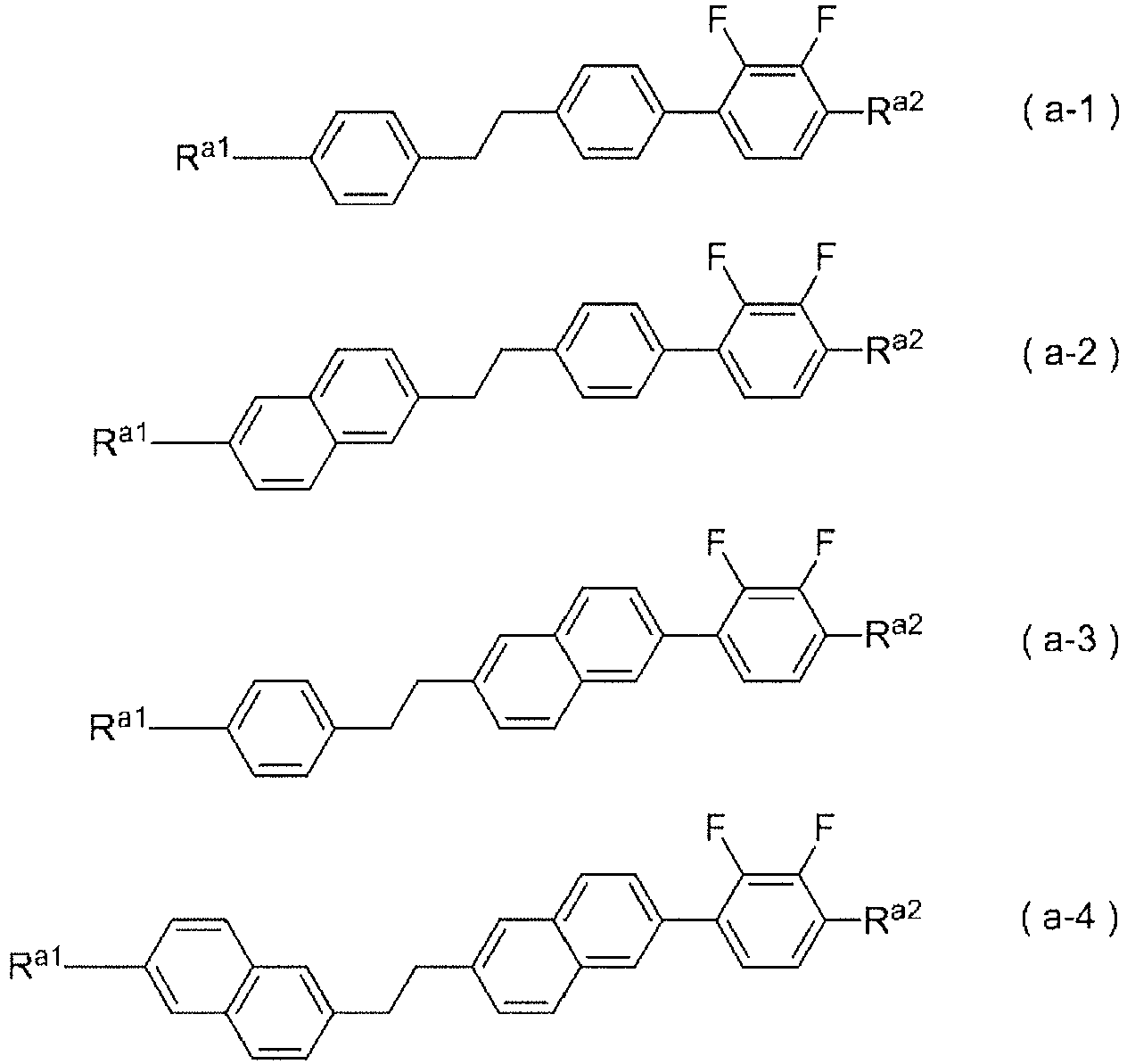


- The liquid crystal composition of the present invention contains at least one compound represented by General Formula (a), and preferably two to ten compounds.
- The lower limit of the total amount of the compounds represented by General Formula (a) in the composition is preferably not less than 0.1 mass% (the term "%" used in the description of the composition hereinafter refers to mass%), also preferably not less than 0.5%, also preferably not less than 1%, also preferably not less than 3%, also preferably not less than 5%, also preferably not less than 10%, also preferably not less than 13%, also preferably not less than 15%, also preferably not less than 18%, also preferably not less than 20%, also preferably not less than 23%, also preferably not less than 25%, also preferably not less than 28%, also preferably not less than 30%, also preferably not less than 33%, also preferably not less than 35%, also preferably not less than 38%, and also preferably not less than 40%. The upper limit thereof is preferably not more than 70%, also preferably not more than 68%, also preferably not more than 65%, also preferably not more than 63%, also preferably not more than 60%, also preferably not more than 55%, also preferably not more than 50%, also preferably not more than 40%, also preferably not more than 38%, also preferably not more than 35%, also preferably not more than 33%, also preferably not more than 30%, also preferably not more than 28%, also preferably not more than 25%, also preferably not more than 23%, also preferably not more than 20%, also preferably not more than 18%, also preferably not more than 15%, and also preferably not more than 10%.
- The liquid crystal composition of the present invention preferably further contains at least one compound selected from the group consisting of compounds represented by General Formulae (LC3) to (LC5).

- (a) a 1,4-cyclohexylene group (in which one -CH2- or two or more -CH2-'s not adjoining each other are each optionally substituted with -O-),
- (b) a 1,4-phenylene group (in which one -CH= or two or more -CH='s not adjoining each other are each optionally substituted with -N=), and
- (c) a naphthalene-2,6-diyl group, a 1,2,3,4-tetrahydronaphthalene-2,6-diyl group, or a decahydronaphthalene-2,6-diyl group (in the naphthalene-2,6-diyl group or the 1,2,3,4-tetrahydronaphthalene-2,6-diyl group, one -CH= or two or more -CH='s not adjoining each other are each optionally substituted with -N=);
- The compounds represented by General Formulae (LC3), (LC4), and (LC5) are preferably compounds each having a negative Δε with an absolute value greater than three.
- RLC31, RLC32, RLC41, RLC42, RLC51, and RLC52 in General Formulae (LC3), (LC4), and (LC5) are preferably each independently an alkyl group having 1 to 8 carbon atoms, an alkoxy group having 1 to 8 carbon atoms, an alkenyl group having 2 to 8 carbon atoms, or an alkenyloxy group having 2 to 8 carbon atoms; also preferably an alkyl group having 1 to 5 carbon atoms, an alkoxy group having 1 to 5 carbon atoms, an alkenyl group having 2 to 5 carbon atoms, or an alkenyloxy group having 2 to 5 carbon atoms; more preferably an alkyl group having 1 to 5 carbon atoms or an alkenyl group having 2 to 5 carbon atoms; further preferably an alkyl group having 2 to 5 carbon atoms or an alkenyl group having 2 or 3 carbon atoms; and especially preferably an alkenyl group having 3 carbon atoms (propenyl group).
- In the case where the ring structures bonded to RLC31, RLC32, RLC91, RLC42, RLC51, and RLC52 are phenyl groups (aromatic), RLC31, RLC32, RLC41, RLC42, RLC51, and RLC52 are each preferably a linear alkyl group having 1 to 5 carbon atoms, a linear alkoxy group having 1 to 4 carbon atoms, or an alkenyl group having 4 or 5 carbon atoms; in the case where the ring structures bonded to them are saturated rings such as cyclohexane, pyran, and dioxane, they are each preferably a linear alkyl group having 1 to 5 carbon atoms, a linear alkoxy group having 1 to 4 carbon atoms, or a linear alkenyl group having 2 to 5 carbon atoms. In order to produce a stable nematic phase, the total number of carbon atoms or, if any, oxygen atoms is preferably five or less, and RLC31, RLC32, RLC41, RLC92, RLC51, and RLC52 are preferably linear.
- The alkenyl group is preferably any group selected from groups represented by Formulae (R1) to (R9) (the black point in each of the formulae represents a carbon atom of the ring structure).

- ALC31, ALC32, ALC41, ALC42, ALC51, and ALC52 are preferably each independently aromatic for large Δn or aliphatic for an improvement in the response speed. They are preferably each independently a trans-1,4-cyclohexylene group, a 1,4-phenylene group, a 2-fluoro-1,4-phenylene group, a 3-fluoro-1,4-phenylene group, a 3,5-difluoro-1,4-phenylene group, a 2,3-difluoro-1,4-phenylene group, a 1,4-cyclohexenylene group, a 1,4-bicyclo[2.2.2]octylene group, a piperidine-1,4-diyl group, a naphthalene-2,6-diyl group, a decahydronaphthalene-2,6-diyl group, or a 1,2,3,4-tetrahydronaphthalene-2,6-diyl group; more preferably any of the following structures; and


- ZLC31, ZLC32, ZLC94, ZLC42, ZLC51, and ZLC52 preferably each independently represent -CH2O-, -CF2O-, -CH2CH2-, -CF2CF2-, or a single bond; more preferably -CH2O-, -CH2CH2-, or a single bond; and especially preferably -CH2O- or a single bond.
- XLC41 is preferably a fluorine atom.
- Z5 is preferably an oxygen atom.
- mLC31 + mLC32, mLC41 + mLC42, and mLC51 + mLC52 are each preferably 1 or 2; and preferred combinations are as follows: mLC31 of 1 and mLC32 of 0, mLC31 of 2 and mLC32 of 0, mLC31 of 1 and mLC32 of 1, mLC31 of 2 and mLC32 of 1, nN21 of 1 and nN22 of 0, nN21 of 2 and nN22 of 0, mLC41 of 1 and mLC42 of 0, and mLC51 of 2 and mLC52 of 0.
- The lower limit of the preferred amount of the compound represented by Formula (LC3) is 1%, 10%, 20%, 30%, 40%, 50%, 55%, 60%, 65%, 70%, 75%, or 80% relative to the amount of the whole composition of the present invention. The upper limit of the preferred amount is 95%, 85%, 75%, 65%, 55%, 45%, 35%, 25%, or 20%.
- The lower limit of the preferred amount of the compound represented by Formula (LC4) is 1%, 10%, 20%, 30%, 40%, 50%, 55%, 60%, 65%, 70%, 75%, or 80% relative to the amount of the whole composition of the present invention. The upper limit of the preferred amount is 95%, 85%, 75%, 65%, 55%, 45%, 35%, 25%, or 20%.
- The lower limit of the preferred amount of the compound represented by Formula (LC5) is 1%, 10%, 20%, 30%, 40%, 50%, 55%, 60%, 65%, 70%, 75%, or 80% relative to the amount of the whole composition of the present invention. The upper limit of the preferred amount is 95%, 85%, 75%, 65%, 55%, 45%, 35%, 25%, or 20%.
- In the case where the composition of the present invention needs to have a viscosity kept at a low level to contribute to a high response speed, it is preferred that the above-mentioned lower limit be low and that the upper limit be low. In the case where the composition of the present invention needs to have a Tni kept at a high level to have a high temperature stability, it is preferred that the above-mentioned lower limit be low and that the upper limit be low. In order to increase dielectric anisotropy for keeping driving voltage at a low level, it is preferred that the above-mentioned lower limit be high and that the upper limit be high.
- The liquid crystal composition of the present invention preferably contains at least one compound represented by General Formula (i) as the compound represented by General Formula (LC3).

- (a) a 1,4-cyclohexylene group (in which one -CH2- or two or more -CH2-'s not adjoining each other are each optionally substituted with -O-),
- (b) a 1,4-phenylene group (in which one -CH= or two or more -CH='s not adjoining each other are each optionally substituted with -N=), and
- (c) a naphthalene-2,6-diyl group, a 1,2,3,4-tetrahydronaphthalene-2,6-diyl group, or a decahydronaphthalene-2,6-diyl group (in the naphthalene-2,6-diyl group or the 1,2,3,4-tetrahydronaphthalene-2,6-diyl group, one -CH= or two or more -CH='s not adjoining each other are each optionally substituted with -N=);
- The compound represented by General Formula (i) is preferably a compound having a negative dielectric anisotropy (Δε) with an absolute value greater than three.
- Ri1 in General Formula (i) is preferably an alkyl group having 1 to 8 carbon atoms, an alkoxy group having 1 to 8 carbon atoms, an alkenyl group having 2 to 8 carbon atoms, or an alkenyloxy group having 2 to 8 carbon atoms; also preferably an alkyl group having 1 to 5 carbon atoms, an alkoxy group having 1 to 5 carbon atoms, an alkenyl group having 2 to 5 carbon atoms, or an alkenyloxy group having 2 to 5 carbon atoms; more preferably an alkyl group having 1 to 5 carbon atoms or an alkenyl group having 2 to 5 carbon atoms; further preferably an alkyl group having 2 to 5 carbon atoms or an alkenyl group having 2 or 3 carbon atoms; and especially preferably an alkenyl group having 3 carbon atoms (propenyl group).
- Ri2 is preferably an alkyl group having 1 to 8 carbon atoms, an alkoxy group having 1 to 8 carbon atoms, an alkenyl group having 2 to 8 carbon atoms, or an alkenyloxy group having 2 to 8 carbon atoms; also preferably an alkyl group having 1 to 5 carbon atoms, an alkoxy group having 1 to 5 carbon atoms, an alkenyl group having 2 to 5 carbon atoms, or an alkenyloxy group having 2 to 5 carbon atoms; and further preferably an alkoxy group having 1 to 4 carbon atoms. In terms of an improvement in the response speed of a display device, an alkenyl group is preferred; in terms of reliability such as a voltage holding ratio, an alkyl group is preferred. In the case where at least any one of Ri1 and Ri2 is an alkenyl group, the alkenyl group is preferably any group selected from groups represented by Formulae (R1) to (R9) (the black point in each of the formulae represents the linkage to the ring).

- Ai1 and Ai2 in General Formula (i) are preferably each independently a trans-1,4-cyclohexylene group, a 1,4-phenylene group, a 2-fluoro-1,4-phenylene group, a 3-fluoro-1,4-phenylene group, a 3,5-difluoro-1,4-phenylene group, a 2,3-difluoro-1,4-phenylene group, a 1,4-cyclohexenylene group, a 1,4-bicyclo[2.2.2]octylene group, a piperidine-1,4-diyl group, a naphthalene-2,6-diyl group, a decahydronaphthalene-2,6-diyl group, or a 1,2,3,4-tetrahydronaphthalene-2,6-diyl group; more preferably any of the following structures; and

- Zi1 and Zi2 preferably each independently represent - CH2O-, -CF2O-, -CH2CH2-, -CF2CF2-, or a single bond; more preferably -CH2O-, -CH2CH2-, or a single bond; and especially preferably -CH2O- or a single bond. At least one Zi1 represents -OCH2-, -CH2O-, -OCF2-, -CF2O-, -CH2CH2-, or - CF2CF2-; preferably -CH2O-, -CF2O-, -CH2CH2-, or -CF2CF2; more preferably -CH2O- or -CH2CH2-; and especially preferably - CH2O-.
- mi1 represents an integer from 1 to 3; mi2 each independently represents an integer from 0 to 3; mi1 + mi2 is 1, 2, or 3; and mi1 + mi2 is preferably 1 or 2.
- At least one compound represented by General Formula (i-1) is preferably used as the compound represented by General Formula (i).

- The compound represented by General Formula (i-1) is preferably any of compounds represented by General Formulae (i-1A), (i-1B), and (i-1C).


- The compound represented by General Formula (i-1A) is preferably any of compounds represented by General Formulae (i-1A-1) to (i-1A-4).
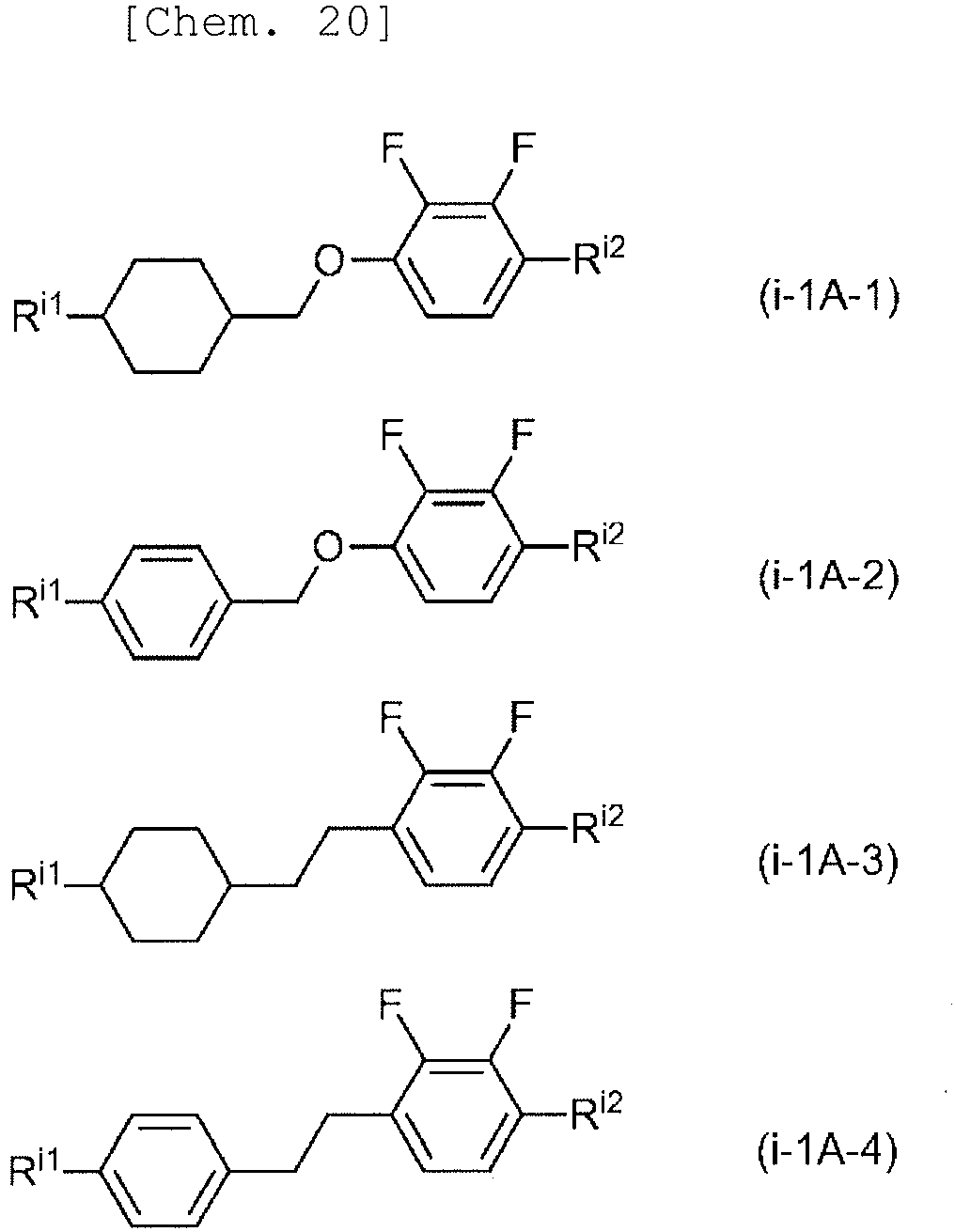
- The compound represented by General Formula (i-1B) is preferably any of compounds represented by General Formulae (i-1B-1) to (i-1B-6).

- The compound represented by General Formula (i-1C) is preferably any of compounds represented by General Formulae (i-1C-1) to (i-1C-4), and more preferably any of the compounds represented by General Formulae (i1C-1) and (i-1C-2).

- The liquid crystal composition of the present invention preferably contains at least one compound represented by General Formula (i); the liquid crystal composition may contain at least one compound selected from the group consisting of the compounds represented by General Formulae (i-1A), (i-1B), and (i-1C). Alternatively, at least one compound may be selected from each of the compounds represented by General Formula (i-1A), the compounds represented by General Formula (i-1B), and the compounds represented by General Formula (i-1C); and the liquid crystal composition may contain the selected ones. At least one compound selected from the compounds represented by General Formulae (i-1A) and (i-1B) is preferably used, and two to ten compounds selected therefrom are more preferably used.
- In particular, at least one compound is preferably selected from the group consisting of the compounds represented by General Formulae (i-1A-1), (i-1B-1), and (i-1C-1) as the compounds represented by General Formulae (i-1A), (i-1B), and (i-1C), respectively; and a combination of the compounds represented by General Formulae (i-1A-1) and (i-1B-1) is more preferably employed.
- The lower limit of the total amount of the compounds represented by General Formula (i) in the composition is preferably not less than 0.1 mass% (the term "%" used in the description of the composition hereinafter refers to mass%), also preferably not less than 0.5%, also preferably not less than 1%, also preferably not less than 3%, also preferably not less than 5%, also preferably not less than 10%, also preferably not less than 13%, also preferably not less than 15%, also preferably not less than 18%, also preferably not less than 20%, also preferably not less than 23%, also preferably not less than 25%, also preferably not less than 28%, also preferably not less than 30%, also preferably not less than 33%, also preferably not less than 35%, also preferably not less than 38%, and also preferably not less than 40%. The upper limit thereof is preferably not more than 95%, also preferably not more than 90%, also preferably not more than 88%, also preferably not more than 85%, also preferably not more than 83%, also preferably not more than 80%, also preferably not more than 78%, also preferably not more than 75%, also preferably not more than 73%, also preferably not more than 70%, also preferably not more than 68%, also preferably not more than 65%, also preferably not more than 63%, also preferably not more than 60%, also preferably not more than 55%, also preferably not more than 50%, also preferably not more than 40%, also preferably not more than 38%, also preferably not more than 35%, also preferably not more than 33%, also preferably not more than 30%, also preferably not more than 28%, also preferably not more than 25%, also preferably not more than 23%, also preferably not more than 20%, also preferably not more than 18%, also preferably not more than 15%, and also preferably not more than 10%.
- The liquid crystal composition of the present invention preferably contains at least one compound represented by General Formula (ii) as the compound represented by General Formula (LC3).

- (in the formula, Rii1 and Rii2 each independently represent an alkyl group having 1 to 10 carbon atoms or an alkenyl group having 2 to 10 carbon atoms; in each of these groups, at least one -CH2- or two or more -CH2-'s not adjoining each other are each independently optionally substituted with -O- or -S-, and one or more hydrogen atoms are each independently optionally substituted with a fluorine atom or a chlorine atom; Aii1 and Aii2 each independently represent a group selected from the group consisting of
- (a) a 1,4-cyclohexylene group (in which one -CH2- or two or more -CH2-'s not adjoining each other are each optionally substituted with -O-),
- (b) a 1,4-phenylene group (in which one -CH= or two or more -CH='s not adjoining each other are each optionally substituted with -N=), and
- (c) a naphthalene-2,6-diyl group, a 1,2,3,4-tetrahydronaphthalene-2,6-diyl group, or a decahydronaphthalene-2,6-diyl group (in the naphthalene-2,6-diyl group or the 1,2,3,4-tetrahydronaphthalene-2,6-diyl group, one -CH= or two or more -CH='s not adjoining each other are each optionally substituted with -N=);
- mii1 preferably represents 1 or 2, mi2 preferably represents 0 or 1, mi1 + mi2 is preferably 1 or 2.
- At least one compound represented by General Formula (II-2) is preferably used as the compound represented by General Formula (ii).

- The compound represented by General Formula (II-2) is preferably any of compounds represented by General Formula (II-2A) or (II-2B).


- (a) a 1,4-cyclohexylene group (in which one -CH2- or two or more -CH2-'s not adjoining each other are each optionally substituted with -O-),
- (b) a 1,4-phenylene group (in which one -CH= or two or more -CH='s not adjoining each other are each optionally substituted with -N=), and
- (c) a naphthalene-2,6-diyl group, a 1,2,3,4-tetrahydronaphthalene-2,6-diyl group, or a decahydronaphthalene-2,6-diyl group (in the naphthalene-2,6-diyl group or the 1,2,3,4-tetrahydronaphthalene-2,6-diyl group, one -CH= or two or more -CH='s not adjoining each other are each optionally substituted with -N=);
- The compound represented by General Formula (II-2A) is preferably any of compounds represented by General Formulae (II-2A-1) and (II-2A-2).

- The compound represented by General Formula (II-2B) is preferably any of compounds represented by General Formulae (II-2B-1) to (II-2B-3).

- The liquid crystal composition of the present invention preferably contains at least one compound represented by General Formula (ii); the liquid crystal composition may contain at least one compound selected from the group consisting of the compounds represented by General Formulae (II-2A) and (II-2B). Alternatively, at least one compound may be selected from each of the compounds represented by General Formula (II-2A) and the compounds represented by General Formula (II-2B), and the liquid crystal composition may contain the selected ones. Two to ten compounds selected from the compounds represented by General Formulae (II-2A) and (II-2B) are preferably used.
- In particular, the compound represented by General Formula (II-2A) is preferably at least one compound selected from the group consisting of the compounds represented by General Formula (II-2A-1), the compound represented by General Formula (II-2B) is preferably at least one compound selected from the group consisting of the compounds represented by General Formulae (II-2B-1) and (II-2B-2), and a combination of the compounds represented by General Formulae (II-2A-1) and (II-2B-1) is more preferably employed.
- At least one compound represented by General Formula (LC3-b) is preferably used as the compound represented by General Formula (LC3).

- The compound represented by General Formula (LC3-b) is preferably any of compounds represented by General Formulae (LC3-b1) to (LC3-b10).


RLC33 and RLC34 can be any combination. Preferred combinations are as follows: both of them are alkyl groups or alkenyl groups; either of them is an alkyl group, and the other one thereof is an alkenyl group; either of them is an alkyl group, and the other one thereof is an alkoxy group; and either of them is an alkyl group, and the other one thereof is an alkenyloxy group. It is more preferred that both of RLC33 and RLC34 be alkyl groups or that both of RLC33 and RLC34 be alkenyl groups. - The compound represented by General Formula (LC3-b) is preferably any of compounds represented by General Formula (LC3-c).

- The compound represented by General Formula (LC4) is preferably any of compounds represented by General Formulae (LC4-a) to (LC4-d).

- The compound represented by General Formula (LC4) is also preferably any of compounds represented by General Formulae (LC4-a1) to (LC4-d1).

- The compound represented by General Formula (LC5) is preferably any of compounds represented by General Formulae (LC5-a) to (LC5-c).
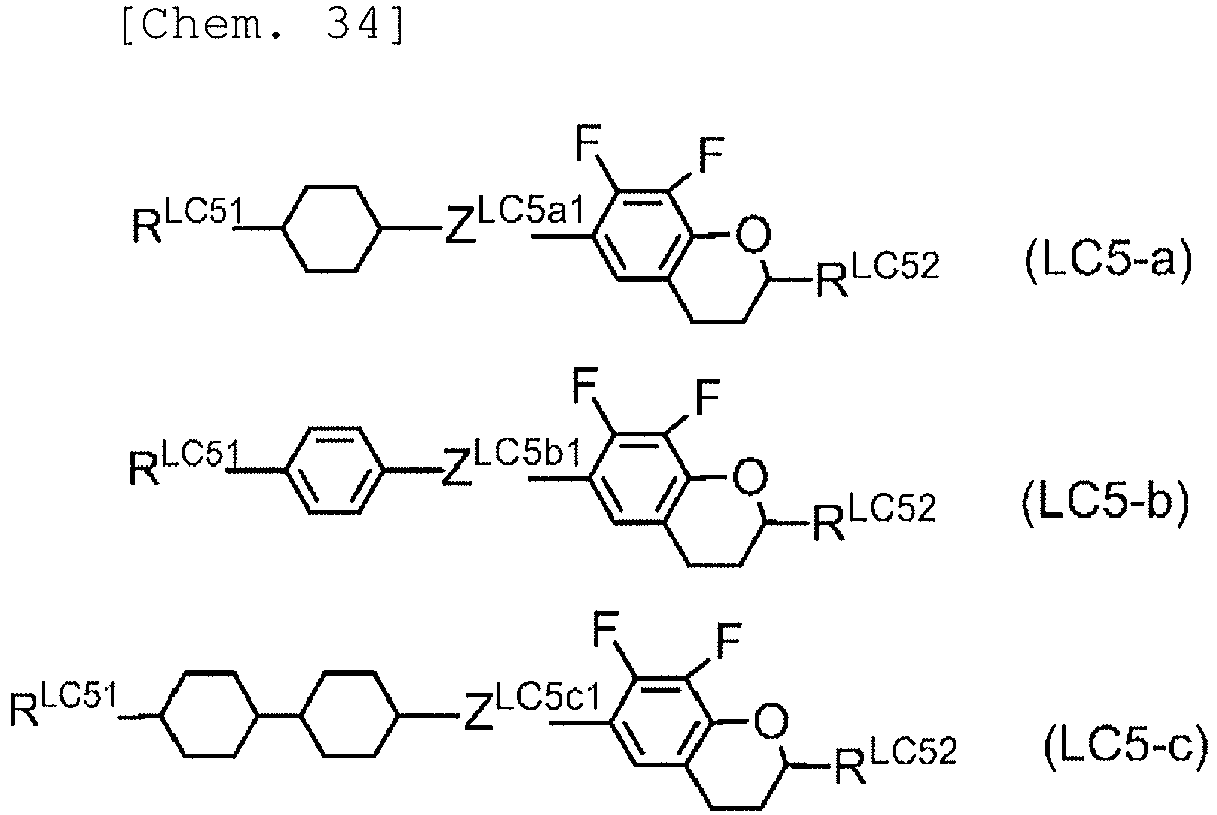
- The compound represented by General Formula (LC5) is also preferably any of compounds represented by General Formulae (LC5-a1) to (LC5-c3).


- The liquid crystal composition of the present invention preferably further contains at least one compound represented by General Formula (L). The compound represented by General Formula (L) is a substantially dielectrically neutral compound (Δε from -2 to 2).


nL1 represents 0, 1, 2, or 3;
AL1, AL2, and AL3 each independently represent a group selected from the group consisting of - (a) a 1,4-cyclohexylene group (in which one -CH2- or at least two -CH2-'s not adjoining each other are each optionally substituted with -O-),
- (b) a 1,4-phenylene group (in which one -CH= or at least two -CH='s not adjoining each other are each optionally substituted with -N=), and
- (c) a naphthalene-2,6-diyl group, a 1,2,3,4-tetrahydronaphthalene-2,6-diyl group, or a decahydronaphthalene-2,6-diyl group (in the naphthalene-2,6-diyl group or the 1,2,3,4-tetrahydronaphthalene-2,6-diyl group, one -CH= or at least two -CH='s not adjoining each other are each optionally substituted with -N=);
- The compounds represented by General Formula (L) may be used alone or in combination. Such compounds can be used in any combination; a proper combination of the compounds is determined on the basis of predetermined properties such as solubility at low temperature, transition temperature, electric reliability, and birefringence. In an embodiment of the present invention, for example, one of such compounds is used. Furthermore, two of the compounds are used in another embodiment of the present invention, three of the compounds are used in another embodiment, four of the compounds are used in another embodiment, five of the compounds are used in another embodiment, six of the compounds are used in another embodiment, seven of the compounds are used in another embodiment, eight of the compounds are used in another embodiment, nine of the compounds are used in another embodiment, and ten or more of the compounds are used in another embodiment.
- In the composition of the present invention, the amount of the compound represented by General Formula (L) needs to be appropriately adjusted on the basis of the intended properties such as solubility at low temperature, transition temperature, electric reliability, birefringence, process adaptability, droplet stains, image-sticking, and dielectric anisotropy.
- The lower limit of the preferred amount of the compound represented by Formula (L) is 1%, 10%, 20%, 30%, 40%, 50%, 55%, 60%, 65%, 70%, 75%, or 80% relative to the amount of the whole composition of the present invention. The upper limit of the preferred amount is 95%, 85%, 75%, 65%, 55%, 45%, 35%, or 25%.
- In the case where the composition of the present invention needs to have a viscosity kept at a low level to contribute to a high response speed, it is preferred that the above-mentioned lower limit be high and that the upper limit be high. In the case where the composition of the present invention needs to have a Tni kept at a high level to have a high temperature stability, it is preferred that the above-mentioned lower limit be high and that the upper limit be high. In order to increase dielectric anisotropy for keeping driving voltage at a low level, it is preferred that the above-mentioned lower limit be low and that the upper limit be low.
- In the case of focusing on the reliability, RL1 and RL2 are each preferably an alkyl group; in the case of focusing on a reduction in the volatility of the compound, they are each preferably an alkoxy group; and in the case of focusing on a reduction in the viscosity, at least one of them is preferably an alkenyl group.
- In the case where the ring structures bonded to RL1 and RL2 are phenyl groups (aromatics), RL1 and RL2 are each preferably a linear alkyl group having 1 to 5 carbon atoms, a linear alkoxy group having 1 to 4 carbon atoms, or an alkenyl group having 4 or 5 carbon atoms; in the case where the ring structures bonded to RL1 and RL2 are saturated rings such as cyclohexane, pyran, and dioxane, RL1 and RL2 are each preferably a linear alkyl group having 1 to 5 carbon atoms, a linear alkoxy group having 1 to 4 carbon atoms, or a linear alkenyl group having 2 to 5 carbon atoms. In order to produce a stable nematic phase, the total number of carbon atoms or, if any, oxygen atoms is preferably five or less, and RL1 and RL2 are preferably linear.
- The alkenyl group is preferably any group selected from groups represented by Formulae (R1) to (R9) (the black point in each of the formulae represents a carbon atom of the ring structure).

- In the case of focusing on the response speed, nL1 is preferably 0; in order to improve the upper limit of the temperature of the nematic phase, nL1 is preferably 2 or 3; and in order to take a balance therebetween, nL1 is preferably 1. In order to satisfy the properties necessary for the composition, compounds having a difference in nL1 are preferably used in combination.
- ALl, AL2, and AL3 are preferably aromatic for large Δn or aliphatic for an improvement in the response speed. They are preferably each independently a trans-1,4-cyclohexylene group, a 1,4-phenylene group, a 2-fluoro-1,4-phenylene group, a 3-fluoro-1,4-phenylene group, a 3,5-difluoro-1,4-phenylene group, a 1,4-cyclohexenylene group, a 1,4-bicyclo[2.2.2]octylene group, a piperidine-1,4-diyl group, a naphthalene-2,6-diyl group, a decahydronaphthalene-2,6-diyl group, or a 1,2,3,4-tetrahydronaphthalene-2,6-diyl group; more preferably any of the following structures; and

- ZL1 and ZL2 are each preferably a single bond in the case of focusing on the response speed.
- The number of halogen atoms per molecule is preferably zero or one. The compound represented by General Formula (L) is preferably a compound selected from the group consisting of compounds represented by General Formulae (L-1) to (L-7).
- The compound represented by General Formula (L-1) is as follows.

RL11 and RL12 is each preferably a linear alkyl group having 1 to 10 carbon atoms, a linear alkoxy group having 1 to 9 carbon atoms, or a linear alkenyl group having 2 to 10 carbon atoms; also preferably a linear alkyl group having 1 to 8 carbon atoms, a linear alkoxy group having 1 to 7 carbon atoms, or a linear alkenyl group having 2 to 8 carbon atoms; and also preferably a linear alkyl group having 1 to 5 carbon atoms, a linear alkoxy group having 1 to 4 carbon atoms, or a linear alkenyl group having 2 to 5 carbon atoms. - Any one or both of RL11 and RL12 are preferably linear alkenyl groups each having 2 to 8 carbon atoms, and more preferably linear alkenyl groups each having 2 to 5 carbon atoms. It is preferred that any one of RL11 and RL12 be a linear alkenyl group having 2 to 5 carbon atoms and that the other one thereof be a linear alkyl group having 1 to 5 carbon atoms.
- It is preferred that both of RL11 and RL12 be linear alkyl groups each having 1 to 8 carbon atoms or linear alkoxy groups each having 1 to 7 carbon atoms, and it is more preferred that both of them be linear alkyl groups each having 1 to 5 carbon atoms or linear alkoxy groups each having 1 to 4 carbon atoms. It is also preferred that any one of RL11 and RL12 be an alkyl group having 1 to 5 carbon atoms and that the other one thereof be an alkyl group having 1 to 5 carbon atoms or a linear alkoxy group having 1 to 4 carbon atoms, and it is more preferred that both of RL11 and RL12 be linear alkyl groups each having 1 to 5 carbon atoms.
- The compounds represented by General Formula (L-1) may be used alone or in combination. Such compounds can be used in any combination; a proper combination of the compounds is determined on the basis of the intended properties such as solubility at low temperature, transition temperature, electric reliability, and birefringence. For example, one of such compounds is used in an embodiment of the present invention, two of the compounds are used in another embodiment, three of the compounds are used in another embodiment, four of the compounds are used in another embodiment, and five or more of the compounds are used in another embodiment.
- The lower limit of the preferred amount of the compound is 1%, 2%, 3%, 5%, 7%, 10%, 15%, 20%, 25%, 30%, 35%, 40%, 45%, 50%, or 55% relative to the amount of the whole composition of the present invention. The upper limit of the preferred amount is 95%, 90%, 85%, 80%, 75%, 70%, 65%, 60%, 55%, 50%, 45%, 40%, 35%, 30%, or 25% relative to the amount of the whole composition of the present invention.
- In the case where the composition of the present invention needs to have a viscosity kept at a low level to contribute to a high response speed, it is preferred that the above-mentioned lower limit be high and that the upper limit be high. In the case where the composition of the present invention needs to have a Tni kept at a high level to have a high temperature stability, it is preferred that the above-mentioned lower limit be moderate and that the upper limit be moderate. In order to increase dielectric anisotropy for keeping driving voltage at a low level, it is preferred that the above-mentioned lower limit be low and that the upper limit be low.
- The compound represented by General Formula (L-1) is preferably a compound selected from the group consisting of compounds represented by General Formula (L-1-1).

- The compound represented by General Formula (L-1-1) is preferably a compound selected from the group consisting of compounds represented by Formulae (L-1-1.1) to (L-1-1.3), also preferably the compound represented by Formula (L-1-1.2) or (L-1-1.3), and especially preferably the compound represented by Formula (L-1-1.3).

- The lower limit of the preferred amount of the compound represented by Formula (L-1-1.3) is preferably 1%, 2%, 3%, 5%, 7%, or 10% relative to the amount of the whole composition of the present invention. The upper limit of the preferred amount is 20%, 15%, 13%, 10%, 8%, 7%, 6%, 5%, or 3% relative to the amount of the whole composition of the present invention.
- The compound represented by General Formula (L-1) is preferably a compound selected from the group consisting of compounds represented by General Formula (L-1-2).

- The lower limit of the preferred amount of the compound represented by Formula (L-1-2) is preferably 1%, 5%, 10%, 15%, 17%, 20%, 23%, 25%, 27%, 30%, or 35% relative to the amount of the whole composition of the present invention. The upper limit of the preferred amount is 60%, 55%, 50%, 45%, 42%, 40%, 38%, 35%, 33%, or 30% relative to the amount of the whole composition of the present invention.
- The compound represented by General Formula (L-1-2) is preferably a compound selected from the group consisting of compounds represented by Formulae (L-1-2.1) to (L-1-2.4), and also preferably any of the compounds represented by Formulae (L-1-2.2) to (L-1-2.4). In particular, the compound represented by Formula (L-1-2.2) is preferred because it especially enhances the response speed of the composition of the present invention. In the case where high Tni is needed rather than the response speed, it is preferred that the compound represented by Formula (L-1-2.3) or (L-1-2.4) be employed. In order to improve solubility at low temperature, it is preferred that the amount of each of the compounds represented by Formulae (L-1-2.3) and (L-1-2.4) be less than 30%.

- The lower limit of the preferred amount of the compound represented by Formula (L-1-2.2) is 10%, 15%, 18%, 20%, 23%, 25%, 27%, 30%, 33%, 35%, 38%, or 40% relative to the amount of the whole composition of the present invention. The upper limit of the preferred amount is 60%, 55%, 50%, 45%, 43%, 40%, 38%, 35%, 32%, 30%, 27%, 25%, or 22% relative to the amount of the whole composition of the present invention.
- The composition of the present invention preferably contains the compounds represented by Formulae (L-1-1.3) and (L-1-2.2). The lower limit of the preferred amount of a combination of the compounds represented by Formulae (L-1-1.3) and (L-1-2.2) is 10%, 15%, 20%, 25%, 27%, 30%, 35%, or 40% relative to the amount of the whole composition of the present invention. The upper limit of the preferred amount is 60%, 55%, 50%, 45%, 43%, 40%, 38%, 35%, 32%, 30%, 27%, 25%, or 22% relative to the amount of the whole composition of the present invention.
- The compound represented by General Formula (L-1) is preferably a compound selected from the group consisting of compounds represented by General Formula (L-1-3).


RL13 and RL14 are each preferably a linear alkyl group having 1 to 5 carbon atoms or a linear alkoxy group having 1 to 4 carbon atoms. - The lower limit of the preferred amount of the compound represented by Formula (L-1-3) is 1%, 5%, 10%, 13%, 15%, 17%, 20%, 23%, 25%, or 30% relative to the amount of the whole composition of the present invention. The upper limit of the preferred amount is 60%, 55%, 50%, 45%, 40%, 37%, 35%, 33%, 30%, 27%, 25%, 23%, 20%, 17%, 15%, 13%, or 10% relative to the amount of the whole composition of the present invention.
The compound represented by General Formula (L-1-3) is preferably a compound selected from the group consisting of compounds represented by Formulae (L-1-3.1) to (L-1-3.12), and also preferably any of the compounds represented by Formulae (L-1-3.1), (L-1-3.3), and (L-1-3.4). In particular, the compound represented by Formula (L-1-3.1) is preferred because it especially enhances the response speed of the composition of the present invention. In the case where high Tni is needed rather than the response speed, it is preferred that the compound represented by Formula (L-1-3.3), (L-1-3.4), (L-1-3.11), or (L-1-3.12) be employed. In order to improve solubility at low temperature, it is preferred that the total amount of the compounds represented by Formulae (L-1-3.3), (L-1-3.4), (L-1-3.11), and (L-1-3.12) be less than 20%.
- The lower limit of the preferred amount of the compound represented by Formula (L-1-3.1) is 1%, 2%, 3%, 5%, 7%, 10%, 13%, 15%, 18%, or 20% relative to the amount of the whole composition of the present invention. The upper limit of the preferred amount is 20%, 17%, 15%, 13%, 10%, 8%, 7%, or 6% relative to the amount of the whole composition of the present invention.
- The compound represented by General Formula (L-1) is preferably a compound selected from the group consisting of compounds represented by General Formula (L-1-4) and/or General Formula (L-1-5).

RL15 and RL16 are each preferably a linear alkyl group having 1 to 5 carbon atoms, a linear alkoxy group having 1 to 4 carbon atoms, or a linear alkenyl group having 2 to 5 carbon atoms. - The lower limit of the preferred amount of the compound represented by Formula (L-1-4) is 1%, 5%, 10%, 13%, 15%, 17%, or 20% relative to the amount of the whole composition of the present invention. The upper limit of the preferred amount is 25%, 23%, 20%, 17%, 15%, 13%, or 10% relative to the amount of the whole composition of the present invention.
- The lower limit of the preferred amount of the compound represented by Formula (L-1-5) is 1%, 5%, 10%, 13%, 15%, 17%, or 20% relative to the amount of the whole composition of the present invention. The upper limit of the preferred amount is 25%, 23%, 20%, 17%, 15%, 13%, or 10% relative to the amount of the whole composition of the present invention.
- The compounds represented by General Formulae (L-1-4) and (L-1-5) are preferably compounds selected from the group consisting of compounds represented by Formulae (L-1-4.1) to (L-1-5.3), and also preferably the compounds represented by Formulae (L-1-4.2) and (L-1-5.2).


- The lower limit of the preferred amount of the compound represented by Formula (L-1-4.2) is 1%, 2%, 3%, 5%, 7%, 10%, 13%, 15%, 18%, or 20% relative to the amount of the whole composition of the present invention. The upper limit of the preferred amount is 20%, 17%, 15%, 13%, 10%, 8%, 7%, or 6% relative to the amount of the whole composition of the present invention.
- At least two compounds selected from the compounds represented by Formulae (L-1-1.3), (L-1-2.2), (L-1-3.1), (L-1-3.3), (L-1-3.4), (L-1-3.11), and (L-1-3.12) are preferably used in combination; and at least two compounds selected from the compounds represented by Formulae (L-1-1.3), (L-1-2.2), (L-1-3.1), (L-1-3.3), (L-1-3.4), and (L-1-4.2) are also preferably used in combination. The lower limit of the preferred amount of the compounds in each of such combinations is 1%, 2%, 3%, 5%, 7%, 10%, 13%, 15%, 18%, 20%, 23%, 25%, 27%, 30%, 33%, or 35% relative to the amount of the whole composition of the present invention. The upper limit thereof is 80%, 70%, 60%, 50%, 45%, 40%, 37%, 35%, 33%, 30%, 28%, 25%, 23%, or 20% relative to the amount of the whole composition of the present invention. In the case of focusing on the reliability of the composition, two or more compounds selected from the compounds represented by Formulae (L-1-3.1), (L-1-3.3), and (L-1-3.4) are preferably used in combination; in the case of focusing on the response speed of the composition, two or more compounds selected from the compounds represented by Formulae (L-1-1.3) and (L-1-2.2) are preferably used in combination.
- The compound represented by General Formula (L-2) is as follows.

RL21 is preferably an alkyl group having 1 to 5 carbon atoms or an alkenyl group having 2 to 5 carbon atoms, and RL22 is preferably an alkyl group having 1 to 5 carbon atoms, an alkenyl group having 4 or 5 carbon atoms, or an alkoxy group having 1 to 4 carbon atoms. - The compounds represented by General Formula (L-1) may be used alone or in combination. Such compounds can be used in any combination; a proper combination of the compounds is determined on the basis of the intended properties such as solubility at low temperature, transition temperature, electric reliability, and birefringence. For example, one of such compounds is used in an embodiment of the present invention, two of the compounds are used in another embodiment, three of the compounds are used in another embodiment, four of the compounds are used in another embodiment, and five or more of the compounds are used in another embodiment.
- In terms of solubility at low temperature, the amount is adjusted to be larger to produce a greater effect; in terms of response speed, the amount is adjusted to be smaller to produce a greater effect. In order to improve properties related to droplet stains and image-sticking, the range of the amount is preferably adjusted to be intermediate.
- The lower limit of the preferred amount of the compound represented by Formula (L-2) is 1%, 2%, 3%, 5%, 7%, or 10% relative to the amount of the whole composition of the present invention. The upper limit of the preferred amount is 20%, 15%, 13%, 10%, 8%, 7%, 6%, 5%, or 3% relative to the amount of the whole composition of the present invention.
- The compound represented by General Formula (L-2) is preferably a compound selected from the group consisting of compounds represented by Formulae (L-2.1) to (L-2.6), and also preferably any of the compounds represented by Formulae (L-2.1), (L-2.3), (L-2.4), and (L-2.6).


- The compound represented by General Formula (L-3) is as follows.

RL31 and RL32 are preferably each independently an alkyl group having 1 to 5 carbon atoms, an alkenyl group having 4 or 5 carbon atoms, or an alkoxy group having 1 to 4 carbon atoms. - The compounds represented by General Formula (L-3) may be used alone or in combination. Such compounds can be used in any combination; a proper combination of the compounds is determined on the basis of the intended properties such as solubility at low temperature, transition temperature, electric reliability, and birefringence. For example, one of such compounds is used in an embodiment of the present invention, two of the compounds are used in another embodiment, three of the compounds are used in another embodiment, four of the compounds are used in another embodiment, and five or more of the compounds are used in another embodiment.
- The lower limit of the preferred amount of the compound represented by Formula (L-3) is 1%, 2%, 3%, 5%, 7%, or 10% relative to the amount of the whole composition of the present invention. The upper limit of the preferred amount is 20%, 15%, 13%, 10%, 8%, 7%, 6%, 5%, or 3% relative to the amount of the whole composition of the present invention.
- In terms of an enhancement in birefringence, the amount is adjusted to be larger to produce a greater effect; in terms of high Tni, the amount is adjusted to be smaller to produce a greater effect. In order to improve properties related to droplet stains and image-sticking, the range of the amount is preferably adjusted to be intermediate.
- The compound represented by General Formula (L-3) is preferably a compound selected from the group consisting of compounds represented by Formulae (L-3.1) to (L-3.9), also preferably any of the compounds represented by Formulae (L-3.1) to (L-3.7), and also preferably any of the compounds represented by Formulae (L-3.1), (L-3.2), (L-3.6), and (L-3.7).

- The compound represented by General Formula (L-4) is as follows.

RL41 is preferably an alkyl group having 1 to 5 carbon atoms or an alkenyl group having 2 to 5 carbon atoms; and RL42 is preferably an alkyl group having 1 to 5 carbon atoms, an alkenyl group having 4 or 5 carbon atoms, or an alkoxy group having 1 to 4 carbon atoms.) - The compounds represented by General Formula (L-4) may be used alone or in combination. Such compounds can be used in any combination; a proper combination of the compounds is determined on the basis of the intended properties such as solubility at low temperature, transition temperature, electric reliability, and birefringence. For example, one of such compounds is used in an embodiment of the present invention, two of the compounds are used in another embodiment, three of the compounds are used in another embodiment, four of the compounds are used in another embodiment, and five or more of the compounds are used in another embodiment.
- In the composition of the present invention, the amount of the compound represented by General Formula (L-4) needs to be appropriately adjusted on the basis of the intended properties such as solubility at low temperature, transition temperature, electric reliability, birefringence, process adaptability, droplet stains, image-sticking, and dielectric anisotropy.
- The lower limit of the preferred amount of the compound represented by Formula (L-4) is 1%, 2%, 3%, 5%, 7%, 10%, 14%, 16%, 20%, 23%, 26%, 30%, 35%, or 40% relative to the amount of the whole composition of the present invention. The upper limit of the preferred amount of the compound represented by Formula (L-4) is 50%, 40%, 35%, 30%, 20%, 15%, 10%, or 5% relative to the amount of the whole composition of the present invention.
- The compound represented by General Formula (L-4) is, for example, preferably any of compounds represented by Formulae (L-4.1) to (L-4.3).


- On the basis of the intended properties such as solubility at low temperature, transition temperature, electric reliability, and birefringence, the compound represented by Formula (L-4.1) may be used, the compound represented by Formula (L-4.2) may be used, both the compounds represented by Formulae (L-4.1) and (L-4.2) may be used, and all of the compounds represented by Formulae (L-4.1) to (L-4.3) may be used. The lower limit of the preferred amount of the compound represented by Formula (L-4.1) or (L-4.2) is 3%, 5%, 7%, 9%, 11%, 12%, 13%, 18%, or 21% relative to the amount of the whole composition of the present invention. The upper limit of the preferred amount is 45, 40%, 35%, 30%, 25%, 23%, 20%, 18%, 15%, 13%, 10%, or 8% relative to the amount of the whole composition of the present invention.
- In the case where both the compound represented by Formula (L-4.1) and the compound represented by Formula (L-4.2) are used, the lower limit of the preferred amount thereof is 15%, 19%, 24%, or 30% relative to the amount of the whole composition of the present invention. The upper limit of the preferred amount is 45, 40%, 35%, 30%, 25%, 23%, 20%, 18%, 15%, or 13% relative to the amount of the whole composition of the present invention.
- The compound represented by General Formula (L-4) is, for instance, preferably any of compounds represented by Formulae (L-4.4) to (L-4.6), and also preferably the compound represented by Formula (L-4.4).

- On the basis of the intended properties such as solubility at low temperature, transition temperature, electric reliability, and birefringence, the compound represented by Formula (L-4.4) may be used, the compound represented by Formula (L-4.5) may be used, and both the compounds represented by Formulae (L-4.4) and (L-4.5) may be used.
- The lower limit of the preferred amount of the compound represented by Formula (L-4.4) or (L-4.5) is 3%, 5%, 7%, 9%, 11%, 12%, 13%, 18%, or 21% relative to the amount of the whole composition of the present invention. The upper limit of the preferred amount is 45, 40%, 35%, 30%, 25%, 23%, 20%, 18%, 15%, 13%, 10%, or 8% relative to the amount of the whole composition of the present invention.
- In the case where both the compound represented by Formula (L-4.4) and the compound represented by Formula (L-4.5) are used, the lower limit of the preferred amount thereof is 15%, 19%, 24%, or 30% relative to the amount of the whole composition of the present invention. The upper limit of the preferred amount is 45, 40%, 35%, 30%, 25%, 23%, 20%, 18%, 15%, or 13% relative to the amount of the whole composition of the present invention.
- The compound represented by General Formula (L-4) is preferably any of compounds represented by Formulae (L-4.7) to (L-4.10), and especially preferably the compound represented by Formula (L-4.9).


- The compound represented by General Formula (L-5) is as follows.

RL51 is preferably an alkyl group having 1 to 5 carbon atoms or an alkenyl group having 2 to 5 carbon atoms; and RL52 is preferably an alkyl group having 1 to 5 carbon atoms, an alkenyl group having 4 or 5 carbon atoms, or an alkoxy group having 1 to 4 carbon atoms. - The compounds represented by General Formula (L-5) may be used alone or in combination. Such compounds can be used in any combination; a proper combination of the compounds is determined on the basis of the intended properties such as solubility at low temperature, transition temperature, electric reliability, and birefringence. For example, one of such compounds is used in an embodiment of the present invention, two of the compounds are used in another embodiment, three of the compounds are used in another embodiment, four of the compounds are used in another embodiment, and five or more of the compounds are used in another embodiment.
- In the composition of the present invention, the amount of the compound represented by General Formula (L-5) needs to be appropriately adjusted on the basis of the intended properties such as solubility at low temperature, transition temperature, electric reliability, birefringence, process adaptability, droplet stains, image-sticking, and dielectric anisotropy.
- The lower limit of the preferred amount of the compound represented by Formula (L-5) is 1%, 2%, 3%, 5%, 7%, 10%, 14%, 16%, 20%, 23%, 26%, 30%, 35%, or 40% relative to the amount of the whole composition of the present invention. The upper limit of the preferred amount represented by Formula (L-5) is 50%, 40%, 35%, 30%, 20%, 15%, 10%, or 5% relative to the amount of the whole composition of the present invention.
- The compound represented by General Formula (L-5) is preferably a compound represented by Formula (L-5.1) or (L-5.2), and especially preferably the compound represented by Formula (L-5.1).
- The lower limit of the preferred amount of these compounds is 1%, 2%, 3%, 5%, or 7% relative to the amount of the whole composition of the present invention. The upper limit of the preferred amount thereof is 20%, 15%, 13%, 10%, or 9%.

- The compound represented by General Formula (L-5) is preferably a compound represented by Formula (L-5.3) or (L-5.4).
- The lower limit of the preferred amount of these compounds is 1%, 2%, 3%, 5%, or 7% relative to the amount of the whole composition of the present invention. The upper limit of the preferred amount thereof is 20%, 15%, 13%, 10%, or 9%.

- The compound represented by General Formula (L-5) is preferably a compound selected from the group consisting of compounds represented by Formulae (L-5.5) to (L-5.7), and especially preferably the compound represented by Formula (L-5.7).
- The lower limit of the preferred amount of these compounds is 1%, 2%, 3%, 5%, or 7% relative to the amount of the whole composition of the present invention. The upper limit of the preferred amount thereof is 20%, 15%, 13%, 10%, or 9%.


- The compound represented by General Formula (L-6) is as follows.

RL61 and RL62 are preferably each independently an alkyl group having 1 to 5 carbon atoms or an alkenyl group having 2 to 5 carbon atoms, and it is preferred that one of XL61 and XL62 be a fluorine atom and that the other one thereof be a hydrogen atom. - The compounds represented by General Formula (L-6) may be used alone or in combination. Such compounds can be used in any combination; a proper combination of the compounds is determined on the basis of the intended properties such as solubility at low temperature, transition temperature, electric reliability, and birefringence. For example, one of such compounds is used in an embodiment of the present invention, two of the compounds are used in another embodiment, three of the compounds are used in another embodiment, four of the compounds are used in another embodiment, and five or more of the compounds are used in another embodiment.
- The lower limit of the preferred amount of the compound represented by Formula (L-6) is 1%, 2%, 3%, 5%, 7%, 10%, 14%, 16%, 20%, 23%, 26%, 30%, 35%, or 40% relative to the amount of the whole composition of the present invention. The upper limit of the preferred amount of the compound represented by Formula (L-6) is 50%, 40%, 35%, 30%, 20%, 15%, 10%, or 5% relative to the amount of the whole composition of the present invention. In the case of focusing on an enhancement in Δn, the amount is preferably larger; in the case of focusing on precipitation at low temperature, the amount is preferably smaller.
- The compound represented by General Formula (L-6) is preferably any of compounds represented by Formulae (L-6.1) to (L-6.9).

- Such compounds can be used in any combination; one to three of the compounds are preferably used, and one to four of the compounds are more preferably used. Use of a compound having a broad molecular weight distribution is also effective in solubility; hence, a preferred example of use of these compounds is as follows: one compound is selected from the compounds represented by Formulae (L-6.1) and (L-6.2), one compound is selected from the compounds represented by Formulae (L-6.4) and (L-6.5), one compound is selected from the compounds represented by Formulae (L-6.6) and (L-6.7), one compound is selected from the compounds represented by Formulae (L-6.8) and (L-6.9), and a proper combination of the selected compounds is determined. In particular, it is preferred that the compound represented by Formula (L-6.1), the compound represented by Formula (L-6.3), the compound represented by Formula (L-6.4), the compound represented by Formula (L-6.6), and the compound represented by Formula (L-6.9) be used.
- Furthermore, the compound represented by General Formula (L-6) is, for instance, preferably any of compounds represented by Formulae (L-6.10) to (L-6.17); in particular, the compound represented by Formula (L-6.11) is preferred.

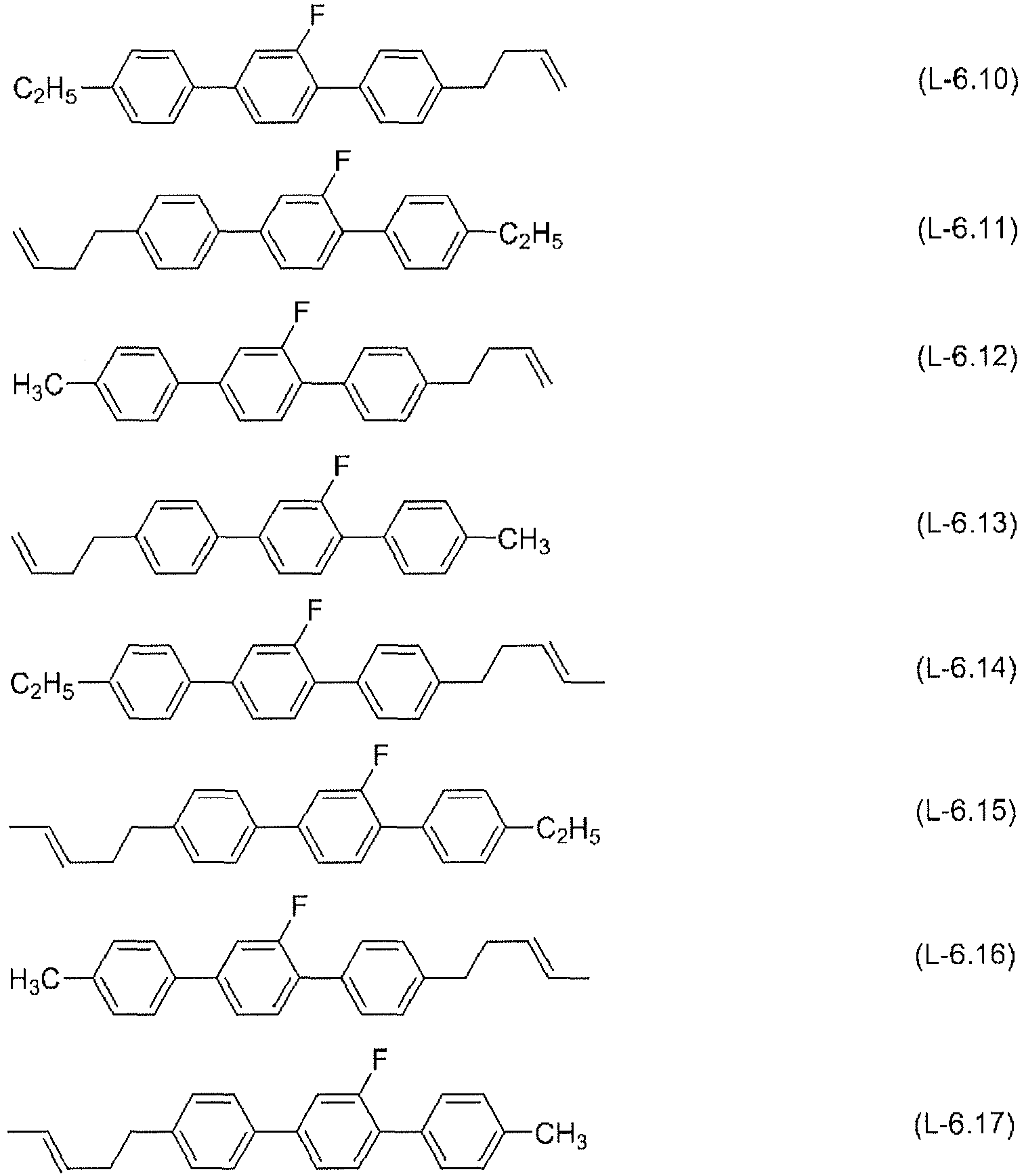
- The lower limit of the preferred amount of these compounds is 1%, 2%, 3%, 5%, or 7% relative to the amount of the whole composition of the present invention. The upper limit of the preferred amount thereof is 20%, 15%, 13%, 10%, or 9%.
- The compound represented by General Formula (L-7) is as follows.
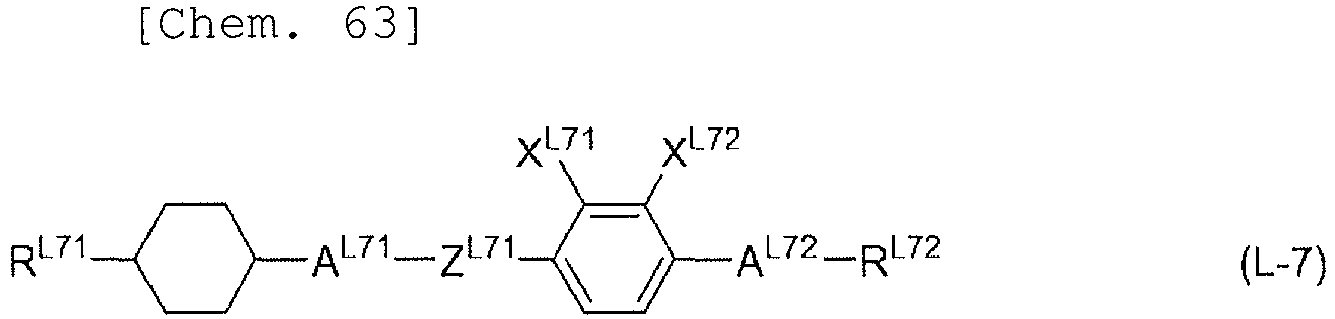
- In the formula, RL71 and RL72 are preferably each independently an alkyl group having 1 to 5 carbon atoms, an alkenyl group having 2 to 5 carbon atoms, or an alkoxy group having 1 to 4 carbon atoms; AL71 and AL72 are preferably each independently a 1,4-cyclohexylene group or a 1,4-phenylene group; the hydrogen atoms of AL71 and AL72 are each independently optionally substituted with a fluorine atom; QL71 is preferably a single bond or COO-, and preferably a single bond; and XL71 and XL72 are each preferably a hydrogen atom.
- Such compounds can be used in any combination; a combination of the compounds is determined on the basis of the intended properties such as solubility at low temperature, transition temperature, electric reliability, and birefringence. For example, one of such compounds is used in an embodiment of the present invention, two of the compounds are used in another embodiment, three of the compounds are used in another embodiment, and four of the compounds are used in another embodiment.
- In the composition of the present invention, the amount of the compound represented by General Formula (L-7) needs to be appropriately adjusted on the basis of the intended properties such as solubility at low temperature, transition temperature, electric reliability, birefringence, process adaptability, droplet stains, image-sticking, and dielectric anisotropy.
- The lower limit of the preferred amount of the compound represented by Formula (L-7) is 1%, 2%, 3%, 5%, 7%, 10%, 14%, 16%, or 20% relative to the amount of the whole composition of the present invention. The upper limit of the preferred amount of a compound represented by Formula (L-7) is 30%, 25%, 23%, 20%, 18%, 15%, 10%, or 5% relative to the amount of the whole composition of the present invention.
- In an embodiment in which the composition of the present invention needs to have a high Tni, the amount of the compound represented by Formula (L-7) is preferably adjusted to be larger; in an embodiment in which the composition needs to have a low viscosity, the amount thereof is preferably adjusted to be smaller.
- The compound represented by General Formula (L-7) is preferably any of compounds represented by Formulae (L-7.1) to (L-7.4), and also preferably the compound represented by Formula (L-7.2).

- Furthermore, the compound represented by General Formula (L-7) is preferably any of compounds represented by Formulae (L-7.11) to (L-7.13), and also preferably the compound represented by Formula (L-7.11).

- Moreover, the compound represented by General Formula (L-7) is any of compounds represented by Formulae (L-7.21) to (L-7.23), and preferably the compound represented by Formula (L-7.21).


- Furthermore, the compound represented by General Formula (L-7) is preferably any of compounds represented by Formulae (L-7.31) to (L-7.34), and also preferably the compound represented by Formula (L-7.31) and/or the compound represented by Formula (L-7.32).
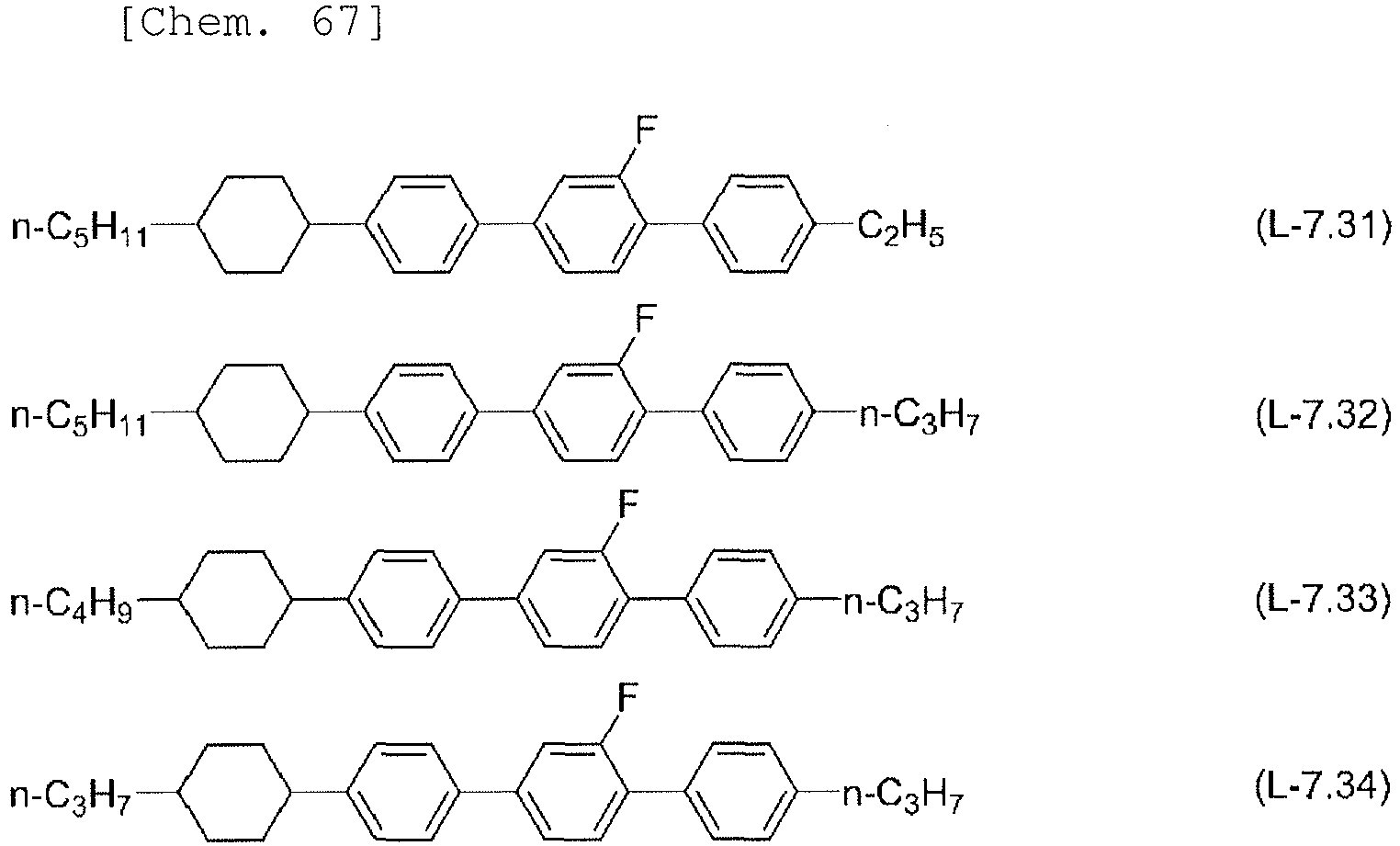
- Moreover, the compound represented by General Formula (L-7) is preferably any of compounds represented by Formulae (L-7.41) to (L-7.44), and also preferably the compound represented by Formula (L-7.41) and/or the compound represented by Formula (L-7.42).

- In the liquid crystal composition of the present invention, the lower limit of the amount of the compounds represented by General Formula (a) and General Formulae (LC3) to (LC5) in the composition is preferably not less than 5% (the term "%" used in the description of the composition hereinafter refers to mass%), also preferably not less than 10%, also preferably not less than 13%, also preferably not less than 15%, also preferably not less than 18%, also preferably not less than 20%, also preferably not less than 23%, also preferably not less than 25%, also preferably not less than 28%, also preferably not less than 30%, also preferably not less than 33%, also preferably not less than 35%, also preferably not less than 38%, or also preferably not less than 40%. The upper limit is preferably not more than 95%, also preferably not more than 90%, also preferably not more than 88%, also preferably not more than 85%, also preferably not more than 83%, also preferably not more than 80%, also preferably not more than 78%, also preferably not more than 75%, also preferably not more than 73%, also preferably not more than 70%, also preferably not more than 68%, also preferably not more than 65%, also preferably not more than 63%, also preferably not more than 60%, also preferably not more than 55%, also preferably not more than 50%, or also preferably not more than 40%.
- The liquid crystal composition of the present invention preferably contains the compound represented by General Formula (a) and the compound represented by General Formula (i). The lower limit of the total amount thereof in the composition is preferably not less than 1 mass%, also preferably not less than 3%, also preferably not less than 5%, also preferably not less than 10%, also preferably not less than 13%, also preferably not less than 15%, also preferably not less than 18%, also preferably not less than 20%, also preferably not less than 23%, also preferably not less than 25%, also preferably not less than 28%, also preferably not less than 30%, also preferably not less than 33%, also preferably not less than 35%, also preferably not less than 38%, or also preferably not less than 40%. The upper limit is preferably not more than 100%, also preferably not more than 99%, also preferably not more than 95%, also preferably not more than 90%, also preferably not more than 85%, also preferably not more than 80%, also preferably not more than 75%, also preferably not more than 70%, also preferably not more than 65%, also preferably not more than 60%, also preferably not more than 55%, also preferably not more than 50%, also preferably not more than 40%, also preferably not more than 38%, also preferably not more than 35%, also preferably not more than 33%, also preferably not more than 30%, also preferably not more than 28%, also preferably not more than 25%, also preferably not more than 23%, also preferably not more than 20%, also preferably not more than 18%, also preferably not more than 15%, or also preferably not more than 10%.
- The liquid crystal composition of the present invention preferably contains the compound represented by General Formula (a) and the compound represented by General Formula (ii). The lower limit of the total amount thereof in the composition is preferably not less than 1%, also preferably not less than 3%, also preferably not less than 5%, also preferably not less than 10%, also preferably not less than 13%, also preferably not less than 15%, also preferably not less than 18%, also preferably not less than 20%, also preferably not less than 23%, also preferably not less than 25%, also preferably not less than 28%, also preferably not less than 30%, also preferably not less than 33%, also preferably not less than 35%, also preferably not less than 38%, or also preferably not less than 40%. The upper limit is preferably not more than 100%, also preferably not more than 99%, also preferably not more than 95%, also preferably not more than 90%, also preferably not more than 85%, also preferably not more than 80%, also preferably not more than 75%, also preferably not more than 70%, also preferably not more than 65%, also preferably not more than 60%, also preferably not more than 55%, also preferably not more than 50%, also preferably not more than 40%, also preferably not more than 38%, also preferably not more than 35%, also preferably not more than 33%, also preferably not more than 30%, also preferably not more than 28%, also preferably not more than 25%, also preferably not more than 23%, also preferably not more than 20%, also preferably not more than 18%, also preferably not more than 15%, or also preferably not more than 10%.
- The liquid crystal composition of the present invention preferably contains the compound represented by General Formula (a) and the compound represented by General Formula (L). The lower limit of the total amount thereof in the composition is preferably not less than 5%, also preferably not less than 10%, also preferably not less than 13%, also preferably not less than 15%, also preferably not less than 18%, also preferably not less than 20%, also preferably not less than 23%, also preferably not less than 25%, also preferably not less than 28%, also preferably not less than 30%, also preferably not less than 33%, also preferably not less than 35%, also preferably not less than 38%, or also preferably not less than 40%. The upper limit is preferably not more than 95%, also preferably not more than 90%, also preferably not more than 88%, also preferably not more than 85%, also preferably not more than 83%, also preferably not more than 80%, also preferably not more than 78%, also preferably not more than 75%, also preferably not more than 73%, also preferably not more than 70%, also preferably not more than 68%, also preferably not more than 65%, also preferably not more than 63%, also preferably not more than 60%, also preferably not more than 55%, also preferably not more than 50%, or also preferably not more than 40%.
- The liquid crystal composition of the present invention preferably contains the compound represented by General Formula (a) and the compound represented by General Formula (L-1). The lower limit of the total amount thereof in the composition is preferably not less than 1%, also preferably not less than 3%, also preferably not less than 5%, also preferably not less than 10%, also preferably not less than 13%, also preferably not less than 15%, also preferably not less than 18%, also preferably not less than 20%, also preferably not less than 23%, also preferably not less than 25%, also preferably not less than 28%, also preferably not less than 30%, also preferably not less than 33%, also preferably not less than 35%, also preferably not less than 38%, or also preferably not less than 40%. The upper limit is preferably not more than 95%, also preferably not more than 90%, also preferably not more than 88%, also preferably not more than 85%, also preferably not more than 83%, also preferably not more than 80%, also preferably not more than 78%, also preferably not more than 75%, also preferably not more than 73%, also preferably not more than 70%, also preferably not more than 68%, also preferably not more than 65%, also preferably not more than 63%, also preferably not more than 60%, also preferably not more than 55%, also preferably not more than 50%, or also preferably not more than 40%.
- In the liquid crystal composition of the present invention, the total amount of the compounds represented by General Formulae (a), (LC3) to (LC5), and (L) is preferably in the range of 70 to 100 mass%, more preferably 80 to 100 mass%, further preferably 85 to 100 mass%, further preferably 90 to 100 mass%, and especially preferably 95 to 100 mass%.
- The dielectric anisotropy (Δε) of the liquid crystal composition of the present invention at 25°C is from -1.5 to -8.0, preferably -2.0 to -6.0, more preferably -2.0 to -5.0, and especially preferably -2.5 to -4.0.
- The refractive index anisotropy (Δn) of the liquid crystal composition of the present invention at 20°C is from 0.08 to 0.14, preferably 0.09 to 0.13, and especially preferably 0.09 to 0.12. More specifically, the refractive index anisotropy is preferably from 0.10 to 0.13 for a thin cell gap or preferably from 0.08 to 0.10 for a thick cell gap.
- The viscosity (η) of the liquid crystal composition of the present invention at 20°C is from 10 to 30 mPa·s, preferably 10 to 25 mPa·s, and especially preferably 10 to 22 mPa·s.
- The rotational viscosity (γ1) of the liquid crystal composition of the present invention at 20°C is from 60 to 130 mPa·s, preferably 60 to 110 mPa·s, and especially preferably 60 to 100 mPa·s.
- The nematic phase-isotropic liquid phase transition temperature (Tni) of the liquid crystal composition of the present invention is from 60°C to 120°C, preferably 70°C to 100°C, and especially preferably 70°C to 85°C.
- The liquid crystal composition of the present invention may contain general nematic liquid crystal, smectic liquid crystal, cholesteric liquid crystal, an antioxidant, an ultraviolet absorber, an infrared absorber, a polymerizable monomer, and a light stabilizer in addition to the above-mentioned compounds.
- The liquid crystal composition, for example, contains 0.01 to 2 mass% of a polymerizable compound as a polymerizable monomer, such as a biphenyl derivative or a terphenyl derivative.
- The polymerizable monomer to be used may be at least one monofunctional polymerizable compound having one reactive group or at least one polyfunctional polymerizable compound having two or more reactive groups, such as difunctional or trifunctional polymerizable compound. The polymerizable compound having a reactive group may contain a mesogenic part or may be free therefrom.
- In the polymerizable compound having a reactive group, the reactive group is preferably a photopolymerizable substituent.
- The polymerizable compound used in the present invention is preferably a compound represented by General Formula (P).

- (in General Formula (P), Zp1 represents a fluorine atom, a cyano group, a hydrogen atom, an alkyl group which has 1 to 15 carbon atoms and of which a hydrogen atom is optionally substituted with a halogen atom, an alkoxyl group which has 1 to 15 carbon atoms and of which a hydrogen atom is optionally substituted with a halogen atom, an alkenyl group which has 1 to 15 carbon atoms and of which a hydrogen atom is optionally substituted with a halogen atom, an alkenyyloxy group which has 1 to 15 carbon atoms and of which a hydrogen atom is optionally substituted with a halogen atom, or -Spp2-Rp2;
- Rp1 and Rp2 each independently represent any of groups represented by Formulae (R-I) to (R-IX);

- in Formulae (R-I) to (R-IX), R2 to R6 each independently represent a hydrogen atom, an alkyl group having 1 to 5 carbon atoms, or a halogenated alkyl group having 1 to 5 carbon atoms, W represents a single bond, -O-, or a methylene group, T represents a single bond or -COO-, and p, t, and q each independently represent 0, 1, or 2;
- Spp1 and Spp2 each represent a spacer group;
- Lp1 and Lp2 each independently represent a single bond, - O-, -S-, -CH2-, -OCH2-, -CH2O-, -CO-, -C2H4-, -COO-, -OCO-, - OCOOCH2-, -CH2OCOO-, -OCH2CH2O-, -CO-NRa-, -NRa-CO-, -SCH2-, - CH2S-, -CH=CRa-COO-, -CH=CRa-OCO-, -COO-CRa=CH-, -OCO-CRa=CH-, -COO-CRa=CH-COO-, -COO-CRa=CH-OCO-, -OCO-CRa=CH-COO-, -OCO-CRa=CH-OCO-, -(CH2)z-C(=O)-O-, -(CH2)z-O-(C=O)-, -O-(C=O)-(CH2)Z-, -(C=O)-O-(CH2)Z-, -CH=CH-, -CF=CF-, -CF=CH-, -CH=CF-, -CF2-, -CF2O-, -OCF2-, -CF2CH2-, -CH2CF2-, -CF2CF2-, or -C≡C-(where Ra's each independently represent a hydrogen atom or an alkyl group having 1 to 4 carbon atoms, and z represents an integer from 1 to 4);
- Mp2 represents a 1,4-phenylene group, a 1,4-cyclohexylene group, an anthracene-2,6-diyl group, a phenanthrene-2,7-diyl group, a pyridine-2,5-diyl group, a pyrimidine-2,5-diyl group, a naphthalen-2,6-diyl group, an indane-2,5-diyl group, a 1,2,3,4-tetrahydronaphthalen-2,6-diyl group, or a 1,3-dioxane-2,5-diyl group; Mp2 may be unsubstituted or substituted with an alkyl group having 1 to 12 carbon atoms, a halogenated alkyl group having 1 to 12 carbon atoms, an alkoxy group having 1 to 12 carbon atoms, a halogenated alkoxy group having 1 to 12 carbon atoms, a halogen atom, a cyano group, a nitro group, or -Rp1;
- Mp1 represents any of Formulae (i-11) to (ix-11)

- (in each of the formulae, the symbol * represents the linkage to Spp1, and the symbol ** represents the linkage to Lp1 or Lp2);
- Mp3 represents any of Formulae (i-13) to (ix-13)


- (in each of the formulae, the symbol * represents the linkage to Zpp1, and the symbol ** represents the linkage to LP2);
- mp2 to mp4 each independently represent 0, 1, 2, or 3; mp1 and mp5 each independently represent 1, 2, or 3; in the case where Zp1 is multiple, the multiple Zp1's may be the same as or different from each other; in the case where Rp1 is multiple, the multiple Rp1's may be the same as or different from each other; in the case where Rp2 is multiple, the multiple Rp2's may be the same as or different from each other; in the case where Spp1 is multiple, the multiple Spp1's may be the same as or different from each other; in the case where Spp2 is multiple, the multiple Spp2's may be the same as or different from each other; in the case where Lp1 is multiple, the multiple Lp1's may be the same as or different from each other; and in the case where Mp2 is multiple, the multiple Mp2's may be the same as or different from each other) It is preferred that at least one of such polymerizable monomers be used.
- In General Formula (1) in the present invention, Zp1 is preferably -Spp2-Rp2, and R11 and R12 are preferably each independently represented by Formula (R-1) or (R-3).
- In General Formula (P), mp1 + mp5 is preferably two or more.
- In General Formula (P), Lp1 is preferably a single bond, -OCH2-, -CH2O-, -CO-, -C2H4-, -COO-, -OCO-, -COOC2H4-, - OCOC2H4-, -C2H4OCO-, -C2H4COO-, -CH=CH-, -CF2-, -CF2O-, - (CH2)z-C(=O)-O-, -(CH2)z-O-(C=O)-, -O-(C=O)-(CH2)z-, -CH=CH-COO-, -COO-CH=CH-, -OCOCH=CH-, -(C=O)-O-(CH2)z-, -OCF2-, or - C≡C-; Lp2 is preferably -OCH2CH2O-, -COOC2H4-, -OCOC2H4-, - (CH2)z-C(=O)-O-, -(CH2)z-O-(C=O)-, -O-(C=O)-(CH2)z-, -(C=O)-O-(CH2)z-, -CH=CH-COO-, -COO-CH=CH-, -OCOCH=CH-, -C2H4OCO-, or -C2H4COO-; and z in these formulae is preferably an integer from 1 to 4.
- In General Formula (P), at least any of Lp1 and Lp2 is preferably at least one selected from the group consisting of -(CH2)-C(=O)-O-, -(CH2)z-O-(C=O)-, -O-(C=O)-(CH2)z-, and -(C=O)-O-(CH2)z-.
- In General Formula (P), Rp1 and Rp2 being each independently represented by any of Formulae (R-1) to (R-15)

- In General Formula (P), mp3 preferably represents 0, 1, 2, or 3; in the case where mp2 represents 1, Lp1 is preferably a single bond; in the case where mp2 represents 2 or 3, at least one of the multiple Lp1's is preferably a single bond.
- In General Formula (P), mp3 preferably represents 0, 1, 2, or 3; in the case where mp3 represents 1, Mp2 is preferably a 1,4-phenylene group; in the case where mp3 represents 2 or 3, at least one of the multiple Mp2's that is present close to Mp1 with Lp1 interposed therebetween is preferably a 1,4-phenylene group.
- In General Formula (P), mp3 preferably represents 0, 1, 2, or 3; and at least one Mp2 is preferably a 1,4-phenylene group substituted with one or more fluorine atoms.
- In General Formula (P), mp4 preferably represents 0, 1, 2, or 3; and at least one Mp3 is preferably a 1,4-phenylene group substituted with one or more fluorine atoms.
- In General Formula (P), the spacer groups (Spp1, Spp2, and Spp4) are each preferably a single bond, -OCH2-, -(CH2)zO-, -CO-, -C2H4-, -COO-, -OCO-, -COOC2H4-, -OCOC2H4-, -(CH2)z-, - C2H4OCO-, -C2H4COO-, -CH=CH-, -CF2-, -CF2O-, - (CH2)z-C(=O)-O-, -(CH2)z-O-(C=O)-, -O-(C=O)-(CH2)z-, -(C=O)-O-(CH2)z-, -O-(CH2)z-O-, -OCF2-, -CH=CH-COO-, -COO-CH=CH-, -OCOCH=CH-, or - C=C-, where Z is preferably an integer from 1 to 10.
- The specific amount of the polymerizable monomer in the polymerizable-monomer-containing liquid crystal composition is preferably not more than 2%, more preferably not more than 1.5%, further preferably not more than 1%, especially preferably not more than 0.5%, and most preferably not more than 0.4%; namely, it is 2% or less.
- The polymerizable compound represented by General Formula (P) in the present invention is preferably at least one compound selected from the group consisting of compounds represented by General Formulae (P-a), (P-b), (P-c), and (P-d).

- In each of General Formulae (P-a) to (P-d), Rp1 and Rp2 each independently represent any of Formulae (R-I) to (R-IX);

- in Formulae (R-I) to (R-IX), R2 to R6 each independently represent a hydrogen atom, an alkyl group having 1 to 5 carbon atoms, or a halogenated alkyl group having 1 to 5 carbon atoms, W represents a single bond, -O-, or a methylene group, T represents a single bond or -COO-, and p, t, and q each independently represent 0, 1, or 2;
- the rings A and B each independently represent a 1,4-phenylene group, a 1,4-cyclohexylene group, an anthracene-2,6-diyl group, a phenanthrene-2,7-diyl group, a pyridine-2,5-diyl group, a pyrimidine-2,5-diyl group, a naphthalen-2,6-diyl group, an indane-2,5-diyl group, a 1,2,3,4-tetrahydronaphthalen-2,6-diyl group, or a 1,3-dioxane-2,5-diyl group and are each preferably unsubstituted or substituted with an alkyl group having 1 to 12 carbon atoms, a halogenated alkyl group having 1 to 12 carbon atoms, an alkoxy group having 1 to 12 carbon atoms, a halogenated alkoxy group having 1 to 12 carbon atoms, a halogen atom, a cyano group, a nitro group, or -Rp1;
- the ring C is represented by any of Formulae (c-i) to (c-ix)

- (in each of the formulae, the symbol * represents the linkage to Spp1, and the symbol ** represents the linkage to Lp5 or Lp6);
- Spp1 and Spp4 each represent a spacer group; Xp1 to Xp4 preferably each independently represent a hydrogen atom or a halogen atom; and
- Lp4, Lp5, and Lp6 are preferably each independently a single bond, -OCH2-, -CH2O-, -CO-, -C2H4-, -COO-, -OCO-, - COOC2H4-, -OCOC2H4-, -C2H4OCO-, -C2H4COO-, -CH=CH-, -CF2-, - CF2O-, -(CH2)z-C(=O)-O-, -(CH2)z-O-(C=O)-, -O-(C=O)-(CH2)z-, - (C=O)-O-(CH2)z-, -O-(CH2)z-O-, -OCF2-, -CH=CHCOO-, -COOCH=CH-, -OCOCH=CH-, or -C=C-, where z is preferably an integer from 1 to 4.
- Lp3 is preferably -CH=CHCOO-, -COOCH=CH-, or -OCOCH=CH-.
- In the compound represented by General Formula (P-a), mp6 and mp7 preferably each independently represent 0, 1, 2, or 3; and mp6 + mp7 is preferably from 2 to 5.
- In the compound represented by General Formula (P-b), mp8 and mp9 preferably each independently represent 1, 2, or 3; and mp6 + mp7 is preferably 2 or 3.
- In the compound represented by General Formula (P-c), mp10 and mp11 preferably each independently represent 0 or 1; and mp10 + mp11 is preferably 0 or 1. Since the structure represented by General Formula (P-c) has phenanthrene, it is believed that the composition is highly photosensitizing as a whole.
- In the compound represented by General Formula (P-d), mp12 and mp15 each independently represent 1, 2, or 3; mp13 preferably represents 0, 1, 2, or 3; and mp14 preferably represents 0, 1, or 2. mp12 + mp15 is preferably from 2 to 5. In the case where Rp1 is multiple, the multiple Rp1's may be the same as or different from each other; in the case where Rp1 is multiple, the multiple Rp1's may be the same as or different from each other; in the case where Rp2 is multiple, the multiple Rp2's may be the same as or different from each other; in the case where SPp1 is multiple, the multiple SPp1's may be the same as or different from each other; in the case where SPp4 is multiple, the multiple SPp4's may be the same as or different from each other; in the case where Lp4 and Lp5 are multiple, the corresponding ones of them may be the same as or different from each other; and in the case where the rings A to C are multiple, the corresponding ones of them may be the same as or different from each other. In the polymerizable-monomer-containing composition used in the present invention, using the polymerizable monomer represented by General Formula (P-d) in combination with the compounds represented by General Formulae (1) and (2) enables a reduction in the length of the time for photopolymerization.
- Preferred examples of the structures represented by General Formulae (P-a) to (P-d) in the present invention will now be described.
- Preferred examples of the compound represented by General Formula (P-a) in the present invention include polymerizable compounds represented by Formulae (P-a-1) to (P-a-31).


- The specific amount of the polymerizable monomer represented by General Formula (P-a) is preferably not more than 5%, more preferably not more than 3%, further preferably not more than 2%, especially preferably not more than 1%, and most preferably not more than 0.8%.
- Preferred examples of the compound represented by General Formula (P-b) in the present invention include polymerizable compounds represented by Formulae (P-b-1) to (P-b-34).


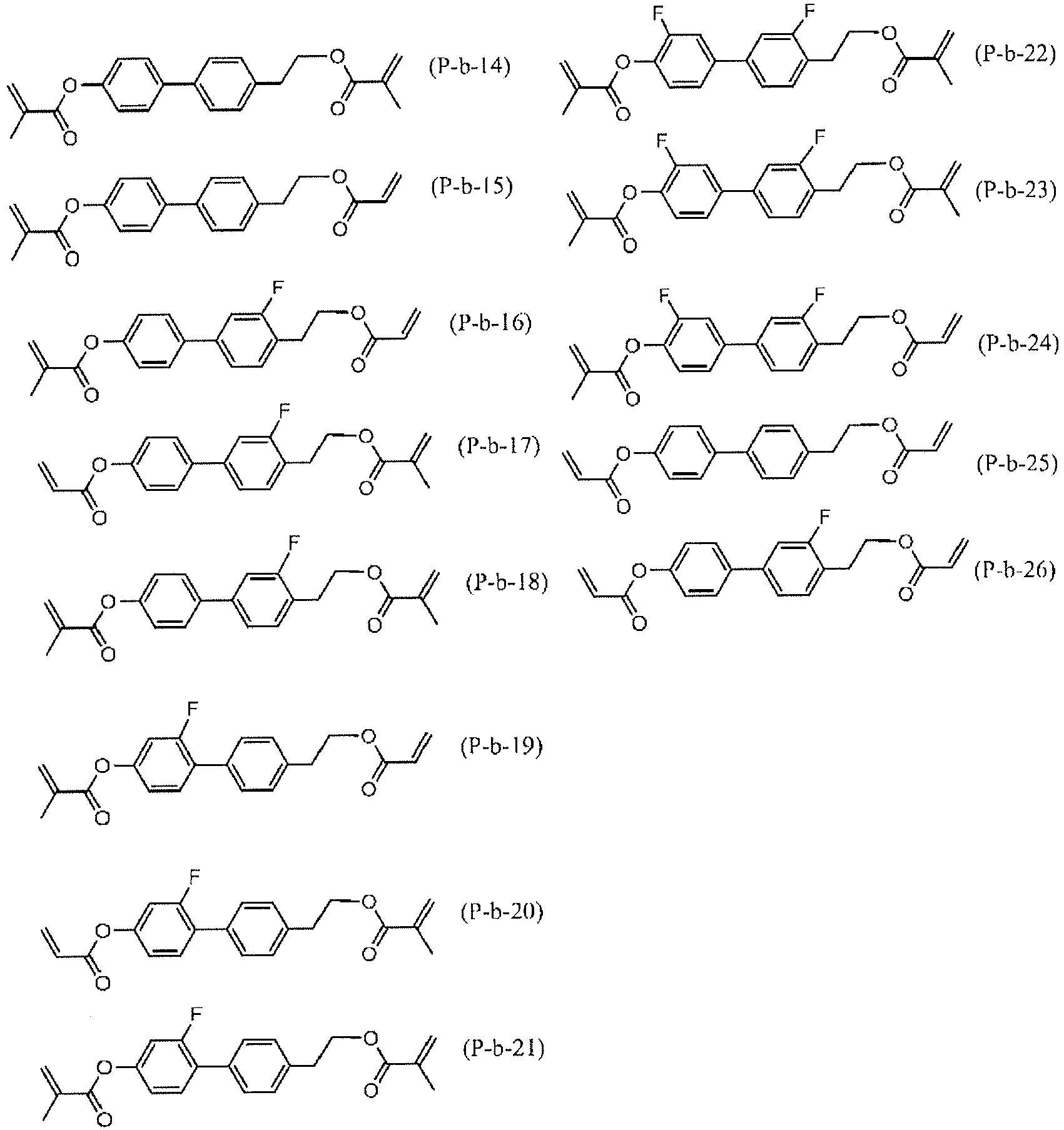


- The specific amount of the polymerizable monomer represented by General Formula (P-b) (proportion to the whole of the polymerizable-monomer-containing liquid crystal composition) is preferably not more than 5%, more preferably not more than 3%, further preferably not more than 2%, especially preferably not more than 1%, and most preferably not more than 0.8%.
- Preferred examples of the compound represented by General Formula (P-c) in the present invention include polymerizable compounds represented by Formulae (P-c-1) to (P-c-52).


- The specific amount of the polymerizable monomer represented by General Formula (P-c) is preferably not more than 5%, more preferably not more than 3%, further preferably not more than 2%, especially preferably not more than 1%, and most preferably not more than 0.8%.
- The compound represented by General Formula (P-d) in the present invention is preferably any of compounds represented by General Formula (P-d').

- Preferred examples of the compound represented by General Formula (P-d) in the present invention include polymerizable compounds represented by Formulae (P-d-1) to (P-d-37).


- The specific amount of the polymerizable monomer represented by General Formula (P-d) is preferably not more than 5%, more preferably not more than 3%, further preferably not more than 2%, especially preferably not more than 1%, and most preferably not more than 0.8%.
- Compounds having the following structures can be preferably used as additives, such as an antioxidant and a light stabilizer, in the liquid crystal composition of the present invention.




- The present invention will now be described further in detail with reference to Examples; however, the present invention is not limited thereto. In compositions which will be described in Examples and Comparative Examples, the term "%" refers to "mass%".
In Examples, compounds are abbreviated as follows. n represents a natural number. -
- -n -CnH2n+1 linear alkyl group having n carbon atoms
- n- CnH2n+1- linear alkyl group having n carbon atoms
- -On -OCnH2n+1 linear alkoxyl group having n carbon atoms nO- CnH2n+1O- linear alkoxyl group having n carbon atoms
- -V -CH=CH2
- V- CH2=CH-
- -V1 -CH=CH-CH3
- 1V- CH3-CH=CH-
- -2V -CH2-CH2-CH=CH3
- V2- CH3=CH-CH2-CH2-
- -2V1 -CH2-CH2-CH=CH-CH3
- 1V2- CH3-CH=CH-CHZ-CH2
-
- n- -CnH2n-
- nO- -CnH2n-O-
- On- -O-CnH2n-
- COO- -C(=O)-O-
- OCO- -O-C(=O)-
- CF2O- -CF2-O-
- OCF2- -O-CF2-
-


- In Examples, the following properties were measured.
-
- Tni: Nematic phase-isotropic liquid phase transition temperature (°C)
- Tcn: Solid phase-nematic phase transition temperature (°C)
- Δn: Refractive index anisotropy at 20°C
- Δε: Dielectric anisotropy at 20°C
- η: Viscosity at 20°C (mPa·s)
- γ1: Rotational viscosity at 20°C (mPa·s)
- K33: Elastic constant K33 at 20°C (pN)
- Initial Voltage Holding Ratio (VHR): VHR measured before UV radiation (%)
- Voltage holding ratio (VHR) after UV radiation: VHR measured after UV radiation (%)
- In the case of generating a pretilt angle in a test cell, the test cell was irradiated with 60 J (365 nm) of UV under application of a square wave voltage of 10 V at a frequency of 100 Hz. The UV light source was a multilight manufactured by USHIO INC.
- In measurement of the response speed of a sample, a test cell having a thickness of 3.5 µm and including an alignment film of JALS2096 was used, Vsel was 5 V, Vnsel was 1 V, measurement temperature was 20°C, and DMS301 manufactured by AUTRONIC-MELCHERS GmbH was used.
- In evaluation of the UV resistance of a test cell, UV was radiated at 100 mW/cm-2 for a predetermined time with SP-7 (manufactured by USHIO INC.), and VHRs before and after the UV radiation were measured.
- VHRs were measured with VHR-1 (manufactured by TOYO Corporation) at 1 V, 60 Hz, and 60°C.
- The compounds (P-b-1), (P-b-3), (P-a-31), (P-d-29), and (P-d-37) were used as representative examples of a polymerizable compound; however, the present invention is not limited thereto.

- Liquid crystal compositions LC-A (Comparative Example 1), LC-A1 (Example 1-1), LC-A2 (Example 1-2), LC-A3 (Example 1-3), and LC-A4 (Example 1-4) were prepared. Table 1 shows the constitution and physical properties of the liquid crystal compositions.
[Table 1] Comparative Example 1 Example 1-1 Example 1-2 Example 1-3 Example 1-4 LC-A LC-A1 LC-A2 LC-A3 LC-A4 3-Ph-2-Ph-Ph5-O2 7.0% 5.0% 3.0% 5.0% 5-Ph-2-Ph-Ph5-O2 5.0% 3-Ph-Ph-2-Ph5-O2 5.0% 3-Np-Ph-2-Ph5-O2 3.0% 3-Cy-Cy-2 16.0% 20.0% 20.0% 20.0% 19.0% 3-Cy-Cy-4 7.0% 8.0% 8.0% 8.0% 8.0% 3-Cy-Cy-5 4.0% 5.0% 5.0% 5.0% 5.0% 3-Ph-Ph-O1 3.0% 3.0% 3.0% 3.0% 3.0% 5-Ph-Ph-O1 3.0% 3.0% 3.0% 5-Ph-Ph-1 9.0% 4.0% 7.0% 3.0% 8.0% 3-Cy-Cy-Ph-1 7.0% 7.0% 6.0% 7.0% 7.0% 3-Cy-Cy-Ph-3 4.0% 3-Cy-10-Ph5-O1 6.0% 6.0% 4.0% 6.0% 5.0% 3-Cy-1O-Ph5-O2 8.0% 8.0% 9.0% 10.0% 9.0% 3-Cy-Ph-Ph5-O3 7.0% 7.0% 7.0% 7.0% 7.0% 3-Cy-Ph-Ph5-O4 6.0% 6.0% 6.0% 6.0% 6.0% 4-Cy-Ph-Ph5-O3 6.0% 6.0% 6.0% 2-Cy-Cy-1O-Ph5-O2 6.0% 2.0% 6.0% 6.0% 3-Cy-Cy-1O-Ph5-O2 8.0% 8.0% 9.0% 8.0% 9.0% Total 100.0% 100.0% 100.0% 100.0% 100.0% Tni [°C] 76 76 76 75 76 Δn 0.102 0.104 0.103 0.103 0.103 Δε -2.9 -2.9 -3.0 -3.0 -2.9 γ1 [mPa·s] 122 124 119 124 116 K33 [pN] 13.0 14.5 14.9 14.7 15.2 γ1/K33 [mPa·s·pN-1] 9.4 8.6 8.0 8.4 7.6 - Each of the LC-A1, LC-A2, LC-A3, and LC-A4 as the liquid crystal composition of the present invention had a sufficiently small γ1 and large K33. Thus, in the LC-A1 to LC-A4, γ1/K33 that is the indicator of response speed was clearly smaller than the LC-A as the comparative example. In addition, the response speed thereof was measured, and the result of the measurement showed an improvement in the response speed in a similar degree.
The prepared liquid crystal compositions LC-A, LC-A1, LC-A2, LC-A3, and LC-A4 were vacuum-injected into test cells, and then the test cells were subjected to measurement of VHRs before and after UV radiation. Each of the LC-A1, LC-A2, LC-A3, and LC-A4 as the liquid crystal composition of the present invention had an approximately similar VHR to the LC-A as Comparative Example 1 after the UV radiation, which showed that the improvement in the response speed did not have any adverse effect on the UV resistance of the liquid crystal materials. - Accordingly, the liquid crystal composition of the present invention had a sufficiently good nematic phase-isotropic liquid phase transition temperature (Tni), refractive index anisotropy (Δn), dielectric anisotropy (Δε), rotational viscosity (γ1), elastic constant (K33), and UV resistance; and the liquid crystal display device of, for instance, a VA type that used such a liquid crystal composition had an excellent display quality.
- Liquid crystal compositions LC-B (Comparative Example 2), LC-B1 (Example 2-1), LC-B2 (Example 2-2), and LC-B3 (Example 2-3) were prepared. Table 2 shows the constitution and physical properties of the liquid crystal compositions.
[Table 2] Comparative Example 2 Example 2-1 Example 2-2 Example 2-3 LC-B LC-B1 LC-B2 LC-B3 1-Ph-2-Ph-Ph5-O2 5.0% 2-Ph-2-Ph-Ph5-O2 5.0% 3-Ph-2-Ph-Ph5-O2 5.0% 5.0% 5.0% 3-Cy-Cy-2 18.0% 19.0% 19.0% 20.0% 3-Cy-Cy-4 8.0% 8.0% 8.0% 8.0% 3-Cy-Ph-O1 4.0% 4.0% 4.0% 5.0% 3-Ph-Ph-1 11.0% 10.0% 11.0% 8.0% 3-Cy-Cy-Ph-1 5.0% 5.0% 5.0% 5.0% 3-Cy-1O-Ph5-O2 11.0% 11.0% 9.0% 10.0% 3-Cy-Ph-Ph5-O3 7.0% 7.0% 7.0% 3.0% 3-Cy-Ph-Ph5-O4 8.0% 8.0% 8.0% 8.0% 4-Cy-Ph-Ph5-O3 6.0% 3.0% 2-Cy-Cy-1O-Ph5-O2 6.0% 6.0% 6.0% 6.0% 3-Cy-Cy-1O-Ph5-O2 11.0% 12.0% 13.0% 11.0% 3-Ph-Ph5-Ph-2 5.0% 5.0% 3.0% Total 100.0% 100.0% 100.0% 100.0% Tni [°C] 75 75 76 75 Δn 0.109 0.109 0.109 0.108 Δε -3.1 -3.1 -3.1 -3.1 γ1 [mPa·s] 118 112 117 121 K33 [pN] 13.0 14.0 15.0 14.8 γ1/K33 [mPa·s·pN-1] 9.1 8.0 7.8 8.2 - Each of the LC-B1, LC-B2, and LC-B3 as the liquid crystal composition of the present invention had a sufficiently small γ1 and large K33. Thus, in the LC-B1 to LC-B3, γ1/K33 that is the indicator of response speed was clearly smaller than the LC-B as the comparative example. In addition, the response speed thereof was measured, and the result of the measurement showed an improvement in the response speed in a similar degree.
The prepared liquid crystal compositions LC-B, LC-B1, LC-B2, and LC-B3 were vacuum-injected into test cells, and then the test cells were subjected to measurement of VHRs before and after UV radiation. Each of the LC-B1, LC-B2, and LC-B3 as the liquid crystal composition of the present invention had an approximately similar VHR to the LC-B as the comparative example after the UV radiation, which showed that the improvement in the response speed did not have any adverse effect on the UV resistance of the liquid crystal materials. - Accordingly, the liquid crystal composition of the present invention had a sufficiently good nematic phase-isotropic liquid phase transition temperature (Tni), refractive index anisotropy (Δn), dielectric anisotropy (Δε), rotational viscosity (γ1), elastic constant (K33), and UV resistance; and the liquid crystal display device of, for instance, a VA type that used such a liquid crystal composition had an excellent display quality.
- Liquid crystal compositions LC-C (Comparative Example 3), LC-C1 (Example 3-1), LC-C2 (Example 3-2), LC-C3 (Example 3-3), and LC-C4 (Example 3-4) were prepared. Table 3 shows the constitution and physical properties of the liquid crystal compositions.
[Table 3] Comparative Example 3 Example 3-1 Example 3-2 Example 3-3 Example 3-4 LC-C LC-C1 LC-C2 LC-C3 LC-C4 1-Ph-2-Ph-Ph5-O2 5.0% 3-Ph-2-Ph-Ph5-O1 5.0% 3-Ph-2-Ph-Ph5-O2 10.0% 5.0% 4-Ph-2-Ph-Ph5-O2 5.0% 5-Ph-2-Ph-Ph5-O2 5.0% 3-Ph-Ph-2-Ph5-O2 5.0% 3-Np-Ph-2-Ph5-O2 3.0% 3-Cy-Cy-V 39.0% 39.0% 28.0% 39.0% 33.0% 3-Cy-Cy-V1 14.0% 8.0% 3-Ph-Ph-1 5.0% 6.0% 4.0% 6.0% 5.0% 3-Cy-1O-Ph5-O2 9.0% 7.0% 11.0% 7.0% 10.0% 2-Cy-Cy-1O-Ph5-O2 12.5% 12.0% 10.0% 12.0% 11.0% 3-Cy-Cy-1O-Ph5-O2 13.0% 13.0% 11.0% 13.0% 13.0% 4-Cy-Cy-1O-Ph5-O2 3.5% 3.0% 3.0% 3-Ph-Ph5-Ph-1 9.0% 5.0% 5.0% 5.0% 3-Ph-Ph5-Ph-2 9.0% 5.0% 7.0% 5.0% 7.0% Total 100.0% 100.0% 100.0% 100.0% 100.0% Tni [°C] 75 76 76 76 75 Δn 0.108 0.108 0.108 0.108 0.108 Δε -3.1 -3.1 -3.1 -3.2 -3.1 γ1 [mPa·s] 96 100 103 98 97 K33 [pN] 14.3 15.8 16.8 15.8 15.9 γ1/K33 [mPa·s·pN-1] 6.7 6.3 6.1 6.2 6.1 - Each of the LC-C1, LC-C2, LC-C3, and LC-C4 as the liquid crystal composition of the present invention had a sufficiently small γ1 and large K33. Thus, in the LC-C1 to LC-C4, γ1/K33 that is the indicator of response speed was clearly smaller than the LC-C as the comparative example. In addition, the response speed thereof was measured, and the result of the measurement showed an improvement in the response speed in a similar degree.
The prepared liquid crystal compositions LC-C, LC-C1, LC-C2, LC-C3, and LC-C4 were vacuum-injected into test cells, and then the test cells were subjected to measurement of VHRs before and after UV radiation. Each of the LC-C1, LC-C2, LC-C3, and LC-C4 as the liquid crystal composition of the present invention had an approximately similar or improved VHR after the UV radiation as compared with the LC-C as the comparative example, which showed that the improvement in the response speed did not have any adverse effect on the UV resistance of the liquid crystal materials. - Accordingly, the liquid crystal composition of the present invention had a sufficiently good nematic phase-isotropic liquid phase transition temperature (Tni), refractive index anisotropy (Δn), dielectric anisotropy (Δε), rotational viscosity (γ1), elastic constant (K33), and UV resistance; and the liquid crystal display device of, for example, a VA type that used such a liquid crystal composition had an excellent display quality.
- Liquid crystal compositions LC-D (Comparative Example 4), LC-D1 (Example 4-1), LC-D2 (Example 4-2), LC-D3 (Example 4-3), and LC-D4 (Example 4-4) were prepared. Table 4 shows the constitution and physical properties of the liquid crystal compositions.
[Table 4] Comparative Example 4 Example 4-1 Example 4-2 Example 4-3 Example 4-4 LC-D LC-D1 LC-D2 LC-D3 LC-D4 1-Ph-2-Ph-Ph5-O2 5.0% 2-Ph-2-Ph-Ph5-O2 6.0% 3-Ph-2-Ph-Ph5-O1 6.0% 3-Ph-2-Ph-Ph5-O2 8.0% 8.0% 5.0% 5-Ph-2-Ph-Ph5-O2 6.0% 3-Ph-Ph-2-Ph5-O2 4.5% 3-Np-Ph-2-Ph5-O2 3.0% 3-Cy-Cy-V 26.5% 23.5% 28.0% 31.0% 23.0% 3-Cy-Cy-V1 10.0% 10.0% 10.0% 7.0% 10.0% 3-Ph-Ph-1 3.0% 7.0% 6.5% 3.5% 7.0% 3-Cy-Ph-Ph-2 1.5% 6.0% 5.0% 3-Cy-1O-Ph5-O1 5.0% 5.0% 4.0% 5.0% 3-Cy-1O-Ph5-O2 11.0% 10.0% 12.0% 10.0% 11.0% 2-Cy-Cy-1O-Ph5-O2 7.0% 5.5% 5.0% 5.0% 7.0% 3-Cy-Cy-1O-Ph5-O2 12.0% 12.0% 11.5% 10.0% 12.0% 1V-Cy-Cy-1O-Ph5-O2 7.0% 7.0% 7.0% 10.0% 7.0% 3-Ph-Ph5-Ph-1 5.0% 5.0% 3-Ph-Ph5-Ph-2 12.0% 5.0% 5.0% Total 100.0% 100.0% 100.0% 100.0% 100.0% Tni [°C] 76 76 75 76 76 Δn 0.109 0.108 0.108 0.108 0.108 Δε -3.7 -3.6 -3.6 -3.7 -3.7 γ1 [mPa·s] 109 114 117 110 116 K33 [pN] 15.4 17.5 17.7 17.2 17.3 γ1/K33 [mPa·s·pN-1] 7.1 6.5 6.6 6.4 6.7 - Each of the LC-D1, LC-D2, LC-D3, and LC-D4 as the liquid crystal composition of the present invention had a sufficiently small γ1 and large K33. Thus, in the LC-D1 to LC-D4, γ1/K33 that is the indicator of response speed was clearly smaller than the LC-D as the comparative example. In addition, the response speed thereof was measured, and the result of the measurement showed an improvement in the response speed in a similar degree.
The prepared liquid crystal compositions LC-D, LC-D1, LC-D2, LC-D3, and LC-D4 were vacuum-injected into test cells, and the test cells were subjected to measurement of VHRs before and after UV radiation. Each of the LC-D1, LC-D2, LC-D3, and LC-D4 as the liquid crystal composition of the present invention had an approximately similar or improved VHR after the UV radiation as compared with the LC-D as the comparative example, which showed that the improvement in the response speed did not have any adverse effect on the UV resistance of the liquid crystal materials. - Accordingly, the liquid crystal composition of the present invention had a sufficiently good nematic phase-isotropic liquid phase transition temperature (Tni), refractive index anisotropy (Δn), dielectric anisotropy (Δε), rotational viscosity (γ1), elastic constant (K33), and UV resistance; and the liquid crystal display device of, for example, a VA type that used such a liquid crystal composition had an excellent display quality.
- Liquid crystal compositions LC-E (Comparative Example 5), LC-E1 (Example 5-1), LC-E2 (Example 5-2), LC-E3 (Example 5-3), and LC-E4 (Example 5-4) were prepared. Table 5 shows the constitution and physical properties of the liquid crystal compositions.
[Table 5] Comparative Example 5 Example 5-1 Example 5-2 Example 5-3 Example 5-4 LC-E LC-E1 LC-E2 LC-E3 LC-E4 2-Ph-2-Ph-Ph5-O2 5.0% 3-Ph-2-Ph-Ph5-O1 7.0% 3-Ph-2-Ph-Ph5-O2 10.0% 10.0% 8.0% 10.0% 4-Ph-2-Ph-Ph5-O2 4.0% 5.0% 5-Ph-2-Ph-Ph5-O2 4.0% 3-Cy-Cy-V 20.0% 20.0% 26.0% 20.0% 24.0% 2-Cy-Cy-V1 5.0% 11.0% 3-Cy-Cy-V1 10.0% 10.5% 10.0% 12.0% 10.0% 3-Ph-Ph-1 7.5% 9.0% 7.5% 7.0% 3-Cy-Ph-Ph-2 6.0% 6.0% 5-Cy-Ph-Ph-2 3.5% 1V-Cy-Ph-Ph-3 3.5% 5.0% 3-Cy-1O-Ph5-O2 11.0% 11.0% 10.5% 9.0% 7.0% V-Cy-1O-Ph5-O2 7.0% 1V-Cy-1O-Ph5-O2 5.0% 5.0% 5.0% 5.0% 2-Cy-Cy-1O-Ph5-O2 6.0% 6.0% 2.0% 3-Cy-Cy-1O-Ph5-O2 13.0% 13.0% 13.0% 9.0% 12.0% V-Cy-Cy-1O-Ph5-O2 12.0% 1V-Cy-Cy-1O-Ph5-O2 9.0% 6.0% 9.0% 6.0% 3-Ph-Ph5-Ph-1 5.0% 3-Ph-Ph5-Ph-2 5.0% 3-Np-Ph5-Ph-2 2.0% Total 100.0% 100.0% 100.0% 100.0% 100.0% Tni [°C] 76 76 76 76 75 Δn 0.109 0.109 0.108 0.108 0.108 Δε -3.7 -3.6 -3.6 -3.6 -3.6 γ1 [mPa·s] 115 116 115 119 106 K33 [pN] 16.9 17.0 18.2 19.0 16.8 γ1/K33 [mPa·s·pN-1] 6.8 6.8 6.3 6.3 6.3 - Each of the LC-E1, LC-E2, LC-E3, and LC-E4 as the liquid crystal composition of the present invention had a sufficiently small γ1 and large K33. Thus, in the LC-E1 to LC-E4, γ1/K33 that is the indicator of response speed was clearly smaller than the LC-E as the comparative example. In addition, the response speed thereof was measured, and the result of the measurement showed an improvement in the response speed in a similar degree.
The prepared liquid crystal compositions LC-E, LC-E1, LC-E2, LC-E3, and LC-E4 were vacuum-injected into test cells, and then the test cells were subjected to measurement of VHRs before and after UV radiation. Each of the LC-E1, LC-E2, LC-E3, and LC-E4 as the liquid crystal composition of the present invention had an approximately similar or improved VHR after the UV radiation as compared with the LC-E as the comparative example, which showed that the improvement in the response speed did not have any adverse effect on the UV resistance of the liquid crystal materials. - Accordingly, the liquid crystal composition of the present invention had a sufficiently good nematic phase-isotropic liquid phase transition temperature (Tni), refractive index anisotropy (Δn), dielectric anisotropy (Δε), rotational viscosity (γ1), elastic constant (K33), and UV resistance; and the liquid crystal display device of, for instance, a VA type that used such a liquid crystal composition had an excellent display quality.
- Liquid crystal compositions MLC-A2 (Example 6-1), MLC-A4 (Example 6-2), MLC-B3 (Example 6-3), MLC-C1 (Example 6-4), MLC-D3 (Example 6-5), MLC-E2 (Example 6-6), MLC-E3 (Example 6-7), and MLC-E4 (Example 6-8) were prepared. Tables 6-1 and 6-2 show the constitution of the liquid crystal compositions.
[Table 6] Example 6-1 Example 6-2 Example 6-3 Example 6-4 MLC-A2 MLC-A4 MLC-B3 MLC-C1 Liquid crystal composition LC-A2 99.60% LC-A4 99.60% LC-B3 99.60% LC-C1 99.60% Polymerizable compound Formula (P-b-3) 0.40% 0.40% 0.40% 0.40% Total 100.00% 100.00% 100.00% 100.00% [Table 7] Example 6-5 Example 6-6 Example 6-7 Example 6-8 MLC-D3 MLC-E2 MLC-E3 MLC-E4 Liquid crystal composition LC-D3 99.60% LC-E2 99.60% LC-E3 99.60% LC-E4 99.60% Polymerizable compound Formula (P-b-3) 0.40% 0.40% 0.40% 0.40% Total 100.00% 100.00% 100.00% 100.00% - In each of the MLC-A2, MLC-A4, MLC-B3, MLC-C1, MLC-D3, MLC-E2, MLC-E3, and MLC-E4 as the liquid crystal composition of the present invention, a proper pretilt angle ranging from 85 to 88° was generated in the test cell. Liquid crystal display devices of a PSVA or PSA type that used such liquid crystal compositions had an excellent display quality.
- Liquid crystal compositions MLC-E11 (Example 7-1), MLC-E12 (Example 7-2), MLC-E13 (Example 7-3), MLC-E14 (Example 7-4), MLC-E15 (Example 7-5), MLC-E16 (Example 7-6), and MLC-E17 (Example 7-7) were prepared. Tables 7-1 and 7-2 show the constitution of the liquid crystal compositions.
[Table 8] Example 7-1 Example 7-2 Example 7-3 Example 7-4 MLC-E11 MLC-E12 MLC-E13 MLC-E14 Liquid crystal composition LC-E1 99.70% 99.60% 99.60% 99.60% Polymerizable compound Formula (P-b-1) 0.30% Formula (P-b-3) 0.40% 0.35% Formula (P-a-31) 0.40% 0.05% Total 100.00% 100.00% 100.00% 100.00% [Table 9] Example 7-5 Example 7-6 Example 7-7 MLC-E15 MLC-E16 MLC-E17 Liquid crystal composition LC-E1 99.60% 99.80% 99.60% Polymerizable compound Formula (P-d-29) 0.40% 0.35% Formula (P-d-37) 0.20% 0.05% Total 100.00% 100.00% 100.00% - In each of the MLC-E11 (Example 7-1), MLC-E12 (Example 7-2), MLC-E13 (Example 7-3), MLC-E14 (Example 7-4), MLC-E15 (Example 7-5), MLC-E16 (Example 7-6), and MLC-E17 (Example 7-7) as the liquid crystal composition of the present invention, a proper pretilt angle ranging from 85 to 88° was generated in the test cell. Liquid crystal display devices of a PSVA or PSA type that used such liquid crystal compositions had an excellent display quality.
- Liquid crystal compositions LC-F (Comparative Example 6), LC-F1 (Example 8), LC-G (Comparative Example 7), and LC-G1 (Example 9) were prepared. Table 5 shows the constitution and physical properties of the liquid crystal compositions.
[Table 10] Comparative Example 6 Example 8 Comparative Example 7 Example 9 LC-F LC-F1 LC-G LC-G1 1-Ph-2-Ph-Ph5-O2 - - - 3.0% 2-Ph-2-Ph-Ph5-O2 - 4.0% - 4.0% 3-Ph-2-Ph-Ph5-O2 - 5.0% - 3.0% 2-Ph-Ph-2-Ph5-O2 - 4.0% - - 3-Ph-Ph-2-Ph5-O2 - 5.0% - - 3-Cy-Cy-2 22.0% 22.0% 22.0% 22.0% 3-Cy-Cy-4 10.0% 10.0% 9.0% 10.0% 3-Cy-Ph-O1 8.0% 9.0% 7.0% 6.0% 3-Cy-Ph5-O2 15.0% 13.0% 15.0% 15.0% 3-Cy-Cy-Ph5-O3 8.5% 6.0% - - 4-Cy-Cy-Ph5-O2 10.0% 7.0% 10.0% 10.0% 5-Cy-Cy-Ph5-O2 - - 5.0% 10.0% 2-Cy-Ph-Ph5-O2 5.0% 5.0% 9.0% 3.0% 3-Cy-Ph-Ph5-O2 10.0% 10.0% 9.0% 5.0% 3-Ph-Ph5-Ph-2 11.5% - 7.0% 6.0% 4-Ph-Ph5-Ph-2 - - 7.0% 3.0% Total 100.0% 100.0% 100.0% 100.0% Tni[°C] 76 76 76 76 Δn 0.102 0.102 0.109 0.109 Δε -2.8 -2.9 -2.9 -2.9 γ1 [mPa·s] 114 120 112 113 K33 [pN] 13.6 15.4 13.7 15.4 γ1/K33 [mPa·s·pN-1] 8.4 7.8 8.4 7.3 - Each of the LC-F1 and LC-G1 as the liquid crystal composition of the present invention had a sufficiently small γ1 and large K33. Thus, in the LC-F1 and LC-G1, γ1/K33 that is the indicator of response speed was clearly smaller than the LC-F and LC-G as the comparative examples. In addition, the response speed thereof was measured, and the result of the measurement showed an improvement in the response speed in a similar degree.
The prepared liquid crystal compositions LC-F, LC-F1, LC-G, and LC-G1 were vacuum-injected into test cells, and then the test cells were subjected to measurement of VHRs before and after UV radiation. Each of the LC-F1 and LC-G1 as the liquid crystal composition of the present invention had an approximately similar or improved VHR after the UV radiation as compared with the LC-F and LC-G as the comparative examples, which showed that the improvement in the response speed did not have any adverse effect on the UV resistance of the liquid crystal materials. Accordingly, the liquid crystal composition of the present invention had a sufficiently good nematic phase-isotropic liquid phase transition temperature (Tni, refractive index anisotropy (Δn), dielectric anisotropy (Δε), rotational viscosity (γ1), elastic constant (K33), and UV resistance; and the liquid crystal display device of, for example, a VA type that used such a liquid crystal composition had an excellent display quality. (Comparative Examples 8 and 9 and Examples 10 and 11) - Liquid crystal compositions LC-H (Comparative Example 8), LC-H1 (Example 10-1), LC-H2 (Example 10-2), LC-I (Comparative Example 9), and LC-I1 (Comparative Example 11) were prepared. Table 11 shows the constitution and physical properties of the liquid crystal compositions.
[Table 11] Comparative Example 8 Example 10-1 Example 10-2 Comparative Example 9 Example 11 LC-H LC-H1 LC-H2 LC-I LC-I1 1-Ph-2-Ph-Ph5-O2 - 4.5% - - - 2-Ph-2-Ph-Ph5-O2 - 5.0% - - 4.0% 3-Ph-2-Ph-Ph5-O2 - - 3.0% - - 2-Ph-Ph-2-Ph5-O2 - - 3.0% - - 3-Ph-Ph-2-Ph5-O2 - - 4.0% - 4.0% 3-Cy-Cy-2 8.0% 8.0% 8.0% - - 3-Cy-Cy-4 7.5% 7.5% 7.5% - - 3-Cy-Cy-V 14.5% 15.0% 17.0% 28.0% 26.0% 3-Cy-Cy-V1 9.5% 9.5% 9.5% 9.5% 9.5% 3-Cy-Ph5-O2 7.0% 7.5% 4.5% 7.0% 10.5% 3-Ph-Ph5-O2 16.0% 14.0% 16.0% 16.5% 12.0% 3-Cy-Cy-Ph5-O1 - - - 7.0% 8.5% 3-Cy-Cy-Ph5-O2 10.0% 10.0% 6.5% 10.5% 12.0% 5-Cy-Cy-Ph5-O2 8.0% 7.5% 5.0% - - 3-Cy-Cy1-Ph5-O2 - - 4.0% - - 2-Cy-Ph-Ph5-O2 3.0% - 6.0% 8.0% 5.0% 3-Cy-Ph-Ph5-O2 8.5% 8.5% 6.0% 10.0% 5.0% 2-Ph-Ph1-Ph5-O4 - - - 3.5% 3.5% 3-Ph-Ph5-Ph-2 8.0% 3.0% - - - Total 100.0% 100.0% 100.0% 100.0% 100.0% Tni [°C] 75 76 76 76 76 Δn 0.109 0.109 0.109 0.109 0.109 Δε -2.9 -2.9 -2.9 -2.8 -2.9 γ1 [mPa·s] 100 105 109 96 102 K33 [pN] 14.5 15.8 16.5 14.4 15.9 γ1/K33 [mPa·s·pN-1] 6.9 6.6 6.6 6.7 6.4 - Each of the LC-H1, LC-H2, and LC-I1 as the liquid crystal composition of the present invention had a sufficiently small γ1 and large K33. Thus, in the LC-H1, LC-H2, and LC-I1, y1/K33 that is the indicator of response speed was clearly smaller than the LC-H and LC-I as the comparative examples. In addition, the response speed thereof was measured, and the result of the measurement showed an improvement in the response speed in a similar degree.
The prepared liquid crystal compositions LC-H, LC-H1, LC-H2, LC-I, and LC-I1 were vacuum-injected into test cells, and then the test cells were subjected to measurement of VHRs before and after UV radiation. Each of the LC-H1 and LC-I1 as the liquid crystal composition of the present invention had an approximately similar or improved VHR after the UV radiation as compared with the LC-H and LC-I as the comparative examples, which showed that the improvement in the response speed did not have any adverse effect on the UV resistance of the liquid crystal materials. - Accordingly, the liquid crystal composition of the present invention had a sufficiently good nematic phase-isotropic liquid phase transition temperature (Tni), refractive index anisotropy (Δn), dielectric anisotropy (Δε), rotational viscosity (γ1), elastic constant (K33), and UV resistance; and the liquid crystal display device of, for instance, a VA type that used such a liquid crystal composition had an excellent display quality. (Examples 12-1 to 12-5)
Liquid crystal compositions MLC-F1 (Example 12-1), MLC-G1 (Example 12-2), MLC-H1 (Example 12-3), MLC-H2 (Example 12-4), and MLC-I1 (Example 12-5) were prepared. Table 12 shows the constitution of the liquid crystal compositions.[Table 12] Example 12-1 Example 12-2 Example 12-3 Example 12-4 Example 12-5 MLC-F1 MLC-G1 MLC-H1 MLC-H2 MLC-I1 Liquid crystal composition LC-F1 99.80% LC-G1 99.80% LC-H1 99.70% LC-H2 99.70% LC-11 99.65% Polymerizable compound Formula (P-b-1) 0.20% 0.20% 0,30% 0.30% 0.35% Total 100.00% 100.00% 100.00% 100.00% 100.00% - In each of the MLC-F1, MLC-G1, MLC-H1, MLC-H2, and MLC-I1 as the liquid crystal composition of the present invention, a proper pretilt angle ranging from 85 to 88° was generated in the test cell. Liquid crystal display devices of a PSVA or PSA type that used such liquid crystal compositions had an excellent display quality.
Za1 and Za2 each independently represent a single bond or - CH2CH2-, and at least any one of Za1 and Za2 is not a single bond)
The present invention also provides a liquid crystal display device that uses such a liquid crystal composition.
2L1 and ZL2 each independently represent a single bond, - CH2CH2-, -(CH2)4-, -OCH2-, -CH2O-, -COO-, -OCO-, -OCF2-, -CF2O-, -CH=N-N=CH-, -CH=CH-, -CF=CF-, or -C=C-;
in the case where AL2 and ZL3 are multiple, the corresponding ones of them may be the same as or different from each other; the compound represented by General Formula (L) excludes the compounds represented by General Formulae (a), (LC3), (LC4), and (LC5))
Claims (11)
- A liquid crystal composition comprising at least one compound represented by General Formula (a)

Ma1 and Ma2 each independently represent a group selected from the group consisting of(b) a 1,4-phenylene group (in which one -CH= or two or more -CH='s not adjoining each other are each optionally substituted with -N=), and(c) a naphthalene-2,6-diyl group (in which one -CH= or two or more -CH='s not adjoining each other are each optionally substituted with -N=);the groups (b) and (c) are each independently optionally substituted with a cyano group, a fluorine atom, or a chlorine atom; and
Za1 and Za2 each independently represent a single bond or - CH2CH2-, and at least any one of Za1 and Za2 is not a single bond). - Compounds represented by General Formulae (LC3), (LC4), and (LC5)
 (a) a 1,4-cyclohexylene group (in which one -CH2- or two or more -CH2-'s not adjoining each other are each optionally substituted with -O-),(b) a 1,4-phenylene group (in which one -CH= or two or more -CH='s not adjoining each other are each optionally substituted with -N=), and(c) a naphthalene-2,6-diyl group, a 1,2,3,4-tetrahydronaphthalene-2,6-diyl group, or a decahydronaphthalene-2,6-diyl group (in the naphthalene-2,6-diyl group or the 1,2,3,4-tetrahydronaphthalene-2,6-diyl group, one -CH= or two or more -CH='s not adjoining each other are each optionally substituted with -N=);the groups (a) to (c) are each independently optionally substituted with a cyano group, a fluorine atom, or a chlorine atom; ZLC31, ZLC32, ZLC41, ZLC42, ZLC51, and ZLC52 each independently represent a single bond -CH=CH-, -C≡C-, - CH2CH2-, -(CH2)4-, -COO-, -OCO-, -OCH2-, -CH2O- -CF2-, or - CF2O-; Z5 represents -CH2- or an oxygen atom; XLC41 represents a hydrogen atom or a fluorine atom; mLC31, mLC32, mLC41, mLC42, mLC51, and mLC52 each independently represent an integer from 0 to 3; mLC31 + mLC32, mLC41 + MLC42, and mLC51 + mLC52 are each 1, 2, or 3; in the case where ALC31 and ZLC31 are multiple, the corresponding ones of them may be the same as or different from each other; in the case where ALC32 and ZLC32 are multiple, the corresponding ones of them may be the same as or different from each other; in the case where ALC41 and ZLC41 are multiple, the corresponding ones of them may be the same as or different from each other; in the case where ALC42 and ZLC42 are multiple, the corresponding ones of them may be the same as or different from each other; in the case where ALC51 and ZLC51 are multiple, the corresponding ones of them may be the same as or different from each other; in the case where ALC52 and ZLC52 are multiple, the corresponding ones of them may be the same as or different from each other; the compounds represented by General Formulae (LC3) to (LC5) exclude the compound represented by General Formula (a); the compounds represented by General Formulae (LC4) and (LC5) exclude the compound represented by General Formula (LC3); and the compound represented by General Formula (LC5) excludes the compound represented by General Formula (LC4)).
 - The liquid crystal composition according to Claim 2, wherein at least one compound represented by General Formula (i) is used as the compound represented by General Formula (LC3)

 (a) a 1,4-cyclohexylene group (in which one -CH2- or two or more -CH2-'s not adjoining each other are each optionally substituted with -O-),(b) a 1,4-phenylene group (in which one -CH= or two or more -CH='s not adjoining each other are each optionally substituted with -N=), and(c) a naphthalene-2,6-diyl group, a 1,2,3,4-tetrahydronaphthalene-2,6-diyl group, or a decahydronaphthalene-2,6-diyl group (in the naphthalene-2,6-diyl group or the 1,2,3,4-tetrahydronaphthalene-2,6-diyl group, one -CH= or two or more -CH='s not adjoining each other are each optionally substituted with -N=);the groups (a) to (c) are each independently optionally substituted with a cyano group, a fluorine atom, or a chlorine atom; Zi1 and Zi2 each independently represent a single bond, -OCH2-, -CH2O-, -OCF2-, -CF2O-, -CH2CH2-, or - CF2CF2-; at least one Zi1 represents -OCH2-, -CH2O-, -OCF2-, - CF2O-, -CH2CH2-, or -CF2CF2-; mi1 is an integer from 1 to 3;
mi2 is an integer from 0 to 3; mi1 + mi2 is 1, 2, or 3; in the case where Ai1 and Zi1 are multiple, the corresponding ones of them may be the same as or different from each other; and
in the case where Ai2 and Zi2 are multiple, the corresponding ones of them may be the same as or different from each other). - The liquid crystal composition according to any one of Claims 2 and 3, wherein at least one compound represented by General Formula (ii) is used as the compound represented by General Formula (LC3)
 (a) a 1,4-cyclohexylene group (in which one -CH2- or two or more -CH2-'s not adjoining each other are each optionally substituted with -O-),(b) a 1,4-phenylene group (in which one -CH= or two or more -CH='s not adjoining each other are each optionally substituted with -N=), and(c) a naphthalene-2,6-diyl group, a 1,2,3,4-tetrahydronaphthalene-2,6-diyl group, or a decahydronaphthalene-2,6-diyl group (in the naphthalene-2,6-diyl group or the 1,2,3,4-tetrahydronaphthalene-2,6-diyl group, one -CH= or two or more -CH='s not adjoining each other are each optionally substituted with -N=);the groups (a) to (c) are each independently optionally substituted with a cyano group, a fluorine atom, or a chlorine atom; mii1 is an integer from 1 to 3; mii2 is an integer from 0 to 3; mii1 + mii2 is 1, 2, or 3; and in the case where Aii1 and Aii2 are multiple, the corresponding ones of them may be the same as or different from each other).
 - The liquid crystal composition according to any one of Claims 1 to 4, further comprising at least one compound represented by General Formula (L)

nL1 represents 0, 1, 2, or 3;
AL1, AL2, and AL3 each independently represent a group selected from the group consisting of(a) a 1,4-cyclohexylene group (in which one -CH2- or at least two -CH2-'s not adjoining each other are each optionally substituted with -O-),(b) a 1,4-phenylene group (in which one -CH= or at least two -CH='s not adjoining each other are each optionally substituted with -N=), and(c) a naphthalene-2,6-diyl group, a 1,2,3,4-tetrahydronaphthalene-2,6-diyl group, or a decahydronaphthalene-2,6-diyl group (in the naphthalene-2,6-diyl group or the 1,2,3,4-tetrahydronaphthalene-2,6-diyl group, one -CH= or at least two -CH='s not adjoining each other are each optionally substituted with -N=);the groups (a) to (c) are each independently optionally substituted with a cyano group, a fluorine atom, or a chlorine atom;
ZL1 and ZL2 each independently represent a single bond, - CH2CH2-, -(CH2)4-, -OCH2-, -CH2O-, -COO-, -OCO-, -OCF2-, -CF2O-, -CH=N-N=CH-, -CH=CH-, -CF=CF-, or -C≡C-;
in the case where AL2 and ZL3 are multiple, the corresponding ones of them may be the same as or different from each other; and the compound represented by General Formula (L) excludes the compounds represented by General Formulae (a), (LC3), (LC4), and (LC5)). - The liquid crystal composition according to Claim 5, wherein at least one compound represented by General Formula (L-1) is used as the compound represented by General Formula (L)

- The liquid crystal composition according to any one of Claims 1 to 6, wherein at least one compound represented by General Formula (a) in which Ma2 is an unsubstituted 1,4-phenylene group or an unsubstituted naphthalene-2,6-diyl group is used.
- The liquid crystal composition according to any one of Claims 1 to 7, wherein the amount of the compound represented by General Formula (a) in the liquid crystal composition is in the range of 0.5 mass% to 35 mass%.
- The liquid crystal composition according to any one of Claims 3 to 8, wherein the amount of the compound represented by General Formula (i) in the liquid crystal composition is in the range of 1 mass% to 25 mass%.
- The liquid crystal composition according to any one of Claims 1 to 9, further comprising at least one polymerizable compound.
- A liquid crystal display device comprising the liquid crystal composition according to any one of Claims 1 to 10.
Applications Claiming Priority (2)
| Application Number | Priority Date | Filing Date | Title |
|---|---|---|---|
| JP2014151814 | 2014-07-25 | ||
| PCT/JP2015/070132 WO2016013449A1 (en) | 2014-07-25 | 2015-07-14 | Liquid-crystal composition and liquid-crystal display element obtained using same |
Publications (3)
| Publication Number | Publication Date |
|---|---|
| EP3173457A1 true EP3173457A1 (en) | 2017-05-31 |
| EP3173457A4 EP3173457A4 (en) | 2018-05-30 |
| EP3173457B1 EP3173457B1 (en) | 2019-06-05 |
Family
ID=55162976
Family Applications (1)
| Application Number | Title | Priority Date | Filing Date |
|---|---|---|---|
| EP15824361.8A Active EP3173457B1 (en) | 2014-07-25 | 2015-07-14 | Liquid-crystal composition and liquid-crystal display element obtained using same |
Country Status (7)
| Country | Link |
|---|---|
| US (1) | US20170218271A1 (en) |
| EP (1) | EP3173457B1 (en) |
| JP (2) | JP5950061B2 (en) |
| KR (1) | KR101786775B1 (en) |
| CN (1) | CN106459766B (en) |
| TW (1) | TWI668296B (en) |
| WO (1) | WO2016013449A1 (en) |
Families Citing this family (8)
| Publication number | Priority date | Publication date | Assignee | Title |
|---|---|---|---|---|
| KR101826643B1 (en) * | 2014-09-05 | 2018-02-07 | 디아이씨 가부시끼가이샤 | Nematic liquid crystal composition, and liquid crystal display element using same |
| JP6555144B2 (en) * | 2016-02-01 | 2019-08-07 | Jnc株式会社 | Liquid crystal compound, liquid crystal composition, and liquid crystal display device |
| CN115433589B (en) * | 2017-09-30 | 2024-09-03 | 石家庄诚志永华显示材料有限公司 | Liquid crystal composition |
| CN110484281B (en) * | 2019-07-31 | 2021-04-20 | 北京八亿时空液晶科技股份有限公司 | Negative liquid crystal composition and application thereof |
| JP7413764B2 (en) * | 2019-12-23 | 2024-01-16 | Dic株式会社 | Liquid crystal composition and liquid crystal display element |
| JP7716191B2 (en) * | 2019-12-24 | 2025-07-31 | 石家庄▲誠▼志永▲華顕▼示材料有限公司 | Liquid crystal composition containing polymerizable compound and liquid crystal display element |
| JP7755378B2 (en) * | 2020-11-10 | 2025-10-16 | 石家庄▲誠▼志永▲華顕▼示材料有限公司 | Liquid crystal composition and liquid crystal display element |
| JP2023012110A (en) * | 2021-07-13 | 2023-01-25 | Dic株式会社 | Liquid crystal composition and liquid crystal display device |
Family Cites Families (18)
| Publication number | Priority date | Publication date | Assignee | Title |
|---|---|---|---|---|
| US5279764A (en) | 1988-03-10 | 1994-01-18 | Merck Patent Gesellschaft Mit Beschrankter Haftung | Dihalogenobenzene derivatives |
| DE3807861A1 (en) | 1988-03-10 | 1989-09-21 | Merck Patent Gmbh | 2,3-DIFLUORBIPHENYLE |
| AU5067398A (en) * | 1996-11-28 | 1998-06-22 | Chisso Corporation | Liquid crystal compounds exhibiting negative anisotropy of permittivity, liquid crystal compositions, and liquid crystal displays |
| JP4337264B2 (en) * | 1997-10-24 | 2009-09-30 | チッソ株式会社 | Novel liquid crystalline compound, liquid crystal composition and liquid crystal display device having large negative dielectric anisotropy value |
| JP4465879B2 (en) * | 1998-04-10 | 2010-05-26 | チッソ株式会社 | Liquid crystalline compound having a piperidine ring, liquid crystal composition and liquid crystal display device |
| JP4320824B2 (en) * | 1998-06-02 | 2009-08-26 | チッソ株式会社 | Alkenyl compound having negative value of Δε, liquid crystal composition, and liquid crystal display device |
| JP4214604B2 (en) * | 1999-03-09 | 2009-01-28 | チッソ株式会社 | Thioether compound having negative value of dielectric anisotropy, liquid crystal composition, and liquid crystal display device |
| JP4534270B2 (en) * | 1999-07-15 | 2010-09-01 | チッソ株式会社 | Silicon compound, liquid crystal composition, and liquid crystal display element |
| JP4742207B2 (en) * | 1999-08-31 | 2011-08-10 | Jnc株式会社 | 2,3-difluorophenyl derivative having negative dielectric anisotropy, liquid crystal composition, and liquid crystal display device |
| DE10216197B4 (en) * | 2002-04-12 | 2013-02-07 | Merck Patent Gmbh | Liquid crystal medium and its use in an electro-optical display |
| KR101496268B1 (en) * | 2005-08-09 | 2015-02-26 | 메르크 파텐트 게엠베하 | Liquid-crystal medium |
| US8114310B2 (en) * | 2007-10-22 | 2012-02-14 | Merck Patent Gmbh | Liquid-crystal display |
| KR101558016B1 (en) * | 2008-04-09 | 2015-10-06 | 제이엔씨 석유 화학 주식회사 | Tricyclic liquid crystalline compound having lateral fluorine, liquid crystal composition and liquid crystal display device |
| WO2010024142A1 (en) * | 2008-08-28 | 2010-03-04 | チッソ株式会社 | Liquid crystal composition and liquid crystal display element |
| CN101519594B (en) * | 2009-04-01 | 2012-10-03 | 晶宝液晶有限公司 | Liquid crystal mixture and liquid crystal display device containing said liquid crystal mixture |
| JPWO2013094596A1 (en) * | 2011-12-21 | 2015-04-27 | Dic株式会社 | Nematic liquid crystal composition and liquid crystal display device using the same |
| US9828548B2 (en) * | 2012-06-06 | 2017-11-28 | Dic Corporation | Liquid-crystal composition |
| JP6143088B2 (en) * | 2013-06-18 | 2017-06-07 | Dic株式会社 | Liquid crystal display |
-
2015
- 2015-07-14 JP JP2015557107A patent/JP5950061B2/en active Active
- 2015-07-14 US US15/328,695 patent/US20170218271A1/en not_active Abandoned
- 2015-07-14 KR KR1020167034002A patent/KR101786775B1/en active Active
- 2015-07-14 EP EP15824361.8A patent/EP3173457B1/en active Active
- 2015-07-14 WO PCT/JP2015/070132 patent/WO2016013449A1/en not_active Ceased
- 2015-07-14 CN CN201580024086.4A patent/CN106459766B/en active Active
- 2015-07-23 TW TW104123906A patent/TWI668296B/en active
-
2016
- 2016-03-18 JP JP2016055404A patent/JP2016164267A/en active Pending
Also Published As
| Publication number | Publication date |
|---|---|
| EP3173457B1 (en) | 2019-06-05 |
| TW201614048A (en) | 2016-04-16 |
| JP2016164267A (en) | 2016-09-08 |
| US20170218271A1 (en) | 2017-08-03 |
| KR20160147053A (en) | 2016-12-21 |
| JP5950061B2 (en) | 2016-07-13 |
| EP3173457A4 (en) | 2018-05-30 |
| TWI668296B (en) | 2019-08-11 |
| WO2016013449A1 (en) | 2016-01-28 |
| KR101786775B1 (en) | 2017-10-18 |
| CN106459766B (en) | 2017-12-05 |
| CN106459766A (en) | 2017-02-22 |
| JPWO2016013449A1 (en) | 2017-04-27 |
Similar Documents
| Publication | Publication Date | Title |
|---|---|---|
| EP3173457B1 (en) | Liquid-crystal composition and liquid-crystal display element obtained using same | |
| EP3029126B1 (en) | Nematic liquid crystal composition and liquid crystal display element using same | |
| EP3095833B1 (en) | Nematic liquid crystal composition, liquid crystal display device using same | |
| EP2883935B1 (en) | Nematic liquid crystal composition and liquid crystal display device using same | |
| EP3040398B1 (en) | Nematic liquid crystal composition and liquid crystal display element using same | |
| KR101691101B1 (en) | Polymerizable compound-containing liquid crystal composition and liquid crystal display element using same | |
| EP2933308B1 (en) | Nematic liquid crystal composition and liquid crystal display device using same | |
| EP2966150B1 (en) | Nematic liquid crystal composition and liquid crystal display element using same | |
| TW201522587A (en) | Nematic liquid crystal composition and liquid crystal display element using same | |
| JPWO2018193859A1 (en) | Liquid crystal display device | |
| KR20160074565A (en) | Nematic liquid crystal composition, and liquid crystal display element using same | |
| TWI886338B (en) | Liquid crystal composition and liquid crystal display element | |
| JP6871307B2 (en) | Liquid crystal display element | |
| JP7205152B2 (en) | Nematic liquid crystal composition and liquid crystal display device using the same | |
| CN112779024B (en) | Liquid crystal composition and liquid crystal display element | |
| JP2023012110A (en) | Liquid crystal composition and liquid crystal display device |
Legal Events
| Date | Code | Title | Description |
|---|---|---|---|
| STAA | Information on the status of an ep patent application or granted ep patent |
Free format text: STATUS: THE INTERNATIONAL PUBLICATION HAS BEEN MADE |
|
| PUAI | Public reference made under article 153(3) epc to a published international application that has entered the european phase |
Free format text: ORIGINAL CODE: 0009012 |
|
| STAA | Information on the status of an ep patent application or granted ep patent |
Free format text: STATUS: REQUEST FOR EXAMINATION WAS MADE |
|
| 17P | Request for examination filed |
Effective date: 20161207 |
|
| AK | Designated contracting states |
Kind code of ref document: A1 Designated state(s): AL AT BE BG CH CY CZ DE DK EE ES FI FR GB GR HR HU IE IS IT LI LT LU LV MC MK MT NL NO PL PT RO RS SE SI SK SM TR |
|
| AX | Request for extension of the european patent |
Extension state: BA ME |
|
| DAV | Request for validation of the european patent (deleted) | ||
| DAX | Request for extension of the european patent (deleted) | ||
| A4 | Supplementary search report drawn up and despatched |
Effective date: 20180426 |
|
| RIC1 | Information provided on ipc code assigned before grant |
Ipc: C09K 19/34 20060101ALI20180420BHEP Ipc: G02F 1/1341 20060101ALI20180420BHEP Ipc: C09K 19/30 20060101ALI20180420BHEP Ipc: G02F 1/13 20060101ALI20180420BHEP Ipc: C09K 19/42 20060101AFI20180420BHEP Ipc: C09K 19/38 20060101ALI20180420BHEP Ipc: C09K 19/32 20060101ALI20180420BHEP Ipc: C09K 19/24 20060101ALI20180420BHEP Ipc: C09K 19/18 20060101ALI20180420BHEP Ipc: C09K 19/16 20060101ALI20180420BHEP Ipc: C09K 19/14 20060101ALI20180420BHEP Ipc: C09K 19/54 20060101ALI20180420BHEP Ipc: C09K 19/20 20060101ALI20180420BHEP Ipc: C09K 19/12 20060101ALI20180420BHEP |
|
| STAA | Information on the status of an ep patent application or granted ep patent |
Free format text: STATUS: EXAMINATION IS IN PROGRESS |
|
| 17Q | First examination report despatched |
Effective date: 20181015 |
|
| GRAP | Despatch of communication of intention to grant a patent |
Free format text: ORIGINAL CODE: EPIDOSNIGR1 |
|
| STAA | Information on the status of an ep patent application or granted ep patent |
Free format text: STATUS: GRANT OF PATENT IS INTENDED |
|
| INTG | Intention to grant announced |
Effective date: 20181213 |
|
| GRAS | Grant fee paid |
Free format text: ORIGINAL CODE: EPIDOSNIGR3 |
|
| GRAA | (expected) grant |
Free format text: ORIGINAL CODE: 0009210 |
|
| STAA | Information on the status of an ep patent application or granted ep patent |
Free format text: STATUS: THE PATENT HAS BEEN GRANTED |
|
| AK | Designated contracting states |
Kind code of ref document: B1 Designated state(s): AL AT BE BG CH CY CZ DE DK EE ES FI FR GB GR HR HU IE IS IT LI LT LU LV MC MK MT NL NO PL PT RO RS SE SI SK SM TR |
|
| REG | Reference to a national code |
Ref country code: GB Ref legal event code: FG4D |
|
| REG | Reference to a national code |
Ref country code: CH Ref legal event code: EP |
|
| REG | Reference to a national code |
Ref country code: AT Ref legal event code: REF Ref document number: 1139959 Country of ref document: AT Kind code of ref document: T Effective date: 20190615 |
|
| REG | Reference to a national code |
Ref country code: IE Ref legal event code: FG4D |
|
| REG | Reference to a national code |
Ref country code: DE Ref legal event code: R096 Ref document number: 602015031524 Country of ref document: DE |
|
| REG | Reference to a national code |
Ref country code: NL Ref legal event code: MP Effective date: 20190605 |
|
| REG | Reference to a national code |
Ref country code: LT Ref legal event code: MG4D |
|
| PG25 | Lapsed in a contracting state [announced via postgrant information from national office to epo] |
Ref country code: HR Free format text: LAPSE BECAUSE OF FAILURE TO SUBMIT A TRANSLATION OF THE DESCRIPTION OR TO PAY THE FEE WITHIN THE PRESCRIBED TIME-LIMIT Effective date: 20190605 Ref country code: LT Free format text: LAPSE BECAUSE OF FAILURE TO SUBMIT A TRANSLATION OF THE DESCRIPTION OR TO PAY THE FEE WITHIN THE PRESCRIBED TIME-LIMIT Effective date: 20190605 Ref country code: NO Free format text: LAPSE BECAUSE OF FAILURE TO SUBMIT A TRANSLATION OF THE DESCRIPTION OR TO PAY THE FEE WITHIN THE PRESCRIBED TIME-LIMIT Effective date: 20190905 Ref country code: AL Free format text: LAPSE BECAUSE OF FAILURE TO SUBMIT A TRANSLATION OF THE DESCRIPTION OR TO PAY THE FEE WITHIN THE PRESCRIBED TIME-LIMIT Effective date: 20190605 Ref country code: FI Free format text: LAPSE BECAUSE OF FAILURE TO SUBMIT A TRANSLATION OF THE DESCRIPTION OR TO PAY THE FEE WITHIN THE PRESCRIBED TIME-LIMIT Effective date: 20190605 Ref country code: SE Free format text: LAPSE BECAUSE OF FAILURE TO SUBMIT A TRANSLATION OF THE DESCRIPTION OR TO PAY THE FEE WITHIN THE PRESCRIBED TIME-LIMIT Effective date: 20190605 Ref country code: ES Free format text: LAPSE BECAUSE OF FAILURE TO SUBMIT A TRANSLATION OF THE DESCRIPTION OR TO PAY THE FEE WITHIN THE PRESCRIBED TIME-LIMIT Effective date: 20190605 |
|
| PG25 | Lapsed in a contracting state [announced via postgrant information from national office to epo] |
Ref country code: BG Free format text: LAPSE BECAUSE OF FAILURE TO SUBMIT A TRANSLATION OF THE DESCRIPTION OR TO PAY THE FEE WITHIN THE PRESCRIBED TIME-LIMIT Effective date: 20190905 Ref country code: GR Free format text: LAPSE BECAUSE OF FAILURE TO SUBMIT A TRANSLATION OF THE DESCRIPTION OR TO PAY THE FEE WITHIN THE PRESCRIBED TIME-LIMIT Effective date: 20190906 Ref country code: RS Free format text: LAPSE BECAUSE OF FAILURE TO SUBMIT A TRANSLATION OF THE DESCRIPTION OR TO PAY THE FEE WITHIN THE PRESCRIBED TIME-LIMIT Effective date: 20190605 Ref country code: LV Free format text: LAPSE BECAUSE OF FAILURE TO SUBMIT A TRANSLATION OF THE DESCRIPTION OR TO PAY THE FEE WITHIN THE PRESCRIBED TIME-LIMIT Effective date: 20190605 |
|
| REG | Reference to a national code |
Ref country code: AT Ref legal event code: MK05 Ref document number: 1139959 Country of ref document: AT Kind code of ref document: T Effective date: 20190605 |
|
| PG25 | Lapsed in a contracting state [announced via postgrant information from national office to epo] |
Ref country code: EE Free format text: LAPSE BECAUSE OF FAILURE TO SUBMIT A TRANSLATION OF THE DESCRIPTION OR TO PAY THE FEE WITHIN THE PRESCRIBED TIME-LIMIT Effective date: 20190605 Ref country code: AT Free format text: LAPSE BECAUSE OF FAILURE TO SUBMIT A TRANSLATION OF THE DESCRIPTION OR TO PAY THE FEE WITHIN THE PRESCRIBED TIME-LIMIT Effective date: 20190605 Ref country code: SK Free format text: LAPSE BECAUSE OF FAILURE TO SUBMIT A TRANSLATION OF THE DESCRIPTION OR TO PAY THE FEE WITHIN THE PRESCRIBED TIME-LIMIT Effective date: 20190605 Ref country code: CZ Free format text: LAPSE BECAUSE OF FAILURE TO SUBMIT A TRANSLATION OF THE DESCRIPTION OR TO PAY THE FEE WITHIN THE PRESCRIBED TIME-LIMIT Effective date: 20190605 Ref country code: PT Free format text: LAPSE BECAUSE OF FAILURE TO SUBMIT A TRANSLATION OF THE DESCRIPTION OR TO PAY THE FEE WITHIN THE PRESCRIBED TIME-LIMIT Effective date: 20191007 Ref country code: RO Free format text: LAPSE BECAUSE OF FAILURE TO SUBMIT A TRANSLATION OF THE DESCRIPTION OR TO PAY THE FEE WITHIN THE PRESCRIBED TIME-LIMIT Effective date: 20190605 Ref country code: NL Free format text: LAPSE BECAUSE OF FAILURE TO SUBMIT A TRANSLATION OF THE DESCRIPTION OR TO PAY THE FEE WITHIN THE PRESCRIBED TIME-LIMIT Effective date: 20190605 |
|
| PG25 | Lapsed in a contracting state [announced via postgrant information from national office to epo] |
Ref country code: IS Free format text: LAPSE BECAUSE OF FAILURE TO SUBMIT A TRANSLATION OF THE DESCRIPTION OR TO PAY THE FEE WITHIN THE PRESCRIBED TIME-LIMIT Effective date: 20191005 Ref country code: SM Free format text: LAPSE BECAUSE OF FAILURE TO SUBMIT A TRANSLATION OF THE DESCRIPTION OR TO PAY THE FEE WITHIN THE PRESCRIBED TIME-LIMIT Effective date: 20190605 Ref country code: IT Free format text: LAPSE BECAUSE OF FAILURE TO SUBMIT A TRANSLATION OF THE DESCRIPTION OR TO PAY THE FEE WITHIN THE PRESCRIBED TIME-LIMIT Effective date: 20190605 |
|
| REG | Reference to a national code |
Ref country code: CH Ref legal event code: PL |
|
| REG | Reference to a national code |
Ref country code: DE Ref legal event code: R097 Ref document number: 602015031524 Country of ref document: DE |
|
| PG25 | Lapsed in a contracting state [announced via postgrant information from national office to epo] |
Ref country code: MC Free format text: LAPSE BECAUSE OF FAILURE TO SUBMIT A TRANSLATION OF THE DESCRIPTION OR TO PAY THE FEE WITHIN THE PRESCRIBED TIME-LIMIT Effective date: 20190605 Ref country code: TR Free format text: LAPSE BECAUSE OF FAILURE TO SUBMIT A TRANSLATION OF THE DESCRIPTION OR TO PAY THE FEE WITHIN THE PRESCRIBED TIME-LIMIT Effective date: 20190605 |
|
| PLBE | No opposition filed within time limit |
Free format text: ORIGINAL CODE: 0009261 |
|
| STAA | Information on the status of an ep patent application or granted ep patent |
Free format text: STATUS: NO OPPOSITION FILED WITHIN TIME LIMIT |
|
| REG | Reference to a national code |
Ref country code: BE Ref legal event code: MM Effective date: 20190731 |
|
| PG25 | Lapsed in a contracting state [announced via postgrant information from national office to epo] |
Ref country code: DK Free format text: LAPSE BECAUSE OF FAILURE TO SUBMIT A TRANSLATION OF THE DESCRIPTION OR TO PAY THE FEE WITHIN THE PRESCRIBED TIME-LIMIT Effective date: 20190605 Ref country code: PL Free format text: LAPSE BECAUSE OF FAILURE TO SUBMIT A TRANSLATION OF THE DESCRIPTION OR TO PAY THE FEE WITHIN THE PRESCRIBED TIME-LIMIT Effective date: 20190605 |
|
| 26N | No opposition filed |
Effective date: 20200306 |
|
| PG25 | Lapsed in a contracting state [announced via postgrant information from national office to epo] |
Ref country code: LU Free format text: LAPSE BECAUSE OF NON-PAYMENT OF DUE FEES Effective date: 20190714 Ref country code: SI Free format text: LAPSE BECAUSE OF FAILURE TO SUBMIT A TRANSLATION OF THE DESCRIPTION OR TO PAY THE FEE WITHIN THE PRESCRIBED TIME-LIMIT Effective date: 20190605 Ref country code: CH Free format text: LAPSE BECAUSE OF NON-PAYMENT OF DUE FEES Effective date: 20190731 Ref country code: BE Free format text: LAPSE BECAUSE OF NON-PAYMENT OF DUE FEES Effective date: 20190731 Ref country code: LI Free format text: LAPSE BECAUSE OF NON-PAYMENT OF DUE FEES Effective date: 20190731 |
|
| PG25 | Lapsed in a contracting state [announced via postgrant information from national office to epo] |
Ref country code: FR Free format text: LAPSE BECAUSE OF NON-PAYMENT OF DUE FEES Effective date: 20190805 Ref country code: IE Free format text: LAPSE BECAUSE OF NON-PAYMENT OF DUE FEES Effective date: 20190714 |
|
| GBPC | Gb: european patent ceased through non-payment of renewal fee |
Effective date: 20190905 |
|
| PG25 | Lapsed in a contracting state [announced via postgrant information from national office to epo] |
Ref country code: GB Free format text: LAPSE BECAUSE OF NON-PAYMENT OF DUE FEES Effective date: 20190905 |
|
| PG25 | Lapsed in a contracting state [announced via postgrant information from national office to epo] |
Ref country code: CY Free format text: LAPSE BECAUSE OF FAILURE TO SUBMIT A TRANSLATION OF THE DESCRIPTION OR TO PAY THE FEE WITHIN THE PRESCRIBED TIME-LIMIT Effective date: 20190605 |
|
| PG25 | Lapsed in a contracting state [announced via postgrant information from national office to epo] |
Ref country code: MT Free format text: LAPSE BECAUSE OF FAILURE TO SUBMIT A TRANSLATION OF THE DESCRIPTION OR TO PAY THE FEE WITHIN THE PRESCRIBED TIME-LIMIT Effective date: 20190605 Ref country code: HU Free format text: LAPSE BECAUSE OF FAILURE TO SUBMIT A TRANSLATION OF THE DESCRIPTION OR TO PAY THE FEE WITHIN THE PRESCRIBED TIME-LIMIT; INVALID AB INITIO Effective date: 20150714 |
|
| PG25 | Lapsed in a contracting state [announced via postgrant information from national office to epo] |
Ref country code: MK Free format text: LAPSE BECAUSE OF FAILURE TO SUBMIT A TRANSLATION OF THE DESCRIPTION OR TO PAY THE FEE WITHIN THE PRESCRIBED TIME-LIMIT Effective date: 20190605 |
|
| P01 | Opt-out of the competence of the unified patent court (upc) registered |
Effective date: 20230522 |
|
| REG | Reference to a national code |
Ref country code: DE Ref legal event code: R082 Ref document number: 602015031524 Country of ref document: DE Representative=s name: WEIDNER STERN JESCHKE PATENTANWAELTE PARTNERSC, DE Ref country code: DE Ref legal event code: R081 Ref document number: 602015031524 Country of ref document: DE Owner name: SHIJIAZHUANG CHENGZHI YONGHUA DISPLAY MATERIAL, CN Free format text: FORMER OWNER: DIC CORPORATION, TOKYO, JP |
|
| PGFP | Annual fee paid to national office [announced via postgrant information from national office to epo] |
Ref country code: DE Payment date: 20250627 Year of fee payment: 11 |