EP3173401A1 - Process for the synthesis of aryldiazonium salts using nitrogen oxides in oxygen-containing gas streams, especially from industrial waste gases - Google Patents
Process for the synthesis of aryldiazonium salts using nitrogen oxides in oxygen-containing gas streams, especially from industrial waste gases Download PDFInfo
- Publication number
- EP3173401A1 EP3173401A1 EP15003404.9A EP15003404A EP3173401A1 EP 3173401 A1 EP3173401 A1 EP 3173401A1 EP 15003404 A EP15003404 A EP 15003404A EP 3173401 A1 EP3173401 A1 EP 3173401A1
- Authority
- EP
- European Patent Office
- Prior art keywords
- acid
- formula
- compound
- aryl
- heteroaryl
- Prior art date
- Legal status (The legal status is an assumption and is not a legal conclusion. Google has not performed a legal analysis and makes no representation as to the accuracy of the status listed.)
- Withdrawn
Links
- MWUXSHHQAYIFBG-UHFFFAOYSA-N nitrogen oxide Inorganic materials O=[N] MWUXSHHQAYIFBG-UHFFFAOYSA-N 0.000 title claims abstract description 128
- 238000000034 method Methods 0.000 title claims abstract description 78
- 230000008569 process Effects 0.000 title claims abstract description 62
- 239000007789 gas Substances 0.000 title claims abstract description 54
- 229910052760 oxygen Inorganic materials 0.000 title claims abstract description 53
- 239000001301 oxygen Substances 0.000 title claims abstract description 43
- QVGXLLKOCUKJST-UHFFFAOYSA-N atomic oxygen Chemical compound [O] QVGXLLKOCUKJST-UHFFFAOYSA-N 0.000 title claims abstract description 36
- 150000003839 salts Chemical class 0.000 title claims abstract description 15
- 239000002440 industrial waste Substances 0.000 title claims abstract description 4
- 230000015572 biosynthetic process Effects 0.000 title abstract description 14
- 238000003786 synthesis reaction Methods 0.000 title abstract description 13
- -1 hydroxy, amino Chemical group 0.000 claims description 208
- 150000001875 compounds Chemical class 0.000 claims description 82
- JCXJVPUVTGWSNB-UHFFFAOYSA-N nitrogen dioxide Inorganic materials O=[N]=O JCXJVPUVTGWSNB-UHFFFAOYSA-N 0.000 claims description 78
- MGWGWNFMUOTEHG-UHFFFAOYSA-N 4-(3,5-dimethylphenyl)-1,3-thiazol-2-amine Chemical compound CC1=CC(C)=CC(C=2N=C(N)SC=2)=C1 MGWGWNFMUOTEHG-UHFFFAOYSA-N 0.000 claims description 74
- XLYOFNOQVPJJNP-UHFFFAOYSA-N water Substances O XLYOFNOQVPJJNP-UHFFFAOYSA-N 0.000 claims description 50
- 125000003118 aryl group Chemical group 0.000 claims description 49
- 125000000217 alkyl group Chemical group 0.000 claims description 46
- 125000001072 heteroaryl group Chemical group 0.000 claims description 44
- 229910006069 SO3H Inorganic materials 0.000 claims description 42
- VEXZGXHMUGYJMC-UHFFFAOYSA-N Hydrochloric acid Chemical compound Cl VEXZGXHMUGYJMC-UHFFFAOYSA-N 0.000 claims description 40
- 125000000753 cycloalkyl group Chemical group 0.000 claims description 35
- 239000002904 solvent Substances 0.000 claims description 34
- 125000004404 heteroalkyl group Chemical group 0.000 claims description 31
- 125000003545 alkoxy group Chemical group 0.000 claims description 29
- QAOWNCQODCNURD-UHFFFAOYSA-N Sulfuric acid Chemical compound OS(O)(=O)=O QAOWNCQODCNURD-UHFFFAOYSA-N 0.000 claims description 27
- 239000002253 acid Substances 0.000 claims description 25
- 125000003342 alkenyl group Chemical group 0.000 claims description 25
- 125000000304 alkynyl group Chemical group 0.000 claims description 25
- 229910052736 halogen Inorganic materials 0.000 claims description 24
- 150000002367 halogens Chemical group 0.000 claims description 24
- 239000002912 waste gas Substances 0.000 claims description 23
- 125000003710 aryl alkyl group Chemical group 0.000 claims description 22
- 125000000592 heterocycloalkyl group Chemical group 0.000 claims description 22
- 125000004475 heteroaralkyl group Chemical group 0.000 claims description 21
- 125000000020 sulfo group Chemical group O=S(=O)([*])O[H] 0.000 claims description 21
- 125000005119 alkyl cycloalkyl group Chemical group 0.000 claims description 20
- QTBSBXVTEAMEQO-UHFFFAOYSA-N Acetic acid Chemical compound CC(O)=O QTBSBXVTEAMEQO-UHFFFAOYSA-N 0.000 claims description 19
- 125000000896 monocarboxylic acid group Chemical group 0.000 claims description 19
- AFVFQIVMOAPDHO-UHFFFAOYSA-N Methanesulfonic acid Chemical compound CS(O)(=O)=O AFVFQIVMOAPDHO-UHFFFAOYSA-N 0.000 claims description 14
- 150000001450 anions Chemical class 0.000 claims description 13
- 125000005843 halogen group Chemical group 0.000 claims description 13
- 125000004435 hydrogen atom Chemical group [H]* 0.000 claims description 13
- 125000000547 substituted alkyl group Chemical group 0.000 claims description 13
- OKKJLVBELUTLKV-UHFFFAOYSA-N Methanol Chemical compound OC OKKJLVBELUTLKV-UHFFFAOYSA-N 0.000 claims description 12
- GRYLNZFGIOXLOG-UHFFFAOYSA-N Nitric acid Chemical compound O[N+]([O-])=O GRYLNZFGIOXLOG-UHFFFAOYSA-N 0.000 claims description 12
- 229910017604 nitric acid Inorganic materials 0.000 claims description 12
- 125000000449 nitro group Chemical group [O-][N+](*)=O 0.000 claims description 12
- DTQVDTLACAAQTR-UHFFFAOYSA-N Trifluoroacetic acid Chemical compound OC(=O)C(F)(F)F DTQVDTLACAAQTR-UHFFFAOYSA-N 0.000 claims description 11
- MDFFNEOEWAXZRQ-UHFFFAOYSA-N aminyl Chemical compound [NH2] MDFFNEOEWAXZRQ-UHFFFAOYSA-N 0.000 claims description 11
- 238000002360 preparation method Methods 0.000 claims description 11
- 125000004093 cyano group Chemical group *C#N 0.000 claims description 9
- 238000004519 manufacturing process Methods 0.000 claims description 9
- BMYNFMYTOJXKLE-UHFFFAOYSA-N 3-azaniumyl-2-hydroxypropanoate Chemical compound NCC(O)C(O)=O BMYNFMYTOJXKLE-UHFFFAOYSA-N 0.000 claims description 7
- VEXZGXHMUGYJMC-UHFFFAOYSA-M Chloride anion Chemical compound [Cl-] VEXZGXHMUGYJMC-UHFFFAOYSA-M 0.000 claims description 7
- 229940098779 methanesulfonic acid Drugs 0.000 claims description 6
- 229910052708 sodium Inorganic materials 0.000 claims description 6
- 239000007864 aqueous solution Substances 0.000 claims description 5
- KGBXLFKZBHKPEV-UHFFFAOYSA-N boric acid Chemical compound OB(O)O KGBXLFKZBHKPEV-UHFFFAOYSA-N 0.000 claims description 5
- 239000004327 boric acid Substances 0.000 claims description 5
- 239000001257 hydrogen Substances 0.000 claims description 5
- 229910052739 hydrogen Inorganic materials 0.000 claims description 5
- 125000003107 substituted aryl group Chemical group 0.000 claims description 5
- JOXIMZWYDAKGHI-UHFFFAOYSA-N toluene-4-sulfonic acid Chemical compound CC1=CC=C(S(O)(=O)=O)C=C1 JOXIMZWYDAKGHI-UHFFFAOYSA-N 0.000 claims description 5
- CPELXLSAUQHCOX-UHFFFAOYSA-M Bromide Chemical compound [Br-] CPELXLSAUQHCOX-UHFFFAOYSA-M 0.000 claims description 4
- IOVCWXUNBOPUCH-UHFFFAOYSA-N Nitrous acid Chemical compound ON=O IOVCWXUNBOPUCH-UHFFFAOYSA-N 0.000 claims description 4
- QAOWNCQODCNURD-UHFFFAOYSA-L Sulfate Chemical compound [O-]S([O-])(=O)=O QAOWNCQODCNURD-UHFFFAOYSA-L 0.000 claims description 4
- 229910052792 caesium Inorganic materials 0.000 claims description 4
- 229910052791 calcium Inorganic materials 0.000 claims description 4
- 229910052744 lithium Inorganic materials 0.000 claims description 4
- 229910052700 potassium Inorganic materials 0.000 claims description 4
- QTBSBXVTEAMEQO-UHFFFAOYSA-M Acetate Chemical compound CC([O-])=O QTBSBXVTEAMEQO-UHFFFAOYSA-M 0.000 claims description 3
- KRHYYFGTRYWZRS-UHFFFAOYSA-M Fluoride anion Chemical compound [F-] KRHYYFGTRYWZRS-UHFFFAOYSA-M 0.000 claims description 3
- 229910003202 NH4 Inorganic materials 0.000 claims description 3
- 229910052782 aluminium Inorganic materials 0.000 claims description 3
- QAOWNCQODCNURD-UHFFFAOYSA-M hydrogensulfate Chemical compound OS([O-])(=O)=O QAOWNCQODCNURD-UHFFFAOYSA-M 0.000 claims description 3
- 229910052749 magnesium Inorganic materials 0.000 claims description 3
- 229910002651 NO3 Inorganic materials 0.000 claims description 2
- NHNBFGGVMKEFGY-UHFFFAOYSA-N Nitrate Chemical compound [O-][N+]([O-])=O NHNBFGGVMKEFGY-UHFFFAOYSA-N 0.000 claims description 2
- IOVCWXUNBOPUCH-UHFFFAOYSA-M Nitrite anion Chemical compound [O-]N=O IOVCWXUNBOPUCH-UHFFFAOYSA-M 0.000 claims description 2
- DTQVDTLACAAQTR-UHFFFAOYSA-M Trifluoroacetate Chemical compound [O-]C(=O)C(F)(F)F DTQVDTLACAAQTR-UHFFFAOYSA-M 0.000 claims description 2
- JZMJDSHXVKJFKW-UHFFFAOYSA-M methyl sulfate(1-) Chemical compound COS([O-])(=O)=O JZMJDSHXVKJFKW-UHFFFAOYSA-M 0.000 claims description 2
- ITMCEJHCFYSIIV-UHFFFAOYSA-M triflate Chemical compound [O-]S(=O)(=O)C(F)(F)F ITMCEJHCFYSIIV-UHFFFAOYSA-M 0.000 claims description 2
- 230000000063 preceeding effect Effects 0.000 claims 5
- 125000004432 carbon atom Chemical group C* 0.000 description 58
- 238000006243 chemical reaction Methods 0.000 description 39
- 239000000243 solution Substances 0.000 description 39
- 239000000203 mixture Substances 0.000 description 31
- IJGRMHOSHXDMSA-UHFFFAOYSA-N Atomic nitrogen Chemical compound N#N IJGRMHOSHXDMSA-UHFFFAOYSA-N 0.000 description 26
- 125000001188 haloalkyl group Chemical group 0.000 description 26
- HDSKJRZKLHXPNF-UHFFFAOYSA-M 4-chlorobenzenediazonium;chloride Chemical compound [Cl-].ClC1=CC=C([N+]#N)C=C1 HDSKJRZKLHXPNF-UHFFFAOYSA-M 0.000 description 25
- CBCKQZAAMUWICA-UHFFFAOYSA-N 1,4-phenylenediamine Chemical compound NC1=CC=C(N)C=C1 CBCKQZAAMUWICA-UHFFFAOYSA-N 0.000 description 24
- 238000005160 1H NMR spectroscopy Methods 0.000 description 24
- 229910052757 nitrogen Inorganic materials 0.000 description 24
- 229910052717 sulfur Inorganic materials 0.000 description 23
- 125000004438 haloalkoxy group Chemical group 0.000 description 22
- WEVYAHXRMPXWCK-UHFFFAOYSA-N Acetonitrile Chemical compound CC#N WEVYAHXRMPXWCK-UHFFFAOYSA-N 0.000 description 21
- RTZKZFJDLAIYFH-UHFFFAOYSA-N Diethyl ether Chemical compound CCOCC RTZKZFJDLAIYFH-UHFFFAOYSA-N 0.000 description 21
- XEKOWRVHYACXOJ-UHFFFAOYSA-N Ethyl acetate Chemical compound CCOC(C)=O XEKOWRVHYACXOJ-UHFFFAOYSA-N 0.000 description 21
- 230000014509 gene expression Effects 0.000 description 21
- HEDRZPFGACZZDS-MICDWDOJSA-N Trichloro(2H)methane Chemical compound [2H]C(Cl)(Cl)Cl HEDRZPFGACZZDS-MICDWDOJSA-N 0.000 description 20
- 125000001424 substituent group Chemical group 0.000 description 19
- RAHZWNYVWXNFOC-UHFFFAOYSA-N Sulphur dioxide Chemical compound O=S=O RAHZWNYVWXNFOC-UHFFFAOYSA-N 0.000 description 17
- 125000001309 chloro group Chemical group Cl* 0.000 description 15
- LFQSCWFLJHTTHZ-UHFFFAOYSA-N Ethanol Chemical compound CCO LFQSCWFLJHTTHZ-UHFFFAOYSA-N 0.000 description 12
- IAZDPXIOMUYVGZ-UHFFFAOYSA-N Dimethylsulphoxide Chemical compound CS(C)=O IAZDPXIOMUYVGZ-UHFFFAOYSA-N 0.000 description 11
- 239000000460 chlorine Substances 0.000 description 11
- 229910052801 chlorine Inorganic materials 0.000 description 11
- 229910052731 fluorine Inorganic materials 0.000 description 11
- 229910002089 NOx Inorganic materials 0.000 description 10
- FAPWRFPIFSIZLT-UHFFFAOYSA-M Sodium chloride Chemical compound [Na+].[Cl-] FAPWRFPIFSIZLT-UHFFFAOYSA-M 0.000 description 10
- 125000005842 heteroatom Chemical group 0.000 description 10
- 239000003960 organic solvent Substances 0.000 description 10
- LYCAIKOWRPUZTN-UHFFFAOYSA-N Ethylene glycol Chemical compound OCCO LYCAIKOWRPUZTN-UHFFFAOYSA-N 0.000 description 9
- MHAJPDPJQMAIIY-UHFFFAOYSA-N Hydrogen peroxide Chemical compound OO MHAJPDPJQMAIIY-UHFFFAOYSA-N 0.000 description 9
- ZMXDDKWLCZADIW-UHFFFAOYSA-N N,N-Dimethylformamide Chemical compound CN(C)C=O ZMXDDKWLCZADIW-UHFFFAOYSA-N 0.000 description 9
- HEMHJVSKTPXQMS-UHFFFAOYSA-M Sodium hydroxide Chemical compound [OH-].[Na+] HEMHJVSKTPXQMS-UHFFFAOYSA-M 0.000 description 9
- 150000007513 acids Chemical class 0.000 description 9
- 229910052794 bromium Inorganic materials 0.000 description 9
- 239000000047 product Substances 0.000 description 9
- NINIDFKCEFEMDL-UHFFFAOYSA-N Sulfur Chemical compound [S] NINIDFKCEFEMDL-UHFFFAOYSA-N 0.000 description 8
- 125000002915 carbonyl group Chemical group [*:2]C([*:1])=O 0.000 description 8
- 125000003178 carboxy group Chemical group [H]OC(*)=O 0.000 description 8
- 235000019439 ethyl acetate Nutrition 0.000 description 8
- 125000000956 methoxy group Chemical group [H]C([H])([H])O* 0.000 description 8
- 229920006395 saturated elastomer Polymers 0.000 description 8
- 125000004434 sulfur atom Chemical group 0.000 description 8
- 238000004056 waste incineration Methods 0.000 description 8
- MYMOFIZGZYHOMD-UHFFFAOYSA-N Dioxygen Chemical compound O=O MYMOFIZGZYHOMD-UHFFFAOYSA-N 0.000 description 7
- 229910006074 SO2NH2 Inorganic materials 0.000 description 7
- 229960004132 diethyl ether Drugs 0.000 description 7
- 239000011737 fluorine Substances 0.000 description 7
- 239000011541 reaction mixture Substances 0.000 description 7
- 238000003756 stirring Methods 0.000 description 7
- 125000000472 sulfonyl group Chemical group *S(*)(=O)=O 0.000 description 7
- VZCYOOQTPOCHFL-UHFFFAOYSA-N trans-butenedioic acid Natural products OC(=O)C=CC(O)=O VZCYOOQTPOCHFL-UHFFFAOYSA-N 0.000 description 7
- GWQSENYKCGJTRI-UHFFFAOYSA-N 1-chloro-4-iodobenzene Chemical compound ClC1=CC=C(I)C=C1 GWQSENYKCGJTRI-UHFFFAOYSA-N 0.000 description 6
- QSNSCYSYFYORTR-UHFFFAOYSA-N 4-chloroaniline Chemical compound NC1=CC=C(Cl)C=C1 QSNSCYSYFYORTR-UHFFFAOYSA-N 0.000 description 6
- ZCYVEMRRCGMTRW-UHFFFAOYSA-N 7553-56-2 Chemical group [I] ZCYVEMRRCGMTRW-UHFFFAOYSA-N 0.000 description 6
- WKBOTKDWSSQWDR-UHFFFAOYSA-N Bromine atom Chemical compound [Br] WKBOTKDWSSQWDR-UHFFFAOYSA-N 0.000 description 6
- ZAMOUSCENKQFHK-UHFFFAOYSA-N Chlorine atom Chemical compound [Cl] ZAMOUSCENKQFHK-UHFFFAOYSA-N 0.000 description 6
- OFOBLEOULBTSOW-UHFFFAOYSA-N Propanedioic acid Natural products OC(=O)CC(O)=O OFOBLEOULBTSOW-UHFFFAOYSA-N 0.000 description 6
- PMZURENOXWZQFD-UHFFFAOYSA-L Sodium Sulfate Chemical compound [Na+].[Na+].[O-]S([O-])(=O)=O PMZURENOXWZQFD-UHFFFAOYSA-L 0.000 description 6
- WYURNTSHIVDZCO-UHFFFAOYSA-N Tetrahydrofuran Chemical compound C1CCOC1 WYURNTSHIVDZCO-UHFFFAOYSA-N 0.000 description 6
- 150000005840 aryl radicals Chemical group 0.000 description 6
- 150000005347 biaryls Chemical group 0.000 description 6
- GDTBXPJZTBHREO-UHFFFAOYSA-N bromine Substances BrBr GDTBXPJZTBHREO-UHFFFAOYSA-N 0.000 description 6
- 238000006193 diazotization reaction Methods 0.000 description 6
- VZCYOOQTPOCHFL-UPHRSURJSA-N maleic acid Chemical compound OC(=O)\C=C/C(O)=O VZCYOOQTPOCHFL-UPHRSURJSA-N 0.000 description 6
- 229910052938 sodium sulfate Inorganic materials 0.000 description 6
- GEHJYWRUCIMESM-UHFFFAOYSA-L sodium sulfite Chemical compound [Na+].[Na+].[O-]S([O-])=O GEHJYWRUCIMESM-UHFFFAOYSA-L 0.000 description 6
- 235000011152 sodium sulphate Nutrition 0.000 description 6
- YONPGGFAJWQGJC-UHFFFAOYSA-K titanium(iii) chloride Chemical compound Cl[Ti](Cl)Cl YONPGGFAJWQGJC-UHFFFAOYSA-K 0.000 description 6
- 125000004169 (C1-C6) alkyl group Chemical group 0.000 description 5
- VQKFNUFAXTZWDK-UHFFFAOYSA-N 2-Methylfuran Chemical compound CC1=CC=CO1 VQKFNUFAXTZWDK-UHFFFAOYSA-N 0.000 description 5
- 125000000882 C2-C6 alkenyl group Chemical group 0.000 description 5
- 125000003601 C2-C6 alkynyl group Chemical group 0.000 description 5
- OAICVXFJPJFONN-UHFFFAOYSA-N Phosphorus Chemical compound [P] OAICVXFJPJFONN-UHFFFAOYSA-N 0.000 description 5
- 239000003125 aqueous solvent Substances 0.000 description 5
- 239000012954 diazonium Substances 0.000 description 5
- 238000000605 extraction Methods 0.000 description 5
- 125000001153 fluoro group Chemical group F* 0.000 description 5
- 239000010881 fly ash Substances 0.000 description 5
- 239000011976 maleic acid Substances 0.000 description 5
- STZCRXQWRGQSJD-GEEYTBSJSA-M methyl orange Chemical compound [Na+].C1=CC(N(C)C)=CC=C1\N=N\C1=CC=C(S([O-])(=O)=O)C=C1 STZCRXQWRGQSJD-GEEYTBSJSA-M 0.000 description 5
- VLKZOEOYAKHREP-UHFFFAOYSA-N n-Hexane Chemical compound CCCCCC VLKZOEOYAKHREP-UHFFFAOYSA-N 0.000 description 5
- 239000012074 organic phase Substances 0.000 description 5
- 229910052698 phosphorus Inorganic materials 0.000 description 5
- 239000011574 phosphorus Substances 0.000 description 5
- 238000000746 purification Methods 0.000 description 5
- 239000011780 sodium chloride Substances 0.000 description 5
- 239000000126 substance Substances 0.000 description 5
- 239000011593 sulfur Substances 0.000 description 5
- GEYOCULIXLDCMW-UHFFFAOYSA-N 1,2-phenylenediamine Chemical compound NC1=CC=CC=C1N GEYOCULIXLDCMW-UHFFFAOYSA-N 0.000 description 4
- LKUDPHPHKOZXCD-UHFFFAOYSA-N 1,3,5-trimethoxybenzene Chemical compound COC1=CC(OC)=CC(OC)=C1 LKUDPHPHKOZXCD-UHFFFAOYSA-N 0.000 description 4
- XKRFYHLGVUSROY-UHFFFAOYSA-N Argon Chemical compound [Ar] XKRFYHLGVUSROY-UHFFFAOYSA-N 0.000 description 4
- 238000006147 Japp-Klingemann synthesis reaction Methods 0.000 description 4
- BUGBHKTXTAQXES-UHFFFAOYSA-N Selenium Chemical compound [Se] BUGBHKTXTAQXES-UHFFFAOYSA-N 0.000 description 4
- XUIMIQQOPSSXEZ-UHFFFAOYSA-N Silicon Chemical compound [Si] XUIMIQQOPSSXEZ-UHFFFAOYSA-N 0.000 description 4
- 230000002378 acidificating effect Effects 0.000 description 4
- 125000005708 carbonyloxy group Chemical group [*:2]OC([*:1])=O 0.000 description 4
- 238000004440 column chromatography Methods 0.000 description 4
- 238000011067 equilibration Methods 0.000 description 4
- 125000002496 methyl group Chemical group [H]C([H])([H])* 0.000 description 4
- 150000002825 nitriles Chemical group 0.000 description 4
- 125000004433 nitrogen atom Chemical group N* 0.000 description 4
- 239000007800 oxidant agent Substances 0.000 description 4
- 230000001590 oxidative effect Effects 0.000 description 4
- 125000004430 oxygen atom Chemical group O* 0.000 description 4
- 125000006413 ring segment Chemical group 0.000 description 4
- 229910052711 selenium Inorganic materials 0.000 description 4
- 239000011669 selenium Substances 0.000 description 4
- 229910052710 silicon Inorganic materials 0.000 description 4
- 239000010703 silicon Substances 0.000 description 4
- 239000011734 sodium Substances 0.000 description 4
- CXWXQJXEFPUFDZ-UHFFFAOYSA-N tetralin Chemical compound C1=CC=C2CCCCC2=C1 CXWXQJXEFPUFDZ-UHFFFAOYSA-N 0.000 description 4
- MWHXEDILRFAJSU-UHFFFAOYSA-N 2-(4-chlorophenyl)benzene-1,4-diamine Chemical compound NC1=CC=C(N)C(C=2C=CC(Cl)=CC=2)=C1 MWHXEDILRFAJSU-UHFFFAOYSA-N 0.000 description 3
- ASAXBSZZWZWZBV-UHFFFAOYSA-M 2-chlorobenzenediazonium;chloride Chemical compound [Cl-].ClC1=CC=CC=C1[N+]#N ASAXBSZZWZWZBV-UHFFFAOYSA-M 0.000 description 3
- QGJOPFRUJISHPQ-UHFFFAOYSA-N Carbon disulfide Chemical compound S=C=S QGJOPFRUJISHPQ-UHFFFAOYSA-N 0.000 description 3
- YMWUJEATGCHHMB-UHFFFAOYSA-N Dichloromethane Chemical compound ClCCl YMWUJEATGCHHMB-UHFFFAOYSA-N 0.000 description 3
- DGAQECJNVWCQMB-PUAWFVPOSA-M Ilexoside XXIX Chemical compound C[C@@H]1CC[C@@]2(CC[C@@]3(C(=CC[C@H]4[C@]3(CC[C@@H]5[C@@]4(CC[C@@H](C5(C)C)OS(=O)(=O)[O-])C)C)[C@@H]2[C@]1(C)O)C)C(=O)O[C@H]6[C@@H]([C@H]([C@@H]([C@H](O6)CO)O)O)O.[Na+] DGAQECJNVWCQMB-PUAWFVPOSA-M 0.000 description 3
- FXHOOIRPVKKKFG-UHFFFAOYSA-N N,N-Dimethylacetamide Chemical compound CN(C)C(C)=O FXHOOIRPVKKKFG-UHFFFAOYSA-N 0.000 description 3
- 238000000297 Sandmeyer reaction Methods 0.000 description 3
- VYPSYNLAJGMNEJ-UHFFFAOYSA-N Silicium dioxide Chemical compound O=[Si]=O VYPSYNLAJGMNEJ-UHFFFAOYSA-N 0.000 description 3
- 229910010062 TiCl3 Inorganic materials 0.000 description 3
- YXFVVABEGXRONW-UHFFFAOYSA-N Toluene Chemical compound CC1=CC=CC=C1 YXFVVABEGXRONW-UHFFFAOYSA-N 0.000 description 3
- RHQDFWAXVIIEBN-UHFFFAOYSA-N Trifluoroethanol Chemical compound OCC(F)(F)F RHQDFWAXVIIEBN-UHFFFAOYSA-N 0.000 description 3
- 125000004453 alkoxycarbonyl group Chemical group 0.000 description 3
- 150000001408 amides Chemical class 0.000 description 3
- 239000008346 aqueous phase Substances 0.000 description 3
- 239000000987 azo dye Substances 0.000 description 3
- 125000003236 benzoyl group Chemical group [H]C1=C([H])C([H])=C(C([H])=C1[H])C(*)=O 0.000 description 3
- 238000001816 cooling Methods 0.000 description 3
- 125000004122 cyclic group Chemical group 0.000 description 3
- 125000003754 ethoxycarbonyl group Chemical group C(=O)(OCC)* 0.000 description 3
- 125000002768 hydroxyalkyl group Chemical group 0.000 description 3
- 239000000543 intermediate Substances 0.000 description 3
- 239000003791 organic solvent mixture Substances 0.000 description 3
- 125000001997 phenyl group Chemical group [H]C1=C([H])C([H])=C(*)C([H])=C1[H] 0.000 description 3
- NLKNQRATVPKPDG-UHFFFAOYSA-M potassium iodide Chemical compound [K+].[I-] NLKNQRATVPKPDG-UHFFFAOYSA-M 0.000 description 3
- BDERNNFJNOPAEC-UHFFFAOYSA-N propan-1-ol Chemical compound CCCO BDERNNFJNOPAEC-UHFFFAOYSA-N 0.000 description 3
- FVSKHRXBFJPNKK-UHFFFAOYSA-N propionitrile Chemical compound CCC#N FVSKHRXBFJPNKK-UHFFFAOYSA-N 0.000 description 3
- 239000012429 reaction media Substances 0.000 description 3
- 235000010265 sodium sulphite Nutrition 0.000 description 3
- 239000007858 starting material Substances 0.000 description 3
- 150000005846 sugar alcohols Polymers 0.000 description 3
- 125000002023 trifluoromethyl group Chemical group FC(F)(F)* 0.000 description 3
- 125000000027 (C1-C10) alkoxy group Chemical group 0.000 description 2
- 125000006716 (C1-C6) heteroalkyl group Chemical group 0.000 description 2
- ILFIRBGRMCGNOO-UHFFFAOYSA-N 1,1-bis($l^{1}-oxidanyl)ethene Chemical group [O]C([O])=C ILFIRBGRMCGNOO-UHFFFAOYSA-N 0.000 description 2
- 238000001644 13C nuclear magnetic resonance spectroscopy Methods 0.000 description 2
- YBYIRNPNPLQARY-UHFFFAOYSA-N 1H-indene Chemical compound C1=CC=C2CC=CC2=C1 YBYIRNPNPLQARY-UHFFFAOYSA-N 0.000 description 2
- 125000000453 2,2,2-trichloroethyl group Chemical group [H]C([H])(*)C(Cl)(Cl)Cl 0.000 description 2
- XPPVKIQNPLKQKY-UHFFFAOYSA-N 2-(4-chlorophenyl)-5-methylfuran Chemical compound O1C(C)=CC=C1C1=CC=C(Cl)C=C1 XPPVKIQNPLKQKY-UHFFFAOYSA-N 0.000 description 2
- 125000004777 2-fluoroethyl group Chemical group [H]C([H])(F)C([H])([H])* 0.000 description 2
- RLNNKLNZXOUFDY-UHFFFAOYSA-M 3-chlorobenzenediazonium;chloride Chemical compound [Cl-].ClC1=CC=CC([N+]#N)=C1 RLNNKLNZXOUFDY-UHFFFAOYSA-M 0.000 description 2
- IXOZFDRVOFNEQB-UHFFFAOYSA-M 4-bromobenzenediazonium;chloride Chemical compound [Cl-].BrC1=CC=C([N+]#N)C=C1 IXOZFDRVOFNEQB-UHFFFAOYSA-M 0.000 description 2
- KXBKHYBYIHGSIE-UHFFFAOYSA-M 4-cyanobenzenediazonium;chloride Chemical compound [Cl-].N#CC1=CC=C([N+]#N)C=C1 KXBKHYBYIHGSIE-UHFFFAOYSA-M 0.000 description 2
- TXXSVHPRRLRBPS-UHFFFAOYSA-M 4-fluorobenzenediazonium;chloride Chemical compound [Cl-].FC1=CC=C([N+]#N)C=C1 TXXSVHPRRLRBPS-UHFFFAOYSA-M 0.000 description 2
- FJMWKSQITGFMKO-UHFFFAOYSA-N 4-hydroxybenzenediazonium;chloride Chemical compound [Cl-].OC1=CC=C([N+]#N)C=C1 FJMWKSQITGFMKO-UHFFFAOYSA-N 0.000 description 2
- XCNWMZUPKAVKPM-UHFFFAOYSA-M 4-iodobenzenediazonium;chloride Chemical compound [Cl-].IC1=CC=C([N+]#N)C=C1 XCNWMZUPKAVKPM-UHFFFAOYSA-M 0.000 description 2
- ITDKGJIKBWSABM-UHFFFAOYSA-M 4-methylbenzenediazonium;chloride Chemical compound [Cl-].CC1=CC=C([N+]#N)C=C1 ITDKGJIKBWSABM-UHFFFAOYSA-M 0.000 description 2
- MVAFULKLPSJSGW-UHFFFAOYSA-N 4-sulfobenzenediazonium;chloride Chemical compound [Cl-].OS(=O)(=O)C1=CC=C([N+]#N)C=C1 MVAFULKLPSJSGW-UHFFFAOYSA-N 0.000 description 2
- 238000007045 Balz-Schiemann reaction Methods 0.000 description 2
- ZOXJGFHDIHLPTG-UHFFFAOYSA-N Boron Chemical compound [B] ZOXJGFHDIHLPTG-UHFFFAOYSA-N 0.000 description 2
- HEDRZPFGACZZDS-UHFFFAOYSA-N Chloroform Chemical compound ClC(Cl)Cl HEDRZPFGACZZDS-UHFFFAOYSA-N 0.000 description 2
- PXGOKWXKJXAPGV-UHFFFAOYSA-N Fluorine Chemical compound FF PXGOKWXKJXAPGV-UHFFFAOYSA-N 0.000 description 2
- JLTDJTHDQAWBAV-UHFFFAOYSA-N N,N-dimethylaniline Chemical compound CN(C)C1=CC=CC=C1 JLTDJTHDQAWBAV-UHFFFAOYSA-N 0.000 description 2
- GQPLMRYTRLFLPF-UHFFFAOYSA-N Nitrous Oxide Chemical compound [O-][N+]#N GQPLMRYTRLFLPF-UHFFFAOYSA-N 0.000 description 2
- NBIIXXVUZAFLBC-UHFFFAOYSA-N Phosphoric acid Chemical compound OP(O)(O)=O NBIIXXVUZAFLBC-UHFFFAOYSA-N 0.000 description 2
- PPBRXRYQALVLMV-UHFFFAOYSA-N Styrene Chemical compound C=CC1=CC=CC=C1 PPBRXRYQALVLMV-UHFFFAOYSA-N 0.000 description 2
- 239000005864 Sulphur Substances 0.000 description 2
- 125000002777 acetyl group Chemical group [H]C([H])([H])C(*)=O 0.000 description 2
- 125000004448 alkyl carbonyl group Chemical group 0.000 description 2
- 125000005196 alkyl carbonyloxy group Chemical group 0.000 description 2
- 125000004390 alkyl sulfonyl group Chemical group 0.000 description 2
- 125000004414 alkyl thio group Chemical group 0.000 description 2
- 125000004397 aminosulfonyl group Chemical group NS(=O)(=O)* 0.000 description 2
- 150000001448 anilines Chemical class 0.000 description 2
- 239000012736 aqueous medium Substances 0.000 description 2
- 229910052786 argon Inorganic materials 0.000 description 2
- 125000005129 aryl carbonyl group Chemical group 0.000 description 2
- 125000005199 aryl carbonyloxy group Chemical group 0.000 description 2
- 125000005161 aryl oxy carbonyl group Chemical group 0.000 description 2
- 125000004391 aryl sulfonyl group Chemical group 0.000 description 2
- 125000005110 aryl thio group Chemical group 0.000 description 2
- 238000005801 aryl-aryl coupling reaction Methods 0.000 description 2
- 125000004104 aryloxy group Chemical group 0.000 description 2
- 238000006149 azo coupling reaction Methods 0.000 description 2
- 239000002585 base Substances 0.000 description 2
- 238000010923 batch production Methods 0.000 description 2
- CLRSZXHOSMKUIB-UHFFFAOYSA-M benzenediazonium chloride Chemical compound [Cl-].N#[N+]C1=CC=CC=C1 CLRSZXHOSMKUIB-UHFFFAOYSA-M 0.000 description 2
- 229940077388 benzenesulfonate Drugs 0.000 description 2
- WPYMKLBDIGXBTP-UHFFFAOYSA-N benzoic acid Chemical compound OC(=O)C1=CC=CC=C1 WPYMKLBDIGXBTP-UHFFFAOYSA-N 0.000 description 2
- 229910052796 boron Inorganic materials 0.000 description 2
- 239000006227 byproduct Substances 0.000 description 2
- 239000011575 calcium Substances 0.000 description 2
- 229910052799 carbon Inorganic materials 0.000 description 2
- 150000001732 carboxylic acid derivatives Chemical class 0.000 description 2
- 238000010531 catalytic reduction reaction Methods 0.000 description 2
- 239000003153 chemical reaction reagent Substances 0.000 description 2
- 150000001805 chlorine compounds Chemical class 0.000 description 2
- 238000005859 coupling reaction Methods 0.000 description 2
- RWGFKTVRMDUZSP-UHFFFAOYSA-N cumene Chemical compound CC(C)C1=CC=CC=C1 RWGFKTVRMDUZSP-UHFFFAOYSA-N 0.000 description 2
- JHIVVAPYMSGYDF-UHFFFAOYSA-N cyclohexanone Chemical compound O=C1CCCCC1 JHIVVAPYMSGYDF-UHFFFAOYSA-N 0.000 description 2
- BGTOWKSIORTVQH-UHFFFAOYSA-N cyclopentanone Chemical compound O=C1CCCC1 BGTOWKSIORTVQH-UHFFFAOYSA-N 0.000 description 2
- IJGRMHOSHXDMSA-UHFFFAOYSA-O diazynium Chemical group [NH+]#N IJGRMHOSHXDMSA-UHFFFAOYSA-O 0.000 description 2
- WOZVHXUHUFLZGK-UHFFFAOYSA-N dimethyl terephthalate Chemical compound COC(=O)C1=CC=C(C(=O)OC)C=C1 WOZVHXUHUFLZGK-UHFFFAOYSA-N 0.000 description 2
- 229910001873 dinitrogen Inorganic materials 0.000 description 2
- ZUOUZKKEUPVFJK-UHFFFAOYSA-N diphenyl Chemical compound C1=CC=CC=C1C1=CC=CC=C1 ZUOUZKKEUPVFJK-UHFFFAOYSA-N 0.000 description 2
- 230000000694 effects Effects 0.000 description 2
- 125000004672 ethylcarbonyl group Chemical group [H]C([H])([H])C([H])([H])C(*)=O 0.000 description 2
- 125000006125 ethylsulfonyl group Chemical group 0.000 description 2
- 239000003546 flue gas Substances 0.000 description 2
- NIHNNTQXNPWCJQ-UHFFFAOYSA-N fluorene Chemical compound C1=CC=C2CC3=CC=CC=C3C2=C1 NIHNNTQXNPWCJQ-UHFFFAOYSA-N 0.000 description 2
- 125000004216 fluoromethyl group Chemical group [H]C([H])(F)* 0.000 description 2
- 150000004820 halides Chemical class 0.000 description 2
- 125000004993 haloalkoxycarbonyl group Chemical group 0.000 description 2
- 125000004692 haloalkylcarbonyl group Chemical group 0.000 description 2
- 125000005203 haloalkylcarbonyloxy group Chemical group 0.000 description 2
- 125000004441 haloalkylsulfonyl group Chemical group 0.000 description 2
- 125000004995 haloalkylthio group Chemical group 0.000 description 2
- 125000005223 heteroarylcarbonyl group Chemical group 0.000 description 2
- 125000005204 heteroarylcarbonyloxy group Chemical group 0.000 description 2
- 125000005553 heteroaryloxy group Chemical group 0.000 description 2
- 125000005226 heteroaryloxycarbonyl group Chemical group 0.000 description 2
- 125000005143 heteroarylsulfonyl group Chemical group 0.000 description 2
- 125000005368 heteroarylthio group Chemical group 0.000 description 2
- 125000000623 heterocyclic group Chemical group 0.000 description 2
- 150000002430 hydrocarbons Chemical group 0.000 description 2
- PQNFLJBBNBOBRQ-UHFFFAOYSA-N indane Chemical compound C1=CC=C2CCCC2=C1 PQNFLJBBNBOBRQ-UHFFFAOYSA-N 0.000 description 2
- 125000003453 indazolyl group Chemical group N1N=C(C2=C1C=CC=C2)* 0.000 description 2
- 125000001041 indolyl group Chemical group 0.000 description 2
- 125000005928 isopropyloxycarbonyl group Chemical group [H]C([H])([H])C([H])(OC(*)=O)C([H])([H])[H] 0.000 description 2
- 125000002183 isoquinolinyl group Chemical group C1(=NC=CC2=CC=CC=C12)* 0.000 description 2
- 125000000842 isoxazolyl group Chemical group 0.000 description 2
- 125000001160 methoxycarbonyl group Chemical group [H]C([H])([H])OC(*)=O 0.000 description 2
- 229940012189 methyl orange Drugs 0.000 description 2
- 125000004674 methylcarbonyl group Chemical group CC(=O)* 0.000 description 2
- 125000004170 methylsulfonyl group Chemical group [H]C([H])([H])S(*)(=O)=O 0.000 description 2
- 150000007522 mineralic acids Chemical class 0.000 description 2
- 125000001624 naphthyl group Chemical group 0.000 description 2
- 150000002823 nitrates Chemical class 0.000 description 2
- 150000007524 organic acids Chemical class 0.000 description 2
- 235000005985 organic acids Nutrition 0.000 description 2
- 125000000951 phenoxy group Chemical group [H]C1=C([H])C([H])=C(O*)C([H])=C1[H] 0.000 description 2
- 125000006678 phenoxycarbonyl group Chemical group 0.000 description 2
- 125000003170 phenylsulfonyl group Chemical group C1(=CC=CC=C1)S(=O)(=O)* 0.000 description 2
- 125000004742 propyloxycarbonyl group Chemical group 0.000 description 2
- 125000002098 pyridazinyl group Chemical group 0.000 description 2
- 125000000714 pyrimidinyl group Chemical group 0.000 description 2
- 150000003254 radicals Chemical class 0.000 description 2
- 239000000376 reactant Substances 0.000 description 2
- YGSDEFSMJLZEOE-UHFFFAOYSA-N salicylic acid Chemical compound OC(=O)C1=CC=CC=C1O YGSDEFSMJLZEOE-UHFFFAOYSA-N 0.000 description 2
- 239000000741 silica gel Substances 0.000 description 2
- 229910002027 silica gel Inorganic materials 0.000 description 2
- 239000011877 solvent mixture Substances 0.000 description 2
- 229910052815 sulfur oxide Inorganic materials 0.000 description 2
- YLQBMQCUIZJEEH-UHFFFAOYSA-N tetrahydrofuran Natural products C=1C=COC=1 YLQBMQCUIZJEEH-UHFFFAOYSA-N 0.000 description 2
- 125000003831 tetrazolyl group Chemical group 0.000 description 2
- 238000007832 transition metal-catalyzed coupling reaction Methods 0.000 description 2
- 125000001889 triflyl group Chemical group FC(F)(F)S(*)(=O)=O 0.000 description 2
- 125000000391 vinyl group Chemical group [H]C([*])=C([H])[H] 0.000 description 2
- 238000010626 work up procedure Methods 0.000 description 2
- HFVMEOPYDLEHBR-UHFFFAOYSA-N (2-fluorophenyl)-phenylmethanol Chemical compound C=1C=CC=C(F)C=1C(O)C1=CC=CC=C1 HFVMEOPYDLEHBR-UHFFFAOYSA-N 0.000 description 1
- JIDDDPVQQUHACU-YFKPBYRVSA-N (2s)-pyrrolidine-2-carbaldehyde Chemical group O=C[C@@H]1CCCN1 JIDDDPVQQUHACU-YFKPBYRVSA-N 0.000 description 1
- 125000000008 (C1-C10) alkyl group Chemical group 0.000 description 1
- 125000004178 (C1-C4) alkyl group Chemical group 0.000 description 1
- 125000004769 (C1-C4) alkylsulfonyl group Chemical group 0.000 description 1
- 125000004767 (C1-C4) haloalkoxy group Chemical group 0.000 description 1
- 125000003161 (C1-C6) alkylene group Chemical group 0.000 description 1
- 125000006771 (C1-C6) haloalkylthio group Chemical group 0.000 description 1
- FKTXDTWDCPTPHK-UHFFFAOYSA-N 1,1,1,2,3,3,3-heptafluoropropane Chemical group FC(F)(F)[C](F)C(F)(F)F FKTXDTWDCPTPHK-UHFFFAOYSA-N 0.000 description 1
- 125000001399 1,2,3-triazolyl group Chemical group N1N=NC(=C1)* 0.000 description 1
- 125000001376 1,2,4-triazolyl group Chemical group N1N=C(N=C1)* 0.000 description 1
- KEIFWROAQVVDBN-UHFFFAOYSA-N 1,2-dihydronaphthalene Chemical compound C1=CC=C2C=CCCC2=C1 KEIFWROAQVVDBN-UHFFFAOYSA-N 0.000 description 1
- RYHBNJHYFVUHQT-UHFFFAOYSA-N 1,4-Dioxane Chemical compound C1COCCO1 RYHBNJHYFVUHQT-UHFFFAOYSA-N 0.000 description 1
- 125000001478 1-chloroethyl group Chemical group [H]C([H])([H])C([H])(Cl)* 0.000 description 1
- MMZYCBHLNZVROM-UHFFFAOYSA-N 1-fluoro-2-methylbenzene Chemical compound CC1=CC=CC=C1F MMZYCBHLNZVROM-UHFFFAOYSA-N 0.000 description 1
- 125000004776 1-fluoroethyl group Chemical group [H]C([H])([H])C([H])(F)* 0.000 description 1
- JQCSUVJDBHJKNG-UHFFFAOYSA-N 1-methoxy-ethyl Chemical group C[CH]OC JQCSUVJDBHJKNG-UHFFFAOYSA-N 0.000 description 1
- 125000004206 2,2,2-trifluoroethyl group Chemical group [H]C([H])(*)C(F)(F)F 0.000 description 1
- 125000004781 2,2-dichloro-2-fluoroethyl group Chemical group [H]C([H])(*)C(F)(Cl)Cl 0.000 description 1
- 125000004778 2,2-difluoroethyl group Chemical group [H]C([H])(*)C([H])(F)F 0.000 description 1
- REBWSFKBXIVNRQ-UHFFFAOYSA-N 2-(furan-3-yl)furan Chemical group C1=COC(C2=COC=C2)=C1 REBWSFKBXIVNRQ-UHFFFAOYSA-N 0.000 description 1
- IQHSSYROJYPFDV-UHFFFAOYSA-N 2-bromo-1,3-dichloro-5-(trifluoromethyl)benzene Chemical group FC(F)(F)C1=CC(Cl)=C(Br)C(Cl)=C1 IQHSSYROJYPFDV-UHFFFAOYSA-N 0.000 description 1
- 125000004780 2-chloro-2,2-difluoroethyl group Chemical group [H]C([H])(*)C(F)(F)Cl 0.000 description 1
- 125000004779 2-chloro-2-fluoroethyl group Chemical group [H]C([H])(*)C([H])(F)Cl 0.000 description 1
- 125000004198 2-fluorophenyl group Chemical group [H]C1=C([H])C(F)=C(*)C([H])=C1[H] 0.000 description 1
- 125000004200 2-methoxyethyl group Chemical group [H]C([H])([H])OC([H])([H])C([H])([H])* 0.000 description 1
- 125000004204 2-methoxyphenyl group Chemical group [H]C1=C([H])C(*)=C(OC([H])([H])[H])C([H])=C1[H] 0.000 description 1
- FKHKSWSHWLYDOI-UHFFFAOYSA-N 2-phenylbenzene-1,4-diamine Chemical compound NC1=CC=C(N)C(C=2C=CC=CC=2)=C1 FKHKSWSHWLYDOI-UHFFFAOYSA-N 0.000 description 1
- 125000003903 2-propenyl group Chemical group [H]C([*])([H])C([H])=C([H])[H] 0.000 description 1
- 125000001494 2-propynyl group Chemical group [H]C#CC([H])([H])* 0.000 description 1
- UDQLIWBWHVOIIF-UHFFFAOYSA-N 3-phenylbenzene-1,2-diamine Chemical compound NC1=CC=CC(C=2C=CC=CC=2)=C1N UDQLIWBWHVOIIF-UHFFFAOYSA-N 0.000 description 1
- QISOBCMNUJQOJU-UHFFFAOYSA-N 4-bromo-1h-pyrazole-5-carboxylic acid Chemical compound OC(=O)C=1NN=CC=1Br QISOBCMNUJQOJU-UHFFFAOYSA-N 0.000 description 1
- 125000004203 4-hydroxyphenyl group Chemical group [H]OC1=C([H])C([H])=C(*)C([H])=C1[H] 0.000 description 1
- 125000004172 4-methoxyphenyl group Chemical group [H]C1=C([H])C(OC([H])([H])[H])=C([H])C([H])=C1* 0.000 description 1
- GAVPOWTXUZVFML-UHFFFAOYSA-M 4-nitrobenzenediazonium;chloride Chemical compound [Cl-].[O-][N+](=O)C1=CC=C([N+]#N)C=C1 GAVPOWTXUZVFML-UHFFFAOYSA-M 0.000 description 1
- 125000000339 4-pyridyl group Chemical group N1=C([H])C([H])=C([*])C([H])=C1[H] 0.000 description 1
- PXRKCOCTEMYUEG-UHFFFAOYSA-N 5-aminoisoindole-1,3-dione Chemical compound NC1=CC=C2C(=O)NC(=O)C2=C1 PXRKCOCTEMYUEG-UHFFFAOYSA-N 0.000 description 1
- 239000005711 Benzoic acid Substances 0.000 description 1
- COVZYZSDYWQREU-UHFFFAOYSA-N Busulfan Chemical compound CS(=O)(=O)OCCCCOS(C)(=O)=O COVZYZSDYWQREU-UHFFFAOYSA-N 0.000 description 1
- 125000006374 C2-C10 alkenyl group Chemical group 0.000 description 1
- 125000005865 C2-C10alkynyl group Chemical group 0.000 description 1
- 125000000041 C6-C10 aryl group Chemical group 0.000 description 1
- GLSYARFJOAOUKJ-MDWZMJQESA-N CCOC(/C(/C)=N/Nc(cc1)ccc1Br)=O Chemical compound CCOC(/C(/C)=N/Nc(cc1)ccc1Br)=O GLSYARFJOAOUKJ-MDWZMJQESA-N 0.000 description 1
- OYPRJOBELJOOCE-UHFFFAOYSA-N Calcium Chemical compound [Ca] OYPRJOBELJOOCE-UHFFFAOYSA-N 0.000 description 1
- RYGMFSIKBFXOCR-UHFFFAOYSA-N Copper Chemical compound [Cu] RYGMFSIKBFXOCR-UHFFFAOYSA-N 0.000 description 1
- VZCYOOQTPOCHFL-OWOJBTEDSA-N Fumaric acid Natural products OC(=O)\C=C\C(O)=O VZCYOOQTPOCHFL-OWOJBTEDSA-N 0.000 description 1
- 238000007341 Heck reaction Methods 0.000 description 1
- UFHFLCQGNIYNRP-UHFFFAOYSA-N Hydrogen Chemical compound [H][H] UFHFLCQGNIYNRP-UHFFFAOYSA-N 0.000 description 1
- WHXSMMKQMYFTQS-UHFFFAOYSA-N Lithium Chemical compound [Li] WHXSMMKQMYFTQS-UHFFFAOYSA-N 0.000 description 1
- 238000006458 Meerwein arylation reaction Methods 0.000 description 1
- 229910003204 NH2 Inorganic materials 0.000 description 1
- PAYRUJLWNCNPSJ-UHFFFAOYSA-N Nc1ccccc1 Chemical compound Nc1ccccc1 PAYRUJLWNCNPSJ-UHFFFAOYSA-N 0.000 description 1
- CTQNGGLPUBDAKN-UHFFFAOYSA-N O-Xylene Chemical compound CC1=CC=CC=C1C CTQNGGLPUBDAKN-UHFFFAOYSA-N 0.000 description 1
- KEBOFPCXLHRSEG-UHFFFAOYSA-N O=Nc(cc1)ccc1Br Chemical compound O=Nc(cc1)ccc1Br KEBOFPCXLHRSEG-UHFFFAOYSA-N 0.000 description 1
- ZLMJMSJWJFRBEC-UHFFFAOYSA-N Potassium Chemical compound [K] ZLMJMSJWJFRBEC-UHFFFAOYSA-N 0.000 description 1
- VMHLLURERBWHNL-UHFFFAOYSA-M Sodium acetate Chemical compound [Na+].CC([O-])=O VMHLLURERBWHNL-UHFFFAOYSA-M 0.000 description 1
- KDYFGRWQOYBRFD-UHFFFAOYSA-N Succinic acid Natural products OC(=O)CCC(O)=O KDYFGRWQOYBRFD-UHFFFAOYSA-N 0.000 description 1
- ZMZDMBWJUHKJPS-UHFFFAOYSA-M Thiocyanate anion Chemical compound [S-]C#N ZMZDMBWJUHKJPS-UHFFFAOYSA-M 0.000 description 1
- CDYUXJBPCIBFNK-UHFFFAOYSA-N [O]C(=O)CC(F)(F)F Chemical group [O]C(=O)CC(F)(F)F CDYUXJBPCIBFNK-UHFFFAOYSA-N 0.000 description 1
- 239000006096 absorbing agent Substances 0.000 description 1
- 150000008061 acetanilides Chemical class 0.000 description 1
- 125000003668 acetyloxy group Chemical group [H]C([H])([H])C(=O)O[*] 0.000 description 1
- 125000000641 acridinyl group Chemical group C1(=CC=CC2=NC3=CC=CC=C3C=C12)* 0.000 description 1
- 125000002252 acyl group Chemical group 0.000 description 1
- 125000005354 acylalkyl group Chemical group 0.000 description 1
- 125000004423 acyloxy group Chemical group 0.000 description 1
- 125000005041 acyloxyalkyl group Chemical group 0.000 description 1
- 239000003513 alkali Substances 0.000 description 1
- 229910052783 alkali metal Inorganic materials 0.000 description 1
- 125000004450 alkenylene group Chemical group 0.000 description 1
- 125000005194 alkoxycarbonyloxy group Chemical group 0.000 description 1
- 125000004419 alkynylene group Chemical group 0.000 description 1
- AZDRQVAHHNSJOQ-UHFFFAOYSA-N alumane Chemical class [AlH3] AZDRQVAHHNSJOQ-UHFFFAOYSA-N 0.000 description 1
- 229910000147 aluminium phosphate Inorganic materials 0.000 description 1
- 150000001412 amines Chemical group 0.000 description 1
- 150000003863 ammonium salts Chemical class 0.000 description 1
- HSMPSHPWCOOUJH-UHFFFAOYSA-N anilinyl Chemical group [NH]C1=CC=CC=C1 HSMPSHPWCOOUJH-UHFFFAOYSA-N 0.000 description 1
- 239000011260 aqueous acid Substances 0.000 description 1
- 150000004982 aromatic amines Chemical class 0.000 description 1
- 125000005018 aryl alkenyl group Chemical group 0.000 description 1
- 125000005015 aryl alkynyl group Chemical group 0.000 description 1
- 125000004350 aryl cycloalkyl group Chemical group 0.000 description 1
- 125000003609 aryl vinyl group Chemical group 0.000 description 1
- 238000006254 arylation reaction Methods 0.000 description 1
- 150000007514 bases Chemical class 0.000 description 1
- SRSXLGNVWSONIS-UHFFFAOYSA-N benzenesulfonic acid Chemical compound OS(=O)(=O)C1=CC=CC=C1 SRSXLGNVWSONIS-UHFFFAOYSA-N 0.000 description 1
- 229940092714 benzenesulfonic acid Drugs 0.000 description 1
- 125000003785 benzimidazolyl group Chemical group N1=C(NC2=C1C=CC=C2)* 0.000 description 1
- 125000004603 benzisoxazolyl group Chemical group O1N=C(C2=C1C=CC=C2)* 0.000 description 1
- 235000010233 benzoic acid Nutrition 0.000 description 1
- 125000001164 benzothiazolyl group Chemical group S1C(=NC2=C1C=CC=C2)* 0.000 description 1
- 125000004541 benzoxazolyl group Chemical group O1C(=NC2=C1C=CC=C2)* 0.000 description 1
- KCXMKQUNVWSEMD-UHFFFAOYSA-N benzyl chloride Chemical compound ClCC1=CC=CC=C1 KCXMKQUNVWSEMD-UHFFFAOYSA-N 0.000 description 1
- 229940073608 benzyl chloride Drugs 0.000 description 1
- 239000004305 biphenyl Substances 0.000 description 1
- 235000010290 biphenyl Nutrition 0.000 description 1
- 125000006267 biphenyl group Chemical group 0.000 description 1
- 125000005997 bromomethyl group Chemical group 0.000 description 1
- 230000005587 bubbling Effects 0.000 description 1
- 125000004369 butenyl group Chemical group C(=CCC)* 0.000 description 1
- TVFDJXOCXUVLDH-UHFFFAOYSA-N caesium atom Chemical compound [Cs] TVFDJXOCXUVLDH-UHFFFAOYSA-N 0.000 description 1
- 125000000609 carbazolyl group Chemical group C1(=CC=CC=2C3=CC=CC=C3NC12)* 0.000 description 1
- 238000001460 carbon-13 nuclear magnetic resonance spectrum Methods 0.000 description 1
- 150000001735 carboxylic acids Chemical class 0.000 description 1
- 239000003054 catalyst Substances 0.000 description 1
- 125000004775 chlorodifluoromethyl group Chemical group FC(F)(Cl)* 0.000 description 1
- 125000004773 chlorofluoromethyl group Chemical group [H]C(F)(Cl)* 0.000 description 1
- 125000004218 chloromethyl group Chemical group [H]C([H])(Cl)* 0.000 description 1
- KRKNYBCHXYNGOX-UHFFFAOYSA-N citric acid Natural products OC(=O)CC(O)(C(O)=O)CC(O)=O KRKNYBCHXYNGOX-UHFFFAOYSA-N 0.000 description 1
- 238000004140 cleaning Methods 0.000 description 1
- 239000011248 coating agent Substances 0.000 description 1
- 238000000576 coating method Methods 0.000 description 1
- 238000005112 continuous flow technique Methods 0.000 description 1
- 238000010924 continuous production Methods 0.000 description 1
- 230000008878 coupling Effects 0.000 description 1
- 238000010168 coupling process Methods 0.000 description 1
- XLJMAIOERFSOGZ-UHFFFAOYSA-M cyanate Chemical compound [O-]C#N XLJMAIOERFSOGZ-UHFFFAOYSA-M 0.000 description 1
- 150000004292 cyclic ethers Chemical class 0.000 description 1
- 150000003997 cyclic ketones Chemical class 0.000 description 1
- 125000000392 cycloalkenyl group Chemical group 0.000 description 1
- 125000001316 cycloalkyl alkyl group Chemical group 0.000 description 1
- 125000001995 cyclobutyl group Chemical group [H]C1([H])C([H])([H])C([H])(*)C1([H])[H] 0.000 description 1
- FWFSEYBSWVRWGL-UHFFFAOYSA-N cyclohex-2-enone Chemical compound O=C1CCCC=C1 FWFSEYBSWVRWGL-UHFFFAOYSA-N 0.000 description 1
- 125000003678 cyclohexadienyl group Chemical group C1(=CC=CCC1)* 0.000 description 1
- 125000000113 cyclohexyl group Chemical group [H]C1([H])C([H])([H])C([H])([H])C([H])(*)C([H])([H])C1([H])[H] 0.000 description 1
- 125000002433 cyclopentenyl group Chemical group C1(=CCCC1)* 0.000 description 1
- 125000001511 cyclopentyl group Chemical group [H]C1([H])C([H])([H])C([H])([H])C([H])(*)C1([H])[H] 0.000 description 1
- 125000001559 cyclopropyl group Chemical group [H]C1([H])C([H])([H])C1([H])* 0.000 description 1
- 125000004855 decalinyl group Chemical group C1(CCCC2CCCCC12)* 0.000 description 1
- 125000004774 dichlorofluoromethyl group Chemical group FC(Cl)(Cl)* 0.000 description 1
- 125000004772 dichloromethyl group Chemical group [H]C(Cl)(Cl)* 0.000 description 1
- 125000004786 difluoromethoxy group Chemical group [H]C(F)(F)O* 0.000 description 1
- 125000001028 difluoromethyl group Chemical group [H]C(F)(F)* 0.000 description 1
- 125000006202 diisopropylaminoethyl group Chemical group [H]C([H])([H])C([H])(N(C([H])([H])C([H])([H])*)C([H])(C([H])([H])[H])C([H])([H])[H])C([H])([H])[H] 0.000 description 1
- 239000000539 dimer Substances 0.000 description 1
- 125000006222 dimethylaminomethyl group Chemical group [H]C([H])([H])N(C([H])([H])[H])C([H])([H])* 0.000 description 1
- 239000000975 dye Substances 0.000 description 1
- 150000002084 enol ethers Chemical class 0.000 description 1
- 238000005530 etching Methods 0.000 description 1
- 125000005745 ethoxymethyl group Chemical group [H]C([H])([H])C([H])([H])OC([H])([H])* 0.000 description 1
- FNENWZWNOPCZGK-UHFFFAOYSA-N ethyl 2-methyl-3-oxobutanoate Chemical compound CCOC(=O)C(C)C(C)=O FNENWZWNOPCZGK-UHFFFAOYSA-N 0.000 description 1
- 125000006534 ethyl amino methyl group Chemical group [H]N(C([H])([H])*)C([H])([H])C([H])([H])[H] 0.000 description 1
- 125000001495 ethyl group Chemical group [H]C([H])([H])C([H])([H])* 0.000 description 1
- 125000002534 ethynyl group Chemical group [H]C#C* 0.000 description 1
- 238000002474 experimental method Methods 0.000 description 1
- 230000005669 field effect Effects 0.000 description 1
- 238000011049 filling Methods 0.000 description 1
- 238000003818 flash chromatography Methods 0.000 description 1
- 125000004785 fluoromethoxy group Chemical group [H]C([H])(F)O* 0.000 description 1
- 238000007306 functionalization reaction Methods 0.000 description 1
- 238000007429 general method Methods 0.000 description 1
- 239000011521 glass Substances 0.000 description 1
- 239000000118 hair dye Substances 0.000 description 1
- 150000005171 halobenzenes Chemical class 0.000 description 1
- 238000010438 heat treatment Methods 0.000 description 1
- 125000004447 heteroarylalkenyl group Chemical group 0.000 description 1
- 125000004446 heteroarylalkyl group Chemical group 0.000 description 1
- 125000005312 heteroarylalkynyl group Chemical group 0.000 description 1
- 125000005349 heteroarylcycloalkyl group Chemical group 0.000 description 1
- 150000007857 hydrazones Chemical class 0.000 description 1
- XMBWDFGMSWQBCA-UHFFFAOYSA-N hydrogen iodide Chemical compound I XMBWDFGMSWQBCA-UHFFFAOYSA-N 0.000 description 1
- ZMZDMBWJUHKJPS-UHFFFAOYSA-N hydrogen thiocyanate Natural products SC#N ZMZDMBWJUHKJPS-UHFFFAOYSA-N 0.000 description 1
- 125000002887 hydroxy group Chemical group [H]O* 0.000 description 1
- 125000002632 imidazolidinyl group Chemical group 0.000 description 1
- 125000002883 imidazolyl group Chemical group 0.000 description 1
- QNXSIUBBGPHDDE-UHFFFAOYSA-N indan-1-one Chemical compound C1=CC=C2C(=O)CCC2=C1 QNXSIUBBGPHDDE-UHFFFAOYSA-N 0.000 description 1
- 150000002475 indoles Chemical class 0.000 description 1
- 229910052500 inorganic mineral Inorganic materials 0.000 description 1
- 229910052740 iodine Inorganic materials 0.000 description 1
- 125000006328 iso-butylcarbonyl group Chemical group [H]C([H])([H])C([H])(C(*)=O)C([H])([H])[H] 0.000 description 1
- 125000000959 isobutyl group Chemical group [H]C([H])([H])C([H])(C([H])([H])[H])C([H])([H])* 0.000 description 1
- 125000005929 isobutyloxycarbonyl group Chemical group [H]C([H])([H])C([H])(C([H])([H])[H])C([H])([H])OC(*)=O 0.000 description 1
- 239000012948 isocyanate Substances 0.000 description 1
- 150000002513 isocyanates Chemical class 0.000 description 1
- 150000002527 isonitriles Chemical class 0.000 description 1
- 125000001972 isopentyl group Chemical group [H]C([H])([H])C([H])(C([H])([H])[H])C([H])([H])C([H])([H])* 0.000 description 1
- 125000000555 isopropenyl group Chemical group [H]\C([H])=C(\*)C([H])([H])[H] 0.000 description 1
- 125000003253 isopropoxy group Chemical group [H]C([H])([H])C([H])(O*)C([H])([H])[H] 0.000 description 1
- 125000001449 isopropyl group Chemical group [H]C([H])([H])C([H])(*)C([H])([H])[H] 0.000 description 1
- 125000001786 isothiazolyl group Chemical group 0.000 description 1
- 150000002540 isothiocyanates Chemical class 0.000 description 1
- JVTAAEKCZFNVCJ-UHFFFAOYSA-N lactic acid Chemical compound CC(O)C(O)=O JVTAAEKCZFNVCJ-UHFFFAOYSA-N 0.000 description 1
- 150000002596 lactones Chemical class 0.000 description 1
- 239000007788 liquid Substances 0.000 description 1
- 239000011777 magnesium Substances 0.000 description 1
- 159000000003 magnesium salts Chemical class 0.000 description 1
- 238000001819 mass spectrum Methods 0.000 description 1
- 239000000463 material Substances 0.000 description 1
- AUHZEENZYGFFBQ-UHFFFAOYSA-N mesitylene Substances CC1=CC(C)=CC(C)=C1 AUHZEENZYGFFBQ-UHFFFAOYSA-N 0.000 description 1
- 125000001827 mesitylenyl group Chemical group [H]C1=C(C(*)=C(C([H])=C1C([H])([H])[H])C([H])([H])[H])C([H])([H])[H] 0.000 description 1
- 229910052751 metal Inorganic materials 0.000 description 1
- 239000002184 metal Substances 0.000 description 1
- JIQNWFBLYKVZFY-UHFFFAOYSA-N methoxycyclohexatriene Chemical compound COC1=C[C]=CC=C1 JIQNWFBLYKVZFY-UHFFFAOYSA-N 0.000 description 1
- 239000000693 micelle Substances 0.000 description 1
- 239000011707 mineral Substances 0.000 description 1
- 239000000178 monomer Substances 0.000 description 1
- 125000002757 morpholinyl group Chemical group 0.000 description 1
- SYSQUGFVNFXIIT-UHFFFAOYSA-N n-[4-(1,3-benzoxazol-2-yl)phenyl]-4-nitrobenzenesulfonamide Chemical class C1=CC([N+](=O)[O-])=CC=C1S(=O)(=O)NC1=CC=C(C=2OC3=CC=CC=C3N=2)C=C1 SYSQUGFVNFXIIT-UHFFFAOYSA-N 0.000 description 1
- 125000004108 n-butyl group Chemical group [H]C([H])([H])C([H])([H])C([H])([H])C([H])([H])* 0.000 description 1
- 125000006126 n-butyl sulfonyl group Chemical group 0.000 description 1
- 125000001280 n-hexyl group Chemical group C(CCCCC)* 0.000 description 1
- 125000000740 n-pentyl group Chemical group [H]C([H])([H])C([H])([H])C([H])([H])C([H])([H])C([H])([H])* 0.000 description 1
- 125000004706 n-propylthio group Chemical group C(CC)S* 0.000 description 1
- 125000005185 naphthylcarbonyl group Chemical group C1(=CC=CC2=CC=CC=C12)C(=O)* 0.000 description 1
- 125000005186 naphthyloxy group Chemical group C1(=CC=CC2=CC=CC=C12)O* 0.000 description 1
- 125000005146 naphthylsulfonyl group Chemical group C1(=CC=CC2=CC=CC=C12)S(=O)(=O)* 0.000 description 1
- 150000002826 nitrites Chemical class 0.000 description 1
- 150000002828 nitro derivatives Chemical class 0.000 description 1
- LYGJENNIWJXYER-UHFFFAOYSA-N nitromethane Chemical compound C[N+]([O-])=O LYGJENNIWJXYER-UHFFFAOYSA-N 0.000 description 1
- 125000001400 nonyl group Chemical group [H]C([*])([H])C([H])([H])C([H])([H])C([H])([H])C([H])([H])C([H])([H])C([H])([H])C([H])([H])C([H])([H])[H] 0.000 description 1
- 125000002868 norbornyl group Chemical group C12(CCC(CC1)C2)* 0.000 description 1
- 125000002971 oxazolyl group Chemical group 0.000 description 1
- 230000003647 oxidation Effects 0.000 description 1
- 238000007254 oxidation reaction Methods 0.000 description 1
- 238000010651 palladium-catalyzed cross coupling reaction Methods 0.000 description 1
- FJKROLUGYXJWQN-UHFFFAOYSA-N papa-hydroxy-benzoic acid Natural products OC(=O)C1=CC=C(O)C=C1 FJKROLUGYXJWQN-UHFFFAOYSA-N 0.000 description 1
- 125000006340 pentafluoro ethyl group Chemical group FC(F)(F)C(F)(F)* 0.000 description 1
- 125000003356 phenylsulfanyl group Chemical group [*]SC1=C([H])C([H])=C([H])C([H])=C1[H] 0.000 description 1
- 125000004193 piperazinyl group Chemical group 0.000 description 1
- 125000005936 piperidyl group Chemical group 0.000 description 1
- 239000011591 potassium Substances 0.000 description 1
- 239000002244 precipitate Substances 0.000 description 1
- 238000012545 processing Methods 0.000 description 1
- 125000004368 propenyl group Chemical group C(=CC)* 0.000 description 1
- 125000001501 propionyl group Chemical group O=C([*])C([H])([H])C([H])([H])[H] 0.000 description 1
- 125000001436 propyl group Chemical group [H]C([*])([H])C([H])([H])C([H])([H])[H] 0.000 description 1
- 125000004673 propylcarbonyl group Chemical group 0.000 description 1
- 238000000425 proton nuclear magnetic resonance spectrum Methods 0.000 description 1
- 125000000561 purinyl group Chemical group N1=C(N=C2N=CNC2=C1)* 0.000 description 1
- 125000003373 pyrazinyl group Chemical group 0.000 description 1
- 125000003226 pyrazolyl group Chemical group 0.000 description 1
- 125000004076 pyridyl group Chemical group 0.000 description 1
- 125000005554 pyridyloxy group Chemical group 0.000 description 1
- 125000000719 pyrrolidinyl group Chemical group 0.000 description 1
- 125000000168 pyrrolyl group Chemical group 0.000 description 1
- 125000002943 quinolinyl group Chemical group N1=C(C=CC2=CC=CC=C12)* 0.000 description 1
- 238000007348 radical reaction Methods 0.000 description 1
- 230000035484 reaction time Effects 0.000 description 1
- 230000009467 reduction Effects 0.000 description 1
- 238000006722 reduction reaction Methods 0.000 description 1
- 238000003303 reheating Methods 0.000 description 1
- 229960004889 salicylic acid Drugs 0.000 description 1
- 125000002914 sec-butyl group Chemical group [H]C([H])([H])C([H])([H])C([H])(*)C([H])([H])[H] 0.000 description 1
- 125000005930 sec-butyloxycarbonyl group Chemical group [H]C([H])([H])C([H])([H])C([H])(OC(*)=O)C([H])([H])[H] 0.000 description 1
- 239000001632 sodium acetate Substances 0.000 description 1
- 235000017281 sodium acetate Nutrition 0.000 description 1
- 239000007921 spray Substances 0.000 description 1
- HXJUTPCZVOIRIF-UHFFFAOYSA-N sulfolane Chemical compound O=S1(=O)CCCC1 HXJUTPCZVOIRIF-UHFFFAOYSA-N 0.000 description 1
- 150000003460 sulfonic acids Chemical class 0.000 description 1
- 150000003464 sulfur compounds Chemical class 0.000 description 1
- XTQHKBHJIVJGKJ-UHFFFAOYSA-N sulfur monoxide Chemical class S=O XTQHKBHJIVJGKJ-UHFFFAOYSA-N 0.000 description 1
- 125000006253 t-butylcarbonyl group Chemical group [H]C([H])([H])C(C(*)=O)(C([H])([H])[H])C([H])([H])[H] 0.000 description 1
- 125000004213 tert-butoxy group Chemical group [H]C([H])([H])C(O*)(C([H])([H])[H])C([H])([H])[H] 0.000 description 1
- 125000000999 tert-butyl group Chemical group [H]C([H])([H])C(*)(C([H])([H])[H])C([H])([H])[H] 0.000 description 1
- 125000005931 tert-butyloxycarbonyl group Chemical group [H]C([H])([H])C(OC(*)=O)(C([H])([H])[H])C([H])([H])[H] 0.000 description 1
- 125000003718 tetrahydrofuranyl group Chemical group 0.000 description 1
- 125000003039 tetrahydroisoquinolinyl group Chemical group C1(NCCC2=CC=CC=C12)* 0.000 description 1
- 125000001412 tetrahydropyranyl group Chemical group 0.000 description 1
- 125000003507 tetrahydrothiofenyl group Chemical group 0.000 description 1
- 239000004753 textile Substances 0.000 description 1
- 125000000335 thiazolyl group Chemical group 0.000 description 1
- 238000000844 transformation Methods 0.000 description 1
- 230000009466 transformation Effects 0.000 description 1
- 150000004654 triazenes Chemical class 0.000 description 1
- 125000001425 triazolyl group Chemical group 0.000 description 1
- 125000003866 trichloromethyl group Chemical group ClC(Cl)(Cl)* 0.000 description 1
- ITMCEJHCFYSIIV-UHFFFAOYSA-N triflic acid Chemical compound OS(=O)(=O)C(F)(F)F ITMCEJHCFYSIIV-UHFFFAOYSA-N 0.000 description 1
- 125000005034 trifluormethylthio group Chemical group FC(S*)(F)F 0.000 description 1
- 125000000876 trifluoromethoxy group Chemical group FC(F)(F)O* 0.000 description 1
- 229920002554 vinyl polymer Polymers 0.000 description 1
- 238000005406 washing Methods 0.000 description 1
- 239000008096 xylene Substances 0.000 description 1
Images
Classifications
-
- C—CHEMISTRY; METALLURGY
- C07—ORGANIC CHEMISTRY
- C07C—ACYCLIC OR CARBOCYCLIC COMPOUNDS
- C07C245/00—Compounds containing chains of at least two nitrogen atoms with at least one nitrogen-to-nitrogen multiple bond
- C07C245/20—Diazonium compounds
-
- B—PERFORMING OPERATIONS; TRANSPORTING
- B01—PHYSICAL OR CHEMICAL PROCESSES OR APPARATUS IN GENERAL
- B01D—SEPARATION
- B01D53/00—Separation of gases or vapours; Recovering vapours of volatile solvents from gases; Chemical or biological purification of waste gases, e.g. engine exhaust gases, smoke, fumes, flue gases, aerosols
- B01D53/34—Chemical or biological purification of waste gases
- B01D53/46—Removing components of defined structure
- B01D53/54—Nitrogen compounds
- B01D53/56—Nitrogen oxides
-
- B—PERFORMING OPERATIONS; TRANSPORTING
- B01—PHYSICAL OR CHEMICAL PROCESSES OR APPARATUS IN GENERAL
- B01D—SEPARATION
- B01D53/00—Separation of gases or vapours; Recovering vapours of volatile solvents from gases; Chemical or biological purification of waste gases, e.g. engine exhaust gases, smoke, fumes, flue gases, aerosols
- B01D53/34—Chemical or biological purification of waste gases
- B01D53/74—General processes for purification of waste gases; Apparatus or devices specially adapted therefor
- B01D53/77—Liquid phase processes
- B01D53/78—Liquid phase processes with gas-liquid contact
-
- C—CHEMISTRY; METALLURGY
- C07—ORGANIC CHEMISTRY
- C07C—ACYCLIC OR CARBOCYCLIC COMPOUNDS
- C07C209/00—Preparation of compounds containing amino groups bound to a carbon skeleton
- C07C209/68—Preparation of compounds containing amino groups bound to a carbon skeleton from amines, by reactions not involving amino groups, e.g. reduction of unsaturated amines, aromatisation, or substitution of the carbon skeleton
-
- C—CHEMISTRY; METALLURGY
- C07—ORGANIC CHEMISTRY
- C07C—ACYCLIC OR CARBOCYCLIC COMPOUNDS
- C07C249/00—Preparation of compounds containing nitrogen atoms doubly-bound to a carbon skeleton
- C07C249/16—Preparation of compounds containing nitrogen atoms doubly-bound to a carbon skeleton of hydrazones
-
- C—CHEMISTRY; METALLURGY
- C07—ORGANIC CHEMISTRY
- C07C—ACYCLIC OR CARBOCYCLIC COMPOUNDS
- C07C253/00—Preparation of carboxylic acid nitriles
- C07C253/30—Preparation of carboxylic acid nitriles by reactions not involving the formation of cyano groups
-
- C—CHEMISTRY; METALLURGY
- C07—ORGANIC CHEMISTRY
- C07C—ACYCLIC OR CARBOCYCLIC COMPOUNDS
- C07C273/00—Preparation of urea or its derivatives, i.e. compounds containing any of the groups, the nitrogen atoms not being part of nitro or nitroso groups
- C07C273/18—Preparation of urea or its derivatives, i.e. compounds containing any of the groups, the nitrogen atoms not being part of nitro or nitroso groups of substituted ureas
- C07C273/1854—Preparation of urea or its derivatives, i.e. compounds containing any of the groups, the nitrogen atoms not being part of nitro or nitroso groups of substituted ureas by reactions not involving the formation of the N-C(O)-N- moiety
-
- C—CHEMISTRY; METALLURGY
- C07—ORGANIC CHEMISTRY
- C07C—ACYCLIC OR CARBOCYCLIC COMPOUNDS
- C07C303/00—Preparation of esters or amides of sulfuric acids; Preparation of sulfonic acids or of their esters, halides, anhydrides or amides
- C07C303/02—Preparation of esters or amides of sulfuric acids; Preparation of sulfonic acids or of their esters, halides, anhydrides or amides of sulfonic acids or halides thereof
- C07C303/22—Preparation of esters or amides of sulfuric acids; Preparation of sulfonic acids or of their esters, halides, anhydrides or amides of sulfonic acids or halides thereof from sulfonic acids, by reactions not involving the formation of sulfo or halosulfonyl groups; from sulfonic halides by reactions not involving the formation of halosulfonyl groups
-
- C—CHEMISTRY; METALLURGY
- C07—ORGANIC CHEMISTRY
- C07C—ACYCLIC OR CARBOCYCLIC COMPOUNDS
- C07C303/00—Preparation of esters or amides of sulfuric acids; Preparation of sulfonic acids or of their esters, halides, anhydrides or amides
- C07C303/36—Preparation of esters or amides of sulfuric acids; Preparation of sulfonic acids or of their esters, halides, anhydrides or amides of amides of sulfonic acids
- C07C303/40—Preparation of esters or amides of sulfuric acids; Preparation of sulfonic acids or of their esters, halides, anhydrides or amides of amides of sulfonic acids by reactions not involving the formation of sulfonamide groups
-
- C—CHEMISTRY; METALLURGY
- C07—ORGANIC CHEMISTRY
- C07C—ACYCLIC OR CARBOCYCLIC COMPOUNDS
- C07C315/00—Preparation of sulfones; Preparation of sulfoxides
- C07C315/04—Preparation of sulfones; Preparation of sulfoxides by reactions not involving the formation of sulfone or sulfoxide groups
-
- C—CHEMISTRY; METALLURGY
- C07—ORGANIC CHEMISTRY
- C07C—ACYCLIC OR CARBOCYCLIC COMPOUNDS
- C07C319/00—Preparation of thiols, sulfides, hydropolysulfides or polysulfides
- C07C319/14—Preparation of thiols, sulfides, hydropolysulfides or polysulfides of sulfides
- C07C319/20—Preparation of thiols, sulfides, hydropolysulfides or polysulfides of sulfides by reactions not involving the formation of sulfide groups
-
- C—CHEMISTRY; METALLURGY
- C07—ORGANIC CHEMISTRY
- C07D—HETEROCYCLIC COMPOUNDS
- C07D213/00—Heterocyclic compounds containing six-membered rings, not condensed with other rings, with one nitrogen atom as the only ring hetero atom and three or more double bonds between ring members or between ring members and non-ring members
- C07D213/02—Heterocyclic compounds containing six-membered rings, not condensed with other rings, with one nitrogen atom as the only ring hetero atom and three or more double bonds between ring members or between ring members and non-ring members having three double bonds between ring members or between ring members and non-ring members
- C07D213/04—Heterocyclic compounds containing six-membered rings, not condensed with other rings, with one nitrogen atom as the only ring hetero atom and three or more double bonds between ring members or between ring members and non-ring members having three double bonds between ring members or between ring members and non-ring members having no bond between the ring nitrogen atom and a non-ring member or having only hydrogen or carbon atoms directly attached to the ring nitrogen atom
- C07D213/60—Heterocyclic compounds containing six-membered rings, not condensed with other rings, with one nitrogen atom as the only ring hetero atom and three or more double bonds between ring members or between ring members and non-ring members having three double bonds between ring members or between ring members and non-ring members having no bond between the ring nitrogen atom and a non-ring member or having only hydrogen or carbon atoms directly attached to the ring nitrogen atom with hetero atoms or with carbon atoms having three bonds to hetero atoms with at the most one bond to halogen, e.g. ester or nitrile radicals, directly attached to ring carbon atoms
- C07D213/72—Nitrogen atoms
- C07D213/76—Nitrogen atoms to which a second hetero atom is attached
-
- C—CHEMISTRY; METALLURGY
- C07—ORGANIC CHEMISTRY
- C07D—HETEROCYCLIC COMPOUNDS
- C07D235/00—Heterocyclic compounds containing 1,3-diazole or hydrogenated 1,3-diazole rings, condensed with other rings
- C07D235/02—Heterocyclic compounds containing 1,3-diazole or hydrogenated 1,3-diazole rings, condensed with other rings condensed with carbocyclic rings or ring systems
- C07D235/04—Benzimidazoles; Hydrogenated benzimidazoles
- C07D235/18—Benzimidazoles; Hydrogenated benzimidazoles with aryl radicals directly attached in position 2
-
- C—CHEMISTRY; METALLURGY
- C07—ORGANIC CHEMISTRY
- C07D—HETEROCYCLIC COMPOUNDS
- C07D235/00—Heterocyclic compounds containing 1,3-diazole or hydrogenated 1,3-diazole rings, condensed with other rings
- C07D235/02—Heterocyclic compounds containing 1,3-diazole or hydrogenated 1,3-diazole rings, condensed with other rings condensed with carbocyclic rings or ring systems
- C07D235/04—Benzimidazoles; Hydrogenated benzimidazoles
- C07D235/24—Benzimidazoles; Hydrogenated benzimidazoles with hetero atoms or with carbon atoms having three bonds to hetero atoms with at the most one bond to halogen, e.g. ester or nitrile radicals, directly attached in position 2
- C07D235/26—Oxygen atoms
-
- C—CHEMISTRY; METALLURGY
- C07—ORGANIC CHEMISTRY
- C07D—HETEROCYCLIC COMPOUNDS
- C07D239/00—Heterocyclic compounds containing 1,3-diazine or hydrogenated 1,3-diazine rings
- C07D239/70—Heterocyclic compounds containing 1,3-diazine or hydrogenated 1,3-diazine rings condensed with carbocyclic rings or ring systems
- C07D239/72—Quinazolines; Hydrogenated quinazolines
- C07D239/95—Quinazolines; Hydrogenated quinazolines with hetero atoms directly attached in positions 2 and 4
- C07D239/96—Two oxygen atoms
-
- C—CHEMISTRY; METALLURGY
- C07—ORGANIC CHEMISTRY
- C07D—HETEROCYCLIC COMPOUNDS
- C07D249/00—Heterocyclic compounds containing five-membered rings having three nitrogen atoms as the only ring hetero atoms
- C07D249/02—Heterocyclic compounds containing five-membered rings having three nitrogen atoms as the only ring hetero atoms not condensed with other rings
- C07D249/08—1,2,4-Triazoles; Hydrogenated 1,2,4-triazoles
-
- C—CHEMISTRY; METALLURGY
- C07—ORGANIC CHEMISTRY
- C07D—HETEROCYCLIC COMPOUNDS
- C07D249/00—Heterocyclic compounds containing five-membered rings having three nitrogen atoms as the only ring hetero atoms
- C07D249/02—Heterocyclic compounds containing five-membered rings having three nitrogen atoms as the only ring hetero atoms not condensed with other rings
- C07D249/08—1,2,4-Triazoles; Hydrogenated 1,2,4-triazoles
- C07D249/10—1,2,4-Triazoles; Hydrogenated 1,2,4-triazoles with hetero atoms or with carbon atoms having three bonds to hetero atoms with at the most one bond to halogen, e.g. ester or nitrile radicals, directly attached to ring carbon atoms
- C07D249/14—Nitrogen atoms
-
- C—CHEMISTRY; METALLURGY
- C07—ORGANIC CHEMISTRY
- C07D—HETEROCYCLIC COMPOUNDS
- C07D275/00—Heterocyclic compounds containing 1,2-thiazole or hydrogenated 1,2-thiazole rings
- C07D275/04—Heterocyclic compounds containing 1,2-thiazole or hydrogenated 1,2-thiazole rings condensed with carbocyclic rings or ring systems
-
- C—CHEMISTRY; METALLURGY
- C07—ORGANIC CHEMISTRY
- C07D—HETEROCYCLIC COMPOUNDS
- C07D277/00—Heterocyclic compounds containing 1,3-thiazole or hydrogenated 1,3-thiazole rings
- C07D277/02—Heterocyclic compounds containing 1,3-thiazole or hydrogenated 1,3-thiazole rings not condensed with other rings
- C07D277/20—Heterocyclic compounds containing 1,3-thiazole or hydrogenated 1,3-thiazole rings not condensed with other rings having two or three double bonds between ring members or between ring members and non-ring members
- C07D277/32—Heterocyclic compounds containing 1,3-thiazole or hydrogenated 1,3-thiazole rings not condensed with other rings having two or three double bonds between ring members or between ring members and non-ring members with hetero atoms or with carbon atoms having three bonds to hetero atoms with at the most one bond to halogen, e.g. ester or nitrile radicals, directly attached to ring carbon atoms
- C07D277/58—Nitro radicals
-
- C—CHEMISTRY; METALLURGY
- C07—ORGANIC CHEMISTRY
- C07D—HETEROCYCLIC COMPOUNDS
- C07D277/00—Heterocyclic compounds containing 1,3-thiazole or hydrogenated 1,3-thiazole rings
- C07D277/60—Heterocyclic compounds containing 1,3-thiazole or hydrogenated 1,3-thiazole rings condensed with carbocyclic rings or ring systems
- C07D277/62—Benzothiazoles
- C07D277/64—Benzothiazoles with only hydrocarbon or substituted hydrocarbon radicals attached in position 2
- C07D277/66—Benzothiazoles with only hydrocarbon or substituted hydrocarbon radicals attached in position 2 with aromatic rings or ring systems directly attached in position 2
-
- C—CHEMISTRY; METALLURGY
- C07—ORGANIC CHEMISTRY
- C07D—HETEROCYCLIC COMPOUNDS
- C07D277/00—Heterocyclic compounds containing 1,3-thiazole or hydrogenated 1,3-thiazole rings
- C07D277/60—Heterocyclic compounds containing 1,3-thiazole or hydrogenated 1,3-thiazole rings condensed with carbocyclic rings or ring systems
- C07D277/62—Benzothiazoles
- C07D277/68—Benzothiazoles with hetero atoms or with carbon atoms having three bonds to hetero atoms with at the most one bond to halogen, e.g. ester or nitrile radicals, directly attached in position 2
- C07D277/82—Nitrogen atoms
-
- C—CHEMISTRY; METALLURGY
- C07—ORGANIC CHEMISTRY
- C07D—HETEROCYCLIC COMPOUNDS
- C07D285/00—Heterocyclic compounds containing rings having nitrogen and sulfur atoms as the only ring hetero atoms, not provided for by groups C07D275/00 - C07D283/00
- C07D285/01—Five-membered rings
- C07D285/02—Thiadiazoles; Hydrogenated thiadiazoles
- C07D285/04—Thiadiazoles; Hydrogenated thiadiazoles not condensed with other rings
- C07D285/12—1,3,4-Thiadiazoles; Hydrogenated 1,3,4-thiadiazoles
- C07D285/125—1,3,4-Thiadiazoles; Hydrogenated 1,3,4-thiadiazoles with oxygen, sulfur or nitrogen atoms, directly attached to ring carbon atoms, the nitrogen atoms not forming part of a nitro radical
- C07D285/135—Nitrogen atoms
-
- C—CHEMISTRY; METALLURGY
- C07—ORGANIC CHEMISTRY
- C07D—HETEROCYCLIC COMPOUNDS
- C07D333/00—Heterocyclic compounds containing five-membered rings having one sulfur atom as the only ring hetero atom
- C07D333/50—Heterocyclic compounds containing five-membered rings having one sulfur atom as the only ring hetero atom condensed with carbocyclic rings or ring systems
- C07D333/76—Dibenzothiophenes
-
- B—PERFORMING OPERATIONS; TRANSPORTING
- B01—PHYSICAL OR CHEMICAL PROCESSES OR APPARATUS IN GENERAL
- B01D—SEPARATION
- B01D2251/00—Reactants
- B01D2251/20—Reductants
- B01D2251/21—Organic compounds not provided for in groups B01D2251/206 or B01D2251/208
-
- B—PERFORMING OPERATIONS; TRANSPORTING
- B01—PHYSICAL OR CHEMICAL PROCESSES OR APPARATUS IN GENERAL
- B01D—SEPARATION
- B01D2258/00—Sources of waste gases
- B01D2258/02—Other waste gases
- B01D2258/0283—Flue gases
-
- C—CHEMISTRY; METALLURGY
- C07—ORGANIC CHEMISTRY
- C07C—ACYCLIC OR CARBOCYCLIC COMPOUNDS
- C07C2603/00—Systems containing at least three condensed rings
- C07C2603/02—Ortho- or ortho- and peri-condensed systems
- C07C2603/04—Ortho- or ortho- and peri-condensed systems containing three rings
- C07C2603/22—Ortho- or ortho- and peri-condensed systems containing three rings containing only six-membered rings
- C07C2603/24—Anthracenes; Hydrogenated anthracenes
Definitions
- SCR selective catalytic reduction
- SNCR selective non-catalytic reduction
- aromatic diazonium salts are prepared by diazotization of the corresponding aniline derivatives using nitrite salts in acidic media.
- the diazotization of anilines and acetanilides with nitrogen dioxide has been described previously, but highly concentrated nitrogen dioxide has so far been used for this purpose.
- the present invention relates to the diazotization of aromatic amines using a stream of low-concentrated nitrogen monoxide and/or nitrogen dioxide in air.
- the process is thus well suited for the denitrification of waste or flue gases.
- the present invention provides a process for the preparation of a compound of formula (II) which is characterized in that a compound of formula (I) or a salt thereof Ar( ⁇ NHR') a (I) is reacted with nitrogen monoxide and/or nitrogen dioxide in the presence of oxygen, wherein Ar is an optionally substituted aryl or an optionally substituted heteroaryl group; R' is hydrogen or a group of formula -CO-R", wherein R" is an optionally substituted alkyl, alkenyl, alkynyl, heteroalkyl, aryl, heteroaryl, cycloalkyl, alkylcycloalkyl, heteroalkylcycloalkyl, heterocycloalkyl, aralkyl or heteroaralkyl group; X- is an anion; and a is 1 or 2 (preferably 1).
- R" is a C 1-4 alkyl group or an optionally substituted phenyl group; especially a methyl group.
- R' is hydrogen
- the anion X- is fluoride, chloride, bromide, sulfate (1 ⁇ 2 SO 4 2- ), hydrogensulfate, nitrate, nitrite, tetrafluoroborate, acetate, trifluoroacetate, hexafluorophosphate, hexafluoroantimonate, methanesulfonate, trifluoromethanesulfonate, the anion of an aromatic 1,2-dicarboximide or the anion of an aromatic 1,2-disulfonimide, toluene-4-sulfonate or monomethylsulfate.
- the anion X- is derived from hydrochloric acid, hydrobromic acid, sulfuric acid, a hydrogensulfate salt, boric acid, tetrafluoroboric acid, methanesulfonic acid, acetic acid, trifluoroacetic acid, nitric acid or nitrous acid; especially preferably hydrochloric acid or sulfuric acid.
- the present invention relates to a process for preparing a compound of formula 2, wherein a compound of formula 1 or a salt thereof is reacted with nitrogen monoxide and/or nitrogen dioxide in the presence of oxygen, wherein n is 0,1,2,3,4 or 5;
- R 1 is independently selected from a halogen atom, NO 2 , N 3 , OH, SH, NH 2 , SO 3 H, COOH or an optionally substituted alkyl, alkenyl, alkynyl, heteroalkyl, aryl, heteroaryl, cycloalkyl, alkylcycloalkyl, heteroalkylcycloalkyl, heterocycloalkyl, aralkyl or heteroaralkyl group; and
- X- is defined as above.
- the present invention relates to a process for preparing a compound of formula 4, wherein a compound of formula 3 or a salt thereof is reacted with nitrogen monoxide and/or nitrogen dioxide in the presence of oxygen, wherein m is 0,1,2 or 3; p is 0,1,2,3 or 4;
- R 1 is independently selected from a halogen atom, NO 2 , N 3 , OH, SH, NH 2 , SO 3 H, COOH or an optionally substituted alkyl, alkenyl, alkynyl, heteroalkyl, aryl, heteroaryl, cycloalkyl, alkylcycloalkyl, heteroalkylcycloalkyl, heterocycloalkyl, aralkyl or heteroaralkyl group;
- R 2 is independently selected from a halogen atom, NO 2 , N 3 , OH, SH, NH 2 , SO 3 H, COOH or an optionally substituted alkyl, alkenyl, alkyny
- the present invention relates to a process for preparing a compound of formula 6, wherein a compound of formula 5 or a salt thereof is reacted with nitrogen monoxide and/or nitrogen dioxide in the presence of oxygen, wherein q is 0,1,2 or 3; r is 0,1,2,3 or 4;
- R 1 is independently selected from a halogen atom, NO 2 , N 3 , OH, SH, NH 2 , SO 3 H, COOH or an optionally substituted alkyl, alkenyl, alkynyl, heteroalkyl, aryl, heteroaryl, cycloalkyl, alkylcycloalkyl, heteroalkylcycloalkyl, heterocycloalkyl, aralkyl or heteroaralkyl group;
- R 2 is independently selected from a halogen atom, NO 2 , N 3 , OH, SH, NH 2 , SO 3 H, COOH or an optionally substituted alkyl, alkenyl, alkyny
- the compound of formula (I) is selected from the following compounds:
- salts of sufficiently basic compounds of formula (I), 1, 3 and 5 are salts of mineral acids like hydrochloric, hydrobromic, sulfuric and phosphoric acid; or salts of organic acids like methanesulfonic, p-toluenesulfonic, lactic, acetic, trifluoroacetic, citric, succinic, fumaric, maleic and salicylic acid.
- a sufficiently acidic compound of formula (I), 1, 3 and 5 e.g. a compound carrying a COOH or SO 3 H group
- alkali or earth alkali metal salts for example sodium, potassium, lithium, caesium, calcium or magnesium salts; aluminum salts; ammonium salts; or organic base salts.
- the reaction is performed at a pH of 9 or lower.
- reaction is performed in the presence of at least one solvent.
- the solvent is water or contains water.
- reaction is performed in water and at least one organic solvent.
- reaction is performed in the presence of water and at least one acid.
- the acid is selected from hydrochloric acid, hydrobromic acid, sulfuric acid, nitric acid, a hydrogensulfate salt, boric acid, tetrafluoroboric acid, methanesulfonic acid, acetic acid, trifluoroacetic acid; most preferably, the acid is hydrochloric acid or sulfuric acid.
- the reaction is performed within a temperature range from -20° C to 150° C. This temperature range refers to the temperature of the reaction mixture or scrubber solution.
- the reaction is performed within a pressure range from 0.1 to 10 bar.
- reaction is performed with a gas stream containing 0.001 - 50 vol.-% nitrogen monoxide.
- reaction is performed with a gas stream containing 0.001 - 50 vol.-% nitrogen dioxide.
- the reaction is performed with a gas stream containing 0.01 - 50 vol.-% oxygen; preferably containing at least 1 vol.-% oxygen, more preferably at least 5 vol.-%; especially at least 10 vol.-%.
- the reaction is performed in the presence of water, at least one acid and at least one oxidant, which is preferably hydrogen peroxide.
- the compounds of formula (II) can be used in various further reactions known to a person skilled in the art. It is for example possible to prepare biaryl compounds through a radical aryl-aryl coupling reaction or aryl-alkyl compounds through Meerwein arylation reactions. Moreover, compounds of formula (II) can be used for the preparation of halobenzenes or aromatic nitriles through Sandmeyer-type or Balz-Schiemann reactions. Compounds of formula (II) have furthermore been described as reactants in palladium-catalyzed cross-coupling reactions leading to biaryl compounds or arylvinyl compounds.
- halogen preferably refers to F, Cl, Br and I; more preferably to F, Cl or Br; especially to Cl or Br.
- alkyl refers to a saturated, straight-chain or branched hydrocarbon group that contains from 1 to 20 carbon atoms, preferably from 1 to 12 carbon atoms, especially from 1 to 6 (e.g. 1, 2, 3 or 4) carbon atoms, for example a methyl, ethyl, propyl, iso-propyl, n-butyl, iso-butyl, sec-butyl, tert-butyl, n-pentyl, iso-pentyl, n-hexyl, 2,2-dimethylbutyl or n-octyl group.
- alkenyl and alkynyl refer to at least partially unsaturated, straight-chain or branched hydrocarbon groups that contain from 2 to 20 carbon atoms, preferably from 2 to 12 carbon atoms, especially from 2 to 6 (e.g. 2, 3 or 4) carbon atoms, for example an ethenyl (vinyl), propenyl (allyl), iso-propenyl, butenyl, ethinyl, propinyl, butinyl, acetylenyl, propargyl, isoprenyl or hex-2-enyl group.
- alkenyl groups have one or two (especially preferably one) double bond(s)
- alkynyl groups have one or two (especially preferably one) triple bond(s).
- alkyl, alkenyl and alkynyl refer to groups in which one or more hydrogen atoms have been replaced by a halogen atom (preferably F or Cl), e.g. a haloalkyl group, such as, for example, a 2,2,2-trichloroethyl or a trifluoromethyl group.
- a halogen atom preferably F or Cl
- a haloalkyl group such as, for example, a 2,2,2-trichloroethyl or a trifluoromethyl group.
- heteroalkyl refers to an alkyl, alkenyl or alkynyl group in which one or more (preferably 1, 2 or 3) carbon atoms have been replaced by an oxygen, nitrogen, phosphorus, boron, selenium, silicon or sulfur atom (preferably by an oxygen, sulfur or nitrogen atom) or by a SO or a SO 2 group.
- the expression heteroalkyl furthermore refers to a carboxylic acid or to a group derived from a carboxylic acid, such as, for example, acyl, acylalkyl, alkoxycarbonyl, acyloxy, acyloxyalkyl, carboxyalkylamide or alkoxycarbonyloxy.
- a heteroalkyl group contains from 1 to 12 carbon atoms and from 1 to 4 hetero atoms selected from oxygen, nitrogen and sulphur (especially oxygen and nitrogen).
- a heteroalkyl group contains from 1 to 6 (e.g. 1, 2, 3 or 4) carbon atoms and 1, 2 or 3 (especially 1 or 2) hetero atoms selected from oxygen, nitrogen and sulphur (especially oxygen and nitrogen).
- the term C 1 -C 6 heteroalkyl refers to a heteroalkyl group containing from 1 to 6 carbon atoms and 1, 2 or 3 heteroatoms selected from O, S and/or N (especially O and/or N).
- C 1 -C 4 heteroalkyl refers to a heteroalkyl group containing from 1 to 4 carbon atoms and 1, 2 or 3 heteroatoms selected from O, S and/or N (especially O and/or N).
- heteroalkyl refers to groups in which one or more hydrogen atoms have been replaced by a halogen atom (preferably F or Cl).
- heteroalkyl groups are groups of formulae: R a -O-Y a -, R a -S-Y a -, R a -SO-Y a -, R a -SO 2 -Y a -, R a -N(R b )-Y a -, R a -CO-Y a -, R a -O-CO-Y a -, R a -CO-O-Y a -, R a -CO-N(R b )-Y a -, R a -N(R b )-CO-Y a -, R a -O-CO-N(R b )-Y a -, R a -N(R b )-CO-O-Y a -, R a -N(R b )-CO-O-Y a -, R a -N(R b )-CO-O
- heteroalkyl groups are methoxy, trifluoromethoxy, ethoxy, n-propyloxy, isopropyloxy, butoxy, tert- butyloxy, methoxymethyl, ethoxymethyl, -CH 2 CH 2 OH, -CH 2 OH, -SO 2 Me, -COOH, methoxyethyl, 1-methoxyethyl, 1-ethoxyethyl, 2-methoxyethyl or 2-ethoxyethyl, methylamino, ethylamino, propylamino, isopropylamino, dimethylamino, diethylamino, isopropylethylamino, methylamino methyl, ethylamino methyl, diisopropyl-amino ethyl, methylthio, ethylthio, isopropylthio, enol ether, dimethylamino methyl,
- heteroalkyl groups are hydroxyalkyl, alkoxy, haloalkoxy, alkylcarbonyl, haloalkylcarbonyl, alkylcarbonyloxy, haloalkylcarbonyloxy, alkoxycarbonyl, haloalkoxycarbonyl, alkylsulfonyl, haloalkylsulfonyl, alkylthio and haloalkylthio groups as well as groups of formula -NH(alkyl), -N(alkyl) 2 , -NH(haloalkyl), -N(haloalkyl) 2 , - N(alkyl)(haloalkyl), -NH(hydroxyalkyl), -N(hydroxyalkyl) 2 , -NHCO(alkyl), - NHCO(haloalkyl), -NHSO 2 (alkyl) and -NHSO 2 (haloalkyl).
- cycloalkyl refers to a saturated or partially unsaturated (for example, a cycloalkenyl group) cyclic group that contains one or more rings (preferably 1 or 2), and contains from 3 to 14 ring carbon atoms, preferably from 3 to 10 (especially 3, 4, 5, 6 or 7) ring carbon atoms.
- cycloalkyl groups are a cyclopropyl, cyclobutyl, cyclopentyl, spiro[4,5]decanyl, norbornyl, cyclohexyl, cyclopentenyl, cyclohexadienyl, decalinyl, bicyclo-[4.3.0]nonyl, tetraline, cyclopentylcyclohexyl, fluorocyclohexyl or cyclohex-2-enyl group.
- heterocycloalkyl refers to a cycloalkyl group as defined above in which one or more (preferably 1, 2 or 3) ring carbon atoms have been replaced by an oxygen, nitrogen, silicon, selenium, phosphorus or sulfur atom (preferably by an oxygen, sulfur or nitrogen atom) or a SO group or a SO 2 group.
- a heterocycloalkyl group has preferably 1 or 2 ring(s) containing from 3 to 10 (especially 3, 4, 5, 6 or 7) ring atoms (preferably selected from C, O, N and S).
- Examples are a piperidyl, prolinyl, imidazolidinyl, piperazinyl, morpholinyl, urotropinyl, pyrrolidinyl, tetrahydrothiophenyl, tetrahydropyranyl, tetrahydrofuryl or 2-pyrazolinyl group and also lactames, lactones, cyclic imides and cyclic anhydrides.
- alkylcycloalkyl refers to groups that contain both cycloalkyl and also alkyl, alkenyl or alkynyl groups in accordance with the above definitions, for example alkylcycloalkyl, cycloalkylalkyl, alkylcycloalkenyl, alkenylcycloalkyl and alkynylcycloalkyl groups.
- An alkylcycloalkyl group preferably contains a cycloalkyl group that contains one or two rings having from 3 to 10 (especially 3, 4, 5, 6 or 7) ring carbon atoms, and one or two alkyl, alkenyl or alkynyl groups (especially alkyl groups) having 1 or 2 to 6 carbon atoms.
- heteroalkylcycloalkyl refers to alkylcycloalkyl groups as defined above in which one or more (preferably 1, 2 or 3) carbon atoms have been replaced by an oxygen, nitrogen, silicon, selenium, phosphorus or sulfur atom (preferably by an oxygen, sulfur or nitrogen atom) or a SO group or a SO 2 group.
- a heteroalkylcycloalkyl group preferably contains 1 or 2 rings having from 3 to 10 (especially 3, 4, 5, 6 or 7) ring atoms, and one or two alkyl, alkenyl, alkynyl or heteroalkyl groups (especially alkyl or heteroalkyl groups) having from 1 or 2 to 6 carbon atoms.
- Examples of such groups are alkylheterocycloalkyl, alkylheterocycloalkenyl, alkenylheterocycloalkyl, alkynylheterocycloalkyl, heteroalkylcycloalkyl, heteroalkylheterocycloalkyl and heteroalkylheterocycloalkenyl, the cyclic groups being saturated or mono-, di- or tri-unsaturated.
- aryl refers to an aromatic group that contains one or more rings containing from 6 to 14 ring carbon atoms, preferably from 6 to 10 (especially 6) ring carbon atoms.
- the expression aryl refers furthermore to groups that are substituted by fluorine, chlorine, bromine or iodine atoms or by OH, SH, SO 3 H, SO 2 NH 2 , NH 2 , N 3 or NO 2 groups. Examples are the phenyl, naphthyl, biphenyl, 2-fluorophenyl, anilinyl, 3-nitrophenyl or 4-hydroxyphenyl group.
- heteroaryl refers to an aromatic group that contains one or more rings containing from 5 to 14 ring atoms, preferably from 5 to 10 (especially 5 or 6 or 9 or 10) ring atoms, and contains one or more (preferably 1, 2, 3 or 4) oxygen, nitrogen, phosphorus or sulfur ring atoms (preferably O, S or N).
- heteroaryl refers furthermore to groups that are substituted by fluorine, chlorine, bromine or iodine atoms or by OH, SH, SO 3 H, SO 2 NH 2 , N 3 , NH 2 or NO 2 groups. Examples are pyridyl (e.g. 4-pyridyl), imidazolyl (e.g.
- 2-imidazolyl 2-imidazolyl
- phenylpyrrolyl e.g. 3-phenylpyrrolyl
- thiazolyl isothiazolyl, 1,2,3-triazolyl, 1,2,4-triazolyl, oxadiazolyl,thiadiazolyl, indolyl, indazolyl, tetrazolyl, pyrazinyl, pyrimidinyl, pyridazinyl, oxazolyl, isoxazolyl, triazolyl, tetrazolyl, isoxazolyl, indazolyl, indolyl, benzimidazolyl, benzoxazolyl, benzisoxazolyl, benzthiazolyl, pyridazinyl, quinolinyl, isoquinolinyl, pyrrolyl, purinyl, carbazolyl, acridinyl, pyrimidyl,
- aralkyl refers to groups containing both aryl and also alkyl, alkenyl, alkynyl and/or cycloalkyl groups in accordance with the above definitions, such as, for example, aryl-alkyl, arylalkenyl, arylalkynyl, arylcycloalkyl, arylcycloalkenyl, alkylarylcycloalkyl and alkylarylcycloalkenyl groups.
- aralkyls are toluene, xylene, mesitylene, styrene, benzyl chloride, o-fluorotoluene, 1H-indene, tetraline, dihydronaphthalene, indanone, phenylcyclopentyl, cumene, cyclohexylphenyl, fluorene and indane.
- An aralkyl group preferably contains one or two aromatic ring systems (1 or 2 rings) containing from 6 to 10 carbon atoms and one or two alkyl, alkenyl and/or alkynyl groups containing from 1 or 2 to 6 carbon atoms and/or a cycloalkyl group containing 5 or 6 ring carbon atoms.
- heteroaralkyl refers to an aralkyl group as defined above in which one or more (preferably 1, 2, 3 or 4) carbon atoms have been replaced by an oxygen, nitrogen, silicon, selenium, phosphorus, boron or sulfur atom (preferably oxygen, sulfur or nitrogen), that is to say to groups containing both aryl or heteroaryl, respectively, and also alkyl, alkenyl, alkynyl and/or heteroalkyl and/or cycloalkyl and/or heterocycloalkyl groups in accordance with the above definitions.
- a heteroaralkyl group preferably contains one or two aromatic ring systems (1 or 2 rings) containing from 5 or 6 to 10 ring carbon atoms and one or two alkyl, alkenyl and/or alkynyl groups containing 1 or 2 to 6 carbon atoms and/or a cycloalkyl group containing 5 or 6 ring carbon atoms, wherein 1, 2, 3 or 4 of these carbon atoms have been replaced by oxygen, sulfur or nitrogen atoms.
- Examples are arylheteroalkyl, arylheterocycloalkyl, arylheterocycloalkenyl, arylalkyl-heterocycloalkyl, arylalkenylheterocycloalkyl, arylalkynylheterocycloalkyl, arylalkylhetero-cycloalkenyl, heteroarylalkyl, heteroarylalkenyl, heteroarylalkynyl, heteroarylheteroalkyl, heteroarylcycloalkyl, heteroarylcycloalkenyl, heteroarylheterocycloalkyl, hetero-arylheterocycloalkenyl, heteroarylalkylcycloalkyl, heteroarylalkylheterocycloalkenyl, heteroarylalkylcycloalkyl, heteroarylalkylheterocycloalkenyl, hetero-arylheteroalkylcycloalkyl,
- heteroaralkyl groups are aryl, heteroaryl, arylsulfonyl, heteroarylsulfonyl, arylcarbonyl, heteroarylcarbonyl, aryloxy, aryloxycarbonyl, heteroaryloxy, heteroaryloxycarbonyl, arylcarbonyloxy, heteroarylcarbonyloxy, arylthio and heteroarylthio groups as well as groups of formula -NH(aryl), N(aryl) 2 , -NH(heteroaryl), -N(heteroaryl) 2 , -N(aryl)(heteroaryl), -N(aryl)(alkyl), -N(aryl)(haloalkyl), - N(heteroaryl)(alkyl), -N(hetero-aryl)(haloalkyl), -NHCO(aryl), -NHCO(heteroaryl), -NHCO(heteroaryl), -NHSO
- haloalkyl as used herein and in the haloalkyl units of haloalkoxy, describes straight-chain or branched alkyl groups having 1 to 10 carbon atoms (C 1 -C 10 -haloalkyl), preferably 1 to 4 carbon atoms (C 1 -C 4 -haloalkyl) and especially 1 to 2 carbon atoms (C 1 -C 2 -haloalkyl), where some or all of the hydrogen atoms in these groups are replaced by halogen atoms.
- C 1 -C 2 -haloalkyl examples include chloromethyl, bromomethyl, dichloromethyl, trichloromethyl, fluoromethyl, difluoromethyl, trifluoromethyl, chlorofluoromethyl, dichlorofluoromethyl, chlorodifluoromethyl, 1-chloroethyl, 1-bromomethyl, 1-fluoroethyl, 2-fluoroethyl, 2,2-difluoroethyl, 2,2,2-trifluoroethyl, 2-chloro-2-fluoroethyl, 2-chloro-2,2-difluoroethyl, 2,2-dichloro-2-fluoroethyl, 2,2,2-trichloroethyl and pentafluoroethyl.
- C 1 -C 4 -haloalkyl are, as well as those mentioned for C 1 -C 2 -haloalkyl, also 3,3,3-trifluoroprop-1-yl, 1,1,1-trifluoroprop-2-yl, 3,3,3-trichloroprop-1-yl, heptafluoroisopropyl, 1-chlorobutyl, 2-chlorobutyl, 3-chlorobutyl, 4-chlorobutyl, 1-fluorobutyl, 2-fluorobutyl, 3-fluorobutyl, 4-fluorobutyl and the like. Preference is given to fluoromethyl, 2-fluoroethyl and trifluoromethyl.
- hydroxyalkyl denotes an alkyl group bearing one hydroxyl group, where the alkyl group optionally bears 1, 2 or 3 further substituents selected from halogen, alkyl, haloalkyl, cycloalkyl, alkoxy and haloalkoxy. Examples are -CH 2 OH, -(CH 2 ) 2 OH or -(CH 2 ) 3 OH.
- alkoxy denotes straight-chain or branched saturated alkyl groups bonded via an oxygen atom and comprising 1 to 10 carbon atoms (C 1 -C 10 -alkoxy), preferably 1 to 4 carbon atoms (C 1 -C 4 -alkoxy), where the alkyl radical optionally bears 1, 2 or 3 substituents selected from cycloalkyl, alkoxy and haloalkoxy.
- Examples of C 1 -C 4 -alkoxy are methoxy, ethoxy, n-propoxy, 1-methylethoxy (isopropoxy), n-butoxy, 1-methylpropoxy (sec-butoxy), 2-methylpropoxy (isobutoxy) and 1,1-dimethyloxy (tert-butoxy).
- C 1 -C 10 -alkoxy examples are, as well as those mentioned for C 1 -C 4 -alkoxy, pentyloxy, hexyloxy and the like. Preference is given to methoxy, ethoxy, n-propoxy and -OCH 2 -cyclo-pentyl.
- haloalkoxy describes straight-chain or branched saturated haloalkyl groups bonded via an oxygen atom and comprising 1 to 10 carbon atoms (C 1 -C 10 -haloalkoxy), preferably 1 to 4 carbon atoms (C 1 -C 4 -haloalkoxy).
- Examples thereof are chloromethoxy, bromomethoxy, dichloromethoxy, trichloromethoxy, fluoromethoxy, difluoromethoxy, trifluoromethoxy, chlorofluoromethoxy, dichlorofluoromethoxy, chlorodifluoromethoxy, 1-chloroethoxy, 1-bromoethoxy, 1-fluoroethoxy, 2-fluoroethoxy, 2,2-difluoroethoxy, 2,2,2-trifluoroethoxy, 2-chloro-2-fluoroethoxy, 2-chloro-2,2-difluoroethoxy, 2,2-dichloro-2-fluoroethoxy, 2,2,2-trichloroethoxy, 1,1,2,2-tetrafluoroethoxy, 1-chloro-1,2,2-trifluoroethoxy, pentafluoroethoxy, 3,3,3-trifluoroprop-1-oxy, 1,1,1-trifluoroprop-2-oxy, 3,3,3-
- alkylcarbonyl denotes alkyl radicals bonded via a carbonyl group and having 1 to 10 carbon atoms (C 1 -C 10 -alkylcarbonyl), where the alkyl radical optionally bears 1, 2 or 3 substituents selected from halogen, alkyl, haloalkyl, cycloalkyl, alkoxy and haloalkoxy.
- Examples thereof are methylcarbonyl (acetyl), ethylcarbonyl, propylcarbonyl, isopropylcarbonyl, n-butylcarbonyl, sec-butylcarbonyl, isobutylcarbonyl and tert-butylcarbonyl; preferably methylcarbonyl and ethylcarbonyl.
- haloalkylcarbonyl denotes haloalkyl radicals bonded via a carbonyl group and having 1 to 10 carbon atoms (C 1 -C 10 -haloalkylcarbonyl).
- fluoromethylcarbonyl difluoromethylcarbonyl, trifluoromethylcarbonyl, 1-fluoroethylcarbonyl, 2-fluoroethylcarbonyl, 1,1-difluoroethylcarbonyl, 2,2-difluoroethylcarbonyl, 2,2,2-trifluoroethylcarbonyl, pentafluoroethylcarbonyl and the like; preference is given to fluoromethylcarbonyl, difluoromethylcarbonyl and trifluoromethylcarbonyl.
- alkylcarbonyloxy denotes alkyl radicals bonded via a carbonyloxy group and having 1 to 10 carbon atoms (C 1 -C 10 -alkylcarbonyloxy), where the alkyl radical optionally bears 1, 2 or 3 substituents selected from cycloalkyl, alkoxy and haloalkoxy. Examples thereof are methylcarbonyloxy (acetoxy), ethylcarbonyloxy, propylcarbonyloxy and isopropylcarbonyloxy, preferably methylcarbonyloxy and ethylcarbonyloxy.
- haloalkylcarbonyloxy denotes haloalkyl radicals bonded via a carbonyloxy group and having 1 to 10 carbon atoms (C 1 -C 10 -haloalkylcarbonyloxy), preferably 1 to 4 carbon atoms (C 1 -C 4 -haloalkylcarbonyloxy).
- fluoromethylcarbonyloxy examples thereof are fluoromethylcarbonyloxy, difluoromethylcarbonyloxy, trifluoromethylcarbonyloxy, 1 -fluoroethylcarbonyloxy, 2-fluoroethylcarbonyloxy, 1,1-difluoroethylcarbonyloxy, 2,2-difluoroethylcarbonyloxy, 2,2,2-trifluoroethylcarbonyloxy, pentafluoroethylcarbonyloxy and the like; preference is given to fluoromethylcarbonyloxy, difluoromethylcarbonyloxy and trifluoromethylcarbonyloxy.
- alkoxycarbonyl denotes alkoxy radicals bonded via a carbonyl group and having 1 to 10 carbon atoms (C 1 -C 10 -alkoxycarbonyl), preferably 1 to 4 carbon atoms (C 1 -C 4 -alkoxycarbonyl), where the alkyl radical optionally bears 1, 2 or 3 substituents selected from cycloalkyl, alkoxy and haloalkoxy.
- Examples thereof are methoxycarbonyl, ethoxycarbonyl, propoxycarbonyl, isopropoxycarbonyl, n-butoxycarbonyl, sec-butoxycarbonyl, isobutoxycarbonyl and tert-butoxycarbonyl; preference is given to methoxycarbonyl, ethoxycarbonyl, propoxycarbonyl and isopropoxycarbonyl.
- haloalkoxycarbonyl denotes haloalkoxy radicals bonded via a carbonyl group and having 1 to 10 carbon atoms (C 1 -C 10 -haloalkoxycarbonyl), preferably 1 to 4 carbon atoms (C 1 -C 4 -haloalkoxycarbonyl).
- fluoromethoxycarbonyl examples thereof are fluoromethoxycarbonyl, difluoromethoxycarbonyl, trifluoromethoxycarbonyl, 1-fluoroethoxycarbonyl, 2-fluoroethoxycarbonyl, 1,1-difluoroethoxycarbonyl, 2,2-difluoroethoxycarbonyl, 2,2,2-trifluoroethoxycarbonyl, pentafluoroethoxycarbonyl and the like; preference is given to fluoromethoxycarbonyl, difluoromethoxycarbonyl and trifluoromethoxycarbonyl.
- alkylsulfonyl denotes alkyl radicals bonded via a sulfonyl group (SO 2 ) and having 1 to 10 carbon atoms (C 1 -C 10 -alkylsulfonyl), preferably 1 to 4 carbon atoms (C 1 -C 4 -alkylsulfonyl), where the alkyl radical optionally bears 1, 2 or 3 substituents selected from cycloalkyl, alkoxy and haloalkoxy.
- Examples thereof are methylsulfonyl, ethylsulfonyl, propylsulfonyl, isopropylsulfonyl, n-butylsulfonyl, sec-butylsulfonyl, isobutylsulfonyl and tert-butylsulfonyl; preferably methylsulfonyl, ethylsulfonyl, propylsulfonyl and isopropylsulfonyl.
- haloalkylsulfonyl denotes haloalkyl radicals bonded via a sulfonyl group (SO 2 ) and having 1 to 10 carbon atoms (C 1 -C 10 -haloalkylsulfonyl), preferably 1 to 4 carbon atoms (C 1 -C 4 -haloalkylsulfonyl).
- fluoromethylsulfonyl examples thereof are fluoromethylsulfonyl, difluoromethylsulfonyl, trifluoromethylsulfonyl, 1-fluoroethylsulfonyl, 2-fluoroethylsulfonyl, 1,1-difluoroethylsulfonyl, 2,2-difluoroethylsulfonyl, 2,2,2-trifluoroethylsulfonyl, pentafluoroethylsulfonyl and the like; preferably fluoromethylsulfonyl, difluoromethylsulfonyl and trifluoromethylsulfonyl.
- arylsulfonyl denotes aryl radicals bonded via a sulfonyl group (SO 2 ), where the aryl group optionally bears 1, 2, 3 or 4 substituents selected from halogen, alkyl, haloalkyl, alkoxy and haloalkoxy. Examples thereof are phenylsulfonyl, naphthylsulfonyl, fluorenylsulfonyl and the like; preference is given to phenylsulfonyl.
- heteroarylsulfonyl denotes heteroaryl radicals bonded via a sulfonyl group (SO 2 ) and having 1 to 4 heteroatoms selected from O, N, S and SO 2 , where the heteroaryl group optionally bears 1, 2, 3 or 4 substituents selected from halogen, alkyl, haloalkyl, alkoxy and haloalkoxy.
- Examples thereof are 2-pyrrolylsulfonyl, 2-furanylsulfonyl, 2-thienylsulfonyl, 3-pyrazolylsulfonyl, 2-imidazolylsulfonyl, 2-oxazolylsulfonyl, 4-pyridylsulfonyl and the like; preferably 2-pyrrolylsulfonyl, 2-furanylsulfonyl and 4-pyridylsulfonyl.
- arylcarbonyl denotes aryl radicals bonded via a carbonyl group, where the aryl group optionally bears 1, 2, 3, 4 or 5 substituents selected from halogen, alkyl, haloalkyl, alkoxy or haloalkoxy. Examples thereof are phenylcarbonyl, 4-nitrophenylcarbonyl, 2-methoxyphenylcarbonyl, 4-chlorophenylcarbonyl, 2,4-dichlorophenylcarbonyl, 4-nitrophenylcarbonyl or naphthylcarbonyl, preferably phenylcarbonyl.
- heteroarylcarbonyl denotes heteroaryl radicals bonded via a carbonyl group and having 1 to 4 heteroatoms selected from O, N, S and SO 2 , where the heteroaryl group optionally bears 1, 2, 3 or 4 substituents selected from halogen, alkyl, haloalkyl, alkoxy and haloalkoxy. Examples thereof are 2-pyrrolylcarbonyl, 2-furanylcarbonyl, 2-thienylcarbonyl, 3-pyrazolylcarbonyl, 2-imidazolylcarbonyl, 2-oxazolylcarbonyl, 2-thiazolylcarbonyl, 4-triazolylcarbonyl, 4-pyridylcarbonyl and the like.
- aryloxy denotes an aryl radical bonded via an oxygen atom, where the aryl group optionally bears 1, 2, 3, 4 or 5 substituents selected from halogen, alkyl, haloalkyl, alkoxy and haloalkoxy. Examples thereof are phenyloxy (phenoxy), naphthyloxy, fluorenyloxy and the like; preference is given to phenoxy.
- aryloxycarbonyl denotes aryloxy radicals bonded via a carbonyl group and having 6 to 14 carbon atoms, where the aryl group optionally bears 1, 2, 3 or 4 substituents selected from halogen, alkyl, haloalkyl, alkoxy and haloalkoxy. Examples thereof are phenyloxycarbonyl (phenoxycarbonyl), naphthyloxycarbonyl, fluorenyloxycarbonyl and the like; preference is given to phenoxycarbonyl.
- heteroaryloxy denotes heteroaryl radicals bonded via an oxygen atom and having 1 to 4 heteroatoms selected from O, N, S and SO 2 , where the heteroaryl group optionally bears 1, 2, 3 or 4 substituents selected from halogen, alkyl, haloalkyl, alkoxy and haloalkoxy.
- Examples thereof are pyrrolyloxy, furanyloxy, thienyloxy, pyrazolyloxy, imidazolyloxy, oxazolyloxy, thiazolyloxy, pyridyloxy, pyrazinyloxy, pyridazinyloxy, pyrimidyloxy and the like; preferably pyrazolyloxy or pyridyloxy.
- heteroaryloxycarbonyl denotes heteroaryloxy radicals bonded via a carbonyl group and having 1 to 4 heteroatoms selected from O, N, S and SO 2 , where the heteroaryl group optionally bears 1, 2, 3 or 4 substituents selected from halogen, alkyl, haloalkyl, alkoxy and haloalkoxy.
- Examples thereof are pyrrolyloxycarbonyl, furanyloxycarbonyl, thienyloxycarbonyl, pyrazolyloxycarbonyl, imidazolyloxycarbonyl, oxazolyloxycarbonyl, thiazolyloxycarbonyl, pyridyloxycarbonyl, pyrazinyloxycarbonyl, pyridazinyloxycarbonyl, pyrimidyloxycarbonyl and the like; preferably imidazolyloxycarbonyl or oxazolyloxycarbonyl.
- arylcarbonyloxy denotes aryl radicals bonded via a carbonyloxy group, where the aryl group optionally bears 1, 2, 3 or 4 substituents selected from halogen, alkyl, haloalkyl, alkoxy and haloalkoxy. Examples thereof are phenylcarbonyloxy, naphthylcarbonyloxy, fluorenylcarbonyloxy, anthracenylcarbonyloxy and the like; preferably phenylcarbonyloxy.
- heteroarylcarbonyloxy denotes heteroaryl radicals bonded via a carbonyloxy group and having 1 to 4 heteroatoms selected from O, N, S and SO 2 , where the heteroaryl group optionally bears 1, 2, 3 or 4 substituents selected from halogen, alkyl, haloalkyl, alkoxy and haloalkoxy.
- Examples thereof are 2-pyrrolylcarbonyloxy, 2-furanylcarbonyloxy, 2-thienylcarbonyloxy, 3-pyrazolylcarbonyloxy, 2-imidazolylcarbonyloxy, 2-oxazolylcarbonyloxy, 2-thiazolylcarbonyloxy, 4-triazolylcarbonyloxy, 4-pyridylcarbonyloxy and the like.
- alkylthio denotes alkyl radicals bonded via a sulfur atom and having 1 to 10 carbon atoms (C 1 -C 10 -alkylthio), more preferably 1 to 6 carbon atoms (C 1 -C 6 -alkylthio), particularly 1 to 4 carbon atoms (C 1 -C 4 -alkylthio) and especially 1 to 3 carbon atoms (C 1 -C 3 -alkylthio), where the alkyl radical optionally bears 1, 2 or 3 substituents selected from halogen, alkyl, haloalkyl, cycloalkyl, alkoxy and haloalkoxy.
- Examples thereof are methylthio, ethylthio, n-propylthio, 1-methylethylthio (isopropylthio), n-butylthio, 1-methylpropylthio (sec-butylthio), 2-methylpropylthio (isobutylthio) and 1,1-dimethylethylthio (tert-butylthio) and the like; preferably methylthio, ethylthio and n-propylthio.
- haloalkylthio describes haloalkyl groups bonded via a sulfur atom and having 1 to 10 carbon atoms (C 1 -C 10 -haloalkylthio), more preferably 1 to 6 carbon atoms (C 1 -C 6 -haloalkylthio), particularly 1 to 4 carbon atoms (C 1 -C 4 -haloalkylthio) and especially 1 to 3 carbon atoms (C 1 -C 3 -haloalkylthio).
- chloromethylthio bromomethylthio, dichloromethylthio, trichloromethylthio, fluoromethylthio, difluoromethylthio, trifluoromethylthio, chlorofluoromethylthio, dichlorofluoromethylthio, chlorodifluoromethylthio, 1-chloroethylthio, 1-bromoethylthio, 1-fluoroethylthio, 2-fluoroethylthio, 2,2-difluoroethylthio, 2,2,2-trifluoroethylthio, 2-chloro-2-fluoroethylthio, 2-chloro-2,2-difluoroethylthio, 2,2-dichloro-2-fluoroethylthio, 2,2,2-trichloroethylthio, 1,1,2,2-tetrafluoroethylthio, 1-chloro-1,2,2-trifluoroeth
- arylthio denotes aryl radicals bonded via a sulfur atom, where the aryl group optionally bears 1, 2, 3 or 4 substituents selected from halogen, alkyl, haloalkyl, alkoxy and haloalkoxy. Examples thereof are phenylthio, naphthylthio, fluorenylthio and the like; preference is given to phenylthio.
- heteroarylthio denotes heteroaryl radicals bonded via a sulfur atom and having 1 to 4 heteroatoms selected from O, N, S and SO 2 , where the heteroaryl group optionally bears 1, 2, 3 or 4 substituents selected from halogen, alkyl, haloalkyl, alkoxy and haloalkoxy. Examples thereof are 2-pyrrolylthio, 3-furanylthio, 3-thienylthio, 2-pyridylthio and the like; preferably 2-pyridylthio and 4-pyridylthio.
- This expression refers furthermore to groups that may be substituted by one, two, three or more C 1 -C 10 alkyl, C 2 -C 10 alkenyl, C 2 -C 10 alkynyl, C 1 -C 10 heteroalkyl, C 3 -C 18 cycloalkyl, C 2 -C 17 heterocycloalkyl, C 4 -C 20 alkylcyclo-alkyl, C 2 -C 19 heteroalkylcycloalkyl, C 6 -C 18 aryl, C 1 -C 17 heteroaryl, C 7 -C 20 aralkyl or C 2 -C 19 heteroaralkyl groups.
- This expression refers furthermore especially to groups that may be substituted by one, two, three or more unsubstituted C 1 -C 6 alkyl, C 2 -C 6 alkenyl, C 2 -C 6 alkynyl, C 1 -C 6 heteroalkyl, C 3 -C 10 cycloalkyl, C 2 -C 9 heterocycloalkyl, C 7 -C 12 alkylcycloalkyl, C 2 -C 11 heteroalkylcycloalkyl, C 6 -C 10 aryl, C 1 -C 9 heteroaryl, C 7 -C 12 aralkyl or C 2 -C 11 heteroaralkyl groups.
- all alkyl, alkenyl, alkynyl, heteroalkyl, aryl, heteroaryl, cycloalkyl, heterocycloalkyl, alkylcycloalkyl, heteroalkylcycloalkyl, aralkyl and heteroaralkyl groups described herein may optionally be substituted.
- aryl, heteroaryl, cycloalkyl, alkylcycloalkyl, heteroalkylcycloalkyl, heterocycloalkyl, aralkyl or heteroaralkyl group contains more than one ring, these rings may be bonded to each other via a single or double bond or these rings may be annulated.
- the reactions described herein are preferably performed in reaction vessels customary for such reactions, and the reaction regime can be configured in a continuous, semicontinuous or batchwise manner.
- the respective reactions will be performed under atmospheric pressure.
- the reactions can, however, also be performed under reduced (e.g. 0.1 to 1.0 bar) or elevated pressure (e.g. >1.0 to 10 bar).
- Ar is an optionally substituted phenyl group, an optionally substituted naphthyl group or an optionally substituted biphenyl group.
- n is preferably 0, 1, 2, 3 or 4, especially 0, 1, 2 or 3, more preferably 1 or 2.
- m is preferably 0, 1 or 2, especially 0 or 1, more preferably 1.
- q is preferably 0, 1 or 2, especially 0 or 1, more preferably 1.
- p is preferably 0, 1, 2 or 3, especially 0, 1 or 2, more preferably 0 or 1.
- r is preferably 0, 1, 2 or 3, especially 0, 1 or 2, more preferably 0 or 1.
- R 1 is preferably independently halogen, hydroxy, amino, alkyl, alkoxy, nitro, cyano, aryl, heteroaryl, NHCOCH 3 , arylazo (such as e.g. phenylazo), heteroarylazo, COOH, SO 3 H, SO 3 M, or COOM, wherein M is Li, Na, K, Cs, Mg, Ca, Al or NH 4 + . More preferably, R 1 is independently halogen, alkyl, alkoxy, hydroxy, amino, nitro, cyano, SO 3 H or COOH.
- R 2 is preferably independently halogen, hydroxy, amino, alkyl, alkoxy, nitro, cyano, aryl, heteroaryl, NHCOCH 3 , arylazo (such as e.g. phenylazo), heteroarylazo, COOH, SO 3 H, SO 3 M, or COOM. More preferably, R 2 is independently halogen, alkyl, alkoxy, hydroxy, amino, nitro, cyano, SO 3 H or COOH.
- R 1 is preferably independently 2-Cl, 4-SO 2 CH 3 , 4-NHCOCH 3 , 2-SO 3 H, 2-OH, 4-SO 2 NH 2 , 4-NO 2 , 3-SO 3 H, 2-Br, 2-NO 2 , 4-OH, 3-COOH, 4-SO 3 H, 2-NH 2 , 3-OH, 3-Cl, 2-CN, 4-Cl, 4-CH 3 , 3-NH 2 , 4-NH 2 or 3-NO 2 .
- R 1 is 2-SO 3 H, 3-SO 3 H, 4-SO 3 H, 2-COOH, 3-COOH, 4-COOH, 2-OH, 3-OH and 4-OH.
- R 2 is 5-SO 3 H, 6-SO 3 H, 7-SO 3 H, 8-SO 3 H, 5-Cl, 6-Cl, 7-Cl, 8-Cl, 5-OMe, 6-OMe, 7-OMe, 8-OMe and 5-NH 2 .
- R 1 is Prefereably 1-COOH, 3-COOH, 4-COOH, 1-SO 3 H, 3-SO 3 H, 4-SO 3 H, 1-OH, 3-OH and 4-OH.
- R 2 is 5-SO 3 H, 6-SO 3 H, 7-SO 3 H, 8-SO 3 H, 5-Cl, 6-Cl, 7-Cl, 8-Cl, 5-OMe, 6-OMe, 7-OMe and 8-OMe.
- X - is preferably a halide, such as fluoride, chloride, bromide, iodide or BF 4 - , PF 6 - , hydrogensulfate, sulfate (1 ⁇ 2 SO 4 2- ), acetate, the anion of an aromatic 1,2-dicarboximide or the anion of an aromatic 1,2-disulfonimide. In the latter two cases, the anion forms through abstraction of the proton on the imide nitrogen atom. More preferably X - is a halide, such as chloride or bromide, or BF 4 - or sulfate (1 ⁇ 2 SO 4 2- ).
- the process of the present invention preferably combines the denitrification of waste gases, as they occur from industrial processes, from waste incineration or from power plants, with the synthesis of valuable and versatile intermediates.
- the process of the present invention may be used for the denitrification of waste gases, especially industrially produced waste gases containing nitrogen monoxide and/or nitrogen dioxide and preferably containing at least 1% (by volume) of O 2 (especially at least 5%; most preferably at least 10% O 2 ).
- the nitrogen monoxide and/or nitrogen dioxide as well as the oxygen which are used in the process of the present invention are used in the form of waste gases.
- NO x hereby corresponds to the combined amounts of the two most important nitrogen oxides occuring in waste gases, which are nitrogen monoxide (NO) and nitrogen dioxide (NO 2 ).
- nitrogen oxides such as N 2 O 4 , N 2 O, N 2 O 3 , N 2 O 5 and N 4 O may also be present in the gas stream or gas mixture used for the process.
- Nitrogen dioxide can hereby be partially present in the form of its dimer N 2 O 4 or in the form of its adduct with NO, which is N 2 O 3 .
- the process can also be used for the removal of N 2 O 3 and N 2 O 4 from gas streams of gas mixtures.
- waste gases with NO x contents of up to 20 vol.-% are produced.
- a major difficulty in denitrification of such highly concentrated gas streams often is that the concentrations of NO x varies rapidly over time.
- the denitrification system has to be able to respond quickly to changes in the NO x concentration to achieve a high degree of purification at all times.
- a further industrial process leading to gas streams containing unsteady concentrations of NO x is the production of nitric acid.
- wet scrubbers represent a valuable alternative to the denitrification methods SCR and SNCR.
- a typical scrubber solution used for such purpose is aqueous hydrogen peroxide (H 2 O 2 ). [Curtius, F.; Oxidative washing process for cleaning waste gases. EP 0487834 (A1 ) ; Chem. Abstr. 115:189023, 1991 ]
- the main task of hydrogen peroxide within the denitrification is to counterbalance the low solubility of nitrogen monoxide in water or aqueous solutions through rapid oxidation to nitrogen dioxide.
- nitrogen monoxide is continuously removed from the unfavorable gas-liquid equilibrium so that further nitrogen monoxide can be absorbed.
- Nitrogen dioxide in contrast, is well soluble in water and is thus easily removed from the stream of waste gas.
- NO 2 undergoes disportionation to nitric acid (HNO 3 ) and nitrous acid (HNO 2 ), of which the latter is again oxidized by hydrogen peroxide to give nitric acid.
- Nitric acid or nitrate salts are thus obtained as final products from such denitrification process.
- the ratio of NO and NO 2 in the waste gas depends on the temperature and on the amount of oxygen. High temperatures and low concentrations of oxygen favor NO. Due to the underlying equilibrium gas streams containing oxygen, as it is typically the case for waste gases, such gases always contain nitrogen monoxide and nitrogen dioxide. Within the description of this invention the existence of both compounds, nitrogen monoxide and nitrogen dioxoide, in the oxygen-containing gas stream is thus assumed.
- the compounds of formula (II), which are obtained from the process, can be employed as starting materials in various further reactions.
- these follow-up reactions are carried out directly with the solution obtained from the batch reactor or from the wet scrubber after denitrification without intermediate work-up.
- Possible applications are mentioned in the introductory section.
- particular examples are given for applications in radical aryl-aryl [ A. Wetzel, V. Ehrhardt, M. R. Heinrich, Angew. Chem. Int. Ed. 2008, 47, 9130-9133 .] and aryl-heteroaryl coupling reactions [ A. Wetzel, G. Pratsch, R. Kolb, M. R. Heinrich, Chem. Eur. J.
- the products from Japp-Klingemann reactions (c.f. III.5.1) can be used as starting materials for heterocycles including indoles.
- the process described herein allows the removal of NO and NO 2 from a gas stream with a scrubber solution containing compounds of formula (I) in water or mixtures of water and other solvents.
- the scrubber solution contains a compound of the formula (I) in water and an acid.
- Preferred acids are described below.
- the denitrification process described in the present invention can be conducted as a batch process or as a continuous flow process.
- a preferred setup for a batch process comprises a closed reaction vessel with pressure equilibration containing the compound of formula (I) in water or mixtures of water and other solvents.
- the stirred reaction mixture hereby typically occupies less than 5% of the total volume of the reaction vessel.
- the gas containing mainly NO and NO 2 , and possibly amounts of other nitrogen oxides as described above, in air is then introduced in the reaction vessel.
- the reaction mixture containing the compound of formula (II) can be used for the purposes described above and in the examples section.
- the ratio of the compound of formula (II) to unreacted compound of formula (I) depends on the amounts of NO and NO 2 introduced into the reaction vessel.
- a preferred setup for a continuous process is a wet scrubber ( Figure 1 ).
- the gas stream containing NO and NO 2 and which can additionally contain fly ashes, SO 2 and/or HCl, gets into contact with the scrubber solution over a column filled with suitable filling materials such as Raschig rings.
- the scrubber solution contains the compound of formula (I) in water or mixtures of water with other solvents.
- the scrubber solution which now contains the compound of formula (II) and, depending of the amounts of NO and NO 2 introduced, also the unreacted compound of formula (I) can be used for the purposes described above and in the examples section.
- Figure 1 shows a scrubber for continuous flow denitrification.
- 1 denotes the scrubber solution
- 2 denotes a pump
- 3 denotes the flow of the scrubber solution
- 4 denotes the purified gas stream
- 5 denotes the column filled with Raschig rings
- 6 denotes the gas stream/waste gas containing NO and/or NO 2
- 7 denotes a cooling or heating unit.
- Typical scrubber units used in industry are of cylindrical shape and have dimensions of 5-15 m in length and 1-3.5 m in diameter. Such scrubbers are suitable for the denitrification of gas streams with flow rates in the range of 0.5-10 m 3 /second.
- denitrification can be achieved by bubbling a gas stream containing NO and/or NO 2 through a solution of the compound of formula (I) in water or a mixture of water and another solvent.
- the process for the conversion of compounds of formula (I) to compounds of formula (II) is preferably carried out with a gas stream containing a mixture of nitrogen monoxide and nitrogen dioxide. As described above, these two nitrogen oxides can interconvert via an equilibrium which depends on factors such as temperature and the concentration of oxygen or other suitable oxidants.
- gas streams with concentrations of nitrogen monoxide and nitrogen dioxide, each independently in the range of 0.001 - 50 vol.-%, may preferably be used.
- the conditions regarding temperature and the content of oxygen are chosen in a way that the equilibrium between nitrogen monoxide and nitrogen dioxide is shifted towards nitrogen dioxide. In particular, this is the case when the process is conducted at room temperature, or more generally at temperature below 100 °C.
- the gas stream can optionally be brought into contact with suitable catalysts.
- suitable catalysts As the process is preferably carried out in the presence of air, it can be assumed that due to the existing equilibrium between NO and NO 2 , a mixture of these two compounds is present at all times in the gas stream or the gas mixture used for the process.
- Suitable conditions are, for example, if a gas stream containing nitrogen dioxide and nitrogen dioxide in air, is used with an concentration of oxygen in the range of 10-20 vol.-%.
- concentration of oxygen in the range of 10-20 vol.-%.
- other components of the gas stream besides nitrogen monoxide, nitrogen dioxide and oxygen the preferred component is dinitrogen, as it is the major component in air.
- Preferred conditions are also, if a gas stream from a waste incineration process is used.
- gas streams typically contain nitrogen monoxide and nitrogen dioxide (NO + NO 2 : 400 mg/Nm 3 ), as well as oxygen (6-10 vol.-%) and dinitrogen (88-94 vol.-%) as major components.
- denitrification techniques can be derived from the NO x emissions reported for Germany in 2013, which amount to 300.000 tons for power plants, to 200.000 tons for industry and production and to ca. 15.000 tons for waste incineration.
- the preferred temperature range of 5 - 50 °C of the process fits well to a tail-end application of the process with the aim of denitrification of a stream of waste gas.
- Waste gases from industrial manufacturing, from power plants or from waste incineration are commonly purified by in a number of steps containing filters for fly ash, absorbers for sulfur oxides and scrubbers for acidic components.
- a "tail-end" application hereby means that the denitrification step is placed at the end of the purification sequence.
- tail-end denitrification usually is that the gas stream contains only low amounts of fly ash as well as only low concentrations of sulfur dioxide.
- the low temperature of the gas stream at the end of the sequence is however a significant drawback, which often requires reheating.
- the process also tolerates the presence of acids such as hydrochloric acid in the gas stream. Moreover, the process is tolerant to the presence of fly ash in the gas stream or gas mixture employed.
- the process for the conversion of compounds of formula (I) to compounds of formula (II) is preferably carried out in water as solvent.
- Suitable solvents for the process of the present invention are aqueous solvents and organic solvents.
- Suitable organic solvents are, for example, short-chain nitriles, such as acetonitrile or propionitrile, amides such as N,N-dimethylformamide or N,N-dimethylacetamide, short-chain mono- or polyhydric alcohols such as methanol, ethanol, propanol, ethylene glycol or trifluoroethanol, dimethyl sulfoxide, open-chain and cyclic ethers such as diethyl ether, dioxane or tetrahydrofuran, sulfur compounds such as carbon disulfide or sulfolane, nitro compounds such as nitromethane, or mixtures of these organic solvents with one another.
- Preferred organic solvents are short-chain nitriles such as acetonitrile or propionitrile, amides such as N,N-dimethylformamide or N,N-dimethylacetamide, short-chain mono- or polyhydric alcohols such as methanol, ethanol, propanol, ethylene glycol or trifluoroethanol, dimethyl sulfoxide and mixtures of these solvents. Particular preference is given to acetonitrile.
- the reaction in a mixture of water and the organic solvent or solvent mixture.
- the volume ratio of the organic solvent or the organic solvent mixture solvents to water can be chosen freely from 100/0 to 0/100.
- the solvents or solvent mixtures used are preferably water or mixtures of the above-mentioned organic, water-miscible solvents or solvent mixtures of water and the aqueous acids mentioned.
- solvent denotes (interface-active) substances which, through their presence, make other compounds which are virtually insoluble in a solvent or solvent system soluble or emulsifiable in this solvent or solvent system, whether by entering into a molecular compound with the sparingly soluble substance or acting through micelle formation.
- aqueous solvents are used.
- Aqueous solvents are water or mixtures of water and at least one further solvent other than water.
- Solvents other than water are preferably organic solvents.
- Preferred organic solvents are water-miscible. Examples of water-miscible organic solvents are short-chain nitriles such as acetonitrile or propionitrile, amides such as N,N-dimethylformamide or N,N-dimethylacetamide, short-chain mono- or polyhydric alcohols such as methanol, ethanol, propanol, ethylene glycol or trifluoroethanol, and dimethyl sulfoxide. Particular preference is given to acetonitrile. Accordingly, particularly preferred solvents are water and aqueous solvents which, as well as water, comprise acetonitrile, i.e. water and water/acetonitrile mixtures.
- Aqueous solvents which, as well as water, comprise at least one further solvent other than water comprise preferably 5 to 95% by weight, more preferably 10 to 95% by weight, even more preferably 20 to 95% by weight, yet more preferably and especially 30 to 95% by weight, and especially 40 to 95% by weight, of water, e.g. 50 to 90 or 60 to 90 or 70 to 90 or 75 to 85% by weight of water.
- the residual content corresponds to the further solvent(s).
- the pH can be determined by means of customary methods, for example by means of indicators or standard pH meters, for example with glass electrodes or hydrogen electrodes, or with field-effect transistors. Typically, however, the pH is determined in a simple manner via the concentration of the base used, without taking activities into account.
- pH values are typically based on aqueous media, i.e. on the concentration/activity of an acid or base in water. If the reaction medium in which the reaction of the compound of formula (I) takes place is aqueous, the pH values are determined in the generally customary manner. If the reaction medium, in contrast, is nonaqueous, "within the acid range" in the context of the present invention means that the reaction medium in question comprises one or more acids in such a concentration that a purely aqueous medium (i.e. with water as the sole solvent) which comprised the same acid(s) in the same concentration would be acidic and would preferably have a pH of at most 7 (e.g. 7 to 0 or lower, e.g.
- process of the present invention can also be conducted in a pH range of 7 - 9.
- pH values refer to pH values that are obtained after the addition of at least one acid to the compound of formula (I) in at least one solvent. Suitable acids are described below.
- suitable acids are, for example, inorganic acids such as hydrochloric acid, hydrobromic acid, sulfuric acid or tetrafluoroboric acid.
- organic acids such as carboxylic acids (e.g. acetic acid, trifluoroacetic, benzoic acid) and sulfonic acids (e.g. methanesulfonic acid, trifluoromethanesulfonic acid, benzenesulfonic acid, p-toluenesulfonic acid).
- the process is preferably carried out with a solution containing the compound of formula (I) in a mixture of water and an aqueous solution of one or more of the above mentioned acids.
- the process can be carried out with a solution containing more than one the compounds of formula (I) in a mixture of water and an aqueous solution of one or more of the above mentioned acids.
- a gas stream in which the ratio of nitrogen dioxide and nitrogen monoxide is shifted towards nitrogen dioxide which can for example by achieved by lowering the temperature.
- an oxidant for gas streams at higher temperatures, e.g. above 50 °C, it is preferable to add an oxidant to the solution containing the compound of formula (I).
- a preferred oxidant is hydrogen peroxide.
- reaction solution can be cooled. This can be achieved by a cooling jacket for the batch setup or by passing the circulating scrubber solution through a cooling device in the continuous wet scrubber setup (see Figure 1 , 7).
- the process is especially preferably conducted with a high content of oxygen in the gas stream with a value above 15 vol.-%.
- a high content of oxygen is for example present in air, which contains approximately 20 vol.-% of oxygen.
- the process is nevertheless also suited for gas streams containing lower amounts of oxygen with values lower than 15 vol.-%.
- Typical oxygen contents in gas streams arising from waste incineration or from power plants are, for example, in the range of 5-15 vol.-%.
- the process can be conducted at temperature of the reaction solution in the range of -20 to 150 °C, preferably 0 to 100 °C, more preferably 5 to 60 °C, even more preferably 10 to 35 °C.
- the process, in which a compound of formula (I) is converted to a compound of formula (II) is preferably conducted in at least one solvent.
- concentration of the compound of formula (I) in the reaction or scrubber solution can be chosen in the range of 0.001 to 10 mol/l, preferably in the range of 0.01 to 1 mol/l, more preferably in the range of 0.01 to 0.1 mol/l.
- the process can be conducted with a mixture of two or more compounds of formula (I), which are then converted to a mixture of the corresponding compounds of formula (II).
- the preferred concentration of each compound of formula (I) is as described above.
- the NO 2 content in streams of air can be reduced from values of 5000-60000 ppm to values below 200 ppm. This demonstrates the applicability of the process for the purpose of denitrification of waste gases.
- the gas stream got into contact with the scrubber solution while passing in counterstream through a column (length ca. 80 cm, diameter ca. 10 cm) filled with Raschig rings.
Landscapes
- Chemical & Material Sciences (AREA)
- Organic Chemistry (AREA)
- Chemical Kinetics & Catalysis (AREA)
- Engineering & Computer Science (AREA)
- Environmental & Geological Engineering (AREA)
- Health & Medical Sciences (AREA)
- Biomedical Technology (AREA)
- Analytical Chemistry (AREA)
- General Chemical & Material Sciences (AREA)
- Oil, Petroleum & Natural Gas (AREA)
- Organic Low-Molecular-Weight Compounds And Preparation Thereof (AREA)
- Heterocyclic Carbon Compounds Containing A Hetero Ring Having Nitrogen And Oxygen As The Only Ring Hetero Atoms (AREA)
Abstract
The present invention relates to a process for the synthesis of aryldiazonium salts using nitrogen oxides in oxygen-containing gas streams, especially from industrial waste gases.
Description
- The denitrification of industrial waste and flue gases is currently achieved through selective catalytic reduction (SCR) and selective non-catalytic reduction (SNCR). These techniques do however only produce nitrogen as product so that the synthetic potential of the nitrogen oxides, which are mainly nitrogen monoxide and nitrogen dioxide, remains unexploited. Only a few processes have so far been developed, which convert the nitrogen oxides from waste gas to cheap chemicals such as nitrate salts. The present invention is based on the task to combine denitrification with the synthesis of valuable chemical intermediates. A particularly valuable and broadly applicable group of compounds is that of aromatic diazonium salts.
- Applications include radical reactions such as Sandmeyer, Meerwein and Gomberg-Bachmann reactions, transformations such as the Japp-Klingemann and the Balz-Schiemann reaction as well as numerous transition-metal catalyzed coupling reactions, for example including the Heck reaction. Most importantly, aromatic diazonium salts play a key role in the synthesis of a large variety of azo dyes, which represent ca. 60% of today's textile dyes.
- In general, aromatic diazonium salts are prepared by diazotization of the corresponding aniline derivatives using nitrite salts in acidic media. The diazotization of anilines and acetanilides with nitrogen dioxide has been described previously, but highly concentrated nitrogen dioxide has so far been used for this purpose.
- Moreover, such diazotizations with nitrogen dioxide have to date been carried out in the absence of air, which is entirely different to the composition of waste gases as they occur in industrial facilities or power plants.
- The present invention relates to the diazotization of aromatic amines using a stream of low-concentrated nitrogen monoxide and/or nitrogen dioxide in air. The process is thus well suited for the denitrification of waste or flue gases.
- The present invention provides a process for the preparation of a compound of formula (II)

Ar(̵NHR')a (I)
is reacted with nitrogen monoxide and/or nitrogen dioxide in the presence of oxygen,
wherein
Ar is an optionally substituted aryl or an optionally substituted heteroaryl group;
R' is hydrogen or a group of formula -CO-R", wherein R" is an optionally substituted alkyl, alkenyl, alkynyl, heteroalkyl, aryl, heteroaryl, cycloalkyl, alkylcycloalkyl, heteroalkylcycloalkyl, heterocycloalkyl, aralkyl or heteroaralkyl group;
X- is an anion; and
a is 1 or 2 (preferably 1). - Preferably, R" is a C1-4 alkyl group or an optionally substituted phenyl group; especially a methyl group.
- Especially preferably, R' is hydrogen.
- Preferably, the anion X- is fluoride, chloride, bromide, sulfate (½ SO4 2-), hydrogensulfate, nitrate, nitrite, tetrafluoroborate, acetate, trifluoroacetate, hexafluorophosphate, hexafluoroantimonate, methanesulfonate, trifluoromethanesulfonate, the anion of an aromatic 1,2-dicarboximide or the anion of an aromatic 1,2-disulfonimide, toluene-4-sulfonate or monomethylsulfate. Preferably, the anion X- is derived from hydrochloric acid, hydrobromic acid, sulfuric acid, a hydrogensulfate salt, boric acid, tetrafluoroboric acid, methanesulfonic acid, acetic acid, trifluoroacetic acid, nitric acid or nitrous acid; especially preferably hydrochloric acid or sulfuric acid.
- According to a preferred embodiment, the present invention relates to a process for preparing a compound of
formula 2,
formula 1 or a salt thereof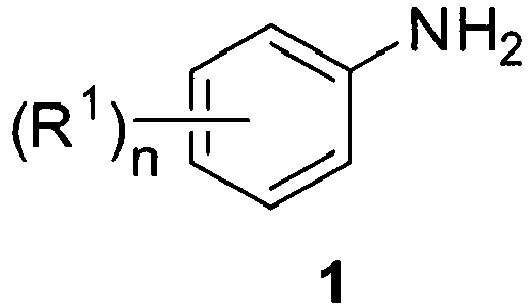
wherein
n is 0,1,2,3,4 or 5;
R1 is independently selected from a halogen atom, NO2, N3, OH, SH, NH2, SO3H, COOH or an optionally substituted alkyl, alkenyl, alkynyl, heteroalkyl, aryl, heteroaryl, cycloalkyl, alkylcycloalkyl, heteroalkylcycloalkyl, heterocycloalkyl, aralkyl or heteroaralkyl group; and
X- is defined as above. - According to a further preferred embodiment, the present invention relates to a process for preparing a compound of
formula 4,
formula 3 or a salt thereof
wherein
m is 0,1,2 or 3;
p is 0,1,2,3 or 4;
R1 is independently selected from a halogen atom, NO2, N3, OH, SH, NH2, SO3H, COOH or an optionally substituted alkyl, alkenyl, alkynyl, heteroalkyl, aryl, heteroaryl, cycloalkyl, alkylcycloalkyl, heteroalkylcycloalkyl, heterocycloalkyl, aralkyl or heteroaralkyl group;
R2 is independently selected from a halogen atom, NO2, N3, OH, SH, NH2, SO3H, COOH or an optionally substituted alkyl, alkenyl, alkynyl, heteroalkyl, aryl, heteroaryl, cycloalkyl, alkylcycloalkyl, heteroalkylcycloalkyl, heterocycloalkyl, aralkyl or heteroaralkyl group; and
X- is defined as above. - According to a further preferred embodiment, the present invention relates to a process for preparing a compound of
formula 6,
formula 5 or a salt thereof
wherein
q is 0,1,2 or 3;
r is 0,1,2,3 or 4;
R1 is independently selected from a halogen atom, NO2, N3, OH, SH, NH2, SO3H, COOH or an optionally substituted alkyl, alkenyl, alkynyl, heteroalkyl, aryl, heteroaryl, cycloalkyl, alkylcycloalkyl, heteroalkylcycloalkyl, heterocycloalkyl, aralkyl or heteroaralkyl group;
R2 is independently selected from a halogen atom, NO2, N3, OH, SH, NH2, SO3H, COOH or an optionally substituted alkyl, alkenyl, alkynyl, heteroalkyl, aryl, heteroaryl, cycloalkyl, alkylcycloalkyl, heteroalkylcycloalkyl, heterocycloalkyl, aralkyl or heteroaralkyl group; and
X- is defined as above. - Preferably, the compound of formula (I) is selected from the following compounds:


- Compounds of
formulas formulas - Compounds of formula (I) as well as the preferred compounds of
formulas - According to a further preferred embodiment, the process of the present invention further comprises a second step, in which the compound of formula (II) is reacted with a compound of formula Ar'-H to give a compound of formula Ar-N=N-Ar' wherein Ar is defined as above and Ar' is an optionally substituted aryl or an optionally substituted heteroaryl group.
- Preferably, the reaction is performed at a pH of 9 or lower.
- Further preferably, the reaction is performed in the presence of at least one solvent.
- Especially preferably, the solvent is water or contains water.
- Moreover preferably, the reaction is performed in water and at least one organic solvent.
- Further preferably, the reaction is performed in the presence of water and at least one acid.
- Especially preferably, the acid is selected from hydrochloric acid, hydrobromic acid, sulfuric acid, nitric acid, a hydrogensulfate salt, boric acid, tetrafluoroboric acid, methanesulfonic acid, acetic acid, trifluoroacetic acid; most preferably, the acid is hydrochloric acid or sulfuric acid.
- Further preferably, the reaction is performed within a temperature range from -20° C to 150° C. This temperature range refers to the temperature of the reaction mixture or scrubber solution.
- Moreover preferably, the reaction is performed within a pressure range from 0.1 to 10 bar.
- Further preferably, the reaction is performed with a gas stream containing 0.001 - 50 vol.-% nitrogen monoxide.
- Further preferably, the reaction is performed with a gas stream containing 0.001 - 50 vol.-% nitrogen dioxide.
- Further preferably, the reaction is performed with a gas stream containing 0.01 - 50 vol.-% oxygen; preferably containing at least 1 vol.-% oxygen, more preferably at least 5 vol.-%; especially at least 10 vol.-%.
- Especially preferably, the reaction is performed in the presence of water, at least one acid and at least one oxidant, which is preferably hydrogen peroxide.
- The compounds of formula (II) can be used in various further reactions known to a person skilled in the art. It is for example possible to prepare biaryl compounds through a radical aryl-aryl coupling reaction or aryl-alkyl compounds through Meerwein arylation reactions. Moreover, compounds of formula (II) can be used for the preparation of halobenzenes or aromatic nitriles through Sandmeyer-type or Balz-Schiemann reactions. Compounds of formula (II) have furthermore been described as reactants in palladium-catalyzed cross-coupling reactions leading to biaryl compounds or arylvinyl compounds. Additional applications for compounds of formula (II) include the synthesis of diaryl azo compounds and aryl-heteroaryl azo compounds. Conversion of compounds of formula (II) into hydrazones through a Japp-Klingemann reaction or into aryl hydrazines via reduction has also been described. Compounds of formula (II) may further be used for the preparation of triazenes as well as for the functionalization and coating of surfaces and in nanotechnology applications. The expression halogen preferably refers to F, Cl, Br and I; more preferably to F, Cl or Br; especially to Cl or Br.
- The expression alkyl refers to a saturated, straight-chain or branched hydrocarbon group that contains from 1 to 20 carbon atoms, preferably from 1 to 12 carbon atoms, especially from 1 to 6 (e.g. 1, 2, 3 or 4) carbon atoms, for example a methyl, ethyl, propyl, iso-propyl, n-butyl, iso-butyl, sec-butyl, tert-butyl, n-pentyl, iso-pentyl, n-hexyl, 2,2-dimethylbutyl or n-octyl group.
- The expressions alkenyl and alkynyl refer to at least partially unsaturated, straight-chain or branched hydrocarbon groups that contain from 2 to 20 carbon atoms, preferably from 2 to 12 carbon atoms, especially from 2 to 6 (e.g. 2, 3 or 4) carbon atoms, for example an ethenyl (vinyl), propenyl (allyl), iso-propenyl, butenyl, ethinyl, propinyl, butinyl, acetylenyl, propargyl, isoprenyl or hex-2-enyl group. Preferably, alkenyl groups have one or two (especially preferably one) double bond(s), and alkynyl groups have one or two (especially preferably one) triple bond(s).
- Furthermore, the terms alkyl, alkenyl and alkynyl refer to groups in which one or more hydrogen atoms have been replaced by a halogen atom (preferably F or Cl), e.g. a haloalkyl group, such as, for example, a 2,2,2-trichloroethyl or a trifluoromethyl group.
- The expression heteroalkyl refers to an alkyl, alkenyl or alkynyl group in which one or more (preferably 1, 2 or 3) carbon atoms have been replaced by an oxygen, nitrogen, phosphorus, boron, selenium, silicon or sulfur atom (preferably by an oxygen, sulfur or nitrogen atom) or by a SO or a SO2 group. The expression heteroalkyl furthermore refers to a carboxylic acid or to a group derived from a carboxylic acid, such as, for example, acyl, acylalkyl, alkoxycarbonyl, acyloxy, acyloxyalkyl, carboxyalkylamide or alkoxycarbonyloxy.
- Preferably, a heteroalkyl group contains from 1 to 12 carbon atoms and from 1 to 4 hetero atoms selected from oxygen, nitrogen and sulphur (especially oxygen and nitrogen). Especially preferably, a heteroalkyl group contains from 1 to 6 (e.g. 1, 2, 3 or 4) carbon atoms and 1, 2 or 3 (especially 1 or 2) hetero atoms selected from oxygen, nitrogen and sulphur (especially oxygen and nitrogen). The term C1-C6 heteroalkyl refers to a heteroalkyl group containing from 1 to 6 carbon atoms and 1, 2 or 3 heteroatoms selected from O, S and/or N (especially O and/or N). The term C1-C4 heteroalkyl refers to a heteroalkyl group containing from 1 to 4 carbon atoms and 1, 2 or 3 heteroatoms selected from O, S and/or N (especially O and/or N). Furthermore, the term heteroalkyl refers to groups in which one or more hydrogen atoms have been replaced by a halogen atom (preferably F or Cl).
- Examples of heteroalkyl groups are groups of formulae: Ra-O-Ya-, Ra-S-Ya-, Ra-SO-Ya-, Ra-SO2-Ya-, Ra-N(Rb)-Ya-, Ra-CO-Ya-, Ra-O-CO-Ya-, Ra-CO-O-Ya-, Ra-CO-N(Rb)-Ya-, Ra-N(Rb)-CO-Ya-, Ra-O-CO-N(Rb)-Ya-, Ra-N(Rb)-CO-O-Ya-, Ra-N(Rb)-CO-N(Rc)-Ya-, Ra-O-CO-O-Ya-, Ra-N(Rb)-C(=NRd)-N(Rc)-Ya-, Ra-CS-Ya-, Ra-O-CS-Ya-, Ra-CS-O-Ya-, Ra-CS-N(Rb)-Ya-, Ra-N(Rb)-CS-Ya-, Ra-O-CS-N(Rb)-Ya-, Ra-N(Rb)-CS-O-Ya-, Ra-N(Rb)-CS-N(Rc)-Ya-, Ra-O-CS-O-Ya-, Ra-S-CO-Ya-, Ra-CO-S-Ya-, Ra-S-CO-N(Rb)-Ya-, Ra-N(Rb)-CO-S-Ya-, Ra-S-CO-O-Ya-, Ra-O-CO-S-Ya-, Ra-S-CO-S-Ya-, Ra-S-CS-Ya-, Ra-CS-S-Ya-, Ra-S-CS-N(Rb)-Ya-, Ra-N(Rb)-CS-S-Ya-, Ra-S-CS-O-Ya-, Ra-O-CS-S-Ya-, wherein Ra being a hydrogen atom, a C1-C6 alkyl, a C2-C6 alkenyl or a C2-C6 alkynyl group; Rb being a hydrogen atom, a C1-C6 alkyl, a C2-C6 alkenyl or a C2-C6 alkynyl group; Rc being a hydrogen atom, a C1-C6 alkyl, a C2-C6 alkenyl or a C2-C6 alkynyl group; Rd being a hydrogen atom, a C1-C6 alkyl, a C2-C6 alkenyl or a C2-C6 alkynyl group and Ya being a bond, a C1-C6 alkylene, a C2-C6 alkenylene or a C2-C6 alkynylene group, wherein each heteroalkyl group contains at least one carbon atom and one or more hydrogen atoms may be replaced by fluorine or chlorine atoms.
- Specific examples of heteroalkyl groups are methoxy, trifluoromethoxy, ethoxy, n-propyloxy, isopropyloxy, butoxy, tert-butyloxy, methoxymethyl, ethoxymethyl, -CH2CH2OH, -CH2OH, -SO2Me, -COOH, methoxyethyl, 1-methoxyethyl, 1-ethoxyethyl, 2-methoxyethyl or 2-ethoxyethyl, methylamino, ethylamino, propylamino, isopropylamino, dimethylamino, diethylamino, isopropylethylamino, methylamino methyl, ethylamino methyl, diisopropyl-amino ethyl, methylthio, ethylthio, isopropylthio, enol ether, dimethylamino methyl, dimethylamino ethyl, acetyl, propionyl, butyryloxy, acetyloxy, methoxycarbonyl, ethoxycarbonyl, propionyloxy, acetylamino or propionylamino, carboxymethyl, carboxyethyl or carboxypropyl, N-ethyl-N-methylcarbamoyl or N-methylcarbamoyl. Further examples of heteroalkyl groups are nitrile, isonitrile, cyanate, thiocyanate, isocyanate, isothiocyanate and alkylnitrile groups.
- Further examples for heteroalkyl groups are hydroxyalkyl, alkoxy, haloalkoxy, alkylcarbonyl, haloalkylcarbonyl, alkylcarbonyloxy, haloalkylcarbonyloxy, alkoxycarbonyl, haloalkoxycarbonyl, alkylsulfonyl, haloalkylsulfonyl, alkylthio and haloalkylthio groups as well as groups of formula -NH(alkyl), -N(alkyl)2, -NH(haloalkyl), -N(haloalkyl)2, - N(alkyl)(haloalkyl), -NH(hydroxyalkyl), -N(hydroxyalkyl)2, -NHCO(alkyl), - NHCO(haloalkyl), -NHSO2(alkyl) and -NHSO2(haloalkyl).
- The expression cycloalkyl refers to a saturated or partially unsaturated (for example, a cycloalkenyl group) cyclic group that contains one or more rings (preferably 1 or 2), and contains from 3 to 14 ring carbon atoms, preferably from 3 to 10 (especially 3, 4, 5, 6 or 7) ring carbon atoms. The expression cycloalkyl refers furthermore to groups in which one or more hydrogen atoms have been replaced by fluorine, chlorine, bromine or iodine atoms or by OH, =O, SH, =S, -SO3H, -SO2NH2, NH2, =NH, N3 or NO2 groups, thus, for example, cyclic ketones such as, for example, cyclohexanone, 2-cyclohexenone or cyclopentanone. Further specific examples of cycloalkyl groups are a cyclopropyl, cyclobutyl, cyclopentyl, spiro[4,5]decanyl, norbornyl, cyclohexyl, cyclopentenyl, cyclohexadienyl, decalinyl, bicyclo-[4.3.0]nonyl, tetraline, cyclopentylcyclohexyl, fluorocyclohexyl or cyclohex-2-enyl group.
- The expression heterocycloalkyl refers to a cycloalkyl group as defined above in which one or more (preferably 1, 2 or 3) ring carbon atoms have been replaced by an oxygen, nitrogen, silicon, selenium, phosphorus or sulfur atom (preferably by an oxygen, sulfur or nitrogen atom) or a SO group or a SO2 group. A heterocycloalkyl group has preferably 1 or 2 ring(s) containing from 3 to 10 (especially 3, 4, 5, 6 or 7) ring atoms (preferably selected from C, O, N and S). The expression heterocycloalkyl refers furthermore to groups that are substituted by fluorine, chlorine, bromine or iodine atoms or by OH, =O, SH, =S, -SO3H, -SO2NH2, NH2, =NH, N3 or NO2 groups. Examples are a piperidyl, prolinyl, imidazolidinyl, piperazinyl, morpholinyl, urotropinyl, pyrrolidinyl, tetrahydrothiophenyl, tetrahydropyranyl, tetrahydrofuryl or 2-pyrazolinyl group and also lactames, lactones, cyclic imides and cyclic anhydrides.
- The expression alkylcycloalkyl refers to groups that contain both cycloalkyl and also alkyl, alkenyl or alkynyl groups in accordance with the above definitions, for example alkylcycloalkyl, cycloalkylalkyl, alkylcycloalkenyl, alkenylcycloalkyl and alkynylcycloalkyl groups. An alkylcycloalkyl group preferably contains a cycloalkyl group that contains one or two rings having from 3 to 10 (especially 3, 4, 5, 6 or 7) ring carbon atoms, and one or two alkyl, alkenyl or alkynyl groups (especially alkyl groups) having 1 or 2 to 6 carbon atoms.
- The expression heteroalkylcycloalkyl refers to alkylcycloalkyl groups as defined above in which one or more (preferably 1, 2 or 3) carbon atoms have been replaced by an oxygen, nitrogen, silicon, selenium, phosphorus or sulfur atom (preferably by an oxygen, sulfur or nitrogen atom) or a SO group or a SO2 group. A heteroalkylcycloalkyl group preferably contains 1 or 2 rings having from 3 to 10 (especially 3, 4, 5, 6 or 7) ring atoms, and one or two alkyl, alkenyl, alkynyl or heteroalkyl groups (especially alkyl or heteroalkyl groups) having from 1 or 2 to 6 carbon atoms. Examples of such groups are alkylheterocycloalkyl, alkylheterocycloalkenyl, alkenylheterocycloalkyl, alkynylheterocycloalkyl, heteroalkylcycloalkyl, heteroalkylheterocycloalkyl and heteroalkylheterocycloalkenyl, the cyclic groups being saturated or mono-, di- or tri-unsaturated.
- The expression aryl refers to an aromatic group that contains one or more rings containing from 6 to 14 ring carbon atoms, preferably from 6 to 10 (especially 6) ring carbon atoms. The expression aryl refers furthermore to groups that are substituted by fluorine, chlorine, bromine or iodine atoms or by OH, SH, SO3H, SO2NH2, NH2, N3 or NO2 groups. Examples are the phenyl, naphthyl, biphenyl, 2-fluorophenyl, anilinyl, 3-nitrophenyl or 4-hydroxyphenyl group.
- The expression heteroaryl refers to an aromatic group that contains one or more rings containing from 5 to 14 ring atoms, preferably from 5 to 10 (especially 5 or 6 or 9 or 10) ring atoms, and contains one or more (preferably 1, 2, 3 or 4) oxygen, nitrogen, phosphorus or sulfur ring atoms (preferably O, S or N). The expression heteroaryl refers furthermore to groups that are substituted by fluorine, chlorine, bromine or iodine atoms or by OH, SH, SO3H, SO2NH2, N3, NH2 or NO2 groups. Examples are pyridyl (e.g. 4-pyridyl), imidazolyl (e.g. 2-imidazolyl), phenylpyrrolyl (e.g. 3-phenylpyrrolyl), thiazolyl, isothiazolyl, 1,2,3-triazolyl, 1,2,4-triazolyl, oxadiazolyl,thiadiazolyl, indolyl, indazolyl, tetrazolyl, pyrazinyl, pyrimidinyl, pyridazinyl, oxazolyl, isoxazolyl, triazolyl, tetrazolyl, isoxazolyl, indazolyl, indolyl, benzimidazolyl, benzoxazolyl, benzisoxazolyl, benzthiazolyl, pyridazinyl, quinolinyl, isoquinolinyl, pyrrolyl, purinyl, carbazolyl, acridinyl, pyrimidyl, 2,3'-bifuryl, pyrazolyl (e.g. 3-pyrazolyl) and isoquinolinyl groups.
- The expression aralkyl refers to groups containing both aryl and also alkyl, alkenyl, alkynyl and/or cycloalkyl groups in accordance with the above definitions, such as, for example, aryl-alkyl, arylalkenyl, arylalkynyl, arylcycloalkyl, arylcycloalkenyl, alkylarylcycloalkyl and alkylarylcycloalkenyl groups. Specific examples of aralkyls are toluene, xylene, mesitylene, styrene, benzyl chloride, o-fluorotoluene, 1H-indene, tetraline, dihydronaphthalene, indanone, phenylcyclopentyl, cumene, cyclohexylphenyl, fluorene and indane. An aralkyl group preferably contains one or two aromatic ring systems (1 or 2 rings) containing from 6 to 10 carbon atoms and one or two alkyl, alkenyl and/or alkynyl groups containing from 1 or 2 to 6 carbon atoms and/or a cycloalkyl group containing 5 or 6 ring carbon atoms.
- The expression heteroaralkyl refers to an aralkyl group as defined above in which one or more (preferably 1, 2, 3 or 4) carbon atoms have been replaced by an oxygen, nitrogen, silicon, selenium, phosphorus, boron or sulfur atom (preferably oxygen, sulfur or nitrogen), that is to say to groups containing both aryl or heteroaryl, respectively, and also alkyl, alkenyl, alkynyl and/or heteroalkyl and/or cycloalkyl and/or heterocycloalkyl groups in accordance with the above definitions. A heteroaralkyl group preferably contains one or two aromatic ring systems (1 or 2 rings) containing from 5 or 6 to 10 ring carbon atoms and one or two alkyl, alkenyl and/or alkynyl groups containing 1 or 2 to 6 carbon atoms and/or a cycloalkyl group containing 5 or 6 ring carbon atoms, wherein 1, 2, 3 or 4 of these carbon atoms have been replaced by oxygen, sulfur or nitrogen atoms.
- Examples are arylheteroalkyl, arylheterocycloalkyl, arylheterocycloalkenyl, arylalkyl-heterocycloalkyl, arylalkenylheterocycloalkyl, arylalkynylheterocycloalkyl, arylalkylhetero-cycloalkenyl, heteroarylalkyl, heteroarylalkenyl, heteroarylalkynyl, heteroarylheteroalkyl, heteroarylcycloalkyl, heteroarylcycloalkenyl, heteroarylheterocycloalkyl, hetero-arylheterocycloalkenyl, heteroarylalkylcycloalkyl, heteroarylalkylheterocycloalkenyl, hetero-arylheteroalkylcycloalkyl, heteroarylheteroalkylcycloalkenyl and heteroarylheteroalkylhetero-cycloalkyl groups, the cyclic groups being saturated or mono-, di- or tri-unsaturated. Specific examples are a tetrahydroisoquinolinyl, benzoyl, 2- or 3-ethylindolyl, 4-methylpyridino, 2-, 3-or 4-methoxyphenyl, 4-ethoxyphenyl, 2-, 3- or 4-carboxyphenylalkyl group.
- Further examples for heteroaralkyl groups are aryl, heteroaryl, arylsulfonyl, heteroarylsulfonyl, arylcarbonyl, heteroarylcarbonyl, aryloxy, aryloxycarbonyl, heteroaryloxy, heteroaryloxycarbonyl, arylcarbonyloxy, heteroarylcarbonyloxy, arylthio and heteroarylthio groups as well as groups of formula -NH(aryl), N(aryl)2, -NH(heteroaryl), -N(heteroaryl)2, -N(aryl)(heteroaryl), -N(aryl)(alkyl), -N(aryl)(haloalkyl), - N(heteroaryl)(alkyl), -N(hetero-aryl)(haloalkyl), -NHCO(aryl), -NHCO(heteroaryl), -NHSO2(aryl), -NHSO2(heteroaryl), -N2(aryl) and -N2(heteroaryl).
- The term "haloalkyl", as used herein and in the haloalkyl units of haloalkoxy, describes straight-chain or branched alkyl groups having 1 to 10 carbon atoms (C1-C10-haloalkyl), preferably 1 to 4 carbon atoms (C1-C4-haloalkyl) and especially 1 to 2 carbon atoms (C1-C2-haloalkyl), where some or all of the hydrogen atoms in these groups are replaced by halogen atoms. Examples of C1-C2-haloalkyl are chloromethyl, bromomethyl, dichloromethyl, trichloromethyl, fluoromethyl, difluoromethyl, trifluoromethyl, chlorofluoromethyl, dichlorofluoromethyl, chlorodifluoromethyl, 1-chloroethyl, 1-bromomethyl, 1-fluoroethyl, 2-fluoroethyl, 2,2-difluoroethyl, 2,2,2-trifluoroethyl, 2-chloro-2-fluoroethyl, 2-chloro-2,2-difluoroethyl, 2,2-dichloro-2-fluoroethyl, 2,2,2-trichloroethyl and pentafluoroethyl. Examples of C1-C4-haloalkyl are, as well as those mentioned for C1-C2-haloalkyl, also 3,3,3-trifluoroprop-1-yl, 1,1,1-trifluoroprop-2-yl, 3,3,3-trichloroprop-1-yl, heptafluoroisopropyl, 1-chlorobutyl, 2-chlorobutyl, 3-chlorobutyl, 4-chlorobutyl, 1-fluorobutyl, 2-fluorobutyl, 3-fluorobutyl, 4-fluorobutyl and the like. Preference is given to fluoromethyl, 2-fluoroethyl and trifluoromethyl.
- The term "hydroxyalkyl" denotes an alkyl group bearing one hydroxyl group, where the alkyl group optionally bears 1, 2 or 3 further substituents selected from halogen, alkyl, haloalkyl, cycloalkyl, alkoxy and haloalkoxy. Examples are -CH2OH, -(CH2)2OH or -(CH2)3OH. The term "alkoxy" denotes straight-chain or branched saturated alkyl groups bonded via an oxygen atom and comprising 1 to 10 carbon atoms (C1-C10-alkoxy), preferably 1 to 4 carbon atoms (C1-C4-alkoxy), where the alkyl radical optionally bears 1, 2 or 3 substituents selected from cycloalkyl, alkoxy and haloalkoxy. Examples of C1-C4-alkoxy are methoxy, ethoxy, n-propoxy, 1-methylethoxy (isopropoxy), n-butoxy, 1-methylpropoxy (sec-butoxy), 2-methylpropoxy (isobutoxy) and 1,1-dimethyloxy (tert-butoxy). Examples of C1-C10-alkoxy are, as well as those mentioned for C1-C4-alkoxy, pentyloxy, hexyloxy and the like. Preference is given to methoxy, ethoxy, n-propoxy and -OCH2-cyclo-pentyl.
- The term "haloalkoxy" describes straight-chain or branched saturated haloalkyl groups bonded via an oxygen atom and comprising 1 to 10 carbon atoms (C1-C10-haloalkoxy), preferably 1 to 4 carbon atoms (C1-C4-haloalkoxy). Examples thereof are chloromethoxy, bromomethoxy, dichloromethoxy, trichloromethoxy, fluoromethoxy, difluoromethoxy, trifluoromethoxy, chlorofluoromethoxy, dichlorofluoromethoxy, chlorodifluoromethoxy, 1-chloroethoxy, 1-bromoethoxy, 1-fluoroethoxy, 2-fluoroethoxy, 2,2-difluoroethoxy, 2,2,2-trifluoroethoxy, 2-chloro-2-fluoroethoxy, 2-chloro-2,2-difluoroethoxy, 2,2-dichloro-2-fluoroethoxy, 2,2,2-trichloroethoxy, 1,1,2,2-tetrafluoroethoxy, 1-chloro-1,2,2-trifluoroethoxy, pentafluoroethoxy, 3,3,3-trifluoroprop-1-oxy, 1,1,1-trifluoroprop-2-oxy, 3,3,3-trichloroprop-1-oxy, 1-chlorobutoxy, 2-chlorobutoxy, 3-chlorobutoxy, 4-chlorobutoxy, 1-fluorobutoxy, 2-fluorobutoxy, 3-fluorobutoxy, 4-fluorobutoxy and the like; preference is given to fluoromethoxy, difluoromethoxy and trifluoromethoxy.
- The term "alkylcarbonyl" denotes alkyl radicals bonded via a carbonyl group and having 1 to 10 carbon atoms (C1-C10-alkylcarbonyl), where the alkyl radical optionally bears 1, 2 or 3 substituents selected from halogen, alkyl, haloalkyl, cycloalkyl, alkoxy and haloalkoxy. Examples thereof are methylcarbonyl (acetyl), ethylcarbonyl, propylcarbonyl, isopropylcarbonyl, n-butylcarbonyl, sec-butylcarbonyl, isobutylcarbonyl and tert-butylcarbonyl; preferably methylcarbonyl and ethylcarbonyl.
- The term "haloalkylcarbonyl" denotes haloalkyl radicals bonded via a carbonyl group and having 1 to 10 carbon atoms (C1-C10-haloalkylcarbonyl). Examples thereof are fluoromethylcarbonyl, difluoromethylcarbonyl, trifluoromethylcarbonyl, 1-fluoroethylcarbonyl, 2-fluoroethylcarbonyl, 1,1-difluoroethylcarbonyl, 2,2-difluoroethylcarbonyl, 2,2,2-trifluoroethylcarbonyl, pentafluoroethylcarbonyl and the like; preference is given to fluoromethylcarbonyl, difluoromethylcarbonyl and trifluoromethylcarbonyl.
- The term "alkylcarbonyloxy" denotes alkyl radicals bonded via a carbonyloxy group and having 1 to 10 carbon atoms (C1-C10-alkylcarbonyloxy), where the alkyl radical optionally bears 1, 2 or 3 substituents selected from cycloalkyl, alkoxy and haloalkoxy. Examples thereof are methylcarbonyloxy (acetoxy), ethylcarbonyloxy, propylcarbonyloxy and isopropylcarbonyloxy, preferably methylcarbonyloxy and ethylcarbonyloxy.
- The term "haloalkylcarbonyloxy" denotes haloalkyl radicals bonded via a carbonyloxy group and having 1 to 10 carbon atoms (C1-C10-haloalkylcarbonyloxy), preferably 1 to 4 carbon atoms (C1-C4-haloalkylcarbonyloxy). Examples thereof are fluoromethylcarbonyloxy, difluoromethylcarbonyloxy, trifluoromethylcarbonyloxy, 1 -fluoroethylcarbonyloxy, 2-fluoroethylcarbonyloxy, 1,1-difluoroethylcarbonyloxy, 2,2-difluoroethylcarbonyloxy, 2,2,2-trifluoroethylcarbonyloxy, pentafluoroethylcarbonyloxy and the like; preference is given to fluoromethylcarbonyloxy, difluoromethylcarbonyloxy and trifluoromethylcarbonyloxy.
- The term "alkoxycarbonyl" denotes alkoxy radicals bonded via a carbonyl group and having 1 to 10 carbon atoms (C1-C10-alkoxycarbonyl), preferably 1 to 4 carbon atoms (C1-C4-alkoxycarbonyl), where the alkyl radical optionally bears 1, 2 or 3 substituents selected from cycloalkyl, alkoxy and haloalkoxy. Examples thereof are methoxycarbonyl, ethoxycarbonyl, propoxycarbonyl, isopropoxycarbonyl, n-butoxycarbonyl, sec-butoxycarbonyl, isobutoxycarbonyl and tert-butoxycarbonyl; preference is given to methoxycarbonyl, ethoxycarbonyl, propoxycarbonyl and isopropoxycarbonyl.
- The term "haloalkoxycarbonyl" denotes haloalkoxy radicals bonded via a carbonyl group and having 1 to 10 carbon atoms (C1-C10-haloalkoxycarbonyl), preferably 1 to 4 carbon atoms (C1-C4-haloalkoxycarbonyl). Examples thereof are fluoromethoxycarbonyl, difluoromethoxycarbonyl, trifluoromethoxycarbonyl, 1-fluoroethoxycarbonyl, 2-fluoroethoxycarbonyl, 1,1-difluoroethoxycarbonyl, 2,2-difluoroethoxycarbonyl, 2,2,2-trifluoroethoxycarbonyl, pentafluoroethoxycarbonyl and the like; preference is given to fluoromethoxycarbonyl, difluoromethoxycarbonyl and trifluoromethoxycarbonyl.
- The term "alkylsulfonyl" denotes alkyl radicals bonded via a sulfonyl group (SO2) and having 1 to 10 carbon atoms (C1-C10-alkylsulfonyl), preferably 1 to 4 carbon atoms (C1-C4-alkylsulfonyl), where the alkyl radical optionally bears 1, 2 or 3 substituents selected from cycloalkyl, alkoxy and haloalkoxy. Examples thereof are methylsulfonyl, ethylsulfonyl, propylsulfonyl, isopropylsulfonyl, n-butylsulfonyl, sec-butylsulfonyl, isobutylsulfonyl and tert-butylsulfonyl; preferably methylsulfonyl, ethylsulfonyl, propylsulfonyl and isopropylsulfonyl.
- The term "haloalkylsulfonyl" denotes haloalkyl radicals bonded via a sulfonyl group (SO2) and having 1 to 10 carbon atoms (C1-C10-haloalkylsulfonyl), preferably 1 to 4 carbon atoms (C1-C4-haloalkylsulfonyl). Examples thereof are fluoromethylsulfonyl, difluoromethylsulfonyl, trifluoromethylsulfonyl, 1-fluoroethylsulfonyl, 2-fluoroethylsulfonyl, 1,1-difluoroethylsulfonyl, 2,2-difluoroethylsulfonyl, 2,2,2-trifluoroethylsulfonyl, pentafluoroethylsulfonyl and the like; preferably fluoromethylsulfonyl, difluoromethylsulfonyl and trifluoromethylsulfonyl.
- The term "arylsulfonyl" denotes aryl radicals bonded via a sulfonyl group (SO2), where the aryl group optionally bears 1, 2, 3 or 4 substituents selected from halogen, alkyl, haloalkyl, alkoxy and haloalkoxy. Examples thereof are phenylsulfonyl, naphthylsulfonyl, fluorenylsulfonyl and the like; preference is given to phenylsulfonyl.
- The term "heteroarylsulfonyl" denotes heteroaryl radicals bonded via a sulfonyl group (SO2) and having 1 to 4 heteroatoms selected from O, N, S and SO2, where the heteroaryl group optionally bears 1, 2, 3 or 4 substituents selected from halogen, alkyl, haloalkyl, alkoxy and haloalkoxy. Examples thereof are 2-pyrrolylsulfonyl, 2-furanylsulfonyl, 2-thienylsulfonyl, 3-pyrazolylsulfonyl, 2-imidazolylsulfonyl, 2-oxazolylsulfonyl, 4-pyridylsulfonyl and the like; preferably 2-pyrrolylsulfonyl, 2-furanylsulfonyl and 4-pyridylsulfonyl.
- The term "arylcarbonyl" denotes aryl radicals bonded via a carbonyl group, where the aryl group optionally bears 1, 2, 3, 4 or 5 substituents selected from halogen, alkyl, haloalkyl, alkoxy or haloalkoxy. Examples thereof are phenylcarbonyl, 4-nitrophenylcarbonyl, 2-methoxyphenylcarbonyl, 4-chlorophenylcarbonyl, 2,4-dichlorophenylcarbonyl, 4-nitrophenylcarbonyl or naphthylcarbonyl, preferably phenylcarbonyl.
- The term "heteroarylcarbonyl" denotes heteroaryl radicals bonded via a carbonyl group and having 1 to 4 heteroatoms selected from O, N, S and SO2, where the heteroaryl group optionally bears 1, 2, 3 or 4 substituents selected from halogen, alkyl, haloalkyl, alkoxy and haloalkoxy. Examples thereof are 2-pyrrolylcarbonyl, 2-furanylcarbonyl, 2-thienylcarbonyl, 3-pyrazolylcarbonyl, 2-imidazolylcarbonyl, 2-oxazolylcarbonyl, 2-thiazolylcarbonyl, 4-triazolylcarbonyl, 4-pyridylcarbonyl and the like.
- The term "aryloxy" denotes an aryl radical bonded via an oxygen atom, where the aryl group optionally bears 1, 2, 3, 4 or 5 substituents selected from halogen, alkyl, haloalkyl, alkoxy and haloalkoxy. Examples thereof are phenyloxy (phenoxy), naphthyloxy, fluorenyloxy and the like; preference is given to phenoxy.
- The term "aryloxycarbonyl" denotes aryloxy radicals bonded via a carbonyl group and having 6 to 14 carbon atoms, where the aryl group optionally bears 1, 2, 3 or 4 substituents selected from halogen, alkyl, haloalkyl, alkoxy and haloalkoxy. Examples thereof are phenyloxycarbonyl (phenoxycarbonyl), naphthyloxycarbonyl, fluorenyloxycarbonyl and the like; preference is given to phenoxycarbonyl.
- The term "heteroaryloxy" denotes heteroaryl radicals bonded via an oxygen atom and having 1 to 4 heteroatoms selected from O, N, S and SO2, where the heteroaryl group optionally bears 1, 2, 3 or 4 substituents selected from halogen, alkyl, haloalkyl, alkoxy and haloalkoxy. Examples thereof are pyrrolyloxy, furanyloxy, thienyloxy, pyrazolyloxy, imidazolyloxy, oxazolyloxy, thiazolyloxy, pyridyloxy, pyrazinyloxy, pyridazinyloxy, pyrimidyloxy and the like; preferably pyrazolyloxy or pyridyloxy.
- The term "heteroaryloxycarbonyl" denotes heteroaryloxy radicals bonded via a carbonyl group and having 1 to 4 heteroatoms selected from O, N, S and SO2, where the heteroaryl group optionally bears 1, 2, 3 or 4 substituents selected from halogen, alkyl, haloalkyl, alkoxy and haloalkoxy. Examples thereof are pyrrolyloxycarbonyl, furanyloxycarbonyl, thienyloxycarbonyl, pyrazolyloxycarbonyl, imidazolyloxycarbonyl, oxazolyloxycarbonyl, thiazolyloxycarbonyl, pyridyloxycarbonyl, pyrazinyloxycarbonyl, pyridazinyloxycarbonyl, pyrimidyloxycarbonyl and the like; preferably imidazolyloxycarbonyl or oxazolyloxycarbonyl.
- The term "arylcarbonyloxy" denotes aryl radicals bonded via a carbonyloxy group, where the aryl group optionally bears 1, 2, 3 or 4 substituents selected from halogen, alkyl, haloalkyl, alkoxy and haloalkoxy. Examples thereof are phenylcarbonyloxy, naphthylcarbonyloxy, fluorenylcarbonyloxy, anthracenylcarbonyloxy and the like; preferably phenylcarbonyloxy.
- The term "heteroarylcarbonyloxy" denotes heteroaryl radicals bonded via a carbonyloxy group and having 1 to 4 heteroatoms selected from O, N, S and SO2, where the heteroaryl group optionally bears 1, 2, 3 or 4 substituents selected from halogen, alkyl, haloalkyl, alkoxy and haloalkoxy. Examples thereof are 2-pyrrolylcarbonyloxy, 2-furanylcarbonyloxy, 2-thienylcarbonyloxy, 3-pyrazolylcarbonyloxy, 2-imidazolylcarbonyloxy, 2-oxazolylcarbonyloxy, 2-thiazolylcarbonyloxy, 4-triazolylcarbonyloxy, 4-pyridylcarbonyloxy and the like.
- The term "alkylthio" denotes alkyl radicals bonded via a sulfur atom and having 1 to 10 carbon atoms (C1-C10-alkylthio), more preferably 1 to 6 carbon atoms (C1-C6-alkylthio), particularly 1 to 4 carbon atoms (C1-C4-alkylthio) and especially 1 to 3 carbon atoms (C1-C3-alkylthio), where the alkyl radical optionally bears 1, 2 or 3 substituents selected from halogen, alkyl, haloalkyl, cycloalkyl, alkoxy and haloalkoxy. Examples thereof are methylthio, ethylthio, n-propylthio, 1-methylethylthio (isopropylthio), n-butylthio, 1-methylpropylthio (sec-butylthio), 2-methylpropylthio (isobutylthio) and 1,1-dimethylethylthio (tert-butylthio) and the like; preferably methylthio, ethylthio and n-propylthio.
- The term "haloalkylthio" describes haloalkyl groups bonded via a sulfur atom and having 1 to 10 carbon atoms (C1-C10-haloalkylthio), more preferably 1 to 6 carbon atoms (C1-C6-haloalkylthio), particularly 1 to 4 carbon atoms (C1-C4-haloalkylthio) and especially 1 to 3 carbon atoms (C1-C3-haloalkylthio). Examples thereof are chloromethylthio, bromomethylthio, dichloromethylthio, trichloromethylthio, fluoromethylthio, difluoromethylthio, trifluoromethylthio, chlorofluoromethylthio, dichlorofluoromethylthio, chlorodifluoromethylthio, 1-chloroethylthio, 1-bromoethylthio, 1-fluoroethylthio, 2-fluoroethylthio, 2,2-difluoroethylthio, 2,2,2-trifluoroethylthio, 2-chloro-2-fluoroethylthio, 2-chloro-2,2-difluoroethylthio, 2,2-dichloro-2-fluoroethylthio, 2,2,2-trichloroethylthio, 1,1,2,2-tetrafluoroethylthio, 1-chloro-1,2,2-trifluoroethylthio, pentafluoroethylthio, 3,3,3-trifluoroprop-1-ylthio, 1,1,1-trifluoroprop-2-ylthio, 3,3,3-trichloroprop-1-ylthio, 1-chlorobutylthio, 2-chlorobutylthio, 3-chlorobutylthio, 4-chlorobutylthio, 1-fluorobutylthio, 2-fluorobutylthio, 3-fluorobutylthio, 4-fluorobutylthio and the like; preference is given to fluoromethylthio, 2-fluoroethylthio and trifluoromethylthio.
- The term "arylthio" denotes aryl radicals bonded via a sulfur atom, where the aryl group optionally bears 1, 2, 3 or 4 substituents selected from halogen, alkyl, haloalkyl, alkoxy and haloalkoxy. Examples thereof are phenylthio, naphthylthio, fluorenylthio and the like; preference is given to phenylthio.
- The term "heteroarylthio" denotes heteroaryl radicals bonded via a sulfur atom and having 1 to 4 heteroatoms selected from O, N, S and SO2, where the heteroaryl group optionally bears 1, 2, 3 or 4 substituents selected from halogen, alkyl, haloalkyl, alkoxy and haloalkoxy. Examples thereof are 2-pyrrolylthio, 3-furanylthio, 3-thienylthio, 2-pyridylthio and the like; preferably 2-pyridylthio and 4-pyridylthio.
- As already stated above, the expressions cycloalkyl, heterocycloalkyl, alkylcycloalkyl, heteroalkylcycloalkyl, aryl, heteroaryl, aralkyl and heteroaralkyl also refer to groups that are substituted by fluorine, chlorine, bromine or iodine atoms or by OH, =O, SH, =S, -SO3H, - SO2NH2, NH2, =NH, N3 or NO2 groups.
- The expression "optionally substituted" especially refers to groups that are optionally substituted by fluorine, chlorine, bromine or iodine atoms or by OH, =O, SH, =S, -SO3H, - COOH, -SO2NH2, NH2, =NH, N3 or NO2 groups. This expression refers furthermore to groups that may be substituted by one, two, three or more C1-C10 alkyl, C2-C10 alkenyl, C2-C10 alkynyl, C1-C10 heteroalkyl, C3-C18 cycloalkyl, C2-C17 heterocycloalkyl, C4-C20 alkylcyclo-alkyl, C2-C19 heteroalkylcycloalkyl, C6-C18 aryl, C1-C17 heteroaryl, C7-C20 aralkyl or C2-C19 heteroaralkyl groups. This expression refers furthermore especially to groups that may be substituted by one, two, three or more unsubstituted C1-C6 alkyl, C2-C6 alkenyl, C2-C6 alkynyl, C1-C6 heteroalkyl, C3-C10 cycloalkyl, C2-C9 heterocycloalkyl, C7-C12 alkylcycloalkyl, C2-C11 heteroalkylcycloalkyl, C6-C10 aryl, C1-C9 heteroaryl, C7-C12 aralkyl or C2-C11 heteroaralkyl groups.
- According to a preferred embodiment, all alkyl, alkenyl, alkynyl, heteroalkyl, aryl, heteroaryl, cycloalkyl, heterocycloalkyl, alkylcycloalkyl, heteroalkylcycloalkyl, aralkyl and heteroaralkyl groups described herein may optionally be substituted.
- When an aryl, heteroaryl, cycloalkyl, alkylcycloalkyl, heteroalkylcycloalkyl, heterocycloalkyl, aralkyl or heteroaralkyl group contains more than one ring, these rings may be bonded to each other via a single or double bond or these rings may be annulated.
- The details given hereinafter regarding preferred configurations of the processes according to the invention, especially regarding preferred configurations of the reactants and products and the reaction conditions of the processes according to the invention, apply either taken alone or, more particularly, in any conceivable combination with one another.
- The reactions described herein are preferably performed in reaction vessels customary for such reactions, and the reaction regime can be configured in a continuous, semicontinuous or batchwise manner.
- In general, the respective reactions will be performed under atmospheric pressure. The reactions can, however, also be performed under reduced (e.g. 0.1 to 1.0 bar) or elevated pressure (e.g. >1.0 to 10 bar).
- More particularly, it is preferable to combine the embodiments with one another in any desired combination.
- According to a preferred embodiment, Ar is an optionally substituted phenyl group, an optionally substituted naphthyl group or an optionally substituted biphenyl group.
- In the context of the present invention, n is preferably 0, 1, 2, 3 or 4, especially 0, 1, 2 or 3, more preferably 1 or 2.
- In the context of the present invention, m is preferably 0, 1 or 2, especially 0 or 1, more preferably 1.
- In the context of the present invention, q is preferably 0, 1 or 2, especially 0 or 1, more preferably 1.
- In the context of the present invention, p is preferably 0, 1, 2 or 3, especially 0, 1 or 2, more preferably 0 or 1.
- In the context of the present invention, r is preferably 0, 1, 2 or 3, especially 0, 1 or 2, more preferably 0 or 1.
- In the context of the present invention, R1 is preferably independently halogen, hydroxy, amino, alkyl, alkoxy, nitro, cyano, aryl, heteroaryl, NHCOCH3, arylazo (such as e.g. phenylazo), heteroarylazo, COOH, SO3H, SO3M, or COOM, wherein M is Li, Na, K, Cs, Mg, Ca, Al or NH4 +. More preferably, R1 is independently halogen, alkyl, alkoxy, hydroxy, amino, nitro, cyano, SO3H or COOH.
- In the context of the present invention, R2 is preferably independently halogen, hydroxy, amino, alkyl, alkoxy, nitro, cyano, aryl, heteroaryl, NHCOCH3, arylazo (such as e.g. phenylazo), heteroarylazo, COOH, SO3H, SO3M, or COOM. More preferably, R2 is independently halogen, alkyl, alkoxy, hydroxy, amino, nitro, cyano, SO3H or COOH.
- More particularly, for compounds of
structure - The stated positions for compounds of
formulas formula - More particularly, for compounds of
structure - More particularly, for compounds of
structure - More particularly, for compounds of
structure - More particularly, for compounds of
structure - The stated positions for compounds of
formulas 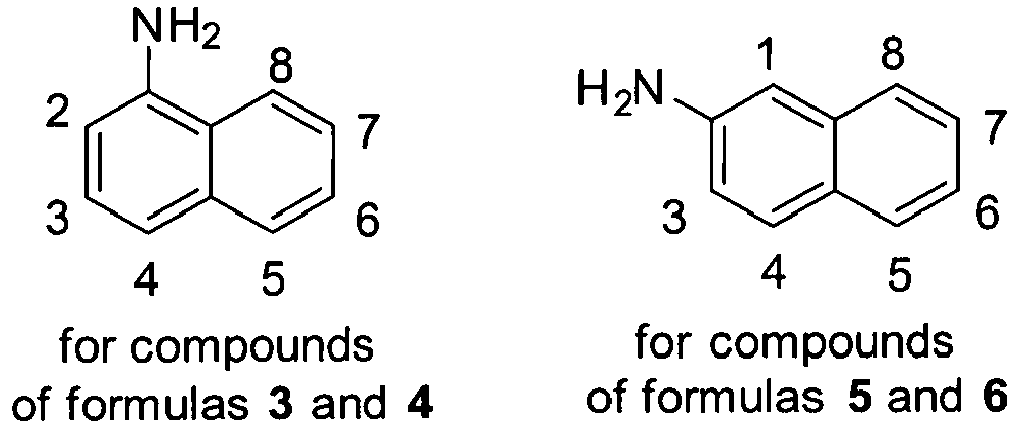
- In the context of the present invention, X- is preferably a halide, such as fluoride, chloride, bromide, iodide or BF4 -, PF6 -, hydrogensulfate, sulfate (½ SO4 2-), acetate, the anion of an aromatic 1,2-dicarboximide or the anion of an aromatic 1,2-disulfonimide. In the latter two cases, the anion forms through abstraction of the proton on the imide nitrogen atom. More preferably X- is a halide, such as chloride or bromide, or BF4 - or sulfate (½ SO4 2-).
- The process of the present invention preferably combines the denitrification of waste gases, as they occur from industrial processes, from waste incineration or from power plants, with the synthesis of valuable and versatile intermediates.
- According to a preferred embodiment of the present invention, the process of the present invention may be used for the denitrification of waste gases, especially industrially produced waste gases containing nitrogen monoxide and/or nitrogen dioxide and preferably containing at least 1% (by volume) of O2 (especially at least 5%; most preferably at least 10% O2).
- Preferably, the nitrogen monoxide and/or nitrogen dioxide as well as the oxygen which are used in the process of the present invention are used in the form of waste gases.
- For waste incineration, typical contents of the stream of waste gas are CO: 30 mg/m3; HCl: 1.500 mg/m3; HF: 14 mg/m3; SOx: 650 mg/m3 (reported as SO2); NOx: 400 mg/Nm3 (reported as NO2) and fly ash: 2.500 mg/Nm3. [Publication No. 4196 by the German Bundesumweltamt (available online via www.umweltbundesamt.de/sites/default/files/medien/ 461/publikationen/4196.pdf or http://www.uba.de/uba-info-medien/4196.html, 10.10.2015)]
- NOx hereby corresponds to the combined amounts of the two most important nitrogen oxides occuring in waste gases, which are nitrogen monoxide (NO) and nitrogen dioxide (NO2).
- Other nitrogen oxides such as N2O4, N2O, N2O3, N2O5 and N4O may also be present in the gas stream or gas mixture used for the process. Within this description, the process is described for nitrogen monoxide and nitrogen dioxide as the two major representative components. Nitrogen dioxide can hereby be partially present in the form of its dimer N2O4 or in the form of its adduct with NO, which is N2O3. As the compounds N2O3 and N2O4 are part of a dynamic equilibrium with their corresponding monomers NO and NO2, the process can also be used for the removal of N2O3 and N2O4 from gas streams of gas mixtures.
- In some industrial fields such as metal processing and etching, for which concentrated nitric acid is commonly used, waste gases with NOx contents of up to 20 vol.-% are produced. A major difficulty in denitrification of such highly concentrated gas streams often is that the concentrations of NOx varies rapidly over time. Thus, the denitrification system has to be able to respond quickly to changes in the NOx concentration to achieve a high degree of purification at all times.
- A further industrial process leading to gas streams containing unsteady concentrations of NOx is the production of nitric acid.
- Especially for gas streams containing unsteady concentrations of NOx, wet scrubbers represent a valuable alternative to the denitrification methods SCR and SNCR. A typical scrubber solution used for such purpose is aqueous hydrogen peroxide (H2O2). [Curtius, F.; Oxidative washing process for cleaning waste gases.
EP 0487834 (A1 ); Chem. Abstr. 115:189023, 1991] - The main task of hydrogen peroxide within the denitrification is to counterbalance the low solubility of nitrogen monoxide in water or aqueous solutions through rapid oxidation to nitrogen dioxide. In this way, nitrogen monoxide is continuously removed from the unfavorable gas-liquid equilibrium so that further nitrogen monoxide can be absorbed. Nitrogen dioxide, in contrast, is well soluble in water and is thus easily removed from the stream of waste gas. Subsequently, NO2 undergoes disportionation to nitric acid (HNO3) and nitrous acid (HNO2), of which the latter is again oxidized by hydrogen peroxide to give nitric acid. Nitric acid or nitrate salts are thus obtained as final products from such denitrification process.
- In general, the ratio of NO and NO2 in the waste gas depends on the temperature and on the amount of oxygen. High temperatures and low concentrations of oxygen favor NO. Due to the underlying equilibrium gas streams containing oxygen, as it is typically the case for waste gases, such gases always contain nitrogen monoxide and nitrogen dioxide. Within the description of this invention the existence of both compounds, nitrogen monoxide and nitrogen dioxoide, in the oxygen-containing gas stream is thus assumed.
- The compounds of formula (II), which are obtained from the process, can be employed as starting materials in various further reactions. Preferably, these follow-up reactions are carried out directly with the solution obtained from the batch reactor or from the wet scrubber after denitrification without intermediate work-up. Possible applications are mentioned in the introductory section. In the examples section, particular examples are given for applications in radical aryl-aryl [A. Wetzel, V. Ehrhardt, M. R. Heinrich, Angew. Chem. Int. Ed. 2008, 47, 9130-9133.] and aryl-heteroaryl coupling reactions [A. Wetzel, G. Pratsch, R. Kolb, M. R. Heinrich, Chem. Eur. J. 2010, 16, 2547-2556.], Sandmeyer reactions [E. Müller, In Methoden der Organischen Chemie (Houben-Weyl), Georg Thieme Verlag, Stuttgart, Germany, 1960 .], azo coupling leading to azo dyes (c.f. III.4.1) [K. Schwetlick, et al. In Organikum, VEB Deutscher Verlag der Wissenschaften, Berlin, Germany, 1971.] and Japp-Klingemann reactions [V. S. Matiychuk, M. A. Potopnyk, M. D. Obushak, J. Heterocyclic Chem. 2013, 50, E43.].
- The products accessible through radical aryl-aryl coupling (c.f. III.2.1) are useful as hair colorants. [
Braun, H.-J.; Chassot, L.; WO 9959527 (A2 - The products from Sandmeyer reactions (c.f. III.3.1) can be used as starting materials for various transition-metal catalyzed coupling reactions. [Modern Arylation Methods, Ackermann, L., Ed.; Wiley-VCH, Weinheim, 2009]
- The products from Japp-Klingemann reactions (c.f. III.5.1) can be used as starting materials for heterocycles including indoles.
- The process described herein allows the removal of NO and NO2 from a gas stream with a scrubber solution containing compounds of formula (I) in water or mixtures of water and other solvents.
- Preferably, the scrubber solution contains a compound of the formula (I) in water and an acid. Preferred acids are described below.
- The denitrification process described in the present invention can be conducted as a batch process or as a continuous flow process.
- A preferred setup for a batch process comprises a closed reaction vessel with pressure equilibration containing the compound of formula (I) in water or mixtures of water and other solvents. The stirred reaction mixture hereby typically occupies less than 5% of the total volume of the reaction vessel. The gas containing mainly NO and NO2, and possibly amounts of other nitrogen oxides as described above, in air is then introduced in the reaction vessel. After completion of the denitrification of the gas introduced in the vessel, the reaction mixture containing the compound of formula (II) can be used for the purposes described above and in the examples section. The ratio of the compound of formula (II) to unreacted compound of formula (I) depends on the amounts of NO and NO2 introduced into the reaction vessel.
- A preferred setup for a continuous process is a wet scrubber (
Figure 1 ). In the scrubber the gas stream containing NO and NO2, and which can additionally contain fly ashes, SO2 and/or HCl, gets into contact with the scrubber solution over a column filled with suitable filling materials such as Raschig rings. Similar to the batch reaction, the scrubber solution contains the compound of formula (I) in water or mixtures of water with other solvents. After completion, the scrubber solution, which now contains the compound of formula (II) and, depending of the amounts of NO and NO2 introduced, also the unreacted compound of formula (I) can be used for the purposes described above and in the examples section. -
Figure 1 shows a scrubber for continuous flow denitrification. Therein, 1 denotes the scrubber solution, 2 denotes a pump, 3 denotes the flow of the scrubber solution, 4 denotes the purified gas stream, 5 denotes the column filled with Raschig rings, 6 denotes the gas stream/waste gas containing NO and/or NO2 and 7 denotes a cooling or heating unit. - Typical scrubber units used in industry are of cylindrical shape and have dimensions of 5-15 m in length and 1-3.5 m in diameter. Such scrubbers are suitable for the denitrification of gas streams with flow rates in the range of 0.5-10 m3/second.
- According to a further preferred embodiment, denitrification can be achieved by bubbling a gas stream containing NO and/or NO2 through a solution of the compound of formula (I) in water or a mixture of water and another solvent.
- The process for the conversion of compounds of formula (I) to compounds of formula (II) is preferably carried out with a gas stream containing a mixture of nitrogen monoxide and nitrogen dioxide. As described above, these two nitrogen oxides can interconvert via an equilibrium which depends on factors such as temperature and the concentration of oxygen or other suitable oxidants. For the process, gas streams with concentrations of nitrogen monoxide and nitrogen dioxide, each independently in the range of 0.001 - 50 vol.-%, may preferably be used.
- Preferably, the conditions regarding temperature and the content of oxygen are chosen in a way that the equilibrium between nitrogen monoxide and nitrogen dioxide is shifted towards nitrogen dioxide. In particular, this is the case when the process is conducted at room temperature, or more generally at temperature below 100 °C.
- To achieve a more rapid equilibration of the components nitrogen monoxide and nitrogen dioxide, the gas stream can optionally be brought into contact with suitable catalysts. As the process is preferably carried out in the presence of air, it can be assumed that due to the existing equilibrium between NO and NO2, a mixture of these two compounds is present at all times in the gas stream or the gas mixture used for the process.
- Suitable conditions are, for example, if a gas stream containing nitrogen dioxide and nitrogen dioxide in air, is used with an concentration of oxygen in the range of 10-20 vol.-%. Regarding other components of the gas stream besides nitrogen monoxide, nitrogen dioxide and oxygen, the preferred component is dinitrogen, as it is the major component in air.
- Preferred conditions are also, if a gas stream from a waste incineration process is used. Such gas streams typically contain nitrogen monoxide and nitrogen dioxide (NO + NO2: 400 mg/Nm3), as well as oxygen (6-10 vol.-%) and dinitrogen (88-94 vol.-%) as major components.
- Currently, the denitrification of waste gases resulting from waste incineration is commonly (ca. 67% of waste incineration sites) achieved with the SCR technique, however comprising the mentioned drawbacks.
- The importance of denitrification techniques can be derived from the NOx emissions reported for Germany in 2013, which amount to 300.000 tons for power plants, to 200.000 tons for industry and production and to ca. 15.000 tons for waste incineration.
- Within the industrial sectors, 59% of the NOx emissions arise from incineration processes.
- Beneficially, the preferred temperature range of 5 - 50 °C of the process fits well to a tail-end application of the process with the aim of denitrification of a stream of waste gas. Waste gases from industrial manufacturing, from power plants or from waste incineration are commonly purified by in a number of steps containing filters for fly ash, absorbers for sulfur oxides and scrubbers for acidic components. A "tail-end" application hereby means that the denitrification step is placed at the end of the purification sequence.
- Advantages of tail-end denitrification usually are that the gas stream contains only low amounts of fly ash as well as only low concentrations of sulfur dioxide. For common techniques such as SCR and SNCR, the low temperature of the gas stream at the end of the sequence is however a significant drawback, which often requires reheating.
- The process described in this invention, in contrast, is well suited for a tail-end application since a gas stream at low temperature will have a higher content of nitrogen dioxide relative to nitrogen monoxide. This is preferable for the process described herein.
- Applications other than tail-end denitrification are however also possible. The process is, for example, not significantly perturbed by the presence of sulfur dioxide in the gas stream.
- The process also tolerates the presence of acids such as hydrochloric acid in the gas stream. Moreover, the process is tolerant to the presence of fly ash in the gas stream or gas mixture employed.
- The process for the conversion of compounds of formula (I) to compounds of formula (II) is preferably carried out in water as solvent.
- Suitable solvents for the process of the present invention are aqueous solvents and organic solvents. Suitable organic solvents are, for example, short-chain nitriles, such as acetonitrile or propionitrile, amides such as N,N-dimethylformamide or N,N-dimethylacetamide, short-chain mono- or polyhydric alcohols such as methanol, ethanol, propanol, ethylene glycol or trifluoroethanol, dimethyl sulfoxide, open-chain and cyclic ethers such as diethyl ether, dioxane or tetrahydrofuran, sulfur compounds such as carbon disulfide or sulfolane, nitro compounds such as nitromethane, or mixtures of these organic solvents with one another. Preferred organic solvents are short-chain nitriles such as acetonitrile or propionitrile, amides such as N,N-dimethylformamide or N,N-dimethylacetamide, short-chain mono- or polyhydric alcohols such as methanol, ethanol, propanol, ethylene glycol or trifluoroethanol, dimethyl sulfoxide and mixtures of these solvents. Particular preference is given to acetonitrile.
- In the case that one or more organic solvents are used, it is preferable to conduct the reaction in a mixture of water and the organic solvent or solvent mixture. The volume ratio of the organic solvent or the organic solvent mixture solvents to water can be chosen freely from 100/0 to 0/100.
- Overall, the solvents or solvent mixtures used are preferably water or mixtures of the above-mentioned organic, water-miscible solvents or solvent mixtures of water and the aqueous acids mentioned.
- As an alternative, not the pure solvents but mixtures which combine the solvent properties are used, or solubilizers are employed.
- The term "solubilizer" denotes (interface-active) substances which, through their presence, make other compounds which are virtually insoluble in a solvent or solvent system soluble or emulsifiable in this solvent or solvent system, whether by entering into a molecular compound with the sparingly soluble substance or acting through micelle formation.
- In a particularly preferred embodiment, aqueous solvents are used. Aqueous solvents are water or mixtures of water and at least one further solvent other than water. Solvents other than water are preferably organic solvents. Preferred organic solvents are water-miscible. Examples of water-miscible organic solvents are short-chain nitriles such as acetonitrile or propionitrile, amides such as N,N-dimethylformamide or N,N-dimethylacetamide, short-chain mono- or polyhydric alcohols such as methanol, ethanol, propanol, ethylene glycol or trifluoroethanol, and dimethyl sulfoxide. Particular preference is given to acetonitrile. Accordingly, particularly preferred solvents are water and aqueous solvents which, as well as water, comprise acetonitrile, i.e. water and water/acetonitrile mixtures.
- Aqueous solvents which, as well as water, comprise at least one further solvent other than water comprise preferably 5 to 95% by weight, more preferably 10 to 95% by weight, even more preferably 20 to 95% by weight, yet more preferably and especially 30 to 95% by weight, and especially 40 to 95% by weight, of water, e.g. 50 to 90 or 60 to 90 or 70 to 90 or 75 to 85% by weight of water. The residual content corresponds to the further solvent(s).
- The pH can be determined by means of customary methods, for example by means of indicators or standard pH meters, for example with glass electrodes or hydrogen electrodes, or with field-effect transistors. Typically, however, the pH is determined in a simple manner via the concentration of the base used, without taking activities into account.
- Stated pH values are typically based on aqueous media, i.e. on the concentration/activity of an acid or base in water. If the reaction medium in which the reaction of the compound of formula (I) takes place is aqueous, the pH values are determined in the generally customary manner. If the reaction medium, in contrast, is nonaqueous, "within the acid range" in the context of the present invention means that the reaction medium in question comprises one or more acids in such a concentration that a purely aqueous medium (i.e. with water as the sole solvent) which comprised the same acid(s) in the same concentration would be acidic and would preferably have a pH of at most 7 (e.g. 7 to 0 or lower, e.g. to -1 or to -2), more preferably at most 5 (e.g. 5 to 0 or lower, e.g. to -1 or to -2), even more preferably at most 3 (e.g. 3 to 0 or lower, e.g. to -1 or to -2).
- Further, the process of the present invention can also be conducted in a pH range of 7 - 9.
- The above mentioned pH values refer to pH values that are obtained after the addition of at least one acid to the compound of formula (I) in at least one solvent. Suitable acids are described below.
- In the context of the processes according to the invention, suitable acids are, for example, inorganic acids such as hydrochloric acid, hydrobromic acid, sulfuric acid or tetrafluoroboric acid. Also suitable in principle are organic acids, such as carboxylic acids (e.g. acetic acid, trifluoroacetic, benzoic acid) and sulfonic acids (e.g. methanesulfonic acid, trifluoromethanesulfonic acid, benzenesulfonic acid, p-toluenesulfonic acid).
- Preference is given to the inorganic acids mentioned, among which preference is given to hydrochloric and sulfuric acid, preferably in the form of the aqueous solution thereof.
- Related to this, the process is preferably carried out with a solution containing the compound of formula (I) in a mixture of water and an aqueous solution of one or more of the above mentioned acids.
- Alternatively and additionally, the process can be carried out with a solution containing more than one the compounds of formula (I) in a mixture of water and an aqueous solution of one or more of the above mentioned acids.
- For the process, it is preferable to use a gas stream in which the ratio of nitrogen dioxide and nitrogen monoxide is shifted towards nitrogen dioxide, which can for example by achieved by lowering the temperature.
- For gas streams at higher temperatures, e.g. above 50 °C, it is preferable to add an oxidant to the solution containing the compound of formula (I). A preferred oxidant is hydrogen peroxide.
- Alternatively, or additionally, for the case that gas streams at higher temperatures, e.g. above 50 °C, are used, the reaction solution can be cooled. This can be achieved by a cooling jacket for the batch setup or by passing the circulating scrubber solution through a cooling device in the continuous wet scrubber setup (see
Figure 1 , 7). - The process is especially preferably conducted with a high content of oxygen in the gas stream with a value above 15 vol.-%. Such a high content of oxygen is for example present in air, which contains approximately 20 vol.-% of oxygen. The process is nevertheless also suited for gas streams containing lower amounts of oxygen with values lower than 15 vol.-%. Typical oxygen contents in gas streams arising from waste incineration or from power plants are, for example, in the range of 5-15 vol.-%.
- The process can be conducted at temperature of the reaction solution in the range of -20 to 150 °C, preferably 0 to 100 °C, more preferably 5 to 60 °C, even more preferably 10 to 35 °C.
- The process, in which a compound of formula (I) is converted to a compound of formula (II) is preferably conducted in at least one solvent. The concentration of the compound of formula (I) in the reaction or scrubber solution can be chosen in the range of 0.001 to 10 mol/l, preferably in the range of 0.01 to 1 mol/l, more preferably in the range of 0.01 to 0.1 mol/l. Alternatively, the process can be conducted with a mixture of two or more compounds of formula (I), which are then converted to a mixture of the corresponding compounds of formula (II). The preferred concentration of each compound of formula (I) is as described above.
- By means of the process of the present invention, the NO2 content in streams of air can be reduced from values of 5000-60000 ppm to values below 200 ppm. This demonstrates the applicability of the process for the purpose of denitrification of waste gases.
- Solvents and reagents were used as received. 1H-NMR spectra were recorded on 360 and 600 MHz spectrometers using CDCl3 and DMSO-d 6 as solvents referenced to TMS (0 ppm), CHCl3 (7.26 ppm) or DMSO-d 6 (2.50 ppm). Chemical shifts are reported in parts per million (ppm). Coupling constants are in Hertz (J Hz). The following abbreviations are used for the description of signals: s (singlet), d (doublet), dd (double doublet), t (triplet), q (quadruplet), m (multiplet). 13C-NMR spectra were recorded at 91 and 151 MHz in CDCl3 using CDCl3 (77.0 ppm) as standard. Mass spectra were recorded using electron impact (EI) or electron spray ionisation (ESI). Analytical TLC was carried out on Merck silica gel plates using short wave (254 nm) UV light to visualize components. Silica gel (Kieselgel 60, 40-63 µm) was used for flash column chromatography.
-
- EtOAc: ethyl acetate
- THF: tetrahydrofuran
- DMSO: dimethylsulfoxide
- In a 250 mL round bottom flask equipped with a balloon for pressure equilibration, nitrogen monoxide (0.10-4.00 mmol) was added by syringe to a mixture of 4-chloroaniline (1a) (1.00 mmol, 128 mg) in a mixture of water and 1 N HCl (3:1 v/v, 16 ml). After vigorous stirring at room temperature, the reaction mixture was concentrated under reduced pressure and analyzed by 1H-NMR spectroscopy using maleic acid as internal standard. The results obtained under these conditions are summarized in the table below.

Entry NO
(equiv)Reaction time
(min)Diazotization (%)
[max. %]Percentage of NO inc. in 2a 1 4.0 120 100 [100] - 2 3.0 120 100 [100] - 3 2.3 120 100 [100] - 4 2.0 120 100 [100] 50 5 2.0 120 d 100 [100] 50 6 2.0 10 100 [100] 50 7 1.0 120 46 [50] 46 8 1.0 30 50 [50] 50 9 1.0 10 45 [50] 45 10 0.1 120 4.9 [5.0] 49 11 3×0.1 3×120 15 [15] 50 - In a 250 mL round bottom flask equipped with a balloon for pressure equilibration, nitrogen monoxide (45 ml, ca. 2.0 mmol) was added by syringe to a solution of 1a-1k (1.00 mmol) in a mixture of water and 1 N HCl (3:1 v/v, 16 ml). After vigorous stirring for 30 minutes at room temperature, the reaction mixture was concentrated under reduced pressure and analyzed by 1H-NMR spectroscopy. Yields determined by 1H-NMR using maleic acid as internal standard (after concentration of the reaction mixture in vacuo). The results obtained under these conditions are summarized in the table below.

Entry 1: R = Yield
2 (%)Side- product 1 1a: 4-Cl 2a (quant.) - 2 1b: 3-Cl 2b (quant.) - 3 1c: 2-Cl 2c (quant.) - 4 1d: 4-F 2d (quant.) - 5 1e: 4-Br 2e (88) 2a (12) 6 1f: 4-I 2f (71) 2a (4) 7 1g: 4-Me 2g (95) - 8 1h: 4-OH 2h (quant.) - 9 1i: 4-CN 2i (91) - 10 1j: 4-NO2 2j (quant.) - 11 1k: H 2k (19) diverse - A stream of nitrogen dioxide (generated by slow addition of copper powder (0.5 equiv.) to concentrated nitric acid (2.0 equiv.)) in air (0.5, 2, 4 or 6 vol.-% NO2, total flow: ca. 5 L/min) was passed through a 10-liter wet scrubber (for figure see above) containing 4-chloroaniline (1a) (12.8 g, 100 mmol) in a mixture of water and 1 N HCl over a time of 22.4, 67.2 or 269 minutes at room temperature. In the 10-liter wet scrubber, the gas stream got into contact with the scrubber solution while passing in counterstream through a column (length ca. 80 cm, diameter ca. 10 cm) filled with Raschig rings. After the NO2 generation was finished, the air flow through the scrubber was maintained for another 38 minutes. The content of NO2 in the outgoing gas stream was measured over the time of NO2 generation and for some further minutes. The results obtained under these conditions are summarized in the table below.

NO2
(mmol)Addition timea
(min)NO2 in air
(vol.-%)Solvents 1N HCl/H2O
(L/L)Diazotization
(%)b1 200 22.4 4.00 0.8/3.2 94 2 300 22.4 6.00 0.8/3.2 100 3 300 67.2 2.00 0.8/3.2 100 4 300 269 0.50 0.8/3.2 100 5 300 22.4 6.00 0.6/2.4c 100 6 300 22.4 6.00 0.5/3.5 100 7 300 22.4 6.00 0.3/3.7 100 8 300 22.4 6.00 0.12/3.88 96 aTime over which NO and NO2-containing gas stream is passed through the scrubber.
bYields determined by 1H-NMR using maleic acid as internal standard (after concentration in vacuo).
cTotal amount of solvent reduced to 3 liters. - For the reactions in entries 1-8 the following NOx (= NO + NO2) concentrations were measured in the outgoing gas stream.
Addition time
(min)NO2 in ingoing gas stream
(ca. ppm)NO + NO2 in outgoing gas stream
(max. ppm value) / (measured time span in min)1 22.4 40000 190 / (0-30) 2 22.4 60000 130 / (0-30) 3 67.2 20000 145 / (0-70) 4 269 5000 110 / (0-270) 5 22.4 60000 120 / (0-30) 6 22.4 60000 180 / (0-30) 7 22.4 60000 110 / (0-30) 8 22.4 60000 180 / (0-30) - For this series of experiments, a partially diazotized mixture containing 1a and 2a in a ratio of 41:59 was used. The obtained results demonstrate that radical biaryl synthesis can be performed also with partially diazotized reaction mixtures.
- A 16 mL aliquot of the 0.062 M solution of 4-chlorophenyl diazonium chloride (2a) (ca. 1 mmol) was added dropwise by syringe pump to a vigorously stirred solution of 1,4-phenylenediamine (3a) (2.16 g, 20.0 mmol) in degassed water (10 mL) and hydrochloric acid (7 ml, 3 N HCl) and titanium(III)-chloride (0.5 mmol, 0.5 mL, ca. 1M solution in 3 N HCl) over a period of 7 minutes under argon. After the addition was complete, the mixture was left to stir for 10 more minutes and a solution of sodium hydroxide (4.0 g) and sodium sulfite (4.0 g) in water (40 mL) was added. After extraction with diethyl ether (3×100 mL), the combined organic phases were washed with satd. aqueous sodium chloride and dried over sodium sulfate. Yield determined by internal standard dimethyltherephthalate and 1,3,5-trimethoxybenzene. Concentration in vacuo and purification by column chromatography (n-hexane/ethyl acetate 8:1) gave the biphenyl-2,5-diamine (4a). The results obtained under these conditions are summarized in the table below.

Entry Variation from standard conditions described above Yield 4a (%) 1 -- 73 2 1,4-Phenylenediamine 4a (5 mmol) 70 3 Under air atmosphere 66 4 Absence of TiCl3 69 5 TiCl3 (2.5 mmol) 64 6 Addition of 2a over 15 min 69 7 Addition of 2a in one batch 68 8 Reaction at 75°C 56 - A 400 mL aliquot of the 0.025 M solution of 4-chlorophenyl diazonium chloride (2a) (ca. 10 mmol, obtained as described in
GM 3, I.3, entries from Table in I.3 correspond to entries in Table II.1.1.2 below) was added by dropping funnel to a vigorously stirred solution of 1,4-phenylenediamine (3a) (5.40 g, 50.0 mmol) in degassed water (100 mL), and titanium(III)-chloride (5.0 mmol, 5.0 mL, ca. 1M solution in 3 N HCl) over a period of 7 minutes under argon. In the case that additional hydrochloric acid (25 mL, 75 mmol, 3 N HCl, seeentries 1 and 2) was added to 3a before the addition of 2a, the amount of water was reduced to 75 mL. For reactions on smaller scales (1, 3, 5 and 7 mmol of 2a), the amounts of all reagents and solvents were reduced accordingly. - After the addition of 2a was complete, the mixture was left to stir for 15 more minutes and a solution of sodium hydroxide (20.0 g) and sodium sulfite (20.0 g) in water (400 mL) was added. After extraction with diethylether (3×100 mL), the combined organic phases were washed with saturated aqueous sodium chloride and dried over sodium sulfate. Concentration in vacuo and purification by column chromatography (n-hexane/ethyl acetate 8:1) gave 4'-chlorobiphenyl-2,5-diamine (4a). The results obtained under these conditions are summarized in the table below.

Entry HCl added to 3a (mol) Yield 4a from 1mmol 2a (%) Yield 4a from 3mmol 2a (%) Yield 4a from 5mmol 2a (%) Yield 4a from 7mmol 2a (%) Yield 4a from 10mmol 2a (%) 1 0.75 - - - - 29 2 0.75 - - - - 32 3 0.0 - - - - 45 4 0.0 34 - 36 - 45 5 0.0 41 43 46 42 47 6 0.0 - - - - 56 7 0.0 43 - 47 - 49 8 0.0 - - - - 44 - After the addition of 2a to 3a and TiCl3 was complete, the resulting mixture was left to stir for further 15 minutes, and it was then extracted with ethyl acetate (3×100 mL) to remove unpolar side products. Due to the acidic conditions, the biphenyl diamine 4a as well as unreacted 1,4-phenylenediamine (3a) were protonated and remained in the aqueous phase. Subsequently, a solution of sodium hydroxide (20.0 g) and sodium sulfite (20.0 g) in water (400 mL) was added to the aqueous phase. After extraction with diethyl ether (3×100 mL), the combined organic phases were washed with saturated aqueous sodium chloride and dried over sodium sulfate. Due to the low solubility of phenylenediamine 3a in diethylether only trace amounts of 3a were extracted from the aqueous phase. The purity of 4a reached with this procedure is comparable to the purity previously observed after column chromatography.
-


- 2-Methylfuran (50 mmol, 4.50 mL) or α-Hydroxymethylfuran (50 mmol, 4.34 mL) was added to a vigorously stirred solution of 400 mL aliquot of the 0.025 M solution of 4-chlorophenyl diazonium chloride (2a) (ca. 10 mmol, obtained as described in
GM 3, I.3, Table entry 6). Subsequently titanium(III)-chloride (5.0 mmol, 5.0 mL, ca. 1 M solution in 3 N HCl) was added and the solution was stirred for 22 minutes. After extraction with dichloromethane (3×200 mL), the combined organic phases were washed with saturated aqueous sodium chloride, dried over sodium sulfate and concentrated in vacuo.
Yields of products 6a (42%) and 8a (56%) were determined by 1H-NMR using internal standards (dimethylterephthalate and 1,3,5-trimethoxybenzene). -

- Potassium iodide (30 mmol, 4.98 g) was added to a 400 mL aliquot of the 0.025 M solution of 4-chlorophenyl diazonium chloride (2a) (ca. 10 mmol, obtained as described in
GM 3, I.3, Table entry 6) and the solution was stirred for 30 minutes at 50° C. After extraction with diethylether (3×200 mL), the combined organic phases were washed with saturated aqueous sodium chloride and dried over sodium sulfate. Concentration in vacuo and purification by column chromatography (diethylether 100%) gave 1-chloro-4-iodobenzene (9a) in a yield of 88%. -
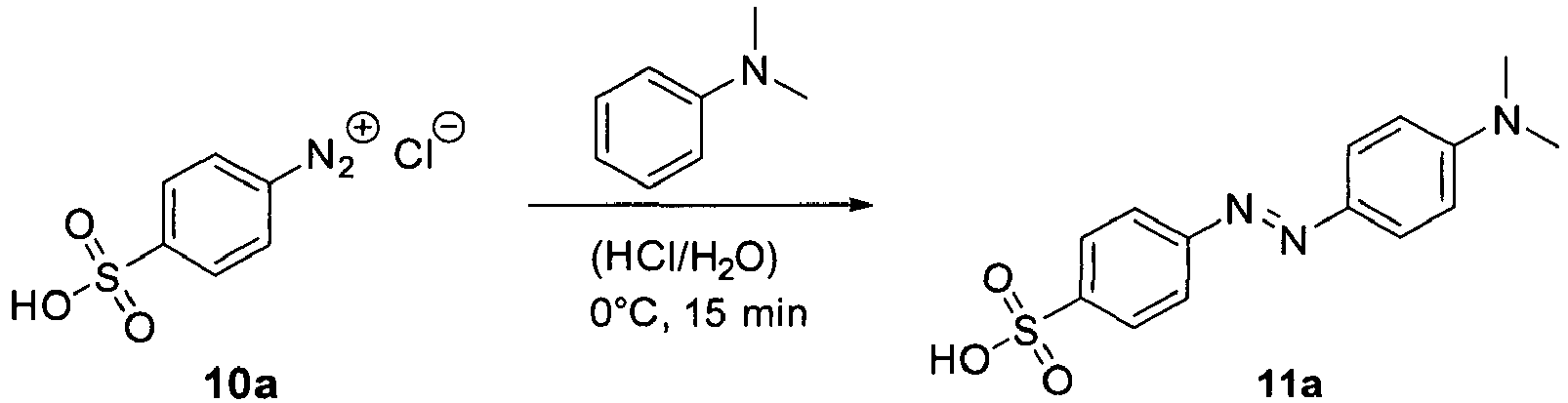
- 4-Sulfophenyl diazonium chloride (10a) (1.00 mmol) is prepared according to
GM 2 and added to a solution of N,N-dimethylaniline (1.00 mmol, 0.13 ml) in 1 M HCl (1 ml) at 0 °C. After stirring for 15 minutes the solution was neutralized and the precipitate obtained was filtered off, washed with water and concentrated under vacuo. The yield of product 11a (71 %) was determined by 1H-NMR spectroscopy using maleic acid as internal standard. -

- 4-Bromo diazonium chloride (1e) (1.00 mmol) is prepared according to
GM 2 and added to a solution of ethyl-2-methyl-3-oxobutanoate (1.00 mmol, 0.14 mL) and sodium acetate (20.0 mmol, 1.6 g) in ethanol (25 ml). After stirring for two hours the solution was evaporated under reduced pressure. The residue was diluted with ethyl acetate (10 mL), extracted with water (10 mL), dried over sodium sulfate and concentration in vacuo. The yield of product 12a (30%) was determined by 1H-NMR spectroscopy using maleic acid as internal standard. - 1H-NMR (360 MHz, DMSO-d 6): δ (ppm) = 8.12 (d, J = 9.3 Hz, 2 H), 8.76 (d, J= 9.3 Hz, 2 H).
- 1H-NMR (360 MHz, DMSO-d 6): δ (ppm) = 8.01 (t, J= 8.3 Hz, 1 H), 8.38 (ddd, J= 1.0 Hz, J = 2.0 Hz, J = 8.3 Hz, 1 H), 8.70 (ddd, J = 1.0 Hz, J = 2.0 Hz, J = 8.3 Hz, 1 H), 8.92 (t, J = 2.0 Hz, 1 H).
- 1H-NMR (360 MHz, DMSO-d 6): δ (ppm) = 7.93-8.00 (m, 1 H), 8.20 (dd, J = 1.0 Hz, J = 8.3 Hz, 1 H), 8.29 (ddd, J= 1.6 Hz, J = 7.6 Hz, J = 8.3 Hz, 1 H), 8.93 (dd, J= 1.6 Hz, J= 8.3 Hz, 1 H).
- 1H-NMR (360 MHz, DMSO-d 6): δ (ppm) = 7.90 (dd, J = 8.3 Hz, J = 9.4 Hz, 2 H), 8.87 (dd, J = 4.5 Hz, J = 9.4 Hz, 2 H).
- 1H-NMR (360 MHz, DMSO-d 6): δ (ppm) = 8.26 (d, J = 9.2 Hz, 2 H), 8.62 (d, J = 9.2 Hz, 2 H).
- 1H-NMR (360 MHz, DMSO-d 6): δ (ppm) = 8.37 (d, J = 9.0 Hz, 2 H), 8.43 (d, J = 9.0 Hz, 2 H).
- 1H-NMR (360 MHz, DMSO-d 6): δ (ppm) = 2.57 (s, 3 H), 7.80 (d, J = 8.3 Hz, 2 H), 8.58 (d, J = 8.3 Hz, 2 H).
- 1H-NMR (360 MHz, DMSO-d 6): δ (ppm) = 7.27 (d, J = 9.3 Hz, 2 H), 8.50 (d, J = 9.3 Hz, 2 H).
- 1H-NMR (360 MHz, DMSO-d 6): δ (ppm) = 8.47 (d, J = 9.1 Hz, 2 H), 8.91 (d, J = 9.1 Hz, 2 H).
- 1H-NMR (360 MHz, DMSO-d 6): δ (ppm) = 8.71 (d, J = 9.3 Hz, 2 H), 8.96 (d, J = 9.3 Hz, 2 H).
- 1H-NMR (360 MHz, DMSO-d 6): δ (ppm) = 7.94-8.02 (m, 2 H), 8.18-8.31 (m, 1 H), 8.63-8.74 (m, 2 H).
- R f = 0.5 (EtOAc) [UV]
1H-NMR (600 MHz, CDCl3): δ (ppm) = 3.42 (bs, 4 H), 6.52 (d, J = 2.5 Hz, 1 H), 6.60 (dd, J = 2.5 Hz, J = 8.5 Hz, 1 H), 6.64 (d, J = 8.5 Hz, 1 H), 7.37-7.41 (m, 4 H). 13C-NMR (151 MHz, CDCl3): δ(ppm) = 116.8 (CH), 117.4 (CH), 117.9 (CH), 127.7 (Cq), 128.9 (2×CH), 130.4 (2×CH), 133.1 (Cq), 135.9 (Cq), 137.9 (Cq), 137.9 (Cq).
HRMS (EI) calculated for C12H11ClN2 [H+]: 219.0684, found: 219.0679. - R f = 0.8 (Hexan/EtOAc = 4:1) [UV].
1H-NMR (600 MHz, CDCl3): δ (ppm) =2.36 (s, 3 H), 6.06 (m, 1 H), 6.53 (d, J= 3.2 Hz, 1 H), 7.32 (d, J= 8.0 Hz, 2 H) 7.55 (d, J = 8.0 Hz, 2 H).
13C-NMR (151 MHz, CDCl3): δ(ppm) = 13.7 (CH3), 106.3 (CH), 107.8 (2 × CH), 124.5 (2 × CH), 135.9 (CH), 129.6 (Cq), 132.2 (Cq), 151.2 (Cq), 152.3 (Cq). - 1H-NMR (600 MHz, CDCl3): δ (ppm) = 4.66 (s, 2 H), 6.38 (d, J = 3.3 Hz, 1 H), 6.58 (d, J = 3.3 Hz, 1 H), 7.34 (d, J = 8.8 Hz, 2 H) 7.59 (d, J = 8.8 Hz, 2 H).
- 1H-NMR (600 MHz, CDCl3): δ (ppm) = 7.09 (d, J = 8.7 Hz, 2 H), 7.61 (d, J = 8.7 Hz, 2 H).
- 1H-NMR (600 MHz, D2O): δ (ppm) = 7.75 (d, J = 8.8 Hz, 2 H), 7.59 (dd, J = 8.8 Hz, J= 14.3 Hz, 4 H), 6.68 (d, J = 9.2 Hz, 2 H), 2.86 (s, 6 H).
- 1H-NMR (600 MHz, CDCl3): δ (ppm) = 7.40 (d, J = 8.9 Hz, 2 H, isomer 1), 7.37 (d, J = 8.9 Hz, 2 H, isomer 2), 7.10 (d, J = 8.9 Hz, 2 H, isomer 1), 7.05 (d, J = 8.9 Hz, 2 H, isomer 2), 4.32 (q, J= 7.1 Hz, 2 H, isomer 1), 4.27 (q, J= 7.1 Hz, 2 H, isomer 2), 2.14 (s, 3 H, isomer 2), 2.10 s (3 H, isomer 1), 1.38 (t, J= 7.1 Hz, 3 H, isomer 1), 1.36 (t, J= 7.1 Hz, 3 H, isomer 2).
Claims (15)
- A process for the preparation of a compound of formula (II)

Ar(̵NHR')a (I)
is reacted with nitrogen monoxide and/or nitrogen dioxide in the presence of oxygen,
wherein
Ar is an optionally substituted aryl or an optionally substituted heteroaryl group;
R' is hydrogen or a group of formula -CO-R", wherein R" is an optionally substituted alkyl, alkenyl, alkynyl, heteroalkyl, aryl, heteroaryl, cycloalkyl, alkylcycloalkyl, heteroalkylcycloalkyl, heterocycloalkyl, aralkyl or heteroaralkyl group;
X- is an anion; and
a is 1 or 2. - The process according to claim 1 for preparing a compound of formula 2,


wherein
n is 0,1,2,3,4 or 5;
R1 is independently selected from a halogen atom, NO2, N3, OH, SH, NH2, SO3H, COOH or an optionally substituted alkyl, alkenyl, alkynyl, heteroalkyl, aryl, heteroaryl, cycloalkyl, alkylcycloalkyl, heteroalkylcycloalkyl, heterocycloalkyl, aralkyl or heteroaralkyl group; and
X- is defined as in claim 1. - The process according to claim 1 for preparing a compound of formula 4,


wherein
m is 0,1,2 or 3;
p is 0,1,2,3 or 4;
R1 is independently selected from a halogen atom, NO2, N3, OH, SH, NH2, SO3H, COOH or an optionally substituted alkyl, alkenyl, alkynyl, heteroalkyl, aryl, heteroaryl, cycloalkyl, alkylcycloalkyl, heteroalkylcycloalkyl, heterocycloalkyl, aralkyl or heteroaralkyl group;
R2 is independently selected from a halogen atom, NO2, N3, OH, SH, NH2, SO3H, COOH or an optionally substituted alkyl, alkenyl, alkynyl, heteroalkyl, aryl, heteroaryl, cycloalkyl, alkylcycloalkyl, heteroalkylcycloalkyl, heterocycloalkyl, aralkyl or heteroaralkyl group; and
X- is defined as in claim 1. - The process according to claim 1 for preparing a compound of formula 6,


wherein
q is 0,1,2 or 3;
r is 0,1,2,3 or 4;
R1 is independently selected from a halogen atom, NO2, N3, OH, SH, NH2, SO3H, COOH or an optionally substituted alkyl, alkenyl, alkynyl, heteroalkyl, aryl, heteroaryl, cycloalkyl, alkylcycloalkyl, heteroalkylcycloalkyl, heterocycloalkyl, aralkyl or heteroaralkyl group;
R2 is independently selected from a halogen atom, NO2, N3, OH, SH, NH2, SO3H, COOH or an optionally substituted alkyl, alkenyl, alkynyl, heteroalkyl, aryl, heteroaryl, cycloalkyl, alkylcycloalkyl, heteroalkylcycloalkyl, heterocycloalkyl, aralkyl or heteroaralkyl group; and
X- is defined as in claim 1. - The process according to claim 1 wherein the compound of formula (I) is selected from the following compounds:


- The process of claim 1 which further comprises a second step, in which the compound of formula (II) is reacted with a compound of formula Ar'-H to give a compound of formula Ar-N=N-Ar' wherein Ar is defined as in claim 1 and Ar' is an optionally substituted aryl or an optionally substituted heteroaryl group.
- The process according to any one of the preceeding claims which is carried out in the presence of at least one solvent, preferably in the presence of water or methanol.
- The process according to any one of the preceeding claims which is carried out in the presence of at least one acid, preferably selected from hydrochloric acid, hydrobromic acid, sulfuric acid, nitric acid, a hydrogensulfate salt, boric acid, tetrafluoroboric acid, methanesulfonic acid, acetic acid and trifluoroacetic acid.
- The process according to any one of claims 2 to 4 wherein R1 is independently halogen, hydroxy, amino, alkyl, alkoxy, nitro, cyano, aryl, heteroaryl, NHCOCH3, arylazo (such as e.g. phenylazo), heteroarylazo, COOH, SO3H, SO3M or COOM, wherein M is Li, Na, K, Cs, Mg, Ca, Al or NH4 +; especially wherein R1 is independently halogen, alkyl, alkoxy, hydroxy, amino, nitro, cyano, SO3H or COOH.
- The process according to any one of claims 3, 4 or 9, wherein R2 is independently halogen, hydroxy, amino, alkyl, alkoxy, nitro, cyano, aryl, heteroaryl, NHCOCH3, arylazo (such as e.g. phenylazo), heteroarylazo, COOH, SO3H, SO3M or COOM, wherein M is Li, Na, K, Cs, Mg, Ca, Al or NH4 +; especially wherein R2 is independently halogen, alkyl, alkoxy, hydroxy, amino, nitro, cyano, SO3H or COOH.
- The process according to any one of the preceeding claims wherein X- is fluoride, chloride, bromide, sulfate, hydrogensulfate, nitrate, nitrite, tetrafluoroborate, acetate, trifluoroacetate, hexafluorophosphate, hexafluoroantimonate, methanesulfonate, trifluoromethanesulfonate, the anion of an aromatic 1,2-dicarboximide or the anion of an aromatic 1,2-disulfonimide, toluene-4-sulfonate or monomethylsulfate; preferably, the anion X- is derived from hydrochloric acid, hydrobromic acid, sulfuric acid, a hydrogensulfate salt, boric acid, tetrafluoroboric acid, methanesulfonic acid, acetic acid, trifluoroacetic acid, nitric acid or nitrous acid; especially preferably from hydrochloric acid or sulfuric acid.
- The process according to any one of the preceeding claims wherein the nitrogen monoxide and/or nitrogen dioxide as well as the oxygen which are used in the process of the present invention are used in the form of waste gases from industrial processes.
- The process according to any one of the preceeding claims which is used for the denitrification of waste gases, especially industrially produced waste gases containing nitrogen monoxide and/or nitrogen dioxide.
- A process for the denitrification of industrial waste gases containing nitrogen monoxide and/or nitrogen dioxide and oxygen which is characterized in that the waste gas is brought into contact with an aqueous solution of a compound of formula (I) or a salt thereof
Ar(̵NHR')a (I)
whereby this compound of formula (I) is converted to a compound of formula (II)
Ar is an optionally substituted aryl or an optionally substituted heteroaryl group;
R' is hydrogen or a group of formula -CO-R", wherein R" is an optionally substituted alkyl, alkenyl, alkynyl, heteroalkyl, aryl, heteroaryl, cycloalkyl, alkylcycloalkyl, heteroalkylcycloalkyl, heterocycloalkyl, aralkyl or heteroaralkyl group;
X- is an anion; and
ais 1 or2. - The process according to claim 14 which is carried out in the presence of at least one acid, preferably selected from hydrochloric acid, hydrobromic acid, sulfuric acid, nitric acid, a hydrogensulfate salt, boric acid, tetrafluoroboric acid, methanesulfonic acid, acetic acid and trifluoroacetic acid.
Priority Applications (3)
| Application Number | Priority Date | Filing Date | Title |
|---|---|---|---|
| EP15003404.9A EP3173401A1 (en) | 2015-11-27 | 2015-11-27 | Process for the synthesis of aryldiazonium salts using nitrogen oxides in oxygen-containing gas streams, especially from industrial waste gases |
| PCT/EP2016/078694 WO2017089470A1 (en) | 2015-11-27 | 2016-11-24 | Process for the synthesis of aryldiazonium salts using nitrogen oxides in oxygen-containing gas streams, especially from industrial waste gases |
| CN201680079827.3A CN108495842A (en) | 2015-11-27 | 2016-11-24 | In oxygen flow, the method for nitrogen oxides synthesizing aryl diazol is used especially from industrial waste gas |
Applications Claiming Priority (1)
| Application Number | Priority Date | Filing Date | Title |
|---|---|---|---|
| EP15003404.9A EP3173401A1 (en) | 2015-11-27 | 2015-11-27 | Process for the synthesis of aryldiazonium salts using nitrogen oxides in oxygen-containing gas streams, especially from industrial waste gases |
Publications (1)
| Publication Number | Publication Date |
|---|---|
| EP3173401A1 true EP3173401A1 (en) | 2017-05-31 |
Family
ID=54770766
Family Applications (1)
| Application Number | Title | Priority Date | Filing Date |
|---|---|---|---|
| EP15003404.9A Withdrawn EP3173401A1 (en) | 2015-11-27 | 2015-11-27 | Process for the synthesis of aryldiazonium salts using nitrogen oxides in oxygen-containing gas streams, especially from industrial waste gases |
Country Status (3)
| Country | Link |
|---|---|
| EP (1) | EP3173401A1 (en) |
| CN (1) | CN108495842A (en) |
| WO (1) | WO2017089470A1 (en) |
Families Citing this family (1)
| Publication number | Priority date | Publication date | Assignee | Title |
|---|---|---|---|---|
| TWI724931B (en) * | 2020-06-23 | 2021-04-11 | 國立成功大學 | N-transfer reagent and method for preparing the same and its application |
Citations (3)
| Publication number | Priority date | Publication date | Assignee | Title |
|---|---|---|---|---|
| EP0487834A1 (en) | 1990-08-30 | 1992-06-03 | Fritz Curtius | Oxidative washing process for cleaning waste gases |
| WO1999059527A2 (en) | 1998-05-16 | 1999-11-25 | Wella Aktiengesellschaft | Oxidizing hair coloring agents containing 2,5-diamino-1-phenylbenzene derivatives and novel 2,5-diamino-1-phenylbenzene derivatives |
| RU2379283C2 (en) * | 2008-01-09 | 2010-01-20 | Государственное образовательное учреждение высшего профессионального образования "Дальневосточный государственный университет" (ДВГУ) | Method of producing stable aryldiazonium salts |
-
2015
- 2015-11-27 EP EP15003404.9A patent/EP3173401A1/en not_active Withdrawn
-
2016
- 2016-11-24 CN CN201680079827.3A patent/CN108495842A/en active Pending
- 2016-11-24 WO PCT/EP2016/078694 patent/WO2017089470A1/en not_active Ceased
Patent Citations (3)
| Publication number | Priority date | Publication date | Assignee | Title |
|---|---|---|---|---|
| EP0487834A1 (en) | 1990-08-30 | 1992-06-03 | Fritz Curtius | Oxidative washing process for cleaning waste gases |
| WO1999059527A2 (en) | 1998-05-16 | 1999-11-25 | Wella Aktiengesellschaft | Oxidizing hair coloring agents containing 2,5-diamino-1-phenylbenzene derivatives and novel 2,5-diamino-1-phenylbenzene derivatives |
| RU2379283C2 (en) * | 2008-01-09 | 2010-01-20 | Государственное образовательное учреждение высшего профессионального образования "Дальневосточный государственный университет" (ДВГУ) | Method of producing stable aryldiazonium salts |
Non-Patent Citations (9)
| Title |
|---|
| "Modern Arylation Methods", 2009, WILEY-VCH |
| A. WETZEL; G. PRATSCH; R. KOLB; M. R. HEINRICH, CHEM. EUR. J., vol. 16, 2010, pages 2547 - 2556 |
| A. WETZEL; V. EHRHARDT; M. R. HEINRICH, ANGEW. CHEM. INT. ED., vol. 47, 2008, pages 9130 - 9133 |
| CHEM. ABSTR., vol. 115, 1991, pages 189023 |
| CHEM. ABSTR., vol. 132, 1999, pages 6216 |
| E. MULLER: "Methoden der Organischen Chemie (Houben-Weyl)", 1960, GEORG THIEME VERLAG |
| G.KAUPP ET AL: "Abfallfreie Gas/Festkörper-Diazotierung mit Stickstoffdioxid und quantitative Triazensynthese ohne Flüssigphase", J.PRAKT.CHEM., vol. 339, 1997, pages 256 - 260, XP002753588 * |
| K. SCHWETLICK ET AL.: "Organikum", 1971, VEB DEUTSCHER VERLAG DER WISSENSCHAFTEN |
| V. S. MATIYCHUK; M. A. POTOPNYK; M. D. OBUSHAK, J. HETEROCYCLIC CHEM., vol. 50, 2013, pages E43 |
Also Published As
| Publication number | Publication date |
|---|---|
| WO2017089470A1 (en) | 2017-06-01 |
| CN108495842A (en) | 2018-09-04 |
Similar Documents
| Publication | Publication Date | Title |
|---|---|---|
| CN102348675B (en) | Process for preparing substituted 2-nitrobiphenyls | |
| Zolfigol et al. | Retracted Article: Experimental and theoretical studies of the nanostructured {Fe 3 O 4@ SiO 2@(CH 2) 3 Im} C (CN) 3 catalyst for 2-amino-3-cyanopyridine preparation via an anomeric based oxidation | |
| DE60007164T2 (en) | METHOD FOR PRODUCING BENZOFURANES OR BENZOTHIOPHENES | |
| CN104151235B (en) | A kind of quinoline preparation method | |
| MX2010014132A (en) | Method for producing aminobiphenylene. | |
| CN104220417B (en) | Use the method for aryl hydrazines synthesizing amino biphenyl class | |
| US8399680B2 (en) | Arylamine synthesis method | |
| AU2001267442B2 (en) | Process for the preparation of aniline compounds | |
| Clark et al. | The trifluoromethylation of chloroaromatics using the copper-CF2Br2-dialkylamide reaction system | |
| WO2017089470A1 (en) | Process for the synthesis of aryldiazonium salts using nitrogen oxides in oxygen-containing gas streams, especially from industrial waste gases | |
| US20130338369A1 (en) | Process for the Synthesis of Aminobiphenylene | |
| Lamson et al. | Aromatic denitration with borohydride. Nucleophilic displacement of nitrite by hydride | |
| US5262539A (en) | Process for the preparation of aromatic amines | |
| Kuriakose et al. | Ferric nitrate-mediated synthesis of functionalized 1, 2, 3-benzotriazinones from 2-aminobenzamides and 2-nitrobenzamides via nitrate reduction strategy | |
| EP3892602A1 (en) | Method for the preparation of deuterated or tritiated compounds | |
| Deck et al. | Synthesis of derivatives of thiophene using methyl 2‐isothiocyanatobenzoate | |
| WO2023007429A1 (en) | Preparation of phenyl sulfilimines or sulfoximines containing thiazolyl-piperidinyl compounds and intermediates thereof | |
| Wróbel et al. | A two-step oxidative aromatic substitution of hydrogen as a convenient way to 2-nitrodiarylamines | |
| CN103804221B (en) | A kind of Preparation Method And Their Intermediate of 4-(4-aminophenyl)-3-morpholone | |
| Suwiński et al. | Reduction of aromatic nitrocompounds by sodium borohydride in methanol in the presence of sodium methoxide | |
| CN107915694A (en) | 1 [2 (2,4 3,5-dimethylphenyl sulfydryl) phenyl] piperazine hydrochloride and preparation method thereof | |
| Vishnumurthy et al. | Reduction of nitro compounds carrying electron withdrawing groups: A convenient approach without metal catalyst | |
| Zhou et al. | Synthesis of 4-methoxy and 5-methoxy substituted 7-aza-isoindolin-1-ones | |
| US20230357125A1 (en) | Process for Catalytic Reduction of Nitro Compounds to Amines | |
| US2945854A (en) | Certain beta-pyridyl, dialkoxy acrylophenones |
Legal Events
| Date | Code | Title | Description |
|---|---|---|---|
| PUAI | Public reference made under article 153(3) epc to a published international application that has entered the european phase |
Free format text: ORIGINAL CODE: 0009012 |
|
| STAA | Information on the status of an ep patent application or granted ep patent |
Free format text: STATUS: THE APPLICATION HAS BEEN PUBLISHED |
|
| AK | Designated contracting states |
Kind code of ref document: A1 Designated state(s): AL AT BE BG CH CY CZ DE DK EE ES FI FR GB GR HR HU IE IS IT LI LT LU LV MC MK MT NL NO PL PT RO RS SE SI SK SM TR |
|
| AX | Request for extension of the european patent |
Extension state: BA ME |
|
| STAA | Information on the status of an ep patent application or granted ep patent |
Free format text: STATUS: THE APPLICATION IS DEEMED TO BE WITHDRAWN |
|
| 18D | Application deemed to be withdrawn |
Effective date: 20171201 |