EP3173071B1 - Maropitant formulation - Google Patents
Maropitant formulation Download PDFInfo
- Publication number
- EP3173071B1 EP3173071B1 EP16200848.6A EP16200848A EP3173071B1 EP 3173071 B1 EP3173071 B1 EP 3173071B1 EP 16200848 A EP16200848 A EP 16200848A EP 3173071 B1 EP3173071 B1 EP 3173071B1
- Authority
- EP
- European Patent Office
- Prior art keywords
- maropitant
- cyclodextrin
- pharmaceutically acceptable
- pharmaceutical composition
- citrate
- Prior art date
- Legal status (The legal status is an assumption and is not a legal conclusion. Google has not performed a legal analysis and makes no representation as to the accuracy of the status listed.)
- Active
Links
Classifications
-
- A—HUMAN NECESSITIES
- A61—MEDICAL OR VETERINARY SCIENCE; HYGIENE
- A61K—PREPARATIONS FOR MEDICAL, DENTAL OR TOILETRY PURPOSES
- A61K31/00—Medicinal preparations containing organic active ingredients
- A61K31/33—Heterocyclic compounds
- A61K31/395—Heterocyclic compounds having nitrogen as a ring hetero atom, e.g. guanethidine or rifamycins
- A61K31/435—Heterocyclic compounds having nitrogen as a ring hetero atom, e.g. guanethidine or rifamycins having six-membered rings with one nitrogen as the only ring hetero atom
- A61K31/439—Heterocyclic compounds having nitrogen as a ring hetero atom, e.g. guanethidine or rifamycins having six-membered rings with one nitrogen as the only ring hetero atom the ring forming part of a bridged ring system, e.g. quinuclidine
-
- A—HUMAN NECESSITIES
- A61—MEDICAL OR VETERINARY SCIENCE; HYGIENE
- A61K—PREPARATIONS FOR MEDICAL, DENTAL OR TOILETRY PURPOSES
- A61K47/00—Medicinal preparations characterised by the non-active ingredients used, e.g. carriers or inert additives; Targeting or modifying agents chemically bound to the active ingredient
- A61K47/06—Organic compounds, e.g. natural or synthetic hydrocarbons, polyolefins, mineral oil, petrolatum or ozokerite
- A61K47/08—Organic compounds, e.g. natural or synthetic hydrocarbons, polyolefins, mineral oil, petrolatum or ozokerite containing oxygen, e.g. ethers, acetals, ketones, quinones, aldehydes, peroxides
- A61K47/10—Alcohols; Phenols; Salts thereof, e.g. glycerol; Polyethylene glycols [PEG]; Poloxamers; PEG/POE alkyl ethers
-
- A—HUMAN NECESSITIES
- A61—MEDICAL OR VETERINARY SCIENCE; HYGIENE
- A61K—PREPARATIONS FOR MEDICAL, DENTAL OR TOILETRY PURPOSES
- A61K47/00—Medicinal preparations characterised by the non-active ingredients used, e.g. carriers or inert additives; Targeting or modifying agents chemically bound to the active ingredient
- A61K47/30—Macromolecular organic or inorganic compounds, e.g. inorganic polyphosphates
- A61K47/36—Polysaccharides; Derivatives thereof, e.g. gums, starch, alginate, dextrin, hyaluronic acid, chitosan, inulin, agar or pectin
- A61K47/40—Cyclodextrins; Derivatives thereof
-
- A—HUMAN NECESSITIES
- A61—MEDICAL OR VETERINARY SCIENCE; HYGIENE
- A61K—PREPARATIONS FOR MEDICAL, DENTAL OR TOILETRY PURPOSES
- A61K9/00—Medicinal preparations characterised by special physical form
- A61K9/0012—Galenical forms characterised by the site of application
- A61K9/0014—Skin, i.e. galenical aspects of topical compositions
-
- A—HUMAN NECESSITIES
- A61—MEDICAL OR VETERINARY SCIENCE; HYGIENE
- A61P—SPECIFIC THERAPEUTIC ACTIVITY OF CHEMICAL COMPOUNDS OR MEDICINAL PREPARATIONS
- A61P1/00—Drugs for disorders of the alimentary tract or the digestive system
- A61P1/08—Drugs for disorders of the alimentary tract or the digestive system for nausea, cinetosis or vertigo; Antiemetics
Definitions
- the present invention relates to a pharmaceutical composition comprising maropitant, a method for preparing the composition, the use of the composition as a medicament, and the use of the composition in the treatment of emesis in mammals, in particular cats and dogs.
- Maropitant a substituted quinuclidine having the chemical name (2S,3S)-(Diphenylmethyl)-N-[2-methoxy-5-(2-methyl-2-propanyl)benzyl]quinuclidin-3-amine, the systematic (IUPAC) name being (2S,3S)- N -(5- tert -Butyl-2-methoxybenzyl)-2-(diphenylmethyl)-1-azabicyclo[2.2.2]octan-3-amine, is a neurokinin (NK1) receptor antagonist that blocks the pharmacological action of substance P in the central nervous system (CNS).
- NK1 neurokinin
- WO 2005/082416 describes the development of a pharmaceutical formulation of maropitant citrate, sulfobutyl ether ⁇ -cyclodextrin and meta-cresol.
- WO 2005/082416 shows that meta-cresol was the only preservative tested that was also stable on storage and had an acceptable injection site tolerance.
- Other preservatives such as benzoic acid, ethanol, propylene glycol and the combination of 0.5 % chlorobutanol and 0.5 % phenylethanol, were all shown to have poor injection site tolerance.
- a pharmaceutical composition comprising, or being: an aqueous solution of:
- injectable compositions according to the invention comprising phenylmethanol do not cause pain on injection in cats and dogs, in other words have an excellent injection site tolerance. Furthermore, phenylmethanol has antimicrobial effects when included in a composition comprising maropitant citrate and a pharmaceutically acceptable ⁇ -cyclodextrin.
- pharmaceutically acceptable means that the substance or composition must be compatible chemically and toxicologically with the other ingredients of the composition and with the mammal being treated therewith.
- injection site tolerance is meant that when the composition according to the invention is injected into a subject, for example a cat, a low pain response is observed.
- pain response is determined by observing behavioural changes of the subject for example scratching, hissing, whining, startled look, flight response, desire to hide.
- the pain score associated with the injection of a composition according to the present invention in cats leads to a modal score of 1 on a five-point pain scale (with a score of 1 indicating minimal or no pain response and a score of 5 indicating a severe pain response was observed).
- the inventors have, for the first time, been able to identify the cause of the pain response in the commercially used maropitant injectable formulations and have identified a composition which does not lead to pain on injection.
- the excellent acceptance of the injectable formulation according to the invention is surprising in light of the knowledge that in rats subcutaneous injection of benzyl alcohol leads to inflammatory responses ( p.180, Water-insoluble Drug Formulation, 2nd Ed., Lui, Rong, CRC Press, Boca Raton, 2008 ).
- the inventors observe that, when phenylmethanol is used as preservative, a surprising lack of inflammatory and pain responses are observed on injection in cats and dogs, in particular when used in the claimed concentration of 7 - 18 mg/ml.
- the pharmaceutically acceptable preservative is free of chlorobutanol, preferably free of chlorinated compounds.
- the aqueous solution is free of chlorinated organic compounds, as such compounds would reduce the injection site tolerance.
- the inventors have found that by using at least 7 - 18 mg/ml phenylmethanol as pharmaceutically acceptable preservative, it is not necessary to include chlorobutanol to achieve the desired antimicrobial effects.
- compositions according to the present invention show an improved injection site tolerance compared to compositions of the prior art which comprise chlorobutanol.
- the pharmaceutically acceptable preservative is present at a concentration of 7-15 mg/ml, preferably 7-13 mg/ml, more preferably 8-12 mg/ml, even more preferably 9-11 mg/ml or even at about 10 mg/ml.
- the term 'about' means that 5% more or less is allowed, i.e. defining a range of 9.5-10.5 mg/ml. More preferably, the term 'about' means that 3% more or less is allowed, most preferably 1% or even 0%.
- concentrations of the pharmaceutically acceptable preservative of 10 mg/ml, and even up to 15 or even 17 or 18 mg/ml pharmaceutically acceptable preservative provides for the desirable osmolality, whilst showing good injection site tolerance.
- phenylmethanol which has a short hydrocarbyl group between the phenyl group and hydroxyl group is advantageous as a particularly low pain score in observed on injection into cats and dogs.
- compositions that has a much better injection site tolerance than commercially available injectable maropitant compositions.
- a particularly acceptable injection site tolerance is achieved by using a composition according to the invention comprising phenylmethanol.
- the antimicrobial preservative is phenylmethanol
- a pain score of 1 is observed, compared to a pain score of 3 using a commercially available composition comprising meta-cresol.
- the composition comprises 8-12 mg/ml maropitant, as calculated by the weight of the free base.
- a maropitant salt is used, the higher molecular weight of the salt should be corrected for. This would e.g. mean that a 8 mg/ml maropitant solution can be obtained by dissolving 8 mg maropitant free base (having a molecular weight of 469 g/mol) per ml of water, or e.g. 11.6 g maropitant citrate monohydrate (having a molecular weight of 679 g/mol).
- maropitant citrate is provided by combining 8-12 mg/ml maropitant free base and 2-6 mg/ml citric acid.
- maropitant free base is used in combination with a pharmaceutical grade citric acid solution.
- maropitant can be present as a pharmaceutically acceptable salt, for example citrate.
- cyclodextrin means a compound including cyclic (is 1 ⁇ 4) linked D-glucopyranose units
- ⁇ -cyclodextrin refers to a cyclodextrin with 6 cyclic, linked D-glucopyranose units
- ⁇ -cyclodextrin has 7 cyclic, linked D-glucopyranose units
- ⁇ -cyclodextrin has 8 cyclic, linked D-glucopyranose units.
- the cyclic D-glucopyranose units define a hydrophobic cavity. Due to the conformation of the glucopyranose units, the cyclodextrins are shaped like a truncated cone rather than perfect cylinders.
- the hydroxyl functions are orientated to the cone exterior with the primary hydroxyl groups of the sugar residues at the narrow edge of the cone and the secondary hydroxyl groups at the wider edge.
- the central cavity is lined by the skeletal carbons and ethereal oxygens of the glucose residues, which gives it a lipophilic character.
- cyclodextrins can occur at one or more of the 2, 3 and 6 hydroxyl positions of one or more glucopyranose units.
- the sulfobutyl ether derivative of ⁇ -cyclodextrin (SBE- ⁇ -CD) has a range of six to seven sulfobutyl ether groups per cyclodextrin molecule
- the hydroxyl groups can be modified by hydroxypropyl moieties resulting in hydroxylpropyl- ⁇ -cycodextrins (HP- ⁇ -CD)
- the pharmaceutically acceptable ⁇ -cyclodextrin is sulfobutyl ether ⁇ -cyclodextrin sodium or 2-hydroxypropyl ⁇ -cyclodextrin, preferably sulfobutyl ether ⁇ -cyclodextrin sodium. It has been found that an acceptable injection site tolerance is observed when either sulfobutyl ether ⁇ -cyclodextrin sodium or 2-hydroxypropyl- ⁇ -cyclodextrin is used. For example, when the ⁇ -cyclodextrin is 2-hydroxypropyl- ⁇ -cyclodextrin, the observed modal pain score was 2 when a composition according to the present invention was subcutaneously injected into cats. This is an improvement on the commercially available composition, which has an observed modal pain score of 3.
- sulfobutyl ether ⁇ -cyclodextrin sodium is particularly preferred as the pharmaceutically acceptable cyclodextrin in the compositions according to the invention because when this composition was sub-cutaneously injected into cats the observed modal pain score was 1.
- the inventors have found that the combination of an aqueous solution of maropitant citrate, sulfobutyl ether ⁇ -cyclodextrin sodium and benzyl alcohol has a very acceptable injection site tolerance.
- Sulfobutyl ether ⁇ -cyclodextrin sodium is polyanionic in nature, and therefore interacts particularly well with maropitant.
- this sulfobutyl ether ⁇ -cyclodextrin sodium has exceptional solubility and parenteral safety.
- compositions comprising sulfobutyl ether ⁇ -cyclodextrin are due to the osmolality of this composition being close to the physiological osmolality.
- osmolality of a real solution corresponds to the molality of an ideal solution containing non-dissociating solutes and is expressed in osmoles or milliosmoles per kilogram of solvent (Osmol per kg or mOsmol per kg, respectively), a unit that is similar to the molality of the solution.
- osmolality is a measure of the osmotic pressure exerted by a real solution across a semipermeable membrane.
- the osmolality of the composition according to the invention is between 290 and 310 mOsmol per kg.
- the inventors have found that by using 11 mg/ml phenylmethanol as the preservative, a composition having an osmolality of 301 mOsmol per kg is obtained, which is very close to the physiological osmolality (in cats and dogs) which is 300 mOsmol per kg. Similar osmolality values are obtained when using benzyl ethanol within he claimed range.
- the effect of the close matching of the osmolality of the injected solution to that of the physiological osmolality means that the injected solution is effectively isotonic with the conditions of the animal receiving the injection, so that there is minimal physiological response in the said animal.
- the commercially available maropitant citrate monohydrate, sulfobutyl ether ⁇ -cyclodextrin and meta-cresol composition has an osmolality of about 214 mOsmol per kg.
- the inventors propose that this relatively low osmolality compared to the physiological osmolality is the cause of the high pain response in an animal.
- An osmolality quite significantly lower (i.e., more dilute) than the physiological osmolality will cause the red blood cells to take on extra fluid in an attempt to equilibrate osmolality on either side of the blood cell membrane. If they swell too much, they will burst, spilling their contents into the serum and, at least with the red blood cells, making them unavailable for oxygen transport, and thus causing pain for the recipient of the injection.
- the pharmaceutically acceptable ⁇ -cyclodextrin is present at a concentration of 40 - 80 mg/ml, preferably of 60 - 70 mg/ml.
- the inventors have found that inclusion of a ⁇ -cyclodextrin is essential for the solubility of the maropitant.
- the optimum concentration range has been found to be 60 - 70 mg/ml.
- the aqueous solution is free of a co-solvent, such as ethanol, as such co-solvent will reduce the injection site tolerance.
- the invention in a second aspect of the present invention, relates to a pharmaceutical composition for use as a medicament.
- the inventors have found that the composition according to the invention is clinically useful for the prevention and treatment of motion sickness and emesis in mammals and as an anti-nociceptive in mammals.
- the pharmaceutical composition according to the invention is used in the treatment of emesis in mammals.
- mammal includes animals such horse, sheep, goat, pig, cow, dog and cat.
- the pharmaceutical composition according to the invention for use in the treatment of emesis in cats and dogs.
- the present invention is particularly suited to the treatment of companion animals, such as cats and dogs.
- the pharmaceutical composition according to the invention is administered by parenteral injection.
- the compositions according to the invention are intended for administration as an injection or infusion.
- the compositions may be administered intravenously (into a vein), subcutaneously (under the skin), and intramuscularly (into muscle).
- the compositions according to the present invention are administered subcutaneously.
- the present invention has the advantage that the composition according to the present invention has leads to a minimal, if any, pain response as observed on the said 5 point pain scale.
- the present invention relates to a method for preparing a pharmaceutical composition as defined above, comprising the steps of:
- the aqueous medium is preferably water, although any suitable a.
- the water can comprise additional solubles, that can e.g. be adjuvants in the solution.
- suitable solubles that can be used in the solution.
- An aqueous medium can be used, which is preferably free of organic cosolvents.
- the maropitant composition of the present invention can easily be prepared by providing an aqueous solution of a source of maropitant, for example as maropitant cations and citrate counter ions, and adding a suitable ⁇ -cyclodextrin to complex the maropitant cations and thus improve the solubility of the maropitant cations. Subsequently, the pharmaceutically acceptable preservative is added and the composition pH adjusted by titration with a pharmaceutically acceptable acid or base.
- a source of maropitant for example as maropitant cations and citrate counter ions
- the maropitant is provided by maropitant free base or a maropitant salt, said salt preferably being selected from the group consisting of hydrobromide, hydrochloride, hydroiodide, sulphate, acetate, malate, oxalate, lactate, citrate, fumerate, tartrate, mesylate and succinate.
- inorganic for example hydrobromide, hydrochloride, hydroiodide and sulphate
- organic salts for example acetate, malate, oxalate, lactate, citrate, fumerate, tartrate, mesylate and succinate, are suitable, and preferred, for use in the present invention.
- citrate anions means the deprotonated form of 2-hydroxypropane-1,2,3-trioic acid, commonly known as citric acid.
- Citrate anions can be provided by 2-hydroxypropane-1,2,3-trioic acid or a pharmaceutically acceptable inorganic salt thereof.
- Suitable inorganic salts are, for example sodium citrate, and potassium citrate.
- the pharmaceutically acceptable citrate source is citric acid as this does not introduce inorganic cations into the composition of the present invention and citric acid provides not only a suitable counter ion but also provides a means of adjusting the pH to the desired value.
- maropitant is provided by maropitant free base and citrate anions are provided by citric acid.
- Maropitant free base is only soluble in organic solvents such as DMSO.
- the inventors have found, however, that an aqueous solution of maropitant can be prepared by addition of citric acid and a ⁇ -cyclodextrin.
- the advantage of this method compared to using maropitant citrate is that maropitant free base is easier to synthesise.
- the maropitant and citrate are provided together by maropitant citrate.
- maropitant citrate monohydrate may be used which has a molecular weight of 678.81 and a theoretical potency based on the active ingredient of 690 mg/g.
- the pharmaceutically acceptable ⁇ -cyclodextrin is sulfobutyl ether 3-cyclodextrin sodium or 2-hydroxypropyl- ⁇ -cyclodextrin, preferably sulfobutyl ether ⁇ -cyclodextrin. It has been found that sulfobutyl ether ⁇ -cyclodextrin is particularly preferred due to the improved solubility of maropitant in the presence of sulfobutyl ether ⁇ -cyclodextrin.
- the pharmaceutically acceptable preservative is selected from the group consisting of phenylmethanol, 2-phenylethanol, 3-phenyl-1-propanol and 4-phenyl-1-butanol preferably phenylmethanol.
- phenylmethanol is included in the composition according to the present invention, a particularly good injection site tolerance is observed.
- the pharmaceutically acceptable base is sodium hydroxide or ammonia, preferably sodium hydroxide. It has been found that there are no adverse side effects when sodium hydroxide is included in the composition according to the present invention.
- the pharmaceutically acceptable acid is selected from the group consisting of hydrochloric acid, formic acid, acetic acid and citric acid, preferably being citric acid. It has been found that in order to bring the composition to the desirable pH of between 3 and 6, both inorganic acid, for example hydrochloric acid, or organic acids, for example formic acid, acetic acid and citric acid, can be used.
- inorganic acid for example hydrochloric acid, or organic acids, for example formic acid, acetic acid and citric acid
- citric acid is used as this also provides a source of citrate anions, which is the preferred anion in order to achieve the desired injection site tolerance.
- Maropitant (free base) was synthesised according to WO 1990005729 A1 .
- Sulfobutyl ether ⁇ -cyclodextrin sodium was obtained from Fraupharma (Italy).
- 2-Hydroxypropyl ⁇ -cyclodextrin was obtained from Roquette (France).
- Phenylmethanol (benzyl alcohol) is obtained from Merck catalogue number 1.00981, 2-phenylethanol, was obtained from Merck, catalogue number 8.07006 and used without any further purification.
- Methyl parahydroxybenzoate and propyl parahydroxybenzoate were obtained from Merck, catalogue numbers 1.06757 and 1.07427 respectively.
- Antimicrobial efficacy was tested according to European Pharmacopoeia 8.0 chapter 5.1.3, 01/2011:50103. Briefly, the test consists of challenging the formulation with a prescribed inoculum of suitable micro-organisms, storing in inoculated formulation at a prescribed temperature, withdrawing a sample of the formulation at specified time intervals and counting the organisms in the samples so removed.
- the acceptance criteria for the injectable formulations tested correspond to those of Table 5.1.3.1 of Eu. Pharm. 8.0.
- Osmolality was measured according European Pharmacopoeia 8.0 01/2012 (Eu. Pharm 8.0), chapter 2.2.35. Briefly, reference solutions according to Table 2.2.35-1 of Eu. Pharm 8.0 were prepared. The zero of the apparatus was determined using water. The apparatus was calibrated using the reference solutions. Before testing each sample, the measurement cell was rinsed with the sample to be tested, see table 2. Table 2: Osmolality of formulations A1 - 4 Example Osmality / mOsm/kg A1 274 A2 42 A3 301 A4 122
- the formulations given in table 1 were assessed for injection site tolerance as follows. 10 Cats were injected with a formulation according to the following tables 3 - 5. The injection site tolerance was scored on a scale of 1 - 5, where 1 indicates a minimal pain response was observed and 5 indicates severe pain response was observed.
- Table 3 Injection site tolerance of commercially available Cerenia® which contains maropitant citrate, sulfobutyl ether ⁇ -cyclodextrin sodium & metacresol Cerenia Weight (kg) Volume of injected fluid(ml) Scoring (1-2-3-4-5) Cat 1 3,3 0,2 1 Cat 2 5 0,5 3 Cat 3 3,5 0,2 3 Cat 4 3 0,2 3 Cat 5 2,8 0,2 1 Cat 6 6 0,4 3 Cat 7 2,6 0,2 4 Cat 8 4 0,2 2 Cat 9 4 0,2 2 Cat 10 3,5 0,2 2 MEAN SCORE 2.4 MODE SCORE 3
- Table 4 Injection site tolerance of test formulation A4 (10 mg/ml maropitant free base, 4.1 mg/ml citric acid, 45 mg/ml 2-Hydroxypropyl ⁇ -cyclodextrin, 10 mg/ml phenylmethanol) Test formulation 1 Weight (kg) Volume of injected fluid(ml) Scoring (1-2-3-4-5) Cat 1 2,5 0,15 1 Cat 2 2,5 0,15 2 Cat 3 2,
- the component effecting injection site tolerance is the antimicrobial preservative.
- meta-cresol When meta-cresol is used a poor injection site tolerance is obtained (3), whereas phenylethanol and phenylmethanol have good (2) and very good (1) tolerances respectively.
- phenylethanol and phenylmethanol have good (2) and very good (1) tolerances respectively.
- 1 mg/ml methyl parahydroxybenzoate together with 0.1 mg/ml propyl parahydroxybenzoate was used as preservative (not shown) the desired level of antimicrobial efficacy was not obtained.
Landscapes
- Health & Medical Sciences (AREA)
- Chemical & Material Sciences (AREA)
- Public Health (AREA)
- Veterinary Medicine (AREA)
- Medicinal Chemistry (AREA)
- Pharmacology & Pharmacy (AREA)
- Life Sciences & Earth Sciences (AREA)
- Animal Behavior & Ethology (AREA)
- General Health & Medical Sciences (AREA)
- Epidemiology (AREA)
- General Chemical & Material Sciences (AREA)
- Engineering & Computer Science (AREA)
- Chemical Kinetics & Catalysis (AREA)
- Hospice & Palliative Care (AREA)
- Otolaryngology (AREA)
- Bioinformatics & Cheminformatics (AREA)
- Inorganic Chemistry (AREA)
- Nuclear Medicine, Radiotherapy & Molecular Imaging (AREA)
- Organic Chemistry (AREA)
- Oil, Petroleum & Natural Gas (AREA)
- Dermatology (AREA)
- Medicinal Preparation (AREA)
- Pharmaceuticals Containing Other Organic And Inorganic Compounds (AREA)
Description
- The present invention relates to a pharmaceutical composition comprising maropitant, a method for preparing the composition, the use of the composition as a medicament, and the use of the composition in the treatment of emesis in mammals, in particular cats and dogs.
- Maropitant, a substituted quinuclidine having the chemical name (2S,3S)-(Diphenylmethyl)-N-[2-methoxy-5-(2-methyl-2-propanyl)benzyl]quinuclidin-3-amine, the systematic (IUPAC) name being (2S,3S)-N-(5-tert-Butyl-2-methoxybenzyl)-2-(diphenylmethyl)-1-azabicyclo[2.2.2]octan-3-amine, is a neurokinin (NK1) receptor antagonist that blocks the pharmacological action of substance P in the central nervous system (CNS). Maropitant is used in the prevention and treatment of vomiting in dogs and the treatment of vomiting in cats.
-
WO 2005/082416 describes the development of a pharmaceutical formulation of maropitant citrate, sulfobutyl ether β-cyclodextrin and meta-cresol.WO 2005/082416 shows that meta-cresol was the only preservative tested that was also stable on storage and had an acceptable injection site tolerance. Other preservatives such as benzoic acid, ethanol, propylene glycol and the combination of 0.5 % chlorobutanol and 0.5 % phenylethanol, were all shown to have poor injection site tolerance. - Although meta-cresol was identified as being the most suitable preservative by the inventors of
WO 2005/082416 , studies have since shown that injection of a pharmaceutical formulation of maropitant citrate, sulfobutyl ether β-cyclodextrin and meta-cresol leads to pain and adverse reactions in animal subjects, in particular cats. For example, pain on injection of maropitant citrate, sulfobutyl ether β-cyclodextrin and meta-cresol was observed in 75% of cats injected with 3 and 5 mg/kg, whereas in the control group injected placebo (saline) only 5% of cats registered a pain response. - There is therefore a need for an injectable solution of maropitant which causes less pain on injection.
- It is an object of the present invention to provide an injectable maropitant composition that has an improved injection site tolerance.
- The object of the present invention is solved by a pharmaceutical composition comprising, or being:
an aqueous solution of: - a) maropitant citrate, the maropitant having the structural formula I:

- b) a acceptable β-cyclodextrin,
- c) 7 - 18 mg/ml of phenylmethanol which is a pharmaceutically acceptable preservative according to formula II:
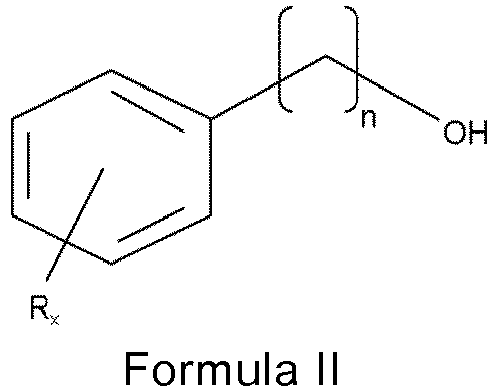
- The inventors have found that injectable compositions according to the invention comprising phenylmethanol do not cause pain on injection in cats and dogs, in other words have an excellent injection site tolerance. Furthermore, phenylmethanol has antimicrobial effects when included in a composition comprising maropitant citrate and a pharmaceutically acceptable β-cyclodextrin.
- The term "pharmaceutically acceptable" means that the substance or composition must be compatible chemically and toxicologically with the other ingredients of the composition and with the mammal being treated therewith.
- By "injection site tolerance" is meant that when the composition according to the invention is injected into a subject, for example a cat, a low pain response is observed. Typically, pain response is determined by observing behavioural changes of the subject for example scratching, hissing, whining, startled look, flight response, desire to hide.
- The pain score associated with the injection of a composition according to the present invention in cats leads to a modal score of 1 on a five-point pain scale (with a score of 1 indicating minimal or no pain response and a score of 5 indicating a severe pain response was observed). This is a considerable improvement over the commercially available composition of maropitant citrate (monohydrate), sulfobutyl ether β-cyclodextrin and meta-cresol which gives a modal score of 3 on the pain scale.
- The inventors have, for the first time, been able to identify the cause of the pain response in the commercially used maropitant injectable formulations and have identified a composition which does not lead to pain on injection. The excellent acceptance of the injectable formulation according to the invention is surprising in light of the knowledge that in rats subcutaneous injection of benzyl alcohol leads to inflammatory responses (p.180, Water-insoluble Drug Formulation, 2nd Ed., Lui, Rong, CRC Press, Boca Raton, 2008). The inventors observe that, when phenylmethanol is used as preservative, a surprising lack of inflammatory and pain responses are observed on injection in cats and dogs, in particular when used in the claimed concentration of 7 - 18 mg/ml.
- The inventors have found that inclusion of 7 - 18 mg/ml phenylmethanol as pharmaceutically acceptable preservative, results in the desired level of antimicrobial effects according to the requirements of Ph. Eur. A criteria and Ph. Eur. B criteria. Not only are the antimicrobial effects acceptable but the compositions of the present invention also have an acceptable and improved injection site tolerance.
- In an attractive embodiment, the pharmaceutically acceptable preservative is free of chlorobutanol, preferably free of chlorinated compounds. Most preferably, the aqueous solution is free of chlorinated organic compounds, as such compounds would reduce the injection site tolerance. The inventors have found that by using at least 7 - 18 mg/ml phenylmethanol as pharmaceutically acceptable preservative, it is not necessary to include chlorobutanol to achieve the desired antimicrobial effects. Moreover, compositions according to the present invention show an improved injection site tolerance compared to compositions of the prior art which comprise chlorobutanol.
- In an attractive embodiment, the pharmaceutically acceptable preservative is present at a concentration of 7-15 mg/ml, preferably 7-13 mg/ml, more preferably 8-12 mg/ml, even more preferably 9-11 mg/ml or even at about 10 mg/ml. The term 'about' means that 5% more or less is allowed, i.e. defining a range of 9.5-10.5 mg/ml. More preferably, the term 'about' means that 3% more or less is allowed, most preferably 1% or even 0%. Surprisingly, it has been found that concentrations of the pharmaceutically acceptable preservative of 10 mg/ml, and even up to 15 or even 17 or 18 mg/ml pharmaceutically acceptable preservative provides for the desirable osmolality, whilst showing good injection site tolerance.
- It has been found that phenylmethanol which has a short hydrocarbyl group between the phenyl group and hydroxyl group is advantageous as a particularly low pain score in observed on injection into cats and dogs.
- Pharmaceutically acceptable preservative being selected from the group consisting of phenylmethanol, 2-phenylethanol, 3-phenyl-1-propanol and 4-phenyl-1-butanol provide a composition that has a much better injection site tolerance than commercially available injectable maropitant compositions.
- A particularly acceptable injection site tolerance is achieved by using a composition according to the invention comprising phenylmethanol. When the antimicrobial preservative is phenylmethanol, a pain score of 1 is observed, compared to a pain score of 3 using a commercially available composition comprising meta-cresol.
- In another embodiment, the composition comprises 8-12 mg/ml maropitant, as calculated by the weight of the free base. In case a maropitant salt is used, the higher molecular weight of the salt should be corrected for. This would e.g. mean that a 8 mg/ml maropitant solution can be obtained by dissolving 8 mg maropitant free base (having a molecular weight of 469 g/mol) per ml of water, or e.g. 11.6 g maropitant citrate monohydrate (having a molecular weight of 679 g/mol). In an attractive embodiment, maropitant citrate is provided by combining 8-12 mg/ml maropitant free base and 2-6 mg/ml citric acid.
- Preferably, maropitant free base is used in combination with a pharmaceutical grade citric acid solution. Alternatively, maropitant can be present as a pharmaceutically acceptable salt, for example citrate.
- In the present application "cyclodextrin" means a compound including cyclic (is 1→4) linked D-glucopyranose units, α-cyclodextrin refers to a cyclodextrin with 6 cyclic, linked D-glucopyranose units, β-cyclodextrin has 7 cyclic, linked D-glucopyranose units, and γ-cyclodextrin has 8 cyclic, linked D-glucopyranose units. The cyclic D-glucopyranose units define a hydrophobic cavity. Due to the conformation of the glucopyranose units, the cyclodextrins are shaped like a truncated cone rather than perfect cylinders. The hydroxyl functions are orientated to the cone exterior with the primary hydroxyl groups of the sugar residues at the narrow edge of the cone and the secondary hydroxyl groups at the wider edge. The central cavity is lined by the skeletal carbons and ethereal oxygens of the glucose residues, which gives it a lipophilic character.
- Modifications to cyclodextrins can occur at one or more of the 2, 3 and 6 hydroxyl positions of one or more glucopyranose units. The sulfobutyl ether derivative of β-cyclodextrin (SBE-β-CD) has a range of six to seven sulfobutyl ether groups per cyclodextrin molecule Alternatively the hydroxyl groups can be modified by hydroxypropyl moieties resulting in hydroxylpropyl-β-cycodextrins (HP-β-CD)
- In an embodiment, the pharmaceutically acceptable β-cyclodextrin is sulfobutyl ether β-cyclodextrin sodium or 2-hydroxypropyl β-cyclodextrin, preferably sulfobutyl ether β-cyclodextrin sodium.
It has been found that an acceptable injection site tolerance is observed when either sulfobutyl ether β-cyclodextrin sodium or 2-hydroxypropyl-β-cyclodextrin is used. For example, when the β-cyclodextrin is 2-hydroxypropyl-β-cyclodextrin, the observed modal pain score was 2 when a composition according to the present invention was subcutaneously injected into cats. This is an improvement on the commercially available composition, which has an observed modal pain score of 3. - It is particularly preferred to use sulfobutyl ether β-cyclodextrin sodium as the pharmaceutically acceptable cyclodextrin in the compositions according to the invention because when this composition was sub-cutaneously injected into cats the observed modal pain score was 1. The inventors have found that the combination of an aqueous solution of maropitant citrate, sulfobutyl ether β-cyclodextrin sodium and benzyl alcohol has a very acceptable injection site tolerance.
- Furthermore the very low pKa of the sulfonic acid groups means that this modified cyclodextrin carries multiple negative charges at physiologically compatible pH values. Sulfobutyl ether β-cyclodextrin sodium is polyanionic in nature, and therefore interacts particularly well with maropitant. In addition, this sulfobutyl ether β-cyclodextrin sodium has exceptional solubility and parenteral safety.
- Without wishing to be bound by theory, it is proposed that the low pain score associated with injection of compositions comprising sulfobutyl ether β-cyclodextrin is due to the osmolality of this composition being close to the physiological osmolality.
- 'Osmolality' is the concentration of a solution expressed as the total number of solute particles per kilogram. According to USP Pharmacists' Pharmacopoeia, Supplement, 2nd Edition, 1st December 2009, section 785, page S5/38, the osmolality of a solution ξm is given by:

- where vi is the number of particles formed by the dissociation of one molecule of the ilh solute; vi = 1 for nonionic (nondissociating) solutes;
- mi is the molality of the ith solute; and
- φm,¡ is the molal osmotic coefficient of the ith solute.
- The osmolality of a real solution corresponds to the molality of an ideal solution containing non-dissociating solutes and is expressed in osmoles or milliosmoles per kilogram of solvent (Osmol per kg or mOsmol per kg, respectively), a unit that is similar to the molality of the solution. Thus, osmolality is a measure of the osmotic pressure exerted by a real solution across a semipermeable membrane.
- It has been found that the osmolality of the composition according to the invention is between 290 and 310 mOsmol per kg. The inventors have found that by using 11 mg/ml phenylmethanol as the preservative, a composition having an osmolality of 301 mOsmol per kg is obtained, which is very close to the physiological osmolality (in cats and dogs) which is 300 mOsmol per kg. Similar osmolality values are obtained when using benzyl ethanol within he claimed range.
- The effect of the close matching of the osmolality of the injected solution to that of the physiological osmolality means that the injected solution is effectively isotonic with the conditions of the animal receiving the injection, so that there is minimal physiological response in the said animal.
- In contrast to the composition according to the present invention, the commercially available maropitant citrate monohydrate, sulfobutyl ether β-cyclodextrin and meta-cresol composition has an osmolality of about 214 mOsmol per kg. The inventors propose that this relatively low osmolality compared to the physiological osmolality is the cause of the high pain response in an animal. An osmolality quite significantly lower (i.e., more dilute) than the physiological osmolality will cause the red blood cells to take on extra fluid in an attempt to equilibrate osmolality on either side of the blood cell membrane. If they swell too much, they will burst, spilling their contents into the serum and, at least with the red blood cells, making them unavailable for oxygen transport, and thus causing pain for the recipient of the injection.
- In another embodiment, the pharmaceutically acceptable β-cyclodextrin is present at a concentration of 40 - 80 mg/ml, preferably of 60 - 70 mg/ml. The inventors have found that inclusion of a β-cyclodextrin is essential for the solubility of the maropitant. The optimum concentration range has been found to be 60 - 70 mg/ml.
- In an attractive embodiment, the aqueous solution is free of a co-solvent, such as ethanol, as such co-solvent will reduce the injection site tolerance.
- In a second aspect of the present invention, the invention relates to a pharmaceutical composition for use as a medicament. The inventors have found that the composition according to the invention is clinically useful for the prevention and treatment of motion sickness and emesis in mammals and as an anti-nociceptive in mammals.
- In a preferred embodiment, the pharmaceutical composition according to the invention is used in the treatment of emesis in mammals. In the context of the present invention, mammal includes animals such horse, sheep, goat, pig, cow, dog and cat.
- In a particularly preferred embodiment, the pharmaceutical composition according to the invention for use in the treatment of emesis in cats and dogs. The present invention is particularly suited to the treatment of companion animals, such as cats and dogs.
- In an embodiment, the pharmaceutical composition according to the invention is administered by parenteral injection. The compositions according to the invention are intended for administration as an injection or infusion. For example, the compositions may be administered intravenously (into a vein), subcutaneously (under the skin), and intramuscularly (into muscle). Preferably the compositions according to the present invention are administered subcutaneously. The present invention has the advantage that the composition according to the present invention has leads to a minimal, if any, pain response as observed on the said 5 point pain scale.
- In a third aspect, the present invention relates to a method for preparing a pharmaceutical composition as defined above, comprising the steps of:
- I) mixing, in an aqueous medium, the medium preferably being water:
- i) a source of maropitant,
- ii) a source of citrate,
- iii) a pharmaceutically acceptable β-cyclodextrin to the mixture, the pharmaceutically acceptable β-cyclodextrin preferably being sulfobutyl ether β-cyclodextrin sodium or 2-hydroxypropyl-β-cyclodextrin, most preferably sulfobutyl ether β-cyclodextrin,
- iv) a pharmaceutically acceptable preservative as defined in claim 1, to obtain an aqueous solution,
- II) if the pH of the aqueous solution is outside the range of 3 - 6, adjusting the pH to between 3 and 6 by adding to the solution a pharmaceutically acceptable acid or base, the pharmaceutically acceptable base preferably being sodium hydroxide or ammonia, most preferably sodium hydroxide, the pharmaceutically acceptable acid preferably being selected from the group consisting of hydrochloric acid, formic acid, acetic acid and citric acid, preferably being citric acid.
- The aqueous medium is preferably water, although any suitable a. The water can comprise additional solubles, that can e.g. be adjuvants in the solution. The skilled person is aware of suitable solubles that can be used in the solution. An aqueous medium can be used, which is preferably free of organic cosolvents.
- Mixing the above compounds will result in dissolution thereof in the medium. The order of addition in the medium is not critical.
- The inventors have found that the maropitant composition of the present invention can easily be prepared by providing an aqueous solution of a source of maropitant, for example as maropitant cations and citrate counter ions, and adding a suitable β-cyclodextrin to complex the maropitant cations and thus improve the solubility of the maropitant cations. Subsequently, the pharmaceutically acceptable preservative is added and the composition pH adjusted by titration with a pharmaceutically acceptable acid or base.
- In an embodiment, the maropitant is provided by maropitant free base or a maropitant salt, said salt preferably being selected from the group consisting of hydrobromide, hydrochloride, hydroiodide, sulphate, acetate, malate, oxalate, lactate, citrate, fumerate, tartrate, mesylate and succinate. The inventors have found that both inorganic, for example hydrobromide, hydrochloride, hydroiodide and sulphate, as well as organic salts, for example acetate, malate, oxalate, lactate, citrate, fumerate, tartrate, mesylate and succinate, are suitable, and preferred, for use in the present invention.
- In the present invention, "citrate anions" means the deprotonated form of 2-hydroxypropane-1,2,3-trioic acid, commonly known as citric acid. Citrate anions can be provided by 2-hydroxypropane-1,2,3-trioic acid or a pharmaceutically acceptable inorganic salt thereof. Suitable inorganic salts are, for example sodium citrate, and potassium citrate. Preferably, the pharmaceutically acceptable citrate source is citric acid as this does not introduce inorganic cations into the composition of the present invention and citric acid provides not only a suitable counter ion but also provides a means of adjusting the pH to the desired value.
- In a preferred embodiment, maropitant is provided by maropitant free base and citrate anions are provided by citric acid. Maropitant free base is only soluble in organic solvents such as DMSO. The inventors have found, however, that an aqueous solution of maropitant can be prepared by addition of citric acid and a β-cyclodextrin. The advantage of this method compared to using maropitant citrate is that maropitant free base is easier to synthesise.
- In an embodiment, the maropitant and citrate are provided together by maropitant citrate. For example, maropitant citrate monohydrate may be used which has a molecular weight of 678.81 and a theoretical potency based on the active ingredient of 690 mg/g.
- In another embodiment, the pharmaceutically acceptable β-cyclodextrin is sulfobutyl ether 3-cyclodextrin sodium or 2-hydroxypropyl-β-cyclodextrin, preferably sulfobutyl ether β-cyclodextrin. It has been found that sulfobutyl ether β-cyclodextrin is particularly preferred due to the improved solubility of maropitant in the presence of sulfobutyl ether β-cyclodextrin.
- In yet another disclosure, the pharmaceutically acceptable preservative is selected from the group consisting of phenylmethanol, 2-phenylethanol, 3-phenyl-1-propanol and 4-phenyl-1-butanol preferably phenylmethanol. The inventors have found that when phenylmethanol is included in the composition according to the present invention, a particularly good injection site tolerance is observed.
- In an embodiment, the pharmaceutically acceptable base is sodium hydroxide or ammonia, preferably sodium hydroxide. It has been found that there are no adverse side effects when sodium hydroxide is included in the composition according to the present invention.
- In an embodiment, the pharmaceutically acceptable acid is selected from the group consisting of hydrochloric acid, formic acid, acetic acid and citric acid, preferably being citric acid. It has been found that in order to bring the composition to the desirable pH of between 3 and 6, both inorganic acid, for example hydrochloric acid, or organic acids, for example formic acid, acetic acid and citric acid, can be used. Preferably, citric acid is used as this also provides a source of citrate anions, which is the preferred anion in order to achieve the desired injection site tolerance.
The invention will now be illustrated by the following non-limiting examples. - Maropitant (free base) was synthesised according to
WO 1990005729 A1 . Sulfobutyl ether β-cyclodextrin sodium was obtained from Fraupharma (Italy). 2-Hydroxypropyl β-cyclodextrin was obtained from Roquette (France). Phenylmethanol (benzyl alcohol) is obtained from Merck catalogue number 1.00981, 2-phenylethanol, was obtained from Merck, catalogue number 8.07006 and used without any further purification. Methyl parahydroxybenzoate and propyl parahydroxybenzoate were obtained from Merck, catalogue numbers 1.06757 and 1.07427 respectively. - 10 mg/ml maropitant free base, 4.1 mg/ml citric acid and cyclodextrin and preservatives as shown in table 1. Formulations were titrated with sodium hydroxide and citric acid to obtain the optimum pH 4.2.
Table 1: Antimicrobial testing of Maropitant formulations A1-A4 Example Cyclodextrin Preservative Ph. Eur. A criteria Ph. Eur. B criteria A1 63 mg/ml SEB 10 mg/ml phenylmethanol Complies Complies A2 63 mg/ml SEB 1 mg/ml methyl parahyd roxybenzoate 0.1 mg/ml propyl parahyd roxybenzoate Does not comply Does not comply A3 63 mg/ml SEB 11 mg/ml phenylmethanol Complies Complies A4 45 mg/ml HP 10 mg/ml phenylmethanol Complies Complies SEB = sulfobutyl ether β-cydodextrin sodium
HP = 2-Hydroxypropyl β-cyclodextrin - Antimicrobial efficacy was tested according to European Pharmacopoeia 8.0 chapter 5.1.3, 01/2011:50103. Briefly, the test consists of challenging the formulation with a prescribed inoculum of suitable micro-organisms, storing in inoculated formulation at a prescribed temperature, withdrawing a sample of the formulation at specified time intervals and counting the organisms in the samples so removed. The acceptance criteria for the injectable formulations tested correspond to those of Table 5.1.3.1 of Eu. Pharm. 8.0.
- Osmolality was measured according European Pharmacopoeia 8.0 01/2012 (Eu. Pharm 8.0), chapter 2.2.35. Briefly, reference solutions according to Table 2.2.35-1 of Eu. Pharm 8.0 were prepared. The zero of the apparatus was determined using water. The apparatus was calibrated using the reference solutions. Before testing each sample, the measurement cell was rinsed with the sample to be tested, see table 2.
Table 2: Osmolality of formulations A1 - 4 Example Osmality / mOsm/kg A1 274 A2 42 A3 301 A4 122 - The formulations given in table 1 were assessed for injection site tolerance as follows. 10 Cats were injected with a formulation according to the following tables 3 - 5. The injection site tolerance was scored on a scale of 1 - 5, where 1 indicates a minimal pain response was observed and 5 indicates severe pain response was observed.
Table 3: Injection site tolerance of commercially available Cerenia® which contains maropitant citrate, sulfobutyl ether β-cyclodextrin sodium & metacresol Cerenia Weight (kg) Volume of injected fluid(ml) Scoring (1-2-3-4-5) Cat 1 3,3 0,2 1 Cat 2 5 0,5 3 Cat 3 3,5 0,2 3 Cat 4 3 0,2 3 Cat 5 2,8 0,2 1 Cat 6 6 0,4 3 Cat 7 2,6 0,2 4 Cat 8 4 0,2 2 Cat 9 4 0,2 2 Cat 10 3,5 0,2 2 MEAN SCORE 2.4 MODE SCORE 3 Table 4: Injection site tolerance of test formulation A4 (10 mg/ml maropitant free base, 4.1 mg/ml citric acid, 45 mg/ml 2-Hydroxypropyl β-cyclodextrin, 10 mg/ml phenylmethanol) Test formulation 1 Weight (kg) Volume of injected fluid(ml) Scoring (1-2-3-4-5) Cat 1 2,5 0,15 1 Cat 2 2,5 0,15 2 Cat 3 2,7 0,15 2 Cat 4 4 0,2 2 Cat 5 3 0,15 1 Cat 6 2,9 0,15 2 Cat 7 3 0,15 2 Cat 8 4,9 0,25 1 Cat 9 3 0,15 3 Cat 10 2,6 0,13 1 MEANS SCORE 1.6 MODE SCORE 2 Table 5: Injection site tolerance of test formulation A1 (10 mg/ml maropitant free base, 4.1 mg/ml citric acid, 63 mg/ml sulfobutyl ether β-cyclodextrin sodium, 10 mg/ml phenylmethanol) Test formulation 2 Weight (kg) Amount injected fluid (ml) Scoring (1-2-3-4-5) Cat 1 3,5 0,2 1 Cat 2 5,5 0,24 1 Cat 3 4,0 0,2 1 Cat 4 3,5 0,17 1 Cat 5 3 0,15 2 Cat 6 2,9 0,15 1 Cat 7 3,0 0,15 1 Cat 8 3,15 0,15 1 Cat 9 2,8 0,14 1 Cat 10 3 0,15 3 Cat 11 2,5 0,12 1 MEAN SCORE 1.2 MODE SCORE 1 - The results show that formulations containing phenylmethanol have a much better injection site tolerance than the commercially available Cerenia. Injection of a formulation comprising 2-hydroxypropyl β-cyclodextrin and phenymethanol (test formulation A4) led to a one point decrease in pain score, with the mode being a score of 2 compared to 3.
- Injection of a formulation comprising sulfobutyl ether β-cyclodextrin and phenylmethanol (test formulation A1) instead of sulfobutyl ether β-cyclodextrin and meta-cresol (Cerenia - control) led to a surprising 2 point decrease in pain score, with a mode of 1 compared to 3. Clearly, phenylmethanol provides an injectable composition with improved injection site tolerance compared to the commercially used meta-cresol.
- Testing of different maropitant citrate formulations. 10 mg/ml maropitant free base corresponds to the same maropitant content as 14.5 mg/ml maropitant citrate monohydrate. Similarly, 4.1 mg/ml citric acid corresponds, in terms of citrate anions, to 4.6 mg/ml sodium citrate.
- 10 mg/ml maropitant free base, 4.1 mg/ml citric acid, 63 mg/ml sulfobutyl ether β-cyclodextrin and preservatives as shown in table 6.
- 14.5 mg/ml maropitant citrate monohydrate, 63 mg/ml sulfobutyl ether β-cyclodextrin and preservatives as shown in table 6.
- 10 mg/ml maropitant free base, 4.6 mg/ml sodium citrate, 63 mg/ml sulfobutyl ether β-cyclodextrin, and preservatives as shown in table 6, adjusted to pH 4.4 using hydrochloric acid and sodium hydroxide.
Table 6: Testing of maropitant formulations A, B and C and antimicrobial preservatives Example Maropitant formulation Antimicrobial preservative Injection site tolerance 5.1 A 10 mg / ml Phenylmethanol 1 5.2 10 mg / ml Phenyl ethanol 2 5.3 4.1 mg/ml Meta-cresol 3 5.4 B 10 mg / ml Phenylmethanol 1 5.5 10 mg / ml Phenyl ethanol 2 5.6 4.1 mg/ml Meta-cresol 3 5.7 C 10 mg / ml Phenylmethanol 1 5.8 10 mg / ml Phenyl ethanol 2 5.9 4.1 mg/ml Meta-cresol 3 - The results show that compounds corresponding to general Formula II, exhibit the desired injection site tolerance and antimicrobial efficacy, whereas those compounds not falling within the scope of general Formula II, do not show the desired injection site tolerance and antimicrobial efficacy.
Claims (13)
- Pharmaceutical composition comprising:
an aqueous solution of:a) maropitant citrate, the maropitant having the structural formula I: b) a pharmaceutically acceptable β-cyclodextrin,c) 7 - 18 mg/ml phenylmethanol.
 - Pharmaceutical composition according to claim 1, wherein the pharmaceutically acceptable preservative is present at a concentration of 8 - 12 mg/ml, preferably 9 - 11 mg/ml, most preferably about 10 mg/ml.
- Pharmaceutical composition according to any of the preceding claims, wherein the preservative is free of free of chlorobutanol, preferably free of chlorinated compounds, most preferably the aqueous solution being free of chlorinated organic compounds.
- Pharmaceutical composition according any of the preceding claims, comprising 8 - 12 mg/ml maropitant, as calculated by the weight of the maropitant free base.
- Pharmaceutical composition according to any of the previous claims, comprising 40 - 80, preferably 60 - 70 mg/ml of the pharmaceutically acceptable β-cyclodextrin.
- Pharmaceutical composition according to any of the preceding claims, wherein the pharmaceutically acceptable β-cyclodextrin is sulfobutyl ether β-cyclodextrin sodium or 2-hydroxypropyl-β-cyclodextrin, preferably sulfobutyl ether β-cyclodextrin.
- Pharmaceutical composition according to any of the previous claims, wherein the osmolality of the solution is between 290 and 310 mOsm/kg.
- Pharmaceutical composition according to any of the previous claims, having a pH of 3 - 6.
- Pharmaceutical composition according to any one or more of the previous claims for use as a medicament.
- Pharmaceutical composition according to any one or more of claims 1 - 8, for use in the treatment and prevention of emesis in mammals, in particular cats and dogs.
- Pharmaceutical composition for use according to claim 9 or 10, wherein said composition is administered by parenteral injection.
- Method for preparing a pharmaceutical composition according to any one or more of claims 1 - 8, comprising the steps of:I) mixing, in an aqueous medium, the medium preferably being water:i) a source of maropitant,ii) a source of citrate,iii) a pharmaceutically acceptable β-cyclodextrin to the mixture, the pharmaceutically acceptable β-cyclodextrin preferably being sulfobutyl ether β-cyclodextrin sodium or 2-hydroxypropyl-β-cyclodextrin, most preferably sulfobutyl ether β-cyclodextrin,iv) a pharmaceutically acceptable preservative as defined in claim 1, to obtain an aqueous solution,II) if the pH of the aqueous solution is outside the range of 3 - 6, adjusting the pH to between 3 and 6 by adding to the solution a pharmaceutically acceptable acid or base, the pharmaceutically acceptable base preferably being sodium hydroxide or ammonia, most preferably sodium hydroxide, the pharmaceutically acceptable acid preferably being selected from the group consisting of hydrochloric acid, formic acid, acetic acid and citric acid, preferably being citric acid.
- Method according to claim 12, wherein the source of maropitant is selected from the group, consisting of maropitant free base or a maropitant salt, said salt preferably being selected from the group consisting of hydrobromide, hydrochloride, hydroiodide, sulphate, acetate, malate, oxalate, lactate, fumerate, tartrate, mesylate and succinate, the source preferably being maropitant free base, the source of citrate being selected from the group consisting of sodium citrate, potassium citrate and citric acid, preferably being citric acid, or wherein the source of both maropitant and citrate is maropitant citrate.
Priority Applications (4)
| Application Number | Priority Date | Filing Date | Title |
|---|---|---|---|
| SI201631246T SI3173071T1 (en) | 2015-11-27 | 2016-11-28 | Maropitant formulation |
| PL16200848.6T PL3173071T5 (en) | 2015-11-27 | 2016-11-28 | Maropitant formulation |
| RS20210798A RS62057B1 (en) | 2015-11-27 | 2016-11-28 | Maropitant formulation |
| HRP20210986TT HRP20210986T1 (en) | 2015-11-27 | 2021-06-23 | Maropitant formulation |
Applications Claiming Priority (1)
| Application Number | Priority Date | Filing Date | Title |
|---|---|---|---|
| NL2015865A NL2015865B1 (en) | 2015-11-27 | 2015-11-27 | Maropitant Formulation. |
Publications (3)
| Publication Number | Publication Date |
|---|---|
| EP3173071A1 EP3173071A1 (en) | 2017-05-31 |
| EP3173071B1 true EP3173071B1 (en) | 2021-03-24 |
| EP3173071B2 EP3173071B2 (en) | 2025-12-24 |
Family
ID=57460319
Family Applications (1)
| Application Number | Title | Priority Date | Filing Date |
|---|---|---|---|
| EP16200848.6A Active EP3173071B2 (en) | 2015-11-27 | 2016-11-28 | Maropitant formulation |
Country Status (13)
| Country | Link |
|---|---|
| EP (1) | EP3173071B2 (en) |
| CY (1) | CY1124893T1 (en) |
| DK (1) | DK3173071T3 (en) |
| ES (1) | ES2873376T3 (en) |
| FI (1) | FI3173071T4 (en) |
| HR (1) | HRP20210986T1 (en) |
| HU (1) | HUE054584T2 (en) |
| LT (1) | LT3173071T (en) |
| NL (1) | NL2015865B1 (en) |
| PL (1) | PL3173071T5 (en) |
| PT (1) | PT3173071T (en) |
| RS (1) | RS62057B1 (en) |
| SI (1) | SI3173071T1 (en) |
Cited By (1)
| Publication number | Priority date | Publication date | Assignee | Title |
|---|---|---|---|---|
| WO2024221029A1 (en) | 2023-04-25 | 2024-10-31 | Vetviva Richter Gmbh | Maropitant formulation |
Families Citing this family (4)
| Publication number | Priority date | Publication date | Assignee | Title |
|---|---|---|---|---|
| IL312486B2 (en) | 2017-04-10 | 2025-05-01 | Chase Therapeutics Corp | Nk1-antagonist combination and method for treating synucleinopathies |
| KR20200026920A (en) | 2017-06-30 | 2020-03-11 | 체이스 테라퓨틱스 코포레이션 | NK-1 antagonist compositions for treating depression and methods for use in treating depression |
| CN112370451A (en) * | 2020-12-08 | 2021-02-19 | 河北科技大学 | Maropritan citrate clathrate compound, injection and preparation method |
| CA3207185A1 (en) * | 2021-02-05 | 2022-08-11 | Billal Tir | High loading oral film formulation |
Citations (5)
| Publication number | Priority date | Publication date | Assignee | Title |
|---|---|---|---|---|
| JPS6340166A (en) | 1986-08-06 | 1988-02-20 | Fuji Xerox Co Ltd | Electrophotographic sensitive body |
| WO2005082416A2 (en) | 2004-01-30 | 2005-09-09 | Pfizer Products Inc. | Antimicrobial preservatives to achieve multi-dose formulation using beta-cyclodextrins for liquid dosage forms |
| EP1800689A1 (en) | 2004-08-24 | 2007-06-27 | Daiichi Asubio Pharma Co., Ltd. | Liquid preparation of physiologically active peptide |
| WO2013078500A1 (en) | 2011-11-29 | 2013-06-06 | Jurox Pty Ltd | Methods of preserving injectable pharmaceutical compositions comprising a cyclodextrin and a hydrophobic drug |
| CN103637987A (en) | 2013-12-09 | 2014-03-19 | 韩彬 | Liquid drug composition of oxycodone |
Family Cites Families (1)
| Publication number | Priority date | Publication date | Assignee | Title |
|---|---|---|---|---|
| MX18467A (en) | 1988-11-23 | 1993-07-01 | Pfizer | THERAPEUTIC AGENTS OF QUINUCLIDINES |
-
2015
- 2015-11-27 NL NL2015865A patent/NL2015865B1/en not_active IP Right Cessation
-
2016
- 2016-11-28 RS RS20210798A patent/RS62057B1/en unknown
- 2016-11-28 LT LTEP16200848.6T patent/LT3173071T/en unknown
- 2016-11-28 HU HUE16200848A patent/HUE054584T2/en unknown
- 2016-11-28 SI SI201631246T patent/SI3173071T1/en unknown
- 2016-11-28 FI FIEP16200848.6T patent/FI3173071T4/en active
- 2016-11-28 PL PL16200848.6T patent/PL3173071T5/en unknown
- 2016-11-28 EP EP16200848.6A patent/EP3173071B2/en active Active
- 2016-11-28 DK DK16200848.6T patent/DK3173071T3/en active
- 2016-11-28 ES ES16200848T patent/ES2873376T3/en active Active
- 2016-11-28 PT PT162008486T patent/PT3173071T/en unknown
-
2021
- 2021-06-22 CY CY20211100549T patent/CY1124893T1/en unknown
- 2021-06-23 HR HRP20210986TT patent/HRP20210986T1/en unknown
Patent Citations (5)
| Publication number | Priority date | Publication date | Assignee | Title |
|---|---|---|---|---|
| JPS6340166A (en) | 1986-08-06 | 1988-02-20 | Fuji Xerox Co Ltd | Electrophotographic sensitive body |
| WO2005082416A2 (en) | 2004-01-30 | 2005-09-09 | Pfizer Products Inc. | Antimicrobial preservatives to achieve multi-dose formulation using beta-cyclodextrins for liquid dosage forms |
| EP1800689A1 (en) | 2004-08-24 | 2007-06-27 | Daiichi Asubio Pharma Co., Ltd. | Liquid preparation of physiologically active peptide |
| WO2013078500A1 (en) | 2011-11-29 | 2013-06-06 | Jurox Pty Ltd | Methods of preserving injectable pharmaceutical compositions comprising a cyclodextrin and a hydrophobic drug |
| CN103637987A (en) | 2013-12-09 | 2014-03-19 | 韩彬 | Liquid drug composition of oxycodone |
Non-Patent Citations (19)
| Title |
|---|
| " Pharmaceutical Preformulation and Formulation", 1 January 2009, article BROADHEAD JOANNE: "Chapter 9 Parenteral Dosage Forms", pages: 331 - 354, XP055879181 |
| ANONYMOUS: "CVMP assessment report for Cerenia new route of administration (intravenous use) for the solution for injection (EMEA/V/C/000106/X/0023)", EMEA, 10 April 2015 (2015-04-10), pages 1/12 - 2/12, XP055357742, Retrieved from the Internet <URL:http://www.ema.europa.eu/docs/en_GB/document_library/EPAR_-_Assessment_Report_-_Variation/veterinary/000106/WC500189398.pdf> [retrieved on 20170322] |
| ANONYMOUS: "SCIENTIFIC DISCUSSION of Cerenia", EMA, 1 January 2004 (2004-01-01), pages 1 - 22, XP055879195, Retrieved from the Internet <URL:https://www.ema.europa.eu/en/documents/scientific-discussion/cerenia-epar-scientific-discussion_en.pdf> [retrieved on 20220114] |
| BROADHEAD J, GIBSON, M: "Chapter 9: Parenteral Dosage Forms", PHARMACEUTICAL PREFORMULATION AND FORMULATION: A PRACTICAL GUIDE FROM CANDIDATE DRUG SELECTION TO COMMERCIAL DOSAGE FORM, CRC PRESS, vol. 199, 1 January 2009 (2009-01-01), pages 325 - 347, XP055882149 |
| DECKERS NYNKE, RUIGROK CATHARINA A, VERHOEVE HANS PETER, LOURENS NICKY: "Comparison of pain response after subcutaneous injection of two maropitant formulations to beagle dogs", VETERINARY RECORD OPEN, vol. 5, no. 1, 1 March 2018 (2018-03-01), pages 262, XP055890327, ISSN: 2399-2050, DOI: 10.1136/vetreco-2017-000262 |
| ISABELLA MEROLA, DANIEL S MILLS: "Systematic review of the behavioural assessment of pain in cats ", JOURNAL OF FELINE MEDICINE AND SURGERY, vol. 18, no. 2, 1 January 2016 (2016-01-01), pages 60 - 76, XP055890346 |
| JOHN M. WILLIAMS, NATHAN R. HOWE: "Benzyl Alcohol Attenuates the Pain of Lidocaine Injections and Prolongs Anesthesia", J DERMATOLOGIC SURGERY ONCOL., vol. 20, 1 January 1994 (1994-01-01), pages 730 - 733, XP055890357 |
| KAPPELGAARD ANNE-MARIE, ET AL: " Liquid Growth Hormone: Preservatives and Buffers", HORMONE RESEARCH IN PAEDIATRICS, vol. 62, no. 3, 1 January 2004 (2004-01-01), pages 98 - 103, XP055879193 |
| LOFTI EL BAHRI: "Maropitant: A novel treatment for acute vomiting in dogs", 1 September 2009 (2009-09-01), pages 1 - 5, XP055890335, Retrieved from the Internet <URL:https://www.dvm360.com/view/maropitant-novel-treatment-acute-vomiting-dogs> [retrieved on 20220210] |
| LOFTSSON T, ET AL.: "INTERACTIONS BETWEEN PRESERVATIVES AND 2-HYDROXYPROPYL-BETA-CYCLODEXTRIN", JOURNAL DRUG DEVELOPMENT AND INDUSTRIAL PHARMACY, NEW YORK, NY, US, vol. 18, no. 13, 1 January 1992 (1992-01-01), US , pages 1477 - 1484, XP008061272, ISSN: 0363-9045, DOI: 10.3109/03639049209040853 |
| MEYER BRIAN K; NI ALEX; HU BINGHUA; SHI LI: "Antimicrobial preservative use in parenteral products: past and present.", JOURNAL OF PHARMACEUTICAL SCIENCES, AMERICAN CHEMICAL SOCIETY AND AMERICAN PHARMACEUTICAL ASSOCIATION, US, vol. 96, no. 12, 1 January 2007 (2007-01-01), US , pages 3155 - 3167, XP009099142, ISSN: 0022-3549, DOI: 10.1002/jps.20976 |
| MICHEL J. BELLIVEAU, DAVID R. JORDAN: "Minimizing injection pain", CMAJ, vol. 184, no. 15, 16 October 2012 (2012-10-16), pages 1715, XP055890366 |
| RASMUSSEN L H; ZACHMANN M; NILSSON P: "AUTHENTIC RECOMBINANT HUMAN GROWTH HORMONE RESULTS OF A MULTICENTER CLINICAL TRIAL IN PATIENTS WITH GROWTH HORMONE DEFICIENCY", HELVETICA PAEDIATRICA ACTA, SCHWABE, BASEL, CH, vol. 43, no. 5-6, 1 January 1988 (1988-01-01), CH , pages 443 - 448, XP009158145, ISSN: 0018-022X |
| ROBERT STRAZAR, DON LALONDE: "Minimizing injection pain in local anesthesia ", CMAJ, vol. 184, no. 18, 11 December 2012 (2012-12-11), pages 2016, XP055890342 |
| ST PETER WL; LEWIS MJ; MACRES MG: "Pain comparison after subcutaneous administration of single-dose formulation versus multidose formulation of epogen in hemodialysis patients", AMERICAN JOURNAL OF KIDNEY DISEASES, ELSEVIER, AMSTERDAM, NL, vol. 32, no. 3, 1 January 1900 (1900-01-01), AMSTERDAM, NL, pages 470 - 474, XP028841231, ISSN: 0272-6386, DOI: 10.1053/ajkd.1998.v32.pm9740164 |
| THE EUROPEAN AGENCY FOR THE EVALUATION OF MEDICINAL PRODUCTS HUMAN MEDICINES EVALUATION UNIT: "Note for Guidance on Inclusion of Antioxidants and Antimicrobial Preservatives in Medicinal Products", EMEA NOTE CPMP/CVMP/QWP/115/95, 8 July 1997 (1997-07-08), pages 1 - 4, XP055609240 |
| WILSON, L. MARTIN, S.: "Benzyl Alcohol as an Alternative Local Anesthetic", ANNALS OF EMERGENCY MEDICINE, ELSEVIER, AMSTERDAM, NL, vol. 33, no. 5, 1 May 1999 (1999-05-01), AMSTERDAM, NL, pages 495 - 499, XP005698806, ISSN: 0196-0644, DOI: 10.1016/S0196-0644(99)70335-5 |
| WU, Z. ; TUCKER, I.G. ; RAZZAK, M. ; YANG, L. ; MCSPORRAN, K. ; MEDLICOTT, N.J.: "Absorption and tissue tolerance of ricobendazole in the presence of hydroxypropyl-@b-cyclodextrin following subcutaneous injection in sheep", INTERNATIONAL JOURNAL OF PHARMACEUTICS, ELSEVIER, NL, vol. 397, no. 1-2, 15 September 2010 (2010-09-15), NL , pages 96 - 102, XP027230643, ISSN: 0378-5173 |
| YUEN VH, DOLMAN PJ : "Comparison of three modified lidocaine solutions for use in eyelid anesthesia", OPHTHALMIC PLASTIC AND RECONSTRUCTIVE SURGERY, vol. 15, no. 2, 1 January 1999 (1999-01-01), pages 143 - 147, XP055890371 |
Cited By (1)
| Publication number | Priority date | Publication date | Assignee | Title |
|---|---|---|---|---|
| WO2024221029A1 (en) | 2023-04-25 | 2024-10-31 | Vetviva Richter Gmbh | Maropitant formulation |
Also Published As
| Publication number | Publication date |
|---|---|
| NL2015865B1 (en) | 2017-06-13 |
| PL3173071T5 (en) | 2026-02-09 |
| HUE054584T2 (en) | 2021-09-28 |
| PT3173071T (en) | 2021-04-15 |
| EP3173071A1 (en) | 2017-05-31 |
| PL3173071T3 (en) | 2021-08-16 |
| EP3173071B2 (en) | 2025-12-24 |
| DK3173071T3 (en) | 2021-06-28 |
| FI3173071T4 (en) | 2026-02-06 |
| CY1124893T1 (en) | 2023-01-05 |
| SI3173071T1 (en) | 2021-11-30 |
| RS62057B1 (en) | 2021-07-30 |
| HRP20210986T1 (en) | 2021-09-17 |
| ES2873376T3 (en) | 2021-11-03 |
| LT3173071T (en) | 2021-07-12 |
Similar Documents
| Publication | Publication Date | Title |
|---|---|---|
| CN107261152B (en) | Method for preserving injectable pharmaceutical compositions comprising cyclodextrin and hydrophobic drug | |
| EP3173071B1 (en) | Maropitant formulation | |
| US12357696B2 (en) | Preserved etherified cyclodextrin derivatives containing liquid aqueous pharmaceutical composition | |
| JP5940146B2 (en) | Ophthalmic composition of high concentration olopatadine | |
| KR101434324B1 (en) | Liquid preparation comprising a complex of pimobendan and cyclodextrin | |
| KR20130114603A (en) | Posaconazole intravenous solution formulations stabilized by substituted beta-cyclodextrin | |
| US20120142768A1 (en) | Formulations including amiodarone and salts thereof and methods of their manufacture and use | |
| EP2432452B1 (en) | Pharmaceutical telmisartan drink solution | |
| US12303502B2 (en) | Oral liquid composition comprising ivacaftor | |
| WO2014108918A2 (en) | An injectable antifungal formulation | |
| KR20210107038A (en) | Oral Formulation of Branaflam | |
| US20040072797A1 (en) | Storage stable eplerenone formulation | |
| AU2024262341A1 (en) | Maropitant formulation | |
| EP2732812A1 (en) | Pramipexole retard tablet formulation | |
| HK1198325B (en) | Stable injectable pharmaceutical compositions comprising 2-hydroxypropyl-beta-cyclodextrin and alfaxalone |
Legal Events
| Date | Code | Title | Description |
|---|---|---|---|
| PUAI | Public reference made under article 153(3) epc to a published international application that has entered the european phase |
Free format text: ORIGINAL CODE: 0009012 |
|
| STAA | Information on the status of an ep patent application or granted ep patent |
Free format text: STATUS: THE APPLICATION HAS BEEN PUBLISHED |
|
| AK | Designated contracting states |
Kind code of ref document: A1 Designated state(s): AL AT BE BG CH CY CZ DE DK EE ES FI FR GB GR HR HU IE IS IT LI LT LU LV MC MK MT NL NO PL PT RO RS SE SI SK SM TR |
|
| AX | Request for extension of the european patent |
Extension state: BA ME |
|
| STAA | Information on the status of an ep patent application or granted ep patent |
Free format text: STATUS: REQUEST FOR EXAMINATION WAS MADE |
|
| 17P | Request for examination filed |
Effective date: 20171107 |
|
| RBV | Designated contracting states (corrected) |
Designated state(s): AL AT BE BG CH CY CZ DE DK EE ES FI FR GB GR HR HU IE IS IT LI LT LU LV MC MK MT NL NO PL PT RO RS SE SI SK SM TR |
|
| TPAC | Observations filed by third parties |
Free format text: ORIGINAL CODE: EPIDOSNTIPA |
|
| TPAC | Observations filed by third parties |
Free format text: ORIGINAL CODE: EPIDOSNTIPA |
|
| STAA | Information on the status of an ep patent application or granted ep patent |
Free format text: STATUS: EXAMINATION IS IN PROGRESS |
|
| 17Q | First examination report despatched |
Effective date: 20200826 |
|
| TPAC | Observations filed by third parties |
Free format text: ORIGINAL CODE: EPIDOSNTIPA |
|
| RIC1 | Information provided on ipc code assigned before grant |
Ipc: A61K 47/40 20060101ALI20201215BHEP Ipc: A61P 1/08 20060101ALI20201215BHEP Ipc: A61K 47/10 20170101ALI20201215BHEP Ipc: A61K 31/439 20060101ALI20201215BHEP Ipc: A61K 9/00 20060101AFI20201215BHEP |
|
| GRAP | Despatch of communication of intention to grant a patent |
Free format text: ORIGINAL CODE: EPIDOSNIGR1 |
|
| STAA | Information on the status of an ep patent application or granted ep patent |
Free format text: STATUS: GRANT OF PATENT IS INTENDED |
|
| GRAS | Grant fee paid |
Free format text: ORIGINAL CODE: EPIDOSNIGR3 |
|
| GRAA | (expected) grant |
Free format text: ORIGINAL CODE: 0009210 |
|
| STAA | Information on the status of an ep patent application or granted ep patent |
Free format text: STATUS: THE PATENT HAS BEEN GRANTED |
|
| INTG | Intention to grant announced |
Effective date: 20210211 |
|
| AK | Designated contracting states |
Kind code of ref document: B1 Designated state(s): AL AT BE BG CH CY CZ DE DK EE ES FI FR GB GR HR HU IE IS IT LI LT LU LV MC MK MT NL NO PL PT RO RS SE SI SK SM TR |
|
| REG | Reference to a national code |
Ref country code: GB Ref legal event code: FG4D |
|
| REG | Reference to a national code |
Ref country code: CH Ref legal event code: EP |
|
| REG | Reference to a national code |
Ref country code: IE Ref legal event code: FG4D |
|
| REG | Reference to a national code |
Ref country code: PT Ref legal event code: SC4A Ref document number: 3173071 Country of ref document: PT Date of ref document: 20210415 Kind code of ref document: T Free format text: AVAILABILITY OF NATIONAL TRANSLATION Effective date: 20210409 Ref country code: AT Ref legal event code: REF Ref document number: 1373752 Country of ref document: AT Kind code of ref document: T Effective date: 20210415 Ref country code: DE Ref legal event code: R096 Ref document number: 602016054740 Country of ref document: DE |
|
| REG | Reference to a national code |
Ref country code: RO Ref legal event code: EPE |
|
| REG | Reference to a national code |
Ref country code: NL Ref legal event code: FP |
|
| REG | Reference to a national code |
Ref country code: SK Ref legal event code: T3 Ref document number: E 36979 Country of ref document: SK |
|
| REG | Reference to a national code |
Ref country code: EE Ref legal event code: FG4A Ref document number: E020654 Country of ref document: EE Effective date: 20210423 |
|
| REG | Reference to a national code |
Ref country code: HR Ref legal event code: TUEP Ref document number: P20210986 Country of ref document: HR |
|
| REG | Reference to a national code |
Ref country code: DK Ref legal event code: T3 Effective date: 20210625 |
|
| REG | Reference to a national code |
Ref country code: FI Ref legal event code: FGE |
|
| REG | Reference to a national code |
Ref country code: SE Ref legal event code: TRGR |
|
| REG | Reference to a national code |
Ref country code: GR Ref legal event code: EP Ref document number: 20210401591 Country of ref document: GR Effective date: 20210709 |
|
| REG | Reference to a national code |
Ref country code: NO Ref legal event code: T2 Effective date: 20210324 |
|
| REG | Reference to a national code |
Ref country code: HR Ref legal event code: T1PR Ref document number: P20210986 Country of ref document: HR |
|
| REG | Reference to a national code |
Ref country code: HU Ref legal event code: AG4A Ref document number: E054584 Country of ref document: HU |
|
| PG25 | Lapsed in a contracting state [announced via postgrant information from national office to epo] |
Ref country code: SM Free format text: LAPSE BECAUSE OF FAILURE TO SUBMIT A TRANSLATION OF THE DESCRIPTION OR TO PAY THE FEE WITHIN THE PRESCRIBED TIME-LIMIT Effective date: 20210324 |
|
| REG | Reference to a national code |
Ref country code: ES Ref legal event code: FG2A Ref document number: 2873376 Country of ref document: ES Kind code of ref document: T3 Effective date: 20211103 |
|
| PG25 | Lapsed in a contracting state [announced via postgrant information from national office to epo] |
Ref country code: IS Free format text: LAPSE BECAUSE OF FAILURE TO SUBMIT A TRANSLATION OF THE DESCRIPTION OR TO PAY THE FEE WITHIN THE PRESCRIBED TIME-LIMIT Effective date: 20210724 |
|
| REG | Reference to a national code |
Ref country code: HR Ref legal event code: ODRP Ref document number: P20210986 Country of ref document: HR Payment date: 20211102 Year of fee payment: 6 |
|
| REG | Reference to a national code |
Ref country code: DE Ref legal event code: R026 Ref document number: 602016054740 Country of ref document: DE |
|
| PLBI | Opposition filed |
Free format text: ORIGINAL CODE: 0009260 |
|
| PLBI | Opposition filed |
Free format text: ORIGINAL CODE: 0009260 |
|
| PLAX | Notice of opposition and request to file observation + time limit sent |
Free format text: ORIGINAL CODE: EPIDOSNOBS2 |
|
| REG | Reference to a national code |
Ref country code: FI Ref legal event code: MDE Opponent name: HOFFMAN EITLE PATENT- UND RECHTSANWAELTE PARTNERSCHAFTSGESELLSCHAFT MBB |
|
| 26 | Opposition filed |
Opponent name: HOFFMAN EITLE PATENT- UND RECHTSANWAELTE PARTNERSCHAFTSGESELLSCHAFT MBB Effective date: 20211220 |
|
| PG25 | Lapsed in a contracting state [announced via postgrant information from national office to epo] |
Ref country code: AL Free format text: LAPSE BECAUSE OF FAILURE TO SUBMIT A TRANSLATION OF THE DESCRIPTION OR TO PAY THE FEE WITHIN THE PRESCRIBED TIME-LIMIT Effective date: 20210324 |
|
| REG | Reference to a national code |
Ref country code: FI Ref legal event code: MDE Opponent name: KRKA, D.D., NOVO MESTO Ref country code: FI Ref legal event code: MDE Opponent name: HOFFMAN EITLE PATENT- UND RECHTSANWAELTE PARTNERSCHAFTSGESELLSCHAFT MBB |
|
| 26 | Opposition filed |
Opponent name: KRKA, D.D., NOVO MESTO Effective date: 20211223 |
|
| PLBB | Reply of patent proprietor to notice(s) of opposition received |
Free format text: ORIGINAL CODE: EPIDOSNOBS3 |
|
| PG25 | Lapsed in a contracting state [announced via postgrant information from national office to epo] |
Ref country code: IS Free format text: LAPSE BECAUSE OF FAILURE TO SUBMIT A TRANSLATION OF THE DESCRIPTION OR TO PAY THE FEE WITHIN THE PRESCRIBED TIME-LIMIT Effective date: 20210724 |
|
| PG25 | Lapsed in a contracting state [announced via postgrant information from national office to epo] |
Ref country code: MC Free format text: LAPSE BECAUSE OF FAILURE TO SUBMIT A TRANSLATION OF THE DESCRIPTION OR TO PAY THE FEE WITHIN THE PRESCRIBED TIME-LIMIT Effective date: 20210324 |
|
| REG | Reference to a national code |
Ref country code: HR Ref legal event code: ODRP Ref document number: P20210986 Country of ref document: HR Payment date: 20220920 Year of fee payment: 7 |
|
| P01 | Opt-out of the competence of the unified patent court (upc) registered |
Effective date: 20230525 |
|
| APBM | Appeal reference recorded |
Free format text: ORIGINAL CODE: EPIDOSNREFNO |
|
| APBP | Date of receipt of notice of appeal recorded |
Free format text: ORIGINAL CODE: EPIDOSNNOA2O |
|
| APAH | Appeal reference modified |
Free format text: ORIGINAL CODE: EPIDOSCREFNO |
|
| APBM | Appeal reference recorded |
Free format text: ORIGINAL CODE: EPIDOSNREFNO |
|
| APBP | Date of receipt of notice of appeal recorded |
Free format text: ORIGINAL CODE: EPIDOSNNOA2O |
|
| REG | Reference to a national code |
Ref country code: HR Ref legal event code: ODRP Ref document number: P20210986 Country of ref document: HR Payment date: 20231121 Year of fee payment: 8 |
|
| APBQ | Date of receipt of statement of grounds of appeal recorded |
Free format text: ORIGINAL CODE: EPIDOSNNOA3O |
|
| APBQ | Date of receipt of statement of grounds of appeal recorded |
Free format text: ORIGINAL CODE: EPIDOSNNOA3O |
|
| PG25 | Lapsed in a contracting state [announced via postgrant information from national office to epo] |
Ref country code: MK Free format text: LAPSE BECAUSE OF FAILURE TO SUBMIT A TRANSLATION OF THE DESCRIPTION OR TO PAY THE FEE WITHIN THE PRESCRIBED TIME-LIMIT Effective date: 20210324 |
|
| PG25 | Lapsed in a contracting state [announced via postgrant information from national office to epo] |
Ref country code: MT Free format text: LAPSE BECAUSE OF FAILURE TO SUBMIT A TRANSLATION OF THE DESCRIPTION OR TO PAY THE FEE WITHIN THE PRESCRIBED TIME-LIMIT Effective date: 20210324 |
|
| REG | Reference to a national code |
Ref country code: HR Ref legal event code: ODRP Ref document number: P20210986 Country of ref document: HR Payment date: 20241115 Year of fee payment: 9 |
|
| PGFP | Annual fee paid to national office [announced via postgrant information from national office to epo] |
Ref country code: PL Payment date: 20241113 Year of fee payment: 9 |
|
| APBU | Appeal procedure closed |
Free format text: ORIGINAL CODE: EPIDOSNNOA9O |
|
| PGFP | Annual fee paid to national office [announced via postgrant information from national office to epo] |
Ref country code: CY Payment date: 20241118 Year of fee payment: 9 |
|
| PUAH | Patent maintained in amended form |
Free format text: ORIGINAL CODE: 0009272 |
|
| STAA | Information on the status of an ep patent application or granted ep patent |
Free format text: STATUS: PATENT MAINTAINED AS AMENDED |
|
| REG | Reference to a national code |
Ref country code: CH Ref legal event code: M12 Free format text: ST27 STATUS EVENT CODE: U-0-0-M10-M12 (AS PROVIDED BY THE NATIONAL OFFICE) Effective date: 20251126 |
|
| REG | Reference to a national code |
Ref country code: HR Ref legal event code: ODRP Ref document number: P20210986 Country of ref document: HR Payment date: 20251111 Year of fee payment: 10 Ref country code: CH Ref legal event code: U11 Free format text: ST27 STATUS EVENT CODE: U-0-0-U10-U11 (AS PROVIDED BY THE NATIONAL OFFICE) Effective date: 20251205 |
|
| PGFP | Annual fee paid to national office [announced via postgrant information from national office to epo] |
Ref country code: PT Payment date: 20251107 Year of fee payment: 10 |
|
| PG25 | Lapsed in a contracting state [announced via postgrant information from national office to epo] |
Ref country code: TR Free format text: LAPSE BECAUSE OF FAILURE TO SUBMIT A TRANSLATION OF THE DESCRIPTION OR TO PAY THE FEE WITHIN THE PRESCRIBED TIME-LIMIT Effective date: 20210324 |
|
| PGFP | Annual fee paid to national office [announced via postgrant information from national office to epo] |
Ref country code: HU Payment date: 20251107 Year of fee payment: 10 |
|
| PGFP | Annual fee paid to national office [announced via postgrant information from national office to epo] |
Ref country code: LU Payment date: 20251119 Year of fee payment: 10 Ref country code: NL Payment date: 20251111 Year of fee payment: 10 |
|
| 27A | Patent maintained in amended form |
Effective date: 20251224 |
|
| AK | Designated contracting states |
Kind code of ref document: B2 Designated state(s): AL AT BE BG CH CY CZ DE DK EE ES FI FR GB GR HR HU IE IS IT LI LT LU LV MC MK MT NL NO PL PT RO RS SE SI SK SM TR |
|
| REG | Reference to a national code |
Ref country code: DE Ref legal event code: R102 Ref document number: 602016054740 Country of ref document: DE |
|
| PGFP | Annual fee paid to national office [announced via postgrant information from national office to epo] |
Ref country code: DE Payment date: 20251113 Year of fee payment: 10 |
|
| PGFP | Annual fee paid to national office [announced via postgrant information from national office to epo] |
Ref country code: LT Payment date: 20251107 Year of fee payment: 10 Ref country code: GB Payment date: 20251106 Year of fee payment: 10 |
|
| PGFP | Annual fee paid to national office [announced via postgrant information from national office to epo] |
Ref country code: NO Payment date: 20251118 Year of fee payment: 10 |
|
| PGFP | Annual fee paid to national office [announced via postgrant information from national office to epo] |
Ref country code: AT Payment date: 20251113 Year of fee payment: 10 |
|
| PGFP | Annual fee paid to national office [announced via postgrant information from national office to epo] |
Ref country code: IT Payment date: 20251110 Year of fee payment: 10 Ref country code: FI Payment date: 20251107 Year of fee payment: 10 Ref country code: DK Payment date: 20251111 Year of fee payment: 10 |
|
| PGFP | Annual fee paid to national office [announced via postgrant information from national office to epo] |
Ref country code: HR Payment date: 20251111 Year of fee payment: 10 Ref country code: FR Payment date: 20251110 Year of fee payment: 10 |
|
| PGFP | Annual fee paid to national office [announced via postgrant information from national office to epo] |
Ref country code: BE Payment date: 20251119 Year of fee payment: 10 Ref country code: GR Payment date: 20251107 Year of fee payment: 10 |
|
| PGFP | Annual fee paid to national office [announced via postgrant information from national office to epo] |
Ref country code: SE Payment date: 20251121 Year of fee payment: 10 Ref country code: CH Payment date: 20251205 Year of fee payment: 10 |
|
| PGFP | Annual fee paid to national office [announced via postgrant information from national office to epo] |
Ref country code: IE Payment date: 20251113 Year of fee payment: 10 Ref country code: CZ Payment date: 20251118 Year of fee payment: 10 |
|
| PGFP | Annual fee paid to national office [announced via postgrant information from national office to epo] |
Ref country code: LV Payment date: 20251107 Year of fee payment: 10 |
|
| PGFP | Annual fee paid to national office [announced via postgrant information from national office to epo] |
Ref country code: BG Payment date: 20251107 Year of fee payment: 10 |
|
| PGFP | Annual fee paid to national office [announced via postgrant information from national office to epo] |
Ref country code: EE Payment date: 20251118 Year of fee payment: 10 |
|
| PGFP | Annual fee paid to national office [announced via postgrant information from national office to epo] |
Ref country code: SK Payment date: 20251114 Year of fee payment: 10 Ref country code: RO Payment date: 20251110 Year of fee payment: 10 |
|
| PGFP | Annual fee paid to national office [announced via postgrant information from national office to epo] |
Ref country code: RS Payment date: 20251107 Year of fee payment: 10 |
|
| REG | Reference to a national code |
Ref country code: NL Ref legal event code: FP |
|
| PGFP | Annual fee paid to national office [announced via postgrant information from national office to epo] |
Ref country code: ES Payment date: 20251202 Year of fee payment: 10 Ref country code: SI Payment date: 20251107 Year of fee payment: 10 |