EP3171607A1 - Method for accessing audio/video content and corresponding device - Google Patents
Method for accessing audio/video content and corresponding device Download PDFInfo
- Publication number
- EP3171607A1 EP3171607A1 EP15306848.1A EP15306848A EP3171607A1 EP 3171607 A1 EP3171607 A1 EP 3171607A1 EP 15306848 A EP15306848 A EP 15306848A EP 3171607 A1 EP3171607 A1 EP 3171607A1
- Authority
- EP
- European Patent Office
- Prior art keywords
- data
- audio
- reading
- provider
- video content
- Prior art date
- Legal status (The legal status is an assumption and is not a legal conclusion. Google has not performed a legal analysis and makes no representation as to the accuracy of the status listed.)
- Withdrawn
Links
Images




Classifications
-
- H—ELECTRICITY
- H04—ELECTRIC COMMUNICATION TECHNIQUE
- H04N—PICTORIAL COMMUNICATION, e.g. TELEVISION
- H04N21/00—Selective content distribution, e.g. interactive television or video on demand [VOD]
- H04N21/40—Client devices specifically adapted for the reception of or interaction with content, e.g. set-top-box [STB]; Operations thereof
- H04N21/45—Management operations performed by the client for facilitating the reception of or the interaction with the content or administrating data related to the end-user or to the client device itself, e.g. learning user preferences for recommending movies, resolving scheduling conflicts
- H04N21/462—Content or additional data management e.g. creating a master electronic programme guide from data received from the Internet and a Head-end or controlling the complexity of a video stream by scaling the resolution or bit-rate based on the client capabilities
- H04N21/4627—Rights management associated to the content
-
- H—ELECTRICITY
- H04—ELECTRIC COMMUNICATION TECHNIQUE
- H04W—WIRELESS COMMUNICATION NETWORKS
- H04W4/00—Services specially adapted for wireless communication networks; Facilities therefor
- H04W4/80—Services using short range communication, e.g. near-field communication [NFC], radio-frequency identification [RFID] or low energy communication
-
- H—ELECTRICITY
- H04—ELECTRIC COMMUNICATION TECHNIQUE
- H04L—TRANSMISSION OF DIGITAL INFORMATION, e.g. TELEGRAPHIC COMMUNICATION
- H04L65/00—Network arrangements, protocols or services for supporting real-time applications in data packet communication
- H04L65/60—Network streaming of media packets
- H04L65/61—Network streaming of media packets for supporting one-way streaming services, e.g. Internet radio
- H04L65/612—Network streaming of media packets for supporting one-way streaming services, e.g. Internet radio for unicast
-
- H—ELECTRICITY
- H04—ELECTRIC COMMUNICATION TECHNIQUE
- H04N—PICTORIAL COMMUNICATION, e.g. TELEVISION
- H04N21/00—Selective content distribution, e.g. interactive television or video on demand [VOD]
- H04N21/20—Servers specifically adapted for the distribution of content, e.g. VOD servers; Operations thereof
- H04N21/25—Management operations performed by the server for facilitating the content distribution or administrating data related to end-users or client devices, e.g. end-user or client device authentication, learning user preferences for recommending movies
- H04N21/254—Management at additional data server, e.g. shopping server, rights management server
- H04N21/2541—Rights Management
-
- H—ELECTRICITY
- H04—ELECTRIC COMMUNICATION TECHNIQUE
- H04N—PICTORIAL COMMUNICATION, e.g. TELEVISION
- H04N21/00—Selective content distribution, e.g. interactive television or video on demand [VOD]
- H04N21/20—Servers specifically adapted for the distribution of content, e.g. VOD servers; Operations thereof
- H04N21/25—Management operations performed by the server for facilitating the content distribution or administrating data related to end-users or client devices, e.g. end-user or client device authentication, learning user preferences for recommending movies
- H04N21/258—Client or end-user data management, e.g. managing client capabilities, user preferences or demographics, processing of multiple end-users preferences to derive collaborative data
- H04N21/25808—Management of client data
- H04N21/25816—Management of client data involving client authentication
-
- H—ELECTRICITY
- H04—ELECTRIC COMMUNICATION TECHNIQUE
- H04N—PICTORIAL COMMUNICATION, e.g. TELEVISION
- H04N21/00—Selective content distribution, e.g. interactive television or video on demand [VOD]
- H04N21/20—Servers specifically adapted for the distribution of content, e.g. VOD servers; Operations thereof
- H04N21/25—Management operations performed by the server for facilitating the content distribution or administrating data related to end-users or client devices, e.g. end-user or client device authentication, learning user preferences for recommending movies
- H04N21/266—Channel or content management, e.g. generation and management of keys and entitlement messages in a conditional access system, merging a VOD unicast channel into a multicast channel
- H04N21/26606—Channel or content management, e.g. generation and management of keys and entitlement messages in a conditional access system, merging a VOD unicast channel into a multicast channel for generating or managing entitlement messages, e.g. Entitlement Control Message [ECM] or Entitlement Management Message [EMM]
Definitions
- the present disclosure generally relates to the field of the rendering of audio/video services and is in particular related to a mobile device as an intermediate device for setting up a rendering of an audio/video service on a rendering device.
- US 7,756,467 B2 to Bent et al. describes a near field communication (NFC) capable wireless communication device reading an NFC tag associated to a media sales display.
- the NFC interface receives data related to multimedia content from the NFC tag.
- the wireless communication device establishes a communication link with a multimedia server via a wireless communication network and controls a multimedia server to download information associated with the multimedia content to a user-specified destination device. Once downloaded, the user of the user-specified destination device may distribute the information to other storage media and/or audio or video devices for rendering.
- the present disclosure aims at alleviating some of the deficiencies of rendering of audio/video services.
- the present principles comprise a method for accessing audio/video content provided by a provider through an audio/video receiver, implemented by a mobile device comprising at least one contactless information sharing arrangement.
- the method comprises reading first data related to the audio/video content from a medium using the at least one contactless information sharing arrangement, the first data comprising a resource locator identifying the provider; reading second data related to an identification of a subscriber of the provider from the audio/video receiver using the at least one contactless information sharing arrangement; and transmitting over a data communication network a request to the provider identified by the resource locator, the request comprising the second data, wherein responsive to the request, the audio/video receiver receives the audio/video content renderable by the audio/video receiver.
- the first data further comprises a serial number of a contactless information tag from which the first data is read and wherein the request further comprises the serial number.
- the reading first data and the reading second data comprises reading the first data and the second data through optical code reading.
- the reading first data and the reading second data comprises reading the first data and the second data through short-range radio communication.
- the reading first data comprises reading the first data through optical code reading
- the reading second data comprises reading the second data through a short-range radio communication.
- the optical code reading is a Quick Response code reading.
- the short-range radio communication is a Near Field Communication.
- the first data comprises a channel number of distribution of the audio/video content, the channel number being transmitted to the audio/video receiver through transmission via the contactless information sharing arrangement, and the audio/video receiver selecting the transmitted channel number.
- the present disclosure also relates to a mobile device, comprising a contactless information reader, configured to read first data related to audio/video content from a medium comprising a contactless information arrangement, the first data comprising a resource locator identifying a provider for providing the audio/video content.
- the contactless information reader is further configured to read second data related to an identification of a subscriber of the provider from a second contactless information arrangement associated with an audio/video receiver on which to render the audio/video content.
- the mobile device further comprises a communication interface for connection to a data communication network, configured to transmit a request to the provider identified by the resource locator for accessing the audio/video content through the audio/video receiver, the request comprising the second data.
- the contactless information reader is an optical code reader.
- the contactless information reader is a short-range radio communication interface.
- the short-range radio communication interface is a Near-Field Communication interface.
- Digital rights management is a set of access control technologies including copy protection technologies, which are used with the intent to control the use of digital content and devices.
- digital television broadcast technology the use of digital rights management (DRM) is widely spread and highly accepted.
- DRM digital rights management
- ATSC Advanced Television Systems Committee
- DVD Digital Video Broadcasting
- ARIB Association of Radio Industries and Business
- CA Conditional Access system
- DRM protected digital streams are scrambled (obfuscated) and can only be descrambled by a receiver comprising a specific smart card of a subscriber to a digital television offer.
- a DRM protected digital television stream is scrambled with a key that is referred to as the control word or Entitlement Control Message (ECM). This key is changed very frequently.
- ECM Entitlement Control Message
- Control words are comprised in the digital television stream in encrypted form.
- EMM Entitlement Management Message
- EMMs are inserted into the digital television stream and are specific to a particular subscriber that is identified by the subscriber's smart card when inserted in the receiver's smart card interface.
- FIG. 1 is a diagram illustrating a distribution of DRM protected digital content from a content provider to a receiver device.
- a content provider 100 has a broadcast server 101 which provides digital content to DRM server 102.
- DRM server 102 adds DRM protection to the digital content before it is transmitted to satellite 14 via satellite dish 12 and uplink 13.
- a receiver device 17 receives the DRM protected content from satellite 14 via a satellite dish 16 and a downlink 15.
- the DRM protected digital content is unscrambled by the CA module 19 in the receiver 17, based on information received from the subscriber's smart card 18 and EMMs in the digital content, as described above. DRM is respected and controlled in the distribution chain of figure 1 .
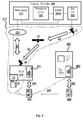
- FIG. 2 is a diagram illustrating an embodiment according to the present principles.
- a content provider 200 comprises, in addition to the elements already described with reference to Figure 1 , a web server 213.
- the DRM 102 of figure 1 is replaced by a DRM 2020, which is coupled to web server 213.
- a magazine 201 contains an embedded NFC (symbol " ") tag 202.
- An NFC enabled mobile phone 204 reads data 203 from NFC tag 202 embedded in an advertisement included in a medium such as magazine 201.
- the data comprises a Uniform Resource Locator (URL) identifying the content provider 10.
- the NFC tag 202 is related to a promotional event that allows temporary access to a DRM protected broadcast sports channel that is not part of the subscription to the digital television channels that can be accessed with smart card 18.
- the mobile phone 204 is moved 205 to the proximity of NFC enabled receiver 210, such as a set-top box, so that they in turn exchange information 209.
- Reference 211 is a placeholder for indicating a NFC sensitive area on device 210.
- the information 209 exchanged comprises a transmission of a subscriber identifier (ID) from the device 210 to mobile phone 204.
- the subscriber ID can be a smart card ID.
- the mobile phone 204 transmits the subscriber ID, received from device 210, to the URL retrieved from the NFC tag 202 via mobile communication antenna 206, transmission path 207, mobile operator 208 and Internet 212. This is for example in the form of a secure http request with one or more parameter arguments such as:
- FIG. 3 is a sequence diagram illustrating a particular embodiment of the present principles related to figure 2 .
- a DRM protected broadcast sports channel is transmitted to a plurality of broadcast receivers by content provider 200 and is received 301 by receiver 210.
- the sports channel is DRM protected and subscriber smart card 18 in the receiver's CA module 19 does not allow access to the sports channel as it is not part of a subscribed channel offering, the receiver 210 CA module 18 cannot descramble the sports channel contents. This results in the rendering of a black screen, 302, on a rendering device associated with the receiver 210.
- the NFC enabled mobile device such as mobile phone 204 is approached to an advertisement in magazine 201 offering temporary access to the broadcast sports channel as a promotional offer.
- data is read from the magazine's NFC tag 202 by the mobile phone 204 using the NFC technology.
- the data comprises a URL identifying a provider providing the broadcast sports channel.
- the NFC enabled mobile device 204 is moved to the proximity of the NFC placeholder 211 on receiver 210, and data from NFC tag associated with the receiver 210 is read 304 by the mobile phone 204 using the NFC technology.
- the receiver 210 transmits the subscriber ID read from the subscriber's smart card 18 to the mobile device 204 via NFC, the subscriber ID identifying that the user of the receiver 210 is a subscriber of the provider.
- the data read from the NFC tag is transmitted via transmission path 207, mobile operator 208, Internet 212 to the content provider's 200 URL read from the magazine's 201 NFC tag and is received by the content provider's web server 213.
- the content provider's DRM 2020 verifies the data received from the NFC enabled mobile device 204.
- the content provider's DRM 2020 adds, reference 307, EMMs for the subscriber to the broadcast sports channel that is transmitted, 308, to the plurality of broadcast receivers by transmitter 103.
- the subscriber's receiver 210 receives the EMMs, the CA module 18 decrypts the ECMs and descrambles the DRM protected broadcast sport channel contents and renders 309 the broadcast sport channel audio/video contents on an audio/video rendering device associated with the receiver 210.
- the data transmitted by the mobile device 204 to the content provider 200 comprises a serial number of the NFC tag in the magazine 201, obtained during operation 303. This enables the content provider 200 to verify the serial number and allows the content provider 200 to prohibit reuse of the associated promotional offer by other users.
- NFC technology is a contactless information sharing technology that is flexible, fast, easy to use and secure and is for example used for contactless payments, in embodiments requiring less tight security
- other types of contactless information sharing technology can be used, such as QR (Quick Response) codes.
- QR codes Quality of Service codes
- At least one of the NFC tags is replaced by a QR code.
- the data related to the audio/video content as for example the above discussed promotional offer printed in magazine 201 is encoded in a QR code in printed form rather than using an NFC tag, and mobile device 204 reads the printed QR code rather than an NFC tag.
- the data encoded in the QR code comprises for example a URL and a serial number of the QR code.
- the receiver 210 shows a QR code on a display associated with the device for transmitting data to mobile device 204, and mobile device 204 reads the displayed QR code rather than an NFC tag. Displaying the QR code on a display rather than printing a QR code allows the QR code to be generated dynamically, so that the data encoded in the QR code comprises for example the subscriber ID as read by device 210 from the smartcard 18 inserted in the CA module 19 of device 210.
- different types of contactless information sharing technologies are mixed.
- data related to the audio/video content is encoded in a printed QR code in a paper magazine or shown on a display
- data related to a subscriber, being sensitive information requiring a high level of security is encoded in an NFC tag associated with the digital audio/video receiver.
- the mobile device 204 transmits a channel number to the receiver 210 via NFC.
- the channel number is that of the channel where audio/video content is broadcasted that is related to the magazine's 201 NFC tag 202 and that is retrieved during the reading of the magazine's 201 NFC tag 202.
- the receiver 210 then changes channel to the channel number transmitted by the mobile device 204.
- This variant advantageously allows the user of the mobile device 204 according to the present principles to avoid having to request the receiver 210 to change to the channel corresponding to the audio/video content related to the magazine's 201 NFC tag 202.
- the user of the mobile device 204 simply taps the NFC tag 202 in the magazine 201, then taps the NFC tag associated to the receiver 210, which makes the receiver 210 change to the channel related to the NFC tag 202 in the magazine 201 and video and audio will arrive when the CA module 19 of the receiver 210 descrambles the audio/video stream with the subscriber's EMMs in the channel data stream.
- the receiver 210 can show a message for example indicating that an initialization of receipt of the channel is ongoing.
- an NFC tag in a magazine is related to a non-commercial item such as a video for a learning event.
- the present principles are not limited to magazines. Without diverting from the present principles, the magazine can be replaced by a book, an e-book, a DVD or in general any type of object with a contactless information sharing technology.
- the mobile device can be for example a smart phone, a tablet, or a portable PC.
- the communication path between the mobile device and the content provider's web server is other than depicted in figure 2 , for example a WiFi or Bluetooth connection.
- the present principles are not limited to Set-Top Box like receiver devices.
- the receiver device 210 is integrated into a rendering device, such as a digital television comprising a digital television decoder arrangement.
- a rendering device such as a digital television comprising a digital television decoder arrangement.
- the present principles are not limited to satellite transmission and reception, and that the present principles equally apply to cable transmission or to Digital Terrestrial Transmission (DTT) technology.
- DTT Digital Terrestrial Transmission
- the present principles are not limited to broadcast transmission of audio/video content, and the present principles equally apply to non-broadcast transmission such as Video on Demand transmission.
- the operations 303 and 304 of reading data can equally be executed in reverse order.
- FIG 4 is a diagram illustrating another embodiment according to the present principles.
- the mobile device 404 is a credit card or smart card.
- Set top box 410 is connected to the Internet 212 via a wired or wireless interface.
- a medium 401 comprises an active NFC tag 402.
- FIG. 5 is a sequence diagram illustrating a particular embodiment of the present principles related to figure 4 .
- NFC enabled mobile device e.g., credit card
- medium 401 medium 401
- provider 200 NFC enabled STB 410.
- Communications 504 and 505 replace communications 304 and 305 of figure 3 .
- the mobile device 404 has retrieved the URL from the medium's NFC tag (arrow 303)
- the mobile device is approached to the NFC enabled receiver device 410, and the mobile device transmits the received URL to the NFC enabled STB 410 (arrow 504 ).
- the STB that has an Internet connection, retrieves the subscriber identifier and transmits the subscriber identifier to the URL (e.g., the webaddress of provider 200 ).
- This embodiment allows to use a credit card as an intermediate device. Further, according to this embodiment there is no need to communicate the subscriber identifier to the intermediate device 404, as according to this embodiment the subscriber identifier is communicated to the provider by the AV receiver 410.
- the AV receiver 410 can have a secure and privileged communication with the provider 200. Not communicating the subscriber identifier to an intermediate device that possibly cannot be thrusted may be preferred for security reasons.
- FIG. 6 is a mobile device 6 according to a particular embodiment of the present principles.
- the mobile device 6 is capable of implementing the disclosed principles.
- the mobile device comprises a central processing unit or CPU 60, a non-volatile memory 61, a volatile memory 62, a user input interface 63, a clock unit 64, display driver 65, a contactless information reader interface 66, and a network interface 67 connected to an antenna 670. All these elements are interconnected via a data- and communication bus 68.
- Network interface 67 is an interface for short- or long range wireless communication, such as Long Term Evolution (LTE) or fourth, third or second generation (4G/3G/2G), WiMax, WiFi, Bluetooth (BT).
- Contactless information reader interface 66 is for example an NFC or QR reader interface.
- User input interface 63 is for example a tactile display or a keypad.
- Display driver is for example an Liquid Crystal Display (LCD), or Organic Light Emitting Diode (OLED) display driver or a High Definition Multimedia Interface (HDMI) display driver for connection to an external display device.
- Antenna 670 is for example a single or multiple (e.g., for multiple-input and multiple-output (MIMO)) internal and/or external antenna(s).
- MIMO multiple-input and multiple-output
- the mobile device 6 can have more or less elements than depicted in figure 6 .
- the device 6 has more than one microprocessor, no user input interface or multiple user input interfaces for different input means, no display driver or several display drivers for different outputs, no network interface or several network interfaces.
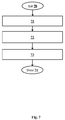
- Figure 7 is a flow chart of a particular embodiment according to the present principles.
- the exemplary process in the flow chart is performed by the mobile device 6.
- a first step 70 any variables and memory space are initialized that are used during execution of the method.
- first data is read that is related to the audio/video content from a medium using the contactless information sharing arrangement.
- the first data comprises a resource locator identifying the provider.
- second data is read that is related to an identification of a subscriber of the provider from the audio/video receiver using the contactless information sharing arrangement.
- a request to the provider identified by the resource locator is transmitted over a data communication network, the request comprising the second data, wherein responsive to the request, the audio/video receiver receives the audio/video content renderable by the audio/video receiver.
- the exemplary process is done.
- aspects of the present principles can be embodied as a system, method or computer readable medium. Accordingly, aspects of the present principles can take the form of an entirely hardware embodiment, an entirely software embodiment (including firmware, resident software, micro-code and so forth), or an embodiment combining hardware and software aspects that can all generally be defined to herein as a "circuit", "module” or “system”. Furthermore, aspects of the present principles can take the form of a computer readable storage medium. Any combination of one or more computer readable storage medium(s) can be utilized.
- a computer readable storage medium can take the form of a computer readable program product embodied in one or more computer readable medium(s) and having computer readable program code embodied thereon that is executable by a computer.
- a computer readable storage medium as used herein is considered a non-transitory storage medium given the inherent capability to store the information therein as well as the inherent capability to provide retrieval of the information there from.
- a computer readable storage medium can be, for example, but is not limited to, an electronic, magnetic, optical, electromagnetic, infrared, or semiconductor system, apparatus, or device, or any suitable combination of the foregoing.
Landscapes
- Engineering & Computer Science (AREA)
- Signal Processing (AREA)
- Multimedia (AREA)
- Databases & Information Systems (AREA)
- Computer Networks & Wireless Communication (AREA)
- Computer Security & Cryptography (AREA)
- Computer Graphics (AREA)
- Two-Way Televisions, Distribution Of Moving Picture Or The Like (AREA)
Abstract
Using a mobile device, data related to audio/video content is read from a medium using a contactless information sharing arrangement, the data comprising a resource locator identifying a provider for providing the audio/video content. Using the same mobile device, second data related to an identification of a subscriber of the provider is read from an audio/video receiver device for accessing the audio/video content. A request is transmitted over a data communication network to the identified provider, the request comprising the identification of the subscriber. In response to the request, the audio/video receiver receives the audio/video content renderable by the audio/video receiver.
Description
- The present disclosure generally relates to the field of the rendering of audio/video services and is in particular related to a mobile device as an intermediate device for setting up a rendering of an audio/video service on a rendering device.
-
US 7,756,467 B2 to Bent et al. describes a near field communication (NFC) capable wireless communication device reading an NFC tag associated to a media sales display. The NFC interface receives data related to multimedia content from the NFC tag. Based on the received data, the wireless communication device establishes a communication link with a multimedia server via a wireless communication network and controls a multimedia server to download information associated with the multimedia content to a user-specified destination device. Once downloaded, the user of the user-specified destination device may distribute the information to other storage media and/or audio or video devices for rendering. - An inconvenience to this approach is that, from a content protection perspective, the download and distribution of the information to other storage media and/or audio or video devices comprise a serious risk of copyright infringement. This is because, once the information is downloaded it is not controlled to which other devices the information is distributed by the user. Content providers however need to be ensured that digital rights management (DRM) is respected and enforced.
- There is thus a need for a solution that ensures that content is distributed in a distribution chain where digital rights management is respected, controlled and proven.
- The present disclosure aims at alleviating some of the deficiencies of rendering of audio/video services.
- To this end, the present principles comprise a method for accessing audio/video content provided by a provider through an audio/video receiver, implemented by a mobile device comprising at least one contactless information sharing arrangement. The method comprises reading first data related to the audio/video content from a medium using the at least one contactless information sharing arrangement, the first data comprising a resource locator identifying the provider; reading second data related to an identification of a subscriber of the provider from the audio/video receiver using the at least one contactless information sharing arrangement; and transmitting over a data communication network a request to the provider identified by the resource locator, the request comprising the second data, wherein responsive to the request, the audio/video receiver receives the audio/video content renderable by the audio/video receiver.
- According to a variant embodiment of the method, the first data further comprises a serial number of a contactless information tag from which the first data is read and wherein the request further comprises the serial number.
- According to a variant embodiment of the method, the reading first data and the reading second data comprises reading the first data and the second data through optical code reading.
- According to a variant embodiment of the method, the reading first data and the reading second data comprises reading the first data and the second data through short-range radio communication.
- According to a variant embodiment of the method, the reading first data comprises reading the first data through optical code reading, and the reading second data comprises reading the second data through a short-range radio communication.
- According to a variant embodiment of the method, the optical code reading is a Quick Response code reading.
- According to a variant embodiment of the method, the short-range radio communication is a Near Field Communication.
- According to a variant embodiment of the method, the first data comprises a channel number of distribution of the audio/video content, the channel number being transmitted to the audio/video receiver through transmission via the contactless information sharing arrangement, and the audio/video receiver selecting the transmitted channel number.
- The present disclosure also relates to a mobile device, comprising a contactless information reader, configured to read first data related to audio/video content from a medium comprising a contactless information arrangement, the first data comprising a resource locator identifying a provider for providing the audio/video content. The contactless information reader is further configured to read second data related to an identification of a subscriber of the provider from a second contactless information arrangement associated with an audio/video receiver on which to render the audio/video content. The mobile device further comprises a communication interface for connection to a data communication network, configured to transmit a request to the provider identified by the resource locator for accessing the audio/video content through the audio/video receiver, the request comprising the second data.
- According to a variant embodiment of the device, the contactless information reader is an optical code reader.
- According to a variant embodiment of the device, the contactless information reader is a short-range radio communication interface.
- According to a variant embodiment of the device, the short-range radio communication interface is a Near-Field Communication interface.
- More advantages of the present principles will appear through the description of particular, non-restricting embodiments of the disclosure. In order to describe the manner in which the advantages of the present principles can be obtained, particular descriptions of the present principles are rendered by reference to specific embodiments thereof which are illustrated in the appended drawings. The drawings depict exemplary embodiments of the disclosure and are therefore not to be considered as limiting its scope. The embodiments described can be combined to form particular advantageous embodiments. In the following figures, items with same reference numbers as items already described in a previous figure will not be described again to avoid unnecessary obscuring of the disclosure.
- The exemplary embodiments will be described with reference to the following figures:
-
Figure 1 is a diagram illustrating a distribution of DRM protected digital content. -
Figure 2 is a diagram illustrating an embodiment according to the present principles. -
Figure 3 is a sequence diagram illustrating a particular embodiment of the present principles related tofigure 2 . -
Figure 4 is a diagram illustrating another embodiment according to the present principles. -
Figure 5 is a sequence diagram illustrating a particular embodiment of the present principles related tofigure 4 . -
Figure 6 is a receiver according to a particular embodiment of the present principles. -
Figure 7 is a flow chart of a particular embodiment according to the present principles. - Digital rights management is a set of access control technologies including copy protection technologies, which are used with the intent to control the use of digital content and devices. In digital television broadcast technology, the use of digital rights management (DRM) is widely spread and highly accepted. In Advanced Television Systems Committee (ATSC), Digital Video Broadcasting (DVB) and Association of Radio Industries and Business (ARIB) standards for example, so-called Conditional Access system (CA) standards are defined in specification documents. According to these standards DRM protected digital streams are scrambled (obfuscated) and can only be descrambled by a receiver comprising a specific smart card of a subscriber to a digital television offer. A DRM protected digital television stream is scrambled with a key that is referred to as the control word or Entitlement Control Message (ECM). This key is changed very frequently. To unscramble the stream the receiver must have the control word. Control words are comprised in the digital television stream in encrypted form. To decrypt the control word, the receiver's CA system must receive a decryption enablement message known as Entitlement Management Message (EMM). EMMs are inserted into the digital television stream and are specific to a particular subscriber that is identified by the subscriber's smart card when inserted in the receiver's smart card interface.
-
Figure 1 is a diagram illustrating a distribution of DRM protected digital content from a content provider to a receiver device. Acontent provider 100 has abroadcast server 101 which provides digital content toDRM server 102.DRM server 102 adds DRM protection to the digital content before it is transmitted tosatellite 14 viasatellite dish 12 anduplink 13. A receiver device 17 receives the DRM protected content fromsatellite 14 via asatellite dish 16 and adownlink 15. The DRM protected digital content is unscrambled by theCA module 19 in the receiver 17, based on information received from the subscriber'ssmart card 18 and EMMs in the digital content, as described above. DRM is respected and controlled in the distribution chain offigure 1 . -
Figure 2 is a diagram illustrating an embodiment according to the present principles. Acontent provider 200 comprises, in addition to the elements already described with reference toFigure 1 , aweb server 213. TheDRM 102 offigure 1 is replaced by aDRM 2020, which is coupled toweb server 213. Amagazine 201 contains an embedded NFC (symbol "")
tag 202. An NFC enabledmobile phone 204 readsdata 203 from NFCtag 202 embedded in an advertisement included in a medium such asmagazine 201. The data comprises a Uniform Resource Locator (URL) identifying the content provider 10. TheNFC tag 202 is related to a promotional event that allows temporary access to a DRM protected broadcast sports channel that is not part of the subscription to the digital television channels that can be accessed withsmart card 18. Themobile phone 204 is moved 205 to the proximity of NFC enabledreceiver 210, such as a set-top box, so that they inturn exchange information 209.Reference 211 is a placeholder for indicating a NFC sensitive area ondevice 210. Theinformation 209 exchanged comprises a transmission of a subscriber identifier (ID) from thedevice 210 tomobile phone 204. The subscriber ID can be a smart card ID. Themobile phone 204 transmits the subscriber ID, received fromdevice 210, to the URL retrieved from theNFC tag 202 viamobile communication antenna 206,transmission path 207, mobile operator 208 andInternet 212. This is for example in the form of a secure http request with one or more parameter arguments such as: - https://www.provider_name.com/sportchpromo?subID=12345
-
Figure 3 is a sequence diagram illustrating a particular embodiment of the present principles related tofigure 2 . A DRM protected broadcast sports channel is transmitted to a plurality of broadcast receivers bycontent provider 200 and is received 301 byreceiver 210. As the sports channel is DRM protected and subscribersmart card 18 in the receiver'sCA module 19 does not allow access to the sports channel as it is not part of a subscribed channel offering, thereceiver 210CA module 18 cannot descramble the sports channel contents. This results in the rendering of a black screen, 302, on a rendering device associated with thereceiver 210. - The NFC enabled mobile device, such as
mobile phone 204 is approached to an advertisement inmagazine 201 offering temporary access to the broadcast sports channel as a promotional offer. In 303, data is read from the magazine'sNFC tag 202 by themobile phone 204 using the NFC technology. The data comprises a URL identifying a provider providing the broadcast sports channel. Then the NFC enabledmobile device 204 is moved to the proximity of theNFC placeholder 211 onreceiver 210, and data from NFC tag associated with thereceiver 210 is read 304 by themobile phone 204 using the NFC technology. In this regard, thereceiver 210 transmits the subscriber ID read from the subscriber'ssmart card 18 to themobile device 204 via NFC, the subscriber ID identifying that the user of thereceiver 210 is a subscriber of the provider. In 305, at least some of the data read from the NFC tag is transmitted viatransmission path 207, mobile operator 208,Internet 212 to the content provider's 200 URL read from the magazine's 201 NFC tag and is received by the content provider'sweb server 213. In 306, the content provider'sDRM 2020 verifies the data received from the NFC enabledmobile device 204. If the result is that access rights for accessing the broadcast sports channel should be given to the subscriber, the content provider'sDRM 2020 adds, reference 307, EMMs for the subscriber to the broadcast sports channel that is transmitted, 308, to the plurality of broadcast receivers bytransmitter 103. The subscriber'sreceiver 210 receives the EMMs, theCA module 18 decrypts the ECMs and descrambles the DRM protected broadcast sport channel contents and renders 309 the broadcast sport channel audio/video contents on an audio/video rendering device associated with thereceiver 210. - According to a variant embodiment, the data transmitted by the
mobile device 204 to thecontent provider 200 comprises a serial number of the NFC tag in themagazine 201, obtained duringoperation 303. This enables thecontent provider 200 to verify the serial number and allows thecontent provider 200 to prohibit reuse of the associated promotional offer by other users. - Those skilled in the art should appreciate that the present principles are not limited to NFC enabled devices. While NFC technology is a contactless information sharing technology that is flexible, fast, easy to use and secure and is for example used for contactless payments, in embodiments requiring less tight security, other types of contactless information sharing technology can be used, such as QR (Quick Response) codes. An advantage of QR codes is that they are relatively robust and cheap to produce.
- According to a variant embodiment, at least one of the NFC tags is replaced by a QR code.
- According to a variant embodiment, the data related to the audio/video content as for example the above discussed promotional offer printed in
magazine 201 is encoded in a QR code in printed form rather than using an NFC tag, andmobile device 204 reads the printed QR code rather than an NFC tag. The data encoded in the QR code comprises for example a URL and a serial number of the QR code. - According to a variant embodiment, the
receiver 210 shows a QR code on a display associated with the device for transmitting data tomobile device 204, andmobile device 204 reads the displayed QR code rather than an NFC tag. Displaying the QR code on a display rather than printing a QR code allows the QR code to be generated dynamically, so that the data encoded in the QR code comprises for example the subscriber ID as read bydevice 210 from thesmartcard 18 inserted in theCA module 19 ofdevice 210. - According to yet another variant embodiment, different types of contactless information sharing technologies are mixed. For example, data related to the audio/video content, not requiring a high level of security, is encoded in a printed QR code in a paper magazine or shown on a display, while data related to a subscriber, being sensitive information requiring a high level of security, is encoded in an NFC tag associated with the digital audio/video receiver.
- According to a variant embodiment, the
mobile device 204 transmits a channel number to thereceiver 210 via NFC. The channel number is that of the channel where audio/video content is broadcasted that is related to the magazine's 201NFC tag 202 and that is retrieved during the reading of the magazine's 201NFC tag 202. Thereceiver 210 then changes channel to the channel number transmitted by themobile device 204. This variant advantageously allows the user of themobile device 204 according to the present principles to avoid having to request thereceiver 210 to change to the channel corresponding to the audio/video content related to the magazine's 201NFC tag 202. The user of themobile device 204 simply taps theNFC tag 202 in themagazine 201, then taps the NFC tag associated to thereceiver 210, which makes thereceiver 210 change to the channel related to theNFC tag 202 in themagazine 201 and video and audio will arrive when theCA module 19 of thereceiver 210 descrambles the audio/video stream with the subscriber's EMMs in the channel data stream. During the delay that is required for transmission of data to thecontent provider 200 and for setting up the distribution of EMMs in the data stream corresponding to the channel related to theNFC tag 202 in themagazine 201 and for descrambling the audio/video contents of the channel by thereceiver 210, thereceiver 210 can show a message for example indicating that an initialization of receipt of the channel is ongoing. - Those skilled in the art should appreciate that the present principles are not limited to promotional offers. In other embodiments, an NFC tag in a magazine is related to a non-commercial item such as a video for a learning event. Those skilled in the art should appreciate that the present principles are not limited to magazines. Without diverting from the present principles, the magazine can be replaced by a book, an e-book, a DVD or in general any type of object with a contactless information sharing technology. Those skilled in the art should appreciate that the mobile device can be for example a smart phone, a tablet, or a portable PC. Those skilled in the art should appreciate that the communication path between the mobile device and the content provider's web server is other than depicted in
figure 2 , for example a WiFi or Bluetooth connection. Those skilled in the art should appreciate that the present principles are not limited to Set-Top Box like receiver devices. In other embodiments, thereceiver device 210 is integrated into a rendering device, such as a digital television comprising a digital television decoder arrangement. Those skilled in the art should appreciate that the present principles are not limited to satellite transmission and reception, and that the present principles equally apply to cable transmission or to Digital Terrestrial Transmission (DTT) technology. Those skilled in the art should appreciate that the present principles are not limited to broadcast transmission of audio/video content, and the present principles equally apply to non-broadcast transmission such as Video on Demand transmission. Those skilled in the art should appreciate that theoperations -
Figure 4 is a diagram illustrating another embodiment according to the present principles. One of the differences with the embodiment illustrated infigure 2 is that themobile device 404 is a credit card or smart card. Settop box 410 is connected to theInternet 212 via a wired or wireless interface. A medium 401 comprises anactive NFC tag 402. -
Figure 5 is a sequence diagram illustrating a particular embodiment of the present principles related tofigure 4 . Represented are NFC enabled mobile device (e.g., credit card) 404, medium 401,provider 200 and NFC enabledSTB 410.Communications communications figure 3 . When themobile device 404 has retrieved the URL from the medium's NFC tag (arrow 303), the mobile device is approached to the NFC enabledreceiver device 410, and the mobile device transmits the received URL to the NFC enabled STB 410 (arrow 504). The STB, that has an Internet connection, retrieves the subscriber identifier and transmits the subscriber identifier to the URL (e.g., the webaddress of provider 200). This embodiment allows to use a credit card as an intermediate device. Further, according to this embodiment there is no need to communicate the subscriber identifier to theintermediate device 404, as according to this embodiment the subscriber identifier is communicated to the provider by theAV receiver 410. TheAV receiver 410 can have a secure and privileged communication with theprovider 200. Not communicating the subscriber identifier to an intermediate device that possibly cannot be thrusted may be preferred for security reasons. -
Figure 6 is a mobile device 6 according to a particular embodiment of the present principles. The mobile device 6 is capable of implementing the disclosed principles. The mobile device comprises a central processing unit orCPU 60, anon-volatile memory 61, avolatile memory 62, a user input interface 63, aclock unit 64,display driver 65, a contactlessinformation reader interface 66, and anetwork interface 67 connected to anantenna 670. All these elements are interconnected via a data- andcommunication bus 68.Network interface 67 is an interface for short- or long range wireless communication, such as Long Term Evolution (LTE) or fourth, third or second generation (4G/3G/2G), WiMax, WiFi, Bluetooth (BT). Contactlessinformation reader interface 66 is for example an NFC or QR reader interface. User input interface 63 is for example a tactile display or a keypad. Display driver is for example an Liquid Crystal Display (LCD), or Organic Light Emitting Diode (OLED) display driver or a High Definition Multimedia Interface (HDMI) display driver for connection to an external display device.Antenna 670 is for example a single or multiple (e.g., for multiple-input and multiple-output (MIMO)) internal and/or external antenna(s). The skilled in the art should appreciate that the mobile device 6 can have more or less elements than depicted infigure 6 . For example, the device 6 has more than one microprocessor, no user input interface or multiple user input interfaces for different input means, no display driver or several display drivers for different outputs, no network interface or several network interfaces. -
Figure 7 is a flow chart of a particular embodiment according to the present principles. The exemplary process in the flow chart is performed by the mobile device 6. In afirst step 70, any variables and memory space are initialized that are used during execution of the method. In astep 71, first data is read that is related to the audio/video content from a medium using the contactless information sharing arrangement. The first data comprises a resource locator identifying the provider. In astep 72, second data is read that is related to an identification of a subscriber of the provider from the audio/video receiver using the contactless information sharing arrangement. In astep 73, a request to the provider identified by the resource locator is transmitted over a data communication network, the request comprising the second data, wherein responsive to the request, the audio/video receiver receives the audio/video content renderable by the audio/video receiver. Instep 74, the exemplary process is done. - Some elements in the drawings may not be used or be necessary in all embodiments. Some operations may be executed in parallel. Variant embodiments other than those illustrated and/or described are possible.As will be appreciated by one skilled in the art, aspects of the present principles can be embodied as a system, method or computer readable medium. Accordingly, aspects of the present principles can take the form of an entirely hardware embodiment, an entirely software embodiment (including firmware, resident software, micro-code and so forth), or an embodiment combining hardware and software aspects that can all generally be defined to herein as a "circuit", "module" or "system". Furthermore, aspects of the present principles can take the form of a computer readable storage medium. Any combination of one or more computer readable storage medium(s) can be utilized.
- Thus, for example, it will be appreciated by those skilled in the art that the diagrams presented herein represent conceptual views of illustrative system components and/or circuitry embodying the principles of the present disclosure. Similarly, it will be appreciated that any flow charts, flow diagrams, state transition diagrams, pseudo code, and the like represent various processes which may be substantially represented in computer readable storage media and so executed by a computer or processor, whether or not such computer or processor is explicitly shown.
- A computer readable storage medium can take the form of a computer readable program product embodied in one or more computer readable medium(s) and having computer readable program code embodied thereon that is executable by a computer. A computer readable storage medium as used herein is considered a non-transitory storage medium given the inherent capability to store the information therein as well as the inherent capability to provide retrieval of the information there from. A computer readable storage medium can be, for example, but is not limited to, an electronic, magnetic, optical, electromagnetic, infrared, or semiconductor system, apparatus, or device, or any suitable combination of the foregoing. It is to be appreciated that the following, while providing more specific examples of computer readable storage mediums to which the present principles can be applied, is merely an illustrative and not exhaustive listing as is readily appreciated by one of ordinary skill in the art: a hard disk, a read-only memory (ROM), an erasable programmable read-only memory (EPROM or Flash memory), a portable compact disc read-only memory (CD-ROM), an optical storage device, a magnetic storage device, or any suitable combination of the foregoing.
Claims (12)
- A method for accessing audio/video content provided by a provider through an audio/video receiver, characterized in that the method is implemented by a mobile device (6) comprising at least one contactless information sharing arrangement, the method comprising:reading (71) first data related to said audio/video content from a medium using said at least one contactless information sharing arrangement, said first data comprising a resource locator identifying said provider;reading (72) second data related to an identification of a subscriber of said provider from said audio/video receiver using said at least one contactless information sharing arrangement; andtransmitting (73) over a data communication network a request to said provider identified by said resource locator, said request comprising said second data, wherein responsive to said request, said audio/video receiver receives said audio/video content renderable by said audio/video receiver.
- The method according to claim 1, wherein said first data further comprises a serial number of a contactless information tag from which said first data is read and wherein said request further comprises said serial number.
- The method according to claim 1 to 2, wherein said reading first data and said reading second data comprises reading said first data and said second data through optical code reading.
- The method according to claim 1, wherein said reading first data and said reading second data comprises reading said first data and said second data through short-range radio communication.
- The method according to claim 1, wherein said reading first data comprises reading said first data through optical code reading, and said reading second data comprises reading said second data through a short-range radio communication.
- The method according to claim 3 or 5, wherein said optical code reading is a Quick Response code reading.
- The method according to claim 4 or 5, wherein said short-range radio communication is a Near Field Communication.
- The method according to claim 1 or 2, wherein said first data comprises a channel number of distribution of said audio/video content, said channel number being transmitted to said audio/video receiver through transmission via said contactless information sharing arrangement, and said audio/video receiver selecting said transmitted channel number.
- A mobile device (6), characterized in that it comprises:a contactless information reader (66), configured to read first data related to audio/video content from a medium (201, 401) comprising a contactless information arrangement (202, 402), the first data comprising a resource locator identifying a provider for providing said audio/video content;said contactless information reader (66) being further configured to read second data related to an identification of a subscriber of said provider from a second contactless information arrangement (211) associated with an audio/video receiver (210) on which to render said audio/video content; anda communication interface (67) for connection to a data communication network, configured to transmit a request to said provider identified by said resource locator for accessing said audio/video content through said audio/video receiver, said request comprising said second data.
- The method according to claim 9, wherein said contactless information reader is an optical code reader.
- The method according to claim 9, wherein said contactless information reader is a short-range radio communication interface.
- The method according to claim 11, wherein said short-range radio communication interface is a Near-Field Communication interface.
Priority Applications (1)
| Application Number | Priority Date | Filing Date | Title |
|---|---|---|---|
| EP15306848.1A EP3171607A1 (en) | 2015-11-23 | 2015-11-23 | Method for accessing audio/video content and corresponding device |
Applications Claiming Priority (1)
| Application Number | Priority Date | Filing Date | Title |
|---|---|---|---|
| EP15306848.1A EP3171607A1 (en) | 2015-11-23 | 2015-11-23 | Method for accessing audio/video content and corresponding device |
Publications (1)
| Publication Number | Publication Date |
|---|---|
| EP3171607A1 true EP3171607A1 (en) | 2017-05-24 |
Family
ID=54782638
Family Applications (1)
| Application Number | Title | Priority Date | Filing Date |
|---|---|---|---|
| EP15306848.1A Withdrawn EP3171607A1 (en) | 2015-11-23 | 2015-11-23 | Method for accessing audio/video content and corresponding device |
Country Status (1)
| Country | Link |
|---|---|
| EP (1) | EP3171607A1 (en) |
Cited By (2)
| Publication number | Priority date | Publication date | Assignee | Title |
|---|---|---|---|---|
| CN113986087A (en) * | 2021-12-27 | 2022-01-28 | 深圳市大头兄弟科技有限公司 | Video rendering method based on subscription |
| CN114339333A (en) * | 2021-12-28 | 2022-04-12 | 未来电视有限公司 | Content switching method, terminal equipment and readable storage medium |
Citations (3)
| Publication number | Priority date | Publication date | Assignee | Title |
|---|---|---|---|---|
| US20080132167A1 (en) * | 2006-12-01 | 2008-06-05 | Sony Ericsson Mobile Communications Ab | Multimedia Distribution Using a Near Field Communication Capable Wireless Communication Device |
| EP2779669A2 (en) * | 2013-03-11 | 2014-09-17 | Nagravision S.A. | Method and system for acquiring access rights to conditional access content |
| US20150215424A1 (en) * | 2014-01-28 | 2015-07-30 | Time Warner Cable Enterprises Llc | Apparatus and methods for content access, retrieval, and delivery in a content distribution network |
-
2015
- 2015-11-23 EP EP15306848.1A patent/EP3171607A1/en not_active Withdrawn
Patent Citations (4)
| Publication number | Priority date | Publication date | Assignee | Title |
|---|---|---|---|---|
| US20080132167A1 (en) * | 2006-12-01 | 2008-06-05 | Sony Ericsson Mobile Communications Ab | Multimedia Distribution Using a Near Field Communication Capable Wireless Communication Device |
| US7756467B2 (en) | 2006-12-01 | 2010-07-13 | Sony Ericsson Mobile Communications Ab | Multimedia distribution using a near field communication capable wireless communication device |
| EP2779669A2 (en) * | 2013-03-11 | 2014-09-17 | Nagravision S.A. | Method and system for acquiring access rights to conditional access content |
| US20150215424A1 (en) * | 2014-01-28 | 2015-07-30 | Time Warner Cable Enterprises Llc | Apparatus and methods for content access, retrieval, and delivery in a content distribution network |
Cited By (2)
| Publication number | Priority date | Publication date | Assignee | Title |
|---|---|---|---|---|
| CN113986087A (en) * | 2021-12-27 | 2022-01-28 | 深圳市大头兄弟科技有限公司 | Video rendering method based on subscription |
| CN114339333A (en) * | 2021-12-28 | 2022-04-12 | 未来电视有限公司 | Content switching method, terminal equipment and readable storage medium |
Similar Documents
| Publication | Publication Date | Title |
|---|---|---|
| US7224797B2 (en) | System and method for hybrid conditional access for receivers of encrypted transmissions | |
| US9392318B2 (en) | Receiver device with multiple decryption modes | |
| KR100984946B1 (en) | How to transfer data between local server and local peripherals | |
| EP2645729A1 (en) | Security device for Pay-TV receiver/decoder | |
| CN106454429B (en) | Method, set-top box, computer storage device for generating hybrid electronic program guide | |
| EP3560212B1 (en) | Securing transmission of content from a smart card in a host television receiver to a client television receiver | |
| US20140237494A1 (en) | Contents receiving device and method for receiving encoded contents, contents supplying device and method for supplying encoded contents | |
| EP2425620B1 (en) | Method to secure access to audio/video content in a decoding unit | |
| EP2827598A1 (en) | A system for receiving and decrypting streaming content | |
| KR20180046674A (en) | Image display apparatus and operating method for the same | |
| EP2724528B1 (en) | Anti-splitter violation conditional key change | |
| CA2856456C (en) | Method, cryptographic system and security module for descrambling content packets of a digital transport stream | |
| KR101605822B1 (en) | Integrated processor device of remote entitlement processing module | |
| US20130145147A1 (en) | Content Protection Method | |
| US20090169003A1 (en) | Broadcast processing apparatus and method thereof | |
| EP2693763A1 (en) | Method of content transaction and apparatus for content transaction | |
| KR101743928B1 (en) | Operating system of broadcast contents protection technologies and its operating method in broadcast receiver environment | |
| Nishimoto et al. | A downloadable conditional access system for satellite broadcasting | |
| EP1633145A1 (en) | Secured electronic device | |
| EP3644615A1 (en) | An interface device and method for a main receiver | |
| KR20160038164A (en) | PayTV management method using UHD TV feature and Gateway thereof | |
| GB2516319A (en) | A host device method and system | |
| PH12017000256A1 (en) | Digital broadcast communication system and method of service scrambling and sim card based descrambling | |
| US20160007087A1 (en) | Broadcast reception device, method of operating broadcast reception device, conditional access module, and method of operating conditional access module | |
| GB2518842A (en) | Host device, method and system |
Legal Events
| Date | Code | Title | Description |
|---|---|---|---|
| PUAI | Public reference made under article 153(3) epc to a published international application that has entered the european phase |
Free format text: ORIGINAL CODE: 0009012 |
|
| AK | Designated contracting states |
Kind code of ref document: A1 Designated state(s): AL AT BE BG CH CY CZ DE DK EE ES FI FR GB GR HR HU IE IS IT LI LT LU LV MC MK MT NL NO PL PT RO RS SE SI SK SM TR |
|
| AX | Request for extension of the european patent |
Extension state: BA ME |
|
| STAA | Information on the status of an ep patent application or granted ep patent |
Free format text: STATUS: THE APPLICATION IS DEEMED TO BE WITHDRAWN |
|
| 18D | Application deemed to be withdrawn |
Effective date: 20171125 |