EP3171375A1 - Coil device - Google Patents
Coil device Download PDFInfo
- Publication number
- EP3171375A1 EP3171375A1 EP15796332.3A EP15796332A EP3171375A1 EP 3171375 A1 EP3171375 A1 EP 3171375A1 EP 15796332 A EP15796332 A EP 15796332A EP 3171375 A1 EP3171375 A1 EP 3171375A1
- Authority
- EP
- European Patent Office
- Prior art keywords
- fastener
- coil device
- coil
- housing
- bobbin
- Prior art date
- Legal status (The legal status is an assumption and is not a legal conclusion. Google has not performed a legal analysis and makes no representation as to the accuracy of the status listed.)
- Granted
Links
Images







Classifications
-
- H—ELECTRICITY
- H01—ELECTRIC ELEMENTS
- H01F—MAGNETS; INDUCTANCES; TRANSFORMERS; SELECTION OF MATERIALS FOR THEIR MAGNETIC PROPERTIES
- H01F27/00—Details of transformers or inductances, in general
- H01F27/28—Coils; Windings; Conductive connections
- H01F27/2823—Wires
-
- B—PERFORMING OPERATIONS; TRANSPORTING
- B60—VEHICLES IN GENERAL
- B60L—PROPULSION OF ELECTRICALLY-PROPELLED VEHICLES; SUPPLYING ELECTRIC POWER FOR AUXILIARY EQUIPMENT OF ELECTRICALLY-PROPELLED VEHICLES; ELECTRODYNAMIC BRAKE SYSTEMS FOR VEHICLES IN GENERAL; MAGNETIC SUSPENSION OR LEVITATION FOR VEHICLES; MONITORING OPERATING VARIABLES OF ELECTRICALLY-PROPELLED VEHICLES; ELECTRIC SAFETY DEVICES FOR ELECTRICALLY-PROPELLED VEHICLES
- B60L53/00—Methods of charging batteries, specially adapted for electric vehicles; Charging stations or on-board charging equipment therefor; Exchange of energy storage elements in electric vehicles
- B60L53/10—Methods of charging batteries, specially adapted for electric vehicles; Charging stations or on-board charging equipment therefor; Exchange of energy storage elements in electric vehicles characterised by the energy transfer between the charging station and the vehicle
- B60L53/12—Inductive energy transfer
-
- B—PERFORMING OPERATIONS; TRANSPORTING
- B60—VEHICLES IN GENERAL
- B60L—PROPULSION OF ELECTRICALLY-PROPELLED VEHICLES; SUPPLYING ELECTRIC POWER FOR AUXILIARY EQUIPMENT OF ELECTRICALLY-PROPELLED VEHICLES; ELECTRODYNAMIC BRAKE SYSTEMS FOR VEHICLES IN GENERAL; MAGNETIC SUSPENSION OR LEVITATION FOR VEHICLES; MONITORING OPERATING VARIABLES OF ELECTRICALLY-PROPELLED VEHICLES; ELECTRIC SAFETY DEVICES FOR ELECTRICALLY-PROPELLED VEHICLES
- B60L53/00—Methods of charging batteries, specially adapted for electric vehicles; Charging stations or on-board charging equipment therefor; Exchange of energy storage elements in electric vehicles
- B60L53/10—Methods of charging batteries, specially adapted for electric vehicles; Charging stations or on-board charging equipment therefor; Exchange of energy storage elements in electric vehicles characterised by the energy transfer between the charging station and the vehicle
- B60L53/12—Inductive energy transfer
- B60L53/126—Methods for pairing a vehicle and a charging station, e.g. establishing a one-to-one relation between a wireless power transmitter and a wireless power receiver
-
- H—ELECTRICITY
- H01—ELECTRIC ELEMENTS
- H01F—MAGNETS; INDUCTANCES; TRANSFORMERS; SELECTION OF MATERIALS FOR THEIR MAGNETIC PROPERTIES
- H01F27/00—Details of transformers or inductances, in general
- H01F27/02—Casings
-
- H—ELECTRICITY
- H01—ELECTRIC ELEMENTS
- H01F—MAGNETS; INDUCTANCES; TRANSFORMERS; SELECTION OF MATERIALS FOR THEIR MAGNETIC PROPERTIES
- H01F27/00—Details of transformers or inductances, in general
- H01F27/28—Coils; Windings; Conductive connections
- H01F27/30—Fastening or clamping coils, windings, or parts thereof together; Fastening or mounting coils or windings on core, casing, or other support
- H01F27/306—Fastening or mounting coils or windings on core, casing or other support
-
- H—ELECTRICITY
- H01—ELECTRIC ELEMENTS
- H01F—MAGNETS; INDUCTANCES; TRANSFORMERS; SELECTION OF MATERIALS FOR THEIR MAGNETIC PROPERTIES
- H01F27/00—Details of transformers or inductances, in general
- H01F27/28—Coils; Windings; Conductive connections
- H01F27/32—Insulating of coils, windings, or parts thereof
- H01F27/324—Insulation between coil and core, between different winding sections, around the coil; Other insulation structures
- H01F27/325—Coil bobbins
-
- H—ELECTRICITY
- H01—ELECTRIC ELEMENTS
- H01F—MAGNETS; INDUCTANCES; TRANSFORMERS; SELECTION OF MATERIALS FOR THEIR MAGNETIC PROPERTIES
- H01F27/00—Details of transformers or inductances, in general
- H01F27/34—Special means for preventing or reducing unwanted electric or magnetic effects, e.g. no-load losses, reactive currents, harmonics, oscillations, leakage fields
- H01F27/36—Electric or magnetic shields or screens
- H01F27/363—Electric or magnetic shields or screens made of electrically conductive material
-
- H—ELECTRICITY
- H01—ELECTRIC ELEMENTS
- H01F—MAGNETS; INDUCTANCES; TRANSFORMERS; SELECTION OF MATERIALS FOR THEIR MAGNETIC PROPERTIES
- H01F38/00—Adaptations of transformers or inductances for specific applications or functions
- H01F38/14—Inductive couplings
-
- H—ELECTRICITY
- H02—GENERATION; CONVERSION OR DISTRIBUTION OF ELECTRIC POWER
- H02J—ELECTRIC POWER NETWORKS; CIRCUIT ARRANGEMENTS OR SYSTEMS FOR SUPPLYING OR DISTRIBUTING ELECTRIC POWER; SYSTEMS FOR STORING ELECTRIC ENERGY
- H02J50/00—Circuit arrangements or systems for wireless supply or distribution of electric power
- H02J50/005—Mechanical details of housing or structure aiming to accommodate the power transfer means, e.g. mechanical integration of coils, antennas or transducers into emitting or receiving devices
-
- H—ELECTRICITY
- H02—GENERATION; CONVERSION OR DISTRIBUTION OF ELECTRIC POWER
- H02J—ELECTRIC POWER NETWORKS; CIRCUIT ARRANGEMENTS OR SYSTEMS FOR SUPPLYING OR DISTRIBUTING ELECTRIC POWER; SYSTEMS FOR STORING ELECTRIC ENERGY
- H02J50/00—Circuit arrangements or systems for wireless supply or distribution of electric power
- H02J50/10—Circuit arrangements or systems for wireless supply or distribution of electric power using inductive coupling
-
- H—ELECTRICITY
- H02—GENERATION; CONVERSION OR DISTRIBUTION OF ELECTRIC POWER
- H02J—ELECTRIC POWER NETWORKS; CIRCUIT ARRANGEMENTS OR SYSTEMS FOR SUPPLYING OR DISTRIBUTING ELECTRIC POWER; SYSTEMS FOR STORING ELECTRIC ENERGY
- H02J50/00—Circuit arrangements or systems for wireless supply or distribution of electric power
- H02J50/10—Circuit arrangements or systems for wireless supply or distribution of electric power using inductive coupling
- H02J50/12—Circuit arrangements or systems for wireless supply or distribution of electric power using inductive coupling of the resonant type
-
- B—PERFORMING OPERATIONS; TRANSPORTING
- B60—VEHICLES IN GENERAL
- B60L—PROPULSION OF ELECTRICALLY-PROPELLED VEHICLES; SUPPLYING ELECTRIC POWER FOR AUXILIARY EQUIPMENT OF ELECTRICALLY-PROPELLED VEHICLES; ELECTRODYNAMIC BRAKE SYSTEMS FOR VEHICLES IN GENERAL; MAGNETIC SUSPENSION OR LEVITATION FOR VEHICLES; MONITORING OPERATING VARIABLES OF ELECTRICALLY-PROPELLED VEHICLES; ELECTRIC SAFETY DEVICES FOR ELECTRICALLY-PROPELLED VEHICLES
- B60L5/00—Current collectors for power supply lines of electrically-propelled vehicles
- B60L5/005—Current collectors for power supply lines of electrically-propelled vehicles without mechanical contact between the collector and the power supply line
-
- H—ELECTRICITY
- H02—GENERATION; CONVERSION OR DISTRIBUTION OF ELECTRIC POWER
- H02J—ELECTRIC POWER NETWORKS; CIRCUIT ARRANGEMENTS OR SYSTEMS FOR SUPPLYING OR DISTRIBUTING ELECTRIC POWER; SYSTEMS FOR STORING ELECTRIC ENERGY
- H02J50/00—Circuit arrangements or systems for wireless supply or distribution of electric power
- H02J50/70—Circuit arrangements or systems for wireless supply or distribution of electric power involving the reduction of electric, magnetic or electromagnetic leakage fields
-
- H—ELECTRICITY
- H02—GENERATION; CONVERSION OR DISTRIBUTION OF ELECTRIC POWER
- H02J—ELECTRIC POWER NETWORKS; CIRCUIT ARRANGEMENTS OR SYSTEMS FOR SUPPLYING OR DISTRIBUTING ELECTRIC POWER; SYSTEMS FOR STORING ELECTRIC ENERGY
- H02J7/00—Circuit arrangements for charging or discharging batteries or for supplying loads from batteries
- H02J7/70—Circuit arrangements for charging or discharging batteries or for supplying loads from batteries characterised by the mechanical construction
-
- Y—GENERAL TAGGING OF NEW TECHNOLOGICAL DEVELOPMENTS; GENERAL TAGGING OF CROSS-SECTIONAL TECHNOLOGIES SPANNING OVER SEVERAL SECTIONS OF THE IPC; TECHNICAL SUBJECTS COVERED BY FORMER USPC CROSS-REFERENCE ART COLLECTIONS [XRACs] AND DIGESTS
- Y02—TECHNOLOGIES OR APPLICATIONS FOR MITIGATION OR ADAPTATION AGAINST CLIMATE CHANGE
- Y02T—CLIMATE CHANGE MITIGATION TECHNOLOGIES RELATED TO TRANSPORTATION
- Y02T10/00—Road transport of goods or passengers
- Y02T10/60—Other road transportation technologies with climate change mitigation effect
- Y02T10/70—Energy storage systems for electromobility, e.g. batteries
-
- Y—GENERAL TAGGING OF NEW TECHNOLOGICAL DEVELOPMENTS; GENERAL TAGGING OF CROSS-SECTIONAL TECHNOLOGIES SPANNING OVER SEVERAL SECTIONS OF THE IPC; TECHNICAL SUBJECTS COVERED BY FORMER USPC CROSS-REFERENCE ART COLLECTIONS [XRACs] AND DIGESTS
- Y02—TECHNOLOGIES OR APPLICATIONS FOR MITIGATION OR ADAPTATION AGAINST CLIMATE CHANGE
- Y02T—CLIMATE CHANGE MITIGATION TECHNOLOGIES RELATED TO TRANSPORTATION
- Y02T10/00—Road transport of goods or passengers
- Y02T10/60—Other road transportation technologies with climate change mitigation effect
- Y02T10/7072—Electromobility specific charging systems or methods for batteries, ultracapacitors, supercapacitors or double-layer capacitors
-
- Y—GENERAL TAGGING OF NEW TECHNOLOGICAL DEVELOPMENTS; GENERAL TAGGING OF CROSS-SECTIONAL TECHNOLOGIES SPANNING OVER SEVERAL SECTIONS OF THE IPC; TECHNICAL SUBJECTS COVERED BY FORMER USPC CROSS-REFERENCE ART COLLECTIONS [XRACs] AND DIGESTS
- Y02—TECHNOLOGIES OR APPLICATIONS FOR MITIGATION OR ADAPTATION AGAINST CLIMATE CHANGE
- Y02T—CLIMATE CHANGE MITIGATION TECHNOLOGIES RELATED TO TRANSPORTATION
- Y02T90/00—Enabling technologies or technologies with a potential or indirect contribution to GHG emissions mitigation
- Y02T90/10—Technologies relating to charging of electric vehicles
- Y02T90/12—Electric charging stations
-
- Y—GENERAL TAGGING OF NEW TECHNOLOGICAL DEVELOPMENTS; GENERAL TAGGING OF CROSS-SECTIONAL TECHNOLOGIES SPANNING OVER SEVERAL SECTIONS OF THE IPC; TECHNICAL SUBJECTS COVERED BY FORMER USPC CROSS-REFERENCE ART COLLECTIONS [XRACs] AND DIGESTS
- Y02—TECHNOLOGIES OR APPLICATIONS FOR MITIGATION OR ADAPTATION AGAINST CLIMATE CHANGE
- Y02T—CLIMATE CHANGE MITIGATION TECHNOLOGIES RELATED TO TRANSPORTATION
- Y02T90/00—Enabling technologies or technologies with a potential or indirect contribution to GHG emissions mitigation
- Y02T90/10—Technologies relating to charging of electric vehicles
- Y02T90/14—Plug-in electric vehicles
Definitions
- the present invention relates to a coil device. This application is based on and claims priority to Japanese Patent Application No. 2014-105906, filed on May 22, 2014 , the entire contents of which is incorporated herein by reference.
- a wireless power transfer system includes a power transmission coil device and a power reception coil device, and implements wireless power transmission using electromagnetic induction, magnetic resonance, etc. between coils.
- Each of the coil devices has a coil and ferrite therein.
- the coil device is surrounded by a housing.
- the housing includes a protective cover and an aluminum plate.
- the wireless power transfer system is applied to a power feeding system of an electric vehicle.
- the power reception coil device is installed in the vehicle.
- Patent Literatures 1, 2, and 3 Technologies disclosed in Patent Literatures 1, 2, and 3 are known.
- an in-vehicle transducer corresponding to a power reception coil device is installed in a vehicle (chassis).
- the in-vehicle transducer is installed to protrude downward on a lower surface of a vehicle body.
- a bobbin that supports a secondary self-resonant coil corresponding to a power reception coil is attached to a vehicle by a fixing member connected to a flange portion thereof.
- an aluminum substrate of a power reception unit is fixed to a lower portion of a moving body by a non-magnetic bolt through a bolt hole.
- An aluminum substrate of a power feeding unit is fixed to a road surface, etc. by a non-magnetic bolt through a bolt hole.
- a protective cover made of polycarbonate is fixed to the substrate by a non-magnetic bolt through a bolt hole.
- a spacer is provided between the protective cover and an insulating plate, and strength of the protective cover is increased by the spacer.
- a bobbin around which a conductive wire is wound (a ferrite housing portion in the apparatus of Patent Literature 1) is disposed to extend in a flat plate shape between a protective cover and an aluminum plate.
- a plurality of slot-shaped grooves is formed in the bobbin, and the conductive wire is disposed in the grooves.
- the conductive wire wound around the bobbin has a plurality of parallel linear portions on each of a surface side and a rear surface side of the bobbin. Therefore, the conductive wire is present over the entire area of the bobbin disposed between the protective cover and the aluminum plate.
- Patent Literature 3 A spacer disclosed in Patent Literature 3 is known to be provided to increase strength of a housing. However, there is difficulty in applying the spacer to a solenoid coil in which a conductive wire is present over the entire are of a bobbin. Increasing strength of the housing is an issue in a coil device that employs the solenoid coil.
- An object of the present invention is to provide a coil device of solenoid type capable of increasing strength of a housing.
- a coil device of solenoid type includes a coil portion having a bobbin and a conductive wire wound around the bobbin, a housing for accommodating the coil portion, and at least one fastener for fastening the bobbin and the housing, wherein the conductive wire includes a plurality of extending portions extending along a wound wire direction on the bobbin and having gaps in a winding axis direction, the coil portion includes an enlarged portion in which a gap between extending portions adjacent to each other in the winding axis direction is wider than a gap between other extending portions, and the fastener is provided in the enlarged portion.
- the housing is accommodated in the coil portion that includes the bobbin.
- the plurality of extending portions extending in the wound wire direction on the bobbin has gaps in the winding axis direction.
- the enlarged portion in which the gap between the extending portions adjacent to each other is wider than the gap between other extending portions is provided in the coil portion.
- the at least one fastener is provided in the enlarged portion.
- the bobbin and the housing are fastened by the fastener.
- the gap between the extending portions is wide in the enlarged portion, and thus interference in the extending portion by the fastener is avoided. Therefore, strength of the housing may be increased in the coil device of solenoid type.
- the coil portion further includes a magnetic member disposed inside the bobbin. In this case, power efficiency is increased.
- the housing includes a first housing member facing a first surface of the coil portion having a flat plate shape, and a second housing member fixed to the first housing member to face a second surface on an opposite side from the first surface.
- strength of the housing may be increased by fastening the bobbin and at least one of the first housing member and the second housing member by the fastener.
- the bobbin includes a first winding plate disposed between the first housing member and the magnetic member, and a second winding plate disposed between the second housing member and the magnetic member, and the fastener penetrates through the magnetic member and fastens the first winding plate and the second winding plate.
- the magnetic member is provided between the first housing member and the second housing member. The fastener penetrates through the magnetic member, and the first winding plate and the second winding plate are fastened, and thus the housing is more strongly fixed to the bobbin.
- a hole portion is provided in the magnetic member
- the first winding plate has a protrusion protruding to an inside of the hole portion
- the fastener includes a flange portion contacting the protrusion of the first winding plate from a side of the first housing member, a shaft portion formed on a distal end side of the flange portion to penetrate through the first winding plate, the magnetic member, and the second winding plate, and a distal end portion formed on a distal end side of the shaft portion and screwed to the second housing member.
- the protrusion of the first winding plate is pressed against the second winding plate and the second housing member by the fastener.
- the first winding plate and the second winding plate are more strongly fastened.
- the magnetic member is sandwiched between and held by the first winding plate and the second winding plate.
- the magnetic member may be fragile. However, according to the above configuration, strength of the magnetic member may be increased.
- the fastener includes a first screw member in which the flange portion, the shaft portion, and the distal end portion are integrally formed, and a second screw member penetrating through the first housing member to be screwed to the shaft portion.
- first the protrusion of the first winding plate is pressed against the second winding plate and the second housing member by the first screw member.
- the first housing member is fastened to the first winding plate, the second winding plate, and the second housing member, which are integrated with one another, by the second screw member. In this way, the fastener may be reliably and easily provided by performing fastening in two discrete steps.
- the fastener penetrates through the housing. Fastening using the fastener is performed from the outside of the housing, and thus the fastener may be reliably and easily provided.
- the fastener includes a first combined member integrally provided in the first housing member to protrude toward the second housing member, and a second combined member integrally provided in the second housing member to protrude toward the first housing member, and at least one of the first combined member and the second combined member is disposed inside the coil portion, and the first combined member and the second combined member are combined together.
- the fastener does not penetrate through the housing, and thus a seal around the fastener is not needed.
- the conductive wire of the coil portion includes a first extending portion and a second extending portion extending to both sides of the fastener in the winding axis direction to form the enlarged portion, a distance between the fastener and the second extending portion is smaller than a distance between the fastener and the first extending portion, and a gap between the second extending portion and a third extending portion adjacent to the second extending portion in the winding axis direction is narrower than a gap between other extending portions.
- the fastener is positioned nearer to the second extending portion between the first extending portion and the second extending portion.
- the gap between the second extending portion and the third extending portion is narrower than the gap between the other extending portions.
- the fastener is provided in a central region of the bobbin in the wound wire direction and the winding axis direction.
- strength of the housing is increased at a position corresponding to the central region of the bobbin.
- the housing is relatively easily bent at the position corresponding to the central region of the bobbin. Therefore, strength of the housing is further improved.
- the fastener is provided in a central region of the housing in the wound wire direction and the winding axis direction.
- strength of the housing is increased at a position corresponding to the central region of the housing.
- the housing is relatively easily bent in the central region. Therefore, strength of the housing is further improved.
- the fastener is provided in a region in which a decrease in power efficiency due to provision of the fastener is less than or equal to 0.1%. In this case, an influence on power efficiency by the fastener may be made as small as possible.
- the fastener is provided in a region in which a magnetic flux density in the coil portion is lower than a magnetic flux density in another region. In this case, an influence on a magnetic flux by the fastener may be made as small as possible.
- the at least one fastener includes a plurality of fasteners, and the plurality of fasteners are arranged along the winding axis direction.
- the at least one fastener includes a plurality of fasteners, and the plurality of fasteners are arranged along the wound wire direction.
- strength of a housing may be increased in a coil device of solenoid type.
- the wireless power transfer system 1 is a system for feeding power from a power transmitter 2 to a power receiver 3.
- the power transmitter 2 and the power receiver 3 are separated from each other in a vertical direction.
- the power transmitter 2 is installed in a parking lot, etc.
- the power receiver 3 is installed in an electric vehicle EV.
- the wireless power transfer system 1 is configured to feed power to the EV arriving at the parking lot, etc. using a magnetic resonance scheme, an electromagnetic induction scheme, etc.
- the power transmitter 2 includes a power transmission coil device 4 for wireless power transfer provided to protrude upward from a road surface of the parking lot, etc.
- the power transmission coil device 4 has a shape of a flat rectangular parallelepiped or frustum.
- the power transmitter 2 generates desired AC power from a DC power source or an AC power source to send the generated AC power to the power receiver 3, and further includes a controller, an inverter, etc. (not illustrated).
- the power receiver 3 includes a power reception coil device 5 for wireless power transfer attached to a bottom surface of a vehicle body (chassis, etc.) of an EV to face the power transmission coil device 4.
- the power reception coil device 5 has a shape of a flat rectangular parallelepiped or frustum.
- the power receiver 3 receives power from the power transmitter 2 to feed power to a load (e.g., a battery), and further includes a controller, a rectifier, etc. (not illustrated).
- a load e.g., a battery
- the power transmission coil device 4 and the power reception coil device 5 will be referred to as a coil device 4 and a coil device 5, respectively.
- the coil device 5 will be described with reference to FIG. 1 and FIG 2 .
- the coil device 5 generates an induced current when a magnetic flux generated by the power transmission coil device 4 interlinks with the coil device 5.
- the coil device 5 corresponds to a solenoid type.
- the coil device 5 includes a flat plate-shaped coil portion C that generates an induced current and a housing 10 that accommodates the coil portion C.
- the housing 10 which has a shape of a flat rectangular parallelepiped, includes a base (second housing member) 12 and a protective cover (first housing member) 11 that forms an accommodation space between the protective cover 11 and the base 12 (see FIG. 3 ).
- the protective cover 11 faces a surface (first surface) C1 of the coil portion C.
- the base 12 faces a rear surface (second surface on the opposite side from the first surface) C2 of the coil portion C.
- the base 12 is fixed to the vehicle body side.
- the protective cover 11 faces the coil device 4. That is, the base 12 is disposed above the coil portion C, and the protective cover 11 is disposed below the coil portion C while the coil device 5 is installed in the EV.
- the base 12 and the protective cover 11 are made of resin.
- the base 12, which does not face the coil device 4 may be formed using a non-magnetic or conductive material (e.g., aluminum).
- the base 12 is a portion fixed to the vehicle body of the EV.
- the base 12 is fixed to the vehicle body by four screw members 15 at four corner portions.
- the coil portion C is accommodated in the accommodating depression 12a, and is fixed to the base 12 by a screw member such as a screw.
- An insulation sheet may be inserted between the coil portion C and the base 12.
- the protective cover 11 which has a rectangular shape, is fixed to the base 12 by four screw members 14 through four screw holes 13 at edges of the base 12.
- a gap G (see FIG. 4 ) is formed between the protective cover 11 and the coil portion C substantially over the entire region of the surface C1 of the coil portion C.
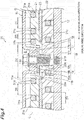
- a fastener 16 described below is provided at a center of the protective cover 11.
- a seat 11b and a through-hole 11 c for providing the fastener 16 are formed in the protective cover 11.
- the protective cover 11 protrudes to the coil portion C side in a portion in which the through-hole 11c is formed.
- the above-described gap G extends between the protective cover 11 and the coil portion C in a region excluding the portion in which the through-hole 11c is formed.
- the protective cover 11 may be flat over the entire region rather than protruding to the coil portion C side in the portion in which the through-hole 11c is formed.
- the coil portion C includes a conductive wire 30 corresponding to a litz wire, and a flat plate-shaped bobbin 20 around which the conductive wire 30 is wound.
- the bobbin 20 includes a rectangular-shaped first winding plate 21 disposed on the surface C1 side, and a rectangular-shaped second winding plate 22 disposed on the rear surface C2 side.
- the first winding plate 21 and the second winding plate 22 are formed using the same material (e.g., a polyphenylene sulfide resin).
- a ferrite plate (magnetic member) 23 is disposed between the first winding plate 21 and the second winding plate 22. That is, the ferrite plate 23 is disposed inside the bobbin 20. In plan view, a shape and a size of the ferrite plate 23 are substantially equal to or smaller than shapes and sizes of the first winding plate 21 and the second winding plate 22. The ferrite plate 23 is sandwiched between and held by the first winding plate 21 and the second winding plate 22. The first winding plate 21 is disposed between the ferrite plate 23 and the protective cover 11. The second winding plate 22 is disposed between the ferrite plate 23 and the base 12.
- a plurality of groove portions 21b extending in a long-side direction of the coil portion C is formed in the first winding plate 21.
- the plurality of groove portions 21b is parallel to each other.
- a cross-sectional shape of the plurality of groove portions 21b perpendicular to the long-side direction corresponds to a rectangular shape in which one side on the protective cover 11 side is open.
- the groove portion 21b is recessed with respect to a surface 21a of the first winding plate 21, and has a predetermined depth.
- a plurality of groove portions 22b extending in the long-side direction of the coil portion C is formed in the second winding plate 22.
- the plurality of groove portions 22b is parallel to each other.
- a cross-sectional shape of the plurality of groove portions 22b perpendicular to the long-side direction corresponds to a rectangular shape in which one side on the base 12 side is open.
- the groove portion 22b is recessed with respect to a surface 22a of the second winding plate 22, and has a predetermined depth.
- the first winding plate 21, the ferrite plate 23, and the second winding plate 22 described above are integrated with one another, and are wound with the conductive wire 30. More specifically, the conductive wire 30 is disposed inside the groove portion 21b and the groove portion 22b. As illustrated in FIG. 3 , in the coil portion C, a position at which the groove portion 21b is provided and a position at which the surface 22a is provided are different from each other in a short-side direction of the coil portion C. In other words, the groove portion 21b and the groove portion 22b are not aligned in the vertical direction (a direction perpendicular to the surface C1 of the coil portion C, that is, a plate thickness direction of the first winding plate 21 and the second winding plate 22).
- the conductive wire 30 wound around the bobbin 20 includes a plurality of surface-side extending portions 31 extending on the first winding plate 21 and a plurality of rear surface-side extending portions 32 extending on the second winding plate 22.
- the long-side direction of the coil portion C is equal to a wound wire direction of the conductive wire 30, and the short-side direction of the coil portion C is equal to a winding axis direction of the conductive wire 30.
- the wound wire direction and the winding axis direction are orthogonal to (intersect with) each other.
- the conductive wire 30 extends in a direction which is inclined with respect to the vertical direction on an end surface of the bobbin 20 in the wound wire direction.
- the respective surface-side extending portions 31 and the respective rear surface-side extending portions 32 are not aligned in the vertical direction.
- the surface-side extending portions 31 and the rear surface-side extending portions 32 are provided in a vertically diagonal shape (in zigzag) when viewed in the wound wire direction (see FIG. 3 ).
- the conductive wire 30 includes the plurality of surface-side extending portions 31 extending along the wound wire direction on the first winding plate 21.
- the plurality of surface-side extending portions 31 has linear shapes, and is parallel to each other.
- the surface-side extending portions 31 include a plurality of first extending portions 31a lined up at equal intervals in the winding axis direction, and one second extending portion 31b and one third extending portion 31c in which a gap between surface-side extending portions 31 adjacent to each other in the winding axis direction is different from that in the first extending portions 31a.
- a distance between centers that is, a pitch of two first extending portions 31a and 31a is a first pitch P1.
- a pitch of the second extending portion 31b and a first extending portion 31a adjacent to the second extending portion 31b is a second pitch P2.
- the second pitch P2 is larger than the first pitch P1.
- pitches may be used for the comparison as described above, or gaps between the surface-side extending portions 31 may be used for the comparison as illustrated in FIG. 4 .
- a gap between the first extending portions 31a and 31a that is, a distance between two inner end surfaces facing each other in the winding axis direction is a first gap D1.
- a gap between the second extending portion 31b and the first extending portion 31a adjacent to the second extending portion 31b is a second gap D2.
- the second gap D2 is larger than the first gap D1.
- the coil portion C includes an enlarged portion 35 in which the second gap D2 between the first extending portion 31a and the second extending portion 31b adjacent to each other in the winding axis direction is wider than a gap between another first extending portion 31a and another first extending portion 31a.
- the first gap D1 between the first extending portion 31 a and the first extending portion 31a adjacent to each other is uniform in a plurality of portions of the coil portion C
- the second gap D2 between the first extending portion 31a and the second extending portion 31b adjacent to each other is different from the first gap D1.
- a pitch of the conductive wire 30 is non-uniform as a whole of the surface-side extending portions 31.
- the enlarged portion 35 may not be formed on the surface C1 of the coil portion C by the surface-side extending portions 31, and may be formed on the rear surface C2 by the rear surface-side extending portions 32 as illustrated in FIG. 4 .
- a pitch of the second extending portion 31b and the third extending portion 31c adjacent to the second extending portion 31b is a third pitch P3.
- the third pitch P3 is smaller than the first pitch P1.
- a gap between the second extending portion 31b and the third extending portion 31c adjacent to the second extending portion 31b is a third gap D3.
- the third gap D3 is smaller than the first gap D1.
- FIG. 4 illustrates positions of the extending portions using a virtual line when the conductive wire 30 is wound at all equal pitches without providing the enlarged portion 35.
- the second gap D2 is twice or more as large as the first gap D1.
- the fastener 16 capable of increasing strength of the protective cover 11 is provided in the enlarged portion 35 in which a pitch of the conductive wire 30 is enlarged.
- a hole portion 26 in which the fastener 16 is provided is formed between the first extending portion 31a and the second extending portion 31b in the bobbin 20 of the coil portion C. According to this arrangement, interference in the conductive wire 30 by the fastener 16 is avoided.
- the conductive wire 30 includes the plurality of rear surface-side extending portions 32 extending along the wound wire direction on the second winding plate 22.
- the plurality of rear surface-side extending portions 32 has linear shapes, and is parallel to each other.
- the rear surface-side extending portions 32 include a plurality of first extending portions 32a lined up at equal intervals in the winding axis direction. A distance between centers, that is, a pitch of two extending portions 32a and 32a is a first pitch P1.
- a gap between the extending portions 32a and 32a that is, a distance between two inner end surfaces facing each other in the winding axis direction is a first gap D1. In this way, the first gap D1 between the extending portion 32a and the extending portion 32a adjacent to each other is uniform in the coil portion C.
- the enlarged portion 35 is a portion in which "a gap between extending portions adjacent to each other in the winding axis direction is wider than a gap between other extending portions".
- the gap between the other extending portions various schemes are considered. For example, when most extending portions have the first gap D1 between the first extending portions 31a and 31a in the coil portion C as described above, the first gap D1 may be set as a standard. When gaps between adjacent extending portions are different from each other (or a dispersion is present), an average of gaps at a plurality of points may be calculated, and a portion, in which a gap is wider than the average, may be set as an enlarged portion.
- An exposed surface of the bobbin 20 formed between adjacent extending portions may be calculated, and a portion, in which an exposed surface is larger than that of another portion, may be set as an enlarged portion.
- An average of exposed areas of the bobbin 20 at a plurality of points may be calculated, and a portion, in which an exposed area is larger than the average, may be set as an enlarged portion.
- symmetry between the surface-side extending portions 31 and the rear surface-side extending portions 32 is maintained in the coil portion C except for the second extending portion 31b of the surface-side extending portions 31.
- the plurality of first extending portions 31a, the second extending portion 31b, and the third extending portion 31c correspond to the plurality of rear surface-side extending portions 32, and a relationship of a vertically diagonal shape (a zigzag positional relation) is maintained.
- the fastener 16 is provided in a first central region A1 which is a central region of the bobbin 20 in the wound wire direction and the winding axis direction.
- the fastener 16 is provided at an intersection point of first diagonal lines L1 and L1, that is, a central point of the bobbin 20.
- the fastener 16 may be provided inside the first central region A1, a center of which corresponds to the intersection point of first diagonal lines L1 and L1 of the bobbin 20.
- the fastener 16 may be provided in a second central region A2 which is a central region of the housing 10 (that is, the protective cover 11 or the base 12) in the wound wire direction and the winding axis direction.
- the fastener 16 may be provided at an intersection point of second diagonal lines L2 and L2, that is, a central point of the base 12, or may be provided inside the second central region A2, a center of which corresponds to the intersection point.
- the fastener 16 is provided along the vertical direction.
- the fastener 16 is orthogonal to the wound wire direction and the winding axis direction.
- the fastener 16 penetrates through the protective cover 11, the first winding plate 21, the ferrite plate 23, and the second winding plate 22.
- a distal end portion 17c of the fastener 16 does not penetrate through the base 12, and terminates inside the base 12.
- the fastener 16 includes a first screw member 17 screwed to the base 12 and a second screw member 18 screwed to the first screw member 17.
- Each of the first screw member 17 and the second screw member 18 is made of a non-magnetic material.
- the first screw member 17 and the second screw member 18 may be non-magnetic or magnetic.
- the fastener 16 strongly fastens the protective cover 11, the first winding plate 21, the ferrite plate 23, the second winding plate 22, and the base 12 using two (a plurality of) screw members.
- the first screw member 17 and the second screw member 18 are made of a material having a thermal conductivity
- a portion of heat of the ferrite plate 23 heated by wireless power transfer is successively transferred to a seat 21c, the first screw member 17, and the second screw member 18, and is released to the outside from a head portion 18a.
- the first screw member 17 and the second screw member 18 are made of a material having a high thermal conductivity (e.g., metal), heat release effect is improved.
- a circular hole portion 23a is provided at a position corresponding to the fastener 16 in the ferrite plate 23.
- the first winding plate 21 includes a cylindrical seat (protrusion) 21c that protrudes to the inside of the hole portion 23a.
- the hole portion 23a may be a rectangle.
- a circular through-hole 21d is provided at a center of the seat 21c.
- a through-hole 22c that communicates with the through-hole 21d is formed in the second winding plate 22.
- the seat 21c of the first winding plate 21 is disposed inside the hole portion 23a of the ferrite plate 23. A rear surface of the seat 21c contacts the second winding plate 22.
- the first screw member 17 includes a disc-shaped flange portion 17a that contacts the seat 21c of the first winding plate 21 from the protective cover 11 side, a shaft portion 17b formed on a distal end side of the flange portion 17a to penetrate through the first winding plate 21, the ferrite plate 23, and the second winding plate 22, and the distal end portion 17c formed on a distal end side of the shaft portion 17b and screwed to the base 12.
- the shaft portion 17b is disposed inside the through-hole 21d and the through-hole 22c.
- a female screw and a screw insertion hole to which the second screw member 18 may be screwed are formed in the shaft portion 17b.
- the flange portion 17a, the shaft portion 17b, and the distal end portion 17c are integrally formed.
- the hole portion 26 of the coil portion C described above includes the through-hole 21d, the hole portion 23a, and the through-hole 22c.
- the second screw member 18 includes the head portion 18a with which a rotating tool, etc. can be engaged, a shaft portion 18b formed on a distal end side of the head portion 18a to penetrate through the protective cover 11, and a distal end portion 18c screwed to the shaft portion 17b of the first screw member 17.
- the shaft portion 18b is disposed inside the through-hole 11c of the protective cover 11.
- the head portion 18a, the shaft portion 18b, and the distal end portion 18c are integrally formed.
- a seal member is appropriately provided between the protective cover 11 and the flange portion 17a.
- a cylindrical member 19 is provided between the shaft portion 18b of the second screw member 18 and the seat 11b of the protective cover 11.
- the second winding plate 22 in which the through-hole 22c is provided, the ferrite plate 23 in which the hole portion 23a is provided, and the first winding plate 21 in which the through-hole 21d is provided are superposed.
- the first winding plate 21, the ferrite plate 23, the second winding plate 22, and the base 12 are fastened by screwing the first screw member 17 in the base 12.
- the flange portion 17a immobilizes the seat 21c of the first winding plate 21 on the base 12 side. In this way, the seat 21 c is pressed against the second winding plate 22, the ferrite plate 23 sandwiched between the first winding plate 21 and the second winding plate 22 is fixed.
- the seat 11b of the protective cover 11 is superposed on the seat 21c of the first winding plate 21 through the flange portion 17a.
- the protective cover 11 is fastened to the first winding plate 21, the ferrite plate 23, the second winding plate 22, and the base 12 by screwing the second screw member 18 in the base 12.
- the protective cover 11 is supported by the base 12 and the coil portion C (bobbin 20) through the flange portion 17a of the fastener 16.
- the seat 11b of the protective cover 11 is recessed from the end surface 11a and formed in a cylindrical shape.
- a cylindrical space S is formed in a recessed portion of the seat 11b.
- the head portion 18a of the second screw member 18 is accommodated in the space S.
- An upper end surface of the head portion 18a is positioned on the base 12 side from the end surface 11a. That is, the head portion 18a is installed on the base 12 side from the end surface 11a of the protective cover 11.
- the protective cover 11 is disposed on a lower side in a state in which the coil device 5 is installed in the EV.
- a position of a lowermost end (that is, a minimum height) of the coil device 5 may be prevented from being lowered by the fastener 16. In this way, it is possible to avoid touching an object by the head portion 18a of the fastener 16 when the EV is driven or stopped.
- the housing 10 is accommodated in the coil portion C that includes the bobbin 20 and the ferrite plate 23.
- the plurality of surface-side extending portions 31 and rear surface-side extending portions 32 extending in the wound wire direction on the bobbin 20 have gaps in the winding axis direction.
- the enlarged portion 35 in which the second gap D2 between the first extending portion 31a and the second extending portion 31b adjacent to each other is wider than the first gap D1 between other first extending portions 31a and 31a, is provided in the coil portion C.
- the fastener 16 is provided in the enlarged portion 35.
- the bobbin 20 and the housing 10 are fastened by the fastener 16.
- the gap between the first extending portion 31a and the second extending portion 31b is wide in the enlarged portion 35, and thus it is possible to avoid interfering in the surface-side extending portions 31 and the rear surface-side extending portions 32 by the fastener 16 (see FIG. 4 ).
- Strength of the housing 10 is increased in the coil device 5 of solenoid type.
- the housing 10 includes the protective cover 11 and the base 12. Strength of the housing 10 is increased by fastening the bobbin 20 and both the protective cover 11 and the base 12 using the fastener 16.
- the ferrite plate 23 is provided between the protective cover 11 and the base 12.
- the fastener 16 penetrates the ferrite plate 23 to fasten the protective cover 11 and the base 12. Therefore, the housing 10 is more strongly fixed to the bobbin 20. Further, movement of the ferrite plate 23 in the wound wire direction and the winding axis direction is regulated.
- the seat 11b of the protective cover 11 is pressed against the second winding plate 22 and the base 12 by the fastener 16. Therefore, the first winding plate 21 and the second winding plate 22 are more strongly fastened.
- the ferrite plate 23 is sandwiched between and held by the first winding plate 21 and the second winding plate 22. In general, the ferrite plate 23 may be fragile. However, according to the above-described configuration, strength of the ferrite plate 23 is increased.
- the fastener 16 includes two members corresponding to the first screw member 17 and the second screw member 18. First, the seat 21c of the first winding plate 21 is pressed against the second winding plate 22 and the base 12 by the first screw member 17. The protective cover 11 is fastened to the first winding plate 21, the second winding plate 22, and the base 12, which are integrated with one another, by the second screw member 18. In this way, the fastener 16 may be reliably and easily provided by performing fastening in two discrete steps.
- fastening using the fastener 16 may be easily performed from the outside of the housing 10. Therefore, the fastener 16 may be reliably and easily provided.
- the fastener 16 is positioned nearer to the second extending portion 31b between the first extending portion 31a and the second extending portion 31b.
- the third gap D3 between the second extending portion 31b and the third extending portion 31c is narrower than the first gap D1 between the other first extending portions 31a and 31a.
- a gap between the surface-side extending portions 31 that is, a position of the conductive wire 30
- the fastener 16 Since the fastener 16 is provided in the first central region A1 of the bobbin 20 in the wound wire direction and the winding axis direction, strength of the housing 10 is increased at a position corresponding to the first central region A1 of the bobbin 20. When the fastener 16 is not provided, the housing 10 is relatively easily bent at a position corresponding to the second central region A2 of the bobbin 20. Strength of housing 10 is further improved by the fastener 16.
- the coil device 5 has advantageous effect in contrast with the above respective conventional art documents.
- Patent Literature 1 there is no examination of a scheme of attaching the power reception coil device to the outside of the vehicle.
- the power reception coil device is supported by the chassis.
- the base 12 is fixed to the outside of the chassis.
- the protective cover 11 facing the power transmission coil device 4 is made of a non-magnetic material, for example, resin, a magnetic flux generated by the coil device 4 is not affected. Therefore, efficient wireless power transfer is achieved. Further, when a non-magnetic and non-conducting material is used for the protective cover 11, power efficiency of wireless power transfer may be further increased.
- the base 12 facing the vehicle body side is made of a non-magnetic and conductive material, structural strength of the coil device 5 may be improved while suppressing an influence on a magnetic field distribution between the coil device 4 and the coil device 5.
- the non-magnetic and conductive base 12 functions as a magnetic shielding, and thus magnetic fluxes heading the coil devices 4 and 5 increase, and power efficiency may be improved.
- Patent Literature 3 discloses that a central region of the substrate is bolted. However, only the substrate is fixed, and the protective cover is not fixed. For this reason, a central region of the protective cover is bent similarly to Patent Literature 2.
- Patent Literature 2 mentions a spacer for ensuring strength of the protective cover. However, when the power reception unit is attached backward, and the protective cover is bent, a gap is generated between the spacer and the protective cover. Thus, there is difficulty in ensuring strength of the protective cover.
- the housing 10 and the bobbin 20 are fastened by the fastener 16, and thus strength of the housing 10 is ensured.
- the bolt or the spacer may be provided in the central region of the power reception unit as in Patent Literature 3 since the coil has a circular shape in which a space is present in the central region.
- a scheme of Patent Literature 3 in a solenoid coil as in Patent Literature 1 in which a conductive wire is wound around a central region.
- a cross-sectional view of the power reception coil device is given in FIG. 7 of Patent Literature 1, and conductive wire positions of an upper ferrite housing portion and a lower ferrite housing portion are matched with each other.
- the bolt may be vertically inserted so as not to interfere in the conductive wire.
- a pitch of the conductive wire may not be longer than a width of the bolt.
- Patent Literature 2 paragraph 0025
- the conductive wire when the conductive wire is sparsely and densely wound, there are problems of heating due to an eddy current in a dense part and a magnetic flux leakage in a sparse part, and thus the conductive wire is preferably wound at equal intervals. For this reason, when the pitch of the conductive wire is set to be wider than the width of the bolt, the power reception coil device increases in size as a whole. However, the power reception coil device is required to be reduced in size due to a characteristic that the power reception coil device is installed in a vehicle in which an installation position is restricted. In addition, the conductive wire needs to be densely wound to improve transmitting efficiency.
- positions of the conductive wire are provided in a diagonal shape rather than being vertically matched in many cases in terms of ensuring an insulation distance (necessity of separating pieces of the conductive wire as much as possible) (see the surface-side extending portions 31 and the rear surface-side extending portions 32 illustrated in FIG. 16 ).
- one of upper and lower pitches of the conductive wire includes a position of another conductive wire position (the rear surface-side extending portion 32), and thus there is difficulty in inserting a bolt 116 such that the conductive wire is not interfered.
- the above-mentioned various problems are overcome.
- the present invention is not limited to the above-described embodiment.
- the present invention includes various modifications.
- a description has been given of a mode in which arrangement of the fastener 16 is determined based on the first central region A1 of the bobbin 20 or the second central region A2 of the housing 10.
- arrangement of the fastener 16 may be determined based on another criterion.
- arrangement of the fastener 16 may be determined based on a viewpoint on a magnetic flux.
- regions FS and FS in which a magnetic flux is strong are formed at both end portions in the winding axis direction.
- Regions FM and FM in which a magnetic flux is moderate are formed at both end portions in the wound wire direction.
- a magnetic flux is relatively weak in a central region FW in the winding axis direction and the wound wire direction except for the region FS and the region FM.
- one or a plurality of fasteners 16 may be disposed in the region FM in which the magnetic flux is weak.
- the regions FS and FS in which the magnetic flux is strong are regions corresponding to 20% to 40% of a whole length of the coil portion C in the winding axis direction from both end portions of the coil portion C.
- the regions FM and FM in which the magnetic flux is moderate are regions corresponding to 20% to 40% of a whole length of the coil portion C in the wound wire direction from both end portions of the coil portion C. Therefore, for example, the region FW in which the magnetic flux is weak corresponds to a region in a range of 20% to 60% in the middle in the winding axis direction and a region in a range of 20% to 60% in the middle in the winding axis direction.
- the fastener 16 may be provided in a region in which a decrease in power efficiency due to provision of the fastener 16 is less than or equal to 0.1%.
- Power efficiency refers to a ratio of power at a certain place inside the power receiver 3 to power at a certain place inside the power transmitter 2.
- power efficiency refers a ratio of power of an output of a rectifier of the power receiver 3 to power of an input of an inverter of the power transmitter 2.
- an influence on power efficiency by the fastener 16 may be made as small as possible.
- the fastener 16 may be provided in a region in which a magnetic flux density in the coil portion C is lower than that in another region. In this case, an influence on a magnetic flux by the fastener 16 may be made as small as possible. An average magnetic flux density in a plurality of regions may be calculated, and the fastener 16 may be provided in a region in which a magnetic flux density is lower than the average. The fastener 16 may be provided in a region in which a magnetic flux density is lowest.
- arrangement of the fastener 16 may be determined based on a viewpoint on strength.
- one or a plurality of fasteners 16 may be provided in a rectangular-shaped region A3 extending in a short-side direction of the bobbin 20 (that is, the winding axis direction) in which the intersection point of the first diagonal lines L1 and L1 of the bobbin 20 is set as a center.
- one or a plurality of fasteners 16 may be provided in a region A4 where the region FW in which the magnetic flux is weak overlaps the rectangular-shaped region A3.
- an enlarged portion 35A may be provided by providing fourth extending portions 31d and 31d, a gap of which is widened only in a part in the wound wire direction.
- the fourth extending portion 31d which is curved in an arc, is provided in a middle portion of a first extending portion 31a having a linear shape.
- the enlarged portion 35A is provided in the first central region A1 (see FIG. 5 ).
- the fastener 16 is provided in the enlarged portion 35A. In other words, the enlarged portion 35A is provided to circle around the fastener 16.
- the fifth extending portions 31e and 31e have a pitch which is twice as large as (an integer multiple) of the first pitch P1 between the first extending portions 31a and 31 a.
- the number of turns in the first winding plate 21 is decreased to be smaller than the number of turns in the second winding plate 22.
- symmetry between the surface-side extending portions 31 and the rear surface-side extending portions 32 is not maintained.
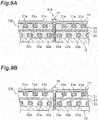
- a fastener is divided into two parts corresponding to a fastener 16C on the protective cover 11 side and a fastener 16C on the base 12 side.
- An enlarged portion 35C is configured similarly to the enlarged portion 35B illustrated in FIG. 9A .
- the two fasteners 16C are provided from the outside of the housing 10.
- the fastener 16C on the protective cover 11 side penetrates through the protective cover 11, and does not penetrate through the ferrite plate 23.
- the fastener 16C on the base 12 side penetrates through the base 12, and does not penetrate through the ferrite plate 23.
- a distal end of the fastener 16C terminates inside the first winding plate 21 or the second winding plate 22.
- a seal member is provided between the fastener 16C on the protective cover 11 side and the protective cover 11.
- a seal member is provided between the fastener 16C on the base 12 side and the base 12.
- a fastener is divided into two parts corresponding to a fastener 16D on the protective cover 11 side and a fastener 16D on the base 12 side.
- An enlarged portion 35D is configured similarly to the enlarged portion 35B illustrated in FIG. 9A .
- the two fasteners 16D and 16D are provided from the inside of the bobbin 20 (that is, the ferrite plate 23 side of the first winding plate 21 and the ferrite plate 23 side of the second winding plate 22).
- the fastener 16D on the protective cover 11 side does not penetrate through the protective cover 11 and the ferrite plate 23.
- the fastener 16D on the base 12 side does not penetrate through the base 12 and the ferrite plate 23. In other words, a base end of the fastener 16D does not protrude from a surface of the first winding plate 21 or the second winding plate 22 on the ferrite plate 23 side.
- a distal end of the fastener 16D on the protective cover 11 side terminates inside the protective cover 11.
- a distal end of the fastener 16D on the base 12 side terminates inside the base 12.
- a seal member is not needed between the fastener 16C on the protective cover 11 side and the protective cover 11.
- a seal member is not needed between the fastener 16C on the base 12 side and the base 12.
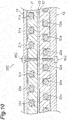
- the fasteners 16E and 16E are obliquely disposed with respect to a virtual plane which is perpendicular to the winding axis direction.
- the fasteners 16E and 16E form an angle with respect to the virtual plane which is perpendicular to the winding axis direction.
- the fasteners 16E and 16E are provided to avoid interference by a surface-side extending portion 31 and an extending portion 32a on the base 12 side close to each other.
- the fasteners 16E and 16E penetrate through the protective cover 11 and the ferrite plate 23. Distal ends of the fasteners 16E and 16E terminate inside the base 12.
- a seal member is provided between the fasteners 16E and 16E and the protective cover 11.
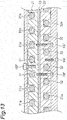
- FIG. 13 illustrates a case in which four fasteners 16F are provided.
- a thickness (diameter) of each of the fasteners 16F may be appropriately changed.
- one medium-sized fastener 16F is used on the protective cover 11 side to fasten the protective cover 11 and the first winding plate 21.
- the second winding plate 22 and the ferrite plate 23 are fastened by two small-sized fasteners 16F and 16F on the base 12 side. Further, the base 12 and the second winding plate 22 are fastened by one small-sized fastener 16F.
- a seal member is provided between the fastener 16F and the protective cover 11 or the base 12 only when the fastener 16F penetrates through the protective cover 11 or the base 12.
- the "middle-sized fastener” and the “small-sized fastener” correspond to thicknesses (diameters) when the one fastener 16 illustrated in FIG. 3 is set as a criterion. When a plurality of middle-sized or small-sized fasteners is used, an influence on a magnetic field distribution may be reduced.
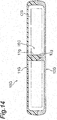
- a key structure may be provided inside the protective cover 11 and the base 12. That is, a fastener 16G includes a first combined member 11g integrally provided with a protective cover 11G to protrude toward a base 12G, and a second combined member 12g integrally provided with the base 12G to protrude toward the protective cover 11G. At least one of the first combined member 11g and the second combined member 12g is disposed inside a coil portion CG. In other words, at least one of the first combined member 11g and the second combined member 12g intersects with (enters) the coil portion CG. The first combined member 11g and the second combined member 12g are combined together.
- the fastener 16G is configured such that a distal end of the first combined member 11g fits into a depression of a distal end of the second combined member 12g. As the protective cover 11G is further pressed against the base 12G, fastening strength between the first combined member 11g and the second combined member 12g increases.
- the fastener 16G is integrally provided with a housing 10G, and does not penetrate through the housing 10G, and thus a seal around the fastener 16G is not needed.
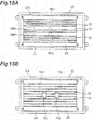
- two (a plurality of) fasteners 16H may be arranged along the winding axis direction.
- two enlarged portions 35H in which a gap between parallel surface-side extending portions 31 is widened, are provided in a coil portion CH.
- the fasteners 16H are provided in the respective enlarged portions 35H.
- the fasteners 16H and 16H may be provided in point symmetry about the intersection point of the first diagonal lines L1 and L1, that is, the central point of the bobbin 20 (see FIG. 5 ). In this way, loads applied to both the fasteners 16H and 16H may be easily balanced, and thus strength of the protective cover may be easily increased.
- two (a plurality of) fasteners 16J may be arranged along the wound wire direction.
- two enlarged portions 35J that circle around the fasteners 16J are provided in a coil portion CJ by bending middle portions of linear-shaped surface-side extending portions 31 in arcs.
- the fasteners 16J are provided in the respective enlarged portions 35J.
- the fasteners 16J and 16J are provided in point symmetry about the intersection point of the first diagonal lines L1 and L1, that is, the central point of the bobbin 20 (see FIG. 5 ).
- the plurality of fasteners 16J may be provided even when a plurality of enlarged portions 35 is not provided unlike the mode of FIG. 15A .
- the number of enlarged portions 35 is suppressed, it is possible to suppress a magnetic flux leakage from between pitches due to the enlarged portions 35.
- sizes of the fasteners may be determined such that a surface area of a surface through which magnetic fluxes of the fasteners pass is the same as a surface area obtained when one fastener 16 is provided. When a surface area of a surface through which magnetic fluxes pass is prevented from increasing, a demerit due to a plurality of fasteners is excluded.
- the conductive wire 30 may extend on a surface of a flat winding plate without forming a groove portion on the winding plate.
- the present invention is not limited to a case in which the distal end portion 17c of the fastener 16 does not penetrate through the base 12, and the distal end portion 17c may penetrate through the base 12.
- the distal end portion 17c penetrating through the base 12 is screwed to the vehicle body, and the coil device 5 is more strongly installed in the vehicle body.
- an enlarged portion is provided only on the protective cover 11 side or both the protective cover 11 side and the base 12 side.
- the present invention is not limited to this case.
- the enlarged portion may be provided only on the base 12 side.
- the present invention is not limited to a case in which the bobbin 20 is disposed on the base 12 such that the first central region A1 and the second central region A2 do not fully overlap each other (see FIG. 5 ).
- the bobbin 20 may be disposed on the base 12 such that a center of the bobbin 20 overlaps a center of the base 12.
- a magnetic member is the ferrite plate 23.
- the magnetic member may be made of another magnetic material (e.g., a silicon steel plate, an amorphous magnetic alloy, and a magnet).
- the magnetic member may be made of a soft magnetic material (e.g., ferrite, a silicon steel plate, and an amorphous magnetic alloy) in terms of improving power efficiency.
- a component disposed inside the bobbin 20 is not restricted to the magnetic member, and may correspond to a reinforcing material that fills a portion or a whole of a cavity inside the bobbin 20 to ensure strength of the coil portion C.
- the present invention is not limited to a case in which the magnetic member or the reinforcing material is disposed inside the bobbin 20.
- the coil portion C may be an air-core coil in which the inside of the bobbin 20 remains as a cavity.
- the above embodiment gives an example in which the litz wire is used as the conductive wire 30.
- the present invention is not limited thereto.
- a conductive wire other than the litz wire may be used as long as the conductive wire functions as a coil device for wireless power transfer.
- a type, a figure, a form, a material, a configuration, a shape, and a dimension of the conductive wire 30 are arbitrarily selected.
- the present invention is applied to the coil device 5.
- the present invention is not limited thereto.
- the present invention may be applied to the power transmission coil device 4.
- a description has been given on a case in which the coil device of the present invention is applied to the wireless power transfer system.
- a system to which the coil device is applied is not restricted to the wireless power transfer system.
- the coil device of the present invention may be applied to an induction heating system or an eddy current flaw detection system.
- the fastener 16 includes the first screw member 17 and the second screw member 18 as a detailed description of the fastener 16.
- the present invention is not limited thereto.
- a cylindrical member having the same flange portion as the flange portion 17a may be employed in place of the first screw member 17.
- the shaft portion 18b of the second screw member 18 has a shape extended to an extent to penetrate through the cylindrical member, and the distal end portion 18c is screwed to the base 12 rather than the shaft portion 17b of the first screw member 17.
- strength of a housing may be increased in a coil device of solenoid type.
Landscapes
- Engineering & Computer Science (AREA)
- Power Engineering (AREA)
- Computer Networks & Wireless Communication (AREA)
- Transportation (AREA)
- Mechanical Engineering (AREA)
- Electric Propulsion And Braking For Vehicles (AREA)
- Current-Collector Devices For Electrically Propelled Vehicles (AREA)
- Coils Or Transformers For Communication (AREA)
- Coils Of Transformers For General Uses (AREA)
- Charge And Discharge Circuits For Batteries Or The Like (AREA)
- Physics & Mathematics (AREA)
- Electromagnetism (AREA)
Abstract
Description
- The present invention relates to a coil device. This application is based on and claims priority to Japanese Patent Application No.
2014-105906, filed on May 22, 2014 - A wireless power transfer system includes a power transmission coil device and a power reception coil device, and implements wireless power transmission using electromagnetic induction, magnetic resonance, etc. between coils. Each of the coil devices has a coil and ferrite therein. The coil device is surrounded by a housing. For example, the housing includes a protective cover and an aluminum plate. For example, the wireless power transfer system is applied to a power feeding system of an electric vehicle. In this case, the power reception coil device is installed in the vehicle.
- Technologies disclosed in
Patent Literatures Patent Literature 2, a bobbin that supports a secondary self-resonant coil corresponding to a power reception coil is attached to a vehicle by a fixing member connected to a flange portion thereof. - In an apparatus disclosed in
Patent Literature 3, an aluminum substrate of a power reception unit is fixed to a lower portion of a moving body by a non-magnetic bolt through a bolt hole. An aluminum substrate of a power feeding unit is fixed to a road surface, etc. by a non-magnetic bolt through a bolt hole. A protective cover made of polycarbonate is fixed to the substrate by a non-magnetic bolt through a bolt hole. A spacer is provided between the protective cover and an insulating plate, and strength of the protective cover is increased by the spacer. -
- Patent Literature 1: Japanese Unexamined Patent Publication No.
2013-153132 - Patent Literature 2: Japanese Unexamined Patent Publication No.
2010-87353 - Patent Literature 3: Japanese Unexamined Patent Publication No.
2008-120239 - In a solenoid coil disclosed in Patent Literature 1, a bobbin around which a conductive wire is wound (a ferrite housing portion in the apparatus of Patent Literature 1) is disposed to extend in a flat plate shape between a protective cover and an aluminum plate. A plurality of slot-shaped grooves is formed in the bobbin, and the conductive wire is disposed in the grooves. In this configuration, the conductive wire wound around the bobbin has a plurality of parallel linear portions on each of a surface side and a rear surface side of the bobbin. Therefore, the conductive wire is present over the entire area of the bobbin disposed between the protective cover and the aluminum plate.
- A spacer disclosed in
Patent Literature 3 is known to be provided to increase strength of a housing. However, there is difficulty in applying the spacer to a solenoid coil in which a conductive wire is present over the entire are of a bobbin. Increasing strength of the housing is an issue in a coil device that employs the solenoid coil. - An object of the present invention is to provide a coil device of solenoid type capable of increasing strength of a housing.
- A coil device of solenoid type according to an aspect of the present invention includes a coil portion having a bobbin and a conductive wire wound around the bobbin, a housing for accommodating the coil portion, and at least one fastener for fastening the bobbin and the housing, wherein the conductive wire includes a plurality of extending portions extending along a wound wire direction on the bobbin and having gaps in a winding axis direction, the coil portion includes an enlarged portion in which a gap between extending portions adjacent to each other in the winding axis direction is wider than a gap between other extending portions, and the fastener is provided in the enlarged portion.
- According to this coil device, the housing is accommodated in the coil portion that includes the bobbin. The plurality of extending portions extending in the wound wire direction on the bobbin has gaps in the winding axis direction. The enlarged portion in which the gap between the extending portions adjacent to each other is wider than the gap between other extending portions is provided in the coil portion. The at least one fastener is provided in the enlarged portion. The bobbin and the housing are fastened by the fastener. The gap between the extending portions is wide in the enlarged portion, and thus interference in the extending portion by the fastener is avoided. Therefore, strength of the housing may be increased in the coil device of solenoid type.
- In some embodiments, the coil portion further includes a magnetic member disposed inside the bobbin. In this case, power efficiency is increased.
- In some embodiments, the housing includes a first housing member facing a first surface of the coil portion having a flat plate shape, and a second housing member fixed to the first housing member to face a second surface on an opposite side from the first surface. In this case, strength of the housing may be increased by fastening the bobbin and at least one of the first housing member and the second housing member by the fastener.
- In some embodiments, the bobbin includes a first winding plate disposed between the first housing member and the magnetic member, and a second winding plate disposed between the second housing member and the magnetic member, and the fastener penetrates through the magnetic member and fastens the first winding plate and the second winding plate. In this case, the magnetic member is provided between the first housing member and the second housing member. The fastener penetrates through the magnetic member, and the first winding plate and the second winding plate are fastened, and thus the housing is more strongly fixed to the bobbin.
- In some embodiments, a hole portion is provided in the magnetic member, the first winding plate has a protrusion protruding to an inside of the hole portion, and the fastener includes a flange portion contacting the protrusion of the first winding plate from a side of the first housing member, a shaft portion formed on a distal end side of the flange portion to penetrate through the first winding plate, the magnetic member, and the second winding plate, and a distal end portion formed on a distal end side of the shaft portion and screwed to the second housing member. In this case, the protrusion of the first winding plate is pressed against the second winding plate and the second housing member by the fastener. The first winding plate and the second winding plate are more strongly fastened. The magnetic member is sandwiched between and held by the first winding plate and the second winding plate. The magnetic member may be fragile. However, according to the above configuration, strength of the magnetic member may be increased.
- In some embodiments, the fastener includes a first screw member in which the flange portion, the shaft portion, and the distal end portion are integrally formed, and a second screw member penetrating through the first housing member to be screwed to the shaft portion. In this case, first, the protrusion of the first winding plate is pressed against the second winding plate and the second housing member by the first screw member. The first housing member is fastened to the first winding plate, the second winding plate, and the second housing member, which are integrated with one another, by the second screw member. In this way, the fastener may be reliably and easily provided by performing fastening in two discrete steps.
- In some embodiments, the fastener penetrates through the housing. Fastening using the fastener is performed from the outside of the housing, and thus the fastener may be reliably and easily provided.
- In some embodiments, the fastener includes a first combined member integrally provided in the first housing member to protrude toward the second housing member, and a second combined member integrally provided in the second housing member to protrude toward the first housing member, and at least one of the first combined member and the second combined member is disposed inside the coil portion, and the first combined member and the second combined member are combined together. In this case, the fastener does not penetrate through the housing, and thus a seal around the fastener is not needed.
- In some embodiments, the conductive wire of the coil portion includes a first extending portion and a second extending portion extending to both sides of the fastener in the winding axis direction to form the enlarged portion, a distance between the fastener and the second extending portion is smaller than a distance between the fastener and the first extending portion, and a gap between the second extending portion and a third extending portion adjacent to the second extending portion in the winding axis direction is narrower than a gap between other extending portions. According to this configuration, the fastener is positioned nearer to the second extending portion between the first extending portion and the second extending portion. The gap between the second extending portion and the third extending portion is narrower than the gap between the other extending portions. Thus, a gap between extending portions (that is, a position of the conductive wire) may not be changed in a portion other than the enlarged portion in which the fastener is provided. Therefore, an influence on a magnetic field may be made as small as possible.
- In some embodiments, the fastener is provided in a central region of the bobbin in the wound wire direction and the winding axis direction. In this case, strength of the housing is increased at a position corresponding to the central region of the bobbin. The housing is relatively easily bent at the position corresponding to the central region of the bobbin. Therefore, strength of the housing is further improved.
- In some embodiments, the fastener is provided in a central region of the housing in the wound wire direction and the winding axis direction. In this case, strength of the housing is increased at a position corresponding to the central region of the housing. The housing is relatively easily bent in the central region. Therefore, strength of the housing is further improved.
- In some embodiments, the fastener is provided in a region in which a decrease in power efficiency due to provision of the fastener is less than or equal to 0.1%. In this case, an influence on power efficiency by the fastener may be made as small as possible.
- In some embodiments, the fastener is provided in a region in which a magnetic flux density in the coil portion is lower than a magnetic flux density in another region. In this case, an influence on a magnetic flux by the fastener may be made as small as possible.
- In some embodiments, the at least one fastener includes a plurality of fasteners, and the plurality of fasteners are arranged along the winding axis direction.
- In some embodiments, the at least one fastener includes a plurality of fasteners, and the plurality of fasteners are arranged along the wound wire direction.
- According to some embodiments of the present invention, strength of a housing may be increased in a coil device of solenoid type.
-
-
FIG. 1 is a diagram illustrating an application example of a coil device according to an embodiment of the present invention. -
FIG. 2 is a perspective view illustrating the coil device according to the embodiment of the present invention. -
FIG. 3A is a cross-sectional view schematically illustrating a portion in which a fastener is provided, andFIG. 3B is a diagram describing a positional relationship of a conductive wire ofFIG. 3A . -
FIG. 4 is a cross-sectional view illustrating a portion around the fastener ofFIG 2 . -
FIG. 5 is a plan view illustrating central regions of a housing and a bobbin. -
FIG. 6A is a plan view illustrating an installation position of the fastener when a magnetic flux density or power efficiency is considered, andFIG. 6B is a plan view illustrating an installation position of the fastener when strength is considered. -
FIG. 7 is a plan view illustrating a region in which a region illustrated inFIG. 6A overlaps a region illustrated inFIG. 6B . -
FIG. 8 is a perspective view illustrating a coil device according to another embodiment. -
FIG. 9A is a cross-sectional view schematically illustrating a portion in which a fastener is provided in another embodiment, andFIG. 9B is a diagram for description of a positional relationship of a conductive wire ofFIG. 9A in another embodiment.FIG. 10 is a cross-sectional view schematically illustrating a portion in which a fastener is provided in another embodiment. -
FIG. 11 is a cross-sectional view schematically illustrating a portion in which a fastener is provided in another embodiment. -
FIG. 12 is a cross-sectional view schematically illustrating a portion in which a fastener is provided in another embodiment. -
FIG. 13 is a cross-sectional view schematically illustrating a portion in which a fastener is provided in another embodiment. - FUG. 14 is a cross-sectional view schematically illustrating a key structure of a housing in another embodiment.
FIG. 15A is a plan view illustrating a mode in which two fasteners are arranged in a winding axis direction, andFIG. 15B is a plan view illustrating a mode in which two fasteners are arranged in a wound wire direction. -
FIG. 16 is a cross-sectional view describing a case in which a fastener is provided in a conventional solenoid coil. - Hereinafter, embodiments of the present invention will be described with reference to drawings. The same reference numeral will be applied to the same component in description of the drawings, and repeated description will be omitted.
- A wireless power transfer system 1 to which a coil device of the present embodiment is applied will be described with reference to
FIG. 1 . The wireless power transfer system 1 is a system for feeding power from apower transmitter 2 to apower receiver 3. For example, thepower transmitter 2 and thepower receiver 3 are separated from each other in a vertical direction. For example, thepower transmitter 2 is installed in a parking lot, etc. For example, thepower receiver 3 is installed in an electric vehicle EV. The wireless power transfer system 1 is configured to feed power to the EV arriving at the parking lot, etc. using a magnetic resonance scheme, an electromagnetic induction scheme, etc. - The
power transmitter 2 includes a power transmission coil device 4 for wireless power transfer provided to protrude upward from a road surface of the parking lot, etc. For example, the power transmission coil device 4 has a shape of a flat rectangular parallelepiped or frustum. Thepower transmitter 2 generates desired AC power from a DC power source or an AC power source to send the generated AC power to thepower receiver 3, and further includes a controller, an inverter, etc. (not illustrated). For example, thepower receiver 3 includes a powerreception coil device 5 for wireless power transfer attached to a bottom surface of a vehicle body (chassis, etc.) of an EV to face the power transmission coil device 4. For example, the powerreception coil device 5 has a shape of a flat rectangular parallelepiped or frustum. Thepower receiver 3 receives power from thepower transmitter 2 to feed power to a load (e.g., a battery), and further includes a controller, a rectifier, etc. (not illustrated). Hereinafter, the power transmission coil device 4 and the powerreception coil device 5 will be referred to as a coil device 4 and acoil device 5, respectively. - The
coil device 5 will be described with reference toFIG. 1 andFIG 2 . Thecoil device 5 generates an induced current when a magnetic flux generated by the power transmission coil device 4 interlinks with thecoil device 5. Thecoil device 5 corresponds to a solenoid type. Thecoil device 5 includes a flat plate-shaped coil portion C that generates an induced current and ahousing 10 that accommodates the coil portion C. - For example, the
housing 10, which has a shape of a flat rectangular parallelepiped, includes a base (second housing member) 12 and a protective cover (first housing member) 11 that forms an accommodation space between theprotective cover 11 and the base 12 (seeFIG. 3 ). Theprotective cover 11 faces a surface (first surface) C1 of the coil portion C. The base 12 faces a rear surface (second surface on the opposite side from the first surface) C2 of the coil portion C. When thecoil device 5 is installed in the EV, for example, thebase 12 is fixed to the vehicle body side. Theprotective cover 11 faces the coil device 4. That is, thebase 12 is disposed above the coil portion C, and theprotective cover 11 is disposed below the coil portion C while thecoil device 5 is installed in the EV. For example, thebase 12 and theprotective cover 11 are made of resin. Alternatively, thebase 12, which does not face the coil device 4, may be formed using a non-magnetic or conductive material (e.g., aluminum). - The
base 12 is a portion fixed to the vehicle body of the EV. For example, thebase 12 is fixed to the vehicle body by fourscrew members 15 at four corner portions. Thebase 12, which has a rectangular shape, includes a rectangular-shapedaccommodating depression 12a slightly smaller than an external form thereof. The coil portion C is accommodated in theaccommodating depression 12a, and is fixed to thebase 12 by a screw member such as a screw. An insulation sheet may be inserted between the coil portion C and thebase 12. - For example, the
protective cover 11, which has a rectangular shape, is fixed to thebase 12 by fourscrew members 14 through fourscrew holes 13 at edges of thebase 12. A gap G (seeFIG. 4 ) is formed between theprotective cover 11 and the coil portion C substantially over the entire region of the surface C1 of the coil portionC. A fastener 16 described below is provided at a center of theprotective cover 11. Aseat 11b and a through-hole 11 c for providing thefastener 16 are formed in theprotective cover 11. Theprotective cover 11 protrudes to the coil portion C side in a portion in which the through-hole 11c is formed. The above-described gap G extends between theprotective cover 11 and the coil portion C in a region excluding the portion in which the through-hole 11c is formed. Theprotective cover 11 may be flat over the entire region rather than protruding to the coil portion C side in the portion in which the through-hole 11c is formed. - As illustrated in
FIG. 2 andFIG. 3 , the coil portion C includes aconductive wire 30 corresponding to a litz wire, and a flat plate-shapedbobbin 20 around which theconductive wire 30 is wound. Thebobbin 20 includes a rectangular-shaped first windingplate 21 disposed on the surface C1 side, and a rectangular-shaped second windingplate 22 disposed on the rear surface C2 side. The first windingplate 21 and the second windingplate 22 are formed using the same material (e.g., a polyphenylene sulfide resin). - A ferrite plate (magnetic member) 23 is disposed between the first winding
plate 21 and the second windingplate 22. That is, theferrite plate 23 is disposed inside thebobbin 20. In plan view, a shape and a size of theferrite plate 23 are substantially equal to or smaller than shapes and sizes of the first windingplate 21 and the second windingplate 22. Theferrite plate 23 is sandwiched between and held by the first windingplate 21 and the second windingplate 22. The first windingplate 21 is disposed between theferrite plate 23 and theprotective cover 11. The second windingplate 22 is disposed between theferrite plate 23 and thebase 12. - For example, a plurality of
groove portions 21b extending in a long-side direction of the coil portion C is formed in the first windingplate 21. The plurality ofgroove portions 21b is parallel to each other. A cross-sectional shape of the plurality ofgroove portions 21b perpendicular to the long-side direction corresponds to a rectangular shape in which one side on theprotective cover 11 side is open. Thegroove portion 21b is recessed with respect to asurface 21a of the first windingplate 21, and has a predetermined depth. - For example, a plurality of
groove portions 22b extending in the long-side direction of the coil portion C is formed in the second windingplate 22. The plurality ofgroove portions 22b is parallel to each other. A cross-sectional shape of the plurality ofgroove portions 22b perpendicular to the long-side direction corresponds to a rectangular shape in which one side on the base 12 side is open. Thegroove portion 22b is recessed with respect to asurface 22a of the second windingplate 22, and has a predetermined depth. - The first winding
plate 21, theferrite plate 23, and the second windingplate 22 described above are integrated with one another, and are wound with theconductive wire 30. More specifically, theconductive wire 30 is disposed inside thegroove portion 21b and thegroove portion 22b. As illustrated inFIG. 3 , in the coil portion C, a position at which thegroove portion 21b is provided and a position at which thesurface 22a is provided are different from each other in a short-side direction of the coil portion C. In other words, thegroove portion 21b and thegroove portion 22b are not aligned in the vertical direction (a direction perpendicular to the surface C1 of the coil portion C, that is, a plate thickness direction of the first windingplate 21 and the second winding plate 22). - According to the above configuration, the
conductive wire 30 wound around thebobbin 20 includes a plurality of surface-side extending portions 31 extending on the first windingplate 21 and a plurality of rear surface-side extending portions 32 extending on the second windingplate 22. The long-side direction of the coil portion C is equal to a wound wire direction of theconductive wire 30, and the short-side direction of the coil portion C is equal to a winding axis direction of theconductive wire 30. The wound wire direction and the winding axis direction are orthogonal to (intersect with) each other. Theconductive wire 30 extends in a direction which is inclined with respect to the vertical direction on an end surface of thebobbin 20 in the wound wire direction. The respective surface-side extending portions 31 and the respective rear surface-side extending portions 32 are not aligned in the vertical direction. The surface-side extending portions 31 and the rear surface-side extending portions 32 are provided in a vertically diagonal shape (in zigzag) when viewed in the wound wire direction (seeFIG. 3 ). When theconductive wire 30 is disposed as described above, portions of theconductive wire 30 are separated from each other as much as possible, and an insulation distance is ensured in the coil portion C. - A more detailed description will be given of the surface-
side extending portions 31 and the rear surface-side extending portions 32 with reference toFIG. 3 andFIG. 4 . Theconductive wire 30 includes the plurality of surface-side extending portions 31 extending along the wound wire direction on the first windingplate 21. The plurality of surface-side extending portions 31 has linear shapes, and is parallel to each other. The surface-side extending portions 31 include a plurality of first extendingportions 31a lined up at equal intervals in the winding axis direction, and one second extendingportion 31b and one third extendingportion 31c in which a gap between surface-side extending portions 31 adjacent to each other in the winding axis direction is different from that in the first extendingportions 31a. - As illustrated in
FIG. 3B , a distance between centers, that is, a pitch of two first extendingportions portion 31b and a first extendingportion 31a adjacent to the second extendingportion 31b is a second pitch P2. The second pitch P2 is larger than the first pitch P1. When distances between the surface-side extending portions 31 are compared, pitches may be used for the comparison as described above, or gaps between the surface-side extending portions 31 may be used for the comparison as illustrated inFIG. 4 . A gap between the first extendingportions portion 31b and the first extendingportion 31a adjacent to the second extendingportion 31b is a second gap D2. The second gap D2 is larger than the first gap D1. - The coil portion C includes an
enlarged portion 35 in which the second gap D2 between the first extendingportion 31a and the second extendingportion 31b adjacent to each other in the winding axis direction is wider than a gap between another first extendingportion 31a and another first extendingportion 31a. In other words, while the first gap D1 between the first extendingportion 31 a and the first extendingportion 31a adjacent to each other is uniform in a plurality of portions of the coil portion C, the second gap D2 between the first extendingportion 31a and the second extendingportion 31b adjacent to each other is different from the first gap D1. When theenlarged portion 35 is provided, a pitch of theconductive wire 30 is non-uniform as a whole of the surface-side extending portions 31. Theenlarged portion 35 may not be formed on the surface C1 of the coil portion C by the surface-side extending portions 31, and may be formed on the rear surface C2 by the rear surface-side extending portions 32 as illustrated inFIG. 4 . - As illustrated in
FIG. 3B , a pitch of the second extendingportion 31b and the third extendingportion 31c adjacent to the second extendingportion 31b is a third pitch P3. The third pitch P3 is smaller than the first pitch P1. As illustrated inFIG. 4 , a gap between the second extendingportion 31b and the third extendingportion 31c adjacent to the second extendingportion 31b is a third gap D3. The third gap D3 is smaller than the first gap D1. - As illustrated in
FIGS. 2 to 5 , in the coil portion C, only a position of the second extendingportion 31b among the surface-side extending portions 31 is shifted (leaned) to one side in the winding axis direction.FIG. 4 illustrates positions of the extending portions using a virtual line when theconductive wire 30 is wound at all equal pitches without providing theenlarged portion 35. As illustrated inFIG. 4 using the virtual line, the second gap D2 is twice or more as large as the first gap D1. Thefastener 16 capable of increasing strength of theprotective cover 11 is provided in theenlarged portion 35 in which a pitch of theconductive wire 30 is enlarged. Ahole portion 26 in which thefastener 16 is provided is formed between the first extendingportion 31a and the second extendingportion 31b in thebobbin 20 of the coil portion C. According to this arrangement, interference in theconductive wire 30 by thefastener 16 is avoided. - As illustrated in
FIG. 3A and FIG. 3B , theconductive wire 30 includes the plurality of rear surface-side extending portions 32 extending along the wound wire direction on the second windingplate 22. The plurality of rear surface-side extending portions 32 has linear shapes, and is parallel to each other. The rear surface-side extending portions 32 include a plurality of first extendingportions 32a lined up at equal intervals in the winding axis direction. A distance between centers, that is, a pitch of two extendingportions FIG. 4 , a gap between the extendingportions portion 32a and the extendingportion 32a adjacent to each other is uniform in the coil portion C. - The
enlarged portion 35 is a portion in which "a gap between extending portions adjacent to each other in the winding axis direction is wider than a gap between other extending portions". Herein, when "the gap between the other extending portions" is calculated, various schemes are considered. For example, when most extending portions have the first gap D1 between the first extendingportions bobbin 20 formed between adjacent extending portions (e.g., an area per unit length in the wound wire direction) may be calculated, and a portion, in which an exposed surface is larger than that of another portion, may be set as an enlarged portion. An average of exposed areas of thebobbin 20 at a plurality of points may be calculated, and a portion, in which an exposed area is larger than the average, may be set as an enlarged portion. - As illustrated in
FIG. 3B , symmetry between the surface-side extending portions 31 and the rear surface-side extending portions 32 is maintained in the coil portion C except for the second extendingportion 31b of the surface-side extending portions 31. The plurality of first extendingportions 31a, the second extendingportion 31b, and the third extendingportion 31c correspond to the plurality of rear surface-side extending portions 32, and a relationship of a vertically diagonal shape (a zigzag positional relation) is maintained. - A detailed description will be given of the
fastener 16 with reference toFIG. 4 andFIG. 5 . As illustrated inFIG. 5 , thefastener 16 is provided in a first central region A1 which is a central region of thebobbin 20 in the wound wire direction and the winding axis direction. In other words, thefastener 16 is provided at an intersection point of first diagonal lines L1 and L1, that is, a central point of thebobbin 20. - The
fastener 16 may be provided inside the first central region A1, a center of which corresponds to the intersection point of first diagonal lines L1 and L1 of thebobbin 20. Thefastener 16 may be provided in a second central region A2 which is a central region of the housing 10 (that is, theprotective cover 11 or the base 12) in the wound wire direction and the winding axis direction. In other words, thefastener 16 may be provided at an intersection point of second diagonal lines L2 and L2, that is, a central point of thebase 12, or may be provided inside the second central region A2, a center of which corresponds to the intersection point. - As illustrated in
FIG. 4 , thefastener 16 is provided along the vertical direction. Thefastener 16 is orthogonal to the wound wire direction and the winding axis direction. Thefastener 16 penetrates through theprotective cover 11, the first windingplate 21, theferrite plate 23, and the second windingplate 22. Adistal end portion 17c of thefastener 16 does not penetrate through thebase 12, and terminates inside thebase 12. More specifically, thefastener 16 includes afirst screw member 17 screwed to thebase 12 and asecond screw member 18 screwed to thefirst screw member 17. Each of thefirst screw member 17 and thesecond screw member 18 is made of a non-magnetic material. Thefirst screw member 17 and thesecond screw member 18 may be non-magnetic or magnetic. Thefastener 16 strongly fastens theprotective cover 11, the first windingplate 21, theferrite plate 23, the second windingplate 22, and the base 12 using two (a plurality of) screw members. In addition, when thefirst screw member 17 and thesecond screw member 18 are made of a material having a thermal conductivity, a portion of heat of theferrite plate 23 heated by wireless power transfer is successively transferred to aseat 21c, thefirst screw member 17, and thesecond screw member 18, and is released to the outside from ahead portion 18a. In particular, when thefirst screw member 17 and thesecond screw member 18 are made of a material having a high thermal conductivity (e.g., metal), heat release effect is improved. - For example, a
circular hole portion 23a is provided at a position corresponding to thefastener 16 in theferrite plate 23. The first windingplate 21 includes a cylindrical seat (protrusion) 21c that protrudes to the inside of thehole portion 23a. Thehole portion 23a may be a rectangle. A circular through-hole 21d is provided at a center of theseat 21c. A through-hole 22c that communicates with the through-hole 21d is formed in the second windingplate 22. Theseat 21c of the first windingplate 21 is disposed inside thehole portion 23a of theferrite plate 23. A rear surface of theseat 21c contacts the second windingplate 22. - The
first screw member 17 includes a disc-shapedflange portion 17a that contacts theseat 21c of the first windingplate 21 from theprotective cover 11 side, ashaft portion 17b formed on a distal end side of theflange portion 17a to penetrate through the first windingplate 21, theferrite plate 23, and the second windingplate 22, and thedistal end portion 17c formed on a distal end side of theshaft portion 17b and screwed to thebase 12. Theshaft portion 17b is disposed inside the through-hole 21d and the through-hole 22c. A female screw and a screw insertion hole to which thesecond screw member 18 may be screwed are formed in theshaft portion 17b. Theflange portion 17a, theshaft portion 17b, and thedistal end portion 17c are integrally formed. Thehole portion 26 of the coil portion C described above (seeFIG. 2 ) includes the through-hole 21d, thehole portion 23a, and the through-hole 22c. - The
second screw member 18 includes thehead portion 18a with which a rotating tool, etc. can be engaged, ashaft portion 18b formed on a distal end side of thehead portion 18a to penetrate through theprotective cover 11, and adistal end portion 18c screwed to theshaft portion 17b of thefirst screw member 17. Theshaft portion 18b is disposed inside the through-hole 11c of theprotective cover 11. Thehead portion 18a, theshaft portion 18b, and thedistal end portion 18c are integrally formed. - A seal member is appropriately provided between the
protective cover 11 and theflange portion 17a. Acylindrical member 19 is provided between theshaft portion 18b of thesecond screw member 18 and theseat 11b of theprotective cover 11. - When fastening is performed using the
fastener 16, the second windingplate 22 in which the through-hole 22c is provided, theferrite plate 23 in which thehole portion 23a is provided, and the first windingplate 21 in which the through-hole 21d is provided are superposed. The first windingplate 21, theferrite plate 23, the second windingplate 22, and the base 12 are fastened by screwing thefirst screw member 17 in thebase 12. Theflange portion 17a immobilizes theseat 21c of the first windingplate 21 on the base 12 side. In this way, theseat 21 c is pressed against the second windingplate 22, theferrite plate 23 sandwiched between the first windingplate 21 and the second windingplate 22 is fixed. Then, theseat 11b of theprotective cover 11 is superposed on theseat 21c of the first windingplate 21 through theflange portion 17a. Theprotective cover 11 is fastened to the first windingplate 21, theferrite plate 23, the second windingplate 22, and the base 12 by screwing thesecond screw member 18 in thebase 12. Theprotective cover 11 is supported by thebase 12 and the coil portion C (bobbin 20) through theflange portion 17a of thefastener 16. - The
seat 11b of theprotective cover 11 is recessed from theend surface 11a and formed in a cylindrical shape. A cylindrical space S is formed in a recessed portion of theseat 11b. Thehead portion 18a of thesecond screw member 18 is accommodated in the space S. An upper end surface of thehead portion 18a is positioned on the base 12 side from theend surface 11a. That is, thehead portion 18a is installed on the base 12 side from theend surface 11a of theprotective cover 11. As illustrated inFIG. 1 , theprotective cover 11 is disposed on a lower side in a state in which thecoil device 5 is installed in the EV. When thehead portion 18a of thefastener 16 is positioned on the base 12 side from theend surface 11a of the protective cover 11 (that is, a lower end surface of the coil device 5), a position of a lowermost end (that is, a minimum height) of thecoil device 5 may be prevented from being lowered by thefastener 16. In this way, it is possible to avoid touching an object by thehead portion 18a of thefastener 16 when the EV is driven or stopped. - According to the
coil device 5 of the present embodiment, thehousing 10 is accommodated in the coil portion C that includes thebobbin 20 and theferrite plate 23. The plurality of surface-side extending portions 31 and rear surface-side extending portions 32 extending in the wound wire direction on thebobbin 20 have gaps in the winding axis direction. Theenlarged portion 35, in which the second gap D2 between the first extendingportion 31a and the second extendingportion 31b adjacent to each other is wider than the first gap D1 between other first extendingportions fastener 16 is provided in theenlarged portion 35. Thebobbin 20 and thehousing 10 are fastened by thefastener 16. The gap between the first extendingportion 31a and the second extendingportion 31b is wide in theenlarged portion 35, and thus it is possible to avoid interfering in the surface-side extending portions 31 and the rear surface-side extending portions 32 by the fastener 16 (seeFIG. 4 ). Strength of thehousing 10 is increased in thecoil device 5 of solenoid type. - The
housing 10 includes theprotective cover 11 and thebase 12. Strength of thehousing 10 is increased by fastening thebobbin 20 and both theprotective cover 11 and the base 12 using thefastener 16. - The
ferrite plate 23 is provided between theprotective cover 11 and thebase 12. Thefastener 16 penetrates theferrite plate 23 to fasten theprotective cover 11 and thebase 12. Therefore, thehousing 10 is more strongly fixed to thebobbin 20. Further, movement of theferrite plate 23 in the wound wire direction and the winding axis direction is regulated. - The
seat 11b of theprotective cover 11 is pressed against the second windingplate 22 and the base 12 by thefastener 16. Therefore, the first windingplate 21 and the second windingplate 22 are more strongly fastened. Theferrite plate 23 is sandwiched between and held by the first windingplate 21 and the second windingplate 22. In general, theferrite plate 23 may be fragile. However, according to the above-described configuration, strength of theferrite plate 23 is increased. - The
fastener 16 includes two members corresponding to thefirst screw member 17 and thesecond screw member 18. First, theseat 21c of the first windingplate 21 is pressed against the second windingplate 22 and the base 12 by thefirst screw member 17. Theprotective cover 11 is fastened to the first windingplate 21, the second windingplate 22, and thebase 12, which are integrated with one another, by thesecond screw member 18. In this way, thefastener 16 may be reliably and easily provided by performing fastening in two discrete steps. - Since the
fastener 16 penetrates through thehousing 10, fastening using thefastener 16 may be easily performed from the outside of thehousing 10. Therefore, thefastener 16 may be reliably and easily provided. - The
fastener 16 is positioned nearer to the second extendingportion 31b between the first extendingportion 31a and the second extendingportion 31b. The third gap D3 between the second extendingportion 31b and the third extendingportion 31c is narrower than the first gap D1 between the other first extendingportions enlarged portion 35 in which thefastener 16 is provided. Therefore, an influence on a magnetic field is minimized. It is possible to minimize a variation of a magnetic field distribution due to a magnetic flux leakage with respect to a magnetic field distribution generated by the coil portion C around which the conductive wire is wound at the first pitch P1 in a whole area. - Since the
fastener 16 is provided in the first central region A1 of thebobbin 20 in the wound wire direction and the winding axis direction, strength of thehousing 10 is increased at a position corresponding to the first central region A1 of thebobbin 20. When thefastener 16 is not provided, thehousing 10 is relatively easily bent at a position corresponding to the second central region A2 of thebobbin 20. Strength ofhousing 10 is further improved by thefastener 16. - Even when the
fastener 16 is provided in the second central region A2 of thehousing 10 in the wound wire direction and the winding axis direction, strength of thehousing 10 is increased at a position corresponding to the second central region A2 of thehousing 10. When thefastener 16 is not provided, thehousing 10 is relatively easily bent in the second central region A2. Strength ofhousing 10 is further improved by thefastener 16. - The
coil device 5 has advantageous effect in contrast with the above respective conventional art documents. In the above Patent Literature 1, there is no examination of a scheme of attaching the power reception coil device to the outside of the vehicle. When the power reception coil device is installed inside the vehicle, the power reception coil device is supported by the chassis. However, it is unclear how to suspend the power reception coil device when the power reception coil device is installed to be exposed to the outside of the chassis of the vehicle. In general, as a distance between the power transmission coil device and the power reception coil device decreases, transmitting efficiency increases. Thus, there is a great need to attach the power reception coil device to the outside of the chassis of the vehicle. In this regard, according to thecoil device 5 of the present embodiment, thebase 12 is fixed to the outside of the chassis. When theprotective cover 11 facing the power transmission coil device 4 is made of a non-magnetic material, for example, resin, a magnetic flux generated by the coil device 4 is not affected. Therefore, efficient wireless power transfer is achieved. Further, when a non-magnetic and non-conducting material is used for theprotective cover 11, power efficiency of wireless power transfer may be further increased. When the base 12 facing the vehicle body side is made of a non-magnetic and conductive material, structural strength of thecoil device 5 may be improved while suppressing an influence on a magnetic field distribution between the coil device 4 and thecoil device 5. In addition, the non-magnetic andconductive base 12 functions as a magnetic shielding, and thus magnetic fluxes heading thecoil devices 4 and 5 increase, and power efficiency may be improved. - In the
above Patent Literature 2, an outer circumferential portion of the bobbin is attached to the vehicle, and thus a central region is not fixed. For this reason, there is concern that a central region may be easily bent and broken, thereby causing damage due to external impact even when the power reception coil device of Patent Literature 1 is attached as inPatent Literature 2. In addition, the power reception coil device is subjected to thermal strain due to power reception, or receives a vibration of the vehicle. The central region, which is not fixed, is easily affected by a force generated in these circumstances. In this regard, according to thecoil device 5 of the present embodiment, strength of the central region of thehousing 10 is increased, and the above-mentioned problem is solved. - The
above Patent Literature 3 discloses that a central region of the substrate is bolted. However, only the substrate is fixed, and the protective cover is not fixed. For this reason, a central region of the protective cover is bent similarly toPatent Literature 2. In addition,Patent Literature 2 mentions a spacer for ensuring strength of the protective cover. However, when the power reception unit is attached backward, and the protective cover is bent, a gap is generated between the spacer and the protective cover. Thus, there is difficulty in ensuring strength of the protective cover. In this regard, in thecoil device 5 of the present embodiment, thehousing 10 and thebobbin 20 are fastened by thefastener 16, and thus strength of thehousing 10 is ensured. - Originally, the bolt or the spacer may be provided in the central region of the power reception unit as in
Patent Literature 3 since the coil has a circular shape in which a space is present in the central region. There is difficulty in employing a scheme ofPatent Literature 3 in a solenoid coil as in Patent Literature 1 in which a conductive wire is wound around a central region. In addition, a cross-sectional view of the power reception coil device is given inFIG. 7 of Patent Literature 1, and conductive wire positions of an upper ferrite housing portion and a lower ferrite housing portion are matched with each other. Thus, the bolt may be vertically inserted so as not to interfere in the conductive wire. However, a pitch of the conductive wire may not be longer than a width of the bolt. As disclosed in Patent Literature 2 (paragraph 0025), when the conductive wire is sparsely and densely wound, there are problems of heating due to an eddy current in a dense part and a magnetic flux leakage in a sparse part, and thus the conductive wire is preferably wound at equal intervals. For this reason, when the pitch of the conductive wire is set to be wider than the width of the bolt, the power reception coil device increases in size as a whole. However, the power reception coil device is required to be reduced in size due to a characteristic that the power reception coil device is installed in a vehicle in which an installation position is restricted. In addition, the conductive wire needs to be densely wound to improve transmitting efficiency. For this reason, there is difficulty in setting all pitches of the conductive wire to be wider than the width of the bolt. Further, positions of the conductive wire are provided in a diagonal shape rather than being vertically matched in many cases in terms of ensuring an insulation distance (necessity of separating pieces of the conductive wire as much as possible) (see the surface-side extending portions 31 and the rear surface-side extending portions 32 illustrated inFIG. 16 ). In this case, one of upper and lower pitches of the conductive wire (a gap between the surface-side extending portions 31 and 31) includes a position of another conductive wire position (the rear surface-side extending portion 32), and thus there is difficulty in inserting abolt 116 such that the conductive wire is not interfered. In this regard, in thecoil device 5 of the present embodiment, the above-mentioned various problems are overcome. - The present invention is not limited to the above-described embodiment. The present invention includes various modifications. In the above embodiment, a description has been given of a mode in which arrangement of the
fastener 16 is determined based on the first central region A1 of thebobbin 20 or the second central region A2 of thehousing 10. However, arrangement of thefastener 16 may be determined based on another criterion. - For example, as illustrated in
FIG. 6A , arrangement of thefastener 16 may be determined based on a viewpoint on a magnetic flux. In thebobbin 20, regions FS and FS in which a magnetic flux is strong are formed at both end portions in the winding axis direction. Regions FM and FM in which a magnetic flux is moderate are formed at both end portions in the wound wire direction. A magnetic flux is relatively weak in a central region FW in the winding axis direction and the wound wire direction except for the region FS and the region FM. In some modes, one or a plurality offasteners 16 may be disposed in the region FM in which the magnetic flux is weak. - A description will be given of a specific range of the region FW in which the magnetic flux is weak. The regions FS and FS in which the magnetic flux is strong are regions corresponding to 20% to 40% of a whole length of the coil portion C in the winding axis direction from both end portions of the coil portion C. The regions FM and FM in which the magnetic flux is moderate are regions corresponding to 20% to 40% of a whole length of the coil portion C in the wound wire direction from both end portions of the coil portion C. Therefore, for example, the region FW in which the magnetic flux is weak corresponds to a region in a range of 20% to 60% in the middle in the winding axis direction and a region in a range of 20% to 60% in the middle in the winding axis direction.
- When a determination scheme based on the viewpoint on the magnetic flux is described from another point of view, the
fastener 16 may be provided in a region in which a decrease in power efficiency due to provision of thefastener 16 is less than or equal to 0.1%. Power efficiency refers to a ratio of power at a certain place inside thepower receiver 3 to power at a certain place inside thepower transmitter 2. For example, power efficiency refers a ratio of power of an output of a rectifier of thepower receiver 3 to power of an input of an inverter of thepower transmitter 2. In this case, an influence on power efficiency by thefastener 16 may be made as small as possible. When the determination scheme based on the viewpoint on the magnetic flux is described from another different point of view, thefastener 16 may be provided in a region in which a magnetic flux density in the coil portion C is lower than that in another region. In this case, an influence on a magnetic flux by thefastener 16 may be made as small as possible. An average magnetic flux density in a plurality of regions may be calculated, and thefastener 16 may be provided in a region in which a magnetic flux density is lower than the average. Thefastener 16 may be provided in a region in which a magnetic flux density is lowest. - As illustrated in
FIG. 6B , arrangement of thefastener 16 may be determined based on a viewpoint on strength. In some modes, one or a plurality offasteners 16 may be provided in a rectangular-shaped region A3 extending in a short-side direction of the bobbin 20 (that is, the winding axis direction) in which the intersection point of the first diagonal lines L1 and L1 of thebobbin 20 is set as a center. - As illustrated in
FIG. 7 , one or a plurality offasteners 16 may be provided in a region A4 where the region FW in which the magnetic flux is weak overlaps the rectangular-shaped region A3. - As illustrated in
FIG. 8 , anenlarged portion 35A may be provided by providing fourth extendingportions portion 31d, which is curved in an arc, is provided in a middle portion of a first extendingportion 31a having a linear shape. Theenlarged portion 35A is provided in the first central region A1 (seeFIG. 5 ). Thefastener 16 is provided in theenlarged portion 35A. In other words, theenlarged portion 35A is provided to circle around thefastener 16. - As illustrated in
FIG. 9A , for example, it is possible to have a coil portion CB in which fifth extendingportions plate 21. Here, the fifth extendingportions portions enlarged portion 35B is provided, the number of turns in the first windingplate 21 is decreased to be smaller than the number of turns in the second windingplate 22. As illustrated inFIG. 9B , symmetry between the surface-side extending portions 31 and the rear surface-side extending portions 32 is not maintained. - As illustrated in
FIG. 10 , it is possible to employ a mode in which a fastener is divided into two parts corresponding to afastener 16C on theprotective cover 11 side and afastener 16C on the base 12 side. Anenlarged portion 35C is configured similarly to theenlarged portion 35B illustrated inFIG. 9A . In this case, the twofasteners 16C are provided from the outside of thehousing 10. Thefastener 16C on theprotective cover 11 side penetrates through theprotective cover 11, and does not penetrate through theferrite plate 23. Thefastener 16C on the base 12 side penetrates through thebase 12, and does not penetrate through theferrite plate 23. In other words, a distal end of thefastener 16C terminates inside the first windingplate 21 or the second windingplate 22. A seal member is provided between thefastener 16C on theprotective cover 11 side and theprotective cover 11. A seal member is provided between thefastener 16C on the base 12 side and thebase 12. - As illustrated in
FIG. 11 , it is possible to employ a mode in which a fastener is divided into two parts corresponding to afastener 16D on theprotective cover 11 side and afastener 16D on the base 12 side. Anenlarged portion 35D is configured similarly to theenlarged portion 35B illustrated inFIG. 9A . In this case, the twofasteners ferrite plate 23 side of the first windingplate 21 and theferrite plate 23 side of the second winding plate 22). Thefastener 16D on theprotective cover 11 side does not penetrate through theprotective cover 11 and theferrite plate 23. Thefastener 16D on the base 12 side does not penetrate through thebase 12 and theferrite plate 23. In other words, a base end of thefastener 16D does not protrude from a surface of the first windingplate 21 or the second windingplate 22 on theferrite plate 23 side. A distal end of thefastener 16D on theprotective cover 11 side terminates inside theprotective cover 11. A distal end of thefastener 16D on the base 12 side terminates inside thebase 12. A seal member is not needed between thefastener 16C on theprotective cover 11 side and theprotective cover 11. A seal member is not needed between thefastener 16C on the base 12 side and thebase 12. - As illustrated in
FIG. 12 , it is possible to employ a mode in which twofasteners protective cover 11 side. Thefasteners fasteners fasteners side extending portion 31 and an extendingportion 32a on the base 12 side close to each other. Thefasteners protective cover 11 and theferrite plate 23. Distal ends of thefasteners base 12. A seal member is provided between thefasteners protective cover 11. - As illustrated in
FIG. 13 , it is possible to employ a mode in which a plurality of miniaturized screw members is used.FIG. 13 illustrates a case in which fourfasteners 16F are provided. A thickness (diameter) of each of thefasteners 16F may be appropriately changed. For example, one medium-sized fastener 16F is used on theprotective cover 11 side to fasten theprotective cover 11 and the first windingplate 21. The second windingplate 22 and theferrite plate 23 are fastened by two small-sized fasteners base 12 and the second windingplate 22 are fastened by one small-sized fastener 16F. A seal member is provided between thefastener 16F and theprotective cover 11 or the base 12 only when thefastener 16F penetrates through theprotective cover 11 or thebase 12. The "middle-sized fastener" and the "small-sized fastener" correspond to thicknesses (diameters) when the onefastener 16 illustrated inFIG. 3 is set as a criterion. When a plurality of middle-sized or small-sized fasteners is used, an influence on a magnetic field distribution may be reduced. - As illustrated in
FIG. 14 , a key structure may be provided inside theprotective cover 11 and thebase 12. That is, afastener 16G includes a first combinedmember 11g integrally provided with aprotective cover 11G to protrude toward abase 12G, and a second combinedmember 12g integrally provided with thebase 12G to protrude toward theprotective cover 11G. At least one of the first combinedmember 11g and the second combinedmember 12g is disposed inside a coil portion CG. In other words, at least one of the first combinedmember 11g and the second combinedmember 12g intersects with (enters) the coil portion CG. The first combinedmember 11g and the second combinedmember 12g are combined together. More specifically, thefastener 16G is configured such that a distal end of the first combinedmember 11g fits into a depression of a distal end of the second combinedmember 12g. As theprotective cover 11G is further pressed against thebase 12G, fastening strength between the first combinedmember 11g and the second combinedmember 12g increases. In this case, thefastener 16G is integrally provided with ahousing 10G, and does not penetrate through thehousing 10G, and thus a seal around thefastener 16G is not needed. - As illustrated in
FIG. 15A , two (a plurality of)fasteners 16H may be arranged along the winding axis direction. In this case, for example, twoenlarged portions 35H, in which a gap between parallel surface-side extending portions 31 is widened, are provided in a coil portion CH. Thefasteners 16H are provided in the respectiveenlarged portions 35H. In this case, thefasteners FIG. 5 ). In this way, loads applied to both thefasteners - As illustrated in
FIG. 15B , two (a plurality of)fasteners 16J may be arranged along the wound wire direction. In this case, for example, twoenlarged portions 35J that circle around thefasteners 16J are provided in a coil portion CJ by bending middle portions of linear-shaped surface-side extending portions 31 in arcs. Thefasteners 16J are provided in the respectiveenlarged portions 35J. In this case, thefasteners FIG. 5 ). In addition, if only a position of the second extendingportion 31b among the surface-side extending portions 31 is shifted to one side in the winding axis direction as inFIG. 5 , the plurality offasteners 16J may be provided even when a plurality ofenlarged portions 35 is not provided unlike the mode ofFIG. 15A . When the number ofenlarged portions 35 is suppressed, it is possible to suppress a magnetic flux leakage from between pitches due to theenlarged portions 35. - If a plurality of fasteners is provided as described above, sizes of the fasteners may be determined such that a surface area of a surface through which magnetic fluxes of the fasteners pass is the same as a surface area obtained when one
fastener 16 is provided. When a surface area of a surface through which magnetic fluxes pass is prevented from increasing, a demerit due to a plurality of fasteners is excluded. - In the above embodiment, a description has been given on a case in which the
groove portion 21b and thegroove portion 22b are formed on the first windingplate 21 and the second windingplate 22. However, the present invention is not limited to this case. Theconductive wire 30 may extend on a surface of a flat winding plate without forming a groove portion on the winding plate. - The present invention is not limited to a case in which the
distal end portion 17c of thefastener 16 does not penetrate through thebase 12, and thedistal end portion 17c may penetrate through thebase 12. For example, thedistal end portion 17c penetrating through thebase 12 is screwed to the vehicle body, and thecoil device 5 is more strongly installed in the vehicle body. - In the above embodiment, a description has been given on a case in which an enlarged portion is provided only on the
protective cover 11 side or both theprotective cover 11 side and the base 12 side. However, the present invention is not limited to this case. For example, the enlarged portion may be provided only on the base 12 side. - The present invention is not limited to a case in which the
bobbin 20 is disposed on the base 12 such that the first central region A1 and the second central region A2 do not fully overlap each other (seeFIG. 5 ). For example, thebobbin 20 may be disposed on the base 12 such that a center of thebobbin 20 overlaps a center of thebase 12. - In the above embodiment, a description has been given on a case in which a magnetic member is the
ferrite plate 23. However, the magnetic member is not restricted to theferrite plate 23. The magnetic member may be made of another magnetic material (e.g., a silicon steel plate, an amorphous magnetic alloy, and a magnet). In particular, the magnetic member may be made of a soft magnetic material (e.g., ferrite, a silicon steel plate, and an amorphous magnetic alloy) in terms of improving power efficiency. In addition, a component disposed inside thebobbin 20 is not restricted to the magnetic member, and may correspond to a reinforcing material that fills a portion or a whole of a cavity inside thebobbin 20 to ensure strength of the coil portion C. Further, the present invention is not limited to a case in which the magnetic member or the reinforcing material is disposed inside thebobbin 20. The coil portion C may be an air-core coil in which the inside of thebobbin 20 remains as a cavity. - The above embodiment gives an example in which the litz wire is used as the
conductive wire 30. However, the present invention is not limited thereto. A conductive wire other than the litz wire may be used as long as the conductive wire functions as a coil device for wireless power transfer. For example, a type, a figure, a form, a material, a configuration, a shape, and a dimension of theconductive wire 30 are arbitrarily selected. - In the above embodiment, a description has been given on a case in which the present invention is applied to the
coil device 5. However, the present invention is not limited thereto. The present invention may be applied to the power transmission coil device 4. In addition, in the above embodiment, a description has been given on a case in which the coil device of the present invention is applied to the wireless power transfer system. However, a system to which the coil device is applied is not restricted to the wireless power transfer system. For example, the coil device of the present invention may be applied to an induction heating system or an eddy current flaw detection system. - In the above embodiment (in particular, the mode of
FIG. 4 ), a description has been given on a case in which thefastener 16 includes thefirst screw member 17 and thesecond screw member 18 as a detailed description of thefastener 16. However, the present invention is not limited thereto. For example, a cylindrical member having the same flange portion as theflange portion 17a may be employed in place of thefirst screw member 17. In this case, theshaft portion 18b of thesecond screw member 18 has a shape extended to an extent to penetrate through the cylindrical member, and thedistal end portion 18c is screwed to the base 12 rather than theshaft portion 17b of thefirst screw member 17. - According to some embodiments of the present invention, strength of a housing may be increased in a coil device of solenoid type.
-
- 1:
- wireless power transfer system
- 5:
- coil device
- 10:
- housing
- 11:
- protective cover
- 11b:
- seat
- 12:
- base
- 16:
- fastener
- 17:
- first screw member
- 17a:
- flange portion
- 17b:
- shaft portion
- 17c:
- distal end portion
- 18:
- second screw member
- 20:
- bobbin
- 21:
- first winding plate
- 21c:
- seat
- 22:
- second winding plate
- 23:
- ferrite plate (magnetic member)
- 23a:
- hole portion
- 30:
- conductive wire
- 31:
- surface-side extending portions
- 31a:
- first extending portions
- 31b:
- second extending portion
- 31c:
- third extending portion
- 32:
- rear surface-side extending portions
- 35:
- enlarged portion
- C:
- coil portion
- C1:
- surface
- C2:
- rear surface
- D1, D2, D3:
- gap
Claims (15)
- A coil device of solenoid type comprising:a coil portion having a bobbin and a conductive wire wound around the bobbin;a housing for accommodating the coil portion; andat least one fastener for fastening the bobbin and the housing,wherein the conductive wire includes a plurality of extending portions extending along a wound wire direction on the bobbin and having gaps in a winding axis direction,the coil portion includes an enlarged portion in which a gap between the extending portions adjacent to each other in the winding axis direction is wider than a gap between other of the extending portions, andthe fastener is provided in the enlarged portion.
- The coil device according to claim 1, wherein the coil portion further includes a magnetic member disposed inside the bobbin.
- The coil device according to claim 2, wherein the housing includes a first housing member facing a first surface of the coil portion having a flat plate shape, and a second housing member fixed to the first housing member to face a second surface on an opposite side from the first surface.
- The coil device according to claim 3,
wherein the bobbin includes a first winding plate disposed between the first housing member and the magnetic member, and a second winding plate disposed between the second housing member and the magnetic member, and
the fastener penetrates through the magnetic member and fastens the first winding plate and the second winding plate. - The coil device according to claim 4,
wherein a hole portion is provided in the magnetic member,
the first winding plate has a protrusion protruding to an inside of the hole portion, and
the fastener includes
a flange portion contacting the protrusion of the first winding plate from a side of the first housing member,
a shaft portion formed on a distal end side of the flange portion to penetrate through the first winding plate, the magnetic member, and the second winding plate, and
a distal end portion formed on a distal end side of the shaft portion and screwed to the second housing member. - The coil device according to claim 5, wherein the fastener includes a first screw member in which the flange portion, the shaft portion, and the distal end portion are integrally formed, and a second screw member penetrating through the first housing member to be screwed to the shaft portion.
- The coil device according to any one of claims 1 to 6, wherein the fastener penetrates through the housing.
- The coil device according to any one of claims 3 to 5,
wherein the fastener includes
a first combined member integrally provided in the first housing member to protrude toward the second housing member, and
a second combined member integrally provided in the second housing member to protrude toward the first housing member, and
at least one of the first combined member and the second combined member is disposed inside the coil portion, and the first combined member and the second combined member are combined together. - The coil device according to any one of claims 1 to 8,
wherein the conductive wire of the coil portion includes a first extending portion and a second extending portion extending to both sides of the fastener in the winding axis direction to form the enlarged portion,
a distance between the fastener and the second extending portion is smaller than a distance between the fastener and the first extending portion, and
a gap between the second extending portion and a third extending portion adjacent to the second extending portion in the winding axis direction is narrower than a gap between the other extending portions. - The coil device according to any one of claims 1 to 9, wherein the fastener is provided in a central region of the bobbin in the wound wire direction and the winding axis direction,
- The coil device according to any one of claims 1 to 10, wherein the fastener is provided in a central region of the housing in the wound wire direction and the winding axis direction.
- The coil device according to any one of claims 1 to 11, wherein the fastener is provided in a region in which a decrease in power efficiency due to provision of the fastener is less than or equal to 0.1%.
- The coil device according to any one of claims 1 to 12, wherein the fastener is provided in a region in which a magnetic flux density in the coil portion is lower than a magnetic flux density in another region.
- The coil device according to any one of claims 1 to 13, wherein the at least one fastener comprises a plurality of fasteners, and the plurality of fasteners are arranged along the winding axis direction.
- The coil device according to any one of claims 1 to 13, wherein the at least one fastener comprises a plurality of fasteners, and the plurality of fasteners are arranged along the wound wire direction.
Applications Claiming Priority (2)
| Application Number | Priority Date | Filing Date | Title |
|---|---|---|---|
| JP2014105906A JP6417713B2 (en) | 2014-05-22 | 2014-05-22 | Coil device |
| PCT/JP2015/061155 WO2015178123A1 (en) | 2014-05-22 | 2015-04-09 | Coil device |
Publications (3)
| Publication Number | Publication Date |
|---|---|
| EP3171375A1 true EP3171375A1 (en) | 2017-05-24 |
| EP3171375A4 EP3171375A4 (en) | 2018-01-24 |
| EP3171375B1 EP3171375B1 (en) | 2019-06-05 |
Family
ID=54553799
Family Applications (1)
| Application Number | Title | Priority Date | Filing Date |
|---|---|---|---|
| EP15796332.3A Active EP3171375B1 (en) | 2014-05-22 | 2015-04-09 | Coil device |
Country Status (5)
| Country | Link |
|---|---|
| US (1) | US10748699B2 (en) |
| EP (1) | EP3171375B1 (en) |
| JP (1) | JP6417713B2 (en) |
| CN (1) | CN106256009B (en) |
| WO (1) | WO2015178123A1 (en) |
Families Citing this family (11)
| Publication number | Priority date | Publication date | Assignee | Title |
|---|---|---|---|---|
| JP6453787B2 (en) * | 2016-02-04 | 2019-01-16 | 矢崎総業株式会社 | Winding unit |
| JP6743432B2 (en) * | 2016-03-14 | 2020-08-19 | 株式会社Ihi | Coil device |
| MX367728B (en) * | 2016-05-25 | 2019-09-04 | Nissan Motor | Non-contact power receiving device. |
| JP6520838B2 (en) * | 2016-06-24 | 2019-05-29 | トヨタ自動車株式会社 | Coil unit |
| JP6589759B2 (en) | 2016-07-07 | 2019-10-16 | 株式会社Ihi | Coil device |
| DE112016007251B4 (en) * | 2016-09-21 | 2024-05-29 | Ihi Corporation | COIL DEVICE |
| EP3645333A1 (en) * | 2017-06-28 | 2020-05-06 | MUSIC, Salih | Wireless transmission system of electricity for electric vehicles |
| JP6866324B2 (en) * | 2018-03-01 | 2021-04-28 | 株式会社東芝 | Inductor unit, contactless power supply system and electric vehicle |
| FR3092433B1 (en) * | 2019-01-31 | 2021-05-21 | Univ De Technologie De Compiegne | Electric coil with low acoustic radiation |
| US12606035B2 (en) * | 2022-12-06 | 2026-04-21 | Volkswagen Aktiengesellschaft | Devices, systems, and methods for wireless vehicle charging |
| ES3062713T3 (en) * | 2023-03-23 | 2026-04-13 | Mahle Int Gmbh | Ground assembly for an inductive charging device |
Family Cites Families (28)
| Publication number | Priority date | Publication date | Assignee | Title |
|---|---|---|---|---|
| EP1506605A2 (en) * | 2002-05-13 | 2005-02-16 | Splashplower Limited | Contact-less power transfer |
| US6906495B2 (en) | 2002-05-13 | 2005-06-14 | Splashpower Limited | Contact-less power transfer |
| GB2388715B (en) | 2002-05-13 | 2005-08-03 | Splashpower Ltd | Improvements relating to the transfer of electromagnetic power |
| US7239110B2 (en) | 2002-05-13 | 2007-07-03 | Splashpower Limited | Primary units, methods and systems for contact-less power transfer |
| GB0210886D0 (en) | 2002-05-13 | 2002-06-19 | Zap Wireless Technologies Ltd | Improvements relating to contact-less power transfer |
| AU2003282214A1 (en) | 2002-10-28 | 2004-05-13 | Splashpower Limited | Unit and system for contactless power transfer |
| JP2004153902A (en) | 2002-10-29 | 2004-05-27 | Mirai Ind Co Ltd | Wiring box |
| JP2004259794A (en) * | 2003-02-25 | 2004-09-16 | Tokyo Seiden Kk | Reactor device |
| JP2005079428A (en) | 2003-09-02 | 2005-03-24 | Matsushita Electric Ind Co Ltd | Stand |
| JP4840084B2 (en) | 2006-11-01 | 2011-12-21 | トヨタ自動車株式会社 | Voltage converter and vehicle equipped with the voltage converter |
| JP4209437B2 (en) | 2006-11-10 | 2009-01-14 | 三菱重工業株式会社 | Non-contact power feeding device for mobile body and protection device therefor |
| JP2008182075A (en) | 2007-01-25 | 2008-08-07 | Sumitomo Electric Ind Ltd | Reactor |
| CN102099876A (en) | 2008-07-15 | 2011-06-15 | 株式会社村田制作所 | Electronic Component |
| JP2010087353A (en) | 2008-10-01 | 2010-04-15 | Toyota Motor Corp | Non-contact power transmission device, method for manufacturing non-contact power transmission device, and vehicle equipped with non-contact power transmission device |
| WO2010103639A1 (en) | 2009-03-12 | 2010-09-16 | トヨタ自動車株式会社 | Electric vehicle |
| US9126491B2 (en) | 2009-12-17 | 2015-09-08 | Toyota Jidosha Kabushiki Kaisha | Shield and vehicle incorporating the shield |
| WO2012099170A1 (en) * | 2011-01-19 | 2012-07-26 | 株式会社 テクノバ | Contactless power transfer system |
| JP5836598B2 (en) * | 2011-01-19 | 2015-12-24 | 株式会社テクノバ | Non-contact power supply core |
| JP5264974B2 (en) | 2011-02-01 | 2013-08-14 | 本田技研工業株式会社 | Non-contact power transmission device |
| US8760253B2 (en) * | 2012-01-17 | 2014-06-24 | Delphi Technologies, Inc. | Electrical coil assembly including a ferrite layer and a thermally-conductive silicone layer |
| JP5958792B2 (en) * | 2012-01-24 | 2016-08-02 | 住友電気工業株式会社 | Reactor, converter, and power converter |
| WO2013132921A1 (en) | 2012-03-05 | 2013-09-12 | スガツネ工業株式会社 | Electric lock |
| CN104335450A (en) | 2012-05-09 | 2015-02-04 | 丰田自动车株式会社 | Vehicle capable of contact-free power reception |
| KR20150003894A (en) * | 2012-06-04 | 2015-01-09 | 도요타지도샤가부시키가이샤 | Power reception device, power transmission device, and vehicle |
| WO2013183105A1 (en) | 2012-06-04 | 2013-12-12 | トヨタ自動車株式会社 | Power reception device and power transmission device |
| JP5958170B2 (en) * | 2012-08-13 | 2016-07-27 | トヨタ自動車株式会社 | Power transmission device, power reception device, and power transmission system |
| JP2014068834A (en) | 2012-09-28 | 2014-04-21 | Daiken Corp | Furniture fixture and structure of fixing furniture on wall surface |
| KR101468821B1 (en) | 2012-12-19 | 2014-12-03 | 티디케이가부시기가이샤 | Common mode filter |
-
2014
- 2014-05-22 JP JP2014105906A patent/JP6417713B2/en not_active Expired - Fee Related
-
2015
- 2015-04-09 WO PCT/JP2015/061155 patent/WO2015178123A1/en not_active Ceased
- 2015-04-09 EP EP15796332.3A patent/EP3171375B1/en active Active
- 2015-04-09 CN CN201580023373.3A patent/CN106256009B/en not_active Expired - Fee Related
-
2016
- 2016-11-22 US US15/358,838 patent/US10748699B2/en not_active Expired - Fee Related
Also Published As
| Publication number | Publication date |
|---|---|
| WO2015178123A1 (en) | 2015-11-26 |
| EP3171375B1 (en) | 2019-06-05 |
| EP3171375A4 (en) | 2018-01-24 |
| CN106256009A (en) | 2016-12-21 |
| JP6417713B2 (en) | 2018-11-07 |
| US10748699B2 (en) | 2020-08-18 |
| US20170076854A1 (en) | 2017-03-16 |
| JP2015222751A (en) | 2015-12-10 |
| CN106256009B (en) | 2018-10-02 |
Similar Documents
| Publication | Publication Date | Title |
|---|---|---|
| EP3171375B1 (en) | Coil device | |
| US10843579B2 (en) | Charging configuration for the inductive wireless emission of energy | |
| US20150091518A1 (en) | Charging configuration for the inductive wireless emission of energy | |
| JP6376285B2 (en) | Coil unit for non-contact power transmission | |
| EP3136546B1 (en) | Power supply device | |
| EP3432328A1 (en) | Coil apparatus | |
| US11211189B2 (en) | Coil device | |
| US20120153741A1 (en) | Non-contact power feeding apparatus | |
| KR20170010736A (en) | wireless power transmission module for car | |
| US20210044019A1 (en) | Antenna module comprising shield layer and wireless power receiving device | |
| JP2013027132A (en) | Non-contact power feed system | |
| CN103814420A (en) | Wireless power transmission device and method thereof | |
| KR20190106082A (en) | Wireless charging pad and wireless charging apparatus | |
| US10748695B2 (en) | Coil device | |
| CN108574327B (en) | Coil unit, wireless power feeding device, wireless power receiving device, and wireless power transmission system | |
| JP5930182B2 (en) | antenna | |
| US20120228955A1 (en) | Transmission coil for wireless power transmission | |
| US11001156B2 (en) | Charging device having an induction coil stitched to a surface of a cross-laid structure | |
| JP2016010171A (en) | Power reception side unit in non-contact power supply device | |
| JP2013118793A (en) | Non-contact power feeding device | |
| JP2014063768A (en) | Coil unit used in non-contact power supply system | |
| CN107430934A (en) | Shielding part for magnet coil | |
| US12573930B2 (en) | Vibration generator with control and vibration assemblies in housing and electronic device having the same |
Legal Events
| Date | Code | Title | Description |
|---|---|---|---|
| STAA | Information on the status of an ep patent application or granted ep patent |
Free format text: STATUS: THE INTERNATIONAL PUBLICATION HAS BEEN MADE |
|
| PUAI | Public reference made under article 153(3) epc to a published international application that has entered the european phase |
Free format text: ORIGINAL CODE: 0009012 |
|
| STAA | Information on the status of an ep patent application or granted ep patent |
Free format text: STATUS: REQUEST FOR EXAMINATION WAS MADE |
|
| 17P | Request for examination filed |
Effective date: 20161219 |
|
| AK | Designated contracting states |
Kind code of ref document: A1 Designated state(s): AL AT BE BG CH CY CZ DE DK EE ES FI FR GB GR HR HU IE IS IT LI LT LU LV MC MK MT NL NO PL PT RO RS SE SI SK SM TR |
|
| AX | Request for extension of the european patent |
Extension state: BA ME |
|
| DAV | Request for validation of the european patent (deleted) | ||
| DAX | Request for extension of the european patent (deleted) | ||
| A4 | Supplementary search report drawn up and despatched |
Effective date: 20180104 |
|
| RIC1 | Information provided on ipc code assigned before grant |
Ipc: B60L 5/00 20060101ALI20171221BHEP Ipc: H01F 27/30 20060101ALI20171221BHEP Ipc: H01F 38/14 20060101AFI20171221BHEP Ipc: B60M 7/00 20060101ALI20171221BHEP Ipc: H02J 7/00 20060101ALI20171221BHEP Ipc: H01F 27/28 20060101ALI20171221BHEP Ipc: B60L 11/18 20060101ALI20171221BHEP |
|
| STAA | Information on the status of an ep patent application or granted ep patent |
Free format text: STATUS: EXAMINATION IS IN PROGRESS |
|
| 17Q | First examination report despatched |
Effective date: 20180827 |
|
| GRAP | Despatch of communication of intention to grant a patent |
Free format text: ORIGINAL CODE: EPIDOSNIGR1 |
|
| STAA | Information on the status of an ep patent application or granted ep patent |
Free format text: STATUS: GRANT OF PATENT IS INTENDED |
|
| INTG | Intention to grant announced |
Effective date: 20190104 |
|
| GRAS | Grant fee paid |
Free format text: ORIGINAL CODE: EPIDOSNIGR3 |
|
| GRAA | (expected) grant |
Free format text: ORIGINAL CODE: 0009210 |
|
| STAA | Information on the status of an ep patent application or granted ep patent |
Free format text: STATUS: THE PATENT HAS BEEN GRANTED |
|
| AK | Designated contracting states |
Kind code of ref document: B1 Designated state(s): AL AT BE BG CH CY CZ DE DK EE ES FI FR GB GR HR HU IE IS IT LI LT LU LV MC MK MT NL NO PL PT RO RS SE SI SK SM TR |
|
| REG | Reference to a national code |
Ref country code: GB Ref legal event code: FG4D |
|
| REG | Reference to a national code |
Ref country code: CH Ref legal event code: EP |
|
| REG | Reference to a national code |
Ref country code: AT Ref legal event code: REF Ref document number: 1140823 Country of ref document: AT Kind code of ref document: T Effective date: 20190615 |
|
| REG | Reference to a national code |
Ref country code: IE Ref legal event code: FG4D |
|
| REG | Reference to a national code |
Ref country code: DE Ref legal event code: R096 Ref document number: 602015031492 Country of ref document: DE |
|
| REG | Reference to a national code |
Ref country code: NL Ref legal event code: MP Effective date: 20190605 |
|
| REG | Reference to a national code |
Ref country code: LT Ref legal event code: MG4D |
|
| PG25 | Lapsed in a contracting state [announced via postgrant information from national office to epo] |
Ref country code: SE Free format text: LAPSE BECAUSE OF FAILURE TO SUBMIT A TRANSLATION OF THE DESCRIPTION OR TO PAY THE FEE WITHIN THE PRESCRIBED TIME-LIMIT Effective date: 20190605 Ref country code: ES Free format text: LAPSE BECAUSE OF FAILURE TO SUBMIT A TRANSLATION OF THE DESCRIPTION OR TO PAY THE FEE WITHIN THE PRESCRIBED TIME-LIMIT Effective date: 20190605 Ref country code: LT Free format text: LAPSE BECAUSE OF FAILURE TO SUBMIT A TRANSLATION OF THE DESCRIPTION OR TO PAY THE FEE WITHIN THE PRESCRIBED TIME-LIMIT Effective date: 20190605 Ref country code: FI Free format text: LAPSE BECAUSE OF FAILURE TO SUBMIT A TRANSLATION OF THE DESCRIPTION OR TO PAY THE FEE WITHIN THE PRESCRIBED TIME-LIMIT Effective date: 20190605 Ref country code: AL Free format text: LAPSE BECAUSE OF FAILURE TO SUBMIT A TRANSLATION OF THE DESCRIPTION OR TO PAY THE FEE WITHIN THE PRESCRIBED TIME-LIMIT Effective date: 20190605 Ref country code: HR Free format text: LAPSE BECAUSE OF FAILURE TO SUBMIT A TRANSLATION OF THE DESCRIPTION OR TO PAY THE FEE WITHIN THE PRESCRIBED TIME-LIMIT Effective date: 20190605 Ref country code: NO Free format text: LAPSE BECAUSE OF FAILURE TO SUBMIT A TRANSLATION OF THE DESCRIPTION OR TO PAY THE FEE WITHIN THE PRESCRIBED TIME-LIMIT Effective date: 20190905 |
|
| PG25 | Lapsed in a contracting state [announced via postgrant information from national office to epo] |
Ref country code: GR Free format text: LAPSE BECAUSE OF FAILURE TO SUBMIT A TRANSLATION OF THE DESCRIPTION OR TO PAY THE FEE WITHIN THE PRESCRIBED TIME-LIMIT Effective date: 20190906 Ref country code: LV Free format text: LAPSE BECAUSE OF FAILURE TO SUBMIT A TRANSLATION OF THE DESCRIPTION OR TO PAY THE FEE WITHIN THE PRESCRIBED TIME-LIMIT Effective date: 20190605 Ref country code: BG Free format text: LAPSE BECAUSE OF FAILURE TO SUBMIT A TRANSLATION OF THE DESCRIPTION OR TO PAY THE FEE WITHIN THE PRESCRIBED TIME-LIMIT Effective date: 20190905 Ref country code: RS Free format text: LAPSE BECAUSE OF FAILURE TO SUBMIT A TRANSLATION OF THE DESCRIPTION OR TO PAY THE FEE WITHIN THE PRESCRIBED TIME-LIMIT Effective date: 20190605 |
|
| REG | Reference to a national code |
Ref country code: AT Ref legal event code: MK05 Ref document number: 1140823 Country of ref document: AT Kind code of ref document: T Effective date: 20190605 |
|
| PG25 | Lapsed in a contracting state [announced via postgrant information from national office to epo] |
Ref country code: NL Free format text: LAPSE BECAUSE OF FAILURE TO SUBMIT A TRANSLATION OF THE DESCRIPTION OR TO PAY THE FEE WITHIN THE PRESCRIBED TIME-LIMIT Effective date: 20190605 Ref country code: AT Free format text: LAPSE BECAUSE OF FAILURE TO SUBMIT A TRANSLATION OF THE DESCRIPTION OR TO PAY THE FEE WITHIN THE PRESCRIBED TIME-LIMIT Effective date: 20190605 Ref country code: EE Free format text: LAPSE BECAUSE OF FAILURE TO SUBMIT A TRANSLATION OF THE DESCRIPTION OR TO PAY THE FEE WITHIN THE PRESCRIBED TIME-LIMIT Effective date: 20190605 Ref country code: PT Free format text: LAPSE BECAUSE OF FAILURE TO SUBMIT A TRANSLATION OF THE DESCRIPTION OR TO PAY THE FEE WITHIN THE PRESCRIBED TIME-LIMIT Effective date: 20191007 Ref country code: CZ Free format text: LAPSE BECAUSE OF FAILURE TO SUBMIT A TRANSLATION OF THE DESCRIPTION OR TO PAY THE FEE WITHIN THE PRESCRIBED TIME-LIMIT Effective date: 20190605 Ref country code: RO Free format text: LAPSE BECAUSE OF FAILURE TO SUBMIT A TRANSLATION OF THE DESCRIPTION OR TO PAY THE FEE WITHIN THE PRESCRIBED TIME-LIMIT Effective date: 20190605 Ref country code: SK Free format text: LAPSE BECAUSE OF FAILURE TO SUBMIT A TRANSLATION OF THE DESCRIPTION OR TO PAY THE FEE WITHIN THE PRESCRIBED TIME-LIMIT Effective date: 20190605 |
|
| PG25 | Lapsed in a contracting state [announced via postgrant information from national office to epo] |
Ref country code: IS Free format text: LAPSE BECAUSE OF FAILURE TO SUBMIT A TRANSLATION OF THE DESCRIPTION OR TO PAY THE FEE WITHIN THE PRESCRIBED TIME-LIMIT Effective date: 20191005 Ref country code: SM Free format text: LAPSE BECAUSE OF FAILURE TO SUBMIT A TRANSLATION OF THE DESCRIPTION OR TO PAY THE FEE WITHIN THE PRESCRIBED TIME-LIMIT Effective date: 20190605 Ref country code: IT Free format text: LAPSE BECAUSE OF FAILURE TO SUBMIT A TRANSLATION OF THE DESCRIPTION OR TO PAY THE FEE WITHIN THE PRESCRIBED TIME-LIMIT Effective date: 20190605 |
|
| REG | Reference to a national code |
Ref country code: DE Ref legal event code: R097 Ref document number: 602015031492 Country of ref document: DE |
|
| PG25 | Lapsed in a contracting state [announced via postgrant information from national office to epo] |
Ref country code: TR Free format text: LAPSE BECAUSE OF FAILURE TO SUBMIT A TRANSLATION OF THE DESCRIPTION OR TO PAY THE FEE WITHIN THE PRESCRIBED TIME-LIMIT Effective date: 20190605 |
|
| PLBE | No opposition filed within time limit |
Free format text: ORIGINAL CODE: 0009261 |
|
| STAA | Information on the status of an ep patent application or granted ep patent |
Free format text: STATUS: NO OPPOSITION FILED WITHIN TIME LIMIT |
|
| PG25 | Lapsed in a contracting state [announced via postgrant information from national office to epo] |
Ref country code: DK Free format text: LAPSE BECAUSE OF FAILURE TO SUBMIT A TRANSLATION OF THE DESCRIPTION OR TO PAY THE FEE WITHIN THE PRESCRIBED TIME-LIMIT Effective date: 20190605 Ref country code: PL Free format text: LAPSE BECAUSE OF FAILURE TO SUBMIT A TRANSLATION OF THE DESCRIPTION OR TO PAY THE FEE WITHIN THE PRESCRIBED TIME-LIMIT Effective date: 20190605 |
|
| 26N | No opposition filed |
Effective date: 20200306 |
|
| PG25 | Lapsed in a contracting state [announced via postgrant information from national office to epo] |
Ref country code: SI Free format text: LAPSE BECAUSE OF FAILURE TO SUBMIT A TRANSLATION OF THE DESCRIPTION OR TO PAY THE FEE WITHIN THE PRESCRIBED TIME-LIMIT Effective date: 20190605 |
|
| PG25 | Lapsed in a contracting state [announced via postgrant information from national office to epo] |
Ref country code: MC Free format text: LAPSE BECAUSE OF FAILURE TO SUBMIT A TRANSLATION OF THE DESCRIPTION OR TO PAY THE FEE WITHIN THE PRESCRIBED TIME-LIMIT Effective date: 20190605 |
|
| REG | Reference to a national code |
Ref country code: CH Ref legal event code: PL |
|
| PG25 | Lapsed in a contracting state [announced via postgrant information from national office to epo] |
Ref country code: LU Free format text: LAPSE BECAUSE OF NON-PAYMENT OF DUE FEES Effective date: 20200409 Ref country code: CH Free format text: LAPSE BECAUSE OF NON-PAYMENT OF DUE FEES Effective date: 20200430 Ref country code: FR Free format text: LAPSE BECAUSE OF NON-PAYMENT OF DUE FEES Effective date: 20200430 Ref country code: LI Free format text: LAPSE BECAUSE OF NON-PAYMENT OF DUE FEES Effective date: 20200430 |
|
| REG | Reference to a national code |
Ref country code: BE Ref legal event code: MM Effective date: 20200430 |
|
| PG25 | Lapsed in a contracting state [announced via postgrant information from national office to epo] |
Ref country code: BE Free format text: LAPSE BECAUSE OF NON-PAYMENT OF DUE FEES Effective date: 20200430 |
|
| GBPC | Gb: european patent ceased through non-payment of renewal fee |
Effective date: 20200409 |
|
| PG25 | Lapsed in a contracting state [announced via postgrant information from national office to epo] |
Ref country code: IE Free format text: LAPSE BECAUSE OF NON-PAYMENT OF DUE FEES Effective date: 20200409 Ref country code: GB Free format text: LAPSE BECAUSE OF NON-PAYMENT OF DUE FEES Effective date: 20200409 |
|
| PG25 | Lapsed in a contracting state [announced via postgrant information from national office to epo] |
Ref country code: MT Free format text: LAPSE BECAUSE OF FAILURE TO SUBMIT A TRANSLATION OF THE DESCRIPTION OR TO PAY THE FEE WITHIN THE PRESCRIBED TIME-LIMIT Effective date: 20190605 Ref country code: CY Free format text: LAPSE BECAUSE OF FAILURE TO SUBMIT A TRANSLATION OF THE DESCRIPTION OR TO PAY THE FEE WITHIN THE PRESCRIBED TIME-LIMIT Effective date: 20190605 |
|
| PG25 | Lapsed in a contracting state [announced via postgrant information from national office to epo] |
Ref country code: MK Free format text: LAPSE BECAUSE OF FAILURE TO SUBMIT A TRANSLATION OF THE DESCRIPTION OR TO PAY THE FEE WITHIN THE PRESCRIBED TIME-LIMIT Effective date: 20190605 |
|
| PGFP | Annual fee paid to national office [announced via postgrant information from national office to epo] |
Ref country code: DE Payment date: 20230321 Year of fee payment: 9 |
|
| REG | Reference to a national code |
Ref country code: DE Ref legal event code: R119 Ref document number: 602015031492 Country of ref document: DE |
|
| PG25 | Lapsed in a contracting state [announced via postgrant information from national office to epo] |
Ref country code: DE Free format text: LAPSE BECAUSE OF NON-PAYMENT OF DUE FEES Effective date: 20241105 |
|
| PG25 | Lapsed in a contracting state [announced via postgrant information from national office to epo] |
Ref country code: DE Free format text: LAPSE BECAUSE OF NON-PAYMENT OF DUE FEES Effective date: 20241105 |