EP3170971A1 - Coupling system comprising self locking joint - Google Patents
Coupling system comprising self locking joint Download PDFInfo
- Publication number
- EP3170971A1 EP3170971A1 EP16199395.1A EP16199395A EP3170971A1 EP 3170971 A1 EP3170971 A1 EP 3170971A1 EP 16199395 A EP16199395 A EP 16199395A EP 3170971 A1 EP3170971 A1 EP 3170971A1
- Authority
- EP
- European Patent Office
- Prior art keywords
- teeth
- joints
- rotating
- joint
- components
- Prior art date
- Legal status (The legal status is an assumption and is not a legal conclusion. Google has not performed a legal analysis and makes no representation as to the accuracy of the status listed.)
- Granted
Links
Images



Classifications
-
- F—MECHANICAL ENGINEERING; LIGHTING; HEATING; WEAPONS; BLASTING
- F01—MACHINES OR ENGINES IN GENERAL; ENGINE PLANTS IN GENERAL; STEAM ENGINES
- F01D—NON-POSITIVE DISPLACEMENT MACHINES OR ENGINES, e.g. STEAM TURBINES
- F01D25/00—Component parts, details, or accessories, not provided for in, or of interest apart from, other groups
- F01D25/24—Casings; Casing parts, e.g. diaphragms, casing fastenings
- F01D25/246—Fastening of diaphragms or stator-rings
-
- F—MECHANICAL ENGINEERING; LIGHTING; HEATING; WEAPONS; BLASTING
- F01—MACHINES OR ENGINES IN GENERAL; ENGINE PLANTS IN GENERAL; STEAM ENGINES
- F01D—NON-POSITIVE DISPLACEMENT MACHINES OR ENGINES, e.g. STEAM TURBINES
- F01D5/00—Blades; Blade-carrying members; Heating, heat-insulating, cooling or antivibration means on the blades or the members
- F01D5/02—Blade-carrying members, e.g. rotors
- F01D5/022—Blade-carrying members, e.g. rotors with concentric rows of axial blades
-
- F—MECHANICAL ENGINEERING; LIGHTING; HEATING; WEAPONS; BLASTING
- F01—MACHINES OR ENGINES IN GENERAL; ENGINE PLANTS IN GENERAL; STEAM ENGINES
- F01D—NON-POSITIVE DISPLACEMENT MACHINES OR ENGINES, e.g. STEAM TURBINES
- F01D5/00—Blades; Blade-carrying members; Heating, heat-insulating, cooling or antivibration means on the blades or the members
- F01D5/02—Blade-carrying members, e.g. rotors
- F01D5/026—Shaft to shaft connections
-
- F—MECHANICAL ENGINEERING; LIGHTING; HEATING; WEAPONS; BLASTING
- F01—MACHINES OR ENGINES IN GENERAL; ENGINE PLANTS IN GENERAL; STEAM ENGINES
- F01D—NON-POSITIVE DISPLACEMENT MACHINES OR ENGINES, e.g. STEAM TURBINES
- F01D5/00—Blades; Blade-carrying members; Heating, heat-insulating, cooling or antivibration means on the blades or the members
- F01D5/02—Blade-carrying members, e.g. rotors
- F01D5/06—Rotors for more than one axial stage, e.g. of drum or multiple disc type; Details thereof, e.g. shafts, shaft connections
-
- F—MECHANICAL ENGINEERING; LIGHTING; HEATING; WEAPONS; BLASTING
- F01—MACHINES OR ENGINES IN GENERAL; ENGINE PLANTS IN GENERAL; STEAM ENGINES
- F01D—NON-POSITIVE DISPLACEMENT MACHINES OR ENGINES, e.g. STEAM TURBINES
- F01D5/00—Blades; Blade-carrying members; Heating, heat-insulating, cooling or antivibration means on the blades or the members
- F01D5/02—Blade-carrying members, e.g. rotors
- F01D5/06—Rotors for more than one axial stage, e.g. of drum or multiple disc type; Details thereof, e.g. shafts, shaft connections
- F01D5/066—Connecting means for joining rotor-discs or rotor-elements together, e.g. by a central bolt, by clamps
-
- F—MECHANICAL ENGINEERING; LIGHTING; HEATING; WEAPONS; BLASTING
- F05—INDEXING SCHEMES RELATING TO ENGINES OR PUMPS IN VARIOUS SUBCLASSES OF CLASSES F01-F04
- F05D—INDEXING SCHEME FOR ASPECTS RELATING TO NON-POSITIVE-DISPLACEMENT MACHINES OR ENGINES, GAS-TURBINES OR JET-PROPULSION PLANTS
- F05D2230/00—Manufacture
- F05D2230/60—Assembly methods
-
- F—MECHANICAL ENGINEERING; LIGHTING; HEATING; WEAPONS; BLASTING
- F05—INDEXING SCHEMES RELATING TO ENGINES OR PUMPS IN VARIOUS SUBCLASSES OF CLASSES F01-F04
- F05D—INDEXING SCHEME FOR ASPECTS RELATING TO NON-POSITIVE-DISPLACEMENT MACHINES OR ENGINES, GAS-TURBINES OR JET-PROPULSION PLANTS
- F05D2250/00—Geometry
- F05D2250/10—Two-dimensional
- F05D2250/13—Two-dimensional trapezoidal
-
- F—MECHANICAL ENGINEERING; LIGHTING; HEATING; WEAPONS; BLASTING
- F05—INDEXING SCHEMES RELATING TO ENGINES OR PUMPS IN VARIOUS SUBCLASSES OF CLASSES F01-F04
- F05D—INDEXING SCHEME FOR ASPECTS RELATING TO NON-POSITIVE-DISPLACEMENT MACHINES OR ENGINES, GAS-TURBINES OR JET-PROPULSION PLANTS
- F05D2250/00—Geometry
- F05D2250/10—Two-dimensional
- F05D2250/18—Two-dimensional patterned
- F05D2250/182—Two-dimensional patterned crenellated, notched
-
- F—MECHANICAL ENGINEERING; LIGHTING; HEATING; WEAPONS; BLASTING
- F05—INDEXING SCHEMES RELATING TO ENGINES OR PUMPS IN VARIOUS SUBCLASSES OF CLASSES F01-F04
- F05D—INDEXING SCHEME FOR ASPECTS RELATING TO NON-POSITIVE-DISPLACEMENT MACHINES OR ENGINES, GAS-TURBINES OR JET-PROPULSION PLANTS
- F05D2250/00—Geometry
- F05D2250/10—Two-dimensional
- F05D2250/18—Two-dimensional patterned
- F05D2250/183—Two-dimensional patterned zigzag
-
- F—MECHANICAL ENGINEERING; LIGHTING; HEATING; WEAPONS; BLASTING
- F05—INDEXING SCHEMES RELATING TO ENGINES OR PUMPS IN VARIOUS SUBCLASSES OF CLASSES F01-F04
- F05D—INDEXING SCHEME FOR ASPECTS RELATING TO NON-POSITIVE-DISPLACEMENT MACHINES OR ENGINES, GAS-TURBINES OR JET-PROPULSION PLANTS
- F05D2250/00—Geometry
- F05D2250/10—Two-dimensional
- F05D2250/18—Two-dimensional patterned
- F05D2250/184—Two-dimensional patterned sinusoidal
-
- F—MECHANICAL ENGINEERING; LIGHTING; HEATING; WEAPONS; BLASTING
- F05—INDEXING SCHEMES RELATING TO ENGINES OR PUMPS IN VARIOUS SUBCLASSES OF CLASSES F01-F04
- F05D—INDEXING SCHEME FOR ASPECTS RELATING TO NON-POSITIVE-DISPLACEMENT MACHINES OR ENGINES, GAS-TURBINES OR JET-PROPULSION PLANTS
- F05D2260/00—Function
- F05D2260/30—Retaining components in desired mutual position
- F05D2260/36—Retaining components in desired mutual position by a form fit connection, e.g. by interlocking
-
- F—MECHANICAL ENGINEERING; LIGHTING; HEATING; WEAPONS; BLASTING
- F05—INDEXING SCHEMES RELATING TO ENGINES OR PUMPS IN VARIOUS SUBCLASSES OF CLASSES F01-F04
- F05D—INDEXING SCHEME FOR ASPECTS RELATING TO NON-POSITIVE-DISPLACEMENT MACHINES OR ENGINES, GAS-TURBINES OR JET-PROPULSION PLANTS
- F05D2260/00—Function
- F05D2260/40—Transmission of power
- F05D2260/403—Transmission of power through the shape of the drive components
-
- Y—GENERAL TAGGING OF NEW TECHNOLOGICAL DEVELOPMENTS; GENERAL TAGGING OF CROSS-SECTIONAL TECHNOLOGIES SPANNING OVER SEVERAL SECTIONS OF THE IPC; TECHNICAL SUBJECTS COVERED BY FORMER USPC CROSS-REFERENCE ART COLLECTIONS [XRACs] AND DIGESTS
- Y02—TECHNOLOGIES OR APPLICATIONS FOR MITIGATION OR ADAPTATION AGAINST CLIMATE CHANGE
- Y02T—CLIMATE CHANGE MITIGATION TECHNOLOGIES RELATED TO TRANSPORTATION
- Y02T50/00—Aeronautics or air transport
- Y02T50/60—Efficient propulsion technologies, e.g. for aircraft
Definitions
- a gas turbine engine may typically include one or more stacks of rotating elements, such as rotor stacks, associated with one or more sections of the engine.
- a rotor stack may include several longitudinally spaced apart blade-carrying disks of successive stages of the section.
- a stator structure may include circumferential stages of vanes longitudinally interspersed with the rotor disks. The rotor disks are secured to each other against relative rotation and the rotor stack is secured against rotation relative to other components on its common spool (e.g., the low and high speed/pressure spools of the engine).
- Various systems for tying rotor disks together may comprise keying arrangements, which may be associated with the maintenance of a longitudinal compressive force across the disk stack so as to maintain the engagement. Other arrangements may use extraneous components such as fasteners or bolts.
- a coupling method for joining rotating components comprising: stacking the rotating components to form a rotating stack aligned along a central axis, wherein the rotating components are supported on joints configured to friction lock with one another, wherein the rotating stack is formed by adjacently aligning the joints, and wherein each of the joints comprises tapered teeth which are configured to intermesh with the tapered teeth of an adjacent joint; and applying a compressive force to the rotating stack, the compressive force being sufficient to cause the joints to interlock with one another.
- the tapered teeth are axially tapered at an angle approximately equal to or less than 20 degrees.
- the method further comprises aligning the tapered teeth of adjacent joints in intermeshing orientation.
- each of the joints comprises an annular structure supporting the tapered teeth, wherein the annular structures are adjacently aligned to form the rotating stack.
- the method further comprises stacking the rotating components across at least one tie shaft, wherein the tie shaft runs down the central axis of the rotating stack.
- the tie shaft comprises capping components in threaded engagement with the tie shaft, at opposite ends of the tie shaft, wherein applying a compressive force comprises threadably tightening the capping components.
- the joints comprise curvic joints having rounded tooth edges, further comprising aligning the joints via the rounded tooth edges.
- the rotating components are components of a jet engine, and the coupling method comprises joining rotating components of a jet engine.
- the rotating components are rotors, and wherein the rotating components are aligned to form a rotating stack.
- at least two of the joints are formed from different materials, wherein stacking the rotating components to form a rotating stack comprises adjacently aligning at least two joints formed from different materials.
- a coupling method for joining rotating components of a jet engine comprising: stacking the rotating components to form a rotating stack aligned along a central axis, wherein the rotating components are supported on joints configured to friction lock with one another, wherein the rotating stack is formed by adjacently aligning the joints, wherein each of the joints comprises tapered teeth which are configured intermesh and interlock with the tapered teeth of an adjacent joint, and wherein at least two of the joints are formed from different materials; and applying a compressive force to the rotating stack, the compressive force being sufficient to cause the joints to interlock with one another.
- the rotating components are rotors
- the rotating stack is a rotor stack of the jet engine.
- the tapered teeth are axially tapered at an angle approximately equal to or less than 45 degrees.
- a coupling system for joining rotating components of an engine comprising: a first joint comprising a first annular structure supporting a first set of teeth formed between wells adjacent the teeth, wherein a first rotating component is coupled to the first annular structure, a second joint comprising a second annular structure supporting a second set of teeth formed between wells adjacent the teeth, wherein a second rotating component is coupled to the second annular structure, wherein the first set of teeth and the second set of teeth are tapered, wherein the first set of teeth are configured to intermesh with the second set of teeth, upon adjacent axial alignment of the first joint and the second joint, such that the first set of teeth are configured to be received between the teeth and within the wells of the second set of teeth, and the second set of teeth are configured to be received between the teeth and within the wells of the first set of teeth, and wherein the first set of teeth are configured to friction lock with the second set of teeth upon application of compressive pressure sufficient to interlock the first joint and the second joint.
- the first set of teeth and the second set of teeth are axially tapered at an angle approximately equal to or less than 20 degrees.
- the first set of teeth and the second set of teeth have rounded edges and wherein the first joint and second joint are curvic joints.
- the first set of teeth are configured to wedge between the second set of teeth upon application of compressive pressure sufficient to interlock the joints.
- an axial span of the first set of teeth is shorter than an axial span of the wells of the first joint, and wherein an axial span of the second set of teeth is shorter than an axial span of the wells of the second joint.
- the engine is a jet turbine engine.
- the rotating components are rotors of a jet turbine engine.
- a coupling system 100 comprising joints 102, configured to friction lock under compressive mechanical load via teeth 104 which are tapered.
- coupling system 100 may be used for joining rotating components, which may be rotating components of an engine, such as a gas turbine, or other engine type.
- Coupling system 100 provides the alignment orientation for the joined components, and may eliminate the use of extraneous fasteners, bolts, interference fits and/or keying arrangements.
- the coupling system 100 may further enable material optimization by allowing for use of different materials throughout different engine sections, depending on the operating parameters, which may reduce weight and cost.
- an exemplary gas turbine engine 20 may have a high speed/pressure compressor (HPC) section 22 receiving air moving along a core flowpath 500 from a low speed/pressure compressor (LPC) section 23 and delivering the air to a combustor section 24.
- High and low speed/pressure turbine (HPT, LPT) sections 25 and 26 may be downstream of the combustor along the core flowpath 500.
- gas turbine engine 20 may further include a transmission-driven fan 28 driving air along a bypass flowpath 501 and/or an augmentor (not shown) among other systems or features.
- gas turbine engine 20 may include various rotating components, which may be mounted for rotation on various shaft structures via coupling system 100, about an engine central longitudinal axis or central axis A relative to an engine stationary structure.
- Various rotating components may include, for example various rotors, such as LPC and LPT rotors, various impellers, turbine wheels, and couplings, etc.
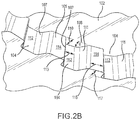
- joints 102 may comprise curvic joints, which have curved teeth, as shown in the figures.
- joints 102 generally comprise annular structures supporting sets of teeth 104 formed between adjacent wells 105, configured to intermesh upon coupling, wherein the teeth of a first joint 102a of joints 102 fit between the teeth 104 and within the wells 105, of a second joint 102b.
- joints 102 may be represented by a first half of a joint 102a ("first joint 102a), supporting a first set of teeth 104a formed between wells 105a, and a second half of a joint 102b (second joint 102b), supporting a second set of teeth 104b, formed between wells 105b, configured to intermesh with the first set of teeth 104a, wherein each tooth 104 is configured to be received within a corresponding well 105.
- teeth 104 are congruent to one another, having similar size and relative orientation with respect to a central axis A' of joint 102.
- teeth 104 have side walls 111 which are tapered ("axially tapered") with respect to a planar surface 108 orthogonal to central axis A'. According to various embodiments, side walls 111 are tapered at an angle ⁇ of less than 45 degrees. According to various embodiments, angle ⁇ may be approximately equal to or less than 20 degrees. According to various embodiments, the surface of side walls 111 may be flat (as shown in the figures), or bulging (i.e. concave and/or convex), wherein corresponding teeth may have oppositely oriented bulges, according to various embodiments.
- the axial span 110 of teeth 104 may be at least about 0.0002 inches (0.0005 cm). In various embodiments, the axial span 110 of teeth 104 may be about 0.175 inches (0.44cm) According to various embodiments, teeth 104 have edges 107 or fillets which are rounded, as shown in FIGS. 2A and B .
- first set of teeth 104a, and second set of teeth 104b are configured to lock together by axially compressing joint 102a against joint 102b, to wedge teeth 104a within wells 105b, and to wedge teeth 104b within wells 105a, as shown in FIG. 2A .
- first set of teeth 104a are configured to be in substantial contact with second set of teeth 104b upon compression of joint 102a against joint 102b, wherein substantial contact may be defined as at least 80% contact between corresponding side walls 111 of at least 90% of the teeth 104.
- teeth 104 comprise top portions 112, each having a radial span 113
- wells 105 comprise bottom portions 114 each having a radial span 115
- radial span 113 of the top portions 112 of the teeth 104 may be slightly greater than the radial span 115 of the bottom portions 114 of the wells 105 in order to facilitate wedging of the teeth within the wells (as this configuration allows the teeth 104 to be inserted axially further within the wells 105).
- the axial span 110 of teeth 104 is slightly shorter than an axial span 117 of the wells 105, also to facilitate wedging, according to various embodiments. This is illustrated in FIG. 2A , wherein a space 116 is formed between corresponding teeth and wells.
- teeth 104 may be configured to pack without space 116.
- Locking between intermeshed teeth 104 of first set of teeth 104a, and second set of teeth 104b upon high force compression is due to frictional forces between the tapered side walls 111, wherein high mechanical loads are required to separate the wedged teeth.
- joints 102 comprise steel
- an axial compression force of about 100,000 pounds ( ⁇ 440,000N) was used to interlock joint 102a with joint 102b, and a force in the order of approximately 40,000 pounds ( ⁇ 180,000N) was required to pull the joints 102 apart.
- the axial compression force required to interlock joints 102 may depend on various factors, such as frictional coefficients, geometry and size of the teeth, ambient temperature, etc., according to various embodiments.
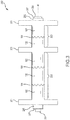
- FIG. 3 shows a rotating stack 200, comprising a plurality of rotating elements 201, joined via joints 102 which form a shaft structure 203 about central axis A' for coupling the rotating elements 201.
- rotating stack 200 may be a may be a rotor stack, wherein rotating elements 201 may comprise rotors, for example.
- a tie shaft 205 may axially extend within shaft structure 203 along central axis A' of rotating stack 200, wherein the shaft structure 203 may be capped by components 204 ("capping components"), such as tie-bolt(s), and/or tie-nut(s), and washers, which may be threaded, on ends 207 of the tie shaft 205, through which a compressive force sufficient to friction lock joints 102 may be applied (e.g. by tightening or screwing the components 204).
- Joints 102 are configured to provide alignment and transfer torque along shaft structure 203.
- joints 102 forming shaft structure 203 may be of the same or similar material (e.g. an austenitic nickel-chromium-based alloy such as InconelTM which is available from Special Metals Corporation of New Hartford, New York, USA).
- joints 102 forming shaft structure 203 may be of dissimilar material.
- the use of dissimilar material throughout shaft structure 203 allows for material optimization throughout different sections of an engine, such as gas turbine engine 20, based on cost, weight, and required operating parameters at the different sections.
- a shaft running through both high temperature and low temperature sections of an engine may be formed from a high temperature material such as an austenitic nickel-chromium-based alloy such as InconelTM in the high temperature section, and steel in the lower temperature section.
- a coupling method 400 for joining rotating components comprises a step 402 of stacking the rotating components to form a rotating stack aligned along a central axis, wherein the rotating components are supported on joints configured to friction lock with one another, the rotating stack comprising a plurality of joints adjacently aligned, wherein the joints comprise tapered teeth which are configured intermesh and interlock with the teeth of an adjacent joint.
- the coupling method 400 further comprises a step 404 of applying a compressive mechanical load at opposite ends of the rotating stack, the compressive mechanical load being sufficient to cause the joints to interlock with one another.
- the compressive force may be at least about 100,000 pounds ( ⁇ 440,000N).
- step 402 of stacking the rotating components further comprises aligning the interlocking teeth of adjacent joints in intermeshing orientation.
- each joint comprises an annular structure supporting the tapered teeth.
- step 402 of stacking the rotating components comprises stacking the rotating components across at least one tie shaft, wherein the at least one tie shaft runs down the central axis of the rotating stack.
- the tie shaft comprises capping components in threaded engagement with the tie shaft, at opposite ends of the tie shaft, and the compressive force is applied by threadably tightening the capping components.
- the joints comprise curvic joints having rounded tooth edges.
- the rotating components are components of a jet engine.
- the rotating components are rotors, and the rotating stack is a rotor stack.
- at least two of the joints are formed from different materials.
- references to "various embodiments”, “one embodiment”, “an embodiment”, “an example embodiment”, etc. indicate that the embodiment described may include a particular feature, structure, or characteristic, but every embodiment may not necessarily include the particular feature, structure, or characteristic. Moreover, such phrases are not necessarily referring to the same embodiment. Further, when a particular feature, structure, or characteristic is described in connection with an embodiment, it is submitted that it is within the knowledge of one skilled in the art to affect such feature, structure, or characteristic in connection with other embodiments whether or not explicitly described. After reading the description, it will be apparent to one skilled in the relevant art(s) how to implement the disclosure in alternative embodiments.
Landscapes
- Engineering & Computer Science (AREA)
- Mechanical Engineering (AREA)
- General Engineering & Computer Science (AREA)
- Turbine Rotor Nozzle Sealing (AREA)
- Connection Of Plates (AREA)
Abstract
Description
- A gas turbine engine may typically include one or more stacks of rotating elements, such as rotor stacks, associated with one or more sections of the engine. A rotor stack may include several longitudinally spaced apart blade-carrying disks of successive stages of the section. A stator structure may include circumferential stages of vanes longitudinally interspersed with the rotor disks. The rotor disks are secured to each other against relative rotation and the rotor stack is secured against rotation relative to other components on its common spool (e.g., the low and high speed/pressure spools of the engine). Various systems for tying rotor disks together may comprise keying arrangements, which may be associated with the maintenance of a longitudinal compressive force across the disk stack so as to maintain the engagement. Other arrangements may use extraneous components such as fasteners or bolts.
- In accordance with various embodiments, disclosed is a coupling method for joining rotating components comprising: stacking the rotating components to form a rotating stack aligned along a central axis, wherein the rotating components are supported on joints configured to friction lock with one another, wherein the rotating stack is formed by adjacently aligning the joints, and wherein each of the joints comprises tapered teeth which are configured to intermesh with the tapered teeth of an adjacent joint; and applying a compressive force to the rotating stack, the compressive force being sufficient to cause the joints to interlock with one another. In one embodiment, the tapered teeth are axially tapered at an angle approximately equal to or less than 20 degrees. In one embodiment, the method further comprises aligning the tapered teeth of adjacent joints in intermeshing orientation. In one embodiment, each of the joints comprises an annular structure supporting the tapered teeth, wherein the annular structures are adjacently aligned to form the rotating stack. In one embodiment, the method further comprises stacking the rotating components across at least one tie shaft, wherein the tie shaft runs down the central axis of the rotating stack. In one embodiment, the tie shaft comprises capping components in threaded engagement with the tie shaft, at opposite ends of the tie shaft, wherein applying a compressive force comprises threadably tightening the capping components. In one embodiment, the joints comprise curvic joints having rounded tooth edges, further comprising aligning the joints via the rounded tooth edges. In one embodiment, the rotating components are components of a jet engine, and the coupling method comprises joining rotating components of a jet engine. In one embodiment, the rotating components are rotors, and wherein the rotating components are aligned to form a rotating stack. In one embodiment, at least two of the joints are formed from different materials, wherein stacking the rotating components to form a rotating stack comprises adjacently aligning at least two joints formed from different materials.
- In accordance with various embodiments, disclosed is a coupling method for joining rotating components of a jet engine comprising: stacking the rotating components to form a rotating stack aligned along a central axis, wherein the rotating components are supported on joints configured to friction lock with one another, wherein the rotating stack is formed by adjacently aligning the joints, wherein each of the joints comprises tapered teeth which are configured intermesh and interlock with the tapered teeth of an adjacent joint, and wherein at least two of the joints are formed from different materials; and applying a compressive force to the rotating stack, the compressive force being sufficient to cause the joints to interlock with one another. In one embodiment, the rotating components are rotors, and the rotating stack is a rotor stack of the jet engine. In one embodiment, the tapered teeth are axially tapered at an angle approximately equal to or less than 45 degrees.
- In accordance with various embodiments, disclosed is a coupling system for joining rotating components of an engine, comprising: a first joint comprising a first annular structure supporting a first set of teeth formed between wells adjacent the teeth, wherein a first rotating component is coupled to the first annular structure, a second joint comprising a second annular structure supporting a second set of teeth formed between wells adjacent the teeth, wherein a second rotating component is coupled to the second annular structure, wherein the first set of teeth and the second set of teeth are tapered, wherein the first set of teeth are configured to intermesh with the second set of teeth, upon adjacent axial alignment of the first joint and the second joint, such that the first set of teeth are configured to be received between the teeth and within the wells of the second set of teeth, and the second set of teeth are configured to be received between the teeth and within the wells of the first set of teeth, and wherein the first set of teeth are configured to friction lock with the second set of teeth upon application of compressive pressure sufficient to interlock the first joint and the second joint. In one embodiment, the first set of teeth and the second set of teeth are axially tapered at an angle approximately equal to or less than 20 degrees. In one embodiment, the first set of teeth and the second set of teeth have rounded edges and wherein the first joint and second joint are curvic joints. In one embodiment, the first set of teeth are configured to wedge between the second set of teeth upon application of compressive pressure sufficient to interlock the joints. In one embodiment, an axial span of the first set of teeth is shorter than an axial span of the wells of the first joint, and wherein an axial span of the second set of teeth is shorter than an axial span of the wells of the second joint. In one embodiment, the engine is a jet turbine engine. In one embodiment, the rotating components are rotors of a jet turbine engine.
- The drawings described herein are for illustration purposes only and are not intended to limit the scope of the present disclosure in any way. The present disclosure will become more fully understood from the detailed description and the accompanying drawings wherein:
-
FIG. 1 is a partial longitudinal sectional view of a gas turbine engine; -
FIG. 2A illustrates a curvic joint, according to various embodiments; -
FIG. 2B is a magnified view of a portion of the curvic joint ofFIG. 2A ; -
FIG. 3 illustrates a rotating stack comprising the curvic joint ofFIG. 2A ; and -
FIG. 4 illustrates a joint coupling method for components of an engine, according to various embodiments. - All ranges and ratio limits disclosed herein may be combined. It is to be understood that unless specifically stated otherwise, references to "a," "an," and/or "the" may include one or more than one and that reference to an item in the singular may also include the item in the plural.
- In accordance with various embodiments, disclosed is a
coupling system 100 comprisingjoints 102, configured to friction lock under compressive mechanical load viateeth 104 which are tapered. In various embodiments,coupling system 100 may be used for joining rotating components, which may be rotating components of an engine, such as a gas turbine, or other engine type.Coupling system 100 provides the alignment orientation for the joined components, and may eliminate the use of extraneous fasteners, bolts, interference fits and/or keying arrangements. Thecoupling system 100 may further enable material optimization by allowing for use of different materials throughout different engine sections, depending on the operating parameters, which may reduce weight and cost. - In accordance with various embodiments, and with reference to
FIG. 1 , an exemplary gas turbine engine 20 may have a high speed/pressure compressor (HPC)section 22 receiving air moving along acore flowpath 500 from a low speed/pressure compressor (LPC)section 23 and delivering the air to acombustor section 24. High and low speed/pressure turbine (HPT, LPT)sections core flowpath 500. In various embodiments, gas turbine engine 20 may further include a transmission-drivenfan 28 driving air along abypass flowpath 501 and/or an augmentor (not shown) among other systems or features. In various embodiments, gas turbine engine 20 may include various rotating components, which may be mounted for rotation on various shaft structures viacoupling system 100, about an engine central longitudinal axis or central axis A relative to an engine stationary structure. Various rotating components, may include, for example various rotors, such as LPC and LPT rotors, various impellers, turbine wheels, and couplings, etc. - According to various embodiments,
coupling system 100 comprisingjoints 102 is shown inFIGS. 2A ,2B . According to various embodiments,joints 102 may comprise curvic joints, which have curved teeth, as shown in the figures. According to various embodiments,joints 102 generally comprise annular structures supporting sets ofteeth 104 formed betweenadjacent wells 105, configured to intermesh upon coupling, wherein the teeth of a first joint 102a ofjoints 102 fit between theteeth 104 and within thewells 105, of a second joint 102b. - In accordance with various embodiments, and with reference to
FIG. 2A , joints 102 may be represented by a first half of a joint 102a ("first joint 102a), supporting a first set of teeth 104a formed between wells 105a, and a second half of a joint 102b (second joint 102b), supporting a second set of teeth 104b, formed between wells 105b, configured to intermesh with the first set of teeth 104a, wherein eachtooth 104 is configured to be received within a corresponding well 105. According to various embodiments,teeth 104 are congruent to one another, having similar size and relative orientation with respect to a central axis A' of joint 102. According to various embodiments,teeth 104 haveside walls 111 which are tapered ("axially tapered") with respect to aplanar surface 108 orthogonal to central axis A'. According to various embodiments,side walls 111 are tapered at an angle θ of less than 45 degrees. According to various embodiments, angle θ may be approximately equal to or less than 20 degrees. According to various embodiments, the surface ofside walls 111 may be flat (as shown in the figures), or bulging (i.e. concave and/or convex), wherein corresponding teeth may have oppositely oriented bulges, according to various embodiments. In various embodiments, theaxial span 110 ofteeth 104 may be at least about 0.0002 inches (0.0005 cm). In various embodiments, theaxial span 110 ofteeth 104 may be about 0.175 inches (0.44cm) According to various embodiments,teeth 104 haveedges 107 or fillets which are rounded, as shown inFIGS. 2A and B . - According to various embodiments, first set of teeth 104a, and second set of teeth 104b are configured to lock together by axially compressing joint 102a against joint 102b, to wedge teeth 104a within wells 105b, and to wedge teeth 104b within wells 105a, as shown in
FIG. 2A . To this end, first set of teeth 104a are configured to be in substantial contact with second set of teeth 104b upon compression of joint 102a against joint 102b, wherein substantial contact may be defined as at least 80% contact betweencorresponding side walls 111 of at least 90% of theteeth 104. In various embodiments,teeth 104 comprisetop portions 112, each having aradial span 113, andwells 105 comprisebottom portions 114 each having aradial span 115, whereinradial span 113 of thetop portions 112 of theteeth 104 may be slightly greater than theradial span 115 of thebottom portions 114 of thewells 105 in order to facilitate wedging of the teeth within the wells (as this configuration allows theteeth 104 to be inserted axially further within the wells 105). Additionally, theaxial span 110 ofteeth 104, is slightly shorter than anaxial span 117 of thewells 105, also to facilitate wedging, according to various embodiments. This is illustrated inFIG. 2A , wherein aspace 116 is formed between corresponding teeth and wells. However,teeth 104 may be configured to pack withoutspace 116. - Locking between
intermeshed teeth 104 of first set of teeth 104a, and second set of teeth 104b upon high force compression is due to frictional forces between thetapered side walls 111, wherein high mechanical loads are required to separate the wedged teeth. In various embodiments, whereinjoints 102 comprise steel, it was found that an axial compression force of about 100,000 pounds (~440,000N) was used to interlock joint 102a with joint 102b, and a force in the order of approximately 40,000 pounds (∼180,000N) was required to pull thejoints 102 apart. However, as will be apparent to one skilled in the art, the axial compression force required to interlockjoints 102 may depend on various factors, such as frictional coefficients, geometry and size of the teeth, ambient temperature, etc., according to various embodiments. -
FIG. 3 shows arotating stack 200, comprising a plurality ofrotating elements 201, joined viajoints 102 which form ashaft structure 203 about central axis A' for coupling therotating elements 201. In various embodiments,rotating stack 200 may be a may be a rotor stack, whereinrotating elements 201 may comprise rotors, for example. According to various embodiments, atie shaft 205 may axially extend withinshaft structure 203 along central axis A' ofrotating stack 200, wherein theshaft structure 203 may be capped by components 204 ("capping components"), such as tie-bolt(s), and/or tie-nut(s), and washers, which may be threaded, on ends 207 of thetie shaft 205, through which a compressive force sufficient to friction lock joints 102 may be applied (e.g. by tightening or screwing the components 204).Joints 102 are configured to provide alignment and transfer torque alongshaft structure 203. - According to various embodiments,
joints 102 formingshaft structure 203 may be of the same or similar material (e.g. an austenitic nickel-chromium-based alloy such as Inconel™ which is available from Special Metals Corporation of New Hartford, New York, USA). According to various embodiments,joints 102 formingshaft structure 203 may be of dissimilar material. The use of dissimilar material throughoutshaft structure 203 allows for material optimization throughout different sections of an engine, such as gas turbine engine 20, based on cost, weight, and required operating parameters at the different sections. For example, a shaft running through both high temperature and low temperature sections of an engine, may be formed from a high temperature material such as an austenitic nickel-chromium-based alloy such as Inconel™ in the high temperature section, and steel in the lower temperature section. - According to various embodiments, a
coupling method 400 for joining rotating components comprises astep 402 of stacking the rotating components to form a rotating stack aligned along a central axis, wherein the rotating components are supported on joints configured to friction lock with one another, the rotating stack comprising a plurality of joints adjacently aligned, wherein the joints comprise tapered teeth which are configured intermesh and interlock with the teeth of an adjacent joint. In various embodiments, thecoupling method 400 further comprises astep 404 of applying a compressive mechanical load at opposite ends of the rotating stack, the compressive mechanical load being sufficient to cause the joints to interlock with one another. In various embodiments, the compressive force may be at least about 100,000 pounds (∼440,000N). In various embodiments, step 402 of stacking the rotating components further comprises aligning the interlocking teeth of adjacent joints in intermeshing orientation. In various embodiments, each joint comprises an annular structure supporting the tapered teeth. In various embodiments, step 402 of stacking the rotating components comprises stacking the rotating components across at least one tie shaft, wherein the at least one tie shaft runs down the central axis of the rotating stack. In various embodiments, the tie shaft comprises capping components in threaded engagement with the tie shaft, at opposite ends of the tie shaft, and the compressive force is applied by threadably tightening the capping components. In various embodiments, the joints comprise curvic joints having rounded tooth edges. In various embodiments, the rotating components are components of a jet engine. In various embodiments, the rotating components are rotors, and the rotating stack is a rotor stack. In various embodiments, at least two of the joints are formed from different materials. - The detailed description of exemplary embodiments herein makes reference to the accompanying drawings, which show exemplary embodiments by way of illustration and its best mode, and not of limitation. While these exemplary embodiments are described in sufficient detail to enable those skilled in the art to practice the invention, it should be understood that other embodiments may be realized and that logical, chemical and mechanical changes may be made without departing from the spirit and scope of the invention. For example, the steps recited in any of the method or process descriptions may be executed in any order and are not necessarily limited to the order presented. Moreover, many of the functions or steps may be outsourced to or performed by one or more third parties. Furthermore, any reference to singular includes plural embodiments, and any reference to more than one component or step may include a singular embodiment or step. Also, any reference to attached, fixed, connected or the like may include permanent, removable, temporary, partial, full and/or any other possible attachment option. Additionally, any reference to without contact (or similar phrases) may also include reduced contact or minimal contact.
- Systems and methods are provided. In the detailed description herein, references to "various embodiments", "one embodiment", "an embodiment", "an example embodiment", etc., indicate that the embodiment described may include a particular feature, structure, or characteristic, but every embodiment may not necessarily include the particular feature, structure, or characteristic. Moreover, such phrases are not necessarily referring to the same embodiment. Further, when a particular feature, structure, or characteristic is described in connection with an embodiment, it is submitted that it is within the knowledge of one skilled in the art to affect such feature, structure, or characteristic in connection with other embodiments whether or not explicitly described. After reading the description, it will be apparent to one skilled in the relevant art(s) how to implement the disclosure in alternative embodiments.
- Benefits, other advantages, and solutions to problems have been described herein with regard to specific embodiments. However, the benefits, advantages, solutions to problems, and any elements that may cause any benefit, advantage, or solution to occur or become more pronounced are not to be construed as critical, required, or essential features or elements of the invention. The scope of the invention is accordingly to be limited by nothing other than the appended claims, in which reference to an element in the singular is not intended to mean "one and only one" unless explicitly so stated, but rather "one or more." Moreover, where a phrase similar to "at least one of A, B, or C" is used in the claims, it is intended that the phrase be interpreted to mean that A alone may be present in an embodiment, B alone may be present in an embodiment, C alone may be present in an embodiment, or that any combination of the elements A, B and C may be present in a single embodiment; for example, A and B, A and C, B and C, or A and B and C.
Claims (15)
- A coupling method for joining rotating components comprising:stacking the rotating components to form a rotating stack (200) aligned along a central axis (A'), wherein the rotating components are supported on joints (102) configured to friction lock with one another, wherein the rotating stack (200) is formed by adjacently aligning the joints (102), and wherein each of the joints (102) comprises tapered teeth (104) which are configured to intermesh with the tapered teeth (104) of an adjacent joint (102); andapplying a compressive force to the rotating stack (200), the compressive force being sufficient to cause the joints (102) to interlock with one another.
- The coupling method of claim 1, wherein the tapered teeth (104) are axially tapered at an angle approximately equal to or less than 20 degrees.
- The coupling method of claim 1 or 2, further comprising aligning the tapered teeth (104) of adjacent joints (102) in intermeshing orientation.
- The coupling method of claim 1, 2 or 3, wherein each of the joints (102) comprises an annular structure supporting the tapered teeth (104), wherein the annular structures are adjacently aligned to form the rotating stack (200).
- The coupling method of any preceding claim, further comprising stacking the rotating components across at least one tie shaft (205), wherein the tie shaft runs down the central axis (A') of the rotating stack (200), wherein, optionally, the tie shaft (205) comprises capping components (204) in threaded engagement with the tie shaft (205), at opposite ends of the tie shaft (205), wherein applying a compressive force comprises threadably tightening the capping components (204).
- The coupling method of any preceding claim, wherein the joints (102) comprise curvic joints having rounded tooth edges, further comprising aligning the joints (102) via the rounded tooth edges.
- The coupling method of any preceding claim, wherein the rotating components are components of a jet engine, and the coupling method comprises joining rotating components of a jet engine.
- The coupling method of any preceding claim, wherein the rotating components are rotors, and wherein the rotating components are aligned to form the rotating stack (200).
- The coupling method of any preceding claim, wherein at least two of the joints (102) are formed from different materials, wherein stacking the rotating components to form the rotating stack (200) comprises adjacently aligning at least two joints (102) formed from different materials.
- A coupling method for joining rotating components of a jet engine comprising:stacking the rotating components to form a rotating stack (200) aligned along a central axis (A'), wherein the rotating components are supported on joints (102) configured to friction lock with one another, wherein the rotating stack (200) is formed by adjacently aligning the joints (102), wherein each of the joints (102) comprises tapered teeth (104) which are configured intermesh and interlock with the tapered teeth (104) of an adjacent joint (102), and wherein at least two of the joints (102) are formed from different materials; andapplying a compressive force to the rotating stack (200), the compressive force being sufficient to cause the joints (102) to interlock with one another.
- The coupling method of claim 10, wherein the rotating components are rotors, and the rotating stack (200) is a rotor stack of the jet engine, and/or wherein the tapered teeth (104) are axially tapered at an angle approximately equal to or less than 45 degrees.
- A coupling system for joining rotating components of an engine, comprising:a first joint (102a) comprising a first annular structure supporting a first set of teeth (104a) formed between wells (105a) adjacent the teeth (104a), wherein a first rotating component is coupled to the first annular structure,a second joint (102b) comprising a second annular structure supporting a second set of teeth (104b) formed between wells (105b) adjacent the teeth (104b), wherein a second rotating component is coupled to the second annular structure,wherein the first set of teeth (104a) and the second set of teeth (104b) are tapered,wherein the first set of teeth (104a) are configured to intermesh with the second set of teeth (104b), upon adjacent axial alignment of the first joint (102a) and the second joint (102b), such that the first set of teeth (104a) are configured to be received between the teeth (104b) and within the wells (105b) of the second set of teeth (104b), and the second set of teeth (104b) are configured to be received between the teeth (104a) and within the wells (105a) of the first set of teeth (104a), andwherein the first set of teeth (104a) are configured to friction lock with the second set of teeth (104b) upon application of compressive pressure sufficient to interlock the first joint (102a) and the second joint (102b).
- The coupling system of claim 12, wherein the first set of teeth (104a) and the second set of teeth (104b) are axially tapered at an angle approximately equal to or less than 20 degrees; and/or wherein: the first set of teeth (104a) and the second set of teeth (104b) have rounded edges and wherein the first joint (102a) and second joint (102b) are curvic joints.
- The coupling system of claim 12 or 13, wherein the first set of teeth (104a) are configured to wedge between the second set of teeth (104b) upon application of compressive pressure sufficient to interlock the joints (102a, 102b), wherein, optionally, an axial span of the first set of teeth (104a) is shorter than an axial span of the wells (105a) of the first joint (102a), and an axial span of the second set (104b) of teeth is shorter than an axial span of the wells (105b) of the second joint (102b).
- The coupling system of claim 12, 13 or 14, wherein the engine is a jet turbine engine, and/or the rotating components are rotors of a jet turbine engine.
Applications Claiming Priority (1)
| Application Number | Priority Date | Filing Date | Title |
|---|---|---|---|
| US14/945,973 US10119422B2 (en) | 2015-11-19 | 2015-11-19 | Coupling system comprising self locking joint |
Publications (2)
| Publication Number | Publication Date |
|---|---|
| EP3170971A1 true EP3170971A1 (en) | 2017-05-24 |
| EP3170971B1 EP3170971B1 (en) | 2018-07-18 |
Family
ID=57354176
Family Applications (1)
| Application Number | Title | Priority Date | Filing Date |
|---|---|---|---|
| EP16199395.1A Revoked EP3170971B1 (en) | 2015-11-19 | 2016-11-17 | Coupling system comprising self locking joint |
Country Status (2)
| Country | Link |
|---|---|
| US (2) | US10119422B2 (en) |
| EP (1) | EP3170971B1 (en) |
Cited By (2)
| Publication number | Priority date | Publication date | Assignee | Title |
|---|---|---|---|---|
| WO2018218530A1 (en) * | 2017-05-31 | 2018-12-06 | 深圳智慧能源技术有限公司 | Centering and twist lock combination mechanism for multistage high-speed steam turbine |
| WO2020183075A1 (en) * | 2019-03-12 | 2020-09-17 | Safran Helicopter Engines | Curvic coupling for an aircraft turbomachine |
Families Citing this family (6)
| Publication number | Priority date | Publication date | Assignee | Title |
|---|---|---|---|---|
| CN107023321A (en) * | 2017-05-31 | 2017-08-08 | 深圳智慧能源技术有限公司 | The centering torsion pass of multistage high speed turbine machine is locked mechanism |
| GB201901557D0 (en) | 2019-02-05 | 2019-03-27 | Rolls Royce Plc | Matallic shaft |
| US11905764B1 (en) * | 2020-12-09 | 2024-02-20 | IBEX Drilling Solutions, Inc. | Coupling with enhanced torsional, fatigue strength, and wear resistance |
| US12061128B2 (en) * | 2021-07-08 | 2024-08-13 | Rtx Corporation | Torque loading in component stack assembly |
| CN114542189B (en) * | 2022-02-08 | 2024-07-19 | 中国联合重型燃气轮机技术有限公司 | Wheel disc, gas turbine rotor and gas turbine |
| FR3165933A1 (en) * | 2024-09-03 | 2026-03-06 | Safran Aircraft Engines | TURBOMACHINE COMPRESSOR ROTOR ASSEMBLY |
Citations (4)
| Publication number | Priority date | Publication date | Assignee | Title |
|---|---|---|---|---|
| US2461242A (en) * | 1944-08-23 | 1949-02-08 | United Aircraft Corp | Rotor construction for turbines |
| US2741454A (en) * | 1954-09-28 | 1956-04-10 | Clifford R Eppley | Elastic fluid machine |
| US2801071A (en) * | 1952-01-31 | 1957-07-30 | Westinghouse Electric Corp | Bladed rotor construction |
| FR2952138A1 (en) * | 2009-10-30 | 2011-05-06 | Turbomeca | METHOD FOR PROTECTING THE AIR PASSAGE INTO A COUPLING OF DRIVING PARTS IN AN UNSECURED ENVIRONMENT, AN IMPLEMENTATION COUPLING AND A ROTOR LINE EQUIPPED WITH SUCH COUPLINGS |
Family Cites Families (6)
| Publication number | Priority date | Publication date | Assignee | Title |
|---|---|---|---|---|
| US2427641A (en) | 1942-05-22 | 1947-09-16 | Gleason Works | Method of producing clutches |
| US2384582A (en) | 1942-05-22 | 1945-09-11 | Gleason Works | Face clutch |
| US4362520A (en) * | 1980-05-12 | 1982-12-07 | Perry John C | Flexible enclosed shaft |
| US5537814A (en) | 1994-09-28 | 1996-07-23 | General Electric Company | High pressure gas generator rotor tie rod system for gas turbine engine |
| US5632600A (en) | 1995-12-22 | 1997-05-27 | General Electric Company | Reinforced rotor disk assembly |
| US8465373B2 (en) * | 2009-12-29 | 2013-06-18 | Rolls-Royce Corporation | Face coupling |
-
2015
- 2015-11-19 US US14/945,973 patent/US10119422B2/en active Active
-
2016
- 2016-11-17 EP EP16199395.1A patent/EP3170971B1/en not_active Revoked
-
2018
- 2018-10-02 US US16/149,419 patent/US10280800B2/en active Active
Patent Citations (4)
| Publication number | Priority date | Publication date | Assignee | Title |
|---|---|---|---|---|
| US2461242A (en) * | 1944-08-23 | 1949-02-08 | United Aircraft Corp | Rotor construction for turbines |
| US2801071A (en) * | 1952-01-31 | 1957-07-30 | Westinghouse Electric Corp | Bladed rotor construction |
| US2741454A (en) * | 1954-09-28 | 1956-04-10 | Clifford R Eppley | Elastic fluid machine |
| FR2952138A1 (en) * | 2009-10-30 | 2011-05-06 | Turbomeca | METHOD FOR PROTECTING THE AIR PASSAGE INTO A COUPLING OF DRIVING PARTS IN AN UNSECURED ENVIRONMENT, AN IMPLEMENTATION COUPLING AND A ROTOR LINE EQUIPPED WITH SUCH COUPLINGS |
Cited By (4)
| Publication number | Priority date | Publication date | Assignee | Title |
|---|---|---|---|---|
| WO2018218530A1 (en) * | 2017-05-31 | 2018-12-06 | 深圳智慧能源技术有限公司 | Centering and twist lock combination mechanism for multistage high-speed steam turbine |
| WO2020183075A1 (en) * | 2019-03-12 | 2020-09-17 | Safran Helicopter Engines | Curvic coupling for an aircraft turbomachine |
| FR3093767A1 (en) * | 2019-03-12 | 2020-09-18 | Safran Helicopter Engines | Curvic coupling for aircraft turbomachines |
| US12071854B2 (en) | 2019-03-12 | 2024-08-27 | Safran Helicopter Engines | Curvilinear coupling for aircraft turbomachinery |
Also Published As
| Publication number | Publication date |
|---|---|
| US10119422B2 (en) | 2018-11-06 |
| US20190032516A1 (en) | 2019-01-31 |
| US20170145859A1 (en) | 2017-05-25 |
| EP3170971B1 (en) | 2018-07-18 |
| US10280800B2 (en) | 2019-05-07 |
Similar Documents
| Publication | Publication Date | Title |
|---|---|---|
| EP3170971B1 (en) | Coupling system comprising self locking joint | |
| US8579538B2 (en) | Turbine engine coupling stack | |
| US7147436B2 (en) | Turbine engine rotor retainer | |
| EP2872744B1 (en) | A rotor for a radial compressor and a method for construction thereof | |
| US7059831B2 (en) | Turbine engine disk spacers | |
| EP3026212B1 (en) | Blisk rim face undercut | |
| US20170058675A1 (en) | Low diameter turbine rotor clamping arrangement | |
| WO2014007902A2 (en) | Tie shaft arrangement for turbomachine | |
| EP2479377A2 (en) | Steam turbine rotor with mechanically coupled high and low temperature sections using different materials | |
| WO2014011269A2 (en) | Dynamic stability and mid axial preload control for a tie shaft coupled axial high pressure rotor | |
| US6572337B1 (en) | Turbine rotor torque transmission | |
| EP2559907B1 (en) | A clamping assembly | |
| EP3059388A1 (en) | Modular components for gas turbine engines | |
| EP3456918B1 (en) | Compressor rotor disk for gas turbine | |
| US20110158814A1 (en) | Turbine engine rotor blades and rotor wheels | |
| EP2636845A2 (en) | Compressor/turbine rotor-torque transmission through hybrid drive | |
| US10100961B2 (en) | Joint assembly and a method of using the same | |
| US9682756B1 (en) | System for composite marine propellers | |
| CN102913530A (en) | Self locking nut and bolt assembly | |
| US10486785B2 (en) | Propeller assembly and method of assembling | |
| JP2025533883A (en) | Adapter for torque transmission between two rotatable components | |
| KR20170079245A (en) | Connecting Structure Between Impeller and Shaft for Turbo Compressor | |
| US10267328B2 (en) | Rotor structure for rotating machinery and method of assembly thereof | |
| CN119096036A (en) | Rotor structure and method for assembling or disassembling such a rotor structure |
Legal Events
| Date | Code | Title | Description |
|---|---|---|---|
| PUAI | Public reference made under article 153(3) epc to a published international application that has entered the european phase |
Free format text: ORIGINAL CODE: 0009012 |
|
| STAA | Information on the status of an ep patent application or granted ep patent |
Free format text: STATUS: THE APPLICATION HAS BEEN PUBLISHED |
|
| AK | Designated contracting states |
Kind code of ref document: A1 Designated state(s): AL AT BE BG CH CY CZ DE DK EE ES FI FR GB GR HR HU IE IS IT LI LT LU LV MC MK MT NL NO PL PT RO RS SE SI SK SM TR |
|
| AX | Request for extension of the european patent |
Extension state: BA ME |
|
| STAA | Information on the status of an ep patent application or granted ep patent |
Free format text: STATUS: REQUEST FOR EXAMINATION WAS MADE |
|
| 17P | Request for examination filed |
Effective date: 20171124 |
|
| RBV | Designated contracting states (corrected) |
Designated state(s): AL AT BE BG CH CY CZ DE DK EE ES FI FR GB GR HR HU IE IS IT LI LT LU LV MC MK MT NL NO PL PT RO RS SE SI SK SM TR |
|
| RIC1 | Information provided on ipc code assigned before grant |
Ipc: F01D 5/02 20060101AFI20171220BHEP Ipc: F01D 5/06 20060101ALI20171220BHEP |
|
| GRAP | Despatch of communication of intention to grant a patent |
Free format text: ORIGINAL CODE: EPIDOSNIGR1 |
|
| STAA | Information on the status of an ep patent application or granted ep patent |
Free format text: STATUS: GRANT OF PATENT IS INTENDED |
|
| INTG | Intention to grant announced |
Effective date: 20180215 |
|
| GRAS | Grant fee paid |
Free format text: ORIGINAL CODE: EPIDOSNIGR3 |
|
| GRAA | (expected) grant |
Free format text: ORIGINAL CODE: 0009210 |
|
| STAA | Information on the status of an ep patent application or granted ep patent |
Free format text: STATUS: THE PATENT HAS BEEN GRANTED |
|
| AK | Designated contracting states |
Kind code of ref document: B1 Designated state(s): AL AT BE BG CH CY CZ DE DK EE ES FI FR GB GR HR HU IE IS IT LI LT LU LV MC MK MT NL NO PL PT RO RS SE SI SK SM TR |
|
| REG | Reference to a national code |
Ref country code: GB Ref legal event code: FG4D |
|
| REG | Reference to a national code |
Ref country code: CH Ref legal event code: EP |
|
| REG | Reference to a national code |
Ref country code: IE Ref legal event code: FG4D |
|
| REG | Reference to a national code |
Ref country code: AT Ref legal event code: REF Ref document number: 1019578 Country of ref document: AT Kind code of ref document: T Effective date: 20180815 |
|
| REG | Reference to a national code |
Ref country code: DE Ref legal event code: R096 Ref document number: 602016004137 Country of ref document: DE |
|
| REG | Reference to a national code |
Ref country code: FR Ref legal event code: PLFP Year of fee payment: 3 |
|
| REG | Reference to a national code |
Ref country code: NL Ref legal event code: MP Effective date: 20180718 |
|
| REG | Reference to a national code |
Ref country code: LT Ref legal event code: MG4D |
|
| REG | Reference to a national code |
Ref country code: AT Ref legal event code: MK05 Ref document number: 1019578 Country of ref document: AT Kind code of ref document: T Effective date: 20180718 |
|
| PG25 | Lapsed in a contracting state [announced via postgrant information from national office to epo] |
Ref country code: NL Free format text: LAPSE BECAUSE OF FAILURE TO SUBMIT A TRANSLATION OF THE DESCRIPTION OR TO PAY THE FEE WITHIN THE PRESCRIBED TIME-LIMIT Effective date: 20180718 |
|
| PG25 | Lapsed in a contracting state [announced via postgrant information from national office to epo] |
Ref country code: FI Free format text: LAPSE BECAUSE OF FAILURE TO SUBMIT A TRANSLATION OF THE DESCRIPTION OR TO PAY THE FEE WITHIN THE PRESCRIBED TIME-LIMIT Effective date: 20180718 Ref country code: IS Free format text: LAPSE BECAUSE OF FAILURE TO SUBMIT A TRANSLATION OF THE DESCRIPTION OR TO PAY THE FEE WITHIN THE PRESCRIBED TIME-LIMIT Effective date: 20181118 Ref country code: AT Free format text: LAPSE BECAUSE OF FAILURE TO SUBMIT A TRANSLATION OF THE DESCRIPTION OR TO PAY THE FEE WITHIN THE PRESCRIBED TIME-LIMIT Effective date: 20180718 Ref country code: NO Free format text: LAPSE BECAUSE OF FAILURE TO SUBMIT A TRANSLATION OF THE DESCRIPTION OR TO PAY THE FEE WITHIN THE PRESCRIBED TIME-LIMIT Effective date: 20181018 Ref country code: GR Free format text: LAPSE BECAUSE OF FAILURE TO SUBMIT A TRANSLATION OF THE DESCRIPTION OR TO PAY THE FEE WITHIN THE PRESCRIBED TIME-LIMIT Effective date: 20181019 Ref country code: SE Free format text: LAPSE BECAUSE OF FAILURE TO SUBMIT A TRANSLATION OF THE DESCRIPTION OR TO PAY THE FEE WITHIN THE PRESCRIBED TIME-LIMIT Effective date: 20180718 Ref country code: BG Free format text: LAPSE BECAUSE OF FAILURE TO SUBMIT A TRANSLATION OF THE DESCRIPTION OR TO PAY THE FEE WITHIN THE PRESCRIBED TIME-LIMIT Effective date: 20181018 Ref country code: RS Free format text: LAPSE BECAUSE OF FAILURE TO SUBMIT A TRANSLATION OF THE DESCRIPTION OR TO PAY THE FEE WITHIN THE PRESCRIBED TIME-LIMIT Effective date: 20180718 Ref country code: LT Free format text: LAPSE BECAUSE OF FAILURE TO SUBMIT A TRANSLATION OF THE DESCRIPTION OR TO PAY THE FEE WITHIN THE PRESCRIBED TIME-LIMIT Effective date: 20180718 Ref country code: PL Free format text: LAPSE BECAUSE OF FAILURE TO SUBMIT A TRANSLATION OF THE DESCRIPTION OR TO PAY THE FEE WITHIN THE PRESCRIBED TIME-LIMIT Effective date: 20180718 |
|
| PG25 | Lapsed in a contracting state [announced via postgrant information from national office to epo] |
Ref country code: AL Free format text: LAPSE BECAUSE OF FAILURE TO SUBMIT A TRANSLATION OF THE DESCRIPTION OR TO PAY THE FEE WITHIN THE PRESCRIBED TIME-LIMIT Effective date: 20180718 Ref country code: LV Free format text: LAPSE BECAUSE OF FAILURE TO SUBMIT A TRANSLATION OF THE DESCRIPTION OR TO PAY THE FEE WITHIN THE PRESCRIBED TIME-LIMIT Effective date: 20180718 Ref country code: HR Free format text: LAPSE BECAUSE OF FAILURE TO SUBMIT A TRANSLATION OF THE DESCRIPTION OR TO PAY THE FEE WITHIN THE PRESCRIBED TIME-LIMIT Effective date: 20180718 |
|
| REG | Reference to a national code |
Ref country code: DE Ref legal event code: R026 Ref document number: 602016004137 Country of ref document: DE |
|
| PLBI | Opposition filed |
Free format text: ORIGINAL CODE: 0009260 |
|
| PG25 | Lapsed in a contracting state [announced via postgrant information from national office to epo] |
Ref country code: ES Free format text: LAPSE BECAUSE OF FAILURE TO SUBMIT A TRANSLATION OF THE DESCRIPTION OR TO PAY THE FEE WITHIN THE PRESCRIBED TIME-LIMIT Effective date: 20180718 Ref country code: RO Free format text: LAPSE BECAUSE OF FAILURE TO SUBMIT A TRANSLATION OF THE DESCRIPTION OR TO PAY THE FEE WITHIN THE PRESCRIBED TIME-LIMIT Effective date: 20180718 Ref country code: IT Free format text: LAPSE BECAUSE OF FAILURE TO SUBMIT A TRANSLATION OF THE DESCRIPTION OR TO PAY THE FEE WITHIN THE PRESCRIBED TIME-LIMIT Effective date: 20180718 Ref country code: CZ Free format text: LAPSE BECAUSE OF FAILURE TO SUBMIT A TRANSLATION OF THE DESCRIPTION OR TO PAY THE FEE WITHIN THE PRESCRIBED TIME-LIMIT Effective date: 20180718 Ref country code: EE Free format text: LAPSE BECAUSE OF FAILURE TO SUBMIT A TRANSLATION OF THE DESCRIPTION OR TO PAY THE FEE WITHIN THE PRESCRIBED TIME-LIMIT Effective date: 20180718 |
|
| PLAX | Notice of opposition and request to file observation + time limit sent |
Free format text: ORIGINAL CODE: EPIDOSNOBS2 |
|
| 26 | Opposition filed |
Opponent name: SAFRAN AIRCRAFT ENGINES Effective date: 20190415 |
|
| PG25 | Lapsed in a contracting state [announced via postgrant information from national office to epo] |
Ref country code: DK Free format text: LAPSE BECAUSE OF FAILURE TO SUBMIT A TRANSLATION OF THE DESCRIPTION OR TO PAY THE FEE WITHIN THE PRESCRIBED TIME-LIMIT Effective date: 20180718 Ref country code: SM Free format text: LAPSE BECAUSE OF FAILURE TO SUBMIT A TRANSLATION OF THE DESCRIPTION OR TO PAY THE FEE WITHIN THE PRESCRIBED TIME-LIMIT Effective date: 20180718 Ref country code: SK Free format text: LAPSE BECAUSE OF FAILURE TO SUBMIT A TRANSLATION OF THE DESCRIPTION OR TO PAY THE FEE WITHIN THE PRESCRIBED TIME-LIMIT Effective date: 20180718 |
|
| PG25 | Lapsed in a contracting state [announced via postgrant information from national office to epo] |
Ref country code: MC Free format text: LAPSE BECAUSE OF FAILURE TO SUBMIT A TRANSLATION OF THE DESCRIPTION OR TO PAY THE FEE WITHIN THE PRESCRIBED TIME-LIMIT Effective date: 20180718 Ref country code: LU Free format text: LAPSE BECAUSE OF NON-PAYMENT OF DUE FEES Effective date: 20181117 |
|
| REG | Reference to a national code |
Ref country code: BE Ref legal event code: MM Effective date: 20181130 |
|
| REG | Reference to a national code |
Ref country code: IE Ref legal event code: MM4A |
|
| PG25 | Lapsed in a contracting state [announced via postgrant information from national office to epo] |
Ref country code: SI Free format text: LAPSE BECAUSE OF FAILURE TO SUBMIT A TRANSLATION OF THE DESCRIPTION OR TO PAY THE FEE WITHIN THE PRESCRIBED TIME-LIMIT Effective date: 20180718 |
|
| PLBB | Reply of patent proprietor to notice(s) of opposition received |
Free format text: ORIGINAL CODE: EPIDOSNOBS3 |
|
| PG25 | Lapsed in a contracting state [announced via postgrant information from national office to epo] |
Ref country code: IE Free format text: LAPSE BECAUSE OF NON-PAYMENT OF DUE FEES Effective date: 20181117 |
|
| PG25 | Lapsed in a contracting state [announced via postgrant information from national office to epo] |
Ref country code: BE Free format text: LAPSE BECAUSE OF NON-PAYMENT OF DUE FEES Effective date: 20181130 |
|
| PG25 | Lapsed in a contracting state [announced via postgrant information from national office to epo] |
Ref country code: MT Free format text: LAPSE BECAUSE OF NON-PAYMENT OF DUE FEES Effective date: 20181117 |
|
| PG25 | Lapsed in a contracting state [announced via postgrant information from national office to epo] |
Ref country code: TR Free format text: LAPSE BECAUSE OF FAILURE TO SUBMIT A TRANSLATION OF THE DESCRIPTION OR TO PAY THE FEE WITHIN THE PRESCRIBED TIME-LIMIT Effective date: 20180718 |
|
| PG25 | Lapsed in a contracting state [announced via postgrant information from national office to epo] |
Ref country code: PT Free format text: LAPSE BECAUSE OF FAILURE TO SUBMIT A TRANSLATION OF THE DESCRIPTION OR TO PAY THE FEE WITHIN THE PRESCRIBED TIME-LIMIT Effective date: 20180718 |
|
| PG25 | Lapsed in a contracting state [announced via postgrant information from national office to epo] |
Ref country code: MK Free format text: LAPSE BECAUSE OF NON-PAYMENT OF DUE FEES Effective date: 20180718 Ref country code: CY Free format text: LAPSE BECAUSE OF FAILURE TO SUBMIT A TRANSLATION OF THE DESCRIPTION OR TO PAY THE FEE WITHIN THE PRESCRIBED TIME-LIMIT Effective date: 20180718 Ref country code: HU Free format text: LAPSE BECAUSE OF FAILURE TO SUBMIT A TRANSLATION OF THE DESCRIPTION OR TO PAY THE FEE WITHIN THE PRESCRIBED TIME-LIMIT; INVALID AB INITIO Effective date: 20161117 |
|
| REG | Reference to a national code |
Ref country code: CH Ref legal event code: PL |
|
| PG25 | Lapsed in a contracting state [announced via postgrant information from national office to epo] |
Ref country code: CH Free format text: LAPSE BECAUSE OF NON-PAYMENT OF DUE FEES Effective date: 20191130 Ref country code: LI Free format text: LAPSE BECAUSE OF NON-PAYMENT OF DUE FEES Effective date: 20191130 |
|
| RAP2 | Party data changed (patent owner data changed or rights of a patent transferred) |
Owner name: RAYTHEON TECHNOLOGIES CORPORATION |
|
| REG | Reference to a national code |
Ref country code: DE Ref legal event code: R103 Ref document number: 602016004137 Country of ref document: DE Ref country code: DE Ref legal event code: R064 Ref document number: 602016004137 Country of ref document: DE |
|
| RDAF | Communication despatched that patent is revoked |
Free format text: ORIGINAL CODE: EPIDOSNREV1 |
|
| PGFP | Annual fee paid to national office [announced via postgrant information from national office to epo] |
Ref country code: DE Payment date: 20211020 Year of fee payment: 6 Ref country code: GB Payment date: 20211020 Year of fee payment: 6 |
|
| RDAG | Patent revoked |
Free format text: ORIGINAL CODE: 0009271 |
|
| STAA | Information on the status of an ep patent application or granted ep patent |
Free format text: STATUS: PATENT REVOKED |
|
| PGFP | Annual fee paid to national office [announced via postgrant information from national office to epo] |
Ref country code: FR Payment date: 20211020 Year of fee payment: 6 |
|
| REG | Reference to a national code |
Ref country code: CH Ref legal event code: PL |
|
| REG | Reference to a national code |
Ref country code: FI Ref legal event code: MGE |
|
| 27W | Patent revoked |
Effective date: 20210916 |
|
| GBPR | Gb: patent revoked under art. 102 of the ep convention designating the uk as contracting state |
Effective date: 20210916 |