EP3170822A1 - Azaindole derivatives and their use as erk kinase inhibitors - Google Patents
Azaindole derivatives and their use as erk kinase inhibitors Download PDFInfo
- Publication number
- EP3170822A1 EP3170822A1 EP15306835.8A EP15306835A EP3170822A1 EP 3170822 A1 EP3170822 A1 EP 3170822A1 EP 15306835 A EP15306835 A EP 15306835A EP 3170822 A1 EP3170822 A1 EP 3170822A1
- Authority
- EP
- European Patent Office
- Prior art keywords
- pyridin
- pyrrolo
- mmol
- chlorobenzyl
- morpholino
- Prior art date
- Legal status (The legal status is an assumption and is not a legal conclusion. Google has not performed a legal analysis and makes no representation as to the accuracy of the status listed.)
- Withdrawn
Links
- 125000005334 azaindolyl group Chemical class N1N=C(C2=CC=CC=C12)* 0.000 title description 4
- 229940043355 kinase inhibitor Drugs 0.000 title description 2
- 239000003757 phosphotransferase inhibitor Substances 0.000 title description 2
- 150000001875 compounds Chemical class 0.000 claims abstract description 280
- 102100024193 Mitogen-activated protein kinase 1 Human genes 0.000 claims abstract description 45
- 230000000694 effects Effects 0.000 claims abstract description 33
- 108010007457 Extracellular Signal-Regulated MAP Kinases Proteins 0.000 claims abstract description 26
- 101001052493 Homo sapiens Mitogen-activated protein kinase 1 Proteins 0.000 claims abstract description 19
- 101000876610 Dictyostelium discoideum Extracellular signal-regulated kinase 2 Proteins 0.000 claims abstract description 18
- 239000003112 inhibitor Substances 0.000 claims abstract description 13
- 150000003839 salts Chemical class 0.000 claims abstract description 13
- -1 cyano, carbonyl Chemical group 0.000 claims description 70
- 125000004191 (C1-C6) alkoxy group Chemical group 0.000 claims description 43
- 125000002887 hydroxy group Chemical group [H]O* 0.000 claims description 41
- 125000004169 (C1-C6) alkyl group Chemical group 0.000 claims description 38
- 208000037265 diseases, disorders, signs and symptoms Diseases 0.000 claims description 27
- 125000003118 aryl group Chemical group 0.000 claims description 26
- 206010028980 Neoplasm Diseases 0.000 claims description 22
- 201000010099 disease Diseases 0.000 claims description 19
- LPTVWZSQAIDCEB-UHFFFAOYSA-N 5-bromo-1h-pyrrolo[2,3-b]pyridine Chemical compound BrC1=CN=C2NC=CC2=C1 LPTVWZSQAIDCEB-UHFFFAOYSA-N 0.000 claims description 16
- 125000005843 halogen group Chemical group 0.000 claims description 16
- 125000001424 substituent group Chemical group 0.000 claims description 16
- 125000001072 heteroaryl group Chemical group 0.000 claims description 15
- 125000000623 heterocyclic group Chemical group 0.000 claims description 13
- 238000006069 Suzuki reaction reaction Methods 0.000 claims description 10
- 125000004432 carbon atom Chemical group C* 0.000 claims description 10
- 125000001997 phenyl group Chemical group [H]C1=C([H])C([H])=C(*)C([H])=C1[H] 0.000 claims description 10
- 125000003161 (C1-C6) alkylene group Chemical group 0.000 claims description 9
- JPRPJUMQRZTTED-UHFFFAOYSA-N 1,3-dioxolanyl Chemical group [CH]1OCCO1 JPRPJUMQRZTTED-UHFFFAOYSA-N 0.000 claims description 9
- 125000002757 morpholinyl group Chemical group 0.000 claims description 9
- MVXVYAKCVDQRLW-UHFFFAOYSA-N 1h-pyrrolo[2,3-b]pyridine Chemical compound C1=CN=C2NC=CC2=C1 MVXVYAKCVDQRLW-UHFFFAOYSA-N 0.000 claims description 8
- VEXZGXHMUGYJMC-UHFFFAOYSA-N Hydrochloric acid Chemical group Cl VEXZGXHMUGYJMC-UHFFFAOYSA-N 0.000 claims description 8
- 125000000217 alkyl group Chemical group 0.000 claims description 8
- 125000002947 alkylene group Chemical group 0.000 claims description 8
- 208000035475 disorder Diseases 0.000 claims description 8
- 239000003814 drug Substances 0.000 claims description 8
- 239000008194 pharmaceutical composition Substances 0.000 claims description 8
- 230000002401 inhibitory effect Effects 0.000 claims description 7
- BMDHNMDCELLYMD-UHFFFAOYSA-N 1-[(3-chlorophenyl)methyl]-4-(5-piperazin-1-yl-1H-pyrrolo[2,3-b]pyridin-3-yl)pyridin-2-one Chemical compound ClC=1C=C(CN2C(C=C(C=C2)C2=CNC3=NC=C(C=C32)N2CCNCC2)=O)C=CC=1 BMDHNMDCELLYMD-UHFFFAOYSA-N 0.000 claims description 6
- FOALVTBDCNRWHH-UHFFFAOYSA-N 1-[3-[1-[(3-chlorophenyl)methyl]-2-oxopyridin-4-yl]-1H-pyrrolo[2,3-b]pyridin-5-yl]piperidine-4-carbonitrile Chemical compound ClC=1C=C(CN2C(C=C(C=C2)C2=CNC3=NC=C(C=C32)N2CCC(CC2)C#N)=O)C=CC=1 FOALVTBDCNRWHH-UHFFFAOYSA-N 0.000 claims description 6
- 239000002253 acid Substances 0.000 claims description 6
- 201000001441 melanoma Diseases 0.000 claims description 6
- 125000005931 tert-butyloxycarbonyl group Chemical group [H]C([H])([H])C(OC(*)=O)(C([H])([H])[H])C([H])([H])[H] 0.000 claims description 6
- 125000002023 trifluoromethyl group Chemical group FC(F)(F)* 0.000 claims description 6
- JCYJDDDSHUVYNE-UHFFFAOYSA-N (2-oxo-1h-pyridin-4-yl)boronic acid Chemical class OB(O)C=1C=CNC(=O)C=1 JCYJDDDSHUVYNE-UHFFFAOYSA-N 0.000 claims description 5
- ZQYMHCKOGDWUML-UHFFFAOYSA-N 1-[(3-chlorophenyl)methyl]-4-(5-morpholin-4-yl-1H-pyrrolo[2,3-b]pyridin-3-yl)pyridin-2-one Chemical compound ClC1=CC=CC(CN2C=CC(=CC2=O)C2=CNC3=C2C=C(C=N3)N2CCOCC2)=C1 ZQYMHCKOGDWUML-UHFFFAOYSA-N 0.000 claims description 5
- DEEAFEMXRUCOKX-UHFFFAOYSA-N 1-[(3-chlorophenyl)methyl]-4-(5-piperidin-1-yl-1H-pyrrolo[2,3-b]pyridin-3-yl)pyridin-2-one Chemical compound ClC=1C=C(CN2C(C=C(C=C2)C2=CNC3=NC=C(C=C32)N2CCCCC2)=O)C=CC=1 DEEAFEMXRUCOKX-UHFFFAOYSA-N 0.000 claims description 5
- MPYXYXSWYHJFQS-UHFFFAOYSA-N 1-[(3-chlorophenyl)methyl]-4-[5-(2-methylmorpholin-4-yl)-1H-pyrrolo[2,3-b]pyridin-3-yl]pyridin-2-one Chemical compound ClC=1C=C(CN2C(C=C(C=C2)C2=CNC3=NC=C(C=C32)N2CC(OCC2)C)=O)C=CC=1 MPYXYXSWYHJFQS-UHFFFAOYSA-N 0.000 claims description 5
- OYGUZIJESGSZBT-UHFFFAOYSA-N 1-[(3-chlorophenyl)methyl]-4-[5-(4-fluorophenyl)-1H-pyrrolo[2,3-b]pyridin-3-yl]pyridin-2-one Chemical compound FC1=CC=C(C=C1)C1=CC2=C(NC=C2C2=CC(=O)N(CC3=CC(Cl)=CC=C3)C=C2)N=C1 OYGUZIJESGSZBT-UHFFFAOYSA-N 0.000 claims description 5
- NOLVSBZBNVEBJO-UHFFFAOYSA-N 1-[(3-chlorophenyl)methyl]-4-[5-[4-(methoxyamino)piperidin-1-yl]-1H-pyrrolo[2,3-b]pyridin-3-yl]pyridin-2-one Chemical compound ClC=1C=C(CN2C(C=C(C=C2)C2=CNC3=NC=C(C=C32)N2CCC(CC2)NOC)=O)C=CC=1 NOLVSBZBNVEBJO-UHFFFAOYSA-N 0.000 claims description 5
- AWRVEXXMOBKRNV-UHFFFAOYSA-N 1-[(3-methoxyphenyl)methyl]-4-(5-morpholin-4-yl-1H-pyrrolo[2,3-b]pyridin-3-yl)pyridin-2-one Chemical compound COC1=CC=CC(CN2C=CC(=CC2=O)C2=CNC3=C2C=C(C=N3)N2CCOCC2)=C1 AWRVEXXMOBKRNV-UHFFFAOYSA-N 0.000 claims description 5
- GYVDISPBNYWCDU-UHFFFAOYSA-N 1-[(4-chloro-3-fluorophenyl)methyl]-4-(5-morpholin-4-yl-1H-pyrrolo[2,3-b]pyridin-3-yl)pyridin-2-one Chemical compound FC1=C(Cl)C=CC(CN2C=CC(=CC2=O)C2=CNC3=C2C=C(C=N3)N2CCOCC2)=C1 GYVDISPBNYWCDU-UHFFFAOYSA-N 0.000 claims description 5
- DSAJQJYCDCSLDK-UHFFFAOYSA-N 1-[(6-chloropyridin-2-yl)methyl]-4-(5-morpholin-4-yl-1H-pyrrolo[2,3-b]pyridin-3-yl)pyridin-2-one Chemical compound ClC1=CC=CC(=N1)CN1C(C=C(C=C1)C1=CNC2=NC=C(C=C21)N1CCOCC1)=O DSAJQJYCDCSLDK-UHFFFAOYSA-N 0.000 claims description 5
- WRNKAZJUIPDBQQ-UHFFFAOYSA-N 1-benzyl-4-(5-morpholin-4-yl-1H-pyrrolo[2,3-b]pyridin-3-yl)pyridin-2-one Chemical compound O=C1C=C(C=CN1CC1=CC=CC=C1)C1=CNC2=C1C=C(C=N2)N1CCOCC1 WRNKAZJUIPDBQQ-UHFFFAOYSA-N 0.000 claims description 5
- DXQZHZQMTJICSS-UHFFFAOYSA-N 2-(3-chlorophenyl)-2-[4-(5-morpholin-4-yl-1H-pyrrolo[2,3-b]pyridin-3-yl)-2-oxopyridin-1-yl]acetic acid Chemical compound ClC=1C=C(C=CC=1)C(C(=O)O)N1C(C=C(C=C1)C1=CNC2=NC=C(C=C21)N1CCOCC1)=O DXQZHZQMTJICSS-UHFFFAOYSA-N 0.000 claims description 5
- 125000002373 5 membered heterocyclic group Chemical group 0.000 claims description 5
- GIPGJYARDOQGDJ-UHFFFAOYSA-N 5-bromo-3-iodo-1h-pyrrolo[2,3-b]pyridine Chemical compound BrC1=CN=C2NC=C(I)C2=C1 GIPGJYARDOQGDJ-UHFFFAOYSA-N 0.000 claims description 5
- 125000004070 6 membered heterocyclic group Chemical group 0.000 claims description 5
- 206010061535 Ovarian neoplasm Diseases 0.000 claims description 5
- 150000002148 esters Chemical class 0.000 claims description 5
- 229910052731 fluorine Inorganic materials 0.000 claims description 5
- 125000001153 fluoro group Chemical group F* 0.000 claims description 5
- 125000005647 linker group Chemical group 0.000 claims description 5
- 229910052757 nitrogen Inorganic materials 0.000 claims description 5
- 239000000546 pharmaceutical excipient Substances 0.000 claims description 5
- YFEVAIXPTGGZDI-UHFFFAOYSA-N 1-[(3,4-dichlorophenyl)methyl]-4-(5-morpholin-4-yl-1H-pyrrolo[2,3-b]pyridin-3-yl)pyridin-2-one Chemical compound ClC1=C(Cl)C=C(CN2C=CC(=CC2=O)C2=CNC3=C2C=C(C=N3)N2CCOCC2)C=C1 YFEVAIXPTGGZDI-UHFFFAOYSA-N 0.000 claims description 4
- NQZSSANBGLISSW-UHFFFAOYSA-N 1-[(3,5-dichlorophenyl)methyl]-4-(5-morpholin-4-yl-1H-pyrrolo[2,3-b]pyridin-3-yl)pyridin-2-one Chemical compound C1=C(Cl)C=C(CN2C(=O)C=C(C=C2)C2=CNC3=NC=C(N4CCOCC4)C=C23)C=C1Cl NQZSSANBGLISSW-UHFFFAOYSA-N 0.000 claims description 4
- AMJWCODBEONSSK-UHFFFAOYSA-N 1-[(3-chloro-2-fluorophenyl)methyl]-4-(5-morpholin-4-yl-1H-pyrrolo[2,3-b]pyridin-3-yl)pyridin-2-one Chemical compound FC1=C(CN2C=CC(=CC2=O)C2=CNC3=C2C=C(C=N3)N2CCOCC2)C=CC=C1Cl AMJWCODBEONSSK-UHFFFAOYSA-N 0.000 claims description 4
- ZDVVRZHGXHRFMJ-UHFFFAOYSA-N 1-[(3-chloro-4-fluorophenyl)methyl]-4-(5-morpholin-4-yl-1H-pyrrolo[2,3-b]pyridin-3-yl)pyridin-2-one Chemical compound FC1=C(Cl)C=C(CN2C=CC(=CC2=O)C2=CNC3=C2C=C(C=N3)N2CCOCC2)C=C1 ZDVVRZHGXHRFMJ-UHFFFAOYSA-N 0.000 claims description 4
- PRQONNYTLPEHNZ-UHFFFAOYSA-N 1-[(3-chloro-5-hydroxyphenyl)methyl]-4-(5-morpholin-4-yl-1H-pyrrolo[2,3-b]pyridin-3-yl)pyridin-2-one Chemical compound OC1=CC(Cl)=CC(CN2C=CC(=CC2=O)C2=CNC3=C2C=C(C=N3)N2CCOCC2)=C1 PRQONNYTLPEHNZ-UHFFFAOYSA-N 0.000 claims description 4
- OOFAXVNZDCHHHZ-UHFFFAOYSA-N 1-[(3-chlorophenyl)methyl]-4-(5-pyrrolidin-1-yl-1H-pyrrolo[2,3-b]pyridin-3-yl)pyridin-2-one Chemical compound ClC=1C=C(CN2C(C=C(C=C2)C2=CNC3=NC=C(C=C32)N2CCCC2)=O)C=CC=1 OOFAXVNZDCHHHZ-UHFFFAOYSA-N 0.000 claims description 4
- DYJCPEOXXNAPPU-UHFFFAOYSA-N 1-[(3-chlorophenyl)methyl]-4-[5-(1,4-dioxa-8-azaspiro[4.5]decan-8-yl)-1H-pyrrolo[2,3-b]pyridin-3-yl]pyridin-2-one Chemical compound O1CCOC21CCN(CC2)C1=CC=2C(C=3C=CN(CC4=CC(=CC=C4)Cl)C(=O)C=3)=CNC=2N=C1 DYJCPEOXXNAPPU-UHFFFAOYSA-N 0.000 claims description 4
- PPDWTWSPMIMFPG-UHFFFAOYSA-N 1-[(3-chlorophenyl)methyl]-4-[5-(1H-pyrazol-4-yl)-1H-pyrrolo[2,3-b]pyridin-3-yl]pyridin-2-one Chemical compound ClC1=CC=CC(CN2C=CC(=CC2=O)C2=CNC3=C2C=C(C=N3)C2=CNN=C2)=C1 PPDWTWSPMIMFPG-UHFFFAOYSA-N 0.000 claims description 4
- UOBQXNPYYNZIIH-UHFFFAOYSA-N 1-[(3-chlorophenyl)methyl]-4-[5-(3-methylmorpholin-4-yl)-1H-pyrrolo[2,3-b]pyridin-3-yl]pyridin-2-one Chemical compound ClC=1C=C(CN2C(C=C(C=C2)C2=CNC3=NC=C(C=C32)N2C(COCC2)C)=O)C=CC=1 UOBQXNPYYNZIIH-UHFFFAOYSA-N 0.000 claims description 4
- AHPKSFHEKUEOFD-UHFFFAOYSA-N 1-[(3-chlorophenyl)methyl]-4-[5-(4-oxopiperidin-1-yl)-1H-pyrrolo[2,3-b]pyridin-3-yl]pyridin-2-one Chemical compound ClC=1C=C(CN2C(C=C(C=C2)C2=CNC3=NC=C(C=C32)N2CCC(CC2)=O)=O)C=CC=1 AHPKSFHEKUEOFD-UHFFFAOYSA-N 0.000 claims description 4
- PHZZKXXGFQGYLA-UHFFFAOYSA-N 1-[(3-chlorophenyl)methyl]-4-[5-[4-(hydroxymethyl)piperidin-1-yl]-1H-pyrrolo[2,3-b]pyridin-3-yl]pyridin-2-one Chemical compound ClC=1C=C(CN2C(C=C(C=C2)C2=CNC3=NC=C(C=C32)N2CCC(CC2)CO)=O)C=CC=1 PHZZKXXGFQGYLA-UHFFFAOYSA-N 0.000 claims description 4
- ITTIVRQNOKGFCA-UHFFFAOYSA-N 1-[(3-iodophenyl)methyl]-4-(5-morpholin-4-yl-1H-pyrrolo[2,3-b]pyridin-3-yl)pyridin-2-one Chemical compound IC1=CC=CC(CN2C=CC(=CC2=O)C2=CNC3=C2C=C(C=N3)N2CCOCC2)=C1 ITTIVRQNOKGFCA-UHFFFAOYSA-N 0.000 claims description 4
- UROALILRKQEMQO-UHFFFAOYSA-N 1-[(4-bromophenyl)methyl]-4-(5-morpholin-4-yl-1H-pyrrolo[2,3-b]pyridin-3-yl)pyridin-2-one Chemical compound BrC1=CC=C(CN2C=CC(=CC2=O)C2=CNC3=C2C=C(C=N3)N2CCOCC2)C=C1 UROALILRKQEMQO-UHFFFAOYSA-N 0.000 claims description 4
- MWILYIXCTPYXIS-UHFFFAOYSA-N 1-[(5-chloro-2-hydroxyphenyl)methyl]-4-(5-morpholin-4-yl-1H-pyrrolo[2,3-b]pyridin-3-yl)pyridin-2-one Chemical compound OC1=C(CN2C=CC(=CC2=O)C2=CNC3=C2C=C(C=N3)N2CCOCC2)C=C(Cl)C=C1 MWILYIXCTPYXIS-UHFFFAOYSA-N 0.000 claims description 4
- VEXUOGJYXAXXDM-UHFFFAOYSA-N 1-[(6-chloropyridin-3-yl)methyl]-4-(5-morpholin-4-yl-1H-pyrrolo[2,3-b]pyridin-3-yl)pyridin-2-one Chemical compound ClC1=CC=C(CN2C=CC(=CC2=O)C2=CNC3=C2C=C(C=N3)N2CCOCC2)C=N1 VEXUOGJYXAXXDM-UHFFFAOYSA-N 0.000 claims description 4
- RFHBLSVKYMKZKM-UHFFFAOYSA-N 1-[1-(3-chlorophenyl)-2-hydroxyethyl]-4-(5-morpholin-4-yl-1H-pyrrolo[2,3-b]pyridin-3-yl)pyridin-2-one Chemical compound ClC=1C=C(C=CC=1)C(CO)N1C(C=C(C=C1)C1=CNC2=NC=C(C=C21)N1CCOCC1)=O RFHBLSVKYMKZKM-UHFFFAOYSA-N 0.000 claims description 4
- RYZXQABJTFJDPN-UHFFFAOYSA-N 1-[2-(3-chlorophenyl)-2-hydroxyethyl]-4-(5-morpholin-4-yl-1H-pyrrolo[2,3-b]pyridin-3-yl)pyridin-2-one Chemical compound OC(CN1C=CC(=CC1=O)C1=CNC2=C1C=C(C=N2)N1CCOCC1)C1=CC(Cl)=CC=C1 RYZXQABJTFJDPN-UHFFFAOYSA-N 0.000 claims description 4
- XXMHNMFXLOISBR-UHFFFAOYSA-N 1-[[3-chloro-5-(2-methoxyethoxy)phenyl]methyl]-4-(5-morpholin-4-yl-1H-pyrrolo[2,3-b]pyridin-3-yl)pyridin-2-one Chemical compound COCCOC1=CC(CN2C=CC(=CC2=O)C2=CNC3=C2C=C(C=N3)N2CCOCC2)=CC(Cl)=C1 XXMHNMFXLOISBR-UHFFFAOYSA-N 0.000 claims description 4
- FBDUUKPGPNGAFU-UHFFFAOYSA-N 1-[[5-chloro-2-(2-methoxyethoxy)phenyl]methyl]-4-(5-morpholin-4-yl-1H-pyrrolo[2,3-b]pyridin-3-yl)pyridin-2-one Chemical compound COCCOC1=C(CN2C=CC(=CC2=O)C2=CNC3=C2C=C(C=N3)N2CCOCC2)C=C(Cl)C=C1 FBDUUKPGPNGAFU-UHFFFAOYSA-N 0.000 claims description 4
- BAXOFTOLAUCFNW-UHFFFAOYSA-N 1H-indazole Chemical compound C1=CC=C2C=NNC2=C1 BAXOFTOLAUCFNW-UHFFFAOYSA-N 0.000 claims description 4
- ZQABRRDNVVYWRW-UHFFFAOYSA-N 4-(5-morpholin-4-yl-1H-pyrrolo[2,3-b]pyridin-3-yl)-1-(pyridin-3-ylmethyl)pyridin-2-one Chemical compound O1CCN(CC1)C=1C=C2C(=NC=1)NC=C2C1=CC(N(C=C1)CC=1C=NC=CC=1)=O ZQABRRDNVVYWRW-UHFFFAOYSA-N 0.000 claims description 4
- CFNYGDCUYCHPAQ-UHFFFAOYSA-N 4-(5-morpholin-4-yl-1H-pyrrolo[2,3-b]pyridin-3-yl)-1-[[3-(trifluoromethyl)phenyl]methyl]pyridin-2-one Chemical compound O1CCN(CC1)C=1C=C2C(=NC=1)NC=C2C1=CC(N(C=C1)CC1=CC(=CC=C1)C(F)(F)F)=O CFNYGDCUYCHPAQ-UHFFFAOYSA-N 0.000 claims description 4
- SEQFZNBRNVVOKG-UHFFFAOYSA-N 4-[3-[1-[(3-chlorophenyl)methyl]-2-oxopyridin-4-yl]-1H-pyrrolo[2,3-b]pyridin-5-yl]-N-methylmorpholine-2-carboxamide Chemical compound CNC(=O)C1CN(CCO1)C1=CC2=C(NC=C2C2=CC(=O)N(CC3=CC(Cl)=CC=C3)C=C2)N=C1 SEQFZNBRNVVOKG-UHFFFAOYSA-N 0.000 claims description 4
- 238000006443 Buchwald-Hartwig cross coupling reaction Methods 0.000 claims description 4
- 208000004248 Familial Primary Pulmonary Hypertension Diseases 0.000 claims description 4
- 241000725303 Human immunodeficiency virus Species 0.000 claims description 4
- 206010064911 Pulmonary arterial hypertension Diseases 0.000 claims description 4
- 125000004429 atom Chemical group 0.000 claims description 4
- 230000002083 iodinating effect Effects 0.000 claims description 4
- 238000004519 manufacturing process Methods 0.000 claims description 4
- 125000004433 nitrogen atom Chemical group N* 0.000 claims description 4
- 125000004430 oxygen atom Chemical group O* 0.000 claims description 4
- 201000008312 primary pulmonary hypertension Diseases 0.000 claims description 4
- 125000000168 pyrrolyl group Chemical group 0.000 claims description 4
- YWKACIVFFULOBM-UHFFFAOYSA-N tert-butyl 4-[3-[1-[(3-chlorophenyl)methyl]-2-oxopyridin-4-yl]-1H-pyrrolo[2,3-b]pyridin-5-yl]piperazine-1-carboxylate Chemical compound CC(C)(C)OC(=O)N1CCN(CC1)C1=CC2=C(NC=C2C2=CC(=O)N(CC3=CC(Cl)=CC=C3)C=C2)N=C1 YWKACIVFFULOBM-UHFFFAOYSA-N 0.000 claims description 4
- GHINNWFNDNPWHQ-UHFFFAOYSA-N 1-[(3-chlorophenyl)methyl]-4-(5-thiophen-3-yl-1H-pyrrolo[2,3-b]pyridin-3-yl)pyridin-2-one Chemical compound ClC1=CC=CC(CN2C=CC(=CC2=O)C2=CNC3=C2C=C(C=N3)C2=CSC=C2)=C1 GHINNWFNDNPWHQ-UHFFFAOYSA-N 0.000 claims description 3
- LTWQBMFGVKAMFI-UHFFFAOYSA-N 1-[(3-chlorophenyl)methyl]-4-[5-(4-hydroxypiperidin-1-yl)-1H-pyrrolo[2,3-b]pyridin-3-yl]pyridin-2-one Chemical compound ClC=1C=C(CN2C(C=C(C=C2)C2=CNC3=NC=C(C=C32)N2CCC(CC2)O)=O)C=CC=1 LTWQBMFGVKAMFI-UHFFFAOYSA-N 0.000 claims description 3
- OIFUBRLTEDUXQP-UHFFFAOYSA-N 1-[(3-chlorophenyl)methyl]-4-[5-(5-chlorothiophen-2-yl)-1H-pyrrolo[2,3-b]pyridin-3-yl]pyridin-2-one Chemical compound ClC1=CC=C(S1)C1=CC2=C(NC=C2C2=CC(=O)N(CC3=CC(Cl)=CC=C3)C=C2)N=C1 OIFUBRLTEDUXQP-UHFFFAOYSA-N 0.000 claims description 3
- VRQJMUPQUZTYFD-UHFFFAOYSA-N 1-[(3-chlorophenyl)methyl]-4-[5-(6-fluoropyridin-3-yl)-1H-pyrrolo[2,3-b]pyridin-3-yl]pyridin-2-one Chemical compound FC1=CC=C(C=N1)C1=CC2=C(NC=C2C2=CC(=O)N(CC3=CC(Cl)=CC=C3)C=C2)N=C1 VRQJMUPQUZTYFD-UHFFFAOYSA-N 0.000 claims description 3
- SJFOVEYMERNBAM-UHFFFAOYSA-N 1-[(3-chlorophenyl)methyl]-4-[5-[4-(hydroxymethyl)phenyl]-1H-pyrrolo[2,3-b]pyridin-3-yl]pyridin-2-one Chemical compound ClC=1C=C(CN2C(C=C(C=C2)C2=CNC3=NC=C(C=C32)C2=CC=C(C=C2)CO)=O)C=CC=1 SJFOVEYMERNBAM-UHFFFAOYSA-N 0.000 claims description 3
- JLFCLXXZTLZCNS-UHFFFAOYSA-N 4-[3-[1-[(3-chlorophenyl)methyl]-2-oxopyridin-4-yl]-1H-pyrrolo[2,3-b]pyridin-5-yl]-N-(2-hydroxyethyl)piperazine-1-carboxamide Chemical compound OCCNC(=O)N1CCN(CC1)C1=CC2=C(NC=C2C2=CC(=O)N(CC3=CC(Cl)=CC=C3)C=C2)N=C1 JLFCLXXZTLZCNS-UHFFFAOYSA-N 0.000 claims description 3
- IUVJSYXTWBNBHU-UHFFFAOYSA-N 4-[3-[1-[(3-chlorophenyl)methyl]-2-oxopyridin-4-yl]-1H-pyrrolo[2,3-b]pyridin-5-yl]-N-ethylpiperazine-1-carboxamide Chemical compound ClC=1C=C(CN2C(C=C(C=C2)C2=CNC3=NC=C(C=C32)N2CCN(CC2)C(=O)NCC)=O)C=CC=1 IUVJSYXTWBNBHU-UHFFFAOYSA-N 0.000 claims description 3
- ISHHVOVUWCPARC-UHFFFAOYSA-N 4-[3-[1-[(3-chlorophenyl)methyl]-2-oxopyridin-4-yl]-1H-pyrrolo[2,3-b]pyridin-5-yl]-N-methylbenzamide Chemical compound ClC=1C=C(CN2C(C=C(C=C2)C2=CNC3=NC=C(C=C32)C2=CC=C(C(=O)NC)C=C2)=O)C=CC=1 ISHHVOVUWCPARC-UHFFFAOYSA-N 0.000 claims description 3
- 208000001333 Colorectal Neoplasms Diseases 0.000 claims description 3
- 208000024770 Thyroid neoplasm Diseases 0.000 claims description 3
- 125000004435 hydrogen atom Chemical group [H]* 0.000 claims description 3
- 230000001404 mediated effect Effects 0.000 claims description 3
- 208000015122 neurodegenerative disease Diseases 0.000 claims description 3
- 125000003566 oxetanyl group Chemical group 0.000 claims description 3
- 125000005475 oxolanyl group Chemical group 0.000 claims description 3
- UTXCYONSWGIWHW-UHFFFAOYSA-N 1-[(3-chlorophenyl)methyl]-4-[5-(5-methyl-1H-pyrazol-4-yl)-1H-pyrrolo[2,3-b]pyridin-3-yl]pyridin-2-one Chemical compound CC1=C(C=NN1)C1=CC2=C(NC=C2C2=CC(=O)N(CC3=CC(Cl)=CC=C3)C=C2)N=C1 UTXCYONSWGIWHW-UHFFFAOYSA-N 0.000 claims description 2
- 208000023275 Autoimmune disease Diseases 0.000 claims description 2
- 206010006187 Breast cancer Diseases 0.000 claims description 2
- 208000026310 Breast neoplasm Diseases 0.000 claims description 2
- 201000009030 Carcinoma Diseases 0.000 claims description 2
- 206010014759 Endometrial neoplasm Diseases 0.000 claims description 2
- 206010016935 Follicular thyroid cancer Diseases 0.000 claims description 2
- 208000009329 Graft vs Host Disease Diseases 0.000 claims description 2
- 208000001258 Hemangiosarcoma Diseases 0.000 claims description 2
- 206010020751 Hypersensitivity Diseases 0.000 claims description 2
- 208000007766 Kaposi sarcoma Diseases 0.000 claims description 2
- 208000008839 Kidney Neoplasms Diseases 0.000 claims description 2
- 206010025323 Lymphomas Diseases 0.000 claims description 2
- 208000001145 Metabolic Syndrome Diseases 0.000 claims description 2
- 206010027476 Metastases Diseases 0.000 claims description 2
- 208000034578 Multiple myelomas Diseases 0.000 claims description 2
- 201000003793 Myelodysplastic syndrome Diseases 0.000 claims description 2
- 208000015914 Non-Hodgkin lymphomas Diseases 0.000 claims description 2
- 206010061902 Pancreatic neoplasm Diseases 0.000 claims description 2
- 206010033701 Papillary thyroid cancer Diseases 0.000 claims description 2
- 241000224016 Plasmodium Species 0.000 claims description 2
- 208000006664 Precursor Cell Lymphoblastic Leukemia-Lymphoma Diseases 0.000 claims description 2
- 208000024777 Prion disease Diseases 0.000 claims description 2
- 208000000236 Prostatic Neoplasms Diseases 0.000 claims description 2
- 208000015634 Rectal Neoplasms Diseases 0.000 claims description 2
- 201000010208 Seminoma Diseases 0.000 claims description 2
- 208000005718 Stomach Neoplasms Diseases 0.000 claims description 2
- 208000007097 Urinary Bladder Neoplasms Diseases 0.000 claims description 2
- 201000000690 abdominal obesity-metabolic syndrome Diseases 0.000 claims description 2
- 208000026935 allergic disease Diseases 0.000 claims description 2
- 230000007815 allergy Effects 0.000 claims description 2
- 208000037849 arterial hypertension Diseases 0.000 claims description 2
- 210000000038 chest Anatomy 0.000 claims description 2
- 208000029742 colonic neoplasm Diseases 0.000 claims description 2
- 230000003176 fibrotic effect Effects 0.000 claims description 2
- 208000005017 glioblastoma Diseases 0.000 claims description 2
- 208000024908 graft versus host disease Diseases 0.000 claims description 2
- 229910052736 halogen Inorganic materials 0.000 claims description 2
- 150000002367 halogens Chemical class 0.000 claims description 2
- 201000010536 head and neck cancer Diseases 0.000 claims description 2
- 208000014829 head and neck neoplasm Diseases 0.000 claims description 2
- 208000019622 heart disease Diseases 0.000 claims description 2
- 210000003630 histaminocyte Anatomy 0.000 claims description 2
- 208000027866 inflammatory disease Diseases 0.000 claims description 2
- 208000032839 leukemia Diseases 0.000 claims description 2
- 201000007270 liver cancer Diseases 0.000 claims description 2
- 208000014018 liver neoplasm Diseases 0.000 claims description 2
- 208000020816 lung neoplasm Diseases 0.000 claims description 2
- 230000000527 lymphocytic effect Effects 0.000 claims description 2
- 208000003747 lymphoid leukemia Diseases 0.000 claims description 2
- 230000001613 neoplastic effect Effects 0.000 claims description 2
- UBQKCCHYAOITMY-UHFFFAOYSA-N pyridin-2-ol Chemical compound OC1=CC=CC=N1 UBQKCCHYAOITMY-UHFFFAOYSA-N 0.000 claims description 2
- 210000002345 respiratory system Anatomy 0.000 claims description 2
- 208000000649 small cell carcinoma Diseases 0.000 claims description 2
- 201000009032 substance abuse Diseases 0.000 claims description 2
- 231100000736 substance abuse Toxicity 0.000 claims description 2
- 208000011117 substance-related disease Diseases 0.000 claims description 2
- 208000030901 thyroid gland follicular carcinoma Diseases 0.000 claims description 2
- XEKOWRVHYACXOJ-UHFFFAOYSA-N Ethyl acetate Chemical compound CCOC(C)=O XEKOWRVHYACXOJ-UHFFFAOYSA-N 0.000 description 156
- WEVYAHXRMPXWCK-UHFFFAOYSA-N Acetonitrile Chemical compound CC#N WEVYAHXRMPXWCK-UHFFFAOYSA-N 0.000 description 106
- IAZDPXIOMUYVGZ-WFGJKAKNSA-N Dimethyl sulfoxide Chemical compound [2H]C([2H])([2H])S(=O)C([2H])([2H])[2H] IAZDPXIOMUYVGZ-WFGJKAKNSA-N 0.000 description 102
- 239000000203 mixture Substances 0.000 description 92
- XKRFYHLGVUSROY-UHFFFAOYSA-N Argon Chemical compound [Ar] XKRFYHLGVUSROY-UHFFFAOYSA-N 0.000 description 88
- 238000000034 method Methods 0.000 description 88
- 239000000243 solution Substances 0.000 description 67
- XLYOFNOQVPJJNP-UHFFFAOYSA-N water Substances O XLYOFNOQVPJJNP-UHFFFAOYSA-N 0.000 description 53
- 238000005160 1H NMR spectroscopy Methods 0.000 description 50
- 229910052786 argon Inorganic materials 0.000 description 44
- 238000003818 flash chromatography Methods 0.000 description 42
- 239000003480 eluent Substances 0.000 description 41
- 230000002829 reductive effect Effects 0.000 description 41
- CSCPPACGZOOCGX-UHFFFAOYSA-N Acetone Chemical compound CC(C)=O CSCPPACGZOOCGX-UHFFFAOYSA-N 0.000 description 36
- YMWUJEATGCHHMB-UHFFFAOYSA-N Dichloromethane Chemical compound ClCCl YMWUJEATGCHHMB-UHFFFAOYSA-N 0.000 description 36
- OKKJLVBELUTLKV-UHFFFAOYSA-N Methanol Chemical compound OC OKKJLVBELUTLKV-UHFFFAOYSA-N 0.000 description 36
- CDBYLPFSWZWCQE-UHFFFAOYSA-L Sodium Carbonate Chemical compound [Na+].[Na+].[O-]C([O-])=O CDBYLPFSWZWCQE-UHFFFAOYSA-L 0.000 description 36
- 239000012043 crude product Substances 0.000 description 36
- 238000006243 chemical reaction Methods 0.000 description 35
- PMZURENOXWZQFD-UHFFFAOYSA-L Sodium Sulfate Chemical compound [Na+].[Na+].[O-]S([O-])(=O)=O PMZURENOXWZQFD-UHFFFAOYSA-L 0.000 description 33
- 229910052938 sodium sulfate Inorganic materials 0.000 description 32
- 235000011152 sodium sulphate Nutrition 0.000 description 32
- VLKZOEOYAKHREP-UHFFFAOYSA-N n-Hexane Chemical compound CCCCCC VLKZOEOYAKHREP-UHFFFAOYSA-N 0.000 description 30
- VYPSYNLAJGMNEJ-UHFFFAOYSA-N Silicium dioxide Chemical compound O=[Si]=O VYPSYNLAJGMNEJ-UHFFFAOYSA-N 0.000 description 28
- FJDQFPXHSGXQBY-UHFFFAOYSA-L caesium carbonate Chemical compound [Cs+].[Cs+].[O-]C([O-])=O FJDQFPXHSGXQBY-UHFFFAOYSA-L 0.000 description 27
- 229910000024 caesium carbonate Inorganic materials 0.000 description 25
- WYURNTSHIVDZCO-UHFFFAOYSA-N tetrahydrofuran Substances C1CCOC1 WYURNTSHIVDZCO-UHFFFAOYSA-N 0.000 description 25
- LQZMLBORDGWNPD-UHFFFAOYSA-N N-iodosuccinimide Chemical compound IN1C(=O)CCC1=O LQZMLBORDGWNPD-UHFFFAOYSA-N 0.000 description 23
- YYROPELSRYBVMQ-UHFFFAOYSA-N 4-toluenesulfonyl chloride Chemical compound CC1=CC=C(S(Cl)(=O)=O)C=C1 YYROPELSRYBVMQ-UHFFFAOYSA-N 0.000 description 22
- 239000000741 silica gel Substances 0.000 description 22
- 229910002027 silica gel Inorganic materials 0.000 description 22
- KKGYYSKXPQFMDE-UHFFFAOYSA-N (1-benzyl-2-oxopyridin-4-yl)boronic acid Chemical compound OB(O)C1=CC(=O)N(CC2=CC=CC=C2)C=C1 KKGYYSKXPQFMDE-UHFFFAOYSA-N 0.000 description 20
- UQTTXNHBLCIRLA-UHFFFAOYSA-N 4-(4,4,5,5-tetramethyl-1,3,2-dioxaborolan-2-yl)-1h-pyridin-2-one Chemical compound O1C(C)(C)C(C)(C)OB1C1=CC=NC(O)=C1 UQTTXNHBLCIRLA-UHFFFAOYSA-N 0.000 description 20
- 239000011541 reaction mixture Substances 0.000 description 20
- AGEZXYOZHKGVCM-UHFFFAOYSA-N benzyl bromide Chemical compound BrCC1=CC=CC=C1 AGEZXYOZHKGVCM-UHFFFAOYSA-N 0.000 description 19
- YNHIGQDRGKUECZ-UHFFFAOYSA-L PdCl2(PPh3)2 Substances [Cl-].[Cl-].[Pd+2].C1=CC=CC=C1P(C=1C=CC=CC=1)C1=CC=CC=C1.C1=CC=CC=C1P(C=1C=CC=CC=1)C1=CC=CC=C1 YNHIGQDRGKUECZ-UHFFFAOYSA-L 0.000 description 18
- 229910000029 sodium carbonate Inorganic materials 0.000 description 18
- UIIMBOGNXHQVGW-UHFFFAOYSA-M Sodium bicarbonate Chemical compound [Na+].OC([O-])=O UIIMBOGNXHQVGW-UHFFFAOYSA-M 0.000 description 16
- 238000001816 cooling Methods 0.000 description 16
- 102100033479 RAF proto-oncogene serine/threonine-protein kinase Human genes 0.000 description 13
- IAZDPXIOMUYVGZ-UHFFFAOYSA-N Dimethylsulphoxide Chemical compound CS(C)=O IAZDPXIOMUYVGZ-UHFFFAOYSA-N 0.000 description 12
- NQRYJNQNLNOLGT-UHFFFAOYSA-N Piperidine Chemical compound C1CCNCC1 NQRYJNQNLNOLGT-UHFFFAOYSA-N 0.000 description 12
- 238000000746 purification Methods 0.000 description 12
- 239000005662 Paraffin oil Substances 0.000 description 11
- KEAYESYHFKHZAL-UHFFFAOYSA-N Sodium Chemical compound [Na] KEAYESYHFKHZAL-UHFFFAOYSA-N 0.000 description 11
- RRBDKVSEWXBTHS-UHFFFAOYSA-N [1-[(3-chlorophenyl)methyl]-2-oxopyridin-4-yl]boronic acid Chemical compound OB(O)C1=CC(=O)N(CC2=CC(Cl)=CC=C2)C=C1 RRBDKVSEWXBTHS-UHFFFAOYSA-N 0.000 description 11
- 239000012312 sodium hydride Substances 0.000 description 11
- 229910000104 sodium hydride Inorganic materials 0.000 description 11
- 239000007787 solid Substances 0.000 description 11
- 238000011282 treatment Methods 0.000 description 11
- WZXKANDCNCEZGK-UHFFFAOYSA-N 3-iodo-5-piperidin-1-yl-1H-pyrrolo[2,3-b]pyridine Chemical compound IC1=CNC2=NC=C(C=C21)N1CCCCC1 WZXKANDCNCEZGK-UHFFFAOYSA-N 0.000 description 10
- PCSFGTKTMJJQGU-UHFFFAOYSA-N 5-piperidin-1-yl-1H-pyrrolo[2,3-b]pyridine Chemical compound N1(CCCCC1)C=1C=C2C(=NC=1)NC=C2 PCSFGTKTMJJQGU-UHFFFAOYSA-N 0.000 description 10
- 239000000047 product Substances 0.000 description 10
- QTBSBXVTEAMEQO-UHFFFAOYSA-N Acetic acid Chemical compound CC(O)=O QTBSBXVTEAMEQO-UHFFFAOYSA-N 0.000 description 9
- RTZKZFJDLAIYFH-UHFFFAOYSA-N Diethyl ether Chemical compound CCOCC RTZKZFJDLAIYFH-UHFFFAOYSA-N 0.000 description 9
- MFRIHAYPQRLWNB-UHFFFAOYSA-N sodium tert-butoxide Chemical compound [Na+].CC(C)(C)[O-] MFRIHAYPQRLWNB-UHFFFAOYSA-N 0.000 description 9
- RLJIDFOWBSBSJF-UHFFFAOYSA-N 3-iodo-1-(4-methylphenyl)sulfonyl-5-piperidin-1-ylpyrrolo[2,3-b]pyridine Chemical compound IC1=CN(C2=NC=C(C=C21)N1CCCCC1)S(=O)(=O)C1=CC=C(C)C=C1 RLJIDFOWBSBSJF-UHFFFAOYSA-N 0.000 description 8
- LBUNNMJLXWQQBY-UHFFFAOYSA-N 4-fluorophenylboronic acid Chemical compound OB(O)C1=CC=C(F)C=C1 LBUNNMJLXWQQBY-UHFFFAOYSA-N 0.000 description 8
- 102000004232 Mitogen-Activated Protein Kinase Kinases Human genes 0.000 description 8
- 108090000744 Mitogen-Activated Protein Kinase Kinases Proteins 0.000 description 8
- 210000004027 cell Anatomy 0.000 description 8
- 239000003795 chemical substances by application Substances 0.000 description 8
- YNESATAKKCNGOF-UHFFFAOYSA-N lithium bis(trimethylsilyl)amide Chemical compound [Li+].C[Si](C)(C)[N-][Si](C)(C)C YNESATAKKCNGOF-UHFFFAOYSA-N 0.000 description 8
- FPGGTKZVZWFYPV-UHFFFAOYSA-M tetrabutylammonium fluoride Chemical compound [F-].CCCC[N+](CCCC)(CCCC)CCCC FPGGTKZVZWFYPV-UHFFFAOYSA-M 0.000 description 8
- CXNIUSPIQKWYAI-UHFFFAOYSA-N xantphos Chemical compound C=12OC3=C(P(C=4C=CC=CC=4)C=4C=CC=CC=4)C=CC=C3C(C)(C)C2=CC=CC=1P(C=1C=CC=CC=1)C1=CC=CC=C1 CXNIUSPIQKWYAI-UHFFFAOYSA-N 0.000 description 8
- MXFYYFVVIIWKFE-UHFFFAOYSA-N dicyclohexyl-[2-[2,6-di(propan-2-yloxy)phenyl]phenyl]phosphane Chemical group CC(C)OC1=CC=CC(OC(C)C)=C1C1=CC=CC=C1P(C1CCCCC1)C1CCCCC1 MXFYYFVVIIWKFE-UHFFFAOYSA-N 0.000 description 7
- 239000000706 filtrate Substances 0.000 description 7
- 239000012044 organic layer Substances 0.000 description 7
- KDLHZDBZIXYQEI-UHFFFAOYSA-N palladium Substances [Pd] KDLHZDBZIXYQEI-UHFFFAOYSA-N 0.000 description 7
- 102000016914 ras Proteins Human genes 0.000 description 7
- 239000002904 solvent Substances 0.000 description 7
- LFQSCWFLJHTTHZ-UHFFFAOYSA-N Ethanol Chemical compound CCO LFQSCWFLJHTTHZ-UHFFFAOYSA-N 0.000 description 6
- YXFVVABEGXRONW-UHFFFAOYSA-N Toluene Chemical compound CC1=CC=CC=C1 YXFVVABEGXRONW-UHFFFAOYSA-N 0.000 description 6
- 239000007864 aqueous solution Substances 0.000 description 6
- UORVGPXVDQYIDP-UHFFFAOYSA-N borane Chemical compound B UORVGPXVDQYIDP-UHFFFAOYSA-N 0.000 description 6
- 201000011510 cancer Diseases 0.000 description 6
- 238000004895 liquid chromatography mass spectrometry Methods 0.000 description 6
- 239000002246 antineoplastic agent Substances 0.000 description 5
- 229910000085 borane Inorganic materials 0.000 description 5
- 239000012230 colorless oil Substances 0.000 description 5
- 229940127089 cytotoxic agent Drugs 0.000 description 5
- 238000004128 high performance liquid chromatography Methods 0.000 description 5
- 230000035772 mutation Effects 0.000 description 5
- 229910000030 sodium bicarbonate Inorganic materials 0.000 description 5
- XMBYPTQONDZMBI-UHFFFAOYSA-N 1-[(3-chlorophenyl)methyl]-4-[1-(4-methylphenyl)sulfonyl-5-(4-oxopiperidin-1-yl)pyrrolo[2,3-b]pyridin-3-yl]pyridin-2-one Chemical compound ClC=1C=C(CN2C(C=C(C=C2)C2=CN(C3=NC=C(C=C32)N2CCC(CC2)=O)S(=O)(=O)C2=CC=C(C)C=C2)=O)C=CC=1 XMBYPTQONDZMBI-UHFFFAOYSA-N 0.000 description 4
- HMFPFMRMWQCKBU-UHFFFAOYSA-N 1-[1-(2-trimethylsilylethoxymethyl)pyrrolo[2,3-b]pyridin-5-yl]piperidine-4-carbonitrile Chemical compound C(#N)C1CCN(CC1)C=1C=C2C(=NC=1)N(C=C2)COCC[Si](C)(C)C HMFPFMRMWQCKBU-UHFFFAOYSA-N 0.000 description 4
- QEPDJKHFBYDQLU-UHFFFAOYSA-N 2-[(5-bromopyrrolo[2,3-b]pyridin-1-yl)methoxy]ethyl-trimethylsilane Chemical compound BrC1=CN=C2N(COCC[Si](C)(C)C)C=CC2=C1 QEPDJKHFBYDQLU-UHFFFAOYSA-N 0.000 description 4
- 125000003349 3-pyridyl group Chemical group N1=C([H])C([*])=C([H])C([H])=C1[H] 0.000 description 4
- NLXLAEXVIDQMFP-UHFFFAOYSA-N Ammonia chloride Chemical compound [NH4+].[Cl-] NLXLAEXVIDQMFP-UHFFFAOYSA-N 0.000 description 4
- PIICEJLVQHRZGT-UHFFFAOYSA-N Ethylenediamine Chemical compound NCCN PIICEJLVQHRZGT-UHFFFAOYSA-N 0.000 description 4
- PHSPJQZRQAJPPF-UHFFFAOYSA-N N-alpha-Methylhistamine Chemical compound CNCCC1=CN=CN1 PHSPJQZRQAJPPF-UHFFFAOYSA-N 0.000 description 4
- 108091000080 Phosphotransferase Proteins 0.000 description 4
- JUJWROOIHBZHMG-UHFFFAOYSA-N Pyridine Chemical compound C1=CC=NC=C1 JUJWROOIHBZHMG-UHFFFAOYSA-N 0.000 description 4
- 238000004458 analytical method Methods 0.000 description 4
- 229910052799 carbon Inorganic materials 0.000 description 4
- 230000004663 cell proliferation Effects 0.000 description 4
- 230000037361 pathway Effects 0.000 description 4
- 102000020233 phosphotransferase Human genes 0.000 description 4
- 239000000843 powder Substances 0.000 description 4
- 239000002244 precipitate Substances 0.000 description 4
- 230000002265 prevention Effects 0.000 description 4
- 230000008569 process Effects 0.000 description 4
- 125000004076 pyridyl group Chemical group 0.000 description 4
- 239000000758 substrate Substances 0.000 description 4
- 230000001225 therapeutic effect Effects 0.000 description 4
- NVZHBVGDIDJZQH-UHFFFAOYSA-N 1-[1-(3-chlorophenyl)-2-hydroxyethyl]-4-(4,4,5,5-tetramethyl-1,3,2-dioxaborolan-2-yl)pyridin-2-one Chemical compound ClC=1C=C(C=CC=1)C(CO)N1C(C=C(C=C1)B1OC(C(O1)(C)C)(C)C)=O NVZHBVGDIDJZQH-UHFFFAOYSA-N 0.000 description 3
- VSRUFSDOVHICLI-UHFFFAOYSA-N 3-chloro-5-(hydroxymethyl)phenol Chemical compound OCC1=CC(O)=CC(Cl)=C1 VSRUFSDOVHICLI-UHFFFAOYSA-N 0.000 description 3
- BJENCCAVAIAGOF-UHFFFAOYSA-N 3-chloro-5-hydroxybenzaldehyde Chemical compound OC1=CC(Cl)=CC(C=O)=C1 BJENCCAVAIAGOF-UHFFFAOYSA-N 0.000 description 3
- GHYUOOZZOMUNSY-UHFFFAOYSA-N 3-chloro-5-hydroxybenzonitrile Chemical compound OC1=CC(Cl)=CC(C#N)=C1 GHYUOOZZOMUNSY-UHFFFAOYSA-N 0.000 description 3
- BIELEFDEFYYZQY-UHFFFAOYSA-N 4-(1h-pyrrolo[2,3-b]pyridin-5-yl)morpholine Chemical compound C1COCCN1C1=CN=C(NC=C2)C2=C1 BIELEFDEFYYZQY-UHFFFAOYSA-N 0.000 description 3
- LFZYTFWTEMPMQD-UHFFFAOYSA-N 4-[5-bromo-1-(4-methylphenyl)sulfonylpyrrolo[2,3-b]pyridin-3-yl]-1-[(3-chlorophenyl)methyl]pyridin-2-one Chemical compound BrC=1C=C2C(=NC=1)N(C=C2C1=CC(N(C=C1)CC1=CC(=CC=C1)Cl)=O)S(=O)(=O)C1=CC=C(C)C=C1 LFZYTFWTEMPMQD-UHFFFAOYSA-N 0.000 description 3
- 239000006144 Dulbecco’s modified Eagle's medium Substances 0.000 description 3
- 239000012824 ERK inhibitor Substances 0.000 description 3
- 108040008097 MAP kinase activity proteins Proteins 0.000 description 3
- 102000019149 MAP kinase activity proteins Human genes 0.000 description 3
- 238000005481 NMR spectroscopy Methods 0.000 description 3
- 229910020889 NaBH3 Inorganic materials 0.000 description 3
- RWRDLPDLKQPQOW-UHFFFAOYSA-N Pyrrolidine Chemical compound C1CCNC1 RWRDLPDLKQPQOW-UHFFFAOYSA-N 0.000 description 3
- 239000007868 Raney catalyst Substances 0.000 description 3
- NPXOKRUENSOPAO-UHFFFAOYSA-N Raney nickel Chemical compound [Al].[Ni] NPXOKRUENSOPAO-UHFFFAOYSA-N 0.000 description 3
- 229910000564 Raney nickel Inorganic materials 0.000 description 3
- GUILJARXFGYCHA-UHFFFAOYSA-N [1-[(3-chloro-2-fluorophenyl)methyl]-2-oxopyridin-4-yl]boronic acid Chemical compound ClC=1C(=C(CN2C(C=C(C=C2)B(O)O)=O)C=CC=1)F GUILJARXFGYCHA-UHFFFAOYSA-N 0.000 description 3
- APMIKGPBMWTOAN-UHFFFAOYSA-N [3-chloro-5-(2-methoxyethoxy)phenyl]methanol Chemical compound ClC=1C=C(C=C(C=1)OCCOC)CO APMIKGPBMWTOAN-UHFFFAOYSA-N 0.000 description 3
- HZVFLUPVZOQIHD-UHFFFAOYSA-N [5-chloro-2-(2-methoxyethoxy)phenyl]methanol Chemical compound COCCOC1=CC=C(Cl)C=C1CO HZVFLUPVZOQIHD-UHFFFAOYSA-N 0.000 description 3
- 150000007513 acids Chemical class 0.000 description 3
- 239000012267 brine Substances 0.000 description 3
- 230000003197 catalytic effect Effects 0.000 description 3
- 230000009036 growth inhibition Effects 0.000 description 3
- 125000001041 indolyl group Chemical group 0.000 description 3
- 230000005764 inhibitory process Effects 0.000 description 3
- 230000026045 iodination Effects 0.000 description 3
- 238000006192 iodination reaction Methods 0.000 description 3
- KJWHRMZKJXOWFC-UHFFFAOYSA-N methyl 5-chloro-2-hydroxybenzoate Chemical compound COC(=O)C1=CC(Cl)=CC=C1O KJWHRMZKJXOWFC-UHFFFAOYSA-N 0.000 description 3
- 125000002950 monocyclic group Chemical group 0.000 description 3
- 125000001624 naphthyl group Chemical group 0.000 description 3
- FSDNTQSJGHSJBG-UHFFFAOYSA-N piperidine-4-carbonitrile Chemical compound N#CC1CCNCC1 FSDNTQSJGHSJBG-UHFFFAOYSA-N 0.000 description 3
- 230000003439 radiotherapeutic effect Effects 0.000 description 3
- HPALAKNZSZLMCH-UHFFFAOYSA-M sodium;chloride;hydrate Chemical compound O.[Na+].[Cl-] HPALAKNZSZLMCH-UHFFFAOYSA-M 0.000 description 3
- 239000000126 substance Substances 0.000 description 3
- 238000003786 synthesis reaction Methods 0.000 description 3
- XGZWUUVQVFDHRY-UHFFFAOYSA-N tert-butyl 4-[3-[1-[(3-chlorophenyl)methyl]-2-oxopyridin-4-yl]-1-(4-methylphenyl)sulfonylpyrrolo[2,3-b]pyridin-5-yl]piperazine-1-carboxylate Chemical compound CC1=CC=C(C=C1)S(=O)(=O)N1C=C(C2=C1N=CC(=C2)N1CCN(CC1)C(=O)OC(C)(C)C)C1=CC(=O)N(CC2=CC(Cl)=CC=C2)C=C1 XGZWUUVQVFDHRY-UHFFFAOYSA-N 0.000 description 3
- 125000000335 thiazolyl group Chemical group 0.000 description 3
- 239000003643 water by type Substances 0.000 description 3
- 125000006570 (C5-C6) heteroaryl group Chemical group 0.000 description 2
- 125000006569 (C5-C6) heterocyclic group Chemical group 0.000 description 2
- QTGVIINMMNNXAJ-UHFFFAOYSA-N 1-(1H-pyrrolo[2,3-b]pyridin-5-yl)piperidine-4-carbonitrile Chemical compound C(#N)C1CCN(CC1)C=1C=C2C(=NC=1)NC=C2 QTGVIINMMNNXAJ-UHFFFAOYSA-N 0.000 description 2
- NHDSTPZYTFEGBF-UHFFFAOYSA-N 1-(3-iodo-1H-pyrrolo[2,3-b]pyridin-5-yl)piperidine-4-carbonitrile Chemical compound IC1=CNC2=NC=C(C=C21)N1CCC(CC1)C#N NHDSTPZYTFEGBF-UHFFFAOYSA-N 0.000 description 2
- PBZQEXSRXUMTID-UHFFFAOYSA-N 1-(bromomethyl)-3-chloro-5-(2-methoxyethoxy)benzene Chemical compound COCCOC1=CC(CBr)=CC(Cl)=C1 PBZQEXSRXUMTID-UHFFFAOYSA-N 0.000 description 2
- DZVWXEXBPYBHOX-UHFFFAOYSA-N 1-[(3-chlorophenyl)methyl]-4-[1-(4-methylphenyl)sulfonyl-5-piperazin-1-ylpyrrolo[2,3-b]pyridin-3-yl]pyridin-2-one Chemical compound ClC=1C=C(CN2C(C=C(C=C2)C2=CN(C3=NC=C(C=C32)N2CCNCC2)S(=O)(=O)C2=CC=C(C)C=C2)=O)C=CC=1 DZVWXEXBPYBHOX-UHFFFAOYSA-N 0.000 description 2
- JQWMXNCICSSZHR-UHFFFAOYSA-N 1-[3-iodo-1-(4-methylphenyl)sulfonylpyrrolo[2,3-b]pyridin-5-yl]piperidine-4-carbonitrile Chemical compound IC1=CN(C2=NC=C(C=C21)N1CCC(CC1)C#N)S(=O)(=O)C1=CC=C(C)C=C1 JQWMXNCICSSZHR-UHFFFAOYSA-N 0.000 description 2
- YZUPZGFPHUVJKC-UHFFFAOYSA-N 1-bromo-2-methoxyethane Chemical compound COCCBr YZUPZGFPHUVJKC-UHFFFAOYSA-N 0.000 description 2
- XWSIRBQEVGQCSM-UHFFFAOYSA-N 2-(bromomethyl)-4-chloro-1-(2-methoxyethoxy)benzene Chemical compound COCCOC1=CC=C(Cl)C=C1CBr XWSIRBQEVGQCSM-UHFFFAOYSA-N 0.000 description 2
- QTGQEAQYABZNPD-UHFFFAOYSA-N 2-(bromomethyl)-4-chlorophenol Chemical compound OC1=CC=C(Cl)C=C1CBr QTGQEAQYABZNPD-UHFFFAOYSA-N 0.000 description 2
- HZAXFHJVJLSVMW-UHFFFAOYSA-N 2-Aminoethan-1-ol Chemical compound NCCO HZAXFHJVJLSVMW-UHFFFAOYSA-N 0.000 description 2
- CDZKVFYBODGZEY-UHFFFAOYSA-N 2-[[5-(1,4-dioxa-8-azaspiro[4.5]decan-8-yl)pyrrolo[2,3-b]pyridin-1-yl]methoxy]ethyl-trimethylsilane Chemical compound C[Si](CCOCN1C=CC=2C1=NC=C(C=2)N1CCC2(OCCO2)CC1)(C)C CDZKVFYBODGZEY-UHFFFAOYSA-N 0.000 description 2
- RDIRKGIWABYAEO-UHFFFAOYSA-N 2-methyl-4-(1H-pyrrolo[2,3-b]pyridin-5-yl)morpholine Chemical compound CC1CN(CCO1)C=1C=C2C(=NC=1)NC=C2 RDIRKGIWABYAEO-UHFFFAOYSA-N 0.000 description 2
- JGQVKHITCKVEFG-UHFFFAOYSA-N 3-(bromomethyl)-5-chlorophenol Chemical compound BrCC=1C=C(C=C(C=1)Cl)O JGQVKHITCKVEFG-UHFFFAOYSA-N 0.000 description 2
- HTLUNJAALKWKBH-UHFFFAOYSA-N 3-chloro-5-(2-methoxyethoxy)benzaldehyde Chemical compound ClC=1C=C(C=O)C=C(C=1)OCCOC HTLUNJAALKWKBH-UHFFFAOYSA-N 0.000 description 2
- GQYCXSVXUIJKSN-UHFFFAOYSA-N 3-chloro-5-(2-methoxyethoxy)benzonitrile Chemical compound COCCOC1=CC(Cl)=CC(C#N)=C1 GQYCXSVXUIJKSN-UHFFFAOYSA-N 0.000 description 2
- NYNHPVQOBZBIBP-UHFFFAOYSA-N 3-iodo-1-(4-methylphenyl)sulfonyl-5-pyrrolidin-1-ylpyrrolo[2,3-b]pyridine Chemical compound IC1=CN(C2=NC=C(C=C21)N1CCCC1)S(=O)(=O)C1=CC=C(C)C=C1 NYNHPVQOBZBIBP-UHFFFAOYSA-N 0.000 description 2
- WZPUYAYMYQRUEX-UHFFFAOYSA-N 3-iodo-5-pyrrolidin-1-yl-1H-pyrrolo[2,3-b]pyridine Chemical compound IC1=CNC2=NC=C(C=C21)N1CCCC1 WZPUYAYMYQRUEX-UHFFFAOYSA-N 0.000 description 2
- RBGTUIKNJLQFHF-UHFFFAOYSA-N 3-methyl-4-(1H-pyrrolo[2,3-b]pyridin-5-yl)morpholine Chemical compound CC1N(CCOC1)C=1C=C2C(=NC=1)NC=C2 RBGTUIKNJLQFHF-UHFFFAOYSA-N 0.000 description 2
- JIRNYLMYXXOUKL-UHFFFAOYSA-N 4-(3-iodo-1H-pyrrolo[2,3-b]pyridin-5-yl)-2-methylmorpholine Chemical compound IC1=CNC2=NC=C(C=C21)N1CC(OCC1)C JIRNYLMYXXOUKL-UHFFFAOYSA-N 0.000 description 2
- ATVKZWGFSZDRRR-UHFFFAOYSA-N 4-(3-iodo-1H-pyrrolo[2,3-b]pyridin-5-yl)-3-methylmorpholine Chemical compound IC1=CNC2=NC=C(C=C21)N1C(COCC1)C ATVKZWGFSZDRRR-UHFFFAOYSA-N 0.000 description 2
- REUSRYLCECDJQO-UHFFFAOYSA-N 4-(3-iodo-1H-pyrrolo[2,3-b]pyridin-5-yl)-N-methylmorpholine-2-carboxamide Chemical compound IC1=CNC2=NC=C(C=C21)N1CC(OCC1)C(=O)NC REUSRYLCECDJQO-UHFFFAOYSA-N 0.000 description 2
- ITQUWAMJXXDUDJ-UHFFFAOYSA-N 4-[3-iodo-1-(4-methylphenyl)sulfonylpyrrolo[2,3-b]pyridin-5-yl]-2-methylmorpholine Chemical compound IC1=CN(C2=NC=C(C=C21)N1CC(OCC1)C)S(=O)(=O)C1=CC=C(C)C=C1 ITQUWAMJXXDUDJ-UHFFFAOYSA-N 0.000 description 2
- QSOGVTCKBXFSPP-UHFFFAOYSA-N 4-[3-iodo-1-(4-methylphenyl)sulfonylpyrrolo[2,3-b]pyridin-5-yl]-3-methylmorpholine Chemical compound IC1=CN(C2=NC=C(C=C21)N1C(COCC1)C)S(=O)(=O)C1=CC=C(C)C=C1 QSOGVTCKBXFSPP-UHFFFAOYSA-N 0.000 description 2
- GKTMUBDBAPNLAX-UHFFFAOYSA-N 4-[3-iodo-1-(4-methylphenyl)sulfonylpyrrolo[2,3-b]pyridin-5-yl]-N-methylmorpholine-2-carboxamide Chemical compound IC1=CN(C2=NC=C(C=C21)N1CC(OCC1)C(=O)NC)S(=O)(=O)C1=CC=C(C)C=C1 GKTMUBDBAPNLAX-UHFFFAOYSA-N 0.000 description 2
- IBYLTQWNEDUABC-UHFFFAOYSA-N 4-bromo-1-[1-(3-chlorophenyl)-2-hydroxyethyl]pyridin-2-one Chemical compound BrC1=CC(N(C=C1)C(CO)C1=CC(=CC=C1)Cl)=O IBYLTQWNEDUABC-UHFFFAOYSA-N 0.000 description 2
- AFPSETMCMFRVPG-UHFFFAOYSA-N 4-chloro-2-(hydroxymethyl)phenol Chemical compound OCC1=CC(Cl)=CC=C1O AFPSETMCMFRVPG-UHFFFAOYSA-N 0.000 description 2
- RNPRNNYUHMYADJ-UHFFFAOYSA-N 5-bromo-3-iodo-1-(4-methylphenyl)sulfonylpyrrolo[2,3-b]pyridine Chemical compound C1=CC(C)=CC=C1S(=O)(=O)N1C2=NC=C(Br)C=C2C(I)=C1 RNPRNNYUHMYADJ-UHFFFAOYSA-N 0.000 description 2
- AMTMROOMIISDOK-UHFFFAOYSA-N 5-pyrrolidin-1-yl-1H-pyrrolo[2,3-b]pyridine Chemical compound N1(CCCC1)C=1C=C2C(=NC=1)NC=C2 AMTMROOMIISDOK-UHFFFAOYSA-N 0.000 description 2
- JXDLUARNNICHQI-UHFFFAOYSA-N 8-(1H-pyrrolo[2,3-b]pyridin-5-yl)-1,4-dioxa-8-azaspiro[4.5]decane Chemical compound C1COC2(CCN(CC2)C2=CC3=C(NC=C3)N=C2)O1 JXDLUARNNICHQI-UHFFFAOYSA-N 0.000 description 2
- AWMCJJZNUODVFP-UHFFFAOYSA-N 8-(3-iodo-1H-pyrrolo[2,3-b]pyridin-5-yl)-1,4-dioxa-8-azaspiro[4.5]decane Chemical compound IC1=CNC2=C1C=C(C=N2)N1CCC2(CC1)OCCO2 AWMCJJZNUODVFP-UHFFFAOYSA-N 0.000 description 2
- HBAQYPYDRFILMT-UHFFFAOYSA-N 8-[3-(1-cyclopropylpyrazol-4-yl)-1H-pyrazolo[4,3-d]pyrimidin-5-yl]-3-methyl-3,8-diazabicyclo[3.2.1]octan-2-one Chemical class C1(CC1)N1N=CC(=C1)C1=NNC2=C1N=C(N=C2)N1C2C(N(CC1CC2)C)=O HBAQYPYDRFILMT-UHFFFAOYSA-N 0.000 description 2
- VPTZPPVLDVLXFN-UHFFFAOYSA-N 8-[3-iodo-1-(4-methylphenyl)sulfonylpyrrolo[2,3-b]pyridin-5-yl]-1,4-dioxa-8-azaspiro[4.5]decane Chemical compound CC1=CC=C(C=C1)S(=O)(=O)N1C=C(I)C2=C1N=CC(=C2)N1CCC2(CC1)OCCO2 VPTZPPVLDVLXFN-UHFFFAOYSA-N 0.000 description 2
- OKTJSMMVPCPJKN-UHFFFAOYSA-N Carbon Chemical compound [C] OKTJSMMVPCPJKN-UHFFFAOYSA-N 0.000 description 2
- ZAMOUSCENKQFHK-UHFFFAOYSA-N Chlorine atom Chemical compound [Cl] ZAMOUSCENKQFHK-UHFFFAOYSA-N 0.000 description 2
- TWRXJAOTZQYOKJ-UHFFFAOYSA-L Magnesium chloride Chemical compound [Mg+2].[Cl-].[Cl-] TWRXJAOTZQYOKJ-UHFFFAOYSA-L 0.000 description 2
- YNAVUWVOSKDBBP-UHFFFAOYSA-N Morpholine Chemical compound C1COCCN1 YNAVUWVOSKDBBP-UHFFFAOYSA-N 0.000 description 2
- JGFZNNIVVJXRND-UHFFFAOYSA-N N,N-Diisopropylethylamine (DIPEA) Chemical compound CCN(C(C)C)C(C)C JGFZNNIVVJXRND-UHFFFAOYSA-N 0.000 description 2
- PZKPKQFPZZAZSJ-UHFFFAOYSA-N N-methyl-4-(1H-pyrrolo[2,3-b]pyridin-5-yl)morpholine-2-carboxamide Chemical compound CNC(=O)C1CN(CCO1)C=1C=C2C(=NC=1)NC=C2 PZKPKQFPZZAZSJ-UHFFFAOYSA-N 0.000 description 2
- LBNAEZDKQNKJSY-UHFFFAOYSA-N N-methyl-4-[1-(2-trimethylsilylethoxymethyl)pyrrolo[2,3-b]pyridin-5-yl]morpholine-2-carboxamide Chemical compound CNC(=O)C1CN(CCO1)C=1C=C2C(=NC=1)N(C=C2)COCC[Si](C)(C)C LBNAEZDKQNKJSY-UHFFFAOYSA-N 0.000 description 2
- DTQVDTLACAAQTR-UHFFFAOYSA-N Trifluoroacetic acid Chemical compound OC(=O)C(F)(F)F DTQVDTLACAAQTR-UHFFFAOYSA-N 0.000 description 2
- OYJINUHNEQXXNF-UHFFFAOYSA-N [1-[(2,4-dichlorophenyl)methyl]-2-oxopyridin-4-yl]boronic acid Chemical compound OB(O)C1=CC(=O)N(CC2=C(Cl)C=C(Cl)C=C2)C=C1 OYJINUHNEQXXNF-UHFFFAOYSA-N 0.000 description 2
- CIAMOVMHIQVOCP-UHFFFAOYSA-N [1-[(3,4-dichlorophenyl)methyl]-2-oxopyridin-4-yl]boronic acid Chemical compound OB(O)C1=CC(=O)N(CC2=CC(Cl)=C(Cl)C=C2)C=C1 CIAMOVMHIQVOCP-UHFFFAOYSA-N 0.000 description 2
- RCMBQHOFGBNFCT-UHFFFAOYSA-N [1-[(3-chloro-4-fluorophenyl)methyl]-2-oxopyridin-4-yl]boronic acid Chemical compound OB(O)C1=CC(=O)N(CC2=CC(Cl)=C(F)C=C2)C=C1 RCMBQHOFGBNFCT-UHFFFAOYSA-N 0.000 description 2
- BSOKKZNEBXGSKI-UHFFFAOYSA-N [1-[(3-chloro-5-hydroxyphenyl)methyl]-2-oxopyridin-4-yl]boronic acid Chemical compound ClC=1C=C(CN2C(C=C(C=C2)B(O)O)=O)C=C(C=1)O BSOKKZNEBXGSKI-UHFFFAOYSA-N 0.000 description 2
- ARJHAOVRFAMOJB-UHFFFAOYSA-N [1-[(3-iodophenyl)methyl]-2-oxopyridin-4-yl]boronic acid Chemical compound OB(O)C1=CC(=O)N(CC2=CC(I)=CC=C2)C=C1 ARJHAOVRFAMOJB-UHFFFAOYSA-N 0.000 description 2
- JASGLFLBXLVUKK-UHFFFAOYSA-N [1-[(3-methoxyphenyl)methyl]-2-oxopyridin-4-yl]boronic acid Chemical compound COC1=CC=CC(CN2C=CC(=CC2=O)B(O)O)=C1 JASGLFLBXLVUKK-UHFFFAOYSA-N 0.000 description 2
- XCEYGGDFGGBDER-UHFFFAOYSA-N [1-[(4-bromophenyl)methyl]-2-oxopyridin-4-yl]boronic acid Chemical compound OB(O)C1=CC(=O)N(CC2=CC=C(Br)C=C2)C=C1 XCEYGGDFGGBDER-UHFFFAOYSA-N 0.000 description 2
- TZZLLMWUWJIPJF-UHFFFAOYSA-N [1-[(4-chloro-3-fluorophenyl)methyl]-2-oxopyridin-4-yl]boronic acid Chemical compound OB(O)C1=CC(=O)N(CC2=CC(F)=C(Cl)C=C2)C=C1 TZZLLMWUWJIPJF-UHFFFAOYSA-N 0.000 description 2
- ZSLPSNUPHYVFPI-UHFFFAOYSA-N [1-[(5-chloro-2-hydroxyphenyl)methyl]-2-oxopyridin-4-yl]boronic acid Chemical compound OB(O)C1=CC(=O)N(CC2=C(O)C=CC(Cl)=C2)C=C1 ZSLPSNUPHYVFPI-UHFFFAOYSA-N 0.000 description 2
- GQRMWRXCSPDRDW-UHFFFAOYSA-N [1-[(6-chloropyridin-2-yl)methyl]-2-oxopyridin-4-yl]boronic acid Chemical compound ClC1=CC=CC(=N1)CN1C(C=C(C=C1)B(O)O)=O GQRMWRXCSPDRDW-UHFFFAOYSA-N 0.000 description 2
- AHMMCJFJQPEEMC-UHFFFAOYSA-N [1-[(6-chloropyridin-3-yl)methyl]-2-oxopyridin-4-yl]boronic acid Chemical compound ClC1=CC=C(C=N1)CN1C(C=C(C=C1)B(O)O)=O AHMMCJFJQPEEMC-UHFFFAOYSA-N 0.000 description 2
- UZAXQSSAFQWHLM-UHFFFAOYSA-N [1-[1-(3-chlorophenyl)-2-ethoxy-2-oxoethyl]-2-oxopyridin-4-yl]boronic acid Chemical compound CCOC(=O)C(N1C=CC(=CC1=O)B(O)O)C1=CC(Cl)=CC=C1 UZAXQSSAFQWHLM-UHFFFAOYSA-N 0.000 description 2
- AXGWPAFHHRXRMU-UHFFFAOYSA-N [1-[2-(3-chlorophenyl)-2-hydroxyethyl]-2-oxopyridin-4-yl]boronic acid Chemical compound ClC=1C=C(C=CC=1)C(CN1C(C=C(C=C1)B(O)O)=O)O AXGWPAFHHRXRMU-UHFFFAOYSA-N 0.000 description 2
- FMMPIXBFOUIQGL-UHFFFAOYSA-N [1-[[3-chloro-5-(2-methoxyethoxy)phenyl]methyl]-2-oxopyridin-4-yl]boronic acid Chemical compound COCCOC1=CC(CN2C=CC(=CC2=O)B(O)O)=CC(Cl)=C1 FMMPIXBFOUIQGL-UHFFFAOYSA-N 0.000 description 2
- XQEZWRFEVUONMK-UHFFFAOYSA-N [1-[[5-chloro-2-(2-methoxyethoxy)phenyl]methyl]-2-oxopyridin-4-yl]boronic acid Chemical compound ClC=1C=CC(=C(CN2C(C=C(C=C2)B(O)O)=O)C=1)OCCOC XQEZWRFEVUONMK-UHFFFAOYSA-N 0.000 description 2
- FAHCVLRRVVYTCK-UHFFFAOYSA-N [2-oxo-1-(pyridin-3-ylmethyl)pyridin-4-yl]boronic acid Chemical compound O=C1N(C=CC(=C1)B(O)O)CC=1C=NC=CC=1 FAHCVLRRVVYTCK-UHFFFAOYSA-N 0.000 description 2
- ZVDQYPNDQWSIRN-UHFFFAOYSA-N [2-oxo-1-[[3-(trifluoromethyl)phenyl]methyl]pyridin-4-yl]boronic acid Chemical compound O=C1N(C=CC(=C1)B(O)O)CC1=CC(=CC=C1)C(F)(F)F ZVDQYPNDQWSIRN-UHFFFAOYSA-N 0.000 description 2
- 239000003242 anti bacterial agent Substances 0.000 description 2
- 230000001028 anti-proliverative effect Effects 0.000 description 2
- 238000003556 assay Methods 0.000 description 2
- 125000004196 benzothienyl group Chemical group S1C(=CC2=C1C=CC=C2)* 0.000 description 2
- 230000015572 biosynthetic process Effects 0.000 description 2
- 239000000872 buffer Substances 0.000 description 2
- PFKFTWBEEFSNDU-UHFFFAOYSA-N carbonyldiimidazole Chemical compound C1=CN=CN1C(=O)N1C=CN=C1 PFKFTWBEEFSNDU-UHFFFAOYSA-N 0.000 description 2
- 239000000460 chlorine Substances 0.000 description 2
- 229910052801 chlorine Inorganic materials 0.000 description 2
- 238000011161 development Methods 0.000 description 2
- 230000002255 enzymatic effect Effects 0.000 description 2
- KUJBNNMQOBLVNP-UHFFFAOYSA-N ethyl 2-(4-bromo-2-oxopyridin-1-yl)-2-(3-chlorophenyl)acetate Chemical compound CCOC(=O)C(N1C=CC(Br)=CC1=O)C1=CC(Cl)=CC=C1 KUJBNNMQOBLVNP-UHFFFAOYSA-N 0.000 description 2
- WEQPTHXMNMLSLW-UHFFFAOYSA-N ethyl 2-bromo-2-(3-chlorophenyl)acetate Chemical compound CCOC(=O)C(Br)C1=CC=CC(Cl)=C1 WEQPTHXMNMLSLW-UHFFFAOYSA-N 0.000 description 2
- 238000009472 formulation Methods 0.000 description 2
- 239000007789 gas Substances 0.000 description 2
- 150000004677 hydrates Chemical class 0.000 description 2
- 239000010410 layer Substances 0.000 description 2
- 238000004811 liquid chromatography Methods 0.000 description 2
- 238000004949 mass spectrometry Methods 0.000 description 2
- ZNAYWACZSDNBET-UHFFFAOYSA-N methyl 5-chloro-2-(2-methoxyethoxy)benzoate Chemical compound COCCOC1=CC=C(Cl)C=C1C(=O)OC ZNAYWACZSDNBET-UHFFFAOYSA-N 0.000 description 2
- 239000002829 mitogen activated protein kinase inhibitor Substances 0.000 description 2
- 230000004048 modification Effects 0.000 description 2
- 238000012986 modification Methods 0.000 description 2
- 239000013642 negative control Substances 0.000 description 2
- 239000003921 oil Substances 0.000 description 2
- 230000004526 pharmaceutical effect Effects 0.000 description 2
- 125000004193 piperazinyl group Chemical group 0.000 description 2
- 125000003386 piperidinyl group Chemical group 0.000 description 2
- 239000013641 positive control Substances 0.000 description 2
- 238000002360 preparation method Methods 0.000 description 2
- 125000006239 protecting group Chemical group 0.000 description 2
- 125000003373 pyrazinyl group Chemical group 0.000 description 2
- 125000003226 pyrazolyl group Chemical group 0.000 description 2
- 125000002098 pyridazinyl group Chemical group 0.000 description 2
- UMJSCPRVCHMLSP-UHFFFAOYSA-N pyridine Natural products COC1=CC=CN=C1 UMJSCPRVCHMLSP-UHFFFAOYSA-N 0.000 description 2
- 125000000719 pyrrolidinyl group Chemical group 0.000 description 2
- 125000002943 quinolinyl group Chemical group N1=C(C=CC2=CC=CC=C12)* 0.000 description 2
- 239000012429 reaction media Substances 0.000 description 2
- 229920006395 saturated elastomer Polymers 0.000 description 2
- 230000011664 signaling Effects 0.000 description 2
- KOUDKOMXLMXFKX-UHFFFAOYSA-N sodium oxido(oxo)phosphanium hydrate Chemical compound O.[Na+].[O-][PH+]=O KOUDKOMXLMXFKX-UHFFFAOYSA-N 0.000 description 2
- 239000012453 solvate Substances 0.000 description 2
- 230000004083 survival effect Effects 0.000 description 2
- YVLOJXCKTJWCPI-UHFFFAOYSA-N tert-butyl 4-(1h-pyrrolo[2,3-b]pyridin-5-yl)piperazine-1-carboxylate Chemical compound C1CN(C(=O)OC(C)(C)C)CCN1C1=CN=C(NC=C2)C2=C1 YVLOJXCKTJWCPI-UHFFFAOYSA-N 0.000 description 2
- JVGAGMVFXXWGSN-UHFFFAOYSA-N tert-butyl 4-(3-iodo-1h-pyrrolo[2,3-b]pyridin-5-yl)piperazine-1-carboxylate Chemical compound C1CN(C(=O)OC(C)(C)C)CCN1C1=CN=C(NC=C2I)C2=C1 JVGAGMVFXXWGSN-UHFFFAOYSA-N 0.000 description 2
- XMTNKNDLTZBCMZ-UHFFFAOYSA-N tert-butyl 4-[3-iodo-1-(4-methylphenyl)sulfonylpyrrolo[2,3-b]pyridin-5-yl]piperazine-1-carboxylate Chemical compound C1=CC(C)=CC=C1S(=O)(=O)N1C2=NC=C(N3CCN(CC3)C(=O)OC(C)(C)C)C=C2C(I)=C1 XMTNKNDLTZBCMZ-UHFFFAOYSA-N 0.000 description 2
- 125000001544 thienyl group Chemical group 0.000 description 2
- 238000004448 titration Methods 0.000 description 2
- UKSZBOKPHAQOMP-SVLSSHOZSA-N (1e,4e)-1,5-diphenylpenta-1,4-dien-3-one;palladium Chemical compound [Pd].C=1C=CC=CC=1\C=C\C(=O)\C=C\C1=CC=CC=C1.C=1C=CC=CC=1\C=C\C(=O)\C=C\C1=CC=CC=C1 UKSZBOKPHAQOMP-SVLSSHOZSA-N 0.000 description 1
- BIIBYWQGRFWQKM-JVVROLKMSA-N (2S)-N-[4-(cyclopropylamino)-3,4-dioxo-1-[(3S)-2-oxopyrrolidin-3-yl]butan-2-yl]-2-[[(E)-3-(2,4-dichlorophenyl)prop-2-enoyl]amino]-4,4-dimethylpentanamide Chemical compound CC(C)(C)C[C@@H](C(NC(C[C@H](CCN1)C1=O)C(C(NC1CC1)=O)=O)=O)NC(/C=C/C(C=CC(Cl)=C1)=C1Cl)=O BIIBYWQGRFWQKM-JVVROLKMSA-N 0.000 description 1
- JFCLNCVCDFUJPO-UHFFFAOYSA-N (5-chlorothiophen-2-yl)boronic acid Chemical compound OB(O)C1=CC=C(Cl)S1 JFCLNCVCDFUJPO-UHFFFAOYSA-N 0.000 description 1
- KZEDPVFJLQLDIZ-UHFFFAOYSA-N (5-diphenylphosphanyl-9,9-dimethylxanthen-4-yl)-diphenylphosphane Chemical compound C=12OC3=C(P(C=4C=CC=CC=4)C=4C=CC=CC=4)C=CC=C3C(C)(C)C2=CC=CC=1P(C=1C=CC=CC=1)C1=CC=CC=C1.C=12OC3=C(P(C=4C=CC=CC=4)C=4C=CC=CC=4)C=CC=C3C(C)(C)C2=CC=CC=1P(C=1C=CC=CC=1)C1=CC=CC=C1 KZEDPVFJLQLDIZ-UHFFFAOYSA-N 0.000 description 1
- OJBYZWHAPXIJID-UHFFFAOYSA-N (6-fluoropyridin-3-yl)boronic acid Chemical compound OB(O)C1=CC=C(F)N=C1 OJBYZWHAPXIJID-UHFFFAOYSA-N 0.000 description 1
- 0 *N(CC1)CCN1c1cc(c(I)c[n]2S)c2nc1 Chemical compound *N(CC1)CCN1c1cc(c(I)c[n]2S)c2nc1 0.000 description 1
- RYHBNJHYFVUHQT-UHFFFAOYSA-N 1,4-Dioxane Chemical compound C1COCCO1 RYHBNJHYFVUHQT-UHFFFAOYSA-N 0.000 description 1
- KPKNTUUIEVXMOH-UHFFFAOYSA-N 1,4-dioxa-8-azaspiro[4.5]decane Chemical compound O1CCOC11CCNCC1 KPKNTUUIEVXMOH-UHFFFAOYSA-N 0.000 description 1
- MYYYZNVAUZVXBO-UHFFFAOYSA-N 1-(bromomethyl)-3-(trifluoromethyl)benzene Chemical compound FC(F)(F)C1=CC=CC(CBr)=C1 MYYYZNVAUZVXBO-UHFFFAOYSA-N 0.000 description 1
- HYILLTADABKYHO-UHFFFAOYSA-N 1-(bromomethyl)-3-chloro-2-fluorobenzene Chemical compound FC1=C(Cl)C=CC=C1CBr HYILLTADABKYHO-UHFFFAOYSA-N 0.000 description 1
- LZIYAIRGDHSVED-UHFFFAOYSA-N 1-(bromomethyl)-3-chlorobenzene Chemical compound ClC1=CC=CC(CBr)=C1 LZIYAIRGDHSVED-UHFFFAOYSA-N 0.000 description 1
- BACZSVQZBSCWIG-UHFFFAOYSA-N 1-(bromomethyl)-3-iodobenzene Chemical compound BrCC1=CC=CC(I)=C1 BACZSVQZBSCWIG-UHFFFAOYSA-N 0.000 description 1
- ZKSOJQDNSNJIQW-UHFFFAOYSA-N 1-(bromomethyl)-3-methoxybenzene Chemical compound COC1=CC=CC(CBr)=C1 ZKSOJQDNSNJIQW-UHFFFAOYSA-N 0.000 description 1
- CMRQOUZNZSOGOZ-UHFFFAOYSA-N 1-[(2-chlorophenyl)methyl]-4-[5-(2-methylmorpholin-4-yl)-1H-pyrrolo[2,3-b]pyridin-3-yl]pyridin-2-one Chemical compound CC1CN(CCO1)C1=CC2=C(NC=C2C2=CC(=O)N(CC3=C(Cl)C=CC=C3)C=C2)N=C1 CMRQOUZNZSOGOZ-UHFFFAOYSA-N 0.000 description 1
- YLRBJYMANQKEAW-UHFFFAOYSA-N 1-bromo-4-(bromomethyl)benzene Chemical compound BrCC1=CC=C(Br)C=C1 YLRBJYMANQKEAW-UHFFFAOYSA-N 0.000 description 1
- IRSVDHPYXFLLDS-UHFFFAOYSA-N 2,4-dichloro-1-(chloromethyl)benzene Chemical compound ClCC1=CC=C(Cl)C=C1Cl IRSVDHPYXFLLDS-UHFFFAOYSA-N 0.000 description 1
- NBWRJAOOMGASJP-UHFFFAOYSA-N 2-(3,5-diphenyl-1h-tetrazol-1-ium-2-yl)-4,5-dimethyl-1,3-thiazole;bromide Chemical compound [Br-].S1C(C)=C(C)N=C1N1N(C=2C=CC=CC=2)N=C(C=2C=CC=CC=2)[NH2+]1 NBWRJAOOMGASJP-UHFFFAOYSA-N 0.000 description 1
- YVMKRPGFBQGEBF-UHFFFAOYSA-N 2-(3-chlorophenyl)oxirane Chemical compound ClC1=CC=CC(C2OC2)=C1 YVMKRPGFBQGEBF-UHFFFAOYSA-N 0.000 description 1
- BPXKZEMBEZGUAH-UHFFFAOYSA-N 2-(chloromethoxy)ethyl-trimethylsilane Chemical compound C[Si](C)(C)CCOCCl BPXKZEMBEZGUAH-UHFFFAOYSA-N 0.000 description 1
- IEQAICDLOKRSRL-UHFFFAOYSA-N 2-[2-[2-[2-[2-[2-[2-[2-[2-[2-[2-[2-[2-[2-[2-[2-[2-[2-[2-[2-[2-[2-(2-dodecoxyethoxy)ethoxy]ethoxy]ethoxy]ethoxy]ethoxy]ethoxy]ethoxy]ethoxy]ethoxy]ethoxy]ethoxy]ethoxy]ethoxy]ethoxy]ethoxy]ethoxy]ethoxy]ethoxy]ethoxy]ethoxy]ethoxy]ethanol Chemical compound CCCCCCCCCCCCOCCOCCOCCOCCOCCOCCOCCOCCOCCOCCOCCOCCOCCOCCOCCOCCOCCOCCOCCOCCOCCOCCOCCO IEQAICDLOKRSRL-UHFFFAOYSA-N 0.000 description 1
- JKMHFZQWWAIEOD-UHFFFAOYSA-N 2-[4-(2-hydroxyethyl)piperazin-1-yl]ethanesulfonic acid Chemical compound OCC[NH+]1CCN(CCS([O-])(=O)=O)CC1 JKMHFZQWWAIEOD-UHFFFAOYSA-N 0.000 description 1
- NOIXNOMHHWGUTG-UHFFFAOYSA-N 2-[[4-[4-pyridin-4-yl-1-(2,2,2-trifluoroethyl)pyrazol-3-yl]phenoxy]methyl]quinoline Chemical class C=1C=C(OCC=2N=C3C=CC=CC3=CC=2)C=CC=1C1=NN(CC(F)(F)F)C=C1C1=CC=NC=C1 NOIXNOMHHWGUTG-UHFFFAOYSA-N 0.000 description 1
- SKCNYHLTRZIINA-UHFFFAOYSA-N 2-chloro-5-(chloromethyl)pyridine Chemical compound ClCC1=CC=C(Cl)N=C1 SKCNYHLTRZIINA-UHFFFAOYSA-N 0.000 description 1
- VHKDPJQJCMVQFZ-UHFFFAOYSA-N 2-chloro-6-(chloromethyl)pyridine Chemical compound ClCC1=CC=CC(Cl)=N1 VHKDPJQJCMVQFZ-UHFFFAOYSA-N 0.000 description 1
- LQMMFVPUIVBYII-UHFFFAOYSA-N 2-methylmorpholine Chemical compound CC1CNCCO1 LQMMFVPUIVBYII-UHFFFAOYSA-N 0.000 description 1
- FNHPUOJKUXFUKN-UHFFFAOYSA-N 3-(bromomethyl)pyridine;hydron;bromide Chemical compound Br.BrCC1=CC=CN=C1 FNHPUOJKUXFUKN-UHFFFAOYSA-N 0.000 description 1
- SFWWGMKXCYLZEG-UHFFFAOYSA-N 3-methylmorpholine Chemical compound CC1COCCN1 SFWWGMKXCYLZEG-UHFFFAOYSA-N 0.000 description 1
- YTGFAFVPFDFIDD-UHFFFAOYSA-N 4-(3-iodo-1h-pyrrolo[2,3-b]pyridin-5-yl)morpholine Chemical compound C1=C2C(I)=CNC2=NC=C1N1CCOCC1 YTGFAFVPFDFIDD-UHFFFAOYSA-N 0.000 description 1
- TVOJIBGZFYMWDT-UHFFFAOYSA-N 4-(4,4,5,5-tetramethyl-1,3,2-dioxaborolan-2-yl)-1h-pyrazole Chemical compound O1C(C)(C)C(C)(C)OB1C1=CNN=C1 TVOJIBGZFYMWDT-UHFFFAOYSA-N 0.000 description 1
- XLWSBDFQAJXCQX-UHFFFAOYSA-N 4-(bromomethyl)-1,2-dichlorobenzene Chemical compound ClC1=CC=C(CBr)C=C1Cl XLWSBDFQAJXCQX-UHFFFAOYSA-N 0.000 description 1
- CNUYBEIHDWMLSD-UHFFFAOYSA-N 4-(bromomethyl)-1-chloro-2-fluorobenzene Chemical compound FC1=CC(CBr)=CC=C1Cl CNUYBEIHDWMLSD-UHFFFAOYSA-N 0.000 description 1
- GGTQWWTYUKXFPP-UHFFFAOYSA-N 4-(bromomethyl)-2-chloro-1-fluorobenzene Chemical compound FC1=CC=C(CBr)C=C1Cl GGTQWWTYUKXFPP-UHFFFAOYSA-N 0.000 description 1
- SSLMGOKTIUIZLY-UHFFFAOYSA-N 4-bromo-1h-pyridin-2-one Chemical compound OC1=CC(Br)=CC=N1 SSLMGOKTIUIZLY-UHFFFAOYSA-N 0.000 description 1
- MSJAEFFWTBMIKT-UHFFFAOYSA-N 5-methyl-4-(4,4,5,5-tetramethyl-1,3,2-dioxaborolan-2-yl)-1h-pyrazole Chemical compound CC1=NNC=C1B1OC(C)(C)C(C)(C)O1 MSJAEFFWTBMIKT-UHFFFAOYSA-N 0.000 description 1
- ZCYVEMRRCGMTRW-UHFFFAOYSA-N 7553-56-2 Chemical group [I] ZCYVEMRRCGMTRW-UHFFFAOYSA-N 0.000 description 1
- 208000024827 Alzheimer disease Diseases 0.000 description 1
- WKBOTKDWSSQWDR-UHFFFAOYSA-N Bromine atom Chemical compound [Br] WKBOTKDWSSQWDR-UHFFFAOYSA-N 0.000 description 1
- GROSLVNSFYPTOY-UHFFFAOYSA-N COCC(C1)OCCN1c(cc12)cnc1[nH]cc2C(C=CN1Cc2cccc(Cl)c2)=CC1=O Chemical compound COCC(C1)OCCN1c(cc12)cnc1[nH]cc2C(C=CN1Cc2cccc(Cl)c2)=CC1=O GROSLVNSFYPTOY-UHFFFAOYSA-N 0.000 description 1
- XCNFYANDJWXXAA-UHFFFAOYSA-N Cc([nH]nc1)c1-c(nc12)cnc1[nH]cc2C(C=CN1Cc2cccc(Cl)c2)=CC1=O Chemical compound Cc([nH]nc1)c1-c(nc12)cnc1[nH]cc2C(C=CN1Cc2cccc(Cl)c2)=CC1=O XCNFYANDJWXXAA-UHFFFAOYSA-N 0.000 description 1
- 206010009944 Colon cancer Diseases 0.000 description 1
- FKLJPTJMIBLJAV-UHFFFAOYSA-N Compound IV Chemical compound O1N=C(C)C=C1CCCCCCCOC1=CC=C(C=2OCCN=2)C=C1 FKLJPTJMIBLJAV-UHFFFAOYSA-N 0.000 description 1
- VGGSQFUCUMXWEO-UHFFFAOYSA-N Ethene Chemical compound C=C VGGSQFUCUMXWEO-UHFFFAOYSA-N 0.000 description 1
- 239000005977 Ethylene Substances 0.000 description 1
- PXGOKWXKJXAPGV-UHFFFAOYSA-N Fluorine Chemical compound FF PXGOKWXKJXAPGV-UHFFFAOYSA-N 0.000 description 1
- 239000001828 Gelatine Substances 0.000 description 1
- 239000007995 HEPES buffer Substances 0.000 description 1
- 101000610640 Homo sapiens U4/U6 small nuclear ribonucleoprotein Prp3 Proteins 0.000 description 1
- 208000023105 Huntington disease Diseases 0.000 description 1
- UFHFLCQGNIYNRP-UHFFFAOYSA-N Hydrogen Chemical compound [H][H] UFHFLCQGNIYNRP-UHFFFAOYSA-N 0.000 description 1
- 206010061218 Inflammation Diseases 0.000 description 1
- 125000002842 L-seryl group Chemical group O=C([*])[C@](N([H])[H])([H])C([H])([H])O[H] 0.000 description 1
- 230000005723 MEK inhibition Effects 0.000 description 1
- 238000007126 N-alkylation reaction Methods 0.000 description 1
- LJWZSXDLNMOUIP-UHFFFAOYSA-N N1C=CN=C2N=CC=C21 Chemical class N1C=CN=C2N=CC=C21 LJWZSXDLNMOUIP-UHFFFAOYSA-N 0.000 description 1
- PUJMHILWDOCGJG-UHFFFAOYSA-N O=C(CC1)CCN1c1cc(c(C(C=CN2Cc3cccc(Cl)c3)=CC2=O)c[n]2S)c2nc1 Chemical compound O=C(CC1)CCN1c1cc(c(C(C=CN2Cc3cccc(Cl)c3)=CC2=O)c[n]2S)c2nc1 PUJMHILWDOCGJG-UHFFFAOYSA-N 0.000 description 1
- WAPINOXLMLZEPX-UHFFFAOYSA-N O=C1N(Cc2cccc(Cl)c2)C=CC(c(c2c3)c[nH]c2ncc3N2CC(CC3)OC3C2)=C1 Chemical compound O=C1N(Cc2cccc(Cl)c2)C=CC(c(c2c3)c[nH]c2ncc3N2CC(CC3)OC3C2)=C1 WAPINOXLMLZEPX-UHFFFAOYSA-N 0.000 description 1
- DHDKRGUWQOABNO-UHFFFAOYSA-N O=C1N(Cc2cccc(Cl)c2)C=CC(c2c[nH]c3ncc(N4CCOCC4)nc23)=C1 Chemical compound O=C1N(Cc2cccc(Cl)c2)C=CC(c2c[nH]c3ncc(N4CCOCC4)nc23)=C1 DHDKRGUWQOABNO-UHFFFAOYSA-N 0.000 description 1
- FPAZIIANSBAPQN-UHFFFAOYSA-N O[B](C(C=CN1Cc2cc(Cl)cc(O)c2)=CC1=O)=O Chemical compound O[B](C(C=CN1Cc2cc(Cl)cc(O)c2)=CC1=O)=O FPAZIIANSBAPQN-UHFFFAOYSA-N 0.000 description 1
- 108700020796 Oncogene Proteins 0.000 description 1
- 206010033128 Ovarian cancer Diseases 0.000 description 1
- 208000018737 Parkinson disease Diseases 0.000 description 1
- 102000001253 Protein Kinase Human genes 0.000 description 1
- 102000018471 Proto-Oncogene Proteins B-raf Human genes 0.000 description 1
- 108010091528 Proto-Oncogene Proteins B-raf Proteins 0.000 description 1
- 101710141955 RAF proto-oncogene serine/threonine-protein kinase Proteins 0.000 description 1
- 101001110823 Saccharomyces cerevisiae (strain ATCC 204508 / S288c) 60S ribosomal protein L6-A Proteins 0.000 description 1
- 101000712176 Saccharomyces cerevisiae (strain ATCC 204508 / S288c) 60S ribosomal protein L6-B Proteins 0.000 description 1
- VMHLLURERBWHNL-UHFFFAOYSA-M Sodium acetate Chemical compound [Na+].CC([O-])=O VMHLLURERBWHNL-UHFFFAOYSA-M 0.000 description 1
- 102100040374 U4/U6 small nuclear ribonucleoprotein Prp3 Human genes 0.000 description 1
- UWKSYZHFTGONHY-UHFFFAOYSA-N [4-(methylcarbamoyl)phenyl]boronic acid Chemical compound CNC(=O)C1=CC=C(B(O)O)C=C1 UWKSYZHFTGONHY-UHFFFAOYSA-N 0.000 description 1
- 238000002835 absorbance Methods 0.000 description 1
- 239000003070 absorption delaying agent Substances 0.000 description 1
- 230000004913 activation Effects 0.000 description 1
- 239000000443 aerosol Substances 0.000 description 1
- 125000001931 aliphatic group Chemical group 0.000 description 1
- 125000003545 alkoxy group Chemical group 0.000 description 1
- 150000001347 alkyl bromides Chemical class 0.000 description 1
- 239000002168 alkylating agent Substances 0.000 description 1
- 229940100198 alkylating agent Drugs 0.000 description 1
- 235000019270 ammonium chloride Nutrition 0.000 description 1
- 230000003321 amplification Effects 0.000 description 1
- 230000001548 androgenic effect Effects 0.000 description 1
- 239000004037 angiogenesis inhibitor Substances 0.000 description 1
- 230000000844 anti-bacterial effect Effects 0.000 description 1
- 239000002260 anti-inflammatory agent Substances 0.000 description 1
- 229940121363 anti-inflammatory agent Drugs 0.000 description 1
- 230000003110 anti-inflammatory effect Effects 0.000 description 1
- 230000000340 anti-metabolite Effects 0.000 description 1
- 229940044684 anti-microtubule agent Drugs 0.000 description 1
- 230000002927 anti-mitotic effect Effects 0.000 description 1
- 229940088710 antibiotic agent Drugs 0.000 description 1
- 239000003429 antifungal agent Substances 0.000 description 1
- 229940121375 antifungal agent Drugs 0.000 description 1
- 239000002256 antimetabolite Substances 0.000 description 1
- 229940100197 antimetabolite Drugs 0.000 description 1
- 239000003080 antimitotic agent Substances 0.000 description 1
- 239000012298 atmosphere Substances 0.000 description 1
- 230000008901 benefit Effects 0.000 description 1
- 125000003785 benzimidazolyl group Chemical group N1=C(NC2=C1C=CC=C2)* 0.000 description 1
- 125000004618 benzofuryl group Chemical group O1C(=CC2=C1C=CC=C2)* 0.000 description 1
- 125000004541 benzoxazolyl group Chemical group O1C(=NC2=C1C=CC=C2)* 0.000 description 1
- 230000005250 beta ray Effects 0.000 description 1
- 238000010256 biochemical assay Methods 0.000 description 1
- IPWKHHSGDUIRAH-UHFFFAOYSA-N bis(pinacolato)diboron Chemical compound O1C(C)(C)C(C)(C)OB1B1OC(C)(C)C(C)(C)O1 IPWKHHSGDUIRAH-UHFFFAOYSA-N 0.000 description 1
- 150000001642 boronic acid derivatives Chemical class 0.000 description 1
- GDTBXPJZTBHREO-UHFFFAOYSA-N bromine Substances BrBr GDTBXPJZTBHREO-UHFFFAOYSA-N 0.000 description 1
- 229910052794 bromium Inorganic materials 0.000 description 1
- 125000000484 butyl group Chemical group [H]C([*])([H])C([H])([H])C([H])([H])C([H])([H])[H] 0.000 description 1
- 239000002775 capsule Substances 0.000 description 1
- 230000022131 cell cycle Effects 0.000 description 1
- 230000010261 cell growth Effects 0.000 description 1
- 238000001516 cell proliferation assay Methods 0.000 description 1
- 239000003153 chemical reaction reagent Substances 0.000 description 1
- 125000001309 chloro group Chemical group Cl* 0.000 description 1
- 125000000259 cinnolinyl group Chemical group N1=NC(=CC2=CC=CC=C12)* 0.000 description 1
- 238000000576 coating method Methods 0.000 description 1
- 230000008878 coupling Effects 0.000 description 1
- 238000010168 coupling process Methods 0.000 description 1
- 238000005859 coupling reaction Methods 0.000 description 1
- 239000006071 cream Substances 0.000 description 1
- 238000002425 crystallisation Methods 0.000 description 1
- 230000008025 crystallization Effects 0.000 description 1
- 208000035250 cutaneous malignant susceptibility to 1 melanoma Diseases 0.000 description 1
- DEZRYPDIMOWBDS-UHFFFAOYSA-N dcm dichloromethane Chemical compound ClCCl.ClCCl DEZRYPDIMOWBDS-UHFFFAOYSA-N 0.000 description 1
- 238000001514 detection method Methods 0.000 description 1
- 238000010790 dilution Methods 0.000 description 1
- 239000012895 dilution Substances 0.000 description 1
- UXGNZZKBCMGWAZ-UHFFFAOYSA-N dimethylformamide dmf Chemical compound CN(C)C=O.CN(C)C=O UXGNZZKBCMGWAZ-UHFFFAOYSA-N 0.000 description 1
- 239000002612 dispersion medium Substances 0.000 description 1
- CETRZFQIITUQQL-UHFFFAOYSA-N dmso dimethylsulfoxide Chemical compound CS(C)=O.CS(C)=O CETRZFQIITUQQL-UHFFFAOYSA-N 0.000 description 1
- 231100000673 dose–response relationship Toxicity 0.000 description 1
- 239000000839 emulsion Substances 0.000 description 1
- 238000005516 engineering process Methods 0.000 description 1
- 238000007824 enzymatic assay Methods 0.000 description 1
- 230000001076 estrogenic effect Effects 0.000 description 1
- 125000001495 ethyl group Chemical group [H]C([H])([H])C([H])([H])* 0.000 description 1
- WUDNUHPRLBTKOJ-UHFFFAOYSA-N ethyl isocyanate Chemical compound CCN=C=O WUDNUHPRLBTKOJ-UHFFFAOYSA-N 0.000 description 1
- DEFVIWRASFVYLL-UHFFFAOYSA-N ethylene glycol bis(2-aminoethyl)tetraacetic acid Chemical compound OC(=O)CN(CC(O)=O)CCOCCOCCN(CC(O)=O)CC(O)=O DEFVIWRASFVYLL-UHFFFAOYSA-N 0.000 description 1
- 238000000105 evaporative light scattering detection Methods 0.000 description 1
- 239000011737 fluorine Substances 0.000 description 1
- 125000002541 furyl group Chemical group 0.000 description 1
- 230000005251 gamma ray Effects 0.000 description 1
- 239000000499 gel Substances 0.000 description 1
- 229920000159 gelatin Polymers 0.000 description 1
- 235000019322 gelatine Nutrition 0.000 description 1
- 239000003102 growth factor Substances 0.000 description 1
- 125000005842 heteroatom Chemical group 0.000 description 1
- 239000005556 hormone Substances 0.000 description 1
- 229940088597 hormone Drugs 0.000 description 1
- 239000001257 hydrogen Substances 0.000 description 1
- 229910052739 hydrogen Inorganic materials 0.000 description 1
- XNXVOSBNFZWHBV-UHFFFAOYSA-N hydron;o-methylhydroxylamine;chloride Chemical compound Cl.CON XNXVOSBNFZWHBV-UHFFFAOYSA-N 0.000 description 1
- 230000003463 hyperproliferative effect Effects 0.000 description 1
- 125000005946 imidazo[1,2-a]pyridyl group Chemical group 0.000 description 1
- 125000002883 imidazolyl group Chemical group 0.000 description 1
- 230000002519 immonomodulatory effect Effects 0.000 description 1
- 125000003453 indazolyl group Chemical group N1N=C(C2=C1C=CC=C2)* 0.000 description 1
- 230000001939 inductive effect Effects 0.000 description 1
- 230000004054 inflammatory process Effects 0.000 description 1
- 238000002347 injection Methods 0.000 description 1
- 239000007924 injection Substances 0.000 description 1
- 239000000138 intercalating agent Substances 0.000 description 1
- 239000000543 intermediate Substances 0.000 description 1
- 229910052740 iodine Inorganic materials 0.000 description 1
- 230000005865 ionizing radiation Effects 0.000 description 1
- 150000002500 ions Chemical class 0.000 description 1
- 125000000959 isobutyl group Chemical group [H]C([H])([H])C([H])(C([H])([H])[H])C([H])([H])* 0.000 description 1
- 125000000904 isoindolyl group Chemical group C=1(NC=C2C=CC=CC12)* 0.000 description 1
- 125000001449 isopropyl group Chemical group [H]C([H])([H])C([H])(*)C([H])([H])[H] 0.000 description 1
- 125000002183 isoquinolinyl group Chemical group C1(=NC=CC2=CC=CC=C12)* 0.000 description 1
- 125000005956 isoquinolyl group Chemical group 0.000 description 1
- 125000001786 isothiazolyl group Chemical group 0.000 description 1
- 239000007951 isotonicity adjuster Substances 0.000 description 1
- 125000000842 isoxazolyl group Chemical group 0.000 description 1
- 239000003446 ligand Substances 0.000 description 1
- 230000000670 limiting effect Effects 0.000 description 1
- 238000012417 linear regression Methods 0.000 description 1
- 239000012280 lithium aluminium hydride Substances 0.000 description 1
- 210000004185 liver Anatomy 0.000 description 1
- 239000006210 lotion Substances 0.000 description 1
- 231100000053 low toxicity Toxicity 0.000 description 1
- 239000007937 lozenge Substances 0.000 description 1
- 210000004072 lung Anatomy 0.000 description 1
- 229910001629 magnesium chloride Inorganic materials 0.000 description 1
- 230000007246 mechanism Effects 0.000 description 1
- 239000002609 medium Substances 0.000 description 1
- COTNUBDHGSIOTA-UHFFFAOYSA-N meoh methanol Chemical compound OC.OC COTNUBDHGSIOTA-UHFFFAOYSA-N 0.000 description 1
- 230000004060 metabolic process Effects 0.000 description 1
- 125000002496 methyl group Chemical group [H]C([H])([H])* 0.000 description 1
- 125000000325 methylidene group Chemical group [H]C([H])=* 0.000 description 1
- WOOWBQQQJXZGIE-UHFFFAOYSA-N n-ethyl-n-propan-2-ylpropan-2-amine Chemical compound CCN(C(C)C)C(C)C.CCN(C(C)C)C(C)C WOOWBQQQJXZGIE-UHFFFAOYSA-N 0.000 description 1
- JOFDGSQZWZFPJC-UHFFFAOYSA-N n-methylmorpholine-2-carboxamide Chemical compound CNC(=O)C1CNCCO1 JOFDGSQZWZFPJC-UHFFFAOYSA-N 0.000 description 1
- 125000004123 n-propyl group Chemical group [H]C([H])([H])C([H])([H])C([H])([H])* 0.000 description 1
- 231100000252 nontoxic Toxicity 0.000 description 1
- 230000003000 nontoxic effect Effects 0.000 description 1
- 238000003199 nucleic acid amplification method Methods 0.000 description 1
- 239000002674 ointment Substances 0.000 description 1
- 125000001715 oxadiazolyl group Chemical group 0.000 description 1
- 125000002971 oxazolyl group Chemical group 0.000 description 1
- 229910052760 oxygen Inorganic materials 0.000 description 1
- 229910052763 palladium Inorganic materials 0.000 description 1
- MUJIDPITZJWBSW-UHFFFAOYSA-N palladium(2+) Chemical compound [Pd+2] MUJIDPITZJWBSW-UHFFFAOYSA-N 0.000 description 1
- 230000008506 pathogenesis Effects 0.000 description 1
- 125000001147 pentyl group Chemical group C(CCCC)* 0.000 description 1
- 230000026731 phosphorylation Effects 0.000 description 1
- 238000006366 phosphorylation reaction Methods 0.000 description 1
- 239000006187 pill Substances 0.000 description 1
- 230000035755 proliferation Effects 0.000 description 1
- 108060006633 protein kinase Proteins 0.000 description 1
- 238000001243 protein synthesis Methods 0.000 description 1
- 102000004169 proteins and genes Human genes 0.000 description 1
- 108090000623 proteins and genes Proteins 0.000 description 1
- 238000000425 proton nuclear magnetic resonance spectrum Methods 0.000 description 1
- 125000000714 pyrimidinyl group Chemical group 0.000 description 1
- 125000002294 quinazolinyl group Chemical group N1=C(N=CC2=CC=CC=C12)* 0.000 description 1
- 125000005493 quinolyl group Chemical group 0.000 description 1
- 125000001567 quinoxalinyl group Chemical group N1=C(C=NC2=CC=CC=C12)* 0.000 description 1
- 150000003254 radicals Chemical class 0.000 description 1
- 230000007420 reactivation Effects 0.000 description 1
- 102000027426 receptor tyrosine kinases Human genes 0.000 description 1
- 108091008598 receptor tyrosine kinases Proteins 0.000 description 1
- 230000001105 regulatory effect Effects 0.000 description 1
- 230000002441 reversible effect Effects 0.000 description 1
- 206010039073 rheumatoid arthritis Diseases 0.000 description 1
- 239000012047 saturated solution Substances 0.000 description 1
- 238000012216 screening Methods 0.000 description 1
- 238000013207 serial dilution Methods 0.000 description 1
- 239000001632 sodium acetate Substances 0.000 description 1
- 235000017281 sodium acetate Nutrition 0.000 description 1
- 235000017557 sodium bicarbonate Nutrition 0.000 description 1
- 239000012279 sodium borohydride Substances 0.000 description 1
- 229910000033 sodium borohydride Inorganic materials 0.000 description 1
- BEOOHQFXGBMRKU-UHFFFAOYSA-N sodium cyanoborohydride Chemical compound [Na+].[B-]C#N BEOOHQFXGBMRKU-UHFFFAOYSA-N 0.000 description 1
- 239000007921 spray Substances 0.000 description 1
- 238000003756 stirring Methods 0.000 description 1
- 229910052717 sulfur Inorganic materials 0.000 description 1
- 239000000829 suppository Substances 0.000 description 1
- 239000000725 suspension Substances 0.000 description 1
- 239000006188 syrup Substances 0.000 description 1
- 235000020357 syrup Nutrition 0.000 description 1
- 239000003826 tablet Substances 0.000 description 1
- 125000000999 tert-butyl group Chemical group [H]C([H])([H])C(*)(C([H])([H])[H])C([H])([H])[H] 0.000 description 1
- CWXPZXBSDSIRCS-UHFFFAOYSA-N tert-butyl piperazine-1-carboxylate Chemical compound CC(C)(C)OC(=O)N1CCNCC1 CWXPZXBSDSIRCS-UHFFFAOYSA-N 0.000 description 1
- 238000012360 testing method Methods 0.000 description 1
- WHRNULOCNSKMGB-UHFFFAOYSA-N tetrahydrofuran thf Chemical compound C1CCOC1.C1CCOC1 WHRNULOCNSKMGB-UHFFFAOYSA-N 0.000 description 1
- 125000003831 tetrazolyl group Chemical group 0.000 description 1
- 125000001113 thiadiazolyl group Chemical group 0.000 description 1
- QNMBSXGYAQZCTN-UHFFFAOYSA-N thiophen-3-ylboronic acid Chemical compound OB(O)C=1C=CSC=1 QNMBSXGYAQZCTN-UHFFFAOYSA-N 0.000 description 1
- 201000002510 thyroid cancer Diseases 0.000 description 1
- 230000000699 topical effect Effects 0.000 description 1
- 125000002088 tosyl group Chemical group [H]C1=C([H])C(=C([H])C([H])=C1C([H])([H])[H])S(*)(=O)=O 0.000 description 1
- 230000014616 translation Effects 0.000 description 1
- 125000004306 triazinyl group Chemical group 0.000 description 1
- 125000001425 triazolyl group Chemical group 0.000 description 1
- 238000000825 ultraviolet detection Methods 0.000 description 1
- 238000011144 upstream manufacturing Methods 0.000 description 1
- 239000004066 vascular targeting agent Substances 0.000 description 1
Classifications
-
- C—CHEMISTRY; METALLURGY
- C07—ORGANIC CHEMISTRY
- C07D—HETEROCYCLIC COMPOUNDS
- C07D471/00—Heterocyclic compounds containing nitrogen atoms as the only ring hetero atoms in the condensed system, at least one ring being a six-membered ring with one nitrogen atom, not provided for by groups C07D451/00 - C07D463/00
- C07D471/02—Heterocyclic compounds containing nitrogen atoms as the only ring hetero atoms in the condensed system, at least one ring being a six-membered ring with one nitrogen atom, not provided for by groups C07D451/00 - C07D463/00 in which the condensed system contains two hetero rings
- C07D471/04—Ortho-condensed systems
-
- A—HUMAN NECESSITIES
- A61—MEDICAL OR VETERINARY SCIENCE; HYGIENE
- A61K—PREPARATIONS FOR MEDICAL, DENTAL OR TOILETRY PURPOSES
- A61K31/00—Medicinal preparations containing organic active ingredients
- A61K31/33—Heterocyclic compounds
- A61K31/395—Heterocyclic compounds having nitrogen as a ring hetero atom, e.g. guanethidine or rifamycins
- A61K31/435—Heterocyclic compounds having nitrogen as a ring hetero atom, e.g. guanethidine or rifamycins having six-membered rings with one nitrogen as the only ring hetero atom
- A61K31/4353—Heterocyclic compounds having nitrogen as a ring hetero atom, e.g. guanethidine or rifamycins having six-membered rings with one nitrogen as the only ring hetero atom ortho- or peri-condensed with heterocyclic ring systems
-
- A—HUMAN NECESSITIES
- A61—MEDICAL OR VETERINARY SCIENCE; HYGIENE
- A61P—SPECIFIC THERAPEUTIC ACTIVITY OF CHEMICAL COMPOUNDS OR MEDICINAL PREPARATIONS
- A61P35/00—Antineoplastic agents
-
- C—CHEMISTRY; METALLURGY
- C07—ORGANIC CHEMISTRY
- C07D—HETEROCYCLIC COMPOUNDS
- C07D491/00—Heterocyclic compounds containing in the condensed ring system both one or more rings having oxygen atoms as the only ring hetero atoms and one or more rings having nitrogen atoms as the only ring hetero atoms, not provided for by groups C07D451/00 - C07D459/00, C07D463/00, C07D477/00 or C07D489/00
- C07D491/02—Heterocyclic compounds containing in the condensed ring system both one or more rings having oxygen atoms as the only ring hetero atoms and one or more rings having nitrogen atoms as the only ring hetero atoms, not provided for by groups C07D451/00 - C07D459/00, C07D463/00, C07D477/00 or C07D489/00 in which the condensed system contains two hetero rings
- C07D491/04—Ortho-condensed systems
- C07D491/044—Ortho-condensed systems with only one oxygen atom as ring hetero atom in the oxygen-containing ring
- C07D491/048—Ortho-condensed systems with only one oxygen atom as ring hetero atom in the oxygen-containing ring the oxygen-containing ring being five-membered
-
- C—CHEMISTRY; METALLURGY
- C07—ORGANIC CHEMISTRY
- C07D—HETEROCYCLIC COMPOUNDS
- C07D491/00—Heterocyclic compounds containing in the condensed ring system both one or more rings having oxygen atoms as the only ring hetero atoms and one or more rings having nitrogen atoms as the only ring hetero atoms, not provided for by groups C07D451/00 - C07D459/00, C07D463/00, C07D477/00 or C07D489/00
- C07D491/02—Heterocyclic compounds containing in the condensed ring system both one or more rings having oxygen atoms as the only ring hetero atoms and one or more rings having nitrogen atoms as the only ring hetero atoms, not provided for by groups C07D451/00 - C07D459/00, C07D463/00, C07D477/00 or C07D489/00 in which the condensed system contains two hetero rings
- C07D491/10—Spiro-condensed systems
- C07D491/107—Spiro-condensed systems with only one oxygen atom as ring hetero atom in the oxygen-containing ring
-
- C—CHEMISTRY; METALLURGY
- C07—ORGANIC CHEMISTRY
- C07D—HETEROCYCLIC COMPOUNDS
- C07D491/00—Heterocyclic compounds containing in the condensed ring system both one or more rings having oxygen atoms as the only ring hetero atoms and one or more rings having nitrogen atoms as the only ring hetero atoms, not provided for by groups C07D451/00 - C07D459/00, C07D463/00, C07D477/00 or C07D489/00
- C07D491/02—Heterocyclic compounds containing in the condensed ring system both one or more rings having oxygen atoms as the only ring hetero atoms and one or more rings having nitrogen atoms as the only ring hetero atoms, not provided for by groups C07D451/00 - C07D459/00, C07D463/00, C07D477/00 or C07D489/00 in which the condensed system contains two hetero rings
- C07D491/10—Spiro-condensed systems
- C07D491/113—Spiro-condensed systems with two or more oxygen atoms as ring hetero atoms in the oxygen-containing ring
-
- C—CHEMISTRY; METALLURGY
- C07—ORGANIC CHEMISTRY
- C07D—HETEROCYCLIC COMPOUNDS
- C07D519/00—Heterocyclic compounds containing more than one system of two or more relevant hetero rings condensed among themselves or condensed with a common carbocyclic ring system not provided for in groups C07D453/00 or C07D455/00
-
- C—CHEMISTRY; METALLURGY
- C07—ORGANIC CHEMISTRY
- C07F—ACYCLIC, CARBOCYCLIC OR HETEROCYCLIC COMPOUNDS CONTAINING ELEMENTS OTHER THAN CARBON, HYDROGEN, HALOGEN, OXYGEN, NITROGEN, SULFUR, SELENIUM OR TELLURIUM
- C07F9/00—Compounds containing elements of Groups 5 or 15 of the Periodic Table
- C07F9/02—Phosphorus compounds
- C07F9/547—Heterocyclic compounds, e.g. containing phosphorus as a ring hetero atom
- C07F9/6561—Heterocyclic compounds, e.g. containing phosphorus as a ring hetero atom containing systems of two or more relevant hetero rings condensed among themselves or condensed with a common carbocyclic ring or ring system, with or without other non-condensed hetero rings
Definitions
- the present invention relates to azaindole derivatives which are inhibitors of ERK kinases (ERK1 and ERK2), to the process for the preparation thereof and to the therapeutic use thereof.
- ERK protein belongs to the RAS/RAF/MEK/ERK pathway which plays a major role in cell cycle, proliferation, growth and survival.
- RAS/RAF/MEK/ERK pathway is activated by growth factors through their receptor tyrosine kinase that allows activation of GTPases RAS.
- RAS activates RAF proteins.
- RAF activates MEK, which activates ERK.
- this enables phosphorylation of many substrates that have key roles in metabolism, protein synthesis, cell proliferation and survival.
- RAF mutations lead specifically to an over-activation of this RAS/RAF/MEK/ERK pathway and are responsible for 7% of all human cancers ( Davies et al., Nature.
- RAF mutations are frequently observed in melanomas (27-70%), thyroid cancer (36-53%), colorectal cancer (5-22%) and ovarian cancer (30%).
- RAS mutations occur in almost 30% of cancers and are present in pancreatic (90%), lung (35%), colorectal (45%) and liver (30%) cancers ( Downward, Nat Rev Cancer. 2003 ).
- proteins of RAS/RAF/MEK/ERK pathway represent targets of interest for cancers treatment.
- pharmaceutical companies focused on upstream kinases (RAF, MEK).
- resistances ultimately appear after current treatment with RAF and MEK inhibitors ( Lito et al., Nat Med.
- ERK signaling has also been described as implied in neurodegenerative disorders such as in Parkinson's, Alzheimer's and Huntington's diseases ( Cheung et al., Sci STKE. 2004 ; Bodai et al., Bioessays. 2012 ) and in inflammation such as in the pathogenesis of Rheumatoid Arthritis ( Thalhamer et al., Rheumatology. 2008 ).
- the present invention relates to ERK inhibitors development to treat a broad spectrum of diseases.
- Pyrrolo[2,3-b]pyrazine derivatives are also reported as ERK inhibitors in international patent application WO 2014/060395 A1 .
- the present invention is precisely directed to novel compounds for use as inhibitors of the kinases ERK activity.
- the compounds of the present invention are novel azaindole derivatives with at least an enhanced anti-proliferative activity.
- the compounds according to the invention are also characterized by their low toxicity.
- a first subject of the invention concerns the compounds corresponding to the general formula (I) wherein:
- kinase inhibitor is intended to mean a compound that reduces or suppresses the activity of the targeted kinase, as compared with said activity determined without said inhibitor.
- the term “present” or “ prevention " with respect to an event is intended to mean the decrease of a risk of occurrence of said event.
- these compounds have utility in the treatment of conditions or diseases in which modification of the activity of ERK would have a positive therapeutic outcome, in particular cancers.
- Another subject concerns processes for preparing the compounds of general formula (I).
- Another subject concerns the compounds of general formula (I) for their use especially in medicaments or in pharmaceuticals compositions.
- a further subject concerns the compounds according to the invention for use as inhibitors of the ERK kinases activity, particularly for use as inhibitors of the ERK1 and/or ERK2 kinases activity.
- the compounds of the invention may be prepared according to methods well-known by the skilled artisan, as illustrated in the examples that follow.
- the compounds of formula (I) may comprise one or more asymmetric carbon atoms. They may thus exist in the form of enantiomers or diastereoisomers. These enantiomers and diastereoisomers, and also mixtures thereof, including racemic mixtures, form part of the invention.
- the compounds of formula (I) may also exist in the form of bases or of acid-addition salts. These salts may be prepared with pharmaceutically acceptable acids, but the salts of other acids that are useful, for example, for purifying or isolating the compounds of formula (I) also form part of the invention.
- the compounds of formula (I) may also exist in the form of hydrates or solvates, i.e. in the form of associations or combinations with one or more molecules of water or with a solvent. Such hydrates and solvates also form part of the invention.
- L represents a linker chosen among linear or branched (C 1 -C 6 )alkylene, preferably linear or branched (C 1 -C 3 )alkylene, said alkylene group being optionally substituted with one hydroxyl group or one fluorine atom.
- L group that may be specially mentioned are methylene and ethylene optionally substituted by one hydroxyl group or one fluorine atom.
- B represents a 6- to 10-membered aryl, preferably a phenyl group, or a 5- to 12-membered heteroaryl group, preferably a 5- 6-membered heteroaryl group and more preferably a group chosen from thiazolyl, pyridinyl, naphtyl, quinolinyl, isoquinolinyl, and indolyl, withsaid aryl or heteroaryl being optionally substituted with one or more substituents chosen among halogen atoms, trifluoromethyl, hydroxyl, (C 1 -C 6 )alkyl, (C 1 -C 6 )alkoxy, -CONR 1 R 2 , NR 1 R 2 , hydroxy(C 1 -C 6 )alkyl, (C 1 -C 6 )alkoxy(C 1 -C 6 )alkoxy and (C 1 -C 6 )alkyl NR 1 R 2 groups.
- B represents a 6- to 10-membered aryl group, preferably a phenyl group, optionally substituted with one or two substituents chosen among trifluoromethyl, hydroxyl, (C 1 -C 6 )alkyl, (C 1 -C 6 )alkoxy groups or halogen atoms.
- B represents an aryl wherein two adjacent carbon atoms are substituted by two oxygen atoms linked together by a (C 1 -C 6 )alkylene group. may be specifically mentioned.
- B is a phenyl group substituted by at least one or two chloride atoms.
- B is a phenyl group bearing two substituents chosen from the following couples: two halogen atoms, an halogen atom and a group hydroxyl, an halogen atom and a group (C 1 -C 6 )alkoxy(C 1 -C 6 )alkoxy.
- A represents a 6- to 10-membered aryl, preferably a phenyl group; a 5- to 12-membered heteroaryl group, preferably a 5- 6-membered heteroaryl group and more preferably a group chosen from pyridinyl, thiophenyl, pyrazolyl; or a 5- to 12-membered heterocyclic group, preferably a 5- 6-membered heterocyclic group and more preferably chosen from pyrrolidinyl, piperidinyl, morpholinyl, piperazinyl or 2-oxa-6-azaspiro[3.3]heptanyl group, that is a compound of formula:
- A is a morpholinyl group or a 2-oxa-6-azaspiro[3.3]heptanyl group.
- A is substituted with one or more substituents chosen among a hydroxyl, (C 1 -C 6 )alkyl, cyano, carbonyl, boc, 1,3-dioxolanyl, 1,4-dioxolanyl, (C 1 -C 6 )alkoxy, -COOR 1 ,-CONR 1 R 2 and NR 1 R 2 groups or halogen atoms, preferably a fluorine atom, said alkyl, being itself optionally substituted with at least one hydroxyl, NR 1 R 2 , (C 1 -C 6 )alkoxy or -S(C 1 -C 6 )alkyl groups.
- substituents chosen among a hydroxyl, (C 1 -C 6 )alkyl, cyano, carbonyl, boc, 1,3-dioxolanyl, 1,4-dioxolanyl, (C 1 -C 6 )alkoxy, -COOR 1
- A is a 5- to 12-membered heterocyclic group optionally comprising two fused cycles wherein the two cycles share at least two, preferably 2, 3 or 4 atoms. may be specifically mentioned
- A is a 5- 6-membered heterocyclic group optionally substituted with one or more substituents chosen among hydroxyl, (C 1 -C 6 )alkyl, cyano, carbonyl, boc, 1,3-dioxolanyl, 1,4-dioxolanyl, (C 1 -C 6 )alkoxy, -COOR 1 ,-CONR 1 R 2 and NR 1 R 2 , said alkyl group being optionally substituted by with a hydroxyl, NR 1 R 2 , (C 1 -C 6 )alkoxy or -S(C 1 -C 6 )alkyl group.
- A is a morpholinyl group optionally substituted with one or two substituents chosen among hydroxyl, (C 1 -C 6 )alkyl, cyano, carbonyl, boc, 1,3-dioxolanyl, 1,4-dioxolanyl, (C 1 -C 6 )alkoxy, -COOR 1 , -CONR 1 R 2 , and NR 1 R 2 , said alkyl group being optionally substituted by with a hydroxyl, NR 1 R 2 , or (C 1 -C 6 )alkoxy groups or a morpholinyl group fused with an oxetanyl or oxolanyl group.
- A may also be a 2-oxa-6-azaspiro[3.3]heptanyl group optionally substituted with one or two substituents chosen among hydroxyl, (C 1 -C 6 )alkyl, cyano, carbonyl, boc, 1,3-dioxolanyl, 1,4-dioxolanyl, (C 1 -C 6 )alkoxy, -COOR 1 , -CONR 1 R 2 , and NR 1 R 2 , said alkyl group being optionally substituted by with a hydroxyl, NR 1 R 2 , or (C 1 -C 6 )alkoxy group.
- the present invention also concerns a process for preparing compounds of general formula (I) wherein A represents a 6- to 10-membered aryl or a 5- to 12-membered heteroaryl group, said aryl or heteroaryl being substituted or non-substituted, L and B being as defined in the present text, wherein the following steps are carried out in that order, starting from a 5-bromo-7-azaindole:
- the compounds of general formula (I) can be prepared according to the process illustrated by the general scheme 1 and 2, below:
- 5-Bromo-3-iodo-7-azaindole V is obtained from compound IV by iodination with N -iodosuccinimide (NIS) (step i). Iodination is performed in a solvent as acetone or THF, at room temperature. Compound Vis then protected with a tosyl group in step ii, and the obtained compound VI is introduced in a Suzuki coupling in step iii. The coupling is performed at 70-80°C, in presence of a 2-oxo-1,2-dihydropyridin-4-ylboronic acid or ester derivative and a catalytic amount of palladium, in a solvent as a mixture of acetonitrile and aqueous Na 2 CO 3 .
- NIS N -iodosuccinimide
- the present invention also concerns a process for preparing compounds of general formula (I) wherein A represents 5- or 6-membered heterocyclic group, substituted or non-substituted, L and B being as defined in the present text, wherein the following steps are carried out in that order, starting from a 5-bromo-7-azaindole:
- Examples of formula XIII can be prepared according to scheme 2. Synthesis starts from 5-bromo-7-azaindole IV which is substituted with a saturated 5- or 6-membered heterocycle via a Buchwald-Hartwig coupling (step v). Reaction occurs at 60°C in presence of RuPhosPd 2 nd generation, its ligand RuPhos and LiHMDS to give derivatives of formula X.
- the substrate IV need first to be protected with a 2-trimethylsilylethoxymethyl protecting group (step vi).
- This group will permit the Buchwald-Hartwig reaction to occur with, the heterocycle, a catalytic amount of Pd(dba) 2 , xantphos and sodium tert-butoxide in toluene at 110°C (step vii).
- Protecting group is then removed with ethylenediamine and TBAF in step viii to give intermediates of formula X.
- Synthesis continues by a iodination with NIS (as step i in scheme 1), followed by a protection with TsCl (as step ii in scheme 1), and then a Suzuki reaction to introduce a substituted 2-oxo-1,2-dihydropyridin-4-yl moiety.
- This last step is performed at 70°C during 1 to 2h (as step iii in scheme 1) and then during a few minutes e.g from 5 to 15 minutes at 150°C under microwaves irradiation to directly obtained unprotected compounds of formula XIII.
- the compounds according to the present invention are useful as inhibitors of the kinases ERK activity.
- the compounds of the invention are used as inhibitors of the kinase ERK2 activity.
- the compounds of the invention are used for preventing and/or inhibiting and/or treating a disease or a condition mediated by kinases ERK activity, in particular by kinase ERK2 activity.
- the present invention therefore provides a method for preventing and/or treating a disease or a condition mediated by kinases ERK activity, comprising at least a step of administering to an individual in need thereof at least an effective amount of at least one compound in accordance with the invention.
- the disease or the condition may be chosen among cancers and metastases.
- the disease or the condition may be chosen among glioblastomas, multiple myelomas, carcinomas, leukemia, in particular myeloid (AML), lymphocytic, myelocytic, myelogenous (CML) or lymphoblastic leukemias, myelodysplastic syndromes, Kaposi's sarcomas, cutaneous angiosarcomas, solid tumours, lymphomas, in particular non-hodgkin's lymphomas, melanomas, in particular malignant melanomas, bladder cancers, breast cancers, gastric cancers, colon cancers, colorectal cancers, endometrial cancers, lung cancers, including non-small-cell cancers, pancreatic cancers, prostate cancers, rectal cancers, kidney cancers, head and neck cancers, liver cancer, ovarian cancers, in particular serous ovarian cancers, seminoma cancers, cancers of the respiratory tract and chest, thyroid cancers, in particular papillary or f
- the disease or condition may be chosen among a neoplastic disorder, an allergy disorder, an inflammatory disorder, an autoimmune disorder, a Plasmodium related disease, a mast cell associated disease, a graft- versus -host disease, a metabolic syndrome, a CNS related disorder, a neurodegenerative disorder, a pain condition, a substance abuse disorder, a prion disease, a heart disease, a fibrotic disease, idiopathic arterial hypertension (IPAH), or primary pulmonary hypertension (PPH).
- a neoplastic disorder an allergy disorder, an inflammatory disorder, an autoimmune disorder, a Plasmodium related disease, a mast cell associated disease, a graft- versus -host disease, a metabolic syndrome, a CNS related disorder, a neurodegenerative disorder, a pain condition, a substance abuse disorder, a prion disease, a heart disease, a fibrotic disease, idiopathic arterial hypertension (IPAH), or primary pulmonary hypertension (PPH
- the compounds of the invention may be used for preventing and/or inhibiting and/or treating the Human Immunodeficiency Virus (HIV).
- HIV Human Immunodeficiency Virus
- the compounds of the present invention may be used alone or combined with chemotherapeutic agents or radiotherapeutic regimen.
- a method of the invention may comprise the step of administering a compound of formula (I) in accordance with the invention, separately, sequentially or simultaneously with a chemotherapeutic agent.
- chemotherapeutic agents chosen from alkylating agents, intercalating agents, antimicrotubule agents, antimitotics, antimetabolites, antiproliferative agents, antibiotics, immunomodulatory agents, anti-inflammatories, kinases inhibitors, anti-angiogenic agents, antivascular agents, oestrogenic and androgenic hormones.
- a radiotherapeutic regimen may be administrated by exposing an individual in need thereof to a source of ionizing radiation such as X-ray, gamma-ray or beta-ray.
- the present invention relates to a pharmaceutical composition
- a pharmaceutical composition comprising at least one compound according to the invention or a pharmaceutically acceptable salt thereof, and at least one pharmaceutically acceptable excipient.
- the compounds according to the invention may be used for the preparation of medicaments, in particular of medicaments for inhibiting the activity of ERK kinases.
- the present invention relates to a medicament comprising at least one compound according to the invention, or a pharmaceutically acceptable salt thereof.
- pharmaceutically acceptable means that which is useful in preparing a pharmaceutical composition that is generally safe, non-toxic, and neither biologically nor otherwise undesirable and includes what is acceptable for veterinary as well as human pharmaceutical use.
- compositions may contain more particularly an effective dose of at least one compound according to the invention.
- an “effective dose” means an amount sufficient to induce a positive modification in the condition to be regulated or treated, but low enough to avoid serious side effects.
- An effective amount may vary with the pharmaceutical effect to obtain or with the particular condition being treated, the age and physical condition of the end user, the severity of the condition being treated/prevented, the duration of the treatment, the nature of other treatments, the specific compound or composition employed, the route of administration, and like factors.
- a compound of formula (I) according to the invention may be administered in an effective dose by any of the accepted modes of administration in the art.
- a compound of the invention may be used in a composition intended to be administrated by oral, nasal, sublingual, aural, ophthalmic, topical, rectal, vaginal, urethral, or parenteral injection route.
- a pharmaceutical composition of the invention may be formulated with any known suitable pharmaceutically acceptable excipients according to the dose, the galenic form, the route of administration and the likes.
- pharmaceutically acceptable excipients include any and all solvents, dispersion media, coatings, antibacterial and antifungal agents, isotonic and absorption delaying agents and the like. Except insofar as any conventional excipient is incompatible with the active compounds, its use in a medicament or pharmaceutical composition of the invention is contemplated.
- a medicament or pharmaceutical composition of the invention may be in the form of tablets, pills, powders, lozenges, sachets, cachets, elixirs, suspensions, emulsions, solutions, syrups, aerosols, sprays, ointments, gels, creams, sticks, lotions, pastes, soft and hard gelatine capsules, suppositories, sterile injectable solutions, sterile packages powders and the like.
- a pharmaceutical composition of the invention may be intended to be administered separately, sequentially or simultaneously with an agent useful for the prevention and/or the treatment of a disease condition, in particular a cancer condition, said agent being different from the compound of formula (I) of the invention.
- the applications also include a novel kit-of-parts that is suitable for use in the treatment of cancers.
- a kit-of-part according to the invention may comprise (i) a compound of formula (I) according to the invention, and (ii) at least one agent useful for the prevention and/or the treatment of a cancer condition, said agent being different from said compound of formula (I).
- An agent useful for the prevention and/or treatment of a cancer condition may be a chemotherapeutic agent or a radiotherapeutic agent.
- Apparatus CEM Discover with Synergy Software. Method: 10 or 30 mL sealed tube, power 50 W, high stirring, and irradiation time 15 or 30 min.
- Apparatus Biotage SP with auto-collector and UV detection (2 wavelengths). Normal phase columns: 10, 25 or 120 g Biotage external dry load cartridge kit, packed with Sigma-Aldrich 40-63 ⁇ m silica gel. Reverse phase column: 30 g Biotage SNAP Cartridges, KP-C18-HS.
- Apparatus Waters alliance 2695 HPLC system with autosampler and Waters 2996 diode array detector. Analytical method:
- Apparatus Waters Micromass ZQ (simple quad). Mass detection method: Electrospray positive mode (ESI+), mass range: 50-800 uma.
- Step 4 4-(5-Bromo-1-tosyl-1H-pyrrolo[2,3-b]pyridin-3-yl)-1-(3-chlorobenzyl)-1H-pyridin-2-one
- Step 5 1-(3-Chlorobenzyl)-4-[5-(4-fluorophenyl)-1H-pyrrolo[2,3-b]pyridin-3-yl]-1H-pyridin-2-one
- the compound is obtained by the procedure described in example 1 step 5, using 4.4 mg (0.029 mmol) of 4-hydroxymethylboronic acid instead of 4-fluorophenylboronic acid. 5.5 mg of the title compound are obtained.
- the compound is obtained by the procedure described in example 1 step 5, using 5.2 mg (0.029 mmol) of 4-( N -methylaminocarbonyl)phenylboronic acid instead of 4-fluorophenylboronic acid. 8.5 mg of the title compound are obtained.
- the compound is obtained by the procedure described in example 1 step 5, using 4.1 mg (0.029 mmol) of 2-fluoropyridine-5-boronic acid instead of 4-fluorophenylboronic acid. 3.3 mg of the title compound are obtained.
- the compound is obtained by the procedure described in example 1 step 5, using 4.0 mg (0.031 mmol) of thiophene-3-boronic acid instead of 4-fluorophenylboronic acid. 7.9 mg of the title compound are obtained.
- the compound is obtained by the procedure described in example 1 step 5, using 4.7 mg (0.029 mmol) of 5-chlorothiophene-2-boronic acid instead of 4-fluorophenylboronic acid. 6.5 mg of the title compound are obtained.
- the compound is obtained by the procedure described in example 1 step 5, using 5.6 mg (0.029 mmol) of 4-pyrazoleboronic acid pinacol ester instead of 4-fluorophenylboronic acid. 2.3 mg of the title compound are obtained.
- the compound is obtained by the procedure described in example 1 step 5, using 20 mg (0.035 mmol) of 4-(5-bromo-1-tosyl-1H-pyrrolo[2,3-b]pyridin-3-yl)-1-(3-chlorobenzyl)-1H-pyridin-2-one (described in example 1 step 4), 8.0 mg (0.038 mmol) of 5-methyl-1H-pyrazole-4-boronic acid pinacol ester instead of 4-fluorophenylboronic acid, and 2 mg of PdCl 2 (PPh 3 ) 2 . 2.1 mg of the title compound are obtained.
- N -iodosuccinimide 855 mg (3.80 mmol) of N -iodosuccinimide are added portionwise to a solution of 510 mg (2.54 mmol) of 5-piperidin-1-yl-1H-pyrrolo[2,3-b]pyridine (described in the previous step) in 10 ml of acetone. The mixture is stirred for 1 hour at ambient temperature. TLC shows that the reaction is complete. Solvent is then removed under reduced pressure. The reaction mixture is diluted with ethyl acetate and washed 2 times with water and another time with brine. The organic layer is dried over sodium sulfate, filtered, and evaporated under reduced pressure. Crude product is purified by flash chromatography with a 30 g silica gel column with an ethyl acetate/hexane mixture as eluent. 501 mg of the title compound are obtained.
- Step 4 1-(3-Chlorobenzyl)-4-(5-piperidin-1-yl-1H-pyrrolo[2,3-b]pyridin-3-yl)-1H-pyridin-2-one
- reaction mixture After cooling to ambient temperature, the reaction mixture is diluted with ethyl acetate, washed 3 times with water, dried over sodium sulfate, filtered, and evaporated under reduced pressure. Crude product is purified by flash chromatography with a 30 g silica gel column and an ethyl acetate/hexane mixture as eluent. 296 mg of the title compound are obtained.
- reaction mixture After cooling to ambient temperature, the reaction mixture is poured into a saturated solution of NaHCO 3 , extracted 3 times with ethyl acetate, dried over sodium sulfate, filtered, and evaporated under reduced pressure. Crude product is purified by flash chromatography with a 30 g silica gel column and an ethyl acetate/hexane mixture as eluent. 141 mg of the title compound are obtained.
- the compound is obtained by the procedure described in example 9 step 2, using 141 mg (0.62 mmol) of 5-(4-cyanopiperidin-1-yl)-1H-pyrrolo[2,3-b]pyridine (described in the previous step) instead of 5-piperidin-1-yl-1H-pyrrolo[2,3-b]pyridine and 210 mg (0.94 mmol) of N -iodosuccinimide in 5 ml of acetone. 139 mg of the title compound are obtained.
- the compound is obtained by the procedure described in example 9 step 3, using 139 mg (0.40 mmol) of 3-iodo-5-(4-cyanopiperidin-1-yl)-1H-pyrrolo[2,3-b]pyridine (described in the previous step) instead of 3-iodo-5-piperidin-1-yl-1H-pyrrolo[2,3-b]pyridine, 24 mg (0.59 mmol) of sodium hydride (60% in paraffin oil) and 83 mg (0.44 mmol) of tosyl chloride in 10 ml of anhydrous DMF. 137 mg of the title compound are obtained.
- Step 6 1-(3-Chlorobenzyl)-4-(5-(4-cyanopiperidin-1-yl)-1H-pyrrolo[2,3-b]pyridin-3-yl)-1H-pyridin-2-one
- the compound is obtained by the procedure described in example 9 step 4, using 137 mg (0.27 mmol) of 3-iodo-5-(4-cyanopiperidin-1-yl)-1-tosyl-1H-pyrrolo[2,3-b]pyridine (described in the previous step) instead of 3-iodo-5-piperidin-1-yl-1-tosyl-1H-pyrrolo[2,3-b]pyridine, 71 mg (0.30 mmol) of 1-(3-chlorobenzyl)-2-oxo-1,2-dihydropyridine-4-boronic acid and 14 mg of PdCl 2 (PPh 3 ) 2 . 52 mg of the title compound are obtained.
- Example 12 1-(3-Chlorobenzyl)-4-[5-(1,4-dioxa-8-azaspiro[4.5]dec-8-yl)-1H-pyrrolo[2,3-]pyridin-3-yl]-1H-pyridin-2-one
- Step 1 8-[1-(2-Trimethylsilylethoxymethyl)-1H-pyrrolo[2,3-b]pyridin-5-yl]-1,4-dioxa-8-azaspiro[4.5]decane
- the compound is obtained by the procedure described in example10 step 2, using 476 mg (1.45mmol) of 5-bromo-1-(2-trimethylsilylethoxymethyl)-1H-pyrrolo[2,3-b]pyridine, 224 ⁇ l (1.75 mmol) of 1,4-dioxa-8-azaspiro[4.5]decane instead of 4-cyanopiperidine, 27 mg (0.03 mmol) of Pd(dba) 2 , 50 mg (0.09 mmol) of xantphos and 209 mg (2.30 mmol) of tBuONa. 443 mg of the title compound are obtained. LC/MS shows a purity of 47%. The compound is used in the next step without further purification.
- the compound is obtained by the procedure described in example 10 step 3, using 443 mg (1.13 mmol) of 8-[1-(2-trimethylsilylethoxymethyl)-1H-pyrrolo[2,3-b]pyridin-5-yl]-1,4-dioxa-8-azaspiro[4.5]decane (described in the previous step) instead of 5-(4-cyanopiperidin-1-yl)-1-(2-trimethylsilylethoxymethyl)-1H-pyrrolo[2,3-b]pyridine, 114 ⁇ l (1.7 mmol) of ethylenediamine, 3.4 ml + 2.3 ml (3.4 mmol + 2.27 mmol) of TBAF (1M in THF) in 8 ml of anhydrous THF. 128 mg of the title compound are obtained.
- Step 3 8-(3-Iodo-1H-pyrrolo[2,3-b]pyridin-5-yl)-1,4-dioxa-8-azaspiro[4.5]decane
- the compound is obtained by the procedure described in example 9 step 2, using 128 mg (0.49 mmol) of 8-(1H-pyrrolo[2,3-b]pyridin-5-yl)-1,4-dioxa-8-azaspiro[4.5]decane (described in the previous step) instead of 5-piperidin-1-yl-1H-pyrrolo[2,3-b]pyridine and 122 mg (0.54 mmol) of N -iodosuccinimide in 2 ml of acetone. 134 mg of the title compound are obtained.
- Step 4 8-(3-Iodo-1-tosyl-1H-pyrrolo[2,3-b]pyridin-5-yl)-1,4-dioxa-8-azaspiro[4.5]decane
- the compound is obtained by the procedure described in example 9 step 3, using 134 mg (0.35 mmol) of 8-(3-iodo-1H-pyrrolo[2,3-b]pyridin-5-yl)-1,4-dioxa-8-azaspiro[4.5]decane (described in the previous step) instead of 3-iodo-5-piperidin-1-yl-1H-pyrrolo[2,3-b]pyridine, 21 mg (0.52 mmol) of sodium hydride (60% in paraffin oil) and 73 mg (0.39 mmol) of tosyl chloride in 5ml of anhydrous DMF. 136 mg of the title compound are obtained.
- Step 5 1-(3-Chlorobenzyl)-4-[5-(1,4-dioxa-8-azaspiro[4.5]dec-8-yl)-1-tosyl-1H-pyrrolo[2,3-]pyridin-3-yl]-1H-pyridin-2-one
- Step 6 1-(3-Chlorobenzyl)-4-[5-(1,4-dioxa-8-azaspiro[4.5]dec-8-yl)-1H-pyrrolo[2,3-]pyridin-3-yl]-1H-pyridin-2-one
- Step 1 1-(3-Chlorobenzyl)-4-[5-(4-oxopiperidin-1-yl)-1-tosyl-1H-pyrrolo[2,3-b]pyridin-3-yl]-1H-pyridin-2-one
- Step 2 1-(3-Chlorobenzyl)-4-[5-(4-oxopiperidin-1-yl)-1H-pyrrolo[2,3-b]pyridin-3-yl]-1H-pyridin-2-one
- the mixture is poured into an aqueous solution of saturated NaHCO 3 , extracted 3 times with ethyl acetate, dried over sodium sulfate, filtered and evaporated under reduced pressure.
- the residue is dissolved in a mixture of 2 ml of acetonitrile and 1 ml of an aqueous 2M solution of Na 2 CO 3 .
- the reaction mixture is heated at 150°C under microwave irradiation for 15 minutes. After cooling, the solution is diluted with water, extracted 3 times with ethyl acetate, dried over sodium sulfate, filtered and evaporated under reduced pressure.
- Crude product is purified by flash chromatography on a 30 g C18 column with a water/acetonitrile mixture as eluent.
- Product is purified a second time by flash chromatography on a 10 g silica gel column with a dichloromethane/methanol mixture as eluent. 1.4 mg of the title compound is obtained.
- the compound is obtained by the procedure described in example 9 step 1, using 253 ⁇ l (3 mmol) of pyrrolidine instead of piperidine. 530 mg of the title compound are obtained.
- the compound is obtained by the procedure described in example 9 step 2, using 480 mg (2.5 mmol) of 5-pyrrolidin-1-yl-1H-pyrrolo[2,3-b]pyridine (described in the previous step) instead of 5-piperidin-1-yl-1H-pyrrolo[2,3-b]pyridine and 865 mg (3.8 mmol) of N -iodosuccinimide in 10 ml of acetone. 234 mg of the title compound are obtained.
- the compound is obtained by the procedure described in example 9 step 3, using 234 mg (0.75 mmol) of 3-iodo-5-pyrrolidin-1-yl-1H-pyrrolo[2,3-b]pyridine (described in the previous step) instead of 3-iodo-5-piperidin-1-yl-1H-pyrrolo[2,3-b]pyridine, 45 mg (1.1 mmol) of sodium hydride (60% in paraffin oil) and 156 mg (0.82 mmol) of tosyl chloride in 10 ml of anhydrous DMF. 201 mg of the title compound are obtained.
- Step 4 1-(3-Chlorobenzyl)-4-(5-pyrrolidin-1-yl-1H-pyrrolo[2,3-b]pyridin-3-yl)-1H-pyridin-2-one
- the compound is obtained by the procedure described in example 9 step 4, using 20 mg (0.043 mmol) of 3-iodo-5-pyrrolidin-1-yl-1-tosyl-1H-pyrrolo[2,3-b]pyridine (described in the previous step) instead of 3-iodo-5-piperidin-1-yl-1-tosyl-1H-pyrrolo[2,3-b]pyridine, 12.4 mg (0.047 mmol) of 1-(3-chlorobenzyl)-2-oxo-1,2-dihydropyridine-4-boronic acid and 2 mg of PdCl 2 (PPh 3 ) 2 .
- Crude product is purified by flash chromatography on a 10 g silica gel column with a dichloromethane/methanol mixture as eluent.
- the obtained product is purified another time by flash chromatography on a 30 g C18 column with a water/acetonitrile mixture as eluent. 1.7 mg of the title compound is obtained.
- the compound is obtained by the procedure described in example 9 step 1, using 800 mg (4.06 mmol) of 5-bromo-1H-pyrrolo[2,3-b]pyridine, 421 ⁇ l (4.87 mmol) of morpholine instead of piperidine, 19 mg (0.04 mmol) of RuPhos, 34 mg (0.04 mmol) of RuPhosPd G2 and 10 ml (10 mmol) of LiHMDS (1M in THF). 795 mg of the title compound are obtained.
- the compound is obtained by the procedure described in example 9 step 2, using 795 mg (3.92 mmol) of 5-morpholin-4-yl-1H-pyrrolo[2,3-b]pyridine (described in the previous step) instead of 5-piperidin-1-yl-1H-pyrrolo[2,3-b]pyridine and 1.32 g (5.87 mmol) of N -iodosuccinimide in 15ml of acetone. 234 mg of the title compound are obtained.
- the compound is obtained by the procedure described in example 9 step 3, using 760 mg (2.31 mmol) of 3-iodo-5-morpholin-1-yl-1H-pyrrolo[2,3-b]pyridine (described in the previous step) instead of 3-iodo-5-piperidin-1-yl-1H-pyrrolo[2,3-b]pyridine, 139 mg (3.46 mmol) of sodium hydride (60% in paraffin oil) and 485 mg (2.54 mmol) of tosyl chloride in 8ml of anhydrous DMF. 655 mg of the title compound are obtained.
- Step 4 1-(3-Chlorobenzyl)-4-(5-morpholin-4-yl-1H-pyrrolo[2,3-b]pyridin-3-yl)-1H-pyridin-2-one
- the compound is obtained by the procedure described in example 9 step 4, using 20 mg (0.043 mmol) of 3-iodo-5-morpholin-1-yl-1-tosyl-1H-pyrrolo[2,3-b]pyridine (described in the previous step) instead of 3-iodo-5-piperidin-1-yl-1-tosyl-1H-pyrrolo[2,3-b]pyridine, 14.2 mg (0.054 mmol) of 1-(3-chlorobenzyl)-2-oxo-1,2-dihydropyridine-4-boronic acid and 2 mg of PdCl 2 (PPh 3 ) 2 .
- Crude product is purified by flash chromatography on a 10 g silica gel column with an ethyl acetate/hexane mixture as eluent.
- the obtained product is purified another time by flash chromatography on a 30 g C18 column with a water/acetonitrile mixture as eluent. 3.7 mg of the title compound are obtained.
- the compound is obtained by the procedure described in example 9 step 1, using 650 mg (3.30 mmol) of 5-bromo-1H-pyrrolo[2,3-b]pyridine, 400 mg (4.29 mmol) of 3-methylmorpholine instead of piperidine, 15 mg (0.043 mmol) of RuPhos, 28 mg (0.043 mmol) of RuPhosPd G2 and 7.9 ml (7.9 mmol) of LiHMDS (1M in THF). 240 mg of the title compound are obtained.
- the compound is obtained by the procedure described in example 9 step 2, using 240 mg (1.11 mmol) of 5-(3-methylmorpholin-4-yl)-1H-pyrrolo[2,3-b]pyridine (described in the previous step) instead of 5-piperidin-1-yl-1H-pyrrolo[2,3-b]pyridine and 373 mg (1.65 mmol) of N -iodosuccinimide in 5 ml of acetone. 231 mg of the title compound are obtained.
- the compound is obtained by the procedure described in example 9 step 3, using 231 mg (0.67 mmol) of 3-iodo-5-(3-methylmorpholin-4-yl)-1H-pyrrolo[2,3-b]pyridine (described in the previous step) instead of 3-iodo-5-piperidin-1-yl-1H-pyrrolo[2,3-b]pyridine, 40 mg (1.01 mmol) of sodium hydride (60% in paraffin oil) and 142 mg (0.74 mmol) of tosyl chloride in 5 ml of anhydrous DMF. 195 mg of the title compound are obtained.
- Step 4 1-(3-Chlorobenzyl)-4-[5-(3-methylmorpholin-4-yl)-1H-pyrrolo[2,3-b]pyridin-3-yl]-1H-pyridin-2-one
- the compound is obtained by the procedure described in example 9 step 4, using 20 mg (0.043 mmol) of 3-iodo-5-(3-methylmorpholin-4-yl)-1-tosyl-1H-pyrrolo[2,3-b]pyridine (described in the previous step) instead of 3-iodo-5-piperidin-1-yl-1-tosyl-1H-pyrrolo[2,3-b]pyridine, 11.7 mg (0.044 mmol) of 1-(3-chlorobenzyl)-2-oxo-1,2-dihydropyridine-4-boronic acid and 2 mg of PdCl 2 (PPh 3 ) 2 .
- Crude product is purified by flash chromatography on a 10 g silica gel column with a dichloromethane/methanol mixture as eluent.
- the obtained product is purified another time by flash chromatography on a 30 g C18 column with a water/acetonitrile mixture as eluent. 4.0 mg of the title compound are obtained.
- the compound is obtained by the procedure described in example 9 step 1, using 650 mg (3.30 mmol) of 5-bromo-1H-pyrrolo[2,3-b]pyridine, 400 mg (4.29 mmol) of 2-methylmorpholine instead of piperidine, 15 mg (0.043 mmol) of RuPhos, 28 mg (0.043 mmol) of RuPhosPd G2 and 7.9 ml (7.9 mmol) of LiHMDS (1M in THF). 640 mg of the title compound are obtained.
- the compound is obtained by the procedure described in example 9 step 2, using 300 mg (1.11 mmol) of 5-(2-methylmorpholin-4-yl)-1H-pyrrolo[2,3-b]pyridine (described in the previous step) instead of 5-piperidin-1-yl-1H-pyrrolo[2,3-b]pyridine and 466 mg (2.07 mmol) of N -iodosuccinimide in 5 ml of acetone. 219 mg of the title compound are obtained.
- the compound is obtained by the procedure described in example 9 step 3, using 219 mg (0.64 mmol) of 3-iodo-5-(2-methylmorpholin-4-yl)-1H-pyrrolo[2,3-b]pyridine (described in the previous step) instead of 3-iodo-5-piperidin-1-yl-1H-pyrrolo[2,3-b]pyridine, 38 mg (0.96 mmol) of sodium hydride (60% in paraffin oil) and 134 mg (0.70 mmol) of tosyl chloride in 5 ml of anhydrous DMF. 105 mg of the title compound are obtained.
- Step 4 1-(2-Chlorobenzyl)-4-[5-(2-methylmorpholin-4-yl)-1H-pyrrolo[2,3-b]pyridin-3-yl]-1H-pyridin-2-one
- the compound is obtained by the procedure described in example 9 step 4, using 20 mg (0.043 mmol) of 3-iodo-5-(2-methylmorpholin-4-yl)-1-tosyl-1H-pyrrolo[2,3-b]pyridine (described in the previous step) instead of 3-iodo-5-piperidin-1-yl-1-tosyl-1H-pyrrolo[2,3-b]pyridine, 12 mg (0.044 mmol) of 1-(3-chlorobenzyl)-2-oxo-1,2-dihydropyridine-4-boronic acid and 2 mg of PdCl 2 (PPh 3 ) 2 .
- Crude product is purified by flash chromatography on a 10 g silica gel column with a dichloromethane/methanol mixture as eluent.
- the obtained product is purified another time by flash chromatography on a 30 g C18 column with a water/acetonitrile mixture as eluent. 3.0 mg of the title compound are obtained.
- Step 1 N- Methyl-4-(1-((2-(trimethylsilyl)ethoxy)methyl)-1H-pyrrolo[2,3-b]pyridin-5-yl)morpholine-2-carboxamide
- the compound is obtained by the procedure described in example 10 step 2, using 452 mg (1.38 mmol) of 5-bromo-1-(2-trimethylsilylethoxymethyl)-1H-pyrrolo[2,3-b]pyridine, 240 mg (1.65 mmol) of N -methylmorpholine-2-carboxamide instead of 4-cyanopiperidine, 24 mg (0.03 mmol) of Pd(dba) 2 , 48 mg (0.09 mmol) of xantphos and 200 mg (2.47 mmol) of tBuONa. 357 mg of the title compound are obtained. LC/MS shows a purity of 47%. The compound is used in the next step without further purification.
- the compound is obtained by the procedure described in example 10 step 3, using 357 mg (0.91 mmol) of N -methyl-4-(1-((2-(trimethylsilyl)ethoxy)methyl)-1H-pyrrolo[2,3-b]pyridin-5-yl)morpholine-2-carboxamide (described in the previous step) instead of 5-(4-cyanopiperidin-1-yl)-1-(2-trimethylsilylethoxymethyl)-1H-pyrrolo[2,3-b]pyridine, 92 ⁇ l (1.37 mmol) of ethylenediamine, 2.7 ml + 1.8 ml (2.7 mmol + 1.8 mmol) of TBAF (1M in THF) in 7 ml oh anhydrous THF. 386 mg of the title compound are obtained.
- Step 3 4-(3-Iodo-1H-pyrrolo[2,3-b]pyridin-5-yl)- N -methylmorpholine-2-carboxamide
- the compound is obtained by the procedure described in example 9 step 2, using 386 mg (1.48 mmol) of N- methyl-4-(1H-pyrrolo[2,3-b]pyridin-5-yl)morpholine-2-carboxamide (described in the previous step) instead of 5-piperidin-1-yl-1H-pyrrolo[2,3-b]pyridine and 367 mg (1.63 mmol) of N -iodosuccinimide in 3 ml of acetone. 70 mg of the title compound are obtained.
- Step 4 4-(3-Iodo-1-tosyl-1H-pyrrolo[2,3-b]pyridin-5-yl)- N- methylmorpholine-2-carboxamide
- the compound is obtained by the procedure described in example 9 step 3, using 70 mg (0.18 mmol) of 4-(3-iodo-1H-pyrrolo[2,3-b]pyridin-5-yl)- N- methylmorpholine-2-carboxamide (described in the previous step) instead of 3-iodo-5-piperidin-1-yl-1H-pyrrolo[2,3-b]pyridine, 11 mg (0.27 mmol) of sodium hydride (60% in paraffin oil) and 38 mg (0.20 mmol) of tosyl chloride in 5 ml of anhydrous DMF. 34 mg of the title compound are obtained.
- Step 5 4-(3-(1-(3-Chlorobenzyl)-2-oxo-1,2-dihydropyridin-4-yl)-1H-pyrrolo[2,3-b]pyridin-5-yl)- N -methylmorpholine-2-carboxamide
- the compound is obtained by the procedure described in example 9 step 4, using 17 mg (0.031 mmol) of 4-(3-iodo-1-tosyl-1H-pyrrolo[2,3-b]pyridin-5-yl)- N- methylmorpholine-2-carboxamide (described in the previous step) instead of 3-iodo-5-piperidin-1-yl-1-tosyl-1H-pyrrolo[2,3-b]pyridine, 11 mg (0.042 mmol) of 1-(3-chlorobenzyl)-2-oxo-1,2-dihydropyridine-4-boronic acid and 2 mg of PdCl 2 (PPh 3 ) 2 .
- Crude product is purified by flash chromatography on a 10 g silica gel column with a dichloromethane/methanol mixture as eluent.
- the obtained product is purified another time by flash chromatography on a 30 g C18 column with a water/acetonitrile mixture as eluent. 4.8 mg of the title compound are obtained.
- Step 1 Tert-butyl 4-(1H-pyrrolo[2,3-b]pyridin-5-yl)piperazine-1-carboxylate
- the compound is obtained by the procedure described in example 9 step 1, using 500 mg (2.53 mmol) of 5-bromo-1H-pyrrolo[2,3-b]pyridine, 566 mg (3.05 mmol) of tert-butyl piperazine-1-carboxylate instead of piperidine, 12 mg (0.025 mmol) of RuPhos, 20 mg (0.025 mmol) of RuPhosPd G2 and 6 ml (6 mmol) of LiHMDS (1M in THF). 651 mg of the title compound are obtained.
- the compound is obtained by the procedure described in example 9 step 2, using 650 mg (2.15 mmol) of tert-butyl 4-(1H-pyrrolo[2,3-b]pyridin-5-yl)piperazine-1-carboxylate (described in the previous step) instead of 5-piperidin-1-yl-1H-pyrrolo[2,3-b]pyridine and 725 mg (3.22 mmol) of N -iodosuccinimide in 12 ml of acetone. 750 mg of the title compound are obtained.
- Step 3 Tert-butyl 4-(3-iodo-1-tosyl-1H-pyrrolo[2,3-b]pyridin-5-yl)piperazine-1-carboxylate
- the compound is obtained by the procedure described in example 9 step 3, using 750 mg (1.75 mmol) of tert-butyl 4-(3-iodo-1H-pyrrolo[2,3-b]pyridin-5-yl)piperazine-1-carboxylate (described in the previous step) instead of 3-iodo-5-piperidin-1-yl-1H-pyrrolo[2,3-b]pyridine, 105 mg (2.63 mmol) of sodium hydride (60% in paraffin oil) and 366 mg (1.93 mmol) of tosyl chloride in 15 ml of anhydrous THF instead of DMF. 275 mg of the title compound are obtained.
- Step 4 Tert-butyl 4-(3-(1-(3-chlorobenzyl)-2-oxo-1,2-dihydropyridin-4-yl)-1-tosyl-1H-pyrrolo[2,3-b]pyridin-5-yl)piperazine-1-carboxylate
- Step 5 Tert-butyl 4-(3-(1-(3-chlorobenzyl)-2-oxo-1,2-dihydropyridin-4-yl)-1H-pyrrolo[2,3-b]pyridin-5-yl)piperazine-1-carboxylate
- Step 1 1-(3-Chlorobenzyl)-4-(5-(piperazin-1-yl)-1-tosyl-1H-pyrrolo[2,3-b]pyridin-3-yl)pyridin-2(1H)-one
- Step 2 1-(3-Chlorobenzyl)-4-(5-(piperazin-1-yl)-1H-pyrrolo[2,3-b]pyridin-3-yl)pyridin-2(1H)-one
- the compound is obtained by the procedure described in example 25 step 1, using 37 mg (0.15 mmol) of 4-bromobenzyl bromide instead of benzyl bromide. 8 mg of the title compound are obtained.
- Step 2 1-(4-Bromobenzyl)-4-(5-morpholino-1H-pyrrolo[2,3-b]pyridin-3-yl)pyridin-2(1H)-one
- the compound is obtained by the procedure described in example 25 step 2, using 12 mg (0.025 mmol) of 3-iodo-5-morpholin-1-yl-1-tosyl-1H-pyrrolo[2,3-b]pyridine and8 mg (0.026 mmol) of 1-(4-bromobenzyl)-2-oxo-1,2-dihydropyridin-4-ylboronic acid (described in the previous step) instead of 1-benzyl-2-oxo-1,2-dihydropyridin-4-ylboronic acid. 1.9 mg of the title compound is obtained.
- the compound is obtained by the procedure described in example 25 step 1, using 50 mg (0.23 mmol) of 4-(4,4,5,5-tetramethyl-[1,3,2]dioxaborolan-2-yl)-1H-pyridin-2-one, 110 mg (0.34 mmol) of cesium carbonate and 74 mg (0.25 mmol) of 3-iodobenzyl bromide instead of benzyl bromide. 28 mg of the title compound are obtained.
- Step 2 1-(3-Iodobenzyl)-4-(5-morpholino-1H-pyrrolo[2,3-b]pyridin-3-yl)pyridin-2(1H)-one
- the compound is obtained by the procedure described in example 25 step 2, using 18 mg (0.047 mmol) of 1-(3-iodobenzyl)-2-oxo-1,2-dihydropyridin-4-ylboronic acid (described in the previous step) instead of 1-benzyl-2-oxo-1,2-dihydropyridin-4-ylboronic acid. 4.0 mg of the title compound are obtained.
- Example 28 4-(5-Morpholino-1H-pyrrolo[2,3-b]pyridin-3-yl)-1-(3-(trifluoromethyl)benzyl)pyridin-2(1H)-one
- the compound is obtained by the procedure described in example 25 step 1, using 50 mg (0.23 mmol) of 4-(4,4,5,5-tetramethyl-[1,3,2]dioxaborolan-2-yl)-1H-pyridin-2-one, 110 mg (0.34 mmol) of cesium carbonate and 38 ⁇ l (0.25 mmol) of 3-(trifluoromethyl)benzyl bromide instead of benzyl bromide. 27 mg of the title compound are obtained.
- Step 2 4-(5-Morpholino-1H-pyrrolo[2,3-b]pyridin-3-yl)-1-(3-(trifluoromethyl)benzyl)pyridin-2(1H)-one
- the compound is obtained by the procedure described in example 25 step 2, using 14 mg (0.047 mmol) of 2-oxo-1-(3-(trifluoromethyl)benzyl)-1,2-dihydropyridin-4-ylboronic acid (described in the previous step) instead of 1-benzyl-2-oxo-1,2-dihydropyridin-4-ylboronic acid. 4.0 mg of the title compound are obtained.
- the compound is obtained by the procedure described in example 25 step 1, using 50 mg (0.23 mmol) of 4-(4,4,5,5-tetramethyl-[1,3,2]dioxaborolan-2-yl)-1H-pyridin-2-one, 110 mg (0.34 mmol) of cesium carbonate and 34 ⁇ l (0.25 mmol) of 3-methoxybenzyl bromide instead of benzyl bromide. 78 mg of the title compound are obtained.
- Step 2 1-(3-Methoxybenzyl)-4-(5-morpholino-1H-pyrrolo[2,3-b]pyridin-3-yl)pyridin-2(1H)-one
- the compound is obtained by the procedure described in example 25 step 2, using 15 mg (0.046 mmol) of 1-(3-methoxybenzyl)-2-oxo-1,2-dihydropyridin-4-ylboronic acid (described in the previous step) instead of 1-benzyl-2-oxo-1,2-dihydropyridin-4-ylboronic acid. 7.7 mg of the title compound are obtained.
- Step 1 1-(4-Chloro-3-fluorobenzyl)-2-oxo-1,2-dihydropyridin-4-ylboronic acid
- the compound is obtained by the procedure described in example 25 step 1, using 50 mg (0.23 mmol) of 4-(4,4,5,5-tetramethyl-[1,3,2]dioxaborolan-2-yl)-1H-pyridin-2-one, 110 mg (0.34 mmol) of cesium carbonate and 33 ⁇ l (0.25 mmol) of 4-chloro-3-fluorobenzyl bromide instead of benzyl bromide. 48 mg of the title compound are obtained.
- Step 2 1-(4-Chloro-3-fluorobenzyl)-4-(5-morpholino-1H-pyrrolo[2,3-b]pyridin-3-yl)pyridin-2(1H)-one
- the compound is obtained by the procedure described in example 25 step 2, using 13 mg (0.046 mmol) of 1-(4-chloro-3-fluorobenzyl)-2-oxo-1,2-dihydropyridin-4-ylboronic acid (described in the previous step) instead of 1-benzyl-2-oxo-1,2-dihydropyridin-4-ylboronic acid. 4.1 mg of the title compound are obtained.
- Step 1 1-(3-Chloro-4-fluorobenzyl)-2-oxo-1,2-dihydropyridin-4-ylboronic acid
- the compound is obtained by the procedure described in example 25 step 1, using 50 mg (0.23 mmol) of 4-(4,4,5,5-tetramethyl-[1,3,2]dioxaborolan-2-yl)-1H-pyridin-2-one, 110 mg (0.34 mmol) of cesium carbonate and 34 ⁇ l (0.25 mmol) of 3-chloro-4-fluorobenzyl bromide instead of benzyl bromide. 44 mg of the title compound are obtained.
- Step 2 1-(3-Chloro-4-fluorobenzyl)-4-(5-morpholino-1H-pyrrolo[2,3-b]pyridin-3-yl)pyridin-2(1H)-one
- the compound is obtained by the procedure described in example 25 step 2, using 13 mg (0.046 mmol) of 1-(3-chloro-4-fluorobenzyl)-2-oxo-1,2-dihydropyridin-4-ylboronic acid (described in the previous step) instead of 1-benzyl-2-oxo-1,2-dihydropyridin-4-ylboronic acid. 4.0 mg of the title compound are obtained.
- Step 1 1-(3-Chloro-2-fluorobenzyl)-2-oxo-1,2-dihydropyridin-4-ylboronic acid
- the compound is obtained by the procedure described in example 25 step 1, using 50 mg (0.23 mmol) of 4-(4,4,5,5-tetramethyl-[1,3,2]dioxaborolan-2-yl)-1H-pyridin-2-one, 110 mg (0.34 mmol) of cesium carbonate and 34 ⁇ l (0.25 mmol) of 3-chloro-2-fluorobenzyl bromide instead of benzyl bromide. 39 mg of the title compound are obtained.
- Step 2 1-(3-Chloro-2-fluorobenzyl)-4-(5-morpholino-1H-pyrrolo[2,3-b]pyridin-3-yl)pyridin-2(1 H)-one
- the compound is obtained by the procedure described in example 25 step 2, using 19 mg (0.068 mmol) of 1-(3-chloro-2-fluorobenzyl)-2-oxo-1,2-dihydropyridin-4-ylboronic acid (described in the previous step) instead of 1-benzyl-2-oxo-1,2-dihydropyridin-4-ylboronic acid. 12.7 mg of the title compound are obtained.
- the compound is obtained by the procedure described in example 25 step 1, using 50 mg (0.23 mmol) of 4-(4,4,5,5-tetramethyl-[1,3,2]dioxaborolan-2-yl)-1H-pyridin-2-one, 110 mg (0.34 mmol) of cesium carbonate and 36 ⁇ l (0.25 mmol) of 3,4-dichlorobenzyl bromide instead of benzyl bromide. 22 mg of the title compound are obtained.
- Step 2 1-(3,4-Dichlorobenzyl)-4-(5-morpholino-1H-pyrrolo[2,3-b]pyridin-3-yl)pyridin-2(1H)-one
- the compound is obtained by the procedure described in example 25 step 2, using 15 mg (0.050 mmol) of 1-(3,4-dichlorobenzyl)-2-oxo-1,2-dihydropyridin-4-ylboronic acid (described in the previous step) instead of 1-benzyl-2-oxo-1,2-dihydropyridin-4-ylboronic acid. 5.2 mg of the title compound are obtained.
- the compound is obtained by the procedure described in example 25 step 1, using 50 mg (0.23 mmol) of 4-(4,4,5,5-tetramethyl-[1,3,2]dioxaborolan-2-yl)-1H-pyridin-2-one, 110 mg (0.34 mmol) of cesium carbonate and 48 mg (0.25 mmol) of 2,4-dichlorobenzyl chloride instead of benzyl bromide. 12 mg of the title compound are obtained.
- Step 2 1-(2,4-Dichlorobenzyl)-4-(5-morpholino-1H-pyrrolo[2,3-b]pyridin-3-yl)pyridin-2(1H)-one
- the compound is obtained by the procedure described in example 25 step 2, using 15 mg (0.031 mmol) of 3-iodo-5-morpholin-1-yl-1-tosyl-1H-pyrrolo[2,3-b]pyridine and 11 mg (0.037 mmol) of 1-(2,4-dichlorobenzyl)-2-oxo-1,2-dihydropyridin-4-ylboronic acid (described in the previous step) instead of 1-benzyl-2-oxo-1,2-dihydropyridin-4-ylboronic acid. 3.4 mg of the title compound are obtained.
- the compound is obtained by the procedure described in example 25 step 1, using 50 mg (0.23 mmol) of 4-(4,4,5,5-tetramethyl-[1,3,2]dioxaborolan-2-yl)-1H-pyridin-2-one, 110 mg (0.34 mmol) of cesium carbonate and 100 mg (0.45 mmol) of 2-(bromomethyl)-4-chlorophenol (described in the previous step) instead of benzyl bromide. 14 mg of the title compound are obtained.
- Step 4 1-(5-Chloro-2-hydroxybenzyl)-4-(5-morpholino-1H-pyrrolo[2,3-b]pyridin-3-yl)pyridin-2(1H)-one
- the compound is obtained by the procedure described in example 25 step 2, using 22 mg (0.045 mmol) of 3-iodo-5-morpholin-1-yl-1-tosyl-1H-pyrrolo[2,3-b]pyridine and 14 mg (0.050 mmol) of 1-(5-chloro-2-hydroxybenzyl)-2-oxo-1,2-dihydropyridin-4-ylboronic acid (described in the previous step) instead of 1-benzyl-2-oxo-1,2-dihydropyridin-4-ylboronic acid. 3.2 mg of the title compound are obtained.
- the compound is obtained by the procedure described in example 25 step 1, using 50 mg (0.23 mmol) of 4-(4,4,5,5-tetramethyl-[1,3,2]dioxaborolan-2-yl)-1H-pyridin-2-one, 110 mg (0.34 mmol) of cesium carbonate and 55 mg (0.25 mmol) of 3-(bromomethyl)-5-chlorophenol (described in the previous step) instead of benzyl bromide. 26 mg of the title compound are obtained.
- Step 5 1-(3-Chloro-5-hydroxybenzyl)-4-(5-morpholino-1H-pyrrolo[2,3-b]pyridin-3-yl)pyridin-2(1H)-one
- the compound is obtained by the procedure described in example 25 step 2, using 41 mg (0.085 mmol) of 3-iodo-5-morpholin-1-yl-1-tosyl-1H-pyrrolo[2,3-b]pyridine and 26 mg (0.093 mmol) of 1-(3-chloro-5-hydroxybenzyl)-2-oxo-1,2-dihydropyridin-4-ylboronic acid (described in the previous step) instead of 1-benzyl-2-oxo-1,2-dihydropyridin-4-ylboronic acid. 6 mg of the title compound are obtained.
- Step 4 1-(5-Chloro-2-(2-methoxyethoxy)benzyl)-2-oxo-1,2-dihydropyridin-4-ylboronic acid
- the compound is obtained by the procedure described in example 25 step 1, using 50 mg (0.23 mmol) of 4-(4,4,5,5-tetramethyl-[1,3,2]dioxaborolan-2-yl)-1H-pyridin-2-one, 110 mg (0.34 mmol) of cesium carbonate and 70 mg (0.25 mmol) of 2-(bromomethyl)-4-chloro-1-(2-methoxyethoxy)benzene (described in the previous step) instead of benzyl bromide. 55 mg of the title compound are obtained.
- Step 5 1-(5-Chloro-2-(2-methoxyethoxy)benzyl)-4-(5-morpholino-1H-pyrrolo[2,3-b]pyridin-3-yl)pyridin-2(1H)-one
- the compound is obtained by the procedure described in example 25 step 2, using 20 mg (0.041 mmol) of 3-iodo-5-morpholin-1-yl-1-tosyl-1H-pyrrolo[2,3-b]pyridine and 16 mg (0.046 mmol) of 1-(5-chloro-2-(2-methoxyethoxy)benzyl)-2-oxo-1,2-dihydropyridin-4-ylboronic acid (described in the previous step) instead of 1-benzyl-2-oxo-1,2-dihydropyridin-4-ylboronic acid. 14 mg of the title compound are obtained.
- the compound is obtained by the procedure described in example 37 step 1, using 500 mg (3.25 mmol) of 3-chloro-5-hydroxybenzonitrile instead of methyl 5-chloro-2-hydroxybenzoate, 337 ⁇ l (3.60 mmol) of 2-bromoethyl methyl ether and 1.6 g (4.9 mmol) of cesium carbonate. 663 mg of a yellow oil are obtained.
- the compound is obtained by the procedure described in example 36 step 1, using 663 mg (3.13 mmol) of 3-chloro-5-(2-methoxyethoxy)benzonitrile (described in the previous step) instead of 3-chloro-5-hydroxybenzonitrile, 664 mg (6.30 mmol) of sodium hypophosphite monohydrate and several drops of Raney nickel in water. 479 mg of a colorless oil are obtained.
- the compound is obtained by the procedure described in example 36 step 2, using 479 mg (2.22 mmol) of 3-chloro-5-(2-methoxyethoxy)benzaldehyde (described in the previous step) instead of 3-chloro-5-hydroxybenzaldehyde and 3.3 ml (3.3 mmol) of a solution of BH 3 (1M in THF). 467 mg of a colorless oil are obtained.
- the compound is obtained by the procedure described in example 37 step 3, using 467 mg (2.16 mmol) of (3-chloro-5-(2-methoxyethoxy)phenyl)methanol (described in the previous step) instead of (5-chloro-2-(2-methoxyethoxy)phenyl)methanol and 303 ⁇ l (3.23 mmol) of phosphorus tribromide. 616 mg of a colorless oil are obtained.
- Step 5 1-(3-Chloro-5-(2-methoxyethoxy)benzyl)-2-oxo-1,2-dihydropyridin-4-ylboronic acid
- the compound is obtained by the procedure described in example 25 step 1, using 50 mg (0.23 mmol) of 4-(4,4,5,5-tetramethyl-[1,3,2]dioxaborolan-2-yl)-1H-pyridin-2-one, 110 mg (0.34 mmol) of cesium carbonate and 70 mg (0.25 mmol) of 1-(bromomethyl)-3-chloro-5-(2-methoxyethoxy)benzene (described in the previous step) instead of benzyl bromide. 45 mg of the title compound are obtained.
- Step 6 1-(3-Chloro-5-(2-methoxyethoxy)benzyl)-4-(5-morpholino-1H-pyrrolo[2,3-b]pyridin-3-yl)pyridin-2(1H)-one
- the compound is obtained by the procedure described in example 25 step 2, using 20 mg (0.041 mmol) of 3-iodo-5-morpholin-1-yl-1-tosyl-1H-pyrrolo[2,3-b]pyridine and 16 mg (0.046 mmol) of 1-(3-chloro-5-(2-methoxyethoxy)benzyl)-2-oxo-1,2-dihydropyridin-4-ylboronic acid (described in the previous step) instead of 1-benzyl-2-oxo-1,2-dihydropyridin-4-ylboronic acid. 7 mg of the title compound are obtained.
- the compound is obtained by the procedure described in example 25 step 1, using 50 mg (0.23 mmol) of 4-(4,4,5,5-tetramethyl-[1,3,2]dioxaborolan-2-yl)-1H-pyridin-2-one, 184 mg (0.57 mmol) of cesium carbonate and 65 mg (0.25 mmol) of 3-(bromomethyl)pyridine hydrobromide instead of benzyl bromide. 11 mg of the title compound are obtained.
- Step 2 4-(5-Morpholino-1H-pyrrolo[2,3-b]pyridin-3-yl)-1-(pyridin-3-ylmethyl)pyridin-2(1H)-one
- the compound is obtained by the procedure described in example 25 step 2, using 20 mg (0.041 mmol) of 3-iodo-5-morpholin-1-yl-1-tosyl-1H-pyrrolo[2,3-b]pyridine and 11 mg (0.048 mmol) of 2-oxo-1-(pyridin-3-ylmethyl)-1,2-dihydropyridin-4-ylboronic acid (described in the previous step) instead of 1-benzyl-2-oxo-1,2-dihydropyridin-4-ylboronic acid. 5.3 mg of the title compound are obtained.
- Step 1 1-((6-Chloropyridin-3-yl)methyl)-2-oxo-1,2-dihydropyridin-4-ylboronic acid
- the compound is obtained by the procedure described in example 25 step 1, using 50 mg (0.23 mmol) of 4-(4,4,5,5-tetramethyl-[1,3,2]dioxaborolan-2-yl)-1H-pyridin-2-one, 110 mg (0.34 mmol) of cesium carbonate and 40 mg (0.25 mmol) of 2-chloro-5-chloromethylpyridine instead of benzyl bromide. 16 mg of the title compound are obtained.
- Step 2 1-((6-Chloropyridin-3-yl)methyl)-4-(5-morpholino-1H-pyrrolo[2,3-b]pyridin-3-yl)pyridin-2(1H)-one
- the compound is obtained by the procedure described in example 25 step 2, using 20 mg (0.041 mmol) of 3-iodo-5-morpholin-1-yl-1-tosyl-1H-pyrrolo[2,3-b]pyridine and 12 mg (0.045mmol) of 1-((6-chloropyridin-3-yl)methyl)-2-oxo-1,2-dihydropyridin-4-ylboronic acid (described in the previous step) instead of 1-benzyl-2-oxo-1,2-dihydropyridin-4-ylboronic acid. 3.4 mg of the title compound are obtained.
- Step 1 1-((6-Chloropyridin-2-yl)methyl)-2-oxo-1,2-dihydropyridin-4-ylboronic acid
- the compound is obtained by the procedure described in example 25 step 1, using 50 mg (0.23 mmol) of 4-(4,4,5,5-tetramethyl-[1,3,2]dioxaborolan-2-yl)-1H-pyridin-2-one, 110 mg (0.34 mmol) of cesium carbonate and 30 ⁇ l (0.25 mmol) of 2-chloro-6-(chloromethyl)pyridine instead of benzyl bromide. 15 mg of the title compound are obtained.
- Step 2 1-((6-Chloropyridin-2-yl)methyl)-4-(5-morpholino-1H-pyrrolo[2,3-b]pyridin-3-yl)pyridin-2(1H)-one
- the compound is obtained by the procedure described in example 25 step 2, using 20 mg (0.041 mmol) of 3-iodo-5-morpholin-1-yl-1-tosyl-1H-pyrrolo[2,3-b]pyridine and 12 mg (0.045 mmol) of 1-((6-chloropyridin-2-yl)methyl)-2-oxo-1,2-dihydropyridin-4-ylboronic acid (described in the previous step) instead of 1-benzyl-2-oxo-1,2-dihydropyridin-4-ylboronic acid. 6.3 mg of the title compound are obtained.
- Step 3 1-(1-(3-Chlorophenyl)-2-hydroxyethyl)-4-(4,4,5,5-tetramethyl-1,3,2-dioxaborolan-2-yl)pyridin-2(1H)-one
- reaction mixture After cooling to ambient temperature, the reaction mixture is concentrated under reduced pressure and crude product is directly purified by flash chromatography on a 10 g silica gel column with an ethyl acetate/methanol mixture as eluent. 20 mg of the title compound are obtained.
- Step 4 1-(1-(3-Chlorophenyl)-2-hydroxyethyl)-4-(5-morpholino-1H-pyrrolo[2,3-b]pyridin-3-yl)pyridin-2(1H)-one
- the compound is obtained by the procedure described in example 25 step 2, using 20 mg (0.041 mmol) of 3-iodo-5-morpholin-1-yl-1-tosyl-1H-pyrrolo[2,3-b]pyridine and 13 mg (0.044mmol) of 1-(1-(3-chlorophenyl)-2-hydroxyethyl)-4-(4,4,5,5-tetramethyl-1,3,2-dioxaborolan-2-yl)pyridin-2(1H)-one (described in the previous step) instead of 1-benzyl-2-oxo-1,2-dihydropyridin-4-ylboronic acid. 3.2 mg of the title compound are obtained.
- Step 1 1-(1-(3-Chlorophenyl)-2-ethoxy-2-oxoethyl)-2-oxo-1,2-dihydropyridin-4-ylboronic acid
- the compound is obtained by the procedure described in example 25 step 1, using 80 mg (0.36 mmol) of 4-(4,4,5,5-tetramethyl-[1,3,2]dioxaborolan-2-yl)-1H-pyridin-2-one, 176 mg (0.54 mmol) of cesium carbonate and 80 ⁇ l (0.40 mmol) of ethyl 2-bromo-2-(3-chlorophenyl)acetate instead of benzyl bromide. 36 mg of the title compound are obtained.
- Step 2 2-(3-Chlorophenyl)-2-(4-(5-morpholino-1H-pyrrolo[2,3-b]pyridin-3-yl)-2-oxopyridin-1 (2H)-yl)acetic acid
- Step 1 1-(2-(3-Chlorophenyl)-2-hydroxyethyl)-2-oxo-1,2-dihydropyridin-4-ylboronic acid
- the compound is obtained by the procedure described in example 25 step 1, using 50 mg (0.23 mmol) of 4-(4,4,5,5-tetramethyl-[1,3,2]dioxaborolan-2-yl)-1H-pyridin-2-one, 110 mg (0.34 mmol) of cesium carbonate and 38 mg (0.25 mmol) of 2-(3-chlorophenyl)-oxirane instead of benzyl bromide. 30 mg of the title compound are obtained.
- Step 2 1-(2-(3-Chlorophenyl)-2-hydroxyethyl)-4-(5-morpholino-1H-pyrrolo[2,3-b]pyridin-3-yl)pyridin-2(1H)-one
- the compound is obtained by the procedure described in example 25 step 2, using 20 mg (0.041 mmol) of 3-iodo-5-morpholin-1-yl-1-tosyl-1H-pyrrolo[2,3-b]pyridine and 13 mg (0.044mmol) of 1-(2-(3-chlorophenyl)-2-hydroxyethyl)-2-oxo-1,2-dihydropyridin-4-ylboronic acid (described in the previous step) instead of 1-benzyl-2-oxo-1,2-dihydropyridin-4-ylboronic acid. 3.9 mg of the title compound are obtained.
- Z'-Lyte biochemical assay from Life technologies was used according to manufacturer's instructions. Briefly, black 384-well plates containing 100 nl of 100X compound solution in 100% DMSO, 2.4 ⁇ l kinase buffer, 5 ⁇ l 2X MAPK1 (ERK2) / Ser/Thr 03 mixture and 2.5 ⁇ l 4X ATP solution were used. Plates were shaken for 30 seconds and incubated for 60 minutes at room temperature. Then, 5 ⁇ l of a 1:1024 dilution of Development Reagent A was added. Plates were shaken for 30 seconds and incubated for 60 minutes at room temperature. A plate reader was used to read fluorescence.
- ERK2 enzyme was used at a concentration of 0.4 ⁇ g/ml (5.74 nM) at ATP Km (100 ⁇ M).
- Kinase buffer consisted of 50 mM HEPES pH 7.5, 0.01% BRIJ-35, 10 mM MgCl2, 1 mM EGTA.
- Compounds IC 50 were determined with a 3-fold serial dilution (10 point titrations in duplicate).
- ERK2 inhibitory activity of selected compounds (“ERK2 IC 50 ”) is reported in table 2 as followed:
- compounds having an activity designated as "A” provided an IC 50 value ⁇ 10 nM.
- Compounds having an activity designated as “B” provided an IC 50 value between 10 nM and 25 nM.
- Compounds having an activity designated as “C” provided an IC 50 value between 25 nM and 50 nM.
- Compounds having an activity designated as “D” provided an IC 50 value between 50 nM and 100 nM.
- Compounds having an activity designated as "E” provided an IC 50 value > 100 nM.
- a cell line assay was used to determine compounds capacity to inhibit cell proliferation.
- A375 cells malignant melanoma
- DMEM fetal bovine serum
- FBS fetal bovine serum
- Percent of proliferation inhibition was calculated using negative controls (0.15% DMSO) as 0% growth inhibition and positive controls (1% SDS) as 100% growth inhibition.
- IC 50 values concentration inducing a half-maximal growth inhibition
- IC 50 values were determined by non-linear regression analysis of the inhibition curve generated by mean replicate values (using a sigmoid dose-response with variable Hill Slope and constraining the top to a constant value of 100 and the bottom to a value between 0 and 50). Analysis was performed using GraphPad Prism software.
Landscapes
- Chemical & Material Sciences (AREA)
- Organic Chemistry (AREA)
- Health & Medical Sciences (AREA)
- General Health & Medical Sciences (AREA)
- Life Sciences & Earth Sciences (AREA)
- Medicinal Chemistry (AREA)
- Pharmacology & Pharmacy (AREA)
- Animal Behavior & Ethology (AREA)
- Public Health (AREA)
- Veterinary Medicine (AREA)
- Nuclear Medicine, Radiotherapy & Molecular Imaging (AREA)
- General Chemical & Material Sciences (AREA)
- Chemical Kinetics & Catalysis (AREA)
- Biochemistry (AREA)
- Molecular Biology (AREA)
- Epidemiology (AREA)
- Pharmaceuticals Containing Other Organic And Inorganic Compounds (AREA)
- Nitrogen Condensed Heterocyclic Rings (AREA)
Abstract
The present invention concerns a compound of formula (I):
or one of its pharmaceutically acceptable salts, especially for use as inhibitors of the kinase ERK activity in particular ERK2 activity.
Description
- The present invention relates to azaindole derivatives which are inhibitors of ERK kinases (ERK1 and ERK2), to the process for the preparation thereof and to the therapeutic use thereof.
- ERK protein belongs to the RAS/RAF/MEK/ERK pathway which plays a major role in cell cycle, proliferation, growth and survival. RAS/RAF/MEK/ERK pathway is activated by growth factors through their receptor tyrosine kinase that allows activation of GTPases RAS. In its turn, RAS activates RAF proteins. Then, RAF activates MEK, which activates ERK. Finally, this enables phosphorylation of many substrates that have key roles in metabolism, protein synthesis, cell proliferation and survival. RAF mutations lead specifically to an over-activation of this RAS/RAF/MEK/ERK pathway and are responsible for 7% of all human cancers (Davies et al., Nature. 2002; Garnett et al., Cancer Cell. 2004). Indeed, RAF mutations are frequently observed in melanomas (27-70%), thyroid cancer (36-53%), colorectal cancer (5-22%) and ovarian cancer (30%). Likewise, RAS mutations occur in almost 30% of cancers and are present in pancreatic (90%), lung (35%), colorectal (45%) and liver (30%) cancers (Downward, Nat Rev Cancer. 2003). Thus, proteins of RAS/RAF/MEK/ERK pathway represent targets of interest for cancers treatment. Indeed, pharmaceutical companies focused on upstream kinases (RAF, MEK). However, resistances ultimately appear after current treatment with RAF and MEK inhibitors (Lito et al., Nat Med. 2013; Caunt et al., Nat Rev Cancer. 2015). Moreover, most resistances to MEK or RAF inhibitors induce ERK reactivation, through different mechanisms such as MEK mutation, B-RAF amplification, C-RAF mutation... (Little et al., Oncogene. 2013). Furthermore, RAF or MEK inhibition suppresses ERK negative feedback that restores upward signaling and finally ERK activity (Lito et al., Nat Med. 2013). In light of the resistance phenomena that emerged after current treatment with RAF and MEK inhibitors, it is essential to develop new therapeutic options.
- Except for its key role in hyperproliferative diseases, ERK signaling has also been described as implied in neurodegenerative disorders such as in Parkinson's, Alzheimer's and Huntington's diseases (Cheung et al., Sci STKE. 2004; Bodai et al., Bioessays. 2012) and in inflammation such as in the pathogenesis of Rheumatoid Arthritis (Thalhamer et al., Rheumatology. 2008).
- Thus, the present invention relates to ERK inhibitors development to treat a broad spectrum of diseases.
- Some ERK inhibitors are already described in the prior art. Thus,
US 8697697 B2 describes substituted pyrazole derivatives as inhibitors of the activity of ERK2 kinase; - Pyrrolo[2,3-b]pyrazine derivatives are also reported as ERK inhibitors in international patent application
WO 2014/060395 A1 . - However, there remains a need for efficient compounds that are able to selectively inhibit ERK1 and/or ERK2 kinases.
- The present invention is precisely directed to novel compounds for use as inhibitors of the kinases ERK activity.
- The compounds of the present invention are novel azaindole derivatives with at least an enhanced anti-proliferative activity.
- The compounds according to the invention are also characterized by their low toxicity.
- A first subject of the invention concerns the compounds corresponding to the general formula (I)

- A represents a 6- to 10-membered aryl group; a 5- to 12-membered heteroaryl group or a 5- to 12-membered heterocyclic group, A being optionally substituted with one or more substituents chosen among halogen atoms, hydroxyl, (C1-C6)alkyl, cyano, carbonyl; tert-butyloxycarbonyl, 1,3-dioxolanyl, 1,4-dioxolanyl, (C1-C6)alkoxy, -COOR1,-CONR1R2 and NR1R2,
with said (C1-C6)alkyl being itself optionally substituted with a hydroxyl, NR1R2, (C1-C6)alkoxy, or -S(C1-C6)alkyl group, and
said 5- to 12-membered heterocyclic group optionally comprising two fused cycles wherein the two cycles share at least two atoms;- L represents a linker chosen among linear or branched (C1-C6)alkylene group, preferably (C1-C3)alkylene, said alkylene group being optionally substituted with at least one halogen, hydroxyl, (C1-C6)alkoxy, -COOR1 or NR1R2 groups;
- B represents a 6- to 10-membered aryl or a 5- to 12-membered heteroaryl group with B being optionally substituted with one or more substituents chosen among halogen atoms, trifluoromethyl, hydroxyl, (C1-C6)alkyl, (C1-C6)alkoxy, -CONR1R2, NR1R2, hydroxy(C1-C6)alkyl, (C1-C6)alkoxy(C1-C6)alkoxy and (C1-C6)alkyl NR1R2 groups;
with two adjacent carbon atoms of said aryl group being optionally substituted by two oxygen atoms linked together by a (C1-C6)alkylene group, - R1 and R2 represent, independently of each other, a hydrogen atom, a (C1-C6)alkyl group, a (C1-C6)alkoxy group, a hydroxy(C1-C6)alkyl group or a hydroxy(C1-C6)alkoxy group,
or one of their pharmaceutically acceptable salts.
- After extensive searching of the ERK crystalline structure and structural screening tests, the inventors have identified that these azaindole derivatives of formula (I) selectively target the active sites of the ERK kinases, and act as effective inhibitors of kinases ERK activity as demonstrated in the following examples.
- In the meaning of the present invention, a "kinase inhibitor" is intended to mean a compound that reduces or suppresses the activity of the targeted kinase, as compared with said activity determined without said inhibitor.
- Within the meaning of the invention, the term "present" or "prevention" with respect to an event is intended to mean the decrease of a risk of occurrence of said event.
- As will be seen below, these compounds have utility in the treatment of conditions or diseases in which modification of the activity of ERK would have a positive therapeutic outcome, in particular cancers.
- Another subject concerns processes for preparing the compounds of general formula (I).
- Another subject concerns the compounds of general formula (I) for their use especially in medicaments or in pharmaceuticals compositions.
- A further subject concerns the compounds according to the invention for use as inhibitors of the ERK kinases activity, particularly for use as inhibitors of the ERK1 and/or ERK2 kinases activity.
- In the context of the present invention, the following abbreviations and empirical formulae are used:
- In the context of the present invention, the following abbreviations and empirical formulae are used:
- BH3
- Borane
- Boc
- tert-butyloxycarbonyl
- C18 column
- Reversed-phase C18 column
- Cs2CO3
- Cesium carbonate
- DIEA
- N,N-Diisopropylethylamine
- DMF
- Dimethylformamide
- DMSO
- Dimethylsulfoxide
- °C
- Degree Celsius
- DCM
- Dichloromethane
- g
- gram(s)
- h
- hour(s)
- H2
- Hydrogen
- HCl
- Hydrochloric acid
- HPLC
- High performance liquid chromatography
- LC/MS
- Liquid chromatography/mass spectrometry
- LiHMDS
- Lithium bis(trimethylsilyl)amide
- M
- Mole(s) per liter
- MeOH
- Methanol
- mg
- Milligram(s)
- MH+
- Pseudo-molecular ion (positive ion mode in mass spectrometry)
- MHz
- Megahertz
- µl
- Microliter(s)
- ml
- Milliliter(s)
- mmol
- Millimole(s)
- mol
- Mole(s)
- NaBH3CN
- Sodium cyanoborohydride
- Na2CO3
- Sodium carbonate
- NaHCO3
- Sodium hydrogen carbonate
- NH4Cl
- Ammonium chloride
- NMR
- Nuclear Magnetic Resonance
- PdCl2(PPh3)2
- Bis(triphenylphosphine)palladium(II) dichloride
- Pd(dba)2
- Bis(dibenzylideneacetone)palladium(0)
- tBuONa
- Sodium tert-butoxide
- THF
- Tetrahydrofuran
- Ts
- Tosyl
- RuPhos
- 2-Dicyclohexylphosphino-2',6'-diisopropoxybiphenyl
- RuPhosPd
- G2 Chloro(2-dicyclohexylphosphino-2',6'-diisopropoxy-1,1'-bi-phenyl)[2-(2'-amino-1,1'-biphenyl)]palladium(II)
- TBAF
- Tetrabutylammonium fluoride
- Xantphos
- 4,5-Bis(diphenylphosphino)-9,9-dimethylxanthene
- Other features, properties and advantages of the invention will emerge more clearly from the description and examples that follow.
- As above identified, the compounds according to the invention correspond to general formula (I):

- A represents a 6- to 10-membered aryl group; a 5- to 12-membered heteroaryl group or a 5- to 12-membered heterocyclic group, A being optionally substituted with one or more substituents chosen among halogen atoms, hydroxyl, (C1-C6)alkyl, cyano, carbonyl; tert-butyloxycarbonyl, 1,3-dioxolanyl, 1,4-dioxolanyl, (C1-C6)alkoxy, -COOR1,-CONR1R2 and NR1R2,
- with said (C1-C6)alkyl being itself optionally substituted with a hydroxyl, NR1R2, (C1-C6)alkoxy, or -S(C1-C6)alkyl group, and
- said 5- to 12-membered heterocyclic group optionally comprising two fused cycles wherein the two cycles share at least two atoms;
- L represents a linker chosen among linear or branched (C1-C6)alkylene group, said alkylene group being optionally substituted with at least one halogen atom, hydroxyl, (C1-C6)alkoxy, -COOR1 or NR1R2 groups;
- B represents a 6- to 10-membered aryl, preferably phenyl, or a 5- to 12-membered heteroaryl group, with B being optionally substituted with one or more substituents chosen among halogen atoms, trifluoromethyl, hydroxyl, (C1-C6)alkyl, (C1-C6)alkoxy, -CONR1R2, NR1R2, hydroxy(C1-C6)alkyl, (C1-C6)alkoxy(C1-C6)alkoxy and (C1-C6)alkyl NR1R2 groups;
- with two adjacent carbon atoms of said aryl group being optionally substituted by two oxygen atoms linked together by a (C1-C6)alkylene, preferably (C1-C3)alkylene group, and
- R1 and R2 representing, independently of each other, a hydrogen atom, a (C1-C6)alkyl group, a (C1-C6)alkoxy group, a hydroxy(C1-C6)alkyl group, or a hydroxy(C1-C6)alkoxy group,
- or one of their pharmaceutically acceptable salts.
- The compounds of the invention may be prepared according to methods well-known by the skilled artisan, as illustrated in the examples that follow.
- The compounds of formula (I) may comprise one or more asymmetric carbon atoms. They may thus exist in the form of enantiomers or diastereoisomers. These enantiomers and diastereoisomers, and also mixtures thereof, including racemic mixtures, form part of the invention.
- The compounds of formula (I) may also exist in the form of bases or of acid-addition salts. These salts may be prepared with pharmaceutically acceptable acids, but the salts of other acids that are useful, for example, for purifying or isolating the compounds of formula (I) also form part of the invention.
- The compounds of formula (I) may also exist in the form of hydrates or solvates, i.e. in the form of associations or combinations with one or more molecules of water or with a solvent. Such hydrates and solvates also form part of the invention.
- In the context of the present invention, the following definitions apply:
- a halogen atom: a fluorine, a chlorine, a bromine or an iodine atom. The halogen atoms may be more particularly chosen among chlorine and fluorine atoms.
- Ct-Cz: a carbon-based chain possibly containing from t to z carbon atoms in which t and z may take values from 1 to 10; for example, C1-C3 is a carbon-based chain possibly containing from 1 to 3 carbon atoms.
- an alkyl: a linear or branched saturated aliphatic group, in particular comprising form 1 to 6 carbon atoms. Examples that may be mentioned include methyl, ethyl, n-propyl, isopropyl, butyl, isobutyl, tert-butyl, pentyl, etc...
- an alkoxy: a radical -O-alkyl in which the alkyl group is as defined previously.
- 5- to 12-membered heterocyclic group: a monocyclic saturated ring containing at least one heterotam. Examples of 5- to 12-membered heterocyclic group that may be mentioned include pyrrolidinyl, piperidinyl, morpholinyl, piperazinyl, 2-oxa-6-azaspiro[3.3]heptanyl and also fused bicycle like morpholinyl fused with oxetanyl or oxolanyl group.
- an aryl: a monocyclic or bicyclic aromatic group containing between 5 and 10 carbon atoms, in particular between 6 to 10 carbon atoms. By way of examples of an aryl group, mention may be made of phenyl or naphthyl group. Preferably, the aryl group is phenyl.
- a heteroaryl: a 5- to 12-membered monocyclic or bicyclic aromatic group containing from 1 to 5 heteroatoms chosen from O, S and N. Examples of monocyclic heteroaryls that may be mentioned include imidazolyl, pyrazolyl, thiazolyl, oxazolyl, isothiazolyl, isoxazolyl, furyl, thienyl, oxadiazolyl, thiadiazolyl, triazolyl, tetrazolyl, pyridinyl, pyrazinyl, pyrimidinyl, pyridazinyl and triazinyl. Examples of bicyclic heteroaryls that may be mentioned include indolyl, isoindolyl, benzofuryl, benzothiophenyl, benzoxazolyl, benzimidazolyl, indazolyl, benzothienyl, isobenzofuryl, isobenzothiazolyl, pyrrolo[2,3-c]pyridyl, pyrrolo[2,3-b]pyridyl, pyrrolo[3,2-b]pyridyl, pyrrolo[3,2-c]pyridyl, pyrrolo[1,2-a]pyridyl, quinolyl, isoquinolyl, cinnolinyl, quinazolinyl, quinoxalinyl, pyrrolo[1,2-a]imidazolyl, imidazo[1,2-a]pyridyl, imidazo[1,2-a]pyridazinyl, imidazo[1,2-c]pyrimidinyl, imidazo[1,2-a]pyrimidinyl, imidazo[1,2-a]pyrazinyl, imidazo[4,5-b]pyrazinyl, imidazo[4,5-b]pyridyl, imidazo[4,5-c]pyridyl, pyrazolo[2,3-a]pyridyl, pyrazolo[2,3-a]pyrimidinyl, pyrazolo[2,3-a]pyrazinyl, thiazolo[5,4-b]pyridyl, thiazolo[5,4-c]pyridyl, thiazolo[4,5-c]pyridyl, thiazolo[4,5-b]pyridyl, oxazolo[5,4-b]pyridyl, oxazolo[5,4-c]pyridyl, oxazolo[4,5-c]pyridyl, oxazolo[4,5-b]pyridyl, isothiazolo[5,4-b]pyridyl, isothiazolo[5,4-c]pyridyl, isothiazolo[4,5-c]pyridyl, isothiazolo[4,5-b]pyridyl, isoxazolo[5,4-b]pyridyl, isoxazolo[5,4-c]pyridyl, isoxazolo[4,5-c]pyridyl and isoxazolo[4,5-b]pyridyl.
- The heteroaryl groups may be more preferably chosen among naphtyl, quinolinyl, indolyl, pyridinyl, pyrazinyl and thiazolylgroups.
- According to one embodiment, L represents a linker chosen among linear or branched (C1-C6)alkylene, preferably linear or branched (C1-C3)alkylene, said alkylene group being optionally substituted with one hydroxyl group or one fluorine atom.
- As L group that may be specially mentioned are methylene and ethylene optionally substituted by one hydroxyl group or one fluorine atom.
- As already explained, B represents a 6- to 10-membered aryl, preferably a phenyl group, or a 5- to 12-membered heteroaryl group, preferably a 5- 6-membered heteroaryl group and more preferably a group chosen from thiazolyl, pyridinyl, naphtyl, quinolinyl, isoquinolinyl, and indolyl, withsaid aryl or heteroaryl being optionally substituted with one or more substituents chosen among halogen atoms, trifluoromethyl, hydroxyl, (C1-C6)alkyl, (C1-C6)alkoxy, -CONR1R2, NR1R2, hydroxy(C1-C6)alkyl, (C1-C6)alkoxy(C1-C6)alkoxy and (C1-C6)alkyl NR1R2 groups.
- According to one embodiment variant, B represents a 6- to 10-membered aryl group, preferably a phenyl group, optionally substituted with one or two substituents chosen among trifluoromethyl, hydroxyl, (C1-C6)alkyl, (C1-C6)alkoxy groups or halogen atoms.
- According to another one embodiment variant, B represents an aryl wherein two adjacent carbon atoms are substituted by two oxygen atoms linked together by a (C1-C6)alkylene group.

- According to a preferred embodiment, B is a phenyl group substituted by at least one or two chloride atoms.
- These compounds correspond to formulae IIa et IIb:


- According to another preferred embodiment, B is a phenyl group bearing two substituents chosen from the following couples: two halogen atoms, an halogen atom and a group hydroxyl, an halogen atom and a group (C1-C6)alkoxy(C1-C6)alkoxy.
- As already explained, A represents a 6- to 10-membered aryl, preferably a phenyl group; a 5- to 12-membered heteroaryl group, preferably a 5- 6-membered heteroaryl group and more preferably a group chosen from pyridinyl, thiophenyl, pyrazolyl; or a 5- to 12-membered heterocyclic group, preferably a 5- 6-membered heterocyclic group and more preferably chosen from pyrrolidinyl, piperidinyl, morpholinyl, piperazinyl or 2-oxa-6-azaspiro[3.3]heptanyl group, that is a compound of formula:

- Advantageously A is a morpholinyl group or a 2-oxa-6-azaspiro[3.3]heptanyl group.
- Advantageously A is substituted with one or more substituents chosen among a hydroxyl, (C1-C6)alkyl, cyano, carbonyl, boc, 1,3-dioxolanyl, 1,4-dioxolanyl, (C1-C6)alkoxy, -COOR1,-CONR1R2and NR1R2 groups or halogen atoms, preferably a fluorine atom, said alkyl, being itself optionally substituted with at least one hydroxyl, NR1R2, (C1-C6)alkoxy or -S(C1-C6)alkyl groups.
- According to one embodiment variant, A is a 5- to 12-membered heterocyclic group optionally comprising two fused cycles wherein the two cycles share at least two, preferably 2, 3 or 4 atoms.

- According to a first embodiment variant, A is a 5- 6-membered heterocyclic group optionally substituted with one or more substituents chosen among hydroxyl, (C1-C6)alkyl, cyano, carbonyl, boc, 1,3-dioxolanyl, 1,4-dioxolanyl, (C1-C6)alkoxy, -COOR1,-CONR1R2 and NR1R2, said alkyl group being optionally substituted by with a hydroxyl, NR1R2, (C1-C6)alkoxy or -S(C1-C6)alkyl group.
- According to a second embodiment variant, A is a morpholinyl group optionally substituted with one or two substituents chosen among hydroxyl, (C1-C6)alkyl, cyano, carbonyl, boc, 1,3-dioxolanyl, 1,4-dioxolanyl, (C1-C6)alkoxy, -COOR1, -CONR1R2, and NR1R2, said alkyl group being optionally substituted by with a hydroxyl, NR1R2, or (C1-C6)alkoxy groups or a morpholinyl group fused with an oxetanyl or oxolanyl group.
- A may also be a 2-oxa-6-azaspiro[3.3]heptanyl group optionally substituted with one or two substituents chosen among hydroxyl, (C1-C6)alkyl, cyano, carbonyl, boc, 1,3-dioxolanyl, 1,4-dioxolanyl, (C1-C6)alkoxy, -COOR1, -CONR1R2, and NR1R2, said alkyl group being optionally substituted by with a hydroxyl, NR1R2, or (C1-C6)alkoxy group.
- When A is a non-substituted morpholinyl group, the compounds correspond to formula III:

- Among the compounds of formula (I) mention may be made especially of the following compounds
- 1: 1-(3-Chlorobenzyl)-4-[5-(4-fluorophenyl)-1H-pyrrolo[2,3-b]pyridin-3-yl]-1H-pyridin-2-one;
- 2: 1-(3-Chlorobenzyl)-4-[5-(4-hydroxymethylphenyl)-1H-pyrrolo[2,3-b]pyridin-3-yl]-1H-pyridin-2-one;
- 3: 4-{3-[1-(3-Chlorobenzyl)-2-oxo-1,2-dihydropyridin-4-yl]-1H-pyrrolo[2,3-b]pyridin-5-yl}-N-methylbenzamide;
- 4: 1-(3-Chlorobenzyl)-4-[5-(6-fluoropyridin-3-yl)-1H-pyrrolo[2,3-b]pyridin-3-yl]-1H-pyridin-2-one;
- 5: 1-(3-Chlorobenzyl)-4-(5-thiophen-3-yl-1H-pyrrolo[2,3-b]pyridin-3-yl)-1H-pyridin-2-one;
- 6: 1-(3-Chlorobenzyl)-4-[5-(5-chlorothiophen-2-yl)-1H-pyrrolo[2,3-b]pyridin-3-yl]-1H-pyridin-2-one;
- 7: 1-(3-Chlorobenzyl)-4-[5-(1H-pyrazol-4-yl)-1H-pyrrolo[2,3-b]pyridin-3-yl]-1H-pyridin-2-one;
- 8: 1-(3-Chlorobenzyl)-4-[5-(5-methyl-1H-pyrazo1-4-yl)-1H-pyrrolo[2,3-b]pyridin-3-yl]-1H-pyridin-2-one;
- 9: 1-(3-Chlorobenzyl)-4-(5-piperidin-1-yl-1H-pyrrolo[2,3-b]pyridin-3-yl)-1H-pyridin-2-one;
- 10: 1-(3-Chlorobenzyl)-4-(5-(4-cyanopiperidin-1-yl)-1H-pyrrolo[2,3-b]pyridin-3-yl)-1H-pyridin-2-one;
- 11: 1-(3-Chlorobenzyl)-4-[5-(4-hydroxymethylpiperidin-1-yl)-1H-pyrrolo[2,3-b]pyridin-3-yl]-1H-pyridin-2-one;
- 12: 1-(3-Chlorobenzyl)-4-[5-(1,4-dioxa-8-azaspiro[4.5]dec-8-yl)-1H-pyrrolo[2,3-]pyridin-3-yl]-1H-pyridin-2-one;
- 13: 1-(3-Chlorobenzyl)-4-[5-(4-oxopiperidin-1-yl)-1H-pyrrolo[2,3-b]pyridin-3-yl]-1H-pyridin-2-one;
- 14: 1-(3-Chlorobenzyl)-4-[5-(4-hydroxypiperidin-1-yl)-1H-pyrrolo[2,3-b]pyridin-3-yl]-1H-pyridin-2-one;
- 15: 1-(3-Chlorobenzyl)-4-[5-(4-methoxyaminopiperidin-1-yl)-1H-pyrrolo[2,3-b]pyridin-3-yl]-1H-pyridin-2-one;
- 16: 1-(3-Chlorobenzyl)-4-(5-pyrrolidin-1-yl-1H-pyrrolo[2,3-b]pyridin-3-yl)-1H-pyridin-2-one
- 17: 1-(3-Chlorobenzyl)-4-(5-morpholin-4-yl-1H-pyrrolo[2,3-b]pyridin-3-yl)-1H-pyridin-2-one
- 18: 1-(3-Chlorobenzyl)-4-[5-(3-methylmorpholin-4-yl)-1H-pyrrolo[2,3-b]pyridin-3-yl]-1H-pyridin-2-one;
- 19: 1-(3-Chlorobenzyl)-4-[5-(2-methylmorpholin-4-yl)-1H-pyrrolo[2,3-b]pyridin-3-yl]-1H-pyridin-2-one;
- 20: 4-(3-(1-(3-Chlorobenzyl)-2-oxo-1,2-dihydropyridin-4-yl)-1H-pyrrolo[2,3-b]pyridin-5-yl)-N-methylmorpholine-2-carboxamide;
- 21: Tert-butyl 4-(3-(1-(3-chlorobenzyl)-2-oxo-1,2-dihydropyridin-4-yl)-1H-pyrrolo[2,3-b]pyridin-5-yl)piperazine-1-carboxylate;
- 22: 1-(3-Chlorobenzyl)-4-(5-(piperazin-1-yl)-1H-pyrrolo[2,3-b]pyridin-3-yl)pyridin-2(1 H)-one;
- 23: 4-(3-(1-(3-Chlorobenzyl)-2-oxo-1,2-dihydropyridin-4-yl)-1H-pyrrolo[2,3-b]pyridin-5-yl)-N-ethylpiperazine-1-carboxamide;
- 24: 4-(3-(1-(3-Chlorobenzyl)-2-oxo-1,2-dihydropyridin-4-yl)-1H-pyrrolo[2,3-b]pyridin-5-yl)-N-(2-hydroxyethyl)piperazine-1-carboxamide;
- 25: 1-Benzyl-4-(5-morpholino-1H-pyrrolo[2,3-b]pyridin-3-yl)pyridin-2(1H)-one
- 26: 1-(4-Bromobenzyl)-4-(5-morpholino-1H-pyrrolo[2,3-b]pyridin-3-yl)pyridin-2(1 H)-one;
- 27: 1-(3-Iodobenzyl)-4-(5-morpholino-1H-pyrrolo[2,3-b]pyridin-3-yl)pyridin-2(1H)-one;
- 28: 4-(5-Morpholino-1H-pyrrolo[2,3-b]pyridin-3-yl)-1-(3-(trifluoromethyl)benzyl)pyridin-2(1 H)-one;
- 29: 1-(3-Methoxybenzyl)-4-(5-morpholino-1H-pyrrolo[2,3-b]pyridin-3-yl)pyridin-2(1 H)-one;
- 30: 1-(4-Chloro-3-fluorobenzyl)-4-(5-morpholino-1H-pyrrolo[2,3-b]pyridin-3-yl)pyridin-2(1 H)-one;
- 31: 1-(3-Chloro-4-fluorobenzyl)-4-(5-morpholino-1H-pyrrolo[2,3-b]pyridin-3-yl)pyridin-2(1 H)-one;
- 32: 1-(3-Chloro-2-fluorobenzyl)-4-(5-morpholino-1H-pyrrolo[2,3-b]pyridin-3-yl)pyridin-2(1 H)-one;
- 33: 1-(3,4-Dichlorobenzyl)-4-(5-morpholino-1H-pyrrolo[2,3-b]pyridin-3-yl)pyridin-2(1 H)-one;
- 34: 1-(2,4-Dichlorobenzyl)-4-(5-morpholino-1H-pyrrolo[2,3-b]pyridin-3-yl)pyridin-2(1 H)-one;
- 35: 1-(5-Chloro-2-hydroxybenzyl)-4-(5-morpholino-1H-pyrrolo[2,3-b]pyridin-3-yl)pyridin-2(1 H)-one;
- 36: 1-(5-Chloro-3-hydroxybenzyl)-4-(5-morpholino-1H-pyrrolo[2,3-b]pyridin-3-yl)pyridin-2(1H)-one;
- 37: 1-(5-Chloro-2-(2-methoxyethoxy)benzyl)-4-(5-morpholino-1H-pyrrolo[2,3-b]pyridin-3-yl)pyridin-2(1H)-one;
- 38: 1-(3-Chloro-5-(2-methoxyethoxy)benzyl)-4-(5-morpholino-1H-pyrrolo[2,3-b]pyridin-3-yl)pyridin-2(1H)-one;
- 39: 4-(5-Morpholino-1H-pyrrolo[2,3-b]pyridin-3-yl)-1-(pyridin-3-ylmethyl)pyridin-2(1 H)-one;
- 40: 1-((6-Chloropyridin-3-yl)methyl)-4-(5-morpholino-1H-pyrrolo[2,3-b]pyridin-3-yl)pyridin-2(1 H)-one;
- 41: 1-((6-Chloropyridin-2-yl)methyl)-4-(5-morpholino-1H-pyrrolo[2,3-b]pyridin-3-yl)pyridin-2(1 H)-one;
- 42: 1-(1-(3-Chlorophenyl)-2-hydroxyethyl)-4-(5-morpholino-1H-pyrrolo[2,3-b]pyridin-3-yl)pyridin-2(1 H)-one;
- 43: 2-(3-Chlorophenyl)-2-(4-(5-morpholino-1H-pyrrolo[2,3-b]pyridin-3-yl)-2-oxopyridin-1(2H)-yl)acetic acid;
- 44: 1-(2-(3-Chlorophenyl)-2-hydroxyethyl)-4-(5-morpholino-1H-pyrrolo[2,3-b]pyridin-3-yl)pyridin-2(1H)-one or one of their pharmaceutically acceptable salts.
- The present invention also concerns a process for preparing compounds of general formula (I) wherein A represents a 6- to 10-membered aryl or a 5- to 12-membered heteroaryl group, said aryl or heteroaryl being substituted or non-substituted, L and B being as defined in the present text, wherein the following steps are carried out in that order, starting from a 5-bromo-7-azaindole:
- a) iodinating said 5-bromo-7-azaindole for obtaining a 5-bromo-3-iodo-7-azaindole,
- b) protecting the nitrogen atom of the pyrrolyl moiety of the azaindole,
- c) carring out a first Suzuki coupling reaction of the compound obtained at step b) with a 2-oxo-1,2-dihydropyridin-4-ylboronic acid or ester derivative at a temperature within the range from 50 to 100°C preferably from 70°C to 80°C;
- d) carring out a second Suzuki coupling reaction of the compound obtained at step c) with an aryl or heteroarylboronic acid under microwave irradiation at a temperature within the range from 120 to 180°C, preferably 150°C.
- Specifically, in accordance with the invention, the compounds of general formula (I) can be prepared according to the process illustrated by the general scheme 1 and 2, below:

- 5-Bromo-3-iodo-7-azaindole V is obtained from compound IV by iodination with N-iodosuccinimide (NIS) (step i). Iodination is performed in a solvent as acetone or THF, at room temperature. Compound Vis then protected with a tosyl group in step ii, and the obtained compound VI is introduced in a Suzuki coupling in step iii. The coupling is performed at 70-80°C, in presence of a 2-oxo-1,2-dihydropyridin-4-ylboronic acid or ester derivative and a catalytic amount of palladium, in a solvent as a mixture of acetonitrile and aqueous Na2CO3. Compounds of formula VII are commercially available or prepared by a N-alkylation, starting from 4-(4,4,5,5-tetramethyl-1,3,2-dioxaborolan-2-yl)pyridin-2(1H)-one, an alkyl bromide and a base (as Cs2CO3 or Na2CO3) in anhydrous DMF. Suzuki coupling gives protected compound of formula VIII which is introduced a second time in a Suzuki coupling, but this time under microwaves irradiation at 150°C, in presence of aryl or heteroarylboronic acid, a catalytic amount of palladiumin a mixture of acetonitrile and aqueous Na2CO3 (step iv). Aryl or heteroarylboronic acids used in this step are commercially available. Protecting group is also removed during this step, to give final expected compounds of formula IX.
- The present invention also concerns a process for preparing compounds of general formula (I) wherein A represents 5- or 6-membered heterocyclic group, substituted or non-substituted, L and B being as defined in the present text, wherein the following steps are carried out in that order, starting from a 5-bromo-7-azaindole:
- a) carring out a Buchwald-Hartwig coupling with a compound comprising a 5- or 6-membered heterocyclic group on said 5-bromo-7-azaindole for obtaining a 5-substitued 7-azaindole,
- b) iodinating the 5-substitued 7-azaindole for obtaining a 5-substitued-3-iodo-7-azaindole,
- c) protecting the nitrogen atom of the pyrrolyl moiety of the azaindole,
- d) carring out a Suzuki coupling reaction of the compound obtained at step b) with a 2-oxo-1,2-dihydropyridin-4-ylboronic acid or ester derivative at a temperature within the range from 50 to 100°C preferably from 70°C to 80°C,
- e) optionally performing a microwave irradiation at a temperature within the range from 120 to180°C, preferably 150°C.

- Examples of formula XIII can be prepared according to scheme 2. Synthesis starts from 5-bromo-7-azaindole IV which is substituted with a saturated 5- or 6-membered heterocycle via a Buchwald-Hartwig coupling (step v). Reaction occurs at 60°C in presence of RuPhosPd 2nd generation, its ligand RuPhos and LiHMDS to give derivatives of formula X.
- In some cases, most frequently when the saturated heterocycle to introduce presents several free H bonds, the substrate IV need first to be protected with a 2-trimethylsilylethoxymethyl protecting group (step vi). This group will permit the Buchwald-Hartwig reaction to occur with, the heterocycle, a catalytic amount of Pd(dba)2, xantphos and sodium tert-butoxide in toluene at 110°C (step vii). Protecting group is then removed with ethylenediamine and TBAF in step viii to give intermediates of formula X.
- Synthesis continues by a iodination with NIS (as step i in scheme 1), followed by a protection with TsCl (as step ii in scheme 1), and then a Suzuki reaction to introduce a substituted 2-oxo-1,2-dihydropyridin-4-yl moiety. This last step is performed at 70°C during 1 to 2h (as step iii in scheme 1) and then during a few minutes e.g from 5 to 15 minutes at 150°C under microwaves irradiation to directly obtained unprotected compounds of formula XIII.
- As specified previously and clearly illustrated by the following examples, the compounds according to the present invention are useful as inhibitors of the kinases ERK activity.
- According to a first aspect, the compounds of the invention are used as inhibitors of the kinase ERK2 activity.
- More specifically the compounds of the invention are used for preventing and/or inhibiting and/or treating a disease or a condition mediated by kinases ERK activity, in particular by kinase ERK2 activity.
- The present invention therefore provides a method for preventing and/or treating a disease or a condition mediated by kinases ERK activity, comprising at least a step of administering to an individual in need thereof at least an effective amount of at least one compound in accordance with the invention.
- According to one embodiment, the disease or the condition may be chosen among cancers and metastases.
- More specifically, the disease or the condition may be chosen among glioblastomas, multiple myelomas, carcinomas, leukemia, in particular myeloid (AML), lymphocytic, myelocytic, myelogenous (CML) or lymphoblastic leukemias, myelodysplastic syndromes, Kaposi's sarcomas, cutaneous angiosarcomas, solid tumours, lymphomas, in particular non-hodgkin's lymphomas, melanomas, in particular malignant melanomas, bladder cancers, breast cancers, gastric cancers, colon cancers, colorectal cancers, endometrial cancers, lung cancers, including non-small-cell cancers, pancreatic cancers, prostate cancers, rectal cancers, kidney cancers, head and neck cancers, liver cancer, ovarian cancers, in particular serous ovarian cancers, seminoma cancers, cancers of the respiratory tract and chest, thyroid cancers, in particular papillary or follicular thyroid cancers, or other tumours expressing ERK.
- According to another embodiment, the disease or condition may be chosen among a neoplastic disorder, an allergy disorder, an inflammatory disorder, an autoimmune disorder, a Plasmodium related disease, a mast cell associated disease, a graft- versus -host disease, a metabolic syndrome, a CNS related disorder, a neurodegenerative disorder, a pain condition, a substance abuse disorder, a prion disease, a heart disease, a fibrotic disease, idiopathic arterial hypertension (IPAH), or primary pulmonary hypertension (PPH).
- According to yet another embodiment, the compounds of the invention may be used for preventing and/or inhibiting and/or treating the Human Immunodeficiency Virus (HIV).
- The compounds of the present invention may be used alone or combined with chemotherapeutic agents or radiotherapeutic regimen.
- Thus, according to one embodiment, a method of the invention may comprise the step of administering a compound of formula (I) in accordance with the invention, separately, sequentially or simultaneously with a chemotherapeutic agent. As examples of chemotherapeutic agents that may be suitable for the invention, one may mention chemotherapeutic agents chosen from alkylating agents, intercalating agents, antimicrotubule agents, antimitotics, antimetabolites, antiproliferative agents, antibiotics, immunomodulatory agents, anti-inflammatories, kinases inhibitors, anti-angiogenic agents, antivascular agents, oestrogenic and androgenic hormones.
- A radiotherapeutic regimen may be administrated by exposing an individual in need thereof to a source of ionizing radiation such as X-ray, gamma-ray or beta-ray.
- According to another of its aspects, the present invention relates to a pharmaceutical composition comprising at least one compound according to the invention or a pharmaceutically acceptable salt thereof, and at least one pharmaceutically acceptable excipient.
- The compounds according to the invention may be used for the preparation of medicaments, in particular of medicaments for inhibiting the activity of ERK kinases.
- Thus, according to yet another of its aspects, the present invention relates to a medicament comprising at least one compound according to the invention, or a pharmaceutically acceptable salt thereof.
- The term "pharmaceutically acceptable" means that which is useful in preparing a pharmaceutical composition that is generally safe, non-toxic, and neither biologically nor otherwise undesirable and includes what is acceptable for veterinary as well as human pharmaceutical use.
- The pharmaceutical compositions may contain more particularly an effective dose of at least one compound according to the invention.
- An "effective dose" means an amount sufficient to induce a positive modification in the condition to be regulated or treated, but low enough to avoid serious side effects. An effective amount may vary with the pharmaceutical effect to obtain or with the particular condition being treated, the age and physical condition of the end user, the severity of the condition being treated/prevented, the duration of the treatment, the nature of other treatments, the specific compound or composition employed, the route of administration, and like factors.
- A compound of formula (I) according to the invention may be administered in an effective dose by any of the accepted modes of administration in the art.
- In one embodiment, a compound of the invention may be used in a composition intended to be administrated by oral, nasal, sublingual, aural, ophthalmic, topical, rectal, vaginal, urethral, or parenteral injection route.
- The route of administration and the galenic formulation will be adapted by one skilled in the art pursuant to the desired pharmaceutical effect.
- One of ordinary skill in the art of therapeutic formulations will be able, without undue experimentation and in reliance upon personal knowledge, to ascertain a therapeutically effective dose of a compound of the invention for a given indication.
- A pharmaceutical composition of the invention may be formulated with any known suitable pharmaceutically acceptable excipients according to the dose, the galenic form, the route of administration and the likes.
- As used herein, "pharmaceutically acceptable excipients" include any and all solvents, dispersion media, coatings, antibacterial and antifungal agents, isotonic and absorption delaying agents and the like. Except insofar as any conventional excipient is incompatible with the active compounds, its use in a medicament or pharmaceutical composition of the invention is contemplated.
- A medicament or pharmaceutical composition of the invention may be in the form of tablets, pills, powders, lozenges, sachets, cachets, elixirs, suspensions, emulsions, solutions, syrups, aerosols, sprays, ointments, gels, creams, sticks, lotions, pastes, soft and hard gelatine capsules, suppositories, sterile injectable solutions, sterile packages powders and the like.
- According to one embodiment, a pharmaceutical composition of the invention may be intended to be administered separately, sequentially or simultaneously with an agent useful for the prevention and/or the treatment of a disease condition, in particular a cancer condition, said agent being different from the compound of formula (I) of the invention.
- The applications also include a novel kit-of-parts that is suitable for use in the treatment of cancers.
- A kit-of-part according to the invention may comprise (i) a compound of formula (I) according to the invention, and (ii) at least one agent useful for the prevention and/or the treatment of a cancer condition, said agent being different from said compound of formula (I). An agent useful for the prevention and/or treatment of a cancer condition may be a chemotherapeutic agent or a radiotherapeutic agent.
- The present invention will be better understood by referring to the following examples which are provided for illustrative purpose only and should not be interpreted as limiting in any manner the instant invention.
- Apparatus: CEM Discover with Synergy Software.
Method: 10 or 30 mL sealed tube, power 50 W, high stirring, and irradiation time 15 or 30 min. - Apparatus: Biotage SP with auto-collector and UV detection (2 wavelengths).
Normal phase columns: 10, 25 or 120 g Biotage external dry load cartridge kit, packed with Sigma-Aldrich 40-63µm silica gel.
Reverse phase column: 30 g Biotage SNAP Cartridges, KP-C18-HS. - Apparatus: Waters alliance 2695 HPLC system with autosampler and Waters 2996 diode array detector.
Analytical method: - Column: Macherey-Nagel Nucleoshell RP18 plus (5 µm, 4 mm x 100 mm).
- Column temperature: 40°C.
- Solvents: A (H2O 99.9%, H2CO2 0.1%); B (CH3CN 99.9%, H2CO2 0.1%). Flow rate: 1 mL/min.
- Gradient (A/B v/v): 90/10 (t=0min), 90/10 (t=1min), 0/100 (t=7min), 0/100 (t=10min).
- Detection: 210-400 nm range.
- Apparatus: Waters Micromass ZQ (simple quad).
Mass detection method: Electrospray positive mode (ESI+), mass range: 50-800 uma. - Apparatus: Bruker 300 MHz.
Methods: 1H NMR spectra performed in DMSO-d6 using DMSO-d5 as internal reference, chemical shifts expressed in parts per million (ppm), signals expressed as follows: s = singlet, d = doublet, t = triplet, q = quadruplet, m = multiplet or large singlet, br = broad, H = proton. -

- 6.28 g (27.9 mmol) of N-iodosuccinimide are added portionwise to a solution of 5 g (25.4 mmol) of 5-bromo-1H-pyrrolo[2,3-b]pyridine in 100 ml of acetone. The mixture is stirred for 1 hour at ambient temperature then cooled to 0°C. The precipitate is filtered off, rinsed with a small amount of cold acetone and dried under vacuum for several hours to give 7.18 g of a white solid. The compound is used in the next step without further purification.
- Yield: 88%.
- 1H NMR (DMSO-d6, 300 MHz): δ 12.34 (br s, 1H); 8.31 (d, J=2.1Hz, 1H); 7.86 (d, J=2.1Hz, 1H); 7.80 (d, J=2.6Hz, 1H).
-

- To a solution of 4 g (12.4 mmol) of 5-bromo-3-iodo-1H-pyrrolo[2,3-b]pyridine (described in the previous step) in 80 ml of anhydrous THF at 0°C, is added 0.74 g of sodium hydride (60% in paraffin oil) under argon. The mixture is stirred at this temperature for 15 minutes, then 2.59 g (13.6 mmol) of tosyl chloride are added and the reaction is allowed to reach ambient temperature overnight. The mixture is concentrated under reduced pressure, dissolved in ethyl acetate, washed 3 times with water, dried over anhydrous sodium sulfate and then filtered. The filtrate is concentrated under reduced pressure to give a crude solid which is purified by crystallization in ethyl acetate. 4.08 g of the title compound are obtained.
- Yield: 69%.
- MH+: 476.5; 478.4.
- 1H NMR (DMSO-d6, 300 MHz): δ 8.51 (d, J=1.8Hz, 1H); 8.22 (s, 1H); 8.02-7.98 (m, 3H); 7.43 (d, J=8.1Hz, 2H); 2.34 (s, 3H).
-

- To a solution of 200 mg (0.91mmol) of 4-(4,4,5,5-tetramethyl-[1,3,2]dioxaborolan-2-yl)-1H-pyridin-2-one, 442 mg (1.36 mmol) of cesium carbonate in 1 ml of anhydrous DMF, is added 0.13 ml (1.00 mmol) of 3-chlorobenzyl bromide at ambient temperature. The reaction is stirred overnight under argon. Reaction mixture is then diluted with ethyl acetate, and the precipitate is filtered and rinsed with a small amount of ethyl acetate. The filtrate is concentrated under vacuum and directly purified by flash chromatography with a 30 g C18 column and a water/acetonitrile mixture as eluent. 109 mg of the title compound are obtained.
- Yield: 45%.
- MH+: 264.0; 266.0.
-
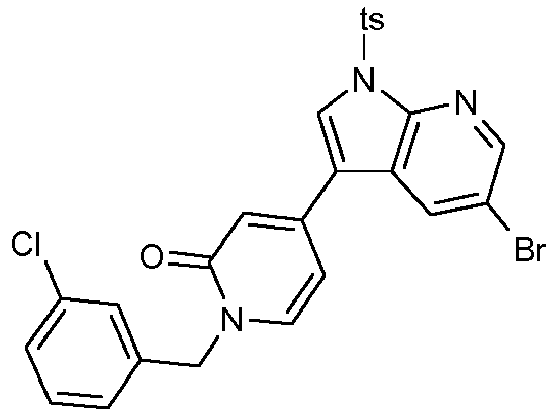
- 326 mg (0.68 mmol) of 5-bromo-3-iodo-1-tosyl-1H-pyrrolo[2,3-b]pyridine (described in the step 2) and 198 mg (0.75 mmol) of 1-(3-chlorobenzyl)-2-oxo-1,2-dihydropyridine-4-boronic acid (described in the previous step) are dissolved in a mixture of 40 ml of acetonitrile and 20 ml of an aqueous 2M solution of Na2CO3. Argon is bubbled through the solution for 10 minutes, then 32 mg of PdCl2(PPh3)2 is added under argon. Argon is bubbled for another 10 minutes and the reaction is stirred at 70°C for 1h30. The reaction medium is diluted with water, extracted 3 times with ethyl acetate, dried over sodium sulfate, filtered and evaporated under reduced pressure. Crude product is purified by flash chromatography on a 10 g silica gel column with an ethyl acetate/hexane mixture as eluent. 129 mg of the title compound are obtained as a white solid.
- Yield: 33%.
- MH+: 567.6; 569.6.
- 1H NMR (DMSO-d6, 300 MHz): δ 8.57-8.52 (m, 3H); 8.04 (d, J=8.4Hz, 2H); 7.93 (d, J=7.1Hz, 1H); 7.46-7.29 (m, 6H); 6.86 (d, J=1.9Hz, 1H); 6.80 (dd, J=7.1 and 1.9Hz, 1H); 5.14 (s, 2H); 2.35 (s, 3H).
-

- 15 mg (0.026 mmol) of 4-(5-bromo-1-tosyl-1H-pyrrolo[2,3-b]pyridin-3-yl)-1-(3-chlorobenzyl)-1H-pyridin-2-one (described in the previous step) and 4 mg (0.028mmol) of 4-fluorophenylboronic acid are dissolved in a mixture of 2 ml of acetonitrile and 1 ml of an aqueous 2M solution of Na2CO3. Argon is bubbled through the solution for 10 minutes, then 2 mg of PdCl2(PPh3)2 is added under argon. Argon is bubbled for another 10 minutes and the reaction is heated at 150°C under microwaves irradiation for 1 hour. The reaction medium is diluted with water, extracted 3 times with ethyl acetate, dried over sodium sulfate, filtered and evaporated under reduced pressure. Crude product is purified by flash chromatography with a 30 g C18 column and a water/acetonitrile mixture as eluent. 5.9 mg of the title compound are obtained.
- Yield: 52%.
- MH+: 429.8; 431.8.
- 1H NMR (DMSO-d6, 300 MHz): δ 12.37 (br s, 1H); 8.57 (d, J=1.5Hz, 1H); 8.44 (d, J=1.6Hz, 1H); 8.23 (s, 1H); 7.86-7.80 (m, 3H); 7.42-7.28 (m, 6H); 6.86-6.79 (m, 2H); 5.12 (s, 2H).
-

- The compound is obtained by the procedure described in example 1 step 5, using 4.4 mg (0.029 mmol) of 4-hydroxymethylboronic acid instead of 4-fluorophenylboronic acid. 5.5 mg of the title compound are obtained.
- Yield: 47%.
- MH+: 441.8; 443.8.
- 1H NMR (DMSO-d6, 300 MHz): δ 12.36 (br s, 1H); 8.56 (d, J=1.6Hz, 1H); 8.43 (d, J=1.6Hz, 1H); 8.23 (s, 1H); 7.83 (d, J=7.0Hz, 1H); 7.75 (d, J=8.4Hz, 2H); 7.44-7.28 (m, 6H); 6.86-6.78 (m, 2H); 5.23 (br t, 1H); 5.12 (s, 2H); 4.55 (d, J=5.5Hz, 2H).
-

- The compound is obtained by the procedure described in example 1 step 5, using 5.2 mg (0.029 mmol) of 4-(N-methylaminocarbonyl)phenylboronic acid instead of 4-fluorophenylboronic acid. 8.5 mg of the title compound are obtained.
- Yield: 68%.
- MH+: 468.8; 470.8.
- 1H NMR (DMSO-d6, 300 MHz): δ 12.41 (br s, 1H); 8.65 (d, J=1.5Hz, 1H); 8.54-8.48 (m, 2H); 8.25 (s, 1H); 7.98-7.87 (m, 5H); 7.44-7.28 (m, 4H); 6.88-6.79 (m, 2H); 5.13 (s, 2H); 2.81 (d, J=4.4Hz, 3H).
-

- The compound is obtained by the procedure described in example 1 step 5, using 4.1 mg (0.029 mmol) of 2-fluoropyridine-5-boronic acid instead of 4-fluorophenylboronic acid. 3.3 mg of the title compound are obtained.
- Yield: 29%.
- MH+: 430.8; 432.8.
- 1H NMR (DMSO-d6, 300 MHz): δ 12.42 (br s, 1H); 8.69-8.68 (m, 1H); 8.63-8.60 (m, 1H); 8.57-8.54 (m, 1H); 8.26 (s, 1H); 7.83 (d, J=6.9Hz, 1H); 7.43-7.28 (m, 6H); 6.92-6.78 (m, 2H); 5.12 (s, 2H).
-

- The compound is obtained by the procedure described in example 1 step 5, using 4.0 mg (0.031 mmol) of thiophene-3-boronic acid instead of 4-fluorophenylboronic acid. 7.9 mg of the title compound are obtained.
- Yield: 72%.
- MH+: 417.8; 419.8.
- 1H NMR (DMSO-d6, 300 MHz): δ 12.35 (br s, 1H); 8.68 (d, J=1.9Hz, 1H); 8.51 (d, J=1.9Hz, 1H); 8.21 (s, 1H); 8.03-7.99 (m, 1H); 7.83 (d, J=7.1Hz, 1H); 7.74-7.65 (m, 2H); 7.44-7.29 (m, 4H); 6.86 (d, J=1.6Hz, 1H); 6.81 (dd, J=1.9 and 7.1Hz, 1H); 5.13 (s, 2H).
-

- The compound is obtained by the procedure described in example 1 step 5, using 4.7 mg (0.029 mmol) of 5-chlorothiophene-2-boronic acid instead of 4-fluorophenylboronic acid. 6.5 mg of the title compound are obtained.
- Yield: 55%.
- MH+: 451.8; 453.7; 455.8.
- 1H NMR (DMSO-d6, 300 MHz): δ 12.45 (br s, 1H); 8.56 (d, J=1.9Hz, 1H); 8.41 (d, J=2.0Hz, 1H); 8.25 (s, 1H); 7.84 (d, J=6.6Hz, 1H); 7.53 (d, J=3.9Hz, 1H); 7.44-7.28 (m, 4H); 7.19 (d, J=3.9Hz, 1H); 6.83-6.75 (m, 2H); 5.13 (s, 2H).
-

- The compound is obtained by the procedure described in example 1 step 5, using 5.6 mg (0.029 mmol) of 4-pyrazoleboronic acid pinacol ester instead of 4-fluorophenylboronic acid. 2.3 mg of the title compound are obtained.
- Yield: 22%.
- MH+: 401.8; 403.9.
- 1H NMR (DMSO-d6, 300 MHz): δ 12.97 (br s, 1H); 12.23 (br s, 1H); 8.59 (d, J=1.8Hz, 1H); 8.42 (d, J=2.0Hz, 1H); 8.37-8.32 (m, 1H); 8.17 (s, 1H); 8.08-8.02 (m, 1H); 7.82 (d, J=7.2Hz, 1H); 7.44-7.29 (m, 4H); 6.85 (d, J=1.7Hz, 1H); 6.80 (dd, J=1.8 and 7.3Hz, 1H); 5.13 (s, 2H).
-

- The compound is obtained by the procedure described in example 1 step 5, using 20 mg (0.035 mmol) of 4-(5-bromo-1-tosyl-1H-pyrrolo[2,3-b]pyridin-3-yl)-1-(3-chlorobenzyl)-1H-pyridin-2-one (described in example 1 step 4), 8.0 mg (0.038 mmol) of 5-methyl-1H-pyrazole-4-boronic acid pinacol ester instead of 4-fluorophenylboronic acid, and 2 mg of PdCl2(PPh3)2. 2.1 mg of the title compound are obtained.
- Yield: 14%.
- MH+: 415.9; 417.9.
- 1H NMR (DMSO-d6, 300 MHz): δ 12.67 (br s, 1H); 12.27 (br s, 1H); 8.39 (d, J=1.8Hz, 1H); 8.23 (d, J=1.9Hz, 1H); 8.19 (s, 1H); 7.92-7.84 (m, 1H); 7.64 (d, J=7.6Hz, 1H); 7.44-7.28 (m, 4H); 6.80-6.74 (m, 2H); 5.11 (s, 2H); 2.39 (s, 3H).
-

- In 6 ml of anhydrous THF are dissolved 0.5 g (2.53 mmol) of 5-bromo-1H-pyrrolo[2,3-b]pyridine, 300 µl (3.05 mmol) of piperidine, 12 mg (0.025 mmol) of RuPhos and 20 mg (0.025 mmol) of RuPhosPd G2 under argon. To the solution is added 6 ml (6 mmol) of LiHMDS (1M in THF) at ambient temperature. Then the reaction is heated at 60°C until LC/MS shows that the reaction is complete (2 hours). After cooling to ambient temperature, the solvent is removed under reduced pressure. 150 ml of a solution of saturated NH4Cl is added and the mixture is extracted 3 times with ethyl acetate. The combined organic layers are dried over sodium sulfate, filtered, and evaporated under reduced pressure to give 0.6 g of a red solid. The compound is used in the next step without further purification.
- Yield: Quantitative.
- MH+: 202.1.
-

- 855 mg (3.80 mmol) of N-iodosuccinimide are added portionwise to a solution of 510 mg (2.54 mmol) of 5-piperidin-1-yl-1H-pyrrolo[2,3-b]pyridine (described in the previous step) in 10 ml of acetone. The mixture is stirred for 1 hour at ambient temperature. TLC shows that the reaction is complete. Solvent is then removed under reduced pressure. The reaction mixture is diluted with ethyl acetate and washed 2 times with water and another time with brine. The organic layer is dried over sodium sulfate, filtered, and evaporated under reduced pressure. Crude product is purified by flash chromatography with a 30 g silica gel column with an ethyl acetate/hexane mixture as eluent. 501 mg of the title compound are obtained.
- Yield: 61%.
- MH+: 327.9.
-

- 500 mg (1.53 mmol) of 3-iodo-5-piperidin-1-yl-1H-pyrrolo[2,3-b]pyridine (described in the previous step) are diluted in 10 ml of anhydrous DMF under argon. 92 mg (2.30 mmol) of sodium hydride (60% in paraffin oil) are slowly added to the mixture at 0°C and the solution is stirred at this temperature for 15 minutes. Then 320 mg (1.70 mmol) of tosyl chloride are added under argon at 0°C and the mixture is allowed to reach ambient temperature overnight. The reaction mixture is diluted with ethyl acetate and washed 3 times with water and then with brine. The organic layer is dried over sodium sulfate, filtered, and evaporated under reduced pressure. Crude product is purified by flash chromatography with a 30 g silica gel column with an ethyl acetate/hexane mixture as eluent. 502 mg of the title compound are obtained.
- Yield: 68%.
- MH+: 481.8.
-

- 20 mg (0.042 mmol) of 3-iodo-5-piperidin-1-yl-1-tosyl-1H-pyrrolo[2,3-b]pyridine (described in previous step) and 12 mg (0.046 mmol) of 1-(3-chlorobenzyl)-2-oxo-1,2-dihydropyridine-4-boronic acid (described in example 1 step 3) are dissolved in a mixture of 3 ml of acetonitrile and 1.5 ml of an aqueous 2M solution of Na2CO3. Argon is bubbled through the solution for 10 minutes, then 2 mg of PdCl2(PPh3)2 are added under argon. Argon is bubbled for another 10 minutes and the reaction is stirred at 70°C for 1 hour. The reaction mixture is transferred in a microwave sealed tube and the reaction is heated at 150°C under microwave irradiation for 15 minutes. After cooling, the solution is diluted with water, extracted 3 times with ethyl acetate, dried over sodium sulfate, filtered and evaporated under reduced pressure. Crude product is purified by flash chromatography on a 10 g silica gel column with an ethyl acetate/hexane mixture as eluent. The obtained product is purified another time by flash chromatography on a 30 g C18 column with a water/acetonitrile mixture as eluent. 3.6 mg of the title compound are obtained.
- Yield: 21%.
- MH+: 419.0; 421.0.
- 1H NMR (DMSO-d6, 300 MHz): δ 12.02 (br s, 1H); 8.13 (d, J=2.2Hz, 1H); 8.07 (s, 1H); 7.80 (d, J=6.9Hz, 1H); 7.69 (d, J=2.2Hz, 1H); 7.42-7.27 (m, 4H); 6.75-6.67 (m, 2H); 5.10 (s, 2H); 3.14-3.00 (m, 4H); 1.76-1.62 (m, 4H); 1.57-1.45 (m, 2H).
-

- 2 g (10 mmol) of 5-bromo-1H-pyrrolo[2,3-b]pyridine are diluted in 20 ml of anhydrous DMF under argon. 0.61 g (15 mmol) of sodium hydride (60% in paraffin oil) is slowly added to the mixture at 0°C. The solution is stirred at 0°C for 5 minutes and at ambient temperature for another 25 minutes. The mixture is cooled again to 0°C and 2.7 ml (15 mmol) of (2-(chloromethoxy)ethyl)trimethylsilane are added dropwise. The reaction is allowed to reach ambient temperature overnight. The reaction mixture is diluted with brine, extracted 3 times with ethyl acetate. The combined organic layers are dried over sodium sulfate, filtered, and evaporated under reduced pressure. Crude product is purified by flash chromatography with a 100 g silica gel column and an ethyl acetate/hexane mixture as eluent. 3.44 g of the title compound are obtained.
- Yield: Quantitative.
- MH+: 327.0; 329.0.
- 1H NMR (DMSO-d6, 300 MHz): δ 8.34 (d, J=2.2Hz, 1H); 8.24 (d, J=2.2Hz, 1H); 7.71 (d, J=3.6Hz, 1H); 6.53 (d, J=3.6Hz, 1H); 5.60 (s, 2H); 3.49 (t, J=7.8Hz,2H); 0.80 (t, J=8.0Hz, 2H); 0.12 (s, 9H).
-

- In 5 ml of anhydrous toluene are dissolved 0.5 g (1.53 mmol) of 5-bromo-1-(2-trimethylsilylethoxymethyl)-1H-pyrrolo[2,3-b]pyridine (described in the previous step) and 0.2 ml (1.82 mmol) of 4-cyanopiperidine. Argon is bubbled through the solution for 10 minutes, then 27 mg (0.3 mmol) of Pd(dba)2, 52 mg (0.09 mmol) of xantphos and 216 mg (2.30 mmol) of sodium tert-butoxide are added. Argon is bubbled for another 10 minutes and the solution is stirred at 110°C overnight. After cooling to ambient temperature, the reaction mixture is diluted with ethyl acetate, washed 3 times with water, dried over sodium sulfate, filtered, and evaporated under reduced pressure. Crude product is purified by flash chromatography with a 30 g silica gel column and an ethyl acetate/hexane mixture as eluent. 296 mg of the title compound are obtained.
- Yield: 55%.
- MH+: 357.1.
-

- 296 mg (0.83 mmol) of 5-(4-cyanopiperidin-1-yl)-1-(2-trimethylsilylethoxymethyl)-1H-pyrrolo[2,3-b]pyridine (described in the previous step) are dissolved in 7 ml of anhydrous THF under argon. 83 µl (1.25 mmol) of ethylenediamine are added to the solution, followed by 2.49 ml (2.49 mmol) of TBAF (1M in THF). The reaction is stirred at 66°C for 4h and another 1.66 ml (1.66 mmol) of TBAF (1M in THF) is added. The reaction is stirred at 66°C overnight. After cooling to ambient temperature, the reaction mixture is poured into a saturated solution of NaHCO3, extracted 3 times with ethyl acetate, dried over sodium sulfate, filtered, and evaporated under reduced pressure. Crude product is purified by flash chromatography with a 30 g silica gel column and an ethyl acetate/hexane mixture as eluent. 141 mg of the title compound are obtained.
- Yield: 75%.
- MH+: 227.1.
-

- The compound is obtained by the procedure described in example 9 step 2, using 141 mg (0.62 mmol) of 5-(4-cyanopiperidin-1-yl)-1H-pyrrolo[2,3-b]pyridine (described in the previous step) instead of 5-piperidin-1-yl-1H-pyrrolo[2,3-b]pyridine and 210 mg (0.94 mmol) of N-iodosuccinimide in 5 ml of acetone. 139 mg of the title compound are obtained.
- Yield: 63%.
- MH+: 352.8.
-

- The compound is obtained by the procedure described in example 9 step 3, using 139 mg (0.40 mmol) of 3-iodo-5-(4-cyanopiperidin-1-yl)-1H-pyrrolo[2,3-b]pyridine (described in the previous step) instead of 3-iodo-5-piperidin-1-yl-1H-pyrrolo[2,3-b]pyridine, 24 mg (0.59 mmol) of sodium hydride (60% in paraffin oil) and 83 mg (0.44 mmol) of tosyl chloride in 10 ml of anhydrous DMF. 137 mg of the title compound are obtained.
- Yield: 67%.
- MH+: 506.8.
-

- The compound is obtained by the procedure described in example 9 step 4, using 137 mg (0.27 mmol) of 3-iodo-5-(4-cyanopiperidin-1-yl)-1-tosyl-1H-pyrrolo[2,3-b]pyridine (described in the previous step) instead of 3-iodo-5-piperidin-1-yl-1-tosyl-1H-pyrrolo[2,3-b]pyridine, 71 mg (0.30 mmol) of 1-(3-chlorobenzyl)-2-oxo-1,2-dihydropyridine-4-boronic acid and 14 mg of PdCl2(PPh3)2. 52 mg of the title compound are obtained.
- Yield: 43%.
- MH+: 444.0; 446.0.
- 1H NMR (DMSO-d6, 300 MHz): δ 12.06 (br s, 1H); 8.15 (d, J=2.0Hz, 1H); 8.09 (d, J=2.5Hz, 1H); 7.79 (d, J=7.3Hz, 1H); 7.77-7.71 (m, 1H); 7.44-7.34 (m, 4H); 6.76-6.69 (m, 2H); 5.10 (s, 2H); 3.11-2.95 (m, 4H); 2.13-1.99 (m, 4H); 1.97-1.82 (m, 1H).
-

- 5 mg (0.011 mmol) of 1-(3-chlorobenzyl)-4-(5-(4-cyanopiperidin-1-yl)-1H-pyrrolo[2,3-b]pyridin-3-yl)-1H-pyridin-2-one (described in example 10 step 6) are dissolved in 1 ml of a mixture pyridine/acetic acid/water (2/1/1). Several drops of Raney nickel in water are added, and the mixture is placed under an atmosphere of H2 and heated at 50°C overnight. The reaction mixture is filtered on celite. The celite is washed 3 times with ethyl acetate. The filtrate is evaporated under reduced pressure and directly purified by flash chromatography with a 10 g silica gel column and a dichloromethane/methanol mixture as eluent. 0.5 mg of the title compound is obtained.
- Yield: 10%.
- MH+: 449.1; 451.0.
- 1H NMR (DMSO-d6, 300 MHz): δ 12.03 (br s, 1H); 8.14 (d, J=2.2Hz, 1H); 8.07 (s, 1H); 7.79 (d, J=7.0Hz, 1H); 7.70 (d, J=2.3Hz, 1H); 7.43-7.27 (m, 4H); 6.75-6.67 (m, 2H); 5.10 (s, 2H); 4.49 (br t, 1H); 3.60 (d, J=11.9Hz, 2H); 2.78-2.60 (m, 4H); 1.86-1.73 (m, 2H); 1.67-1.41 (m, 1H); 1.40-1.19 (m, 2H).
-

- The compound is obtained by the procedure described in example10 step 2, using 476 mg (1.45mmol) of 5-bromo-1-(2-trimethylsilylethoxymethyl)-1H-pyrrolo[2,3-b]pyridine, 224 µl (1.75 mmol) of 1,4-dioxa-8-azaspiro[4.5]decane instead of 4-cyanopiperidine, 27 mg (0.03 mmol) of Pd(dba)2, 50 mg (0.09 mmol) of xantphos and 209 mg (2.30 mmol) of tBuONa. 443 mg of the title compound are obtained. LC/MS shows a purity of 47%. The compound is used in the next step without further purification.
- Yield: 78% (HPLC purity: 47%).
- MH+: 390.0.
-

- The compound is obtained by the procedure described in example 10 step 3, using 443 mg (1.13 mmol) of 8-[1-(2-trimethylsilylethoxymethyl)-1H-pyrrolo[2,3-b]pyridin-5-yl]-1,4-dioxa-8-azaspiro[4.5]decane (described in the previous step) instead of 5-(4-cyanopiperidin-1-yl)-1-(2-trimethylsilylethoxymethyl)-1H-pyrrolo[2,3-b]pyridine, 114 µl (1.7 mmol) of ethylenediamine, 3.4 ml + 2.3 ml (3.4 mmol + 2.27 mmol) of TBAF (1M in THF) in 8 ml of anhydrous THF. 128 mg of the title compound are obtained.
- Yield: 43%.
- MH+: 260.1.
-
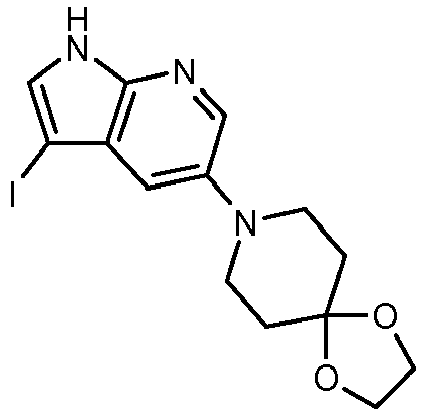
- The compound is obtained by the procedure described in example 9 step 2, using 128 mg (0.49 mmol) of 8-(1H-pyrrolo[2,3-b]pyridin-5-yl)-1,4-dioxa-8-azaspiro[4.5]decane (described in the previous step) instead of 5-piperidin-1-yl-1H-pyrrolo[2,3-b]pyridine and 122 mg (0.54 mmol) of N-iodosuccinimide in 2 ml of acetone. 134 mg of the title compound are obtained.
- Yield: 71%.
- MH+: 385.9.
-

- The compound is obtained by the procedure described in example 9 step 3, using 134 mg (0.35 mmol) of 8-(3-iodo-1H-pyrrolo[2,3-b]pyridin-5-yl)-1,4-dioxa-8-azaspiro[4.5]decane (described in the previous step) instead of 3-iodo-5-piperidin-1-yl-1H-pyrrolo[2,3-b]pyridine, 21 mg (0.52 mmol) of sodium hydride (60% in paraffin oil) and 73 mg (0.39 mmol) of tosyl chloride in 5ml of anhydrous DMF. 136 mg of the title compound are obtained.
- Yield: 72%.
- MH+: 539.8.
-

- 134 mg (0.25 mmol) of 8-(3-iodo-1-tosyl-1H-pyrrolo[2,3-b]pyridin-5-yl)-1,4-dioxa-8-azaspiro[4.5]decane (described in previous step) and 85 mg (0.32 mmol) of 1-(3-chlorobenzyl)-2-oxo-1,2-dihydropyridine-4-boronic acid (described in example 1 step 3) are dissolved in a mixture of 3 ml of acetonitrile and 1.5 ml of an aqueous 2M solution of Na2CO3. Argon is bubbled through the solution for 10 minutes, then 13 mg of PdCl2(PPh3)2 are added under argon. Argon is bubbled for another 10 minutes and the reaction is stirred at 70°C for 1 hour. After cooling, the solution is diluted with water, extracted 3 times with ethyl acetate, dried over sodium sulfate, filtered and evaporated under reduced pressure. Crude product is purified by flash chromatography on a 10 g silica gel column with a dichloromethane/methanol mixture as eluent. The obtained product is purified another time by flash chromatography on a 30 g C18 column with a water/acetonitrile mixture as eluent. 55 mg of the title compound are obtained.
- Yield: 35%.
- MH+: 631.0; 632.9.
-

- 5 mg (0.008 mmol) of 1-(3-chlorobenzyl)-4-[5-(1,4-dioxa-8-azaspiro[4.5]dec-8-yl)-1-tosyl-1H-pyrrolo[2,3-]pyridin-3-yl]-1H-pyridin-2-one (described in previous step) are dissolved in a mixture of 3 ml of acetonitrile and 1.5 ml of an aqueous 2M solution of Na2CO3. The reaction mixture is transferred in a microwave sealed tube and the reaction is heated at 150°C under microwave irradiation for 15 minutes. After cooling, the solution is diluted with water, extracted 3 times with ethyl acetate, dried over sodium sulfate, filtered and evaporated under reduced pressure. Crude product is purified by flash chromatography on a 30 g C18 column with a water/acetonitrile mixture as eluent. 2.2 mg of the title compound are obtained.
- Yield: 58%.
- MH+: 476.9; 478.9.
- Example 13: 1-(3-Chlorobenzyl)-4-[5-(4-oxopiperidin-1-yl)-1H-pyrrolo[2,3-b]pyridin-3-yl]-1H-pyridin-2-one
-

- 52 mg (0.082 mmol) of 1-(3-chlorobenzyl)-4-[5-(1,4-dioxa-8-azaspiro[4.5]dec-8-yl)-1-tosyl-1H-pyrrolo[2,3-]pyridin-3-yl]-1H-pyridin-2-one (described in example 12 step 5) are dissolved in a mixture of 5 ml of THF and 5 ml of HCl 1N and the reaction is stirred for 48 hours. The mixture is poured into an aqueous solution of saturated NaHCO3, extracted 3 times with ethyl acetate, dried over sodium sulfate, filtered and evaporated under reduced pressure to give 44 mg of a yellow solid. Crude product is used in the next step without further purification.
- Yield: 92%.
- MH+: 586.9; 588.9.
-

- 4 mg (0.007 mmol) of 1-(3-chlorobenzyl)-4-[5-(4-oxopiperidin-1-yl)-1-tosyl-1H-pyrrolo[2,3-b]pyridin-3-yl]-1H-pyridin-2-one (described in previous step) are dissolved in a mixture of 2 ml of acetonitrile and 1 ml of an aqueous 2M solution of Na2CO3. The reaction mixture is heated at 150°C under microwave irradiation for 15 minutes. After cooling, the solution is diluted with water, extracted 3 times with ethyl acetate, dried over sodium sulfate, filtered and evaporated under reduced pressure. Crude product is purified by flash chromatography on a 30 g C18 column with a water/acetonitrile mixture as eluent. 0.8 mg of the title compound is obtained.
- Yield: 27%.
- MH+: 432.9; 434.9.
-

- 12 mg (0.020 mmol) of 1-(3-chlorobenzyl)-4-[5-(4-oxopiperidin-1-yl)-1-tosyl-1H-pyrrolo[2,3-b]pyridin-3-yl]-1H-pyridin-2-one (described in example 13 step 1) are dissolved in 1 ml of ethanol. 1.3 mg (0.020 mmol) of NaBH3CN is added and the reaction is stirred at ambient temperature overnight. The mixture is poured into an aqueous solution of saturated NaHCO3, extracted 3 times with ethyl acetate, dried over sodium sulfate, filtered and evaporated under reduced pressure. The residue is dissolved in a mixture of 2 ml of acetonitrile and 1 ml of an aqueous 2M solution of Na2CO3. The reaction mixture is heated at 150°C under microwave irradiation for 15 minutes. After cooling, the solution is diluted with water, extracted 3 times with ethyl acetate, dried over sodium sulfate, filtered and evaporated under reduced pressure. Crude product is purified by flash chromatography on a 30 g C18 column with a water/acetonitrile mixture as eluent. 3.2 mg of the title compound are obtained.
- Yield: 36%.
- MH+: 434.9; 436.9.
-

- 12 mg (0.020 mmol) of 1-(3-chlorobenzyl)-4-[5-(4-oxopiperidin-1-yl)-1-tosyl-1H-pyrrolo[2,3-b]pyridin-3-yl]-1H-pyridin-2-one (described in example 13 step 1) and 1.9 mg (0.022 mmol) of O-methylhydroxylamine hydrochloride are dissolved in 1 ml of a mixture of methanol/acetic acid (9/1). 1.4 mg (0.022 mmol) of NaBH3CN is added and the reaction is stirred at ambient temperature overnight. The mixture is poured into an aqueous solution of saturated NaHCO3, extracted 3 times with ethyl acetate, dried over sodium sulfate, filtered and evaporated under reduced pressure. The residue is dissolved in a mixture of 2 ml of acetonitrile and 1 ml of an aqueous 2M solution of Na2CO3. The reaction mixture is heated at 150°C under microwave irradiation for 15 minutes. After cooling, the solution is diluted with water, extracted 3 times with ethyl acetate, dried over sodium sulfate, filtered and evaporated under reduced pressure. Crude product is purified by flash chromatography on a 30 g C18 column with a water/acetonitrile mixture as eluent. Product is purified a second time by flash chromatography on a 10 g silica gel column with a dichloromethane/methanol mixture as eluent. 1.4 mg of the title compound is obtained.
- Yield: 16%.
- MH+: 464.0; 465.9.
-

- The compound is obtained by the procedure described in example 9 step 1, using 253 µl (3 mmol) of pyrrolidine instead of piperidine. 530 mg of the title compound are obtained.
- Yield: Quantitative.
- MH+: 188.2.
-

- The compound is obtained by the procedure described in example 9 step 2, using 480 mg (2.5 mmol) of 5-pyrrolidin-1-yl-1H-pyrrolo[2,3-b]pyridine (described in the previous step) instead of 5-piperidin-1-yl-1H-pyrrolo[2,3-b]pyridine and 865 mg (3.8 mmol) of N-iodosuccinimide in 10 ml of acetone. 234 mg of the title compound are obtained.
- Yield: 30%.
- MH+: 313.9.
-

- The compound is obtained by the procedure described in example 9 step 3, using 234 mg (0.75 mmol) of 3-iodo-5-pyrrolidin-1-yl-1H-pyrrolo[2,3-b]pyridine (described in the previous step) instead of 3-iodo-5-piperidin-1-yl-1H-pyrrolo[2,3-b]pyridine, 45 mg (1.1 mmol) of sodium hydride (60% in paraffin oil) and 156 mg (0.82 mmol) of tosyl chloride in 10 ml of anhydrous DMF. 201 mg of the title compound are obtained.
- Yield: 58%.
- MH+: 467.8.
-

- The compound is obtained by the procedure described in example 9 step 4, using 20 mg (0.043 mmol) of 3-iodo-5-pyrrolidin-1-yl-1-tosyl-1H-pyrrolo[2,3-b]pyridine (described in the previous step) instead of 3-iodo-5-piperidin-1-yl-1-tosyl-1H-pyrrolo[2,3-b]pyridine, 12.4 mg (0.047 mmol) of 1-(3-chlorobenzyl)-2-oxo-1,2-dihydropyridine-4-boronic acid and 2 mg of PdCl2(PPh3)2. Crude product is purified by flash chromatography on a 10 g silica gel column with a dichloromethane/methanol mixture as eluent. The obtained product is purified another time by flash chromatography on a 30 g C18 column with a water/acetonitrile mixture as eluent. 1.7 mg of the title compound is obtained.
- Yield: 10%.
- MH+: 405.0; 407.0.
- 1H NMR (DMSO-d6, 300 MHz): δ 11.87 (br s, 1H); 8.02 (s, 1H); 7.83 (d, J=2.3Hz, 1H); 7.77 (d, J=6.9Hz, 1H); 7.42-7.20 (m, 5H); 6.75-6.65 (m, 2H); 5.10 (s, 2H); 3.30-3.20 (m, 4H); 2.02-1.93 (m, 4H).
-

- The compound is obtained by the procedure described in example 9 step 1, using 800 mg (4.06 mmol) of 5-bromo-1H-pyrrolo[2,3-b]pyridine, 421 µl (4.87 mmol) of morpholine instead of piperidine, 19 mg (0.04 mmol) of RuPhos, 34 mg (0.04 mmol) of RuPhosPd G2 and 10 ml (10 mmol) of LiHMDS (1M in THF). 795 mg of the title compound are obtained.
- Yield: 96%.
- MH+: 204.1.
-

- The compound is obtained by the procedure described in example 9 step 2, using 795 mg (3.92 mmol) of 5-morpholin-4-yl-1H-pyrrolo[2,3-b]pyridine (described in the previous step) instead of 5-piperidin-1-yl-1H-pyrrolo[2,3-b]pyridine and 1.32 g (5.87 mmol) of N-iodosuccinimide in 15ml of acetone. 234 mg of the title compound are obtained.
- Yield: 59%.
- MH+: 329.9.
-

- The compound is obtained by the procedure described in example 9 step 3, using 760 mg (2.31 mmol) of 3-iodo-5-morpholin-1-yl-1H-pyrrolo[2,3-b]pyridine (described in the previous step) instead of 3-iodo-5-piperidin-1-yl-1H-pyrrolo[2,3-b]pyridine, 139 mg (3.46 mmol) of sodium hydride (60% in paraffin oil) and 485 mg (2.54 mmol) of tosyl chloride in 8ml of anhydrous DMF. 655 mg of the title compound are obtained.
- Yield: 60%.
- MH+: 483.8.
-

- The compound is obtained by the procedure described in example 9 step 4, using 20 mg (0.043 mmol) of 3-iodo-5-morpholin-1-yl-1-tosyl-1H-pyrrolo[2,3-b]pyridine (described in the previous step) instead of 3-iodo-5-piperidin-1-yl-1-tosyl-1H-pyrrolo[2,3-b]pyridine, 14.2 mg (0.054 mmol) of 1-(3-chlorobenzyl)-2-oxo-1,2-dihydropyridine-4-boronic acid and 2 mg of PdCl2(PPh3)2. Crude product is purified by flash chromatography on a 10 g silica gel column with an ethyl acetate/hexane mixture as eluent. The obtained product is purified another time by flash chromatography on a 30 g C18 column with a water/acetonitrile mixture as eluent. 3.7 mg of the title compound are obtained.
- Yield: 21%.
- MH+: 420.9; 422.9.
- 1H NMR (DMSO-d6, 300 MHz): δ 12.03 (br s, 1H); 8.16 (d, J=2.4Hz, 1H); 8.09 (s, 1H); 7.79 (d, J=7.4Hz, 1H); 7.71 (d, J=2.5Hz, 1H); 7.45-7.27 (m, 4H); 6.76-6.69 (m, 2H); 5.10 (s, 2H); 3.83-3.73 (m, 4H); 3.19-3.09 (m, 4H).
-

- The compound is obtained by the procedure described in example 9 step 1, using 650 mg (3.30 mmol) of 5-bromo-1H-pyrrolo[2,3-b]pyridine, 400 mg (4.29 mmol) of 3-methylmorpholine instead of piperidine, 15 mg (0.043 mmol) of RuPhos, 28 mg (0.043 mmol) of RuPhosPd G2 and 7.9 ml (7.9 mmol) of LiHMDS (1M in THF). 240 mg of the title compound are obtained.
- Yield: 33%.
- MH+: 218.1.
- 1H NMR (DMSO-d6, 300 MHz): δ 11.43 (br s, 1H); 8.02 (d, J=2.4Hz, 1H); 7.60 (d, J=2.4Hz, 1H); 7.39 (t, J=2.9Hz, 1H); 6.34 (dd, J=1.9 and 3.2Hz, 1H); 3.86-3.64 (m, 3H); 3.50-3.38 (m, 2H); 3.02-2.94 (m, 2H); 0.81 (d, J=5.9Hz, 3H).
-

- The compound is obtained by the procedure described in example 9 step 2, using 240 mg (1.11 mmol) of 5-(3-methylmorpholin-4-yl)-1H-pyrrolo[2,3-b]pyridine (described in the previous step) instead of 5-piperidin-1-yl-1H-pyrrolo[2,3-b]pyridine and 373 mg (1.65 mmol) of N-iodosuccinimide in 5 ml of acetone. 231 mg of the title compound are obtained.
- Yield: 61%.
- MH+: 343.9.
-

- The compound is obtained by the procedure described in example 9 step 3, using 231 mg (0.67 mmol) of 3-iodo-5-(3-methylmorpholin-4-yl)-1H-pyrrolo[2,3-b]pyridine (described in the previous step) instead of 3-iodo-5-piperidin-1-yl-1H-pyrrolo[2,3-b]pyridine, 40 mg (1.01 mmol) of sodium hydride (60% in paraffin oil) and 142 mg (0.74 mmol) of tosyl chloride in 5 ml of anhydrous DMF. 195 mg of the title compound are obtained.
- Yield: 61%.
- MH+: 497.7.
-

- The compound is obtained by the procedure described in example 9 step 4, using 20 mg (0.043 mmol) of 3-iodo-5-(3-methylmorpholin-4-yl)-1-tosyl-1H-pyrrolo[2,3-b]pyridine (described in the previous step) instead of 3-iodo-5-piperidin-1-yl-1-tosyl-1H-pyrrolo[2,3-b]pyridine, 11.7 mg (0.044 mmol) of 1-(3-chlorobenzyl)-2-oxo-1,2-dihydropyridine-4-boronic acid and 2 mg of PdCl2(PPh3)2. Crude product is purified by flash chromatography on a 10 g silica gel column with a dichloromethane/methanol mixture as eluent. The obtained product is purified another time by flash chromatography on a 30 g C18 column with a water/acetonitrile mixture as eluent. 4.0 mg of the title compound are obtained.
- Yield: 22%.
- MH+: 434.9; 436.9.
-

- Yield: 89%.
- MH+: 218.1.
- 1H NMR (DMSO-d6, 300 MHz): δ 11.35 (br s, 1H); 8.06 (d, J=2.6Hz, 1H); 7.47 (d, J=2.6Hz, 1H); 7.36 (t, J=2.9Hz, 1H); 6.31 (dd, J=1.9 and 3.3Hz, 1H); 3.95-3.85 (m, 1H); 3.75-3.63 (m, 2H); 3.49-3.33 (m, 2H); 2.69 (dt, J=3.4 and 11.6Hz, 1H);2.36 (dt, J=1.3 and 11.4Hz, 1H); 1.15 (d, J=6.4Hz, 3H).
-

- The compound is obtained by the procedure described in example 9 step 2, using 300 mg (1.11 mmol) of 5-(2-methylmorpholin-4-yl)-1H-pyrrolo[2,3-b]pyridine (described in the previous step) instead of 5-piperidin-1-yl-1H-pyrrolo[2,3-b]pyridine and 466 mg (2.07 mmol) of N-iodosuccinimide in 5 ml of acetone. 219 mg of the title compound are obtained.
- Yield: 46%.
- MH+: 343.9.
-

- The compound is obtained by the procedure described in example 9 step 3, using 219 mg (0.64 mmol) of 3-iodo-5-(2-methylmorpholin-4-yl)-1H-pyrrolo[2,3-b]pyridine (described in the previous step) instead of 3-iodo-5-piperidin-1-yl-1H-pyrrolo[2,3-b]pyridine, 38 mg (0.96 mmol) of sodium hydride (60% in paraffin oil) and 134 mg (0.70 mmol) of tosyl chloride in 5 ml of anhydrous DMF. 105 mg of the title compound are obtained.
- Yield: 33%.
- MH+: 497.8.
-

- The compound is obtained by the procedure described in example 9 step 4, using 20 mg (0.043 mmol) of 3-iodo-5-(2-methylmorpholin-4-yl)-1-tosyl-1H-pyrrolo[2,3-b]pyridine (described in the previous step) instead of 3-iodo-5-piperidin-1-yl-1-tosyl-1H-pyrrolo[2,3-b]pyridine, 12 mg (0.044 mmol) of 1-(3-chlorobenzyl)-2-oxo-1,2-dihydropyridine-4-boronic acid and 2 mg of PdCl2(PPh3)2. Crude product is purified by flash chromatography on a 10 g silica gel column with a dichloromethane/methanol mixture as eluent. The obtained product is purified another time by flash chromatography on a 30 g C18 column with a water/acetonitrile mixture as eluent. 3.0 mg of the title compound are obtained.
- Yield: 17%.
- MH+: 434.9; 436.9.
- 1H NMR (DMSO-d6, 300 MHz): δ 12.06 (br s, 1H); 8.16 (d, J=2.5Hz, 1H); 8.09 (s, 1H); 7.80 (d, J=7.0Hz, 1H); 7.70 (d, J=2.6Hz, 1H); 7.44-7.28 (m, 4H); 6.76-6.69 (m, 2H); 5.11 (s, 2H); 3.97-3.87 (m, 1H); 3.77-3.65 (m, 2H); 3.60-3.42 (m, 2H); 2.78-2.76 (m, 1H); 2.40-2.36 (m, 1H); 1.17 (d, J=6.2Hz, 3H).
-

- The compound is obtained by the procedure described in example 10 step 2, using 452 mg (1.38 mmol) of 5-bromo-1-(2-trimethylsilylethoxymethyl)-1H-pyrrolo[2,3-b]pyridine, 240 mg (1.65 mmol) of N-methylmorpholine-2-carboxamide instead of 4-cyanopiperidine, 24 mg (0.03 mmol) of Pd(dba)2, 48 mg (0.09 mmol) of xantphos and 200 mg (2.47 mmol) of tBuONa. 357 mg of the title compound are obtained. LC/MS shows a purity of 47%. The compound is used in the next step without further purification.
- Yield: 66% (HPLC purity: 52%).
- MH+: 391.0.
-

- The compound is obtained by the procedure described in example 10 step 3, using 357 mg (0.91 mmol) of N-methyl-4-(1-((2-(trimethylsilyl)ethoxy)methyl)-1H-pyrrolo[2,3-b]pyridin-5-yl)morpholine-2-carboxamide (described in the previous step) instead of 5-(4-cyanopiperidin-1-yl)-1-(2-trimethylsilylethoxymethyl)-1H-pyrrolo[2,3-b]pyridine, 92 µl (1.37 mmol) of ethylenediamine, 2.7 ml + 1.8 ml (2.7 mmol + 1.8 mmol) of TBAF (1M in THF) in 7 ml oh anhydrous THF. 386 mg of the title compound are obtained.
- Yield: Quantitative.
- MH+: 261.1.
-

- The compound is obtained by the procedure described in example 9 step 2, using 386 mg (1.48 mmol) of N-methyl-4-(1H-pyrrolo[2,3-b]pyridin-5-yl)morpholine-2-carboxamide (described in the previous step) instead of 5-piperidin-1-yl-1H-pyrrolo[2,3-b]pyridine and 367 mg (1.63 mmol) of N-iodosuccinimide in 3 ml of acetone. 70 mg of the title compound are obtained.
- Yield: 12%.
- MH+: 386.9.
-
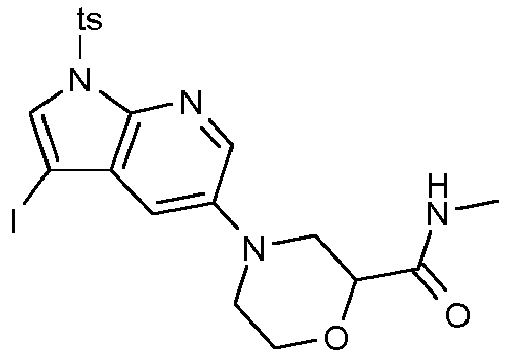
- The compound is obtained by the procedure described in example 9 step 3, using 70 mg (0.18 mmol) of 4-(3-iodo-1H-pyrrolo[2,3-b]pyridin-5-yl)-N-methylmorpholine-2-carboxamide (described in the previous step) instead of 3-iodo-5-piperidin-1-yl-1H-pyrrolo[2,3-b]pyridine, 11 mg (0.27 mmol) of sodium hydride (60% in paraffin oil) and 38 mg (0.20 mmol) of tosyl chloride in 5 ml of anhydrous DMF. 34 mg of the title compound are obtained.
- Yield: 35%.
- MH+: 540.8.
-
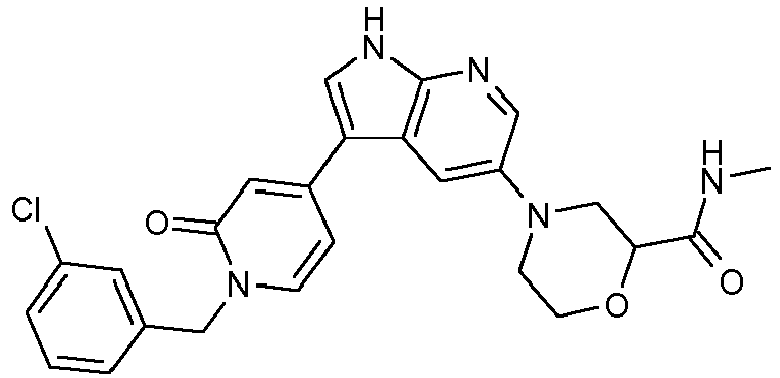
- The compound is obtained by the procedure described in example 9 step 4, using 17 mg (0.031 mmol) of 4-(3-iodo-1-tosyl-1H-pyrrolo[2,3-b]pyridin-5-yl)-N-methylmorpholine-2-carboxamide (described in the previous step) instead of 3-iodo-5-piperidin-1-yl-1-tosyl-1H-pyrrolo[2,3-b]pyridine, 11 mg (0.042 mmol) of 1-(3-chlorobenzyl)-2-oxo-1,2-dihydropyridine-4-boronic acid and 2 mg of PdCl2(PPh3)2. Crude product is purified by flash chromatography on a 10 g silica gel column with a dichloromethane/methanol mixture as eluent. The obtained product is purified another time by flash chromatography on a 30 g C18 column with a water/acetonitrile mixture as eluent. 4.8 mg of the title compound are obtained.
- Yield: 32%.
- MH+: 478.0; 479.9.
- 1H NMR (DMSO-d6, 300 MHz): δ 12.08 (br s, 1H); 8.17 (d, J=1.9Hz, 1H); 8.10 (s, 1H); 7.89-7.81 (m, 1H); 7.80 (d, J=7.6Hz, 1H); 7.74 (d, J=2.1Hz, 1H); 7.43-7.27 (m, 4H); 6.77-6.69 (m, 2H); 5.11 (s, 2H); 4.18-3.99 (m, 2H); 3.86-3.74 (m, 1H); 3.71-3.61 (m, 1H); 2.78-2.76 (m, 1H); 2.90-2.68 (m, 3H); 2.64 (d, J=4.6Hz, 3H).
-

- The compound is obtained by the procedure described in example 9 step 1, using 500 mg (2.53 mmol) of 5-bromo-1H-pyrrolo[2,3-b]pyridine, 566 mg (3.05 mmol) of tert-butyl piperazine-1-carboxylate instead of piperidine, 12 mg (0.025 mmol) of RuPhos, 20 mg (0.025 mmol) of RuPhosPd G2 and 6 ml (6 mmol) of LiHMDS (1M in THF). 651 mg of the title compound are obtained.
- Yield: 85%.
- MH+: 303.0.
- 1H NMR (DMSO-d6, 300 MHz): δ 11.39 (br s, 1H); 8.06 (d, J=2.6Hz, 1H); 7.51 (d, J=2.5Hz, 1H); 7.37 (t, J=2.9Hz, 1H); 6.32 (dd, J=1.9 and 3.3Hz, 1H); 3.54-3.44 (m, 4H); 3.05-2.96 (m, 4H); 1.43 (s, 9H).
-

- The compound is obtained by the procedure described in example 9 step 2, using 650 mg (2.15 mmol) of tert-butyl 4-(1H-pyrrolo[2,3-b]pyridin-5-yl)piperazine-1-carboxylate (described in the previous step) instead of 5-piperidin-1-yl-1H-pyrrolo[2,3-b]pyridine and 725 mg (3.22 mmol) of N-iodosuccinimide in 12 ml of acetone. 750 mg of the title compound are obtained.
- Yield: 82%.
- MH+: 428.7.
- 1H NMR (DMSO-d6, 300 MHz): δ 11.88 (br s, 1H); 8.12 (d, J=2.5Hz, 1H); 7.61 (d, J=2.6Hz, 1H); 7.13 (d, J=2.4Hz, 1H); 3.56-3.44 (m, 4H); 3.11-3.02 (m, 4H); 1.43 (s, 9H).
-

- The compound is obtained by the procedure described in example 9 step 3, using 750 mg (1.75 mmol) of tert-butyl 4-(3-iodo-1H-pyrrolo[2,3-b]pyridin-5-yl)piperazine-1-carboxylate (described in the previous step) instead of 3-iodo-5-piperidin-1-yl-1H-pyrrolo[2,3-b]pyridine, 105 mg (2.63 mmol) of sodium hydride (60% in paraffin oil) and 366 mg (1.93 mmol) of tosyl chloride in 15 ml of anhydrous THF instead of DMF. 275 mg of the title compound are obtained.
- Yield: 27%.
- MH+: 582.7.
- 1H NMR (DMSO-d6, 300 MHz): δ 8.22 (d, J=2.6Hz, 1H); 8.03 (s, 1H); 7.95 (d, J=8.4Hz, 1H); 7.41 (d, J=8.1Hz, 1H); 7.61 (d, J=2.6Hz, 1H); 7.14 (d, J=2.6Hz, 1H); 3.52-3.42 (m, 4H); 3.20-3.10 (m, 4H); 2.34 (s, 3H); 1.41 (s, 9H).
-

- 160 mg (0.28 mmol) of tert-butyl 4-(3-iodo-1-tosyl-1H-pyrrolo[2,3-b]pyridin-5-yl)piperazine-1-carboxylate (described in previous step) and 94 mg (0.36 mmol) of 1-(3-chlorobenzyl)-2-oxo-1,2-dihydropyridine-4-boronic acid (described in example 1 step 3) are dissolved in a mixture of 3 ml of acetonitrile and 1.5 ml of an aqueous 2M solution of Na2CO3. Argon is bubbled through the solution for 10 minutes, then 16 mg of PdCl2(PPh3)2 are added under argon. Argon is bubbled for another 10 minutes and the reaction is stirred at 70°C for 1 hour. After cooling, the solution is diluted with water, extracted 3 times with ethyl acetate, dried over sodium sulfate, filtered and evaporated under reduced pressure. Crude product is purified by flash chromatography on a 10 g silica gel column with a dichloromethane/methanol mixture as eluent. The obtained product is purified another time by flash chromatography on a 30 g C18 column with a water/acetonitrile mixture as eluent. 70 mg of the title compound are obtained.
- Yield: 37%.
- MH+: 673.9; 676.0.
-

- 5 mg (0.007 mmol) of tert-butyl 4-(3-(1-(3-chlorobenzyl)-2-oxo-1,2-dihydropyridin-4-yl)-1-tosyl-1H-pyrrolo[2,3-b]pyridin-5-yl)piperazine-1-carboxylate (described in previous step) are dissolved in a mixture of 3 ml of acetonitrile and 1.5 ml of an aqueous 2M solution of Na2CO3. The reaction mixture is transferred in a microwave sealed tube and the reaction is heated at 150°C under microwave irradiation for 15 minutes. After cooling, the solution is diluted with water, extracted 3 times with ethyl acetate, dried over sodium sulfate, filtered and evaporated under reduced pressure. Crude product is purified by flash chromatography on a 30 g C18 column with a water/acetonitrile mixture as eluent. 2.7 mg of the title compound are obtained.
- Yield: 63%.
- MH+: 519.9; 522.0.
-

- 68 mg (0.10 mmol) of tert-butyl 4-(3-(1-(3-chlorobenzyl)-2-oxo-1,2-dihydropyridin-4-yl)-1-tosyl-1H-pyrrolo[2,3-b]pyridin-5-yl)piperazine-1-carboxylate (described in example 21 step 4) are dissolved in a mixture of 1 ml of trifluoroacetic acid and 9 ml of dichloromethane and the reaction is stirred at ambient temperature for 1 hour. The mixture is poured into an aqueous solution of saturated NaHCO3, extracted 3 times with ethyl acetate, dried over sodium sulfate, filtered and evaporated under reduced pressure. 55 mg of a yellow solid are obtained. Crude product is used without further purification in the next step.
- Yield: 95%.
- MH+: 573.9; 575.9.
-

- Yield: Quantitative.
- MH+: 420.0; 421.9.
-

- 8 mg (0.019 mmol) of 1-(3-chlorobenzyl)-4-(5-(piperazin-1-yl)-1H-pyrrolo[2,3-b]pyridin-3-yl)pyridin-2(1H)-one (described in example 22 step 2) are dissolved in 1 ml of anhydrous THF. Then 1.7 µl (0.021 mmol) of ethyl isocyanate are added under argon, followed by 4 µl (0.023 mmol) of DIEA and the reaction is stirred at ambient temperature for 1 hour. The mixture is poured into an aqueous solution of saturated NaHCO3, extracted 3 times with ethyl acetate, dried over sodium sulfate, filtered and evaporated under reduced pressure. Crude product is purified by flash chromatography on a 30 g C18 column with a water/acetonitrile mixture as eluent. 2.4 mg of the title compound are obtained.
- Yield: 26%.
- MH+: 491.0; 493.0.
- 1H NMR (DMSO-d6, 300 MHz): δ 12.06 (br s, 1H); 8.17 (d, J=2.3Hz, 1H); 8.09 (s, 1H); 7.80 (d, J=7.8Hz, 1H); 7.75 (d, J=2.3Hz, 1H); 7.44-7.27 (m, 4H); 7.77-7.70 (m, 2H); 6.57 (br t, 1H); 5.11 (s, 2H); 3.54-3.41 (m, 4H); 3.13-2.99 (m, 6H); 1.02 (t, J=7.1Hz, 3H).
-

- To a solution of 13 mg (0.031 mmol) of 1-(3-chlorobenzyl)-4-(5-(piperazin-1-yl)-1H-pyrrolo[2,3-b]pyridin-3-yl)pyridin-2(1H)-one (described in example 22 step 2), 5.5 mg (0.034 mmol) of 1,1'-carbonyldiimidazole, in 1 ml of anhydrous dichloromethane, are added 6.5 µl (0.037 mmol) of DIEA. The solution is stirred at ambient temperature for 30 minutes. Then 2 µl (0.034 mmol) of ethanolamine are added and the reaction is stirred overnight. The mixture is poured into an aqueous solution of saturated NaHCO3, extracted 3 times with ethyl acetate, dried over sodium sulfate, filtered and evaporated under reduced pressure. Crude product is purified by flash chromatography on a 30 g C18 column with a water/acetonitrile mixture as eluent. 0.8 mg of the title compound is obtained.
- Yield: 5%.
- MH+: 506.9; 509.0.
-

- To a solution of 30 mg (0.14 mmol) of 4-(4,4,5,5-tetramethyl-[1,3,2]dioxaborolan-2-yl)-1H-pyridin-2-one and 66 mg (0.20 mmol) of cesium carbonate in 1 ml of anhydrous DMF, are added 18 µl (0.15 mmol) of benzyl bromide at ambient temperature. The reaction is stirred overnight under argon. Reaction mixture is then diluted with ethyl acetate, and the precipitate is filtered and rinsed with a small amount of ethyl acetate. The filtrate is concentrated under vacuum and directly purified by flash chromatography with a 30 g C18 column and a water/acetonitrile mixture as eluent. 20 mg of the title compound are obtained.
- Yield: 65%.
- MH+: 230.1.
-

- 20 mg (0.041 mmol) of 3-iodo-5-morpholin-1-yl-1-tosyl-1H-pyrrolo[2,3-b]pyridine (described in example 17 step 3) and 12 mg (0.052 mmol) of 1-benzyl-2-oxo-1,2-dihydropyridin-4-ylboronic acid (described in the previous step) are dissolved in a mixture of 3 ml of acetonitrile and 1.5 ml of an aqueous 2M solution of Na2CO3. Argon is bubbled through the solution for 10 minutes, then 2 mg of PdCl2(PPh3)2 are added under argon. Argon is bubbled for another 10 minutes and the reaction is stirred at 70°C for 1 hour. The reaction mixture is transferred in a microwave sealed tube and the reaction is heated at 150°C under microwave irradiation for 15 minutes. After cooling, the solution is diluted with water, extracted 3 times with ethyl acetate, dried over sodium sulfate, filtered and evaporated under reduced pressure. Crude product is purified by flash chromatography on a 10 g silica gel column with an ethyl acetate/methanol mixture as eluent. The obtained product is purified another time by flash chromatography on a 30 g C18 column with a water/acetonitrile mixture as eluent. 1.5 mg of the title compound is obtained.
- Yield: 10%.
- MH+: 387.1.
- 1H NMR (DMSO-d6, 300 MHz): δ 12.04 (br s, 1H); 8.17 (d, J=2.5Hz, 1H); 8.07 (s, 1H); 7.75 (d, J=7.8Hz, 1H); 7.70 (d, J=2.5Hz, 1H); 7.39-7.24 (m, 5H); 6.74-6.66 (m, 2H); 5.11 (s, 2H); 3.83-3.74 (m, 4H); 3.20-3.09 (m, 4H).
-

- The compound is obtained by the procedure described in example 25 step 1, using 37 mg (0.15 mmol) of 4-bromobenzyl bromide instead of benzyl bromide. 8 mg of the title compound are obtained.
- Yield: 20%.
- MH+: 307.9; 309.9.
-

- The compound is obtained by the procedure described in example 25 step 2, using 12 mg (0.025 mmol) of 3-iodo-5-morpholin-1-yl-1-tosyl-1H-pyrrolo[2,3-b]pyridine and8 mg (0.026 mmol) of 1-(4-bromobenzyl)-2-oxo-1,2-dihydropyridin-4-ylboronic acid (described in the previous step) instead of 1-benzyl-2-oxo-1,2-dihydropyridin-4-ylboronic acid. 1.9 mg of the title compound is obtained.
- Yield: 17%.
- MH+: 464.9; 466.9.
- 1H NMR (DMSO-d6, 300 MHz): δ 12.05 (br s, 1H); 8.17 (d, J=2.5Hz, 1H); 8.08 (s, 1H); 7.76 (d, J=7.1Hz, 1H); 7.70 (d, J=2.5Hz, 1H); 7.56 (d, J=8.4Hz, 2H); 7.29 (d, J=8.4Hz, 2H); 6.74-6.68 (m, 2H); 5.08 (s, 2H); 3.82-3.73 (m, 4H); 3.18-3.10 (m, 4H).
-

- Yield: 35%.
- MH+: 355.8.
-

- The compound is obtained by the procedure described in example 25 step 2, using 18 mg (0.047 mmol) of 1-(3-iodobenzyl)-2-oxo-1,2-dihydropyridin-4-ylboronic acid (described in the previous step) instead of 1-benzyl-2-oxo-1,2-dihydropyridin-4-ylboronic acid. 4.0 mg of the title compound are obtained.
- Yield: 19%.
- MH+: 512.9.
- 1H NMR (DMSO-d6, 300 MHz): δ 12.05 (br s, 1H); 8.17 (d, J=2.5Hz, 1H); 8.09 (s, 1H); 7.81-7.63 (m, 4H); 7.36 (d, J=7.5Hz, 1H); 7.16 (d, J=7.8Hz, 1H); 6.75-6.68 (m, 2H); 5.06 (s, 2H); 3.84-3.72 (m, 4H); 3.19-3.06 (m, 4H).
-

- The compound is obtained by the procedure described in example 25 step 1, using 50 mg (0.23 mmol) of 4-(4,4,5,5-tetramethyl-[1,3,2]dioxaborolan-2-yl)-1H-pyridin-2-one, 110 mg (0.34 mmol) of cesium carbonate and 38 µl (0.25 mmol) of 3-(trifluoromethyl)benzyl bromide instead of benzyl bromide. 27 mg of the title compound are obtained.
- Yield: 40%.
- MH+: 298.0.
-

- The compound is obtained by the procedure described in example 25 step 2, using 14 mg (0.047 mmol) of 2-oxo-1-(3-(trifluoromethyl)benzyl)-1,2-dihydropyridin-4-ylboronic acid (described in the previous step) instead of 1-benzyl-2-oxo-1,2-dihydropyridin-4-ylboronic acid. 4.0 mg of the title compound are obtained.
- Yield: 21%.
- MH+: 454.9.
- 1H NMR (DMSO-d6, 300 MHz): δ 12.07 (br s, 1H); 8.16 (d, J=2.6Hz, 1H); 8.10 (s, 1H); 7.85 (d, J=7.1Hz, 1H); 7.75-7.51 (m, 5H); 6.77-6.70 (m, 2H); 5.20 (s, 2H); 3.83-3.72 (m, 4H); 3.18-3.09 (m, 4H).
-

- The compound is obtained by the procedure described in example 25 step 1, using 50 mg (0.23 mmol) of 4-(4,4,5,5-tetramethyl-[1,3,2]dioxaborolan-2-yl)-1H-pyridin-2-one, 110 mg (0.34 mmol) of cesium carbonate and 34 µl (0.25 mmol) of 3-methoxybenzyl bromide instead of benzyl bromide. 78 mg of the title compound are obtained.
- Yield: Quantitative.
- MH+: 260.1.
-

- The compound is obtained by the procedure described in example 25 step 2, using 15 mg (0.046 mmol) of 1-(3-methoxybenzyl)-2-oxo-1,2-dihydropyridin-4-ylboronic acid (described in the previous step) instead of 1-benzyl-2-oxo-1,2-dihydropyridin-4-ylboronic acid. 7.7 mg of the title compound are obtained.
- Yield: 45%.
- MH+: 417.0.
- 1H NMR (DMSO-d6, 300 MHz): δ 12.05 (br s, 1H); 8.17 (d, J=2.3Hz, 1H); 8.08 (s, 1H); 7.77-7.67 (m, 2H); 7.27 (t, J=8.0Hz, 1H); 6.94-6.82 (m, 3H); 6.75-6.67 (m, 2H); 5.07 (s, 2H); 3.83-3.73 (m, 4H); 3.73 (s, 3H); 3.20-3.08 (m, 4H).
-

- The compound is obtained by the procedure described in example 25 step 1, using 50 mg (0.23 mmol) of 4-(4,4,5,5-tetramethyl-[1,3,2]dioxaborolan-2-yl)-1H-pyridin-2-one, 110 mg (0.34 mmol) of cesium carbonate and 33 µl (0.25 mmol) of 4-chloro-3-fluorobenzyl bromide instead of benzyl bromide. 48 mg of the title compound are obtained.
- Yield: 76%.
- MH+: 282.0; 284.0.
-

- The compound is obtained by the procedure described in example 25 step 2, using 13 mg (0.046 mmol) of 1-(4-chloro-3-fluorobenzyl)-2-oxo-1,2-dihydropyridin-4-ylboronic acid (described in the previous step) instead of 1-benzyl-2-oxo-1,2-dihydropyridin-4-ylboronic acid. 4.1 mg of the title compound are obtained.
- Yield: 22%.
- MH+: 438.9; 440.9.
- 1H NMR (DMSO-d6, 300 MHz): δ 12.06 (br s, 1H); 8.17 (d, J=2.4Hz, 1H); 8.09 (s, 1H); 7.79 (d, J=7.2Hz, 1H); 7.70 (d, J=2.3Hz, 1H); 7.58 (t, J=8.0Hz, 1H); 7.40 (dd, J=1.4 and 10.2Hz, 1H); 7.21 (dd, J=1.1 and 8.0Hz, 1H); 6.76-6.67 (m, 2H); 5.10 (s, 2H); 3.84-3.74 (m, 4H); 3.20-3.09 (m, 4H).
-

- The compound is obtained by the procedure described in example 25 step 1, using 50 mg (0.23 mmol) of 4-(4,4,5,5-tetramethyl-[1,3,2]dioxaborolan-2-yl)-1H-pyridin-2-one, 110 mg (0.34 mmol) of cesium carbonate and 34 µl (0.25 mmol) of 3-chloro-4-fluorobenzyl bromide instead of benzyl bromide. 44 mg of the title compound are obtained.
- Yield: 69%.
- MH+: 282.0; 284.0.
-

- The compound is obtained by the procedure described in example 25 step 2, using 13 mg (0.046 mmol) of 1-(3-chloro-4-fluorobenzyl)-2-oxo-1,2-dihydropyridin-4-ylboronic acid (described in the previous step) instead of 1-benzyl-2-oxo-1,2-dihydropyridin-4-ylboronic acid. 4.0 mg of the title compound are obtained.
- Yield: 22%.
- MH+: 438.9; 440.9.
- 1H NMR (DMSO-d6, 300 MHz): δ 12.05 (br s, 1H); 8.17 (d, J=2.1Hz, 1H); 8.09 (s, 1H); 7.81 (d, J=6.1Hz, 1H); 7.70 (d, J=2.2Hz, 1H); 7.61 (dd, J=1.9 and 7.9Hz, 1H); 7.44-7.36 (m, 2H); 6.76-6.69 (m, 2H); 5.08 (s, 2H); 3.84-3.74 (m, 4H); 3.19-3.10 (m, 4H).
-

- The compound is obtained by the procedure described in example 25 step 1, using 50 mg (0.23 mmol) of 4-(4,4,5,5-tetramethyl-[1,3,2]dioxaborolan-2-yl)-1H-pyridin-2-one, 110 mg (0.34 mmol) of cesium carbonate and 34 µl (0.25 mmol) of 3-chloro-2-fluorobenzyl bromide instead of benzyl bromide. 39 mg of the title compound are obtained.
- Yield: 61%.
- MH+: 282.0; 284.0.
-

- The compound is obtained by the procedure described in example 25 step 2, using 19 mg (0.068 mmol) of 1-(3-chloro-2-fluorobenzyl)-2-oxo-1,2-dihydropyridin-4-ylboronic acid (described in the previous step) instead of 1-benzyl-2-oxo-1,2-dihydropyridin-4-ylboronic acid. 12.7 mg of the title compound are obtained.
- Yield: 71%.
- MH+: 439.0; 441.0.
- 1H NMR (DMSO-d6, 300 MHz): δ 12.07 (br s, 1H); 8.17 (d, J=2.4Hz, 1H); 8.10 (s, 1H); 7.74 (d, J=7.2Hz, 1H); 7.71 (d, J=2.4Hz, 1H); 7.54 (t, J=5.9Hz, 1H); 7.26-7.10 (m, 2H); 6.76 (dd, J=1.8 and 9.0Hz, 1H); 6.71 (s, 1H); 5.18 (s, 2H); 3.83-3.72 (m, 4H); 3.20-3.09 (m, 4H).
-

- The compound is obtained by the procedure described in example 25 step 1, using 50 mg (0.23 mmol) of 4-(4,4,5,5-tetramethyl-[1,3,2]dioxaborolan-2-yl)-1H-pyridin-2-one, 110 mg (0.34 mmol) of cesium carbonate and 36 µl (0.25 mmol) of 3,4-dichlorobenzyl bromide instead of benzyl bromide. 22 mg of the title compound are obtained.
- Yield: 33%.
- MH+: 297.9; 299.9; 301.9.
-

- The compound is obtained by the procedure described in example 25 step 2, using 15 mg (0.050 mmol) of 1-(3,4-dichlorobenzyl)-2-oxo-1,2-dihydropyridin-4-ylboronic acid (described in the previous step) instead of 1-benzyl-2-oxo-1,2-dihydropyridin-4-ylboronic acid. 5.2 mg of the title compound are obtained.
- Yield: 27%.
- MH+: 454.9; 456.9; 458.9.
- 1H NMR (DMSO-d6, 300 MHz): δ 12.06 (br s, 1H); 8.17 (d, J=2.4Hz, 1H); 8.10 (s, 1H); 7.81 (d, J=7.0Hz, 1H); 7.71 (d, J=2.3Hz, 1H); 7.66-7.60 (m, 2H); 7.33 (dd, J=1.8 and 8.4Hz, 1H); 6.77-6.69 (m, 2H); 5.10 (s, 2H); 3.83-3.72 (m, 4H); 3.21-3.10 (m, 4H).
-

- The compound is obtained by the procedure described in example 25 step 1, using 50 mg (0.23 mmol) of 4-(4,4,5,5-tetramethyl-[1,3,2]dioxaborolan-2-yl)-1H-pyridin-2-one, 110 mg (0.34 mmol) of cesium carbonate and 48 mg (0.25 mmol) of 2,4-dichlorobenzyl chloride instead of benzyl bromide. 12 mg of the title compound are obtained.
- Yield: 17%.
- MH+: 297.9; 299.9; 301.9.
-

- The compound is obtained by the procedure described in example 25 step 2, using 15 mg (0.031 mmol) of 3-iodo-5-morpholin-1-yl-1-tosyl-1H-pyrrolo[2,3-b]pyridine and 11 mg (0.037 mmol) of 1-(2,4-dichlorobenzyl)-2-oxo-1,2-dihydropyridin-4-ylboronic acid (described in the previous step) instead of 1-benzyl-2-oxo-1,2-dihydropyridin-4-ylboronic acid. 3.4 mg of the title compound are obtained.
- Yield: 24%.
- MH+: 454.9; 456.9; 458.9.
- 1H NMR (DMSO-d6, 300 MHz): δ 12.07 (br s, 1H); 8.17 (d, J=2.3Hz, 1H); 8.11 (s, 1H); 7.82 (d, J=7.3Hz, 1H); 7.72 (d, J=2.3Hz, 1H); 7.64-7.52 (m, 2H); 7.41 (d, J=1.4Hz, 2H); 6.79-6.69 (m, 2H); 5.10 (s, 2H); 3.86-3.73 (m, 4H); 3.20-3.09 (m, 4H).
-

- 200 mg (1.07 mmol) of methyl 5-chloro-2-hydroxybenzoate are added slowly to 4.3 ml (4.3 mmol) of a solution of BH3 (1M in THF) at 0°C. The solution is stirred at 0°C for 30 minutes under argon. LC/MS shows complete conversion of the substrate. Then pieces of ice are slowly added until the end of gas evolution. NaHCO3 in powder is added until pH 8-9. The solution is then diluted with water, extracted 3 times with ethyl acetate, dried over sodium sulfate, filtered and evaporated under reduced pressure. 158 mg of a white solid are obtained. Crude product is used in the next step without purification.
- Yield: 93%.
-

- 158 mg (0.84 mmol) of 4-chloro-2-(hydroxymethyl)phenol (described in the previous step) and 119 µl (1.27 mmol) of phosphorus tribromide are dissolved in 10 ml of anhydrous THF under argon, and the mixture is stirred at ambient temperature for 2h30. Then the solution is diluted with ethyl acetate. The organic layer is washed 3 times with water, dried over sodium sulfate, filtered and evaporated under reduced pressure to give 546 mg of a brown solid. Crude product is used in the next step without purification.
- Yield: Quantitative.
-

- The compound is obtained by the procedure described in example 25 step 1, using 50 mg (0.23 mmol) of 4-(4,4,5,5-tetramethyl-[1,3,2]dioxaborolan-2-yl)-1H-pyridin-2-one, 110 mg (0.34 mmol) of cesium carbonate and 100 mg (0.45 mmol) of 2-(bromomethyl)-4-chlorophenol (described in the previous step) instead of benzyl bromide. 14 mg of the title compound are obtained.
- Yield: 22%.
- MH+: 280.0; 282.1.
-

- The compound is obtained by the procedure described in example 25 step 2, using 22 mg (0.045 mmol) of 3-iodo-5-morpholin-1-yl-1-tosyl-1H-pyrrolo[2,3-b]pyridine and 14 mg (0.050 mmol) of 1-(5-chloro-2-hydroxybenzyl)-2-oxo-1,2-dihydropyridin-4-ylboronic acid (described in the previous step) instead of 1-benzyl-2-oxo-1,2-dihydropyridin-4-ylboronic acid. 3.2 mg of the title compound are obtained.
- Yield: 16%.
- MH+: 437.0; 439.0.
- 1H NMR (DMSO-d6, 300 MHz): δ 12.08 (br s, 1H); 10.47 (br s, 1H); 8.17 (d, J=2.4Hz, 1H); 8.11 (s, 1H); 7.82 (d, J=7.1Hz, 1H); 7.72 (d, J=2.3Hz, 1H); 7.23-7.15 (m, 2H); 6.90-6.73 (m, 3H); 5.01 (s, 2H); 3.84-3.73 (m, 4H); 3.20-3.09 (m, 4H).
-

- 500 mg (3.27 mmol) of 3-chloro-5-hydroxybenzonitrile are dissolved in a mixture of 4 ml of pyridine/acetic acid/water (2/1/1). 630 mg (6.54 mmol) of sodium hypophosphite monohydrate are added, followed by several drops of Raney nickel in water, and the mixture is stirred at 50°C for 1 hour under argon. After cooling to ambient temperature, the mixture is filtered carefully on Celite and the Celite is washed several times with ethyl acetate. The combined filtrates are evaporated under reduced pressure to give the crude product which is directly purified by flash chromatography on a 60 g silica gel column with an ethyl acetate/hexane mixture as eluent. 426 mg of a white solid are obtained.
- Yield: 84%.
-

- 426 mg (2.73 mmol) of 3-chloro-5-hydroxybenzaldehyde (described in the previous step) are added slowly to 4.1 ml (4.1 mmol) of a solution of BH3 (1M in THF) at 0°C. The solution is stirred at 0°C for 30 minutes under argon. LC/MS shows complete conversion of the substrate. Then pieces of ice are slowly added until the end of gas evolution. NaHCO3 in powder is added until pH 8-9. The solution is then diluted with water, extracted 3 times with ethyl acetate, dried over sodium sulfate, filtered and evaporated under reduced pressure. 483 mg of a solid are obtained. Crude product is used in the next step without purification.
- Yield: Quantitative.
-

- 483 mg (3.06 mmol) of 5-chloro-3-(hydroxymethyl)phenol (described in the previous step) and 0.41 ml (4.38 mmol) of phosphorus tribromide are dissolved in 40 ml of anhydrous THF under argon, and the mixture is stirred at ambient temperature overnight. Then the solution is diluted with diethyl ether. The organic layer is washed 3 times with water, dried over sodium sulfate, filtered and evaporated under reduced pressure to give 654 mg of a brown solid. Crude product is used in the next step without purification.
- Yield: Quantitative.
-

- The compound is obtained by the procedure described in example 25 step 1, using 50 mg (0.23 mmol) of 4-(4,4,5,5-tetramethyl-[1,3,2]dioxaborolan-2-yl)-1H-pyridin-2-one, 110 mg (0.34 mmol) of cesium carbonate and 55 mg (0.25 mmol) of 3-(bromomethyl)-5-chlorophenol (described in the previous step) instead of benzyl bromide. 26 mg of the title compound are obtained.
- Yield: 41%.
- MH+: 280.1; 282.1.
-

- The compound is obtained by the procedure described in example 25 step 2, using 41 mg (0.085 mmol) of 3-iodo-5-morpholin-1-yl-1-tosyl-1H-pyrrolo[2,3-b]pyridine and 26 mg (0.093 mmol) of 1-(3-chloro-5-hydroxybenzyl)-2-oxo-1,2-dihydropyridin-4-ylboronic acid (described in the previous step) instead of 1-benzyl-2-oxo-1,2-dihydropyridin-4-ylboronic acid. 6 mg of the title compound are obtained.
- Yield: 16%.
- MH+: 437.0; 439.0.
- 1H NMR (DMSO-d6, 300 MHz): δ 12.05 (br s, 1H); 10.05 (br s, 1H); 8.17 (d, J=2.3Hz, 1H); 8.09 (s, 1H); 7.77-7.68 (m, 2H); 6.84-6.63 (m, 5H); 5.01 (s, 2H); 3.87-3.75 (m, 4H); 3.22-3.11 (m, 4H).
-
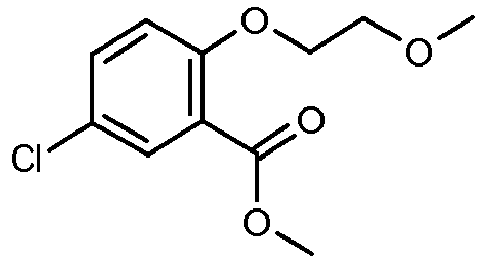
- In 5 ml of anhydrous DMF, are added under argon 500 mg (2.7 mmol) of methyl 5-chloro-2-hydroxybenzoate, 277 µl (2.9 mmol) of 2-bromoethyl methyl ether and 1.3 g (4 mmol) of cesium carbonate. The mixture is stirred at ambient temperature overnight. The mixture is then diluted with diethyl ether, filtered on Celite and the Celite is washed several times with diethyl ether. The combined filtrates are evaporated under reduced pressure to give 580 mg of a yellow oil which crystallizes at ambient temperature. Crude product is used in the next step without further purification.
- Yield: 88%.
- 1H NMR (DMSO-d6, 300 MHz): δ 7.67 (d, J=2.7Hz, 1H); 7.56 (dd, J=2.7 and 8.9Hz, 1H); 7.67 (d, J=8.9Hz, 1H); 4.17 (t, J=4.5Hz, 2H); 3.79 (s, 3H); 3.65 (t, J=4.6Hz, 2H); 3.31 (s, 3H).
-

- 580 mg (2.37 mmol) of methyl 5-chloro-2-(2-methoxyethoxy)benzoate (described in the previous step) are added slowly to a solution of 90 mg (2.37 mmol) of lithium aluminum hydride in 7 ml of anhydrous THF at 0°C. The solution is stirred at 0°C for 30 minutes under argon and the temperature is allowed to reach ambient temperature overnight. The solution is cooled to 0°C and water is slowly added. The layer is then extracted 3 times with ethyl acetate, dried over sodium sulfate, filtered and evaporated under reduced pressure. 510 mg of a colorless oil are obtained. Crude product is used in the next step without purification.
- Yield: 99%.
- MH+: 199.1; 201.1 (-H2O).
- 1H NMR (DMSO-d6, 300 MHz): δ 7.35 (d, J=2.6Hz, 1H); 7.22 (dd, J=2.7 and 8.7Hz, 1H); 6.97 (d, J=8.7Hz, 1H); 5.17 (t, J=5.7Hz, 1H); 4.47 (d, J=5.7Hz, 2H); 4.09 (t, J=4.5Hz, 2H); 3.64 (t, J=4.6Hz, 2H); 3.31 (s, 3H).
-

- 510 mg (2.35 mmol) of (5-chloro-2-(2-methoxyethoxy)phenyl)methanol (described in the previous step) and 351 µl (3.5 mmol) of phosphorus tribromide are dissolved in 10 ml of anhydrous THF under argon, and the mixture is stirred at ambient temperature overnight. Then the solution is diluted with ethyl acetate. The organic layer is washed 3 times with water, dried over sodium sulfate, filtered and evaporated under reduced pressure. Crude product is purified by flash chromatography on a 30 g silica gel column with an ethyl acetate/hexane mixture as eluent. 528 mg of a colorless oil which crystallizes at ambient temperature, are obtained.
- Yield: 80%.
- MH+: 280.1; 282.1.
- 1H NMR (DMSO-d6, 300 MHz): δ 7.50 (d, J=2.6Hz, 1H); 7.36 (dd, J=2.6 and 8.8Hz, 1H); 7.08 (d, J=8.9Hz, 1H); 4.61 (s, 2H); 4.19 (t, J=4.4Hz, 2H); 3.70 (t, J=4.5Hz, 2H); 3.34 (s, 3H).
-

- The compound is obtained by the procedure described in example 25 step 1, using 50 mg (0.23 mmol) of 4-(4,4,5,5-tetramethyl-[1,3,2]dioxaborolan-2-yl)-1H-pyridin-2-one, 110 mg (0.34 mmol) of cesium carbonate and 70 mg (0.25 mmol) of 2-(bromomethyl)-4-chloro-1-(2-methoxyethoxy)benzene (described in the previous step) instead of benzyl bromide. 55 mg of the title compound are obtained.
- Yield: 72%.
- MH+: 338.0; 340.0.
-

- The compound is obtained by the procedure described in example 25 step 2, using 20 mg (0.041 mmol) of 3-iodo-5-morpholin-1-yl-1-tosyl-1H-pyrrolo[2,3-b]pyridine and 16 mg (0.046 mmol) of 1-(5-chloro-2-(2-methoxyethoxy)benzyl)-2-oxo-1,2-dihydropyridin-4-ylboronic acid (described in the previous step) instead of 1-benzyl-2-oxo-1,2-dihydropyridin-4-ylboronic acid. 14 mg of the title compound are obtained.
- Yield: 68%.
- MH+: 495.0; 497.0.
- 1H NMR (DMSO-d6, 300 MHz): δ 12.06 (br s, 1H); 8.17 (d, J=2.0Hz, 1H); 8.10 (s, 1H); 7.78-7.67 (m, 2H); 7.32 (dd, J=2.5 and 8.5Hz, 1H); 7.15-7.05 (m, 2H); 6.77-6.66 (m, 2H); 5.01 (s, 2H); 4.17 (t, J=3.9Hz, 2H); 3.86-3.75 (m, 4H); 3.74 (t, J=4.1Hz, 2H); 3.34 (s, 3H); 3.21-3.09 (m, 4H).
- Example 38: 1-(3-Chloro-5-(2-methoxyethoxy)benzyl)-4-(5-morpholino-1H-pyrrolo[2,3-b]pyridin-3-yl)pyridin-2(1H)-one
-

- The compound is obtained by the procedure described in example 37 step 1, using 500 mg (3.25 mmol) of 3-chloro-5-hydroxybenzonitrile instead of methyl 5-chloro-2-hydroxybenzoate, 337 µl (3.60 mmol) of 2-bromoethyl methyl ether and 1.6 g (4.9 mmol) of cesium carbonate. 663 mg of a yellow oil are obtained.
- Yield: 96%.
- 1H NMR (DMSO-d6, 300 MHz): δ 7.59-7.55 (m, 1H); 7.49-7.45 (m, 1H); 7.45-7.41 (m, 1H); 4.20 (t, J=4.3Hz, 2H); 3.65 (t, J=4.5Hz, 2H); 3.29 (s, 3H).
-
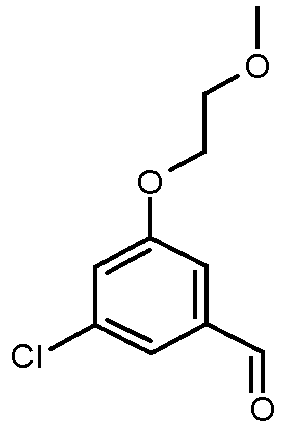
- The compound is obtained by the procedure described in example 36 step 1, using 663 mg (3.13 mmol) of 3-chloro-5-(2-methoxyethoxy)benzonitrile (described in the previous step) instead of 3-chloro-5-hydroxybenzonitrile, 664 mg (6.30 mmol) of sodium hypophosphite monohydrate and several drops of Raney nickel in water. 479 mg of a colorless oil are obtained.
- Yield: 99%.
- 1H NMR (DMSO-d6, 300 MHz): δ 9.94 (s, 1H); 7.55-7.49 (m, 1H); 7.46-7.41 (m, 1H); 7.41-7.36 (m, 1H); 4.22 (t, J=4.4Hz, 2H); 3.68 (t, J=4.5Hz, 2H); 3.31 (s, 3H).
-

- The compound is obtained by the procedure described in example 36 step 2, using 479 mg (2.22 mmol) of 3-chloro-5-(2-methoxyethoxy)benzaldehyde (described in the previous step) instead of 3-chloro-5-hydroxybenzaldehyde and 3.3 ml (3.3 mmol) of a solution of BH3 (1M in THF). 467 mg of a colorless oil are obtained.
- Yield: 96%.
- MH+: 217.2; 219.2.
- 1H NMR (DMSO-d6, 300 MHz): δ 6.96-6.90 (m, 1H); 6.90-6.81 (m, 2H); 5.31 (t, J=5.8Hz, 1H); 4.45 (d, J=5.7Hz, 2H); 4.10 (t, J=4.4Hz, 2H); 3.64 (t, J=4.6Hz, 2H); 3.30 (s, 3H).
-

- The compound is obtained by the procedure described in example 37 step 3, using 467 mg (2.16 mmol) of (3-chloro-5-(2-methoxyethoxy)phenyl)methanol (described in the previous step) instead of (5-chloro-2-(2-methoxyethoxy)phenyl)methanol and 303 µl (3.23 mmol) of phosphorus tribromide. 616 mg of a colorless oil are obtained.
- Yield: Quantitative.
-

- The compound is obtained by the procedure described in example 25 step 1, using 50 mg (0.23 mmol) of 4-(4,4,5,5-tetramethyl-[1,3,2]dioxaborolan-2-yl)-1H-pyridin-2-one, 110 mg (0.34 mmol) of cesium carbonate and 70 mg (0.25 mmol) of 1-(bromomethyl)-3-chloro-5-(2-methoxyethoxy)benzene (described in the previous step) instead of benzyl bromide. 45 mg of the title compound are obtained.
- Yield: 59%.
- MH+: 338.0; 340.0.
-

- The compound is obtained by the procedure described in example 25 step 2, using 20 mg (0.041 mmol) of 3-iodo-5-morpholin-1-yl-1-tosyl-1H-pyrrolo[2,3-b]pyridine and 16 mg (0.046 mmol) of 1-(3-chloro-5-(2-methoxyethoxy)benzyl)-2-oxo-1,2-dihydropyridin-4-ylboronic acid (described in the previous step) instead of 1-benzyl-2-oxo-1,2-dihydropyridin-4-ylboronic acid. 7 mg of the title compound are obtained.
- Yield: 34%.
- MH+: 495.0; 497.0.
- 1H NMR (DMSO-d6, 300 MHz): δ 12.05 (br s, 1H); 8.17 (d, J=2.3Hz, 1H); 8.09 (s, 1H); 7.77 (d, J=7.8Hz, 1H); 7.71 (d, J=2.4Hz, 1H);6.99-6.94 (m, 2H); 6.88 (s, 1H); 6.76-6.69 (m, 2H); 5.05 (s, 2H); 4.10 (t, J=4.3Hz, 2H); 3.83-3.73 (m, 4H); 3.61 (t, J=4.5Hz, 2H); 3.28 (s, 3H); 3.20-3.09 (m, 4H).
-

- The compound is obtained by the procedure described in example 25 step 1, using 50 mg (0.23 mmol) of 4-(4,4,5,5-tetramethyl-[1,3,2]dioxaborolan-2-yl)-1H-pyridin-2-one, 184 mg (0.57 mmol) of cesium carbonate and 65 mg (0.25 mmol) of 3-(bromomethyl)pyridine hydrobromide instead of benzyl bromide. 11 mg of the title compound are obtained.
- Yield: 21%.
- MH+: 231.1.
-

- The compound is obtained by the procedure described in example 25 step 2, using 20 mg (0.041 mmol) of 3-iodo-5-morpholin-1-yl-1-tosyl-1H-pyrrolo[2,3-b]pyridine and 11 mg (0.048 mmol) of 2-oxo-1-(pyridin-3-ylmethyl)-1,2-dihydropyridin-4-ylboronic acid (described in the previous step) instead of 1-benzyl-2-oxo-1,2-dihydropyridin-4-ylboronic acid. 5.3 mg of the title compound are obtained.
- Yield: 33%.
- MH+: 388.0.
- 1H NMR (DMSO-d6, 300 MHz): δ 12.05 (br s, 1H); 8.61 (d, J=1.4Hz, 1H); 8.50 (dd, J=1.4 and 4.8Hz, 1H); 8.16 (d, J=2.3Hz, 1H); 8.08 (s, 1H); 7.84 (d, J=7.0Hz, 1H); 7.78-7.66 (m, 2H); 7.39 (dd, J=4.9 and 7.3Hz, 1H); 6.76-6.68 (m, 2H); 5.13 (s, 2H); 3.84-3.72 (m, 4H); 3.20-3.06 (m, 4H).
-

- The compound is obtained by the procedure described in example 25 step 1, using 50 mg (0.23 mmol) of 4-(4,4,5,5-tetramethyl-[1,3,2]dioxaborolan-2-yl)-1H-pyridin-2-one, 110 mg (0.34 mmol) of cesium carbonate and 40 mg (0.25 mmol) of 2-chloro-5-chloromethylpyridine instead of benzyl bromide. 16 mg of the title compound are obtained.
- Yield: 27%.
- MH+: 265.1; 267.1.
-

- The compound is obtained by the procedure described in example 25 step 2, using 20 mg (0.041 mmol) of 3-iodo-5-morpholin-1-yl-1-tosyl-1H-pyrrolo[2,3-b]pyridine and 12 mg (0.045mmol) of 1-((6-chloropyridin-3-yl)methyl)-2-oxo-1,2-dihydropyridin-4-ylboronic acid (described in the previous step) instead of 1-benzyl-2-oxo-1,2-dihydropyridin-4-ylboronic acid. 3.4 mg of the title compound are obtained.
- Yield: 20%.
- MH+: 421.9; 424.0.
- 1H NMR (DMSO-d6, 300 MHz): δ 12.07 (br s, 1H); 8.46 (d, J=1.9Hz, 1H); 8.16 (d, J=2.3Hz, 1H); 8.09 (s, 1H); 7.88-7.78 (m, 2H); 7.70 (d, J=2.6Hz, 1H); 7.52 (d, J=8.1Hz, 1H); 6.78-6.68 (m, 2H); 5.12 (s, 2H); 3.83-3.73 (m, 4H); 3.18-3.08 (m, 4H).
-

- The compound is obtained by the procedure described in example 25 step 1, using 50 mg (0.23 mmol) of 4-(4,4,5,5-tetramethyl-[1,3,2]dioxaborolan-2-yl)-1H-pyridin-2-one, 110 mg (0.34 mmol) of cesium carbonate and 30 µl (0.25 mmol) of 2-chloro-6-(chloromethyl)pyridine instead of benzyl bromide. 15 mg of the title compound are obtained.
- Yield: 25%.
- MH+: 265.1; 267.1.
-

- The compound is obtained by the procedure described in example 25 step 2, using 20 mg (0.041 mmol) of 3-iodo-5-morpholin-1-yl-1-tosyl-1H-pyrrolo[2,3-b]pyridine and 12 mg (0.045 mmol) of 1-((6-chloropyridin-2-yl)methyl)-2-oxo-1,2-dihydropyridin-4-ylboronic acid (described in the previous step) instead of 1-benzyl-2-oxo-1,2-dihydropyridin-4-ylboronic acid. 6.3 mg of the title compound are obtained.
- Yield: 36%.
- MH+: 421.9; 423.9.
- 1H NMR (DMSO-d6, 300 MHz): δ 12.07 (br s, 1H); 8.17 (d, J=2.2Hz, 1H); 8.12 (s, 1H); 7.87 (t, J=7.7Hz, 1H); 7.77 (d, J=7.0Hz, 1H); 7.72 (d, J=2.4Hz, 1H); 7.43 (d, J=7.9Hz, 1H); 7.22 (d, J=7.7Hz, 1H); 6.77 (dd, J=1.4 and 6.0Hz, 1H); 6.71 (d, J=1.5Hz, 1H); 5.17 (s, 2H); 3.83-3.73 (m, 4H); 3.20-3.10 (m, 4H).
-

- To a solution of 200 mg (1.15 mmol) of 4-bromopyridin-2(1H)-one and 561 mg (1.73 mmol) of cesium carbonate in 2 ml of anhydrous DMF, are added 253 µl (1.26 mmol) of ethyl 2-bromo-2-(3-chlorophenyl)acetate at ambient temperature. The reaction is stirred overnight under argon. Reaction mixture is then diluted with ethyl acetate, and the precipitate is filtered and rinsed with a small amount of ethyl acetate. The combined filtrates are concentrated under vacuum and directly purified by flash chromatography with a 30 g C18 column and a water/acetonitrile mixture as eluent. 238 mg of the title compound are obtained.
- Yield: 56%.
- MH+: 369.8; 371.8; 373.8.
-

- To a solution of 160 mg (0.43 mmol) of ethyl 2-(4-bromo-2-oxopyridin-1(2H)-yl)-2-(3-chlorophenyl)acetate (described in the previous step) in 5 ml of ethanol at 0°C, are added 16 mg (0.43 mmol) of sodium borohydride. The reaction is stirred for 1 hour at 0°C. Reaction mixture is then diluted with dichloromethane, washed 3 times with water, dried over sodium sulfate, filtered and evaporated under reduced pressure. Crude product is purified by flash chromatography on a 10 g silica gel column with a dichloromethane/methanol mixture as eluent. 37 mg of the title compound are obtained.
- Yield: 26%.
- MH+: 327.9; 329.8; 331.8.
-

- Yield: 47%.
- MH+: 294.0; 296.0 (Boronic acid derivative).
-

- The compound is obtained by the procedure described in example 25 step 2, using 20 mg (0.041 mmol) of 3-iodo-5-morpholin-1-yl-1-tosyl-1H-pyrrolo[2,3-b]pyridine and 13 mg (0.044mmol) of 1-(1-(3-chlorophenyl)-2-hydroxyethyl)-4-(4,4,5,5-tetramethyl-1,3,2-dioxaborolan-2-yl)pyridin-2(1H)-one (described in the previous step) instead of 1-benzyl-2-oxo-1,2-dihydropyridin-4-ylboronic acid. 3.2 mg of the title compound are obtained.
- Yield: 16%.
- MH+: 451.0; 453.1.
- 1H NMR (DMSO-d6, 300 MHz): δ 12.08 (br s, 1H); 8.17 (d, J=2.1Hz, 1H); 8.08 (s, 1H); 7.7-7.67 (m, 2H); 7.47-7.26 (m, 4H); 6.75-6.67 (m, 2H); 6.00 (br t, 1H); 5.39-5.19 (m, 1H); 4.23-3.97 (m, 2H); 3.86-3.73 (m, 4H); 3.21-3.08 (m, 4H).
-

- The compound is obtained by the procedure described in example 25 step 1, using 80 mg (0.36 mmol) of 4-(4,4,5,5-tetramethyl-[1,3,2]dioxaborolan-2-yl)-1H-pyridin-2-one, 176 mg (0.54 mmol) of cesium carbonate and 80 µl (0.40 mmol) of ethyl 2-bromo-2-(3-chlorophenyl)acetate instead of benzyl bromide. 36 mg of the title compound are obtained.
- Yield: 30%.
- MH+: 336.0; 337.9.
-

- 20 mg (0.041 mmol) of 3-iodo-5-morpholin-1-yl-1-tosyl-1H-pyrrolo[2,3-b]pyridine (described in example 17 step 3) and 16 mg (0.048 mmol) of 1-(1-(3-chlorophenyl)-2-ethoxy-2-oxoethyl)-2-oxo-1,2-dihydropyridin-4-ylboronic acid (described in the previous step) are dissolved in a mixture of 3 ml of acetonitrile and 1.5 ml of an aqueous 2M solution of Na2CO3. Argon is bubbled through the solution for 10 minutes, then 2 mg of PdCl2(PPh3)2 are added under argon. Argon is bubbled for another 10 minutes and the reaction is stirred at 70°C for 1 hour. The reaction mixture is transferred in a microwave sealed tube and the reaction is heated at 150°C under microwave irradiation for 15 minutes. After cooling, the solution is concentrated under reduced pressure, diluted with water and acidified to pH 2-3 with HCl 2N. Aqueous layer is extracted 3 times with ethyl acetate, dried over sodium sulfate, filtered and evaporated under reduced pressure. 11 mg of the title compound are obtained.
- Yield: 55%.
- MH+: 464.9; 466.9.
- Example 44: 1-(2-(3-Chlorophenyl)-2-hydroxyethyl)-4-(5-morpholino-1H-pyrrolo[2,3-b]pyridin-3-yl)pyridin-2(1H)-one
-

- The compound is obtained by the procedure described in example 25 step 1, using 50 mg (0.23 mmol) of 4-(4,4,5,5-tetramethyl-[1,3,2]dioxaborolan-2-yl)-1H-pyridin-2-one, 110 mg (0.34 mmol) of cesium carbonate and 38 mg (0.25 mmol) of 2-(3-chlorophenyl)-oxirane instead of benzyl bromide. 30 mg of the title compound are obtained.
- Yield: 45%.
- MH+: 294.1; 296.0.
-

- The compound is obtained by the procedure described in example 25 step 2, using 20 mg (0.041 mmol) of 3-iodo-5-morpholin-1-yl-1-tosyl-1H-pyrrolo[2,3-b]pyridine and 13 mg (0.044mmol) of 1-(2-(3-chlorophenyl)-2-hydroxyethyl)-2-oxo-1,2-dihydropyridin-4-ylboronic acid (described in the previous step) instead of 1-benzyl-2-oxo-1,2-dihydropyridin-4-ylboronic acid. 3.9 mg of the title compound are obtained.
- Yield: 22%.
- MH+: 450.9; 452.9.
- 1H NMR (DMSO-d6, 300 MHz): δ 12.04 (br s, 1H); 8.17 (d, J=2.2Hz, 1H); 8.07 (s, 1H); 7.71 (d, J=2.3Hz, 1H); 7.51 (d, J=7.2Hz, 1H); 7.45 (s, 1H); 7.42-7.30 (m, 3H); 6.70 (s, 1H); 6.64 (dd, J=1.6 and 5.5Hz, 1H); 5.85 (br s, 1H); 4.97-4.86 (m, 1H); 4.19 (dd, J=3.6 and 13.0Hz, 1H); 3.89-3.73 (m, 5H); 3.20-3.08 (m, 4H).
- The following table illustrates the chemical structures of the compounds according to the invention:
N° Structures 1 
2 
3 
4 
5 
6 
7 
8 
9 
10 
11 
12 
13 
14 
15 
16 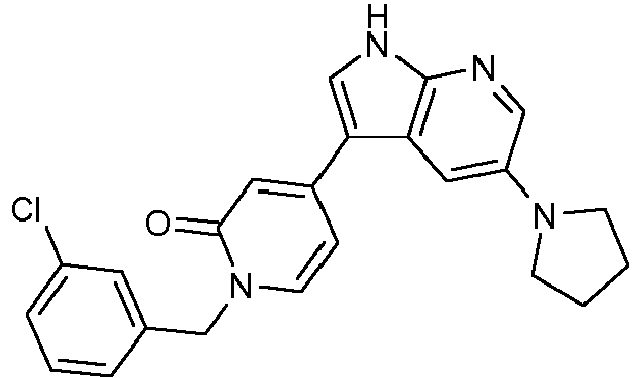
17 
18 
19 
20 
100 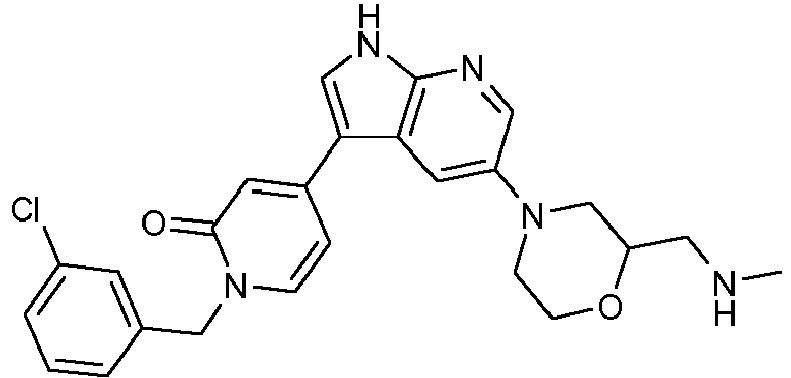
101 
102 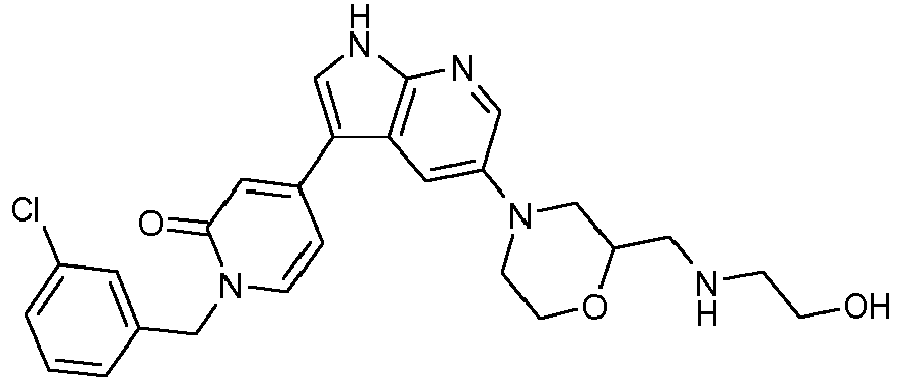
103 
104 
105 
106 
107 
108 
109 
21 
22 
23 
24 
25 
26 
27 
28 
29 
30 
31 
32 
33 
34 
35 
36 
37 
38 
39 
40 
41 
201 
202 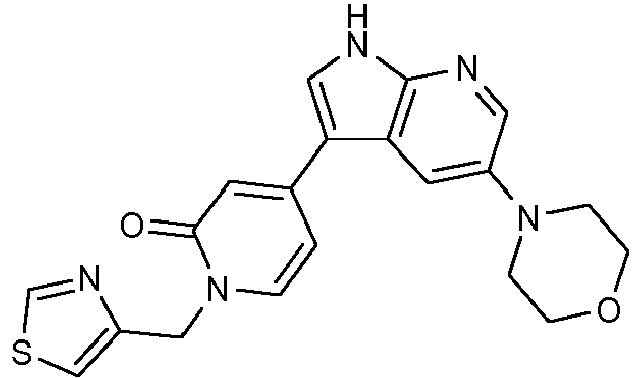
203 
204 
205 
206 
207 
208 
209 
42 
43 
44 
301 
302 
303 
304 
305 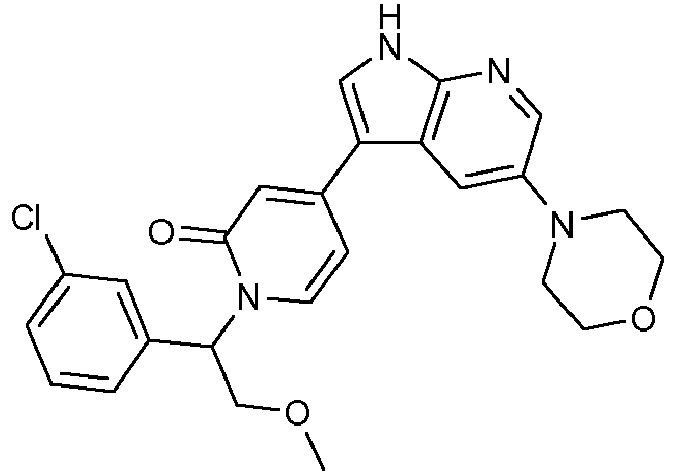
306 
- To assess compounds capacity to inhibit ERK2 enzymatic activity, Z'-Lyte biochemical assay from Life technologies was used according to manufacturer's instructions. Briefly, black 384-well plates containing 100 nl of 100X compound solution in 100% DMSO, 2.4 µl kinase buffer, 5 µl 2X MAPK1 (ERK2) / Ser/Thr 03 mixture and 2.5 µl 4X ATP solution were used. Plates were shaken for 30 seconds and incubated for 60 minutes at room temperature. Then, 5 µl of a 1:1024 dilution of Development Reagent A was added. Plates were shaken for 30 seconds and incubated for 60 minutes at room temperature. A plate reader was used to read fluorescence. In this assay, ERK2 enzyme was used at a concentration of 0.4 µg/ml (5.74 nM) at ATP Km (100 µM). Kinase buffer consisted of 50 mM HEPES pH 7.5, 0.01% BRIJ-35, 10 mM MgCl2, 1 mM EGTA. Compounds IC50 were determined with a 3-fold serial dilution (10 point titrations in duplicate).
- ERK2 inhibitory activity of selected compounds ("ERK2 IC50") is reported in table 2 as followed:
- All tested compounds exhibit a capacity to inhibit ERK2 enzymatic activity.
- In particular, compounds having an activity designated as "A" provided an IC50 value < 10 nM. Compounds having an activity designated as "B" provided an IC50 value between 10 nM and 25 nM. Compounds having an activity designated as "C" provided an IC50 value between 25 nM and 50 nM. Compounds having an activity designated as "D" provided an IC50 value between 50 nM and 100 nM. Compounds having an activity designated as "E" provided an IC50 value > 100 nM.
- A cell line assay was used to determine compounds capacity to inhibit cell proliferation. A375 cells (malignant melanoma) were grown to near 80% confluence and seeded at 4000 cells per 100 µl per well in DMEM with 10% FBS in 96-well flat bottom plates. Cells were incubated for 24 hours at 37°C under 5% CO2. 100 µl compound solutions were added to cells and incubated for 72 hours at 37°C. Total volume of media was 200 µl per well. Compounds were screened in 0.15% DMSO (final) using 6 point titrations in duplicate. Negative control wells consisted of vehicle only (0.15% DMSO in 10% FBS DMEM). After 72 hours of compound treatment, SDS 1% (final) was added to positive control wells for 15 minutes at 37°C. Then, medium was discarded and replaced by 100 µl per well of a MTT solution (3-[4.5-dimethylthiazol-2-yl]-2.5-diphenyltetrazolium bromide) (Sigma, Cat#M5655) at 0.5 mg/ml in 10% FBS DMEM. Cells were incubated for 4 hours at 37°C. MTT reaction was stopped and homogenized by the addition of 100 µl per well of SDS 10% 0.01M HCl. After 2 hours at 37°C, absorbance was measured at 570 nm in a Bio-Tek plate reader (PowerWave HT). Percent of proliferation inhibition was calculated using negative controls (0.15% DMSO) as 0% growth inhibition and positive controls (1% SDS) as 100% growth inhibition. IC50 values (concentration inducing a half-maximal growth inhibition) were determined by non-linear regression analysis of the inhibition curve generated by mean replicate values (using a sigmoid dose-response with variable Hill Slope and constraining the top to a constant value of 100 and the bottom to a value between 0 and 50). Analysis was performed using GraphPad Prism software.
- Cell proliferation inhibitory activity of selected compounds ("A375 IC50") is reported in table 2 as followed:
- Compounds having an activity designated as "A"' provided an IC50 value < 150 nM. Compounds having an activity designated as "B"' provided an IC50 value between 150 nM and 300 nM. Compounds having an activity designated as "C"' provided an IC50 value between 300 nM and 500 nM. Compounds having an activity designated as "D"' provided an IC50 value between 500 nM and 1000 nM. Compounds having an activity designated as "E"' provided an IC50 value > 1000 nM.
| N° | Chemical structure | ERK2 IC50 | A375 IC50 |
| 1 |  | B' | |
| 2 |  | A | B' |
| 3 |  | C' | |
| 4 |  | B' | |
| 5 |  | B | D' |
| 6 |  | C | E' |
| 7 |  | A | B' |
| 8 |  | A | C' |
| 9 |  | E' | |
| 10 | 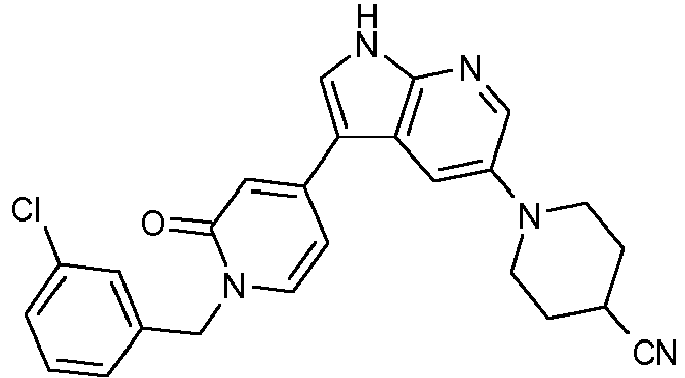 | E' | |
| 11 |  | E' | |
| 12 |  | E' | |
| 13 |  | E' | |
| 14 |  | E' | |
| 15 |  | D | E' |
| 16 |  | E' | |
| 17 |  | A | A' |
| 18 | 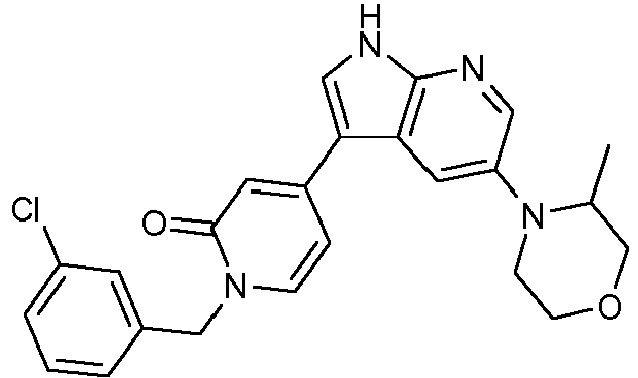 | D' | |
| 19 |  | A | D' |
| 20 |  | A | E' |
| 21 | 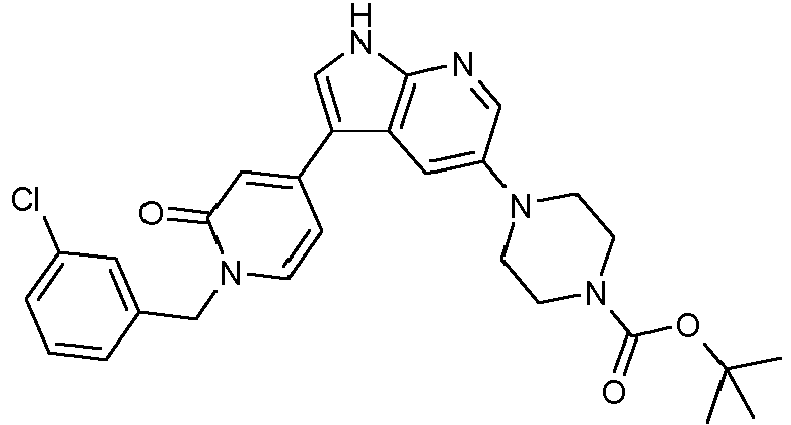 | E' | |
| 22 |  | D | E' |
| 23 |  | E' | |
| 24 |  | E' | |
| 25 |  | A | C' |
| 26 |  | A | B' |
| 27 |  | A | A' |
| 28 | 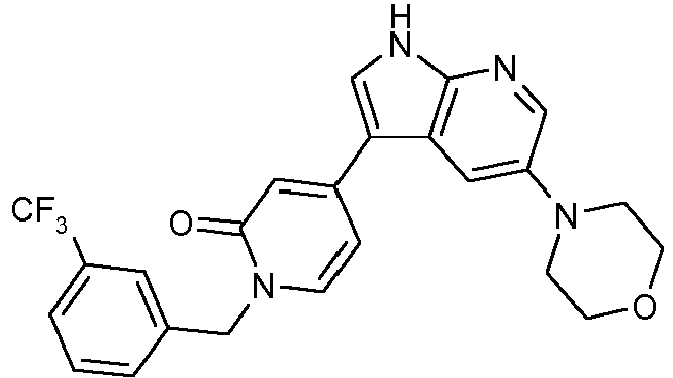 | A | A' |
| 29 |  | A | D' |
| 30 |  | A | A' |
| 31 |  | A | A' |
| 32 |  | A' | |
| 33 | 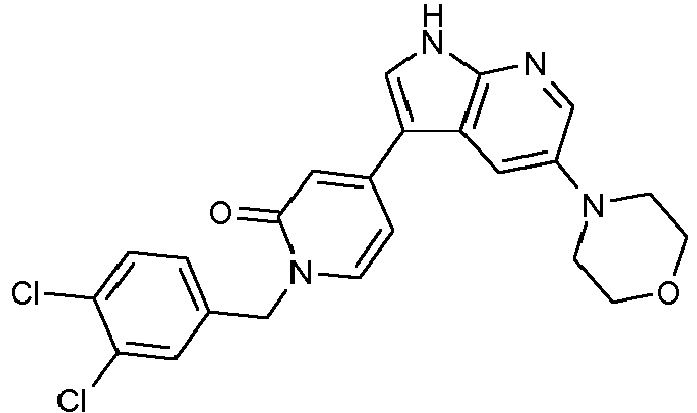 | A | A' |
| 34 |  | A | B' |
| 35 |  | C' | |
| 36 |  | D' | |
| 37 |  | B' | |
| 38 |  | A' | |
| 39 |  | E' | |
| 40 |  | E' | |
| 41 |  | A | B' |
| 42 |  | A | C' |
| 43 |  | E | E' |
| 44 |  | C' | |
| 45 |  | A | D' |
| 46 |  | A | C' |
Claims (17)
- Compound of formula (I):
 - A represents a 6- to 10-membered aryl group; a 5- to 12-membered heteroaryl group or a 5- to 12-membered heterocyclic group, A being optionally substituted with one or more substituents chosen among halogen atoms, hydroxyl, (C1-C6)alkyl, cyano, carbonyl; tert-butyloxycarbonyl, 1,3-dioxolanyl, 1,4-dioxolanyl, (C1-C6)alkoxy, -COOR1,-CONR1R2 and NR1R2,
with said (C1-C6)alkyl being itself optionally substituted with a hydroxyl, NR1R2, (C1-C6)alkoxy, or -S(C1-C6)alkyl group, and
said 5- to 12-membered heterocyclic group optionally comprising two fused cycles wherein the two cycles share at least two atoms;- L represents a linker chosen among linear or branched (C1-C6)alkylene group, said alkylene group being optionally substituted with at least one halogen, hydroxyl, (C1-C6)alkoxy, -COOR1 or NR1R2 groups;- B represents a 6- to 10-membered aryl or a 5- to 12-membered heteroaryl group with B being optionally substituted with one or more substituents chosen among halogen atoms, trifluoromethyl, hydroxyl, (C1-C6)alkyl, (C1-C6)alkoxy, -CONR1R2, NR1R2, hydroxy(C1-C6)alkyl, (C1-C6)alkoxy(C1-C6)alkoxy and (C1-C6)alkyl NR1R2 groups;
with two adjacent carbon atoms of said 6- to 10-membered aryl group being optionally substituted by two oxygen atoms linked together by a (C1-C6)alkylene group,- R1 and R2 represent, independently of each other, a hydrogen atom, a (C1-C6)alkyl group, a (C1-C6)alkoxy group, a hydroxy(C1-C6)alkyl group or a hydroxy(C1-C6)alkoxy group,
or one of its pharmaceutically acceptable salts. - Compound according to claim 1, wherein L represents a linker chosen among linear or branched (C1-C6)alkylene-, preferably(C1-C3)alkylene- said alkylene group being optionally substituted with one hydroxyl group or one fluorine atom.
- Compound according to claim 1 or 2, wherein B represents a 6- to 10-membered aryl group, preferably a phenyl group, optionally substituted with one or two substituents chosen among halogen atoms, trifluoromethyl, hydroxyl, (C1-C6)alkyl, and (C1-C6)alkoxy groups.
- Compound according to anyone of the preceding claims, wherein B is a phenyl group substituted by one or two chloride atoms.
- Compound according to anyone of the preceding claims, wherein A is a 5-or 6-membered heterocyclic group optionally substituted with one or more substituents chosen among hydroxyl, (C1-C6)alkyl, cyano, carbonyl, tert-butyloxycarbonyl, 1,3-dioxolanyl, 1,4-dioxolanyl, (C1-C6)alkoxy, -COOR1, -CONR1R2 and NR1R2, said alkyl group being optionally substituted with a hydroxyl, NR1R2, (C1-C6)alkoxy or -S(C1-C6)alkyl group.
- Compound according to anyone of the preceding claims wherein A is a morpholinyl or a 2-oxa-6-azaspiro[3.3]heptanyl group optionally substituted with one or two substituents chosen among hydroxyl, (C1-C6)alkyl, cyano, carbonyl, tert-butyloxycarbonyl, 1,3-dioxolanyl, 1,4-dioxolanyl, (C1-C6)alkoxy, -COOR1, -CONR1R2, NR1R2, said alkyl group being optionally substituted with at least one hydroxyl, NR1R2, or (C1-C6)alkoxy groups or A being a morpholinyl group fused with an oxetanyl or oxolanyl group.
- Compound according to claim 1, chosen among:1: 1-(3-Chlorobenzyl)-4-[5-(4-fluorophenyl)-1H-pyrrolo[2,3-b]pyridin-3-yl]-1H-pyridin-2-one;2: 1-(3-Chlorobenzyl)-4-[5-(4-hydroxymethylphenyl)-1H-pyrrolo[2,3-b]pyridin-3-yl]-1H-pyridin-2-one;3: 4-{3-[1-(3-Chlorobenzyl)-2-oxo-1,2-dihydropyridin-4-yl]-1H-pyrrolo[2,3-b]pyridin-5-yl}-N-methylbenzamide;4: 1-(3-Chlorobenzyl)-4-[5-(6-fluoropyridin-3-yl)-1H-pyrrolo[2,3-b]pyridin-3-yl]-1H-pyridin-2-one;5: 1-(3-Chlorobenzyl)-4-(5-thiophen-3-yl-1H-pyrrolo[2,3-b]pyridin-3-yl)-1H-pyridin-2-one;6: 1-(3-Chlorobenzyl)-4-[5-(5-chlorothiophen-2-yl)-1H-pyrrolo[2,3-b]pyridin-3-yl]-1H-pyridin-2-one;7: 1-(3-Chlorobenzyl)-4-[5-(1H-pyrazol-4-yl)-1H-pyrrolo[2,3-b]pyridin-3-yl]-1H-pyridin-2-one;8: 1-(3-Chlorobenzyl)-4-[5-(5-methyl-1H-pyrazol-4-yl)-1H-pyrrolo[2,3-b]pyridin-3-yl]-1H-pyridin-2-one;9: 1-(3-Chlorobenzyl)-4-(5-piperidin-1-yl-1H-pyrrolo[2,3-b]pyridin-3-yl)-1H-pyridin-2-one;10: 1-(3-Chlorobenzyl)-4-(5-(4-cyanopiperidin-1-yl)-1H-pyrrolo[2,3-b]pyridin-3-yl)-1H-pyridin-2-one;11: 1-(3-Chlorobenzyl)-4-[5-(4-hydroxymethylpiperidin-1-yl)-1H-pyrrolo[2,3-b]pyridin-3-yl]-1H-pyridin-2-one;12: 1-(3-Chlorobenzyl)-4-[5-(1,4-dioxa-8-azaspiro[4.5]dec-8-yl)-1H-pyrrolo[2,3-]pyridin-3-yl]-1H-pyridin-2-one;13: 1-(3-Chlorobenzyl)-4-[5-(4-oxopiperidin-1-yl)-1H-pyrrolo[2,3-b]pyridin-3-yl]-1H-pyridin-2-one;14: 1-(3-Chlorobenzyl)-4-[5-(4-hydroxypiperidin-1-yl)-1H-pyrrolo[2,3-b]pyridin-3-yl]-1H-pyridin-2-one;15: 1-(3-Chlorobenzyl)-4-[5-(4-methoxyaminopiperidin-1-yl)-1H-pyrrolo[2,3-b]pyridin-3-yl]-1H-pyridin-2-one;16: 1-(3-Chlorobenzyl)-4-(5-pyrrolidin-1-yl-1H-pyrrolo[2,3-b]pyridin-3-yl)-1H-pyridin-2-one17: 1-(3-Chlorobenzyl)-4-(5-morpholin-4-yl-1H-pyrrolo[2,3-b]pyridin-3-yl)-1H-pyridin-2-one18: 1-(3-Chlorobenzyl)-4-[5-(3-methylmorpholin-4-yl)-1H-pyrrolo[2,3-b]pyridin-3-yl]-1H-pyridin-2-one;19: 1-(3-Chlorobenzyl)-4-[5-(2-methylmorpholin-4-yl)-1H-pyrrolo[2,3-b]pyridin-3-yl]-1H-pyridin-2-one;20: 4-(3-(1-(3-Chlorobenzyl)-2-oxo-1,2-dihydropyridin-4-yl)-1H-pyrrolo[2,3-b]pyridin-5-yl)-N-methylmorpholine-2-carboxamide;21: Tert-butyl 4-(3-(1-(3-chlorobenzyl)-2-oxo-1,2-dihydropyridin-4-yl)-1H-pyrrolo[2,3-b]pyridin-5-yl)piperazine-1-carboxylate;22: 1-(3-Chlorobenzyl)-4-(5-(piperazin-1-yl)-1H-pyrrolo[2,3-b]pyridin-3-yl)pyridin-2(1H)-one;23: 4-(3-(1-(3-Chlorobenzyl)-2-oxo-1,2-dihydropyridin-4-yl)-1H-pyrrolo[2,3-b]pyridin-5-yl)-N-ethylpiperazine-1-carboxamide;24: 4-(3-(1-(3-Chlorobenzyl)-2-oxo-1,2-dihydropyridin-4-yl)-1H-pyrrolo[2,3-b]pyridin-5-yl)-N-(2-hydroxyethyl)piperazine-1-carboxamide;25: 1-Benzyl-4-(5-morpholino-1H-pyrrolo[2,3-b]pyridin-3-yl)pyridin-2(1H)-one26: 1-(4-Bromobenzyl)-4-(5-morpholino-1H-pyrrolo[2,3-b]pyridin-3-yl)pyridin-2(1H)-one;27: 1-(3-Iodobenzyl)-4-(5-morpholino-1H-pyrrolo[2,3-b]pyridin-3-yl)pyridin-2(1H)-one;28: 4-(5-Morpholino-1H-pyrrolo[2,3-b]pyridin-3-yl)-1-(3-(trifluoromethyl)benzyl)pyridin-2(1H)-one;29: 1-(3-Methoxybenzyl)-4-(5-morpholino-1H-pyrrolo[2,3-b]pyridin-3-yl)pyridin-2(1H)-one;30: 1-(4-Chloro-3-fluorobenzyl)-4-(5-morpholino-1H-pyrrolo[2,3-b]pyridin-3-yl)pyridin-2(1H)-one;31: 1-(3-Chloro-4-fluorobenzyl)-4-(5-morpholino-1H-pyrrolo[2,3-b]pyridin-3-yl)pyridin-2(1H)-one;32: 1-(3-Chloro-2-fluorobenzyl)-4-(5-morpholino-1H-pyrrolo[2,3-b]pyridin-3-yl)pyridin-2(1H)-one;33: 1-(3,4-Dichlorobenzyl)-4-(5-morpholino-1H-pyrrolo[2,3-b]pyridin-3-yl)pyridin-2(1H)-one;34: 1-(2,4-Dichlorobenzyl)-4-(5-morpholino-1H-pyrrolo[2,3-b]pyridin-3-yl)pyridin-2(1H)-one;35: 1-(5-Chloro-2-hydroxybenzyl)-4-(5-morpholino-1H-pyrrolo[2,3-b]pyridin-3-yl)pyridin-2(1H)-one;36: 1-(5-Chloro-3-hydroxybenzyl)-4-(5-morpholino-1H-pyrrolo[2,3-b]pyridin-3-yl)pyridin-2(1H)-one;37: 1-(5-Chloro-2-(2-methoxyethoxy)benzyl)-4-(5-morpholino-1H-pyrrolo[2,3-b]pyridin-3-yl)pyridin-2(1H)-one;38: 1-(3-Chloro-5-(2-methoxyethoxy)benzyl)-4-(5-morpholino-1H-pyrrolo[2,3-b]pyridin-3-yl)pyridin-2(1H)-one;39: 4-(5-Morpholino-1H-pyrrolo[2,3-b]pyridin-3-yl)-1-(pyridin-3-ylmethyl)pyridin-2(1H)-one;40: 1-((6-Chloropyridin-3-yl)methyl)-4-(5-morpholino-1H-pyrrolo[2,3-b]pyridin-3-yl)pyridin-2(1H)-one;41: 1-((6-Chloropyridin-2-yl)methyl)-4-(5-morpholino-1H-pyrrolo[2,3-b]pyridin-3-yl)pyridin-2(1H)-one;42: 1-(1-(3-Chlorophenyl)-2-hydroxyethyl)-4-(5-morpholino-1H-pyrrolo[2,3-b]pyridin-3-yl)pyridin-2(1H)-one;43: 2-(3-Chlorophenyl)-2-(4-(5-morpholino-1H-pyrrolo[2,3-b]pyridin-3-yl)-2-oxopyridin-1(2H)-yl)acetic acid;44: 1-(2-(3-Chlorophenyl)-2-hydroxyethyl)-4-(5-morpholino-1H-pyrrolo[2,3-b]pyridin-3-yl)pyridin-2(1H)-one or one of their pharmaceutically acceptable salts.
- Process for preparing a compound of general formula (I) according to anyone of claims 1 to 7 wherein A represents a 6- to 10-membered aryl or a 5- to 12-membered heteroaryl group, said aryl or heteroaryl being substituted or non-substituted as defined in claim 1, wherein the following steps are carried out in that order, starting from a 5-bromo-7-azaindole:a) Iodinating said 5-bromo-7-azaindole for obtaining a 5-bromo-3-iodo-7-azaindole,b) protecting the nitrogen atom of the pyrrolyl moiety of the azaindole,c) carring out a first Suzuki coupling reaction of the compound obtained at step b) with a 2-oxo-1,2-dihydropyridin-4-ylboronic acid or ester derivative at a temperature within the range from 50 to 100°C preferably from 70°C to 80°C;d) carring out a second Suzuki coupling reaction of the compound obtained at step c) with an aryl or heteroarylboronic acid under microwave irradiation at a temperature within the range from 120 to 180°C, preferably 150°C.
- Process for preparing a compound of general formula (I) according to anyone of claims 1 to 7 wherein A represents 5- or 6-membered heterocyclic group, substituted or non-substituted as defined in claim 1, wherein the following steps are carried out in that order, starting from a 5-bromo-7-azaindole:a) carring out a Buchwald-Hartwig coupling with a compound comprising a 5-or 6-membered heterocyclic group on said 5-bromo-7-azaindole for obtaining a 5-substitued 7-azaindole,b) iodinating the 5-substitued 7-azaindole for obtaining a -5-substitued-3-iodo 7-azaindole,c) protecting the nitrogen atom of the pyrrolyl moiety of the azaindole,d) carring out a Suzuki coupling reaction of the compound obtained at step c) with a 2-oxo-1,2-dihydropyridin-4-ylboronic acid or ester derivative at a temperature within the range from 50 to 100°C preferably from 70°C to 80°C,e) optionally performing a microwave irradiation at a temperature within the range from 120 to 180°C, preferably 150°C.
- Compound according to any one of claims 1 to 7, for use as inhibitors of the kinase ERK activity in particular ERK2 activity.
- Compound according to anyone of claims 1 to 7 for use for preventing and/or inhibiting and/or treating a disease or a condition mediated by kinases ERK activity, in particular by kinase ERK2 activity.
- Compound according to the preceding claim, wherein the disease or the condition is chosen among cancers and metastases.
- Compound according to claim 11 or 12 wherein the disease or the condition is chosen among glioblastomas, multiple myelomas, carcinomas, leukemia, in particular myeloid (AML), lymphocytic, myelocytic, myelogenous (CML) or lymphoblastic leukemias, myelodysplastic syndromes, Kaposi's sarcomas, cutaneous angiosarcomas, solid tumours, lymphomas, in particular non-hodgkin's lymphomas, melanomas, in particular malignant melanomas, bladder cancers, breast cancers, gastric cancers, colon cancers, colorectal cancers, endometrial cancers, lung cancers, including non-small-cell cancers, pancreatic cancers, prostate cancers, rectal cancers, kidney cancers, head and neck cancers, liver cancer, ovarian cancers, in particular serous ovarian cancers, seminoma cancers, cancers of the respiratory tract and chest, thyroid cancers, in particular papillary or follicular thyroid cancers, and other tumours expressing ERK.
- Compound according to the preceding claim, wherein the disease or the condition is chosen among a neoplastic disorder, an allergy disorder, an inflammatory disorder, an autoimmune disorder, a Plasmodium related disease, a mast cell associated disease, a graft- versus -host disease, a metabolic syndrome, a CNS related disorder, a neurodegenerative disorder, a pain condition, a substance abuse disorder, a prion disease, a heart disease, a fibrotic disease, idiopathic arterial hypertension (IPAH), and primary pulmonary hypertension (PPH).
- Compound according to claim 11, for use for preventing and/or inhibiting and/or treating the Human Immunodeficiency Virus (HIV).
- Medicament comprising at least one compound as defined in anyone of claims 1 to 7, or a pharmaceutically acceptable salt thereof.
- A pharmaceutical composition comprising at least one compound as defined in anyone of claims 1 to 7, or a pharmaceutically acceptable salt thereof, and at least one pharmaceutically acceptable excipient.
Priority Applications (5)
| Application Number | Priority Date | Filing Date | Title |
|---|---|---|---|
| EP15306835.8A EP3170822A1 (en) | 2015-11-18 | 2015-11-18 | Azaindole derivatives and their use as erk kinase inhibitors |
| EP16801735.8A EP3377491B1 (en) | 2015-11-18 | 2016-11-17 | Azaindole derivatives and their use as erk kinase inhibitors |
| US15/777,386 US10995089B2 (en) | 2015-11-18 | 2016-11-17 | Zaindole derivatives and their use as ERK kinase inhibitors |
| PCT/EP2016/078080 WO2017085230A1 (en) | 2015-11-18 | 2016-11-17 | Azaindole derivatives and their use as erk kinase inhibitors |
| US17/216,114 US11708364B2 (en) | 2015-11-18 | 2021-03-29 | Azaindole derivatives and their use as ERK kinase inhibitors |
Applications Claiming Priority (1)
| Application Number | Priority Date | Filing Date | Title |
|---|---|---|---|
| EP15306835.8A EP3170822A1 (en) | 2015-11-18 | 2015-11-18 | Azaindole derivatives and their use as erk kinase inhibitors |
Publications (1)
| Publication Number | Publication Date |
|---|---|
| EP3170822A1 true EP3170822A1 (en) | 2017-05-24 |
Family
ID=54705141
Family Applications (2)
| Application Number | Title | Priority Date | Filing Date |
|---|---|---|---|
| EP15306835.8A Withdrawn EP3170822A1 (en) | 2015-11-18 | 2015-11-18 | Azaindole derivatives and their use as erk kinase inhibitors |
| EP16801735.8A Active EP3377491B1 (en) | 2015-11-18 | 2016-11-17 | Azaindole derivatives and their use as erk kinase inhibitors |
Family Applications After (1)
| Application Number | Title | Priority Date | Filing Date |
|---|---|---|---|
| EP16801735.8A Active EP3377491B1 (en) | 2015-11-18 | 2016-11-17 | Azaindole derivatives and their use as erk kinase inhibitors |
Country Status (3)
| Country | Link |
|---|---|
| US (2) | US10995089B2 (en) |
| EP (2) | EP3170822A1 (en) |
| WO (1) | WO2017085230A1 (en) |
Cited By (5)
| Publication number | Priority date | Publication date | Assignee | Title |
|---|---|---|---|---|
| EP3880677A4 (en) * | 2018-11-16 | 2022-06-22 | California Institute of Technology | ERK INHIBITOR AND USES THEREOF |
| CN117126157A (en) * | 2023-08-28 | 2023-11-28 | 舞阳威森生物医药有限公司 | Preparation method of 5-hydroxy-7-azaindole |
| US11827637B2 (en) | 2022-01-14 | 2023-11-28 | Agv Discovery | Azaindole derivatives and their use as ERK kinase inhibitors |
| WO2025012357A1 (en) * | 2023-07-12 | 2025-01-16 | Ipsen Pharma | Fluorinated azaindole derivatives and their use as erk kinase inhibitors |
| WO2025012383A1 (en) * | 2023-07-12 | 2025-01-16 | Ipsen Pharma | Azaindole derivatives with a cyclo(hetero)aliphatic ring and their use as erk kinase inhibitors |
Families Citing this family (4)
| Publication number | Priority date | Publication date | Assignee | Title |
|---|---|---|---|---|
| EP3170822A1 (en) | 2015-11-18 | 2017-05-24 | AGV Discovery | Azaindole derivatives and their use as erk kinase inhibitors |
| CN118679163A (en) * | 2022-02-08 | 2024-09-20 | 上海奕拓医药科技有限责任公司 | Bicyclic heteroaryl compounds and uses thereof |
| KR20260036006A (en) | 2023-07-12 | 2026-03-13 | 에이지브이 디스커버리 | (S)-1-(1-(3-chlorophenyl)-2-(dimethylamino)ethyl)-4-(5-morpholino-1H-pyrrolo[2,3-B]pyridin-3-yl)pyridin-2(1H)-on salt, preparation thereof and use thereof as an ERK kinase inhibitor |
| EP4743460A1 (en) | 2023-07-12 | 2026-05-20 | Agv Discovery | Crystalline form of (S)-1-(1- (3-chlorophenyl)-2-(dimethylamino)ethyl)-4- (5-morpholino-1H-pyrrolol[2,3-Bpyridine-3-yl)pyridine-2(1H)-one, its manufacture and use as an ERK kinase inhibitor |
Citations (2)
| Publication number | Priority date | Publication date | Assignee | Title |
|---|---|---|---|---|
| WO2012094313A1 (en) * | 2011-01-04 | 2012-07-12 | Kinentia Biosciences Llc | Pyrazole derivatives as erk inhibitors |
| WO2014060395A1 (en) | 2012-10-16 | 2014-04-24 | F. Hoffmann-La Roche Ag | Serine/threonine kinase inhibitors |
Family Cites Families (12)
| Publication number | Priority date | Publication date | Assignee | Title |
|---|---|---|---|---|
| TWI339206B (en) | 2003-09-04 | 2011-03-21 | Vertex Pharma | Compositions useful as inhibitors of protein kinases |
| DK3305776T3 (en) | 2004-05-14 | 2019-12-09 | Vertex Pharma | PYRROL COMPOUNDS AS INHIBITORS OF ERK-PROTEIN KINASES AND PHARMACEUTICAL COMPOSITIONS CONTAINING THESE COMPOUNDS |
| US7361764B2 (en) | 2004-07-27 | 2008-04-22 | Sgx Pharmaceuticals, Inc. | Pyrrolo-pyridine kinase modulators |
| CN100396678C (en) | 2004-11-16 | 2008-06-25 | 财团法人工业技术研究院 | Synthesis and use of indole analogues of 1-benzyl-3- (5 '-hydroxymethyl-2' -furyl) indazole |
| EP2038272B8 (en) | 2006-06-30 | 2013-10-23 | Sunesis Pharmaceuticals, Inc. | Pyridinonyl pdk1 inhibitors |
| CA2658764A1 (en) | 2006-07-20 | 2008-01-24 | Mehmet Kahraman | Benzothiophene inhibitors of rho kinase |
| EP2102189B1 (en) | 2006-12-15 | 2015-07-29 | Bristol-Myers Squibb Company | Arylpropionamide, arylacrylamide, arylpropynamide, or arylmethylurea analogs as factor xia inhibitors |
| WO2013022766A1 (en) | 2011-08-05 | 2013-02-14 | Flynn Gary A | Preparation and methods of use for ortho-aryl 5- membered heteroaryl-carboxamide containing multi-targeted kinase inhibitors |
| JO3215B1 (en) | 2012-08-09 | 2018-03-08 | Phenex Pharmaceuticals Ag | Carboxamide or Sulfonamide Substituted Nitrogen-Containing 5-Membered Heterocycles as Modulators for the Orphan Nuclear Receptor RORy |
| GB2515785A (en) | 2013-07-03 | 2015-01-07 | Redx Pharma Ltd | Compounds |
| HK1245677A1 (en) * | 2015-01-23 | 2018-08-31 | Aclaris Therapeutics, Inc. | Heterocyclic itk inhibitors for treating inflammation and cancer |
| EP3170822A1 (en) | 2015-11-18 | 2017-05-24 | AGV Discovery | Azaindole derivatives and their use as erk kinase inhibitors |
-
2015
- 2015-11-18 EP EP15306835.8A patent/EP3170822A1/en not_active Withdrawn
-
2016
- 2016-11-17 WO PCT/EP2016/078080 patent/WO2017085230A1/en not_active Ceased
- 2016-11-17 EP EP16801735.8A patent/EP3377491B1/en active Active
- 2016-11-17 US US15/777,386 patent/US10995089B2/en active Active
-
2021
- 2021-03-29 US US17/216,114 patent/US11708364B2/en active Active
Patent Citations (3)
| Publication number | Priority date | Publication date | Assignee | Title |
|---|---|---|---|---|
| WO2012094313A1 (en) * | 2011-01-04 | 2012-07-12 | Kinentia Biosciences Llc | Pyrazole derivatives as erk inhibitors |
| US8697697B2 (en) | 2011-01-04 | 2014-04-15 | Kinentia Biosciences Llc | Pyrazole derivatives as ERK inhibitors |
| WO2014060395A1 (en) | 2012-10-16 | 2014-04-24 | F. Hoffmann-La Roche Ag | Serine/threonine kinase inhibitors |
Non-Patent Citations (9)
| Title |
|---|
| BODAI ET AL., BIOESSAYS, 2012 |
| CAUNT ET AL., NAT REV CANCER, 2015 |
| CHEUNG ET AL., SCI STKE., 2004 |
| DAVIES ET AL., NATURE, 2002 |
| DOWNWARD, NAT REV CANCER., 2003 |
| GARNETT ET AL., CANCER CELL, 2004 |
| LITO ET AL., NAT MED., 2013 |
| LITTLE ET AL., ONCOGENE, 2013 |
| THALHAMER ET AL., RHEUMATOLOGY, 2008 |
Cited By (6)
| Publication number | Priority date | Publication date | Assignee | Title |
|---|---|---|---|---|
| EP3880677A4 (en) * | 2018-11-16 | 2022-06-22 | California Institute of Technology | ERK INHIBITOR AND USES THEREOF |
| US11827637B2 (en) | 2022-01-14 | 2023-11-28 | Agv Discovery | Azaindole derivatives and their use as ERK kinase inhibitors |
| US12421231B2 (en) | 2022-01-14 | 2025-09-23 | Agv Discovery | Azaindole derivatives and their use as ERK kinase inhibitors |
| WO2025012357A1 (en) * | 2023-07-12 | 2025-01-16 | Ipsen Pharma | Fluorinated azaindole derivatives and their use as erk kinase inhibitors |
| WO2025012383A1 (en) * | 2023-07-12 | 2025-01-16 | Ipsen Pharma | Azaindole derivatives with a cyclo(hetero)aliphatic ring and their use as erk kinase inhibitors |
| CN117126157A (en) * | 2023-08-28 | 2023-11-28 | 舞阳威森生物医药有限公司 | Preparation method of 5-hydroxy-7-azaindole |
Also Published As
| Publication number | Publication date |
|---|---|
| US10995089B2 (en) | 2021-05-04 |
| EP3377491A1 (en) | 2018-09-26 |
| WO2017085230A1 (en) | 2017-05-26 |
| EP3377491B1 (en) | 2019-11-13 |
| US20200283432A1 (en) | 2020-09-10 |
| US11708364B2 (en) | 2023-07-25 |
| US20210221809A1 (en) | 2021-07-22 |
Similar Documents
| Publication | Publication Date | Title |
|---|---|---|
| EP4263545B1 (en) | Prmt5 inhibitors | |
| EP3377491B1 (en) | Azaindole derivatives and their use as erk kinase inhibitors | |
| EP1937680A2 (en) | Novel imidazo [4,5 -b] pyridine derivatives as inhibitors of glycogen synthase kinase 3 for use in the treatment of dementia and neurodegenerative disorders | |
| KR20160086930A (en) | Pyrrolopyrrolone derivatives and their use as bet inhibitors | |
| EP3016951A1 (en) | Tricyclic pyrido-carboxamide derivatives as rock inhibitors | |
| CA3085460A1 (en) | Aryl-bipyridine amine derivatives as phosphatidylinositol phosphate kinase inhibitors | |
| JP2016507502A (en) | Novel substituted imidazoles as casein kinase 1δ / ε inhibitors | |
| KR101552361B1 (en) | Novel imidazolone derivatives, their pharmaceutical preparations as pharmaceutical compositions, and their use as protein kinase inhibitors, in particular as CDC7 inhibitors | |
| AU2020380828A1 (en) | WDR5 inhibitors and modulators | |
| JP5937201B2 (en) | 2-Amino-3- (imidazol-2-yl) pyridin-4-one derivatives and their use as VEGF receptor kinase inhibitors | |
| EP3532466A1 (en) | Modulators of hedgehog (hh) signalling pathway | |
| KR20070067116A (en) | Novel bis-azaindole derivatives, methods for their preparation and their pharmaceutical use as kinase inhibitors | |
| CN113461670A (en) | Novel compounds as inhibitors of rearrangement kinase during transfection | |
| CA3189703A1 (en) | Casein kinase 1 delta modulators | |
| EP4588920A1 (en) | Novel prmt5 inhibitor and use thereof | |
| CN116848117B (en) | Fused-ring compounds as Wee-1 inhibitors | |
| WO2023250083A1 (en) | Small molecule inhibitors of dyrk/clk and uses thereof | |
| CN117222648B (en) | Fused-ring compounds as Wee-1 inhibitors, their preparation methods and uses | |
| KR20230038740A (en) | CDK9 Inhibitors and Uses Thereof |
Legal Events
| Date | Code | Title | Description |
|---|---|---|---|
| PUAI | Public reference made under article 153(3) epc to a published international application that has entered the european phase |
Free format text: ORIGINAL CODE: 0009012 |
|
| STAA | Information on the status of an ep patent application or granted ep patent |
Free format text: STATUS: THE APPLICATION HAS BEEN PUBLISHED |
|
| AK | Designated contracting states |
Kind code of ref document: A1 Designated state(s): AL AT BE BG CH CY CZ DE DK EE ES FI FR GB GR HR HU IE IS IT LI LT LU LV MC MK MT NL NO PL PT RO RS SE SI SK SM TR |
|
| AX | Request for extension of the european patent |
Extension state: BA ME |
|
| STAA | Information on the status of an ep patent application or granted ep patent |
Free format text: STATUS: THE APPLICATION IS DEEMED TO BE WITHDRAWN |
|
| 18D | Application deemed to be withdrawn |
Effective date: 20171125 |