EP3170436B1 - Going back and charging system for sweeping robot and method for controlling the same - Google Patents
Going back and charging system for sweeping robot and method for controlling the same Download PDFInfo
- Publication number
- EP3170436B1 EP3170436B1 EP16183998.0A EP16183998A EP3170436B1 EP 3170436 B1 EP3170436 B1 EP 3170436B1 EP 16183998 A EP16183998 A EP 16183998A EP 3170436 B1 EP3170436 B1 EP 3170436B1
- Authority
- EP
- European Patent Office
- Prior art keywords
- sweeping robot
- field region
- near field
- infrared receiving
- receiving tube
- Prior art date
- Legal status (The legal status is an assumption and is not a legal conclusion. Google has not performed a legal analysis and makes no representation as to the accuracy of the status listed.)
- Not-in-force
Links
Images


Classifications
-
- G—PHYSICS
- G05—CONTROLLING; REGULATING
- G05D—SYSTEMS FOR CONTROLLING OR REGULATING NON-ELECTRIC VARIABLES
- G05D1/00—Control of position, course, altitude or attitude of land, water, air or space vehicles, e.g. using automatic pilots
- G05D1/02—Control of position or course in two dimensions
- G05D1/021—Control of position or course in two dimensions specially adapted to land vehicles
- G05D1/0231—Control of position or course in two dimensions specially adapted to land vehicles using optical position detecting means
- G05D1/0242—Control of position or course in two dimensions specially adapted to land vehicles using optical position detecting means using non-visible light signals, e.g. IR or UV signals
-
- A—HUMAN NECESSITIES
- A47—FURNITURE; DOMESTIC ARTICLES OR APPLIANCES; COFFEE MILLS; SPICE MILLS; SUCTION CLEANERS IN GENERAL
- A47L—DOMESTIC WASHING OR CLEANING; SUCTION CLEANERS IN GENERAL
- A47L9/00—Details or accessories of suction cleaners, e.g. mechanical means for controlling the suction or for effecting pulsating action; Storing devices specially adapted to suction cleaners or parts thereof; Carrying-vehicles specially adapted for suction cleaners
- A47L9/28—Installation of the electric equipment, e.g. adaptation or attachment to the suction cleaner; Controlling suction cleaners by electric means
- A47L9/2805—Parameters or conditions being sensed
-
- G—PHYSICS
- G05—CONTROLLING; REGULATING
- G05D—SYSTEMS FOR CONTROLLING OR REGULATING NON-ELECTRIC VARIABLES
- G05D1/00—Control of position, course, altitude or attitude of land, water, air or space vehicles, e.g. using automatic pilots
-
- G—PHYSICS
- G05—CONTROLLING; REGULATING
- G05D—SYSTEMS FOR CONTROLLING OR REGULATING NON-ELECTRIC VARIABLES
- G05D1/00—Control of position, course, altitude or attitude of land, water, air or space vehicles, e.g. using automatic pilots
- G05D1/02—Control of position or course in two dimensions
- G05D1/021—Control of position or course in two dimensions specially adapted to land vehicles
- G05D1/0212—Control of position or course in two dimensions specially adapted to land vehicles with means for defining a desired trajectory
- G05D1/0225—Control of position or course in two dimensions specially adapted to land vehicles with means for defining a desired trajectory involving docking at a fixed facility, e.g. base station or loading bay
-
- A—HUMAN NECESSITIES
- A47—FURNITURE; DOMESTIC ARTICLES OR APPLIANCES; COFFEE MILLS; SPICE MILLS; SUCTION CLEANERS IN GENERAL
- A47L—DOMESTIC WASHING OR CLEANING; SUCTION CLEANERS IN GENERAL
- A47L2201/00—Robotic cleaning machines, i.e. with automatic control of the travelling movement or the cleaning operation
- A47L2201/02—Docking stations; Docking operations
-
- A—HUMAN NECESSITIES
- A47—FURNITURE; DOMESTIC ARTICLES OR APPLIANCES; COFFEE MILLS; SPICE MILLS; SUCTION CLEANERS IN GENERAL
- A47L—DOMESTIC WASHING OR CLEANING; SUCTION CLEANERS IN GENERAL
- A47L2201/00—Robotic cleaning machines, i.e. with automatic control of the travelling movement or the cleaning operation
- A47L2201/04—Automatic control of the travelling movement; Automatic obstacle detection
Definitions
- the present disclosure relates to the robot technology field, and more particularly to a going back and charging system including a sweeping robot and a charging station and a method for controlling a going back and charging system including a sweeping robot and a charging station.
- a direction of the charging station is determined according to a strong-weak relationship between a received left infrared signal and a received right infrared signal.
- the speed of going back is slow, and the probability that the sweeping robot docks with the charging station accurately is low, and it is impossible for the sweeping robot to adapt to complex environment.
- the document CN 103 948 354 A discloses a floor cleaning robot a charging station as well as a controlling method according to the preamble of the independent claims 1 and 7.
- a first objective of the present disclosure is to provide a going back and charging system including a sweeping robot and a charging station, which may control the sweeping robot to go back quickly to a charging station and to dock accurately with the charging station.
- a second objective of the present disclosure is to provide a method for controlling a going back and charging system including a sweeping robot and a charging station.
- a going back and charging system including a sweeping robot and a charging station
- a charging station configured to emit a plurality of differently encoded groups of infrared signals, so as to divide an area in front of the charging station into six different signal regions, in which the six different signal regions include: a left near field region, a middle near field region, a right near field region, a left far field region, a middle far field region and a right far field region; six infrared receiving tubes, disposed on the sweeping robot, in which a first infrared receiving tube, a second infrared receiving tube, a third infrared receiving tube and a fourth infrared receiving tube are respectively disposed at four corners of the sweeping robot in a symmetrical manner with respect to a front-rear direction and a left-right direction, a fifth infrared receiving tube and a sixth infrared receiving tube are disposed at
- the sweeping robot is controlled to go back the charging station quickly according to the infrared signals emitted from the charging station and received by the six infrared receiving tubes disposed on the sweeping robot, such that the period of time during which the sweeping robot goes back to the charging station for being charged is reduced effectively and the sweeping robot is adapt to complex environment.
- the sweeping robot is controlled to dock with the charging station accurately and quickly by the infrared receiving tubes disposed at the front end or at the rear end of the sweeping robot, such that the problem that the sweeping robot cannot dock with the charging station stably since the left and right side brushes brush the charging station during the docking process may be avoided effectively.
- an angle between a receiving surface of the first infrared receiving tube and a receiving surface of the second infrared receiving tube is 90°
- an angle between the receiving surface of the first infrared receiving tube and a receiving surface of the third infrared receiving tube is 90°
- an angle between the receiving surface of the second infrared receiving tube and a receiving surface of the fourth infrared receiving tube is 90°
- an angle between the receiving surface of the third infrared receiving tube and the receiving surface of the fourth infrared receiving tube is 90°
- an angle between a receiving surface of the fifth infrared receiving tube and a receiving surface of the sixth infrared receiving tube is 90°.
- the going back and charging control device is configured to: control the sweeping robot to walk toward the left near field region from the left far field region or to walk toward the right near field region from the right far field region; control the sweeping robot to walk toward the middle near field region, after the sweeping robot enters the left near field region or the right near field region; and control the rear end of the sweeping robot to align with the charging station until the rear end of the sweeping robot docks with the charging station successfully, after the sweeping robot enters the middle near field region; or if it is determined according to a received infrared signal that the sweeping robot is in the left near field region or in the right near field region, the going back and charging control device is configured to: control the sweeping robot to walk
- the going back and charging control device is configured to: control the sweeping robot to walk toward the left near field region from the left far field region or to walk toward the right near field region from the right far field region; control the sweeping robot to walk toward the middle near field region, after the sweeping robot enters the left near field region or the right near field region; and control the front end of the sweeping robot to align with and to approach the charging station until the front end of the sweeping robot docks with the charging station successfully, after the sweeping robot enters the middle near field region; or if it is determined according to a received infrared signal that the sweeping robot is in the left near field region or in the right near field region, the going back and charging control device is configured to: control the sweeping robot to walk toward the left near field region from the left far field region or to walk toward the right near field region from the right far field region; control the sweeping robot to walk toward the middle near field region, after the sweeping robot enters the left near field region or the right near field region; and control the front end of the sweeping robot to
- the going back and charging control device is further configured to: block the infrared receiving tubes at the rear end of the sweeping robot, and control the sweeping robot to walk at a first preset speed according to an infrared signal received by the infrared receiving tubes at the front end of the sweeping robot.
- the going back and charging control device is further configured to: control the sweeping robot to rotate to right by 90° according to an infrared signal received from the left near field region, or control the sweeping robot to rotate to left by 90° according to an infrared signal received from the right near field region, and then control the sweeping robot to walk toward the middle near field region at a second preset speed.
- the going back and charging control device is further configured to: control the sweeping robot to rotate, until the fifth infrared receiving tube and the sixth infrared receiving tube can receive the infrared signal of the middle near field region.
- a method for controlling a going back and charging system including a sweeping robot and a charging station includes: a charging station, configured to emit a plurality of differently encoded groups of infrared signals, so as to divide an area in front of the charging station into six different signal regions, in which the six different signal regions include: a left near field region, a middle near field region, a right near field region, a left far field region, a middle far field region and a right far field region; and six infrared receiving tubes, disposed on the sweeping robot, in which a first infrared receiving tube, a second infrared receiving tube, a third infrared receiving tube and a fourth infrared receiving tube are respectively disposed at four corners of the sweeping robot in a symmetrical manner with respect to a front-rear direction and a left-right direction, a fifth infrared receiving tube and
- the method includes: controlling the six infrared receiving tubes to be turned on if it is determined that the sweeping robot needs to be charged; controlling the sweeping robot to walk toward the middle near field region if any one of the six infrared receiving tubes receives an infrared signal emitted from the charging station; and controlling the sweeping robot to continue to walk until the sweeping robot docks with the charging station successfully if the fifth infrared receiving tube and the sixth infrared receiving tube receive an infrared signal of the middle near field region.
- the sweeping robot is controlled to walk toward the middle near field region, and if the fifth infrared receiving tube and the sixth infrared receiving tube receive the infrared signal of the middle near field region, the sweeping robot is controlled to continue to walk until the sweeping robot docks with the charging station successfully.
- the sweeping robot may be controlled to go back to the charging station quickly, such that the period of time during which the sweeping robot goes back to the charging station for being charged is reduced effectively.
- the sweeping robot is controlled to dock with the charging station accurately and quickly, such that the problem that the sweeping robot cannot dock with the charging station stably since the left and right side brushes brush the charging station during the docking process may be avoided effectively, and thus the sweeping robot is adapt to complex environment.
- an angle between a receiving surface of the first infrared receiving tube and a receiving surface of the second infrared receiving tube is 90°
- an angle between the receiving surface of the first infrared receiving tube and a receiving surface of the third infrared receiving tube is 90°
- an angle between the receiving surface of the second infrared receiving tube and a receiving surface of the fourth infrared receiving tube is 90°
- an angle between the receiving surface of the third infrared receiving tube and the receiving surface of the fourth infrared receiving tube is 90°
- an angle between a receiving surface of the fifth infrared receiving tube and a receiving surface of the sixth infrared receiving tube is 90°.
- controlling the sweeping robot to walk toward the middle near field region includes:
- the method further includes: blocking the infrared receiving tubes at the rear end of the sweeping robot, and controlling the sweeping robot to walk at a first preset speed according to an infrared signal received by the infrared receiving tubes at the front end of the sweeping robot.
- the method further includes: controlling the sweeping robot to rotate to right by 90° according to an infrared signal received from the left near field region, or controlling the sweeping robot to rotate to left by 90° according to an infrared signal received from the right near field region, and controlling the sweeping robot to walk toward the middle near field region at a second preset speed.
- the method further includes: controlling the sweeping robot to rotate, until the fifth infrared receiving tube and the sixth infrared receiving tube can receive the infrared signal of the middle near field region.
- controlling the sweeping robot to continue to walk until the sweeping robot docks with the charging station successfully includes: controlling the rear end of the sweeping robot to align with and to approach the charging station until the rear end of the sweeping robot docks with the charging station successfully; if the fifth infrared receiving tube and the sixth infrared receiving tube are disposed at the front end of the sweeping robot, controlling the sweeping robot to continue to walk until the sweeping robot docks with the charging station successfully includes: controlling the front end of the sweeping robot to align with and to approach the charging station until the front end of the sweeping robot docks with the charging station successfully.
- a computer program when executing on a processor, performs the method according to embodiments of the first aspect of the present disclosure.
- a going back and charging system including a sweeping robot and a charging station and a method for controlling a going back and charging system including a sweeping robot and a charging station according to embodiments of the present disclosure are described below with reference to drawings.
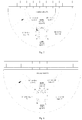
- Fig. 1 is a schematic diagram showing a going back and charging system including a sweeping robot and a charging station according to an embodiment of the present disclosure. As shown in Fig. 1 , the system includes: a charging station 100, six infrared receiving tubes P1, P2, P3, P4, P5, P6 disposed on the sweeping robot and a going back and charging control device (not shown).
- the charging station 100 is configured to emit a plurality of different encoded groups of infrared signals, so as to divide an area in front of the charging station 100 into six different signal regions S1, S2, S3, S4, S5, S6.
- the six different signal regions S1, S2, S3, S4, S5, S6 include: a left near field region S1, a middle near field region S2, a right near field region S3, a left far field region S4, a middle far field region S5 and a right far field region S6.
- the six infrared receiving tubes P1, P2, P3, P4, P5, P6 include: a first infrared receiving tube P1, a second infrared receiving tube P2, a third infrared receiving tube P3, a fourth infrared receiving tube P4, a fifth infrared receiving tube P5 and a sixth infrared receiving tube P6.
- the first infrared receiving tube P1, the second infrared receiving tube P2, the third infrared receiving tube P3 and the fourth infrared receiving tube P4 are disposed at four corners of the sweeping robot in a symmetrical manner with respect to a front-rear direction and a left-right direction.
- the fifth infrared receiving tube P5 and the sixth infrared receiving tube P6 are disposed at a front end or a rear end of the sweeping robot in a symmetrical manner with respect to the front-rear direction.
- the going back and charging control device is configured to: control the six infrared receiving tubes P1, P2, P3, P4, P5, P6 to be turned on if it is determined that the sweeping robot needs to be charged, control the sweeping robot to walk toward the middle near field region S2 if any one of the six infrared receiving tubes P1, P2, P3, P4, P5, P6 receives an infrared signal emitted from the charging station 100, and control the sweeping robot to continue to walk until the sweeping robot docks with the charging station 100 successfully if the fifth infrared receiving tube P5 and the sixth infrared receiving tube P6 receive an infrared signal of the middle near field region S2.
- the first infrared receiving tube P1 and the second infrared receiving tube P2 are disposed symmetrically with respect to a central axis A-A'.
- the third infrared receiving tube P3 and the fourth infrared receiving tube P4 are disposed symmetrically with respect to the central axis A-A'.
- the first infrared receiving tube P1 and the third infrared receiving tube P3 are disposed symmetrically with respect to a central axis B-B'.
- the second infrared receiving tube P2 and the fourth infrared receiving tube P4 are disposed symmetrically with respect to the central axis B-B'.
- the fifth infrared receiving tube P5 and the sixth infrared receiving tube P6 are disposed symmetrically with respect to the central axis A-A' at the rear end of the sweeping robot. As shown in Fig. 3 , the fifth infrared receiving tube P5 and the sixth infrared receiving tube P6 are disposed symmetrically with respect to the central axis A-A' at the front end of the sweeping robot.
- the plurality of differently encoded groups of infrared signals emitted from the charging station 100 may be searched for by the first infrared receiving tube P1 and the second infrared receiving tube P2 or by the fifth infrared receiving tube P5 and the sixth infrared receiving tube P6.
- the plurality of differently encoded groups of infrared signals emitted from the charging station 100 may be searched for by the first infrared receiving tube P1 and the third infrared receiving tube P3 or by the second infrared receiving tube P2 and the fourth infrared receiving tube P4.
- the going back and charging control device for the sweeping robot controls the six infrared receiving tubes P1, P2, P3, P4, P5, P6 to be turned on. If any one of the six infrared receiving tubes P1, P2, P3, P4, P5, P6 receives an infrared signal emitted from the charging station 100, the going back and charging control device controls the sweeping robot to walk toward the middle near field region S2 from any one of the left far field region S4, middle far field region S5, right far field region S6, left near field region S1 and right near field region S3, until the fifth infrared receiving tube P5 and the sixth infrared receiving tube P6 receive an infrared signal of the middle near field region S2, i.e., the fifth and sixth receiving tubes are in the middle near field region S2.
- the going back and charging control device adjusts the direction to which the front end or the rear end of the sweeping robot faces so as to ensure that the charging interface of the sweeping robot align with the charging station 100, and controls the sweeping robot to walk along a straight line until the sweeping robot docks with the charging station 100 successfully.
- the going back and charging system including a sweeping robot and a charging station may control the sweeping robot to arrive at the middle near field region quickly according to the infrared signals emitted from the charging station and received by the six infrared receiving tubes, and adjust the sweeping robot in the middle near field region so as to ensure that the charging interface of the sweeping robot align with the charging station, such that the sweeping robot may dock with the charging station accurately, the period of time during which the sweeping robot goes back for being charged may be reduced effectively, the problem that the sweeping robot cannot dock with the charging station stably since the left and right side brushes brush the charging station during the docking process may be avoided effectively, and the system may be adapt to complex environment.
- an angle between a receiving surface of the first infrared receiving tube P1 and a receiving surface of the second infrared receiving tube P2 is 90°.
- An angle between the receiving surface of the first infrared receiving tube P1 and a receiving surface of the third infrared receiving tube P3 is 90°.
- An angle between the receiving surface of the second infrared receiving tube P2 and a receiving surface of the fourth infrared receiving tube P4 is 90°.
- An angle between the receiving surface of the third infrared receiving tube P3 and the receiving surface of the fourth infrared receiving tube P4 is 90°.
- An angle between a receiving surface of the fifth infrared receiving tube P5 and a receiving surface of the sixth infrared receiving tube P6 is 90°.
- each of the six infrared receiving tubes P1, P2, P3, P4, P5, P6 may be a 90° infrared sensor. Since the angle between the receiving surface of the first infrared receiving tube P1 and the receiving surface of the second infrared receiving tube P2 is 90°, the angle between the receiving surface of the third infrared receiving tube P3 and the receiving surface of the fourth infrared receiving tube P4 is 90°, and the angle between the receiving surface of the fifth infrared receiving tube P5 and the receiving surface of the sixth infrared receiving tube P6 is 90°, the accuracy of adjusting the sweeping robot from side to side is high, such that the charging interface of the sweeping robot may dock with the charging station 100 accurately and quickly, and the precision of movement when the sweeping robot walks forward or backward may be improved.
- the precision of movement when the sweeping robot walks in the transverse direction may be improved.
- the blind-zone of receiving the infrared signals may be reduced effectively, such that the sweeping robot may be at any position to receive the infrared signals emitted from the charging station 100.
- the fifth and sixth infrared receiving tubes P5, P6 are disposed at the rear end of the sweeping robot in a symmetrical manner with respect to a front-end central axis. If it is determined according to the received infrared signal that the sweeping robot is in the left far field region S4 or in the right far field region S6, the going back and charging control device controls the sweeping robot to walk toward the left near field region S1 from the left far field region S4 or to walk toward the right near field region S3 from the right far field region S6, and controls the sweeping robot to walk toward the middle near field region S2 after the sweeping robot enters the left near field region S1 or the right near field region S3, and controls the rear end of the sweeping robot to align with and to approach the charging station 100 after the sweeping robot enters the middle near field region S2, until the rear end of the sweeping robot docks with the charging station 100 successfully.
- the going back and charging control device controls the sweeping robot to walk toward the middle near field region S2, and controls the rear end of the sweeping robot to align with and to approach the charging station 100 after the sweeping robot enters the middle near field region S2, until the rear end of the sweeping robot docks with the charging station 100 successfully. If it is determined according to the received infrared signal that the sweeping robot is in the middle near field region S2, the going back and charging control device controls the rear end of the sweeping robot to align with and to approach the charging station 100, until the rear end of the sweeping robot docks with the charging station 100 successfully.
- the going back and charging control device controls the sweeping robot to walk toward the middle near field region S2, and controls the rear end of the sweeping robot to align with and to approach the charging station 100 after the sweeping robot enters the middle near field region S2, until the rear end of the sweeping robot docks with the charging station 100 successfully.
- the charging interface of the sweeping robot is disposed at the rear end of the sweeping robot.
- the going back and charging control device adjusts the heading direction of the sweeping robot, and controls the sweeping robot to walk toward the left near field region S1 at a first preset speed (such as 0.35 m/s) until the sweeping robot receives an infrared signal of the left near field region. Then the going back and charging control device controls the sweeping robot to rotate by a certain angle (as shown in Fig.
- the going back and charging control device controls the sweeping robot to spin around, until the fifth and sixth infrared receiving tubes receive the infrared signal of the middle near field region, i.e., controls the rear end of the sweeping robot to align with the charging station 100, as shown in Fig. 8 .
- the going back and charging control device controls the sweeping robot to approach the charging station 100 until the rear end of the sweeping robot docks with the charging station 100 successfully, such that the sweeping robot may dock with the charging station accurately and quickly. It should be understood that, if the charging interface of the sweeping robot is disposed at the rear end, the problem that it is difficult to assemble the front end and the structure design is complex due to a cleaning part disposed at the front end may be solved. The going back and charging process in any other situation is not described herein.
- the fifth and sixth infrared receiving tubes P5, P6 are disposed at the front end of the sweeping robot in a symmetrical manner with respect to a front-end central axis. If it is determined according to the received infrared signal that the sweeping robot is in the left far field region S4 or in the right far field region S6, the going back and charging control device controls the sweeping robot to walk toward the left near field region S1 from the left far field region S4 or to walk toward the right near field region S3 from the right far field region S6, and controls the sweeping robot to walk toward the middle near field region S2 after the sweeping robot enters the left near field region S1 or the right near field region S3, and controls the front end of the sweeping robot to align with and to approach the charging station 100 after the sweeping robot enters the middle near field region S2, until the front end of the sweeping robot docks with the charging station 100 successfully.
- the going back and charging control device controls the sweeping robot to walk toward the middle near field region S2, and controls the front end of the sweeping robot to align with and to approach the charging station 100 after the sweeping robot enters the middle near field region S2, until the front end of the sweeping robot docks with the charging station 100 successfully. If it is determined according to the received infrared signal that the sweeping robot is in the middle near field region S2, the going back and charging control device controls the front end of the sweeping robot to align with and to approach the charging station 100, until the front end of the sweeping robot docks with the charging station 100 successfully.
- the going back and charging control device controls the sweeping robot to walk toward the middle near field region S2, and controls the front end of the sweeping robot to align with and to approach the charging station 100 after the sweeping robot enters the middle near field region S2, until the front end of the sweeping robot docks with the charging station 100 successfully.
- the charging interface of the sweeping robot is disposed at the front end of the sweeping robot. The specific going back and charging process is not described herein.
- the rear end or the front end of the sweeping robot docks with the charging station, such that the problem that the sweeping robot cannot dock with the charging station stably since the left and right side brushes brush the charging station during the docking process may be avoided effectively.
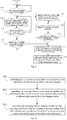
- Fig. 9 is a flow chart showing a method for controlling a going back and charging system including a sweeping robot and a charging station according to an embodiment of the present disclosure. As shown in Fig. 9 , the method includes the followings.
- S 101 it is determined whether an infrared receiving tube receives an infrared signal. If one of the six infrared receiving tubes receives an infrared signal emitted from the charging station, S102 is executed, otherwise, S101 is repeated.
- the infrared receiving tube at the rear end is blocked, and the sweeping robot is controlled to walk at a first preset speed (such as 0.35 m/s) according to the infrared signal received by the infrared receiving tube at the front end.
- a first preset speed such as 0.35 m/s
- the going back and charging control device shields the infrared signals received by the third, fourth, fifth and sixth infrared receiving tubes, and controls the sweeping robot to walk at a speed of 0.35 m/s according to the infrared signals received by the first and second infrared receiving tubes.
- the going back and charging control device shields the infrared signals received by the third and fourth infrared receiving tubes, and controls the sweeping robot to walk at a speed of 0.35 m/s according to the infrared signals received by the first and second infrared receiving tubes or by the fifth and sixth infrared receiving tubes. It should be understood that, the infrared signals received by the fifth and sixth infrared receiving tubes may also be shielded.
- S103 it is determined whether the infrared receiving tubes at the front end receive the infrared signal of the near field region, i.e., it is determined whether the first and second infrared receiving tubes receive one of the infrared signal of the left near field region, the infrared signal of the right near field region and the infrared signal of the middle near field region. If yes, S104 is executed, otherwise, S102 is executed.
- S104 it is determined whether the infrared signal of the near field region is the infrared signal of the middle near field region. If yes, S109 is executed, otherwise, S105 is executed.
- the sweeping robot is controlled to rotate to right/left by 90° according to the received infrared signal of the left/right near field region. Specifically, if the first and second infrared receiving tubes receive the infrared signal of the left near field region, the sweeping robot is controlled to rotate to the right by 90°. If the first and second infrared receiving tubes receive the infrared signal of the right near field region, the sweeping robot is controlled to rotate to the left by 90°.
- the sweeping robot is controlled to walk toward the middle near field region at a second preset speed (such as 0.1-0.2 m/s).
- S107 it is determined whether an infrared receiving tube receives the infrared signal of the middle near field region, if yes, S108 is executed, otherwise, S106 is executed.
- the sweeping robot is controlled to rotate, until the infrared receiving tubes at the back/front end of the sweeping robot can receive the infrared signal of the middle near field region.
- the charging interface of the sweeping robot is disposed at the rear end, the rear end of the sweeping robot is controlled to align with the charging station.
- the charging interface of the sweeping robot is disposed at the front end, the front end of the sweeping robot is controlled to align with the charging station.
- the charging interface of the sweeping robot align with the charging station and the sweeping robot is controlled to walk to a position close to the baffle of charging station at the second preset speed, all the infrared receiving tubes are turned off, and the sweeping robot is controlled to dock with the charging station.
- the going back and charging system including a sweeping robot and a charging station controls the sweeping robot to go back to the charging station quickly according to the infrared signals emitted from the charging station and received by the six infrared receiving tubes disposed on the sweeping robot, such that the period of time during which the sweeping robot goes back for being charged is reduced effectively, and the system is adapt to the complex environment. Meanwhile, the sweeping robot is controlled to dock with the charging station accurately and quickly by the infrared receiving tubes disposed at the front end or the rear end of the sweeping robot, the problem that the sweeping robot cannot dock with the charging station stably since the left and right side brushes brush the charging station during the docking process may be avoided effectively.
- Fig. 10 is a flow chart showing a method for controlling a going back and charging system including a sweeping robot and a charging station according to another embodiment of the present disclosure.
- the going back and charging system includes a charging station and six infrared receiving tubes disposed on the sweeping robot.
- the charging station is configured to emit a plurality of differently encoded groups of infrared signals, so as to divide an area in front of the charging station into six different signal regions, in which the six different signal regions include: a left near field region, a middle near field region, a right near field region, a left far field region, a middle far field region and a right far field region.
- a first infrared receiving tube, a second infrared receiving tube, a third infrared receiving tube and a fourth infrared receiving tube are respectively disposed at four corners of the sweeping robot in a symmetrical manner with respect to a front-rear direction and a left-right direction.
- a fifth infrared receiving tube and a sixth infrared receiving tube are disposed at a front end or a rear end of the sweeping robot, and the fifth infrared receiving tube and the sixth infrared receiving tube are symmetrical with respect to the front-rear direction.
- an angle between a receiving surface of the first infrared receiving tube and a receiving surface of the second infrared receiving tube is 90°.
- An angle between the receiving surface of the first infrared receiving tube and a receiving surface of the third infrared receiving tube is 90°.
- An angle between the receiving surface of the second infrared receiving tube and a receiving surface of the fourth infrared receiving tube is 90°.
- An angle between the receiving surface of the third infrared receiving tube and the receiving surface of the fourth infrared receiving tube is 90°.
- An angle between a receiving surface of the fifth infrared receiving tube and a receiving surface of the sixth infrared receiving tube is 90°.
- each of the six infrared receiving tubes may be a 90° infrared sensor. Since the angle between the receiving surface of the first infrared receiving tube and the receiving surface of the second infrared receiving tube is 90°, the angle between the receiving surface of the third infrared receiving tube and the receiving surface of the fourth infrared receiving tube is 90°, and the angle between the receiving surface of the fifth infrared receiving tube and the receiving surface of the sixth infrared receiving tube is 90°, the accuracy of adjusting the sweeping robot from side to side is high, such that the charging interface of the sweeping robot may dock with the charging station 100 accurately and quickly, and the precision of movement when the sweeping robot walks forward or backward may be improved.
- the precision of movement when the sweeping robot walks in the transverse direction may be improved.
- the blind-zone of receiving the infrared signals may be reduced effectively, such that the sweeping robot may be at any position to receive the infrared signals emitted from the charging station.
- the method includes the followings.
- the six infrared receiving tubes are controlled to be turned on if the sweeping robot needs to be charged.
- the six infrared receiving tubes are controlled to be turned on. If any one of the six infrared receiving tubes receives an infrared signal emitted from the charging station, the sweeping robot is controlled to walk toward the middle near field region from any one of the left far field region, middle far field region, right far field region, left near field region and right near field region, until the fifth infrared receiving tube and the sixth infrared receiving tube receive an infrared signal of the middle near field region, i.e., the fifth and sixth receiving tubes are in the middle near field region.
- the direction to which the front end or the rear end of the sweeping robot faces is adjusted so as to ensure that the charging interface of the sweeping robot align with the charging station, and the sweeping robot is controlled to walk along a straight line until the sweeping robot docks with the charging station successfully.
- the fifth and sixth infrared receiving tubes are disposed at the rear end of the sweeping robot in a symmetrical manner with respect to a front-end central axis. If it is determined according to the received infrared signal that the sweeping robot is in the left far field region or in the right far field region, the sweeping robot is controlled to walk toward the left near field region from the left far field region or to walk toward the right near field region from the right far field region, and the sweeping robot is controlled to walk toward the middle near field region after the sweeping robot enters the left near field region or the right near field region, and the rear end of the sweeping robot is controlled to align with and to approach the charging station after the sweeping robot enters the middle near field region, until the rear end of the sweeping robot docks with the charging station successfully.
- the sweeping robot is controlled to walk toward the middle near field region, and the rear end of the sweeping robot is controlled to align with and to approach the charging station after the sweeping robot enters the middle near field region, until the rear end of the sweeping robot docks with the charging station successfully. If it is determined according to the received infrared signal that the sweeping robot is in the middle near field region, the rear end of the sweeping robot is controlled to align with and to approach the charging station, until the rear end of the sweeping robot docks with the charging station successfully.
- the sweeping robot is controlled to walk toward the middle near field region, and the rear end of the sweeping robot is controlled to align with and to approach the charging station after the sweeping robot enters the middle near field region, until the rear end of the sweeping robot docks with the charging station successfully.
- the charging interface of the sweeping robot is disposed at the rear end of the sweeping robot.
- the heading direction of the sweeping robot is adjusted, and the sweeping robot is controlled to walk toward the left near field region at a first preset speed (such as 0.35 m/s) until the sweeping robot receives an infrared signal of the left near field region. Then the sweeping robot is controlled to rotate by a certain angle (as shown in Fig.
- the sweeping robot is controlled to approach the middle near field region along a trajectory with a radius R, until any one of the six infrared receiving tubes receives the infrared signal of the middle near field region, as shown in Fig. 7 .
- the sweeping robot is controlled to spin around, until the fifth and sixth infrared receiving tubes receive the infrared signal of the middle near field region, i.e., the rear end of the sweeping robot is controlled to align with the charging station, as shown in Fig. 8 .
- the sweeping robot is controlled to approach the charging station until the rear end of the sweeping robot docks with the charging station successfully, such that the sweeping robot may dock with the charging station accurately and quickly.
- the fifth and sixth infrared receiving tubes are disposed at the front end of the sweeping robot in a symmetrical manner with respect to a front-end central axis. If it is determined according to the received infrared signal that the sweeping robot is in the left far field region or in the right far field region, the sweeping robot is controlled to walk toward the left near field region from the left far field region or to walk toward the right near field region from the right far field region, and the sweeping robot is controlled to walk toward the middle near field region after the sweeping robot enters the left near field region or the right near field region, and the front end of the sweeping robot is controlled to align with and to approach the charging station after the sweeping robot enters the middle near field region, until the front end of the sweeping robot docks with the charging station successfully.
- the sweeping robot is controlled to walk toward the middle near field region, and the front end of the sweeping robot is controlled to align with and to approach the charging station after the sweeping robot enters the middle near field region, until the front end of the sweeping robot docks with the charging station successfully. If it is determined according to the received infrared signal that the sweeping robot is in the middle near field region, the front end of the sweeping robot is controlled to align with and to approach the charging station, until the front end of the sweeping robot docks with the charging station successfully.
- the sweeping robot is controlled to walk toward the middle near field region, and the front end of the sweeping robot is controlled to align with and to approach the charging station after the sweeping robot enters the middle near field region, until the front end of the sweeping robot docks with the charging station successfully.
- the charging interface of the sweeping robot is disposed at the front end of the sweeping robot. The specific going back and charging process is not described herein.
- the sweeping robot is controlled to walk toward the middle near field region, and if the fifth infrared receiving tube and the sixth infrared receiving tube receive the infrared signal of the middle near field region, the sweeping robot is controlled to continue to walk until the sweeping robot docks with the charging station successfully.
- the sweeping robot may be controlled to go back to the charging station quickly, such that the period of time during which the sweeping robot goes back to the charging station for being charged is reduced effectively.
- the sweeping robot is controlled to dock with the charging station accurately and quickly, such that the problem that the sweeping robot cannot dock with the charging station stably since the left and right side brushes brush the charging station during the docking process may be avoided effectively, and thus the sweeping robot is adapt to complex environment.
- first and second are used herein for purposes of description and are not intended to indicate or imply relative importance or significance or to imply the number of indicated technical features.
- the feature defined with “first” and “second” may comprise one or more of this feature.
- a plurality of' means two or more than two, unless specified otherwise.
- the terms “mounted,” “connected,” “coupled,” “fixed” and the like are used broadly, and may be, for example, fixed connections, detachable connections, or integral connections; may also be mechanical or electrical connections; may also be direct connections or indirect connections via intervening structures; may also be inner communications of two elements, which can be understood by those skilled in the art according to specific situations.
- a structure in which a first feature is "on" or “below” a second feature may include an embodiment in which the first feature is in direct contact with the second feature, and may also include an embodiment in which the first feature and the second feature are not in direct contact with each other, but are contacted via an additional feature formed therebetween.
- a first feature "on,” “above,” or “on top of' a second feature may include an embodiment in which the first feature is right or obliquely “on,” “above,” or “on top of' the second feature, or just means that the first feature is at a height higher than that of the second feature; while a first feature "below,” “under,” or “on bottom of' a second feature may include an embodiment in which the first feature is right or obliquely “below,” “under,” or “on bottom of' the second feature, or just means that the first feature is at a height lower than that of the second feature.
Landscapes
- Engineering & Computer Science (AREA)
- Physics & Mathematics (AREA)
- Aviation & Aerospace Engineering (AREA)
- Radar, Positioning & Navigation (AREA)
- Remote Sensing (AREA)
- General Physics & Mathematics (AREA)
- Automation & Control Theory (AREA)
- Electromagnetism (AREA)
- Mechanical Engineering (AREA)
- Control Of Position, Course, Altitude, Or Attitude Of Moving Bodies (AREA)
- Manipulator (AREA)
- Toys (AREA)
Description
- The present disclosure relates to the robot technology field, and more particularly to a going back and charging system including a sweeping robot and a charging station and a method for controlling a going back and charging system including a sweeping robot and a charging station.
- At present, the way that a sweeping robot goes back to a charging station is simple. For example, a direction of the charging station is determined according to a strong-weak relationship between a received left infrared signal and a received right infrared signal. In this way, although the sweeping robot may be controlled to go back to the charging station, the speed of going back is slow, and the probability that the sweeping robot docks with the charging station accurately is low, and it is impossible for the sweeping robot to adapt to complex environment.
- The document
CN 103 948 354 A discloses a floor cleaning robot a charging station as well as a controlling method according to the preamble of theindependent claims 1 and 7. - Embodiments of the present disclosure seek to solve at least one of the problems above to at least some extent. Accordingly, a first objective of the present disclosure is to provide a going back and charging system including a sweeping robot and a charging station, which may control the sweeping robot to go back quickly to a charging station and to dock accurately with the charging station.
- A second objective of the present disclosure is to provide a method for controlling a going back and charging system including a sweeping robot and a charging station.
- In order to achieve the above objectives, according to embodiments of a first aspect of the present disclosure, a going back and charging system including a sweeping robot and a charging station is provided, including: a charging station, configured to emit a plurality of differently encoded groups of infrared signals, so as to divide an area in front of the charging station into six different signal regions, in which the six different signal regions include: a left near field region, a middle near field region, a right near field region, a left far field region, a middle far field region and a right far field region; six infrared receiving tubes, disposed on the sweeping robot, in which a first infrared receiving tube, a second infrared receiving tube, a third infrared receiving tube and a fourth infrared receiving tube are respectively disposed at four corners of the sweeping robot in a symmetrical manner with respect to a front-rear direction and a left-right direction, a fifth infrared receiving tube and a sixth infrared receiving tube are disposed at a front end or a rear end of the sweeping robot, and the fifth infrared receiving tube and the sixth infrared receiving tube are symmetrical with respect to the front-rear direction; and a going back and charging control device, configured to: control the six infrared receiving tubes to be turned on if it is determined that the sweeping robot needs to be charged; control the sweeping robot to walk toward the middle near field region if any one of the six infrared receiving tubes receives an infrared signal emitted from the charging station; and control the sweeping robot to continue to walk until the sweeping robot docks with the charging station successfully if the fifth infrared receiving tube and the sixth infrared receiving tube receive an infrared signal of the middle near field region.
- With the going back and charging system including a sweeping robot and a charging station according to embodiments of the present disclosure, the sweeping robot is controlled to go back the charging station quickly according to the infrared signals emitted from the charging station and received by the six infrared receiving tubes disposed on the sweeping robot, such that the period of time during which the sweeping robot goes back to the charging station for being charged is reduced effectively and the sweeping robot is adapt to complex environment. Meanwhile, the sweeping robot is controlled to dock with the charging station accurately and quickly by the infrared receiving tubes disposed at the front end or at the rear end of the sweeping robot, such that the problem that the sweeping robot cannot dock with the charging station stably since the left and right side brushes brush the charging station during the docking process may be avoided effectively.
- According to an embodiment of the present disclosure, an angle between a receiving surface of the first infrared receiving tube and a receiving surface of the second infrared receiving tube is 90°, an angle between the receiving surface of the first infrared receiving tube and a receiving surface of the third infrared receiving tube is 90°, an angle between the receiving surface of the second infrared receiving tube and a receiving surface of the fourth infrared receiving tube is 90°, an angle between the receiving surface of the third infrared receiving tube and the receiving surface of the fourth infrared receiving tube is 90°, and an angle between a receiving surface of the fifth infrared receiving tube and a receiving surface of the sixth infrared receiving tube is 90°.
- According to an embodiment of the present disclosure, if the fifth infrared receiving tube and the sixth infrared receiving tube are disposed at the rear end of the sweeping robot,
if it is determined according to a received infrared signal that the sweeping robot is in the left far field region or in the right far field region, the going back and charging control device is configured to: control the sweeping robot to walk toward the left near field region from the left far field region or to walk toward the right near field region from the right far field region; control the sweeping robot to walk toward the middle near field region, after the sweeping robot enters the left near field region or the right near field region; and control the rear end of the sweeping robot to align with the charging station until the rear end of the sweeping robot docks with the charging station successfully, after the sweeping robot enters the middle near field region;
or
if it is determined according to a received infrared signal that the sweeping robot is in the left near field region or in the right near field region, the going back and charging control device is configured to: control the sweeping robot to walk toward the middle near field region; and control the rear end of the sweeping robot to align with and to approach the charging station until the rear end of the sweeping robot docks with the charging station successfully, after the sweeping robot enters the middle near field region;
or
if it is determined according to a received infrared signal that the sweeping robot is in the middle near field region, the going back and charging control device is configured to: control the rear end of the sweeping robot to align with and to approach the charging station until the rear end of the sweeping robot docks with the charging station successfully;
or
if it is determined according to a received infrared signal that the sweeping robot is in the middle far field region, the going back and charging control device is configured to: control the sweeping robot to walk toward the middle near field region; and control the rear end of the sweeping robot to align with and to approach the charging station until the rear end of the sweeping robot docks with the charging station successfully, after the sweeping robot enters the middle near field region. - According to an embodiment of the present disclosure, if the fifth infrared receiving tube and the sixth infrared receiving tube are disposed at the front end of the sweeping robot,
if it is determined according to a received infrared signal that the sweeping robot is in the left far field region or in the right far field region, the going back and charging control device is configured to: control the sweeping robot to walk toward the left near field region from the left far field region or to walk toward the right near field region from the right far field region; control the sweeping robot to walk toward the middle near field region, after the sweeping robot enters the left near field region or the right near field region; and control the front end of the sweeping robot to align with and to approach the charging station until the front end of the sweeping robot docks with the charging station successfully, after the sweeping robot enters the middle near field region;
or
if it is determined according to a received infrared signal that the sweeping robot is in the left near field region or in the right near field region, the going back and charging control device is configured to: control the sweeping robot to walk toward the middle near field region; and control the front end of the sweeping robot to align with and to approach the charging station until the front end of the sweeping robot docks with the charging station successfully, after the sweeping robot enters the middle near field region;
or
if it is determined according to a received infrared signal that the sweeping robot is in the middle near field region, the going back and charging control device is configured to: control the front end of the sweeping robot to align with and to approach the charging station until the front end of the sweeping robot docks with the charging station successfully;
or
if it is determined according to a received infrared signal that the sweeping robot is in the middle far field region, the going back and charging control device is configured to: control the sweeping robot to walk toward the middle near field region; and control the front end of the sweeping robot to align with and to approach the charging station until the front end of the sweeping robot docks with the charging station successfully, after the sweeping robot enters the middle near field region. - According to an embodiment of the present disclosure, it is determined according to the received infrared signal that the sweeping robot is in the left far field region or in the right far field region or in the middle far field region, the going back and charging control device is further configured to: block the infrared receiving tubes at the rear end of the sweeping robot, and control the sweeping robot to walk at a first preset speed according to an infrared signal received by the infrared receiving tubes at the front end of the sweeping robot.
- According to an embodiment of the present disclosure, if it is determined according to the received infrared signal that the sweeping robot is in the left near field region or in the right near field region, the going back and charging control device is further configured to: control the sweeping robot to rotate to right by 90° according to an infrared signal received from the left near field region, or control the sweeping robot to rotate to left by 90° according to an infrared signal received from the right near field region, and then control the sweeping robot to walk toward the middle near field region at a second preset speed.
- According to an embodiment of the present disclosure, if it is determined according to the received infrared signal that the sweeping robot is in the middle near field region, the going back and charging control device is further configured to: control the sweeping robot to rotate, until the fifth infrared receiving tube and the sixth infrared receiving tube can receive the infrared signal of the middle near field region.
- In order to achieve the above objectives, according to embodiments of a second aspect of the present disclosure, a method for controlling a going back and charging system including a sweeping robot and a charging station is provided. The going back and charging system includes: a charging station, configured to emit a plurality of differently encoded groups of infrared signals, so as to divide an area in front of the charging station into six different signal regions, in which the six different signal regions include: a left near field region, a middle near field region, a right near field region, a left far field region, a middle far field region and a right far field region; and six infrared receiving tubes, disposed on the sweeping robot, in which a first infrared receiving tube, a second infrared receiving tube, a third infrared receiving tube and a fourth infrared receiving tube are respectively disposed at four corners of the sweeping robot in a symmetrical manner with respect to a front-rear direction and a left-right direction, a fifth infrared receiving tube and a sixth infrared receiving tube are disposed at a front end or a rear end of the sweeping robot, and the fifth infrared receiving tube and the sixth infrared receiving tube are symmetrical with respect to the front-rear direction. The method includes: controlling the six infrared receiving tubes to be turned on if it is determined that the sweeping robot needs to be charged; controlling the sweeping robot to walk toward the middle near field region if any one of the six infrared receiving tubes receives an infrared signal emitted from the charging station; and controlling the sweeping robot to continue to walk until the sweeping robot docks with the charging station successfully if the fifth infrared receiving tube and the sixth infrared receiving tube receive an infrared signal of the middle near field region.
- With the method for controlling a going back and charging system including a sweeping robot and a charging station according embodiments of the present disclosure, if any one of the six infrared receiving tubes disposed on the sweeping robot receives the infrared signal emitted from the charging station, the sweeping robot is controlled to walk toward the middle near field region, and if the fifth infrared receiving tube and the sixth infrared receiving tube receive the infrared signal of the middle near field region, the sweeping robot is controlled to continue to walk until the sweeping robot docks with the charging station successfully. With the method according to the present disclosure, the sweeping robot may be controlled to go back to the charging station quickly, such that the period of time during which the sweeping robot goes back to the charging station for being charged is reduced effectively. Meanwhile, the sweeping robot is controlled to dock with the charging station accurately and quickly, such that the problem that the sweeping robot cannot dock with the charging station stably since the left and right side brushes brush the charging station during the docking process may be avoided effectively, and thus the sweeping robot is adapt to complex environment.
- According to an embodiment of the present disclosure, an angle between a receiving surface of the first infrared receiving tube and a receiving surface of the second infrared receiving tube is 90°, an angle between the receiving surface of the first infrared receiving tube and a receiving surface of the third infrared receiving tube is 90°, an angle between the receiving surface of the second infrared receiving tube and a receiving surface of the fourth infrared receiving tube is 90°, an angle between the receiving surface of the third infrared receiving tube and the receiving surface of the fourth infrared receiving tube is 90°, and an angle between a receiving surface of the fifth infrared receiving tube and a receiving surface of the sixth infrared receiving tube is 90°.
- According to an embodiment of the present disclosure, controlling the sweeping robot to walk toward the middle near field region includes:
- if it is determined according to a received infrared signal that the sweeping robot is in the left far field region or in the right far field region, controlling the sweeping robot to walk toward the left near field region from the left far field region or to walk toward the right near field region from the right far field region, and controlling the sweeping robot to walk toward the middle near field region from the left near field region or from the right near field region after the sweeping robot enters the left near field region or the right near field region;
or - if it is determined according to a received infrared signal that the sweeping robot is in the left near field region or in the right near field region, controlling the sweeping robot to walk toward the middle near field region from the left near field region or from the right near field region;
or - if it is determined according to a received infrared signal that the sweeping robot is in the middle far field region, controlling the sweeping robot to walk toward the middle near field region from the middle far field region.
- According to an embodiment of the present disclosure, if it is determined according to the received infrared signal that the sweeping robot is in the left far field region or in the right far field region or in the middle far field region, the method further includes: blocking the infrared receiving tubes at the rear end of the sweeping robot, and controlling the sweeping robot to walk at a first preset speed according to an infrared signal received by the infrared receiving tubes at the front end of the sweeping robot.
- According to an embodiment of the present disclosure, if it is determined according to the received infrared signal that the sweeping robot is in the left near field region or in the right near field region, the method further includes: controlling the sweeping robot to rotate to right by 90° according to an infrared signal received from the left near field region, or controlling the sweeping robot to rotate to left by 90° according to an infrared signal received from the right near field region, and controlling the sweeping robot to walk toward the middle near field region at a second preset speed.
- According to an embodiment of the present disclosure, if it is determined according to the received infrared signal that the sweeping robot is in the middle near field region, the method further includes: controlling the sweeping robot to rotate, until the fifth infrared receiving tube and the sixth infrared receiving tube can receive the infrared signal of the middle near field region.
- According to an embodiment of the present disclosure, if the fifth infrared receiving tube and the sixth infrared receiving tube are disposed at the rear end of the sweeping robot, controlling the sweeping robot to continue to walk until the sweeping robot docks with the charging station successfully includes: controlling the rear end of the sweeping robot to align with and to approach the charging station until the rear end of the sweeping robot docks with the charging station successfully; if the fifth infrared receiving tube and the sixth infrared receiving tube are disposed at the front end of the sweeping robot, controlling the sweeping robot to continue to walk until the sweeping robot docks with the charging station successfully includes: controlling the front end of the sweeping robot to align with and to approach the charging station until the front end of the sweeping robot docks with the charging station successfully.
- In order to achieve the above objectives, according to embodiments of a third aspect of the present disclosure, a computer program is provided. The computer program, when executing on a processor, performs the method according to embodiments of the first aspect of the present disclosure.
- These and other aspects and advantages of embodiments of the present disclosure will become apparent and more readily appreciated from the following descriptions made with reference to the drawings, in which:
-
Fig. 1 is a schematic diagram showing a going back and charging system including a sweeping robot and a charging station according to an embodiment of the present disclosure; -
Fig. 2 is a schematic diagram showing an arrangement of six infrared receiving tubes according to an embodiment of the present disclosure; -
Fig. 3 is a schematic diagram showing an arrangement of six infrared receiving tubes according to another embodiment of the present disclosure; -
Fig. 4 is a schematic diagram showing a receiving region formed by six infrared receiving tubes according to an embodiment of the present disclosure; -
Fig. 5 is a schematic diagram showing a sweeping robot walking toward a left near field region according to an embodiment of the present disclosure; -
Fig. 6 is a schematic diagram showing a sweeping robot walking toward a middle near field region from a left near field region according to an embodiment of the present disclosure; -
Fig. 7 is a schematic diagram showing a sweeping robot entering the middle near field region according to an embodiment of the present disclosure; -
Fig. 8 is a schematic diagram showing a sweeping robot adjusting its location according to an embodiment of the present disclosure; -
Fig. 9 is a flow chart showing a method for controlling a going back and charging system including a sweeping robot and a charging station according to an embodiment of the present disclosure; and -
Fig. 10 is a flow chart showing a method for controlling a going back and charging system including a sweeping robot and a charging station according to another embodiment of the present disclosure. - Embodiments of the present disclosure will be described in detail in the following descriptions, examples of which are shown in the accompanying drawings, in which the same or similar elements and elements having same or similar functions are denoted by like reference numerals throughout the descriptions. The embodiments described herein with reference to the accompanying drawings are explanatory and illustrative, which are used to generally understand the present disclosure. The embodiments shall not be construed to limit the present disclosure.
- A going back and charging system including a sweeping robot and a charging station and a method for controlling a going back and charging system including a sweeping robot and a charging station according to embodiments of the present disclosure are described below with reference to drawings.
-
Fig. 1 is a schematic diagram showing a going back and charging system including a sweeping robot and a charging station according to an embodiment of the present disclosure. As shown inFig. 1 , the system includes: a chargingstation 100, six infrared receiving tubes P1, P2, P3, P4, P5, P6 disposed on the sweeping robot and a going back and charging control device (not shown). - The charging
station 100 is configured to emit a plurality of different encoded groups of infrared signals, so as to divide an area in front of the chargingstation 100 into six different signal regions S1, S2, S3, S4, S5, S6. The six different signal regions S1, S2, S3, S4, S5, S6 include: a left near field region S1, a middle near field region S2, a right near field region S3, a left far field region S4, a middle far field region S5 and a right far field region S6. The six infrared receiving tubes P1, P2, P3, P4, P5, P6 include: a first infrared receiving tube P1, a second infrared receiving tube P2, a third infrared receiving tube P3, a fourth infrared receiving tube P4, a fifth infrared receiving tube P5 and a sixth infrared receiving tube P6. The first infrared receiving tube P1, the second infrared receiving tube P2, the third infrared receiving tube P3 and the fourth infrared receiving tube P4 are disposed at four corners of the sweeping robot in a symmetrical manner with respect to a front-rear direction and a left-right direction. The fifth infrared receiving tube P5 and the sixth infrared receiving tube P6 are disposed at a front end or a rear end of the sweeping robot in a symmetrical manner with respect to the front-rear direction. The going back and charging control device is configured to: control the six infrared receiving tubes P1, P2, P3, P4, P5, P6 to be turned on if it is determined that the sweeping robot needs to be charged, control the sweeping robot to walk toward the middle near field region S2 if any one of the six infrared receiving tubes P1, P2, P3, P4, P5, P6 receives an infrared signal emitted from the chargingstation 100, and control the sweeping robot to continue to walk until the sweeping robot docks with the chargingstation 100 successfully if the fifth infrared receiving tube P5 and the sixth infrared receiving tube P6 receive an infrared signal of the middle near field region S2. - Specifically, as shown in
Fig. 2 andFig. 3 , the first infrared receiving tube P1 and the second infrared receiving tube P2 are disposed symmetrically with respect to a central axis A-A'. The third infrared receiving tube P3 and the fourth infrared receiving tube P4 are disposed symmetrically with respect to the central axis A-A'. The first infrared receiving tube P1 and the third infrared receiving tube P3 are disposed symmetrically with respect to a central axis B-B'. The second infrared receiving tube P2 and the fourth infrared receiving tube P4 are disposed symmetrically with respect to the central axis B-B'. As shown inFig. 2 , the fifth infrared receiving tube P5 and the sixth infrared receiving tube P6 are disposed symmetrically with respect to the central axis A-A' at the rear end of the sweeping robot. As shown inFig. 3 , the fifth infrared receiving tube P5 and the sixth infrared receiving tube P6 are disposed symmetrically with respect to the central axis A-A' at the front end of the sweeping robot. In this way, when the sweeping robot walks forward or backward, the plurality of differently encoded groups of infrared signals emitted from the chargingstation 100 may be searched for by the first infrared receiving tube P1 and the second infrared receiving tube P2 or by the fifth infrared receiving tube P5 and the sixth infrared receiving tube P6. When the sweeping robot walks in a transverse direction (from left to right, or from right to left), the plurality of differently encoded groups of infrared signals emitted from the chargingstation 100 may be searched for by the first infrared receiving tube P1 and the third infrared receiving tube P3 or by the second infrared receiving tube P2 and the fourth infrared receiving tube P4. - During the work of the sweeping robot, if the sweeping robot needs to be charged, the going back and charging control device for the sweeping robot controls the six infrared receiving tubes P1, P2, P3, P4, P5, P6 to be turned on. If any one of the six infrared receiving tubes P1, P2, P3, P4, P5, P6 receives an infrared signal emitted from the charging
station 100, the going back and charging control device controls the sweeping robot to walk toward the middle near field region S2 from any one of the left far field region S4, middle far field region S5, right far field region S6, left near field region S1 and right near field region S3, until the fifth infrared receiving tube P5 and the sixth infrared receiving tube P6 receive an infrared signal of the middle near field region S2, i.e., the fifth and sixth receiving tubes are in the middle near field region S2. Then, the going back and charging control device adjusts the direction to which the front end or the rear end of the sweeping robot faces so as to ensure that the charging interface of the sweeping robot align with the chargingstation 100, and controls the sweeping robot to walk along a straight line until the sweeping robot docks with the chargingstation 100 successfully. - Therefore, the going back and charging system including a sweeping robot and a charging station according to embodiments of the present disclosure may control the sweeping robot to arrive at the middle near field region quickly according to the infrared signals emitted from the charging station and received by the six infrared receiving tubes, and adjust the sweeping robot in the middle near field region so as to ensure that the charging interface of the sweeping robot align with the charging station, such that the sweeping robot may dock with the charging station accurately, the period of time during which the sweeping robot goes back for being charged may be reduced effectively, the problem that the sweeping robot cannot dock with the charging station stably since the left and right side brushes brush the charging station during the docking process may be avoided effectively, and the system may be adapt to complex environment.
- According to an embodiment of the present disclosure, as shown in
Fig. 4 , an angle between a receiving surface of the first infrared receiving tube P1 and a receiving surface of the second infrared receiving tube P2 is 90°. An angle between the receiving surface of the first infrared receiving tube P1 and a receiving surface of the third infrared receiving tube P3 is 90°. An angle between the receiving surface of the second infrared receiving tube P2 and a receiving surface of the fourth infrared receiving tube P4 is 90°. An angle between the receiving surface of the third infrared receiving tube P3 and the receiving surface of the fourth infrared receiving tube P4 is 90°. An angle between a receiving surface of the fifth infrared receiving tube P5 and a receiving surface of the sixth infrared receiving tube P6 is 90°. - Specifically, each of the six infrared receiving tubes P1, P2, P3, P4, P5, P6 may be a 90° infrared sensor. Since the angle between the receiving surface of the first infrared receiving tube P1 and the receiving surface of the second infrared receiving tube P2 is 90°, the angle between the receiving surface of the third infrared receiving tube P3 and the receiving surface of the fourth infrared receiving tube P4 is 90°, and the angle between the receiving surface of the fifth infrared receiving tube P5 and the receiving surface of the sixth infrared receiving tube P6 is 90°, the accuracy of adjusting the sweeping robot from side to side is high, such that the charging interface of the sweeping robot may dock with the charging
station 100 accurately and quickly, and the precision of movement when the sweeping robot walks forward or backward may be improved. In addition, since the angle between the receiving surface of the first infrared receiving tube P1 and the receiving surface of the third infrared receiving tube P3 is 90°, and the angle between the receiving surface of the second infrared receiving tube P2 and the receiving surface of the fourth infrared receiving tube P4 is 90°, the precision of movement when the sweeping robot walks in the transverse direction may be improved. Further, by adopting the above ways, the blind-zone of receiving the infrared signals may be reduced effectively, such that the sweeping robot may be at any position to receive the infrared signals emitted from the chargingstation 100. - According to an embodiment of the present disclosure, the fifth and sixth infrared receiving tubes P5, P6 are disposed at the rear end of the sweeping robot in a symmetrical manner with respect to a front-end central axis. If it is determined according to the received infrared signal that the sweeping robot is in the left far field region S4 or in the right far field region S6, the going back and charging control device controls the sweeping robot to walk toward the left near field region S1 from the left far field region S4 or to walk toward the right near field region S3 from the right far field region S6, and controls the sweeping robot to walk toward the middle near field region S2 after the sweeping robot enters the left near field region S1 or the right near field region S3, and controls the rear end of the sweeping robot to align with and to approach the charging
station 100 after the sweeping robot enters the middle near field region S2, until the rear end of the sweeping robot docks with the chargingstation 100 successfully. If it is determined according to the received infrared signal that the sweeping robot is in the left near field region S1 or in the right near field region S3, the going back and charging control device controls the sweeping robot to walk toward the middle near field region S2, and controls the rear end of the sweeping robot to align with and to approach the chargingstation 100 after the sweeping robot enters the middle near field region S2, until the rear end of the sweeping robot docks with the chargingstation 100 successfully. If it is determined according to the received infrared signal that the sweeping robot is in the middle near field region S2, the going back and charging control device controls the rear end of the sweeping robot to align with and to approach the chargingstation 100, until the rear end of the sweeping robot docks with the chargingstation 100 successfully. If it is determined according to the received infrared signal that the sweeping robot is in the middle far field region S5, the going back and charging control device controls the sweeping robot to walk toward the middle near field region S2, and controls the rear end of the sweeping robot to align with and to approach the chargingstation 100 after the sweeping robot enters the middle near field region S2, until the rear end of the sweeping robot docks with the chargingstation 100 successfully. In this embodiment, the charging interface of the sweeping robot is disposed at the rear end of the sweeping robot. - Specifically, as shown in
Fig. 5 , if the sweeping robot receives an infrared signal of the left far field region, i.e., the sweeping robot enters the left far field region S4, the going back and charging control device adjusts the heading direction of the sweeping robot, and controls the sweeping robot to walk toward the left near field region S1 at a first preset speed (such as 0.35 m/s) until the sweeping robot receives an infrared signal of the left near field region. Then the going back and charging control device controls the sweeping robot to rotate by a certain angle (as shown inFig. 6 ), and controls the sweeping robot to approach the middle near field region S2 along a trajectory with a radius R, until any one of the six infrared receiving tubes receives the infrared signal of the middle near field region, as shown inFig. 7 . And then, the going back and charging control device controls the sweeping robot to spin around, until the fifth and sixth infrared receiving tubes receive the infrared signal of the middle near field region, i.e., controls the rear end of the sweeping robot to align with the chargingstation 100, as shown inFig. 8 . Lastly, the going back and charging control device controls the sweeping robot to approach the chargingstation 100 until the rear end of the sweeping robot docks with the chargingstation 100 successfully, such that the sweeping robot may dock with the charging station accurately and quickly. It should be understood that, if the charging interface of the sweeping robot is disposed at the rear end, the problem that it is difficult to assemble the front end and the structure design is complex due to a cleaning part disposed at the front end may be solved. The going back and charging process in any other situation is not described herein. - According to an embodiment of the present disclosure, the fifth and sixth infrared receiving tubes P5, P6 are disposed at the front end of the sweeping robot in a symmetrical manner with respect to a front-end central axis. If it is determined according to the received infrared signal that the sweeping robot is in the left far field region S4 or in the right far field region S6, the going back and charging control device controls the sweeping robot to walk toward the left near field region S1 from the left far field region S4 or to walk toward the right near field region S3 from the right far field region S6, and controls the sweeping robot to walk toward the middle near field region S2 after the sweeping robot enters the left near field region S1 or the right near field region S3, and controls the front end of the sweeping robot to align with and to approach the charging
station 100 after the sweeping robot enters the middle near field region S2, until the front end of the sweeping robot docks with the chargingstation 100 successfully. If it is determined according to the received infrared signal that the sweeping robot is in the left near field region S1 or in the right near field region S3, the going back and charging control device controls the sweeping robot to walk toward the middle near field region S2, and controls the front end of the sweeping robot to align with and to approach the chargingstation 100 after the sweeping robot enters the middle near field region S2, until the front end of the sweeping robot docks with the chargingstation 100 successfully. If it is determined according to the received infrared signal that the sweeping robot is in the middle near field region S2, the going back and charging control device controls the front end of the sweeping robot to align with and to approach the chargingstation 100, until the front end of the sweeping robot docks with the chargingstation 100 successfully. If it is determined according to the received infrared signal that the sweeping robot is in the middle far field region S5, the going back and charging control device controls the sweeping robot to walk toward the middle near field region S2, and controls the front end of the sweeping robot to align with and to approach the chargingstation 100 after the sweeping robot enters the middle near field region S2, until the front end of the sweeping robot docks with the chargingstation 100 successfully. In this embodiment, the charging interface of the sweeping robot is disposed at the front end of the sweeping robot. The specific going back and charging process is not described herein. - With the going back and charging system including a sweeping robot and a charging station according to embodiments of the present disclosure, the rear end or the front end of the sweeping robot docks with the charging station, such that the problem that the sweeping robot cannot dock with the charging station stably since the left and right side brushes brush the charging station during the docking process may be avoided effectively.
-
Fig. 9 is a flow chart showing a method for controlling a going back and charging system including a sweeping robot and a charging station according to an embodiment of the present disclosure. As shown inFig. 9 , the method includes the followings. - In
S 101, it is determined whether an infrared receiving tube receives an infrared signal. If one of the six infrared receiving tubes receives an infrared signal emitted from the charging station, S102 is executed, otherwise, S101 is repeated. - In S102, the infrared receiving tube at the rear end is blocked, and the sweeping robot is controlled to walk at a first preset speed (such as 0.35 m/s) according to the infrared signal received by the infrared receiving tube at the front end.
- Specifically, if the fifth and sixth infrared receiving tubes are disposed at the rear end of the sweeping robot, the going back and charging control device shields the infrared signals received by the third, fourth, fifth and sixth infrared receiving tubes, and controls the sweeping robot to walk at a speed of 0.35 m/s according to the infrared signals received by the first and second infrared receiving tubes. If the fifth and sixth infrared receiving tubes are disposed at the front end of the sweeping robot, the going back and charging control device shields the infrared signals received by the third and fourth infrared receiving tubes, and controls the sweeping robot to walk at a speed of 0.35 m/s according to the infrared signals received by the first and second infrared receiving tubes or by the fifth and sixth infrared receiving tubes. It should be understood that, the infrared signals received by the fifth and sixth infrared receiving tubes may also be shielded.
- In S103, it is determined whether the infrared receiving tubes at the front end receive the infrared signal of the near field region, i.e., it is determined whether the first and second infrared receiving tubes receive one of the infrared signal of the left near field region, the infrared signal of the right near field region and the infrared signal of the middle near field region. If yes, S104 is executed, otherwise, S102 is executed.
- In S104, it is determined whether the infrared signal of the near field region is the infrared signal of the middle near field region. If yes, S109 is executed, otherwise, S105 is executed.
- In S105, the sweeping robot is controlled to rotate to right/left by 90° according to the received infrared signal of the left/right near field region. Specifically, if the first and second infrared receiving tubes receive the infrared signal of the left near field region, the sweeping robot is controlled to rotate to the right by 90°. If the first and second infrared receiving tubes receive the infrared signal of the right near field region, the sweeping robot is controlled to rotate to the left by 90°.
- In S106, the sweeping robot is controlled to walk toward the middle near field region at a second preset speed (such as 0.1-0.2 m/s).
- In S107, it is determined whether an infrared receiving tube receives the infrared signal of the middle near field region, if yes, S108 is executed, otherwise, S106 is executed.
- In S108, the sweeping robot is controlled to rotate, until the infrared receiving tubes at the back/front end of the sweeping robot can receive the infrared signal of the middle near field region. In other words, if the charging interface of the sweeping robot is disposed at the rear end, the rear end of the sweeping robot is controlled to align with the charging station. If the charging interface of the sweeping robot is disposed at the front end, the front end of the sweeping robot is controlled to align with the charging station.
- In S109, after the sweeping robot is controlled to walk forward for a certain distance at the second preset speed, all the infrared receiving tubes are turned off and the sweeping robot is controlled to continue to walk until the sweeping robot docks with the charging station successfully.
- Specifically, if the charging interface of the sweeping robot align with the charging station and the sweeping robot is controlled to walk to a position close to the baffle of charging station at the second preset speed, all the infrared receiving tubes are turned off, and the sweeping robot is controlled to dock with the charging station.
- The going back and charging system including a sweeping robot and a charging station according to embodiments of the present disclosure controls the sweeping robot to go back to the charging station quickly according to the infrared signals emitted from the charging station and received by the six infrared receiving tubes disposed on the sweeping robot, such that the period of time during which the sweeping robot goes back for being charged is reduced effectively, and the system is adapt to the complex environment. Meanwhile, the sweeping robot is controlled to dock with the charging station accurately and quickly by the infrared receiving tubes disposed at the front end or the rear end of the sweeping robot, the problem that the sweeping robot cannot dock with the charging station stably since the left and right side brushes brush the charging station during the docking process may be avoided effectively.
-
Fig. 10 is a flow chart showing a method for controlling a going back and charging system including a sweeping robot and a charging station according to another embodiment of the present disclosure. The going back and charging system includes a charging station and six infrared receiving tubes disposed on the sweeping robot. The charging station is configured to emit a plurality of differently encoded groups of infrared signals, so as to divide an area in front of the charging station into six different signal regions, in which the six different signal regions include: a left near field region, a middle near field region, a right near field region, a left far field region, a middle far field region and a right far field region. A first infrared receiving tube, a second infrared receiving tube, a third infrared receiving tube and a fourth infrared receiving tube are respectively disposed at four corners of the sweeping robot in a symmetrical manner with respect to a front-rear direction and a left-right direction. A fifth infrared receiving tube and a sixth infrared receiving tube are disposed at a front end or a rear end of the sweeping robot, and the fifth infrared receiving tube and the sixth infrared receiving tube are symmetrical with respect to the front-rear direction. Regarding the specific structure of the going back and charging system, a reference may be made toFigs. 1-3 , which is not described in detail herein. - According to an embodiment of the present disclosure, as shown in
Fig. 4 , an angle between a receiving surface of the first infrared receiving tube and a receiving surface of the second infrared receiving tube is 90°. An angle between the receiving surface of the first infrared receiving tube and a receiving surface of the third infrared receiving tube is 90°. An angle between the receiving surface of the second infrared receiving tube and a receiving surface of the fourth infrared receiving tube is 90°. An angle between the receiving surface of the third infrared receiving tube and the receiving surface of the fourth infrared receiving tube is 90°. An angle between a receiving surface of the fifth infrared receiving tube and a receiving surface of the sixth infrared receiving tube is 90°. - Specifically, each of the six infrared receiving tubes may be a 90° infrared sensor. Since the angle between the receiving surface of the first infrared receiving tube and the receiving surface of the second infrared receiving tube is 90°, the angle between the receiving surface of the third infrared receiving tube and the receiving surface of the fourth infrared receiving tube is 90°, and the angle between the receiving surface of the fifth infrared receiving tube and the receiving surface of the sixth infrared receiving tube is 90°, the accuracy of adjusting the sweeping robot from side to side is high, such that the charging interface of the sweeping robot may dock with the charging
station 100 accurately and quickly, and the precision of movement when the sweeping robot walks forward or backward may be improved. In addition, since the angle between the receiving surface of the first infrared receiving tube and the receiving surface of the third infrared receiving tube is 90°, and the angle between the receiving surface of the second infrared receiving tube and the receiving surface of the fourth infrared receiving tube is 90°, the precision of movement when the sweeping robot walks in the transverse direction may be improved. Further, by adopting the above ways, the blind-zone of receiving the infrared signals may be reduced effectively, such that the sweeping robot may be at any position to receive the infrared signals emitted from the charging station. - As shown in
Fig. 10 , the method includes the followings. - In S11, the six infrared receiving tubes are controlled to be turned on if the sweeping robot needs to be charged.
- In S12, if any one of the six infrared receiving tubes receives an infrared signal emitted from the charging station, the sweeping robot is controlled to walk toward the middle near field region.
- In S13, if the fifth and sixth infrared receiving tubes receive the infrared signal of the middle near field region, the sweeping robot is controlled to continue to walk until the sweeping robot docks with the charging station successfully.
- Specifically, during the work of the sweeping robot, if the sweeping robot needs to be charged, the six infrared receiving tubes are controlled to be turned on. If any one of the six infrared receiving tubes receives an infrared signal emitted from the charging station, the sweeping robot is controlled to walk toward the middle near field region from any one of the left far field region, middle far field region, right far field region, left near field region and right near field region, until the fifth infrared receiving tube and the sixth infrared receiving tube receive an infrared signal of the middle near field region, i.e., the fifth and sixth receiving tubes are in the middle near field region. Then, the direction to which the front end or the rear end of the sweeping robot faces is adjusted so as to ensure that the charging interface of the sweeping robot align with the charging station, and the sweeping robot is controlled to walk along a straight line until the sweeping robot docks with the charging station successfully.
- According to an embodiment of the present disclosure, the fifth and sixth infrared receiving tubes are disposed at the rear end of the sweeping robot in a symmetrical manner with respect to a front-end central axis. If it is determined according to the received infrared signal that the sweeping robot is in the left far field region or in the right far field region, the sweeping robot is controlled to walk toward the left near field region from the left far field region or to walk toward the right near field region from the right far field region, and the sweeping robot is controlled to walk toward the middle near field region after the sweeping robot enters the left near field region or the right near field region, and the rear end of the sweeping robot is controlled to align with and to approach the charging station after the sweeping robot enters the middle near field region, until the rear end of the sweeping robot docks with the charging station successfully. If it is determined according to the received infrared signal that the sweeping robot is in the left near field region or in the right near field region, the sweeping robot is controlled to walk toward the middle near field region, and the rear end of the sweeping robot is controlled to align with and to approach the charging station after the sweeping robot enters the middle near field region, until the rear end of the sweeping robot docks with the charging station successfully. If it is determined according to the received infrared signal that the sweeping robot is in the middle near field region, the rear end of the sweeping robot is controlled to align with and to approach the charging station, until the rear end of the sweeping robot docks with the charging station successfully. If it is determined according to the received infrared signal that the sweeping robot is in the middle far field region, the sweeping robot is controlled to walk toward the middle near field region, and the rear end of the sweeping robot is controlled to align with and to approach the charging station after the sweeping robot enters the middle near field region, until the rear end of the sweeping robot docks with the charging station successfully. In this embodiment, the charging interface of the sweeping robot is disposed at the rear end of the sweeping robot.
- Specifically, as shown in
Fig. 5 , if the sweeping robot receives an infrared signal of the left far field region, i.e., the sweeping robot enters the left far field region, the heading direction of the sweeping robot is adjusted, and the sweeping robot is controlled to walk toward the left near field region at a first preset speed (such as 0.35 m/s) until the sweeping robot receives an infrared signal of the left near field region. Then the sweeping robot is controlled to rotate by a certain angle (as shown inFig. 6 ), and the sweeping robot is controlled to approach the middle near field region along a trajectory with a radius R, until any one of the six infrared receiving tubes receives the infrared signal of the middle near field region, as shown inFig. 7 . And then, the sweeping robot is controlled to spin around, until the fifth and sixth infrared receiving tubes receive the infrared signal of the middle near field region, i.e., the rear end of the sweeping robot is controlled to align with the charging station, as shown inFig. 8 . Lastly, the sweeping robot is controlled to approach the charging station until the rear end of the sweeping robot docks with the charging station successfully, such that the sweeping robot may dock with the charging station accurately and quickly. It should be understood that, if the charging interface of the sweeping robot is disposed at the rear end, the problem that it is difficult to assemble the front end and the structure design is complex due to a cleaning part disposed at the front end may be solved. The going back and charging process in any other situation is not described herein. - According to an embodiment of the present disclosure, the fifth and sixth infrared receiving tubes are disposed at the front end of the sweeping robot in a symmetrical manner with respect to a front-end central axis. If it is determined according to the received infrared signal that the sweeping robot is in the left far field region or in the right far field region, the sweeping robot is controlled to walk toward the left near field region from the left far field region or to walk toward the right near field region from the right far field region, and the sweeping robot is controlled to walk toward the middle near field region after the sweeping robot enters the left near field region or the right near field region, and the front end of the sweeping robot is controlled to align with and to approach the charging station after the sweeping robot enters the middle near field region, until the front end of the sweeping robot docks with the charging station successfully. If it is determined according to the received infrared signal that the sweeping robot is in the left near field region or in the right near field region, the sweeping robot is controlled to walk toward the middle near field region, and the front end of the sweeping robot is controlled to align with and to approach the charging station after the sweeping robot enters the middle near field region, until the front end of the sweeping robot docks with the charging station successfully. If it is determined according to the received infrared signal that the sweeping robot is in the middle near field region, the front end of the sweeping robot is controlled to align with and to approach the charging station, until the front end of the sweeping robot docks with the charging station successfully. If it is determined according to the received infrared signal that the sweeping robot is in the middle far field region, the sweeping robot is controlled to walk toward the middle near field region, and the front end of the sweeping robot is controlled to align with and to approach the charging station after the sweeping robot enters the middle near field region, until the front end of the sweeping robot docks with the charging station successfully. In this embodiment, the charging interface of the sweeping robot is disposed at the front end of the sweeping robot. The specific going back and charging process is not described herein.
- With the method for controlling a going back and charging system including a sweeping robot and a charging station according embodiments of the present disclosure, if any one of the six infrared receiving tubes disposed on the sweeping robot receives the infrared signal emitted from the charging station, the sweeping robot is controlled to walk toward the middle near field region, and if the fifth infrared receiving tube and the sixth infrared receiving tube receive the infrared signal of the middle near field region, the sweeping robot is controlled to continue to walk until the sweeping robot docks with the charging station successfully. With the method according to the present disclosure, the sweeping robot may be controlled to go back to the charging station quickly, such that the period of time during which the sweeping robot goes back to the charging station for being charged is reduced effectively. Meanwhile, the sweeping robot is controlled to dock with the charging station accurately and quickly, such that the problem that the sweeping robot cannot dock with the charging station stably since the left and right side brushes brush the charging station during the docking process may be avoided effectively, and thus the sweeping robot is adapt to complex environment.
- In the specification, it is to be understood that terms such as "central," "longitudinal," "lateral," "length," "width," "thickness," "upper," "lower," "front," "rear," "left," "right," "vertical," "horizontal," "top," "bottom," "inner," "outer," "clockwise," and "counterclockwise" should be construed to refer to the orientation as then described or as shown in the drawings under discussion. These relative terms are for convenience of description and do not require that the present invention be constructed or operated in a particular orientation.
- In addition, terms such as "first" and "second" are used herein for purposes of description and are not intended to indicate or imply relative importance or significance or to imply the number of indicated technical features. Thus, the feature defined with "first" and "second" may comprise one or more of this feature. In the description of the present invention, "a plurality of' means two or more than two, unless specified otherwise.
- In the present invention, unless specified or limited otherwise, the terms "mounted," "connected," "coupled," "fixed" and the like are used broadly, and may be, for example, fixed connections, detachable connections, or integral connections; may also be mechanical or electrical connections; may also be direct connections or indirect connections via intervening structures; may also be inner communications of two elements, which can be understood by those skilled in the art according to specific situations.
- In the present invention, unless specified or limited otherwise, a structure in which a first feature is "on" or "below" a second feature may include an embodiment in which the first feature is in direct contact with the second feature, and may also include an embodiment in which the first feature and the second feature are not in direct contact with each other, but are contacted via an additional feature formed therebetween. Furthermore, a first feature "on," "above," or "on top of' a second feature may include an embodiment in which the first feature is right or obliquely "on," "above," or "on top of' the second feature, or just means that the first feature is at a height higher than that of the second feature; while a first feature "below," "under," or "on bottom of' a second feature may include an embodiment in which the first feature is right or obliquely "below," "under," or "on bottom of' the second feature, or just means that the first feature is at a height lower than that of the second feature.
- Reference throughout this specification to "an embodiment," "some embodiments," "one embodiment", "another example," "an example," "a specific example," or "some examples," means that a particular feature, structure, material, or characteristic described in connection with the embodiment or example is included in at least one embodiment or example of the present disclosure. Thus, the appearances of the phrases such as "in some embodiments," "in one embodiment", "in an embodiment", "in another example," "in an example," "in a specific example," or "in some examples," in various places throughout this specification are not necessarily referring to the same embodiment or example of the present disclosure. Furthermore, the particular features, structures, materials, or characteristics may be combined in any suitable manner in one or more embodiments or examples.
Claims (13)
- A going back and charging system comprising a sweeping robot and a charging station, comprising:a charging station (100), configured to emit a plurality of differently encoded groups of infrared signals, so as to divide an area in front of the charging station (100) into six different signal regions (S1, S2, S3, S4, S5, S6), wherein the six different signal regions (S1, S2, S3, S4, S5, S6) comprise: a left near field region (S1), a middle near field region (S2), a right near field region (S3), a left far field region (S4), a middle far field region (S5) and a right far field region (S6), characterised bysix infrared receiving tubes (P1, P2, P3, P4, P5, P6), disposed on the sweeping robot, wherein a first infrared receiving tube (P1), a second infrared receiving tube (P2), a third infrared receiving tube (P3) and a fourth infrared receiving tube (P4) are respectively disposed at four corners of the sweeping robot in a symmetrical manner with respect to a front-rear direction and a left-right direction, a fifth infrared receiving tube (P5) and a sixth infrared receiving tube (P6) are disposed at a front end or a rear end of the sweeping robot, and the fifth infrared receiving tube (P5) and the sixth infrared receiving tube (P6) are symmetrical with respect to the front-rear direction; anda going back and charging control device, configured to:control the six infrared receiving tubes (P1, P2, P3, P4, P5, P6) to be turned on if it is determined that the sweeping robot needs to be charged;control the sweeping robot to walk toward the middle near field region (S2) if any one of the six infrared receiving tubes (P1, P2, P3, P4, P5, P6) receives an infrared signal emitted from the charging station (100); andcontrol the sweeping robot to continue to walk until the sweeping robot docks with the charging station (100) successfully if the fifth infrared receiving tube (P5) and the sixth infrared receiving tube (P6) receive an infrared signal of the middle near field region (S2);wherein an angle between a receiving surface of the first infrared receiving tube (P1) and a receiving surface of the second infrared receiving tube (P2) is 90°, an angle between the receiving surface of the first infrared receiving tube (P1) and a receiving surface of the third infrared receiving tube (P3) is 90°, an angle between the receiving surface of the second infrared receiving tube (P2) and a receiving surface of the fourth infrared receiving tube (P4) is 90°, an angle between the receiving surface of the third infrared receiving tube (P3) and the receiving surface of the fourth infrared receiving tube (P4) is 90°, and an angle between a receiving surface of the fifth infrared receiving tube (P5) and a receiving surface of the sixth infrared receiving tube (P6) is 90°.
- The system according to claim 1, wherein if the fifth infrared receiving tube (P5) and the sixth infrared receiving tube (P6) are disposed at the rear end of the sweeping robot,
if it is determined according to a received infrared signal that the sweeping robot is in the left far field region (S4) or in the right far field region (S6), the going back and charging control device is configured to:control the sweeping robot to walk toward the left near field region (S1) from the left far field region (S4) or to walk toward the right near field region (S3) from the right far field region (S6);control the sweeping robot to walk toward the middle near field region (S2), after the sweeping robot enters the left near field region (S1) or the right near field region (S3); andcontrol the rear end of the sweeping robot to align with and to approach the charging station (100) until the rear end of the sweeping robot docks with the charging station (100) successfully, after the sweeping robot enters the middle near field region (S2);or
if it is determined according to a received infrared signal that the sweeping robot is in the left near field region (S1) or in the right near field region (S3), the going back and charging control device is configured to:control the sweeping robot to walk toward the middle near field region (S2); andcontrol the rear end of the sweeping robot to align with and to approach the charging station (100) until the rear end of the sweeping robot docks with the charging station (100) successfully, after the sweeping robot enters the middle near field region (S2);or
if it is determined according to a received infrared signal that the sweeping robot is in the middle near field region (S2), the going back and charging control device is configured to:control the rear end of the sweeping robot to align with and to approach the charging station (100) until the rear end of the sweeping robot docks with the charging station (100) successfully;or
if it is determined according to a received infrared signal that the sweeping robot is in the middle far field region (S5), the going back and charging control device is configured to:control the sweeping robot to walk toward the middle near field region (S2); andcontrol the rear end of the sweeping robot to align with and to approach the charging station (100) until the rear end of the sweeping robot docks with the charging station (100) successfully, after the sweeping robot enters the middle near field region (S2). - The system according to claim 1, wherein if the fifth infrared receiving tube (P5) and the sixth infrared receiving tube (P6) are disposed at the front end of the sweeping robot,
if it is determined according to a received infrared signal that the sweeping robot is in the left far field region (S4) or in the right far field region (S6), the going back and charging control device is configured to:control the sweeping robot to walk toward the left near field region (S1) from the left far field region (S4) or to walk toward the right near field region (S3) from the right far field region (S6);control the sweeping robot to walk toward the middle near field region (S2), after the sweeping robot enters the left near field region (S1) or the right near field region (S3); andcontrol the front end of the sweeping robot to align with and to approach the charging station (100) until the front end of the sweeping robot docks with the charging station (100) successfully, after the sweeping robot enters the middle near field region (S2);or
if it is determined according to a received infrared signal that the sweeping robot is in the left near field region (S1) or in the right near field region (S3), the going back and charging control device is configured to:control the sweeping robot to walk toward the middle near field region (S2); andcontrol the front end of the sweeping robot to align with and to approach the charging station (100) until the front end of the sweeping robot docks with the charging station (100) successfully, after the sweeping robot enters the middle near field region (S2);or
if it is determined according to a received infrared signal that the sweeping robot is in the middle near field region (S2), the going back and charging control device is configured to:control the front end of the sweeping robot to align with and to approach the charging station (100) until the front end of the sweeping robot docks with the charging station (100) successfully;or
if it is determined according to a received infrared signal that the sweeping robot is in the middle far field region (S5), the going back and charging control device is configured to:control the sweeping robot to walk toward the middle near field region (S2); andcontrol the front end of the sweeping robot to align with and to approach the charging station (100) until the front end of the sweeping robot docks with the charging station (100) successfully, after the sweeping robot enters the middle near field region (S2). - The system according to any one of claims 1-3, wherein it is determined according to the received infrared signal that the sweeping robot is in the left far field region (S4) or in the right far field region (S6) or in the middle far field region (S5), the going back and charging control device is further configured to:block the infrared receiving tubes at the rear end of the sweeping robot, and control the sweeping robot to walk at a first preset speed according to an infrared signal received by the infrared receiving tubes at the front end of the sweeping robot.
- The system according to any one of claims 1-3, wherein if it is determined according to the received infrared signal that the sweeping robot is in the left near field region (S1) or in the right near field region (S3), the going back and charging control device is further configured to:control the sweeping robot to rotate to right by 90° according to an infrared signal received from the left near field region (S1), or control the sweeping robot to rotate to left by 90° according to an infrared signal received from the right near field region (S3), and then control the sweeping robot to walk toward the middle near field region (S2) at a second preset speed.
- The system according to any one of claims 1-3, wherein if it is determined according to the received infrared signal that the sweeping robot is in the middle near field region (S2), the going back and charging control device is further configured to:control the sweeping robot to rotate, until the fifth infrared receiving tube (P5) and the sixth infrared receiving tube (P6) can receive the infrared signal of the middle near field region.
- A method for controlling a going back and charging system comprising a sweeping robot and a charging station, wherein the going back and charging system comprises: a charging station (100), characterised by six infrared receiving tubes (P1, P2, P3, P4, P5, P6) disposed on the sweeping robot, the charging station (100) is configured to emit a plurality of differently encoded groups of infrared signals, so as to divide an area in front of the charging station (100) into six different signal regions (S1, S2, S3, S4, S5, S6), the six different signal regions (S1, S2, S3, S4, S5, S6) comprise:a left near field region (S1), a middle near field region (S2), a right near field region (S3), a left far field region (S4), a middle far field region (S5) and a right far field region (S6); a first infrared receiving tube (P1), a second infrared receiving tube (P2), a third infrared receiving tube (P3) anda fourth infrared receiving tube (P4) are respectively disposed at four corners of the sweeping robot in a symmetrical manner with respect to a front-rear direction and a left-right direction, a fifth infrared receiving tube (P5) and a sixth infrared receiving tube (P6) are disposed at a front end or a rear end of the sweeping robot, and the fifth infrared receiving tube (P5) and the sixth infrared receiving tube (P6) are symmetrical with respect to the front-rear direction;
the method comprises:controlling (S11) the six infrared receiving tubes (P1, P2, P3, P4, P5, P6) to be turned on if it is determined that the sweeping robot needs to be charged;controlling (S12) the sweeping robot to walk toward the middle near field region (S2) if any one of the six infrared receiving tubes (P1, P2, P3, P4, P5, P6) receives an infrared signal emitted from the charging station (100); andcontrolling (S13) the sweeping robot to continue to walk until the sweeping robot docks with the charging station (100) successfully if the fifth infrared receiving tube (P5) and the sixth infrared receiving tube (P6) receive an infrared signal of the middle near field region (S2);wherein an angle between a receiving surface of the first infrared receiving tube (P1) and a receiving surface of the second infrared receiving tube (P2) is 90°, an angle between the receiving surface of the first infrared receiving tube (P1) and a receiving surface of the third infrared receiving tube (P3) is 90°, an angle between the receiving surface of the second infrared receiving tube (P2) and a receiving surface of the fourth infrared receiving tube (P4) is 90°, an angle between the receiving surface of the third infrared receiving tube (P3) and the receiving surface of the fourth infrared receiving tube (P4) is 90°, and an angle between a receiving surface of the fifth infrared receiving tube (P5) and a receiving surface of the sixth infrared receiving tube (P6) is 90°. - The method according to claim 7, wherein controlling (S12) the sweeping robot to walk toward the middle near field region (S2) comprises:if it is determined according to a received infrared signal that the sweeping robot is in the left far field region (S4) or in the right far field region (S6), controlling the sweeping robot to walk toward the left near field region (S1) from the left far field region (S4) or to walk toward the right near field region (S3) from the right far field region (S6), and controlling the sweeping robot to walk toward the middle near field region (S2) from the left near field region (S1) or from the right near field region (S3) after the sweeping robot enters the left near field region (S1) or the right near field region (S3);
orif it is determined according to a received infrared signal that the sweeping robot is in the left near field region (S1) or in the right near field region (S3), controlling the sweeping robot to walk toward the middle near field region (S2) from the left near field region (S1) or from the right near field region (S3);
orif it is determined according to a received infrared signal that the sweeping robot is in the middle far field region (S5), controlling the sweeping robot to walk toward the middle near field region (S2) from the middle far field region (S5). - The method according to any one of claims 7-8, wherein if it is determined according to the received infrared signal that the sweeping robot is in the left far field region (S4) or in the right far field region (S6) or in the middle far field region (S5), the method further comprises:blocking the infrared receiving tubes at the rear end of the sweeping robot, and controlling the sweeping robot to walk at a first preset speed according to an infrared signal received by the infrared receiving tubes at the front end of the sweeping robot.
- The method according to any one of claims 7-8, wherein if it is determined according to the received infrared signal that the sweeping robot is in the left near field region (S1) or in the right near field region (S3), the method further comprises:controlling the sweeping robot to rotate to right by 90° according to an infrared signal received from the left near field region (S1), or controlling the sweeping robot to rotate to left by 90° according to an infrared signal received from the right near field region (S3), and controlling the sweeping robot to walk toward the middle near field region (S2) at a second preset speed.
- The method according to any one of claims 7-8, wherein if it is determined according to the received infrared signal that the sweeping robot is in the middle near field region (S2), the method further comprises:controlling the sweeping robot to rotate, until the fifth infrared receiving tube (P5) and the sixth infrared receiving tube (P6) can receive the infrared signal of the middle near field region.
- The method according to any one of claims 7-11, wherein
if the fifth infrared receiving tube (P5) and the sixth infrared receiving tube (P6) are disposed at the rear end of the sweeping robot, controlling (S13) the sweeping robot to continue to walk until the sweeping robot docks with the charging station (100) successfully comprises: controlling the rear end of the sweeping robot to align with and to approach the charging station (100) until the rear end of the sweeping robot docks with the charging station (100) successfully;
if the fifth infrared receiving tube (P5) and the sixth infrared receiving tube (P6) are disposed at the front end of the sweeping robot, controlling (S13) the sweeping robot to continue to walk until the sweeping robot docks with the charging station (100) successfully comprises: controlling the front end of the sweeping robot to align with and to approach the charging station (100) until the front end of the sweeping robot docks with the charging station (100) successfully. - A computer program, which when executing on a processor, performs the method according to any one of claims 7 to 12.
Applications Claiming Priority (2)
| Application Number | Priority Date | Filing Date | Title |
|---|---|---|---|
| CN201520933595.6U CN205158132U (en) | 2015-11-20 | 2015-11-20 | Time charging system of robot sweeps floor |
| CN201510810284.5A CN105242674B (en) | 2015-11-20 | 2015-11-20 | Sweeping robot recharges electric system and its recharges control method |
Publications (2)
| Publication Number | Publication Date |
|---|---|
| EP3170436A1 EP3170436A1 (en) | 2017-05-24 |
| EP3170436B1 true EP3170436B1 (en) | 2018-10-31 |
Family
ID=57189725
Family Applications (1)
| Application Number | Title | Priority Date | Filing Date |
|---|---|---|---|
| EP16183998.0A Not-in-force EP3170436B1 (en) | 2015-11-20 | 2016-08-12 | Going back and charging system for sweeping robot and method for controlling the same |
Country Status (4)
| Country | Link |
|---|---|
| US (1) | US9989968B2 (en) |
| EP (1) | EP3170436B1 (en) |
| CA (1) | CA2971236A1 (en) |
| WO (1) | WO2017084395A1 (en) |
Families Citing this family (15)
| Publication number | Priority date | Publication date | Assignee | Title |
|---|---|---|---|---|
| US10698411B1 (en) | 2016-12-13 | 2020-06-30 | AI Incorporated | Recharge station for mobile robot |
| KR102329614B1 (en) * | 2017-03-23 | 2021-11-22 | 엘지전자 주식회사 | Cleaner and controlling method thereof |
| CN119225356A (en) * | 2017-05-31 | 2024-12-31 | 北京小米移动软件有限公司 | Autonomous charging system, autonomous mobile device and charging station |
| CN107601194B (en) * | 2017-09-30 | 2023-10-31 | 樱花电梯(中山)有限公司 | Elevator device, electromechanical control module and elevator automatic cleaning system |
| CN109991983B (en) * | 2019-04-10 | 2020-12-01 | 拉扎斯网络科技(上海)有限公司 | Robot navigation method, device, system, electronic device and storage medium |
| CN112214011B (en) * | 2019-07-11 | 2022-05-10 | 珠海一微半导体股份有限公司 | System and method for positioning charging seat of self-moving robot |
| CN112020041B (en) * | 2020-08-27 | 2024-03-15 | 尚科宁家(中国)科技有限公司 | A communication system between cleaning robot and base station |
| EP3968051B1 (en) * | 2020-09-15 | 2024-10-30 | Infineon Technologies AG | Guiding system for a robot, base station including such a guiding system, and method for guiding a robot |
| CN114903372A (en) * | 2021-02-06 | 2022-08-16 | 尚科宁家(中国)科技有限公司 | Method for returning self-moving robot to base station and self-moving robot |
| CN114762579B (en) * | 2021-01-11 | 2023-07-25 | 宁波方太厨具有限公司 | Control method and system for cleaning robot to return to base station |
| CN113749566A (en) * | 2021-09-28 | 2021-12-07 | 安克创新科技股份有限公司 | Cleaning machine, base station and cleaning machine alignment system |
| CN114424910B (en) * | 2021-12-31 | 2023-01-31 | 深圳市优必选科技股份有限公司 | Recharging method, device, sweeping machine and computer-readable storage medium |
| CN114545937A (en) * | 2022-02-17 | 2022-05-27 | 浙江工业大学 | Automatic recharging device and method for AGV |
| CN115067841B (en) * | 2022-07-14 | 2025-02-07 | 杭州萤石软件有限公司 | Control method and control device of cleaning robot and cleaning robot system |
| CN121774419A (en) * | 2026-03-06 | 2026-04-03 | 追觅创新科技(苏州)有限公司 | Control method and device of cleaning robot, medium and product |
Family Cites Families (17)
| Publication number | Priority date | Publication date | Assignee | Title |
|---|---|---|---|---|
| US4679152A (en) * | 1985-02-20 | 1987-07-07 | Heath Company | Navigation system and method for a mobile robot |
| KR100492590B1 (en) | 2003-03-14 | 2005-06-03 | 엘지전자 주식회사 | Auto charge system and return method for robot |
| US7332890B2 (en) * | 2004-01-21 | 2008-02-19 | Irobot Corporation | Autonomous robot auto-docking and energy management systems and methods |
| KR100645381B1 (en) | 2005-08-31 | 2006-11-14 | 삼성광주전자 주식회사 | External charge return device and return method for robot cleaner |
| KR100766435B1 (en) * | 2005-10-27 | 2007-10-15 | 엘지전자 주식회사 | Mobile robot charging station return system |
| KR100766439B1 (en) * | 2006-03-29 | 2007-10-12 | 엘지전자 주식회사 | Mobile robot charging station return system |
| KR100769910B1 (en) * | 2006-09-11 | 2007-10-24 | 엘지전자 주식회사 | Mobile robot and its operation method |
| KR20080051936A (en) | 2006-12-07 | 2008-06-11 | 삼성광주전자 주식회사 | Robotic docking guidance device |
| CN103948358B (en) | 2009-06-19 | 2017-04-26 | 三星电子株式会社 | Docking station for robot cleaner |
| KR101672787B1 (en) * | 2009-06-19 | 2016-11-17 | 삼성전자주식회사 | Robot cleaner and docking station and robot cleaner system having the same and control method thereof |
| CN102262407B (en) | 2010-05-31 | 2016-08-03 | 恩斯迈电子(深圳)有限公司 | Guide and operating system |
| CN201996471U (en) | 2011-04-21 | 2011-10-05 | 深圳市银星智能电器有限公司 | Charging system for sweeping robot |
| TWI635303B (en) | 2014-04-09 | 2018-09-11 | 燕成祥 | Guided cleaning device and guided cleaning group |
| CN103948354B (en) * | 2014-05-05 | 2016-03-09 | 苏州爱普电器有限公司 | A kind of robot for cleaning floor and control method thereof |
| CN204203769U (en) * | 2014-10-23 | 2015-03-11 | 江苏美的春花电器股份有限公司 | The cradle of sweeping robot and sweeping robot |
| CN105242674B (en) * | 2015-11-20 | 2017-03-08 | 江苏美的清洁电器股份有限公司 | Sweeping robot recharges electric system and its recharges control method |
| CN205158132U (en) * | 2015-11-20 | 2016-04-13 | 江苏美的清洁电器股份有限公司 | Time charging system of robot sweeps floor |
-
2016
- 2016-08-11 CA CA2971236A patent/CA2971236A1/en not_active Abandoned
- 2016-08-11 WO PCT/CN2016/094697 patent/WO2017084395A1/en not_active Ceased
- 2016-08-12 EP EP16183998.0A patent/EP3170436B1/en not_active Not-in-force
- 2016-08-12 US US15/235,731 patent/US9989968B2/en active Active
Non-Patent Citations (1)
| Title |
|---|
| None * |
Also Published As
| Publication number | Publication date |
|---|---|
| US20170147001A1 (en) | 2017-05-25 |
| CA2971236A1 (en) | 2017-05-26 |
| WO2017084395A1 (en) | 2017-05-26 |
| EP3170436A1 (en) | 2017-05-24 |
| US9989968B2 (en) | 2018-06-05 |
Similar Documents
| Publication | Publication Date | Title |
|---|---|---|
| EP3170436A1 (en) | Going back and charging system for sweeping robot and method for controlling the same | |
| CN105242674B (en) | Sweeping robot recharges electric system and its recharges control method | |
| CN205158132U (en) | Time charging system of robot sweeps floor | |
| EP2312412B1 (en) | Docking station for a cleaning robot with spatially coded guiding signals | |
| CN104029207B (en) | Laser-guided walking operation system for self-moving robot and control method for same | |
| CN111196271A (en) | Automatic parking method, device, equipment and storage medium | |
| EP2859423B1 (en) | System and method for guiding a robot cleaner along a path | |
| CN103066645B (en) | Robot and system and method of automatic charging thereof | |
| CN109002046B (en) | Mobile robot navigation system and navigation method | |
| CN114983293B (en) | Self-moving robot | |
| CN103948354A (en) | Ground cleaning robot and control method thereof | |
| US20160236347A1 (en) | Movable object controller and method for controlling movable object | |
| US10696344B2 (en) | Scooter driven by an electric motor for transporting persons and method for operating a scooter | |
| CN111474928A (en) | Robot control method, robot, electronic device, and readable storage medium | |
| CN106950966A (en) | Translation control device | |
| CN110928296B (en) | Method for avoiding charging seat by robot and robot thereof | |
| JP5476887B2 (en) | Group traveling control device and group traveling control method | |
| KR101483049B1 (en) | Mobile Robot of Improved Drive Ability | |
| JP2021024662A (en) | Control system and control method for crane | |
| CN111361509A (en) | Automatic adjusting method and system for vehicle sensor | |
| JP7259720B2 (en) | charging system | |
| CN117622354A (en) | Transfer robot and transfer system | |
| CN112748724B (en) | A control method, chip and robot after receiving a charging seat guardrail signal | |
| JP7009320B2 (en) | Mobile | |
| JP7014193B2 (en) | Mobile robot |
Legal Events
| Date | Code | Title | Description |
|---|---|---|---|
| PUAI | Public reference made under article 153(3) epc to a published international application that has entered the european phase |
Free format text: ORIGINAL CODE: 0009012 |
|
| STAA | Information on the status of an ep patent application or granted ep patent |
Free format text: STATUS: THE APPLICATION HAS BEEN PUBLISHED |
|
| AK | Designated contracting states |
Kind code of ref document: A1 Designated state(s): AL AT BE BG CH CY CZ DE DK EE ES FI FR GB GR HR HU IE IS IT LI LT LU LV MC MK MT NL NO PL PT RO RS SE SI SK SM TR |
|
| AX | Request for extension of the european patent |
Extension state: BA ME |
|
| STAA | Information on the status of an ep patent application or granted ep patent |
Free format text: STATUS: REQUEST FOR EXAMINATION WAS MADE |
|
| 17P | Request for examination filed |
Effective date: 20171121 |
|
| RBV | Designated contracting states (corrected) |
Designated state(s): AL AT BE BG CH CY CZ DE DK EE ES FI FR GB GR HR HU IE IS IT LI LT LU LV MC MK MT NL NO PL PT RO RS SE SI SK SM TR |
|
| GRAP | Despatch of communication of intention to grant a patent |
Free format text: ORIGINAL CODE: EPIDOSNIGR1 |
|
| RIC1 | Information provided on ipc code assigned before grant |
Ipc: A47L 9/28 20060101AFI20180531BHEP Ipc: G05D 1/00 20060101ALI20180531BHEP |
|
| STAA | Information on the status of an ep patent application or granted ep patent |
Free format text: STATUS: GRANT OF PATENT IS INTENDED |
|
| INTG | Intention to grant announced |
Effective date: 20180705 |
|
| GRAS | Grant fee paid |
Free format text: ORIGINAL CODE: EPIDOSNIGR3 |
|
| GRAA | (expected) grant |
Free format text: ORIGINAL CODE: 0009210 |
|
| STAA | Information on the status of an ep patent application or granted ep patent |
Free format text: STATUS: THE PATENT HAS BEEN GRANTED |
|
| AK | Designated contracting states |
Kind code of ref document: B1 Designated state(s): AL AT BE BG CH CY CZ DE DK EE ES FI FR GB GR HR HU IE IS IT LI LT LU LV MC MK MT NL NO PL PT RO RS SE SI SK SM TR |
|
| REG | Reference to a national code |
Ref country code: CH Ref legal event code: EP Ref country code: GB Ref legal event code: FG4D |
|
| REG | Reference to a national code |
Ref country code: AT Ref legal event code: REF Ref document number: 1058375 Country of ref document: AT Kind code of ref document: T Effective date: 20181115 |
|
| REG | Reference to a national code |
Ref country code: DE Ref legal event code: R096 Ref document number: 602016006750 Country of ref document: DE |
|
| REG | Reference to a national code |
Ref country code: IE Ref legal event code: FG4D |
|
| REG | Reference to a national code |
Ref country code: NL Ref legal event code: MP Effective date: 20181031 |
|
| REG | Reference to a national code |
Ref country code: LT Ref legal event code: MG4D |
|
| REG | Reference to a national code |
Ref country code: AT Ref legal event code: MK05 Ref document number: 1058375 Country of ref document: AT Kind code of ref document: T Effective date: 20181031 |
|
| PG25 | Lapsed in a contracting state [announced via postgrant information from national office to epo] |
Ref country code: ES Free format text: LAPSE BECAUSE OF FAILURE TO SUBMIT A TRANSLATION OF THE DESCRIPTION OR TO PAY THE FEE WITHIN THE PRESCRIBED TIME-LIMIT Effective date: 20181031 Ref country code: BG Free format text: LAPSE BECAUSE OF FAILURE TO SUBMIT A TRANSLATION OF THE DESCRIPTION OR TO PAY THE FEE WITHIN THE PRESCRIBED TIME-LIMIT Effective date: 20190131 Ref country code: LT Free format text: LAPSE BECAUSE OF FAILURE TO SUBMIT A TRANSLATION OF THE DESCRIPTION OR TO PAY THE FEE WITHIN THE PRESCRIBED TIME-LIMIT Effective date: 20181031 Ref country code: AT Free format text: LAPSE BECAUSE OF FAILURE TO SUBMIT A TRANSLATION OF THE DESCRIPTION OR TO PAY THE FEE WITHIN THE PRESCRIBED TIME-LIMIT Effective date: 20181031 Ref country code: PL Free format text: LAPSE BECAUSE OF FAILURE TO SUBMIT A TRANSLATION OF THE DESCRIPTION OR TO PAY THE FEE WITHIN THE PRESCRIBED TIME-LIMIT Effective date: 20181031 Ref country code: HR Free format text: LAPSE BECAUSE OF FAILURE TO SUBMIT A TRANSLATION OF THE DESCRIPTION OR TO PAY THE FEE WITHIN THE PRESCRIBED TIME-LIMIT Effective date: 20181031 Ref country code: LV Free format text: LAPSE BECAUSE OF FAILURE TO SUBMIT A TRANSLATION OF THE DESCRIPTION OR TO PAY THE FEE WITHIN THE PRESCRIBED TIME-LIMIT Effective date: 20181031 Ref country code: NO Free format text: LAPSE BECAUSE OF FAILURE TO SUBMIT A TRANSLATION OF THE DESCRIPTION OR TO PAY THE FEE WITHIN THE PRESCRIBED TIME-LIMIT Effective date: 20190131 Ref country code: FI Free format text: LAPSE BECAUSE OF FAILURE TO SUBMIT A TRANSLATION OF THE DESCRIPTION OR TO PAY THE FEE WITHIN THE PRESCRIBED TIME-LIMIT Effective date: 20181031 Ref country code: IS Free format text: LAPSE BECAUSE OF FAILURE TO SUBMIT A TRANSLATION OF THE DESCRIPTION OR TO PAY THE FEE WITHIN THE PRESCRIBED TIME-LIMIT Effective date: 20190228 |
|
| PG25 | Lapsed in a contracting state [announced via postgrant information from national office to epo] |
Ref country code: AL Free format text: LAPSE BECAUSE OF FAILURE TO SUBMIT A TRANSLATION OF THE DESCRIPTION OR TO PAY THE FEE WITHIN THE PRESCRIBED TIME-LIMIT Effective date: 20181031 Ref country code: SE Free format text: LAPSE BECAUSE OF FAILURE TO SUBMIT A TRANSLATION OF THE DESCRIPTION OR TO PAY THE FEE WITHIN THE PRESCRIBED TIME-LIMIT Effective date: 20181031 Ref country code: GR Free format text: LAPSE BECAUSE OF FAILURE TO SUBMIT A TRANSLATION OF THE DESCRIPTION OR TO PAY THE FEE WITHIN THE PRESCRIBED TIME-LIMIT Effective date: 20190201 Ref country code: RS Free format text: LAPSE BECAUSE OF FAILURE TO SUBMIT A TRANSLATION OF THE DESCRIPTION OR TO PAY THE FEE WITHIN THE PRESCRIBED TIME-LIMIT Effective date: 20181031 Ref country code: PT Free format text: LAPSE BECAUSE OF FAILURE TO SUBMIT A TRANSLATION OF THE DESCRIPTION OR TO PAY THE FEE WITHIN THE PRESCRIBED TIME-LIMIT Effective date: 20190301 Ref country code: NL Free format text: LAPSE BECAUSE OF FAILURE TO SUBMIT A TRANSLATION OF THE DESCRIPTION OR TO PAY THE FEE WITHIN THE PRESCRIBED TIME-LIMIT Effective date: 20181031 |
|
| PG25 | Lapsed in a contracting state [announced via postgrant information from national office to epo] |
Ref country code: CZ Free format text: LAPSE BECAUSE OF FAILURE TO SUBMIT A TRANSLATION OF THE DESCRIPTION OR TO PAY THE FEE WITHIN THE PRESCRIBED TIME-LIMIT Effective date: 20181031 Ref country code: IT Free format text: LAPSE BECAUSE OF FAILURE TO SUBMIT A TRANSLATION OF THE DESCRIPTION OR TO PAY THE FEE WITHIN THE PRESCRIBED TIME-LIMIT Effective date: 20181031 Ref country code: DK Free format text: LAPSE BECAUSE OF FAILURE TO SUBMIT A TRANSLATION OF THE DESCRIPTION OR TO PAY THE FEE WITHIN THE PRESCRIBED TIME-LIMIT Effective date: 20181031 |
|
| REG | Reference to a national code |
Ref country code: DE Ref legal event code: R097 Ref document number: 602016006750 Country of ref document: DE |
|
| PG25 | Lapsed in a contracting state [announced via postgrant information from national office to epo] |
Ref country code: EE Free format text: LAPSE BECAUSE OF FAILURE TO SUBMIT A TRANSLATION OF THE DESCRIPTION OR TO PAY THE FEE WITHIN THE PRESCRIBED TIME-LIMIT Effective date: 20181031 Ref country code: SM Free format text: LAPSE BECAUSE OF FAILURE TO SUBMIT A TRANSLATION OF THE DESCRIPTION OR TO PAY THE FEE WITHIN THE PRESCRIBED TIME-LIMIT Effective date: 20181031 Ref country code: SK Free format text: LAPSE BECAUSE OF FAILURE TO SUBMIT A TRANSLATION OF THE DESCRIPTION OR TO PAY THE FEE WITHIN THE PRESCRIBED TIME-LIMIT Effective date: 20181031 Ref country code: RO Free format text: LAPSE BECAUSE OF FAILURE TO SUBMIT A TRANSLATION OF THE DESCRIPTION OR TO PAY THE FEE WITHIN THE PRESCRIBED TIME-LIMIT Effective date: 20181031 |
|
| PLBE | No opposition filed within time limit |
Free format text: ORIGINAL CODE: 0009261 |
|
| STAA | Information on the status of an ep patent application or granted ep patent |
Free format text: STATUS: NO OPPOSITION FILED WITHIN TIME LIMIT |
|
| 26N | No opposition filed |
Effective date: 20190801 |
|
| PG25 | Lapsed in a contracting state [announced via postgrant information from national office to epo] |
Ref country code: SI Free format text: LAPSE BECAUSE OF FAILURE TO SUBMIT A TRANSLATION OF THE DESCRIPTION OR TO PAY THE FEE WITHIN THE PRESCRIBED TIME-LIMIT Effective date: 20181031 |
|
| PG25 | Lapsed in a contracting state [announced via postgrant information from national office to epo] |
Ref country code: TR Free format text: LAPSE BECAUSE OF FAILURE TO SUBMIT A TRANSLATION OF THE DESCRIPTION OR TO PAY THE FEE WITHIN THE PRESCRIBED TIME-LIMIT Effective date: 20181031 |
|
| PG25 | Lapsed in a contracting state [announced via postgrant information from national office to epo] |
Ref country code: LU Free format text: LAPSE BECAUSE OF NON-PAYMENT OF DUE FEES Effective date: 20190812 Ref country code: CH Free format text: LAPSE BECAUSE OF NON-PAYMENT OF DUE FEES Effective date: 20190831 Ref country code: MC Free format text: LAPSE BECAUSE OF FAILURE TO SUBMIT A TRANSLATION OF THE DESCRIPTION OR TO PAY THE FEE WITHIN THE PRESCRIBED TIME-LIMIT Effective date: 20181031 Ref country code: LI Free format text: LAPSE BECAUSE OF NON-PAYMENT OF DUE FEES Effective date: 20190831 |
|
| REG | Reference to a national code |
Ref country code: BE Ref legal event code: MM Effective date: 20190831 |
|
| PG25 | Lapsed in a contracting state [announced via postgrant information from national office to epo] |
Ref country code: IE Free format text: LAPSE BECAUSE OF NON-PAYMENT OF DUE FEES Effective date: 20190812 |
|
| PG25 | Lapsed in a contracting state [announced via postgrant information from national office to epo] |
Ref country code: BE Free format text: LAPSE BECAUSE OF NON-PAYMENT OF DUE FEES Effective date: 20190831 |
|
| REG | Reference to a national code |
Ref country code: DE Ref legal event code: R081 Ref document number: 602016006750 Country of ref document: DE Owner name: MIDEA ROBOZONE TECHNOLOGY CO.LTD., SUZHOU, CN Free format text: FORMER OWNER: JIANGSU MIDEA CLEANING APPLIANCES CO., LTD., SUZHOU, JIANGSU, CN |
|
| PG25 | Lapsed in a contracting state [announced via postgrant information from national office to epo] |
Ref country code: CY Free format text: LAPSE BECAUSE OF FAILURE TO SUBMIT A TRANSLATION OF THE DESCRIPTION OR TO PAY THE FEE WITHIN THE PRESCRIBED TIME-LIMIT Effective date: 20181031 |
|
| PG25 | Lapsed in a contracting state [announced via postgrant information from national office to epo] |
Ref country code: HU Free format text: LAPSE BECAUSE OF FAILURE TO SUBMIT A TRANSLATION OF THE DESCRIPTION OR TO PAY THE FEE WITHIN THE PRESCRIBED TIME-LIMIT; INVALID AB INITIO Effective date: 20160812 Ref country code: MT Free format text: LAPSE BECAUSE OF FAILURE TO SUBMIT A TRANSLATION OF THE DESCRIPTION OR TO PAY THE FEE WITHIN THE PRESCRIBED TIME-LIMIT Effective date: 20181031 |
|
| REG | Reference to a national code |
Ref country code: GB Ref legal event code: 732E Free format text: REGISTERED BETWEEN 20210930 AND 20211006 |
|
| PG25 | Lapsed in a contracting state [announced via postgrant information from national office to epo] |
Ref country code: MK Free format text: LAPSE BECAUSE OF FAILURE TO SUBMIT A TRANSLATION OF THE DESCRIPTION OR TO PAY THE FEE WITHIN THE PRESCRIBED TIME-LIMIT Effective date: 20181031 |
|
| PGFP | Annual fee paid to national office [announced via postgrant information from national office to epo] |
Ref country code: GB Payment date: 20220714 Year of fee payment: 7 Ref country code: DE Payment date: 20220608 Year of fee payment: 7 |
|
| PGFP | Annual fee paid to national office [announced via postgrant information from national office to epo] |
Ref country code: FR Payment date: 20220709 Year of fee payment: 7 |
|
| P01 | Opt-out of the competence of the unified patent court (upc) registered |
Effective date: 20230526 |
|
| REG | Reference to a national code |
Ref country code: DE Ref legal event code: R119 Ref document number: 602016006750 Country of ref document: DE |
|
| GBPC | Gb: european patent ceased through non-payment of renewal fee |
Effective date: 20230812 |
|
| PG25 | Lapsed in a contracting state [announced via postgrant information from national office to epo] |
Ref country code: GB Free format text: LAPSE BECAUSE OF NON-PAYMENT OF DUE FEES Effective date: 20230812 |
|
| PG25 | Lapsed in a contracting state [announced via postgrant information from national office to epo] |
Ref country code: GB Free format text: LAPSE BECAUSE OF NON-PAYMENT OF DUE FEES Effective date: 20230812 Ref country code: FR Free format text: LAPSE BECAUSE OF NON-PAYMENT OF DUE FEES Effective date: 20230831 Ref country code: DE Free format text: LAPSE BECAUSE OF NON-PAYMENT OF DUE FEES Effective date: 20240301 |