EP3169367B1 - Poly(beta-amino ester) conjugates for cartilage agent delivery and methods - Google Patents
Poly(beta-amino ester) conjugates for cartilage agent delivery and methods Download PDFInfo
- Publication number
- EP3169367B1 EP3169367B1 EP15741260.2A EP15741260A EP3169367B1 EP 3169367 B1 EP3169367 B1 EP 3169367B1 EP 15741260 A EP15741260 A EP 15741260A EP 3169367 B1 EP3169367 B1 EP 3169367B1
- Authority
- EP
- European Patent Office
- Prior art keywords
- pbae
- cartilage
- treatment
- amino
- cartilage damage
- Prior art date
- Legal status (The legal status is an assumption and is not a legal conclusion. Google has not performed a legal analysis and makes no representation as to the accuracy of the status listed.)
- Not-in-force
Links
- 210000000845 cartilage Anatomy 0.000 title claims description 151
- 238000000034 method Methods 0.000 title claims description 30
- 239000003814 drug Substances 0.000 claims description 102
- 229940079593 drug Drugs 0.000 claims description 92
- 229960003957 dexamethasone Drugs 0.000 claims description 74
- UREBDLICKHMUKA-CXSFZGCWSA-N dexamethasone Chemical compound C1CC2=CC(=O)C=C[C@]2(C)[C@]2(F)[C@@H]1[C@@H]1C[C@@H](C)[C@@](C(=O)CO)(O)[C@@]1(C)C[C@@H]2O UREBDLICKHMUKA-CXSFZGCWSA-N 0.000 claims description 74
- 239000003795 chemical substances by application Substances 0.000 claims description 41
- 229920000642 polymer Polymers 0.000 claims description 34
- 150000001412 amines Chemical class 0.000 claims description 29
- 238000002156 mixing Methods 0.000 claims description 29
- 239000000178 monomer Substances 0.000 claims description 29
- 150000001875 compounds Chemical class 0.000 claims description 27
- 206010007710 Cartilage injury Diseases 0.000 claims description 26
- 238000006243 chemical reaction Methods 0.000 claims description 25
- CGIGDMFJXJATDK-UHFFFAOYSA-N indomethacin Chemical compound CC1=C(CC(O)=O)C2=CC(OC)=CC=C2N1C(=O)C1=CC=C(Cl)C=C1 CGIGDMFJXJATDK-UHFFFAOYSA-N 0.000 claims description 21
- 125000000524 functional group Chemical group 0.000 claims description 17
- 230000035800 maturation Effects 0.000 claims description 16
- 229960005205 prednisolone Drugs 0.000 claims description 14
- OIGNJSKKLXVSLS-VWUMJDOOSA-N prednisolone Chemical compound O=C1C=C[C@]2(C)[C@H]3[C@@H](O)C[C@](C)([C@@](CC4)(O)C(=O)CO)[C@@H]4[C@@H]3CCC2=C1 OIGNJSKKLXVSLS-VWUMJDOOSA-N 0.000 claims description 14
- 230000012010 growth Effects 0.000 claims description 13
- 125000002924 primary amino group Chemical group [H]N([H])* 0.000 claims description 13
- 125000005842 heteroatom Chemical group 0.000 claims description 12
- 125000001183 hydrocarbyl group Chemical group 0.000 claims description 12
- 229940021182 non-steroidal anti-inflammatory drug Drugs 0.000 claims description 12
- UETNIIAIRMUTSM-UHFFFAOYSA-N Jacareubin Natural products CC1(C)OC2=CC3Oc4c(O)c(O)ccc4C(=O)C3C(=C2C=C1)O UETNIIAIRMUTSM-UHFFFAOYSA-N 0.000 claims description 11
- -1 ibruprofen Chemical compound 0.000 claims description 11
- 229960000905 indomethacin Drugs 0.000 claims description 11
- 229960001940 sulfasalazine Drugs 0.000 claims description 11
- NCEXYHBECQHGNR-QZQOTICOSA-N sulfasalazine Chemical compound C1=C(O)C(C(=O)O)=CC(\N=N\C=2C=CC(=CC=2)S(=O)(=O)NC=2N=CC=CC=2)=C1 NCEXYHBECQHGNR-QZQOTICOSA-N 0.000 claims description 11
- NCEXYHBECQHGNR-UHFFFAOYSA-N sulfasalazine Natural products C1=C(O)C(C(=O)O)=CC(N=NC=2C=CC(=CC=2)S(=O)(=O)NC=2N=CC=CC=2)=C1 NCEXYHBECQHGNR-UHFFFAOYSA-N 0.000 claims description 11
- 125000002947 alkylene group Chemical group 0.000 claims description 10
- 229940124597 therapeutic agent Drugs 0.000 claims description 10
- VHRSUDSXCMQTMA-PJHHCJLFSA-N 6alpha-methylprednisolone Chemical compound C([C@@]12C)=CC(=O)C=C1[C@@H](C)C[C@@H]1[C@@H]2[C@@H](O)C[C@]2(C)[C@@](O)(C(=O)CO)CC[C@H]21 VHRSUDSXCMQTMA-PJHHCJLFSA-N 0.000 claims description 9
- LQGKDMHENBFVRC-UHFFFAOYSA-N 5-aminopentan-1-ol Chemical group NCCCCCO LQGKDMHENBFVRC-UHFFFAOYSA-N 0.000 claims description 8
- 230000003637 steroidlike Effects 0.000 claims description 8
- DGVVWUTYPXICAM-UHFFFAOYSA-N β‐Mercaptoethanol Chemical compound OCCS DGVVWUTYPXICAM-UHFFFAOYSA-N 0.000 claims description 8
- 125000004169 (C1-C6) alkyl group Chemical group 0.000 claims description 7
- HZAXFHJVJLSVMW-UHFFFAOYSA-N 2-Aminoethan-1-ol Chemical compound NCCO HZAXFHJVJLSVMW-UHFFFAOYSA-N 0.000 claims description 7
- RPNUMPOLZDHAAY-UHFFFAOYSA-N Diethylenetriamine Chemical compound NCCNCCN RPNUMPOLZDHAAY-UHFFFAOYSA-N 0.000 claims description 7
- IUNMPGNGSSIWFP-UHFFFAOYSA-N dimethylaminopropylamine Chemical compound CN(C)CCCN IUNMPGNGSSIWFP-UHFFFAOYSA-N 0.000 claims description 7
- HXKKHQJGJAFBHI-UHFFFAOYSA-N 1-aminopropan-2-ol Chemical compound CC(O)CN HXKKHQJGJAFBHI-UHFFFAOYSA-N 0.000 claims description 6
- PIICEJLVQHRZGT-UHFFFAOYSA-N Ethylenediamine Chemical compound NCCN PIICEJLVQHRZGT-UHFFFAOYSA-N 0.000 claims description 6
- GLUUGHFHXGJENI-UHFFFAOYSA-N Piperazine Chemical compound C1CNCCN1 GLUUGHFHXGJENI-UHFFFAOYSA-N 0.000 claims description 6
- NINIDFKCEFEMDL-UHFFFAOYSA-N Sulfur Chemical compound [S] NINIDFKCEFEMDL-UHFFFAOYSA-N 0.000 claims description 6
- 206010003246 arthritis Diseases 0.000 claims description 6
- 125000004386 diacrylate group Chemical group 0.000 claims description 6
- XPQIPUZPSLAZDV-UHFFFAOYSA-N 2-pyridylethylamine Chemical compound NCCC1=CC=CC=N1 XPQIPUZPSLAZDV-UHFFFAOYSA-N 0.000 claims description 5
- FAXDZWQIWUSWJH-UHFFFAOYSA-N 3-methoxypropan-1-amine Chemical compound COCCCN FAXDZWQIWUSWJH-UHFFFAOYSA-N 0.000 claims description 5
- UFHFLCQGNIYNRP-UHFFFAOYSA-N Hydrogen Chemical compound [H][H] UFHFLCQGNIYNRP-UHFFFAOYSA-N 0.000 claims description 5
- WUGQZFFCHPXWKQ-UHFFFAOYSA-N Propanolamine Chemical compound NCCCO WUGQZFFCHPXWKQ-UHFFFAOYSA-N 0.000 claims description 5
- 229910052739 hydrogen Inorganic materials 0.000 claims description 5
- 239000001257 hydrogen Substances 0.000 claims description 5
- WYTZZXDRDKSJID-UHFFFAOYSA-N (3-aminopropyl)triethoxysilane Chemical compound CCO[Si](OCC)(OCC)CCCN WYTZZXDRDKSJID-UHFFFAOYSA-N 0.000 claims description 4
- ASUDFOJKTJLAIK-UHFFFAOYSA-N 2-methoxyethanamine Chemical compound COCCN ASUDFOJKTJLAIK-UHFFFAOYSA-N 0.000 claims description 4
- KQIGMPWTAHJUMN-UHFFFAOYSA-N 3-aminopropane-1,2-diol Chemical compound NCC(O)CO KQIGMPWTAHJUMN-UHFFFAOYSA-N 0.000 claims description 4
- BLFRQYKZFKYQLO-UHFFFAOYSA-N 4-aminobutan-1-ol Chemical compound NCCCCO BLFRQYKZFKYQLO-UHFFFAOYSA-N 0.000 claims description 4
- FBOZXECLQNJBKD-ZDUSSCGKSA-N L-methotrexate Chemical compound C=1N=C2N=C(N)N=C(N)C2=NC=1CN(C)C1=CC=C(C(=O)N[C@@H](CCC(O)=O)C(O)=O)C=C1 FBOZXECLQNJBKD-ZDUSSCGKSA-N 0.000 claims description 4
- 229960000485 methotrexate Drugs 0.000 claims description 4
- 239000000041 non-steroidal anti-inflammatory agent Substances 0.000 claims description 4
- 239000008194 pharmaceutical composition Substances 0.000 claims description 4
- 229910052717 sulfur Inorganic materials 0.000 claims description 4
- 239000011593 sulfur Substances 0.000 claims description 4
- MBYLVOKEDDQJDY-UHFFFAOYSA-N tris(2-aminoethyl)amine Chemical compound NCCN(CCN)CCN MBYLVOKEDDQJDY-UHFFFAOYSA-N 0.000 claims description 4
- UQNAFPHGVPVTAL-UHFFFAOYSA-N 2,3-Dihydroxy-6-nitro-7-sulfamoyl-benzo(f)quinoxaline Chemical compound N1C(=O)C(=O)NC2=C1C=C([N+]([O-])=O)C1=C2C=CC=C1S(=O)(=O)N UQNAFPHGVPVTAL-UHFFFAOYSA-N 0.000 claims description 3
- 229940098747 AMPA receptor antagonist Drugs 0.000 claims description 3
- 239000000775 AMPA receptor antagonist Substances 0.000 claims description 3
- 125000003158 alcohol group Chemical group 0.000 claims description 3
- QVGXLLKOCUKJST-UHFFFAOYSA-N atomic oxygen Chemical group [O] QVGXLLKOCUKJST-UHFFFAOYSA-N 0.000 claims description 3
- 208000015100 cartilage disease Diseases 0.000 claims description 3
- 229960004384 ketorolac tromethamine Drugs 0.000 claims description 3
- BWHLPLXXIDYSNW-UHFFFAOYSA-N ketorolac tromethamine Chemical compound OCC(N)(CO)CO.OC(=O)C1CCN2C1=CC=C2C(=O)C1=CC=CC=C1 BWHLPLXXIDYSNW-UHFFFAOYSA-N 0.000 claims description 3
- 229910052760 oxygen Inorganic materials 0.000 claims description 3
- 239000001301 oxygen Substances 0.000 claims description 3
- 125000003161 (C1-C6) alkylene group Chemical group 0.000 claims description 2
- VXNZUUAINFGPBY-UHFFFAOYSA-N 1-Butene Chemical group CCC=C VXNZUUAINFGPBY-UHFFFAOYSA-N 0.000 claims description 2
- CMWTZPSULFXXJA-UHFFFAOYSA-N Naproxen Natural products C1=C(C(C)C(O)=O)C=CC2=CC(OC)=CC=C21 CMWTZPSULFXXJA-UHFFFAOYSA-N 0.000 claims description 2
- 229940124599 anti-inflammatory drug Drugs 0.000 claims description 2
- RZEKVGVHFLEQIL-UHFFFAOYSA-N celecoxib Chemical compound C1=CC(C)=CC=C1C1=CC(C(F)(F)F)=NN1C1=CC=C(S(N)(=O)=O)C=C1 RZEKVGVHFLEQIL-UHFFFAOYSA-N 0.000 claims description 2
- 229960000590 celecoxib Drugs 0.000 claims description 2
- 239000003937 drug carrier Substances 0.000 claims description 2
- CMWTZPSULFXXJA-VIFPVBQESA-N naproxen Chemical compound C1=C([C@H](C)C(O)=O)C=CC2=CC(OC)=CC=C21 CMWTZPSULFXXJA-VIFPVBQESA-N 0.000 claims description 2
- 229960002009 naproxen Drugs 0.000 claims description 2
- 125000004193 piperazinyl group Chemical group 0.000 claims description 2
- 125000003386 piperidinyl group Chemical group 0.000 claims description 2
- 239000007858 starting material Substances 0.000 claims description 2
- 239000002260 anti-inflammatory agent Substances 0.000 claims 1
- YMWUJEATGCHHMB-UHFFFAOYSA-N Dichloromethane Chemical compound ClCCl YMWUJEATGCHHMB-UHFFFAOYSA-N 0.000 description 87
- RTZKZFJDLAIYFH-UHFFFAOYSA-N Diethyl ether Chemical compound CCOCC RTZKZFJDLAIYFH-UHFFFAOYSA-N 0.000 description 66
- 229920001212 Poly(beta amino esters) Polymers 0.000 description 39
- 239000003102 growth factor Substances 0.000 description 31
- 239000000243 solution Substances 0.000 description 30
- 230000021615 conjugation Effects 0.000 description 26
- 229960004132 diethyl ether Drugs 0.000 description 22
- 210000001612 chondrocyte Anatomy 0.000 description 20
- NIXOWILDQLNWCW-UHFFFAOYSA-M Acrylate Chemical compound [O-]C(=O)C=C NIXOWILDQLNWCW-UHFFFAOYSA-M 0.000 description 18
- ZMXDDKWLCZADIW-UHFFFAOYSA-N N,N-Dimethylformamide Chemical compound CN(C)C=O ZMXDDKWLCZADIW-UHFFFAOYSA-N 0.000 description 18
- 229960004833 dexamethasone phosphate Drugs 0.000 description 17
- VQODGRNSFPNSQE-CXSFZGCWSA-N dexamethasone phosphate Chemical compound C1CC2=CC(=O)C=C[C@]2(C)[C@]2(F)[C@@H]1[C@@H]1C[C@@H](C)[C@@](C(=O)COP(O)(O)=O)(O)[C@@]1(C)C[C@@H]2O VQODGRNSFPNSQE-CXSFZGCWSA-N 0.000 description 17
- 125000002887 hydroxy group Chemical group [H]O* 0.000 description 17
- 150000001414 amino alcohols Chemical class 0.000 description 16
- 210000001519 tissue Anatomy 0.000 description 16
- 102000010834 Extracellular Matrix Proteins Human genes 0.000 description 15
- 108010037362 Extracellular Matrix Proteins Proteins 0.000 description 15
- 210000002744 extracellular matrix Anatomy 0.000 description 15
- IJGRMHOSHXDMSA-UHFFFAOYSA-N Atomic nitrogen Chemical compound N#N IJGRMHOSHXDMSA-UHFFFAOYSA-N 0.000 description 14
- 210000004027 cell Anatomy 0.000 description 14
- LOKCTEFSRHRXRJ-UHFFFAOYSA-I dipotassium trisodium dihydrogen phosphate hydrogen phosphate dichloride Chemical compound P(=O)(O)(O)[O-].[K+].P(=O)(O)([O-])[O-].[Na+].[Na+].[Cl-].[K+].[Cl-].[Na+] LOKCTEFSRHRXRJ-UHFFFAOYSA-I 0.000 description 14
- 239000002953 phosphate buffered saline Substances 0.000 description 14
- 108090000379 Fibroblast growth factor 2 Proteins 0.000 description 13
- 239000000203 mixture Substances 0.000 description 13
- 201000008482 osteoarthritis Diseases 0.000 description 13
- QOSSAOTZNIDXMA-UHFFFAOYSA-N Dicylcohexylcarbodiimide Chemical compound C1CCCCC1N=C=NC1CCCCC1 QOSSAOTZNIDXMA-UHFFFAOYSA-N 0.000 description 12
- 102000003974 Fibroblast growth factor 2 Human genes 0.000 description 12
- 238000009792 diffusion process Methods 0.000 description 12
- 238000000338 in vitro Methods 0.000 description 12
- 238000012377 drug delivery Methods 0.000 description 11
- 230000000694 effects Effects 0.000 description 11
- OZWKMVRBQXNZKK-UHFFFAOYSA-N ketorolac Chemical compound OC(=O)C1CCN2C1=CC=C2C(=O)C1=CC=CC=C1 OZWKMVRBQXNZKK-UHFFFAOYSA-N 0.000 description 11
- 229960004752 ketorolac Drugs 0.000 description 11
- 125000005647 linker group Chemical group 0.000 description 11
- 229910052757 nitrogen Inorganic materials 0.000 description 11
- 239000002904 solvent Substances 0.000 description 11
- 102000046299 Transforming Growth Factor beta1 Human genes 0.000 description 10
- 101800002279 Transforming growth factor beta-1 Proteins 0.000 description 10
- 230000015572 biosynthetic process Effects 0.000 description 10
- 208000037265 diseases, disorders, signs and symptoms Diseases 0.000 description 10
- 0 *N(*)CCC(O*)=O Chemical compound *N(*)CCC(O*)=O 0.000 description 9
- WEVYAHXRMPXWCK-UHFFFAOYSA-N Acetonitrile Chemical compound CC#N WEVYAHXRMPXWCK-UHFFFAOYSA-N 0.000 description 9
- 235000001014 amino acid Nutrition 0.000 description 9
- 201000010099 disease Diseases 0.000 description 9
- 150000003431 steroids Chemical class 0.000 description 9
- 210000001188 articular cartilage Anatomy 0.000 description 8
- 238000002360 preparation method Methods 0.000 description 8
- 239000011541 reaction mixture Substances 0.000 description 8
- 230000008439 repair process Effects 0.000 description 8
- 239000003981 vehicle Substances 0.000 description 8
- 150000001413 amino acids Chemical class 0.000 description 7
- 210000000988 bone and bone Anatomy 0.000 description 7
- 230000006870 function Effects 0.000 description 7
- 230000001965 increasing effect Effects 0.000 description 7
- 239000007787 solid Substances 0.000 description 7
- WYURNTSHIVDZCO-UHFFFAOYSA-N Tetrahydrofuran Chemical compound C1CCOC1 WYURNTSHIVDZCO-UHFFFAOYSA-N 0.000 description 6
- 239000003435 antirheumatic agent Substances 0.000 description 6
- 125000003178 carboxy group Chemical group [H]OC(*)=O 0.000 description 6
- 239000002988 disease modifying antirheumatic drug Substances 0.000 description 6
- 230000001747 exhibiting effect Effects 0.000 description 6
- 238000002474 experimental method Methods 0.000 description 6
- 230000014509 gene expression Effects 0.000 description 6
- 208000014674 injury Diseases 0.000 description 6
- 239000011159 matrix material Substances 0.000 description 6
- 230000035515 penetration Effects 0.000 description 6
- FALRKNHUBBKYCC-UHFFFAOYSA-N 2-(chloromethyl)pyridine-3-carbonitrile Chemical compound ClCC1=NC=CC=C1C#N FALRKNHUBBKYCC-UHFFFAOYSA-N 0.000 description 5
- JKMHFZQWWAIEOD-UHFFFAOYSA-N 2-[4-(2-hydroxyethyl)piperazin-1-yl]ethanesulfonic acid Chemical compound OCC[NH+]1CCN(CCS([O-])(=O)=O)CC1 JKMHFZQWWAIEOD-UHFFFAOYSA-N 0.000 description 5
- 102000008186 Collagen Human genes 0.000 description 5
- 108010035532 Collagen Proteins 0.000 description 5
- LFQSCWFLJHTTHZ-UHFFFAOYSA-N Ethanol Chemical compound CCO LFQSCWFLJHTTHZ-UHFFFAOYSA-N 0.000 description 5
- 229920002683 Glycosaminoglycan Polymers 0.000 description 5
- 125000003277 amino group Chemical group 0.000 description 5
- 125000003118 aryl group Chemical group 0.000 description 5
- 239000000872 buffer Substances 0.000 description 5
- 229920001436 collagen Polymers 0.000 description 5
- 239000000470 constituent Substances 0.000 description 5
- 230000006378 damage Effects 0.000 description 5
- 238000002347 injection Methods 0.000 description 5
- 239000007924 injection Substances 0.000 description 5
- 230000002829 reductive effect Effects 0.000 description 5
- 206010039073 rheumatoid arthritis Diseases 0.000 description 5
- 125000001424 substituent group Chemical group 0.000 description 5
- 229940014800 succinic anhydride Drugs 0.000 description 5
- 239000000725 suspension Substances 0.000 description 5
- 238000003786 synthesis reaction Methods 0.000 description 5
- 238000012360 testing method Methods 0.000 description 5
- 230000035899 viability Effects 0.000 description 5
- GVJXGCIPWAVXJP-UHFFFAOYSA-N 2,5-dioxo-1-oxoniopyrrolidine-3-sulfonate Chemical compound ON1C(=O)CC(S(O)(=O)=O)C1=O GVJXGCIPWAVXJP-UHFFFAOYSA-N 0.000 description 4
- FPQQSJJWHUJYPU-UHFFFAOYSA-N 3-(dimethylamino)propyliminomethylidene-ethylazanium;chloride Chemical compound Cl.CCN=C=NCCCN(C)C FPQQSJJWHUJYPU-UHFFFAOYSA-N 0.000 description 4
- VHYFNPMBLIVWCW-UHFFFAOYSA-N 4-Dimethylaminopyridine Chemical compound CN(C)C1=CC=NC=C1 VHYFNPMBLIVWCW-UHFFFAOYSA-N 0.000 description 4
- QTBSBXVTEAMEQO-UHFFFAOYSA-N Acetic acid Chemical compound CC(O)=O QTBSBXVTEAMEQO-UHFFFAOYSA-N 0.000 description 4
- 108090000723 Insulin-Like Growth Factor I Proteins 0.000 description 4
- NQTADLQHYWFPDB-UHFFFAOYSA-N N-Hydroxysuccinimide Chemical compound ON1C(=O)CCC1=O NQTADLQHYWFPDB-UHFFFAOYSA-N 0.000 description 4
- 239000008280 blood Substances 0.000 description 4
- 210000004369 blood Anatomy 0.000 description 4
- 229910052799 carbon Inorganic materials 0.000 description 4
- 125000004432 carbon atom Chemical group C* 0.000 description 4
- 230000003247 decreasing effect Effects 0.000 description 4
- 230000007547 defect Effects 0.000 description 4
- 229940042399 direct acting antivirals protease inhibitors Drugs 0.000 description 4
- 229940012017 ethylenediamine Drugs 0.000 description 4
- 239000012467 final product Substances 0.000 description 4
- 238000002513 implantation Methods 0.000 description 4
- 230000014759 maintenance of location Effects 0.000 description 4
- 239000002609 medium Substances 0.000 description 4
- 125000004433 nitrogen atom Chemical group N* 0.000 description 4
- 239000003960 organic solvent Substances 0.000 description 4
- 239000000137 peptide hydrolase inhibitor Substances 0.000 description 4
- 238000001556 precipitation Methods 0.000 description 4
- 230000008569 process Effects 0.000 description 4
- 230000009467 reduction Effects 0.000 description 4
- 229960005322 streptomycin Drugs 0.000 description 4
- TYFQFVWCELRYAO-UHFFFAOYSA-N suberic acid Chemical compound OC(=O)CCCCCCC(O)=O TYFQFVWCELRYAO-UHFFFAOYSA-N 0.000 description 4
- 239000006228 supernatant Substances 0.000 description 4
- 238000002560 therapeutic procedure Methods 0.000 description 4
- 125000003396 thiol group Chemical group [H]S* 0.000 description 4
- XLYOFNOQVPJJNP-UHFFFAOYSA-N water Substances O XLYOFNOQVPJJNP-UHFFFAOYSA-N 0.000 description 4
- VHRSUDSXCMQTMA-UHFFFAOYSA-N 11,17-dihydroxy-17-(2-hydroxyacetyl)-6,10,13-trimethyl-7,8,9,11,12,14,15,16-octahydro-6h-cyclopenta[a]phenanthren-3-one Chemical compound CC12C=CC(=O)C=C1C(C)CC1C2C(O)CC2(C)C(O)(C(=O)CO)CCC21 VHRSUDSXCMQTMA-UHFFFAOYSA-N 0.000 description 3
- HCLJOFJIQIJXHS-UHFFFAOYSA-N 2-[2-[2-(2-prop-2-enoyloxyethoxy)ethoxy]ethoxy]ethyl prop-2-enoate Chemical compound C=CC(=O)OCCOCCOCCOCCOC(=O)C=C HCLJOFJIQIJXHS-UHFFFAOYSA-N 0.000 description 3
- OXEZLYIDQPBCBB-UHFFFAOYSA-N 4-(3-piperidin-4-ylpropyl)piperidine Chemical compound C1CNCCC1CCCC1CCNCC1 OXEZLYIDQPBCBB-UHFFFAOYSA-N 0.000 description 3
- JHWGFJBTMHEZME-UHFFFAOYSA-N 4-prop-2-enoyloxybutyl prop-2-enoate Chemical compound C=CC(=O)OCCCCOC(=O)C=C JHWGFJBTMHEZME-UHFFFAOYSA-N 0.000 description 3
- FIHBHSQYSYVZQE-UHFFFAOYSA-N 6-prop-2-enoyloxyhexyl prop-2-enoate Chemical compound C=CC(=O)OCCCCCCOC(=O)C=C FIHBHSQYSYVZQE-UHFFFAOYSA-N 0.000 description 3
- OKTJSMMVPCPJKN-UHFFFAOYSA-N Carbon Chemical compound [C] OKTJSMMVPCPJKN-UHFFFAOYSA-N 0.000 description 3
- 102000000503 Collagen Type II Human genes 0.000 description 3
- 108010041390 Collagen Type II Proteins 0.000 description 3
- 206010010904 Convulsion Diseases 0.000 description 3
- 102000018233 Fibroblast Growth Factor Human genes 0.000 description 3
- 108050007372 Fibroblast Growth Factor Proteins 0.000 description 3
- PEDCQBHIVMGVHV-UHFFFAOYSA-N Glycerine Chemical compound OCC(O)CO PEDCQBHIVMGVHV-UHFFFAOYSA-N 0.000 description 3
- 239000007995 HEPES buffer Substances 0.000 description 3
- 239000007987 MES buffer Substances 0.000 description 3
- 241001465754 Metazoa Species 0.000 description 3
- 108010025020 Nerve Growth Factor Proteins 0.000 description 3
- 108010067787 Proteoglycans Proteins 0.000 description 3
- 102000016611 Proteoglycans Human genes 0.000 description 3
- 102000006747 Transforming Growth Factor alpha Human genes 0.000 description 3
- 102000004887 Transforming Growth Factor beta Human genes 0.000 description 3
- 108090001012 Transforming Growth Factor beta Proteins 0.000 description 3
- 101800004564 Transforming growth factor alpha Proteins 0.000 description 3
- 208000027418 Wounds and injury Diseases 0.000 description 3
- 150000001252 acrylic acid derivatives Chemical class 0.000 description 3
- 125000000217 alkyl group Chemical group 0.000 description 3
- 239000012296 anti-solvent Substances 0.000 description 3
- 239000012298 atmosphere Substances 0.000 description 3
- 125000004429 atom Chemical group 0.000 description 3
- 150000001732 carboxylic acid derivatives Chemical class 0.000 description 3
- 230000029087 digestion Effects 0.000 description 3
- 238000001704 evaporation Methods 0.000 description 3
- 229940126864 fibroblast growth factor Drugs 0.000 description 3
- 238000007306 functionalization reaction Methods 0.000 description 3
- 125000005843 halogen group Chemical group 0.000 description 3
- 125000000623 heterocyclic group Chemical group 0.000 description 3
- 210000003035 hyaline cartilage Anatomy 0.000 description 3
- 238000001727 in vivo Methods 0.000 description 3
- 238000011835 investigation Methods 0.000 description 3
- 239000007788 liquid Substances 0.000 description 3
- 230000033001 locomotion Effects 0.000 description 3
- 239000000463 material Substances 0.000 description 3
- PLBHSZGDDKCEHR-LFYFAGGJSA-N methylprednisolone acetate Chemical compound C([C@@]12C)=CC(=O)C=C1[C@@H](C)C[C@@H]1[C@@H]2[C@@H](O)C[C@]2(C)[C@@](O)(C(=O)COC(C)=O)CC[C@H]21 PLBHSZGDDKCEHR-LFYFAGGJSA-N 0.000 description 3
- XXGPJVZDKNCYDC-UHFFFAOYSA-N n,n'-dicyclohexylmethanediimine;hydrochloride Chemical compound Cl.C1CCCCC1N=C=NC1CCCCC1 XXGPJVZDKNCYDC-UHFFFAOYSA-N 0.000 description 3
- 239000004810 polytetrafluoroethylene Substances 0.000 description 3
- 229920001343 polytetrafluoroethylene Polymers 0.000 description 3
- 230000001737 promoting effect Effects 0.000 description 3
- 210000005065 subchondral bone plate Anatomy 0.000 description 3
- 239000000126 substance Substances 0.000 description 3
- RVEZZJVBDQCTEF-UHFFFAOYSA-N sulfenic acid Chemical compound SO RVEZZJVBDQCTEF-UHFFFAOYSA-N 0.000 description 3
- YLQBMQCUIZJEEH-UHFFFAOYSA-N tetrahydrofuran Natural products C=1C=COC=1 YLQBMQCUIZJEEH-UHFFFAOYSA-N 0.000 description 3
- ZRKFYGHZFMAOKI-QMGMOQQFSA-N tgfbeta Chemical compound C([C@H](NC(=O)[C@H](C(C)C)NC(=O)CNC(=O)[C@H](CCC(O)=O)NC(=O)[C@H](CCCNC(N)=N)NC(=O)[C@H](CC(N)=O)NC(=O)[C@H](CC(C)C)NC(=O)[C@H]([C@@H](C)O)NC(=O)[C@H](CCC(O)=O)NC(=O)[C@H]([C@@H](C)O)NC(=O)[C@H](CC(C)C)NC(=O)CNC(=O)[C@H](C)NC(=O)[C@H](CO)NC(=O)[C@H](CCC(N)=O)NC(=O)[C@@H](NC(=O)[C@H](C)NC(=O)[C@H](C)NC(=O)[C@@H](NC(=O)[C@H](CC(C)C)NC(=O)[C@@H](N)CCSC)C(C)C)[C@@H](C)CC)C(=O)N[C@@H]([C@@H](C)O)C(=O)N[C@@H](C(C)C)C(=O)N[C@@H](CC=1C=CC=CC=1)C(=O)N[C@@H](C)C(=O)N1[C@@H](CCC1)C(=O)N[C@@H]([C@@H](C)O)C(=O)N[C@@H](CC(N)=O)C(=O)N[C@@H](CCC(O)=O)C(=O)N[C@@H](C)C(=O)N[C@@H](CC=1C=CC=CC=1)C(=O)N[C@@H](CCCNC(N)=N)C(=O)N[C@@H](C)C(=O)N[C@@H](CC(C)C)C(=O)N1[C@@H](CCC1)C(=O)N1[C@@H](CCC1)C(=O)N[C@@H](CCCNC(N)=N)C(=O)N[C@@H](CCC(O)=O)C(=O)N[C@@H](CCCNC(N)=N)C(=O)N[C@@H](CO)C(=O)N[C@@H](CCCNC(N)=N)C(=O)N[C@@H](CC(C)C)C(=O)N[C@@H](CC(C)C)C(O)=O)C1=CC=C(O)C=C1 ZRKFYGHZFMAOKI-QMGMOQQFSA-N 0.000 description 3
- KIUKXJAPPMFGSW-DNGZLQJQSA-N (2S,3S,4S,5R,6R)-6-[(2S,3R,4R,5S,6R)-3-Acetamido-2-[(2S,3S,4R,5R,6R)-6-[(2R,3R,4R,5S,6R)-3-acetamido-2,5-dihydroxy-6-(hydroxymethyl)oxan-4-yl]oxy-2-carboxy-4,5-dihydroxyoxan-3-yl]oxy-5-hydroxy-6-(hydroxymethyl)oxan-4-yl]oxy-3,4,5-trihydroxyoxane-2-carboxylic acid Chemical compound CC(=O)N[C@H]1[C@H](O)O[C@H](CO)[C@@H](O)[C@@H]1O[C@H]1[C@H](O)[C@@H](O)[C@H](O[C@H]2[C@@H]([C@@H](O[C@H]3[C@@H]([C@@H](O)[C@H](O)[C@H](O3)C(O)=O)O)[C@H](O)[C@@H](CO)O2)NC(C)=O)[C@@H](C(O)=O)O1 KIUKXJAPPMFGSW-DNGZLQJQSA-N 0.000 description 2
- 125000004191 (C1-C6) alkoxy group Chemical group 0.000 description 2
- BHKKSKOHRFHHIN-MRVPVSSYSA-N 1-[[2-[(1R)-1-aminoethyl]-4-chlorophenyl]methyl]-2-sulfanylidene-5H-pyrrolo[3,2-d]pyrimidin-4-one Chemical compound N[C@H](C)C1=C(CN2C(NC(C3=C2C=CN3)=O)=S)C=CC(=C1)Cl BHKKSKOHRFHHIN-MRVPVSSYSA-N 0.000 description 2
- WCFJUSRQHZPVKY-UHFFFAOYSA-N 3-[(2-methylpropan-2-yl)oxycarbonylamino]propanoic acid Chemical compound CC(C)(C)OC(=O)NCCC(O)=O WCFJUSRQHZPVKY-UHFFFAOYSA-N 0.000 description 2
- 102000004379 Adrenomedullin Human genes 0.000 description 2
- 101800004616 Adrenomedullin Proteins 0.000 description 2
- APKFDSVGJQXUKY-KKGHZKTASA-N Amphotericin-B Natural products O[C@H]1[C@@H](N)[C@H](O)[C@@H](C)O[C@H]1O[C@H]1C=CC=CC=CC=CC=CC=CC=C[C@H](C)[C@@H](O)[C@@H](C)[C@H](C)OC(=O)C[C@H](O)C[C@H](O)CC[C@@H](O)[C@H](O)C[C@H](O)C[C@](O)(C[C@H](O)[C@H]2C(O)=O)O[C@H]2C1 APKFDSVGJQXUKY-KKGHZKTASA-N 0.000 description 2
- 102000007350 Bone Morphogenetic Proteins Human genes 0.000 description 2
- 108010007726 Bone Morphogenetic Proteins Proteins 0.000 description 2
- 241000283690 Bos taurus Species 0.000 description 2
- 206010008723 Chondrodystrophy Diseases 0.000 description 2
- 102000029816 Collagenase Human genes 0.000 description 2
- 108060005980 Collagenase Proteins 0.000 description 2
- 208000034656 Contusions Diseases 0.000 description 2
- 102000003951 Erythropoietin Human genes 0.000 description 2
- 108090000394 Erythropoietin Proteins 0.000 description 2
- VGGSQFUCUMXWEO-UHFFFAOYSA-N Ethene Chemical compound C=C VGGSQFUCUMXWEO-UHFFFAOYSA-N 0.000 description 2
- QUSNBJAOOMFDIB-UHFFFAOYSA-N Ethylamine Chemical compound CCN QUSNBJAOOMFDIB-UHFFFAOYSA-N 0.000 description 2
- 239000005977 Ethylene Substances 0.000 description 2
- IAJILQKETJEXLJ-UHFFFAOYSA-N Galacturonsaeure Natural products O=CC(O)C(O)C(O)C(O)C(O)=O IAJILQKETJEXLJ-UHFFFAOYSA-N 0.000 description 2
- WQZGKKKJIJFFOK-GASJEMHNSA-N Glucose Natural products OC[C@H]1OC(O)[C@H](O)[C@@H](O)[C@@H]1O WQZGKKKJIJFFOK-GASJEMHNSA-N 0.000 description 2
- 108010017080 Granulocyte Colony-Stimulating Factor Proteins 0.000 description 2
- 102000004269 Granulocyte Colony-Stimulating Factor Human genes 0.000 description 2
- 108010017213 Granulocyte-Macrophage Colony-Stimulating Factor Proteins 0.000 description 2
- 102100039620 Granulocyte-macrophage colony-stimulating factor Human genes 0.000 description 2
- 102000004858 Growth differentiation factor-9 Human genes 0.000 description 2
- 108090001086 Growth differentiation factor-9 Proteins 0.000 description 2
- 102100039939 Growth/differentiation factor 8 Human genes 0.000 description 2
- HTTJABKRGRZYRN-UHFFFAOYSA-N Heparin Chemical compound OC1C(NC(=O)C)C(O)OC(COS(O)(=O)=O)C1OC1C(OS(O)(=O)=O)C(O)C(OC2C(C(OS(O)(=O)=O)C(OC3C(C(O)C(O)C(O3)C(O)=O)OS(O)(=O)=O)C(CO)O2)NS(O)(=O)=O)C(C(O)=O)O1 HTTJABKRGRZYRN-UHFFFAOYSA-N 0.000 description 2
- 108090000100 Hepatocyte Growth Factor Proteins 0.000 description 2
- 102100021866 Hepatocyte growth factor Human genes 0.000 description 2
- 102100031000 Hepatoma-derived growth factor Human genes 0.000 description 2
- 101000595923 Homo sapiens Placenta growth factor Proteins 0.000 description 2
- 102000004218 Insulin-Like Growth Factor I Human genes 0.000 description 2
- 102000014429 Insulin-like growth factor Human genes 0.000 description 2
- 108010002386 Interleukin-3 Proteins 0.000 description 2
- 108090001005 Interleukin-6 Proteins 0.000 description 2
- CSNNHWWHGAXBCP-UHFFFAOYSA-L Magnesium sulfate Chemical compound [Mg+2].[O-][S+2]([O-])([O-])[O-] CSNNHWWHGAXBCP-UHFFFAOYSA-L 0.000 description 2
- NPPQSCRMBWNHMW-UHFFFAOYSA-N Meprobamate Chemical compound NC(=O)OCC(C)(CCC)COC(N)=O NPPQSCRMBWNHMW-UHFFFAOYSA-N 0.000 description 2
- 208000010428 Muscle Weakness Diseases 0.000 description 2
- 206010028372 Muscular weakness Diseases 0.000 description 2
- 108010056852 Myostatin Proteins 0.000 description 2
- 102000015336 Nerve Growth Factor Human genes 0.000 description 2
- 239000004677 Nylon Substances 0.000 description 2
- 208000002193 Pain Diseases 0.000 description 2
- 102100035194 Placenta growth factor Human genes 0.000 description 2
- 108010038512 Platelet-Derived Growth Factor Proteins 0.000 description 2
- 102000010780 Platelet-Derived Growth Factor Human genes 0.000 description 2
- 229920002873 Polyethylenimine Polymers 0.000 description 2
- CDBYLPFSWZWCQE-UHFFFAOYSA-L Sodium Carbonate Chemical compound [Na+].[Na+].[O-]C([O-])=O CDBYLPFSWZWCQE-UHFFFAOYSA-L 0.000 description 2
- 239000005864 Sulphur Substances 0.000 description 2
- 102000036693 Thrombopoietin Human genes 0.000 description 2
- 108010041111 Thrombopoietin Proteins 0.000 description 2
- 108010073929 Vascular Endothelial Growth Factor A Proteins 0.000 description 2
- 108010019530 Vascular Endothelial Growth Factors Proteins 0.000 description 2
- 102100039037 Vascular endothelial growth factor A Human genes 0.000 description 2
- 229960000583 acetic acid Drugs 0.000 description 2
- 239000013543 active substance Substances 0.000 description 2
- ULCUCJFASIJEOE-NPECTJMMSA-N adrenomedullin Chemical compound C([C@@H](C(=O)N[C@@H](CCC(N)=O)C(=O)NCC(=O)N[C@@H]([C@@H](C)CC)C(=O)N[C@@H](CCCNC(N)=N)C(=O)N[C@@H](CO)C(=O)N[C@@H](CC=1C=CC=CC=1)C(=O)NCC(=O)N[C@@H]1C(N[C@@H](CCCNC(N)=N)C(=O)N[C@@H](CC=2C=CC=CC=2)C(=O)NCC(=O)N[C@H](C(=O)N[C@@H](CSSC1)C(=O)N[C@@H]([C@@H](C)O)C(=O)N[C@@H](C(C)C)C(=O)N[C@@H](CCC(N)=O)C(=O)N[C@@H](CCCCN)C(=O)N[C@@H](CC(C)C)C(=O)N[C@@H](C)C(=O)N[C@@H](CC=1NC=NC=1)C(=O)N[C@@H](CCC(N)=O)C(=O)N[C@@H]([C@@H](C)CC)C(=O)N[C@@H](CC=1C=CC(O)=CC=1)C(=O)N[C@@H](CCC(N)=O)C(=O)N[C@@H](CC=1C=CC=CC=1)C(=O)N[C@@H]([C@@H](C)O)C(=O)N[C@@H](CC(O)=O)C(=O)N[C@@H](CCCCN)C(=O)N[C@@H](CC(O)=O)C(=O)N[C@@H](CCCCN)C(=O)N[C@@H](CC(O)=O)C(=O)N[C@@H](CC(N)=O)C(=O)N[C@@H](C(C)C)C(=O)N[C@@H](C)C(=O)N1[C@@H](CCC1)C(=O)N[C@@H](CCCNC(N)=N)C(=O)N[C@@H](CO)C(=O)N[C@@H](CCCCN)C(=O)N[C@@H]([C@@H](C)CC)C(=O)N[C@@H](CO)C(=O)N1[C@@H](CCC1)C(=O)N[C@@H](CCC(N)=O)C(=O)NCC(=O)N[C@@H](CC=1C=CC(O)=CC=1)C(N)=O)[C@@H](C)O)=O)NC(=O)[C@H](CC(N)=O)NC(=O)[C@H](CC(N)=O)NC(=O)[C@H](CCSC)NC(=O)[C@H](CO)NC(=O)[C@H](CCC(N)=O)NC(=O)[C@H](CCCNC(N)=N)NC(=O)[C@@H](N)CC=1C=CC(O)=CC=1)C1=CC=CC=C1 ULCUCJFASIJEOE-NPECTJMMSA-N 0.000 description 2
- 238000013019 agitation Methods 0.000 description 2
- 125000003342 alkenyl group Chemical group 0.000 description 2
- 125000000304 alkynyl group Chemical group 0.000 description 2
- APKFDSVGJQXUKY-INPOYWNPSA-N amphotericin B Chemical compound O[C@H]1[C@@H](N)[C@H](O)[C@@H](C)O[C@H]1O[C@H]1/C=C/C=C/C=C/C=C/C=C/C=C/C=C/[C@H](C)[C@@H](O)[C@@H](C)[C@H](C)OC(=O)C[C@H](O)C[C@H](O)CC[C@@H](O)[C@H](O)C[C@H](O)C[C@](O)(C[C@H](O)[C@H]2C(O)=O)O[C@H]2C1 APKFDSVGJQXUKY-INPOYWNPSA-N 0.000 description 2
- 229960003942 amphotericin b Drugs 0.000 description 2
- 230000001195 anabolic effect Effects 0.000 description 2
- 238000004458 analytical method Methods 0.000 description 2
- 238000013459 approach Methods 0.000 description 2
- 238000003556 assay Methods 0.000 description 2
- 230000009286 beneficial effect Effects 0.000 description 2
- 230000008901 benefit Effects 0.000 description 2
- WQZGKKKJIJFFOK-VFUOTHLCSA-N beta-D-glucose Chemical compound OC[C@H]1O[C@@H](O)[C@H](O)[C@@H](O)[C@@H]1O WQZGKKKJIJFFOK-VFUOTHLCSA-N 0.000 description 2
- 230000027455 binding Effects 0.000 description 2
- 229920001222 biopolymer Polymers 0.000 description 2
- 208000027503 bloody stool Diseases 0.000 description 2
- 229940112869 bone morphogenetic protein Drugs 0.000 description 2
- 150000001734 carboxylic acid salts Chemical class 0.000 description 2
- 238000005119 centrifugation Methods 0.000 description 2
- 230000008859 change Effects 0.000 description 2
- 229960002424 collagenase Drugs 0.000 description 2
- 125000004122 cyclic group Chemical group 0.000 description 2
- NISGSNTVMOOSJQ-UHFFFAOYSA-N cyclopentanamine Chemical compound NC1CCCC1 NISGSNTVMOOSJQ-UHFFFAOYSA-N 0.000 description 2
- 230000001419 dependent effect Effects 0.000 description 2
- 230000001627 detrimental effect Effects 0.000 description 2
- 238000010586 diagram Methods 0.000 description 2
- 150000004985 diamines Chemical group 0.000 description 2
- 239000003085 diluting agent Substances 0.000 description 2
- ZWIBGKZDAWNIFC-UHFFFAOYSA-N disuccinimidyl suberate Chemical compound O=C1CCC(=O)N1OC(=O)CCCCCCC(=O)ON1C(=O)CCC1=O ZWIBGKZDAWNIFC-UHFFFAOYSA-N 0.000 description 2
- 239000013583 drug formulation Substances 0.000 description 2
- 229940105423 erythropoietin Drugs 0.000 description 2
- 230000008020 evaporation Effects 0.000 description 2
- 239000000284 extract Substances 0.000 description 2
- 210000003414 extremity Anatomy 0.000 description 2
- 210000000968 fibrocartilage Anatomy 0.000 description 2
- 210000002683 foot Anatomy 0.000 description 2
- 238000009472 formulation Methods 0.000 description 2
- 239000012362 glacial acetic acid Substances 0.000 description 2
- 208000035861 hematochezia Diseases 0.000 description 2
- 229920000669 heparin Polymers 0.000 description 2
- 229960002897 heparin Drugs 0.000 description 2
- 108010052188 hepatoma-derived growth factor Proteins 0.000 description 2
- 125000001072 heteroaryl group Chemical group 0.000 description 2
- 238000004128 high performance liquid chromatography Methods 0.000 description 2
- 229920002674 hyaluronan Polymers 0.000 description 2
- 229960003160 hyaluronic acid Drugs 0.000 description 2
- 230000001976 improved effect Effects 0.000 description 2
- 230000006872 improvement Effects 0.000 description 2
- 208000015181 infectious disease Diseases 0.000 description 2
- 230000002401 inhibitory effect Effects 0.000 description 2
- NOESYZHRGYRDHS-UHFFFAOYSA-N insulin Chemical compound N1C(=O)C(NC(=O)C(CCC(N)=O)NC(=O)C(CCC(O)=O)NC(=O)C(C(C)C)NC(=O)C(NC(=O)CN)C(C)CC)CSSCC(C(NC(CO)C(=O)NC(CC(C)C)C(=O)NC(CC=2C=CC(O)=CC=2)C(=O)NC(CCC(N)=O)C(=O)NC(CC(C)C)C(=O)NC(CCC(O)=O)C(=O)NC(CC(N)=O)C(=O)NC(CC=2C=CC(O)=CC=2)C(=O)NC(CSSCC(NC(=O)C(C(C)C)NC(=O)C(CC(C)C)NC(=O)C(CC=2C=CC(O)=CC=2)NC(=O)C(CC(C)C)NC(=O)C(C)NC(=O)C(CCC(O)=O)NC(=O)C(C(C)C)NC(=O)C(CC(C)C)NC(=O)C(CC=2NC=NC=2)NC(=O)C(CO)NC(=O)CNC2=O)C(=O)NCC(=O)NC(CCC(O)=O)C(=O)NC(CCCNC(N)=N)C(=O)NCC(=O)NC(CC=3C=CC=CC=3)C(=O)NC(CC=3C=CC=CC=3)C(=O)NC(CC=3C=CC(O)=CC=3)C(=O)NC(C(C)O)C(=O)N3C(CCC3)C(=O)NC(CCCCN)C(=O)NC(C)C(O)=O)C(=O)NC(CC(N)=O)C(O)=O)=O)NC(=O)C(C(C)CC)NC(=O)C(CO)NC(=O)C(C(C)O)NC(=O)C1CSSCC2NC(=O)C(CC(C)C)NC(=O)C(NC(=O)C(CCC(N)=O)NC(=O)C(CC(N)=O)NC(=O)C(NC(=O)C(N)CC=1C=CC=CC=1)C(C)C)CC1=CN=CN1 NOESYZHRGYRDHS-UHFFFAOYSA-N 0.000 description 2
- 230000003993 interaction Effects 0.000 description 2
- 238000004519 manufacturing process Methods 0.000 description 2
- 125000000956 methoxy group Chemical group [H]C([H])([H])O* 0.000 description 2
- 229960001293 methylprednisolone acetate Drugs 0.000 description 2
- RWIVICVCHVMHMU-UHFFFAOYSA-N n-aminoethylmorpholine Chemical compound NCCN1CCOCC1 RWIVICVCHVMHMU-UHFFFAOYSA-N 0.000 description 2
- 229940053128 nerve growth factor Drugs 0.000 description 2
- 229920001778 nylon Polymers 0.000 description 2
- 230000010355 oscillation Effects 0.000 description 2
- 125000004430 oxygen atom Chemical group O* 0.000 description 2
- 239000000546 pharmaceutical excipient Substances 0.000 description 2
- 125000001997 phenyl group Chemical group [H]C1=C([H])C([H])=C(*)C([H])=C1[H] 0.000 description 2
- 239000008363 phosphate buffer Substances 0.000 description 2
- OXCMYAYHXIHQOA-UHFFFAOYSA-N potassium;[2-butyl-5-chloro-3-[[4-[2-(1,2,4-triaza-3-azanidacyclopenta-1,4-dien-5-yl)phenyl]phenyl]methyl]imidazol-4-yl]methanol Chemical compound [K+].CCCCC1=NC(Cl)=C(CO)N1CC1=CC=C(C=2C(=CC=CC=2)C2=N[N-]N=N2)C=C1 OXCMYAYHXIHQOA-UHFFFAOYSA-N 0.000 description 2
- 239000000047 product Substances 0.000 description 2
- 125000004076 pyridyl group Chemical group 0.000 description 2
- 230000008929 regeneration Effects 0.000 description 2
- 238000011069 regeneration method Methods 0.000 description 2
- 230000000717 retained effect Effects 0.000 description 2
- 238000004007 reversed phase HPLC Methods 0.000 description 2
- 125000000467 secondary amino group Chemical group [H]N([*:1])[*:2] 0.000 description 2
- 238000001542 size-exclusion chromatography Methods 0.000 description 2
- 238000003756 stirring Methods 0.000 description 2
- UCSJYZPVAKXKNQ-HZYVHMACSA-N streptomycin Chemical compound CN[C@H]1[C@H](O)[C@@H](O)[C@H](CO)O[C@H]1O[C@@H]1[C@](C=O)(O)[C@H](C)O[C@H]1O[C@@H]1[C@@H](NC(N)=N)[C@H](O)[C@@H](NC(N)=N)[C@H](O)[C@H]1O UCSJYZPVAKXKNQ-HZYVHMACSA-N 0.000 description 2
- 125000000547 substituted alkyl group Chemical group 0.000 description 2
- KDYFGRWQOYBRFD-UHFFFAOYSA-N succinic acid group Chemical group C(CCC(=O)O)(=O)O KDYFGRWQOYBRFD-UHFFFAOYSA-N 0.000 description 2
- 235000000346 sugar Nutrition 0.000 description 2
- 230000008961 swelling Effects 0.000 description 2
- 230000002195 synergetic effect Effects 0.000 description 2
- 230000001225 therapeutic effect Effects 0.000 description 2
- 230000000472 traumatic effect Effects 0.000 description 2
- 230000008736 traumatic injury Effects 0.000 description 2
- VBEQCZHXXJYVRD-GACYYNSASA-N uroanthelone Chemical compound C([C@@H](C(=O)N[C@H](C(=O)N[C@@H](CS)C(=O)N[C@@H](CC(N)=O)C(=O)N[C@@H](CS)C(=O)N[C@H](C(=O)N[C@@H]([C@@H](C)CC)C(=O)NCC(=O)N[C@@H](CC=1C=CC(O)=CC=1)C(=O)N[C@@H](CO)C(=O)NCC(=O)N[C@@H](CC(O)=O)C(=O)N[C@@H](CCCNC(N)=N)C(=O)N[C@@H](CS)C(=O)N[C@@H](CCC(N)=O)C(=O)N[C@@H]([C@@H](C)O)C(=O)N[C@@H](CCCNC(N)=N)C(=O)N[C@@H](CC(O)=O)C(=O)N[C@@H](CC(C)C)C(=O)N[C@@H](CCCNC(N)=N)C(=O)N[C@@H](CC=1C2=CC=CC=C2NC=1)C(=O)N[C@@H](CC=1C2=CC=CC=C2NC=1)C(=O)N[C@@H](CCC(O)=O)C(=O)N[C@@H](CC(C)C)C(=O)N[C@@H](CCCNC(N)=N)C(O)=O)C(C)C)[C@@H](C)O)NC(=O)[C@H](CO)NC(=O)[C@H](CC(O)=O)NC(=O)[C@H](CC(C)C)NC(=O)[C@H](CO)NC(=O)[C@H](CCC(O)=O)NC(=O)[C@@H](NC(=O)[C@H](CC=1NC=NC=1)NC(=O)[C@H](CCSC)NC(=O)[C@H](CS)NC(=O)[C@@H](NC(=O)CNC(=O)CNC(=O)[C@H](CC(N)=O)NC(=O)[C@H](CC(C)C)NC(=O)[C@H](CS)NC(=O)[C@H](CC=1C=CC(O)=CC=1)NC(=O)CNC(=O)[C@H](CC(O)=O)NC(=O)[C@H](CC=1C=CC(O)=CC=1)NC(=O)[C@H](CO)NC(=O)[C@H](CO)NC(=O)[C@H]1N(CCC1)C(=O)[C@H](CS)NC(=O)CNC(=O)[C@H]1N(CCC1)C(=O)[C@H](CC=1C=CC(O)=CC=1)NC(=O)[C@H](CO)NC(=O)[C@@H](N)CC(N)=O)C(C)C)[C@@H](C)CC)C1=CC=C(O)C=C1 VBEQCZHXXJYVRD-GACYYNSASA-N 0.000 description 2
- 238000005406 washing Methods 0.000 description 2
- 230000004584 weight gain Effects 0.000 description 2
- 235000019786 weight gain Nutrition 0.000 description 2
- NMWKYTGJWUAZPZ-WWHBDHEGSA-N (4S)-4-[[(4R,7S,10S,16S,19S,25S,28S,31R)-31-[[(2S)-2-[[(1R,6R,9S,12S,18S,21S,24S,27S,30S,33S,36S,39S,42R,47R,53S,56S,59S,62S,65S,68S,71S,76S,79S,85S)-47-[[(2S)-2-[[(2S)-4-amino-2-[[(2S)-2-[[(2S)-2-[[(2S)-2-[[(2S)-2-[[(2S)-2-amino-3-methylbutanoyl]amino]-3-methylbutanoyl]amino]-3-hydroxypropanoyl]amino]-3-(1H-imidazol-4-yl)propanoyl]amino]-3-phenylpropanoyl]amino]-4-oxobutanoyl]amino]-3-carboxypropanoyl]amino]-18-(4-aminobutyl)-27,68-bis(3-amino-3-oxopropyl)-36,71,76-tribenzyl-39-(3-carbamimidamidopropyl)-24-(2-carboxyethyl)-21,56-bis(carboxymethyl)-65,85-bis[(1R)-1-hydroxyethyl]-59-(hydroxymethyl)-62,79-bis(1H-imidazol-4-ylmethyl)-9-methyl-33-(2-methylpropyl)-8,11,17,20,23,26,29,32,35,38,41,48,54,57,60,63,66,69,72,74,77,80,83,86-tetracosaoxo-30-propan-2-yl-3,4,44,45-tetrathia-7,10,16,19,22,25,28,31,34,37,40,49,55,58,61,64,67,70,73,75,78,81,84,87-tetracosazatetracyclo[40.31.14.012,16.049,53]heptaoctacontane-6-carbonyl]amino]-3-methylbutanoyl]amino]-7-(3-carbamimidamidopropyl)-25-(hydroxymethyl)-19-[(4-hydroxyphenyl)methyl]-28-(1H-imidazol-4-ylmethyl)-10-methyl-6,9,12,15,18,21,24,27,30-nonaoxo-16-propan-2-yl-1,2-dithia-5,8,11,14,17,20,23,26,29-nonazacyclodotriacontane-4-carbonyl]amino]-5-[[(2S)-1-[[(2S)-1-[[(2S)-3-carboxy-1-[[(2S)-1-[[(2S)-1-[[(1S)-1-carboxyethyl]amino]-4-methyl-1-oxopentan-2-yl]amino]-4-methyl-1-oxopentan-2-yl]amino]-1-oxopropan-2-yl]amino]-1-oxopropan-2-yl]amino]-3-(1H-imidazol-4-yl)-1-oxopropan-2-yl]amino]-5-oxopentanoic acid Chemical compound CC(C)C[C@H](NC(=O)[C@H](CC(C)C)NC(=O)[C@H](CC(O)=O)NC(=O)[C@H](C)NC(=O)[C@H](Cc1c[nH]cn1)NC(=O)[C@H](CCC(O)=O)NC(=O)[C@@H]1CSSC[C@H](NC(=O)[C@@H](NC(=O)[C@@H]2CSSC[C@@H]3NC(=O)[C@H](Cc4ccccc4)NC(=O)[C@H](CCC(N)=O)NC(=O)[C@@H](NC(=O)[C@H](Cc4c[nH]cn4)NC(=O)[C@H](CO)NC(=O)[C@H](CC(O)=O)NC(=O)[C@@H]4CCCN4C(=O)[C@H](CSSC[C@H](NC(=O)[C@@H](NC(=O)CNC(=O)[C@H](Cc4c[nH]cn4)NC(=O)[C@H](Cc4ccccc4)NC3=O)[C@@H](C)O)C(=O)N[C@@H](CCCNC(N)=N)C(=O)N[C@@H](Cc3ccccc3)C(=O)N[C@@H](CC(C)C)C(=O)N[C@@H](C(C)C)C(=O)N[C@@H](CCC(N)=O)C(=O)N[C@@H](CCC(O)=O)C(=O)N[C@@H](CC(O)=O)C(=O)N[C@@H](CCCCN)C(=O)N3CCC[C@H]3C(=O)N[C@@H](C)C(=O)N2)NC(=O)[C@H](CC(O)=O)NC(=O)[C@H](CC(N)=O)NC(=O)[C@H](Cc2ccccc2)NC(=O)[C@H](Cc2c[nH]cn2)NC(=O)[C@H](CO)NC(=O)[C@@H](NC(=O)[C@@H](N)C(C)C)C(C)C)[C@@H](C)O)C(C)C)C(=O)N[C@@H](Cc2c[nH]cn2)C(=O)N[C@@H](CO)C(=O)NCC(=O)N[C@@H](Cc2ccc(O)cc2)C(=O)N[C@@H](C(C)C)C(=O)NCC(=O)N[C@@H](C)C(=O)N[C@@H](CCCNC(N)=N)C(=O)N1)C(=O)N[C@@H](C)C(O)=O NMWKYTGJWUAZPZ-WWHBDHEGSA-N 0.000 description 1
- MQSVFWKOSGKXOC-UHFFFAOYSA-N 2-[(2-methylpropan-2-yl)oxycarbonylamino]acetic acid Chemical compound CC(C)(C)OC(=O)NCC(O)=O.CC(C)(C)OC(=O)NCC(O)=O MQSVFWKOSGKXOC-UHFFFAOYSA-N 0.000 description 1
- VRPJIFMKZZEXLR-UHFFFAOYSA-N 2-[(2-methylpropan-2-yl)oxycarbonylamino]acetic acid Chemical compound CC(C)(C)OC(=O)NCC(O)=O VRPJIFMKZZEXLR-UHFFFAOYSA-N 0.000 description 1
- 125000000022 2-aminoethyl group Chemical group [H]C([*])([H])C([H])([H])N([H])[H] 0.000 description 1
- MPEIIIWBVXISKP-UHFFFAOYSA-N 4-aminohexan-1-ol Chemical compound CCC(N)CCCO MPEIIIWBVXISKP-UHFFFAOYSA-N 0.000 description 1
- NDWUBGAGUCISDV-UHFFFAOYSA-N 4-hydroxybutyl prop-2-enoate Chemical compound OCCCCOC(=O)C=C NDWUBGAGUCISDV-UHFFFAOYSA-N 0.000 description 1
- 208000004998 Abdominal Pain Diseases 0.000 description 1
- 206010000087 Abdominal pain upper Diseases 0.000 description 1
- 208000002874 Acne Vulgaris Diseases 0.000 description 1
- 102000016284 Aggrecans Human genes 0.000 description 1
- 108010067219 Aggrecans Proteins 0.000 description 1
- HJCMDXDYPOUFDY-WHFBIAKZSA-N Ala-Gln Chemical compound C[C@H](N)C(=O)N[C@H](C(O)=O)CCC(N)=O HJCMDXDYPOUFDY-WHFBIAKZSA-N 0.000 description 1
- 208000023275 Autoimmune disease Diseases 0.000 description 1
- 108090001008 Avidin Proteins 0.000 description 1
- 206010065687 Bone loss Diseases 0.000 description 1
- 206010006002 Bone pain Diseases 0.000 description 1
- 102000055006 Calcitonin Human genes 0.000 description 1
- 108060001064 Calcitonin Proteins 0.000 description 1
- 201000005262 Chondroma Diseases 0.000 description 1
- 206010061762 Chondropathy Diseases 0.000 description 1
- 208000005243 Chondrosarcoma Diseases 0.000 description 1
- 206010011219 Costochondritis Diseases 0.000 description 1
- 206010011224 Cough Diseases 0.000 description 1
- 229920001651 Cyanoacrylate Polymers 0.000 description 1
- 206010013786 Dry skin Diseases 0.000 description 1
- 206010013975 Dyspnoeas Diseases 0.000 description 1
- KCXVZYZYPLLWCC-UHFFFAOYSA-N EDTA Chemical compound OC(=O)CN(CC(O)=O)CCN(CC(O)=O)CC(O)=O KCXVZYZYPLLWCC-UHFFFAOYSA-N 0.000 description 1
- 102000004190 Enzymes Human genes 0.000 description 1
- 108090000790 Enzymes Proteins 0.000 description 1
- 102400001368 Epidermal growth factor Human genes 0.000 description 1
- 101800003838 Epidermal growth factor Proteins 0.000 description 1
- LYCAIKOWRPUZTN-UHFFFAOYSA-N Ethylene glycol Chemical group OCCO LYCAIKOWRPUZTN-UHFFFAOYSA-N 0.000 description 1
- 101150019331 FGF2 gene Proteins 0.000 description 1
- 206010016100 Faeces discoloured Diseases 0.000 description 1
- 102100024785 Fibroblast growth factor 2 Human genes 0.000 description 1
- 102100037362 Fibronectin Human genes 0.000 description 1
- 102100031132 Glucose-6-phosphate isomerase Human genes 0.000 description 1
- 108010070600 Glucose-6-phosphate isomerase Proteins 0.000 description 1
- 206010053759 Growth retardation Diseases 0.000 description 1
- 208000032843 Hemorrhage Diseases 0.000 description 1
- 101001027128 Homo sapiens Fibronectin Proteins 0.000 description 1
- AVXURJPOCDRRFD-UHFFFAOYSA-N Hydroxylamine Chemical compound ON AVXURJPOCDRRFD-UHFFFAOYSA-N 0.000 description 1
- 206010020772 Hypertension Diseases 0.000 description 1
- 206010061218 Inflammation Diseases 0.000 description 1
- 102000004877 Insulin Human genes 0.000 description 1
- 108090001061 Insulin Proteins 0.000 description 1
- 102100020873 Interleukin-2 Human genes 0.000 description 1
- 108010002350 Interleukin-2 Proteins 0.000 description 1
- 108090000978 Interleukin-4 Proteins 0.000 description 1
- 108010002616 Interleukin-5 Proteins 0.000 description 1
- 208000003618 Intervertebral Disc Displacement Diseases 0.000 description 1
- 231100000416 LDH assay Toxicity 0.000 description 1
- 231100000002 MTT assay Toxicity 0.000 description 1
- 238000000134 MTT assay Methods 0.000 description 1
- MWCLLHOVUTZFKS-UHFFFAOYSA-N Methyl cyanoacrylate Chemical compound COC(=O)C(=C)C#N MWCLLHOVUTZFKS-UHFFFAOYSA-N 0.000 description 1
- 238000006845 Michael addition reaction Methods 0.000 description 1
- 238000006957 Michael reaction Methods 0.000 description 1
- 206010027940 Mood altered Diseases 0.000 description 1
- 206010027951 Mood swings Diseases 0.000 description 1
- 101100508567 Mus musculus Il7 gene Proteins 0.000 description 1
- 208000007101 Muscle Cramp Diseases 0.000 description 1
- 206010028289 Muscle atrophy Diseases 0.000 description 1
- 208000000112 Myalgia Diseases 0.000 description 1
- OVRNDRQMDRJTHS-CBQIKETKSA-N N-Acetyl-D-Galactosamine Chemical compound CC(=O)N[C@H]1[C@@H](O)O[C@H](CO)[C@H](O)[C@@H]1O OVRNDRQMDRJTHS-CBQIKETKSA-N 0.000 description 1
- OVRNDRQMDRJTHS-UHFFFAOYSA-N N-acelyl-D-glucosamine Natural products CC(=O)NC1C(O)OC(CO)C(O)C1O OVRNDRQMDRJTHS-UHFFFAOYSA-N 0.000 description 1
- MBLBDJOUHNCFQT-UHFFFAOYSA-N N-acetyl-D-galactosamine Natural products CC(=O)NC(C=O)C(O)C(O)C(O)CO MBLBDJOUHNCFQT-UHFFFAOYSA-N 0.000 description 1
- OVRNDRQMDRJTHS-FMDGEEDCSA-N N-acetyl-beta-D-glucosamine Chemical compound CC(=O)N[C@H]1[C@H](O)O[C@H](CO)[C@@H](O)[C@@H]1O OVRNDRQMDRJTHS-FMDGEEDCSA-N 0.000 description 1
- MBLBDJOUHNCFQT-LXGUWJNJSA-N N-acetylglucosamine Natural products CC(=O)N[C@@H](C=O)[C@@H](O)[C@H](O)[C@H](O)CO MBLBDJOUHNCFQT-LXGUWJNJSA-N 0.000 description 1
- 206010028980 Neoplasm Diseases 0.000 description 1
- 102000007072 Nerve Growth Factors Human genes 0.000 description 1
- 229910019142 PO4 Inorganic materials 0.000 description 1
- 206010033645 Pancreatitis Diseases 0.000 description 1
- 108090000526 Papain Proteins 0.000 description 1
- 229930182555 Penicillin Natural products 0.000 description 1
- JGSARLDLIJGVTE-MBNYWOFBSA-N Penicillin G Chemical compound N([C@H]1[C@H]2SC([C@@H](N2C1=O)C(O)=O)(C)C)C(=O)CC1=CC=CC=C1 JGSARLDLIJGVTE-MBNYWOFBSA-N 0.000 description 1
- 208000008469 Peptic Ulcer Diseases 0.000 description 1
- 201000007100 Pharyngitis Diseases 0.000 description 1
- 206010065159 Polychondritis Diseases 0.000 description 1
- LRJOMUJRLNCICJ-JZYPGELDSA-N Prednisolone acetate Chemical compound C1CC2=CC(=O)C=C[C@]2(C)[C@@H]2[C@@H]1[C@@H]1CC[C@@](C(=O)COC(=O)C)(O)[C@@]1(C)C[C@@H]2O LRJOMUJRLNCICJ-JZYPGELDSA-N 0.000 description 1
- 108010059712 Pronase Proteins 0.000 description 1
- 239000004365 Protease Substances 0.000 description 1
- 206010037660 Pyrexia Diseases 0.000 description 1
- 241000219061 Rheum Species 0.000 description 1
- 208000025747 Rheumatic disease Diseases 0.000 description 1
- BUGBHKTXTAQXES-UHFFFAOYSA-N Selenium Chemical compound [Se] BUGBHKTXTAQXES-UHFFFAOYSA-N 0.000 description 1
- XUIMIQQOPSSXEZ-UHFFFAOYSA-N Silicon Chemical compound [Si] XUIMIQQOPSSXEZ-UHFFFAOYSA-N 0.000 description 1
- 208000013738 Sleep Initiation and Maintenance disease Diseases 0.000 description 1
- FAPWRFPIFSIZLT-UHFFFAOYSA-M Sodium chloride Chemical compound [Na+].[Cl-] FAPWRFPIFSIZLT-UHFFFAOYSA-M 0.000 description 1
- 208000000491 Tendinopathy Diseases 0.000 description 1
- 206010043255 Tendonitis Diseases 0.000 description 1
- 208000026317 Tietze syndrome Diseases 0.000 description 1
- 102000004338 Transferrin Human genes 0.000 description 1
- 108090000901 Transferrin Proteins 0.000 description 1
- 108090000631 Trypsin Proteins 0.000 description 1
- 102000004142 Trypsin Human genes 0.000 description 1
- 108060008682 Tumor Necrosis Factor Proteins 0.000 description 1
- 102000000852 Tumor Necrosis Factor-alpha Human genes 0.000 description 1
- 102000009270 Tumour necrosis factor alpha Human genes 0.000 description 1
- 108050000101 Tumour necrosis factor alpha Proteins 0.000 description 1
- 108020005202 Viral DNA Proteins 0.000 description 1
- 206010047513 Vision blurred Diseases 0.000 description 1
- 239000006096 absorbing agent Substances 0.000 description 1
- 239000008351 acetate buffer Substances 0.000 description 1
- 208000008919 achondroplasia Diseases 0.000 description 1
- 239000002253 acid Substances 0.000 description 1
- 206010000496 acne Diseases 0.000 description 1
- 230000003213 activating effect Effects 0.000 description 1
- 239000004480 active ingredient Substances 0.000 description 1
- 239000000654 additive Substances 0.000 description 1
- 210000004100 adrenal gland Anatomy 0.000 description 1
- IAJILQKETJEXLJ-QTBDOELSSA-N aldehydo-D-glucuronic acid Chemical compound O=C[C@H](O)[C@@H](O)[C@H](O)[C@H](O)C(O)=O IAJILQKETJEXLJ-QTBDOELSSA-N 0.000 description 1
- 125000004450 alkenylene group Chemical group 0.000 description 1
- 125000003282 alkyl amino group Chemical group 0.000 description 1
- 125000004419 alkynylene group Chemical group 0.000 description 1
- 239000002160 alpha blocker Substances 0.000 description 1
- 229940124308 alpha-adrenoreceptor antagonist Drugs 0.000 description 1
- 210000003423 ankle Anatomy 0.000 description 1
- 230000001028 anti-proliverative effect Effects 0.000 description 1
- 230000003356 anti-rheumatic effect Effects 0.000 description 1
- 230000037444 atrophy Effects 0.000 description 1
- 230000005784 autoimmunity Effects 0.000 description 1
- 229940000635 beta-alanine Drugs 0.000 description 1
- UCMIRNVEIXFBKS-UHFFFAOYSA-N beta-aminopropionic acid Natural products NCCC(O)=O UCMIRNVEIXFBKS-UHFFFAOYSA-N 0.000 description 1
- 239000003124 biologic agent Substances 0.000 description 1
- 239000012620 biological material Substances 0.000 description 1
- 238000001574 biopsy Methods 0.000 description 1
- 230000000740 bleeding effect Effects 0.000 description 1
- 230000036770 blood supply Effects 0.000 description 1
- 238000006664 bond formation reaction Methods 0.000 description 1
- BBBFJLBPOGFECG-VJVYQDLKSA-N calcitonin Chemical compound N([C@H](C(=O)N[C@@H](CC(C)C)C(=O)NCC(=O)N[C@@H](CCCCN)C(=O)N[C@@H](CC(C)C)C(=O)N[C@@H](CO)C(=O)N[C@@H](CCC(N)=O)C(=O)N[C@@H](CCC(O)=O)C(=O)N[C@@H](CC(C)C)C(=O)N[C@@H](CC=1NC=NC=1)C(=O)N[C@@H](CCCCN)C(=O)N[C@@H](CC(C)C)C(=O)N[C@@H](CCC(N)=O)C(=O)N[C@@H]([C@@H](C)O)C(=O)N[C@@H](CC=1C=CC(O)=CC=1)C(=O)N1[C@@H](CCC1)C(=O)N[C@@H](CCCNC(N)=N)C(=O)N[C@@H]([C@@H](C)O)C(=O)N[C@@H](CC(N)=O)C(=O)N[C@@H]([C@@H](C)O)C(=O)NCC(=O)N[C@@H](CO)C(=O)NCC(=O)N[C@@H]([C@@H](C)O)C(=O)N1[C@@H](CCC1)C(N)=O)C(C)C)C(=O)[C@@H]1CSSC[C@H](N)C(=O)N[C@@H](CO)C(=O)N[C@@H](CC(N)=O)C(=O)N[C@@H](CC(C)C)C(=O)N[C@@H](CO)C(=O)N[C@@H]([C@@H](C)O)C(=O)N1 BBBFJLBPOGFECG-VJVYQDLKSA-N 0.000 description 1
- 229960004015 calcitonin Drugs 0.000 description 1
- 239000002775 capsule Substances 0.000 description 1
- 150000001721 carbon Chemical group 0.000 description 1
- 125000002915 carbonyl group Chemical group [*:2]C([*:1])=O 0.000 description 1
- 125000002843 carboxylic acid group Chemical group 0.000 description 1
- 239000000969 carrier Substances 0.000 description 1
- 210000003321 cartilage cell Anatomy 0.000 description 1
- 230000022159 cartilage development Effects 0.000 description 1
- 230000008421 cartilage matrix synthesis Effects 0.000 description 1
- 239000005018 casein Substances 0.000 description 1
- BECPQYXYKAMYBN-UHFFFAOYSA-N casein, tech. Chemical compound NCCCCC(C(O)=O)N=C(O)C(CC(O)=O)N=C(O)C(CCC(O)=N)N=C(O)C(CC(C)C)N=C(O)C(CCC(O)=O)N=C(O)C(CC(O)=O)N=C(O)C(CCC(O)=O)N=C(O)C(C(C)O)N=C(O)C(CCC(O)=N)N=C(O)C(CCC(O)=N)N=C(O)C(CCC(O)=N)N=C(O)C(CCC(O)=O)N=C(O)C(CCC(O)=O)N=C(O)C(COP(O)(O)=O)N=C(O)C(CCC(O)=N)N=C(O)C(N)CC1=CC=CC=C1 BECPQYXYKAMYBN-UHFFFAOYSA-N 0.000 description 1
- 235000021240 caseins Nutrition 0.000 description 1
- 230000015556 catabolic process Effects 0.000 description 1
- 150000001768 cations Chemical class 0.000 description 1
- 238000004113 cell culture Methods 0.000 description 1
- 230000001413 cellular effect Effects 0.000 description 1
- 239000003153 chemical reaction reagent Substances 0.000 description 1
- 125000001309 chloro group Chemical group Cl* 0.000 description 1
- 230000001684 chronic effect Effects 0.000 description 1
- 230000009918 complex formation Effects 0.000 description 1
- 239000002131 composite material Substances 0.000 description 1
- 230000001143 conditioned effect Effects 0.000 description 1
- 230000001268 conjugating effect Effects 0.000 description 1
- 210000002808 connective tissue Anatomy 0.000 description 1
- 230000036461 convulsion Effects 0.000 description 1
- 238000004132 cross linking Methods 0.000 description 1
- 125000000753 cycloalkyl group Chemical group 0.000 description 1
- 230000007850 degeneration Effects 0.000 description 1
- 239000007857 degradation product Substances 0.000 description 1
- 238000006731 degradation reaction Methods 0.000 description 1
- 230000008021 deposition Effects 0.000 description 1
- 238000001514 detection method Methods 0.000 description 1
- 239000008121 dextrose Substances 0.000 description 1
- 206010012601 diabetes mellitus Diseases 0.000 description 1
- 238000000502 dialysis Methods 0.000 description 1
- 230000004069 differentiation Effects 0.000 description 1
- IPZJQDSFZGZEOY-UHFFFAOYSA-N dimethylmethylene Chemical group C[C]C IPZJQDSFZGZEOY-UHFFFAOYSA-N 0.000 description 1
- 238000002845 discoloration Methods 0.000 description 1
- 230000037336 dry skin Effects 0.000 description 1
- 230000013020 embryo development Effects 0.000 description 1
- 239000003995 emulsifying agent Substances 0.000 description 1
- 230000002708 enhancing effect Effects 0.000 description 1
- 229940088598 enzyme Drugs 0.000 description 1
- 238000001952 enzyme assay Methods 0.000 description 1
- 229940116977 epidermal growth factor Drugs 0.000 description 1
- 150000002148 esters Chemical class 0.000 description 1
- 102000003977 fibroblast growth factor 18 Human genes 0.000 description 1
- 108090000370 fibroblast growth factor 18 Proteins 0.000 description 1
- 239000013020 final formulation Substances 0.000 description 1
- 238000003818 flash chromatography Methods 0.000 description 1
- 239000012530 fluid Substances 0.000 description 1
- MHMNJMPURVTYEJ-UHFFFAOYSA-N fluorescein-5-isothiocyanate Chemical compound O1C(=O)C2=CC(N=C=S)=CC=C2C21C1=CC=C(O)C=C1OC1=CC(O)=CC=C21 MHMNJMPURVTYEJ-UHFFFAOYSA-N 0.000 description 1
- 125000001153 fluoro group Chemical group F* 0.000 description 1
- 239000012634 fragment Substances 0.000 description 1
- 125000002541 furyl group Chemical group 0.000 description 1
- 229930182830 galactose Natural products 0.000 description 1
- 238000007429 general method Methods 0.000 description 1
- 239000011521 glass Substances 0.000 description 1
- 239000008103 glucose Substances 0.000 description 1
- 229940097043 glucuronic acid Drugs 0.000 description 1
- 150000002337 glycosamines Chemical class 0.000 description 1
- 208000035474 group of disease Diseases 0.000 description 1
- 231100000001 growth retardation Toxicity 0.000 description 1
- 230000035876 healing Effects 0.000 description 1
- 230000036541 health Effects 0.000 description 1
- LJXICGDBVCTCOC-UHFFFAOYSA-H hexasodium;diphosphate Chemical compound [Na+].[Na+].[Na+].[Na+].[Na+].[Na+].[O-]P([O-])([O-])=O.[O-]P([O-])([O-])=O LJXICGDBVCTCOC-UHFFFAOYSA-H 0.000 description 1
- 230000003284 homeostatic effect Effects 0.000 description 1
- 229940088597 hormone Drugs 0.000 description 1
- 239000005556 hormone Substances 0.000 description 1
- 239000000017 hydrogel Substances 0.000 description 1
- 125000004435 hydrogen atom Chemical group [H]* 0.000 description 1
- IAJILQKETJEXLJ-LECHCGJUSA-N iduronic acid Chemical compound O=C[C@@H](O)[C@H](O)[C@@H](O)[C@H](O)C(O)=O IAJILQKETJEXLJ-LECHCGJUSA-N 0.000 description 1
- 238000011534 incubation Methods 0.000 description 1
- 125000001041 indolyl group Chemical group 0.000 description 1
- 230000006698 induction Effects 0.000 description 1
- 230000002757 inflammatory effect Effects 0.000 description 1
- 230000004054 inflammatory process Effects 0.000 description 1
- 230000000977 initiatory effect Effects 0.000 description 1
- 206010022437 insomnia Diseases 0.000 description 1
- 229940125396 insulin Drugs 0.000 description 1
- 230000001788 irregular Effects 0.000 description 1
- 125000005956 isoquinolyl group Chemical group 0.000 description 1
- 210000003127 knee Anatomy 0.000 description 1
- 238000002843 lactate dehydrogenase assay Methods 0.000 description 1
- 230000002045 lasting effect Effects 0.000 description 1
- 210000003041 ligament Anatomy 0.000 description 1
- 239000006193 liquid solution Substances 0.000 description 1
- 239000006194 liquid suspension Substances 0.000 description 1
- 239000000314 lubricant Substances 0.000 description 1
- 238000005461 lubrication Methods 0.000 description 1
- 210000001365 lymphatic vessel Anatomy 0.000 description 1
- 229920002521 macromolecule Polymers 0.000 description 1
- 229910052943 magnesium sulfate Inorganic materials 0.000 description 1
- 238000012423 maintenance Methods 0.000 description 1
- 230000003211 malignant effect Effects 0.000 description 1
- 238000005259 measurement Methods 0.000 description 1
- 208000001118 melena Diseases 0.000 description 1
- 230000003821 menstrual periods Effects 0.000 description 1
- 230000003340 mental effect Effects 0.000 description 1
- 230000002503 metabolic effect Effects 0.000 description 1
- 210000000811 metacarpophalangeal joint Anatomy 0.000 description 1
- RTWNYYOXLSILQN-UHFFFAOYSA-N methanediamine Chemical compound NCN RTWNYYOXLSILQN-UHFFFAOYSA-N 0.000 description 1
- 125000002496 methyl group Chemical group [H]C([H])([H])* 0.000 description 1
- 229960000907 methylthioninium chloride Drugs 0.000 description 1
- 230000011278 mitosis Effects 0.000 description 1
- 125000002950 monocyclic group Chemical group 0.000 description 1
- 230000007510 mood change Effects 0.000 description 1
- 230000001002 morphogenetic effect Effects 0.000 description 1
- 230000004899 motility Effects 0.000 description 1
- 210000003205 muscle Anatomy 0.000 description 1
- 208000013465 muscle pain Diseases 0.000 description 1
- 201000000585 muscular atrophy Diseases 0.000 description 1
- 229950006780 n-acetylglucosamine Drugs 0.000 description 1
- 239000002105 nanoparticle Substances 0.000 description 1
- 239000012299 nitrogen atmosphere Substances 0.000 description 1
- QJGQUHMNIGDVPM-UHFFFAOYSA-N nitrogen group Chemical group [N] QJGQUHMNIGDVPM-UHFFFAOYSA-N 0.000 description 1
- 230000009871 nonspecific binding Effects 0.000 description 1
- 239000012038 nucleophile Substances 0.000 description 1
- 125000000962 organic group Chemical group 0.000 description 1
- 230000011164 ossification Effects 0.000 description 1
- 239000006179 pH buffering agent Substances 0.000 description 1
- 229940055729 papain Drugs 0.000 description 1
- 235000019834 papain Nutrition 0.000 description 1
- 238000007911 parenteral administration Methods 0.000 description 1
- 239000002245 particle Substances 0.000 description 1
- 230000037361 pathway Effects 0.000 description 1
- 239000008188 pellet Substances 0.000 description 1
- 229940049954 penicillin Drugs 0.000 description 1
- 208000011906 peptic ulcer disease Diseases 0.000 description 1
- 230000002688 persistence Effects 0.000 description 1
- 239000008177 pharmaceutical agent Substances 0.000 description 1
- NBIIXXVUZAFLBC-UHFFFAOYSA-K phosphate Chemical compound [O-]P([O-])([O-])=O NBIIXXVUZAFLBC-UHFFFAOYSA-K 0.000 description 1
- 239000010452 phosphate Substances 0.000 description 1
- 229920000729 poly(L-lysine) polymer Polymers 0.000 description 1
- 230000008092 positive effect Effects 0.000 description 1
- 230000007542 postnatal development Effects 0.000 description 1
- 230000008927 postnatal maturation Effects 0.000 description 1
- 229960002800 prednisolone acetate Drugs 0.000 description 1
- 230000035755 proliferation Effects 0.000 description 1
- 125000006239 protecting group Chemical group 0.000 description 1
- 235000018102 proteins Nutrition 0.000 description 1
- 108090000623 proteins and genes Proteins 0.000 description 1
- 102000004169 proteins and genes Human genes 0.000 description 1
- 238000000746 purification Methods 0.000 description 1
- 125000000714 pyrimidinyl group Chemical group 0.000 description 1
- 125000000168 pyrrolyl group Chemical group 0.000 description 1
- 238000011002 quantification Methods 0.000 description 1
- 125000005493 quinolyl group Chemical group 0.000 description 1
- 230000008707 rearrangement Effects 0.000 description 1
- 230000001172 regenerating effect Effects 0.000 description 1
- 230000001105 regulatory effect Effects 0.000 description 1
- 230000009711 regulatory function Effects 0.000 description 1
- 230000000754 repressing effect Effects 0.000 description 1
- 238000011160 research Methods 0.000 description 1
- 230000004044 response Effects 0.000 description 1
- 239000012047 saturated solution Substances 0.000 description 1
- 231100000241 scar Toxicity 0.000 description 1
- 150000003335 secondary amines Chemical class 0.000 description 1
- 229910052711 selenium Inorganic materials 0.000 description 1
- 239000011669 selenium Substances 0.000 description 1
- 239000004017 serum-free culture medium Substances 0.000 description 1
- 230000035939 shock Effects 0.000 description 1
- 239000010703 silicon Substances 0.000 description 1
- 229910052710 silicon Inorganic materials 0.000 description 1
- 230000005808 skin problem Effects 0.000 description 1
- 229910000029 sodium carbonate Inorganic materials 0.000 description 1
- 239000011780 sodium chloride Substances 0.000 description 1
- RPENMORRBUTCPR-UHFFFAOYSA-M sodium;1-hydroxy-2,5-dioxopyrrolidine-3-sulfonate Chemical compound [Na+].ON1C(=O)CC(S([O-])(=O)=O)C1=O RPENMORRBUTCPR-UHFFFAOYSA-M 0.000 description 1
- 239000003381 stabilizer Substances 0.000 description 1
- 230000000087 stabilizing effect Effects 0.000 description 1
- 230000003335 steric effect Effects 0.000 description 1
- 210000002784 stomach Anatomy 0.000 description 1
- 238000003860 storage Methods 0.000 description 1
- 230000035322 succinylation Effects 0.000 description 1
- 238000010613 succinylation reaction Methods 0.000 description 1
- 150000008163 sugars Chemical class 0.000 description 1
- 230000001629 suppression Effects 0.000 description 1
- 230000003746 surface roughness Effects 0.000 description 1
- 210000001179 synovial fluid Anatomy 0.000 description 1
- 201000004415 tendinitis Diseases 0.000 description 1
- 125000005931 tert-butyloxycarbonyl group Chemical group [H]C([H])([H])C(OC(*)=O)(C([H])([H])[H])C([H])([H])[H] 0.000 description 1
- WROMPOXWARCANT-UHFFFAOYSA-N tfa trifluoroacetic acid Chemical compound OC(=O)C(F)(F)F.OC(=O)C(F)(F)F WROMPOXWARCANT-UHFFFAOYSA-N 0.000 description 1
- 125000001544 thienyl group Chemical group 0.000 description 1
- 150000003573 thiols Chemical class 0.000 description 1
- 230000030968 tissue homeostasis Effects 0.000 description 1
- 230000017423 tissue regeneration Effects 0.000 description 1
- 239000012581 transferrin Substances 0.000 description 1
- 229940099456 transforming growth factor beta 1 Drugs 0.000 description 1
- 230000008733 trauma Effects 0.000 description 1
- 239000012588 trypsin Substances 0.000 description 1
- 238000011144 upstream manufacturing Methods 0.000 description 1
- 125000000391 vinyl group Chemical group [H]C([*])=C([H])[H] 0.000 description 1
- 229920002554 vinyl polymer Polymers 0.000 description 1
- 210000004916 vomit Anatomy 0.000 description 1
- 230000008673 vomiting Effects 0.000 description 1
- 238000009736 wetting Methods 0.000 description 1
- 239000000080 wetting agent Substances 0.000 description 1
- 230000029663 wound healing Effects 0.000 description 1
Images


Classifications
-
- A—HUMAN NECESSITIES
- A61—MEDICAL OR VETERINARY SCIENCE; HYGIENE
- A61K—PREPARATIONS FOR MEDICAL, DENTAL OR TOILETRY PURPOSES
- A61K31/00—Medicinal preparations containing organic active ingredients
- A61K31/655—Azo (—N=N—), diazo (=N2), azoxy (>N—O—N< or N(=O)—N<), azido (—N3) or diazoamino (—N=N—N<) compounds
-
- A—HUMAN NECESSITIES
- A61—MEDICAL OR VETERINARY SCIENCE; HYGIENE
- A61K—PREPARATIONS FOR MEDICAL, DENTAL OR TOILETRY PURPOSES
- A61K31/00—Medicinal preparations containing organic active ingredients
- A61K31/33—Heterocyclic compounds
- A61K31/395—Heterocyclic compounds having nitrogen as a ring hetero atom, e.g. guanethidine or rifamycins
- A61K31/40—Heterocyclic compounds having nitrogen as a ring hetero atom, e.g. guanethidine or rifamycins having five-membered rings with one nitrogen as the only ring hetero atom, e.g. sulpiride, succinimide, tolmetin, buflomedil
- A61K31/403—Heterocyclic compounds having nitrogen as a ring hetero atom, e.g. guanethidine or rifamycins having five-membered rings with one nitrogen as the only ring hetero atom, e.g. sulpiride, succinimide, tolmetin, buflomedil condensed with carbocyclic rings, e.g. carbazole
- A61K31/404—Indoles, e.g. pindolol
- A61K31/405—Indole-alkanecarboxylic acids; Derivatives thereof, e.g. tryptophan, indomethacin
-
- A—HUMAN NECESSITIES
- A61—MEDICAL OR VETERINARY SCIENCE; HYGIENE
- A61K—PREPARATIONS FOR MEDICAL, DENTAL OR TOILETRY PURPOSES
- A61K31/00—Medicinal preparations containing organic active ingredients
- A61K31/33—Heterocyclic compounds
- A61K31/395—Heterocyclic compounds having nitrogen as a ring hetero atom, e.g. guanethidine or rifamycins
- A61K31/40—Heterocyclic compounds having nitrogen as a ring hetero atom, e.g. guanethidine or rifamycins having five-membered rings with one nitrogen as the only ring hetero atom, e.g. sulpiride, succinimide, tolmetin, buflomedil
- A61K31/407—Heterocyclic compounds having nitrogen as a ring hetero atom, e.g. guanethidine or rifamycins having five-membered rings with one nitrogen as the only ring hetero atom, e.g. sulpiride, succinimide, tolmetin, buflomedil condensed with other heterocyclic ring systems, e.g. ketorolac, physostigmine
-
- A—HUMAN NECESSITIES
- A61—MEDICAL OR VETERINARY SCIENCE; HYGIENE
- A61K—PREPARATIONS FOR MEDICAL, DENTAL OR TOILETRY PURPOSES
- A61K31/00—Medicinal preparations containing organic active ingredients
- A61K31/33—Heterocyclic compounds
- A61K31/395—Heterocyclic compounds having nitrogen as a ring hetero atom, e.g. guanethidine or rifamycins
- A61K31/495—Heterocyclic compounds having nitrogen as a ring hetero atom, e.g. guanethidine or rifamycins having six-membered rings with two or more nitrogen atoms as the only ring heteroatoms, e.g. piperazine or tetrazines
- A61K31/505—Pyrimidines; Hydrogenated pyrimidines, e.g. trimethoprim
- A61K31/519—Pyrimidines; Hydrogenated pyrimidines, e.g. trimethoprim ortho- or peri-condensed with heterocyclic rings
-
- A—HUMAN NECESSITIES
- A61—MEDICAL OR VETERINARY SCIENCE; HYGIENE
- A61K—PREPARATIONS FOR MEDICAL, DENTAL OR TOILETRY PURPOSES
- A61K31/00—Medicinal preparations containing organic active ingredients
- A61K31/56—Compounds containing cyclopenta[a]hydrophenanthrene ring systems; Derivatives thereof, e.g. steroids
- A61K31/57—Compounds containing cyclopenta[a]hydrophenanthrene ring systems; Derivatives thereof, e.g. steroids substituted in position 17 beta by a chain of two carbon atoms, e.g. pregnane or progesterone
- A61K31/573—Compounds containing cyclopenta[a]hydrophenanthrene ring systems; Derivatives thereof, e.g. steroids substituted in position 17 beta by a chain of two carbon atoms, e.g. pregnane or progesterone substituted in position 21, e.g. cortisone, dexamethasone, prednisone or aldosterone
-
- A—HUMAN NECESSITIES
- A61—MEDICAL OR VETERINARY SCIENCE; HYGIENE
- A61K—PREPARATIONS FOR MEDICAL, DENTAL OR TOILETRY PURPOSES
- A61K38/00—Medicinal preparations containing peptides
- A61K38/16—Peptides having more than 20 amino acids; Gastrins; Somatostatins; Melanotropins; Derivatives thereof
- A61K38/17—Peptides having more than 20 amino acids; Gastrins; Somatostatins; Melanotropins; Derivatives thereof from animals; from humans
- A61K38/18—Growth factors; Growth regulators
- A61K38/1841—Transforming growth factor [TGF]
-
- A—HUMAN NECESSITIES
- A61—MEDICAL OR VETERINARY SCIENCE; HYGIENE
- A61K—PREPARATIONS FOR MEDICAL, DENTAL OR TOILETRY PURPOSES
- A61K47/00—Medicinal preparations characterised by the non-active ingredients used, e.g. carriers or inert additives; Targeting or modifying agents chemically bound to the active ingredient
- A61K47/50—Medicinal preparations characterised by the non-active ingredients used, e.g. carriers or inert additives; Targeting or modifying agents chemically bound to the active ingredient the non-active ingredient being chemically bound to the active ingredient, e.g. polymer-drug conjugates
- A61K47/51—Medicinal preparations characterised by the non-active ingredients used, e.g. carriers or inert additives; Targeting or modifying agents chemically bound to the active ingredient the non-active ingredient being chemically bound to the active ingredient, e.g. polymer-drug conjugates the non-active ingredient being a modifying agent
- A61K47/56—Medicinal preparations characterised by the non-active ingredients used, e.g. carriers or inert additives; Targeting or modifying agents chemically bound to the active ingredient the non-active ingredient being chemically bound to the active ingredient, e.g. polymer-drug conjugates the non-active ingredient being a modifying agent the modifying agent being an organic macromolecular compound, e.g. an oligomeric, polymeric or dendrimeric molecule
- A61K47/59—Medicinal preparations characterised by the non-active ingredients used, e.g. carriers or inert additives; Targeting or modifying agents chemically bound to the active ingredient the non-active ingredient being chemically bound to the active ingredient, e.g. polymer-drug conjugates the non-active ingredient being a modifying agent the modifying agent being an organic macromolecular compound, e.g. an oligomeric, polymeric or dendrimeric molecule obtained otherwise than by reactions only involving carbon-to-carbon unsaturated bonds, e.g. polyureas or polyurethanes
- A61K47/593—Polyesters, e.g. PLGA or polylactide-co-glycolide
-
- C—CHEMISTRY; METALLURGY
- C08—ORGANIC MACROMOLECULAR COMPOUNDS; THEIR PREPARATION OR CHEMICAL WORKING-UP; COMPOSITIONS BASED THEREON
- C08G—MACROMOLECULAR COMPOUNDS OBTAINED OTHERWISE THAN BY REACTIONS ONLY INVOLVING UNSATURATED CARBON-TO-CARBON BONDS
- C08G63/00—Macromolecular compounds obtained by reactions forming a carboxylic ester link in the main chain of the macromolecule
- C08G63/68—Polyesters containing atoms other than carbon, hydrogen and oxygen
- C08G63/685—Polyesters containing atoms other than carbon, hydrogen and oxygen containing nitrogen
-
- C—CHEMISTRY; METALLURGY
- C08—ORGANIC MACROMOLECULAR COMPOUNDS; THEIR PREPARATION OR CHEMICAL WORKING-UP; COMPOSITIONS BASED THEREON
- C08G—MACROMOLECULAR COMPOUNDS OBTAINED OTHERWISE THAN BY REACTIONS ONLY INVOLVING UNSATURATED CARBON-TO-CARBON BONDS
- C08G63/00—Macromolecular compounds obtained by reactions forming a carboxylic ester link in the main chain of the macromolecule
- C08G63/78—Preparation processes
-
- C—CHEMISTRY; METALLURGY
- C08—ORGANIC MACROMOLECULAR COMPOUNDS; THEIR PREPARATION OR CHEMICAL WORKING-UP; COMPOSITIONS BASED THEREON
- C08G—MACROMOLECULAR COMPOUNDS OBTAINED OTHERWISE THAN BY REACTIONS ONLY INVOLVING UNSATURATED CARBON-TO-CARBON BONDS
- C08G63/00—Macromolecular compounds obtained by reactions forming a carboxylic ester link in the main chain of the macromolecule
- C08G63/91—Polymers modified by chemical after-treatment
Definitions
- the invention relates to a complex comprising a cartilage delivery vehicle for transporting agents such as drugs, like small drug molecules, biomacromolecules or growth/maturation factors into cartilage tissue and at least one agent as described above, for use in the treatment of cartilage damage; and a method for the manufacture of said complex.
- a cartilage delivery vehicle for transporting agents such as drugs, like small drug molecules, biomacromolecules or growth/maturation factors into cartilage tissue and at least one agent as described above, for use in the treatment of cartilage damage; and a method for the manufacture of said complex.
- Cartilage is a tissue that lines the ends of bones and, usually but not exclusively, in combination with ligaments and muscles, constitutes the load-bearing surfaces of synovial joints and allows the frictionless movement of these joints.
- Cartilage is composed of a single cell type, the chondrocyte, which is suspended at a low cell to volume ratio in an extracellular matrix that resembles a stiff hydrogel.
- the principal role of the chondrocyte is in the maintenance of the intricate extracellular matrix of cartilage primarily composed of proteoglycans, glycosaminoglycans and collagens.
- the extracellular matrix (ECM) chiefly consists of a fibrous component, mainly collagen type II, and a proteoglycan, aggrecan.
- GAGs Glycosaminoglycans
- cartilage growth consists mostly of the maturing of immature cartilage to a more mature state.
- the division of cells within cartilage occurs very slowly, and thus growth in cartilage is usually not based on an increase in size or mass of the cartilage but also remodelling.
- articular cartilage is morphologically distinct compared to adult tissue; immature cartilage is much thicker, chondrocytes appear to be isotropically distributed throughout the tissue with no specific zonal architecture apparent, and collagen fibrils appear to be randomly aligned.
- growth and, importantly, maturation proceeds through a gradual process of resorption from below and appositional growth from the surface.
- Articular cartilage function is dependent on the molecular composition of its extracellular matrix (ECM), which consists mainly of proteoglycans and collagens. Remodelling of cartilage is predominantly affected by changes and rearrangements of the collagen matrix, which responds to tensile and compressive forces experienced by the cartilage. Cartilage growth thus refers to matrix deposition, but can include remodelling of the extracellular matrix.
- ECM extracellular matrix
- Cartilage's structure and function can be damaged. This damage can be the result of a variety of causative factors, such as a physical traumatic injury, events precipitated by a previous injury or wear and tear over time. Immobilization for long periods can also result in cartilage damage.
- Chondrodystrophies are a group of diseases characterized by disturbance of growth and subsequent ossification of cartilage.
- the most common disease affecting cartilage is Rheumatoid Arthritis (RA), a chronic autoimmune disease in which skeletal joints become inflamed; and Osteoarthritis (OA), where the cartilage covering bones is thinned from "wear and tear", resulting in a "bone against bone” joint. Both diseases cause reduced motion and pain in the affected areas.
- Other cartilage diseases or damage include traumatic rupture or detachment, wherein cartilage is physically damaged through injury, achondroplasia, costochondritis, spinal disc herniation, and polychondritis. Tumours made up of cartilage tissue, either benign (termed chondromas) or malignant (termed chondrosarcoma), can also occur usually appearing in bone, rarely in pre-existing cartilage.
- cartilage has limited repair capabilities. Chondrocytes are contained in cavities in the matrix, called cartilage lacunae; this constitutes the so-called capsule of the space. Because chondrocytes are bound in lacunae, they cannot migrate to damaged areas and as such cartilage damage is difficult to heal. Additionally, unlike other connective tissues cartilage is avascular, aneural and contains no lymphatic vessels it also has low metabolic activity. These latter characteristics and the fact that the tissue is composed of a highly hydrated ECM impede repair and/or regeneration following trauma or disease. Thus, compared to other connective tissues, cartilage grows and repairs more slowly or not at all.
- cartilage damage is not life threatening, it can severely affect the quality of life.
- DARDS disease-modifying anti-rheumatic drugs
- TNF ⁇ blockers tumour necrosis factor alpha blockers
- DMOADS disease modifying osteoarthritis drugs
- tissue engineering the generation of biofunctional and biocompatible tissue for therapeutic regeneration and repair, has advanced to the stage where it is possible to generate artificial cartilage constructs that can be either pre-conditioned and grown in vitro prior to implantation, or, designed to fulfil the latter objectives in vivo following implantation and exposure to suitable agents such as growth factors and the like.
- dexamethasone drugs used to treat cartilage damage, including arthritis, have serious side effects, e.g. dexamethasone, shown to have positive effects for the treatment of inflammatory and autoimmunity diseases, has been linked to bone loss, muscle weakness and atrophy, suppression of the adrenal gland, increased risk of infection, peptic ulcer disease and growth retardation.
- Dexamethasone can also cause problems with vision; swelling, rapid weight gain, feeling short of breath; severe depression, unusual thoughts or behaviour, seizure (convulsions); bloody or tarry stools, coughing up blood; pancreatitis; muscle weakness; high blood pressure, insomnia and skin problems (acne, dry skin, thinning skin, bruising or discoloration);
- Prednisolone can cause effects including muscle pain/cramps, irregular heartbeat, weakness, swelling hands/ankles/feet, unusual weight gain, signs of infection (such as fever, persistent sore throat), vision problems (such as blurred vision), vomit that looks like coffee grounds, black/bloody stools, severe stomach/abdominal pain, mental/mood changes (such as depression, mood swings, agitation), slow wound healing, thinning skin, bone pain, menstrual period changes, puffy face, seizures, easy bruising/bleeding. It may also increase blood sugar level, which can cause or worsen diabetes.
- Nanoparticles in particular based on avidin/biotin-conjugates, for enabling drug penetration into the deeper zones of cartilage are disclosed in US2014/0193508 A1 .
- PBAEs poly( ⁇ -amino esters
- a polymer comprising poly( ⁇ -amino ester (PBAE) or a PBAE derivative having a functional group at the end of the polymer chain, and a therapeutic agent effective in the treatment of a cartilage disease or condition, for use in the treatment of cartilage damage, wherein the PBAE or PBAE derivative is covalently bound to the therapeutic agent and said complex is administered such that the complex penetrates pre-existing cartilage tissue.
- the polymer is able to penetrate cartilage cells, even when combined with a therapeutic agent. In order to achieve this, the polymer will not be subject to procedures such as cross-linking, to produce rigid three-dimensional structures.
- PBAEs have been found to have good biocompatibility and solubility as compared to other available poly-cations such as poly-L-lysine and polyethylenimine (PEI). Furthermore, they have shown good cytocompatibility in vitro.
- PEI polyethylenimine
- poly( ⁇ -amino ester) or PBAE refers to a polymer obtainable by reaction of a diacrylate monomer with an amine monomer.
- Suitable diacrylate monomers are compounds of formula (I) where R 1 is an optionally substituted divalent hydrocarbyl group, which may also be interposed with heteroatoms, with a primary or secondary amine monomer.
- hydrocarbyl' refers to groups made up of carbon and hydrogen atoms. These include alkyl, alkenyl or alkynyl groups, as well as aromatic groups such as phenyl or combinations of these.
- hydrocarbyl groups may comprise carbon chains which are substituted with or interposed with aromatic groups such as phenyl. Divalent forms include alkylene, alkenylene, alkynylene etc.
- Alkyl groups may be straight or branched chains, or they may form or include cycloalkyl rings.
- Hydrocarbyl groups may suitably comprise from 1-20 carbons atoms, for example from 2-10 carbon atoms.
- Alkyl groups may comprise 1-10 carbon atoms such as from 1-6 carbon atoms, whilst alkenyl and alkynyl groups suitably comprise from 2-10 such as from 2-6 carbon atoms.
- the expression 'heteroatom' refers to an atom which is not a carbon atom, such as oxygen, nitrogen, sulphur or silicon.
- the expression 'heterocyclic' or 'heterocyclyl' refers to groups which comprise rings suitably of from 3-20 atoms, at least one of which is a heteroatom.
- the rings may be monocyclic or fused ring systems and they may be aromatic of non-aromatic. Examples of such groups include pyridyl, pyrimidyl, pyrrolyl, thiophenyl, furanyl, indolyl, quinolyl, isoquinolyl, imidazoyl and triazoyl groups.
- heteroaryl refers to such ring systems which are aromatic in nature such as pyridyl.
- R 1 is an optionally substituted alkylene chain which are optionally interposed with one or more heteroatoms, in particular oxygen atoms.
- R 1 is an alkylene chain interposed with oxygen atoms, it may comprise an ethylene glycol chain.
- the compound of formula (I) may comprise tetra(ethylene glycol) diacrylate.
- Suitable substituents for R 1 groups include halo groups such as fluoro or chloro and well as hydroxyl groups.
- R 1 is a C 1-10 alkylene chain, for instance C 1-6 alkylene.
- R 1 is an n-butylene group or n-hexylene.
- compounds of formula (I) are 1,4-butanediol diacrylate or 1,6-hexanediol diacrylate.
- Suitable amine monomers include primary amines or secondary diamines such as those of formula (II) or (III)
- Suitable optional substitutents for the hydrocarbyl groups R 3 , R 4 and R 5 comprise one or more groups selected from hydroxyl, C 1-6 alkoxy such as methoxy, C 1-6 alkylsilane or heterocyclic groups or halo.
- Suitable optional substituents for R 2 are one or more groups selected from hydroxyl, C 1-6 alkoxy such as methoxy, C 1-6 alkylsilane or heteroaryl groups or halo.
- R 2 is an optionally substituted alkyl group, in particular an optionally substituted C 1-6 alkyl group wherein the optional substituents are as described above.
- R 3 or R 4 are optionally substituted alkyl groups, in particular unsubstituted C 1-6 alkyl such as methyl.
- R 3 and R 4 are linked together to form a ring structure, in particular a 5-6-membered nitrogen containing ring such as a piperazine ring.
- R 3 and/or R 4 are linked to R 5 to form a piperidine ring.
- R 5 is an optionally substituted alkylene chain, in particular an unsubstituted C 1-10 alkylene chain, such as ethylene.
- monomers of formula (II) include 5-amino-1-pentanol, 2-methoxyethylamine, 3-(dimethylamino)-propylamine, (3-aminopropyl) triethoxysilane, 2-(2-pyridyl)ethylamine, 3-methoxy-propylamine, 3-amino-1,2-propanediol, 3-methoxypropylamine, 4-(2-aminoethyl)morpholine, cyclopentylamine, 4-amino-hexanol and 1-amino-2 propanol.
- monomers of formula (II) may be 5-amino-1-pentanol, 2-methoxyethylamine, 3-(dimethylamino)-propylamine, (3-aminopropyl) triethoxysilane, 2-(2-pyridyl)ethylamine, 3-methoxy-propylamine, 3-amino-1,2-propanediol and 1-amino-2 propanol.
- monomers of formula (III) include piperazine, 4,4-trimethylenedipiperidine and 3-(dimethylamino)-propylamine.
- the amine monomer is a compound of formula (III) or is a compound of formula (II) wherein R 2 carries at least one substituent which includes a nitrogen atom and /or is a hydroxyl group.
- R 2 carries at least one substituent which includes a nitrogen atom and /or is a hydroxyl group.
- substituents such compounds are 4,4-trimethylenedipiperidine, 3-(dimethylamino)-propylamine, 2-(2-pyridyl)ethylamine and 1-amino-2 propanol.
- PBAEs including such substituents appear to be particularly effective vehicles carrying agents into cartilage tissue.
- the monomers comprising additional nitrogen produce an increased positive charge in the polymer chain, which may increase the electrostatic attraction towards the negatively charged biopolymers constituting the extracellular matrix of cartilage.
- the acrylate monomer needs to be present in excess. However, the greater the excess the shorter the PBAE chain produced. Although a smaller chain would allow a higher percentage of drug to be present in the final formulation, if the chain is too short it is unlikely to be effective as it would lack sufficient charge. Thus the acrylate monomer is suitably present in a small excess as compared to the amine monomer. Typically, the ratio of diacrylate monomer to amine monomer in the PBAE is in the range of from 2:1 to 1.05:1, such as 1.1:1.
- the length of the PBAE polymer is such that the average molecular weight is in the range of from 4,000-40,000, for example from 12000-30000 such as from 18000-20000.
- PBAEs as described above may be represented by formula (IV) and (V) where R 1 is as defined above in relation to formula (I), R 2 is as defined above in relation to formula (II) and R 3 , R 4 and R 5 are as defined above in relation to formula (III); and n is a integer greater than 2, in particular in the range of from 10-100, for example from 30-70 such as from 45-55.
- the agent is covalently bound to the ends of the PBAE chains.
- a PBAE derivative may be formed which is then reacted with the agent to form a covalent bond.
- Derivatives of the PBAEs have a functional group at an end of the polymer chain. Such derivatives for use in the treatment of form a particular embodiment of the invention.
- the expression 'functional group' refers to groups which are reactive to allow the formation of covalent bonds to agents, in particular pharmaceutical agents, which may themselves be modified by addition of a functional group able to react with the functional group present on the PBAE.
- the functional group is such as to be able to allow an amide bond to be formed between the agent and the PBAE.
- one of the functional groups on the agent or the PBAE comprises a carboxylic acid or acid salt and the functional group on the other of the agent or the PBAE comprises a primary or secondary amino group.
- the PBAE derivative carries amino functional groups at the ends of the polymer chains forming 'end-caps'.
- Amino functional groups may comprise primary or secondary amino groups, able to link to an agent.
- Such functional groups or end caps may be introduced by reacting the PBAE with a primary or secondary diamine compound, for example a primary diamine of formula (VI)
- R 6 is a C 2-6 alkylene chain which is optionally interposed with a heteroatom, in particular a nitrogen atom.
- the nitrogen atom may be substituted with an optionally substituted C 1-6 alkyl group, such as an alkyl amino group, for example 2-aminoethyl.
- R 7 and R 8 are both hydrogen.
- compounds of formula (VI) are ethylene diamine and diethylenetriamine.
- R 6 are ethylene and diethyleneamino.
- the compound of formula (VI) is diethylenetriamine.
- the compound of formula (VI) is tris-(2-aminoethyl)amine.
- PBAE derivatives of the invention may be represented by formula (VII) or (VIII) wherein R 1 , R 2 R 3 , R 4 , R 5 , R 6 , R 7 , R 8 and n are as defined above.
- R 1 , R 2 R 3 , R 4 , R 5 , R 6 and n are also as defined above.
- the functional group is such as to be able to allow an ester bond to be formed between the agent and the PBAE.
- one of the functional groups on the agent or the PBAE comprises a carboxylic acid or acid salt and the functional group on the other of the agent or the PBAE comprises an alcohol group.
- the PBAE derivative carries an alcohol functional group at the ends of the polymer chains forming 'end-caps' that may react with carboxylic acid functionalities on agents. They may also react with hydroxyl groups on drugs if a suitable linker such as suberic acid is included in the reaction.
- Such functional groups or end caps may be introduced by reacting the PBAE with an amino alcohol or mercapto-alcohol instead of a primary or secondary diamine compound, for example an alcohol formula (VIA) where R 6 is as defined above, and X is NH or sulfur.
- VIA alcohol formula (VIA) where R 6 is as defined above, and X is NH or sulfur.
- R 6 is an unsubstituted alkylene group.
- compounds of formula (VIA) are 2-aminoethanol, 3-amino-1-propanol, 4-amino-1-butanol, 5-amino-1-pentanol and 2-mercaptoethanol.
- PBAE derivatives of the invention may be represented by formula (VIIA) or (VIIIA)
- Derivatives of a PBAE as described above may be prepared by reacting a PBAE with a compound of formula (VI) or (VIA) as defined above.
- the compound of formula (VI) or (VIA) is suitably present in excess.
- the reaction is suitably carried out in an organic solvent such as dichloromethane (DCM) or tetrahydrofuran (THF) at moderate temperatures, for example from 10-50°C, and conveniently at ambient temperature.
- the reaction mixture may be retained under these conditions for a sufficient period to ensure that end-capping is substantially complete, typically from 10-36 hours for example about 24 hours.
- the PBAE derivative may be recovered by precipitation into an antisolvent such as diethyl-ether. Excess compound of formula (VI) or (VIA) may then be removed for example by centrifugation, and the resulting derivative may be isolated.
- the PBAE starting material may be prepared using methods known in the art, for example as described in Anderson et al. Angew. Chem. Int. Ed. 2003, 42, 3153-3158 .
- they may be prepared by mixing together a monomer of formula (I) above with an appropriate amount of an amine monomer such as those of formula (II) or (III) above to achieve the desired polymer.
- the reaction is suitably carried out in an organic solvent such as DCM, at elevated temperatures for example of from 30-80°C, for example at about 50°C, with agitation.
- Polymer may be recovered by precipitation using an antisolvent such as diethylether.
- PBAE derivatives having hydroxyl end groups instead of acrylate end groups may be prepared directly, by reacting the monomer of formula (I) above with an excess of an amine monomer, which in this case, may be of formula (VIA) as described above.
- PBAE derivatives such as those of formula (VII) or (VIIA) or formula (VIII) or (VIIIA) may be readily covalently linked to agents which have, or which are modified to include carboxylic acid groups.
- Suitable agents for use in the complexes of this aspect of the invention will comprise therapeutic agents or substances that have a beneficial effect in cartilage. They may include drugs in particular small drug molecules as well as biomacromolecules, biological agents including growth/maturation factors.
- Suitable drugs include those used in the treatment of arthritis including osteoarthritis and rheumatoid arthritis.
- Such drugs include steroidal anti-inflammatory drugs such as dexamethasone, prednisolone, 6 ⁇ -methylprednisolone; DMARDS such as methotrexate, sulfasalazine; non-steroidal anti-inflammatory drugs (NSAID) such as ibruprofen, naproxen, ketorolac tromethamine, Celecoxib and indomethacin or AMPA receptor antagonists such as 2,3-dihydroxy-6-nitro-7-sulfamoyl-benzo[f]quinoxaline-2,3-dione (NBQX).
- NSAID non-steroidal anti-inflammatory drugs
- NBQX 2,3-dihydroxy-6-nitro-7-sulfamoyl-benzo[f]quinoxaline-2,3-dione
- the drug is selected from dexamethasone, 6 ⁇ -methylprednisolone, methotrexate, ketorolac tromethamine, sulfasalazine, indomethacin and NBQX (AMPA receptor antagonists).
- Steroidal drugs such as Dexamethasone and Prednisolone
- succinic anhydride as illustrated in the following schemes, resulting in an ester bond formation between the drug and the linker (succinic anhydride); the functionalised drug exhibits a carboxyl group.
- the terminal carboxyl group may be is employed in the conjugation to the end-capped PBAE as illustrated below. Since the resultant ester bond is hydrolysable it may be utilised to achieve drug release from the PBAE carrier.
- the wavy lines represent the repeat unit of the polymeric elements such as those represented above.
- Biomacromolecules include biological macromolecules that may be used to treat cartilage conditions such as glycosaminoglycans, hyaluronic acid (HA) and hormones, for instance calcitonin.
- HA hyaluronic acid
- hormones for instance calcitonin.
- Adrenomedullin A
- BMPs Bone morphogenetic proteins
- EGF Epidermal growth factor
- EPO Erythropoietin
- FGF Fibroblast growth factor
- G-CSF Granulocyte-colony stimulating factor
- GM-CSF Granulocyte-macrophage colony stimulating factor
- GDF9 Growth differentiation factor-9
- HGF Hepatocyte growth factor
- HDGF Hepatoma derived growth factor
- IGF Insulin-like growth factor
- GDF-8 Nerve growth factor
- NGF Nerve growth factor
- PDGF Platelet-derived growth factor
- TPO Thrombopoietin
- TPO Transforming growth factor alpha(TGF- ⁇ )
- TGF- ⁇ Transforming growth factor beta
- VEGF Vascular endothelial growth factor
- Growth factors have a role to play in both cartilage growth and maturation.
- the former being characterised by an increase in cell mass or ECM mass and the latter by a change in the morphogenetic characteristics of the tissue as explained in some detail above.
- growth factors act in an anabolic fashion promoting cartilage matrix synthesis leading to chondrocytes being surrounded by abundant matrix.
- An example of a growth factor that has this effect is FGF-18.
- Other growth factors, such as TGF-alpha or TGF-beta have also been shown to have anabolic and homeostatic effects resulting in a regulated increase in glycosaminoglycan and collagen content of the ECM leading to growth of the hyaline cartilage.
- FGF has also been shown to inhibit chondrocyte proliferation by initiating multiple pathways that result in the induction of antiproliferative functions.
- a cocktail of growth factors i.e. IGF-I, FGF- 2 (also known as FGF-basic or bFGF), and TGF-betal have been shown to regulate their own and each other's activities, their interactions ranging from inhibitory to synergistic effects.
- growth factors in the growth or maturation process of cartilage is not clearly defined, it may be of clinical benefit to supply one or more of such factors in therapy. In such cases, they may be administered in combination with the vehicles of the invention.
- TGF- ⁇ 1 stabilizes the synthesis of cartilaginous matrix (PG and type II collagen) by chondrocytes: it promotes tissue homeostasis with no overall change in their size, composition or biomechanical function.
- FGF-2 exerts opposing effects on immature cartilage, promoting mitosis and anabolism at low concentration ( ⁇ 30 ng/ml) but inhibiting the same processes at higher (30-300 ng/ml) concentration.
- Combinations of factors such as FGF-2 and TGF- ⁇ 1 have synergistic effects on chondrocytes, repressing collagen type II gene expression, reducing the doubling time of culture expanded human chondrocytes and maintaining their phenotypic stability.
- the agent is a drug as described above.
- these drugs may be derivatised to facilitate covalent attachment to the PBAE derivative as described above.
- the drugs may be succinylated, for example by reaction with succinic anhydride to convert a hydroxyl group in the drug structure to a succinic acid group.
- the reaction conditions will depend upon the particular drug involved. However, typically, the reaction may be carried out in a solvent such as dimethyl-formamide (DMF) at moderate temperatures for example of from 10-50°C and conveniently at ambient temperature.
- the reaction may suitably be carried out under an inert atmosphere for example a nitrogen atmosphere.
- the succinic acid group introduced in this way will then readily form a covalent bond with a PBAE derivative having an amine end-cap, such as a derivative of formula (VII) or (VIII) as described above, to form the desired complex.
- the invention provides a method for preparing a complex as described above, which method comprises reacting together a PBAE derivative as described above with an agent or a derivative thereof.
- the method of the invention involves 4 steps which are summarized in Figure 1 hereinafter.
- the polymer is first synthesised from a mixture of acrylate and amine with acrylate excess (based on molar ratio) in order to achieve a polymer with acrylate ends as illustrated hereinafter in Example 1.
- the acrylate terminated PBAE are then reacted with end-capping agents exhibiting either amino or mercapto groups and a further amino or hydroxyl group as illustrated in Example 2 hereinafter. In case of di-amine compounds these are symmetric.
- the PBAEs exhibit either an amino or a hydroxyl group at the extremities providing moieties for the conjugation of the drug.
- reaction conditions employed with vary depending upon factors such as the particular nature of the vehicle or linker and the agent or whether it is derivatised. These will be determined by a chemist using their skill and knowledge.
- a reaction between a succinylated agent and an amine end-capped PBAE such as a derivative of formula (VII) or (VIII) the reaction is suitably carried out in an organic solvent such as DCM, in the presence of a carboxylic activating agents such as N,N'-Dicyclohexylcarbodiimide (DDC) and N-hydroxysuccinimide (NHS).
- DDC N,N'-Dicyclohexylcarbodiimide
- NHS N-hydroxysuccinimide
- the reaction may be carried out at moderate temperatures for example of from 10-50°C and conveniently at room temperature.
- the complexes may be precipitated out of solution using an anti-solvent such as diethyl-ether and then recovered for example by evaporation of the solvents.
- the complexes of the invention may be used in therapy, in particular for the treatment of conditions or diseases that are associated with or related to cartilage tissue.
- conditions include reduction in cartilage tissue due to wear and tear, as well as diseases including arthritis including rheumatoid arthritis, osteoarthritis ankylosing spondilitisis, tendonitis or traumatic injury.
- the vehicles are combined with a therapeutic agent as described above, in particular in the form of a complex as described above and are suitably administered in the form of a pharmaceutical composition.
- a third aspect of the invention provides a pharmaceutical composition
- a pharmaceutical composition comprising a vehicle and an agent as described above, in particular in the form of a complex also, as described above in combination with a pharmaceutically acceptable carrier for use in the treatment of cartilage damage.
- Suitable pharmaceutical compositions will be in either solid or liquid form. They may be adapted for administration by any convenient route, but in particular will be by parenteral administration.
- the pharmaceutical acceptable carrier may include diluents or excipients which are physiologically tolerable and compatible with the active ingredient. These include those described for example in Remington's Pharmaceutical Sciences, Mack Publishing Co. (A.R. Gennaro edit. 1985 ).
- compositions are prepared for injection, for example either intra-articularly, subcutaneously, intramuscularly, intradermally, intravenously or via needle-free injection systems.
- the compositions will be administered by the intra-articular route. They may be liquid solutions or suspensions, or they may be in the form of a solid that is suitable for solution in, or suspension in, liquid prior to injection. Suitable diluents and excipients are, for example, water, saline, dextrose, glycerol, or other pharmaceutially acceptable organic solvents such as ethanol, and combinations thereof.
- the compositions may contain minor amounts of auxiliary substances such as wetting or emulsifying agents, stabilizing or pH-buffering agents.
- the amount of therapeutic agent and PBAE or derivative to be administered will vary depending upon factors such as the specific nature of the agent used, the size and health of the patient, the nature of the condition being treated etc. in accordance with normal clinical practice. Typically, a dosage in the range of from 0.001-1000 mg/Kg, for instance from 0.1-10 mg/Kg, would produce a suitable therapeutic effect.
- Dosages may be given in single dose regimes, split dose regimes and/or in multiple dose regimes lasting over several days. Effective daily doses will, however vary depending upon the inherent activity of the therapeutic agent, such variations being within the skill and judgment of the physician.
- vehicle/agent combinations of the present invention may be used in combination with one or more other active agents, such as one or more pharmaceutically active agents.
- PBAEs possess positive charges because of the presence of amine groups; however the net charge can vary depending on the structure of the acrylates and amine; the PBAE prepared using amino-alcohols exhibited lower zeta potentials because OH can be deprotonated resulting in a negative charge; whilst the presence of additional nitrogen atoms have been found to return a higher zeta potential as additional positive charge can be formed.
- PBAEs rely on their electrostatic attraction towards the negatively charged GAG to enhance drug uptake; therefore a reduction in GAG could have resulted in lower efficacy as drug delivery system in situations (cartilage affected by OA) when drugs would have been used.
- the applicants have found that despite the reduction of GAG content the uptake of a drug such as DEX was greater than in case of cartilage with normal amount of GAG. Such circumstance is likely to depend on the reduced steric inherence exhibited by GAG depleted cartilage to the penetration of PBAE.
- PBAE are an effective drug delivery system for cartilages even when the amount of GAG is severely limited.
- Drug "wash out” from cartilages is known to reduce efficacy so it is important that not only uptake but also retention is improved.
- the applications have found that a drug such as DEX is retained in cartilages through the use of PBAE-DEX for longer period of time that when a simple DEX phosphate solution is used.
- PBAEs are known to be cytocompatible but this is the first time that such property (linked to easy hydrolysation and biological compatibility of the degradation products) is shown in chondrocytes).
- End capping is the result of the reaction between a nucleophile and a carbon double bonds in position alfa-beta from a carbonyl group (Michael reaction or Michael addition). Primary amine and thiols can undergo such reaction but hydroxyl group are not generally susceptible. For these reasons the applicants carried out end-capping with symmetric di-amines or amino-alcohols to allow the formation of the bond between acrylates and amino groups, in the same way thio-alcohols allowed the formation of bond between the acrylate and sulphur. The length of the chain had an effect on the drug delivery efficacy of the PBEA end-capped in this way as with compounds too long or too short having the worst performance.
- Acrylate-terminated poly( ⁇ -amino ester)s were synthesized by mixing 1,4-butandiole diacrylate (A), 1,6-hexanediol diacrylate (B) or tetra(ethylene glycol) diacrylate (C) shown in Table 2 below, with a range of amine monomers as shown in Table 1 below a 1.1:1 ratio in Dichloro-methane (DCM) at a concentration of 5ml of DCM each 3.7 mmol of acrylate.
- DCM Dichloro-methane
- PBAEs were precipitated through pouring the reaction mixture in about 10 times the volume of diethyl-ether under vigorous mixing; the solvent was removed under vacuum.
- All PBAEs exhibited positive charges, generally when no hydroxyl groups are present in the amine constituting the PBAE backbone, the charge is higher (about +15 mV) than when this group is present (about +8 mV).
- amine capping reagents either ethylene diamine ('e1'), diethylenetriamine ('e2') or tris-(2-aminoethyl)amine ('e3') were dissolved in DCM to a concentration of 0.25 mol/l).
- the capping reactions were performed by mixing the polymer/DCM solution with amine solution at a ratio of 800 ⁇ l per 321 mg of polymer solution; the mixture was kept for 24 hours at room temperature.
- End-capped PBAEs were recovered through precipitation in diethyl-ether under vigorous mixing, the unreacted amine were removed centrifuging the suspension of PBAE in diethyl-ether/DCM for 2 min at 1155 g. The supernatant was removed and the PBAEs washed twice with diethyl-ether. The end-capped PBAEs were then dried under vacuum.
- the method was repeated using a range of amino alcohols or instead of the diamines.
- the amino alcohols used were 2-aminethanol ('c2'), 3-amino-1-propanol ('c3'), 4-amino-1-butanol ('c4') and 5-amino-1-pentanol ('c5') to produce a range of compounds.
- the PBAEs and derivatives obtained were coded through the constituents of the back bone using a capital letter to indicate the acrylate (A being 1,4-butanediol acrylate) and a number to indicate the amine as shown in Table 1; the further end capping is describes by a number preceded by the letter e.
- A2-e1 is the PBAE obtained from 1,4-Butanediol diacrylate and 4,4'-Trimethylenedipiperidine then capped with ethylene-diamine.
- Dexamethasone (DEX) and 6 ⁇ -Methyl-Prednisolone (Pred) were first succinylated by mixing 200 mg of DEX with 35 mg of succinic anhydride in 50 ml Dimethyl-formamide (DMF). The reaction was performed under nitrogen for 24 hours at room temperature with mixing. The solvent was removed under vacuum and the product (DEX-succ and Pred-succ) purified through dialysis.
- DEX Dexamethasone
- Pred 6 ⁇ -Methyl-Prednisolone
- Dexamethasone (DEX) and 6a-Methyl-Prednisolone (Pred) were succinylated by mixing 200 mg of drug with 200 mg of succinic anhydride) and 10 mg of 4-(Dimethylamino)pyridine (DMAP) in 50 ml Dimethyl-formamide (DMF).
- DMF Dimethyl-formamide
- the reaction was performed under nitrogen for 24 h at room temperature with mixing.
- the solvent was removed under vacuum and the solid residue (DEX-succ and Pred-succ) was purified through repeated washing with dH 2 O. Finally, the product was dried under vacuum.
- the conjugation of DEX-succ was performed by mixing 80 mg of end-capped PBAEs obtained in Example 2 with 8 mg of succinylated drug obtained in Example 3, 8 mg of 1-[3-(dimethylamino)-propyl]-3-ethylcarbodiimide hydrochloride (EDC) or 8 mg of N,N'-dicyclo-hexylcarbodiimide hydrochloride (DCC) and 8 mg of N-hydroxysulfosuccinimide (NHS) in 25 ml of DCM.
- EDC 1-[3-(dimethylamino)-propyl]-3-ethylcarbodiimide hydrochloride
- DCC N,N'-dicyclo-hexylcarbodiimide hydrochloride
- NHS N-hydroxysulfosuccinimide
- Bovine steers immature (7-day-old) feet were obtained from a local abattoir.
- Articular cartilage explants were surgically removed under sterile conditions from metacarpo-phalangeal joints.
- Full depth explants were excised using a 6mm diameter biopsy punch from the medial aspect of the medial condyle of individual joints.
- Explants were placed initially in Dulbecco's modified Eagles medium (DMEM; Invitrogen, Paisley, UK) and washed in the same medium to remove blood and small particulates due to the presence of a small amount of subchondral bone lining the basal aspect of cartilages.
- DMEM Dulbecco's modified Eagles medium
- GAG depleted samples were obtained digesting the samples in a solution of trypsin 1mg/ml in PBS for 24 hours at 37 °C, and these was also used in the tests described below.
- a PTFE transport chamber was designed ( Figure 2 ) and manufactured to study oneway diffusion of solutes entering into cartilage; the chamber walls were treated with casein to block non-specific binding of solutes to PTFE surfaces.
- Cartilage disks (6 mm diameter, 1 mm thick or ⁇ 0.4mm thick) were cut in half and placed in one of the holding slots machined into the chamber.
- the chamber facing the superficial zone was filled with 50 ⁇ l of a known concentration of PBAEs-drug solution supplemented with protease inhibitors; the other chamber side was filled with 50 ⁇ l of PBS containing protease inhibitors alone.
- the chamber was then placed in a petri dish containing d-H 2 O and covered to minimize evaporation, then placed inside an incubator at 37°C; stagnant layers at cartilage surfaces were prevented by placing the dish on a slow-speed rocker. At required intervals a sample was removed, washed in copious amount of water and placed in an Eppendorf containing 1 ml of digestion buffer.
- Cartilages were digested using a sodium di-phosphate buffer 0.2 M containing 300 mg/l of papain, EDTA 1 mM and DTT 2mM. Samples were mixed in the buffer and incubated at 50 °C for 24 hours.
- the amount of GAG present in the cartilages samples was determined through the DMMB (Dimethyl-Methylene Blue) assay as described in Farndale et al. (Biochim Biophys Acta. 1986;883(2): 173-177 ).
- cartilages were exposed to the DEX solution in the apparatus described above for 10 min and after washing in copious amount of water, they were place in an Eppendorf containing 0.5 ml of PBS. Cartilages were stored for up to 2.5 hours at 37 °C, at fixed intervals the cartilages were removed from the PBS solution, washed with water and placed in 1 ml of digestion buffer.
- Dexamethasone and 6 ⁇ -methylprednisolone in the digestion buffer was quantified through reverse phase-HPLC.
- An Agilent series 1100 HPLC system was equipped with a TeknoKroma TRACE EXCEL 120 ODSB 5 ⁇ m analytical column thermostated at 25°C.
- the injection volume was 10 ⁇ l or 25 ⁇ l
- the mobile phase was PBS:acetonitrile:glacial acetic acid 70:26:4 with a flow rate of 1 ml/min
- the detector was a UV spectrophotometer at 244 nm.
- the amount of drug present in the cartilages was then expressed as mass of drug per cartilage mass.
- amine constituent of the polymer back-bone had a clear effect on the amounts obtained, the most effective being 4,4'-trimethylenedipiperidine, 3-(dimethylamino)-propylamine, 2-(2-pyridyl)ethylamine and 1-amino-2-propanol.
- PBAEs PBAEs are used as non-viral DNA delivery system, highlighting the different requirements for drug delivery in cells against cartilages.
- these amines present extra nitrogen capable of increasing the positive charge of the polymer chain, possibly increasing the electrostatic attraction towards the negatively charged biopolymers constituting the extracellular matrix of cartilages.
- PBAE PBAE were effective drug delivery system for cartilages also for another very commonly used steroidal drug such Prednisolone, also for this steroid the efficacy depended on the PBAE structure and end-capping; however the overall enhancement was greater for Prednisolone than for Dexamethasone ( Figure 10 ).
- the cartilage samples as described in Example 4 underwent a 1 hour predigestion stage with 0.4 % w/v pronase (Sigma, UK), dissolved in 4-(2-hydroxyethyl)-1-piperazineethanesulfonic acid (HEPES)-buffered DMEM (Gibco, UK) supplemented with 50 U/50 mg/mL penicillin-streptomycin (Sigma Aldrich) and 2.5 mg/mL amphotericin B.
- Cartilages samples were placed in sterile eppendorfs containing the filter-sterilized enzyme solution by passage through a 0.22-mm filter at a concentration of 1 ml solution for 5 cartilage extracts.
- the triturate suspension was passed through a 100-mm nylon cell strainer (Fisher, UK) to remove matrix debris, and added to 10 mL DMEM/F-12 (1.1) with GlutaMAX (DMEM/F-12) (Gibco, UK) media, supplemented with 20% FBS, 1% penicillin-streptomycin and 1% amphotericin B. Chondrocytes were centrifuged at 1500 rpm at 4°C for 10 min to pellet the cells. The supernatant was discharged and the pelleted cells were washed in sterile PBS.
- DMEM/F-12 10% FBS
- Chondrocytes were cultured in a humidified incubator at 37 °C and 5% CO 2 . After 3 days chondrocytes were washed in sterile PBS and trypsinated. 24 well plates were the inoculated with approximately 6000 cells/well in 1 ml of DMEM/F-12 supplemented with 10% FBS and 1% pen-strep.
- Chondrocytes were grown for 2 days in a humidified incubator at 37 °C and 5% CO 2 before 15 ⁇ l of a solution containing DEX 4 mg/ml was added.
- the DEX solutions were prepared using Dexamethasone phosphate or PBAE-DEX conjugates.
- Plates were incubated in a humidified incubator at 37 °C and 5% CO 2 for up to 3 days.
- PBAE-FITC FluoroTagTM FITC Conjugation Kit
- the diffusion coefficients of PBAE were determined using the same PTFE transport chamber and arrangements described above in Example 4.
- the chamber facing the superficial zone was filled with 50 ⁇ l of a known concentration of PBAEs-FITC supplemented with protease inhibitors; the other chamber side was filled with 50 ⁇ l of PBS containing protease inhibitors alone.
- PBAEs A1-e1 and A2-e2 Representative results for PBAEs A1-e1 and A2-e2 are shown in Figure 3 . These show that PBAE can penetrate cartilages tissues and that the effective diffusion coefficient depends on the structure of the PBAE.
- NSAIDs non-steroidal anti-inflammatory drugs
- DMARDs disease-modifying anti-rheumatic drugs
- the conjugation of the NSAIDs and DMRAD was performed mixing 20 mg of end-capped PBAE with 2 mg of drug, 2 mg of N,N'-dicyclohexylcarbodiimide hydrochloride (DCC) and 2 mg of N-hydroxysulfosuccinimide (NHS) in 25 ml of DCM .
- DCC N,N'-dicyclohexylcarbodiimide hydrochloride
- NHS N-hydroxysulfosuccinimide
- a drug exhibiting -OH for example Dexamethasone or Prednisolone
- PBEA succinylation
- a heto-bifunctional linker such as suberic acid
- this approach is irrespective of the end-capping step resulting in -OH or -NH 2 terminal groups as the ester bond is formed at one end of the linker in both cases, as illustrated in the following schemes.
- Dexmethasone were conjugated to end-capped PBAE mixing 8 mg of drug with 80 mg of PBAE and 2 mg of Suberic acid bis(N-hydroxysuccinimide ester) in 25 ml of DCM; for 6 ⁇ -methyl Prednisolone 10 times the mentioned quantities were used. After 24 hours at room temperature under mixing, the solution was filtered and the conjugates PBAEs-drug were precipitated through pouring the reaction mixture in about 10 times the volume of diethyl-ether under vigorous mixing; the solvent was removed under vacuum. PBAEs-drug conjugates were washed twice with diethyl-ether:DCM (10:1). The final product was then dried under vacuum.
- Cartilage uptake experiments were carried out as described in Example 4 above.
- a Comparison of the drug penetration was performed against the results of a solution of the commercial drug formulation (for DEX, dexamethasone phosphate and for Pred, 6 ⁇ -methyl-Prednisolone acetate) at the advised concentration of 4 mg/ml for DEX (equivalent to 4.4 mg/ml of dexamethasone phosphate) and 40 mg/ml for Pred (equivalent to 44 mg/ml 6 ⁇ -methyl-Prednisolone acetate).
- Ketorolac, Indomethacin and Sulfasalazine were quantified through reverse phase-HPLC.
- the detector was a UV spectrophotometer at 244 nm for Dexamethasone and Prednisolone, 255 nm for Indomethacin, 315 nm for Ketorolac and 360 nm for Sulfasalazine.
- the amount of drug present in the cartilages was then expressed as mass of drug per cartilage mass.
- PBAE end-capped with amino alcohols or mercapto-alcohols could be employed to deliver non-steroidal anti-inflammatory drugs in cartilages.
- Ketorolac A5 had greater efficacy than A12 regardless of the end-capping agent ( Figure 13 ), the latter did not appear effective.
- Indomethacin and could only be delivered effectively using A5 end-capped with short amino-alcohols ( Figure 14 ).
- Disease modifying anti-rheumatoid drug (DMARD) such as sulfasalazine could also been delivery through the use of PBAE-drug ( Figure 15 ).
- DMARD Disease modifying anti-rheumatoid drug
- sulfasalazine could also been delivery through the use of PBAE-drug ( Figure 15 ).
- Dexamethasone and Prednisolone could also be delivered when conjugated in this manner (see Figures 16 and 17 respectively).
- Sulfasalazine was employed as example of DMARD and the efficacy of PBAE was connected to the length of the end-capping agent.
- PBAE conjugated to steroids in a single step reaction is an important benefit as the reduction of reactions corresponds to lower production costs.
- heto-bifunctional linker such as the NHS ester of subaric acid performs the same function of succinic anhydrade (forming an ester bond between steroid and linker) and forms another bond to the PBAE.
- the PBAE drug delivery system for cartilages is largely agnostic to the nature of the cargo. It may be used as an effective delivery system for steroids, NSAIDS and DMARDs. These may be bound to the PBAE directly if required, without prior functionalization.
- a steroidal drug can be functionalised with amino acids forming an ester bond between the hydroxyl group on the drug and the carboxyl group of the aminoacid. Tthe amino group of the aminoacid on the functionalised steroidal drug can then bind directly to the acrylate groups present on the acrylate terminated PBAE as illustrated in the following scheme.
- a protecting group such as tert-Butoxy-carbonyl protected (BOC) aminoacids may be used.
- thiolactones can be employed in order to for an ester bond between steroid and linker and forming a mercapto group that can bind to the acrylate group at the end of the PBAE.
- This method was effected by dissolving 50 mg of Dexamethasone (DEX) in 20 ml Dichloromethane (DCM) with 26 g of DCC and Dicyclohexylcarbodiimide and 6 mg of 4-(Dimethylamino)pyridine (DMAP). Then, 23 mg of N-(tert-Butoxycarbonyl)glycine (BOC-glycine) or 24.5 mg of BOC- ⁇ -alanine were added. The reaction was performed under nitrogen for 24 hours at room temperature with mixing. DCM was removed under reduced pressure to yield a white solid. The solid was re-dissolved in diethyl ether (10 ml) and washed twice with 10 ml 0.1N HCl.
- the esters were dissolved in a 1:1 mixture of DCM and trifluoroacetic acid (TFA) and stirred at room Temperature; after 1 h, the reaction mixture was quenched with an aqueous saturated solution of Na 2 CO 3 to neutrality. The mixture was extracted with DCM and the organic extracts were combined. Glycinate ester or ⁇ -alanine ester of Dexamethasone were obtained evaporating the solvent under reduced pressure.
- TFA trifluoroacetic acid
- PBAEs-DEX were recovered through precipitation in diethyl-ether under vigorous mixing, the unreacted aminoacid ester of DEX were removed centrifuging the suspension of PBAE in diethyl-ether/DCM for 2 min at 1155 g. The supernatant was removed and the PBAEs washed twice with diethyl-ether:DCM (10:1); PBAE-DEX were then dried under vacuum.
- PBAEs can be synthesised directly end-capped when the amine compound is in excess during the polymerisation, as illustrated in the following scheme.
- Hydroxyl terminated poly( ⁇ -amino ester)s were synthesized by mixing diacrylate and amine monomers in a 1:1.1 ratio in Dichloro-methane (DCM) at a concentration of 5 ml of DCM (or THF) each 3.7 mmol of acrylate. The polymerisation was then performed under stirring at 50 °C for 48 hours. PBAEs were precipitated through pouring the reaction mixture in about 10 times the volume of diethyl-ether under vigorous mixing; the solvent was removed under vacuum.
- DCM Dichloro-methane
- the unreacted di-acrylate was removed dispersing the recovered polymer in diethyl-ether and centrifuging the suspension of PBAE for 2 min at 1155 g. The supernatant was removed and the PBAEs washed twice with diethyl-ether. The end-capped PBAEs were then dried under vacuum.
- the conjugation of the Ketorolac was performed mixing 20 mg of end-capped PBAE with 2 mg of drug, 2 mg of N,N'-dicyclohexylcarbodiimide hydrochloride (DCC) and 2 mg of N-hydroxysulfosuccinimide (NHS) in 25 ml of DCM.
- DCC N,N'-dicyclohexylcarbodiimide hydrochloride
- NHS N-hydroxysulfosuccinimide
- Dexmethasone was conjugated to end-capped PBAE mixing 8 mg of drug with 80 mg of PBAE and 2 mg of Suberic acid bis(N-hydroxysuccinimide ester); for 6 ⁇ -methyl Prednisolone 10 times the mentioned quantities were used.
- the amount of drug present in cartilages using PBAE-drug prepared in a two step synthesis was greater for the polymers prepared with acrylate B than acrylate A that has a with shorter carbon chain.
- PBAE-drug in a two steps synthesis protocol using amino-alcohols as polymer constituent in excess compared to acrylates and conjugating drugs with carboxyl groups directly or drugs with hydroxyl groups (i.e. steroids) through a heto-bifunctional linker.
- A2-e1 and A5-e2, prepared as described in Example 2 above, were dissolved in (4-morphoiino)-ethane sulfonic acid (MES) buffer pH 6.5 at a concentration of 1mg/ml.
- MES (4-morphoiino)-ethane sulfonic acid
- 1-[3-(dimethylamino)-propyl]-3-ethylcarbodiimide hydrochloride (EDC) and N-hydroxysulfosuccinimide sodium salt (sulfo-NHS) were dissolved in MES buffer at a concentration of 2 mg/l.
- TGF- ⁇ 1 was dissolved in MES at a concentration 10 mg/l and another solution was prepared with FGF-2 at 100 mg/l.
- TGF- ⁇ 1 solution 50 ⁇ l of TGF- ⁇ 1 solution were mixed with 10 ⁇ l of PBAE solution and 35 ⁇ l of the EDC/NHS sulfo solution.
- 50 ⁇ l of FGF-2 solution were mixed with 100 ⁇ l of PBAE solution and 350 ⁇ l of the EDC/NHS sulfo solution.
- Fresh MES was added to each growth factor solution to a final volume of 1.5 ml. The conjugation reaction was carried out at room temperature for 8 hours under mixing.
- the PBAE-growth factors were purified with size exclusion chromatography (SEC) and lyophilised.
- Cartilages samples were placed in a sterile well plate with a Dulbecco's Modified Eagles Medium (DMEM) immediately after removal from the joint, to remove blood and small particulates due to the presence of a small amount of subchondral bone lining the basal aspect of cartilages. Samples were incubate at 37°C in humidified atmosphere containing 5% CO 2 .
- DMEM Dulbecco's Modified Eagles Medium
- DMEM serum-free culture medium
- serum-free culture medium with the following composition: DMEM high glucose, 4.4 g/ml; ascorbate-2-phospate, 100 ⁇ g/ml; penicillin 50 U/ml; streptomycin 50 ⁇ g/ml; HEPES pH 7.5, 10 ⁇ g/ml insulin, 10mM; Transferrin, 5.5 ⁇ g/ml and Selenium (ITS), 6.7 ng/ml.
- the media was also supplemented with growth factors: TGF- ⁇ 1, 10 ng/ml and FGF-2, 100 ng/ml (Peprotech, London, UK) either pure or conjugated to PBAE; control samples were prepared without the presence of growth factors in the media. Cartilages were incubated at 37°C in humidified atmosphere containing 5% CO 2 and the media changed every 3 days.
- Cartilage is a composite material, constituted by a solid portion (ECM) and a fluid portion (synovial fluid). Due to this feature, the cartilage responds to the onset of a stress with poro-elastic behaviour.
- the storage (G') and loss modulus (G") can be defined as the component in phase and ⁇ /2 out of phase with the strain, respectively.
- cos ⁇ G "
- the frictional coefficient of cartilage explants was assessed using a pin-on-plate tribometer, with phosphate-buffered saline (PBS) as a lubricant.
- PBS phosphate-buffered saline
- the tissue was then preloaded at 1.2 MPa for 120s prior to disc rotation to ensure consistent boundary lubrication as described previously ( Neu et al. Arthritis Rheum 2010;62(9):2680e7 ).
- the value of F was determined through a previously obtained calibration of the rig.
- PBAE is an effective delivery system for cartilage not only for the transport of small drug molecules but also for biological molecules such as growth factors.
- PBAE-growth factors it is possible to increase in vitro cartilages maturation and maintain to developed mechanical properties for longer without degradation.
Landscapes
- Health & Medical Sciences (AREA)
- Chemical & Material Sciences (AREA)
- Life Sciences & Earth Sciences (AREA)
- Medicinal Chemistry (AREA)
- Public Health (AREA)
- Pharmacology & Pharmacy (AREA)
- Epidemiology (AREA)
- Animal Behavior & Ethology (AREA)
- General Health & Medical Sciences (AREA)
- Veterinary Medicine (AREA)
- Bioinformatics & Cheminformatics (AREA)
- Engineering & Computer Science (AREA)
- Polymers & Plastics (AREA)
- Chemical Kinetics & Catalysis (AREA)
- Organic Chemistry (AREA)
- Gastroenterology & Hepatology (AREA)
- Immunology (AREA)
- Proteomics, Peptides & Aminoacids (AREA)
- Zoology (AREA)
- General Chemical & Material Sciences (AREA)
- Medicines That Contain Protein Lipid Enzymes And Other Medicines (AREA)
- Pharmaceuticals Containing Other Organic And Inorganic Compounds (AREA)
Description
- The invention relates to a complex comprising a cartilage delivery vehicle for transporting agents such as drugs, like small drug molecules, biomacromolecules or growth/maturation factors into cartilage tissue and at least one agent as described above, for use in the treatment of cartilage damage; and a method for the manufacture of said complex.
- Cartilage is a tissue that lines the ends of bones and, usually but not exclusively, in combination with ligaments and muscles, constitutes the load-bearing surfaces of synovial joints and allows the frictionless movement of these joints.
- Cartilage is composed of a single cell type, the chondrocyte, which is suspended at a low cell to volume ratio in an extracellular matrix that resembles a stiff hydrogel. The principal role of the chondrocyte is in the maintenance of the intricate extracellular matrix of cartilage primarily composed of proteoglycans, glycosaminoglycans and collagens. The extracellular matrix (ECM) chiefly consists of a fibrous component, mainly collagen type II, and a proteoglycan, aggrecan.
- The structure of the extracellular matrix of cartilages is characterised by the presence of Glycosaminoglycans (GAGs). These are polymers made of amino sugars (N-acetylglucosamine or N-acetyl galactosamine) and uronic sugars (glucuronic acid or iduronic acid) or galactose. The resulting structure is highly negatively charged allowing cartilages to perform the required functions of shock absorber and low friction surface.
- Following the chondrification that occurs during embryogenesis, cartilage growth consists mostly of the maturing of immature cartilage to a more mature state. The division of cells within cartilage occurs very slowly, and thus growth in cartilage is usually not based on an increase in size or mass of the cartilage but also remodelling. At birth, articular cartilage is morphologically distinct compared to adult tissue; immature cartilage is much thicker, chondrocytes appear to be isotropically distributed throughout the tissue with no specific zonal architecture apparent, and collagen fibrils appear to be randomly aligned. In articular cartilage it has been hypothesised that growth and, importantly, maturation proceeds through a gradual process of resorption from below and appositional growth from the surface. Articular cartilage function is dependent on the molecular composition of its extracellular matrix (ECM), which consists mainly of proteoglycans and collagens. Remodelling of cartilage is predominantly affected by changes and rearrangements of the collagen matrix, which responds to tensile and compressive forces experienced by the cartilage. Cartilage growth thus refers to matrix deposition, but can include remodelling of the extracellular matrix.
- Cartilage's structure and function can be damaged. This damage can be the result of a variety of causative factors, such as a physical traumatic injury, events precipitated by a previous injury or wear and tear over time. Immobilization for long periods can also result in cartilage damage.
- Repair of injured cartilage in hips and knees is proving to be an extremely difficult principally because hyaline cartilage is avascular, aneural and consequently has a poor reparative capacity. Current surgical methods to heal cartilage defects focus on the delivery of cells embedded in a scaffold material. One of the main criticisms levelled at cell implantation techniques is that the tissue exhibits poor biomechanical performance that eventually leads to a failure of the grafted material. The poor biomechanical function of repair tissues are attributed to both inappropriate (fibrocartilagenous) differentiation and the persistence of immature cartilage tissue following surgical cellular implantation. Postnatal development of immature cartilage to a mature structured tissue can take many months, and in humans takes many years, leading some to question whether complete tissue repair is at possible. The lack and speed of tissue maturation in planted or injured articular cartilage needs to be resolved in order to provide an effective and durable treatment for patients.
- Further, several diseases are known to exist that can affect cartilage. Chondrodystrophies are a group of diseases characterized by disturbance of growth and subsequent ossification of cartilage. The most common disease affecting cartilage is Rheumatoid Arthritis (RA), a chronic autoimmune disease in which skeletal joints become inflamed; and Osteoarthritis (OA), where the cartilage covering bones is thinned from "wear and tear", resulting in a "bone against bone" joint. Both diseases cause reduced motion and pain in the affected areas. Other cartilage diseases or damage include traumatic rupture or detachment, wherein cartilage is physically damaged through injury, achondroplasia, costochondritis, spinal disc herniation, and polychondritis. Tumours made up of cartilage tissue, either benign (termed chondromas) or malignant (termed chondrosarcoma), can also occur usually appearing in bone, rarely in pre-existing cartilage.
- When the cartilage damage increases and the chondral defect reaches the subchondral bone, the blood supply in the bone starts a healing process in the defect. Scar tissue made up of a type of cartilage called fibrocartilage is then formed. Although fibrocartilage is able to fill in cartilage defects its structure is significantly inferior to hyaline cartilage being much denser and less able to withstand compressional force. It is therefore at a higher risk of breaking down. For example, it is documented that small articular cartilage defects can progress to OA over time if left untreated. Indeed, this has led to the definition of a subset of the OA disease termed post traumatic osteoarthritis (PTA) i.e. degenerative joint disease secondary to injury that may lead to OA years later.
- Unfortunately, cartilage has limited repair capabilities. Chondrocytes are contained in cavities in the matrix, called cartilage lacunae; this constitutes the so-called capsule of the space. Because chondrocytes are bound in lacunae, they cannot migrate to damaged areas and as such cartilage damage is difficult to heal. Additionally, unlike other connective tissues cartilage is avascular, aneural and contains no lymphatic vessels it also has low metabolic activity. These latter characteristics and the fact that the tissue is composed of a highly hydrated ECM impede repair and/or regeneration following trauma or disease. Thus, compared to other connective tissues, cartilage grows and repairs more slowly or not at all.
- Though cartilage damage is not life threatening, it can severely affect the quality of life.
- Recent research has focussed on regenerating damaged joints, or more ideally preventing degeneration in the first place. Numerous disease-modifying anti-rheumatic drugs (DMARDS) for rheumatoid arthritis and several related rheumatic diseases are available (such as methatrexate and tumour necrosis factor alpha blockers (TNFα blockers)); conversely no effective disease modifying osteoarthritis drugs (DMOADS) are currently available. At present, therapies for OA are capable of providing only short term relief of pain and inflammation are offered; these can be through the administration of steroidal or non-steroidal anti-inflammatory drugs (NSAID).
- Alternatively, tissue engineering, the generation of biofunctional and biocompatible tissue for therapeutic regeneration and repair, has advanced to the stage where it is possible to generate artificial cartilage constructs that can be either pre-conditioned and grown in vitro prior to implantation, or, designed to fulfil the latter objectives in vivo following implantation and exposure to suitable agents such as growth factors and the like.
- Unfortunately, many drugs used to treat cartilage damage, including arthritis, have serious side effects, e.g. dexamethasone, shown to have positive effects for the treatment of inflammatory and autoimmunity diseases, has been linked to bone loss, muscle weakness and atrophy, suppression of the adrenal gland, increased risk of infection, peptic ulcer disease and growth retardation. Dexamethasone can also cause problems with vision; swelling, rapid weight gain, feeling short of breath; severe depression, unusual thoughts or behaviour, seizure (convulsions); bloody or tarry stools, coughing up blood; pancreatitis; muscle weakness; high blood pressure, insomnia and skin problems (acne, dry skin, thinning skin, bruising or discoloration);
- Prednisolone can cause effects including muscle pain/cramps, irregular heartbeat, weakness, swelling hands/ankles/feet, unusual weight gain, signs of infection (such as fever, persistent sore throat), vision problems (such as blurred vision), vomit that looks like coffee grounds, black/bloody stools, severe stomach/abdominal pain, mental/mood changes (such as depression, mood swings, agitation), slow wound healing, thinning skin, bone pain, menstrual period changes, puffy face, seizures, easy bruising/bleeding. It may also increase blood sugar level, which can cause or worsen diabetes.
- It is thought these effects could be mitigated or overcome if the drug was delivered to, or constrained within, the cartilage tissue. Nanoparticles, in particular based on avidin/biotin-conjugates, for enabling drug penetration into the deeper zones of cartilage are disclosed in
US2014/0193508 A1 . - Hence there is an unmet need for the targeted delivery of drugs used to treat or alleviate cartilage damage and/or promote repair. Moreover there is also an unmet need for the targeted delivery of factors used to promote cartilage development/repair, particularly in tissue engineering interventions.
- We describe herein a delivery vehicle for delivering agents into cartilage thus improving drug efficacy at lower concentrations, enhancing agent retention in the cartilage, reducing the side effects of the agents and reducing treatment costs.
- The applicants have found that poly(β-amino esters (PBAEs) or derivatives thereof are able to penetrate into cartilage tissue and act as carriers for agents in particular therapeutic agents such as drugs, like small drug molecules, biomacromolecules or growth factors. Without being bound by theory, it appears that this may be due to the electrostatic attraction between the negatively charged components of the cartilages extracellular matrix and the positively charged PBAEs.
- According to a first aspect of the invention there is provided a polymer comprising poly(β-amino ester (PBAE) or a PBAE derivative having a functional group at the end of the polymer chain, and a therapeutic agent effective in the treatment of a cartilage disease or condition, for use in the treatment of cartilage damage, wherein the PBAE or PBAE derivative is covalently bound to the therapeutic agent and said complex is administered such that the complex penetrates pre-existing cartilage tissue. The polymer is able to penetrate cartilage cells, even when combined with a therapeutic agent. In order to achieve this, the polymer will not be subject to procedures such as cross-linking, to produce rigid three-dimensional structures.
- PBAEs have been found to have good biocompatibility and solubility as compared to other available poly-cations such as poly-L-lysine and polyethylenimine (PEI). Furthermore, they have shown good cytocompatibility in vitro.
- As used herein, the expression poly(β-amino ester) or PBAE refers to a polymer obtainable by reaction of a diacrylate monomer with an amine monomer. Suitable diacrylate monomers are compounds of formula (I)

- As used herein, the expression 'hydrocarbyl' refers to groups made up of carbon and hydrogen atoms. These include alkyl, alkenyl or alkynyl groups, as well as aromatic groups such as phenyl or combinations of these. For example, hydrocarbyl groups may comprise carbon chains which are substituted with or interposed with aromatic groups such as phenyl. Divalent forms include alkylene, alkenylene, alkynylene etc. Alkyl groups may be straight or branched chains, or they may form or include cycloalkyl rings. Hydrocarbyl groups may suitably comprise from 1-20 carbons atoms, for example from 2-10 carbon atoms. Alkyl groups may comprise 1-10 carbon atoms such as from 1-6 carbon atoms, whilst alkenyl and alkynyl groups suitably comprise from 2-10 such as from 2-6 carbon atoms.
- The expression 'heteroatom' refers to an atom which is not a carbon atom, such as oxygen, nitrogen, sulphur or silicon. The expression 'heterocyclic' or 'heterocyclyl' refers to groups which comprise rings suitably of from 3-20 atoms, at least one of which is a heteroatom. The rings may be monocyclic or fused ring systems and they may be aromatic of non-aromatic. Examples of such groups include pyridyl, pyrimidyl, pyrrolyl, thiophenyl, furanyl, indolyl, quinolyl, isoquinolyl, imidazoyl and triazoyl groups.
- The term 'heteroaryl' refers to such ring systems which are aromatic in nature such as pyridyl.
- In particular R1 is an optionally substituted alkylene chain which are optionally interposed with one or more heteroatoms, in particular oxygen atoms.
- Where R1 is an alkylene chain interposed with oxygen atoms, it may comprise an ethylene glycol chain. For example, the compound of formula (I) may comprise tetra(ethylene glycol) diacrylate.
- Suitable substituents for R1 groups include halo groups such as fluoro or chloro and well as hydroxyl groups.
- In particular however, R1 is a C1-10alkylene chain, for instance C1-6alkylene. In a particular embodiment, R1 is an n-butylene group or n-hexylene. Thus particular compounds of formula (I) are 1,4-butanediol diacrylate or 1,6-hexanediol diacrylate.
- Suitable amine monomers include primary amines or secondary diamines such as those of formula (II) or (III)

- where R2 is an optionally substituted hydrocarbyl group;
- R3 and R4 are independently selected from optionally substituted hydrocarbyl groups;
- R5 is a divalent hydrocarbyl group which is optionally substituted and may also be interposed with heteroatoms such as oxygen;
- or R3 and/or R4 are linked together or to R5 to form one or more ring structures.
- Suitable optional substitutents for the hydrocarbyl groups R3, R4 and R5 comprise one or more groups selected from hydroxyl, C1-6alkoxy such as methoxy, C1-6alkylsilane or heterocyclic groups or halo.
- Suitable optional substituents for R2 are one or more groups selected from hydroxyl, C1-6alkoxy such as methoxy, C1-6alkylsilane or heteroaryl groups or halo.
- Suitable, R2 is an optionally substituted alkyl group, in particular an optionally substituted C1-6alkyl group wherein the optional substituents are as described above.
- Suitably, R3 or R4 are optionally substituted alkyl groups, in particular unsubstituted C1-6alkyl such as methyl.
- In a particular embodiment R3 and R4 are linked together to form a ring structure, in particular a 5-6-membered nitrogen containing ring such as a piperazine ring. In another particular embodiment, R3 and/or R4 are linked to R5 to form a piperidine ring.
- Suitably R5 is an optionally substituted alkylene chain, in particular an unsubstituted C1-10alkylene chain, such as ethylene.
- Particular examples of monomers of formula (II) include 5-amino-1-pentanol, 2-methoxyethylamine, 3-(dimethylamino)-propylamine, (3-aminopropyl) triethoxysilane, 2-(2-pyridyl)ethylamine, 3-methoxy-propylamine, 3-amino-1,2-propanediol, 3-methoxypropylamine, 4-(2-aminoethyl)morpholine, cyclopentylamine, 4-amino-hexanol and 1-amino-2 propanol.
For instance monomers of formula (II) may be 5-amino-1-pentanol, 2-methoxyethylamine, 3-(dimethylamino)-propylamine, (3-aminopropyl) triethoxysilane, 2-(2-pyridyl)ethylamine, 3-methoxy-propylamine, 3-amino-1,2-propanediol and 1-amino-2 propanol. - Particular examples of monomers of formula (III) include piperazine, 4,4-trimethylenedipiperidine and 3-(dimethylamino)-propylamine.
- In a particular embodiment, the amine monomer is a compound of formula (III) or is a compound of formula (II) wherein R2 carries at least one substituent which includes a nitrogen atom and /or is a hydroxyl group. Examples of such compounds are 4,4-trimethylenedipiperidine, 3-(dimethylamino)-propylamine, 2-(2-pyridyl)ethylamine and 1-amino-2 propanol.
- PBAEs including such substituents appear to be particularly effective vehicles carrying agents into cartilage tissue. Again, without being bound by theory, it is possible that the monomers comprising additional nitrogen produce an increased positive charge in the polymer chain, which may increase the electrostatic attraction towards the negatively charged biopolymers constituting the extracellular matrix of cartilage.
- If the PBAEs produced are required to have a vinyl terminal group, the acrylate monomer needs to be present in excess. However, the greater the excess the shorter the PBAE chain produced. Although a smaller chain would allow a higher percentage of drug to be present in the final formulation, if the chain is too short it is unlikely to be effective as it would lack sufficient charge. Thus the acrylate monomer is suitably present in a small excess as compared to the amine monomer. Typically, the ratio of diacrylate monomer to amine monomer in the PBAE is in the range of from 2:1 to 1.05:1, such as 1.1:1.
- The length of the PBAE polymer is such that the average molecular weight is in the range of from 4,000-40,000, for example from 12000-30000 such as from 18000-20000.
- Examples of PBAEs as described above may be represented by formula (IV) and (V)


- In the complex of the invention, the agent is covalently bound to the ends of the PBAE chains. In particular, a PBAE derivative may be formed which is then reacted with the agent to form a covalent bond.
- Derivatives of the PBAEs have a functional group at an end of the polymer chain. Such derivatives for use in the treatment of form a particular embodiment of the invention.
- As used herein, the expression 'functional group' refers to groups which are reactive to allow the formation of covalent bonds to agents, in particular pharmaceutical agents, which may themselves be modified by addition of a functional group able to react with the functional group present on the PBAE.
- In a particular embodiment, the functional group is such as to be able to allow an amide bond to be formed between the agent and the PBAE. In such cases, one of the functional groups on the agent or the PBAE comprises a carboxylic acid or acid salt and the functional group on the other of the agent or the PBAE comprises a primary or secondary amino group.
- In a particular embodiment, the PBAE derivative carries amino functional groups at the ends of the polymer chains forming 'end-caps'.
- Amino functional groups may comprise primary or secondary amino groups, able to link to an agent. Such functional groups or end caps may be introduced by reacting the PBAE with a primary or secondary diamine compound, for example a primary diamine of formula (VI)

- where R6 is an alkylene chain, and
- R7 and R8 are the same and are selected from hydrogen or a C1-6alkyl group.
- In a particular embodiment, R6 is a C2-6alkylene chain which is optionally interposed with a heteroatom, in particular a nitrogen atom. The nitrogen atom may be substituted with an optionally substituted C1-6alkyl group, such as an alkyl amino group, for example 2-aminoethyl.
- In particular, R7 and R8 are both hydrogen.
- Particular examples of compounds of formula (VI) are ethylene diamine and diethylenetriamine. Thus particular examples of R6 are ethylene and diethyleneamino. In a particular embodiment, the compound of formula (VI) is diethylenetriamine. In a further embodiment, the compound of formula (VI) is tris-(2-aminoethyl)amine.
- Thus suitable PBAE derivatives of the invention may be represented by formula (VII) or (VIII)


- Particular groups R1, R2 R3, R4, R5, R6 and n are also as defined above.
- In an alternative embodiment, the functional group is such as to be able to allow an ester bond to be formed between the agent and the PBAE. In such cases, one of the functional groups on the agent or the PBAE comprises a carboxylic acid or acid salt and the functional group on the other of the agent or the PBAE comprises an alcohol group.
- In a particular embodiment, the PBAE derivative carries an alcohol functional group at the ends of the polymer chains forming 'end-caps' that may react with carboxylic acid functionalities on agents. They may also react with hydroxyl groups on drugs if a suitable linker such as suberic acid is included in the reaction.
- Such functional groups or end caps may be introduced by reacting the PBAE with an amino alcohol or mercapto-alcohol instead of a primary or secondary diamine compound, for example an alcohol formula (VIA)

- In particular, in these compounds, R6 is an unsubstituted alkylene group. Particular examples of compounds of formula (VIA) are 2-aminoethanol, 3-amino-1-propanol, 4-amino-1-butanol, 5-amino-1-pentanol and 2-mercaptoethanol.
- Thus suitable PBAE derivatives of the invention may be represented by formula (VIIA) or (VIIIA)


- wherein R1, R2 R3, R4 and R5 are as defined above,
- R6 is an alkylene chain which is optionally interposed with a heteroatom, which may be substituted,
- n is an integer of greater than 2, and X is NH or sulfur.
- Derivatives of a PBAE as described above may be prepared by reacting a PBAE with a compound of formula (VI) or (VIA) as defined above. The compound of formula (VI) or (VIA) is suitably present in excess. The reaction is suitably carried out in an organic solvent such as dichloromethane (DCM) or tetrahydrofuran (THF) at moderate temperatures, for example from 10-50°C, and conveniently at ambient temperature. The reaction mixture may be retained under these conditions for a sufficient period to ensure that end-capping is substantially complete, typically from 10-36 hours for example about 24 hours. Thereafter, the PBAE derivative may be recovered by precipitation into an antisolvent such as diethyl-ether. Excess compound of formula (VI) or (VIA) may then be removed for example by centrifugation, and the resulting derivative may be isolated.
- The PBAE starting material may be prepared using methods known in the art, for example as described in Anderson et al. Angew. Chem. Int. Ed. 2003, 42, 3153-3158. In particular, they may be prepared by mixing together a monomer of formula (I) above with an appropriate amount of an amine monomer such as those of formula (II) or (III) above to achieve the desired polymer. The reaction is suitably carried out in an organic solvent such as DCM, at elevated temperatures for example of from 30-80°C, for example at about 50°C, with agitation. Polymer may be recovered by precipitation using an antisolvent such as diethylether.
- In some instances, PBAE derivatives having hydroxyl end groups instead of acrylate end groups may be prepared directly, by reacting the monomer of formula (I) above with an excess of an amine monomer, which in this case, may be of formula (VIA) as described above.
- PBAE derivatives such as those of formula (VII) or (VIIA) or formula (VIII) or (VIIIA) may be readily covalently linked to agents which have, or which are modified to include carboxylic acid groups.
- Suitable agents for use in the complexes of this aspect of the invention will comprise therapeutic agents or substances that have a beneficial effect in cartilage. They may include drugs in particular small drug molecules as well as biomacromolecules, biological agents including growth/maturation factors.
- Suitable drugs include those used in the treatment of arthritis including osteoarthritis and rheumatoid arthritis. Such drugs include steroidal anti-inflammatory drugs such as dexamethasone, prednisolone, 6α-methylprednisolone; DMARDS such as methotrexate, sulfasalazine; non-steroidal anti-inflammatory drugs (NSAID) such as ibruprofen, naproxen, ketorolac tromethamine, Celecoxib and indomethacin or AMPA receptor antagonists such as 2,3-dihydroxy-6-nitro-7-sulfamoyl-benzo[f]quinoxaline-2,3-dione (NBQX).
- In particular, the drug is selected from dexamethasone, 6α-methylprednisolone, methotrexate, ketorolac tromethamine, sulfasalazine, indomethacin and NBQX (AMPA receptor antagonists).
- Steroidal drugs (such as Dexamethasone and Prednisolone) that present hydroxyl group are functionalised with succinic anhydride as illustrated in the following schemes, resulting in an ester bond formation between the drug and the linker (succinic anhydride); the functionalised drug exhibits a carboxyl group.

- The terminal carboxyl group may be is employed in the conjugation to the end-capped PBAE as illustrated below. Since the resultant ester bond is hydrolysable it may be utilised to achieve drug release from the PBAE carrier.

- In the above schemes, the wavy lines represent the repeat unit of the polymeric elements such as those represented above.
- Biomacromolecules include biological macromolecules that may be used to treat cartilage conditions such as glycosaminoglycans, hyaluronic acid (HA) and hormones, for instance calcitonin.
- Growth factors are growth promoting molecules that are classified in large families of structurally and evolutionarily related proteins. These families are listed as follows: Adrenomedullin (AM), Autocrine motility factor, Bone morphogenetic proteins (BMPs), Epidermal growth factor (EGF), Erythropoietin (EPO), Fibroblast growth factor (FGF), Granulocyte-colony stimulating factor (G-CSF), Granulocyte-macrophage colony stimulating factor (GM-CSF), Growth differentiation factor-9 (GDF9), Hepatocyte growth factor (HGF), Hepatoma derived growth factor (HDGF), Insulin-like growth factor (IGF), migration- stimulating factor, Myostatin (GDF-8), Nerve growth factor (NGF) and other neurotrophins, Platelet-derived growth factor (PDGF), Thrombopoietin (TPO), Transforming growth factor alpha(TGF-α), Transforming growth factor beta (TGF-β), Vascular endothelial growth factor (VEGF), placental growth factor (PlGF), Foetal Bovine Somatotrophin (FBS), Heparin binding (HB), Heparin-binding like EGF growth factors (HB-EGF), IL-1-Cofactor for IL-3 and IL-6, IL-2- T-cell growth factor, IL-3, IL-4, IL-5, IL-6, and Il-7.
- Growth factors have a role to play in both cartilage growth and maturation. The former being characterised by an increase in cell mass or ECM mass and the latter by a change in the morphogenetic characteristics of the tissue as explained in some detail above. Typically, growth factors act in an anabolic fashion promoting cartilage matrix synthesis leading to chondrocytes being surrounded by abundant matrix. An example of a growth factor that has this effect is FGF-18. Other growth factors, such as TGF-alpha or TGF-beta have also been shown to have anabolic and homeostatic effects resulting in a regulated increase in glycosaminoglycan and collagen content of the ECM leading to growth of the hyaline cartilage.
- However, FGF has also been shown to inhibit chondrocyte proliferation by initiating multiple pathways that result in the induction of antiproliferative functions. Further, a cocktail of growth factors i.e. IGF-I, FGF- 2 (also known as FGF-basic or bFGF), and TGF-betal have been shown to regulate their own and each other's activities, their interactions ranging from inhibitory to synergistic effects. These studies suggest that interactions among IGF-I, FGF-2, and TGF-betal substantially modulate their regulatory functions.
- Although the role of growth factors in the growth or maturation process of cartilage is not clearly defined, it may be of clinical benefit to supply one or more of such factors in therapy. In such cases, they may be administered in combination with the vehicles of the invention.
- The ability to artificially mature cartilage in-vitro thus mimicking the natural process in vivo has been shown (Khan et al. Arthritis and Rheumatism (2011) 63 (11):3417-3427) and evidence provided that growth factors fibroblast growth factor-2 (FGF2) and transforming growth factor beta-1 (TGFβ1) work combinatorially to highly accelerate postnatal maturation of immature articular cartilage, even in the absence of biomechanical input. Furthermore, it has been demonstrated that immature cartilage that had been 'matured' in vitro using growth factors had the same fundamental properties: frictional coefficient, stiffness, surface roughness and biochemical profile as native (in-vivo) mature articular cartilage (Khan et al. Biomaterials (2013) 34(5):1478-1487). TGF-β1 stabilizes the synthesis of cartilaginous matrix (PG and type II collagen) by chondrocytes: it promotes tissue homeostasis with no overall change in their size, composition or biomechanical function. FGF-2 exerts opposing effects on immature cartilage, promoting mitosis and anabolism at low concentration (<30 ng/ml) but inhibiting the same processes at higher (30-300 ng/ml) concentration. Combinations of factors such as FGF-2 and TGF-β1 have synergistic effects on chondrocytes, repressing collagen type II gene expression, reducing the doubling time of culture expanded human chondrocytes and maintaining their phenotypic stability.
- In a particular embodiment however, the agent is a drug as described above.
- Where necessary these drugs may be derivatised to facilitate covalent attachment to the PBAE derivative as described above. In particular, the drugs may be succinylated, for example by reaction with succinic anhydride to convert a hydroxyl group in the drug structure to a succinic acid group. The reaction conditions will depend upon the particular drug involved. However, typically, the reaction may be carried out in a solvent such as dimethyl-formamide (DMF) at moderate temperatures for example of from 10-50°C and conveniently at ambient temperature. The reaction may suitably be carried out under an inert atmosphere for example a nitrogen atmosphere. The succinic acid group introduced in this way will then readily form a covalent bond with a PBAE derivative having an amine end-cap, such as a derivative of formula (VII) or (VIII) as described above, to form the desired complex.
- In a second aspect, the invention provides a method for preparing a complex as described above, which method comprises reacting together a PBAE derivative as described above with an agent or a derivative thereof.
- In a particular embodiment, the method of the invention involves 4 steps which are summarized in
Figure 1 hereinafter. In particular, the polymer is first synthesised from a mixture of acrylate and amine with acrylate excess (based on molar ratio) in order to achieve a polymer with acrylate ends as illustrated hereinafter in Example 1. The acrylate terminated PBAE are then reacted with end-capping agents exhibiting either amino or mercapto groups and a further amino or hydroxyl group as illustrated in Example 2 hereinafter. In case of di-amine compounds these are symmetric. At the end of this reaction, the PBAEs exhibit either an amino or a hydroxyl group at the extremities providing moieties for the conjugation of the drug. - The reaction conditions employed with vary depending upon factors such as the particular nature of the vehicle or linker and the agent or whether it is derivatised. These will be determined by a chemist using their skill and knowledge. For example, a reaction between a succinylated agent and an amine end-capped PBAE such as a derivative of formula (VII) or (VIII), the reaction is suitably carried out in an organic solvent such as DCM, in the presence of a carboxylic activating agents such as N,N'-Dicyclohexylcarbodiimide (DDC) and N-hydroxysuccinimide (NHS). The reaction may be carried out at moderate temperatures for example of from 10-50°C and conveniently at room temperature. The complexes may be precipitated out of solution using an anti-solvent such as diethyl-ether and then recovered for example by evaporation of the solvents.
- The complexes of the invention may be used in therapy, in particular for the treatment of conditions or diseases that are associated with or related to cartilage tissue. Such conditions include reduction in cartilage tissue due to wear and tear, as well as diseases including arthritis including rheumatoid arthritis, osteoarthritis ankylosing spondilitisis, tendonitis or traumatic injury.
- For use in these therapies, the vehicles are combined with a therapeutic agent as described above, in particular in the form of a complex as described above and are suitably administered in the form of a pharmaceutical composition.
- Thus a third aspect of the invention provides a pharmaceutical composition comprising a vehicle and an agent as described above, in particular in the form of a complex also, as described above in combination with a pharmaceutically acceptable carrier for use in the treatment of cartilage damage.
- Suitable pharmaceutical compositions will be in either solid or liquid form. They may be adapted for administration by any convenient route, but in particular will be by parenteral administration. The pharmaceutical acceptable carrier may include diluents or excipients which are physiologically tolerable and compatible with the active ingredient. These include those described for example in Remington's Pharmaceutical Sciences, Mack Publishing Co. (A.R. Gennaro edit. 1985).
- Parenteral compositions are prepared for injection, for example either intra-articularly, subcutaneously, intramuscularly, intradermally, intravenously or via needle-free injection systems. In particular, the compositions will be administered by the intra-articular route. They may be liquid solutions or suspensions, or they may be in the form of a solid that is suitable for solution in, or suspension in, liquid prior to injection. Suitable diluents and excipients are, for example, water, saline, dextrose, glycerol, or other pharmaceutially acceptable organic solvents such as ethanol, and combinations thereof. In addition, if desired the compositions may contain minor amounts of auxiliary substances such as wetting or emulsifying agents, stabilizing or pH-buffering agents.
- The amount of therapeutic agent and PBAE or derivative to be administered will vary depending upon factors such as the specific nature of the agent used, the size and health of the patient, the nature of the condition being treated etc. in accordance with normal clinical practice. Typically, a dosage in the range of from 0.001-1000 mg/Kg, for instance from 0.1-10 mg/Kg, would produce a suitable therapeutic effect.
- Dosages may be given in single dose regimes, split dose regimes and/or in multiple dose regimes lasting over several days. Effective daily doses will, however vary depending upon the inherent activity of the therapeutic agent, such variations being within the skill and judgment of the physician.
- The vehicle/agent combinations of the present invention may be used in combination with one or more other active agents, such as one or more pharmaceutically active agents.
- PBAEs possess positive charges because of the presence of amine groups; however the net charge can vary depending on the structure of the acrylates and amine; the PBAE prepared using amino-alcohols exhibited lower zeta potentials because OH can be deprotonated resulting in a negative charge; whilst the presence of additional nitrogen atoms have been found to return a higher zeta potential as additional positive charge can be formed.
- Trypsine is used to reduce the quantity of GAG presents in cartilage and such mimics the situation in osteoarthritis. PBAEs rely on their electrostatic attraction towards the negatively charged GAG to enhance drug uptake; therefore a reduction in GAG could have resulted in lower efficacy as drug delivery system in situations (cartilage affected by OA) when drugs would have been used. The applicants have found that despite the reduction of GAG content the uptake of a drug such as DEX was greater than in case of cartilage with normal amount of GAG. Such circumstance is likely to depend on the reduced steric inherence exhibited by GAG depleted cartilage to the penetration of PBAE. Hence, PBAE are an effective drug delivery system for cartilages even when the amount of GAG is severely limited.
- Drug "wash out" from cartilages is known to reduce efficacy so it is important that not only uptake but also retention is improved. The applications have found that a drug such as DEX is retained in cartilages through the use of PBAE-DEX for longer period of time that when a simple DEX phosphate solution is used.
- As exemplified hereinafter, viability of chondrocytes was not affected by the presence of PBAE in the media and this is essential for medical application. PBAEs are known to be cytocompatible but this is the first time that such property (linked to easy hydrolysation and biological compatibility of the degradation products) is shown in chondrocytes).
- End capping is the result of the reaction between a nucleophile and a carbon double bonds in position alfa-beta from a carbonyl group (Michael reaction or Michael addition). Primary amine and thiols can undergo such reaction but hydroxyl group are not generally susceptible. For these reasons the applicants carried out end-capping with symmetric di-amines or amino-alcohols to allow the formation of the bond between acrylates and amino groups, in the same way thio-alcohols allowed the formation of bond between the acrylate and sulphur. The length of the chain had an effect on the drug delivery efficacy of the PBEA end-capped in this way as with compounds too long or too short having the worst performance.
- The efficacy of PBAE to delivery prednisolone was higher than dexamethasone probably in virtue of the higher hydrophilicity of Prednisolone.
- The applicants have also found that conjugation between PBAE and drug is essential for the drug delivery performance, as the electrostatic attraction between dexamethasone and PBAE was not enough to allow the delivery of the steroid into cartilages. In some cases the presence of unconjugated PBAE was detrimental to the overall uptake of DEX, likely the presence of diffusing pure PBAE molecules obstacles the penetration of pure DEX molecules.
- Throughout the description and claims of this specification, the words "comprise" and "contain" and variations of the words, for example "comprising" and "comprises", mean "including but not limited to" and do not exclude other moieties, additives, components, integers or steps. Throughout the description and claims of this specification, the singular encompasses the plural unless the context otherwise requires. In particular, where the indefinite article is used, the specification is to be understood as contemplating plurality as well as singularity, unless the context requires otherwise.
- No admission is made that any reference cited in this specification constitutes prior art. Further, no admission is made that any of the prior art constitutes part of the common general knowledge in the art.
- Preferred features of each aspect of the invention may be as described in connection with any of the other aspects.
- Other features of the present invention will become apparent from the following examples. Generally speaking, the invention extends to any novel one, or any novel combination, of the features disclosed in this specification (including the accompanying claims and drawings). Thus, features, integers, characteristics, compounds or chemical moieties described in conjunction with a particular aspect, embodiment or example of the invention are to be understood to be applicable to any other aspect, embodiment or example described herein, unless incompatible therewith. Moreover, unless stated otherwise, any feature disclosed herein may be replaced by an alternative feature serving the same or a similar purpose.
- The invention will now be described by way of example only with reference to the Examples below and to the following Figures wherein:
-
Figure 1(A) is a schematic diagram showing a general method of synthesis of the polymers of the invention (B) is a schematic of an alternative method which avoids functionalization of the drug; (C) is a schematic of an alternative method in which the drug complexes are prepared in three steps; and (D) illustrates a two-steps method. -
Figure 2 is a schematic diagram of a transport chamber (a) prepared for use in experiments showing the efficacy of complexes of the invention in cartilage tissues, and (b) illustrates the flow through the cartilages sample; -
Figure 3 is a graph showing the non-equilibrium diffusive transport of PBAE-FITC across a 6 mm diameter, ∼400 mm thick cartilage explants, plotted as the ratio between measured downstream and upstream concentration versus time where ● is the PBAE represented by A1-e1 and ○ is the PBAE represented by A2-e2. -
Figure 4 is a graph showing a comparison of DEX uptake in normal cartilages (a) and GAG depleted cartilages (b) using PBAE-DEX; where ■ represents A1-e1-DEX, ▼ represents A2-e1-DEX and ○ represents DEX-P. -
Figure 5 is a graph showing the results of an investigation into the viability of chondrocytes exposed to DEX-P (black columns), A1-e1-DEX (grey columns) and A2-e2- DEX (white columns) assessed through MTT (a) and (LDH) assay. -
Figure 6 shows the results of cartilage uptake of DEX using PBAE-DEX after 10 min exposure compared to DEX-P for a range of complexes. -
Figure 7 are graphs showing correlations between DEX uptake PBAE-DEX end-capped with e1 and(a) and zeta potential (b) of PBAEs.
-
Figure 8 is a graph showing correlations between zeta potential andof PBAEs. -
Figure 9 is a graph showing dexamethasone uptake in cartilage using PBAE-DEX prepared through conjugation of succinylated Dexamethasone to PBAE end capped with amino-alcohols or thio-alcohols. (black columns for A5 and grey columns for A12). -
Figure 10 is a graph showing cartilage uptake of 6α-methylprednisole using PBAE-Pred after 10 minutes exposure compared to Prednisolone acetate. -
Figure 11 is a graph showing a comparison of DEX retention in normal cartilages (a) and GAG depleted cartilages (b) using PBAE-DEX; where ■ represents A1-e1-DEX, ▼ represents A2-e2-DEX and ○ represents DEX-P. -
Figure 12 is a graph showing cartilage uptake of DEX when in solution pure or mixed with various unconjugated PBAEs where ● represents DEX-P, ○ represents A1-e1, ▼ represents A2-e1 and Δ represents A5-e1. -
Figure 13 is a graph showing Ketorolac uptake in cartilage using PBAE-Ket prepared through direct conjugation to PBAE end capped with amino-alcohols or thio-alcohols (black columns for A5 and grey columns for A12). -
Figure 14 is a graph showing Indomethacin uptake in cartilage using A5-Ind prepared through direct conjugation to PBAE end capped with amino-alcohols or thio-alcohols. -
Figure 15 shows Sulfasalazine uptake in cartilage using A5-Sulfa prepared through direct conjugation to PBAE end capped with amino-alcohols or thio-alcohols. -
Figure 16 shows DEX uptake in cartilage using PBAE-DEX prepared through direct conjugation of Dexamethasone to PBAE. (black columns for PBAE end-capped with e1 and gray columns for PBAE end-capped with e2). -
Figure 17 shows 6α-methylprednisole uptake in cartilage using PBAE-DEX prepared through direct conjugation of 6α-methyl-Prednisolone to PBAE. (black columns for PBAE end-capped with e1 and gray columns for PBAE end-capped with e2). -
Figure 18 shows DEX uptake in cartilage using PBAE-DEX prepared through conjugation of Dexamethasone functionalised with aminoacid to acrylate terminated PBAE. (black columns for BOC-glycine and gray columns for BOC-β-alanine). -
Figure 19 shows drug uptake in cartilage using PBAE-drug prepared through two steps synthesis protocol. (black columns for A16 and gray columns for B16). -
Figure 20 shows the mean value of the magnitude (top) and phase angle (bottom) of the dynamic modulus, |G*|, versus frequency of cartilages maturated without growth factors; where ● is at 0 days, ○ is at 3 days, ▼ is at 1 week, Δ is at 2 weeks and ■ 3 is at weeks. -
Figure 21 shows shows the mean value of the magnitude (top) and phase angle (bottom) of the dynamic modulus, |G*|, versus frequency of cartilages maturated with growth factors; where ● is at 0 days, ○ is at 3 days, ▼ is at 1 week, Δ is at 2 weeks and ■ 3 is at weeks. -
Figure 22 shows the mean value of the magnitude (top) and phase angle (bottom) of the dynamic modulus, |G*|, versus frequency of cartilages maturated with growth factors conjugated to A2-e1; where ● is at 0 days, ○ is at 3 days, ▼ is at 1 week, Δ is at 2 weeks and ■ 3 is at weeks. -
Figure 23 shows the mean value of the magnitude (top) and phase angle (bottom) of the dynamic modulus, |G*|, versus frequency of cartilages maturated with growth factors conjugated to A5-e2 ; where ● is at 0 days, ○ is at 3 days, ▼ is at 1 week, Δ is at 2 weeks and ■ 3 is at weeks. -
Figure 24 shows box whiskers plots of the friction coefficient of cartilages matured in vitro under various conditions including with and without growth factors and with growth factors conjugated to A2-e1 and A5-e2. -

- Acrylate-terminated poly(α-amino ester)s were synthesized by mixing 1,4-butandiole diacrylate (A), 1,6-hexanediol diacrylate (B) or tetra(ethylene glycol) diacrylate (C) shown in Table 2 below, with a range of amine monomers as shown in Table 1 below a 1.1:1 ratio in Dichloro-methane (DCM) at a concentration of 5ml of DCM each 3.7 mmol of acrylate. In the above scheme, the letter 'R' is indicative of the particular organic group present in the monomers.
- The polymerisation was then performed under stirring at 50 °C for 48 hours. PBAEs were precipitated through pouring the reaction mixture in about 10 times the volume of diethyl-ether under vigorous mixing; the solvent was removed under vacuum.
- The Zeta potential of the PBAEs produced was measured. Particle charge was determined using a Malvern Zetasizer Nano ZS (Malvern Instruments, Malvern, U.K.). Un-capped (acrylated terminated) PBAE were dissolved in 100 mM phosphate buffer (pH = 6.0) at about 20 mg/ml. Average electrophoretic motilities were measured at 25 °C and zeta potentials were calculated using the Smoluchowsky model.
- All PBAEs exhibited positive charges, generally when no hydroxyl groups are present in the amine constituting the PBAE backbone, the charge is higher (about +15 mV) than when this group is present (about +8 mV).
- Acrylate-terminated polymers of Example 1 were dissolved in DCM at a concentration of 31.13% w/w. A range of end capping agents shown in Table 3 below were then added.

- Specifically amine capping reagents (either ethylene diamine ('e1'), diethylenetriamine ('e2') or tris-(2-aminoethyl)amine ('e3') were dissolved in DCM to a concentration of 0.25 mol/l). The capping reactions were performed by mixing the polymer/DCM solution with amine solution at a ratio of 800 µl per 321 mg of polymer solution; the mixture was kept for 24 hours at room temperature.
- End-capped PBAEs were recovered through precipitation in diethyl-ether under vigorous mixing, the unreacted amine were removed centrifuging the suspension of PBAE in diethyl-ether/DCM for 2 min at 1155 g. The supernatant was removed and the PBAEs washed twice with diethyl-ether. The end-capped PBAEs were then dried under vacuum.

- The method was repeated using a range of amino alcohols or instead of the diamines. The amino alcohols used were 2-aminethanol ('c2'), 3-amino-1-propanol ('c3'), 4-amino-1-butanol ('c4') and 5-amino-1-pentanol ('c5') to produce a range of compounds.
- In addition, a mercapto alcohol (2-mercapto ethanol ('s2') was used instead of the amino alcohol in accordance with the following scheme.

- The PBAEs and derivatives obtained were coded through the constituents of the back bone using a capital letter to indicate the acrylate (A being 1,4-butanediol acrylate) and a number to indicate the amine as shown in Table 1; the further end capping is describes by a number preceded by the letter e. For example A2-e1 is the PBAE obtained from 1,4-Butanediol diacrylate and 4,4'-Trimethylenedipiperidine then capped with ethylene-diamine.
-
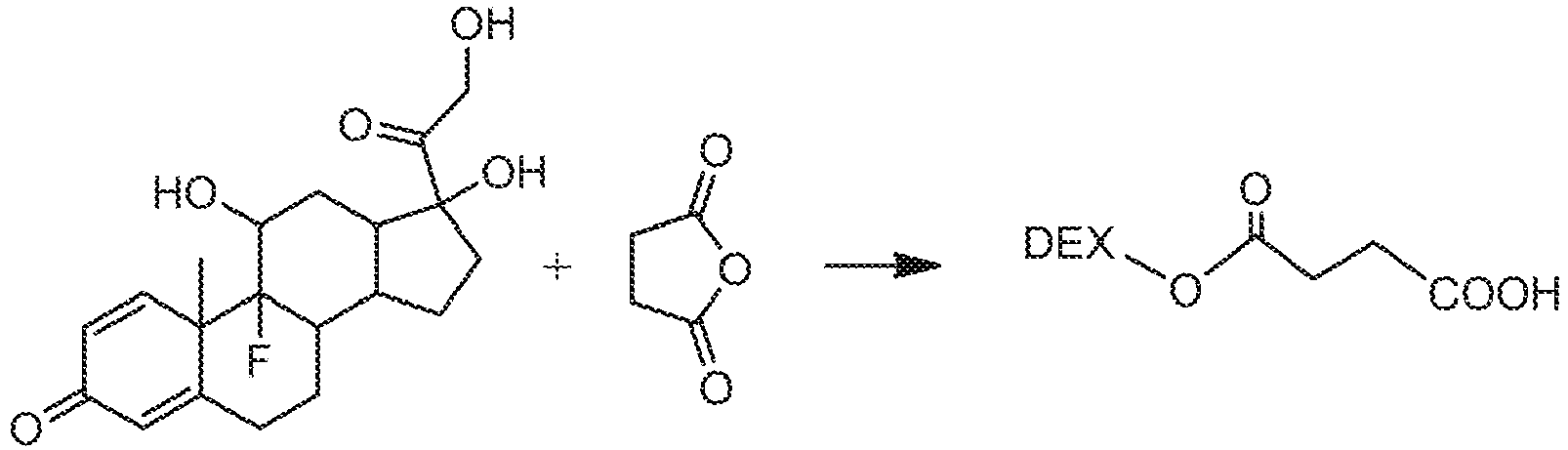
- Dexamethasone (DEX) and 6α-Methyl-Prednisolone (Pred) were first succinylated by mixing 200 mg of DEX with 35 mg of succinic anhydride in 50 ml Dimethyl-formamide (DMF). The reaction was performed under nitrogen for 24 hours at room temperature with mixing. The solvent was removed under vacuum and the product (DEX-succ and Pred-succ) purified through dialysis.
- In an alternative preparation, Dexamethasone (DEX) and 6a-Methyl-Prednisolone (Pred) were succinylated by mixing 200 mg of drug with 200 mg of succinic anhydride) and 10 mg of 4-(Dimethylamino)pyridine (DMAP) in 50 ml Dimethyl-formamide (DMF). The reaction was performed under nitrogen for 24 h at room temperature with mixing. The solvent was removed under vacuum and the solid residue (DEX-succ and Pred-succ) was purified through repeated washing with dH2O. Finally, the product was dried under vacuum.
-

- The conjugation of DEX-succ was performed by mixing 80 mg of end-capped PBAEs obtained in Example 2 with 8 mg of succinylated drug obtained in Example 3, 8 mg of 1-[3-(dimethylamino)-propyl]-3-ethylcarbodiimide hydrochloride (EDC) or 8 mg of N,N'-dicyclo-hexylcarbodiimide hydrochloride (DCC) and 8 mg of N-hydroxysulfosuccinimide (NHS) in 25 ml of DCM.
- For Pred-succ
conjugation 10 times the quantities employed for DEX-succ were used. After 24 hours at room temperature under mixing, the solution was filtered and the conjugates PBAEs-drug were precipitated through pouring the reaction mixture in about 10 times the volume of diethyl-ether under vigorous mixing; the solvent was removed under vacuum. PBAEs-drug conjugates were washed twice with diethylether. The final product was then dried under vacuum. - Bovine steers immature (7-day-old) feet were obtained from a local abattoir. Articular cartilage explants were surgically removed under sterile conditions from metacarpo-phalangeal joints. Full depth explants were excised using a 6mm diameter biopsy punch from the medial aspect of the medial condyle of individual joints. Explants were placed initially in Dulbecco's modified Eagles medium (DMEM; Invitrogen, Paisley, UK) and washed in the same medium to remove blood and small particulates due to the presence of a small amount of subchondral bone lining the basal aspect of cartilages.
- GAG depleted samples were obtained digesting the samples in a solution of trypsin 1mg/ml in PBS for 24 hours at 37 °C, and these was also used in the tests described below.
- A PTFE transport chamber was designed (
Figure 2 ) and manufactured to study oneway diffusion of solutes entering into cartilage; the chamber walls were treated with casein to block non-specific binding of solutes to PTFE surfaces. Cartilage disks (6 mm diameter, 1 mm thick or ∼0.4mm thick) were cut in half and placed in one of the holding slots machined into the chamber. The chamber facing the superficial zone was filled with 50 µl of a known concentration of PBAEs-drug solution supplemented with protease inhibitors; the other chamber side was filled with 50 µl of PBS containing protease inhibitors alone. The chamber was then placed in a petri dish containing d-H2O and covered to minimize evaporation, then placed inside an incubator at 37°C; stagnant layers at cartilage surfaces were prevented by placing the dish on a slow-speed rocker. At required intervals a sample was removed, washed in copious amount of water and placed in an Eppendorf containing 1 ml of digestion buffer. - Cartilages were digested using a sodium di-phosphate buffer 0.2 M containing 300 mg/l of papain,
EDTA 1 mM and DTT 2mM. Samples were mixed in the buffer and incubated at 50 °C for 24 hours. - Experiments were performed on duplicate samples originated from 3 different animals.
- Comparison of the drug penetration was performed against the results of a solution of the commercial drug formulation (for DEX, dexamethasone phosphate and for Pred, 6a-methyl-Prednisolone acetate) at the advised concentration of 4 mg/ml for DEX (equivalent to 4.4 mg/ml of dexamethasone phosphate) and 40 mg/ml for Pred (equivalent to 44 mg/ml 6a-methyl-Prednisolone acetate).
- The amount of GAG present in the cartilages samples was determined through the DMMB (Dimethyl-Methylene Blue) assay as described in Farndale et al. (Biochim Biophys Acta. 1986;883(2): 173-177).
- In addition, for DEX retention studies, cartilages were exposed to the DEX solution in the apparatus described above for 10 min and after washing in copious amount of water, they were place in an Eppendorf containing 0.5 ml of PBS. Cartilages were stored for up to 2.5 hours at 37 °C, at fixed intervals the cartilages were removed from the PBS solution, washed with water and placed in 1 ml of digestion buffer.
- Dexamethasone and 6α-methylprednisolone in the digestion buffer was quantified through reverse phase-HPLC. An Agilent series 1100 HPLC system was equipped with a
TeknoKroma TRACE EXCEL 120ODSB 5 µm analytical column thermostated at 25°C. The injection volume was 10 µl or 25 µl, the mobile phase was PBS:acetonitrile:glacial acetic acid 70:26:4 with a flow rate of 1 ml/min and the detector was a UV spectrophotometer at 244 nm. The amount of drug present in the cartilages was then expressed as mass of drug per cartilage mass. - The results obtained were compared with those obtained using dexamethasone phosphate in the case of dexamethasone complexes and 6α-methylprednisolone acetate in the case of 6α-methylprednisolone complexes. Representative results are shown in
Figure 4 . - As is clear, the amount of DEX recovered from cartilages increased with time over the course of 10 min; the conjugation of DEX to PBAEs generally induced an increase with time of the ratio between the drug delivered through PBAEs against the commercial formulation of dexamethasone phosphate (DEX-P). The overall effect of PBAEs depended on the both the chain constituents and the end-capping agent (
Figure 6 ). - The nature of the amine constituent of the polymer back-bone had a clear effect on the amounts obtained, the most effective being 4,4'-trimethylenedipiperidine, 3-(dimethylamino)-propylamine, 2-(2-pyridyl)ethylamine and 1-amino-2-propanol. These amines are not the most effective when PBAEs are used as non-viral DNA delivery system, highlighting the different requirements for drug delivery in cells against cartilages. Particularly, these amines present extra nitrogen capable of increasing the positive charge of the polymer chain, possibly increasing the electrostatic attraction towards the negatively charged biopolymers constituting the extracellular matrix of cartilages.
- The investigation of the end-capping amine role in cartilages drug delivery showed that diethylentriamine was more effective than ethylene-diamine (
Figure 6 ). This can be attributed to a steric effect as the longer chain of the end-capping amine could help the stability of the drug at the end of the chains, also the extra nitrogen present in diethylentriamine could results in higher a charge of the polymer conjugate. - When cartilages were exposed to the same concentration of DEX either as the commercial formulation of DEX-P or in the conjugated form to PBAE, the conjugation of Dexamethasone to PBAE resulted in a higher amount of the drug in the cartilages even after a very short period of time (1 min). The use of A2-e1-DEX resulted in the concentration of DEX in the cartilage to increase only in the first minute and then remain almost constant.
- When the GAG depleted samples were used, it was found that despite relying on the negative charges of the GAG molecules to deliver the drug in the cartilages, PBAE were also effective on GAG depleted cartilage exhibiting about 40% of the untreated tissues.
- DEX was quickly released from the cartilage; in normal GAG sample DEX concentration fell below detection limit after about 2 hours (
Figure 11 ) in case of DEX-P; when PBAE-DEX were employed DEX was still detectable in the cartilage even after 2.5 hours). In GAG depleted cartilages the release was slower than in for normal GAG samples but the amount of DEX left in the tissue for PBAE-DEX was always higher than for DEX-P. - A more extensive investigation of the drug delivery properties of PBAE in cartilages revealed that many members of the PBAE family mildly enhanced the uptake of DEX, few candidates were not capable of increasing DEX concentration in cartilages, whilst some PBEA achieved remarkably high levels of DEX (
Figure 6 ). Although no good coefficient of correlation (0.046) was found between zeta potential and diffusion coefficient of PBAE (Figure 8 ) or between zeta potential and DEX uptake (0.22) after 10 min exposure (Figure 7a ); on the contrary good correlation was found between diffusion coefficient of DEX uptake (Figure 7b ). Generally the compound e2 gave better performance than e1 or e3, the latter also generally did not perform as well as the other two. - End-capping with di-amine results in a NH2 groups at the PBEA extremities and the formation of an amide bond with the succinilated DEX, however it is also possible to employ amino-alcohols or thio-alcohols compound to end-cap PBAEs. When these different compounds were used the conjugation of succinylated DEX returned an ester bond but the PBEA-DEX formed was still capable to increase DEX uptake (
Figure 9 ) with efficacy dependent on the length of the amino-alcohol used. The optimal appeared to be a chain of about 3-4 carbons. Similar results were obtained for amino-ethanol and thio-alcohols. - PBAE were effective drug delivery system for cartilages also for another very commonly used steroidal drug such Prednisolone, also for this steroid the efficacy depended on the PBAE structure and end-capping; however the overall enhancement was greater for Prednisolone than for Dexamethasone (
Figure 10 ). - By way of comparison, a solution containing 4 mg/ml of Dexamethsone and the same quantity of pure end-capped PBAE that would be found in PBAE-DEX was prepared and employed in similar cartilage uptake experiments to those described above. It was found however, that when pure PBAEs were present along with DEX, but the two compounds were not conjugated, the uptake of DEX was always lower than the corresponding case of pure steroidal drug (
Figure 12 ). - The cartilage samples as described in Example 4 underwent a 1 hour predigestion stage with 0.4 % w/v pronase (Sigma, UK), dissolved in 4-(2-hydroxyethyl)-1-piperazineethanesulfonic acid (HEPES)-buffered DMEM (Gibco, UK) supplemented with 50 U/50 mg/mL penicillin-streptomycin (Sigma Aldrich) and 2.5 mg/mL amphotericin B. Cartilages samples were placed in sterile eppendorfs containing the filter-sterilized enzyme solution by passage through a 0.22-mm filter at a concentration of 1 ml solution for 5 cartilage extracts. The samples were incubated at 37 °C and the cartilage fragments were then washed twice with sterile PBS and digested with 1 ml each 6 cartilage sample of collagenase II (Sigma, UK) 0.1 % w/v for 16 h at 37 °C. Collagenase II was prepared in 4-(2-hydroxyethyl)-1-piperazineethanesulfonic acid (HEPES)-buffered DMEM (Gibco, UK) supplemented with 50 U/50 mg/mL penicillin-streptomycin (Sigma Aldrich and filter sterilised.
- The triturate suspension was passed through a 100-mm nylon cell strainer (Fisher, UK) to remove matrix debris, and added to 10 mL DMEM/F-12 (1.1) with GlutaMAX (DMEM/F-12) (Gibco, UK) media, supplemented with 20% FBS, 1% penicillin-streptomycin and 1% amphotericin B. Chondrocytes were centrifuged at 1500 rpm at 4°C for 10 min to pellet the cells. The supernatant was discharged and the pelleted cells were washed in sterile PBS. After centrifugation at 1500 rpm at 4 °C for 10 min, the cells were suspended in supplemented 10 ml of DMEM/F-12 (10% FBS) and aseptically transferred in cell culture flasks. Chondrocytes were cultured in a humidified incubator at 37 °C and 5% CO2. After 3 days chondrocytes were washed in sterile PBS and trypsinated. 24 well plates were the inoculated with approximately 6000 cells/well in 1 ml of DMEM/F-12 supplemented with 10% FBS and 1% pen-strep. Chondrocytes were grown for 2 days in a humidified incubator at 37 °C and 5% CO2 before 15 µl of a
solution containing DEX 4 mg/ml was added. The DEX solutions were prepared using Dexamethasone phosphate or PBAE-DEX conjugates. - Plates were incubated in a humidified incubator at 37 °C and 5% CO2 for up to 3 days.
- Chondrocytes viability was assessed through MTT and LDH assay kits (Sigma, UK) according to manufacturer's protocols. Experiments were performed in duplicate on cells originated from 3 different animals.
- The results are shown in
Figure 5 . They showed that chondrocytes, which are cell present in the cartilages, did not suffer negatively from the exposure to PBAE for at least 3 days. Both enzyme assays (LDH and MTT) gave the same viability in samples exposed to DEX-P that samples exposed to PBAE-DEX. - In order to determine the basic diffusion coefficients of PBAEs in cartilages, Amino terminated PBAEs were fluoro-tagged (PBAE-FITC) using FluoroTag™ FITC Conjugation Kit (Sigma, UK) according to manufacturer's recommendations.
- The diffusion coefficients of PBAE were determined using the same PTFE transport chamber and arrangements described above in Example 4. The chamber facing the superficial zone was filled with 50 µl of a known concentration of PBAEs-FITC supplemented with protease inhibitors; the other chamber side was filled with 50 µl of PBS containing protease inhibitors alone. After diffusion for a set length of time, 33µl of liquid for both chamber were removed and added to 67 µl of fresh PBS contained in black 96 well plate. Fluorescence was read using FLUOstar OPTIMA Microplate Reader (BMG Labtech, UK) with Ex = 480 nm and Em = 520 nm. The parameters were set assuring that the intensity response was in the linear range of concentrations as determined during PBAE-FITC purification.
- The ratio of fluorescence between the two sides of the cartilage was plotted against diffusion time in order to identify the "break-through time" (tlag ), the diffusion coefficient () was calculated as (Crank J. The mathematics of diffusion. Oxford, Clarendon Press; 1975):


d is the cartilage sample thickness - Experiments were performed on duplicate samples originated from 3 different animals.
- Representative results for PBAEs A1-e1 and A2-e2 are shown in
Figure 3 . These show that PBAE can penetrate cartilages tissues and that the effective diffusion coefficient depends on the structure of the PBAE. - However, no good coefficient of correlation (0.046) was found between the zeta potential and diffusion coefficient of the PBAE (see
Figure 7 hereinafter). - Complexes were formed using a method that did not require prior functionalization of the drug to be bound. The drugs in this case inherently presented a carboxyl group such in the case of (non-steroidal anti-inflammatory drugs (NSAIDs) like indomethacine and Ketorolac or in disease-modifying anti-rheumatic drugs (DMARDs) such as sulfasalazine and methotrexate. The bond between drug and PBAE can be formed directly. However in order to the drug to linked with an ester bond, PBAEs need to be end-capped with amino-alcohols or mercapto-alcohols instead of with di-amine as illustrated in the following schemes.
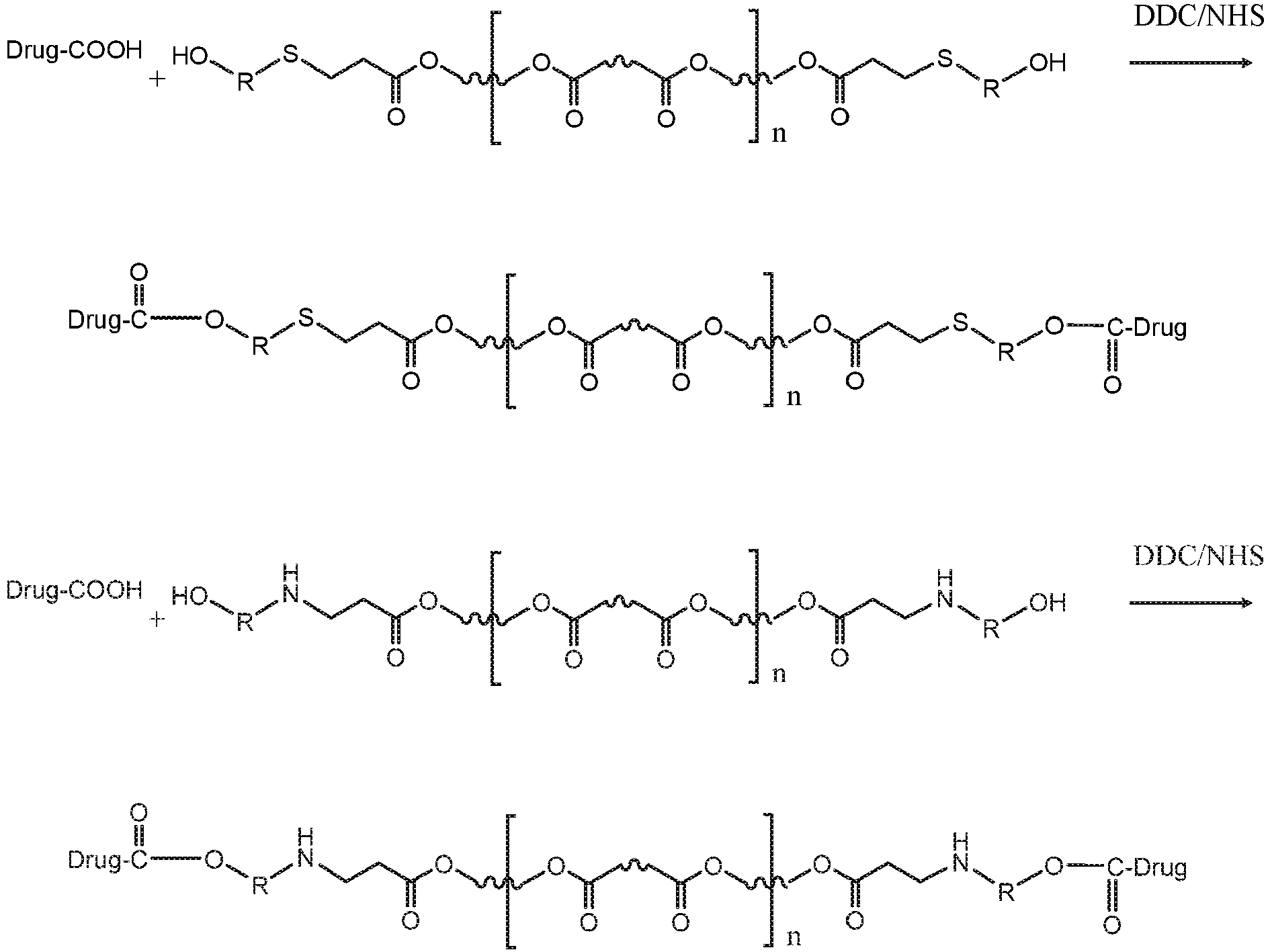
- The conjugation of the NSAIDs and DMRAD was performed mixing 20 mg of end-capped PBAE with 2 mg of drug, 2 mg of N,N'-dicyclohexylcarbodiimide hydrochloride (DCC) and 2 mg of N-hydroxysulfosuccinimide (NHS) in 25 ml of DCM .
- After 24 hours at room temperature under mixing, the solution was filtered and the conjugates PBAEs-drug were precipitated through pouring the reaction mixture in about 10 times the volume of diethyl-ether under vigorous mixing; the solvent was removed under vacuum. PBAEs-drug conjugates were washed twice with diethyl-ether:DCM (10:1). The final product was then dried under vacuum.
- It was also possible to conjugate directly a drug exhibiting -OH (for example Dexamethasone or Prednisolone) to PBEA without succinylation. In this case, a heto-bifunctional linker (such as suberic acid) can be employed and this approach is irrespective of the end-capping step resulting in -OH or -NH2 terminal groups as the ester bond is formed at one end of the linker in both cases, as illustrated in the following schemes.

- Dexmethasone, were conjugated to end-capped PBAE mixing 8 mg of drug with 80 mg of PBAE and 2 mg of Suberic acid bis(N-hydroxysuccinimide ester) in 25 ml of DCM; for 6α-
methyl Prednisolone 10 times the mentioned quantities were used. After 24 hours at room temperature under mixing, the solution was filtered and the conjugates PBAEs-drug were precipitated through pouring the reaction mixture in about 10 times the volume of diethyl-ether under vigorous mixing; the solvent was removed under vacuum. PBAEs-drug conjugates were washed twice with diethyl-ether:DCM (10:1). The final product was then dried under vacuum. - Cartilage uptake experiments were carried out as described in Example 4 above. A Comparison of the drug penetration was performed against the results of a solution of the commercial drug formulation (for DEX, dexamethasone phosphate and for Pred, 6α-methyl-Prednisolone acetate) at the advised concentration of 4 mg/ml for DEX (equivalent to 4.4 mg/ml of dexamethasone phosphate) and 40 mg/ml for Pred (equivalent to 44 mg/ml 6α-methyl-Prednisolone acetate).
- Ketorolac, Indomethacin and Sulfasalazine were quantified through reverse phase-HPLC. An Agilent series 1100 HPLC system was equipped with a
TeknoKroma TRACE EXCEL 120ODSB 5 µm analytical column thermostated at 25°C. The injection volume was 25 µl, the mobile phase with a flow rate of 1 ml/min was PBS:acetonitrile:glacial acetic acid 70:26:4 for Dexamethasone, Prednisolone, Ketorolac and Sulfasalazine whilst acetonitrile:acetate buffer pH=3.6 60:40 for Indomethacin. The detector was a UV spectrophotometer at 244 nm for Dexamethasone and Prednisolone, 255 nm for Indomethacin, 315 nm for Ketorolac and 360 nm for Sulfasalazine. The amount of drug present in the cartilages was then expressed as mass of drug per cartilage mass. - It was found that PBAE end-capped with amino alcohols or mercapto-alcohols could be employed to deliver non-steroidal anti-inflammatory drugs in cartilages. For Ketorolac A5 had greater efficacy than A12 regardless of the end-capping agent (
Figure 13 ), the latter did not appear effective. Indomethacin and could only be delivered effectively using A5 end-capped with short amino-alcohols (Figure 14 ). Disease modifying anti-rheumatoid drug (DMARD) such as sulfasalazine could also been delivery through the use of PBAE-drug (Figure 15 ). However, Dexamethasone and Prednisolone could also be delivered when conjugated in this manner (seeFigures 16 and 17 respectively). - It is believed that the efficacy of PBAE as drug delivery systems for cartilages depends on the electrostatic attraction between polymer and cartilages constituents and therefore it was expected that the system would be relatively agnostic to the type of cargo to be delivered. This appears to be the case. Our results demonstrated that ketorolac was easier to deliver into cartilages than Indomethacin (the two examples of NSAID used), the reason could lie in the higher hydrophilicity of ketorolac than indomethacin, this was found to be the case also for the comparison between Prednisolone and Dexamethasone.
- Sulfasalazine was employed as example of DMARD and the efficacy of PBAE was connected to the length of the end-capping agent.
- The preparation of PBAE conjugated to steroids in a single step reaction is an important benefit as the reduction of reactions corresponds to lower production costs. The use of heto-bifunctional linker such as the NHS ester of subaric acid performs the same function of succinic anhydrade (forming an ester bond between steroid and linker) and forms another bond to the PBAE.
- It appears therefore that the PBAE drug delivery system for cartilages is largely agnostic to the nature of the cargo. It may be used as an effective delivery system for steroids, NSAIDS and DMARDs. These may be bound to the PBAE directly if required, without prior functionalization.
- It is possible to functionalise the drug in order for the molecule to exhbit either an amino group or a mercapto group, in this way the functionalised drug can be bind to the acrylate terminated PBAE during the end-capping reaction, for example as illustrated in
Figure 1C . - In this case, a steroidal drug can be functionalised with amino acids forming an ester bond between the hydroxyl group on the drug and the carboxyl group of the aminoacid. Tthe amino group of the aminoacid on the functionalised steroidal drug can then bind directly to the acrylate groups present on the acrylate terminated PBAE as illustrated in the following scheme. In order to protect the amino group of aminoacid during the reaction with the steroids, a protecting group such as tert-Butoxy-carbonyl protected (BOC) aminoacids may be used. Similarly, thiolactones can be employed in order to for an ester bond between steroid and linker and forming a mercapto group that can bind to the acrylate group at the end of the PBAE.

- This method was effected by dissolving 50 mg of Dexamethasone (DEX) in 20 ml Dichloromethane (DCM) with 26 g of DCC and Dicyclohexylcarbodiimide and 6 mg of 4-(Dimethylamino)pyridine (DMAP). Then, 23 mg of N-(tert-Butoxycarbonyl)glycine (BOC-glycine) or 24.5 mg of BOC-β-alanine were added. The reaction was performed under nitrogen for 24 hours at room temperature with mixing. DCM was removed under reduced pressure to yield a white solid. The solid was re-dissolved in diethyl ether (10 ml) and washed twice with 10 ml 0.1N HCl. It was then dried over MgSO4 and reduced under vacuum to yield white solid. The 21-O-t-Boc-glycinate ester or 21-O-t-Boc-β-alanine ester of Dexamethasone were purified by flash column chromatography.
- The esters were dissolved in a 1:1 mixture of DCM and trifluoroacetic acid (TFA) and stirred at room Temperature; after 1 h, the reaction mixture was quenched with an aqueous saturated solution of Na2CO3 to neutrality. The mixture was extracted with DCM and the organic extracts were combined. Glycinate ester or β-alanine ester of Dexamethasone were obtained evaporating the solvent under reduced pressure.
- Acrylate-terminated polymers (80 mg) and 10 mg of aminoacid ester of Dexamethasone were dissolved in 25 ml of DCM; the mixture was kept for 24 h at room temperature under mixing.
- The PBAEs-DEX were recovered through precipitation in diethyl-ether under vigorous mixing, the unreacted aminoacid ester of DEX were removed centrifuging the suspension of PBAE in diethyl-ether/DCM for 2 min at 1155 g. The supernatant was removed and the PBAEs washed twice with diethyl-ether:DCM (10:1); PBAE-DEX were then dried under vacuum.
- The resultant complexes were tested for cartilage uptake using the method of Example 4. The results are shown in
Figure 18 . Although preparation of PBAE-DEX through the functionalisation of DEX with aminoacids was possible, the drug delivery performance of the conjugate was not significantly better than the pure form of DEX, possibly due to the short chain length of the linker. - PBAEs can be synthesised directly end-capped when the amine compound is in excess during the polymerisation, as illustrated in the following scheme.

- If such amine presents also another functional group that can be employed for conjugation, then a simpler two step approach to the preparation of PBAE-drug can be designed. This is possible for drugs exhibiting carboxyl groups (i.e Ketorolac, Indomethacoin, Sulfasalazine) or molecules exhibiting hydroxyl groups (i.e steroids) through the use of a heto-bifunctional linker as described in Example 8 above.
- Hydroxyl terminated poly(β-amino ester)s were synthesized by mixing diacrylate and amine monomers in a 1:1.1 ratio in Dichloro-methane (DCM) at a concentration of 5 ml of DCM (or THF) each 3.7 mmol of acrylate. The polymerisation was then performed under stirring at 50 °C for 48 hours. PBAEs were precipitated through pouring the reaction mixture in about 10 times the volume of diethyl-ether under vigorous mixing; the solvent was removed under vacuum.
- The unreacted di-acrylate was removed dispersing the recovered polymer in diethyl-ether and centrifuging the suspension of PBAE for 2 min at 1155 g. The supernatant was removed and the PBAEs washed twice with diethyl-ether. The end-capped PBAEs were then dried under vacuum.
- The conjugation of the Ketorolac was performed mixing 20 mg of end-capped PBAE with 2 mg of drug, 2 mg of N,N'-dicyclohexylcarbodiimide hydrochloride (DCC) and 2 mg of N-hydroxysulfosuccinimide (NHS) in 25 ml of DCM. Dexmethasone was conjugated to end-capped PBAE mixing 8 mg of drug with 80 mg of PBAE and 2 mg of Suberic acid bis(N-hydroxysuccinimide ester); for 6α-
methyl Prednisolone 10 times the mentioned quantities were used. After 24 hours at room Temperature under mixing, the solution was filtered and the conjugates PBAEs-drug were precipitated through pouring the reaction mixture in about 10 times the volume of diethyl-ether under vigorous mixing; the solvent was removed under vacuum. PBAEs-drug conjugates were washed twice with diethyl-ether:DCM (10:1). The final product was then dried under vacuum. - The cartilage uptake of the complexes was tested using the methods described in Example 4. The results are shown in
Figure 19 . - The amount of drug present in cartilages using PBAE-drug prepared in a two step synthesis was greater for the polymers prepared with acrylate B than acrylate A that has a with shorter carbon chain. The best improvement was seen for Prednisolone than for Dexamethasone; Ketorolac had the lowest improvement in drug uptake.
- It appears therefore that when amino-alcohols are used in the PBAE backbone the polymer presents hydroxyl groups therefore the conjugation of drugs not necessary occurs to PBAE ends. The efficacy of PBAE-drug prepared in this way showed the already found patterned Pred>DEX>Ket.
- It is possible to prepare PBAE-drug in a two steps synthesis protocol using amino-alcohols as polymer constituent in excess compared to acrylates and conjugating drugs with carboxyl groups directly or drugs with hydroxyl groups (i.e. steroids) through a heto-bifunctional linker.
- A2-e1 and A5-e2, prepared as described in Example 2 above, were dissolved in (4-morphoiino)-ethane sulfonic acid (MES) buffer pH= 6.5 at a concentration of 1mg/ml. 1-[3-(dimethylamino)-propyl]-3-ethylcarbodiimide hydrochloride (EDC) and N-hydroxysulfosuccinimide sodium salt (sulfo-NHS) were dissolved in MES buffer at a concentration of 2 mg/l. TGF-β1 was dissolved in MES at a
concentration 10 mg/l and another solution was prepared with FGF-2 at 100 mg/l. 50 µl of TGF-β1 solution were mixed with 10 µl of PBAE solution and 35 µl of the EDC/NHS sulfo solution. 50 µl of FGF-2 solution were mixed with 100 µl of PBAE solution and 350 µl of the EDC/NHS sulfo solution. Fresh MES was added to each growth factor solution to a final volume of 1.5 ml. The conjugation reaction was carried out at room temperature for 8 hours under mixing. - The PBAE-growth factors were purified with size exclusion chromatography (SEC) and lyophilised.
- Cartilages samples were placed in a sterile well plate with a Dulbecco's Modified Eagles Medium (DMEM) immediately after removal from the joint, to remove blood and small particulates due to the presence of a small amount of subchondral bone lining the basal aspect of cartilages. Samples were incubate at 37°C in humidified atmosphere containing 5% CO2.
- After 24 hours the DMEM was removed and was replaced with serum-free culture medium with the following composition: DMEM high glucose, 4.4 g/ml; ascorbate-2-phospate, 100 µg/ml; penicillin 50 U/ml; streptomycin 50 µg/ml; HEPES pH 7.5, 10 µg/ml insulin, 10mM; Transferrin, 5.5 µg/ml and Selenium (ITS), 6.7 ng/ml. The media was also supplemented with growth factors: TGF-β1, 10 ng/ml and FGF-2, 100 ng/ml (Peprotech, London, UK) either pure or conjugated to PBAE; control samples were prepared without the presence of growth factors in the media. Cartilages were incubated at 37°C in humidified atmosphere containing 5% CO2 and the media changed every 3 days.
- Cartilage is a composite material, constituted by a solid portion (ECM) and a fluid portion (synovial fluid). Due to this feature, the cartilage responds to the onset of a stress with poro-elastic behaviour.
- The evolution of the material properties of the cartilages during in vitro maturation was determined through rheological tests using AR-G2 (TA Instruments, UK) using 5 mm Peltier plates. Dynamic oscillation tests were performed; in these measurements a sinusoidal oscillation strain (σ) of small amplitude (σ0) and frequency (ω):


- Because the two sinusoidal waves will have a phase angle difference, δ, the storage (G') and loss modulus (G") can be defined as the component in phase and π/2 out of phase with the strain, respectively.



- Analysis was carried out at 37°C using frequency sweep between 0.1 and 100 Hz, a fixed strain of 0.1% and 25N applied load.
- The frictional coefficient of cartilage explants was assessed using a pin-on-plate tribometer, with phosphate-buffered saline (PBS) as a lubricant. Six millimeter diameter freshly isolated and cultured articular cartilage explants, were fixed onto a nylon housing using cyanoacrylate. PBS was applied evenly over the polished glass surface, providing an average depth of approximately 1 mm. The tissue was then preloaded at 1.2 MPa for 120s prior to disc rotation to ensure consistent boundary lubrication as described previously (Neu et al. Arthritis Rheum 2010;62(9):2680e7).
- The sliding speed was then ramped to 12 mm/s, before data was recorded for 15 seconds. Retrospective analysis to compute the mean frictional coefficient was then completed using MS Excel (Microsoft, Redmond, WA, USA) according to:

- F= frictional force;
- µ=frictional coefficient;
- N=normal compressive force necessary to initiate sliding motion.
- The value of F was determined through a previously obtained calibration of the rig.
- The mechanical properties of cartilages described by |G*| and δ revealed that without growth factors both parameters exhibited a slight increase during the first 3 days of in-vitro maturation and the gradually decreased (
Figure 20 ) with the phase angles decreasing after 1 week. Instead, when growth factors (TGF-β1 and FGF-2) were added to the media, G* presented the greatest values after 1 week of maturation across the frequency range investigated (Figure 21 ). - The conjugation of the growth factor to PBAE resulted in the values of G* not decreasing after the maximum values reached after 1 week of maturation (
Figures 22 and23 ). - No significant difference was noticeable between conjugation to A5-e2 and A2-e1. The friction coefficient (Figure 25) during in vitro maturation increased when TGF-β1 and FGF-2 were added to the medium; moreover their absence resulted in the cartilages sample exhibiting the same friction coefficient than the immature samples (t = 0) for the incubation period (up to 3 weeks). When TGF-β1 and FGF-2 were conjugated to both A5-e2 and A1-e1 the progression of the friction coefficient during the in vitro maturation had the same patterned as the unconjugated growth factors but after 2 and 3 weeks the friction coefficient was higher.
- In summary therefore, these results show that the cartilages mechanical properties evolve during in-vitro maturation, and the absence of any growth factors was detrimental as the G* quickly decreased through the frequency range tested and the friction coefficient did not increase; the addition of FGF-2 and TGF-β1 to the media had the beneficial effects expected and resulted in a maximum of mechanical properties after about 1 week, however this was followed by a decrease. Moreover, the conjugation of the growth factors visibly improved the properties of the cartilages as the maximum was reached after 3 days and no decrease was detected.
- Thus, PBAE is an effective delivery system for cartilage not only for the transport of small drug molecules but also for biological molecules such as growth factors. Through PBAE-growth factors it is possible to increase in vitro cartilages maturation and maintain to developed mechanical properties for longer without degradation.
Table 1. 1 
piperazine 2 
4,4'- Trimethylenedipiperidine 3 
5-amino-1- pentanol 4 
2- methoxyethylamine 5 
3-(dimethylamino)-1-propilamine 6 
(3-aminopropyl) triethoxysilane 7 
2-(2-pyridy) ethylamine 8 
3-methoxy-propylamine 9 
N,N'- dimethylethyldiamine 10 
4-(2-aminoethyl) morpholine 12 
3-Amino-1,2- propanediol 13 
DL 1-amino-2- propanol 14 
trans-4-amino- hexanol 15 
Cyclopentylamine 16 
3-amino-1-propanol Table 2 A 
1,4- Butanediol diacrylate B 
1,6 Hexanediol diacrylate C 
Tetra(ethylene glycol) diacrylate Table 3 
Ethylen diamine e1 
Diethylentriamine e2 
Tris-(2-aminoethyl) amine e3 
2-aminoethanol c2 
3 -amino-1-propanol c3 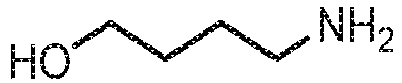
4-amino-1-butanol c4 
5-amino-1-pentanol c5 
2-mercaptoethanol s2
Claims (24)
- A complex comprising a polymer comprising a poly(β-amino ester (PBAE) or a PBAE derivative having a functional group at an end of the polymer chain, and a therapeutic agent effective in the treatment of a cartilage disease or condition, for use in the treatment of cartilage damage, wherein the PBAE or PBAE derivative is covalently bound to the therapeutic agent and said complex is administered such that the complex penetrates pre-existing cartilage tissue.
- The complex according to claim 1 for use in the treatment of cartilage damage wherein the PBAE is obtainable by reaction of a diacrylate monomer of formula (I)
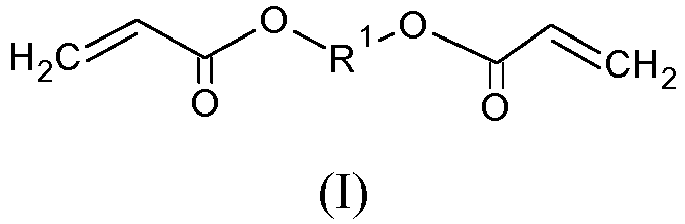
- The complex according to claim 2 for use in the treatment of cartilage damage wherein the amine monomer is a compound of formula (II) or (III)
 where R2 is an optionally substituted hydrocarbyl group;R3 and R4 are independently selected from optionally substituted hydrocarbyl groups;R5 is a divalent hydrocarbyl group which is optionally substituted and may also be interposed with heteroatoms such as oxygen;or R3 and/or R4 are linked together or to R5 to form one or more ring structures.
- The complex according to claim 2 or claim 3 for use in the treatment of cartilage damage wherein, in the polymer, R1 is C1-6alkylene group.
- The complex according to claim 4 for use in the treatment of cartilage damage wherein R1 is an n-butylene group.
- The complex according to any one of claims 2 to 5 for use in the treatment of cartilage damage wherein the amine monomer is selected from 5-amino-1-pentanol, 2-methoxyethylamine, 3 -(dimethylamino)-propylamine, (3-aminopropyl) triethoxysilane, 2-(2-pyridyl)ethylamine, 3-methoxy-propylamine, 3-amino-1,2-propanediol, 1-amino-2 propanol, piperazine, 4,4-trimethylenedipiperidine, 3-(dimethylamino)-propylamine and N,N-dimethylethyldiamine.
- The complex according to any one of claims 1 to 6 for use in the treatment of cartilage damage wherein the polymer is a PBAE derivative having amino or alcohol functional groups at the ends of the polymer chains forming 'end caps'.
- The complex according to claim 7 for use in the treatment of cartilage damage wherein the PBAE derivative is of formula (VII) or (VIII)

 wherein R1 is as defined in claim 2,R2 R3, R4 and R5 are as defined in claim 3,R6 is an alkylene chain which is optionally interposed with a heteroatom,R7 and R8 are the same and are selected from hydrogen or C1-6alkyl,and n is an integer of greater than 2.
- The complex according to any one of claims 1 to 7 for use in the treatment of cartilage damage wherein the PBAE derivative is of formula (VIIA) or (VIIIA)
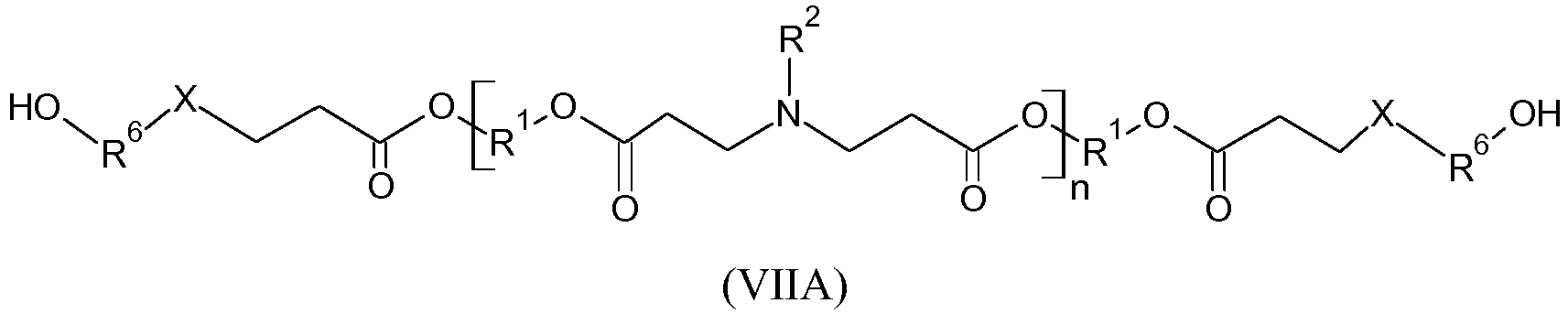
 wherein R1 is as defined in claim 2,R2 R3, R4 and R5 are as defined in claim 3,R6 is an alkylene chain which is optionally interposed with a heteroatom, which may be substituted,n is an integer of greater than 2, and X is NH or sulfur.
- The complex according to claim 8 or claim 9 for use in the treatment of cartilage damage wherein R3 and R4 C1-6alkyl; or R3 and R4 are linked together to form a piperazine ring; or R3 and/or R4 are linked to R5 to form a piperidine ring.
- The complex according to any one of claims 8 to 10 for use in the treatment of cartilage damage wherein R5 is a C1-10alkylene chain.
- The complex according to any one of claims 8 to 11 for use in the treatment of cartilage damage wherein R7 and R8 are both hydrogen.
- The complex according to claims 1-12 for use in the treatment of cartilage damage wherein the agent is a small drug molecule, biomacromolecule or a growth/maturation factor.
- The complex according to claim 13 for use in the treatment of cartilage damage wherein the agent is a drug for use in the treatment of arthritis.
- The complex according to claim 14 for use in the treatment of cartilage damage wherein the drug is a steroidal anti-inflammatory drug such as dexamethasone, prednisolone or 6α-methylprednisolone; a DMARD such as methotrexate, sulfasalazine, a non-steroidal anti-inflammatory drug (NSAID) such as ibruprofen, naproxen, ketorolac tromethamine, Celecoxib and indomethacin or an AMPA receptor antagonist such as 2,3-dihydroxy-6-nitro-7-sulfamoyl-benzo[f]quinoxaline-2,3-dione (NBQX).
- A pharmaceutical composition comprising a complex according to any one of claims 1 to 15 in combination with a pharmaceutically acceptable carrier for use in the treatment of cartilage damage.
- A method for preparing a complex according to any one of the preceding claims, which method comprises reacting together a polymer which is a PBAE derivative as defined in to any one of claims 1 or 7 to 12 with an agent or a derivative thereof.
- The method according to claim 17 wherein the agent is a succinylated derivative.
- The method according to claim 17 or claim 18 wherein the PBAE derivative is obtained by reacting a PBAE with a compound of formula (VI)

- The method according to claim 19 wherein the compound of formula (VI) is ethylene diamine, diethylenetriamine or tris-(2-aminoethyl) amine.
- The method according to claim 17 or claim 18 wherein the PBAE derivative is obtained by reacting a PBAE compound with a compound of formula (VIA)

- The method according to claim 21 wherein the compound of formula (VIA) is 2-aminoethanol, 3-amino-1-propanol, 4-amino-1-butanol, 5-amino-1-pentanol or 2-mercaptoethanol.
- The method according to any one of claims 19 to 21 wherein the PBAE used as a starting material is prepared by mixing together a monomer of formula (I) as defined in claim 2, with an appropriate amount of an amine monomer.
- The method according to claim 23 wherein the amine monomer is a compound of formula (II) or (III) as defined in claim 3.
Applications Claiming Priority (2)
| Application Number | Priority Date | Filing Date | Title |
|---|---|---|---|
| GBGB1412610.6A GB201412610D0 (en) | 2014-07-16 | 2014-07-16 | Cartilage agent delivery |
| PCT/GB2015/052028 WO2016009190A1 (en) | 2014-07-16 | 2015-07-14 | Poly(beta-amino ester) conjugates for cartilage agent delivery and methods |
Publications (2)
| Publication Number | Publication Date |
|---|---|
| EP3169367A1 EP3169367A1 (en) | 2017-05-24 |
| EP3169367B1 true EP3169367B1 (en) | 2019-06-05 |
Family
ID=51454204
Family Applications (1)
| Application Number | Title | Priority Date | Filing Date |
|---|---|---|---|
| EP15741260.2A Not-in-force EP3169367B1 (en) | 2014-07-16 | 2015-07-14 | Poly(beta-amino ester) conjugates for cartilage agent delivery and methods |
Country Status (4)
| Country | Link |
|---|---|
| US (1) | US20170209468A1 (en) |
| EP (1) | EP3169367B1 (en) |
| GB (1) | GB201412610D0 (en) |
| WO (1) | WO2016009190A1 (en) |
Families Citing this family (3)
| Publication number | Priority date | Publication date | Assignee | Title |
|---|---|---|---|---|
| CN110559448B (en) * | 2019-07-26 | 2023-12-19 | 广州医科大学 | Targeted delivery siRNA bionic nanoparticle, and preparation method and application thereof |
| CN110841071B (en) * | 2019-11-08 | 2023-03-31 | 南通大学 | Poly (beta-amino ester) drug delivery system loaded with bioactive substances and preparation method thereof |
| WO2022067249A1 (en) * | 2020-09-28 | 2022-03-31 | The Johns Hopkins University | Polymers and nanoparticle formulations for systemic nucleic acid delivery |
Citations (1)
| Publication number | Priority date | Publication date | Assignee | Title |
|---|---|---|---|---|
| US20140050671A1 (en) * | 2012-08-16 | 2014-02-20 | University Of Washington Through Its Center For Commercialization | Theranostic nanoparticle and methods for making and using the nanoparticle |
Family Cites Families (4)
| Publication number | Priority date | Publication date | Assignee | Title |
|---|---|---|---|---|
| US20060228404A1 (en) * | 2004-03-04 | 2006-10-12 | Anderson Daniel G | Compositions and methods for treatment of hypertrophic tissues |
| EP2046266A4 (en) * | 2006-07-21 | 2009-11-04 | Massachusetts Inst Technology | MODIFIED EXTREMITE POLY (BETA-AMINO ESTERS) AND USES THEREOF |
| JP2016511747A (en) * | 2013-01-04 | 2016-04-21 | マサチューセッツ インスティテュート オブ テクノロジー | Drug delivery to tissues based on nanoparticle surface binding |
| US20150352180A1 (en) * | 2013-01-11 | 2015-12-10 | The Trustee Of The University Of Pennsylvania | Notch Ligand Bound Biocompatible Substrates And Their Use In Bone Formation |
-
2014
- 2014-07-16 GB GBGB1412610.6A patent/GB201412610D0/en not_active Ceased
-
2015
- 2015-07-14 EP EP15741260.2A patent/EP3169367B1/en not_active Not-in-force
- 2015-07-14 WO PCT/GB2015/052028 patent/WO2016009190A1/en not_active Ceased
- 2015-07-14 US US15/326,570 patent/US20170209468A1/en not_active Abandoned
Patent Citations (1)
| Publication number | Priority date | Publication date | Assignee | Title |
|---|---|---|---|---|
| US20140050671A1 (en) * | 2012-08-16 | 2014-02-20 | University Of Washington Through Its Center For Commercialization | Theranostic nanoparticle and methods for making and using the nanoparticle |
Also Published As
| Publication number | Publication date |
|---|---|
| WO2016009190A1 (en) | 2016-01-21 |
| US20170209468A1 (en) | 2017-07-27 |
| EP3169367A1 (en) | 2017-05-24 |
| GB201412610D0 (en) | 2014-08-27 |
Similar Documents
| Publication | Publication Date | Title |
|---|---|---|
| EP2794701B1 (en) | A peptide-hydrogel composite | |
| EP1115433B1 (en) | Functionalized derivatives of hyaluronic acid, formation of hydrogels and in situ using same | |
| Park et al. | RGD-conjugated chitosan-pluronic hydrogels as a cell supported scaffold for articular cartilage regeneration | |
| CN112812329B (en) | Hydrogel of sulfhydryl modified high molecular compound, preparation method and application thereof | |
| Yang et al. | Functional gelatin hydrogel scaffold with degraded-release of glutamine to enhance cellular energy metabolism for cartilage repair | |
| US20120301441A1 (en) | Dextran-hyaluronic acid based hydrogels | |
| US10344243B2 (en) | Biomimetic boundary lubricants for articular cartilage | |
| LU101045B1 (en) | Method for the manufacture and use of a bionic hydrogel composition for medical applications | |
| JP2004507588A (en) | Novel crosslinked derivatives of hyaluronic acid | |
| WO2006010066A2 (en) | Hydroxyphenyl cross-linked macromolecular network and applications thereof | |
| WO2009108100A1 (en) | Composition for the formation of gels | |
| US20150337121A1 (en) | Multifunctional tunable biomaterials for tissue engineering | |
| WO2017182483A1 (en) | Hyaluronic acid conjugates and uses thereof | |
| US20170209468A1 (en) | Poly(beta-amino ester) conjugates for cartilage agent delivery and methods | |
| Kim et al. | Preparation and properties of collagen/modified hyaluronic acid hydrogel for biomedical application | |
| EP4268856A1 (en) | Multilayer structure using chemically crosslinked alginic acid | |
| CN106714856B (en) | Composition containing glycosaminoglycan and protein | |
| WO2025106906A1 (en) | Supramolecular hydrogels and uses thereof | |
| US20210393854A1 (en) | Skeletal muscle regeneration in volumetric muscle loss using biomimetic glycosaminoglycan-based hydrogel | |
| CN120617300A (en) | Application of BSP-MA/HA-NB hydrogel in preparation of medicines for treating bone defect, cartilage injury or articular cartilage degenerative diseases | |
| CN118903172A (en) | Icariin and curcumin are used in combination, and composition for cartilage repair | |
| Responte | Novel Exogenous Agents for Improving Articular Cartilage Tissue Engineering | |
| Salinas | Photoinitiated thiol-acrylate polymerizations to tailor PEG microenvironments with peptide moieties to direct chondrogenic differentiation of hMSCs | |
| HK1235322A1 (en) | Composition containing glycosaminoglycans and proteins |
Legal Events
| Date | Code | Title | Description |
|---|---|---|---|
| STAA | Information on the status of an ep patent application or granted ep patent |
Free format text: STATUS: THE INTERNATIONAL PUBLICATION HAS BEEN MADE |
|
| PUAI | Public reference made under article 153(3) epc to a published international application that has entered the european phase |
Free format text: ORIGINAL CODE: 0009012 |
|
| STAA | Information on the status of an ep patent application or granted ep patent |
Free format text: STATUS: REQUEST FOR EXAMINATION WAS MADE |
|
| 17P | Request for examination filed |
Effective date: 20170110 |
|
| AK | Designated contracting states |
Kind code of ref document: A1 Designated state(s): AL AT BE BG CH CY CZ DE DK EE ES FI FR GB GR HR HU IE IS IT LI LT LU LV MC MK MT NL NO PL PT RO RS SE SI SK SM TR |
|
| AX | Request for extension of the european patent |
Extension state: BA ME |
|
| DAV | Request for validation of the european patent (deleted) | ||
| DAX | Request for extension of the european patent (deleted) | ||
| STAA | Information on the status of an ep patent application or granted ep patent |
Free format text: STATUS: EXAMINATION IS IN PROGRESS |
|
| 17Q | First examination report despatched |
Effective date: 20180504 |
|
| REG | Reference to a national code |
Ref country code: DE Ref legal event code: R079 Ref document number: 602015031390 Country of ref document: DE Free format text: PREVIOUS MAIN CLASS: A61K0047500000 Ipc: A61K0047590000 |
|
| RIC1 | Information provided on ipc code assigned before grant |
Ipc: A61K 47/59 20170101AFI20181206BHEP |
|
| GRAP | Despatch of communication of intention to grant a patent |
Free format text: ORIGINAL CODE: EPIDOSNIGR1 |
|
| STAA | Information on the status of an ep patent application or granted ep patent |
Free format text: STATUS: GRANT OF PATENT IS INTENDED |
|
| INTG | Intention to grant announced |
Effective date: 20190114 |
|
| GRAS | Grant fee paid |
Free format text: ORIGINAL CODE: EPIDOSNIGR3 |
|
| GRAA | (expected) grant |
Free format text: ORIGINAL CODE: 0009210 |
|
| STAA | Information on the status of an ep patent application or granted ep patent |
Free format text: STATUS: THE PATENT HAS BEEN GRANTED |
|
| AK | Designated contracting states |
Kind code of ref document: B1 Designated state(s): AL AT BE BG CH CY CZ DE DK EE ES FI FR GB GR HR HU IE IS IT LI LT LU LV MC MK MT NL NO PL PT RO RS SE SI SK SM TR |
|
| REG | Reference to a national code |
Ref country code: GB Ref legal event code: FG4D |
|
| REG | Reference to a national code |
Ref country code: CH Ref legal event code: EP |
|
| REG | Reference to a national code |
Ref country code: AT Ref legal event code: REF Ref document number: 1139327 Country of ref document: AT Kind code of ref document: T Effective date: 20190615 |
|
| REG | Reference to a national code |
Ref country code: IE Ref legal event code: FG4D |
|
| REG | Reference to a national code |
Ref country code: DE Ref legal event code: R096 Ref document number: 602015031390 Country of ref document: DE |
|
| REG | Reference to a national code |
Ref country code: NL Ref legal event code: MP Effective date: 20190605 |
|
| REG | Reference to a national code |
Ref country code: LT Ref legal event code: MG4D |
|
| PG25 | Lapsed in a contracting state [announced via postgrant information from national office to epo] |
Ref country code: ES Free format text: LAPSE BECAUSE OF FAILURE TO SUBMIT A TRANSLATION OF THE DESCRIPTION OR TO PAY THE FEE WITHIN THE PRESCRIBED TIME-LIMIT Effective date: 20190605 Ref country code: LT Free format text: LAPSE BECAUSE OF FAILURE TO SUBMIT A TRANSLATION OF THE DESCRIPTION OR TO PAY THE FEE WITHIN THE PRESCRIBED TIME-LIMIT Effective date: 20190605 Ref country code: HR Free format text: LAPSE BECAUSE OF FAILURE TO SUBMIT A TRANSLATION OF THE DESCRIPTION OR TO PAY THE FEE WITHIN THE PRESCRIBED TIME-LIMIT Effective date: 20190605 Ref country code: FI Free format text: LAPSE BECAUSE OF FAILURE TO SUBMIT A TRANSLATION OF THE DESCRIPTION OR TO PAY THE FEE WITHIN THE PRESCRIBED TIME-LIMIT Effective date: 20190605 Ref country code: NO Free format text: LAPSE BECAUSE OF FAILURE TO SUBMIT A TRANSLATION OF THE DESCRIPTION OR TO PAY THE FEE WITHIN THE PRESCRIBED TIME-LIMIT Effective date: 20190905 Ref country code: AL Free format text: LAPSE BECAUSE OF FAILURE TO SUBMIT A TRANSLATION OF THE DESCRIPTION OR TO PAY THE FEE WITHIN THE PRESCRIBED TIME-LIMIT Effective date: 20190605 Ref country code: SE Free format text: LAPSE BECAUSE OF FAILURE TO SUBMIT A TRANSLATION OF THE DESCRIPTION OR TO PAY THE FEE WITHIN THE PRESCRIBED TIME-LIMIT Effective date: 20190605 |
|
| PG25 | Lapsed in a contracting state [announced via postgrant information from national office to epo] |
Ref country code: LV Free format text: LAPSE BECAUSE OF FAILURE TO SUBMIT A TRANSLATION OF THE DESCRIPTION OR TO PAY THE FEE WITHIN THE PRESCRIBED TIME-LIMIT Effective date: 20190605 Ref country code: RS Free format text: LAPSE BECAUSE OF FAILURE TO SUBMIT A TRANSLATION OF THE DESCRIPTION OR TO PAY THE FEE WITHIN THE PRESCRIBED TIME-LIMIT Effective date: 20190605 Ref country code: GR Free format text: LAPSE BECAUSE OF FAILURE TO SUBMIT A TRANSLATION OF THE DESCRIPTION OR TO PAY THE FEE WITHIN THE PRESCRIBED TIME-LIMIT Effective date: 20190906 Ref country code: BG Free format text: LAPSE BECAUSE OF FAILURE TO SUBMIT A TRANSLATION OF THE DESCRIPTION OR TO PAY THE FEE WITHIN THE PRESCRIBED TIME-LIMIT Effective date: 20190905 |
|
| REG | Reference to a national code |
Ref country code: AT Ref legal event code: MK05 Ref document number: 1139327 Country of ref document: AT Kind code of ref document: T Effective date: 20190605 |
|
| PG25 | Lapsed in a contracting state [announced via postgrant information from national office to epo] |
Ref country code: PT Free format text: LAPSE BECAUSE OF FAILURE TO SUBMIT A TRANSLATION OF THE DESCRIPTION OR TO PAY THE FEE WITHIN THE PRESCRIBED TIME-LIMIT Effective date: 20191007 Ref country code: RO Free format text: LAPSE BECAUSE OF FAILURE TO SUBMIT A TRANSLATION OF THE DESCRIPTION OR TO PAY THE FEE WITHIN THE PRESCRIBED TIME-LIMIT Effective date: 20190605 Ref country code: NL Free format text: LAPSE BECAUSE OF FAILURE TO SUBMIT A TRANSLATION OF THE DESCRIPTION OR TO PAY THE FEE WITHIN THE PRESCRIBED TIME-LIMIT Effective date: 20190605 Ref country code: CZ Free format text: LAPSE BECAUSE OF FAILURE TO SUBMIT A TRANSLATION OF THE DESCRIPTION OR TO PAY THE FEE WITHIN THE PRESCRIBED TIME-LIMIT Effective date: 20190605 Ref country code: EE Free format text: LAPSE BECAUSE OF FAILURE TO SUBMIT A TRANSLATION OF THE DESCRIPTION OR TO PAY THE FEE WITHIN THE PRESCRIBED TIME-LIMIT Effective date: 20190605 Ref country code: SK Free format text: LAPSE BECAUSE OF FAILURE TO SUBMIT A TRANSLATION OF THE DESCRIPTION OR TO PAY THE FEE WITHIN THE PRESCRIBED TIME-LIMIT Effective date: 20190605 Ref country code: AT Free format text: LAPSE BECAUSE OF FAILURE TO SUBMIT A TRANSLATION OF THE DESCRIPTION OR TO PAY THE FEE WITHIN THE PRESCRIBED TIME-LIMIT Effective date: 20190605 |
|
| PG25 | Lapsed in a contracting state [announced via postgrant information from national office to epo] |
Ref country code: SM Free format text: LAPSE BECAUSE OF FAILURE TO SUBMIT A TRANSLATION OF THE DESCRIPTION OR TO PAY THE FEE WITHIN THE PRESCRIBED TIME-LIMIT Effective date: 20190605 Ref country code: IS Free format text: LAPSE BECAUSE OF FAILURE TO SUBMIT A TRANSLATION OF THE DESCRIPTION OR TO PAY THE FEE WITHIN THE PRESCRIBED TIME-LIMIT Effective date: 20191005 Ref country code: IT Free format text: LAPSE BECAUSE OF FAILURE TO SUBMIT A TRANSLATION OF THE DESCRIPTION OR TO PAY THE FEE WITHIN THE PRESCRIBED TIME-LIMIT Effective date: 20190605 |
|
| REG | Reference to a national code |
Ref country code: CH Ref legal event code: PL |
|
| REG | Reference to a national code |
Ref country code: DE Ref legal event code: R097 Ref document number: 602015031390 Country of ref document: DE |
|
| PG25 | Lapsed in a contracting state [announced via postgrant information from national office to epo] |
Ref country code: MC Free format text: LAPSE BECAUSE OF FAILURE TO SUBMIT A TRANSLATION OF THE DESCRIPTION OR TO PAY THE FEE WITHIN THE PRESCRIBED TIME-LIMIT Effective date: 20190605 Ref country code: TR Free format text: LAPSE BECAUSE OF FAILURE TO SUBMIT A TRANSLATION OF THE DESCRIPTION OR TO PAY THE FEE WITHIN THE PRESCRIBED TIME-LIMIT Effective date: 20190605 |
|
| PLBE | No opposition filed within time limit |
Free format text: ORIGINAL CODE: 0009261 |
|
| STAA | Information on the status of an ep patent application or granted ep patent |
Free format text: STATUS: NO OPPOSITION FILED WITHIN TIME LIMIT |
|
| REG | Reference to a national code |
Ref country code: BE Ref legal event code: MM Effective date: 20190731 |
|
| PG25 | Lapsed in a contracting state [announced via postgrant information from national office to epo] |
Ref country code: PL Free format text: LAPSE BECAUSE OF FAILURE TO SUBMIT A TRANSLATION OF THE DESCRIPTION OR TO PAY THE FEE WITHIN THE PRESCRIBED TIME-LIMIT Effective date: 20190605 Ref country code: DK Free format text: LAPSE BECAUSE OF FAILURE TO SUBMIT A TRANSLATION OF THE DESCRIPTION OR TO PAY THE FEE WITHIN THE PRESCRIBED TIME-LIMIT Effective date: 20190605 |
|
| 26N | No opposition filed |
Effective date: 20200306 |
|
| PG25 | Lapsed in a contracting state [announced via postgrant information from national office to epo] |
Ref country code: LI Free format text: LAPSE BECAUSE OF NON-PAYMENT OF DUE FEES Effective date: 20190731 Ref country code: CH Free format text: LAPSE BECAUSE OF NON-PAYMENT OF DUE FEES Effective date: 20190731 Ref country code: LU Free format text: LAPSE BECAUSE OF NON-PAYMENT OF DUE FEES Effective date: 20190714 Ref country code: BE Free format text: LAPSE BECAUSE OF NON-PAYMENT OF DUE FEES Effective date: 20190731 Ref country code: SI Free format text: LAPSE BECAUSE OF FAILURE TO SUBMIT A TRANSLATION OF THE DESCRIPTION OR TO PAY THE FEE WITHIN THE PRESCRIBED TIME-LIMIT Effective date: 20190605 |
|
| PG25 | Lapsed in a contracting state [announced via postgrant information from national office to epo] |
Ref country code: IE Free format text: LAPSE BECAUSE OF NON-PAYMENT OF DUE FEES Effective date: 20190714 |
|
| PGFP | Annual fee paid to national office [announced via postgrant information from national office to epo] |
Ref country code: GB Payment date: 20200708 Year of fee payment: 6 Ref country code: FR Payment date: 20200709 Year of fee payment: 6 Ref country code: DE Payment date: 20200708 Year of fee payment: 6 |
|
| PG25 | Lapsed in a contracting state [announced via postgrant information from national office to epo] |
Ref country code: CY Free format text: LAPSE BECAUSE OF FAILURE TO SUBMIT A TRANSLATION OF THE DESCRIPTION OR TO PAY THE FEE WITHIN THE PRESCRIBED TIME-LIMIT Effective date: 20190605 |
|
| PG25 | Lapsed in a contracting state [announced via postgrant information from national office to epo] |
Ref country code: MT Free format text: LAPSE BECAUSE OF FAILURE TO SUBMIT A TRANSLATION OF THE DESCRIPTION OR TO PAY THE FEE WITHIN THE PRESCRIBED TIME-LIMIT Effective date: 20190605 Ref country code: HU Free format text: LAPSE BECAUSE OF FAILURE TO SUBMIT A TRANSLATION OF THE DESCRIPTION OR TO PAY THE FEE WITHIN THE PRESCRIBED TIME-LIMIT; INVALID AB INITIO Effective date: 20150714 |
|
| REG | Reference to a national code |
Ref country code: DE Ref legal event code: R119 Ref document number: 602015031390 Country of ref document: DE |
|
| GBPC | Gb: european patent ceased through non-payment of renewal fee |
Effective date: 20210714 |
|
| PG25 | Lapsed in a contracting state [announced via postgrant information from national office to epo] |
Ref country code: GB Free format text: LAPSE BECAUSE OF NON-PAYMENT OF DUE FEES Effective date: 20210714 Ref country code: DE Free format text: LAPSE BECAUSE OF NON-PAYMENT OF DUE FEES Effective date: 20220201 |
|
| PG25 | Lapsed in a contracting state [announced via postgrant information from national office to epo] |
Ref country code: FR Free format text: LAPSE BECAUSE OF NON-PAYMENT OF DUE FEES Effective date: 20210731 |
|
| PG25 | Lapsed in a contracting state [announced via postgrant information from national office to epo] |
Ref country code: MK Free format text: LAPSE BECAUSE OF FAILURE TO SUBMIT A TRANSLATION OF THE DESCRIPTION OR TO PAY THE FEE WITHIN THE PRESCRIBED TIME-LIMIT Effective date: 20190605 |