EP3168216A1 - Azetidinyloxyphenylpyrrolidine compounds - Google Patents
Azetidinyloxyphenylpyrrolidine compounds Download PDFInfo
- Publication number
- EP3168216A1 EP3168216A1 EP16196721.1A EP16196721A EP3168216A1 EP 3168216 A1 EP3168216 A1 EP 3168216A1 EP 16196721 A EP16196721 A EP 16196721A EP 3168216 A1 EP3168216 A1 EP 3168216A1
- Authority
- EP
- European Patent Office
- Prior art keywords
- compound
- formula
- methyl
- pharmaceutically acceptable
- compounds
- Prior art date
- Legal status (The legal status is an assumption and is not a legal conclusion. Google has not performed a legal analysis and makes no representation as to the accuracy of the status listed.)
- Withdrawn
Links
- WVEMMKKRMPLVQC-UHFFFAOYSA-N 2-(azetidin-1-yloxy)-1-phenylpyrrolidine Chemical class C1CCN1OC1N(C=2C=CC=CC=2)CCC1 WVEMMKKRMPLVQC-UHFFFAOYSA-N 0.000 title abstract description 3
- 150000001875 compounds Chemical class 0.000 claims abstract description 86
- 125000002496 methyl group Chemical group [H]C([H])([H])* 0.000 claims abstract description 16
- 229910052739 hydrogen Inorganic materials 0.000 claims abstract description 12
- 239000001257 hydrogen Substances 0.000 claims abstract description 12
- 125000004435 hydrogen atom Chemical group [H]* 0.000 claims abstract description 12
- 238000004519 manufacturing process Methods 0.000 claims abstract description 5
- 150000003839 salts Chemical class 0.000 claims description 28
- 238000000034 method Methods 0.000 claims description 15
- VEXZGXHMUGYJMC-UHFFFAOYSA-N Hydrochloric acid Chemical compound Cl VEXZGXHMUGYJMC-UHFFFAOYSA-N 0.000 claims description 8
- QTBSBXVTEAMEQO-UHFFFAOYSA-N Acetic acid Chemical compound CC(O)=O QTBSBXVTEAMEQO-UHFFFAOYSA-N 0.000 claims description 6
- KPNDJESFVQAITP-IDPPLZKOSA-N (2s)-2,3-dihydroxy-1-[(3s,4s)-3-[(1r)-1-hydroxyethyl]-4-[4-methoxy-3-[1-(5-methylpyridin-2-yl)azetidin-3-yl]oxyphenyl]-3-methylpyrrolidin-1-yl]propan-1-one Chemical compound COC1=CC=C([C@H]2[C@](CN(C2)C(=O)[C@@H](O)CO)(C)[C@@H](C)O)C=C1OC(C1)CN1C1=CC=C(C)C=N1 KPNDJESFVQAITP-IDPPLZKOSA-N 0.000 claims description 5
- 239000002253 acid Substances 0.000 claims description 4
- 239000008194 pharmaceutical composition Chemical group 0.000 abstract description 7
- 206010020853 Hypertonic bladder Diseases 0.000 description 28
- 208000009722 Overactive Urinary Bladder Diseases 0.000 description 28
- 208000020629 overactive bladder Diseases 0.000 description 28
- 238000011282 treatment Methods 0.000 description 14
- WEVYAHXRMPXWCK-UHFFFAOYSA-N Acetonitrile Chemical compound CC#N WEVYAHXRMPXWCK-UHFFFAOYSA-N 0.000 description 12
- XEKOWRVHYACXOJ-UHFFFAOYSA-N Ethyl acetate Chemical compound CCOC(C)=O XEKOWRVHYACXOJ-UHFFFAOYSA-N 0.000 description 12
- MSYGAHOHLUJIKV-UHFFFAOYSA-N 3,5-dimethyl-1-(3-nitrophenyl)-1h-pyrazole-4-carboxylic acid ethyl ester Chemical compound CC1=C(C(=O)OCC)C(C)=NN1C1=CC=CC([N+]([O-])=O)=C1 MSYGAHOHLUJIKV-UHFFFAOYSA-N 0.000 description 11
- IAZDPXIOMUYVGZ-UHFFFAOYSA-N Dimethylsulphoxide Chemical compound CS(C)=O IAZDPXIOMUYVGZ-UHFFFAOYSA-N 0.000 description 11
- 108010037584 Type 4 Cyclic Nucleotide Phosphodiesterases Proteins 0.000 description 11
- 102000011017 Type 4 Cyclic Nucleotide Phosphodiesterases Human genes 0.000 description 11
- 239000003112 inhibitor Substances 0.000 description 11
- BWHMMNNQKKPAPP-UHFFFAOYSA-L potassium carbonate Chemical compound [K+].[K+].[O-]C([O-])=O BWHMMNNQKKPAPP-UHFFFAOYSA-L 0.000 description 10
- 239000003981 vehicle Substances 0.000 description 10
- OKKJLVBELUTLKV-UHFFFAOYSA-N Methanol Chemical compound OC OKKJLVBELUTLKV-UHFFFAOYSA-N 0.000 description 9
- 238000006243 chemical reaction Methods 0.000 description 9
- 208000037265 diseases, disorders, signs and symptoms Diseases 0.000 description 8
- 238000002360 preparation method Methods 0.000 description 8
- 239000002904 solvent Substances 0.000 description 8
- XLYOFNOQVPJJNP-UHFFFAOYSA-N water Substances O XLYOFNOQVPJJNP-UHFFFAOYSA-N 0.000 description 8
- 239000003814 drug Substances 0.000 description 7
- YMWUJEATGCHHMB-UHFFFAOYSA-N Dichloromethane Chemical compound ClCCl YMWUJEATGCHHMB-UHFFFAOYSA-N 0.000 description 6
- LFQSCWFLJHTTHZ-UHFFFAOYSA-N Ethanol Chemical compound CCO LFQSCWFLJHTTHZ-UHFFFAOYSA-N 0.000 description 6
- 230000015572 biosynthetic process Effects 0.000 description 6
- 238000000524 positive electrospray ionisation mass spectrometry Methods 0.000 description 6
- 208000024891 symptom Diseases 0.000 description 6
- 238000003786 synthesis reaction Methods 0.000 description 6
- 229940113042 tadalafil 10 mg Drugs 0.000 description 6
- 102000004861 Phosphoric Diester Hydrolases Human genes 0.000 description 5
- 108090001050 Phosphoric Diester Hydrolases Proteins 0.000 description 5
- 238000003556 assay Methods 0.000 description 5
- 231100000673 dose–response relationship Toxicity 0.000 description 5
- 229940079593 drug Drugs 0.000 description 5
- 239000000203 mixture Substances 0.000 description 5
- 229910000027 potassium carbonate Inorganic materials 0.000 description 5
- 239000000243 solution Substances 0.000 description 5
- 239000011800 void material Substances 0.000 description 5
- CMSMOCZEIVJLDB-UHFFFAOYSA-N Cyclophosphamide Chemical compound ClCCN(CCCl)P1(=O)NCCCO1 CMSMOCZEIVJLDB-UHFFFAOYSA-N 0.000 description 4
- 102000004190 Enzymes Human genes 0.000 description 4
- 108090000790 Enzymes Proteins 0.000 description 4
- 101000988424 Homo sapiens cAMP-specific 3',5'-cyclic phosphodiesterase 4B Proteins 0.000 description 4
- 241000699670 Mus sp. Species 0.000 description 4
- SECXISVLQFMRJM-UHFFFAOYSA-N N-Methylpyrrolidone Chemical compound CN1CCCC1=O SECXISVLQFMRJM-UHFFFAOYSA-N 0.000 description 4
- 206010036018 Pollakiuria Diseases 0.000 description 4
- 102100029168 cAMP-specific 3',5'-cyclic phosphodiesterase 4B Human genes 0.000 description 4
- 239000003795 chemical substances by application Substances 0.000 description 4
- 125000004122 cyclic group Chemical group 0.000 description 4
- 229960004397 cyclophosphamide Drugs 0.000 description 4
- 210000002460 smooth muscle Anatomy 0.000 description 4
- 239000000725 suspension Substances 0.000 description 4
- LMBFAGIMSUYTBN-MPZNNTNKSA-N teixobactin Chemical compound C([C@H](C(=O)N[C@@H]([C@@H](C)CC)C(=O)N[C@@H](CO)C(=O)N[C@H](CCC(N)=O)C(=O)N[C@H]([C@@H](C)CC)C(=O)N[C@@H]([C@@H](C)CC)C(=O)N[C@@H](CO)C(=O)N[C@H]1C(N[C@@H](C)C(=O)N[C@@H](C[C@@H]2NC(=N)NC2)C(=O)N[C@H](C(=O)O[C@H]1C)[C@@H](C)CC)=O)NC)C1=CC=CC=C1 LMBFAGIMSUYTBN-MPZNNTNKSA-N 0.000 description 4
- 210000002700 urine Anatomy 0.000 description 4
- UFHFLCQGNIYNRP-UHFFFAOYSA-N Hydrogen Chemical compound [H][H] UFHFLCQGNIYNRP-UHFFFAOYSA-N 0.000 description 3
- 229920000663 Hydroxyethyl cellulose Polymers 0.000 description 3
- 241001465754 Metazoa Species 0.000 description 3
- KDLHZDBZIXYQEI-UHFFFAOYSA-N Palladium Chemical compound [Pd] KDLHZDBZIXYQEI-UHFFFAOYSA-N 0.000 description 3
- HEMHJVSKTPXQMS-UHFFFAOYSA-M Sodium hydroxide Chemical compound [OH-].[Na+] HEMHJVSKTPXQMS-UHFFFAOYSA-M 0.000 description 3
- ZMANZCXQSJIPKH-UHFFFAOYSA-N Triethylamine Chemical compound CCN(CC)CC ZMANZCXQSJIPKH-UHFFFAOYSA-N 0.000 description 3
- FJDQFPXHSGXQBY-UHFFFAOYSA-L caesium carbonate Chemical compound [Cs+].[Cs+].[O-]C([O-])=O FJDQFPXHSGXQBY-UHFFFAOYSA-L 0.000 description 3
- 229910000024 caesium carbonate Inorganic materials 0.000 description 3
- 239000003085 diluting agent Substances 0.000 description 3
- 239000003937 drug carrier Substances 0.000 description 3
- 230000000694 effects Effects 0.000 description 3
- 239000000546 pharmaceutical excipient Substances 0.000 description 3
- IEHKWSGCTWLXFU-IIBYNOLFSA-N tadalafil Chemical compound C1=C2OCOC2=CC([C@@H]2C3=C([C]4C=CC=CC4=N3)C[C@H]3N2C(=O)CN(C3=O)C)=C1 IEHKWSGCTWLXFU-IIBYNOLFSA-N 0.000 description 3
- 229960000835 tadalafil Drugs 0.000 description 3
- LENZDBCJOHFCAS-UHFFFAOYSA-N tris Chemical compound OCC(N)(CO)CO LENZDBCJOHFCAS-UHFFFAOYSA-N 0.000 description 3
- 208000022934 urinary frequency Diseases 0.000 description 3
- 230000036318 urination frequency Effects 0.000 description 3
- MSVZMUILYMLJCF-UHFFFAOYSA-N (1-benzhydrylazetidin-3-yl) methanesulfonate Chemical compound C1C(OS(=O)(=O)C)CN1C(C=1C=CC=CC=1)C1=CC=CC=C1 MSVZMUILYMLJCF-UHFFFAOYSA-N 0.000 description 2
- HBAQYPYDRFILMT-UHFFFAOYSA-N 8-[3-(1-cyclopropylpyrazol-4-yl)-1H-pyrazolo[4,3-d]pyrimidin-5-yl]-3-methyl-3,8-diazabicyclo[3.2.1]octan-2-one Chemical class C1(CC1)N1N=CC(=C1)C1=NNC2=C1N=C(N=C2)N1C2C(N(CC1CC2)C)=O HBAQYPYDRFILMT-UHFFFAOYSA-N 0.000 description 2
- OKTJSMMVPCPJKN-UHFFFAOYSA-N Carbon Chemical compound [C] OKTJSMMVPCPJKN-UHFFFAOYSA-N 0.000 description 2
- 101100189582 Dictyostelium discoideum pdeD gene Proteins 0.000 description 2
- TWRXJAOTZQYOKJ-UHFFFAOYSA-L Magnesium chloride Chemical compound [Mg+2].[Cl-].[Cl-] TWRXJAOTZQYOKJ-UHFFFAOYSA-L 0.000 description 2
- 241000124008 Mammalia Species 0.000 description 2
- 241000699666 Mus <mouse, genus> Species 0.000 description 2
- 101150098694 PDE5A gene Proteins 0.000 description 2
- PMZURENOXWZQFD-UHFFFAOYSA-L Sodium Sulfate Chemical compound [Na+].[Na+].[O-]S([O-])(=O)=O PMZURENOXWZQFD-UHFFFAOYSA-L 0.000 description 2
- FAPWRFPIFSIZLT-UHFFFAOYSA-M Sodium chloride Chemical compound [Na+].[Cl-] FAPWRFPIFSIZLT-UHFFFAOYSA-M 0.000 description 2
- WYURNTSHIVDZCO-UHFFFAOYSA-N Tetrahydrofuran Chemical compound C1CCOC1 WYURNTSHIVDZCO-UHFFFAOYSA-N 0.000 description 2
- 239000007983 Tris buffer Substances 0.000 description 2
- HWFUJADAXDZEOI-CMQYYOQXSA-N [(3s,4s)-4-[3-(1-benzhydrylazetidin-3-yl)oxy-4-methoxyphenyl]-3-[(1r)-1-hydroxyethyl]-3-methylpyrrolidin-1-yl]-[(4s)-2,2-dimethyl-1,3-dioxolan-4-yl]methanone Chemical compound COC1=CC=C([C@H]2[C@](CN(C2)C(=O)[C@H]2OC(C)(C)OC2)(C)[C@@H](C)O)C=C1OC(C1)CN1C(C=1C=CC=CC=1)C1=CC=CC=C1 HWFUJADAXDZEOI-CMQYYOQXSA-N 0.000 description 2
- KWYNUBAASJPMQN-KHAHPYLPSA-N [(4s)-2,2-dimethyl-1,3-dioxolan-4-yl]-[(3s,4s)-3-[(1r)-1-hydroxyethyl]-4-[4-methoxy-3-(1-pyridin-2-ylazetidin-3-yl)oxyphenyl]-3-methylpyrrolidin-1-yl]methanone Chemical compound COC1=CC=C([C@H]2[C@](CN(C2)C(=O)[C@H]2OC(C)(C)OC2)(C)[C@@H](C)O)C=C1OC(C1)CN1C1=CC=CC=N1 KWYNUBAASJPMQN-KHAHPYLPSA-N 0.000 description 2
- 239000004480 active ingredient Substances 0.000 description 2
- 230000002411 adverse Effects 0.000 description 2
- 238000000540 analysis of variance Methods 0.000 description 2
- 238000010171 animal model Methods 0.000 description 2
- 230000037396 body weight Effects 0.000 description 2
- 102100029175 cGMP-specific 3',5'-cyclic phosphodiesterase Human genes 0.000 description 2
- 125000002915 carbonyl group Chemical group [*:2]C([*:1])=O 0.000 description 2
- 125000001309 chloro group Chemical group Cl* 0.000 description 2
- 238000012937 correction Methods 0.000 description 2
- -1 cyclic nucleotide monophosphate Chemical class 0.000 description 2
- 230000003247 decreasing effect Effects 0.000 description 2
- 201000010099 disease Diseases 0.000 description 2
- 239000000706 filtrate Substances 0.000 description 2
- 238000013100 final test Methods 0.000 description 2
- 125000001153 fluoro group Chemical group F* 0.000 description 2
- 238000001727 in vivo Methods 0.000 description 2
- 230000005764 inhibitory process Effects 0.000 description 2
- 239000000543 intermediate Substances 0.000 description 2
- VLKZOEOYAKHREP-UHFFFAOYSA-N n-Hexane Chemical class CCCCCC VLKZOEOYAKHREP-UHFFFAOYSA-N 0.000 description 2
- 108010028584 nucleotidase Proteins 0.000 description 2
- 238000000746 purification Methods 0.000 description 2
- 239000011541 reaction mixture Substances 0.000 description 2
- 239000003998 snake venom Substances 0.000 description 2
- 229910052938 sodium sulfate Inorganic materials 0.000 description 2
- 235000011152 sodium sulphate Nutrition 0.000 description 2
- 238000003756 stirring Methods 0.000 description 2
- 239000011550 stock solution Substances 0.000 description 2
- 239000000126 substance Substances 0.000 description 2
- 238000012360 testing method Methods 0.000 description 2
- UHLOWDUPVXSBLL-KAAUDJBISA-N (2s)-2,3-dihydroxy-1-[(3s,4s)-3-[(1r)-1-hydroxyethyl]-4-[4-methoxy-3-(1-pyridin-2-ylazetidin-3-yl)oxyphenyl]-3-methylpyrrolidin-1-yl]propan-1-one Chemical compound COC1=CC=C([C@H]2[C@](CN(C2)C(=O)[C@@H](O)CO)(C)[C@@H](C)O)C=C1OC(C1)CN1C1=CC=CC=N1 UHLOWDUPVXSBLL-KAAUDJBISA-N 0.000 description 1
- 125000000424 1,2-diol group Chemical group 0.000 description 1
- VXLYOURCUVQYLN-UHFFFAOYSA-N 2-chloro-5-methylpyridine Chemical compound CC1=CC=C(Cl)N=C1 VXLYOURCUVQYLN-UHFFFAOYSA-N 0.000 description 1
- MTAODLNXWYIKSO-UHFFFAOYSA-N 2-fluoropyridine Chemical compound FC1=CC=CC=N1 MTAODLNXWYIKSO-UHFFFAOYSA-N 0.000 description 1
- ZOOGRGPOEVQQDX-UUOKFMHZSA-N 3',5'-cyclic GMP Chemical compound C([C@H]1O2)OP(O)(=O)O[C@H]1[C@@H](O)[C@@H]2N1C(N=C(NC2=O)N)=C2N=C1 ZOOGRGPOEVQQDX-UUOKFMHZSA-N 0.000 description 1
- 0 CC(C(C)(CN(C1)C(C(CO)O)=O)C1c(cc1)cc(OC(C2)CN2c2ccc(*)cn2)c1OC)O Chemical compound CC(C(C)(CN(C1)C(C(CO)O)=O)C1c(cc1)cc(OC(C2)CN2c2ccc(*)cn2)c1OC)O 0.000 description 1
- QWOJMRHUQHTCJG-UHFFFAOYSA-N CC([CH2-])=O Chemical compound CC([CH2-])=O QWOJMRHUQHTCJG-UHFFFAOYSA-N 0.000 description 1
- PCMMVOFIVBAEDF-QTZUSBOUSA-N C[C@H]([C@](C)(CN(C1)C(CCOC(C)(C)O)=O)[C@@H]1c(cc1)cc(OC(C2)CN2c2ccc(C)cn2)c1OC)O Chemical compound C[C@H]([C@](C)(CN(C1)C(CCOC(C)(C)O)=O)[C@@H]1c(cc1)cc(OC(C2)CN2c2ccc(C)cn2)c1OC)O PCMMVOFIVBAEDF-QTZUSBOUSA-N 0.000 description 1
- 241000271537 Crotalus atrox Species 0.000 description 1
- 101001098805 Homo sapiens cAMP-specific 3',5'-cyclic phosphodiesterase 4A Proteins 0.000 description 1
- 101000988423 Homo sapiens cAMP-specific 3',5'-cyclic phosphodiesterase 4C Proteins 0.000 description 1
- 101000988419 Homo sapiens cAMP-specific 3',5'-cyclic phosphodiesterase 4D Proteins 0.000 description 1
- 239000004354 Hydroxyethyl cellulose Substances 0.000 description 1
- 239000012359 Methanesulfonyl chloride Substances 0.000 description 1
- 206010027566 Micturition urgency Diseases 0.000 description 1
- 101000909851 Mycobacterium tuberculosis (strain ATCC 25618 / H37Rv) cAMP/cGMP dual specificity phosphodiesterase Rv0805 Proteins 0.000 description 1
- 229910019142 PO4 Inorganic materials 0.000 description 1
- 229940123932 Phosphodiesterase 4 inhibitor Drugs 0.000 description 1
- 102000007056 Recombinant Fusion Proteins Human genes 0.000 description 1
- 108010008281 Recombinant Fusion Proteins Proteins 0.000 description 1
- 235000014680 Saccharomyces cerevisiae Nutrition 0.000 description 1
- 240000004808 Saccharomyces cerevisiae Species 0.000 description 1
- 208000000921 Urge Urinary Incontinence Diseases 0.000 description 1
- QZXNFWPURJRREZ-WHDWGMSBSA-N [(4s)-2,2-dimethyl-1,3-dioxolan-4-yl]-[(3s,4s)-3-[(1r)-1-hydroxyethyl]-4-(3-hydroxy-4-methoxyphenyl)-3-methylpyrrolidin-1-yl]methanone Chemical compound C1=C(O)C(OC)=CC=C1[C@H]1[C@@]([C@@H](C)O)(C)CN(C(=O)[C@H]2OC(C)(C)OC2)C1 QZXNFWPURJRREZ-WHDWGMSBSA-N 0.000 description 1
- SIQZAPORPSEVJK-HFFDINDOSA-N [(4s)-2,2-dimethyl-1,3-dioxolan-4-yl]-[(3s,4s)-3-[(1r)-1-hydroxyethyl]-4-[4-methoxy-3-[1-(5-methylpyridin-2-yl)azetidin-3-yl]oxyphenyl]-3-methylpyrrolidin-1-yl]methanone Chemical compound COC1=CC=C([C@H]2[C@](CN(C2)C(=O)[C@H]2OC(C)(C)OC2)(C)[C@@H](C)O)C=C1OC(C1)CN1C1=CC=C(C)C=N1 SIQZAPORPSEVJK-HFFDINDOSA-N 0.000 description 1
- 230000001022 anti-muscarinic effect Effects 0.000 description 1
- 239000002518 antifoaming agent Substances 0.000 description 1
- 239000012131 assay buffer Substances 0.000 description 1
- 208000006673 asthma Diseases 0.000 description 1
- GMWFCJXSQQHBPI-UHFFFAOYSA-N azetidin-3-ol Chemical compound OC1CNC1 GMWFCJXSQQHBPI-UHFFFAOYSA-N 0.000 description 1
- 239000012267 brine Substances 0.000 description 1
- 102100037092 cAMP-specific 3',5'-cyclic phosphodiesterase 4A Human genes 0.000 description 1
- 102100029169 cAMP-specific 3',5'-cyclic phosphodiesterase 4C Human genes 0.000 description 1
- 102100029170 cAMP-specific 3',5'-cyclic phosphodiesterase 4D Human genes 0.000 description 1
- 239000003054 catalyst Substances 0.000 description 1
- 230000001413 cellular effect Effects 0.000 description 1
- 238000012512 characterization method Methods 0.000 description 1
- 239000003610 charcoal Substances 0.000 description 1
- 230000001684 chronic effect Effects 0.000 description 1
- 229940124301 concurrent medication Drugs 0.000 description 1
- 230000001276 controlling effect Effects 0.000 description 1
- 238000007796 conventional method Methods 0.000 description 1
- 239000012043 crude product Substances 0.000 description 1
- 238000002425 crystallisation Methods 0.000 description 1
- 230000008025 crystallization Effects 0.000 description 1
- 238000010790 dilution Methods 0.000 description 1
- 239000012895 dilution Substances 0.000 description 1
- 239000013024 dilution buffer Substances 0.000 description 1
- 230000003467 diminishing effect Effects 0.000 description 1
- 125000005982 diphenylmethyl group Chemical group [H]C1=C([H])C([H])=C(C([H])=C1[H])C([H])(*)C1=C([H])C([H])=C([H])C([H])=C1[H] 0.000 description 1
- VHJLVAABSRFDPM-QWWZWVQMSA-N dithiothreitol Chemical compound SC[C@@H](O)[C@H](O)CS VHJLVAABSRFDPM-QWWZWVQMSA-N 0.000 description 1
- 239000002552 dosage form Substances 0.000 description 1
- 230000008030 elimination Effects 0.000 description 1
- 238000003379 elimination reaction Methods 0.000 description 1
- 235000013305 food Nutrition 0.000 description 1
- 238000009472 formulation Methods 0.000 description 1
- 238000003304 gavage Methods 0.000 description 1
- 230000007062 hydrolysis Effects 0.000 description 1
- 238000006460 hydrolysis reaction Methods 0.000 description 1
- 235000019447 hydroxyethyl cellulose Nutrition 0.000 description 1
- 238000000338 in vitro Methods 0.000 description 1
- 238000000099 in vitro assay Methods 0.000 description 1
- 230000002401 inhibitory effect Effects 0.000 description 1
- 238000007912 intraperitoneal administration Methods 0.000 description 1
- 230000007774 longterm Effects 0.000 description 1
- 229910001629 magnesium chloride Inorganic materials 0.000 description 1
- 230000001404 mediated effect Effects 0.000 description 1
- QARBMVPHQWIHKH-UHFFFAOYSA-N methanesulfonyl chloride Chemical compound CS(Cl)(=O)=O QARBMVPHQWIHKH-UHFFFAOYSA-N 0.000 description 1
- 125000004170 methylsulfonyl group Chemical group [H]C([H])([H])S(*)(=O)=O 0.000 description 1
- 230000027939 micturition Effects 0.000 description 1
- 238000010172 mouse model Methods 0.000 description 1
- 239000012044 organic layer Substances 0.000 description 1
- 229910052763 palladium Inorganic materials 0.000 description 1
- NXJCBFBQEVOTOW-UHFFFAOYSA-L palladium(2+);dihydroxide Chemical compound O[Pd]O NXJCBFBQEVOTOW-UHFFFAOYSA-L 0.000 description 1
- NBIIXXVUZAFLBC-UHFFFAOYSA-K phosphate Chemical compound [O-]P([O-])([O-])=O NBIIXXVUZAFLBC-UHFFFAOYSA-K 0.000 description 1
- 239000010452 phosphate Substances 0.000 description 1
- 239000002587 phosphodiesterase IV inhibitor Substances 0.000 description 1
- 239000002504 physiological saline solution Substances 0.000 description 1
- 235000010482 polyoxyethylene sorbitan monooleate Nutrition 0.000 description 1
- 229920000053 polysorbate 80 Polymers 0.000 description 1
- 230000002265 prevention Effects 0.000 description 1
- 238000011321 prophylaxis Methods 0.000 description 1
- 230000002829 reductive effect Effects 0.000 description 1
- 230000001105 regulatory effect Effects 0.000 description 1
- 238000004366 reverse phase liquid chromatography Methods 0.000 description 1
- 239000011780 sodium chloride Substances 0.000 description 1
- HPALAKNZSZLMCH-UHFFFAOYSA-M sodium;chloride;hydrate Chemical compound O.[Na+].[Cl-] HPALAKNZSZLMCH-UHFFFAOYSA-M 0.000 description 1
- 241000894007 species Species 0.000 description 1
- 125000001424 substituent group Chemical group 0.000 description 1
- 239000000758 substrate Substances 0.000 description 1
- 239000006228 supernatant Substances 0.000 description 1
- 230000001629 suppression Effects 0.000 description 1
- YLQBMQCUIZJEEH-UHFFFAOYSA-N tetrahydrofuran Natural products C=1C=COC=1 YLQBMQCUIZJEEH-UHFFFAOYSA-N 0.000 description 1
- 229940124597 therapeutic agent Drugs 0.000 description 1
- 238000002560 therapeutic procedure Methods 0.000 description 1
- 206010046494 urge incontinence Diseases 0.000 description 1
- NWONKYPBYAMBJT-UHFFFAOYSA-L zinc sulfate Chemical compound [Zn+2].[O-]S([O-])(=O)=O NWONKYPBYAMBJT-UHFFFAOYSA-L 0.000 description 1
- 229910000368 zinc sulfate Inorganic materials 0.000 description 1
- 239000011686 zinc sulphate Substances 0.000 description 1
Classifications
-
- C—CHEMISTRY; METALLURGY
- C07—ORGANIC CHEMISTRY
- C07D—HETEROCYCLIC COMPOUNDS
- C07D401/00—Heterocyclic compounds containing two or more hetero rings, having nitrogen atoms as the only ring hetero atoms, at least one ring being a six-membered ring with only one nitrogen atom
- C07D401/14—Heterocyclic compounds containing two or more hetero rings, having nitrogen atoms as the only ring hetero atoms, at least one ring being a six-membered ring with only one nitrogen atom containing three or more hetero rings
-
- A—HUMAN NECESSITIES
- A61—MEDICAL OR VETERINARY SCIENCE; HYGIENE
- A61K—PREPARATIONS FOR MEDICAL, DENTAL OR TOILETRY PURPOSES
- A61K31/00—Medicinal preparations containing organic active ingredients
- A61K31/33—Heterocyclic compounds
- A61K31/395—Heterocyclic compounds having nitrogen as a ring hetero atom, e.g. guanethidine or rifamycins
- A61K31/40—Heterocyclic compounds having nitrogen as a ring hetero atom, e.g. guanethidine or rifamycins having five-membered rings with one nitrogen as the only ring hetero atom, e.g. sulpiride, succinimide, tolmetin, buflomedil
- A61K31/4025—Heterocyclic compounds having nitrogen as a ring hetero atom, e.g. guanethidine or rifamycins having five-membered rings with one nitrogen as the only ring hetero atom, e.g. sulpiride, succinimide, tolmetin, buflomedil not condensed and containing further heterocyclic rings, e.g. cromakalim
-
- A—HUMAN NECESSITIES
- A61—MEDICAL OR VETERINARY SCIENCE; HYGIENE
- A61K—PREPARATIONS FOR MEDICAL, DENTAL OR TOILETRY PURPOSES
- A61K31/00—Medicinal preparations containing organic active ingredients
- A61K31/33—Heterocyclic compounds
- A61K31/395—Heterocyclic compounds having nitrogen as a ring hetero atom, e.g. guanethidine or rifamycins
- A61K31/435—Heterocyclic compounds having nitrogen as a ring hetero atom, e.g. guanethidine or rifamycins having six-membered rings with one nitrogen as the only ring hetero atom
- A61K31/44—Non condensed pyridines; Hydrogenated derivatives thereof
- A61K31/4427—Non condensed pyridines; Hydrogenated derivatives thereof containing further heterocyclic ring systems
- A61K31/4439—Non condensed pyridines; Hydrogenated derivatives thereof containing further heterocyclic ring systems containing a five-membered ring with nitrogen as a ring hetero atom, e.g. omeprazole
-
- A—HUMAN NECESSITIES
- A61—MEDICAL OR VETERINARY SCIENCE; HYGIENE
- A61K—PREPARATIONS FOR MEDICAL, DENTAL OR TOILETRY PURPOSES
- A61K31/00—Medicinal preparations containing organic active ingredients
- A61K31/33—Heterocyclic compounds
- A61K31/395—Heterocyclic compounds having nitrogen as a ring hetero atom, e.g. guanethidine or rifamycins
- A61K31/495—Heterocyclic compounds having nitrogen as a ring hetero atom, e.g. guanethidine or rifamycins having six-membered rings with two or more nitrogen atoms as the only ring heteroatoms, e.g. piperazine or tetrazines
- A61K31/4985—Pyrazines or piperazines ortho- or peri-condensed with heterocyclic ring systems
-
- A—HUMAN NECESSITIES
- A61—MEDICAL OR VETERINARY SCIENCE; HYGIENE
- A61P—SPECIFIC THERAPEUTIC ACTIVITY OF CHEMICAL COMPOUNDS OR MEDICINAL PREPARATIONS
- A61P13/00—Drugs for disorders of the urinary system
- A61P13/10—Drugs for disorders of the urinary system of the bladder
-
- C—CHEMISTRY; METALLURGY
- C07—ORGANIC CHEMISTRY
- C07D—HETEROCYCLIC COMPOUNDS
- C07D403/00—Heterocyclic compounds containing two or more hetero rings, having nitrogen atoms as the only ring hetero atoms, not provided for by group C07D401/00
- C07D403/14—Heterocyclic compounds containing two or more hetero rings, having nitrogen atoms as the only ring hetero atoms, not provided for by group C07D401/00 containing three or more hetero rings
-
- A—HUMAN NECESSITIES
- A61—MEDICAL OR VETERINARY SCIENCE; HYGIENE
- A61K—PREPARATIONS FOR MEDICAL, DENTAL OR TOILETRY PURPOSES
- A61K2300/00—Mixtures or combinations of active ingredients, wherein at least one active ingredient is fully defined in groups A61K31/00 - A61K41/00
Definitions
- the invention provides certain azetidinyloxyphenylpyrrolidine compounds, pharmaceutical compositions thereof, methods of using the same, and processes for preparing the same.
- Overactive bladder is a symptomatically defined medical condition referring to the symptoms of urinary frequency and urgency, with or without urge incontinence. OAB is a condition that adversely affects the quality of life and social functioning of approximately 17 percent of the adult population. In spite of progress made for OAB treatment, many patients suffer with OAB for years without resolution. The first-line treatment for OAB are antimuscarinic drugs which have a good initial response, but experience diminishing patient compliance over the long term due to adverse effects and decreasing efficacy. There remains a significant unmet need for safe and effective OAB treatments.
- Cyclic nucleotides are important secondary messengers that modulate the contractility of smooth muscle.
- Cyclic nucleotide phosphodiesterases hydrolyse cyclic nucleotides and are important in regulating the level and duration of action of cyclic nucleotides inside cells. Compounds which inhibit PDE elevate cellular levels of cyclic nucleotides and thereby relax many types of smooth muscle.
- Phosphodiesterase 4 PDE4 is cAMP specific and abundantly expressed in bladder. As such, PDE4 has been implicated in the control of bladder smooth muscle tone in vitro and in animal models of overactive bladder ( Kaiho, Y. et al. BJU International 2008, 101(5), 615-620 ).
- the compounds of the present invention are inhibitors of phosphodiesterase 4 (PDE4) and demonstrate selectivity for PDE4. As such, compounds of the present invention are believed to be useful for the treatment of conditions in which PDE4 plays a role such as overactive bladder, including relief of associated symptoms such as frequency and urgency.
- PDE4 phosphodiesterase 4
- the present invention provides novel compounds which are inhibitors of PDE4 and as such, are useful in treatment of overactive bladder and other disorders.
- the compounds provided address the need for safe and effective treatments of conditions associated with PDE4 such as overactive bladder.
- the present invention provides a compound of formula I wherein R is hydrogen or methyl, or a pharmaceutically acceptable salt thereof.
- a particular compound of formula I is one wherein R is methyl or a pharmaceutically acceptable salt thereof.
- a particular compound of formula I is (2S)-3-[(3S,4S)-3-[(1R)-1-hydroxyethyl]-4-(4-methoxy-3- ⁇ [1-(5-methylpyridin-2-yl)azetidin-3-yl]oxy ⁇ phenyl)-3-methylpyrrolidin-1-yl]-3-oxopropane-1,2-diol, or a pharmaceutically acceptable salt thereof.
- the present invention provides a pharmaceutical composition
- a pharmaceutical composition comprising a compound of formula I, or a pharmaceutically acceptable salt thereof, and a pharmaceutically acceptable carrier, diluent or excipient.
- the pharmaceutical composition further comprises one or more other therapeutic agents such as tadalifil.
- the present invention provides a pharmaceutical composition comprising a first component which is a compound of formula I, or a pharmaceutically acceptable salt thereof, and a second component which is tadalifil, and a pharmaceutically acceptable carrier, diluent or excipient.
- the present invention provides a compound of formula I, or a pharmaceutically acceptable salt thereof, for use in therapy.
- the present invention provides a compound of formula I, or a pharmaceutically acceptable salt thereof, for use in the treatment of overactive bladder.
- the present invention provides the use of a compound of formula I, or a pharmaceutically acceptable salt thereof, for the manufacture of a medicament for treating overactive bladder.
- a particular compound of formula I is a compound of formula Ia wherein R is hydrogen or methyl, or a pharmaceutically acceptable salt thereof.
- a particular compound of formula Ia is one wherein R is methyl, or a pharmaceutically acceptable salt thereof.
- a particular compound of formula Ia is (2S)-3-[(3S,4S)-3-[(1R)-1-hydroxyethyl]-4-(4-methoxy-3- ⁇ [1-(5-methylpyridin-2-yl)azetidin-3-yl]oxy ⁇ phenyl)-3-methylpyrrolidin-1-yl]-3-oxopropane-1,2-diol, or a pharmaceutically acceptable salt thereof.
- the present invention provides a method of treating overactive bladder, comprising administering to a patient in need thereof an effective amount of a compound of formula Ia, or a pharmaceutically acceptable salt thereof.
- the invention provides a method of treating overactive bladder, comprising administering to a patient in need thereof an effective amount of a first component which is a compound of formula Ia, or a pharmaceutically acceptable salt thereof, in combination with an effective amount of a second component which is tadalifil.
- the invention provides a method of treating overactive bladder comprising administrating to a patient in need thereof an effective amount of (2S)-3-[(3S,4S)-3-[(1R)-1-hydroxyethyl]-4-(4-methoxy-3- ⁇ [1-(5-methylpyridin-2-yl)azetidin-3-yl]oxy ⁇ phenyl)-3-methylpyrrolidin-1-yl]-3-oxopropane-1,2-diol, or a pharmaceutically acceptable salt thereof, in combination with an effective amount of tadalifil.
- compounds of the present invention may exist as stereoisomers.
- Embodiments of the present invention include all enantiomers, diastereomers, and mixtures thereof. Preferred embodiments are single diastereomers, and more preferred embodiments are single enantiomers.
- pharmaceutically acceptable salt includes an acid addition salt that exists in conjunction with the basic portion of a compound of formula I.
- Such salts include the pharmaceutically acceptable salts, for example those listed in Handbook of Pharmaceutical Salts: Properties, Selection and Use, P. H. Stahl and C. G. Wermuth (Eds.), Wiley-VCH, New York, 2002 which are known to the skilled artisan.
- salts are contemplated in the invention. They may serve as intermediates in the purification of compounds or in the preparation of other pharmaceutically-acceptable salts, or are useful for identification, characterization or purification of compounds of the invention.
- the term "patient” refers to a warm blooded animal such as a mammal and includes a human.
- a human is a preferred patient.
- treatment and “treating” are intended to refer to all processes wherein there may be a slowing, interrupting, arresting, controlling, or stopping of the progression of an existing disorder and/or symptoms thereof, but does not necessarily indicate a total elimination of all symptoms.
- the term "effective amount" of a compound of formula I refers to an amount, that is a dosage, which is effective in treating a disorder, such as overactive bladder described herein.
- the attending diagnostician as one skilled in the art, can readily determine an effective amount by the use of conventional techniques and by observing results obtained under analogous circumstances.
- a number of factors are considered, including, but not limited to the compound of formula I to be administered; the coadministration of other agents, if used; the species of mammal; its size, age, and general health; the degree of involvement or the severity of the disorder, such as overactive bladder; the response of the individual patient; the mode of administration; the bioavailability characteristics of the preparation administered; the dose regimen selected; the use of other concomitant medication; and other relevant circumstances.
- a compound of formula I may be used in combination with other drugs that are used in the treatment/prevention/suppression or amelioration of the diseases or conditions for which compounds of formula I are useful, including overactive bladder.
- Such other drug(s) may be administered by a route and in an amount commonly used therefore, including contemporaneously or sequentially with a compound of formula I.
- a pharmaceutical unit dosage form containing such other drugs in addition to the compound of formula I is preferred.
- the pharmaceutical compositions of the present invention include those containing one or more other active ingredients in addition to a compound of formula I.
- Other active ingredients effective in the treatment of overactive bladder which may be combined with a compound of formula I, either administered separately or in the same pharmaceutical include an inhibitor of PDE5 such as tadalifil.
- the compounds of the present invention can be administered alone or in the form of a pharmaceutical composition combined with pharmaceutically acceptable carriers or excipients, the proportion, and nature of which are determined by the solubility and chemical properties, including stability, of the compound selected, the chosen route of administration, and standard pharmaceutical practice.
- the compounds of the present invention while effective themselves, may also be formulated and administered in the form of their pharmaceutically acceptable salts for convenience of crystallization, increased solubility, and the like.
- formulations can readily select the proper form and mode of administration depending upon the particular characteristics of the compound selected, the disorder or condition to be treated, the stage of the disorder or condition, and other relevant circumstances (See, e.g., Remington: The Science and Practice of Pharmacy, D.B. Troy, Editor, 21st Edition., Lippincott, Williams & Wilkins, 2006 ).
- PDE4A, PDE4B, PDE4C, PDE4D, and PDE5 human recombinant proteins are expressed and purified from Saccharomyes cerevisiae that lack endogenous PDEs.
- the phosphodiesterase enzymes are diluted on ice with enzyme dilution buffer (25 mM Tris, pH 7.5, 0.1 mM DTT, 5.0 mM MgCl 2 , 100 mM NaCl, 5 ⁇ M ZnSO 4 , 100 ⁇ g/mL BSA) to give approximately 20%-40% hydrolysis of cyclic nucleotide monophosphate (cNMP) in the absence of inhibitor.
- enzyme dilution buffer 25 mM Tris, pH 7.5, 0.1 mM DTT, 5.0 mM MgCl 2 , 100 mM NaCl, 5 ⁇ M ZnSO 4 , 100 ⁇ g/mL BSA
- the stock solution of test compounds are diluted on the Beckman BioMekTM 1000 workstation to span a concentration range of 4.5 log units in 0.5 log increments.
- the DMSO concentration in the final test system is 2.5% for all PDE enzymes.
- the final test compound concentration tested ranged from 0.03 nM to 1 ⁇ M.
- the assay is performed in a 96-well microtiter plate format on a Beckman BioMekTM 1000 robotic station. Each row of the plate represents a 10-point dose response curve containing blank (no enzyme), non-inhibited control, and inhibitor dilutions spanning 4.5 log units in concentration in 0.5 log increments.
- Assay stock solutions are loaded into the Biomek reservoirs (water, inhibitor diluent [2.5% or 10% DMSO], 5X PDE assay buffer, substrate, inhibitor solutions, enzyme solutions, snake venom nucleotidase, and charcoal suspension). The reaction is initiated with enzyme, and incubated for 15 minutes at 30°C.
- Crotalus atrox snake venom nucleotidase (5 ⁇ L/well) is then added and the mixture is incubated for an additional 3 minutes. The reaction is terminated by the addition of 200 ⁇ L of activated charcoal suspension, after which the plate is centrifuged for 5 minutes at 750 x g. A transfer program is run in which 200 ⁇ L of supernatant is removed and placed into a new plate. The amount of radioactivity released as phosphate is determined in a Wallac MicroBeta PlateTM counter.
- the reduced data at each concentration of inhibitor is analyzed using a four-, three- or two-parameter logistic dose response model to provide an IC 50 value. For those sets of data that exhibited >95% inhibition at the maximal inhibitor concentration, a four-parameter logistic dose response model is used.
- the compounds Examples 1 and 2 exhibit an IC 50 of less than 10 nM at PDE4B. More specifically, the compound of Example 2 has an IC 50 of 0.58 nM measured at PDE4B in the above assay. These data demonstrate the compounds of Example 1 and 2 are inhibitors of PDE4B.
- mice receive cyclophosphamide (dissolved in physiological saline) i.p. administration at 100 mg/kg on days 1, 3, 5, and 7 to chronically induce OAB.
- the vehicle control group received daily vehicle (HEC 1%/Tween 80 0.25%/Antifoam 0.05%) administered orally. All other groups are administered orally tadalafil at 10mg/kg in combination with 0.1, 1.0, or 10.0 mg/kg of test compound daily at a volume of 200 ⁇ l/mouse.
- mice are housed in urine collection chambers with a filter paper placed underneath chamber. Prior to urine collection, gavages of 1 ml water are given to each mouse. Urine is collected from 6 pm to 10 pm (i.e. for 4 hrs).
- Gel cups (DietGelTM 76A) are supplied as water source during the 4 hour period. The filter paper is changed every hour. Voiding frequency and volume/void are calculated using Image J software (NIH). Data are statistically analyzed with JMPB® software (Cary, N. C.).
- the animals develop OAB after 8 days following CYP treatment as demonstrated by increased urinary frequency (sham: 6.66 ⁇ 0.91 vs. vehicle: 16.5 ⁇ 1.65 number of urination/4 hour period) and decreased volume/void (sham: 173.36 ⁇ 38.39 mL vs. vehicle: 31.93 ⁇ 4.16 mL). All treatment groups receive a fixed dose of 10 mg/kg of tadalafil. At this dose, tadalifil has no significant activity on either urinary frequency or volume per void. Following the protocol essentially as described above, the compound of Example 2 given with tadalafil significantly reduces urinary frequency in a dose-dependent fashion (Table 1).
- Example 2 0.1 mg/kg + tadalafil 10 mg/kg 10 0.9587 0.0057
- Example 2 1.0 mg/kg + tadalafil 10 mg/kg 8.61 0.7633 0.0003
- Example 2 10.0 m g/kg + tadalafil 10 mg/kg 8.38 1.2049 0.0000 *p ⁇ 0.05 is statistically significant; p ⁇ 0.001 is statistically highly significant; p-values computed based on ANOVA model for the square root transform of number of spots in 4 hours; p-values adjusted for multiple comparisons to vehicle using Dunnett's correction.
- Table 2 Treatment Mean Volume/Void (mL) Standard Error p value vs.
- Example 2 0.1 mg/kg + tadalafil 10 mg/kg 47.30 6.3428 0.29619
- Example 2 1.0 mg/kg + tadalafil 10 mg/kg 77.15 5.6815 0.00003
- Example 2 10.0 m g/kg + tadalafil 10 mg/kg 81.93 10.0205 0.00007 *p ⁇ 0.05 is statistically significant; p ⁇ 0.001 is statistically highly significant; p-values computed based on ANOVA model for the logarithm of urine spot volumes; p-values adjusted for multiple comparisons to vehicle using Dunnett's correction.
- a compound of formula Ia where R is hydrogen or methyl may be prepared from a compound of formula II where the 1,2-diol group is protected with a suitable group such as acetonide (Scheme 1). More specifically, a compound of formula II is reacted with an acid such aqueous hydrochloric acid or acetic acid in a suitable solvent to provide a compound of formula Ia. Suitable solvents include water, methanol and acetonitrile.
- a compound of formula II where R is hydrogen or methyl may be prepared by reacting a compound of formula III with a compound of formula IV where L represents a suitable leaving group such as fluoro or chloro in the presence of a suitable base. Suitable bases include potassium carbonate and cesium carbonate. The reaction is conveniently carried out in a solvent such as N-methyl-2-pyrrolidone or acetonitirile.
- a compound of formula III may be prepared from a compound of formula V where the azetidine amine is protected with a suitable group such as diphenylmethyl. More specifically, a compound of formula V is reacted with hydrogen gas in the presence of suitable catalyst such as palladium on carbon to provide a compound of formula III. The reaction is conveniently carried out in a solvent such as methanol or ethanol.
- a compound of formula V may be prepared by reacting a compound of formula VI with 1-(diphenylmethyl)azetidin-3-yl methanesulfonate in the presence of a suitable base.
- suitable bases include potassium carbonate and cesium carbonate. The reaction is conveniently carried out in an appropriate solvent such as acetonitirile.
- a compound of formula II may be prepared directly from a compound of formula VI (Scheme 2). More specifically, a compound of formula VI is reacted with a compound of formula VII where R is hydrogen or methyl and OMs represents the leaving group methanesulfonyl in the presence of a suitable base such as cesium carbonate. The reaction is conveniently carried out in an appropriate solvent such as acetonitirile.
- a compound of formula VII may be prepared by reacting a compound of formula VIII with methanesulfonyl chloride in the presence of a base such as triethylamine. The reaction is conveniently carried out in a suitable solvent such as methylene chloride.
- a compound of formula VIII where R is hydrogen or methyl may be prepared by reacting a compound of formula IV where L represents a suitable leaving group such as fluoro or chloro with 3-hydroxy azetidine in the presence of a suitable base. Suitable bases include potassium carbonate. The reaction is conveniently carried out in a suitable solvent.
- a compound of formula VI may be prepared by procedures appreciated by one of ordinary skill in the art including those disclosed in International Application Publication No. WO 01/47905 as well as those disclosed in Scheme 3 in view of Nichols, P. J.; DeMattei, J. A.; Barnett, B. R.; LeFur, N. A.; Chuang, T.; Piscopio, A. D.; Kock, K. Org. Lett. 2006, 8, 1495-1498 .
- DMSO dimethylsulfoxide
- Tris trishydroxymethylaminomethane
- DTT dithiothreitol
- HEC hydroxyethyl cellulose
- IC 50 refers to the concentration of an agent that produces 50% of the maximal inhibitory response possible for that agent.
Landscapes
- Health & Medical Sciences (AREA)
- Chemical & Material Sciences (AREA)
- Organic Chemistry (AREA)
- Veterinary Medicine (AREA)
- Pharmacology & Pharmacy (AREA)
- Public Health (AREA)
- General Health & Medical Sciences (AREA)
- Medicinal Chemistry (AREA)
- Animal Behavior & Ethology (AREA)
- Life Sciences & Earth Sciences (AREA)
- Epidemiology (AREA)
- Bioinformatics & Cheminformatics (AREA)
- Nuclear Medicine, Radiotherapy & Molecular Imaging (AREA)
- General Chemical & Material Sciences (AREA)
- Chemical Kinetics & Catalysis (AREA)
- Engineering & Computer Science (AREA)
- Urology & Nephrology (AREA)
- Pharmaceuticals Containing Other Organic And Inorganic Compounds (AREA)
- Plural Heterocyclic Compounds (AREA)
- Nitrogen Condensed Heterocyclic Rings (AREA)
Abstract
Description
- The invention provides certain azetidinyloxyphenylpyrrolidine compounds, pharmaceutical compositions thereof, methods of using the same, and processes for preparing the same.
- Overactive bladder (OAB) is a symptomatically defined medical condition referring to the symptoms of urinary frequency and urgency, with or without urge incontinence. OAB is a condition that adversely affects the quality of life and social functioning of approximately 17 percent of the adult population. In spite of progress made for OAB treatment, many patients suffer with OAB for years without resolution. The first-line treatment for OAB are antimuscarinic drugs which have a good initial response, but experience diminishing patient compliance over the long term due to adverse effects and decreasing efficacy. There remains a significant unmet need for safe and effective OAB treatments.
- Cyclic nucleotides (cAMP and cGMP) are important secondary messengers that modulate the contractility of smooth muscle. Cyclic nucleotide phosphodiesterases (PDEs) hydrolyse cyclic nucleotides and are important in regulating the level and duration of action of cyclic nucleotides inside cells. Compounds which inhibit PDE elevate cellular levels of cyclic nucleotides and thereby relax many types of smooth muscle. Previous studies have shown that relaxation of bladder smooth muscle is mainly mediated by agents that elevate cAMP. Phosphodiesterase 4 (PDE4) is cAMP specific and abundantly expressed in bladder. As such, PDE4 has been implicated in the control of bladder smooth muscle tone in vitro and in animal models of overactive bladder (Kaiho, Y. et al. BJU International 2008, 101(5), 615-620).
- The compounds of the present invention are inhibitors of phosphodiesterase 4 (PDE4) and demonstrate selectivity for PDE4. As such, compounds of the present invention are believed to be useful for the treatment of conditions in which PDE4 plays a role such as overactive bladder, including relief of associated symptoms such as frequency and urgency.
- International Application Publication
WO 01/47905 - The present invention provides novel compounds which are inhibitors of PDE4 and as such, are useful in treatment of overactive bladder and other disorders. The compounds provided address the need for safe and effective treatments of conditions associated with PDE4 such as overactive bladder.
- The present invention provides a compound of formula I

- A particular compound of formula I is one wherein R is methyl or a pharmaceutically acceptable salt thereof.
- A particular compound of formula I is (2S)-3-[(3S,4S)-3-[(1R)-1-hydroxyethyl]-4-(4-methoxy-3-{[1-(5-methylpyridin-2-yl)azetidin-3-yl]oxy}phenyl)-3-methylpyrrolidin-1-yl]-3-oxopropane-1,2-diol, or a pharmaceutically acceptable salt thereof.
- Further, the present invention provides a pharmaceutical composition comprising a compound of formula I, or a pharmaceutically acceptable salt thereof, and a pharmaceutically acceptable carrier, diluent or excipient. In a particular embodiment, the pharmaceutical composition further comprises one or more other therapeutic agents such as tadalifil. As such, the present invention provides a pharmaceutical composition comprising a first component which is a compound of formula I, or a pharmaceutically acceptable salt thereof, and a second component which is tadalifil, and a pharmaceutically acceptable carrier, diluent or excipient.
- Further, the present invention provides a compound of formula I, or a pharmaceutically acceptable salt thereof, for use in therapy.
- Further, the present invention provides a compound of formula I, or a pharmaceutically acceptable salt thereof, for use in the treatment of overactive bladder.
- Further, the present invention provides the use of a compound of formula I, or a pharmaceutically acceptable salt thereof, for the manufacture of a medicament for treating overactive bladder.
- A particular compound of formula I is a compound of formula Ia

- A particular compound of formula Ia is one wherein R is methyl, or a pharmaceutically acceptable salt thereof.
- A particular compound of formula Ia is (2S)-3-[(3S,4S)-3-[(1R)-1-hydroxyethyl]-4-(4-methoxy-3-{[1-(5-methylpyridin-2-yl)azetidin-3-yl]oxy}phenyl)-3-methylpyrrolidin-1-yl]-3-oxopropane-1,2-diol, or a pharmaceutically acceptable salt thereof.
- Further, the present invention provides a method of treating overactive bladder, comprising administering to a patient in need thereof an effective amount of a compound of formula Ia, or a pharmaceutically acceptable salt thereof. In a particular embodiment, the invention provides a method of treating overactive bladder, comprising administering to a patient in need thereof an effective amount of a first component which is a compound of formula Ia, or a pharmaceutically acceptable salt thereof, in combination with an effective amount of a second component which is tadalifil.
- Further, the invention provides a method of treating overactive bladder comprising administrating to a patient in need thereof an effective amount of (2S)-3-[(3S,4S)-3-[(1R)-1-hydroxyethyl]-4-(4-methoxy-3-{[1-(5-methylpyridin-2-yl)azetidin-3-yl]oxy}phenyl)-3-methylpyrrolidin-1-yl]-3-oxopropane-1,2-diol, or a pharmaceutically acceptable salt thereof, in combination with an effective amount of tadalifil.
- It is understood that compounds of the present invention may exist as stereoisomers. Embodiments of the present invention include all enantiomers, diastereomers, and mixtures thereof. Preferred embodiments are single diastereomers, and more preferred embodiments are single enantiomers.
- The term "pharmaceutically acceptable salt" includes an acid addition salt that exists in conjunction with the basic portion of a compound of formula I. Such salts include the pharmaceutically acceptable salts, for example those listed in Handbook of Pharmaceutical Salts: Properties, Selection and Use, P. H. Stahl and C. G. Wermuth (Eds.), Wiley-VCH, New York, 2002 which are known to the skilled artisan.
- In addition to pharmaceutically acceptable salts, other salts are contemplated in the invention. They may serve as intermediates in the purification of compounds or in the preparation of other pharmaceutically-acceptable salts, or are useful for identification, characterization or purification of compounds of the invention.
- As used herein, the term "patient" refers to a warm blooded animal such as a mammal and includes a human. A human is a preferred patient.
- It is also recognized that one skilled in the art may treat overactive bladder by administering to a patient presently displaying symptoms an effective amount of the compound of formula I. Thus, the terms "treatment" and "treating" are intended to refer to all processes wherein there may be a slowing, interrupting, arresting, controlling, or stopping of the progression of an existing disorder and/or symptoms thereof, but does not necessarily indicate a total elimination of all symptoms.
- It is also recognized that one skilled in the art may treat overactive bladder by administering to a patient at risk of future symptoms an effective amount of the compound of formula I and is intended to include prophylactic treatment of such.
- As used herein, the term "effective amount" of a compound of formula I refers to an amount, that is a dosage, which is effective in treating a disorder, such as overactive bladder described herein. The attending diagnostician, as one skilled in the art, can readily determine an effective amount by the use of conventional techniques and by observing results obtained under analogous circumstances. In determining an effective amount or dose of a compound of formula I, a number of factors are considered, including, but not limited to the compound of formula I to be administered; the coadministration of other agents, if used; the species of mammal; its size, age, and general health; the degree of involvement or the severity of the disorder, such as overactive bladder; the response of the individual patient; the mode of administration; the bioavailability characteristics of the preparation administered; the dose regimen selected; the use of other concomitant medication; and other relevant circumstances.
- A compound of formula I may be used in combination with other drugs that are used in the treatment/prevention/suppression or amelioration of the diseases or conditions for which compounds of formula I are useful, including overactive bladder. Such other drug(s) may be administered by a route and in an amount commonly used therefore, including contemporaneously or sequentially with a compound of formula I. When a compound of formula I is used contemporaneously with one or more other drugs, a pharmaceutical unit dosage form containing such other drugs in addition to the compound of formula I is preferred. Accordingly, the pharmaceutical compositions of the present invention include those containing one or more other active ingredients in addition to a compound of formula I. Other active ingredients effective in the treatment of overactive bladder which may be combined with a compound of formula I, either administered separately or in the same pharmaceutical include an inhibitor of PDE5 such as tadalifil.
- The compounds of the present invention can be administered alone or in the form of a pharmaceutical composition combined with pharmaceutically acceptable carriers or excipients, the proportion, and nature of which are determined by the solubility and chemical properties, including stability, of the compound selected, the chosen route of administration, and standard pharmaceutical practice. The compounds of the present invention, while effective themselves, may also be formulated and administered in the form of their pharmaceutically acceptable salts for convenience of crystallization, increased solubility, and the like.
- One skilled in the art of preparing formulations can readily select the proper form and mode of administration depending upon the particular characteristics of the compound selected, the disorder or condition to be treated, the stage of the disorder or condition, and other relevant circumstances (See, e.g., Remington: The Science and Practice of Pharmacy, D.B. Troy, Editor, 21st Edition., Lippincott, Williams & Wilkins, 2006).
- The phosphodiesterase assays are performed essentially according to the method described in Loughney, K., et al., J. Biol. Chem., 271, pp. 796-806 (1996). PDE4A, PDE4B, PDE4C, PDE4D, and PDE5 human recombinant proteins are expressed and purified from Saccharomyes cerevisiae that lack endogenous PDEs. The phosphodiesterase enzymes are diluted on ice with enzyme dilution buffer (25 mM Tris, pH 7.5, 0.1 mM DTT, 5.0 mM MgCl2, 100 mM NaCl, 5 µM ZnSO4, 100 µg/mL BSA) to give approximately 20%-40% hydrolysis of cyclic nucleotide monophosphate (cNMP) in the absence of inhibitor.
- The stock solution of test compounds are diluted on the Beckman BioMek™ 1000 workstation to span a concentration range of 4.5 log units in 0.5 log increments. The DMSO concentration in the final test system is 2.5% for all PDE enzymes. The final test compound concentration tested ranged from 0.03 nM to 1 µM.
- The assay is performed in a 96-well microtiter plate format on a Beckman BioMek™ 1000 robotic station. Each row of the plate represents a 10-point dose response curve containing blank (no enzyme), non-inhibited control, and inhibitor dilutions spanning 4.5 log units in concentration in 0.5 log increments. Assay stock solutions are loaded into the Biomek reservoirs (water, inhibitor diluent [2.5% or 10% DMSO], 5X PDE assay buffer, substrate, inhibitor solutions, enzyme solutions, snake venom nucleotidase, and charcoal suspension). The reaction is initiated with enzyme, and incubated for 15 minutes at 30°C. An excess of Crotalus atrox snake venom nucleotidase (5 µL/well) is then added and the mixture is incubated for an additional 3 minutes. The reaction is terminated by the addition of 200 µL of activated charcoal suspension, after which the plate is centrifuged for 5 minutes at 750 x g. A transfer program is run in which 200 µL of supernatant is removed and placed into a new plate. The amount of radioactivity released as phosphate is determined in a Wallac MicroBeta Plate™ counter.
- The reduced data at each concentration of inhibitor is analyzed using a four-, three- or two-parameter logistic dose response model to provide an IC50 value. For those sets of data that exhibited >95% inhibition at the maximal inhibitor concentration, a four-parameter logistic dose response model is used.
- In the above assay, the compounds Examples 1 and 2 exhibit an IC50 of less than 10 nM at PDE4B. More specifically, the compound of Example 2 has an IC50 of 0.58 nM measured at PDE4B in the above assay. These data demonstrate the compounds of Example 1 and 2 are inhibitors of PDE4B.
- The in vivo effect of PDE4 inhibitors on OAB is studied with a chronic cyclophosphamide (CYP)-induced overactive bladder mouse model adapted from Boudes et al., Neurourol. Urodynam. 2011. In a typical study, female C57/B16 mice, approximately 20 grams in body weight (Harlan Laboratories, Inc., Indianapolis, Indiana) are used. Mice are randomized by body weight into groups one day before the start of the study. Mice are individually housed and maintained on a 12 hour light/dark cycle at 22°C with ad lib access to food (TD 2014 with 0.72% Ca and 0.61%P, 990 IU/g D3, Teklad™, Madison, WI) and water. Animals receive cyclophosphamide (dissolved in physiological saline) i.p. administration at 100 mg/kg on days 1, 3, 5, and 7 to chronically induce OAB. The vehicle control group received daily vehicle (HEC 1%/Tween 80 0.25%/Antifoam 0.05%) administered orally. All other groups are administered orally tadalafil at 10mg/kg in combination with 0.1, 1.0, or 10.0 mg/kg of test compound daily at a volume of 200 µl/mouse. On day 8, mice are housed in urine collection chambers with a filter paper placed underneath chamber. Prior to urine collection, gavages of 1 ml water are given to each mouse. Urine is collected from 6 pm to 10 pm (i.e. for 4 hrs). Gel cups (DietGel™ 76A) are supplied as water source during the 4 hour period. The filter paper is changed every hour. Voiding frequency and volume/void are calculated using Image J software (NIH). Data are statistically analyzed with JMPB® software (Cary, N. C.).
- The animals develop OAB after 8 days following CYP treatment as demonstrated by increased urinary frequency (sham: 6.66 ± 0.91 vs. vehicle: 16.5 ± 1.65 number of urination/4 hour period) and decreased volume/void (sham: 173.36 ± 38.39 mL vs. vehicle: 31.93 ± 4.16 mL). All treatment groups receive a fixed dose of 10 mg/kg of tadalafil. At this dose, tadalifil has no significant activity on either urinary frequency or volume per void. Following the protocol essentially as described above, the compound of Example 2 given with tadalafil significantly reduces urinary frequency in a dose-dependent fashion (Table 1). In addition, increases of volume/void are also observed in a dose-dependent fashion (Table 2). This demonstrates that a compound of Example 2 in combination with tadalifil is active in an animal model of overactive bladder.
Table 1 Treatment Mean Voiding Frequency (no./4hr) Standard Error p value vs. Vehicle* Vehicle 16.5 1.6583 Example 2 0.1 mg/kg + tadalafil 10 mg/kg 10 0.9587 0.0057 Example 2 1.0 mg/kg + tadalafil 10 mg/kg 8.61 0.7633 0.0003 Example 2 10.0 m g/kg + tadalafil 10 mg/kg 8.38 1.2049 0.0000 *p<0.05 is statistically significant; p<0.001 is statistically highly significant; p-values computed based on ANOVA model for the square root transform of number of spots in 4 hours; p-values adjusted for multiple comparisons to vehicle using Dunnett's correction. Table 2 Treatment Mean Volume/Void (mL) Standard Error p value vs. Vehicle* Vehicle 31.93 4.1635 Example 2 0.1 mg/kg + tadalafil 10 mg/kg 47.30 6.3428 0.29619 Example 2 1.0 mg/kg + tadalafil 10 mg/kg 77.15 5.6815 0.00003 Example 2 10.0 m g/kg + tadalafil 10 mg/kg 81.93 10.0205 0.00007 *p<0.05 is statistically significant; p<0.001 is statistically highly significant; p-values computed based on ANOVA model for the logarithm of urine spot volumes; p-values adjusted for multiple comparisons to vehicle using Dunnett's correction. - Compounds of formula I may be prepared by processes known in the chemical art for the production of structurally analogous compounds or by a novel process described herein. A process for the preparation of a compound of formula I, or a pharmaceutically acceptable salt thereof, and novel intermediates for the manufacture of a compound of formula I, provide further features of the invention and are illustrated by the following procedures in which the meaning of substituent, R is as defined above, unless otherwise specified.
- Generally, a compound of formula Ia where R is hydrogen or methyl may be prepared from a compound of formula II where the 1,2-diol group is protected with a suitable group such as acetonide (Scheme 1). More specifically, a compound of formula II is reacted with an acid such aqueous hydrochloric acid or acetic acid in a suitable solvent to provide a compound of formula Ia. Suitable solvents include water, methanol and acetonitrile. A compound of formula II where R is hydrogen or methyl may be prepared by reacting a compound of formula III with a compound of formula IV where L represents a suitable leaving group such as fluoro or chloro in the presence of a suitable base. Suitable bases include potassium carbonate and cesium carbonate. The reaction is conveniently carried out in a solvent such as N-methyl-2-pyrrolidone or acetonitirile.
- A compound of formula III may be prepared from a compound of formula V where the azetidine amine is protected with a suitable group such as diphenylmethyl. More specifically, a compound of formula V is reacted with hydrogen gas in the presence of suitable catalyst such as palladium on carbon to provide a compound of formula III. The reaction is conveniently carried out in a solvent such as methanol or ethanol.
- A compound of formula V may be prepared by reacting a compound of formula VI with 1-(diphenylmethyl)azetidin-3-yl methanesulfonate in the presence of a suitable base. Suitable bases include potassium carbonate and cesium carbonate. The reaction is conveniently carried out in an appropriate solvent such as acetonitirile.

- Alternatively, a compound of formula II may be prepared directly from a compound of formula VI (Scheme 2). More specifically, a compound of formula VI is reacted with a compound of formula VII where R is hydrogen or methyl and OMs represents the leaving group methanesulfonyl in the presence of a suitable base such as cesium carbonate. The reaction is conveniently carried out in an appropriate solvent such as acetonitirile.
- A compound of formula VII may be prepared by reacting a compound of formula VIII with methanesulfonyl chloride in the presence of a base such as triethylamine. The reaction is conveniently carried out in a suitable solvent such as methylene chloride. A compound of formula VIII where R is hydrogen or methyl may be prepared by reacting a compound of formula IV where L represents a suitable leaving group such as fluoro or chloro with 3-hydroxy azetidine in the presence of a suitable base. Suitable bases include potassium carbonate. The reaction is conveniently carried out in a suitable solvent.

- A compound of formula VI may be prepared by procedures appreciated by one of ordinary skill in the art including those disclosed in International Application Publication No.
WO 01/47905 
- As used herein, "DMSO" refers to dimethylsulfoxide; "Tris" refers to trishydroxymethylaminomethane; "DTT" refers to dithiothreitol; "HEC" refers to hydroxyethyl cellulose; and "IC50" refers to the concentration of an agent that produces 50% of the maximal inhibitory response possible for that agent.
-

- To a suspension of (1R)-1-[(3S,4S)-1-{[(4S)-2,2-dimethyl-1,3-dioxolan-4-yl]carbonyl}-4-(4-methoxy-3-hydroxyphenyl)-3-methylpyrrolidin-3-yl]ethanol (2.0 g) and potassium carbonate (1.46 g) in acetonitrile (30 mL) is added 1-(diphenylmethyl)azetidin-3-yl methanesulfonate (2.51 g). The mixture is heated at 80°C overnight. Cool the reaction mixture and pour into ethyl acetate (100 mL), wash with water (40 mL) and brine (40 mL), dry over sodium sulfate, filter and evaporate the filtrate to dryness. Purify the resulting residue (silca gel, 60% ethyl acetate/hexanes to ethyl acetate) to provide 0.6 g of the title compound. MS (ES+) = 601 (M+1).
-
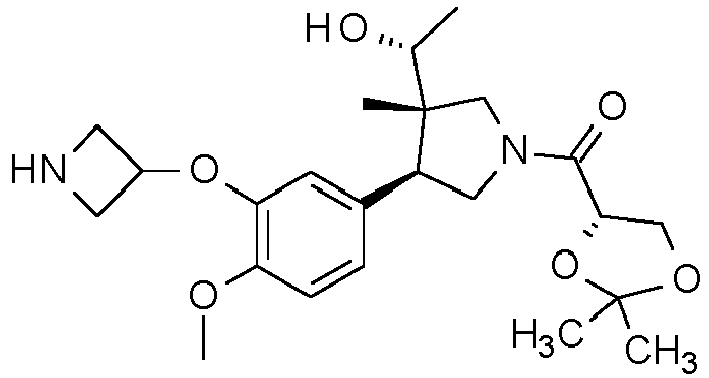
- To a Parr™ vessel containing a solution of (1R)-1-[(3S,4S)-1-{[(4S)-2,2-dimethyl-1,3-dioxolan-4-yl]carbonyl}-4-(3-{[1-(diphenylmethyl)azetidin-3-yl]oxy}-4-methoxyphenyl)-3-methylpyrrolidin-3-yl]ethanol (0.6 g) in methanol (20 mL) is added palladium hydroxide on carbon (60 mg, 20wt% Pd on C dry basis). The suspension is hydrogenated at 30 psig hydrogen gas until hydrogen gas uptake ceases. The reaction mixture is filtered through Celite™ and the filtrate is evaporated to provide the title compound (0.4 g). MS (ES+) = 435 (M+1).
-

- A mixture of (1R)-1-[(3S,4S)-1-{[(4S)-2,2-dimethyl-1,3-dioxolan-4-yl]carbonyl}-4-(4-methoxy-3-{[1-(azetidin-3-yl]oxy}phenyl)-3-methylpyrrolidin-3-yl]ethanol (50 mg), 2-fluoropyridine (11.8 mg) and potassium carbonate (31.8 mg) in N-methyl-2-pyrrolidone (3 mL) is heated at 120° C overnight. The reaction is cooled, poured into methylene chloride (40 mL), and washed with water (10 mL). The organic layer is dried over sodium sulfate and evaporated to 3 mL. Acetonitrile is added and the crude product solution is purified by reverse phase chromatography (5% to 95% acetonitrile/water). The appropriate fractions are collected and evaporated to provide the title compound (22.1 mg). MS (ES+) = 512 (M+1).
-

- The title compound is prepared essentially by the method of Preparation 3 using 2-chloro-5-methylpyridine. MS(ES+) = 526 (M+1).
-

- To a solution of (1R)-1-[(3S,4S)-1-{[(4S)-2,2-dimethyl-1,3-dioxolan-4-yl]carbonyl}-4-(4-methoxy-3-{[1-pyridin-2-ylazetidin-3-yl]oxy}phenyl)-3-methylpyrrolidin-3-yl]ethanol (22.1 mg) in tetrahydrofuran (2 mL) is added aqueous 1.0 M HCl (1 mL). Stir overnight at room temperature. Add aqueous 1.0 M HCl (1 mL) and stir for additional 8 hours. Neutralize with aqueous 1.0 M NaOH, extract with ethyl acetate, dry and evaporate to provide the title compound (18.2 mg). MS(ES+) = 472 (M+1).
-

- The title compound is prepared essentially by the method of Example 1. MS(ES+) = 486 (M+1).
Claims (8)
- A compound of the formula

- The compound or salt of claim 1 of the formula

- The compound or salt of claim 1 or 2 wherein R is methyl.
- The compound which is (2S)-3-[(3S,4S)-3-[(1R)-1-hydroxyethyl]-4-(4-methoxy-3-{[1-(5-methylpyridin-2-yl)azetidin-3-yl]oxy}phenyl)-3-methylpyrrolidin-1-yl]-3-oxopropane-1,2-diol.
- A compound of the formula

- The compound of claim 5 wherein R is methyl.
- A process for preparing a compound of the formula


- The process according to claim 7 wherein the acid is aqueous hydrochloric acid.
Applications Claiming Priority (2)
| Application Number | Priority Date | Filing Date | Title |
|---|---|---|---|
| US201361778546P | 2013-03-13 | 2013-03-13 | |
| EP14712968.8A EP2970222B1 (en) | 2013-03-13 | 2014-03-07 | Azetidinyloxyphenylpyrrolidine compounds |
Related Parent Applications (2)
| Application Number | Title | Priority Date | Filing Date |
|---|---|---|---|
| EP14712968.8A Division EP2970222B1 (en) | 2013-03-13 | 2014-03-07 | Azetidinyloxyphenylpyrrolidine compounds |
| EP14712968.8A Division-Into EP2970222B1 (en) | 2013-03-13 | 2014-03-07 | Azetidinyloxyphenylpyrrolidine compounds |
Publications (1)
| Publication Number | Publication Date |
|---|---|
| EP3168216A1 true EP3168216A1 (en) | 2017-05-17 |
Family
ID=50382705
Family Applications (2)
| Application Number | Title | Priority Date | Filing Date |
|---|---|---|---|
| EP14712968.8A Active EP2970222B1 (en) | 2013-03-13 | 2014-03-07 | Azetidinyloxyphenylpyrrolidine compounds |
| EP16196721.1A Withdrawn EP3168216A1 (en) | 2013-03-13 | 2014-03-07 | Azetidinyloxyphenylpyrrolidine compounds |
Family Applications Before (1)
| Application Number | Title | Priority Date | Filing Date |
|---|---|---|---|
| EP14712968.8A Active EP2970222B1 (en) | 2013-03-13 | 2014-03-07 | Azetidinyloxyphenylpyrrolidine compounds |
Country Status (39)
| Country | Link |
|---|---|
| US (3) | US9034864B2 (en) |
| EP (2) | EP2970222B1 (en) |
| JP (2) | JP6017708B2 (en) |
| KR (2) | KR101745304B1 (en) |
| CN (2) | CN109336865A (en) |
| AP (1) | AP3850A (en) |
| AR (1) | AR095015A1 (en) |
| AU (1) | AU2014241444B2 (en) |
| BR (1) | BR112015020222B1 (en) |
| CA (1) | CA2899806C (en) |
| CL (1) | CL2015002113A1 (en) |
| CR (1) | CR20150417A (en) |
| CY (1) | CY1120142T1 (en) |
| DK (1) | DK2970222T3 (en) |
| DO (1) | DOP2015000176A (en) |
| EA (1) | EA026631B1 (en) |
| ES (1) | ES2616470T3 (en) |
| HR (1) | HRP20170080T1 (en) |
| HU (1) | HUE032235T2 (en) |
| IL (1) | IL240904B (en) |
| JO (1) | JO3264B1 (en) |
| LT (1) | LT2970222T (en) |
| MA (1) | MA38410B1 (en) |
| ME (1) | ME02592B (en) |
| MX (1) | MX373636B (en) |
| MY (1) | MY180006A (en) |
| NZ (1) | NZ710481A (en) |
| PE (1) | PE20151669A1 (en) |
| PH (1) | PH12015502032A1 (en) |
| PL (1) | PL2970222T3 (en) |
| PT (1) | PT2970222T (en) |
| RS (1) | RS55594B1 (en) |
| SG (2) | SG11201507501YA (en) |
| SI (1) | SI2970222T1 (en) |
| TN (1) | TN2015000384A1 (en) |
| TW (1) | TWI617553B (en) |
| UA (1) | UA115583C2 (en) |
| WO (1) | WO2014159012A1 (en) |
| ZA (1) | ZA201505417B (en) |
Families Citing this family (7)
| Publication number | Priority date | Publication date | Assignee | Title |
|---|---|---|---|---|
| TWI617553B (en) * | 2013-03-13 | 2018-03-11 | 美國禮來大藥廠 | Azetidinyloxyphenylpyrrolidine compound |
| WO2016033776A1 (en) * | 2014-09-04 | 2016-03-10 | Eli Lilly And Company | Crystalline (2s) -3- [ (3s, 4s) -3- [ (1r) -1-hydroxyethyl] -4- (4-methoxy-3- { [1- (5-methylpyridin-2-yl) azetidin-3-yl] oxy} phenyl) -3-methylpyrrolidin-1-yl] -3-oxopropane-1, 2-diol |
| AR101696A1 (en) * | 2014-09-12 | 2017-01-04 | Lilly Co Eli | AZETIDINYLOXYPHENYLPIRROLIDINE COMPOUNDS |
| CN111333625B (en) * | 2018-12-18 | 2022-10-18 | 武汉人福创新药物研发中心有限公司 | Phenyl pyrrolidine compounds and uses thereof |
| CN111333637B (en) * | 2018-12-18 | 2022-07-29 | 武汉人福创新药物研发中心有限公司 | Phenyl pyrrolidine derivative and preparation method thereof |
| KR20210093320A (en) * | 2018-12-18 | 2021-07-27 | 우한 휴먼웰 이노베이티브 드러그 리서치 앤드 디벨롭먼트 센터 리미티드 컴퍼니 | Phenylpyrrolidine-based compounds and uses thereof |
| WO2021036953A1 (en) * | 2019-08-23 | 2021-03-04 | 湖北生物医药产业技术研究院有限公司 | Phenylpyrrolidine compound |
Citations (1)
| Publication number | Priority date | Publication date | Assignee | Title |
|---|---|---|---|---|
| WO2001047905A1 (en) | 1999-12-23 | 2001-07-05 | Icos Corporation | Pyrrolidine derivatives as cyclic amp-specific phosphodiesterase inhibitors |
Family Cites Families (9)
| Publication number | Priority date | Publication date | Assignee | Title |
|---|---|---|---|---|
| US5665754A (en) * | 1993-09-20 | 1997-09-09 | Glaxo Wellcome Inc. | Substituted pyrrolidines |
| JPH07300455A (en) * | 1994-03-08 | 1995-11-14 | Mitsubishi Chem Corp | 3-phenylpyrrolidine derivative |
| DE19601938A1 (en) * | 1996-01-12 | 1997-07-17 | Schering Ag | New phosphodiesterase inhibitors |
| US6376489B1 (en) * | 1999-12-23 | 2002-04-23 | Icos Corporation | Cyclic AMP-specific phosphodiesterase inhibitors |
| OA12542A (en) * | 2001-01-31 | 2006-06-05 | Pfizer Prod Inc | Thiazolyl-, oxazolyl-, pyrrolyl-, and imidazolyl-acid amide derivatives useful as inhibitors of PDE4isozymes. |
| CA2623657A1 (en) | 2005-09-29 | 2007-04-12 | Bayer Healthcare Ag | Pde inhibitors and combinations thereof for the treatment of urological disorders |
| TW201206440A (en) | 2010-04-28 | 2012-02-16 | Astellas Pharma Inc | Prophylactic or therapeutic agent for diseases associated with pains in urinary organs |
| JP2013526546A (en) | 2010-05-13 | 2013-06-24 | アムジエン・インコーポレーテツド | Heteroaryloxyheterocyclyl compounds as PDE10 inhibitors |
| TWI617553B (en) * | 2013-03-13 | 2018-03-11 | 美國禮來大藥廠 | Azetidinyloxyphenylpyrrolidine compound |
-
2014
- 2014-03-04 TW TW103107294A patent/TWI617553B/en active
- 2014-03-04 JO JOP/2014/0068A patent/JO3264B1/en active
- 2014-03-05 AR ARP140100712A patent/AR095015A1/en active IP Right Grant
- 2014-03-07 AU AU2014241444A patent/AU2014241444B2/en active Active
- 2014-03-07 PT PT147129688T patent/PT2970222T/en unknown
- 2014-03-07 US US14/200,376 patent/US9034864B2/en active Active
- 2014-03-07 DK DK14712968.8T patent/DK2970222T3/en active
- 2014-03-07 MY MYPI2015703060A patent/MY180006A/en unknown
- 2014-03-07 EP EP14712968.8A patent/EP2970222B1/en active Active
- 2014-03-07 HU HUE14712968A patent/HUE032235T2/en unknown
- 2014-03-07 CN CN201811189530.XA patent/CN109336865A/en active Pending
- 2014-03-07 UA UAA201508671A patent/UA115583C2/en unknown
- 2014-03-07 PE PE2015001904A patent/PE20151669A1/en active IP Right Grant
- 2014-03-07 WO PCT/US2014/021474 patent/WO2014159012A1/en not_active Ceased
- 2014-03-07 PL PL14712968T patent/PL2970222T3/en unknown
- 2014-03-07 RS RS20170035A patent/RS55594B1/en unknown
- 2014-03-07 MA MA38410A patent/MA38410B1/en unknown
- 2014-03-07 CN CN201480014091.2A patent/CN105051034B/en active Active
- 2014-03-07 KR KR1020177002304A patent/KR101745304B1/en active Active
- 2014-03-07 ES ES14712968.8T patent/ES2616470T3/en active Active
- 2014-03-07 EP EP16196721.1A patent/EP3168216A1/en not_active Withdrawn
- 2014-03-07 CA CA2899806A patent/CA2899806C/en active Active
- 2014-03-07 HR HRP20170080TT patent/HRP20170080T1/en unknown
- 2014-03-07 SG SG11201507501YA patent/SG11201507501YA/en unknown
- 2014-03-07 BR BR112015020222-5A patent/BR112015020222B1/en active IP Right Grant
- 2014-03-07 MX MX2015012579A patent/MX373636B/en active IP Right Grant
- 2014-03-07 SG SG10201609717YA patent/SG10201609717YA/en unknown
- 2014-03-07 SI SI201430124A patent/SI2970222T1/en unknown
- 2014-03-07 NZ NZ710481A patent/NZ710481A/en unknown
- 2014-03-07 AP AP2015008699A patent/AP3850A/en active
- 2014-03-07 KR KR1020157024606A patent/KR101702797B1/en active Active
- 2014-03-07 JP JP2015561688A patent/JP6017708B2/en active Active
- 2014-03-07 EA EA201591498A patent/EA026631B1/en not_active IP Right Cessation
- 2014-03-07 ME MEP-2017-10A patent/ME02592B/en unknown
- 2014-03-07 LT LTEP14712968.8T patent/LT2970222T/en unknown
-
2015
- 2015-01-13 US US14/595,262 patent/US9266859B2/en active Active
- 2015-07-24 DO DO2015000176A patent/DOP2015000176A/en unknown
- 2015-07-28 ZA ZA2015/05417A patent/ZA201505417B/en unknown
- 2015-07-29 CL CL2015002113A patent/CL2015002113A1/en unknown
- 2015-08-14 CR CR20150417A patent/CR20150417A/en unknown
- 2015-08-27 IL IL240904A patent/IL240904B/en active IP Right Grant
- 2015-09-03 TN TN2015000384A patent/TN2015000384A1/en unknown
- 2015-09-10 PH PH12015502032A patent/PH12015502032A1/en unknown
-
2016
- 2016-01-15 US US14/996,321 patent/US9604967B2/en active Active
- 2016-09-28 JP JP2016189812A patent/JP6204557B2/en active Active
-
2017
- 2017-02-03 CY CY20171100164T patent/CY1120142T1/en unknown
Patent Citations (1)
| Publication number | Priority date | Publication date | Assignee | Title |
|---|---|---|---|---|
| WO2001047905A1 (en) | 1999-12-23 | 2001-07-05 | Icos Corporation | Pyrrolidine derivatives as cyclic amp-specific phosphodiesterase inhibitors |
Non-Patent Citations (6)
| Title |
|---|
| "Handbook of Pharmaceutical Salts: Properties, Selection and Use", 2002, WILEY-VCH |
| "Remington: The Science and Practice of Pharmacy", 2006, LIPPINCOTT, WILLIAMS & WILKINS |
| BOUDES ET AL., NEUROUROL. URODYNAM., 2011 |
| KAIHO, Y. ET AL., BJUINTERNATIONAL, vol. 101, no. 5, 2008, pages 615 - 620 |
| LOUGHNEY, K. ET AL., J. BIOL. CHEM, vol. 271, 1996, pages 796 - 806 |
| NICHOLS, P. J.; DEMATTEI, J. A.; BARNETT, B. R.; LEFUR, N. A.; CHUANG, T.; PISCOPIO, A. D.; KOCK, K., ORG. LETT, vol. 8, 2006, pages 1495 - 1498 |
Also Published As
Similar Documents
| Publication | Publication Date | Title |
|---|---|---|
| US9604967B2 (en) | Azetidinyloxyphenylpyrrolidine compounds | |
| EP3191466B1 (en) | Azetidinyloxyphenylpyrrolidine compounds | |
| EP3189044B1 (en) | Crystalline (2s)-3-[(3s,4s)-3-[(1r)-1-hydroxyethyl]-4-(4-methoxy-3-{[1-(5-methylpyridin-2-yl)azetidin-3-yl]oxy}phenyl) -3-methylpyrrolidin-1-yl]-3-oxopropane-1,2-diol | |
| HK1212695B (en) | Azetidinyloxyphenylpyrrolidine compounds | |
| HK1233631A1 (en) | Azetidinyloxyphenylpyrrolidine compounds | |
| HK1233631B (en) | Azetidinyloxyphenylpyrrolidine compounds | |
| HK1233263B (en) | Crystalline (2s)-3-[(3s,4s)-3-[(1r)-1-hydroxyethyl]-4-(4-methoxy-3-{[1-(5-methylpyridin-2-yl)azetidin-3-yl]oxy}phenyl) -3-methylpyrrolidin-1-yl]-3-oxopropane-1,2-diol | |
| HK1233263A1 (en) | Crystalline (2s)-3-[(3s,4s)-3-[(1r)-1-hydroxyethyl]-4-(4-methoxy-3-{[1-(5-methylpyridin-2-yl)azetidin-3-yl]oxy}phenyl) -3-methylpyrrolidin-1-yl]-3-oxopropane-1,2-diol |
Legal Events
| Date | Code | Title | Description |
|---|---|---|---|
| PUAI | Public reference made under article 153(3) epc to a published international application that has entered the european phase |
Free format text: ORIGINAL CODE: 0009012 |
|
| AC | Divisional application: reference to earlier application |
Ref document number: 2970222 Country of ref document: EP Kind code of ref document: P |
|
| AK | Designated contracting states |
Kind code of ref document: A1 Designated state(s): AL AT BE BG CH CY CZ DE DK EE ES FI FR GB GR HR HU IE IS IT LI LT LU LV MC MK MT NL NO PL PT RO RS SE SI SK SM TR |
|
| AX | Request for extension of the european patent |
Extension state: BA ME |
|
| 17P | Request for examination filed |
Effective date: 20171117 |
|
| RBV | Designated contracting states (corrected) |
Designated state(s): AL AT BE BG CH CY CZ DE DK EE ES FI FR GB GR HR HU IE IS IT LI LT LU LV MC MK MT NL NO PL PT RO RS SE SI SK SM TR |
|
| GRAP | Despatch of communication of intention to grant a patent |
Free format text: ORIGINAL CODE: EPIDOSNIGR1 |
|
| RIC1 | Information provided on ipc code assigned before grant |
Ipc: A61K 31/4439 20060101ALI20180711BHEP Ipc: A61K 31/4985 20060101ALI20180711BHEP Ipc: C07D 401/14 20060101AFI20180711BHEP |
|
| INTG | Intention to grant announced |
Effective date: 20180727 |
|
| GRAS | Grant fee paid |
Free format text: ORIGINAL CODE: EPIDOSNIGR3 |
|
| STAA | Information on the status of an ep patent application or granted ep patent |
Free format text: STATUS: THE APPLICATION IS DEEMED TO BE WITHDRAWN |
|
| 18D | Application deemed to be withdrawn |
Effective date: 20181207 |