EP3166952B1 - Process for preparation of 3-methacryloxypropyldimethylchlorosilane in continuous flow reactor - Google Patents
Process for preparation of 3-methacryloxypropyldimethylchlorosilane in continuous flow reactor Download PDFInfo
- Publication number
- EP3166952B1 EP3166952B1 EP15738445.4A EP15738445A EP3166952B1 EP 3166952 B1 EP3166952 B1 EP 3166952B1 EP 15738445 A EP15738445 A EP 15738445A EP 3166952 B1 EP3166952 B1 EP 3166952B1
- Authority
- EP
- European Patent Office
- Prior art keywords
- methacryloxypropyldimethylchlorosilane
- continuous flow
- flow reactor
- reaction
- catalyst
- Prior art date
- Legal status (The legal status is an assumption and is not a legal conclusion. Google has not performed a legal analysis and makes no representation as to the accuracy of the status listed.)
- Active
Links
- 0 CCCCC*1(CC2(C(C)C2)*(C)(C2)CC2C(C2)C=*2C([C@](C)C(C)C(F)(F)F)C2*CC2)CC1 Chemical compound CCCCC*1(CC2(C(C)C2)*(C)(C2)CC2C(C2)C=*2C([C@](C)C(C)C(F)(F)F)C2*CC2)CC1 0.000 description 5
Images
Classifications
-
- C—CHEMISTRY; METALLURGY
- C07—ORGANIC CHEMISTRY
- C07F—ACYCLIC, CARBOCYCLIC OR HETEROCYCLIC COMPOUNDS CONTAINING ELEMENTS OTHER THAN CARBON, HYDROGEN, HALOGEN, OXYGEN, NITROGEN, SULFUR, SELENIUM OR TELLURIUM
- C07F7/00—Compounds containing elements of Groups 4 or 14 of the Periodic Table
- C07F7/02—Silicon compounds
- C07F7/08—Compounds having one or more C—Si linkages
- C07F7/12—Organo silicon halides
- C07F7/121—Preparation or treatment not provided for in C07F7/14, C07F7/16 or C07F7/20
- C07F7/122—Preparation or treatment not provided for in C07F7/14, C07F7/16 or C07F7/20 by reactions involving the formation of Si-C linkages
-
- B—PERFORMING OPERATIONS; TRANSPORTING
- B01—PHYSICAL OR CHEMICAL PROCESSES OR APPARATUS IN GENERAL
- B01J—CHEMICAL OR PHYSICAL PROCESSES, e.g. CATALYSIS OR COLLOID CHEMISTRY; THEIR RELEVANT APPARATUS
- B01J19/00—Chemical, physical or physico-chemical processes in general; Their relevant apparatus
- B01J19/24—Stationary reactors without moving elements inside
-
- B—PERFORMING OPERATIONS; TRANSPORTING
- B01—PHYSICAL OR CHEMICAL PROCESSES OR APPARATUS IN GENERAL
- B01J—CHEMICAL OR PHYSICAL PROCESSES, e.g. CATALYSIS OR COLLOID CHEMISTRY; THEIR RELEVANT APPARATUS
- B01J31/00—Catalysts comprising hydrides, coordination complexes or organic compounds
- B01J31/16—Catalysts comprising hydrides, coordination complexes or organic compounds containing coordination complexes
- B01J31/1608—Catalysts comprising hydrides, coordination complexes or organic compounds containing coordination complexes the ligands containing silicon
-
- C—CHEMISTRY; METALLURGY
- C07—ORGANIC CHEMISTRY
- C07F—ACYCLIC, CARBOCYCLIC OR HETEROCYCLIC COMPOUNDS CONTAINING ELEMENTS OTHER THAN CARBON, HYDROGEN, HALOGEN, OXYGEN, NITROGEN, SULFUR, SELENIUM OR TELLURIUM
- C07F7/00—Compounds containing elements of Groups 4 or 14 of the Periodic Table
- C07F7/02—Silicon compounds
- C07F7/08—Compounds having one or more C—Si linkages
- C07F7/0834—Compounds having one or more O-Si linkage
- C07F7/0838—Compounds with one or more Si-O-Si sequences
-
- C—CHEMISTRY; METALLURGY
- C07—ORGANIC CHEMISTRY
- C07F—ACYCLIC, CARBOCYCLIC OR HETEROCYCLIC COMPOUNDS CONTAINING ELEMENTS OTHER THAN CARBON, HYDROGEN, HALOGEN, OXYGEN, NITROGEN, SULFUR, SELENIUM OR TELLURIUM
- C07F7/00—Compounds containing elements of Groups 4 or 14 of the Periodic Table
- C07F7/02—Silicon compounds
- C07F7/08—Compounds having one or more C—Si linkages
- C07F7/12—Organo silicon halides
-
- C—CHEMISTRY; METALLURGY
- C07—ORGANIC CHEMISTRY
- C07F—ACYCLIC, CARBOCYCLIC OR HETEROCYCLIC COMPOUNDS CONTAINING ELEMENTS OTHER THAN CARBON, HYDROGEN, HALOGEN, OXYGEN, NITROGEN, SULFUR, SELENIUM OR TELLURIUM
- C07F7/00—Compounds containing elements of Groups 4 or 14 of the Periodic Table
- C07F7/02—Silicon compounds
- C07F7/08—Compounds having one or more C—Si linkages
- C07F7/12—Organo silicon halides
- C07F7/14—Preparation thereof from optionally substituted halogenated silanes and hydrocarbons hydrosilylation reactions
-
- C—CHEMISTRY; METALLURGY
- C08—ORGANIC MACROMOLECULAR COMPOUNDS; THEIR PREPARATION OR CHEMICAL WORKING-UP; COMPOSITIONS BASED THEREON
- C08G—MACROMOLECULAR COMPOUNDS OBTAINED OTHERWISE THAN BY REACTIONS ONLY INVOLVING UNSATURATED CARBON-TO-CARBON BONDS
- C08G77/00—Macromolecular compounds obtained by reactions forming a linkage containing silicon with or without sulfur, nitrogen, oxygen or carbon in the main chain of the macromolecule
- C08G77/04—Polysiloxanes
- C08G77/20—Polysiloxanes containing silicon bound to unsaturated aliphatic groups
-
- C—CHEMISTRY; METALLURGY
- C08—ORGANIC MACROMOLECULAR COMPOUNDS; THEIR PREPARATION OR CHEMICAL WORKING-UP; COMPOSITIONS BASED THEREON
- C08G—MACROMOLECULAR COMPOUNDS OBTAINED OTHERWISE THAN BY REACTIONS ONLY INVOLVING UNSATURATED CARBON-TO-CARBON BONDS
- C08G77/00—Macromolecular compounds obtained by reactions forming a linkage containing silicon with or without sulfur, nitrogen, oxygen or carbon in the main chain of the macromolecule
- C08G77/04—Polysiloxanes
- C08G77/38—Polysiloxanes modified by chemical after-treatment
-
- B—PERFORMING OPERATIONS; TRANSPORTING
- B01—PHYSICAL OR CHEMICAL PROCESSES OR APPARATUS IN GENERAL
- B01J—CHEMICAL OR PHYSICAL PROCESSES, e.g. CATALYSIS OR COLLOID CHEMISTRY; THEIR RELEVANT APPARATUS
- B01J2219/00—Chemical, physical or physico-chemical processes in general; Their relevant apparatus
- B01J2219/00002—Chemical plants
- B01J2219/00027—Process aspects
- B01J2219/00033—Continuous processes
-
- B—PERFORMING OPERATIONS; TRANSPORTING
- B01—PHYSICAL OR CHEMICAL PROCESSES OR APPARATUS IN GENERAL
- B01J—CHEMICAL OR PHYSICAL PROCESSES, e.g. CATALYSIS OR COLLOID CHEMISTRY; THEIR RELEVANT APPARATUS
- B01J2231/00—Catalytic reactions performed with catalysts classified in B01J31/00
- B01J2231/30—Addition reactions at carbon centres, i.e. to either C-C or C-X multiple bonds
- B01J2231/32—Addition reactions to C=C or C-C triple bonds
- B01J2231/323—Hydrometalation, e.g. bor-, alumin-, silyl-, zirconation or analoguous reactions like carbometalation, hydrocarbation
-
- B—PERFORMING OPERATIONS; TRANSPORTING
- B01—PHYSICAL OR CHEMICAL PROCESSES OR APPARATUS IN GENERAL
- B01J—CHEMICAL OR PHYSICAL PROCESSES, e.g. CATALYSIS OR COLLOID CHEMISTRY; THEIR RELEVANT APPARATUS
- B01J2531/00—Additional information regarding catalytic systems classified in B01J31/00
- B01J2531/80—Complexes comprising metals of Group VIII as the central metal
- B01J2531/82—Metals of the platinum group
- B01J2531/828—Platinum
Definitions
- the present invention relates to a process for the preparation of 3-methacryloxypropylbisdimethylchlorosilane (MOPDMCS).
- MOPDMCS 3-methacryloxypropylbisdimethylchlorosilane
- organosilicon compounds by reaction of an organic compound containing an alkenyl group with a hydrosilane, resulting in addition of silicon and hydrogen across the carbon-carbon double bond of the alkenyl group, is well known.
- the general method usually carried out in the presence of a transition metal catalyst, has been known for many decades. It has generally been believed that continuous processes are not suitable for the production of acryloyl- or methacryloyl-organosilicon compounds using hydrosilation catalysts, for a number of different reasons.
- MOPDMCS 3-Methacryloxypropyl-bisdimethylchlorosilane
- mPDMS methacryloxy propyl dimethyl methoxysilane
- MOPDMCS is manufactured by the reaction of allyl methacrylate (AMA) and dimethylchlorosilane (DMCS) in the presence of a transition metal hydrosilylation catalyst, usually based on platinum.
- AMA allyl methacrylate
- DMCS dimethylchlorosilane
- MOPDMCS being a particularly difficult methacryloyl organosilicon compound to prepare and handle. Controlling the process is difficult, and it is difficult to ensure batch-to-batch consistency. As a result, problems arise, in particular relating to product consistency and purity. For example, hydrolysis and dimerisation of the product occurs readily. Further, the product may form homopolymers, or it may copolymerize with by-products present in the reaction mixture. Such reactions can occur at any time during the preparative process and also during purification of the product, which may for example be carried out by distillation. It is thus difficult to prepare MOPDMCS having a high degree of purity.
- US 2010/179340 describes some of the disadvantages of batch processes for the preparation of methacryloyloxypropylalkoxysilanes, and describes a continuous process for the preparation of methacryloylorganosilicon compounds by the reaction of allyl methacrylate with a hydrosilane using a specific system of reactors.
- the hydrosilanes used in the process are alkoxyhydrosilanes.
- WO 2008/017555 contains a very similar disclosure to US 2010/0179340 , and as for US 2010/0179340 , the example of preparing a methacryloxy compound is carried out using a methoxysilane.
- Methacryloylalkoxysilanes of the type prepared in US 2010/0179340 and WO 2008/017555 are known to be relatively stable and easy to handle compared with other hydrosilanes.
- a reaction mixture including AMA, a platinum hydrosilylation catalyst and DMCS would be expected to have a much greater propensity to form by-products and/or polymerise during synthesis than the corresponding reaction mixture including trimethoxysilane.
- MOPDMCS is particularly difficult to synthesise, due to its propensity to polymerise.
- MOPDMCS is always sold containing a significant level of polymerization inhibitors, typically from 100-200 ppm BHT plus 200-400 ppm MeHQ.
- MOPTMOS 3-methacryloxypropyltrimethoxysilane
- the present invention provides a process for the preparation of methacryloxypropylbisdimethylchlorosilane by reaction of allyl methacrylate with dimethylchlorosilane in the presence of a hydrosilylation catalyst, characterized in that the reaction is carried out in the absence of a peroxide by a process comprising:
- the product stream is processed in an additional step v) which comprises carrying out a batch distillation of the product stream.
- the surface area/volume ratio of the continuous flow reactor is an important parameter. Preferably it is from 4:1 to 400:1.
- the ratio of the path length of the reactants within the reactor to the cross sectional area of the reactor is also an important parameter. Preferably it is from 0.01:10,000 to 100: 10,000.
- the reactor may take any desired form. Suitably it contains elongated channels having dimensions as above. These channels may have any desired cross-section, for example rectangular or circular.
- the process of the invention is carried out in the absence of solvent. Surprisingly the process of the invention remains effective in consistently producing MOPDMCS in high yield and purity even under solvent-free conditions.
- the process of the invention comprises analysing the product stream produced in step (iii) for the presence and/or level of MOPDMCS and/or an impurity, more preferably the process comprises carrying out in-line analysis of the product stream. Analysing/monitoring the product stream permits a determination to be made regarding whether the product stream is of acceptable purity and/or yield, and processing conditions may be altered in response to that determination.
- the product stream may be permitted to flow into a first receptacle containing crude product of acceptable purity, or may be diverted into a second receptacle containing crude product of unacceptable purity.
- Process conditions e.g. temperature
- the feed streams are provided to the continuous flow reactor at a flow rate such that they are contacted in the continuous flow reactor at a pressure in the range of from 1 to 100 bar (100 to 10,000 kilopascals).
- a pressure in the range of from 1 to 100 bar (100 to 10,000 kilopascals).
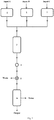
- Figure 1 is a schematic flow diagram illustrating a preferred embodiment of the process of the invention.
- MOPDMCS has the formula:
- silicone containing monomers for example for use in contact lens formulations which on curing produce lenses with high oxygen permeability.
- step (i) of the process of the invention a first stream containing AMA is provided.
- reaction of the AMA with DMCS results in addition of silicon and hydrogen across the carbon-carbon double bond.
- the first stream may if desired include an organic solvent, for example an aromatic hydrocarbon such as benzene, toluene or xylene; an aliphatic hydrocarbon such as hexane or heptane; an ether such as tetrahydrofuran or diethyl ether; a ketone such as acetone or methyl ethyl ketone; or an ester such as ethyl acetate or butyl acetate.
- an organic solvent for example an aromatic hydrocarbon such as benzene, toluene or xylene; an aliphatic hydrocarbon such as hexane or heptane; an ether such as tetrahydrofuran or diethyl ether; a ketone such as acetone or methyl ethyl ketone; or an ester such as ethyl acetate or butyl acetate.
- no solvent is present other than, if desired, the quantities of solvent
- step (ii) of the process of the invention a second stream containing dimethylchlorosilane is provided.
- Said second stream may if desired include an organic solvent, for example one of the solvents mentioned above for the first stream. It may for example include up to 20% of solvent. However, preferably no solvent is present other than, if desired, the quantities of solvent required to deliver the hydrosilation catalyst if said catalyst forms part of said second stream as described below.
- Step (iii) is carried out in a continuous flow reactor.
- the surface area/volume ratio of the reactor is an important parameter. Preferably it is from 4:1 to 400:1, for example 10:1 to 200:1, particularly 20:1 to 100:1.
- said first and second streams are contacted in the presence of a hydrosilylation catalyst.
- the first and second streams may be introduced as separate streams into the reactor, or they may be combined immediately prior to entry to the reactor.
- the catalyst may be introduced as part of the first stream, or as part of the second stream, or in a third stream which may be introduced directly into the continuous flow reactor or merged into either or both of the first or second streams immediately prior to entry into the reactor; or it may be pre-introduced into the continuous flow reactor. Preferably it is introduced as part of the first or second streams, more preferably as part of the first stream. Introducing the catalyst to the reactor as part of one of these streams ensures consistent production of product in high yield.
- the optimum residence time in the reactor will depend upon the precise details of the reaction being carried out, but preferably the residence time is from 1 sec to 30 minutes, for example 10 sec to 15 minutes, preferably from 1 to 5 minutes.
- This brief residence time provides an advantage in using the process of the invention in that the formation of by-products is minimized.
- the flow through the continuous flow reactor will be such that there is minimal spare head-room in the reactor.
- any suitable hydrosilylation catalyst may be used.
- the catalyst may contain a transition metal.
- the catalyst may be homogeneous or heterogeneous.
- the catalyst is a homogeneous catalyst.
- Such catalysts may for example be based on rhodium, for example RhCl 3 or Rh(PPh 3 ) 3 Cl (where Ph is a phenyl group), or platinum.
- Platinum catalysts may be provided as chloroplatinic acid, platinum-olefin complexes, and complexes of platinum and vinyl-functional siloxane.
- a homogenous catalyst will be provided in the form of a solution in an organic solvent, for example a solution in a polydimethylsiloxane or a hydrocarbon solvent, for example a xylene, hexane, heptane or toluene. If a heterogeneous catalyst is used, this may if desired be introduced into the continuous flow reactor prior to introduction of the first and second streams. As an example of a heterogeneous catalyst, there may for example be mentioned a solid-supported platinum catalyst, or a solid Cu(II) salt catalyst. Generally, the catalyst will be used in an quantity similar to, or a little lower than, the quantity used in known batch reactions. The use of rather lower quantities than in known reactions provides a further advantage of the process of the invention, as the presence of lower quantities of catalyst would be expected to increase the stability of the product.
- Step (iii) of the process of the invention may be carried out at any desired temperature, for example at room temperature or an elevated temperature.
- the maximum temperature is kept below 200°C, especially below 120°C, in order to minimize polymerization or other undesired side reactions.
- the reaction temperature may be in the range of from 30 to 120°C, for example from 60 to 120°C, especially from 80 to 100°C.
- the reaction conditions including temperature, pressure and flow rates are controlled in such a way that the reaction temperature can be kept within these ranges, without causing vaporization of the hydrosilane.
- DMCS can be handled at reaction temperatures of around 80°C without any vaporization leading to optimum process efficiency.
- Step (iii) of the process of the invention may be carried out at atmospheric pressure but it is preferably carried out at elevated pressure as this assists in keeping all the components in the liquid phase and helps to achieve a consistent residence time.
- the streams are provided to the continuous flow reactor at a flow rate such that they are contacted in the continuous flow reactor at a pressure of up to 100 bar (10,000 kPa), for example a pressure in the range of from 1 to 100 bar (100 to 10,000 kPa), for example up to 70 bar (7,000kPa), for example up to 50 bar (5,000 kPa).
- contacting the streams in the continuous flow reactor at such pressure leads to particularly high yields and purity of the MOPDMCS.
- a back pressure regulator will be provided at the end of the system, and this together with the applied pressure caused by the rate at which the streams are provided to the continuous flow reactor, and the pressure drop across the system, will determine the pressure in the continuous flow reactor.
- the molar ratio of AMA to DMCS is not critical, but preferably approximately equivalent amounts, or a small excess of AMA, are used.
- the molar ratio of AMA to DMCS may be in the range of from 1:1 to 1.5:1, for example 1:1 to 1.2:1.
- the first and second streams contain no added solvent other than if desired the small quantity of solvent required for provision of the catalyst.
- less than 20 wt%, preferably less than 10 wt% of the inputs to the continuous flow reactor are solvent.
- less than 5 wt %, less than 4 wt%, less than 3 wt%, less than 2 wt%, less than 1 wt%, less than 0.5 wt% or less than 0.2 wt % of the inputs to the continuous flow reactor are solvent.
- At least 90 wt%, at least 95 wt%, at least 96 wt%, at least 97 wt%, at least 98 wt%, at least 99 wt%, at least 99.5 wt%, or at least 99.8 wt% of the inputs to the continuous flow reactor are the sum wt% of i) hydrosilylation catalyst, ii) DMCS, and iii) AMA.
- any known polymerization inhibitor may be present in step (iii) if desired.
- Suitable inhibitors include phenols, amines (for example N,N-diphenyl-p-phenylenediamine, DPPD), quinones and other oxygen-containing compounds, and copper salts, for example Cu(I)O, Cu 2 (I)(SO 4 ), Cu(I)OH, Cu(I)Cl, Cu(I)OAc and Cu(II)O, Cu(II)SO 4 , Cu(II)(OH) 2 , Cu(II)Cl 2 and Cu(II)(OAc) 2 , as well as those inhibitors disclosed in the prior art mentioned above.
- a phenol for example p-methoxyphenol, 4-hydroxyanisole, dibutylhydroxytoluene or bis(tert butyl)-4-methylphenol (BHT), or phenothiazine (PTZ), is preferred.
- BHT bis(tert butyl)-4-methylphenol
- PTZ phenothiazine
- Mixtures of inhibitors may be used.
- the inhibitor may be introduced as part of the first stream, or as part of the second stream, or it may be introduced into the continuous flow reactor by any other means, for example in a third stream. Preferably it is introduced as part of the first stream.
- step (iii) can, during an initial start-up phase, be diverted to a waste stream. Once the catalyst is fully activated, collection of product can begin. Generally, however, such steps are not necessary.
- the process of the invention is controlled by analyzing/monitoring output from the reactor, specifically by analyzing/monitoring the crude product stream, using any suitable analytical technique, for example HPLC, GC-FID, GC-MS or, especially, IR, ideally using an in-line monitor.
- any suitable analytical technique for example HPLC, GC-FID, GC-MS or, especially, IR, ideally using an in-line monitor.
- Such monitoring gives real-time information on accumulation of product and reaction activity, which leads to significant safety advantages, without the need for sampling and holding, leading to delays. It is advantageous to provide, in association with the monitoring, automated switching of the product stream to a waste stream in the event of sub-standard product, which in turn prevents contamination of any product collected prior to a problem arising.
- the process of the invention comprises analysing the product stream for the presence and/or level of MOPDMCS and/or an impurity, more preferably the process comprises carrying out in-line analysis of the product stream, yet more preferably the process comprises carrying out in-line IR analysis of the product stream.
- the process of the invention comprises determining the yield of MOPDMCS present in the product stream by carrying out in-line IR analysis and, where the yield of MOPDMCS is equal to or greater than a pre-defined value (e.g. at least 60%, at least 65%, at least 70%, at least 75%, at least 80% or at least 85%), passing the product stream to a first vessel; or, where the yield of MOPDMCS is less than said pre-defined value (e.g. at least 60%, at least 65%, at least 70%, at least 75%, at least 80% or at least 85%), passing the product stream to a second waste vessel.
- a pre-defined value e.g. at least 60%, at least 65%, at least 70%, at least 75%, at least 80% or at least 85%
- in-line monitoring indicates that the yield/level of MOPDMCS is below a desired level, or where the level of an impurity is above a desired level
- the temperature and/or flow rates of the first and/or second stream may be adjusted in response to a determination that the yield is less than a pre-defined value.
- the continuous flow reactor may be desirable to purge the continuous flow reactor, for example by stopping flow of the product stream to a first vessel and diverting it to a second waste vessel, passing a stream containing solvent and/or polymerization inhibitor through the continuous flow reactor in place of the first and second streams for a period of time (e.g. for at least 1, 2, 5, 10, or 20 minutes), before reverting to providing the original streams to the continuous flow reactor, and reverting to passing the product stream to the first vessel.
- a period of time e.g. for at least 1, 2, 5, 10, or 20 minutes
- a product stream is removed from the continuous flow reactor.
- this product stream may be subject to a purification step.
- the product may be purified by a solvent extraction process or, preferably, distillation.
- the product stream obtained by step iv) is subjected to a batch distillation process.
- the use of batch distillation has proved to be an improvement over the use of continuous distillation, which would not be expected for a process in which step iii) is carried out in a continuous flow reactor.
- a preferred embodiment of the process of the invention comprises a process for the preparation of MOPDMCS by reaction of AMA with DMCS in the presence of a hydrosilylation catalyst, characterized in that the reaction is carried out in the absence of a peroxide by a process comprising:
- Distillation may be carried out under known conditions, for example at a pressure of 0.1-10, preferably 1 to 5, mbar, and a temperature of 50-150.
- the distillation temperature is at least 60°C, for example at least 70°C, and preferably it is no greater than 120°C. It may for example be 60-120°C, for example 60-100 °C.
- a polymerization inhibitor may be present if desired. Preferred inhibitors are as mentioned above.
- MOPDMCS can for example be converted into compounds of the formulae: or in which n is 0 to 100, and each R independently is a C 1-4 alkyl group, especially a methyl group, by known methods. For example, it may be reacted with a (poly)siloxane of the formula (IV): in which M + is a cation, for example a metal ion, especially a lithium ion, to form a compound of formula (I).
- compounds of formula (I) include: which may for example be produced by a reaction between MOPDMCS and an appropriate compound of formula (IV) or (IVa) as shown below in a reaction scheme using a lithium salt of formula (IV):
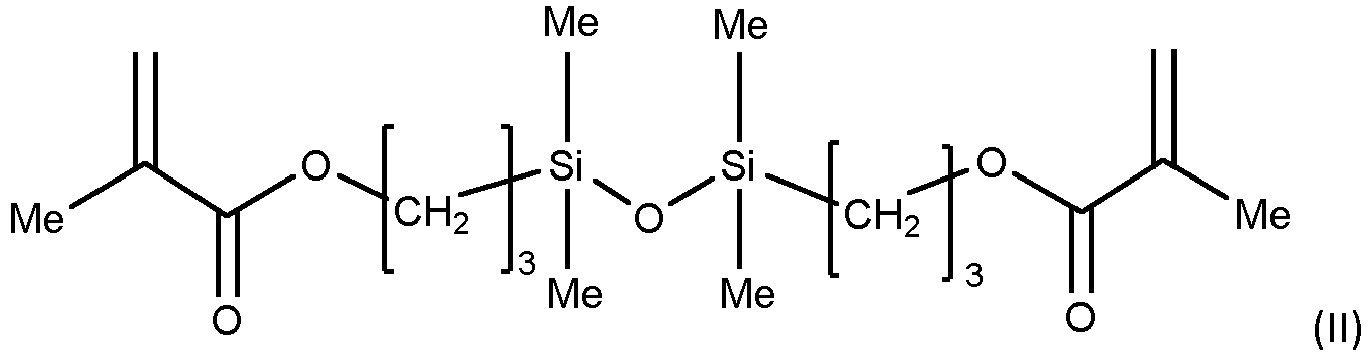
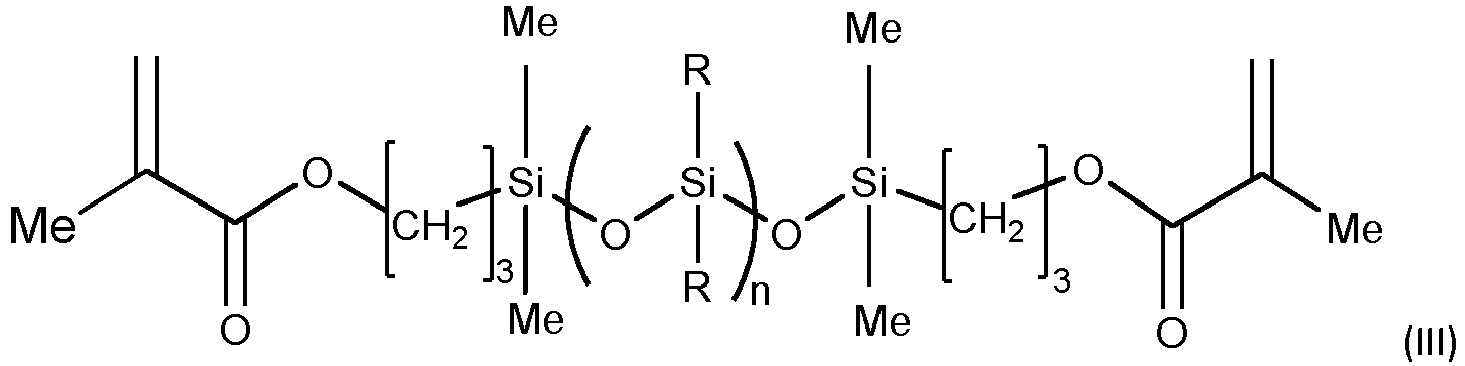
- Two molecules of MOPDMCS may be dimerised in the presence of water to form a compound of formula (II), or two molecules of MOPDMCS may be reacted with a compound of formula (V) or (Va): in which M + has the meaning given above, to form a compound of the formula III.
- the process of the present invention is a process for the preparation of MOPDMCS which provides a significant improvement compared with known processes, specifically providing a significant improvement in the quality and consistency of the product, as well as leading to an improvement in overall yields.
- the results obtained using the process of the invention are surprisingly rapid, consistent and controllable.
- the skilled man would have expected deposition of solid polymer to occur within the continuous flow reactor, making the use of a continuous flow reactor not feasible given the nature of the reaction, but in fact, as demonstrated in the Example below, this does not occur.
- FIG. 1 A preferred embodiment of the invention is shown in Figure 1 .
- allylmethacrylate, a polymerization inhibitor (e.g. phenothiazine) and hydrosilylation catalyst (e.g. platinum(0)-1,3-divinyl-1,1,3,3-tetramethyldisiloxane in xylenes) is provided to a first storage vessel 1 (indicated as "input A” in Fig. 1 ).
- Dimethylchlorosilane is provided to a second storage vessel 2 (indicated as "Input B").
- a first stream containing the AMA, polymerization inhibitor and hydrosilylation catalyst is pumped from the first storage vessel and is combined with a second stream containing the DMCS and the combined stream is flowed immediately into a continuous flow reactor 3 at a temperature in the range of from 80 to 100°C.
- the flow rate of the first and second streams is adjusted so as to achieve a residence time of the reactants in the continuous flow reactor in the range of from 1 to 5 minutes, and to achieve a pressure in the range of from 500 to 1500 kilopascals.
- the DMCS reacts with the AMA, and a crude product stream containing the MOPDMCS exits the continuous flow reactor.
- the crude product stream is subjected to in-line analysis by passing it through an in-line IR instrument 4 equipped with a silicon probe. Where analysis confirms that the crude product stream contains MOPDMCS in acceptable yield and purity, the crude product stream is allowed to pass via valve 5 to distillation column 6 where the crude product stream is subject to distillation, providing the purified MOPDMCS (indicated as "output" in Fig. 1 ) and a waste stream. Where in-line IR analysis indicates that the crude product stream is not of acceptable yield and/or purity (for example where polymerization of the AMA or MOPDMCS starts to take place), the crude product stream is diverted via valve 5 to waste preventing spoiling of the product stream.
- a third stream containing solvent e.g.
- a solution of phenothiazine (0.28g, 1.41 mmol), allylmethacrylate (60 mL, 446 mmol), and platinum(0)-1,3-divinyl-1,1,3,3-tetramethyldisiloxane complex solution (2% Pt in xylenes, 66 ⁇ L, 20 ppm Pt) was prepared in a dry, sealed 100 mL round bottomed flask under an atmosphere of N 2 .
- a peristaltic pump-equipped Vapourtec®E-Series flow reactor having a surface area/volume ration of 40:1 was used to carry out the reaction.
- the solution of phenothiazine and platinum(0)-1,3-divinyl-1,1,3,3-tetramethyldisiloxane complex solution was pumped using a first peristaltic pump at a rate of 1.1 mL min-1 to a PTFE t-piece, where it was combined with a stream of dimethylchlorosilane being pumped at a rate of 0.9mLmin-1 using a second peristaltic pump.
- the combined stream was flowed immediately into a 10 mL tubular reactor, which was being held at 80°C, the system kept under pressure by means of a 100 PSI backpressure regulator.
- the output stream of the system was passed through a Mettler-Toledo®FlowIR in-line FTIR instrument equipped with a silicon probe, which confirmed the complete consumption of all hydrosilane species. IR monitoring also confirmed consistent product production over the course of the experiment.
- the output stream was flowed into a waste receptacle for 10 minutes before being diverted to a dry, sealed 100 mL round bottomed flask under an atmosphere of N 2 for 30 min.
- a 2 L reaction kettle was fitted with a mechanical stirrer, condenser, thermocouple, air sparge, sub-surface water cooling coil, 500 mL dropping funnel, heating mantle, N 2 inlet and N 2 bubbler.
- phenothiazine (0.93 g, 4.7 mmol)
- allyl methacrylate 146 mL, 1.09 mol
- toluene 340 mL
- platinum(0)-1,3-divinyl-1,1,3,3-tetramethyldisiloxane complex solution 2% Pt in xylene solution, 137 ⁇ L, 20 ppm Pt
- the solution was heated to 80°C and a solution of dimethylchlorosilane (94 mL, 0.85 mol) in toluene (200 mL) charged to a dropping funnel. Approximately 30 mL (10%) of the dimethylchlorosilane solution was charged to the kettle and the kettle was held at 80°C for 30 min. The contents of the kettle were sampled at this time and after approx. 30 min, confirmation of reaction turnover was obtained from GC-FID analysis. The remaining DMCS solution was added drop wise over a time period of 3 hours to the kettle with maintained temperature and stirring. The reaction was highly exothermic. Excessive increase in the temperature of the reaction had to be controlled by using the cooling coil.
- a continuous flow reaction was executed using a Plantrix (Trade Mark) MR260 reactor fitted with three SiC modules (MRX+MRH-II+MRH-II, giving a total reaction volume of 69.9 ml) with Ti connectors & bushings.
- the reactor was maintained at 7 bar using a back pressure regulator at the reactor outlet to allow the use of high temperatures.
- Pressure safety relief valves were fitted on each reagent inlet at 17 bar to protect the system from over-pressurisation.
- a handheld pressure gauge was fitted to the AMA feedline to measure the pressure drop within the reactor under the reaction conditions.
- Reagents were dosed from 1000 ml (DMCS) and 2500 ml (AMA) glass bottles maintained under 0.5 to 0.7 bar of N 2 to aid smooth reagent dosing.
- the reagents were pumped using a pair of dual syringe pumps fitted with 25 ml PTFE-lined syringes and PEEK check valves (KiloFlow®).
- the reaction products were cooled in a FEP tube submerged in a salt/ice bath ahead of passing through the back pressure regulator and into a Mettler-Toledo®FlowIR in-line FTIR instrument equipped with a silicon probe.
- the reactor temperature was thermally controlled using a Lauda XT150 thermostat (Kryo 55 thermal fluid).
- the total system was tested with laboratory grade THF and flushed with anhydrous THF prior to employing the pure reagents in a reaction.
- the reactor was then heated up in intervals from 40°C to 70°C to 90°C, with DMCS introduced at 70°C.
- the AMA feed with 20 ppm Pt (Karstedt's catalyst) with respect to AMA and 5000 ppm BHT with respect to the product MOPDMCS, was started.
- the molar ratio of AMA to DMCS was 1.1:1, residence time in the reactor was 2 minutes, and the stable pressure in the reactor was 9.4 bar.
- the reactor temperature was increased to 90°C and after equilibration (three system volumes) the reaction product was collected into 1L bottles on ice. During continuous operation a faint yellow, low viscosity product was obtained, no pressure increases or polymer products were formed and the reactor was able to be operated for in excess of 5 hours without problem.
- the resulting reaction product was analysed by GC-FID (72.4% MOPDMCS) and stored in a refrigerator with all bottles fitted with a vented cap. The reaction was repeated using 5270ppm BHT with respect to the product MOPDMCS. Again stable operation was observed with good product conversion. All the MOPDMCS product remained stable after overnight storage with minimal signs of venting. After collection, the crude MOPDMCS produced was distilled to improve its purity.
- Example 3 Demonstration of the relative stability to polymerisation of MOPDMCS and MOPTMOS.
- MOPTMOS (3-(trimethoxysilyl)propyl methacrylate), containing 500ppm BHT as stabiliser, was stirred at 100rpm and heated for 2 hours at 130°C and then the temperature increased to 135°C. After 7 hours 5 minutes (i.e. after 5 hours 5 minutes at 135°C), the MOPTMOS polymerised. In contrast, when the experiment was repeated using MOPDMCS with the same amount of BHT, polymerisation occurred after only 2 hours 45 minutes (i.e. within 45 minutes at 135°C).
- the system was flushed with anhydrous toluene prior to employing the pure reagents.
- the reactor was then heated to 80°C.
- One system volume of DMCS was pumped through the system before introducing the AMA feed.
- the AMA feed contained 20 ppm Pt (Karstedt's catalyst) with respect to AMA and 1000 ppm BHT with respect to the product MOPDMCS.
- the molar ratio of AMA to DMCS was 1:1, residence time in the reactor was 5 minutes, and the stable pressure in the reactor was 5-6 bar.
- the reaction product was collected into glass bottles for 15 minutes. During continuous operation the product appeared as a faint yellow, low viscosity product, no pressure increases or polymer products were formed.
- the product was analysed by GC-FID (72.1% MOPDMCS) and stored cold.
Landscapes
- Chemical & Material Sciences (AREA)
- Organic Chemistry (AREA)
- Chemical Kinetics & Catalysis (AREA)
- Health & Medical Sciences (AREA)
- Medicinal Chemistry (AREA)
- Polymers & Plastics (AREA)
- General Chemical & Material Sciences (AREA)
- Inorganic Chemistry (AREA)
- Engineering & Computer Science (AREA)
- Materials Engineering (AREA)
- Catalysts (AREA)
- Low-Molecular Organic Synthesis Reactions Using Catalysts (AREA)
Description
- The present invention relates to a process for the preparation of 3-methacryloxypropylbisdimethylchlorosilane (MOPDMCS).
- The synthesis of organosilicon compounds by reaction of an organic compound containing an alkenyl group with a hydrosilane, resulting in addition of silicon and hydrogen across the carbon-carbon double bond of the alkenyl group, is well known. The general method, usually carried out in the presence of a transition metal catalyst, has been known for many decades. It has generally been believed that continuous processes are not suitable for the production of acryloyl- or methacryloyl-organosilicon compounds using hydrosilation catalysts, for a number of different reasons. First, it would be expected that polymerization would occur and would disrupt the flow process; second, an induction period is required for catalyst activation, and this would be expected to mean that a continuous process would not work; and third, deactivation of the catalyst is known to occur over time.
US 5,359,113 describes this latter problem, which it believes is caused by lack of oxygen, and solves the problem by adding a peroxide into the hydrosilylation reaction. Using MeHSiCl2 as the silane and allyl chloride as the unsaturated compound, Comparative Example 1 ofUS 5,359,113 illustrates catalyst deactivation during a continuous reaction process, while Example 1 shows that addition of a peroxide avoids this problem, permitting the use of a continuous reaction process. However, the reaction ofUS 5,359,113 cannot in practice be used for the preparation of acryloyl- or methacryloylsilicon compounds because peroxide is a known initiator for polymerization. Even without the addition of peroxide, it is known that polymerization causes major problems in known processes for the preparation of acryloyl- or methacryloylsilicon compounds. - 3-Methacryloxypropyl-bisdimethylchlorosilane (MOPDMCS) is a key raw material for the manufacture of methacryloxy propyl dimethyl methoxysilane (mPDMS), which is used in the manufacture of contact lenses. MOPDMCS is manufactured by the reaction of allyl methacrylate (AMA) and dimethylchlorosilane (DMCS) in the presence of a transition metal hydrosilylation catalyst, usually based on platinum.
- However, known processes for the preparation of MOPDMCS suffer from a number of disadvantages, MOPDMCS being a particularly difficult methacryloyl organosilicon compound to prepare and handle. Controlling the process is difficult, and it is difficult to ensure batch-to-batch consistency. As a result, problems arise, in particular relating to product consistency and purity. For example, hydrolysis and dimerisation of the product occurs readily. Further, the product may form homopolymers, or it may copolymerize with by-products present in the reaction mixture. Such reactions can occur at any time during the preparative process and also during purification of the product, which may for example be carried out by distillation. It is thus difficult to prepare MOPDMCS having a high degree of purity.
- Much research has been carried out to develop methods which reduce degradation of the product during or after preparation, either by reducing the content of by-products obtained, or by reducing the dimerization or polymerisation of the product. For example,
US 5,550,272 andEP 803507 US 5,847,178 proposes adding copper compounds to the reaction mixture.EP 775,708 US 5,811,565 describes treatment of the reaction mixture with a Lewis acid.EP 693492 EP 562584 WO 2004/085446 andEP 753521 - These known processes are all carried out using conventional batch processing techniques, and none of them addresses one major problem which contributes to batch-to-batch inconsistency, which is that the reaction has a long induction time during which activation of the catalyst takes place. Not only is the induction time long, but it is unpredictable, varying significantly from batch to batch. Generally, if reactants are added during the induction period, they will accumulate, and once the reaction begins, large quantities of heat are generated and the temperature will rise to an undesired level. Under these circumstances, runaway reactions and polymerization are likely to occur. Even if steps are taken to monitor and deal effectively with the induction period, batch-to-batch consistency tends to be low.
-
US 2010/179340 describes some of the disadvantages of batch processes for the preparation of methacryloyloxypropylalkoxysilanes, and describes a continuous process for the preparation of methacryloylorganosilicon compounds by the reaction of allyl methacrylate with a hydrosilane using a specific system of reactors. The hydrosilanes used in the process are alkoxyhydrosilanes.WO 2008/017555 contains a very similar disclosure toUS 2010/0179340 , and as forUS 2010/0179340 , the example of preparing a methacryloxy compound is carried out using a methoxysilane. - Methacryloylalkoxysilanes of the type prepared in
US 2010/0179340 andWO 2008/017555 , and the alkoxyhydrosilanes used to make them, are known to be relatively stable and easy to handle compared with other hydrosilanes. Specifically, a reaction mixture including AMA, a platinum hydrosilylation catalyst and DMCS would be expected to have a much greater propensity to form by-products and/or polymerise during synthesis than the corresponding reaction mixture including trimethoxysilane. MOPDMCS is particularly difficult to synthesise, due to its propensity to polymerise. It is believed that this is because Si-Cl bonds are highly susceptible to hydrolysis leading to the formation of hydrochloric acid, which catalyses both further decomposition and polymerization of any methacrylate bonds present. Because of its instability, MOPDMCS is always sold containing a significant level of polymerization inhibitors, typically from 100-200 ppm BHT plus 200-400 ppm MeHQ. In contrast, the corresponding 3-methacryloxypropyltrimethoxysilane (MOPTMOS) is sold with a very low level of polymerization inhibitor, typically less than 10 ppm BHT. The skilled person would not have expected that a continuous process for the preparation of MOPDMCS could be carried out successfully. - There remains a need for improved processes for the production of MOPDMCS. We have now found a highly efficient process which permits their preparation with high yield, as well as a high degree of consistency and purity. This is particularly surprising given the highly reactive nature of the reactants and product, and in particular their propensity to react with themselves and each other.
- The present invention provides a process for the preparation of methacryloxypropylbisdimethylchlorosilane by reaction of allyl methacrylate with dimethylchlorosilane in the presence of a hydrosilylation catalyst, characterized in that the reaction is carried out in the absence of a peroxide by a process comprising:
- i. providing a first stream containing allyl methacrylate;
- ii. providing a second stream containing dimethylchlorosilane;
- iii. contacting said streams in a continuous flow reactor in the presence of said hydrosilylation catalyst, thereby producing methacryloxypropylbisdimethylchlorosilane; and
- iv. continuously removing a product stream from said continuous flow reactor.
- In a particularly preferred embodiment of the invention, the product stream is processed in an additional step v) which comprises carrying out a batch distillation of the product stream. The surface area/volume ratio of the continuous flow reactor is an important parameter. Preferably it is from 4:1 to 400:1. The ratio of the path length of the reactants within the reactor to the cross sectional area of the reactor is also an important parameter. Preferably it is from 0.01:10,000 to 100: 10,000. The reactor may take any desired form. Suitably it contains elongated channels having dimensions as above. These channels may have any desired cross-section, for example rectangular or circular.
- Preferably, the process of the invention is carried out in the absence of solvent. Surprisingly the process of the invention remains effective in consistently producing MOPDMCS in high yield and purity even under solvent-free conditions. Preferably, the process of the invention comprises analysing the product stream produced in step (iii) for the presence and/or level of MOPDMCS and/or an impurity, more preferably the process comprises carrying out in-line analysis of the product stream. Analysing/monitoring the product stream permits a determination to be made regarding whether the product stream is of acceptable purity and/or yield, and processing conditions may be altered in response to that determination. For example, depending on whether a positive or negative determination is made, the product stream may be permitted to flow into a first receptacle containing crude product of acceptable purity, or may be diverted into a second receptacle containing crude product of unacceptable purity. Process conditions (e.g. temperature) may for example be adjusted in order to improve product purity and/or yield, or the continuous flow reactor purged, in response to a negative determination.
- Preferably, the feed streams are provided to the continuous flow reactor at a flow rate such that they are contacted in the continuous flow reactor at a pressure in the range of from 1 to 100 bar (100 to 10,000 kilopascals). The use of such conditions results in the production of the acryloyl- or methacryloyl-organosilicon compound in particularly high yield and purity.
-
Figure 1 is a schematic flow diagram illustrating a preferred embodiment of the process of the invention. - MOPDMCS has the formula:

- It has a number of different uses. Specifically, it may be used to synthesize silicone containing monomers, for example for use in contact lens formulations which on curing produce lenses with high oxygen permeability.
- In step (i) of the process of the invention, a first stream containing AMA is provided. As discussed above, reaction of the AMA with DMCS results in addition of silicon and hydrogen across the carbon-carbon double bond.
- The first stream may if desired include an organic solvent, for example an aromatic hydrocarbon such as benzene, toluene or xylene; an aliphatic hydrocarbon such as hexane or heptane; an ether such as tetrahydrofuran or diethyl ether; a ketone such as acetone or methyl ethyl ketone; or an ester such as ethyl acetate or butyl acetate. Preferably however no solvent is present other than, if desired, the quantities of solvent required to deliver the hydrosilylation catalyst if said catalyst forms part of said first stream as described below.
- In step (ii) of the process of the invention, a second stream containing dimethylchlorosilane is provided.
- Said second stream may if desired include an organic solvent, for example one of the solvents mentioned above for the first stream. It may for example include up to 20% of solvent. However, preferably no solvent is present other than, if desired, the quantities of solvent required to deliver the hydrosilation catalyst if said catalyst forms part of said second stream as described below.
- Step (iii) is carried out in a continuous flow reactor. The surface area/volume ratio of the reactor is an important parameter. Preferably it is from 4:1 to 400:1, for example 10:1 to 200:1, particularly 20:1 to 100:1. Within the reactor, said first and second streams are contacted in the presence of a hydrosilylation catalyst. The first and second streams may be introduced as separate streams into the reactor, or they may be combined immediately prior to entry to the reactor.
- The catalyst may be introduced as part of the first stream, or as part of the second stream, or in a third stream which may be introduced directly into the continuous flow reactor or merged into either or both of the first or second streams immediately prior to entry into the reactor; or it may be pre-introduced into the continuous flow reactor. Preferably it is introduced as part of the first or second streams, more preferably as part of the first stream. Introducing the catalyst to the reactor as part of one of these streams ensures consistent production of product in high yield.
- The optimum residence time in the reactor will depend upon the precise details of the reaction being carried out, but preferably the residence time is from 1 sec to 30 minutes, for example 10 sec to 15 minutes, preferably from 1 to 5 minutes. This brief residence time provides an advantage in using the process of the invention in that the formation of by-products is minimized. Generally, the flow through the continuous flow reactor will be such that there is minimal spare head-room in the reactor.
- Any suitable hydrosilylation catalyst may be used. Preferably the catalyst contains a transition metal. The catalyst may be homogeneous or heterogeneous. In one preferred embodiment, the catalyst is a homogeneous catalyst. Such catalysts may for example be based on rhodium, for example RhCl3 or Rh(PPh3)3Cl (where Ph is a phenyl group), or platinum. Platinum catalysts may be provided as chloroplatinic acid, platinum-olefin complexes, and complexes of platinum and vinyl-functional siloxane. Specific catalysts including Speier's catalyst (H2PtCl6 in i-PrOH), Karstedt's catalyst (the reaction product of H2PtCl6 and divinyltetramethyldisiloxane), Ashby's catalyst (the reaction product of H2PtCl6 and tetravinyltetramethyldisloxane) and Lamoreoux's catalyst (H2PtCl6 in n-octanol). The use of Karstedt's catalyst forms one preferred embodiment of the invention. Generally, a homogenous catalyst will be provided in the form of a solution in an organic solvent, for example a solution in a polydimethylsiloxane or a hydrocarbon solvent, for example a xylene, hexane, heptane or toluene. If a heterogeneous catalyst is used, this may if desired be introduced into the continuous flow reactor prior to introduction of the first and second streams. As an example of a heterogeneous catalyst, there may for example be mentioned a solid-supported platinum catalyst, or a solid Cu(II) salt catalyst. Generally, the catalyst will be used in an quantity similar to, or a little lower than, the quantity used in known batch reactions. The use of rather lower quantities than in known reactions provides a further advantage of the process of the invention, as the presence of lower quantities of catalyst would be expected to increase the stability of the product.
- Step (iii) of the process of the invention may be carried out at any desired temperature, for example at room temperature or an elevated temperature. Preferably the maximum temperature is kept below 200°C, especially below 120°C, in order to minimize polymerization or other undesired side reactions. For example the reaction temperature may be in the range of from 30 to 120°C, for example from 60 to 120°C, especially from 80 to 100°C. In a preferred embodiment of the process of the invention, the reaction conditions including temperature, pressure and flow rates are controlled in such a way that the reaction temperature can be kept within these ranges, without causing vaporization of the hydrosilane. For example, DMCS can be handled at reaction temperatures of around 80°C without any vaporization leading to optimum process efficiency.
- Step (iii) of the process of the invention may be carried out at atmospheric pressure but it is preferably carried out at elevated pressure as this assists in keeping all the components in the liquid phase and helps to achieve a consistent residence time. In one preferred embodiment, the streams are provided to the continuous flow reactor at a flow rate such that they are contacted in the continuous flow reactor at a pressure of up to 100 bar (10,000 kPa), for example a pressure in the range of from 1 to 100 bar (100 to 10,000 kPa), for example up to 70 bar (7,000kPa), for example up to 50 bar (5,000 kPa). As discussed above, contacting the streams in the continuous flow reactor at such pressure leads to particularly high yields and purity of the MOPDMCS. However, lower pressures, for example up to 25 bar (kPa), especially up to 15bar (kPa) may also be used, and these may provide advantages. Generally, a back pressure regulator will be provided at the end of the system, and this together with the applied pressure caused by the rate at which the streams are provided to the continuous flow reactor, and the pressure drop across the system, will determine the pressure in the continuous flow reactor.
The molar ratio of AMA to DMCS is not critical, but preferably approximately equivalent amounts, or a small excess of AMA, are used. For example, the molar ratio of AMA to DMCS may be in the range of from 1:1 to 1.5:1, for example 1:1 to 1.2:1. - As mentioned above, in a preferred embodiment, the first and second streams contain no added solvent other than if desired the small quantity of solvent required for provision of the catalyst. In one preferred embodiment, less than 20 wt%, preferably less than 10 wt% of the inputs to the continuous flow reactor are solvent. For example, less than 5 wt %, less than 4 wt%, less than 3 wt%, less than 2 wt%, less than 1 wt%, less than 0.5 wt% or less than 0.2 wt % of the inputs to the continuous flow reactor are solvent. In one preferred embodiment, at least 90 wt%, at least 95 wt%, at least 96 wt%, at least 97 wt%, at least 98 wt%, at least 99 wt%, at least 99.5 wt%, or at least 99.8 wt% of the inputs to the continuous flow reactor are the sum wt% of i) hydrosilylation catalyst, ii) DMCS, and iii) AMA.
- Any known polymerization inhibitor may be present in step (iii) if desired. Suitable inhibitors include phenols, amines (for example N,N-diphenyl-p-phenylenediamine, DPPD), quinones and other oxygen-containing compounds, and copper salts, for example Cu(I)O, Cu2(I)(SO4), Cu(I)OH, Cu(I)Cl, Cu(I)OAc and Cu(II)O, Cu(II)SO4, Cu(II)(OH)2, Cu(II)Cl2 and Cu(II)(OAc)2, as well as those inhibitors disclosed in the prior art mentioned above. The use of a phenol, for example p-methoxyphenol, 4-hydroxyanisole, dibutylhydroxytoluene or bis(tert butyl)-4-methylphenol (BHT), or phenothiazine (PTZ), is preferred. Mixtures of inhibitors may be used. The inhibitor may be introduced as part of the first stream, or as part of the second stream, or it may be introduced into the continuous flow reactor by any other means, for example in a third stream. Preferably it is introduced as part of the first stream.
- In batch reactions for the preparation of MOPDMCS, catalyst activation and hence an induction period is generally necessary. In known processes, catalyst induction issues can produce major problems, including significant inconsistencies between batches leading to reduced product purity. In the process of the invention, it has surprisingly been found that no allowance needs to be made for activation of the catalyst. If desired, the flow through the continuous flow reactor in step (iii) can, during an initial start-up phase, be diverted to a waste stream. Once the catalyst is fully activated, collection of product can begin. Generally, however, such steps are not necessary.
- Conveniently, the process of the invention is controlled by analyzing/monitoring output from the reactor, specifically by analyzing/monitoring the crude product stream, using any suitable analytical technique, for example HPLC, GC-FID, GC-MS or, especially, IR, ideally using an in-line monitor. Such monitoring gives real-time information on accumulation of product and reaction activity, which leads to significant safety advantages, without the need for sampling and holding, leading to delays. It is advantageous to provide, in association with the monitoring, automated switching of the product stream to a waste stream in the event of sub-standard product, which in turn prevents contamination of any product collected prior to a problem arising.
- Furthermore, during processing of MOPDMCS, polymerization events can occur, affecting the quality of the product obtained. Carrying out analysis of the product stream as it is produced permits early detection of such events, so that processing conditions may be altered if required. Accordingly, as discussed above, in one preferred embodiment the process of the invention comprises analysing the product stream for the presence and/or level of MOPDMCS and/or an impurity, more preferably the process comprises carrying out in-line analysis of the product stream, yet more preferably the process comprises carrying out in-line IR analysis of the product stream.
- In one preferred embodiment, the process of the invention comprises determining the yield of MOPDMCS present in the product stream by carrying out in-line IR analysis and, where the yield of MOPDMCS is equal to or greater than a pre-defined value (e.g. at least 60%, at least 65%, at least 70%, at least 75%, at least 80% or at least 85%), passing the product stream to a first vessel; or, where the yield of MOPDMCS is less than said pre-defined value (e.g. at least 60%, at least 65%, at least 70%, at least 75%, at least 80% or at least 85%), passing the product stream to a second waste vessel.
- Where in-line monitoring indicates that the yield/level of MOPDMCS is below a desired level, or where the level of an impurity is above a desired level, it may be desirable to adjust the process conditions in response in order to achieve an acceptable yield and/or purity of MOPDMCS in the product stream. For example, the temperature and/or flow rates of the first and/or second stream may be adjusted in response to a determination that the yield is less than a pre-defined value.
- Furthermore, where in-line analysis/monitoring leads to a determination that the yield and/or purity of MOPDMCS in the product stream is unacceptable, in particular where a polymerization event is detected, it may be desirable to purge the continuous flow reactor, for example by stopping flow of the product stream to a first vessel and diverting it to a second waste vessel, passing a stream containing solvent and/or polymerization inhibitor through the continuous flow reactor in place of the first and second streams for a period of time (e.g. for at least 1, 2, 5, 10, or 20 minutes), before reverting to providing the original streams to the continuous flow reactor, and reverting to passing the product stream to the first vessel.
- Following step (iii) of the process, a product stream is removed from the continuous flow reactor. If desired, this product stream may be subject to a purification step. For example, the product may be purified by a solvent extraction process or, preferably, distillation. In one preferred embodiment of the invention, the product stream obtained by step iv) is subjected to a batch distillation process. Surprisingly, the use of batch distillation has proved to be an improvement over the use of continuous distillation, which would not be expected for a process in which step iii) is carried out in a continuous flow reactor. Accordingly, a preferred embodiment of the process of the invention comprises a process for the preparation of MOPDMCS by reaction of AMA with DMCS in the presence of a hydrosilylation catalyst, characterized in that the reaction is carried out in the absence of a peroxide by a process comprising:
- i. providing a first stream containing AMA;
- ii. providing a second stream containing DMCS;
- iii. contacting said streams in a continuous flow reactor in the presence of said hydrosilylation catalyst, thereby producing MOPDMCS;
- iv. continuously removing a product stream from said continuous flow reactor; and
- v. subjecting said product stream to a batch distillation process.
- Distillation may be carried out under known conditions, for example at a pressure of 0.1-10, preferably 1 to 5, mbar, and a temperature of 50-150. Preferably the distillation temperature is at least 60°C, for example at least 70°C, and preferably it is no greater than 120°C. It may for example be 60-120°C, for example 60-100 °C. During this step, a polymerization inhibitor may be present if desired. Preferred inhibitors are as mentioned above.
- The reaction of the present invention takes place by the following scheme:

- As mentioned above, MOPDMCS can for example be converted into compounds of the formulae:



- Specific examples of compounds of formula (I) include:


- Two molecules of MOPDMCS may be dimerised in the presence of water to form a compound of formula (II), or two molecules of MOPDMCS may be reacted with a compound of formula (V) or (Va):

- The process of the present invention is a process for the preparation of MOPDMCS which provides a significant improvement compared with known processes, specifically providing a significant improvement in the quality and consistency of the product, as well as leading to an improvement in overall yields. The results obtained using the process of the invention are surprisingly rapid, consistent and controllable. The skilled man would have expected deposition of solid polymer to occur within the continuous flow reactor, making the use of a continuous flow reactor not feasible given the nature of the reaction, but in fact, as demonstrated in the Example below, this does not occur. Further, given the fact that in known ways of carrying out the reaction there is a significant induction time during which catalyst activation must be allowed to occur before initiating the reaction, it is most surprising that no allowance for induction period needs to be made when carrying out the process of the invention, and that high yields can be obtained with low residence time. The reaction is sensitive to the presence of water, which causes impurities in the product. The process of the invention permits the use of apparatus in which the number of points of ingress for water is low, and the surface area of wettable surfaces within the apparatus is also low. Finally, it is surprising that the reaction takes place efficiently without significant catalyst deactivation without taking any active steps to introduce a source of oxygen, for example peroxide, into the system, it previously having been believed that a source of oxygen was necessary to avoid catalyst deactivation.
- A preferred embodiment of the invention is shown in
Figure 1 . In that embodiment, allylmethacrylate, a polymerization inhibitor (e.g. phenothiazine) and hydrosilylation catalyst (e.g. platinum(0)-1,3-divinyl-1,1,3,3-tetramethyldisiloxane in xylenes) is provided to a first storage vessel 1 (indicated as "input A" inFig. 1 ). Dimethylchlorosilane is provided to a second storage vessel 2 (indicated as "Input B"). A first stream containing the AMA, polymerization inhibitor and hydrosilylation catalyst is pumped from the first storage vessel and is combined with a second stream containing the DMCS and the combined stream is flowed immediately into acontinuous flow reactor 3 at a temperature in the range of from 80 to 100°C. The flow rate of the first and second streams is adjusted so as to achieve a residence time of the reactants in the continuous flow reactor in the range of from 1 to 5 minutes, and to achieve a pressure in the range of from 500 to 1500 kilopascals. The DMCS reacts with the AMA, and a crude product stream containing the MOPDMCS exits the continuous flow reactor. The crude product stream is subjected to in-line analysis by passing it through an in-line IR instrument 4 equipped with a silicon probe. Where analysis confirms that the crude product stream contains MOPDMCS in acceptable yield and purity, the crude product stream is allowed to pass viavalve 5 todistillation column 6 where the crude product stream is subject to distillation, providing the purified MOPDMCS (indicated as "output" inFig. 1 ) and a waste stream. Where in-line IR analysis indicates that the crude product stream is not of acceptable yield and/or purity (for example where polymerization of the AMA or MOPDMCS starts to take place), the crude product stream is diverted viavalve 5 to waste preventing spoiling of the product stream. A third stream containing solvent (e.g. toluene, xylenes) and polymerization inhibitor (e.g.phenothiazine) introduced to a third storage vessel 7 (indicated as "Input C" inFig. 1 ) is then pumped from thevessel 7 through thecontinuous flow reactor 3 for a period of time in place of the first and second streams, purging the reactor. Normal operation is then resumed, with first and second streams being contacted in thecontinuous flow reactor 3 to produce further methacyloyl-organosilicon compound, and where in-line IR analysis indicates that the crude product stream is once again of acceptable yield and/or purity, the crude product stream is again allowed to pass viavalve 5 todistillation column 6. - The following Examples illustrate the invention.
- A solution of phenothiazine (0.28g, 1.41 mmol), allylmethacrylate (60 mL, 446 mmol), and platinum(0)-1,3-divinyl-1,1,3,3-tetramethyldisiloxane complex solution (2% Pt in xylenes, 66 µL, 20 ppm Pt) was prepared in a dry, sealed 100 mL round bottomed flask under an atmosphere of N2. A peristaltic pump-equipped Vapourtec®E-Series flow reactor having a surface area/volume ration of 40:1 was used to carry out the reaction. The solution of phenothiazine and platinum(0)-1,3-divinyl-1,1,3,3-tetramethyldisiloxane complex solution was pumped using a first peristaltic pump at a rate of 1.1 mL min-1 to a PTFE t-piece, where it was combined with a stream of dimethylchlorosilane being pumped at a rate of 0.9mLmin-1 using a second peristaltic pump. The combined stream was flowed immediately into a 10 mL tubular reactor, which was being held at 80°C, the system kept under pressure by means of a 100 PSI backpressure regulator. The output stream of the system was passed through a Mettler-Toledo®FlowIR in-line FTIR instrument equipped with a silicon probe, which confirmed the complete consumption of all hydrosilane species. IR monitoring also confirmed consistent product production over the course of the experiment. The output stream was flowed into a waste receptacle for 10 minutes before being diverted to a dry, sealed 100 mL round bottomed flask under an atmosphere of N2 for 30 min. BHT (butylated hydroxyl toluene) (13.7 mg, 250 ppm) was charged to the solution and the solution was stripped in vacuo at 80°C for one hour to give MOPDMCS (47.9g, 97.9% yield) as a pale yellow liquid shown by GC to be of 89% purity.
- A 2 L reaction kettle was fitted with a mechanical stirrer, condenser, thermocouple, air sparge, sub-surface water cooling coil, 500 mL dropping funnel, heating mantle, N2 inlet and N2 bubbler. To the kettle was charged phenothiazine (0.93 g, 4.7 mmol), allyl methacrylate (146 mL, 1.09 mol), toluene (340 mL) and platinum(0)-1,3-divinyl-1,1,3,3-tetramethyldisiloxane complex solution (2% Pt in xylene solution, 137 µL, 20 ppm Pt) and the contents were stirred for 10 min. The solution was heated to 80°C and a solution of dimethylchlorosilane (94 mL, 0.85 mol) in toluene (200 mL) charged to a dropping funnel. Approximately 30 mL (10%) of the dimethylchlorosilane solution was charged to the kettle and the kettle was held at 80°C for 30 min. The contents of the kettle were sampled at this time and after approx. 30 min, confirmation of reaction turnover was obtained from GC-FID analysis. The remaining DMCS solution was added drop wise over a time period of 3 hours to the kettle with maintained temperature and stirring. The reaction was highly exothermic. Excessive increase in the temperature of the reaction had to be controlled by using the cooling coil. After the addition of DMCS was complete, the solution was heated and stirred for a further 1 hour and then allowed to cool to room temperature. BHT (butylated hydroxyl toluene) (47 mg, 250 ppm) was charged to the solution and the solution was stripped in vacuo at 80°C for one hour to give MOPDMCS (144 g, 77% yield) as a pale yellow liquid shown by GC to be of 88% purity.
- A continuous flow reaction was executed using a Plantrix (Trade Mark) MR260 reactor fitted with three SiC modules (MRX+MRH-II+MRH-II, giving a total reaction volume of 69.9 ml) with Ti connectors & bushings. The reactor was maintained at 7 bar using a back pressure regulator at the reactor outlet to allow the use of high temperatures. Pressure safety relief valves were fitted on each reagent inlet at 17 bar to protect the system from over-pressurisation. A handheld pressure gauge was fitted to the AMA feedline to measure the pressure drop within the reactor under the reaction conditions. Reagents were dosed from 1000 ml (DMCS) and 2500 ml (AMA) glass bottles maintained under 0.5 to 0.7 bar of N2 to aid smooth reagent dosing. The reagents were pumped using a pair of dual syringe pumps fitted with 25 ml PTFE-lined syringes and PEEK check valves (KiloFlow®). The reaction products were cooled in a FEP tube submerged in a salt/ice bath ahead of passing through the back pressure regulator and into a Mettler-Toledo®FlowIR in-line FTIR instrument equipped with a silicon probe. The reactor temperature was thermally controlled using a Lauda XT150 thermostat (Kryo 55 thermal fluid).
- The total system was tested with laboratory grade THF and flushed with anhydrous THF prior to employing the pure reagents in a reaction. The reactor was then heated up in intervals from 40°C to 70°C to 90°C, with DMCS introduced at 70°C. On detection of the Si-H stretch by IR, the AMA feed, with 20 ppm Pt (Karstedt's catalyst) with respect to AMA and 5000 ppm BHT with respect to the product MOPDMCS, was started. The molar ratio of AMA to DMCS was 1.1:1, residence time in the reactor was 2 minutes, and the stable pressure in the reactor was 9.4 bar.
- Following the reduction in the Si-H stretch the reactor temperature was increased to 90°C and after equilibration (three system volumes) the reaction product was collected into 1L bottles on ice. During continuous operation a faint yellow, low viscosity product was obtained, no pressure increases or polymer products were formed and the reactor was able to be operated for in excess of 5 hours without problem. The resulting reaction product was analysed by GC-FID (72.4% MOPDMCS) and stored in a refrigerator with all bottles fitted with a vented cap. The reaction was repeated using 5270ppm BHT with respect to the product MOPDMCS. Again stable operation was observed with good product conversion. All the MOPDMCS product remained stable after overnight storage with minimal signs of venting. After collection, the crude MOPDMCS produced was distilled to improve its purity.
- 15g of MOPTMOS (3-(trimethoxysilyl)propyl methacrylate), containing 500ppm BHT as stabiliser, was stirred at 100rpm and heated for 2 hours at 130°C and then the temperature increased to 135°C. After 7
hours 5 minutes (i.e. after 5hours 5 minutes at 135°C), the MOPTMOS polymerised. In contrast, when the experiment was repeated using MOPDMCS with the same amount of BHT, polymerisation occurred after only 2 hours 45 minutes (i.e. within 45 minutes at 135°C). - Continuous flow reactions utilising various catalyst loadings were executed using a Vapourtec E-series flow reactor fitted with a standard 10 ml PFA coiled tube reactor and V3 peristaltic pumps. The reactor was maintained at 5-6 bar using a back pressure regulator at the reactor outlet to allow the use of high temperatures. Reagents were dosed using acid resistant flanged tubing from glass bottles maintained under a N2 headspace.
- The system was flushed with anhydrous toluene prior to employing the pure reagents. The reactor was then heated to 80°C. One system volume of DMCS was pumped through the system before introducing the AMA feed. The AMA feed contained 20 ppm Pt (Karstedt's catalyst) with respect to AMA and 1000 ppm BHT with respect to the product MOPDMCS. The molar ratio of AMA to DMCS was 1:1, residence time in the reactor was 5 minutes, and the stable pressure in the reactor was 5-6 bar. After equilibration (three system volumes) the reaction product was collected into glass bottles for 15 minutes. During continuous operation the product appeared as a faint yellow, low viscosity product, no pressure increases or polymer products were formed. The product was analysed by GC-FID (72.1% MOPDMCS) and stored cold.
- The reaction was repeated with AMA feeds containing different levels of Karstedt's catalyst (15 ppm, 10 ppm and 5 ppm Pt). The inhibitor content, equipment and reaction conditions were unchanged. Stable operation at 5-6 bar was observed and pale yellow, low viscosity products were collected with no polymer products formed. GC-FID analysis of all MOPDMCS products showed good product conversion for each catalyst loading. The purity measured for 15 ppm Pt, 10ppm Pt and 5 ppm Pt were 68.8% MOPDMCS, 69.2% MOPDMCS and 70.5% MOPDMCS respectively.
Claims (15)
- A process for the preparation of 3-methacryloxypropyldimethylchlorosilane by reaction of allylmethacrylate with dimethylchlorosilane in the presence of a hydrosilylation catalyst, characterized in that the reaction is carried out in the absence of a peroxide by a process comprising:i) providing a first stream containing allylmethacrylate;ii) providing a second stream containing dimethylchlorosilane;iii) contacting said streams in a continuous flow reactor in the presence of said hydrosilylation catalyst, thereby producing 3-methacryloxypropyldimethylchlorosilane; andiv) continuously removing a product stream from said continuous flow reactor.
- A process as claimed in claim 1, in which the surface area/volume ratio of the continuous flow reactor is in the range of from 4:1 to 400:1; and/or the ratio of the cross sectional area of the continuous flow reactor to the path length of the reagents in the reactor is in the range of from 0.01:10,000 to 100:10,000.
- A process as claimed in either claim 1 or claim 2, carried out in the absence of solvent.
- A process as claimed in any one of the preceding claims, in which in-line analysis of the product stream produced in step (iii) is carried out.
- A process as claimed in claim 4, in which in-line analysis is carried out by HPLC, GC-FID, GC-MS or IR.
- A process as claimed in either claim 4 or claim 5, which comprises determining the purity and/or yield of 3-methacryloxypropyldimethylchlorosilane present in the product stream and, where the purity and/or yield of 3-methacryloxypropyldimethylchlorosilane is equal to or greater than a pre-defined value, passing the product stream to a first vessel; or, where the purity and/or yield of 3-methacryloxypropyldimethylchlorosilane is less than said pre-defined value, passing the crude product stream to a second waste vessel.
- A process as claimed in any one of the preceding claims, in which the first and second streams are provided to the continuous flow reactor at a flow rate such that they are contacted in the continuous flow reactor at a pressure in the range of from 100 to 10,000 kilopascals.
- A process as claimed in any one of the preceding claims, in which step (iii) is carried out at temperature in the range of from 30 to 120°C.
- A process as claimed in any one of the preceding claims, in which the hydrosilation catalyst contains rhodium or platinum.
- A process as claimed in claim 9, in which the catalyst is the reaction product of H2PtCl6 and divinyltetramethyldisiloxane.
- A process as claimed in any one of the preceding claims, in which step (iii) is carried out in the presence of an inhibitor.
- A process as claimed in claim 11, in which the inhibitor is phenothiazine and/or bis(tert butyl)-4-methylphenol.
- A process as claimed in any one of the preceding claims, which comprises an additional step v) which comprises subjecting the product stream from step iv) to batch distillation.
- A process for the preparation of a compound of the general formula:


- A process as claimed in claim 14, which comprises reacting 3-methacryloxypropyldimethylchlorosilane with a (poly)siloxane of the formula:


Applications Claiming Priority (2)
| Application Number | Priority Date | Filing Date | Title |
|---|---|---|---|
| GBGB1412406.9A GB201412406D0 (en) | 2014-07-11 | 2014-07-11 | Process |
| PCT/GB2015/051992 WO2016005757A1 (en) | 2014-07-11 | 2015-07-09 | Process for preparation of 3-methacryloxypropyldimethylchlorosilane in continuous flow reactor |
Publications (2)
| Publication Number | Publication Date |
|---|---|
| EP3166952A1 EP3166952A1 (en) | 2017-05-17 |
| EP3166952B1 true EP3166952B1 (en) | 2018-06-06 |
Family
ID=51454035
Family Applications (1)
| Application Number | Title | Priority Date | Filing Date |
|---|---|---|---|
| EP15738445.4A Active EP3166952B1 (en) | 2014-07-11 | 2015-07-09 | Process for preparation of 3-methacryloxypropyldimethylchlorosilane in continuous flow reactor |
Country Status (7)
| Country | Link |
|---|---|
| US (1) | US10399997B2 (en) |
| EP (1) | EP3166952B1 (en) |
| JP (1) | JP6581177B2 (en) |
| ES (1) | ES2682747T3 (en) |
| GB (1) | GB201412406D0 (en) |
| HU (1) | HUE038965T2 (en) |
| WO (1) | WO2016005757A1 (en) |
Families Citing this family (6)
| Publication number | Priority date | Publication date | Assignee | Title |
|---|---|---|---|---|
| JP2020094132A (en) * | 2018-12-13 | 2020-06-18 | ダウ・東レ株式会社 | Hydrolyzable silicon compound-containing composition, method for stabilizing electric conductivity thereof, application thereof and production method thereof |
| JP7298446B2 (en) | 2019-11-07 | 2023-06-27 | 信越化学工業株式会社 | Method for producing organosilicon compound having acryloyloxy group or methacryloyloxy group |
| JP2024546276A (en) | 2021-12-15 | 2024-12-19 | ジェレスト, インコーポレイテッド | High purity polysiloxane macromer and method for producing same |
| CN116574124A (en) * | 2022-04-18 | 2023-08-11 | 华诺森(武汉)生物医药技术有限公司 | A kind of method that microchannel reactor prepares 3-methacryloxypropyl dimethyl chlorosilane |
| CN115920780A (en) * | 2022-11-25 | 2023-04-07 | 新疆晶硕新材料有限公司 | Feeding device and method for producing silane coupling agent |
| CN115945217B (en) * | 2022-12-20 | 2025-04-25 | 优美特(北京)环境材料科技股份公司 | A kind of solid-supported platinum catalyst, polyether-modified siloxane and preparation method |
Family Cites Families (24)
| Publication number | Priority date | Publication date | Assignee | Title |
|---|---|---|---|---|
| NL274405A (en) | 1961-02-06 | 1900-01-01 | ||
| US3258477A (en) | 1963-07-19 | 1966-06-28 | Dow Corning | Acryloxyalkylsilanes and compositions thereof |
| DE2851456C2 (en) * | 1978-11-28 | 1982-09-23 | Wacker-Chemie GmbH, 8000 München | Process for the preparation of organosilicon compounds |
| JPS604193A (en) | 1983-06-21 | 1985-01-10 | Kanegafuchi Chem Ind Co Ltd | Continuous production of alkoxysilane |
| US4709067A (en) | 1986-05-20 | 1987-11-24 | Union Carbide Corporation | Method for preparing methacryloxy and acryloxy containing organosilanes and organosilicones |
| US4780555A (en) * | 1988-01-04 | 1988-10-25 | Dow Corning Corporation | Method for preparing and stabilizing acryl-functional halosilanes |
| JP2851477B2 (en) | 1992-03-25 | 1999-01-27 | 東レ・ダウコーニング・シリコーン株式会社 | Method for producing acryloxy or methacryloxy group-containing organosilicon compound |
| US5488142A (en) * | 1993-10-04 | 1996-01-30 | Minnesota Mining And Manufacturing Company | Fluorination in tubular reactor system |
| US5359113A (en) | 1993-11-08 | 1994-10-25 | Dow Corning Corporation | Method for maintaining catalytic activity during a hydrosilylation reaction |
| JP3445370B2 (en) | 1994-07-18 | 2003-09-08 | 東レ・ダウコーニング・シリコーン株式会社 | Method for producing methacryloxypropyldimethylchlorosilane |
| DE4434200C2 (en) | 1994-09-24 | 2002-06-27 | Degussa | Process for the preparation of 3-acryloxypropylalkoxysilanes |
| US5824195A (en) | 1995-07-10 | 1998-10-20 | Chisso Corporation | Process for distilling crude acrylic silane solution |
| US5550272A (en) | 1995-10-02 | 1996-08-27 | General Electric Company | Method for hydrosilating unsaturated monomers |
| JPH09143187A (en) | 1995-11-21 | 1997-06-03 | Toray Dow Corning Silicone Co Ltd | Method for producing high-purity methacryloxypropyldimethylchlorosilane |
| JP3611668B2 (en) | 1996-04-26 | 2005-01-19 | 東レ・ダウコーニング・シリコーン株式会社 | Acrylic functional silane polymerization inhibitor |
| US5811565A (en) | 1996-04-26 | 1998-09-22 | Dow Corning Toray Silicone Co., Ltd. | Method for purifying 3-methacryloxypropyldimethylhalosilanes and 3-methacryloxypropylmethyldihalosilanes |
| JP4025384B2 (en) | 1996-12-02 | 2007-12-19 | 東レ・ダウコーニング株式会社 | Method for purifying 3-methacryloxypropyldimethylhalosilane or 3-methacryloxypropylmethyldihalosilane |
| JP4123334B2 (en) | 2001-09-27 | 2008-07-23 | 信越化学工業株式会社 | Method for producing carboxylic acid 3- (dimethylchlorosilyl) propyl ester |
| JP4297708B2 (en) * | 2003-03-25 | 2009-07-15 | 東レ・ダウコーニング株式会社 | Method for distillation of acryloxy group- or methacryloxy group-containing organosilicon compound |
| DE102007023760A1 (en) * | 2006-08-10 | 2008-02-14 | Evonik Degussa Gmbh | Plant, reactor and process for continuous industrial production of 3-methacryloxypropylalkoxysilanes |
| DE102007023757A1 (en) | 2006-08-10 | 2008-02-14 | Evonik Degussa Gmbh | Plant and method for the continuous industrial production of organosilanes |
| CN101157700B (en) | 2007-11-15 | 2011-05-04 | 上海化学试剂研究所 | Method for preparing methyl acryloyl o-propyl dimethylchlorosilane |
| JP5720103B2 (en) | 2010-03-18 | 2015-05-20 | 東レ株式会社 | Silicone hydrogels, ophthalmic lenses and contact lenses |
| US9695093B2 (en) * | 2014-06-11 | 2017-07-04 | Alireza Shekarriz | Hydrothermal conversion process |
-
2014
- 2014-07-11 GB GBGB1412406.9A patent/GB201412406D0/en not_active Ceased
-
2015
- 2015-07-09 JP JP2017501275A patent/JP6581177B2/en not_active Expired - Fee Related
- 2015-07-09 EP EP15738445.4A patent/EP3166952B1/en active Active
- 2015-07-09 ES ES15738445.4T patent/ES2682747T3/en active Active
- 2015-07-09 US US15/324,740 patent/US10399997B2/en active Active
- 2015-07-09 WO PCT/GB2015/051992 patent/WO2016005757A1/en not_active Ceased
- 2015-07-09 HU HUE15738445A patent/HUE038965T2/en unknown
Non-Patent Citations (1)
| Title |
|---|
| None * |
Also Published As
| Publication number | Publication date |
|---|---|
| US10399997B2 (en) | 2019-09-03 |
| JP2017528424A (en) | 2017-09-28 |
| GB201412406D0 (en) | 2014-08-27 |
| US20170197995A1 (en) | 2017-07-13 |
| ES2682747T3 (en) | 2018-09-21 |
| HUE038965T2 (en) | 2018-12-28 |
| EP3166952A1 (en) | 2017-05-17 |
| WO2016005757A1 (en) | 2016-01-14 |
| JP6581177B2 (en) | 2019-09-25 |
Similar Documents
| Publication | Publication Date | Title |
|---|---|---|
| US10399997B2 (en) | Process for preparation of 3-methacryloxypropyldimethylchlorosilane in continuous flow reactor | |
| CA1301773C (en) | Method for the preparation of methacryloxy and acryloxy containing organosilanes and organosilicones | |
| CN1135233C (en) | Method and apparatus for continuous alkylation of silicon hydride | |
| JPH09202791A (en) | Production of acryloxypropylsilane | |
| US5262555A (en) | Method for the preparation of acryloxy group-containing or methacryloxy group-containing organosilicon compounds | |
| EP0693492B1 (en) | Method for preparation of methacryloxypropyldimethylchlorosilane | |
| EP1694687B1 (en) | Specific process for preparing silicon compounds bearing fluoroalkyl groups by hydrosilylation | |
| JP2825787B2 (en) | Preparation of di- and trialkylsilanes | |
| JP2019031492A (en) | Method for producing 3-glycidyloxypropyltrialkoxysilane | |
| KR20120125402A (en) | Silaoxa Cycle | |
| CN101157700A (en) | The preparation method of methacryloxypropyl dimethyl chlorosilane | |
| US3505379A (en) | Production of organosilanes | |
| US4537983A (en) | Method of preparing 2-phenylethylchlorosilanes | |
| US4642363A (en) | Method of preparing trialkyl organo-oxysilanes | |
| US20120165565A1 (en) | Synthesis of fluorocarbofunctional alkoxysilanes and chlorosilanes | |
| JP5231973B2 (en) | Organosilicon compound and method for producing the same | |
| US5530152A (en) | Method for manufacturing organosilanes | |
| KR20170066379A (en) | Fluorinated alkyl silane compound, and production method for same | |
| US20110118493A1 (en) | Method for preventing polymerization of unsaturated organosilicon compounds | |
| JP3581757B2 (en) | Silicon-containing peroxyester | |
| US20200385411A1 (en) | Organosilane compounds having bulky substituent and preparation thereof | |
| KR19980042816A (en) | Removal of residual acidic chlorine from acyloxysilane | |
| PL217829B1 (en) | Process for the preparation of fluorocarbfunctional chlorosilanes | |
| EP2021346A1 (en) | Process for the production of trialkylsilyl (fluorosulfonyl)difluoroacetate | |
| PL217830B1 (en) | Process for the preparation of fluorocarbfunctional alkoxysilanes |
Legal Events
| Date | Code | Title | Description |
|---|---|---|---|
| STAA | Information on the status of an ep patent application or granted ep patent |
Free format text: STATUS: THE INTERNATIONAL PUBLICATION HAS BEEN MADE |
|
| PUAI | Public reference made under article 153(3) epc to a published international application that has entered the european phase |
Free format text: ORIGINAL CODE: 0009012 |
|
| STAA | Information on the status of an ep patent application or granted ep patent |
Free format text: STATUS: REQUEST FOR EXAMINATION WAS MADE |
|
| 17P | Request for examination filed |
Effective date: 20161222 |
|
| AK | Designated contracting states |
Kind code of ref document: A1 Designated state(s): AL AT BE BG CH CY CZ DE DK EE ES FI FR GB GR HR HU IE IS IT LI LT LU LV MC MK MT NL NO PL PT RO RS SE SI SK SM TR |
|
| AX | Request for extension of the european patent |
Extension state: BA ME |
|
| DAV | Request for validation of the european patent (deleted) | ||
| DAX | Request for extension of the european patent (deleted) | ||
| REG | Reference to a national code |
Ref country code: DE Ref legal event code: R079 Ref document number: 602015011994 Country of ref document: DE Free format text: PREVIOUS MAIN CLASS: C07F0007080000 Ipc: B01J0019240000 |
|
| RIC1 | Information provided on ipc code assigned before grant |
Ipc: C08G 77/38 20060101ALI20171115BHEP Ipc: B01J 19/24 20060101AFI20171115BHEP Ipc: C07F 7/12 20060101ALI20171115BHEP Ipc: B01J 31/16 20060101ALI20171115BHEP Ipc: C07F 7/08 20060101ALI20171115BHEP Ipc: C08G 77/20 20060101ALI20171115BHEP |
|
| GRAP | Despatch of communication of intention to grant a patent |
Free format text: ORIGINAL CODE: EPIDOSNIGR1 |
|
| STAA | Information on the status of an ep patent application or granted ep patent |
Free format text: STATUS: GRANT OF PATENT IS INTENDED |
|
| INTG | Intention to grant announced |
Effective date: 20171222 |
|
| GRAS | Grant fee paid |
Free format text: ORIGINAL CODE: EPIDOSNIGR3 |
|
| GRAA | (expected) grant |
Free format text: ORIGINAL CODE: 0009210 |
|
| STAA | Information on the status of an ep patent application or granted ep patent |
Free format text: STATUS: THE PATENT HAS BEEN GRANTED |
|
| AK | Designated contracting states |
Kind code of ref document: B1 Designated state(s): AL AT BE BG CH CY CZ DE DK EE ES FI FR GB GR HR HU IE IS IT LI LT LU LV MC MK MT NL NO PL PT RO RS SE SI SK SM TR |
|
| REG | Reference to a national code |
Ref country code: GB Ref legal event code: FG4D |
|
| REG | Reference to a national code |
Ref country code: CH Ref legal event code: EP Ref country code: AT Ref legal event code: REF Ref document number: 1005428 Country of ref document: AT Kind code of ref document: T Effective date: 20180615 |
|
| REG | Reference to a national code |
Ref country code: IE Ref legal event code: FG4D |
|
| REG | Reference to a national code |
Ref country code: DE Ref legal event code: R096 Ref document number: 602015011994 Country of ref document: DE |
|
| REG | Reference to a national code |
Ref country code: ES Ref legal event code: FG2A Ref document number: 2682747 Country of ref document: ES Kind code of ref document: T3 Effective date: 20180921 |
|
| REG | Reference to a national code |
Ref country code: NL Ref legal event code: MP Effective date: 20180606 |
|
| REG | Reference to a national code |
Ref country code: LT Ref legal event code: MG4D |
|
| PG25 | Lapsed in a contracting state [announced via postgrant information from national office to epo] |
Ref country code: FI Free format text: LAPSE BECAUSE OF FAILURE TO SUBMIT A TRANSLATION OF THE DESCRIPTION OR TO PAY THE FEE WITHIN THE PRESCRIBED TIME-LIMIT Effective date: 20180606 Ref country code: BG Free format text: LAPSE BECAUSE OF FAILURE TO SUBMIT A TRANSLATION OF THE DESCRIPTION OR TO PAY THE FEE WITHIN THE PRESCRIBED TIME-LIMIT Effective date: 20180906 Ref country code: NO Free format text: LAPSE BECAUSE OF FAILURE TO SUBMIT A TRANSLATION OF THE DESCRIPTION OR TO PAY THE FEE WITHIN THE PRESCRIBED TIME-LIMIT Effective date: 20180906 Ref country code: LT Free format text: LAPSE BECAUSE OF FAILURE TO SUBMIT A TRANSLATION OF THE DESCRIPTION OR TO PAY THE FEE WITHIN THE PRESCRIBED TIME-LIMIT Effective date: 20180606 Ref country code: CY Free format text: LAPSE BECAUSE OF FAILURE TO SUBMIT A TRANSLATION OF THE DESCRIPTION OR TO PAY THE FEE WITHIN THE PRESCRIBED TIME-LIMIT Effective date: 20180606 Ref country code: SE Free format text: LAPSE BECAUSE OF FAILURE TO SUBMIT A TRANSLATION OF THE DESCRIPTION OR TO PAY THE FEE WITHIN THE PRESCRIBED TIME-LIMIT Effective date: 20180606 |
|
| PG25 | Lapsed in a contracting state [announced via postgrant information from national office to epo] |
Ref country code: RS Free format text: LAPSE BECAUSE OF FAILURE TO SUBMIT A TRANSLATION OF THE DESCRIPTION OR TO PAY THE FEE WITHIN THE PRESCRIBED TIME-LIMIT Effective date: 20180606 Ref country code: HR Free format text: LAPSE BECAUSE OF FAILURE TO SUBMIT A TRANSLATION OF THE DESCRIPTION OR TO PAY THE FEE WITHIN THE PRESCRIBED TIME-LIMIT Effective date: 20180606 Ref country code: GR Free format text: LAPSE BECAUSE OF FAILURE TO SUBMIT A TRANSLATION OF THE DESCRIPTION OR TO PAY THE FEE WITHIN THE PRESCRIBED TIME-LIMIT Effective date: 20180907 Ref country code: LV Free format text: LAPSE BECAUSE OF FAILURE TO SUBMIT A TRANSLATION OF THE DESCRIPTION OR TO PAY THE FEE WITHIN THE PRESCRIBED TIME-LIMIT Effective date: 20180606 |
|
| REG | Reference to a national code |
Ref country code: AT Ref legal event code: MK05 Ref document number: 1005428 Country of ref document: AT Kind code of ref document: T Effective date: 20180606 |
|
| REG | Reference to a national code |
Ref country code: HU Ref legal event code: AG4A Ref document number: E038965 Country of ref document: HU |
|
| PG25 | Lapsed in a contracting state [announced via postgrant information from national office to epo] |
Ref country code: NL Free format text: LAPSE BECAUSE OF FAILURE TO SUBMIT A TRANSLATION OF THE DESCRIPTION OR TO PAY THE FEE WITHIN THE PRESCRIBED TIME-LIMIT Effective date: 20180606 |
|
| PG25 | Lapsed in a contracting state [announced via postgrant information from national office to epo] |
Ref country code: PL Free format text: LAPSE BECAUSE OF FAILURE TO SUBMIT A TRANSLATION OF THE DESCRIPTION OR TO PAY THE FEE WITHIN THE PRESCRIBED TIME-LIMIT Effective date: 20180606 Ref country code: IS Free format text: LAPSE BECAUSE OF FAILURE TO SUBMIT A TRANSLATION OF THE DESCRIPTION OR TO PAY THE FEE WITHIN THE PRESCRIBED TIME-LIMIT Effective date: 20181006 Ref country code: EE Free format text: LAPSE BECAUSE OF FAILURE TO SUBMIT A TRANSLATION OF THE DESCRIPTION OR TO PAY THE FEE WITHIN THE PRESCRIBED TIME-LIMIT Effective date: 20180606 Ref country code: CZ Free format text: LAPSE BECAUSE OF FAILURE TO SUBMIT A TRANSLATION OF THE DESCRIPTION OR TO PAY THE FEE WITHIN THE PRESCRIBED TIME-LIMIT Effective date: 20180606 Ref country code: RO Free format text: LAPSE BECAUSE OF FAILURE TO SUBMIT A TRANSLATION OF THE DESCRIPTION OR TO PAY THE FEE WITHIN THE PRESCRIBED TIME-LIMIT Effective date: 20180606 Ref country code: SK Free format text: LAPSE BECAUSE OF FAILURE TO SUBMIT A TRANSLATION OF THE DESCRIPTION OR TO PAY THE FEE WITHIN THE PRESCRIBED TIME-LIMIT Effective date: 20180606 Ref country code: AT Free format text: LAPSE BECAUSE OF FAILURE TO SUBMIT A TRANSLATION OF THE DESCRIPTION OR TO PAY THE FEE WITHIN THE PRESCRIBED TIME-LIMIT Effective date: 20180606 |
|
| PG25 | Lapsed in a contracting state [announced via postgrant information from national office to epo] |
Ref country code: SM Free format text: LAPSE BECAUSE OF FAILURE TO SUBMIT A TRANSLATION OF THE DESCRIPTION OR TO PAY THE FEE WITHIN THE PRESCRIBED TIME-LIMIT Effective date: 20180606 Ref country code: IT Free format text: LAPSE BECAUSE OF FAILURE TO SUBMIT A TRANSLATION OF THE DESCRIPTION OR TO PAY THE FEE WITHIN THE PRESCRIBED TIME-LIMIT Effective date: 20180606 |
|
| REG | Reference to a national code |
Ref country code: CH Ref legal event code: PL |
|
| REG | Reference to a national code |
Ref country code: DE Ref legal event code: R097 Ref document number: 602015011994 Country of ref document: DE |
|
| PG25 | Lapsed in a contracting state [announced via postgrant information from national office to epo] |
Ref country code: MC Free format text: LAPSE BECAUSE OF FAILURE TO SUBMIT A TRANSLATION OF THE DESCRIPTION OR TO PAY THE FEE WITHIN THE PRESCRIBED TIME-LIMIT Effective date: 20180606 Ref country code: LU Free format text: LAPSE BECAUSE OF NON-PAYMENT OF DUE FEES Effective date: 20180709 |
|
| REG | Reference to a national code |
Ref country code: BE Ref legal event code: MM Effective date: 20180731 |
|
| PLBE | No opposition filed within time limit |
Free format text: ORIGINAL CODE: 0009261 |
|
| STAA | Information on the status of an ep patent application or granted ep patent |
Free format text: STATUS: NO OPPOSITION FILED WITHIN TIME LIMIT |
|
| PG25 | Lapsed in a contracting state [announced via postgrant information from national office to epo] |
Ref country code: CH Free format text: LAPSE BECAUSE OF NON-PAYMENT OF DUE FEES Effective date: 20180731 Ref country code: LI Free format text: LAPSE BECAUSE OF NON-PAYMENT OF DUE FEES Effective date: 20180731 |
|
| 26N | No opposition filed |
Effective date: 20190307 |
|
| PG25 | Lapsed in a contracting state [announced via postgrant information from national office to epo] |
Ref country code: BE Free format text: LAPSE BECAUSE OF NON-PAYMENT OF DUE FEES Effective date: 20180731 Ref country code: SI Free format text: LAPSE BECAUSE OF FAILURE TO SUBMIT A TRANSLATION OF THE DESCRIPTION OR TO PAY THE FEE WITHIN THE PRESCRIBED TIME-LIMIT Effective date: 20180606 Ref country code: DK Free format text: LAPSE BECAUSE OF FAILURE TO SUBMIT A TRANSLATION OF THE DESCRIPTION OR TO PAY THE FEE WITHIN THE PRESCRIBED TIME-LIMIT Effective date: 20180606 |
|
| PG25 | Lapsed in a contracting state [announced via postgrant information from national office to epo] |
Ref country code: FR Free format text: LAPSE BECAUSE OF NON-PAYMENT OF DUE FEES Effective date: 20180806 |
|
| PG25 | Lapsed in a contracting state [announced via postgrant information from national office to epo] |
Ref country code: AL Free format text: LAPSE BECAUSE OF FAILURE TO SUBMIT A TRANSLATION OF THE DESCRIPTION OR TO PAY THE FEE WITHIN THE PRESCRIBED TIME-LIMIT Effective date: 20180606 |
|
| PG25 | Lapsed in a contracting state [announced via postgrant information from national office to epo] |
Ref country code: MT Free format text: LAPSE BECAUSE OF NON-PAYMENT OF DUE FEES Effective date: 20180709 |
|
| REG | Reference to a national code |
Ref country code: GB Ref legal event code: 732E Free format text: REGISTERED BETWEEN 20200130 AND 20200205 |
|
| PG25 | Lapsed in a contracting state [announced via postgrant information from national office to epo] |
Ref country code: TR Free format text: LAPSE BECAUSE OF FAILURE TO SUBMIT A TRANSLATION OF THE DESCRIPTION OR TO PAY THE FEE WITHIN THE PRESCRIBED TIME-LIMIT Effective date: 20180606 |
|
| PG25 | Lapsed in a contracting state [announced via postgrant information from national office to epo] |
Ref country code: PT Free format text: LAPSE BECAUSE OF FAILURE TO SUBMIT A TRANSLATION OF THE DESCRIPTION OR TO PAY THE FEE WITHIN THE PRESCRIBED TIME-LIMIT Effective date: 20180606 |
|
| PG25 | Lapsed in a contracting state [announced via postgrant information from national office to epo] |
Ref country code: MK Free format text: LAPSE BECAUSE OF NON-PAYMENT OF DUE FEES Effective date: 20180606 |
|
| PGFP | Annual fee paid to national office [announced via postgrant information from national office to epo] |
Ref country code: IE Payment date: 20220510 Year of fee payment: 8 Ref country code: GB Payment date: 20220519 Year of fee payment: 8 |
|
| PGFP | Annual fee paid to national office [announced via postgrant information from national office to epo] |
Ref country code: HU Payment date: 20220525 Year of fee payment: 9 |
|
| GBPC | Gb: european patent ceased through non-payment of renewal fee |
Effective date: 20230709 |
|
| REG | Reference to a national code |
Ref country code: IE Ref legal event code: MM4A |
|
| PG25 | Lapsed in a contracting state [announced via postgrant information from national office to epo] |
Ref country code: GB Free format text: LAPSE BECAUSE OF NON-PAYMENT OF DUE FEES Effective date: 20230709 |
|
| PG25 | Lapsed in a contracting state [announced via postgrant information from national office to epo] |
Ref country code: IE Free format text: LAPSE BECAUSE OF NON-PAYMENT OF DUE FEES Effective date: 20230709 |
|
| PG25 | Lapsed in a contracting state [announced via postgrant information from national office to epo] |
Ref country code: IE Free format text: LAPSE BECAUSE OF NON-PAYMENT OF DUE FEES Effective date: 20230709 |
|
| PG25 | Lapsed in a contracting state [announced via postgrant information from national office to epo] |
Ref country code: HU Free format text: LAPSE BECAUSE OF NON-PAYMENT OF DUE FEES Effective date: 20240710 |
|
| PG25 | Lapsed in a contracting state [announced via postgrant information from national office to epo] |
Ref country code: HU Free format text: LAPSE BECAUSE OF NON-PAYMENT OF DUE FEES Effective date: 20240710 |
|
| PGFP | Annual fee paid to national office [announced via postgrant information from national office to epo] |
Ref country code: ES Payment date: 20250827 Year of fee payment: 11 |
|
| PGFP | Annual fee paid to national office [announced via postgrant information from national office to epo] |
Ref country code: DE Payment date: 20250813 Year of fee payment: 11 |