EP3166313A1 - Encoding and decoding method and corresponding devices - Google Patents
Encoding and decoding method and corresponding devices Download PDFInfo
- Publication number
- EP3166313A1 EP3166313A1 EP15306779.8A EP15306779A EP3166313A1 EP 3166313 A1 EP3166313 A1 EP 3166313A1 EP 15306779 A EP15306779 A EP 15306779A EP 3166313 A1 EP3166313 A1 EP 3166313A1
- Authority
- EP
- European Patent Office
- Prior art keywords
- transform
- encoding
- precision
- decoding
- picture
- Prior art date
- Legal status (The legal status is an assumption and is not a legal conclusion. Google has not performed a legal analysis and makes no representation as to the accuracy of the status listed.)
- Withdrawn
Links
- 238000000034 method Methods 0.000 title claims abstract description 46
- 239000013598 vector Substances 0.000 claims description 77
- 238000013139 quantization Methods 0.000 description 21
- 238000004891 communication Methods 0.000 description 13
- 230000003044 adaptive effect Effects 0.000 description 12
- 238000004590 computer program Methods 0.000 description 8
- 230000000694 effects Effects 0.000 description 8
- 230000008569 process Effects 0.000 description 8
- 230000003287 optical effect Effects 0.000 description 6
- 208000037170 Delayed Emergence from Anesthesia Diseases 0.000 description 5
- 230000003247 decreasing effect Effects 0.000 description 4
- 230000006870 function Effects 0.000 description 4
- 230000014509 gene expression Effects 0.000 description 4
- 230000001419 dependent effect Effects 0.000 description 3
- 239000011159 matrix material Substances 0.000 description 3
- 230000009466 transformation Effects 0.000 description 3
- 238000005056 compaction Methods 0.000 description 2
- 230000000295 complement effect Effects 0.000 description 2
- 230000007423 decrease Effects 0.000 description 2
- 238000010586 diagram Methods 0.000 description 2
- 230000007246 mechanism Effects 0.000 description 2
- 238000005457 optimization Methods 0.000 description 2
- 229920001690 polydopamine Polymers 0.000 description 2
- 238000012545 processing Methods 0.000 description 2
- 239000004065 semiconductor Substances 0.000 description 2
- 238000013179 statistical model Methods 0.000 description 2
- 238000013459 approach Methods 0.000 description 1
- 230000009286 beneficial effect Effects 0.000 description 1
- 230000008859 change Effects 0.000 description 1
- 238000000354 decomposition reaction Methods 0.000 description 1
- 238000009472 formulation Methods 0.000 description 1
- 239000000203 mixture Substances 0.000 description 1
- 238000012986 modification Methods 0.000 description 1
- 230000004048 modification Effects 0.000 description 1
- 230000000717 retained effect Effects 0.000 description 1
- 238000001228 spectrum Methods 0.000 description 1
- 230000009897 systematic effect Effects 0.000 description 1
- 238000012360 testing method Methods 0.000 description 1
- 238000012549 training Methods 0.000 description 1
Images


Classifications
-
- H—ELECTRICITY
- H04—ELECTRIC COMMUNICATION TECHNIQUE
- H04N—PICTORIAL COMMUNICATION, e.g. TELEVISION
- H04N19/00—Methods or arrangements for coding, decoding, compressing or decompressing digital video signals
- H04N19/10—Methods or arrangements for coding, decoding, compressing or decompressing digital video signals using adaptive coding
- H04N19/102—Methods or arrangements for coding, decoding, compressing or decompressing digital video signals using adaptive coding characterised by the element, parameter or selection affected or controlled by the adaptive coding
- H04N19/12—Selection from among a plurality of transforms or standards, e.g. selection between discrete cosine transform [DCT] and sub-band transform or selection between H.263 and H.264
-
- H—ELECTRICITY
- H04—ELECTRIC COMMUNICATION TECHNIQUE
- H04N—PICTORIAL COMMUNICATION, e.g. TELEVISION
- H04N19/00—Methods or arrangements for coding, decoding, compressing or decompressing digital video signals
- H04N19/10—Methods or arrangements for coding, decoding, compressing or decompressing digital video signals using adaptive coding
- H04N19/102—Methods or arrangements for coding, decoding, compressing or decompressing digital video signals using adaptive coding characterised by the element, parameter or selection affected or controlled by the adaptive coding
- H04N19/124—Quantisation
-
- H—ELECTRICITY
- H04—ELECTRIC COMMUNICATION TECHNIQUE
- H04N—PICTORIAL COMMUNICATION, e.g. TELEVISION
- H04N19/00—Methods or arrangements for coding, decoding, compressing or decompressing digital video signals
- H04N19/10—Methods or arrangements for coding, decoding, compressing or decompressing digital video signals using adaptive coding
- H04N19/102—Methods or arrangements for coding, decoding, compressing or decompressing digital video signals using adaptive coding characterised by the element, parameter or selection affected or controlled by the adaptive coding
- H04N19/124—Quantisation
- H04N19/126—Details of normalisation or weighting functions, e.g. normalisation matrices or variable uniform quantisers
-
- H—ELECTRICITY
- H04—ELECTRIC COMMUNICATION TECHNIQUE
- H04N—PICTORIAL COMMUNICATION, e.g. TELEVISION
- H04N19/00—Methods or arrangements for coding, decoding, compressing or decompressing digital video signals
- H04N19/10—Methods or arrangements for coding, decoding, compressing or decompressing digital video signals using adaptive coding
- H04N19/134—Methods or arrangements for coding, decoding, compressing or decompressing digital video signals using adaptive coding characterised by the element, parameter or criterion affecting or controlling the adaptive coding
- H04N19/136—Incoming video signal characteristics or properties
-
- H—ELECTRICITY
- H04—ELECTRIC COMMUNICATION TECHNIQUE
- H04N—PICTORIAL COMMUNICATION, e.g. TELEVISION
- H04N19/00—Methods or arrangements for coding, decoding, compressing or decompressing digital video signals
- H04N19/10—Methods or arrangements for coding, decoding, compressing or decompressing digital video signals using adaptive coding
- H04N19/169—Methods or arrangements for coding, decoding, compressing or decompressing digital video signals using adaptive coding characterised by the coding unit, i.e. the structural portion or semantic portion of the video signal being the object or the subject of the adaptive coding
- H04N19/17—Methods or arrangements for coding, decoding, compressing or decompressing digital video signals using adaptive coding characterised by the coding unit, i.e. the structural portion or semantic portion of the video signal being the object or the subject of the adaptive coding the unit being an image region, e.g. an object
- H04N19/176—Methods or arrangements for coding, decoding, compressing or decompressing digital video signals using adaptive coding characterised by the coding unit, i.e. the structural portion or semantic portion of the video signal being the object or the subject of the adaptive coding the unit being an image region, e.g. an object the region being a block, e.g. a macroblock
-
- H—ELECTRICITY
- H04—ELECTRIC COMMUNICATION TECHNIQUE
- H04N—PICTORIAL COMMUNICATION, e.g. TELEVISION
- H04N19/00—Methods or arrangements for coding, decoding, compressing or decompressing digital video signals
- H04N19/10—Methods or arrangements for coding, decoding, compressing or decompressing digital video signals using adaptive coding
- H04N19/169—Methods or arrangements for coding, decoding, compressing or decompressing digital video signals using adaptive coding characterised by the coding unit, i.e. the structural portion or semantic portion of the video signal being the object or the subject of the adaptive coding
- H04N19/184—Methods or arrangements for coding, decoding, compressing or decompressing digital video signals using adaptive coding characterised by the coding unit, i.e. the structural portion or semantic portion of the video signal being the object or the subject of the adaptive coding the unit being bits, e.g. of the compressed video stream
-
- H—ELECTRICITY
- H04—ELECTRIC COMMUNICATION TECHNIQUE
- H04N—PICTORIAL COMMUNICATION, e.g. TELEVISION
- H04N19/00—Methods or arrangements for coding, decoding, compressing or decompressing digital video signals
- H04N19/46—Embedding additional information in the video signal during the compression process
- H04N19/463—Embedding additional information in the video signal during the compression process by compressing encoding parameters before transmission
-
- H—ELECTRICITY
- H04—ELECTRIC COMMUNICATION TECHNIQUE
- H04N—PICTORIAL COMMUNICATION, e.g. TELEVISION
- H04N19/00—Methods or arrangements for coding, decoding, compressing or decompressing digital video signals
- H04N19/60—Methods or arrangements for coding, decoding, compressing or decompressing digital video signals using transform coding
-
- H—ELECTRICITY
- H04—ELECTRIC COMMUNICATION TECHNIQUE
- H04N—PICTORIAL COMMUNICATION, e.g. TELEVISION
- H04N19/00—Methods or arrangements for coding, decoding, compressing or decompressing digital video signals
- H04N19/90—Methods or arrangements for coding, decoding, compressing or decompressing digital video signals using coding techniques not provided for in groups H04N19/10-H04N19/85, e.g. fractals
- H04N19/94—Vector quantisation
Definitions
- content-adaptive transform may be used such as the ones disclosed in the PCT application PCT/EP15/053298 published on September 3, 2015 .
- Using such a content-adaptive transform leads to a better compaction of the energy, thus reducing the bitrate.
- the adaptive transforms must be sent to the decoder, increasing the bitrate in return. If one does not take care on the way of sending the transforms, the global bitrate rate may increase.
- a transform to be applied on a block of pixels of size NxN is composed of N 2 vectors of size N 2 (i.e. having N 2 components).
- N 2 i.e. having N 2 components
- a method for decoding a bitstream representative of a picture comprises:
- determining an information representative of an encoding precision comprises decoding said encoding precision from the bitstream. According to a specific characteristic, said information representative of an encoding precision is a number of bits.
- said information representative of an encoding precision is a bit decrement.
- the method further comprises decoding information representative of a number of transform vectors, determining information representative of at least one encoding precision comprises decoding information representative of an encoding precision for each transform vector and decoding said transform responsive to said determined information comprises decoding components of each transform vector responsive to the associated encoding precision.
- a method for encoding a picture comprises:
- a decoding device that comprises:
- An encoding device that comprises :
- a bitstream comprises information representative of at least one encoding precision, information representative of a transform encoded responsive to said encoded precision and information representative of a picture encoded using the encoded transform.
- a non-transitory storage medium comprises a bitstream comprising: information representative of at least one encoding precision, information representative of a transform encoded responsive to said encoded precision and information representative of a picture encoded using the encoded transform.
- first and second may be used herein to describe various color components, these color components should not be limited by these terms. These terms are only used to distinguish one color component from another. For example, a first color component could be termed “a component” or “a second color component”, and, similarly, a second color component could be termed “another component” or “a first color component” without departing from the teachings of the disclosure.
- the encoding/decoding method make it possible to reduce the overhead cost when encoding transforms. These transforms may be obtained using a typical block based adaptive transform learning algorithm.
- a transform T is represented by a set of transform vectors.
- a content adaptive transform T determined on-the-fly is more efficient for compacting the energy of the transformed coefficients. More precisely, the energy in the transformed domain is higher in the first few coefficient positions compared to the last coefficient positions.
- a quantization parameter (QP) defines the quality level/bit-rate of a codec where, the higher value of QP means low bit-rate and vice-versa.
- the encoding method takes into account the sum of energies/amplitudes of quantized coefficients at each coefficient position for determining a number of transform vectors to encode.
- a scalar quantization of the transform T generates a transform G of less precision.
- a suitable precision value in terms of bits is determined for each transform vector at the encoder side and encoded in the bit-stream along with the quantized transform vectors.
- the precision value for each transform vector is decoded. For a precision value greater than zero, the corresponding transform vector is decoded from the bit-stream and reconstructed by scaling each value of the transform vector by the precision value. For a precision value of zero, the corresponding transform vector is constructed as zero vector.
- the encoding method comprises encoding, for a transform to be applied on pixels for obtaining coefficients, a number of transform vectors and a precision, e.g. a number of bits used to encode each component of a transform vector. Encoding a number of transform vectors and the precision makes it possible reduce the overhead due to encoding transforms without affecting the overall performance of the codec
- a transform T is represented by n transform vectors denoted v.
- Each transform vector v comprises components.
- Figure 1A represents a flowchart of a method for encoding a transform in a bitstream according to a specific and non-limiting embodiment.
- a number k of transform vectors with k ⁇ n is obtained, k being an integer (section 5.2).
- an encoding precision b is obtained that is to be used to encode the k first transform vectors of the transform T. More precisely, a precision is determined for each transform vector of the transform T.
- the precision b may be determined based data driven statistical model (section 5.3).
- a step S14 information representative of k and possibly information representative b are encoded.
- the encoding precision b is going to be deduced from a syntax element (e.g. QP) on the decoder side.
- the encoding precision b may be encoded directly as a number of bits.
- the precision b is encoded as a number m of bits only for the first transform vector and as a decrement for the other transform vectors.
- m being known by both the encoder and decoder, a bit decrement is encoded for all transform vectors. In this case encoding k may be avoided because the number k maybe determined when the encoding bit precision b equals 0.
- the information representative of precision b may be :
- the number N of transforms may also be coded in the bitstream.
- the transform T (more precisely its transform vectors v) is encoded in a bitstream responsive to the value of k and the value of the precision b.
- Encoding the transform T may comprise quantizing the transform vector components and coding the quantized components of a transform vector using a lossless entropy coder.
- the transform vector components are encoded using an entropy coder in order to minimize the bit-rate associated to their coding.
- the encoded transform are advantageously used to encode pictures. In the encoding process they replace the fixed transforms (DCT, DST, Hadamard, etc) that are used in classical encoders (e.g. H.264/AVC, H.265/HEVC, etc).
- An exemplary embodiment is disclosed on Figure 1B .
- the method begins at step E30.
- an encoder accesses at least one current transform.
- an information representative of a number N of transforms is encoded in a bitstream.
- the encoder optionally starts a loop over N at step E36.
- an information representative of a number k of transform vectors is encoded for the current transform.
- the encoder begins a loop over k.
- the encoder encodes an information representative of an encoding precision b for a current transform vector.
- the encoder encodes the components of the current transform vector responsive to the precision b.
- the method ends at step E50.
- Determination of adaptive transforms is not part of the encoding method according to the present principles. Indeed, the transforms to be encoded may also be determined off-line and stored on a storage medium.
- An adaptive set of orthogonal transforms may be used in place of the systematic fixed transforms (DCT, DST, etc.) or in place of transforms that are learned offline on a large training set using different classification and transform optimization schemes.
- This set of adaptive transforms is fed to a codec and the best transform out of a set is chosen in Rate Distortion Optimization (RDO) loop.
- RDO Rate Distortion Optimization
- a more adaptive approach is to learn a set of orthogonal transforms for a particular intra picture of a sequence. This is referred as on-the-fly block based transform learning scheme in the rest of the document. This scheme is described in Figure 2 .
- This block diagram shows a typical on-the-fly scheme in which the algorithm is split into two parts, i.e. classification of the residual blocks inside the video/picture codec and generation of the new set of transforms.
- the residual blocks are classified into K different classes (S 1 ... S K ).
- a new transform is obtained for each class using minimization of the reconstruction error for that particular class.
- Singular Value Decomposition (SVD) and KLT may be used to generate an orthogonal set of transforms.
- the input to the system is an intra picture or an picture along with some initial set of non-separable orthogonal transforms (T 1 ...T K ).
- the system outputs a set of learned transforms (T' 1 ...T' K ) along with the syntax information that need to be encoded into the bit-stream which is sent to a decoder.
- Each transform T'j is represented by a set of transform vectors. In general, the overhead bits required to encode these transform vectors is significantly large compared to the bits required to encode the picture.
- obtaining the number k of transform vectors at step S10 comprises determining the number k from the content and from QP. Due to the energy compaction property of SVD, it is observed that the overhead cost can be considerably reduced by deducing an incomplete representation of the learned transforms where, only first 'k' transform vectors are transmitted to the decoder and the remaining (n - k) transform vectors are either generated using a completion algorithm similar to Gram-Schmidt method or forced to zero.
- the completion method may be performed both at the encoder and decoder.
- An example of such a completion method is disclosed in A diagonally oriented dct-like 2d block transform, Selesnick I. W.; Guleryuz, O. G., in SPIE optical engineering and applications, 2011.
- k 32, there is negligible performance drop in terms of rate-distortion performance (or BD rate), here expressed as a percentage increase compared to the anchor.
- rate-distortion performance or BD rate
- BD rate rate-distortion performance
- the performance drop in terms of BD-rate when encoding only first 'k' transform may be used to estimate an optimal value of 'k'.
- the coefficients energy is significant even at high frequencies. Therefore, the value of 'k' may depend on the content as well as on the quantization parameter QP.
- a thresholding may be applied in order to compute the value of 'k' which is then coded along with the picture.
- An example of such a thresholding is disclosed below.
- E be the sum of energy/amplitude of the transformed coefficients obtained from the transformation of blocks.
- p 10 -2 , 5*10 -3 or 10 -3 .
- the value of 'p' is found experimentally.
- the value of 'k' is computed from the number of transform vectors for which the associated energy/amplitude of the transformed coefficients is statistically greater than this threshold; the statistic being found from a large number of blocks to be transformed by the transform.
- obtaining the precision b at step 20 comprises determining b from precision decrease found by a statistical model as described below.
- An additional bit-rate saving may be obtained by decreasing the precision of coding of the transform T.
- v(i) be a component of a transform vector v of size n.
- the initial precision is defined as a fixed number of bits 'm', required to represent the first vector.
- Figure 4 shows the effect of using the adaptive transforms with reduced precision on the overall percentage of gain on two video sequences. Again, the vertical axis is the percentage of performance gain compared to anchor (HEVC test software HM15.0) and without taking the transform cost into account.
- a model is described below for determining an optimal value of the precision decrement d for each transform vector that minimizes the loss in performance due to the decrement in precision.
- T a non-separable integer transform, obtained for instance by the learning algorithm as described above.
- the coefficients obtained after transformation of the residual block are quantized using a uniform scalar quantizer Q ( ⁇ ), with a dead-zone, whose step size ⁇ q depends on the quantization parameter (QP) which may be chosen at the picture level or at the block level using so-called adaptive QP.
- Q uniform scalar quantizer
- QP quantization parameter
- MSE mean-squared error due to the quantization of a coefficient
- x denotes the coefficient values
- o is the rounding offset
- p(x) denotes the probability distribution of the coefficient.
- the variance D( ⁇ g ) should be kept strictly less than the variance of the error induced due to the scalar quantizer present in a video/picture codec. Therefore, the relation between the two variances D( ⁇ g ) and D( ⁇ q ) as obtained above is shown as D ⁇ g ⁇ D ⁇ q
- d log 2 N ⁇ ⁇ ⁇ r 2 ⁇ ⁇ ⁇ q ⁇ d may be the closest integer smaller than log 2 N ⁇ ⁇ ⁇ r 2 ⁇ ⁇ ⁇ q ⁇ .
- Figure 6 represents a flowchart of a method for decoding a transform T from a bitstream according to a specific and non-limiting embodiment.
- an information representative of a number of transform vectors 'k' is decoded. Possibly an information representative of a precision b is further decoded for each transform vector.
- the information may be a number of bits used to encode each component of the transform vector.
- a precision decrement is decoded. In the latter case, a number of bits m may be decoded at least for the first transfom vector.
- m is known by the decoder and a precision decrement d is decoded for each transform vector.
- the information representative of the precision b may be :
- an information representative of a number of adaptive transforms 'N' encoded into the bit-stream is encoded into the bit-stream.
- the information (for k and b) are encoded for each transform.
- a step S28 the transform vectors of the transform T are decoded responsive to k and b. More precisely, each component of the transform vectors is decoded from the bitstream and dequantized to obtain the transform T.
- the non-decoded transform vectors i.e. the (n-k) transform vectors may either be set to 0 or may be determined using a completion method.
- the decoded transforms may then be used to decode pictures.
- the decoded transforms replace the fixed DCT/Hadamard transforms that are used in classical decoders (H.264/AVC, H.265/HEVC, etc).
- the method begins at step S30.
- a decoder accesses a bitstream.
- an information representative of a number N of transforms is decoded from the accessed bitstream.
- the decoder optionally starts a loop over N at step S36.
- an information representative of a number k of transform vectors is decoded for a current transform.
- the decoder begins a loop over k.
- the decoder decodes an information representative of an encoding precision b for a current transform vector.
- the decoder decodes the components of the current transform vector responsive to the precision b.
- the method ends at step S50.
- Figure 8 represents an exemplary architecture of a receiver 110 configured to decode a picture from a bitstream according to a non-limiting embodiment.
- the receiver 110 comprises one or more processor(s) 1100, which could comprise, for example, a CPU, a GPU and/or a DSP (English acronym of Digital Signal Processor), along with internal memory 1510 (e.g. RAM, ROM and/or EPROM).
- the receiver 110 comprises one or more communication interface(s) 1110, each adapted to display output information and/or allow a user to enter commands and/or access data (e.g. a keyboard, a mouse, a touchpad, a webcam, etc); and a power source 1120 which may be external to the receiver 110.
- the receiver 110 may also comprise one or more network interface(s) (not shown).
- Decoder module 1140 represents the module that may be included in a device to perform the decoding functions. Additionally, decoder module 1140 may be implemented as a separate element of the receiver 110 or may be incorporated within processor(s) 1100 as a combination of hardware and software as known to those skilled in the art.
- the bitstream may be obtained from a source.
- the source can be, but not limited to:
- the decoded picture may be sent to a destination, e.g. a display device.
- the decoded picture is stored in a remote or in a local memory, e.g. a video memory or a RAM, a hard disk.
- the decoded picture is sent to a storage interface, e.g. an interface with a mass storage, a ROM, a flash memory, an optical disc or a magnetic support and/or transmitted over a communication interface, e.g. an interface to a point to point link, a communication bus, a point to multipoint link or a broadcast network.
- the receiver 110 further comprises a computer program stored in the memory 1130.
- the computer program comprises instructions which, when executed by the receiver 110, in particular by the processor 1100, enable the receiver to execute the method described with reference to figures 6 and/or 7.
- the computer program is stored externally to the receiver 110 on a non-transitory digital data support, e.g. on an external storage medium such as a HDD, CD-ROM, DVD, a read-only and/or DVD drive and/or a DVD Read/Write drive, all known in the art.
- the receiver 110 thus comprises a mechanism to read the computer program.
- the receiver 110 could access one or more Universal Serial Bus (USB)-type storage devices (e.g., "memory sticks.") through corresponding USB ports (not shown).
- USB Universal Serial Bus
- the receiver 110 can be, but not limited to:
- Figure 9 represents an exemplary architecture of a transmitter 100 configured to encode a picture in a bitstream according to a non-limiting embodiment.
- the transmitter 100 comprises one or more processor(s) 1000, which could comprise, for example, a CPU, a GPU and/or a DSP (English acronym of Digital Signal Processor), along with internal memory 1030 (e.g. RAM, ROM, and/or EPROM).
- the transmitter 100 comprises one or more communication interface(s) 1010, each adapted to display output information and/or allow a user to enter commands and/or access data (e.g. a keyboard, a mouse, a touchpad, a webcam); and a power source 1020 which may be external to the transmitter 100.
- the transmitter 100 may also comprise one or more network interface(s) (not shown).
- Encoder module 1040 represents the module that may be included in a device to perform the coding functions. Additionally, encoder module 1140 may be implemented as a separate element of the transmitter 100 or may be incorporated within processor(s) 1000 as a combination of hardware and software as known to those skilled in the art.
- the picture may be obtained from a source.
- the source can be, but is not limited to:
- the bitstream may be sent to a destination.
- the bitstream is stored in a remote or in a local memory, e.g. a video memory or a RAM, a hard disk.
- the bitstream is sent to a storage interface, e.g. an interface with a mass storage, a ROM, a flash memory, an optical disc or a magnetic support and/or transmitted over a communication interface, e.g. an interface to a point to point link, a communication bus, a point to multipoint link or a broadcast network.
- the transmitter 100 further comprises a computer program stored in the memory 1030.
- the computer program comprises instructions which, when executed by the transmitter 100, in particular by the processor 1000, enable the transmitter 100 to execute the method described with reference to figure 1A and/or 1B.
- the computer program is stored externally to the transmitter 100 on a non-transitory digital data support, e.g. on an external storage medium such as a HDD, CD-ROM, DVD, a read-only and/or DVD drive and/or a DVD Read/Write drive, all known in the art.
- the transmitter 100 thus comprises a mechanism to read the computer program. Further, the transmitter 100 could access one or more Universal Serial Bus (USB)-type storage devices (e.g., "memory sticks.") through corresponding USB ports (not shown).
- USB Universal Serial Bus
- the transmitter 100 can be, but is not limited to:
- the implementations described herein may be implemented in, for example, a method or a process, an apparatus, a software program, a data stream, or a signal. Even if only discussed in the context of a single form of implementation (for example, discussed only as a method or a device), the implementation of features discussed may also be implemented in other forms (for example a program).
- An apparatus may be implemented in, for example, appropriate hardware, software, and firmware.
- the methods may be implemented in, for example, an apparatus such as, for example, a processor, which refers to processing devices in general, including, for example, a computer, a microprocessor, an integrated circuit, or a programmable logic device. Processors also include communication devices, such as, for example, computers, cell phones, portable/personal digital assistants ("PDAs”), and other devices that facilitate communication of information between end-users.
- PDAs portable/personal digital assistants
- Implementations of the various processes and features described herein may be embodied in a variety of different equipment or applications, particularly, for example, equipment or applications.
- equipment examples include an encoder, a decoder, a post-processor processing output from a decoder, a pre-processor providing input to an encoder, a video coder, a video decoder, a video codec, a web server, a set-top box, a laptop, a personal computer, a cell phone, a PDA, and other communication devices.
- the equipment may be mobile and even installed in a mobile vehicle.
- the methods may be implemented by instructions being performed by a processor, and such instructions (and/or data values produced by an implementation) may be stored on a processor-readable medium such as, for example, an integrated circuit, a software carrier or other storage device such as, for example, a hard disk, a compact diskette (“CD"), an optical disc (such as, for example, a DVD, often referred to as a digital versatile disc or a digital video disc), a random access memory (“RAM”), or a read-only memory (“ROM”).
- the instructions may form an application program tangibly embodied on a processor-readable medium. Instructions may be, for example, in hardware, firmware, software, or a combination.
- a processor may be characterized, therefore, as, for example, both a device configured to carry out a process and a device that includes a processor-readable medium (such as a storage device) having instructions for carrying out a process. Further, a processor-readable medium may store, in addition to or in lieu of instructions, data values produced by an implementation.
- implementations may produce a variety of signals formatted to carry information that may be, for example, stored or transmitted.
- the information may include, for example, instructions for performing a method, or data produced by one of the described implementations.
- a signal may be formatted to carry as data the rules for writing or reading the syntax of a described embodiment, or to carry as data the actual syntax-values written by a described embodiment.
- Such a signal may be formatted, for example, as an electromagnetic wave (for example, using a radio frequency portion of spectrum) or as a baseband signal.
- the formatting may include, for example, encoding a data stream and modulating a carrier with the encoded data stream.
- the information that the signal carries may be, for example, analog or digital information.
- the signal may be transmitted over a variety of different wired or wireless links, as is known.
- the signal may be stored on a processor-readable medium.
Landscapes
- Engineering & Computer Science (AREA)
- Multimedia (AREA)
- Signal Processing (AREA)
- Physics & Mathematics (AREA)
- Discrete Mathematics (AREA)
- General Physics & Mathematics (AREA)
- Compression Or Coding Systems Of Tv Signals (AREA)
Abstract
A method for decoding a bitstream representative of a picture is disclosed. The decoding method comprises:
- determining information representative of at least one encoding precision;
- decoding a transform responsive to said determined information;
- decoding said picture using the decoded transform.
- determining information representative of at least one encoding precision;
- decoding a transform responsive to said determined information;
- decoding said picture using the decoded transform.
Description
- In the following, a method and a device for encoding a picture are disclosed. Corresponding decoding method and decoding device are further disclosed.
- Conventionally, in many video and picture codec's developed in the last decades (MPEG2, h264/AVC, HEVC, VP8, VP9, etc.), fixed transforms (DCT, DST, etc.) are applied to the pixels of each block (more precisely to their residual) to obtain transformed coefficient, more precisely frequency coefficients. These frequency coefficients are then quantized by a quantizer Q to obtain quantized coefficients which are encoded by an entropy coder (VLC, arithmetic coder, CABAC, etc.).
- Alternatively to fixed transforms, content-adaptive transform may be used such as the ones disclosed in the PCT application
PCT/EP15/053298 published on September 3, 2015 - For example, a non-separable transform of 64x64 size learned on residual blocks of size 8x8 requires 64x64x10 = 40Kbits when encoded at a precision of 10bits. Therefore, the coding cost of four such transforms would require approximately 160Kbits. More generally, a transform to be applied on a block of pixels of size NxN is composed of N2 vectors of size N2 (i.e. having N2 components). Thus, the size of the transform increases rapidly with N, namely as N4. This is a significant amount of information to encode compared to the bit-rate of the sequence itself, especially at low bit rate.
- There is thus a need of a method for encoding such content-adaptive transforms with a small bitrate overhead.
- A method for decoding a bitstream representative of a picture is disclosed that comprises:
- determining information representative of at least one encoding precision;
- decoding a transform responsive to said determined information;
- decoding said picture using the decoded transform.
- In a first embodiment, determining an information representative of an encoding precision comprises decoding said encoding precision from the bitstream. According to a specific characteristic, said information representative of an encoding precision is a number of bits.
- In a variant, said information representative of an encoding precision is a bit decrement.
- In another embodiment, the method further comprises decoding information representative of a number of transform vectors, determining information representative of at least one encoding precision comprises decoding information representative of an encoding precision for each transform vector and decoding said transform responsive to said determined information comprises decoding components of each transform vector responsive to the associated encoding precision.
- A method for encoding a picture is also disclosed that comprises:
- determining information representative of at least one encoding precision;
- encoding a transform responsive to said determined information; and
- encoding said picture using the encoded transform.
- A decoding device is disclosed that comprises:
- means for determining information representative of at least one encoding precision;
- means for decoding a transform responsive to said determined information; and
- means for decoding said picture using the decoded transform.
- An encoding device is disclosed that comprises :
- means for determining information representative of at least one encoding precision;
- means for encoding a transform responsive to said determined information; and
- means for encoding said picture using the encoded transform.
- A bitstream is disclosed that comprises information representative of at least one encoding precision, information representative of a transform encoded responsive to said encoded precision and information representative of a picture encoded using the encoded transform.
- A non-transitory storage medium is disclosed that comprises a bitstream comprising: information representative of at least one encoding precision, information representative of a transform encoded responsive to said encoded precision and information representative of a picture encoded using the encoded transform.
-
-
Figures 1A and1B represent a flowcharts of a method for encoding a transform in a bitstream according to specific and non-limiting embodiments; -
Figure 2 represents a flowchart of an on-the-fly block based transform learning scheme for illustrative purpose only; -
Figure 3 shows the variation of the performance gain with respect to the number of coded transform vectors; -
Figure 4 shows the effect of using adaptive transforms with reduced precision; -
Figure 5 shows the effect of precision decrement on the performance at various bit-rates; -
Figures 6 and7 represent flowcharts of a method for decoding a transform from a bitstream according to a specific and non-limiting embodiment. -
Figure 8 represents an exemplary architecture of the receiver configured to decode a picture from a bitstream according to a non-limiting embodiment; and -
Figure 9 represents an exemplary architecture of a transmitter configured to encode a picture in a bitstream according to a non-limiting embodiment. - It will be understood that, although the terms first and second may be used herein to describe various color components, these color components should not be limited by these terms. These terms are only used to distinguish one color component from another. For example, a first color component could be termed "a component" or "a second color component", and, similarly, a second color component could be termed "another component" or "a first color component" without departing from the teachings of the disclosure.
- The encoding/decoding method according to the present principles make it possible to reduce the overhead cost when encoding transforms. These transforms may be obtained using a typical block based adaptive transform learning algorithm. A transform T is represented by a set of transform vectors. A content adaptive transform T determined on-the-fly is more efficient for compacting the energy of the transformed coefficients. More precisely, the energy in the transformed domain is higher in the first few coefficient positions compared to the last coefficient positions. A quantization parameter (QP) defines the quality level/bit-rate of a codec where, the higher value of QP means low bit-rate and vice-versa. The encoding method according to a particular embodiment takes into account the sum of energies/amplitudes of quantized coefficients at each coefficient position for determining a number of transform vectors to encode.
- A scalar quantization of the transform T generates a transform G of less precision. In contrast to the prior art, a suitable precision value in terms of bits is determined for each transform vector at the encoder side and encoded in the bit-stream along with the quantized transform vectors. At the decoder side, first the precision value for each transform vector is decoded. For a precision value greater than zero, the corresponding transform vector is decoded from the bit-stream and reconstructed by scaling each value of the transform vector by the precision value. For a precision value of zero, the corresponding transform vector is constructed as zero vector.
- The encoding method comprises encoding, for a transform to be applied on pixels for obtaining coefficients, a number of transform vectors and a precision, e.g. a number of bits used to encode each component of a transform vector. Encoding a number of transform vectors and the precision makes it possible reduce the overhead due to encoding transforms without affecting the overall performance of the codec
- A transform T is represented by n transform vectors denoted v. Each transform vector v comprises components.
-
Figure 1A represents a flowchart of a method for encoding a transform in a bitstream according to a specific and non-limiting embodiment. - In a step S10, a number k of transform vectors with k≤n is obtained, k being an integer (section 5.2).
- In a step S12, an encoding precision b is obtained that is to be used to encode the k first transform vectors of the transform T. More precisely, a precision is determined for each transform vector of the transform T. The precision b may be determined based data driven statistical model (section 5.3).
- In a step S14, information representative of k and possibly information representative b are encoded. In a variant, only an information representative of k is encoded. In the latter case, the encoding precision b is going to be deduced from a syntax element (e.g. QP) on the decoder side. The encoding precision b may be encoded directly as a number of bits. In a variant, the precision b is encoded as a number m of bits only for the first transform vector and as a decrement for the other transform vectors. In a variant, m being known by both the encoder and decoder, a bit decrement is encoded for all transform vectors. In this case encoding k may be avoided because the number k maybe determined when the encoding bit precision b equals 0.
- The information representative of precision b may be :
- a. An integer that indicates directly the number of bits used to encode each component of the transform vector,
- b. Information that indicate the evolution of the number of bits, i.e. bit decrement. As an example, this information is a flag that signals a decrement of the precision by one bit. When the flag equals 0 then the precision is not changed and when the flag equals 1 then the precision is decremented by 1.
- Optionally, the number N of transforms may also be coded in the bitstream.
- In a step S16, the transform T (more precisely its transform vectors v) is encoded in a bitstream responsive to the value of k and the value of the precision b. Encoding the transform T may comprise quantizing the transform vector components and coding the quantized components of a transform vector using a lossless entropy coder. In a variant, the transform vector components are encoded using an entropy coder in order to minimize the bit-rate associated to their coding.
- The encoded transform are advantageously used to encode pictures. In the encoding process they replace the fixed transforms (DCT, DST, Hadamard, etc) that are used in classical encoders (e.g. H.264/AVC, H.265/HEVC, etc).
- An exemplary embodiment is disclosed on
Figure 1B . The method begins at step E30. At step E32, an encoder accesses at least one current transform. At an optional step E34, an information representative of a number N of transforms is encoded in a bitstream. The encoder optionally starts a loop over N at step E36. At step E38, an information representative of a number k of transform vectors is encoded for the current transform. At step E40, the encoder begins a loop over k. At step E42, The encoder encodes an information representative of an encoding precision b for a current transform vector. At step E44, the encoder encodes the components of the current transform vector responsive to the precision b. In step E46, ends the loop over k and in step E48 the loop over N. The method ends at step E50. - Determination of adaptive transforms is not part of the encoding method according to the present principles. Indeed, the transforms to be encoded may also be determined off-line and stored on a storage medium.
- An adaptive set of orthogonal transforms may be used in place of the systematic fixed transforms (DCT, DST, etc.) or in place of transforms that are learned offline on a large training set using different classification and transform optimization schemes. This set of adaptive transforms is fed to a codec and the best transform out of a set is chosen in Rate Distortion Optimization (RDO) loop. A more adaptive approach is to learn a set of orthogonal transforms for a particular intra picture of a sequence. This is referred as on-the-fly block based transform learning scheme in the rest of the document. This scheme is described in
Figure 2 . - This block diagram shows a typical on-the-fly scheme in which the algorithm is split into two parts, i.e. classification of the residual blocks inside the video/picture codec and generation of the new set of transforms. In a step S20, the residual blocks are classified into K different classes (S1 ... SK). In a step S22, a new transform is obtained for each class using minimization of the reconstruction error for that particular class. Typically, Singular Value Decomposition (SVD) and KLT may be used to generate an orthogonal set of transforms. These two steps are iterated until convergence of the solution or until a stop criteria (e.g. a number of iterations) is reached. As seen in the block diagram, the input to the system is an intra picture or an picture along with some initial set of non-separable orthogonal transforms (T1...TK). The system outputs a set of learned transforms (T'1...T'K) along with the syntax information that need to be encoded into the bit-stream which is sent to a decoder. Each transform T'j is represented by a set of transform vectors. In general, the overhead bits required to encode these transform vectors is significantly large compared to the bits required to encode the picture.
- According to a non-limiting embodiment, obtaining the number k of transform vectors at step S10 comprises determining the number k from the content and from QP. Due to the energy compaction property of SVD, it is observed that the overhead cost can be considerably reduced by deducing an incomplete representation of the learned transforms where, only first 'k' transform vectors are transmitted to the decoder and the remaining (n - k) transform vectors are either generated using a completion algorithm similar to Gram-Schmidt method or forced to zero. The completion method may be performed both at the encoder and decoder. An example of such a completion method is disclosed in A diagonally oriented dct-like 2d block transform, Selesnick I. W.; Guleryuz, O. G., in SPIE optical engineering and applications, 2011.
- In order to illustrate the effect of dropping the last few transform vectors of a transform, four non-separable optimized transforms of size 64x64 are learned on the 4K sequences 'PeopleOnStreet' and 'Traffic'. Encoding tests are performed on these sequences. The first 'k' transform vectors are retained and the rest of the transform vectors are completed using a completion algorithm.
Figure 3 shows the variation of the performance gain with respect to the number of coded transform vectors. The vertical axis is the percentage gain relative to an anchor (HEVC test software HM15.0) and without taking into account the transform cost.Figure 3 shows that when retaining just the first half of the transform vectors, i.e. k = 32, there is negligible performance drop in terms of rate-distortion performance (or BD rate), here expressed as a percentage increase compared to the anchor. For the case of k = 16, i.e. when only first 16 transform vectors are coded, the performance drops by 1% compared to the overall bit-rate obtained by coding all 'n' basis transform vectors, but the overhead cost of transform vectors reduces to one fourth of the total overhead. When k = 8, there is considerable loss of performance (in terms of BD-rate). Nevertheless, in the latter case the overhead is further reduced. In general, this shows that there exists a trade-off between the performance loss and the overhead cost. - Since, the performance drop in terms of BD-rate when encoding only first 'k' transform may be used to estimate an optimal value of 'k'. Intuitively, at low bit-rates, most of the coefficients are quantized to zero and at high bit rate, the coefficients energy is significant even at high frequencies. Therefore, the value of 'k' may depend on the content as well as on the quantization parameter QP.
- The residual signal energy is mostly concentrated into the first few coefficients. The energy decreases as we go towards the higher frequency coefficients. Therefore, most of the high frequency coefficients are quantized to zero. A thresholding may be applied in order to compute the value of 'k' which is then coded along with the picture. An example of such a thresholding is disclosed below. Let E be the sum of energy/amplitude of the transformed coefficients obtained from the transformation of blocks. A threshold t is defined by multiplying E with a parameter p:

- As an example, p=10-2, 5*10-3 or 10-3. The value of 'p' is found experimentally. The value of 'k' is computed from the number of transform vectors for which the associated energy/amplitude of the transformed coefficients is statistically greater than this threshold; the statistic being found from a large number of blocks to be transformed by the transform.
Table 1 shows the variation of the ratio of the number 'k' of vectors above this threshold divided by the total number n (=N2) of vectors, for a chosen value of 'p'. It is observed from Table 1 that the number of transform vectors to be encoded is smaller at high QP than at low QP. Moreover, the number of transform vectors 'k' also varies depending on the content. QP 'p' Ratio k/N2 of the vectors to encode PeopleOnStreet Traffic Nebuta SteamLocomotive 22 0.01 0.23 0.24 0.30 0.32 0.005 0.27 0.29 0.32 0.35 0.001 0.45 0.48 0.46 0.46 27 0.01 0.20 0.22 0.28 0.31 0.005 0.25 0.27 0.31 0.34 0.001 0.38 0.39 0.38 0.43 32 0.01 0.18 0.19 0.26 0.28 0.005 0.21 0.22 0.29 0.30 0.001 0.29 0.30 0.39 0.36 37 0.01 0.14 0.15 0.23 0.23 0.005 0.18 0.18 0.26 0.25 0.001 0.23 0.23 0.30 0.30 - According to a non-limiting embodiment, obtaining the precision b at
step 20 comprises determining b from precision decrease found by a statistical model as described below. An additional bit-rate saving may be obtained by decreasing the precision of coding of the transform T. - Let v(i) be a component of a transform vector v of size n. The initial precision is defined as a fixed number of bits 'm', required to represent the first vector. A vector v(i) will be coded with a decrement d of precision such that its precision is b = m-d bits, i.e.

-
Figure 4 shows the effect of using the adaptive transforms with reduced precision on the overall percentage of gain on two video sequences. Again, the vertical axis is the percentage of performance gain compared to anchor (HEVC test software HM15.0) and without taking the transform cost into account..Figure 4 shows that decreasing the precision by d=1 and d=2 has a negligible impact on the BD-rate performance. There is a slight loss in the case where the precision is further decreased (d=3 and d=4). Therefore, decreasing the precision is beneficial since it reduces the overhead bit-rate needed for storing and transmitting the transform vectors. Additionally, it is observed that the effect on the overall BD-rate is content dependent.Figure 5 shows the effect of precision decrement (d=1 for 'Prec2', d=5 for 'Prec32') on the performance at various bit-rates. It is observed that the precision decrement has little effect at low bit-rate. Therefore, the precision decrement d depends on the video content and the QP parameter, namely.
where µ is a factor dependent on the content. A model is described below for determining an optimal value of the precision decrement d for each transform vector that minimizes the loss in performance due to the decrement in precision. The basic idea behind this model is to find a bound on error induced by quantization of transform vector such that the variance of the error induced due to the transform quantization is less than the variance of the error induced due to the scalar quantizer present in a video/picture codec. Let the variance of error due to quantization of coefficients in a codec is denoted by D(Δq) and the variance of error due to the quantization of transform T is denoted by D(Δg). - The decrement of precision can be seen as quantization of the transform where the step size of the quantizer Δg is shown as

- Let T a non-separable integer transform, obtained for instance by the learning algorithm as described above. Let G = g(T) be the transform obtained after the quantization of T, where g(·) is defined as a quantization function which depends on the step Δg as follows

- Let r be a residual block (straightforwardly put under a vector form to get obvious matrix notation) to be transformed and quantized in order to be compressed by the video codec. The associated transformed coefficient blocks c and c' after transformation by T and G respectively are


- The average variance of the error in the transformed domain is defined by


- A quantization error matrix A is defined as

- Therefore, the error variance equation can be written as

where M = Λ T Λ. An upper bound for the above equation is easily found to get
- As each value in the matrix Λ is proportional to the step size Δg and lies between (-Δg/2, +Δg/2), the sum of absolute values in M is proportional to the step size such that

where γ is a parameter computed experimentally for each transform. Therefore, an upper bound of the variance due to the quantization of the transforms is given as
- The coefficients obtained after transformation of the residual block are quantized using a uniform scalar quantizer Q(·), with a dead-zone, whose step size Δ q depends on the quantization parameter (QP) which may be chosen at the picture level or at the block level using so-called adaptive QP.
- The mean-squared error (MSE) due to the quantization of a coefficient is

where x denotes the coefficient values, o is the rounding offset, and p(x) denotes the probability distribution of the coefficient. It is known from the literature that the coefficients obtained from DCT-like integer transforms follow more or less a zero-mean Laplace distribution defined by
where λ is the Laplacian distribution parameter related to the standard deviation σ of the coefficients by

- where the two parameter α, β > 0 depend on λ which in turn depends on the content. The expression shows that there is an exponential relationship between the quantization error variance and the quantization step-size.
- In order to minimize the effect of the change in transformed coefficient values due to the quantization of the transform, the variance D(Δg) should be kept strictly less than the variance of the error induced due to the scalar quantizer present in a video/picture codec. Therefore, the relation between the two variances D(Δg) and D(Δq) as obtained above is shown as

- Substituting the expressions from above, the relation can be shown as:

- A relationship between the precision decrement d and the quantization step size Δq, which is related to QP, is thus obtained. The parameters α, β and


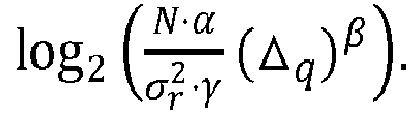
-
Figure 6 represents a flowchart of a method for decoding a transform T from a bitstream according to a specific and non-limiting embodiment. - In a step S26, an information representative of a number of transform vectors 'k' is decoded. Possibly an information representative of a precision b is further decoded for each transform vector. The information may be a number of bits used to encode each component of the transform vector. In a variant, a precision decrement is decoded. In the latter case, a number of bits m may be decoded at least for the first transfom vector. In a variant m is known by the decoder and a precision decrement d is decoded for each transform vector. The information representative of the precision b may be :
- a. an integer that signals directly the number of bits used to encode each component of the transform vector,
- b. information that indicates the evolution of the number of bits, i.e. bit decrement. As an example, this information is a flag that signals a decrement of the precision by one bit. When the flag equals 0 then the precision is not changed and when the flag equals 1 then the precision is decremented by 1. In this case encoding k may be avoided because the number k maybe determined when the encoding bit precision b equals 0.
- Optionally, an information representative of a number of adaptive transforms 'N' encoded into the bit-stream. In the case where several transforms are encoded, then the information (for k and b) are encoded for each transform.
- In a step S28, the transform vectors of the transform T are decoded responsive to k and b. More precisely, each component of the transform vectors is decoded from the bitstream and dequantized to obtain the transform T. The non-decoded transform vectors (i.e. the (n-k) transform vectors may either be set to 0 or may be determined using a completion method.
- The decoded transforms may then be used to decode pictures. In the decoding process the decoded transforms replace the fixed DCT/Hadamard transforms that are used in classical decoders (H.264/AVC, H.265/HEVC, etc).
- An exemplary embodiment is disclosed on
Figure 7 . The method begins at step S30. At step S32, a decoder accesses a bitstream. At an optional step S34, an information representative of a number N of transforms is decoded from the accessed bitstream. The decoder optionally starts a loop over N at step S36. At step S38, an information representative of a number k of transform vectors is decoded for a current transform. At step S40, the decoder begins a loop over k. At step S42, The decoder decodes an information representative of an encoding precision b for a current transform vector. At step S44, the decoder decodes the components of the current transform vector responsive to the precision b. In step S46, ends the loop over k and in step S48 the loop over N. The method ends at step S50. -
Figure 8 represents an exemplary architecture of a receiver 110 configured to decode a picture from a bitstream according to a non-limiting embodiment. - The receiver 110 comprises one or more processor(s) 1100, which could comprise, for example, a CPU, a GPU and/or a DSP (English acronym of Digital Signal Processor), along with internal memory 1510 (e.g. RAM, ROM and/or EPROM). The receiver 110 comprises one or more communication interface(s) 1110, each adapted to display output information and/or allow a user to enter commands and/or access data (e.g. a keyboard, a mouse, a touchpad, a webcam, etc); and a
power source 1120 which may be external to the receiver 110. The receiver 110 may also comprise one or more network interface(s) (not shown).Decoder module 1140 represents the module that may be included in a device to perform the decoding functions. Additionally,decoder module 1140 may be implemented as a separate element of the receiver 110 or may be incorporated within processor(s) 1100 as a combination of hardware and software as known to those skilled in the art. - The bitstream may be obtained from a source. According to different embodiments, the source can be, but not limited to:
- a local memory, e.g. a video memory, a RAM, a flash memory, a hard disk ;
- a storage interface, e.g. an interface with a mass storage, a ROM, an optical disc or a magnetic support;
- a communication interface, e.g. a wireline interface (for example a bus interface, a wide area network interface, a local area network interface) or a wireless interface (such as a IEEE 802.11 interface or a Bluetooth interface); and
- an picture capturing circuit (e.g. a sensor such as, for example, a CCD (or Charge-Coupled Device) or CMOS (or Complementary Metal-Oxide-Semiconductor)).
- According to different embodiments, the decoded picture may be sent to a destination, e.g. a display device. As an example, the decoded picture is stored in a remote or in a local memory, e.g. a video memory or a RAM, a hard disk. In a variant, the decoded picture is sent to a storage interface, e.g. an interface with a mass storage, a ROM, a flash memory, an optical disc or a magnetic support and/or transmitted over a communication interface, e.g. an interface to a point to point link, a communication bus, a point to multipoint link or a broadcast network.
- According to an exemplary and non-limiting embodiment, the receiver 110 further comprises a computer program stored in the
memory 1130. The computer program comprises instructions which, when executed by the receiver 110, in particular by theprocessor 1100, enable the receiver to execute the method described with reference tofigures 6 and/or 7. According to a variant, the computer program is stored externally to the receiver 110 on a non-transitory digital data support, e.g. on an external storage medium such as a HDD, CD-ROM, DVD, a read-only and/or DVD drive and/or a DVD Read/Write drive, all known in the art. The receiver 110 thus comprises a mechanism to read the computer program. Further, the receiver 110 could access one or more Universal Serial Bus (USB)-type storage devices (e.g., "memory sticks.") through corresponding USB ports (not shown). - According to exemplary and non-limiting embodiments, the receiver 110 can be, but not limited to:
- a mobile device ;
- a communication device ;
- a game device ;
- a set top box;
- a player, e.g. a Blu-Ray player;
- a TV set;
- a tablet (or tablet computer) ;
- a laptop ;
- a display and
- a decoding chip.
-
Figure 9 represents an exemplary architecture of atransmitter 100 configured to encode a picture in a bitstream according to a non-limiting embodiment. - The
transmitter 100 comprises one or more processor(s) 1000, which could comprise, for example, a CPU, a GPU and/or a DSP (English acronym of Digital Signal Processor), along with internal memory 1030 (e.g. RAM, ROM, and/or EPROM). Thetransmitter 100 comprises one or more communication interface(s) 1010, each adapted to display output information and/or allow a user to enter commands and/or access data (e.g. a keyboard, a mouse, a touchpad, a webcam); and apower source 1020 which may be external to thetransmitter 100. Thetransmitter 100 may also comprise one or more network interface(s) (not shown).Encoder module 1040 represents the module that may be included in a device to perform the coding functions. Additionally,encoder module 1140 may be implemented as a separate element of thetransmitter 100 or may be incorporated within processor(s) 1000 as a combination of hardware and software as known to those skilled in the art. - The picture may be obtained from a source. According to different embodiments, the source can be, but is not limited to:
- a local memory, e.g. a video memory, a RAM, a flash memory, a hard disk ;
- a storage interface, e.g. an interface with a mass storage, a ROM, an optical disc or a magnetic support;
- a communication interface, e.g. a wireline interface (for example a bus interface, a wide area network interface, a local area network interface) or a wireless interface (such as a IEEE 802.11 interface or a Bluetooth interface); and
- an picture capturing circuit (e.g. a sensor such as, for example, a CCD (or Charge-Coupled Device) or CMOS (or Complementary Metal-Oxide-Semiconductor)).
- According to different embodiments, the bitstream may be sent to a destination. As an example, the bitstream is stored in a remote or in a local memory, e.g. a video memory or a RAM, a hard disk. In a variant, the bitstream is sent to a storage interface, e.g. an interface with a mass storage, a ROM, a flash memory, an optical disc or a magnetic support and/or transmitted over a communication interface, e.g. an interface to a point to point link, a communication bus, a point to multipoint link or a broadcast network. According to an exemplary and non-limiting embodiment, the
transmitter 100 further comprises a computer program stored in thememory 1030. The computer program comprises instructions which, when executed by thetransmitter 100, in particular by theprocessor 1000, enable thetransmitter 100 to execute the method described with reference tofigure 1A and/or 1B. According to a variant, the computer program is stored externally to thetransmitter 100 on a non-transitory digital data support, e.g. on an external storage medium such as a HDD, CD-ROM, DVD, a read-only and/or DVD drive and/or a DVD Read/Write drive, all known in the art. Thetransmitter 100 thus comprises a mechanism to read the computer program. Further, thetransmitter 100 could access one or more Universal Serial Bus (USB)-type storage devices (e.g., "memory sticks.") through corresponding USB ports (not shown). - According to exemplary and non-limiting embodiments, the
transmitter 100 can be, but is not limited to: - a mobile device ;
- a communication device ;
- a game device ;
- a tablet (or tablet computer) ;
- a laptop ;
- a still picture camera;
- a video camera ;
- an encoding chip;
- a still picture server; and
- a video server (e.g. a broadcast server, a video-on-demand server or a web server).
- The implementations described herein may be implemented in, for example, a method or a process, an apparatus, a software program, a data stream, or a signal. Even if only discussed in the context of a single form of implementation (for example, discussed only as a method or a device), the implementation of features discussed may also be implemented in other forms (for example a program). An apparatus may be implemented in, for example, appropriate hardware, software, and firmware. The methods may be implemented in, for example, an apparatus such as, for example, a processor, which refers to processing devices in general, including, for example, a computer, a microprocessor, an integrated circuit, or a programmable logic device. Processors also include communication devices, such as, for example, computers, cell phones, portable/personal digital assistants ("PDAs"), and other devices that facilitate communication of information between end-users.
- Implementations of the various processes and features described herein may be embodied in a variety of different equipment or applications, particularly, for example, equipment or applications. Examples of such equipment include an encoder, a decoder, a post-processor processing output from a decoder, a pre-processor providing input to an encoder, a video coder, a video decoder, a video codec, a web server, a set-top box, a laptop, a personal computer, a cell phone, a PDA, and other communication devices. As should be clear, the equipment may be mobile and even installed in a mobile vehicle.
- Additionally, the methods may be implemented by instructions being performed by a processor, and such instructions (and/or data values produced by an implementation) may be stored on a processor-readable medium such as, for example, an integrated circuit, a software carrier or other storage device such as, for example, a hard disk, a compact diskette ("CD"), an optical disc (such as, for example, a DVD, often referred to as a digital versatile disc or a digital video disc), a random access memory ("RAM"), or a read-only memory ("ROM"). The instructions may form an application program tangibly embodied on a processor-readable medium. Instructions may be, for example, in hardware, firmware, software, or a combination. Instructions may be found in, for example, an operating system, a separate application, or a combination of the two. A processor may be characterized, therefore, as, for example, both a device configured to carry out a process and a device that includes a processor-readable medium (such as a storage device) having instructions for carrying out a process. Further, a processor-readable medium may store, in addition to or in lieu of instructions, data values produced by an implementation.
- As will be evident to one of skill in the art, implementations may produce a variety of signals formatted to carry information that may be, for example, stored or transmitted. The information may include, for example, instructions for performing a method, or data produced by one of the described implementations. For example, a signal may be formatted to carry as data the rules for writing or reading the syntax of a described embodiment, or to carry as data the actual syntax-values written by a described embodiment. Such a signal may be formatted, for example, as an electromagnetic wave (for example, using a radio frequency portion of spectrum) or as a baseband signal. The formatting may include, for example, encoding a data stream and modulating a carrier with the encoded data stream. The information that the signal carries may be, for example, analog or digital information. The signal may be transmitted over a variety of different wired or wireless links, as is known. The signal may be stored on a processor-readable medium.
- A number of implementations have been described. Nevertheless, it will be understood that various modifications may be made. For example, elements of different implementations may be combined, supplemented, modified, or removed to produce other implementations. Additionally, one of ordinary skill will understand that other structures and processes may be substituted for those disclosed and the resulting implementations will perform at least substantially the same function(s), in at least substantially the same way(s), to achieve at least substantially the same result(s) as the implementations disclosed. Accordingly, these and other implementations are contemplated by this application.
Claims (9)
- A method for decoding a bitstream representative of a picture comprising:- determining information representative of at least one encoding precision;- decoding a transform responsive to said determined information;- decoding said picture using the decoded transform.
- The method of claim 1, wherein determining an information representative of an encoding precision comprises decoding said encoding precision from the bitstream.
- The method of claim 1 or 2, wherein said information representative of an encoding precision is a number of bits.
- The method of claim 1 or 2, wherein said information representative of an encoding precision is a bit decrement.
- The method according to any one of claims 1 to 4, further comprising decoding information representative of a number of transform vectors, wherein determining information representative of at least one encoding precision comprises decoding information representative of an encoding precision for each transform vector and wherein decoding said transform responsive to said determined information comprises decoding components of each transform vector responsive to the associated encoding precision.
- A method for encoding a picture comprising:- determining information representative of at least one encoding precision;- encoding a transform responsive to said determined information; and- encoding said picture using the encoded transform.
- A decoding device comprising:- means for determining information representative of at least one encoding precision;- means for decoding a transform responsive to said determined information;- means for decoding said picture using the decoded transform.
- An encoding device comprising:- means for determining information representative of at least one encoding precision;- means for encoding a transform responsive to said determined information; and- means for encoding said picture using the encoded transform.
- A bitstream comprising information representative of at least one encoding precision, information representative of a transform encoded responsive to said encoded precision and information representative of a picture encoded using the encoded transform.
Priority Applications (7)
| Application Number | Priority Date | Filing Date | Title |
|---|---|---|---|
| EP15306779.8A EP3166313A1 (en) | 2015-11-09 | 2015-11-09 | Encoding and decoding method and corresponding devices |
| PCT/EP2016/076438 WO2017080887A1 (en) | 2015-11-09 | 2016-11-02 | Encoding and decoding method and corresponding devices |
| CN201680065320.2A CN108353178B (en) | 2015-11-09 | 2016-11-02 | Encoding and decoding method and corresponding devices |
| EP16790607.2A EP3375189A1 (en) | 2015-11-09 | 2016-11-02 | Encoding and decoding method and corresponding devices |
| US15/774,992 US10958937B2 (en) | 2015-11-09 | 2016-11-02 | Encoding and decoding method and corresponding devices |
| JP2018522538A JP6854816B2 (en) | 2015-11-09 | 2016-11-02 | Coding and decoding methods and corresponding devices |
| KR1020187012768A KR102802266B1 (en) | 2015-11-09 | 2016-11-02 | Encoding and decoding methods and corresponding devices |
Applications Claiming Priority (1)
| Application Number | Priority Date | Filing Date | Title |
|---|---|---|---|
| EP15306779.8A EP3166313A1 (en) | 2015-11-09 | 2015-11-09 | Encoding and decoding method and corresponding devices |
Publications (1)
| Publication Number | Publication Date |
|---|---|
| EP3166313A1 true EP3166313A1 (en) | 2017-05-10 |
Family
ID=54608467
Family Applications (2)
| Application Number | Title | Priority Date | Filing Date |
|---|---|---|---|
| EP15306779.8A Withdrawn EP3166313A1 (en) | 2015-11-09 | 2015-11-09 | Encoding and decoding method and corresponding devices |
| EP16790607.2A Pending EP3375189A1 (en) | 2015-11-09 | 2016-11-02 | Encoding and decoding method and corresponding devices |
Family Applications After (1)
| Application Number | Title | Priority Date | Filing Date |
|---|---|---|---|
| EP16790607.2A Pending EP3375189A1 (en) | 2015-11-09 | 2016-11-02 | Encoding and decoding method and corresponding devices |
Country Status (6)
| Country | Link |
|---|---|
| US (1) | US10958937B2 (en) |
| EP (2) | EP3166313A1 (en) |
| JP (1) | JP6854816B2 (en) |
| KR (1) | KR102802266B1 (en) |
| CN (1) | CN108353178B (en) |
| WO (1) | WO2017080887A1 (en) |
Families Citing this family (2)
| Publication number | Priority date | Publication date | Assignee | Title |
|---|---|---|---|---|
| EP3270595A1 (en) | 2016-07-15 | 2018-01-17 | Thomson Licensing | Method and apparatus for last coefficient coding for adaptive transform based video compression |
| CN110337812A (en) * | 2018-04-02 | 2019-10-15 | 北京大学 | The method, apparatus and computer system of loop filtering |
Citations (2)
| Publication number | Priority date | Publication date | Assignee | Title |
|---|---|---|---|---|
| WO2014103294A1 (en) * | 2012-12-28 | 2014-07-03 | Canon Kabushiki Kaisha | Provision of precision information in an image encoding device, image encoding method and program, image decoding device, and image decoding method and program |
| WO2015128222A1 (en) * | 2014-02-27 | 2015-09-03 | Thomson Licensing | Method for encoding and decoding a picture and corresponding devices |
Family Cites Families (15)
| Publication number | Priority date | Publication date | Assignee | Title |
|---|---|---|---|---|
| EP0667716B1 (en) * | 1993-08-30 | 1999-11-24 | Sony Corporation | Device and method for encoding image |
| GB2326572A (en) * | 1997-06-19 | 1998-12-23 | Softsound Limited | Low bit rate audio coder and decoder |
| JP2000197054A (en) | 1998-12-24 | 2000-07-14 | Hudson Soft Co Ltd | Dynamic image encoding method, recording medium with program thereof recorded therein and apparatus |
| US6161043A (en) * | 1999-02-22 | 2000-12-12 | Pacesetter, Inc. | Implantable cardiac device having event recording capability with compression |
| JP3670554B2 (en) * | 2000-04-25 | 2005-07-13 | 日本電信電話株式会社 | Image signal encoding device / decoding device, image signal encoding method / decoding method, and image signal encoding / decoding program recording medium |
| US6831947B2 (en) | 2001-03-23 | 2004-12-14 | Sharp Laboratories Of America, Inc. | Adaptive quantization based on bit rate prediction and prediction error energy |
| SE0202159D0 (en) * | 2001-07-10 | 2002-07-09 | Coding Technologies Sweden Ab | Efficientand scalable parametric stereo coding for low bitrate applications |
| WO2003079692A1 (en) * | 2002-03-19 | 2003-09-25 | Fujitsu Limited | Hierarchical encoder and decoder |
| US8289572B2 (en) * | 2005-09-22 | 2012-10-16 | Ricoh Production Print Solutions LLC | Estimation of ink/toner coverage when printing |
| KR100772391B1 (en) * | 2006-01-23 | 2007-11-01 | 삼성전자주식회사 | Video Coding and Decoding Based on Orthogonal Transform and Vector Quantization and Its Apparatus |
| US8179775B2 (en) * | 2007-08-14 | 2012-05-15 | Texas Instruments Incorporated | Precoding matrix feedback processes, circuits and systems |
| JP2009005041A (en) * | 2007-06-21 | 2009-01-08 | Sony Corp | Encoding apparatus and method, decoding apparatus and method, program, recording medium, and data structure |
| JP2012516627A (en) * | 2009-01-27 | 2012-07-19 | トムソン ライセンシング | Method and apparatus for selection of transforms in video encoding and video decoding |
| RU2408076C1 (en) | 2009-07-02 | 2010-12-27 | Корпорация "САМСУНГ ЭЛЕКТРОНИКС Ко., Лтд." | Image compression method |
| EP2952002A4 (en) | 2013-01-30 | 2016-09-21 | Intel Corp | Content adaptive entropy coding for next generation video |
-
2015
- 2015-11-09 EP EP15306779.8A patent/EP3166313A1/en not_active Withdrawn
-
2016
- 2016-11-02 US US15/774,992 patent/US10958937B2/en active Active
- 2016-11-02 JP JP2018522538A patent/JP6854816B2/en active Active
- 2016-11-02 EP EP16790607.2A patent/EP3375189A1/en active Pending
- 2016-11-02 CN CN201680065320.2A patent/CN108353178B/en active Active
- 2016-11-02 WO PCT/EP2016/076438 patent/WO2017080887A1/en not_active Ceased
- 2016-11-02 KR KR1020187012768A patent/KR102802266B1/en active Active
Patent Citations (2)
| Publication number | Priority date | Publication date | Assignee | Title |
|---|---|---|---|---|
| WO2014103294A1 (en) * | 2012-12-28 | 2014-07-03 | Canon Kabushiki Kaisha | Provision of precision information in an image encoding device, image encoding method and program, image decoding device, and image decoding method and program |
| WO2015128222A1 (en) * | 2014-02-27 | 2015-09-03 | Thomson Licensing | Method for encoding and decoding a picture and corresponding devices |
Non-Patent Citations (2)
| Title |
|---|
| N. GARGUIR: "Comparative Performance of SVD and Adaptive Cosine Transform in Coding Images", IRE TRANSACTIONS ON COMMUNICATIONS SYSTEMS, vol. 27, no. 8, 1 August 1979 (1979-08-01), USA, pages 1230 - 1234, XP055269934, ISSN: 0096-2244, DOI: 10.1109/TCOM.1979.1094538 * |
| SELESNICK . W.; GULERYUZ, O. G.: "A diagonally oriented dct-like 2d block transform", SPIE OPTICAL ENGINEERING AND APPLICATIONS, 2011 |
Also Published As
| Publication number | Publication date |
|---|---|
| US20180324462A1 (en) | 2018-11-08 |
| CN108353178B (en) | 2022-07-05 |
| US10958937B2 (en) | 2021-03-23 |
| KR20180081512A (en) | 2018-07-16 |
| JP6854816B2 (en) | 2021-04-07 |
| WO2017080887A1 (en) | 2017-05-18 |
| KR102802266B1 (en) | 2025-04-29 |
| EP3375189A1 (en) | 2018-09-19 |
| JP2018533309A (en) | 2018-11-08 |
| CN108353178A (en) | 2018-07-31 |
Similar Documents
| Publication | Publication Date | Title |
|---|---|---|
| US9282329B2 (en) | Methods and devices for data compression using offset-based adaptive reconstruction levels | |
| US8934543B2 (en) | Adaptive quantization with balanced pixel-domain distortion distribution in image processing | |
| US10939108B2 (en) | Method and a device for image encoding and decoding | |
| US8913666B2 (en) | Entropy coding coefficients using a joint context model | |
| US8767835B2 (en) | Method for coding videos using dictionaries | |
| US8311109B2 (en) | In-loop deblocking for intra-coded images or frames | |
| US20110134995A1 (en) | Video coding with coding of the locations of significant coefficients in a block of coefficients | |
| EP2595382A2 (en) | Methods And Devices For Encoding And Decoding Transform Domain Filters | |
| US20100208804A1 (en) | Modified entropy encoding for images and videos | |
| US20120183043A1 (en) | Method for Training and Utilizing Separable Transforms for Video Coding | |
| US9560386B2 (en) | Pyramid vector quantization for video coding | |
| EP3151559A1 (en) | Method for coding and decoding a plurality of picture blocks and corresponding devices | |
| EP3891977B1 (en) | Method and apparatus for intra prediction | |
| KR102787006B1 (en) | A video encoder, a video decoder, and a video display system | |
| US10958937B2 (en) | Encoding and decoding method and corresponding devices | |
| Le Pendu et al. | Template based inter-layer prediction for high dynamic range scalable compression | |
| WO2015128222A1 (en) | Method for encoding and decoding a picture and corresponding devices | |
| EP3026913A1 (en) | Scalable encoding and decoding methods and corresponding devices with combined intraprediction and interlayer prediction | |
| EP1750452B1 (en) | Apparatus for intra coding video data | |
| KR20150100232A (en) | Method and system for data encoding | |
| Ropert et al. | Entropy Constrained Scalar Quantization for Laplacian Distribution: Application to HEVC |
Legal Events
| Date | Code | Title | Description |
|---|---|---|---|
| PUAI | Public reference made under article 153(3) epc to a published international application that has entered the european phase |
Free format text: ORIGINAL CODE: 0009012 |
|
| AK | Designated contracting states |
Kind code of ref document: A1 Designated state(s): AL AT BE BG CH CY CZ DE DK EE ES FI FR GB GR HR HU IE IS IT LI LT LU LV MC MK MT NL NO PL PT RO RS SE SI SK SM TR |
|
| AX | Request for extension of the european patent |
Extension state: BA ME |
|
| STAA | Information on the status of an ep patent application or granted ep patent |
Free format text: STATUS: THE APPLICATION IS DEEMED TO BE WITHDRAWN |
|
| 18D | Application deemed to be withdrawn |
Effective date: 20171111 |