EP3165523A2 - Composition for inducing cell reprogramming - Google Patents
Composition for inducing cell reprogramming Download PDFInfo
- Publication number
- EP3165523A2 EP3165523A2 EP15815352.8A EP15815352A EP3165523A2 EP 3165523 A2 EP3165523 A2 EP 3165523A2 EP 15815352 A EP15815352 A EP 15815352A EP 3165523 A2 EP3165523 A2 EP 3165523A2
- Authority
- EP
- European Patent Office
- Prior art keywords
- compound
- alkyl
- mmol
- hydroxy
- alkenyl
- Prior art date
- Legal status (The legal status is an assumption and is not a legal conclusion. Google has not performed a legal analysis and makes no representation as to the accuracy of the status listed.)
- Granted
Links
- 0 *C(*)(CC=S)N Chemical compound *C(*)(CC=S)N 0.000 description 16
- CLQUXVAHQPCPHS-UHFFFAOYSA-N [O-][N+](c(cc12)ccc1[nH]nc2NS(c1cc(Br)ccc1)(=O)=O)=O Chemical compound [O-][N+](c(cc12)ccc1[nH]nc2NS(c1cc(Br)ccc1)(=O)=O)=O CLQUXVAHQPCPHS-UHFFFAOYSA-N 0.000 description 2
- YEGQMUOUKUEJRM-UHFFFAOYSA-N Nc1n[nH]c(cc2)c1cc2C(O)=O Chemical compound Nc1n[nH]c(cc2)c1cc2C(O)=O YEGQMUOUKUEJRM-UHFFFAOYSA-N 0.000 description 1
- QEQQKCQJSODYMO-UHFFFAOYSA-N O=C(c(cc12)ccc1[nH]nc2NS(c1ccccc1)(=O)=O)N1CCNCC1 Chemical compound O=C(c(cc12)ccc1[nH]nc2NS(c1ccccc1)(=O)=O)N1CCNCC1 QEQQKCQJSODYMO-UHFFFAOYSA-N 0.000 description 1
- MAPWHWRNFRJKFI-UHFFFAOYSA-N OC(c(cc1)cc2c1[nH]nc2C=O)=O Chemical compound OC(c(cc1)cc2c1[nH]nc2C=O)=O MAPWHWRNFRJKFI-UHFFFAOYSA-N 0.000 description 1
- WJOQVNLTMGDQNN-UHFFFAOYSA-N OC(c(cc1)cc2c1[nH]nc2NS(c1ccccc1)(=O)=O)=O Chemical compound OC(c(cc1)cc2c1[nH]nc2NS(c1ccccc1)(=O)=O)=O WJOQVNLTMGDQNN-UHFFFAOYSA-N 0.000 description 1
- UVUPPLXBIXJRKD-UHFFFAOYSA-N [O-][N+](c1ccc2[nH]nc(C=O)c2c1)=O Chemical compound [O-][N+](c1ccc2[nH]nc(C=O)c2c1)=O UVUPPLXBIXJRKD-UHFFFAOYSA-N 0.000 description 1
Images


Classifications
-
- C—CHEMISTRY; METALLURGY
- C07—ORGANIC CHEMISTRY
- C07D—HETEROCYCLIC COMPOUNDS
- C07D231/00—Heterocyclic compounds containing 1,2-diazole or hydrogenated 1,2-diazole rings
- C07D231/54—Heterocyclic compounds containing 1,2-diazole or hydrogenated 1,2-diazole rings condensed with carbocyclic rings or ring systems
- C07D231/56—Benzopyrazoles; Hydrogenated benzopyrazoles
-
- A—HUMAN NECESSITIES
- A61—MEDICAL OR VETERINARY SCIENCE; HYGIENE
- A61K—PREPARATIONS FOR MEDICAL, DENTAL OR TOILETRY PURPOSES
- A61K31/00—Medicinal preparations containing organic active ingredients
- A61K31/33—Heterocyclic compounds
- A61K31/395—Heterocyclic compounds having nitrogen as a ring hetero atom, e.g. guanethidine or rifamycins
- A61K31/41—Heterocyclic compounds having nitrogen as a ring hetero atom, e.g. guanethidine or rifamycins having five-membered rings with two or more ring hetero atoms, at least one of which being nitrogen, e.g. tetrazole
- A61K31/415—1,2-Diazoles
-
- A—HUMAN NECESSITIES
- A61—MEDICAL OR VETERINARY SCIENCE; HYGIENE
- A61K—PREPARATIONS FOR MEDICAL, DENTAL OR TOILETRY PURPOSES
- A61K31/00—Medicinal preparations containing organic active ingredients
- A61K31/33—Heterocyclic compounds
- A61K31/395—Heterocyclic compounds having nitrogen as a ring hetero atom, e.g. guanethidine or rifamycins
- A61K31/41—Heterocyclic compounds having nitrogen as a ring hetero atom, e.g. guanethidine or rifamycins having five-membered rings with two or more ring hetero atoms, at least one of which being nitrogen, e.g. tetrazole
- A61K31/415—1,2-Diazoles
- A61K31/416—1,2-Diazoles condensed with carbocyclic ring systems, e.g. indazole
-
- A—HUMAN NECESSITIES
- A61—MEDICAL OR VETERINARY SCIENCE; HYGIENE
- A61P—SPECIFIC THERAPEUTIC ACTIVITY OF CHEMICAL COMPOUNDS OR MEDICINAL PREPARATIONS
- A61P21/00—Drugs for disorders of the muscular or neuromuscular system
- A61P21/02—Muscle relaxants, e.g. for tetanus or cramps
-
- A—HUMAN NECESSITIES
- A61—MEDICAL OR VETERINARY SCIENCE; HYGIENE
- A61P—SPECIFIC THERAPEUTIC ACTIVITY OF CHEMICAL COMPOUNDS OR MEDICINAL PREPARATIONS
- A61P25/00—Drugs for disorders of the nervous system
-
- A—HUMAN NECESSITIES
- A61—MEDICAL OR VETERINARY SCIENCE; HYGIENE
- A61P—SPECIFIC THERAPEUTIC ACTIVITY OF CHEMICAL COMPOUNDS OR MEDICINAL PREPARATIONS
- A61P25/00—Drugs for disorders of the nervous system
- A61P25/14—Drugs for disorders of the nervous system for treating abnormal movements, e.g. chorea, dyskinesia
- A61P25/16—Anti-Parkinson drugs
-
- A—HUMAN NECESSITIES
- A61—MEDICAL OR VETERINARY SCIENCE; HYGIENE
- A61P—SPECIFIC THERAPEUTIC ACTIVITY OF CHEMICAL COMPOUNDS OR MEDICINAL PREPARATIONS
- A61P43/00—Drugs for specific purposes, not provided for in groups A61P1/00-A61P41/00
-
- C—CHEMISTRY; METALLURGY
- C07—ORGANIC CHEMISTRY
- C07D—HETEROCYCLIC COMPOUNDS
- C07D401/00—Heterocyclic compounds containing two or more hetero rings, having nitrogen atoms as the only ring hetero atoms, at least one ring being a six-membered ring with only one nitrogen atom
- C07D401/02—Heterocyclic compounds containing two or more hetero rings, having nitrogen atoms as the only ring hetero atoms, at least one ring being a six-membered ring with only one nitrogen atom containing two hetero rings
- C07D401/06—Heterocyclic compounds containing two or more hetero rings, having nitrogen atoms as the only ring hetero atoms, at least one ring being a six-membered ring with only one nitrogen atom containing two hetero rings linked by a carbon chain containing only aliphatic carbon atoms
-
- C—CHEMISTRY; METALLURGY
- C07—ORGANIC CHEMISTRY
- C07D—HETEROCYCLIC COMPOUNDS
- C07D401/00—Heterocyclic compounds containing two or more hetero rings, having nitrogen atoms as the only ring hetero atoms, at least one ring being a six-membered ring with only one nitrogen atom
- C07D401/02—Heterocyclic compounds containing two or more hetero rings, having nitrogen atoms as the only ring hetero atoms, at least one ring being a six-membered ring with only one nitrogen atom containing two hetero rings
- C07D401/12—Heterocyclic compounds containing two or more hetero rings, having nitrogen atoms as the only ring hetero atoms, at least one ring being a six-membered ring with only one nitrogen atom containing two hetero rings linked by a chain containing hetero atoms as chain links
-
- C—CHEMISTRY; METALLURGY
- C07—ORGANIC CHEMISTRY
- C07D—HETEROCYCLIC COMPOUNDS
- C07D403/00—Heterocyclic compounds containing two or more hetero rings, having nitrogen atoms as the only ring hetero atoms, not provided for by group C07D401/00
- C07D403/02—Heterocyclic compounds containing two or more hetero rings, having nitrogen atoms as the only ring hetero atoms, not provided for by group C07D401/00 containing two hetero rings
- C07D403/06—Heterocyclic compounds containing two or more hetero rings, having nitrogen atoms as the only ring hetero atoms, not provided for by group C07D401/00 containing two hetero rings linked by a carbon chain containing only aliphatic carbon atoms
-
- C—CHEMISTRY; METALLURGY
- C07—ORGANIC CHEMISTRY
- C07D—HETEROCYCLIC COMPOUNDS
- C07D403/00—Heterocyclic compounds containing two or more hetero rings, having nitrogen atoms as the only ring hetero atoms, not provided for by group C07D401/00
- C07D403/14—Heterocyclic compounds containing two or more hetero rings, having nitrogen atoms as the only ring hetero atoms, not provided for by group C07D401/00 containing three or more hetero rings
-
- C—CHEMISTRY; METALLURGY
- C12—BIOCHEMISTRY; BEER; SPIRITS; WINE; VINEGAR; MICROBIOLOGY; ENZYMOLOGY; MUTATION OR GENETIC ENGINEERING
- C12N—MICROORGANISMS OR ENZYMES; COMPOSITIONS THEREOF; PROPAGATING, PRESERVING, OR MAINTAINING MICROORGANISMS; MUTATION OR GENETIC ENGINEERING; CULTURE MEDIA
- C12N5/00—Undifferentiated human, animal or plant cells, e.g. cell lines; Tissues; Cultivation or maintenance thereof; Culture media therefor
- C12N5/06—Animal cells or tissues; Human cells or tissues
- C12N5/0602—Vertebrate cells
- C12N5/0652—Cells of skeletal and connective tissues; Mesenchyme
- C12N5/0654—Osteocytes, Osteoblasts, Odontocytes; Bones, Teeth
-
- C—CHEMISTRY; METALLURGY
- C12—BIOCHEMISTRY; BEER; SPIRITS; WINE; VINEGAR; MICROBIOLOGY; ENZYMOLOGY; MUTATION OR GENETIC ENGINEERING
- C12N—MICROORGANISMS OR ENZYMES; COMPOSITIONS THEREOF; PROPAGATING, PRESERVING, OR MAINTAINING MICROORGANISMS; MUTATION OR GENETIC ENGINEERING; CULTURE MEDIA
- C12N2506/00—Differentiation of animal cells from one lineage to another; Differentiation of pluripotent cells
- C12N2506/13—Differentiation of animal cells from one lineage to another; Differentiation of pluripotent cells from connective tissue cells, from mesenchymal cells
- C12N2506/1323—Differentiation of animal cells from one lineage to another; Differentiation of pluripotent cells from connective tissue cells, from mesenchymal cells from skeletal muscle cells
Definitions
- the present invention relates to a composition for inducing cell reprogramming.
- Reprogramming technology is a relatively easy method that causes little or no physical damage and discomfort to patients.
- This technology makes it possible to obtain self-somatic cells and to produce induced pluripotent stem cells having characteristics similar to those of human embryonic stem cells therefrom.
- virus recombined with a specific gene may be used to induce undifferentiated stem cells, and several researchers reported a method in which the virus is transfected into cells to insert the gene into the genome of the cells and the protein of interest is expressed in the cells.
- reprogrammed cells produced by this method were found to have cell characteristics and differentiation potential, which are almost similar to those of embryonic stem cells, but these cells have a problem in that they contain a large amount of a genetic material on the genome of the cells, because the gene is delivered into the cells by the viral vector.
- induced pluripotent stem cells had side effects such as formation of cancer. This suggests that the actual clinical application of induced pluripotent stem cells can still be risky.
- induced pluripotent stem cells have a problem in that an oncogene is used in a reprogramming process. Due to this problem, in recent years, there have been active studies on direct reprogramming to allow somatic cells to differentiate directly into a required cell lineage in patients, unlike conventional reprogramming methods.
- the present inventors have made extensive efforts to overcome the above-described problems, and as a result, have synthesized compounds which are not toxic to cells and which allow direct reprogramming of differentiated cells into cells having other characteristics, and have found that the use of these compounds enables safe, efficient cell reprogramming.
- the present inventors have made extensive efforts to develop compositions capable of inducing cell reprogramming while showing improved biological profiles compared to conventional indazole derivative compounds.
- the present inventor have designed and synthesized novel indazole derivative compounds having the ability to induce cell reprogramming, and have found that these compounds have excellent cell reprogramming ability without showing cytotoxicity, unlike conventional indazole derivatives (for example, kinase inhibitors), thereby completing the present invention.
- Another object of the present invention is to provide novel indazole derivatives.
- the present invention provides a composition for inducing cell reprogramming, comprising a compound represented by the following formula A: wherein R 1 is hydrogen, nitro, nitroxy or Y-carbonyl, wherein Y is hydrogen, hydroxy, halo, C 1-30 alkoxy, C 2-30 heterocycloalkyl containing nitrogen, oxygen or sulfur as a heteroatom, C 2-20 heterocycloalkenyl containing nitrogen, oxygen or sulfur as a heteroatom, C 6-30 aryl, C 1-30 alkyl, or C 2-30 alkenyl; R 2 is hydrogen, hydroxy, halo, C 1-30 aryl, C 1-30 alkoxy, C 1-30 alkyl, or C 2-30 alkenyl; R 3 is hydrogen, hydroxy, halo, C 1-30 aryl, C 1-30 alkoxy, C 1-30 alkyl, or C 2-30 alkenyl; and X is amine, amido, sulfonamido, carbonyl,
- the present invention provides a method for producing reprogrammed cells from differentiated cells, the method comprising the steps of: (a) bring a cell reprogramming composition into contact with the differentiated cells; (b) culturing the cells of step (a).
- the present inventors have made extensive efforts to develop compositions capable of inducing cell reprogramming while showing improved biological profiles compared to conventional indazole derivative compounds.
- the present inventor have designed and synthesized novel indazole derivative compounds having the ability to induce cell reprogramming, and have found that these compounds have excellent cell reprogramming ability without showing cytotoxicity, unlike conventional indazole derivatives (for example, kinase inhibitors).
- the compound represented by formula A according to the present invention is a compound that can reprogram differentiated cells into cells having new characteristics, and is chemically synthesized using indazole as a nucleus.
- Conventional indazole derivative compounds have not been known to be used for cell reprogramming, and the compound of the present invention has an excellent ability to reprogram cells while having little or no cytotoxicity, compared to conventional indazole derivative compounds.
- a conventional direct reprogramming method is a method of introducing a gene using virus, and has shortcomings in that the method is difficult to apply directly to patient, the efficiency of the process of inducing cell reprogramming is low, and immunological problems arise.
- Direct cell reprogramming using the low-molecular compound of the present invention is very excellent in terms of safety, cost-effectiveness and efficiency, because cell reprogramming is induced only by treatment with the low-molecular compound instead of introducing a gene by a viral vector.
- the composition of the present invention is very effective for inducing reprogrammed cells from differentiated cells.
- the composition of the present invention can induce cell lines of various lineages, such as reprogrammed osteogenic lineage cells or adipogenic lineage cells, from mammalian differentiated cells.
- the composition of the present invention induces differentiation from myoblasts into osteoblasts or adipocytes.
- differentiated cells is not specifically limited, and includes, for example, somatic cells or somatic stem cells.
- somatic cells refers to adult cells having a limited ability to differentiate and self-renew.
- the somatic cells may be cells that form human skin, hair, adipose or bone.
- the differentiated cells may be cells from a variety of mammals, including humans, monkeys, pigs, horses, cattle, sheep, dogs, cats, mice and rabbits.
- the differentiated cells may be human cells.
- differentiated cells may be reprogrammed into cells having characteristics that are 0-100% different from those of the differentiated cells, as a result of contact with the composition of the present invention.
- nitro used to define the indazole derivatives of formula A refers to halogen group elements, and includes, for example, fluoro, chloro, bromo and iodo.
- hydroxy refers to an -OH- functional group.
- halo refers to halogen group elements, and includes, for example, fluoro, chloro, bromo and iodo.
- alkyl refers to a straight or branched-chain, unsubstituted or substituted, saturated hydrocarbon group, and includes, for example, methyl, ethyl, propyl, isobutyl, pentyl, hexyl, heptyl, octyl, nonyl, decyl, undecyl, tridecyl, pentadecyl and heptadecyl.
- C 1-30 alkyl refers to an alkyl group having a alkyl unit containing 1-30 carbon atoms, and when C 1-30 alkyl is substituted, the carbon number of the substituent is not included in the carbon number of the C 1-30 alkyl.
- the C 1-30 alkyl at the Y position in formula is C 1-15 alkyl
- the C 1-30 alkyl at the R 2 position in formula A is preferably C 1-15 alkyl
- alkenyl refers to a straight or branched-chain unsubstituted or substituted, unsaturated hydrocarbon group having the indicated number of carbon atoms, and includes, for example, ethenyl, vinyl, propenyl, allyl, isopropenyl, butenyl, isobutenyl, t-butenyl, n-pentenyl, and n-hexenyl.
- C 2-20 alkenyl refers to an alkenyl group having an alkenyl unit containing 2-30 carbon atoms, and when C 2-20 alkenyl is substituted, the carbon number of the substituent is not included in the carbon atom of the C 2-20 alkenyl.
- the C 2-20 alkenyl at the Y position in formula A is C 2-15 alkenyl
- the C 2-20 alkenyl at the R 2 position in formula A is C 2-15 alkenyl.
- alkoxy refers to an alkyl or aryl group combined with one oxygen atom, and include, for example, methoxy, ethoxy, propoxy, aryloxy and the like.
- C 1-30 alkoxy means an alkyl group having an alkoxy unit containing 1 to 30 carbon atoms, and when C 1-30 alkoxy is substituted, the carbon number of the substituent is not included in the carbon number of the C 1-30 alkoxy.
- alkoxyalkyl refers to an alkyl group substituted with an alkoxy group.
- C 2-5 alkoxyalkyl means an alkoxyalkyl group having an alkoxyalkyl unit containing 2 to 5 carbon atoms, and when C 2-5 alkoxyalkyl is substituted, the carbon number of the substituent is not included in the carbon atom of the C 2-5 alkoxyalkyl.
- alkoxycarbonyl refers to carbonyl substituted with alkoxy.
- C 2-5 alkoxycarbonyl means an alkoxycarbonyl group having an alkoxycarbonyl unit containing 2 to 5 carbon atoms, and when C 2-5 alkoxycarbonyl is substituted, the carbon number of the substituent is not included in the carbon atom of the C 2-5 alkoxycarbonyl.
- heterocycloalkyl containing nitrogen, oxygen or sulfur as a heteroatom refers to a non-aromatic cyclic hydrocarbon group containing carbon and hydrogen atoms and at least one heteroatom (nitrogen, oxygen or sulfur).
- the heteroatom is preferably nitrogen or oxygen, and most preferably, nitrogen. According to the present invention, the number of the heteroatoms is 1 to 4, or 1 to 3, or 1 to 2.
- C 2-30 heterocycloalkyl refers to a heterocycloalkyl wherein the number of carbons forming the ring structure is 2-30.
- the heterocycloalkyl is a wholly or partially substituted or unsubstituted carbon ring.
- the heterocycloalkyl may be substituted with hydroxy, halo, C 1 -C 5 substituted or unsubstituted straight- or branched-chain alkyl, C 1 -C 5 substituted or unsubstituted straight- or branched-chain alkoxy, C 1 -C 5 substituted or unsubstituted straight- or branched-chain alkenyl, C 2-8 alkoxyalkyl, C 2-5 alkoxycarbonyl, C 2-8 heterocycloalkenyl containing nitrogen as a heteroatom, or a combination thereof.
- heterocycloalkenyl containing nitrogen, oxygen or sulfur as a heteroatom refers to a non-aromatic cyclic hydrocarbon group containing carbon and hydrogen atoms and at least one heteroatom (nitrogen, oxygen or sulfur).
- the heteroatom is preferably nitrogen or oxygen, and most preferably, nitrogen. According to the present invention, the number of the heteroatoms is 1 to 4, or 1 to 3, or 1 to 2.
- C 2-30 heterocycloalkenyl refers to a heterocycloalkenyl wherein the number of carbons forming the ring structure is 2-30.
- heterocycloalkenyl alkyl refers to an alkyl group substituted with a heterocycloalkenyl group.
- C 2-8 heterocycloalkenyl alkyl means a heterocycloalkenyl alkyl having a heterocycloalkenyl alkyl unit containing 2 to 5 carbon atoms, and when C 2-8 heterocycloalkenyl alkyl is substituted, the carbon number of the substituent is not included in the carbon number of the C 2-8 heterocycloalkenyl alkyl.
- aryl refers to a wholly or partially substituted or unsubstituted monocyclic or polycyclic carbon ring.
- C 6-30 aryl refers to an aryl group having 6 to 30 carbon atoms in the ring, and when C 6-30 aryl is substituted, the carbon number of the substituent is not included in the carbon number of the C 6-30 aryl.
- aryl is monoaryl or biaryl.
- Monoaryl preferably has 5 to 6 carbon atoms, and biaryl preferably has 9 to 10 carbon atoms.
- the aryl is substituted or unsubstituted aryl.
- phenyl When monoaryl, for example, phenyl, is substituted, it may be substituted with various substituents at various position. For example, it may be substituted with halo, hydroxy, nitro, C 1 -C 5 substituted or unsubstituted straight or branched-chain alkyl, C 1 -C 5 substituted or unsubstituted straight or branched-chain alkenyl, C 1 -C 5 substituted or unsubstituted straight or branched-chain alkoxy, C 1 -C 5 substituted or unsubstituted straight or branched-chain alkyl, or a combination thereof.
- aryl moieties include, but are not limited to, phenyl, benzyl, naphthyl, pyrrolyl, pyrrolidinyl, pyridinyl, pyrimidinyl, purinyl, quinolinyl, isoquinolinyl, furyl, thiophenyl, thiophenyl, imidazolyl, oxazolyl, thiazolyl, pyrazolyl and thienyl.
- amine refers to a functional group containing a basic nitrogen atom with a lone pair.
- C 1-10 amine refers to an amine group that has -NH 2 or an amine unit containing 1 to 10 carbon atoms. When C 1-10 amine is substituted, the carbon atom of the substituent is not included in the carbon atom of the C 1-10 amine. According to the present invention, the C 1-10 amine at the X position in formula A is C 1-5 amine or -NH 2 .
- amide refers to a functional group consisting of an acyl group combined with a nitrogen atom.
- C 1-10 amide refers to an amide group having an amide unit containing 1 to 10 carbon atoms. When C 1-10 amide is substituted, the carbon number of the substituent is not included in the carbon number of the C 1-10 amide.
- the amide is R-CO-NH-R', sulfonamide or phosphoramide.
- Y in formula A is hydrogen, hydroxy, halo, C 1-15 alkoxy, C 2-15 heterocycloalkyl containing nitrogen, oxygen or sulfur as a heteroatom, C 2-15 heterocycloalkenyl containing nitrogen, oxygen or sulfur as a heteroatom, C 6-15 aryl, C 1-15 alkyl, or C 2-15 alkenyl.
- the heterocycloalkyl in Y of formula A may be substituted with hydroxy, halo, C 1-5 alkyl, C 2-5 alkenyl, C 1-5 alkoxy, C 2-8 alkoxyalkyl, C 2-8 alkoxycarbonyl, C 2-8 heterocycloalkenyl alkyl containing nitrogen as a heteroatom, or a combination thereof.
- the heterocycloalkenyl alkyl in Y is (1H-imidazol-1-ly)alkyl.
- R 2 may be substituted with hydrogen, halo, C 1-15 aryl, C 1-15 alkoxy, or C 2-15 alkenyl, and the aryl in R 2 may be substituted with hydroxy, halo, C 1-5 alkoxy, C 1-5 alkyl, C 2-5 alkenyl, or a combination thereof.
- R 2 may be bound to C or N' of the imidamido.
- the compounds of the present invention may have one or more chiral centers and/or geometric isomeric centers, and thus the present invention include all stereoisomers represented by formula A, such as optical isomers, diastereomers and geometric isomers.
- the composition for inducing cell reprogramming according to the present invention contains a compound represented by a formula selected from the group consisting of the following formulas 1 to 45:
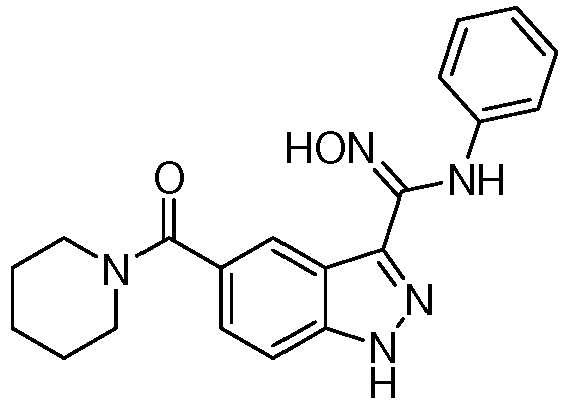
- the composition for inducing cell reprogramming comprises a compound represented by a formula selected from the group consisting of the following formula 1, formula 25, formula 30, formula 31, formula 33, formula 34, formula 35 and formula 45:
- the present invention provides an indazole derivative compound represented by the following formula A: wherein R 1 is hydrogen, nitro, nitroxy or Y-carbonyl, wherein Y is hydrogen, hydroxy, halo, C 1-30 alkoxy, C 2-30 heterocycloalkyl containing nitrogen, oxygen or sulfur as a heteroatom, C 2-20 heterocycloalkenyl containing nitrogen, oxygen or sulfur as a heteroatom, C 6-30 aryl, C 1-30 alkyl, or C 2-30 alkenyl; R 2 is hydrogen, hydroxy, halo, C 1-30 aryl, C 1-30 alkoxy, C 1-30 alkyl, or C 2-30 alkenyl; R 3 is hydrogen, hydroxy, halo, C 1-30 aryl, C 1-30 alkoxy, C 1-30 alkyl, or C 2-30 alkenyl; and X is amine, amido, sulfonamido, carbonyl, oxime, or imidamido, provided that R 1 is hydrogen,
- Y is hydrogen, hydroxy, halo, C 1-15 alkoxy, C 2-15 heterocycloalkyl containing nitrogen, oxygen or sulfur as a heteroatom, heterocycloalkenyl containing nitrogen, oxygen or sulfur as a heteroatom, C 6-15 aryl, C 1-15 alkyl, or C 2-15 alkenyl.
- the heterocycloalkyl in Y of formula A may be substituted with hydroxy, halo, C 1-5 alkyl, C 2-5 alkenyl, C 1-5 alkoxy, C 2-8 alkoxyalkyl, C 2-8 alkoxycarbonyl, C 2-8 heterocycloalkenyl alkyl containing nitrogen as a heteroatom, or a combination thereof.
- the heterocycloalkenyl alkyl in Y is (1H-imidazol-1-ly)alkyl.
- R 2 in formula A may be substituted with hydrogen, halo, C 1-15 aryl, C 1-15 alkoxy, C 1-15 alkyl, or C 2-15 alkenyl, and the aryl in R 2 may be substituted with hydroxy, halo, C 1-5 alkoxy, C 1-5 alkyl, C 2-5 alkenyl, or a combination thereof.
- the heteroatom in formula A is nitrogen.
- the indazole derivative compound of the present invention is represented by a formula selected from the group consisting of the following formula 1, formula 2 and formulas 4 to 45:
- the indazole derivative compound according to the present invention is represented by a formula selected from the group consisting of the following formula 1, formula 25, formula 30, formula 31, formula 33, formula 34, formula 35 and formula 45:
- the present invention provides a method for inducing cell programming, comprising bringing a compound represented by the following formula A into contact with cells: wherein R 1 is hydrogen, nitro, nitroxy or Y-carbonyl, wherein Y is hydrogen, hydroxy, halo, C 1-30 alkoxy, C 2-30 heterocycloalkyl containing nitrogen, oxygen or sulfur as a heteroatom, C 2-20 heterocycloalkenyl containing nitrogen, oxygen or sulfur as a heteroatom, C 6-30 aryl, C 1-30 alkyl, or C 2-30 alkenyl; R 2 is hydrogen, hydroxy, halo, C 1-30 aryl, C 1-030 alkoxy, C 1-30 alkyl, or C 2-30 alkenyl; R 3 is hydrogen, hydroxy, halo, C 1-30 aryl, C 1-30 alkoxy, C 1-30 alkyl, or C 2-30 alkenyl; and X is amine, amido, sulfonamido, carbony
- the method for inducing cell reprogramming according to the present invention is performed using the composition for inducing cell reprogramming according to the present invention as described above, and the common descriptions between the two are omitted in order to avoid undue redundancy leading to the complexity of the specification.
- Reagents and conditions a) hydrazine hydrate, 1-butanol, 110°C, 3h; b) R 2 -benzoyl chloride, pyridine, rt, 5h; c) piperidine, EDC HCl, DMAP, DCM, rt, 2h; d) t-butyl 4-aminopiperidine-1-carboxylate, EDC HCl, DMAP, DCM, rt, 2h; e) TFA, MC, 0°C, 1h.
- a starting material (1.0 g, 6.02 mmol) was dissolved in n-butanol (20 mL). Then, hydrazine hydrate (420 ⁇ L, 7.22 mmol) was added to the solution. The mixture was stirred at 110°C for 2 hours and cooled, and then methylene chloride (MC) was added to the reaction mixture, and the formed precipitate was filtered, thereby obtaining the desired compound.
- MC methylene chloride
- T ert-butyl 4-(3-benzamido 1H-indazole-5-carbonyl)piperazine-1-carboxylate (30 mg, 0.065 mmol) was dissolved in DCM (0.7 mL).
- trifluoroacetic acid (TFA, 0.2 ml) was added to the solution at 0°C, followed by stirring at 0°C for 30 minutes.
- the reaction solution was concentrated in a vacuum, and then purified by silica gel chromatography using ammonia-saturated chloroform and MeOH, thereby obtaining the desired compound (20% yield).
- Reagents and conditions a) R 2 - benzenesulfonyl chloride, pyridine, rt, 5h; b) t-butyl-4-aminopiperidine-1-carboxylate, EDC HCl, DMAP, DCM, rt, 2h; c) TFA, MC, 0°C, 1h.
- Reagents and conditions a) sodium nitrite, HCl, water, rt, 8h; b) hydroxylamine hydrochloride, TEA, DMF, 80°C, 12h; c) NCS, DMF, 40°C, 1h; d) R 2 -aniline, TEA, 1,4-dioxane, rt, 1h; e) TMS-diazomethane, DMF, 0°C, 30 min; f) various amine.
- a starting material (1.0 g, 6.2 mmol) was added to water (40 ml), and a solution of sodium nitrite (4.3 g, 62 mmol) in water was added thereto.
- 3N HCl was slowly added dropwise to the reaction mixture over 20 minutes.
- the reaction mixture was stirred at room temperature for 8 hours, and then the formed precipitate was filtered. The precipitate was completely dried, thereby obtaining the desired compound.
- N-hydroxy-5-nitro-1H-indazole-3-carbamimidoyl chloride (30 mg, 0.13 mmol) was dissolved in ethanol (1.5 mL).
- 4-fluoroaniline 37 ⁇ L, 0.38 mmol was added to the reaction solution which was then stirred at 80°C for 2 hours.
- the resulting residue was concentrated to remove ethanol, and was then purified by silica gel chromatography, thereby obtaining the desired compound (33% yield).
- N-hydroxy-5-nitro-1H-indazole-3-carbamimidoyl chloride (30 mg, 0.13 mmol) was dissolved in ethanol (1.5 mL).
- 4-hydroxyaniline 41 mg, 0.38 mmol was added to the reaction solution which was then stirred at 80°C for 2 hours.
- the resulting residue was concentrated to remove ethanol, and was then purified by silica gel chromatography, thereby obtaining the desired compound (33% yield).
- Example 26 The compound (10 mg, 0.03 mmol) obtained in Example 26 was dissolved in DMF (0.3 mL). Next, HOBt (0.04 mmol), piperidine (0.09 mmol), TEA (0.09 mmol) and EDC (0.09 mmol) were added to the solution which was then stirred at room temperature for 3 hours. The resulting residue was extracted with ethyl acetate and saturated NH 4 Cl aqueous solution. Next, purification was performed by silica gel chromatography, thereby obtaining the desired compound (72% yield).
- Example 27 The compound (10 mg, 0.03 mmol) obtained in Example 27 was dissolved in DMF (0.3 mL). Next, HOBt (0.04 mmol), piperidine (0.09 mmol), TEA (0.09 mmol) and EDC (0.09 mmol) were added to the solution which was then stirred at room temperature for 3 hours. The resulting residue was extracted with ethyl acetate and saturated NH 4 Cl aqueous solution. Next, purification was performed by silica gel chromatography, thereby obtaining the desired compound (65% yield).
- Example 28 The compound (10 mg, 0.03 mmol) obtained in Example 28 was dissolved in DMF (0.3 mL). Next, HOBt (0.04 mmol), piperidine (0.09 mmol), TEA (0.09 mmol) and EDC (0.09 mmol) were added to the solution which was then stirred at room temperature for 3 hours. The resulting residue was extracted with ethyl acetate and saturated NH 4 Cl aqueous solution. Next, purification was performed by silica gel chromatography, thereby obtaining the desired compound (41% yield).
- Example 25 The compound (10 mg, 0.03 mmol) obtained in Example 25 was dissolved in DMF (0.3 mL). Next, HOBt (0.04 mmol), 1-propylpiperazine (0.09 mmol) and EDC (0.09 mmol) were added to the solution which was then stirred at room temperature for 3 hours. The resulting residue was extracted with ethyl acetate and water. Next, purification was performed by silica gel chromatography, thereby obtaining the desired compound (41% yield).
- Example 25 The compound (10 mg, 0.03 mmol) obtained in Example 25 was dissolved in DMF (0.3 mL). Next, HOBt (0.04 mmol), 1-(2-methoxyethyl)piperazine (0.09 mmol) and EDC (0.09 mmol) were added to the solution which was then stirred at room temperature for 3 hours. The resulting residue was extracted with ethyl acetate and water. Next, purification was performed by silica gel chromatography, thereby obtaining the desired compound (36% yield).
- Example 25 The compound (10 mg, 0.02 mmol) obtained in Example 25 was dissolved in DCM (0.3 mL). Next, TFA (0.15 ml) was added to the solution at 0°C, followed by stirring at 0°C for 30 minutes. The reaction solution was concentrated in a vacuum, and then purified by silica gel chromatography using ammonia-saturated chloroform and methanol, thereby obtaining (85% yield).
- Reagents and conditions a) R 2 -N-hydroxybenzimidoyl chloride, TEA, 1,4-dioxane, rt, 18h; b) TMS-diazomethane, DMF, 0°C, 30 min; c) various amine, EDC HCl, HOBt, DMF, rt, 1h.
- a method for identifying compounds that induce cell reprogramming was based on a previous study (PMID: 23044010 and 18974773) on the myocyte-to-osteocyte conversion by bone formation induction and a previous reversine publication (Chen S 2004).
- C2C12 mouse skeletal myoblasts were seeded in a 24-well cell culture dish at a density of 1 x 10 4 cells per well. 24 Hours after seeding, the compound of interest was added to three well at a concentration of 1.
- the cells were treated with 100 nM reversine or 2 ⁇ M BIO. The two compounds are known to induce the conversion of myoblasts to myocytes (Chen S 2004 and Kim WH recapitulate papers).
- the cells were untreated or treated with DMSO. The cells were treated with each compound for a total of 72 hours, and were further treated with each compound after 48 hours.
- the cytotoxicity of each compound could be confirmed from disappearance of a portion of the cells and from floating cell debris during culture, and a compound causing cytotoxicity was screened again at a concentration of 250 nM.
- the medium was replaced with an osteogenic differentiation inducing medium (treated for 14 days with a DMEM supplemented with 10% FBS, 50 g/mL ascorbic acid-2-phosphate, 0.1 ⁇ M dexamethasone, 10 mM ⁇ -glycerophosphate, 50 units/mL of penicillin, and 50 -1 streptomycin).
- the osteogenic differentiation inducing medium was based on one previously described in direct cell reprogramming ( reversine papers, Chen S 2004 and Chen S 2007 ). Direct cell reprogramming from myocytes to osteocytes was analyzed by Alizarin red staining that detects calcium deposits (Gregory CA 2004 : PMID: 15136169) in bone lineage cells.
- the cell reprogramming potentials of the synthesized indazole compounds were evaluated.
- Compounds, LDD-1664, LDD-1821, LDD-1945, LDD-2199 and LDD-2200 showed a strong reprogramming potential in differentiation into osteoblasts, like the positive control reversine, and LDD-1986, LDD-1987 and LDD-1988 also showed reprogramming potential.
- LDD-1821, LDD-1986, LDD-1987 and LDD-1988 compounds showed strong reprogramming potential.
- LDD-1821 showed strong reprogramming potential in differentiation into both osteoblasts and adipocytes (see FIGS.
- Table 1 Cell staining results Compound Alizarin red staining (osteoblasts) Oil red O staining (adipocytes) LDD-1664 ++ n.t LDD-1667 - n.t LDD-1820 - n.t LDD-1821 ++ ++ LDD-1986 + ++ LDD-1987 + ++ LDD-1988 + ++ LDD-1945 ++ n.t LDD-2199 ++ n.t LDD-2200 ++ n.t DMSO (-) - - Reversine (+) ++ ++ ++ (strong positive), + (weak positive), - (negative)
- the inhibitory activities of indazole derivatives against GSK-3 ⁇ and Aurora A were analyzed by HTRF (homogeneous time-resolved fluorescence) assay.
- the HTRF assay is an assay method that detects the phosphorylation of peptide substances in the presence of ATP. Phosphorylated substances were detected by TR-FRET (Time Resolved-Fluorescence Resonance) signals.
- Recombinant GSK-3 ⁇ and Aurora A kinase were purchased from Millipore (Billerica, MA). Using a HTRF KinEASE kit (Cisbio), the assay was performed.
- the assay was composed of a compound-enzyme mixture and peptide substance dissolved in kinase reaction buffer (250 mM HEPES (pH 7.0), 0.5 mM orthovanadate, 0.05% BSA, 0.1% NaN 3 ). After addition of detection buffer, the TR-FRET signal was detected by an EnVision multi-label reader.
- Table 2 shows the degree of inhibition of enzymatic activities of GSK-3 ⁇ and Aurora A by treatment with 1 ⁇ M of each of LDD-1664, LDD-1667, LDD-1820 and LDD-1821. As shown in Table 2, the four derivatives all showed an inhibitory activity of less than 50% against GSK-3 ⁇ and Aurora A at a concentration of 1 ⁇ M. In addition, LDD-1821 showing excellent reprogramming potential showed no inhibitory activity against the two enzymes at a concentration of 1 ⁇ M. Thus, it appears that the derivative compounds of the present invention induce cell reprogramming through mechanisms completely different from those of BI0 and reversine, which are inhibitors of GSK-3P or Aurora A. Table 2: Kinase assay Compound % Inhibition at 1 ⁇ M concentration Compound GSK-3 ⁇ Aurora-A LDD-1664 6.5 0 LDD-1667 0 0 LDD-1820 0.5 32.5 LDD1821 0.2 0
- C2C12 myoblasts were seeded in a 96-well plate at a density of 3 x 10 3 cells per well.
- the cells were cultured for one day, and then treated with each compound.
- the cells were incubated for 2 days, and then treated with a serum-free medium containing 3-(4,5-dimethylthiazol-2-yl)-2,5-diphenyltetrazolium bromide (MTT) for 3 hours. After removal of the medium, the cells were incubated in DMSO for 10 minutes while they were shaken.
- the absorbance at 570 nm was measured by a microreader (VersaMax, Molecular Devices) (see FIG. 4 ).
- MTT assay results Compound IC 50 ( ⁇ M) LDD-1821 >10 LDD-1986 >10 LDD-1987 >10 LDD-1988 >10 LDD-1945 >10 LDD-2194 >10 LDD-2195 >10 LDD-2196 >10 LDD-2197 >10 LDD-2198 >10 LDD-2199 >10 LDD-2200 >10
Landscapes
- Chemical & Material Sciences (AREA)
- Health & Medical Sciences (AREA)
- Organic Chemistry (AREA)
- Life Sciences & Earth Sciences (AREA)
- Engineering & Computer Science (AREA)
- General Health & Medical Sciences (AREA)
- Animal Behavior & Ethology (AREA)
- Veterinary Medicine (AREA)
- Public Health (AREA)
- Pharmacology & Pharmacy (AREA)
- Medicinal Chemistry (AREA)
- Bioinformatics & Cheminformatics (AREA)
- Biomedical Technology (AREA)
- Epidemiology (AREA)
- Chemical Kinetics & Catalysis (AREA)
- General Chemical & Material Sciences (AREA)
- Nuclear Medicine, Radiotherapy & Molecular Imaging (AREA)
- Neurology (AREA)
- Neurosurgery (AREA)
- Wood Science & Technology (AREA)
- Zoology (AREA)
- Genetics & Genomics (AREA)
- Biotechnology (AREA)
- Orthopedic Medicine & Surgery (AREA)
- Cell Biology (AREA)
- Rheumatology (AREA)
- Microbiology (AREA)
- Biochemistry (AREA)
- General Engineering & Computer Science (AREA)
- Pain & Pain Management (AREA)
- Physical Education & Sports Medicine (AREA)
- Psychology (AREA)
- Pharmaceuticals Containing Other Organic And Inorganic Compounds (AREA)
- Plural Heterocyclic Compounds (AREA)
- Micro-Organisms Or Cultivation Processes Thereof (AREA)
- Medicines Containing Material From Animals Or Micro-Organisms (AREA)
Abstract
Description
- This application claims priority to Korean Patent Application No.
10-2014-0081889 - The present invention relates to a composition for inducing cell reprogramming.
- As an aging society has been growing, many people have suffered from degenerative diseases, and the number thereof has continued to increase. The most ideal method for treatment of a number of incurable degenerative diseases, including Parkinson's disease and Lou Gehrig's disease, is to transplant either pluripotent stem cells, derived from the patient, or functional cells that differentiated therefrom, into an affected part. In recent years, for radical treatment of incurable degenerative diseases, a competition for development of technologies among countries in the world to lead the development of cell therapeutic agents and new drugs based on cell reprogramming technology has been keenly contested.
- Reprogramming technology is a relatively easy method that causes little or no physical damage and discomfort to patients. This technology makes it possible to obtain self-somatic cells and to produce induced pluripotent stem cells having characteristics similar to those of human embryonic stem cells therefrom. Thus, it dramatically evolved a strategy for generating self pluripotent stem cells from patient's somatic cells. For example, virus recombined with a specific gene may be used to induce undifferentiated stem cells, and several researchers reported a method in which the virus is transfected into cells to insert the gene into the genome of the cells and the protein of interest is expressed in the cells. Meanwhile, reprogrammed cells produced by this method were found to have cell characteristics and differentiation potential, which are almost similar to those of embryonic stem cells, but these cells have a problem in that they contain a large amount of a genetic material on the genome of the cells, because the gene is delivered into the cells by the viral vector. In addition, in vivo experiments indicated that induced pluripotent stem cells had side effects such as formation of cancer. This suggests that the actual clinical application of induced pluripotent stem cells can still be risky.
- As described above, induced pluripotent stem cells have a problem in that an oncogene is used in a reprogramming process. Due to this problem, in recent years, there have been active studies on direct reprogramming to allow somatic cells to differentiate directly into a required cell lineage in patients, unlike conventional reprogramming methods.
- Meanwhile, among conventional compounds, compounds (e.g., Reversine, Aurora kinase inhibitor) which can be used for cell reprogramming are not suitable as a cell reprogramming composition due to their cytotoxicity.
- The present inventors have made extensive efforts to overcome the above-described problems, and as a result, have synthesized compounds which are not toxic to cells and which allow direct reprogramming of differentiated cells into cells having other characteristics, and have found that the use of these compounds enables safe, efficient cell reprogramming.
- Throughout the specification, a number of publications and patent documents are referred to and cited. The disclosure of the cited publications and patent documents is incorporated herein by reference in its entirety to more clearly describe the state of the related art and the present invention.
- The present inventors have made extensive efforts to develop compositions capable of inducing cell reprogramming while showing improved biological profiles compared to conventional indazole derivative compounds. As a result, the present inventor have designed and synthesized novel indazole derivative compounds having the ability to induce cell reprogramming, and have found that these compounds have excellent cell reprogramming ability without showing cytotoxicity, unlike conventional indazole derivatives (for example, kinase inhibitors), thereby completing the present invention.
- Therefore, it is an object of the present invention to provide a composition for inducing cell reprogramming.
- Another object of the present invention is to provide novel indazole derivatives.
- Other objects and advantages of the present invention will be more apparent from the following detailed description, the accompanying drawings and the appended claims.
- In accordance with one aspect, the present invention provides a composition for inducing cell reprogramming, comprising a compound represented by the following formula A:


- According to another aspect, the present invention provides a method for producing reprogrammed cells from differentiated cells, the method comprising the steps of: (a) bring a cell reprogramming composition into contact with the differentiated cells; (b) culturing the cells of step (a).
- The present inventors have made extensive efforts to develop compositions capable of inducing cell reprogramming while showing improved biological profiles compared to conventional indazole derivative compounds. As a result, the present inventor have designed and synthesized novel indazole derivative compounds having the ability to induce cell reprogramming, and have found that these compounds have excellent cell reprogramming ability without showing cytotoxicity, unlike conventional indazole derivatives (for example, kinase inhibitors).
- The compound represented by formula A according to the present invention is a compound that can reprogram differentiated cells into cells having new characteristics, and is chemically synthesized using indazole as a nucleus. Conventional indazole derivative compounds have not been known to be used for cell reprogramming, and the compound of the present invention has an excellent ability to reprogram cells while having little or no cytotoxicity, compared to conventional indazole derivative compounds. A conventional direct reprogramming method is a method of introducing a gene using virus, and has shortcomings in that the method is difficult to apply directly to patient, the efficiency of the process of inducing cell reprogramming is low, and immunological problems arise. Direct cell reprogramming using the low-molecular compound of the present invention is very excellent in terms of safety, cost-effectiveness and efficiency, because cell reprogramming is induced only by treatment with the low-molecular compound instead of introducing a gene by a viral vector.
- The composition of the present invention is very effective for inducing reprogrammed cells from differentiated cells. According to the present invention, the composition of the present invention can induce cell lines of various lineages, such as reprogrammed osteogenic lineage cells or adipogenic lineage cells, from mammalian differentiated cells. According to one embodiment of the present invention, the composition of the present invention induces differentiation from myoblasts into osteoblasts or adipocytes.
- The term "differentiated cells" is not specifically limited, and includes, for example, somatic cells or somatic stem cells. The term "somatic cells" refers to adult cells having a limited ability to differentiate and self-renew. The somatic cells may be cells that form human skin, hair, adipose or bone.
- The differentiated cells may be cells from a variety of mammals, including humans, monkeys, pigs, horses, cattle, sheep, dogs, cats, mice and rabbits. Preferably, the differentiated cells may be human cells.
- As used herein, the term "reprogramming" refers to a process by which cells existing in different conditions, such as cells having no differentiation potential or cells having a certain differentiation potential, can be finally restored or converted into a new type of cells or a new type of status having differentiation potential. According to the present invention, differentiated cells may be reprogrammed into cells having characteristics that are 0-100% different from those of the differentiated cells, as a result of contact with the composition of the present invention.
- As used herein, the term "nitro" used to define the indazole derivatives of formula A refers to halogen group elements, and includes, for example, fluoro, chloro, bromo and iodo.
- The term "nitroxy" refers to an -O-N=O functional group.
- The term "carbonyl" refers to a - (C=O) - functional group.
- The term "hydroxy" refers to an -OH- functional group.
- The term "halo" refers to halogen group elements, and includes, for example, fluoro, chloro, bromo and iodo.
- The term "alkyl" refers to a straight or branched-chain, unsubstituted or substituted, saturated hydrocarbon group, and includes, for example, methyl, ethyl, propyl, isobutyl, pentyl, hexyl, heptyl, octyl, nonyl, decyl, undecyl, tridecyl, pentadecyl and heptadecyl. "C1-30 alkyl" refers to an alkyl group having a alkyl unit containing 1-30 carbon atoms, and when C1-30 alkyl is substituted, the carbon number of the substituent is not included in the carbon number of the C1-30 alkyl.
- According to the present invention, the C1-30 alkyl at the Y position in formula is C1-15 alkyl, and the C1-30 alkyl at the R2 position in formula A is preferably C1-15 alkyl.
- The term "alkenyl" refers to a straight or branched-chain unsubstituted or substituted, unsaturated hydrocarbon group having the indicated number of carbon atoms, and includes, for example, ethenyl, vinyl, propenyl, allyl, isopropenyl, butenyl, isobutenyl, t-butenyl, n-pentenyl, and n-hexenyl. "C2-20 alkenyl" refers to an alkenyl group having an alkenyl unit containing 2-30 carbon atoms, and when C2-20 alkenyl is substituted, the carbon number of the substituent is not included in the carbon atom of the C2-20 alkenyl. According to the present invention, the C2-20 alkenyl at the Y position in formula A is C2-15 alkenyl, and the C2-20 alkenyl at the R2 position in formula A is C2-15 alkenyl.
- The term "alkoxy" refers to an alkyl or aryl group combined with one oxygen atom, and include, for example, methoxy, ethoxy, propoxy, aryloxy and the like. "C1-30 alkoxy" means an alkyl group having an alkoxy unit containing 1 to 30 carbon atoms, and when C1-30 alkoxy is substituted, the carbon number of the substituent is not included in the carbon number of the C1-30 alkoxy.
- The term "alkoxyalkyl" refers to an alkyl group substituted with an alkoxy group. "C2-5 alkoxyalkyl" means an alkoxyalkyl group having an alkoxyalkyl unit containing 2 to 5 carbon atoms, and when C2-5 alkoxyalkyl is substituted, the carbon number of the substituent is not included in the carbon atom of the C2-5 alkoxyalkyl.
- The term "alkoxycarbonyl" refers to carbonyl substituted with alkoxy. "C2-5 alkoxycarbonyl" means an alkoxycarbonyl group having an alkoxycarbonyl unit containing 2 to 5 carbon atoms, and when C2-5 alkoxycarbonyl is substituted, the carbon number of the substituent is not included in the carbon atom of the C2-5 alkoxycarbonyl.
- The expression "heterocycloalkyl containing nitrogen, oxygen or sulfur as a heteroatom" refers to a non-aromatic cyclic hydrocarbon group containing carbon and hydrogen atoms and at least one heteroatom (nitrogen, oxygen or sulfur). The heteroatom is preferably nitrogen or oxygen, and most preferably, nitrogen. According to the present invention, the number of the heteroatoms is 1 to 4, or 1 to 3, or 1 to 2. "C2-30 heterocycloalkyl" refers to a heterocycloalkyl wherein the number of carbons forming the ring structure is 2-30.
- Meanwhile, the heterocycloalkyl is a wholly or partially substituted or unsubstituted carbon ring. The heterocycloalkyl may be substituted with hydroxy, halo, C1-C5 substituted or unsubstituted straight- or branched-chain alkyl, C1-C5 substituted or unsubstituted straight- or branched-chain alkoxy, C1-C5 substituted or unsubstituted straight- or branched-chain alkenyl, C2-8 alkoxyalkyl, C2-5 alkoxycarbonyl, C2-8 heterocycloalkenyl containing nitrogen as a heteroatom,

- The expression "heterocycloalkenyl containing nitrogen, oxygen or sulfur as a heteroatom" refers to a non-aromatic cyclic hydrocarbon group containing carbon and hydrogen atoms and at least one heteroatom (nitrogen, oxygen or sulfur). The heteroatom is preferably nitrogen or oxygen, and most preferably, nitrogen. According to the present invention, the number of the heteroatoms is 1 to 4, or 1 to 3, or 1 to 2. "C2-30 heterocycloalkenyl" refers to a heterocycloalkenyl wherein the number of carbons forming the ring structure is 2-30.
- The term "heterocycloalkenyl alkyl" refers to an alkyl group substituted with a heterocycloalkenyl group. "C2-8 heterocycloalkenyl alkyl means a heterocycloalkenyl alkyl having a heterocycloalkenyl alkyl unit containing 2 to 5 carbon atoms, and when C2-8 heterocycloalkenyl alkyl is substituted, the carbon number of the substituent is not included in the carbon number of the C2-8 heterocycloalkenyl alkyl.
- The term "aryl" refers to a wholly or partially substituted or unsubstituted monocyclic or polycyclic carbon ring. "C6-30 aryl" refers to an aryl group having 6 to 30 carbon atoms in the ring, and when C6-30 aryl is substituted, the carbon number of the substituent is not included in the carbon number of the C6-30 aryl. Preferably, aryl is monoaryl or biaryl. Monoaryl preferably has 5 to 6 carbon atoms, and biaryl preferably has 9 to 10 carbon atoms. According to the present invention, the aryl is substituted or unsubstituted aryl. When monoaryl, for example, phenyl, is substituted, it may be substituted with various substituents at various position. For example, it may be substituted with halo, hydroxy, nitro, C1-C5 substituted or unsubstituted straight or branched-chain alkyl, C1-C5 substituted or unsubstituted straight or branched-chain alkenyl, C1-C5 substituted or unsubstituted straight or branched-chain alkoxy, C1-C5 substituted or unsubstituted straight or branched-chain alkyl, or a combination thereof.
- Particularly preferred aryl moieties include, but are not limited to, phenyl, benzyl, naphthyl, pyrrolyl, pyrrolidinyl, pyridinyl, pyrimidinyl, purinyl, quinolinyl, isoquinolinyl, furyl, thiophenyl, thiophenyl, imidazolyl, oxazolyl, thiazolyl, pyrazolyl and thienyl.
- The term "amine" refers to a functional group containing a basic nitrogen atom with a lone pair. "C1-10 amine" refers to an amine group that has -NH2 or an amine unit containing 1 to 10 carbon atoms. When C1-10 amine is substituted, the carbon atom of the substituent is not included in the carbon atom of the C1-10 amine. According to the present invention, the C1-10 amine at the X position in formula A is C1-5 amine or -NH2.
- The term "amide" refers to a functional group consisting of an acyl group combined with a nitrogen atom. "C1-10 amide" refers to an amide group having an amide unit containing 1 to 10 carbon atoms. When C1-10 amide is substituted, the carbon number of the substituent is not included in the carbon number of the C1-10 amide. According to the present invention, the amide is R-CO-NH-R', sulfonamide or phosphoramide.
- The term "oxime" refers to a functional group comprising an imine of RR'C=N-OH.
- The term "imidamide" refers to a functional group comprising N-CR=N'H2.
- According to the present invention, Y in formula A is hydrogen, hydroxy, halo, C1-15 alkoxy, C2-15 heterocycloalkyl containing nitrogen, oxygen or sulfur as a heteroatom, C2-15 heterocycloalkenyl containing nitrogen, oxygen or sulfur as a heteroatom, C6-15 aryl, C1-15 alkyl, or C2-15 alkenyl.
- According to the present invention, the heterocycloalkyl in Y of formula A may be substituted with hydroxy, halo, C1-5 alkyl, C2-5 alkenyl, C1-5 alkoxy, C2-8 alkoxyalkyl, C2-8 alkoxycarbonyl, C2-8 heterocycloalkenyl alkyl containing nitrogen as a heteroatom,

- According to one embodiment of the present invention, the heterocycloalkenyl alkyl in Y is (1H-imidazol-1-ly)alkyl.
- According to the present invention, R2 may be substituted with hydrogen, halo, C1-15 aryl, C1-15 alkoxy, or C2-15 alkenyl, and the aryl in R2 may be substituted with hydroxy, halo, C1-5 alkoxy, C1-5 alkyl, C2-5 alkenyl, or a combination thereof.
- Meanwhile, when X in formula A is imidamido

- The compounds of the present invention may have one or more chiral centers and/or geometric isomeric centers, and thus the present invention include all stereoisomers represented by formula A, such as optical isomers, diastereomers and geometric isomers.
- According to the present invention, the composition for inducing cell reprogramming according to the present invention contains a compound represented by a formula selected from the group consisting of the following formulas 1 to 45:




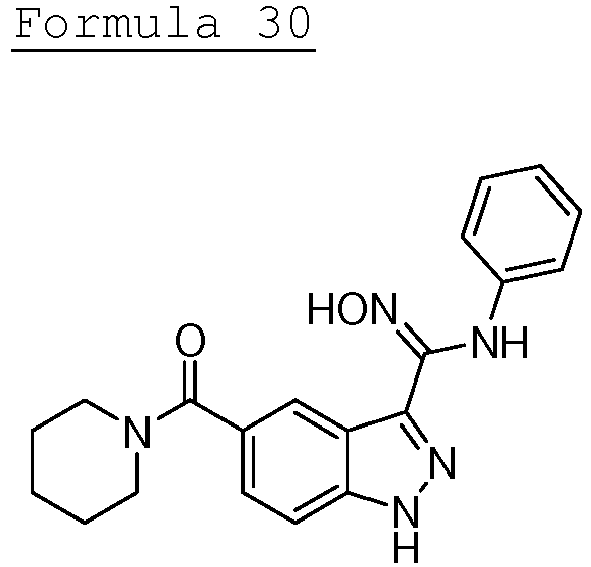


- According to the present invention, the composition for inducing cell reprogramming according to the present invention comprises a compound represented by a formula selected from the group consisting of the following formula 1, formula 25, formula 30, formula 31, formula 33, formula 34, formula 35 and formula 45:




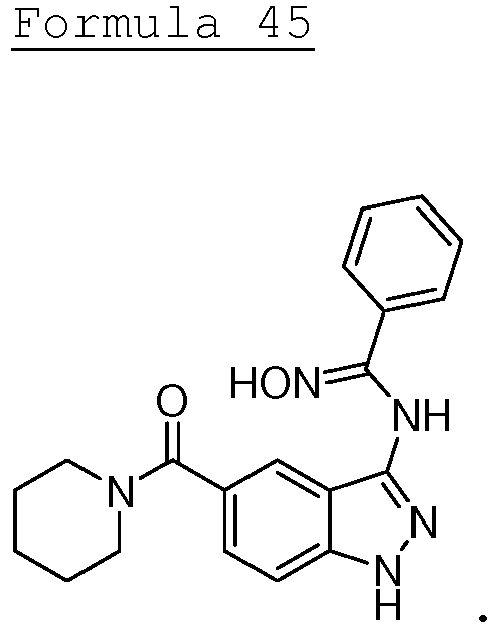
- According to another aspect, the present invention provides an indazole derivative compound represented by the following formula A:

- According to the present invention, Y is hydrogen, hydroxy, halo, C1-15 alkoxy, C2-15 heterocycloalkyl containing nitrogen, oxygen or sulfur as a heteroatom, heterocycloalkenyl containing nitrogen, oxygen or sulfur as a heteroatom, C6-15 aryl, C1-15 alkyl, or C2-15 alkenyl.
- According to the present invention, the heterocycloalkyl in Y of formula A may be substituted with hydroxy, halo, C1-5 alkyl, C2-5 alkenyl, C1-5 alkoxy, C2-8 alkoxyalkyl, C2-8 alkoxycarbonyl, C2-8 heterocycloalkenyl alkyl containing nitrogen as a heteroatom,

- According to the present invention, R2 in formula A may be substituted with hydrogen, halo, C1-15 aryl, C1-15 alkoxy, C1-15 alkyl, or C2-15 alkenyl, and the aryl in R2 may be substituted with hydroxy, halo, C1-5 alkoxy, C1-5 alkyl, C2-5 alkenyl, or a combination thereof.
- According to one embodiment of the present invention, the heteroatom in formula A is nitrogen.
- The indazole derivative compound of the present invention is represented by a formula selected from the group consisting of the following formula 1, formula 2 and formulas 4 to 45:


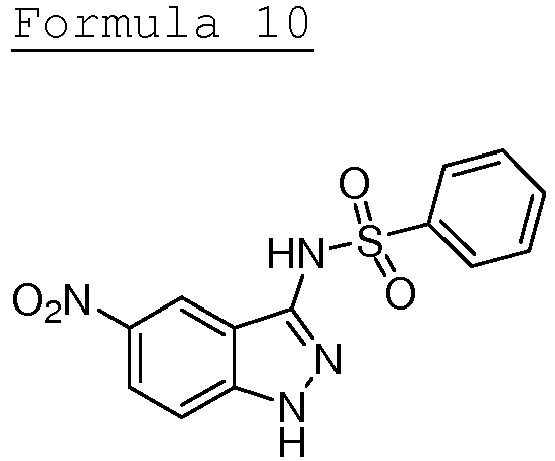


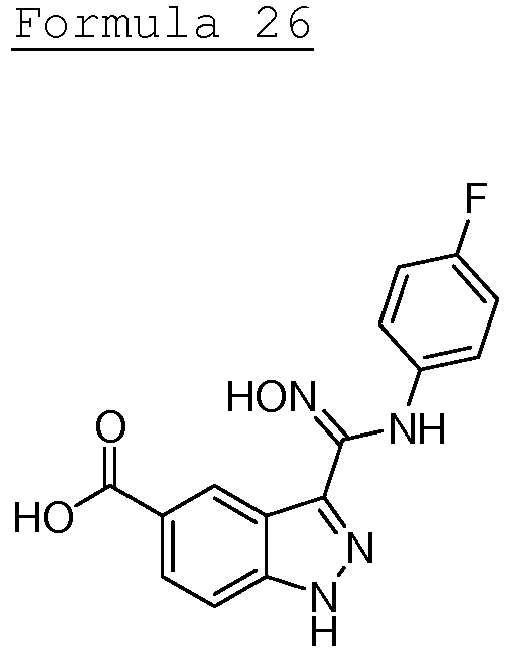



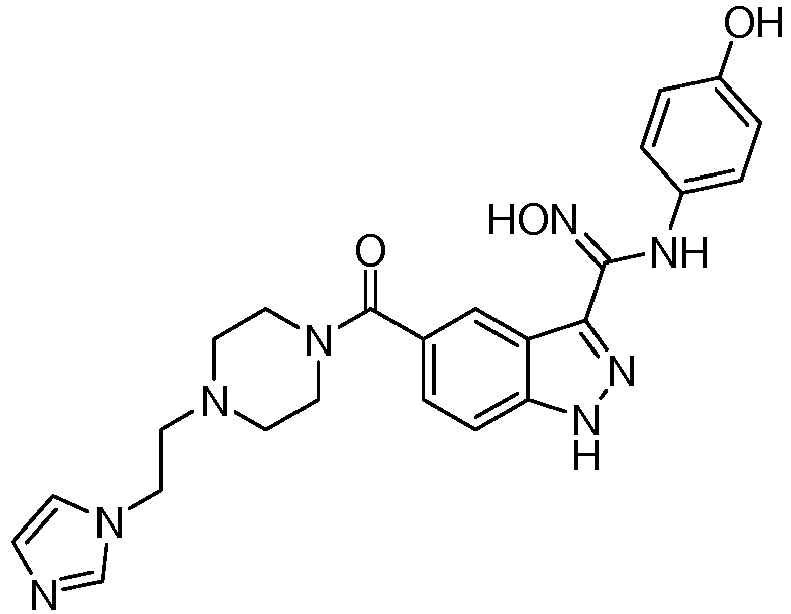


- According to the present invention, the indazole derivative compound according to the present invention is represented by a formula selected from the group consisting of the following formula 1, formula 25, formula 30, formula 31, formula 33, formula 34, formula 35 and formula 45:


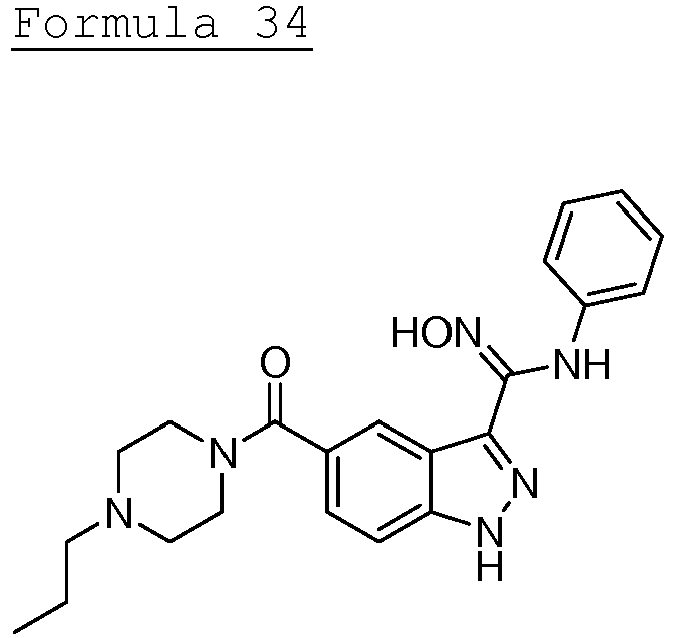
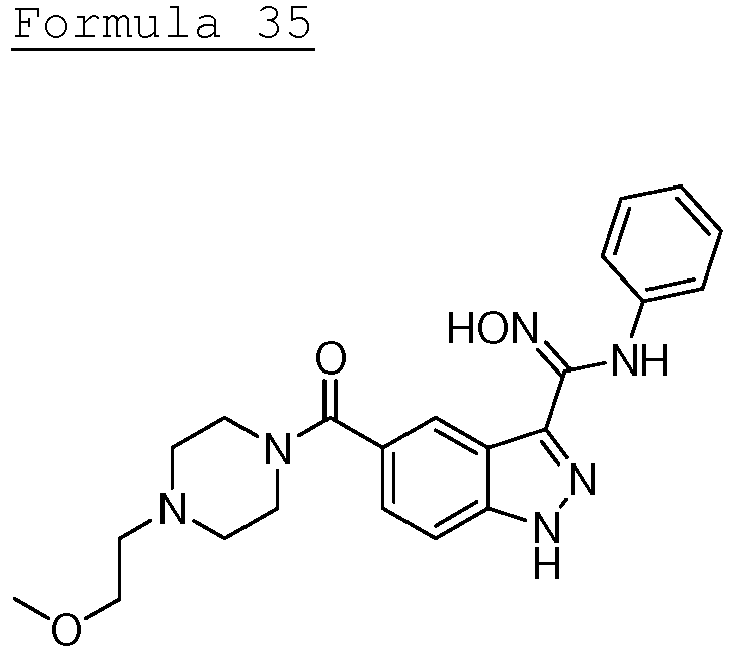

- According to still another aspect, the present invention provides a method for inducing cell programming, comprising bringing a compound represented by the following formula A into contact with cells:

- The method for inducing cell reprogramming according to the present invention is performed using the composition for inducing cell reprogramming according to the present invention as described above, and the common descriptions between the two are omitted in order to avoid undue redundancy leading to the complexity of the specification.
- The features and advantages of the present invention are summarized as follows:
- (a) The present invention relates to a composition for inducing cell reprogramming.
- (b) Indazole derivative compounds according to the present invention can perform efficient cell reprogramming while showing improved biological profiles.
- (c) Indazole derivative compounds according to the present invention show no cytotoxicity, unlike conventional low-molecular compounds (e.g., Reversine or BI0) for inducing cell reprogramming. Thus, when these compounds are clinically applied, they can make a great contribution to the marker of cell therapeutic agents or cell reprogramming inducers.
- (d) Meanwhile, conventional indazole derivative compounds are not known to be used for cell reprogramming, and cannot be used at high concentrations due to their nonspecific cytotoxicity.
- (e) The compounds of the present invention have excellent cell reprogramming ability while causing little or no cytotoxicity, and have a new mechanism of action, compared to conventional indazole derivative compounds.
-
-
FIGS. 1 and 2 show the results of reprogramming C2C12 mouse myoblasts into osteoblasts by brining the myoblasts into contact with the compound of the present invention. The cells were brought into contact with LDD-1821, LDD-1664, LDD- 1945, LDD-2199 or LDD-2200, which is the compound of the present invention, and then the cells were observed by Alizarin red staining (ATDC5: osteochondroprogenitor cell line). -
FIG. 3 shows the results obtained by brining C2C12 into contact with the compounds of the present invention and analyzing the cells by an Alizarin red assay. The graph shows absorbance measured after the cells were treated with each of the compounds. -
FIG. 4 shows the results of an MTT assay for C2C12 mouse myoblasts. - Hereinafter, the present invention will be described in further detail with reference to examples. It will be obvious to those skilled in the art these examples are for illustrative purposes only and are not intended to limit the scope of the present invention.
-


- Reagents and conditions: a) hydrazine hydrate, 1-butanol, 110°C, 3h; b) R2-benzoyl chloride, pyridine, rt, 5h; c) piperidine, EDC HCl, DMAP, DCM, rt, 2h; d) t-butyl 4-aminopiperidine-1-carboxylate, EDC HCl, DMAP, DCM, rt, 2h; e) TFA, MC, 0°C, 1h.
- The reaction procedures and substituents described in the following synthetic examples refer to those shown in synthetic scheme 1 above.
- A starting material (1.0 g, 6.02 mmol) was dissolved in n-butanol (20 mL). Then, hydrazine hydrate (420 µL, 7.22 mmol) was added to the solution. The mixture was stirred at 110°C for 2 hours and cooled, and then methylene chloride (MC) was added to the reaction mixture, and the formed precipitate was filtered, thereby obtaining the desired compound.
- 2-fluoro-5-nitrobenzonitrile (1.0 g, 6.02 mmol) was dissolved in n-butanol (20 mL). Then, hydrazine hydrate (420 µL, 7.22 mmol) was added to the solution. The mixture was stirred at 110°C for 2 hours and cooled, and then methylene chloride (MC) was added to the reaction mixture, and the formed precipitate was filtered, thereby obtaining the desired compound (84% yield). 1H NMR (400 MHz, DMS0-d6) δ 8.89 (d, 1H), 8.05 (dd, 1H), 7.34 (d, 2H), 5.98 (s, 2H). Mass = 178.15.
- 3-cyano-4-fluorobenzoic acid (1.0 g, 6.02 mmol) was dissolved in n-butanol (20 mL). Then, hydrazine hydrate (420 µL, 7.22 mmol) was added to the solution. The mixture was stirred at 110°C for 2 hours and cooled, and then methylene chloride (MC) was added to the reaction mixture, and the formed precipitate was filtered, and then washed with MeOH, thereby obtaining the desired compound (55% yield).
1H NMR (400 MHz, DMS0-d6) δ 11.35 (s, 1H), 8.45 (s, 1H), 7.80 (d, 2H), 7.22 (d, 1H), 5.59 (s, 2H). Mass =177.16. - The compound (50 mg, 0.28 mmol) of formula 2 in synthetic scheme 1 was dissolved in pyridine (0.3mL). Then, R2-benzoyl chloride (16.5 µL, 0.28 mmol) was added to the solution which was then stirred for 1 hour, followed by extraction with ethyl acetate and 1N HCl. The combined organic layer was washed with brine, dried with anhydrous Na2SO4, concentrated in a vacuum, and then purified by chromatography, thereby obtaining the desired compounds (compounds 3 to 6).
- 5-Nitro-1H-indazol-3-yl amine (50 mg, 0.28 mmol) was dissolved in pyridine (0.3mL). Then, benzoyl chloride (16.5 µL, 0.28 mmol) was added to the solution which was then stirred for 1 hour, followed by extraction with ethyl acetate and 1N HCl. The combined organic layer washed with brine, dried with anhydrous Na2SO4, and then concentrated in a vacuum. The concentrate was purified by column chromatography, thereby obtaining the desired compound (42% yield).
1H NMR (400 MHz, DMSO-d6) δ 8.95 (d, 1H), 8.22 (dd, 1H), 8.12 (m, 2H), 8.12 (m, 2H), 7.69 (m, 4H). Mass = 282.26. - 5-nitro-1H-indazol-3-yl amine (0.14 mmol) was dissolved in pyridine (0.4 mL). Then, 3-bromobenzoyl chloride (19 µL, 0.14 mmol) was added to the solution which was then stirred for 1 hour, followed by extraction with ethyl acetate and 1N HCl. Dichloromethane (DCM) and hexane were added to the extract to form a precipitate, followed by filtration, thereby obtaining the desired compound (37% yield).
1H NMR (400 MHz, DMSO-d6) δ 11.32 (s, 1H), 8.93 (d, 1H), 8.26 (s, 1H), 8.19 (dd, 1H). Mass = 361.16. - 5-nitro-1H-indazol-3-yl amine (25 mg, 0.14 mmol) was dissolved in pyridine (0.3 mL). Then, 4-methoxybenzoyl chloride (24 mg, 0.14 mmol) was added to the solution which was then stirred for 1 hour, followed by extraction with ethyl acetate and 1N HCl. The combined organic layer was washed with brine, dried with anhydrous Na2SO4, and then concentrated in a vacuum. The concentrate was purified by column chromatography, thereby obtaining the desired compound (40% yield).
1H NMR (400 MHz, DMSO-d6) δ 8.93 (d, 1H), 8.20 (dd, 1H), 8.12 (d, 2H), 7.67 (d, 1H), 7.11 (d, 2H), 3.86 (s, 3H). Mass = 312.28. - 3-amino-1H-indazole-5-carboxylic acid (25 mg, 0.14 mmol) was dissolved in pyridine (0.5 mL). Next, Benzoyl chloride (16.5 µL, 0.14 mmol) was added to the solution which was then stirred for 1 hour, followed by extraction with ethyl acetate and 1N HCl. DCM was added to form a precipitate, followed by filtration, thereby obtaining the desired compound (31% yield).
1H NMR (400 MHz, DMSO-d6) δ 10.98 (s, 1H), 8.11 (d, 2H), 7.94 (dd, 1H), 7.66 (t, 1H), 7.58 (t, 3H). Mass = 281.27. - The compound (25 mg, 0.14 mmol) of formula 3 in synthetic scheme 1 was dissolved in dimethylformamide (DMF, 1 mL). Next, dimethylaminopyridine (DMAP, 0.03 mmol), piperidine (0.17 mmol) and ethylene dichloride (EDC, 0.28 mmol) were added to the solution which was then stirred at room temperature for 3 hours. The resulting residue was extracted with ethyl acetate and water. Next, silica gel chromatography was performed, thereby obtaining the desired compound.
- 3-benzamido-1H-indazole-5-carboxylic acid (25 mg, 0.14 mmol) was dissolved in DMF (1 mL). DMAP (0.03 mmol), piperidine (0.17 mmol) and EDC (0.28 mmol) were added to the solution which was then stirred at room temperature for 3 hours. The resulting residue was extracted with ethyl acetate and water. Next, silica gel chromatography was performed, thereby obtaining the desired compound (33% yield).
1H NMR (400 MHz, CDCl3) δ 11.02 (s, 1H), 9.26 (s, 1H), 8.15 (s, 1H), 8.04 (d, 2H), 7.59 (m, 3H), 7.37 (d, 1H), 7.21 (d, 1H), 3.59 (m, 4H), 1.75 (m, 6H). Mass = 348.41. - The compound (25 mg, 0.14 mmol) of formula 3 in synthetic scheme 1 was dissolved in DMF (1 mL). DMAP (0.03 mmol), t-butyl 4-aminpiperidine-1-carboxylate (0.17 mmol) and EDC (0.28 mmol) were added to the solution which was then stirred at room temperature for 3 hours. The resulting residue was extracted with ethyl acetate and water. Next, silica gel chromatography was performed, thereby obtaining the desired compound (33% yield).
- 3-benzamido-1H-indazole-5-carboxylic acid (25 mg, 0.14 mmol) was dissolved in DMF (1 mL). DMAP (0.03 mmol), t-butyl 4-aminopiperidine-1-carboxylate (0.17 mmol) and EDC (0.28 mmol) were added to the solution which was then stirred at room temperature for 3 hours. The resulting residue was extracted with ethyl acetate and water. Next, silica gel chromatography was performed, thereby obtaining the desired compound (33% yield).
1H NMR (400 MHz, DMSO-d6) δ 10.82 (s, 1H), 8.23 (s, 2H), 8.07 (d, 2H), 7.85 (d, 1H), 7.60 (m, 4H), 3.96 (m, 3H), 2.79 (m, 2H), 1.74 (m, 2H), 1.41 (m, 11H). Mass =449.51. - The compound (30 mg, 0.065 mmol) of formula 5 in synthetic scheme 1 was dissolved in DCM (0.7 mL). TFA (0.2 ml) was added to the solution at 0°C, followed by stirring at 0°C for 30 minutes. The reaction solution was concentrated in a vacuum, and then purified by silica gel chromatography using ammonia-saturated chloroform and methanol, thereby obtaining the desired compound.
- Tert-butyl 4-(3-benzamido 1H-indazole-5-carbonyl)piperazine-1-carboxylate (30 mg, 0.065 mmol) was dissolved in DCM (0.7 mL). Next, trifluoroacetic acid (TFA, 0.2 ml) was added to the solution at 0°C, followed by stirring at 0°C for 30 minutes. The reaction solution was concentrated in a vacuum, and then purified by silica gel chromatography using ammonia-saturated chloroform and MeOH, thereby obtaining the desired compound (20% yield).
1H NMR (400 MHz, DMSO-d6) δ 10.86 (s, 1H), 8.40 (d, 1H), 8.24 (s, 1H), 8.07 (d, 2H), 7.85 (d, 1H), 7.63 (m, 4H). Mass = 349.39.
- Reagents and conditions: a) R2 -benzenesulfonyl chloride, pyridine, rt, 5h; b) t-butyl-4-aminopiperidine-1-carboxylate, EDC HCl, DMAP, DCM, rt, 2h; c) TFA, MC, 0°C, 1h.
- The reaction procedures and substituents described in the following synthetic examples refer to those shown in synthetic scheme 2 above.
- The compound (50 mg, 0.28 mmol) of formula 2 in synthetic scheme 2 was dissolved in pyridine (0.9 mL). Next, R2-benzenesulfonyl chloride (36 µL, 0.28 mmol) was added to the solution which was then stirred for 1 hour, followed by extraction with ethyl acetate and 1N HCl. The combined organic layer was washed with brine, dried with anhydrous Na2SO4, and then concentrated in a vacuum. DCM was added to form a precipitate, followed by filtration, thereby obtaining the desired compound.
- 5-Nitro-1H-indazol-3-yl amine (50 mg, 0.28 mmol) was dissolved in pyridine (0.9 mL). Next, benzenesulfonyl chloride (36 µL, 0.28 mmol) was added to the solution which was then stirred for 1 hour, followed by extraction with acetate and 1N HCl. The combined organic layer was washed with brine, dried with anhydrous Na2SO4, and then concentrated in a vacuum. MC was added to form a precipitate, followed by filtration, thereby obtaining the desired compound (43% yield).
1H NMR (400 MHz, DMSO-d6) δ 11.14 (s, 1H), 8.70 (d, 1H), 8.12 (dd, 1H), 7.78 (d, 2H), 7.55 (m, 4H). Mass =318.31. - 5-Nitro-1H-indazol-3-yl amine (0.28 mmol) was dissolved in pyridine (0.9 mL). Next, 3-bromobenzenesulfonyl chloride (40 µL, 0.28 mmol) was added to the solution which was then stirred for 1 hour, followed by extraction with ethyl acetate and 1N HCl. DCM and hexane were added to the extract to form a precipitate, followed by filtration, thereby obtaining the desired compound (50% yield).
1H NMR (400 MHz, DMSO-d6) δ 10.99 (s, 1H), 8.72 (d, 1H), 8.19 (m, 1H), 7.99 (t, 1H), 7.87 (d, 1H), 7.81 (d, 1H), 7.63 (d, 1H), 7.54 (t, 1H). Mass = 397.20. - 3-Amino-1H-indazole-5-carboxylic acid (25 mg, 0.14 mmol) was dissolved in pyridine (0.7 mL). Benzenesulfonyl chloride (20 µL, 0.14 mmol) was added to the solution which was then stirred for 1 hour, followed by extraction with ethyl acetate and HCl. Methanol was added to the extract to form a precipitate, followed by filtration, thereby obtaining the desired compound (20% yield).
1H NMR (400 MHz, DMSO-d6) δ 10.88 (s, 1H), 8.42 (s, 1H), 7.89 (dd, 3H), 7.63 (m, 4H). Mass = 317.32. - The compound (25 mg, 0.08 mmol) of formula 7 in synthetic scheme 2 was dissolved in DMF (0.8 mL). DMAP (0.02 mmol), t-butyl 4-aminopiperidine-1-carboxylate (0.09 mmol) and EDC (0.16 mmol) were added to the solution which was then stirred at room temperature for 3 hours. The resulting residue was extracted with ethyl acetate and water. Next, silica gel chromatography was performed, thereby obtaining the desired compound.
- 3-(phenylsulfonamido)-1H-indazole-5-carboxylic acid (25 mg, 0.08 mmol) was dissolved in DMF (0.8 mL). DMAP (0.015 mmol), t-butyl 4-aminopiperidine-1-carboxylate (0.09 mmol) and EDC (0.16 mmol) were added to the solution which was then stirred at room temperature for 3 hours. The resulting residue was extracted with ethyl acetate and water. Next, silica gel chromatography was performed, thereby obtaining the desired compound (50% yield).
1H NMR (400 MHz, DMSO-d6) δ 10.77 (s, 1H), 8.31 (d, 2H), 7.83 (m, 3H), 7.62 (m, 1H), 7.57 (t, 2H), 7.44 (d, 1H). Mass = 485.56. - The compound (20 mg, 0.038 mmol) of
formula 8 in synthetic scheme 2 was dissolved in DCM (0.4 mL). TFA (0.15 ml) was added to the solution at 0°C, followed by stirring at 0°C for 30 minutes. The reaction solution was concentrated in a vacuum, and then purified by silica gel chromatography using ammonia-saturated chloroform and MeOH, thereby obtaining the desired compound. - Tert-butyl 4-(3-(phenylsulfonamido)-1H-indazole-5-carbonyl)piperazine-1-carboxylate (20 mg, 0.038 mmol) was dissolved in DCM (0.4 mL). Next, TFA (0.15 ml) was added to the solution at 0°C, followed by stirring at 0°C for 30 minutes. The reaction solution was concentrated in a vacuum, and then purified by silica gel chromatography using ammonia-saturated chloroform and methanol, thereby obtaining the desired compound (20% yield).
1H NMR (400 MHz, DMSO-d6) δ 11.92 (s, 1H), 8.28 (d, 1H), 8.22 (s, 1H), 7.80 (m, 2H), 7.68 (d, 1H), 7.38 (d, 3H), 7.20 (d, 1H), 3.95 (m, 1H), 3.16 (d, 3H), 2.78 (t, 2H), 1.85 (m, 2H), 1.57 (m, 2H). Mass = 385.44.
- Reagents and conditions: a) sodium nitrite, HCl, water, rt, 8h; b) hydroxylamine hydrochloride, TEA, DMF, 80°C, 12h; c) NCS, DMF, 40°C, 1h; d) R2-aniline, TEA, 1,4-dioxane, rt, 1h; e) TMS-diazomethane, DMF, 0°C, 30 min; f) various amine.
- The reaction procedures and substituents described in the following examples refer to those shown in synthetic scheme 3 above.
- A starting material (1.0 g, 6.2 mmol) was added to water (40 ml), and a solution of sodium nitrite (4.3 g, 62 mmol) in water was added thereto. Next, 3N HCl was slowly added dropwise to the reaction mixture over 20 minutes. The reaction mixture was stirred at room temperature for 8 hours, and then the formed precipitate was filtered. The precipitate was completely dried, thereby obtaining the desired compound.
- 5-Nitro-1H-indole (1.0 g, 6.2 mmol) was added to water (40 ml), and a solution of sodium nitrite (4.3 g, 62 mmol) in water was added thereto. Next, 3N HCl (21 ml) was slowly added dropwise to the reaction mixture over 20 minutes. The reaction mixture was stirred at room temperature for 8 hours, and then the formed precipitate was filtered. The precipitate was completely dried in a vacuum, thereby obtaining the desired compound (40% yield).
1H NMR (400 MHz, DMSO-d6) δ 11.98 (s, 1H), 9.75 (s, 1H), 8.87 (s, 1H), 8.56 (m, 2H). Mass =191.15. - 1H-indole -5-carboxylic acid (1.0 g, 6.02 mmol) was added to water (40 ml), and a solution of sodium nitrite (4.3 g, 62 mmol) in water was added thereto. Next, 3N HCl (21 ml) was slowly added dropwise to the reaction mixture over 20 minutes. The reaction mixture was stirred at room temperature for 8 hours, and then the formed precipitate was filtered. The precipitate was completely dried in a vacuum, thereby obtaining the desired compound (84% yield).
1H NMR (400 MHz, DMSO-d6) δ 10.20 (s, 1H), 8.74 (s, 1H), 8.02 (d, 1H), 7.75 (d, 2H). Mass =190.16. - The compound (500 mg, 2.63 mmol) of the compound of formula 11 in synthetic scheme 3 was dissolved in DMF (13 mL). Next, hydroxylamine hydrochloride (550 mg, 7.89 mmol) and triethylamine (110 µL, 7.89 mmol) was added to the solution which was then stirred at 80°C for 12 hours, followed by extraction with ethyl acetate and 1N HCl. The combined organic layer was washed with brine, dried with anhydrous Na2SO4, and then concentrated in a vacuum. The desired compound to be used in a subsequent reaction was obtained without separate purification.
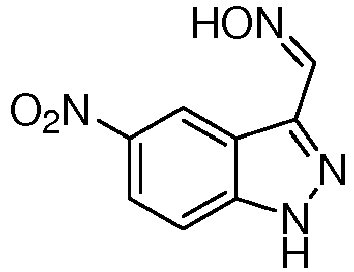
- 5-Nitro-1H-indazole-3-carbaldehyde (500 mg, 2.63 mmol) was dissolved in DMF (13 mL). Hydroxylamine hydrochloride (550 mg, 7.89 mmol) and triethylamine (110 µL, 7.89 mmol) were added to the solution which was then stirred at 80°C for 12 hours, followed by extraction with ethyl acetate and 1N HCl. The combined organic layer was washed with brine, dried with anhydrous Na2SO4, and then concentrated in a vacuum. The desired compound to be used in a subsequent reaction was obtained without separate purification (93% yield).
1H NMR (400 MHz, DMSO-d6) δ 11.98 (s, 1H), 11.12 (s, 1H), 8.87 (s, 1H), 8.56 (m, 2H), 7.95 (s, 1H). Mass = 206.16. - 3-Formyl-1H-indazole-5-carboxylic acid (500 mg, 2.63 mmol) was dissolved in DMF (13 mL). Hydroxylamine hydrochloride (550 mg, 7.89 mmol) and triethylamine (110 µL, 7.89 mmol) were added to the solution which was then stirred at 80°C for 12 hours, followed by extraction with ethyl acetate and 1N HCl. The combined organic layer was washed with brine, dried with anhydrous Na2SO4, and then concentrated in a vacuum. The desired compound to be used in a subsequent reaction was obtained without separate purification (93% yield).
1H NMR (400 MHz, DMSO-d6) δ 11.61 (s, 1H), 8.75 (s, 1H), 8.38 (s, 1H), 7.96 (d, 2H), 7.62 (d, 1H). Mass = 205.17. - The compound (500 mg, 2.44 mmol) of formula 12 in synthetic scheme 3 was dissolved in DMF (12 mL). Next, N-chlorosuccinimide (320 mg, 2.44 mmol) was added dropwise to the solution which was then stirred at 40°C for 1 hour. The resulting residue was extracted with ethyl acetate and water. The combined organic layer was washed with brine, dried with anhydrous NSO4, and then concentrated in a vacuum. The desired compound was obtained without separate purification.
- 5-Nitro-1H-indazole-3-carboxaldehyde oxime (500 mg, 2.44 mol) was dissolved in DMF (12 mL). N-chlorosuccinimide (320 mg, 2.44 mmol) was added to the solution which was then stirred at 40°C for 1 hour. The resulting residue was extracted with ethyl acetate and water. The combined organic layer was washed with brine, dried with anhydrous Na2SO4, and then concentrated in a vacuum. The desired compound was obtained without separate purification (80% yield).
1H NMR (400 MHz, DMSO-d6) δ 11.98 (s, 1H), 11.12 (s, 1H), 8.87 (s, 1H), 8.56 (m, 2H). Mass = 240.60. - 3-((hydroxyimino)methyl)-1H-indazole-5-carboxylic acid (500 mg, 2.44 mmol) was dissolved in DMF (12 mL). N-chlorosuccinimide (320 mg, 2.44 mmol) was added to the solution which was then stirred at 40°C for 1 hour. The resulting residue was extracted with ethyl acetate and water. The combined organic layer was washed with brine, dried with anhydrous Na2SO4, and then concentrated in a vacuum. The desired compound was obtained without separate purification (86% yield).
1H NMR (400 MHz, DMSO-d6) δ 10.98 (s, 1H), 8.78 (s, 1H), 7.99 (d, 1H), 7.68 (d, 1H). Mass = 239.62. - The compound (30 mg, 0.13 mmol) of formula 13 in synthetic scheme 3 was dissolved in (1.5 mL). Next, R2-aniline (35 µL, 0.38 mmol) was added to the solution which was then stirred at 80°C for 2 hours. The resulting residue was concentrated to remove ethanol, and was then purified by silica gel chromatography, thereby obtaining the desired compound.
- N-hydroxy-5-nitro-1H-indazole-3-carbamimidoyl chloride (30 mg, 0.13 mmol) was dissolved in ethanol (1.5 mL). Aniline (35 µL, 0.38 mmol) was added to the reaction solution which was then stirred at 80°C for 2 hours. The resulting residue was concentrated to remove ethanol, and was then purified by silica gel chromatography, thereby obtaining the desired compound (yield 33%).
1H NMR (400 MHz, DMSO-d6) δ 10.97 (s, 1H), 8.90 (d, 1H), 8.47 (s, 1H), 8.23 (dd, 1H), 7.75 (dd, 1H). Mass =297.27. - N-hydroxy-5-nitro-1H-indazole-3-carbamimidoyl chloride (30 mg, 0.13 mmol) was dissolved in ethanol (1.5 mL). Next, 4-fluoroaniline (37 µL, 0.38 mmol) was added to the reaction solution which was then stirred at 80°C for 2 hours. The resulting residue was concentrated to remove ethanol, and was then purified by silica gel chromatography, thereby obtaining the desired compound (33% yield).
1H NMR (400 MHz, DMSO-d6) δ 10.95 (s, 1H), 8.92 (d, 1H), 8.49 (s, 1H), 8.23 (dd, 1H), 7.75 (dd, 1H), 6.94 (m, 2H), 6.75 (m, 2H). Mass =315.26. - N-hydroxy-5-nitro-1H-indazole-3-carbamimidoyl chloride (30 mg, 0.13 mmol) was dissolved in ethanol (1.5 mL). Next, 4-hydroxyaniline (41 mg, 0.38 mmol) was added to the reaction solution which was then stirred at 80°C for 2 hours. The resulting residue was concentrated to remove ethanol, and was then purified by silica gel chromatography, thereby obtaining the desired compound (33% yield).
1H NMR (400 MHz, DMSO-d6) δ 10.65 (s, 1H), 8.92 (s, 1H), 8.84 (d, 1H), 8.21 (dd, 1H), 8.09 (s, 1H), 7.72 (d, 1H), 6.60 (m, 2H), 6.50 (m, 2H). Mass =313.27. - N-hydroxy-5-nitro-1H-indazole-3-carbobamimidoyl chloride (30 mg, 0.13 mmol) was dissolved in ethanol (1.5 mL). Next, 4-methoxyaniline (41 mg, 47 mmol) was added to the reaction solution which was then stirred at 80°C for 2 hours. The resulting residue was concentrated to remove ethanol, and was then purified by silica gel chromatography, thereby obtaining the desired compound (33% yield).
1H NMR (400 MHz, DMSO-d6) δ 10.74 (s, 1H), 8.87 (d, H), 8.23 (s, 1H), 8.21 (dd, 1H), 7.72 (d, 1H), 6.68 (m, 4H). Mass = 327.30. - 3-(chloro(hydroxyimino)methyl)-1H-indazole-5-carboxylic acid (30 mg, 0.13 mmol) was dissolved in ethanol (1.5 mL). Next, aniline (35 µL, 0.38 mmol) was added to the reaction solution which was then stirred at 80°C for 2 hours. The resulting residue was concentrated to remove ethanol, and was then purified by silica gel chromatography, thereby obtaining the desired compound (75% yield).
1H NMR (400 MHz, DMSO-d6) δ 10.82 (s, 1H), 8.66 (s, 1H), 8.38 (s, 1H), 7.95 (dd, 1H), 7.60 (d, 1H), 7.07 (t, 2H), 6.78 (t, 1H), 6.69 (d, 2H). Mass =296.29. - 3-(Chloro(hydroxyimino)methyl)-1H-indazole-5-carboxylic acid (30 mg, 0.13 mmol) was dissolved in (1.5 mL). Next, 4-fluoroaniline (37 µL, 0.38 mmol) was added to the reaction solution which was then stirred at 80°C for 2 hours. The resulting residue was concentrated to remove ethanol, and was then purified by silica gel chromatography, thereby obtaining the desired compound (29% yield).
1H NMR (400 MHz, DMSO-d6) δ 10.79 (s, 1H), 8.67 (s, 1H), 8.40 (s, 1H), 7.95 (dd, 1H), 7.60 (dd, 1H), 6.93 (m, 2H), 6.714 (m, 2H). Mass =314.28. - 3-(chloro(hydroxyimino)methyl)-1H-indazole-5-carboxylic acid (30 mg, 0.13 mmol) was dissolved in ethanol (1.5 mL). Next, 4-hydroxyaniline (41 mg, 0.38 mmol) was added to the reaction solution which was then stirred at 80°C for 2 hours. The resulting residue was concentrated to remove ethanol, and was then purified by silica gel chromatography, thereby obtaining the desired compound (31% yield).
1H NMR (400 MHz, DMSO-d6) δ 13.23 (s, 1H), 10.45 (s, 1H), 8.93 (s, 1H), 8.90 (s, 1H), 7.92 (m, 2H), 7.47 (d, 1H), 6.64 (d, 2H) , 6.40 (d, 2H) . Mass = 312.28. - 3-(Chloro(hydroxyimino)methyl)-1H-indazole-5-carboxylic acid (30 mg, 0.13 mmol) was dissolved in ethanol (1.5 mL). Next, 4-methoxyaniline (41 mg, 47 mmol) was added to the reaction solution which was then stirred at 80°C for 2 hours. The resulting residue was concentrated to remove ethanol, and was then purified by silica gel chromatography, thereby obtaining the desired compound (31% yield).
1H NMR (400 MHz, DMSO-d6) δ 10.60 (s, 1H), 8.59 (s, 1H), 8.11 (s, 1H), 7.89 (dd, 1H), 7.54 (dd, 1H), 6.61 (s, 4H), 3.58 (s, 3H). Mass = 326.31. - The compound (10 mg, 0.02 mmol) obtained in Synthetic Example 25 was dissolved in DMF (0.3 mL). Next, tetramethylsilane (TMS)-diazomethane (100 µL) was slowly added dropwise to the solution at 0°C, followed by stirring at 0°C for 30 minutes. The reaction solution was concentrated in a vacuum, and then purified by silica gel chromatography, thereby obtaining the desired compound.
- The compound (10 mg, 0.02 mmol) obtained in Synthetic Example 25 was dissolved in DMF (0.3 mL). Next, TMS-diazomethane (100 µL) was slowly added dropwise to the solution at 0°C, followed by stirring at 0°C for 30 minutes. The reaction solution was concentrated in a vacuum, and then purified by silica gel chromatography, thereby obtaining the desired compound (83% yield).
1H NMR (400 MHz, DMSO-d6) δ 12.27 (s, 1H), 9.56 (dd, 1H), 9.20 (s, 1H), 8.65 (dd, 1H), 8.25 (dd, 1H), 7.54 (m, 2H), 7.19 (t, 1H), 7.06 (dd, 2H), 3.55 (s, 3H). Mass = 310.31. - The compound (10 mg, 0.03 mmol) of formula 14 in synthetic scheme 3 was dissolved in DMF (0.3 mL). Next, hydroxybenzotriazole (HOBt, 0.04 mmol), piperidine (0.09 mmol), TEA (0.09 mmol) and EDC (0.09 mmol) were added to the reaction solution which was then stirred at room temperature for 3 hours. The resulting residue was extracted with ethyl acetate and saturated NH4Cl aqueous solution. Next, purification was performed by silica gel chromatography, thereby obtaining the desired compound.
- The compound (10 mg, 0.03 mmol) of formula 14 in synthetic scheme 3 was dissolved in DMF (0.3 mL). Next, HOBt (0.04 mmol), piperidine (0.09 mmol), TEA (0.09 mmol) and EDC (0.09 mmol) were added to the reaction solution which was then stirred at room temperature for 3 hours. The resulting residue was extracted with ethyl acetate and saturated NH4Cl aqueous solution. Next, purification was performed by silica gel chromatography, thereby obtaining the desired compound (65% yield).
1H NMR (400 MHz, DMSO-d6) δ 10.67 (s, 1H), 8.36 (s, 1H), 7.83 (s, 1H), 7.55 (d, 1H), 7.34(d, 1H), 7.02(t, 2H), 6.73(t, 1H), 6. 64 (d, 2H), 3.56(m, 4H), 1.58(m, 6H). Mass = 363.42. - The compound (10 mg, 0.03 mmol) obtained in Example 26 was dissolved in DMF (0.3 mL). Next, HOBt (0.04 mmol), piperidine (0.09 mmol), TEA (0.09 mmol) and EDC (0.09 mmol) were added to the solution which was then stirred at room temperature for 3 hours. The resulting residue was extracted with ethyl acetate and saturated NH4Cl aqueous solution. Next, purification was performed by silica gel chromatography, thereby obtaining the desired compound (72% yield).
1H NMR (400 MHz, DMSO-d6) δ 10.67 (s, 1H), 8.41 (s, 1H), 7.88 (s, 1H), 7.58 (dd, 1H), 7.38 (dd, 1H), 6.915 (m, 2H), 6.71 (m, 2H), 3.33 (m, 4H), 1.62 (m, 6H). Mass = 381.41. - The compound (10 mg, 0.03 mmol) obtained in Example 27 was dissolved in DMF (0.3 mL). Next, HOBt (0.04 mmol), piperidine (0.09 mmol), TEA (0.09 mmol) and EDC (0.09 mmol) were added to the solution which was then stirred at room temperature for 3 hours. The resulting residue was extracted with ethyl acetate and saturated NH4Cl aqueous solution. Next, purification was performed by silica gel chromatography, thereby obtaining the desired compound (65% yield).
1H NMR (400 MHz, DMSO-d6) δ 13.25 (s, 1H), 10.34 (s, 1H), 8.84 (s, 1H), 7.96 (s, 1H), 7.74 (s, 1H) , 7.51 (d, 1H), 7.31 (dd, 1H), 6.53 (m, 2H), 6.44 (m, 2H), 3.39 (m, 4H), 1.60 (m, 6H). Mass = 379.42. - The compound (10 mg, 0.03 mmol) obtained in Example 28 was dissolved in DMF (0.3 mL). Next, HOBt (0.04 mmol), piperidine (0.09 mmol), TEA (0.09 mmol) and EDC (0.09 mmol) were added to the solution which was then stirred at room temperature for 3 hours. The resulting residue was extracted with ethyl acetate and saturated NH4Cl aqueous solution. Next, purification was performed by silica gel chromatography, thereby obtaining the desired compound (41% yield).
1H NMR (400 MHz, DMSO-d6) δ 10.48 (s, 1H), 8.16 (s, 1H), 7.82 (s, 1H), 7.56 (dd, 1H), 7.36 (dd, 1H), 3.55 (s, 3H), 3.46 (m, 4H), 1.62 (m, 6H). Mass = 393.45. - The compound (10 mg, 0.03 mmol) obtained in Example 25 was dissolved in DMF (0.3 mL). Next, HOBt (0.04 mmol), 1-propylpiperazine (0.09 mmol) and EDC (0.09 mmol) were added to the solution which was then stirred at room temperature for 3 hours. The resulting residue was extracted with ethyl acetate and water. Next, purification was performed by silica gel chromatography, thereby obtaining the desired compound (41% yield).
1H NMR (400 MHz, DMSO-d6) δ 10.69 (s, 1H), 8.37 (s, 1H), 7.87 (s, 1H), 7.59 (d, 1H), 7.39 (dd, 1H), 7.06 (t, 2H), 6.77 (t, 1H), 6.69 (d, 2H), 3.45 (m, 4H), 2.37 (m, 4H), 2.29 (t, 2H) , 1.47 (q, 2H), 0.88 (m, 3H). Mass = 406.49. - The compound (10 mg, 0.03 mmol) obtained in Example 25 was dissolved in DMF (0.3 mL). Next, HOBt (0.04 mmol), 1-(2-methoxyethyl)piperazine (0.09 mmol) and EDC (0.09 mmol) were added to the solution which was then stirred at room temperature for 3 hours. The resulting residue was extracted with ethyl acetate and water. Next, purification was performed by silica gel chromatography, thereby obtaining the desired compound (36% yield).
1H NMR (400 MHz, DMSO-d6) δ 10.70 (s, 1H), 8.39 (s, 1H), 7.87 (s, 1H), 7.59 (d, 1H), 7.39 (dd, 1H), 7.06 (t, 2H), 6.77 (t, 1H), 6.69 (d, 2H), 3.46 (m, 6H), 3.24 (s, 1H), 2.52 (m, 2H), 2.40 (m, 4H). Mass = 422.49. - The compound (10 mg, 0.03 mmol) obtained in Example 25 was dissolved in DMF (0.6 mL). Next, HOBt (0.08 mmol), 1-(2-(1H-imidazol-1-yl)ethyl)piperazine (0.19 mmol) and EDC (0.19 mmol) were added to the solution which was then stirred at room temperature for 1 hour. The resulting residue was extracted with a solvent mixture of MC: MeOH=10: 1 and a saturated NaHCO3 aqueous solution. Next, purification was performed by silica gel chromatography using ammonia-saturated chloroform and methanol, thereby obtaining the desired compound (16% yield).
1H NMR (400 MHz, DMSO-d6) δ 10.74 (s, 1H), 8.37 (s, 1H), 7.870 (s, 1H), 7.65 (s, 1H), 7.58 (dd, 1H), 7.38 (dd, 1H), 7.20 (m, 1H) , 7.05 (t, 2H), 6.87 (m, 1H), 6.77 (t, 1H) , 6.68 (d, 2H) , 4.10 (t, 2H) , 3.46 (m, 4H), 2.68 (t, 2H), 2.42 (m, 4H). Mass = 458.53. - The compound (10 mg, 0.03 mmol) obtained in Example 25 was dissolved in DMF (0.6 mL). Next, HOBt (0.08 mmol), 1-(2-(1H-imidazol-1-yl)ethyl)piperazine (0.19 mmol) and EDC (0.19 mmol) were added to the solution which was then stirred at room temperature for 1 hour. The resulting residue was extracted with a solvent mixture of MC: MeOH=10: 1 and a saturated NaHCO3 aqueous solution. Next, purification was performed by silica gel chromatography using ammonia-saturated chloroform and methanol, thereby obtaining the desired compound (29% yield).
1H NMR (400 MHz, DMS0-d6) δ 10.74 (s, 1H), 8.42 (s, 1H), 7.90 (s, 1H), 7.65 (s, 1H), 7.58 (d, 1H), 7.39 (dd, 1H), 7.20 (t, 1H), 6.92 (m, 3H), 6.70 (m, 2H), 4.10 (t, 2H), 3.50 (m, 4H), 2.68 (t, 2H), 2.40 (m, 4H). Mass = 476.52. - The compound (10 mg, 0.03 mmol) obtained in Example 25 was dissolved in DMF (0.6 mL). Next, HOBt (0.08 mmol), 1-(2-(1H-imidazol-1-yl)ethyl)piperazine (0.19 mmol) and EDC (0.19 mmol) were added to the solution which was then stirred at room temperature for 1 hour. The resulting residue was extracted with a solvent mixture of MC: MeOH=10: 1 and a saturated NaHCO3 aqueous solution. Next, purification was performed by silica gel chromatography using ammonia-saturated chloroform and methanol, thereby obtaining the desired compound (14% yield).
1H NMR (400 MHz, DMSO-d6) δ 13.29 (s, 1H), 10.41 (s, 1H), 8.88 (s, 1H), 7.99 (s, 1H), 7.79 (s, 1H), 7.71 (s, 1H), 7.55 (d, 1H), 7.36 (dd, 1H), 7.22 (m, 1H), 6.90 (m, 1H), 6.55 (m, 2H), 6.49 (m, 2H), 4.10 (t, 2H), 3.50 (m, 4H), 2.67 (t, 2H), 2.42 (m, 4H). Mass = 474.52. - The compound (10 mg, 0.03 mmol) obtained in Example 25 was dissolved in DMF (0.6 mL). Next, HOBt (0.08 mmol), 1-(2-(1H-imidazol-1-yl)ethyl)piperazine (0.19 mmol) and EDC (0.19 mmol) were added to the solution which was then stirred at room temperature for 1 hour. The resulting residue was extracted with a solvent mixture of MC: MeOH=10: 1 and a saturated NaHCO3 aqueous solution. Next, purification was performed by silica gel chromatography using ammonia-saturated chloroform and methanol, thereby obtaining the desired compound (31% yield).
1H NMR (400 MHz, DMSO-d6) δ 13.29 (s, 1H), 10.41 (s, 1H), 8.88 (s, 1H), 7.99 (s, 1H), 7.79 (s, 1H), 7.71 (s, 1H), 7.55 (d, 1H), 7.36 (dd, 1H), 7.22 (m, 1H), 6.90 (m, 1H), 6.55 (m, 2H), 6.49 (m, 2H), 4.10 (t, 2H), 3.50 (m, 4H), 2.67 (t, 2H), 2.42 (m, 4H). Mass = 488.55. - The compound (10 mg, 0.03 mmol) obtained in Example 25 was dissolved in DMF (0.6 mL). Next, HOBt (0.08 mmol), 1-(2-(1H-imidazol-1-yl)ethyl)piperazine (0.19 mmol) and EDC (0.19 mmol) were added to the solution which was then stirred at room temperature for 1 hour. The resulting residue was extracted with a solvent mixture of MC: MeOH=10: 1 and a saturated NaHCO3 aqueous solution. Next, purification was performed by silica gel chromatography using ammonia-saturated chloroform and methanol, thereby obtaining the desired compound (90% yield).
1H NMR (400 MHz, DMSO-d6) δ 10.68 (s, 1H), 8.36 (s, 1H), 7.82 (s, 1H), 7.53 (d, 1H), 7.33 (dd, 1H), 6.99 (t, 2H), 6.71 (m, 2H), 6.63 (d, 2H), 3.49 (m, 8H), 3.29 (m, 4H), 3.01 (m, 2H), 2.49 (m, 2H), 2.37 (m, 4H), 1.32 (s, 9H). Mass = 595.7. - The compound (10 mg, 0.02 mmol) obtained in Example 25 was dissolved in DCM (0.3 mL). Next, TFA (0.15 ml) was added to the solution at 0°C, followed by stirring at 0°C for 30 minutes. The reaction solution was concentrated in a vacuum, and then purified by silica gel chromatography using ammonia-saturated chloroform and methanol, thereby obtaining (85% yield).
1H NMR (400 MHz, DMSO-d6) δ 10.75 (s, 1H), 8.40 (s, 1H), 7.86 (s, 1H), 7.57 (d, 1H), 7.38 (dd, 1H), 7.03 (t, 2H), 6.75 (t, 1H), 6.68 (d, 2H), 3.54 (m, 12H), 2.86 (m, 2H), 2.49 (m, 2H), 2.42 (m, 4H). Mass = 495.58.

- Reagents and conditions: a) R2-N-hydroxybenzimidoyl chloride, TEA, 1,4-dioxane, rt, 18h; b) TMS-diazomethane, DMF, 0°C, 30 min; c) various amine, EDC HCl, HOBt, DMF, rt, 1h.
- The reaction procedures and substituents described in the following synthetic examples refer to those shown in synthetic scheme 4 above.
- The compound (20 mg, 0.11 mmol) of formula 2 in synthetic scheme 4 above was dissolved in 1,4-dioxane (1 mL). Then, R2-N-hydroxybenzimidoyl chloride (0.17 mmol) and TEA (0.22 mmol) were added to the solution. The mixture was stirred at room temperature for 18 hours, and then the resulting residue was extracted with ethyl acetate and saturated NH4Cl aqueous solution. Next, purification was performed by silica gel chromatography to afford the desired compound.
- The compound (20 mg, 0.11 mmol) obtained in Synthetic Example 2 was dissolved in 1,4-dioxane (1 mL). Then, N-hydroxybenzimidoyl chloride (0.17 mmol) and TEA (0.22 mmol) were added to the solution. The mixture was stirred at room temperature for 18 hours, and then the resulting residue was extracted with ethyl acetate and saturated NH4Cl aqueous solution. Next, purification was performed by silica gel chromatography to afford the desired compound (23% yield).
1H NMR (400 MHz, DMSO-d6) δ 12.31 (s, 1H), 8.62 (m, 1H), 7.63 (dd, 1H), 7.43 (m, 3H), 7.33 (m, 2H), 7.16 (dd, 1H), 6.81 (s, 2H). Mass = 296.29. - The compound (10 mg, 0.04 mmol) obtained in Synthetic Example 44 was dissolved in 1,4-dioxane (0.4 mL). Then, N-hydroxybenzimidoyl chloride (0.04 mmol) and TEA (0.08 mmol) were added to the solution. The mixture was stirred at room temperature for 18 hours, and the formed precipitate was filtered, and washed with MC, thereby obtaining the desired compound (31% yield).
1H NMR (400 MHz, DMSO-d6) δ 12.28 (s, 1H), 7.91 (s, 1H), 7.43 (m, 3H), 7.32 (d, 2H), 7.18 (m, 2H), 6.48 (s, 2H), 3.57 (m, 4H), 1.54 (m, 6H). Mass = 363.42. - The compound (10 mg, 0.03 mmol) of formula 17 in synthetic scheme 4 was dissolved in DMF (0.3 mL). Then, TMS-diazomethane (100 µL) was slowly added dropwise to the solution at 0°C, followed by stirring at 0°C for 30 minutes. The reaction solution was concentrated in a vacuum, and then purified by silica gel chromatography to afford the desired compound.
- The compound (10 mg, 0.03 mmol) obtained in Synthetic Example 42 was dissolved in DMF (0.3 mL). Then, TMS-diazomethane (100 µL) was slowly added dropwise to the solution at 0°C, followed by stirring at 0°C for 30 minutes. The reaction solution was concentrated in a vacuum, and then purified by silica gel chromatography to afford the desired compound (85% yield).
1H NMR (400 MHz, DMSO-d6) δ 12.31 (s, 1H), 8.66 (m, 1H), 7.640 (dd, 1H), 7.43 (m, 3H), 7.33 (m, 2H), 7.19 (dd, 1H), 6.87 (s, 2H), 3.84(s, 3H). Mass = 310.31. - The compound (100 mg, 0.56 mmol) of formula 2 in synthetic scheme 2 was dissolved in DMF (2 mL). Next, HOBt (0.85 mmol), various amines (0.68 mmol), TEA (1.7 mmol) and EDC (1.13 mmol) were added to the solution which was then stirred at room temperature for 12 hours. The resulting residue was extracted with saturated NaHCO3 aqueous solution and ethyl acetate. The combined organic layer was washed with brine, dried with anhydrous Na2SO4, and then concentrated in a vacuum. DCM and hexane were added to the concentrate to form a precipitate, followed by filtration, thereby obtaining the desired compound.
- The compound (100 mg, 0.56 mmol) of formula 2 in formula 4 was dissolved in DMF (2 mL). Next, HOBt (0.85 mmol), various amines (0.68 mmol), TEA (1.7 mmol) and EDC (1.13 mmol) were added to the solution which was then stirred at room temperature for 12 hours. The resulting residue was extracted with saturated NaHCO3 aqueous solution and ethyl acetate. The combined organic layer was washed with brine, dried with anhydrous Na2SO4, and then concentrated in a vacuum. DCM and hexane were added to the concentrate to form a precipitate, followed by filtration, thereby obtaining the desired compound (41% yield).
1H NMR (400 MHz, DMSO-d6) δ 11.58 (s, 1H), 7.81 (m, 1H), 7.24 (s, 2H), 5.50 (s, 2H), 3.40 (m, 4H), 1.61 (m, 6H). Mass = 244.30. - A method for identifying compounds that induce cell reprogramming was based on a previous study (PMID: 23044010 and 18974773) on the myocyte-to-osteocyte conversion by bone formation induction and a previous reversine publication (Chen S 2004).
- C2C12 mouse skeletal myoblasts were seeded in a 24-well cell culture dish at a density of 1 x 10⁴ cells per well. 24 Hours after seeding, the compound of interest was added to three well at a concentration of 1. For a positive control, the cells were treated with 100 nM reversine or 2 µM BIO. The two compounds are known to induce the conversion of myoblasts to myocytes (Chen S 2004 and Kim WH recapitulate papers). For a negative control, the cells were untreated or treated with DMSO. The cells were treated with each compound for a total of 72 hours, and were further treated with each compound after 48 hours. The cytotoxicity of each compound could be confirmed from disappearance of a portion of the cells and from floating cell debris during culture, and a compound causing cytotoxicity was screened again at a concentration of 250 nM. After 72 hours, the medium was replaced with an osteogenic differentiation inducing medium (treated for 14 days with a DMEM supplemented with 10% FBS, 50 g/mL ascorbic acid-2-phosphate, 0.1 µM dexamethasone, 10 mM β-glycerophosphate, 50 units/mL of penicillin, and 50-1 streptomycin). The osteogenic differentiation inducing medium was based on one previously described in direct cell reprogramming (reversine papers, Chen S 2004 and Chen S 2007). Direct cell reprogramming from myocytes to osteocytes was analyzed by Alizarin red staining that detects calcium deposits (Gregory CA 2004 : PMID: 15136169) in bone lineage cells.
- Cells were washed once with PBS, and then fixed with phosphate-buffered formalin for 20 minutes. The fixed cells were washed with distilled water, and immersed in a solution of 1% Alizarin red-S in water for 5 minutes. The remaining dye was washed out with distilled water. The cells were dried, and then imaged with an optical microscope (CKX41 Olympus). The stained cells did look red, and a compound corresponding to such cells was selected as a 'hit' compound and further analyzed.
- Using the above-described assay method, the cell reprogramming potentials of the synthesized indazole compounds were evaluated. Compounds, LDD-1664, LDD-1821, LDD-1945, LDD-2199 and LDD-2200, showed a strong reprogramming potential in differentiation into osteoblasts, like the positive control reversine, and LDD-1986, LDD-1987 and LDD-1988 also showed reprogramming potential. In oil red O staining making it possible to observe differentiation into adipocytes, LDD-1821, LDD-1986, LDD-1987 and LDD-1988 compounds showed strong reprogramming potential. In particular, LDD-1821 showed strong reprogramming potential in differentiation into both osteoblasts and adipocytes (see
FIGS. 1, 2 and3 ).Table 1 : Cell staining results Compound Alizarin red staining (osteoblasts) Oil red O staining (adipocytes) LDD-1664 ++ n.t LDD-1667 - n.t LDD-1820 - n.t LDD-1821 ++ ++ LDD-1986 + ++ LDD-1987 + ++ LDD-1988 + ++ LDD-1945 ++ n.t LDD-2199 ++ n.t LDD-2200 ++ n.t DMSO (-) - - Reversine (+) ++ ++ ++ (strong positive), + (weak positive), - (negative) - The inhibitory activities of indazole derivatives against GSK-3 β and Aurora A were analyzed by HTRF (homogeneous time-resolved fluorescence) assay. The HTRF assay is an assay method that detects the phosphorylation of peptide substances in the presence of ATP. Phosphorylated substances were detected by TR-FRET (Time Resolved-Fluorescence Resonance) signals. Recombinant GSK-3 β and Aurora A kinase were purchased from Millipore (Billerica, MA). Using a HTRF KinEASE kit (Cisbio), the assay was performed. Each of GSK-3 β and Aurora A was treated with 1 µM of each indazole compound, and the degree of inhibition of phosphorylation was analyzed. The assay was composed of a compound-enzyme mixture and peptide substance dissolved in kinase reaction buffer (250 mM HEPES (pH 7.0), 0.5 mM orthovanadate, 0.05% BSA, 0.1% NaN3). After addition of detection buffer, the TR-FRET signal was detected by an EnVision multi-label reader.
- Table 2 below shows the degree of inhibition of enzymatic activities of GSK-3β and Aurora A by treatment with 1 µM of each of LDD-1664, LDD-1667, LDD-1820 and LDD-1821. As shown in Table 2, the four derivatives all showed an inhibitory activity of less than 50% against GSK-3 β and Aurora A at a concentration of 1 µM. In addition, LDD-1821 showing excellent reprogramming potential showed no inhibitory activity against the two enzymes at a concentration of 1 µM. Thus, it appears that the derivative compounds of the present invention induce cell reprogramming through mechanisms completely different from those of BI0 and reversine, which are inhibitors of GSK-3P or Aurora A.
Table 2: Kinase assay Compound % Inhibition at 1 µM concentration Compound GSK-3β Aurora-A LDD-1664 6.5 0 LDD-1667 0 0 LDD-1820 0.5 32.5 LDD1821 0.2 0 - C2C12 myoblasts were seeded in a 96-well plate at a density of 3 x 10³ cells per well. The cells were cultured for one day, and then treated with each compound. Next, the cells were incubated for 2 days, and then treated with a serum-free medium containing 3-(4,5-dimethylthiazol-2-yl)-2,5-diphenyltetrazolium bromide (MTT) for 3 hours. After removal of the medium, the cells were incubated in DMSO for 10 minutes while they were shaken. The absorbance at 570 nm was measured by a microreader (VersaMax, Molecular Devices) (see
FIG. 4 ). - The cytotoxicities of compounds listed in Table 3 below were evaluated by the MTT assay. As a result, all the evaluated indazole derivatives showed an IC50 of 10 µM or higher. In this respect, the indazole derivatives of the present invention have excellent advantages over conventional BI0 and reversine which show high cytotoxicity.
Table 3: MTT assay results Compound IC50 (µM) LDD-1821 >10 LDD-1986 >10 LDD-1987 >10 LDD-1988 >10 LDD-1945 >10 LDD-2194 >10 LDD-2195 >10 LDD-2196 >10 LDD-2197 >10 LDD-2198 >10 LDD-2199 >10 LDD-2200 >10 - Although the present disclosure has been described in detail with reference to the specific features, it will be apparent to those skilled in the art that this description is only of a preferred embodiment thereof, and does not limit the scope of the present invention. Thus, the substantial scope of the present invention will be defined by the appended claims and equivalents thereof.
Claims (36)
- A composition for inducing cell reprogramming, comprising a compound represented by the following formula A:

- The composition of claim 1, wherein the composition induces reprogrammed cells from differentiated cells.
- The composition of claim 1, wherein the composition induces reprogrammed osteoblasts or adipocytes from differentiated cells.
- The composition of claim 1, wherein the cell is of mammalian origin.
- The composition of claim 1, wherein Y is hydrogen, hydroxy, halo, C1-15 alkoxy, C2-15 heterocycloalkyl containing nitrogen, oxygen or sulfur as a heteroatom, C2-15 heterocycloalkenyl containing nitrogen, oxygen or sulfur as a heteroatom, C6-15 aryl, C1-15 alkyl, or C2-15 alkenyl.
- The composition of claim 1, wherein the heterocycloalkyl in Y may be substituted with hydroxy, halo, C1-5 alkyl, C2-5 alkenyl, C1-5 alkoxy, C2-8 alkoxyalkyl, C2-8 alkoxycarbonyl, C2-8 heterocycloalkenyl alkyl containing nitrogen as a heteroatom,

- The composition of claim 6, wherein the heterocycloalkenyl alkyl is (1H-imidazol-1-ly)alkyl.
- The composition of claim 1, wherein R2 is hydrogen, halo, C1-15 aryl, C1-15 alkoxy, C1-15 alkyl, or C2-15 alkenyl.
- The composition of claim 1, wherein the aryl in R2 may be substituted with hydroxy, halo, C1-5 alkoxy, C1-5 alkyl, C2-5 alkenyl, or a combination thereof.
- The composition of claim 1, wherein X in formula A is imidamido

- The composition of claim 1, wherein the heteroatom is nitrogen.
- The composition of claim 1, wherein the compound is represented by a formula selected from the group consisting of the following formulas 1 to 45:


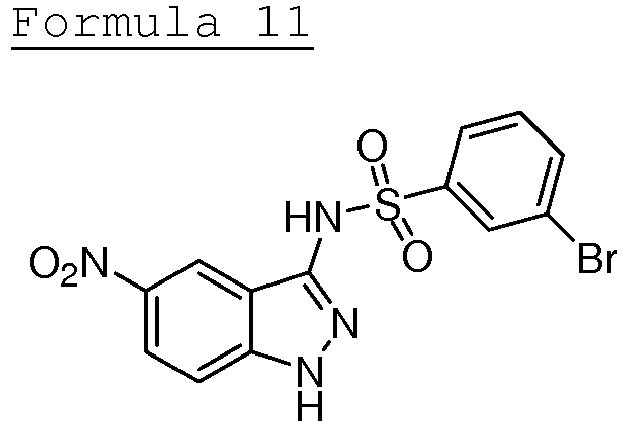


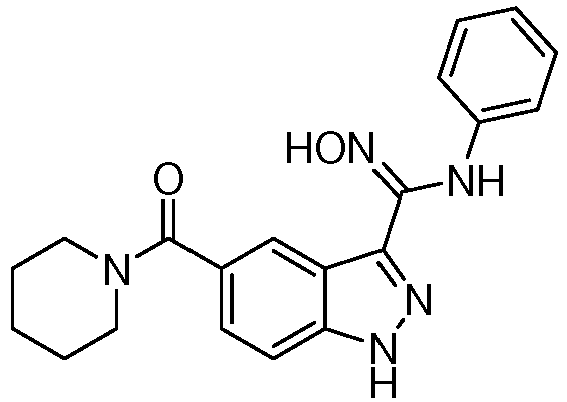


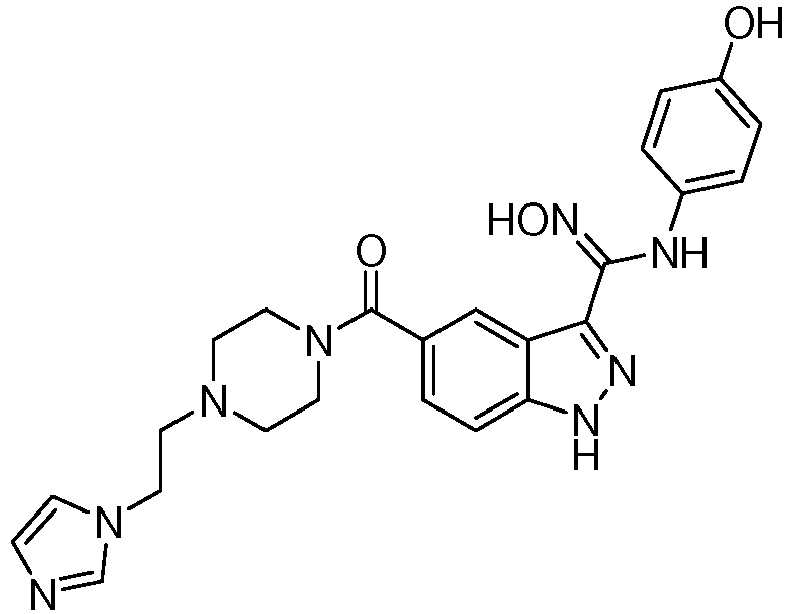




- The composition of claim 12, wherein the compound is represented by a formula selected from the group consisting of the following formulas 1, 25, 30, 31, 33, 34, 35 and 45:


- A compound represented by the following formula A as an indazole derivative:

- The compound of claim 14, wherein Y is hydrogen, hydroxy, halo, C1-15 alkoxy, C2-15 heterocycloalkyl containing nitrogen, oxygen or sulfur as a heteroatom, C2-15 heterocycloalkenyl containing nitrogen, oxygen or sulfur as a heteroatom, C6-15 aryl, C1-15 alkyl, or C2-15 alkenyl.
- The compound of claim 14, wherein the heterocycloalkyl in Y may be substituted with hydroxy, halo, C1-5 alkyl, C2-5 alkenyl, C1-5 alkoxy, C2-8 alkoxyalkyl, C2-8 alkoxycarbonyl, C2-8 heterocycloalkenyl alkyl containing nitrogen as a heteroatom,

- The compound of claim 16, wherein the heterocycloalkenyl alkyl is (1H-imidazol-1-ly)alkyl.
- The compound of claim 14, wherein R2 is hydrogen, halo, C1-15 aryl, C1-15 alkoxy, C1-15 alkyl, or C2-15 alkenyl.
- The compound of claim 14, wherein the aryl in R2 may be substituted with hydroxy, halo, C1-5 alkoxy, C1-5 alkyl, C2-5 alkenyl, or a combination thereof.
- The compound of claim 14, wherein the heteroatom is nitrogen.
- The compound of claim 14, wherein the compound is represented by a formula selected from the group consisting of the following formulas 1, 2 and 4 to 45:
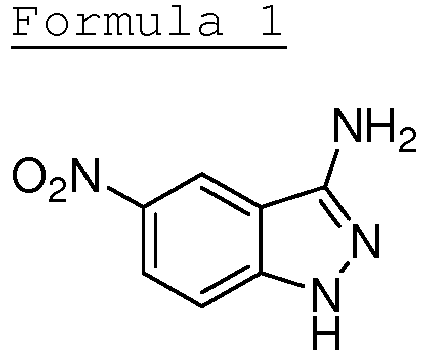


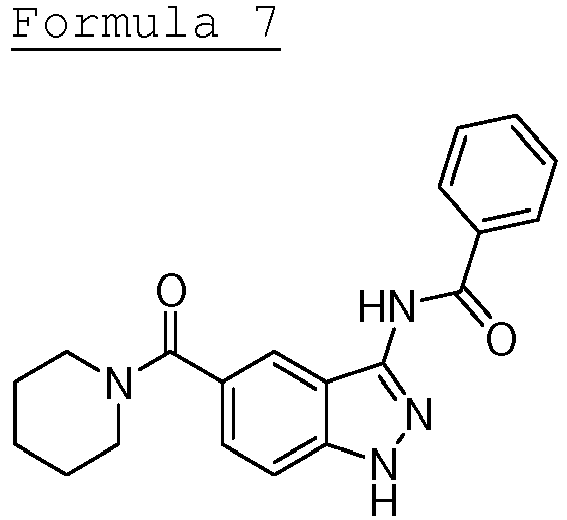


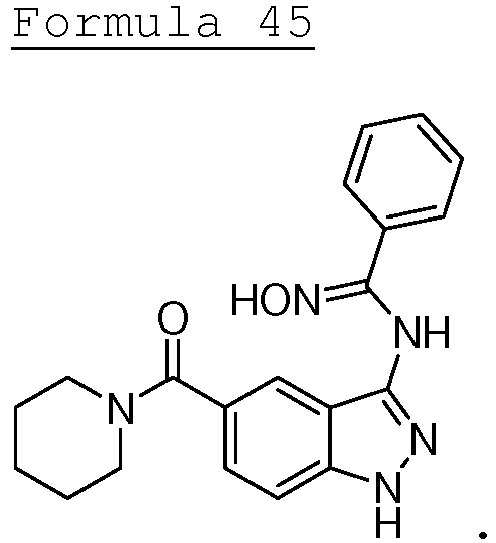
- The compound of claim 21, wherein the compound is represented by a formula selected from the group consisting of the following formulas 1, 25, 30, 31, 33, 34, 35 and 45:


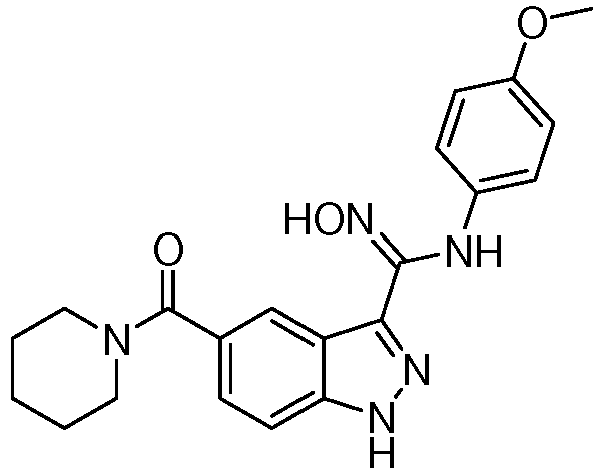


- A method for producing reprogrammed cells from differentiated cells, the method comprising the steps of:(a) brining the composition for inducing cell reprogramming of any one of claims 1 to 13 into contact with differentiated cells; and(b) culturing the cells of step (a).
- A method for inducing cell reprogramming, comprising bringing a composition comprising a compound represented by the following formula A into contact with cells:

- The method of claim 24, wherein the composition induces reprogrammed cells from differentiated cells.
- The method of claim 24, wherein the composition induces reprogrammed osteoblasts or adipocytes from differentiated cells.
- The method of claim 24, wherein the cell is of mammalian origin.
- The method of claim 24, wherein Y is hydrogen, hydroxy, halo, C1-15 alkoxy, C2-15 heterocycloalkyl containing nitrogen, oxygen or sulfur as a heteroatom, C2-15 heterocycloalkenyl containing nitrogen, oxygen or sulfur as a heteroatom, C6-15 aryl, C1-15 alkyl, or C2-15 alkenyl.
- The method of claim 24, wherein the heterocycloalkyl in Y may be substituted with hydroxy, halo, C1-5 alkyl, C2-5 alkenyl, C1-5 alkoxy, C2-8 alkoxyalkyl, C2-8 alkoxycarbonyl, C2-8 heterocycloalkenyl alkyl containing nitrogen as a heteroatom,

- The method of claim 29, wherein the heterocycloalkenyl alkyl is (1H-imidazol-1-ly)alkyl.
- The method of claim 24, wherein R2 is hydrogen, halo, C1-15 aryl, C1-15 alkoxy, C1-15 alkyl, or C2-15 alkenyl.
- The method of claim 24, wherein the aryl in R2 may be substituted with hydroxy, halo, C1-5 alkoxy, C1-5 alkyl, C2-5 alkenyl, or a combination thereof.
- The method of claim 24, wherein X in formula A is imidamido

- The method of claim 24, wherein the heteroatom is nitrogen.
- The method of claim 24, wherein the compound is represented by a formula selected from the group consisting of the following formulas 1 to 45:


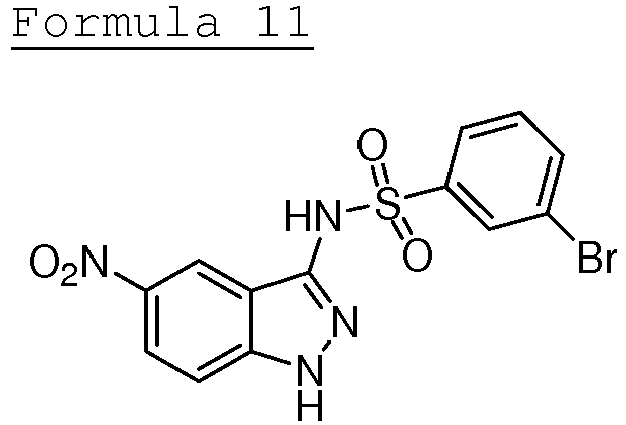


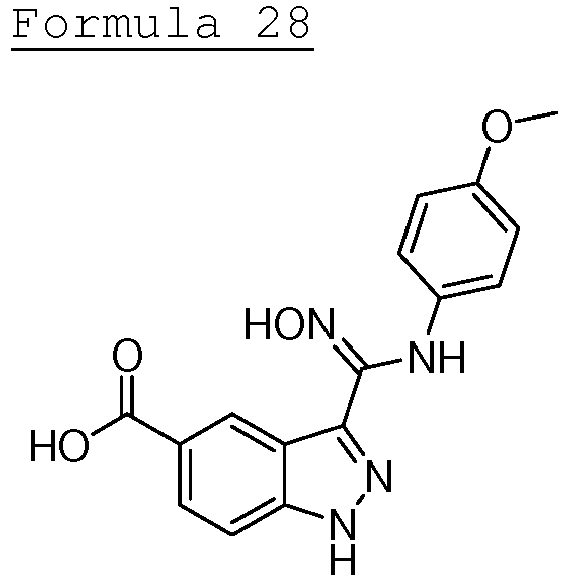


- The method of claim 35, wherein the compound is represented by a formula selected from the group consisting of the following formulas 1, 25, 30, 31, 33, 34, 35 and 45:


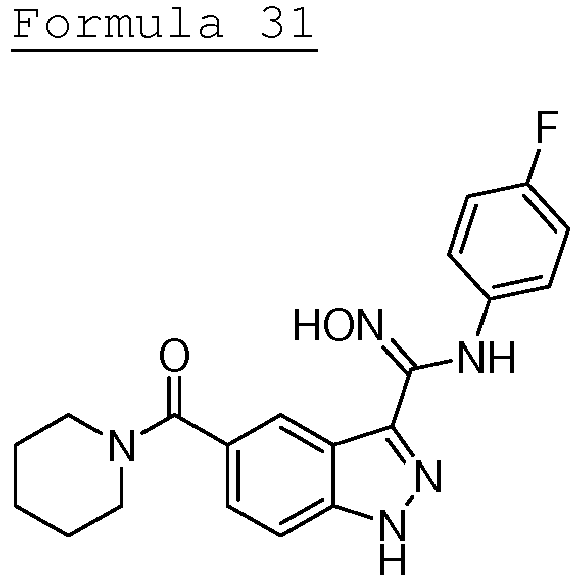


Priority Applications (1)
| Application Number | Priority Date | Filing Date | Title |
|---|---|---|---|
| PL15815352T PL3165523T3 (en) | 2014-07-01 | 2015-06-30 | Composition for inducing cell reprogramming |
Applications Claiming Priority (2)
| Application Number | Priority Date | Filing Date | Title |
|---|---|---|---|
| KR1020140081889A KR101731624B1 (en) | 2014-07-01 | 2014-07-01 | Compositions for inducing a cell re-programming |
| PCT/KR2015/006718 WO2016003169A2 (en) | 2014-07-01 | 2015-06-30 | Composition for inducing cell reprogramming |
Publications (3)
| Publication Number | Publication Date |
|---|---|
| EP3165523A2 true EP3165523A2 (en) | 2017-05-10 |
| EP3165523A4 EP3165523A4 (en) | 2017-08-30 |
| EP3165523B1 EP3165523B1 (en) | 2020-01-08 |
Family
ID=55020061
Family Applications (1)
| Application Number | Title | Priority Date | Filing Date |
|---|---|---|---|
| EP15815352.8A Active EP3165523B1 (en) | 2014-07-01 | 2015-06-30 | Composition for inducing cell reprogramming |
Country Status (8)
| Country | Link |
|---|---|
| US (1) | US10858321B2 (en) |
| EP (1) | EP3165523B1 (en) |
| JP (1) | JP6511075B2 (en) |
| KR (1) | KR101731624B1 (en) |
| CN (1) | CN106794172B (en) |
| ES (1) | ES2768803T3 (en) |
| PL (1) | PL3165523T3 (en) |
| WO (1) | WO2016003169A2 (en) |
Families Citing this family (2)
| Publication number | Priority date | Publication date | Assignee | Title |
|---|---|---|---|---|
| SG11202108636SA (en) * | 2019-02-11 | 2021-09-29 | Merck Patent Gmbh | Indazolyl-isoxazole derivatives for the treatment of diseases such as cancer |
| KR102919328B1 (en) | 2022-11-23 | 2026-01-29 | 동서대학교 산학협력단 | Composition for preventing, improving or treating atopic dermatitis containing reversine as an active ingredient |
Family Cites Families (24)
| Publication number | Priority date | Publication date | Assignee | Title |
|---|---|---|---|---|
| US5244907A (en) * | 1992-03-26 | 1993-09-14 | A. H. Robins Company, Incorporated | Carbocyclic carboxylic acid amides and esters of azabicyclic compounds as gastric prokinetic, antiemetic, anxiolytic and antiarrhythmic agents |
| JP3289177B2 (en) * | 1995-07-07 | 2002-06-04 | コニカ株式会社 | New photographic coupler and silver halide color photographic light-sensitive material |
| DE19810018A1 (en) * | 1998-03-09 | 1999-09-16 | Bayer Ag | New dioxazine derivatives useful as microbicides, especially fungicides for plant protection |
| US7642278B2 (en) * | 2001-07-03 | 2010-01-05 | Novartis Vaccines And Diagnostics, Inc. | Indazole benzimidazole compounds |
| US6897208B2 (en) * | 2001-10-26 | 2005-05-24 | Aventis Pharmaceuticals Inc. | Benzimidazoles |
| TW200306819A (en) * | 2002-01-25 | 2003-12-01 | Vertex Pharma | Indazole compounds useful as protein kinase inhibitors |
| FR2836915B1 (en) * | 2002-03-11 | 2008-01-11 | Aventis Pharma Sa | AMINOINDAZOLE DERIVATIVES, PREPARATION METHOD AND INTERMEDIATES THEREOF AS MEDICAMENTS AND PHARMACEUTICAL COMPOSITIONS COMPRISING THE SAME |
| CN1319968C (en) * | 2002-08-02 | 2007-06-06 | 沃泰克斯药物股份有限公司 | Pyrazole compositions useful as inhibitors of GSK-3 |
| WO2004014922A1 (en) * | 2002-08-10 | 2004-02-19 | Astex Technology Limited | 3-(carbonyl) 1h-indazole compounds as cyclin dependent kinases (cdk) inhibitors |
| FR2845382A1 (en) * | 2002-10-02 | 2004-04-09 | Sanofi Synthelabo | INDAZOLECARBOXAMIDE DERIVATIVES, THEIR PREPARATION AND THEIR USE IN THERAPEUTICS |
| EP1735306A2 (en) * | 2004-03-25 | 2006-12-27 | Memory Pharmaceuticals Corporation | Indazoles, benzothiazoles, benzoisothiazoles, benzisoxazoles, and preparation and uses thereof |
| DE102004028862A1 (en) | 2004-06-15 | 2005-12-29 | Merck Patent Gmbh | 3-aminoindazoles |
| CA2644910C (en) * | 2006-03-31 | 2014-01-28 | Abbott Laboratories | Indazole compounds |
| CA2668429A1 (en) * | 2006-11-02 | 2008-05-15 | Vertex Pharmaceuticals Incorporated | Aminopyridines and aminopyrimidines useful as inhibitors of protein kinases |
| US20080194557A1 (en) * | 2007-01-18 | 2008-08-14 | Joseph Barbosa | Methods and compositions for the treatment of pain, inflammation and cancer |
| PT2176231T (en) * | 2007-07-20 | 2016-12-09 | Nerviano Medical Sciences Srl | Substituted indazole derivatives active as kinase inhibitors |
| CN102595899A (en) * | 2009-08-10 | 2012-07-18 | 埃皮瑟瑞克斯有限公司 | Indazoles as WNT/B-catenin signaling pathway inhibitors and therapeutic uses thereof |
| KR101874463B1 (en) * | 2009-10-31 | 2018-08-02 | 뉴 월드 레보러토리즈 인코포레이티드. | Methods for reprogramming cells and uses thereof |
| ES2546465T3 (en) * | 2010-10-29 | 2015-09-23 | Pfizer Inc | N1 / N2-lactam acetyl-CoA carboxylase inhibitors |
| EP2799431B1 (en) * | 2011-12-28 | 2018-01-24 | FUJIFILM Corporation | Novel nicotinamide derivative or salt thereof |
| KR101539132B1 (en) | 2012-01-20 | 2015-07-28 | 주식회사 스템랩 | Method for induction cardiac myocyte from somatic cells using direct reprogramming strategy by small molecule treatment without genetic modification |
| US20130281399A1 (en) * | 2012-04-19 | 2013-10-24 | Rvx Therapeutics Inc. | Treatment of diseases by epigenetic regulation |
| JP2016533385A (en) * | 2013-08-22 | 2016-10-27 | エフ.ホフマン−ラ ロシュ アーゲーF. Hoffmann−La Roche Aktiengesellschaft | Alkynyl alcohol and method of use |
| ES2703851T3 (en) | 2014-08-22 | 2019-03-12 | Merck Patent Gmbh | Indazoles |
-
2014
- 2014-07-01 KR KR1020140081889A patent/KR101731624B1/en not_active Expired - Fee Related
-
2015
- 2015-06-30 EP EP15815352.8A patent/EP3165523B1/en active Active
- 2015-06-30 US US15/323,342 patent/US10858321B2/en not_active Expired - Fee Related
- 2015-06-30 CN CN201580036120.XA patent/CN106794172B/en not_active Expired - Fee Related
- 2015-06-30 ES ES15815352T patent/ES2768803T3/en active Active
- 2015-06-30 JP JP2016575756A patent/JP6511075B2/en not_active Expired - Fee Related
- 2015-06-30 WO PCT/KR2015/006718 patent/WO2016003169A2/en not_active Ceased
- 2015-06-30 PL PL15815352T patent/PL3165523T3/en unknown
Also Published As
| Publication number | Publication date |
|---|---|
| PL3165523T3 (en) | 2020-07-13 |
| JP6511075B2 (en) | 2019-05-15 |
| KR20160003965A (en) | 2016-01-12 |
| KR101731624B1 (en) | 2017-05-04 |
| CN106794172A (en) | 2017-05-31 |
| JP2017526342A (en) | 2017-09-14 |
| WO2016003169A2 (en) | 2016-01-07 |
| US20170158642A1 (en) | 2017-06-08 |
| EP3165523A4 (en) | 2017-08-30 |
| US10858321B2 (en) | 2020-12-08 |
| WO2016003169A3 (en) | 2016-06-16 |
| CN106794172B (en) | 2020-03-17 |
| ES2768803T3 (en) | 2020-06-23 |
| EP3165523B1 (en) | 2020-01-08 |
Similar Documents
| Publication | Publication Date | Title |
|---|---|---|
| JP5406725B2 (en) | Compounds useful as protein kinase inhibitors | |
| KR102232742B1 (en) | Indole carboxamide derivatives as p2x7 receptor antagonists | |
| RU2503664C2 (en) | Acyl thiourea derivative or salt thereof and use thereof | |
| TWI531573B (en) | Novel compounds of reverse-turn mimetics and use therefor | |
| UA76512C2 (en) | Dihydropteridinones, a method for producing thereof and use thereof as medicament | |
| US20050209231A1 (en) | Compositions and methods for inducing cardiomyogenesis | |
| US9439877B2 (en) | Small molecule inhibitors of Dusp6 and uses therefor | |
| AU2017327304B2 (en) | Use of morphinan derivative for therapeutic treatment of opioid δ receptor agonist-related disease | |
| CN113968824A (en) | 2,3, 5-trisubstituted pyrazine compound and preparation method and application thereof | |
| CN119798159A (en) | PAPD5 inhibitors and methods of use thereof | |
| BRPI0618752A2 (en) | bicyclically substituted pyrimidone derivatives | |
| JP2009538305A (en) | Thiophenecarboxamides useful as inhibitors of protein kinases | |
| CN106831780A (en) | New type heterocycle derivative with CDK4/6 and HDAC inhibitory activity | |
| CN115286585A (en) | Pleuromutilin derivative and application thereof | |
| CA3058190A1 (en) | Agents for differentiating stem cells and treating cancer | |
| EP3165523B1 (en) | Composition for inducing cell reprogramming | |
| JP5334586B2 (en) | Substituted 5-phenyl-3,6-dihydro-2-oxo-6H- [1,3,4] thiadiazine | |
| CN114929675B (en) | Novel adamantane derivatives as focal adhesion kinase inhibitors | |
| FR2953836A1 (en) | NOVEL DERIVATIVES (HETEROCYCLE-TETRAHYDRO-PYRIDINE) - (PIPERAZINYL) -1-ALKANONE AND (HETEROCYCLE-DIHYDRO-PYRROLIDINE) - (PIPERAZINYL) -1-ALKANONE AND THEIR USE AS INHIBITORS OF P75 | |
| JP2015172046A (en) | Production method of dasatinib and its intermediate | |
| KR101183553B1 (en) | Pharmaceutical composition for the prevention or treatment of a cancer comprising a quinoxaline derivative or a salt thereof as an active ingredient | |
| JP5665537B2 (en) | Pyrazole 3,5 carboxylate derivatives, their preparation and therapeutic application | |
| KR101117129B1 (en) | Novel quinoxaline derivatives and composition for inducing differentiation of stem cells into neural cells comprising same | |
| US20160280670A1 (en) | Novel compounds for regeneration of terminally-differentiated cells and tissues | |
| KR101490695B1 (en) | N-(2-acetyl-4-morpholinophenyl amide derivatives for inducing differentiation of mesenchymal stem cells to endothelial cells |
Legal Events
| Date | Code | Title | Description |
|---|---|---|---|
| STAA | Information on the status of an ep patent application or granted ep patent |
Free format text: STATUS: THE INTERNATIONAL PUBLICATION HAS BEEN MADE |
|
| PUAI | Public reference made under article 153(3) epc to a published international application that has entered the european phase |
Free format text: ORIGINAL CODE: 0009012 |
|
| STAA | Information on the status of an ep patent application or granted ep patent |
Free format text: STATUS: REQUEST FOR EXAMINATION WAS MADE |
|
| 17P | Request for examination filed |
Effective date: 20170127 |
|
| AK | Designated contracting states |
Kind code of ref document: A2 Designated state(s): AL AT BE BG CH CY CZ DE DK EE ES FI FR GB GR HR HU IE IS IT LI LT LU LV MC MK MT NL NO PL PT RO RS SE SI SK SM TR |
|
| AX | Request for extension of the european patent |
Extension state: BA ME |
|
| RIC1 | Information provided on ipc code assigned before grant |
Ipc: A61K 31/454 20060101ALI20170720BHEP Ipc: A61K 31/416 20060101ALI20170720BHEP Ipc: A61P 43/00 20060101ALI20170720BHEP Ipc: C07D 231/56 20060101AFI20170720BHEP Ipc: A61K 31/415 20060101ALI20170720BHEP Ipc: C07D 401/12 20060101ALI20170720BHEP Ipc: A61P 25/00 20060101ALI20170720BHEP Ipc: A61P 25/16 20060101ALI20170720BHEP Ipc: A61K 31/496 20060101ALI20170720BHEP |
|
| A4 | Supplementary search report drawn up and despatched |
Effective date: 20170728 |
|
| DAV | Request for validation of the european patent (deleted) | ||
| DAX | Request for extension of the european patent (deleted) | ||
| STAA | Information on the status of an ep patent application or granted ep patent |
Free format text: STATUS: EXAMINATION IS IN PROGRESS |
|
| 17Q | First examination report despatched |
Effective date: 20180627 |
|
| GRAP | Despatch of communication of intention to grant a patent |
Free format text: ORIGINAL CODE: EPIDOSNIGR1 |
|
| STAA | Information on the status of an ep patent application or granted ep patent |
Free format text: STATUS: GRANT OF PATENT IS INTENDED |
|
| INTG | Intention to grant announced |
Effective date: 20190730 |
|
| GRAS | Grant fee paid |
Free format text: ORIGINAL CODE: EPIDOSNIGR3 |
|
| GRAA | (expected) grant |
Free format text: ORIGINAL CODE: 0009210 |
|
| STAA | Information on the status of an ep patent application or granted ep patent |
Free format text: STATUS: THE PATENT HAS BEEN GRANTED |
|
| AK | Designated contracting states |
Kind code of ref document: B1 Designated state(s): AL AT BE BG CH CY CZ DE DK EE ES FI FR GB GR HR HU IE IS IT LI LT LU LV MC MK MT NL NO PL PT RO RS SE SI SK SM TR |
|
| REG | Reference to a national code |
Ref country code: GB Ref legal event code: FG4D |
|
| REG | Reference to a national code |
Ref country code: CH Ref legal event code: EP |
|
| REG | Reference to a national code |
Ref country code: DE Ref legal event code: R096 Ref document number: 602015045296 Country of ref document: DE |
|
| REG | Reference to a national code |
Ref country code: IE Ref legal event code: FG4D |
|
| REG | Reference to a national code |
Ref country code: AT Ref legal event code: REF Ref document number: 1222542 Country of ref document: AT Kind code of ref document: T Effective date: 20200215 |
|
| REG | Reference to a national code |
Ref country code: NL Ref legal event code: MP Effective date: 20200108 |
|
| REG | Reference to a national code |
Ref country code: ES Ref legal event code: FG2A Ref document number: 2768803 Country of ref document: ES Kind code of ref document: T3 Effective date: 20200623 |
|
| REG | Reference to a national code |
Ref country code: LT Ref legal event code: MG4D |
|
| PG25 | Lapsed in a contracting state [announced via postgrant information from national office to epo] |
Ref country code: FI Free format text: LAPSE BECAUSE OF FAILURE TO SUBMIT A TRANSLATION OF THE DESCRIPTION OR TO PAY THE FEE WITHIN THE PRESCRIBED TIME-LIMIT Effective date: 20200108 Ref country code: PT Free format text: LAPSE BECAUSE OF FAILURE TO SUBMIT A TRANSLATION OF THE DESCRIPTION OR TO PAY THE FEE WITHIN THE PRESCRIBED TIME-LIMIT Effective date: 20200531 Ref country code: NL Free format text: LAPSE BECAUSE OF FAILURE TO SUBMIT A TRANSLATION OF THE DESCRIPTION OR TO PAY THE FEE WITHIN THE PRESCRIBED TIME-LIMIT Effective date: 20200108 Ref country code: RS Free format text: LAPSE BECAUSE OF FAILURE TO SUBMIT A TRANSLATION OF THE DESCRIPTION OR TO PAY THE FEE WITHIN THE PRESCRIBED TIME-LIMIT Effective date: 20200108 Ref country code: LT Free format text: LAPSE BECAUSE OF FAILURE TO SUBMIT A TRANSLATION OF THE DESCRIPTION OR TO PAY THE FEE WITHIN THE PRESCRIBED TIME-LIMIT Effective date: 20200108 Ref country code: NO Free format text: LAPSE BECAUSE OF FAILURE TO SUBMIT A TRANSLATION OF THE DESCRIPTION OR TO PAY THE FEE WITHIN THE PRESCRIBED TIME-LIMIT Effective date: 20200408 |
|
| REG | Reference to a national code |
Ref country code: DE Ref legal event code: R088 Ref document number: 602015045296 Country of ref document: DE |
|
| REG | Reference to a national code |
Ref country code: ES Ref legal event code: GD2A Effective date: 20200812 |
|
| PG25 | Lapsed in a contracting state [announced via postgrant information from national office to epo] |
Ref country code: BG Free format text: LAPSE BECAUSE OF FAILURE TO SUBMIT A TRANSLATION OF THE DESCRIPTION OR TO PAY THE FEE WITHIN THE PRESCRIBED TIME-LIMIT Effective date: 20200408 Ref country code: LV Free format text: LAPSE BECAUSE OF FAILURE TO SUBMIT A TRANSLATION OF THE DESCRIPTION OR TO PAY THE FEE WITHIN THE PRESCRIBED TIME-LIMIT Effective date: 20200108 Ref country code: SE Free format text: LAPSE BECAUSE OF FAILURE TO SUBMIT A TRANSLATION OF THE DESCRIPTION OR TO PAY THE FEE WITHIN THE PRESCRIBED TIME-LIMIT Effective date: 20200108 Ref country code: HR Free format text: LAPSE BECAUSE OF FAILURE TO SUBMIT A TRANSLATION OF THE DESCRIPTION OR TO PAY THE FEE WITHIN THE PRESCRIBED TIME-LIMIT Effective date: 20200108 Ref country code: IS Free format text: LAPSE BECAUSE OF FAILURE TO SUBMIT A TRANSLATION OF THE DESCRIPTION OR TO PAY THE FEE WITHIN THE PRESCRIBED TIME-LIMIT Effective date: 20200508 Ref country code: GR Free format text: LAPSE BECAUSE OF FAILURE TO SUBMIT A TRANSLATION OF THE DESCRIPTION OR TO PAY THE FEE WITHIN THE PRESCRIBED TIME-LIMIT Effective date: 20200409 |
|
| REG | Reference to a national code |
Ref country code: GB Ref legal event code: 732E Free format text: REGISTERED BETWEEN 20200820 AND 20200826 |
|
| REG | Reference to a national code |
Ref country code: DE Ref legal event code: R097 Ref document number: 602015045296 Country of ref document: DE |
|
| PG25 | Lapsed in a contracting state [announced via postgrant information from national office to epo] |
Ref country code: DK Free format text: LAPSE BECAUSE OF FAILURE TO SUBMIT A TRANSLATION OF THE DESCRIPTION OR TO PAY THE FEE WITHIN THE PRESCRIBED TIME-LIMIT Effective date: 20200108 Ref country code: RO Free format text: LAPSE BECAUSE OF FAILURE TO SUBMIT A TRANSLATION OF THE DESCRIPTION OR TO PAY THE FEE WITHIN THE PRESCRIBED TIME-LIMIT Effective date: 20200108 Ref country code: SM Free format text: LAPSE BECAUSE OF FAILURE TO SUBMIT A TRANSLATION OF THE DESCRIPTION OR TO PAY THE FEE WITHIN THE PRESCRIBED TIME-LIMIT Effective date: 20200108 Ref country code: EE Free format text: LAPSE BECAUSE OF FAILURE TO SUBMIT A TRANSLATION OF THE DESCRIPTION OR TO PAY THE FEE WITHIN THE PRESCRIBED TIME-LIMIT Effective date: 20200108 Ref country code: SK Free format text: LAPSE BECAUSE OF FAILURE TO SUBMIT A TRANSLATION OF THE DESCRIPTION OR TO PAY THE FEE WITHIN THE PRESCRIBED TIME-LIMIT Effective date: 20200108 Ref country code: CZ Free format text: LAPSE BECAUSE OF FAILURE TO SUBMIT A TRANSLATION OF THE DESCRIPTION OR TO PAY THE FEE WITHIN THE PRESCRIBED TIME-LIMIT Effective date: 20200108 |
|
| PLBE | No opposition filed within time limit |
Free format text: ORIGINAL CODE: 0009261 |
|
| STAA | Information on the status of an ep patent application or granted ep patent |
Free format text: STATUS: NO OPPOSITION FILED WITHIN TIME LIMIT |
|
| REG | Reference to a national code |
Ref country code: AT Ref legal event code: MK05 Ref document number: 1222542 Country of ref document: AT Kind code of ref document: T Effective date: 20200108 |
|
| 26N | No opposition filed |
Effective date: 20201009 |
|
| REG | Reference to a national code |
Ref country code: DE Ref legal event code: R082 Ref document number: 602015045296 Country of ref document: DE |
|
| PG25 | Lapsed in a contracting state [announced via postgrant information from national office to epo] |
Ref country code: AT Free format text: LAPSE BECAUSE OF FAILURE TO SUBMIT A TRANSLATION OF THE DESCRIPTION OR TO PAY THE FEE WITHIN THE PRESCRIBED TIME-LIMIT Effective date: 20200108 Ref country code: MC Free format text: LAPSE BECAUSE OF FAILURE TO SUBMIT A TRANSLATION OF THE DESCRIPTION OR TO PAY THE FEE WITHIN THE PRESCRIBED TIME-LIMIT Effective date: 20200108 |
|
| REG | Reference to a national code |
Ref country code: CH Ref legal event code: PL |
|
| PG25 | Lapsed in a contracting state [announced via postgrant information from national office to epo] |
Ref country code: SI Free format text: LAPSE BECAUSE OF FAILURE TO SUBMIT A TRANSLATION OF THE DESCRIPTION OR TO PAY THE FEE WITHIN THE PRESCRIBED TIME-LIMIT Effective date: 20200108 |
|
| PG25 | Lapsed in a contracting state [announced via postgrant information from national office to epo] |
Ref country code: LU Free format text: LAPSE BECAUSE OF NON-PAYMENT OF DUE FEES Effective date: 20200630 |
|
| REG | Reference to a national code |
Ref country code: BE Ref legal event code: MM Effective date: 20200630 |
|
| PG25 | Lapsed in a contracting state [announced via postgrant information from national office to epo] |
Ref country code: LI Free format text: LAPSE BECAUSE OF NON-PAYMENT OF DUE FEES Effective date: 20200630 Ref country code: IE Free format text: LAPSE BECAUSE OF NON-PAYMENT OF DUE FEES Effective date: 20200630 Ref country code: CH Free format text: LAPSE BECAUSE OF NON-PAYMENT OF DUE FEES Effective date: 20200630 |
|
| PG25 | Lapsed in a contracting state [announced via postgrant information from national office to epo] |
Ref country code: BE Free format text: LAPSE BECAUSE OF NON-PAYMENT OF DUE FEES Effective date: 20200630 |
|
| PG25 | Lapsed in a contracting state [announced via postgrant information from national office to epo] |
Ref country code: TR Free format text: LAPSE BECAUSE OF FAILURE TO SUBMIT A TRANSLATION OF THE DESCRIPTION OR TO PAY THE FEE WITHIN THE PRESCRIBED TIME-LIMIT Effective date: 20200108 Ref country code: MT Free format text: LAPSE BECAUSE OF FAILURE TO SUBMIT A TRANSLATION OF THE DESCRIPTION OR TO PAY THE FEE WITHIN THE PRESCRIBED TIME-LIMIT Effective date: 20200108 Ref country code: CY Free format text: LAPSE BECAUSE OF FAILURE TO SUBMIT A TRANSLATION OF THE DESCRIPTION OR TO PAY THE FEE WITHIN THE PRESCRIBED TIME-LIMIT Effective date: 20200108 |
|
| PG25 | Lapsed in a contracting state [announced via postgrant information from national office to epo] |
Ref country code: MK Free format text: LAPSE BECAUSE OF FAILURE TO SUBMIT A TRANSLATION OF THE DESCRIPTION OR TO PAY THE FEE WITHIN THE PRESCRIBED TIME-LIMIT Effective date: 20200108 Ref country code: AL Free format text: LAPSE BECAUSE OF FAILURE TO SUBMIT A TRANSLATION OF THE DESCRIPTION OR TO PAY THE FEE WITHIN THE PRESCRIBED TIME-LIMIT Effective date: 20200108 |
|
| PGFP | Annual fee paid to national office [announced via postgrant information from national office to epo] |
Ref country code: IT Payment date: 20220526 Year of fee payment: 8 Ref country code: GB Payment date: 20220519 Year of fee payment: 8 Ref country code: FR Payment date: 20220523 Year of fee payment: 8 Ref country code: DE Payment date: 20220517 Year of fee payment: 8 |
|
| PGFP | Annual fee paid to national office [announced via postgrant information from national office to epo] |
Ref country code: PL Payment date: 20220530 Year of fee payment: 8 |
|
| PGFP | Annual fee paid to national office [announced via postgrant information from national office to epo] |
Ref country code: ES Payment date: 20220704 Year of fee payment: 8 |
|
| REG | Reference to a national code |
Ref country code: DE Ref legal event code: R119 Ref document number: 602015045296 Country of ref document: DE |
|
| GBPC | Gb: european patent ceased through non-payment of renewal fee |
Effective date: 20230630 |
|
| PG25 | Lapsed in a contracting state [announced via postgrant information from national office to epo] |
Ref country code: DE Free format text: LAPSE BECAUSE OF NON-PAYMENT OF DUE FEES Effective date: 20240103 Ref country code: GB Free format text: LAPSE BECAUSE OF NON-PAYMENT OF DUE FEES Effective date: 20230630 |
|
| PG25 | Lapsed in a contracting state [announced via postgrant information from national office to epo] |
Ref country code: FR Free format text: LAPSE BECAUSE OF NON-PAYMENT OF DUE FEES Effective date: 20230630 |
|
| PG25 | Lapsed in a contracting state [announced via postgrant information from national office to epo] |
Ref country code: IT Free format text: LAPSE BECAUSE OF NON-PAYMENT OF DUE FEES Effective date: 20230630 |
|
| REG | Reference to a national code |
Ref country code: ES Ref legal event code: FD2A Effective date: 20240806 |
|
| PG25 | Lapsed in a contracting state [announced via postgrant information from national office to epo] |
Ref country code: ES Free format text: LAPSE BECAUSE OF NON-PAYMENT OF DUE FEES Effective date: 20230701 |
|
| PG25 | Lapsed in a contracting state [announced via postgrant information from national office to epo] |
Ref country code: PL Free format text: LAPSE BECAUSE OF NON-PAYMENT OF DUE FEES Effective date: 20230630 |
|
| PG25 | Lapsed in a contracting state [announced via postgrant information from national office to epo] |
Ref country code: PL Free format text: LAPSE BECAUSE OF NON-PAYMENT OF DUE FEES Effective date: 20230630 Ref country code: ES Free format text: LAPSE BECAUSE OF NON-PAYMENT OF DUE FEES Effective date: 20230701 |