EP3164527B1 - Synthesis and use of bio-based imidazolium carboxylates - Google Patents
Synthesis and use of bio-based imidazolium carboxylates Download PDFInfo
- Publication number
- EP3164527B1 EP3164527B1 EP15733766.8A EP15733766A EP3164527B1 EP 3164527 B1 EP3164527 B1 EP 3164527B1 EP 15733766 A EP15733766 A EP 15733766A EP 3164527 B1 EP3164527 B1 EP 3164527B1
- Authority
- EP
- European Patent Office
- Prior art keywords
- group
- alkyl
- imidazolium
- aryl
- cycloalkyl
- Prior art date
- Legal status (The legal status is an assumption and is not a legal conclusion. Google has not performed a legal analysis and makes no representation as to the accuracy of the status listed.)
- Not-in-force
Links
- 0 CC(*)C1C(*)=C(*)*(*)=C=C1 Chemical compound CC(*)C1C(*)=C(*)*(*)=C=C1 0.000 description 4
Classifications
-
- C—CHEMISTRY; METALLURGY
- C01—INORGANIC CHEMISTRY
- C01B—NON-METALLIC ELEMENTS; COMPOUNDS THEREOF; METALLOIDS OR COMPOUNDS THEREOF NOT COVERED BY SUBCLASS C01C
- C01B32/00—Carbon; Compounds thereof
- C01B32/50—Carbon dioxide
-
- C—CHEMISTRY; METALLURGY
- C07—ORGANIC CHEMISTRY
- C07D—HETEROCYCLIC COMPOUNDS
- C07D233/00—Heterocyclic compounds containing 1,3-diazole or hydrogenated 1,3-diazole rings, not condensed with other rings
- C07D233/54—Heterocyclic compounds containing 1,3-diazole or hydrogenated 1,3-diazole rings, not condensed with other rings having two double bonds between ring members or between ring members and non-ring members
-
- C—CHEMISTRY; METALLURGY
- C07—ORGANIC CHEMISTRY
- C07D—HETEROCYCLIC COMPOUNDS
- C07D233/00—Heterocyclic compounds containing 1,3-diazole or hydrogenated 1,3-diazole rings, not condensed with other rings
- C07D233/54—Heterocyclic compounds containing 1,3-diazole or hydrogenated 1,3-diazole rings, not condensed with other rings having two double bonds between ring members or between ring members and non-ring members
- C07D233/56—Heterocyclic compounds containing 1,3-diazole or hydrogenated 1,3-diazole rings, not condensed with other rings having two double bonds between ring members or between ring members and non-ring members with only hydrogen atoms or radicals containing only hydrogen and carbon atoms, attached to ring carbon atoms
- C07D233/58—Heterocyclic compounds containing 1,3-diazole or hydrogenated 1,3-diazole rings, not condensed with other rings having two double bonds between ring members or between ring members and non-ring members with only hydrogen atoms or radicals containing only hydrogen and carbon atoms, attached to ring carbon atoms with only hydrogen atoms or radicals containing only hydrogen and carbon atoms, attached to ring nitrogen atoms
-
- C—CHEMISTRY; METALLURGY
- C07—ORGANIC CHEMISTRY
- C07D—HETEROCYCLIC COMPOUNDS
- C07D233/00—Heterocyclic compounds containing 1,3-diazole or hydrogenated 1,3-diazole rings, not condensed with other rings
- C07D233/54—Heterocyclic compounds containing 1,3-diazole or hydrogenated 1,3-diazole rings, not condensed with other rings having two double bonds between ring members or between ring members and non-ring members
- C07D233/66—Heterocyclic compounds containing 1,3-diazole or hydrogenated 1,3-diazole rings, not condensed with other rings having two double bonds between ring members or between ring members and non-ring members with hetero atoms or with carbon atoms having three bonds to hetero atoms with at the most one bond to halogen, e.g. ester or nitrile radicals, directly attached to ring carbon atoms
- C07D233/90—Carbon atoms having three bonds to hetero atoms with at the most one bond to halogen, e.g. ester or nitrile radicals
-
- C—CHEMISTRY; METALLURGY
- C25—ELECTROLYTIC OR ELECTROPHORETIC PROCESSES; APPARATUS THEREFOR
- C25B—ELECTROLYTIC OR ELECTROPHORETIC PROCESSES FOR THE PRODUCTION OF COMPOUNDS OR NON-METALS; APPARATUS THEREFOR
- C25B3/00—Electrolytic production of organic compounds
- C25B3/01—Products
- C25B3/05—Heterocyclic compounds
-
- C—CHEMISTRY; METALLURGY
- C25—ELECTROLYTIC OR ELECTROPHORETIC PROCESSES; APPARATUS THEREFOR
- C25B—ELECTROLYTIC OR ELECTROPHORETIC PROCESSES FOR THE PRODUCTION OF COMPOUNDS OR NON-METALS; APPARATUS THEREFOR
- C25B3/00—Electrolytic production of organic compounds
- C25B3/01—Products
- C25B3/07—Oxygen containing compounds
-
- C—CHEMISTRY; METALLURGY
- C25—ELECTROLYTIC OR ELECTROPHORETIC PROCESSES; APPARATUS THEREFOR
- C25B—ELECTROLYTIC OR ELECTROPHORETIC PROCESSES FOR THE PRODUCTION OF COMPOUNDS OR NON-METALS; APPARATUS THEREFOR
- C25B3/00—Electrolytic production of organic compounds
- C25B3/01—Products
- C25B3/09—Nitrogen containing compounds
-
- C—CHEMISTRY; METALLURGY
- C25—ELECTROLYTIC OR ELECTROPHORETIC PROCESSES; APPARATUS THEREFOR
- C25B—ELECTROLYTIC OR ELECTROPHORETIC PROCESSES FOR THE PRODUCTION OF COMPOUNDS OR NON-METALS; APPARATUS THEREFOR
- C25B3/00—Electrolytic production of organic compounds
- C25B3/20—Processes
- C25B3/25—Reduction
Definitions
- the present invention relates to a new method for preparation of bio-based imidazolium salts and derivatives thereof; in particular, for the preparation of imidazolium hydrogenoxalate.
- the present invention also relates to uses of imidazolium hydrogenoxalate salts, especially as a precursor of imidazolium carboxylate compounds.
- the present invention also refers to a green electrochemical process providing imidazolium compounds, especially imidazolium carboxylate compounds.
- the invention refers to a one-compartment electrochemical cell and its use for the preparation of imidazolium carboxylate compounds.
- N-heterocyclic carbenes are commonly used in many applications such as ligands for organometallics catalysts, organic catalyst, material and drug syntheses, therapeutics or electrochemistry.
- NHC N-heterocyclic carbenes
- these high value-added products have been prepared until now, by energy-consuming processes that use reagents with strong negative environmental impacts.
- their handling is still sensitive: the used conditions of NHC synthesis lead to highly explosive atmosphere and finally, to high professional risks. Consequently, it is necessary to develop both eco-friendly and safe processes in this chemical field.
- N-heterocyclic carbenes are synthetized from their corresponding imidazolium salts by deprotonation with a strong base ( n -BuLi, t BuOK, NaH), which usually requires special conditions (low temperature, inert atmosphere; Arduengo, A.J., Acc. Chem. Res., 1999, 32, p 913 ).
- a strong base n -BuLi, t BuOK, NaH
- Numerous works are devoted to the synthesis of an intermediate stable masked carbenes allowing regenerating in situ free carbenes by thermal activation.
- imidazolium 2-carboxylate compound is particularly interesting in that it allows spontaneous carbon dioxide delivery.
- the first one (method A) consists of deprotonation of imidazolium salt compound at low temperature and under inert atmosphere in order to provide a free intermediate carbene which then, will react by contacting itself with a solution comprising carbon dioxide ( Kuhn, N. et al. Naturforsch 1999, 54b, 427 ):
- the second (method B) refers to a « one-pot » reaction of both N-methylation and C-carboxylation of N-monosubstituted imidazole precursor using dimethylcarbonate (DMC) as a reagent ( Holbrey, J. et al. Chem. Commun. 2003, 28 ):
- the aim is thus to provide imidazolium carboxylate compounds by a green process easy to implement, safe and allowing having products without toxic subproducts.
- CN101078129 does not address with providing imidazolium carboxylate from imidazolium hydrogenoxalate salts by a green process.
- the Applicant has discovered a process and a new electrochemical device for preparation of imidazolium 2-carboxylate overcoming the drawbacks previously described. Especially, the Applicant has further discovered a method for preparation of new imidazolium salts, particularly imidazolium hydrogenoxalate salts from bio-based reagents, useful for providing bio-sourced imidazolium 2-carboxylate compounds by a more eco-friendly electrochemical way.
- This invention thus relates to an electrochemical cell comprising:
- the electrochemical cell further comprises a source of carbon dioxide.
- the imidazolium salts are hydrogenoxalate salts of general formula (I): wherein:
- the imidazolium salt of general formula (I) or (I') is 1,3-di-(phenylethyl)imidazolium hydrogenoxalate salt of formula (Ia):
- the imidazolium salt of general formula (I) or (I') is 1,3-di-(isobutyl)imidazolium hydrogenoxalate salt of formula (Ib):
- the imidazolium salts are bio-sourced compounds.
- This invention also relates to the use of the one-compartment electrochemical cell as defined above, for the preparation of imidazolium carboxylate compounds of general formula II: wherein:
- the use of the one-compartment electrochemical cell is implemented at room temperature.
- the preparation of imidazolium carboxylate compounds is implemented in only one step.
- This invention also relates to a cyclic process for delivering carbon dioxide stocked in a materialcomprising the following reaction steps:
- the material is a solid or a liquid.
- the solid is a membrane support.
- R 1 and R 3 may represent one fused substituent selected from the group of aryl, heteroaryl, cycloalkyl, cycloalkane or heterocycloalkyl; optionally substituted by at least one group selected from aryl, hydroxyl, oxo, nitro, amido, carboxy, amino, cyano, alkoxy, alkyl, alkene, alkyne, cycloalkyl, cycloalkene, heteroalkyl or heterocycloalkyl group; preferably fused R 1 and R 3 are one aryl group optionally substituted by at least one group selected from hydroxyl, oxo, nitro, amido, carboxy, amino, cyano, alkoxy, alkyl, alkene or alkyne.
- R 2 and R 4 may represent one fused substituent selected from the group of aryl, heteroaryl, cycloalkyl, cycloalkane or heterocycloalkyl; optionally substituted by at least one group selected from aryl, hydroxyl, oxo, nitro, amido, carboxy, amino, cyano, alkoxy, alkyl, alkene, alkyne, cycloalkyl, cycloalkene, heteroalkyl or heterocycloalkyl group; preferably fused R 2 and R 4 are one aryl group optionally substituted by at least one group selected from hydroxyl, oxo, nitro, amido, carboxy, amino, cyano, alkoxy, alkyl, alkene or alkyne.
- R 3 and R 4 may represent one fused substituent selected from the group of aryl, heteroaryl, cycloalkyl, cycloalkane or heterocycloalkyl; optionally substituted by at least one group selected from aryl, hydroxyl, oxo, nitro, amido, carboxy, amino, cyano, alkoxy, alkyl, alkene, alkyne, cycloalkyl, cycloalkene, heteroalkyl or heterocycloalkyl group; preferably fused R 3 and R 4 are one aryl group optionally substituted by at least one group selected from hydroxyl, oxo, nitro, amido, carboxy, amino, cyano, alkoxy, alkyl, alkene or alkyne.
- preferred compounds of formula (II) are compounds which are symmetric.
- preferred compounds of formula (II) are compounds wherein R 1 and R 2 are identical.
- preferred compounds of formula (II) are compounds wherein R 1 and R 2 are identical and are selected from the group of aryl, alkyl, alkene, alkyne, cycloalkyl, cycloalkene, heteroalkyl, heteroaryl or heterocycloalkyl group; optionally substituted by at least one group selected from aryl, hydroxyl, oxo, nitro, amido, carboxy, amino, cyano, alkoxy, alkyl, alkene, alkyne, cycloalkyl, cycloalkene, heteroalkyl, heteroaryl or heterocycloalkyl group; preferably R 1 and R 2 are both alkyl chain substituted by an alkyl or aryl group.
- preferred compounds of formula (II) are compounds wherein R 1 and R 2 are not H.
- preferred compounds of formula (II) are compounds wherein R 1 or R 2 may be identical or different and each is selected from the group of aryl, alkyl, alkene, alkyne, cycloalkyl, cycloalkene, heteroalkyl, heteroaryl or heterocycloalkyl group; optionally substituted by at least one group selected from aryl, hydroxyl, oxo, nitro, amido, carboxy, amino, cyano, alkoxy, alkyl, alkene, alkyne, cycloalkyl, cycloalkene, heteroalkyl, heteroaryl or heterocycloalkyl group; preferably R 1 and R 2 are identical; more preferably, R 1 and R 2 are both alkyl chain substituted by an alkyl or aryl group.
- preferred compounds of formula (II) are compounds wherein R 3 and R 4 both represent an atom H.
- preferred compounds of formula (II) are selected from 1,3-dialkylimidazolium carboxylate, 1,3-di(arylalkyl)imidazolium carboxylate or 1,3-diarylimidazolium carboxylate.
- preferred compounds of formula (II) are 1,3-dialkylimidazolium carboxylate.
- preferred compounds of formula (II) are 1,3-di(arylalkyl)imidazolium carboxylate.
- preferred compounds of formula (II) are 1,3-diarylimidazolium carboxylate.
- the electrochemical cell further comprises a carbon dioxide source.
- the electrochemical cell comprises at least two electrodes; preferably the electrochemical cell comprises three electrodes: one working electrode, one reference electrode and one auxiliary electrode.
- the working electrode may be a suitable conductive electrode selected from at least one Al, Au, Ag, Boron doped diamond, C, Cd, Co, Cr, Cu, Cu alloys, Ga, Hg, In, Ir, Mg, Mo, Nb, Ni, Ni alloys, lead oxide, Li-Fe alloys, Os, Pb, Pd, Pt, Rh, Ru, Sn, Sn alloys, Ti, V, W, Zn, elgiloy, austenitic steel, duplex steel, ferritic steel, martensitic steel, stainless steel, degenerately doped p-Si, degenerately doped p-Si:As and degenerately p-Si: B; preferably the electrode is C, Pt or stainless steel.
- the auxiliary electrode may be a suitable conductive electrode selected from at least one Al, Au, Ag, Boron doped diamond, C, Cd, Co, Cr, Cu, Cu alloys, Ga, Hg, In, Ir, Mg, Mo, Nb, Ni, Ni alloys, lead oxide, Li-Fe alloys, Os, Pb, Pd, Pt, Rh, Ru, Sn, Sn alloys, Ti, V, W, Zn, elgiloy, austenitic steel, duplex steel, ferritic steel, martensitic steel, stainless steel, degenerately doped p-Si, degenerately doped p-Si:As and degenerately p-Si: B; preferably the electrode is C, Pt or stainless steel.
- the reference electrode is selected from saturated calomel electrode (SCE), silver-silver chloride electrode (Ag/AgCl) or Ag/AgNO 3 ; preferably the reference electrode is SCE.
- the electrical potential applied at the working electrode ranges from about 0 volt to -4 volts versus the SCE; preferably the electrical potential ranges from -1.5 volts to -3 volts versus the SCE.
- the current during the process of invention is applied or not; preferably the current is applied and the current density ranges from 1 mA/m 2 to 4 kA/m 2 .
- the supporting electrolyte is selected from solid or liquid compounds, water or organic liquid comprising ionic liquids, salts such as Na 2 SO 4 NaNO 3 , K 2 SiO 3 , ions such as a H cation, a Li cation, a Na cation, a K cation, a Rb cation, a Cs cation, an ammonium cation, an alkylammonium cation, an alkyl amine, borates, carbonates, nitrites, nitrates, phosphates, polyphosphates, silicates, sulfates and tetralkyl ammonium salt, organic solvents or carboxylic acids.
- ionic liquids such as Na 2 SO 4 NaNO 3 , K 2 SiO 3
- ions such as a H cation, a Li cation, a Na cation, a K cation, a Rb cation, a Cs cation, an am
- the electrolyte is tetrabutylammonium hexafluorophosphate (TBAPF 6 ), tetraethylammonium hexafluorophosphate (TEAPF 6 ), or imidazolium salts.
- the electrolyte is not solid. In one embodiment, the electrolyte is not a gel. In one embodiment, the electrolyte is not a layer. In one embodiment, the electrolyte is not a gel. In one embodiment, the electrolyte is not a polymer. In one embodiment, the electrolyte is not polymerizable. In one embodiment, the electrolyte does not comprise polymerizable functions such as, but not limited to, vinyl, acrylate or methacrylate function. In one embodiment, the imidazolium salts are not polymerizable. In one embodiment, the imidazolium salts do not comprise polymerizable functions such as, but not limited to, vinyl, acrylate or methacrylate function. In one embodiment, the electrolyte is not cellulose or any derivatives thereof.
- the electrolyte does not comprise any acid scavenger.
- the electrolyte does not comprise any ionic liquids.
- the electrolyte does not comprise benzimidazolium compound and/or salt.
- the electrolyte does not comprise aluminium chloride.
- the electrolyte does not comprise any dyes and/or pigments.
- the electrolyte is not aqueous.
- the supporting electrolyte is selected from bio-sourced compounds.
- the electrolyte is sourced from biomass; preferably selected from agricultural crops and residues; forestry crops and residues, animal residues; more preferably, from corn, sugar beet or potatoes.
- the supporting electrolyte is used at a concentration ranging from 0.01 mol/L to a saturated solution; preferably is the highest concentration.
- the solvent used in the process of invention is selected from organic solvents; preferably polar and aprotic solvents, ionic liquids, bio-based solvents or mixed solvents; more preferably is dimethylformamide, acetonitrile or bio-based solvents.
- room temperature in the process of the invention a temperature ranging from 15 °C to 40 °C; preferably the temperature is 25 °C.
- the faradaic yield of desired products ranges from 50 % to 100 %.
- the electrochemical cell is not a photoelectrochemical cell.
- the electrochemical cell is flexible.
- the electrolyte or the counter-ion of imidazolium salts used in the process of the invention is oxidized.
- the great majority of counter-ions or electrolytes are halo compounds, the final products of the electrosynthesis are often contaminated and need a purification step.
- the Applicant have worked for optimization of the oxidation step; especially, in order to provide a process wherein the subproducts of oxidation step are easy to eliminate at the end of the reaction and allowing to provide final products with a high purity degree.
- the invention also relates to a process for preparation of imidazolium carboxylate compounds of general formula (II): wherein R 1 , R 2 , R 3 or R 4 are as defined above, comprising:
- the process may provide a subproduct having general formula (III): wherein R 1 , R 2 , R 3 or R 4 are as defined in the general formula (II).
- the process further comprises a step of hydrolysis.
- the step of hydrolysis provides the compounds of general formula (III) or a mixture of compounds of general formula (II) and of formula (III).
- the electrochemical cell comprises at least two electrodes; preferably the electrochemical cell comprises one working electrode, one reference electrode and one auxiliary electrode; more preferably the electrochemical cell does not comprise any reference electrode.
- the electrodes are identical or not and may be a suitable conductive electrode selected from at least one Al, Au, Ag, Boron doped diamond, C, Cd, Co, Cr, Cu, Cu alloys, Ga, Hg, In, Ir, Mg, Mo, Nb, Ni, Ni alloys, lead oxide, Li-Fe alloys, Os, Pb, Pd, Pt, Rh, Ru, Sn, Sn alloys, Ti, V, W, Zn, elgiloy, austenitic steel, duplex steel, ferritic steel, martensitic steel, stainless steel, degenerately doped p-Si, degenerately doped p-Si:As and degenerately p-Si: B; preferably the electrode is C, Pt or stainless steel.
- the products of the oxidation step do not contaminate the products of the reduction step.
- the process of the invention is led under anhydrous conditions or not; preferably under anhydrous conditions.
- the supporting electrolyte is the starting material; preferably the supporting electrolyte is imidazolium salt; more preferably is selected from the group of imidazolium hydrogenoxalate salts.
- the subproducts of the oxidation reaction during the electrolysis are non-toxic compounds, easy to remove from the final reaction medium; preferably at least one subproduct is a gaseous compound; more preferably is carbon dioxide.
- the solvent used in the process of invention is selected from organic solvents; preferably from aprotic and highly ionic solvents; more preferably the solvent is dimethylformamide, acetonitrile or a polar bio-based solvent.
- the electrochemical cell further comprises a carbon dioxide source.
- the temperature used in the process of the invention is ranging from 15 °C to 40 °C; preferably the temperature is 25 °C.
- the faradaic yield of desired products ranges from 50 % to 100 %.
- a one-compartment electrochemical cell comprising:
- R 1 and R 3 may represent one fused substituent selected from the group of aryl, heteroaryl, cycloalkyl, cycloalkane or heterocycloalkyl; optionally substituted by at least one group selected from aryl, hydroxyl, oxo, nitro, amido, carboxy, amino, cyano, alkoxy, alkyl, alkene, alkyne, cycloalkyl, cycloalkene, heteroalkyl or heterocycloalkyl group; preferably fused R 1 and R 3 are one aryl group optionally substituted by at least one group selected from hydroxyl, oxo, nitro, amido, carboxy, amino, cyano, alkoxy, alkyl, alkene or alkyne.
- R 2 and R 4 may represent one fused substituent selected from the group of aryl, heteroaryl, cycloalkyl, cycloalkane or heterocycloalkyl; optionally substituted by at least one group selected from aryl, hydroxyl, oxo, nitro, amido, carboxy, amino, cyano, alkoxy, alkyl, alkene, alkyne, cycloalkyl, cycloalkene, heteroalkyl or heterocycloalkyl group; preferably fused R 2 and R 4 are one aryl group optionally substituted by at least one group selected from hydroxyl, oxo, nitro, amido, carboxy, amino, cyano, alkoxy, alkyl, alkene or alkyne.
- R 3 and R 4 may represent one fused substituent selected from the group of aryl, heteroaryl, cycloalkyl, cycloalkane or heterocycloalkyl; optionally substituted by at least one group selected from aryl, hydroxyl, oxo, nitro, amido, carboxy, amino, cyano, alkoxy, alkyl, alkene, alkyne, cycloalkyl, cycloalkene, heteroalkyl or heterocycloalkyl group; preferably fused R 3 and R 4 are one aryl group optionally substituted by at least one group selected from hydroxyl, oxo, nitro, amido, carboxy, amino, cyano, alkoxy, alkyl, alkene or alkyne.
- the anion of compound of general formula (I') is not formate.
- compounds of formula (I') do not comprise the following compounds:
- preferred compounds of formula (I') are compounds which are symmetric. In one embodiment, preferred compounds of formula (I') are compounds wherein R 1 and R 2 are identical. In one embodiment, preferred compounds of formula (I') are compounds wherein R 1 and R 2 are identical and are selected from the group of aryl, alkyl, alkene, alkyne, cycloalkyl, cycloalkene, heteroalkyl or heterocycloalkyl group; optionally substituted by at least one group selected from aryl, hydroxyl, oxo, nitro, amido, carboxy, amino, cyano, alkoxy, alkyl, alkene, alkyne, cycloalkyl, cycloalkene, heteroalkyl or heterocycloalkyl group; preferably, R 1 and R 2 are both alkyl chain substituted by an alkyl or aryl group.
- preferred compounds of formula (I') are compounds wherein R 1 or R 2 may be identical or different and each is selected from the unsubstituted group of aryl, alkyl, alkene, alkyne, cycloalkyl, cycloalkene, heteroalkyl or heterocycloalkyl group.
- preferred compounds of formula (I') are compounds wherein R 1 or R 2 may be identical or different and each is selected from the group of aryl, alkyl, alkene, alkyne, cycloalkyl, cycloalkene, heteroalkyl or heterocycloalkyl group, said group being substituted by at least one group selected from aryl, hydroxyl, oxo, amido, carboxy, amino, cyano, alkoxy, alkyl, alkene, alkyne, cycloalkyl, cycloalkene, heteroalkyl or heterocycloalkyl group.
- preferred compounds of formula (I') are compounds wherein R 1 and R 2 are not H.
- preferred compounds of formula (I') are compounds wherein R 1 or R 2 may be identical or different and each is selected from the group of aryl, alkyl, alkene, alkyne, cycloalkyl, cycloalkene, heteroalkyl or heterocycloalkyl group; optionally substituted by at least one group selected from aryl, hydroxyl, oxo, nitro, amido, carboxy, amino, cyano, alkoxy, alkyl, alkene, alkyne, cycloalkyl, cycloalkene, heteroalkyl or heterocycloalkyl group; preferably R 1 and R 2 are identical; more preferably, R 1 and R 2 are both alkyl chain substituted by an alkyl or aryl group.
- R 5 is not H.
- R 5 is selected from the group of aryl, alkyl, alkene, alkyne, alkoxy, cycloalkyl, cycloalkene, heteroalkyl or heterocycloalkyl group; optionally substituted by at least one group selected from aryl, hydroxyl, oxo, nitro, amido, carboxy, amino, cyano, alkoxy, alkyl, alkene, alkyne, cycloalkyl, cycloalkene, heteroalkyl or heterocycloalkyl group; preferably R 5 is a carboxy group.
- preferred compounds of formula (I') are compounds wherein R 1 . R 2 , R 3 and R 4 do not comprise more than 5 carbon atoms. In one embodiment, preferred compounds of formula (I') are compounds wherein R 1 and R 2 represents an alkyl or an alkene chain having less than 5 carbon atoms. In one embodiment, preferred compounds of formula (I') are compounds wherein R 1 represents an alkyl or an alkene chain having less than 5 carbon atoms. In one embodiment, preferred compounds of formula (I') are compounds wherein R 2 represents an alkyl or an alkene chain having less than 5 carbon atoms.
- preferred compounds of formula (I') are compounds wherein R 3 represents an alkyl or an alkene chain having less than 5 carbon atoms. In one embodiment, preferred compounds of formula (I') are compounds wherein R 4 represents an alkyl or an alkene chain having less than 5 carbon atoms.
- the electrodes are identical or not and may be a suitable conductive electrode selected from at least one Al, Au, Ag, Boron doped diamond, C, Cd, Co, Cr, Cu, Cu alloys, Ga, Hg, In, Ir, Mg, Mo, Nb, Ni, Ni alloys, lead oxide, Li-Fe alloys, Os, Pb, Pd, Pt, Rh, Ru, Sn, Sn alloys, Ti, V, W, Zn, elgiloy, austenitic steel, duplex steel, ferritic steel, martensitic steel, stainless steel, degenerately doped p-Si, degenerately doped p-Si:As and degenerately p-Si: B; preferably the electrode is C, Pt or stainless steel.
- the electrochemical cell is not a photoelectrochemical cell.
- the electrochemical cell is flexible.
- the halogen-free supporting electrolyte is selected from the group of imidazolium hydrogenoxalate salts of general formula (I): wherein R 1 , R 2 , R 3 and R 4 are as defined in the general formula (I').
- Formula (I) corresponds to the general formula (I') wherein R 5 is carboxyl group.
- Imidazolium carboxylate salts of the present invention are more specifically represented by compounds of formula (Ia) and (Ib):
- the imidazolium salts are bio-based compounds.
- the electrolyte is sourced from biomass; preferably selected from agricultural crops and residues; forestry crops and residues, animal residues; more preferably, from corn, sugar beet or potatoes.
- the invention relates also the use of the one-compartment electrochemical cell as described above for the preparation of imidazolium carboxylate compounds of general formula (II): wherein R 1 , R 2 , R 3 and R 4 are as defined above.
- the preparation of imidazolium carboxylate compounds is implemented in only one step.
- the imidazolium salts are the only carbon dioxide source.
- the products of the oxidation step do not contaminate the products of the reduction step.
- the subproducts of the oxidation reaction during the electrolysis are non-toxic compounds, easy to remove from the final reaction medium; preferably at least one subproduct is a gaseous compound; more preferably is carbon dioxide.
- the use of the one-compartment electrochemical cell is led under anhydrous conditions or not; preferably under anhydrous conditions.
- the use of the one-compartment electrochemical cell is implemented at room temperature.
- the reagents used in the process of the invention are selected from commercially available chemical compounds or bio-based compounds; preferably bio-based compounds; more preferably the reagents used in the process of the invention are extracted from biomass.
- the primary amines used in the process of the invention are bio-based compounds selected from the group comprising spermidine, putrescine, spermine, mercaptoethylamine, histamine, phenylethylamine, ethanolamine, serotonine, cadaverine; preferably phenylethylamine or isobutylamine.
- the bio-based primary amines used in the process of the invention are obtained from decarboxylation of chemical or bio-based amino-acids.
- the bio-based primary amines are obtained from decarboxylation of bio-based amino-acids selected from the group comprising spermidine, putrescine, spermine, mercaptoethylamine, histamine, phenylethylamine, ethanolamine, serotonine, cadaverine; preferably, the bio-based amino-acids are selected from phenylethylamine or isobutylamine.
- the primary amines are compounds extracted by physical, chemical or enzymatical way.
- the oxalyl compounds used in the process of the invention are selected from any organic compound bearing an oxalyl group; preferably the oxalyl compound is ethanedial, 2,3-butanedione or benzil.
- the aldehyde compound used in the process of the invention is selected from any organic compound bearing a formyl group; preferably the aldehyde compound is formaldehyde or paraformaldehyde.
- the carboxylic acid compounds used in the process of the invention are selected from the group of organic compounds bearing at least one carboxyl group; preferably two carboxyl groups.
- the carboxylic acid used in the process of the invention is oxalic or formic acid.
- the carboxylic acid used in the process of the invention is oxalic acid.
- the oxalic acid may be extracted from starch, sawdust or cellulose.
- the carboxylic acid used in the process of the invention is not formic acid.
- the solvent is water or an organic solvent; preferably the solvent is benign for environment or a bio-based solvent.
- the temperature used in the process of the invention is ranging from 0 °C to 150 °C; preferably the temperature is ranging from 25 °C to 80 °C.
- the molar ratio of carboxylic and oxalyl compounds is ranging from 0 to 1; preferably the molar ratio is 1.
- the invention also relates to a cyclic process for delivering dioxide carbon stocked in a material, membrane support, solid or liquid, comprising the following reaction steps:
- the method for delivering dioxide carbon includes the steps shown in scheme 3:
- the temperature used during the dioxide carbon delivering step and/or the regeneration step is ranging from 15 °C to 80 °C, preferably is about 20 °C.
- the imidazolium hydrogenoxalate salts used in the process of invention are compounds of general formula (I): wherein R 1 , R 2 , R 3 and R 4 are as defined above.
- the regeneration step is implemented in the one-compartment electrochemical cell as described above.
- preferred compounds of formula (II) are compounds which are symmetric.
- preferred compounds of formula (II) are compounds wherein R 3 and R 4 both represent an atom H.
- preferred compounds of formula (II) are selected from 1,3-dialkylimidazolium carboxylate, 1,3-di(arylalkyl)imidazolium carboxylate or 1,3-diarylimidazolium carboxylate.
- preferred compounds of formula (II) are 1,3-dialkylimidazolium carboxylate.
- preferred compounds of formula (II) are 1,3-di(arylalkyl)imidazolium carboxylate.
- preferred compounds of formula (II) are 1,3-diarylimidazolium carboxylate.
- preferred compounds of formula (II) are compounds of Table 1: Table 1 Cpd n° Structure and chemical name 1 2-Methylpyrido[1,2-c]imidazolium-3-carboxylate 2 2,10-Di- tert -butyl-dipyrido[1,2-c;2',1'-e]imidazolium-6-carboxylate 3 1,3-diisobutylimidazolium-2-carboxylate 4 1,3 -diphenylmethylimidazolium-2 -carboxylate 5 1,3-diphenylethylimidazolium-2-carboxylate 6 1,3-di(2,4,6-trimethyl)phenylimidazolium-2-carboxylate 7 1,3-di(2,6-diisopropyl)phenylimidazolium-2-carboxylate 8 1,3-di(1-pyrenyl)imidazolium-2-carboxylate 9 1,3-di(
- R 1 and R 3 may represent one fused substituent selected from the group of aryl, heteroaryl, cycloalkyl, cycloalkane or heterocycloalkyl; optionally substituted by at least one group selected from aryl, hydroxyl, oxo, nitro, amido, carboxy, amino, cyano, alkoxy, alkyl, alkene, alkyne, cycloalkyl, cycloalkene, heteroalkyl or heterocycloalkyl group; preferably fused R 1 and R 3 are one aryl group optionally substituted by at least one group selected from hydroxyl, oxo, nitro, amido, carboxy, amino, cyano, alkoxy, alkyl, alkene or alkyne.
- R 2 and R 4 may represent one fused substituent selected from the group of aryl, heteroaryl, cycloalkyl, cycloalkane or heterocycloalkyl; optionally substituted by at least one group selected from aryl, hydroxyl, oxo, nitro, amido, carboxy, amino, cyano, alkoxy, alkyl, alkene, alkyne, cycloalkyl, cycloalkene, heteroalkyl or heterocycloalkyl group; preferably fused R 2 and R 4 are one aryl group optionally substituted by at least one group selected from hydroxyl, oxo, nitro, amido, carboxy, amino, cyano, alkoxy, alkyl, alkene or alkyne.
- R 3 and R 4 may represent one fused substituent selected from the group of aryl, heteroaryl, cycloalkyl, cycloalkane or heterocycloalkyl; optionally substituted by at least one group selected from aryl, hydroxyl, oxo, nitro, amido, carboxy, amino, cyano, alkoxy, alkyl, alkene, alkyne, cycloalkyl, cycloalkene, heteroalkyl or heterocycloalkyl group; preferably fused R 3 and R 4 are one aryl group optionally substituted by at least one group selected from hydroxyl, oxo, nitro, amido, carboxy, amino, cyano, alkoxy, alkyl, alkene or alkyne.
- the anion is the conjugate base of a carboxylic acid compound having a pKa measured in water below 7; preferably below 5; more preferably, below 4. In one embodiment, the anion is the conjugate base of a carboxylic acid compound having a pKa measured in water below 3; preferably below 2. In one embodiment, the anion is the conjugate base of oxalic acid.
- R 5 COO - is the conjugate base of a carboxylic acid compound having a pKa measured in water below 7; preferably below 5; more preferably, below 4. In one embodiment, R 5 COO - is the conjugate base of a carboxylic acid compound having a pKa measured in water below 3; preferably below 2. In one embodiment, R 5 COO - is the conjugate base of oxalic acid.
- the anion is not formate.
- compounds of formula (I') do not comprise the following compounds:
- preferred compounds of formula (I') are compounds which are symmetric. In one embodiment, preferred compounds of formula (I') are compounds wherein R 1 and R 2 are identical. In one embodiment, preferred compounds of formula (I') are compounds wherein R 1 and R 2 are identical and are selected from the group of aryl, alkyl, alkene, alkyne, cycloalkyl, cycloalkene, heteroalkyl or heterocycloalkyl group; optionally substituted by at least one group selected from aryl, hydroxyl, oxo, nitro, amido, carboxy, amino, cyano, alkoxy, alkyl, alkene, alkyne, cycloalkyl, cycloalkene, heteroalkyl or heterocycloalkyl group; preferably, R 1 and R 2 are both alkyl chain substituted by an alkyl or aryl group.
- preferred compounds of formula (I') are compounds wherein R 1 or R 2 may be identical or different and each is selected from the unsubstituted group of aryl, alkyl, alkene, alkyne, cycloalkyl, cycloalkene, heteroalkyl or heterocycloalkyl group.
- preferred compounds of formula (I') are compounds wherein R 1 or R 2 may be identical or different and each is selected from the group of aryl, alkyl, alkene, alkyne, cycloalkyl, cycloalkene, heteroalkyl or heterocycloalkyl group, said group being substituted by at least one group selected from aryl, hydroxyl, oxo, amido, carboxy, amino, cyano, alkoxy, alkyl, alkene, alkyne, cycloalkyl, cycloalkene, heteroalkyl or heterocycloalkyl group.
- preferred compounds of formula (I') are compounds wherein R 1 and R 2 are not H.
- preferred compounds of formula (I') are compounds wherein R 1 or R 2 may be identical or different and each is selected from the group of aryl, alkyl, alkene, alkyne, cycloalkyl, cycloalkene, heteroalkyl or heterocycloalkyl group; optionally substituted by at least one group selected from aryl, hydroxyl, oxo, nitro, amido, carboxy, amino, cyano, alkoxy, alkyl, alkene, alkyne, cycloalkyl, cycloalkene, heteroalkyl or heterocycloalkyl group; preferably, R 1 and R 2 are both alkyl chain substituted by an alkyl or aryl group.
- R 5 is not H.
- R 5 is selected from the group of aryl, alkyl, alkene, alkyne, alkoxy, cycloalkyl, cycloalkene, heteroalkyl or heterocycloalkyl group; optionally substituted by at least one group selected from aryl, hydroxyl, oxo, nitro, amido, carboxy, amino, cyano, alkoxy, alkyl, alkene, alkyne, cycloalkyl, cycloalkene, heteroalkyl or heterocycloalkyl group; preferably R 5 is a carboxy group.
- preferred compounds of formula (I') are compounds wherein R 1 , R 2 , R 3 and R 4 do not comprise more than 5 carbon atoms. In one embodiment, preferred compounds of formula (I') are compounds wherein R 1 and R 2 represents an alkyl or an alkene chain having less than 5 carbon atoms. In one embodiment, preferred compounds of formula (I') are compounds wherein R 1 represents an alkyl or an alkene chain having less than 5 carbon atoms. In one embodiment, preferred compounds of formula (I') are compounds wherein R 2 represents an alkyl or an alkene chain having less than 5 carbon atoms.
- preferred compounds of formula (I') are compounds wherein R 3 represents an alkyl or an alkene chain having less than 5 carbon atoms. In one embodiment, preferred compounds of formula (I') are compounds wherein R 4 represents an alkyl or an alkene chain having less than 5 carbon atoms.
- the compounds have the general formula (I): wherein R 1 , R 2 , R 3 and R 4 are as defined in the general formula (I').
- preferred compounds of formula (I) are compounds which are symmetric.
- preferred compounds of formula (I) are compounds wherein R 3 and R 4 both represent an atom H.
- preferred compounds of formula (I) are selected from 1,3-dialkylimidazolium hydrogenoxalate, 1,3-di(arylalkyl)imidazolium hydrogenoxalate or 1,3-diarylimidazolium hydrogenoxalate.
- preferred compounds of formula (I) are 1,3-dialkylimidazolium hydrogenoxalate.
- preferred compounds of formula (I) are 1,3-di(arylalkyl)imidazolium hydrogenoxalate.
- preferred compounds of formula (I) are 1,3-diarylimidazolium hydrogenoxalate.
- the preferred compounds of formula (I) are 1,3-di-(phenylethyl)imidazolium hydrogenoxalates salts (formula la): or 1,3-di(isobutyl)imidazolium hydrogenoxalate salts (formula Ib):
- the compounds of formula (I) or formula (II) are obtained by the process of the invention as described above.
- the compounds obtained by the process of invention are not contaminated by toxic subproducts.
- the compounds obtained by the process of invention are bio-based compounds.
- compounds of general formula (I') can act as catalysts or precursors for different kind of uses.
- compounds with formula (I') may be used as catalysts.
- they may be used in polymer or organic chemistry.
- compounds with formula (I'), and particularly formula (I), (Ia) or (Ib) may be used as ionic liquid precursor.
- compounds with formula (I'), and particularly formula (I), (Ia) or (Ib) may be used as imidazolium 2-carboxylate precursor.
- compounds with formula (I') may be used as anti-infectious and/or anti-bacterial agents.
- compounds of general formula (II) can act as catalysts or precursors for different kind of uses.
- compounds with formula (II) may be used as catalysts. In particular, they may be used in polymer or organometallic and organic chemistry. According to one embodiment, compounds with formula (II) may be used as ionic liquid precursor with a high purity.
- compounds with formula (II) may be used as safe carbenes precursor.
- Solvents, reagents and starting materials were purchased from well-known chemical suppliers such as for example Sigma Aldrich, Acros Organics, VWR Int., Sopachem or Polymer labs.
- Example 1 Synthesis of imidazolium hydrogenoxalates salts from bio-based primary amines
- 2-phenylethylamine (8.85 mL, 70.4 mmol) was added to a suspension of paraformaldehyde (2.11 g, 70.4 mmol) in toluene (100 mL) which was cooled at 0 °C with a water bath. Afterwards the reaction mixture was stirred for 30 min and then cooled to 0 °C.
- Another equivalent of 2-phenylethylamine (8.85 mL, 70.4 mmol), oxalic acid (6.34 g, 70.4 mmol) and water (25 mL) were added. The cooling bath was removed and the solution allows stirring for 2 hours.
- Example 2 Electrosynthesis of imidazolium carboxylate salts from imidazolium halide salts
- NMR spectra were recorded using a BRUKER 600 MHz Avance II, 500 MHz Avance II or 300 MHz Bruker Avance III NanoBay spectrometer. 1 H and 13 C ⁇ 1 H ⁇ NMR spectra were calibrated to TMS on the basis of the relative chemical shift of the solvent as an internal standard.
- the auxiliary electrode was a platinum wire separated from the analyzed solution by a sintered glass disk filled with the background solution.
- the formal potential for the ferrocene (+/0) couple was found to be +0.32 V vs. SCE.
- the formal potential for the ferrocene (+/0) couple was found to be + 0.40 V vs. SCE.
- Electrolyses were carried out by bubbling of carbon dioxide (atmospheric pressure), into 30 mL of solvent containing 0.1 M of supporting electrolyte and the imidazolium salt in a three compartment cell under vigorous stirring at ambient temperature and at controlled potential,. Electrolyses were stopped after an uptake of 1.1-1.5 faraday per mol of imidazolium. After removing the solvent, the product was washed with 3 x 20 mL of THF and dried under vacuum.
- the starting material was synthetized according to known procedures ( Nonnenmacher, M.; Kunz, D.; Rominger, F.; Oeser, T. Chem. Commun. 2006, 1378 .).
- Example 3 Electrosynthesis of imidazolium carboxylate salts from imidazolium hydrogenoxalate compounds
- the electrolysis was performed in an electrochemical cell at one compartment under CO 2 -atmosphere with 2 carbon electrodes (working electrode and auxiliary electrode) at applied current (from 15 mA to 50 mA) or at controlled potential (-2.8 V/SCE) with a reference electrode. All these experiments lead to imidazolium carboxylate compounds. After purification, the final product was dried affording 1,3-diisobutylimidazolium carboxylate in good yields.
- the electrolysis was performed in an electrochemical cell at one compartment under CO 2 -atmosphere with 2 carbon electrodes (working electrode and auxiliary electrode) and at applied current (10 mA). This experiment leads to imidazolium carboxylate. After purification, the final product was dried affording 1,3- diphenylethyllimidazolium carboxylate in good yields.
- Example 4 CO 2 -delivery from imidazolium carboxylate compounds
Landscapes
- Chemical & Material Sciences (AREA)
- Organic Chemistry (AREA)
- Chemical Kinetics & Catalysis (AREA)
- Engineering & Computer Science (AREA)
- Electrochemistry (AREA)
- Materials Engineering (AREA)
- Metallurgy (AREA)
- Inorganic Chemistry (AREA)
- Secondary Cells (AREA)
- Heterocyclic Carbon Compounds Containing A Hetero Ring Having Nitrogen And Oxygen As The Only Ring Hetero Atoms (AREA)
Description
- The present invention relates to a new method for preparation of bio-based imidazolium salts and derivatives thereof; in particular, for the preparation of imidazolium hydrogenoxalate. The present invention also relates to uses of imidazolium hydrogenoxalate salts, especially as a precursor of imidazolium carboxylate compounds. The present invention also refers to a green electrochemical process providing imidazolium compounds, especially imidazolium carboxylate compounds. Especially, the invention refers to a one-compartment electrochemical cell and its use for the preparation of imidazolium carboxylate compounds.
- One of the most important challenges of our century concerns reduction of the negative effects of human activities on the Environment. The development of new technologies thus owes integrate a responsible approach of both environmental and societal management to build a sustainable industry, in particular in the chemical industries.
- Thus, in the latest century was born the concept of "green chemistry", namely a chemistry worried of implementing principles of reduction or limited generation of harmful substances for the Environment since its sources.
- For instance, in pharmaceutical and chemical industry, nitrogen heterocyclic compounds, mainly N-heterocyclic carbenes (NHC), are commonly used in many applications such as ligands for organometallics catalysts, organic catalyst, material and drug syntheses, therapeutics or electrochemistry. However, these high value-added products have been prepared until now, by energy-consuming processes that use reagents with strong negative environmental impacts. Furthermore, their handling is still sensitive: the used conditions of NHC synthesis lead to highly explosive atmosphere
and finally, to high professional risks. Consequently, it is necessary to develop both eco-friendly and safe processes in this chemical field. - Currently, a large majority of N-heterocyclic carbenes are synthetized from their corresponding imidazolium salts by deprotonation with a strong base (n-BuLi, tBuOK, NaH), which usually requires special conditions (low temperature, inert atmosphere; Arduengo, A.J., Acc. Chem. Res., 1999, 32, p 913). Numerous works are devoted to the synthesis of an intermediate stable masked carbenes allowing regenerating in situ free carbenes by thermal activation. Among these compounds, imidazolium 2-carboxylate compound is particularly interesting in that it allows spontaneous carbon dioxide delivery.
- Until now, two chemicals pathways have been reported to prepare imidazolium 2-carboxylate. The first one (method A) consists of deprotonation of imidazolium salt compound at low temperature and under inert atmosphere in order to provide a free intermediate carbene which then, will react by contacting itself with a solution comprising carbon dioxide (Kuhn, N. et al. Naturforsch 1999, 54b, 427):
-

- During this reaction, a very reactive carbene is provided, constraining the experimenter to work at cryogenic temperatures for avoiding any pyrophoric risk.
- The second (method B) refers to a « one-pot » reaction of both N-methylation and C-carboxylation of N-monosubstituted imidazole precursor using dimethylcarbonate (DMC) as a reagent (Holbrey, J. et al. Chem. Commun. 2003, 28):
-

- Contrary to the first method, this latest chemical way requires high temperature and pressure conditions that limit methylation (with DMC) reaction on the remaining unsubstituted-N atom and needs specific experimental material.
- Some attempts have been carried out for providing imidazolium carboxylate by electrochemically methods. For example, the process of De Robillard et al. (Organic Letters, 2013) refers to the electrochemical reduction of imidazolium precursors in a three-compartment cell with halogenated compounds as supporting electrolyte. Feroci et al. (ChemElectroChem, 2014) refers to the electrochemical reduction of imidazolium-based ionic liquids in a divided cell, leading to the formation of N-heterocyclic carbenes (NHCs) for catch carbon dioxide. However, the conditions of De Robillard and Feroci do not fulfill with "green chemistry".
- The aim is thus to provide imidazolium carboxylate compounds by a green process easy to implement, safe and allowing having products without toxic subproducts.
- The literature also reports the preparation of formiate imidazolium salts which are used as supporting electrolyte for the electrolysis of nitrobenzene (
CN101078129 ). However,CN101078129 does not address with providing imidazolium carboxylate from imidazolium hydrogenoxalate salts by a green process. - Surprisingly, the Applicant has discovered a process and a new electrochemical device for preparation of imidazolium 2-carboxylate overcoming the drawbacks previously described. Especially, the Applicant has further discovered a method for preparation of new imidazolium salts, particularly imidazolium hydrogenoxalate salts from bio-based reagents, useful for providing bio-sourced imidazolium 2-carboxylate compounds by a more eco-friendly electrochemical way.
- This invention thus relates to an electrochemical cell comprising:
- a cathode;
- an anode;
- a halogen-free supporting electrolyte comprising imidazolium salts of general formula (I'):

- R1 or R2 : may be identical or different and each is selected from the group of H, aryl, alkyl, alkene, alkyne, cycloalkyl, cycloalkene, heteroalkyl, heteroaryl or heterocycloalkyl group; optionally substituted by at least one group selected from aryl, hydroxyl, oxo, nitro, amido, carboxy, amino, cyano, alkoxy, alkyl, alkene, alkyne, cycloalkyl, cycloalkene, heteroalkyl, heteroaryl or heterocycloalkyl group; preferably R1 and R2 are identical; more preferably, R1 and R2 are both alkyl chain substituted by an alkyl or aryl group;
- R3 or R4 : may be identical or different and each is selected from the group of H, aryl, alkyl, alkene, alkyne, alkoxy, cycloalkyl, cycloalkene, heteroalkyl, heteroaryl or heterocycloalkyl group; optionally substituted by at least one group selected from aryl, hydroxyl, oxo, nitro, amido, carboxy, amino, cyano, alkoxy, alkyl, alkene, alkyne, cycloalkyl, cycloalkene, heteroalkyl or heterocycloalkyl group; preferably R3 and R4 are identical; more preferably, R3 and R4 are both H or alkyl group;
- R5 is a carboxy group;
- wherein the term "heteroalkyl" refers to a C1-C14 alkyl group having at least one atom that is not carbon or hydrogen, said atom being selected from N, S, P or O;
- wherein the term "heteroaryl" refers to a C6-C50 aryl group having at least one atom that is not carbon or hydrogen, said atom being selected from N, S, P or O;
- wherein the term "heterocycloalkyl" refers to a C3-C10 cycloalkyl group having at least one atom that is not carbon or hydrogen, said atom being selected from N, S, P or O; and
- According to one embodiment, the electrochemical cell further comprises a source of carbon dioxide.
- According to one embodiment, the imidazolium salts are hydrogenoxalate salts of general formula (I):
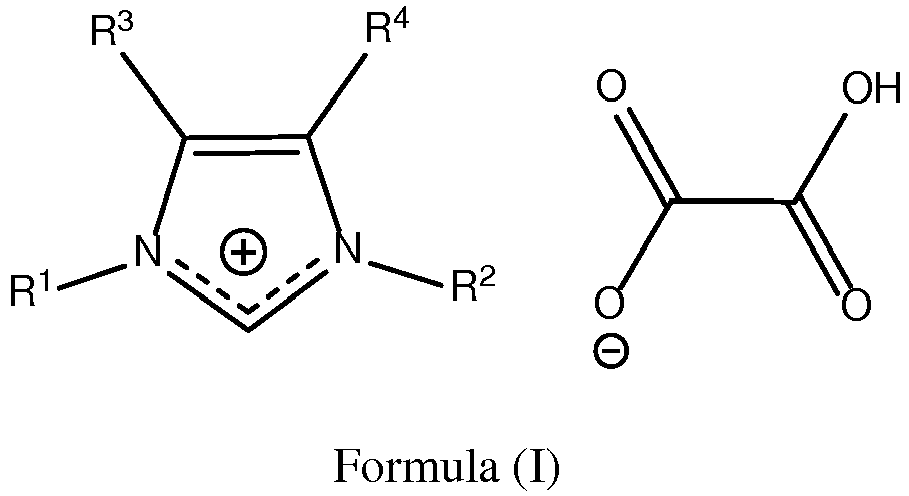
- R1 or R2 : may be identical or different and each is selected from the group of H, aryl, alkyl, alkene, alkyne, cycloalkyl, cycloalkene, heteroalkyl, heteroaryl or heterocycloalkyl group; optionally substituted by at least one group selected from aryl, hydroxyl, oxo, nitro, amido, carboxy, amino, cyano, alkoxy, alkyl, alkene, alkyne, cycloalkyl, cycloalkene, heteroalkyl, heteroaryl or heterocycloalkyl group; preferably R1 and R2 are identical; more preferably, R1 and R2 are both alkyl chain substituted by an alkyl or aryl group;
- R3 or R4 : may be identical or different and each is selected from the group of H, aryl, alkyl, alkene, alkyne, alkoxy, cycloalkyl, cycloalkene, heteroalkyl, heteroaryl or heterocycloalkyl group; optionally substituted by at least one group selected from aryl, hydroxyl, oxo, nitro, amido, carboxy, amino, cyano, alkoxy, alkyl, alkene, alkyne, cycloalkyl, cycloalkene, heteroalkyl, heteroaryl or heterocycloalkyl group; preferably R3 and R4 are identical; more preferably, R3 and R4 are both H or alkyl group.
- According to one embodiment, the imidazolium salt of general formula (I) or (I') is 1,3-di-(phenylethyl)imidazolium hydrogenoxalate salt of formula (Ia):

- According to one embodiment, the imidazolium salt of general formula (I) or (I') is 1,3-di-(isobutyl)imidazolium hydrogenoxalate salt of formula (Ib):

- According to one embodiment, the imidazolium salts are bio-sourced compounds.
- This invention also relates to the use of the one-compartment electrochemical cell as defined above, for the preparation of imidazolium carboxylate compounds of general formula II:

- R1 or R2 : may be identical or different and each is selected from the group of H, aryl, alkyl, alkene, alkyne, cycloalkyl, cycloalkene, heteroalkyl, heteroaryl or heterocycloalkyl group; optionally substituted by at least one group selected from aryl, hydroxyl, oxo, nitro, amido, carboxy, amino, cyano, alkoxy, alkyl, alkene, alkyne, cycloalkyl, cycloalkene, heteroalkyl, heteroaryl or heterocycloalkyl group; preferably R1 and R2 are identical; more preferably, R1 and R2 are both alkyl chain substituted by an alkyl or aryl group;
- R3 or R4 : may be identical or different and each is selected from the group of H, aryl, alkyl, alkene, alkyne, alkoxy, cycloalkyl, cycloalkene, heteroalkyl, heteroaryl or heterocycloalkyl group; optionally substituted by at least one group selected from aryl, hydroxyl, oxo, nitro, amido, carboxy, amino, cyano, alkoxy, alkyl, alkene, alkyne, cycloalkyl, cycloalkene, heteroalkyl or heterocycloalkyl group; preferably R3 and R4 are identical; more preferably, R3 and R4 are both H or alkyl group;
- wherein the term "heteroalkyl" refers to a C1-C14 alkyl group having at least one atom that is not carbon or hydrogen, said atom being selected from N, S, P or O;
- wherein the term "heteroaryl" refers to a C6-C50 aryl group having at least one atom that is not carbon or hydrogen, said atom being selected from N, S, P or O;
- wherein the term "heterocycloalkyl" refers to a C3-C10 cycloalkyl group having at least one atom that is not carbon or hydrogen, said atom being selected from N, S, P or O.
- According to one embodiment, the use of the one-compartment electrochemical cell is implemented at room temperature.
- According to one embodiment, the preparation of imidazolium carboxylate compounds is implemented in only one step.
- This invention also relates to a cyclic process for delivering carbon dioxide stocked in a materialcomprising the following reaction steps:
- carbon dioxide delivering by contacting imidazolium carboxylate compound with oxalic acid leading to synthesis of imidazolium hydrogenoxalate salt;
- regeneration of imidazolium carboxylate compound by electrochemical process from imidazolium hydrogenoxalate salts obtained during the previous reaction step; wherein the regeneration step is implemented in a one-compartment electrochemical cell according to the present invention.
- According to one embodiment, the material is a solid or a liquid.
- According to one embodiment, the solid is a membrane support.
- In the present invention, the following terms have the following meanings:
- "Imidazolium salt" refers to any salt comprising an imidazolium moiety and a negative counter-ion;
- "Imidazolium carboxylate salt" refers to any salt comprising an imidazolium moiety and a counter-ion having at least one carboxylate group;
- "Imidazolium carboxylate compound" or "imidazolium 2-carboxylate" refers to one chemical compound comprising an imidazolium ring bearing one carboxylate group in position 2 of the imidazolium ring;
- "about" preceding a figure means plus or less 10% of the value of said figure;
- "alkyl" refers to compound of formula CnH2n+1, wherein n is a number greater than or equal to 1. Generally, alkyl groups of this invention comprise from 1 to 14 carbon atoms. Alkyl groups may be linear or branched and may be substituted. Examples of alkyl groups are methyl, ethyl, n-propyl, i-propyl, butyl and its isomers (e.g. n-butyl, i-butyl and t-butyl); pentyl and its isomers, hexyl and its isomers.
- "alkene" refers to any linear or branched hydrocarbon chain having at least one double bond, preferably 2 to 12 carbon atoms;
- "alkyne" refers to any linear or branched hydrocarbon chain having at least one triple carbon bond; preferably 2 to 12 carbon atoms;
- "aryl" refers to any polyunsaturated, aromatic hydrocarbyl group having a single ring (i.e. phenyl) or multiple aromatic rings fused together (e.g. naphtyl) or linked covalently, typically containing 6 to 50 atoms; preferably 6 to 10, wherein at least one ring is aromatic;
- "heteroaryl" refers to aryl group having at least one atom that is not carbon or hydrogen; preferably, said atom is selected from N, S, P or O;
- "cycloalkyl" refers to a cyclic alkyl group, that is to say, a monovalent, saturated, or unsaturated hydrocarbyl group having 1 or 2 cyclic structure. Cycloalkyl includes all saturated hydrocarbon groups containing 1 to 2 rings, including monocyclic or bicyclic groups. Cycloalkyl groups may comprise 3 or more carbon atoms in the ring and generally, according to this invention comprise from 3 to 10, more preferably from 3 to 8 carbon atoms still more preferably from 3 to 6 carbon atoms. The further rings of multiring cycloalkyls may be either fused, bridged and/or joined through one or more spiro atoms. Examples of cycloalkyl groups include but are not limited to cyclopropyl, cyclobutyl, cyclopentyl, cyclohexyl;
- "cycloalkene" refers to a cyclic alkene group that is to say, a monovalent, saturated, or unsaturated hydrocarbyl group having 1 or 2 cyclic structure. Cycloalkene includes all unsaturated hydrocarbon groups containing 1 to 2 rings, including monocyclic or bicyclic groups. Cycloalkene groups may comprise 3 or more carbon atoms in the ring and generally, according to this invention comprise from 3 to 10, more preferably from 3 to 8 carbon atoms still more preferably from 3 to 6 carbon atoms. The further rings of multiring cycloalkene may be either fused, bridged and/or joined through one or more spiro atoms. Examples of cycloalkene groups include but are not limited to cyclopropenyl, cyclobutenyl, cyclopentenyl, cyclohexenyl;
- "heteroalkyl" refers to alkyl group having at least one atom that is not carbon or hydrogen; preferably, said atom is selected from N, S, P or O;
- "heterocycloalkyl" refers to a cycloalkyl group having at least one atom that is not carbon or hydrogen; preferably, said atom is selected from N, S, P or O;
- "oxalyl" or "oxalo" or "diacyl" refers to a compound bearing a vicinal diketone group, e.g. two C=O groups, side-by-side;
- "aldehyde" refers to an organic compound comprising at least one formyl group of general formula R-CHO, wherein R represents a substituted or unsubstituted group selected from aryl or alkyl group. In the present invention, aldehyde is preferably paraformaldehyde or formaldehyde;
- "cathode" refers to the electrode at which the reduction reaction occurs;
- "anode" refers to the electrode at which the oxidation reaction occurs;
- "oxidation" refers to an electrochemical reaction in which the atoms in an element lose electrons;
- "reduction" refers to an electrochemical reaction in which the atoms in an element gain electrons;
- "electrolyte" refers to the conductive liquid medium through which electricity can pass such as for example, ionic liquids or any solvent combined with chemical salts;
- "oxo" refers to the -C=O function;
- "alkoxy" refers to any O-alkyl or O-aryl group;
- "hydroxyl" refers to the -OH function;
- "nitro" refers to the -NO2 function;
- "cyano" refers to the -C=N function;
- "amino" refers to the -NR2 function wherein each group R may be independently chosen among -H or an alkyl group;
- "amido" refers to the -NR-CO- function wherein R may be -H or an alkyl group;
- "carboxy" refers to the -COOH function;
- "electrochemical cell" refers to a device that generates a potential difference between electrodes;
- "conjugate base" refers to chemical compound obtained by deprotonation of the corresponding acid; the conjugate based and its corresponding acid form an acid/base pair characterized by its pKa;
- "pKa" refers to the negative logarithm of the ionization constant (Ka) of an acid characterizing the balance of an acid/base pair.
- Disclosed is a process for preparation of isolable imidazolium carboxylate compounds of general formula (II):

- R1 or R2 : may be identical or different and each is selected from the group of H, aryl, alkyl, alkene, alkyne, cycloalkyl, cycloalkene, heteroalkyl, heteroaryl or heterocycloalkyl group; optionally substituted by at least one group selected from aryl, hydroxyl, oxo, nitro, amido, carboxy, amino, cyano, alkoxy, alkyl, alkene, alkyne, cycloalkyl, cycloalkene, heteroalkyl, heteroaryl or heterocycloalkyl group; preferably R1 and R2 are identical; more preferably, R1 and R2 are both alkyl chain substituted by an alkyl or aryl group;
- R3 or R4 : may be identical or different and each is selected from the group of H, aryl, alkyl, alkene, alkyne, alkoxy, cycloalkyl, cycloalkene, heteroalkyl, heteroaryl or heterocycloalkyl group; optionally substituted by at least one group selected from aryl, hydroxyl, oxo, nitro, amido, carboxy, amino, cyano, alkoxy, alkyl, alkene, alkyne, cycloalkyl, cycloalkene, heteroalkyl, heteroaryl or heterocycloalkyl group; preferably R3 and R4 are identical; more preferably, R3 and R4 are both H, alkyl group or aryl group;
- and derivatives thereof, comprising:
- introducing a supporting electrolyte comprising imidazolium salts, which may be a ionic liquid, in an electrochemical cell;
- synthetizing imidazolium carboxylate compounds by electrochemical reaction in one step and at room temperature; and wherein the electrochemical cell does not comprise two compartments.
- In one embodiment, R1 and R3 may represent one fused substituent selected from the group of aryl, heteroaryl, cycloalkyl, cycloalkane or heterocycloalkyl; optionally substituted by at least one group selected from aryl, hydroxyl, oxo, nitro, amido, carboxy, amino, cyano, alkoxy, alkyl, alkene, alkyne, cycloalkyl, cycloalkene, heteroalkyl or heterocycloalkyl group; preferably fused R1 and R3 are one aryl group optionally substituted by at least one group selected from hydroxyl, oxo, nitro, amido, carboxy, amino, cyano, alkoxy, alkyl, alkene or alkyne.
- In one embodiment, R2 and R4 may represent one fused substituent selected from the group of aryl, heteroaryl, cycloalkyl, cycloalkane or heterocycloalkyl; optionally substituted by at least one group selected from aryl, hydroxyl, oxo, nitro, amido, carboxy, amino, cyano, alkoxy, alkyl, alkene, alkyne, cycloalkyl, cycloalkene, heteroalkyl or heterocycloalkyl group; preferably fused R2 and R4 are one aryl group optionally substituted by at least one group selected from hydroxyl, oxo, nitro, amido, carboxy, amino, cyano, alkoxy, alkyl, alkene or alkyne.
- In one embodiment, R3 and R4 may represent one fused substituent selected from the group of aryl, heteroaryl, cycloalkyl, cycloalkane or heterocycloalkyl; optionally substituted by at least one group selected from aryl, hydroxyl, oxo, nitro, amido, carboxy, amino, cyano, alkoxy, alkyl, alkene, alkyne, cycloalkyl, cycloalkene, heteroalkyl or heterocycloalkyl group; preferably fused R3 and R4 are one aryl group optionally substituted by at least one group selected from hydroxyl, oxo, nitro, amido, carboxy, amino, cyano, alkoxy, alkyl, alkene or alkyne.
- According to one embodiment, preferred compounds of formula (II) are compounds which are symmetric. In one embodiment, preferred compounds of formula (II) are compounds wherein R1 and R2 are identical. In one embodiment, preferred compounds of formula (II) are compounds wherein R1 and R2 are identical and are selected from the group of aryl, alkyl, alkene, alkyne, cycloalkyl, cycloalkene, heteroalkyl, heteroaryl or heterocycloalkyl group; optionally substituted by at least one group selected from aryl, hydroxyl, oxo, nitro, amido, carboxy, amino, cyano, alkoxy, alkyl, alkene, alkyne, cycloalkyl, cycloalkene, heteroalkyl, heteroaryl or heterocycloalkyl group; preferably R1 and R2 are both alkyl chain substituted by an alkyl or aryl group.
- According to one embodiment, preferred compounds of formula (II) are compounds wherein R1 and R2 are not H. In one embodiment, preferred compounds of formula (II) are compounds wherein R1 or R2 may be identical or different and each is selected from the group of aryl, alkyl, alkene, alkyne, cycloalkyl, cycloalkene, heteroalkyl, heteroaryl or heterocycloalkyl group; optionally substituted by at least one group selected from aryl, hydroxyl, oxo, nitro, amido, carboxy, amino, cyano, alkoxy, alkyl, alkene, alkyne, cycloalkyl, cycloalkene, heteroalkyl, heteroaryl or heterocycloalkyl group; preferably R1 and R2 are identical; more preferably, R1 and R2 are both alkyl chain substituted by an alkyl or aryl group.
- According to one embodiment, preferred compounds of formula (II) are compounds wherein R3 and R4 both represent an atom H. In one embodiment, preferred compounds of formula (II) are selected from 1,3-dialkylimidazolium carboxylate, 1,3-di(arylalkyl)imidazolium carboxylate or 1,3-diarylimidazolium carboxylate. In one embodiment, preferred compounds of formula (II) are 1,3-dialkylimidazolium carboxylate. In one embodiment, preferred compounds of formula (II) are 1,3-di(arylalkyl)imidazolium carboxylate. In one embodiment, preferred compounds of formula (II) are 1,3-diarylimidazolium carboxylate.
- According to one embodiment, the electrochemical cell further comprises a carbon dioxide source.
- According to one embodiment, the electrochemical cell comprises at least two electrodes; preferably the electrochemical cell comprises three electrodes: one working electrode, one reference electrode and one auxiliary electrode.
- For electrochemical reduction, the working electrode may be a suitable conductive electrode selected from at least one Al, Au, Ag, Boron doped diamond, C, Cd, Co, Cr, Cu, Cu alloys, Ga, Hg, In, Ir, Mg, Mo, Nb, Ni, Ni alloys, lead oxide, Li-Fe alloys, Os, Pb, Pd, Pt, Rh, Ru, Sn, Sn alloys, Ti, V, W, Zn, elgiloy, austenitic steel, duplex steel, ferritic steel, martensitic steel, stainless steel, degenerately doped p-Si, degenerately doped p-Si:As and degenerately p-Si: B; preferably the electrode is C, Pt or stainless steel.
- According to one embodiment, the auxiliary electrode may be a suitable conductive electrode selected from at least one Al, Au, Ag, Boron doped diamond, C, Cd, Co, Cr, Cu, Cu alloys, Ga, Hg, In, Ir, Mg, Mo, Nb, Ni, Ni alloys, lead oxide, Li-Fe alloys, Os, Pb, Pd, Pt, Rh, Ru, Sn, Sn alloys, Ti, V, W, Zn, elgiloy, austenitic steel, duplex steel, ferritic steel, martensitic steel, stainless steel, degenerately doped p-Si, degenerately doped p-Si:As and degenerately p-Si: B; preferably the electrode is C, Pt or stainless steel.
- According to one embodiment, the reference electrode is selected from saturated calomel electrode (SCE), silver-silver chloride electrode (Ag/AgCl) or Ag/AgNO3; preferably the reference electrode is SCE.
- According to one embodiment, the electrical potential applied at the working electrode ranges from about 0 volt to -4 volts versus the SCE; preferably the electrical potential ranges from -1.5 volts to -3 volts versus the SCE.
- According to one embodiment, the current during the process of invention is applied or not; preferably the current is applied and the current density ranges from 1 mA/m2 to 4 kA/m2.
- According to one embodiment, the supporting electrolyte is selected from solid or liquid compounds, water or organic liquid comprising ionic liquids, salts such as Na2SO4 NaNO3, K2SiO3, ions such as a H cation, a Li cation, a Na cation, a K cation, a Rb cation, a Cs cation, an ammonium cation, an alkylammonium cation, an alkyl amine, borates, carbonates, nitrites, nitrates, phosphates, polyphosphates, silicates, sulfates and tetralkyl ammonium salt, organic solvents or carboxylic acids. According to one preferred embodiment the electrolyte is tetrabutylammonium hexafluorophosphate (TBAPF6), tetraethylammonium hexafluorophosphate (TEAPF6), or imidazolium salts.
- According to one embodiment, the electrolyte is not solid. In one embodiment, the electrolyte is not a gel. In one embodiment, the electrolyte is not a layer. In one embodiment, the electrolyte is not a gel. In one embodiment, the electrolyte is not a polymer. In one embodiment, the electrolyte is not polymerizable. In one embodiment, the electrolyte does not comprise polymerizable functions such as, but not limited to, vinyl, acrylate or methacrylate function. In one embodiment, the imidazolium salts are not polymerizable. In one embodiment, the imidazolium salts do not comprise polymerizable functions such as, but not limited to, vinyl, acrylate or methacrylate function. In one embodiment, the electrolyte is not cellulose or any derivatives thereof.
- According to one embodiment, the electrolyte does not comprise any acid scavenger.
- According to one embodiment, the electrolyte does not comprise any ionic liquids.
- According to one embodiment, the electrolyte does not comprise benzimidazolium compound and/or salt.
- According to one embodiment, the electrolyte does not comprise aluminium chloride.
- According to one embodiment, the electrolyte does not comprise any dyes and/or pigments.
- According to one embodiment, the electrolyte is not aqueous.
- According to one embodiment, the supporting electrolyte is selected from bio-sourced compounds. In one embodiment, the electrolyte is sourced from biomass; preferably selected from agricultural crops and residues; forestry crops and residues, animal residues; more preferably, from corn, sugar beet or potatoes.
- According to one embodiment, the supporting electrolyte is used at a concentration ranging from 0.01 mol/L to a saturated solution; preferably is the highest concentration. According to one embodiment, the solvent used in the process of invention is selected from organic solvents; preferably polar and aprotic solvents, ionic liquids, bio-based solvents or mixed solvents; more preferably is dimethylformamide, acetonitrile or bio-based solvents.
- It is understood by room temperature in the process of the invention a temperature ranging from 15 °C to 40 °C; preferably the temperature is 25 °C.
- According to one embodiment, the faradaic yield of desired products ranges from 50 % to 100 %.
- According to one embodiment, the electrochemical cell is not a photoelectrochemical cell.
- According to one embodiment, the electrochemical cell is flexible.
- In this process, compounds with formula (II) are obtained by electro-reduction of imidazolium salts as shown in scheme 1:

- In the same time, the electrolyte or the counter-ion of imidazolium salts used in the process of the invention is oxidized. As the great majority of counter-ions or electrolytes are halo compounds, the final products of the electrosynthesis are often contaminated and need a purification step. In order to improve this process, the Applicant have worked for optimization of the oxidation step; especially, in order to provide a process wherein the subproducts of oxidation step are easy to eliminate at the end of the reaction and allowing to provide final products with a high purity degree.
- Surprisingly, the Applicant has found that the use of carboxylate ion as counter-ion of imidazolium salts allows achieving these goals and enables to provide an electrochemical material easier to use for industrial purposes.
- Consequently, the invention also relates to a process for preparation of imidazolium carboxylate compounds of general formula (II):

comprising: - introducing a supporting electrolyte comprising imidazolium carboxylate salts in an electrochemical cell; preferably a solution of imidazolium hydrogenoxalate salts;
- synthesizing imidazolium 2-carboxylate by electrochemical reaction in one step and at room temperature.
- According to one embodiment, the process may provide a subproduct having general formula (III):

- According to one embodiment, the process further comprises a step of hydrolysis. In one embodiment, the step of hydrolysis provides the compounds of general formula (III) or a mixture of compounds of general formula (II) and of formula (III).
- According to one embodiment, the electrochemical cell comprises at least two electrodes; preferably the electrochemical cell comprises one working electrode, one reference electrode and one auxiliary electrode; more preferably the electrochemical cell does not comprise any reference electrode.
- For electrochemical reduction and oxidation, the electrodes are identical or not and may be a suitable conductive electrode selected from at least one Al, Au, Ag, Boron doped diamond, C, Cd, Co, Cr, Cu, Cu alloys, Ga, Hg, In, Ir, Mg, Mo, Nb, Ni, Ni alloys, lead oxide, Li-Fe alloys, Os, Pb, Pd, Pt, Rh, Ru, Sn, Sn alloys, Ti, V, W, Zn, elgiloy, austenitic steel, duplex steel, ferritic steel, martensitic steel, stainless steel, degenerately doped p-Si, degenerately doped p-Si:As and degenerately p-Si: B; preferably the electrode is C, Pt or stainless steel.
- According to one preferred embodiment, the products of the oxidation step do not contaminate the products of the reduction step.
- According to one embodiment, the process of the invention is led under anhydrous conditions or not; preferably under anhydrous conditions.
- According to one embodiment, the supporting electrolyte is the starting material; preferably the supporting electrolyte is imidazolium salt; more preferably is selected from the group of imidazolium hydrogenoxalate salts.
- According to one embodiment, the subproducts of the oxidation reaction during the electrolysis are non-toxic compounds, easy to remove from the final reaction medium; preferably at least one subproduct is a gaseous compound; more preferably is carbon dioxide.
- According to one embodiment, the solvent used in the process of invention is selected from organic solvents; preferably from aprotic and highly ionic solvents; more preferably the solvent is dimethylformamide, acetonitrile or a polar bio-based solvent.
- According to one embodiment, the electrochemical cell further comprises a carbon dioxide source.
- According to one embodiment, the temperature used in the process of the invention is ranging from 15 °C to 40 °C; preferably the temperature is 25 °C.
- According to one embodiment, the faradaic yield of desired products ranges from 50 % to 100 %.
- In particular, disclosed is a one-compartment electrochemical cell comprising:
- a cathode;
- an anode;
- a halogen-free supporting electrolyte comprising compounds of general formula (I'):

- R1 or R2 : may be identical or different and each is selected from the group of H, aryl, alkyl, alkene, alkyne, cycloalkyl, cycloalkene, heteroalkyl or heterocycloalkyl group; optionally substituted by at least one group selected from aryl, hydroxyl, oxo, nitro, amido, carboxy, amino, cyano, alkoxy, alkyl, alkene,
alkyne, cycloalkyl, cycloalkene, heteroalkyl or heterocycloalkyl group; preferably R1 and R2 are identical; more preferably, R1 and R2 are both alkyl chain substituted by an alkyl or aryl group; - R3 or R4 : may be identical or different and each is selected from the group of H, aryl, alkyl, alkene, alkyne, alkoxy, cycloalkyl, cycloalkene, heteroalkyl or heterocycloalkyl group; optionally substituted by at least one group selected from aryl, hydroxyl, oxo, nitro, amido, carboxy, amino, cyano, alkoxy, alkyl, alkene, alkyne, cycloalkyl, cycloalkene, heteroalkyl or heterocycloalkyl group; preferably R3 and R4 are identical; more preferably, R3 and R4 are both H or alkyl group;
- R5 is selected from the group of H, aryl, alkyl, alkene, alkyne, alkoxy, cycloalkyl, cycloalkene, heteroalkyl or heterocycloalkyl group; optionally substituted by at least one group selected from aryl, hydroxyl, oxo, nitro, amido, carboxy, amino, cyano, alkoxy, alkyl, alkene, alkyne, cycloalkyl, cycloalkene, heteroalkyl or heterocycloalkyl group; preferably R5 is H or a carboxy group.
- R1 or R2 : may be identical or different and each is selected from the group of H, aryl, alkyl, alkene, alkyne, cycloalkyl, cycloalkene, heteroalkyl or heterocycloalkyl group; optionally substituted by at least one group selected from aryl, hydroxyl, oxo, nitro, amido, carboxy, amino, cyano, alkoxy, alkyl, alkene,
- In one embodiment, R1 and R3 may represent one fused substituent selected from the group of aryl, heteroaryl, cycloalkyl, cycloalkane or heterocycloalkyl; optionally substituted by at least one group selected from aryl, hydroxyl, oxo, nitro, amido, carboxy, amino, cyano, alkoxy, alkyl, alkene, alkyne, cycloalkyl, cycloalkene, heteroalkyl or heterocycloalkyl group; preferably fused R1 and R3 are one aryl group optionally substituted by at least one group selected from hydroxyl, oxo, nitro, amido, carboxy, amino, cyano, alkoxy, alkyl, alkene or alkyne.
- In one embodiment, R2 and R4 may represent one fused substituent selected from the group of aryl, heteroaryl, cycloalkyl, cycloalkane or heterocycloalkyl; optionally substituted by at least one group selected from aryl, hydroxyl, oxo, nitro, amido, carboxy, amino, cyano, alkoxy, alkyl, alkene, alkyne, cycloalkyl, cycloalkene, heteroalkyl or heterocycloalkyl group; preferably fused R2 and R4 are one aryl group optionally substituted by at least one group selected from hydroxyl, oxo, nitro, amido, carboxy, amino, cyano, alkoxy, alkyl, alkene or alkyne.
- In one embodiment, R3 and R4 may represent one fused substituent selected from the group of aryl, heteroaryl, cycloalkyl, cycloalkane or heterocycloalkyl; optionally substituted by at least one group selected from aryl, hydroxyl, oxo, nitro, amido, carboxy, amino, cyano, alkoxy, alkyl, alkene, alkyne, cycloalkyl, cycloalkene, heteroalkyl or heterocycloalkyl group; preferably fused R3 and R4 are one aryl group optionally substituted by at least one group selected from hydroxyl, oxo, nitro, amido, carboxy, amino, cyano, alkoxy, alkyl, alkene or alkyne.
- According to one embodiment, the anion of compound of general formula (I') is not formate.
- According to one embodiment, compounds of formula (I') do not comprise the following compounds:
- 1-methyl-1H-imidazolium formate;
- 1-ethyl-1H-imidazolium formate;
- 1-propyl-1H-imidazolium formate;
- 1-butyl-1H-imidazolium formate.
- According to one embodiment, preferred compounds of formula (I') are compounds which are symmetric. In one embodiment, preferred compounds of formula (I') are compounds wherein R1 and R2 are identical. In one embodiment, preferred compounds of formula (I') are compounds wherein R1 and R2 are identical and are selected from the group of aryl, alkyl, alkene, alkyne, cycloalkyl, cycloalkene, heteroalkyl or heterocycloalkyl group; optionally substituted by at least one group selected from aryl, hydroxyl, oxo, nitro, amido, carboxy, amino, cyano, alkoxy, alkyl, alkene, alkyne, cycloalkyl, cycloalkene, heteroalkyl or heterocycloalkyl group; preferably, R1 and R2 are both alkyl chain substituted by an alkyl or aryl group. In one embodiment, preferred compounds of formula (I') are compounds wherein R1 or R2 may be identical or different and each is selected from the unsubstituted group of aryl, alkyl, alkene, alkyne, cycloalkyl, cycloalkene, heteroalkyl or heterocycloalkyl group. In one embodiment, preferred compounds of formula (I') are compounds wherein R1 or R2 may be identical or different and each is selected from the group of aryl, alkyl, alkene, alkyne, cycloalkyl, cycloalkene, heteroalkyl or heterocycloalkyl group, said group being substituted by at least one group selected from aryl, hydroxyl, oxo, amido, carboxy, amino, cyano, alkoxy, alkyl, alkene, alkyne, cycloalkyl, cycloalkene, heteroalkyl or heterocycloalkyl group.
- According to one embodiment, preferred compounds of formula (I') are compounds wherein R1 and R2 are not H. In one embodiment, preferred compounds of formula (I') are compounds wherein R1 or R2 may be identical or different and each is selected from the group of aryl, alkyl, alkene, alkyne, cycloalkyl, cycloalkene, heteroalkyl or heterocycloalkyl group; optionally substituted by at least one group selected from aryl, hydroxyl, oxo, nitro, amido, carboxy, amino, cyano, alkoxy, alkyl, alkene, alkyne, cycloalkyl, cycloalkene, heteroalkyl or heterocycloalkyl group; preferably R1 and R2 are identical; more preferably, R1 and R2 are both alkyl chain substituted by an alkyl or aryl group.
- According to one embodiment, R5 is not H. According to one embodiment, R5 is selected from the group of aryl, alkyl, alkene, alkyne, alkoxy, cycloalkyl, cycloalkene, heteroalkyl or heterocycloalkyl group; optionally substituted by at least one group selected from aryl, hydroxyl, oxo, nitro, amido, carboxy, amino, cyano, alkoxy, alkyl, alkene, alkyne, cycloalkyl, cycloalkene, heteroalkyl or heterocycloalkyl group; preferably R5 is a carboxy group.
- According to one embodiment, preferred compounds of formula (I') are compounds wherein R1. R2, R3 and R4 do not comprise more than 5 carbon atoms. In one embodiment, preferred compounds of formula (I') are compounds wherein R1 and R2 represents an alkyl or an alkene chain having less than 5 carbon atoms. In one embodiment, preferred compounds of formula (I') are compounds wherein R1 represents an alkyl or an alkene chain having less than 5 carbon atoms. In one embodiment, preferred compounds of formula (I') are compounds wherein R2 represents an alkyl or an alkene chain having less than 5 carbon atoms. In one embodiment, preferred compounds of formula (I') are compounds wherein R3 represents an alkyl or an alkene chain having less than 5 carbon atoms. In one embodiment, preferred compounds of formula (I') are compounds wherein R4 represents an alkyl or an alkene chain having less than 5 carbon atoms.
- For electrochemical reduction and oxidation, the electrodes are identical or not and may be a suitable conductive electrode selected from at least one Al, Au, Ag, Boron doped diamond, C, Cd, Co, Cr, Cu, Cu alloys, Ga, Hg, In, Ir, Mg, Mo, Nb, Ni, Ni alloys, lead oxide, Li-Fe alloys, Os, Pb, Pd, Pt, Rh, Ru, Sn, Sn alloys, Ti, V, W, Zn, elgiloy, austenitic steel, duplex steel, ferritic steel, martensitic steel, stainless steel, degenerately doped p-Si, degenerately doped p-Si:As and degenerately p-Si: B; preferably the electrode is C, Pt or stainless steel.
- According to one embodiment, the electrochemical cell is not a photoelectrochemical cell.
- According to one embodiment, the electrochemical cell is flexible.
- According to one embodiment, the halogen-free supporting electrolyte is selected from the group of imidazolium hydrogenoxalate salts of general formula (I):

- Formula (I) corresponds to the general formula (I') wherein R5 is carboxyl group.
- Imidazolium carboxylate salts of the present invention are more specifically represented by compounds of formula (Ia) and (Ib):


- According to one preferred embodiment, the imidazolium salts are bio-based compounds. In one embodiment, the electrolyte is sourced from biomass; preferably selected from agricultural crops and residues; forestry crops and residues, animal residues; more preferably, from corn, sugar beet or potatoes.
- The invention relates also the use of the one-compartment electrochemical cell as described above for the preparation of imidazolium carboxylate compounds of general formula (II):

- According to one embodiment, the preparation of imidazolium carboxylate compounds is implemented in only one step.
- According to one embodiment, the imidazolium salts are the only carbon dioxide source.
- According to one embodiment, the products of the oxidation step do not contaminate the products of the reduction step.
- According to one embodiment, the subproducts of the oxidation reaction during the electrolysis are non-toxic compounds, easy to remove from the final reaction medium; preferably at least one subproduct is a gaseous compound; more preferably is carbon dioxide.
- According to one embodiment, the use of the one-compartment electrochemical cell is led under anhydrous conditions or not; preferably under anhydrous conditions.
- According to one embodiment, the use of the one-compartment electrochemical cell is implemented at room temperature.
- Also disclosed is a process for preparation of imidazolium carboxylate salts of general formula (I'):

comprising: - mixing a solution of bio-based primary amines, a carboxylic acid compound an aldehyde compound and an oxalyl compound.
- The method for preparation of compounds with formula (I') is shown in scheme 2:
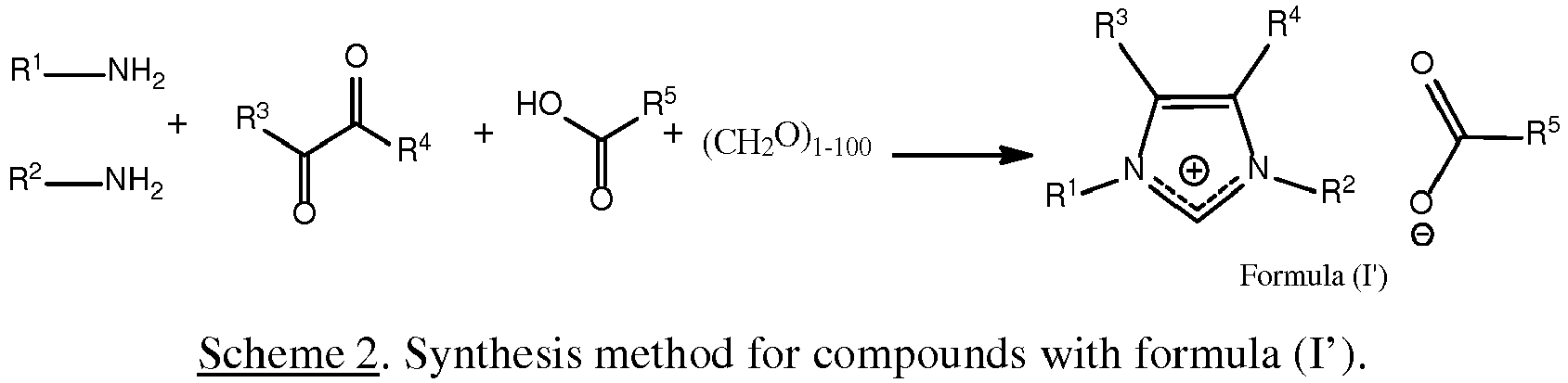
- According to one embodiment, the reagents used in the process of the invention are selected from commercially available chemical compounds or bio-based compounds; preferably bio-based compounds; more preferably the reagents used in the process of the invention are extracted from biomass.
- According to one preferred embodiment, the primary amines used in the process of the invention are bio-based compounds selected from the group comprising spermidine, putrescine, spermine, mercaptoethylamine, histamine, phenylethylamine, ethanolamine, serotonine, cadaverine; preferably phenylethylamine or isobutylamine.
- According to one preferred embodiment, the bio-based primary amines used in the process of the invention are obtained from decarboxylation of chemical or bio-based amino-acids. In one preferred embodiment, the bio-based primary amines are obtained from decarboxylation of bio-based amino-acids selected from the group comprising spermidine, putrescine, spermine, mercaptoethylamine, histamine, phenylethylamine, ethanolamine, serotonine, cadaverine; preferably, the bio-based amino-acids are selected from phenylethylamine or isobutylamine.
- According to one preferred embodiment, the primary amines are compounds extracted by physical, chemical or enzymatical way.
- According to one embodiment, the oxalyl compounds used in the process of the invention are selected from any organic compound bearing an oxalyl group; preferably the oxalyl compound is ethanedial, 2,3-butanedione or benzil.
- According to one embodiment, the aldehyde compound used in the process of the invention is selected from any organic compound bearing a formyl group; preferably the aldehyde compound is formaldehyde or paraformaldehyde.
- According to one preferred embodiment, the carboxylic acid compounds used in the process of the invention are selected from the group of organic compounds bearing at least one carboxyl group; preferably two carboxyl groups.
- According to a very preferred embodiment, the carboxylic acid used in the process of the invention is oxalic or formic acid. In one embodiment, the carboxylic acid used in the process of the invention is oxalic acid. In one embodiment, the oxalic acid may be extracted from starch, sawdust or cellulose. In one embodiment, the carboxylic acid used in the process of the invention is not formic acid.
- According to one embodiment, the solvent is water or an organic solvent; preferably the solvent is benign for environment or a bio-based solvent.
- According to one embodiment, the temperature used in the process of the invention is ranging from 0 °C to 150 °C; preferably the temperature is ranging from 25 °C to 80 °C.
- According to one embodiment, the molar ratio of carboxylic and oxalyl compounds is ranging from 0 to 1; preferably the molar ratio is 1.
- In another aspect, the invention also relates to a cyclic process for delivering dioxide carbon stocked in a material, membrane support, solid or liquid, comprising the following reaction steps:
- carbon dioxide delivering by contacting imidazolium carboxylate compound with oxalic acid or formic acid leading to synthesis of imidazolium hydrogenoxalate or imidazolium formate salt;
- regeneration of imidazolium carboxylate compound by electrochemical process from imidazolium hydrogenoxalate or imidazolium formate salts obtained during the previous reaction step.
- The method for delivering dioxide carbon includes the steps shown in scheme 3:


- According to one embodiment, the temperature used during the dioxide carbon delivering step and/or the regeneration step is ranging from 15 °C to 80 °C, preferably is about 20 °C. According to a one embodiment, the imidazolium hydrogenoxalate salts used in the process of invention are compounds of general formula (I):
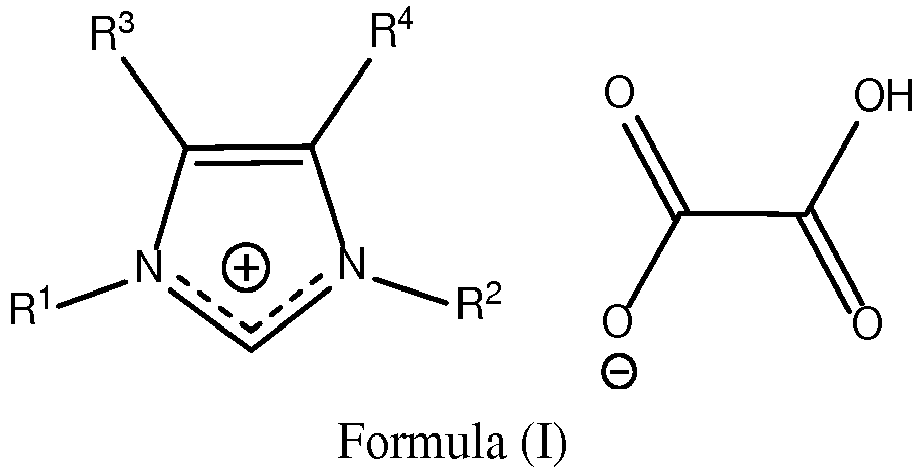
- According to one embodiment, the regeneration step is implemented in the one-compartment electrochemical cell as described above.
- Also disclosed are compounds with general formula (II):

- According to one embodiment, preferred compounds of formula (II) are compounds which are symmetric.
- According to one embodiment, preferred compounds of formula (II) are compounds wherein R3 and R4 both represent an atom H. In one embodiment, preferred compounds of formula (II) are selected from 1,3-dialkylimidazolium carboxylate, 1,3-di(arylalkyl)imidazolium carboxylate or 1,3-diarylimidazolium carboxylate. In one embodiment, preferred compounds of formula (II) are 1,3-dialkylimidazolium carboxylate. In one embodiment, preferred compounds of formula (II) are 1,3-di(arylalkyl)imidazolium carboxylate. In one embodiment, preferred compounds of formula (II) are 1,3-diarylimidazolium carboxylate.
- In one embodiment, preferred compounds of formula (II) are compounds of Table 1:
Table 1 Cpd n° Structure and chemical name 1 
2-Methylpyrido[1,2-c]imidazolium-3-carboxylate 2 
2,10-Di-tert-butyl-dipyrido[1,2-c;2',1'-e]imidazolium-6-carboxylate 3 
1,3-diisobutylimidazolium-2-carboxylate 4 
1,3 -diphenylmethylimidazolium-2 -carboxylate 5 
1,3-diphenylethylimidazolium-2-carboxylate 6 
1,3-di(2,4,6-trimethyl)phenylimidazolium-2-carboxylate 7 
1,3-di(2,6-diisopropyl)phenylimidazolium-2-carboxylate 8 
1,3-di(1-pyrenyl)imidazolium-2-carboxylate 9 
1,3-methyl(1-pyrenyl)imidazolium-2-carboxylate - In Table 1, « Cpd » means compounds. Also disclosed are compounds with general formula (I'):
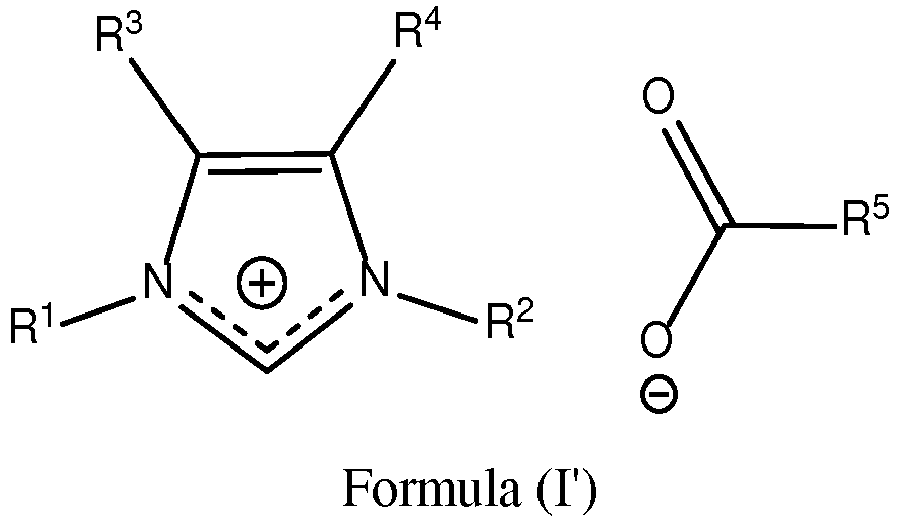
- R1 or R2 : may be identical or different and each is selected from the group of H, aryl, alkyl, alkene, alkyne, cycloalkyl, cycloalkene, heteroalkyl, heteroaryl or heterocycloalkyl group; optionally substituted by at least one group selected from aryl, hydroxyl, oxo, nitro, amido, carboxy, amino, cyano, alkoxy, alkyl, alkene, alkyne, cycloalkyl, cycloalkene, heteroalkyl, heteroaryl or heterocycloalkyl group; preferably R1 and R2 are identical; more preferably, R1 and R2 are both alkyl chain substituted by an alkyl or aryl group or R1 and R2 are both aryl group;
- R3 or R4 : may be identical or different and each is selected from the group of H, aryl, alkyl, alkene, alkyne, alkoxy, cycloalkyl, cycloalkene, heteroalkyl, heteroaryl or heterocycloalkyl group; optionally substituted by at least one group selected from aryl, hydroxyl, oxo, nitro, amido, carboxy, amino, cyano, alkoxy, alkyl, alkene, alkyne, cycloalkyl, cycloalkene, heteroalkyl, heteroaryl or heterocycloalkyl group; preferably R3 and R4 are identical; more preferably, R3 and R4 are both H or alkyl group;
- R5 is selected from the group of H, aryl, alkyl, alkene, alkyne, alkoxy, cycloalkyl, cycloalkene, heteroalkyl or heterocycloalkyl group; optionally substituted by at least one group selected from aryl, hydroxyl, oxo, nitro, amido, carboxy, amino, cyano, alkoxy, alkyl, alkene, alkyne, cycloalkyl, cycloalkene, heteroalkyl or heterocycloalkyl group; preferably R5 is H or a carboxyl group.
- In one embodiment, R1 and R3 may represent one fused substituent selected from the group of aryl, heteroaryl, cycloalkyl, cycloalkane or heterocycloalkyl; optionally substituted by at least one group selected from aryl, hydroxyl, oxo, nitro, amido, carboxy, amino, cyano, alkoxy, alkyl, alkene, alkyne, cycloalkyl, cycloalkene, heteroalkyl or heterocycloalkyl group; preferably fused R1 and R3 are one aryl group
optionally substituted by at least one group selected from hydroxyl, oxo, nitro, amido, carboxy, amino, cyano, alkoxy, alkyl, alkene or alkyne. - In one embodiment, R2 and R4 may represent one fused substituent selected from the group of aryl, heteroaryl, cycloalkyl, cycloalkane or heterocycloalkyl; optionally substituted by at least one group selected from aryl, hydroxyl, oxo, nitro, amido, carboxy, amino, cyano, alkoxy, alkyl, alkene, alkyne, cycloalkyl, cycloalkene, heteroalkyl or heterocycloalkyl group; preferably fused R2 and R4 are one aryl group optionally substituted by at least one group selected from hydroxyl, oxo, nitro, amido, carboxy, amino, cyano, alkoxy, alkyl, alkene or alkyne.
- In one embodiment, R3 and R4 may represent one fused substituent selected from the group of aryl, heteroaryl, cycloalkyl, cycloalkane or heterocycloalkyl; optionally substituted by at least one group selected from aryl, hydroxyl, oxo, nitro, amido, carboxy, amino, cyano, alkoxy, alkyl, alkene, alkyne, cycloalkyl, cycloalkene, heteroalkyl or heterocycloalkyl group; preferably fused R3 and R4 are one aryl group optionally substituted by at least one group selected from hydroxyl, oxo, nitro, amido, carboxy, amino, cyano, alkoxy, alkyl, alkene or alkyne.
- According to one embodiment, the anion is the conjugate base of a carboxylic acid compound having a pKa measured in water below 7; preferably below 5; more preferably, below 4. In one embodiment, the anion is the conjugate base of a carboxylic acid compound having a pKa measured in water below 3; preferably below 2. In one embodiment, the anion is the conjugate base of oxalic acid.
- According to one embodiment, R5COO- is the conjugate base of a carboxylic acid compound having a pKa measured in water below 7; preferably below 5; more preferably, below 4. In one embodiment, R5COO- is the conjugate base of a carboxylic acid compound having a pKa measured in water below 3; preferably below 2. In one embodiment, R5COO- is the conjugate base of oxalic acid.
- According to one embodiment, the anion is not formate.
- According to one embodiment, compounds of formula (I') do not comprise the following compounds:
- 1-methyl-1H-imidazolium formate;
- 1-ethyl-1H-imidazolium formate;
- 1-propyl-1H-imidazolium formate;
- 1-butyl-1H-imidazolium formate.
- According to one embodiment, preferred compounds of formula (I') are compounds which are symmetric. In one embodiment, preferred compounds of formula (I') are compounds wherein R1 and R2 are identical. In one embodiment, preferred compounds of formula (I') are compounds wherein R1 and R2 are identical and are selected from the group of aryl, alkyl, alkene, alkyne, cycloalkyl, cycloalkene, heteroalkyl or heterocycloalkyl group; optionally substituted by at least one group selected from aryl, hydroxyl, oxo, nitro, amido, carboxy, amino, cyano, alkoxy, alkyl, alkene, alkyne, cycloalkyl, cycloalkene, heteroalkyl or heterocycloalkyl group; preferably, R1 and R2 are both alkyl chain substituted by an alkyl or aryl group. In one embodiment, preferred compounds of formula (I') are compounds wherein R1 or R2 may be identical or different and each is selected from the unsubstituted group of aryl, alkyl, alkene, alkyne, cycloalkyl, cycloalkene, heteroalkyl or heterocycloalkyl group. In one embodiment, preferred compounds of formula (I') are compounds wherein R1 or R2 may be identical or different and each is selected from the group of aryl, alkyl, alkene, alkyne, cycloalkyl, cycloalkene, heteroalkyl or heterocycloalkyl group, said group being substituted by at least one group selected from aryl, hydroxyl, oxo, amido, carboxy, amino, cyano, alkoxy, alkyl, alkene, alkyne, cycloalkyl, cycloalkene, heteroalkyl or heterocycloalkyl group.
- According to one embodiment, preferred compounds of formula (I') are compounds wherein R1 and R2 are not H. In one embodiment, preferred compounds of formula (I') are compounds wherein R1 or R2 may be identical or different and each is selected from the group of aryl, alkyl, alkene, alkyne, cycloalkyl, cycloalkene, heteroalkyl or heterocycloalkyl group; optionally substituted by at least one group selected from aryl, hydroxyl, oxo, nitro, amido, carboxy, amino, cyano, alkoxy, alkyl, alkene, alkyne, cycloalkyl, cycloalkene, heteroalkyl or heterocycloalkyl group; preferably, R1 and R2 are both alkyl chain substituted by an alkyl or aryl group.
- According to one embodiment, R5 is not H. According to one embodiment, R5 is selected from the group of aryl, alkyl, alkene, alkyne, alkoxy, cycloalkyl, cycloalkene, heteroalkyl or heterocycloalkyl group; optionally substituted by at least one group selected from aryl, hydroxyl, oxo, nitro, amido, carboxy, amino, cyano, alkoxy, alkyl, alkene, alkyne, cycloalkyl, cycloalkene, heteroalkyl or heterocycloalkyl group; preferably R5 is a carboxy group.
- According to one embodiment, preferred compounds of formula (I') are compounds wherein R1, R2, R3 and R4 do not comprise more than 5 carbon atoms. In one embodiment, preferred compounds of formula (I') are compounds wherein R1 and R2 represents an alkyl or an alkene chain having less than 5 carbon atoms. In one embodiment, preferred compounds of formula (I') are compounds wherein R1 represents an alkyl or an alkene chain having less than 5 carbon atoms. In one embodiment, preferred compounds of formula (I') are compounds wherein R2 represents an alkyl or an alkene chain having less than 5 carbon atoms. In one embodiment, preferred compounds of formula (I') are compounds wherein R3 represents an alkyl or an alkene chain having less than 5 carbon atoms. In one embodiment, preferred compounds of formula (I') are compounds wherein R4 represents an alkyl or an alkene chain having less than 5 carbon atoms.
- According to one preferred embodiment, the compounds have the general formula (I):

- According to one embodiment, preferred compounds of formula (I) are compounds which are symmetric.
- According to one embodiment, preferred compounds of formula (I) are compounds wherein R3 and R4 both represent an atom H. In one embodiment, preferred compounds of formula (I) are selected from 1,3-dialkylimidazolium hydrogenoxalate, 1,3-di(arylalkyl)imidazolium hydrogenoxalate or 1,3-diarylimidazolium hydrogenoxalate. In one embodiment, preferred compounds of formula (I) are 1,3-dialkylimidazolium hydrogenoxalate. In one embodiment, preferred compounds of formula (I) are 1,3-di(arylalkyl)imidazolium hydrogenoxalate. In one embodiment, preferred compounds of formula (I) are 1,3-diarylimidazolium hydrogenoxalate.
- According to one embodiment, the preferred compounds of formula (I) are 1,3-di-(phenylethyl)imidazolium hydrogenoxalates salts (formula la):


- According to one embodiment, the compounds of formula (I) or formula (II) are obtained by the process of the invention as described above. In one embodiment, the compounds obtained by the process of invention are not contaminated by toxic
subproducts. In one embodiment, the compounds obtained by the process of invention are bio-based compounds. - As mentioned previously, compounds of general formula (I') can act as catalysts or precursors for different kind of uses.
- According to one embodiment, compounds with formula (I') may be used as catalysts. In particular, they may be used in polymer or organic chemistry.
- According to one embodiment, compounds with formula (I'), and particularly formula (I), (Ia) or (Ib) may be used as ionic liquid precursor. According to one embodiment, compounds with formula (I'), and particularly formula (I), (Ia) or (Ib) may be used as imidazolium 2-carboxylate precursor.
- According to another embodiment, compounds with formula (I') may be used as anti-infectious and/or anti-bacterial agents.
- As mentioned previously, compounds of general formula (II) can act as catalysts or precursors for different kind of uses.
- According to one embodiment, compounds with formula (II) may be used as catalysts. In particular, they may be used in polymer or organometallic and organic chemistry. According to one embodiment, compounds with formula (II) may be used as ionic liquid precursor with a high purity.
- According to one embodiment, compounds with formula (II) may be used as safe carbenes precursor.
- The present invention will be better understood after reading the following examples that provide non-limitative illustrations of the invention.
- Solvents, reagents and starting materials were purchased from well-known chemical suppliers such as for example Sigma Aldrich, Acros Organics, VWR Int., Sopachem or Polymer labs.
-
- ACN or MeCN: Acetonitrile,
- CHCl3 : Chloroform,
- CH2Cl2 : Methylene chloride,
- eq: Equivalent,
- g: Grams,
- h: Hours,
- HRMS: High-resolution Mass Spectrometry,
- L: Liters,
- M: mol/L,
- min or mn: Minutes,
- mL: Milliliters,
- mg: Milligrams,
- MW: Micro-waves,
- µL: Microliters,
- mol: Moles,
- mmol: Millimoles,
- RT: Room temperature,
- THF: Tetrahydrofuran,
- tBu: tert-Butyl,
- TMS: trimethylsilyl,
- Y: Yield.
-

- 2-phenylethylamine (8.85 mL, 70.4 mmol) was added to a suspension of paraformaldehyde (2.11 g, 70.4 mmol) in toluene (100 mL) which was cooled at 0 °C with a water bath. Afterwards the reaction mixture was stirred for 30 min and then cooled to 0 °C. Another equivalent of 2-phenylethylamine (8.85 mL, 70.4 mmol), oxalic acid (6.34 g, 70.4 mmol) and water (25 mL) were added. The cooling bath was removed and the solution allows stirring for 2 hours. Then glyoxal (40 wt % solution in water, 8.1 mL, 70.4 mmol) was added. The mixture was stirred for 2 hours at 110 °C and water was removed by a Dean-Stark apparatus. The resulting dark brown solution was stirred overnight. All volatile material was removed in vacuo and the brown residue was dissolved in a minimum of acetonitrile, filtered to remove the solids and precipitated with THF. A brown solid was obtained and it was purified by recrystallization in a mixture of chloroform/THF to give 20.6 g (80 %) of an off white powder.
1H NMR (MeOD, 300 MHz, 298 K) δ (ppm) 8.81 (H2, s, 1H), 7.42 (H4, d, 2H), 7.32-7.20 (Hméta-para, m, 6H), 7.12 (Hortho, m, 4H), 4.43 (H5, t, 4H), 3.10 (H6, t, 4H); 13C NMR (MeOD, 75 MHz, 298 K) δ (ppm) 169.1 (C11), 137.8 (C2), 129.9 (C), 129.8 (C), 128.2 (C), 123.7 (C), 123.6 (C), 51.86 (C5), 37.2 (C6). HRMS (ESI-MS) m/z calcd. For C19H21N2 [M]+: 277.16976, found: 277.16993. Elemental analysis: Calc. for C21H23N2O4: C, 68.65; H, 6.31; N, 7.62; Found: C, 69.10; H, 6.50 ; N,7.92. -

- Isobutylamine (10 mL, 101 mmol) was added to a suspension of paraformaldéhyde (3.05 g, 102 mmol) in toluene (100 mL) which was cooled at 0°C with a water bath. Afterwards the reaction mixture was stirred for 30 min and then cooled to 0 °C. Another equivalent of isobutylamine (10 mL, 101 mmol), oxalic acid (9.06 g, 101 mmol) and water (25 mL) were added. The cooling bath was removed and the solution allows stirring for 2 hours. Then glyoxal (40 wt % solution in water, 11.5 mL, 100 mmol) was added. The mixture was stirred for 2 hours at 110°C and water was removed by a Dean-Stark apparatus. The resulting dark brown solution was stirred overnight. All volatile material was removed in vacuo and the brown residue was dissolved in a minimum of acetonitrile, filtered to remove the solids and precipitated with diethyl ether. A brown solid was obtained and it was purified by recrystallization in a mixture of chloroform/THF to give 18.4 g (68 %) of an off white powder.
1H NMR (CDCl3, 300 MHz, 298 K) δ (ppm) 10.65 (H11, s, 1H), 8.77 (H2, s, 1H), 7.30 (H4, d, 2H), 4.14 (H5, d, 4H), 2.13 (H6, h, 2H), 0.91 (H7, d, 12H) ; 13C NMR (CDCl3, 75 MHz, 298 K) δ (ppm) 165.16 (C11), 139.86 (C2), 122.08 (C4), 56.78 (C5), 29.61 (C6), 19.50 (C7). HRMS (ESI-MS) m/z calcd. For C11H21N2 [M]+: 181.16993, found: 181.16998. Elemental analysis: Calc. for C13H23N2O4: C, 57.55; H, 8.54; N, 10.32; Found: C, 57.41; H, 8.58; N,10.61. - Solvents were dried according to standard procedures and saturated with argon prior to use. 1-methylbenzimidazole (Alfa-Aesar, 99 %) and imidazo[1,5-a]pyridine (TCI, >98 %) were obtained from commercial suppliers and used without further purifications. 1-methylimidazole (Fluka puriss, 99 %) and dimethyl carbonate (Sigma-Aldrich, 99 %) were distilled before utilization.
- NMR spectra were recorded using a BRUKER 600 MHz Avance II, 500 MHz Avance II or 300 MHz Bruker Avance III NanoBay spectrometer. 1H and 13C {1H}NMR spectra were calibrated to TMS on the basis of the relative chemical shift of the solvent as an internal standard.
- All manipulations were performed using Schlenk techniques at room temperature (T = 20 °C ± 3 °C). The supporting electrolyte (tetraethylammonium or tetrabutylammonium hexafluorophosphate) was degassed under vacuum before use and then dissolved to a concentration of 0.1 M. Voltammetric analyses were carried out in a standard three-electrode cell, with an Autolab PGSTAT 302 N potentiostat, connected to an interfaced computer that employed Electrochemistry Nova software. The reference electrode was a saturated calomel electrode (SCE) separated from the analyzed solution by a sintered glass disk filled with the background solution. The auxiliary electrode was a platinum wire separated from the analyzed solution by a sintered glass disk filled with the background solution. For all voltammetric measurements, the working electrode was a platinum electrode disk (Ø = 1 mm). In these conditions, when operating in dimethylformamide (0.1 M TBAPF6), the formal potential for the ferrocene (+/0) couple was found to be +0.32 V vs. SCE. When operating in CH3CN (0.1 M TEAPF6 and 0.1M TBAPF6) the formal potential for the ferrocene (+/0) couple was found to be + 0.40 V vs. SCE.
- Bulk electrolyses were performed in a cell with three compartments separated with glass frits of medium porosity with an Amel 552 potentiostat coupled with an Amel 721 electronic integrator. A platinum wire spiral (l = 50 cm, Ø = 1 mm) was used as the working electrode, a platinum plate as the counter electrode and a saturated calomel electrode as the reference electrode.
- Electrolyses were carried out by bubbling of carbon dioxide (atmospheric pressure), into 30 mL of solvent containing 0.1 M of supporting electrolyte and the imidazolium salt in a three compartment cell under vigorous stirring at ambient temperature and at controlled potential,. Electrolyses were stopped after an uptake of 1.1-1.5 faraday per
mol of imidazolium. After removing the solvent, the product was washed with 3 x 20 mL of THF and dried under vacuum. -

- Imidazo[1,5-a]pyridine (2.000 g, 16.93 mmol) and [(Me)3O][BF4] (2.505 g, 16.94 mmol) were mixed at 0 °C in a solution of pre-cooled CH2Cl2 (20 mL). The solution was stirred overnight at room temperature. The suspension was filtered and the resulting solid was washed with cooled (0 °C) CH2Cl2 (3 x 10 mL). The solid was dried under vacuum (RT) to yield 54 % of 3H+, BF4 - (2.034 g, 9.25 mmol)). 1H NMR (Acetone-d6, 300 MHz, 298 K): δ (ppm) 9.57 (s, H3, 1H), 8.62 (dd, 3J = 7.1 Hz, 4 J = 0.9 Hz, H5, 1H), 8.18 (s, H1, 1H), 7.89 (dd, 3 J = 9.3 Hz, 4 J = 1.0 Hz, H8, 1H), 7.33 (ddd, 3 J = 9.3 Hz, 3 J = 6.9 Hz, 4 J = 0.9 Hz, H7, 1H), 7.22 (ddd, 1H, 3 J = 7.1 Hz, 3 J = 6.9 Hz, 4 J = 1.0 Hz, H6, 1H), 4.36 (s, CH3, 3H); 13C NMR (Acetone-d6, 75 MHz, 298 K): δ (ppm) 131.1 (C8a), 127.9 (C3), 125.7 (C7), 124.9 (C5), 119.0 (C8), 118.6 (C6), 115.6 (C1), 37.8 (CH3); HRMS (ESI-MS) m/z calcd. For C8H9N2 [M]+: 133.07602, found: 133.07548; Elemental analysis: Calc. for C8H9N2BF4: C, 43.68; H, 4.12; N, 12.73; Found: C, 43.62; H, 4.12; N, 12.73.
-

- The starting material was synthetized according to known procedures (Nonnenmacher, M.; Kunz, D.; Rominger, F.; Oeser, T. Chem. Commun. 2006, 1378.).
-

- According to the general procedure, electrolysis of 3H+, BF4 - (47 mg, 0.21 mmol) was performed in dimethylformamide (TBAPF6 as supporting electrolyte) at -2.5 V/SCE. After an uptake of 1.14 faraday per mol of 3H+, BF4 - the electrolysis was stopped. After work-up, 66 % of 3CO2 (25 mg, 0.14 mmol) were obtained.
1H NMR (D2O, 300 MHz, 298 K): δ (ppm) 9.22 (d, 3 J = 7.4 Hz, H5,1H), 7.94 (s, H1, 1H), 7.78 (d, 3 J = 9.2 Hz, H8, 1H), 7.35 (dd, 3 J = 9.2 Hz 3 J = 6.8 Hz, H7, 1H), 7.21 (dd, 3 J = 7.4 Hz, 3 J = 6.8 Hz, H6, 1H), 4.38 (s, CH3, 3H); 13C NMR (D2O, 75 MHz, 298 K): δ (ppm) 159.5 (CO2), 129.9 (C8a), 128.7 (C3), 126.2 (C7), 125.7 (C5), 119.0 (C6), 118.5 (C8), 116.9 (C1), 39.3 (CH3), assignment of 13C signals was done thanks to 2D 1H,13C HSQC and HMBC NMR techniques, in particular, in HMBC, cross peaks between H1 (7.94 ppm) and C8a (129.9 ppm), H8 (7.78 ppm) and C8a (129.9 ppm), H(CH3, 4.38 ppm) and C3 (128.7 ppm) were observed; moreover, one drop of CD3COCD3 was added for calibration (seen at 30.89 ppm).; m.p. >150 °C (decomp.); FTIR (ATR) vmax/cm-1: 3051, 1658, 1643, 1497, 1412, 1304, 1242, 995, 860, 798, 756; HRMS (ESI-MS) m/z calcd. For C9H9N2O2 + [M+H]+: 177.0659, found: 177.0651; for C9H8N2O2Na+ [M+Na]+: 199.0478, found: 199.0469; Elemental analysis: Calc. for C9H8N2O2: C, 61.36; H, 4.58; N, 15.90; Found: C, 61.32; H, 4.57; N, 15.89. -

- According to the general procedure, electrolysis of 4H+, BF4 - (44 mg, 0.12 mmol) was performed in acetonitrile (TBAPF6 as supporting electrolyte) at -2.2 V/SCE. After an uptake of 1.5 faraday per mol of 4H+, BF4 - the electrolysis was stopped. After work-up, 84% of 4CO2 (33 mg, 0.10 mmol) were obtained.
1H NMR (CDCl3, 500 MHz, 298K): δ (ppm) 10.36 (dd, 3J = 7.6 Hz, 5J = 0.9 Hz, H4/H8, 2H), 7.99 (dd, 4J = 1.8 Hz, 5J = 0.9 Hz, H1/H11, 2H), 7.47 (dd, 3J = 7.6 Hz, 4J = 1.8 Hz, H3/H9, 2H), 1.45 (s, CH3, 18H); 13C NMR (125 MHz; CDCl3): δ = 158.0 (CO2), 147.6 (C2/C10), 126.5 (C4/C8), 121.7 (C11a/C11b), 119.8 (C3/C9), 111.3 (C1/C11), 35.4 (C (CH3)3), 30.5 (CH3); assignment of 13C signals was done by 2D 1H,13C HSQC and HMBC NMR techniques. In particular, cross peaks between H(Me, 1.45 ppm) and C2/C10 (147.6 ppm) and H1/H11 (7.99 ppm) and C11a/C11b (121.7 ppm) were observed; despite all our efforts, the C6 carbon signal is not observed; m.p. >170 °C (decomp.); FTIR (ATR) vmax/cm-1: 2959, 1648, 1539, 1273, 1195, 1050 (w), 891, 833, 802, 771; HRMS (ESI-MS) m/zcalcd. For C20H24N2O2Na+ [M+Na]+: 347.17300, found: 347.17223; Elemental analysis: Calc. for C20H24N2O2: C, 74.04; H, 7.46; N, 8.64; Found: C, 73.99; H, 7.46; N, 8.66. -
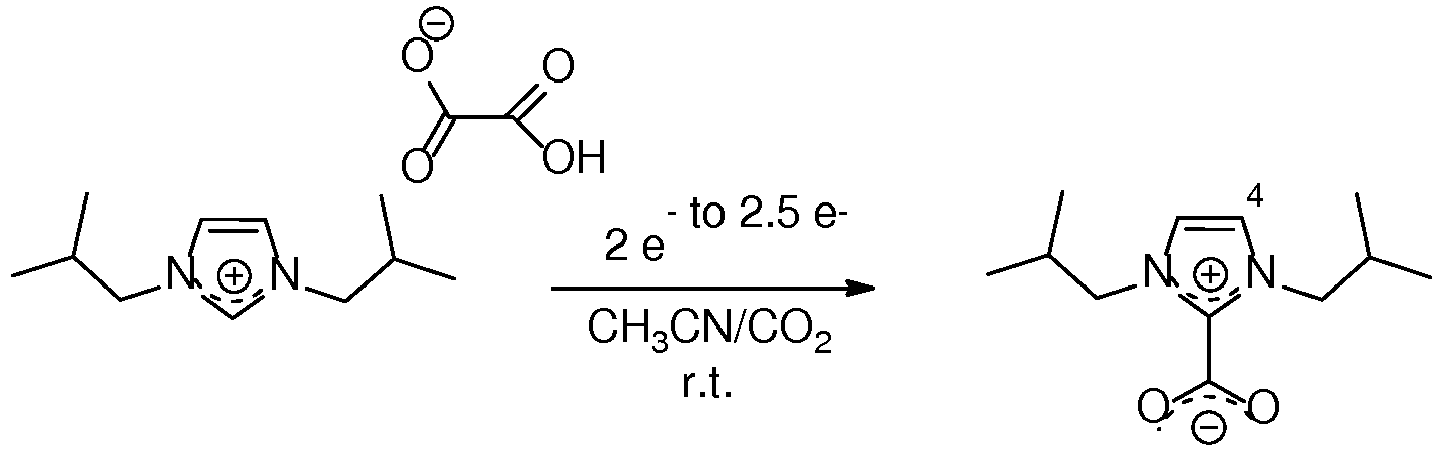
- The electrolysis was performed in an electrochemical cell at one compartment under CO2-atmosphere with 2 carbon electrodes (working electrode and auxiliary electrode) at applied current (from 15 mA to 50 mA) or at controlled potential (-2.8 V/SCE) with a reference electrode. All these experiments lead to imidazolium carboxylate compounds. After purification, the final product was dried affording 1,3-diisobutylimidazolium carboxylate in good yields. 1H NMR (CDCl3, 500MHz, 298K) δ (ppm) 7.03 (H4, s, 2H), 4.35 (CH2, d 3 J=7.30Hz, 4H), 2.17 (CH, m, 2H), 0.92 (CH3, d 3J=6.38Hz, 12H); 13C NMR (CDCl3, 125MHz, 298K) δ (ppm) 155.1 (CO2), 143.9 (C2), 120.5 (C4), 56.8 (CH2), 29.8 (CH), 19.7 (CH3).
-

- The electrolysis was performed in an electrochemical cell at one compartment under CO2-atmosphere with 2 carbon electrodes (working electrode and auxiliary electrode) and at applied current (10 mA). This experiment leads to imidazolium carboxylate. After purification, the final product was dried affording 1,3- diphenylethyllimidazolium carboxylate in good yields.
- The results show that the electrolysis of imidazolium hydrogenoxalate in one compartment on carbon support and under CO2 atmosphere allows preparation of imidazolium carboxylate compound.
- An example of CO2 delivery experiment is given with an imidazolium carboxylate with formula (II) with R1=R2= CH3 and R3=R4= H:

R5COO- is the conjugate base of a carboxylic acid compound having a pKa measured in water below 3; preferably below 2.
Claims (10)
- An electrochemical cell comprising:- a cathode;- an anode;- a halogen-free supporting electrolyte comprising imidazolium salts of general formula (I'):
 R1 or R2 may be identical or different and each is selected from the group of H, C6-C50 aryl, C1-C14 alkyl, C2-C12 alkene, C2-C12 alkyne, C3-C10 cycloalkyl, C3-C10 cycloalkene, C1-C14 heteroalkyl, C6-C50 heteroaryl or C3-C10 heterocycloalkyl group; optionally substituted by at least one group selected from aryl, hydroxyl, oxo, nitro, amido, carboxy, amino, cyano, alkoxy, alkyl, alkene, alkyne, cycloalkyl, cycloalkene, heteroalkyl, heteroaryl or heterocycloalkyl group; preferably R1 and R2 are identical; more preferably, R1 and R2 are both alkyl chain substituted by an alkyl or aryl group;R3 or R4 may be identical or different and each is selected from the group of H, C6-C50 aryl, C1-C14 alkyl, C2-C12 alkene, C2-C12 alkyne, alkoxy, C3-C10 cycloalkyl, C3-C10 cycloalkene, C1-C14 heteroalkyl, C6-C50 heteroaryl or C3-C10 heterocycloalkyl group; optionally substituted by at least one group selected from aryl, hydroxyl, oxo, nitro, amido, carboxy, amino, cyano, alkoxy, alkyl, alkene, alkyne, cycloalkyl, cycloalkene, heteroalkyl or heterocycloalkyl group; preferably R3 and R4 are identical; more preferably, R3 and R4 are both H or alkyl group;R5 is a carboxy group;wherein the term "heteroalkyl" refers to a C1-C14 alkyl group having at least one atom that is not carbon or hydrogen, said atom being selected from N, S, P or O;wherein the term "heteroaryl" refers to a C6-C50 aryl group having at least one atom that is not carbon or hydrogen, said atom being selected from N, S, P or O;wherein the term "heterocycloalkyl" refers to a C3-C10 cycloalkyl group having at least one atom that is not carbon or hydrogen, said atom being selected from N, S, P or O;
andwherein said electrochemical cell is a one-compartment cell; andR5COO- is the conjugate base of a carboxylic acid compound having a pKa measured in water below 3; preferably below 2. - The one-compartment electrochemical cell according to claim 1, further comprising a source of carbon dioxide.
- The one-compartment electrochemical cell according to claim 1 or claim 2, wherein the imidazolium salt of general formula (I')is 1, 3-di-(phenylethyl)imidazolium hydrogen oxalate salt of formula (Ia):

- The one-compartment electrochemical cell according to claim 1 or claim 2, wherein the imidazolium salt of general formula (I') is 1, 3-di-(isobutyl)imidazolium hydrogen oxalate salt of formula (Ib):
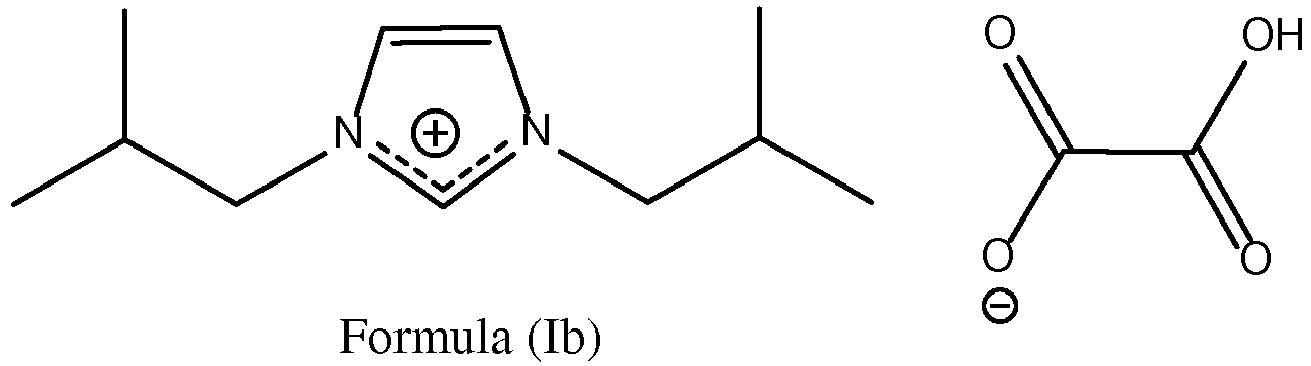
- Use of the one-compartment electrochemical cell according to anyone of claims 1 to 4 for the preparation of imidazolium carboxylate compounds of general formula II:
 R1 or R2 may be identical or different and each is selected from the group of H, C6-C50 aryl, C1-C14 alkyl, C2-C12 alkene, C2-C12 alkyne, C3-C10 cycloalkyl, C3-C10 cycloalkene, C1-C14 heteroalkyl, C6-C50 heteroaryl or C3-C10 heterocycloalkyl group; optionally substituted by at least one group selected from aryl, hydroxyl, oxo, nitro, amido, carboxy, amino, cyano, alkoxy, alkyl, alkene, alkyne, cycloalkyl, cycloalkene, heteroalkyl, heteroaryl or heterocycloalkyl group; preferably R1 and R2 are identical; more preferably, R1 and R2 are both alkyl chain substituted by an alkyl or aryl group; andR3 or R4 may be identical or different and each is selected from the group of H, C6-C50 aryl, C1-C14 alkyl, C2-C12 alkene, C2-C12 alkyne, alkoxy, C3-C10 cycloalkyl, C3-C10 cycloalkene, C1-C14 heteroalkyl, C6-C50 heteroaryl or C3-C10 heterocycloalkyl group; optionally substituted by at least one group selected from aryl, hydroxyl, oxo, nitro, amido, carboxy, amino, cyano, alkoxy, alkyl, alkene, alkyne, cycloalkyl, cycloalkene, heteroalkyl or heterocycloalkyl group; preferably R3 and R4 are identical; more preferably, R3 and R4 are both H or alkyl group;wherein the term "heteroalkyl" refers to a C1-C14 alkyl group having at least one atom that is not carbon or hydrogen, said atom being selected from N, S, P or O;wherein the term "heteroaryl" refers to a C6-C50 aryl group having at least one atom that is not carbon or hydrogen, said atom being selected from N, S, P or O;wherein the term "heterocycloalkyl" refers to a C3-C10 cycloalkyl group having at least one atom that is not carbon or hydrogen, said atom being selected from N, S, P or O.
 - Use of the one-compartment electrochemical cell according to claim 5, wherein the use of the one-compartment electrochemical cell is implemented at room temperature.
- Use of the one-compartment electrochemical cell according to claim 5 or claim 6, wherein the preparation of imidazolium carboxylate compounds is implemented in only one step.
- A cyclic process for delivering carbon dioxide stocked in a material comprising the following reaction steps:- carbon dioxide delivering by contacting imidazolium carboxylate compound with oxalic acid leading to synthesis of imidazolium hydrogenoxalate salt;- regeneration of imidazolium carboxylate compound by electrochemical process from imidazolium hydrogenoxalate or imidazolium formate salts obtained during the previous reaction step; wherein the regeneration step is implemented in a one-compartment electrochemical cell according to anyone of claims 1 to 4.
- The process according to claim 8, wherein the material is a solid or a liquid.
- The process according to claim 9, wherein the solid is a membrane support.
Applications Claiming Priority (3)
| Application Number | Priority Date | Filing Date | Title |
|---|---|---|---|
| US14/323,950 US9863048B2 (en) | 2014-07-03 | 2014-07-03 | Synthesis and use of biobased imidazolium carboxylates |
| EP14177320.0A EP2963155A1 (en) | 2014-07-03 | 2014-07-16 | Synthesis and use of biobased imidazolium carboxylates |
| PCT/EP2015/065265 WO2016001436A1 (en) | 2014-07-03 | 2015-07-03 | Synthesis and use of bio-based imidazolium carboxylates |
Publications (2)
| Publication Number | Publication Date |
|---|---|
| EP3164527A1 EP3164527A1 (en) | 2017-05-10 |
| EP3164527B1 true EP3164527B1 (en) | 2019-04-17 |
Family
ID=51265478
Family Applications (2)
| Application Number | Title | Priority Date | Filing Date |
|---|---|---|---|
| EP14177320.0A Withdrawn EP2963155A1 (en) | 2014-07-03 | 2014-07-16 | Synthesis and use of biobased imidazolium carboxylates |
| EP15733766.8A Not-in-force EP3164527B1 (en) | 2014-07-03 | 2015-07-03 | Synthesis and use of bio-based imidazolium carboxylates |
Family Applications Before (1)
| Application Number | Title | Priority Date | Filing Date |
|---|---|---|---|
| EP14177320.0A Withdrawn EP2963155A1 (en) | 2014-07-03 | 2014-07-16 | Synthesis and use of biobased imidazolium carboxylates |
Country Status (3)
| Country | Link |
|---|---|
| US (1) | US9863048B2 (en) |
| EP (2) | EP2963155A1 (en) |
| WO (1) | WO2016001436A1 (en) |
Families Citing this family (4)
| Publication number | Priority date | Publication date | Assignee | Title |
|---|---|---|---|---|
| CN114737210B (en) * | 2022-04-26 | 2023-04-18 | 南京工业大学 | Method for continuously preparing 1,3-indenone spiro imidazoline compound by using electrochemical microchannel reaction device |
| CN115928114B (en) * | 2022-12-29 | 2023-06-27 | 淮北师范大学 | Synthetic method of aromatic hydrocarbon pyrazole compound |
| JP2026509675A (en) * | 2023-09-05 | 2026-03-23 | エルジー エナジー ソリューション リミテッド | Electrolyte additive, electrolyte for lithium secondary battery containing the same, and lithium secondary battery |
| JP2025058877A (en) * | 2023-09-28 | 2025-04-09 | 広栄化学株式会社 | Method for producing onium salt and method for purifying onium salt |
Family Cites Families (1)
| Publication number | Priority date | Publication date | Assignee | Title |
|---|---|---|---|---|
| CN101078129B (en) | 2007-04-30 | 2011-12-21 | 浙江工业大学 | Formiate ion liquid compound and its preparing method and application |
-
2014
- 2014-07-03 US US14/323,950 patent/US9863048B2/en not_active Expired - Fee Related
- 2014-07-16 EP EP14177320.0A patent/EP2963155A1/en not_active Withdrawn
-
2015
- 2015-07-03 WO PCT/EP2015/065265 patent/WO2016001436A1/en not_active Ceased
- 2015-07-03 EP EP15733766.8A patent/EP3164527B1/en not_active Not-in-force
Non-Patent Citations (1)
| Title |
|---|
| None * |
Also Published As
| Publication number | Publication date |
|---|---|
| WO2016001436A1 (en) | 2016-01-07 |
| EP3164527A1 (en) | 2017-05-10 |
| EP2963155A1 (en) | 2016-01-06 |
| US9863048B2 (en) | 2018-01-09 |
| US20160002796A1 (en) | 2016-01-07 |
Similar Documents
| Publication | Publication Date | Title |
|---|---|---|
| Ourari et al. | Synthesis, characterization, and electrochemical study of a new tetradentate nickel (II)-Schiff base complex derived from ethylenediamine and 5′-(N-methyl-N-phenylaminomethyl)-2′-hydroxyacetophenone | |
| US20120108820A1 (en) | Ionic liquids based on imidazolium salts incorporating a nitrile functionality | |
| US9863048B2 (en) | Synthesis and use of biobased imidazolium carboxylates | |
| Liu et al. | Continuous-flow electro-oxidative coupling of sulfides with activated methylene compounds leading to sulfur ylides | |
| CN105483749B (en) | The paired electrosynthesis method of thiocyanogen α, β the unsaturated carbonyl class compound of 3 amido 2 | |
| US9566576B2 (en) | Metal complex catalysts and uses thereof | |
| CN106676573B (en) | A method of synthesizing aromatic nitriles by raw material electrochemical catalysis of alcohol | |
| Song et al. | Hydrogen photogeneration catalyzed by a cobalt complex of a pentadentate aminopyridine-based ligand | |
| Andrade et al. | Synthesis and structure of palladium (II) complexes supported by bis-NHC pincer ligands for the electrochemical activation of CO2 | |
| CN107855134A (en) | Asymmetric imine-pyridine-cobalt metal catalyst and preparation method and application thereof | |
| Ourari et al. | A novel copper (II) complex with an unsymmetrical tridentate-Schiff base: synthesis, crystal structure, electrochemical, morphological and electrocatalytic behaviors toward electroreduction of alkyl and aryl halides | |
| EP2865446B1 (en) | Process for producing optically active secondary alcohol | |
| WO2009020798A1 (en) | Methods for performing electrochemical nitration reactions | |
| US11198669B2 (en) | Method for preparing primary diamines by Kolbe electrolysis coupling reaction | |
| EP2751308B1 (en) | Process for cathodic deoxygenation of amides and esters | |
| Song et al. | Novel reactions of homodinuclear Ni 2 complexes [Ni (RN Py S 4)] 2 with Fe 3 (CO) 12 to give heterotrinuclear NiFe 2 and mononuclear Fe complexes relevant to [NiFe]-and [Fe]-hydrogenases | |
| CN108503672B (en) | Osmium peroxide complex and preparation method and application thereof | |
| CN101787542B (en) | Electrochemical synthesis method of metal and nitrogen heterocyclic arbine complex | |
| CN102212086A (en) | Biphenyl phosphine-oxazoline ligand-iridium complex as well as preparation and application methods thereof | |
| Sanchooli et al. | Recent advances on transition-metal-catalyzed 1, 2-diazidation of alkenes | |
| US10654879B2 (en) | Nickel-based catalysts for C=O reduction and oxygen evolution | |
| EP1852412B1 (en) | Process for production of optically active hydroxymethylated compounds and catalyst therefor | |
| Schneider | Syntheses and investigations of metal complexes with tripodal and macrocyclic ligands | |
| Cingolani | A journey around iron complexes: ligands design, sustainability, catalytic and bio-inorganic applications | |
| Berro | Exploring Photocatalytic and Electrocatalytic Reduction of CO2 with Re (I) and Zn (II) Complexes and Attempts to Employ a Novel Carbene Ligand to this Endeavor |
Legal Events
| Date | Code | Title | Description |
|---|---|---|---|
| STAA | Information on the status of an ep patent application or granted ep patent |
Free format text: STATUS: THE INTERNATIONAL PUBLICATION HAS BEEN MADE |
|
| PUAI | Public reference made under article 153(3) epc to a published international application that has entered the european phase |
Free format text: ORIGINAL CODE: 0009012 |
|
| STAA | Information on the status of an ep patent application or granted ep patent |
Free format text: STATUS: REQUEST FOR EXAMINATION WAS MADE |
|
| 17P | Request for examination filed |
Effective date: 20170203 |
|
| AK | Designated contracting states |
Kind code of ref document: A1 Designated state(s): AL AT BE BG CH CY CZ DE DK EE ES FI FR GB GR HR HU IE IS IT LI LT LU LV MC MK MT NL NO PL PT RO RS SE SI SK SM TR |
|
| AX | Request for extension of the european patent |
Extension state: BA ME |
|
| DAV | Request for validation of the european patent (deleted) | ||
| DAX | Request for extension of the european patent (deleted) | ||
| STAA | Information on the status of an ep patent application or granted ep patent |
Free format text: STATUS: EXAMINATION IS IN PROGRESS |
|
| 17Q | First examination report despatched |
Effective date: 20180403 |
|
| GRAP | Despatch of communication of intention to grant a patent |
Free format text: ORIGINAL CODE: EPIDOSNIGR1 |
|
| RIC1 | Information provided on ipc code assigned before grant |
Ipc: C25B 3/04 20060101AFI20180831BHEP Ipc: C07D 233/90 20060101ALI20180831BHEP Ipc: C07D 233/54 20060101ALI20180831BHEP Ipc: C07D 233/58 20060101ALI20180831BHEP |
|
| STAA | Information on the status of an ep patent application or granted ep patent |
Free format text: STATUS: GRANT OF PATENT IS INTENDED |
|
| INTG | Intention to grant announced |
Effective date: 20181011 |
|
| GRAS | Grant fee paid |
Free format text: ORIGINAL CODE: EPIDOSNIGR3 |
|
| GRAA | (expected) grant |
Free format text: ORIGINAL CODE: 0009210 |
|
| STAA | Information on the status of an ep patent application or granted ep patent |
Free format text: STATUS: THE PATENT HAS BEEN GRANTED |
|
| AK | Designated contracting states |
Kind code of ref document: B1 Designated state(s): AL AT BE BG CH CY CZ DE DK EE ES FI FR GB GR HR HU IE IS IT LI LT LU LV MC MK MT NL NO PL PT RO RS SE SI SK SM TR |
|
| REG | Reference to a national code |
Ref country code: GB Ref legal event code: FG4D |
|
| REG | Reference to a national code |
Ref country code: CH Ref legal event code: EP |
|
| REG | Reference to a national code |
Ref country code: DE Ref legal event code: R096 Ref document number: 602015028462 Country of ref document: DE |
|
| REG | Reference to a national code |
Ref country code: AT Ref legal event code: REF Ref document number: 1121647 Country of ref document: AT Kind code of ref document: T Effective date: 20190515 Ref country code: IE Ref legal event code: FG4D |
|
| REG | Reference to a national code |
Ref country code: NL Ref legal event code: MP Effective date: 20190417 |
|
| REG | Reference to a national code |
Ref country code: LT Ref legal event code: MG4D |
|
| PG25 | Lapsed in a contracting state [announced via postgrant information from national office to epo] |
Ref country code: NL Free format text: LAPSE BECAUSE OF FAILURE TO SUBMIT A TRANSLATION OF THE DESCRIPTION OR TO PAY THE FEE WITHIN THE PRESCRIBED TIME-LIMIT Effective date: 20190417 |
|
| PG25 | Lapsed in a contracting state [announced via postgrant information from national office to epo] |
Ref country code: LT Free format text: LAPSE BECAUSE OF FAILURE TO SUBMIT A TRANSLATION OF THE DESCRIPTION OR TO PAY THE FEE WITHIN THE PRESCRIBED TIME-LIMIT Effective date: 20190417 Ref country code: HR Free format text: LAPSE BECAUSE OF FAILURE TO SUBMIT A TRANSLATION OF THE DESCRIPTION OR TO PAY THE FEE WITHIN THE PRESCRIBED TIME-LIMIT Effective date: 20190417 Ref country code: SE Free format text: LAPSE BECAUSE OF FAILURE TO SUBMIT A TRANSLATION OF THE DESCRIPTION OR TO PAY THE FEE WITHIN THE PRESCRIBED TIME-LIMIT Effective date: 20190417 Ref country code: NO Free format text: LAPSE BECAUSE OF FAILURE TO SUBMIT A TRANSLATION OF THE DESCRIPTION OR TO PAY THE FEE WITHIN THE PRESCRIBED TIME-LIMIT Effective date: 20190717 Ref country code: ES Free format text: LAPSE BECAUSE OF FAILURE TO SUBMIT A TRANSLATION OF THE DESCRIPTION OR TO PAY THE FEE WITHIN THE PRESCRIBED TIME-LIMIT Effective date: 20190417 Ref country code: AL Free format text: LAPSE BECAUSE OF FAILURE TO SUBMIT A TRANSLATION OF THE DESCRIPTION OR TO PAY THE FEE WITHIN THE PRESCRIBED TIME-LIMIT Effective date: 20190417 Ref country code: PT Free format text: LAPSE BECAUSE OF FAILURE TO SUBMIT A TRANSLATION OF THE DESCRIPTION OR TO PAY THE FEE WITHIN THE PRESCRIBED TIME-LIMIT Effective date: 20190817 Ref country code: FI Free format text: LAPSE BECAUSE OF FAILURE TO SUBMIT A TRANSLATION OF THE DESCRIPTION OR TO PAY THE FEE WITHIN THE PRESCRIBED TIME-LIMIT Effective date: 20190417 |
|
| PGFP | Annual fee paid to national office [announced via postgrant information from national office to epo] |
Ref country code: DE Payment date: 20190719 Year of fee payment: 5 Ref country code: FR Payment date: 20190719 Year of fee payment: 5 |
|
| PG25 | Lapsed in a contracting state [announced via postgrant information from national office to epo] |
Ref country code: BG Free format text: LAPSE BECAUSE OF FAILURE TO SUBMIT A TRANSLATION OF THE DESCRIPTION OR TO PAY THE FEE WITHIN THE PRESCRIBED TIME-LIMIT Effective date: 20190717 Ref country code: GR Free format text: LAPSE BECAUSE OF FAILURE TO SUBMIT A TRANSLATION OF THE DESCRIPTION OR TO PAY THE FEE WITHIN THE PRESCRIBED TIME-LIMIT Effective date: 20190718 Ref country code: PL Free format text: LAPSE BECAUSE OF FAILURE TO SUBMIT A TRANSLATION OF THE DESCRIPTION OR TO PAY THE FEE WITHIN THE PRESCRIBED TIME-LIMIT Effective date: 20190417 Ref country code: RS Free format text: LAPSE BECAUSE OF FAILURE TO SUBMIT A TRANSLATION OF THE DESCRIPTION OR TO PAY THE FEE WITHIN THE PRESCRIBED TIME-LIMIT Effective date: 20190417 Ref country code: LV Free format text: LAPSE BECAUSE OF FAILURE TO SUBMIT A TRANSLATION OF THE DESCRIPTION OR TO PAY THE FEE WITHIN THE PRESCRIBED TIME-LIMIT Effective date: 20190417 |
|
| REG | Reference to a national code |
Ref country code: AT Ref legal event code: MK05 Ref document number: 1121647 Country of ref document: AT Kind code of ref document: T Effective date: 20190417 |
|
| PG25 | Lapsed in a contracting state [announced via postgrant information from national office to epo] |
Ref country code: IS Free format text: LAPSE BECAUSE OF FAILURE TO SUBMIT A TRANSLATION OF THE DESCRIPTION OR TO PAY THE FEE WITHIN THE PRESCRIBED TIME-LIMIT Effective date: 20190817 |
|
| PGFP | Annual fee paid to national office [announced via postgrant information from national office to epo] |
Ref country code: GB Payment date: 20190719 Year of fee payment: 5 |
|
| REG | Reference to a national code |
Ref country code: DE Ref legal event code: R097 Ref document number: 602015028462 Country of ref document: DE |
|
| PG25 | Lapsed in a contracting state [announced via postgrant information from national office to epo] |
Ref country code: EE Free format text: LAPSE BECAUSE OF FAILURE TO SUBMIT A TRANSLATION OF THE DESCRIPTION OR TO PAY THE FEE WITHIN THE PRESCRIBED TIME-LIMIT Effective date: 20190417 Ref country code: DK Free format text: LAPSE BECAUSE OF FAILURE TO SUBMIT A TRANSLATION OF THE DESCRIPTION OR TO PAY THE FEE WITHIN THE PRESCRIBED TIME-LIMIT Effective date: 20190417 Ref country code: SK Free format text: LAPSE BECAUSE OF FAILURE TO SUBMIT A TRANSLATION OF THE DESCRIPTION OR TO PAY THE FEE WITHIN THE PRESCRIBED TIME-LIMIT Effective date: 20190417 Ref country code: CZ Free format text: LAPSE BECAUSE OF FAILURE TO SUBMIT A TRANSLATION OF THE DESCRIPTION OR TO PAY THE FEE WITHIN THE PRESCRIBED TIME-LIMIT Effective date: 20190417 Ref country code: RO Free format text: LAPSE BECAUSE OF FAILURE TO SUBMIT A TRANSLATION OF THE DESCRIPTION OR TO PAY THE FEE WITHIN THE PRESCRIBED TIME-LIMIT Effective date: 20190417 Ref country code: AT Free format text: LAPSE BECAUSE OF FAILURE TO SUBMIT A TRANSLATION OF THE DESCRIPTION OR TO PAY THE FEE WITHIN THE PRESCRIBED TIME-LIMIT Effective date: 20190417 |
|
| PLBE | No opposition filed within time limit |
Free format text: ORIGINAL CODE: 0009261 |
|
| STAA | Information on the status of an ep patent application or granted ep patent |
Free format text: STATUS: NO OPPOSITION FILED WITHIN TIME LIMIT |
|
| PG25 | Lapsed in a contracting state [announced via postgrant information from national office to epo] |
Ref country code: SM Free format text: LAPSE BECAUSE OF FAILURE TO SUBMIT A TRANSLATION OF THE DESCRIPTION OR TO PAY THE FEE WITHIN THE PRESCRIBED TIME-LIMIT Effective date: 20190417 Ref country code: MC Free format text: LAPSE BECAUSE OF FAILURE TO SUBMIT A TRANSLATION OF THE DESCRIPTION OR TO PAY THE FEE WITHIN THE PRESCRIBED TIME-LIMIT Effective date: 20190417 Ref country code: IT Free format text: LAPSE BECAUSE OF FAILURE TO SUBMIT A TRANSLATION OF THE DESCRIPTION OR TO PAY THE FEE WITHIN THE PRESCRIBED TIME-LIMIT Effective date: 20190417 |
|
| REG | Reference to a national code |
Ref country code: CH Ref legal event code: PL |
|
| 26N | No opposition filed |
Effective date: 20200120 |
|
| PG25 | Lapsed in a contracting state [announced via postgrant information from national office to epo] |
Ref country code: TR Free format text: LAPSE BECAUSE OF FAILURE TO SUBMIT A TRANSLATION OF THE DESCRIPTION OR TO PAY THE FEE WITHIN THE PRESCRIBED TIME-LIMIT Effective date: 20190417 |
|
| REG | Reference to a national code |
Ref country code: BE Ref legal event code: MM Effective date: 20190731 |
|
| PG25 | Lapsed in a contracting state [announced via postgrant information from national office to epo] |
Ref country code: CH Free format text: LAPSE BECAUSE OF NON-PAYMENT OF DUE FEES Effective date: 20190731 Ref country code: BE Free format text: LAPSE BECAUSE OF NON-PAYMENT OF DUE FEES Effective date: 20190731 Ref country code: LU Free format text: LAPSE BECAUSE OF NON-PAYMENT OF DUE FEES Effective date: 20190703 Ref country code: LI Free format text: LAPSE BECAUSE OF NON-PAYMENT OF DUE FEES Effective date: 20190731 Ref country code: SI Free format text: LAPSE BECAUSE OF FAILURE TO SUBMIT A TRANSLATION OF THE DESCRIPTION OR TO PAY THE FEE WITHIN THE PRESCRIBED TIME-LIMIT Effective date: 20190417 |
|
| PG25 | Lapsed in a contracting state [announced via postgrant information from national office to epo] |
Ref country code: IE Free format text: LAPSE BECAUSE OF NON-PAYMENT OF DUE FEES Effective date: 20190703 |
|
| REG | Reference to a national code |
Ref country code: DE Ref legal event code: R079 Ref document number: 602015028462 Country of ref document: DE Free format text: PREVIOUS MAIN CLASS: C25B0003040000 Ipc: C25B0003250000 |
|
| REG | Reference to a national code |
Ref country code: DE Ref legal event code: R119 Ref document number: 602015028462 Country of ref document: DE |
|
| GBPC | Gb: european patent ceased through non-payment of renewal fee |
Effective date: 20200703 |
|
| PG25 | Lapsed in a contracting state [announced via postgrant information from national office to epo] |
Ref country code: FR Free format text: LAPSE BECAUSE OF NON-PAYMENT OF DUE FEES Effective date: 20200731 Ref country code: GB Free format text: LAPSE BECAUSE OF NON-PAYMENT OF DUE FEES Effective date: 20200703 |
|
| PG25 | Lapsed in a contracting state [announced via postgrant information from national office to epo] |
Ref country code: DE Free format text: LAPSE BECAUSE OF NON-PAYMENT OF DUE FEES Effective date: 20210202 Ref country code: CY Free format text: LAPSE BECAUSE OF FAILURE TO SUBMIT A TRANSLATION OF THE DESCRIPTION OR TO PAY THE FEE WITHIN THE PRESCRIBED TIME-LIMIT Effective date: 20190417 |
|
| PG25 | Lapsed in a contracting state [announced via postgrant information from national office to epo] |
Ref country code: MT Free format text: LAPSE BECAUSE OF FAILURE TO SUBMIT A TRANSLATION OF THE DESCRIPTION OR TO PAY THE FEE WITHIN THE PRESCRIBED TIME-LIMIT Effective date: 20190417 Ref country code: HU Free format text: LAPSE BECAUSE OF FAILURE TO SUBMIT A TRANSLATION OF THE DESCRIPTION OR TO PAY THE FEE WITHIN THE PRESCRIBED TIME-LIMIT; INVALID AB INITIO Effective date: 20150703 |
|
| PG25 | Lapsed in a contracting state [announced via postgrant information from national office to epo] |
Ref country code: MK Free format text: LAPSE BECAUSE OF FAILURE TO SUBMIT A TRANSLATION OF THE DESCRIPTION OR TO PAY THE FEE WITHIN THE PRESCRIBED TIME-LIMIT Effective date: 20190417 |