EP3163836A1 - Method and apparatus for secure access of a service via customer premise equipment - Google Patents
Method and apparatus for secure access of a service via customer premise equipment Download PDFInfo
- Publication number
- EP3163836A1 EP3163836A1 EP16194894.8A EP16194894A EP3163836A1 EP 3163836 A1 EP3163836 A1 EP 3163836A1 EP 16194894 A EP16194894 A EP 16194894A EP 3163836 A1 EP3163836 A1 EP 3163836A1
- Authority
- EP
- European Patent Office
- Prior art keywords
- cpe
- service
- vcpe
- communications channel
- secure communications
- Prior art date
- Legal status (The legal status is an assumption and is not a legal conclusion. Google has not performed a legal analysis and makes no representation as to the accuracy of the status listed.)
- Granted
Links
- 238000000034 method Methods 0.000 title claims abstract description 26
- 238000004891 communication Methods 0.000 claims abstract description 78
- 230000004044 response Effects 0.000 claims abstract description 7
- 230000006870 function Effects 0.000 description 12
- 230000008569 process Effects 0.000 description 12
- 230000007246 mechanism Effects 0.000 description 9
- 238000012546 transfer Methods 0.000 description 5
- 229920006235 chlorinated polyethylene elastomer Polymers 0.000 description 4
- 238000010586 diagram Methods 0.000 description 4
- 230000003287 optical effect Effects 0.000 description 4
- 238000005516 engineering process Methods 0.000 description 3
- 238000012545 processing Methods 0.000 description 3
- 238000013500 data storage Methods 0.000 description 2
- 230000010354 integration Effects 0.000 description 2
- 238000012544 monitoring process Methods 0.000 description 2
- 229920001690 polydopamine Polymers 0.000 description 2
- 239000004065 semiconductor Substances 0.000 description 2
- 239000000872 buffer Substances 0.000 description 1
- 238000000136 cloud-point extraction Methods 0.000 description 1
- 239000000835 fiber Substances 0.000 description 1
- 238000001914 filtration Methods 0.000 description 1
- 230000003993 interaction Effects 0.000 description 1
- 238000012423 maintenance Methods 0.000 description 1
- 238000007726 management method Methods 0.000 description 1
- 238000004519 manufacturing process Methods 0.000 description 1
- 238000005204 segregation Methods 0.000 description 1
- 238000001228 spectrum Methods 0.000 description 1
- 238000012795 verification Methods 0.000 description 1
- 230000000007 visual effect Effects 0.000 description 1
Images






Classifications
-
- H—ELECTRICITY
- H04—ELECTRIC COMMUNICATION TECHNIQUE
- H04L—TRANSMISSION OF DIGITAL INFORMATION, e.g. TELEGRAPHIC COMMUNICATION
- H04L9/00—Cryptographic mechanisms or cryptographic arrangements for secret or secure communications; Network security protocols
- H04L9/32—Cryptographic mechanisms or cryptographic arrangements for secret or secure communications; Network security protocols including means for verifying the identity or authority of a user of the system or for message authentication, e.g. authorization, entity authentication, data integrity or data verification, non-repudiation, key authentication or verification of credentials
- H04L9/3215—Cryptographic mechanisms or cryptographic arrangements for secret or secure communications; Network security protocols including means for verifying the identity or authority of a user of the system or for message authentication, e.g. authorization, entity authentication, data integrity or data verification, non-repudiation, key authentication or verification of credentials using a plurality of channels
-
- H—ELECTRICITY
- H04—ELECTRIC COMMUNICATION TECHNIQUE
- H04L—TRANSMISSION OF DIGITAL INFORMATION, e.g. TELEGRAPHIC COMMUNICATION
- H04L63/00—Network architectures or network communication protocols for network security
- H04L63/04—Network architectures or network communication protocols for network security for providing a confidential data exchange among entities communicating through data packet networks
- H04L63/0428—Network architectures or network communication protocols for network security for providing a confidential data exchange among entities communicating through data packet networks wherein the data content is protected, e.g. by encrypting or encapsulating the payload
-
- H—ELECTRICITY
- H04—ELECTRIC COMMUNICATION TECHNIQUE
- H04L—TRANSMISSION OF DIGITAL INFORMATION, e.g. TELEGRAPHIC COMMUNICATION
- H04L63/00—Network architectures or network communication protocols for network security
- H04L63/02—Network architectures or network communication protocols for network security for separating internal from external traffic, e.g. firewalls
- H04L63/0281—Proxies
-
- H—ELECTRICITY
- H04—ELECTRIC COMMUNICATION TECHNIQUE
- H04L—TRANSMISSION OF DIGITAL INFORMATION, e.g. TELEGRAPHIC COMMUNICATION
- H04L63/00—Network architectures or network communication protocols for network security
- H04L63/04—Network architectures or network communication protocols for network security for providing a confidential data exchange among entities communicating through data packet networks
- H04L63/0428—Network architectures or network communication protocols for network security for providing a confidential data exchange among entities communicating through data packet networks wherein the data content is protected, e.g. by encrypting or encapsulating the payload
- H04L63/0478—Network architectures or network communication protocols for network security for providing a confidential data exchange among entities communicating through data packet networks wherein the data content is protected, e.g. by encrypting or encapsulating the payload applying multiple layers of encryption, e.g. nested tunnels or encrypting the content with a first key and then with at least a second key
-
- H—ELECTRICITY
- H04—ELECTRIC COMMUNICATION TECHNIQUE
- H04L—TRANSMISSION OF DIGITAL INFORMATION, e.g. TELEGRAPHIC COMMUNICATION
- H04L63/00—Network architectures or network communication protocols for network security
- H04L63/08—Network architectures or network communication protocols for network security for authentication of entities
-
- H—ELECTRICITY
- H04—ELECTRIC COMMUNICATION TECHNIQUE
- H04L—TRANSMISSION OF DIGITAL INFORMATION, e.g. TELEGRAPHIC COMMUNICATION
- H04L63/00—Network architectures or network communication protocols for network security
- H04L63/10—Network architectures or network communication protocols for network security for controlling access to devices or network resources
-
- H—ELECTRICITY
- H04—ELECTRIC COMMUNICATION TECHNIQUE
- H04L—TRANSMISSION OF DIGITAL INFORMATION, e.g. TELEGRAPHIC COMMUNICATION
- H04L63/00—Network architectures or network communication protocols for network security
- H04L63/10—Network architectures or network communication protocols for network security for controlling access to devices or network resources
- H04L63/105—Multiple levels of security
-
- H—ELECTRICITY
- H04—ELECTRIC COMMUNICATION TECHNIQUE
- H04L—TRANSMISSION OF DIGITAL INFORMATION, e.g. TELEGRAPHIC COMMUNICATION
- H04L63/00—Network architectures or network communication protocols for network security
- H04L63/14—Network architectures or network communication protocols for network security for detecting or protecting against malicious traffic
- H04L63/1441—Countermeasures against malicious traffic
- H04L63/1475—Passive attacks, e.g. eavesdropping or listening without modification of the traffic monitored
-
- H—ELECTRICITY
- H04—ELECTRIC COMMUNICATION TECHNIQUE
- H04L—TRANSMISSION OF DIGITAL INFORMATION, e.g. TELEGRAPHIC COMMUNICATION
- H04L12/00—Data switching networks
- H04L12/28—Data switching networks characterised by path configuration, e.g. LAN [Local Area Networks] or WAN [Wide Area Networks]
- H04L12/2854—Wide area networks, e.g. public data networks
- H04L12/2856—Access arrangements, e.g. Internet access
- H04L12/2869—Operational details of access network equipments
- H04L12/2898—Subscriber equipments
-
- H—ELECTRICITY
- H04—ELECTRIC COMMUNICATION TECHNIQUE
- H04L—TRANSMISSION OF DIGITAL INFORMATION, e.g. TELEGRAPHIC COMMUNICATION
- H04L63/00—Network architectures or network communication protocols for network security
- H04L63/04—Network architectures or network communication protocols for network security for providing a confidential data exchange among entities communicating through data packet networks
- H04L63/0428—Network architectures or network communication protocols for network security for providing a confidential data exchange among entities communicating through data packet networks wherein the data content is protected, e.g. by encrypting or encapsulating the payload
- H04L63/0464—Network architectures or network communication protocols for network security for providing a confidential data exchange among entities communicating through data packet networks wherein the data content is protected, e.g. by encrypting or encapsulating the payload using hop-by-hop encryption, i.e. wherein an intermediate entity decrypts the information and re-encrypts it before forwarding it
-
- H—ELECTRICITY
- H04—ELECTRIC COMMUNICATION TECHNIQUE
- H04L—TRANSMISSION OF DIGITAL INFORMATION, e.g. TELEGRAPHIC COMMUNICATION
- H04L63/00—Network architectures or network communication protocols for network security
- H04L63/08—Network architectures or network communication protocols for network security for authentication of entities
- H04L63/0869—Network architectures or network communication protocols for network security for authentication of entities for achieving mutual authentication
Definitions
- This invention relates to a method and a system for accessing a service via customer premise equipment (CPE), for example a gateway, and more particularly, to a method and a system for accessing service via CPE by authenticating the CPE with the user device and the service provider.
- CPE customer premise equipment
- digital credential theft has the potential to cause critical danger for the credential owner.
- the dangers include, but are not limited to: a theft of credential from an on-line retailer, wherein the attacker may use the credit card of the owner to illegitimately order items and/or divert the delivery of legitimately order to a different address, as well as access illegitimately access the owner's digital items and use the owner's cloud services; theft of credentials for online bank account information; and hacking of e-mail accounts.
- User access control policy may be implemented in a corporate network.
- Computer information e.g. users, computers, and groups
- a central directory such as LDAP or active directory, Microsoft Active Dir
- Protocol such as 802.1 X access policy used in both wired and wireless contexts can bind user information to network information (e.g. MAC address).
- the credentials are applicative in the sense that the credentials are associated with an application rather than strictly with a user, e.g. a specific user, group of users, or a machine. Practically, this means security policies can integrate with the user's directory, and bring the notion of user ID down to the IP layers". These solutions are not adapted for end users connecting web service through Internet from any browser and without administrator able to set policy at the user granularity.
- a 2-step Web access authentication may be implemented.
- This solution is used by banks and Google, Google 2-step verification, to prevent someone that has stolen a pin code or a password from acting maliciously.
- the basic idea is to send a specific code through another communication channel to authenticate the user against a second authentication factor. Generally, it consists in sending a SMS to the user's phone.
- This solution improves the security, it also brings annoyances to the user obliged to wait for the pin code and type it afterwards each time he connects to the service. In addition, it does not prevent an attacker that also steals the phone while he knows the pin code as well, this even for a short lapse of time.
- a gateway embeds a lot of network function (DHCP, NAT, parental control,%) and does not evolve a lot.
- NFV shifts the aforementioned network functions from the gateway to the cloud so as to provide new features and reduce gateway maintenance and manufacturing cost.
- the GW connects to a Virtual CPE (VCPE) in the cloud which in turn provides the virtualized functions (DHCP service to get an IP address for example) from a Virtual machine for example.
- VCPE Virtual CPE
- VPNs allow a form of access segregation, at the network level.
- VPNs operate at the network level and do not provide integration with the service level on a target application or native integration with a gateway
- the present principles are directed to a service provider device comprising means for establishing a first secure communications channel with a customer premise equipment, means for establishing with a user device a second secure communications channel, passing through the customer premise equipment and the first secure communications channel, upon reception of correct credentials for the user, means for receiving a request for a service from the user device, means for verifying that the request was received through the second secure communications channel and means for providing the service to the user device through the second secure communications channel only in case the customer premise equipment is part of a set of devices through which the second secure communications channel must pass.
- the service provider device further comprises means for providing, in response to a request received through the second secure communications channel, a second service to the user device regardless of which the device through which the second secure communications channel passes.
- the present principles are directed to a method for providing a service comprising.
- a service provider device establishes a first secure communications channel with a customer premise equipment, establishes with a user device a second secure communications channel, passing through the customer premise equipment and the first secure communications channel, upon reception of correct credentials for the user, receives a request for a service from the user device, verifies that the request was received through the second secure communications channel, and provides the service to the user device through the second secure communications channel only in case the customer premise equipment is part of a set of devices through which the second secure communications channel must pass.
- the service provider device further provides, in response to a request received through the second secure communications channel, a second service to the user device regardless of which the device through which the second secure communications channel passes.
- the present principles relate to a method and a system for providing a secure and seamless authentication method for allowing end users to access a service from a user device to a web browser or an application using a secure intermediate device.
- the service provides credentials (later called “applicative credentials”), such as a login and password. Using the present principles, these credentials are not necessarily sufficient to access the service.
- the authentication is seamless in the sense that it does not require additional user interactions after the initial setup.
- the present principles enables distinguishing and setting different rights levels depending on the request level for some service.
- the typical request levels are: 1) Get the account balance (Read operation). In that case, the applicative credentials are sufficient to perform this operation; 2) Purchase operation or bank transfer (Write operation). In that case, the applicative credentials plus the additional authentication according to the invention are necessary.
- a CPE based authentication to a service based authentication.
- the CPE acts as an intermediate device to mediate all the secure connections to a given service (e.g. bank.com) which supports the CPE based authentication.
- a given service e.g. bank.com
- the end-user configures his browser's plugin or application, the intermediate CPE and the service access, he can seamlessly connect to the web service with a high level of security.
- the exemplary embodiments provide an authentication service that fulfills the following properties.
- the authentication factor is the applicative credentials for connecting to the service (login/password) as usual.
- the data must go through the trusted intermediate device (e.g. CPE).
- the intermediate device is trusted for providing the additional authentication.
- the applicative traffic is end-to-end encrypted and thus, even though the traffic flows through the intermediate device, the intermediate device is not able to read or tamper the applicative data.
- the secure intermediate device is a customer premise equipment (CPE) that is typically located in the customer's home.
- the CPE can be either the Broadband Gateway (DSL, Cable, Fiber), a Set-Top-Box or even a vCPE - Virtual CPE - which can be a Virtual Gateway or a Virtual Set-Top-Box running in the cloud that delivers Internet or Video to the customer.
- vCPEs are typically implemented by a service provider using a Network Functions Virtualization platform and uniquely assigned to a specific customer.
- the CPE/vCPE can also be a SmartHome Box bringing digital assistants with personalized services dealing with Home Care (home security), Home Comfort (home monitoring & control), as well as Family Care (kids, elderly care).
- the CPE based authentication according the present principles can either be setup and configured by the end-user or by an Internet/Service Provider (ISP) as described below.
- ISP Internet/Service Provider
- End-user control The end-user configures on one side the CPE/vCPE and on the other side the given service provided by a service provider.
- the CPE/vCPE configuration can be done via a GUI, that allows entering the URL of the applicative service.
- the URLs may be listed in a shared list, similar to profiles, wherein the user may select the URLs for which the CPE based authentication in accordance with the present principles is to be enforced.
- Various different configuration mechanisms may be provided, including, for example, GUIs, uploaded configuration files, and dedicated configuration files, e.g. smartphone.
- the service configuration can be done either online using similar configuration mechanisms as discussed above via an application provided menu or offline via traditional mail or call to the service support.
- the service configuration determines which CPE/vCPE and which operations to the given service requires additional authentication according to the invention. For example, a customer may want to grant "bank transfer rights" only when he accesses the service from its broadband Gateway and not from everywhere else. He can still access to the "account balance" from everywhere.
- the ISP configures on one side the CPE/vCPE and on the other side the service (owned by a third party provider or the ISP itself) so that access to this given service requires the CPE-based authentication.
- the ISP established a list of URLs and provides it to the CPE/vCPE. Further, the ISP provides the list of CPE/vCPE identifiers to the service provider.
- an ISP grants access to watch "3 rd party OTT service" to an end-user from its residential STB (i.e. residential TV connected on the STB / Tablet connecting the Wi-Fi access point of the STB) but not from anywhere else to avoid sharing an entitled OTT service to a friend (e.g. tablet connecting OTT service via a mobile access).
- Restricted access can consist in allowing specific contents from an OTT provider, according to some viewing constraints (quality, bandwidth, rating, pricing, age%)
- SmartHome provided by Technicolor SA
- several information flows may deserve separate authentication levels, according to the user's preference. For instance, checking alarm status may be allowed from any place (using the regular SmartHome authentication). On the other hand, modifying alarm settings requires the additional CPE/vCPE based authentication, according to the present principles.
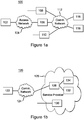
- Fig. 1 a illustrates a system that can be used in accordance with the present principles.
- a user device 102 is used to access a service from a service provider 116 or 118 via access network 104, CPE 106 and communications network 112.
- the access network 104 may include, for example a home network, either wired or wireless, that enables a user to connect to the Internet via CPE106.
- CPE 106 is one of a plurality of CPEs that are connected to communication network 112 and may access the various service providers connected to the network.
- the CPE 106 may be, for example a gateway, which provides an interface between the user device 102 and communications network 112, such as the Internet, in order to access a service from a service provider 116 or 118.
- User device 102 is a device that enables a user to access a service over the Internet, including, but not limited to, a smart phone, a personal computer, tablet, a wireless PDA, or other suitable user communication device.
- Fig. 1b illustrates a system, similar to that of Fig. 1 a and uses virtual CPEs that are implemented by service provider 126.
- vCPE is virtually implemented and uniquely assigned similar to a CPE, and provides similar functionality as CPE 104 for connecting the user device to a service provider.
- Fig. 2 illustrates a block diagram of CPE 200, corresponding to CPE 106 of Fig. 1a , in which various aspects of the exemplary embodiments of the present principles may be implemented.
- the CPE 200 may include at least one processor 210 configured to execute instructions loaded therein for implementing the various processes as discussed above.
- Processor 210 may include embedded memory, input output interface and various other circuitries as known in the art.
- the CPE 200 may also include at least one memory 220 (e.g., a volatile memory device, a non-volatile memory device).
- CPE 200 may additionally include a storage device 240, which may include non-volatile memory, including, but not limited to, EEPROM, ROM, PROM, RAM, DRAM, SRAM, flash, magnetic disk drive, and/or optical disk drive.
- the storage device 240 may comprise an internal storage device, an attached storage device and/or a network accessible storage device, as non-limiting examples.
- Program code to be loaded onto processors 210 to perform the various processes described hereinabove may be stored in storage device 240 and subsequently loaded onto memory 220 for execution by processors 210.
- one or more of the processor(s) 210, memory 220, and storage device 240 may store one or more of the various items during the performance of the processes discussed herein above.
- the CPE 200 also includes communication interface 250 that enables communication with other devices via communication channel 260.
- the communication interface 250 may include, but is not limited to a transceiver configured to transmit and receive data from communication channel 260.
- the communication interface may include, but is not limited to, a modem or network card and the communication channel may be implemented within a wired and/or wireless medium.
- the various components of CPE 200 may be connected or communicatively coupled together using various suitable connections, including, but not limited to internal buses, wires, and printed circuit boards.
- the exemplary embodiments according to the present principles may be carried out by computer software implemented by the processor 210 or by hardware, or by a combination of hardware and software.
- the exemplary embodiments according to the present principles may be implemented by one or more integrated circuits.
- the memory 220 may be of any type appropriate to the technical environment and may be implemented using any appropriate data storage technology, such as optical memory devices, magnetic memory devices, semiconductor-based memory devices, fixed memory and removable memory, as non-limiting examples.
- the processor 210 may be of any type appropriate to the technical environment, and may encompass one or more of microprocessors, general purpose computers, special purpose computers and processors based on a multi-core architecture, as non-limiting examples.
- CPE 200 may represent logical functions rather than a physical device without departing from the scope of the present invention.
- Figure 2 has been described in the context of a CPE, it is to be understood that the components described are also applicable to a user device, for example, but not limited to a PC, laptop and tablet. It is clear that the components of processor, memory, storage device, communications interface, and encryption/decryption module are typically found in such devices and may be used to implement the various steps performed when operating with the CPE described above.
- the first set of examples are those that involve end-user control, wherein the gateway is the CPE, and the second set of examples involve ISP control, wherein a set top box (STB) is the CPE/vCPE.
- STB set top box
- the setup and authentication according to the first set of examples are shown in Figures 3 and 4 .
- the embodiments that involve the first set of examples in which the gateway is the CPE include the following: a mechanism for mutual authentication between A and CPE/VCPE exist.
- A has a login/password to authenticate on the CPE/VCPE and the CPE/VCPE has some certificates.
- a and CPE/VCPE may also use non-cryptographic authentication means, such as being connected on a same physical network considered trusted (e.g. a same home network, a USB wire between a phone and a CPE/VCPE, etc.) or even a VPN access from outside.
- a mechanism for mutual authentication between CPE/VCPE and B exist.
- CPE/VCPE has a certificate with its serial number (signed by some known CA), and the B knows this serial number.
- B has a standard SSL certificate signed by some known CA. Means for mutual authentication between A and B exist. E.g. A has a login/password to authenticate himself on B.
- B has a standard SSL certificate signed by some known CA. B knows that, for some functions of its services A must connect using CPE/VCPE. Otherwise this function is not available.
- the user wants to access a bank site from home only involves the following steps. This is also referred to as the configuration stage.
- A configures the list of services that support CPE/VCPE-based Authentication using a dedicated plugin of his browser. This plugin is used by the user to decide whether he wants to use the secure service or not.
- A connects to the CPE/VCPE-based authentication service and enters the list of allowed URL (e.g. bank.com) but not bank2.com even if Bank2.com has a trusted certificate) and picks the serial number of the CPE/VCPE. This operation can be done manually by the user.
- A connects to the bank service offline (bank.com) and enters the CA provider of the CPE/VCPE certificate issuer and the serial number of the CPE/VCPE that he picks from his CPE/VCPE.
- This offline operation may be done by traditional mail or phone call for instance.
- the end-user launches its plugin and connects the web service URL of B (e.g. https://bank.com/transfer) to get the HTML page and fills the applicative credentials.
- the plugin checks the URL of B against the CPE/vCPE list it has requested to the CPE/VCPE or previously stored locally. Since the end-user A enters an URL of B in the list, the Browser's plugin notices that the user is trying to access a service that supports CPE/VCPE-based authentication. Ideally, the web service displays a visual indication when the CPE/VCPE-based authentication is required and is on use, otherwise the user connects the web service as usual and the plugin does nothing.
- the plugin For each URL corresponding to a configured applicative service, the plugin establishes a trusted channel between A and CPE/VCPE, indicated as “mutual authenticated channel” in figure 3 , and sends the URL of B to the CPE/VCPE.
- the CPE/VCPE receives the URL and establishes a mutual authenticated tunnel, such as a TLS tunnel and indicated as "mutual authenticated channel” in figure 3 , between the CPE/vCPE (GW in this example) towards B.
- A initiates a secure authenticated channel, indicated as "GW-Based authentication channel” in figure 4 , with B that traverses CPE/VCPE and the two authenticated tunnels above.
- a and B may use an authenticated Diffie-Hellman channel (using the credential and certificates in the pre requirements) to establish a session key between A and B. Once this session is established, A and B have a secure authenticated channel that is tunneled through the tunnels A-CPE/VCPE and CPE/VCPE-B.
- the CPE/VCPE establishes the mutual authentication with B only when it detects that A initiates a secure connection with B.
- the CPE/VCPE buffers the initial network packets sent from A to B, establishes a tunnel between CPE/VCPE and B, and forwards the buffered packets and all the upcoming packets sent from A to B into the established tunnel.
- the enforcement stage here refers to the communications and operations between A and B once the configuration for CPE/VCPE based authentication as described above has been completed between the user device, the CPE/vCPE, and the service provider.
- the enforcement stage notably comprises the steps of establishing secure tunnels and granting access to a requested service.
- B When a given service of B is configured with the CPE/VCPE-based authentication service, B must check if A is actually communicating with B using the designated CPE/VCPE. Therefore, B upon receiving communications from A, B checks if the secure authenticated channel is authenticated by A and if this secure authenticated channel arrives through a tunnel authenticated by CPE/VCPE.
- B When B decodes a packet from CPE/VCPE-B, B associates a context I1 to the packet, for instance an SSL id tunnel number. When B decodes the inner packet from A-B, B associates a second context I2. As soon as A-B is fully established, i.e. when the authentication between A and B is complete, B learns that I1 and I2 are associated. For all subsequent packets of A-B within CPE/VCPE-B, B will check for the associations I1 and I2.
- an attacker To gain access to the service, an attacker must know the applicative credentials then must steal and install the CPE/VCPE credentials on a device under his control. Although the risk is low, an additional trusted storage (e.g. TPM) can increase the security by storing CPE/VCPE credentials within protected hardware.
- TPM additional trusted storage
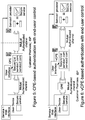
- Figure 5 depicts an arrangement wherein the user device is granted access to a secure service via the CPE-based authentication controlled by the end-user.
- the appropriate authenticated channels have been established between the user device, CPE, and Service Provider as described above.
- the secure service is designated within the user device, the service1.com is included in the list of secure services in the CPE, and the Service Provider has verified the presence of the secure authenticated tunnels, and thus allows the user device to access the designated secure service.
- Figure 6 depicts the same situation wherein the authentication is based on a vCPE in the cloud.
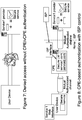
- Figure 7 depicts a denied access to the service since the user device does not access the secure service of the service provider via a CPE or vCPE.
- mutual authenticated channels between the user device and the CPE/vCPE, and/or between the CPE/vCPE and the Service Provider is not confirmed, and thus the service provider does not provide access to the secure service.
- the second set of examples relate to cases in which the ISP control is used, and the STB is the CPE/vCPE.
- the relevant configuration involves the following: a mechanism for mutual authentication between A and CPE/VCPE exist.
- A has a login/password to authenticate on the CPE/VCPE.
- the CPE/VCPE has some certificates.
- a and CPE/VCPE may also use non-cryptographic authentication means, like being connected via a same physical network considered trusted (e.g. a same home network, a USB wire between a phone and a CPE/VCPE, etc.); CPE/VCPE credentials for mutual authentication between CPE/VCPE and B exist.
- a mechanism for mutual authentication between A and CPE/VCPE exist.
- A has a login/password to authenticate on the CPE/VCPE.
- the CPE/VCPE has some certificates.
- a and CPE/VCPE may also use non-cryptographic authentication means, like being connected via a same physical network considered trusted (e.g.
- CPE/VCPE has a certificate with its serial number (signed by some known CA), and the B knows this serial number.
- B has a standard SSL certificate signed by some known CA; a mechanism for mutual authentication between A and B exist. E.g. A has a login/password to authenticate himself on B.
- B has a standard SSL certificate signed by some known CA; and B knows that, for some functions of its services A must connect using CPE/VCPE. Otherwise this function is not available.
- the setup stage proceeds as follows: When a customer requests a secure service, for example OTT service or by default if the OTT service is available for all customers, the ISP adds the OTT service to the list of services of the CPE/vCPE that supports CPE/VCPE-based Authentication (e.g. using CPE-Wan management protocol).
- the end-user connects a CPE, provided by the service provider, via the STB Wi-Fi or through the LAN and launches the OTT service from a dedicated OTT service application running on his PC (or television or tablet or other client device).
- the application tries to access a service that supports CPE/VCPE-based authentication and establishes a trusted channel between A and CPE/VCPE and sends a service identification to the CPE/vCPE. Then the CPE/VCPE establishes a mutual authenticated tunnel between CPE/VCPE and B. Once the two tunnels have been established, thanks to the OTT application, A initiates a secure authenticated channel with B that traverses CPE/VCPE and the two authenticated tunnels above. A and B may use an authenticated Diffie-Hellman channel (using the credential and certificates in the pre requirements) to establish a session key between A and B. Once this session is established, A and B have a secure authenticated channel that is tunneled through the tunnels A-CPE/VCPE and CPE/VCPE-B.
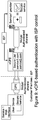
- Figure 8 depicts a configuration in which the user device is granted access to a secure service of a service provider via the CPE-based authentication controlled by the ISP as described hereinabove.
- Figure 9 depicts a similar configuration in which the user device is grant access via authentication from the vCPE in the cloud.
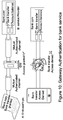
- Figure 10 above depicts situations in which the user device is allowed access to certain services, but is denied access to the secure services.
- account balance inquiries do not require CPE/vCPE based authentication, but bank transfers, which may require higher level of security, requires CPE/vCPE based authentication.
- a PC that accesses bank.com through a CPE, such as a GW, has access to both services, but a mobile device that does not go through a CPE only has access to account balances, but not bank transfers.
- Figure 11 depicts the use-case in which the secure service comprises an Over the Top (OTT) service.
- the CPE/vCPE is the STB.
- An ISP grants access to the end-user for watching video streaming content from a third party OTT service provider from its PC connected to the STB via the Wi-Fi access point of the STB or reaching the STB inside the LAN.
- the end-user can connect the OTT service from his mobile but access to the same secure service is denied.
- Figure 12 depicts a SmartHome use-case based on SmartHome Box which mediates accesses from sensors, home automation monitoring and controls as well as family care devices. Access to "configuration settings" is provided via the SmartHome Box, which is presumably located at home. The consumer can still check alarms status from everywhere.
- An embodiment without Browser plugin is possible, using any independent piece of software, a java application (possibly signed), etc.
- A first connects (non-authenticated) directly to B.
- B pushes an applet (e.g. JavaScript) that is equivalent to the plugin in the first scenario. Then everything works as the main embodiment.
- the description is the same than the GW embodiment above.
- the implementations described herein may be implemented in, for example, a method or a process, an apparatus, a software program, a data stream, or a signal. Even if only discussed in the context of a single form of implementation (for example, discussed only as a method), the implementation of features discussed may also be implemented in other forms (for example, an apparatus or program).
- An apparatus may be implemented in, for example, appropriate hardware, software, and firmware.
- the methods may be implemented in, for example, an apparatus such as, for example, a processor, which refers to processing devices in general, including, for example, a computer, a microprocessor, an integrated circuit, or a programmable logic device. Processors also include communication devices, such as, for example, computers, cell phones, portable/personal digital assistants ("PDAs”), and other devices that facilitate communication of information between end-users.
- PDAs portable/personal digital assistants
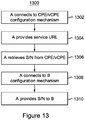
- FIG. 13 illustrates a flowchart showing the steps associated with the setup stage according to the present principles.
- the CPE/vCPE is configured by user A connecting to a CPE/vCPE configuration mechanism in step 1302.
- A transmits the service URL to the CPE/vCPE, wherein the service URL is included in a list so that the CPE/vCPE will in the future recognize the URL as belonging to a service that requires CPE/vCPE authentication.
- a user retrieves an unique identification associated with the CPE/vCPE, such as the serial number, and after connecting with the service provider B configuration mechanism via another secure communications channel in step 1308, the User provides the serial number to service provider B so that the service provider recognizes the serial number for the CPE/vCPE based authentication.
- the configuration of the CPE/vCPE, steps 1302-1304, and the configuration of the service provider side, 1306-1310 may be done in any order as desired.
- steps 1302-1310 are initiated and performed in response to a program transmitted from the service provider to the user device when the user device attempts to access the URL. In that case, a program transmitted from the service provider and running on the user device prompts a user to perform steps 1302-1304.
- FIG. 14 illustrates a flowchart showing the steps associated with the enforcement stage according to the present principles.
- a plugin of the user device in step 1404, intercepts the URL.
- the plugin determines in step 1410 whether the URL is associated with CPE/vCPE authentication by checking the URL against a list. If not, standard access to the URL is established in step 1412. If so, the plugin transmits the request to the CPE, mutually authenticates with the CPE and establishes a mutually authenticated tunnel between the plugin and the CPE/vCPE in step 1406. Once the tunnel has been established, the plugin forwards the URL via the tunnel to the CPE/vCPE.
- the CPE/vCPE determines whether the URL is associated with CPE/vCPE authentication by checking the URL against a list. If not, a configuration error is reported in step 1414. The configuration error may be reported by, for example, a configuration GUI, in real time via a user browser, or by a HTTP 403 Forbidden code. If so, the VPE/vCPE establishes a mutually authenticated tunnel with the service provider B associated with the URL in step 1418. Once established, the user device and the service provider mutual authenticate and establish a mutually authenticated tunnel within the previously established tunnels. Known tunnel implementations may be used here, for example, but not limited to GnuTLS, stunnel, and OpenSSL.
- the tunnel may be established, for example, by TLS/SSL or by IPsec.
- the service provider B checks the serial number of the CPE/vCPE, and determines whether the connection and origin are correct when determining whether requests to access the service is to be granted or denied. That is, whether A is entitled to access to the service and whether the request for service is being sent via the designated CPE/vCPE. If not, access is denied in step 1424. If so, service provider B establishes a mutually authenticated tunnel with the user device A and grants access to the requested service in step 1422.
- Fig. 15 illustrates a block diagram of a service provider apparatus 1500, corresponding to service provider 116 or 118 of Fig. 1a , in which various aspects of the exemplary embodiments of the present principles may be implemented.
- the service provider apparatus 1500 may include at least one processor 1510 configured to execute instructions loaded therein for implementing the various processes as discussed herein.
- Processor 1510 may include embedded memory, input output interface and various other circuitries as known in the art.
- the service provider apparatus 1500 may also include at least one memory 1520 (e.g., a volatile memory device, a non-volatile memory device).
- the service provider apparatus 1500 may additionally include a storage device 1540, which may include non-volatile memory, including, but not limited to, EEPROM, ROM, PROM, RAM, DRAM, SRAM, flash, magnetic disk drive, and/or optical disk drive.
- the storage device 1540 may comprise an internal storage device, an attached storage device and/or a network accessible storage device, as non-limiting examples.
- Program code to be loaded onto processors 1510 to perform the various processes described hereinabove may be stored in storage device 1540 and subsequently loaded onto memory 1520 for execution by processors 1510.
- one or more of the processor(s) 1510, memory 1520, and storage device 1540 may store one or more of the various items during the performance of the processes discussed herein.
- the service provider apparatus 1500 also includes communication interface 1550 that enables communication with other devices via communication channel 1560 (or a plurality of communication channels that may be implemented using different technologies).
- the communication interface 1550 may include, but is not limited to a transceiver configured to transmit and receive data from communication channel 1560.
- the communication interface may include, but is not limited to, a modem or network card and the communication channel may be implemented within a wired and/or wireless medium.
- the various components of service provider apparatus 1500 may be connected or communicatively coupled together using various suitable connections, including, but not limited to internal buses, wires, and printed circuit boards.
- the exemplary embodiments according to the present principles may be carried out by computer software implemented by the processor 1510 or by hardware, or by a combination of hardware and software.
- the exemplary embodiments according to the present principles may be implemented by one or more integrated circuits.
- the memory 1520 may be of any type appropriate to the technical environment and may be implemented using any appropriate data storage technology, such as optical memory devices, magnetic memory devices, semiconductor-based memory devices, fixed memory and removable memory, as non-limiting examples.
- the processor 1510 may be of any type appropriate to the technical environment, and may encompass one or more of microprocessors, general purpose computers, special purpose computers and processors based on a multi-core architecture, as non-limiting examples.
- service provider apparatus 1500 could be performed by a single entity or multiple entities in combinations and configurations other than that shown.
- service provider apparatus 1500 may represent logical functions rather than a physical device without departing from the scope of the present invention.
- Figure 15 has been described in the context of a service provider apparatus, it is to be understood that the components described are also applicable to a user device, for example, but not limited to a PC, laptop and tablet. It is clear that the components of processor, memory, storage device, communications interface, and encryption/decryption module are typically found in such devices and may be used to implement the various steps performed when operating with the service provider apparatus 1500 described herein.
- FIG. 16 illustrates a flowchart of the service provider process for providing service access according to the present principles.
- the processor 1510 establishes a first secure communications channel with a customer premise equipment (CPE).
- CPE customer premise equipment
- the processor 1510 establishes with a user device a second secure communications channel, passing through the CPE and the first secure communications channel, upon reception of correct credentials for the user.
- the processor 1510 receives, in step S1630, via the communication interface 1550 a request for a service from the user device and verifies, in step S1640, that the request was received through the second secure communications channel.
- step S1650 the service to the user device through the second secure communications channel (i.e., via the communication interface 1550,).
- step S1660 the processor provides, via the communication interface 1550, in response to a request received through the second secure communications channel, a second service to the user device regardless of which the device through which the second secure communications channel passes.
- the appearances of the phrase “in one embodiment” or “in an embodiment” or “in one implementation” or “in an implementation”, as well any other variations, appearing in various places throughout the specification are not necessarily all referring to the same embodiment.
- Determining the information may include one or more of, for example, estimating the information, calculating the information, predicting the information, or retrieving the information from memory.
- Accessing the information may include one or more of, for example, receiving the information, retrieving the information (for example, from memory), storing the information, processing the information, transmitting the information, moving the information, copying the information, erasing the information, calculating the information, determining the information, predicting the information, or estimating the information.
- Receiving is, as with “accessing”, intended to be a broad term.
- Receiving the information may include one or more of, for example, accessing the information, or retrieving the information (for example, from memory).
- “receiving” is typically involved, in one way or another, during operations such as, for example, storing the information, processing the information, transmitting the information, moving the information, copying the information, erasing the information, calculating the information, determining the information, predicting the information, or estimating the information.
- implementations may produce a variety of signals formatted to carry information that may be, for example, stored or transmitted.
- the information may include, for example, instructions for performing a method, or data produced by one of the described implementations.
- a signal may be formatted to carry the bitstream of a described embodiment.
- Such a signal may be formatted, for example, as an electromagnetic wave (for example, using a radio frequency portion of spectrum) or as a baseband signal.
- the formatting may include, for example, encoding a data stream and modulating a carrier with the encoded data stream.
- the information that the signal carries may be, for example, analog or digital information.
- the signal may be transmitted over a variety of different wired or wireless links, as is known.
- the signal may be stored on a processor-readable medium.
Landscapes
- Engineering & Computer Science (AREA)
- Computer Security & Cryptography (AREA)
- Computer Networks & Wireless Communication (AREA)
- Signal Processing (AREA)
- Computer Hardware Design (AREA)
- Computing Systems (AREA)
- General Engineering & Computer Science (AREA)
- Telephonic Communication Services (AREA)
- Data Exchanges In Wide-Area Networks (AREA)
Abstract
Description
- This invention relates to a method and a system for accessing a service via customer premise equipment (CPE), for example a gateway, and more particularly, to a method and a system for accessing service via CPE by authenticating the CPE with the user device and the service provider.
- This section is intended to introduce the reader to various aspects of art, which may be related to various aspects of the present invention that are described and/or claimed below. This discussion is believed to be helpful in providing the reader with background information to facilitate a better understanding of the various aspects of the present invention. Accordingly, it should be understood that these statements are to be read in this light, and not as admissions of prior art.
- In today's digital age, digital credential theft has the potential to cause critical danger for the credential owner. Some examples of the dangers include, but are not limited to: a theft of credential from an on-line retailer, wherein the attacker may use the credit card of the owner to illegitimately order items and/or divert the delivery of legitimately order to a different address, as well as access illegitimately access the owner's digital items and use the owner's cloud services; theft of credentials for online bank account information; and hacking of e-mail accounts.
- Various solutions exist for such attacks based on verifying user information against network information known by the service or enabling a multi-factor authentication mechanism.
- First, User access control policy may be implemented in a corporate network. Computer information (e.g. users, computers, and groups) is compared against a central directory such as LDAP or active directory, Microsoft Active Dir, to enable access to a given domain. Protocol such as 802.1 X access policy used in both wired and wireless contexts can bind user information to network information (e.g. MAC address). NuFW, NuFW: https://admin.fedoraproject.org/pkgdb/acls/name/nufw, is another enterprise grade firewall that "performs an authentication of every single connection passing through the IP filter, by transparently requesting applicative credentials before any filtering decision is taken. The credentials are applicative in the sense that the credentials are associated with an application rather than strictly with a user, e.g. a specific user, group of users, or a machine. Practically, this means security policies can integrate with the user's directory, and bring the notion of user ID down to the IP layers". These solutions are not adapted for end users connecting web service through Internet from any browser and without administrator able to set policy at the user granularity.
- Also, a 2-step Web access authentication may be implemented. This solution is used by banks and Google, Google 2-step verification, to prevent someone that has stolen a pin code or a password from acting maliciously. The basic idea is to send a specific code through another communication channel to authenticate the user against a second authentication factor. Generally, it consists in sending a SMS to the user's phone. Although this solution improves the security, it also brings annoyances to the user obliged to wait for the pin code and type it afterwards each time he connects to the service. In addition, it does not prevent an attacker that also steals the phone while he knows the pin code as well, this even for a short lapse of time.
- Today, a gateway embeds a lot of network function (DHCP, NAT, parental control,...) and does not evolve a lot. NFV shifts the aforementioned network functions from the gateway to the cloud so as to provide new features and reduce gateway maintenance and manufacturing cost. In short, the GW (CPE) connects to a Virtual CPE (VCPE) in the cloud which in turn provides the virtualized functions (DHCP service to get an IP address for example) from a Virtual machine for example.
- Virtual Private Networks (VPN) allow a form of access segregation, at the network level. However, VPNs operate at the network level and do not provide integration with the service level on a target application or native integration with a gateway
- In a first aspect, the present principles are directed to a service provider device comprising means for establishing a first secure communications channel with a customer premise equipment, means for establishing with a user device a second secure communications channel, passing through the customer premise equipment and the first secure communications channel, upon reception of correct credentials for the user, means for receiving a request for a service from the user device, means for verifying that the request was received through the second secure communications channel and means for providing the service to the user device through the second secure communications channel only in case the customer premise equipment is part of a set of devices through which the second secure communications channel must pass.
- In an embodiment, the service provider device further comprises means for providing, in response to a request received through the second secure communications channel, a second service to the user device regardless of which the device through which the second secure communications channel passes.
- In a second aspect, the present principles are directed to a method for providing a service comprising. A service provider device establishes a first secure communications channel with a customer premise equipment, establishes with a user device a second secure communications channel, passing through the customer premise equipment and the first secure communications channel, upon reception of correct credentials for the user, receives a request for a service from the user device, verifies that the request was received through the second secure communications channel, and provides the service to the user device through the second secure communications channel only in case the customer premise equipment is part of a set of devices through which the second secure communications channel must pass.
- In an embodiment, the service provider device further provides, in response to a request received through the second secure communications channel, a second service to the user device regardless of which the device through which the second secure communications channel passes.
- The above-mentioned and other features of the present principles, and the manner of attaining them, will become more apparent and the present principles will be better understood by reference to the following description of exemplary embodiments taken in conjunction with the accompanying drawings, wherein
-
Fig. 1a-b are illustrations of systems in which the exemplary embodiments according to the present principles may be applied; -
Fig. 2 is a block diagram of customer premise equipment such as a gateway that may be used in exemplary embodiments according to the present principles; -
Fig. 3 is a pictorial example of a gateway based authentication setup according to the present principles; -
Fig. 4 is a pictorial example of gateway based authentication according to the present principles; -
Fig. 5 is a pictorial example of CPE based authentication with end-user control according to the present principles; -
Fig. 6 is a pictorial example of vCPE based authentication with end-user control according to the present principles; -
Fig. 7 is a pictorial example illustrating denial of access without CPE/vCPE authentication according to the present principles; -
Fig. 8 is a pictorial example of CPE based authentication with ISP control according to the present principles; -
Fig. 9 is a pictorial example of vCPE based authentication with ISP control according to the present principles; -
Fig. 10 is a pictorial example of gateway authentication for bank service according to the present principles; -
Fig. 11 is a pictorial example of Set-Top-Box authentication for restricted OTT service access according to the present principles; -
FIG. 12 is a pictorial example of SmartHome Box authentication for restricted SmartHome security setting according to the present principles. -
FIG. 13 illustrates a flowchart of the process for setting up the gateway based authentication according to the present principles. -
FIG. 14 illustrates a flowchart of the process for providing service access according to the present principles. -
FIG. 15 is a block diagram of a service provider apparatus according to the present principles. -
FIG. 16 illustrates a flowchart of the service provider process for providing service access according to the present principles. - The description set out herein illustrates exemplary embodiments for implementing various aspects of the present principles. Such examples are not to be construed as limiting the scope of the claims in any manner.
- The present principles relate to a method and a system for providing a secure and seamless authentication method for allowing end users to access a service from a user device to a web browser or an application using a secure intermediate device. The service provides credentials (later called "applicative credentials"), such as a login and password. Using the present principles, these credentials are not necessarily sufficient to access the service. The authentication is seamless in the sense that it does not require additional user interactions after the initial setup.
- Additionally, the present principles enables distinguishing and setting different rights levels depending on the request level for some service. For example, in a bank service, the typical request levels are: 1) Get the account balance (Read operation). In that case, the applicative credentials are sufficient to perform this operation; 2) Purchase operation or bank transfer (Write operation). In that case, the applicative credentials plus the additional authentication according to the invention are necessary.
- According to embodiments according to the present principles, we associate a CPE based authentication to a service based authentication. The CPE acts as an intermediate device to mediate all the secure connections to a given service (e.g. bank.com) which supports the CPE based authentication. Once the end-user configures his browser's plugin or application, the intermediate CPE and the service access, he can seamlessly connect to the web service with a high level of security.
- The exemplary embodiments provide an authentication service that fulfills the following properties. First, the authentication factor is the applicative credentials for connecting to the service (login/password) as usual. Second, the data must go through the trusted intermediate device (e.g. CPE). The intermediate device is trusted for providing the additional authentication. However, the applicative traffic is end-to-end encrypted and thus, even though the traffic flows through the intermediate device, the intermediate device is not able to read or tamper the applicative data.
- In the exemplary embodiments, the secure intermediate device is a customer premise equipment (CPE) that is typically located in the customer's home. The CPE can be either the Broadband Gateway (DSL, Cable, Fiber), a Set-Top-Box or even a vCPE - Virtual CPE - which can be a Virtual Gateway or a Virtual Set-Top-Box running in the cloud that delivers Internet or Video to the customer. vCPEs are typically implemented by a service provider using a Network Functions Virtualization platform and uniquely assigned to a specific customer. The CPE/vCPE can also be a SmartHome Box bringing digital assistants with personalized services dealing with Home Care (home security), Home Comfort (home monitoring & control), as well as Family Care (kids, elderly care).
- The CPE based authentication according the present principles can either be setup and configured by the end-user or by an Internet/Service Provider (ISP) as described below.
- End-user control: The end-user configures on one side the CPE/vCPE and on the other side the given service provided by a service provider. On the CPE/vCPE side the CPE/vCPE configuration can be done via a GUI, that allows entering the URL of the applicative service. Alternatively, the URLs may be listed in a shared list, similar to profiles, wherein the user may select the URLs for which the CPE based authentication in accordance with the present principles is to be enforced. Various different configuration mechanisms may be provided, including, for example, GUIs, uploaded configuration files, and dedicated configuration files, e.g. smartphone. On the service side, the service configuration can be done either online using similar configuration mechanisms as discussed above via an application provided menu or offline via traditional mail or call to the service support. The service configuration determines which CPE/vCPE and which operations to the given service requires additional authentication according to the invention. For example, a customer may want to grant "bank transfer rights" only when he accesses the service from its broadband Gateway and not from everywhere else. He can still access to the "account balance" from everywhere.
- Internet/Service Provider (ISP) Control: The ISP configures on one side the CPE/vCPE and on the other side the service (owned by a third party provider or the ISP itself) so that access to this given service requires the CPE-based authentication. The ISP established a list of URLs and provides it to the CPE/vCPE. Further, the ISP provides the list of CPE/vCPE identifiers to the service provider. As an example, an ISP grants access to watch "3rd party OTT service" to an end-user from its residential STB (i.e. residential TV connected on the STB / Tablet connecting the Wi-Fi access point of the STB) but not from anywhere else to avoid sharing an entitled OTT service to a friend (e.g. tablet connecting OTT service via a mobile access). Restricted access can consist in allowing specific contents from an OTT provider, according to some viewing constraints (quality, bandwidth, rating, pricing, age...)
- In a smart home application, such as SmartHome provided by Technicolor SA, several information flows may deserve separate authentication levels, according to the user's preference. For instance, checking alarm status may be allowed from any place (using the regular SmartHome authentication). On the other hand, modifying alarm settings requires the additional CPE/vCPE based authentication, according to the present principles.
-
Fig. 1 a illustrates a system that can be used in accordance with the present principles. Insystem 100, auser device 102 is used to access a service from aservice provider access network 104,CPE 106 andcommunications network 112. Theaccess network 104 may include, for example a home network, either wired or wireless, that enables a user to connect to the Internet via CPE106.CPE 106 is one of a plurality of CPEs that are connected tocommunication network 112 and may access the various service providers connected to the network. TheCPE 106 may be, for example a gateway, which provides an interface between theuser device 102 andcommunications network 112, such as the Internet, in order to access a service from aservice provider User device 102 is a device that enables a user to access a service over the Internet, including, but not limited to, a smart phone, a personal computer, tablet, a wireless PDA, or other suitable user communication device.Fig. 1b illustrates a system, similar to that ofFig. 1 a and uses virtual CPEs that are implemented byservice provider 126. In this case vCPE is virtually implemented and uniquely assigned similar to a CPE, and provides similar functionality asCPE 104 for connecting the user device to a service provider. -
Fig. 2 illustrates a block diagram ofCPE 200, corresponding toCPE 106 ofFig. 1a , in which various aspects of the exemplary embodiments of the present principles may be implemented. TheCPE 200 may include at least oneprocessor 210 configured to execute instructions loaded therein for implementing the various processes as discussed above.Processor 210 may include embedded memory, input output interface and various other circuitries as known in the art. TheCPE 200 may also include at least one memory 220 (e.g., a volatile memory device, a non-volatile memory device).CPE 200 may additionally include astorage device 240, which may include non-volatile memory, including, but not limited to, EEPROM, ROM, PROM, RAM, DRAM, SRAM, flash, magnetic disk drive, and/or optical disk drive. Thestorage device 240 may comprise an internal storage device, an attached storage device and/or a network accessible storage device, as non-limiting examples. - Program code to be loaded onto
processors 210 to perform the various processes described hereinabove may be stored instorage device 240 and subsequently loaded ontomemory 220 for execution byprocessors 210. In accordance with the exemplary embodiments of the present principles, one or more of the processor(s) 210,memory 220, andstorage device 240 may store one or more of the various items during the performance of the processes discussed herein above. - The
CPE 200 also includescommunication interface 250 that enables communication with other devices viacommunication channel 260. Thecommunication interface 250 may include, but is not limited to a transceiver configured to transmit and receive data fromcommunication channel 260. The communication interface may include, but is not limited to, a modem or network card and the communication channel may be implemented within a wired and/or wireless medium. The various components ofCPE 200 may be connected or communicatively coupled together using various suitable connections, including, but not limited to internal buses, wires, and printed circuit boards. - The exemplary embodiments according to the present principles may be carried out by computer software implemented by the
processor 210 or by hardware, or by a combination of hardware and software. As a non-limiting example, the exemplary embodiments according to the present principles may be implemented by one or more integrated circuits. Thememory 220 may be of any type appropriate to the technical environment and may be implemented using any appropriate data storage technology, such as optical memory devices, magnetic memory devices, semiconductor-based memory devices, fixed memory and removable memory, as non-limiting examples. Theprocessor 210 may be of any type appropriate to the technical environment, and may encompass one or more of microprocessors, general purpose computers, special purpose computers and processors based on a multi-core architecture, as non-limiting examples. It will be noted that the functions carried out byCPE 200 could be performed by a single entity or multiple entities in combinations and configurations other than that shown. Thus,CPE 200 may represent logical functions rather than a physical device without departing from the scope of the present invention. AlthoughFigure 2 has been described in the context of a CPE, it is to be understood that the components described are also applicable to a user device, for example, but not limited to a PC, laptop and tablet. It is clear that the components of processor, memory, storage device, communications interface, and encryption/decryption module are typically found in such devices and may be used to implement the various steps performed when operating with the CPE described above. - Various illustrative examples and use cases are now described. The first set of examples are those that involve end-user control, wherein the gateway is the CPE, and the second set of examples involve ISP control, wherein a set top box (STB) is the CPE/vCPE.
- The setup and authentication according to the first set of examples are shown in
Figures 3 and 4 . The embodiments that involve the first set of examples in which the gateway is the CPE include the following: a mechanism for mutual authentication between A and CPE/VCPE exist. E.g. A has a login/password to authenticate on the CPE/VCPE and the CPE/VCPE has some certificates. A and CPE/VCPE may also use non-cryptographic authentication means, such as being connected on a same physical network considered trusted (e.g. a same home network, a USB wire between a phone and a CPE/VCPE, etc.) or even a VPN access from outside. A mechanism for mutual authentication between CPE/VCPE and B exist. E.g. CPE/VCPE has a certificate with its serial number (signed by some known CA), and the B knows this serial number. Similarly, B has a standard SSL certificate signed by some known CA. Means for mutual authentication between A and B exist. E.g. A has a login/password to authenticate himself on B. Similarly, B has a standard SSL certificate signed by some known CA. B knows that, for some functions of its services A must connect using CPE/VCPE. Otherwise this function is not available. - As shown in
Figure 3 , in the setup of the service access, for example, the user wants to access a bank site from home only, involves the following steps. This is also referred to as the configuration stage. A configures the list of services that support CPE/VCPE-based Authentication using a dedicated plugin of his browser. This plugin is used by the user to decide whether he wants to use the secure service or not. A connects to the CPE/VCPE-based authentication service and enters the list of allowed URL (e.g. bank.com) but not bank2.com even if Bank2.com has a trusted certificate) and picks the serial number of the CPE/VCPE. This operation can be done manually by the user. A connects to the bank service offline (bank.com) and enters the CA provider of the CPE/VCPE certificate issuer and the serial number of the CPE/VCPE that he picks from his CPE/VCPE. This offline operation may be done by traditional mail or phone call for instance. - After the configuration for CPE/vCPE authentication is completed, the enforcement stage processes are implemented. The end-user launches its plugin and connects the web service URL of B (e.g. https://bank.com/transfer) to get the HTML page and fills the applicative credentials. The plugin checks the URL of B against the CPE/vCPE list it has requested to the CPE/VCPE or previously stored locally. Since the end-user A enters an URL of B in the list, the Browser's plugin notices that the user is trying to access a service that supports CPE/VCPE-based authentication. Ideally, the web service displays a visual indication when the CPE/VCPE-based authentication is required and is on use, otherwise the user connects the web service as usual and the plugin does nothing.
- For each URL corresponding to a configured applicative service, the plugin establishes a trusted channel between A and CPE/VCPE, indicated as "mutual authenticated channel" in
figure 3 , and sends the URL of B to the CPE/VCPE. The CPE/VCPE receives the URL and establishes a mutual authenticated tunnel, such as a TLS tunnel and indicated as "mutual authenticated channel" infigure 3 , between the CPE/vCPE (GW in this example) towards B. As shown inFigure 4 , once the two tunnels have been established, A initiates a secure authenticated channel, indicated as "GW-Based authentication channel" infigure 4 , with B that traverses CPE/VCPE and the two authenticated tunnels above. For example, A and B may use an authenticated Diffie-Hellman channel (using the credential and certificates in the pre requirements) to establish a session key between A and B. Once this session is established, A and B have a secure authenticated channel that is tunneled through the tunnels A-CPE/VCPE and CPE/VCPE-B. In another embodiment which does not require the creation of a trusted channel between A and the CPE/VCPE as presented hereinbefore, the CPE/VCPE establishes the mutual authentication with B only when it detects that A initiates a secure connection with B. In that case, the CPE/VCPE buffers the initial network packets sent from A to B, establishes a tunnel between CPE/VCPE and B, and forwards the buffered packets and all the upcoming packets sent from A to B into the established tunnel. - The enforcement stage here refers to the communications and operations between A and B once the configuration for CPE/VCPE based authentication as described above has been completed between the user device, the CPE/vCPE, and the service provider. The enforcement stage notably comprises the steps of establishing secure tunnels and granting access to a requested service. When a given service of B is configured with the CPE/VCPE-based authentication service, B must check if A is actually communicating with B using the designated CPE/VCPE. Therefore, B upon receiving communications from A, B checks if the secure authenticated channel is authenticated by A and if this secure authenticated channel arrives through a tunnel authenticated by CPE/VCPE. In one embodiment: Recall that packets from A-B are encapsulated into packets from CPE/VCPE-B. When B decodes a packet from CPE/VCPE-B, B associates a context I1 to the packet, for instance an SSL id tunnel number. When B decodes the inner packet from A-B, B associates a second context I2. As soon as A-B is fully established, i.e. when the authentication between A and B is complete, B learns that I1 and I2 are associated. For all subsequent packets of A-B within CPE/VCPE-B, B will check for the associations I1 and I2.
- To gain access to the service, an attacker must know the applicative credentials then must steal and install the CPE/VCPE credentials on a device under his control. Although the risk is low, an additional trusted storage (e.g. TPM) can increase the security by storing CPE/VCPE credentials within protected hardware.
-
Figure 5 depicts an arrangement wherein the user device is granted access to a secure service via the CPE-based authentication controlled by the end-user. Here, the appropriate authenticated channels have been established between the user device, CPE, and Service Provider as described above. The secure service is designated within the user device, the service1.com is included in the list of secure services in the CPE, and the Service Provider has verified the presence of the secure authenticated tunnels, and thus allows the user device to access the designated secure service.Figure 6 depicts the same situation wherein the authentication is based on a vCPE in the cloud.Figure 7 depicts a denied access to the service since the user device does not access the secure service of the service provider via a CPE or vCPE. Here, mutual authenticated channels between the user device and the CPE/vCPE, and/or between the CPE/vCPE and the Service Provider is not confirmed, and thus the service provider does not provide access to the secure service. - The second set of examples relate to cases in which the ISP control is used, and the STB is the CPE/vCPE. In this case, the relevant configuration involves the following: a mechanism for mutual authentication between A and CPE/VCPE exist. E.g. A has a login/password to authenticate on the CPE/VCPE. The CPE/VCPE has some certificates. A and CPE/VCPE may also use non-cryptographic authentication means, like being connected via a same physical network considered trusted (e.g. a same home network, a USB wire between a phone and a CPE/VCPE, etc.); CPE/VCPE credentials for mutual authentication between CPE/VCPE and B exist. E.g. CPE/VCPE has a certificate with its serial number (signed by some known CA), and the B knows this serial number. Similarly, B has a standard SSL certificate signed by some known CA; a mechanism for mutual authentication between A and B exist. E.g. A has a login/password to authenticate himself on B. Similarly, B has a standard SSL certificate signed by some known CA; and B knows that, for some functions of its services A must connect using CPE/VCPE. Otherwise this function is not available.
- The setup stage proceeds as follows: When a customer requests a secure service, for example OTT service or by default if the OTT service is available for all customers, the ISP adds the OTT service to the list of services of the CPE/vCPE that supports CPE/VCPE-based Authentication (e.g. using CPE-Wan management protocol). The end-user connects a CPE, provided by the service provider, via the STB Wi-Fi or through the LAN and launches the OTT service from a dedicated OTT service application running on his PC (or television or tablet or other client device). The application tries to access a service that supports CPE/VCPE-based authentication and establishes a trusted channel between A and CPE/VCPE and sends a service identification to the CPE/vCPE. Then the CPE/VCPE establishes a mutual authenticated tunnel between CPE/VCPE and B. Once the two tunnels have been established, thanks to the OTT application, A initiates a secure authenticated channel with B that traverses CPE/VCPE and the two authenticated tunnels above. A and B may use an authenticated Diffie-Hellman channel (using the credential and certificates in the pre requirements) to establish a session key between A and B. Once this session is established, A and B have a secure authenticated channel that is tunneled through the tunnels A-CPE/VCPE and CPE/VCPE-B.
-
Figure 8 depicts a configuration in which the user device is granted access to a secure service of a service provider via the CPE-based authentication controlled by the ISP as described hereinabove.Figure 9 depicts a similar configuration in which the user device is grant access via authentication from the vCPE in the cloud. Similar to the end-user control Embodiment,Figure 10 above depicts situations in which the user device is allowed access to certain services, but is denied access to the secure services. In this case, account balance inquiries do not require CPE/vCPE based authentication, but bank transfers, which may require higher level of security, requires CPE/vCPE based authentication. Here, a PC that accesses bank.com through a CPE, such as a GW, has access to both services, but a mobile device that does not go through a CPE only has access to account balances, but not bank transfers. -
Figure 11 depicts the use-case in which the secure service comprises an Over the Top (OTT) service. The CPE/vCPE is the STB. An ISP grants access to the end-user for watching video streaming content from a third party OTT service provider from its PC connected to the STB via the Wi-Fi access point of the STB or reaching the STB inside the LAN. The end-user can connect the OTT service from his mobile but access to the same secure service is denied. -
Figure 12 depicts a SmartHome use-case based on SmartHome Box which mediates accesses from sensors, home automation monitoring and controls as well as family care devices. Access to "configuration settings" is provided via the SmartHome Box, which is presumably located at home. The consumer can still check alarms status from everywhere. - An embodiment without Browser plugin is possible, using any independent piece of software, a java application (possibly signed), etc. A first connects (non-authenticated) directly to B. B pushes an applet (e.g. JavaScript) that is equivalent to the plugin in the first scenario. Then everything works as the main embodiment. The description is the same than the GW embodiment above.
- The implementations described herein may be implemented in, for example, a method or a process, an apparatus, a software program, a data stream, or a signal. Even if only discussed in the context of a single form of implementation (for example, discussed only as a method), the implementation of features discussed may also be implemented in other forms (for example, an apparatus or program). An apparatus may be implemented in, for example, appropriate hardware, software, and firmware. The methods may be implemented in, for example, an apparatus such as, for example, a processor, which refers to processing devices in general, including, for example, a computer, a microprocessor, an integrated circuit, or a programmable logic device. Processors also include communication devices, such as, for example, computers, cell phones, portable/personal digital assistants ("PDAs"), and other devices that facilitate communication of information between end-users.
-
Figure 13 illustrates a flowchart showing the steps associated with the setup stage according to the present principles. Inmethod 1300, the CPE/vCPE is configured by user A connecting to a CPE/vCPE configuration mechanism instep 1302. Instep 1304, A transmits the service URL to the CPE/vCPE, wherein the service URL is included in a list so that the CPE/vCPE will in the future recognize the URL as belonging to a service that requires CPE/vCPE authentication. Instep 1306, a user retrieves an unique identification associated with the CPE/vCPE, such as the serial number, and after connecting with the service provider B configuration mechanism via another secure communications channel instep 1308, the User provides the serial number to service provider B so that the service provider recognizes the serial number for the CPE/vCPE based authentication. Of course, the configuration of the CPE/vCPE, steps 1302-1304, and the configuration of the service provider side, 1306-1310, may be done in any order as desired. In an alternative embodiment, steps 1302-1310 are initiated and performed in response to a program transmitted from the service provider to the user device when the user device attempts to access the URL. In that case, a program transmitted from the service provider and running on the user device prompts a user to perform steps 1302-1304. -
Figure 14 illustrates a flowchart showing the steps associated with the enforcement stage according to the present principles. Instep 1402, when the user enters a service URL, a plugin of the user device, instep 1404, intercepts the URL. The plugin determines instep 1410 whether the URL is associated with CPE/vCPE authentication by checking the URL against a list. If not, standard access to the URL is established instep 1412. If so, the plugin transmits the request to the CPE, mutually authenticates with the CPE and establishes a mutually authenticated tunnel between the plugin and the CPE/vCPE instep 1406. Once the tunnel has been established, the plugin forwards the URL via the tunnel to the CPE/vCPE. - In
step 1416, the CPE/vCPE determines whether the URL is associated with CPE/vCPE authentication by checking the URL against a list. If not, a configuration error is reported instep 1414. The configuration error may be reported by, for example, a configuration GUI, in real time via a user browser, or by a HTTP 403 Forbidden code. If so, the VPE/vCPE establishes a mutually authenticated tunnel with the service provider B associated with the URL instep 1418. Once established, the user device and the service provider mutual authenticate and establish a mutually authenticated tunnel within the previously established tunnels. Known tunnel implementations may be used here, for example, but not limited to GnuTLS, stunnel, and OpenSSL. The tunnel may be established, for example, by TLS/SSL or by IPsec. Instep 1420, the service provider B checks the serial number of the CPE/vCPE, and determines whether the connection and origin are correct when determining whether requests to access the service is to be granted or denied. That is, whether A is entitled to access to the service and whether the request for service is being sent via the designated CPE/vCPE. If not, access is denied instep 1424. If so, service provider B establishes a mutually authenticated tunnel with the user device A and grants access to the requested service instep 1422. -
Fig. 15 illustrates a block diagram of aservice provider apparatus 1500, corresponding toservice provider Fig. 1a , in which various aspects of the exemplary embodiments of the present principles may be implemented. Theservice provider apparatus 1500 may include at least oneprocessor 1510 configured to execute instructions loaded therein for implementing the various processes as discussed herein.Processor 1510 may include embedded memory, input output interface and various other circuitries as known in the art. Theservice provider apparatus 1500 may also include at least one memory 1520 (e.g., a volatile memory device, a non-volatile memory device). Theservice provider apparatus 1500 may additionally include astorage device 1540, which may include non-volatile memory, including, but not limited to, EEPROM, ROM, PROM, RAM, DRAM, SRAM, flash, magnetic disk drive, and/or optical disk drive. Thestorage device 1540 may comprise an internal storage device, an attached storage device and/or a network accessible storage device, as non-limiting examples. - Program code to be loaded onto
processors 1510 to perform the various processes described hereinabove may be stored instorage device 1540 and subsequently loaded ontomemory 1520 for execution byprocessors 1510. In accordance with the exemplary embodiments of the present principles, one or more of the processor(s) 1510,memory 1520, andstorage device 1540 may store one or more of the various items during the performance of the processes discussed herein. - The
service provider apparatus 1500 also includescommunication interface 1550 that enables communication with other devices via communication channel 1560 (or a plurality of communication channels that may be implemented using different technologies). Thecommunication interface 1550 may include, but is not limited to a transceiver configured to transmit and receive data fromcommunication channel 1560. The communication interface may include, but is not limited to, a modem or network card and the communication channel may be implemented within a wired and/or wireless medium. The various components ofservice provider apparatus 1500 may be connected or communicatively coupled together using various suitable connections, including, but not limited to internal buses, wires, and printed circuit boards. - The exemplary embodiments according to the present principles may be carried out by computer software implemented by the
processor 1510 or by hardware, or by a combination of hardware and software. As a non-limiting example, the exemplary embodiments according to the present principles may be implemented by one or more integrated circuits. Thememory 1520 may be of any type appropriate to the technical environment and may be implemented using any appropriate data storage technology, such as optical memory devices, magnetic memory devices, semiconductor-based memory devices, fixed memory and removable memory, as non-limiting examples. Theprocessor 1510 may be of any type appropriate to the technical environment, and may encompass one or more of microprocessors, general purpose computers, special purpose computers and processors based on a multi-core architecture, as non-limiting examples. It will be noted that the functions carried out byservice provider apparatus 1500 could be performed by a single entity or multiple entities in combinations and configurations other than that shown. Thus,service provider apparatus 1500 may represent logical functions rather than a physical device without departing from the scope of the present invention. AlthoughFigure 15 has been described in the context of a service provider apparatus, it is to be understood that the components described are also applicable to a user device, for example, but not limited to a PC, laptop and tablet. It is clear that the components of processor, memory, storage device, communications interface, and encryption/decryption module are typically found in such devices and may be used to implement the various steps performed when operating with theservice provider apparatus 1500 described herein. -
FIG. 16 illustrates a flowchart of the service provider process for providing service access according to the present principles. In step S1610, theprocessor 1510 establishes a first secure communications channel with a customer premise equipment (CPE). In step S1620, theprocessor 1510 establishes with a user device a second secure communications channel, passing through the CPE and the first secure communications channel, upon reception of correct credentials for the user. Theprocessor 1510, receives, in step S1630, via the communication interface 1550 a request for a service from the user device and verifies, in step S1640, that the request was received through the second secure communications channel. Only in case the CPE is part of a set of devices through which the second secure communications channel must pass does the processor provide, in step S1650, the service to the user device through the second secure communications channel (i.e., via thecommunication interface 1550,). In step S1660, the processor provides, via thecommunication interface 1550, in response to a request received through the second secure communications channel, a second service to the user device regardless of which the device through which the second secure communications channel passes. - Reference to "one embodiment" or "an embodiment" or "one implementation" or "an implementation" of the present principles, as well as other variations thereof, mean that a particular feature, structure, characteristic, and so forth described in connection with the embodiment is included in at least one embodiment of the present principles. Thus, the appearances of the phrase "in one embodiment" or "in an embodiment" or "in one implementation" or "in an implementation", as well any other variations, appearing in various places throughout the specification are not necessarily all referring to the same embodiment.
- Additionally, this application or its claims may refer to "determining" various pieces of information. Determining the information may include one or more of, for example, estimating the information, calculating the information, predicting the information, or retrieving the information from memory.
- Further, this application or its claims may refer to "accessing" various pieces of information. Accessing the information may include one or more of, for example, receiving the information, retrieving the information (for example, from memory), storing the information, processing the information, transmitting the information, moving the information, copying the information, erasing the information, calculating the information, determining the information, predicting the information, or estimating the information.
- Additionally, this application or its claims may refer to "receiving" various pieces of information. Receiving is, as with "accessing", intended to be a broad term. Receiving the information may include one or more of, for example, accessing the information, or retrieving the information (for example, from memory). Further, "receiving" is typically involved, in one way or another, during operations such as, for example, storing the information, processing the information, transmitting the information, moving the information, copying the information, erasing the information, calculating the information, determining the information, predicting the information, or estimating the information.
- As will be evident to one of skill in the art, implementations may produce a variety of signals formatted to carry information that may be, for example, stored or transmitted. The information may include, for example, instructions for performing a method, or data produced by one of the described implementations. For example, a signal may be formatted to carry the bitstream of a described embodiment. Such a signal may be formatted, for example, as an electromagnetic wave (for example, using a radio frequency portion of spectrum) or as a baseband signal. The formatting may include, for example, encoding a data stream and modulating a carrier with the encoded data stream. The information that the signal carries may be, for example, analog or digital information. The signal may be transmitted over a variety of different wired or wireless links, as is known. The signal may be stored on a processor-readable medium.
Claims (4)
- A service provider device (116, 118, 1500) comprising:means for establishing a first secure communications channel with a customer premise equipment (106);means for establishing with a user device (102) a second secure communications channel, passing through the customer premise equipment and the first secure communications channel, upon reception of correct credentials for the user;means for receiving a request for a service from the user device;means for verifying that the request was received through the second secure communications channel; andmeans for providing the service to the user device through the second secure communications channel only in case the customer premise equipment is part of a set of devices through which the second secure communications channel must pass.
- The service provider device of claim 1, further comprising:means for providing, in response to a request received through the second secure communications channel, a second service to the user device regardless of which the device through which the second secure communications channel passes.
- A method for providing a service comprising at a service provider device:establishing (S1610) a first secure communications channel with a customer premise equipment (106);establishing (S1620) with a user device (102) a second secure communications channel, passing through the customer premise equipment and the first secure communications channel, upon reception of correct credentials for the user;receiving (S1630) a request for a service from the user device;verifying (S1640) that the request was received through the second secure communications channel; andproviding (S1650) the service to the user device through the second secure communications channel only in case the customer premise equipment is part of a set of devices through which the second secure communications channel must pass.
- The method of claim 3, further comprising:providing (S1660), in response to a request received through the second secure communications channel, a second service to the user device regardless of which the device through which the second secure communications channel passes.
Applications Claiming Priority (1)
| Application Number | Priority Date | Filing Date | Title |
|---|---|---|---|
| EP15306714.5A EP3163832A1 (en) | 2015-10-27 | 2015-10-27 | Method and apparatus for secure access of a service via customer premise equipment |
Publications (2)
| Publication Number | Publication Date |
|---|---|
| EP3163836A1 true EP3163836A1 (en) | 2017-05-03 |
| EP3163836B1 EP3163836B1 (en) | 2020-07-22 |
Family
ID=54427682
Family Applications (2)
| Application Number | Title | Priority Date | Filing Date |
|---|---|---|---|
| EP15306714.5A Withdrawn EP3163832A1 (en) | 2015-10-27 | 2015-10-27 | Method and apparatus for secure access of a service via customer premise equipment |
| EP16194894.8A Active EP3163836B1 (en) | 2015-10-27 | 2016-10-20 | Method and apparatus for secure access of a service via customer premise equipment |
Family Applications Before (1)
| Application Number | Title | Priority Date | Filing Date |
|---|---|---|---|
| EP15306714.5A Withdrawn EP3163832A1 (en) | 2015-10-27 | 2015-10-27 | Method and apparatus for secure access of a service via customer premise equipment |
Country Status (4)
| Country | Link |
|---|---|
| US (1) | US20170118179A1 (en) |
| EP (2) | EP3163832A1 (en) |
| JP (1) | JP2017085568A (en) |
| KR (1) | KR20170054260A (en) |
Families Citing this family (5)
| Publication number | Priority date | Publication date | Assignee | Title |
|---|---|---|---|---|
| JP6973326B2 (en) * | 2018-08-15 | 2021-11-24 | 日本電信電話株式会社 | Communication system and communication method |
| US20200136864A1 (en) * | 2018-10-29 | 2020-04-30 | Centurylink Intellectual Property Llc | Over-The-Top Access to Distributed Local Resources |
| CN111614476A (en) * | 2019-02-22 | 2020-09-01 | 华为技术有限公司 | Device configuration method, system and apparatus |
| US11570192B2 (en) * | 2021-04-26 | 2023-01-31 | Synamedia Limited | Methods, systems, and devices for detecting over-the-top piracy |
| US12457129B2 (en) | 2022-08-09 | 2025-10-28 | Solar Turbines Incorporated | System and method for connecting a customer premises equipment |
Citations (3)
| Publication number | Priority date | Publication date | Assignee | Title |
|---|---|---|---|---|
| US20030191843A1 (en) * | 2002-04-04 | 2003-10-09 | Joel Balissat | Secure network connection for devices on a private network |
| US7661131B1 (en) * | 2005-02-03 | 2010-02-09 | Sun Microsystems, Inc. | Authentication of tunneled connections |
| US20100281174A1 (en) * | 2009-05-04 | 2010-11-04 | Comcast Cable Holdings, Llc | Personalized Media Server in a Service Provider Network |
Family Cites Families (4)
| Publication number | Priority date | Publication date | Assignee | Title |
|---|---|---|---|---|
| US7028186B1 (en) * | 2000-02-11 | 2006-04-11 | Nokia, Inc. | Key management methods for wireless LANs |
| US6986061B1 (en) * | 2000-11-20 | 2006-01-10 | International Business Machines Corporation | Integrated system for network layer security and fine-grained identity-based access control |
| KR20080031965A (en) * | 2005-07-20 | 2008-04-11 | 베리메트릭스 인코퍼레이티드 | Network user authentication system and method |
| US20080141313A1 (en) * | 2006-12-06 | 2008-06-12 | Ryoji Kato | Authentication bootstrap by network support |
-
2015
- 2015-10-27 EP EP15306714.5A patent/EP3163832A1/en not_active Withdrawn
-
2016
- 2016-10-20 EP EP16194894.8A patent/EP3163836B1/en active Active
- 2016-10-21 US US15/331,006 patent/US20170118179A1/en not_active Abandoned
- 2016-10-25 JP JP2016208636A patent/JP2017085568A/en active Pending
- 2016-10-26 KR KR1020160140345A patent/KR20170054260A/en not_active Withdrawn
Patent Citations (3)
| Publication number | Priority date | Publication date | Assignee | Title |
|---|---|---|---|---|
| US20030191843A1 (en) * | 2002-04-04 | 2003-10-09 | Joel Balissat | Secure network connection for devices on a private network |
| US7661131B1 (en) * | 2005-02-03 | 2010-02-09 | Sun Microsystems, Inc. | Authentication of tunneled connections |
| US20100281174A1 (en) * | 2009-05-04 | 2010-11-04 | Comcast Cable Holdings, Llc | Personalized Media Server in a Service Provider Network |
Also Published As
| Publication number | Publication date |
|---|---|
| EP3163832A1 (en) | 2017-05-03 |
| EP3163836B1 (en) | 2020-07-22 |
| JP2017085568A (en) | 2017-05-18 |
| KR20170054260A (en) | 2017-05-17 |
| US20170118179A1 (en) | 2017-04-27 |
Similar Documents
| Publication | Publication Date | Title |
|---|---|---|
| US20230247003A1 (en) | Zero trust private application access for government applications | |
| US11134058B1 (en) | Network traffic inspection | |
| CN107005442B (en) | Method and apparatus for remote access | |
| CA2689847C (en) | Network transaction verification and authentication | |
| EP2842258B1 (en) | Multi-factor certificate authority | |
| US8893255B1 (en) | Device authentication using device-specific proxy addresses | |
| EP2632108B1 (en) | Method and system for secure communication | |
| CA2868896C (en) | Secure mobile framework | |
| US12507060B2 (en) | Identity-based policy enforcement for SIM devices | |
| US9204345B1 (en) | Socially-aware cloud control of network devices | |
| EP3163836B1 (en) | Method and apparatus for secure access of a service via customer premise equipment | |
| US20150223068A1 (en) | Methods, devices and systems for dynamic network access administration | |
| US20050198501A1 (en) | System and method of providing credentials in a network | |
| CN105100095A (en) | Secure interaction method and apparatus for mobile terminal application program | |
| CN101986598B (en) | Authentication method, server and system | |
| US20230110111A1 (en) | Identity proxy and access gateway | |
| US20160261576A1 (en) | Method, an apparatus, a computer program product and a server for secure access to an information management system | |
| CN113341798A (en) | Method, system, device, equipment and storage medium for remotely accessing application | |
| CN103477666A (en) | Connecting mobile devices, Internet-connected vehicles, and cloud services | |
| US20140359741A1 (en) | Mutually Authenticated Communication | |
| CN107404485A (en) | A kind of self-validation cloud connection method and its system | |
| CN106921636A (en) | Identity identifying method and device | |
| US9712556B2 (en) | Preventing browser-originating attacks | |
| Yang et al. | Signing into one billion mobile app accounts effortlessly with oauth2. 0 | |
| US20250203372A1 (en) | Method For Authenticating To A Remote Server Using Service-Specific Credentials Stored In The eUICC |
Legal Events
| Date | Code | Title | Description |
|---|---|---|---|
| PUAI | Public reference made under article 153(3) epc to a published international application that has entered the european phase |
Free format text: ORIGINAL CODE: 0009012 |
|
| STAA | Information on the status of an ep patent application or granted ep patent |
Free format text: STATUS: THE APPLICATION HAS BEEN PUBLISHED |
|
| AK | Designated contracting states |
Kind code of ref document: A1 Designated state(s): AL AT BE BG CH CY CZ DE DK EE ES FI FR GB GR HR HU IE IS IT LI LT LU LV MC MK MT NL NO PL PT RO RS SE SI SK SM TR |
|
| AX | Request for extension of the european patent |
Extension state: BA ME |
|
| STAA | Information on the status of an ep patent application or granted ep patent |
Free format text: STATUS: REQUEST FOR EXAMINATION WAS MADE |
|
| 17P | Request for examination filed |
Effective date: 20171002 |
|
| RBV | Designated contracting states (corrected) |
Designated state(s): AL AT BE BG CH CY CZ DE DK EE ES FI FR GB GR HR HU IE IS IT LI LT LU LV MC MK MT NL NO PL PT RO RS SE SI SK SM TR |
|
| RAP1 | Party data changed (applicant data changed or rights of an application transferred) |
Owner name: INTERDIGITAL CE PATENT HOLDINGS |
|
| RIC1 | Information provided on ipc code assigned before grant |
Ipc: H04L 12/28 20060101ALN20191220BHEP Ipc: H04L 29/06 20060101AFI20191220BHEP |
|
| GRAP | Despatch of communication of intention to grant a patent |
Free format text: ORIGINAL CODE: EPIDOSNIGR1 |
|
| STAA | Information on the status of an ep patent application or granted ep patent |
Free format text: STATUS: GRANT OF PATENT IS INTENDED |
|
| INTG | Intention to grant announced |
Effective date: 20200212 |
|
| GRAJ | Information related to disapproval of communication of intention to grant by the applicant or resumption of examination proceedings by the epo deleted |
Free format text: ORIGINAL CODE: EPIDOSDIGR1 |
|
| STAA | Information on the status of an ep patent application or granted ep patent |
Free format text: STATUS: REQUEST FOR EXAMINATION WAS MADE |
|
| INTC | Intention to grant announced (deleted) | ||
| RIC1 | Information provided on ipc code assigned before grant |
Ipc: H04L 29/06 20060101AFI20200417BHEP Ipc: H04L 12/28 20060101ALN20200417BHEP |
|
| GRAR | Information related to intention to grant a patent recorded |
Free format text: ORIGINAL CODE: EPIDOSNIGR71 |
|
| GRAS | Grant fee paid |
Free format text: ORIGINAL CODE: EPIDOSNIGR3 |
|
| STAA | Information on the status of an ep patent application or granted ep patent |
Free format text: STATUS: GRANT OF PATENT IS INTENDED |
|
| GRAA | (expected) grant |
Free format text: ORIGINAL CODE: 0009210 |
|
| STAA | Information on the status of an ep patent application or granted ep patent |
Free format text: STATUS: THE PATENT HAS BEEN GRANTED |
|
| INTG | Intention to grant announced |
Effective date: 20200611 |
|
| AK | Designated contracting states |
Kind code of ref document: B1 Designated state(s): AL AT BE BG CH CY CZ DE DK EE ES FI FR GB GR HR HU IE IS IT LI LT LU LV MC MK MT NL NO PL PT RO RS SE SI SK SM TR |
|
| REG | Reference to a national code |
Ref country code: GB Ref legal event code: FG4D |
|
| REG | Reference to a national code |
Ref country code: CH Ref legal event code: EP |
|
| REG | Reference to a national code |
Ref country code: DE Ref legal event code: R096 Ref document number: 602016040305 Country of ref document: DE |
|
| REG | Reference to a national code |
Ref country code: AT Ref legal event code: REF Ref document number: 1294467 Country of ref document: AT Kind code of ref document: T Effective date: 20200815 |
|
| REG | Reference to a national code |
Ref country code: IE Ref legal event code: FG4D |
|
| REG | Reference to a national code |
Ref country code: NL Ref legal event code: FP |
|
| REG | Reference to a national code |
Ref country code: LT Ref legal event code: MG4D |
|
| PGFP | Annual fee paid to national office [announced via postgrant information from national office to epo] |
Ref country code: NL Payment date: 20201027 Year of fee payment: 5 |
|
| REG | Reference to a national code |
Ref country code: AT Ref legal event code: MK05 Ref document number: 1294467 Country of ref document: AT Kind code of ref document: T Effective date: 20200722 |
|
| PG25 | Lapsed in a contracting state [announced via postgrant information from national office to epo] |
Ref country code: AT Free format text: LAPSE BECAUSE OF FAILURE TO SUBMIT A TRANSLATION OF THE DESCRIPTION OR TO PAY THE FEE WITHIN THE PRESCRIBED TIME-LIMIT Effective date: 20200722 Ref country code: HR Free format text: LAPSE BECAUSE OF FAILURE TO SUBMIT A TRANSLATION OF THE DESCRIPTION OR TO PAY THE FEE WITHIN THE PRESCRIBED TIME-LIMIT Effective date: 20200722 Ref country code: BG Free format text: LAPSE BECAUSE OF FAILURE TO SUBMIT A TRANSLATION OF THE DESCRIPTION OR TO PAY THE FEE WITHIN THE PRESCRIBED TIME-LIMIT Effective date: 20201022 Ref country code: PT Free format text: LAPSE BECAUSE OF FAILURE TO SUBMIT A TRANSLATION OF THE DESCRIPTION OR TO PAY THE FEE WITHIN THE PRESCRIBED TIME-LIMIT Effective date: 20201123 Ref country code: LT Free format text: LAPSE BECAUSE OF FAILURE TO SUBMIT A TRANSLATION OF THE DESCRIPTION OR TO PAY THE FEE WITHIN THE PRESCRIBED TIME-LIMIT Effective date: 20200722 Ref country code: NO Free format text: LAPSE BECAUSE OF FAILURE TO SUBMIT A TRANSLATION OF THE DESCRIPTION OR TO PAY THE FEE WITHIN THE PRESCRIBED TIME-LIMIT Effective date: 20201022 Ref country code: ES Free format text: LAPSE BECAUSE OF FAILURE TO SUBMIT A TRANSLATION OF THE DESCRIPTION OR TO PAY THE FEE WITHIN THE PRESCRIBED TIME-LIMIT Effective date: 20200722 Ref country code: GR Free format text: LAPSE BECAUSE OF FAILURE TO SUBMIT A TRANSLATION OF THE DESCRIPTION OR TO PAY THE FEE WITHIN THE PRESCRIBED TIME-LIMIT Effective date: 20201023 Ref country code: FI Free format text: LAPSE BECAUSE OF FAILURE TO SUBMIT A TRANSLATION OF THE DESCRIPTION OR TO PAY THE FEE WITHIN THE PRESCRIBED TIME-LIMIT Effective date: 20200722 Ref country code: SE Free format text: LAPSE BECAUSE OF FAILURE TO SUBMIT A TRANSLATION OF THE DESCRIPTION OR TO PAY THE FEE WITHIN THE PRESCRIBED TIME-LIMIT Effective date: 20200722 |
|
| PGFP | Annual fee paid to national office [announced via postgrant information from national office to epo] |
Ref country code: DE Payment date: 20201030 Year of fee payment: 5 Ref country code: GB Payment date: 20201027 Year of fee payment: 5 Ref country code: FR Payment date: 20201027 Year of fee payment: 5 |
|
| PG25 | Lapsed in a contracting state [announced via postgrant information from national office to epo] |
Ref country code: LV Free format text: LAPSE BECAUSE OF FAILURE TO SUBMIT A TRANSLATION OF THE DESCRIPTION OR TO PAY THE FEE WITHIN THE PRESCRIBED TIME-LIMIT Effective date: 20200722 Ref country code: RS Free format text: LAPSE BECAUSE OF FAILURE TO SUBMIT A TRANSLATION OF THE DESCRIPTION OR TO PAY THE FEE WITHIN THE PRESCRIBED TIME-LIMIT Effective date: 20200722 Ref country code: PL Free format text: LAPSE BECAUSE OF FAILURE TO SUBMIT A TRANSLATION OF THE DESCRIPTION OR TO PAY THE FEE WITHIN THE PRESCRIBED TIME-LIMIT Effective date: 20200722 Ref country code: IS Free format text: LAPSE BECAUSE OF FAILURE TO SUBMIT A TRANSLATION OF THE DESCRIPTION OR TO PAY THE FEE WITHIN THE PRESCRIBED TIME-LIMIT Effective date: 20201122 |
|
| REG | Reference to a national code |
Ref country code: DE Ref legal event code: R097 Ref document number: 602016040305 Country of ref document: DE |
|
| PG25 | Lapsed in a contracting state [announced via postgrant information from national office to epo] |
Ref country code: EE Free format text: LAPSE BECAUSE OF FAILURE TO SUBMIT A TRANSLATION OF THE DESCRIPTION OR TO PAY THE FEE WITHIN THE PRESCRIBED TIME-LIMIT Effective date: 20200722 Ref country code: IT Free format text: LAPSE BECAUSE OF FAILURE TO SUBMIT A TRANSLATION OF THE DESCRIPTION OR TO PAY THE FEE WITHIN THE PRESCRIBED TIME-LIMIT Effective date: 20200722 Ref country code: RO Free format text: LAPSE BECAUSE OF FAILURE TO SUBMIT A TRANSLATION OF THE DESCRIPTION OR TO PAY THE FEE WITHIN THE PRESCRIBED TIME-LIMIT Effective date: 20200722 Ref country code: SM Free format text: LAPSE BECAUSE OF FAILURE TO SUBMIT A TRANSLATION OF THE DESCRIPTION OR TO PAY THE FEE WITHIN THE PRESCRIBED TIME-LIMIT Effective date: 20200722 Ref country code: DK Free format text: LAPSE BECAUSE OF FAILURE TO SUBMIT A TRANSLATION OF THE DESCRIPTION OR TO PAY THE FEE WITHIN THE PRESCRIBED TIME-LIMIT Effective date: 20200722 Ref country code: CZ Free format text: LAPSE BECAUSE OF FAILURE TO SUBMIT A TRANSLATION OF THE DESCRIPTION OR TO PAY THE FEE WITHIN THE PRESCRIBED TIME-LIMIT Effective date: 20200722 |
|
| PLBE | No opposition filed within time limit |
Free format text: ORIGINAL CODE: 0009261 |
|
| STAA | Information on the status of an ep patent application or granted ep patent |
Free format text: STATUS: NO OPPOSITION FILED WITHIN TIME LIMIT |
|
| PG25 | Lapsed in a contracting state [announced via postgrant information from national office to epo] |
Ref country code: AL Free format text: LAPSE BECAUSE OF FAILURE TO SUBMIT A TRANSLATION OF THE DESCRIPTION OR TO PAY THE FEE WITHIN THE PRESCRIBED TIME-LIMIT Effective date: 20200722 |
|
| REG | Reference to a national code |
Ref country code: CH Ref legal event code: PL |
|
| 26N | No opposition filed |
Effective date: 20210423 |
|
| PG25 | Lapsed in a contracting state [announced via postgrant information from national office to epo] |
Ref country code: MC Free format text: LAPSE BECAUSE OF FAILURE TO SUBMIT A TRANSLATION OF THE DESCRIPTION OR TO PAY THE FEE WITHIN THE PRESCRIBED TIME-LIMIT Effective date: 20200722 Ref country code: LU Free format text: LAPSE BECAUSE OF NON-PAYMENT OF DUE FEES Effective date: 20201020 Ref country code: SK Free format text: LAPSE BECAUSE OF FAILURE TO SUBMIT A TRANSLATION OF THE DESCRIPTION OR TO PAY THE FEE WITHIN THE PRESCRIBED TIME-LIMIT Effective date: 20200722 |
|
| REG | Reference to a national code |
Ref country code: BE Ref legal event code: MM Effective date: 20201031 |
|
| PG25 | Lapsed in a contracting state [announced via postgrant information from national office to epo] |
Ref country code: SI Free format text: LAPSE BECAUSE OF FAILURE TO SUBMIT A TRANSLATION OF THE DESCRIPTION OR TO PAY THE FEE WITHIN THE PRESCRIBED TIME-LIMIT Effective date: 20200722 Ref country code: LI Free format text: LAPSE BECAUSE OF NON-PAYMENT OF DUE FEES Effective date: 20201031 Ref country code: BE Free format text: LAPSE BECAUSE OF NON-PAYMENT OF DUE FEES Effective date: 20201031 Ref country code: CH Free format text: LAPSE BECAUSE OF NON-PAYMENT OF DUE FEES Effective date: 20201031 |
|
| PG25 | Lapsed in a contracting state [announced via postgrant information from national office to epo] |
Ref country code: IE Free format text: LAPSE BECAUSE OF NON-PAYMENT OF DUE FEES Effective date: 20201020 |
|
| REG | Reference to a national code |
Ref country code: DE Ref legal event code: R079 Ref document number: 602016040305 Country of ref document: DE Free format text: PREVIOUS MAIN CLASS: H04L0029060000 Ipc: H04L0065000000 |
|
| REG | Reference to a national code |
Ref country code: DE Ref legal event code: R119 Ref document number: 602016040305 Country of ref document: DE |
|
| PG25 | Lapsed in a contracting state [announced via postgrant information from national office to epo] |
Ref country code: TR Free format text: LAPSE BECAUSE OF FAILURE TO SUBMIT A TRANSLATION OF THE DESCRIPTION OR TO PAY THE FEE WITHIN THE PRESCRIBED TIME-LIMIT Effective date: 20200722 Ref country code: MT Free format text: LAPSE BECAUSE OF FAILURE TO SUBMIT A TRANSLATION OF THE DESCRIPTION OR TO PAY THE FEE WITHIN THE PRESCRIBED TIME-LIMIT Effective date: 20200722 Ref country code: CY Free format text: LAPSE BECAUSE OF FAILURE TO SUBMIT A TRANSLATION OF THE DESCRIPTION OR TO PAY THE FEE WITHIN THE PRESCRIBED TIME-LIMIT Effective date: 20200722 |
|
| REG | Reference to a national code |
Ref country code: NL Ref legal event code: MM Effective date: 20211101 |
|
| GBPC | Gb: european patent ceased through non-payment of renewal fee |
Effective date: 20211020 |
|
| PG25 | Lapsed in a contracting state [announced via postgrant information from national office to epo] |
Ref country code: MK Free format text: LAPSE BECAUSE OF FAILURE TO SUBMIT A TRANSLATION OF THE DESCRIPTION OR TO PAY THE FEE WITHIN THE PRESCRIBED TIME-LIMIT Effective date: 20200722 |
|
| PG25 | Lapsed in a contracting state [announced via postgrant information from national office to epo] |
Ref country code: NL Free format text: LAPSE BECAUSE OF NON-PAYMENT OF DUE FEES Effective date: 20211101 Ref country code: GB Free format text: LAPSE BECAUSE OF NON-PAYMENT OF DUE FEES Effective date: 20211020 Ref country code: DE Free format text: LAPSE BECAUSE OF NON-PAYMENT OF DUE FEES Effective date: 20220503 |
|
| PG25 | Lapsed in a contracting state [announced via postgrant information from national office to epo] |
Ref country code: FR Free format text: LAPSE BECAUSE OF NON-PAYMENT OF DUE FEES Effective date: 20211031 |