EP3163483A1 - Mobile terminal user mode starting method and system based on iris identification - Google Patents
Mobile terminal user mode starting method and system based on iris identification Download PDFInfo
- Publication number
- EP3163483A1 EP3163483A1 EP14880389.3A EP14880389A EP3163483A1 EP 3163483 A1 EP3163483 A1 EP 3163483A1 EP 14880389 A EP14880389 A EP 14880389A EP 3163483 A1 EP3163483 A1 EP 3163483A1
- Authority
- EP
- European Patent Office
- Prior art keywords
- user
- iris
- feature data
- mobile terminal
- groups
- Prior art date
- Legal status (The legal status is an assumption and is not a legal conclusion. Google has not performed a legal analysis and makes no representation as to the accuracy of the status listed.)
- Granted
Links
Images
Classifications
-
- H—ELECTRICITY
- H04—ELECTRIC COMMUNICATION TECHNIQUE
- H04L—TRANSMISSION OF DIGITAL INFORMATION, e.g. TELEGRAPHIC COMMUNICATION
- H04L63/00—Network architectures or network communication protocols for network security
- H04L63/08—Network architectures or network communication protocols for network security for authentication of entities
- H04L63/0861—Network architectures or network communication protocols for network security for authentication of entities using biometrical features, e.g. fingerprint, retina-scan
-
- G—PHYSICS
- G06—COMPUTING OR CALCULATING; COUNTING
- G06F—ELECTRIC DIGITAL DATA PROCESSING
- G06F21/00—Security arrangements for protecting computers, components thereof, programs or data against unauthorised activity
- G06F21/30—Authentication, i.e. establishing the identity or authorisation of security principals
- G06F21/31—User authentication
- G06F21/32—User authentication using biometric data, e.g. fingerprints, iris scans or voiceprints
-
- G—PHYSICS
- G06—COMPUTING OR CALCULATING; COUNTING
- G06F—ELECTRIC DIGITAL DATA PROCESSING
- G06F21/00—Security arrangements for protecting computers, components thereof, programs or data against unauthorised activity
- G06F21/60—Protecting data
- G06F21/62—Protecting access to data via a platform, e.g. using keys or access control rules
- G06F21/6218—Protecting access to data via a platform, e.g. using keys or access control rules to a system of files or objects, e.g. local or distributed file system or database
- G06F21/6245—Protecting personal data, e.g. for financial or medical purposes
-
- H—ELECTRICITY
- H04—ELECTRIC COMMUNICATION TECHNIQUE
- H04L—TRANSMISSION OF DIGITAL INFORMATION, e.g. TELEGRAPHIC COMMUNICATION
- H04L63/00—Network architectures or network communication protocols for network security
- H04L63/10—Network architectures or network communication protocols for network security for controlling access to devices or network resources
-
- H—ELECTRICITY
- H04—ELECTRIC COMMUNICATION TECHNIQUE
- H04L—TRANSMISSION OF DIGITAL INFORMATION, e.g. TELEGRAPHIC COMMUNICATION
- H04L63/00—Network architectures or network communication protocols for network security
- H04L63/10—Network architectures or network communication protocols for network security for controlling access to devices or network resources
- H04L63/101—Access control lists [ACL]
-
- H—ELECTRICITY
- H04—ELECTRIC COMMUNICATION TECHNIQUE
- H04L—TRANSMISSION OF DIGITAL INFORMATION, e.g. TELEGRAPHIC COMMUNICATION
- H04L63/00—Network architectures or network communication protocols for network security
- H04L63/10—Network architectures or network communication protocols for network security for controlling access to devices or network resources
- H04L63/102—Entity profiles
-
- H—ELECTRICITY
- H04—ELECTRIC COMMUNICATION TECHNIQUE
- H04L—TRANSMISSION OF DIGITAL INFORMATION, e.g. TELEGRAPHIC COMMUNICATION
- H04L63/00—Network architectures or network communication protocols for network security
- H04L63/10—Network architectures or network communication protocols for network security for controlling access to devices or network resources
- H04L63/104—Grouping of entities
-
- H—ELECTRICITY
- H04—ELECTRIC COMMUNICATION TECHNIQUE
- H04L—TRANSMISSION OF DIGITAL INFORMATION, e.g. TELEGRAPHIC COMMUNICATION
- H04L63/00—Network architectures or network communication protocols for network security
- H04L63/10—Network architectures or network communication protocols for network security for controlling access to devices or network resources
- H04L63/105—Multiple levels of security
-
- H—ELECTRICITY
- H04—ELECTRIC COMMUNICATION TECHNIQUE
- H04W—WIRELESS COMMUNICATION NETWORKS
- H04W12/00—Security arrangements; Authentication; Protecting privacy or anonymity
- H04W12/06—Authentication
-
- H—ELECTRICITY
- H04—ELECTRIC COMMUNICATION TECHNIQUE
- H04W—WIRELESS COMMUNICATION NETWORKS
- H04W12/00—Security arrangements; Authentication; Protecting privacy or anonymity
- H04W12/08—Access security
-
- H—ELECTRICITY
- H04—ELECTRIC COMMUNICATION TECHNIQUE
- H04W—WIRELESS COMMUNICATION NETWORKS
- H04W12/00—Security arrangements; Authentication; Protecting privacy or anonymity
- H04W12/08—Access security
- H04W12/082—Access security using revocation of authorisation
-
- G—PHYSICS
- G06—COMPUTING OR CALCULATING; COUNTING
- G06F—ELECTRIC DIGITAL DATA PROCESSING
- G06F21/00—Security arrangements for protecting computers, components thereof, programs or data against unauthorised activity
- G06F21/30—Authentication, i.e. establishing the identity or authorisation of security principals
- G06F21/31—User authentication
Definitions
- the present invention relates to an iris recognition technology, and in particular to a user mode control method and system based on iris recognition for a mobile terminal.
- a main mode e.g. a main mode
- a child mode e.g. a guest mode
- a guest mode e.g. a main mode
- the owner of the mobile terminal i.e. possessor
- lends the mobile terminal to others he or she does not want others to view stored private photos, videos, text messages, and other private data.
- the owner needs to manually key-in a security password set in advance, switch to the guest mode, and then lend the mobile terminal to others. It can be seen from the foregoing that the user mode of the mobile terminal needs to be manually switched, and this operation is very tedious.
- the technical problem which the present invention needs to solve is to provide a user mode control method and system based on iris recognition for a mobile terminal for the above-mentioned disadvantage in the prior art.
- the present invention mainly applies the iris recognition technology to the mobile terminal for user identification, privacy protection, and information security.
- a user mode control method based on iris recognition for a mobile terminal includes: collecting iris feature data of a plurality of users in advance by the mobile terminal, packaging the iris feature data of the users to store them to a plurality of user iris groups which are pre-set, and setting a plurality of user modes which correspond one-to-one to the user iris groups; prompting a user to aim eyes at a camera by popping up a prompt box when the mobile terminal receives an operation instruction of the user to start a display screen; acquiring the iris feature data of the current user by the camera when the camera detects the eyes of the user aiming at the camera; determining whether the mobile terminal receives an operation instruction of the current user to select the user iris groups for carrying out a simple match; matching the iris feature data of the current user with the iris feature data of the users collected in advance by the mobile terminal if not, and starting the corresponding user mode when the match succeeds; matching the iris feature data of the current user with the iris feature data stored in the user iris group selected by
- the user modes herein include a main mode, a family mode, a friend mode, and a stranger mode.
- the user mode control method herein based on iris recognition for the mobile terminal further includes: locking the mobile terminal when the match fails.
- the user mode control method herein based on iris recognition for the mobile terminal further includes: starting the stranger mode when the match fails.
- the step of packaging the iris feature data of the users to store them to the user iris groups which are pre-set and setting the user modes which correspond one-to-one to the user iris groups specifically is: dividing a region within mobile terminal in which the iris feature data stored into four regions, an owner region of the iris feature data, a family region of the iris feature data, a friend region of the iris feature data, and a stranger region of the iris feature data, respectively; storing owner iris groups to the owner region of the iris feature data, storing family iris groups to the family region of the iris feature data, storing friend iris groups to the friend region of the iris feature data, and storing stranger iris groups to the stranger region of the iris feature data; and setting a corresponding permission for each of the user iris groups after the iris feature data are stored in classification, and acquiring the corresponding user modes.
- the step of starting the stranger mode when the match fails specifically is: if the iris feature data that matches the current user is not found in the stored owner iris groups, family iris groups and friend iris groups, then assuming that the current user belongs to the stranger iris groups, and starting the corresponding stranger user mode.
- the owner iris groups correspond to a highest user permission, which is able to turn on all applications, make any settings, and view all photos, videos, and text message data;
- the family iris groups correspond to a second-highest user permission, which is able to turn on all applications, not able to make settings, and able to view partial photos, videos, and text message data;
- the friend iris groups correspond to a third-highest user permission, which is able to turn on partial applications, not able to make settings, and not able to view photos, videos, and text message data;
- the stranger iris groups correspond to a fourth-highest user permission, which is not able to turn on applications, not able to make settings, and not able to view photos, videos, and text message data.
- a user mode control method based on iris recognition for a mobile terminal includes: collecting iris feature data of a plurality of users in advance by the mobile terminal, packaging the iris feature data of the users to store them to a plurality of user iris groups which are pre-set, and setting a plurality of user modes which correspond one-to-one to the user iris groups; scanning the iris feature data of a current user by a camera disposed on the mobile terminal when the mobile terminal receives an operation instruction of the user to start a display screen; matching the iris feature data of the current user with the iris feature data of the users collected in advance by the mobile terminal, and starting the corresponding user mode when the match succeeds.
- the user modes herein include a main mode, a family mode, a friend mode, and a stranger mode.
- the user mode control method herein based on iris recognition for the mobile terminal further includes: locking the mobile terminal when the match fails.
- the user mode control method herein based on iris recognition for the mobile terminal further includes: starting the stranger mode when the match fails.
- the step of scanning the iris feature data of a current user by a camera disposed on the mobile terminal when the mobile terminal receives an operation instruction of the user to start a display screen specifically includes: prompting a user to aim eyes at a camera by popping up a prompt box when the mobile terminal receives an operation instruction of the user to start a display screen; acquiring the iris feature data of the current user by the camera when the camera detects the eyes of the user aiming at the camera.
- the step of matching the iris feature data of the current user with the iris feature data of the users collected in advance by the mobile terminal and starting the corresponding user mode when the match succeeds specifically comprises: determining whether the mobile terminal receives an operation instruction of the current user to select the user iris groups for carrying out a simple match; matching the iris feature data of the current user with the iris feature data of the users collected in advance by the mobile terminal if not, and starting the corresponding user mode when the match succeeds; matching the iris feature data of the current user with the iris feature data stored in the user iris group selected by the current user if yes, and starting the user mode corresponding to the user iris group selected by the current user when the match succeeds.
- the step of packaging the iris feature data of the users to store them to the user iris groups which are pre-set and setting the user modes which correspond one-to-one to the user iris groups specifically is: dividing a region within mobile terminal in which the iris feature data are stored into four regions, an owner region of the iris feature data, a family region of the iris feature data, a friend region of the iris feature data, and a stranger region of the iris feature data, respectively; storing owner iris groups to the owner region of the iris feature data, storing family iris groups to the family region of the iris feature data, storing friend iris groups to the friend region of the iris feature data, and storing stranger iris groups to the stranger region of the iris feature data; and setting a corresponding permission for each of the user iris groups after the iris feature data are stored in classification, and acquiring the corresponding user modes.
- the step of starting the stranger mode when the match fails specifically is: if the iris feature data that matches the current user is not found in the stored owner iris groups, family iris groups, and friend iris groups, then assuming that the current user belongs to the stranger iris groups, and starting the corresponding stranger user mode.
- a user mode starting system based on iris recognition for a mobile terminal includes: a setting module utilized to collect iris feature data of users in advance by the mobile terminal, to package the iris feature data of the users to store them to a plurality of user iris groups which are pre-set, and to set a plurality of user modes which correspond one-to-one to the user iris groups; an iris acquiring module utilized to scan the iris feature data of a current user by a camera disposed on the mobile terminal when the mobile terminal receives an operation instruction of the user to start a display screen; and a matching and starting module utilized to match the iris feature data of the current user with the iris feature data of the users collected in advance by the mobile terminal, and to start the corresponding user mode when the match succeeds.
- the user modes herein include a main mode, a family mode, a friend mode, and a stranger mode.
- the matching and starting module herein is further utilized to lock the mobile terminal or start the stranger mode when the match fails.
- the iris acquiring module herein specifically comprises: a prompting unit utilized to prompt a user to aim eyes at a camera by popping up a prompt box when the mobile terminal receives an operation instruction of the user to start a display screen; and an iris acquiring unit utilized to acquire the iris feature data of the current user by the camera when the camera detects the eyes of the user aiming at the camera.
- the matching and starting module herein specifically comprises: a simple match selecting unit utilized to determine whether mobile terminal receives an operation instruction of the current user to select the user iris groups for carrying out a simple match, and to start a full matching and starting unit if not, and to start a simple matching and starting unit if yes; the full matching and starting unit utilized to match the iris feature data of the current user with the iris feature data of the users collected in advance by the mobile terminal, and to start the corresponding user mode when the match succeeds; the simple matching and starting unit utilized to match the iris feature data of the current user with the iris feature data stored in the user iris group selected by the current user, and starting the user mode corresponding to the user iris group selected by the current user when the match succeeds.
- the present invention discloses a user mode control method and system based on iris recognition for mobile terminal, both of which include: collecting iris feature data of a plurality of users in advance by the mobile terminal, packaging the iris feature data of the users to store them to a plurality of user iris groups which are pre-set, and setting a plurality of user modes which correspond one-to-one to the user iris groups; scanning the iris feature data of a current user by a camera disposed on the mobile terminal when the mobile terminal receives an operation instruction of the user to start a display screen; matching the iris feature data of the current user with the iris feature data of the users collected in advance by the mobile terminal, and starting the corresponding user mode when the match succeeds.
- the user mode control method employing the iris recognition of the present invention utilizes a result of the iris recognition to determine to start which user mode, thereby preventing a stranger from entering the owner mode of the terminal and accessing private data, greatly improving the security of the user data.
- the user mode control method and system based on iris recognition for mobile terminal mainly employs an iris recognition technology, which has uniqueness, stability, and immutability.
- the exterior of a human eye consists of three parts: sclera, iris, and pupil.
- the iris is an annular portion located between the black sclera and the white pupil, and the annular portion includes many interlaced minutiae features that are similar to spots, filaments, coronals, stripes, and crypts. These features can uniquely identify a person's identity. Except for rare abnormal status, e.g. except that large physical or mental trauma may cause changes in the appearance of the iris, the appearance of the iris can be maintained for several decades without many changes.
- the iris is externally visible, but it belongs to internal organizations, which are located behind the cornea. Modifying the appearance of the iris not only requires a very delicate surgery, but also risks the danger of visual impairment.
- the user In using the mobile terminal such as mobile phones, tablet PCs or other computing devices with a camera function, the user usually sets a security measure such as passwords and pattern locks.
- a security measure such as passwords and pattern locks.
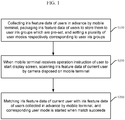
- FIG. 1 is a flow chart illustrating a user mode control method based on face recognition for a mobile terminal according to one preferred embodiment of the present invention.
- the user mode control method based on iris recognition for a mobile terminal shown in FIG. 1 includes: step S100, collecting iris feature data of a plurality of users in advance by the mobile terminal, packaging the iris feature data of the users to store them to a plurality of user iris groups which are pre-set, and setting a plurality of user modes which correspond one-to-one to the user iris groups.
- the user when a user uses the mobile terminal, the user employs a camera of the mobile terminal itself to train it on eyeballs of the use for collecting the iris feature data of the user in advance.
- the owner of the mobile terminal needs to collect not only his or her iris feature data but the iris feature data of relatives and friends.
- a plurality of user iris groups which are utilized to store the iris feature data in classification, can be established in the mobile terminal.
- a region within mobile terminal in which the iris feature data stored is divided into four regions, an owner region of the iris feature data, a family region of the iris feature data, a friend region of the iris feature data, and a stranger region of the iris feature data, respectively.
- the above four regions correspondingly store the iris feature data of the four user iris groups, respectively. That is, owner iris groups are stored to the owner region of the iris feature data; family iris groups are stored to the family region of the iris feature data; friend iris groups are stored to the friend region of the iris feature data; stranger iris groups are stored to the stranger region of the iris feature data.
- a corresponding permission for each of the user iris groups is set, and the corresponding user modes are acquired.
- Step S200 when the mobile terminal receives an operation instruction of the user to start a display screen, the iris feature data of the current user are scanned by the camera disposed on the mobile terminal.
- the user when the user turns on the display screen of the mobile terminal, it does not enter a main desktop of the mobile terminal immediately but starts the camera of the mobile terminal to collect the iris feature data of the current user. Since the main desktop of the mobile terminal cannot be accessed and then be normally used by starting the display screen of the mobile terminal, the security of the user data is greatly improved.
- Step S300 the iris feature data of the current user are matched with the iris feature data of the users collected in advance by the mobile terminal, and the corresponding user mode is started when the match succeeds.
- the iris feature data of the current user are matched with the iris feature data stored in the plurality of user iris groups.
- the user mode of the corresponding user iris group is started.
- the user modes of the embodiment include a main mode, a family mode, a friend mode, and a stranger mode.
- the plurality of user iris groups are set in the step S100, and the user modes which correspond one-to-one to the user iris groups are set.
- the owner iris groups correspond to a highest user permission, which is able to turn on all applications, make any settings, and view all photos, videos and text message data; that is, the user mode that is set to correspond to the owner iris groups is a main mode.
- the family iris groups correspond to a second-highest user permission, which is able to turn on all applications, not able to make settings, and able to view partial photos, videos and text message data; that is, the user mode that is set to correspond to the family iris groups is a family mode.
- the friend iris groups correspond to a third-highest user permission, which is able to turn on partial applications, not able to make settings, and not able to view photos, videos and text message data; that is, the user mode that is set to correspond to the friend iris groups is a friend mode.
- the stranger iris groups correspond to a fourth-highest user permission, which is not able to turn on applications, not able to make settings, and not able to view photos, videos and text message data.
- the above contents are just utilized to give examples.
- the user iris groups which can be stored in the terminal include but not limited to the above user iris groups, and the user modes which can be set by the terminal include but not limited to the above user modes.
- the user iris groups and the user modes have properties of increase, edition, modification, and deletion.
- step S300 of matching the iris feature data and stating the corresponding user mode further includes: locking the mobile terminal or starting the stranger mode when the match fails.
- the owner of the mobile terminal does not seek to collect the iris feature data of strangers, so the stranger iris groups do not store any iris feature data. Meanwhile, if the iris feature data that matches the current user is not found in the stored owner iris groups, family iris groups and friend iris groups, then the current user is assumed to belong to the stranger iris groups, and the corresponding stranger user mode is started.
- the step S200 of acquiring the iris feature data of the current user specifically includes: step S201, prompting the user to aim his or her eyes at a camera by popping up a prompt box when the mobile terminal receives an operation instruction of the user to start a display screen; when the current user of the mobile terminal starts the display screen, the display screen of the mobile terminal pops up the prompt box to prompt the user to aim the eyes at the camera.
- step S201 prompting the user to aim his or her eyes at a camera by popping up a prompt box when the mobile terminal receives an operation instruction of the user to start a display screen; when the current user of the mobile terminal starts the display screen, the display screen of the mobile terminal pops up the prompt box to prompt the user to aim the eyes at the camera.
- Step S202 when the camera detects the eyes of the user aiming at the camera, the iris feature data of the current user are acquired by the camera.
- the camera detects that the eyes of the user have aimed at the camera, the camera acquires the iris feature data of the current user by continuous shooting, continuous recording or other scanning manners.
- the step S300 of matching the iris feature data and stating the corresponding user mode specifically includes: step S301, determining whether the mobile terminal receives an operation instruction of the current user to select the user iris groups for carrying out a simple match, if not, then entering step S302, if yes, then entering step S303; step S302, matching the iris feature data of the current user with the iris feature data of the users collected in advance by the mobile terminal, and starting the corresponding user mode when the match succeeds; and step S303, matching the iris feature data of the current user with the iris feature data stored in the user iris group selected by the current user, and starting the user mode corresponding to the user iris group selected by the current user when the match succeeds.
- the current user when the current user has been informed that the iris feature data are stored in which user iris group by the owner of the mobile terminal, the current user selects the corresponding user iris group, and the iris feature data of the current user are compared and matched with all the iris feature data stored in the selected user iris group. When the match succeeds, the user mode corresponding to the user iris group selected by the current user is started. If the current user does not know which iris group their iris feature data is stored in , the iris feature data of the current user are matched with all the iris feature data, which are collected in advance and stored in the mobile terminal, and when the match succeeds, the user mode corresponding to the user iris group selected by the current user is started.
- the above embodiment preferably requires to starting the camera of the mobile terminal for collecting the iris feature data of the current user.
- the user mode can also be switched by manual starting during using the mobile terminal, then the iris feature data of the current user are collected, and the subsequent related steps are performed in order to enrich the operating experience for the user.
- the present invention provides a user mode control method based on iris recognition for a mobile terminal, which utilizes the result of the iris recognition to determine which user mode of the mobile terminal to start without manually switching the user mode by the user, whereby the operation is simple, practical, and convenient. Meanwhile, the uniqueness of the iris of the owner of the mobile terminal is utilized to start the main mode, thereby improving information security of the private data of the owner of the mobile terminal.
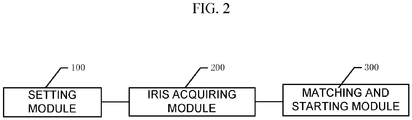
- the present invention further provides a user mode starting system based on iris recognition for a mobile terminal, which includes: a setting module 100 which is utilized to collect iris feature data of users in advance by the mobile terminal, to package the iris feature data of the users to store them to a plurality of user iris groups which are pre-set, and to set a plurality of user modes which correspond one-to-one to the user iris groups; the specific description is mentioned above.
- a setting module 100 which is utilized to collect iris feature data of users in advance by the mobile terminal, to package the iris feature data of the users to store them to a plurality of user iris groups which are pre-set, and to set a plurality of user modes which correspond one-to-one to the user iris groups; the specific description is mentioned above.
- An iris acquiring module 200 is utilized to scan the iris feature data of a current user by a camera disposed on the mobile terminal when the mobile terminal receives an operation instruction of the user to start a display screen; the specific description is mentioned above.
- a matching and starting module 300 is utilized to match the iris feature data of the current user with the iris feature data of the users collected in advance by the mobile terminal, and to start the corresponding user mode when the match succeeds; the specific description is mentioned above.
- the user modes herein include a main mode, a family mode, a friend mode, and a stranger mode; the specific description is mentioned above.
- the matching and starting module 300 is further utilized to lock the mobile terminal or start the stranger mode when the match fails; the specific description is mentioned above.
- the iris acquiring module 200 specifically includes: a prompting unit utilized to prompt a user to aim eyes at a camera by popping up a prompt box when the mobile terminal receives an operation instruction of the user to start a display screen; the specific description is mentioned above.
- An iris acquiring unit is utilized to acquire the iris feature data of the current user by the camera when the camera detects the eyes of the user aiming at the camera; the specific description is mentioned above.
- the matching and starting module 300 specifically includes: a simple match selecting unit utilized to determine whether the mobile terminal receives an operation instruction of the current user to select the user iris groups for carrying out a simple match, and to start a full matching and starting unit if not, and to start a simple matching and starting unit if yes; the specific description is mentioned above.
- the full matching and starting unit is utilized to match the iris feature data of the current user with the iris feature data of the users collected in advance by the mobile terminal, and to start the corresponding user mode when the match succeeds; the specific description is mentioned above.
- the simple matching and starting unit is utilized to match the iris feature data of the current user with the iris feature data stored in the user iris group selected by the current user.
- the match succeeds, the user mode corresponding to the user iris group selected by the current user is started; the specific description is mentioned above.
- the user mode starting system based on iris recognition for a mobile terminal is formed in a terminal such as a computer, a tablet computer, and a cell phone.
- the mobile terminal user mode control method based on the iris recognition technology provided in the above-described embodiments and the user mode control system based on the iris recognition technology belong to the same concept.
- the mobile terminal user mode control system based on the iris recognition technology can run any method provided in the embodiments of the mobile terminal user mode control method based on the iris recognition technology, and implementation thereof is referred to the embodiments of the mobile terminal user mode control method based on the iris recognition technology and is not detailed herein.
- the computer program can be stored in a computer-readable storage medium such as a memory in a terminal and is executed by at least one processor in the terminal.
- the computer program may include the processes of the embodiments of the above methods in the execution process.
- the storage medium can be a disk, an optical disc, a read-only memory (ROM), or a random access memory (RAM), etc.
- the respective functional modules can be integrated into one processing chip, or each of the modules may exist alone physically, or else two or more than two modules are integrated into one module.
- the aforementioned integrated module can be implemented in a form of hardware or a form of software functional modules.
- the integrated module may be stored in a computer-readable storage medium such as a read-only memory, a disk, or an optical disc.
- the present invention discloses a user mode control method and system based on iris recognition for a mobile terminal for collecting iris feature data of a plurality of users in advance by the mobile terminal, packaging the iris feature data of the users to store them to a plurality of user iris groups which are pre-set, and setting a plurality of user modes which correspond one-to-one to the user iris groups; scanning the iris feature data of a current user by a camera disposed on the mobile terminal when the mobile terminal receives an operation instruction of the user to start a display screen; and matching the iris feature data of the current user with the iris feature data of the users collected in advance by the mobile terminal, and starting the corresponding user mode when the match succeeds.
- the user mode control method employing the iris recognition of the present invention utilizes a result of the iris recognition to determine which user mode to start, thereby preventing a stranger from entering the owner mode of the terminal and accessing private data, greatly improving the security of the user data.
Landscapes
- Engineering & Computer Science (AREA)
- Computer Security & Cryptography (AREA)
- Computer Networks & Wireless Communication (AREA)
- Signal Processing (AREA)
- Computer Hardware Design (AREA)
- General Engineering & Computer Science (AREA)
- Computing Systems (AREA)
- Theoretical Computer Science (AREA)
- Health & Medical Sciences (AREA)
- General Health & Medical Sciences (AREA)
- Physics & Mathematics (AREA)
- General Physics & Mathematics (AREA)
- Software Systems (AREA)
- Bioethics (AREA)
- Biomedical Technology (AREA)
- Medical Informatics (AREA)
- Databases & Information Systems (AREA)
- Telephone Function (AREA)
- Collating Specific Patterns (AREA)
- Mobile Radio Communication Systems (AREA)
Abstract
Description
- The present invention relates to an iris recognition technology, and in particular to a user mode control method and system based on iris recognition for a mobile terminal.
- With the increasing development of mobile communications and the raising of people's living standards, usage of various mobile terminals such as mobile phones is increasingly popular, and mobile phones have become indispensable communication tools in people's lives.
- Data in the mobile terminals such as mobile phones usually have different levels of privacy. However, owners of the mobile terminals often lend their devices to their family members or friends. If some important private files are not encrypted locked, they are very easily seen. If the owner of a mobile device accidentally loses the mobile terminal, and if it is picked up by a stranger, some information relating to the privacy and some important contents such as Alipay passwords, IM account passwords, and even bank card information, etc. are likely to leak.
- At present, many mobile terminals are equipped with three user modes, e.g. a main mode, a child mode, and a guest mode. When the owner of the mobile terminal (i.e. possessor) lends the mobile terminal to others, he or she does not want others to view stored private photos, videos, text messages, and other private data. The owner needs to manually key-in a security password set in advance, switch to the guest mode, and then lend the mobile terminal to others. It can be seen from the foregoing that the user mode of the mobile terminal needs to be manually switched, and this operation is very tedious.
- Thus, there is a requirement to improve and develop the prior art.
- The technical problem which the present invention needs to solve is to provide a user mode control method and system based on iris recognition for a mobile terminal for the above-mentioned disadvantage in the prior art. The present invention mainly applies the iris recognition technology to the mobile terminal for user identification, privacy protection, and information security.
- A technical solution of the present invention is implemented as follows.
- A user mode control method based on iris recognition for a mobile terminal includes: collecting iris feature data of a plurality of users in advance by the mobile terminal, packaging the iris feature data of the users to store them to a plurality of user iris groups which are pre-set, and setting a plurality of user modes which correspond one-to-one to the user iris groups; prompting a user to aim eyes at a camera by popping up a prompt box when the mobile terminal receives an operation instruction of the user to start a display screen; acquiring the iris feature data of the current user by the camera when the camera detects the eyes of the user aiming at the camera; determining whether the mobile terminal receives an operation instruction of the current user to select the user iris groups for carrying out a simple match; matching the iris feature data of the current user with the iris feature data of the users collected in advance by the mobile terminal if not, and starting the corresponding user mode when the match succeeds; matching the iris feature data of the current user with the iris feature data stored in the user iris group selected by the current user if yes, and starting the user mode corresponding to the user iris group selected by the current user when the match succeeds.
- The user modes herein include a main mode, a family mode, a friend mode, and a stranger mode.
- The user mode control method herein based on iris recognition for the mobile terminal further includes: locking the mobile terminal when the match fails.
- The user mode control method herein based on iris recognition for the mobile terminal further includes: starting the stranger mode when the match fails.
- The step of packaging the iris feature data of the users to store them to the user iris groups which are pre-set and setting the user modes which correspond one-to-one to the user iris groups specifically is: dividing a region within mobile terminal in which the iris feature data stored into four regions, an owner region of the iris feature data, a family region of the iris feature data, a friend region of the iris feature data, and a stranger region of the iris feature data, respectively; storing owner iris groups to the owner region of the iris feature data, storing family iris groups to the family region of the iris feature data, storing friend iris groups to the friend region of the iris feature data, and storing stranger iris groups to the stranger region of the iris feature data; and setting a corresponding permission for each of the user iris groups after the iris feature data are stored in classification, and acquiring the corresponding user modes.
- The step of starting the stranger mode when the match fails specifically is: if the iris feature data that matches the current user is not found in the stored owner iris groups, family iris groups and friend iris groups, then assuming that the current user belongs to the stranger iris groups, and starting the corresponding stranger user mode.
- The owner iris groups correspond to a highest user permission, which is able to turn on all applications, make any settings, and view all photos, videos, and text message data; the family iris groups correspond to a second-highest user permission, which is able to turn on all applications, not able to make settings, and able to view partial photos, videos, and text message data; the friend iris groups correspond to a third-highest user permission, which is able to turn on partial applications, not able to make settings, and not able to view photos, videos, and text message data; the stranger iris groups correspond to a fourth-highest user permission, which is not able to turn on applications, not able to make settings, and not able to view photos, videos, and text message data.
- A user mode control method based on iris recognition for a mobile terminal includes: collecting iris feature data of a plurality of users in advance by the mobile terminal, packaging the iris feature data of the users to store them to a plurality of user iris groups which are pre-set, and setting a plurality of user modes which correspond one-to-one to the user iris groups; scanning the iris feature data of a current user by a camera disposed on the mobile terminal when the mobile terminal receives an operation instruction of the user to start a display screen; matching the iris feature data of the current user with the iris feature data of the users collected in advance by the mobile terminal, and starting the corresponding user mode when the match succeeds.
- The user modes herein include a main mode, a family mode, a friend mode, and a stranger mode.
- The user mode control method herein based on iris recognition for the mobile terminal further includes: locking the mobile terminal when the match fails.
- The user mode control method herein based on iris recognition for the mobile terminal further includes: starting the stranger mode when the match fails.
- The step of scanning the iris feature data of a current user by a camera disposed on the mobile terminal when the mobile terminal receives an operation instruction of the user to start a display screen specifically includes: prompting a user to aim eyes at a camera by popping up a prompt box when the mobile terminal receives an operation instruction of the user to start a display screen; acquiring the iris feature data of the current user by the camera when the camera detects the eyes of the user aiming at the camera.
- The step of matching the iris feature data of the current user with the iris feature data of the users collected in advance by the mobile terminal and starting the corresponding user mode when the match succeeds specifically comprises: determining whether the mobile terminal receives an operation instruction of the current user to select the user iris groups for carrying out a simple match; matching the iris feature data of the current user with the iris feature data of the users collected in advance by the mobile terminal if not, and starting the corresponding user mode when the match succeeds; matching the iris feature data of the current user with the iris feature data stored in the user iris group selected by the current user if yes, and starting the user mode corresponding to the user iris group selected by the current user when the match succeeds.
- The step of packaging the iris feature data of the users to store them to the user iris groups which are pre-set and setting the user modes which correspond one-to-one to the user iris groups specifically is: dividing a region within mobile terminal in which the iris feature data are stored into four regions, an owner region of the iris feature data, a family region of the iris feature data, a friend region of the iris feature data, and a stranger region of the iris feature data, respectively; storing owner iris groups to the owner region of the iris feature data, storing family iris groups to the family region of the iris feature data, storing friend iris groups to the friend region of the iris feature data, and storing stranger iris groups to the stranger region of the iris feature data; and setting a corresponding permission for each of the user iris groups after the iris feature data are stored in classification, and acquiring the corresponding user modes.
- The step of starting the stranger mode when the match fails specifically is: if the iris feature data that matches the current user is not found in the stored owner iris groups, family iris groups, and friend iris groups, then assuming that the current user belongs to the stranger iris groups, and starting the corresponding stranger user mode.
- A user mode starting system based on iris recognition for a mobile terminal includes: a setting module utilized to collect iris feature data of users in advance by the mobile terminal, to package the iris feature data of the users to store them to a plurality of user iris groups which are pre-set, and to set a plurality of user modes which correspond one-to-one to the user iris groups; an iris acquiring module utilized to scan the iris feature data of a current user by a camera disposed on the mobile terminal when the mobile terminal receives an operation instruction of the user to start a display screen; and a matching and starting module utilized to match the iris feature data of the current user with the iris feature data of the users collected in advance by the mobile terminal, and to start the corresponding user mode when the match succeeds.
- The user modes herein include a main mode, a family mode, a friend mode, and a stranger mode. The matching and starting module herein is further utilized to lock the mobile terminal or start the stranger mode when the match fails.
- The iris acquiring module herein specifically comprises: a prompting unit utilized to prompt a user to aim eyes at a camera by popping up a prompt box when the mobile terminal receives an operation instruction of the user to start a display screen; and an iris acquiring unit utilized to acquire the iris feature data of the current user by the camera when the camera detects the eyes of the user aiming at the camera.
- The matching and starting module herein specifically comprises: a simple match selecting unit utilized to determine whether mobile terminal receives an operation instruction of the current user to select the user iris groups for carrying out a simple match, and to start a full matching and starting unit if not, and to start a simple matching and starting unit if yes; the full matching and starting unit utilized to match the iris feature data of the current user with the iris feature data of the users collected in advance by the mobile terminal, and to start the corresponding user mode when the match succeeds; the simple matching and starting unit utilized to match the iris feature data of the current user with the iris feature data stored in the user iris group selected by the current user, and starting the user mode corresponding to the user iris group selected by the current user when the match succeeds.
- The present invention discloses a user mode control method and system based on iris recognition for mobile terminal, both of which include: collecting iris feature data of a plurality of users in advance by the mobile terminal, packaging the iris feature data of the users to store them to a plurality of user iris groups which are pre-set, and setting a plurality of user modes which correspond one-to-one to the user iris groups; scanning the iris feature data of a current user by a camera disposed on the mobile terminal when the mobile terminal receives an operation instruction of the user to start a display screen; matching the iris feature data of the current user with the iris feature data of the users collected in advance by the mobile terminal, and starting the corresponding user mode when the match succeeds. The user mode control method employing the iris recognition of the present invention utilizes a result of the iris recognition to determine to start which user mode, thereby preventing a stranger from entering the owner mode of the terminal and accessing private data, greatly improving the security of the user data.
-
-
FIG. 1 is a flow chart illustrating a user mode control method based on face recognition for a mobile terminal according to one preferred embodiment of the present invention; and -
FIG. 2 is a block diagram illustrating a user mode starting system based on iris recognition for a mobile terminal according to one preferred embodiment of the present invention. - The user mode control method and system based on iris recognition for mobile terminal provided by the present invention mainly employs an iris recognition technology, which has uniqueness, stability, and immutability. The exterior of a human eye consists of three parts: sclera, iris, and pupil. The iris is an annular portion located between the black sclera and the white pupil, and the annular portion includes many interlaced minutiae features that are similar to spots, filaments, coronals, stripes, and crypts. These features can uniquely identify a person's identity. Except for rare abnormal status, e.g. except that large physical or mental trauma may cause changes in the appearance of the iris, the appearance of the iris can be maintained for several decades without many changes. On the other hand, the iris is externally visible, but it belongs to internal organizations, which are located behind the cornea. Modifying the appearance of the iris not only requires a very delicate surgery, but also risks the danger of visual impairment.
- In using the mobile terminal such as mobile phones, tablet PCs or other computing devices with a camera function, the user usually sets a security measure such as passwords and pattern locks.
- However, the above safety measures are easily broken by others, thereby unlocking the mobile terminal for further use. When the private photos, videos, text messages, personal bank accounts, and other private contents in the mobile terminal are viewed by others, it might bring great losses to the owner of the mobile terminal.
- To make the objectives, technical solutions and advantages of the present disclosure clearer, the present disclosure will be further described herein below with reference to the attached drawings and embodiments thereof. It should be understood that the specific embodiment described herein is merely utilized to explain the present invention but not to limit the present invention.
- Refer to
FIG. 1 , which is a flow chart illustrating a user mode control method based on face recognition for a mobile terminal according to one preferred embodiment of the present invention. The user mode control method based on iris recognition for a mobile terminal shown inFIG. 1 includes: step S100, collecting iris feature data of a plurality of users in advance by the mobile terminal, packaging the iris feature data of the users to store them to a plurality of user iris groups which are pre-set, and setting a plurality of user modes which correspond one-to-one to the user iris groups. - That is, when a user uses the mobile terminal, the user employs a camera of the mobile terminal itself to train it on eyeballs of the use for collecting the iris feature data of the user in advance. In the process of collecting the iris feature data of the user in advance, the owner of the mobile terminal needs to collect not only his or her iris feature data but the iris feature data of relatives and friends. During packaging the iris feature data to store them, a plurality of user iris groups, which are utilized to store the iris feature data in classification, can be established in the mobile terminal. For example, a region within mobile terminal in which the iris feature data stored is divided into four regions, an owner region of the iris feature data, a family region of the iris feature data, a friend region of the iris feature data, and a stranger region of the iris feature data, respectively. The above four regions correspondingly store the iris feature data of the four user iris groups, respectively. That is, owner iris groups are stored to the owner region of the iris feature data; family iris groups are stored to the family region of the iris feature data; friend iris groups are stored to the friend region of the iris feature data; stranger iris groups are stored to the stranger region of the iris feature data. After the iris feature data are stored in classification, a corresponding permission for each of the user iris groups is set, and the corresponding user modes are acquired.
- Step S200, when the mobile terminal receives an operation instruction of the user to start a display screen, the iris feature data of the current user are scanned by the camera disposed on the mobile terminal.
- That is, when the user turns on the display screen of the mobile terminal, it does not enter a main desktop of the mobile terminal immediately but starts the camera of the mobile terminal to collect the iris feature data of the current user. Since the main desktop of the mobile terminal cannot be accessed and then be normally used by starting the display screen of the mobile terminal, the security of the user data is greatly improved.
- Step S300, the iris feature data of the current user are matched with the iris feature data of the users collected in advance by the mobile terminal, and the corresponding user mode is started when the match succeeds.
- That is, the iris feature data of the current user are matched with the iris feature data stored in the plurality of user iris groups. When the iris feature data which match the iris feature data of the current user are found in one of the user iris groups, the user mode of the corresponding user iris group is started.
- Furthermore, the user modes of the embodiment include a main mode, a family mode, a friend mode, and a stranger mode.
- The plurality of user iris groups are set in the step S100, and the user modes which correspond one-to-one to the user iris groups are set. In specific implementation, the owner iris groups correspond to a highest user permission, which is able to turn on all applications, make any settings, and view all photos, videos and text message data; that is, the user mode that is set to correspond to the owner iris groups is a main mode. The family iris groups correspond to a second-highest user permission, which is able to turn on all applications, not able to make settings, and able to view partial photos, videos and text message data; that is, the user mode that is set to correspond to the family iris groups is a family mode. The friend iris groups correspond to a third-highest user permission, which is able to turn on partial applications, not able to make settings, and not able to view photos, videos and text message data; that is, the user mode that is set to correspond to the friend iris groups is a friend mode. The stranger iris groups correspond to a fourth-highest user permission, which is not able to turn on applications, not able to make settings, and not able to view photos, videos and text message data. The above contents are just utilized to give examples. The user iris groups which can be stored in the terminal include but not limited to the above user iris groups, and the user modes which can be set by the terminal include but not limited to the above user modes. The user iris groups and the user modes have properties of increase, edition, modification, and deletion.
- Furthermore, the step S300 of matching the iris feature data and stating the corresponding user mode further includes: locking the mobile terminal or starting the stranger mode when the match fails.
- Although the stranger iris groups have been set, and the stranger mode is set correspondingly in the step S100, the owner of the mobile terminal does not seek to collect the iris feature data of strangers, so the stranger iris groups do not store any iris feature data. Meanwhile, if the iris feature data that matches the current user is not found in the stored owner iris groups, family iris groups and friend iris groups, then the current user is assumed to belong to the stranger iris groups, and the corresponding stranger user mode is started.
- In a further embodiment, the step S200 of acquiring the iris feature data of the current user specifically includes: step S201, prompting the user to aim his or her eyes at a camera by popping up a prompt box when the mobile terminal receives an operation instruction of the user to start a display screen; when the current user of the mobile terminal starts the display screen, the display screen of the mobile terminal pops up the prompt box to prompt the user to aim the eyes at the camera. Through the prompting function of the mobile terminal, the user can timely acquire the prompt for the next operation after starting the display screen, which greatly facilitates the user.
- Step S202, when the camera detects the eyes of the user aiming at the camera, the iris feature data of the current user are acquired by the camera.
- That is, when the camera detects that the eyes of the user have aimed at the camera, the camera acquires the iris feature data of the current user by continuous shooting, continuous recording or other scanning manners.
- In a further embodiment, the step S300 of matching the iris feature data and stating the corresponding user mode specifically includes: step S301, determining whether the mobile terminal receives an operation instruction of the current user to select the user iris groups for carrying out a simple match, if not, then entering step S302, if yes, then entering step S303; step S302, matching the iris feature data of the current user with the iris feature data of the users collected in advance by the mobile terminal, and starting the corresponding user mode when the match succeeds; and step S303, matching the iris feature data of the current user with the iris feature data stored in the user iris group selected by the current user, and starting the user mode corresponding to the user iris group selected by the current user when the match succeeds.
- That is, when the current user has been informed that the iris feature data are stored in which user iris group by the owner of the mobile terminal, the current user selects the corresponding user iris group, and the iris feature data of the current user are compared and matched with all the iris feature data stored in the selected user iris group. When the match succeeds, the user mode corresponding to the user iris group selected by the current user is started. If the current user does not know which iris group their iris feature data is stored in , the iris feature data of the current user are matched with all the iris feature data, which are collected in advance and stored in the mobile terminal, and when the match succeeds, the user mode corresponding to the user iris group selected by the current user is started.
- It should be noted that the above embodiment preferably requires to starting the camera of the mobile terminal for collecting the iris feature data of the current user. However, in other embodiments, the user mode can also be switched by manual starting during using the mobile terminal, then the iris feature data of the current user are collected, and the subsequent related steps are performed in order to enrich the operating experience for the user.
- Notably, the present invention provides a user mode control method based on iris recognition for a mobile terminal, which utilizes the result of the iris recognition to determine which user mode of the mobile terminal to start without manually switching the user mode by the user, whereby the operation is simple, practical, and convenient. Meanwhile, the uniqueness of the iris of the owner of the mobile terminal is utilized to start the main mode, thereby improving information security of the private data of the owner of the mobile terminal.
- Based on the above-mentioned embodiment, as shown in
FIG. 2 , the present invention further provides a user mode starting system based on iris recognition for a mobile terminal, which includes: a settingmodule 100 which is utilized to collect iris feature data of users in advance by the mobile terminal, to package the iris feature data of the users to store them to a plurality of user iris groups which are pre-set, and to set a plurality of user modes which correspond one-to-one to the user iris groups; the specific description is mentioned above. - An
iris acquiring module 200 is utilized to scan the iris feature data of a current user by a camera disposed on the mobile terminal when the mobile terminal receives an operation instruction of the user to start a display screen; the specific description is mentioned above. - A matching and starting
module 300 is utilized to match the iris feature data of the current user with the iris feature data of the users collected in advance by the mobile terminal, and to start the corresponding user mode when the match succeeds; the specific description is mentioned above. - In a further embodiment, the user modes herein include a main mode, a family mode, a friend mode, and a stranger mode; the specific description is mentioned above.
- In a further embodiment, the matching and starting
module 300 is further utilized to lock the mobile terminal or start the stranger mode when the match fails; the specific description is mentioned above. - In a further embodiment, the
iris acquiring module 200 specifically includes: a prompting unit utilized to prompt a user to aim eyes at a camera by popping up a prompt box when the mobile terminal receives an operation instruction of the user to start a display screen; the specific description is mentioned above. - An iris acquiring unit is utilized to acquire the iris feature data of the current user by the camera when the camera detects the eyes of the user aiming at the camera; the specific description is mentioned above.
- In a further embodiment, the matching and starting
module 300 specifically includes: a simple match selecting unit utilized to determine whether the mobile terminal receives an operation instruction of the current user to select the user iris groups for carrying out a simple match, and to start a full matching and starting unit if not, and to start a simple matching and starting unit if yes; the specific description is mentioned above. - The full matching and starting unit is utilized to match the iris feature data of the current user with the iris feature data of the users collected in advance by the mobile terminal, and to start the corresponding user mode when the match succeeds; the specific description is mentioned above.
- The simple matching and starting unit is utilized to match the iris feature data of the current user with the iris feature data stored in the user iris group selected by the current user. When the match succeeds, the user mode corresponding to the user iris group selected by the current user is started; the specific description is mentioned above.
- The user mode starting system based on iris recognition for a mobile terminal is formed in a terminal such as a computer, a tablet computer, and a cell phone. The mobile terminal user mode control method based on the iris recognition technology provided in the above-described embodiments and the user mode control system based on the iris recognition technology belong to the same concept. The mobile terminal user mode control system based on the iris recognition technology can run any method provided in the embodiments of the mobile terminal user mode control method based on the iris recognition technology, and implementation thereof is referred to the embodiments of the mobile terminal user mode control method based on the iris recognition technology and is not detailed herein.
- It should be noted that as to the user mode control method based on iris recognition for mobile terminal of the embodiment of the present invention, it should be understood for an ordinary person in this field that partial or full processes carrying out the mobile terminal user mode control method based on the iris recognition technology provided in the embodiment of the present invention can be accomplished by related hardware instructed by a computer program. The computer program can be stored in a computer-readable storage medium such as a memory in a terminal and is executed by at least one processor in the terminal. The computer program may include the processes of the embodiments of the above methods in the execution process. The storage medium can be a disk, an optical disc, a read-only memory (ROM), or a random access memory (RAM), etc.
- As to the user mode starting system based on iris recognition for a mobile terminal of the embodiment of the present invention, the respective functional modules can be integrated into one processing chip, or each of the modules may exist alone physically, or else two or more than two modules are integrated into one module. The aforementioned integrated module can be implemented in a form of hardware or a form of software functional modules. When the integrated module is implemented in the form of software functional modules and sold or used as an independent product, the integrated module may be stored in a computer-readable storage medium such as a read-only memory, a disk, or an optical disc.
- In summary, the present invention discloses a user mode control method and system based on iris recognition for a mobile terminal for collecting iris feature data of a plurality of users in advance by the mobile terminal, packaging the iris feature data of the users to store them to a plurality of user iris groups which are pre-set, and setting a plurality of user modes which correspond one-to-one to the user iris groups; scanning the iris feature data of a current user by a camera disposed on the mobile terminal when the mobile terminal receives an operation instruction of the user to start a display screen; and matching the iris feature data of the current user with the iris feature data of the users collected in advance by the mobile terminal, and starting the corresponding user mode when the match succeeds. The user mode control method employing the iris recognition of the present invention utilizes a result of the iris recognition to determine which user mode to start, thereby preventing a stranger from entering the owner mode of the terminal and accessing private data, greatly improving the security of the user data.
- It shall be understood that applications of the present disclosure are not limited to what is described above. Those of ordinary skill in the art may make modifications or variations according to the above description, and all of these modifications and variations shall be covered within the scope of the attached claims of the present disclosure.
Claims (20)
- A user mode control method based on iris recognition for a mobile terminal, comprising:collecting iris feature data of a plurality of users in advance by the mobile terminal, packaging the iris feature data of the users to store them to a plurality of user iris groups which are pre-set, and setting a plurality of user modes which correspond one-to-one to the user iris groups;prompting a user to aim eyes at a camera by popping up a prompt box when the mobile terminal receives an operation instruction of the user to start a display screen;acquiring the iris feature data of the current user by the camera when the camera detects the eyes of the user aiming at the camera;determining whether the mobile terminal receives an operation instruction of the current user to select the user iris groups for carrying out a simple match;if not, matching the iris feature data of the current user with the iris feature data of the users collected in advance by the mobile terminal, and starting the corresponding user mode when the match succeeds;if yes, matching the iris feature data of the current user with the iris feature data stored in the user iris group selected by the current user, and starting the user mode corresponding to the user iris group selected by the current user when the match succeeds.
- The user mode control method according to claim 1, wherein the user modes comprise a main mode, a family mode, a friend mode, and a stranger mode.
- The user mode control method according to claim 2, wherein the user mode control method further comprises:when the match fails, locking the mobile terminal.
- The user mode control method according to claim 2, wherein the user mode control method further comprises:when the match fails, starting the stranger mode.
- The user mode control method according to claim 4, wherein the step of packaging the iris feature data of the users to store them to the user iris groups which are pre-set and setting the user modes which correspond one-to-one to the user iris groups specifically is:dividing a region within mobile terminal in which the iris feature data are stored into four regions, an owner region of the iris feature data, a family region of the iris feature data, a friend region of the iris feature data, and a stranger region of the iris feature data, respectively;storing owner iris groups to the owner region of the iris feature data, storing family iris groups to the family region of the iris feature data, storing friend iris groups to the friend region of the iris feature data, and storing stranger iris groups to the stranger region of the iris feature data;setting a corresponding permission for each of the user iris groups after the iris feature data are stored in classification, and acquiring the corresponding user modes.
- The user mode control method according to claim 5, wherein the step of starting the stranger mode when the match fails specifically is:if the iris feature data that matches the current user is not found in the stored owner iris groups, family iris groups and friend iris groups, then assuming that the current user belongs to the stranger iris groups, and starting the corresponding stranger user mode.
- The user mode control method according to claim 5, wherein:the owner iris groups correspond to a highest user permission, which is able to turn on all applications, make any settings, and view all photos, videos and text message data;the family iris groups correspond to a second-highest user permission, which is able to turn on all applications, not able to make settings, and able to view partial photos, videos and text message data;the friend iris groups correspond to a third-highest user permission, which is able to turn on partial applications, not able to make settings, and not able to view photos, videos and text message data;the stranger iris groups correspond to a fourth-highest user permission, which is not able to turn on applications, not able to make settings, and not able to view photos, videos and text message data.
- A user mode control method based on iris recognition for a mobile terminal, comprising:collecting iris feature data of a plurality of users in advance by the mobile terminal, packaging the iris feature data of the users to store them to a plurality of user iris groups which are pre-set, and setting a plurality of user modes which correspond one-to-one to the user iris groups;scanning the iris feature data of a current user by a camera disposed on the mobile terminal when the mobile terminal receives an operation instruction of the user to start a display screen;matching the iris feature data of the current user with the iris feature data of the users collected in advance by the mobile terminal, and starting the corresponding user mode when the match succeeds.
- The user mode control method according to claim 8, wherein the user modes comprise a main mode, a family mode, a friend mode, and a stranger mode.
- The user mode control method according to claim 9, wherein the user mode control method further comprises:when the match fails, locking the mobile terminal.
- The user mode control method according to claim 9, wherein the user mode control method further comprises:when the match fails, starting the stranger mode.
- The user mode control method according to claim 8, wherein the step of scanning the iris feature data of a current user by a camera disposed on the mobile terminal when the mobile terminal receives an operation instruction of the user to start a display screen specifically comprises:when the mobile terminal receives an operation instruction of the user to start a display screen, prompting a user to aim eyes at a camera by popping up a prompt box;when the camera detects the eyes of the user aiming at the camera, acquiring the iris feature data of the current user by the camera.
- The user mode control method according to claim 8, wherein the step of matching the iris feature data of the current user with the iris feature data of the users collected in advance by the mobile terminal and starting the corresponding user mode when the match succeeds specifically comprises:determining whether the mobile terminal receives an operation instruction of the current user to select the user iris groups for carrying out a simple match;if not, matching the iris feature data of the current user with the iris feature data of the users collected in advance by the mobile terminal, and starting the corresponding user mode when the match succeeds;if yes, matching the iris feature data of the current user with the iris feature data stored in the user iris group selected by the current user, and starting the user mode corresponding to the user iris group selected by the current user when the match succeeds.
- The user mode control method according to claim 11, wherein the step of packaging the iris feature data of the users to store them to the user iris groups which are pre-set and setting the user modes which correspond one-to-one to the user iris groups specifically is:dividing a region within mobile terminal in which the iris feature data are stored into four regions, an owner region of the iris feature data, a family region of the iris feature data, a friend region of the iris feature data, and a stranger region of the iris feature data, respectively;storing owner iris groups to the owner region of the iris feature data, storing family iris groups to the family region of the iris feature data, storing friend iris groups to the friend region of the iris feature data, and storing stranger iris groups to the stranger region of the iris feature data;setting a corresponding permission for each of the user iris groups after the iris feature data are stored in classification, and acquiring the corresponding user modes.
- The user mode control method according to claim 14, wherein the step of starting the stranger mode when the match fails specifically is:if the iris feature data that matches the current user is not found in the stored owner iris groups, family iris groups and friend iris groups, then assuming that the current user belongs to the stranger iris groups, and starting the corresponding stranger user mode.
- A user mode starting system based on iris recognition for a mobile terminal, comprising:a setting module utilized to collect iris feature data of users in advance by the mobile terminal, to package the iris feature data of the users to store them to a plurality of user iris groups which are pre-set, and to set a plurality of user modes which correspond one-to-one to the user iris groups;an iris acquiring module utilized to scan the iris feature data of a current user by a camera disposed on the mobile terminal when the mobile terminal receives an operation instruction of the user to start a display screen;a matching and starting module utilized to match the iris feature data of the current user with the iris feature data of the users collected in advance by the mobile terminal, and to start the corresponding user mode when the match succeeds.
- The user mode starting system according to claim 16, wherein the user modes comprise a main mode, a family mode, a friend mode, and a stranger mode.
- The user mode starting system according to claim 17, wherein the matching and starting module further comprises: when the match fails, locking the mobile terminal or starting the stranger mode.
- The user mode starting system according to claim 16, wherein the iris acquiring module specifically comprises:a prompting unit utilized to prompt a user to aim eyes at a camera by popping up a prompt box when the mobile terminal receives an operation instruction of the user to start a display screen;an iris acquiring unit utilized to acquire the iris feature data of the current user by the camera when the camera detects the eyes of the user aiming at the camera.
- The user mode starting system according to claim 16, wherein the matching and starting module specifically comprises:a simple match selecting unit utilized to determine whether the mobile terminal receives an operation instruction of the current user to select the user iris groups for carrying out a simple match, and to start a full matching and starting unit if not, and to start a simple matching and starting unit if yes;the full matching and starting unit utilized to match the iris feature data of the current user with the iris feature data of the users collected in advance by the mobile terminal, and to start the corresponding user mode when the match succeeds;the simple matching and starting unit utilized to match the iris feature data of the current user with the iris feature data stored in the user iris group selected by the current user, and to start the user mode corresponding to the user iris group selected by the current user.
Applications Claiming Priority (2)
| Application Number | Priority Date | Filing Date | Title |
|---|---|---|---|
| CN201410302591.8A CN104077517A (en) | 2014-06-30 | 2014-06-30 | Mobile terminal user mode start method and system based on iris identification |
| PCT/CN2014/085726 WO2016000307A1 (en) | 2014-06-30 | 2014-09-02 | Mobile terminal user mode starting method and system based on iris identification |
Publications (3)
| Publication Number | Publication Date |
|---|---|
| EP3163483A1 true EP3163483A1 (en) | 2017-05-03 |
| EP3163483A4 EP3163483A4 (en) | 2018-03-14 |
| EP3163483B1 EP3163483B1 (en) | 2021-01-06 |
Family
ID=51598767
Family Applications (1)
| Application Number | Title | Priority Date | Filing Date |
|---|---|---|---|
| EP14880389.3A Active EP3163483B1 (en) | 2014-06-30 | 2014-09-02 | Mobile terminal user mode starting method and system based on iris identification |
Country Status (4)
| Country | Link |
|---|---|
| US (1) | US9900308B2 (en) |
| EP (1) | EP3163483B1 (en) |
| CN (1) | CN104077517A (en) |
| WO (1) | WO2016000307A1 (en) |
Cited By (1)
| Publication number | Priority date | Publication date | Assignee | Title |
|---|---|---|---|---|
| EP3229508A4 (en) * | 2014-12-26 | 2017-12-27 | Huawei Technologies Co., Ltd. | Method and apparatus for adjusting network mode |
Families Citing this family (43)
| Publication number | Priority date | Publication date | Assignee | Title |
|---|---|---|---|---|
| CN104572191A (en) * | 2014-12-26 | 2015-04-29 | 惠州Tcl移动通信有限公司 | Electronic device and method for recording, prompting or controlling use of electronic device |
| EP3261055A4 (en) * | 2015-02-20 | 2018-10-24 | Sony Corporation | Information processing device, information processing method, and program |
| CN106203081A (en) * | 2015-04-29 | 2016-12-07 | 北京壹人壹本信息科技有限公司 | A kind of safety protecting method and device |
| CN106295284A (en) * | 2015-05-27 | 2017-01-04 | 中兴通讯股份有限公司 | A kind of information protecting method and mobile terminal |
| CN105574386A (en) * | 2015-06-16 | 2016-05-11 | 宇龙计算机通信科技(深圳)有限公司 | Terminal mode management method and apparatus |
| WO2016206041A1 (en) * | 2015-06-25 | 2016-12-29 | 宇龙计算机通信科技(深圳)有限公司 | Terminal data protection method and apparatus |
| CN106357876A (en) * | 2015-07-14 | 2017-01-25 | 中兴通讯股份有限公司 | Data display method of mobile terminal and device |
| CN105184133B (en) * | 2015-07-30 | 2017-11-10 | 广东欧珀移动通信有限公司 | A kind of method for authenticating, device and corresponding mobile terminal |
| CN105260667A (en) * | 2015-10-08 | 2016-01-20 | 青岛海信移动通信技术股份有限公司 | Mobile terminal information confidential method and mobile terminal |
| CN105373226A (en) * | 2015-10-23 | 2016-03-02 | 东莞酷派软件技术有限公司 | Terminal mode switching method and system |
| CN105354467A (en) * | 2015-10-26 | 2016-02-24 | 惠州Tcl移动通信有限公司 | Mobile terminal user mode starting method based on auricle recognition and mobile terminal |
| CN105320871A (en) * | 2015-10-28 | 2016-02-10 | 广东欧珀移动通信有限公司 | Screen unlocking method and screen unlocking device |
| CN105262823A (en) * | 2015-10-28 | 2016-01-20 | 广东欧珀移动通信有限公司 | Method, apparatus and system for controlling terminal |
| CN105335642B (en) * | 2015-10-28 | 2018-02-16 | 广东欧珀移动通信有限公司 | The processing method and processing system of picture |
| CN106909214A (en) * | 2015-12-23 | 2017-06-30 | 北京奇虎科技有限公司 | The startup method and device of application program |
| CN107292159A (en) * | 2016-04-05 | 2017-10-24 | 中兴通讯股份有限公司 | Operate method and device, the terminal of terminal |
| CN105844137B (en) * | 2016-04-07 | 2020-01-07 | 上海斐讯数据通信技术有限公司 | Device and method for identifying picture browsing operation authority |
| CN105868609A (en) * | 2016-04-25 | 2016-08-17 | 乐视控股(北京)有限公司 | Application mode switching method and device as well as intelligent terminal |
| CN106055953A (en) * | 2016-05-27 | 2016-10-26 | 广东欧珀移动通信有限公司 | Unlocking control method and mobile terminal |
| CN106055962B (en) * | 2016-06-07 | 2019-04-02 | Oppo广东移动通信有限公司 | Unlocking control method and mobile terminal |
| CN106203018A (en) * | 2016-07-11 | 2016-12-07 | 北京奇虎科技有限公司 | Multi-user access control method and device |
| CN106228046A (en) * | 2016-07-11 | 2016-12-14 | 佛山杰致信息科技有限公司 | A kind of multi-cipher system |
| CN106250733A (en) * | 2016-07-27 | 2016-12-21 | 广东欧珀移动通信有限公司 | control method and control device |
| WO2018023564A1 (en) * | 2016-08-04 | 2018-02-08 | 薄冰 | Method for adjusting audio effect technique according to market, and vehicle-mounted entertainment system |
| CN106355068A (en) * | 2016-08-31 | 2017-01-25 | 维沃移动通信有限公司 | Individual security information displaying method and device |
| CN106254539B (en) * | 2016-09-23 | 2019-12-06 | 捷开通讯(深圳)有限公司 | Mobile equipment and time-use monitoring system and method based on biological feature recognition |
| CN106775291A (en) * | 2016-11-21 | 2017-05-31 | 珠海格力电器股份有限公司 | Desktop application switching method and device and mobile terminal |
| CN110062929A (en) * | 2016-12-14 | 2019-07-26 | 华为技术有限公司 | A kind of method, apparatus and terminal showing data |
| CN106845370A (en) * | 2016-12-30 | 2017-06-13 | 移康智能科技(上海)股份有限公司 | A kind of electronic peephole viewer accessory system, terminal device and electronic peephole viewer |
| CN107169335A (en) * | 2017-05-15 | 2017-09-15 | 广东小天才科技有限公司 | Intelligent terminal operation management method and device and intelligent terminal |
| CN107179862A (en) * | 2017-05-24 | 2017-09-19 | 广东小天才科技有限公司 | Operation mode switching method and device of mobile equipment |
| CN107315937A (en) * | 2017-06-08 | 2017-11-03 | 努比亚技术有限公司 | A kind of method for secret protection, mobile terminal and computer-readable recording medium |
| CN107704843A (en) * | 2017-10-26 | 2018-02-16 | 上海爱优威软件开发有限公司 | A kind of simple eye iris verification method and system |
| CN108229383A (en) * | 2017-12-29 | 2018-06-29 | 上海爱优威软件开发有限公司 | A kind of iris wiring method and system |
| CN107463822B (en) * | 2017-07-21 | 2021-04-02 | Oppo广东移动通信有限公司 | Biometric pattern control method and related products |
| CN107491673A (en) * | 2017-07-24 | 2017-12-19 | 广东欧珀移动通信有限公司 | Biometric methods and related products |
| CN107516030A (en) * | 2017-07-24 | 2017-12-26 | 广东欧珀移动通信有限公司 | Data storage method and related products |
| CN107426249B (en) * | 2017-09-08 | 2019-08-16 | 维沃移动通信有限公司 | Method for controlling mobile terminal and mobile terminal |
| CN107386827B (en) * | 2017-09-22 | 2023-06-09 | 贵州维讯光电科技有限公司 | Iris camera intelligent identification system for lock |
| CN107808086A (en) * | 2017-10-31 | 2018-03-16 | 广东小天才科技有限公司 | Unlocking method, device and equipment of intelligent terminal |
| CN107818247B (en) * | 2017-11-24 | 2020-05-05 | 维沃移动通信有限公司 | A mobile terminal unlocking method and mobile terminal |
| US10956607B2 (en) * | 2018-06-01 | 2021-03-23 | Motorola Mobility Llc | Controlling non-owner access to media content on a computing device |
| CN115544474A (en) * | 2022-09-13 | 2022-12-30 | 金陵科技学院 | Information processing method and system of electronic equipment based on equipment state |
Family Cites Families (28)
| Publication number | Priority date | Publication date | Assignee | Title |
|---|---|---|---|---|
| US20020152402A1 (en) * | 2001-02-07 | 2002-10-17 | Tov Ofer Shem | Personalized visitor pages |
| US20050197859A1 (en) * | 2004-01-16 | 2005-09-08 | Wilson James C. | Portable electronic data storage and retreival system for group data |
| US20050187980A1 (en) * | 2004-02-10 | 2005-08-25 | Microsoft Corporation | Systems and methods for hosting the common language runtime in a database management system |
| US7427019B2 (en) * | 2004-08-25 | 2008-09-23 | Hsbc North America Holdings Inc. | Biometric identification system, method and medium for point of sale environment |
| DE502005007345D1 (en) * | 2005-01-11 | 2009-07-09 | Swisscom Schweiz Ag | Method and system for gaining access to an object or service |
| DE502005010847D1 (en) * | 2005-10-26 | 2011-02-24 | Swisscom Ag | Method and communication system for comparing biometric data recorded with biometric sensors with reference data |
| US8458465B1 (en) * | 2005-11-16 | 2013-06-04 | AT&T Intellectual Property II, L. P. | Biometric authentication |
| CN1997188A (en) * | 2006-01-06 | 2007-07-11 | 乐金电子(中国)研究开发中心有限公司 | A recognition method of the user identity and its handset |
| US9235733B2 (en) * | 2006-08-11 | 2016-01-12 | J. Douglas Birdwell | Mobile biometrics information collection and identification |
| US20100228692A1 (en) * | 2009-03-03 | 2010-09-09 | Honeywell International Inc. | System and method for multi-modal biometrics |
| US7690032B1 (en) * | 2009-05-22 | 2010-03-30 | Daon Holdings Limited | Method and system for confirming the identity of a user |
| US8868502B2 (en) * | 2011-01-14 | 2014-10-21 | Apple Inc. | Organizing versioning according to permissions |
| US9390445B2 (en) * | 2012-03-05 | 2016-07-12 | Visa International Service Association | Authentication using biometric technology through a consumer device |
| US20130307670A1 (en) * | 2012-05-15 | 2013-11-21 | Jonathan E. Ramaci | Biometric authentication system |
| WO2014012102A2 (en) | 2012-07-13 | 2014-01-16 | Retina Biometrix, Llc | Biometric identification via retina scanning |
| CN102902935A (en) * | 2012-09-26 | 2013-01-30 | 广东欧珀移动通信有限公司 | Mobile terminal privacy protection method and device |
| US8914875B2 (en) * | 2012-10-26 | 2014-12-16 | Facebook, Inc. | Contextual device locking/unlocking |
| US9275212B2 (en) * | 2012-12-26 | 2016-03-01 | Cellco Partnership | Secure element biometric authentication system |
| US10726668B2 (en) * | 2013-03-01 | 2020-07-28 | Igt | Transfer verification of mobile payments |
| GB2517952B (en) * | 2013-09-05 | 2017-05-31 | Barclays Bank Plc | Biometric verification using predicted signatures |
| US9936916B2 (en) * | 2013-10-09 | 2018-04-10 | Nedim T. SAHIN | Systems, environment and methods for identification and analysis of recurring transitory physiological states and events using a portable data collection device |
| US9686274B2 (en) * | 2013-10-11 | 2017-06-20 | Microsoft Technology Licensing, Llc | Informed implicit enrollment and identification |
| US10055562B2 (en) * | 2013-10-23 | 2018-08-21 | Intel Corporation | Techniques for identifying a change in users |
| CN103678981B (en) * | 2013-12-06 | 2017-12-29 | 北京奇虎科技有限公司 | The method and device at different interfaces is realized for different user |
| US20150220537A1 (en) * | 2014-02-06 | 2015-08-06 | Kibra Llc | System & Method for Constructing, Augmenting & Rendering Multimedia Stories |
| US9391988B2 (en) * | 2014-06-04 | 2016-07-12 | Grandios Technologies, Llc | Community biometric authentication on a smartphone |
| US9639680B2 (en) * | 2014-07-29 | 2017-05-02 | Google Inc. | Allowing access to applications based on user handling measurements |
| US9992171B2 (en) * | 2014-11-03 | 2018-06-05 | Sony Corporation | Method and system for digital rights management of encrypted digital content |
-
2014
- 2014-06-30 CN CN201410302591.8A patent/CN104077517A/en active Pending
- 2014-09-02 EP EP14880389.3A patent/EP3163483B1/en active Active
- 2014-09-02 WO PCT/CN2014/085726 patent/WO2016000307A1/en not_active Ceased
- 2014-09-02 US US14/890,163 patent/US9900308B2/en active Active
Cited By (1)
| Publication number | Priority date | Publication date | Assignee | Title |
|---|---|---|---|---|
| EP3229508A4 (en) * | 2014-12-26 | 2017-12-27 | Huawei Technologies Co., Ltd. | Method and apparatus for adjusting network mode |
Also Published As
| Publication number | Publication date |
|---|---|
| US9900308B2 (en) | 2018-02-20 |
| US20160156624A1 (en) | 2016-06-02 |
| WO2016000307A1 (en) | 2016-01-07 |
| EP3163483A4 (en) | 2018-03-14 |
| EP3163483B1 (en) | 2021-01-06 |
| CN104077517A (en) | 2014-10-01 |
Similar Documents
| Publication | Publication Date | Title |
|---|---|---|
| EP3163483B1 (en) | Mobile terminal user mode starting method and system based on iris identification | |
| KR101430348B1 (en) | Authentication apparatus, control method of authentication apparatus, control program, and recording medium | |
| US8955069B1 (en) | Event-based biometric authentication using mobile device | |
| US10867199B2 (en) | Data update method for face-to-unlock authentication, authentication device, and non-volatile storage medium | |
| EP3163851A1 (en) | User mode control method and system based on iris recognition technology for mobile terminal | |
| US20150278495A1 (en) | Fingerprint password | |
| CN103324947B (en) | Authentication method and authentication method | |
| US20150089635A1 (en) | System for correlation of independent authentication mechanisms | |
| CN107609373A (en) | A kind of terminal device and its method for safeguard protection | |
| CN107872560A (en) | The management method and device of terminal authorization | |
| CN106295284A (en) | A kind of information protecting method and mobile terminal | |
| WO2017067507A1 (en) | Method and device for determining a use permission of an apparatus | |
| CN105046133A (en) | Image display method and vehicle-mounted terminal | |
| CN106650361A (en) | Unblocking method and device | |
| CN105262823A (en) | Method, apparatus and system for controlling terminal | |
| CN108647510A (en) | Application program access method and device | |
| CN107437016B (en) | Application control method and related product | |
| US11520938B2 (en) | Root level controls to enable privacy mode for device cameras | |
| CN107169338A (en) | Unlocking method and device | |
| WO2013116117A1 (en) | Facial recognition streamlined login | |
| CN107273732A (en) | Unlocking method, device, equipment and storage medium for mobile terminal | |
| WO2015184894A2 (en) | Method and device for implementing multi-user login mode | |
| TWI820007B (en) | Method and device for displaying contact information and method and device for displaying information | |
| US9473936B2 (en) | Method and device for protecting privacy information | |
| CN107391990A (en) | A method, terminal and storage medium for identifying users |
Legal Events
| Date | Code | Title | Description |
|---|---|---|---|
| STAA | Information on the status of an ep patent application or granted ep patent |
Free format text: STATUS: THE INTERNATIONAL PUBLICATION HAS BEEN MADE |
|
| PUAI | Public reference made under article 153(3) epc to a published international application that has entered the european phase |
Free format text: ORIGINAL CODE: 0009012 |
|
| STAA | Information on the status of an ep patent application or granted ep patent |
Free format text: STATUS: REQUEST FOR EXAMINATION WAS MADE |
|
| 17P | Request for examination filed |
Effective date: 20161227 |
|
| AK | Designated contracting states |
Kind code of ref document: A1 Designated state(s): AL AT BE BG CH CY CZ DE DK EE ES FI FR GB GR HR HU IE IS IT LI LT LU LV MC MK MT NL NO PL PT RO RS SE SI SK SM TR |
|
| AX | Request for extension of the european patent |
Extension state: BA ME |
|
| DAX | Request for extension of the european patent (deleted) | ||
| REG | Reference to a national code |
Ref country code: DE Ref legal event code: R079 Ref document number: 602014074116 Country of ref document: DE Free format text: PREVIOUS MAIN CLASS: G06F0021320000 Ipc: H04L0029060000 |
|
| A4 | Supplementary search report drawn up and despatched |
Effective date: 20180212 |
|
| RIC1 | Information provided on ipc code assigned before grant |
Ipc: H04L 29/06 20060101AFI20180205BHEP Ipc: H04W 12/06 20090101ALI20180205BHEP Ipc: G06F 21/31 20130101ALI20180205BHEP Ipc: H04W 12/08 20090101ALI20180205BHEP Ipc: G06F 21/32 20130101ALI20180205BHEP |
|
| STAA | Information on the status of an ep patent application or granted ep patent |
Free format text: STATUS: EXAMINATION IS IN PROGRESS |
|
| 17Q | First examination report despatched |
Effective date: 20181130 |
|
| GRAP | Despatch of communication of intention to grant a patent |
Free format text: ORIGINAL CODE: EPIDOSNIGR1 |
|
| STAA | Information on the status of an ep patent application or granted ep patent |
Free format text: STATUS: GRANT OF PATENT IS INTENDED |
|
| INTG | Intention to grant announced |
Effective date: 20200917 |
|
| GRAS | Grant fee paid |
Free format text: ORIGINAL CODE: EPIDOSNIGR3 |
|
| GRAA | (expected) grant |
Free format text: ORIGINAL CODE: 0009210 |
|
| STAA | Information on the status of an ep patent application or granted ep patent |
Free format text: STATUS: THE PATENT HAS BEEN GRANTED |
|
| AK | Designated contracting states |
Kind code of ref document: B1 Designated state(s): AL AT BE BG CH CY CZ DE DK EE ES FI FR GB GR HR HU IE IS IT LI LT LU LV MC MK MT NL NO PL PT RO RS SE SI SK SM TR |
|
| REG | Reference to a national code |
Ref country code: GB Ref legal event code: FG4D |
|
| REG | Reference to a national code |
Ref country code: AT Ref legal event code: REF Ref document number: 1353575 Country of ref document: AT Kind code of ref document: T Effective date: 20210115 Ref country code: CH Ref legal event code: EP |
|
| REG | Reference to a national code |
Ref country code: DE Ref legal event code: R096 Ref document number: 602014074116 Country of ref document: DE |
|
| REG | Reference to a national code |
Ref country code: IE Ref legal event code: FG4D |
|
| REG | Reference to a national code |
Ref country code: NL Ref legal event code: MP Effective date: 20210106 |
|
| REG | Reference to a national code |
Ref country code: AT Ref legal event code: MK05 Ref document number: 1353575 Country of ref document: AT Kind code of ref document: T Effective date: 20210106 |
|
| REG | Reference to a national code |
Ref country code: LT Ref legal event code: MG9D |
|
| PG25 | Lapsed in a contracting state [announced via postgrant information from national office to epo] |
Ref country code: HR Free format text: LAPSE BECAUSE OF FAILURE TO SUBMIT A TRANSLATION OF THE DESCRIPTION OR TO PAY THE FEE WITHIN THE PRESCRIBED TIME-LIMIT Effective date: 20210106 Ref country code: FI Free format text: LAPSE BECAUSE OF FAILURE TO SUBMIT A TRANSLATION OF THE DESCRIPTION OR TO PAY THE FEE WITHIN THE PRESCRIBED TIME-LIMIT Effective date: 20210106 Ref country code: GR Free format text: LAPSE BECAUSE OF FAILURE TO SUBMIT A TRANSLATION OF THE DESCRIPTION OR TO PAY THE FEE WITHIN THE PRESCRIBED TIME-LIMIT Effective date: 20210407 Ref country code: PT Free format text: LAPSE BECAUSE OF FAILURE TO SUBMIT A TRANSLATION OF THE DESCRIPTION OR TO PAY THE FEE WITHIN THE PRESCRIBED TIME-LIMIT Effective date: 20210506 Ref country code: LT Free format text: LAPSE BECAUSE OF FAILURE TO SUBMIT A TRANSLATION OF THE DESCRIPTION OR TO PAY THE FEE WITHIN THE PRESCRIBED TIME-LIMIT Effective date: 20210106 Ref country code: BG Free format text: LAPSE BECAUSE OF FAILURE TO SUBMIT A TRANSLATION OF THE DESCRIPTION OR TO PAY THE FEE WITHIN THE PRESCRIBED TIME-LIMIT Effective date: 20210406 Ref country code: NL Free format text: LAPSE BECAUSE OF FAILURE TO SUBMIT A TRANSLATION OF THE DESCRIPTION OR TO PAY THE FEE WITHIN THE PRESCRIBED TIME-LIMIT Effective date: 20210106 Ref country code: NO Free format text: LAPSE BECAUSE OF FAILURE TO SUBMIT A TRANSLATION OF THE DESCRIPTION OR TO PAY THE FEE WITHIN THE PRESCRIBED TIME-LIMIT Effective date: 20210406 |
|
| PG25 | Lapsed in a contracting state [announced via postgrant information from national office to epo] |
Ref country code: SE Free format text: LAPSE BECAUSE OF FAILURE TO SUBMIT A TRANSLATION OF THE DESCRIPTION OR TO PAY THE FEE WITHIN THE PRESCRIBED TIME-LIMIT Effective date: 20210106 Ref country code: AT Free format text: LAPSE BECAUSE OF FAILURE TO SUBMIT A TRANSLATION OF THE DESCRIPTION OR TO PAY THE FEE WITHIN THE PRESCRIBED TIME-LIMIT Effective date: 20210106 Ref country code: PL Free format text: LAPSE BECAUSE OF FAILURE TO SUBMIT A TRANSLATION OF THE DESCRIPTION OR TO PAY THE FEE WITHIN THE PRESCRIBED TIME-LIMIT Effective date: 20210106 Ref country code: RS Free format text: LAPSE BECAUSE OF FAILURE TO SUBMIT A TRANSLATION OF THE DESCRIPTION OR TO PAY THE FEE WITHIN THE PRESCRIBED TIME-LIMIT Effective date: 20210106 Ref country code: LV Free format text: LAPSE BECAUSE OF FAILURE TO SUBMIT A TRANSLATION OF THE DESCRIPTION OR TO PAY THE FEE WITHIN THE PRESCRIBED TIME-LIMIT Effective date: 20210106 |
|
| PG25 | Lapsed in a contracting state [announced via postgrant information from national office to epo] |
Ref country code: IS Free format text: LAPSE BECAUSE OF FAILURE TO SUBMIT A TRANSLATION OF THE DESCRIPTION OR TO PAY THE FEE WITHIN THE PRESCRIBED TIME-LIMIT Effective date: 20210506 |
|
| REG | Reference to a national code |
Ref country code: DE Ref legal event code: R097 Ref document number: 602014074116 Country of ref document: DE |
|
| PG25 | Lapsed in a contracting state [announced via postgrant information from national office to epo] |
Ref country code: CZ Free format text: LAPSE BECAUSE OF FAILURE TO SUBMIT A TRANSLATION OF THE DESCRIPTION OR TO PAY THE FEE WITHIN THE PRESCRIBED TIME-LIMIT Effective date: 20210106 Ref country code: EE Free format text: LAPSE BECAUSE OF FAILURE TO SUBMIT A TRANSLATION OF THE DESCRIPTION OR TO PAY THE FEE WITHIN THE PRESCRIBED TIME-LIMIT Effective date: 20210106 Ref country code: SM Free format text: LAPSE BECAUSE OF FAILURE TO SUBMIT A TRANSLATION OF THE DESCRIPTION OR TO PAY THE FEE WITHIN THE PRESCRIBED TIME-LIMIT Effective date: 20210106 |
|
| PLBE | No opposition filed within time limit |
Free format text: ORIGINAL CODE: 0009261 |
|
| STAA | Information on the status of an ep patent application or granted ep patent |
Free format text: STATUS: NO OPPOSITION FILED WITHIN TIME LIMIT |
|
| REG | Reference to a national code |
Ref country code: DE Ref legal event code: R079 Ref document number: 602014074116 Country of ref document: DE Free format text: PREVIOUS MAIN CLASS: H04L0029060000 Ipc: H04L0065000000 |
|
| PG25 | Lapsed in a contracting state [announced via postgrant information from national office to epo] |
Ref country code: DK Free format text: LAPSE BECAUSE OF FAILURE TO SUBMIT A TRANSLATION OF THE DESCRIPTION OR TO PAY THE FEE WITHIN THE PRESCRIBED TIME-LIMIT Effective date: 20210106 Ref country code: ES Free format text: LAPSE BECAUSE OF FAILURE TO SUBMIT A TRANSLATION OF THE DESCRIPTION OR TO PAY THE FEE WITHIN THE PRESCRIBED TIME-LIMIT Effective date: 20210106 Ref country code: SK Free format text: LAPSE BECAUSE OF FAILURE TO SUBMIT A TRANSLATION OF THE DESCRIPTION OR TO PAY THE FEE WITHIN THE PRESCRIBED TIME-LIMIT Effective date: 20210106 Ref country code: RO Free format text: LAPSE BECAUSE OF FAILURE TO SUBMIT A TRANSLATION OF THE DESCRIPTION OR TO PAY THE FEE WITHIN THE PRESCRIBED TIME-LIMIT Effective date: 20210106 |
|
| 26N | No opposition filed |
Effective date: 20211007 |
|
| PG25 | Lapsed in a contracting state [announced via postgrant information from national office to epo] |
Ref country code: AL Free format text: LAPSE BECAUSE OF FAILURE TO SUBMIT A TRANSLATION OF THE DESCRIPTION OR TO PAY THE FEE WITHIN THE PRESCRIBED TIME-LIMIT Effective date: 20210106 |
|
| PG25 | Lapsed in a contracting state [announced via postgrant information from national office to epo] |
Ref country code: SI Free format text: LAPSE BECAUSE OF FAILURE TO SUBMIT A TRANSLATION OF THE DESCRIPTION OR TO PAY THE FEE WITHIN THE PRESCRIBED TIME-LIMIT Effective date: 20210106 |
|
| PG25 | Lapsed in a contracting state [announced via postgrant information from national office to epo] |
Ref country code: IT Free format text: LAPSE BECAUSE OF FAILURE TO SUBMIT A TRANSLATION OF THE DESCRIPTION OR TO PAY THE FEE WITHIN THE PRESCRIBED TIME-LIMIT Effective date: 20210106 |
|
| REG | Reference to a national code |
Ref country code: CH Ref legal event code: PL |
|
| REG | Reference to a national code |
Ref country code: BE Ref legal event code: MM Effective date: 20210930 |
|
| PG25 | Lapsed in a contracting state [announced via postgrant information from national office to epo] |
Ref country code: IS Free format text: LAPSE BECAUSE OF FAILURE TO SUBMIT A TRANSLATION OF THE DESCRIPTION OR TO PAY THE FEE WITHIN THE PRESCRIBED TIME-LIMIT Effective date: 20210506 Ref country code: MC Free format text: LAPSE BECAUSE OF FAILURE TO SUBMIT A TRANSLATION OF THE DESCRIPTION OR TO PAY THE FEE WITHIN THE PRESCRIBED TIME-LIMIT Effective date: 20210106 |
|
| PG25 | Lapsed in a contracting state [announced via postgrant information from national office to epo] |
Ref country code: LU Free format text: LAPSE BECAUSE OF NON-PAYMENT OF DUE FEES Effective date: 20210902 Ref country code: IE Free format text: LAPSE BECAUSE OF NON-PAYMENT OF DUE FEES Effective date: 20210902 Ref country code: BE Free format text: LAPSE BECAUSE OF NON-PAYMENT OF DUE FEES Effective date: 20210930 |
|
| PG25 | Lapsed in a contracting state [announced via postgrant information from national office to epo] |
Ref country code: LI Free format text: LAPSE BECAUSE OF NON-PAYMENT OF DUE FEES Effective date: 20210930 Ref country code: CH Free format text: LAPSE BECAUSE OF NON-PAYMENT OF DUE FEES Effective date: 20210930 |
|
| PG25 | Lapsed in a contracting state [announced via postgrant information from national office to epo] |
Ref country code: HU Free format text: LAPSE BECAUSE OF FAILURE TO SUBMIT A TRANSLATION OF THE DESCRIPTION OR TO PAY THE FEE WITHIN THE PRESCRIBED TIME-LIMIT; INVALID AB INITIO Effective date: 20140902 |
|
| PG25 | Lapsed in a contracting state [announced via postgrant information from national office to epo] |
Ref country code: CY Free format text: LAPSE BECAUSE OF FAILURE TO SUBMIT A TRANSLATION OF THE DESCRIPTION OR TO PAY THE FEE WITHIN THE PRESCRIBED TIME-LIMIT Effective date: 20210106 |
|
| P01 | Opt-out of the competence of the unified patent court (upc) registered |
Effective date: 20230530 |
|
| PG25 | Lapsed in a contracting state [announced via postgrant information from national office to epo] |
Ref country code: MK Free format text: LAPSE BECAUSE OF FAILURE TO SUBMIT A TRANSLATION OF THE DESCRIPTION OR TO PAY THE FEE WITHIN THE PRESCRIBED TIME-LIMIT Effective date: 20210106 |
|
| PG25 | Lapsed in a contracting state [announced via postgrant information from national office to epo] |
Ref country code: TR Free format text: LAPSE BECAUSE OF FAILURE TO SUBMIT A TRANSLATION OF THE DESCRIPTION OR TO PAY THE FEE WITHIN THE PRESCRIBED TIME-LIMIT Effective date: 20210106 |
|
| PG25 | Lapsed in a contracting state [announced via postgrant information from national office to epo] |
Ref country code: MT Free format text: LAPSE BECAUSE OF FAILURE TO SUBMIT A TRANSLATION OF THE DESCRIPTION OR TO PAY THE FEE WITHIN THE PRESCRIBED TIME-LIMIT Effective date: 20210106 |
|
| PGFP | Annual fee paid to national office [announced via postgrant information from national office to epo] |
Ref country code: DE Payment date: 20250919 Year of fee payment: 12 |
|
| PGFP | Annual fee paid to national office [announced via postgrant information from national office to epo] |
Ref country code: GB Payment date: 20250919 Year of fee payment: 12 |
|
| PGFP | Annual fee paid to national office [announced via postgrant information from national office to epo] |
Ref country code: FR Payment date: 20250922 Year of fee payment: 12 |