EP3162820A1 - Ethylene/alpha-olefin copolymer having excellent processability - Google Patents
Ethylene/alpha-olefin copolymer having excellent processability Download PDFInfo
- Publication number
- EP3162820A1 EP3162820A1 EP16780324.6A EP16780324A EP3162820A1 EP 3162820 A1 EP3162820 A1 EP 3162820A1 EP 16780324 A EP16780324 A EP 16780324A EP 3162820 A1 EP3162820 A1 EP 3162820A1
- Authority
- EP
- European Patent Office
- Prior art keywords
- aryl
- alkyl
- alpha
- ethylene
- substituted
- Prior art date
- Legal status (The legal status is an assumption and is not a legal conclusion. Google has not performed a legal analysis and makes no representation as to the accuracy of the status listed.)
- Ceased
Links
- VGGSQFUCUMXWEO-UHFFFAOYSA-N Ethene Chemical compound C=C VGGSQFUCUMXWEO-UHFFFAOYSA-N 0.000 title claims abstract description 42
- 239000005977 Ethylene Substances 0.000 title claims abstract description 42
- 239000004711 α-olefin Substances 0.000 title claims abstract description 42
- 229920000089 Cyclic olefin copolymer Polymers 0.000 title claims abstract description 34
- 150000001875 compounds Chemical class 0.000 claims description 56
- -1 4,5,6,7-tetrahydro-1-indenyl Chemical group 0.000 claims description 55
- 239000000126 substance Substances 0.000 claims description 55
- 125000003118 aryl group Chemical group 0.000 claims description 29
- 229910052739 hydrogen Inorganic materials 0.000 claims description 28
- 125000003837 (C1-C20) alkyl group Chemical group 0.000 claims description 25
- 239000001257 hydrogen Substances 0.000 claims description 24
- 238000009826 distribution Methods 0.000 claims description 20
- 125000003358 C2-C20 alkenyl group Chemical group 0.000 claims description 18
- 125000002877 alkyl aryl group Chemical group 0.000 claims description 18
- 125000003710 aryl alkyl group Chemical group 0.000 claims description 18
- 150000002431 hydrogen Chemical class 0.000 claims description 16
- 229910052736 halogen Inorganic materials 0.000 claims description 12
- 150000002367 halogens Chemical class 0.000 claims description 12
- VXNZUUAINFGPBY-UHFFFAOYSA-N 1-Butene Chemical compound CCC=C VXNZUUAINFGPBY-UHFFFAOYSA-N 0.000 claims description 11
- 229910052723 transition metal Inorganic materials 0.000 claims description 10
- 150000003624 transition metals Chemical class 0.000 claims description 10
- 125000004432 carbon atom Chemical group C* 0.000 claims description 9
- KWKAKUADMBZCLK-UHFFFAOYSA-N 1-octene Chemical compound CCCCCCC=C KWKAKUADMBZCLK-UHFFFAOYSA-N 0.000 claims description 8
- 125000004183 alkoxy alkyl group Chemical group 0.000 claims description 8
- 125000003860 C1-C20 alkoxy group Chemical group 0.000 claims description 7
- 239000004215 Carbon black (E152) Substances 0.000 claims description 7
- XUIMIQQOPSSXEZ-UHFFFAOYSA-N Silicon Chemical group [Si] XUIMIQQOPSSXEZ-UHFFFAOYSA-N 0.000 claims description 7
- 229910052799 carbon Inorganic materials 0.000 claims description 7
- 229930195733 hydrocarbon Natural products 0.000 claims description 7
- 150000002430 hydrocarbons Chemical class 0.000 claims description 7
- 229910052710 silicon Inorganic materials 0.000 claims description 7
- 239000010703 silicon Chemical group 0.000 claims description 7
- 125000000027 (C1-C10) alkoxy group Chemical group 0.000 claims description 6
- LIKMAJRDDDTEIG-UHFFFAOYSA-N 1-hexene Chemical compound CCCCC=C LIKMAJRDDDTEIG-UHFFFAOYSA-N 0.000 claims description 6
- YBYIRNPNPLQARY-UHFFFAOYSA-N 1H-indene Natural products C1=CC=C2CC=CC2=C1 YBYIRNPNPLQARY-UHFFFAOYSA-N 0.000 claims description 6
- 125000006374 C2-C10 alkenyl group Chemical group 0.000 claims description 6
- OKTJSMMVPCPJKN-UHFFFAOYSA-N Carbon Chemical group [C] OKTJSMMVPCPJKN-UHFFFAOYSA-N 0.000 claims description 6
- 125000005055 alkyl alkoxy group Chemical group 0.000 claims description 6
- 125000001118 alkylidene group Chemical group 0.000 claims description 6
- 125000000304 alkynyl group Chemical group 0.000 claims description 6
- 125000005018 aryl alkenyl group Chemical group 0.000 claims description 6
- 125000002102 aryl alkyloxo group Chemical group 0.000 claims description 6
- 125000004104 aryloxy group Chemical group 0.000 claims description 6
- 125000000058 cyclopentadienyl group Chemical group C1(=CC=CC1)* 0.000 claims description 6
- ZSWFCLXCOIISFI-UHFFFAOYSA-N endo-cyclopentadiene Natural products C1C=CC=C1 ZSWFCLXCOIISFI-UHFFFAOYSA-N 0.000 claims description 6
- 229910052732 germanium Chemical group 0.000 claims description 6
- 125000005843 halogen group Chemical group 0.000 claims description 6
- 125000003454 indenyl group Chemical group C1(C=CC2=CC=CC=C12)* 0.000 claims description 6
- 125000002924 primary amino group Chemical group [H]N([H])* 0.000 claims description 6
- 229910052757 nitrogen Inorganic materials 0.000 claims description 5
- 125000004433 nitrogen atom Chemical group N* 0.000 claims description 5
- AFFLGGQVNFXPEV-UHFFFAOYSA-N 1-decene Chemical compound CCCCCCCCC=C AFFLGGQVNFXPEV-UHFFFAOYSA-N 0.000 claims description 4
- CRSBERNSMYQZNG-UHFFFAOYSA-N 1-dodecene Chemical compound CCCCCCCCCCC=C CRSBERNSMYQZNG-UHFFFAOYSA-N 0.000 claims description 4
- GQEZCXVZFLOKMC-UHFFFAOYSA-N 1-hexadecene Chemical compound CCCCCCCCCCCCCCC=C GQEZCXVZFLOKMC-UHFFFAOYSA-N 0.000 claims description 4
- HFDVRLIODXPAHB-UHFFFAOYSA-N 1-tetradecene Chemical compound CCCCCCCCCCCCC=C HFDVRLIODXPAHB-UHFFFAOYSA-N 0.000 claims description 4
- WSSSPWUEQFSQQG-UHFFFAOYSA-N 4-methyl-1-pentene Chemical compound CC(C)CC=C WSSSPWUEQFSQQG-UHFFFAOYSA-N 0.000 claims description 4
- OAICVXFJPJFONN-UHFFFAOYSA-N Phosphorus Chemical compound [P] OAICVXFJPJFONN-UHFFFAOYSA-N 0.000 claims description 4
- 125000005103 alkyl silyl group Chemical group 0.000 claims description 4
- 125000002947 alkylene group Chemical group 0.000 claims description 4
- VGRFVJMYCCLWPQ-UHFFFAOYSA-N germanium Chemical compound [Ge].[Ge] VGRFVJMYCCLWPQ-UHFFFAOYSA-N 0.000 claims description 4
- 125000001072 heteroaryl group Chemical group 0.000 claims description 4
- 239000000155 melt Substances 0.000 claims description 4
- TVMXDCGIABBOFY-UHFFFAOYSA-N n-Octanol Natural products CCCCCCCC TVMXDCGIABBOFY-UHFFFAOYSA-N 0.000 claims description 4
- VAMFXQBUQXONLZ-UHFFFAOYSA-N n-alpha-eicosene Natural products CCCCCCCCCCCCCCCCCCC=C VAMFXQBUQXONLZ-UHFFFAOYSA-N 0.000 claims description 4
- CCCMONHAUSKTEQ-UHFFFAOYSA-N octadec-1-ene Chemical compound CCCCCCCCCCCCCCCCC=C CCCMONHAUSKTEQ-UHFFFAOYSA-N 0.000 claims description 4
- YWAKXRMUMFPDSH-UHFFFAOYSA-N pentene Chemical compound CCCC=C YWAKXRMUMFPDSH-UHFFFAOYSA-N 0.000 claims description 4
- 229910052698 phosphorus Inorganic materials 0.000 claims description 4
- 239000011574 phosphorus Substances 0.000 claims description 4
- 230000000379 polymerizing effect Effects 0.000 claims description 4
- 229940106006 1-eicosene Drugs 0.000 claims description 2
- FIKTURVKRGQNQD-UHFFFAOYSA-N 1-eicosene Natural products CCCCCCCCCCCCCCCCCC=CC(O)=O FIKTURVKRGQNQD-UHFFFAOYSA-N 0.000 claims description 2
- 125000001931 aliphatic group Chemical group 0.000 claims description 2
- 125000000217 alkyl group Chemical group 0.000 claims description 2
- 125000003368 amide group Chemical group 0.000 claims description 2
- 229940069096 dodecene Drugs 0.000 claims description 2
- GNPVGFCGXDBREM-UHFFFAOYSA-N germanium atom Chemical group [Ge] GNPVGFCGXDBREM-UHFFFAOYSA-N 0.000 claims description 2
- 125000000592 heterocycloalkyl group Chemical group 0.000 claims description 2
- 125000000449 nitro group Chemical group [O-][N+](*)=O 0.000 claims description 2
- 125000005353 silylalkyl group Chemical group 0.000 claims description 2
- 125000000547 substituted alkyl group Chemical group 0.000 claims description 2
- 125000003107 substituted aryl group Chemical group 0.000 claims description 2
- BDHFUVZGWQCTTF-UHFFFAOYSA-M sulfonate Chemical compound [O-]S(=O)=O BDHFUVZGWQCTTF-UHFFFAOYSA-M 0.000 claims description 2
- 125000005370 alkoxysilyl group Chemical group 0.000 claims 1
- 238000001746 injection moulding Methods 0.000 abstract description 3
- YXFVVABEGXRONW-UHFFFAOYSA-N Toluene Chemical compound CC1=CC=CC=C1 YXFVVABEGXRONW-UHFFFAOYSA-N 0.000 description 48
- VLKZOEOYAKHREP-UHFFFAOYSA-N n-Hexane Chemical compound CCCCCC VLKZOEOYAKHREP-UHFFFAOYSA-N 0.000 description 45
- 239000003054 catalyst Substances 0.000 description 31
- CSCPPACGZOOCGX-UHFFFAOYSA-N Acetone Chemical compound CC(C)=O CSCPPACGZOOCGX-UHFFFAOYSA-N 0.000 description 20
- 239000012968 metallocene catalyst Substances 0.000 description 18
- 239000000243 solution Substances 0.000 description 18
- 229920000642 polymer Polymers 0.000 description 17
- 238000002360 preparation method Methods 0.000 description 14
- 238000000034 method Methods 0.000 description 13
- 239000002002 slurry Substances 0.000 description 13
- 239000003446 ligand Substances 0.000 description 11
- CURLTUGMZLYLDI-UHFFFAOYSA-N Carbon dioxide Chemical compound O=C=O CURLTUGMZLYLDI-UHFFFAOYSA-N 0.000 description 10
- HEDRZPFGACZZDS-MICDWDOJSA-N Trichloro(2H)methane Chemical compound [2H]C(Cl)(Cl)Cl HEDRZPFGACZZDS-MICDWDOJSA-N 0.000 description 10
- 235000011089 carbon dioxide Nutrition 0.000 description 10
- 230000000052 comparative effect Effects 0.000 description 10
- 239000000203 mixture Substances 0.000 description 10
- BTBUEUYNUDRHOZ-UHFFFAOYSA-N Borate Chemical compound [O-]B([O-])[O-] BTBUEUYNUDRHOZ-UHFFFAOYSA-N 0.000 description 9
- 230000000694 effects Effects 0.000 description 9
- 238000006116 polymerization reaction Methods 0.000 description 9
- 238000005160 1H NMR spectroscopy Methods 0.000 description 8
- VYPSYNLAJGMNEJ-UHFFFAOYSA-N Silicium dioxide Chemical compound O=[Si]=O VYPSYNLAJGMNEJ-UHFFFAOYSA-N 0.000 description 8
- 125000002887 hydroxy group Chemical group [H]O* 0.000 description 8
- 230000000704 physical effect Effects 0.000 description 8
- 0 C[C@](CC1)C(*)=CC1C1C2C=CCCC2CC1NC Chemical compound C[C@](CC1)C(*)=CC1C1C2C=CCCC2CC1NC 0.000 description 7
- RTZKZFJDLAIYFH-UHFFFAOYSA-N Diethyl ether Chemical compound CCOCC RTZKZFJDLAIYFH-UHFFFAOYSA-N 0.000 description 7
- 238000006243 chemical reaction Methods 0.000 description 7
- 239000004698 Polyethylene Substances 0.000 description 6
- 229920001577 copolymer Polymers 0.000 description 6
- DLEDOFVPSDKWEF-UHFFFAOYSA-N lithium butane Chemical compound [Li+].CCC[CH2-] DLEDOFVPSDKWEF-UHFFFAOYSA-N 0.000 description 6
- MZRVEZGGRBJDDB-UHFFFAOYSA-N n-Butyllithium Substances [Li]CCCC MZRVEZGGRBJDDB-UHFFFAOYSA-N 0.000 description 6
- 239000002904 solvent Substances 0.000 description 6
- UFHFLCQGNIYNRP-UHFFFAOYSA-N Hydrogen Chemical compound [H][H] UFHFLCQGNIYNRP-UHFFFAOYSA-N 0.000 description 5
- 229910007932 ZrCl4 Inorganic materials 0.000 description 5
- NFHFRUOZVGFOOS-UHFFFAOYSA-N palladium;triphenylphosphane Chemical compound [Pd].C1=CC=CC=C1P(C=1C=CC=CC=1)C1=CC=CC=C1.C1=CC=CC=C1P(C=1C=CC=CC=1)C1=CC=CC=C1.C1=CC=CC=C1P(C=1C=CC=CC=1)C1=CC=CC=C1.C1=CC=CC=C1P(C=1C=CC=CC=1)C1=CC=CC=C1 NFHFRUOZVGFOOS-UHFFFAOYSA-N 0.000 description 5
- 229920000573 polyethylene Polymers 0.000 description 5
- 230000008569 process Effects 0.000 description 5
- 239000000047 product Substances 0.000 description 5
- DUNKXUFBGCUVQW-UHFFFAOYSA-J zirconium tetrachloride Chemical compound Cl[Zr](Cl)(Cl)Cl DUNKXUFBGCUVQW-UHFFFAOYSA-J 0.000 description 5
- UHOVQNZJYSORNB-UHFFFAOYSA-N Benzene Chemical compound C1=CC=CC=C1 UHOVQNZJYSORNB-UHFFFAOYSA-N 0.000 description 4
- CSNNHWWHGAXBCP-UHFFFAOYSA-L Magnesium sulfate Chemical compound [Mg+2].[O-][S+2]([O-])([O-])[O-] CSNNHWWHGAXBCP-UHFFFAOYSA-L 0.000 description 4
- 238000001035 drying Methods 0.000 description 4
- 239000000706 filtrate Substances 0.000 description 4
- NIHNNTQXNPWCJQ-UHFFFAOYSA-N fluorene Chemical compound C1=CC=C2CC3=CC=CC=C3C2=C1 NIHNNTQXNPWCJQ-UHFFFAOYSA-N 0.000 description 4
- 125000003983 fluorenyl group Chemical group C1(=CC=CC=2C3=CC=CC=C3CC12)* 0.000 description 4
- RXXXUIOZOITBII-UHFFFAOYSA-N indeno[1,2-g]indole Chemical class C1=C2C=CC=CC2=C2C1=C1N=CC=C1C=C2 RXXXUIOZOITBII-UHFFFAOYSA-N 0.000 description 4
- KWGKDLIKAYFUFQ-UHFFFAOYSA-M lithium chloride Chemical compound [Li+].[Cl-] KWGKDLIKAYFUFQ-UHFFFAOYSA-M 0.000 description 4
- 238000004519 manufacturing process Methods 0.000 description 4
- CPOFMOWDMVWCLF-UHFFFAOYSA-N methyl(oxo)alumane Chemical compound C[Al]=O CPOFMOWDMVWCLF-UHFFFAOYSA-N 0.000 description 4
- 239000000377 silicon dioxide Substances 0.000 description 4
- PBKONEOXTCPAFI-UHFFFAOYSA-N 1,2,4-trichlorobenzene Chemical compound ClC1=CC=C(Cl)C(Cl)=C1 PBKONEOXTCPAFI-UHFFFAOYSA-N 0.000 description 3
- YMWUJEATGCHHMB-UHFFFAOYSA-N Dichloromethane Chemical compound ClCCl YMWUJEATGCHHMB-UHFFFAOYSA-N 0.000 description 3
- 239000011954 Ziegler–Natta catalyst Substances 0.000 description 3
- 229910052782 aluminium Inorganic materials 0.000 description 3
- XAGFODPZIPBFFR-UHFFFAOYSA-N aluminium Chemical group [Al] XAGFODPZIPBFFR-UHFFFAOYSA-N 0.000 description 3
- WFZSIVNWLIYDJZ-UHFFFAOYSA-N dichloro-methyl-[6-[(2-methylpropan-2-yl)oxy]hexyl]silane Chemical compound CC(C)(C)OCCCCCC[Si](C)(Cl)Cl WFZSIVNWLIYDJZ-UHFFFAOYSA-N 0.000 description 3
- 239000013013 elastic material Substances 0.000 description 3
- 125000001495 ethyl group Chemical group [H]C([H])([H])C([H])([H])* 0.000 description 3
- 125000001183 hydrocarbyl group Chemical group 0.000 description 3
- RAXXELZNTBOGNW-UHFFFAOYSA-N imidazole Natural products C1=CNC=N1 RAXXELZNTBOGNW-UHFFFAOYSA-N 0.000 description 3
- 125000001449 isopropyl group Chemical group [H]C([H])([H])C([H])(*)C([H])([H])[H] 0.000 description 3
- 229920000092 linear low density polyethylene Polymers 0.000 description 3
- 239000004707 linear low-density polyethylene Substances 0.000 description 3
- 239000007788 liquid Substances 0.000 description 3
- 125000002496 methyl group Chemical group [H]C([H])([H])* 0.000 description 3
- 125000004108 n-butyl group Chemical group [H]C([H])([H])C([H])([H])C([H])([H])C([H])([H])* 0.000 description 3
- 230000037048 polymerization activity Effects 0.000 description 3
- 229920000098 polyolefin Polymers 0.000 description 3
- 125000001436 propyl group Chemical group [H]C([*])([H])C([H])([H])C([H])([H])[H] 0.000 description 3
- 239000007787 solid Substances 0.000 description 3
- 238000003756 stirring Methods 0.000 description 3
- 125000000999 tert-butyl group Chemical group [H]C([H])([H])C(*)(C([H])([H])[H])C([H])([H])[H] 0.000 description 3
- XLYOFNOQVPJJNP-UHFFFAOYSA-N water Substances O XLYOFNOQVPJJNP-UHFFFAOYSA-N 0.000 description 3
- KWVPRPSXBZNOHS-UHFFFAOYSA-N 2,4,6-Trimethylaniline Chemical compound CC1=CC(C)=C(N)C(C)=C1 KWVPRPSXBZNOHS-UHFFFAOYSA-N 0.000 description 2
- YWOQUYASJOJVPR-UHFFFAOYSA-N 5-methyl-10h-indeno[1,2-b]indole Chemical compound C12=CC=CC=C2N(C)C2=C1CC1=CC=CC=C12 YWOQUYASJOJVPR-UHFFFAOYSA-N 0.000 description 2
- ZOXJGFHDIHLPTG-UHFFFAOYSA-N Boron Chemical compound [B] ZOXJGFHDIHLPTG-UHFFFAOYSA-N 0.000 description 2
- BZLVMXJERCGZMT-UHFFFAOYSA-N Methyl tert-butyl ether Chemical compound COC(C)(C)C BZLVMXJERCGZMT-UHFFFAOYSA-N 0.000 description 2
- IMNFDUFMRHMDMM-UHFFFAOYSA-N N-Heptane Chemical compound CCCCCCC IMNFDUFMRHMDMM-UHFFFAOYSA-N 0.000 description 2
- OFBQJSOFQDEBGM-UHFFFAOYSA-N Pentane Chemical compound CCCCC OFBQJSOFQDEBGM-UHFFFAOYSA-N 0.000 description 2
- SMWDFEZZVXVKRB-UHFFFAOYSA-N Quinoline Chemical compound N1=CC=CC2=CC=CC=C21 SMWDFEZZVXVKRB-UHFFFAOYSA-N 0.000 description 2
- 229910007928 ZrCl2 Inorganic materials 0.000 description 2
- 150000001336 alkenes Chemical class 0.000 description 2
- TZCXTZWJZNENPQ-UHFFFAOYSA-L barium sulfate Chemical compound [Ba+2].[O-]S([O-])(=O)=O TZCXTZWJZNENPQ-UHFFFAOYSA-L 0.000 description 2
- 230000002902 bimodal effect Effects 0.000 description 2
- 229910052796 boron Inorganic materials 0.000 description 2
- 125000001309 chloro group Chemical group Cl* 0.000 description 2
- MVPPADPHJFYWMZ-UHFFFAOYSA-N chlorobenzene Chemical compound ClC1=CC=CC=C1 MVPPADPHJFYWMZ-UHFFFAOYSA-N 0.000 description 2
- DIOQZVSQGTUSAI-UHFFFAOYSA-N decane Chemical compound CCCCCCCCCC DIOQZVSQGTUSAI-UHFFFAOYSA-N 0.000 description 2
- 125000005131 dialkylammonium group Chemical group 0.000 description 2
- ZUOUZKKEUPVFJK-UHFFFAOYSA-N diphenyl Chemical compound C1=CC=CC=C1C1=CC=CC=C1 ZUOUZKKEUPVFJK-UHFFFAOYSA-N 0.000 description 2
- 238000005516 engineering process Methods 0.000 description 2
- 238000001125 extrusion Methods 0.000 description 2
- 239000012530 fluid Substances 0.000 description 2
- 239000007789 gas Substances 0.000 description 2
- 150000004820 halides Chemical class 0.000 description 2
- 125000003187 heptyl group Chemical group [H]C([*])([H])C([H])([H])C([H])([H])C([H])([H])C([H])([H])C([H])([H])C([H])([H])[H] 0.000 description 2
- 125000004051 hexyl group Chemical group [H]C([H])([H])C([H])([H])C([H])([H])C([H])([H])C([H])([H])C([H])([H])* 0.000 description 2
- AWJUIBRHMBBTKR-UHFFFAOYSA-N isoquinoline Chemical compound C1=NC=CC2=CC=CC=C21 AWJUIBRHMBBTKR-UHFFFAOYSA-N 0.000 description 2
- 229910052943 magnesium sulfate Inorganic materials 0.000 description 2
- 125000002950 monocyclic group Chemical group 0.000 description 2
- 238000000465 moulding Methods 0.000 description 2
- 125000002347 octyl group Chemical group [H]C([*])([H])C([H])([H])C([H])([H])C([H])([H])C([H])([H])C([H])([H])C([H])([H])C([H])([H])[H] 0.000 description 2
- 239000003921 oil Substances 0.000 description 2
- JRZJOMJEPLMPRA-UHFFFAOYSA-N olefin Natural products CCCCCCCC=C JRZJOMJEPLMPRA-UHFFFAOYSA-N 0.000 description 2
- 239000012044 organic layer Substances 0.000 description 2
- 150000002902 organometallic compounds Chemical class 0.000 description 2
- 239000002245 particle Substances 0.000 description 2
- 125000000538 pentafluorophenyl group Chemical group FC1=C(F)C(F)=C(*)C(F)=C1F 0.000 description 2
- 125000001147 pentyl group Chemical group C(CCCC)* 0.000 description 2
- 125000001997 phenyl group Chemical group [H]C1=C([H])C([H])=C(*)C([H])=C1[H] 0.000 description 2
- 239000002685 polymerization catalyst Substances 0.000 description 2
- BWHMMNNQKKPAPP-UHFFFAOYSA-L potassium carbonate Chemical compound [K+].[K+].[O-]C([O-])=O BWHMMNNQKKPAPP-UHFFFAOYSA-L 0.000 description 2
- 239000002244 precipitate Substances 0.000 description 2
- 150000003254 radicals Chemical class 0.000 description 2
- 239000011541 reaction mixture Substances 0.000 description 2
- 230000009257 reactivity Effects 0.000 description 2
- 125000005373 siloxane group Chemical group [SiH2](O*)* 0.000 description 2
- 125000003718 tetrahydrofuranyl group Chemical group 0.000 description 2
- 125000001412 tetrahydropyranyl group Chemical group 0.000 description 2
- WCFQIFDACWBNJT-UHFFFAOYSA-N $l^{1}-alumanyloxy(2-methylpropyl)aluminum Chemical compound CC(C)C[Al]O[Al] WCFQIFDACWBNJT-UHFFFAOYSA-N 0.000 description 1
- JYEUMXHLPRZUAT-UHFFFAOYSA-N 1,2,3-triazine Chemical compound C1=CN=NN=C1 JYEUMXHLPRZUAT-UHFFFAOYSA-N 0.000 description 1
- 238000001644 13C nuclear magnetic resonance spectroscopy Methods 0.000 description 1
- YVSMQHYREUQGRX-UHFFFAOYSA-N 2-ethyloxaluminane Chemical compound CC[Al]1CCCCO1 YVSMQHYREUQGRX-UHFFFAOYSA-N 0.000 description 1
- 125000003903 2-propenyl group Chemical group [H]C([*])([H])C([H])=C([H])[H] 0.000 description 1
- UERDRKZGACRLPC-UHFFFAOYSA-N 5,8-dimethyl-10h-indeno[1,2-b]indole Chemical compound C12=CC=CC=C2CC2=C1N(C)C1=CC=C(C)C=C12 UERDRKZGACRLPC-UHFFFAOYSA-N 0.000 description 1
- JNTPTNNCGDAGEJ-UHFFFAOYSA-N 6-chlorohexan-1-ol Chemical compound OCCCCCCCl JNTPTNNCGDAGEJ-UHFFFAOYSA-N 0.000 description 1
- 239000002841 Lewis acid Substances 0.000 description 1
- 239000002879 Lewis base Substances 0.000 description 1
- 238000005481 NMR spectroscopy Methods 0.000 description 1
- KKCBUQHMOMHUOY-UHFFFAOYSA-N Na2O Inorganic materials [O-2].[Na+].[Na+] KKCBUQHMOMHUOY-UHFFFAOYSA-N 0.000 description 1
- 229920000297 Rayon Polymers 0.000 description 1
- RTAQQCXQSZGOHL-UHFFFAOYSA-N Titanium Chemical compound [Ti] RTAQQCXQSZGOHL-UHFFFAOYSA-N 0.000 description 1
- QCWXUUIWCKQGHC-UHFFFAOYSA-N Zirconium Chemical compound [Zr] QCWXUUIWCKQGHC-UHFFFAOYSA-N 0.000 description 1
- 230000004913 activation Effects 0.000 description 1
- 239000012190 activator Substances 0.000 description 1
- 150000001338 aliphatic hydrocarbons Chemical class 0.000 description 1
- 125000003342 alkenyl group Chemical group 0.000 description 1
- 150000004703 alkoxides Chemical class 0.000 description 1
- 239000004411 aluminium Substances 0.000 description 1
- PNEYBMLMFCGWSK-UHFFFAOYSA-N aluminium oxide Inorganic materials [O-2].[O-2].[O-2].[Al+3].[Al+3] PNEYBMLMFCGWSK-UHFFFAOYSA-N 0.000 description 1
- 150000003863 ammonium salts Chemical class 0.000 description 1
- 150000004945 aromatic hydrocarbons Chemical class 0.000 description 1
- 230000008901 benefit Effects 0.000 description 1
- 235000010290 biphenyl Nutrition 0.000 description 1
- 239000004305 biphenyl Substances 0.000 description 1
- 238000007664 blowing Methods 0.000 description 1
- 125000004369 butenyl group Chemical group C(=CCC)* 0.000 description 1
- 125000000609 carbazolyl group Chemical group C1(=CC=CC=2C3=CC=CC=C3NC12)* 0.000 description 1
- 150000004649 carbonic acid derivatives Chemical class 0.000 description 1
- 230000008859 change Effects 0.000 description 1
- 150000001793 charged compounds Polymers 0.000 description 1
- 229910052801 chlorine Inorganic materials 0.000 description 1
- 229910052681 coesite Inorganic materials 0.000 description 1
- 238000010960 commercial process Methods 0.000 description 1
- 238000007334 copolymerization reaction Methods 0.000 description 1
- 229910052906 cristobalite Inorganic materials 0.000 description 1
- 238000010908 decantation Methods 0.000 description 1
- 230000007423 decrease Effects 0.000 description 1
- 229960004132 diethyl ether Drugs 0.000 description 1
- 230000008030 elimination Effects 0.000 description 1
- 238000003379 elimination reaction Methods 0.000 description 1
- 125000001301 ethoxy group Chemical group [H]C([H])([H])C([H])([H])O* 0.000 description 1
- 238000011156 evaluation Methods 0.000 description 1
- 230000001747 exhibiting effect Effects 0.000 description 1
- 125000002541 furyl group Chemical group 0.000 description 1
- 229910021482 group 13 metal Inorganic materials 0.000 description 1
- 229910052735 hafnium Inorganic materials 0.000 description 1
- VBJZVLUMGGDVMO-UHFFFAOYSA-N hafnium atom Chemical compound [Hf] VBJZVLUMGGDVMO-UHFFFAOYSA-N 0.000 description 1
- 229920001903 high density polyethylene Polymers 0.000 description 1
- 229920006158 high molecular weight polymer Polymers 0.000 description 1
- 239000004700 high-density polyethylene Substances 0.000 description 1
- 150000004678 hydrides Chemical class 0.000 description 1
- 230000003993 interaction Effects 0.000 description 1
- 150000007517 lewis acids Chemical class 0.000 description 1
- 150000007527 lewis bases Chemical class 0.000 description 1
- 229910003002 lithium salt Inorganic materials 0.000 description 1
- 159000000002 lithium salts Chemical class 0.000 description 1
- 229920001684 low density polyethylene Polymers 0.000 description 1
- 239000004702 low-density polyethylene Substances 0.000 description 1
- YIXJRHPUWRPCBB-UHFFFAOYSA-N magnesium nitrate Inorganic materials [Mg+2].[O-][N+]([O-])=O.[O-][N+]([O-])=O YIXJRHPUWRPCBB-UHFFFAOYSA-N 0.000 description 1
- 239000000395 magnesium oxide Substances 0.000 description 1
- CPLXHLVBOLITMK-UHFFFAOYSA-N magnesium oxide Inorganic materials [Mg]=O CPLXHLVBOLITMK-UHFFFAOYSA-N 0.000 description 1
- 239000000463 material Substances 0.000 description 1
- 238000005259 measurement Methods 0.000 description 1
- 229910052751 metal Inorganic materials 0.000 description 1
- 239000002184 metal Substances 0.000 description 1
- 150000002736 metal compounds Chemical class 0.000 description 1
- 238000006263 metalation reaction Methods 0.000 description 1
- 125000000956 methoxy group Chemical group [H]C([H])([H])O* 0.000 description 1
- 125000004184 methoxymethyl group Chemical group [H]C([H])([H])OC([H])([H])* 0.000 description 1
- 239000000178 monomer Substances 0.000 description 1
- KUFYUMSBZMUWAN-UHFFFAOYSA-N n-methyl-n-tetradecyltetradecan-1-amine Chemical compound CCCCCCCCCCCCCCN(C)CCCCCCCCCCCCCC KUFYUMSBZMUWAN-UHFFFAOYSA-N 0.000 description 1
- HSUGDXPUFCVGES-UHFFFAOYSA-N n-tetradecyltetradecan-1-amine Chemical compound CCCCCCCCCCCCCCNCCCCCCCCCCCCCC HSUGDXPUFCVGES-UHFFFAOYSA-N 0.000 description 1
- 125000001624 naphthyl group Chemical group 0.000 description 1
- 150000002823 nitrates Chemical class 0.000 description 1
- ZCYXXKJEDCHMGH-UHFFFAOYSA-N nonane Chemical compound CCCC[CH]CCCC ZCYXXKJEDCHMGH-UHFFFAOYSA-N 0.000 description 1
- BKIMMITUMNQMOS-UHFFFAOYSA-N normal nonane Natural products CCCCCCCCC BKIMMITUMNQMOS-UHFFFAOYSA-N 0.000 description 1
- 125000002971 oxazolyl group Chemical group 0.000 description 1
- 230000003647 oxidation Effects 0.000 description 1
- 238000007254 oxidation reaction Methods 0.000 description 1
- 125000002255 pentenyl group Chemical group C(=CCCC)* 0.000 description 1
- 125000001792 phenanthrenyl group Chemical group C1(=CC=CC=2C3=CC=CC=C3C=CC12)* 0.000 description 1
- PAYRUJLWNCNPSJ-UHFFFAOYSA-O phenylazanium Chemical compound [NH3+]C1=CC=CC=C1 PAYRUJLWNCNPSJ-UHFFFAOYSA-O 0.000 description 1
- 150000004714 phosphonium salts Chemical class 0.000 description 1
- 239000002574 poison Substances 0.000 description 1
- 231100000614 poison Toxicity 0.000 description 1
- 239000011148 porous material Substances 0.000 description 1
- 229910000027 potassium carbonate Inorganic materials 0.000 description 1
- 239000002243 precursor Substances 0.000 description 1
- 125000004368 propenyl group Chemical group C(=CC)* 0.000 description 1
- 125000004076 pyridyl group Chemical group 0.000 description 1
- 239000011347 resin Substances 0.000 description 1
- 229920005989 resin Polymers 0.000 description 1
- 239000012266 salt solution Substances 0.000 description 1
- 238000005070 sampling Methods 0.000 description 1
- 238000001694 spray drying Methods 0.000 description 1
- 229910052682 stishovite Inorganic materials 0.000 description 1
- 229920006302 stretch film Polymers 0.000 description 1
- 125000001424 substituent group Chemical group 0.000 description 1
- 150000003467 sulfuric acid derivatives Chemical class 0.000 description 1
- 239000000725 suspension Substances 0.000 description 1
- 125000000335 thiazolyl group Chemical group 0.000 description 1
- 125000001544 thienyl group Chemical group 0.000 description 1
- 229910052719 titanium Inorganic materials 0.000 description 1
- 239000010936 titanium Substances 0.000 description 1
- 150000003623 transition metal compounds Chemical group 0.000 description 1
- IMFACGCPASFAPR-UHFFFAOYSA-N tributylamine Chemical compound CCCCN(CCCC)CCCC IMFACGCPASFAPR-UHFFFAOYSA-N 0.000 description 1
- 125000002306 tributylsilyl group Chemical group C(CCC)[Si](CCCC)(CCCC)* 0.000 description 1
- 229910052905 tridymite Inorganic materials 0.000 description 1
- ZMANZCXQSJIPKH-UHFFFAOYSA-O triethylammonium ion Chemical compound CC[NH+](CC)CC ZMANZCXQSJIPKH-UHFFFAOYSA-O 0.000 description 1
- 125000000025 triisopropylsilyl group Chemical group C(C)(C)[Si](C(C)C)(C(C)C)* 0.000 description 1
- 125000000026 trimethylsilyl group Chemical group [H]C([H])([H])[Si]([*])(C([H])([H])[H])C([H])([H])[H] 0.000 description 1
- 125000000391 vinyl group Chemical group [H]C([*])=C([H])[H] 0.000 description 1
- 239000011345 viscous material Substances 0.000 description 1
- 229910052726 zirconium Inorganic materials 0.000 description 1
Images

Classifications
-
- C—CHEMISTRY; METALLURGY
- C08—ORGANIC MACROMOLECULAR COMPOUNDS; THEIR PREPARATION OR CHEMICAL WORKING-UP; COMPOSITIONS BASED THEREON
- C08F—MACROMOLECULAR COMPOUNDS OBTAINED BY REACTIONS ONLY INVOLVING CARBON-TO-CARBON UNSATURATED BONDS
- C08F210/00—Copolymers of unsaturated aliphatic hydrocarbons having only one carbon-to-carbon double bond
- C08F210/16—Copolymers of ethene with alpha-alkenes, e.g. EP rubbers
-
- C—CHEMISTRY; METALLURGY
- C08—ORGANIC MACROMOLECULAR COMPOUNDS; THEIR PREPARATION OR CHEMICAL WORKING-UP; COMPOSITIONS BASED THEREON
- C08L—COMPOSITIONS OF MACROMOLECULAR COMPOUNDS
- C08L23/00—Compositions of homopolymers or copolymers of unsaturated aliphatic hydrocarbons having only one carbon-to-carbon double bond; Compositions of derivatives of such polymers
- C08L23/02—Compositions of homopolymers or copolymers of unsaturated aliphatic hydrocarbons having only one carbon-to-carbon double bond; Compositions of derivatives of such polymers not modified by chemical after-treatment
- C08L23/04—Homopolymers or copolymers of ethene
- C08L23/08—Copolymers of ethene
-
- C—CHEMISTRY; METALLURGY
- C08—ORGANIC MACROMOLECULAR COMPOUNDS; THEIR PREPARATION OR CHEMICAL WORKING-UP; COMPOSITIONS BASED THEREON
- C08F—MACROMOLECULAR COMPOUNDS OBTAINED BY REACTIONS ONLY INVOLVING CARBON-TO-CARBON UNSATURATED BONDS
- C08F2420/00—Metallocene catalysts
- C08F2420/06—Cp analog where at least one of the carbon atoms of the non-coordinating part of the condensed ring is replaced by a heteroatom
-
- C—CHEMISTRY; METALLURGY
- C08—ORGANIC MACROMOLECULAR COMPOUNDS; THEIR PREPARATION OR CHEMICAL WORKING-UP; COMPOSITIONS BASED THEREON
- C08F—MACROMOLECULAR COMPOUNDS OBTAINED BY REACTIONS ONLY INVOLVING CARBON-TO-CARBON UNSATURATED BONDS
- C08F4/00—Polymerisation catalysts
- C08F4/42—Metals; Metal hydrides; Metallo-organic compounds; Use thereof as catalyst precursors
- C08F4/44—Metals; Metal hydrides; Metallo-organic compounds; Use thereof as catalyst precursors selected from light metals, zinc, cadmium, mercury, copper, silver, gold, boron, gallium, indium, thallium, rare earths or actinides
- C08F4/60—Metals; Metal hydrides; Metallo-organic compounds; Use thereof as catalyst precursors selected from light metals, zinc, cadmium, mercury, copper, silver, gold, boron, gallium, indium, thallium, rare earths or actinides together with refractory metals, iron group metals, platinum group metals, manganese, rhenium technetium or compounds thereof
- C08F4/62—Refractory metals or compounds thereof
- C08F4/64—Titanium, zirconium, hafnium or compounds thereof
- C08F4/659—Component covered by group C08F4/64 containing a transition metal-carbon bond
- C08F4/65908—Component covered by group C08F4/64 containing a transition metal-carbon bond in combination with an ionising compound other than alumoxane, e.g. (C6F5)4B-X+
-
- C—CHEMISTRY; METALLURGY
- C08—ORGANIC MACROMOLECULAR COMPOUNDS; THEIR PREPARATION OR CHEMICAL WORKING-UP; COMPOSITIONS BASED THEREON
- C08F—MACROMOLECULAR COMPOUNDS OBTAINED BY REACTIONS ONLY INVOLVING CARBON-TO-CARBON UNSATURATED BONDS
- C08F4/00—Polymerisation catalysts
- C08F4/42—Metals; Metal hydrides; Metallo-organic compounds; Use thereof as catalyst precursors
- C08F4/44—Metals; Metal hydrides; Metallo-organic compounds; Use thereof as catalyst precursors selected from light metals, zinc, cadmium, mercury, copper, silver, gold, boron, gallium, indium, thallium, rare earths or actinides
- C08F4/60—Metals; Metal hydrides; Metallo-organic compounds; Use thereof as catalyst precursors selected from light metals, zinc, cadmium, mercury, copper, silver, gold, boron, gallium, indium, thallium, rare earths or actinides together with refractory metals, iron group metals, platinum group metals, manganese, rhenium technetium or compounds thereof
- C08F4/62—Refractory metals or compounds thereof
- C08F4/64—Titanium, zirconium, hafnium or compounds thereof
- C08F4/659—Component covered by group C08F4/64 containing a transition metal-carbon bond
- C08F4/65912—Component covered by group C08F4/64 containing a transition metal-carbon bond in combination with an organoaluminium compound
-
- C—CHEMISTRY; METALLURGY
- C08—ORGANIC MACROMOLECULAR COMPOUNDS; THEIR PREPARATION OR CHEMICAL WORKING-UP; COMPOSITIONS BASED THEREON
- C08F—MACROMOLECULAR COMPOUNDS OBTAINED BY REACTIONS ONLY INVOLVING CARBON-TO-CARBON UNSATURATED BONDS
- C08F4/00—Polymerisation catalysts
- C08F4/42—Metals; Metal hydrides; Metallo-organic compounds; Use thereof as catalyst precursors
- C08F4/44—Metals; Metal hydrides; Metallo-organic compounds; Use thereof as catalyst precursors selected from light metals, zinc, cadmium, mercury, copper, silver, gold, boron, gallium, indium, thallium, rare earths or actinides
- C08F4/60—Metals; Metal hydrides; Metallo-organic compounds; Use thereof as catalyst precursors selected from light metals, zinc, cadmium, mercury, copper, silver, gold, boron, gallium, indium, thallium, rare earths or actinides together with refractory metals, iron group metals, platinum group metals, manganese, rhenium technetium or compounds thereof
- C08F4/62—Refractory metals or compounds thereof
- C08F4/64—Titanium, zirconium, hafnium or compounds thereof
- C08F4/659—Component covered by group C08F4/64 containing a transition metal-carbon bond
- C08F4/65916—Component covered by group C08F4/64 containing a transition metal-carbon bond supported on a carrier, e.g. silica, MgCl2, polymer
-
- C—CHEMISTRY; METALLURGY
- C08—ORGANIC MACROMOLECULAR COMPOUNDS; THEIR PREPARATION OR CHEMICAL WORKING-UP; COMPOSITIONS BASED THEREON
- C08F—MACROMOLECULAR COMPOUNDS OBTAINED BY REACTIONS ONLY INVOLVING CARBON-TO-CARBON UNSATURATED BONDS
- C08F4/00—Polymerisation catalysts
- C08F4/42—Metals; Metal hydrides; Metallo-organic compounds; Use thereof as catalyst precursors
- C08F4/44—Metals; Metal hydrides; Metallo-organic compounds; Use thereof as catalyst precursors selected from light metals, zinc, cadmium, mercury, copper, silver, gold, boron, gallium, indium, thallium, rare earths or actinides
- C08F4/60—Metals; Metal hydrides; Metallo-organic compounds; Use thereof as catalyst precursors selected from light metals, zinc, cadmium, mercury, copper, silver, gold, boron, gallium, indium, thallium, rare earths or actinides together with refractory metals, iron group metals, platinum group metals, manganese, rhenium technetium or compounds thereof
- C08F4/62—Refractory metals or compounds thereof
- C08F4/64—Titanium, zirconium, hafnium or compounds thereof
- C08F4/659—Component covered by group C08F4/64 containing a transition metal-carbon bond
- C08F4/6592—Component covered by group C08F4/64 containing a transition metal-carbon bond containing at least one cyclopentadienyl ring, condensed or not, e.g. an indenyl or a fluorenyl ring
-
- C—CHEMISTRY; METALLURGY
- C08—ORGANIC MACROMOLECULAR COMPOUNDS; THEIR PREPARATION OR CHEMICAL WORKING-UP; COMPOSITIONS BASED THEREON
- C08F—MACROMOLECULAR COMPOUNDS OBTAINED BY REACTIONS ONLY INVOLVING CARBON-TO-CARBON UNSATURATED BONDS
- C08F4/00—Polymerisation catalysts
- C08F4/42—Metals; Metal hydrides; Metallo-organic compounds; Use thereof as catalyst precursors
- C08F4/44—Metals; Metal hydrides; Metallo-organic compounds; Use thereof as catalyst precursors selected from light metals, zinc, cadmium, mercury, copper, silver, gold, boron, gallium, indium, thallium, rare earths or actinides
- C08F4/60—Metals; Metal hydrides; Metallo-organic compounds; Use thereof as catalyst precursors selected from light metals, zinc, cadmium, mercury, copper, silver, gold, boron, gallium, indium, thallium, rare earths or actinides together with refractory metals, iron group metals, platinum group metals, manganese, rhenium technetium or compounds thereof
- C08F4/62—Refractory metals or compounds thereof
- C08F4/64—Titanium, zirconium, hafnium or compounds thereof
- C08F4/659—Component covered by group C08F4/64 containing a transition metal-carbon bond
- C08F4/6592—Component covered by group C08F4/64 containing a transition metal-carbon bond containing at least one cyclopentadienyl ring, condensed or not, e.g. an indenyl or a fluorenyl ring
- C08F4/65922—Component covered by group C08F4/64 containing a transition metal-carbon bond containing at least one cyclopentadienyl ring, condensed or not, e.g. an indenyl or a fluorenyl ring containing at least two cyclopentadienyl rings, fused or not
- C08F4/65925—Component covered by group C08F4/64 containing a transition metal-carbon bond containing at least one cyclopentadienyl ring, condensed or not, e.g. an indenyl or a fluorenyl ring containing at least two cyclopentadienyl rings, fused or not two cyclopentadienyl rings being mutually non-bridged
-
- C—CHEMISTRY; METALLURGY
- C08—ORGANIC MACROMOLECULAR COMPOUNDS; THEIR PREPARATION OR CHEMICAL WORKING-UP; COMPOSITIONS BASED THEREON
- C08F—MACROMOLECULAR COMPOUNDS OBTAINED BY REACTIONS ONLY INVOLVING CARBON-TO-CARBON UNSATURATED BONDS
- C08F4/00—Polymerisation catalysts
- C08F4/42—Metals; Metal hydrides; Metallo-organic compounds; Use thereof as catalyst precursors
- C08F4/44—Metals; Metal hydrides; Metallo-organic compounds; Use thereof as catalyst precursors selected from light metals, zinc, cadmium, mercury, copper, silver, gold, boron, gallium, indium, thallium, rare earths or actinides
- C08F4/60—Metals; Metal hydrides; Metallo-organic compounds; Use thereof as catalyst precursors selected from light metals, zinc, cadmium, mercury, copper, silver, gold, boron, gallium, indium, thallium, rare earths or actinides together with refractory metals, iron group metals, platinum group metals, manganese, rhenium technetium or compounds thereof
- C08F4/62—Refractory metals or compounds thereof
- C08F4/64—Titanium, zirconium, hafnium or compounds thereof
- C08F4/659—Component covered by group C08F4/64 containing a transition metal-carbon bond
- C08F4/6592—Component covered by group C08F4/64 containing a transition metal-carbon bond containing at least one cyclopentadienyl ring, condensed or not, e.g. an indenyl or a fluorenyl ring
- C08F4/65922—Component covered by group C08F4/64 containing a transition metal-carbon bond containing at least one cyclopentadienyl ring, condensed or not, e.g. an indenyl or a fluorenyl ring containing at least two cyclopentadienyl rings, fused or not
- C08F4/65927—Component covered by group C08F4/64 containing a transition metal-carbon bond containing at least one cyclopentadienyl ring, condensed or not, e.g. an indenyl or a fluorenyl ring containing at least two cyclopentadienyl rings, fused or not two cyclopentadienyl rings being mutually bridged
Definitions
- the present invention relates to an ethylene/alpha-olefin copolymer having excellent processability.
- Olefin polymerization catalyst systems can be classified into Ziegler-Natta and metallocene catalyst systems, and these two highly active catalyst systems have been developed in compliance with their characteristics.
- Ziegler-Natta catalyst has been widely applied to existing commercial processes since it was developed in the 1950's.
- the Ziegler-Natta catalyst is a multi-active site catalyst in which a plurality of active sites are mixed, it has a feature that molecular weight distribution of polymers is broad.
- compositional distribution of comonomers is not uniform, there is a problem that it has a limitation to secure the desired physical properties.
- the metallocence catalyst comprises a combination of a main catalyst whose main component is a transition metal compound, and an organometallic compound cocatalyst whose main component is aluminium.
- a catalyst is a single-site catalyst which is a homogeneous complex catalyst, and offers a polymer having a narrow molecular weight distribution and an uniform composition distribution of comonomers, depending on the single site characteristics.
- the metallocence catalyst has characteristics which can control the stereoregularity, copolymerizing properties, molecular weight, crystallinity and the like of the resulting polymer by changing the ligand structure of the catalyst and the polymerization condition.
- US Patent No. 5,914,289 discloses a method of controlling the molecular weight and the molecular weight distribution of polymers using metallocene catalysts which are respectively supported on supports.
- a large amount of solvent and a long period of time are required to prepare the supported catalysts, and the process of supporting metallocene catalysts on the respective supports is troublesome.
- Korean Patent Application No.10-2003-12308 discloses a method of controlling the molecular weight distribution of polymers by supporting a bi-nuclear metallocnene catalyst and a mononuclear metallocene catalyst on a support with an activator, thus changing a combination of catalysts in a reactor and performing polymerization.
- this method has a limitation to achieve the properties of the respective catalysts simultaneously.
- a linear low density polyethylene is produced by copolymerizing ethylene and alpha olefin using a polymerization catalyst under low pressure.
- This is a resin having a narrow molecular weight distribution and a certain length of a short chain branch, without a long chain branch.
- the linear low density polyethylene film has high strength and elongation at break in addition to the properties of a general polyethylene and exhibits excellent tear strength, falling weight impact strength or the like. This has led to an increase in the use of a stretch film, an overlapping films or the like which is difficult to apply existing low density polyethylene or high density polyethylene.
- the linear low density polyethylene using 1-butene or 1-hexene as a comonomer is mostly prepared in a single gas phase reactor or a single loop slurry reactor, and has a high productivity compared to a process using 1-octene comonomer.
- these products have limitations in the catalyst technology and process technology. Thus, they are problematic in that their physical properties are greatly inferior to when using 1-octene comonomer, and the molecular weight distribution is narrow, resulting in poor processability. Many studies have been conducted to improve these problems.
- US Patent No. 4,935,474 describes a process for preparing polyethylene having a broad molecular weight distribution by using two or more metallocene compounds.
- US Patent No. 6,828,394 discloses a process for producing polyethylene which is excellent in processability and particularly suitable for a film, by using a catalyst system comprising a poor comonomer incorporating catalyst compound and a good comonomer incorporating catalyst compound.
- US Patent No. 6,841,631 and US Patent No. 6,894,128 describe that polyethylene having a bimodal or multimodal molecular weight distribution is produced by using a metallocene-type catalyst including at least two metal compounds, and thus it can be used in various applications such as film, blowing and molding, and pipe.
- these products have improved processability, there is still a problem that the dispersed state per molecular weight within unit particles is not uniform, and thus the extruded appearance is rough even under relatively good extrusion condition and the physical properties are not stable.
- the present invention provides an ethylene/alpha-olefin copolymer which satisfies the following conditions:
- a deformation occurs in proportion to an elastic shear stress, which is called a Hook's law.
- a deformation occurs in proportion to a viscous shear stress, which is called a Newton's law.
- a deformation can be again restored when the elastic energy is accumulated and the elastic shear stress is removed.
- the energy is completely discarded by deformation and thus the deformation is not restored even when the elastic shear stress is removed.
- the viscosity of the material itself does not change.
- a polymer in a molten state, has an intermediate property between a completely elastic material and a viscous liquid, which is called a viscoelasticity.
- a viscoelasticity in a molten state, the deformation is not proportional to the shear stress, and its viscosity varies depending on the shear stress, which is also called a non-Newtonian fluid.
- a shear-thinning phenomenon is considered as one of the important characteristics of the non-Newtonian fluid.
- the shear-thinning phenomenon means a phenomenon in which the viscosity of a polymer decreases as the shear rate increases.
- the method of molding a polymer is determined according to these shear-thinning properties.
- a considerable pressure must be applied to the molten polymer, and so it is difficult to manufacture such a molded article unless the shear-thinning property is exhibited. Therefore, the shear-thinning property is considered important.
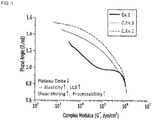
- the shear-thinning property is measured through a graph of a complex viscosity ( ⁇ * [Pa.s]) versus a frequency ( ⁇ [rad/s]).
- the Equation 1 is a model for quantitatively evaluating the shear thinning property of ethylene/alpha-olefin copolymer according to the present invention, and also is a model for estimating the complex viscosity at a high frequency by applying data of complex viscosity versus frequency.
- Equation 1 is a power law model in which x means a frequency and y means a complex viscosity, and two variables C 1 and C 2 are required.
- C 1 refers to a consistency index
- C 2 refers to a CV index
- a C 2 value is a gradient of graph.
- the higher the complex viscosity at low frequency the better the physical properties. Also, the lower the complex viscosity at high frequency, the better the processability. Therefore, the smaller the C 2 value, that is, the larger the negative gradient of graph, it is better.
- TA Orchestrator which is a ARES measurement program of TA Instruments can be used.
- the ethylene/alpha-olefin copolymer has preferably a molecular weight of 80,000 to 90,000 g/mol.
- the ethylene/alpha-olefin copolymer has preferably a molecular weight distribution of 5 to 6.
- the ethylene/alpha-olefin copolymer has preferably a density of 0.960 to 0.965 g/cm 3 .
- the ethylene/alpha-olefin copolymer has preferably a melt flow rate ratio of 3.5 to 40.
- the ethylene/alpha-olefin copolymer has preferably the C 2 value -0.40 to -0.25.
- the alpha-olefins which can be used for the copolymerization of ethylene/alpha-olefins, may include one or more selected from the group consisting of 1-butene, 1-pentene, 1-hexene, 4-methyl-1-pentene, 1-octene, 1-decene, 1-dodecene, 1-tetradecene, 1-hexadecene, 1-octadecene and 1-eicosene.
- the content of the alpha-olefin can be from about 0.5 to about 10% by weight, preferably from about 1 to about 5% by weight, but is not limited thereto. in Chemical Formula 1,
- the C 1-20 alkyl includes a linear or branched alkyl and specific examples thereof include methyl, ethyl, propyl, isopropyl, n-butyl, tert-butyl, pentyl, hexyl, heptyl, octyl and the like, but are not limited thereto.
- the C 2-20 alkenyl includes a linear or branched alkenyl, and specific examples thereof include allyl, ethenyl, propenyl, butenyl, pentenyl and the like, but are not limited thereto.
- the C 6-20 aryl includes a monocyclic or fused ring-type aryl, and specific examples thereof include phenyl, biphenyl, naphthyl, phenanthrenyl, fluorenyl and the like, but are not limited thereto.
- the C 5-20 heteroaryl includes a monocyclic or fused ring-type heteroaryl, and specific examples thereof include carbazolyl, pyridyl, quinoline, isoquinoline, thiophenyl, furanyl, imidazole, oxazolyl, thiazolyl, triazine, tetrahydro pyranyl, tetrahydrofuranyl and the like, but are not limited thereto.
- Examples of the C 1-20 alkoxy include methoxy, ethoxy, phenyloxy, cyclohexyloxy and the like, but are not limited thereto.
- Group 4 transition metal examples include titanium, zirconium, hafnium and the like, but are not limited thereto.
- R 1 to R 17 and R 1 'to R 9 ' in the Chemical Formulas 2a, 2b and 2c are each independently hydrogen, methyl, ethyl, propyl, isopropyl, n-butyl, tert-butyl, pentyl, hexyl, heptyl, octyl, phenyl, halogen, trimethylsilyl, triethylsilyl, tripropylsilyl, tributylsilyl, triisopropylsilyl, trimethylsilylmethyl, methoxy or ethoxy, but are not limited thereto.
- the L in the Chemical Formula 1 is more preferably a linear or branched C 4-8 alkylene, but is not limited thereto. Also, the alkylene group may be substituted or unsubstituted with C 1-20 alkyl, C 2-20 alkenyl, or C 6-20 aryl.
- a in the Chemical Formula 1 is preferably hydrogen, methyl, ethyl, propyl, isopropyl, n-butyl, tert-butyl, methoxymethyl, tert-butoxymethyl, 1-ethoxyethyl, 1-methyl-1-methoxyethyl, tetrahydropyranyl, or tetrahydrofuranyl, but is not limited thereto.
- B in in the Chemical Formula 1 is preferably silicon, but it is not limited thereto.
- the first metallocene compound of the Chemical Formula 1 forms a structure in which an indeno indole derivative and/or a fluorene derivative is crosslinked via a bridge, and has an unshared electron pair which can act as a Lewis base in the ligand structure, thereby exhibiting a high polymerization activity even when supported on a surface having a Lewis acid property of a support.
- an indeno indole group and/or a fluorene group which is electronically rich the activity is high, and due to an appropriate steric hindrance and an electronic effect of the ligand, not only hydrogen reactivity is low but also the high activity is maintained even in the presence of hydrogen.
- the beta-hydrogen of the polymer chain where the nitrogen atom of the indenoindole derivative grows is stabilized by hydrogen bonding, to inhibit beta-hydrogen elimination, thereby polymerizing an ultra-high molecular weight olefin polymer.
- a specific example of the compound represented by Chemical Formula 2a may include a compound represented by any one of the following structural formulas, but the present invention is not limited thereto.
- a specific example of the compound represented by Chemical Formula 2b may include a compound represented by one of the following structural formulas, but the present invention is not limited thereto.
- the compound represented by Chemical Formula 2c may include a compound represented by one of the following structural formulas, but the present invention is not limited thereto.
- a specific example of the first metallocene compound represented by Chemical Formula 1 may include a compound represented by one of the following structural formulas, but is not limited thereto.
- the first metallocene compound of Chemical Formula 1 has a superior activity and can polymerize an ethylene/alpha-olefin copolymer having a high molecular weight. In particular, it can exhibit a high polymerization activity even when it is used in the state of being supported on a support, and thus can produce an ethylene/alpha-olefin copolymer having a ultra-high molecular weight.
- the first metallocene compound of Chemical Formula 1 according to the present invention exhibits a low hydrogen reactivity and thus can still polymerize an ethylene/alpha-olefin copolymer having an ultra-high molecular weight with a high activity.
- the first metallocene compound of Chemical Formula 1 can be prepared by connecting an indenoindole derivative and/or a fluorene derivative via a bridging compound to prepare a ligand compound, then introducing a metal precursor compound therein to perform a metallation.
- the method for producing the first metallocene compound will be specifically explained in the examples to be described below.
- the compound represented by Chemical Formula 3 can be, for example, a compound represented by one of the following structural formulas, but is not limited thereto.
- the compound represented by Chemical Formula 4 may be, for example, a compound represented by one of the following structural formulas, but is not limited thereto.
- the compound represented by Chemical Formula 5 may be, for example, a compound represented by the following structural formulas, but is not limited thereto.
- the metallocene catalyst used in the present invention may be a metallocene catalyst in which at least one of the first metallocene compounds represented by the Chemical Formula 1 and at least one of the second metallocene compounds selected among the compounds represented by the Chemical Formulas 3 to 5 are supported on a support together with a cocatalyst compound.
- the supported metallocene catalyst can induce the generation of LCB (Long Chain Branch) in the ethylene/alpha-olefin copolymer to be produced.
- LCB Long Chain Branch
- the cocatalyst to be supported on the support for activation of the metallocene compound is an organometallic compound containing a Group 13 metal, and it is not particularly limited as long as it can be used when polymerizing the olefin in the presence of a general metallocene catalyst.
- the cocatalyst compound may include at least one of an aluminum-containing primary cocatalyst of the following Chemical Formula 6 and a boron-containing secondary cocatalyst of the following Chemical Formula 7.
- R 18 is each independently a halogen, a halogen-substituted or unsubstituted hydrocarbyl group having 1 to 20 carbon atoms, and k is an integer of 2 or more
- B is boron in an oxidation state of +3
- G is each independently selected from the group consisting of hydride, dialkylamido, halide, alkoxide, aryloxide, hydrocarbyl, halocarbyl and halo-substituted hydrocarbyl, wherein the G has
- the polyolefins finally prepared may have more uniform molecular weight distribution, while the polymerization activity can be enhanced.
- the first cocatalyst of Chemical Formula 6 may be an alkylaluminoxane-based compound wherein the repeating units are combined into a linear, circular or network form.
- Specific examples of the first cocatalyst include methylaluminoxane (MAO), ethylaluminoxane, isobutylaluminoxane, butylaluminoxane, and the like.
- the second cocatalyst of Chemical Formula 7 may be a tri-substituted ammonium salt, or a dialkylammonium salt, or a tri-substituted phosphate type borate compound.
- Specific examples of the second cocatalyst include a borate-based compound in the form of a trisubstituted ammonium salt, such as trimethylammonium tetraphenylborate, methyl dioctadecylammonium tetraphenylborate, triethylammonium tetraphenylborate, tripropylammonium tetraphenylborate, tri(n-butyl)ammonium tetraphenylborate, methyltetradecyloctadecylammonium tetraphenylborate, N,N-dimethylanilinium tetraphenylborate, N,N-diethylanilinium tetra
- the mass ratio between the whole transition metals contained in the first metallocene compound represented by the Chemical Formula 1 or the second metallocene compound represented by the Chemical Formulas 3 to 5 and the support may be 1 : 10 to 1 : 1000.
- the mass ratio of the cocatalyst compound to the support may be 1 : 1 to 1 : 100.
- a support containing a hydroxy group on its surface can be used, and preferably a support having highly reactive hydroxy group and siloxane group, of which the surface is dried and removed of moisture can be used.
- silica, silica-alumina, silica-magnesia or the like which are dried at high temperature, can be used, and they may typically contain oxides, carbonates, sulfates, and nitrates such as Na 2 O, K 2 CO 3 , BaSO 4 and Mg(NO 3 ) 2 .
- the drying temperature of the support is preferably 200 to 800°C, more preferably 300 to 600°C, and most preferably 300 to 400°C. If the drying temperature of the support is lower than 200°C, it retains moisture too much so that moisture on the surface is reacted with the cocatalyst. If the drying temperature is higher than 800°C, pores on the surface of the support are combined with each other to reduce surface area, and many hydroxyl groups are lost on the surface to remain only siloxane groups. Thus, since the reactive sites with cocatalyst are reduced, it is not preferable.
- the amount of hydroxyl group on the surface of the support is preferably 0.1 to 10 mmol/g, and more preferably 0.5 to 5 mmol/g.
- the amount of hydroxyl group on the surface of the support may be controlled depending on the preparation method and conditions of the support, or drying conditions such as temperature, time, vacuum, spray drying, and the like.
- the amount of hydroxyl group is less than 0.1 mmol/g, the reactive sites with cocatalyst are reduced. If the amount of hydroxyl group is more than 10 mmol/g, it is not desirable because it may be caused by moisture besides the hydroxyl groups present on the surface of support particles.
- the ethylene/alpha-olefin copolymer according to the present invention can be produced by polymerizing ethylene and alpha-olefin in the presence of the supported metallocene catalyst described above.
- the polymerization reaction may be carried out by copolymerizing ethylene and alpha-olefin, using a continuous slurry polymerization reactor, a loop slurry reactor, a gas phase reactor, or a solution reactor.
- the polymerization temperature may be about 25 to about 500°C, preferably about 25 to about 200°C, and more preferably about 50 to about 150°C.
- the polymerization pressure may be from about 1 to about 100 Kgf/cm 2 , preferably from about 1 to about 50 Kgf/cm 2 , more preferably from about 5 to about 30 Kgf/cm 2 .
- the supported metallocene catalyst can be injected after being dissolved or diluted in an aliphatic hydrocarbon solvent having 5 to 12 carbon atoms such as pentane, hexane, heptane, nonane, decane, and isomers thereof, an aromatic hydrocarbon solvent such as toluene and benzene, or a hydrocarbon solvent substituted with chlorine atom such as dichloromethane and chlorobenzene. It is preferable that the solvent is used after a small amount of water, air or the like acting as a catalyst poison is removed by treating with a small amount of aluminum. It may also be performed using an additional cocatalyst.
- the ethylene/alpha-olefin copolymer according to the present invention can be produced by copolymerizing ethylene and alpha-olefin monomers, using a catalyst of Chemical Formulas 3 to 5 which mainly polymerizes low molecular weight polymer chains, and a catalyst of Chemical Formula 1 which mainly polymerizes high molecular weight polymer chains. Due to the interaction between these two or more catalysts, the low molecular weight and the molecular weight distribution generally increase.
- the ethylene/alpha-olefin copolymer can exhibit excellent processability and is therefore suitable for producing products by an injection molding method.
- the ethylene/alpha-olefin copolymer according to the present invention has excellent processability and is therefore suitable for producing products by an injection molding method.
- the ligand compound synthesized in 2-1 above (3.82 g, 6 mmol) was dissolved in toluene (100 mL) and MTBE (5 mL), and then 2.5 M n-BuLi hexane solution (5.6 mL, 14 mmol) was added dropwise in a dry ice/acetone bath and stirred overnight at room temperature.
- ZrCl 4 (THF) 2 (2.26 g, 6 mmol) was prepared as a slurry by adding toluene (100 mL).
- ZrCl 4 (THF) 2 as a toluene slurry was transferred to the litiated ligand in a dry ice/acetone bath.
- t-Butyl-O-(CH 2 ) 6 -Cl was prepared using 6-chlorohexanol according to the method described in Tetrahedron Lett. 2951 (1988), and then reacted with NaCp to obtain t-Butyl-O-(CH 2 ) 6 -C 5 H 5 (Yield 60%, b.p. 80°C /0.1 mmHg).
- t-Butyl-O-(CH 2 ) 6 -C 5 H 5 was dissolved in THF at -78 °C, n-BuLi was slowly added thereto, and the mixture was warmed up to room temperature and then reacted for 8 hours. Again at a temperature of -78°C, thus prepared lithium salt solution was slowly added to a suspension solution of ZrCl 4 (THF) 2 (1.70 g, 4.50 mmol)/THF (30 mL) and the mixture was further reacted at room temperature for 6 hours.
- THF ZrCl 4
- Catalyst Preparation Example 1 / toluene solution 250 g was added to the reactor and stirred at 200 rpm for 1 hour.
- Catalyst Preparation Example 3 (20 g) was dissolved in toluene, charged into the reactor, and stirred at 200 rpm for 2 hours.
- 70 g of cocatalyst [anilinium tetrakis (pentafluorophenyl) borate] was diluted in toluene, charged into the reactor, and stirred at 200 rpm for 15 hours or longer. After the temperature of the reactor was lowered to room temperature, the stirring was stopped, and settling was then carried out for 30 minutes and the reaction solution was subjected to decantation.
- the toluene slurry was transferred to a filter dryer and filtered. 3.0 kg of toluene was added and stirred for 10 minutes, then the stirring was stopped and filtered. 3.0 kg of hexane was added to the reactor and stirred for 10 minutes, then the stirring was stopped and filtered. The filtrate was dried at 50°C under reduced pressure for 4 hours to produce a 500 g-SiO 2 -supported catalyst.
- Each of the hybrid supported metallocene catalysts prepared in Examples 1 and 2 was subjected to a bimodal operation using two hexane slurry stirred tank process polymerization devices to prepare an olefin polymer.
- the comonomer 1-butene was used.
- copolymers prepared in Examples and the copolymers prepared in Comparative Examples were evaluated for their physical properties by the following methods.
- Example according to the present invention the value of the negative gradient in the graph of complex viscosity versus frequency was higher as compared with Comparative Examples, and thus the shear thinning property was more excellent.
Landscapes
- Chemical & Material Sciences (AREA)
- Health & Medical Sciences (AREA)
- Chemical Kinetics & Catalysis (AREA)
- Medicinal Chemistry (AREA)
- Polymers & Plastics (AREA)
- Organic Chemistry (AREA)
- Transition And Organic Metals Composition Catalysts For Addition Polymerization (AREA)
- Addition Polymer Or Copolymer, Post-Treatments, Or Chemical Modifications (AREA)
- Crystallography & Structural Chemistry (AREA)
- Engineering & Computer Science (AREA)
- Materials Engineering (AREA)
Abstract
Description
- This application claims the benefit of the filing date of Korean Patent Application No.
10-2015-0053279 filed with Korean Intellectual Property Office on April 15, 2015 - The present invention relates to an ethylene/alpha-olefin copolymer having excellent processability.
- Olefin polymerization catalyst systems can be classified into Ziegler-Natta and metallocene catalyst systems, and these two highly active catalyst systems have been developed in compliance with their characteristics. Ziegler-Natta catalyst has been widely applied to existing commercial processes since it was developed in the 1950's. However, since the Ziegler-Natta catalyst is a multi-active site catalyst in which a plurality of active sites are mixed, it has a feature that molecular weight distribution of polymers is broad. Also, since compositional distribution of comonomers is not uniform, there is a problem that it has a limitation to secure the desired physical properties.
- Meanwhile, the metallocence catalyst comprises a combination of a main catalyst whose main component is a transition metal compound, and an organometallic compound cocatalyst whose main component is aluminium. Such a catalyst is a single-site catalyst which is a homogeneous complex catalyst, and offers a polymer having a narrow molecular weight distribution and an uniform composition distribution of comonomers, depending on the single site characteristics. The metallocence catalyst has characteristics which can control the stereoregularity, copolymerizing properties, molecular weight, crystallinity and the like of the resulting polymer by changing the ligand structure of the catalyst and the polymerization condition.
-
US Patent No. 5,914,289 discloses a method of controlling the molecular weight and the molecular weight distribution of polymers using metallocene catalysts which are respectively supported on supports. However, a large amount of solvent and a long period of time are required to prepare the supported catalysts, and the process of supporting metallocene catalysts on the respective supports is troublesome. -
Korean Patent Application No.10-2003-12308 - Therefore, in order to solve the above-mentioned disadvantages, there is a need to develop a method for preparing olefinic polymers with the desired physical properties by easily preparing a supported hybrid metallocene catalyst having an excellent activity.
- On the other hand, a linear low density polyethylene is produced by copolymerizing ethylene and alpha olefin using a polymerization catalyst under low pressure. Thus, this is a resin having a narrow molecular weight distribution and a certain length of a short chain branch, without a long chain branch. The linear low density polyethylene film has high strength and elongation at break in addition to the properties of a general polyethylene and exhibits excellent tear strength, falling weight impact strength or the like. This has led to an increase in the use of a stretch film, an overlapping films or the like which is difficult to apply existing low density polyethylene or high density polyethylene.
- However, the linear low density polyethylene using 1-butene or 1-hexene as a comonomer is mostly prepared in a single gas phase reactor or a single loop slurry reactor, and has a high productivity compared to a process using 1-octene comonomer. However, these products have limitations in the catalyst technology and process technology. Thus, they are problematic in that their physical properties are greatly inferior to when using 1-octene comonomer, and the molecular weight distribution is narrow, resulting in poor processability. Many studies have been conducted to improve these problems.
-
US Patent No. 4,935,474 , describes a process for preparing polyethylene having a broad molecular weight distribution by using two or more metallocene compounds.US Patent No. 6,828,394 discloses a process for producing polyethylene which is excellent in processability and particularly suitable for a film, by using a catalyst system comprising a poor comonomer incorporating catalyst compound and a good comonomer incorporating catalyst compound. In addition,US Patent No. 6,841,631 andUS Patent No. 6,894,128 describe that polyethylene having a bimodal or multimodal molecular weight distribution is produced by using a metallocene-type catalyst including at least two metal compounds, and thus it can be used in various applications such as film, blowing and molding, and pipe. However, although these products have improved processability, there is still a problem that the dispersed state per molecular weight within unit particles is not uniform, and thus the extruded appearance is rough even under relatively good extrusion condition and the physical properties are not stable. - Given the above circumstances, there is a constant demand for the production of superior products having a balance between physical properties and processability. In particular, the necessity of a polyethylene copolymer having excellent processability is further required.
- In order to solve the problems of the prior arts, it is an object of the present invention to provide an ethylene/alpha-olefin copolymer having excellent processability.
- In order to achieve these objects, the present invention provides an ethylene/alpha-olefin copolymer which satisfies the following conditions:
- a molecular weight of 50,000 to 150,000 g/mol,
- a molecular weight distribution (Mw/Mn) of 2 to 10,
- a density of 0.940 to 0.965 g/cm3,
- a melt flow rate ratio (MFR5/MFR2.16, measured at 190°C according to ASTM 1238) of 3.5 or more,
- a C2 value of -0.25 or less when a graph of a complex viscosity(η*[Pa.s] versus a frequency (ω[rad/s] is fitted to a Power Law of Equation 1 below,

- For a perfectly elastic material, a deformation (strain) occurs in proportion to an elastic shear stress, which is called a Hook's law. In addition, for a pure viscose liquid, a deformation occurs in proportion to a viscous shear stress, which is called a Newton's law. For a completely elastic material, a deformation can be again restored when the elastic energy is accumulated and the elastic shear stress is removed. However, for a completely viscous material, the energy is completely discarded by deformation and thus the deformation is not restored even when the elastic shear stress is removed. In addition, the viscosity of the material itself does not change.
- However, in a molten state, a polymer has an intermediate property between a completely elastic material and a viscous liquid, which is called a viscoelasticity. In other words, when a polymer is subjected to a shear stress in the molten state, the deformation is not proportional to the shear stress, and its viscosity varies depending on the shear stress, which is also called a non-Newtonian fluid. These properties are due to the complexity of deformation due to the shear stress because the polymer has a huge molecular size and a complex intermolecular structure.
- In particular, when producing a molded article by using a polymer, a shear-thinning phenomenon is considered as one of the important characteristics of the non-Newtonian fluid. The shear-thinning phenomenon means a phenomenon in which the viscosity of a polymer decreases as the shear rate increases. The method of molding a polymer is determined according to these shear-thinning properties. In particular, when producing a molded article requiring high-speed polymer extrusion as in the present invention, a considerable pressure must be applied to the molten polymer, and so it is difficult to manufacture such a molded article unless the shear-thinning property is exhibited. Therefore, the shear-thinning property is considered important.
- In this regard, according to the present invention, the shear-thinning property is measured through a graph of a complex viscosity (η* [Pa.s]) versus a frequency (ω[rad/s]).
- The Equation 1 is a model for quantitatively evaluating the shear thinning property of ethylene/alpha-olefin copolymer according to the present invention, and also is a model for estimating the complex viscosity at a high frequency by applying data of complex viscosity versus frequency.
- The Equation 1 is a power law model in which x means a frequency and y means a complex viscosity, and two variables C1 and C2 are required. C1 refers to a consistency index, C2 refers to a CV index, and a C2 value is a gradient of graph. The higher the complex viscosity at low frequency, the better the physical properties. Also, the lower the complex viscosity at high frequency, the better the processability. Therefore, the smaller the C2 value, that is, the larger the negative gradient of graph, it is better.
- In a method for fitting a graph of a complex viscosity versus a frequency to the Equation 1 above, TA Orchestrator which is a ARES measurement program of TA Instruments can be used.
- The ethylene/alpha-olefin copolymer has preferably a molecular weight of 80,000 to 90,000 g/mol.
- Also, the ethylene/alpha-olefin copolymer has preferably a molecular weight distribution of 5 to 6.
- Further, the ethylene/alpha-olefin copolymer has preferably a density of 0.960 to 0.965 g/cm3.
- Further, the ethylene/alpha-olefin copolymer has preferably a melt flow rate ratio of 3.5 to 40.
- Further, the ethylene/alpha-olefin copolymer has preferably the C2 value -0.40 to -0.25.
- The alpha-olefins, which can be used for the copolymerization of ethylene/alpha-olefins, may include one or more selected from the group consisting of 1-butene, 1-pentene, 1-hexene, 4-methyl-1-pentene, 1-octene, 1-decene, 1-dodecene, 1-tetradecene, 1-hexadecene, 1-octadecene and 1-eicosene. In the ethylene/alpha-olefin copolymer, the content of the alpha-olefin can be from about 0.5 to about 10% by weight, preferably from about 1 to about 5% by weight, but is not limited thereto.


- A is hydrogen, halogen, C1-20 alkyl, C2-20 alkenyl, C6-20 aryl, C7-20 alkylaryl, C7-20 arylalkyl, C1-20 alkoxy, C2-20 alkoxyalkyl, C3-20 heterocycloalkyl, or C5-20 heteroaryl;
- D is -O-, -S-, -N(R)- or -Si(R)(R')-, wherein R and R' are same as or different from each other, and are each independently hydrogen, halogen, C1-20 alkyl, C2-20 alkenyl, or C6-20 aryl;
- L is a linear or branched C1-10 alkylene;
- B is carbon, silicon or germanium;
- Q is hydrogen, halogen, C1-20 alkyl, C2-20 alkenyl, C6-20 aryl, C7-20 alkylaryl, or C7-20 arylalkyl;
- M is a Group 4 transition metal;
- X1 and X2 are same as or different from each other and are each independently halogen, C1-20 alkyl, C2-20 alkenyl, C6-20 aryl, nitro, amido, C1-20 alkylsilyl, C1-20 alkoxy, or C1-20 sulfonate;
- C1 and C2 are same as or different from each other and are each independently represented by one of the following Chemical Formulas 2a, 2b or 2c, provided that cases where both C1 and C2 are the Chemical Formula 2c, are excluded;
- M1 is a Group 4 transition metal;
- Cp1 and Cp2 are same as or different from each other and are each independently any one selected from the group consisting of cyclopentadienyl, indenyl, 4,5,6,7-tetrahydro-1-indenyl, and fluorenyl radical, which may be substituted with a hydrocarbon having 1 to 20 carbon atoms;
- Ra and Rb are same as or different from each other and are each independently hydrogen, C1-20 alkyl, C1-10 alkoxy, C2-20 alkoxyalkyl, C6-20 aryl, C6-10 aryloxy, C2-20 alkenyl, C7-40 alkylaryl, C7-40 arylalkyl, C8-40 arylalkenyl, or C2-10 alkynyl;
- Z1 is a halogen atom, C1-20 alkyl, C2-10 alkenyl, C7-40 alkylaryl, C7-40 arylalkyl, C6-20 aryl, substituted or unsubstituted C1-20 alkylidene, substituted or unsubstituted amino, C2-20 alkylalkoxy, or C7-40 arylalkoxy;
- n is 1 or 0;
- M2 is a Group 4 transition metal;
- Cp3 and Cp4 are same as or different from each other and are each independently any one selected from the group consisting of cyclopentadienyl, indenyl, 4,5,6,7-tetrahydro-1-indenyl and fluorenyl radicals, which may be substituted with a hydrocarbon having 1 to 20 carbon atoms;
- Rc and Rd are same as or different from each other and are each independently hydrogen, C1-20 alkyl, C1-10 alkoxy, C2-20 alkoxyalkyl, C6-20 aryl, C6-10 aryloxy, C2-20 alkenyl, C7-40 alkylaryl, C7-40 arylalkyl, C8-40 arylalkenyl, or C2-10 alkynyl;
- Z2 is a halogen atom, C1-20 alkyl, C2-10 alkenyl, C7-40 alkyl aryl, C7-40 arylalkyl, C6-20 aryl, substituted or unsubstituted C1-20 alkylidene, substituted or unsubstituted amino, C2-20 alkylalkoxy, or C7-40 arylalkoxy;
- B1 is at least one of carbon, germanium, silicon, phosphorus, or nitrogen atom containing radicals, which cross-link Cp3Rc ring and Cp4Rd ring or which cross-link one Cp4Rd ring to M2, a combination thereof;
- m is 1 or 0;
- M3 is a Group 4 transition metal;
- Cp5 is any one selected from the group consisting of cyclopentadienyl, indenyl, 4,5,6,7-tetrahydro-1-indenyl and fluorenyl radicals, which may be substituted with a hydrocarbon having 1 to 20 carbon atoms;
- Re is hydrogen, C1-20 alkyl, C1-10 alkoxy, C2-20 alkoxyalkyl, C6-20 aryl, C6-10 aryloxy, C2-20 alkenyl, C7-40 alkylaryl, C7-40 arylalkyl, C8-40 arylalkenyl, or C2-10 alkynyl;
- Z3 is a halogen atom, C1-20 alkyl, C2-10 alkenyl, C7-40 alkylaryl, C7-40 arylalkyl, C6-20 aryl, substituted or unsubstituted C1-20 alkylidene, substituted or unsubstituted amino, C2-20 alkylalkoxy, or C7-40 arylalkoxy;
- B2 is at least one of carbon, germanium, silicon, phosphorus, or nitrogen atom containing radicals, which cross-link Cp5Re ring and J, or a combination thereof;
- J is any one selected from the group consisting of NRf, O, PRf and S, and the Rf is C1-20 alkyl, aryl, substituted alkyl or substituted aryl.
- The substituents of the Chemical Formulas 1, 3, 4 and 5 will be more specifically described as follows.
- The C1-20 alkyl includes a linear or branched alkyl and specific examples thereof include methyl, ethyl, propyl, isopropyl, n-butyl, tert-butyl, pentyl, hexyl, heptyl, octyl and the like, but are not limited thereto.
- The C2-20 alkenyl includes a linear or branched alkenyl, and specific examples thereof include allyl, ethenyl, propenyl, butenyl, pentenyl and the like, but are not limited thereto.
- The C6-20 aryl includes a monocyclic or fused ring-type aryl, and specific examples thereof include phenyl, biphenyl, naphthyl, phenanthrenyl, fluorenyl and the like, but are not limited thereto.
- The C5-20 heteroaryl includes a monocyclic or fused ring-type heteroaryl, and specific examples thereof include carbazolyl, pyridyl, quinoline, isoquinoline, thiophenyl, furanyl, imidazole, oxazolyl, thiazolyl, triazine, tetrahydro pyranyl, tetrahydrofuranyl and the like, but are not limited thereto.
- Examples of the C1-20 alkoxy include methoxy, ethoxy, phenyloxy, cyclohexyloxy and the like, but are not limited thereto.
- Examples of the Group 4 transition metal include titanium, zirconium, hafnium and the like, but are not limited thereto.
- More preferably, R1 to R17 and R1'to R9' in the Chemical Formulas 2a, 2b and 2c are each independently hydrogen, methyl, ethyl, propyl, isopropyl, n-butyl, tert-butyl, pentyl, hexyl, heptyl, octyl, phenyl, halogen, trimethylsilyl, triethylsilyl, tripropylsilyl, tributylsilyl, triisopropylsilyl, trimethylsilylmethyl, methoxy or ethoxy, but are not limited thereto.
- The L in the Chemical Formula 1 is more preferably a linear or branched C4-8 alkylene, but is not limited thereto. Also, the alkylene group may be substituted or unsubstituted with C1-20 alkyl, C2-20 alkenyl, or C6-20 aryl.
- In addition, A in the Chemical Formula 1 is preferably hydrogen, methyl, ethyl, propyl, isopropyl, n-butyl, tert-butyl, methoxymethyl, tert-butoxymethyl, 1-ethoxyethyl, 1-methyl-1-methoxyethyl, tetrahydropyranyl, or tetrahydrofuranyl, but is not limited thereto.
- Further, B in in the Chemical Formula 1 is preferably silicon, but it is not limited thereto.
- The first metallocene compound of the Chemical Formula 1 forms a structure in which an indeno indole derivative and/or a fluorene derivative is crosslinked via a bridge, and has an unshared electron pair which can act as a Lewis base in the ligand structure, thereby exhibiting a high polymerization activity even when supported on a surface having a Lewis acid property of a support. In addition, by including an indeno indole group and/or a fluorene group which is electronically rich, the activity is high, and due to an appropriate steric hindrance and an electronic effect of the ligand, not only hydrogen reactivity is low but also the high activity is maintained even in the presence of hydrogen. Further, the beta-hydrogen of the polymer chain where the nitrogen atom of the indenoindole derivative grows is stabilized by hydrogen bonding, to inhibit beta-hydrogen elimination, thereby polymerizing an ultra-high molecular weight olefin polymer.
- According to one embodiment of the present invention, a specific example of the compound represented by Chemical Formula 2a may include a compound represented by any one of the following structural formulas, but the present invention is not limited thereto.


- According to one embodiment of the present invention, a specific example of the compound represented by Chemical Formula 2b may include a compound represented by one of the following structural formulas, but the present invention is not limited thereto.


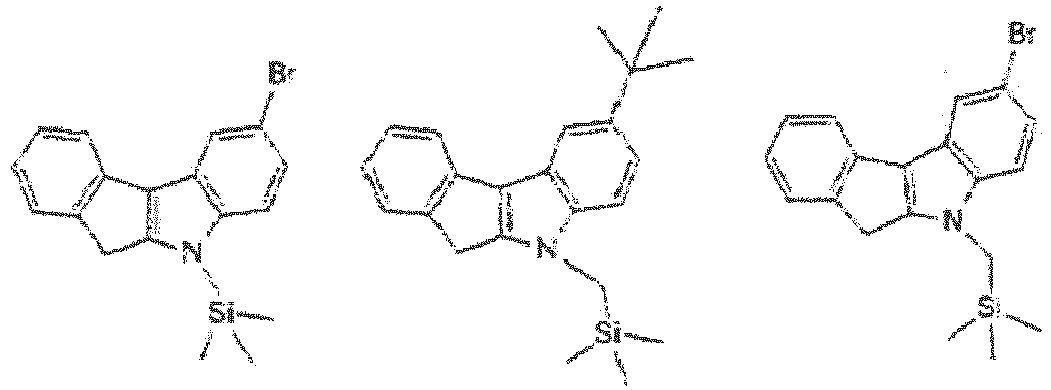
- According to one embodiment of the present invention, the compound represented by Chemical Formula 2c may include a compound represented by one of the following structural formulas, but the present invention is not limited thereto.


- According to one embodiment of the present invention, a specific example of the first metallocene compound represented by Chemical Formula 1 may include a compound represented by one of the following structural formulas, but is not limited thereto.


- The first metallocene compound of Chemical Formula 1 has a superior activity and can polymerize an ethylene/alpha-olefin copolymer having a high molecular weight. In particular, it can exhibit a high polymerization activity even when it is used in the state of being supported on a support, and thus can produce an ethylene/alpha-olefin copolymer having a ultra-high molecular weight.
- Further, even when the polymerization reaction is carried out in the presence of hydrogen in order to produce an ethylene/alpha-olefin copolymer having both a high molecular weight and a broad molecular weight distribution, the first metallocene compound of Chemical Formula 1 according to the present invention exhibits a low hydrogen reactivity and thus can still polymerize an ethylene/alpha-olefin copolymer having an ultra-high molecular weight with a high activity. Therefore, even when it is used as a hybrid with a catalyst having different characteristics, it is possible to produce an ethylene/alpha-olefin copolymer satisfying the characteristics of high molecular weight without lowering the activity, resulting in the easy preparation of an ethylene/alpha-olefin copolymer having broad molecular weight distribution while containing the ethylene/alpha-olefin copolymer having high molecular weight.
- The first metallocene compound of Chemical Formula 1 can be prepared by connecting an indenoindole derivative and/or a fluorene derivative via a bridging compound to prepare a ligand compound, then introducing a metal precursor compound therein to perform a metallation. The method for producing the first metallocene compound will be specifically explained in the examples to be described below.
- The compound represented by Chemical Formula 3 can be, for example, a compound represented by one of the following structural formulas, but is not limited thereto.


- In Chemical Formula 4, when m is 1, it means a structure in which the Cp3Rc ring, the Cp4Rd ring or the Cp4Rd ring and the M2 are crosslinked via B1, and when m is 0, it means a non-crosslinked compound structure.
- The compound represented by Chemical Formula 4 may be, for example, a compound represented by one of the following structural formulas, but is not limited thereto.


- Further, the compound represented by Chemical Formula 5 may be, for example, a compound represented by the following structural formulas, but is not limited thereto.



- The metallocene catalyst used in the present invention may be a metallocene catalyst in which at least one of the first metallocene compounds represented by the Chemical Formula 1 and at least one of the second metallocene compounds selected among the compounds represented by the Chemical Formulas 3 to 5 are supported on a support together with a cocatalyst compound.
- In addition, the supported metallocene catalyst can induce the generation of LCB (Long Chain Branch) in the ethylene/alpha-olefin copolymer to be produced.
- In the supported metallocene catalyst according to the present invention, the cocatalyst to be supported on the support for activation of the metallocene compound is an organometallic compound containing a Group 13 metal, and it is not particularly limited as long as it can be used when polymerizing the olefin in the presence of a general metallocene catalyst.
- Specifically, the cocatalyst compound may include at least one of an aluminum-containing primary cocatalyst of the following Chemical Formula 6 and a boron-containing secondary cocatalyst of the following Chemical Formula 7.
[Chemical Formula 6] -[Al(R18)-O-]k-
in Chemical Formula 6, R18 is each independently a halogen, a halogen-substituted or unsubstituted hydrocarbyl group having 1 to 20 carbon atoms, and k is an integer of 2 or more,
[Chemical Formula 7] T+[BG4]-
in Chemical Formula 7, T+ is a +1 valent polyatomic ion, B is boron in an oxidation state of +3, and G is each independently selected from the group consisting of hydride, dialkylamido, halide, alkoxide, aryloxide, hydrocarbyl, halocarbyl and halo-substituted hydrocarbyl, wherein the G has 20 or less carbon atoms, provided that G is halide at one or less position. - By using the first and the second cocatalysts as above, the polyolefins finally prepared may have more uniform molecular weight distribution, while the polymerization activity can be enhanced.
- The first cocatalyst of Chemical Formula 6 may be an alkylaluminoxane-based compound wherein the repeating units are combined into a linear, circular or network form. Specific examples of the first cocatalyst include methylaluminoxane (MAO), ethylaluminoxane, isobutylaluminoxane, butylaluminoxane, and the like.
- Further, the second cocatalyst of Chemical Formula 7 may be a tri-substituted ammonium salt, or a dialkylammonium salt, or a tri-substituted phosphate type borate compound. Specific examples of the second cocatalyst include a borate-based compound in the form of a trisubstituted ammonium salt, such as trimethylammonium tetraphenylborate, methyl dioctadecylammonium tetraphenylborate, triethylammonium tetraphenylborate, tripropylammonium tetraphenylborate, tri(n-butyl)ammonium tetraphenylborate, methyltetradecyloctadecylammonium tetraphenylborate, N,N-dimethylanilinium tetraphenylborate, N,N-diethylanilinium tetraphenylborate, N,N-dimethyl(2,4,6-trimethylanilinium)tetraphenylborate, trimethylammonium tetrakis(pentafluorophenyl)borate, methylditetradecylammonium tetrakis(pentaphenyl)borate, methyldioctadecylammonium tetrakis(pentafluorophenyl)borate, triethylammonium, tetrakis(pentafluorophenyl)borate, tripropylammonium tetrakis(pentafluorophenyl)borate, tri(n-butyl)ammonium tetrakis(pentafluorophenyl)borate, tri(sec-butyl)ammonium tetrakis(pentafluorophenyl)borate, N,N-dimethylanilinium tetrakis(pentafluorophenyl)borate, N,N-diethylanilinium tetrakis(pentafluorophenyl)borate, N,N-dimethyl(2,4,6-trimethylanilinium)tetrakis(pentafluorophenyl)borate, trimethylammonium tetrakis(2,3,4,6-tetrafluorophenyl)borate, triethylammonium tetrakis(2,3,4,6-tetrafluorophenyl)borate, tripropylammonium tetrakis(2,3,4,6-tetrafluorophenyl)borate, tri(n-butyl)ammonium tetrakis(2,3,4,6-tetrafluorophenyl) borate, dimethyl(t-butyl)ammonium tetrakis(2,3,4,6-tetrafluorophenyl)borate, N,N-dimethylanilinium tetrakis(2,3,4,6-tetrafluorophenyl)borate, N,N-diethylanilinium tetrakis(2,3,4,6-tetrafluorophenyl)borate or N,N-dimethyl-(2,4,6-trimethylanilinium)tetrakis-(2,3,4,6-tetrafluorophenyl)borate and the like; a borate-based compound in the form of a dialkylammonium salt, such as dioctadecylammonium tetrakis(pentafluorophenyl)borate, ditetradecylammonium tetrakis(pentafluorophenyl) borate or dicyclohexylammonium tetrakis(pentafluorophenyl)borate; or a borate-based compound in the form of a trisubstituted phosphonium salt, such as triphenylphosphonium tetrakis(pentafluorophenyl)borate, methyldioctadecylphosphonium tetrakis(pentafluorophenyl)borate or tri(2,6-dimethylphenyl)phosphonium tetrakis(pentafluorophenyl)borate.
- In the supported metallocene catalyst according to the present invention, the mass ratio between the whole transition metals contained in the first metallocene compound represented by the Chemical Formula 1 or the second metallocene compound represented by the Chemical Formulas 3 to 5 and the support may be 1 : 10 to 1 : 1000. When the support and the metallocene compound are contained in the range of the above mass ratio, an optimal shape can be provided. The mass ratio of the cocatalyst compound to the support may be 1 : 1 to 1 : 100.
- In the supported metallocene catalyst according to the present invention, as the support, a support containing a hydroxy group on its surface can be used, and preferably a support having highly reactive hydroxy group and siloxane group, of which the surface is dried and removed of moisture can be used.
- For example, silica, silica-alumina, silica-magnesia or the like, which are dried at high temperature, can be used, and they may typically contain oxides, carbonates, sulfates, and nitrates such as Na2O, K2CO3, BaSO4 and Mg(NO3)2.
- The drying temperature of the support is preferably 200 to 800°C, more preferably 300 to 600°C, and most preferably 300 to 400°C. If the drying temperature of the support is lower than 200°C, it retains moisture too much so that moisture on the surface is reacted with the cocatalyst. If the drying temperature is higher than 800°C, pores on the surface of the support are combined with each other to reduce surface area, and many hydroxyl groups are lost on the surface to remain only siloxane groups. Thus, since the reactive sites with cocatalyst are reduced, it is not preferable.
- The amount of hydroxyl group on the surface of the support is preferably 0.1 to 10 mmol/g, and more preferably 0.5 to 5 mmol/g. The amount of hydroxyl group on the surface of the support may be controlled depending on the preparation method and conditions of the support, or drying conditions such as temperature, time, vacuum, spray drying, and the like.
- If the amount of hydroxyl group is less than 0.1 mmol/g, the reactive sites with cocatalyst are reduced. If the amount of hydroxyl group is more than 10 mmol/g, it is not desirable because it may be caused by moisture besides the hydroxyl groups present on the surface of support particles.
- On the other hand, the ethylene/alpha-olefin copolymer according to the present invention can be produced by polymerizing ethylene and alpha-olefin in the presence of the supported metallocene catalyst described above.
- The polymerization reaction may be carried out by copolymerizing ethylene and alpha-olefin, using a continuous slurry polymerization reactor, a loop slurry reactor, a gas phase reactor, or a solution reactor.
- The polymerization temperature may be about 25 to about 500°C, preferably about 25 to about 200°C, and more preferably about 50 to about 150°C. Further, the polymerization pressure may be from about 1 to about 100 Kgf/cm2, preferably from about 1 to about 50 Kgf/cm2, more preferably from about 5 to about 30 Kgf/cm2.
- The supported metallocene catalyst can be injected after being dissolved or diluted in an aliphatic hydrocarbon solvent having 5 to 12 carbon atoms such as pentane, hexane, heptane, nonane, decane, and isomers thereof, an aromatic hydrocarbon solvent such as toluene and benzene, or a hydrocarbon solvent substituted with chlorine atom such as dichloromethane and chlorobenzene. It is preferable that the solvent is used after a small amount of water, air or the like acting as a catalyst poison is removed by treating with a small amount of aluminum. It may also be performed using an additional cocatalyst.
- The ethylene/alpha-olefin copolymer according to the present invention can be produced by copolymerizing ethylene and alpha-olefin monomers, using a catalyst of Chemical Formulas 3 to 5 which mainly polymerizes low molecular weight polymer chains, and a catalyst of Chemical Formula 1 which mainly polymerizes high molecular weight polymer chains. Due to the interaction between these two or more catalysts, the low molecular weight and the molecular weight distribution generally increase.
- As a result, the ethylene/alpha-olefin copolymer can exhibit excellent processability and is therefore suitable for producing products by an injection molding method.
- The ethylene/alpha-olefin copolymer according to the present invention has excellent processability and is therefore suitable for producing products by an injection molding method.
-
-
FIG. 1 shows vGP plots of the copolymers prepared in Example of the present invention and Comparative Examples. -
FIG. 2 shows a graph of the complex viscosity versus frequency in accordance with Example of the present invention and Comparative Examples. - Hereinafter, preferred Examples are provided for better understanding of the present invention. However, these Examples are for illustrative purposes only and the invention are not intended to be limited by these Examples.
-

- 2 g of fluorene was dissolved in 5 mL of MTBE and 100 mL of hexane, and 5.5 mL of 2.5 M n-BuLi hexane solution was added dropwise in a dry ice/acetone bath and stirred overnight at room temperature. 3.6 g of (6-(tert-butoxy)hexyl)dichloro(methyl)silane was was dissolved in 50 mL of hexane, and fluorene-Li slurry was transferred under a dry ice/acetone bath for 30 minutes and stirred overnight at room temperature. At the same time, 5,8-dimethyl-5,10-dihydroindeno[1,2-b] indole (12 mmol, 2.8 g) was dissolved in 60 mL of THF, and 5.5 mL of 2.5 M n-BuLi hexane solution was added dropwise in a dry ice/acetone bath and stirred overnight at room temperature. The reaction solution of fluorene and (6-(tert-butoxy)hexyl)dichloro(methyl)silane was subjected to NMR sampling to confirm the completion of the reaction, and then 5,8-dimethyl-5,10-dihydroindeno[1,2-b]indole-Li solution was transferred under dry ice/acetone bath. The mixture was stirred overnight at room temperature. After reaction, the reaction mixture was extracted with ether/water and the remaining moisture in the organic layer was removed with MgSO4 to give the ligand compound (Mw 597.90, 12 mmol), and it could be confirmed by 1 H-NMR that two isomers were produced.
1H NMR (500 MHz, d6-benzene): -0.30 ∼ -0.18 (3H, d), 0.40 (2H, m), 0.65 ∼ 1.45 (8H, m), 1.12 (9H, d), 2.36 ∼ 2.40 (3H, d), 3.17 (2H, m), 3.41 ∼ 3.43 (3H, d), 4.17 ∼ 4.21 (1 H, d), 4.34 ∼ 4.38 (1 H, d), 6.90 ∼ 7.80 (15H, m) - 7.2 g (12 mmol) of the ligand compound synthesized in 1-1 above was dissolved in 50 mL of diethylether, and 11.5 mL of 2.5 M n-BuLi hexane solution was added dropwise in a dry ice/acetone bath and stirred overnight at room temperature. The mixture was dried under vacuum to give sticky oil having a brown color. This oil was dissolved in toluene to give a slurry. ZrCl4(THF)2 was prepared, and toluene (50 mL) was added thereto to prepare a slurry. The toluene slurry of ZrCl4(THF)2 (50 mL) was transferred in a dry ice/acetone bath. As the mixture was stirred overnight at room temperature, the color was changed to violet. The reaction solution was filtered to remove LiCl. The filtrate was dried under vacuum to remove toluene, hexane was added thereto, and the mixture was sonicated for 1 hour. The slurry was filtered to give 6 g of metallocene compound (Mw 758.02, 7.92 mmol, Yield 66 mol%) having a dark violet color as a filtered solid. Two isomers were observed through 1 H-NMR.
1H NMR (500 MHz, CDCl3): 1.19 (9H, d), 1.71 (3H, d), 1.50 ∼ 1.70(4H, m), 1.79(2H, m), 1.98 ∼ 2.19(4H, m), 2.58(3H, s), 3.38 (2H, m), 3.91 (3H, d), 6.66 ∼ 7.88 (15H, m) -

- To a 250 mL flask was introduced 5-methyl-5,10-dihydroindeno[1,2-b]indole (2.63 g, 12 mmol), which was then dissolved in THF (50 mL). Then, 2.5 M n-BuLi hexane solution (6 mL) was added dropwise in a dry ice/acetone bath and stirred overnight at room temperature. In another 250 mL flask, (6-(tert-butoxy)hexyl)dichloro(methyl)silane (1.62 g, 6 mmol) was prepared by dissolving it in hexane (100 mL), which was then slowly added dropwise to a lithiated solution of 5-methyl-5,10-dihydroindeno[1,2-b]indole under a dry ice/acetone bath and stirred overnight at room temperature. After reaction, the reaction mixture was extracted with ether/water. The organic layer was treated with MgSO4 to remove the remaining moisture and then dried under vacuum to give the ligand compound (3.82 g, 6 mmol) which was confirmed by 1 H-NMR.
1H NMR (500 MHz, CDCl3): -0.33 (3H, m), 0.86∼1.53 (10H, m), 1.16 (9H, d), 3.18 (2H, m), 4.07 (3H, d), 4.12 (3H, d), 4.17 (1 H, d), 4.25 (1 H, d), 6.95∼7.92 (16H, m) - The ligand compound synthesized in 2-1 above (3.82 g, 6 mmol) was dissolved in toluene (100 mL) and MTBE (5 mL), and then 2.5 M n-BuLi hexane solution (5.6 mL, 14 mmol) was added dropwise in a dry ice/acetone bath and stirred overnight at room temperature. In another flask, ZrCl4(THF)2 (2.26 g, 6 mmol) was prepared as a slurry by adding toluene (100 mL). ZrCl4(THF)2 as a toluene slurry was transferred to the litiated ligand in a dry ice/acetone bath. The mixture was stirred overnight at room temperature and the color was changed to violet. The reaction solution was filtered to remove LiCl. The filtrate thus obtained was dried under vacuum, hexane was added thereto, and the mixture was sonicated. The slurry was filtered to give 3.40 g of metallocene compound (Yield 71.1 mol%) having a dark violet color as a filtered solid.
1H NMR (500 MHz, CDCl3): 1.74 (3H, d), 0.85∼2.33(10H, m), 1.29(9H, d), 3.87 (3H, s), 3.92 (3H, s), 3.36(2H, m), 6.48∼ 8.10 (16H, m) - t-Butyl-O-(CH2)6-Cl was prepared using 6-chlorohexanol according to the method described in Tetrahedron Lett. 2951 (1988), and then reacted with NaCp to obtain t-Butyl-O-(CH2)6-C5H5 (Yield 60%, b.p. 80°C /0.1 mmHg).
- Also, t-Butyl-O-(CH2)6-C5H5 was dissolved in THF at -78 °C, n-BuLi was slowly added thereto, and the mixture was warmed up to room temperature and then reacted for 8 hours. Again at a temperature of -78°C, thus prepared lithium salt solution was slowly added to a suspension solution of ZrCl4(THF)2 (1.70 g, 4.50 mmol)/THF (30 mL) and the mixture was further reacted at room temperature for 6 hours.
- All volatile substances were dried under vacuum and hexane solvent was added to the resulting oily liquid substance, which was then filtered. The filtrate was dried under vacuum, and hexane was added to induce a precipitate at a low temperature (-20°C). The resulting precipitate was filtered at a low temperature to give [tBu-O-(CH2)6-C5H4]2ZrCl2 compound (Yield 92%) as a white solid.
1H NMR (300 MHz, CDCl3): 6.28 (t, J = 2.6 Hz, 2H), 6.19 (t, J = 2.6 Hz, 2H), 3.31 (t, 6.6 Hz, 2H), 2.62 (t, J = 8 Hz), 1.7 - 1.3 (m, 8H), 1.17 (s, 9H)
13C NMR (CDCl3): 135.09, 116.66, 112.28, 72.42, 61.52, 30.66, 30.61, 30.14, 29.18, 27.58, 26.00 - 3.0 kg of toluene solution was added to a 20 L sus autoclave, and the reactor temperature was maintained at 40°C. 500 g of silica (Grace Davison, SP2212) was added to the reactor and the silica was sufficiently dispersed. Then, 2.78 kg of 10 wt% methylaluminoxane(MAO)/toluene solution was added and the temperature was raised to 80°C. The mixture was stirred at 200 rpm for 15 hours or more. After the temperature of the reactor was lowered to 40°C, 7.5 wt% Catalyst Preparation Example 2 / toluene solution (300 g) was added to the reactor and stirred at 200 rpm for 1 hour. 8.8 wt% Catalyst Preparation Example 1 / toluene solution (250 g) was added to the reactor and stirred at 200 rpm for 1 hour. Catalyst Preparation Example 3 (20 g) was dissolved in toluene, charged into the reactor, and stirred at 200 rpm for 2 hours. 70 g of cocatalyst [anilinium tetrakis (pentafluorophenyl) borate] was diluted in toluene, charged into the reactor, and stirred at 200 rpm for 15 hours or longer. After the temperature of the reactor was lowered to room temperature, the stirring was stopped, and settling was then carried out for 30 minutes and the reaction solution was subjected to decantation. The toluene slurry was transferred to a filter dryer and filtered. 3.0 kg of toluene was added and stirred for 10 minutes, then the stirring was stopped and filtered. 3.0 kg of hexane was added to the reactor and stirred for 10 minutes, then the stirring was stopped and filtered. The filtrate was dried at 50°C under reduced pressure for 4 hours to produce a 500 g-SiO2-supported catalyst.
- Each of the hybrid supported metallocene catalysts prepared in Examples 1 and 2 was subjected to a bimodal operation using two hexane slurry stirred tank process polymerization devices to prepare an olefin polymer. As the comonomer, 1-butene was used.
- The polymerization conditions using the hybrid supported metallocene catalysts in Examples 1 and 2 above are summarized in Table 1 below.
[Table 1] Used catalyst Example 1 Example 2 R1 supply amount of ethylene (kg/hr) 7.0 7.0 R1 pressure(kg/cm2) 7.5 7.2 R1 temperature(°C) 84.4 85.0 R1 amount of charged hydrogen (g/hr) 3.10 2.44 R2 supply amount of ethylene (kg/hr) 6.0 6.0 R2 pressure(kg/cm2) 4.7 4.8 R2 temperature(°C) 75.2 73.0 R2 amount of charged 1-butene(g/hr) 18.0 18.0 Catalystic activity(kg PE/g SiO2) 6.1 7.8 - In order to compare with the polymers prepared using the hybrid supported metallocene catalysts of Examples 1 and 2 above, the following copolymers having similar densities were used as comparative examples.
- Comparative Example 1: KPIC M850
- Comparative Example 2: LG ME8000
- The copolymers prepared in Examples and the copolymers prepared in Comparative Examples were evaluated for their physical properties by the following methods.
- 1) Density: ASTM 1505
- 2) Melt Flow Index (MFR, 5 kg / 2.16 kg): Measuring temperature 190 °C, ASTM 1238
- 3) MFRR (MFR5/MFR2.16): the ratio where MFR10 melt index (MI, load: 5kg) is divided by MFR2,16 (MI, load: 2.16 kg).
- 4) Mn, Mw, MWD: The sample was melted and pre-treated in 1,2,4-trichlorobenzene containing BHT 0.0125% using PL-SP260 at 160°C for 10 hours, and the number average molecular weight and the weight average molecular weight were measured at a temperature of 160°C using PL-GPC220. The molecular weight distribution was indicated by the ratio of the weight average molecular weight and the number average molecular weight.
- 5) Fitting with Graph of Complex Viscosity versus Frequency, Power Law and Cross Model: The complex viscosity was measured with ARES (Advanced Rheometric Expansion System) of TA instruments. Samples were made using a parallel plate with a diameter of 25.0 mm at 190°C so as to have a gap of 2.0 mm. Measurement was carried out in a dynamic strain frequency sweep mode with a strain of 5%, a frequency of 0.05 rad/s to 500 rad/s, and a total of 41 points with 10 points at each decade. Power law fitting was carried out using TA Orchestrator which is a measurement program.
- The above results are shown in Table 2,
FIG. 1 andFIG. 2 below.[Table 2] Unit Example 1 Comparative Example 1 Comparative Example 2 Catalyst - Metallocene Ziegler-Natta Ziegler-Natta Density g/cm3 0.961 0.965 0.958 MI2.16 g/10 min 5 4.7 8 MFRR5/2.16 - 3.9 3.2 2.9 Molecular weight g/mol 8.6 9.8 7.3 Molecular weight distribution - 5.1 6.1 5.2 Plateau Delta1) rad 0.97 - - -Sη* (-C2) - 0.358 0.241 0.155 1) Plateau Delta: Average value of the interval in which plateau is formed - As shown in Table 2 and
FIG. 2 above, it could be confirmed that in the case of Example according to the present invention, the value of the negative gradient in the graph of complex viscosity versus frequency was higher as compared with Comparative Examples, and thus the shear thinning property was more excellent.


[Chemical Formula 3] (Cp1Ra)n(Cp2Rb)M1Z1 3-n
in Chemical Formula 3,
[Chemical Formula 4] (Cp3Rc)mB1(Cp4Rd)M2Z2 3-m
in Chemical Formula 4,
[Chemical Formula 5] (Cp5Re)B2(J)M3Z3 2
in Chemical Formula 5,
Claims (8)
- An ethylenelalpha-olefin copolymer having:a molecular weight of 50,000 to 150,000 g/mol,a molecular weight distribution(Mw/Mn) of 2 to 10,a density of 0.940 to 0.965 g/cm3,a melt flow rate ratio (MFR5/MFR2.16, measured at 190°C according to ASTM 1238) of 3.5 or more,a C2 value of -0.25 or less when a graph of a complex viscosity(η *[Pa.s] versus a frequency (ω[rad/s] is fitted to a Power Law of Equation 1 below,

- The ethylene/alpha-olefin copolymer according to claim 1, wherein
the molecular weight is 80,000 to 90,000 g/mol. - The ethylene/alpha-olefin copolymer according to claim 1, wherein
the molecular weight distribution is 5 to 6. - The ethylene/alpha-olefin copolymer according to claim 1, wherein
the density is 0.960 to 0.965 g/cm3. - The ethylene/alpha-olefin copolymer according to claim 1, wherein
the melt flow rate ratio is 3.5 to 40. - The ethylene/alpha-olefin copolymer according to claim 1, wherein
the C2 value is -0.40 to -0.25. - The ethylene/alpha-olefin copolymer according to claim 1, wherein
the alpha-olefin is one or more selected from the group consisting of 1-butene, 1-pentene, 1-hexene, 4-methyl-1-pentene, 1-octene, 1-decene, 1-dodecene, 1-tetradecene, 1-hexadecene, 1-octadecene and 1-eicosene. - The ethylene/alpha-olefin copolymer according to claim 1, wherein
the ethylene/alpha-olefin copolymer is produced by polymerizing ethylene and alpha-olefin in the presence of one or more of the first metallocene compounds represented by the following Chemical Formula 1; and one or more of the second metallocene compounds selected from the compounds represented by the following Chemical Formulas 3 to 5: A is hydrogen, halogen, C1-20 alkyl, C2-20 alkenyl, C6-20 aryl, C7-20 alkylaryl, C7-20 arylalkyl, C1-20 alkoxy, C2-20 alkoxyalkyl, C3-20 heterocycloalkyl, or C5-20 heteroaryl;D is -O-, -S-, -N(R)- or -Si(R)(R')-, wherein R and R' are same as or different from each other, and are each independently hydrogen, halogen, C1-20 alkyl, C2-20 alkenyl, or C6-20 aryl;L is a linear or branched C1-10 alkylene;B is carbon, silicon or germanium;Q is hydrogen, halogen, C1-20 alkyl, C2-20 alkenyl, C6-20 aryl, C7-20 alkylaryl, or C7-20 arylalkyl;M is a Group 4 transition metal;X1 and X2 are same as or different from each other and are each independently halogen, C1-20 alkyl, C2-20 alkenyl, C6-20 aryl, nitro, amido, C1-20 alkylsilyl, C1-20 alkoxy, or C1-20 sulfonate;C1 and C2 are same as or different from each other and are each independently represented by one of the following Chemical Formulas 2a, 2b or 2c, provided that cases where both C1 and C2 are Chemical Formula 2c, are excluded;


R1 to R17 and R1' to R9' are same as or different from each other, and are each independently hydrogen, halogen, C1-20 alkyl, C2-20 alkenyl, C1-20 alkylsilyl, C1-20 silylalkyl, C1-20 alkoxysilyl, C1-20 alkoxy, C6-20 aryl, C7-20 alkylaryl, or C7-20 arylalkyl, and adjacent two or more of the R10 to R17 are connected to each other to form a substituted or unsubstituted aliphatic or aromatic ring;
[Chemical Formula 3] (Cp1Ra)n(Cp2Rb)M1Z1 3-n
in Chemical Formula 3,M1 is a Group 4 transition metal;Cp1 and Cp2 are same as or different from each other and are each independently any one selected from the group consisting of cyclopentadienyl, indenyl, 4,5,6,7-tetrahydro-1-indenyl, and fluorenyl radicals, which may be substituted with a hydrocarbon having 1 to 20 carbon atoms;Ra and Rb are same as or different from each other and are each independently hydrogen, C1-20 alkyl, C1-10 alkoxy, C2-20 alkoxyalkyl, C6-20 aryl, C6-10 aryloxy, C2-20 alkenyl, C7-40 alkylaryl, C7-40 arylalkyl, C8-40 arylalkenyl, or C2-10 alkynyl;Z1 is a halogen atom, C1-20 alkyl, C2-10 alkenyl, C7-40 alkylaryl, C7-40 arylalkyl, C6-20 aryl, substituted or unsubstituted C1-20 alkylidene, substituted or unsubstituted amino, C2-20 alkylalkoxy, or C7-40 arylalkoxy;n is 1 or 0;
[Chemical Formula 4] (Cp3Rc)mB1(Cp4Rd)M2Z2 3-m
in Chemical Formula 4,M2 is a Group 4 transition metal;Cp3 and Cp4 are same as or different from each other and are each independently any one selected from the group consisting of cyclopentadienyl, indenyl, 4,5,6,7-tetrahydro-1-indenyl and fluorenyl radicals, which may be substituted with a hydrocarbon having 1 to 20 carbon atoms;Rc and Rd are same as or different from each other and are each independently hydrogen, C1-20 alkyl, C1-10 alkoxy, C2-20 alkoxyalkyl, C6-20 aryl, C6-10 aryloxy, C2-20 alkenyl, C7-40 alkylaryl, C7-40 arylalkyl, C8-40 arylalkenyl, or C2-10 alkynyl;Z2 is a halogen atom, C7-20 alkyl, C2-10 alkenyl, C7-40 alkyl aryl, C7-40 arylalkyl, C5-20 aryl, substituted or unsubstituted C1-20 alkylidene, substituted or unsubstituted amino, C2-20 alkylalkoxy, or C7-40 arylalkoxy;B1 is at least one of carbon, germanium, silicon, phosphorus, or nitrogen atom containing radicals, which cross-link Cp3Rc ring and Cp4Rd ring or which cross-link one Cp4Rd ring to M2, a combination thereof;M is 1 or 0;
[Chemical Formula 5] (Cp5Re)B2(J)M3Z3 2
in Chemical Formula 5,M3 is a Group 4 transition metal;Cp5 is any one selected from the group consisting of cyclopentadienyl, indenyl, 4,5,6,7-tetrahydro-1-indenyl and fluorenyl radicals, which may be substituted with a hydrocarbon having 1 to 20 carbon atoms;Re is hydrogen, C1-20 alkyl, C1-10 alkoxy, C2-20 alkoxyalkyl, C6-20 aryl, C6-10 aryloxy, C2-20 alkenyl, C7-40 alkylaryl, C7-40 arylalkyl, C8-40 arylalkenyl, or C2-10 alkynyl;Z3 is a halogen atom, C1-20 alkyl, C2-10 alkenyl, C7-40 alkylaryl, C7-40 arylalkyl, C6-20 aryl, substituted or unsubstituted C1-20 alkylidene, substituted or unsubstituted amino, C2-20 alkylalkoxy, or C7-40 arylalkoxy;B2 is at least one of carbon, germanium, silicon, phosphorus, or nitrogen atom containing radicals, which cross-link Cp5Re ring and J, or a combination thereof;J is any one selected from the group consisting of NRf, O, PRf and S, and the Rf is C1-20 alkyl, aryl, substituted alkyl or substituted aryl.
Applications Claiming Priority (2)
| Application Number | Priority Date | Filing Date | Title |
|---|---|---|---|
| KR1020150053279A KR101891638B1 (en) | 2015-04-15 | 2015-04-15 | Ethylene/alpha-olefin copolymer having excellent processibility |
| PCT/KR2016/003947 WO2016167601A1 (en) | 2015-04-15 | 2016-04-15 | Ethylene/α-olefin copolymer having excellent processability |
Publications (2)
| Publication Number | Publication Date |
|---|---|
| EP3162820A1 true EP3162820A1 (en) | 2017-05-03 |
| EP3162820A4 EP3162820A4 (en) | 2018-04-11 |
Family
ID=57126722
Family Applications (1)
| Application Number | Title | Priority Date | Filing Date |
|---|---|---|---|
| EP16780324.6A Ceased EP3162820A4 (en) | 2015-04-15 | 2016-04-15 | Ethylene/alpha-olefin copolymer having excellent processability |
Country Status (6)
| Country | Link |
|---|---|
| US (1) | US10323110B2 (en) |
| EP (1) | EP3162820A4 (en) |
| JP (1) | JP6470834B2 (en) |
| KR (1) | KR101891638B1 (en) |
| CN (1) | CN106661160B (en) |
| WO (1) | WO2016167601A1 (en) |
Cited By (4)
| Publication number | Priority date | Publication date | Assignee | Title |
|---|---|---|---|---|
| EP3070108A4 (en) * | 2014-12-08 | 2017-07-26 | LG Chem, Ltd. | Ethylene/alpha-olefin copolymer having excellent processability |
| EP3421510A4 (en) * | 2016-12-09 | 2019-06-12 | LG Chem, Ltd. | ETHYLENE / 1-HEXENE COPOLYMER HAVING EXCELLENT PROCESSING AND MECHANICAL PROPERTIES |
| EP3434700A4 (en) * | 2016-11-15 | 2019-06-26 | LG Chem, Ltd. | ETHYLENE / ALPHA-OLEFIN COPOLYMER HAVING EXCELLENT TREATMENT FITNESS |
| EP3424962A4 (en) * | 2016-11-15 | 2019-07-10 | LG Chem, Ltd. | Polyethylene resin exhibiting excellent impact strength |
Families Citing this family (21)
| Publication number | Priority date | Publication date | Assignee | Title |
|---|---|---|---|---|
| KR102073253B1 (en) * | 2016-12-19 | 2020-02-04 | 주식회사 엘지화학 | Supported hybrid metallocene catalyst and method for preparing polyolefin using the same |
| WO2018117403A1 (en) * | 2016-12-19 | 2018-06-28 | 주식회사 엘지화학 | Hybrid supported metallocene catalyst, and method for preparing polyolefin by using same |
| WO2019124835A1 (en) | 2017-12-20 | 2019-06-27 | 주식회사 엘지화학 | Polyethylene copolymer and preparation method therefor |
| KR102459861B1 (en) | 2017-12-21 | 2022-10-27 | 주식회사 엘지화학 | Ethylene/1-butene copolymer having excellent processibility |
| CN110809603B (en) | 2018-03-21 | 2022-05-03 | Lg化学株式会社 | Polyolefin resin composition and stretched film using the same |
| WO2020122561A1 (en) * | 2018-12-10 | 2020-06-18 | 주식회사 엘지화학 | Polyethylene and chlorinated polyethylene thereof |
| CN117229436A (en) * | 2018-12-10 | 2023-12-15 | Lg化学株式会社 | Polyethylene and chlorinated polyethylene thereof |
| WO2020122562A1 (en) * | 2018-12-10 | 2020-06-18 | 주식회사 엘지화학 | Polyethylene and chlorinated polyethylene thereof |
| KR102427755B1 (en) * | 2018-12-10 | 2022-08-01 | 주식회사 엘지화학 | Polyethylene and its chlorinated polyethylene |
| KR102431339B1 (en) * | 2018-12-10 | 2022-08-10 | 주식회사 엘지화학 | Polyethylene and its chlorinated polyethylene |
| KR102252430B1 (en) * | 2018-12-10 | 2021-05-14 | 주식회사 엘지화학 | Polyethylene and its chlorinated polyethylene |
| KR102427756B1 (en) * | 2018-12-10 | 2022-08-01 | 주식회사 엘지화학 | Polyethylene and its chlorinated polyethylene |
| WO2020122563A1 (en) * | 2018-12-10 | 2020-06-18 | 주식회사 엘지화학 | Polyethylene and chlorinated polyethylene thereof |
| CN113348321B (en) | 2019-02-20 | 2022-12-06 | 株式会社Lg化学 | Crosslinked polyethylene pipe having excellent physical properties |
| EP3909988B1 (en) | 2019-02-20 | 2025-12-03 | LG Chem, Ltd. | Polyethylene having high degree of crosslinking and cross-linked polyethylene pipe comprising same |
| KR102178361B1 (en) * | 2019-02-20 | 2020-11-12 | 주식회사 엘지화학 | Polyethylene with high degree of crosslinking and Crosslinked polyethylene pipe comprising the same |
| KR102178360B1 (en) | 2019-02-20 | 2020-11-12 | 주식회사 엘지화학 | Polyethylene with high pressure resistance and Crosslinked polyethylene pipe comprising the same |
| KR102812372B1 (en) * | 2019-09-18 | 2025-05-23 | 주식회사 엘지화학 | Crosslinked polyethylene pipe with high pressure resistance |
| WO2022071738A1 (en) | 2020-09-29 | 2022-04-07 | 주식회사 엘지화학 | Polyethylene and method for preparing same |
| WO2022177348A1 (en) * | 2021-02-19 | 2022-08-25 | 주식회사 엘지화학 | Polyethylene for making fiber and preparation method therefor |
| TWI885506B (en) * | 2022-10-05 | 2025-06-01 | 南韓商Lg化學股份有限公司 | Polycarbonate resin and preparation method thereof |
Family Cites Families (20)
| Publication number | Priority date | Publication date | Assignee | Title |
|---|---|---|---|---|
| US4935474A (en) | 1983-06-06 | 1990-06-19 | Exxon Research & Engineering Company | Process and catalyst for producing polyethylene having a broad molecular weight distribution |
| US5914289A (en) | 1996-02-19 | 1999-06-22 | Fina Research, S.A. | Supported metallocene-alumoxane catalysts for the preparation of polyethylene having a broad monomodal molecular weight distribution |
| US6274684B1 (en) | 1999-10-22 | 2001-08-14 | Univation Technologies, Llc | Catalyst composition, method of polymerization, and polymer therefrom |
| JP4020862B2 (en) | 2001-07-19 | 2007-12-12 | ユニベーション・テクノロジーズ・エルエルシー | Mixed metallocene catalyst system containing comonomer minor incorporation catalyst and comonomer major incorporation catalyst |
| KR20040076965A (en) | 2003-02-27 | 2004-09-04 | 호남석유화학 주식회사 | A supported multinuclear metallocene catalysts for olefin polymerization and a process for preparing the same |
| CN102197081B (en) | 2008-08-29 | 2013-08-21 | 巴塞尔聚烯烃股份有限公司 | Polyethylene for injection moldings |
| CN102421808B (en) * | 2009-05-07 | 2015-04-08 | Lg化学株式会社 | Olefin polymer and fiber including same |
| KR101154507B1 (en) | 2009-07-31 | 2012-06-13 | 주식회사 엘지화학 | Metallocene compounds, catalyst composition comprising the same, and method for preparation of olefin-based polymer using the same |
| US8288487B2 (en) * | 2010-07-06 | 2012-10-16 | Chevron Phillips Chemical Company Lp | Catalysts for producing broad molecular weight distribution polyolefins in the absence of added hydrogen |
| KR101248421B1 (en) | 2010-07-15 | 2013-03-28 | 에스케이이노베이션 주식회사 | Ethylene copolymer with improved elasticity and processibility |
| JP2014505155A (en) | 2011-02-15 | 2014-02-27 | エクソンモービル ケミカル パテンツ インコーポレイテッド | Thermoplastic polyolefin blend |
| EP2570455A1 (en) * | 2011-09-16 | 2013-03-20 | Borealis AG | Polyethylene composition with broad molecular weight distribution and improved homogeneity |
| US8796409B2 (en) * | 2011-10-04 | 2014-08-05 | Exxonmobil Chemical Patents Inc. | Use of temperature and ethylene partial pressure to introduce long chain branching in high density polyethylene |
| US9115233B2 (en) * | 2012-06-21 | 2015-08-25 | Nova Chemicals (International) S.A. | Ethylene copolymer compositions, film and polymerization processes |
| US9422385B2 (en) * | 2013-01-30 | 2016-08-23 | Exxonmobil Chemical Patents Inc. | Polyethylene copolymers with vinyl terminated macromonomers as comonomers |
| KR101650092B1 (en) | 2013-08-01 | 2016-08-22 | 주식회사 엘지화학 | Metallocene compound, catalyst composition comprising the same, and method for preparation of olefin-based polymer using the same |
| KR101709688B1 (en) * | 2013-09-30 | 2017-02-23 | 주식회사 엘지화학 | Method for preparing polyolfin and polyolefin prepared therefrom |
| KR101644113B1 (en) | 2013-10-18 | 2016-07-29 | 주식회사 엘지화학 | Supported hybrid metallocene catalyst |
| KR101617870B1 (en) | 2014-09-05 | 2016-05-03 | 주식회사 엘지화학 | Olefin based polymer having excellent processibility |
| KR101747396B1 (en) * | 2014-12-15 | 2017-06-14 | 주식회사 엘지화학 | Olefin based polymer having excellent processibility |
-
2015
- 2015-04-15 KR KR1020150053279A patent/KR101891638B1/en active Active
-
2016
- 2016-04-15 EP EP16780324.6A patent/EP3162820A4/en not_active Ceased
- 2016-04-15 CN CN201680002412.6A patent/CN106661160B/en active Active
- 2016-04-15 WO PCT/KR2016/003947 patent/WO2016167601A1/en not_active Ceased
- 2016-04-15 JP JP2017503838A patent/JP6470834B2/en active Active
- 2016-04-15 US US15/501,415 patent/US10323110B2/en active Active
Cited By (6)
| Publication number | Priority date | Publication date | Assignee | Title |
|---|---|---|---|---|
| EP3070108A4 (en) * | 2014-12-08 | 2017-07-26 | LG Chem, Ltd. | Ethylene/alpha-olefin copolymer having excellent processability |
| EP3434700A4 (en) * | 2016-11-15 | 2019-06-26 | LG Chem, Ltd. | ETHYLENE / ALPHA-OLEFIN COPOLYMER HAVING EXCELLENT TREATMENT FITNESS |
| EP3424962A4 (en) * | 2016-11-15 | 2019-07-10 | LG Chem, Ltd. | Polyethylene resin exhibiting excellent impact strength |
| US20200010584A1 (en) * | 2016-11-15 | 2020-01-09 | Lg Chem, Ltd. | Polyethylene Resin Having Excellent Impact Strength |
| US10793651B2 (en) | 2016-11-15 | 2020-10-06 | Lg Chem, Ltd. | Polyethylene resin having excellent impact strength |
| EP3421510A4 (en) * | 2016-12-09 | 2019-06-12 | LG Chem, Ltd. | ETHYLENE / 1-HEXENE COPOLYMER HAVING EXCELLENT PROCESSING AND MECHANICAL PROPERTIES |
Also Published As
| Publication number | Publication date |
|---|---|
| EP3162820A4 (en) | 2018-04-11 |
| WO2016167601A1 (en) | 2016-10-20 |
| US10323110B2 (en) | 2019-06-18 |
| US20170233511A1 (en) | 2017-08-17 |
| KR20160123123A (en) | 2016-10-25 |
| KR101891638B1 (en) | 2018-08-24 |
| CN106661160A (en) | 2017-05-10 |
| JP6470834B2 (en) | 2019-02-13 |
| JP2018512457A (en) | 2018-05-17 |
| CN106661160B (en) | 2020-03-10 |
Similar Documents
| Publication | Publication Date | Title |
|---|---|---|
| US10323110B2 (en) | Ethylene/alpha-olefin copolymer having excellent processability | |
| RU2670752C9 (en) | Olefin based polymer with excellent processing ability | |
| KR101747401B1 (en) | Ethylene/alpha-olefin copolymer having excellent processibility | |
| EP3372620B1 (en) | Catalyst composition for synthesizing olefin copolymer, and method for preparing olefin copolymer | |
| EP3225638B1 (en) | Ethylene/ -olefin copolymer having excellent processability and surface characteristics | |
| KR101691628B1 (en) | Method for preparing polyolfin and polyolefin prepared therefrom | |
| KR102260362B1 (en) | Olefin copolymer | |
| KR101658172B1 (en) | Supported hybrid metallocene catalyst and method for preparing of olefin based polymer using the same | |
| KR101549209B1 (en) | Olefin based polymer having excellent processibility | |
| CN106232638A (en) | Polyolefins with Excellent Environmental Stress Cracking Resistance | |
| EP3078682B1 (en) | Olefin-based polymer having excellent processability | |
| EP3476870B1 (en) | Method for preparing an olefin polymer | |
| KR102211603B1 (en) | Catalyst composition for polymerizing olefin copolymer and preparation method of olefin copolymer | |
| KR20160121045A (en) | High density polyethylene copolymer for blow molding |
Legal Events
| Date | Code | Title | Description |
|---|---|---|---|
| PUAI | Public reference made under article 153(3) epc to a published international application that has entered the european phase |
Free format text: ORIGINAL CODE: 0009012 |
|
| 17P | Request for examination filed |
Effective date: 20170125 |
|
| AK | Designated contracting states |
Kind code of ref document: A1 Designated state(s): AL AT BE BG CH CY CZ DE DK EE ES FI FR GB GR HR HU IE IS IT LI LT LU LV MC MK MT NL NO PL PT RO RS SE SI SK SM TR |
|
| AX | Request for extension of the european patent |
Extension state: BA ME |
|
| A4 | Supplementary search report drawn up and despatched |
Effective date: 20180313 |
|
| RIC1 | Information provided on ipc code assigned before grant |
Ipc: C08L 23/08 20060101ALI20180307BHEP Ipc: C08F 210/16 20060101AFI20180307BHEP |
|
| DAV | Request for validation of the european patent (deleted) | ||
| DAX | Request for extension of the european patent (deleted) | ||
| 17Q | First examination report despatched |
Effective date: 20190110 |
|
| REG | Reference to a national code |
Ref country code: DE Ref legal event code: R003 |
|
| STAA | Information on the status of an ep patent application or granted ep patent |
Free format text: STATUS: THE APPLICATION HAS BEEN REFUSED |
|
| 18R | Application refused |
Effective date: 20191122 |