EP3160457B1 - 7-hydroxy-cannabidivarin (7-oh-cbdv) for use in the treatment of epilepsy - Google Patents
7-hydroxy-cannabidivarin (7-oh-cbdv) for use in the treatment of epilepsy Download PDFInfo
- Publication number
- EP3160457B1 EP3160457B1 EP15733514.2A EP15733514A EP3160457B1 EP 3160457 B1 EP3160457 B1 EP 3160457B1 EP 15733514 A EP15733514 A EP 15733514A EP 3160457 B1 EP3160457 B1 EP 3160457B1
- Authority
- EP
- European Patent Office
- Prior art keywords
- cbdv
- cbd
- hydroxy
- cannabidivarin
- epilepsy
- Prior art date
- Legal status (The legal status is an assumption and is not a legal conclusion. Google has not performed a legal analysis and makes no representation as to the accuracy of the status listed.)
- Active
Links
- QHMBSVQNZZTUGM-ZWKOTPCHSA-N CCCCCc1cc(O)c([C@@H]2C=C(C)CC[C@H]2C(C)=C)c(O)c1 Chemical compound CCCCCc1cc(O)c([C@@H]2C=C(C)CC[C@H]2C(C)=C)c(O)c1 QHMBSVQNZZTUGM-ZWKOTPCHSA-N 0.000 description 1
Images

Classifications
-
- A—HUMAN NECESSITIES
- A61—MEDICAL OR VETERINARY SCIENCE; HYGIENE
- A61K—PREPARATIONS FOR MEDICAL, DENTAL OR TOILETRY PURPOSES
- A61K31/00—Medicinal preparations containing organic active ingredients
- A61K31/658—Medicinal preparations containing organic active ingredients o-phenolic cannabinoids, e.g. cannabidiol, cannabigerolic acid, cannabichromene or tetrahydrocannabinol
-
- A—HUMAN NECESSITIES
- A61—MEDICAL OR VETERINARY SCIENCE; HYGIENE
- A61K—PREPARATIONS FOR MEDICAL, DENTAL OR TOILETRY PURPOSES
- A61K36/00—Medicinal preparations of undetermined constitution containing material from algae, lichens, fungi or plants, or derivatives thereof, e.g. traditional herbal medicines
- A61K36/18—Magnoliophyta (angiosperms)
- A61K36/185—Magnoliopsida (dicotyledons)
- A61K36/348—Cannabaceae
- A61K36/3482—Cannabis
-
- A—HUMAN NECESSITIES
- A61—MEDICAL OR VETERINARY SCIENCE; HYGIENE
- A61K—PREPARATIONS FOR MEDICAL, DENTAL OR TOILETRY PURPOSES
- A61K45/00—Medicinal preparations containing active ingredients not provided for in groups A61K31/00 - A61K41/00
- A61K45/06—Mixtures of active ingredients without chemical characterisation, e.g. antiphlogistics and cardiaca
-
- A—HUMAN NECESSITIES
- A61—MEDICAL OR VETERINARY SCIENCE; HYGIENE
- A61K—PREPARATIONS FOR MEDICAL, DENTAL OR TOILETRY PURPOSES
- A61K47/00—Medicinal preparations characterised by the non-active ingredients used, e.g. carriers or inert additives; Targeting or modifying agents chemically bound to the active ingredient
- A61K47/06—Organic compounds, e.g. natural or synthetic hydrocarbons, polyolefins, mineral oil, petrolatum or ozokerite
- A61K47/08—Organic compounds, e.g. natural or synthetic hydrocarbons, polyolefins, mineral oil, petrolatum or ozokerite containing oxygen, e.g. ethers, acetals, ketones, quinones, aldehydes, peroxides
- A61K47/10—Alcohols; Phenols; Salts thereof, e.g. glycerol; Polyethylene glycols [PEG]; Poloxamers; PEG/POE alkyl ethers
-
- A—HUMAN NECESSITIES
- A61—MEDICAL OR VETERINARY SCIENCE; HYGIENE
- A61K—PREPARATIONS FOR MEDICAL, DENTAL OR TOILETRY PURPOSES
- A61K47/00—Medicinal preparations characterised by the non-active ingredients used, e.g. carriers or inert additives; Targeting or modifying agents chemically bound to the active ingredient
- A61K47/44—Oils, fats or waxes according to two or more groups of A61K47/02-A61K47/42; Natural or modified natural oils, fats or waxes, e.g. castor oil, polyethoxylated castor oil, montan wax, lignite, shellac, rosin, beeswax or lanolin
-
- A—HUMAN NECESSITIES
- A61—MEDICAL OR VETERINARY SCIENCE; HYGIENE
- A61K—PREPARATIONS FOR MEDICAL, DENTAL OR TOILETRY PURPOSES
- A61K9/00—Medicinal preparations characterised by special physical form
- A61K9/0012—Galenical forms characterised by the site of application
- A61K9/0019—Injectable compositions; Intramuscular, intravenous, arterial, subcutaneous administration; Compositions to be administered through the skin in an invasive manner
-
- A—HUMAN NECESSITIES
- A61—MEDICAL OR VETERINARY SCIENCE; HYGIENE
- A61K—PREPARATIONS FOR MEDICAL, DENTAL OR TOILETRY PURPOSES
- A61K9/00—Medicinal preparations characterised by special physical form
- A61K9/08—Solutions
-
- A—HUMAN NECESSITIES
- A61—MEDICAL OR VETERINARY SCIENCE; HYGIENE
- A61P—SPECIFIC THERAPEUTIC ACTIVITY OF CHEMICAL COMPOUNDS OR MEDICINAL PREPARATIONS
- A61P25/00—Drugs for disorders of the nervous system
- A61P25/08—Antiepileptics; Anticonvulsants
Definitions
- the present invention relates to 7-hydroxy-cannabidivarin (7-OH-CBDV) in a pure, isolated or synthetic form for use as a medicament.
- the invention further relates to 7-OH CBDV for use in the treatment of epilepsy.
- the 7-OH-CBDV is isolated from plants to produce a highly purified extract or can be reproduced synthetically.
- Epilepsy occurs in approximately 1% of the population worldwide, (Thurman et al., 2011) of which 70% are able to adequately control their symptoms with the available existing anti-epileptic drugs (AED). However, 30% of this patient group, (Eadie et al., 2012), are unable to obtain seizure freedom from the AED that are available and as such are termed as suffering from "treatment-resistant epilepsy” (TRE).
- TRE treatment-resistant epilepsy
- AED Advanced Driver Assistance Agent
- narrow spectrum AED Narrow-spectrum AED Mechanism Phenytoin Sodium channel Phenobarbital GABA / Calcium channel Carbamazepine Sodium channel Oxcarbazepine Sodium channel Gabapentin Calcium channel Pregabalin Calcium channel Lacosamide Sodium channel Vigabatrin GABA Examples of broad spectrum AED Broad-spectrum AED Mechanism Valproic acid GABA / Sodium channel Lamotrigine Sodium channel Topiramate GABA / Sodium channel Zonisamide GABA / Calcium /Sodium channel Levetiracetam Calcium channel Clonazepam GABA Rufinamide Sodium channel
- Childhood epilepsy is a relatively common neurological disorder in children and young adults with a prevalence of approximately 700 per 100,000. This is twice the number of epileptic adults per population.
- Childhood epilepsy can be caused by many different syndromes and genetic mutations and as such diagnosis for these children may take some time.
- Childhood epilepsy refers to the many different syndromes and genetic mutations that can occur to cause epilepsy in childhood. Examples of some of these are as follows: Dravet Syndrome; Myoclonic-Absence Epilepsy; Lennox-Gastaut syndrome; Generalized Epilepsy of unknown origin; CDKL5 mutation; Aicardi syndrome; bilateral polymicrogyria; Dup15q; SNAP25; and febrile infection related epilepsy syndrome (FIRES); benign rolandic epilepsy; juvenile myoclonic epilepsy; infantile spasm (West syndrome); and Landau-Kleffner syndrome. The list above is non-exhaustive as many different childhood epilepsies exist. Examples of AED used specifically in childhood epilepsy AED Mechanism Clobazam GABA Stiripentol GABA
- the International League against Epilepsy (ILAE) in 2011 have reclassified the old terms of "general” and “partial” seizures".
- the new term “generalized seizure” refers to seizures conceptualized as originating at some point within the brain and rapidly engaging bilaterally distributed networks.
- focal seizure now refers to seizures conceptualized as originating at some point within the brain and being limited to one hemisphere.
- the etiology of epilepsy has also been reclassified by the ILAE as being of genetic origin; structural or metabolic origin; or of unknown origin.
- CBD non-psychoactive cannabinoid cannabidiol
- Carlini et al. in 1981 described a further study where CBD was provided to healthy volunteers, insomniacs and epileptic patients. Seven out of the eight epileptic patients described an improvement in their condition.
- cannabinoids CBD and CBDV are effective in animal models of epilepsy.
- EP 2,448,637 describes the use of CBD in the treatment of partial seizures
- WO 2011/121351 describes the use of CBDV in the treatment of epilepsy.
- Hill et al. (2012) and Amada et al. (2013) both also describe the use of CBDV in the treatment of epilepsy.
- Jones et al. (2012) describes the anti-convulsant activity of CBD in animal models.
- GB 2495118 describes the use of a pharmaceutical composition comprising a combination of CBDV and CBD.
- the synthetic production of the metabolite of CBD, 7-hydroxy-cannabidiol, (7-OH CBD) is disclosed in WO 01/95899 in addition to many other CBD derivatives.
- the compound was tested in a model of inflammation and found to be effective.
- the application goes on to suggest that the compound may be of use as an analgesic, anti-anxiety, anti-convulsant, neuroprotective, anti-psychotic and anti-inflammatory based on the mechanisms the compound displays in the model of inflammation.
- no data is presented to support the use of 7-OH-CBD as an anti-convulsant.
- a metabolite of CBD, 7-hydroxy-cannabidiol, (7-OH CBD) and a metabolite of CBD, 7-hydroxy-cannabidivarin, (7-OH CBDV) are effective in the treatment of epilepsy.
- the metabolites appear to be more effective than their parent compounds in certain aspects of seizure control.
- 7-hydroxy-cannabidivarin (7-OH-CBDV) in a pure, isolated or synthetic form for use as a medicament.
- 7-hydroxy-cannabidivarin (7-OH-CBDV) in a pure, isolated or synthetic form for use in the treatment of epilepsy.
- the 7-hydroxy-cannabidivarin (7-OH-CBDV) in a pure, isolated or synthetic form is for use in combination with 7-hydroxy-cannabidol (7-OH-CBD) in a pure, isolated or synthetic form.
- the 7-hydroxy-cannabidivarin (7-OH-CBDV) is for use in combination with one or more concomitant anti-epileptic drugs (AED).
- AED concomitant anti-epileptic drugs
- the one or more AED is selected from the group consisting of: clobazam; levetiracetam; topiramate; stiripentol; phenobarbital; lacsamide; valproic acid; zonisamide; perampanel; and fosphenytoin.
- the 7-OH-CBDV is for use at a dose of between 1 and 2000 mg/kg.
- the 7-OH-CBDV may be formulated for administration separately, sequentially or simultaneously with the 7-OH-CBD or the combination may be provided in a single dosage form.
- composition be administered as an oral liquid solution.
- Other modes of administration including solids, semi-solids, gels, sprays, aerosols, inhalers, vaporisers, enemas and suppositories are alternative administration forms.
- Such medicaments could be administered via the oral, buccal, sublingual, respiratory, nasal and distal rectum route.
- FIG. 1 CBDV and 7-OH CBDV were dosed at 200 mg/kg, and CBD and 7-OH CBD were dosed at 100 mg/kg
- A Maximum observed seizure severity (median severity in grey, box represents interquartile range, whiskers represent maxima and minima; Kruskal-Wallis test, with a post-hoc Mann-Whitney U)
- B Mortality (Chi-squared test, with a post-hoc Fisher exact)
- C Animals exhibiting tonic-clonic seizures (Chi-squared test, with a post-hoc Fisher exact)
- D Latency to seizure onset (median with interquartile range; Kruskal-Wallis test, with a post-hoc Mann-Whitney U).
- cannabinoids which are identified in the present application for reference. So far over 60 different cannabinoids have been identified and these cannabinoids can be split into different groups as follows: Phytocannabinoids; Endocannabinoids and Synthetic cannabinoids (which may be novel cannabinoids or synthetically produced phytocannabinoids or endocannabinoids).
- Cannabinoid metabolites are metabolites from cannabinoids that originate when the parent cannabinoid is metabolised or broken down.
- the cannabinoid metabolites can be isolated from plants to produce a highly purified extract or can be reproduced synthetically.
- “Highly purified cannabinoid metabolites” are defined as cannabinoids that have been extracted from the cannabis plant and purified to the extent that other cannabinoids and non-cannabinoid components that are co-extracted with the cannabinoids have been removed, such that the highly purified cannabinoid is greater than 90%, more preferably greater than 95%, most preferably greater than 98% (w/w) pure.
- the cannabinoid metabolites may be manufactured synthetically and / or produced from the parent cannabinoid by enzymatic means.
- Phytocannabinoids can be obtained as either the neutral (decarboxylated form) or the carboxylic acid form depending on the method used to extract the cannabinoids. For example it is known that heating the carboxylic acid form will cause most of the carboxylic acid form to decarboxylate into the neutral form.
- HED Human dose equivalent
- a 200mg/Kg dose in rat would equate to a human daily dose of about 2000mg.
- EXAMPLE 1 EFFICACY OF 7-HYDROXY CANNABIDIOL (7-OH-CBD) AND 7-HYDROXY CANNABIDIVARIN (7-OH-CBDV) IN THE PTZ MODEL OF SEIZURE
- the compounds 7-OH CBD and 7-OH-CBDV have never been tested in a model of epilepsy and as such the effects were examined at one dose level in order to determine efficacy.
- mice Male Wistar rats (P24-29; 75-110g) were used to assess the effects of the cannabinoids listed above on the PTZ model of generalised seizures. Animals were habituated to the test environment, cages, injection protocol and handling prior to experimentation. Animals were housed in a room at 21°C on a 12 hour light: dark cycle (lights on 0900) in 50% humidity, with free access to food and water.
- mice received an IP injection with either the cannabinoids (or a matched volume of the cannabinoids vehicle (1:1:18 ethanol:Cremophor: 0.9%w/v NaCl solution), which served as the negative control group. Animals were then observed for 30 mins, after which time they received an IP injection of 70 or 80mg/kg PTZ. Negative vehicle controls were performed in parallel with cannabinoid-dosed subjects. After receiving a dose of PTZ, animals were observed and videoed to determine the severity of seizure and latency to several seizure behaviour types (see in vivo analysis, below). Animals were filmed for half an hour after last sign of seizure, and then returned to their cage.
- FMJ myoclonic jerk
- Figure 1A shows that treatment with all of the compounds, both parents and metabolites resulted in a decrease the observed maximum seizure severity.
- CBDV significantly reduced seizure severity (p ⁇ 0.01).
- Figure 1B shows that CBDV and 7-OH-CBDV had a significant effect on mortality of the animals. There was also a reduction in mortality observed for CBD and 7-OH-CBD.
- Figure 1C demonstrates that the incidence of tonic clonic seizures was significantly reduced by CBDV and to a lesser extent 7-OH-CBDV.
- Figure 1D demonstrates that the latency to the onset of seizures was also affected by the administration of cannabinoids. Indeed 7-OH CBD significantly reduced the latency to seizure onset (p ⁇ 0.01).
- EXAMPLE 2 EFFICACY OF 7-HYDROXY CANNABIDIVARIN (7-OH-CBDV) IN THE MAXIMAL ELECTROSHOCK (MES) MODEL OF SEIZURE
- the vehicle used in this study was 2:1:17 (ethanol:Cremophor:0.9% w / v NaCl).
- the test compound used was 7-OH-CBDV. This was made to a solution at the highest concentration; then dissolved in ethanol before combination with Cremophor and 0.9% NaCl in the proportion described above.
- the 7-OH-CBDV was administered intraperitoneally at a volume of 10 ml/kg body weight.
- Animal Species/Strain Mouse/ICR, Microbiological grade: SPF, Inc. Sex: male, Age (at time of testing): 5-7 weeks old, Number of animals: about 5 animals per group. Temperature: 23 ⁇ 2°C, Humidity: 60 ⁇ 10%, Light conditions: 7 AM to 7 PM for the light period, 7 PM to 7 AM for the dark period. Chow and water: Free access to CRF-1 (Oriental Yeast Co, Ltd) and tap water.
- mice were weighed and randomized into several groups in each test. On the morning of the experiment day, body weight was measured in order to calculate the administration volume of each animal. Vehicle, 7-OH-CBDV or CBDV was interperitoneally administered 30 minutes before electric stimuli. Maximal electroshock seizures (MES) in mice was induced by a stimulator (UGO BASILE ECT UNIT 7801, Italia) using a current of 30 mA delivered with a pulse frequency of 100 Hz for 200 msec through earlap electrodes. The mice were observed for 10 seconds and the incidence of tonic hindlimb extension was noted.
- MES Maximal electroshock seizures
- Table 2 below demonstrates that the data obtained for the 7-OH-CBDV was statistically significant when compared to vehicle.
- CBDV, 7-OH-CBDV at both doses produced a decrease in 90% of tonic clonic convulsions.
Landscapes
- Health & Medical Sciences (AREA)
- Life Sciences & Earth Sciences (AREA)
- Chemical & Material Sciences (AREA)
- Veterinary Medicine (AREA)
- Public Health (AREA)
- General Health & Medical Sciences (AREA)
- Animal Behavior & Ethology (AREA)
- Pharmacology & Pharmacy (AREA)
- Medicinal Chemistry (AREA)
- Epidemiology (AREA)
- Natural Medicines & Medicinal Plants (AREA)
- Engineering & Computer Science (AREA)
- Botany (AREA)
- Mycology (AREA)
- Microbiology (AREA)
- Medical Informatics (AREA)
- Biotechnology (AREA)
- Alternative & Traditional Medicine (AREA)
- Dermatology (AREA)
- General Chemical & Material Sciences (AREA)
- Chemical Kinetics & Catalysis (AREA)
- Oil, Petroleum & Natural Gas (AREA)
- Bioinformatics & Cheminformatics (AREA)
- Biomedical Technology (AREA)
- Neurology (AREA)
- Neurosurgery (AREA)
- Pain & Pain Management (AREA)
- Nuclear Medicine, Radiotherapy & Molecular Imaging (AREA)
- Organic Chemistry (AREA)
- Pharmaceuticals Containing Other Organic And Inorganic Compounds (AREA)
- Acyclic And Carbocyclic Compounds In Medicinal Compositions (AREA)
Description
- The present invention relates to 7-hydroxy-cannabidivarin (7-OH-CBDV) in a pure, isolated or synthetic form for use as a medicament. The invention further relates to 7-OH CBDV for use in the treatment of epilepsy.
- Preferably the 7-OH-CBDV is isolated from plants to produce a highly purified extract or can be reproduced synthetically.
- Epilepsy occurs in approximately 1% of the population worldwide, (Thurman et al., 2011) of which 70% are able to adequately control their symptoms with the available existing anti-epileptic drugs (AED). However, 30% of this patient group, (Eadie et al., 2012), are unable to obtain seizure freedom from the AED that are available and as such are termed as suffering from "treatment-resistant epilepsy" (TRE).
- There are several different types of AED available to treat epilepsy, some of the most common AED defined by their mechanisms of action are described in the following tables:
Examples of narrow spectrum AED Narrow-spectrum AED Mechanism Phenytoin Sodium channel Phenobarbital GABA / Calcium channel Carbamazepine Sodium channel Oxcarbazepine Sodium channel Gabapentin Calcium channel Pregabalin Calcium channel Lacosamide Sodium channel Vigabatrin GABA Examples of broad spectrum AED Broad-spectrum AED Mechanism Valproic acid GABA / Sodium channel Lamotrigine Sodium channel Topiramate GABA / Sodium channel Zonisamide GABA / Calcium /Sodium channel Levetiracetam Calcium channel Clonazepam GABA Rufinamide Sodium channel - Individuals who develop epilepsy during the first few years of life are often difficult to treat and as such are often termed treatment-resistant. Children who undergo frequent seizures in childhood are often left with neurological damage which can cause cognitive, behavioral and motor delays.
- Childhood epilepsy is a relatively common neurological disorder in children and young adults with a prevalence of approximately 700 per 100,000. This is twice the number of epileptic adults per population.
- When a child or young adult presents with a seizure, investigations are normally undertaken in order to investigate the cause. Childhood epilepsy can be caused by many different syndromes and genetic mutations and as such diagnosis for these children may take some time.
- Childhood epilepsy refers to the many different syndromes and genetic mutations that can occur to cause epilepsy in childhood. Examples of some of these are as follows: Dravet Syndrome; Myoclonic-Absence Epilepsy; Lennox-Gastaut syndrome; Generalized Epilepsy of unknown origin; CDKL5 mutation; Aicardi syndrome; bilateral polymicrogyria; Dup15q; SNAP25; and febrile infection related epilepsy syndrome (FIRES); benign rolandic epilepsy; juvenile myoclonic epilepsy; infantile spasm (West syndrome); and Landau-Kleffner syndrome. The list above is non-exhaustive as many different childhood epilepsies exist.
Examples of AED used specifically in childhood epilepsy AED Mechanism Clobazam GABA Stiripentol GABA - The International League Against Epilepsy (ILAE) in 2011 have reclassified the old terms of "general" and "partial" seizures". The new term "generalized seizure" refers to seizures conceptualized as originating at some point within the brain and rapidly engaging bilaterally distributed networks.
- The new term "focal seizure" now refers to seizures conceptualized as originating at some point within the brain and being limited to one hemisphere.
- The etiology of epilepsy has also been reclassified by the ILAE as being of genetic origin; structural or metabolic origin; or of unknown origin.
- There is also now no specific classification for focal seizure types, therefore the terms complex partial and simple partial seizure are no longer in use.
- There are several different animal models that can be used to test the efficacy of compounds as anti-convulsants. These include the pentylenetetrazole-induced (PTZ) model of generalised seizures and the Maximal Electroshock (MES) model of generalised seizures.
- Over the past forty years there have been a number of animal studies on the use of the non-psychoactive cannabinoid cannabidiol (CBD) to treat seizures. For example, Consroe et al., (1982) determined that CBD was able to prevent seizures in mice after administration of pro-convulsant drugs or an electric current.
- Studies in epileptic adults have also occurred in the past forty years with CBD. Cunha et al. reported that administration of CBD to eight adult patients with generalized epilepsy resulted in a marked reduction of seizures in 4 of the patients (Cunha et al., 1980).
- A study in 1978 provided 200 mg/day of pure CBD to four adult patients, two of the four patients became seizure free, whereas in the remainder seizure frequency was unchanged (Mechoulam and Carlini, 1978).
- Carlini et al. in 1981 described a further study where CBD was provided to healthy volunteers, insomniacs and epileptic patients. Seven out of the eight epileptic patients described an improvement in their condition.
- In contrast to the studies described above, an open label study reported that 200 mg / day of pure CBD was ineffective in controlling seizures in twelve institutionalized adult patients (Ames and Cridland, 1986).
- In the past forty years of research there have been over thirty drugs approved for the treatment of epilepsy none of which are cannabinoids. Indeed, there appears to have been a prejudice against cannabinoids, possible due to the scheduled nature of these compounds and / or the fact that THC, which is a known psychoactive, has been ascribed as a pro-convulsant (Consroe et al., 1977).
- More recently the applicant has discovered that the cannabinoids CBD and CBDV are effective in animal models of epilepsy. For example
EP 2,448,637 describes the use of CBD in the treatment of partial seizures andWO 2011/121351 describes the use of CBDV in the treatment of epilepsy. Hill et al. (2012) and Amada et al. (2013) both also describe the use of CBDV in the treatment of epilepsy. Jones et al. (2012) describes the anti-convulsant activity of CBD in animal models. - Furthermore
GB 2495118 - The synthetic production of the metabolite of CBD, 7-hydroxy-cannabidiol, (7-OH CBD) is disclosed in
WO 01/95899 - To date there have been no studies into the anti-convulsant effect of metabolites of CBD and CBDV.
- Surprisingly, it has now been found that a metabolite of CBD, 7-hydroxy-cannabidiol, (7-OH CBD) and a metabolite of CBD, 7-hydroxy-cannabidivarin, (7-OH CBDV) are effective in the treatment of epilepsy. The metabolites appear to be more effective than their parent compounds in certain aspects of seizure control.
- In accordance with a first aspect of the present invention there is provided 7-hydroxy-cannabidivarin (7-OH-CBDV) in a pure, isolated or synthetic form for use as a medicament.
- In accordance with a second aspect of the present invention there is provided 7-hydroxy-cannabidivarin (7-OH-CBDV) in a pure, isolated or synthetic form for use in the treatment of epilepsy.
- In one embodiment the 7-hydroxy-cannabidivarin (7-OH-CBDV) in a pure, isolated or synthetic form is for use in combination with 7-hydroxy-cannabidol (7-OH-CBD) in a pure, isolated or synthetic form.
- In one embodiment the 7-hydroxy-cannabidivarin (7-OH-CBDV) is for use in combination with one or more concomitant anti-epileptic drugs (AED).
- Preferably the one or more AED is selected from the group consisting of: clobazam; levetiracetam; topiramate; stiripentol; phenobarbital; lacsamide; valproic acid; zonisamide; perampanel; and fosphenytoin.
- Preferably the 7-OH-CBDV is for use at a dose of between 1 and 2000 mg/kg.
- Preferably the 7-OH-CBDV may be formulated for administration separately, sequentially or simultaneously with the 7-OH-CBD or the combination may be provided in a single dosage form.
- It is envisaged that the composition be administered as an oral liquid solution. Other modes of administration including solids, semi-solids, gels, sprays, aerosols, inhalers, vaporisers, enemas and suppositories are alternative administration forms. Such medicaments could be administered via the oral, buccal, sublingual, respiratory, nasal and distal rectum route.
- Embodiments of the invention are further described hereinafter with reference to the accompanying drawings, in which:
-
Figure 1 shows CBDV and CBD, and their 7-OH metabolites in the PTZ model of acute seizure. -
Figure 1 . CBDV and 7-OH CBDV were dosed at 200 mg/kg, and CBD and 7-OH CBD were dosed at 100 mg/kg (A) Maximum observed seizure severity (median severity in grey, box represents interquartile range, whiskers represent maxima and minima; Kruskal-Wallis test, with a post-hoc Mann-Whitney U) (B) Mortality (Chi-squared test, with a post-hoc Fisher exact) (C) Animals exhibiting tonic-clonic seizures (Chi-squared test, with a post-hoc Fisher exact) (D) Latency to seizure onset (median with interquartile range; Kruskal-Wallis test, with a post-hoc Mann-Whitney U). n=11 for each dose, * = p≤0.05, ** = p≤0.01. - Definitions of some of the terms used to describe the invention are detailed below:
The cannabinoids described in the present application are listed below along with their standard abbreviations.CBD Cannabidiol 
7-OH-CBD 7-hydroxy-cannabidiol 
CBDV Cannabidivarin 
7-OH-CBDV 7-hydroxy-cannabidivarin 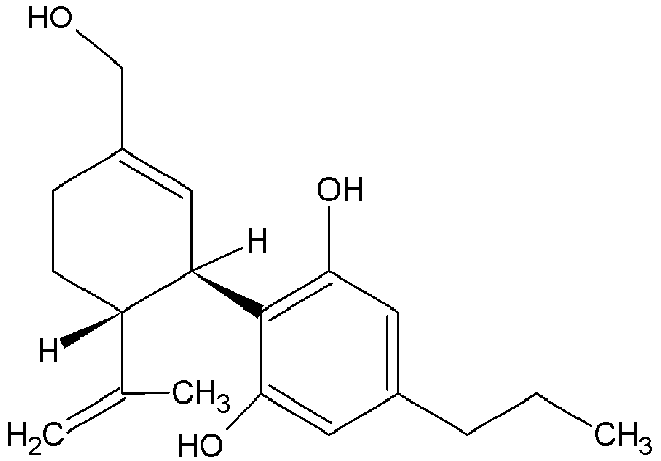
- The table above is not exhaustive and merely details the cannabinoids which are identified in the present application for reference. So far over 60 different cannabinoids have been identified and these cannabinoids can be split into different groups as follows: Phytocannabinoids; Endocannabinoids and Synthetic cannabinoids (which may be novel cannabinoids or synthetically produced phytocannabinoids or endocannabinoids).
- "Cannabinoid metabolites" are metabolites from cannabinoids that originate when the parent cannabinoid is metabolised or broken down. The cannabinoid metabolites can be isolated from plants to produce a highly purified extract or can be reproduced synthetically.
- "Highly purified cannabinoid metabolites" are defined as cannabinoids that have been extracted from the cannabis plant and purified to the extent that other cannabinoids and non-cannabinoid components that are co-extracted with the cannabinoids have been removed, such that the highly purified cannabinoid is greater than 90%, more preferably greater than 95%, most preferably greater than 98% (w/w) pure.
- The cannabinoid metabolites may be manufactured synthetically and / or produced from the parent cannabinoid by enzymatic means.
- Phytocannabinoids can be obtained as either the neutral (decarboxylated form) or the carboxylic acid form depending on the method used to extract the cannabinoids. For example it is known that heating the carboxylic acid form will cause most of the carboxylic acid form to decarboxylate into the neutral form.
- The human dose equivalent (HED) can be estimated using the following formula:

- Thus, for a human of approximately 60Kg a 200mg/Kg dose in rat would equate to a human daily dose of about 2000mg.
- The following Examples describe for the first time the anti-convulsant activity of the metabolites of CBD, namely 7-OH-CBD and CBDV, namely, 7-OH-CBDV.
- The compounds 7-OH CBD and 7-OH-CBDV have never been tested in a model of epilepsy and as such the effects were examined at one dose level in order to determine efficacy.
- The hydroxy-metabolites of CBD and CBDV were also tested against their parent cannabinoids which were used as positive controls. The table below details the doses used in this study.
Compound Dose (mg/kg) Vehicle - CBDV 200 7-OH-CBDV 200 CBD 100 7- OH CBD 100 - Male Wistar rats (P24-29; 75-110g) were used to assess the effects of the cannabinoids listed above on the PTZ model of generalised seizures. Animals were habituated to the test environment, cages, injection protocol and handling prior to experimentation. Animals were housed in a room at 21°C on a 12 hour light: dark cycle (lights on 0900) in 50% humidity, with free access to food and water.
- Five 6L Perspex (RTM) tanks with lids were placed on a single bench with dividers between them. Closed-circuit television (CCTV) cameras were mounted onto the dividers to observe rat behaviour. Sony Topica CCD cameras (Bluecherry, USA) were linked via BNC cables to a low-noise PC via Brooktree digital capture cards (Bluecherry, USA). Zoneminder (http://www.zoneminder.com) software was used to monitor rats, start and end recordings and manage video files. In-house Linux (RTM) scripts were used to encode video files into a suitable format for further offline analysis
- On the day of testing, animals received an IP injection with either the cannabinoids (or a matched volume of the cannabinoids vehicle (1:1:18 ethanol:Cremophor: 0.9%w/v NaCl solution), which served as the negative control group. Animals were then observed for 30 mins, after which time they received an IP injection of 70 or 80mg/kg PTZ. Negative vehicle controls were performed in parallel with cannabinoid-dosed subjects. After receiving a dose of PTZ, animals were observed and videoed to determine the severity of seizure and latency to several seizure behaviour types (see in vivo analysis, below). Animals were filmed for half an hour after last sign of seizure, and then returned to their cage.
- Animals were observed during experimental procedures, but all analysis was performed offline on recorded video files using The Observer behavioural analysis software (Noldus, Netherlands). A seizure severity scoring system was used to determine the levels of seizure experienced by subjects (Table 1). All signs of seizure were detailed for all animals.
Table 1 Seizure severity scoring scale Seizure score Behavioural expression Righting reflex 0 No changes to behaviour Preserved 0.5 Abnormal behaviour (sniffing, excessive washing, orientation) Preserved 1 Isolated myoclonic jerks Preserved 2 Atypical clonic seizure Preserved 3 Fully developed bilateral forelimb clonus Preserved 3.5 Forelimb clonus with tonic component and body twist Preserved 4 Tonic-clonic seizure with suppressed tonic phase Lost 5 Fully developed tonic-clonic seizure Lost 6 Death - The latency (in seconds) from injection of PTZ to first myoclonic jerk (FMJ; score of 1), and to the animal attaining "forelimb clonus with tonic component and body twist" (score of 3.5) were recorded. FMJ is an indicator of the onset of seizure activity, whilst >90% of animals developed scores of 3.5, and so is a good marker of the development of more severe seizures. Data are presented as the mean ± S.E.M. within an experimental group.
- This is given as the median value for each experimental group based on the scoring scale above.
- The percentage of animals within an experimental group that died as a result of PTZ-induced seizures. A score of 6 (death) automatically denotes that the animal also experienced tonic-clonic seizures.
- The time (in seconds) from the first sign of seizure (typically FMJ) to either the last sign of seizure or, in the case of subjects that died, the time of death - separated into animals that survived and those that did not. This is given as the mean ± S.E.M. for each experimental group.
- Differences in latencies and durations were assessed by one-way analysis of variance (ANOVA) with post-hoc Tukey's test. P≤0.05 was considered significant.
-
Figure 1A shows that treatment with all of the compounds, both parents and metabolites resulted in a decrease the observed maximum seizure severity. CBDV significantly reduced seizure severity (p≤0.01). -
Figure 1B shows that CBDV and 7-OH-CBDV had a significant effect on mortality of the animals. There was also a reduction in mortality observed for CBD and 7-OH-CBD. -
Figure 1C demonstrates that the incidence of tonic clonic seizures was significantly reduced by CBDV and to a lesser extent 7-OH-CBDV. -
Figure 1D demonstrates that the latency to the onset of seizures was also affected by the administration of cannabinoids. Indeed 7-OH CBD significantly reduced the latency to seizure onset (p≤0.01). - These results demonstrate that both 7-OH-CBD and 7-OH-CBDV show anti-convulsant action in the PTZ model of acute seizure.
- Furthermore the ability 7-OH-CBD to significantly reduce the latency to onset of seizures and of 7-OH-CBDV to significantly reduce the median seizure severity, from 5 to 3 are remarkable as these data infer that the metabolites may be more effective than their parent compounds in certain aspects of seizure control.
- The fact that the 7-OH-CBD and 7-OH-CBDV appear to be more potent than their parent cannabinoids, CBD and CBDV respectively, means that lower doses of the metabolites may be used in the treatment of epilepsy.
- The vehicle used in this study was 2:1:17 (ethanol:Cremophor:0.9% w/v NaCl). The test compound used was 7-OH-CBDV. This was made to a solution at the highest concentration; then dissolved in ethanol before combination with Cremophor and 0.9% NaCl in the proportion described above. The 7-OH-CBDV was administered intraperitoneally at a volume of 10 ml/kg body weight.
- Animal Species/Strain: Mouse/ICR, Microbiological grade: SPF, Inc. Sex: male, Age (at time of testing): 5-7 weeks old, Number of animals: about 5 animals per group. Temperature: 23 ± 2°C, Humidity: 60 ± 10%, Light conditions: 7 AM to 7 PM for the light period, 7 PM to 7 AM for the dark period. Chow and water: Free access to CRF-1 (Oriental Yeast Co, Ltd) and tap water.
- One day before each experiment, mice were weighed and randomized into several groups in each test. On the morning of the experiment day, body weight was measured in order to calculate the administration volume of each animal. Vehicle, 7-OH-CBDV or CBDV was interperitoneally administered 30 minutes before electric stimuli. Maximal electroshock seizures (MES) in mice was induced by a stimulator (UGO BASILE ECT UNIT 7801, Italia) using a current of 30 mA delivered with a pulse frequency of 100 Hz for 200 msec through earlap electrodes. The mice were observed for 10 seconds and the incidence of tonic hindlimb extension was noted.
- All statistical analyses were performed using SAS Software for Windows, Release 9.1. The difference of the number (hindlimb extension or deaths) in each group was assessed using two-tailed Fisher's exact test. The differences were considered statistically significant, when the p value was less than 0.05.
- Table 2 below demonstrates that the data obtained for the 7-OH-CBDV was statistically significant when compared to vehicle. Similarly to the parent compound, CBDV, 7-OH-CBDV at both doses produced a decrease in 90% of tonic clonic convulsions.
Table 2. Percentage decrease in tonic clonic convulsions Compound (dose) Percentage decrease in tonic clonic convulsions compared with vehicle Vehicle - 7-OH-CBDV (150mg/kg i.p.) 90%*** 7-OH-CBDV (200mg/kg i.p.) 90% *** CBDV (200mg/kg i.p.) 82% *** *** - = p < 0.001 - These data further demonstrate the surprising ability of the primary metabolite of CBDV, 7-OH-CBDV to produce anti-convulsant effects.
-
- Amada et al. (2013) PeerJ, 2013, pages 1-18 "Cannabidivarin (CBDV) suppresses pentylenetetrazole (PTZ)-induced increases in epilepsy-related gene expression."
- Ames FR and Cridland S (1986). "Anticonvulsant effects of cannabidiol." S Afr Med J 69:14.
- Carlini et al. (1981) Journal of Clinical Pharmacology, vol. 21, No. 8/9, 1981, pages 417S-427S "Hypnotic and antiepileptic effects of cannabidiol."
- Consroe P, Martin P, Eisenstein D. (1977). "Anticonvulsant drug antagonism of delta-9-tetrahydrocannabinol induced seizures in rabbits." Res Commun Chem Pathol Pharmacol. 16:1-13
- Consroe P, Benedicto MA, Leite JR, Carlini EA, Mechoulam R. (1982). "Effects of cannabidiol on behavioural seizures caused by convulsant drugs or current in mice." Eur J Pharmaco. 83: 293-8
- Cunha JM, Carlini EA, Pereira AE, Ramos OL, Pimental C, Gagliardi R et al. (1980). "Chronic administration of cannabidiol to healthy volunteers and epileptic patient." Pharmacology. 21:175-85
- Hill et al. (2012) British Journal of Pharmacology, vol. 167, No. 8, 2012, pages 1629-1642 "Cannabidivarin is anticonvulsant in mouse and rat."
- Jones et al. (2012) Seizure, vol. 21, No. 5, 2012, pages 344-352 "Cannabidiol exerts anti-convulsant effects in animal models of temporal lobe and partial seizures."
- Mechoulam R and Carlini EA (1978). "Toward drugs derived from cannabis." Die naturwissenschaften 65:174-9.
Claims (7)
- 7-hydroxy-cannabidivarin (7-OH-CBDV) in a pure, isolated or synthetic form for use as a medicament.
- 7-hydroxy-cannabidivarin (7-OH-CBDV) in a pure, isolated or synthetic form for use in the treatment of epilepsy.
- 7-hydroxy-cannabidivarin (7-OH-CBDV) in a pure, isolated or synthetic form for use according to claim 2, in combination with 7-hydroxy-cannabidol (7-OH-CBD) in a pure, isolated or synthetic form.
- 7-hydroxy-cannabidivarin (7-OH-CBDV) for use as claimed in claim 2, wherein the 7-OH-CBDV is for concomitant use with one or more anti-epileptic drugs (AED).
- 7-hydroxy-cannabidivarin (7-OH-CBDV) for use as claimed in claim 4, wherein the one or more AED is selected from the group consisting of: clobazam; levetiracetam; topiramate; stiripentol; phenobarbital; lacsamide; valproic acid; zonisamide; perampanel; and fosphenytoin.
- 7-hydroxy-cannabidivarin (7-OH-CBDV) for use as claimed in claim 4, wherein the dose of 7-OH-CBDV is between 1 and 2000 mg/kg.
- 7-hydroxy-cannabidivarin (7-OH-CBDV) for use as claimed in claim 3, for use in combination with 7-OH-CBD, the 7-OH-CBDV may be formulated for administration separately, sequentially or simultaneously with the 7-OH-CBD or the combination may be provided in a single dosage form.
Priority Applications (1)
| Application Number | Priority Date | Filing Date | Title |
|---|---|---|---|
| EP19204387.5A EP3639814A1 (en) | 2014-06-27 | 2015-06-29 | 7-oh-cannabidiol (7-oh-cbd) for use in the treatment of epilepsy |
Applications Claiming Priority (2)
| Application Number | Priority Date | Filing Date | Title |
|---|---|---|---|
| GB1411496.1A GB2527599A (en) | 2014-06-27 | 2014-06-27 | Use of 7-OH-Cannabidiol (7-OH-CBD) and/or 7-OH-Cannabidivarin (7-OH-CBDV) in the treatment of epilepsy |
| PCT/GB2015/051894 WO2015198078A1 (en) | 2014-06-27 | 2015-06-29 | 7-oh-cannabidiol (7-oh-cbd) and/or 7-oh-cannabidivarin (7-oh-cbdv) for use in the treatment of epilepsy |
Related Child Applications (1)
| Application Number | Title | Priority Date | Filing Date |
|---|---|---|---|
| EP19204387.5A Division EP3639814A1 (en) | 2014-06-27 | 2015-06-29 | 7-oh-cannabidiol (7-oh-cbd) for use in the treatment of epilepsy |
Publications (2)
| Publication Number | Publication Date |
|---|---|
| EP3160457A1 EP3160457A1 (en) | 2017-05-03 |
| EP3160457B1 true EP3160457B1 (en) | 2019-11-20 |
Family
ID=51410266
Family Applications (2)
| Application Number | Title | Priority Date | Filing Date |
|---|---|---|---|
| EP19204387.5A Withdrawn EP3639814A1 (en) | 2014-06-27 | 2015-06-29 | 7-oh-cannabidiol (7-oh-cbd) for use in the treatment of epilepsy |
| EP15733514.2A Active EP3160457B1 (en) | 2014-06-27 | 2015-06-29 | 7-hydroxy-cannabidivarin (7-oh-cbdv) for use in the treatment of epilepsy |
Family Applications Before (1)
| Application Number | Title | Priority Date | Filing Date |
|---|---|---|---|
| EP19204387.5A Withdrawn EP3639814A1 (en) | 2014-06-27 | 2015-06-29 | 7-oh-cannabidiol (7-oh-cbd) for use in the treatment of epilepsy |
Country Status (5)
| Country | Link |
|---|---|
| US (3) | US20170209390A1 (en) |
| EP (2) | EP3639814A1 (en) |
| ES (1) | ES2769863T3 (en) |
| GB (1) | GB2527599A (en) |
| WO (1) | WO2015198078A1 (en) |
Families Citing this family (43)
| Publication number | Priority date | Publication date | Assignee | Title |
|---|---|---|---|---|
| GB2487712B (en) | 2011-01-04 | 2015-10-28 | Otsuka Pharma Co Ltd | Use of the phytocannabinoid cannabidiol (CBD) in combination with a standard anti-epileptic drug (SAED) in the treatment of epilepsy |
| GB2495118B (en) | 2011-09-29 | 2016-05-18 | Otsuka Pharma Co Ltd | A pharmaceutical composition comprising the phytocannabinoids cannabidivarin (CBDV) and cannabidiol (CBD) |
| GB2530001B (en) | 2014-06-17 | 2019-01-16 | Gw Pharma Ltd | Use of cannabidiol in the reduction of convulsive seizure frequency in treatment-resistant epilepsy |
| GB2527599A (en) | 2014-06-27 | 2015-12-30 | Gw Pharma Ltd | Use of 7-OH-Cannabidiol (7-OH-CBD) and/or 7-OH-Cannabidivarin (7-OH-CBDV) in the treatment of epilepsy |
| GB2531282A (en) | 2014-10-14 | 2016-04-20 | Gw Pharma Ltd | Use of cannabinoids in the treatment of epilepsy |
| GB2531281A (en) | 2014-10-14 | 2016-04-20 | Gw Pharma Ltd | Use of cannabidiol in the treatment of intractable epilepsy |
| GB2539472A (en) | 2015-06-17 | 2016-12-21 | Gw Res Ltd | Use of cannabinoids in the treatment of epilepsy |
| GB2541191A (en) | 2015-08-10 | 2017-02-15 | Gw Pharma Ltd | Use of cannabinoids in the treatment of epilepsy |
| US10588974B2 (en) | 2016-04-22 | 2020-03-17 | Receptor Holdings, Inc. | Fast-acting plant-based medicinal compounds and nutritional supplements |
| GB2551987A (en) | 2016-07-01 | 2018-01-10 | Gw Res Ltd | Oral cannabinoid formulations |
| GB2551986A (en) | 2016-07-01 | 2018-01-10 | Gw Res Ltd | Parenteral formulations |
| CN109963595B (en) | 2016-10-11 | 2023-02-03 | Gbs全球生物制药公司 | Complex mixture containing cannabinoids for the treatment of neurodegenerative diseases |
| EA201892396A1 (en) | 2016-12-02 | 2019-04-30 | Ресептор Лайф Сайенсиз, Инк. | QUICKLY PRODUCTIVE PLANT MEDICINES AND BIOLOGICALLY ACTIVE ADDITIVES |
| US10239808B1 (en) | 2016-12-07 | 2019-03-26 | Canopy Holdings, LLC | Cannabis extracts |
| GB2557921A (en) | 2016-12-16 | 2018-07-04 | Gw Res Ltd | Use of cannabinoids in the treatment of angelman syndrome |
| WO2018144637A1 (en) | 2017-02-01 | 2018-08-09 | Growblox Life Sciences L.L.C. | Cannabinoid-containing complex mixtures for the treatment of mast cell-associated or basophil-mediated inflammatory disorders |
| GB2560019A (en) | 2017-02-27 | 2018-08-29 | Gw Res Ltd | Use of cannabinoids in the treatment of leukaemia |
| GB2564383B (en) | 2017-06-23 | 2021-04-21 | Gw Res Ltd | Use of cannabidiol in the treatment of tumours assoicated with Tuberous Sclerosis Complex |
| GB201715919D0 (en) | 2017-09-29 | 2017-11-15 | Gw Res Ltd | use of cannabinoids in the treatment of epilepsy |
| GB2568929A (en) | 2017-12-01 | 2019-06-05 | Gw Res Ltd | Use of cannabinoids in the treatment of epilepsy |
| GB2569961B (en) | 2018-01-03 | 2021-12-22 | Gw Res Ltd | Pharmaceutical |
| CA3089994A1 (en) | 2018-01-31 | 2019-08-08 | Canopy Holdings, LLC | Hemp powder |
| WO2019180706A1 (en) * | 2018-03-19 | 2019-09-26 | Bol Pharma Ltd. | Methods and compositions for treating epilepsy and associated disorders |
| GB201806953D0 (en) | 2018-04-27 | 2018-06-13 | Gw Res Ltd | Cannabidiol Preparations |
| WO2020041326A1 (en) * | 2018-08-20 | 2020-02-27 | Berkowitz Barry A | Applications of known and novel cannabinoids |
| CA3119729A1 (en) | 2018-10-10 | 2020-04-16 | Treehouse Biotech, Inc. | Synthesis of cannabigerol |
| UY38480A (en) | 2018-11-19 | 2020-06-30 | Receptor Holdings Inc | N-ACILATED FATTY AMINO ACIDS TO REDUCE THE VARIABILITY OF ABSORPTION IN COMPOSITIONS BASED ON CANNABINOIDS |
| GB201910389D0 (en) | 2019-07-19 | 2019-09-04 | Gw Pharma Ltd | Novel compounds, methods for their manufacture, and uses thereof |
| GB2588576A (en) | 2019-08-27 | 2021-05-05 | Gw Res Ltd | Use of cannabinoids in the treatment of dyskinesia associated with Parkinson's disease |
| GB201916846D0 (en) | 2019-11-19 | 2020-01-01 | Gw Res Ltd | Cannabidiol-type cannabinoid compound |
| GB201916849D0 (en) | 2019-11-19 | 2020-01-01 | Gw Res Ltd | Cannabidiol-type cannabinoid compound |
| GB201916977D0 (en) * | 2019-11-21 | 2020-01-08 | Gw Res Ltd | Cannibidol-type cannabinoid compound |
| GB201916974D0 (en) | 2019-11-21 | 2020-01-08 | Gw Res Ltd | Cannabidol-type cannabinoid compound |
| GB202002754D0 (en) | 2020-02-27 | 2020-04-15 | Gw Res Ltd | Methods of treating tuberous sclerosis complex with cannabidiol and everolimus |
| GB2597321A (en) | 2020-07-20 | 2022-01-26 | Gw Res Ltd | Use of cannabidiol in the treatment of seizures associated with rare epilepsy syndromes related to genetic abnormalities |
| GB202013765D0 (en) | 2020-09-02 | 2020-10-14 | Gw Res Ltd | Method of preparing cannabinoids |
| GB2602019A (en) | 2020-12-15 | 2022-06-22 | Gw Res Ltd | Cannabinoid derivative as a pharmaceutically active compound and method of preparation thereof |
| GB2606334A (en) * | 2021-02-12 | 2022-11-09 | Gw Res Ltd | Use of cannabidivarin in the treatment of seizures associated with canine epilepsy |
| KR20240006584A (en) * | 2021-05-12 | 2024-01-15 | 지더블유 리서치 리미티드 | 6-Hydroxy-cannabidiol-C4 |
| JP2024518520A (en) * | 2021-05-12 | 2024-05-01 | ジーダブリュー・リサーチ・リミテッド | Cannabidiol-C4 derivatives for the treatment of epilepsy |
| EP4568702A1 (en) | 2022-08-12 | 2025-06-18 | Jazz Pharmaceuticals Research UK Limited | Oral solid dosage forms comprising cannabinoids |
| WO2025046488A1 (en) * | 2023-08-30 | 2025-03-06 | BT DE Investments Inc. | Synthetic cannabinoids for use in therapy and for enhancement of wellbeing |
| GB2642523A (en) | 2024-07-12 | 2026-01-14 | Sonas Pharmaceuticals N I Ltd | Novel halogenated cannabinoid derivatives |
Family Cites Families (69)
| Publication number | Priority date | Publication date | Assignee | Title |
|---|---|---|---|---|
| JP2002512188A (en) * | 1998-04-21 | 2002-04-23 | ザ ガバメント オブ ザ ユナイテッド ステイツ オブ アメリカ, アズ レプレゼンテッド バイ ザ セクレタリー, デパートメント オブ ヘルス アンド ヒューマン サービシーズ | Cannabinoids as antioxidants and neuroprotective agents |
| US6949582B1 (en) | 1999-05-27 | 2005-09-27 | Wallace Walter H | Method of relieving analgesia and reducing inflamation using a cannabinoid delivery topical liniment |
| IL136839A (en) * | 2000-06-16 | 2006-12-10 | Yissum Res Dev Co | Pharmaceutical compositions comprising cannabidiol derivatives, and processes for the preparation of same |
| AU2002231970B2 (en) | 2001-02-14 | 2007-08-16 | CNX Therapeutics Limited | Mucoadhesive pharmaceutical formulations |
| GB0202385D0 (en) | 2002-02-01 | 2002-03-20 | Gw Pharma Ltd | Compositions for the treatment of nausea,vomiting,emesis,motion sicknes or like conditions |
| ITPD20020138A1 (en) | 2002-05-24 | 2003-11-24 | Matteo Bevilacqua | COMPOSITION OF TERPENIC-BASED SUBSTANCES, METHOD OF PREPARATION AND METHOD OF DISPERSION IN THE ENVIRONMENT OF THE SAME. |
| DE10226494A1 (en) | 2002-06-14 | 2004-01-08 | Lts Lohmann Therapie-Systeme Ag | Film-shaped mucoadhesive dosage forms for administration of cannabis active ingredients |
| US10538373B2 (en) | 2002-08-14 | 2020-01-21 | Gw Pharma Limited | Pharmaceutical formulation |
| ES2392510T3 (en) | 2002-08-14 | 2012-12-11 | Gw Pharma Limited | Extraction of pharmaceutically active cannabinoids from plant materials |
| PT1542657E (en) | 2002-08-14 | 2012-02-29 | Gw Pharma Ltd | Cannabinoid liquid formulations for mucosal amdinistration |
| GB2393182B (en) | 2002-09-23 | 2007-03-14 | Gw Pharma Ltd | Method of preparing cannabidiol from plant material |
| GB0425248D0 (en) | 2004-11-16 | 2004-12-15 | Gw Pharma Ltd | New use for cannabinoid |
| AU2005305675B2 (en) | 2004-11-16 | 2012-12-13 | Jazz Pharmaceuticals Operations Uk Limited | New use for cannabinoid |
| TWI366460B (en) | 2005-06-16 | 2012-06-21 | Euro Celtique Sa | Cannabinoid active pharmaceutical ingredient for improved dosage forms |
| US20070060639A1 (en) | 2005-09-09 | 2007-03-15 | University Of Kentucky | Compositions and methods for intranasal delivery of tricyclic cannabinoids |
| GB2434312B (en) | 2006-01-18 | 2011-06-29 | Gw Pharma Ltd | Cannabinoid-containing plant extracts as neuroprotective agents |
| WO2007142957A2 (en) | 2006-05-30 | 2007-12-13 | Air Systems | Gear drive damper |
| GB2438682A (en) | 2006-06-01 | 2007-12-05 | Gw Pharma Ltd | New use for cannabinoids |
| WO2008021394A2 (en) | 2006-08-15 | 2008-02-21 | Theraquest Biosciences, Llc | Pharmaceutical formulations of cannabinoids and method of use |
| US20080188461A1 (en) | 2007-02-01 | 2008-08-07 | Regents Of The University Of Michigan | Compositions and methods for detecting, preventing and treating seizures and seizure related disorders |
| GB2448535A (en) | 2007-04-19 | 2008-10-22 | Gw Pharma Ltd | New use for cannabinoid-containing plant extracts |
| GB2449691A (en) | 2007-05-31 | 2008-12-03 | Gw Pharma Ltd | A reference plant lacking medicinal active compound expression |
| GB2450753B (en) | 2007-07-06 | 2012-07-18 | Gw Pharma Ltd | New Pharmaceutical formulation |
| WO2009020666A1 (en) | 2007-08-06 | 2009-02-12 | Insys Therapeutics Inc. | Oral cannabinoid liquid formulations and methods of treatment |
| GB2456183A (en) | 2008-01-04 | 2009-07-08 | Gw Pharma Ltd | Anti-psychotic composition comprising cannabinoids and anti-psychotic medicament |
| GB2459637B (en) | 2008-01-21 | 2012-06-06 | Gw Pharma Ltd | New use for cannabinoids |
| SI2280687T1 (en) | 2008-03-26 | 2019-09-30 | Stichting Sanammad | Chewing gum compositions containing cannabinoids |
| GB2478072B (en) | 2008-06-04 | 2012-12-26 | Gw Pharma Ltd | Anti-tumoural effects of cannabinoid combinations |
| GB2478074B (en) | 2008-06-04 | 2012-12-26 | Gw Pharma Ltd | Anti-tumoural effects of cannabinoid combinations |
| GB2471523A (en) | 2009-07-03 | 2011-01-05 | Gw Pharma Ltd | Use of tetrahydrocannibivarin (THCV) and optionally cannabidiol (CBD) in the treatment of epilepsy |
| GB2478595B (en) | 2010-03-12 | 2018-04-04 | Gw Pharma Ltd | Phytocannabinoids in the treatment of glioma |
| GB2487183B (en) * | 2011-01-04 | 2018-10-03 | Otsuka Pharma Co Ltd | Use of the phytocannabinoid cannabidivarin (CBDV) in the treatment of epilepsy |
| GB2479153B (en) | 2010-03-30 | 2014-03-19 | Gw Pharma Ltd | The phytocannabinoid cannabidivarin (CBDV) for use in the treatment of epilepsy |
| TWI583374B (en) * | 2010-03-30 | 2017-05-21 | Gw伐瑪有限公司 | Use of plant cannabinoid cannabinol (CBDV) for the treatment of epilepsy |
| WO2012033478A1 (en) | 2010-09-07 | 2012-03-15 | Murty Pharmaceuticals, Inc. | An improved oral dosage form of tetrahydrocannabinol and a method of avoiding and/or suppressing hepatic first pass metabolism via targeted chylomicron/lipoprotein delivery |
| US8895536B2 (en) | 2010-10-29 | 2014-11-25 | Infirst Healthcare Ltd. | Compositions and methods for treating chronic inflammation and inflammatory diseases |
| GB2487712B (en) | 2011-01-04 | 2015-10-28 | Otsuka Pharma Co Ltd | Use of the phytocannabinoid cannabidiol (CBD) in combination with a standard anti-epileptic drug (SAED) in the treatment of epilepsy |
| GB201111261D0 (en) | 2011-07-01 | 2011-08-17 | Gw Pharma Ltd | Cannabinoids for use in the treatment of neuro-degenerative diseases or disorders |
| CA2847235C (en) | 2011-08-26 | 2020-07-07 | Bial - Portela & Ca, S.A. | Treatments involving eslicarbazepine acetate or eslicarbazepine |
| GB2495118B (en) * | 2011-09-29 | 2016-05-18 | Otsuka Pharma Co Ltd | A pharmaceutical composition comprising the phytocannabinoids cannabidivarin (CBDV) and cannabidiol (CBD) |
| GB2496687A (en) | 2011-11-21 | 2013-05-22 | Gw Pharma Ltd | Tetrahydrocannabivarin (THCV) in the protection of pancreatic islet cells |
| US9517989B2 (en) * | 2012-10-17 | 2016-12-13 | Northeastern University | 2-cycloalkyl resorcinol cannabinergic ligands |
| WO2014145490A2 (en) | 2013-03-15 | 2014-09-18 | Biotech Institute, Llc | Breeding, production, processing and use of specialty cannabis |
| JP6300613B2 (en) | 2013-04-09 | 2018-03-28 | キヤノン株式会社 | Resin for toner and toner |
| US20150181924A1 (en) | 2013-10-31 | 2015-07-02 | Michael R. Llamas | Cannabidiol liquid composition for smoking |
| US9259449B2 (en) | 2014-01-07 | 2016-02-16 | Joshua Michael Raderman | Method for modifying THC content in a lipid-based extract of cannabis |
| US10052339B2 (en) | 2014-03-21 | 2018-08-21 | Bodybio Inc. | Methods and compositions for treating symptoms of diseases related to imbalance of essential fatty acids |
| CA2950424C (en) | 2014-05-29 | 2023-03-14 | Insys Pharma, Inc. | Stable cannabinoid formulations |
| GB2530001B (en) | 2014-06-17 | 2019-01-16 | Gw Pharma Ltd | Use of cannabidiol in the reduction of convulsive seizure frequency in treatment-resistant epilepsy |
| GB2527599A (en) | 2014-06-27 | 2015-12-30 | Gw Pharma Ltd | Use of 7-OH-Cannabidiol (7-OH-CBD) and/or 7-OH-Cannabidivarin (7-OH-CBDV) in the treatment of epilepsy |
| GB2531281A (en) | 2014-10-14 | 2016-04-20 | Gw Pharma Ltd | Use of cannabidiol in the treatment of intractable epilepsy |
| GB2531282A (en) | 2014-10-14 | 2016-04-20 | Gw Pharma Ltd | Use of cannabinoids in the treatment of epilepsy |
| GB2531278A (en) | 2014-10-14 | 2016-04-20 | Gw Pharma Ltd | Use of cannabidiol in the treatment of intractable epilepsy |
| GB2539472A (en) | 2015-06-17 | 2016-12-21 | Gw Res Ltd | Use of cannabinoids in the treatment of epilepsy |
| GB2541191A (en) | 2015-08-10 | 2017-02-15 | Gw Pharma Ltd | Use of cannabinoids in the treatment of epilepsy |
| GB2548873B (en) | 2016-03-31 | 2020-12-02 | Gw Res Ltd | Use of Cannabidiol in the Treatment of SturgeWeber Syndrome |
| GB2551986A (en) | 2016-07-01 | 2018-01-10 | Gw Res Ltd | Parenteral formulations |
| GB2553139A (en) | 2016-08-25 | 2018-02-28 | Gw Res Ltd | Use of cannabinoids in the treatment of multiple myeloma |
| GB2568471B (en) | 2017-11-15 | 2022-04-13 | Gw Res Ltd | Use of cannabinoids in the treatment of epilepsy |
| GB2568929A (en) | 2017-12-01 | 2019-06-05 | Gw Res Ltd | Use of cannabinoids in the treatment of epilepsy |
| GB2569961B (en) | 2018-01-03 | 2021-12-22 | Gw Res Ltd | Pharmaceutical |
| GB2572126B (en) | 2018-01-03 | 2021-01-13 | Gw Res Ltd | Pharmaceutical |
| GB2572125B (en) | 2018-01-03 | 2021-01-13 | Gw Res Ltd | Pharmaceutical |
| GB2572737A (en) | 2018-01-24 | 2019-10-16 | Gw Res Ltd | Use of cannabinoids in the treatment of epilepsy |
| GB201806953D0 (en) | 2018-04-27 | 2018-06-13 | Gw Res Ltd | Cannabidiol Preparations |
| GB2580881A (en) | 2018-11-30 | 2020-08-05 | Gw Res Ltd | Use of cannabinoids in the treatment of epilepsy |
| GB2581517A (en) | 2019-02-22 | 2020-08-26 | Gw Res Ltd | Use of cannabinoids in the treatment of epilepsy |
| GB202002754D0 (en) | 2020-02-27 | 2020-04-15 | Gw Res Ltd | Methods of treating tuberous sclerosis complex with cannabidiol and everolimus |
| US11160757B1 (en) | 2020-10-12 | 2021-11-02 | GW Research Limited | pH dependent release coated microparticle cannabinoid formulations |
-
2014
- 2014-06-27 GB GB1411496.1A patent/GB2527599A/en not_active Withdrawn
-
2015
- 2015-06-29 US US15/321,819 patent/US20170209390A1/en not_active Abandoned
- 2015-06-29 ES ES15733514T patent/ES2769863T3/en active Active
- 2015-06-29 WO PCT/GB2015/051894 patent/WO2015198078A1/en not_active Ceased
- 2015-06-29 EP EP19204387.5A patent/EP3639814A1/en not_active Withdrawn
- 2015-06-29 EP EP15733514.2A patent/EP3160457B1/en active Active
-
2019
- 2019-10-03 US US16/591,702 patent/US11147776B2/en active Active
-
2021
- 2021-09-10 US US17/472,000 patent/US11793770B2/en active Active
Non-Patent Citations (1)
| Title |
|---|
| BILL MARTIN ET AL: "Identification of monohydroxylated metabolites of cannabidiol formed by rat liver", JOURNAL OF PHARMACY AND PHARMACOLOGY, vol. 28, no. 4, 26 August 1976 (1976-08-26), LONDON; GB, pages 275 - 279, XP055491307, ISSN: 0022-3573, DOI: 10.1111/j.2042-7158.1976.tb04152.x * |
Also Published As
| Publication number | Publication date |
|---|---|
| US20220062197A1 (en) | 2022-03-03 |
| US11793770B2 (en) | 2023-10-24 |
| US11147776B2 (en) | 2021-10-19 |
| GB2527599A (en) | 2015-12-30 |
| GB201411496D0 (en) | 2014-08-13 |
| WO2015198078A1 (en) | 2015-12-30 |
| EP3160457A1 (en) | 2017-05-03 |
| ES2769863T8 (en) | 2020-07-21 |
| EP3639814A1 (en) | 2020-04-22 |
| ES2769863T3 (en) | 2020-06-29 |
| US20170209390A1 (en) | 2017-07-27 |
| US20200206152A1 (en) | 2020-07-02 |
Similar Documents
| Publication | Publication Date | Title |
|---|---|---|
| US11793770B2 (en) | 7-OH-cannabidiol (7-OH-CBD) and/or 7-OH-cannabidivarin (7-OH-CBDV) for use in the treatment of epilepsy | |
| ES2811327T3 (en) | Use of cannabinoids in the treatment of atonic seizures in Lennox-Gastaut syndrome | |
| US20220387348A1 (en) | Use of cannabinoids in the treatment of epilepsy | |
| JP7712968B2 (en) | Use of cannabidiol in the treatment of epilepsy | |
| EP3769755B1 (en) | Use of cannabidiolic acid in the treatment of epilepsy | |
| US20210330636A1 (en) | Use of cannabidiol in the treatment of epilepsy | |
| EP3206715B1 (en) | Use of cannabidiol in the treatment of tuberous sclerosis complex | |
| EP2661263B1 (en) | Use of the phytocannabinoid cannabidiol (cbd) in combination with a standard anti-epileptic drug (saed) in the treatment of epilepsy | |
| EP3763361B1 (en) | Cannabidivarin (cbdv) for use in the treatment of epilepsy | |
| HK40028405A (en) | 7-oh-cannabidiol (7-oh-cbd) for use in the treatment of epilepsy | |
| WO2020142290A1 (en) | Method to prevent and treat hearing loss by calcium method to prevent and treat hearing loss | |
| HK1241740B (en) | Use of cannabinoids in the treatment of atonic seizures in lennox-gastaut syndrome |
Legal Events
| Date | Code | Title | Description |
|---|---|---|---|
| STAA | Information on the status of an ep patent application or granted ep patent |
Free format text: STATUS: THE INTERNATIONAL PUBLICATION HAS BEEN MADE |
|
| PUAI | Public reference made under article 153(3) epc to a published international application that has entered the european phase |
Free format text: ORIGINAL CODE: 0009012 |
|
| STAA | Information on the status of an ep patent application or granted ep patent |
Free format text: STATUS: REQUEST FOR EXAMINATION WAS MADE |
|
| 17P | Request for examination filed |
Effective date: 20170113 |
|
| AK | Designated contracting states |
Kind code of ref document: A1 Designated state(s): AL AT BE BG CH CY CZ DE DK EE ES FI FR GB GR HR HU IE IS IT LI LT LU LV MC MK MT NL NO PL PT RO RS SE SI SK SM TR |
|
| AX | Request for extension of the european patent |
Extension state: BA ME |
|
| DAV | Request for validation of the european patent (deleted) | ||
| DAX | Request for extension of the european patent (deleted) | ||
| STAA | Information on the status of an ep patent application or granted ep patent |
Free format text: STATUS: EXAMINATION IS IN PROGRESS |
|
| 17Q | First examination report despatched |
Effective date: 20180717 |
|
| RAP1 | Party data changed (applicant data changed or rights of an application transferred) |
Owner name: GW RESEARCH LIMITED |
|
| GRAP | Despatch of communication of intention to grant a patent |
Free format text: ORIGINAL CODE: EPIDOSNIGR1 |
|
| STAA | Information on the status of an ep patent application or granted ep patent |
Free format text: STATUS: GRANT OF PATENT IS INTENDED |
|
| RIC1 | Information provided on ipc code assigned before grant |
Ipc: A61K 9/08 20060101ALI20190509BHEP Ipc: A61K 31/05 20060101AFI20190509BHEP Ipc: A61K 9/00 20060101ALI20190509BHEP Ipc: A61K 45/06 20060101ALI20190509BHEP Ipc: A61P 25/08 20060101ALI20190509BHEP |
|
| INTG | Intention to grant announced |
Effective date: 20190603 |
|
| GRAS | Grant fee paid |
Free format text: ORIGINAL CODE: EPIDOSNIGR3 |
|
| GRAA | (expected) grant |
Free format text: ORIGINAL CODE: 0009210 |
|
| STAA | Information on the status of an ep patent application or granted ep patent |
Free format text: STATUS: THE PATENT HAS BEEN GRANTED |
|
| AK | Designated contracting states |
Kind code of ref document: B1 Designated state(s): AL AT BE BG CH CY CZ DE DK EE ES FI FR GB GR HR HU IE IS IT LI LT LU LV MC MK MT NL NO PL PT RO RS SE SI SK SM TR |
|
| REG | Reference to a national code |
Ref country code: GB Ref legal event code: FG4D |
|
| REG | Reference to a national code |
Ref country code: CH Ref legal event code: EP |
|
| REG | Reference to a national code |
Ref country code: DE Ref legal event code: R096 Ref document number: 602015042035 Country of ref document: DE |
|
| REG | Reference to a national code |
Ref country code: IE Ref legal event code: FG4D |
|
| REG | Reference to a national code |
Ref country code: AT Ref legal event code: REF Ref document number: 1203389 Country of ref document: AT Kind code of ref document: T Effective date: 20191215 |
|
| REG | Reference to a national code |
Ref country code: NL Ref legal event code: MP Effective date: 20191120 |
|
| REG | Reference to a national code |
Ref country code: LT Ref legal event code: MG4D |
|
| PG25 | Lapsed in a contracting state [announced via postgrant information from national office to epo] |
Ref country code: NL Free format text: LAPSE BECAUSE OF FAILURE TO SUBMIT A TRANSLATION OF THE DESCRIPTION OR TO PAY THE FEE WITHIN THE PRESCRIBED TIME-LIMIT Effective date: 20191120 Ref country code: LV Free format text: LAPSE BECAUSE OF FAILURE TO SUBMIT A TRANSLATION OF THE DESCRIPTION OR TO PAY THE FEE WITHIN THE PRESCRIBED TIME-LIMIT Effective date: 20191120 Ref country code: SE Free format text: LAPSE BECAUSE OF FAILURE TO SUBMIT A TRANSLATION OF THE DESCRIPTION OR TO PAY THE FEE WITHIN THE PRESCRIBED TIME-LIMIT Effective date: 20191120 Ref country code: LT Free format text: LAPSE BECAUSE OF FAILURE TO SUBMIT A TRANSLATION OF THE DESCRIPTION OR TO PAY THE FEE WITHIN THE PRESCRIBED TIME-LIMIT Effective date: 20191120 Ref country code: BG Free format text: LAPSE BECAUSE OF FAILURE TO SUBMIT A TRANSLATION OF THE DESCRIPTION OR TO PAY THE FEE WITHIN THE PRESCRIBED TIME-LIMIT Effective date: 20200220 Ref country code: FI Free format text: LAPSE BECAUSE OF FAILURE TO SUBMIT A TRANSLATION OF THE DESCRIPTION OR TO PAY THE FEE WITHIN THE PRESCRIBED TIME-LIMIT Effective date: 20191120 Ref country code: GR Free format text: LAPSE BECAUSE OF FAILURE TO SUBMIT A TRANSLATION OF THE DESCRIPTION OR TO PAY THE FEE WITHIN THE PRESCRIBED TIME-LIMIT Effective date: 20200221 Ref country code: NO Free format text: LAPSE BECAUSE OF FAILURE TO SUBMIT A TRANSLATION OF THE DESCRIPTION OR TO PAY THE FEE WITHIN THE PRESCRIBED TIME-LIMIT Effective date: 20200220 |
|
| PG25 | Lapsed in a contracting state [announced via postgrant information from national office to epo] |
Ref country code: HR Free format text: LAPSE BECAUSE OF FAILURE TO SUBMIT A TRANSLATION OF THE DESCRIPTION OR TO PAY THE FEE WITHIN THE PRESCRIBED TIME-LIMIT Effective date: 20191120 Ref country code: RS Free format text: LAPSE BECAUSE OF FAILURE TO SUBMIT A TRANSLATION OF THE DESCRIPTION OR TO PAY THE FEE WITHIN THE PRESCRIBED TIME-LIMIT Effective date: 20191120 Ref country code: IS Free format text: LAPSE BECAUSE OF FAILURE TO SUBMIT A TRANSLATION OF THE DESCRIPTION OR TO PAY THE FEE WITHIN THE PRESCRIBED TIME-LIMIT Effective date: 20200320 |
|
| REG | Reference to a national code |
Ref country code: ES Ref legal event code: FG2A Ref document number: 2769863 Country of ref document: ES Kind code of ref document: T3 Effective date: 20200629 |
|
| PG25 | Lapsed in a contracting state [announced via postgrant information from national office to epo] |
Ref country code: AL Free format text: LAPSE BECAUSE OF FAILURE TO SUBMIT A TRANSLATION OF THE DESCRIPTION OR TO PAY THE FEE WITHIN THE PRESCRIBED TIME-LIMIT Effective date: 20191120 |
|
| PG25 | Lapsed in a contracting state [announced via postgrant information from national office to epo] |
Ref country code: CZ Free format text: LAPSE BECAUSE OF FAILURE TO SUBMIT A TRANSLATION OF THE DESCRIPTION OR TO PAY THE FEE WITHIN THE PRESCRIBED TIME-LIMIT Effective date: 20191120 Ref country code: RO Free format text: LAPSE BECAUSE OF FAILURE TO SUBMIT A TRANSLATION OF THE DESCRIPTION OR TO PAY THE FEE WITHIN THE PRESCRIBED TIME-LIMIT Effective date: 20191120 Ref country code: PT Free format text: LAPSE BECAUSE OF FAILURE TO SUBMIT A TRANSLATION OF THE DESCRIPTION OR TO PAY THE FEE WITHIN THE PRESCRIBED TIME-LIMIT Effective date: 20200412 Ref country code: EE Free format text: LAPSE BECAUSE OF FAILURE TO SUBMIT A TRANSLATION OF THE DESCRIPTION OR TO PAY THE FEE WITHIN THE PRESCRIBED TIME-LIMIT Effective date: 20191120 Ref country code: DK Free format text: LAPSE BECAUSE OF FAILURE TO SUBMIT A TRANSLATION OF THE DESCRIPTION OR TO PAY THE FEE WITHIN THE PRESCRIBED TIME-LIMIT Effective date: 20191120 |
|
| REG | Reference to a national code |
Ref country code: AT Ref legal event code: MK05 Ref document number: 1203389 Country of ref document: AT Kind code of ref document: T Effective date: 20191120 |
|
| REG | Reference to a national code |
Ref country code: DE Ref legal event code: R097 Ref document number: 602015042035 Country of ref document: DE |
|
| PG25 | Lapsed in a contracting state [announced via postgrant information from national office to epo] |
Ref country code: SK Free format text: LAPSE BECAUSE OF FAILURE TO SUBMIT A TRANSLATION OF THE DESCRIPTION OR TO PAY THE FEE WITHIN THE PRESCRIBED TIME-LIMIT Effective date: 20191120 Ref country code: SM Free format text: LAPSE BECAUSE OF FAILURE TO SUBMIT A TRANSLATION OF THE DESCRIPTION OR TO PAY THE FEE WITHIN THE PRESCRIBED TIME-LIMIT Effective date: 20191120 |
|
| PLBE | No opposition filed within time limit |
Free format text: ORIGINAL CODE: 0009261 |
|
| STAA | Information on the status of an ep patent application or granted ep patent |
Free format text: STATUS: NO OPPOSITION FILED WITHIN TIME LIMIT |
|
| 26N | No opposition filed |
Effective date: 20200821 |
|
| PG25 | Lapsed in a contracting state [announced via postgrant information from national office to epo] |
Ref country code: AT Free format text: LAPSE BECAUSE OF FAILURE TO SUBMIT A TRANSLATION OF THE DESCRIPTION OR TO PAY THE FEE WITHIN THE PRESCRIBED TIME-LIMIT Effective date: 20191120 Ref country code: SI Free format text: LAPSE BECAUSE OF FAILURE TO SUBMIT A TRANSLATION OF THE DESCRIPTION OR TO PAY THE FEE WITHIN THE PRESCRIBED TIME-LIMIT Effective date: 20191120 Ref country code: PL Free format text: LAPSE BECAUSE OF FAILURE TO SUBMIT A TRANSLATION OF THE DESCRIPTION OR TO PAY THE FEE WITHIN THE PRESCRIBED TIME-LIMIT Effective date: 20191120 |
|
| PG25 | Lapsed in a contracting state [announced via postgrant information from national office to epo] |
Ref country code: MC Free format text: LAPSE BECAUSE OF FAILURE TO SUBMIT A TRANSLATION OF THE DESCRIPTION OR TO PAY THE FEE WITHIN THE PRESCRIBED TIME-LIMIT Effective date: 20191120 |
|
| REG | Reference to a national code |
Ref country code: CH Ref legal event code: PL |
|
| PG25 | Lapsed in a contracting state [announced via postgrant information from national office to epo] |
Ref country code: LU Free format text: LAPSE BECAUSE OF NON-PAYMENT OF DUE FEES Effective date: 20200629 |
|
| REG | Reference to a national code |
Ref country code: BE Ref legal event code: MM Effective date: 20200630 |
|
| PG25 | Lapsed in a contracting state [announced via postgrant information from national office to epo] |
Ref country code: IE Free format text: LAPSE BECAUSE OF NON-PAYMENT OF DUE FEES Effective date: 20200629 Ref country code: CH Free format text: LAPSE BECAUSE OF NON-PAYMENT OF DUE FEES Effective date: 20200630 Ref country code: LI Free format text: LAPSE BECAUSE OF NON-PAYMENT OF DUE FEES Effective date: 20200630 |
|
| PG25 | Lapsed in a contracting state [announced via postgrant information from national office to epo] |
Ref country code: BE Free format text: LAPSE BECAUSE OF NON-PAYMENT OF DUE FEES Effective date: 20200630 |
|
| PG25 | Lapsed in a contracting state [announced via postgrant information from national office to epo] |
Ref country code: TR Free format text: LAPSE BECAUSE OF FAILURE TO SUBMIT A TRANSLATION OF THE DESCRIPTION OR TO PAY THE FEE WITHIN THE PRESCRIBED TIME-LIMIT Effective date: 20191120 Ref country code: MT Free format text: LAPSE BECAUSE OF FAILURE TO SUBMIT A TRANSLATION OF THE DESCRIPTION OR TO PAY THE FEE WITHIN THE PRESCRIBED TIME-LIMIT Effective date: 20191120 Ref country code: CY Free format text: LAPSE BECAUSE OF FAILURE TO SUBMIT A TRANSLATION OF THE DESCRIPTION OR TO PAY THE FEE WITHIN THE PRESCRIBED TIME-LIMIT Effective date: 20191120 |
|
| PG25 | Lapsed in a contracting state [announced via postgrant information from national office to epo] |
Ref country code: MK Free format text: LAPSE BECAUSE OF FAILURE TO SUBMIT A TRANSLATION OF THE DESCRIPTION OR TO PAY THE FEE WITHIN THE PRESCRIBED TIME-LIMIT Effective date: 20191120 |
|
| P01 | Opt-out of the competence of the unified patent court (upc) registered |
Effective date: 20230530 |
|
| PGFP | Annual fee paid to national office [announced via postgrant information from national office to epo] |
Ref country code: DE Payment date: 20250402 Year of fee payment: 11 |
|
| PGFP | Annual fee paid to national office [announced via postgrant information from national office to epo] |
Ref country code: GB Payment date: 20250401 Year of fee payment: 11 |
|
| PGFP | Annual fee paid to national office [announced via postgrant information from national office to epo] |
Ref country code: IT Payment date: 20250522 Year of fee payment: 11 |
|
| PGFP | Annual fee paid to national office [announced via postgrant information from national office to epo] |
Ref country code: FR Payment date: 20250508 Year of fee payment: 11 |
|
| PGFP | Annual fee paid to national office [announced via postgrant information from national office to epo] |
Ref country code: ES Payment date: 20250707 Year of fee payment: 11 |