EP3159821A1 - Prozessor-system mit applet security settings - Google Patents
Prozessor-system mit applet security settings Download PDFInfo
- Publication number
- EP3159821A1 EP3159821A1 EP16002258.8A EP16002258A EP3159821A1 EP 3159821 A1 EP3159821 A1 EP 3159821A1 EP 16002258 A EP16002258 A EP 16002258A EP 3159821 A1 EP3159821 A1 EP 3159821A1
- Authority
- EP
- European Patent Office
- Prior art keywords
- applet
- security
- processor system
- registry
- operating system
- Prior art date
- Legal status (The legal status is an assumption and is not a legal conclusion. Google has not performed a legal analysis and makes no representation as to the accuracy of the status listed.)
- Granted
Links
Images


Classifications
-
- G—PHYSICS
- G06—COMPUTING OR CALCULATING; COUNTING
- G06F—ELECTRIC DIGITAL DATA PROCESSING
- G06F21/00—Security arrangements for protecting computers, components thereof, programs or data against unauthorised activity
- G06F21/70—Protecting specific internal or peripheral components, in which the protection of a component leads to protection of the entire computer
- G06F21/71—Protecting specific internal or peripheral components, in which the protection of a component leads to protection of the entire computer to assure secure computing or processing of information
- G06F21/77—Protecting specific internal or peripheral components, in which the protection of a component leads to protection of the entire computer to assure secure computing or processing of information in smart cards
-
- G—PHYSICS
- G06—COMPUTING OR CALCULATING; COUNTING
- G06F—ELECTRIC DIGITAL DATA PROCESSING
- G06F21/00—Security arrangements for protecting computers, components thereof, programs or data against unauthorised activity
- G06F21/70—Protecting specific internal or peripheral components, in which the protection of a component leads to protection of the entire computer
- G06F21/71—Protecting specific internal or peripheral components, in which the protection of a component leads to protection of the entire computer to assure secure computing or processing of information
- G06F21/75—Protecting specific internal or peripheral components, in which the protection of a component leads to protection of the entire computer to assure secure computing or processing of information by inhibiting the analysis of circuitry or operation
-
- G—PHYSICS
- G06—COMPUTING OR CALCULATING; COUNTING
- G06F—ELECTRIC DIGITAL DATA PROCESSING
- G06F21/00—Security arrangements for protecting computers, components thereof, programs or data against unauthorised activity
- G06F21/70—Protecting specific internal or peripheral components, in which the protection of a component leads to protection of the entire computer
- G06F21/71—Protecting specific internal or peripheral components, in which the protection of a component leads to protection of the entire computer to assure secure computing or processing of information
- G06F21/75—Protecting specific internal or peripheral components, in which the protection of a component leads to protection of the entire computer to assure secure computing or processing of information by inhibiting the analysis of circuitry or operation
- G06F21/755—Protecting specific internal or peripheral components, in which the protection of a component leads to protection of the entire computer to assure secure computing or processing of information by inhibiting the analysis of circuitry or operation with measures against power attack
Definitions
- the invention relates to a processor system with an operating system installed therein, a security manager, an applet that can be run or installed under the operating system (or several applets, which can also be reloaded), a registry, applets installed in the data carrier and associated security Settings for the operating system are registered against applets.
- the invention relates to a method for installing an applet in a processor system, and to a method for executing an applet installed in a processor system.
- Processor systems are used in a variety of devices, such as personal computers (PCs), mobile terminals, e.g. Smartphones, and data carriers.
- Processor systems containing an operating system and applets such as Java Cards, but also native media, or mobile devices such as smartphones (applications / applets are usually referred to as mobile apps in the mobile device), contain a registry in which a listing of all installed Applets, as well as a list of security settings for the behavior of the operating system against installed applets.
- a data carrier in particular a Java Card.
- Java Card For a Java Card according to JCRE (Java Card Runtime Environment) Version 3.0.1, for example, according to Chapter 3 "Java Card Applet Lifetime" an applet is installed in the Java Card by using the INSTALL command to create an instance of the applet in the Java Card is registered by calling the applet.register method in the java card registry. Together with the applet, the java card can be provided for installation install parameters, so when installing the applet with parameters to install.
- the Install parameters include, for example, conventional parameters such as Applet Identifier AID or so-called Privileges, in a sense privileges and privileges that the Applet has, but also security settings applicable to the entire Applet, in which e.g. applicable safeguards.
- applets in data carriers or apps in mobile terminals are used to provide a service such as e.g. a mobile service or payment service or identification service or authentication service.
- a service such as e.g. a mobile service or payment service or identification service or authentication service.
- an applet is constructed of elements (e.g., program codes, bytecodes, objects, etc.) that in their entirety represent the computer implementation of the service. Some of the code parts of the applet perform non-critical routine calculations. Other code parts of the applet execute safety-critical computations, such as the processing of secret data such as e.g. Cryptographic keys using cryptographic algorithms.
- Using side channel attacks such as listening to power consumption or electromagnetic radiation of a data carrier, or active attacks (Fault Attacks) can be from unprotected calculations, where secret data such as cryptographic keys are used, the spy out secret data, eg cryptographic keys, from the arithmetic process.
- Security measures are used to complicate or prevent page channel attacks.
- a known security measure is the double execution or multiple execution, which consists of performing a computation twice or more times, comparing the results obtained to compare two or more computational results and continue to use the computational result only if all computational results match.
- Other possible security measures include the connection of a jitter or current noise, special rules for the procedure for reading out memories (eg reading should always be done directly from the non-volatile memory instead of from a cache memory).
- Applicable security measures are entered in the security settings of the registry of the data carrier for the applet, e.g. by referring to an applet identifier AID of the applet.
- a security measure always applies to a specific applet, and to the applet as a whole.
- Applets sometimes have a large volume of code, of which only a part - possibly only a small part - is critical to security. In principle, it would be sufficient to secure safety-critical code parts of an applet with security measures. However, the applet does not have permission to control over the operating system to control security measures applied by the operating system, e.g. Enable or disable code subselect. Conversely, the operating system has no way of recognizing safety-critical code parts in the applet code as a whole and of treating them differently from noncritical code parts.
- the invention is based on the object to provide a disk in which security measures of the operating system on applets targeted to individual elements or areas of the applet (code, objects or data) are applicable, so that a different application of security measures for safety-critical elements and non-critical Elements is possible.
- the processor system is characterized in that, in addition to the security measure, the security setting comprises at least one applet element reference denoting an element (e.g., a code part or data object) of the applet to which the security measure is to be applied.
- the security setting comprises at least one applet element reference denoting an element (e.g., a code part or data object) of the applet to which the security measure is to be applied.
- the applet element reference allows a differentiated application of security measures only to individual elements of the applet, preferably security-critical elements. Uncritical elements can be used with less Effort to be treated. Therefore, according to claim 1, a processor system with specifically different application possibilities of safeguards is created on different applet elements.
- applet element reference one of the following elements is optionally provided: a bytecode offset; a bytecode area including a bytecode start offset and a bytecode end offset, or comprising a bytecode beginning and a bytecode offset; an object reference; a reference to a method.
- the applet element reference is embedded in a class reference.
- one or more of the measures known per se in claim 3 are / are optionally provided.
- the processor system is prepared to install an applet.
- the processor system already includes an installed applet.
- the processor system is optionally designed as a Java-based chipset of a mobile terminal or as a Java Card, and in this case comprises a working under the operating system virtual machine under which the security manager is implemented.
- the registry is optionally designed as a general registry of the processor system independent of specific applets.
- the registry is a specific registry associated with an applet or a plurality of applets, particularly a specific file associated with an applet or a plurality of applets.
- An inventive method of installing an applet is based on a processor system comprising: an operating system; a security manager; a registry that registers or registers: applets installed in the processor system, and at least one security setting for an installed applet that references a security action to be applied to the applet under the control of the operating system by the security manager.
- the method comprises the steps of sending an applet installation package to the processor system that includes installable applet code and sending install parameters to the processor system, the install parameters including at least one security setting for the applet, the includes a security measure to be applied by the operating system to the applet; Installing the applet in the processor system using the installation package; Register the at least one security setting in the registry.
- the method is characterized by at least one applet element reference further included in the security settings, indicating an item of the applet to which the security measure is to be applied, and the step of registering the applet when registering the security settings Element Reference in the Card Registry. Thanks to the applet element reference, the Card Registry now contains a procedure for applying the precautionary measures only to those individual elements of the applet that are identified by the applet element reference.
- the install parameters are optionally sent within the installation package.
- the install parameters are in the form of a separate File that is assigned to the applet to be installed and that contains the security settings.
- a method according to the invention for executing an applet installed in a processor system is based on a processor system comprising: an operating system; a security manager; a registry that registers: - applets installed in the processor system, and - at least one security setting for the installed applet that references a backup action to be applied to the applet under the control of the operating system by the security manager.
- the method is characterized by at least one applet element reference further encompassed in the security setting, which designates an element of the applet to which the security measure is to be applied, wherein the security measure is applied using the applet element reference.
- the processor system is optionally designed as one of the following: computer; mobile terminal, in particular smartphone; Chipset for a mobile terminal, in particular a smartphone; Data carrier, in particular Java Card or native card or chip module.
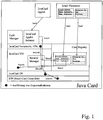
- Fig.1 shows an architectural diagram of a data carrier in the form of a Java Card, suitable for incorporating the invention.
- the Java Card contains, starting from a hardware-near level and progressing to always application-closer levels, arranged in several interacting levels the following elements.
- the Java Card contains firmware or a smart card controller.
- the Java Card contains a Java Card Operating System OS.
- the Java Card Virtual Machine VM Based on the operating system OS a Java Card Virtual Machine VM.
- Integrated into the virtual machine VM is a security manager.
- the Java Card further contains a Java Card Framework and Application Programming Interfaces (approximately application programming interfaces) APIs.
- the Java Card further contains a Java Card Registry.
- the Card Registry contains, as entries for installed applets, conventional parameters such as Applet Identifiers AIDs and Privileges (about privileges).
- the registry further contains security settings of applets.
- the Java Card contains a Card Manager and one or more Java Card Applets (in Fig. 1 an applet is shown).
- the Java Card contains a Java Card Applet Instance (Instance) for the currently running Applet.
- the entries from the Card Registry are applied at runtime.
- FIG. 1 Arrows Inst1, Inst2, Inst3 show operations during installation and arrows Exec processes when running an applet in the Java Card.
- Inst1 an applet is loaded into the java card and an instance of the applet is created in the java card. Furthermore, install parameters are loaded and installed in the Java Card. Inst2: Furthermore, conventional parameters such as AID and Privileges are loaded and installed in the Card Registry. Inst3: continue to Security Settings loaded into the Card Registry and installed.
- Exec1 The Security Manager extracts from the applet elements (eg bytecodes, data, objects, references) of the applet.
- Exec2 The Security Manager searches for references to the extracted elements in the Card Registry, more precisely in the Security Settings. Such references, if present, are created as applet element references in the Card Registry. If the Security Manager finds a suitable applet element reference for the extracted element in the Card Registry, the Security Manager will continue to extract the one with the Applet element reference precautionary measure specified in the card registry.
- Exec4 The Security Manager initiates the execution of the backup action. Depending on the type of security measure, the security manager commissions the appropriate instance of the Java Card, which then initiates the security action.
- Exec4a A double or multiple execution of code sections is initiated by the virtual machine VM.
- the security manager accordingly instructs the virtual machine VM to execute the double or multiple execution.
- Exec4b For a flow control measure, the security manager commissions the operating system OS, and, 4c: the operating system OS commissions the smart card controller (hardware HW, firmware), which finally initiates the flow control action.
- Exec4d A backup measure of redundant saving or encrypted saving is commissioned by the Security Manager to the Java Card Framework or the APIs, which then initiate the saving.
- Fig. 2 shows a flow diagram illustrating the operations of installation (upper part of Fig. 2 ), Personalization (middle part of Fig. 2 ) and execution (lower part of Fig. 2 ) of an applet in a java card like the one in Fig. 1 shown.
- the processes are carried out between a terminal ("TERMINAL") and the Java Card ("CARD").
- the terminal can handle ISO / IEC 7816-4 APDU commands and execute APDU functions in the Java Card.
- the APDU function ICC_ON the chip of the Java Card is booted up.
- the APDU function SELECT CARD MANAGER transfers the control to the Card Manager.
- the terminal is authenticated by the Java Card and, in the event of a fault, the installation is continued.
- the Java Card After authentication, the Java Card receives from the terminal a loading package or "package" to install the applet, usually a cap file.
- the APDU function INSTALL FOR INSTALL installs the contents of the loading package in the Java Card.
- the loading package contains the standard Apple applets: Package ID, Applet Class ID, Instance ID, Privileges, Application Specific Parameters, System Specific Parameters, and possibly others.
- the System Specific Parameters include in particular the Security Settings.
- the APDU function INSTALL FOR INSTALL triggers the following steps: (I1) Create a new applet instance object, namely "Applet Instance Object"; Create a new card registry entry that at least includes the security settings.
- the APDU SELECT APPLET INSTANCE function selects the applet to personalize.
- the Java Card authenticates the terminal. Now the Java Card receives personalization data DATA from the terminal in several loading steps and saves it with several executions of STORE DATA (DGI), up to a last "Last STORE DATA (DGI)", until all personalization data are in the Java Card.
- DGI STORE DATA
- the applet to be executed is initially selected with SELECT APPLET INSTANCE. This starts the Java Card Runtime Environment or Runtime Environment.
- one or more applet-specific commands or functions (“Applet Specific Commands") are executed.
- the applet-specific commands are executed by executing (U1) the bytecode of the current applet command through the Java Card Virtual Machine.
- U1 the security settings for the current active applet instance based on the card registry information applied.
- U2 the security settings are applied to the applet based on the information from the card registry.
- Fig. 3 shows security settings according to an embodiment of the invention.
- Each security setting includes an element (or equivalent asset) and a security measure.
- a first security setting [1] includes as element a code offset 000 to 011, as well as a flow control measure (the flow control measure can be selected arbitrarily from the prior art) via the address range of the applet bytecode of the Start address 000 as start address to address 011 as end address.
- a second security setting [2] includes as an element a method reference to a method with the name "public static void ⁇ Dings ⁇ " as well as the double code execution for the entire method as a precautionary measure, with subsequent plausibility comparison of the two versions (action double version).
- a third security setting [3] comprises as an object an object reference to an object "abPIN", as well as a security measure to switch on current noise during the activity of the object "abPIN”. As soon as the object is no longer active, the current noise, e.g. automatically switched off again.
- the object abPIN can be e.g. be a reference PIN for a PIN verification routine.
Landscapes
- Engineering & Computer Science (AREA)
- Physics & Mathematics (AREA)
- Computer Hardware Design (AREA)
- Theoretical Computer Science (AREA)
- Mathematical Physics (AREA)
- Computer Security & Cryptography (AREA)
- Software Systems (AREA)
- General Engineering & Computer Science (AREA)
- General Physics & Mathematics (AREA)
- Storage Device Security (AREA)
Abstract
Description
- Die Erfindung betrifft ein Prozessor-System mit einem darin installierten Betriebssystem, einem Security Manager, einem unter dem Betriebssystem lauffähigen installierten oder installierbaren Applet (oder mehrere Applets; diese können auch nachladbar sein), einer Registry, in der im Datenträger installierte Applets und zugeordnete Security Settings (in etwa: Sicherheitseinstellungen) für das Betriebssystem gegenüber Applets registriert sind. Die Erfindung betrifft ein Verfahren zum Installieren eines Applet in ein Prozessor-System, sowie ein Verfahren zum Ausführen eines in einem Prozessor-System installierten Applet.
- Prozessor-Systeme werden in unterschiedlichsten Geräten verwendet, wie Personal Computern (PCs), mobilen Endgeräten, z.B. Smartphones, und Datenträgern. Datenträger können insbesondere die Gestalt von Chipkarten haben - z.B. (U)SIM-Karten (SIM = Subscriber Identity Module) oder UICCs (UICC = Universal Integrated Circuit Card) für Mobilfunksysteme oder Zahlungsverkehrskarten oder Identitätskarten oder Datenseiten von Identitätsdokumenten -, oder von einlötbaren bzw. eingelöteten Modulen - z.B. embedded UICCs oder M2M-Modulen (M2M = Machine to Machine).
- Prozessor-Systeme, die ein Betriebssystem und Applets enthalten, wie beispielsweise Java Cards, aber auch native Datenträger, oder mobile Endgeräte wie Smartphones (Applikationen / Applets werden im mobilen Endgerät üblicherweise als Apps bezeichnet), enthalten eine Registry, in welcher eine Auflistung aller installierten Applets enthalten ist, sowie eine Auflistung von Security Settings für die Verhaltensweise des Betriebssystems gegenüber installierten Applets. Nachfolgend wird der Stand der Technik vorrangig am Beispiel eines Datenträgers, insbesondere einer Java Card, betrachtet.
- Bei einer Java Card gemäß JCRE (Java Card Runtime Environment) Version 3.0.1, beispielsweise wird gemäß Kapitel 3 "Java Card Applet Lifetime" ein Applet in der Java Card installiert, indem mittels des Kommandos INSTALL eine Instanz des Applet in der Java Card angelegt wird und durch Aufruf der Methode Applet.register in der Java Card Registry registriert wird. Zusammen mit dem Applet können der Java Card für die Installation Install Parameter bereitgestellt werden, also bei der Installation des Applet mit zu installierende Parameter. Die Install Parameter umfassen beispielsweise herkömmliche Parameter wie Applet Identifer AID oder sogenannte Privileges, also gewissermaßen Vorzugsrechte und Privilegien, die das Applet hat, aber auch für das gesamte Applet geltende Security Settings, in denen z.B. anzuwendende Sicherungsmaßnahmen angegeben sind.
- Funktional werden Applets in Datenträgern oder Apps in mobilen Endgeräten für die Bereitstellung eines Dienstes wie z.B. eines Mobilfunkdienstes oder Zahlungsdienstes oder Identifizierungsdienstes oder Authentisierungsdienstes, verwendet. Konstruktiv ist ein Applet aus Elementen (z.B. Programmcodes, Bytecodes, Objekten etc.) aufgebaut, die in ihrer Gesamtheit die Computerimplementierung des Dienstes darstellen. Manche der Code-Teile des Applet führen unkritische Routine-Rechenvorgänge aus. Andere Code-Teile des Applet führen sicherheitskritische Rechenvorgänge aus, wie beispielsweise die Verarbeitung von geheimen Daten wie z.B. kryptographischen Schlüsseln mittels kryptographischer Algorithmen.
- Mittels Seitenkanalangriffen, z.B. Abhorchen von Stromverbrauch oder elektromagnetischer Strahlung eines Datenträgers, oder aktiven Angriffen (Fault Attacks) lassen sich aus ungeschützten Rechenvorgängen, bei denen geheime Daten wie z.B. kryptographische Schlüssel verwendet werden, die geheimen Daten, z.B. kryptographischen Schlüsseln, aus dem Rechenvorgang ausspähen. Um Seitenkanalangriffe zu erschweren oder verhindern, werden Sicherheitsmaßnahmen angewandt. Eine bekannte Sicherheitsmaßnahme ist die Doppelausführung oder Mehrfachausführung, die darin besteht, einen Rechenvorgang zweimal oder öfter durchzuführen, die dabei erzielten zwei oder mehr Rechenergebnisse zu vergleichen und das Rechenergebnis nur bei Übereinstimmung aller Rechenergebnisse weiter zu verwenden. Weitere mögliche Sicherheitsmaßnahmen sind das Zuschalten eines Jitters oder von Stromrauschen, spezielle Vorschriften für die Vorgehensweise bei einem Auslesen von Speichern (z.B. Auslesen soll stets nur direkt aus dem nichtflüchtigen Speicher erfolgen statt aus einem Cache-Speicher).
- Anzuwendende Sicherheitsmaßnahmen werden in den Security Settings (in etwa "Sicherheitseinstellungen") der Registry des Datenträgers für das Applet eingetragen, z.B. durch Bezugnahme auf einen Applet Identifier AID des Applet. Dabei gilt eine Sicherheitsmaßnahme stets für ein bestimmtes Applet, und dabei für das Applet als Ganzes.
- Applets haben teilweise ein umfangreiches Volumen an Code, von dem nur ein Teil - ggf. nur ein geringer Teil - sicherheitskritisch ist. Prinzipiell würde es genügen, sicherheitskritische Code-Teile eines Applet mit Sicherheitsmaßnahmen abzusichern. Allerdings hat das Applet gegenüber dem Betriebssystem keine Berechtigung zu einem steuernden Zugriff, um vom Betriebssystem angewandte Sicherheitsmaßnahmen zu steuern, z.B. Code-Teilselektiv ein- oder auszuschalten. Das Betriebssystem umgekehrt hat keine Möglichkeit, im Applet-Code als Ganzem sicherheitskritische Code-Teile zu erkennen und unterschiedlich zu unkritischen Code-Teilen zu behandeln.
- Der Erfindung liegt die Aufgabe zu Grunde, einen Datenträger zu schaffen, bei dem Sicherheitsmaßnahmen des Betriebssystems auf Applets gezielt auf einzelne Elemente oder Bereiche des Applets (Code, Objekte oder Daten) anwendbar sind, so dass eine unterschiedliche Anwendung der Sicherheitsmaßnahmen für sicherheitskritische Elemente und unkritische Elemente möglich ist.
- Die Aufgabe wird gelöst durch ein Prozessor-System nach Anspruch 1.
- Das erfindungsgemäße Prozessor-System nach Anspruch 1 umfasst darin installiert:
- ein Betriebssystem;
- einen Security Manager;
- eine Registry, in der registriert oder registrierbar sind:
- -- im Prozessor-System installierte oder installierbare Applets;
- -- im Betriebssystem implementierte Sicherungsmaßnahmen; und
- -- zumindest ein Security Setting für ein installiertes Applet, durch das eine unter Steuerung des Betriebssystems durch den Security Manager auf das Applet anzuwendende Sicherungsmaßnahme referenziert ist.
- Das Prozessor-System ist dadurch gekennzeichnet, dass das Security Setting zusätzlich zur Sicherungsmaßnahme zumindest eine Applet-Element-Referenz umfasst, durch welche ein Element (z.B. ein Code-Teil oder ein Datenobjekt) des Applet bezeichnet ist, auf welches die Sicherungsmaßnahme anzuwenden ist.
- Die Applet-Element-Referenz ermöglicht ein differenziertes Anwenden von Sicherungsmaßnahmen nur auf einzelne Elemente des Applets, bevorzugt sicherheitskritische Elemente. Unkritische Elemente können mit geringerem Aufwand behandelt werden. Daher ist gemäß Anspruch 1 ein Prozessor-System mit gezielt unterschiedlicher Anwendungsmöglichkeit von Sicherungsmaßnahmen auf unterschiedliche Applet-Elemente geschaffen.
- Als Applet-Element-Referenz ist wahlweise eines der folgenden Elemente vorgesehen: ein Bytecode-Offset; ein Bytecode- -Bereich umfassend einen Bytecode-Anfangs-Offset und einen Byte-Code-Ende-Offset oder umfassend einen Bytecode-Anfang und einen Bytecode-Offset; eine Objekt-Referenz; eine Referenz auf eine Methode. Wahlweise ist die Applet-Element-Referenz in eine Klassen-Referenz eingebettet.
- Als Sicherungsmaßnahme ist/ sind wahlweise eine oder mehrere der in Anspruch 3 angegebenen an sich bekannten Maßnahmen vorgesehen.
- Wahlweise ist das Prozessor-System zum Installieren eines Applet vorbereitet. Wahlweise umfasst das Prozessor-System bereits ein installiertes Applet.
- Das Prozessor-System ist wahlweise gestaltet als Java-basiertes Chipset eines mobilen Endgeräts oder als Java Card, und umfasst in diesem Fall eine unter dem Betriebssystem lauffähige Virtuelle Maschine, unter welcher der Security Manager implementiert ist.
- Die Registry ist wahlweise gestaltet als eine von spezifischen Applets unabhängige allgemeine Registry des Prozessor-Systems. Alternativ ist die Registry eine einem Applet oder einer Mehrzahl von Applets zugeordnete spezifische Registry, insbesondere eine einem Applet oder einer Mehrzahl von Applets zugeordnete spezifische Datei.
- Ein erfindungsgemäßes Verfahren zum Installieren eines Applet geht aus von einem Prozessor-System, das umfasst: ein Betriebssystem; einen Security Manager; eine Registry, in der registriert oder registrierbar sind: im Prozessor-System installierte Applets, und zumindest ein Security Setting für ein installiertes Applet, durch das eine unter Steuerung des Betriebssystems durch den Security Manager auf das Applet anzuwendende Sicherungsmaßnahme referenziert ist.
- Das Verfahren umfasst die Schritte: Senden eines Installationspakets für das Applet an das Prozessor-System, das installierbaren Applet-Code umfasst, und Senden von Install Parametern an das Prozessor-System, wobei die Install Parameter zumindest ein Security Setting für das Applet umfassen, die eine durch das Betriebssystem auf das Applet anzuwendende Sicherungsmaßnahme umfasst; Installieren des Applet im Prozessor-System an Hand des Installationspakets; Registrieren des zumindest einen Security Setting in der Registry.
- Das Verfahren ist gekennzeichnet durch mindestens eine in der Sicherheitseinstellungen weiter umfasste Applet-Element-Referenz, durch welche ein Element des Applet bezeichnet ist, auf welchen die Sicherungsmaßnahme anzuwenden ist, und durch den - beim Registrieren der Security Settings durchgeführten - Schritt des Registrierens der Applet-Element-Referenz in der Card-Registry. Die Card Registry enthält nun - dank der Applet-Element-Referenz - eine Handlungsanweisung für ein gezieltes Anwenden der Sicherungsmaßnahmen nur auf diejenigen einzelnen Elemente des Applet, die durch die Applet-Element-Referenz bezeichnet sind.
- Die Install Parameter werden wahlweise innerhalb des Installationspakets gesendet. Alternativ werden die Install Parameter in Gestalt einer gesonderten Datei gesendet, die dem zu installierenden Applet zugeordnet ist, und in der die Security Settings enthalten sind.
- Bei einem erfindungsgemäßen Verfahren zum Ausführen eines in einem Prozessor-System installierten Applet wird von einem Prozessor-System ausgegangen, welches umfasst: ein Betriebssystem; einen Security Manager; eine Registry, in der registriert sind: - im Prozessor-System installierte Applets, und - zumindest ein Security Setting für das installierte Applet, durch das eine unter Steuerung des Betriebssystems durch den Security Manager auf das Applet anzuwendende Sicherungsmaßnahme referenziert ist.
- Das Verfahren umfasst die Schritte:
- Senden eines Aufrufbefehls für das Applet an das Prozessor-System;
- Prüfen des zumindest einen Security Setting für das Applet in der Registry;
- Ausführen des Applet unter Anwenden der durch das Security Setting vorgegebene Sicherungsmaßnahme;
- Das Verfahren ist gekennzeichnet durch mindestens eine in dem Security Setting weiter umfasste Applet-Element-Referenz, durch welche ein Element des Applet bezeichnet ist, auf welchen die Sicherungsmaßnahme anzuwenden ist, wobei die Sicherungsmaßnahme unter Verwendung der Applet-Element-Referenz angewandt wird.
- Die einzelnen Schritte bei der Applet-Abarbeitung umfassen im Detail vorzugsweise:
- Element-Referenz (Bytecode, Referenz...) aus dem Applet holen;
- Suche nach dem referenzierten Element in den Sicherheitseinstellungen;
- Bei Auffinden des Elements Holen der zugeordneten Gegenmaßnahme;
- Ausführung der Gegenmaßnahme.
- Das Prozessor-System ist wahlweise als eines der folgenden gestaltet: Computer; mobiles Endgerät, insbesondere Smartphone; Chipset für ein mobiles Endgerät, insbesondere Smartphone; Datenträger, insbesondere Java Card oder native Karte oder Chipmodul.
- Im Folgenden wird die Erfindung an Hand von Ausführungsbeispielen und unter Bezugnahme auf die Zeichnung näher erläutert, in der zeigen:
-
Fig. 1 ein Architektur-Diagramm einer Java Card, geeignet zur Aufnahme der Erfindung; -
Fig. 2 ein Ablaufdiagramm zur Veranschaulichung von Installation, Personalisierung und Ausführung eines Applet in einer Java Card wie der inFig. 1 gezeigten; -
Fig. 3 Security Settings nach einer Ausführungsform der Erfindung. -
Fig.1 zeigt ein Architektur-Diagramm eines Datenträgers in Gestalt einer Java Card, geeignet für zur Aufnahme der Erfindung. Die Java Card enthält, ausgehend von einer Hardware-nahen Ebene und weiterschreitend zu immer Applikations-näheren Ebenen, in mehreren wechselwirkenden Ebenen angeordnet folgende Elemente. Auf Hardware-nächste Ebene enthält die Java Card Firmware bzw. einen Smart Card Controller. Auf Betriebssystemebene enthält die Java Card ein Java Card Betriebssystem OS. Aufsetzend auf dem Betriebssystem OS eine Java Card Virtuelle Maschine VM. In die Virtuelle Maschine VM integriert ist ein Security Manager. Unter Steuerung der Virtuellen Maschine VM enthält die Java Card weiter ein Java Card Framework und Application Programming Interfaces (in etwa Applikationsprogrammierungs-Schnittstellen) APIs. Auf den Ebenen von Virtueller Maschine VM und Framework/ APIs enthält die Java Card weiter eine Java Card Registry. Die Card Registry enthält, als Einträge für installierte Applets herkömmliche Parameter wie Applet Identifiers AIDs und Privileges (in etwa Privilegien). Die Registry enthält weiter Security Settings von Applets. Auf Applikationsebene enthält die Java Card einen Card Manager und ein oder mehrere Java Card Applets (inFig. 1 ist ein Applet gezeigt). Im Betrieb der Java Card, zur Laufzeit, enthält die Java Card zum gerade ausgeführten Applet eine Java Card Applet Instance (Instanz). Im Betrieb, zur Laufzeit werden die Einträge aus der Card Registry angewandt. - In
Fig. 1 zeigen Pfeile Inst1, Inst2, Inst3 zeigen Vorgänge bei der Installation und Pfeile Exec Vorgänge bei der Ausführung eines Applet in der Java Card. - Inst1: ein wird Applet in die Java Card geladen und in der Java Card eine Instance (Instanz) des Applet angelegt. Weiter werden Install Parameter in die Java Card geladen und installiert. Inst2: weiter werden herkömmliche Parameter wie AID und Privileges in die Card Registry geladen und installiert. Inst3: weiter werden Security Settings in die Card Registry geladen und installiert.
- Bei Applet-Ausführung werden folgende Schritte ausgeführt. Exec1: Der Security Manager extrahiert aus dem Applet Elemente (z.B. Bytecodes, Daten, Objekte, Referenzen) des Applet. Exec2: Der Security Manager sucht in der Card Registry, genauer in den Security Settings, nach Referenzen auf die extrahierten Elemente. Solche Referenzen sind, falls vorhanden, als Applet-Element-Referenzen in der Card Registry angelegt. Findet der Security Manager in der Card Registry eine passende Applet-Element-Referenz für das extrahierte Element, dann extrahiert der Security Manager weiter die mit der Applet-Element-Referenz zusammen in der Card Registry angegebene Sicherungsmaßnahme. Exec4: Der Security Manager leitet die Ausführung der Sicherungsmaßnahme ein. Je nach Art der Sicherungsmaßnahme beauftragt der Security Manager dazu die passende Instanz der Java Card, welche die Sicherungsmaßnahme dann veranlasst. Exec4a: Eine Doppel- oder Mehrfachausführung von Code-Abschnitten wird durch die Virtuelle Maschine VM veranlasst. Der Security Manager beauftragt entsprechend die Virtuelle Maschine VM mit der Ausführung der Doppel- bzw. Mehrfachausführung. Exec4b: Für eine Flow-Control-Maßnahme beauftragt der Security Manager das Betriebssystem OS, und, 4c: das Betriebssystem OS beauftragt den Smart Card Controler (Hardware HW, Firmware), welcher die Flow-Control-Maßnahme schließlich veranlasst. Exec4d: Eine Sicherungsmaßnahme redundantes Speichern oder verschlüsseltes Abspeichern wird vom Security Manager an das Java Card Framework bzw. die APIs in Auftrag gegeben, welche das Abspeichern dann veranlassen.
-
Fig. 2 zeigt ein Ablaufdiagramm zur Veranschaulichung der Vorgänge von Installation (oberer Teil vonFig. 2 ), Personalisierung (mittlerer Teil vonFig. 2 ) und Ausführung (unterer Teil vonFig. 2 ) eines Applet in einer Java Card wie der inFig. 1 gezeigten. Die Vorgänge werden jeweils zwischen einem Terminal ("TERMINAL") und der Java Card ("CARD") ausgeführt. Das Terminal kann ISO/IEC 7816-4 APDU-Kommandos verarbeiten und APDU-Funktionen in der Java Card zur Ausführung bringen. - Mit der APDU-Funktion ICC_ON der Chip der Java Card hochgefahren. Mit dem APDU-Funktion SELECT CARD MANAGER wird die Kontrolle an den Card Manager übergeben. Mit der APDU-Funktion AUTHENTICATE wird das Terminal durch die Java Card authentisiert und im Gutfall die Installation weitergeführt.
- Nach der Authentisierung empfängt die Java Card vom Terminal ein Ladepaket oder "Package" zur Installation des Applet, in der Regel ein Cap-File. Mit der APDU-Funktion INSTALL FOR INSTALL wird der Inhalt des Ladepakets in der Java Card installiert. Das Ladepaket enthält die für Applets üblichen Elemente Package ID, Applet Class ID, Instance ID, Privileges, Application Specific Parameters, System Specific Parameters und evtl. weitere. In den System Specific Parameters sind insbesondere die Security Settings enthalten. Die APDU-Funktion INSTALL FOR INSTALL löst die folgenden Schritte aus: (I1) Erzeugen eines neuen Applet Instanz Objekts, nämlich "Applet Instance Object"; Erzeugen eines neuen Card Registry Eintrags, der zumindest die Security Settings umfasst.
- Nachfolgend wird das installierte Applet personalisiert. Mit der APDU-Funktion SELECT APPLET INSTANCE wird das zu personalisierende Applet ausgewählt. Mit AUHTENTICATE authentisiert die Java Card das Terminal. Nun nimmt die Java Card vom Terminal in mehreren Ladeschritten Personalisierungsdaten DATA entgegen und speichert sie mit mehreren Durchführungen von STORE DATA (DGI) ab, bis zu einem letzten "Last STORE DATA (DGI)", bis alle Personalisierungsdaten in der Java Card sind.
- Bei der Ausführung eines Applet wird zu Anfang mit SELECT APPLET INSTANCE das auszuführende Applet ausgewählt. Hierdurch wird die Java Card Laufzeitumgebung oder "Runtime Environment" gestartet. Zudem werden nach Applet Auswahl ein oder mehrere Applet-spezifische Kommandos oder Funktionen ("Applet Specific Commands") ausgeführt. Die Applet-spezifischen Kommandos werden ausgeführt, indem (U1) der Byte-code des aktuellen Applet Kommandos durch die Java Card Virtuelle Maschine ausgeführt wird. Hierbei werden die Security Settings für die aktuell aktive Applet Instanz auf Grundlage der Card Registry Information angewendet. In Folge (U2) werden die Security Settings auf Grundlage der Information aus der Card Registry gegenüber dem Applet angewandt.
-
Fig. 3 zeigt Security Settings nach einer Ausführungsform der Erfindung. Jedes Security Setting umfasst ein Element (oder gleichbedeutend Asset) und eine Sicherungsmaßnahme. - Ein erstes Security Setting [1] umfasst als Element einen Code-Offset 000 bis 011, sowie als Sicherungsmaßnahme eine Flow Control Maßnahme (die Flow Control Maßnahme kann u.W. beliebig aus dem Stand der Technik gewählt sein) über den Adressbereich des Applet-Bytecodes von der Start-Adresse 000 als Anfangsadresse bis zur Adresse 011 als Endadresse hin.
- Ein zweites Security Setting [2] umfasst als Element eine Methoden-Referenz auf eine Methode mit dem Namen "public static void {Dings}", sowie als Sicherungsmaßnahme die doppelte Code-Ausführung für die gesamte Methode, mit anschließendem Plausibilitätsvergleich der beiden Ausführungen (Maßnahme Doppelausführung).
- Ein drittes Security Setting [3] umfasst als Element eine Objekt-Referenz auf ein Objekt "abPIN", sowie als Sicherungsmaßnahme ein Einschalten von Stromrauschen während der Aktivität des Objekts "abPIN". Sobald das Objekt abPIN nicht mehr aktiv ist, wird das Stromrauschen z.B. automatisch wieder ausgeschaltet. Das Objekt abPIN kann z.B. eine Referenz-PIN für eine PIN-Prüfungsroutine sein.
- Nachfolgend wird ein Applet-Source-Code im Pseudocode-Format angegeben, für eine PIN-Prüfungsroutine "void VerifYPIN(void)", bei der eine Sicherheitseinstellungen angewandt werden, gemäß einer Ausführungsform der Erfindung. Bytecodes und Aufrufe werden dabei als unkritisch, undefiniert (also weder kritisch noch unkritisch) oder kritisch klassifiziert. Kommentarzeilen oder -teilzeilen ist ein // vorangestellt.
 void VerifyPIN(void) //unkritischer Bytecode,
 / / umfasst keine Parameter;
 //Inhalt der Routine Aufruf PIN-Prüfungs-Routine;
 { / / unkritisch;
       if (ClassByte != 0x90) //unkritisch;
              throw(CLA_EXCEPTION); / / unkritisch;
 // Code-Teil Bytecode-Anfangsadresse und Bytecode-Offset,
 //Sicherungs-Maßnahme Flow Control einschalten;
       if(AuthState != AUTH_OK) //kritische Referenz auf
 //Authentisierungszustand AuthState, daher Code-Teil Variablen-Referenz,
 //Maßnahme Betriebssystem prüft Authentisierungszustand doppelt;
 // AuthState != AUTH_OK -> Ergebnis Authentisierungszustand nicht OK
              throw(NOT_AUTHENT); //undefiniert;
 // Endadresse gemäß Bytecode-Offset; Flow Control ausschalten;
 int Length = P3Byte; //unkritischer Bytecode;
 if (Length <4) //unkritisch, keine Parameter
       throw(PIN_TOO_SHORT); / / PIN zu kurz, unkritisch;
       //von Anfängsadresse Endadresse = Anfangsadresse + Adress-Offset:
       // Maßnahmen Flow Control einschalten, Hardware-Jitter einschalten;
       if(ArrayCompare(SollPin, EnteredPIN, Length) != OK)
       //--------------------------------------------------------------------------------------
       // Funktionalität: Prüfung der EnteredPIN gegen die Soll-PIN;
       //-------------------------------------------------------------------------------------
       // Security Setting 1:
 // Ziel: Kritische Variable "SollPIN" darf nicht manipuliert werden
 // Applet-Element: Referenz auf Variable "SollPIN";
 // Sicherungs-Maßnahme: SollPIN direkt aus NVM lesen, nicht über Cache;
 //--------------------------------------------------------------------------------------
 // nach kritischer Referenz "SollPIN" folgen Undefinierte Bytecodes;
 // danach undefinierten Routinen Aufruf INVOKE;
 //--------------------------------------------------------------------------------------
 // Security Setting 2:
 // Ziel: Vergleich beider PINs mittels Methode ArrayCompare darf nicht
 // manipuliert werden;
 // Applet-Element: Methoden-Referenz des ArrayCompare;
 // Sicherungs-Maßnahme Betriebssystem OS führt, anstatt des in Programm
 //angegebenen einfachen ArrayCompare, sichere Compare Routine aus;
 //----------------------------------------------------------------------------------
 //danach wieder unkritische Bytecodes;
       throw(WRONG_PIN); //undefiniert;
 }
 //Endadresse gemäß Bytecode-Offset, daher
 //Hardware-Jitter ausschalten, Flow Control ausschalten.
Claims (11)
- Prozessor-System, umfassend darin installiert:- ein Betriebssystem;- einen Security Manager;- eine Registry, in der registriert oder registrierbar sind:-- im Prozessor-System installierte oder installierbare Applets;-- im Betriebssystem implementierte Sicherungsmaßnahmen; und-- zumindest ein Security Setting für ein installiertes Applet, durch das eine unter Steuerung des Betriebssystems durch den Security Manager auf das Applet anzuwendende Sicherungsmaßnahme referenziert ist;dadurch gekennzeichnet, dass:- das Security Setting zusätzlich zur Sicherungsmaßnahme zumindest eine Applet-Element-Referenz umfasst, durch welche ein Element (z.B. Code-Teil oder Datenobjekt) des Applet bezeichnet ist, auf welches die Sicherungsmaßnahme anzuwenden ist.
- Prozessor-System nach Anspruch 1, wobei als Applet-Element-Referenz eines der folgenden Elemente vorgesehen ist: ein Bytecode-Offset; ein Byte-code- -Bereich umfassend einen Bytecode-Anfangs-Offset und einen Byte-Code-Ende-Offset oder umfassend einen Bytecode-Anfang und einen Byte-code-Offset; eine Objekt-Referenz; eine Referenz auf eine Methode.
- Prozessor-System nach Anspruch 1 oder 2, wobei als Sicherungsmaßnahme eine oder mehrere der folgenden Maßnahmen vorgesehen ist bzw. sind: eine Doppel- oder Mehrfachausführung für einen Rechenvorgang; Maßnahmen, die für Angriffe nutzbare physikalische Parameter wie Ausführungszeit des Codes, Stromverbrauch oder elektromagnetische Abstrahlung des Prozessorsystems verändern; ein Zu- bzw. Abschalten eines Jitters oder von Stromrauschen; eine spezielle Vorgehensweise bei einem Auslesen von Speichern des Prozessor-Systems; ein redundantes oder verschlüsseltes Abspeichern und Wiederauslesen von abzuspeichernden Daten; eine Maßnahme zur Programmfluss-Kontrolle des Betriebssystems; ein Auswählen einer gegen Angriffe abgesicherten Methode anstelle einer ungesicherten Methode, insbesondere ein Auswählen einer sicheren ArrayCompare-Methode anstelle eines einfacher ArrayCompare-Methode.
- Prozessor-System nach einem der Ansprüche 1 bis 3, weiter umfassend ein installiertes Applet.
- Prozessor-System nach einem der Ansprüche 1 bis 4, gestaltet als Java-basiertes Chipset eines mobilen Endgeräts oder als Java Card, und umfassend eine unter dem Betriebssystem lauffähige Virtuelle Maschine, unter welcher der Security Manager implementiert ist.
- Prozessor-System nach einem der Ansprüche 1 bis 5, wobei die Registry wahlweise gestaltet ist als:- entweder eine von spezifischen Applets unabhängige allgemeine Registry des Prozessor-Systems;- oder als eine einem Applet oder einer Mehrzahl von Applets zugeordnete spezifische Registry, insbesondere eine einem Applet oder einer Mehrzahl von Applets zugeordnete spezifische Datei.
- Verfahren zum Installieren eines Applet in einem Prozessor-System, das Prozessor-System umfassend:- ein Betriebssystem;- einen Security Manager;- eine Registry, in der registriert oder registrierbar sind:das Verfahren umfassend die Schritte:-- im Prozessor-System installierte Applets, und-- zumindest ein Security Setting für ein installiertes Applet, durch das eine unter Steuerung des Betriebssystems durch den Security Manager auf das Applet anzuwendende Sicherungsmaßnahme referenziert ist;- Senden eines Installationspakets für das Applet an das Prozessor-System, das installierbaren Applet-Code umfasst, und Senden von Install Parametern an das Prozessor-System, wobei die Install Parameter zumindest ein Security Setting für das Applet umfassen, die eine durch das Betriebssystem auf das Applet anzuwendende Sicherungsmaßnahme umfasst;- Installieren des Applet im Prozessor-System an Hand des Installationspakets;- Registrieren des zumindest einen Security Setting in der Registry;gekennzeichnet durch:- mindestens eine in der Sicherheitseinstellungen weiter umfasste Applet-Element-Referenz, durch welche ein Element des Applet bezeichnet ist, auf welchen die Sicherungsmaßnahme anzuwenden ist, und die beim Registrieren der Security Settings in der Card-Registry registriert wird.
- Verfahren nach Anspruch 7, wobei die Install Parameter entweder innerhalb des Installationspakets gesendet werden, oder in Gestalt einer gesonderten, dem zu installierenden Applet zugeordneten Datei umfassend die Security Settings gesendet werden.
- Verfahren zum Ausführen eines in einem Prozessor-System installierten Applet, das Prozessor-System umfassend:- ein Betriebssystem;- einen Security Manager;- eine Registry, in der registriert sind:-- im Prozessor-System r installierte Applets, und-- zumindest ein Security Setting für das installierte Applet, durch das eine unter Steuerung des Betriebssystems durch den Security Manager auf das Applet anzuwendende Sicherungsmaßnahme referenziert ist;das Verfahren umfassend die Schritte:- Senden eines Aufrufbefehls für das Applet an das Prozessor-System;- Prüfen des zumindest einen Security Setting für das Applet in der Registry;- Ausführen des Applet unter Anwenden der durch das Security Setting vorgegebene Sicherungsmaßnahme;gekennzeichnet durch:- mindestens eine in dem Security Setting weiter umfasste Applet-Element-Referenz, durch welche ein Element des Applet bezeichnet ist, auf welchen die Sicherungsmaßnahme anzuwenden ist, wobei die Sicherungsmaßnahme unter Verwendung der Applet-Element-Referenz angewandt wird.
- Verfahren nach einem der Ansprüche 7 bis 9, wobei das Prozessor-System nach einem der Ansprüche 1 bis 6 gestaltet ist.
- Prozessor-System oder Verfahren nach einem der vorangehenden Ansprüche, wobei das Prozessor-System als eines der folgenden gestaltet ist: Computer; mobiles Endgerät, insbesondere Smartphone; Chipset für ein mobiles Endgerät, insbesondere Smartphone; Datenträger, insbesondere Java Card oder native Karte oder Chipmodul.
Applications Claiming Priority (1)
| Application Number | Priority Date | Filing Date | Title |
|---|---|---|---|
| DE102015013760 | 2015-10-23 |
Publications (2)
| Publication Number | Publication Date |
|---|---|
| EP3159821A1 true EP3159821A1 (de) | 2017-04-26 |
| EP3159821B1 EP3159821B1 (de) | 2018-08-15 |
Family
ID=57233268
Family Applications (1)
| Application Number | Title | Priority Date | Filing Date |
|---|---|---|---|
| EP16002258.8A Active EP3159821B1 (de) | 2015-10-23 | 2016-10-21 | Prozessor-system mit applet security settings |
Country Status (1)
| Country | Link |
|---|---|
| EP (1) | EP3159821B1 (de) |
Cited By (2)
| Publication number | Priority date | Publication date | Assignee | Title |
|---|---|---|---|---|
| WO2022247226A1 (zh) * | 2021-05-28 | 2022-12-01 | 深圳前海微众银行股份有限公司 | 一种小程序监控方法及装置 |
| CN115599409A (zh) * | 2022-11-30 | 2023-01-13 | 紫光同芯微电子有限公司(Cn) | 一种Java卡的应用程序安装方法及装置 |
-
2016
- 2016-10-21 EP EP16002258.8A patent/EP3159821B1/de active Active
Non-Patent Citations (2)
| Title |
|---|
| AHMADOU SERE ET AL: "Evaluation of Countermeasures Against Fault Attacks on Smart Cards", INTERNATIONAL JOURNAL OF SECURITY AND ITS APPLICATIONS, vol. 5, no. 2, 1 April 2011 (2011-04-01), pages 49 - 60, XP055201621 * |
| RAJA AKRAM ET AL: "Enhancing Java Runtime Environment for Smart Cards Against Runtime Attacks", 21 September 2015 (2015-09-21), https://pure.royalholloway.ac.uk/portal/en/publications/enhancing-java-runtime-environment-for-smart-cards-against-runtime-attacks%283a7568c3-af52-4aa7-8a83-514e6660f0fd%29.html, XP055339750, Retrieved from the Internet <URL:https://pure.royalholloway.ac.uk/portal/files/25117130/ESORICS_2015_submission_210.pdf> [retrieved on 20170127] * |
Cited By (2)
| Publication number | Priority date | Publication date | Assignee | Title |
|---|---|---|---|---|
| WO2022247226A1 (zh) * | 2021-05-28 | 2022-12-01 | 深圳前海微众银行股份有限公司 | 一种小程序监控方法及装置 |
| CN115599409A (zh) * | 2022-11-30 | 2023-01-13 | 紫光同芯微电子有限公司(Cn) | 一种Java卡的应用程序安装方法及装置 |
Also Published As
| Publication number | Publication date |
|---|---|
| EP3159821B1 (de) | 2018-08-15 |
Similar Documents
| Publication | Publication Date | Title |
|---|---|---|
| DE60308990T2 (de) | Schutz eines gerätes gegen unerwünschte verwendung in einem sicheren umfeld | |
| EP3224758B1 (de) | Schlüsselableitung in einem chipkarten betriebsystem | |
| DE10393662T5 (de) | Bereitstellen eines sicheren Ausführungsmodus in einer Preboot-Umgebung | |
| DE112014006112T5 (de) | Applet-Migration in einem sicheren Element | |
| DE102006028513B4 (de) | Eingabevorrichtung für biometrische Signale sowie Computersystem mit einer solchen | |
| EP1611510B1 (de) | Kontrollierte ausführung eines für eine virtuelle maschine vorgesehenen programms auf einem tragbaren datenträger | |
| WO2014023394A1 (de) | Verfahren zum aktivieren eines betriebssystems in einem sicherheitsmodul | |
| DE102014220616A1 (de) | Verfahren zum Laden von ausführbaren Programminstruktionen in eine Chipkarte im Wirkbetrieb | |
| DE102011115135A1 (de) | Mikroprozessorsystem mit gesicherter Laufzeitumgebung | |
| DE102016009232A1 (de) | Integriertes Teilnehmeridentitätsmodul mit Core-OS und Anwendungs-OS | |
| EP2795934B1 (de) | Verfahren zur kommunikation mit einer applikation auf einem portablen datenträger sowie ein solcher portabler datenträger | |
| DE69911174T2 (de) | System und verfahren zur kontrolle des zugangs zu dem computercode in einer chipkarte | |
| EP3159821B1 (de) | Prozessor-system mit applet security settings | |
| EP2987078B1 (de) | Verfahren zum bereitstellen einer applikation auf einem sicherheitsmodul sowie ein solches sicherheitsmodul | |
| EP2524333B1 (de) | Verfahren zum bereitstellen eines sicheren zählers auf einem endgerät | |
| DE102009048756B4 (de) | Verfahren und Schlüsselgerät zur Verbesserung der Sicherheit eines verschlüsselten Datenspeichers, von dem ein Computer bootet | |
| WO2016096139A1 (de) | Verfahren zum bereitstellen einer sicherheitskritischen softwareapplikation auf einer computereinheit | |
| US10489775B2 (en) | Integrated circuit card adapted to transfer first data from a first application for use by a second application | |
| WO2017017085A1 (de) | Chipkarte mit hauptapplikation und persistenzapplikation | |
| EP3488375B1 (de) | Chipset mit gesicherter firmware | |
| DE102021126509B4 (de) | Tragbare Chipvorrichtung und Verfahren zum Ausführen eines Softwaremodul-Updates in einer tragbaren Chipvorrichtung | |
| DE102007027935A1 (de) | Tragbarer Datenträger und Verfahren zur Personalisierung eines tragbaren Datenträgers | |
| WO2017190830A1 (de) | Verfahren zur erstmaligen inbetriebnahme eines nicht vollständig personalisierten sicheren elements | |
| EP2782006B1 (de) | Prozess und System zur Überprüfung eines Computerprogramms auf einer Chipkarte | |
| DE102015207004A1 (de) | Verfahren zum geschützten Zugriff auf Sicherheitsfunktionen eines Sicherheitsmoduls eines Hostsystems |
Legal Events
| Date | Code | Title | Description |
|---|---|---|---|
| PUAI | Public reference made under article 153(3) epc to a published international application that has entered the european phase |
Free format text: ORIGINAL CODE: 0009012 |
|
| AK | Designated contracting states |
Kind code of ref document: A1 Designated state(s): AL AT BE BG CH CY CZ DE DK EE ES FI FR GB GR HR HU IE IS IT LI LT LU LV MC MK MT NL NO PL PT RO RS SE SI SK SM TR |
|
| AX | Request for extension of the european patent |
Extension state: BA ME |
|
| RAP1 | Party data changed (applicant data changed or rights of an application transferred) |
Owner name: GIESECKE+DEVRIENT MOBILE SECURITY GMBH |
|
| 17P | Request for examination filed |
Effective date: 20171026 |
|
| RBV | Designated contracting states (corrected) |
Designated state(s): AL AT BE BG CH CY CZ DE DK EE ES FI FR GB GR HR HU IE IS IT LI LT LU LV MC MK MT NL NO PL PT RO RS SE SI SK SM TR |
|
| GRAP | Despatch of communication of intention to grant a patent |
Free format text: ORIGINAL CODE: EPIDOSNIGR1 |
|
| INTG | Intention to grant announced |
Effective date: 20180316 |
|
| GRAS | Grant fee paid |
Free format text: ORIGINAL CODE: EPIDOSNIGR3 |
|
| GRAA | (expected) grant |
Free format text: ORIGINAL CODE: 0009210 |
|
| AK | Designated contracting states |
Kind code of ref document: B1 Designated state(s): AL AT BE BG CH CY CZ DE DK EE ES FI FR GB GR HR HU IE IS IT LI LT LU LV MC MK MT NL NO PL PT RO RS SE SI SK SM TR |
|
| REG | Reference to a national code |
Ref country code: CH Ref legal event code: EP Ref country code: GB Ref legal event code: FG4D Free format text: NOT ENGLISH Ref country code: AT Ref legal event code: REF Ref document number: 1030609 Country of ref document: AT Kind code of ref document: T Effective date: 20180815 |
|
| REG | Reference to a national code |
Ref country code: IE Ref legal event code: FG4D Free format text: LANGUAGE OF EP DOCUMENT: GERMAN |
|
| REG | Reference to a national code |
Ref country code: DE Ref legal event code: R096 Ref document number: 502016001635 Country of ref document: DE |
|
| REG | Reference to a national code |
Ref country code: FR Ref legal event code: PLFP Year of fee payment: 3 |
|
| REG | Reference to a national code |
Ref country code: NL Ref legal event code: MP Effective date: 20180815 |
|
| REG | Reference to a national code |
Ref country code: LT Ref legal event code: MG4D |
|
| PG25 | Lapsed in a contracting state [announced via postgrant information from national office to epo] |
Ref country code: FI Free format text: LAPSE BECAUSE OF FAILURE TO SUBMIT A TRANSLATION OF THE DESCRIPTION OR TO PAY THE FEE WITHIN THE PRESCRIBED TIME-LIMIT Effective date: 20180815 Ref country code: IS Free format text: LAPSE BECAUSE OF FAILURE TO SUBMIT A TRANSLATION OF THE DESCRIPTION OR TO PAY THE FEE WITHIN THE PRESCRIBED TIME-LIMIT Effective date: 20181215 Ref country code: RS Free format text: LAPSE BECAUSE OF FAILURE TO SUBMIT A TRANSLATION OF THE DESCRIPTION OR TO PAY THE FEE WITHIN THE PRESCRIBED TIME-LIMIT Effective date: 20180815 Ref country code: NO Free format text: LAPSE BECAUSE OF FAILURE TO SUBMIT A TRANSLATION OF THE DESCRIPTION OR TO PAY THE FEE WITHIN THE PRESCRIBED TIME-LIMIT Effective date: 20181115 Ref country code: GR Free format text: LAPSE BECAUSE OF FAILURE TO SUBMIT A TRANSLATION OF THE DESCRIPTION OR TO PAY THE FEE WITHIN THE PRESCRIBED TIME-LIMIT Effective date: 20181116 Ref country code: SE Free format text: LAPSE BECAUSE OF FAILURE TO SUBMIT A TRANSLATION OF THE DESCRIPTION OR TO PAY THE FEE WITHIN THE PRESCRIBED TIME-LIMIT Effective date: 20180815 Ref country code: BG Free format text: LAPSE BECAUSE OF FAILURE TO SUBMIT A TRANSLATION OF THE DESCRIPTION OR TO PAY THE FEE WITHIN THE PRESCRIBED TIME-LIMIT Effective date: 20181115 Ref country code: NL Free format text: LAPSE BECAUSE OF FAILURE TO SUBMIT A TRANSLATION OF THE DESCRIPTION OR TO PAY THE FEE WITHIN THE PRESCRIBED TIME-LIMIT Effective date: 20180815 Ref country code: LT Free format text: LAPSE BECAUSE OF FAILURE TO SUBMIT A TRANSLATION OF THE DESCRIPTION OR TO PAY THE FEE WITHIN THE PRESCRIBED TIME-LIMIT Effective date: 20180815 |
|
| PG25 | Lapsed in a contracting state [announced via postgrant information from national office to epo] |
Ref country code: AL Free format text: LAPSE BECAUSE OF FAILURE TO SUBMIT A TRANSLATION OF THE DESCRIPTION OR TO PAY THE FEE WITHIN THE PRESCRIBED TIME-LIMIT Effective date: 20180815 Ref country code: LV Free format text: LAPSE BECAUSE OF FAILURE TO SUBMIT A TRANSLATION OF THE DESCRIPTION OR TO PAY THE FEE WITHIN THE PRESCRIBED TIME-LIMIT Effective date: 20180815 Ref country code: HR Free format text: LAPSE BECAUSE OF FAILURE TO SUBMIT A TRANSLATION OF THE DESCRIPTION OR TO PAY THE FEE WITHIN THE PRESCRIBED TIME-LIMIT Effective date: 20180815 |
|
| PG25 | Lapsed in a contracting state [announced via postgrant information from national office to epo] |
Ref country code: ES Free format text: LAPSE BECAUSE OF FAILURE TO SUBMIT A TRANSLATION OF THE DESCRIPTION OR TO PAY THE FEE WITHIN THE PRESCRIBED TIME-LIMIT Effective date: 20180815 Ref country code: PL Free format text: LAPSE BECAUSE OF FAILURE TO SUBMIT A TRANSLATION OF THE DESCRIPTION OR TO PAY THE FEE WITHIN THE PRESCRIBED TIME-LIMIT Effective date: 20180815 Ref country code: CZ Free format text: LAPSE BECAUSE OF FAILURE TO SUBMIT A TRANSLATION OF THE DESCRIPTION OR TO PAY THE FEE WITHIN THE PRESCRIBED TIME-LIMIT Effective date: 20180815 Ref country code: RO Free format text: LAPSE BECAUSE OF FAILURE TO SUBMIT A TRANSLATION OF THE DESCRIPTION OR TO PAY THE FEE WITHIN THE PRESCRIBED TIME-LIMIT Effective date: 20180815 Ref country code: EE Free format text: LAPSE BECAUSE OF FAILURE TO SUBMIT A TRANSLATION OF THE DESCRIPTION OR TO PAY THE FEE WITHIN THE PRESCRIBED TIME-LIMIT Effective date: 20180815 Ref country code: IT Free format text: LAPSE BECAUSE OF FAILURE TO SUBMIT A TRANSLATION OF THE DESCRIPTION OR TO PAY THE FEE WITHIN THE PRESCRIBED TIME-LIMIT Effective date: 20180815 |
|
| REG | Reference to a national code |
Ref country code: DE Ref legal event code: R097 Ref document number: 502016001635 Country of ref document: DE |
|
| PG25 | Lapsed in a contracting state [announced via postgrant information from national office to epo] |
Ref country code: SM Free format text: LAPSE BECAUSE OF FAILURE TO SUBMIT A TRANSLATION OF THE DESCRIPTION OR TO PAY THE FEE WITHIN THE PRESCRIBED TIME-LIMIT Effective date: 20180815 Ref country code: DK Free format text: LAPSE BECAUSE OF FAILURE TO SUBMIT A TRANSLATION OF THE DESCRIPTION OR TO PAY THE FEE WITHIN THE PRESCRIBED TIME-LIMIT Effective date: 20180815 Ref country code: SK Free format text: LAPSE BECAUSE OF FAILURE TO SUBMIT A TRANSLATION OF THE DESCRIPTION OR TO PAY THE FEE WITHIN THE PRESCRIBED TIME-LIMIT Effective date: 20180815 |
|
| PLBE | No opposition filed within time limit |
Free format text: ORIGINAL CODE: 0009261 |
|
| STAA | Information on the status of an ep patent application or granted ep patent |
Free format text: STATUS: NO OPPOSITION FILED WITHIN TIME LIMIT |
|
| REG | Reference to a national code |
Ref country code: BE Ref legal event code: MM Effective date: 20181031 |
|
| PG25 | Lapsed in a contracting state [announced via postgrant information from national office to epo] |
Ref country code: MC Free format text: LAPSE BECAUSE OF FAILURE TO SUBMIT A TRANSLATION OF THE DESCRIPTION OR TO PAY THE FEE WITHIN THE PRESCRIBED TIME-LIMIT Effective date: 20180815 Ref country code: LU Free format text: LAPSE BECAUSE OF NON-PAYMENT OF DUE FEES Effective date: 20181021 |
|
| 26N | No opposition filed |
Effective date: 20190516 |
|
| REG | Reference to a national code |
Ref country code: IE Ref legal event code: MM4A |
|
| PG25 | Lapsed in a contracting state [announced via postgrant information from national office to epo] |
Ref country code: SI Free format text: LAPSE BECAUSE OF FAILURE TO SUBMIT A TRANSLATION OF THE DESCRIPTION OR TO PAY THE FEE WITHIN THE PRESCRIBED TIME-LIMIT Effective date: 20180815 Ref country code: BE Free format text: LAPSE BECAUSE OF NON-PAYMENT OF DUE FEES Effective date: 20181031 |
|
| PG25 | Lapsed in a contracting state [announced via postgrant information from national office to epo] |
Ref country code: IE Free format text: LAPSE BECAUSE OF NON-PAYMENT OF DUE FEES Effective date: 20181021 |
|
| PG25 | Lapsed in a contracting state [announced via postgrant information from national office to epo] |
Ref country code: MT Free format text: LAPSE BECAUSE OF FAILURE TO SUBMIT A TRANSLATION OF THE DESCRIPTION OR TO PAY THE FEE WITHIN THE PRESCRIBED TIME-LIMIT Effective date: 20180815 |
|
| PG25 | Lapsed in a contracting state [announced via postgrant information from national office to epo] |
Ref country code: TR Free format text: LAPSE BECAUSE OF FAILURE TO SUBMIT A TRANSLATION OF THE DESCRIPTION OR TO PAY THE FEE WITHIN THE PRESCRIBED TIME-LIMIT Effective date: 20180815 |
|
| PG25 | Lapsed in a contracting state [announced via postgrant information from national office to epo] |
Ref country code: PT Free format text: LAPSE BECAUSE OF FAILURE TO SUBMIT A TRANSLATION OF THE DESCRIPTION OR TO PAY THE FEE WITHIN THE PRESCRIBED TIME-LIMIT Effective date: 20180815 |
|
| REG | Reference to a national code |
Ref country code: CH Ref legal event code: PL |
|
| PG25 | Lapsed in a contracting state [announced via postgrant information from national office to epo] |
Ref country code: CY Free format text: LAPSE BECAUSE OF FAILURE TO SUBMIT A TRANSLATION OF THE DESCRIPTION OR TO PAY THE FEE WITHIN THE PRESCRIBED TIME-LIMIT Effective date: 20180815 Ref country code: HU Free format text: LAPSE BECAUSE OF FAILURE TO SUBMIT A TRANSLATION OF THE DESCRIPTION OR TO PAY THE FEE WITHIN THE PRESCRIBED TIME-LIMIT; INVALID AB INITIO Effective date: 20161021 Ref country code: MK Free format text: LAPSE BECAUSE OF NON-PAYMENT OF DUE FEES Effective date: 20180815 |
|
| PG25 | Lapsed in a contracting state [announced via postgrant information from national office to epo] |
Ref country code: LI Free format text: LAPSE BECAUSE OF NON-PAYMENT OF DUE FEES Effective date: 20191031 Ref country code: CH Free format text: LAPSE BECAUSE OF NON-PAYMENT OF DUE FEES Effective date: 20191031 |
|
| GBPC | Gb: european patent ceased through non-payment of renewal fee |
Effective date: 20201021 |
|
| PG25 | Lapsed in a contracting state [announced via postgrant information from national office to epo] |
Ref country code: GB Free format text: LAPSE BECAUSE OF NON-PAYMENT OF DUE FEES Effective date: 20201021 |
|
| REG | Reference to a national code |
Ref country code: AT Ref legal event code: MM01 Ref document number: 1030609 Country of ref document: AT Kind code of ref document: T Effective date: 20211021 |
|
| PG25 | Lapsed in a contracting state [announced via postgrant information from national office to epo] |
Ref country code: AT Free format text: LAPSE BECAUSE OF NON-PAYMENT OF DUE FEES Effective date: 20211021 |
|
| P01 | Opt-out of the competence of the unified patent court (upc) registered |
Effective date: 20230520 |
|
| REG | Reference to a national code |
Ref country code: DE Ref legal event code: R081 Ref document number: 502016001635 Country of ref document: DE Owner name: GIESECKE+DEVRIENT EPAYMENTS GMBH, DE Free format text: FORMER OWNER: GIESECKE+DEVRIENT MOBILE SECURITY GMBH, 81677 MUENCHEN, DE |
|
| PGFP | Annual fee paid to national office [announced via postgrant information from national office to epo] |
Ref country code: DE Payment date: 20241031 Year of fee payment: 9 |
|
| PGFP | Annual fee paid to national office [announced via postgrant information from national office to epo] |
Ref country code: FR Payment date: 20241024 Year of fee payment: 9 |