EP3159798B1 - Method and system for determining user interface usage - Google Patents
Method and system for determining user interface usage Download PDFInfo
- Publication number
- EP3159798B1 EP3159798B1 EP16191549.1A EP16191549A EP3159798B1 EP 3159798 B1 EP3159798 B1 EP 3159798B1 EP 16191549 A EP16191549 A EP 16191549A EP 3159798 B1 EP3159798 B1 EP 3159798B1
- Authority
- EP
- European Patent Office
- Prior art keywords
- entity
- user interface
- event
- data
- time interval
- Prior art date
- Legal status (The legal status is an assumption and is not a legal conclusion. Google has not performed a legal analysis and makes no representation as to the accuracy of the status listed.)
- Active
Links
Images


Classifications
-
- G—PHYSICS
- G06—COMPUTING OR CALCULATING; COUNTING
- G06F—ELECTRIC DIGITAL DATA PROCESSING
- G06F40/00—Handling natural language data
- G06F40/10—Text processing
- G06F40/12—Use of codes for handling textual entities
- G06F40/14—Tree-structured documents
- G06F40/143—Markup, e.g. Standard Generalized Markup Language [SGML] or Document Type Definition [DTD]
-
- G—PHYSICS
- G06—COMPUTING OR CALCULATING; COUNTING
- G06F—ELECTRIC DIGITAL DATA PROCESSING
- G06F11/00—Error detection; Error correction; Monitoring
- G06F11/30—Monitoring
- G06F11/34—Recording or statistical evaluation of computer activity, e.g. of down time, of input/output operation ; Recording or statistical evaluation of user activity, e.g. usability assessment
- G06F11/3409—Recording or statistical evaluation of computer activity, e.g. of down time, of input/output operation ; Recording or statistical evaluation of user activity, e.g. usability assessment for performance assessment
- G06F11/3419—Recording or statistical evaluation of computer activity, e.g. of down time, of input/output operation ; Recording or statistical evaluation of user activity, e.g. usability assessment for performance assessment by assessing time
-
- G—PHYSICS
- G06—COMPUTING OR CALCULATING; COUNTING
- G06F—ELECTRIC DIGITAL DATA PROCESSING
- G06F11/00—Error detection; Error correction; Monitoring
- G06F11/30—Monitoring
- G06F11/34—Recording or statistical evaluation of computer activity, e.g. of down time, of input/output operation ; Recording or statistical evaluation of user activity, e.g. usability assessment
- G06F11/3438—Recording or statistical evaluation of computer activity, e.g. of down time, of input/output operation ; Recording or statistical evaluation of user activity, e.g. usability assessment monitoring of user actions
-
- G—PHYSICS
- G06—COMPUTING OR CALCULATING; COUNTING
- G06F—ELECTRIC DIGITAL DATA PROCESSING
- G06F3/00—Input arrangements for transferring data to be processed into a form capable of being handled by the computer; Output arrangements for transferring data from processing unit to output unit, e.g. interface arrangements
- G06F3/01—Input arrangements or combined input and output arrangements for interaction between user and computer
- G06F3/048—Interaction techniques based on graphical user interfaces [GUI]
- G06F3/0481—Interaction techniques based on graphical user interfaces [GUI] based on specific properties of the displayed interaction object or a metaphor-based environment, e.g. interaction with desktop elements like windows or icons, or assisted by a cursor's changing behaviour or appearance
-
- G—PHYSICS
- G06—COMPUTING OR CALCULATING; COUNTING
- G06F—ELECTRIC DIGITAL DATA PROCESSING
- G06F40/00—Handling natural language data
- G06F40/20—Natural language analysis
- G06F40/205—Parsing
-
- G—PHYSICS
- G06—COMPUTING OR CALCULATING; COUNTING
- G06F—ELECTRIC DIGITAL DATA PROCESSING
- G06F2201/00—Indexing scheme relating to error detection, to error correction, and to monitoring
- G06F2201/86—Event-based monitoring
Definitions
- the present invention relates to methods and systems for determining user interface usage, and in particular detecting and measuring the duration of activities or processes performed in one or more user interfaces.
- a workflow may consist of a series of steps a user performs.
- drawbacks to using a workflow to detect processes and activities For example, there may be multiple ways to perform the same activity, which makes it difficult to capture all the different ways to perform the activity.
- There may be multiple applications where the user can perform the same activity which makes it difficult to detect all but the simplest activities because the number of possible workflows becomes too large to describe.
- users can multitask, effectively intertwining multiple workflows into a single sequence that must then be disambiguated to detect single activities.
- US 5,696,702 A1 discloses a method and system for automatically collecting and for analyzing information about time and work performed on a computer includes the following elements: data collector means for monitoring certain portions of a user's computer activity; data collector means for logging into a log file those certain portions of a user's computer activity; data analyzer means for determining, by means of user-defined rules, which portions of those certain portions of a user's computer activity constitutes continuous work activities and how this work should be categorized by project and task with project; and external interface means for building the rules defining work.
- the data collector means for monitoring certain portions of a user's computer activity includes a resident module, such as a TSR (terminate-and-stay-resident) module, which extends the file system of the computer so that detailed records are kept of file activities.
- the data collector means for monitoring certain portions of a user's computer activity includes means for routing information about file activity to the data collection means and includes means for tabulating and writing such information to a user's disk periodically.
- the data collector means for monitoring certain portions of a user's computer activity includes means for routing information about keyboard activity to the data collection means and includes means for periodically tabulating and writing such information to a user's disk.
- the method for computer application analysis includes monitoring a computer system on which an application to be analyzed is executed and interacted with by a user of the computer system.
- the monitoring includes: capturing screen data of the application as displayed on a display screen of the computer system including interpreting the screen data using optical character recognition (OCR); and capturing user inputs to the application to input devices of the computer system.
- OCR optical character recognition
- the method further includes analyzing the captured screen data and user inputs to generate a summary of the usage of the application.
- a method may include extracting in-app data for at least one of the plurality of apps running on a computing device, the in-app data including content consumed by a user while the at least one app is running, and/or at least one user action taken in connection with the content.
- a plurality of text strings within the in-app data are classified into at least one of a plurality of data types specified by the template.
- At least one user data item may be generated by combining at least a portion of the classified plurality of text strings, the at least one UDI being accessible by a second app, an operating system running on the, a service of the operating system, and/or a service running on at least another device.
- Embodiments of the present invention may provide improved techniques for detecting and measuring the duration of activities or processes performed in one or more user interfaces.
- a computer-implemented method of determining user interface usage comprises collecting, from at least one user interface including at least one data entry field, data indicating at least one event that occurs as a result of an action performed by a user on a data entry field and data associated with the user interface at the time of the at least one action, extracting, from the data indicating at least one event and the data associated with the user interface, data indicating an entity associated with the at least one event, applying a regular time interval to the data indicating at least one event, the data associated with the user interface, and the data indicating an entity and determining the entity as owner of the event; assigning each time interval to the entity owning the greatest number of events in that time interval; and determining a duration of an activity by multiplying the number of intervals that contain a given entity and action by the duration of the time interval, and determining multitasking by identifying time intervals that alternate between different entity and action owners and by determining a time interval owner based on the most common entity in the time interval.
- the collecting may comprise converting the data associated with the user interface at the time of the at least one action to a text representation.
- the converting iterating over each detected text region in a screen that was captured with optical character recognition (OCR), and iterating over characters within at least one of a mainframe screen and a console screen.
- OCR optical character recognition
- the converting may comprise including text bounded within a logical control and ignoring extraneous information.
- the extracting may comprise applying at least one of a plurality of text-processing rules and a plurality of object selection rules to the data indicating at least one event and the data associated with the user interface.
- the text-processing rules may comprise at least one rule selected from a group comprising: identifying a label and capturing text after the label, matching patterns using at least one of regular expressions and other pattern matching, matching keywords, and identifying a list of specific keywords.
- the method may further comprise reinforcing an entity by detecting other occurrences of the entity in at least one of other screens, files, documents, emails, comments, and fields.
- the method may further comprise detecting an activity using hierarchical clustering.
- the method may further comprise determining an entity as owner of an event for an interval that includes at least one of no entities and no actions based on an entity determined as owner of surrounding intervals.
- the invention is further directed to an apparatus according to claim 12 and a computer-readable medium according to claim 13.
- Embodiments of the present invention provide improved techniques for detecting and measuring the duration of activities or processes performed in one or more user interfaces (UIs).
- UIs user interfaces
- embodiments of the present UI usage systems and methods may provide an activity or process as an action performed on an entity rather than a workflow.
- an address change is the act of changing an address.
- Other non-limiting examples may include claims adjustments, change orders, and fee refunds.
- embodiments of the present UI usage systems and methods may detect that the user is operating on an entity (such as a customer and address) and the action performed on the entity (such as a change).
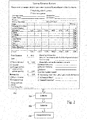
- FIG. 1 A flow diagram of one embodiment of a process of the present invention is shown in Fig. 1 .
- This example shows a process 100 for detecting and measuring the duration of activities or processes performed in one or more user interfaces. It is best viewed in conjunction with Fig. 2 , which shows an example of an embodiment of structural elements that may perform process 100.
- User interface 202 may be displayed to a user of a computer system and includes a number of data entry fields. The user may select one or more of the data entry fields, sequentially or non-sequentially, and may enter data into the field in the form of text, checkbox selection, list entry selection, etc.
- Process 100 begins with step 102, in which a collector 204 on the computer system, or on a remote computer system, collects data indicating an action performed by a user on a data entry field and data associated with the user interface at the time of the action.
- Collector 204 may generate from the actions and data a series of events that may contain both an individual event (such as a click, double-click, text-change, etc.) and the data on the screen at the time of that event.
- the data on the screen may be converted into a text representation. In this way, context of an event may be captured and converted to text for extracting relevant terms.
- the system may iterate the contents of the screen in its native format. For example, to create phrases from a web page, the system may parse hypertext markup language (HTML) in the web page. To create phrases from a desktop application such as an application executing on a Windows®, macOS, OS/2®, UNIX® or Linux operating system, the system may iterate over the individual controls in the application or user interface.
- HTML hypertext markup language
- the system may iterate over detected text regions.
- OCR optical character recognition
- the system may iterate over every character on the screen, grouping characters together into a phrase until a sequence of more than one blank character is encountered, at which point a new phrase may be started.
- the system may include text bounded within a logical control, such as a label or textbox, but may ignore extraneous information. For example, some embodiments of the system may ignore formatting such as italics, bold, underlining and line breaks. Other embodiments of the system may use the formatting to identify text or phrases. In this way, the system may create a common phrase format that retains the logical layout of the application, while ignoring formatting and application differences.
- step 106 entities and actions are extracted by Extractor 206 from the text representation.
- the underlying user interface may generate the text representation by converting the underlying user interface into an abstract representation, such as a document object model representation (DOM). Based on the text representation, entities may then be extracted utilizing text processing rules, object selection rules, or both.
- DOM document object model representation
- these rules may be basic patterns that detect a field by the label next to it.
- the extracted entities and actions may be stored or annotated along-side the events, for example as attributes or metadata of the events.
- Examples of fields that may be detected may include Name, Address, Phone Number, Credit Card Number, Social Security Number, Bank Account Number, etc.
- the present UI usage systems and methods are not limited to these examples, rather the present UI usage systems and methods may be applied to any type of text representation, field, or text-processing rule.
- FIG. 3 Another example of a user interface 300, which may be displayed to a user of a computer system and includes a number of data entry fields, is shown in Fig. 3 .
- a typical web form for example, Update Profile web form 301.
- form 301 may contain the labels First Name 302, Last Name 306, and Email Address 308.
- Each label may be followed by a text entry box, such as boxes 310, 312, 314.
- a series of phrases may be generated with the contents of the labels and the textboxes. If the text boxes are blank, the following phrases 316 may, for example, be generated: "First Name", "", “Last Name", "", "Email Address", "".
- the following phrases 318 may, for example, be generated: "First Name”, “John”, “Last Name”, “Smith”, “Email Address”, "john.smith@acme.com”.
- a rule to capture these entities may detect or identify a label and then capture the text after the label. More complicated rules may involve matching patterns using regular expressions or other pattern matching. To capture the action for this activity, the keyword "Update Profile" may be matched exactly. If there are multiple titles, entities may be detected by looking for or identifying a list of specific keywords.
- entities may be reinforced by looking for or identifying other occurrences of the entities that are otherwise not detected using patterns. For example, in our previous example "John Smith” was detected using a specific pattern. However, the words “John Smith” may appear on other screens in unstructured text such as documents, letters, email bodies or comment fields. After "John Smith” has been found, the system can detect or identify "John Smith” or variations on "John Smith” (e.g., "Smith John”, “Smith”, “John”) in other screens and add these occurrences to the detected entities.
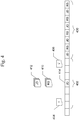
- the system may have stored a series of events that are each annotated with entities and actions, as shown in Fig. 4 .
- some embodiments which do not form part of the current invention of the system determine the overall duration of activity as the delta 402 between the event where an entity first appears 404 and the event where the action on that entity is executed 406. However, doing so may not account for instances where the user multitasks.
- an interval is applied by Usage Determiner 208 to the series of events, creating a set of "time buckets".
- Each time bucket may contain some or all of the events that occur within that interval.
- the entity that "wins" or is considered the owner of each bucket is selected. This is the most common entity in the bucket. For example, if a time bucket contains two events for "Richard Stein" 410 and five events for "James Dupont" 412, in some embodiments the bucket will be annotated as belonging to "James Dupont".
- the system further detects or identifies a series of time buckets 420 that alternate between different entity and action winners. This indicates that a user was multitasking by working on two or more different activities simultaneously.
- the content of time buckets that do not contain any entities or actions may, in step 110, be extrapolated from the surrounding buckets when appropriate by applying a set of rules. For example, an action may be "back-filled" to the first time an entity was detected to make activity detection simpler.
- activities may also be created using hierarchical clustering. In hierarchical clustering the system may add similar time buckets to an activity in successive iterations until no more similar time buckets can be added. In this case, similarity may be calculated by creating a vector of entities for each time bucket. If one vector is determined to be similar to another vector (e.g., similar over a pre-configured percentage such as fifty percent), the two time buckets may be clustered or combined into an activity. Subsequent iterations may add additional time buckets to the activity if they are also at least fifty percent similar. In further embodiments, empty time buckets may automatically be added if they are bounded by two time buckets with similar entity vectors.
- the duration of an activity may be calculated, for example by multiplying the number of buckets that contain a given entity and action by the duration of the interval.
- the duration of the activity may only be accurate to the nearest interval.
- the techniques described may be further expanded to capture the duration of almost any data that was worked upon. For example, by selecting all time buckets for a customer, an analyst could calculate the overall duration or amount of time spent servicing that customer as an entity regardless of the actions performed. Likewise, if "product" was captured as an entity, the overall amount of time spent servicing a product could be easily calculated.
- system data such as logs may be processed using these techniques to understand the amount of time a system spends on entities, methods, or tasks.
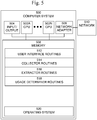
- Fig. 5 shows an exemplary block diagram of an embodiment of computer system 500, which may include structural elements shown in Fig. 2 to perform the process shown in Fig. 1 .
- Computer system 500 is typically a programmed general-purpose computer system, such as a personal computer, tablet computer, mobile device, workstation, server system, minicomputer, mainframe computer, etc.
- Computer system 500 includes one or more processors (CPUs) 502A-502N, input/output circuitry 504, network adapter 506, and memory 508.
- CPUs 502A-502N execute program instructions in order to carry out the functions of the present UI usage systems and methods.
- CPUs 502A-502N are one or more microprocessors, such as an INTEL® CORE processor.
- FIG. 5 illustrates an embodiment in which computer system 500 is implemented as a single multi-processor computer system, in which multiple processors 502A-502N share system resources, such as memory 508, input/output circuitry 504, and network adapter 506.
- system resources such as memory 508, input/output circuitry 504, and network adapter 506.
- present UI usage systems and methods may also include embodiments in which computer system 500 is implemented as a plurality of networked computer systems, which may be single-processor computer systems, multi-processor computer systems, or a mix thereof.
- Input/output circuitry 504 provides the capability to input data to, or output data from, computer system 500.
- input/output circuitry may include input devices, such as keyboards, mice, touchpads, trackballs, scanners, etc., output devices, such as video adapters, monitors, printers, etc., and input/output devices, such as, modems, etc.
- Network adapter 506 interfaces computer system 500 with a network 510.
- Network 510 may be any public or proprietary LAN or WAN, including, but not limited to the Internet.
- Memory 508 stores program instructions that are executed by, and data that are used and processed by, CPU 502 to perform the functions of computer system 500.
- Memory 508 may include, for example, electronic memory devices, such as random-access memory (RAM), read-only memory (ROM), programmable read-only memory (PROM), electrically erasable programmable read-only memory (EEPROM), flash memory, etc., and electro-mechanical memory, such as magnetic disk drives, tape drives, optical disk drives, etc., which may use an integrated drive electronics (IDE) interface, or a variation or enhancement thereof, such as enhanced IDE (EIDE) or ultra-direct memory access (UDMA), or a small computer system interface (SCSI) based interface, or a variation or enhancement thereof, such as fast-SCSI, wide-SCSI, fast and wide-SCSI, etc., or Serial Advanced Technology Attachment (SATA), or a variation or enhancement thereof, or a fiber channel-arbitrated loop (FC-AL) interface.
- RAM random-access memory
- ROM read-only memory
- the contents of memory 508 vary depending upon the function that verification computer system 500 is programmed to perform. In the example shown in Fig. 5 , exemplary memory contents for an analysis system are shown. However, one of skill in the art would recognize that these functions, along with the memory contents related to those functions, may be included on one system, or may be distributed among a plurality of systems, based on well-known engineering considerations. The present UI usage systems and methods may include any and all such arrangements.
- memory 508 may include user interface routines 512, collector routines 514, extractor routines 516, and usage determiner routines 518, and operating system 520.
- User interface routines 514 may generate a user interface display, which may include data entry fields in the form of text boxes, checkboxes, selection entry lists, etc., and may accept user entry of data into the data entry fields.
- Collector routines 516 may provide the capability to generate a series of events that may contain both an individual event (such as a click, double-click, text-change, etc.) and the data on the screen at the time of that event and to convert the data on the screen into a text representation.
- Extractor routines 518 may provide the capability to extract entities and actions from the text representation.
- Usage determiner routines 518 may provide the capability to apply an interval to a series of events, to create a set of time buckets, back fill time buckets that do not contain any entities or actions, and determine the duration of an activity.
- Operating system 524 provides overall system functionality.
- the present UI usage systems and methods may be implemented on a system or systems that provide multi-processor, multi-tasking, multi-process, and/or multi-thread computing, as well as implementation on systems that provide only single processor, single thread computing.
- Multi-processor computing involves performing computing using more than one processor.
- Multi-tasking computing involves performing computing using more than one operating system task.
- a task is an operating system concept that refers to the combination of a program being executed and bookkeeping information used by the operating system. Whenever a program is executed, the operating system creates a new task for it. The task is like an envelope for the program in that it identifies the program with a task number and attaches other bookkeeping information to it.
- Multi-tasking is the ability of an operating system to execute more than one executable at the same time.
- Each executable is running in its own address space, meaning that the executables have no way to share any of their memory. This has advantages, because it is impossible for any program to damage the execution of any of the other programs running on the system. However, the programs have no way to exchange any information except through the operating system (or by reading files stored on the file system).
- Multi-process computing is similar to multi-tasking computing, as the terms task and process are often used interchangeably, although some operating systems make a distinction between the two.
Landscapes
- Engineering & Computer Science (AREA)
- Theoretical Computer Science (AREA)
- General Engineering & Computer Science (AREA)
- General Physics & Mathematics (AREA)
- Physics & Mathematics (AREA)
- Quality & Reliability (AREA)
- Computer Hardware Design (AREA)
- Health & Medical Sciences (AREA)
- Artificial Intelligence (AREA)
- Audiology, Speech & Language Pathology (AREA)
- Computational Linguistics (AREA)
- General Health & Medical Sciences (AREA)
- Human Computer Interaction (AREA)
- User Interface Of Digital Computer (AREA)
- Management, Administration, Business Operations System, And Electronic Commerce (AREA)
Description
- The present invention relates to methods and systems for determining user interface usage, and in particular detecting and measuring the duration of activities or processes performed in one or more user interfaces.
- Conventional approaches to detecting an activity or process in a user interface rely on first describing and then recognizing a user workflow. For example, a workflow may consist of a series of steps a user performs. However, there are drawbacks to using a workflow to detect processes and activities. For example, there may be multiple ways to perform the same activity, which makes it difficult to capture all the different ways to perform the activity. There may be multiple applications where the user can perform the same activity, which makes it difficult to detect all but the simplest activities because the number of possible workflows becomes too large to describe. Likewise, in a desktop environment, users can multitask, effectively intertwining multiple workflows into a single sequence that must then be disambiguated to detect single activities.
- As a result, a need arises for improved techniques for detecting and measuring the duration of activities or processes performed in one or more user interfaces.
- Reference is made to
US 5,696,702 A1 , which discloses a method and system for automatically collecting and for analyzing information about time and work performed on a computer includes the following elements: data collector means for monitoring certain portions of a user's computer activity; data collector means for logging into a log file those certain portions of a user's computer activity; data analyzer means for determining, by means of user-defined rules, which portions of those certain portions of a user's computer activity constitutes continuous work activities and how this work should be categorized by project and task with project; and external interface means for building the rules defining work. The data collector means for monitoring certain portions of a user's computer activity includes a resident module, such as a TSR (terminate-and-stay-resident) module, which extends the file system of the computer so that detailed records are kept of file activities. The data collector means for monitoring certain portions of a user's computer activity includes means for routing information about file activity to the data collection means and includes means for tabulating and writing such information to a user's disk periodically. The data collector means for monitoring certain portions of a user's computer activity includes means for routing information about keyboard activity to the data collection means and includes means for periodically tabulating and writing such information to a user's disk. - Reference is also made to Brett Owens: "How Automatic Time Tracking Software Works: Chrometa Demo", Youtube, 31 March 2015 (2015-03-31), XP054977180, Retrieved from the Internet: URL: https://www.youtube.com/watch?v=Q56i803h9IU [retrieved on 2017-02-28], which discloses a method of tracking and recording time of user activity on a computer system.
- Further reference is made to
US 2011/0038542 A1 , which discloses a method, system, and computer program product for computer application analysis. The method for computer application analysis includes monitoring a computer system on which an application to be analyzed is executed and interacted with by a user of the computer system. The monitoring includes: capturing screen data of the application as displayed on a display screen of the computer system including interpreting the screen data using optical character recognition (OCR); and capturing user inputs to the application to input devices of the computer system. The method further includes analyzing the captured screen data and user inputs to generate a summary of the usage of the application. - Reference is also made to
WO 2016/186833 A1 , which discloses systems and methods for extracting and sharing application-related user data are disclosed. A method may include extracting in-app data for at least one of the plurality of apps running on a computing device, the in-app data including content consumed by a user while the at least one app is running, and/or at least one user action taken in connection with the content. Using an entity template associated with the app, a plurality of text strings within the in-app data are classified into at least one of a plurality of data types specified by the template. At least one user data item (UDI) may be generated by combining at least a portion of the classified plurality of text strings, the at least one UDI being accessible by a second app, an operating system running on the, a service of the operating system, and/or a service running on at least another device. - Embodiments of the present invention may provide improved techniques for detecting and measuring the duration of activities or processes performed in one or more user interfaces.
- For example, in an embodiment, a computer-implemented method of determining user interface usage comprises collecting, from at least one user interface including at least one data entry field, data indicating at least one event that occurs as a result of an action performed by a user on a data entry field and data associated with the user interface at the time of the at least one action, extracting, from the data indicating at least one event and the data associated with the user interface, data indicating an entity associated with the at least one event, applying a regular time interval to the data indicating at least one event, the data associated with the user interface, and the data indicating an entity and determining the entity as owner of the event; assigning each time interval to the entity owning the greatest number of events in that time interval; and determining a duration of an activity by multiplying the number of intervals that contain a given entity and action by the duration of the time interval, and determining multitasking by identifying time intervals that alternate between different entity and action owners and by determining a time interval owner based on the most common entity in the time interval.
- In an embodiment, the collecting may comprise converting the data associated with the user interface at the time of the at least one action to a text representation. The converting iterating over each detected text region in a screen that was captured with optical character recognition (OCR), and iterating over characters within at least one of a mainframe screen and a console screen. The converting may comprise including text bounded within a logical control and ignoring extraneous information. The extracting may comprise applying at least one of a plurality of text-processing rules and a plurality of object selection rules to the data indicating at least one event and the data associated with the user interface. The text-processing rules may comprise at least one rule selected from a group comprising: identifying a label and capturing text after the label, matching patterns using at least one of regular expressions and other pattern matching, matching keywords, and identifying a list of specific keywords. The method may further comprise reinforcing an entity by detecting other occurrences of the entity in at least one of other screens, files, documents, emails, comments, and fields. The method may further comprise detecting an activity using hierarchical clustering. The method may further comprise determining an entity as owner of an event for an interval that includes at least one of no entities and no actions based on an entity determined as owner of surrounding intervals.
- The invention is further directed to an apparatus according to claim 12 and a computer-readable medium according to claim 13.
-
-
Fig. 1 is an exemplary flow diagram of one embodiment of a process for detecting and measuring the duration of activities or processes performed in one or more user interfaces. -
Fig. 2 is an exemplary diagram of an embodiment of structural elements that may perform the process shown inFig. 1 . -
Fig. 3 is an exemplary diagram of an embodiment of a user interface, which may be displayed to a user of a computer system. -
Fig. 4 is an exemplary diagram of detection of entities and actions, in accordance with embodiments of the present invention. -
Fig. 5 is an exemplary block diagram of an embodiment of a computer system in which the process shown inFig. 1 may be performed. - Embodiments of the present invention provide improved techniques for detecting and measuring the duration of activities or processes performed in one or more user interfaces (UIs). For example, embodiments of the present UI usage systems and methods may provide an activity or process as an action performed on an entity rather than a workflow. For example, an address change is the act of changing an address. Other non-limiting examples may include claims adjustments, change orders, and fee refunds. Rather than detecting a workflow, embodiments of the present UI usage systems and methods may detect that the user is operating on an entity (such as a customer and address) and the action performed on the entity (such as a change).
- A flow diagram of one embodiment of a process of the present invention is shown in
Fig. 1 . This example shows aprocess 100 for detecting and measuring the duration of activities or processes performed in one or more user interfaces. It is best viewed in conjunction withFig. 2 , which shows an example of an embodiment of structural elements that may performprocess 100.User interface 202 may be displayed to a user of a computer system and includes a number of data entry fields. The user may select one or more of the data entry fields, sequentially or non-sequentially, and may enter data into the field in the form of text, checkbox selection, list entry selection, etc. - Referring to
Fig. 1 ,Process 100 begins withstep 102, in which acollector 204 on the computer system, or on a remote computer system, collects data indicating an action performed by a user on a data entry field and data associated with the user interface at the time of the action.Collector 204 may generate from the actions and data a series of events that may contain both an individual event (such as a click, double-click, text-change, etc.) and the data on the screen at the time of that event. Instep 104, the data on the screen may be converted into a text representation. In this way, context of an event may be captured and converted to text for extracting relevant terms. - When converting a screen to text, it may not be sufficient to simply create a set of words separated by spaces. Doing so would lose important information, such as which words were part of a label or if a field was blank (in which case a blank phrase should be emitted). To correctly create phrases, the system may iterate the contents of the screen in its native format. For example, to create phrases from a web page, the system may parse hypertext markup language (HTML) in the web page. To create phrases from a desktop application such as an application executing on a Windows®, macOS, OS/2®, UNIX® or Linux operating system, the system may iterate over the individual controls in the application or user interface. To create phrases from a screen that was captured with optical character recognition (OCR), the system may iterate over detected text regions. To create phrases from a mainframe or console screen, the system may iterate over every character on the screen, grouping characters together into a phrase until a sequence of more than one blank character is encountered, at which point a new phrase may be started. In each example, the system may include text bounded within a logical control, such as a label or textbox, but may ignore extraneous information. For example, some embodiments of the system may ignore formatting such as italics, bold, underlining and line breaks. Other embodiments of the system may use the formatting to identify text or phrases. In this way, the system may create a common phrase format that retains the logical layout of the application, while ignoring formatting and application differences.
- In
step 106, entities and actions are extracted byExtractor 206 from the text representation. In order to extract entities, the underlying user interface may generate the text representation by converting the underlying user interface into an abstract representation, such as a document object model representation (DOM). Based on the text representation, entities may then be extracted utilizing text processing rules, object selection rules, or both. - For example, these rules may be basic patterns that detect a field by the label next to it. The extracted entities and actions may be stored or annotated along-side the events, for example as attributes or metadata of the events. Examples of fields that may be detected may include Name, Address, Phone Number, Credit Card Number, Social Security Number, Bank Account Number, etc. The present UI usage systems and methods are not limited to these examples, rather the present UI usage systems and methods may be applied to any type of text representation, field, or text-processing rule.
- Another example of a
user interface 300, which may be displayed to a user of a computer system and includes a number of data entry fields, is shown inFig. 3 . For a non-limiting example of text-processing rules, consider a typical web form, for example, UpdateProfile web form 301. In this example,form 301 may contain thelabels First Name 302,Last Name 306, andEmail Address 308. Each label may be followed by a text entry box, such asboxes form 301 is converted to text, a series of phrases may be generated with the contents of the labels and the textboxes. If the text boxes are blank, the followingphrases 316 may, for example, be generated: "First Name", "", "Last Name", "", "Email Address", "". If the textboxes are not blank, the followingphrases 318 may, for example, be generated: "First Name", "John", "Last Name", "Smith", "Email Address", "john.smith@acme.com". A rule to capture these entities may detect or identify a label and then capture the text after the label. More complicated rules may involve matching patterns using regular expressions or other pattern matching. To capture the action for this activity, the keyword "Update Profile" may be matched exactly. If there are multiple titles, entities may be detected by looking for or identifying a list of specific keywords. - After entities are detected, some entities may be reinforced by looking for or identifying other occurrences of the entities that are otherwise not detected using patterns. For example, in our previous example "John Smith" was detected using a specific pattern. However, the words "John Smith" may appear on other screens in unstructured text such as documents, letters, email bodies or comment fields. After "John Smith" has been found, the system can detect or identify "John Smith" or variations on "John Smith" (e.g., "Smith John", "Smith", "John") in other screens and add these occurrences to the detected entities.
- At this point, the system may have stored a series of events that are each annotated with entities and actions, as shown in
Fig. 4 . Given this, some embodiments which do not form part of the current invention of the system determine the overall duration of activity as thedelta 402 between the event where an entity first appears 404 and the event where the action on that entity is executed 406. However, doing so may not account for instances where the user multitasks. - With reference to
Fig. 1 , to account for multitasking, instep 108, an interval is applied byUsage Determiner 208 to the series of events, creating a set of "time buckets". Each time bucket may contain some or all of the events that occur within that interval. The entity that "wins" or is considered the owner of each bucket is selected. This is the most common entity in the bucket. For example, if a time bucket contains two events for "Richard Stein" 410 and five events for "James Dupont" 412, in some embodiments the bucket will be annotated as belonging to "James Dupont". The system further detects or identifies a series oftime buckets 420 that alternate between different entity and action winners. This indicates that a user was multitasking by working on two or more different activities simultaneously. - In some embodiments, the content of time buckets that do not contain any entities or actions may, in
step 110, be extrapolated from the surrounding buckets when appropriate by applying a set of rules. For example, an action may be "back-filled" to the first time an entity was detected to make activity detection simpler. As another example, activities may also be created using hierarchical clustering. In hierarchical clustering the system may add similar time buckets to an activity in successive iterations until no more similar time buckets can be added. In this case, similarity may be calculated by creating a vector of entities for each time bucket. If one vector is determined to be similar to another vector (e.g., similar over a pre-configured percentage such as fifty percent), the two time buckets may be clustered or combined into an activity. Subsequent iterations may add additional time buckets to the activity if they are also at least fifty percent similar. In further embodiments, empty time buckets may automatically be added if they are bounded by two time buckets with similar entity vectors. - Once all buckets have been filled, in
step 112, the duration of an activity may be calculated, for example by multiplying the number of buckets that contain a given entity and action by the duration of the interval. The duration of the activity may only be accurate to the nearest interval. - The techniques described may be further expanded to capture the duration of almost any data that was worked upon. For example, by selecting all time buckets for a customer, an analyst could calculate the overall duration or amount of time spent servicing that customer as an entity regardless of the actions performed. Likewise, if "product" was captured as an entity, the overall amount of time spent servicing a product could be easily calculated.
- The techniques described may be further expanded to capture the duration of almost anything given a series of events that contain additional data elements. For example, system data such as logs may be processed using these techniques to understand the amount of time a system spends on entities, methods, or tasks.
-
Fig. 5 shows an exemplary block diagram of an embodiment ofcomputer system 500, which may include structural elements shown inFig. 2 to perform the process shown inFig. 1 .Computer system 500 is typically a programmed general-purpose computer system, such as a personal computer, tablet computer, mobile device, workstation, server system, minicomputer, mainframe computer, etc.Computer system 500 includes one or more processors (CPUs) 502A-502N, input/output circuitry 504,network adapter 506, andmemory 508.CPUs 502A-502N execute program instructions in order to carry out the functions of the present UI usage systems and methods. Typically,CPUs 502A-502N are one or more microprocessors, such as an INTEL® CORE processor.Fig. 5 illustrates an embodiment in whichcomputer system 500 is implemented as a single multi-processor computer system, in whichmultiple processors 502A-502N share system resources, such asmemory 508, input/output circuitry 504, andnetwork adapter 506. However, the present UI usage systems and methods may also include embodiments in whichcomputer system 500 is implemented as a plurality of networked computer systems, which may be single-processor computer systems, multi-processor computer systems, or a mix thereof. - Input/
output circuitry 504 provides the capability to input data to, or output data from,computer system 500. For example, input/output circuitry may include input devices, such as keyboards, mice, touchpads, trackballs, scanners, etc., output devices, such as video adapters, monitors, printers, etc., and input/output devices, such as, modems, etc.Network adapter 506interfaces computer system 500 with anetwork 510.Network 510 may be any public or proprietary LAN or WAN, including, but not limited to the Internet. -
Memory 508 stores program instructions that are executed by, and data that are used and processed by, CPU 502 to perform the functions ofcomputer system 500.Memory 508 may include, for example, electronic memory devices, such as random-access memory (RAM), read-only memory (ROM), programmable read-only memory (PROM), electrically erasable programmable read-only memory (EEPROM), flash memory, etc., and electro-mechanical memory, such as magnetic disk drives, tape drives, optical disk drives, etc., which may use an integrated drive electronics (IDE) interface, or a variation or enhancement thereof, such as enhanced IDE (EIDE) or ultra-direct memory access (UDMA), or a small computer system interface (SCSI) based interface, or a variation or enhancement thereof, such as fast-SCSI, wide-SCSI, fast and wide-SCSI, etc., or Serial Advanced Technology Attachment (SATA), or a variation or enhancement thereof, or a fiber channel-arbitrated loop (FC-AL) interface. - The contents of
memory 508 vary depending upon the function thatverification computer system 500 is programmed to perform. In the example shown inFig. 5 , exemplary memory contents for an analysis system are shown. However, one of skill in the art would recognize that these functions, along with the memory contents related to those functions, may be included on one system, or may be distributed among a plurality of systems, based on well-known engineering considerations. The present UI usage systems and methods may include any and all such arrangements. - In the example shown in
Fig. 5 ,memory 508 may includeuser interface routines 512,collector routines 514,extractor routines 516, andusage determiner routines 518, andoperating system 520.User interface routines 514 may generate a user interface display, which may include data entry fields in the form of text boxes, checkboxes, selection entry lists, etc., and may accept user entry of data into the data entry fields.Collector routines 516 may provide the capability to generate a series of events that may contain both an individual event (such as a click, double-click, text-change, etc.) and the data on the screen at the time of that event and to convert the data on the screen into a text representation.Extractor routines 518 may provide the capability to extract entities and actions from the text representation.Usage determiner routines 518 may provide the capability to apply an interval to a series of events, to create a set of time buckets, back fill time buckets that do not contain any entities or actions, and determine the duration of an activity. Operating system 524 provides overall system functionality. - As shown in
Fig. 5 , the present UI usage systems and methods may be implemented on a system or systems that provide multi-processor, multi-tasking, multi-process, and/or multi-thread computing, as well as implementation on systems that provide only single processor, single thread computing. Multi-processor computing involves performing computing using more than one processor. Multi-tasking computing involves performing computing using more than one operating system task. A task is an operating system concept that refers to the combination of a program being executed and bookkeeping information used by the operating system. Whenever a program is executed, the operating system creates a new task for it. The task is like an envelope for the program in that it identifies the program with a task number and attaches other bookkeeping information to it. Many operating systems, including Linux, UNIX®, OS/2®, macOS and Windows®, are capable of running many tasks at the same time and are called multitasking operating systems. Multi-tasking is the ability of an operating system to execute more than one executable at the same time. Each executable is running in its own address space, meaning that the executables have no way to share any of their memory. This has advantages, because it is impossible for any program to damage the execution of any of the other programs running on the system. However, the programs have no way to exchange any information except through the operating system (or by reading files stored on the file system). Multi-process computing is similar to multi-tasking computing, as the terms task and process are often used interchangeably, although some operating systems make a distinction between the two. - Although examples of embodiments of the present invention have been described, it will be understood by those of skill in the art that there are other embodiments that are nonetheless within the scope of the present invention. Accordingly, it is to be understood that the invention is not to be limited by the specific described embodiments, but only by the scope of the appended claims.
Claims (13)
- A computer-implemented method of determining user interface usage, the method comprising:collecting via a collector (204), from at least one user interface (202, 300) including at least one data entry field, data indicating at least one event that occurs as a result of an action performed by a user on a data entry field and data associated with the user interface (202, 300) at the time of the at least one action;extracting via the extractor (206), from the data indicating at least one event and the data associated with the user interface (202, 300), data indicating an entity associated with the at least one event;applying a regular time interval to the data indicating at least one event, the data associated with the user interface, and the data indicating an entity and determining the entity as owner of the event;assigning each time interval to the entity owning the greatest number of events in that time interval;determining a duration of an activity by multiplying the number of intervals that contain a given entity and action by the duration of the time interval; anddetermining multitasking by identifying time intervals that alternate between different entity and action winners and by determining a time interval winner based on the most common entity in the time interval.
- The method of claim 1, wherein the collecting comprises:
converting the data associated with the user interface (202, 300) at the time of the at least one action to a text representation. - The method of claim 2, wherein the converting comprises at least one process selected from a group comprising: parsing hypertext markup language (HTML) in a web page, iterating over individual controls in the user interface (202, 300), iterating over each detected text region in a screen that was captured with optical character recognition (OCR), and iterating over characters within at least one of a mainframe screen and a console screen.
- The method of claim 3, wherein the converting comprises including text bounded within a logical control and ignoring extraneous information.
- The method of claim 1, wherein the extracting comprises:
applying at least one of a plurality of text-processing rules and a plurality of object selection rules to the data indicating at least one event and the data associated with the user interface (202, 300). - The method of claim 5, wherein the text-processing rules comprise at least one rule selected from a group comprising: identifying a label and capturing text after the label, matching patterns using at least one of regular expressions and other pattern matching, matching keywords, and identifying a list of specific keywords.
- The method of claim 1, further comprising reinforcing an entity by detecting variations of the entity in at least one of other screens, files, documents, emails, comments, and fields, and adding the variations to the detected entity.
- The method of claim 1, further comprising detecting an activity using hierarchical clustering.
- The method of claim 1, further comprising determining an entity as owner of an event for an interval that includes at least one of no entities and no actions based on an entity determined as owner of surrounding intervals.
- The method of claim 1, wherein the method is implemented in a computer system comprising a processor, memory accessible by the processor, and program instructions and data stored in the memory, the program instructions executable by the processor to perform the method.
- The method of claim 1, wherein program instructions implementing the method when executed by a processor are embodied in a computer program product comprising a non-transitory computer readable medium storing the program instructions.
- An apparatus for determining user interface usage, comprising:a collector (204) for collecting, from at least one user interface (202, 300) including at least one data entry field, data indicating at least one event that occurs as a result of an action performed by a user on a data entry field and data associated with the user interface at the time of the at least one action;an extractor (206) for extracting, from the data indicating at least one event and the data associated with the user interface (202, 300), data indicating an entity associated with the at least one event;a usage determiner (208) for applying a regular time interval to the data indicating at least one event, the data associated with the user interface (202, 300), and the data indicating an entity and determining the entity as owner of the event; andmeans for assigning each time interval to the entity owning the greatest number of events in that time interval;means for determining a duration of an activity by multiplying the number of intervals that contain a given entity and action by the duration of the time interval; andmeans for determining multitasking by identifying time intervals that alternate between different entity and action winners and by determining a time interval winner based on the most common entity in the time interval.
- A computer-readable medium having computer-executable instructions that when executed cause a processor to perform the method of any of claims 1 to 11.
Priority Applications (1)
| Application Number | Priority Date | Filing Date | Title |
|---|---|---|---|
| PL16191549T PL3159798T3 (en) | 2015-09-29 | 2016-09-29 | Method and system for determining user interface usage |
Applications Claiming Priority (2)
| Application Number | Priority Date | Filing Date | Title |
|---|---|---|---|
| US201562234282P | 2015-09-29 | 2015-09-29 | |
| US15/278,499 US10289262B2 (en) | 2015-09-29 | 2016-09-28 | Method and system for determining user interface usage |
Publications (2)
| Publication Number | Publication Date |
|---|---|
| EP3159798A1 EP3159798A1 (en) | 2017-04-26 |
| EP3159798B1 true EP3159798B1 (en) | 2021-11-24 |
Family
ID=57389165
Family Applications (1)
| Application Number | Title | Priority Date | Filing Date |
|---|---|---|---|
| EP16191549.1A Active EP3159798B1 (en) | 2015-09-29 | 2016-09-29 | Method and system for determining user interface usage |
Country Status (3)
| Country | Link |
|---|---|
| US (2) | US10289262B2 (en) |
| EP (1) | EP3159798B1 (en) |
| PL (1) | PL3159798T3 (en) |
Families Citing this family (8)
| Publication number | Priority date | Publication date | Assignee | Title |
|---|---|---|---|---|
| US11048488B2 (en) | 2018-08-14 | 2021-06-29 | Pegasystems, Inc. | Software code optimizer and method |
| US11108618B2 (en) | 2019-09-24 | 2021-08-31 | Intradiem, Inc. | Live-monitoring of agent instances to trigger automation |
| US11665044B2 (en) | 2019-09-24 | 2023-05-30 | Intradiem, Inc. | Adaptive rule trigger thresholds for managing contact center interaction time |
| US10623233B1 (en) | 2019-09-24 | 2020-04-14 | Intradiem Inc. | Live monitoring to trigger automation |
| US11949549B2 (en) | 2019-09-24 | 2024-04-02 | Intradiem, Inc. | Agent instance live-monitoring by a management network for burnout and attrition prediction and response |
| US11329861B2 (en) | 2019-09-24 | 2022-05-10 | Intradiem, Inc. | Optimized automation triggering in live-monitoring of agent instances |
| US11356316B2 (en) | 2019-09-24 | 2022-06-07 | Intradiem, Inc. | Live-monitoring of agent instances to trigger automation |
| US11567945B1 (en) * | 2020-08-27 | 2023-01-31 | Pegasystems Inc. | Customized digital content generation systems and methods |
Citations (1)
| Publication number | Priority date | Publication date | Assignee | Title |
|---|---|---|---|---|
| WO2016186833A1 (en) * | 2015-05-15 | 2016-11-24 | Microsoft Technology Licensing, Llc | System and method for extracting and sharing application-related user data |
Family Cites Families (8)
| Publication number | Priority date | Publication date | Assignee | Title |
|---|---|---|---|---|
| US6581025B2 (en) * | 1995-04-17 | 2003-06-17 | Discovision Associates | Time and work tracker for wireless devices |
| US5696702A (en) * | 1995-04-17 | 1997-12-09 | Skinner; Gary R. | Time and work tracker |
| US7222293B1 (en) * | 1999-08-12 | 2007-05-22 | Applieoe, Inc. | Professional time tracking and reporting system |
| KR100388486B1 (en) * | 2000-12-14 | 2003-06-25 | 한국전자통신연구원 | Method and apparatus for identifying software components using object relationships and object usages in use cases |
| US7032229B1 (en) * | 2001-06-04 | 2006-04-18 | Palmsource, Inc. | Automatic tracking of user progress in a software application |
| US20070261030A1 (en) * | 2006-05-04 | 2007-11-08 | Gaurav Wadhwa | Method and system for tracking and prioritizing applications |
| US8396964B2 (en) * | 2009-05-13 | 2013-03-12 | International Business Machines Corporation | Computer application analysis |
| US9086928B2 (en) * | 2009-08-31 | 2015-07-21 | Accenture Global Services Limited | Provisioner within cloud console—defining images of an enterprise to be operable on different cloud computing providers |
-
2016
- 2016-09-28 US US15/278,499 patent/US10289262B2/en active Active
- 2016-09-29 PL PL16191549T patent/PL3159798T3/en unknown
- 2016-09-29 EP EP16191549.1A patent/EP3159798B1/en active Active
-
2019
- 2019-05-10 US US16/409,491 patent/US10845939B2/en active Active
Patent Citations (1)
| Publication number | Priority date | Publication date | Assignee | Title |
|---|---|---|---|---|
| WO2016186833A1 (en) * | 2015-05-15 | 2016-11-24 | Microsoft Technology Licensing, Llc | System and method for extracting and sharing application-related user data |
Also Published As
| Publication number | Publication date |
|---|---|
| US10289262B2 (en) | 2019-05-14 |
| US10845939B2 (en) | 2020-11-24 |
| EP3159798A1 (en) | 2017-04-26 |
| US20200004385A1 (en) | 2020-01-02 |
| US20170090685A1 (en) | 2017-03-30 |
| PL3159798T3 (en) | 2022-04-04 |
Similar Documents
| Publication | Publication Date | Title |
|---|---|---|
| US10845939B2 (en) | Method and system for determining user interface usage | |
| US11113477B2 (en) | Visualizing comment sentiment | |
| JP7568371B2 (en) | System and method for activity target selection for robotic process automation - Patents.com | |
| US20210055918A1 (en) | Generating data mappings for user interface screens and screen components for an application | |
| EP4639336A1 (en) | Software development artifact name generation | |
| US7865870B2 (en) | Automatic content completion of valid values for method argument variables | |
| TW202020691A (en) | Method, device and server for determining characteristic words | |
| US20110106801A1 (en) | Systems and methods for organizing documented processes | |
| US12217523B2 (en) | List and tabular data extraction system and method | |
| US20240054802A1 (en) | System and method for spatial encoding and feature generators for enhancing information extraction | |
| US20110099498A1 (en) | Graphical user interface hierarchy generation | |
| US9043760B2 (en) | Creating dynamic interactive views from trace events for performing deterministic performance analysis | |
| CN118210573A (en) | Basic input and output system configuration method, device, electronic equipment and medium | |
| CN115469849B (en) | Service processing system, method, electronic equipment and storage medium | |
| Bao et al. | Reverse engineering time-series interaction data from screen-captured videos | |
| US9715372B2 (en) | Executable guidance experiences based on implicitly generated guidance models | |
| CN120045171A (en) | Code generation method and device | |
| CN113791860A (en) | Information conversion method, device and storage medium | |
| Bao et al. | Tracking and Analyzing Cross-Cutting Activities in Developers' Daily Work (N) | |
| US9286036B2 (en) | Computer-readable recording medium storing program for managing scripts, script management device, and script management method | |
| CN115795059A (en) | Threat modeling method and system for agile development | |
| US20250046107A1 (en) | Automated key-value pair extraction | |
| CN119292656A (en) | A method, device, electronic device and medium for automatically generating software documents | |
| CN121209843A (en) | Automated service system and methods for front-end software development | |
| CN118170719A (en) | An automated archiving method, device, equipment and storage medium for security assessment |
Legal Events
| Date | Code | Title | Description |
|---|---|---|---|
| PUAI | Public reference made under article 153(3) epc to a published international application that has entered the european phase |
Free format text: ORIGINAL CODE: 0009012 |
|
| STAA | Information on the status of an ep patent application or granted ep patent |
Free format text: STATUS: THE APPLICATION HAS BEEN PUBLISHED |
|
| AK | Designated contracting states |
Kind code of ref document: A1 Designated state(s): AL AT BE BG CH CY CZ DE DK EE ES FI FR GB GR HR HU IE IS IT LI LT LU LV MC MK MT NL NO PL PT RO RS SE SI SK SM TR |
|
| AX | Request for extension of the european patent |
Extension state: BA ME |
|
| STAA | Information on the status of an ep patent application or granted ep patent |
Free format text: STATUS: REQUEST FOR EXAMINATION WAS MADE |
|
| 17P | Request for examination filed |
Effective date: 20171025 |
|
| RBV | Designated contracting states (corrected) |
Designated state(s): AL AT BE BG CH CY CZ DE DK EE ES FI FR GB GR HR HU IE IS IT LI LT LU LV MC MK MT NL NO PL PT RO RS SE SI SK SM TR |
|
| STAA | Information on the status of an ep patent application or granted ep patent |
Free format text: STATUS: EXAMINATION IS IN PROGRESS |
|
| 17Q | First examination report despatched |
Effective date: 20190822 |
|
| GRAP | Despatch of communication of intention to grant a patent |
Free format text: ORIGINAL CODE: EPIDOSNIGR1 |
|
| STAA | Information on the status of an ep patent application or granted ep patent |
Free format text: STATUS: GRANT OF PATENT IS INTENDED |
|
| INTG | Intention to grant announced |
Effective date: 20210702 |
|
| GRAA | (expected) grant |
Free format text: ORIGINAL CODE: 0009210 |
|
| STAA | Information on the status of an ep patent application or granted ep patent |
Free format text: STATUS: THE PATENT HAS BEEN GRANTED |
|
| GRAS | Grant fee paid |
Free format text: ORIGINAL CODE: EPIDOSNIGR3 |
|
| AK | Designated contracting states |
Kind code of ref document: B1 Designated state(s): AL AT BE BG CH CY CZ DE DK EE ES FI FR GB GR HR HU IE IS IT LI LT LU LV MC MK MT NL NO PL PT RO RS SE SI SK SM TR |
|
| REG | Reference to a national code |
Ref country code: GB Ref legal event code: FG4D |
|
| REG | Reference to a national code |
Ref country code: AT Ref legal event code: REF Ref document number: 1450378 Country of ref document: AT Kind code of ref document: T Effective date: 20211215 |
|
| REG | Reference to a national code |
Ref country code: DE Ref legal event code: R096 Ref document number: 602016066521 Country of ref document: DE |
|
| REG | Reference to a national code |
Ref country code: IE Ref legal event code: FG4D |
|
| REG | Reference to a national code |
Ref country code: LT Ref legal event code: MG9D |
|
| REG | Reference to a national code |
Ref country code: NL Ref legal event code: MP Effective date: 20211124 |
|
| REG | Reference to a national code |
Ref country code: AT Ref legal event code: MK05 Ref document number: 1450378 Country of ref document: AT Kind code of ref document: T Effective date: 20211124 |
|
| PG25 | Lapsed in a contracting state [announced via postgrant information from national office to epo] |
Ref country code: RS Free format text: LAPSE BECAUSE OF FAILURE TO SUBMIT A TRANSLATION OF THE DESCRIPTION OR TO PAY THE FEE WITHIN THE PRESCRIBED TIME-LIMIT Effective date: 20211124 Ref country code: LT Free format text: LAPSE BECAUSE OF FAILURE TO SUBMIT A TRANSLATION OF THE DESCRIPTION OR TO PAY THE FEE WITHIN THE PRESCRIBED TIME-LIMIT Effective date: 20211124 Ref country code: FI Free format text: LAPSE BECAUSE OF FAILURE TO SUBMIT A TRANSLATION OF THE DESCRIPTION OR TO PAY THE FEE WITHIN THE PRESCRIBED TIME-LIMIT Effective date: 20211124 Ref country code: BG Free format text: LAPSE BECAUSE OF FAILURE TO SUBMIT A TRANSLATION OF THE DESCRIPTION OR TO PAY THE FEE WITHIN THE PRESCRIBED TIME-LIMIT Effective date: 20220224 Ref country code: AT Free format text: LAPSE BECAUSE OF FAILURE TO SUBMIT A TRANSLATION OF THE DESCRIPTION OR TO PAY THE FEE WITHIN THE PRESCRIBED TIME-LIMIT Effective date: 20211124 |
|
| PG25 | Lapsed in a contracting state [announced via postgrant information from national office to epo] |
Ref country code: IS Free format text: LAPSE BECAUSE OF FAILURE TO SUBMIT A TRANSLATION OF THE DESCRIPTION OR TO PAY THE FEE WITHIN THE PRESCRIBED TIME-LIMIT Effective date: 20220324 Ref country code: SE Free format text: LAPSE BECAUSE OF FAILURE TO SUBMIT A TRANSLATION OF THE DESCRIPTION OR TO PAY THE FEE WITHIN THE PRESCRIBED TIME-LIMIT Effective date: 20211124 Ref country code: PT Free format text: LAPSE BECAUSE OF FAILURE TO SUBMIT A TRANSLATION OF THE DESCRIPTION OR TO PAY THE FEE WITHIN THE PRESCRIBED TIME-LIMIT Effective date: 20220324 Ref country code: NO Free format text: LAPSE BECAUSE OF FAILURE TO SUBMIT A TRANSLATION OF THE DESCRIPTION OR TO PAY THE FEE WITHIN THE PRESCRIBED TIME-LIMIT Effective date: 20220224 Ref country code: NL Free format text: LAPSE BECAUSE OF FAILURE TO SUBMIT A TRANSLATION OF THE DESCRIPTION OR TO PAY THE FEE WITHIN THE PRESCRIBED TIME-LIMIT Effective date: 20211124 Ref country code: LV Free format text: LAPSE BECAUSE OF FAILURE TO SUBMIT A TRANSLATION OF THE DESCRIPTION OR TO PAY THE FEE WITHIN THE PRESCRIBED TIME-LIMIT Effective date: 20211124 Ref country code: HR Free format text: LAPSE BECAUSE OF FAILURE TO SUBMIT A TRANSLATION OF THE DESCRIPTION OR TO PAY THE FEE WITHIN THE PRESCRIBED TIME-LIMIT Effective date: 20211124 Ref country code: GR Free format text: LAPSE BECAUSE OF FAILURE TO SUBMIT A TRANSLATION OF THE DESCRIPTION OR TO PAY THE FEE WITHIN THE PRESCRIBED TIME-LIMIT Effective date: 20220225 Ref country code: ES Free format text: LAPSE BECAUSE OF FAILURE TO SUBMIT A TRANSLATION OF THE DESCRIPTION OR TO PAY THE FEE WITHIN THE PRESCRIBED TIME-LIMIT Effective date: 20211124 |
|
| PG25 | Lapsed in a contracting state [announced via postgrant information from national office to epo] |
Ref country code: SM Free format text: LAPSE BECAUSE OF FAILURE TO SUBMIT A TRANSLATION OF THE DESCRIPTION OR TO PAY THE FEE WITHIN THE PRESCRIBED TIME-LIMIT Effective date: 20211124 Ref country code: SK Free format text: LAPSE BECAUSE OF FAILURE TO SUBMIT A TRANSLATION OF THE DESCRIPTION OR TO PAY THE FEE WITHIN THE PRESCRIBED TIME-LIMIT Effective date: 20211124 Ref country code: RO Free format text: LAPSE BECAUSE OF FAILURE TO SUBMIT A TRANSLATION OF THE DESCRIPTION OR TO PAY THE FEE WITHIN THE PRESCRIBED TIME-LIMIT Effective date: 20211124 Ref country code: EE Free format text: LAPSE BECAUSE OF FAILURE TO SUBMIT A TRANSLATION OF THE DESCRIPTION OR TO PAY THE FEE WITHIN THE PRESCRIBED TIME-LIMIT Effective date: 20211124 Ref country code: DK Free format text: LAPSE BECAUSE OF FAILURE TO SUBMIT A TRANSLATION OF THE DESCRIPTION OR TO PAY THE FEE WITHIN THE PRESCRIBED TIME-LIMIT Effective date: 20211124 Ref country code: CZ Free format text: LAPSE BECAUSE OF FAILURE TO SUBMIT A TRANSLATION OF THE DESCRIPTION OR TO PAY THE FEE WITHIN THE PRESCRIBED TIME-LIMIT Effective date: 20211124 |
|
| REG | Reference to a national code |
Ref country code: DE Ref legal event code: R097 Ref document number: 602016066521 Country of ref document: DE |
|
| PLBE | No opposition filed within time limit |
Free format text: ORIGINAL CODE: 0009261 |
|
| STAA | Information on the status of an ep patent application or granted ep patent |
Free format text: STATUS: NO OPPOSITION FILED WITHIN TIME LIMIT |
|
| PG25 | Lapsed in a contracting state [announced via postgrant information from national office to epo] |
Ref country code: AL Free format text: LAPSE BECAUSE OF FAILURE TO SUBMIT A TRANSLATION OF THE DESCRIPTION OR TO PAY THE FEE WITHIN THE PRESCRIBED TIME-LIMIT Effective date: 20211124 |
|
| 26N | No opposition filed |
Effective date: 20220825 |
|
| PG25 | Lapsed in a contracting state [announced via postgrant information from national office to epo] |
Ref country code: SI Free format text: LAPSE BECAUSE OF FAILURE TO SUBMIT A TRANSLATION OF THE DESCRIPTION OR TO PAY THE FEE WITHIN THE PRESCRIBED TIME-LIMIT Effective date: 20211124 |
|
| PG25 | Lapsed in a contracting state [announced via postgrant information from national office to epo] |
Ref country code: MC Free format text: LAPSE BECAUSE OF FAILURE TO SUBMIT A TRANSLATION OF THE DESCRIPTION OR TO PAY THE FEE WITHIN THE PRESCRIBED TIME-LIMIT Effective date: 20211124 |
|
| REG | Reference to a national code |
Ref country code: CH Ref legal event code: PL |
|
| REG | Reference to a national code |
Ref country code: BE Ref legal event code: MM Effective date: 20220930 |
|
| PG25 | Lapsed in a contracting state [announced via postgrant information from national office to epo] |
Ref country code: IT Free format text: LAPSE BECAUSE OF FAILURE TO SUBMIT A TRANSLATION OF THE DESCRIPTION OR TO PAY THE FEE WITHIN THE PRESCRIBED TIME-LIMIT Effective date: 20211124 |
|
| PG25 | Lapsed in a contracting state [announced via postgrant information from national office to epo] |
Ref country code: LU Free format text: LAPSE BECAUSE OF NON-PAYMENT OF DUE FEES Effective date: 20220929 |
|
| PG25 | Lapsed in a contracting state [announced via postgrant information from national office to epo] |
Ref country code: LI Free format text: LAPSE BECAUSE OF NON-PAYMENT OF DUE FEES Effective date: 20220930 Ref country code: CH Free format text: LAPSE BECAUSE OF NON-PAYMENT OF DUE FEES Effective date: 20220930 Ref country code: IE Free format text: LAPSE BECAUSE OF NON-PAYMENT OF DUE FEES Effective date: 20220929 |
|
| PG25 | Lapsed in a contracting state [announced via postgrant information from national office to epo] |
Ref country code: BE Free format text: LAPSE BECAUSE OF NON-PAYMENT OF DUE FEES Effective date: 20220930 |
|
| PG25 | Lapsed in a contracting state [announced via postgrant information from national office to epo] |
Ref country code: HU Free format text: LAPSE BECAUSE OF FAILURE TO SUBMIT A TRANSLATION OF THE DESCRIPTION OR TO PAY THE FEE WITHIN THE PRESCRIBED TIME-LIMIT; INVALID AB INITIO Effective date: 20160929 |
|
| PG25 | Lapsed in a contracting state [announced via postgrant information from national office to epo] |
Ref country code: CY Free format text: LAPSE BECAUSE OF FAILURE TO SUBMIT A TRANSLATION OF THE DESCRIPTION OR TO PAY THE FEE WITHIN THE PRESCRIBED TIME-LIMIT Effective date: 20211124 |
|
| PG25 | Lapsed in a contracting state [announced via postgrant information from national office to epo] |
Ref country code: MK Free format text: LAPSE BECAUSE OF FAILURE TO SUBMIT A TRANSLATION OF THE DESCRIPTION OR TO PAY THE FEE WITHIN THE PRESCRIBED TIME-LIMIT Effective date: 20211124 |
|
| PG25 | Lapsed in a contracting state [announced via postgrant information from national office to epo] |
Ref country code: MT Free format text: LAPSE BECAUSE OF FAILURE TO SUBMIT A TRANSLATION OF THE DESCRIPTION OR TO PAY THE FEE WITHIN THE PRESCRIBED TIME-LIMIT Effective date: 20211124 |
|
| PGFP | Annual fee paid to national office [announced via postgrant information from national office to epo] |
Ref country code: DE Payment date: 20250929 Year of fee payment: 10 |
|
| PGFP | Annual fee paid to national office [announced via postgrant information from national office to epo] |
Ref country code: PL Payment date: 20250903 Year of fee payment: 10 |
|
| PGFP | Annual fee paid to national office [announced via postgrant information from national office to epo] |
Ref country code: GB Payment date: 20250929 Year of fee payment: 10 |
|
| PGFP | Annual fee paid to national office [announced via postgrant information from national office to epo] |
Ref country code: FR Payment date: 20250925 Year of fee payment: 10 |
|
| PG25 | Lapsed in a contracting state [announced via postgrant information from national office to epo] |
Ref country code: TR Free format text: LAPSE BECAUSE OF FAILURE TO SUBMIT A TRANSLATION OF THE DESCRIPTION OR TO PAY THE FEE WITHIN THE PRESCRIBED TIME-LIMIT Effective date: 20211124 |