EP3159182A1 - Air-less tire - Google Patents
Air-less tire Download PDFInfo
- Publication number
- EP3159182A1 EP3159182A1 EP15810351.5A EP15810351A EP3159182A1 EP 3159182 A1 EP3159182 A1 EP 3159182A1 EP 15810351 A EP15810351 A EP 15810351A EP 3159182 A1 EP3159182 A1 EP 3159182A1
- Authority
- EP
- European Patent Office
- Prior art keywords
- cords
- tire
- air
- less
- cord layer
- Prior art date
- Legal status (The legal status is an assumption and is not a legal conclusion. Google has not performed a legal analysis and makes no representation as to the accuracy of the status listed.)
- Granted
Links
Images


Classifications
-
- B—PERFORMING OPERATIONS; TRANSPORTING
- B60—VEHICLES IN GENERAL
- B60C—VEHICLE TYRES; TYRE INFLATION; TYRE CHANGING; CONNECTING VALVES TO INFLATABLE ELASTIC BODIES IN GENERAL; DEVICES OR ARRANGEMENTS RELATED TO TYRES
- B60C7/00—Non-inflatable or solid tyres
-
- B—PERFORMING OPERATIONS; TRANSPORTING
- B60—VEHICLES IN GENERAL
- B60C—VEHICLE TYRES; TYRE INFLATION; TYRE CHANGING; CONNECTING VALVES TO INFLATABLE ELASTIC BODIES IN GENERAL; DEVICES OR ARRANGEMENTS RELATED TO TYRES
- B60C7/00—Non-inflatable or solid tyres
- B60C7/10—Non-inflatable or solid tyres characterised by means for increasing resiliency
- B60C7/102—Tyres built-up with separate rubber parts
-
- B—PERFORMING OPERATIONS; TRANSPORTING
- B60—VEHICLES IN GENERAL
- B60B—VEHICLE WHEELS; CASTORS; AXLES FOR WHEELS OR CASTORS; INCREASING WHEEL ADHESION
- B60B19/00—Wheels not otherwise provided for or having characteristics specified in one of the subgroups of this group
- B60B19/12—Roller-type wheels
-
- B—PERFORMING OPERATIONS; TRANSPORTING
- B60—VEHICLES IN GENERAL
- B60B—VEHICLE WHEELS; CASTORS; AXLES FOR WHEELS OR CASTORS; INCREASING WHEEL ADHESION
- B60B5/00—Wheels, spokes, disc bodies, rims, hubs, wholly or predominantly made of non-metallic material
- B60B5/02—Wheels, spokes, disc bodies, rims, hubs, wholly or predominantly made of non-metallic material made of synthetic material
-
- B—PERFORMING OPERATIONS; TRANSPORTING
- B60—VEHICLES IN GENERAL
- B60C—VEHICLE TYRES; TYRE INFLATION; TYRE CHANGING; CONNECTING VALVES TO INFLATABLE ELASTIC BODIES IN GENERAL; DEVICES OR ARRANGEMENTS RELATED TO TYRES
- B60C11/00—Tyre tread bands; Tread patterns; Anti-skid inserts
-
- B—PERFORMING OPERATIONS; TRANSPORTING
- B60—VEHICLES IN GENERAL
- B60C—VEHICLE TYRES; TYRE INFLATION; TYRE CHANGING; CONNECTING VALVES TO INFLATABLE ELASTIC BODIES IN GENERAL; DEVICES OR ARRANGEMENTS RELATED TO TYRES
- B60C7/00—Non-inflatable or solid tyres
- B60C7/10—Non-inflatable or solid tyres characterised by means for increasing resiliency
- B60C7/14—Non-inflatable or solid tyres characterised by means for increasing resiliency using springs
- B60C7/16—Non-inflatable or solid tyres characterised by means for increasing resiliency using springs of helical or flat coil form
- B60C7/18—Non-inflatable or solid tyres characterised by means for increasing resiliency using springs of helical or flat coil form disposed radially relative to wheel axis
-
- B—PERFORMING OPERATIONS; TRANSPORTING
- B60—VEHICLES IN GENERAL
- B60B—VEHICLE WHEELS; CASTORS; AXLES FOR WHEELS OR CASTORS; INCREASING WHEEL ADHESION
- B60B9/00—Wheels of high resiliency, e.g. with conical interacting pressure-surfaces
- B60B9/26—Wheels of high resiliency, e.g. with conical interacting pressure-surfaces comprising resilient spokes
-
- B—PERFORMING OPERATIONS; TRANSPORTING
- B60—VEHICLES IN GENERAL
- B60C—VEHICLE TYRES; TYRE INFLATION; TYRE CHANGING; CONNECTING VALVES TO INFLATABLE ELASTIC BODIES IN GENERAL; DEVICES OR ARRANGEMENTS RELATED TO TYRES
- B60C9/00—Reinforcements or ply arrangement of pneumatic tyres
- B60C9/18—Structure or arrangement of belts or breakers, crown-reinforcing or cushioning layers
- B60C2009/1871—Structure or arrangement of belts or breakers, crown-reinforcing or cushioning layers with flat cushions or shear layers between belt layers
-
- B—PERFORMING OPERATIONS; TRANSPORTING
- B60—VEHICLES IN GENERAL
- B60C—VEHICLE TYRES; TYRE INFLATION; TYRE CHANGING; CONNECTING VALVES TO INFLATABLE ELASTIC BODIES IN GENERAL; DEVICES OR ARRANGEMENTS RELATED TO TYRES
- B60C7/00—Non-inflatable or solid tyres
- B60C7/10—Non-inflatable or solid tyres characterised by means for increasing resiliency
- B60C7/14—Non-inflatable or solid tyres characterised by means for increasing resiliency using springs
- B60C7/146—Non-inflatable or solid tyres characterised by means for increasing resiliency using springs extending substantially radially, e.g. like spokes
Definitions
- the present invention relates to an air-less tire having lightweight and excellent steering stability.
- Patent Literature 1 Japanese Unexamined Patent Application Publication No. 2008-260514
- the tread ring of the air-less tire disclosed in the above mentioned Patent Literature 1 includes an outer reinforcing cord layer disposed nearest to a tread rubber and an inner reinforcing cord layer disposed radially inward of the outer reinforcing cord layer.
- a shear rubber layer is also disposed between the outer reinforcing cord layer and the inner reinforcing cord layer.
- the inner surface of the tread ring in the tire radial direction may have a relatively high rigidity by being supported by the spokes.
- the present invention has been made in view of the above circumstances, and has a major object to provide an air-less tire having lightweight and excellent steering stability.
- the present invention provides an air-less tire including an annular tread ring having a ground contact surface, a hub to be fixed to an axle and disposed radially inward of the tread ring, and spokes connecting the tread ring and the hub.
- the tread ring includes a tread rubber forming the ground contact surface, an outer reinforcing cord layer disposed proximately to the tread rubber, an inner reinforcing cord layer disposed radially inward of the outer reinforcing cord layers and a shear rubber layer disposed between the outer reinforcing cord layer and the inner reinforcing cord layer.
- the outer reinforcing cord layer with respect to the number of plies, is greater than the inner reinforcing cord layer.
- the outer reinforcing cord layer includes a first cord ply having first cords inclining with respect to a tire circumferential direction and a second cord ply disposed radially outward of the first cord ply and having second cords inclining in an opposite direction to the first cords with respect to the tire circumferential direction, and that the inner reinforcing cord layer includes a third cord ply having third cords arranged in parallel with either the tire circumferential direction or a tire axial direction.
- the first cords are arranged in a line symmetrical manner to the second cords with respect to a tire circumferential line.
- the outer reinforcing cord layer further includes a fourth cord ply having forth cords, and the fourth cord ply is disposed radially outward of the second cord ply.
- the fourth cords are arranged in parallel with the tire circumferential direction and that the fourth cords have an elastic modulus equal to or less than those of the first cords and the second cords.
- the outer reinforcing cord layer further includes a fifth cord ply having fifth cords, and the fifth cord ply is disposed radially inward of the first cord ply.
- the fifth cords are arranged in parallel with the tire circumferential direction.
- the third cords are arranged in parallel with the tire circumferential direction.
- angles of the first cords are in a range of from 5 to 85 degrees with respect to the tire circumferential direction.
- distances in a tire radial direction between the first cords and the third cords are not less than 3 mm.
- the shear rubber layer has a complex modulus equal to or more than 2 MPa.
- An air-less tire includes the tread ring including the tread rubber forming the ground contact surface, the outer reinforcing cord layer disposed proximately to the tread rubber, the inner reinforcing cord layer disposed radially inward of the outer reinforcing cord layer and the shear rubber layer disposed between the outer reinforcing cord layer and the inner reinforcing cord layer.
- the shape of the tread ring is maintained by the outer reinforcing cord layer and the inner reinforcing cord layer so as to support the load acting on the air-less tire.
- the shear rubber layer mitigates shear stress acting between the outer reinforcing cord layer and the inner reinforcing cord layer.
- the outer reinforcing cord layer which is disposed proximately to the tread rubber forming the ground contact surface, with respect to the number of plies, is greater than the inner reinforcing cord layer which is disposed inward of the shear rubber layer, the rigidity of the ground contact surface can easily be enhanced. Furthermore, since the inner reinforcing cord layer is configured to be smaller than the outer reinforcing cord layer with respect to the number of plies, saving weight can easily be achieved. The radially inner surface of the tread ring can obtain sufficient rigidity since it is restrained by the spokes.
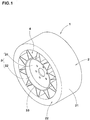
- FIG. 1 is a perspective view of an air-less tire 1 in accordance with the present embodiment.
- the air-less tire 1 in accordance with the present embodiment includes an annular tread ring 2 having a ground contact surface 21, a hub 3 to be fixed to an axle and disposed radially inward of the tread ring 2 and spokes 4 connecting the tread ring 2 and the hub 3.
- the air-less tire 1 is illustrated as a tire for passenger car.
- the hub 3 includes a disk portion 31 to be fixed to an axle and a cylindrical portion 32 formed on the outer periphery of the disk portion 31.
- the cylindrical portion 32 has a sidewall 33 formed on an edge.
- the sidewall 33 is formed as a plane that is perpendicular to the hub center axis A3.
- the hub 3, for example, is made of a metallic material such as steel, aluminum alloy, magnesium alloy and the like same as conventional tire wheels.
- the spokes 4 are formed by cast molding of high polymer material.
- the spokes 4 have a plate shape and are arranged in a tire circumferential direction.
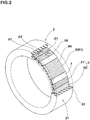
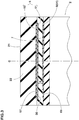
- FIG. 2 and FIG. 3 illustrate the tread ring 2.
- the tread ring 2 includes a tread rubber 22 forming the ground contact surface 21, an outer reinforcing cord layer 5 disposed proximately to the tread rubber 22, an inner reinforcing cord layer 6 disposed radially inward of the outer reinforcing cord layer 5, and a shear rubber layer 7 disposed between the outer reinforcing cord layer 5 and the inner reinforcing cord layer 6.
- the shape of the tread ring 2 is maintained by the outer reinforcing cord layer 5 and the inner reinforcing cord layer 6 so as to support the load acting on the air-less tire 1.
- the ground contact surface 21, which is an outer surface of the tread ring 2, may be provided with tread grooves (not illustrated) in various patterns.
- tread rubber 22 a rubber composition that generates high friction force to the ground with excellent wear resistance can suitably be employed.
- the outer reinforcing cord layer 5 which is disposed proximately to the tread rubber 22, with respect to the number of plies, is greater than the inner reinforcing cord layer 6 which is disposed inward of the shear rubber layer 7.
- the rigidity of the ground contact surface 21 can easily be enhanced.
- the inner reinforcing cord layer 6 is configured to be smaller than the outer reinforcing cord layer 5 with respect to the number of plies, saving weight can easily be achieved.
- the radially inner surface of the tread ring 2 can obtain sufficient rigidity since it is restrained by the spokes 4.
- the outer reinforcing cord layer 5 is configured to include a first cord ply 51 and a second cord ply 52 disposed radially outward of the first cord ply 51.
- widths of the first cord ply 51 and the second cord ply 52 are equal from one another in the tire axial direction.
- the widths of the first cord ply 51 and the second cord ply 52 may be different from one another.
- the difference in width between the cord plies is preferably tens of millimeters or less.
- the first cord ply 51 includes a plurality of first cords 56.
- the first cords 56 are oriented at angles ⁇ 1 with respect to the tire circumferential direction.
- the first cords 56 are coated with topping rubber.
- the second cord ply 52 includes a plurality of second cords 57.
- the second cords 57 are oriented at angles ⁇ 2 with respect to the tire circumferential direction in an opposite direction to the first cords 56.
- the second cords 57 are coated with topping rubber.
- a steel cord and an organic fiber cord which are the same as belt cords of pneumatic tires, can be employed.
- an organic fiber cord a high modulus fiber having high strength and elastic modulus such as aramid, polyethylene naphthalate (PEN), polyethylene terephthalate (PET) and the like can suitably be employed.
- aramid polyethylene naphthalate
- PET polyethylene terephthalate
- Such a steel cord and an organic fiber cord can exhibit sufficient strength without occurring yielding by tensile and compressive stresses which act on the cords when the tire is subjected to load.
- the rigidity of the outer reinforcing cord layer 5 can be increased to enhance the tread ring 2 effectively.
- Such an outer reinforcing cord layer 5 can exhibit high torsional resistance in a plane of the layer as with belt cords of pneumatic tires when the air-less tire 1 is given a slip angle, and thus brings an excellent cornering performance.
- the inner reinforcing cord layer 6 is configured to include a third cord ply 61.
- the third cord ply 61 includes a plurality of third cords 66.
- the third cords 66 are coated with topping rubber.
- the third cords 66 are oriented in parallel with the tire circumferential direction.
- the "parallel with the tire circumferential direction” means that the third cords 66 are substantially parallel with the tire circumferential direction.
- the angles ⁇ 3 of third cords 66 with respect to the tire circumferential direction are about 0 degrees plus or minus 5 degrees.
- the above mentioned organic fibers such as aramid, polyethylene naphthalate, polyethylene terephthalate and the like can suitably be employed, for example.
- the rigidity of the tread ring 2 in the tire circumferential direction can be enhanced by the inner reinforcing cord layer 6 with the third cords 66.
- the shape of the ground contact surface 21 upon braking and accelerating becomes stable, thereby improving braking performance and traction performance.
- the third cord ply 61 which includes the third cords 66 oriented in parallel with the tire circumferential direction can ensure by itself symmetry with respect to a tire circumferential line. Accordingly, weight saving of the tread ring 2 as well as improved steering stability of the air-less tire 1 can be achieved.
- FIG. 4 illustrates another embodiment of the third cord ply 61.
- the third cords 66 may be oriented in parallel with the tire axial direction.
- the "parallel with the tire axial direction” means that the third cords 66 are substantially parallel with the tire axial direction.
- the third cords 66 can be oriented at angles ⁇ 3 with respect to the tire axial direction is about 90 degrees plus or minus 5 degrees.
- the rigidity of the tread ring 2 in the tire axial direction can be enhanced by the third cords 66 which are oriented in parallel with the tire axial direction.
- the shape of the ground contact surface 21 when the air-less tire 1 is subject to a large slip angle becomes stable, thereby improving steering stability.
- the third cord ply 61 which includes the third cords 66 oriented in parallel with the tire axial direction can ensure by itself symmetry with respect to the tire circumferential direction. Accordingly, in the same manner as described above, weight saving of the tread ring 2 as well as improved steering stability of the air-less tire 1 can be achieved.
- the first cords 56 are preferably oriented in a line symmetrical manner to the second cords 57 with respect to a tire circumferential line.
- the first cords 56 and the second cords 57 ensure symmetry of the outer reinforcing cord layer 5 with respect to a tire circumferential line.
- steering stability of the air-less tire 1 can be improved.
- the angles ⁇ 1 of the first cords 56 are in a range of from 5 to 85 degrees with respect to the tire circumferential direction.
- the angles ⁇ 1 are less than 5 degrees, the rigidity of the tread ring 2 in the tire axial direction tends to be insufficient, and thus cornering performance may be affected.
- the angles ⁇ 1 are more than 85 degrees, the rigidity of the tread ring 2 in the tire circumferential direction tends to be insufficient, and thus straight traveling ability and cornering performance with small slip angles may be affected.
- the angles ⁇ 2 of the second cords 57 are in a range of from 5 to 85 degrees with respect to the tire circumferential direction.
- the angles ⁇ 2 are less than 5 degrees, the rigidity of the tread ring 2 in the tire axial direction tends to be insufficient, and thus cornering performance may be affected.
- the angles ⁇ 2 are more than 85 degrees, the rigidity of the tread ring 2 in the tire circumferential direction tends to be insufficient, and thus straight traveling ability and cornering performance with small slip angles may be affected.
- the first cords 56 are arranged in a line symmetrical manner to the second cords 57 with respect to a tire circumferential line, the above angles ⁇ 1 are substantially the same as the angles ⁇ 2 with respect to their absolute values.
- the first cord ply 51 is disposed on the innermost side in the tire radial direction among the outer reinforcing cord layer 5.
- a single or plurality of cord plies may be disposed under the first cord ply 51. These cord plies can suppress the deformation of the tread ring 2 to improve load resistance of the air-less tire 1.
- the cords embedded in each ply are preferably arranged in a line symmetrical manner with respect to a tire circumferential line to the cords of adjacent another ply. These cords can ensure symmetrical property of the outer reinforcing cord layer 5 with respect to a tire circumferential line. Thus, steering stability of the air-less tire 1 can be improved.
- the cords embedded in the ply are preferably arranged in parallel with the tire circumferential direction. These cords can also ensure symmetrical property of the outer reinforcing cord layer 5 with respect to a tire circumferential line using a single ply. Thus, steering stability of the air-less tire 1 can be improved while reducing the weight of the tread ring 2.
- the shear rubber layer 7 is disposed between two cord-plies which are located farthest in the tire radial direction among the plies constituting the outer reinforcing cord layer 5 and the inner reinforcing cord layer 6.
- the shear rubber layer 7 is disposed between the first cord ply 51 and the third cord ply 61.
- the shear rubber layer 7 can mitigate the shear strain between the outer reinforcing cord layer 5 and the inner reinforcing cord layer 6.
- the shear rubber layer 7, for example, is disposed at a location including the neutral axis where tensile stress and compressive stress are not subject when the air-less tire 1 is loaded with a vertical load.
- the shear rubber layer 7 is configured to include a rubber having a complex modulus E* of not less than 2 MPa.
- the complex modulus E* of the rubber is less than 2 MPa, shear strain in the shear rubber layer 7 tends to be large and thus the durability of the tread ring 2 may be affected.
- the shear rubber layer 7 may be made of a rubber material that has the same composition as that of the topping rubber for coating the first cords 56 and the third cords 66.
- the shear rubber layer 7 may be configured by thickening adjacent topping rubber layers of the first cord ply 51 and the third cord ply 61 without providing any independent rubber layer between the outer reinforcing cord layer 5 and the inner reinforcing cord layer 6.
- the shear rubber layer 7 with a certain thickness is provided between the first cord ply 51 and the third cord ply 61, the first cords 56 and the third cords 66 are sufficiently isolated in the tire radial direction, and thus the shear stress between the first cord ply 51 and the third cord ply 61 can be mitigated. It is preferable that the distances D in the tire radial direction between the first cords 56 and the third cords 66 are equal to or more than 3 mm. When the distances D are less than 3 mm, the shear stress on the shear rubber layer 7 tends to be large and may the durability of the tread ring 2 may be affected.
- the tread ring 2 as illustrated in FIGs. 2 to 4 may be manufactured in such a manner that a green tread ring is molded previously and then the green tread ring is vulcanized in a vulcanization mold.
- the green tread ring is formed by winding sheet-like members in stages on a cylindrical forming drum in the tire circumferential direction to form the respective third cord ply 61, shear rubber layer 7, first cord ply 51, second cord ply 52, the tread rubber 22 and the like.
- FIG. 5 illustrates another embodiment of the outer reinforcing cord layer 5. Note that no explanations for the same elements as the previous embodiment are given.
- the outer reinforcing cord layer 5 further includes a fourth cord ply 53 having fourth cords 58 disposed outside the second cord ply 52 in the tire radial direction.
- the fourth cord ply 53 can reinforce the tread ring 2 together with the first cord ply 51 and the second cord ply 52.
- the outer reinforcing cord layer 5 as illustrated in FIG. 5 is suitable to use for commercial tires which is subject to a large load since it increases rigidity of the tread ring 2.
- the fourth cords 58 are oriented in parallel with the tire circumferential direction, i.e. the angles ⁇ 4 are 0 degrees plus or minus 5 degrees with respect to the tire circumferential direction, same as the third cords 66.
- the fourth cords 58 can enhance rigidity of the tread ring 2 in the tire circumferential direction.
- the shape of the ground contact surface 21 upon braking and accelerating becomes stable, thereby improving braking performance and traction performance.
- the fourth cord ply 53 with the fourth cords 58 oriented in parallel with the tire circumferential direction can ensure by itself symmetry with respect to a tire circumferential line. Accordingly, weight saving of the tread ring 2 as well as improved steering stability of the air-less tire 1 can be achieved.
- an elastic modulus E4 of the fourth cords 58 is equal to or less than the elastic moduli E1 and E2 of the first cords 56 and the second cords 57, respectively.
- the elastic modulus E4 of the fourth cords 58 exceeds the elastic moduli E1 and E2 of the first cords 56 and the second cords 57 respectively, the rigidity of the tread ring 2 in the tire axial direction decreases in relation to that of the tire circumferential direction, and thus the cornering performance may be affected.
- an organic fiber cord such as nylon and the like can be employed for the fourth cords 58, for example.
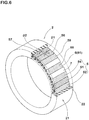
- FIG. 6 illustrates yet another embodiment of the outer reinforcing cord layer 5. Note that no explanations for the same elements as the previous embodiment are given.
- the outer reinforcing cord layer 5 further includes a fifth cord ply 54 having fifth cords 59 disposed inside the first cord ply 51 in the tire radial direction.
- the fifth cord ply 54 can reinforce the tread ring 2 together with the first cord ply 51 and the second cord ply 52.
- the outer reinforcing cord layer 5 as illustrated in FIG. 6 is suitable to use for commercial tires which is subject to a large load since the layer increases rigidity of the tread ring 2.
- the fifth cords 59 are oriented in parallel with the tire circumferential direction, i.e. the angles ⁇ 4 are 0 degrees plus or minus 5 degrees with respect to the tire circumferential direction, same as the third cords 66.
- the fifth cords 59 can enhance rigidity of the tread ring 2 in the tire circumferential direction.
- the shape of the ground contact surface 21 upon braking and accelerating becomes stable, thereby improving braking performance and traction performance.
- the fifth cord ply 54 with the fifth cords 59 oriented in parallel with the tire circumferential direction can ensure by itself symmetry with respect to a tire circumferential line. Accordingly, weight saving of the tread ring 2 as well as improved steering stability of the air-less tire 1 can be achieved.
- the fourth cords 58 may be arranged outside the second cord ply 52 in the tire radial direction and the fifth cords 59 may be arranged inside the first cord ply 51. Such a configuration may further increase the rigidity of the tread ring 2.
- Air-less tires having a basic structure illustrated in FIGs. 1 and 2 were manufactured based on the details shown in Table 1, and then appearance, steering stability, weight and durability thereof were evaluated.
- a traveling distance of each air-less tire until it is injured was measured using a drum tester under the conditions at speed of 40 km/hr with vertical load of 1.17kN.
- the test results are indicated using an index based on Ex. 1 being 100, wherein the larger the value, the better the durability is.
Landscapes
- Engineering & Computer Science (AREA)
- Mechanical Engineering (AREA)
- Chemical & Material Sciences (AREA)
- Materials Engineering (AREA)
- Tires In General (AREA)
Abstract
Description
- The present invention relates to an air-less tire having lightweight and excellent steering stability.
- As air-less tires, the construction that includes an annular tread ring having a ground contact surface, a hub and a plurality of radially arranged spoke plates connecting the hub and an axle has been proposed (see
Patent Literature 1, for example). - In such an air-less tire, it is requested to improve steering stability with weight saving.
- Patent Literature 1:
Japanese Unexamined Patent Application Publication No. 2008-260514 - The tread ring of the air-less tire disclosed in the above mentioned
Patent Literature 1 includes an outer reinforcing cord layer disposed nearest to a tread rubber and an inner reinforcing cord layer disposed radially inward of the outer reinforcing cord layer. A shear rubber layer is also disposed between the outer reinforcing cord layer and the inner reinforcing cord layer. Unfortunately, in the above mentioned tread ring, since the respective one of the outer reinforcing cord layer and the inner reinforcing cord layer are formed of a pair of cord layers each having tire cords which are inclined with respect to the tire circumferential direction, it may be difficult to reduce the weight. - In order to improve steering stability of air-less tires, it is important to increase rigidity of the ground contact surface of the tread ring as with pneumatic tires. In general, the inner surface of the tread ring in the tire radial direction may have a relatively high rigidity by being supported by the spokes. However, it is difficult to increase rigidity of the ground contact surface which is located on the outer surface of the tread ring in the tire radial direction. Thus, in the above mentioned air-less tire, it would be difficult to improve steering stability while reducing its weight.
- The present invention has been made in view of the above circumstances, and has a major object to provide an air-less tire having lightweight and excellent steering stability. Solution to Problem
- The present invention provides an air-less tire including an annular tread ring having a ground contact surface, a hub to be fixed to an axle and disposed radially inward of the tread ring, and spokes connecting the tread ring and the hub. The tread ring includes a tread rubber forming the ground contact surface, an outer reinforcing cord layer disposed proximately to the tread rubber, an inner reinforcing cord layer disposed radially inward of the outer reinforcing cord layers and a shear rubber layer disposed between the outer reinforcing cord layer and the inner reinforcing cord layer. The outer reinforcing cord layer, with respect to the number of plies, is greater than the inner reinforcing cord layer.
- In the air-less tire in accordance with the present invention, it is preferable that the outer reinforcing cord layer includes a first cord ply having first cords inclining with respect to a tire circumferential direction and a second cord ply disposed radially outward of the first cord ply and having second cords inclining in an opposite direction to the first cords with respect to the tire circumferential direction, and that the inner reinforcing cord layer includes a third cord ply having third cords arranged in parallel with either the tire circumferential direction or a tire axial direction.
- In the air-less tire in accordance with the present invention, it is preferable that the first cords are arranged in a line symmetrical manner to the second cords with respect to a tire circumferential line.
- In the air-less tire in accordance with the present invention, it is preferable that the outer reinforcing cord layer further includes a fourth cord ply having forth cords, and the fourth cord ply is disposed radially outward of the second cord ply.
- In the air-less tire in accordance with the present invention, it is preferable that the fourth cords are arranged in parallel with the tire circumferential direction and that the fourth cords have an elastic modulus equal to or less than those of the first cords and the second cords.
- In the air-less tire in accordance with the present invention, it is preferable that the outer reinforcing cord layer further includes a fifth cord ply having fifth cords, and the fifth cord ply is disposed radially inward of the first cord ply.
- In the air-less tire in accordance with the present invention, it is preferable that the fifth cords are arranged in parallel with the tire circumferential direction.
- In the air-less tire in accordance with the present invention, it is preferable that the third cords are arranged in parallel with the tire circumferential direction.
- In the air-less tire in accordance with the present invention, it is preferable that angles of the first cords are in a range of from 5 to 85 degrees with respect to the tire circumferential direction.
- In the air-less tire in accordance with the present invention, it is preferable that distances in a tire radial direction between the first cords and the third cords are not less than 3 mm.
- In the air-less tire in accordance with the present invention, it is preferable that the shear rubber layer has a complex modulus equal to or more than 2 MPa.
- An air-less tire according to the present invention includes the tread ring including the tread rubber forming the ground contact surface, the outer reinforcing cord layer disposed proximately to the tread rubber, the inner reinforcing cord layer disposed radially inward of the outer reinforcing cord layer and the shear rubber layer disposed between the outer reinforcing cord layer and the inner reinforcing cord layer. The shape of the tread ring is maintained by the outer reinforcing cord layer and the inner reinforcing cord layer so as to support the load acting on the air-less tire. The shear rubber layer mitigates shear stress acting between the outer reinforcing cord layer and the inner reinforcing cord layer.
- In the present invention, since the outer reinforcing cord layer which is disposed proximately to the tread rubber forming the ground contact surface, with respect to the number of plies, is greater than the inner reinforcing cord layer which is disposed inward of the shear rubber layer, the rigidity of the ground contact surface can easily be enhanced. Furthermore, since the inner reinforcing cord layer is configured to be smaller than the outer reinforcing cord layer with respect to the number of plies, saving weight can easily be achieved. The radially inner surface of the tread ring can obtain sufficient rigidity since it is restrained by the spokes.
-
-
FIG. 1 is a perspective view of an air-less tire in accordance with the present invention. -
FIG. 2 is a perspective view of a tread ring ofFIG. 1 . -
FIG. 3 is a cross-sectional view of the tread ring ofFIG. 2 . -
FIG. 4 is a perspective view of the tread ring illustrating another embodiment of an inner reinforcing cord layer ofFIG. 2 . -
FIG. 5 is a perspective view of the tread ring illustrating another embodiment of an outer reinforcing cord layer ofFIG. 2 . -
FIG. 6 is a perspective view of the tread ring illustrating yet another embodiment of an outer reinforcing cord layer ofFIG. 2 . - An embodiment of the present invention will be explained below with reference to the accompanying drawings.
FIG. 1 is a perspective view of anair-less tire 1 in accordance with the present embodiment. As illustrated inFIG. 1 , theair-less tire 1 in accordance with the present embodiment includes anannular tread ring 2 having aground contact surface 21, ahub 3 to be fixed to an axle and disposed radially inward of thetread ring 2 andspokes 4 connecting thetread ring 2 and thehub 3. In this embodiment, theair-less tire 1 is illustrated as a tire for passenger car. - As illustrated in
FIG. 1 , thehub 3 includes adisk portion 31 to be fixed to an axle and acylindrical portion 32 formed on the outer periphery of thedisk portion 31. Thecylindrical portion 32 has asidewall 33 formed on an edge. Thesidewall 33 is formed as a plane that is perpendicular to the hub center axis A3. Thehub 3, for example, is made of a metallic material such as steel, aluminum alloy, magnesium alloy and the like same as conventional tire wheels. - The
spokes 4 are formed by cast molding of high polymer material. Thespokes 4 have a plate shape and are arranged in a tire circumferential direction. -
FIG. 2 andFIG. 3 illustrate thetread ring 2. Thetread ring 2 includes atread rubber 22 forming theground contact surface 21, an outerreinforcing cord layer 5 disposed proximately to thetread rubber 22, an inner reinforcingcord layer 6 disposed radially inward of the outerreinforcing cord layer 5, and ashear rubber layer 7 disposed between the outer reinforcingcord layer 5 and the innerreinforcing cord layer 6. The shape of thetread ring 2 is maintained by the outer reinforcingcord layer 5 and the inner reinforcingcord layer 6 so as to support the load acting on theair-less tire 1. - The
ground contact surface 21, which is an outer surface of thetread ring 2, may be provided with tread grooves (not illustrated) in various patterns. For thetread rubber 22, a rubber composition that generates high friction force to the ground with excellent wear resistance can suitably be employed. - In this embodiment, the outer reinforcing
cord layer 5 which is disposed proximately to thetread rubber 22, with respect to the number of plies, is greater than the inner reinforcingcord layer 6 which is disposed inward of theshear rubber layer 7. Thus, the rigidity of theground contact surface 21 can easily be enhanced. Furthermore, since the inner reinforcingcord layer 6 is configured to be smaller than the outer reinforcingcord layer 5 with respect to the number of plies, saving weight can easily be achieved. The radially inner surface of thetread ring 2 can obtain sufficient rigidity since it is restrained by thespokes 4. - The outer reinforcing
cord layer 5 is configured to include afirst cord ply 51 and asecond cord ply 52 disposed radially outward of thefirst cord ply 51. - In this embodiment, widths of the
first cord ply 51 and the second cord ply 52 are equal from one another in the tire axial direction. The widths of thefirst cord ply 51 and the second cord ply 52 may be different from one another. In this case, the difference in width between the cord plies is preferably tens of millimeters or less. - The first cord ply 51 includes a plurality of
first cords 56. Thefirst cords 56 are oriented at angles θ1 with respect to the tire circumferential direction. Thefirst cords 56 are coated with topping rubber. - The second cord ply 52 includes a plurality of
second cords 57. Thesecond cords 57 are oriented at angles θ2 with respect to the tire circumferential direction in an opposite direction to thefirst cords 56. Thesecond cords 57 are coated with topping rubber. - For the
first cords 56 and thesecond cords 57, a steel cord and an organic fiber cord, which are the same as belt cords of pneumatic tires, can be employed. In case of an organic fiber cord, a high modulus fiber having high strength and elastic modulus such as aramid, polyethylene naphthalate (PEN), polyethylene terephthalate (PET) and the like can suitably be employed. Such a steel cord and an organic fiber cord can exhibit sufficient strength without occurring yielding by tensile and compressive stresses which act on the cords when the tire is subjected to load. - Since the
first cords 56 and thesecond cords 57 are inclined with respect to the tire circumferential direction in an opposite direction from one another, the rigidity of the outer reinforcingcord layer 5 can be increased to enhance thetread ring 2 effectively. Such an outer reinforcingcord layer 5 can exhibit high torsional resistance in a plane of the layer as with belt cords of pneumatic tires when theair-less tire 1 is given a slip angle, and thus brings an excellent cornering performance. - The inner reinforcing
cord layer 6 is configured to include athird cord ply 61. The third cord ply 61 includes a plurality ofthird cords 66. Thethird cords 66 are coated with topping rubber. - In this embodiment, the
third cords 66 are oriented in parallel with the tire circumferential direction. Here, the "parallel with the tire circumferential direction" means that thethird cords 66 are substantially parallel with the tire circumferential direction. In view of manufacturing tolerance, the angles θ3 ofthird cords 66 with respect to the tire circumferential direction, for example, are about 0 degrees plus or minus 5 degrees. For thethird cords 66, the above mentioned organic fibers such as aramid, polyethylene naphthalate, polyethylene terephthalate and the like can suitably be employed, for example. - The rigidity of the
tread ring 2 in the tire circumferential direction can be enhanced by the inner reinforcingcord layer 6 with thethird cords 66. Thus, the shape of theground contact surface 21 upon braking and accelerating becomes stable, thereby improving braking performance and traction performance. Furthermore, the third cord ply 61 which includes thethird cords 66 oriented in parallel with the tire circumferential direction can ensure by itself symmetry with respect to a tire circumferential line. Accordingly, weight saving of thetread ring 2 as well as improved steering stability of theair-less tire 1 can be achieved. -
FIG. 4 illustrates another embodiment of thethird cord ply 61. As illustrated inFIG. 4 , thethird cords 66 may be oriented in parallel with the tire axial direction. Here, the "parallel with the tire axial direction" means that thethird cords 66 are substantially parallel with the tire axial direction. In view of manufacturing tolerance, thethird cords 66 can be oriented at angles θ3 with respect to the tire axial direction is about 90 degrees plus or minus 5 degrees. - The rigidity of the
tread ring 2 in the tire axial direction can be enhanced by thethird cords 66 which are oriented in parallel with the tire axial direction. Thus, the shape of theground contact surface 21 when theair-less tire 1 is subject to a large slip angle becomes stable, thereby improving steering stability. Furthermore, the third cord ply 61 which includes thethird cords 66 oriented in parallel with the tire axial direction can ensure by itself symmetry with respect to the tire circumferential direction. Accordingly, in the same manner as described above, weight saving of thetread ring 2 as well as improved steering stability of theair-less tire 1 can be achieved. - As illustrated in
FIGs. 2 and4 , thefirst cords 56 are preferably oriented in a line symmetrical manner to thesecond cords 57 with respect to a tire circumferential line. Thefirst cords 56 and thesecond cords 57 ensure symmetry of the outer reinforcingcord layer 5 with respect to a tire circumferential line. Thus, steering stability of theair-less tire 1 can be improved. - In pneumatic tires, belt cord angles with respect to the tire circumferential direction are generally limited in a certain ranges in order to suppress growth of tread portion due to internal pressure. On the other hand, since the
air-less tire 1 in accordance with the present embodiment is not necessary to consider the internal pressure, angles θ1 and θ2 of thefirst cords 56 and thesecond cords 57 respectively with respect to the tire circumferential direction can be determined in a wide range. - It is preferable that the angles θ1 of the
first cords 56, for example, are in a range of from 5 to 85 degrees with respect to the tire circumferential direction. When the angles θ1 are less than 5 degrees, the rigidity of thetread ring 2 in the tire axial direction tends to be insufficient, and thus cornering performance may be affected. On the other hand, when the angles θ1 are more than 85 degrees, the rigidity of thetread ring 2 in the tire circumferential direction tends to be insufficient, and thus straight traveling ability and cornering performance with small slip angles may be affected. - Similarly, it is preferable that the angles θ2 of the
second cords 57, for example, are in a range of from 5 to 85 degrees with respect to the tire circumferential direction. When the angles θ2 are less than 5 degrees, the rigidity of thetread ring 2 in the tire axial direction tends to be insufficient, and thus cornering performance may be affected. On the other hand, when the angles θ2 are more than 85 degrees, the rigidity of thetread ring 2 in the tire circumferential direction tends to be insufficient, and thus straight traveling ability and cornering performance with small slip angles may be affected. In this embodiment, since thefirst cords 56 are arranged in a line symmetrical manner to thesecond cords 57 with respect to a tire circumferential line, the above angles θ1 are substantially the same as the angles θ2 with respect to their absolute values. - In this embodiment, the first cord ply 51 is disposed on the innermost side in the tire radial direction among the outer reinforcing
cord layer 5. Alternately, a single or plurality of cord plies (not illustrated) may be disposed under thefirst cord ply 51. These cord plies can suppress the deformation of thetread ring 2 to improve load resistance of theair-less tire 1. - When a plurality of cord plies are disposed, the cords embedded in each ply are preferably arranged in a line symmetrical manner with respect to a tire circumferential line to the cords of adjacent another ply. These cords can ensure symmetrical property of the outer reinforcing
cord layer 5 with respect to a tire circumferential line. Thus, steering stability of theair-less tire 1 can be improved. - When a single cord ply is disposed, the cords embedded in the ply are preferably arranged in parallel with the tire circumferential direction. These cords can also ensure symmetrical property of the outer reinforcing
cord layer 5 with respect to a tire circumferential line using a single ply. Thus, steering stability of theair-less tire 1 can be improved while reducing the weight of thetread ring 2. - The
shear rubber layer 7 is disposed between two cord-plies which are located farthest in the tire radial direction among the plies constituting the outer reinforcingcord layer 5 and the inner reinforcingcord layer 6. In this embodiment, theshear rubber layer 7 is disposed between thefirst cord ply 51 and thethird cord ply 61. - The
shear rubber layer 7 can mitigate the shear strain between the outer reinforcingcord layer 5 and the inner reinforcingcord layer 6. Theshear rubber layer 7, for example, is disposed at a location including the neutral axis where tensile stress and compressive stress are not subject when theair-less tire 1 is loaded with a vertical load. - It is preferable that the
shear rubber layer 7 is configured to include a rubber having a complex modulus E* of not less than 2 MPa. When the complex modulus E* of the rubber is less than 2 MPa, shear strain in theshear rubber layer 7 tends to be large and thus the durability of thetread ring 2 may be affected. - The
shear rubber layer 7 may be made of a rubber material that has the same composition as that of the topping rubber for coating thefirst cords 56 and thethird cords 66. In this case, theshear rubber layer 7 may be configured by thickening adjacent topping rubber layers of thefirst cord ply 51 and the third cord ply 61 without providing any independent rubber layer between the outer reinforcingcord layer 5 and the inner reinforcingcord layer 6. - As illustrated in
FIG. 3 , since theshear rubber layer 7 with a certain thickness is provided between thefirst cord ply 51 and thethird cord ply 61, thefirst cords 56 and thethird cords 66 are sufficiently isolated in the tire radial direction, and thus the shear stress between thefirst cord ply 51 and the third cord ply 61 can be mitigated. It is preferable that the distances D in the tire radial direction between thefirst cords 56 and thethird cords 66 are equal to or more than 3 mm. When the distances D are less than 3 mm, the shear stress on theshear rubber layer 7 tends to be large and may the durability of thetread ring 2 may be affected. - The
tread ring 2 as illustrated inFIGs. 2 to 4 , for example, may be manufactured in such a manner that a green tread ring is molded previously and then the green tread ring is vulcanized in a vulcanization mold. The green tread ring is formed by winding sheet-like members in stages on a cylindrical forming drum in the tire circumferential direction to form the respectivethird cord ply 61,shear rubber layer 7,first cord ply 51,second cord ply 52, thetread rubber 22 and the like. -
FIG. 5 illustrates another embodiment of the outer reinforcingcord layer 5. Note that no explanations for the same elements as the previous embodiment are given. As illustrated inFIG. 5 , the outer reinforcingcord layer 5 further includes a fourth cord ply 53 havingfourth cords 58 disposed outside the second cord ply 52 in the tire radial direction. The fourth cord ply 53 can reinforce thetread ring 2 together with thefirst cord ply 51 and thesecond cord ply 52. The outer reinforcingcord layer 5 as illustrated inFIG. 5 , for example, is suitable to use for commercial tires which is subject to a large load since it increases rigidity of thetread ring 2. - It is preferable that the
fourth cords 58 are oriented in parallel with the tire circumferential direction, i.e. the angles θ4 are 0 degrees plus or minus 5 degrees with respect to the tire circumferential direction, same as thethird cords 66. Thefourth cords 58 can enhance rigidity of thetread ring 2 in the tire circumferential direction. Thus, the shape of theground contact surface 21 upon braking and accelerating becomes stable, thereby improving braking performance and traction performance. Furthermore, the fourth cord ply 53 with thefourth cords 58 oriented in parallel with the tire circumferential direction can ensure by itself symmetry with respect to a tire circumferential line. Accordingly, weight saving of thetread ring 2 as well as improved steering stability of theair-less tire 1 can be achieved. - It is preferable that an elastic modulus E4 of the
fourth cords 58 is equal to or less than the elastic moduli E1 and E2 of thefirst cords 56 and thesecond cords 57, respectively. When the elastic modulus E4 of thefourth cords 58 exceeds the elastic moduli E1 and E2 of thefirst cords 56 and thesecond cords 57 respectively, the rigidity of thetread ring 2 in the tire axial direction decreases in relation to that of the tire circumferential direction, and thus the cornering performance may be affected. It is preferable that an organic fiber cord such as nylon and the like can be employed for thefourth cords 58, for example. -
FIG. 6 illustrates yet another embodiment of the outer reinforcingcord layer 5. Note that no explanations for the same elements as the previous embodiment are given. As illustrated inFIG. 6 , the outer reinforcingcord layer 5 further includes a fifth cord ply 54 havingfifth cords 59 disposed inside the first cord ply 51 in the tire radial direction. The fifth cord ply 54 can reinforce thetread ring 2 together with thefirst cord ply 51 and thesecond cord ply 52. The outer reinforcingcord layer 5 as illustrated inFIG. 6 , for example, is suitable to use for commercial tires which is subject to a large load since the layer increases rigidity of thetread ring 2. - It is preferable that the
fifth cords 59 are oriented in parallel with the tire circumferential direction, i.e. the angles θ4 are 0 degrees plus or minus 5 degrees with respect to the tire circumferential direction, same as thethird cords 66. Thefifth cords 59 can enhance rigidity of thetread ring 2 in the tire circumferential direction. Thus, the shape of theground contact surface 21 upon braking and accelerating becomes stable, thereby improving braking performance and traction performance. Furthermore, the fifth cord ply 54 with thefifth cords 59 oriented in parallel with the tire circumferential direction can ensure by itself symmetry with respect to a tire circumferential line. Accordingly, weight saving of thetread ring 2 as well as improved steering stability of theair-less tire 1 can be achieved. - By combining the embodiment of outer reinforcing
cord layer 5 illustrated inFIG. 5 and the embodiment of outer reinforcingcord layer 5 illustrated inFIG. 6 , thefourth cords 58 may be arranged outside the second cord ply 52 in the tire radial direction and thefifth cords 59 may be arranged inside thefirst cord ply 51. Such a configuration may further increase the rigidity of thetread ring 2. - While the particularly preferable embodiments in accordance with the present invention have been described in detail, the present invention is not limited to the illustrated embodiments, but can be modified and carried out in various aspects.
- Air-less tires having a basic structure illustrated in
FIGs. 1 and2 were manufactured based on the details shown in Table 1, and then appearance, steering stability, weight and durability thereof were evaluated. - An observer evaluated distortion on the tread rings of each of the air-less tires by his sense.
- A small electric vehicle with each test air-less tire was driven by a test driver without any other passengers to evaluate performance such as steering response, rigidity feeling, grip and the like by his sense. The test results are indicated using a score based on Ex. 1 being 100, wherein the larger the value, the better the performance is. Note that steering stability and durability tests were not conducted for the air-less tires which had been identified as having distortion in the appearance test.
- Each weight of the tread rings was measured. The test results are indicated using an index based on Ex. 1 being 100, wherein the larger the value, the lighter the weight is.
- A traveling distance of each air-less tire until it is injured was measured using a drum tester under the conditions at speed of 40 km/hr with vertical load of 1.17kN. The test results are indicated using an index based on Ex. 1 being 100, wherein the larger the value, the better the durability is.


- As apparent from Table 1, it is confirmed that the air-less tires in accordance with the examples improve appearance, steering stability, weight and durability as compared with the comparative examples.
-
- 1
- air-less tire
- 2
- tread ring
- 2
- tread ring
- 3
- hubs
- 4
- spokes
- 5
- outer reinforcing cord layer
- 6
- inner reinforcing cord layer
- 7
- shear rubber layer
- 21
- ground contact surface
- 22
- tread rubber
- 51
- first cord ply
- 52
- second cord ply
- 53
- fourth cord ply
- 54
- fifth cord ply
- 56
- first cords
- 57
- second cords
- 58
- fourth cords
- 59
- fifth cords
- 61
- third cord ply
- 66
- third cords
Claims (11)
- An air-less tire comprising:an annular tread ring having a ground contact surface;a hub to be fixed to an axle and disposed radially inward of the tread ring; andspokes connecting the tread ring and the hub;wherein the tread ring comprises a tread rubber forming the ground contact surface, an outer reinforcing cord layer disposed proximately to the tread rubber, an inner reinforcing cord layer disposed radially inward of the outer reinforcing cord layers and a shear rubber layer disposed between the outer reinforcing cord layer and the inner reinforcing cord layer, andwherein the outer reinforcing cord layer, with respect to the number of plies, is greater than the inner reinforcing cord layer.
- The air-less tire as set forth in claim 1,
wherein the outer reinforcing cord layer comprises a first cord ply having first cords inclining with respect to a tire circumferential direction and a second cord ply disposed radially outward of the first cord ply and having second cords inclining in an opposite direction to the first cords with respect to the tire circumferential direction, and
the inner reinforcing cord layer comprises a third cord ply having third cords arranged in parallel with either the tire circumferential direction or a tire axial direction. - The air-less tire as set forth in claim 2,
wherein the first cords are arranged in a line symmetrical manner to the second cords with respect to a tire circumferential line. - The air-less tire as set forth in claim 2 or 3,
wherein the outer reinforcing cord layer further comprises a fourth cord ply having forth cords,
and the fourth cord ply is disposed radially outward of the second cord ply. - The air-less tire as set forth in claim 4, wherein the fourth cords are arranged in parallel with the tire circumferential direction, and
the fourth cords have an elastic modulus equal to or less than those of the first cords and the second cords. - The air-less tire as set forth in any one of claims 2 to 5,
wherein the outer reinforcing cord layer further comprises a fifth cord ply having fifth cords,
and the fifth cord ply is disposed radially inward of the first cord ply. - The air-less tire as set forth in claim 6,
wherein the fifth cords are arranged in parallel with the tire circumferential direction. - The air-less tire as set forth in any one of claims 2 to 7,
wherein the third cords are arranged in parallel with the tire circumferential direction. - The air-less tire as set forth in any one of claims 2 to 8,
wherein angles of the first cords are in a range of from 5 to 85 degrees with respect to the tire circumferential direction. - The air-less tire as set forth in any one of claims 2 to 9,
wherein distances in a tire radial direction between the first cords and the third cords are not less than 3 mm. - The air-less tire as set forth in any one of claims 1 to 9,
wherein the shear rubber layer has a complex modulus equal to or more than 2 MPa.
Applications Claiming Priority (2)
| Application Number | Priority Date | Filing Date | Title |
|---|---|---|---|
| JP2014127519A JP6317633B2 (en) | 2014-06-20 | 2014-06-20 | Airless tire |
| PCT/JP2015/063177 WO2015194277A1 (en) | 2014-06-20 | 2015-05-07 | Air-less tire |
Publications (3)
| Publication Number | Publication Date |
|---|---|
| EP3159182A1 true EP3159182A1 (en) | 2017-04-26 |
| EP3159182A4 EP3159182A4 (en) | 2018-01-10 |
| EP3159182B1 EP3159182B1 (en) | 2020-08-05 |
Family
ID=54935271
Family Applications (1)
| Application Number | Title | Priority Date | Filing Date |
|---|---|---|---|
| EP15810351.5A Active EP3159182B1 (en) | 2014-06-20 | 2015-05-07 | Air-less tire |
Country Status (6)
| Country | Link |
|---|---|
| US (1) | US10300742B2 (en) |
| EP (1) | EP3159182B1 (en) |
| JP (1) | JP6317633B2 (en) |
| KR (1) | KR102352531B1 (en) |
| CN (1) | CN106457903B (en) |
| WO (1) | WO2015194277A1 (en) |
Cited By (3)
| Publication number | Priority date | Publication date | Assignee | Title |
|---|---|---|---|---|
| WO2019050549A1 (en) * | 2017-09-11 | 2019-03-14 | Compagnie Generale Des Etablissements Michelin | Non-pneumatic tire |
| US10800118B2 (en) | 2016-09-08 | 2020-10-13 | Sumitomo Rubber Industries, Ltd. | Method of manufacturing tire product |
| US20230065909A1 (en) * | 2021-09-01 | 2023-03-02 | The Goodyear Tire & Rubber Company | Non-pneumatic tire with improved shear band |
Families Citing this family (13)
| Publication number | Priority date | Publication date | Assignee | Title |
|---|---|---|---|---|
| EP3007909A4 (en) | 2013-06-15 | 2017-03-01 | Ronald Thompson | Annular ring and non-pneumatic tire |
| EP3253591B1 (en) | 2015-02-04 | 2021-06-30 | Camso Inc. | Non-pneumatic tire and other annular devices |
| US10696096B2 (en) * | 2015-12-08 | 2020-06-30 | The Goodyear Tire & Rubber Company | Non-pneumatic tire |
| US11999419B2 (en) | 2015-12-16 | 2024-06-04 | Camso Inc. | Track system for traction of a vehicle |
| JP6633948B2 (en) * | 2016-03-14 | 2020-01-22 | 本田技研工業株式会社 | Airless tire and its manufacturing apparatus and method |
| FR3056444A1 (en) * | 2016-09-27 | 2018-03-30 | Compagnie Generale Des Etablissements Michelin | NON-PNEUMATIC ELASTIC WHEEL INCORPORATING LAMINATE BASED ON SILICONE RUBBER AND FIBER-RESIN COMPOSITE |
| FR3056442A1 (en) | 2016-09-27 | 2018-03-30 | Compagnie Generale Des Etablissements Michelin | LAMINATE PRODUCT BASED ON SILICONE RUBBER AND FIBER-RESIN COMPOSITE |
| EP3600916B1 (en) * | 2017-03-24 | 2023-11-22 | Camso Inc. | Wheel comprising a tire |
| EP3638515B1 (en) | 2017-06-15 | 2023-04-05 | Camso Inc. | Wheel comprising a non-pneumatic tire |
| JP7324088B2 (en) * | 2019-08-26 | 2023-08-09 | Toyo Tire株式会社 | non-pneumatic tires |
| KR102254477B1 (en) * | 2019-09-24 | 2021-05-25 | 한국타이어앤테크놀로지 주식회사 | Non-pneumatic tire having reinforcing material |
| KR102327709B1 (en) * | 2020-02-17 | 2021-11-19 | 한국타이어앤테크놀로지 주식회사 | A non-pneumatic tire including reinforcing structure part |
| CN113306345A (en) * | 2021-03-16 | 2021-08-27 | 龙岩高德新材料科技有限公司 | Solid tire and manufacturing process thereof |
Family Cites Families (21)
| Publication number | Priority date | Publication date | Assignee | Title |
|---|---|---|---|---|
| DE1929174A1 (en) * | 1969-06-09 | 1970-12-17 | Continental Gummi Werke Ag | Pneumatic vehicle tires |
| JPH02179503A (en) * | 1988-12-29 | 1990-07-12 | Yokohama Rubber Co Ltd:The | Non-pneumatic tire |
| US6983776B2 (en) * | 1999-12-10 | 2006-01-10 | Michelin Recherche Et Technique S.A. | Structurally supported resilient tire with bias ply carcass |
| DE69929903T2 (en) * | 1999-12-10 | 2006-09-28 | Michelin Recherche Et Technique S.A. | ELASTIC SELF-WEARING TIRES |
| US7650919B2 (en) * | 1999-12-10 | 2010-01-26 | Michelin Recherche of Technique S.A. | Non-pneumatic tire having web spokes |
| US6994134B2 (en) * | 2001-10-05 | 2006-02-07 | Michelin Recherche Et Technique S.A. | Structurally supported resilient tire and materials |
| JP2005104413A (en) * | 2003-10-01 | 2005-04-21 | Sumitomo Rubber Ind Ltd | Hollow tire |
| CA2525982C (en) * | 2005-10-27 | 2011-07-26 | Michelin Recherche Et Technique S.A. | Non-pneumatic tire |
| WO2008073098A1 (en) * | 2006-12-15 | 2008-06-19 | Michelin Recherche Et Technique S.A. | Improved run-flat tire |
| US8109308B2 (en) * | 2007-03-27 | 2012-02-07 | Resilient Technologies LLC. | Tension-based non-pneumatic tire |
| US8104524B2 (en) * | 2007-03-27 | 2012-01-31 | Resilient Technologies Llc | Tension-based non-pneumatic tire |
| JP5245785B2 (en) * | 2008-12-10 | 2013-07-24 | 横浜ゴム株式会社 | Non-pneumatic tire |
| US8944125B2 (en) * | 2009-07-20 | 2015-02-03 | Polaris Industries Inc. | Tension-based non-pneumatic tire |
| US8176957B2 (en) * | 2009-07-20 | 2012-05-15 | Resilient Technologies, Llc. | Tension-based non-pneumatic tire |
| JP5314621B2 (en) * | 2010-03-02 | 2013-10-16 | 東洋ゴム工業株式会社 | Non-pneumatic tire |
| EP2544905B1 (en) * | 2010-03-12 | 2015-11-04 | Compagnie Générale des Etablissements Michelin | Structually supported, non-pneumatic wheel with continuous loop reinforcement assembly |
| WO2012091754A1 (en) * | 2010-12-29 | 2012-07-05 | Michelin Recherche Et Technique, S.A. | Structurally supported non-pneumatic wheel with reinforcements and method of manufacture |
| US8813797B2 (en) * | 2011-01-30 | 2014-08-26 | Compagnie Generale Des Etablissements Michelin | Controlled buckling of a shear band for a tire |
| JP5774905B2 (en) * | 2011-05-18 | 2015-09-09 | 東洋ゴム工業株式会社 | Non-pneumatic tire |
| JP2015506300A (en) * | 2011-12-22 | 2015-03-02 | コンパニー ゼネラール デ エタブリッスマン ミシュラン | Shear band with interlaced reinforcement |
| JP5628946B2 (en) * | 2013-02-12 | 2014-11-19 | 株式会社ブリヂストン | Heavy duty tire |
-
2014
- 2014-06-20 JP JP2014127519A patent/JP6317633B2/en active Active
-
2015
- 2015-05-07 US US15/314,354 patent/US10300742B2/en active Active
- 2015-05-07 EP EP15810351.5A patent/EP3159182B1/en active Active
- 2015-05-07 WO PCT/JP2015/063177 patent/WO2015194277A1/en not_active Ceased
- 2015-05-07 KR KR1020167036682A patent/KR102352531B1/en active Active
- 2015-05-07 CN CN201580029543.9A patent/CN106457903B/en active Active
Cited By (4)
| Publication number | Priority date | Publication date | Assignee | Title |
|---|---|---|---|---|
| US10800118B2 (en) | 2016-09-08 | 2020-10-13 | Sumitomo Rubber Industries, Ltd. | Method of manufacturing tire product |
| WO2019050549A1 (en) * | 2017-09-11 | 2019-03-14 | Compagnie Generale Des Etablissements Michelin | Non-pneumatic tire |
| WO2019051502A1 (en) * | 2017-09-11 | 2019-03-14 | Compagnie Generale Des Etablissements Michelin | Non-pneumatic tire |
| US20230065909A1 (en) * | 2021-09-01 | 2023-03-02 | The Goodyear Tire & Rubber Company | Non-pneumatic tire with improved shear band |
Also Published As
| Publication number | Publication date |
|---|---|
| US10300742B2 (en) | 2019-05-28 |
| CN106457903B (en) | 2019-07-02 |
| EP3159182A4 (en) | 2018-01-10 |
| KR102352531B1 (en) | 2022-01-19 |
| WO2015194277A1 (en) | 2015-12-23 |
| JP6317633B2 (en) | 2018-04-25 |
| JP2016007863A (en) | 2016-01-18 |
| KR20170019382A (en) | 2017-02-21 |
| EP3159182B1 (en) | 2020-08-05 |
| US20170197467A1 (en) | 2017-07-13 |
| CN106457903A (en) | 2017-02-22 |
Similar Documents
| Publication | Publication Date | Title |
|---|---|---|
| EP3159182B1 (en) | Air-less tire | |
| EP3088208B1 (en) | Airless tire | |
| JP6217168B2 (en) | Pneumatic tire | |
| JP6241346B2 (en) | Pneumatic tire | |
| JP6442228B2 (en) | Pneumatic tires for passenger cars | |
| JP2017222209A (en) | Pneumatic tire | |
| WO2015111439A1 (en) | Motorcycle tire | |
| JP2013039851A (en) | Pneumatic tire | |
| US11148470B2 (en) | Zero-pressure tire | |
| JP5103994B2 (en) | Pneumatic tire | |
| JP5077094B2 (en) | Pneumatic tire | |
| JP5703973B2 (en) | Pneumatic tire | |
| CN113423587B (en) | tire | |
| US11780266B2 (en) | Tire with specified belt layers of 1X4 steel cords | |
| JP2016041524A (en) | Pneumatic tire | |
| WO2021085386A1 (en) | Tire | |
| CN101213095B (en) | tires for heavy vehicles | |
| JP6331606B2 (en) | Pneumatic tire | |
| US20150273954A1 (en) | Zero-pressure tire | |
| WO2021095884A1 (en) | Run-flat tire | |
| JP2011230584A (en) | Pneumatic radial tire for motorcycle | |
| JP2014004992A (en) | Pneumatic radial tire |
Legal Events
| Date | Code | Title | Description |
|---|---|---|---|
| STAA | Information on the status of an ep patent application or granted ep patent |
Free format text: STATUS: THE INTERNATIONAL PUBLICATION HAS BEEN MADE |
|
| PUAI | Public reference made under article 153(3) epc to a published international application that has entered the european phase |
Free format text: ORIGINAL CODE: 0009012 |
|
| STAA | Information on the status of an ep patent application or granted ep patent |
Free format text: STATUS: REQUEST FOR EXAMINATION WAS MADE |
|
| 17P | Request for examination filed |
Effective date: 20161228 |
|
| AK | Designated contracting states |
Kind code of ref document: A1 Designated state(s): AL AT BE BG CH CY CZ DE DK EE ES FI FR GB GR HR HU IE IS IT LI LT LU LV MC MK MT NL NO PL PT RO RS SE SI SK SM TR |
|
| AX | Request for extension of the european patent |
Extension state: BA ME |
|
| DAV | Request for validation of the european patent (deleted) | ||
| DAX | Request for extension of the european patent (deleted) | ||
| REG | Reference to a national code |
Ref country code: DE Ref legal event code: R079 Ref document number: 602015057061 Country of ref document: DE Free format text: PREVIOUS MAIN CLASS: B60C0007000000 Ipc: B60B0009260000 |
|
| A4 | Supplementary search report drawn up and despatched |
Effective date: 20171213 |
|
| RIC1 | Information provided on ipc code assigned before grant |
Ipc: B60C 7/18 20060101ALI20171207BHEP Ipc: B60B 9/26 20060101AFI20171207BHEP |
|
| STAA | Information on the status of an ep patent application or granted ep patent |
Free format text: STATUS: EXAMINATION IS IN PROGRESS |
|
| 17Q | First examination report despatched |
Effective date: 20190624 |
|
| GRAP | Despatch of communication of intention to grant a patent |
Free format text: ORIGINAL CODE: EPIDOSNIGR1 |
|
| STAA | Information on the status of an ep patent application or granted ep patent |
Free format text: STATUS: GRANT OF PATENT IS INTENDED |
|
| INTG | Intention to grant announced |
Effective date: 20200313 |
|
| GRAS | Grant fee paid |
Free format text: ORIGINAL CODE: EPIDOSNIGR3 |
|
| GRAA | (expected) grant |
Free format text: ORIGINAL CODE: 0009210 |
|
| STAA | Information on the status of an ep patent application or granted ep patent |
Free format text: STATUS: THE PATENT HAS BEEN GRANTED |
|
| AK | Designated contracting states |
Kind code of ref document: B1 Designated state(s): AL AT BE BG CH CY CZ DE DK EE ES FI FR GB GR HR HU IE IS IT LI LT LU LV MC MK MT NL NO PL PT RO RS SE SI SK SM TR |
|
| REG | Reference to a national code |
Ref country code: GB Ref legal event code: FG4D |
|
| REG | Reference to a national code |
Ref country code: CH Ref legal event code: EP |
|
| REG | Reference to a national code |
Ref country code: AT Ref legal event code: REF Ref document number: 1298196 Country of ref document: AT Kind code of ref document: T Effective date: 20200815 |
|
| REG | Reference to a national code |
Ref country code: DE Ref legal event code: R096 Ref document number: 602015057061 Country of ref document: DE |
|
| REG | Reference to a national code |
Ref country code: IE Ref legal event code: FG4D |
|
| REG | Reference to a national code |
Ref country code: LT Ref legal event code: MG4D |
|
| REG | Reference to a national code |
Ref country code: NL Ref legal event code: MP Effective date: 20200805 |
|
| REG | Reference to a national code |
Ref country code: AT Ref legal event code: MK05 Ref document number: 1298196 Country of ref document: AT Kind code of ref document: T Effective date: 20200805 |
|
| PG25 | Lapsed in a contracting state [announced via postgrant information from national office to epo] |
Ref country code: HR Free format text: LAPSE BECAUSE OF FAILURE TO SUBMIT A TRANSLATION OF THE DESCRIPTION OR TO PAY THE FEE WITHIN THE PRESCRIBED TIME-LIMIT Effective date: 20200805 Ref country code: LT Free format text: LAPSE BECAUSE OF FAILURE TO SUBMIT A TRANSLATION OF THE DESCRIPTION OR TO PAY THE FEE WITHIN THE PRESCRIBED TIME-LIMIT Effective date: 20200805 Ref country code: SE Free format text: LAPSE BECAUSE OF FAILURE TO SUBMIT A TRANSLATION OF THE DESCRIPTION OR TO PAY THE FEE WITHIN THE PRESCRIBED TIME-LIMIT Effective date: 20200805 Ref country code: GR Free format text: LAPSE BECAUSE OF FAILURE TO SUBMIT A TRANSLATION OF THE DESCRIPTION OR TO PAY THE FEE WITHIN THE PRESCRIBED TIME-LIMIT Effective date: 20201106 Ref country code: AT Free format text: LAPSE BECAUSE OF FAILURE TO SUBMIT A TRANSLATION OF THE DESCRIPTION OR TO PAY THE FEE WITHIN THE PRESCRIBED TIME-LIMIT Effective date: 20200805 Ref country code: FI Free format text: LAPSE BECAUSE OF FAILURE TO SUBMIT A TRANSLATION OF THE DESCRIPTION OR TO PAY THE FEE WITHIN THE PRESCRIBED TIME-LIMIT Effective date: 20200805 Ref country code: NO Free format text: LAPSE BECAUSE OF FAILURE TO SUBMIT A TRANSLATION OF THE DESCRIPTION OR TO PAY THE FEE WITHIN THE PRESCRIBED TIME-LIMIT Effective date: 20201105 Ref country code: BG Free format text: LAPSE BECAUSE OF FAILURE TO SUBMIT A TRANSLATION OF THE DESCRIPTION OR TO PAY THE FEE WITHIN THE PRESCRIBED TIME-LIMIT Effective date: 20201105 Ref country code: ES Free format text: LAPSE BECAUSE OF FAILURE TO SUBMIT A TRANSLATION OF THE DESCRIPTION OR TO PAY THE FEE WITHIN THE PRESCRIBED TIME-LIMIT Effective date: 20200805 Ref country code: PT Free format text: LAPSE BECAUSE OF FAILURE TO SUBMIT A TRANSLATION OF THE DESCRIPTION OR TO PAY THE FEE WITHIN THE PRESCRIBED TIME-LIMIT Effective date: 20201207 |
|
| PG25 | Lapsed in a contracting state [announced via postgrant information from national office to epo] |
Ref country code: RS Free format text: LAPSE BECAUSE OF FAILURE TO SUBMIT A TRANSLATION OF THE DESCRIPTION OR TO PAY THE FEE WITHIN THE PRESCRIBED TIME-LIMIT Effective date: 20200805 Ref country code: PL Free format text: LAPSE BECAUSE OF FAILURE TO SUBMIT A TRANSLATION OF THE DESCRIPTION OR TO PAY THE FEE WITHIN THE PRESCRIBED TIME-LIMIT Effective date: 20200805 Ref country code: NL Free format text: LAPSE BECAUSE OF FAILURE TO SUBMIT A TRANSLATION OF THE DESCRIPTION OR TO PAY THE FEE WITHIN THE PRESCRIBED TIME-LIMIT Effective date: 20200805 Ref country code: LV Free format text: LAPSE BECAUSE OF FAILURE TO SUBMIT A TRANSLATION OF THE DESCRIPTION OR TO PAY THE FEE WITHIN THE PRESCRIBED TIME-LIMIT Effective date: 20200805 Ref country code: IS Free format text: LAPSE BECAUSE OF FAILURE TO SUBMIT A TRANSLATION OF THE DESCRIPTION OR TO PAY THE FEE WITHIN THE PRESCRIBED TIME-LIMIT Effective date: 20201205 |
|
| PG25 | Lapsed in a contracting state [announced via postgrant information from national office to epo] |
Ref country code: EE Free format text: LAPSE BECAUSE OF FAILURE TO SUBMIT A TRANSLATION OF THE DESCRIPTION OR TO PAY THE FEE WITHIN THE PRESCRIBED TIME-LIMIT Effective date: 20200805 Ref country code: SM Free format text: LAPSE BECAUSE OF FAILURE TO SUBMIT A TRANSLATION OF THE DESCRIPTION OR TO PAY THE FEE WITHIN THE PRESCRIBED TIME-LIMIT Effective date: 20200805 Ref country code: RO Free format text: LAPSE BECAUSE OF FAILURE TO SUBMIT A TRANSLATION OF THE DESCRIPTION OR TO PAY THE FEE WITHIN THE PRESCRIBED TIME-LIMIT Effective date: 20200805 Ref country code: DK Free format text: LAPSE BECAUSE OF FAILURE TO SUBMIT A TRANSLATION OF THE DESCRIPTION OR TO PAY THE FEE WITHIN THE PRESCRIBED TIME-LIMIT Effective date: 20200805 Ref country code: CZ Free format text: LAPSE BECAUSE OF FAILURE TO SUBMIT A TRANSLATION OF THE DESCRIPTION OR TO PAY THE FEE WITHIN THE PRESCRIBED TIME-LIMIT Effective date: 20200805 |
|
| REG | Reference to a national code |
Ref country code: DE Ref legal event code: R097 Ref document number: 602015057061 Country of ref document: DE |
|
| PG25 | Lapsed in a contracting state [announced via postgrant information from national office to epo] |
Ref country code: AL Free format text: LAPSE BECAUSE OF FAILURE TO SUBMIT A TRANSLATION OF THE DESCRIPTION OR TO PAY THE FEE WITHIN THE PRESCRIBED TIME-LIMIT Effective date: 20200805 |
|
| PLBE | No opposition filed within time limit |
Free format text: ORIGINAL CODE: 0009261 |
|
| STAA | Information on the status of an ep patent application or granted ep patent |
Free format text: STATUS: NO OPPOSITION FILED WITHIN TIME LIMIT |
|
| PG25 | Lapsed in a contracting state [announced via postgrant information from national office to epo] |
Ref country code: SK Free format text: LAPSE BECAUSE OF FAILURE TO SUBMIT A TRANSLATION OF THE DESCRIPTION OR TO PAY THE FEE WITHIN THE PRESCRIBED TIME-LIMIT Effective date: 20200805 |
|
| 26N | No opposition filed |
Effective date: 20210507 |
|
| PG25 | Lapsed in a contracting state [announced via postgrant information from national office to epo] |
Ref country code: IT Free format text: LAPSE BECAUSE OF FAILURE TO SUBMIT A TRANSLATION OF THE DESCRIPTION OR TO PAY THE FEE WITHIN THE PRESCRIBED TIME-LIMIT Effective date: 20200805 |
|
| PG25 | Lapsed in a contracting state [announced via postgrant information from national office to epo] |
Ref country code: SI Free format text: LAPSE BECAUSE OF FAILURE TO SUBMIT A TRANSLATION OF THE DESCRIPTION OR TO PAY THE FEE WITHIN THE PRESCRIBED TIME-LIMIT Effective date: 20200805 |
|
| REG | Reference to a national code |
Ref country code: CH Ref legal event code: PL |
|
| GBPC | Gb: european patent ceased through non-payment of renewal fee |
Effective date: 20210507 |
|
| PG25 | Lapsed in a contracting state [announced via postgrant information from national office to epo] |
Ref country code: CH Free format text: LAPSE BECAUSE OF NON-PAYMENT OF DUE FEES Effective date: 20210531 Ref country code: LU Free format text: LAPSE BECAUSE OF NON-PAYMENT OF DUE FEES Effective date: 20210507 Ref country code: MC Free format text: LAPSE BECAUSE OF FAILURE TO SUBMIT A TRANSLATION OF THE DESCRIPTION OR TO PAY THE FEE WITHIN THE PRESCRIBED TIME-LIMIT Effective date: 20200805 Ref country code: LI Free format text: LAPSE BECAUSE OF NON-PAYMENT OF DUE FEES Effective date: 20210531 |
|
| REG | Reference to a national code |
Ref country code: BE Ref legal event code: MM Effective date: 20210531 |
|
| PG25 | Lapsed in a contracting state [announced via postgrant information from national office to epo] |
Ref country code: IE Free format text: LAPSE BECAUSE OF NON-PAYMENT OF DUE FEES Effective date: 20210507 Ref country code: GB Free format text: LAPSE BECAUSE OF NON-PAYMENT OF DUE FEES Effective date: 20210507 |
|
| PG25 | Lapsed in a contracting state [announced via postgrant information from national office to epo] |
Ref country code: BE Free format text: LAPSE BECAUSE OF NON-PAYMENT OF DUE FEES Effective date: 20210531 |
|
| REG | Reference to a national code |
Ref country code: FR Ref legal event code: PLFP Year of fee payment: 9 |
|
| PG25 | Lapsed in a contracting state [announced via postgrant information from national office to epo] |
Ref country code: HU Free format text: LAPSE BECAUSE OF FAILURE TO SUBMIT A TRANSLATION OF THE DESCRIPTION OR TO PAY THE FEE WITHIN THE PRESCRIBED TIME-LIMIT; INVALID AB INITIO Effective date: 20150507 |
|
| P01 | Opt-out of the competence of the unified patent court (upc) registered |
Effective date: 20230510 |
|
| PG25 | Lapsed in a contracting state [announced via postgrant information from national office to epo] |
Ref country code: CY Free format text: LAPSE BECAUSE OF FAILURE TO SUBMIT A TRANSLATION OF THE DESCRIPTION OR TO PAY THE FEE WITHIN THE PRESCRIBED TIME-LIMIT Effective date: 20200805 |
|
| PG25 | Lapsed in a contracting state [announced via postgrant information from national office to epo] |
Ref country code: MK Free format text: LAPSE BECAUSE OF FAILURE TO SUBMIT A TRANSLATION OF THE DESCRIPTION OR TO PAY THE FEE WITHIN THE PRESCRIBED TIME-LIMIT Effective date: 20200805 |
|
| PG25 | Lapsed in a contracting state [announced via postgrant information from national office to epo] |
Ref country code: MT Free format text: LAPSE BECAUSE OF FAILURE TO SUBMIT A TRANSLATION OF THE DESCRIPTION OR TO PAY THE FEE WITHIN THE PRESCRIBED TIME-LIMIT Effective date: 20200805 |
|
| PGFP | Annual fee paid to national office [announced via postgrant information from national office to epo] |
Ref country code: DE Payment date: 20250402 Year of fee payment: 11 |
|
| PGFP | Annual fee paid to national office [announced via postgrant information from national office to epo] |
Ref country code: FR Payment date: 20250401 Year of fee payment: 11 |
|
| PG25 | Lapsed in a contracting state [announced via postgrant information from national office to epo] |
Ref country code: TR Free format text: LAPSE BECAUSE OF FAILURE TO SUBMIT A TRANSLATION OF THE DESCRIPTION OR TO PAY THE FEE WITHIN THE PRESCRIBED TIME-LIMIT Effective date: 20200805 |