EP3158789B1 - Method for collecting and aggregating network quality data - Google Patents
Method for collecting and aggregating network quality data Download PDFInfo
- Publication number
- EP3158789B1 EP3158789B1 EP15730307.4A EP15730307A EP3158789B1 EP 3158789 B1 EP3158789 B1 EP 3158789B1 EP 15730307 A EP15730307 A EP 15730307A EP 3158789 B1 EP3158789 B1 EP 3158789B1
- Authority
- EP
- European Patent Office
- Prior art keywords
- network
- wireless networks
- client device
- different wireless
- quality parameters
- Prior art date
- Legal status (The legal status is an assumption and is not a legal conclusion. Google has not performed a legal analysis and makes no representation as to the accuracy of the status listed.)
- Active
Links
Images

Classifications
-
- H—ELECTRICITY
- H04—ELECTRIC COMMUNICATION TECHNIQUE
- H04W—WIRELESS COMMUNICATION NETWORKS
- H04W24/00—Supervisory, monitoring or testing arrangements
- H04W24/02—Arrangements for optimising operational condition
-
- H—ELECTRICITY
- H04—ELECTRIC COMMUNICATION TECHNIQUE
- H04W—WIRELESS COMMUNICATION NETWORKS
- H04W24/00—Supervisory, monitoring or testing arrangements
- H04W24/10—Scheduling measurement reports ; Arrangements for measurement reports
Definitions
- Client devices such as a mobile phone or laptop, often have a plurality of available wireless networks to choose from in order to achieve network connectivity.
- an available wireless network is selected by a client device or a user of the client device.
- the client device and the user do not have access to certain historical network quality parameters that will inform a decision to select a wireless network to use for achieving the best network quality.
- each individual client device may only be aware of the presence of a particular wireless network once the individual client device is within signal range of an access point of the wireless network.
- the individual client device may be unable to determine what wireless network to attach to until it comes into signal range of the access point of the wireless network. This issue is exacerbated as the client device moves between various wireless network coverage areas. Accordingly, the wireless network selection process is inefficient.
- CMCC Network Selection for WLAN/3GPP Radio Interworking
- 3GPP Draft, R2-130973 relates to issues of network selection for WLAN/3GPP interworking scenarios, which are: factors necessary considered for network selection, who is the decision maker, i.e. network side or UE.
- a method of providing network quality parameters for a plurality of different wireless network from a client device as set out in claim 1.
- a non-transitory computer readable storage device for collecting network quality parameters by a client application residing on a client device, as set out in claim 15.
- Client devices such as a mobile phone or laptop, often have a plurality of available wireless networks to choose from in order to achieve network connectivity.
- an available wireless network is selected by a client device or a user of the client device.
- the client device and the user do not have access to certain historical network quality parameters that will inform a decision to select a wireless network to use for achieving the best network quality.
- each individual client device may only be aware of the presence of a particular wireless network once the individual client device is within signal range of an access point of the wireless network.
- the individual client device may be unable to determine what wireless network to attach to until it comes into signal range of the access point of the wireless network. This issue is exacerbated as the client device moves between various wireless network coverage areas. Accordingly, the wireless network selection process is inefficient.
- quality parameters relating a wireless network quality can be collected over time and utilized to determine which wireless network a client device will attach to out of a plurality of available wireless networks.
- Embodiments of the disclosure described herein provide a system to collect and analyze quality parameters and other network and geographic information related to wireless networks. Using the collected quality parameters and network and geographic information, the system is able to build a searchable database providing wireless network quality in various geographic areas for various wireless networks where quality parameters and wireless network information is collected. In certain embodiments, the wireless network will be searchable based on wireless network identification information and a geographic location of a client device. The system is then able to provide access to the database in order to support a variety of uses, such as making an informed decision on wireless network selection or planning future data downloads based on a route of travel of the client device.
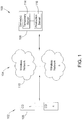
- FIG. 1 illustrates a block diagram of an example communications system 100 in which various embodiments of the present disclosure may be implemented.
- a plurality of client devices 1 - n 102 are shown in relation to a plurality of wireless networks 1 - n 104, which in turn is shown in relation to a server 106.
- the plurality of client devices 102 collect quality parameters from the plurality of wireless networks 104, which the plurality of client devices 102 has available while they travel around various geographic locations.
- the quality parameters collected by the plurality of client devices 102 are then transferred to the server 106, which analyzes the quality parameters to build a database of summarized quality parameters in each geographic location.
- the server 106 then shares this database with each individual client device, such as client device 108, comprising the plurality of client devices 102.
- the plurality of client devices 102 can then make an informed decision on which wireless network of the plurality of wireless networks 104 to connect.
- the quality parameters may include only a single parameter or a multitude of parameters.
- the quality parameters may include at least one of a bit error rate, a signal strength such as a received signal strength indicator (RSSI), a network latency as determined by the time it takes from an HTTP request to an HTTP response, and network throughout measured in bytes/second and used to determine a time it takes to transmit a known amount of data packets.
- RSSI received signal strength indicator
- the plurality of client devices 102 may be a mobile device such as a smart phone, a tablet computer, a laptop computer, a watch with a computer operating system, a personal digital assistant (PDA), a video game console, a wearable or embedded digital device(s), or any one of a number of additional devices capable of communicating over the plurality of wireless networks 104.
- a mobile device such as a smart phone, a tablet computer, a laptop computer, a watch with a computer operating system, a personal digital assistant (PDA), a video game console, a wearable or embedded digital device(s), or any one of a number of additional devices capable of communicating over the plurality of wireless networks 104.
- PDA personal digital assistant
- the plurality of wireless networks 104 include but are not limited to Wide Area Networks (WAN) such as a Long Term Evolution (LTE) network, a Global System for Mobile Communications (GSM) network, a Code Division Multiple Access (CDMA) network, a Wideband Code Division Multiple Access (WCDMA) network, Wireless Local Area Networks (WLAN) such as the various Wi-Fi networks operating under the various IEEE 802.11 standards, or any other kind of wireless network.
- WAN Wide Area Networks
- LTE Long Term Evolution
- GSM Global System for Mobile Communications
- CDMA Code Division Multiple Access
- WCDMA Wideband Code Division Multiple Access
- WLAN Wireless Local Area Networks
- the plurality of wireless networks 104 allow the plurality of client devices 102 to communicate with the server 106.
- client device 108 may transmit information to the server 106 and receive information from the server 106 through wireless network 110.
- the plurality of wireless networks 104 may include a set of cell towers, as well as a set of base stations and/or mobile switching centers (MSCs). In some embodiments, the plurality of wireless networks 104 may include various cell tower/base station/MSC arrangements.
- each client device of the plurality of client devices 102 will be able to connect to each of the plurality of wireless networks 104. In this manner, each individual client device from the plurality of client devices 102 will only report quality parameters from the individual wireless networks the individual client device is able to communicate with.
- embodiments of the disclosure described herein will refer to the plurality of client devices 102 collecting quality parameters from the plurality of data networks 104 even though it is understood that not every client device of the plurality of client devices 102 will communicate with every wireless network.
- server 106 is illustrated as a single server. However, server 106 could be implemented as a plurality of servers servicing specified geographic locations, or server 106 could be implemented as a cloud server.
- the singular server 106 is illustrated for ease of description. This singular server illustration is not intended to limit the disclosure contained herein.
- the server 106 is illustrated as including a temporary server 114 and a production server 116.
- the temporary server 114 and the production server 116 may be included as software servers within server 106 or as separate servers communicatively coupled in a cluster of servers 106.
- the temporary server 114 functions to receive data reported from the plurality of client devices 102 and temporarily store the data for holding and analyzing the data prior to transfer to the production server 116.
- the production server 116 aggregates the data and stores it in a searchable database (see FIG. 4 ).
- the data stored in the database by the production server 116 is aggregated and stored for a finite period of time, such as one day, one week, one month, three months or longer.
- the network quality as determined by the quality parameters for the plurality of wireless networks 104 will be built upon recently collected relevant data.
- client device 108 or wireless network 110 are only referenced as being generally representative of the plurality of client devices 102 and the plurality of wireless networks 104, respectively. Therefore, the functionality of client device 108 can be imported to the plurality of client devices 102, and the functionality of wireless network 110 can be imported to the plurality of wireless networks 110.
- the plurality of client devices 102 may collect further data beyond the quality parameters associated with the plurality of wireless networks 104. In certain embodiments, the plurality of client devices 102 will also collect wireless network identification information utilized to uniquely identify a wireless network and an access point for that wireless network.
- client device 108 may transmit information to the server 106 and receive information from the server 106 through wireless network 110, and wireless network 110 may be a Wi-Fi wireless network.
- the client device 108 would collect identification information including at least one of a Basic Service Set Identification (BSSID) and a Service Set Identification (SSID).
- BSSID Basic Service Set Identification
- SSID Service Set Identification
- the client device 108 will collect both the SSID and the BSSID, which will uniquely identify an access point for the Wi-Fi wireless network 110.
- the Wi-Fi wireless network 110 may indicate that it does not want to be uniquely identified.
- the SSID may contain the term "_nomap" in the name field, which indicates that the particular Wi-Fi wireless network 110 does not wish to have data uniquely identifying the network collected.
- the client device 108 will only collect BSSID information, such as the MAC address of the wireless network 110 access point.
- client device 108 may transmit information to the server 106 and receive information from the server 106 through wireless network 110, and wireless network 110 may be a cellular wireless network.
- the client device 108 would collect identification information that uniquely identifies an access point for the cellular wireless network 110.
- the identification information could be an identifier of a cellular base station, such as a CellID.
- the identification information could include a NetworkID, a SystemID and/or a BasestationID.
- the identification information could include a Mobile Country Code (MCC), a Mobile Network Code (MNC) and/or a Location Area Code (LAC).
- MCC Mobile Country Code
- MNC Mobile Network Code
- LAC Location Area Code
- the identification information could include a MCC, a MNC, a Tracking Area Code (TAC) and/or a physical Cell Identity (CI).
- the identification information may indicate a type of cellular wireless network.
- the identification information may further include information regarding whether the wireless network 110 is an Evolution Data-Optimized (EVDO) network, a High Speed Packet Access (HSPA) network or an LTE network.
- EVDO Evolution Data-Optimized
- HSPA High Speed Packet Access
- LTE Long Term Evolution
- the identification information is associated with the quality parameters for the wireless network 110 and sent to the server 106.
- the quality parameters are associated with a unique wireless network or unique access point of the wireless network.
- the client device 108 may collect location data that indicates a location of the client device 108 while collecting the quality parameters.
- the location data includes a latitude, a longitude and a timestamp of when the location data is determined.
- the latitude and longitude are collected to a certain precision that allows the location of client device 108 to be determined to within 5 - 100 meters. In doing so, the latitude and longitude data will be coarsened to the sixth decimal digit.
- One such technique to coarsen the longitude and latitude data is to multiply a raw latitude or longitude measurement by 1,000,000 and truncate any places in the resulting number beyond six digits after the decimal.
- the location data will be associated with the quality parameters and identification information and sent to the server 106.
- a location of the client device 108 is associated with the quality parameters and the identification information such that a map of wireless network quality can be determined based on the data in database.
- the location data will only be collected if a user of the client device 108 has indicated that location data may be collected from the client device 108. In this regard, if the user configures the client device 108 such that location data is not to be collected, then location data for the client device 108 will not be collected.
- the client device 108 may collect a timestamp of when the quality parameters were collected and associate that timestamp with the quality parameters as they are sent to the server 106.
- the timestamp collected at the time of collecting the quality parameters may be different than a timestamp collected at the time of determining a location of the client device 108.
- the client device 108 may also collect data indicating a name and version of an application residing on the client device 108, where the application is utilized to collect the quality parameters. Also, the client device 108 may collect data indicating whether the wireless network 110 is a captive portal or a tethered network. The data indicating whether the wireless network 110 is a captive network or a tethered portal may be in the form of a true/false bit.
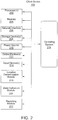
- FIG. 2 a block diagram of basic functional components for an individual client device, such as client device 108 (see FIG. 1 ), of the plurality of client devices 102 (see FIG. 1 ), according to one aspect of the disclosure, is illustrated.
- the client device 108 includes one or more processors 202, memory 204, a network interface 206, one or more storage devices 208, power source 210, one or more output devices 212, one or more input devices 214, a location determination module 218, a data collection module 220 and a reporting module 222.
- the client device 108 also includes an operating system 216.
- Each of the components including the processor 202, memory 204, network interface 206, storage device 208, power source 210, output device 212, input device 214, location determination module 218, data collection module 220, reporting module 222 and the operating system 216 is interconnected physically, communicatively, and/or operatively for inter-component communications.
- processor 202 is configured to implement functionality and/or process instructions for execution within client device 108.
- processor 202 executes instructions stored in memory 204 or instructions stored on a storage device 208.
- Memory 204 which may be a non-transient, computer-readable storage medium, is configured to store information within client device 108 during operation.
- memory 204 includes a temporary memory, an area for information not to be maintained when the client device 108 is turned off. Examples of such temporary memory include volatile memories such as random access memories (RAM), dynamic random access memories (DRAM), and static random access memories (SRAM).
- RAM random access memories
- DRAM dynamic random access memories
- SRAM static random access memories
- Storage device 208 also includes one or more non-transient computer-readable storage media.
- the storage device 208 is generally configured to store larger amounts of information than memory 204.
- the storage device 208 may further be configured for long-term storage of information.
- the storage device 208 includes non-volatile storage elements.
- Non-limiting examples of non-volatile storage elements include magnetic hard discs, optical discs, floppy discs, flash memories, or forms of electrically programmable memories (EPROM) or electrically erasable and programmable (EEPROM) memories.
- the client device 108 uses network interface 206 to communicate with external devices via one or more networks, such as the plurality of wireless networks 104 (see FIG.l), and other types of networks through which a communication with the client device 108 may be established.
- Network interface 206 may be a network interface card, such as an Ethernet card, an optical transceiver, a radio frequency transceiver, or any other type of device that can send and receive information.
- Other non-limiting examples of network interfaces include Bluetooth®, 3G and Wi-Fi radios in client computing devices, and USB.
- the client device 108 includes one or more input devices 214.
- Input devices 214 are configured to receive input from a user or a surrounding environment of the user through tactile, audio, and/or video feedback.
- Non-limiting examples of input device 214 include a presence-sensitive screen, a mouse, a keyboard, a voice responsive system, video camera, microphone or any other type of input device.
- a presence-sensitive screen includes a touch-sensitive screen.
- One or more output devices 212 are also included in client device 108.
- Output devices 212 are configured to provide output to a user using tactile, audio, and/or video stimuli.
- Output device 212 may include a display screen (part of the presence-sensitive screen), a sound card, a video graphics adapter card, or any other type of device for converting a signal into an appropriate form understandable to humans or machines.
- Additional examples of output device 212 include a speaker such as headphones, a cathode ray tube (CRT) monitor, a liquid crystal display (LCD), or any other type of device that can generate intelligible output to a user.
- CTR cathode ray tube
- LCD liquid crystal display
- the client device 108 includes one or more power sources 210 to provide power to the device.
- power source 210 include single-use power sources, rechargeable power sources, and/or power sources developed from nickel-cadmium, lithium-ion, or other suitable material.
- the client device 108 includes an operating system 216.
- the operating system 216 controls operations of the components of the client device 108.
- the operating system 216 facilitates the interaction of the processor(s) 202, memory 204, network interface 206, storage device(s) 208, input device 214, output device 212, and power source 210.
- the client device 108 uses the location determination module 218 to determine a geographic location of the client device 108.
- This location determination module 218 may be a GPS transceiver or a state of the processor 202, which is defined by a series of instructions stored on the memory 204 or storage device 208 that when executed cause the processor 202 to triangulate a geographic location of the client device 108 based on any available wireless network connections.
- the client device 108 further includes a data collection module 220 and a reporting module 222.
- both the data collection module 220 and the reporting module 222 represent various states of the processor 202, and are defined by program instructions and/or data stored on the memory 204 or the storage device 208.
- the data collection module 220 configures the client device 108 to collect quality parameters and other forms of network information such as the wireless network identification information and the location data, as discussed above in relation to FIG. 1 , from the plurality of wireless networks 104 (see FIG. 1 ). Once the quality parameters and other information are collected for an individual wireless network, such as wireless network 110 (see FIG. 1 ), then the data collection module 220 provides quality parameters and the other network information to the reporting module 222.
- the reporting module 222 configures the client device 108 to upload, to the server 106 (see FIG. 1 ), the identification information associated with the wireless network 110, location data pertaining to a location of the client device 108 when the quality parameters were collected, and the actual quality parameters collected.
- server 106 is configured to receive performance parameters for the plurality of data networks 104 (see FIG. 1 ) and create a database of summarized quality parameters arranged by wireless network identification information that uniquely identifies individual access points corresponding to individual wireless networks of the plurality of wireless networks 104.
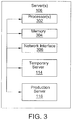
- the server(s) 106 includes one or more processors 302, memory 304, network interface 306, a temporary server 114 and a production server 116.
- processors 302, memory 304, network interface 306, a temporary server 114 and a production server 116 are interconnected physically, communicatively, and/or operatively for inter-component communications.
- processors 302 are configured to implement functionality and/or process instructions for execution within server 106.
- processors 302 execute instructions stored in memory 304.
- Memory 304 which may be a non-transient, computer-readable storage medium, is configured to store information within server 106 during operation.
- memory 304 includes a temporary memory, i.e. an area for information not to be maintained when the server 106 is turned off. Examples of such temporary memory include volatile memories such as random access memories (RAM), dynamic random access memories (DRAM), and static random access memories (SRAM).
- RAM random access memories
- DRAM dynamic random access memories
- SRAM static random access memories
- the server 106 uses network interface 306 to communicate with external devices via one or more networks, such as the plurality of wireless networks 104 of FIG. 1 .
- networks may include one or more wireless networks, wired networks, fiber optics networks, and other types of networks through which communication between the server 106 and an external device may be established.
- Network interface 306 may be a network interface card, such as an Ethernet card, an optical transceiver, a radio frequency transceiver, or any other type of device that can send and receive information.
- the server 106 is illustrated as including a temporary server 114 and a production server 116.
- the temporary server 114 and the production server 116 may be included as software servers within server 106 or as separate servers communicatively coupled in a cluster of servers 106.
- the temporary server 114 functions to receive data reported from the plurality of client devices 102 and temporarily store the data for holding and analyzing the data prior to transfer to the production server 116.
- the production server 116 receives the data, such as the quality parameters, from the temporary server 114, the production server 116 aggregates the data and stores it in a searchable database.
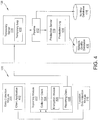
- FIG. 4 a block diagram including a flow of data collected by the plurality of client devices 102 of FIG. 1 and stored by the server(s) 106 of FIG. 1 is illustrated.
- FIG. 4 illustrates a flow of data collected and reported by a client device 108 (see FIG. 1 ) to the server(s) 106 where the data is aggregated, filtered and stored.
- the client device 108 includes the data collection module 220, which includes a client application 402.
- the client application 402 communicates with a wireless network, such as wireless network 110.
- the client application 402 can be any application residing on the client device 108 that is capable of collecting wireless network quality parameters such as latency and throughput.
- the reporting module 222 includes a collection client 404 that receives the wireless network quality parameters from the client application 402.
- the collection client 404 determines whether the client application is an application that is trusted to provide the wireless network quality parameters. In certain embodiments, the collection client 404 will only take wireless network quality parameters from trusted applications. For instance, the collection client 404, prior to accepting the quality parameters from the client application 402, may determine whether the client application 402 is part of a trusted applications list that provides a list of applications that the collection client 404 can trust for the purposes of receiving wireless network quality parameters. If the collection client 404 determines that the client application 402 is a trusted application, then the collection client 404 accepts the wireless network quality parameters.
- the collection client 404 also determines the wireless network identification information for the wireless network, such as wireless network 110, that the quality parameters were collected from.
- the wireless network identification information is associated with the quality parameters and provided to the reporting client 408 for reporting to the server(s) 106.
- the wireless network identification information Prior to being reported, the wireless network identification information is obfuscated by a encryption module 406, which hashes the wireless network identification information prior to it being reported to the server(s) 106. Accordingly, the wireless network identification information is reported to the server(s) 106 in an obfuscated state.
- any suitable hashing function may be used to obfuscate the collected wireless network identification information.
- a SHA-256 hashing function may be utilized to obfuscate the wireless network identification information.
- the collection client 404 determines whether location data providing a location of the client device 108 when measuring the quality parameters may be collected and provided to the server(s) 106. The location data is provided to the collection client 404 by the location determination module 218. However, prior to associating the location data with the quality parameters and the wireless network identification information, the collection client 404 determines whether location consent is provided on the client device 108. The collection client 404 will only report location data if the client device 108 provides location consent.
- the collection client 404 will not append the location data to the quality parameters and the wireless network identification information.
- the client device 108 does not include a user account associated with the client device.
- the client device 108 may include one or more user accounts associated with various users of the client device 108.
- location data is not appended is where one or more user accounts associated with the client device 108 indicates that a location history is not to be stored or that the client device 108 is not to report its location. In one embodiment, if one or more user account indicates that location data is not to be collected, the location data will not be appended for all user accounts for client device 108.
- the collection client 404 determines that the client device 108 does not prohibit the collection of location data, then the collection client 404 appends the location data to the quality parameters and the wireless network identification information for reporting by the reporting client 408.
- the collection client 404 anonymizes the location data by associating it only with a pseudonymous (sticky) identifier that only identifies the client device 108 and not a user account associated with the client device 108.
- This pseudonymous identifier is generated by the collection client 404 for the purposes of identifying the client device 108 associated with the location data.
- the pseudonymous identifier is only used for a period of time before it is recycled for use again with different location data. In some embodiments, this time period is seven days or less.
- the location data is only reported with accuracy between 5 - 100 meters.
- the location data is generally in the form of longitude and latitude measurements.
- the collection client 404 upon receiving the longitude and latitude measurements from the location determination module 218, the collection client 404 multiplies each longitude and latitude measurement by 1,000,000 and then truncates any digit beyond six digits after the decimal in order to coarsen the collected data to provide the desired accuracy.
- the collection client 404 After collection of the quality parameters and the network information including the wireless network identification information and the location data, the collection client 404 provides that data to the reporting client 408 for reporting to the server(s) 106.
- the server(s) 106 side includes a temporary server 114 including a temporary log 410 that first receives the data from the reporting client 408.
- the data is retained in the temporary log 410 of the temporary server 114 for a finite period of time, such as seven days. While being retained, the data is processed, scrubbed and anonymized to ensure that the quality parameters and associated wireless network identification information and location data do not identify a user of the client device or include data from a wireless network that indicates it is not to be stored, such as the previously mentioned "_nomap" wireless networks.
- the temporary server 114 After the expiration of the retention period, the temporary server 114 provides the processed, scrubbed and anonymized data from the temporary log 410 to a pipeline 412, which provides the data to the production server 116 that stores it in a production log 414.
- the data in the production log 414 is aggregated with previously stored data pertaining to the particular wireless network associated with the quality parameters, such as wireless network 110.
- the quality parameters are aggregated with previously collected quality parameters as identified by the wireless network identification information.
- the location data is aggregated and stored with the quality parameters associated with the wireless network identification information.
- a network quality associated with a wireless network such as wireless network 110 may be determined.
- the network quality provides a historical indication of performance for that wireless network based on the wireless network quality parameters and the location data.
- the wireless network quality may be based on a weighted average of the totality of throughput and latency measurements collected from the plurality of client devices 102 (see FIG. 1 ) over time, as defined by the collected timestamp indicating a time when the wireless network quality parameters were collected.
- the more recently collected quality parameters could be weighted more heavily in comparison to previously collected wireless network quality parameters in determining the wireless network quality.
- That average could be compared to a known range of average values that assigns a relative network quality score for that wireless network.
- that score could be on a scale from one to ten or from one to one hundred, where a higher score indicates a better performing wireless network, or vice versa.
- the wireless network quality is stored in the network quality database 416 and made searchable based on wireless network identification information and location. In this manner, a client device, such as client device 108, that has access to the network quality database 416 can utilize the stored wireless network quality to make informed decisions regarding a variety of tasks the client device 108 may undertake.
- the sever(s) 106 side further includes a no map database 418.
- the no map database 418 provides a log of wireless networks that indicate that quality parameters are not to be collected.
- the collection client 404 determines whether the wireless network includes an indication that the wireless network is not to be included in the wireless network quality database. One such indication would be for a Wi-Fi network with the term "_nomap" in the SSID for an access point of the Wi-Fi network. If the SSID of the access point of the Wi-Fi network includes "_nomap," then no quality parameters will be reported for that Wi-Fi network.
- the BSSID is reported, hashed by the encryption module 406 and stored on the server(s) 106 end in the no map database 418, after being processed through the temporary server 114.
- the temporary server 114 recognizes that the hashed BSSID is not associated with a hashed SSID and passes it to the pipeline 412 to be stored in the no map database 418.
- the no map database 418 is utilized as part of the processing, scrubbing and anonymization process discussed above in regard to the temporary server 114. Accordingly, in the example above including the Wi-Fi network, during the processing, scrubbing and anonymization process performed by the temporary server 114, if the temporary server 114 identifies quality parameters measured from a different access point of the Wi-Fi network with an SSID that does not include "_nomap," then the hashed BSSID from the different access point of the Wi-Fi network is compared against the BSSIDs stored in the no map database 418 to determine whether the different access point is associated with the Wi-Fi network with the access point indicating that quality parameters are not to be collected.
- the quality parameters and location data associated with the different access point of the Wi-Fi network are discarded and not utilized in the determination of network quality stored in the network quality database.
- a wireless network once a wireless network is determined to be stored in the no map database 418, it will remain in the no map database 418 until further wireless network identification information collected from the wireless network indicates that the wireless network no longer prohibits the collection of quality parameters.
- the wireless network identification information for the wireless network in the no map database 418 must no longer indicate that quality parameters are not to be collected for a set period of time, such as seven days before the wireless network will be removed from the no map database 418.
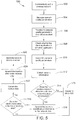
- FIG. 5 a flow diagram 500 providing steps performed by a client device, of the plurality of client devices 1-n 102 (see FIG. 1 ), for collecting and sending wireless network information, including quality parameters, wireless network identification information and location data is illustrated.
- the client device for ease of description, say client device 108 - see FIG. 1
- a wireless network for ease of description, say wireless network 110
- a client application 402 of the client device 108 measures quality parameters from the wireless network 110.
- the quality parameters are provided to a collection client 404 (see FIG. 4 ) by the client application 402 of the client device 108 (see FIG. 1 ).
- the collection client 404 checks to determine whether the client application 402 is a trusted application, and, if the client application 402 is trusted, then at step 510, the collection client 404 accepts the quality parameters.
- the collection client 404 collects wireless network identification information.
- the collection client 404 reviews the wireless network identification information to determine whether it is supposed to be collected; for instance, the wireless network is a Wi-Fi network, and the SSID includes "_nomap.” If the SSID does contain "_nomap," then the flow chart proceeds to step 516, which bypasses the remaining steps to step 526 where only the BSSID is reported to the server(s) 106 (see FIG. 1 ) by the reporting client 408.
- a further step of hashing the BSSID by the encryption module 406 may be performed prior to step 526.
- step 415 determines that there is no indication that quality parameters are not to be collected
- step 518 the collection client 404 appends the wireless identification information to the quality parameters.
- a further step of hashing the BSSID by the encryption module 406 may be performed to obfuscate the wireless identification information prior to transmission to the server(s) 106 (see FIG. 1 ).
- the collection client 404 determines whether the client device 108 allows location data collected by a location determination module 218 (see FIG. 2 ) to be appended to the quality parameters and the wireless network identification information. If location data cannot be appended, then the flow chart proceeds to step 516, which acts as a bypass to step 526 where only the quality parameters and the appended wireless network identification information will be sent to the server(s) 106 (see FIG. 1 ).
- the collection client 404 determines that the client device 108 (see FIG. 1 ) allows location data to be collected, then at step 522 the collection client 404 receives location data from the location determination module 218 (see FIG. 2 ), and at step 524, the collection client 404 appends the location data to the quality parameters and the wireless network identification information. At step 526, the collection client 404 provides the quality parameters with the appended wireless network identification information and location data to the reporting client 408, which sends the quality parameters with the appended wireless network identification information and location data to the server(s) 106.
- server(s) 106 receives quality parameters associated with network information, which may include wireless network identification information and location data.
- the server(s) 106 aggregates the received quality parameters with previously received quality parameters for the wireless network identified by the wireless network identification information.
- the server(s) 106 determines whether location data providing a location of the client device when measuring the quality parameters is provided in the network information. If location data is provided, then at step 608, the server(s) 106 aggregate the location data along with the quality parameters for the wireless network identified by the wireless network identification information. However, if location data is not present in the network information, then the flow chart 600 bypasses step 608 and proceeds directly to step 610.
- the server(s) 106 processes the aggregated quality parameters to determine a network quality of the wireless network.
- the server(s) 106 stores the network quality in a network quality database 416 (see FIG. 4 ).
- the network quality stored in the network quality database 416 is searchable based on wireless network identification information and further searchable based on a geographic location.
- the users may be provided with an opportunity to control whether programs or features collect user information (e.g., information about a user's social network, social actions or activities, profession, a user's preferences, or a user's current location), or to control whether and/or how to receive content from a server that may be more relevant to the user.
- user information e.g., information about a user's social network, social actions or activities, profession, a user's preferences, or a user's current location
- certain data may be treated in one or more ways before it is stored or used, so that personally identifiable information is removed.
- a user's identity may be treated so that no personally identifiable information can be determined for the user, or a user's geographic location may be generalized where location information is obtained (such as to a city, ZIP code, or state level), so that a particular location of a user cannot be determined.
- location information such as to a city, ZIP code, or state level
- the user may have control over how information is collected about the user and used by a server.
Landscapes
- Engineering & Computer Science (AREA)
- Computer Networks & Wireless Communication (AREA)
- Signal Processing (AREA)
- Mobile Radio Communication Systems (AREA)
Description
- Client devices, such as a mobile phone or laptop, often have a plurality of available wireless networks to choose from in order to achieve network connectivity. Typically, an available wireless network is selected by a client device or a user of the client device. However, the client device and the user do not have access to certain historical network quality parameters that will inform a decision to select a wireless network to use for achieving the best network quality.
- Additionally, while there are an abundance of wireless networks available for use by client devices, each individual client device may only be aware of the presence of a particular wireless network once the individual client device is within signal range of an access point of the wireless network. In this regard, the individual client device may be unable to determine what wireless network to attach to until it comes into signal range of the access point of the wireless network. This issue is exacerbated as the client device moves between various wireless network coverage areas. Accordingly, the wireless network selection process is inefficient.
- Qualcomm Europe et al.: "Text proposal for UE Measurements for Minimizing Drive Tests," 3GPP Draft, R2-093175 relates to use cases for minimization of drive tests.
- Qualcomm Europe: "Framework for UE SON Reports," 3GPP TSG RAN WG3& SA WG5, no. S5-090017 relates to utilizing measurement capabilities in UEs in order to augment the information available at the OAM on the status of the network.
- CMCC: "Network Selection for WLAN/3GPP Radio Interworking," 3GPP Draft, R2-130973 relates to issues of network selection for WLAN/3GPP interworking scenarios, which are: factors necessary considered for network selection, who is the decision maker, i.e. network side or UE.
- According to one aspect, there is provided a method of providing network quality parameters for a plurality of different wireless network from a client device, as set out in
claim 1. - According to another aspect, there is provided a method implemented on one or more servers of providing a database of wireless networks based on network quality, as set out in claim 9.
- According to a further aspect, there is provided a non-transitory computer readable storage device for collecting network quality parameters by a client application residing on a client device, as set out in claim 15.
- Other aspects, objectives and advantages of the disclosure will become more apparent from the following detailed description when taken in conjunction with the accompanying drawings.
- The accompanying drawings incorporated in and forming a part of the specification illustrate several aspects of the present disclosure and, together with the description, serve to explain the principles of the disclosure. In the drawings:
-
FIG. 1 is a block diagram illustrating a system for collecting wireless network data, according to an example embodiment; -
FIG. 2 is a block diagram illustrating components of a client device from the system illustrated inFIG. 1 , according to an example embodiment; -
FIG. 3 is a block diagram illustrating components of a server or cluster of servers from the system illustrated inFIG. 1 , according to an example embodiment; -
FIG. 4 is a block diagram illustrating a flow of data collected by the client devices ofFIG. 1 and stored by the server(s) ofFIG. 1 , according to an example embodiment; -
FIG. 5 is a flow diagram illustrating steps performed by a client device for collecting and sending wireless network data, according to an example embodiment; and -
FIG. 6 is a flow diagram illustrating steps performed by a server or cluster of servers for receiving, processing and storing wireless network data, according to an example embodiment. - Client devices, such as a mobile phone or laptop, often have a plurality of available wireless networks to choose from in order to achieve network connectivity. Typically, an available wireless network is selected by a client device or a user of the client device. However, the client device and the user do not have access to certain historical network quality parameters that will inform a decision to select a wireless network to use for achieving the best network quality.
- Additionally, while there are an abundance of wireless networks available for use by client devices, each individual client device may only be aware of the presence of a particular wireless network once the individual client device is within signal range of an access point of the wireless network. In this regard, the individual client device may be unable to determine what wireless network to attach to until it comes into signal range of the access point of the wireless network. This issue is exacerbated as the client device moves between various wireless network coverage areas. Accordingly, the wireless network selection process is inefficient.
- Therefore, to improve wireless network selection efficiency, quality parameters relating a wireless network quality can be collected over time and utilized to determine which wireless network a client device will attach to out of a plurality of available wireless networks. Embodiments of the disclosure described herein provide a system to collect and analyze quality parameters and other network and geographic information related to wireless networks. Using the collected quality parameters and network and geographic information, the system is able to build a searchable database providing wireless network quality in various geographic areas for various wireless networks where quality parameters and wireless network information is collected. In certain embodiments, the wireless network will be searchable based on wireless network identification information and a geographic location of a client device. The system is then able to provide access to the database in order to support a variety of uses, such as making an informed decision on wireless network selection or planning future data downloads based on a route of travel of the client device.
-
FIG. 1 illustrates a block diagram of anexample communications system 100 in which various embodiments of the present disclosure may be implemented. In thecommunications system 100 depicted inFIG. 1 , a plurality of client devices 1 -n 102 are shown in relation to a plurality of wireless networks 1 -n 104, which in turn is shown in relation to aserver 106. The plurality ofclient devices 102 collect quality parameters from the plurality ofwireless networks 104, which the plurality ofclient devices 102 has available while they travel around various geographic locations. The quality parameters collected by the plurality ofclient devices 102 are then transferred to theserver 106, which analyzes the quality parameters to build a database of summarized quality parameters in each geographic location. Theserver 106 then shares this database with each individual client device, such asclient device 108, comprising the plurality ofclient devices 102. The plurality ofclient devices 102 can then make an informed decision on which wireless network of the plurality ofwireless networks 104 to connect. - The quality parameters may include only a single parameter or a multitude of parameters. For instance, the quality parameters may include at least one of a bit error rate, a signal strength such as a received signal strength indicator (RSSI), a network latency as determined by the time it takes from an HTTP request to an HTTP response, and network throughout measured in bytes/second and used to determine a time it takes to transmit a known amount of data packets.
- The plurality of
client devices 102 may be a mobile device such as a smart phone, a tablet computer, a laptop computer, a watch with a computer operating system, a personal digital assistant (PDA), a video game console, a wearable or embedded digital device(s), or any one of a number of additional devices capable of communicating over the plurality ofwireless networks 104. - The plurality of
wireless networks 104 include but are not limited to Wide Area Networks (WAN) such as a Long Term Evolution (LTE) network, a Global System for Mobile Communications (GSM) network, a Code Division Multiple Access (CDMA) network, a Wideband Code Division Multiple Access (WCDMA) network, Wireless Local Area Networks (WLAN) such as the various Wi-Fi networks operating under the various IEEE 802.11 standards, or any other kind of wireless network. The plurality ofwireless networks 104 allow the plurality ofclient devices 102 to communicate with theserver 106. For example,client device 108 may transmit information to theserver 106 and receive information from theserver 106 throughwireless network 110. Further, the plurality ofwireless networks 104 may include a set of cell towers, as well as a set of base stations and/or mobile switching centers (MSCs). In some embodiments, the plurality ofwireless networks 104 may include various cell tower/base station/MSC arrangements. - As an aside, whether because of technological limitations or geographic limitations, not every client device of the plurality of
client devices 102 will be able to connect to each of the plurality ofwireless networks 104. In this manner, each individual client device from the plurality ofclient devices 102 will only report quality parameters from the individual wireless networks the individual client device is able to communicate with. For ease of description, embodiments of the disclosure described herein will refer to the plurality ofclient devices 102 collecting quality parameters from the plurality ofdata networks 104 even though it is understood that not every client device of the plurality ofclient devices 102 will communicate with every wireless network. - Further,
server 106 is illustrated as a single server. However,server 106 could be implemented as a plurality of servers servicing specified geographic locations, orserver 106 could be implemented as a cloud server. Thesingular server 106 is illustrated for ease of description. This singular server illustration is not intended to limit the disclosure contained herein. Also, theserver 106 is illustrated as including atemporary server 114 and aproduction server 116. Thetemporary server 114 and theproduction server 116 may be included as software servers withinserver 106 or as separate servers communicatively coupled in a cluster ofservers 106. Thetemporary server 114 functions to receive data reported from the plurality ofclient devices 102 and temporarily store the data for holding and analyzing the data prior to transfer to theproduction server 116. Once theproduction server 116 receives the data, such as the quality parameters, from thetemporary server 114, theproduction server 116 aggregates the data and stores it in a searchable database (seeFIG. 4 ). - As an aside, in certain embodiments, the data stored in the database by the
production server 116 is aggregated and stored for a finite period of time, such as one day, one week, one month, three months or longer. In this regard, the network quality as determined by the quality parameters for the plurality ofwireless networks 104 will be built upon recently collected relevant data. - As the discussion of the various devices, systems and methods contained herein progresses, at points only a
singular client device 108 or asingular wireless network 110 may be discussed. In this regard,client device 108 orwireless network 110 are only referenced as being generally representative of the plurality ofclient devices 102 and the plurality ofwireless networks 104, respectively. Therefore, the functionality ofclient device 108 can be imported to the plurality ofclient devices 102, and the functionality ofwireless network 110 can be imported to the plurality ofwireless networks 110. - The plurality of
client devices 102 may collect further data beyond the quality parameters associated with the plurality ofwireless networks 104. In certain embodiments, the plurality ofclient devices 102 will also collect wireless network identification information utilized to uniquely identify a wireless network and an access point for that wireless network. - In certain embodiments,
client device 108 may transmit information to theserver 106 and receive information from theserver 106 throughwireless network 110, andwireless network 110 may be a Wi-Fi wireless network. In this instance, theclient device 108 would collect identification information including at least one of a Basic Service Set Identification (BSSID) and a Service Set Identification (SSID). In certain embodiments, theclient device 108 will collect both the SSID and the BSSID, which will uniquely identify an access point for the Wi-Fi wireless network 110. However, in other embodiments the Wi-Fi wireless network 110 may indicate that it does not want to be uniquely identified. For instance, the SSID may contain the term "_nomap" in the name field, which indicates that the particular Wi-Fi wireless network 110 does not wish to have data uniquely identifying the network collected. In this embodiment, theclient device 108 will only collect BSSID information, such as the MAC address of thewireless network 110 access point. - In certain embodiments,
client device 108 may transmit information to theserver 106 and receive information from theserver 106 throughwireless network 110, andwireless network 110 may be a cellular wireless network. In this instance, theclient device 108 would collect identification information that uniquely identifies an access point for thecellular wireless network 110. For instance, the identification information could be an identifier of a cellular base station, such as a CellID. If thecellular wireless network 110 is a CDMA network, then the identification information could include a NetworkID, a SystemID and/or a BasestationID. If thecellular wireless network 110 is a GSM or WCDMA network, then the identification information could include a Mobile Country Code (MCC), a Mobile Network Code (MNC) and/or a Location Area Code (LAC). If thecellular wireless network 110 is an LTE network, then the identification information could include a MCC, a MNC, a Tracking Area Code (TAC) and/or a physical Cell Identity (CI). - Further, in certain embodiments, the identification information may indicate a type of cellular wireless network. For instance, the identification information may further include information regarding whether the
wireless network 110 is an Evolution Data-Optimized (EVDO) network, a High Speed Packet Access (HSPA) network or an LTE network. - Whether the
wireless network 110 is a Wi-Fi wireless network or a cellular wireless network, the identification information is associated with the quality parameters for thewireless network 110 and sent to theserver 106. In this regard, the quality parameters are associated with a unique wireless network or unique access point of the wireless network. - Additionally, in certain embodiments, the
client device 108 may collect location data that indicates a location of theclient device 108 while collecting the quality parameters. In certain embodiments, the location data includes a latitude, a longitude and a timestamp of when the location data is determined. Generally, the latitude and longitude are collected to a certain precision that allows the location ofclient device 108 to be determined to within 5 - 100 meters. In doing so, the latitude and longitude data will be coarsened to the sixth decimal digit. One such technique to coarsen the longitude and latitude data is to multiply a raw latitude or longitude measurement by 1,000,000 and truncate any places in the resulting number beyond six digits after the decimal. - If collected, the location data will be associated with the quality parameters and identification information and sent to the
server 106. In this regard, a location of theclient device 108 is associated with the quality parameters and the identification information such that a map of wireless network quality can be determined based on the data in database. - As an aside, the location data will only be collected if a user of the
client device 108 has indicated that location data may be collected from theclient device 108. In this regard, if the user configures theclient device 108 such that location data is not to be collected, then location data for theclient device 108 will not be collected. - Additionally, other types of network information can be collected by the
client device 108. For instance, theclient device 108 may collect a timestamp of when the quality parameters were collected and associate that timestamp with the quality parameters as they are sent to theserver 106. For clarity, the timestamp collected at the time of collecting the quality parameters may be different than a timestamp collected at the time of determining a location of theclient device 108. - In certain embodiments, the
client device 108 may also collect data indicating a name and version of an application residing on theclient device 108, where the application is utilized to collect the quality parameters. Also, theclient device 108 may collect data indicating whether thewireless network 110 is a captive portal or a tethered network. The data indicating whether thewireless network 110 is a captive network or a tethered portal may be in the form of a true/false bit. - Turning now to
FIG. 2 , a block diagram of basic functional components for an individual client device, such as client device 108 (seeFIG. 1 ), of the plurality of client devices 102 (seeFIG. 1 ), according to one aspect of the disclosure, is illustrated. In general, many other embodiments of theclient device 108 may be used. In the illustrated embodiment ofFIG. 2 , theclient device 108 includes one ormore processors 202,memory 204, anetwork interface 206, one ormore storage devices 208,power source 210, one ormore output devices 212, one ormore input devices 214, alocation determination module 218, adata collection module 220 and areporting module 222. Theclient device 108 also includes anoperating system 216. Each of the components including theprocessor 202,memory 204,network interface 206,storage device 208,power source 210,output device 212,input device 214,location determination module 218,data collection module 220, reportingmodule 222 and theoperating system 216 is interconnected physically, communicatively, and/or operatively for inter-component communications. - As illustrated,
processor 202 is configured to implement functionality and/or process instructions for execution withinclient device 108. For example,processor 202 executes instructions stored inmemory 204 or instructions stored on astorage device 208.Memory 204, which may be a non-transient, computer-readable storage medium, is configured to store information withinclient device 108 during operation. In some embodiments,memory 204 includes a temporary memory, an area for information not to be maintained when theclient device 108 is turned off. Examples of such temporary memory include volatile memories such as random access memories (RAM), dynamic random access memories (DRAM), and static random access memories (SRAM).Memory 204 also maintains program instructions for execution by theprocessor 202. -
Storage device 208 also includes one or more non-transient computer-readable storage media. Thestorage device 208 is generally configured to store larger amounts of information thanmemory 204. Thestorage device 208 may further be configured for long-term storage of information. In some examples, thestorage device 208 includes non-volatile storage elements. Non-limiting examples of non-volatile storage elements include magnetic hard discs, optical discs, floppy discs, flash memories, or forms of electrically programmable memories (EPROM) or electrically erasable and programmable (EEPROM) memories. - The
client device 108 usesnetwork interface 206 to communicate with external devices via one or more networks, such as the plurality of wireless networks 104 (see FIG.l), and other types of networks through which a communication with theclient device 108 may be established.Network interface 206 may be a network interface card, such as an Ethernet card, an optical transceiver, a radio frequency transceiver, or any other type of device that can send and receive information. Other non-limiting examples of network interfaces include Bluetooth®, 3G and Wi-Fi radios in client computing devices, and USB. - The
client device 108 includes one ormore input devices 214.Input devices 214 are configured to receive input from a user or a surrounding environment of the user through tactile, audio, and/or video feedback. Non-limiting examples ofinput device 214 include a presence-sensitive screen, a mouse, a keyboard, a voice responsive system, video camera, microphone or any other type of input device. In some examples, a presence-sensitive screen includes a touch-sensitive screen. - One or
more output devices 212 are also included inclient device 108.Output devices 212 are configured to provide output to a user using tactile, audio, and/or video stimuli.Output device 212 may include a display screen (part of the presence-sensitive screen), a sound card, a video graphics adapter card, or any other type of device for converting a signal into an appropriate form understandable to humans or machines. Additional examples ofoutput device 212 include a speaker such as headphones, a cathode ray tube (CRT) monitor, a liquid crystal display (LCD), or any other type of device that can generate intelligible output to a user. - The
client device 108 includes one ormore power sources 210 to provide power to the device. Non-limiting examples ofpower source 210 include single-use power sources, rechargeable power sources, and/or power sources developed from nickel-cadmium, lithium-ion, or other suitable material. - The
client device 108 includes anoperating system 216. Theoperating system 216 controls operations of the components of theclient device 108. For example, theoperating system 216 facilitates the interaction of the processor(s) 202,memory 204,network interface 206, storage device(s) 208,input device 214,output device 212, andpower source 210. - The
client device 108 uses thelocation determination module 218 to determine a geographic location of theclient device 108. Thislocation determination module 218 may be a GPS transceiver or a state of theprocessor 202, which is defined by a series of instructions stored on thememory 204 orstorage device 208 that when executed cause theprocessor 202 to triangulate a geographic location of theclient device 108 based on any available wireless network connections. - In certain embodiments of the disclosure, the
client device 108 further includes adata collection module 220 and areporting module 222. In certain embodiments, both thedata collection module 220 and thereporting module 222 represent various states of theprocessor 202, and are defined by program instructions and/or data stored on thememory 204 or thestorage device 208. - The
data collection module 220 configures theclient device 108 to collect quality parameters and other forms of network information such as the wireless network identification information and the location data, as discussed above in relation toFIG. 1 , from the plurality of wireless networks 104 (seeFIG. 1 ). Once the quality parameters and other information are collected for an individual wireless network, such as wireless network 110 (seeFIG. 1 ), then thedata collection module 220 provides quality parameters and the other network information to thereporting module 222. - The
reporting module 222 configures theclient device 108 to upload, to the server 106 (seeFIG. 1 ), the identification information associated with thewireless network 110, location data pertaining to a location of theclient device 108 when the quality parameters were collected, and the actual quality parameters collected. - Turning to
FIG. 3 , a block diagram of basic functional components for a server or cluster of servers 106 (seeFIG. 1 ) is depicted, according to one aspect of the disclosure. Specifically,server 106 is configured to receive performance parameters for the plurality of data networks 104 (seeFIG. 1 ) and create a database of summarized quality parameters arranged by wireless network identification information that uniquely identifies individual access points corresponding to individual wireless networks of the plurality ofwireless networks 104. - The server(s) 106 includes one or more processors 302,
memory 304,network interface 306, atemporary server 114 and aproduction server 116. In some embodiments, each of the components including the processor(s) 302,memory 304,network interface 306,temporary server 114 andproduction server 116 are interconnected physically, communicatively, and/or operatively for inter-component communications. - As illustrated, processors 302 are configured to implement functionality and/or process instructions for execution within
server 106. For example, processors 302 execute instructions stored inmemory 304.Memory 304, which may be a non-transient, computer-readable storage medium, is configured to store information withinserver 106 during operation. In some embodiments,memory 304 includes a temporary memory, i.e. an area for information not to be maintained when theserver 106 is turned off. Examples of such temporary memory include volatile memories such as random access memories (RAM), dynamic random access memories (DRAM), and static random access memories (SRAM).Memory 304 also maintains program instructions for execution by the processors 302. - The
server 106 usesnetwork interface 306 to communicate with external devices via one or more networks, such as the plurality ofwireless networks 104 ofFIG. 1 . Such networks may include one or more wireless networks, wired networks, fiber optics networks, and other types of networks through which communication between theserver 106 and an external device may be established.Network interface 306 may be a network interface card, such as an Ethernet card, an optical transceiver, a radio frequency transceiver, or any other type of device that can send and receive information. - As mentioned above, the
server 106 is illustrated as including atemporary server 114 and aproduction server 116. Thetemporary server 114 and theproduction server 116 may be included as software servers withinserver 106 or as separate servers communicatively coupled in a cluster ofservers 106. Thetemporary server 114 functions to receive data reported from the plurality ofclient devices 102 and temporarily store the data for holding and analyzing the data prior to transfer to theproduction server 116. Once theproduction server 116 receives the data, such as the quality parameters, from thetemporary server 114, theproduction server 116 aggregates the data and stores it in a searchable database. - Turning to
FIG. 4 , a block diagram including a flow of data collected by the plurality ofclient devices 102 ofFIG. 1 and stored by the server(s) 106 ofFIG. 1 is illustrated. Specifically,FIG. 4 illustrates a flow of data collected and reported by a client device 108 (seeFIG. 1 ) to the server(s) 106 where the data is aggregated, filtered and stored. In this regard, theclient device 108 includes thedata collection module 220, which includes aclient application 402. Theclient application 402 communicates with a wireless network, such aswireless network 110. Theclient application 402 can be any application residing on theclient device 108 that is capable of collecting wireless network quality parameters such as latency and throughput. - Subsequent to collecting the wireless network quality parameters, the
client application 402 provides those quality parameters to thereporting module 222. Thereporting module 222 includes acollection client 404 that receives the wireless network quality parameters from theclient application 402. Upon receiving the quality parameters, thecollection client 404 determines whether the client application is an application that is trusted to provide the wireless network quality parameters. In certain embodiments, thecollection client 404 will only take wireless network quality parameters from trusted applications. For instance, thecollection client 404, prior to accepting the quality parameters from theclient application 402, may determine whether theclient application 402 is part of a trusted applications list that provides a list of applications that thecollection client 404 can trust for the purposes of receiving wireless network quality parameters. If thecollection client 404 determines that theclient application 402 is a trusted application, then thecollection client 404 accepts the wireless network quality parameters. - The
collection client 404 also determines the wireless network identification information for the wireless network, such aswireless network 110, that the quality parameters were collected from. The wireless network identification information is associated with the quality parameters and provided to thereporting client 408 for reporting to the server(s) 106. Prior to being reported, the wireless network identification information is obfuscated by aencryption module 406, which hashes the wireless network identification information prior to it being reported to the server(s) 106. Accordingly, the wireless network identification information is reported to the server(s) 106 in an obfuscated state. - As an aside, any suitable hashing function may be used to obfuscate the collected wireless network identification information. For instance, a SHA-256 hashing function may be utilized to obfuscate the wireless network identification information.
- Prior to reporting the quality parameters and the associated wireless network identification information, the
collection client 404 determines whether location data providing a location of theclient device 108 when measuring the quality parameters may be collected and provided to the server(s) 106. The location data is provided to thecollection client 404 by thelocation determination module 218. However, prior to associating the location data with the quality parameters and the wireless network identification information, thecollection client 404 determines whether location consent is provided on theclient device 108. Thecollection client 404 will only report location data if theclient device 108 provides location consent. - In this regard, there are several instances where the
collection client 404 will not append the location data to the quality parameters and the wireless network identification information. One such instance is where theclient device 108 does not include a user account associated with the client device. As an aside, theclient device 108 may include one or more user accounts associated with various users of theclient device 108. - Another instance where location data is not appended is where one or more user accounts associated with the
client device 108 indicates that a location history is not to be stored or that theclient device 108 is not to report its location. In one embodiment, if one or more user account indicates that location data is not to be collected, the location data will not be appended for all user accounts forclient device 108. - If the
collection client 404 determines that theclient device 108 does not prohibit the collection of location data, then thecollection client 404 appends the location data to the quality parameters and the wireless network identification information for reporting by the reportingclient 408. In certain embodiments, prior to appending the location data, thecollection client 404 anonymizes the location data by associating it only with a pseudonymous (sticky) identifier that only identifies theclient device 108 and not a user account associated with theclient device 108. This pseudonymous identifier is generated by thecollection client 404 for the purposes of identifying theclient device 108 associated with the location data. Generally, the pseudonymous identifier is only used for a period of time before it is recycled for use again with different location data. In some embodiments, this time period is seven days or less. - Furthermore, in certain embodiments, the location data is only reported with accuracy between 5 - 100 meters. Typically, the location data is generally in the form of longitude and latitude measurements. In certain embodiments, upon receiving the longitude and latitude measurements from the
location determination module 218, thecollection client 404 multiplies each longitude and latitude measurement by 1,000,000 and then truncates any digit beyond six digits after the decimal in order to coarsen the collected data to provide the desired accuracy. - After collection of the quality parameters and the network information including the wireless network identification information and the location data, the
collection client 404 provides that data to thereporting client 408 for reporting to the server(s) 106. The server(s) 106 side includes atemporary server 114 including atemporary log 410 that first receives the data from the reportingclient 408. The data is retained in thetemporary log 410 of thetemporary server 114 for a finite period of time, such as seven days. While being retained, the data is processed, scrubbed and anonymized to ensure that the quality parameters and associated wireless network identification information and location data do not identify a user of the client device or include data from a wireless network that indicates it is not to be stored, such as the previously mentioned "_nomap" wireless networks. - After the expiration of the retention period, the
temporary server 114 provides the processed, scrubbed and anonymized data from thetemporary log 410 to apipeline 412, which provides the data to theproduction server 116 that stores it in aproduction log 414. The data in theproduction log 414 is aggregated with previously stored data pertaining to the particular wireless network associated with the quality parameters, such aswireless network 110. In this regard, the quality parameters are aggregated with previously collected quality parameters as identified by the wireless network identification information. Further, the location data is aggregated and stored with the quality parameters associated with the wireless network identification information. - Using the aggregated data, a network quality associated with a wireless network, such as
wireless network 110 may be determined. The network quality provides a historical indication of performance for that wireless network based on the wireless network quality parameters and the location data. For instance, the wireless network quality may be based on a weighted average of the totality of throughput and latency measurements collected from the plurality of client devices 102 (seeFIG. 1 ) over time, as defined by the collected timestamp indicating a time when the wireless network quality parameters were collected. In this regard, the more recently collected quality parameters could be weighted more heavily in comparison to previously collected wireless network quality parameters in determining the wireless network quality. Once an average score for the network quality is determined, that average could be compared to a known range of average values that assigns a relative network quality score for that wireless network. In certain embodiments, that score could be on a scale from one to ten or from one to one hundred, where a higher score indicates a better performing wireless network, or vice versa. - The wireless network quality is stored in the
network quality database 416 and made searchable based on wireless network identification information and location. In this manner, a client device, such asclient device 108, that has access to thenetwork quality database 416 can utilize the stored wireless network quality to make informed decisions regarding a variety of tasks theclient device 108 may undertake. - The sever(s) 106 side further includes a no
map database 418. The nomap database 418 provides a log of wireless networks that indicate that quality parameters are not to be collected. Returning briefly to the data collection process performed by theclient device 108 ofFIG. 4 , thecollection client 404 determines whether the wireless network includes an indication that the wireless network is not to be included in the wireless network quality database. One such indication would be for a Wi-Fi network with the term "_nomap" in the SSID for an access point of the Wi-Fi network. If the SSID of the access point of the Wi-Fi network includes "_nomap," then no quality parameters will be reported for that Wi-Fi network. However, the BSSID is reported, hashed by theencryption module 406 and stored on the server(s) 106 end in the nomap database 418, after being processed through thetemporary server 114. Thetemporary server 114 recognizes that the hashed BSSID is not associated with a hashed SSID and passes it to thepipeline 412 to be stored in the nomap database 418. - The no
map database 418 is utilized as part of the processing, scrubbing and anonymization process discussed above in regard to thetemporary server 114. Accordingly, in the example above including the Wi-Fi network, during the processing, scrubbing and anonymization process performed by thetemporary server 114, if thetemporary server 114 identifies quality parameters measured from a different access point of the Wi-Fi network with an SSID that does not include "_nomap," then the hashed BSSID from the different access point of the Wi-Fi network is compared against the BSSIDs stored in the nomap database 418 to determine whether the different access point is associated with the Wi-Fi network with the access point indicating that quality parameters are not to be collected. If the BSSID of the different access is the same as the BSSID stored in the nomap database 418, then the quality parameters and location data associated with the different access point of the Wi-Fi network are discarded and not utilized in the determination of network quality stored in the network quality database. - Additionally, once a wireless network is determined to be stored in the no
map database 418, it will remain in the nomap database 418 until further wireless network identification information collected from the wireless network indicates that the wireless network no longer prohibits the collection of quality parameters. In certain embodiments, the wireless network identification information for the wireless network in the nomap database 418 must no longer indicate that quality parameters are not to be collected for a set period of time, such as seven days before the wireless network will be removed from the nomap database 418. - Turning now to
FIG. 5 , a flow diagram 500 providing steps performed by a client device, of the plurality of client devices 1-n 102 (seeFIG. 1 ), for collecting and sending wireless network information, including quality parameters, wireless network identification information and location data is illustrated. Atstep 502, the client device (for ease of description, say client device 108 - seeFIG. 1 ) communicates with a wireless network (for ease of description, say wireless network 110). Atstep 504, a client application 402 (seeFIG. 4 ) of theclient device 108 measures quality parameters from thewireless network 110. - At
step 506, the quality parameters are provided to a collection client 404 (seeFIG. 4 ) by theclient application 402 of the client device 108 (seeFIG. 1 ). Atstep 508, thecollection client 404 checks to determine whether theclient application 402 is a trusted application, and, if theclient application 402 is trusted, then atstep 510, thecollection client 404 accepts the quality parameters. - At
step 512, the collection client 404 (seeFIG. 4 ) collects wireless network identification information. Atstep 514, thecollection client 404 reviews the wireless network identification information to determine whether it is supposed to be collected; for instance, the wireless network is a Wi-Fi network, and the SSID includes "_nomap." If the SSID does contain "_nomap," then the flow chart proceeds to step 516, which bypasses the remaining steps to step 526 where only the BSSID is reported to the server(s) 106 (seeFIG. 1 ) by the reportingclient 408. A further step of hashing the BSSID by theencryption module 406 may be performed prior to step 526. - However, if step 415 (see
FIG. 4 ) determines that there is no indication that quality parameters are not to be collected, then, atstep 518, thecollection client 404 appends the wireless identification information to the quality parameters. A further step of hashing the BSSID by theencryption module 406 may be performed to obfuscate the wireless identification information prior to transmission to the server(s) 106 (seeFIG. 1 ). - At
step 520, the collection client 404 (seeFIG. 4 ) determines whether theclient device 108 allows location data collected by a location determination module 218 (seeFIG. 2 ) to be appended to the quality parameters and the wireless network identification information. If location data cannot be appended, then the flow chart proceeds to step 516, which acts as a bypass to step 526 where only the quality parameters and the appended wireless network identification information will be sent to the server(s) 106 (seeFIG. 1 ). - However, if the collection client 404 (see
FIG. 4 ) determines that the client device 108 (seeFIG. 1 ) allows location data to be collected, then atstep 522 thecollection client 404 receives location data from the location determination module 218 (seeFIG. 2 ), and atstep 524, thecollection client 404 appends the location data to the quality parameters and the wireless network identification information. Atstep 526, thecollection client 404 provides the quality parameters with the appended wireless network identification information and location data to thereporting client 408, which sends the quality parameters with the appended wireless network identification information and location data to the server(s) 106. - Turning now to
FIG. 6 , a flow diagram 600 providing steps performed by a server or cluster of servers for receiving, processing and storing wireless network data is illustrated. Atstep 602, server(s) 106 (seeFIG. 1 ) receives quality parameters associated with network information, which may include wireless network identification information and location data. - At
step 604, the server(s) 106 (seeFIG. 1 ) aggregates the received quality parameters with previously received quality parameters for the wireless network identified by the wireless network identification information. Atstep 606, the server(s) 106 determines whether location data providing a location of the client device when measuring the quality parameters is provided in the network information. If location data is provided, then atstep 608, the server(s) 106 aggregate the location data along with the quality parameters for the wireless network identified by the wireless network identification information. However, if location data is not present in the network information, then theflow chart 600 bypasses step 608 and proceeds directly to step 610. - At
step 610, the server(s) 106 (seeFIG. 1 ) processes the aggregated quality parameters to determine a network quality of the wireless network. Atstep 612, the server(s) 106 stores the network quality in a network quality database 416 (seeFIG. 4 ). The network quality stored in thenetwork quality database 416 is searchable based on wireless network identification information and further searchable based on a geographic location. - In situations in which the systems discussed here collect personal information about users, or may make use of personal information, the users may be provided with an opportunity to control whether programs or features collect user information (e.g., information about a user's social network, social actions or activities, profession, a user's preferences, or a user's current location), or to control whether and/or how to receive content from a server that may be more relevant to the user. In addition, certain data may be treated in one or more ways before it is stored or used, so that personally identifiable information is removed. For example, a user's identity may be treated so that no personally identifiable information can be determined for the user, or a user's geographic location may be generalized where location information is obtained (such as to a city, ZIP code, or state level), so that a particular location of a user cannot be determined. Thus, the user may have control over how information is collected about the user and used by a server.
- The use of the terms "a" and "an" and "the" and "at least one" and similar referents in the context of describing the disclosure (especially in the context of the following claims) are to be construed to cover both the singular and the plural, unless otherwise indicated herein or clearly contradicted by context. The use of the term "at least one" followed by a list of one or more items (for example, "at least one of A and B") is to be construed to mean one item selected from the listed items (A or B) or any combination of two or more of the listed items (A and B), unless otherwise indicated herein or clearly contradicted by context. The terms "comprising," "having," "including," and "containing" are to be construed as open-ended terms (i.e., meaning "including, but not limited to,") unless otherwise noted. Recitation of ranges of values herein are merely intended to serve as a shorthand method of referring individually to each separate value falling within the range, unless otherwise indicated herein, and each separate value is incorporated into the specification as if it were individually recited herein. All methods described herein can be performed in any suitable order unless otherwise indicated herein or otherwise clearly contradicted by context. The use of any and all examples provided herein, is intended merely to better illuminate the disclosure and does not pose a limitation on the scope of the disclosure unless otherwise claimed. No language in the specification should be construed as indicating any non-claimed element as essential to the practice of the disclosure.
- Preferred embodiments of this disclosure are described herein, including the best mode known to the inventors for carrying out the objectives of the disclosure. Variations of those preferred embodiments may become apparent to those of ordinary skill in the art upon reading the foregoing description. The inventors expect skilled artisans to employ such variations as appropriate, and the inventors intend for the disclosed embodiments to be practiced otherwise than as specifically described herein. Accordingly, the scope of this disclosure is defined by the appended claims.
Claims (15)
- A method of providing network quality parameters for a plurality of different wireless networks (104) from a client device (108), the method comprising:communicating with each of the plurality of different wireless networks (104) over a network interface (206) of the client device (108);measuring, by a client application (402) residing on the client device (108), the network quality parameters for each of the plurality of different wireless networks (104);providing, by the client application (402), the network quality parameters for each of the plurality of different wireless networks (104) to a reporting module (222) of the client device (108);collecting, by the reporting module (222), network information associated with the network quality parameters for each of the plurality of different wireless networks (104); andsending, by the reporting module (222), the network information and the network quality parameters for each of the plurality of different wireless networks (104) to a server (106);communicating with the server (106) to access data in a database (416);selecting one out of a plurality of available wireless networks from the plurality of different wireless networks (104) based on a route of travel of the client device (108) and a map of wireless network quality based on the data; andattaching to the selected wireless network.
- The method of claim 1, further comprising:determining, by the reporting module, whether the client application is part of a trusted applications list; andconditionally accepting, by the reporting module, the network quality parameters for each of the plurality of different wireless networks from the client application if the client application is part of the trusted applications list.
- The method of claim 1, wherein the network information associated with the network quality parameters for each of the plurality of different wireless networks comprises network identification information configured to uniquely identify each of the plurality of different wireless networks.
- The method of claim 3, wherein one of the plurality of different wireless networks is a Wi-Fi network and the network identification information comprises a Service Set Identifier, SSID, and a Basic Service Set Identifier, BSSID, optionally
further comprising determining, by the reporting module, whether the SSID indicates the one of the plurality of different wireless networks allows collection of data pertaining to the one of the plurality of different wireless networks. - The method of claim 3, wherein one of the plurality of different wireless networks is a cellular wireless network and the network identification information comprises a Cell Identifier, CellID.
- The method of claim 3, further comprising associating, by the reporting module, the network identification information with the network quality parameters for each of the plurality of different wireless networks, wherein prior to sending the network information and the network quality parameters for each of the plurality of different wireless networks, the method further optionally comprises hashing the network information.
- The method of claim 6, further comprising:determining whether the client device (108) allows location data indicating a location of the client device to be collected;collecting the location data if it is determined that the client device (108) allows the location data to be collected; andassociating, by the reporting module (222), the location data with the network quality parameters and the network information for each of the plurality of different wireless networks (104).
- The method of claim 7, wherein the location data is anonymous based on a pseudonymous identifier attached to the location data, wherein the pseudonymous identifier identifies only the client device separate from a user account associated with the client device, or wherein the location data provides an accurate location of the client device to within 5 - 100 meters.
- A method implemented on one or more servers (106) of providing a database (416) of wireless networks (104) based on network quality, the method comprising:receiving network quality parameters for each of a plurality of different wireless networks (104) collected by a client device (108) when the client device is attached to each of the plurality of different wireless networks (104);receiving network information associated with the network quality parameters for each of the plurality of different wireless networks (104);aggregating the network quality parameters for each of the plurality of different wireless networks (104) with previously received network quality parameters for each of the plurality of different wireless networks (104) based on the network information;processing the network quality parameters for each of the plurality of different wireless networks (104) and the previously received network quality parameters to determine a wireless network quality for each of the plurality of different wireless networks (104);communicating with the server (106) to access data in a database (416);selecting one out of a plurality of available wireless networks from the plurality of different wireless networks (104) based on a route of travel of the client device (108) and a map of wireless network quality based on the data; andattaching to the selected wireless network.
- The method of claim 9, wherein the network information comprises network identification information that uniquely identifies each of the plurality of wireless networks (104), and the method further comprises storing the wireless network quality for each of the plurality of different wireless networks (104) in the database (416), wherein the database is searchable based on the network identification information.
- The method of claim 10, further comprising:receiving location data from the client device (108), wherein the location data provides a location of the client device (108) when the network quality parameters for each of the plurality of different wireless networks (104) were collected;aggregating the location data with the network quality parameters and the network identification information for each of a plurality of different wireless networks (104); andstoring the location data in the database (416) with the wireless network quality for each of the plurality of different wireless networks (104).
- The method of claim 11, wherein the database is further searchable based on the location data, wherein optionally the location data is anonymous.
- The method of claim 9, wherein the network quality parameters for each of the plurality of different wireless networks (104) comprise at least one of network latency, network throughput and a received signal strength indicator, RSSI.
- The method of claim 9, wherein one or more of the plurality of different wireless networks (104) is a Wi-Fi network, and the network identification information comprises a Service Set Identifier, SSID, and a Basic Service Set Identifier, BSSID, or wherein one or more of the plurality of different wireless networks (104) is a cellular wireless network, and the network identification information comprises a Cell Identifier, CellID.
- A non-transitory computer readable storage device for collecting network quality parameters by a client application (402) residing on a client device (108), the non-transitory computer readable storage device having computer executable instructions to cause a processor to perform the steps of the method of any one of claims 1 to 3, 6, and 7.
Applications Claiming Priority (2)
| Application Number | Priority Date | Filing Date | Title |
|---|---|---|---|
| US14/308,341 US9565578B2 (en) | 2014-06-18 | 2014-06-18 | Method for collecting and aggregating network quality data |
| PCT/US2015/030775 WO2015195235A1 (en) | 2014-06-18 | 2015-05-14 | Method for collecting and aggregating network quality data |
Publications (2)
| Publication Number | Publication Date |
|---|---|
| EP3158789A1 EP3158789A1 (en) | 2017-04-26 |
| EP3158789B1 true EP3158789B1 (en) | 2020-10-14 |
Family
ID=53434444
Family Applications (1)
| Application Number | Title | Priority Date | Filing Date |
|---|---|---|---|
| EP15730307.4A Active EP3158789B1 (en) | 2014-06-18 | 2015-05-14 | Method for collecting and aggregating network quality data |
Country Status (5)
| Country | Link |
|---|---|
| US (1) | US9565578B2 (en) |
| EP (1) | EP3158789B1 (en) |
| CN (1) | CN106465175A (en) |
| CA (1) | CA2952794C (en) |
| WO (1) | WO2015195235A1 (en) |
Families Citing this family (11)
| Publication number | Priority date | Publication date | Assignee | Title |
|---|---|---|---|---|
| US10999264B2 (en) * | 2014-08-28 | 2021-05-04 | Cryptography Research, Inc. | Generating a device identification key from a base key for authentication with a network |
| US10021618B2 (en) | 2015-04-30 | 2018-07-10 | Google Technology Holdings LLC | Apparatus and method for cloud assisted wireless mobility |
| US10257782B2 (en) * | 2015-07-30 | 2019-04-09 | Google Llc | Power management by powering off unnecessary radios automatically |
| CN107026746B (en) * | 2016-01-30 | 2020-06-02 | 华为技术有限公司 | Network service quality assessment method, system and network equipment |
| US10498615B2 (en) | 2017-07-10 | 2019-12-03 | Google Llc | Method, apparatus and system for providing wireless network speed information |
| US11120377B2 (en) | 2017-12-29 | 2021-09-14 | The Nielsen Company (Us), Llc | Methods, systems, articles of manufacture and apparatus to calibrate payload information |
| US10834524B2 (en) * | 2019-02-19 | 2020-11-10 | International Business Machines Corporation | Delegating cloud-side roles to devices |
| KR102664820B1 (en) * | 2019-05-28 | 2024-05-09 | 삼성에스디에스 주식회사 | Method for transmission data and apparatus for executint the method |
| EP3987828A4 (en) * | 2019-06-19 | 2023-08-16 | Veniam, Inc. | DOWNLOADING TRAFFIC TO PUBLIC AND PRIVATE WIFI POINTS IN A NETWORK OF MOVING OBJECTS |
| EP4011100A4 (en) | 2019-08-09 | 2023-03-29 | Hewlett-Packard Development Company L.P. | Network connectivity performance determination on computing devices |
| CN112804743A (en) * | 2021-01-05 | 2021-05-14 | 上海艾策通讯科技股份有限公司 | Self-adaptive adjusting method for gateway AP transmitting power, storage medium and gateway equipment |
Family Cites Families (85)
| Publication number | Priority date | Publication date | Assignee | Title |
|---|---|---|---|---|
| US6128490A (en) | 1997-05-08 | 2000-10-03 | Nortel Networks Limited | Wireless communication system that supports selection of operation from multiple frequency bands and multiple protocols and method of operation therefor |
| US6381315B1 (en) | 1999-12-02 | 2002-04-30 | Eli Nhaissi | Universal exchange for making least-cost non-local telephone calls |
| US6633761B1 (en) | 2000-08-11 | 2003-10-14 | Reefedge, Inc. | Enabling seamless user mobility in a short-range wireless networking environment |
| AU2001221501A1 (en) | 2000-11-14 | 2002-05-27 | Siemens Aktiengesellschaft | Device and method for selecting network accesses |
| JP3929693B2 (en) | 2000-11-20 | 2007-06-13 | 株式会社日立製作所 | Communications system |
| US20020169716A1 (en) | 2001-05-08 | 2002-11-14 | Johnson Jack J. | Bidding tor telecommunications traffic and billing for service |
| US7173910B2 (en) | 2001-05-14 | 2007-02-06 | Level 3 Communications, Inc. | Service level agreements based on objective voice quality testing for voice over IP (VOIP) networks |
| US7113498B2 (en) * | 2002-06-05 | 2006-09-26 | Broadcom Corporation | Virtual switch |
| JP2006506880A (en) | 2002-11-20 | 2006-02-23 | インターナショナル・ビジネス・マシーンズ・コーポレーション | Method for managing network resources for wireless communication |
| FI20030827A0 (en) | 2003-06-03 | 2003-06-03 | Nokia Corp | Transmission of price information in a telecommunication system |
| US20050245269A1 (en) | 2004-04-30 | 2005-11-03 | Intel Corporation | Channel scanning in wireless networks |
| US7509131B2 (en) | 2004-06-29 | 2009-03-24 | Microsoft Corporation | Proximity detection using wireless signal strengths |
| WO2006005947A1 (en) | 2004-07-12 | 2006-01-19 | Sensustech Limited | Testing device and method |
| US8165109B2 (en) | 2004-11-10 | 2012-04-24 | Cisco Technology, Inc. | Method for managing the quality of encrypted voice over IP to teleagents |
| EP1813063A4 (en) | 2004-11-19 | 2009-08-12 | Stevens Inst Technology | MULTIPLE USER TERMINAL WITH SIMULTANEOUS CONNECTIVITY CAPACITY TO MULTIPLE COMMUNICATION CHANNELS |
| US7937069B2 (en) | 2005-04-29 | 2011-05-03 | Rassam Frederic | System and process for switching between cell phone and landline services |
| US8467377B2 (en) | 2005-08-24 | 2013-06-18 | Qualcomm Incorporated | Interleaving VoIP/VIP transmission in multiple sessions to increase quality of service in mobile devices having multiple interfaces |
| US7746985B2 (en) | 2005-09-14 | 2010-06-29 | Sorenson Communications, Inc. | Method, system and device for relay call transfer service |
| US20070147317A1 (en) | 2005-12-23 | 2007-06-28 | Motorola, Inc. | Method and system for providing differentiated network service in WLAN |
| US7809360B2 (en) | 2006-05-24 | 2010-10-05 | International Business Machines Corporation | Optimization of calendar, itinerary, route plan, and PIM efficiencies according to assimilated wireless service availability conditions |
| US8565766B2 (en) * | 2007-02-05 | 2013-10-22 | Wefi Inc. | Dynamic network connection system and method |
| US7848292B2 (en) | 2006-06-29 | 2010-12-07 | Alcatel-Lucent Usa Inc. | Method of dynamically populating a neighbor list in a wireless communication system |
| WO2008005046A1 (en) | 2006-06-30 | 2008-01-10 | Sony Ericsson Mobile Communications Ab | Portable communication device and method for simultaneously handling circuit-switched and packet-switched audio |
| US7724186B2 (en) * | 2006-06-30 | 2010-05-25 | Sirf Technology, Inc. | Enhanced aiding in GPS systems |
| JP4758294B2 (en) | 2006-07-10 | 2011-08-24 | 株式会社日立製作所 | Area quality information acquisition system |
| JP4899696B2 (en) | 2006-07-31 | 2012-03-21 | 富士通株式会社 | Communication device, relay device, communication system, communication method, and communication program |
| KR101234194B1 (en) | 2006-08-28 | 2013-02-18 | 삼성전자주식회사 | Apparatus and method for downloading of sim data in mobile communication system |
| US9380496B2 (en) | 2006-12-29 | 2016-06-28 | Nokia Technologies Oy | Method of handover of circuit-switched voice call to packet-switched voice call |
| US8761815B2 (en) | 2007-03-21 | 2014-06-24 | Motorola Mobility Llc | Method, device and system for accessing mobile device user information |
| US20080282080A1 (en) * | 2007-05-11 | 2008-11-13 | Nortel Networks Limited | Method and apparatus for adapting a communication network according to information provided by a trusted client |
| US8391192B2 (en) | 2007-05-14 | 2013-03-05 | Qualcomm Incorporated | Carrier switching in a multi-carrier wireless communication network |
| US8155081B1 (en) | 2007-05-21 | 2012-04-10 | Marvell International Ltd. | Self learning roaming optimization |
| US20090061862A1 (en) | 2007-08-30 | 2009-03-05 | Alberth Jr William P | Peer to peer service discovery sharing |
| US8724619B2 (en) | 2007-12-31 | 2014-05-13 | Apple Inc. | Transparently routing a telephone call between mobile and VOIP services |
| US8447303B2 (en) | 2008-02-07 | 2013-05-21 | Research In Motion Limited | Method and system for automatic seamless mobility |
| US20110111693A1 (en) | 2008-02-14 | 2011-05-12 | Seigo Nakao | Radio communication base station device, radio communication relay station device, radio communication terminal device, radio communication system, and radio communication method |
| US8165581B2 (en) | 2008-04-25 | 2012-04-24 | Microsoft Corporation | Selective channel scanning for networked devices |
| US8200217B2 (en) | 2008-05-23 | 2012-06-12 | Qualcomm Incorporated | Method and apparatus for channel scanning that improves acquisition probability and power consumption |
| US8265599B2 (en) | 2008-05-27 | 2012-09-11 | Intel Corporation | Enabling and charging devices for broadband services through nearby SIM devices |
| US8229812B2 (en) | 2009-01-28 | 2012-07-24 | Headwater Partners I, Llc | Open transaction central billing system |
| US20100124886A1 (en) * | 2008-11-18 | 2010-05-20 | Fordham Bradley S | Network sensor, analyzer and enhancer |
| US20140071895A1 (en) | 2008-12-12 | 2014-03-13 | Ryan H. Bane | Network Selection Based On Customizing Crowdsourced Connection Quality Data |
| EP2202662A1 (en) * | 2008-12-24 | 2010-06-30 | Gemalto SA | Portable security device protecting against keystroke loggers |
| US9179296B2 (en) * | 2009-03-03 | 2015-11-03 | Mobilitie, Llc | System and method for device authentication in a dynamic network using wireless communication devices |
| US8594723B2 (en) | 2009-05-26 | 2013-11-26 | Intel Corporation | Techniques for interworking between heterogeneous radios |
| US8750265B2 (en) | 2009-07-20 | 2014-06-10 | Wefi, Inc. | System and method of automatically connecting a mobile communication device to a network using a communications resource database |
| US8395994B2 (en) | 2009-10-28 | 2013-03-12 | Liveops, Inc. | System and method for adaptive call management |
| US9525569B2 (en) | 2010-03-03 | 2016-12-20 | Skype | Enhanced circuit-switched calls |
| US8666368B2 (en) | 2010-05-03 | 2014-03-04 | Apple Inc. | Wireless network authentication apparatus and methods |
| US8996002B2 (en) | 2010-06-14 | 2015-03-31 | Apple Inc. | Apparatus and methods for provisioning subscriber identity data in a wireless network |
| GB2481254B (en) | 2010-06-18 | 2017-07-12 | Skype | Determining network quality |
| SE537642C2 (en) | 2010-06-21 | 2015-09-08 | Scania Cv Ab | Method and apparatus for cooling a reducing agent dosing unit |
| US8484568B2 (en) | 2010-08-25 | 2013-07-09 | Verizon Patent And Licensing Inc. | Data usage monitoring per application |
| JP5648408B2 (en) | 2010-10-13 | 2015-01-07 | 富士通株式会社 | Mobile communication system, communication control apparatus, communication control method, and radio base station |
| US20120108206A1 (en) | 2010-10-28 | 2012-05-03 | Haggerty David T | Methods and apparatus for access control client assisted roaming |
| CA2819697A1 (en) | 2011-01-09 | 2012-07-12 | James William Lake | System, method and apparatus for dynamic wireless network discovery |
| US8542637B2 (en) | 2011-01-18 | 2013-09-24 | Microsoft Corporation | Clustering crowd-sourced data for determining beacon positions |
| US8909224B2 (en) | 2011-05-06 | 2014-12-09 | Verizon Patent And Licensing Inc. | Connecting device via multiple carriers |
| US8590023B2 (en) | 2011-06-30 | 2013-11-19 | Intel Corporation | Mobile device and method for automatic connectivity, data offloading and roaming between networks |
| KR20140041728A (en) | 2011-07-20 | 2014-04-04 | 엘지전자 주식회사 | Method for channel switching in wireless communication system and apparatus therefor |
| US9655014B2 (en) | 2011-08-11 | 2017-05-16 | Nokia Solutions And Networks Oy | Optimizing a handover behavior of a mobile radio communication network based on an extended data record being associated with a user equipment |
| US9451451B2 (en) | 2011-09-30 | 2016-09-20 | Tutela Technologies Ltd. | System for regulating wireless device operations in wireless networks |
| US8964533B2 (en) | 2011-12-14 | 2015-02-24 | Verizon Patent And Licensing Inc. | Method and system for providing mobile wireless call failover |
| US20130166448A1 (en) | 2011-12-27 | 2013-06-27 | Infosys Limited | Financial transfers from mobile devices |
| KR101785618B1 (en) | 2012-02-02 | 2017-11-06 | 삼성전자주식회사 | A method for searching the position of multi sim mobile station |
| EP2632205B1 (en) | 2012-02-24 | 2018-08-22 | BlackBerry Limited | Monitoring neighbour cells |
| US20130227647A1 (en) | 2012-02-28 | 2013-08-29 | Apple Inc. | Shared network access via a peer-to-peer link |
| EP2873270B1 (en) | 2012-07-13 | 2019-12-04 | Telefonaktiebolaget LM Ericsson (publ) | Network-controlled ue switching between different types of radio networks |
| US8811614B2 (en) * | 2012-10-16 | 2014-08-19 | The Boeing Company | Space based authentication utilizing signals from low and medium earth orbit |
| US9634726B2 (en) | 2012-11-02 | 2017-04-25 | Google Inc. | Seamless tethering setup between phone and laptop using peer-to-peer mechanisms |
| KR102141372B1 (en) | 2012-11-06 | 2020-08-05 | 삼성전자주식회사 | Terminal device with built-in subscriber identification module and profile selection method for this |
| US9420523B2 (en) | 2012-11-26 | 2016-08-16 | Apple Inc. | Reducing radio frequency band scan time by a wireless communication device |
| US9213093B2 (en) * | 2012-12-21 | 2015-12-15 | Qualcomm Incorporated | Pairwise measurements for improved position determination |
| US20140213256A1 (en) | 2013-01-25 | 2014-07-31 | Qualcomm Incorporated | Apparatus and method of network selection based on available bandwidth |
| US9258764B2 (en) | 2013-01-29 | 2016-02-09 | Broadcom Corporation | System and methods for anonymous crowdsourcing of network condition measurements |
| US9485224B2 (en) * | 2013-03-14 | 2016-11-01 | Samsung Electronics Co., Ltd. | Information delivery system with advertising mechanism and method of operation thereof |
| KR101752266B1 (en) * | 2013-04-19 | 2017-07-11 | 인텔 코포레이션 | Techniques for trusted location application and location provider communications |
| US8964595B2 (en) * | 2013-06-11 | 2015-02-24 | Seven Networks, Inc. | Quality of experience enhancement for wireless networks based on received signal strength at a mobile device |
| US9998866B2 (en) * | 2013-06-14 | 2018-06-12 | Microsoft Technology Licensing, Llc | Detecting geo-fence events using varying confidence levels |
| US8909250B1 (en) * | 2013-07-02 | 2014-12-09 | Google Inc. | Obscuring true location for location-based services |
| US9565576B2 (en) | 2013-10-09 | 2017-02-07 | At&T Intellectual Property I, L.P. | Network operating system client architecture for mobile user equipment |
| US10305876B2 (en) | 2013-11-04 | 2019-05-28 | Microsoft Technology Licensing, Llc | Sharing based on social network contacts |
| US9258677B2 (en) * | 2013-11-21 | 2016-02-09 | Microsoft Technology Licensing, Llc | Improving scalability and reliability of hardware geo-fencing with failover support |
| US10681142B2 (en) * | 2014-01-09 | 2020-06-09 | Comcast Cable Communications, Llc | Network filter |
| US9480043B2 (en) * | 2014-04-25 | 2016-10-25 | Qualcomm Incorporated | Method and apparatus for network based positioning |
-
2014
- 2014-06-18 US US14/308,341 patent/US9565578B2/en active Active
-
2015
- 2015-05-14 CA CA2952794A patent/CA2952794C/en active Active
- 2015-05-14 EP EP15730307.4A patent/EP3158789B1/en active Active
- 2015-05-14 CN CN201580032683.1A patent/CN106465175A/en active Pending
- 2015-05-14 WO PCT/US2015/030775 patent/WO2015195235A1/en not_active Ceased
Non-Patent Citations (1)
| Title |
|---|
| None * |
Also Published As
| Publication number | Publication date |
|---|---|
| CA2952794A1 (en) | 2015-12-23 |
| CN106465175A (en) | 2017-02-22 |
| US20150373560A1 (en) | 2015-12-24 |
| WO2015195235A1 (en) | 2015-12-23 |
| US9565578B2 (en) | 2017-02-07 |
| CA2952794C (en) | 2022-11-08 |
| EP3158789A1 (en) | 2017-04-26 |
Similar Documents
| Publication | Publication Date | Title |
|---|---|---|
| US11690009B2 (en) | Power management by powering off unnecessary radios automatically | |
| CA2952794C (en) | Method for collecting and aggregating network quality data | |
| US9628359B1 (en) | Network selection using current and historical measurements | |
| EP3272144B1 (en) | Connection technology-based wireless coverage verification | |
| US9277431B1 (en) | System, method, and computer program for generating mobile subscriber network experience indicators based on geo-located events | |
| AU2015225397B2 (en) | Network system, analysis device, method for processing measurement information, and recording medium | |
| US9100926B2 (en) | Methods and apparatus to determine a base station location | |
| US9258770B2 (en) | Providing access point information to a user | |
| US20160316410A1 (en) | Profile switching powered by location | |
| US10652892B2 (en) | System and method for improved band-channel scanning and network switching | |
| US11516100B1 (en) | Cloud-to-cloud integration of vendor device testing automation and carrier performance analytics | |
| CN111372183B (en) | A method, device, device and storage medium for identifying a terminal with poor quality | |
| US10271218B2 (en) | Enable access point availability prediction | |
| US20210352489A1 (en) | Licensed assisted access based on low utilization of unlicensed channels | |
| US20160150425A1 (en) | System and method of providing a synthetic transaction platform for analyzing communication between a mobile device and a wireless network | |
| US9736704B1 (en) | Providing an overlay network using multiple underlying networks | |
| US20240250763A1 (en) | Interference identification in a ran | |
| CN105897495A (en) | Method for determining KQI and KPI correlation in communication network and equipment | |
| US11399256B2 (en) | Storage size based offloading of geofence processing | |
| CN112543416A (en) | Capacity analysis method and device based on user perception data | |
| CN118802575A (en) | Fault prediction model construction method and device and fault prediction method and device |
Legal Events
| Date | Code | Title | Description |
|---|---|---|---|
| STAA | Information on the status of an ep patent application or granted ep patent |
Free format text: STATUS: THE INTERNATIONAL PUBLICATION HAS BEEN MADE |
|
| PUAI | Public reference made under article 153(3) epc to a published international application that has entered the european phase |
Free format text: ORIGINAL CODE: 0009012 |
|
| STAA | Information on the status of an ep patent application or granted ep patent |
Free format text: STATUS: REQUEST FOR EXAMINATION WAS MADE |
|
| 17P | Request for examination filed |
Effective date: 20170110 |
|
| AK | Designated contracting states |
Kind code of ref document: A1 Designated state(s): AL AT BE BG CH CY CZ DE DK EE ES FI FR GB GR HR HU IE IS IT LI LT LU LV MC MK MT NL NO PL PT RO RS SE SI SK SM TR |
|
| AX | Request for extension of the european patent |
Extension state: BA ME |
|
| DAV | Request for validation of the european patent (deleted) | ||
| DAX | Request for extension of the european patent (deleted) | ||
| RAP1 | Party data changed (applicant data changed or rights of an application transferred) |
Owner name: GOOGLE LLC |
|
| STAA | Information on the status of an ep patent application or granted ep patent |
Free format text: STATUS: EXAMINATION IS IN PROGRESS |
|
| 17Q | First examination report despatched |
Effective date: 20180719 |
|
| GRAP | Despatch of communication of intention to grant a patent |
Free format text: ORIGINAL CODE: EPIDOSNIGR1 |
|
| STAA | Information on the status of an ep patent application or granted ep patent |
Free format text: STATUS: GRANT OF PATENT IS INTENDED |
|
| INTG | Intention to grant announced |
Effective date: 20200507 |
|
| GRAS | Grant fee paid |
Free format text: ORIGINAL CODE: EPIDOSNIGR3 |
|
| GRAA | (expected) grant |
Free format text: ORIGINAL CODE: 0009210 |
|
| STAA | Information on the status of an ep patent application or granted ep patent |
Free format text: STATUS: THE PATENT HAS BEEN GRANTED |
|
| AK | Designated contracting states |
Kind code of ref document: B1 Designated state(s): AL AT BE BG CH CY CZ DE DK EE ES FI FR GB GR HR HU IE IS IT LI LT LU LV MC MK MT NL NO PL PT RO RS SE SI SK SM TR |
|
| REG | Reference to a national code |
Ref country code: GB Ref legal event code: FG4D |
|
| REG | Reference to a national code |
Ref country code: AT Ref legal event code: REF Ref document number: 1324782 Country of ref document: AT Kind code of ref document: T Effective date: 20201015 Ref country code: CH Ref legal event code: EP |
|
| REG | Reference to a national code |
Ref country code: DE Ref legal event code: R096 Ref document number: 602015060424 Country of ref document: DE |
|
| REG | Reference to a national code |
Ref country code: IE Ref legal event code: FG4D |
|
| REG | Reference to a national code |
Ref country code: NL Ref legal event code: FP |
|
| REG | Reference to a national code |
Ref country code: AT Ref legal event code: MK05 Ref document number: 1324782 Country of ref document: AT Kind code of ref document: T Effective date: 20201014 |
|
| PG25 | Lapsed in a contracting state [announced via postgrant information from national office to epo] |
Ref country code: PT Free format text: LAPSE BECAUSE OF FAILURE TO SUBMIT A TRANSLATION OF THE DESCRIPTION OR TO PAY THE FEE WITHIN THE PRESCRIBED TIME-LIMIT Effective date: 20210215 Ref country code: NO Free format text: LAPSE BECAUSE OF FAILURE TO SUBMIT A TRANSLATION OF THE DESCRIPTION OR TO PAY THE FEE WITHIN THE PRESCRIBED TIME-LIMIT Effective date: 20210114 Ref country code: RS Free format text: LAPSE BECAUSE OF FAILURE TO SUBMIT A TRANSLATION OF THE DESCRIPTION OR TO PAY THE FEE WITHIN THE PRESCRIBED TIME-LIMIT Effective date: 20201014 Ref country code: FI Free format text: LAPSE BECAUSE OF FAILURE TO SUBMIT A TRANSLATION OF THE DESCRIPTION OR TO PAY THE FEE WITHIN THE PRESCRIBED TIME-LIMIT Effective date: 20201014 Ref country code: GR Free format text: LAPSE BECAUSE OF FAILURE TO SUBMIT A TRANSLATION OF THE DESCRIPTION OR TO PAY THE FEE WITHIN THE PRESCRIBED TIME-LIMIT Effective date: 20210115 |
|
| REG | Reference to a national code |
Ref country code: LT Ref legal event code: MG4D |
|
| PG25 | Lapsed in a contracting state [announced via postgrant information from national office to epo] |
Ref country code: ES Free format text: LAPSE BECAUSE OF FAILURE TO SUBMIT A TRANSLATION OF THE DESCRIPTION OR TO PAY THE FEE WITHIN THE PRESCRIBED TIME-LIMIT Effective date: 20201014 Ref country code: AT Free format text: LAPSE BECAUSE OF FAILURE TO SUBMIT A TRANSLATION OF THE DESCRIPTION OR TO PAY THE FEE WITHIN THE PRESCRIBED TIME-LIMIT Effective date: 20201014 Ref country code: BG Free format text: LAPSE BECAUSE OF FAILURE TO SUBMIT A TRANSLATION OF THE DESCRIPTION OR TO PAY THE FEE WITHIN THE PRESCRIBED TIME-LIMIT Effective date: 20210114 Ref country code: LV Free format text: LAPSE BECAUSE OF FAILURE TO SUBMIT A TRANSLATION OF THE DESCRIPTION OR TO PAY THE FEE WITHIN THE PRESCRIBED TIME-LIMIT Effective date: 20201014 Ref country code: IS Free format text: LAPSE BECAUSE OF FAILURE TO SUBMIT A TRANSLATION OF THE DESCRIPTION OR TO PAY THE FEE WITHIN THE PRESCRIBED TIME-LIMIT Effective date: 20210214 Ref country code: PL Free format text: LAPSE BECAUSE OF FAILURE TO SUBMIT A TRANSLATION OF THE DESCRIPTION OR TO PAY THE FEE WITHIN THE PRESCRIBED TIME-LIMIT Effective date: 20201014 Ref country code: SE Free format text: LAPSE BECAUSE OF FAILURE TO SUBMIT A TRANSLATION OF THE DESCRIPTION OR TO PAY THE FEE WITHIN THE PRESCRIBED TIME-LIMIT Effective date: 20201014 |
|
| PG25 | Lapsed in a contracting state [announced via postgrant information from national office to epo] |
Ref country code: HR Free format text: LAPSE BECAUSE OF FAILURE TO SUBMIT A TRANSLATION OF THE DESCRIPTION OR TO PAY THE FEE WITHIN THE PRESCRIBED TIME-LIMIT Effective date: 20201014 |
|
| REG | Reference to a national code |
Ref country code: DE Ref legal event code: R097 Ref document number: 602015060424 Country of ref document: DE |
|
| PG25 | Lapsed in a contracting state [announced via postgrant information from national office to epo] |
Ref country code: RO Free format text: LAPSE BECAUSE OF FAILURE TO SUBMIT A TRANSLATION OF THE DESCRIPTION OR TO PAY THE FEE WITHIN THE PRESCRIBED TIME-LIMIT Effective date: 20201014 Ref country code: SK Free format text: LAPSE BECAUSE OF FAILURE TO SUBMIT A TRANSLATION OF THE DESCRIPTION OR TO PAY THE FEE WITHIN THE PRESCRIBED TIME-LIMIT Effective date: 20201014 Ref country code: LT Free format text: LAPSE BECAUSE OF FAILURE TO SUBMIT A TRANSLATION OF THE DESCRIPTION OR TO PAY THE FEE WITHIN THE PRESCRIBED TIME-LIMIT Effective date: 20201014 Ref country code: SM Free format text: LAPSE BECAUSE OF FAILURE TO SUBMIT A TRANSLATION OF THE DESCRIPTION OR TO PAY THE FEE WITHIN THE PRESCRIBED TIME-LIMIT Effective date: 20201014 Ref country code: CZ Free format text: LAPSE BECAUSE OF FAILURE TO SUBMIT A TRANSLATION OF THE DESCRIPTION OR TO PAY THE FEE WITHIN THE PRESCRIBED TIME-LIMIT Effective date: 20201014 Ref country code: EE Free format text: LAPSE BECAUSE OF FAILURE TO SUBMIT A TRANSLATION OF THE DESCRIPTION OR TO PAY THE FEE WITHIN THE PRESCRIBED TIME-LIMIT Effective date: 20201014 |
|
| PLBE | No opposition filed within time limit |
Free format text: ORIGINAL CODE: 0009261 |
|
| STAA | Information on the status of an ep patent application or granted ep patent |
Free format text: STATUS: NO OPPOSITION FILED WITHIN TIME LIMIT |
|
| PG25 | Lapsed in a contracting state [announced via postgrant information from national office to epo] |
Ref country code: DK Free format text: LAPSE BECAUSE OF FAILURE TO SUBMIT A TRANSLATION OF THE DESCRIPTION OR TO PAY THE FEE WITHIN THE PRESCRIBED TIME-LIMIT Effective date: 20201014 |
|
| 26N | No opposition filed |
Effective date: 20210715 |
|
| PG25 | Lapsed in a contracting state [announced via postgrant information from national office to epo] |
Ref country code: IT Free format text: LAPSE BECAUSE OF FAILURE TO SUBMIT A TRANSLATION OF THE DESCRIPTION OR TO PAY THE FEE WITHIN THE PRESCRIBED TIME-LIMIT Effective date: 20201014 Ref country code: AL Free format text: LAPSE BECAUSE OF FAILURE TO SUBMIT A TRANSLATION OF THE DESCRIPTION OR TO PAY THE FEE WITHIN THE PRESCRIBED TIME-LIMIT Effective date: 20201014 |
|
| PG25 | Lapsed in a contracting state [announced via postgrant information from national office to epo] |
Ref country code: SI Free format text: LAPSE BECAUSE OF FAILURE TO SUBMIT A TRANSLATION OF THE DESCRIPTION OR TO PAY THE FEE WITHIN THE PRESCRIBED TIME-LIMIT Effective date: 20201014 |
|
| REG | Reference to a national code |
Ref country code: CH Ref legal event code: PL |
|
| PG25 | Lapsed in a contracting state [announced via postgrant information from national office to epo] |
Ref country code: CH Free format text: LAPSE BECAUSE OF NON-PAYMENT OF DUE FEES Effective date: 20210531 Ref country code: MC Free format text: LAPSE BECAUSE OF FAILURE TO SUBMIT A TRANSLATION OF THE DESCRIPTION OR TO PAY THE FEE WITHIN THE PRESCRIBED TIME-LIMIT Effective date: 20201014 Ref country code: LI Free format text: LAPSE BECAUSE OF NON-PAYMENT OF DUE FEES Effective date: 20210531 Ref country code: LU Free format text: LAPSE BECAUSE OF NON-PAYMENT OF DUE FEES Effective date: 20210514 |
|
| REG | Reference to a national code |
Ref country code: BE Ref legal event code: MM Effective date: 20210531 |
|
| PG25 | Lapsed in a contracting state [announced via postgrant information from national office to epo] |
Ref country code: IE Free format text: LAPSE BECAUSE OF NON-PAYMENT OF DUE FEES Effective date: 20210514 |
|
| PG25 | Lapsed in a contracting state [announced via postgrant information from national office to epo] |
Ref country code: IS Free format text: LAPSE BECAUSE OF FAILURE TO SUBMIT A TRANSLATION OF THE DESCRIPTION OR TO PAY THE FEE WITHIN THE PRESCRIBED TIME-LIMIT Effective date: 20210214 |
|
| PG25 | Lapsed in a contracting state [announced via postgrant information from national office to epo] |
Ref country code: BE Free format text: LAPSE BECAUSE OF NON-PAYMENT OF DUE FEES Effective date: 20210531 |
|
| PG25 | Lapsed in a contracting state [announced via postgrant information from national office to epo] |
Ref country code: HU Free format text: LAPSE BECAUSE OF FAILURE TO SUBMIT A TRANSLATION OF THE DESCRIPTION OR TO PAY THE FEE WITHIN THE PRESCRIBED TIME-LIMIT; INVALID AB INITIO Effective date: 20150514 |
|
| P01 | Opt-out of the competence of the unified patent court (upc) registered |
Effective date: 20230505 |
|
| PG25 | Lapsed in a contracting state [announced via postgrant information from national office to epo] |
Ref country code: CY Free format text: LAPSE BECAUSE OF FAILURE TO SUBMIT A TRANSLATION OF THE DESCRIPTION OR TO PAY THE FEE WITHIN THE PRESCRIBED TIME-LIMIT Effective date: 20201014 |
|
| PG25 | Lapsed in a contracting state [announced via postgrant information from national office to epo] |
Ref country code: MK Free format text: LAPSE BECAUSE OF FAILURE TO SUBMIT A TRANSLATION OF THE DESCRIPTION OR TO PAY THE FEE WITHIN THE PRESCRIBED TIME-LIMIT Effective date: 20201014 |
|
| PG25 | Lapsed in a contracting state [announced via postgrant information from national office to epo] |
Ref country code: TR Free format text: LAPSE BECAUSE OF FAILURE TO SUBMIT A TRANSLATION OF THE DESCRIPTION OR TO PAY THE FEE WITHIN THE PRESCRIBED TIME-LIMIT Effective date: 20201014 |
|
| PG25 | Lapsed in a contracting state [announced via postgrant information from national office to epo] |
Ref country code: MT Free format text: LAPSE BECAUSE OF FAILURE TO SUBMIT A TRANSLATION OF THE DESCRIPTION OR TO PAY THE FEE WITHIN THE PRESCRIBED TIME-LIMIT Effective date: 20201014 |
|
| PGFP | Annual fee paid to national office [announced via postgrant information from national office to epo] |
Ref country code: NL Payment date: 20260526 Year of fee payment: 12 |
|
| PGFP | Annual fee paid to national office [announced via postgrant information from national office to epo] |
Ref country code: GB Payment date: 20260527 Year of fee payment: 12 |
|
| PGFP | Annual fee paid to national office [announced via postgrant information from national office to epo] |
Ref country code: DE Payment date: 20260528 Year of fee payment: 12 |
|
| PGFP | Annual fee paid to national office [announced via postgrant information from national office to epo] |
Ref country code: FR Payment date: 20260525 Year of fee payment: 12 |