EP3158289B1 - Method and device for automated parameters calculation of an object - Google Patents
Method and device for automated parameters calculation of an object Download PDFInfo
- Publication number
- EP3158289B1 EP3158289B1 EP15731099.6A EP15731099A EP3158289B1 EP 3158289 B1 EP3158289 B1 EP 3158289B1 EP 15731099 A EP15731099 A EP 15731099A EP 3158289 B1 EP3158289 B1 EP 3158289B1
- Authority
- EP
- European Patent Office
- Prior art keywords
- size
- dimensional image
- dimensional
- pig
- acquired
- Prior art date
- Legal status (The legal status is an assumption and is not a legal conclusion. Google has not performed a legal analysis and makes no representation as to the accuracy of the status listed.)
- Active
Links
Images




Classifications
-
- G—PHYSICS
- G06—COMPUTING OR CALCULATING; COUNTING
- G06T—IMAGE DATA PROCESSING OR GENERATION, IN GENERAL
- G06T7/00—Image analysis
- G06T7/60—Analysis of geometric attributes
- G06T7/62—Analysis of geometric attributes of area, perimeter, diameter or volume
-
- G—PHYSICS
- G01—MEASURING; TESTING
- G01B—MEASURING LENGTH, THICKNESS OR SIMILAR LINEAR DIMENSIONS; MEASURING ANGLES; MEASURING AREAS; MEASURING IRREGULARITIES OF SURFACES OR CONTOURS
- G01B21/00—Measuring arrangements or details thereof, where the measuring technique is not covered by the other groups of this subclass, unspecified or not relevant
- G01B21/02—Measuring arrangements or details thereof, where the measuring technique is not covered by the other groups of this subclass, unspecified or not relevant for measuring length, width, or thickness
- G01B21/04—Measuring arrangements or details thereof, where the measuring technique is not covered by the other groups of this subclass, unspecified or not relevant for measuring length, width, or thickness by measuring coordinates of points
- G01B21/042—Calibration or calibration artifacts
-
- G—PHYSICS
- G01—MEASURING; TESTING
- G01B—MEASURING LENGTH, THICKNESS OR SIMILAR LINEAR DIMENSIONS; MEASURING ANGLES; MEASURING AREAS; MEASURING IRREGULARITIES OF SURFACES OR CONTOURS
- G01B11/00—Measuring arrangements characterised by the use of optical techniques
- G01B11/02—Measuring arrangements characterised by the use of optical techniques for measuring length, width or thickness
-
- G—PHYSICS
- G01—MEASURING; TESTING
- G01B—MEASURING LENGTH, THICKNESS OR SIMILAR LINEAR DIMENSIONS; MEASURING ANGLES; MEASURING AREAS; MEASURING IRREGULARITIES OF SURFACES OR CONTOURS
- G01B11/00—Measuring arrangements characterised by the use of optical techniques
- G01B11/14—Measuring arrangements characterised by the use of optical techniques for measuring distance or clearance between spaced objects or spaced apertures
-
- G—PHYSICS
- G01—MEASURING; TESTING
- G01B—MEASURING LENGTH, THICKNESS OR SIMILAR LINEAR DIMENSIONS; MEASURING ANGLES; MEASURING AREAS; MEASURING IRREGULARITIES OF SURFACES OR CONTOURS
- G01B11/00—Measuring arrangements characterised by the use of optical techniques
- G01B11/24—Measuring arrangements characterised by the use of optical techniques for measuring contours or curvatures
-
- G—PHYSICS
- G01—MEASURING; TESTING
- G01B—MEASURING LENGTH, THICKNESS OR SIMILAR LINEAR DIMENSIONS; MEASURING ANGLES; MEASURING AREAS; MEASURING IRREGULARITIES OF SURFACES OR CONTOURS
- G01B11/00—Measuring arrangements characterised by the use of optical techniques
- G01B11/28—Measuring arrangements characterised by the use of optical techniques for measuring areas
-
- G—PHYSICS
- G06—COMPUTING OR CALCULATING; COUNTING
- G06T—IMAGE DATA PROCESSING OR GENERATION, IN GENERAL
- G06T2207/00—Indexing scheme for image analysis or image enhancement
- G06T2207/10—Image acquisition modality
- G06T2207/10004—Still image; Photographic image
-
- G—PHYSICS
- G06—COMPUTING OR CALCULATING; COUNTING
- G06T—IMAGE DATA PROCESSING OR GENERATION, IN GENERAL
- G06T2207/00—Indexing scheme for image analysis or image enhancement
- G06T2207/10—Image acquisition modality
- G06T2207/10016—Video; Image sequence
-
- G—PHYSICS
- G06—COMPUTING OR CALCULATING; COUNTING
- G06T—IMAGE DATA PROCESSING OR GENERATION, IN GENERAL
- G06T2207/00—Indexing scheme for image analysis or image enhancement
- G06T2207/30—Subject of image; Context of image processing
- G06T2207/30181—Earth observation
- G06T2207/30188—Vegetation; Agriculture
-
- G—PHYSICS
- G06—COMPUTING OR CALCULATING; COUNTING
- G06T—IMAGE DATA PROCESSING OR GENERATION, IN GENERAL
- G06T2207/00—Indexing scheme for image analysis or image enhancement
- G06T2207/30—Subject of image; Context of image processing
- G06T2207/30248—Vehicle exterior or interior
- G06T2207/30252—Vehicle exterior; Vicinity of vehicle
Definitions
- the present invention relates to a method and to a device for automatically calculating parameters of an object, for instance the size, dimensions, body part dimensions, body features, volume, weight and other related data allowing defining said object, which is an animal such as a livestock animal.
- the invention can be used for a fast, accurate and individualised animal weighting that is of particular interest for the agro food industry as profit strongly depends on this.
- Optiscan currently commercialized by Ro-main is based on three dimensional (3D) imaging of the pig and subsequent processing of data to estimate the overall pig weight.
- WO-A1-2010/063527 provides an arrangement that comprises a three-dimensional camera system directed towards the animal and provided for recording at least one three-dimensional image of the animal, and an image processing device connected to the three-dimensional camera system and provided for forming a three-dimensional surface representation of a portion of the animal from the three-dimensional image recorded by the three-dimensional camera system; for statistically analyzing the surface of the three-dimensional surface representation; and for determining the body condition score of the animal based on the statistically analyzed surface of the three-dimensional surface representation.
- WO-A2-2010/098954 discloses methods, systems, and apparatus for estimating physical parameters using three dimensional representations.
- predetermined light patterns are projected onto an object and light patterns resulting from an interaction of the projected light patterns and portions of the object are detected.
- Three dimensional locations of multiple light elements in the detected light pattern are determined, and physical parameters of the object, for example, weight, are estimated based on the locations.
- WO-A1-2004/012146 presents an imaging method and system for use in automatic monitoring the body condition of an animal.
- a predetermined region of interest on the animal body is imaged, and data indicative of the acquired one or more images is processed to obtain a three-dimensional representation of the region of interest.
- the three-dimensional representation is analyzed to determine a predetermined measurable parameter indicative of a surface relief of the region of interest which is indicative of the body condition of the imaged animal.
- US-A1-2005257748 discloses a method and apparatus for measuring the physical characteristics of livestock animals such as cattle and hogs.
- the apparatus of this patent application includes a plurality of strategically positioned cameras that are used to obtain data concerning volumetric, curvilinear (surface) and linear measurements of the livestock animals and the full carcasses thereof. The data is then analysed to provide information that substantially assists the commercial producer of livestock animals in producing a high-quality end-product for the consumer while adding profitability to the enterprise.
- US-A1-2008/0140234 discloses a method for remotely directing a fishing tournament making use of a data network over which participants transmit submissions indicating sizes of fish caught.
- this patent application allows performing the submissions by including digital images of fish.
- the size of the fish may be determined from a scale established using a reference object depicted in the image.
- EP-A1-1148316 provides an information reader comprising camera means setup above a path for take a crane shot of the path within a predetermined range; a sensor placed above a path next to the camera means for detecting the distance to the path; a processor that receives the digital image data taken by the camera means in response to detection of an object passing in the path so as to recognize the profile of the object, calculates the height of the object based on the variation in value detected by the sensor, and performs corrective operations on the actual length and width of the object based on its apparent length and width corresponding to the pixel array of the profile data on the basis of corrective values the apparent image size corresponding to the camera distance; and output means for producing the results of operation.
- VIA Visual image analysis
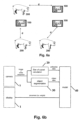
- Fig. 2 shows an example of body parts used to compute the pig weight.
- a UK company is currently commercializing the implementation of this work to monitor pig growth.
- a PhD Thesis [2] evaluated the ability of Qscan to accurately estimate: (1) live body weight (BW) of individual pigs, and (2) mean BW for groups of pigs. Conclusions of this work were to not recommend Qscan for predicting BW of individual pigs.
- the present invention provides further improvements in the field.
- the present invention proposes the use of a device that can include embedded processing means (there could also be located remotely) for the calculation, or estimation, of parameters of an object or part of an animal, for instance size, volume, weight, roughness, volume efficiency, surface, ripeness, content, quality, color purity, status, health, maturation, surface roughness, similarity, mood, visual attention, probability of bumping or collision between two or more objects and other related parameters of said animal such as a livestock animal.
- embedded processing means there could also be located remotely
- parameters of an object or part of an animal for instance size, volume, weight, roughness, volume efficiency, surface, ripeness, content, quality, color purity, status, health, maturation, surface roughness, similarity, mood, visual attention, probability of bumping or collision between two or more objects and other related parameters of said animal such as a livestock animal.
- the present invention provides a method according to claim 1.
- the a priori model in accordance with an embodiment is stored in a memory or database of a computing system, and includes information linking different parts, contours or shapes representative of several animals, previously acquired with a two-dimensional camera, with several parameters including the size, dimensions, body part dimensions, body features, weight and/or volume of said several animals.
- a pig weight can be calculated from its body shape, and more particularly, by measuring different body parts of a pig, like those reported in [1].
- said several parameters may be calculated by using the calculated size of the pixel and a heuristic model.
- the method also acquires a sequence of two dimensional images and/or video images.
- a reference object or a feature of a known size included in the scene is used for calculating the size of the pixel of the object.
- the calculation of the size of a pixel of the object in the acquired and segmented two-dimensional image and the calculation of the several parameters is performed by a remote server including at least one processing unit. This is done by the remote server previously receiving at least the acquired two dimensional image, through a communication network such as internet, via a local area network (LAN) or a general wide area network (WAN), or any other communication means.
- a communication network such as internet, via a local area network (LAN) or a general wide area network (WAN), or any other communication means.
- the remote server can built a map to represent a spatial distribution of the calculated parameters, to monitor a temporal evolution of the calculated parameters, or to perform a combination of the represented spatial distribution and monitored temporal distribution.
- the built map then can be used to optimize at least pig growth, stock management, stock pricing, vision attention, marketing of products, mapping of pig production and/or reliability of producers.
- the present invention provides a device according to claim 9.
- the first means include a second camera to have an stereoscopic vision, which enable to estimate the distance to the object or objects of interest.
- segmentation it has to be understood a process that partitions a digital image into segments.
- segmentation assigns a label to every pixel within the digital image and all pixels with the same label share certain characteristics. Segmentation is typically used to locate objects and boundaries (lines, curves, etc.) in images.
- segments There are a number of many different approaches that enable to segment digital images and here are listed a number of them that can be used for segmenting the two dimensional image (or even the sequence of two dimensional images and/or video images):
- the first and/or second means to calculate the object or objects parameters can be, entirely or in part, included in the proposed device or in a remote server located in a cloud computing environment.
- the proposed device may also include additional means in order to improve its usability or 'user experience'. For example, a way to tag which object or objects are being evaluated. This can be accomplished by including a display and tag the object by any mean, like highlighting the object, coloring the object or objects being evaluated. Alternatively, identification means such as a laser pointer or some illumination control can be used to indicate to users which object or objects are being evaluated.
- synchronization/association signaling when this property is not already built-in.
- electronic control might synchronize a device for taking the two dimensional image, sequence of images and/or video sequence, and the external sensor if required.
- This signal can be asynchronous, established on some time information based on Greenwich Mean Time (GMT), or by any other time reference.
- GTT Greenwich Mean Time
- the device can be also embedded in an unmanned vehicle.
- the unmanned vehicle could be aerial such as a drone, terrestrial, or maritime, and might be particularly useful to build maps for crops or turf management, but this is not claimed.
- the device of the invention is adapted to perform the method of the invention.
- Figs. 3 and 4 illustrate an example embodiment of the device 100 of the invention.
- the proposed device 100 comprises two handles H operable by an operator of the device 100.
- Fig. 3 is a frontal view of the device 100 which according to this particular embodiment preferably includes located in a frontal housing 3 of the device 100: a touchpad display 1, a control button 2, an indicator of battery life 4, an on/off switch 5 and several regulator buttons 13.
- Fig. 4 is a rear view of the device 100 and includes located in a rear housing 10: a two-dimensional camera 7, identification means or laser pointer 8 and a distance sensor 9.
- the device 100 of this embodiment includes (in this case not illustrated for simplicity of the figures) an USB port and a charger for power supply of the device 100.
- the device 100 of the invention comprises only one handle H, like a gun-like shape, allowing its use by the operator with a single hand.
- Fig. 5a is the frontal view of the device 100 and preferably includes a touchpad display 1, an on/off switch 5 and several regulator buttons 6 in order to set up different operation commands of the device 100 and/or to focus/defocus the two-dimensional camera 7.
- Fig. 5a is the frontal view of the device 100 and preferably includes a touchpad display 1, an on/off switch 5 and several regulator buttons 6 in order to set up different operation commands of the device 100 and/or to focus/defocus the two-dimensional camera 7.
- 5b is the rear view and according to this embodiment includes a two-dimensional camera 7, a distance sensor 9, a laser pointer 8, a charger 11 for power supply of the device 100 and a control button 2 located at the handle H of the device 100 for taking (when pressing it) the two dimensional image, sequence of two dimensional images and/or video images when pressing the control button 2.
- the proposed device 100 can form a box that can be fixed to take data from a static standpoint:
- Figs. 6a and 6b illustrate a non-claimed example to perform the automated weighting and parameters calculation (in this case physical parameters) of at least one object 200, in particular a livestock animal such as a pig, however this is not limitative since in the invention the at least one object 200 could be an animal or a human, a crop, turf, compost, people faces, a vehicle, etc.
- the proposed device 100 requires a two-dimensional camera 7 that preferably will have connectivity to internet, WiFi or some sort of mechanism to transmit data to a processing unit comprising several means which can be included, entirely or in part, on the same device 100 or in a remote server S.
- the device 100 is placed at a known distance d (that is, a known situation in the scene) and a size of the pixel of the object 200 is already known (previously calculated) which enables to precisely calculate the weight (and also if wanted the physical parameters) of the pig 200 based on the following processing steps: pig segmentation 30 preferably based on a color appearance segmentation algorithm; calculation of size of body parts of the pig 200 based on an a priori model, such as the one disclosed in [1], which is kept stored in a memory or database of a computing system; and calculation of pig weight based on an heuristic model 40 calibrated with experimental data.
- a known distance d that is, a known situation in the scene
- a size of the pixel of the object 200 is already known (previously calculated) which enables to precisely calculate the weight (and also if wanted the physical parameters) of the pig 200 based on the following processing steps: pig segmentation 30 preferably based on a color appearance segmentation algorithm; calculation of size
- Generation of said heuristic model 40 is based on a training set of hundred pigs 200 ranging from 70 to 140 Kg. Then, the validation of the heuristic model is done with another sample set (test sample) of hundred pigs ranging from 70 to 140Kg that have been weighted independently. Finally, in this non-claimed example the validated model is implemented into the device (100) for subsequent utilization.
- a calibration object OB of a known size like a green panel of 30 by 30 cm, is placed next to the pig 200.
- the pig 200 may be positioned at a known position (a priori knowledge of the scene), e.g. by knowing the size of the batch SB or by knowing the size of a grid or tiles on the floor SG.
- Figs. 8a and 8b illustrate an embodiment of the invention.
- the proposed device 100 requires a two-dimensional camera 7 to acquire a video sequence of images of the pig 200, a distance sensor 9 to measure the distance between the device 100 and the pig 200, and a laser pointer 8 to provide guidance to a user/operator for accurate tagging of the pig 200 to be weighted.
- the distance sensor 9, or ranging signaling can be implemented in different manners, for example, by means of a laser than can include a telemeter, a LED, ultrasounds, RF, microwaves, magnets, capacitance, and/or conductivity.
- the acquisition of video sequences have many advantages for segmentation and weight calculation, i.e. to reject inappropriate frames, increased average, background removal, sensor and video synchronization, among others.
- the device 100 includes two two-dimensional cameras 7; therefore the calculation is done by including two or more different views of the object or objects 200 improving the parameter calculation of the object 200, or objects 200.
- the acquired image is transmitted to a processing unit located in a remote server S of a cloud computing environment in order a computing algorithm running in the remote server S (step 92) validating and processing the received image (in few seconds) enabling in that way additional web services like pig growth monitoring in an ubiquitous manner or building of production maps.
- step 93 the data has been processed (step 93) it is transmitted to the proposed device 100 allowing said computing software application displaying (step 94) the calculated value of the parameter.
- the centralization of the acquired data within the remote server S leads to additional features, and the number of applications is larger: animal or pig growth, stock management, stock pricing, vision attention for marketing of products, mapping of pig production or reliability of producers, overall yield for a year, and predicted yield for the next season or years.
- the proposed device 100 requires a two-dimensional camera 7 to acquire a video sequence of images of the pig 200, a distance sensor 9 to measure the distance between the device 100 and the pig 200, and a synchronization signaling to synchronize the distance measurements and video sequences by temporal tagging based on a GMT reference.
- FIG. 10 shows the results of one of the proposed embodiments in real data compared with scale results on two different tests.
Landscapes
- Physics & Mathematics (AREA)
- General Physics & Mathematics (AREA)
- Engineering & Computer Science (AREA)
- Geometry (AREA)
- Computer Vision & Pattern Recognition (AREA)
- Theoretical Computer Science (AREA)
- Image Analysis (AREA)
- Length Measuring Devices By Optical Means (AREA)
- Image Processing (AREA)
Description
- The present invention relates to a method and to a device for automatically calculating parameters of an object, for instance the size, dimensions, body part dimensions, body features, volume, weight and other related data allowing defining said object, which is an animal such as a livestock animal.
- The invention can be used for a fast, accurate and individualised animal weighting that is of particular interest for the agro food industry as profit strongly depends on this.
- Fast, accurate and individualised calculation or estimation of an animal weight is important in many commercial fields. In agriculture, for example, estimation of carcass weight is important in efficient livestock processing operations, such as growth control and pricing. Accurately estimating a livestock animal's weight and/or final carcass weight can result in significant cost savings to the livestock producers, as they are often penalised when any of the animals they produce have a weight or volume outside of the range determined by the slaughter. Also, growth monitoring, feeding optimisation and management of batches is currently done in an uncontrolled manner, and accuracy of the methods relies on producer's criteria.
- There exist a number of approaches to accurately weight animals; however, these are based on the use of scales which are logistically impractical and stressful for the animals, which less to an overall reduction of the yield. For instance, the most common approach to estimate the weight of a pig is based on experience after visual evaluation of the producer.
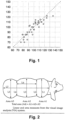
- In an experimental evaluation on a sample of 45 pigs it has been found that overall pig weighting based on observation was indeed correlated. For this specific test the inventors of this invention has found that root mean squared error was about 6,4 Kg for pigs ranging from 70 to 140 Kg. This resulted in a Pearson's correlation of 0,90 and R2 coefficient of 0,80. Obviously, this result is a reference and variability in error might depend in many factors that might increase or reduce overall accuracy. This leads to the conclusion that observation has an important degree of uncertainty, which is a disadvantage for business.
- Optiscan currently commercialized by Ro-main (disclosed in
US-20100222684 ) is based on three dimensional (3D) imaging of the pig and subsequent processing of data to estimate the overall pig weight. - Other known technologies to estimate body conditions of animals are disclosed in
WO-A1-2010/063527 providing an arrangement that comprises a three-dimensional camera system directed towards the animal and provided for recording at least one three-dimensional image of the animal, and an image processing device connected to the three-dimensional camera system and provided for forming a three-dimensional surface representation of a portion of the animal from the three-dimensional image recorded by the three-dimensional camera system; for statistically analyzing the surface of the three-dimensional surface representation; and for determining the body condition score of the animal based on the statistically analyzed surface of the three-dimensional surface representation. - Also
WO-A2-2010/098954 discloses methods, systems, and apparatus for estimating physical parameters using three dimensional representations. In this case, predetermined light patterns are projected onto an object and light patterns resulting from an interaction of the projected light patterns and portions of the object are detected. Three dimensional locations of multiple light elements in the detected light pattern are determined, and physical parameters of the object, for example, weight, are estimated based on the locations. - Similarly,
WO-A1-2004/012146 presents an imaging method and system for use in automatic monitoring the body condition of an animal. A predetermined region of interest on the animal body is imaged, and data indicative of the acquired one or more images is processed to obtain a three-dimensional representation of the region of interest. The three-dimensional representation is analyzed to determine a predetermined measurable parameter indicative of a surface relief of the region of interest which is indicative of the body condition of the imaged animal. -
US-A1-2005257748 discloses a method and apparatus for measuring the physical characteristics of livestock animals such as cattle and hogs. The apparatus of this patent application includes a plurality of strategically positioned cameras that are used to obtain data concerning volumetric, curvilinear (surface) and linear measurements of the livestock animals and the full carcasses thereof. The data is then analysed to provide information that substantially assists the commercial producer of livestock animals in producing a high-quality end-product for the consumer while adding profitability to the enterprise. -
US-A1-2008/0140234 discloses a method for remotely directing a fishing tournament making use of a data network over which participants transmit submissions indicating sizes of fish caught. In this case, this patent application allows performing the submissions by including digital images of fish. Moreover, the size of the fish may be determined from a scale established using a reference object depicted in the image. -
EP-A1-1148316 provides an information reader comprising camera means setup above a path for take a crane shot of the path within a predetermined range; a sensor placed above a path next to the camera means for detecting the distance to the path; a processor that receives the digital image data taken by the camera means in response to detection of an object passing in the path so as to recognize the profile of the object, calculates the height of the object based on the variation in value detected by the sensor, and performs corrective operations on the actual length and width of the object based on its apparent length and width corresponding to the pixel array of the profile data on the basis of corrective values the apparent image size corresponding to the camera distance; and output means for producing the results of operation. - Apart from that, Visual image analysis (VIA) uses aerial-view images of animals to determine body surface dimensions and may be used for real-time monitoring of pig growth [1].
Fig. 2 shows an example of body parts used to compute the pig weight. A UK company is currently commercializing the implementation of this work to monitor pig growth. Recently, a PhD Thesis [2] evaluated the ability of Qscan to accurately estimate: (1) live body weight (BW) of individual pigs, and (2) mean BW for groups of pigs. Conclusions of this work were to not recommend Qscan for predicting BW of individual pigs. - The present invention provides further improvements in the field.
-
- [1] A.B. Doeschl et.al. 'The relationship between the body shape of living pigs and their carcass morphology and composition'. Animal Science 2004, 73-83.
- [2] Jaclyn Elyse Love. 'Video imaging for Real-Time Performance Monitoring of Growing-Finishing Pigs'. Thesis. University of Guelph, 2012.
- The present invention proposes the use of a device that can include embedded processing means (there could also be located remotely) for the calculation, or estimation, of parameters of an object or part of an animal, for instance size, volume, weight, roughness, volume efficiency, surface, ripeness, content, quality, color purity, status, health, maturation, surface roughness, similarity, mood, visual attention, probability of bumping or collision between two or more objects and other related parameters of said animal such as a livestock animal.
- To that end, the present invention provides a method according to
claim 1. - The a priori model in accordance with an embodiment is stored in a memory or database of a computing system, and includes information linking different parts, contours or shapes representative of several animals, previously acquired with a two-dimensional camera, with several parameters including the size, dimensions, body part dimensions, body features, weight and/or volume of said several animals.
- For example, it is known that a pig weight can be calculated from its body shape, and more particularly, by measuring different body parts of a pig, like those reported in [1].
- Alternatively to the a priori model, but this is not claimed, said several parameters may be calculated by using the calculated size of the pixel and a heuristic model.
- In accordance with an embodiment, the method also acquires a sequence of two dimensional images and/or video images.
- In accordance with an embodiment, a reference object or a feature of a known size included in the scene is used for calculating the size of the pixel of the object.
- In accordance with yet another embodiment, the calculation of the size of a pixel of the object in the acquired and segmented two-dimensional image and the calculation of the several parameters is performed by a remote server including at least one processing unit. This is done by the remote server previously receiving at least the acquired two dimensional image, through a communication network such as internet, via a local area network (LAN) or a general wide area network (WAN), or any other communication means.
- In addition, the remote server can built a map to represent a spatial distribution of the calculated parameters, to monitor a temporal evolution of the calculated parameters, or to perform a combination of the represented spatial distribution and monitored temporal distribution. The built map then can be used to optimize at least pig growth, stock management, stock pricing, vision attention, marketing of products, mapping of pig production and/or reliability of producers.
- In addition, the present invention provides a device according to claim 9.
- According to an embodiment, the first means include a second camera to have an stereoscopic vision, which enable to estimate the distance to the object or objects of interest.
- Regarding the distance sensor, this could be of any time and can be based in different technologies, like ultrasound, RF, microwaves, LED or laser telemetry, among others.
- To be noted that by segmentation it has to be understood a process that partitions a digital image into segments. In general, segmentation assigns a label to every pixel within the digital image and all pixels with the same label share certain characteristics. Segmentation is typically used to locate objects and boundaries (lines, curves, etc.) in images. There are a number of many different approaches that enable to segment digital images and here are listed a number of them that can be used for segmenting the two dimensional image (or even the sequence of two dimensional images and/or video images):
- Thresholding, this is probably the simplest method to segment an image. This thresholding can be directly applied to image intensity, in gray scale or RGB, or any image feature obtained by combining spatial information within the image or information from other images (stored in a database, temporal, arbitrary, pattern...).
- Clustering methods are based on known algorithms like Gaussian mixture models and k-means that group segments based on their common properties of one or multiple image features and/or variables.
- Compression-based segmentation which minimizes the coding length of an image.
- Histogram-based methods use the information of a group of pixels in the form of a distribution to group the segments.
- Edge detection methods; use the information of boundaries and sharp changes in intensity to identify the limits of a segment.
- Region growing methods, group together those neighbouring pixels with similar properties. If a similarity criterion is satisfied, the pixel can be set to belong to the segment as one or more of its neighbors.
- Partial differential equation-based methods, by solving the Partial differential equation by a numerical scheme, one can segment the image.
- Graph partitioning methods, which model the impact of pixel neighborhoods on a given cluster of pixels or pixel, under the assumption of homogeneity in images.
- Watershed methods, which consider the gradient magnitude of an image as a topographic surface. Pixels having the highest gradient magnitude intensities (GMIs) correspond to watershed lines, which represent the region boundaries.
- Model-based methods, which assume that structures of interest have a repetitive form of geometry. Therefore, one can seek for a probabilistic model towards explaining the variation of the shape of the organ and then when segmenting an image impose constraints using this model as prior. Such a task involves (i) registration of the training examples to a common pose, (ii) probabilistic representation of the variation of the registered samples, and (iii) statistical inference between the model and the image. State of the art methods in the literature for knowledge-based segmentation involve active shape and appearance models, active contours and deformable templates and level-set based methods.
- Multi-scale segmentation, for which a series of image segmentations are computed at multiple scales. Hierarchical segmentation is an example of this approach.
- Machine learning-based segmentation, for which techniques like neural networks or support vector machines are used to develop a model for segmentation based on training the computer on a known databased with correct segmentations. For example, pulse-coupled neural networks (PCNNs) are neural models proposed by modeling a cat's visual cortex and developed for high-performance biomimetic image processing.
- Model fusion-based segmentation, finally an approach containing a number of the above methods is combined to optimize the performance of the final segmentation.
- Depending on the model complexity the first and/or second means to calculate the object or objects parameters can be, entirely or in part, included in the proposed device or in a remote server located in a cloud computing environment.
- The proposed device may also include additional means in order to improve its usability or 'user experience'. For example, a way to tag which object or objects are being evaluated. This can be accomplished by including a display and tag the object by any mean, like highlighting the object, coloring the object or objects being evaluated. Alternatively, identification means such as a laser pointer or some illumination control can be used to indicate to users which object or objects are being evaluated.
- Additionally, in some configurations of the proposed device it might be required to include additional synchronization/association signaling when this property is not already built-in. For example, electronic control might synchronize a device for taking the two dimensional image, sequence of images and/or video sequence, and the external sensor if required. This signal can be asynchronous, established on some time information based on Greenwich Mean Time (GMT), or by any other time reference.
- The device can be also embedded in an unmanned vehicle. The unmanned vehicle could be aerial such as a drone, terrestrial, or maritime, and might be particularly useful to build maps for crops or turf management, but this is not claimed.
- The device of the invention is adapted to perform the method of the invention.
- The previous and other advantages and features will be more fully understood from the following detailed description of embodiments, with reference to the attached, which must be considered in an illustrative and non-limiting manner, in which:
-
Fig. 1 shows the scattering plot of real pig weight on a scale (x-axis) and estimated weight based on an expert (y-axis). -
Fig. 2 is a figure extracted from [1], explaining the body parts required to be measured for estimating weight of a pig. -
Fig. 3 illustrates a frontal view of an exemplary embodiment of the proposed device for automated parameters calculation of an object in accordance with some embodiments of the present invention. -
Fig. 4 is a rear view of the proposed device ofFig. 3 . -
Fig. 5 illustrates another exemplary embodiment of the proposed device for automated parameters calculation of an object in accordance with some embodiments of the present invention.Fig. 5a illustrates the front view;Fig. 5b illustrates the rear view andFig. 5c is a lateral view. -
Figs. 6a and 6b illustrate a non-claimed example in which the proposed device is used at a known distance. -
Fig. 7 illustrate another non-claimed example in which the image processing is performed by using an a priori knowledge of the scene or by including a reference object on the scene. -
Figs. 8a and 8b illustrate an embodiment of the invention, including a distance sensor. -
Fig. 9 illustrates an example of use of the proposed device through a cloud service for pig weighting. -
Fig. 10 illustrates some experimental results on pig weighting for two different days: (A) 10 pigs with special feeding and (B) evaluation of 25 pigs on normal growth. -
Figs. 3 and 4 illustrate an example embodiment of thedevice 100 of the invention. According to this particular embodiment, the proposeddevice 100 comprises two handles H operable by an operator of thedevice 100.Fig. 3 is a frontal view of thedevice 100 which according to this particular embodiment preferably includes located in a frontal housing 3 of the device 100: atouchpad display 1, acontrol button 2, an indicator of battery life 4, an on/off switch 5 andseveral regulator buttons 13.Fig. 4 is a rear view of thedevice 100 and includes located in a rear housing 10: a two-dimensional camera 7, identification means orlaser pointer 8 and a distance sensor 9. In addition thedevice 100 of this embodiment includes (in this case not illustrated for simplicity of the figures) an USB port and a charger for power supply of thedevice 100. - In another example embodiment (see
Fig. 5 ) thedevice 100 of the invention comprises only one handle H, like a gun-like shape, allowing its use by the operator with a single hand.Fig. 5a is the frontal view of thedevice 100 and preferably includes atouchpad display 1, an on/off switch 5 and several regulator buttons 6 in order to set up different operation commands of thedevice 100 and/or to focus/defocus the two-dimensional camera 7.Fig. 5b is the rear view and according to this embodiment includes a two-dimensional camera 7, a distance sensor 9, alaser pointer 8, acharger 11 for power supply of thedevice 100 and acontrol button 2 located at the handle H of thedevice 100 for taking (when pressing it) the two dimensional image, sequence of two dimensional images and/or video images when pressing thecontrol button 2. - Alternatively, in this case not illustrated, the proposed
device 100 can form a box that can be fixed to take data from a static standpoint:
Figs. 6a and 6b illustrate a non-claimed example to perform the automated weighting and parameters calculation (in this case physical parameters) of at least oneobject 200, in particular a livestock animal such as a pig, however this is not limitative since in the invention the at least oneobject 200 could be an animal or a human, a crop, turf, compost, people faces, a vehicle, etc. In this particular case, the proposeddevice 100 requires a two-dimensional camera 7 that preferably will have connectivity to internet, WiFi or some sort of mechanism to transmit data to a processing unit comprising several means which can be included, entirely or in part, on thesame device 100 or in a remote server S. According to this example, thedevice 100 is placed at a known distance d (that is, a known situation in the scene) and a size of the pixel of theobject 200 is already known (previously calculated) which enables to precisely calculate the weight (and also if wanted the physical parameters) of thepig 200 based on the following processing steps:pig segmentation 30 preferably based on a color appearance segmentation algorithm; calculation of size of body parts of thepig 200 based on an a priori model, such as the one disclosed in [1], which is kept stored in a memory or database of a computing system; and calculation of pig weight based on anheuristic model 40 calibrated with experimental data. - Generation of said
heuristic model 40 is based on a training set of hundredpigs 200 ranging from 70 to 140 Kg. Then, the validation of the heuristic model is done with another sample set (test sample) of hundred pigs ranging from 70 to 140Kg that have been weighted independently. Finally, in this non-claimed example the validated model is implemented into the device (100) for subsequent utilization. - In reference to
Fig. 7 it is illustrated non-claimed example. In this case, a calibration object OB of a known size, like a green panel of 30 by 30 cm, is placed next to thepig 200. In addition, thepig 200 may be positioned at a known position (a priori knowledge of the scene), e.g. by knowing the size of the batch SB or by knowing the size of a grid or tiles on the floor SG. This enables to precisely calculate parameters of thepig 200 by: segmenting thepig 200 and the calibration object OB based on a color appearance segmentation algorithm; affine registration of the calibration object OB to calculate a spatial transformation and the distance between thedevice 100 and thepig 200; calculating the pig volume based on a 3D template and a spatial transformation; and calculate the pig weight based on an heuristic model calibrated with experimental data. -
Figs. 8a and 8b illustrate an embodiment of the invention. In this embodiment, the proposeddevice 100 requires a two-dimensional camera 7 to acquire a video sequence of images of thepig 200, a distance sensor 9 to measure the distance between thedevice 100 and thepig 200, and alaser pointer 8 to provide guidance to a user/operator for accurate tagging of thepig 200 to be weighted. The distance sensor 9, or ranging signaling, can be implemented in different manners, for example, by means of a laser than can include a telemeter, a LED, ultrasounds, RF, microwaves, magnets, capacitance, and/or conductivity. Advantageously, the acquisition of video sequences have many advantages for segmentation and weight calculation, i.e. to reject inappropriate frames, increased average, background removal, sensor and video synchronization, among others. - In accordance with another embodiment, in this case not illustrated, the
device 100 includes two two-dimensional cameras 7; therefore the calculation is done by including two or more different views of the object orobjects 200 improving the parameter calculation of theobject 200, or objects 200. - In accordance with yet another embodiment, and as seen in
Fig. 9 , once the two dimensional image (or even the sequence of images and/or the video sequence) is acquired by a user via a computing software application installed the proposed device 100 (step 91), the acquired image is transmitted to a processing unit located in a remote server S of a cloud computing environment in order a computing algorithm running in the remote server S (step 92) validating and processing the received image (in few seconds) enabling in that way additional web services like pig growth monitoring in an ubiquitous manner or building of production maps. Once the data has been processed (step 93) it is transmitted to the proposeddevice 100 allowing said computing software application displaying (step 94) the calculated value of the parameter. - The centralization of the acquired data within the remote server S leads to additional features, and the number of applications is larger: animal or pig growth, stock management, stock pricing, vision attention for marketing of products, mapping of pig production or reliability of producers, overall yield for a year, and predicted yield for the next season or years.
- Finally, in another embodiment, not illustrated, the proposed
device 100 requires a two-dimensional camera 7 to acquire a video sequence of images of thepig 200, a distance sensor 9 to measure the distance between thedevice 100 and thepig 200, and a synchronization signaling to synchronize the distance measurements and video sequences by temporal tagging based on a GMT reference. -
Fig. 10 shows the results of one of the proposed embodiments in real data compared with scale results on two different tests.Figure 10A shows data on 10 pigs that were fed with special food and were overweight, RMSE = 1.47Kg, Pearson's rho = 0,99.Figure 10B shows data on a wide range of 25 pigs, RMSE = 1,72Kg, Pearson's rho = 0,99. - While this description covers many specific implementation details, these should not be construed as limitations on the scope of the invention or of what may be claimed, but rather as a description of features specific to particular embodiments of the invention.
- The scope of the present invention is defined in the following attached claims.
Claims (13)
- A method for automated parameters calculation of an object (200), or part of an object (200), the method comprising:a) acquiring, by at least one two-dimensional camera (7), in a scene, a two dimensional image of at least one object (200) being an animal, said two-dimensional camera (7) being included in a portable device (100);b) identifying, by a processing unit, the object (200) within the acquired two-dimensional image by segmenting the two-dimensional image via a segmentation algorithm;c) calculating, by the processing unit, the size of a pixel of the object (200) in the acquired and segmented two dimensional image using a measured distance between the object (200) and the at least one two-dimensional camera (7); andd) calculating, by the processing unit, several parameters including at least the size, dimensions, body part dimensions, body features, weight and/or volume of the object (200) by using said acquired and segmented two dimensional image, the calculated size of the pixel and an a priori model of the object (200), the a priori model including information linking different parts, contours or shapes representative of several objects (200), previously acquired with a two-dimensional camera, with several parameters including the size, dimensions, body part dimensions, body features, weight and/or volume of said several objects (200).
- The method of claim 1, wherein said a priori model is stored in a memory or database.
- The method of any of previous claims, wherein said step a) further comprises acquiring a sequence of two dimensional images and/or video images.
- The method of any of previous claims, wherein a reference object or a feature of a known size included in the scene is used for calculating the size of the pixel of the object (200).
- The method of any of previous claims, wherein the processing unit is included in a remote server (S), distant to the at least one two-dimensional camera (7), wherein the remote server (S) comprises building a map to represent a spatial distribution of the calculated parameters of the object (200), to monitor a temporal evolution of the calculated parameters of the object (200), or to perform a combination of a represented spatial distribution of the calculated parameters of the object (200) and a monitored temporal distribution thereof.
- The method of claim 1, wherein the animal is a livestock animal including a pig, a piglet, a cow, veal or a sheep.
- The method of claim 5, wherein the object (200) is a pig, and wherein said built map is used to optimize at least pig growth or mapping of pig production or reliability of producers.
- The method of claim 1, wherein the body features comprises a body fat index.
- A device (100) for automated parameters calculation of an object (200), or part of an object (200), comprising:- at least one two-dimensional camera (7), provided to point to at least one object (200) being an animal, said two-dimensional camera being configured to acquire in a scene at least one two dimensional image of the at least one object (200);- a distance sensor (9) configured to measure a distance between the device (100) and the object (200); and- a processing unit;characterized in that:- the device (100) is portable and further comprises at least one handle (H) and a display (1); and- the processing unit is arranged and configured to:- identify the object (200) within the acquired two-dimensional image by segmenting the two-dimensional image via a segmentation algorithm;- calculate the size of a pixel of the object (200) in the acquired and segmented two-dimensional image using the measured distance between the object and the device (100); and- calculate several parameters, including at least the size, dimensions, body part dimensions, body features, weight and/or volume of the object (200) by using said acquired two dimensional image, the calculated size of the pixel, and an a priori model of the object (200) including information linking different parts, contours or shapes representative of several objects (200), previously acquired with a two-dimensional camera, with several parameters including the size, dimensions, body part dimensions, body features, weight and/or volume of said several objects (200).
- The device of claim 9, wherein said distance sensor (9) includes an ultrasound sensor, a microwave sensor, a LED or laser telemetry sensor.
- The device of claim 9, further comprising identification means (8), including a laser pointer, arranged and configured to identify the at least one object (200) in the scene.
- The device of any of claims 9 to 11, further comprising means arranged and configured to associate the distance measured by the distance sensor (9) with a device to take at least a two-dimensional image.
- The device of any of previous claims 9 to 12, wherein the device (100) is embedded in an unmanned vehicle including an aerial vehicle, a terrestrial vehicle or a maritime vehicle.
Applications Claiming Priority (2)
| Application Number | Priority Date | Filing Date | Title |
|---|---|---|---|
| EP14002083.5A EP2957861A1 (en) | 2014-06-17 | 2014-06-17 | Device and method for automated parameters calculation of an object |
| PCT/IB2015/000734 WO2015193711A1 (en) | 2014-06-17 | 2015-05-22 | Method and device for automated parameters calculation of an object |
Publications (3)
| Publication Number | Publication Date |
|---|---|
| EP3158289A1 EP3158289A1 (en) | 2017-04-26 |
| EP3158289B1 true EP3158289B1 (en) | 2024-05-01 |
| EP3158289C0 EP3158289C0 (en) | 2024-05-01 |
Family
ID=50972419
Family Applications (2)
| Application Number | Title | Priority Date | Filing Date |
|---|---|---|---|
| EP14002083.5A Withdrawn EP2957861A1 (en) | 2014-06-17 | 2014-06-17 | Device and method for automated parameters calculation of an object |
| EP15731099.6A Active EP3158289B1 (en) | 2014-06-17 | 2015-05-22 | Method and device for automated parameters calculation of an object |
Family Applications Before (1)
| Application Number | Title | Priority Date | Filing Date |
|---|---|---|---|
| EP14002083.5A Withdrawn EP2957861A1 (en) | 2014-06-17 | 2014-06-17 | Device and method for automated parameters calculation of an object |
Country Status (4)
| Country | Link |
|---|---|
| US (1) | US10249054B2 (en) |
| EP (2) | EP2957861A1 (en) |
| CN (1) | CN106662437A (en) |
| WO (1) | WO2015193711A1 (en) |
Families Citing this family (44)
| Publication number | Priority date | Publication date | Assignee | Title |
|---|---|---|---|---|
| US20170112467A1 (en) * | 2015-10-27 | 2017-04-27 | QT Ultrasound LLC | Retention and stabilization of anatomy for ultrasound imaging |
| US10587858B2 (en) * | 2016-03-14 | 2020-03-10 | Symbol Technologies, Llc | Device and method of dimensioning using digital images and depth data |
| DE102016207291B4 (en) * | 2016-04-28 | 2023-09-21 | Siemens Healthcare Gmbh | Determination of at least one protocol parameter for a contrast-enhanced imaging procedure |
| US10037605B2 (en) * | 2016-08-23 | 2018-07-31 | Disney Enterprises, Inc. | Video object tagging using synthetic images and segmentation hierarchies |
| US10733482B1 (en) * | 2017-03-08 | 2020-08-04 | Zoox, Inc. | Object height estimation from monocular images |
| GB201706857D0 (en) * | 2017-04-28 | 2017-06-14 | Select Res Ltd | Health risk prediction tools |
| NL2019176B1 (en) * | 2017-07-05 | 2019-01-16 | N V Nederlandsche Apparatenfabriek Nedap | Method and system for monitoring the growth of calves |
| KR102702448B1 (en) * | 2017-08-07 | 2024-09-04 | 더 잭슨 래보라토리 | Long-term and continuous animal behavior monitoring |
| US10796142B2 (en) * | 2017-08-28 | 2020-10-06 | Nutech Ventures | Systems for tracking individual animals in a group-housed environment |
| WO2019058752A1 (en) * | 2017-09-22 | 2019-03-28 | パナソニックIpマネジメント株式会社 | Livestock information management system, livestock barn, livestock information management program, and livestock information management method |
| CN109584351B (en) * | 2017-09-29 | 2023-06-13 | 大连恒锐科技股份有限公司 | Biological feature-based human body three-dimensional reconstruction method and system |
| US10952410B2 (en) | 2017-11-06 | 2021-03-23 | Dairy Tech, Inc. | System and method of estimating livestock weight |
| US10701905B2 (en) * | 2017-12-06 | 2020-07-07 | International Business Machines Corporation | Imaging and three dimensional reconstruction for weight estimation |
| EP3531373B1 (en) * | 2018-02-26 | 2022-05-04 | Touchless Animal Metrics, SL | A method and device for the characterization of living specimens from a distance |
| CN109559342B (en) * | 2018-03-05 | 2024-02-09 | 北京佳格天地科技有限公司 | Method and device for measuring animal body length |
| US11537719B2 (en) | 2018-05-18 | 2022-12-27 | Deepmind Technologies Limited | Deep neural network system for similarity-based graph representations |
| CN108764210B (en) * | 2018-06-12 | 2019-11-15 | 焦点科技股份有限公司 | A kind of method and system that the pig based on object of reference identifies again |
| TWI676956B (en) * | 2018-06-22 | 2019-11-11 | 廖培志 | Pig farm management system |
| CN108990831B (en) * | 2018-06-22 | 2021-07-13 | 成都睿畜电子科技有限公司 | A livestock health monitoring method and system |
| US12266142B2 (en) | 2018-06-25 | 2025-04-01 | Farmsee Ltd. | Monitoring livestock in an agricultural pen |
| CN108871520A (en) * | 2018-07-06 | 2018-11-23 | 平安科技(深圳)有限公司 | Livestock body weight measurement and device |
| US11715308B2 (en) | 2018-10-10 | 2023-08-01 | Delaval Holding Ab | Animal identification using vision techniques |
| CN109559373B (en) * | 2018-10-25 | 2022-10-18 | 武汉亘星智能技术有限公司 | Method and system for measuring body based on 2D human body image |
| US11407589B2 (en) | 2018-10-25 | 2022-08-09 | Berkshire Grey Operating Company, Inc. | Systems and methods for learning to extrapolate optimal object routing and handling parameters |
| CN109579956B (en) * | 2018-12-13 | 2021-05-14 | 北京小龙潜行科技有限公司 | Intelligent pig raising limiting weight measuring method and device, electronic equipment and storage medium |
| US11388416B2 (en) * | 2019-03-21 | 2022-07-12 | Qualcomm Incorporated | Video compression using deep generative models |
| KR102239387B1 (en) * | 2019-04-30 | 2021-04-12 | 대한민국 | Strawberry quality discrimination device and method for operating the same |
| EP3742366A1 (en) | 2019-05-20 | 2020-11-25 | Touchless Animal Metrics, SL | Method and system for assisting in the management of livestock |
| CN112116647B (en) * | 2019-06-19 | 2024-04-05 | 虹软科技股份有限公司 | Weighting method and weighting device |
| CN110307783B (en) * | 2019-06-26 | 2021-01-08 | 浙江农林大学 | A tree volume measurement device based on binocular stereo vision |
| WO2021005603A1 (en) * | 2019-07-09 | 2021-01-14 | Guardian Optical Technologies Ltd | Systems, devices and methods for measuring the mass of objects in a vehicle |
| US12062458B2 (en) * | 2019-10-21 | 2024-08-13 | Singapore Ministry Of Health Office Of Healthcare Transformation | System and method for secure, private, and trusted medical information monitoring and semi-autonomous prescription management |
| CN111008560A (en) * | 2019-10-31 | 2020-04-14 | 重庆小雨点小额贷款有限公司 | Livestock weight determination method, device, terminal and computer storage medium |
| CN111539937A (en) * | 2020-04-24 | 2020-08-14 | 北京海益同展信息科技有限公司 | Object index detection method and livestock weight detection method and device |
| US12039007B2 (en) * | 2020-10-09 | 2024-07-16 | GE Precision Healthcare LLC | Systems and methods of automatic medical image labeling |
| KR102264281B1 (en) * | 2020-12-31 | 2021-06-14 | 한국축산데이터 주식회사 농업회사법인 | Livestock weight estimation system and method using livestock image |
| CN112330677A (en) * | 2021-01-05 | 2021-02-05 | 四川智迅车联科技有限公司 | High-precision weighing method and system based on image, electronic equipment and storage medium |
| KR102285603B1 (en) * | 2021-01-15 | 2021-08-04 | 주식회사 에이오팜 | Apparatus and method for selecting a fruit |
| CN112927282A (en) * | 2021-01-25 | 2021-06-08 | 华南农业大学 | Automatic livestock and poultry foot parameter measuring method based on machine vision |
| WO2022243953A1 (en) * | 2021-05-20 | 2022-11-24 | U-Sense.It S.R.L. | Apparatus, method and computer program for measuring a space and / or an alignment and / or an angle of misalignment between a first surface and a second surface |
| IT202100013196A1 (en) * | 2021-05-20 | 2022-11-20 | U Sense It S R L | Apparatus and method for measuring a gap and/or an alignment and/or an angle of misalignment between surfaces, particularly on the basis of an inferential model |
| CN117918023A (en) | 2021-09-07 | 2024-04-23 | 希尔氏宠物营养品公司 | Method for determining biometric data related to animals based on image data |
| CN114693345A (en) * | 2022-03-17 | 2022-07-01 | 上海禹璨信息技术有限公司 | Information processing method, device, equipment and storage medium |
| JP7754551B2 (en) * | 2023-04-28 | 2025-10-15 | イントフロー インコーポレイテッド | Apparatus and method for providing video-based animal status information |
Family Cites Families (15)
| Publication number | Priority date | Publication date | Assignee | Title |
|---|---|---|---|---|
| JP2000171215A (en) | 1998-12-03 | 2000-06-23 | Techno Wave:Kk | Physical distribution information reader |
| US20030123703A1 (en) * | 2001-06-29 | 2003-07-03 | Honeywell International Inc. | Method for monitoring a moving object and system regarding same |
| IL150915A0 (en) * | 2002-07-25 | 2003-02-12 | Vet Tech Ltd | Imaging system and method for body condition evaluation |
| US7399220B2 (en) * | 2002-08-02 | 2008-07-15 | Kriesel Marshall S | Apparatus and methods for the volumetric and dimensional measurement of livestock |
| JP2009500042A (en) * | 2005-07-07 | 2009-01-08 | インジーニアス・ターゲティング・ラボラトリー・インコーポレーテッド | System for 3D monitoring and analysis of target motor behavior |
| US20080140234A1 (en) * | 2006-12-06 | 2008-06-12 | Shafter Richard M | Method and system for remotely directing a fishing tournament |
| JP4775391B2 (en) * | 2008-03-18 | 2011-09-21 | 株式会社デンソー | Obstacle detection device |
| RU2543948C2 (en) * | 2008-12-03 | 2015-03-10 | Делаваль Холдинг Аб | Device and method of determining quantitative indicator of body condition of animals |
| BRPI1008771A2 (en) | 2009-02-27 | 2019-07-02 | Body Surface Translations Inc | estimation of physical parameters using three-dimensional representations |
| AU2010219406B2 (en) * | 2010-05-19 | 2013-01-24 | Plf Agritech Pty Ltd | Image analysis for making animal measurements |
| IL210427A0 (en) * | 2011-01-02 | 2011-06-30 | Agent Video Intelligence Ltd | Calibration device and method for use in a surveillance system for event detection |
| EP2662659B1 (en) * | 2012-05-08 | 2015-01-21 | Ralph John Hossary | Device for measuring a geometric characteristic of an object |
| US9129404B1 (en) * | 2012-09-13 | 2015-09-08 | Amazon Technologies, Inc. | Measuring physical objects and presenting virtual articles |
| US9922242B2 (en) * | 2012-12-02 | 2018-03-20 | Agricam Ab | Systems and methods for predicting the outcome of a state of a subject |
| US9230339B2 (en) * | 2013-01-07 | 2016-01-05 | Wexenergy Innovations Llc | System and method of measuring distances related to an object |
-
2014
- 2014-06-17 EP EP14002083.5A patent/EP2957861A1/en not_active Withdrawn
-
2015
- 2015-05-22 CN CN201580043844.7A patent/CN106662437A/en active Pending
- 2015-05-22 EP EP15731099.6A patent/EP3158289B1/en active Active
- 2015-05-22 WO PCT/IB2015/000734 patent/WO2015193711A1/en not_active Ceased
- 2015-05-22 US US15/319,110 patent/US10249054B2/en active Active
Also Published As
| Publication number | Publication date |
|---|---|
| US10249054B2 (en) | 2019-04-02 |
| US20170124727A1 (en) | 2017-05-04 |
| CN106662437A (en) | 2017-05-10 |
| EP3158289A1 (en) | 2017-04-26 |
| WO2015193711A1 (en) | 2015-12-23 |
| EP2957861A1 (en) | 2015-12-23 |
| EP3158289C0 (en) | 2024-05-01 |
Similar Documents
| Publication | Publication Date | Title |
|---|---|---|
| US10249054B2 (en) | Method and device for automated parameters calculation of an object | |
| US11627726B2 (en) | System and method of estimating livestock weight | |
| Fernandes et al. | A novel automated system to acquire biometric and morphological measurements and predict body weight of pigs via 3D computer vision | |
| Wang et al. | ASAS-NANP SYMPOSIUM: Applications of machine learning for livestock body weight prediction from digital images | |
| Wongsriworaphon et al. | An approach based on digital image analysis to estimate the live weights of pigs in farm environments | |
| US12016308B2 (en) | System for high performance, AI-based dairy herd management and disease detection | |
| Alvarez et al. | Body condition estimation on cows from depth images using Convolutional Neural Networks | |
| CA2744146C (en) | Arrangement and method for determining a body condition score of an animal | |
| Salau et al. | Feasibility of automated body trait determination using the SR4K time-of-flight camera in cow barns | |
| CN110672189A (en) | Weight estimation method, device, system and storage medium | |
| KR102289640B1 (en) | A contactless mobile weighting system for livestock using asymmetric stereo cameras | |
| US20140088939A1 (en) | Evaluation of animal products based on customized models | |
| WO2016023075A1 (en) | 3d imaging | |
| Giannone et al. | Automated dairy cow identification and feeding behaviour analysis using a computer vision model based on YOLOv8 | |
| US20250225671A1 (en) | Method for predicting body mass of herd animal, computer-readable storage media, system for predicting body mass of herd | |
| KR20220142514A (en) | Methods, systems and computer programs for traceability of living specimens | |
| CN114708233B (en) | A method for measuring pig carcass fat thickness and related products | |
| WO2025068550A1 (en) | System and method for determining at least one body parameter of a bovine subject based on range imaging | |
| Tao et al. | Development and implementation of a training dataset to ensure clear boundary value of body condition score classification of dairy cows in automatic system | |
| CN117523603A (en) | Intelligent pig performance measurement method and system | |
| US9872482B2 (en) | Systems and methods for analyzing and monitoring alligator growth | |
| KR102779233B1 (en) | Technique for providing information on multiple sows | |
| KR102779229B1 (en) | Technique for providing information on multiple sows | |
| WO2018186796A1 (en) | Method and system for classifying animal carcass | |
| Masudur Rahman et al. | A multilayer linear regression approach to find the coefficients of two dimensional values from the live weight and the manual body measurement process of a cow. |
Legal Events
| Date | Code | Title | Description |
|---|---|---|---|
| STAA | Information on the status of an ep patent application or granted ep patent |
Free format text: STATUS: THE INTERNATIONAL PUBLICATION HAS BEEN MADE |
|
| PUAI | Public reference made under article 153(3) epc to a published international application that has entered the european phase |
Free format text: ORIGINAL CODE: 0009012 |
|
| STAA | Information on the status of an ep patent application or granted ep patent |
Free format text: STATUS: REQUEST FOR EXAMINATION WAS MADE |
|
| 17P | Request for examination filed |
Effective date: 20170103 |
|
| AK | Designated contracting states |
Kind code of ref document: A1 Designated state(s): AL AT BE BG CH CY CZ DE DK EE ES FI FR GB GR HR HU IE IS IT LI LT LU LV MC MK MT NL NO PL PT RO RS SE SI SK SM TR |
|
| AX | Request for extension of the european patent |
Extension state: BA ME |
|
| DAV | Request for validation of the european patent (deleted) | ||
| DAX | Request for extension of the european patent (deleted) | ||
| STAA | Information on the status of an ep patent application or granted ep patent |
Free format text: STATUS: EXAMINATION IS IN PROGRESS |
|
| 17Q | First examination report despatched |
Effective date: 20191127 |
|
| RAP1 | Party data changed (applicant data changed or rights of an application transferred) |
Owner name: TOUCHLESS ANIMAL METRICS, SL |
|
| GRAP | Despatch of communication of intention to grant a patent |
Free format text: ORIGINAL CODE: EPIDOSNIGR1 |
|
| STAA | Information on the status of an ep patent application or granted ep patent |
Free format text: STATUS: GRANT OF PATENT IS INTENDED |
|
| INTG | Intention to grant announced |
Effective date: 20231221 |
|
| GRAS | Grant fee paid |
Free format text: ORIGINAL CODE: EPIDOSNIGR3 |
|
| GRAA | (expected) grant |
Free format text: ORIGINAL CODE: 0009210 |
|
| STAA | Information on the status of an ep patent application or granted ep patent |
Free format text: STATUS: THE PATENT HAS BEEN GRANTED |
|
| AK | Designated contracting states |
Kind code of ref document: B1 Designated state(s): AL AT BE BG CH CY CZ DE DK EE ES FI FR GB GR HR HU IE IS IT LI LT LU LV MC MK MT NL NO PL PT RO RS SE SI SK SM TR |
|
| REG | Reference to a national code |
Ref country code: GB Ref legal event code: FG4D |
|
| REG | Reference to a national code |
Ref country code: CH Ref legal event code: EP |
|
| REG | Reference to a national code |
Ref country code: IE Ref legal event code: FG4D |
|
| REG | Reference to a national code |
Ref country code: DE Ref legal event code: R096 Ref document number: 602015088539 Country of ref document: DE |
|
| U01 | Request for unitary effect filed |
Effective date: 20240528 |
|
| U07 | Unitary effect registered |
Designated state(s): AT BE BG DE DK EE FI FR IT LT LU LV MT NL PT SE SI Effective date: 20240611 |
|
| PG25 | Lapsed in a contracting state [announced via postgrant information from national office to epo] |
Ref country code: IS Free format text: LAPSE BECAUSE OF FAILURE TO SUBMIT A TRANSLATION OF THE DESCRIPTION OR TO PAY THE FEE WITHIN THE PRESCRIBED TIME-LIMIT Effective date: 20240901 |
|
| PG25 | Lapsed in a contracting state [announced via postgrant information from national office to epo] |
Ref country code: HR Free format text: LAPSE BECAUSE OF FAILURE TO SUBMIT A TRANSLATION OF THE DESCRIPTION OR TO PAY THE FEE WITHIN THE PRESCRIBED TIME-LIMIT Effective date: 20240501 |
|
| PG25 | Lapsed in a contracting state [announced via postgrant information from national office to epo] |
Ref country code: GR Free format text: LAPSE BECAUSE OF FAILURE TO SUBMIT A TRANSLATION OF THE DESCRIPTION OR TO PAY THE FEE WITHIN THE PRESCRIBED TIME-LIMIT Effective date: 20240802 |
|
| PG25 | Lapsed in a contracting state [announced via postgrant information from national office to epo] |
Ref country code: PL Free format text: LAPSE BECAUSE OF FAILURE TO SUBMIT A TRANSLATION OF THE DESCRIPTION OR TO PAY THE FEE WITHIN THE PRESCRIBED TIME-LIMIT Effective date: 20240501 |
|
| PG25 | Lapsed in a contracting state [announced via postgrant information from national office to epo] |
Ref country code: PL Free format text: LAPSE BECAUSE OF FAILURE TO SUBMIT A TRANSLATION OF THE DESCRIPTION OR TO PAY THE FEE WITHIN THE PRESCRIBED TIME-LIMIT Effective date: 20240501 Ref country code: NO Free format text: LAPSE BECAUSE OF FAILURE TO SUBMIT A TRANSLATION OF THE DESCRIPTION OR TO PAY THE FEE WITHIN THE PRESCRIBED TIME-LIMIT Effective date: 20240801 Ref country code: IS Free format text: LAPSE BECAUSE OF FAILURE TO SUBMIT A TRANSLATION OF THE DESCRIPTION OR TO PAY THE FEE WITHIN THE PRESCRIBED TIME-LIMIT Effective date: 20240901 Ref country code: HR Free format text: LAPSE BECAUSE OF FAILURE TO SUBMIT A TRANSLATION OF THE DESCRIPTION OR TO PAY THE FEE WITHIN THE PRESCRIBED TIME-LIMIT Effective date: 20240501 Ref country code: GR Free format text: LAPSE BECAUSE OF FAILURE TO SUBMIT A TRANSLATION OF THE DESCRIPTION OR TO PAY THE FEE WITHIN THE PRESCRIBED TIME-LIMIT Effective date: 20240802 Ref country code: RS Free format text: LAPSE BECAUSE OF FAILURE TO SUBMIT A TRANSLATION OF THE DESCRIPTION OR TO PAY THE FEE WITHIN THE PRESCRIBED TIME-LIMIT Effective date: 20240801 |
|
| REG | Reference to a national code |
Ref country code: CH Ref legal event code: PL |
|
| U90 | Renewal fees not paid: noting of loss of rights |
Free format text: RENEWAL FEE NOT PAID FOR YEAR 10 Effective date: 20250107 |
|
| PG25 | Lapsed in a contracting state [announced via postgrant information from national office to epo] |
Ref country code: CZ Free format text: LAPSE BECAUSE OF FAILURE TO SUBMIT A TRANSLATION OF THE DESCRIPTION OR TO PAY THE FEE WITHIN THE PRESCRIBED TIME-LIMIT Effective date: 20240501 |
|
| PG25 | Lapsed in a contracting state [announced via postgrant information from national office to epo] |
Ref country code: RO Free format text: LAPSE BECAUSE OF FAILURE TO SUBMIT A TRANSLATION OF THE DESCRIPTION OR TO PAY THE FEE WITHIN THE PRESCRIBED TIME-LIMIT Effective date: 20240501 Ref country code: SK Free format text: LAPSE BECAUSE OF FAILURE TO SUBMIT A TRANSLATION OF THE DESCRIPTION OR TO PAY THE FEE WITHIN THE PRESCRIBED TIME-LIMIT Effective date: 20240501 |
|
| PG25 | Lapsed in a contracting state [announced via postgrant information from national office to epo] |
Ref country code: SM Free format text: LAPSE BECAUSE OF FAILURE TO SUBMIT A TRANSLATION OF THE DESCRIPTION OR TO PAY THE FEE WITHIN THE PRESCRIBED TIME-LIMIT Effective date: 20240501 Ref country code: ES Free format text: LAPSE BECAUSE OF FAILURE TO SUBMIT A TRANSLATION OF THE DESCRIPTION OR TO PAY THE FEE WITHIN THE PRESCRIBED TIME-LIMIT Effective date: 20240501 |
|
| PG25 | Lapsed in a contracting state [announced via postgrant information from national office to epo] |
Ref country code: SM Free format text: LAPSE BECAUSE OF FAILURE TO SUBMIT A TRANSLATION OF THE DESCRIPTION OR TO PAY THE FEE WITHIN THE PRESCRIBED TIME-LIMIT Effective date: 20240501 Ref country code: SK Free format text: LAPSE BECAUSE OF FAILURE TO SUBMIT A TRANSLATION OF THE DESCRIPTION OR TO PAY THE FEE WITHIN THE PRESCRIBED TIME-LIMIT Effective date: 20240501 Ref country code: RO Free format text: LAPSE BECAUSE OF FAILURE TO SUBMIT A TRANSLATION OF THE DESCRIPTION OR TO PAY THE FEE WITHIN THE PRESCRIBED TIME-LIMIT Effective date: 20240501 Ref country code: ES Free format text: LAPSE BECAUSE OF FAILURE TO SUBMIT A TRANSLATION OF THE DESCRIPTION OR TO PAY THE FEE WITHIN THE PRESCRIBED TIME-LIMIT Effective date: 20240501 Ref country code: CZ Free format text: LAPSE BECAUSE OF FAILURE TO SUBMIT A TRANSLATION OF THE DESCRIPTION OR TO PAY THE FEE WITHIN THE PRESCRIBED TIME-LIMIT Effective date: 20240501 Ref country code: MC Free format text: LAPSE BECAUSE OF FAILURE TO SUBMIT A TRANSLATION OF THE DESCRIPTION OR TO PAY THE FEE WITHIN THE PRESCRIBED TIME-LIMIT Effective date: 20240501 Ref country code: CH Free format text: LAPSE BECAUSE OF NON-PAYMENT OF DUE FEES Effective date: 20240531 |
|
| REG | Reference to a national code |
Ref country code: DE Ref legal event code: R097 Ref document number: 602015088539 Country of ref document: DE |
|
| PLBE | No opposition filed within time limit |
Free format text: ORIGINAL CODE: 0009261 |
|
| STAA | Information on the status of an ep patent application or granted ep patent |
Free format text: STATUS: NO OPPOSITION FILED WITHIN TIME LIMIT |
|
| 26N | No opposition filed |
Effective date: 20250204 |
|
| PG25 | Lapsed in a contracting state [announced via postgrant information from national office to epo] |
Ref country code: IE Free format text: LAPSE BECAUSE OF NON-PAYMENT OF DUE FEES Effective date: 20240522 |
|
| GBPC | Gb: european patent ceased through non-payment of renewal fee |
Effective date: 20240801 |
|
| U93 | Unitary patent lapsed |
Free format text: RENEWAL FEE NOT PAID Effective date: 20240531 |
|
| PG25 | Lapsed in a contracting state [announced via postgrant information from national office to epo] |
Ref country code: GB Free format text: LAPSE BECAUSE OF NON-PAYMENT OF DUE FEES Effective date: 20240801 |
|
| PG25 | Lapsed in a contracting state [announced via postgrant information from national office to epo] |
Ref country code: CY Free format text: LAPSE BECAUSE OF FAILURE TO SUBMIT A TRANSLATION OF THE DESCRIPTION OR TO PAY THE FEE WITHIN THE PRESCRIBED TIME-LIMIT; INVALID AB INITIO Effective date: 20150522 |
|
| PG25 | Lapsed in a contracting state [announced via postgrant information from national office to epo] |
Ref country code: HU Free format text: LAPSE BECAUSE OF FAILURE TO SUBMIT A TRANSLATION OF THE DESCRIPTION OR TO PAY THE FEE WITHIN THE PRESCRIBED TIME-LIMIT; INVALID AB INITIO Effective date: 20150522 |