EP3157900B1 - Verfahren zur herstellung von 2-halogenacrylsäureestern - Google Patents
Verfahren zur herstellung von 2-halogenacrylsäureestern Download PDFInfo
- Publication number
- EP3157900B1 EP3157900B1 EP15728903.4A EP15728903A EP3157900B1 EP 3157900 B1 EP3157900 B1 EP 3157900B1 EP 15728903 A EP15728903 A EP 15728903A EP 3157900 B1 EP3157900 B1 EP 3157900B1
- Authority
- EP
- European Patent Office
- Prior art keywords
- formula
- fluoro
- iii
- process according
- compounds
- Prior art date
- Legal status (The legal status is an assumption and is not a legal conclusion. Google has not performed a legal analysis and makes no representation as to the accuracy of the status listed.)
- Active
Links
- 238000000034 method Methods 0.000 title claims description 44
- 238000002360 preparation method Methods 0.000 title claims description 27
- 150000001875 compounds Chemical class 0.000 claims description 30
- FYSNRJHAOHDILO-UHFFFAOYSA-N thionyl chloride Chemical compound ClS(Cl)=O FYSNRJHAOHDILO-UHFFFAOYSA-N 0.000 claims description 24
- -1 chlorosulfinyloxy Chemical group 0.000 claims description 23
- 150000002148 esters Chemical class 0.000 claims description 16
- CDBYLPFSWZWCQE-UHFFFAOYSA-L Sodium Carbonate Chemical compound [Na+].[Na+].[O-]C([O-])=O CDBYLPFSWZWCQE-UHFFFAOYSA-L 0.000 claims description 13
- 239000002585 base Substances 0.000 claims description 13
- WSFSSNUMVMOOMR-UHFFFAOYSA-N Formaldehyde Chemical compound O=C WSFSSNUMVMOOMR-UHFFFAOYSA-N 0.000 claims description 11
- 239000002904 solvent Substances 0.000 claims description 10
- KWYUFKZDYYNOTN-UHFFFAOYSA-M Potassium hydroxide Chemical compound [OH-].[K+] KWYUFKZDYYNOTN-UHFFFAOYSA-M 0.000 claims description 9
- HEMHJVSKTPXQMS-UHFFFAOYSA-M Sodium hydroxide Chemical compound [OH-].[Na+] HEMHJVSKTPXQMS-UHFFFAOYSA-M 0.000 claims description 8
- 238000006243 chemical reaction Methods 0.000 claims description 8
- 229910052731 fluorine Inorganic materials 0.000 claims description 8
- 239000011737 fluorine Substances 0.000 claims description 8
- SECXISVLQFMRJM-UHFFFAOYSA-N N-Methylpyrrolidone Chemical compound CN1CCCC1=O SECXISVLQFMRJM-UHFFFAOYSA-N 0.000 claims description 7
- 150000001408 amides Chemical class 0.000 claims description 7
- 239000003795 chemical substances by application Substances 0.000 claims description 7
- ZTZJVAOTIOAZGZ-UHFFFAOYSA-N methyl 2-fluoroacrylate Chemical compound COC(=O)C(F)=C ZTZJVAOTIOAZGZ-UHFFFAOYSA-N 0.000 claims description 7
- 229910000029 sodium carbonate Inorganic materials 0.000 claims description 7
- 125000005913 (C3-C6) cycloalkyl group Chemical group 0.000 claims description 6
- ZAMOUSCENKQFHK-UHFFFAOYSA-N Chlorine atom Chemical compound [Cl] ZAMOUSCENKQFHK-UHFFFAOYSA-N 0.000 claims description 6
- ZMXDDKWLCZADIW-UHFFFAOYSA-N N,N-Dimethylformamide Chemical compound CN(C)C=O ZMXDDKWLCZADIW-UHFFFAOYSA-N 0.000 claims description 6
- 229910052783 alkali metal Inorganic materials 0.000 claims description 6
- 239000000460 chlorine Substances 0.000 claims description 6
- 229910052801 chlorine Inorganic materials 0.000 claims description 6
- 230000002140 halogenating effect Effects 0.000 claims description 6
- BWHMMNNQKKPAPP-UHFFFAOYSA-L potassium carbonate Chemical compound [K+].[K+].[O-]C([O-])=O BWHMMNNQKKPAPP-UHFFFAOYSA-L 0.000 claims description 6
- WKBOTKDWSSQWDR-UHFFFAOYSA-N Bromine atom Chemical compound [Br] WKBOTKDWSSQWDR-UHFFFAOYSA-N 0.000 claims description 5
- 150000002170 ethers Chemical class 0.000 claims description 5
- 238000004519 manufacturing process Methods 0.000 claims description 5
- 150000003462 sulfoxides Chemical class 0.000 claims description 5
- 125000004169 (C1-C6) alkyl group Chemical group 0.000 claims description 4
- IAZDPXIOMUYVGZ-UHFFFAOYSA-N Dimethylsulphoxide Chemical compound CS(C)=O IAZDPXIOMUYVGZ-UHFFFAOYSA-N 0.000 claims description 4
- WQDUMFSSJAZKTM-UHFFFAOYSA-N Sodium methoxide Chemical compound [Na+].[O-]C WQDUMFSSJAZKTM-UHFFFAOYSA-N 0.000 claims description 4
- 150000008044 alkali metal hydroxides Chemical class 0.000 claims description 4
- GDTBXPJZTBHREO-UHFFFAOYSA-N bromine Substances BrBr GDTBXPJZTBHREO-UHFFFAOYSA-N 0.000 claims description 4
- 229910052794 bromium Inorganic materials 0.000 claims description 4
- GHJLTUQIKBUUJP-UHFFFAOYSA-N diethyl 2-(chloromethyl)-2-fluoropropanedioate Chemical compound FC(C(=O)OCC)(C(=O)OCC)CCl GHJLTUQIKBUUJP-UHFFFAOYSA-N 0.000 claims description 4
- XAMFGPIOAPOCMM-UHFFFAOYSA-N dimethyl 2-(chloromethyl)-2-fluoropropanedioate Chemical compound FC(C(=O)OC)(C(=O)OC)CCl XAMFGPIOAPOCMM-UHFFFAOYSA-N 0.000 claims description 4
- 150000003457 sulfones Chemical class 0.000 claims description 4
- LWIHDJKSTIGBAC-UHFFFAOYSA-K tripotassium phosphate Chemical compound [K+].[K+].[K+].[O-]P([O-])([O-])=O LWIHDJKSTIGBAC-UHFFFAOYSA-K 0.000 claims description 4
- 229910019142 PO4 Inorganic materials 0.000 claims description 3
- 239000000654 additive Substances 0.000 claims description 3
- JOWPHNRURQGHOK-UHFFFAOYSA-N dimethyl 2-fluoro-2-(hydroxymethyl)propanedioate Chemical compound COC(=O)C(F)(CO)C(=O)OC JOWPHNRURQGHOK-UHFFFAOYSA-N 0.000 claims description 3
- 239000003814 drug Substances 0.000 claims description 3
- CPELXLSAUQHCOX-UHFFFAOYSA-N hydrogen bromide Substances Br CPELXLSAUQHCOX-UHFFFAOYSA-N 0.000 claims description 3
- 239000004033 plastic Substances 0.000 claims description 3
- 229920003023 plastic Polymers 0.000 claims description 3
- 229910000027 potassium carbonate Inorganic materials 0.000 claims description 3
- RYHBNJHYFVUHQT-UHFFFAOYSA-N 1,4-Dioxane Chemical compound C1COCCO1 RYHBNJHYFVUHQT-UHFFFAOYSA-N 0.000 claims description 2
- FXHOOIRPVKKKFG-UHFFFAOYSA-N N,N-Dimethylacetamide Chemical compound CN(C)C(C)=O FXHOOIRPVKKKFG-UHFFFAOYSA-N 0.000 claims description 2
- PHSPJQZRQAJPPF-UHFFFAOYSA-N N-alpha-Methylhistamine Chemical compound CNCCC1=CN=CN1 PHSPJQZRQAJPPF-UHFFFAOYSA-N 0.000 claims description 2
- NBIIXXVUZAFLBC-UHFFFAOYSA-N Phosphoric acid Chemical class OP(O)(O)=O NBIIXXVUZAFLBC-UHFFFAOYSA-N 0.000 claims description 2
- 229910000288 alkali metal carbonate Inorganic materials 0.000 claims description 2
- 150000008041 alkali metal carbonates Chemical class 0.000 claims description 2
- 229910000318 alkali metal phosphate Inorganic materials 0.000 claims description 2
- 229910052784 alkaline earth metal Inorganic materials 0.000 claims description 2
- 150000001342 alkaline earth metals Chemical class 0.000 claims description 2
- 150000004649 carbonic acid derivatives Chemical class 0.000 claims description 2
- MLRARFWKUWAYOW-UHFFFAOYSA-N diethyl 2-fluoro-2-(hydroxymethyl)propanedioate Chemical compound FC(C(=O)OCC)(C(=O)OCC)CO MLRARFWKUWAYOW-UHFFFAOYSA-N 0.000 claims description 2
- ZPWVASYFFYYZEW-UHFFFAOYSA-L dipotassium hydrogen phosphate Chemical compound [K+].[K+].OP([O-])([O-])=O ZPWVASYFFYYZEW-UHFFFAOYSA-L 0.000 claims description 2
- BNIILDVGGAEEIG-UHFFFAOYSA-L disodium hydrogen phosphate Chemical compound [Na+].[Na+].OP([O-])([O-])=O BNIILDVGGAEEIG-UHFFFAOYSA-L 0.000 claims description 2
- 229910052739 hydrogen Inorganic materials 0.000 claims description 2
- 239000001257 hydrogen Substances 0.000 claims description 2
- 229910000042 hydrogen bromide Inorganic materials 0.000 claims description 2
- 238000007031 hydroxymethylation reaction Methods 0.000 claims description 2
- AHNJTQYTRPXLLG-UHFFFAOYSA-N lithium;diethylazanide Chemical compound [Li+].CC[N-]CC AHNJTQYTRPXLLG-UHFFFAOYSA-N 0.000 claims description 2
- 229910000402 monopotassium phosphate Inorganic materials 0.000 claims description 2
- 235000019796 monopotassium phosphate Nutrition 0.000 claims description 2
- 229910000403 monosodium phosphate Inorganic materials 0.000 claims description 2
- 235000019799 monosodium phosphate Nutrition 0.000 claims description 2
- 235000021317 phosphate Nutrition 0.000 claims description 2
- 150000003013 phosphoric acid derivatives Chemical class 0.000 claims description 2
- PJNZPQUBCPKICU-UHFFFAOYSA-N phosphoric acid;potassium Chemical compound [K].OP(O)(O)=O PJNZPQUBCPKICU-UHFFFAOYSA-N 0.000 claims description 2
- FAIAAWCVCHQXDN-UHFFFAOYSA-N phosphorus trichloride Chemical compound ClP(Cl)Cl FAIAAWCVCHQXDN-UHFFFAOYSA-N 0.000 claims description 2
- LPNYRYFBWFDTMA-UHFFFAOYSA-N potassium tert-butoxide Chemical compound [K+].CC(C)(C)[O-] LPNYRYFBWFDTMA-UHFFFAOYSA-N 0.000 claims description 2
- ODZPKZBBUMBTMG-UHFFFAOYSA-N sodium amide Chemical compound [NH2-].[Na+] ODZPKZBBUMBTMG-UHFFFAOYSA-N 0.000 claims description 2
- AJPJDKMHJJGVTQ-UHFFFAOYSA-M sodium dihydrogen phosphate Chemical compound [Na+].OP(O)([O-])=O AJPJDKMHJJGVTQ-UHFFFAOYSA-M 0.000 claims description 2
- 239000001488 sodium phosphate Substances 0.000 claims description 2
- HXJUTPCZVOIRIF-UHFFFAOYSA-N sulfolane Chemical compound O=S1(=O)CCCC1 HXJUTPCZVOIRIF-UHFFFAOYSA-N 0.000 claims description 2
- NBNBICNWNFQDDD-UHFFFAOYSA-N sulfuryl dibromide Chemical compound BrS(Br)(=O)=O NBNBICNWNFQDDD-UHFFFAOYSA-N 0.000 claims description 2
- YBBRCQOCSYXUOC-UHFFFAOYSA-N sulfuryl dichloride Chemical compound ClS(Cl)(=O)=O YBBRCQOCSYXUOC-UHFFFAOYSA-N 0.000 claims description 2
- HFRXJVQOXRXOPP-UHFFFAOYSA-N thionyl bromide Chemical compound BrS(Br)=O HFRXJVQOXRXOPP-UHFFFAOYSA-N 0.000 claims description 2
- 229910000404 tripotassium phosphate Inorganic materials 0.000 claims description 2
- 235000019798 tripotassium phosphate Nutrition 0.000 claims description 2
- RYFMWSXOAZQYPI-UHFFFAOYSA-K trisodium phosphate Chemical compound [Na+].[Na+].[Na+].[O-]P([O-])([O-])=O RYFMWSXOAZQYPI-UHFFFAOYSA-K 0.000 claims description 2
- 229910000406 trisodium phosphate Inorganic materials 0.000 claims description 2
- 235000019801 trisodium phosphate Nutrition 0.000 claims description 2
- WUXCEODLOVQULA-UHFFFAOYSA-N diethyl 2-(chlorosulfinyloxymethyl)-2-fluoropropanedioate Chemical compound FC(C(=O)OCC)(C(=O)OCC)COS(=O)Cl WUXCEODLOVQULA-UHFFFAOYSA-N 0.000 claims 3
- QKUKNLYHYNUQHL-UHFFFAOYSA-N dimethyl 2-(chlorosulfinyloxymethyl)-2-fluoropropanedioate Chemical compound FC(C(=O)OC)(C(=O)OC)COS(=O)Cl QKUKNLYHYNUQHL-UHFFFAOYSA-N 0.000 claims 3
- 125000001153 fluoro group Chemical group F* 0.000 claims 2
- SUSQOBVLVYHIEX-UHFFFAOYSA-N phenylacetonitrile Chemical compound N#CCC1=CC=CC=C1 SUSQOBVLVYHIEX-UHFFFAOYSA-N 0.000 claims 2
- CPELXLSAUQHCOX-UHFFFAOYSA-M Bromide Chemical compound [Br-] CPELXLSAUQHCOX-UHFFFAOYSA-M 0.000 claims 1
- VEXZGXHMUGYJMC-UHFFFAOYSA-N Hydrochloric acid Chemical compound Cl VEXZGXHMUGYJMC-UHFFFAOYSA-N 0.000 claims 1
- 150000004703 alkoxides Chemical class 0.000 claims 1
- IXCSERBJSXMMFS-UHFFFAOYSA-N hydrogen chloride Substances Cl.Cl IXCSERBJSXMMFS-UHFFFAOYSA-N 0.000 claims 1
- 229910000041 hydrogen chloride Inorganic materials 0.000 claims 1
- 239000000047 product Substances 0.000 description 17
- 239000002253 acid Substances 0.000 description 13
- TYCFGHUTYSLISP-UHFFFAOYSA-N 2-fluoroprop-2-enoic acid Chemical class OC(=O)C(F)=C TYCFGHUTYSLISP-UHFFFAOYSA-N 0.000 description 10
- YMWUJEATGCHHMB-UHFFFAOYSA-N Dichloromethane Chemical compound ClCCl YMWUJEATGCHHMB-UHFFFAOYSA-N 0.000 description 9
- YXFVVABEGXRONW-UHFFFAOYSA-N Toluene Chemical compound CC1=CC=CC=C1 YXFVVABEGXRONW-UHFFFAOYSA-N 0.000 description 9
- ZMANZCXQSJIPKH-UHFFFAOYSA-N Triethylamine Chemical compound CCN(CC)CC ZMANZCXQSJIPKH-UHFFFAOYSA-N 0.000 description 9
- YCKRFDGAMUMZLT-UHFFFAOYSA-N Fluorine atom Chemical compound [F] YCKRFDGAMUMZLT-UHFFFAOYSA-N 0.000 description 8
- 239000007858 starting material Substances 0.000 description 8
- 125000002496 methyl group Chemical group [H]C([H])([H])* 0.000 description 7
- NLZUEZXRPGMBCV-UHFFFAOYSA-N Butylhydroxytoluene Chemical compound CC1=CC(C(C)(C)C)=C(O)C(C(C)(C)C)=C1 NLZUEZXRPGMBCV-UHFFFAOYSA-N 0.000 description 6
- CURLTUGMZLYLDI-UHFFFAOYSA-N Carbon dioxide Chemical compound O=C=O CURLTUGMZLYLDI-UHFFFAOYSA-N 0.000 description 6
- XEKOWRVHYACXOJ-UHFFFAOYSA-N Ethyl acetate Chemical compound CCOC(C)=O XEKOWRVHYACXOJ-UHFFFAOYSA-N 0.000 description 6
- OKKJLVBELUTLKV-UHFFFAOYSA-N Methanol Chemical compound OC OKKJLVBELUTLKV-UHFFFAOYSA-N 0.000 description 6
- 235000010354 butylated hydroxytoluene Nutrition 0.000 description 6
- 239000000203 mixture Substances 0.000 description 6
- XNBAZQGJXYPJPZ-UHFFFAOYSA-N 2-fluoro-2-(hydroxymethyl)propanedioic acid Chemical class OCC(F)(C(O)=O)C(O)=O XNBAZQGJXYPJPZ-UHFFFAOYSA-N 0.000 description 5
- 230000026030 halogenation Effects 0.000 description 5
- 238000005658 halogenation reaction Methods 0.000 description 5
- UIIMBOGNXHQVGW-UHFFFAOYSA-M sodium bicarbonate Substances [Na+].OC([O-])=O UIIMBOGNXHQVGW-UHFFFAOYSA-M 0.000 description 5
- 229940001593 sodium carbonate Drugs 0.000 description 5
- 238000003756 stirring Methods 0.000 description 5
- KIGRUMDJRRVENH-UHFFFAOYSA-N 2-(chloromethyl)-2-fluoropropanedioic acid Chemical compound OC(=O)C(F)(CCl)C(O)=O KIGRUMDJRRVENH-UHFFFAOYSA-N 0.000 description 4
- LFQSCWFLJHTTHZ-UHFFFAOYSA-N Ethanol Chemical compound CCO LFQSCWFLJHTTHZ-UHFFFAOYSA-N 0.000 description 4
- DGAQECJNVWCQMB-PUAWFVPOSA-M Ilexoside XXIX Chemical compound C[C@@H]1CC[C@@]2(CC[C@@]3(C(=CC[C@H]4[C@]3(CC[C@@H]5[C@@]4(CC[C@@H](C5(C)C)OS(=O)(=O)[O-])C)C)[C@@H]2[C@]1(C)O)C)C(=O)O[C@H]6[C@@H]([C@H]([C@@H]([C@H](O6)CO)O)O)O.[Na+] DGAQECJNVWCQMB-PUAWFVPOSA-M 0.000 description 4
- FAPWRFPIFSIZLT-UHFFFAOYSA-M Sodium chloride Chemical compound [Na+].[Cl-] FAPWRFPIFSIZLT-UHFFFAOYSA-M 0.000 description 4
- 238000004821 distillation Methods 0.000 description 4
- 125000001495 ethyl group Chemical group [H]C([H])([H])C([H])([H])* 0.000 description 4
- 239000007788 liquid Substances 0.000 description 4
- 239000003921 oil Substances 0.000 description 4
- 238000010992 reflux Methods 0.000 description 4
- RFFLAFLAYFXFSW-UHFFFAOYSA-N 1,2-dichlorobenzene Chemical compound ClC1=CC=CC=C1Cl RFFLAFLAYFXFSW-UHFFFAOYSA-N 0.000 description 3
- OFOBLEOULBTSOW-UHFFFAOYSA-L Malonate Chemical compound [O-]C(=O)CC([O-])=O OFOBLEOULBTSOW-UHFFFAOYSA-L 0.000 description 3
- 239000001569 carbon dioxide Substances 0.000 description 3
- 229910002092 carbon dioxide Inorganic materials 0.000 description 3
- 230000032050 esterification Effects 0.000 description 3
- 238000005886 esterification reaction Methods 0.000 description 3
- 238000000605 extraction Methods 0.000 description 3
- VLKZOEOYAKHREP-UHFFFAOYSA-N n-Hexane Chemical compound CCCCCC VLKZOEOYAKHREP-UHFFFAOYSA-N 0.000 description 3
- 229910000028 potassium bicarbonate Inorganic materials 0.000 description 3
- 235000015497 potassium bicarbonate Nutrition 0.000 description 3
- 239000011736 potassium bicarbonate Substances 0.000 description 3
- TYJJADVDDVDEDZ-UHFFFAOYSA-M potassium hydrogencarbonate Chemical compound [K+].OC([O-])=O TYJJADVDDVDEDZ-UHFFFAOYSA-M 0.000 description 3
- 238000000746 purification Methods 0.000 description 3
- 239000011541 reaction mixture Substances 0.000 description 3
- 229910000030 sodium bicarbonate Inorganic materials 0.000 description 3
- 235000017557 sodium bicarbonate Nutrition 0.000 description 3
- SVYXLQRWNWOHSJ-UHFFFAOYSA-N 2-fluoro-3-hydroxypropanoic acid Chemical class OCC(F)C(O)=O SVYXLQRWNWOHSJ-UHFFFAOYSA-N 0.000 description 2
- QGZKDVFQNNGYKY-UHFFFAOYSA-N Ammonia Chemical compound N QGZKDVFQNNGYKY-UHFFFAOYSA-N 0.000 description 2
- HEDRZPFGACZZDS-UHFFFAOYSA-N Chloroform Chemical compound ClC(Cl)Cl HEDRZPFGACZZDS-UHFFFAOYSA-N 0.000 description 2
- OFOBLEOULBTSOW-UHFFFAOYSA-N Malonic acid Chemical compound OC(=O)CC(O)=O OFOBLEOULBTSOW-UHFFFAOYSA-N 0.000 description 2
- IMNFDUFMRHMDMM-UHFFFAOYSA-N N-Heptane Chemical compound CCCCCCC IMNFDUFMRHMDMM-UHFFFAOYSA-N 0.000 description 2
- JUJWROOIHBZHMG-UHFFFAOYSA-N Pyridine Chemical compound C1=CC=NC=C1 JUJWROOIHBZHMG-UHFFFAOYSA-N 0.000 description 2
- RAHZWNYVWXNFOC-UHFFFAOYSA-N Sulphur dioxide Chemical compound O=S=O RAHZWNYVWXNFOC-UHFFFAOYSA-N 0.000 description 2
- 230000015572 biosynthetic process Effects 0.000 description 2
- 150000008280 chlorinated hydrocarbons Chemical class 0.000 description 2
- MVPPADPHJFYWMZ-UHFFFAOYSA-N chlorobenzene Chemical compound ClC1=CC=CC=C1 MVPPADPHJFYWMZ-UHFFFAOYSA-N 0.000 description 2
- NEHMKBQYUWJMIP-UHFFFAOYSA-N chloromethane Chemical compound ClC NEHMKBQYUWJMIP-UHFFFAOYSA-N 0.000 description 2
- 238000003776 cleavage reaction Methods 0.000 description 2
- 239000012230 colorless oil Substances 0.000 description 2
- 238000006114 decarboxylation reaction Methods 0.000 description 2
- 125000000118 dimethyl group Chemical group [H]C([H])([H])* 0.000 description 2
- 230000008030 elimination Effects 0.000 description 2
- 238000003379 elimination reaction Methods 0.000 description 2
- DJMOYRIAWTXGEY-UHFFFAOYSA-N ethyl 2-fluoroprop-2-enoate Chemical compound CCOC(=O)C(F)=C DJMOYRIAWTXGEY-UHFFFAOYSA-N 0.000 description 2
- 238000001704 evaporation Methods 0.000 description 2
- 230000008020 evaporation Effects 0.000 description 2
- 239000008098 formaldehyde solution Substances 0.000 description 2
- UAEPNZWRGJTJPN-UHFFFAOYSA-N methylcyclohexane Chemical compound CC1CCCCC1 UAEPNZWRGJTJPN-UHFFFAOYSA-N 0.000 description 2
- 230000007935 neutral effect Effects 0.000 description 2
- 239000012074 organic phase Substances 0.000 description 2
- 235000011181 potassium carbonates Nutrition 0.000 description 2
- 229940086066 potassium hydrogencarbonate Drugs 0.000 description 2
- 230000007017 scission Effects 0.000 description 2
- 239000011780 sodium chloride Substances 0.000 description 2
- VZGDMQKNWNREIO-UHFFFAOYSA-N tetrachloromethane Chemical compound ClC(Cl)(Cl)Cl VZGDMQKNWNREIO-UHFFFAOYSA-N 0.000 description 2
- ZPQOPVIELGIULI-UHFFFAOYSA-N 1,3-dichlorobenzene Chemical compound ClC1=CC=CC(Cl)=C1 ZPQOPVIELGIULI-UHFFFAOYSA-N 0.000 description 1
- OCJBOOLMMGQPQU-UHFFFAOYSA-N 1,4-dichlorobenzene Chemical compound ClC1=CC=C(Cl)C=C1 OCJBOOLMMGQPQU-UHFFFAOYSA-N 0.000 description 1
- FALCMQXTWHPRIH-UHFFFAOYSA-N 2,3-dichloroprop-1-ene Chemical compound ClCC(Cl)=C FALCMQXTWHPRIH-UHFFFAOYSA-N 0.000 description 1
- SRIWHNAOAIXGFA-UHFFFAOYSA-N 2-(chlorosulfinyloxymethyl)-2-fluoropropanedioic acid Chemical compound OC(=O)C(F)(COS(Cl)=O)C(O)=O SRIWHNAOAIXGFA-UHFFFAOYSA-N 0.000 description 1
- AFXWHCJMTLWFKF-UHFFFAOYSA-N 2-chloropropanedioic acid Chemical class OC(=O)C(Cl)C(O)=O AFXWHCJMTLWFKF-UHFFFAOYSA-N 0.000 description 1
- HDECRAPHCDXMIJ-UHFFFAOYSA-N 2-methylbenzenesulfonyl chloride Chemical compound CC1=CC=CC=C1S(Cl)(=O)=O HDECRAPHCDXMIJ-UHFFFAOYSA-N 0.000 description 1
- XDTMQSROBMDMFD-UHFFFAOYSA-N Cyclohexane Chemical compound C1CCCCC1 XDTMQSROBMDMFD-UHFFFAOYSA-N 0.000 description 1
- CTQNGGLPUBDAKN-UHFFFAOYSA-N O-Xylene Chemical compound CC1=CC=CC=C1C CTQNGGLPUBDAKN-UHFFFAOYSA-N 0.000 description 1
- 150000001338 aliphatic hydrocarbons Chemical class 0.000 description 1
- 150000001412 amines Chemical class 0.000 description 1
- 229910021529 ammonia Inorganic materials 0.000 description 1
- 125000003118 aryl group Chemical group 0.000 description 1
- 239000006227 byproduct Substances 0.000 description 1
- 239000012320 chlorinating reagent Substances 0.000 description 1
- 239000012043 crude product Substances 0.000 description 1
- 230000018044 dehydration Effects 0.000 description 1
- 238000006297 dehydration reaction Methods 0.000 description 1
- 150000005690 diesters Chemical class 0.000 description 1
- 125000004177 diethyl group Chemical group [H]C([H])([H])C([H])([H])* 0.000 description 1
- 229910052736 halogen Inorganic materials 0.000 description 1
- 150000002367 halogens Chemical group 0.000 description 1
- 230000007062 hydrolysis Effects 0.000 description 1
- 238000006460 hydrolysis reaction Methods 0.000 description 1
- 230000002452 interceptive effect Effects 0.000 description 1
- 125000000959 isobutyl group Chemical group [H]C([H])([H])C([H])(C([H])([H])[H])C([H])([H])* 0.000 description 1
- 125000001449 isopropyl group Chemical group [H]C([H])([H])C([H])(*)C([H])([H])[H] 0.000 description 1
- 229940050176 methyl chloride Drugs 0.000 description 1
- GYNNXHKOJHMOHS-UHFFFAOYSA-N methyl-cycloheptane Natural products CC1CCCCCC1 GYNNXHKOJHMOHS-UHFFFAOYSA-N 0.000 description 1
- 125000004108 n-butyl group Chemical group [H]C([H])([H])C([H])([H])C([H])([H])C([H])([H])* 0.000 description 1
- 125000001280 n-hexyl group Chemical group C(CCCCC)* 0.000 description 1
- 125000000740 n-pentyl group Chemical group [H]C([H])([H])C([H])([H])C([H])([H])C([H])([H])C([H])([H])* 0.000 description 1
- 125000004123 n-propyl group Chemical group [H]C([H])([H])C([H])([H])C([H])([H])* 0.000 description 1
- 230000003287 optical effect Effects 0.000 description 1
- 239000010452 phosphate Substances 0.000 description 1
- 229920000642 polymer Polymers 0.000 description 1
- 229910052700 potassium Inorganic materials 0.000 description 1
- 229960003975 potassium Drugs 0.000 description 1
- 239000011591 potassium Substances 0.000 description 1
- FYRHIOVKTDQVFC-UHFFFAOYSA-M potassium phthalimide Chemical compound [K+].C1=CC=C2C(=O)[N-]C(=O)C2=C1 FYRHIOVKTDQVFC-UHFFFAOYSA-M 0.000 description 1
- UMJSCPRVCHMLSP-UHFFFAOYSA-N pyridine Natural products COC1=CC=CN=C1 UMJSCPRVCHMLSP-UHFFFAOYSA-N 0.000 description 1
- 125000002914 sec-butyl group Chemical group [H]C([H])([H])C([H])([H])C([H])(*)C([H])([H])[H] 0.000 description 1
- 239000011734 sodium Substances 0.000 description 1
- 229910052708 sodium Inorganic materials 0.000 description 1
- 239000007787 solid Substances 0.000 description 1
- 239000000126 substance Substances 0.000 description 1
- 125000001174 sulfone group Chemical group 0.000 description 1
- 239000000725 suspension Substances 0.000 description 1
- 238000003786 synthesis reaction Methods 0.000 description 1
- 125000000999 tert-butyl group Chemical group [H]C([H])([H])C(*)(C([H])([H])[H])C([H])([H])[H] 0.000 description 1
- JOXIMZWYDAKGHI-UHFFFAOYSA-N toluene-4-sulfonic acid Chemical compound CC1=CC=C(S(O)(=O)=O)C=C1 JOXIMZWYDAKGHI-UHFFFAOYSA-N 0.000 description 1
- IMFACGCPASFAPR-UHFFFAOYSA-N tributylamine Chemical compound CCCCN(CCCC)CCCC IMFACGCPASFAPR-UHFFFAOYSA-N 0.000 description 1
- 238000005406 washing Methods 0.000 description 1
- XLYOFNOQVPJJNP-UHFFFAOYSA-N water Substances O XLYOFNOQVPJJNP-UHFFFAOYSA-N 0.000 description 1
- 238000010626 work up procedure Methods 0.000 description 1
- 239000008096 xylene Substances 0.000 description 1
Classifications
-
- C—CHEMISTRY; METALLURGY
- C07—ORGANIC CHEMISTRY
- C07C—ACYCLIC OR CARBOCYCLIC COMPOUNDS
- C07C69/00—Esters of carboxylic acids; Esters of carbonic or haloformic acids
- C07C69/62—Halogen-containing esters
- C07C69/63—Halogen-containing esters of saturated acids
-
- A—HUMAN NECESSITIES
- A61—MEDICAL OR VETERINARY SCIENCE; HYGIENE
- A61K—PREPARATIONS FOR MEDICAL, DENTAL OR TOILETRY PURPOSES
- A61K31/00—Medicinal preparations containing organic active ingredients
- A61K31/21—Esters, e.g. nitroglycerine, selenocyanates
- A61K31/215—Esters, e.g. nitroglycerine, selenocyanates of carboxylic acids
-
- C—CHEMISTRY; METALLURGY
- C07—ORGANIC CHEMISTRY
- C07C—ACYCLIC OR CARBOCYCLIC COMPOUNDS
- C07C301/00—Esters of sulfurous acid
-
- C—CHEMISTRY; METALLURGY
- C07—ORGANIC CHEMISTRY
- C07C—ACYCLIC OR CARBOCYCLIC COMPOUNDS
- C07C67/00—Preparation of carboxylic acid esters
- C07C67/28—Preparation of carboxylic acid esters by modifying the hydroxylic moiety of the ester, such modification not being an introduction of an ester group
- C07C67/287—Preparation of carboxylic acid esters by modifying the hydroxylic moiety of the ester, such modification not being an introduction of an ester group by introduction of halogen; by substitution of halogen atoms by other halogen atoms
-
- C—CHEMISTRY; METALLURGY
- C07—ORGANIC CHEMISTRY
- C07C—ACYCLIC OR CARBOCYCLIC COMPOUNDS
- C07C67/00—Preparation of carboxylic acid esters
- C07C67/30—Preparation of carboxylic acid esters by modifying the acid moiety of the ester, such modification not being an introduction of an ester group
- C07C67/307—Preparation of carboxylic acid esters by modifying the acid moiety of the ester, such modification not being an introduction of an ester group by introduction of halogen; by substitution of halogen atoms by other halogen atoms
-
- C—CHEMISTRY; METALLURGY
- C07—ORGANIC CHEMISTRY
- C07C—ACYCLIC OR CARBOCYCLIC COMPOUNDS
- C07C67/00—Preparation of carboxylic acid esters
- C07C67/30—Preparation of carboxylic acid esters by modifying the acid moiety of the ester, such modification not being an introduction of an ester group
- C07C67/317—Preparation of carboxylic acid esters by modifying the acid moiety of the ester, such modification not being an introduction of an ester group by splitting-off hydrogen or functional groups; by hydrogenolysis of functional groups
- C07C67/32—Decarboxylation
-
- C—CHEMISTRY; METALLURGY
- C07—ORGANIC CHEMISTRY
- C07C—ACYCLIC OR CARBOCYCLIC COMPOUNDS
- C07C67/00—Preparation of carboxylic acid esters
- C07C67/30—Preparation of carboxylic acid esters by modifying the acid moiety of the ester, such modification not being an introduction of an ester group
- C07C67/317—Preparation of carboxylic acid esters by modifying the acid moiety of the ester, such modification not being an introduction of an ester group by splitting-off hydrogen or functional groups; by hydrogenolysis of functional groups
- C07C67/327—Preparation of carboxylic acid esters by modifying the acid moiety of the ester, such modification not being an introduction of an ester group by splitting-off hydrogen or functional groups; by hydrogenolysis of functional groups by elimination of functional groups containing oxygen only in singly bound form
-
- C—CHEMISTRY; METALLURGY
- C07—ORGANIC CHEMISTRY
- C07C—ACYCLIC OR CARBOCYCLIC COMPOUNDS
- C07C69/00—Esters of carboxylic acids; Esters of carbonic or haloformic acids
- C07C69/62—Halogen-containing esters
- C07C69/65—Halogen-containing esters of unsaturated acids
- C07C69/653—Acrylic acid esters; Methacrylic acid esters; Haloacrylic acid esters; Halomethacrylic acid esters
-
- C—CHEMISTRY; METALLURGY
- C08—ORGANIC MACROMOLECULAR COMPOUNDS; THEIR PREPARATION OR CHEMICAL WORKING-UP; COMPOSITIONS BASED THEREON
- C08K—Use of inorganic or non-macromolecular organic substances as compounding ingredients
- C08K5/00—Use of organic ingredients
- C08K5/04—Oxygen-containing compounds
- C08K5/10—Esters; Ether-esters
- C08K5/11—Esters; Ether-esters of acyclic polycarboxylic acids
Definitions
- the present invention relates to a process for the preparation of 2-haloacrylic acid esters from 2-hydroxymethyl or 2-halomethyl or 2-chlorosulfinyloxymethyl-2-halomalonic diesters.
- Another object of the invention are novel 2-halomethyl-2-halo-malonic acid diester or 2-Chlorsulfinyloxymethyl-2-Halogenmalonklarediester, which can be used for the preparation of 2-haloacrylic acid esters.
- Substituted 2-haloacrylic acid esters are starting materials for the synthesis of polymers. be used as plastics in optical waveguides and as polymeric additives in pharmaceuticals.
- EP 415 214 A describes a four-step process for the preparation of a 2-fluoroacrylic acid ester starting from 2,3-dichloro-1-propene. Further processes for the preparation of 2-fluoroacrylic acid derivatives starting from 3-hydroxy-2-fluoropropionates by reaction with toluenesulfonyl chloride and elimination of the resulting tosylate in the presence of potassium phthalimide are out Journal of Fluorine Chemistry, 1993, 60, pp. 149-162 and from Coll. Czech. Chem. Commun., 1983, 48, pp. 319-326 known. The aforementioned methods have in common that they are not desirable in technical processes for economic and safety reasons.
- EP 249 867 A and EP 203 462 A are known processes for the preparation of 2-fluoroacrylic acid esters in which 2-Fluormalon Acidimethylester in a first Process step with formaldehyde to 2-hydroxymethyl-2-fluoro-malonate, which is converted in a second step with decarboxylation and dehydration in 2-fluoroacrylic acid.
- the corresponding 2-fluoroacrylic acid esters are obtained by esterification of the 2-fluoroacrylic acid with an alcohol.
- the compounds of the formula (IV) are obtained from the compounds of the formula (II) with elimination of carbon dioxide and alcohol (R 1 OH).
- the compounds of the formula (IV) are obtained from the compounds of the formula (III) with carbon dioxide and methyl halide cleavage (CH 3 X 2 ).
- the compounds of formula (IV) from the compounds of formula (III), when X 2 is Chlorsulfinyloxy obtained under carbon dioxide, sulfur dioxide and methyl chloride cleavage.
- chlorosulfinyloxy is meant the radical -O-SO-Cl.
- R 1 is methyl, ethyl, n-propyl, i-propyl, n-, i-, s- or t-butyl, n-pentyl or n-hexyl, in particular methyl or ethyl. More preferably, R 1 is methyl.
- X 2 in the given formulas (I) to (IV) is chlorine or bromine. X 2 is particularly preferably chlorine. In a further embodiment, X 2 in the given formulas (I) to (IV) is fluorine, chlorine, chlorosulfinyloxy or bromine.
- Particularly preferred compounds of formula (IV) are 2-fluoroacrylic acid methyl ester and 2-fluoroacrylic acid ethyl ester, with 2-fluoroacrylic acid methyl ester being more preferred.
- Particularly preferred compounds of formula (II) are 2-fluoro-2-hydroxymethyl-malonate and 2-fluoro-2-hydroxymethyl-malonate, with 2-fluoro-2-hydroxymethyl-malonate being more preferred.
- Particularly preferred compounds of formula (III) are 2-fluoro-2-chloromethyl-malonate and 2-fluoro-2-chloromethyl-malonate, with 2-fluoro-2-chloromethyl-malonate being more preferred.
- particularly preferred compounds of the formula (III) are diethyl 2-fluoro-2-chlorosulphyloxymethylmalonate and dimethyl 2-fluoro-2-chlorosulphyloxymethyl malonate.
- the preparation of the starting materials used as the starting material of the formula (II) is by hydroxymethylation of 2-halo-malonates of the formula (I) with formaldehyde EP 249 867 A and EP 203 462 A well known.
- the compounds of the formula (I) in which R 1 and X 1 have the meanings given above are likewise known and can be prepared by known processes (for example from the corresponding malonic acid dialkyl esters by halogenation or from 2-chloro-malonates by halogen exchange).
- the compounds of the formula (III) used as starting material can be prepared by reacting compounds of the formula (II) with a halogenating agent.
- halogenating agent fluorinating, chlorinating or brominating agents
- Halogenating agents include, for example, thionyl chloride, thionyl bromide, phosphorus trichloride, phosphorus tribromide, sulfuryl chloride, sulfuryl bromide and hydrogen halides such as fluorine, chlorine or hydrogen bromide.
- a particularly preferred halogenating or chlorinating agent is thionyl chloride.
- the halogenation process can be carried out in the presence or absence of a solvent.
- Suitable solvents for the halogenation include, for example, chlorinated hydrocarbons such as methylene chloride, chloroform, carbon tetrachloride; aromatic, optionally chlorinated hydrocarbons such as toluene, xylene, chlorobenzene, 1,2-dichlorobenzene, 1,3-dichlorobenzene and 1,4-dichlorobenzene; aliphatic hydrocarbons such as hexane, heptane, cyclohexane and methylcyclohexane or mixtures of the aforementioned solvents.
- chlorinated hydrocarbons such as methylene chloride, chloroform, carbon tetrachloride
- aromatic optionally chlorinated hydrocarbons such as toluene, xylene, chlorobenzene, 1,2-dichlorobenzene, 1,3-dichlorobenzene and 1,4-dichlorobenzene
- aliphatic hydrocarbons such as hex
- Suitable bases include, for example, sodium or potassium hydroxide, sodium or potassium carbonate, sodium or potassium alkoxide, ammonia, organic amines such as triethylamine, tributylamine or pyridine, or mixtures of the abovementioned bases.
- the halogenation process may be carried out at a temperature in the range of -20 ° C to 200 ° C, preferably 50 ° C to 90 ° C, or more preferably, 0 ° C to 50 ° C, more preferably 80 ° C to 120 ° C, or further more preferably be carried out at 110 ° C to 170 ° C.
- the starting materials used in the process according to the invention are the compounds of the formula (III).
- Preferred bases are alkali metal hydroxides selected from sodium hydroxide or potassium hydroxide, alkali metal amides selected from sodium amide or lithium diethylamide, alkali metal alkoxides selected from sodium methoxide or potassium tert-butoxide, alkali metal carbonates selected from sodium carbonate or potassium carbonate, alkali metal hydrogenphosphates selected from disodium hydrogenphosphate, dipotassium hydrogenphosphate, sodium dihydrogenphosphate or potassium dihydrogenphosphate, or Alkali metal phosphates selected from trisodium phosphate, tripotassium phosphate used.
- the process according to the invention is carried out in the presence of solvent selected from the group consisting of ethers, amides, sulfones and sulfoxides.
- Suitable solvents include, for example, dioxane from the group of ethers, from the group of amides, for example, N, N-dimethylformamide, N, N-dimethyl-acetamide and N-methyl-pyrrolidone, from the group sulphones, for example sulfolane; and from the group sulfoxides, for example dimethyl sulfoxide.
- a particularly preferred solvent is N-methyl-pyrrolidone.
- the process according to the invention is carried out at a temperature in the range from 120 to 170.degree. C., preferably at 140 to 160.degree.
- the purification of the 2-haloacrylic esters of the formula (IV) can be carried out by methods known to the person skilled in the art, for example by extraction with solvents or preferably by distillation.
- the further processing of the 2-haloacrylic esters of the formula (IV) from the process according to the invention can also be carried out without further workup.
- 2-haloacrylic acid esters of the formula (IV) can be prepared in high yields and in high purity in a technically simple and safe manner.
- the inventive method does not require the handling of chemicals that require special effort because of their potential risk and is feasible without problems on a larger scale. It is especially surprising that the process according to the invention gives 2-haloacrylic acid esters of the formula (IV) in high yields and in high purity.
- the 2-haloacrylic acid esters of the formula (IV) prepared according to the invention are particularly suitable for the production of plastics and polymeric additives in medicaments.
- R 1 is an ethyl or methyl group, more preferably a methyl group.
- 2-Chlorsulfinyloxymethyl-2-halo-malonates of the formula (III) were previously unknown in the prior art. As described above, they can be used as starting materials for the preparation of 2-haloacrylic acid esters.
- R 1 is an ethyl or methyl group, more preferably a methyl group.
- Example 1 Preparation of dimethyl 2-fluoro-2-hydroxymethylmalonate (analogous to that described in EP-A-0203462 or EP-A-0249867).
- Example 2 Preparation of 2-fluoro-2-hydroxymethyl-malonic acid diethyl ester (analogous as described in EP-A-0203462 or EP-A-0249867).
- the product could be further purified with the addition of 2,6-di- tert -butyl-4-methylphenol in a distillation yield of about 92% of theory be fractionally distilled under vacuum.
Landscapes
- Chemical & Material Sciences (AREA)
- Organic Chemistry (AREA)
- Health & Medical Sciences (AREA)
- Medicinal Chemistry (AREA)
- Emergency Medicine (AREA)
- Polymers & Plastics (AREA)
- Chemical Kinetics & Catalysis (AREA)
- Pharmacology & Pharmacy (AREA)
- Epidemiology (AREA)
- Life Sciences & Earth Sciences (AREA)
- Animal Behavior & Ethology (AREA)
- General Health & Medical Sciences (AREA)
- Public Health (AREA)
- Veterinary Medicine (AREA)
- Organic Low-Molecular-Weight Compounds And Preparation Thereof (AREA)
Description
- Die vorliegende Erfindung betrifft ein Verfahren zur Herstellung von 2-Halogenacrylsäureestern aus 2-Hydroxymethyl- oder 2-Halogenmethyl- oder 2-Chlorsulfinyloxymethyl-2-halogenmalonsäurediestern. Ein weiterer Gegenstand der Erfindung sind neuartige 2-Halogenmethyl-2-halogen-malonsäurediester oder 2-Chlorsulfinyloxymethyl-2-halogenmalonsäurediester, die zur Herstellung der 2-Halogenacrylsäureester eingesetzt werden können.
- Substituierte 2-Halogenacrylsäureester, insbesondere 2-Fluoracrylsäureester stellen Edukte zur Synthese von Polymeren dar. Diese können z.B. als Kunststoffe in optischen Lichtwellenleitern und als polymere Zusatzstoffe in Arzneimitteln eingesetzt werden.
- Aus der Literatur sind verschiedene Verfahren zur Herstellung von 2-Fluoracrylsäureestern bekannt.
- Aus Journal of Fluorine Chemistry, 55, 1991, S. 149 - 162 ist ein Verfahren zur Herstellung von 2-Fluor-acrylsäureestern durch Hydrolyse von α-Hydroxymethyl-α-fluormalonsäureestern, anschließender Decarboxylierung und erneuter Veresterung bekannt. Das Verfahren weist den Nachteil auf, dass lediglich geringe Ausbeuten erhalten werden.
- Weiterhin ist aus
JP 2001172223 - In
EP 415 214 A - Ein weiteres Verfahren zur Herstellung von 2-Fluor-acrylsäure-Derivaten durch Umsetzung von 3-Hydroxy-2-fluorpropionaten mit Wasser-entziehenden Mitteln ist aus Bull. Soc. Chem. Fr., 1975, S. 1633 - 1638 bekannt. Nachteilig an diesem Verfahren ist ebenfalls die geringe Produktausbeute.
- Aus
EP 249 867 A EP 203 462 A - Auch diesen Verfahren ist gemeinsam, dass sie entweder aus sicherheitstechnischen Gründen für eine Herstellung von 2-Halogenacrylsäureestern ungeeignet sind oder aufgrund zu vieler Verfahrensstufen zu geringe Reaktionsausbeuten liefern.
- Es bestand daher weiterhin ein Bedürfnis nach einem Verfahren zur Herstellung von 2-Halogen-acrylsäureestern, das die Nachteile des Standes der Technik überwindet und mit dem substituierte 2-Halogenacrylsäureester in effizienter Weise in technisch gangbaren Prozessen hergestellt werden können.
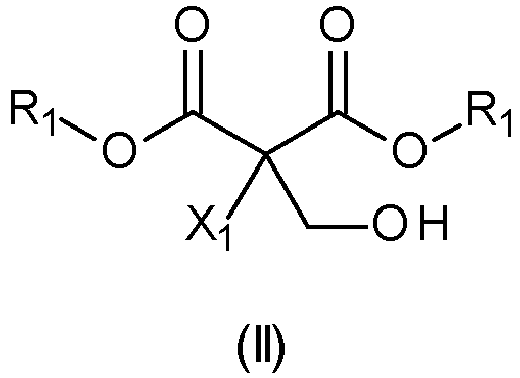
- Gegenstand der Erfindung ist daher ein Verfahren zur Herstellung von 2-Halogenacrylsäureestern der Formel (IV)

- R1
- für C1-C6-Alkyl, oder C3-C6-Cycloalkyl und
- X1
- für Fluor steht,
- a) Umsetzung von Verbindungen der Formel (II),


- in denen jeweils R1 und X1 die für Formel (IV) genannte Bedeutung besitzen und die beiden Reste R1 identisch oder verschieden, vorzugsweise identisch sind,
- und wobei X2 in Formel (III) für Chlor, Chlorsulfinyloxy oder Brom steht,
- in Gegenwart von Base ausgewählt aus der Gruppe bestehend aus Erdalkali- oder Alkalimetallhydroxide, -amide, -alkoholate, -carbonate, -hydrogenphosphate, -phosphate und in Gegenwart von Lösungsmitteln ausgewählt aus der Gruppe bestehend aus Ethern, Amiden, Sulfonen und Sulfoxiden zu Verbindungen der Formel (IV) bei Temperaturen von 120°C bis 170°C.
- In Gegenwart der erfindungsgemäßen Base werden die Verbindungen der Formel (IV) aus den Verbindungen der Formel (II) unter Kohlenstoffdioxid- und Alkoholabspaltung (R1OH) erhalten.
- In Gegenwart der erfindungsgemäßen Base werden die Verbindungen der Formel (IV) aus den Verbindungen der Formel (III) unter Kohlenstoffdioxid- und Methylhalogenidabspaltung (CH3X2) erhalten.
- In einer weiteren Ausführungsform werden die Verbindungen der Formel (IV) aus den Verbindungen der Formel (III), wenn X2=Chlorsulfinyloxy ist, unter Kohlenstoffdioxid-, Schwefeldioxid und Methylchloridabspaltung erhalten. Unter Chlorsulfinyloxy wird der Rest -O-SO-Cl verstanden.
- Bevorzugt steht R1 für Methyl, Ethyl, n-Propyl, i-Propyl, n-, i-, s- oder t-Butyl, n-Pentyl oder n-Hexyl, insbesondere für Methyl oder Ethyl. Besonders bevorzugt steht R1 für Methyl.
- In einer Ausführungsform steht X2 in den angegebenen Formeln (I) bis (IV) für Chlor oder Brom. Besonders bevorzugt steht X2 für Chlor. In einer weiteren Ausführungsform steht X2 in den angegebenen Formeln (I) bis (IV) für Fluor, Chlor, Chlorsulfinyloxy oder Brom.
- Besonders bevorzugte Verbindungen der Formel (IV) sind 2-Fluoracrylsäuremethylester und 2-Fluoracrylsäureethylester, wobei 2-Fluoracrylsäuremethylester weiter bevorzugt ist.
- Besonders bevorzugte Verbindungen der Formel (II) sind 2-Fluor-2-hydroxymethyl-malonsäuredimethylester und 2-Fluor-2-hydroxymethyl-malonsäurediethylester, wobei 2-Fluor-2-hydroxymethyl-malonsäuredimethylester weiter bevorzugt ist.
- Besonders bevorzugte Verbindungen der Formel (III) sind 2-Fluor-2-chlormethyl-malonsäuredimethylester und 2-Fluor-2-chlormethyl-malonsäurediethylester, wobei 2-Fluor-2-chlormethyl-malonsäuredimethylester weiter bevorzugt ist. Darüber hinaus besonders bevorzugte Verbindungen der Formel (III) sind 2-Fluor-2-chlorsulfinyloxy-methylmalonsäurediethylester und 2-Fluor-2-chlorsulfinyloxymethyl-malonsäure-dimethylester.
- Die Herstellung der als Edukt eingesetzten Verbindungen der Formel (II) ist durch Hydroxymethylierung von 2-Halogen-malonsäuredialkylestern der Formel (I) mit Formaldehyd aus
EP 249 867 A EP 203 462 A 
- Die Herstellung der als Edukt eingesetzten Verbindungen der Formel (III) kann durch Umsetzung von Verbindungen der Formel (II) mit einem Halogenierungsmittel erfolgen.
- Als Halogenierungsmittel können Fluorierungs-, Chlorierungs- oder Bromierungsmittel eingesetzt werden. Halogenierungsmittel umfassen beispielsweise Thionylchlorid, Thionylbromid, Phosphortrichlorid, Phosphortribromid, Sulfurylchlorid, Sulfurylbromid und Halogenwasserstoffe wie Fluor-, Chlor- oder Bromwasserstoff. Ein besonders bevorzugtes Halogenierungs- bzw. Chlorierungsmittel ist Thionylchlorid.
- Das Halogenierungsverfahren kann in Gegenwart oder in Abwesenheit eines Lösungsmittels durchgeführt werden.
- Geeignete Lösungsmittel für die Halogenierung umfassen beispielsweise Chlorkohlenwasserstoffe wie beispielsweise Methylenchlorid, Chloroform, Tetrachlorkohlenstoff; aromatische, gegebenenfalls chlorierte Kohlenwasserstoffe wie beispielsweise Toluol, Xylol, Chlorbenzol, 1,2-Dichlorbenzol, 1,3-Dichlorbenzol und 1,4-Dichlorbenzol; aliphatische Kohlenwasserstoffe wie beispielsweise Hexan, Heptan, Cyclohexan und Methylcyclohexan oder Mischungen der vorgenannten Lösungsmittel.
- Das Halogenierungsverfahren kann in Gegenwart oder in Abwesenheit einer Base erfolgen. Geeignete Basen umfassen beispielsweise Natrium- oder Kaliumhydroxid, Natrium- oder Kaliumcarbonat, Natrium- oder Kaliumalkoxid, Ammoniak, organische Amine wie Triethylamin, Tributylamin oder Pyridin, oder Mischungen der vorgenannten Basen.
- Das Halogenierungsverfahren kann beispielsweise bei einer Temperatur im Bereich von -20°C bis 200°C, vorzugsweise bei 50°C bis 90°C, oder darüber hinaus vorzugsweise bei 0°C bis 50°C, oder weiterhin darüber hinaus vorzugsweise bei 80°C bis 120°C, oder weiterhin darüber hinaus vorzugsweise bei 110°C bis 170°C durchgeführt werden.
- Bei der Umsetzung der Verbindung der allgemeinen Formel (II) mit Thionylchlorid kann als Produkt ein 2-Fluor-2-chlorsulfinyloxymethyl-malonsäurediester erhalten werden (X2= O-SO-Cl). Diese Verbindung wird beispielsweise bei der Umsetzung von der Verbindung der allgemeinen Formel (II) mit Thionylchlorid bei Temperaturen von 0 bis 50°C erhalten. Bei der Umsetzung der Verbindung der allgemeinen Formel (II) mit Thionylchlorid in Anwesenheit einer Base bei höheren Temperaturen, beispielsweise bei Temperaturen von 80 bis 120°C, wird dagegen der entsprechende Chlormethylmalonsäurediester erhalten. In Abwesenheit einer Base wird bei der Umsetzung der Verbindung der allgemeinen Formel (II) mit Thionylchlorid dagegen der entsprechende Chlormethylmalonsäurediester erst bei höheren Temperaturen, beispielsweise bei Temperaturen von 110 bis 170°C erhalten.
- Die alternativ oder zusätzlich als Edukt in das erfindungsgemäße Verfahren eingesetzten Verbindungen der Formel (III) sind neu und daher ebenso wie ihre Herstellung von der Erfindung mit umfasst.
- In einer bevorzugten Ausführungsform werden als Edukt in das erfindungsgemäße Verfahren die Verbindungen der Formel (III) eingesetzt.
- Der Vorteil zum bekannten Stand der Technik ist darin zu sehen, dass das erfindungsgemäße Verfahren nicht über die Herstellung der freien 2-Halogenacrylsäure verläuft. Ein zusätzlicher Veresterungsschritt entfällt somit.
- Bevorzugt werden als Basen Alkalimetallhydroxide ausgewählt aus Natriumhydroxid oder Kaliumhydroxid, Alkalimetallamide ausgewählt aus Natriumamid oder Lithiumdiethylamid, Alkalimetallalkoholate ausgewählt aus Natriummethylat oder Kalium-tert-butylat, Alkalimetall-carbonate ausgewählt aus Natriumcarbonat oder Kaliumcarbonat, Alkalimetallhydrogenphosphate ausgewählt aus Dinatriumhydrogenphosphat, Dikaliumhydrogenphosphat, Natriumdihydrogenphosphat oder Kaliumdihydrogenphosphat, oder Alkalimetallphosphate ausgewählt aus Trinatriumphosphat, Trikaliumphosphat eingesetzt.
- Besonders bevorzugt werden als Basen Natrium- oder Kaliumhydrogencarbonat eingesetzt.
- Das Verfahren wird erfindungsgemäß in Gegenwart von Lösungsmittel ausgewählt aus der Gruppe bestehend aus Ethern, Amiden, Sulfonen und Sulfoxiden durchgeführt.
- Geeignete Lösungsmittel umfassen aus der Gruppe der Ether beispielsweise Dioxan, aus der Gruppe Amide beispielsweise N,N-Dimethyl-formamid, N,N Dimethyl-acetamid und N-Methyl-pyrrolidon, aus der Gruppe Sulfone beispielsweise Sulfolan; und aus der Gruppe Sulfoxide beispielsweise Dimethylsulfoxid. Ein besonders bevorzugtes Lösungsmittel ist N-Methyl-pyrrolidon.
- Das Verfahren wird erfindungsgemäß bei einer Temperatur im Bereich von 120 bis 170°C, vorzugsweise bei 140 bis 160°C, durchgeführt.
- Mit Hilfe des erfindungsgemäßen Verfahrens ist die Herstellung von 2-Halogenacrylsäureestern der Formel (IV) in vorteilhafter Weise weitgehend ohne die Bildung störender Nebenprodukte möglich.
- Die Aufreinigung der 2-Halogenacrylsäureestern der Formel (IV) kann nach dem Fachmann bekannten Verfahren, beispielsweise durch Extraktion mit Lösungsmitteln oder bevorzugt durch Destillation erfolgen. Die Weiterverarbeitung der 2-Halogenacrylsäureestern der Formel (IV) aus dem erfindungsgemäßen Verfahren kann aber auch ohne weitere Aufarbeitung erfolgen.
- Durch das erfindungsgemäße Verfahren können 2-Halogenacrylsäureestern der Formel (IV) in hohen Ausbeuten und in hoher Reinheit auf technisch einfache und sichere Weise hergestellt werden. Das erfindungsgemäße Verfahren erfordert nicht die Handhabung von Chemikalien, die wegen ihres Gefahrenpotenzials besonderen Aufwand erfordern und ist ohne Probleme auch in größerem Maßstab durchführbar. Es ist vor allem überraschend, dass das erfindungsgemäße Verfahren 2-Halogenacrylsäureestern der Formel (IV) in hohen Ausbeuten und in hoher Reinheit liefert.
- Die erfindungsgemäß hergestellten 2-Halogenacrylsäureester der Formel (IV) eignen sich insbesondere zur Herstellung von Kunststoffen und polymeren Zusatzstoffen in Arzneimitteln.
- Ein weitere Gegenstand der Erfindung sind 2-Chlorsulfinyloxymethyl-2-halogenmalonsäuredialkylesterder Formel (III)

- R1
- für C1-C6-Alkyl, oder C3-C6-Cycloalkyl und
- X1
- für Fluor steht, und
- X2
- für Chlorsulfinyloxy steht.
- Bevorzugt ist R1 eine Ethyl-oder Methylgruppe, besonders bevorzugt eine Methylgruppe. 2-Chlorsulfinyloxymethyl-2-halogen-malonsäuredialkylesterder der Formel (III) waren bisher nach dem Stand der Technik nicht bekannt. Wie vorstehend beschrieben, können sie als Ausgangsprodukte für die Herstellung von 2-Halogenacrylsäureestern eingesetzt werden.
- Ein weiterer Gegenstand der Erfindung ist ein Verfahren zur Herstellung von 2-Chlorsulfinyloxymethyl-2-halogen-malonsäuredialkylestern der Formel (III)


- Bevorzugt ist R1 eine Ethyl-oder Methylgruppe, besonders bevorzugt eine Methylgruppe.
- Die nachstehenden Beispiele dienen der Erläuterung der Erfindung, ohne sie dabei zu beschränken.
- Zu einer bei Raumtemperatur hergestellten Lösung von 8 g Kaliumhydrogencarbonat in 80 g einer 30%-igen wässrigen Formaldehyd-Lösung wurden bei einer Innentemperatur von 20 bis 25°C 100 g 2-Fluormalonsäuredimethylester innerhalb von 1 Stunde zudosiert. Nach 1 Stunde Nachrühren bei Raumtemperatur wurden 112 g Produkt in einer Reinheit von ca. 88 % durch Extraktion mit Ethylacetat und Eindampfen des Extrakts in Form eines farblosen Öls gewonnen, das bei Raumtemperatur rasch zu einem farblosen Feststoff erstarrte. Das Produkt wurde zur weiteren Aufreinigung aus Toluol umkristallisiert.
- Zu einer bei Raumtemperatur hergestellten Lösung von 7 g Kaliumhydrogencarbonat in 70 g einer 30%-igen wässrigen Formaldehyd-Lösung wurden nach Zusatz von 7,0 g Ethanol 100 g 2-Fluormalonsäurediethylester innerhalb von 1 Stunde bei einer Innentemperatur von 20 bis 25°C zudosiert. Nach 3 Stunden Nachrühren bei Raumtemperatur wurden 122 g Produkt in einer Reinheit von ca. 84 % durch Extraktion mit Ethylacetat und Eindampfen des Extrakts in Form eines blass beigen Öls gewonnen. Das Produkt wurde zur weiteren Aufreinigung aus Toluol umkristallisiert.
- 60 g des Produkts aus Beispiel 1 wurden bei 0 bis 5°C mit 300 g Thionylchlorid versetzt, wobei die primär auftretende Suspension nach kurzer Zeit in eine klare, hell-beige Lösung überging. Nach 1 Stunde Nachrühren bei 0 bis 5°C wurden bei dieser Temperatur 1,8 g Triethylamin zugesetzt, die Reaktionsmischung zum Rückfluss aufgeheizt und für 48 Stunden unter Rückfluss erhitzt. Der nach anschließender Einengung bis zur Trockne verbliebene Rückstand wurde in 200 g Dichlormethan aufgenommen und die resultierende Lösung bei Raumtemperatur mit 200 g einer 5 Gew.-%-igen wässrigen Natriumhydrogencarbonat-Lösung neutral gewaschen. Die organische Phase wurde erneut zur Trockne eingeengt und der verbliebende Rückstand bei ca. 10 mbar fraktioniert destilliert. Man erhielt knapp 50 g eines gelblichen Öls mit einer Reinheit >98% (ca. 75% d.Th.).
- 100 g des Produkts aus Beispiel 2 wurden bei 0 bis 5°C mit 400 g Thionylchlorid versetzt, wobei sich nach kurzer Zeit in eine klare, braune Lösung bildete. Nach 1 Stunde Nachrühren bei 0 bis 5°C wurden bei dieser Temperatur 5,0 g Triethylamin zugesetzt, die Reaktionsmischung zum Rückfluss aufgeheizt und für 48 Stunden unter Rückfluss erhitzt. Der nach anschließender Einengung bis zur Trockne verbliebene Rückstand wurde in 300 g Dichlormethan aufgenommen und die resultierende Lösung bei Raumtemperatur mit 300 g einer 5 Gew.-%-igen wässrigen Natriumhydrogencarbonat-Lösung neutral gewaschen. Durch Einengen der organischen Phase zur Trockne erhielt man knapp 107 g eines beigen Öls mit einer Reinheit von ca. 91% (ca. 88% d.Th.). Das Produkt konnte zur weiteren Aufreinigung in einer Destillationsausbeute von ca. 80% d.Th. bei 20 mbar fraktioniert destilliert werden.
- 60 g des Produkts aus Beispiel 1 wurden aufgeschmolzen und als Schmelze bei Raumtemp. in vorgelegte 80 g Thionylchlorid eindosiert. Nach 5 Stunden Nachrühren bei Raumtemp. wurde die Reaktionsmischung im Vakuum bis zur Trockne eingeengt. Als Sumpf verblieben 86 g eines beigen Öls mit einer Reinheit von 90% (ca. 90% d.Th.).
- 68 g des Produkts aus Beispiel 5 wurden bei 20 mbar fraktioniert destilliert. Man erhielt als Destillat 27,7 g eines farblosen Öls mit einer Reinheit von knapp 97% (ca. 60% d.Th.).
- In eine Mischung aus 100 g N-Methyl-pyrrolidon, 70 g Natriumcarbonat und 5 g 2,6-Di-tert.-butyl-4-methylphenol wurden bei 300 mbar und 150°C 50 g des Produkts aus Beispiel 3 in ca. 4 h eindosiert. Man erhielt 27 g einer farblosen Flüssigkeit mit einer Reinheit von 88% (ca. 93% d.Th.). Das Produkt konnte zur weiteren Aufreinigung unter Zusatz von 2,6-Di-tert.-butyl-4-methylphenol in einer Destillationsausbeute von ca. 92% d.Th. unter Vakuum fraktioniert destilliert werden.
- Eine bei Raumtemp. hergestellte Mischung aus 50 g N-Methyl-pyrrolidon, 30 g Natriumcarbonat, 2,5 g 2,6-Di-tert.-butyl-4-methylphenol und 50 g des Produkts aus Beispiel 1 wurde im Vakuum bei 300 mbar langsam auf 150°C aufgeheizt. Das dabei anfallende Destillat wurde bei 0°C mit einer 20 Gew.-%-igen wässrigen Natriumchlorid-Lösung Methanol-frei gewaschen. Man erhielt 24 g einer farblosen Flüssigkeit mit einer Reinheit von 96% (ca. 82% d.Th.).
- Das Produkt konnte zur weiteren Aufreinigung unter Zusatz von 2,6-Di-tert.-butyl-4-methylphenol in einer Destillationsausbeute von ca. 92% d.Th. unter Vakuum fraktioniert destilliert werden.
- In eine Mischung aus 40 g N-Methyl-pyrrolidon, 32 g Natriumcarbonat und 1,4 g 2,6-Di-tert.-butyl-4-methylphenol wurden bei 300 mbar und 130°C 48,6 g des Produkts aus Beispiel 5 in ca. 4 h eindosiert. Das dabei anfallende Destillat wurde bei 0°C mit Wasser gewaschen. Man erhielt 14,8 g einer farblosen Flüssigkeit mit einer Reinheit von knapp 88% (ca. 82% d.Th.).
- In eine Mischung aus 100 g N-Methyl-pyrrolidon, 24 g Natriumcarbonat und 2,5 g 2,6-Di-tert.-butyl-4-methylphenol wurden bei 300 mbar und 140°C 50,7 g des destillierten Produkts aus Beispiel 4 in ca. 3 h eindosiert. Man erhielt als Destillat 16,2 g einer farblosen Flüssigkeit mit einer Reinheit von 80% (ca. 47% d.Th.). Das Rohprodukt konnte durch Wäschen mit einer 20 Gew.-%-igen wässrigen Natriumchlorid-Lösung bei 0°C von Methanol befreit werden.
Claims (12)
- Verfahren zur Herstellung von 2-Halogenacrylsäureestern der Formel (IV)
 R1 für C1-C6-Alkyl, oder C3-C6-Cycloalkyl undX1 für Fluor steht,umfassend den Schritt:a) Umsetzung von Verbindungen der Formel (II),
 in denen jeweils R1 und X1 die für Formel (IV) genannte Bedeutung besitzen und die beiden Reste R1 identisch oder verschieden, vorzugsweise identisch sind,und wobei X2 in Formel (III) für Chlor. Brom oder Chlorsulfinyloxy steht,in Gegenwart von Base, ausgewählt aus der Gruppe bestehend aus Erdalkali- oder Alkalimetallhydroxide, -amide, -alkoholate, -carbonate, -hydrogenphosphate, -phosphate und in Gegenwart von Lösungsmitteln ausgewählt aus der Gruppe bestehend aus Ethern, Amiden, Sulfonen und Sulfoxiden zu Verbindungen der Formel (IV) bei Temperaturen von 120°C bis 170°C.
 - Verfahren nach Anspruch 1, dadurch gekennzeichnet, dass die Verbindungen der Formel (II) durch Hydroxymethylierung von 2-Halogen-malonsäuredialkylestern der Formel (I) mit Formaldehyd hergestellt werden,

- Verfahren nach einem der Anspruch 1 oder 2, dadurch gekennzeichnet, dass die Verbindungen der Formel (III) durch Umsetzung von Verbindungen der Formel (II) mit einem Halogenierungsmittel hergestellt werden.
- Verfahren nach Anspruch 3, dadurch gekennzeichnet, dass als Halogenierungsmittel solche eingesetzt werden, die ausgewählt sind aus der Gruppe Thionylchlorid, Thionylbromid, Phosphortrichlorid, Phosphortribromid, Sulfurylchlorid, Sulfurylbromid und Halogenwasserstoffe wie Chlor- oder Bromwasserstoff.
- Verfahren nach einem der Ansprüche 1 bis 4, dadurch gekennzeichnet, dass 2-Fluoracrylsäuremethylester oder 2-Fluoracrylsäureethylester im Schritt a) ausgehend von• 2-Fluor-2-hydroxymethyl-malonsäuredimethylester bzw. 2-Fluor-2-hydroxymethyl-malonsäurediethylester oder ausgehend von• 2-Fluor-2-chlormethyl-malonsäuredimethylester bzw. 2-Fluor-2-chlormethylmalonsäurediethylesterhergestellt werden, wobei die Herstellung ausgehend von 2-Fluor-2-chlormethylmalonsäuredimethylester bzw. 2-Fluor-2-chlormethyl-malonsäurediethylester bevorzugt ist.
- Verfahren nach Anspruch 1, dadurch gekennzeichnet, dass 2-Fluoracrylsäuremethylester oder 2-Fluoracrylsäureethylester im Schritt a) ausgehend von• 2-Fluor-2-chlorsulfinyloxymethyl-malonsäuredimethylester bzw. 2-Fluor-2-chlorsulfinyloxymethyl-malonsäurediethylester
hergestellt werden, wobei die Herstellung ausgehend von 2-Fluor-2-chlorsulfinyloxymethyl-malonsäuredimethylester bzw. 2-Fluor-2-chlorsulfinyl-oxymethylmalonsäurediethylester bevorzugt ist. - Verfahren nach einem der Ansprüche 1 bis 6 dadurch gekennzeichnet, dass als Basen Alkalimetallhydroxide ausgewählt aus Natriumhydroxid oder Kaliumhydroxid, Alkalimetallamide ausgewählt aus Natriumamid oder Lithiumdiethylamid, Alkalimetallalkoholate ausgewählt aus Natriummethylat oder Kalium-tert-butylat, Alkalimetall-carbonate ausgewählt aus Natriumcarbonat oder Kaliumcarbonat, Alkalimetallhydrogenphosphate ausgewählt aus Dinatriumhydrogenphosphat, Dikaliumhydrogenphosphat, Natriumdihydrogenphosphat oder Kaliumdihydrogenphosphat, oder Alkalimetallphosphate ausgewählt aus Trinatriumphosphat, Trikaliumphosphat eingesetzt werden.
- Verfahren nach einem der Ansprüche 1 bis 7, dadurch gekennzeichnet, dass als Lösungsmittel aus der Gruppe der Ether Dioxan, Amide ausgewählt aus der Gruppe N,N-Dimethyl-formamid, N,N Dimethyl-acetamid und N-Methyl-pyrrolidon, aus der Gruppe Sulfone Sulfolan; und aus der Gruppe Sulfoxide Dimethylsulfoxid eingesetzt werden.
- Verfahren zur Herstellung von Kunststoffen und polymeren Zusatzstoffen in Arzneimitteln, dadurch gekennzeichnet, dass es ein Verfahren gemäß einem der Ansprüche 1 bis 8 umfasst.
- 2- Chlorsulfinyloxymethyl-2-halogen-malonsäuredialkylester der Formel (III)
 R1 für C1-C6-Alkyl oder C3-C6-Cycloalkyl undX1 für Fluor steht, undX2 für Chlorsulfinyloxy steht.
 - Verbindung der Formel (III) nach Anspruch 10 ausgewählt aus 2-Fluor-2-chlorsulfinyloxymethyl-malonsäuredimethylester und 2-Fluor-2-chlorsulfinyloxymethyl-malonsäurediethylester.
- Verfahren zur Herstellung von 2-Chlorsulfinyloxymethyl-2-halogen-malonsäuredialkylestern der Formel (III)

Applications Claiming Priority (2)
| Application Number | Priority Date | Filing Date | Title |
|---|---|---|---|
| EP14172874 | 2014-06-18 | ||
| PCT/EP2015/063634 WO2015193392A1 (de) | 2014-06-18 | 2015-06-17 | Verfahren zur herstellung von 2-halogenacrylsäureestern |
Publications (2)
| Publication Number | Publication Date |
|---|---|
| EP3157900A1 EP3157900A1 (de) | 2017-04-26 |
| EP3157900B1 true EP3157900B1 (de) | 2019-05-15 |
Family
ID=50942600
Family Applications (1)
| Application Number | Title | Priority Date | Filing Date |
|---|---|---|---|
| EP15728903.4A Active EP3157900B1 (de) | 2014-06-18 | 2015-06-17 | Verfahren zur herstellung von 2-halogenacrylsäureestern |
Country Status (8)
| Country | Link |
|---|---|
| US (1) | US10125085B2 (de) |
| EP (1) | EP3157900B1 (de) |
| JP (1) | JP6574209B2 (de) |
| KR (1) | KR20170020350A (de) |
| CN (1) | CN106458841B (de) |
| CA (1) | CA2952530A1 (de) |
| ES (1) | ES2738421T3 (de) |
| WO (1) | WO2015193392A1 (de) |
Families Citing this family (7)
| Publication number | Priority date | Publication date | Assignee | Title |
|---|---|---|---|---|
| CN114867710B (zh) * | 2019-11-14 | 2026-03-13 | 维福(国际)有限公司 | 2-氟代丙烯酸烷基酯的一步合成 |
| JP7375519B2 (ja) * | 2019-12-17 | 2023-11-08 | Agc株式会社 | ハロゲン化アクリル酸エステルの製造方法 |
| WO2021215450A1 (ja) * | 2020-04-20 | 2021-10-28 | ダイキン工業株式会社 | α-フルオロアクリル酸エステルの製造方法 |
| CN115427387A (zh) * | 2020-04-20 | 2022-12-02 | 大金工业株式会社 | α-氟丙烯酸酯的制造方法 |
| JP7104358B2 (ja) * | 2020-08-19 | 2022-07-21 | ダイキン工業株式会社 | 含ハロゲン(メタ)アクリル酸エステルの精製方法 |
| CN112574037A (zh) * | 2021-02-20 | 2021-03-30 | 湖南师范大学 | 一种α,γ,γ,γ-四氯丁酸酯的合成方法 |
| WO2025132814A1 (en) | 2023-12-21 | 2025-06-26 | Vifor (International) Ag | Novel synthesis of methyl-2-fluoroacrylate |
Family Cites Families (7)
| Publication number | Priority date | Publication date | Assignee | Title |
|---|---|---|---|---|
| FR1445618A (fr) * | 1965-05-31 | 1966-07-15 | Centre Nat Rech Scient | Procédé pour l'obtention d'esters alpha-fluoracryliques, notamment d'alpha-fluoracrylate de butyle |
| DE3673068D1 (de) * | 1985-05-25 | 1990-09-06 | Hoechst Ag | Alpha-fluoracrylsaeureester und deren polymere. |
| US5319131A (en) | 1985-05-25 | 1994-06-07 | Hoechst Aktiengesellschaft | α-fluoroacrylic acid esters and polymers thereof |
| DE3620050A1 (de) * | 1986-06-14 | 1987-12-17 | Hoechst Ag | Substituierte (alpha)-fluoracrylsaeurephenylester |
| DE3928990A1 (de) * | 1989-09-01 | 1991-03-07 | Bayer Ag | Verfahren zur herstellung von (alpha)-fluoroacrylsaeurederivaten |
| JP2001172223A (ja) | 1999-12-17 | 2001-06-26 | Nippon Mektron Ltd | 2−フルオロアクリル酸またはそのエステルの製造法 |
| JP6237223B2 (ja) * | 2012-12-28 | 2017-11-29 | ダイキン工業株式会社 | α−フルオロアクリル酸エステルの製造方法 |
-
2015
- 2015-06-17 WO PCT/EP2015/063634 patent/WO2015193392A1/de not_active Ceased
- 2015-06-17 KR KR1020167034968A patent/KR20170020350A/ko not_active Abandoned
- 2015-06-17 CA CA2952530A patent/CA2952530A1/en not_active Abandoned
- 2015-06-17 ES ES15728903T patent/ES2738421T3/es active Active
- 2015-06-17 US US15/317,583 patent/US10125085B2/en active Active
- 2015-06-17 JP JP2016573088A patent/JP6574209B2/ja not_active Expired - Fee Related
- 2015-06-17 EP EP15728903.4A patent/EP3157900B1/de active Active
- 2015-06-17 CN CN201580032457.3A patent/CN106458841B/zh not_active Expired - Fee Related
Non-Patent Citations (1)
| Title |
|---|
| None * |
Also Published As
| Publication number | Publication date |
|---|---|
| CN106458841A (zh) | 2017-02-22 |
| EP3157900A1 (de) | 2017-04-26 |
| ES2738421T3 (es) | 2020-01-22 |
| CA2952530A1 (en) | 2015-12-23 |
| JP6574209B2 (ja) | 2019-09-11 |
| KR20170020350A (ko) | 2017-02-22 |
| WO2015193392A1 (de) | 2015-12-23 |
| JP2017522286A (ja) | 2017-08-10 |
| US10125085B2 (en) | 2018-11-13 |
| US20170197905A1 (en) | 2017-07-13 |
| CN106458841B (zh) | 2019-12-20 |
Similar Documents
| Publication | Publication Date | Title |
|---|---|---|
| EP3157900A1 (de) | Verfahren zur herstellung von 2-halogenacrylsäureestern | |
| EP2445862B1 (de) | Herstellung von substituierten 2-fluoracrylsäurederivaten | |
| EP0463464B1 (de) | Verfahren zur Herstellung von 2-Chlor-5-methyl-pyridin | |
| DE102004033525A1 (de) | Verbessertes Verfahren zur Herstellung kernfluorierter Aromaten | |
| EP0393453A2 (de) | Verfahren zur Herstellung von 2-Chlor-5-chlormethyl-pyridin und neue Zwischenprodukte | |
| EP2729444B1 (de) | Verfahren zur herstellung von 2-amino-5-cyano-n,3-dimethylbenzamid | |
| EP1598331B1 (de) | Verfahren zur Herstellung von Phthalsäuredichlorid | |
| DE10208955A1 (de) | Verfahren zur Herstellung von 2-Halogenalkylnicotinsäuren | |
| EP0439745A2 (de) | Verfahren zur Herstellung von 2-Chlor-5-methyl-pyridin | |
| EP1232151B1 (de) | Verfahren zur herstellung von benzofuranonoximen | |
| DE4438366A1 (de) | Verfahren zur Herstellung von N-Alkenylcarbonsäureamiden | |
| EP1515954B1 (de) | Verfahren zur herstellung von 4,6-dichlor-5-fluorpyrimidin | |
| DE4231036A1 (de) | Verfahren zur Herstellung von 2-Amino-6-halogenpurinen | |
| DE1670585B2 (de) | Verfahren zur Herstellung von substituierten 2-Mercapto-4,6-dichlor-s-triazinen | |
| DE102004027871B3 (de) | Verfahren zur Herstellung von 10α-[4'-(S,S-Dioxothiomorpholin-1'-yl)]-10-desoxo-10-dihydroartemisinin | |
| EP0290903B1 (de) | Beta-Fluoracyl-beta-halogenvinylalkylether | |
| EP0478994B1 (de) | Verfahren zur Herstellung von 5-Hydroxy-3,4,5,6-tetrahydro-pyrimidin-Derivaten | |
| DE60310709T2 (de) | Neue Säurehalogenid-Derivate, deren Herstellung sowie deren Verwendung zur Herstellung von Indanoncarbonsäureestern | |
| EP3548463B1 (de) | Verfahren zur herstellung von 3-substituierten 2-vinylphenylsulfonaten | |
| EP0445644B1 (de) | Trifluor- bzw. Chlordifluormethoxypyrimidine und Verfahren zu ihrer Herstellung | |
| EP3145907B1 (de) | Verfahren zur herstellung von alkoxybenzonitrilen | |
| WO2006058642A1 (de) | Verfahren zum herstellen von 3-halophthalsäuredichloriden | |
| EP2112137A1 (de) | Verfahren zur Herstellung von quarternären Salzen von Piperidyl Estern der Mandelsäure | |
| DE3031325A1 (de) | Verfahren zur herstellung von ethan-1, 1,2,2-tetracarbonsaeure-tetraalkylestern | |
| DE2410954B2 (de) | Verfahren zur Herstellung von Phthalimide- oder Cyclohexen-1,2-dicarboximido-thionophosphaten |
Legal Events
| Date | Code | Title | Description |
|---|---|---|---|
| STAA | Information on the status of an ep patent application or granted ep patent |
Free format text: STATUS: THE INTERNATIONAL PUBLICATION HAS BEEN MADE |
|
| PUAI | Public reference made under article 153(3) epc to a published international application that has entered the european phase |
Free format text: ORIGINAL CODE: 0009012 |
|
| STAA | Information on the status of an ep patent application or granted ep patent |
Free format text: STATUS: REQUEST FOR EXAMINATION WAS MADE |
|
| 17P | Request for examination filed |
Effective date: 20170118 |
|
| AK | Designated contracting states |
Kind code of ref document: A1 Designated state(s): AL AT BE BG CH CY CZ DE DK EE ES FI FR GB GR HR HU IE IS IT LI LT LU LV MC MK MT NL NO PL PT RO RS SE SI SK SM TR |
|
| AX | Request for extension of the european patent |
Extension state: BA ME |
|
| DAV | Request for validation of the european patent (deleted) | ||
| DAX | Request for extension of the european patent (deleted) | ||
| STAA | Information on the status of an ep patent application or granted ep patent |
Free format text: STATUS: EXAMINATION IS IN PROGRESS |
|
| 17Q | First examination report despatched |
Effective date: 20180313 |
|
| GRAP | Despatch of communication of intention to grant a patent |
Free format text: ORIGINAL CODE: EPIDOSNIGR1 |
|
| STAA | Information on the status of an ep patent application or granted ep patent |
Free format text: STATUS: GRANT OF PATENT IS INTENDED |
|
| INTG | Intention to grant announced |
Effective date: 20181024 |
|
| GRAJ | Information related to disapproval of communication of intention to grant by the applicant or resumption of examination proceedings by the epo deleted |
Free format text: ORIGINAL CODE: EPIDOSDIGR1 |
|
| STAA | Information on the status of an ep patent application or granted ep patent |
Free format text: STATUS: EXAMINATION IS IN PROGRESS |
|
| INTC | Intention to grant announced (deleted) | ||
| GRAR | Information related to intention to grant a patent recorded |
Free format text: ORIGINAL CODE: EPIDOSNIGR71 |
|
| GRAS | Grant fee paid |
Free format text: ORIGINAL CODE: EPIDOSNIGR3 |
|
| STAA | Information on the status of an ep patent application or granted ep patent |
Free format text: STATUS: GRANT OF PATENT IS INTENDED |
|
| GRAA | (expected) grant |
Free format text: ORIGINAL CODE: 0009210 |
|
| STAA | Information on the status of an ep patent application or granted ep patent |
Free format text: STATUS: THE PATENT HAS BEEN GRANTED |
|
| AK | Designated contracting states |
Kind code of ref document: B1 Designated state(s): AL AT BE BG CH CY CZ DE DK EE ES FI FR GB GR HR HU IE IS IT LI LT LU LV MC MK MT NL NO PL PT RO RS SE SI SK SM TR |
|
| INTG | Intention to grant announced |
Effective date: 20190408 |
|
| REG | Reference to a national code |
Ref country code: CH Ref legal event code: EP |
|
| REG | Reference to a national code |
Ref country code: DE Ref legal event code: R096 Ref document number: 502015009077 Country of ref document: DE |
|
| REG | Reference to a national code |
Ref country code: IE Ref legal event code: FG4D Free format text: LANGUAGE OF EP DOCUMENT: GERMAN |
|
| REG | Reference to a national code |
Ref country code: NL Ref legal event code: FP |
|
| REG | Reference to a national code |
Ref country code: LT Ref legal event code: MG4D |
|
| PG25 | Lapsed in a contracting state [announced via postgrant information from national office to epo] |
Ref country code: NO Free format text: LAPSE BECAUSE OF FAILURE TO SUBMIT A TRANSLATION OF THE DESCRIPTION OR TO PAY THE FEE WITHIN THE PRESCRIBED TIME-LIMIT Effective date: 20190815 Ref country code: LT Free format text: LAPSE BECAUSE OF FAILURE TO SUBMIT A TRANSLATION OF THE DESCRIPTION OR TO PAY THE FEE WITHIN THE PRESCRIBED TIME-LIMIT Effective date: 20190515 Ref country code: FI Free format text: LAPSE BECAUSE OF FAILURE TO SUBMIT A TRANSLATION OF THE DESCRIPTION OR TO PAY THE FEE WITHIN THE PRESCRIBED TIME-LIMIT Effective date: 20190515 Ref country code: SE Free format text: LAPSE BECAUSE OF FAILURE TO SUBMIT A TRANSLATION OF THE DESCRIPTION OR TO PAY THE FEE WITHIN THE PRESCRIBED TIME-LIMIT Effective date: 20190515 Ref country code: HR Free format text: LAPSE BECAUSE OF FAILURE TO SUBMIT A TRANSLATION OF THE DESCRIPTION OR TO PAY THE FEE WITHIN THE PRESCRIBED TIME-LIMIT Effective date: 20190515 Ref country code: AL Free format text: LAPSE BECAUSE OF FAILURE TO SUBMIT A TRANSLATION OF THE DESCRIPTION OR TO PAY THE FEE WITHIN THE PRESCRIBED TIME-LIMIT Effective date: 20190515 Ref country code: PT Free format text: LAPSE BECAUSE OF FAILURE TO SUBMIT A TRANSLATION OF THE DESCRIPTION OR TO PAY THE FEE WITHIN THE PRESCRIBED TIME-LIMIT Effective date: 20190915 |
|
| PG25 | Lapsed in a contracting state [announced via postgrant information from national office to epo] |
Ref country code: BG Free format text: LAPSE BECAUSE OF FAILURE TO SUBMIT A TRANSLATION OF THE DESCRIPTION OR TO PAY THE FEE WITHIN THE PRESCRIBED TIME-LIMIT Effective date: 20190815 Ref country code: RS Free format text: LAPSE BECAUSE OF FAILURE TO SUBMIT A TRANSLATION OF THE DESCRIPTION OR TO PAY THE FEE WITHIN THE PRESCRIBED TIME-LIMIT Effective date: 20190515 Ref country code: LV Free format text: LAPSE BECAUSE OF FAILURE TO SUBMIT A TRANSLATION OF THE DESCRIPTION OR TO PAY THE FEE WITHIN THE PRESCRIBED TIME-LIMIT Effective date: 20190515 Ref country code: GR Free format text: LAPSE BECAUSE OF FAILURE TO SUBMIT A TRANSLATION OF THE DESCRIPTION OR TO PAY THE FEE WITHIN THE PRESCRIBED TIME-LIMIT Effective date: 20190816 |
|
| REG | Reference to a national code |
Ref country code: ES Ref legal event code: FG2A Ref document number: 2738421 Country of ref document: ES Kind code of ref document: T3 Effective date: 20200122 |
|
| PG25 | Lapsed in a contracting state [announced via postgrant information from national office to epo] |
Ref country code: SK Free format text: LAPSE BECAUSE OF FAILURE TO SUBMIT A TRANSLATION OF THE DESCRIPTION OR TO PAY THE FEE WITHIN THE PRESCRIBED TIME-LIMIT Effective date: 20190515 Ref country code: EE Free format text: LAPSE BECAUSE OF FAILURE TO SUBMIT A TRANSLATION OF THE DESCRIPTION OR TO PAY THE FEE WITHIN THE PRESCRIBED TIME-LIMIT Effective date: 20190515 Ref country code: DK Free format text: LAPSE BECAUSE OF FAILURE TO SUBMIT A TRANSLATION OF THE DESCRIPTION OR TO PAY THE FEE WITHIN THE PRESCRIBED TIME-LIMIT Effective date: 20190515 Ref country code: CZ Free format text: LAPSE BECAUSE OF FAILURE TO SUBMIT A TRANSLATION OF THE DESCRIPTION OR TO PAY THE FEE WITHIN THE PRESCRIBED TIME-LIMIT Effective date: 20190515 Ref country code: RO Free format text: LAPSE BECAUSE OF FAILURE TO SUBMIT A TRANSLATION OF THE DESCRIPTION OR TO PAY THE FEE WITHIN THE PRESCRIBED TIME-LIMIT Effective date: 20190515 |
|
| REG | Reference to a national code |
Ref country code: DE Ref legal event code: R097 Ref document number: 502015009077 Country of ref document: DE |
|
| PG25 | Lapsed in a contracting state [announced via postgrant information from national office to epo] |
Ref country code: MC Free format text: LAPSE BECAUSE OF FAILURE TO SUBMIT A TRANSLATION OF THE DESCRIPTION OR TO PAY THE FEE WITHIN THE PRESCRIBED TIME-LIMIT Effective date: 20190515 Ref country code: SM Free format text: LAPSE BECAUSE OF FAILURE TO SUBMIT A TRANSLATION OF THE DESCRIPTION OR TO PAY THE FEE WITHIN THE PRESCRIBED TIME-LIMIT Effective date: 20190515 |
|
| PLBE | No opposition filed within time limit |
Free format text: ORIGINAL CODE: 0009261 |
|
| STAA | Information on the status of an ep patent application or granted ep patent |
Free format text: STATUS: NO OPPOSITION FILED WITHIN TIME LIMIT |
|
| REG | Reference to a national code |
Ref country code: BE Ref legal event code: MM Effective date: 20190630 |
|
| PG25 | Lapsed in a contracting state [announced via postgrant information from national office to epo] |
Ref country code: TR Free format text: LAPSE BECAUSE OF FAILURE TO SUBMIT A TRANSLATION OF THE DESCRIPTION OR TO PAY THE FEE WITHIN THE PRESCRIBED TIME-LIMIT Effective date: 20190515 |
|
| 26N | No opposition filed |
Effective date: 20200218 |
|
| PG25 | Lapsed in a contracting state [announced via postgrant information from national office to epo] |
Ref country code: PL Free format text: LAPSE BECAUSE OF FAILURE TO SUBMIT A TRANSLATION OF THE DESCRIPTION OR TO PAY THE FEE WITHIN THE PRESCRIBED TIME-LIMIT Effective date: 20190515 |
|
| PG25 | Lapsed in a contracting state [announced via postgrant information from national office to epo] |
Ref country code: LU Free format text: LAPSE BECAUSE OF NON-PAYMENT OF DUE FEES Effective date: 20190617 Ref country code: SI Free format text: LAPSE BECAUSE OF FAILURE TO SUBMIT A TRANSLATION OF THE DESCRIPTION OR TO PAY THE FEE WITHIN THE PRESCRIBED TIME-LIMIT Effective date: 20190515 Ref country code: BE Free format text: LAPSE BECAUSE OF NON-PAYMENT OF DUE FEES Effective date: 20190630 |
|
| PG25 | Lapsed in a contracting state [announced via postgrant information from national office to epo] |
Ref country code: CY Free format text: LAPSE BECAUSE OF FAILURE TO SUBMIT A TRANSLATION OF THE DESCRIPTION OR TO PAY THE FEE WITHIN THE PRESCRIBED TIME-LIMIT Effective date: 20190515 |
|
| PG25 | Lapsed in a contracting state [announced via postgrant information from national office to epo] |
Ref country code: IS Free format text: LAPSE BECAUSE OF FAILURE TO SUBMIT A TRANSLATION OF THE DESCRIPTION OR TO PAY THE FEE WITHIN THE PRESCRIBED TIME-LIMIT Effective date: 20190915 |
|
| PG25 | Lapsed in a contracting state [announced via postgrant information from national office to epo] |
Ref country code: MT Free format text: LAPSE BECAUSE OF FAILURE TO SUBMIT A TRANSLATION OF THE DESCRIPTION OR TO PAY THE FEE WITHIN THE PRESCRIBED TIME-LIMIT Effective date: 20190515 Ref country code: HU Free format text: LAPSE BECAUSE OF FAILURE TO SUBMIT A TRANSLATION OF THE DESCRIPTION OR TO PAY THE FEE WITHIN THE PRESCRIBED TIME-LIMIT; INVALID AB INITIO Effective date: 20150617 |
|
| PG25 | Lapsed in a contracting state [announced via postgrant information from national office to epo] |
Ref country code: MK Free format text: LAPSE BECAUSE OF FAILURE TO SUBMIT A TRANSLATION OF THE DESCRIPTION OR TO PAY THE FEE WITHIN THE PRESCRIBED TIME-LIMIT Effective date: 20190515 |
|
| PGFP | Annual fee paid to national office [announced via postgrant information from national office to epo] |
Ref country code: NL Payment date: 20220513 Year of fee payment: 8 |
|
| PGFP | Annual fee paid to national office [announced via postgrant information from national office to epo] |
Ref country code: IT Payment date: 20220510 Year of fee payment: 8 Ref country code: IE Payment date: 20220413 Year of fee payment: 8 Ref country code: GB Payment date: 20220428 Year of fee payment: 8 Ref country code: FR Payment date: 20220408 Year of fee payment: 8 Ref country code: DE Payment date: 20220427 Year of fee payment: 8 |
|
| PGFP | Annual fee paid to national office [announced via postgrant information from national office to epo] |
Ref country code: AT Payment date: 20220525 Year of fee payment: 8 |
|
| PGFP | Annual fee paid to national office [announced via postgrant information from national office to epo] |
Ref country code: ES Payment date: 20220705 Year of fee payment: 8 |
|
| PGFP | Annual fee paid to national office [announced via postgrant information from national office to epo] |
Ref country code: CH Payment date: 20220702 Year of fee payment: 8 |
|
| REG | Reference to a national code |
Ref country code: DE Ref legal event code: R119 Ref document number: 502015009077 Country of ref document: DE |
|
| REG | Reference to a national code |
Ref country code: CH Ref legal event code: PL |
|
| REG | Reference to a national code |
Ref country code: NL Ref legal event code: MM Effective date: 20230701 |
|
| REG | Reference to a national code |
Ref country code: AT Ref legal event code: MM01 Ref document number: 1133250 Country of ref document: AT Kind code of ref document: T Effective date: 20230617 |
|
| GBPC | Gb: european patent ceased through non-payment of renewal fee |
Effective date: 20230617 |
|
| REG | Reference to a national code |
Ref country code: IE Ref legal event code: MM4A |
|
| PG25 | Lapsed in a contracting state [announced via postgrant information from national office to epo] |
Ref country code: NL Free format text: LAPSE BECAUSE OF NON-PAYMENT OF DUE FEES Effective date: 20230701 |
|
| PG25 | Lapsed in a contracting state [announced via postgrant information from national office to epo] |
Ref country code: IE Free format text: LAPSE BECAUSE OF NON-PAYMENT OF DUE FEES Effective date: 20230617 |
|
| PG25 | Lapsed in a contracting state [announced via postgrant information from national office to epo] |
Ref country code: AT Free format text: LAPSE BECAUSE OF NON-PAYMENT OF DUE FEES Effective date: 20230617 |
|
| PG25 | Lapsed in a contracting state [announced via postgrant information from national office to epo] |
Ref country code: IE Free format text: LAPSE BECAUSE OF NON-PAYMENT OF DUE FEES Effective date: 20230617 Ref country code: DE Free format text: LAPSE BECAUSE OF NON-PAYMENT OF DUE FEES Effective date: 20240103 Ref country code: AT Free format text: LAPSE BECAUSE OF NON-PAYMENT OF DUE FEES Effective date: 20230617 Ref country code: GB Free format text: LAPSE BECAUSE OF NON-PAYMENT OF DUE FEES Effective date: 20230617 Ref country code: CH Free format text: LAPSE BECAUSE OF NON-PAYMENT OF DUE FEES Effective date: 20230630 |
|
| PG25 | Lapsed in a contracting state [announced via postgrant information from national office to epo] |
Ref country code: FR Free format text: LAPSE BECAUSE OF NON-PAYMENT OF DUE FEES Effective date: 20230630 |
|
| PG25 | Lapsed in a contracting state [announced via postgrant information from national office to epo] |
Ref country code: IT Free format text: LAPSE BECAUSE OF NON-PAYMENT OF DUE FEES Effective date: 20230617 |
|
| REG | Reference to a national code |
Ref country code: ES Ref legal event code: FD2A Effective date: 20240801 |
|
| PG25 | Lapsed in a contracting state [announced via postgrant information from national office to epo] |
Ref country code: ES Free format text: LAPSE BECAUSE OF NON-PAYMENT OF DUE FEES Effective date: 20230618 |
|
| PG25 | Lapsed in a contracting state [announced via postgrant information from national office to epo] |
Ref country code: ES Free format text: LAPSE BECAUSE OF NON-PAYMENT OF DUE FEES Effective date: 20230618 |