EP3156975A1 - Voxelization of a mesh - Google Patents
Voxelization of a mesh Download PDFInfo
- Publication number
- EP3156975A1 EP3156975A1 EP16193486.4A EP16193486A EP3156975A1 EP 3156975 A1 EP3156975 A1 EP 3156975A1 EP 16193486 A EP16193486 A EP 16193486A EP 3156975 A1 EP3156975 A1 EP 3156975A1
- Authority
- EP
- European Patent Office
- Prior art keywords
- triangle
- vertex
- pixel attributes
- vertices
- coordinates
- Prior art date
- Legal status (The legal status is an assumption and is not a legal conclusion. Google has not performed a legal analysis and makes no representation as to the accuracy of the status listed.)
- Granted
Links
Images


Classifications
-
- G—PHYSICS
- G06—COMPUTING OR CALCULATING; COUNTING
- G06T—IMAGE DATA PROCESSING OR GENERATION, IN GENERAL
- G06T19/00—Manipulating three-dimensional [3D] models or images for computer graphics
- G06T19/20—Editing of three-dimensional [3D] images, e.g. changing shapes or colours, aligning objects or positioning parts
-
- G—PHYSICS
- G06—COMPUTING OR CALCULATING; COUNTING
- G06T—IMAGE DATA PROCESSING OR GENERATION, IN GENERAL
- G06T15/00—Three-dimensional [3D] image rendering
-
- A—HUMAN NECESSITIES
- A61—MEDICAL OR VETERINARY SCIENCE; HYGIENE
- A61B—DIAGNOSIS; SURGERY; IDENTIFICATION
- A61B34/00—Computer-aided surgery; Manipulators or robots specially adapted for use in surgery
- A61B34/10—Computer-aided planning, simulation or modelling of surgical operations
-
- A—HUMAN NECESSITIES
- A61—MEDICAL OR VETERINARY SCIENCE; HYGIENE
- A61B—DIAGNOSIS; SURGERY; IDENTIFICATION
- A61B5/00—Measuring for diagnostic purposes; Identification of persons
- A61B5/06—Devices, other than using radiation, for detecting or locating foreign bodies ; Determining position of diagnostic devices within or on the body of the patient
- A61B5/061—Determining position of a probe within the body employing means separate from the probe, e.g. sensing internal probe position employing impedance electrodes on the surface of the body
- A61B5/062—Determining position of a probe within the body employing means separate from the probe, e.g. sensing internal probe position employing impedance electrodes on the surface of the body using magnetic field
-
- G—PHYSICS
- G06—COMPUTING OR CALCULATING; COUNTING
- G06T—IMAGE DATA PROCESSING OR GENERATION, IN GENERAL
- G06T1/00—General purpose image data processing
- G06T1/20—Processor architectures; Processor configuration, e.g. pipelining
-
- G—PHYSICS
- G06—COMPUTING OR CALCULATING; COUNTING
- G06T—IMAGE DATA PROCESSING OR GENERATION, IN GENERAL
- G06T15/00—Three-dimensional [3D] image rendering
- G06T15/005—General purpose rendering architectures
-
- G—PHYSICS
- G06—COMPUTING OR CALCULATING; COUNTING
- G06T—IMAGE DATA PROCESSING OR GENERATION, IN GENERAL
- G06T15/00—Three-dimensional [3D] image rendering
- G06T15/08—Volume rendering
-
- G—PHYSICS
- G06—COMPUTING OR CALCULATING; COUNTING
- G06T—IMAGE DATA PROCESSING OR GENERATION, IN GENERAL
- G06T17/00—Three-dimensional [3D] modelling for computer graphics
-
- G—PHYSICS
- G06—COMPUTING OR CALCULATING; COUNTING
- G06T—IMAGE DATA PROCESSING OR GENERATION, IN GENERAL
- G06T17/00—Three-dimensional [3D] modelling for computer graphics
- G06T17/20—Finite element generation, e.g. wire-frame surface description, tesselation
-
- G—PHYSICS
- G06—COMPUTING OR CALCULATING; COUNTING
- G06T—IMAGE DATA PROCESSING OR GENERATION, IN GENERAL
- G06T17/00—Three-dimensional [3D] modelling for computer graphics
- G06T17/20—Finite element generation, e.g. wire-frame surface description, tesselation
- G06T17/205—Re-meshing
-
- A—HUMAN NECESSITIES
- A61—MEDICAL OR VETERINARY SCIENCE; HYGIENE
- A61B—DIAGNOSIS; SURGERY; IDENTIFICATION
- A61B34/00—Computer-aided surgery; Manipulators or robots specially adapted for use in surgery
- A61B34/10—Computer-aided planning, simulation or modelling of surgical operations
- A61B2034/101—Computer-aided simulation of surgical operations
- A61B2034/105—Modelling of the patient, e.g. for ligaments or bones
Definitions
- the present invention relates generally to image generation, and specifically to efficient generation of an image from a mesh.
- the manipulation becomes more computer intensive as the resolution, size and numbers of colors in the image increases.
- the manipulation may be required to be in substantially real-time, leading to further demands on computer resources used to present the image.
- the quality of the image may be reduced, for example by reducing the resolution of the image or by reducing the number of colors in the image.
- An embodiment of the present invention provides a method for three-dimensional (3D) rendering, including:
- the method typically includes, after passing a given 2D triangle to the graphics processor, filling the given 2D triangle with the pixels within the given 2D triangle.
- the interpolated pixel attributes include a weighted interpolation of the triplet of pixel attributes of each 2D vertex.
- the weighted interpolation includes applying a weight to the triplet of pixel attributes of a given 2D vertex that is inversely proportional to a distance of a given pixel to the given 2D vertex.
- converting the interpolated pixel attributes into voxel coordinates consists of enclosing the triangular mesh in a rectangular parallelepiped of voxels, and selecting voxels containing or touching the interpolated pixel attributes as voxels of the surface.
- the surface is included in a chamber of a heart.
- each 2D triangle cons one common 2D triangle.
- each 2D triangle is configured to fill a virtual screen.
- apparatus for three-dimensional (3D) rendering including:
- Manipulation of surface images is typically computer intensive. Furthermore, as the resolution of images and number of colors in the images increase, the computing power needed to perform the manipulations in a timely manner also needs to increase. Rather than provide such increased computing power, prior art systems may reduce the resolution of the image, reduce the number of colors, and/or increase the time taken for manipulating the image.
- Embodiments of the present invention take a different tack, by providing the increased computing power needed for quick manipulations of images having a high resolution.
- the increased computer power is provided in the form of a dedicated graphics processor.
- a graphics processor has a highly parallel structure, which makes it more effective than general purpose processing units for processing large blocks of data.
- a general purpose processing unit receives a group of three-dimensional (3D) triangles that define a mesh of a surface, each of the triangles having three 3D vertices with respective 3D coordinates.
- the processing unit transforms each 3D triangle into a corresponding two-dimensional (2D) triangle having three 2D vertices corresponding to the 3D vertices.
- the 2D triangles may be one common 2D triangle, having one set of 2D vertices.
- Each 2D vertex has 2D pixel coordinates, and in addition each vertex is assigned a triplet of pixel attributes that are the 3D coordinates of a corresponding 3D vertex.
- the processing unit passes each 2D triangle to a dedicated graphics processor which treats the triplet of pixel attributes of each 2D vertex as interpolatable values, i.e., values between which the graphics processor may perform interpolation.
- the interpolatable values input to the processor are color values.
- the graphics processor is configured to fill each 2D triangle with pixels within the triangle. Furthermore, by treating the triplet of pixel attributes of each 2D vertex as interpolatable values, the graphics processor computes respective triplets of interpolated pixel attributes for each of the filled pixels.
- the interpolation is typically a weighted mean of the 2D vertex triplets, the weighting being configured to be inversely proportional to the distance of a given filled pixel from the 2D vertices.
- the processing unit may receive the triplets of interpolated pixel attributes from the graphics processor, and use the triplets as 3D points within the corresponding 3D triangle.
- the processing unit typically initially encloses the mesh in a set of voxels, and after performing the process described above, selects voxels that enclose or touch the 3D points.
- the processing unit uses voxel coordinates of the selected voxels to render a 3D image of the surface associated with the mesh on a screen.
- embodiments of the present invention use the highly parallel nature of the graphics processor to efficiently manipulate high resolution images in real time.
- Fig. 1 is a schematic illustration of a voxelization apparatus 20, according to an embodiment of the present invention.
- apparatus 20 is configured to determine voxels comprised in a three-dimensional (3D) surface 22.
- 3D three-dimensional
- the apparatus is assumed to be used in an invasive medical procedure, and surface 22 upon which the procedure is performed is assumed to comprise the surface of a chamber 24 of a heart 26 of a human patient 28.
- the procedure is assumed to be performed by a medical professional 30.
- the procedure is assumed to comprise ablation of surface 24.
- embodiments of the present invention are not just applicable to this specific procedure on a particular surface, and may include substantially any procedure on any surface.
- Apparatus 20 is controlled by a system processing unit (PU) 46, which is located in an operating console 48 of the apparatus.
- PU 46 is in communication with a graphics processor (GP) 50 and with a tracking module 52, the functions of which are described below.
- PU 46 is typically also in communication with other modules used for the procedure, such as an ablation module and an irrigation module, but for simplicity such modules are not shown in Fig. 1 .
- Console 48 comprises controls 54 which are used by professional 30 to communicate with the processing unit.
- a probe 60 may be configured to have a location sensor 62 at its distal end, the location sensor being in communication with PU 46 so that signals from the sensor enable the processing unit to determine the location of the sensor.
- Sensor 62 may use any method for determining its location known in the art.
- sensor 62 may comprise one or more coils, and PU 46 may use a magnetic tracking method, wherein magnetic transmitters 64 external to patient 28 generate signals in the coils.
- the processing unit may use a tracking module, such as tracking module 52, to convert the signals to location coordinates in a three-dimensional (3D) frame of reference 66 defined by the magnetic transmitters.
- 3D frame of reference is illustrated by a set of orthogonal xyz axes.
- the Carto® system produced by Biosense Webster, of Diamond Bar, CA, uses such a tracking method.
- the professional may insert probe 60 into a lumen of the patient, so that the distal end of the probe enters chamber 24 of the heart of the patient, and so that sensor 62 contacts surface 22 of the chamber at multiple points.
- From the mapping PU 46 may generate an image 70 of surface 22, which the processing unit typically presents to professional 30 on a screen 74.
- image 70 is able to manipulate image 70, for example by rotating, changing the magnification, changing the direction of view, and/or showing only a portion of the image, using controls 54.
- the production of image 70 is described below.
- the software for PU 46, GP 50, and module 52 may be downloaded in electronic form, over a network, for example.
- the software may be provided on non-transitory tangible media, such as optical, magnetic, or electronic storage media.
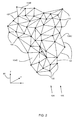
- Fig. 2 is a schematic illustration of points 100 that are registered by sensor 62 as it contacts surface 22, according to an embodiment of the present invention.
- PU 46 initially stores 3D coordinates of points 100 as measured in the 3D frame of reference defined by transmitters 64.
- the processing unit then connects 3D coordinates of points 100, herein also termed 3D vertices 100, by line segments 102, using any method known in the art such as the ball-pivoting algorithm, to produce a set of connected 3D triangles 104A, 104B, 104C, ... , generically termed triangles 104.
- 3D triangles 104 form a triangular mesh 106 of the surface.
- PU 46 uses GP 50 to render mesh 106 into image 70.
- Fig. 3 is a flowchart of steps performed by PU 46 to produce image 70
- Fig. 4 is a diagram illustrating one of the steps of the flowchart, according to an embodiment of the present invention.
- the processing unit In an initial step 150, the processing unit generates a 3D triangular mesh, herein assumed to comprise mesh 106, of surface 22, generally as described above with reference to Figs. 1 and 2 .
- the generation of the mesh comprises determining 3D coordinates, as ordered triplets, of 3D vertices 100 of the mesh, then determining equations of line segments 102 connecting the vertices to form 3D triangles 104, in frame of reference 66.
- the 3D mesh is enclosed in a 3D volume composed of voxels.
- edges of the enclosing volume are selected to be parallel to the xyz axes of frame of reference 66.
- the number and size of the voxels may be selected by professional 30.
- the voxels are typically cubic and are typically equal in size.
- Typical 3D volumes may comprise 128 ⁇ 128 ⁇ 128 or 512 ⁇ 512 ⁇ 512 voxels, but embodiments of the present invention are not limited to these specific values, and other convenient voxel configurations for the 3D volume may be selected by professional 30.
- a triangle selection step 152 the processing unit selects a 3D triangle, herein assumed to be triangle 104A, and registers the 3D coordinates of the 3D vertices of the triangle, assumed to be triplets (x A1 , Y A1 , z A1 ), (x A2 , y A2 , z A2 ), (x A3 , y A3 , z A3 ).
- a conversion step 154 in preparation for inputting data to GP 50, the selected 3D triangle is converted to a 2D triangle.
- Each of the 3D coordinates of the 3D vertices of the selected triangle is placed in a one-one correspondence with respective 2D coordinates of two-dimensional (2D) vertices.
- Each of the 2D vertices has 2D pixel coordinates and a triplet of pixel attributes of the corresponding 3D vertex.
- Fig. 4 and Table I below illustrate the correspondence formed in step 154.
- Table I 3D Triangle 2D Triangle 3D Vertices 2D Vertices and Pixel Triplet (x A1 , y A1 , z A1 ) ((x s1 ,y s1 ), [x A1 , y A1 , z A1 ]) (x A2 , y A2 , z A2 ) ((x s2 , y A2 , z A2 ]) (x A3 , y A3 , z A3 ) ((x s3 , y s3 ), [x A3 , y A3 , z A3 ])
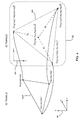
- Fig. 4 illustrates 3D triangle 104A, with its three 3D vertices, drawn in frame of reference 66.
- a 2D triangle 180 corresponding to 3D triangle 104A, has been drawn on a 2D screen 182 which has a 2D frame of reference 184.
- Triangle 180, screen 182, and frame of reference 184 have been drawn in broken lines, to indicate that the correspondence generated in step 154 does not involve any actual placement of points on a screen, and that screen 182 is a virtual screen.
- 2D triangle 182 is drawn in broken lines since there is no actual drawing of triangle 182.
- step 154 is repeated for different 3D triangles selected in step 152.
- the 2D triangle into which they are converted may be the same, so that in this case there is one common 2D triangle for all the 3D triangles.
- the 2D vertices of the common 2D triangle are selected so that the 2D triangle fills screen 182. In this case, and assuming that screen 182 in frame of reference 184 has corners (1,1), (1,-1), (-1,-1), and (-1,1) Table II applies for the correspondence.
- PU 46 passes the 2D vertices and associated pixel triplets of the 2D triangle to GP 50.
- the GP is configured to treat the attributes of each pixel triplet associated with the 2D vertices as interpolatable values. As for its treatment of interpolatable values, for each interpolated 2D pixel (x p , y p ) the GP calculates a value of a pixel triplet [x wp , y wp , z wp ] associated with the pixel as the weighted average of the three pixel triplets of the 2D vertices of triangle 182, the weighting being determined according to the closeness of the interpolated pixel to the vertices.
- step 156 the processing unit determines the values of a respective triplet [x wp , y wp , z wp ], according to equation (1), for each of the 2D pixels (x p , y p ) that fill 2D triangle 182.
- each triplet [x wp , y wp , z wp ], of the filled pixels in step 156 are associated with triangle 104A, forming a set ⁇ S ⁇ of triplets for the triangle, and the processing unit stores the set of triplets. It will be apparent from equation (1) that each triplet of set ⁇ S ⁇ is equivalent to a 3D point within triangle 104A.
- a decision step 160 the processing unit checks if a set of triplets, i.e., a set of 3D points within a given 3D triangle 104, has been stored for all 3D triangles in mesh 106. If a 3D triangle 104 exists without such a set, then the flowchart returns to step 152. If respective sets of 3D points have been stored for all triangles 104 in mesh 106, then the flowchart continues to a voxelization step 162.
- voxelization step 162 for each voxel of the 3D volume formed in step 151 PU 46 checks if at least one of the triplets stored in step 158 is contained in, or touches, the voxel. Such a voxel is "marked,” or selected, as being assumed to be a voxel comprised in surface 22. All other voxels in the 3D volume, i.e., those not enclosing or touching a triplet stored in step 158, are assumed to be not comprised in surface 22.
- PU 46 uses the voxel coordinates of the selected voxels to render image 70 of surface 22 on screen 74.
Landscapes
- Engineering & Computer Science (AREA)
- Physics & Mathematics (AREA)
- General Physics & Mathematics (AREA)
- Theoretical Computer Science (AREA)
- Computer Graphics (AREA)
- Software Systems (AREA)
- Health & Medical Sciences (AREA)
- Geometry (AREA)
- Life Sciences & Earth Sciences (AREA)
- Surgery (AREA)
- Public Health (AREA)
- Animal Behavior & Ethology (AREA)
- Veterinary Medicine (AREA)
- General Health & Medical Sciences (AREA)
- Molecular Biology (AREA)
- Biomedical Technology (AREA)
- Heart & Thoracic Surgery (AREA)
- Medical Informatics (AREA)
- Nuclear Medicine, Radiotherapy & Molecular Imaging (AREA)
- Robotics (AREA)
- Human Computer Interaction (AREA)
- Biophysics (AREA)
- Pathology (AREA)
- Computer Hardware Design (AREA)
- General Engineering & Computer Science (AREA)
- Architecture (AREA)
- Image Generation (AREA)
- Measurement And Recording Of Electrical Phenomena And Electrical Characteristics Of The Living Body (AREA)
Abstract
Description
- The present invention relates generally to image generation, and specifically to efficient generation of an image from a mesh.
- In many fields it is important to be able to manipulate images in a timely manner. The manipulation becomes more computer intensive as the resolution, size and numbers of colors in the image increases. In time critical fields, such as during a surgical procedure, the manipulation may be required to be in substantially real-time, leading to further demands on computer resources used to present the image. In some cases, in order to maintain real-time behavior, the quality of the image may be reduced, for example by reducing the resolution of the image or by reducing the number of colors in the image.
- An embodiment of the present invention provides a method for three-dimensional (3D) rendering, including:
- receiving a group of 3D triangles defining a triangular mesh of a surface, each 3D triangle in the group having three 3D vertices with respective 3D coordinates;
- transforming each 3D triangle into a corresponding two-dimensional (2D) triangle having three 2D vertices corresponding respectively to the 3D vertices, each 2D vertex having respective 2D pixel coordinates and a triplet of pixel attributes corresponding to the 3D coordinates of a corresponding 3D vertex;
- passing each 2D triangle to a graphics processor, which treats the triplet of pixel attributes of each 2D vertex as interpolatable values;
- in the graphics processor, computing respective triplets of interpolated pixel attributes for pixels within each 2D triangle by interpolation between the pixel attributes of the 2D vertices of the 2D triangle; and
- rendering a 3D image of the surface by converting the interpolated pixel attributes computed by the graphics processor into voxel coordinates in the 3D image.
- The method typically includes, after passing a given 2D triangle to the graphics processor, filling the given 2D triangle with the pixels within the given 2D triangle.
- In a disclosed embodiment the interpolated pixel attributes include a weighted interpolation of the triplet of pixel attributes of each 2D vertex. Typically the weighted interpolation includes applying a weight to the triplet of pixel attributes of a given 2D vertex that is inversely proportional to a distance of a given pixel to the given 2D vertex.
- In a further disclosed embodiment converting the interpolated pixel attributes into voxel coordinates consists of enclosing the triangular mesh in a rectangular parallelepiped of voxels, and selecting voxels containing or touching the interpolated pixel attributes as voxels of the surface.
- In a yet further disclosed embodiment the surface is included in a chamber of a heart.
- In an alternative embodiment each 2D triangle cons one common 2D triangle.
- In a further alternative embodiment each 2D triangle is configured to fill a virtual screen.
- There is further provided, according to an embodiment of the present invention, apparatus for three-dimensional (3D) rendering, including:
- a processing unit configured to:
- receive a group of 3D triangles defining a triangular mesh of a surface, each 3D triangle in the group having three 3D vertices with respective 3D coordinates, and
- transform each 3D triangle into a corresponding two-dimensional (2D) triangle having three 2D vertices corresponding respectively to the 3D vertices, each 2D vertex having respective 2D pixel coordinates and a triplet of pixel attributes corresponding to the 3D coordinates of a corresponding 3D vertex; and
- a graphics processor configured to:
- receive each 2D triangle and to treat the triplet of pixel attributes of each 2D vertex as interpolatable values,
- compute respective triplets of interpolated pixel attributes for pixels within each 2D triangle by interpolation between the pixel attributes of the 2D vertices of the 2D triangle, and
- wherein the processing unit is configured to render a 3D image of the surface by converting the interpolated pixel attributes computed by the graphics processor into voxel coordinates in the 3D image.
- The present disclosure will be more fully understood from the following detailed description of the embodiments thereof, taken together with the drawings, in which:
-
-
Fig. 1 is a schematic illustration of a voxelization apparatus, according to an embodiment of the present invention; -
Fig. 2 is a schematic illustration of points that are registered by a sensor as it contacts a surface, according to an embodiment of the present invention; -
Fig. 3 is a flowchart of steps performed by a processing unit to produce an image, according to an embodiment of the present invention; and -
Fig. 4 is a diagram illustrating one of the steps of the flowchart, according to an embodiment of the present invention. - Manipulation of surface images, such as rotating, translating, magnifying, and/or de-magnifying the images is typically computer intensive. Furthermore, as the resolution of images and number of colors in the images increase, the computing power needed to perform the manipulations in a timely manner also needs to increase. Rather than provide such increased computing power, prior art systems may reduce the resolution of the image, reduce the number of colors, and/or increase the time taken for manipulating the image.
- Embodiments of the present invention take a different tack, by providing the increased computing power needed for quick manipulations of images having a high resolution. The increased computer power is provided in the form of a dedicated graphics processor. As is known in the art, a graphics processor has a highly parallel structure, which makes it more effective than general purpose processing units for processing large blocks of data.
- In embodiments of the present invention a general purpose processing unit receives a group of three-dimensional (3D) triangles that define a mesh of a surface, each of the triangles having three 3D vertices with respective 3D coordinates. The processing unit transforms each 3D triangle into a corresponding two-dimensional (2D) triangle having three 2D vertices corresponding to the 3D vertices. Typically, although the 3D triangles are different, the 2D triangles may be one common 2D triangle, having one set of 2D vertices. Each 2D vertex has 2D pixel coordinates, and in addition each vertex is assigned a triplet of pixel attributes that are the 3D coordinates of a corresponding 3D vertex.
- The processing unit passes each 2D triangle to a dedicated graphics processor which treats the triplet of pixel attributes of each 2D vertex as interpolatable values, i.e., values between which the graphics processor may perform interpolation. In some usages of a graphics processor, the interpolatable values input to the processor are color values. The graphics processor is configured to fill each 2D triangle with pixels within the triangle. Furthermore, by treating the triplet of pixel attributes of each 2D vertex as interpolatable values, the graphics processor computes respective triplets of interpolated pixel attributes for each of the filled pixels. The interpolation is typically a weighted mean of the 2D vertex triplets, the weighting being configured to be inversely proportional to the distance of a given filled pixel from the 2D vertices.
- The processing unit may receive the triplets of interpolated pixel attributes from the graphics processor, and use the triplets as 3D points within the corresponding 3D triangle. The processing unit typically initially encloses the mesh in a set of voxels, and after performing the process described above, selects voxels that enclose or touch the 3D points. The processing unit then uses voxel coordinates of the selected voxels to render a 3D image of the surface associated with the mesh on a screen.
- By using a dedicated graphics processor which is configured to treat a triplet of pixel attributes as interpolatable values, embodiments of the present invention use the highly parallel nature of the graphics processor to efficiently manipulate high resolution images in real time.
- In the following description, like elements in the drawings are identified by like numerals, and the like elements are differentiated as necessary by appending a letter to the identifying numeral.
-
Fig. 1 is a schematic illustration of avoxelization apparatus 20, according to an embodiment of the present invention. As is described hereinbelow,apparatus 20 is configured to determine voxels comprised in a three-dimensional (3D)surface 22. By way example, the apparatus is assumed to be used in an invasive medical procedure, andsurface 22 upon which the procedure is performed is assumed to comprise the surface of achamber 24 of aheart 26 of ahuman patient 28. The procedure is assumed to be performed by amedical professional 30. Also by way of example, the procedure is assumed to comprise ablation ofsurface 24. However, it will be understood that embodiments of the present invention are not just applicable to this specific procedure on a particular surface, and may include substantially any procedure on any surface. -
Apparatus 20 is controlled by a system processing unit (PU) 46, which is located in anoperating console 48 of the apparatus. PU 46 is in communication with a graphics processor (GP) 50 and with atracking module 52, the functions of which are described below.PU 46 is typically also in communication with other modules used for the procedure, such as an ablation module and an irrigation module, but for simplicity such modules are not shown inFig. 1 .Console 48 comprisescontrols 54 which are used by professional 30 to communicate with the processing unit. - Typically, prior to performing the procedure,
surface 22 is mapped, and the mapping is assumed to be performed by professional 30. In order to perform the mapping aprobe 60 may be configured to have alocation sensor 62 at its distal end, the location sensor being in communication withPU 46 so that signals from the sensor enable the processing unit to determine the location of the sensor.Sensor 62 may use any method for determining its location known in the art. For example,sensor 62 may comprise one or more coils, andPU 46 may use a magnetic tracking method, whereinmagnetic transmitters 64 external topatient 28 generate signals in the coils. The processing unit may use a tracking module, such astracking module 52, to convert the signals to location coordinates in a three-dimensional (3D) frame ofreference 66 defined by the magnetic transmitters. InFig. 1 the 3D frame of reference is illustrated by a set of orthogonal xyz axes. The Carto® system produced by Biosense Webster, of Diamond Bar, CA, uses such a tracking method. - To perform the mapping the professional may insert
probe 60 into a lumen of the patient, so that the distal end of the probe enterschamber 24 of the heart of the patient, and so thatsensor 62 contacts surface 22 of the chamber at multiple points. From themapping PU 46 may generate animage 70 ofsurface 22, which the processing unit typically presents to professional 30 on ascreen 74. During the procedure professional 30 is able to manipulateimage 70, for example by rotating, changing the magnification, changing the direction of view, and/or showing only a portion of the image, using controls 54. The production ofimage 70 is described below. - The software for
PU 46,GP 50, andmodule 52 may be downloaded in electronic form, over a network, for example. Alternatively or additionally, the software may be provided on non-transitory tangible media, such as optical, magnetic, or electronic storage media. -
Fig. 2 is a schematic illustration ofpoints 100 that are registered bysensor 62 as it contacts surface 22, according to an embodiment of the present invention. Typically during the mapping referred to above,PU 46 initially stores 3D coordinates ofpoints 100 as measured in the 3D frame of reference defined bytransmitters 64. The processing unit then connects 3D coordinates ofpoints 100, herein also termed3D vertices 100, byline segments 102, using any method known in the art such as the ball-pivoting algorithm, to produce a set ofconnected 3D triangles triangles 104.3D triangles 104 form atriangular mesh 106 of the surface. As described below with reference to the flowchart ofFig. 3 ,PU 46 usesGP 50 to rendermesh 106 intoimage 70. -
Fig. 3 is a flowchart of steps performed byPU 46 to produceimage 70, andFig. 4 is a diagram illustrating one of the steps of the flowchart, according to an embodiment of the present invention. In aninitial step 150, the processing unit generates a 3D triangular mesh, herein assumed to comprisemesh 106, ofsurface 22, generally as described above with reference toFigs. 1 and2 . The generation of the mesh comprises determining 3D coordinates, as ordered triplets, of3D vertices 100 of the mesh, then determining equations ofline segments 102 connecting the vertices to form3D triangles 104, in frame ofreference 66. - In an
enclosure step 151, the 3D mesh is enclosed in a 3D volume composed of voxels. Typically, although not necessarily, edges of the enclosing volume are selected to be parallel to the xyz axes of frame ofreference 66. The number and size of the voxels may be selected by professional 30. The voxels are typically cubic and are typically equal in size. Typical 3D volumes may comprise 128×128×128 or 512×512×512 voxels, but embodiments of the present invention are not limited to these specific values, and other convenient voxel configurations for the 3D volume may be selected by professional 30. - In a
triangle selection step 152, the processing unit selects a 3D triangle, herein assumed to betriangle 104A, and registers the 3D coordinates of the 3D vertices of the triangle, assumed to be triplets (xA1, YA1, zA1), (xA2, yA2, zA2), (xA3, yA3, zA3). - In a
conversion step 154, in preparation for inputting data toGP 50, the selected 3D triangle is converted to a 2D triangle. Each of the 3D coordinates of the 3D vertices of the selected triangle is placed in a one-one correspondence with respective 2D coordinates of two-dimensional (2D) vertices. Each of the 2D vertices has 2D pixel coordinates and a triplet of pixel attributes of the corresponding 3D vertex. -
Fig. 4 and Table I below illustrate the correspondence formed instep 154.Table I 3D Triangle 2D Triangle 3D Vertices 2D Vertices and Pixel Triplet (xA1, yA1, zA1) ((xs1,ys1), [xA1, yA1, zA1]) (xA2, yA2, zA2) ((xs2, ys2), [xA2, yA2, zA2]) (xA3, yA3, zA3) ((xs3, ys3), [xA3, yA3, zA3]) -
Fig. 4 illustrates3D triangle 104A, with its three 3D vertices, drawn in frame ofreference 66. A2D triangle 180, corresponding to3D triangle 104A, has been drawn on a2D screen 182 which has a 2D frame ofreference 184.Triangle 180,screen 182, and frame ofreference 184 have been drawn in broken lines, to indicate that the correspondence generated instep 154 does not involve any actual placement of points on a screen, and thatscreen 182 is a virtual screen. Thus,2D triangle 182 is drawn in broken lines since there is no actual drawing oftriangle 182. - As is described further below,
step 154 is repeated for different 3D triangles selected instep 152. However, while the 3D triangles may be different, the 2D triangle into which they are converted may be the same, so that in this case there is one common 2D triangle for all the 3D triangles. In some embodiments the 2D vertices of the common 2D triangle are selected so that the 2D triangle fillsscreen 182. In this case, and assuming thatscreen 182 in frame ofreference 184 has corners (1,1), (1,-1), (-1,-1), and (-1,1) Table II applies for the correspondence.Table II 3D Triangle 2D Triangle 3D Vertices 2D Vertices and Pixel Triplet (xA1, yA1, zA1) ((0.0, 1.0), [xA1, yA1, zA1]) (xA2, yA2, zA2) ((-1.0, -1.0), [xA2, yA2, zA2]) (xA3, yA3, zA3) ((1.0, -1.0), [xA3, yA3, zA3]) - In a GP input and filling
step 156,PU 46 passes the 2D vertices and associated pixel triplets of the 2D triangle toGP 50.GP 50 is configured, on receipt of the three 2D vertices, to filltriangle 182 with 2D pixels, each 2D pixel having respective 2D screen coordinates (xp, yp), p = 1, 2, 3, .... - In addition, the GP is configured to treat the attributes of each pixel triplet associated with the 2D vertices as interpolatable values. As for its treatment of interpolatable values, for each interpolated 2D pixel (xp, yp) the GP calculates a value of a pixel triplet [xwp, ywp, zwp] associated with the pixel as the weighted average of the three pixel triplets of the 2D vertices of
triangle 182, the weighting being determined according to the closeness of the interpolated pixel to the vertices. - An expression for [xwp, ywp, zwp] is given by equation (1) :

- For example, if d1 = d2 = d3, then


- In
step 156 the processing unit determines the values of a respective triplet [xwp, ywp, zwp], according to equation (1), for each of the 2D pixels (xp, yp) that fill2D triangle 182. - In an
association step 158, the values of each triplet [xwp, ywp, zwp], of the filled pixels instep 156, are associated withtriangle 104A, forming a set {S} of triplets for the triangle, and the processing unit stores the set of triplets. It will be apparent from equation (1) that each triplet of set {S} is equivalent to a 3D point withintriangle 104A. - In a
decision step 160, the processing unit checks if a set of triplets, i.e., a set of 3D points within a given3D triangle 104, has been stored for all 3D triangles inmesh 106. If a3D triangle 104 exists without such a set, then the flowchart returns to step 152. If respective sets of 3D points have been stored for alltriangles 104 inmesh 106, then the flowchart continues to avoxelization step 162. - In
voxelization step 162 for each voxel of the 3D volume formed instep 151PU 46 checks if at least one of the triplets stored instep 158 is contained in, or touches, the voxel. Such a voxel is "marked," or selected, as being assumed to be a voxel comprised insurface 22. All other voxels in the 3D volume, i.e., those not enclosing or touching a triplet stored instep 158, are assumed to be not comprised insurface 22. -
PU 46 uses the voxel coordinates of the selected voxels to renderimage 70 ofsurface 22 onscreen 74. - It will be appreciated that the embodiments described above are cited by way of example, and that the present invention is not limited to what has been particularly shown and described hereinabove. Rather, the scope of the present invention includes both combinations and subcombinations of the various features described hereinabove, as well as variations and modifications thereof which would occur to persons skilled in the art upon reading the foregoing description and which are not disclosed in the prior art.
Claims (15)
- A method for three-dimensional (3D) rendering, comprising:receiving a group of 3D triangles defining a triangular mesh of a surface, each 3D triangle in the group having three 3D vertices with respective 3D coordinates;transforming each 3D triangle into a corresponding two-dimensional (2D) triangle having three 2D vertices corresponding respectively to the 3D vertices, each 2D vertex having respective 2D pixel coordinates and a triplet of pixel attributes corresponding to the 3D coordinates of a corresponding 3D vertex;passing each 2D triangle to a graphics processor, which treats the triplet of pixel attributes of each 2D vertex as interpolatable values;in the graphics processor, computing respective triplets of interpolated pixel attributes for pixels within each 2D triangle by interpolation between the pixel attributes of the 2D vertices of the 2D triangle; andrendering a 3D image of the surface by converting the interpolated pixel attributes computed by the graphics processor into voxel coordinates in the 3D image.
- The method according to claim 1, and comprising, after passing a given 2D triangle to the graphics processor, filling the given 2D triangle with the pixels within the given 2D triangle.
- The method according to claim 1, wherein the interpolated pixel attributes comprise a weighted interpolation of the triplet of pixel attributes of each 2D vertex.
- The method according to claim 3, wherein the weighted interpolation comprises applying a weight to the triplet of pixel attributes of a given 2D vertex that is inversely proportional to a distance of a given pixel to the given 2D vertex.
- The method according to claim 1, wherein converting the interpolated pixel attributes into voxel coordinates comprises enclosing the triangular mesh in a rectangular parallelepiped of voxels, and selecting voxels containing or touching the interpolated pixel attributes as voxels of the surface.
- The method according to claim 1, wherein each 2D triangle comprises one common 2D triangle.
- The method according to claim 1, wherein each 2D triangle is configured to fill a virtual screen.
- Apparatus for three-dimensional (3D) rendering, comprising:a processing unit configured to:receive a group of 3D triangles defining a triangular mesh of a surface, each 3D triangle in the group having three 3D vertices with respective 3D coordinates, andtransform each 3D triangle into a corresponding two-dimensional (2D) triangle having three 2D vertices corresponding respectively to the 3D vertices, each 2D vertex having respective 2D pixel coordinates and a triplet of pixel attributes corresponding to the 3D coordinates of a corresponding 3D vertex; anda graphics processor configured to:receive each 2D triangle and to treat the triplet of pixel attributes of each 2D vertex as interpolatable values,compute respective triplets of interpolated pixel attributes for pixels within each 2D triangle by interpolation between the pixel attributes of the 2D vertices of the 2D triangle, andwherein the processing unit is configured to render a 3D image of the surface by converting the interpolated pixel attributes computed by the graphics processor into voxel coordinates in the 3D image.
- The apparatus according to claim 8, wherein the graphics processor is configured to fill a given 2D triangle with the pixels.
- The apparatus according to claim 8, wherein the interpolated pixel attributes comprise a weighted interpolation of the triplet of pixel attributes of each 2D vertex.
- The apparatus according to claim 10, wherein the weighted interpolation comprises applying a weight to the triplet of pixel attributes of a given 2D vertex that is inversely proportional to a distance of a given pixel to the given 2D vertex.
- The apparatus according to claim 8, wherein the processing unit is configured to enclose the triangular mesh in a rectangular parallelepiped of voxels, and to select voxels containing or touching the interpolated pixel attributes as voxels of the surface.
- The method according to claim 1 or the apparatus according to claim 8, wherein the surface is comprised in a chamber of a heart.
- The apparatus according to claim 8, wherein each 2D triangle comprises one common 2D triangle.
- The apparatus according to claim 8, wherein each 2D triangle is configured to fill a virtual screen.
Applications Claiming Priority (1)
| Application Number | Priority Date | Filing Date | Title |
|---|---|---|---|
| US14/881,192 US9875578B2 (en) | 2015-10-13 | 2015-10-13 | Voxelization of a mesh |
Publications (2)
| Publication Number | Publication Date |
|---|---|
| EP3156975A1 true EP3156975A1 (en) | 2017-04-19 |
| EP3156975B1 EP3156975B1 (en) | 2019-05-29 |
Family
ID=57153313
Family Applications (1)
| Application Number | Title | Priority Date | Filing Date |
|---|---|---|---|
| EP16193486.4A Active EP3156975B1 (en) | 2015-10-13 | 2016-10-12 | Voxelization of a tridimensional mesh |
Country Status (9)
| Country | Link |
|---|---|
| US (1) | US9875578B2 (en) |
| EP (1) | EP3156975B1 (en) |
| JP (1) | JP6890945B2 (en) |
| CN (1) | CN107016731B (en) |
| AU (1) | AU2016225803A1 (en) |
| CA (1) | CA2945022A1 (en) |
| ES (1) | ES2734123T3 (en) |
| IL (1) | IL248137B (en) |
| MA (1) | MA41578A (en) |
Cited By (1)
| Publication number | Priority date | Publication date | Assignee | Title |
|---|---|---|---|---|
| EP3200159A1 (en) * | 2016-01-28 | 2017-08-02 | Biosense Webster (Israel), Ltd. | High definition coloring of heart chambers |
Families Citing this family (9)
| Publication number | Priority date | Publication date | Assignee | Title |
|---|---|---|---|---|
| US11389232B2 (en) | 2006-06-28 | 2022-07-19 | Kardium Inc. | Apparatus and method for intra-cardiac mapping and ablation |
| US9119633B2 (en) | 2006-06-28 | 2015-09-01 | Kardium Inc. | Apparatus and method for intra-cardiac mapping and ablation |
| US8906011B2 (en) | 2007-11-16 | 2014-12-09 | Kardium Inc. | Medical device for use in bodily lumens, for example an atrium |
| US9693832B2 (en) | 2012-05-21 | 2017-07-04 | Kardium Inc. | Systems and methods for selecting, activating, or selecting and activating transducers |
| US10827977B2 (en) | 2012-05-21 | 2020-11-10 | Kardium Inc. | Systems and methods for activating transducers |
| US9198592B2 (en) | 2012-05-21 | 2015-12-01 | Kardium Inc. | Systems and methods for activating transducers |
| US10722184B2 (en) | 2014-11-17 | 2020-07-28 | Kardium Inc. | Systems and methods for selecting, activating, or selecting and activating transducers |
| US10368936B2 (en) | 2014-11-17 | 2019-08-06 | Kardium Inc. | Systems and methods for selecting, activating, or selecting and activating transducers |
| US10682181B2 (en) * | 2017-09-06 | 2020-06-16 | Biosense Webster (Israel) Ltd. | Methods and systems for modeling and registration of 3-dimensional images of the heart |
Citations (3)
| Publication number | Priority date | Publication date | Assignee | Title |
|---|---|---|---|---|
| US8274513B1 (en) * | 2007-12-17 | 2012-09-25 | Nvidia Corporation | System, method, and computer program product for obtaining a boundary attribute value from a polygon mesh, during voxelization |
| EP2728552A2 (en) * | 2012-11-06 | 2014-05-07 | Biosense Webster (Israel), Ltd. | Combining three-dimensional surfaces |
| EP2902973A1 (en) * | 2014-02-03 | 2015-08-05 | Thomson Licensing | Method and device for processing a geometry image of a 3d scene |
Family Cites Families (8)
| Publication number | Priority date | Publication date | Assignee | Title |
|---|---|---|---|---|
| US6301496B1 (en) * | 1998-07-24 | 2001-10-09 | Biosense, Inc. | Vector mapping of three-dimensionally reconstructed intrabody organs and method of display |
| US6631202B2 (en) * | 2000-12-08 | 2003-10-07 | Landmark Graphics Corporation | Method for aligning a lattice of points in response to features in a digital image |
| US20030038802A1 (en) * | 2001-08-23 | 2003-02-27 | Johnson Richard K. | Automatic delineation of heart borders and surfaces from images |
| US6867774B1 (en) * | 2002-12-02 | 2005-03-15 | Ngrain (Canada) Corporation | Method and apparatus for transforming polygon data to voxel data for general purpose applications |
| WO2007043293A1 (en) * | 2005-10-03 | 2007-04-19 | Ssd Company Limited | Image creating device, texture mapping device, image processor, and texture storing method |
| KR100837818B1 (en) * | 2006-12-15 | 2008-06-13 | 주식회사 케이티 | How to restore 3D shape using 2D image and 3D image generation method using it |
| CN100492412C (en) * | 2007-04-03 | 2009-05-27 | 浙江大学 | Voxel data generation method in volumetric three-dimensional display |
| CN103049896B (en) * | 2012-12-27 | 2015-09-16 | 浙江大学 | The geometric data of three-dimensional model and data texturing autoregistration algorithm |
-
2015
- 2015-10-13 US US14/881,192 patent/US9875578B2/en active Active
-
2016
- 2016-09-06 AU AU2016225803A patent/AU2016225803A1/en not_active Abandoned
- 2016-09-29 IL IL248137A patent/IL248137B/en active IP Right Grant
- 2016-10-12 CA CA2945022A patent/CA2945022A1/en not_active Abandoned
- 2016-10-12 ES ES16193486T patent/ES2734123T3/en active Active
- 2016-10-12 JP JP2016200654A patent/JP6890945B2/en active Active
- 2016-10-12 MA MA041578A patent/MA41578A/en unknown
- 2016-10-12 EP EP16193486.4A patent/EP3156975B1/en active Active
- 2016-10-13 CN CN201610894352.5A patent/CN107016731B/en active Active
Patent Citations (3)
| Publication number | Priority date | Publication date | Assignee | Title |
|---|---|---|---|---|
| US8274513B1 (en) * | 2007-12-17 | 2012-09-25 | Nvidia Corporation | System, method, and computer program product for obtaining a boundary attribute value from a polygon mesh, during voxelization |
| EP2728552A2 (en) * | 2012-11-06 | 2014-05-07 | Biosense Webster (Israel), Ltd. | Combining three-dimensional surfaces |
| EP2902973A1 (en) * | 2014-02-03 | 2015-08-05 | Thomson Licensing | Method and device for processing a geometry image of a 3d scene |
Non-Patent Citations (3)
| Title |
|---|
| BEDRICH BENES ET AL: "GI-COLLIDE - Collision Detection with Geometry Images", PROCEEDING OF SCCG '05 - 21ST SPRING CONFERENCE ON COMPUTER GRAPHICS,BUDMERICE, SLOVAKIA, MAY 12 - 14, 2005, 12 May 2005 (2005-05-12), pages 95 - 102, XP055350285, ISBN: 978-1-59593-204-4, DOI: 10.1145/1090122.1090139 * |
| EMIL PRAUN ET AL: "Spherical parametrization and remeshing", ACM SIGGRAPH 2003 PAPERS, ACM US, 2 PENN PLAZA, SUITE 701 NEW YORK NY 10121-0701 USA, 1 July 2003 (2003-07-01), pages 340 - 349, XP058134301, ISBN: 978-1-58113-709-5, DOI: 10.1145/1201775.882274 * |
| NATHAN A CARR ET AL: "Fast GPU ray tracing of dynamic meshes using geometry images", GRAPHICS INTERFACE 2005 : PROCEEDINGS ; VICTORIA, BRITISH COLUMBIA, 9 - 11 MAY 2005, CANADIAN INFORMATION PROCESSING SOCIETY, 403 KING STREET WEST, SUITE 205 TORONTO, ONT. M5U 1LS CANADA, 7 June 2006 (2006-06-07), pages 203 - 209, XP058302757, ISSN: 0713-5424, ISBN: 978-1-56881-308-0 * |
Cited By (3)
| Publication number | Priority date | Publication date | Assignee | Title |
|---|---|---|---|---|
| EP3200159A1 (en) * | 2016-01-28 | 2017-08-02 | Biosense Webster (Israel), Ltd. | High definition coloring of heart chambers |
| US10282888B2 (en) | 2016-01-28 | 2019-05-07 | Biosense Webster (Israel) Ltd. | High definition coloring of heart chambers |
| US11043017B2 (en) | 2016-01-28 | 2021-06-22 | Biosense Webster (Israel) Ltd. | High definition coloring of heart chambers |
Also Published As
| Publication number | Publication date |
|---|---|
| US9875578B2 (en) | 2018-01-23 |
| US20170103570A1 (en) | 2017-04-13 |
| AU2016225803A1 (en) | 2017-04-27 |
| JP2017076397A (en) | 2017-04-20 |
| CA2945022A1 (en) | 2017-04-13 |
| MA41578A (en) | 2017-04-19 |
| CN107016731A (en) | 2017-08-04 |
| JP6890945B2 (en) | 2021-06-18 |
| ES2734123T3 (en) | 2019-12-04 |
| EP3156975B1 (en) | 2019-05-29 |
| CN107016731B (en) | 2021-12-21 |
| IL248137A0 (en) | 2017-01-31 |
| IL248137B (en) | 2019-02-28 |
Similar Documents
| Publication | Publication Date | Title |
|---|---|---|
| EP3156975B1 (en) | Voxelization of a tridimensional mesh | |
| CN104794758B (en) | A kind of method of cutting out of 3-D view | |
| US10692272B2 (en) | System and method for removing voxel image data from being rendered according to a cutting region | |
| WO2013069215A1 (en) | Image processing device, image processing method and image file data structure | |
| US12073508B2 (en) | System and method for image processing | |
| JP2008259699A (en) | Image processing method, apparatus, and program | |
| KR20200099633A (en) | Method and computer program for analyzing texture of an image | |
| US20150104084A1 (en) | Scanning system and image display method | |
| US9311740B2 (en) | Method for enhancing reconstructed 3-D tomosynthesis volume image | |
| JP7205189B2 (en) | Rendering device, rendering method, and program | |
| JPH03202981A (en) | Three-dimensional graphic dis- play method and system | |
| CN113662663A (en) | A method, device and system for transforming coordinate system of AR holographic surgical navigation system | |
| CN115330753B (en) | Vertebra identification method, device, equipment and storage medium | |
| CN109979572B (en) | Method and device for obtaining tangent plane of vertebral pedicle in three-dimensional vertebral model | |
| JP2009247490A (en) | Image processor, image processing method and program | |
| JP7003635B2 (en) | Computer program, image processing device and image processing method | |
| CN118402867B (en) | Bone surface registration guiding device, bone surface registration equipment and storage medium | |
| EP3588449A1 (en) | Devices, systems, and methods for color correcting digital images | |
| CN111210898B (en) | Method and device for processing DICOM data | |
| CN103377480A (en) | Medical image imaging system | |
| JP7230645B2 (en) | Mask generation device, three-dimensional reconstruction image generation device, mask generation method, and program | |
| JPH0254381A (en) | Picture process and processor | |
| KR20230012820A (en) | Electronic device for realization of virtual reality of medical environment | |
| KR102104889B1 (en) | Method of generating 3-dimensional model data based on vertual solid surface models and system thereof | |
| LU508750B1 (en) | Preoperative planning simulation method and apparatus for spine based on multi-modal registration and fusion |
Legal Events
| Date | Code | Title | Description |
|---|---|---|---|
| PUAI | Public reference made under article 153(3) epc to a published international application that has entered the european phase |
Free format text: ORIGINAL CODE: 0009012 |
|
| STAA | Information on the status of an ep patent application or granted ep patent |
Free format text: STATUS: THE APPLICATION HAS BEEN PUBLISHED |
|
| AK | Designated contracting states |
Kind code of ref document: A1 Designated state(s): AL AT BE BG CH CY CZ DE DK EE ES FI FR GB GR HR HU IE IS IT LI LT LU LV MC MK MT NL NO PL PT RO RS SE SI SK SM TR |
|
| AX | Request for extension of the european patent |
Extension state: BA ME |
|
| RIN1 | Information on inventor provided before grant (corrected) |
Inventor name: ZAR, LIOR Inventor name: KATZ, NATAN SHARON Inventor name: COHEN, BENJAMIN |
|
| STAA | Information on the status of an ep patent application or granted ep patent |
Free format text: STATUS: REQUEST FOR EXAMINATION WAS MADE |
|
| 17P | Request for examination filed |
Effective date: 20171019 |
|
| RAV | Requested validation state of the european patent: fee paid |
Extension state: MD Effective date: 20171019 Extension state: MA Effective date: 20171019 |
|
| RAX | Requested extension states of the european patent have changed |
Extension state: BA Payment date: 20171019 Extension state: ME Payment date: 20171019 |
|
| RBV | Designated contracting states (corrected) |
Designated state(s): AL AT BE BG CH CY CZ DE DK EE ES FI FR GB GR HR HU IE IS IT LI LT LU LV MC MK MT NL NO PL PT RO RS SE SI SK SM TR |
|
| GRAP | Despatch of communication of intention to grant a patent |
Free format text: ORIGINAL CODE: EPIDOSNIGR1 |
|
| STAA | Information on the status of an ep patent application or granted ep patent |
Free format text: STATUS: GRANT OF PATENT IS INTENDED |
|
| INTG | Intention to grant announced |
Effective date: 20180830 |
|
| GRAJ | Information related to disapproval of communication of intention to grant by the applicant or resumption of examination proceedings by the epo deleted |
Free format text: ORIGINAL CODE: EPIDOSDIGR1 |
|
| STAA | Information on the status of an ep patent application or granted ep patent |
Free format text: STATUS: REQUEST FOR EXAMINATION WAS MADE |
|
| GRAS | Grant fee paid |
Free format text: ORIGINAL CODE: EPIDOSNIGR3 |
|
| STAA | Information on the status of an ep patent application or granted ep patent |
Free format text: STATUS: GRANT OF PATENT IS INTENDED |
|
| GRAP | Despatch of communication of intention to grant a patent |
Free format text: ORIGINAL CODE: EPIDOSNIGR1 |
|
| INTC | Intention to grant announced (deleted) | ||
| INTG | Intention to grant announced |
Effective date: 20190124 |
|
| GRAA | (expected) grant |
Free format text: ORIGINAL CODE: 0009210 |
|
| STAA | Information on the status of an ep patent application or granted ep patent |
Free format text: STATUS: THE PATENT HAS BEEN GRANTED |
|
| AK | Designated contracting states |
Kind code of ref document: B1 Designated state(s): AL AT BE BG CH CY CZ DE DK EE ES FI FR GB GR HR HU IE IS IT LI LT LU LV MC MK MT NL NO PL PT RO RS SE SI SK SM TR |
|
| AX | Request for extension of the european patent |
Extension state: BA ME |
|
| REG | Reference to a national code |
Ref country code: GB Ref legal event code: FG4D |
|
| REG | Reference to a national code |
Ref country code: CH Ref legal event code: EP |
|
| REG | Reference to a national code |
Ref country code: AT Ref legal event code: REF Ref document number: 1138718 Country of ref document: AT Kind code of ref document: T Effective date: 20190615 |
|
| REG | Reference to a national code |
Ref country code: DE Ref legal event code: R096 Ref document number: 602016014533 Country of ref document: DE |
|
| REG | Reference to a national code |
Ref country code: IE Ref legal event code: FG4D |
|
| REG | Reference to a national code |
Ref country code: NL Ref legal event code: FP |
|
| REG | Reference to a national code |
Ref country code: LT Ref legal event code: MG4D |
|
| PG25 | Lapsed in a contracting state [announced via postgrant information from national office to epo] |
Ref country code: HR Free format text: LAPSE BECAUSE OF FAILURE TO SUBMIT A TRANSLATION OF THE DESCRIPTION OR TO PAY THE FEE WITHIN THE PRESCRIBED TIME-LIMIT Effective date: 20190529 Ref country code: PT Free format text: LAPSE BECAUSE OF FAILURE TO SUBMIT A TRANSLATION OF THE DESCRIPTION OR TO PAY THE FEE WITHIN THE PRESCRIBED TIME-LIMIT Effective date: 20190930 Ref country code: AL Free format text: LAPSE BECAUSE OF FAILURE TO SUBMIT A TRANSLATION OF THE DESCRIPTION OR TO PAY THE FEE WITHIN THE PRESCRIBED TIME-LIMIT Effective date: 20190529 Ref country code: SE Free format text: LAPSE BECAUSE OF FAILURE TO SUBMIT A TRANSLATION OF THE DESCRIPTION OR TO PAY THE FEE WITHIN THE PRESCRIBED TIME-LIMIT Effective date: 20190529 Ref country code: LT Free format text: LAPSE BECAUSE OF FAILURE TO SUBMIT A TRANSLATION OF THE DESCRIPTION OR TO PAY THE FEE WITHIN THE PRESCRIBED TIME-LIMIT Effective date: 20190529 Ref country code: FI Free format text: LAPSE BECAUSE OF FAILURE TO SUBMIT A TRANSLATION OF THE DESCRIPTION OR TO PAY THE FEE WITHIN THE PRESCRIBED TIME-LIMIT Effective date: 20190529 Ref country code: NO Free format text: LAPSE BECAUSE OF FAILURE TO SUBMIT A TRANSLATION OF THE DESCRIPTION OR TO PAY THE FEE WITHIN THE PRESCRIBED TIME-LIMIT Effective date: 20190829 |
|
| PG25 | Lapsed in a contracting state [announced via postgrant information from national office to epo] |
Ref country code: LV Free format text: LAPSE BECAUSE OF FAILURE TO SUBMIT A TRANSLATION OF THE DESCRIPTION OR TO PAY THE FEE WITHIN THE PRESCRIBED TIME-LIMIT Effective date: 20190529 Ref country code: BG Free format text: LAPSE BECAUSE OF FAILURE TO SUBMIT A TRANSLATION OF THE DESCRIPTION OR TO PAY THE FEE WITHIN THE PRESCRIBED TIME-LIMIT Effective date: 20190829 Ref country code: RS Free format text: LAPSE BECAUSE OF FAILURE TO SUBMIT A TRANSLATION OF THE DESCRIPTION OR TO PAY THE FEE WITHIN THE PRESCRIBED TIME-LIMIT Effective date: 20190529 Ref country code: GR Free format text: LAPSE BECAUSE OF FAILURE TO SUBMIT A TRANSLATION OF THE DESCRIPTION OR TO PAY THE FEE WITHIN THE PRESCRIBED TIME-LIMIT Effective date: 20190830 |
|
| PGFP | Annual fee paid to national office [announced via postgrant information from national office to epo] |
Ref country code: BE Payment date: 20190917 Year of fee payment: 4 |
|
| REG | Reference to a national code |
Ref country code: ES Ref legal event code: FG2A Ref document number: 2734123 Country of ref document: ES Kind code of ref document: T3 Effective date: 20191204 |
|
| REG | Reference to a national code |
Ref country code: AT Ref legal event code: MK05 Ref document number: 1138718 Country of ref document: AT Kind code of ref document: T Effective date: 20190529 |
|
| PG25 | Lapsed in a contracting state [announced via postgrant information from national office to epo] |
Ref country code: SK Free format text: LAPSE BECAUSE OF FAILURE TO SUBMIT A TRANSLATION OF THE DESCRIPTION OR TO PAY THE FEE WITHIN THE PRESCRIBED TIME-LIMIT Effective date: 20190529 Ref country code: DK Free format text: LAPSE BECAUSE OF FAILURE TO SUBMIT A TRANSLATION OF THE DESCRIPTION OR TO PAY THE FEE WITHIN THE PRESCRIBED TIME-LIMIT Effective date: 20190529 Ref country code: RO Free format text: LAPSE BECAUSE OF FAILURE TO SUBMIT A TRANSLATION OF THE DESCRIPTION OR TO PAY THE FEE WITHIN THE PRESCRIBED TIME-LIMIT Effective date: 20190529 Ref country code: EE Free format text: LAPSE BECAUSE OF FAILURE TO SUBMIT A TRANSLATION OF THE DESCRIPTION OR TO PAY THE FEE WITHIN THE PRESCRIBED TIME-LIMIT Effective date: 20190529 Ref country code: AT Free format text: LAPSE BECAUSE OF FAILURE TO SUBMIT A TRANSLATION OF THE DESCRIPTION OR TO PAY THE FEE WITHIN THE PRESCRIBED TIME-LIMIT Effective date: 20190529 Ref country code: CZ Free format text: LAPSE BECAUSE OF FAILURE TO SUBMIT A TRANSLATION OF THE DESCRIPTION OR TO PAY THE FEE WITHIN THE PRESCRIBED TIME-LIMIT Effective date: 20190529 |
|
| PGFP | Annual fee paid to national office [announced via postgrant information from national office to epo] |
Ref country code: IE Payment date: 20191010 Year of fee payment: 4 |
|
| VS25 | Lapsed in a validation state [announced via postgrant information from nat. office to epo] |
Ref country code: MD Free format text: LAPSE BECAUSE OF FAILURE TO SUBMIT A TRANSLATION OF THE DESCRIPTION OR TO PAY THE FEE WITHIN THE PRESCRIBED TIME-LIMIT Effective date: 20190529 |
|
| PG25 | Lapsed in a contracting state [announced via postgrant information from national office to epo] |
Ref country code: SM Free format text: LAPSE BECAUSE OF FAILURE TO SUBMIT A TRANSLATION OF THE DESCRIPTION OR TO PAY THE FEE WITHIN THE PRESCRIBED TIME-LIMIT Effective date: 20190529 |
|
| PGFP | Annual fee paid to national office [announced via postgrant information from national office to epo] |
Ref country code: ES Payment date: 20191104 Year of fee payment: 4 |
|
| REG | Reference to a national code |
Ref country code: DE Ref legal event code: R097 Ref document number: 602016014533 Country of ref document: DE |
|
| PG25 | Lapsed in a contracting state [announced via postgrant information from national office to epo] |
Ref country code: TR Free format text: LAPSE BECAUSE OF FAILURE TO SUBMIT A TRANSLATION OF THE DESCRIPTION OR TO PAY THE FEE WITHIN THE PRESCRIBED TIME-LIMIT Effective date: 20190529 |
|
| PGFP | Annual fee paid to national office [announced via postgrant information from national office to epo] |
Ref country code: CH Payment date: 20191015 Year of fee payment: 4 |
|
| PLBE | No opposition filed within time limit |
Free format text: ORIGINAL CODE: 0009261 |
|
| STAA | Information on the status of an ep patent application or granted ep patent |
Free format text: STATUS: NO OPPOSITION FILED WITHIN TIME LIMIT |
|
| PG25 | Lapsed in a contracting state [announced via postgrant information from national office to epo] |
Ref country code: PL Free format text: LAPSE BECAUSE OF FAILURE TO SUBMIT A TRANSLATION OF THE DESCRIPTION OR TO PAY THE FEE WITHIN THE PRESCRIBED TIME-LIMIT Effective date: 20190529 |
|
| 26N | No opposition filed |
Effective date: 20200303 |
|
| PG25 | Lapsed in a contracting state [announced via postgrant information from national office to epo] |
Ref country code: MC Free format text: LAPSE BECAUSE OF FAILURE TO SUBMIT A TRANSLATION OF THE DESCRIPTION OR TO PAY THE FEE WITHIN THE PRESCRIBED TIME-LIMIT Effective date: 20190529 Ref country code: SI Free format text: LAPSE BECAUSE OF FAILURE TO SUBMIT A TRANSLATION OF THE DESCRIPTION OR TO PAY THE FEE WITHIN THE PRESCRIBED TIME-LIMIT Effective date: 20190529 |
|
| PG25 | Lapsed in a contracting state [announced via postgrant information from national office to epo] |
Ref country code: LU Free format text: LAPSE BECAUSE OF NON-PAYMENT OF DUE FEES Effective date: 20191012 |
|
| PG25 | Lapsed in a contracting state [announced via postgrant information from national office to epo] |
Ref country code: CY Free format text: LAPSE BECAUSE OF FAILURE TO SUBMIT A TRANSLATION OF THE DESCRIPTION OR TO PAY THE FEE WITHIN THE PRESCRIBED TIME-LIMIT Effective date: 20190529 |
|
| REG | Reference to a national code |
Ref country code: CH Ref legal event code: PL |
|
| VS25 | Lapsed in a validation state [announced via postgrant information from nat. office to epo] |
Ref country code: MA Free format text: LAPSE BECAUSE OF FAILURE TO SUBMIT A TRANSLATION OF THE DESCRIPTION OR TO PAY THE FEE WITHIN THE PRESCRIBED TIME-LIMIT Effective date: 20190529 |
|
| PG25 | Lapsed in a contracting state [announced via postgrant information from national office to epo] |
Ref country code: IS Free format text: LAPSE BECAUSE OF FAILURE TO SUBMIT A TRANSLATION OF THE DESCRIPTION OR TO PAY THE FEE WITHIN THE PRESCRIBED TIME-LIMIT Effective date: 20190929 |
|
| REG | Reference to a national code |
Ref country code: BE Ref legal event code: MM Effective date: 20201031 |
|
| PG25 | Lapsed in a contracting state [announced via postgrant information from national office to epo] |
Ref country code: MT Free format text: LAPSE BECAUSE OF FAILURE TO SUBMIT A TRANSLATION OF THE DESCRIPTION OR TO PAY THE FEE WITHIN THE PRESCRIBED TIME-LIMIT Effective date: 20190529 Ref country code: HU Free format text: LAPSE BECAUSE OF FAILURE TO SUBMIT A TRANSLATION OF THE DESCRIPTION OR TO PAY THE FEE WITHIN THE PRESCRIBED TIME-LIMIT; INVALID AB INITIO Effective date: 20161012 |
|
| PG25 | Lapsed in a contracting state [announced via postgrant information from national office to epo] |
Ref country code: LI Free format text: LAPSE BECAUSE OF NON-PAYMENT OF DUE FEES Effective date: 20201031 Ref country code: BE Free format text: LAPSE BECAUSE OF NON-PAYMENT OF DUE FEES Effective date: 20201031 Ref country code: CH Free format text: LAPSE BECAUSE OF NON-PAYMENT OF DUE FEES Effective date: 20201031 |
|
| PG25 | Lapsed in a contracting state [announced via postgrant information from national office to epo] |
Ref country code: IE Free format text: LAPSE BECAUSE OF NON-PAYMENT OF DUE FEES Effective date: 20201012 |
|
| REG | Reference to a national code |
Ref country code: ES Ref legal event code: FD2A Effective date: 20220120 |
|
| PG25 | Lapsed in a contracting state [announced via postgrant information from national office to epo] |
Ref country code: ES Free format text: LAPSE BECAUSE OF NON-PAYMENT OF DUE FEES Effective date: 20201013 |
|
| PG25 | Lapsed in a contracting state [announced via postgrant information from national office to epo] |
Ref country code: MK Free format text: LAPSE BECAUSE OF FAILURE TO SUBMIT A TRANSLATION OF THE DESCRIPTION OR TO PAY THE FEE WITHIN THE PRESCRIBED TIME-LIMIT Effective date: 20190529 |
|
| PGFP | Annual fee paid to national office [announced via postgrant information from national office to epo] |
Ref country code: NL Payment date: 20230915 Year of fee payment: 8 |
|
| REG | Reference to a national code |
Ref country code: NL Ref legal event code: MM Effective date: 20241101 |
|
| PG25 | Lapsed in a contracting state [announced via postgrant information from national office to epo] |
Ref country code: NL Free format text: LAPSE BECAUSE OF NON-PAYMENT OF DUE FEES Effective date: 20241101 |
|
| PGFP | Annual fee paid to national office [announced via postgrant information from national office to epo] |
Ref country code: IT Payment date: 20250922 Year of fee payment: 10 |
|
| PGFP | Annual fee paid to national office [announced via postgrant information from national office to epo] |
Ref country code: GB Payment date: 20250828 Year of fee payment: 10 |
|
| PGFP | Annual fee paid to national office [announced via postgrant information from national office to epo] |
Ref country code: FR Payment date: 20250908 Year of fee payment: 10 |
|
| PGFP | Annual fee paid to national office [announced via postgrant information from national office to epo] |
Ref country code: DE Payment date: 20250902 Year of fee payment: 10 |