EP3156791A1 - Enzyme electrode - Google Patents
Enzyme electrode Download PDFInfo
- Publication number
- EP3156791A1 EP3156791A1 EP16194045.7A EP16194045A EP3156791A1 EP 3156791 A1 EP3156791 A1 EP 3156791A1 EP 16194045 A EP16194045 A EP 16194045A EP 3156791 A1 EP3156791 A1 EP 3156791A1
- Authority
- EP
- European Patent Office
- Prior art keywords
- electrode
- enzyme
- electrically conductive
- electron transfer
- dehydrogenase
- Prior art date
- Legal status (The legal status is an assumption and is not a legal conclusion. Google has not performed a legal analysis and makes no representation as to the accuracy of the status listed.)
- Withdrawn
Links
Images

Classifications
-
- C—CHEMISTRY; METALLURGY
- C12—BIOCHEMISTRY; BEER; SPIRITS; WINE; VINEGAR; MICROBIOLOGY; ENZYMOLOGY; MUTATION OR GENETIC ENGINEERING
- C12Q—MEASURING OR TESTING PROCESSES INVOLVING ENZYMES, NUCLEIC ACIDS OR MICROORGANISMS; COMPOSITIONS OR TEST PAPERS THEREFOR; PROCESSES OF PREPARING SUCH COMPOSITIONS; CONDITION-RESPONSIVE CONTROL IN MICROBIOLOGICAL OR ENZYMOLOGICAL PROCESSES
- C12Q1/00—Measuring or testing processes involving enzymes, nucleic acids or microorganisms; Compositions therefor; Processes of preparing such compositions
- C12Q1/001—Enzyme electrodes
-
- C—CHEMISTRY; METALLURGY
- C12—BIOCHEMISTRY; BEER; SPIRITS; WINE; VINEGAR; MICROBIOLOGY; ENZYMOLOGY; MUTATION OR GENETIC ENGINEERING
- C12Q—MEASURING OR TESTING PROCESSES INVOLVING ENZYMES, NUCLEIC ACIDS OR MICROORGANISMS; COMPOSITIONS OR TEST PAPERS THEREFOR; PROCESSES OF PREPARING SUCH COMPOSITIONS; CONDITION-RESPONSIVE CONTROL IN MICROBIOLOGICAL OR ENZYMOLOGICAL PROCESSES
- C12Q1/00—Measuring or testing processes involving enzymes, nucleic acids or microorganisms; Compositions therefor; Processes of preparing such compositions
- C12Q1/001—Enzyme electrodes
- C12Q1/005—Enzyme electrodes involving specific analytes or enzymes
- C12Q1/006—Enzyme electrodes involving specific analytes or enzymes for glucose
-
- C—CHEMISTRY; METALLURGY
- C12—BIOCHEMISTRY; BEER; SPIRITS; WINE; VINEGAR; MICROBIOLOGY; ENZYMOLOGY; MUTATION OR GENETIC ENGINEERING
- C12Q—MEASURING OR TESTING PROCESSES INVOLVING ENZYMES, NUCLEIC ACIDS OR MICROORGANISMS; COMPOSITIONS OR TEST PAPERS THEREFOR; PROCESSES OF PREPARING SUCH COMPOSITIONS; CONDITION-RESPONSIVE CONTROL IN MICROBIOLOGICAL OR ENZYMOLOGICAL PROCESSES
- C12Q1/00—Measuring or testing processes involving enzymes, nucleic acids or microorganisms; Compositions therefor; Processes of preparing such compositions
- C12Q1/25—Measuring or testing processes involving enzymes, nucleic acids or microorganisms; Compositions therefor; Processes of preparing such compositions involving enzymes not classifiable in groups C12Q1/26 - C12Q1/66
-
- C—CHEMISTRY; METALLURGY
- C12—BIOCHEMISTRY; BEER; SPIRITS; WINE; VINEGAR; MICROBIOLOGY; ENZYMOLOGY; MUTATION OR GENETIC ENGINEERING
- C12Q—MEASURING OR TESTING PROCESSES INVOLVING ENZYMES, NUCLEIC ACIDS OR MICROORGANISMS; COMPOSITIONS OR TEST PAPERS THEREFOR; PROCESSES OF PREPARING SUCH COMPOSITIONS; CONDITION-RESPONSIVE CONTROL IN MICROBIOLOGICAL OR ENZYMOLOGICAL PROCESSES
- C12Q1/00—Measuring or testing processes involving enzymes, nucleic acids or microorganisms; Compositions therefor; Processes of preparing such compositions
- C12Q1/26—Measuring or testing processes involving enzymes, nucleic acids or microorganisms; Compositions therefor; Processes of preparing such compositions involving oxidoreductase
- C12Q1/32—Measuring or testing processes involving enzymes, nucleic acids or microorganisms; Compositions therefor; Processes of preparing such compositions involving oxidoreductase involving dehydrogenase
-
- C—CHEMISTRY; METALLURGY
- C23—COATING METALLIC MATERIAL; COATING MATERIAL WITH METALLIC MATERIAL; CHEMICAL SURFACE TREATMENT; DIFFUSION TREATMENT OF METALLIC MATERIAL; COATING BY VACUUM EVAPORATION, BY SPUTTERING, BY ION IMPLANTATION OR BY CHEMICAL VAPOUR DEPOSITION, IN GENERAL; INHIBITING CORROSION OF METALLIC MATERIAL OR INCRUSTATION IN GENERAL
- C23C—COATING METALLIC MATERIAL; COATING MATERIAL WITH METALLIC MATERIAL; SURFACE TREATMENT OF METALLIC MATERIAL BY DIFFUSION INTO THE SURFACE, BY CHEMICAL CONVERSION OR SUBSTITUTION; COATING BY VACUUM EVAPORATION, BY SPUTTERING, BY ION IMPLANTATION OR BY CHEMICAL VAPOUR DEPOSITION, IN GENERAL
- C23C14/00—Coating by vacuum evaporation, by sputtering or by ion implantation of the coating forming material
- C23C14/06—Coating by vacuum evaporation, by sputtering or by ion implantation of the coating forming material characterised by the coating material
- C23C14/0605—Carbon
-
- C—CHEMISTRY; METALLURGY
- C23—COATING METALLIC MATERIAL; COATING MATERIAL WITH METALLIC MATERIAL; CHEMICAL SURFACE TREATMENT; DIFFUSION TREATMENT OF METALLIC MATERIAL; COATING BY VACUUM EVAPORATION, BY SPUTTERING, BY ION IMPLANTATION OR BY CHEMICAL VAPOUR DEPOSITION, IN GENERAL; INHIBITING CORROSION OF METALLIC MATERIAL OR INCRUSTATION IN GENERAL
- C23C—COATING METALLIC MATERIAL; COATING MATERIAL WITH METALLIC MATERIAL; SURFACE TREATMENT OF METALLIC MATERIAL BY DIFFUSION INTO THE SURFACE, BY CHEMICAL CONVERSION OR SUBSTITUTION; COATING BY VACUUM EVAPORATION, BY SPUTTERING, BY ION IMPLANTATION OR BY CHEMICAL VAPOUR DEPOSITION, IN GENERAL
- C23C14/00—Coating by vacuum evaporation, by sputtering or by ion implantation of the coating forming material
- C23C14/06—Coating by vacuum evaporation, by sputtering or by ion implantation of the coating forming material characterised by the coating material
- C23C14/14—Metallic material, boron or silicon
- C23C14/20—Metallic material, boron or silicon on organic substrates
- C23C14/205—Metallic material, boron or silicon on organic substrates by cathodic sputtering
-
- C—CHEMISTRY; METALLURGY
- C23—COATING METALLIC MATERIAL; COATING MATERIAL WITH METALLIC MATERIAL; CHEMICAL SURFACE TREATMENT; DIFFUSION TREATMENT OF METALLIC MATERIAL; COATING BY VACUUM EVAPORATION, BY SPUTTERING, BY ION IMPLANTATION OR BY CHEMICAL VAPOUR DEPOSITION, IN GENERAL; INHIBITING CORROSION OF METALLIC MATERIAL OR INCRUSTATION IN GENERAL
- C23C—COATING METALLIC MATERIAL; COATING MATERIAL WITH METALLIC MATERIAL; SURFACE TREATMENT OF METALLIC MATERIAL BY DIFFUSION INTO THE SURFACE, BY CHEMICAL CONVERSION OR SUBSTITUTION; COATING BY VACUUM EVAPORATION, BY SPUTTERING, BY ION IMPLANTATION OR BY CHEMICAL VAPOUR DEPOSITION, IN GENERAL
- C23C14/00—Coating by vacuum evaporation, by sputtering or by ion implantation of the coating forming material
- C23C14/22—Coating by vacuum evaporation, by sputtering or by ion implantation of the coating forming material characterised by the process of coating
- C23C14/24—Vacuum evaporation
-
- C—CHEMISTRY; METALLURGY
- C23—COATING METALLIC MATERIAL; COATING MATERIAL WITH METALLIC MATERIAL; CHEMICAL SURFACE TREATMENT; DIFFUSION TREATMENT OF METALLIC MATERIAL; COATING BY VACUUM EVAPORATION, BY SPUTTERING, BY ION IMPLANTATION OR BY CHEMICAL VAPOUR DEPOSITION, IN GENERAL; INHIBITING CORROSION OF METALLIC MATERIAL OR INCRUSTATION IN GENERAL
- C23C—COATING METALLIC MATERIAL; COATING MATERIAL WITH METALLIC MATERIAL; SURFACE TREATMENT OF METALLIC MATERIAL BY DIFFUSION INTO THE SURFACE, BY CHEMICAL CONVERSION OR SUBSTITUTION; COATING BY VACUUM EVAPORATION, BY SPUTTERING, BY ION IMPLANTATION OR BY CHEMICAL VAPOUR DEPOSITION, IN GENERAL
- C23C14/00—Coating by vacuum evaporation, by sputtering or by ion implantation of the coating forming material
- C23C14/22—Coating by vacuum evaporation, by sputtering or by ion implantation of the coating forming material characterised by the process of coating
- C23C14/34—Sputtering
-
- C—CHEMISTRY; METALLURGY
- C23—COATING METALLIC MATERIAL; COATING MATERIAL WITH METALLIC MATERIAL; CHEMICAL SURFACE TREATMENT; DIFFUSION TREATMENT OF METALLIC MATERIAL; COATING BY VACUUM EVAPORATION, BY SPUTTERING, BY ION IMPLANTATION OR BY CHEMICAL VAPOUR DEPOSITION, IN GENERAL; INHIBITING CORROSION OF METALLIC MATERIAL OR INCRUSTATION IN GENERAL
- C23C—COATING METALLIC MATERIAL; COATING MATERIAL WITH METALLIC MATERIAL; SURFACE TREATMENT OF METALLIC MATERIAL BY DIFFUSION INTO THE SURFACE, BY CHEMICAL CONVERSION OR SUBSTITUTION; COATING BY VACUUM EVAPORATION, BY SPUTTERING, BY ION IMPLANTATION OR BY CHEMICAL VAPOUR DEPOSITION, IN GENERAL
- C23C14/00—Coating by vacuum evaporation, by sputtering or by ion implantation of the coating forming material
- C23C14/58—After-treatment
-
- C—CHEMISTRY; METALLURGY
- C23—COATING METALLIC MATERIAL; COATING MATERIAL WITH METALLIC MATERIAL; CHEMICAL SURFACE TREATMENT; DIFFUSION TREATMENT OF METALLIC MATERIAL; COATING BY VACUUM EVAPORATION, BY SPUTTERING, BY ION IMPLANTATION OR BY CHEMICAL VAPOUR DEPOSITION, IN GENERAL; INHIBITING CORROSION OF METALLIC MATERIAL OR INCRUSTATION IN GENERAL
- C23C—COATING METALLIC MATERIAL; COATING MATERIAL WITH METALLIC MATERIAL; SURFACE TREATMENT OF METALLIC MATERIAL BY DIFFUSION INTO THE SURFACE, BY CHEMICAL CONVERSION OR SUBSTITUTION; COATING BY VACUUM EVAPORATION, BY SPUTTERING, BY ION IMPLANTATION OR BY CHEMICAL VAPOUR DEPOSITION, IN GENERAL
- C23C16/00—Chemical coating by decomposition of gaseous compounds, without leaving reaction products of surface material in the coating, i.e. chemical vapour deposition [CVD] processes
- C23C16/06—Chemical coating by decomposition of gaseous compounds, without leaving reaction products of surface material in the coating, i.e. chemical vapour deposition [CVD] processes characterised by the deposition of metallic material
-
- C—CHEMISTRY; METALLURGY
- C23—COATING METALLIC MATERIAL; COATING MATERIAL WITH METALLIC MATERIAL; CHEMICAL SURFACE TREATMENT; DIFFUSION TREATMENT OF METALLIC MATERIAL; COATING BY VACUUM EVAPORATION, BY SPUTTERING, BY ION IMPLANTATION OR BY CHEMICAL VAPOUR DEPOSITION, IN GENERAL; INHIBITING CORROSION OF METALLIC MATERIAL OR INCRUSTATION IN GENERAL
- C23C—COATING METALLIC MATERIAL; COATING MATERIAL WITH METALLIC MATERIAL; SURFACE TREATMENT OF METALLIC MATERIAL BY DIFFUSION INTO THE SURFACE, BY CHEMICAL CONVERSION OR SUBSTITUTION; COATING BY VACUUM EVAPORATION, BY SPUTTERING, BY ION IMPLANTATION OR BY CHEMICAL VAPOUR DEPOSITION, IN GENERAL
- C23C16/00—Chemical coating by decomposition of gaseous compounds, without leaving reaction products of surface material in the coating, i.e. chemical vapour deposition [CVD] processes
- C23C16/44—Chemical coating by decomposition of gaseous compounds, without leaving reaction products of surface material in the coating, i.e. chemical vapour deposition [CVD] processes characterised by the method of coating
-
- C—CHEMISTRY; METALLURGY
- C23—COATING METALLIC MATERIAL; COATING MATERIAL WITH METALLIC MATERIAL; CHEMICAL SURFACE TREATMENT; DIFFUSION TREATMENT OF METALLIC MATERIAL; COATING BY VACUUM EVAPORATION, BY SPUTTERING, BY ION IMPLANTATION OR BY CHEMICAL VAPOUR DEPOSITION, IN GENERAL; INHIBITING CORROSION OF METALLIC MATERIAL OR INCRUSTATION IN GENERAL
- C23C—COATING METALLIC MATERIAL; COATING MATERIAL WITH METALLIC MATERIAL; SURFACE TREATMENT OF METALLIC MATERIAL BY DIFFUSION INTO THE SURFACE, BY CHEMICAL CONVERSION OR SUBSTITUTION; COATING BY VACUUM EVAPORATION, BY SPUTTERING, BY ION IMPLANTATION OR BY CHEMICAL VAPOUR DEPOSITION, IN GENERAL
- C23C16/00—Chemical coating by decomposition of gaseous compounds, without leaving reaction products of surface material in the coating, i.e. chemical vapour deposition [CVD] processes
- C23C16/56—After-treatment
-
- C—CHEMISTRY; METALLURGY
- C23—COATING METALLIC MATERIAL; COATING MATERIAL WITH METALLIC MATERIAL; CHEMICAL SURFACE TREATMENT; DIFFUSION TREATMENT OF METALLIC MATERIAL; COATING BY VACUUM EVAPORATION, BY SPUTTERING, BY ION IMPLANTATION OR BY CHEMICAL VAPOUR DEPOSITION, IN GENERAL; INHIBITING CORROSION OF METALLIC MATERIAL OR INCRUSTATION IN GENERAL
- C23C—COATING METALLIC MATERIAL; COATING MATERIAL WITH METALLIC MATERIAL; SURFACE TREATMENT OF METALLIC MATERIAL BY DIFFUSION INTO THE SURFACE, BY CHEMICAL CONVERSION OR SUBSTITUTION; COATING BY VACUUM EVAPORATION, BY SPUTTERING, BY ION IMPLANTATION OR BY CHEMICAL VAPOUR DEPOSITION, IN GENERAL
- C23C28/00—Coating for obtaining at least two superposed coatings either by methods not provided for in a single one of groups C23C2/00 - C23C26/00 or by combinations of methods provided for in subclasses C23C and C25C or C25D
-
- G—PHYSICS
- G01—MEASURING; TESTING
- G01N—INVESTIGATING OR ANALYSING MATERIALS BY DETERMINING THEIR CHEMICAL OR PHYSICAL PROPERTIES
- G01N27/00—Investigating or analysing materials by the use of electric, electrochemical, or magnetic means
- G01N27/26—Investigating or analysing materials by the use of electric, electrochemical, or magnetic means by investigating electrochemical variables; by using electrolysis or electrophoresis
- G01N27/28—Electrolytic cell components
- G01N27/30—Electrodes, e.g. test electrodes; Half-cells
- G01N27/327—Biochemical electrodes, e.g. electrical or mechanical details for in vitro measurements
- G01N27/3271—Amperometric enzyme electrodes for analytes in body fluids, e.g. glucose in blood
-
- G—PHYSICS
- G01—MEASURING; TESTING
- G01N—INVESTIGATING OR ANALYSING MATERIALS BY DETERMINING THEIR CHEMICAL OR PHYSICAL PROPERTIES
- G01N27/00—Investigating or analysing materials by the use of electric, electrochemical, or magnetic means
- G01N27/26—Investigating or analysing materials by the use of electric, electrochemical, or magnetic means by investigating electrochemical variables; by using electrolysis or electrophoresis
- G01N27/28—Electrolytic cell components
- G01N27/30—Electrodes, e.g. test electrodes; Half-cells
- G01N27/327—Biochemical electrodes, e.g. electrical or mechanical details for in vitro measurements
- G01N27/3271—Amperometric enzyme electrodes for analytes in body fluids, e.g. glucose in blood
- G01N27/3272—Test elements therefor, i.e. disposable laminated substrates with electrodes, reagent and channels
Definitions
- the present invention relates to an enzyme electrode for measuring a charge transfer limiting current.
- An enzyme electrode which includes an electrode as a base material and a detection layer, in which an enzyme and electrically conductive particles are immobilized using a crosslinking agent or a binder, on the surface of the electrode.
- Some enzyme electrodes measure a concentration of an intended substance by measuring a charge transfer limiting current by the electron exchange which has occurred between an enzyme in the detection layer and the electrode.
- Examples of the enzyme electrode which measures a charge transfer limiting current include an enzyme electrode wherein a detection layer contains an enzyme, electrically conductive particles and a crosslinking agent (e.g., Patent document 1). Another enzyme electrode is also known wherein a detection device includes an enzyme, electrically conductive particles and electrically conductive macromolecules (e.g., Patent document 2).
- the enzyme electrode which measures a charge transfer limiting current can suitably measure the concentration of an intended substance in a small amount of a sample.
- the enzyme electrodes disclosed in Patent document 1 and Patent document 2 still need to be improved in the aspects of manufacturing costs and storage stability.
- the present invention has an object to provide an enzyme electrode which can reduce the manufacturing costs and improve storage stability.
- One of the aspects is an enzyme electrode including an electrode, and a detection layer which contacts the electrode and contains a crosslinking agent, an electrically conductive macromolecule and an enzyme transferring and receiving electrons to and from the electrode and does not contain an electron transfer subunit.
- the enzyme may be an oxidoreductase.
- the enzyme also may be cytochrome dehydrogenase which does not contain an electron transfer subunit.
- the aspects include a method of manufacturing an enzyme electrode, including forming, on an electrode, a detection layer which contacts the electrode and contains a crosslinking agent, an electrically conductive macromolecule and an enzyme transferring and receiving electrons to and from the electrode and does not contain an electron transfer subunit.
- an enzyme electrode which can reduce the manufacturing costs and improve storage stability is provided.
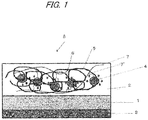
- Fig. 1 is a drawing schematically illustrating the enzyme electrode according to the embodiment.
- an enzyme electrode A is provided with an electrode 1 and a detection layer 2 formed on the surface (the upper surface in Fig. 1 ) of the electrode 1.
- the electrode 1 is made of a metallic material such as gold (Au), platinum (Pt), silver (Ag) or palladium, or a carbon material such as carbon.
- the electrode 1 is formed, for example, on an insulating base plate 3 as illustrated in Fig. 1 .
- the insulating base plate 3 is made of a thermoplastic resin such as polyetherimide (PEI), polyethylene terephthalate (PET) and polyethylene (PE), various resins (plastics) such as polyimide resins and epoxy resins, or insulating materials such as glasses, ceramics and papers.
- PEI polyetherimide
- PET polyethylene terephthalate
- PE polyethylene
- various resins plastics
- Various known materials are applicable to be the electrode material which forms the electrode 1 and the material for the insulating base plate 3.
- the size and thickness of the electrode 1 and the insulating base plate 3 can be determined as appropriate.
- the combination of the insulating base plate 3 and the electrode 1 is also called "base material”.
- the detection layer 2 contacts the electrode 1 and contains an enzyme 4, electrically conductive macromolecules 5, a sugar 6 and a crosslinking agent 7, but does not contain an electron mediator.
- the object to be measured using the enzyme electrode according to the embodiment is a charge transfer limiting current based on the transfer of electrons from the substance to be measured to the electrode. This is an electric current generated when electrons from the enzyme are transferred to the electrode due to the reaction of the enzyme and the substance to be measured, and is a time-independent steady-state current, preferably a steady-state current after the occurrence of the transient current due to the charging of an electric double layer.
- the working electrode is preferably a "direct electron transfer-type enzyme electrode".
- the "direct electron transfer-type enzyme electrode” as used herein refers to a type of an enzyme electrode in which electrons are exchanged between the enzyme and the electrode (namely, an enzyme transfers and receives electrons to and from the electrode) in such a way that electrons generated by an enzyme reaction in a reagent layer are directly, or mediated by electrically conductive macromolecules, transferred to the electrode without the involvement of an oxidation reduction substance such as an electron transfer mediator.
- the charge transfer limiting current can be measured in the case where the electron transfer mediator is immobilized so as not to be diffused.
- the molecules of the enzyme 4 within the detection layer 2 are crosslinked by the crosslinking agent 7 and has a complicatedly interwined structure further due to the electrically conductive macromolecule 5.
- the electrons generated by the enzyme reaction can be transferred to the electrode 1 directly or along the electrically conductive macromolecule 5 having electrical conductivity.
- the electrons are exchanged between the enzyme 4 and the electrode 1 by the direct electron transfer in the detection layer 2.
- the limiting distance within which the direct electron transfer occurs is considered from 1 to 2 nm, and even in the electron exchange in an electrochemical reaction system consisting of an electrode and an enzyme, the electron exchange on the electrode becomes difficult to detect unless the transfer of a mediator (e.g., transfer by diffusion) is involved in the case where the above distance is farther apart. Consequently, within the detection layer 2, the active sites (the site at which electrons are generated by an enzyme reaction) of the enzyme 4 and the electrically conductive sites of the electrically conductive macromolecule 5 are located within a distance suitable for the electron transfer, specifically, the electrically conductive sites and the active sites are located close enough so that electrons are suitably transferred therebetween.
- a mediator e.g., transfer by diffusion
- Examples of the enzyme 4 include oxidoreductases.
- Examples of the oxidoreductase include glucose oxidase (GOD), galactose oxidase, bilirubin oxidase, pyruvic acid oxidase, D- or L-amino acid oxidase, amine oxidase, cholesterol oxidase, choline oxidase, xanthine oxidase, sarcosine oxidase, L-lactic acid oxidase, ascorbic acid oxidase, cytochrome oxidase, alcohol dehydrogenase, glutamate dehydrogenase, cholesterol dehydrogenase, aldehyde dehydrogenase, glucose dehydrogenase (GDH), fructose dehydrogenase, sorbitol dehydrogenase, lactate dehydrogenase, malate dehydrogenase,
- oxidoreductases of sugars are preferable.
- examples of the oxidoreductase of sugars include glucose oxidase (GOD), galactose oxidase, glucose dehydrogenase (GDH), fructose dehydrogenase and sorbitol dehydrogenase.
- the oxidoreductase can further contain, as a catalytic subunit and a catalytic domain, at least one of pyrroloquinoline quinone (PQQ) and flavin adenine dinucleotide (FAD).
- PQQ pyrroloquinoline quinone
- FAD flavin adenine dinucleotide
- Examples of the oxidoreductase containing PQQ include PQQ glucose dehydrogenase (PQQGDH).
- Examples of the oxidoreductase containing FAD include cytochrome glucose dehydrogenase (Cy-GDH) and glucose oxidase (GOD), which have an FAD-containing ⁇ -subunit.
- the oxidoreductase can further contain an electron transfer subunit or an electron transfer domain.
- the electron transfer subunit include subunits, which have a heme with the function of electron exchange.
- the oxidoreductase containing such a heme-containing subunit include those containing cytochrome, and for example glucose dehydrogenase and a fusion protein of PQQGDH and cytochrome can be used.
- Examples of the enzyme containing an electron transfer domain include cholesterol oxidase and quinoheme ethanol dehydrogenase (QHEDH (PQQ Ethanol dh)).
- QHEDH quinoheme ethanol dehydrogenase
- Examples include "QHGDH” (fusion enzyme; GDH with heme domain of QHGDH), sorbitol dehydrogenase (Sorbitol DH), D-fructose dehydrogenase (Fructose DH), Agrobacterium tumefasience -derived Glucose-3-Dehydrogenase (G3DH from Agrobacterium tumefasience ) and cellobiose dehydrogenase.
- an oligomer enzyme composed of at least a catalytic subunit and a subunit containing cytochrome having a heme with the function of electron acceptor can be used.
- an oxidoreductase which does not contain an electron transfer subunit or an electron transfer domain is used as the enzyme in the present embodiment.
- An example is cytochrome glucose dehydrogenase (Cy-GDH). Cy-GDH has an electron transfer subunit ⁇ , a catalytic subunit ⁇ and a catalytic subunit ⁇ . In the present embodiment, Cy-GDH which does not have the electron transfer subunit ⁇ (contains the catalytic subunits ⁇ and ⁇ ) is used as the enzyme.
- Cy-GDH which does not have the electron transfer subunit ⁇ can be purchased at a lower price than Cy-GDH which has the electron transfer subunit ⁇ , the catalytic subunit ⁇ and the catalytic subunit ⁇ . For this reason, when Cy-GDH which does not have the electron transfer subunit ⁇ is used as the enzyme to be contained in the detection layer 2, the manufacturing costs of the enzyme electrode can be reduced.
- Cy-GDH which does not have the electron transfer subunit ⁇ further has higher stability as the substance than Cy-GDH which has the electron transfer subunit ⁇ , the catalytic subunit ⁇ and the catalytic subunit ⁇ .
- the enzyme electrode (biosensor) in which Cy-GDH not having the electron transfer subunit ⁇ is used can be stored for a longer period of time than the enzyme electrode (biosensor) in which Cy-GDH having the electron transfer subunit ⁇ , the catalytic subunit ⁇ and the catalytic subunit ⁇ is used. Consequently, the type of enzyme electrode for a charge transfer limiting measurement, with a longer product life, can be obtained.
- Examples of the electrically conductive polymer include polypyrrole, polyaniline, polystyrene sulfonate, polythiophene, polyisothianaphthene, polyethylene dioxythiophene(poly(3,4-ethylenedioxythiophene)poly(styrene sulfonate)), the combinations thereof and the like.
- Examples of the commercial products thereof include, as the polypyrrole, "SSPY” (ethyl 3-methyl-4-pyrrolecarboxylate) (manufactured by KAKENSANGYOU CORPORATION) and the like.
- Examples also include, as the polyaniline, "AquaPASS 01-x” (manufactured by TA Chemical Co., Ltd.) and the like. Examples further include, as the polystyrene sulfonate, “Poly-NaSS” (manufactured by TOSOH ORGANIC CHEMICAL CO., LTD.) and the like. Examples include, as the polythiophene, “ESPACER 100” (manufactured by TA Chemical Co., Ltd.) and the like. Examples include, as the polyisothianaphthene, "ESPACER 300" (manufactured by TA Chemical Co., Ltd.) and the like.
- Examples include, as the polyethylene dioxythiophene(poly(3,4-ethylenedioxythiophene)poly(styrene sulfonate)), "PEDOT-PSS” (Polyscience, Inc.) and the like.
- electrically conductive polymers with various properties can be used.
- Functional groups of the electrically conductive polymers preferably have a hydroxy group or a sulfo group.
- the detection layer 2 can contain the sugar 6, as illustrated in Fig. 1 , in addition to the enzyme, the crosslinking agent and the electrically conductive macromolecule.
- the sugar 6 is a sugar which does not serve as a substrate for the enzyme 4, and the number of constituent sugar(s) of the sugar 6 is, for example, 1 to 6, and preferably 2 to 6. These may be a D-form or an L-form, or a mixture thereof, and can be used singly or two or more thereof can be used in combination as appropriate. However, in the case where a sugar such as glucose is used as a measurement object, a sugar which is different from the sugar of the measurement object and which does not serve as a substrate for the enzyme 4 is used as the sugar 6.
- disaccharides examples include xylobiose, agarobiose, carrabiose, maltose, isomaltose, sophorose, cellobiose, trehalose, neotrehalose, isotrehalose, inulobiose, vicianose, isoprimeverose, sambubiose, primeverose, solabiose, melibiose, lactose, lycobiose, epicellobiose, sucrose, turanose, maltulose, lactulose, epigentibiose, robinobiose, silanobiose, rutinose and the like.
- trisaccharides examples include glucosyl trehalose, cellotriose, chacotriose, gentianose, isomaltotriose, isopanose, maltotriose, manninotriose, melezitose, panose, planteose, raffinose, soratriose, umbelliferose and the like.
- Examples of tetrasaccharides include maltosyl trehalose, maltotetraose, stachyose and the like.
- Examples of pentasaccharides include maltotriosyl trehalose, maltopentaose, verbascose and the like.
- Examples of hexasaccharide include maltohexaose and the like.
- crosslinking agent 7 examples include, specifically as the aldehyde group-containing compound, glutaraldehyde, formaldehyde, malonaldehyde, terephthalaldehyde, isobutyraldehyde, valeraldehyde, isovaleraldehyde, cinnamaldehyde, nicotinaldehyde, glyceraldehyde, glycoaldehyde, succinaldehyde, adipaldehyde, isophthalaldehyde, terephthalaldehyde and the like.
- Examples include, as the carbodiimide group-containing compound, hexamethylene diisocyanate, hydrogenated xylylene diisocyanate, xylylene diisocyanate, 2,2,4-trimethylhexamethylene diisocyanate, 1,12-diisocyanate dodecane, norbornane diisocyanate, 2,4-bis-(8-isocyanateoctyl)-1,3-dioctylcyclobutane, 4,4'-dicyclohexylmethane diisocyanate, tetramethylxylylene diisocyanate, isophorone diisocyanate and the like.
- the carbodiimide group-containing compounds are also commercially available under the names of CARBODILITE V-02, CARBODILITE V-02-L2, CARBODILITE V-04, CARBODILITE V-06, CARBODILITE E-02, CARBODILITE V-01, CARBODILITE V-03, CARBODILITE V-05, CARBODILITE V-07, CARBODILITE V-09 (all are product names, manufactured by Nisshinbo Chemical Inc.) and the like.
- Examples include, as the maleimide group-containing compound, m-maleimidobenzoyl-N-hydroxysuccinimide ester, sulfonsuccinimidyl 4-(p-maleimidophenyl)butyrate, m-maleimidobenzoyl sulfosuccinimide ester, N- ⁇ -maleimidobutyryloxysuccinimide ester, succinimidyl 4-(N-maleidomethyl)cyclohexane 1-carboxylate, N-succinimidyl-2-maleimidoacetic acid, N-succinimidyl-4-maleimidobutyric acid, N-succinimidyl-6-maleimidohexanoic acid, N-succinimidyl-4-maleimidomethylcyclohexane-1-carboxylic acid, N-sulfosuccinimidyl-4-maleimidomethylcyclohexane-1-
- oxazoline compounds such as 2,2'-bis-(2-oxazoline), 2,2'-methylene-bis-(2-oxazoline), 2,2'-ethylene-bis-(2-oxazoline), 2,2'-trimethylene-bis-(2-oxazoline), 2,2'-tetramethylene-bis-(2-oxazoline), 2,2'-hexamethylene-bis-(2-oxazoline), 2,2'-octamethylene-bis-(2-oxazoline), 2,2'-ethylene-bis-(4,4'-dimethyl-2-oxazoline), 2,2'-p-phenylene-bis-(2-oxazoline), 2,2'-m-phenylene-bis-(2-oxazoline), 2,2'-m-phenylene-bis-(4,4'-dimethyl-2-oxazoline), bis-(2-oxazolinylcyclohexane)sulfide, bis-(2-oxazolinylcyclohexane)
- Examples include, as the addition polymerizable oxazoline compound, 2-vinyl-2-oxazoline, 2-vinyl-4-methyl-2-oxazoline, 2-vinyl-5-methyl-2-oxazoline, 2-isopropenyl-2-oxazoline, 2-isopropenyl-4-methyl-2-oxazoline, 2-isopropenyl-5-ethyl-2-oxazoline and the like, and polymerized or copolymerized compounds of one or more thereof can be used.
- the oxazoline group-containing compounds are also commercially available under the names of EPOCROS WS-500, EPOCROS WS-700, EPOCROS K-1010E, EPOCROS K-1020E, EPOCROS K-1030E, EPOCROS K-2010E, EPOCROS K-2020E, EPOCROS K-2030E, EPOCROS RPS-1005, EPOCROS RAS-1005 (all manufactured by NIPPON SHOKUBAI CO., LTD.), NK Linker FX (manufactured by Shin-Nakamura Chemical Co., Ltd.) and the like.
- the epoxy group-containing compound examples specifically include, as the epoxy group-containing compound, sorbitol polyglycidyl ether, polyglycerol polyglycidyl ether, diglycerol polyglycidyl ether, glycerol polyglycidyl ether, trimethylolpropane polyglycidyl ether, ethylene glycol diglycidyl ether, poly
- the epoxy group-containing compounds are also commercially available under the names of Denacol EX-611, DenacolEX-612, DenacolEX-614, DenacolEX-614B, DenacolEX-512, DenacolEX-521, DenacolEX-421, DenacolEX-313, DenacolEX-314, DenacolEX-321, DenacolEX-810, DenacolEX-811, DenacolEX-850, DenacolEX-851, Denacol EX-821, DenacolEX-830, Denacol EX-832, DenacolEX-841, DenacolEX-861, DenacolEX-911, DenacolEX-941, Denacol EX-920, Denacol EX-145 and Denacol EX-171 (all are product names, manufactured by Nagase ChemteX Corporation), SR-PG, SR-2EG, SR-8EG, SR-8EGS, SR-GLG,
- crosslinking agent is not limited to the above compounds and commercial products but may be any compounds containing at least one functional group of an aldehyde group, a maleimide group, a carbodiimide group, an oxazoline group and an epoxy group.
- the form of crosslinking agent is not limited and may be in the form of a monomer or a polymer.
- the detection layer 2 can further contain electrically conductive particles.
- electrically conductive particles metal particles such as gold, platinum, silver or palladium, or higher-order structures made of a carbon material, can be used.
- the higher-order structure can contain, for example, electrically conductive carbon black, carbon nanotube (CNT) and carbon particles or carbon fine particles such as fullerene.
- electrically conductive carbon black include Ketjenblack (manufactured by Degussa AG), BLACK PEARL (Cabot Corporation) and the like.
- the surface of the detection layer 2 may also be covered with an outer layer film such as cellulose acetate.
- an outer layer film such as cellulose acetate.
- the raw material for the outer layer film include, among others, polyurethane, polycarbonate, polymethylmethacrylate, butylmethacrylate, polypropylene, polyether ether ketone and the like.
- the above enzyme electrode A is, for example, produced as follows. Specifically, a metal layer which functions as the electrode 1 is formed on one surface of the insulating base plate 3. For example, a metal layer having a desired thickness (e.g., about 30 nm) can be formed on one surface of the insulating base plate 3 in the shape of a film having a predetermined thickness (e.g., about 100 ⁇ m) by forming a film by depositing a metallic material by physical vapor deposition (PVD, e.g., sputtering) or chemical vapor deposition (CVD). Instead of the metal layer, an electrode layer made of a carbon material can also be formed.
- PVD physical vapor deposition
- CVD chemical vapor deposition
- the detection layer 2 is formed on the electrode 1.
- a solution (reagent) containing the enzyme 4, the electrically conductive macromolecule 5, the sugar 6 and the crosslinking agent 7 is prepared.
- the concentration of the sugar herein is preferably from 0.1 to 2 wt%, and more preferably 0.2 to 2 wt%.
- the solution (reagent) is dropped onto the surface of the electrode 1.
- the enzyme electrode A, wherein the detection layer 2 is formed on the electrode 1 is obtained.
- the use of the enzyme electrode according to the embodiment enables the concentration measurement of a substance to be tested in a sample based on a charge transfer limiting current.
- the substance to be measured as referred herein is not limited as long as the substance is measurable by the measurement method using the enzyme electrode of the present invention, but is preferably a substance of a biological origin and can be an indicator for a disease or health conditions with examples including glucose, cholesterol and the like.
- the sample is not limited as long as it contains the substance to be measured but is preferably a biological sample with examples including blood, urine and the like.
- the enzyme electrode according to the embodiment can be used as a biosensor such as a glucose sensor.
- the biosensor includes, together with the enzyme electrode, an electrode to be the counter electrode.
- the counter electrode may be any electrode which can be commonly used as the counter electrode of the biosensor, and, for example, a carbon electrode obtained by forming a film using screen printing, a metal electrode obtained by forming a film using physical vapor deposition (PVD, e.g., sputtering) or chemical vapor deposition (CVD) and a silver/silver chloride electrode obtained by forming a film using screen printing can be used.
- PVD physical vapor deposition
- CVD chemical vapor deposition
- a three-electrode system may also be used in which a reference electrode is the silver/chloride silver electrode, the carbon electrode obtained by forming a film using screen printing or the metal electrode obtained by forming a film using physical vapor deposition (PVD, e.g., sputtering) or chemical vapor deposition (CVD).
- PVD physical vapor deposition
- CVD chemical vapor deposition
- the measuring apparatus for measuring a concentration of the substance using the enzyme electrode is described.
- a glucose measuring apparatus using a glucose sensor which is an example of the biosensor which uses the enzyme electrode, is illustrated here.
- the measuring apparatus is not limited to the glucose measuring apparatus, and the purpose of use of the measuring apparatus changes depending on the substance to be measured by the enzyme electrode (biosensor).
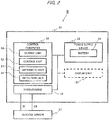
- Fig. 2 illustrates an example of the configuration of main electronic components housed in the measuring apparatus B.
- a control computer 18, a potentiostat 19 and a power supply device 11 are provided on a base plate 20 housed in a housing.
- the control computer 18 includes, as hardware, a processor such as a CPU (Central Processing Unit), recording media such as memories (RAM (Random Access Memory) and ROM (Read Only Memory)) and the communication unit.
- a processor such as a CPU (Central Processing Unit)
- recording media such as memories (RAM (Random Access Memory) and ROM (Read Only Memory)
- control computer 18 When the processor loads a program stored in the recording medium (e.g., ROM) to the RAM and executes the program, the control computer 18 functions as an apparatus including an output unit 10, a control unit 12, an arithmetic unit 13 and a detection unit 14.
- the control computer 18 may also include an auxiliary memory such as a semiconductor memory (EEPROM or flash memory) or a hard disk for storing programs and data.
- the control unit 12 controls the timing for applying the voltage, the value of the voltage to be applied and the like.
- the power supply device 11 includes a battery 16, and supplies electricity to the control computer 18 and the potentiostat 19 for operation. It is also possible to dispose the power supply device 11 outside the housing.
- the potentiostat 19 is a device which maintains the potential of the working electrode constant with respect to the reference electrode and is controlled by the control unit 12.
- the potentiostat 19 applies a predetermined amount of voltage between the counter electrode and the working electrode of the glucose sensor 17 using terminals CR, W, measures the response electric current of the working electrode which can be obtained at the terminal W, and sends the measurement results of the response electric current to the detection unit 14.
- the arithmetic unit 13 calculates and stores the concentration of the substance to be measured based on the value of the detected electric current.
- the output unit 10 carries out data communication with the display unit 15 and sends the calculated result of the concentration of the substance to be measured, which is provided by the arithmetic unit 13, to the display unit 15.
- the display unit 15 is capable of displaying, for example, the calculated result of the glucose concentration received from the measuring apparatus B, on a display screen in a predetermined format.
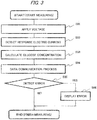
- Fig. 3 is a flow chart illustrating an example of the processing sequence of the glucose concentration measurement carried out by the control computer 18.
- the CPU (control unit 12) of the control computer 18 receives an instruction to start the measurement of the glucose concentration.
- the control unit 12 controls the potentiostat 19 to apply a predetermined amount of voltage to the working electrode, and starts measuring the response electric current from the working electrode (Step S01). Note that the detection of the installation of the glucose sensor 17 to the measuring apparatus B may be used as the instruction to start the concentration measurement.
- the potentiostat 19 measures the response electric current generated by the application of voltage, specifically, the charge transfer limiting current based on the transfer to the electrode of electrons derived from the substance to be measured (glucose, herein) in the sample, and sends the measured current to the detection unit 14 (Step S02).
- the charge transfer limiting current the steady-state current after the occurrence of the transient current due to the charging of an electric double layer, for example, 1 to 20 seconds after the application of voltage, is measured.
- the arithmetic unit 13 carries out arithmetic processing based on the electric current value and calculates the glucose concentration (Step S03). For example, the formulae for calculating the glucose concentration or the data of the calibration curve of the glucose concentration, which correspond to an enzyme (e.g., glucose dehydrogenase) contained in the detection layer disposed on the working electrode, are preinstalled to the arithmetic unit 13 in the control computer 18. The arithmetic unit 13 calculates the glucose concentration using these calculation formulae or the calibration curve.
- an enzyme e.g., glucose dehydrogenase
- the output unit 10 sends the calculated result of the glucose concentration to the display unit 15, through a communication link provided with the display unit 15 (Step S04). Thereafter, the control unit 12 determines if there are any measurement errors detected (Step S05), completes the measurement if there is no error and displays the glucose concentration on the display unit. If there are any errors, a notification of error is displayed, and then the flow sequence illustrated in Fig. 3 is completed.
- the calculation result may be stored in a storage medium and read out the calculation result from the storage medium to display and confirm. Note that the detection of measurement error by the control unit 12 (Step S05) is carried out after the calculated result is sent to the display unit 15 (Step S04) in the example of Fig. 3 , but it is also possible to carry out these steps in switching orders.
- a plurality of insulating base plates having on one surface thereof an electrode (electrode layer) formed by gold vapor deposition (base material) were prepared, and the reagent solution according to Example 1 or Comparative Example 1 was dispensed on each of the insulating base plates, allowed to stand for 30 minutes in a low humidity drying furnace and dried.
- the enzyme electrodes (samples) according to Example 1 and the enzyme electrodes (samples) according to Comparative Example 1 on which the detection layers were formed when the reagents were solidified on the electrodes, were obtained.
- the response electric current value was measured for human whole bloods in which the concentration of glucose was adjusted respectively to 0, 100 mg/dL, 300 mg/dL, 600 mg/dL and 800 mg/dL, using each of the enzyme electrodes.
- Glucose was measured using a reference electrode/counter electrode (both made of carbon) and a reference electrode (silver/silver chloride) formed on the electrode, with a voltage of +200 mV applied to the working electrode (vs. Ag/AgCl).
- Fig. 4 is a graph depicting comparisons of the calibration curves created based on response electric current values obtained using the enzyme electrodes of Example 1 and Comparative Example 1. As depicted in Fig. 4 , it is revealed that the ⁇ (Example 1) is suggested, with the linear range of the calibration, to be sufficiently used as a glucose sensor although the response electric current values are lower than the ⁇ (Comparative Example 1). According to Test 1, the enzyme electrode, with reduced manufacturing costs and improved quality stability of the detection layer 2, can be thus provided.
- the enzyme electrode according to Example 1 measures a charge transfer limiting current, due to which inconsistencies of measured values caused by diffusion conditions of a substance, as occurred with the conventional enzyme electrodes which use a mediator, can be obviated.
- the enzyme electrode according to the embodiment can provide the enzyme electrode, with improved storage stability at a lower price, which enables more quantitative measurement (measurement accuracy is high) than the enzyme electrode which uses a mediator.
Landscapes
- Chemical & Material Sciences (AREA)
- Organic Chemistry (AREA)
- Life Sciences & Earth Sciences (AREA)
- Engineering & Computer Science (AREA)
- Health & Medical Sciences (AREA)
- Chemical Kinetics & Catalysis (AREA)
- Proteomics, Peptides & Aminoacids (AREA)
- Zoology (AREA)
- Wood Science & Technology (AREA)
- Mechanical Engineering (AREA)
- Materials Engineering (AREA)
- Metallurgy (AREA)
- Molecular Biology (AREA)
- General Health & Medical Sciences (AREA)
- Physics & Mathematics (AREA)
- Analytical Chemistry (AREA)
- Biochemistry (AREA)
- Immunology (AREA)
- Biophysics (AREA)
- Microbiology (AREA)
- Biotechnology (AREA)
- Bioinformatics & Cheminformatics (AREA)
- General Engineering & Computer Science (AREA)
- Genetics & Genomics (AREA)
- General Chemical & Material Sciences (AREA)
- Hematology (AREA)
- Electrochemistry (AREA)
- General Physics & Mathematics (AREA)
- Pathology (AREA)
- Emergency Medicine (AREA)
- Apparatus Associated With Microorganisms And Enzymes (AREA)
Abstract
Description
- The present invention relates to an enzyme electrode for measuring a charge transfer limiting current.
- An enzyme electrode is known which includes an electrode as a base material and a detection layer, in which an enzyme and electrically conductive particles are immobilized using a crosslinking agent or a binder, on the surface of the electrode. Some enzyme electrodes measure a concentration of an intended substance by measuring a charge transfer limiting current by the electron exchange which has occurred between an enzyme in the detection layer and the electrode.
- Examples of the enzyme electrode which measures a charge transfer limiting current include an enzyme electrode wherein a detection layer contains an enzyme, electrically conductive particles and a crosslinking agent (e.g., Patent document 1). Another enzyme electrode is also known wherein a detection device includes an enzyme, electrically conductive particles and electrically conductive macromolecules (e.g., Patent document 2).
-
- [Patent document 1] Japanese Patent Laid-Open No.
2014-006154 - [Patent document 2] Japanese Patent Laid-Open No.
2014-006155 - The enzyme electrode which measures a charge transfer limiting current can suitably measure the concentration of an intended substance in a small amount of a sample. However, the enzyme electrodes disclosed in Patent document 1 and
Patent document 2 still need to be improved in the aspects of manufacturing costs and storage stability. - The present invention has an object to provide an enzyme electrode which can reduce the manufacturing costs and improve storage stability.
- One of the aspects is an enzyme electrode including an electrode, and a detection layer which contacts the electrode and contains a crosslinking agent, an electrically conductive macromolecule and an enzyme transferring and receiving electrons to and from the electrode and does not contain an electron transfer subunit.
- In the enzyme electrode, the enzyme may be an oxidoreductase. The enzyme also may be cytochrome dehydrogenase which does not contain an electron transfer subunit.
- The aspects include a method of manufacturing an enzyme electrode, including forming, on an electrode, a detection layer which contacts the electrode and contains a crosslinking agent, an electrically conductive macromolecule and an enzyme transferring and receiving electrons to and from the electrode and does not contain an electron transfer subunit.
- According to the present invention, an enzyme electrode which can reduce the manufacturing costs and improve storage stability is provided.
-
- [
Fig. 1] Fig. 1 is a drawing schematically illustrating a configuration of the enzyme electrode according to an embodiment; - [
Fig. 2] Fig. 2 is a schematic drawing illustrating an embodiment of the measuring apparatus of the present invention; [Fig. 3] Fig. 3 is a flow chart illustrating an embodiment of a measurement program using the measuring apparatus of the present invention; and - [
Fig. 4] Fig. 4 is a graph depicting comparisons of the calibration curves created based on response electric current values obtained using the enzyme electrodes of Example 1 and Comparative Example 1. - Hereinafter, the enzyme electrode according to an embodiment of the present invention will be described with reference to the drawings. The configuration of the embodiment described below is illustrative, and the present invention is not limited thereto.
-
Fig. 1 is a drawing schematically illustrating the enzyme electrode according to the embodiment. InFig. 1 , an enzyme electrode A is provided with an electrode 1 and adetection layer 2 formed on the surface (the upper surface inFig. 1 ) of the electrode 1. - The electrode 1 is made of a metallic material such as gold (Au), platinum (Pt), silver (Ag) or palladium, or a carbon material such as carbon. The electrode 1 is formed, for example, on an insulating base plate 3 as illustrated in
Fig. 1 . The insulating base plate 3 is made of a thermoplastic resin such as polyetherimide (PEI), polyethylene terephthalate (PET) and polyethylene (PE), various resins (plastics) such as polyimide resins and epoxy resins, or insulating materials such as glasses, ceramics and papers. Various known materials are applicable to be the electrode material which forms the electrode 1 and the material for the insulating base plate 3. The size and thickness of the electrode 1 and the insulating base plate 3 can be determined as appropriate. Hereinafter, the combination of the insulating base plate 3 and the electrode 1 is also called "base material". - The
detection layer 2 contacts the electrode 1 and contains anenzyme 4, electricallyconductive macromolecules 5, asugar 6 and a crosslinking agent 7, but does not contain an electron mediator. The object to be measured using the enzyme electrode according to the embodiment is a charge transfer limiting current based on the transfer of electrons from the substance to be measured to the electrode. This is an electric current generated when electrons from the enzyme are transferred to the electrode due to the reaction of the enzyme and the substance to be measured, and is a time-independent steady-state current, preferably a steady-state current after the occurrence of the transient current due to the charging of an electric double layer. - For measuring the charge transfer limiting current, the working electrode is preferably a "direct electron transfer-type enzyme electrode". The "direct electron transfer-type enzyme electrode" as used herein refers to a type of an enzyme electrode in which electrons are exchanged between the enzyme and the electrode (namely, an enzyme transfers and receives electrons to and from the electrode) in such a way that electrons generated by an enzyme reaction in a reagent layer are directly, or mediated by electrically conductive macromolecules, transferred to the electrode without the involvement of an oxidation reduction substance such as an electron transfer mediator.
- Note that, even when an electron transfer mediator is used, the charge transfer limiting current can be measured in the case where the electron transfer mediator is immobilized so as not to be diffused.
- As illustrated in
Fig. 1 , the molecules of theenzyme 4 within thedetection layer 2 are crosslinked by the crosslinking agent 7 and has a complicatedly interwined structure further due to the electricallyconductive macromolecule 5. The electrons generated by the enzyme reaction can be transferred to the electrode 1 directly or along the electricallyconductive macromolecule 5 having electrical conductivity. Specifically, in the enzyme electrode A according to the embodiment, the electrons are exchanged between theenzyme 4 and the electrode 1 by the direct electron transfer in thedetection layer 2. - Note that, in the physiological reaction system, the limiting distance within which the direct electron transfer occurs is considered from 1 to 2 nm, and even in the electron exchange in an electrochemical reaction system consisting of an electrode and an enzyme, the electron exchange on the electrode becomes difficult to detect unless the transfer of a mediator (e.g., transfer by diffusion) is involved in the case where the above distance is farther apart. Consequently, within the
detection layer 2, the active sites (the site at which electrons are generated by an enzyme reaction) of theenzyme 4 and the electrically conductive sites of the electricallyconductive macromolecule 5 are located within a distance suitable for the electron transfer, specifically, the electrically conductive sites and the active sites are located close enough so that electrons are suitably transferred therebetween. - Examples of the
enzyme 4 include oxidoreductases. Examples of the oxidoreductase include glucose oxidase (GOD), galactose oxidase, bilirubin oxidase, pyruvic acid oxidase, D- or L-amino acid oxidase, amine oxidase, cholesterol oxidase, choline oxidase, xanthine oxidase, sarcosine oxidase, L-lactic acid oxidase, ascorbic acid oxidase, cytochrome oxidase, alcohol dehydrogenase, glutamate dehydrogenase, cholesterol dehydrogenase, aldehyde dehydrogenase, glucose dehydrogenase (GDH), fructose dehydrogenase, sorbitol dehydrogenase, lactate dehydrogenase, malate dehydrogenase, glycerol dehydrogenase, 17B hydroxysteroid dehydrogenase, estradiol 17B dehydrogenase, amino acid dehydrogenases, glyceraldehyde 3-phosphoric acid dehydrogenase, 3-hydroxysteroid dehydrogenase, diaphorase, cytochrome oxidoreductase, catalase, peroxidase, glutathione reductase and the like. Of these, oxidoreductases of sugars are preferable. Examples of the oxidoreductase of sugars include glucose oxidase (GOD), galactose oxidase, glucose dehydrogenase (GDH), fructose dehydrogenase and sorbitol dehydrogenase. - The oxidoreductase can further contain, as a catalytic subunit and a catalytic domain, at least one of pyrroloquinoline quinone (PQQ) and flavin adenine dinucleotide (FAD). Examples of the oxidoreductase containing PQQ include PQQ glucose dehydrogenase (PQQGDH). Examples of the oxidoreductase containing FAD include cytochrome glucose dehydrogenase (Cy-GDH) and glucose oxidase (GOD), which have an FAD-containing α-subunit.
- The oxidoreductase can further contain an electron transfer subunit or an electron transfer domain. Examples of the electron transfer subunit include subunits, which have a heme with the function of electron exchange. Examples of the oxidoreductase containing such a heme-containing subunit include those containing cytochrome, and for example glucose dehydrogenase and a fusion protein of PQQGDH and cytochrome can be used.
- Examples of the enzyme containing an electron transfer domain include cholesterol oxidase and quinoheme ethanol dehydrogenase (QHEDH (PQQ Ethanol dh)). For the electron transfer domain, it is further preferable to use domains containing cytochrome, which has a heme with the function of electron exchange. Examples include "QHGDH" (fusion enzyme; GDH with heme domain of QHGDH), sorbitol dehydrogenase (Sorbitol DH), D-fructose dehydrogenase (Fructose DH), Agrobacterium tumefasience-derived Glucose-3-Dehydrogenase (G3DH from Agrobacterium tumefasience) and cellobiose dehydrogenase. Note that the above fusion protein of PQQGDH and cytochrome, which is the example of the subunit containing cytochrome, and the cytochrome domain of PQQGDH, which is the example of the domain containing cytochrome, are disclosed in, for example, International Publication No.
WO2005/030807 . - Further, for the oxidoreductase, an oligomer enzyme composed of at least a catalytic subunit and a subunit containing cytochrome having a heme with the function of electron acceptor can be used.
- However, an oxidoreductase which does not contain an electron transfer subunit or an electron transfer domain is used as the enzyme in the present embodiment. An example is cytochrome glucose dehydrogenase (Cy-GDH). Cy-GDH has an electron transfer subunit β, a catalytic subunit α and a catalytic subunit γ. In the present embodiment, Cy-GDH which does not have the electron transfer subunit β (contains the catalytic subunits α and γ) is used as the enzyme.
- Cy-GDH which does not have the electron transfer subunit β can be purchased at a lower price than Cy-GDH which has the electron transfer subunit β, the catalytic subunit α and the catalytic subunit γ. For this reason, when Cy-GDH which does not have the electron transfer subunit β is used as the enzyme to be contained in the
detection layer 2, the manufacturing costs of the enzyme electrode can be reduced. - Cy-GDH which does not have the electron transfer subunit β further has higher stability as the substance than Cy-GDH which has the electron transfer subunit β, the catalytic subunit α and the catalytic subunit γ. This means that the enzyme electrode (biosensor) in which Cy-GDH not having the electron transfer subunit β is used can be stored for a longer period of time than the enzyme electrode (biosensor) in which Cy-GDH having the electron transfer subunit β, the catalytic subunit α and the catalytic subunit γ is used. Consequently, the type of enzyme electrode for a charge transfer limiting measurement, with a longer product life, can be obtained.
- Examples of the electrically conductive polymer include polypyrrole, polyaniline, polystyrene sulfonate, polythiophene, polyisothianaphthene, polyethylene dioxythiophene(poly(3,4-ethylenedioxythiophene)poly(styrene sulfonate)), the combinations thereof and the like. Examples of the commercial products thereof include, as the polypyrrole, "SSPY" (ethyl 3-methyl-4-pyrrolecarboxylate) (manufactured by KAKENSANGYOU CORPORATION) and the like. Examples also include, as the polyaniline, "AquaPASS 01-x" (manufactured by TA Chemical Co., Ltd.) and the like. Examples further include, as the polystyrene sulfonate, "Poly-NaSS" (manufactured by TOSOH ORGANIC CHEMICAL CO., LTD.) and the like. Examples include, as the polythiophene, "ESPACER 100" (manufactured by TA Chemical Co., Ltd.) and the like. Examples include, as the polyisothianaphthene, "ESPACER 300" (manufactured by TA Chemical Co., Ltd.) and the like. Examples include, as the polyethylene dioxythiophene(poly(3,4-ethylenedioxythiophene)poly(styrene sulfonate)), "PEDOT-PSS" (Polyscience, Inc.) and the like.
- Additionally, electrically conductive polymers with various properties (e.g., water solubility) can be used. Functional groups of the electrically conductive polymers preferably have a hydroxy group or a sulfo group.
- The
detection layer 2 can contain thesugar 6, as illustrated inFig. 1 , in addition to the enzyme, the crosslinking agent and the electrically conductive macromolecule. Thesugar 6 is a sugar which does not serve as a substrate for theenzyme 4, and the number of constituent sugar(s) of thesugar 6 is, for example, 1 to 6, and preferably 2 to 6. These may be a D-form or an L-form, or a mixture thereof, and can be used singly or two or more thereof can be used in combination as appropriate. However, in the case where a sugar such as glucose is used as a measurement object, a sugar which is different from the sugar of the measurement object and which does not serve as a substrate for theenzyme 4 is used as thesugar 6. - Examples of disaccharides include xylobiose, agarobiose, carrabiose, maltose, isomaltose, sophorose, cellobiose, trehalose, neotrehalose, isotrehalose, inulobiose, vicianose, isoprimeverose, sambubiose, primeverose, solabiose, melibiose, lactose, lycobiose, epicellobiose, sucrose, turanose, maltulose, lactulose, epigentibiose, robinobiose, silanobiose, rutinose and the like. Examples of trisaccharides include glucosyl trehalose, cellotriose, chacotriose, gentianose, isomaltotriose, isopanose, maltotriose, manninotriose, melezitose, panose, planteose, raffinose, soratriose, umbelliferose and the like.
- Examples of tetrasaccharides include maltosyl trehalose, maltotetraose, stachyose and the like. Examples of pentasaccharides include maltotriosyl trehalose, maltopentaose, verbascose and the like. Examples of hexasaccharide include maltohexaose and the like.
- Examples of the type of crosslinking agent 7 include, specifically as the aldehyde group-containing compound, glutaraldehyde, formaldehyde, malonaldehyde, terephthalaldehyde, isobutyraldehyde, valeraldehyde, isovaleraldehyde, cinnamaldehyde, nicotinaldehyde, glyceraldehyde, glycoaldehyde, succinaldehyde, adipaldehyde, isophthalaldehyde, terephthalaldehyde and the like. Examples include, as the carbodiimide group-containing compound, hexamethylene diisocyanate, hydrogenated xylylene diisocyanate, xylylene diisocyanate, 2,2,4-trimethylhexamethylene diisocyanate, 1,12-diisocyanate dodecane, norbornane diisocyanate, 2,4-bis-(8-isocyanateoctyl)-1,3-dioctylcyclobutane, 4,4'-dicyclohexylmethane diisocyanate, tetramethylxylylene diisocyanate, isophorone diisocyanate and the like. The carbodiimide group-containing compounds are also commercially available under the names of CARBODILITE V-02, CARBODILITE V-02-L2, CARBODILITE V-04, CARBODILITE V-06, CARBODILITE E-02, CARBODILITE V-01, CARBODILITE V-03, CARBODILITE V-05, CARBODILITE V-07, CARBODILITE V-09 (all are product names, manufactured by Nisshinbo Chemical Inc.) and the like.
- Examples include, as the maleimide group-containing compound, m-maleimidobenzoyl-N-hydroxysuccinimide ester, sulfonsuccinimidyl 4-(p-maleimidophenyl)butyrate, m-maleimidobenzoyl sulfosuccinimide ester, N-γ-maleimidobutyryloxysuccinimide ester, succinimidyl 4-(N-maleidomethyl)cyclohexane 1-carboxylate, N-succinimidyl-2-maleimidoacetic acid, N-succinimidyl-4-maleimidobutyric acid, N-succinimidyl-6-maleimidohexanoic acid, N-succinimidyl-4-maleimidomethylcyclohexane-1-carboxylic acid, N-sulfosuccinimidyl-4-maleimidomethylcyclohexane-1-carboxyl ic acid, N-succinimidyl-4-maleimidomethylbenzoate, N-succinimidyl-3-maleimidobenzoate, N-succinimidyl-4-maleimidophenyl-4-butyric acid, N-sulfosuccinimidyl-4-maleimidophenyl-4-butyric acid, N,N'-oxydimethylene-dimaleimide, N,N'-o-phenylene-dimaleimide, N,N'-m-phenylene-dimaleimide, N,N'-p-phenylene-dimaleimide, N,N'-hexamethylene-dimaleimide, N-succinimidyl maleimide carboxylate and the like. Examples also include commercial products such as SANFEL BM-G (manufactured by SANSHIN CHEMICAL INDUSTRY CO., LTD.) and the like.
- Examples include, as the oxazoline group-containing compound, oxazoline compounds such as 2,2'-bis-(2-oxazoline), 2,2'-methylene-bis-(2-oxazoline), 2,2'-ethylene-bis-(2-oxazoline), 2,2'-trimethylene-bis-(2-oxazoline), 2,2'-tetramethylene-bis-(2-oxazoline), 2,2'-hexamethylene-bis-(2-oxazoline), 2,2'-octamethylene-bis-(2-oxazoline), 2,2'-ethylene-bis-(4,4'-dimethyl-2-oxazoline), 2,2'-p-phenylene-bis-(2-oxazoline), 2,2'-m-phenylene-bis-(2-oxazoline), 2,2'-m-phenylene-bis-(4,4'-dimethyl-2-oxazoline), bis-(2-oxazolinylcyclohexane)sulfide, bis-(2-oxazolinylnorbornane)sulfide and the like.
- Examples include, as the addition polymerizable oxazoline compound, 2-vinyl-2-oxazoline, 2-vinyl-4-methyl-2-oxazoline, 2-vinyl-5-methyl-2-oxazoline, 2-isopropenyl-2-oxazoline, 2-isopropenyl-4-methyl-2-oxazoline, 2-isopropenyl-5-ethyl-2-oxazoline and the like, and polymerized or copolymerized compounds of one or more thereof can be used.
- The oxazoline group-containing compounds are also commercially available under the names of EPOCROS WS-500, EPOCROS WS-700, EPOCROS K-1010E, EPOCROS K-1020E, EPOCROS K-1030E, EPOCROS K-2010E, EPOCROS K-2020E, EPOCROS K-2030E, EPOCROS RPS-1005, EPOCROS RAS-1005 (all manufactured by NIPPON SHOKUBAI CO., LTD.), NK Linker FX (manufactured by Shin-Nakamura Chemical Co., Ltd.) and the like.
- Examples specifically include, as the epoxy group-containing compound, sorbitol polyglycidyl ether, polyglycerol polyglycidyl ether, diglycerol polyglycidyl ether, glycerol polyglycidyl ether, trimethylolpropane polyglycidyl ether, ethylene glycol diglycidyl ether, polyethylene glycol diglycidyl ether, propylene glycol diglycidyl ether, polypropylene glycol diglycidyl ether and the like, and two or more of these compounds can also be used in combination. The epoxy group-containing compounds are also commercially available under the names of Denacol EX-611, DenacolEX-612, DenacolEX-614, DenacolEX-614B, DenacolEX-512, DenacolEX-521, DenacolEX-421, DenacolEX-313, DenacolEX-314, DenacolEX-321, DenacolEX-810, DenacolEX-811, DenacolEX-850, DenacolEX-851, Denacol EX-821, DenacolEX-830, Denacol EX-832, DenacolEX-841, DenacolEX-861, DenacolEX-911, DenacolEX-941, Denacol EX-920, Denacol EX-145 and Denacol EX-171 (all are product names, manufactured by Nagase ChemteX Corporation), SR-PG, SR-2EG, SR-8EG, SR-8EGS, SR-GLG, SR-DGE, SR-4GL, SR-4GLS and SR-SEP (all are product names, manufactured by Sakamoto Yakuhin Kogyo Co., Ltd.), Epolite 200E, Epolite 400E, Epolite 400P (all are manufactured by KYOEISHA CHEMICAL Co., LTD.) and the like.
- The type of crosslinking agent is not limited to the above compounds and commercial products but may be any compounds containing at least one functional group of an aldehyde group, a maleimide group, a carbodiimide group, an oxazoline group and an epoxy group. The form of crosslinking agent is not limited and may be in the form of a monomer or a polymer.
- The
detection layer 2 can further contain electrically conductive particles. For the electrically conductive particles, metal particles such as gold, platinum, silver or palladium, or higher-order structures made of a carbon material, can be used. The higher-order structure can contain, for example, electrically conductive carbon black, carbon nanotube (CNT) and carbon particles or carbon fine particles such as fullerene. Examples of the electrically conductive carbon black include Ketjenblack (manufactured by Degussa AG), BLACK PEARL (Cabot Corporation) and the like. - Note that the surface of the
detection layer 2 may also be covered with an outer layer film such as cellulose acetate. Examples of the raw material for the outer layer film include, among others, polyurethane, polycarbonate, polymethylmethacrylate, butylmethacrylate, polypropylene, polyether ether ketone and the like. - The above enzyme electrode A is, for example, produced as follows. Specifically, a metal layer which functions as the electrode 1 is formed on one surface of the insulating base plate 3. For example, a metal layer having a desired thickness (e.g., about 30 nm) can be formed on one surface of the insulating base plate 3 in the shape of a film having a predetermined thickness (e.g., about 100 µm) by forming a film by depositing a metallic material by physical vapor deposition (PVD, e.g., sputtering) or chemical vapor deposition (CVD). Instead of the metal layer, an electrode layer made of a carbon material can also be formed.
- Next, the
detection layer 2 is formed on the electrode 1. Specifically, a solution (reagent) containing theenzyme 4, the electricallyconductive macromolecule 5, thesugar 6 and the crosslinking agent 7 is prepared. The concentration of the sugar herein is preferably from 0.1 to 2 wt%, and more preferably 0.2 to 2 wt%. The solution (reagent) is dropped onto the surface of the electrode 1. When the solution (reagent) is solidified by drying on the electrode 1, the enzyme electrode A, wherein thedetection layer 2 is formed on the electrode 1, is obtained. - The use of the enzyme electrode according to the embodiment enables the concentration measurement of a substance to be tested in a sample based on a charge transfer limiting current. The substance to be measured as referred herein is not limited as long as the substance is measurable by the measurement method using the enzyme electrode of the present invention, but is preferably a substance of a biological origin and can be an indicator for a disease or health conditions with examples including glucose, cholesterol and the like. The sample is not limited as long as it contains the substance to be measured but is preferably a biological sample with examples including blood, urine and the like.
- The enzyme electrode according to the embodiment can be used as a biosensor such as a glucose sensor. The biosensor includes, together with the enzyme electrode, an electrode to be the counter electrode. The counter electrode may be any electrode which can be commonly used as the counter electrode of the biosensor, and, for example, a carbon electrode obtained by forming a film using screen printing, a metal electrode obtained by forming a film using physical vapor deposition (PVD, e.g., sputtering) or chemical vapor deposition (CVD) and a silver/silver chloride electrode obtained by forming a film using screen printing can be used. A three-electrode system may also be used in which a reference electrode is the silver/chloride silver electrode, the carbon electrode obtained by forming a film using screen printing or the metal electrode obtained by forming a film using physical vapor deposition (PVD, e.g., sputtering) or chemical vapor deposition (CVD).
- Next, the measuring apparatus for measuring a concentration of the substance using the enzyme electrode according to the embodiment is described. A glucose measuring apparatus using a glucose sensor, which is an example of the biosensor which uses the enzyme electrode, is illustrated here. However, the measuring apparatus is not limited to the glucose measuring apparatus, and the purpose of use of the measuring apparatus changes depending on the substance to be measured by the enzyme electrode (biosensor).
-
Fig. 2 illustrates an example of the configuration of main electronic components housed in the measuring apparatus B.A control computer 18, apotentiostat 19 and apower supply device 11 are provided on abase plate 20 housed in a housing. Thecontrol computer 18 includes, as hardware, a processor such as a CPU (Central Processing Unit), recording media such as memories (RAM (Random Access Memory) and ROM (Read Only Memory)) and the communication unit. - When the processor loads a program stored in the recording medium (e.g., ROM) to the RAM and executes the program, the
control computer 18 functions as an apparatus including anoutput unit 10, acontrol unit 12, anarithmetic unit 13 and adetection unit 14. Thecontrol computer 18 may also include an auxiliary memory such as a semiconductor memory (EEPROM or flash memory) or a hard disk for storing programs and data. - The
control unit 12 controls the timing for applying the voltage, the value of the voltage to be applied and the like. Thepower supply device 11 includes abattery 16, and supplies electricity to thecontrol computer 18 and thepotentiostat 19 for operation. It is also possible to dispose thepower supply device 11 outside the housing. - The
potentiostat 19 is a device which maintains the potential of the working electrode constant with respect to the reference electrode and is controlled by thecontrol unit 12. Thepotentiostat 19 applies a predetermined amount of voltage between the counter electrode and the working electrode of theglucose sensor 17 using terminals CR, W, measures the response electric current of the working electrode which can be obtained at the terminal W, and sends the measurement results of the response electric current to thedetection unit 14. - The
arithmetic unit 13 calculates and stores the concentration of the substance to be measured based on the value of the detected electric current. Theoutput unit 10 carries out data communication with thedisplay unit 15 and sends the calculated result of the concentration of the substance to be measured, which is provided by thearithmetic unit 13, to thedisplay unit 15. Thedisplay unit 15 is capable of displaying, for example, the calculated result of the glucose concentration received from the measuring apparatus B, on a display screen in a predetermined format. -
Fig. 3 is a flow chart illustrating an example of the processing sequence of the glucose concentration measurement carried out by thecontrol computer 18. The CPU (control unit 12) of thecontrol computer 18 receives an instruction to start the measurement of the glucose concentration. Thecontrol unit 12 controls thepotentiostat 19 to apply a predetermined amount of voltage to the working electrode, and starts measuring the response electric current from the working electrode (Step S01). Note that the detection of the installation of theglucose sensor 17 to the measuring apparatus B may be used as the instruction to start the concentration measurement. - Next, the potentiostat 19 measures the response electric current generated by the application of voltage, specifically, the charge transfer limiting current based on the transfer to the electrode of electrons derived from the substance to be measured (glucose, herein) in the sample, and sends the measured current to the detection unit 14 (Step S02). As the charge transfer limiting current, the steady-state current after the occurrence of the transient current due to the charging of an electric double layer, for example, 1 to 20 seconds after the application of voltage, is measured.
- The
arithmetic unit 13 carries out arithmetic processing based on the electric current value and calculates the glucose concentration (Step S03). For example, the formulae for calculating the glucose concentration or the data of the calibration curve of the glucose concentration, which correspond to an enzyme (e.g., glucose dehydrogenase) contained in the detection layer disposed on the working electrode, are preinstalled to thearithmetic unit 13 in thecontrol computer 18. Thearithmetic unit 13 calculates the glucose concentration using these calculation formulae or the calibration curve. - The
output unit 10 sends the calculated result of the glucose concentration to thedisplay unit 15, through a communication link provided with the display unit 15 (Step S04). Thereafter, thecontrol unit 12 determines if there are any measurement errors detected (Step S05), completes the measurement if there is no error and displays the glucose concentration on the display unit. If there are any errors, a notification of error is displayed, and then the flow sequence illustrated inFig. 3 is completed. The calculation result may be stored in a storage medium and read out the calculation result from the storage medium to display and confirm. Note that the detection of measurement error by the control unit 12 (Step S05) is carried out after the calculated result is sent to the display unit 15 (Step S04) in the example ofFig. 3 , but it is also possible to carry out these steps in switching orders. - Hereinafter, Examples of the enzyme electrode are described.
- Two types of reagent solutions according to Example 1 and Comparative Example 1 as described below were prepared.
-
- Ketjenblack (Mitsubishi Carbon Black) 0.6%
- Electrically conductive macromolecule: sulfonated polyaniline aqueous solution (tradename: aquaPASS-01x, manufactured by Mitsubishi Rayon Co., Ltd.): 0.2%
- Oxazoline group-containing polymer EPOCROS WS-700 (NIPPON SHOKUBAI CO., LTD.): 3.0%
- Enzyme (Cy-GDH: γα): 2.5 mg/mL
- Trehalose: 0.25% (protection agent of the enzyme)
- Phosphate buffer solution: (pH 5.8): 5 mM
-
- Ketjenblack (Mitsubishi Carbon Black): 0.6%
- Electrically conductive macromolecule: sulfonated polyaniline aqueous solution (tradename: aquaPASS-01x, manufactured by Mitsubishi Rayon Co., Ltd.): 0.2%
- Oxazoline group-containing polymer EPOCROS WS-700 (NIPPON SHOKUBAI CO., LTD.): 3.0%
- Enzyme (Cy-GDH: γαβ) : 2.3 mg/mL
- Trehalose: 0.25% (protection agent of the enzyme)
- Phosphate buffer solution: (pH 5.8): 5 mM
- Next, a plurality of insulating base plates having on one surface thereof an electrode (electrode layer) formed by gold vapor deposition (base material) were prepared, and the reagent solution according to Example 1 or Comparative Example 1 was dispensed on each of the insulating base plates, allowed to stand for 30 minutes in a low humidity drying furnace and dried. Thus, the enzyme electrodes (samples) according to Example 1 and the enzyme electrodes (samples) according to Comparative Example 1, on which the detection layers were formed when the reagents were solidified on the electrodes, were obtained.
- Next, the response electric current value was measured for human whole bloods in which the concentration of glucose was adjusted respectively to 0, 100 mg/dL, 300 mg/dL, 600 mg/dL and 800 mg/dL, using each of the enzyme electrodes. Glucose was measured using a reference electrode/counter electrode (both made of carbon) and a reference electrode (silver/silver chloride) formed on the electrode, with a voltage of +200 mV applied to the working electrode (vs. Ag/AgCl).
-
Fig. 4 is a graph depicting comparisons of the calibration curves created based on response electric current values obtained using the enzyme electrodes of Example 1 and Comparative Example 1. As depicted inFig. 4 , it is revealed that the γα (Example 1) is suggested, with the linear range of the calibration, to be sufficiently used as a glucose sensor although the response electric current values are lower than the γαβ (Comparative Example 1). According to Test 1, the enzyme electrode, with reduced manufacturing costs and improved quality stability of thedetection layer 2, can be thus provided. - The enzyme electrode according to Example 1 measures a charge transfer limiting current, due to which inconsistencies of measured values caused by diffusion conditions of a substance, as occurred with the conventional enzyme electrodes which use a mediator, can be obviated. As described above, the enzyme electrode according to the embodiment can provide the enzyme electrode, with improved storage stability at a lower price, which enables more quantitative measurement (measurement accuracy is high) than the enzyme electrode which uses a mediator.
Claims (5)
- An enzyme electrode comprising:an electrode; anda detection layer which contacts the electrode and contains a crosslinking agent, an electrically conductive macromolecule and an enzyme transferring and receiving electrons to and from the electrode and does not contain an electron transfer subunit.
- The enzyme electrode according to claim 1, wherein the enzyme is an oxidoreductase.
- The enzyme electrode according to claim 1 or 2, wherein the enzyme is cytochrome dehydrogenase which does not contain an electron transfer subunit.
- A method of manufacturing an enzyme electrode, comprising:forming, on an electrode, a detection layer which contacts the electrode and contains a crosslinking agent, an electrically conductive macromolecule and an enzyme transferring and receiving electrons to and from the electrode and does not contain an electron transfer subunit.
- A method according to claim 4 wherein the enzyme is as defined in claim 2 or 3.
Applications Claiming Priority (2)
| Application Number | Priority Date | Filing Date | Title |
|---|---|---|---|
| JP2015204033 | 2015-10-15 | ||
| JP2016196930A JP6783108B2 (en) | 2015-10-15 | 2016-10-05 | Enzyme electrode |
Publications (1)
| Publication Number | Publication Date |
|---|---|
| EP3156791A1 true EP3156791A1 (en) | 2017-04-19 |
Family
ID=57137934
Family Applications (1)
| Application Number | Title | Priority Date | Filing Date |
|---|---|---|---|
| EP16194045.7A Withdrawn EP3156791A1 (en) | 2015-10-15 | 2016-10-14 | Enzyme electrode |
Country Status (2)
| Country | Link |
|---|---|
| US (1) | US10577637B2 (en) |
| EP (1) | EP3156791A1 (en) |
Families Citing this family (2)
| Publication number | Priority date | Publication date | Assignee | Title |
|---|---|---|---|---|
| AU2021306975A1 (en) * | 2020-07-08 | 2023-01-19 | Abbott Diabetes Care Inc. | Analyte sensors featuring enhancements for decreasing interferent signal |
| WO2022139876A1 (en) | 2020-12-23 | 2022-06-30 | Abbott Diabetes Care Inc. | Analyte sensors with reduced interferent signal and methods |
Citations (13)
| Publication number | Priority date | Publication date | Assignee | Title |
|---|---|---|---|---|
| US20050067278A1 (en) * | 2001-03-13 | 2005-03-31 | Koji Sode | Oxygen electrode |
| WO2005030807A1 (en) | 2003-09-30 | 2005-04-07 | Koji Sode | Glucose dehydrogenase/cytochrome fused protein |
| WO2005066356A1 (en) * | 2004-01-09 | 2005-07-21 | Hypoguard Limited | Biosensor and method of manufacture |
| US20080090278A1 (en) * | 2006-03-31 | 2008-04-17 | Toyo Boseki Kabushiki Kaisha | Method for enhancing stability of a composition comprising soluble glucose dehydrogenase (gdh) |
| EP2012121A1 (en) * | 2007-07-04 | 2009-01-07 | Funai Electric Advanced Applied Technology Research Institute Inc. | Enzyme electrode and enzyme sensor |
| US20090321277A1 (en) * | 2007-05-03 | 2009-12-31 | Adam Heller | Electron-conducting crosslinked polyaniline-based redox hydrogel, and method of making |
| EP2447358A1 (en) * | 2010-10-27 | 2012-05-02 | Arkray, Inc. | Mutant glucose dehydrogenase |
| JP2014006155A (en) | 2012-06-25 | 2014-01-16 | Bioengineering Laboratories Llc | Enzyme electrode |
| JP2014006154A (en) | 2012-06-25 | 2014-01-16 | Bioengineering Laboratories Llc | Enzyme electrode |
| WO2015020149A1 (en) * | 2013-08-07 | 2015-02-12 | アークレイ株式会社 | Substance measurement method and measurement device employing electrochemical biosensor |
| EP3037812A1 (en) * | 2014-12-24 | 2016-06-29 | ARKRAY, Inc. | Enzyme electrode |
| EP3078965A1 (en) * | 2015-04-06 | 2016-10-12 | ARKRAY, Inc. | Biosensor comprising electrode for measuring hematocrit value |
| EP3086113A1 (en) * | 2015-04-06 | 2016-10-26 | ARKRAY, Inc. | Biosensor comprising electrode for measuring hematocrit value |
Family Cites Families (3)
| Publication number | Priority date | Publication date | Assignee | Title |
|---|---|---|---|---|
| JP5930810B2 (en) * | 2011-04-26 | 2016-06-08 | アークレイ株式会社 | Analysis tool |
| US20150192537A1 (en) * | 2012-06-25 | 2015-07-09 | Bioengineering Laboratories, Llc | Enzyme Electrode |
| BR112014032201A2 (en) * | 2012-06-25 | 2017-06-27 | Bioengineering Laboratories Llc | enzyme electrode |
-
2016
- 2016-10-14 US US15/294,374 patent/US10577637B2/en active Active
- 2016-10-14 EP EP16194045.7A patent/EP3156791A1/en not_active Withdrawn
Patent Citations (14)
| Publication number | Priority date | Publication date | Assignee | Title |
|---|---|---|---|---|
| US20050067278A1 (en) * | 2001-03-13 | 2005-03-31 | Koji Sode | Oxygen electrode |
| WO2005030807A1 (en) | 2003-09-30 | 2005-04-07 | Koji Sode | Glucose dehydrogenase/cytochrome fused protein |
| WO2005066356A1 (en) * | 2004-01-09 | 2005-07-21 | Hypoguard Limited | Biosensor and method of manufacture |
| US20080090278A1 (en) * | 2006-03-31 | 2008-04-17 | Toyo Boseki Kabushiki Kaisha | Method for enhancing stability of a composition comprising soluble glucose dehydrogenase (gdh) |
| US20090321277A1 (en) * | 2007-05-03 | 2009-12-31 | Adam Heller | Electron-conducting crosslinked polyaniline-based redox hydrogel, and method of making |
| EP2012121A1 (en) * | 2007-07-04 | 2009-01-07 | Funai Electric Advanced Applied Technology Research Institute Inc. | Enzyme electrode and enzyme sensor |
| EP2447358A1 (en) * | 2010-10-27 | 2012-05-02 | Arkray, Inc. | Mutant glucose dehydrogenase |
| JP2014006155A (en) | 2012-06-25 | 2014-01-16 | Bioengineering Laboratories Llc | Enzyme electrode |
| JP2014006154A (en) | 2012-06-25 | 2014-01-16 | Bioengineering Laboratories Llc | Enzyme electrode |
| WO2015020149A1 (en) * | 2013-08-07 | 2015-02-12 | アークレイ株式会社 | Substance measurement method and measurement device employing electrochemical biosensor |
| EP3032250A1 (en) * | 2013-08-07 | 2016-06-15 | ARKRAY, Inc. | Substance measurement method and measurement device employing electrochemical biosensor |
| EP3037812A1 (en) * | 2014-12-24 | 2016-06-29 | ARKRAY, Inc. | Enzyme electrode |
| EP3078965A1 (en) * | 2015-04-06 | 2016-10-12 | ARKRAY, Inc. | Biosensor comprising electrode for measuring hematocrit value |
| EP3086113A1 (en) * | 2015-04-06 | 2016-10-26 | ARKRAY, Inc. | Biosensor comprising electrode for measuring hematocrit value |
Non-Patent Citations (1)
| Title |
|---|
| JAMES F. RUSLING: "Enzyme Bioelectrochemistry in Cast Biomembrane-Like Films", ACCOUNTS OF CHEMICAL RESEARCH, vol. 31, no. 6, 1 June 1998 (1998-06-01), pages 363 - 369, XP055006436, ISSN: 0001-4842, DOI: 10.1021/ar970254y * |
Also Published As
| Publication number | Publication date |
|---|---|
| US20170107555A1 (en) | 2017-04-20 |
| US10577637B2 (en) | 2020-03-03 |
Similar Documents
| Publication | Publication Date | Title |
|---|---|---|
| EP3156789B1 (en) | Biosensor | |
| EP3037812A1 (en) | Enzyme electrode | |
| JP6435264B2 (en) | Method and apparatus for measuring substances using electrochemical biosensor | |
| EP3086113B1 (en) | Biosensor comprising electrode for measuring hematocrit value | |
| EP3078965B1 (en) | Biosensor comprising electrode for measuring hematocrit value | |
| EP3220138B1 (en) | Substance measuring method and measuring apparatus using electrochemical biosensor | |
| US11073495B2 (en) | Biosensor and manufacturing method of biosensor | |
| JP6754259B2 (en) | Biosensor and its manufacturing method | |
| EP3156788B1 (en) | Biosensor | |
| CN106990148B (en) | Biosensor and method for measuring the same | |
| US10577637B2 (en) | Enzyme electrode | |
| CN107037101B (en) | Enzyme electrode | |
| JP6783109B2 (en) | Biosensor |
Legal Events
| Date | Code | Title | Description |
|---|---|---|---|
| PUAI | Public reference made under article 153(3) epc to a published international application that has entered the european phase |
Free format text: ORIGINAL CODE: 0009012 |
|
| STAA | Information on the status of an ep patent application or granted ep patent |
Free format text: STATUS: THE APPLICATION HAS BEEN PUBLISHED |
|
| AK | Designated contracting states |
Kind code of ref document: A1 Designated state(s): AL AT BE BG CH CY CZ DE DK EE ES FI FR GB GR HR HU IE IS IT LI LT LU LV MC MK MT NL NO PL PT RO RS SE SI SK SM TR |
|
| AX | Request for extension of the european patent |
Extension state: BA ME |
|
| STAA | Information on the status of an ep patent application or granted ep patent |
Free format text: STATUS: REQUEST FOR EXAMINATION WAS MADE |
|
| 17P | Request for examination filed |
Effective date: 20171019 |
|
| RBV | Designated contracting states (corrected) |
Designated state(s): AL AT BE BG CH CY CZ DE DK EE ES FI FR GB GR HR HU IE IS IT LI LT LU LV MC MK MT NL NO PL PT RO RS SE SI SK SM TR |
|
| STAA | Information on the status of an ep patent application or granted ep patent |
Free format text: STATUS: EXAMINATION IS IN PROGRESS |
|
| 17Q | First examination report despatched |
Effective date: 20180803 |
|
| RAP1 | Party data changed (applicant data changed or rights of an application transferred) |
Owner name: ARKRAY, INC. |
|
| STAA | Information on the status of an ep patent application or granted ep patent |
Free format text: STATUS: THE APPLICATION IS DEEMED TO BE WITHDRAWN |
|
| 18D | Application deemed to be withdrawn |
Effective date: 20240329 |