EP3156539A1 - Continuous process for pretreating a ligno-cellulosic feedstock - Google Patents
Continuous process for pretreating a ligno-cellulosic feedstock Download PDFInfo
- Publication number
- EP3156539A1 EP3156539A1 EP15425084.9A EP15425084A EP3156539A1 EP 3156539 A1 EP3156539 A1 EP 3156539A1 EP 15425084 A EP15425084 A EP 15425084A EP 3156539 A1 EP3156539 A1 EP 3156539A1
- Authority
- EP
- European Patent Office
- Prior art keywords
- steam
- feedstock
- reactor vessel
- ligno
- pressure
- Prior art date
- Legal status (The legal status is an assumption and is not a legal conclusion. Google has not performed a legal analysis and makes no representation as to the accuracy of the status listed.)
- Granted
Links
Images
Classifications
-
- D—TEXTILES; PAPER
- D21—PAPER-MAKING; PRODUCTION OF CELLULOSE
- D21B—FIBROUS RAW MATERIALS OR THEIR MECHANICAL TREATMENT
- D21B1/00—Fibrous raw materials or their mechanical treatment
- D21B1/04—Fibrous raw materials or their mechanical treatment by dividing raw materials into small particles, e.g. fibres
- D21B1/12—Fibrous raw materials or their mechanical treatment by dividing raw materials into small particles, e.g. fibres by wet methods, by the use of steam
- D21B1/30—Defibrating by other means
- D21B1/36—Explosive disintegration by sudden pressure reduction
Definitions
- a pretreatment is usually required to break down the ligno-cellulosic structure in order to increase the accessibility to the carbohydrates contained therein.
- the pre-treated ligno-cellulosic feedstock may then be further processed, for example, by enzymatic hydrolysis, to obtain a hydrolyzed mixture comprising monomeric sugars.
- Steam explosion is a well-known pre-treatment technique in which the ligno-cellulosic feedstock is first subjected to a hydrothermal treatment in the presence of steam at high temperature and pressure, followed by rapid release of the steam pressure to produce an explosive disruption of the ligno-cellulosic structure.
- the feedstock is inserted in a pressurized reactor, wherein the pressure is usually obtained by inserting saturated steam in the reactor.
- Steam is used to heat the feedstock to the process temperature, ideally reaching a temperature which is close to the steam temperature. A relevant portion of the steam will therefore condense to liquid water causing a significant reduction of the reactor pressure.
- Sufficient steam must be added to the reactor vessel to achieve the desired pressure for steam explosion pulping, such as 15 bar.
- a difficulty with this approach is that it requires a large amount of steam to heat the material and to efficiently steam explode it out of the reactor vessel.
- the required large volume of steam is expensive in terms of energy consumption, especially in the case that the feedstock is introduced in the reactor vessel at a low temperature.
- a first problem to be solved is to reduce the amount of steam needed in a steam explosion process, while achieving at the same time an effective steam explosion of the feedstock.
- a second problem to be solved is to reduce the amount of condensed liquid water present together with the feedstock during steam explosion.
- condensed water having a higher gravimetric density than the feedstock, reduces the effectiveness of steam explosion and may cause the plugging of the blow lines typically used for implementing steam explosion.
- US20080277082 discloses a method and device for steam explosion pulping including: impregnating a cellulosic biomass feed material in a pressurized reactor vessel; discharging the impregnated feed material from the vessel to a high pressure compressor; elevating a pressure of the feed material in the compressor; discharging the pressurized feed material from the compressor to a conduit coupled to a blow valve; rapidly reducing the pressure of the pressurized feed material as the feed material passes through the blow valve, and pulping the feed material by expansion of fluid in the feed material during the rapid pressure reduction.
- the high pressure discharge compressor applies centrifugal force to increase the pressure of a feed material stream from a pressurized reactor vessel.
- the centrifugal force applied to the stream increases the pressure to, for example, at least 0.5-1 bar above the pressure inside the cooking reactor.
- a first drawback of the offered solution is that a relevant amount of mechanical energy is required in providing centrifugal force to the feed material stream to reach sufficiently high pressure to ensure an effective subsequent steam explosion.
- a second drawback is that the incoming material may plug the rotating components of the compressor. As the rotation speed is high, disruptive damages may occur.
- WO2011044282A2 discloses a process for the thermal-mechanical pretreatment of biomass.
- the process includes subjecting a biomass feedstock to thermal reaction under conditions exceeding atmospheric pressure, at a temperature exceeding ambient temperature, at a predetermined moisture content and for a predetermined amount of time. Subsequently, the pressure of said thermal reaction is reduced under conditions resulting in explosive decompression of said biomass.
- the decompressed biomass is then subjected to axial shear forces to mechanically reduce the size of the fibers of the biomass to obtain treated biomass.
- the resultant treated biomass has a high level of enzymatic digestibility and a low concentration of degradation products.
- the thermal reaction conditions are provided by a live steam injection.
- the steam injection is provided at a minimum pressure of 290 psig and reduced adiabatically to the thermal reactor operating pressure, therefore allowing the steam to enter the reactor slightly superheated in order to compensate for any ambient heat loss in the reactor.
- the higher the steam pressure the more superheat can be transferred to the reactor.
- the present invention is believed to solve in an effective manner the above mentioned problems occurring in steam explosion processes disclosed in the art.
- a continuous process for the pre-treatment of a ligno-cellulosic feedstock comprising the following steps of: introducing the ligno-cellulosic feedstock in a pressurized reactor vessel; hydrothermally treating the ligno-cellulosic feedstock with steam at a reactor pressure, by inserting at least a first steam stream comprising a first steam and a second steam stream comprising a second steam in the pressurized reactor vessel, the first steam having a first steam temperature and the second steam having a second steam temperature, wherein the second steam temperature is greater than the first steam temperature; and steam exploding the ligno-cellulosic feedstock.
- first steam stream may be inserted into the pressurized reactor vessel through a first steam inlet or inlets and the second steam stream is inserted into the reactor vessel through a second steam inlet or inlets, wherein at least one second steam inlet has a distance from a feedstock outlet of the pressurized reactor vessel which is less than the distance from a feedstock inlet of the pressurized reactor vessel.
- At least a portion of the steam in the pressurized reactor vessel may be superheated steam.
- the temperature of at least a portion of the superheated steam in the pressurized reactor vessel may be at least 10°C greater than the steam saturation temperature at the reactor pressure.
- the superheated steam may be included in a superheated zone of the pressurized reactor vessel, wherein the superheated zone has a volume which is less than a percent value selected from the group consisting of 50%, 30%, and 10% of the total volume of the pressurized reactor vessel.
- the superheated zone may be located in proximity of the feedstock outlet of the pressurized reactor vessel.
- hydrothermally treating the ligno-cellulosic feedstock may be conducted for a residence time which is a value in a range selected from the group consisting of from 1 minute to 30 minutes, from 2 minutes to 20 minutes, and from 3 minutes to 10 minutes.
- the first steam temperature may be in a range selected from the group consisting of from 170°C to 230°C, from 175°C to 210°C, and from 180°C to 195°C.
- the second steam temperature may be greater than the first steam temperature by at least a value selected from the group consisting of 10°C, 30°C, 50°C, and 100°C.
- first steam and the second steam may be saturated steam.
- the second steam may be superheated steam.
- the reactor pressure may be greater than a value selected from the group consisting 13bar, 15bar, and 18bar.
- first steam stream may be inserted at a first steam pressure and the second steam stream is inserted at a second steam pressure
- the reactor pressure is at least a percent value selected from the group consisting of 60%, 80%, 90%, and 95% and less than 100% of the lower of the first steam pressure and the second steam pressure.
- reactor pressure may be homogeneous.
- the second steam stream has a mean flow which may be greater than 0 and less than a percent value selected from the group consisting of 70%, 50%, 30 %, 10% of a mean flow of the first steam stream and the second steam stream.
- the total amount of steams per Kg of ligno-cellulosic feedstock on a dry basis introduced in the pressurized reactor vessel may be in a range of from 0.2Kg/Kg to 2Kg/Kg, from 0.4Kg/Kg to 1.5Kg/Kg, and from 0.6Kg/Kg to 1Kg/Kg.
- steam exploding the ligno-cellulosic feedstock may comprise releasing a pressure applied to the feedstock through a blow line operatively connected to the feedstock outlet of the pressurized reactor vessel.
- the ligno-cellulosic feedstock may be introduced in the pressurized reactor vessel at a temperature which is in a range selected from the group consisting of from 20° to 100°C, from 40° to 95°C, and from 60° to 90°C.
- the ligno-cellulosic feedstock introduced in the reactor may have a moisture content in a range of from 40% to 70% by weight of the ligno-cellulosic feedstock on a wet basis.
- a pre-treatment process of a ligno-cellulosic feedstock comprising carbohydrates and lignin.
- the pre-treatment process increases the accessibility of the carbohydrates to a biological agent such as an enzyme or enzyme mixture. Therefore, the pre-treated ligno-cellulosic feedstock may be subjected to a subsequent hydrolysis step, to produce a hydrolyzed mixture comprising water soluble monomeric sugars.
- a detailed description of a ligno-cellulosic feedstock may be found in WO2015028156A1 , pag. 11-14, which is herein incorporated by reference.
- a preferred ligno-cellulosic feedstock is selected from the group of agricultural residues, in particular straws such as wheat straw, rice straw, or bagasse, such as sugar cane bagasse. The hardwoods and softwoods also benefit from this process.
- the disclosed process is a continuous process, which comprises introducing the ligno-cellulosic feedstock in a pressurized reactor vessel through a feedstock inlet, and subjecting the ligno-cellulosic feedstock to a hydrothermal treatment while the feedstock moves, or is conveyed, to a feedstock outlet of the pressurized reactor.
- the hydrothermal treatment is realized by inserting at least two steams having different temperature in the pressurized reactor vessel, which is thereby pressurized at a reactor pressure by the at least two steams inserted therein.
- the ligno-cellulosic feedstock is then subjected to steam explosion by rapidly releasing the pressure applied to the feedstock.
- the disclosed process significantly reduces the total amount of steam which is needed to pre-treat the ligno-cellulosic feedstock, with respect to the amount of steam needed to pre-treat the ligno-cellulosic feedstock with steam at a unique temperature.
- the disclosed process greatly reduces the amount of liquid water which is formed in the pressurized reactor vessel due to steam condensation. Because of the high pressure, it is difficult to separately withdraw liquid water from the pressurized reactor vessel and its presence during steam explosion may strongly reduce the disruptive effects of the steam explosion on the ligno-cellulosic feedstock.
- the disclosed process prevents or strongly reduces the steam pressure drop in the pressurized reactor vessel due to steam condensation.
- the pressure drop may occur in the pressurized reactor vessel typically in the case that the ligno-cellulosic feedstock is inserted at low temperature while inserting the steam at a low flow rate to limit steam consumption.
- the ligno-cellulosic feedstock is continuously introduced into the pressurized reactor vessel, but it can be introduced at steady aliquots or pulses. Thus there are moments when there is no ligno-cellulosic feedstock entering the pressurized reactor vessel. But, over time, the total mass introduced into the pressurized reactor vessel equals the total mass subjected to steam explosion. In the case that a portion of the ligno-cellulosic feedstock is withdrawn in liquid and/or solid form from the pressurized reactor vessel from auxiliary outlets without being steam exploded, the mass balance applies to the total amount of withdrawn and steam exploded ligno-cellulosic feedstock.
- One distinguishing feature between a continuous and a batch process is that, in a continuous process, a fresh portion of the ligno-cellulosic feedstock is introduced in the pressurized reactor vessel at the same time that a hydrothermally treated portion of the ligno-cellulosic feedstock is subjected to steam explosion. Such steam explosion is done in a continuous manner which includes an aliquot or pulse removal.
- the ligno-cellulosic feedstock is preferably subjected to a previous soaking process or step to remove a portion of non-ligno-cellulosic compounds contained in the raw ligno-cellulosic feedstock such as inorganic salts, waxes, and organic acids prior to being introduced into the pressurized reactor.
- non-ligno-cellulosic compounds such as inorganic salts, waxes, and organic acids prior to being introduced into the pressurized reactor.
- external contaminants such as ground, stones, and harvesting residues may also be separated.
- the soaking process preferably comprises introducing the ligno-cellulosic feedstock in a soaking liquid comprising water at a temperature from 20°C to 100°C, more preferably from 40°C and 70°C and for a soaking time which is from 30 seconds to 30 minutes, more preferably from 3 minutes to 15 minutes.
- the soaking step or process is preferably conducted at atmospheric pressure.
- some liquid is removed from the ligno-cellulosic feedstock by draining and/or by applying mechanical shearing/compression forces.
- all the free liquid and at least a portion of the soaked liquid in the biomass are withdrawn before inserting the feedstock in the pressurized reactor.
- the ligno-cellulosic feedstock may be introduced in the pressurized reactor vessel at a temperature in a range from 20°C to 100°C, more preferably from 40°C to 95°C, and most preferably from 60°C to 90°C.
- the moisture content of the ligno-cellulosic feedstock may be from 40% to 70%, more preferably from 45% to 65%, and most preferably from 50% to 60% on a wet basis.
- the ligno-cellulosic feedstock is subjected to a preliminary hydrothermal treatment in water or a liquid comprising water to solubilize a portion of the water insoluble carbohydrates contained in the ligno-cellulosic feedstock prior to being introduced in the pressurized reactor vessel.
- the preliminary hydrothermal treatment is conducted in pressurized conditions in the presence of water in a steam or liquid phase, or mixture thereof, at a temperature from 100°C to 190°C, preferably from 130°C to 180°C, and most preferably from 140°C to 170°C.
- the preliminary hydrothermal treatment is conducted for a time in a range from 10 minutes to 3 hours, preferably from 15 minutes to 3 hours, and most preferably from 20 minutes to 60 minutes.
- the preliminary hydrothermal treatment solubilizes mainly the hemicellulosic component of the ligno-cellulosic feedstock, which may subjected to thermal degradation at high temperature, and a liquid comprising water and water soluble xylose polymers and oligomers and optionally other hemicellulose-derived sugars is thereby separated from the solid ligno-cellulosic feedstock before treating the solid ligno-cellulosic feedstock according to the disclosed process.
- Each reactor assembly comprises a pressurized reactor vessel, wherein the hydrothermal treatment occurs, and a steam explosion device for rapidly reducing the pressure applied to the feedstock.
- the ligno-cellulosic feedstock is introduced in the pressurized reactor vessel from a zone which is at a lower pressure than the reactor pressure.
- the feedstock may be introduced from a zone at atmospheric pressure, i.e. 1 bar, or from an already pressurized environment at a pressure greater than 1 bar.
- a pressure sealing device is therefore used for introducing the feedstock in the pressurized reactor vessel.
- the pressure sealing device is preferably a continuous plug forming device such as a biomass compressor, also known as a plug screw feeder, or worm screw feeder.
- the feedstock is conveyed from an inlet of the pressure sealing device connected to the low pressure zone to an outlet of the pressure sealing device by means of an internal screw, which compresses the feedstock to form a plug capable of dynamically sustaining a difference of pressure between the two zones at different pressure, while continuously introducing the feedstock in the pressurized reactor vessel.
- the feedstock plug may be mechanically fragmented at the outlet of the pressure sealing device and the feedstock preferably enters the pressurized reactor vessel under the action of gravity.
- a rotary cell which works in a discontinuous or semi-continuous mode, may also be used to introduce sequential aliquots of feedstock in the pressurized reactor vessel.
- the pressure sealing device is connected to the pressurized reactor vessel, that is the outlet of the pressure sealing device may be directly or indirectly connected to the feedstock inlet of the pressurized reactor vessel.
- the outlet of the pressure sealing device and the inlet of the pressurized reactor vessel are joined by means of one or more flanges tightened to avoid steam leaks.
- a connection system is interposed between the outlet of the pressure sealing device and the inlet of the pressurized reactor vessel.
- the connection system may comprise one or more pipes, vessels or apparatuses.
- the pressurized reactor vessel comprises a feedstock inlet, a feedstock outlet and two or more steam inlets for inserting steam in the pressurized reactor vessel, and it is designed to operate at a maximum internal pressure of at least 20 bar, preferably at least 40 bar, and more preferably at least 50 bar, according to well-known reactor design rules.
- the feedstock inlet and feedstock outlet on the pressurized reactor vessel may be located in different positions.
- the pressurized reactor vessel used to implement the disclosed process may be any kind of pressurized reactor.
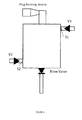
- FIG. 1 it is represented a first exemplary reactor assembly comprising a vertical pressurized reactor vessel, wherein the feedstock inlet is positioned at a higher height than the feedstock outlet with respect to gravity, preferably at the top of the reactor, in such a way that the flow of the ligno-cellulosic feedstock from the feedstock inlet to the feedstock outlet is promoted by the action of gravity force.
- the pressurized reactor vessel may include a means to convey, or move, the ligno-cellulosic feedstock from the feedstock inlet to the feedstock outlet.
- the inclination angle of the pressurized reactor vessel may be different from vertical, without limiting the scope of the invention.
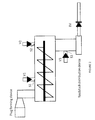
- FIG 2 it is represented a second exemplary reactor assembly comprising a tubular pressurized reactor vessel, having preferably a cylindrical shape.
- the tubular pressurized reactor vessel is preferably disposed in a horizontal or approximately horizontal position, thereby the main axis of the pressurized reactor vessel may be at an angle which is less than 15°, preferably less than 10°, and more preferably less than 5° with respect to a horizontal plane. If the inclination angle is different from 0°, the tubular pressurized reactor vessel is preferably oriented in such a way to promote the flow of the condensed water or liquids to the feedstock outlet under the action of gravity, which corresponds to a clockwise inclination angle in Figure 2 .
- the feedstock inlet and the feedstock outlet are preferably located at or close to the opposite ends of the tubular pressurized reactor vessel.
- the feedstock inlet and feedstock outlet may be located on the circular bases or on the lateral surface of the tubular pressurized reactor vessel.
- the feedstock inlet is located at a higher height than the feedstock outlet with respect to gravity so that the ligno-cellulosic feedstock is inserted and it is removed under the action of gravity, even if a mechanical or pneumatic extractor may be used to force the removal of the ligno-cellulosic feedstock from the tubular pressurized reactor vessel.
- the tubular pressurized reactor vessel may comprise an internal screw conveyor having a rotation axis which is coincident with the main axis of the pressurized reactor vessel.
- the shaft of the screw conveyor is connected with rotation means, which typically comprise a motor and a transmission coupling stage external to the pressurized reactor vessel.
- the screw conveyor conveys the ligno-cellulosic feedstock from the feedstock inlet to the feedstock outlet.
- the conveyor flights are designed to promote the mixing of the ligno-cellulosic feedstock with steam while it is conveyed from the feedstock inlet to the feedstock outlet.
- the steam inlets are located on the pressurized reactor vessel, each steam inlet being connected to a steam source through a steam line.
- the steam inlets or the majority of the steam inlets, are preferably located on the lateral surface of the tubular pressurized reactor vessel, with some steam inlets distributed along the longitudinal section of the pressurized reactor vessel so that they progressively infuse steam on the ligno-cellulosic feedstock advancing in the pressurized reactor vessel.
- a steam inlet is typically connected to a steam controlling device, which is preferably located on the steam line in proximity of the steam inlet.
- a suitable steam controlling device which can be used is a steam valve, indicated as V1 and V2 in Figures 1 and 2 .
- Steam pipes connect the steam inlets with at least a steam source.
- each steam inlet is connected to one steam source, while a steam source is connected to one or more steam inlets.
- the steam source may be any suitable apparatus to generate steam at high pressure and temperature, such as a steam boiler.
- the steam line is pressurized at a steam pressure higher than the reactor pressure and the steam controlling device typically regulates the steam flow entering the pressurized reactor vessel through the specific steam inlet.
- the steam pressure of each steam entering the pressurized reactor vessel is defined as the steam pressure upstream of the steam controlling device and it may be measured by means of a pressure gauge positioned preferably immediately upstream of the steam controlling device.
- the steam temperature of each steam entering the pressurized reactor vessel is defined as the steam temperature upstream of the steam controlling device and it may be measured by means of a temperature gauge positioned preferably immediately upstream of the steam controlling device.
- the steam inlets are distributed on the surface of the pressurized reactor vessel, in order to progressively infuse the ligno-cellulosic feedstock with steam while the ligno-cellulosic feedstock progressively advances from the feedstock inlet to the feedstock outlet of the pressurized reactor vessel.
- each steam inlet is positioned at a certain distance from the feedstock inlet and from the feedstock outlet. Because the feedstock inlet and a steam inlet are two geometrical surfaces, from a geometrical point of view the distance of a steam inlet from the feedstock inlet may defined as the minimum linear distance of any point of the steam inlet to any point of the feedstock inlet.
- the distance of a steam inlet from the feedstock inlet may be defined as the minimum length a steam molecule travels in the pressurized reactor vessel to reach the feedstock inlet. Equivalently, the distance of a steam inlet from the feedstock outlet may be geometrically defined as the minimum linear distance of any point of the steam inlet to any point of the feedstock outlet. From an alternative physical point of view, the distance of a steam inlet from the feedstock outlet may be defined as the minimum length a steam molecule travels in the pressurized reactor vessel to reach the feedstock outlet.
- the distance of the steam inlet S2 from the feedstock outlet is less than the distance of the steam inlet S2 from the feedstock inlet, while the distance of the steam inlet S1 from the feedstock inlet is less than the distance of the steam inlet S1 from the feedstock outlet.
- the pressurized reactor vessel may further comprise auxiliary inlets for introducing liquids or gas in the reactor vessel, and discharge outlets for removing liquids from the reactor, such as for instance condensed water.
- the ligno-cellulosic feedstock is introduced in the pressurized reactor and subjected to a continuous hydrothermal treatment while it is moved through the pressurized reactor vessel from the feedstock inlet to the feedstock outlet.
- the hydrothermal treatment is preferably conducted for a short residence time, which may be from 1 minute to 30 minutes, preferably from 2 minutes to 20 minutes, and most preferably from 3 minutes to 10 minutes.
- at least two steams in the pressurized reactor vessel are used, the steams having different temperatures. Even if more than two steams may be used, the process may be described for clarity in the preferred embodiment of two steams.
- a first steam stream comprising the first stream having a first steam temperature is inserted in the pressurized reactor vessel through at least a first steam inlet
- a second steam stream comprising the second steam having a second steam temperature is inserted the pressurized reactor vessel through at least a second steam inlet.
- each steam is inserted through a set of steam inlets, in order to achieve a homogeneous mixing of steam with the ligno-cellulosic feedstock.
- the first steam inlets are upstream connected to a unique first steam generator, or steam source, providing the first steam
- the second steam inlets are connected to a unique second steam generator providing the second steam.
- the redundancy of steam generators introduced by the disclosed process is apparent, as a real ligno-cellulosic feedstock conversion plant, or biorefinery, usually includes a main steam generator and a supplementary boiler to produce heat and electric energy by burning ligno-cellulosic residues and by-products.
- the first steam and the second steam may be derived from the unique steam generator, optionally reusing recycled steam streams from the conversion plant.
- the first steam is characterized by having a first steam temperature and a first steam pressure which are preferably measured immediately upstream of the steam controlling device.
- the second steam is characterized by having a second steam temperature and a second steam pressure which are preferably measured immediately upstream of the steam controlling device.
- the first steam temperature is in a range from 170°C to 230°C, more preferably from 175°C to 210°C, and, and most preferably from 180°C to 195°C.
- the second steam temperature is greater than the first steam temperature, that is the second steam temperature is greater than the first steam temperature by at least 10°C, more preferably 30°C, even more preferably 50°C, and most preferably 100°C.
- the second steam temperature is less than 300°C.
- the first steam and the second steam are saturated steam, that is they are in equilibrium with heated water at the same pressure, i.e., it has not been heated past the boiling point for that pressure. Again, it is reminded that this property refers to the steam before being inserted in the pressurized reactor vessel.
- the first steam pressure and the second steam pressure are fixed by the thermodynamic equilibrium condition, and are easily defined by the temperature-pressure conversion tables of saturated steam.
- at least the second steam is superheated steam, thereby the second steam pressure is less than the saturation pressure at the second steam temperature.
- the superheated steam may be obtained from the saturated steam drawn from a boiler by passing it through a separate heating device (a super-heater) which transfers additional heat to the steam by contact or by radiation.
- the first steam and the second steam are introduced in the pressurized reactor vessel in the form of a stream. While a continuous steam stream is preferred, being more easily operatively controllable, the stream may also be pulsed.
- the first steam is the main steam used for hydrothermally treating the ligno-cellulosic feedstock, while the second steam is used as a refining steam.
- the amount of first steam exceeds, or greatly exceeds, the amount of second steam.
- the amount of the second steam introduced in the pressurized reactor vessel may be defined in terms of the mean flow of the second steam stream relative to the mean flow of the first steam stream and the second steam stream introduced in the pressurized reactor vessel.
- the instantaneous steam flow may vary to a great extent, as it happens in the case of a pulsed steam stream.
- a mean flow is measured over a time which is equal or comparable to the residence time of the ligno-cellulosic feedstock in the pressurized reactor vessel.
- the mean flow of the second steam stream may be less than 70% of the mean flow of the total steam streams, it is preferred that it is less than 50%, more preferred less than 30 %, and most preferred less than 10% of the mean flow of the first steam stream and the second steam stream.
- One of the improvements of the disclosed process over the prior art processes is the reduction of total amount of steam needed in the hydrothermal treatment, thereby also the reduction of condensed water or liquid in the pressurized reactor vessel.
- the amount of steam used in the process may be quantified as the total amount of steam used for pretreating a Kg of ligno-cellulosic feedstock on a dry basis, which in the case of two steams is the sum of the amount of the first steam and the second steam.
- the total amount of steams per Kg of ligno-cellulosic feedstock on a dry basis introduced in the reactor is preferably in a range of from 0.2Kg/Kg to 2Kg/Kg, more preferably from 0.4Kg/Kg to 1.5Kg/Kg, and most preferably from 0.6Kg/Kg to 1Kg/Kg.
- the ligno-cellulosic feedstock does not completely fill the pressurized reactor vessel in such a way that the hydrothermal treatment is conducted in the presence of steam.
- the filling factor of the pressurized reactor vessel which is the percent volume of the pressurized reactor vessel occupied by the ligno-cellulosic feedstock, may be less than 80%, preferably less than 60%, and most preferably less than 50%.
- the first steam and the second steam, entering the pressurized reactor vessel will mix with the steam already present in the pressurized reactor vessel to reach the reactor pressure, which is the pressure of steam in the pressurized reactor vessel.
- the reactor pressure in the pressurized reactor vessel is preferably spatially homogeneous. At a certain instant, spatial variations of the reactor pressure may occur in a limited portion of the pressurized reactor vessel, especially in proximity of the steam inlets due to fluid dynamic turbulences generated by steam insertion.
- the reactor pressure may be measured by means of a set of pressure gauges sampling the internal pressure.
- the pressure gauges are preferably homogeneously positioned in the pressurized reactor vessel, taking care to avoid the reactor regions in proximity of the steam inlets, which are not statistically representative of the reactor pressure.
- the reactor pressure is represented by the arithmetic mean of the sampled pressure, and the reaction pressure is considered homogeneous if the standard deviation of the sampled pressure is less than 10%, preferably less than 5%, and most preferably less than 2% of the reaction pressure.
- the reactor pressure is greater than 13 bar, more preferably greater than 15 bar, and most preferably greater than 18 bar.
- the first steam pressure and the second steam pressure are greater than the reactor pressure, to permit both the steam streams to enter the pressurized reactor vessel, but preferably the reactor pressure is close to the lower of the first steam pressure and the second steam pressure.
- the reactor pressure is close to the first steam pressure, which is the steam at lower temperature.
- the reactor pressure is at least 60%, more preferably at least 80%, even more preferably at least 90%, and most preferably at least 95% of the lower value of the first steam pressure and the second steam pressure.
- the first and the second steam streams are inserted through separated inlets which are located in different positions on the surface of the pressurized reactor vessel, thereby that the steam temperature in the pressurized reactor vessel is preferably not homogeneous. Namely, in a zone of the pressurized reactor vessel in proximity of the second steam inlet the steam temperature will be close to the second steam temperature. Thereby, in that zone the steam temperature will be greater than the steam temperature in a zone located in proximity of the first steam inlet. As the second steam diffuses from the second steam inlet in the pressurized reactor vessel, the temperature of the internal steam will progressively decrease. Thereby, in the disclosed process, at least a portion of the steam in the pressurized reactor vessel may be in a superheated state.
- the presence of steam in superheated state, or superheated steam can be verified by locally measuring the steam temperature in different positions in the pressurized reactor vessel.
- a steam temperature greater than the steam saturation temperature at the reactor pressure indicates that the steam in the measurement positon is in a superheated state.
- the superheated steam may reach a temperature far exceeding the steam saturation temperature, which is a further important advantage offered by the disclosed process to reduce the amount of condensed liquids in the pressurized reactor vessel. Namely, the extra energy of superheated steam, with respect to saturated steam at the same pressure, may heat the ligno-cellulosic feedstock without generating condensed water or liquid.
- At least a portion of the superheated steam preferably has a temperature which is at least 10°C greater than the steam saturation temperature at the reactor pressure, more preferably at least 30°C greater than the steam saturation temperature at the reactor pressure, and most preferably at least 50°C greater than the steam saturation temperature at the reactor pressure.
- the extra temperature of the superheated steam in the pressurized reactor vessel with respect to the saturation temperature will depend on many factors, and can therefore be controlled to a certain extent.
- a first factor is the difference of the second steam pressure and the reactor pressure.
- a second factor is the mode in which the second steam stream is inserted in the pressurized reactor vessel: namely, the faster the insertion, the less the temperature of the second steam entering the pressurized reactor vessel will drop.
- the second steam stream is inserted by means of an adiabatic or nearly adiabatic expansion, thereby without a significant heat exchange with the environment.
- the second steam is in a superheated state before entering the pressurized reactor vessel, in which case at least a portion of the second steam will remain in a superheated state in the pressurized reactor vessel.
- the second steam pressure may be close to the reactor pressure, provided that it is greater to permit the insertion of the steam.
- the steam in the pressurized vessel is in a superheated state because the second steam is already in a superheated state before being inserted in the pressurized vessel.
- the steam in the pressurized reactor vessel may be in a superheated state also in a zone located in proximity of the first steam inlet, and the first steam may be suitably selected as in the case of the second steam.
- the first steam is saturated steam at a first steam pressure which is slightly greater that the reactor pressure to permit the insertion in the pressurized reactor vessel, thereby the steam in the reactor vessel is at most in a superheated state in a very limited zone close to the first steam inlet.
- the reactor pressure is at least 60%, more preferably at least 80%, even more preferably at least 90%, and most preferably at least 95% of the of the first steam pressure.
- the inventors have found that by suitably inserting two or more steams having different steam temperatures, the local temperature of the steam in the unique pressurized reactor vessel may be controlled to a great extent, and that a portion of the internal steam may be maintained in a superheated state. Thereby, in the unique pressurized reactor vessel, there may be the presence of steam in a saturated state and a superheated state in different zones of the pressurized reactor vessel.
- the extent and position of the different zones may be controlled by suitably locating the first steam inlets and the second steam inlets on the pressurized reactor vessel.
- This may be realized for instance by concentrating the second steam inlets, or the majority of the second steam inlets, on a specific region of the pressurized reactor vessel surface, in such a way to have in the pressurized reactor vessel an extended hot steam zone, wherein steam is preferably in a superheated state.
- the position and extent of the different temperature zones may be easily defined or changed by a person skilled in the art.
- the superheated steam is included in a small zone of the reactor vessel, which is a superheated zone, in such a way that the ligno-cellulosic feedstock is treated with superheated steam for a short superheating time, which can be of the order of a few minutes, or less than 2 minutes, or less than 1 minute, or less 30 seconds.
- the superheating time may be less than 50% of the total residence time of the hydrothermal treatment, preferably less than 30%, and most preferably less than 10%.
- the second steam temperature may be extremely high, i.e.
- the small superheated zone may be sustained by using a limited amount of second steam, thereby in this embodiment the percent flow of the second steam stream is less than 20% of the flow of total steam streams.
- the superheated zone may have a volume which is less than a 20%, more preferably less than 10% of the total volume of the reactor vessel.
- the second steam is inserted through a second steam inlet on the pressurized reactor vessel which has a distance from the feedstock outlet which is less than the distance from the feedstock inlet.
- the second steam is inserted through multiple steam inlets, preferably at least one of the second steam inlets has a distance from the feedstock outlet which is less than the distance from the feedstock inlet, even more preferably the majority of the second steam inlets are positioned to have a distance from the feedstock outlet which is less than the distance from the feedstock inlet, and most preferably all the second steam inlets have a distance from the feedstock outlet which is less than the distance from the feedstock inlet.
- the first steam inlets may be positioned without specific requirements, at least one of the first steam inlets has a distance from the feedstock inlet which is less than the distance from the feedstock outlet, even more preferably the majority of the first steam inlets are positioned to have a distance from the feedstock inlet which is less than the distance from the feedstock outlet, and most preferably all the first steam inlets have a distance from the feedstock inlet which is less than the distance from the feedstock outlet.
- the steam temperature in the zone of the pressurized reactor vessel in proximity of the feedstock outlet is greater than the steam temperature in the zone of the pressurized reactor vessel in proximity of the feedstock inlet, more preferably reaching a superheated state at or in proximity of the feedstock outlet.
- the superheated zone is preferably located in proximity of the feedstock outlet, meaning that at least 50% of the superheated zone, i.e. the points of the superheated zone, has a distance from the feedstock outlet which is less than the distance from the feedstock inlet.
- at least 80%, more preferably at least 90%, and most preferably at least 99% of the superheated zone has a distance from the feedstock outlet which is less than the distance from the feedstock inlet.
- the ligno-cellulosic feedstock is inserted in the pressurized reactor vessel through a feedstock inlet and it is subjected to a hydrothermal treatment in the presence of steam, wherein the steam temperature increases while the feedstock advances to the steam outlet.
- the ligno-cellulosic feedstock is steam treated by saturated steam in the majority of the reactor vessel, or for the majority of the residence time, and subsequently it is steam treated by superheated steam for the remaining part of the residence time.
- the inventors have found that by progressively treating the ligno-cellulosic feedstock with steam at increasing temperature, and particularly creating a superheated zone in proximity of the feedstock outlet, the following step of the process, which is the steam explosion of the ligno-cellulosic feedstock, greatly improves.
- the pressure applied to the ligno-cellulosic feedstock in the pressurized reactor vessel is suddenly reduced while the ligno-cellulosic feedstock is removed from the reactor vessel or reactor vessel assembly to a downstream low pressure zone.
- the physical effects produced by the steam explosion on the ligno-cellulosic feedstock, thereby producing a pre-treated ligno-cellulosic feedstock may vary and may be controlled to a certain extent by suitable choice of operating parameters, which include the absolute pressure drop applied to the feedstock and the steam explosion time, that is the time used to release the pressure applied to the feedstock.
- the steam explosion time is difficult to be quantitatively measured and it may depend on the setup used, a person skilled in the art may easily define how to operate a steam explosion in order to obtain a steam explosion of the ligno-cellulosic feedstock.
- one way to do so is to compare the enzymatic accessibility of the pre-treated ligno-cellulosic feedstock with the enzymatic accessibility of a reference case, wherein following the hydrothermal treatment the pressure applied to the feedstock is released to 1 bar in a very long time of 1 minute or more.
- the increase of the enzymatic accessibility by more than 10% with respect to the reference case may be considered as indicative of a steam explosion of the ligno-cellulosic feedstock.
- the enzymatic accessibility is the percent ratio of the total monomeric sugars obtained in a reference hydrolysis test to the total amount of sugars present in the pre-treated feedstock.
- the total amount of sugars include water insoluble sugars, mainly glucans and xylans, and water soluble oligomers and monomers already present in the pre-treated ligno-cellulosic feedstock.
- the enzymatic accessibility may be conducted according to many protocols known in the art, which typically require to hydrolyze the pre-treated ligno-cellulosic feedstock in the presence of a great amount of enzyme or enzyme cocktail.
- the accessibility may be conducted using a reference amount of 10 ml of Cellic Ctec3 by Novozymes A/S, Bagsvaerd, Denmark, per gram of cellulose in the pre-treated feedstock, for an hydrolysis time of 48 hours, at a temperature of 45°C and at a pH of 5 under stirring agitation.
- the steam explosion of the ligno-cellulosic feedstock following the hydrothermal treatment produces a steam explosion of the cell, thereby substantially disrupting the cell walls.
- This result typically corresponds to short steam explosion time and high pressure drop, and the enzymatic accessibility is enhanced.
- the pressure applied to the ligno-cellulosic feedstock may be released in a time to produce a cell expansion, thereby causing what is known in the art as a steam flash, provided that the enzymatic accessibility of the pre-treated ligno-cellulosic feedstock is increased with respect to the reference case.
- the steam explosion device may be operated to obtain a refining of the feedstock, meaning that a pretreated feedstock with a smaller mean particle size is obtained, again provided that the enzymatic accessibility of the pre-treated feedstock is increased with respect to the reference case.
- the steam explosion is conducted by means of a steam explosion device which preferably comprises a blow valve, which is a valve interposed between the pressurized reactor vessel or reactor assembly and a downstream low pressure expansion zone.
- the blow valve can be automatically operated in closed and open positions, wherein the open position may range from a full open position to a certain level of partial open position.
- the switch time that is the time needed to pass from the closed to the open position, may also be regulated.
- the steam explosion device may be operated in continuous or semi-continuous mode. In the case of continuous operation, the ligno-cellulosic feedstock is continuously admitted to the steam explosion device to flow to the low pressure zone. If a blow valve is used, the blow valve is kept in the open position during stationary operation. In semi-continuous mode, the blow valve is operated with a duty cycle corresponding to the ratio between the open time and the total cycle time.
- the steam explosion device is upstream operatively connected to the feedstock outlet of the pressurized reactor vessel.
- operatively connected it is meant that the steam explosion device may be directly or indirectly connected to the feedstock outlet of the pressurized reactor vessel.
- the feedstock is steam exploded while it is removed from the feedstock outlet.
- a connection system is interposed between the feedstock outlet of the pressurized reactor vessel and the inlet of the steam explosion device.
- the connection system may comprise one or more pipes, vessels or apparatuses, provided that the pressure at in the connection system does not differ significantly from the reactor pressure in the pressurized reactor vessel.
- the pressure in the connection system may be at least 80%, preferably at least 90%, and more preferably at least 95% of the reactor pressure in the pressurized reactor vessel.
- the reactor assembly of figure 1 it is represented a steam explosion device which is directly connected to the feedstock outlet.
- FIG. 2 it is represented a steam explosion device which is operatively connected to the feedstock outlet by means of a vertical connection pipe or vessel, so that the ligno-cellulosic feedstock is conveyed to the feedstock outlet of the pressurized reactor vessel and then fall by gravity at the bottom of the connection pipe or vessel to be steam exploded through the steam explosion device BV.
- One or more optional steam inlets S3 may be located on the surface of the connection pipe or vessel. As these optional steam inlets are characterized by having a shorter distance from the feedstock outlet than from the feedstock inlet of the pressurized reactor, in an alternative embodiment at least a portion of the second steam is inserted through the optional steam inlets S3. The second steam may therefore not directly enter the pressurized reactor vessel, but may enter through the connection pipe or vessel.
- the steam explosion device may further comprise a feedstock distribution device for partitioning the ligno-cellulosic feedstock in feedstock portions and sequentially exposing the ligno-cellulosic feedstock portion to a blow valve, thereby sequentially releasing the pressure applied to each portion of the feedstock.
- the feedstock distribution device is located upstream of the blow valve in the high pressure zone.
- a preferred feedstock distribution device is disclosed as a high pressure compressor in US2008277082A1 , which is herein incorporated by reference. It comprises a rotating disk provided of radially disposed walls defining circular sector vanes. The feedstock distribution device received the feedstock from the feedstock outlet of the pressurized reactor vessel while around a vertical axis, thereby partitioning the feedstock in the vanes.
- the steam explosion device is downstream connected to a low pressure expansion zone which is at a pressure lower than the reactor pressure, preferably by means of one or more blow lines.
- the low pressure expansion zone comprises a separation cyclone, wherein the pre-treated ligno-cellulosic feedstock is collected and steam is recovered.
- the low pressure expansion zone is preferably at a pressure in a range from 0.2 bar to 4 bar, more preferably from 0.9 bar to 2 bar.
- the low pressure expansion zone may be at a sub atmospheric pressure, and the pressure expansion zone may be provided of extraction systems to dynamically maintain a pressure of less than 1 bar.
- the low pressure is atmospheric pressure, that is 1 bar, or slightly super atmospheric, and the pressure reduction to the expansion pressure preferably occurs in one step.
Landscapes
- Engineering & Computer Science (AREA)
- Life Sciences & Earth Sciences (AREA)
- Wood Science & Technology (AREA)
- Mechanical Engineering (AREA)
- Polysaccharides And Polysaccharide Derivatives (AREA)
- Chemical And Physical Treatments For Wood And The Like (AREA)
- Processing Of Solid Wastes (AREA)
- Paper (AREA)
Abstract
Description
- For converting a ligno-cellulosic feedstock to useful compounds, such as biofuels and bio-chemicals, a pretreatment is usually required to break down the ligno-cellulosic structure in order to increase the accessibility to the carbohydrates contained therein. The pre-treated ligno-cellulosic feedstock may then be further processed, for example, by enzymatic hydrolysis, to obtain a hydrolyzed mixture comprising monomeric sugars.
- Typically, mechanical, thermal and hydrothermal, physical, biological and chemical pretreatments are used.
- Steam explosion is a well-known pre-treatment technique in which the ligno-cellulosic feedstock is first subjected to a hydrothermal treatment in the presence of steam at high temperature and pressure, followed by rapid release of the steam pressure to produce an explosive disruption of the ligno-cellulosic structure. Thereby, the feedstock is inserted in a pressurized reactor, wherein the pressure is usually obtained by inserting saturated steam in the reactor. Steam is used to heat the feedstock to the process temperature, ideally reaching a temperature which is close to the steam temperature. A relevant portion of the steam will therefore condense to liquid water causing a significant reduction of the reactor pressure. Sufficient steam must be added to the reactor vessel to achieve the desired pressure for steam explosion pulping, such as 15 bar. A difficulty with this approach is that it requires a large amount of steam to heat the material and to efficiently steam explode it out of the reactor vessel. The required large volume of steam is expensive in terms of energy consumption, especially in the case that the feedstock is introduced in the reactor vessel at a low temperature.
- Therefore, a first problem to be solved is to reduce the amount of steam needed in a steam explosion process, while achieving at the same time an effective steam explosion of the feedstock.
- A second problem to be solved is to reduce the amount of condensed liquid water present together with the feedstock during steam explosion. Namely, condensed water, having a higher gravimetric density than the feedstock, reduces the effectiveness of steam explosion and may cause the plugging of the blow lines typically used for implementing steam explosion.
- A first solution to reduce the amount of steam while preserving steam explosion effectiveness is presented in
US20080277082 , which discloses a method and device for steam explosion pulping including: impregnating a cellulosic biomass feed material in a pressurized reactor vessel; discharging the impregnated feed material from the vessel to a high pressure compressor; elevating a pressure of the feed material in the compressor; discharging the pressurized feed material from the compressor to a conduit coupled to a blow valve; rapidly reducing the pressure of the pressurized feed material as the feed material passes through the blow valve, and pulping the feed material by expansion of fluid in the feed material during the rapid pressure reduction. The high pressure discharge compressor applies centrifugal force to increase the pressure of a feed material stream from a pressurized reactor vessel. The centrifugal force applied to the stream increases the pressure to, for example, at least 0.5-1 bar above the pressure inside the cooking reactor. A first drawback of the offered solution is that a relevant amount of mechanical energy is required in providing centrifugal force to the feed material stream to reach sufficiently high pressure to ensure an effective subsequent steam explosion. A second drawback is that the incoming material may plug the rotating components of the compressor. As the rotation speed is high, disruptive damages may occur. - A further solution to reduce the amount of steam while preserving steam explosion effectiveness is originally disclosed in Boehm, R.M. "The Masonite process", Industrial and Engineering Chemistry, 22(5), pag.493-497, 1930, and described in Fiberboard Manufacturing Practices in the United States, by Otto Suchsland and George E. Woodson, United States Department of Agriculture Forest Service Agriculture Handbook No. 640, 1984, p.62. The disclosed sequence of operation is as follows: 1) Gun is loaded with green chips through the port on the top; 2) Chip inlet valve is tightly closed; 3) Low-pressure steam (350 Ib/in2-just over 430 °F) is admitted immediately. This brings the chips to a temperature of about 375 °F; 4) The chips remain at 375 °F for 30 to 40 s; 5) High-pressure steam is admitted and the gun pressure is elevated within about 2 to 3 s to 1,000 lb/in2 equivalent to a temperature of about 540 °F; 6) The chips remain at this pressure for about 5 s; 7) The hydraulic discharge valve is opened; 8) The chips explode due to the pressure differential and at the same time are forced by the expanding steam through the slotted bottom port plate where they are shredded into a mass of fiber bundles; 9) Steam and fibers are separated in a cyclone. Thereby, the disclosed process is a batch process using two steam sources, namely the low-pressure steam and the high pressure steam, sequentially. These types of batch processes are known to be difficult to be implemented on an industrial scale.
- The use of superheated steam for treating a ligno-cellulosic biomass is known in the art.
- As an example, Dave Barchyn, Stefan Cenkowski, "Process analysis of superheated steam pre-treatment of wheat straw and its relative effect on ethanol selling price", Biofuel Research Journal 4 (2014) 123-128, examined the use of superheated steam as a process medium by which wheat straw ligno-cellulosic material is pre-treated as an alternative to steam explosion. In the paper, it is said that superheated steam has been successfully implemented into industrial processes such as food processing and drying and biomass decontamination and has led to substantial increases in energy efficiency due to high penetration and energy delivery. In the disclosed pre-treatment, the samples were subjected to 15 min of hot water treatment in pressurized hot water (193 kPa, 119°C) followed by 2, 5, or 10 min of superheated steam treatment in a batch process.
- In
WO2011044282A2 discloses a process for the thermal-mechanical pretreatment of biomass. The process includes subjecting a biomass feedstock to thermal reaction under conditions exceeding atmospheric pressure, at a temperature exceeding ambient temperature, at a predetermined moisture content and for a predetermined amount of time. Subsequently, the pressure of said thermal reaction is reduced under conditions resulting in explosive decompression of said biomass. The decompressed biomass is then subjected to axial shear forces to mechanically reduce the size of the fibers of the biomass to obtain treated biomass. The resultant treated biomass has a high level of enzymatic digestibility and a low concentration of degradation products. The thermal reaction conditions are provided by a live steam injection. In one embodiment, the steam injection is provided at a minimum pressure of 290 psig and reduced adiabatically to the thermal reactor operating pressure, therefore allowing the steam to enter the reactor slightly superheated in order to compensate for any ambient heat loss in the reactor. Generally, the higher the steam pressure, the more superheat can be transferred to the reactor. - The present invention is believed to solve in an effective manner the above mentioned problems occurring in steam explosion processes disclosed in the art.
- It is disclosed a continuous process for the pre-treatment of a ligno-cellulosic feedstock, comprising the following steps of: introducing the ligno-cellulosic feedstock in a pressurized reactor vessel; hydrothermally treating the ligno-cellulosic feedstock with steam at a reactor pressure, by inserting at least a first steam stream comprising a first steam and a second steam stream comprising a second steam in the pressurized reactor vessel, the first steam having a first steam temperature and the second steam having a second steam temperature, wherein the second steam temperature is greater than the first steam temperature; and steam exploding the ligno-cellulosic feedstock.
- It is further disclosed that the first steam stream may be inserted into the pressurized reactor vessel through a first steam inlet or inlets and the second steam stream is inserted into the reactor vessel through a second steam inlet or inlets, wherein at least one second steam inlet has a distance from a feedstock outlet of the pressurized reactor vessel which is less than the distance from a feedstock inlet of the pressurized reactor vessel.
- It is also disclosed that at least a portion of the steam in the pressurized reactor vessel may be superheated steam.
- It is further disclosed that the temperature of at least a portion of the superheated steam in the pressurized reactor vessel may be at least 10°C greater than the steam saturation temperature at the reactor pressure.
- It is also disclosed that the superheated steam may be included in a superheated zone of the pressurized reactor vessel, wherein the superheated zone has a volume which is less than a percent value selected from the group consisting of 50%, 30%, and 10% of the total volume of the pressurized reactor vessel.
- It is also disclosed that the superheated zone may be located in proximity of the feedstock outlet of the pressurized reactor vessel.
- It is further disclosed that hydrothermally treating the ligno-cellulosic feedstock may be conducted for a residence time which is a value in a range selected from the group consisting of from 1 minute to 30 minutes, from 2 minutes to 20 minutes, and from 3 minutes to 10 minutes.
- It is also disclosed that the first steam temperature may be in a range selected from the group consisting of from 170°C to 230°C, from 175°C to 210°C, and from 180°C to 195°C.
- It is further disclosed that the second steam temperature may be greater than the first steam temperature by at least a value selected from the group consisting of 10°C, 30°C, 50°C, and 100°C.
- It is also disclosed that the first steam and the second steam may be saturated steam.
- It is further disclosed that the second steam may be superheated steam.
- It is also disclosed that the reactor pressure may be greater than a value selected from the group consisting 13bar, 15bar, and 18bar.
- It is further disclosed that the first steam stream may be inserted at a first steam pressure and the second steam stream is inserted at a second steam pressure, and the reactor pressure is at least a percent value selected from the group consisting of 60%, 80%, 90%, and 95% and less than 100% of the lower of the first steam pressure and the second steam pressure.
- It is also disclosed that the reactor pressure may be homogeneous.
- It is further disclosed that the second steam stream has a mean flow which may be greater than 0 and less than a percent value selected from the group consisting of 70%, 50%, 30 %, 10% of a mean flow of the first steam stream and the second steam stream.
- It is also disclosed that the total amount of steams per Kg of ligno-cellulosic feedstock on a dry basis introduced in the pressurized reactor vessel may be in a range of from 0.2Kg/Kg to 2Kg/Kg, from 0.4Kg/Kg to 1.5Kg/Kg, and from 0.6Kg/Kg to 1Kg/Kg.
- It is further disclosed that steam exploding the ligno-cellulosic feedstock may comprise releasing a pressure applied to the feedstock through a blow line operatively connected to the feedstock outlet of the pressurized reactor vessel.
- It is also disclosed that the ligno-cellulosic feedstock may be introduced in the pressurized reactor vessel at a temperature which is in a range selected from the group consisting of from 20° to 100°C, from 40° to 95°C, and from 60° to 90°C.
- It is further disclosed that the ligno-cellulosic feedstock introduced in the reactor may have a moisture content in a range of from 40% to 70% by weight of the ligno-cellulosic feedstock on a wet basis.
-
-
Figure 1 is an exemplary embodiment of the disclosed process -
Figure 2 is another exemplary embodiment of the disclosed process - It is disclosed a pre-treatment process of a ligno-cellulosic feedstock comprising carbohydrates and lignin. The pre-treatment process increases the accessibility of the carbohydrates to a biological agent such as an enzyme or enzyme mixture. Therefore, the pre-treated ligno-cellulosic feedstock may be subjected to a subsequent hydrolysis step, to produce a hydrolyzed mixture comprising water soluble monomeric sugars. A detailed description of a ligno-cellulosic feedstock may be found in
WO2015028156A1 , pag. 11-14, which is herein incorporated by reference. A preferred ligno-cellulosic feedstock is selected from the group of agricultural residues, in particular straws such as wheat straw, rice straw, or bagasse, such as sugar cane bagasse. The hardwoods and softwoods also benefit from this process. - The disclosed process is a continuous process, which comprises introducing the ligno-cellulosic feedstock in a pressurized reactor vessel through a feedstock inlet, and subjecting the ligno-cellulosic feedstock to a hydrothermal treatment while the feedstock moves, or is conveyed, to a feedstock outlet of the pressurized reactor. The hydrothermal treatment is realized by inserting at least two steams having different temperature in the pressurized reactor vessel, which is thereby pressurized at a reactor pressure by the at least two steams inserted therein. The ligno-cellulosic feedstock is then subjected to steam explosion by rapidly releasing the pressure applied to the feedstock.
- According to one aspect, the disclosed process significantly reduces the total amount of steam which is needed to pre-treat the ligno-cellulosic feedstock, with respect to the amount of steam needed to pre-treat the ligno-cellulosic feedstock with steam at a unique temperature. According to another aspect, the disclosed process greatly reduces the amount of liquid water which is formed in the pressurized reactor vessel due to steam condensation. Because of the high pressure, it is difficult to separately withdraw liquid water from the pressurized reactor vessel and its presence during steam explosion may strongly reduce the disruptive effects of the steam explosion on the ligno-cellulosic feedstock.
- According to a further aspect of the invention, the disclosed process prevents or strongly reduces the steam pressure drop in the pressurized reactor vessel due to steam condensation. The pressure drop may occur in the pressurized reactor vessel typically in the case that the ligno-cellulosic feedstock is inserted at low temperature while inserting the steam at a low flow rate to limit steam consumption.
- In order for the process to be continuous, it is not necessary that the ligno-cellulosic feedstock is continuously introduced into the pressurized reactor vessel, but it can be introduced at steady aliquots or pulses. Thus there are moments when there is no ligno-cellulosic feedstock entering the pressurized reactor vessel. But, over time, the total mass introduced into the pressurized reactor vessel equals the total mass subjected to steam explosion. In the case that a portion of the ligno-cellulosic feedstock is withdrawn in liquid and/or solid form from the pressurized reactor vessel from auxiliary outlets without being steam exploded, the mass balance applies to the total amount of withdrawn and steam exploded ligno-cellulosic feedstock. One distinguishing feature between a continuous and a batch process is that, in a continuous process, a fresh portion of the ligno-cellulosic feedstock is introduced in the pressurized reactor vessel at the same time that a hydrothermally treated portion of the ligno-cellulosic feedstock is subjected to steam explosion. Such steam explosion is done in a continuous manner which includes an aliquot or pulse removal.
- The ligno-cellulosic feedstock is preferably subjected to a previous soaking process or step to remove a portion of non-ligno-cellulosic compounds contained in the raw ligno-cellulosic feedstock such as inorganic salts, waxes, and organic acids prior to being introduced into the pressurized reactor. In the soaking step or process, external contaminants, such as ground, stones, and harvesting residues may also be separated. The soaking process preferably comprises introducing the ligno-cellulosic feedstock in a soaking liquid comprising water at a temperature from 20°C to 100°C, more preferably from 40°C and 70°C and for a soaking time which is from 30 seconds to 30 minutes, more preferably from 3 minutes to 15 minutes. The soaking step or process is preferably conducted at atmospheric pressure. After soaking, some liquid is removed from the ligno-cellulosic feedstock by draining and/or by applying mechanical shearing/compression forces. Preferably, all the free liquid and at least a portion of the soaked liquid in the biomass are withdrawn before inserting the feedstock in the pressurized reactor. Thereby, in the disclosed process, the ligno-cellulosic feedstock may be introduced in the pressurized reactor vessel at a temperature in a range from 20°C to 100°C, more preferably from 40°C to 95°C, and most preferably from 60°C to 90°C. The moisture content of the ligno-cellulosic feedstock may be from 40% to 70%, more preferably from 45% to 65%, and most preferably from 50% to 60% on a wet basis.
- In another embodiment, the ligno-cellulosic feedstock is subjected to a preliminary hydrothermal treatment in water or a liquid comprising water to solubilize a portion of the water insoluble carbohydrates contained in the ligno-cellulosic feedstock prior to being introduced in the pressurized reactor vessel. The preliminary hydrothermal treatment is conducted in pressurized conditions in the presence of water in a steam or liquid phase, or mixture thereof, at a temperature from 100°C to 190°C, preferably from 130°C to 180°C, and most preferably from 140°C to 170°C. The preliminary hydrothermal treatment is conducted for a time in a range from 10 minutes to 3 hours, preferably from 15 minutes to 3 hours, and most preferably from 20 minutes to 60 minutes. The preliminary hydrothermal treatment solubilizes mainly the hemicellulosic component of the ligno-cellulosic feedstock, which may subjected to thermal degradation at high temperature, and a liquid comprising water and water soluble xylose polymers and oligomers and optionally other hemicellulose-derived sugars is thereby separated from the solid ligno-cellulosic feedstock before treating the solid ligno-cellulosic feedstock according to the disclosed process.
- To describe the disclosed process, reference is made to
Figure 1 andFigure 2 , which represent two exemplary reactor assemblies which may be used to implement the process. Each reactor assembly comprises a pressurized reactor vessel, wherein the hydrothermal treatment occurs, and a steam explosion device for rapidly reducing the pressure applied to the feedstock. - The ligno-cellulosic feedstock is introduced in the pressurized reactor vessel from a zone which is at a lower pressure than the reactor pressure. The feedstock may be introduced from a zone at atmospheric pressure, i.e. 1 bar, or from an already pressurized environment at a pressure greater than 1 bar. A pressure sealing device is therefore used for introducing the feedstock in the pressurized reactor vessel. The pressure sealing device is preferably a continuous plug forming device such as a biomass compressor, also known as a plug screw feeder, or worm screw feeder. In this case, the feedstock is conveyed from an inlet of the pressure sealing device connected to the low pressure zone to an outlet of the pressure sealing device by means of an internal screw, which compresses the feedstock to form a plug capable of dynamically sustaining a difference of pressure between the two zones at different pressure, while continuously introducing the feedstock in the pressurized reactor vessel. The feedstock plug may be mechanically fragmented at the outlet of the pressure sealing device and the feedstock preferably enters the pressurized reactor vessel under the action of gravity. A rotary cell, which works in a discontinuous or semi-continuous mode, may also be used to introduce sequential aliquots of feedstock in the pressurized reactor vessel. The pressure sealing device is connected to the pressurized reactor vessel, that is the outlet of the pressure sealing device may be directly or indirectly connected to the feedstock inlet of the pressurized reactor vessel. In the case of direct connection, typically the outlet of the pressure sealing device and the inlet of the pressurized reactor vessel are joined by means of one or more flanges tightened to avoid steam leaks. In the case of indirect connection, a connection system is interposed between the outlet of the pressure sealing device and the inlet of the pressurized reactor vessel. The connection system may comprise one or more pipes, vessels or apparatuses.
- The pressurized reactor vessel comprises a feedstock inlet, a feedstock outlet and two or more steam inlets for inserting steam in the pressurized reactor vessel, and it is designed to operate at a maximum internal pressure of at least 20 bar, preferably at least 40 bar, and more preferably at least 50 bar, according to well-known reactor design rules. Depending on the specific type of pressurized reactor vessel, the feedstock inlet and feedstock outlet on the pressurized reactor vessel may be located in different positions. The pressurized reactor vessel used to implement the disclosed process may be any kind of pressurized reactor.
- In
Figure 1 , it is represented a first exemplary reactor assembly comprising a vertical pressurized reactor vessel, wherein the feedstock inlet is positioned at a higher height than the feedstock outlet with respect to gravity, preferably at the top of the reactor, in such a way that the flow of the ligno-cellulosic feedstock from the feedstock inlet to the feedstock outlet is promoted by the action of gravity force. The pressurized reactor vessel may include a means to convey, or move, the ligno-cellulosic feedstock from the feedstock inlet to the feedstock outlet. The inclination angle of the pressurized reactor vessel may be different from vertical, without limiting the scope of the invention. - In
Figure 2 , it is represented a second exemplary reactor assembly comprising a tubular pressurized reactor vessel, having preferably a cylindrical shape. The tubular pressurized reactor vessel is preferably disposed in a horizontal or approximately horizontal position, thereby the main axis of the pressurized reactor vessel may be at an angle which is less than 15°, preferably less than 10°, and more preferably less than 5° with respect to a horizontal plane. If the inclination angle is different from 0°, the tubular pressurized reactor vessel is preferably oriented in such a way to promote the flow of the condensed water or liquids to the feedstock outlet under the action of gravity, which corresponds to a clockwise inclination angle inFigure 2 . The feedstock inlet and the feedstock outlet are preferably located at or close to the opposite ends of the tubular pressurized reactor vessel. The feedstock inlet and feedstock outlet may be located on the circular bases or on the lateral surface of the tubular pressurized reactor vessel. Preferably, the feedstock inlet is located at a higher height than the feedstock outlet with respect to gravity so that the ligno-cellulosic feedstock is inserted and it is removed under the action of gravity, even if a mechanical or pneumatic extractor may be used to force the removal of the ligno-cellulosic feedstock from the tubular pressurized reactor vessel. The tubular pressurized reactor vessel may comprise an internal screw conveyor having a rotation axis which is coincident with the main axis of the pressurized reactor vessel. The shaft of the screw conveyor is connected with rotation means, which typically comprise a motor and a transmission coupling stage external to the pressurized reactor vessel. The screw conveyor conveys the ligno-cellulosic feedstock from the feedstock inlet to the feedstock outlet. Preferably, the conveyor flights are designed to promote the mixing of the ligno-cellulosic feedstock with steam while it is conveyed from the feedstock inlet to the feedstock outlet. - The steam inlets are located on the pressurized reactor vessel, each steam inlet being connected to a steam source through a steam line. With reference to the exemplary reactor vessels of
Figure 1 and2 , the steam inlets, or the majority of the steam inlets, are preferably located on the lateral surface of the tubular pressurized reactor vessel, with some steam inlets distributed along the longitudinal section of the pressurized reactor vessel so that they progressively infuse steam on the ligno-cellulosic feedstock advancing in the pressurized reactor vessel. A steam inlet is typically connected to a steam controlling device, which is preferably located on the steam line in proximity of the steam inlet. A suitable steam controlling device which can be used is a steam valve, indicated as V1 and V2 inFigures 1 and2 . Steam pipes connect the steam inlets with at least a steam source. Preferably, each steam inlet is connected to one steam source, while a steam source is connected to one or more steam inlets. The steam source may be any suitable apparatus to generate steam at high pressure and temperature, such as a steam boiler. The steam line is pressurized at a steam pressure higher than the reactor pressure and the steam controlling device typically regulates the steam flow entering the pressurized reactor vessel through the specific steam inlet. As the steam entering the pressurized reactor vessel may be subjected to turbulent flow immediately downstream the steam controlling device, the steam pressure of each steam entering the pressurized reactor vessel is defined as the steam pressure upstream of the steam controlling device and it may be measured by means of a pressure gauge positioned preferably immediately upstream of the steam controlling device. In the same way, the steam temperature of each steam entering the pressurized reactor vessel is defined as the steam temperature upstream of the steam controlling device and it may be measured by means of a temperature gauge positioned preferably immediately upstream of the steam controlling device. - The steam inlets are distributed on the surface of the pressurized reactor vessel, in order to progressively infuse the ligno-cellulosic feedstock with steam while the ligno-cellulosic feedstock progressively advances from the feedstock inlet to the feedstock outlet of the pressurized reactor vessel. Thereby, each steam inlet is positioned at a certain distance from the feedstock inlet and from the feedstock outlet. Because the feedstock inlet and a steam inlet are two geometrical surfaces, from a geometrical point of view the distance of a steam inlet from the feedstock inlet may defined as the minimum linear distance of any point of the steam inlet to any point of the feedstock inlet. From an alternative physical point of view, the distance of a steam inlet from the feedstock inlet may be defined as the minimum length a steam molecule travels in the pressurized reactor vessel to reach the feedstock inlet. Equivalently, the distance of a steam inlet from the feedstock outlet may be geometrically defined as the minimum linear distance of any point of the steam inlet to any point of the feedstock outlet. From an alternative physical point of view, the distance of a steam inlet from the feedstock outlet may be defined as the minimum length a steam molecule travels in the pressurized reactor vessel to reach the feedstock outlet. With reference to
Figure 1 andFigure 2 , the distance of the steam inlet S2 from the feedstock outlet is less than the distance of the steam inlet S2 from the feedstock inlet, while the distance of the steam inlet S1 from the feedstock inlet is less than the distance of the steam inlet S1 from the feedstock outlet. - The pressurized reactor vessel may further comprise auxiliary inlets for introducing liquids or gas in the reactor vessel, and discharge outlets for removing liquids from the reactor, such as for instance condensed water.
- In the disclosed process, the ligno-cellulosic feedstock is introduced in the pressurized reactor and subjected to a continuous hydrothermal treatment while it is moved through the pressurized reactor vessel from the feedstock inlet to the feedstock outlet. The hydrothermal treatment is preferably conducted for a short residence time, which may be from 1 minute to 30 minutes, preferably from 2 minutes to 20 minutes, and most preferably from 3 minutes to 10 minutes. In order to obtain an effective hydrothermal treatment of the lingo-cellulosic feedstock in a short time, at least two steams in the pressurized reactor vessel are used, the steams having different temperatures. Even if more than two steams may be used, the process may be described for clarity in the preferred embodiment of two steams. Thereby, a first steam stream comprising the first stream having a first steam temperature is inserted in the pressurized reactor vessel through at least a first steam inlet, while a second steam stream comprising the second steam having a second steam temperature is inserted the pressurized reactor vessel through at least a second steam inlet. Preferably each steam is inserted through a set of steam inlets, in order to achieve a homogeneous mixing of steam with the ligno-cellulosic feedstock. Preferably, the first steam inlets are upstream connected to a unique first steam generator, or steam source, providing the first steam, and the second steam inlets are connected to a unique second steam generator providing the second steam. It is noted that the redundancy of steam generators introduced by the disclosed process is apparent, as a real ligno-cellulosic feedstock conversion plant, or biorefinery, usually includes a main steam generator and a supplementary boiler to produce heat and electric energy by burning ligno-cellulosic residues and by-products. In the case that only one steam generator producing steam at a unique temperature is available, the first steam and the second steam may be derived from the unique steam generator, optionally reusing recycled steam streams from the conversion plant.
- The first steam is characterized by having a first steam temperature and a first steam pressure which are preferably measured immediately upstream of the steam controlling device. Correspondingly, the second steam is characterized by having a second steam temperature and a second steam pressure which are preferably measured immediately upstream of the steam controlling device. Preferably, the first steam temperature is in a range from 170°C to 230°C, more preferably from 175°C to 210°C, and, and most preferably from 180°C to 195°C. The second steam temperature is greater than the first steam temperature, that is the second steam temperature is greater than the first steam temperature by at least 10°C, more preferably 30°C, even more preferably 50°C, and most preferably 100°C. Even if the maximum value allowed for the second steam temperature will vary according to the specific configuration and process conditions, preferably the second steam temperature is less than 300°C. In one embodiment, the first steam and the second steam are saturated steam, that is they are in equilibrium with heated water at the same pressure, i.e., it has not been heated past the boiling point for that pressure. Again, it is reminded that this property refers to the steam before being inserted in the pressurized reactor vessel. Thereby, the first steam pressure and the second steam pressure are fixed by the thermodynamic equilibrium condition, and are easily defined by the temperature-pressure conversion tables of saturated steam. In another embodiment, at least the second steam is superheated steam, thereby the second steam pressure is less than the saturation pressure at the second steam temperature. The superheated steam may be obtained from the saturated steam drawn from a boiler by passing it through a separate heating device (a super-heater) which transfers additional heat to the steam by contact or by radiation.
- The first steam and the second steam are introduced in the pressurized reactor vessel in the form of a stream. While a continuous steam stream is preferred, being more easily operatively controllable, the stream may also be pulsed. In a preferred embodiment, the first steam is the main steam used for hydrothermally treating the ligno-cellulosic feedstock, while the second steam is used as a refining steam. Thereby, in this preferred embodiment, the amount of first steam exceeds, or greatly exceeds, the amount of second steam. The amount of the second steam introduced in the pressurized reactor vessel may be defined in terms of the mean flow of the second steam stream relative to the mean flow of the first steam stream and the second steam stream introduced in the pressurized reactor vessel. The instantaneous steam flow may vary to a great extent, as it happens in the case of a pulsed steam stream. Thereby, a mean flow is measured over a time which is equal or comparable to the residence time of the ligno-cellulosic feedstock in the pressurized reactor vessel. Even if the mean flow of the second steam stream may be less than 70% of the mean flow of the total steam streams, it is preferred that it is less than 50%, more preferred less than 30 %, and most preferred less than 10% of the mean flow of the first steam stream and the second steam stream. One of the improvements of the disclosed process over the prior art processes is the reduction of total amount of steam needed in the hydrothermal treatment, thereby also the reduction of condensed water or liquid in the pressurized reactor vessel. The amount of steam used in the process may be quantified as the total amount of steam used for pretreating a Kg of ligno-cellulosic feedstock on a dry basis, which in the case of two steams is the sum of the amount of the first steam and the second steam. The total amount of steams per Kg of ligno-cellulosic feedstock on a dry basis introduced in the reactor is preferably in a range of from 0.2Kg/Kg to 2Kg/Kg, more preferably from 0.4Kg/Kg to 1.5Kg/Kg, and most preferably from 0.6Kg/Kg to 1Kg/Kg.
- Preferably, the ligno-cellulosic feedstock does not completely fill the pressurized reactor vessel in such a way that the hydrothermal treatment is conducted in the presence of steam. Thereby, preferably in a portion of the pressurized reactor vessel only steam is present. The filling factor of the pressurized reactor vessel, which is the percent volume of the pressurized reactor vessel occupied by the ligno-cellulosic feedstock, may be less than 80%, preferably less than 60%, and most preferably less than 50%. Thereby, the first steam and the second steam, entering the pressurized reactor vessel, will mix with the steam already present in the pressurized reactor vessel to reach the reactor pressure, which is the pressure of steam in the pressurized reactor vessel. The reactor pressure in the pressurized reactor vessel is preferably spatially homogeneous. At a certain instant, spatial variations of the reactor pressure may occur in a limited portion of the pressurized reactor vessel, especially in proximity of the steam inlets due to fluid dynamic turbulences generated by steam insertion. The reactor pressure may be measured by means of a set of pressure gauges sampling the internal pressure. The pressure gauges are preferably homogeneously positioned in the pressurized reactor vessel, taking care to avoid the reactor regions in proximity of the steam inlets, which are not statistically representative of the reactor pressure. The reactor pressure is represented by the arithmetic mean of the sampled pressure, and the reaction pressure is considered homogeneous if the standard deviation of the sampled pressure is less than 10%, preferably less than 5%, and most preferably less than 2% of the reaction pressure.
- Preferably, the reactor pressure is greater than 13 bar, more preferably greater than 15 bar, and most preferably greater than 18 bar.
- The first steam pressure and the second steam pressure are greater than the reactor pressure, to permit both the steam streams to enter the pressurized reactor vessel, but preferably the reactor pressure is close to the lower of the first steam pressure and the second steam pressure. In the preferred embodiment that the first steam and the second steam are saturated steam, the reactor pressure is close to the first steam pressure, which is the steam at lower temperature. The reactor pressure is at least 60%, more preferably at least 80%, even more preferably at least 90%, and most preferably at least 95% of the lower value of the first steam pressure and the second steam pressure.
- The first and the second steam streams are inserted through separated inlets which are located in different positions on the surface of the pressurized reactor vessel, thereby that the steam temperature in the pressurized reactor vessel is preferably not homogeneous. Namely, in a zone of the pressurized reactor vessel in proximity of the second steam inlet the steam temperature will be close to the second steam temperature. Thereby, in that zone the steam temperature will be greater than the steam temperature in a zone located in proximity of the first steam inlet. As the second steam diffuses from the second steam inlet in the pressurized reactor vessel, the temperature of the internal steam will progressively decrease. Thereby, in the disclosed process, at least a portion of the steam in the pressurized reactor vessel may be in a superheated state. The presence of steam in superheated state, or superheated steam, can be verified by locally measuring the steam temperature in different positions in the pressurized reactor vessel. A steam temperature greater than the steam saturation temperature at the reactor pressure indicates that the steam in the measurement positon is in a superheated state. The superheated steam may reach a temperature far exceeding the steam saturation temperature, which is a further important advantage offered by the disclosed process to reduce the amount of condensed liquids in the pressurized reactor vessel. Namely, the extra energy of superheated steam, with respect to saturated steam at the same pressure, may heat the ligno-cellulosic feedstock without generating condensed water or liquid. Thereby, at least a portion of the superheated steam preferably has a temperature which is at least 10°C greater than the steam saturation temperature at the reactor pressure, more preferably at least 30°C greater than the steam saturation temperature at the reactor pressure, and most preferably at least 50°C greater than the steam saturation temperature at the reactor pressure. The extra temperature of the superheated steam in the pressurized reactor vessel with respect to the saturation temperature will depend on many factors, and can therefore be controlled to a certain extent. A first factor is the difference of the second steam pressure and the reactor pressure. A second factor is the mode in which the second steam stream is inserted in the pressurized reactor vessel: namely, the faster the insertion, the less the temperature of the second steam entering the pressurized reactor vessel will drop. Preferably, the second steam stream is inserted by means of an adiabatic or nearly adiabatic expansion, thereby without a significant heat exchange with the environment. In one embodiment, the second steam is in a superheated state before entering the pressurized reactor vessel, in which case at least a portion of the second steam will remain in a superheated state in the pressurized reactor vessel. It is noted that if the second steam is in a superheated state, the second steam pressure may be close to the reactor pressure, provided that it is greater to permit the insertion of the steam. In this case, the steam in the pressurized vessel is in a superheated state because the second steam is already in a superheated state before being inserted in the pressurized vessel.
- In one embodiment, the steam in the pressurized reactor vessel may be in a superheated state also in a zone located in proximity of the first steam inlet, and the first steam may be suitably selected as in the case of the second steam.
- In a preferred embodiment, the first steam is saturated steam at a first steam pressure which is slightly greater that the reactor pressure to permit the insertion in the pressurized reactor vessel, thereby the steam in the reactor vessel is at most in a superheated state in a very limited zone close to the first steam inlet. Thereby, in a zone in proximity of the first steam inlet the steam in the reactor vessel is saturated steam. In this case, the reactor pressure is at least 60%, more preferably at least 80%, even more preferably at least 90%, and most preferably at least 95% of the of the first steam pressure.
- The inventors have found that by suitably inserting two or more steams having different steam temperatures, the local temperature of the steam in the unique pressurized reactor vessel may be controlled to a great extent, and that a portion of the internal steam may be maintained in a superheated state. Thereby, in the unique pressurized reactor vessel, there may be the presence of steam in a saturated state and a superheated state in different zones of the pressurized reactor vessel. The extent and position of the different zones may be controlled by suitably locating the first steam inlets and the second steam inlets on the pressurized reactor vessel. This may be realized for instance by concentrating the second steam inlets, or the majority of the second steam inlets, on a specific region of the pressurized reactor vessel surface, in such a way to have in the pressurized reactor vessel an extended hot steam zone, wherein steam is preferably in a superheated state. On the basis of the present disclosure, the position and extent of the different temperature zones may be easily defined or changed by a person skilled in the art.
- In a preferred embodiment, the superheated steam is included in a small zone of the reactor vessel, which is a superheated zone, in such a way that the ligno-cellulosic feedstock is treated with superheated steam for a short superheating time, which can be of the order of a few minutes, or less than 2 minutes, or less than 1 minute, or less 30 seconds. The superheating time may be less than 50% of the total residence time of the hydrothermal treatment, preferably less than 30%, and most preferably less than 10%. In this embodiment, the second steam temperature may be extremely high, i.e. greater than 250°C, without causing a significant sugars degradation as the exposure of the ligno-cellulosic feedstock to high temperature steam occurs for a short time. Moreover, the small superheated zone may be sustained by using a limited amount of second steam, thereby in this embodiment the percent flow of the second steam stream is less than 20% of the flow of total steam streams. The superheated zone may have a volume which is less than a 20%, more preferably less than 10% of the total volume of the reactor vessel.
- In a preferred embodiment, the second steam is inserted through a second steam inlet on the pressurized reactor vessel which has a distance from the feedstock outlet which is less than the distance from the feedstock inlet. In the case that the second steam is inserted through multiple steam inlets, preferably at least one of the second steam inlets has a distance from the feedstock outlet which is less than the distance from the feedstock inlet, even more preferably the majority of the second steam inlets are positioned to have a distance from the feedstock outlet which is less than the distance from the feedstock inlet, and most preferably all the second steam inlets have a distance from the feedstock outlet which is less than the distance from the feedstock inlet. Even if the first steam inlets may be positioned without specific requirements, at least one of the first steam inlets has a distance from the feedstock inlet which is less than the distance from the feedstock outlet, even more preferably the majority of the first steam inlets are positioned to have a distance from the feedstock inlet which is less than the distance from the feedstock outlet, and most preferably all the first steam inlets have a distance from the feedstock inlet which is less than the distance from the feedstock outlet. In this embodiment, the steam temperature in the zone of the pressurized reactor vessel in proximity of the feedstock outlet is greater than the steam temperature in the zone of the pressurized reactor vessel in proximity of the feedstock inlet, more preferably reaching a superheated state at or in proximity of the feedstock outlet. Thereby, the superheated zone is preferably located in proximity of the feedstock outlet, meaning that at least 50% of the superheated zone, i.e. the points of the superheated zone, has a distance from the feedstock outlet which is less than the distance from the feedstock inlet. Preferably at least 80%, more preferably at least 90%, and most preferably at least 99% of the superheated zone has a distance from the feedstock outlet which is less than the distance from the feedstock inlet.
- Therefore, according to a preferred embodiment, the ligno-cellulosic feedstock is inserted in the pressurized reactor vessel through a feedstock inlet and it is subjected to a hydrothermal treatment in the presence of steam, wherein the steam temperature increases while the feedstock advances to the steam outlet. Preferably, first the ligno-cellulosic feedstock is steam treated by saturated steam in the majority of the reactor vessel, or for the majority of the residence time, and subsequently it is steam treated by superheated steam for the remaining part of the residence time. The inventors have found that by progressively treating the ligno-cellulosic feedstock with steam at increasing temperature, and particularly creating a superheated zone in proximity of the feedstock outlet, the following step of the process, which is the steam explosion of the ligno-cellulosic feedstock, greatly improves.
- During steam explosion, the pressure applied to the ligno-cellulosic feedstock in the pressurized reactor vessel is suddenly reduced while the ligno-cellulosic feedstock is removed from the reactor vessel or reactor vessel assembly to a downstream low pressure zone. It is generally recognized in the art that the physical effects produced by the steam explosion on the ligno-cellulosic feedstock, thereby producing a pre-treated ligno-cellulosic feedstock, may vary and may be controlled to a certain extent by suitable choice of operating parameters, which include the absolute pressure drop applied to the feedstock and the steam explosion time, that is the time used to release the pressure applied to the feedstock. Although the steam explosion time is difficult to be quantitatively measured and it may depend on the setup used, a person skilled in the art may easily define how to operate a steam explosion in order to obtain a steam explosion of the ligno-cellulosic feedstock. For example, one way to do so is to compare the enzymatic accessibility of the pre-treated ligno-cellulosic feedstock with the enzymatic accessibility of a reference case, wherein following the hydrothermal treatment the pressure applied to the feedstock is released to 1 bar in a very long time of 1 minute or more. The increase of the enzymatic accessibility by more than 10% with respect to the reference case may be considered as indicative of a steam explosion of the ligno-cellulosic feedstock. The enzymatic accessibility is the percent ratio of the total monomeric sugars obtained in a reference hydrolysis test to the total amount of sugars present in the pre-treated feedstock. The total amount of sugars include water insoluble sugars, mainly glucans and xylans, and water soluble oligomers and monomers already present in the pre-treated ligno-cellulosic feedstock. The enzymatic accessibility may be conducted according to many protocols known in the art, which typically require to hydrolyze the pre-treated ligno-cellulosic feedstock in the presence of a great amount of enzyme or enzyme cocktail. For instance, the accessibility may be conducted using a reference amount of 10 ml of Cellic Ctec3 by Novozymes A/S, Bagsvaerd, Denmark, per gram of cellulose in the pre-treated feedstock, for an hydrolysis time of 48 hours, at a temperature of 45°C and at a pH of 5 under stirring agitation.
- In a preferred embodiment, the steam explosion of the ligno-cellulosic feedstock following the hydrothermal treatment produces a steam explosion of the cell, thereby substantially disrupting the cell walls. This result typically corresponds to short steam explosion time and high pressure drop, and the enzymatic accessibility is enhanced. In certain embodiments, the pressure applied to the ligno-cellulosic feedstock may be released in a time to produce a cell expansion, thereby causing what is known in the art as a steam flash, provided that the enzymatic accessibility of the pre-treated ligno-cellulosic feedstock is increased with respect to the reference case. In further embodiments, the steam explosion device may be operated to obtain a refining of the feedstock, meaning that a pretreated feedstock with a smaller mean particle size is obtained, again provided that the enzymatic accessibility of the pre-treated feedstock is increased with respect to the reference case.
- The steam explosion is conducted by means of a steam explosion device which preferably comprises a blow valve, which is a valve interposed between the pressurized reactor vessel or reactor assembly and a downstream low pressure expansion zone. The blow valve can be automatically operated in closed and open positions, wherein the open position may range from a full open position to a certain level of partial open position. In certain blow valves, the switch time, that is the time needed to pass from the closed to the open position, may also be regulated. The steam explosion device may be operated in continuous or semi-continuous mode. In the case of continuous operation, the ligno-cellulosic feedstock is continuously admitted to the steam explosion device to flow to the low pressure zone. If a blow valve is used, the blow valve is kept in the open position during stationary operation. In semi-continuous mode, the blow valve is operated with a duty cycle corresponding to the ratio between the open time and the total cycle time.
- The steam explosion device is upstream operatively connected to the feedstock outlet of the pressurized reactor vessel. By the expression "operatively connected", it is meant that the steam explosion device may be directly or indirectly connected to the feedstock outlet of the pressurized reactor vessel. In the case that the steam explosion device is directly connected to the feedstock outlet of the reactor vessel, the feedstock is steam exploded while it is removed from the feedstock outlet. In the case that the steam explosion device is indirectly connected to the feedstock outlet of the pressurized reactor vessel, a connection system is interposed between the feedstock outlet of the pressurized reactor vessel and the inlet of the steam explosion device. The connection system may comprise one or more pipes, vessels or apparatuses, provided that the pressure at in the connection system does not differ significantly from the reactor pressure in the pressurized reactor vessel. Thereby, the pressure in the connection system may be at least 80%, preferably at least 90%, and more preferably at least 95% of the reactor pressure in the pressurized reactor vessel. As an example, in the reactor assembly of
figure 1 it is represented a steam explosion device which is directly connected to the feedstock outlet. - In
Figure 2 it is represented a steam explosion device which is operatively connected to the feedstock outlet by means of a vertical connection pipe or vessel, so that the ligno-cellulosic feedstock is conveyed to the feedstock outlet of the pressurized reactor vessel and then fall by gravity at the bottom of the connection pipe or vessel to be steam exploded through the steam explosion device BV. One or more optional steam inlets S3 may be located on the surface of the connection pipe or vessel. As these optional steam inlets are characterized by having a shorter distance from the feedstock outlet than from the feedstock inlet of the pressurized reactor, in an alternative embodiment at least a portion of the second steam is inserted through the optional steam inlets S3. The second steam may therefore not directly enter the pressurized reactor vessel, but may enter through the connection pipe or vessel. - In
Figure 2 , the steam explosion device may further comprise a feedstock distribution device for partitioning the ligno-cellulosic feedstock in feedstock portions and sequentially exposing the ligno-cellulosic feedstock portion to a blow valve, thereby sequentially releasing the pressure applied to each portion of the feedstock. Thereby, the feedstock distribution device is located upstream of the blow valve in the high pressure zone. A preferred feedstock distribution device is disclosed as a high pressure compressor inUS2008277082A1 , which is herein incorporated by reference. It comprises a rotating disk provided of radially disposed walls defining circular sector vanes. The feedstock distribution device received the feedstock from the feedstock outlet of the pressurized reactor vessel while around a vertical axis, thereby partitioning the feedstock in the vanes. - The steam explosion device is downstream connected to a low pressure expansion zone which is at a pressure lower than the reactor pressure, preferably by means of one or more blow lines. Preferably the low pressure expansion zone comprises a separation cyclone, wherein the pre-treated ligno-cellulosic feedstock is collected and steam is recovered. The low pressure expansion zone is preferably at a pressure in a range from 0.2 bar to 4 bar, more preferably from 0.9 bar to 2 bar. Thereby, in certain embodiments, the low pressure expansion zone may be at a sub atmospheric pressure, and the pressure expansion zone may be provided of extraction systems to dynamically maintain a pressure of less than 1 bar. Preferably, the low pressure is atmospheric pressure, that is 1 bar, or slightly super atmospheric, and the pressure reduction to the expansion pressure preferably occurs in one step.
Claims (19)
- A continuous process for the pre-treatment of a ligno-cellulosic feedstock, comprising the steps of:a) introducing the ligno-cellulosic feedstock in a pressurized reactor vessel;b) hydrothermally treating the ligno-cellulosic feedstock with steam at a reactor pressure, by inserting at least a first steam stream comprising a first steam and a second steam stream comprising a second steam in the pressurized reactor vessel, the first steam having a first steam temperature and the second steam having a second steam temperature, wherein the second steam temperature is greater than the first steam temperature; andc) steam exploding the ligno-cellulosic feedstock.
- The process of claim 1, wherein the first steam stream is inserted into the pressurized reactor vessel through a first steam inlet or inlets and the second steam stream is inserted into the reactor vessel through a second steam inlet or inlets, wherein at least one second steam inlet has a distance from a feedstock outlet of the pressurized reactor vessel which is less than the distance from a feedstock inlet of the pressurized reactor vessel.
- The process of any of claim 1 to 2, wherein at least a portion of the steam in the pressurized reactor vessel is superheated steam.
- The process of claim 3, wherein the temperature of at least a portion of the superheated steam in the pressurized reactor vessel is at least 10°C greater than the steam saturation temperature at the reactor pressure.
- The process of any of claims 3 to 4, wherein the superheated steam is included in a superheated zone of the pressurized reactor vessel, wherein the superheated zone has a volume which is less than a percent value selected from the group consisting of 50%, 30%, and 10% of the total volume of the pressurized reactor vessel.
- The process of claim 5, wherein the superheated zone is located in proximity of the feedstock outlet of the pressurized reactor vessel.
- The process of any of claims 1 to 6, wherein hydrothermally treating the ligno-cellulosic feedstock is conducted for a residence time which is a value in a range selected from the group consisting of from 1 minute to 30 minutes, from 2 minutes to 20 minutes, and from 3 minutes to 10 minutes.
- The process of any of claims 1 to 7, wherein the first steam temperature is in a range selected from the group consisting of from 170°C to 230°C, from 175°C to 210°C, and from 180°C to 195°C.
- The process of claim 8, wherein the second steam temperature is greater than the first steam temperature by at least a value selected from the group consisting of 10°C, 30°C, 50°C, and 100°C.
- The process of any of claims 8 to 9, wherein the first steam and the second steam are saturated steam.
- The process of any of claims 8 to 9, wherein the second steam is superheated steam.
- The process of any of claims 8 to 11, wherein the reactor pressure is greater than a value selected from the group consisting of 13 bar, 15 bar, and 18 bar.
- The process of claim 12, wherein the first steam stream is inserted at a first steam pressure and the second steam stream is inserted at a second steam pressure, and the reactor pressure is at least a percent value selected from the group consisting of 60%, 80%, 90%, and 95% and less than 100% of the lower of the first steam pressure and the second steam pressure.
- The process of any of claim 12 to 13, wherein the reactor pressure is homogeneous.
- The process of any of claims 8 to 19, wherein the second steam stream has a mean flow which is greater than 0 and less than a percent value selected from the group consisting of 70%, 50%, 30 %, 10% of a mean flow of the first steam stream and the second steam stream.
- The process of any of claims 8 to 15, wherein the total amount of steam per Kg of ligno-cellulosic feedstock on a dry basis introduced in the pressurized reactor vessel is in a range selected from the group consisting of from 0.2Kg/Kg to 2Kg/Kg, from 0.4Kg/Kg to 1.5Kg/Kg, and from 0.6Kg/Kg to 1Kg/Kg.
- The process of any of claims 1 to 16, wherein steam exploding the ligno-cellulosic feedstock comprises releasing a pressure applied to the feedstock through a blow line operatively connected to the feedstock outlet of the pressurized reactor vessel.
- The process of any of claims 1 to 17, wherein the ligno-cellulosic feedstock is introduced in the pressurized reactor vessel at a temperature which is in a range selected from the group consisting of from 20°C to 100°C, from 40°C to 95°C, and from 60°C to 90°C.
- The process of claim 18, wherein the ligno-cellulosic feedstock introduced in the pressurized reactor vessel has a moisture content in a range of from 40% to 70% by weight of the ligno-cellulosic feedstock on a wet basis.
Priority Applications (11)
| Application Number | Priority Date | Filing Date | Title |
|---|---|---|---|
| SI201531808T SI3156539T1 (en) | 2015-10-16 | 2015-10-16 | Continuous process for pretreating a ligno-cellulosic feedstock |
| RS20220343A RS63096B1 (en) | 2015-10-16 | 2015-10-16 | Continuous process for pretreating a ligno-cellulosic feedstock |
| PT154250849T PT3156539T (en) | 2015-10-16 | 2015-10-16 | Continuous process for pretreating a ligno-cellulosic feedstock |
| ES15425084T ES2909451T3 (en) | 2015-10-16 | 2015-10-16 | Continuous process for the pretreatment of a lignocellulosic raw material |
| HRP20220454TT HRP20220454T1 (en) | 2015-10-16 | 2015-10-16 | Continuous process for pretreating a ligno-cellulosic feedstock |
| EP15425084.9A EP3156539B1 (en) | 2015-10-16 | 2015-10-16 | Continuous process for pretreating a ligno-cellulosic feedstock |
| LTEP15425084.9T LT3156539T (en) | 2015-10-16 | 2015-10-16 | Continuous process for pretreating a ligno-cellulosic feedstock |
| HUE15425084A HUE058078T2 (en) | 2015-10-16 | 2015-10-16 | Continuous process for pretreating a ligno-cellulosic feedstock |
| DK15425084.9T DK3156539T3 (en) | 2015-10-16 | 2015-10-16 | CONTINUOUS PROCEDURE FOR PRE-TREATMENT OF A LIGNO-CELLULOSE-RAW MATERIAL |
| PL15425084T PL3156539T3 (en) | 2015-10-16 | 2015-10-16 | Continuous process for pretreating a ligno-cellulosic feedstock |
| US15/293,712 US20170107664A1 (en) | 2015-10-16 | 2016-10-14 | Continuous process for pretreating a ligno-cellulosic feedstock |
Applications Claiming Priority (1)
| Application Number | Priority Date | Filing Date | Title |
|---|---|---|---|
| EP15425084.9A EP3156539B1 (en) | 2015-10-16 | 2015-10-16 | Continuous process for pretreating a ligno-cellulosic feedstock |
Publications (2)
| Publication Number | Publication Date |
|---|---|
| EP3156539A1 true EP3156539A1 (en) | 2017-04-19 |
| EP3156539B1 EP3156539B1 (en) | 2022-03-02 |
Family
ID=55027676
Family Applications (1)
| Application Number | Title | Priority Date | Filing Date |
|---|---|---|---|
| EP15425084.9A Active EP3156539B1 (en) | 2015-10-16 | 2015-10-16 | Continuous process for pretreating a ligno-cellulosic feedstock |
Country Status (11)
| Country | Link |
|---|---|
| US (1) | US20170107664A1 (en) |
| EP (1) | EP3156539B1 (en) |
| DK (1) | DK3156539T3 (en) |
| ES (1) | ES2909451T3 (en) |
| HR (1) | HRP20220454T1 (en) |
| HU (1) | HUE058078T2 (en) |
| LT (1) | LT3156539T (en) |
| PL (1) | PL3156539T3 (en) |
| PT (1) | PT3156539T (en) |
| RS (1) | RS63096B1 (en) |
| SI (1) | SI3156539T1 (en) |
Cited By (3)
| Publication number | Priority date | Publication date | Assignee | Title |
|---|---|---|---|---|
| US20210197155A1 (en) * | 2018-05-24 | 2021-07-01 | Valmet Ab | System for treatment of a biomass material and a method for connecting a valve to a transporting pipe |
| CN113996414A (en) * | 2020-07-28 | 2022-02-01 | 阮正富 | Device and method for material steam explosion |
| SE2250551A1 (en) * | 2022-05-06 | 2023-11-07 | Ikea Supply Ag | Apparatus for recycling of lignocellulosic fibres from fibreboards |
Families Citing this family (8)
| Publication number | Priority date | Publication date | Assignee | Title |
|---|---|---|---|---|
| EP3833812B1 (en) * | 2018-08-08 | 2024-03-27 | Casad, Jr., Robert C. | Methods and devices for processing lignocellulosic biomass with recovery purified lignin and purified wax fractions |
| FR3087790B1 (en) * | 2018-10-29 | 2021-06-25 | Europeenne De Biomasse | CONTINUOUS MANUFACTURING PROCESS OF A COMBUSTIBLE MATERIAL FOR AN INDUSTRIAL BOILER, MATERIAL AND CORRESPONDING INSTALLATION |
| CN109868212A (en) * | 2019-03-15 | 2019-06-11 | 青岛汇君环境能源工程有限公司 | A kind of stalk broken wall pulper and the method for stalk broken wall slurrying |
| EP3858968A1 (en) * | 2020-02-03 | 2021-08-04 | Sekab E-Technology AB | Pretreatment arrangement comprising a sluice vessel |
| SE2051303A1 (en) * | 2020-11-09 | 2022-05-10 | Ikea Supply Ag | Apparatus for recycling of lignocellulosic fibers from fiberboards |
| CN117918544A (en) * | 2024-03-06 | 2024-04-26 | 扬州大学 | Straw or pasture thermal explosion processing device and processing method |
| SE2430207A1 (en) * | 2024-04-16 | 2025-10-07 | Valmet Oy | A process for steam treatment of non-wood plant material |
| CN119344191A (en) * | 2024-10-25 | 2025-01-24 | 南宁普田润生物有机肥有限公司 | A cultivation nutrient matrix and preparation method thereof |
Citations (5)
| Publication number | Priority date | Publication date | Assignee | Title |
|---|---|---|---|---|
| US20080277082A1 (en) | 2007-05-07 | 2008-11-13 | Andritz Inc. | High pressure compressor and steam explosion pulping method |
| WO2011001315A1 (en) * | 2009-07-01 | 2011-01-06 | Lignotech Developments Limited | Processing of lignocellulosic and related materials |
| US20110081689A1 (en) * | 2009-10-06 | 2011-04-07 | Kl Energy Corporation | Process for Thermal-Mechanical Pretreatment of Biomass |
| WO2012042498A1 (en) * | 2010-09-29 | 2012-04-05 | Chemtex Italia S.P.A. | Improved process for recovering sugars from a pretreatment stream of lignocellulosic biomass |
| WO2015028156A1 (en) | 2013-09-02 | 2015-03-05 | Biochemtex S.P.A. | Bio-derived ethylene glycol compositions for polyester bottles |
-
2015
- 2015-10-16 EP EP15425084.9A patent/EP3156539B1/en active Active
- 2015-10-16 RS RS20220343A patent/RS63096B1/en unknown
- 2015-10-16 ES ES15425084T patent/ES2909451T3/en active Active
- 2015-10-16 SI SI201531808T patent/SI3156539T1/en unknown
- 2015-10-16 LT LTEP15425084.9T patent/LT3156539T/en unknown
- 2015-10-16 HR HRP20220454TT patent/HRP20220454T1/en unknown
- 2015-10-16 PL PL15425084T patent/PL3156539T3/en unknown
- 2015-10-16 DK DK15425084.9T patent/DK3156539T3/en active
- 2015-10-16 PT PT154250849T patent/PT3156539T/en unknown
- 2015-10-16 HU HUE15425084A patent/HUE058078T2/en unknown
-
2016
- 2016-10-14 US US15/293,712 patent/US20170107664A1/en not_active Abandoned
Patent Citations (6)
| Publication number | Priority date | Publication date | Assignee | Title |
|---|---|---|---|---|
| US20080277082A1 (en) | 2007-05-07 | 2008-11-13 | Andritz Inc. | High pressure compressor and steam explosion pulping method |
| WO2011001315A1 (en) * | 2009-07-01 | 2011-01-06 | Lignotech Developments Limited | Processing of lignocellulosic and related materials |
| US20110081689A1 (en) * | 2009-10-06 | 2011-04-07 | Kl Energy Corporation | Process for Thermal-Mechanical Pretreatment of Biomass |
| WO2011044282A2 (en) | 2009-10-06 | 2011-04-14 | Kl Energy Corporation | Process for thermal-mechanical pretreatment of biomass |
| WO2012042498A1 (en) * | 2010-09-29 | 2012-04-05 | Chemtex Italia S.P.A. | Improved process for recovering sugars from a pretreatment stream of lignocellulosic biomass |
| WO2015028156A1 (en) | 2013-09-02 | 2015-03-05 | Biochemtex S.P.A. | Bio-derived ethylene glycol compositions for polyester bottles |
Non-Patent Citations (3)
| Title |
|---|
| BOEHM, R.M.: "The Masonite process", INDUSTRIAL AND ENGINEERING CHEMISTRY, vol. 22, no. 5, 1930, pages 493 - 497 |
| DAVE BARCHYN; STEFAN CENKOWSKI: "Process analysis of superheated steam pre-treatment of wheat straw and its relative effect on ethanol selling price", BIOFUEL RESEARCH JOURNAL, vol. 4, 2014, pages 123 - 128 |
| OTTO SUCHSLAND; GEORGE E. WOODSON: "United States Department of Agriculture Forest Service Agriculture Handbook No. 640", 1984, article "Manufacturing Practices in the United States", pages: 62 |
Cited By (4)
| Publication number | Priority date | Publication date | Assignee | Title |
|---|---|---|---|---|
| US20210197155A1 (en) * | 2018-05-24 | 2021-07-01 | Valmet Ab | System for treatment of a biomass material and a method for connecting a valve to a transporting pipe |
| US11674264B2 (en) * | 2018-05-24 | 2023-06-13 | Valmet Ab | System for treatment of a biomass material and a method for connecting a valve to a transporting pipe |
| CN113996414A (en) * | 2020-07-28 | 2022-02-01 | 阮正富 | Device and method for material steam explosion |
| SE2250551A1 (en) * | 2022-05-06 | 2023-11-07 | Ikea Supply Ag | Apparatus for recycling of lignocellulosic fibres from fibreboards |
Also Published As
| Publication number | Publication date |
|---|---|
| LT3156539T (en) | 2022-04-11 |
| EP3156539B1 (en) | 2022-03-02 |
| SI3156539T1 (en) | 2022-05-31 |
| ES2909451T3 (en) | 2022-05-06 |
| HRP20220454T1 (en) | 2022-05-27 |
| PL3156539T3 (en) | 2022-05-02 |
| US20170107664A1 (en) | 2017-04-20 |
| RS63096B1 (en) | 2022-04-29 |
| PT3156539T (en) | 2022-03-28 |
| DK3156539T3 (en) | 2022-04-04 |
| HUE058078T2 (en) | 2022-06-28 |
Similar Documents
| Publication | Publication Date | Title |
|---|---|---|
| EP3156539B1 (en) | Continuous process for pretreating a ligno-cellulosic feedstock | |
| EP2500466B2 (en) | Method and process for the pretreatment of lignocellulosic biomass | |
| CN111788255B (en) | Method for treating lignocellulosic biomass by impregnation | |
| CN109563271B (en) | Process for treating lignocellulosic biomass by impregnation and steam explosion | |
| JP2024059830A (en) | Methods and systems for producing pulp, energy and bio-derived products from plant and recycled materials | |
| CA2836200C (en) | Pressurized low polarity water extraction apparatus and methods of use | |
| CN102230284B (en) | Ultrasonic-assistant steam explosion pretreatment process for extracting straw cellulose of crops | |
| KR20150041665A (en) | Method and apparatus for cooling pretreated biomass prior to mixing with enzymes | |
| BR112014031084B1 (en) | METHOD FOR REMOVING LIQUID FROM A MANURE | |
| AU2018389968B2 (en) | Method for treating lignocellulosic biomass | |
| Smichi et al. | Steam explosion (SE) and instant controlled pressure drop (DIC) as thermo-hydro-mechanical pretreatment methods for bioethanol production | |
| Vandenbossche et al. | Bio-catalytic action of twin-screw extruder enzymatic hydrolysis on the deconstruction of annual plant material: case of sweet corn co-products | |
| JP6004313B2 (en) | Method for producing resin raw material from lignocellulosic biomass and method for avoiding blockage of solid line in reactor outlet line in the apparatus | |
| DK181708B1 (en) | Method and apparatus for pretreatment of a biomass comprising lignocellulosic fibers | |
| JP2013163796A5 (en) | ||
| FI128936B (en) | Recovery of high-value components from biomass | |
| EP3450622B1 (en) | Method and apparatus for the treatment of lignocellulosic biomasses | |
| WO2013143547A1 (en) | Method and apparatus for small scale simulation of large scale continuous processes for treatment of plant material | |
| BR112020012271B1 (en) | CONTINUOUS TREATMENT PROCESS OF A LIGNOCELLULOSIC BIOMASS FOR THE PRODUCTION OF SUGAR JUICES | |
| Zoulikhaa et al. | A thermomechanical pretreatment to improve enzymatic hydrolysis of wheat straw | |
| WO1997007688A1 (en) | A method of disrupting fibrous biomass by treatment with a gas |
Legal Events
| Date | Code | Title | Description |
|---|---|---|---|
| REG | Reference to a national code |
Ref country code: HR Ref legal event code: TUEP Ref document number: P20220454 Country of ref document: HR |
|
| PUAI | Public reference made under article 153(3) epc to a published international application that has entered the european phase |
Free format text: ORIGINAL CODE: 0009012 |
|
| STAA | Information on the status of an ep patent application or granted ep patent |
Free format text: STATUS: THE APPLICATION HAS BEEN PUBLISHED |
|
| AK | Designated contracting states |
Kind code of ref document: A1 Designated state(s): AL AT BE BG CH CY CZ DE DK EE ES FI FR GB GR HR HU IE IS IT LI LT LU LV MC MK MT NL NO PL PT RO RS SE SI SK SM TR |
|
| AX | Request for extension of the european patent |
Extension state: BA ME |
|
| STAA | Information on the status of an ep patent application or granted ep patent |
Free format text: STATUS: REQUEST FOR EXAMINATION WAS MADE |
|
| 17P | Request for examination filed |
Effective date: 20171019 |
|
| RBV | Designated contracting states (corrected) |
Designated state(s): AL AT BE BG CH CY CZ DE DK EE ES FI FR GB GR HR HU IE IS IT LI LT LU LV MC MK MT NL NO PL PT RO RS SE SI SK SM TR |
|
| RAP1 | Party data changed (applicant data changed or rights of an application transferred) |
Owner name: VERSALIS S.P.A. |
|
| GRAP | Despatch of communication of intention to grant a patent |
Free format text: ORIGINAL CODE: EPIDOSNIGR1 |
|
| STAA | Information on the status of an ep patent application or granted ep patent |
Free format text: STATUS: GRANT OF PATENT IS INTENDED |
|
| GRAJ | Information related to disapproval of communication of intention to grant by the applicant or resumption of examination proceedings by the epo deleted |
Free format text: ORIGINAL CODE: EPIDOSDIGR1 |
|
| GRAP | Despatch of communication of intention to grant a patent |
Free format text: ORIGINAL CODE: EPIDOSNIGR1 |
|
| INTG | Intention to grant announced |
Effective date: 20211011 |
|
| INTG | Intention to grant announced |
Effective date: 20211026 |
|
| GRAS | Grant fee paid |
Free format text: ORIGINAL CODE: EPIDOSNIGR3 |
|
| GRAA | (expected) grant |
Free format text: ORIGINAL CODE: 0009210 |
|
| STAA | Information on the status of an ep patent application or granted ep patent |
Free format text: STATUS: THE PATENT HAS BEEN GRANTED |
|
| AK | Designated contracting states |
Kind code of ref document: B1 Designated state(s): AL AT BE BG CH CY CZ DE DK EE ES FI FR GB GR HR HU IE IS IT LI LT LU LV MC MK MT NL NO PL PT RO RS SE SI SK SM TR |
|
| REG | Reference to a national code |
Ref country code: GB Ref legal event code: FG4D |
|
| REG | Reference to a national code |
Ref country code: CH Ref legal event code: EP Ref country code: AT Ref legal event code: REF Ref document number: 1472317 Country of ref document: AT Kind code of ref document: T Effective date: 20220315 |
|
| REG | Reference to a national code |
Ref country code: DE Ref legal event code: R096 Ref document number: 602015077218 Country of ref document: DE |
|
| REG | Reference to a national code |
Ref country code: FI Ref legal event code: FGE |
|
| REG | Reference to a national code |
Ref country code: PT Ref legal event code: SC4A Ref document number: 3156539 Country of ref document: PT Date of ref document: 20220328 Kind code of ref document: T Free format text: AVAILABILITY OF NATIONAL TRANSLATION Effective date: 20220322 |
|
| REG | Reference to a national code |
Ref country code: IE Ref legal event code: FG4D |
|
| REG | Reference to a national code |
Ref country code: RO Ref legal event code: EPE Ref country code: DK Ref legal event code: T3 Effective date: 20220330 |
|
| REG | Reference to a national code |
Ref country code: SE Ref legal event code: TRGR |
|
| REG | Reference to a national code |
Ref country code: NL Ref legal event code: FP |
|
| REG | Reference to a national code |
Ref country code: ES Ref legal event code: FG2A Ref document number: 2909451 Country of ref document: ES Kind code of ref document: T3 Effective date: 20220506 |
|
| REG | Reference to a national code |
Ref country code: HR Ref legal event code: T1PR Ref document number: P20220454 Country of ref document: HR |
|
| REG | Reference to a national code |
Ref country code: NO Ref legal event code: T2 Effective date: 20220302 |
|
| REG | Reference to a national code |
Ref country code: GR Ref legal event code: EP Ref document number: 20220400763 Country of ref document: GR Effective date: 20220509 |
|
| REG | Reference to a national code |
Ref country code: EE Ref legal event code: FG4A Ref document number: E022253 Country of ref document: EE Effective date: 20220404 |
|
| REG | Reference to a national code |
Ref country code: HU Ref legal event code: AG4A Ref document number: E058078 Country of ref document: HU |
|
| REG | Reference to a national code |
Ref country code: HR Ref legal event code: ODRP Ref document number: P20220454 Country of ref document: HR Payment date: 20221003 Year of fee payment: 8 |
|
| PG25 | Lapsed in a contracting state [announced via postgrant information from national office to epo] |
Ref country code: SM Free format text: LAPSE BECAUSE OF FAILURE TO SUBMIT A TRANSLATION OF THE DESCRIPTION OR TO PAY THE FEE WITHIN THE PRESCRIBED TIME-LIMIT Effective date: 20220302 |
|
| PG25 | Lapsed in a contracting state [announced via postgrant information from national office to epo] |
Ref country code: IS Free format text: LAPSE BECAUSE OF FAILURE TO SUBMIT A TRANSLATION OF THE DESCRIPTION OR TO PAY THE FEE WITHIN THE PRESCRIBED TIME-LIMIT Effective date: 20220702 Ref country code: AL Free format text: LAPSE BECAUSE OF FAILURE TO SUBMIT A TRANSLATION OF THE DESCRIPTION OR TO PAY THE FEE WITHIN THE PRESCRIBED TIME-LIMIT Effective date: 20220302 |
|
| REG | Reference to a national code |
Ref country code: DE Ref legal event code: R097 Ref document number: 602015077218 Country of ref document: DE |
|
| PLBE | No opposition filed within time limit |
Free format text: ORIGINAL CODE: 0009261 |
|
| STAA | Information on the status of an ep patent application or granted ep patent |
Free format text: STATUS: NO OPPOSITION FILED WITHIN TIME LIMIT |
|
| 26N | No opposition filed |
Effective date: 20221205 |
|
| PG25 | Lapsed in a contracting state [announced via postgrant information from national office to epo] |
Ref country code: MC Free format text: LAPSE BECAUSE OF FAILURE TO SUBMIT A TRANSLATION OF THE DESCRIPTION OR TO PAY THE FEE WITHIN THE PRESCRIBED TIME-LIMIT Effective date: 20220302 |
|
| REG | Reference to a national code |
Ref country code: CH Ref legal event code: PL |
|
| P01 | Opt-out of the competence of the unified patent court (upc) registered |
Effective date: 20230515 |
|
| PG25 | Lapsed in a contracting state [announced via postgrant information from national office to epo] |
Ref country code: LU Free format text: LAPSE BECAUSE OF NON-PAYMENT OF DUE FEES Effective date: 20221016 |
|
| PG25 | Lapsed in a contracting state [announced via postgrant information from national office to epo] |
Ref country code: LI Free format text: LAPSE BECAUSE OF NON-PAYMENT OF DUE FEES Effective date: 20221031 Ref country code: CH Free format text: LAPSE BECAUSE OF NON-PAYMENT OF DUE FEES Effective date: 20221031 |
|
| REG | Reference to a national code |
Ref country code: HR Ref legal event code: ODRP Ref document number: P20220454 Country of ref document: HR Payment date: 20231003 Year of fee payment: 9 |
|
| PG25 | Lapsed in a contracting state [announced via postgrant information from national office to epo] |
Ref country code: CY Free format text: LAPSE BECAUSE OF FAILURE TO SUBMIT A TRANSLATION OF THE DESCRIPTION OR TO PAY THE FEE WITHIN THE PRESCRIBED TIME-LIMIT Effective date: 20220302 |
|
| PG25 | Lapsed in a contracting state [announced via postgrant information from national office to epo] |
Ref country code: MK Free format text: LAPSE BECAUSE OF FAILURE TO SUBMIT A TRANSLATION OF THE DESCRIPTION OR TO PAY THE FEE WITHIN THE PRESCRIBED TIME-LIMIT Effective date: 20220302 |
|
| PG25 | Lapsed in a contracting state [announced via postgrant information from national office to epo] |
Ref country code: MT Free format text: LAPSE BECAUSE OF FAILURE TO SUBMIT A TRANSLATION OF THE DESCRIPTION OR TO PAY THE FEE WITHIN THE PRESCRIBED TIME-LIMIT Effective date: 20220302 |
|
| REG | Reference to a national code |
Ref country code: HR Ref legal event code: ODRP Ref document number: P20220454 Country of ref document: HR Payment date: 20241009 Year of fee payment: 10 |
|
| PGFP | Annual fee paid to national office [announced via postgrant information from national office to epo] |
Ref country code: SI Payment date: 20250930 Year of fee payment: 11 |
|
| REG | Reference to a national code |
Ref country code: HR Ref legal event code: ODRP Ref document number: P20220454 Country of ref document: HR Payment date: 20251010 Year of fee payment: 11 |
|
| PGFP | Annual fee paid to national office [announced via postgrant information from national office to epo] |
Ref country code: HU Payment date: 20251007 Year of fee payment: 11 |
|
| PGFP | Annual fee paid to national office [announced via postgrant information from national office to epo] |
Ref country code: NL Payment date: 20251026 Year of fee payment: 11 |
|
| PGFP | Annual fee paid to national office [announced via postgrant information from national office to epo] |
Ref country code: PT Payment date: 20251001 Year of fee payment: 11 |
|
| PGFP | Annual fee paid to national office [announced via postgrant information from national office to epo] |
Ref country code: DE Payment date: 20251029 Year of fee payment: 11 |
|
| PGFP | Annual fee paid to national office [announced via postgrant information from national office to epo] |
Ref country code: LT Payment date: 20251001 Year of fee payment: 11 Ref country code: GB Payment date: 20251027 Year of fee payment: 11 |
|
| PGFP | Annual fee paid to national office [announced via postgrant information from national office to epo] |
Ref country code: NO Payment date: 20251029 Year of fee payment: 11 |
|
| PGFP | Annual fee paid to national office [announced via postgrant information from national office to epo] |
Ref country code: AT Payment date: 20251029 Year of fee payment: 11 |
|
| PGFP | Annual fee paid to national office [announced via postgrant information from national office to epo] |
Ref country code: FI Payment date: 20251027 Year of fee payment: 11 Ref country code: DK Payment date: 20251027 Year of fee payment: 11 Ref country code: IT Payment date: 20251021 Year of fee payment: 11 |
|
| PGFP | Annual fee paid to national office [announced via postgrant information from national office to epo] |
Ref country code: FR Payment date: 20251027 Year of fee payment: 11 Ref country code: HR Payment date: 20251010 Year of fee payment: 11 |
|
| PGFP | Annual fee paid to national office [announced via postgrant information from national office to epo] |
Ref country code: TR Payment date: 20251007 Year of fee payment: 11 Ref country code: GR Payment date: 20251029 Year of fee payment: 11 Ref country code: BE Payment date: 20251027 Year of fee payment: 11 |
|
| PGFP | Annual fee paid to national office [announced via postgrant information from national office to epo] |
Ref country code: SE Payment date: 20251027 Year of fee payment: 11 |
|
| PGFP | Annual fee paid to national office [announced via postgrant information from national office to epo] |
Ref country code: IE Payment date: 20251027 Year of fee payment: 11 Ref country code: CZ Payment date: 20251007 Year of fee payment: 11 |
|
| PGFP | Annual fee paid to national office [announced via postgrant information from national office to epo] |
Ref country code: LV Payment date: 20251001 Year of fee payment: 11 |
|
| PGFP | Annual fee paid to national office [announced via postgrant information from national office to epo] |
Ref country code: PL Payment date: 20251001 Year of fee payment: 11 Ref country code: BG Payment date: 20251016 Year of fee payment: 11 |
|
| PGFP | Annual fee paid to national office [announced via postgrant information from national office to epo] |
Ref country code: EE Payment date: 20251009 Year of fee payment: 11 |
|
| PGFP | Annual fee paid to national office [announced via postgrant information from national office to epo] |
Ref country code: SK Payment date: 20251002 Year of fee payment: 11 Ref country code: RO Payment date: 20251006 Year of fee payment: 11 |
|
| PGFP | Annual fee paid to national office [announced via postgrant information from national office to epo] |
Ref country code: RS Payment date: 20251001 Year of fee payment: 11 |
|
| PGFP | Annual fee paid to national office [announced via postgrant information from national office to epo] |
Ref country code: ES Payment date: 20251103 Year of fee payment: 11 |