EP3156046A1 - Amphiphilic molecules layers - Google Patents
Amphiphilic molecules layers Download PDFInfo
- Publication number
- EP3156046A1 EP3156046A1 EP15306656.8A EP15306656A EP3156046A1 EP 3156046 A1 EP3156046 A1 EP 3156046A1 EP 15306656 A EP15306656 A EP 15306656A EP 3156046 A1 EP3156046 A1 EP 3156046A1
- Authority
- EP
- European Patent Office
- Prior art keywords
- layer
- cross
- amphiphilic molecules
- self
- linking
- Prior art date
- Legal status (The legal status is an assumption and is not a legal conclusion. Google has not performed a legal analysis and makes no representation as to the accuracy of the status listed.)
- Withdrawn
Links
Images


Classifications
-
- C—CHEMISTRY; METALLURGY
- C08—ORGANIC MACROMOLECULAR COMPOUNDS; THEIR PREPARATION OR CHEMICAL WORKING-UP; COMPOSITIONS BASED THEREON
- C08J—WORKING-UP; GENERAL PROCESSES OF COMPOUNDING; AFTER-TREATMENT NOT COVERED BY SUBCLASSES C08B, C08C, C08F, C08G or C08H
- C08J3/00—Processes of treating or compounding macromolecular substances
- C08J3/24—Crosslinking, e.g. vulcanising, of macromolecules
-
- A—HUMAN NECESSITIES
- A61—MEDICAL OR VETERINARY SCIENCE; HYGIENE
- A61K—PREPARATIONS FOR MEDICAL, DENTAL OR TOILETRY PURPOSES
- A61K9/00—Medicinal preparations characterised by special physical form
- A61K9/10—Dispersions; Emulsions
- A61K9/127—Synthetic bilayered vehicles, e.g. liposomes or liposomes with cholesterol as the only non-phosphatidyl surfactant
- A61K9/1271—Non-conventional liposomes, e.g. PEGylated liposomes or liposomes coated or grafted with polymers
- A61K9/1273—Polymersomes; Liposomes with polymerisable or polymerised bilayer-forming substances
-
- C—CHEMISTRY; METALLURGY
- C08—ORGANIC MACROMOLECULAR COMPOUNDS; THEIR PREPARATION OR CHEMICAL WORKING-UP; COMPOSITIONS BASED THEREON
- C08K—Use of inorganic or non-macromolecular organic substances as compounding ingredients
- C08K5/00—Use of organic ingredients
- C08K5/56—Organo-metallic compounds, i.e. organic compounds containing a metal-to-carbon bond
-
- C—CHEMISTRY; METALLURGY
- C08—ORGANIC MACROMOLECULAR COMPOUNDS; THEIR PREPARATION OR CHEMICAL WORKING-UP; COMPOSITIONS BASED THEREON
- C08L—COMPOSITIONS OF MACROMOLECULAR COMPOUNDS
- C08L83/00—Compositions of macromolecular compounds obtained by reactions forming in the main chain of the macromolecule a linkage containing silicon with or without sulfur, nitrogen, oxygen or carbon only; Compositions of derivatives of such polymers
- C08L83/04—Polysiloxanes
-
- G—PHYSICS
- G01—MEASURING; TESTING
- G01N—INVESTIGATING OR ANALYSING MATERIALS BY DETERMINING THEIR CHEMICAL OR PHYSICAL PROPERTIES
- G01N27/00—Investigating or analysing materials by the use of electric, electrochemical, or magnetic means
- G01N27/26—Investigating or analysing materials by the use of electric, electrochemical, or magnetic means by investigating electrochemical variables; by using electrolysis or electrophoresis
- G01N27/403—Cells and electrode assemblies
- G01N27/414—Ion-sensitive or chemical field-effect transistors, i.e. ISFETS or CHEMFETS
-
- H—ELECTRICITY
- H10—SEMICONDUCTOR DEVICES; ELECTRIC SOLID-STATE DEVICES NOT OTHERWISE PROVIDED FOR
- H10D—INORGANIC ELECTRIC SEMICONDUCTOR DEVICES
- H10D64/00—Electrodes of devices having potential barriers
- H10D64/01—Manufacture or treatment
- H10D64/013—Manufacture or treatment of electrodes having a conductor capacitively coupled to a semiconductor by an insulator
- H10D64/01302—Manufacture or treatment of electrodes having a conductor capacitively coupled to a semiconductor by an insulator the insulator being formed after the semiconductor body, the semiconductor being silicon
- H10D64/01332—Making the insulator
- H10D64/01336—Making the insulator on single crystalline silicon, e.g. chemical oxidation using a liquid
- H10D64/0134—Making the insulator on single crystalline silicon, e.g. chemical oxidation using a liquid with a treatment, e.g. annealing, after the formation of the insulator and before the formation of the conductor
-
- A—HUMAN NECESSITIES
- A61—MEDICAL OR VETERINARY SCIENCE; HYGIENE
- A61K—PREPARATIONS FOR MEDICAL, DENTAL OR TOILETRY PURPOSES
- A61K9/00—Medicinal preparations characterised by special physical form
- A61K9/10—Dispersions; Emulsions
- A61K9/107—Emulsions ; Emulsion preconcentrates; Micelles
- A61K9/1075—Microemulsions or submicron emulsions; Preconcentrates or solids thereof; Micelles, e.g. made of phospholipids or block copolymers
-
- C—CHEMISTRY; METALLURGY
- C08—ORGANIC MACROMOLECULAR COMPOUNDS; THEIR PREPARATION OR CHEMICAL WORKING-UP; COMPOSITIONS BASED THEREON
- C08G—MACROMOLECULAR COMPOUNDS OBTAINED OTHERWISE THAN BY REACTIONS ONLY INVOLVING UNSATURATED CARBON-TO-CARBON BONDS
- C08G77/00—Macromolecular compounds obtained by reactions forming a linkage containing silicon with or without sulfur, nitrogen, oxygen or carbon in the main chain of the macromolecule
- C08G77/42—Block-or graft-polymers containing polysiloxane sequences
-
- C—CHEMISTRY; METALLURGY
- C08—ORGANIC MACROMOLECULAR COMPOUNDS; THEIR PREPARATION OR CHEMICAL WORKING-UP; COMPOSITIONS BASED THEREON
- C08L—COMPOSITIONS OF MACROMOLECULAR COMPOUNDS
- C08L2203/00—Applications
- C08L2203/02—Applications for biomedical use
-
- C—CHEMISTRY; METALLURGY
- C08—ORGANIC MACROMOLECULAR COMPOUNDS; THEIR PREPARATION OR CHEMICAL WORKING-UP; COMPOSITIONS BASED THEREON
- C08L—COMPOSITIONS OF MACROMOLECULAR COMPOUNDS
- C08L2205/00—Polymer mixtures characterised by other features
- C08L2205/14—Polymer mixtures characterised by other features containing polymeric additives characterised by shape
- C08L2205/18—Spheres
- C08L2205/20—Hollow spheres
Definitions
- the present disclosure relates to amphiphilic molecules layers, detecting devices (e.g. sensors and biosensors), liposomes, micelles, transport systems and biomimetic systems comprising said layers, as well as processes for producing said layers.
- Amphiphilic molecules are molecules possessing at least one hydrophilic moiety and at least one hydrophobic moiety, which may be used to form monolayers, bi-layers or multi-layers, such as in the form of micelles, liposomes, lamellar structures and the like, through self-assembly in a solvent and/or on a substrate.
- amphiphilic molecules layers have some degree of chemical stability in aqueous media
- numerous studies have been performed in an attempt to provide chemically stable amphiphilic molecules layers in different media, for example by insertion of proteins, polymerization or fixation on substrates via covalent interactions.
- supported amphiphilic molecules bearing apolar tails with two acetylenic groups may be two-dimensionally polymerized along a plane of the amphiphilic molecules to provide monolayers which are chemically stable also when exposed to air and a number of selected solvents.
- the Applicant has also found that a supported and polymerized monolayer may possess some degree of mechanical stability (see Anne M. Charrier et al., "Supported Lipid Monolayer with Improved Nanomechanical Stability: Effect of Polymerization," J. Phys. Chem. B 2012, 116, 7190-7195 ).
- An object of the present disclosure is to provide an amphiphilic molecules layer having improved chemical and mechanical stability. Another object of the present disclosure is to provide an amphiphilic molecules layer having improved electrical stability. A further object of the present disclosure is to provide a detecting device (e.g. sensor and biosensor), a liposome, a micelle, a transport system for a substrate and a biomimetic system, which comprise an amphiphilic molecules layer having improved mechanical and/or electrical stability.
- a detecting device e.g. sensor and biosensor
- a layer comprising at least one hydrophilic part and at least one hydrophobic part, the layer comprising self-assembled amphiphilic molecules polymerized with each other on both the hydrophilic part and the hydrophobic part of the layer.
- a detecting device comprising a substrate and the layer according to the first aspect.
- a liposome, a micelle, a transport system for a substance and a biomimetic system comprising the layer according to the first aspect.
- a process for producing a layer comprising: providing amphiphilic molecules; allowing sufficient time for the amphiphilic molecules to self-assemble and form at least one hydrophilic part and at least one hydrophobic part of the layer; and polymerizing the self-assembled amphiphilic molecules with each other on both the hydrophilic part and the hydrophobic part of the layer.
- polymerizing is synonymous with (means the same thing as) providing an amphiphilic molecule polymer by connecting an amphiphilic molecule monomer to another by covalent bonding ( i.e., simple covalent bonding such as where each atom supplying at least one electron to the bond), optionally with a comonomer.
- cross-linking is synonymous with (means the same thing as) providing a cross-linked amphiphilic molecule polymer by polymerizing an amphiphilic molecule polymer to another by covalent bonding ( i.e., simple covalent bonds), optionally with a cross-linking agent.
- biomolecule is synonymous with (means the same thing as) a molecule that is present in or derived from living organisms.
- the biomolecule is a molecule selected from the group comprising proteins, antibodies, polysaccharides, lipids, nucleic acids, metabolites, natural products and their analogues, parts thereof and sequences thereof.
- the biomolecule is selected from the group comprising proteins, DNAs, antibody, parts thereof and sequences thereof.
- the terms "natural product" are synonymous with (means the same thing as) a chemical compound or substance produced by a living organism.
- the protein is selected from the group comprising biotin and streptavidin.
- the DNA is selected from the group comprising single stranded DNA and aptamers.
- the present disclosure relates to amphiphilic molecules, such as surfactants, for the fabrication of layers in the form of monolayers, bi-layers or multi-layers, with high chemical, mechanical and electrical stability.
- amphiphilic molecules such as surfactants
- the Applicant has found that a layer comprising at least one hydrophilic part and at least one hydrophobic part, wherein self-assembled amphiphilic molecules are polymerized with each other on both the hydrophilic part and the hydrophobic part of the layer, have improved chemical, mechanical and electrical stability.
- the self-assembled amphiphilic molecules form the at least one hydrophilic part and the at least one hydrophobic part of the layer, and the amphiphilic molecules are cross-linked on at least one of the hydrophilic part and the hydrophobic part.
- the amphiphilic molecules are polymerized on either one of the hydrophilic part and the hydrophobic part, and cross-linked on the other one of the hydrophilic part and the hydrophobic part.
- the amphiphilic molecule comprises at least one hydrophilic head and at least one hydrophobic tail. According to one or more embodiments, the amphiphilic molecule comprises one hydrophilic head and two hydrophobic tails. According to one or more embodiments, the hydrophobic tails of the amphiphilic molecules are polymerized with each other, and the hydrophilic heads the hydrophobic tails of the amphiphilic molecules are polymerized with each other. According to one or more embodiments, the self-assembled amphiphilic molecules comprise polymerized hydrophobic tails and cross-linked hydrophilic heads.
- the amphiphilic molecule comprises at least one heteroatom bound to a comonomer moiety or a cross-linker.
- the heteroatom is selected from the group comprising O, S, N and P.
- the heteroatom is oxygen.
- the heteroatom is on the hydrophilic head of the amphiphilic molecule.
- the amphiphilic molecule comprises a surfactant.
- the surfactant is selected from the group comprising lipids, soaps, detergents, wetting agents, dispersants, emulsifiers, foaming agents and mixtures thereof.
- the amphiphilic molecule is selected from the group comprising anionic, cationic, nonionic and amphoteric surfactants.
- the amphiphilic molecule comprises at least one polar moiety, such as hydrophilic heads, for example selected from the group comprising: carboxylate salts, sulfate salts, sulfonate salts, phosphate ester salts (anionic surfactants); benzalkonium salts, amine salts, quaternary ammonium salts, octenidine salts (cationic surfactants); polypropylene oxides, glucosides, glycerol esters, amine oxides, poloxamers (nonionic surfactants); aminoacids, phospholipids (amphoteric surfactants); and mixture thereof.
- hydrophilic heads for example selected from the group comprising: carboxylate salts, sulfate salts, sulfonate salts, phosphate ester salts (anionic surfactants); benzalkonium salts, amine salts, quaternary ammonium salts, octenidine salts (cationic surfact
- the amphiphilic molecule comprises at least one non-polar organic moiety, such as hydrophobic tails, for example selected from the group comprising linear, cyclic or branched, saturated or unsaturated C1-C30 organic moieties.
- the C1-C30 organic moieties comprises a C1-C30 alkyl, alkenyl, alkynyl, aryl, alkylaryl, arylalkyl, arylalkenyl or arylalkynyl radical, and optionally comprises one or more heteroatoms such as N, O, S, P, F, Cl, Br and I.
- the amphiphilic molecule comprises a lipid.
- the lipid is selected from the group comprising phospholipids, sphingolipids, chelator lipids, antigenic lipids, glycosylated lipids, alkyl phosphate lipids, pH sensitive lipids, adhesive lipids, cross-linking lipids, polyethylene glycol (PEG) phospholipids, PEG ceramides, functionalized PEG lipids and derivative thereof.
- the lipid is selected from the group comprising 1,2-bis(10,12-tricosadiynoyl)-sn-glycero-3-phosphocholine, 1,2-bis(10,12-tricosadiynoyl)-sn-glycero-3-phosphoethanolamine, 1-palmitoyl-2-(10,12-tricosadiynoyl)-sn-glycero-3-phosphocholine, 1-palmitoyl-2-(10,12-tricosadiynoyl)-sn-glycero-3-phosphoethanolamine, 1-palmitoyl-2-[16-(acryloyloxy)palmitoyl]-sn-glycero-3-phosphorylcholine.
- the amphiphilic molecules comprise bolamphiphilic molecules.
- the bolamphiphilic molecules comprise at least one hydrophobic tail T connecting a first hydrophilic head H1 to a second hydrophilic head H2, the first hydrophilic head H1 and the second hydrophilic head H2 being identical or different.
- the bolamphiphilic molecules comprise at least one hydrophilic head H connecting a first hydrophobic tail T1 to a second hydrophobic tail T2, the first hydrophobic tail T1 and the second hydrophobic tail T2 being identical or different.
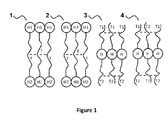
- the first hydrophilic head H1 and the second hydrophilic head H2 are different and the bolamphiphilic molecules are arranged in an non-alternating head-to-head configuration 1 ( e.g. [(H1-T-H2)(H1-T-H2)] n ) or in a alternating head-to-head configuration 2 ( e.g. [(H1-T-H2)(H2-T-H1)] n ), as shown in the following Figure 1 .
- the first hydrophobic tail T1 and the second hydrophobic tail T2 are different and the bolamphiphilic molecules are arranged in a non-alternating tail-to-tail configuration 3 (e.g.
- the hydrophilic part and/or the hydrophobic part comprise(s) a comonomer moiety and/or a cross-linker bonding the amphiphilic molecules with each other.
- the comonomer moiety or the cross-linker comprises a radical having the following chemical formula: M-(R) Y wherein:
- M is selected from the group comprising metalloids, post-transition metals, phosphorus and nitrogen. According to one or more embodiments, M is selected from the group comprising Si, Ge, Sn, P and N. According to one or more embodiments, M is Si or Ge. According to one or more embodiments, M is Si.
- R is a functional group configured for providing to the layer (e.g. at a boundary between a surface of the layer and a condensed phase or a gas phase contacting the layer) at least one predetermined property (e.g. a surface characteristic of the layer).
- the predetermined property is selected from the group comprising surface tension, charge density, hydrophobicity, hydrophilicity, wettability, pH, thickness, density, wear resistance, corrosion resistance, chelating, optical, magnetic, redox, insulation and chemical resistance properties.
- the functional group is selected from the group comprising a hydrogen atom, a halide, a linker and an organic compound, such as a linear, cyclic or branched, saturated or unsaturated hydrocarbon.
- the functional group is a linker for bonding the layer to a predetermined target, such as a molecule or a biomolecule.
- the functional group is a linear, cyclic or branched, saturated or unsaturated C1-C30 organic radical.
- the C1-C30 organic radical is a C1-C30 alkyl, alkenyl, alkynyl, aryl, alkylaryl, arylalkyl, arylalkenyl or arylalkynyl radical, and optionally comprises one or more heteroatoms such as N, O, S, P, F, Cl, Br and I.
- the comonomer moiety or the cross-linker is bound to at least two heteroatoms of the self-assembled amphiphilic molecules. According to one or more embodiments, the comonomer moiety or the cross-linker is bound to three heteroatoms of the self-assembled amphiphilic molecules. According to one or more embodiments, M is bound ( i.e., by a simple covalent bond) to at least one heteroatom of the at least two amphiphilic molecules.
- the comonomer moiety or the cross-linker is bound to at least one first heteroatom of the self-assembled amphiphilic molecules, and the first comonomer moiety or the cross-linker further comprises a second heteroatom bound to at least one second comonomer moiety or cross-linker.
- the heteroatom is selected from the group comprising O, S, N and P.
- the heteroatom is oxygen.
- the comonomer moiety or the cross-linker is bound to the hydrophilic part of the layer.
- the amphiphilic molecule comprises a polymerized functional group selected from the group comprising polymerized diynes and acrylates.
- the polymerized function is a diyne.
- the hydrophobic tail of the amphiphilic molecule comprises a polymerized functional group, for example selected according to the above-mentioned embodiments.
- the present disclosure also relates to the use of a layer according to one or more of the above embodiments in a wide range of applications as described in the following.
- the present disclosure provides a detecting device comprising a substrate and the layer according to any of the embodiments of the first aspect.
- the layer may be incorporated into a device comprising a substrate supporting the layer, for use in a detector, a biosensor and the like.
- the substrate comprises an inorganic or organic/polymeric material.
- the substrate comprises a semi-conductive material.
- the substrate comprises a silicon surface or an organic semiconductor surface such as a thin film of 2,7-Dioctyl[1]benzothieno[3,2-b][1]benzothiophene.
- the layer may be a monolayer on the substrate. According to one or more embodiments, the layer may be a bilayer on the substrate. According to one or more embodiments, the supported layer has a thickness ranging from about 2 nm to about 8 nm. According to one or more embodiments, the supported layer is a monolayer and/or has a thickness ranging from about 2 nm to about 4 nm. According to one or more embodiments, the supported layer is a bilayer and/or has a thickness ranging from about 4 nm to about 8 nm.
- the device is a field effect transistor comprising the layer according to embodiments of the first aspect as a dielectric layer disposed on a substrate between a source and a drain, thereby forming a gate dielectric as described in US 2014/0264473 A1 .
- the field effect transistor includes: a semiconducting substrate having two areas doped with electric charge carriers forming a source area and a drain area, respectively; a dielectric layer positioned above the semiconducting substrate between the source and the drain and forming the gate dielectric of the field effect transistor; a gate consisting of a reference electrode and of a conductive solution, the solution being in contact with the gate dielectric; the gate dielectric comprising a layer according to any of the embodiments of the first aspect in direct contact with the semiconducting layer.
- a liposome, a micelle, a transport system for a substance e.g. for delivering an active substance or a drug
- a biomimetic system comprising the layer according any of the embodiments of the first aspect.
- the transport system as well as the biomimetic system may comprise a solvent and the layer.
- the solvent is aqueous.
- the layer may be in the form of liposomes and micelles, thereby providing a membrane for encapsulation of the substance, such as an active agent for drug delivery applications.
- Layers in the form of micellar or lamellar structures may also provide membranes for biomimetic systems aiming at mimicking a cell membrane for biological applications.
- the liposomes and/or micelles have an average diameter ranging from about 1 ⁇ m to about 100 ⁇ m.
- the liposomes and/or micelles have an average diameter ranging from about 10 ⁇ m to about 100 ⁇ m.
- a process to produce a layer according to any of the embodiments of the first aspect is also provided herein.
- the present disclosure provides a process for producing a layer, the process comprising: providing amphiphilic molecules; allowing sufficient time for the amphiphilic molecules to self-assemble and form at least one hydrophilic part and at least one hydrophobic part of the layer; and polymerizing the self-assembled amphiphilic molecules with each other on both the hydrophilic part and the hydrophobic part of the layer.
- the polymerizing comprises cross-linking at least one of the hydrophilic part and the hydrophobic part. According to one or more embodiments, the polymerizing comprises polymerizing either one of the hydrophilic part and the hydrophobic part; and cross-linking the other one of the hydrophilic part and the hydrophobic part.
- the polymerizing comprises polymerizing with a comonomer; and/or the cross-linking comprises cross-linking with a cross-linking agent.
- the comonomer or the cross-linking agent comprises the following chemical formula: (Z) X -M-(R) Y wherein:
- M, R and Y are individually selected as defined in the above embodiments defined with reference of the first aspect.
- Z is selected from the group comprising fluoride, chloride, bromide, iodide, hydroxide, alkoxides, carboxylates, sulfonates, nitrate, phosphate, thiolates, amines, ammonia and dinitrogen.
- Z is selected from the group comprising F, Cl, Br, I, OH, OR', OCOR', OSO 2 R', ONO 2 , OPO(OH) 2 , SR' 2 + , NR' 2 , NR' 3 + , N 2 + , R' being identical or different and each R' being a hydrogen atom or a linear, cyclic or branched, saturated or unsaturated, substituted or unsubstituted C1-C20 organic radical.
- the C1-C20 organic radical is a C1-C20 alkyl, alkenyl, alkynyl, aryl, alkylaryl, arylalkyl, arylalkenyl or arylalkynyl radical, and optionally comprises one or more heteroatoms such as N, O, S, P, F, Cl, Br and I.
- Z is selected from the group comprising F, Cl, Br, I and OH.
- Z is Cl.
- the comonomer or the cross-linking agent comprises an organosilicon halide, which may be saturated or unsaturated, cyclic linear or branched, and which may optionally comprise one or more heteroatoms.
- the comonomer or the cross-linking agent comprises an organosilicon chloride or bromide.
- the comonomer or the cross-linking agent comprises an organosilicon trichloride, such as an alkyl trichlorosilane (e.g. methyltrichlorosilane, octadecyltrichlorosilane and the like).
- the polymerizing or cross-linking comprises bonding the comonomer or the cross-linking agent to at least two nucleophilic functional groups of the self-assembled amphiphilic molecules. According to one or more embodiments, the polymerizing or the cross-linking comprises bonding the comonomer or the cross-linking agent to three nucleophilic functional groups of the self-assembled amphiphilic molecules.
- the polymerizing or the cross-linking comprises bonding M ( i.e., by a simple covalent bond) to at least one nucleophilic functional group of at least two amphiphilic molecules.
- the nucleophilic functional group is selected from the group comprising hydroxyls, thiols, amines, amides, carboxylic acids and derivative thereof.
- the nucleophilic functional group is a hydroxyl.
- the polymerizing or the cross-linking comprises bonding the comonomer or the cross-linking agent to the hydrophilic part of the layer.
- the polymerizing and/or the cross-linking is/are performed in a polar organic solvent, an aqueous solvent or mixture thereof. According to one or more embodiments, the polymerizing and/or the cross-linking is/are performed in a solvent selected from the group comprising dioxane, water, tetrahydrofuran and diethyl ether. According to one or more embodiments, the polymerizing and/or cross-linking the hydrophilic part is/are performed in dioxane. According to one or more embodiments, the polymerizing/cross-linking the hydrophobic part is performed in water.
- the polymerizing or cross-linking the hydrophobic part is a two-dimensional polymerization or cross-linking.
- the polymerizing or cross-linking the hydrophobic part comprises polymerizing or cross-linking a polymerizable functional group, for example a polymerizable functional group of at least one the hydrophobic tails of the hydrophobic parts.
- the polymerizable functional group is selected from the group comprising diynes and acrylates.
- the polymerizable functional group is a diyne.
- the polymerizing and/or cross-linking the hydrophobic part is/are selected from the group comprising thermal polymerization, photo-polymerization and radical polymerization. According to one or more embodiments, the polymerizing and/or cross-linking the hydrophobic part is/are selected from the group comprising photo-polymerization and radical polymerization. According to one or more embodiments, the polymerizing and/or cross-linking the hydrophobic part is/are a radical polymerization. According to one or more embodiments, the polymerizing and/or cross-linking the hydrophobic part comprise(s) providing a free radical generating compound and allowing sufficient time for the free radical generating compound to initiate the polymerization and/or cross-linking.
- the free radical generating compound is selected from the group comprising azo, benzile, metal iodide and metal alkyl compounds.
- the free radical generating compound comprises an azo-compound such as ((2,2'-Azobis(2-methylpropionamidine) dihydrochloride.
- the self-assembling is performed through non-covalent interactions (e.g. ionic interactions, ⁇ -interactions, hydrogen bonding and dipole-dipole interactions).
- the self-assembling comprises self-assembling the amphiphilic molecules to form a monolayer, bi-layer or multi-layer.
- the self-assembling comprises self-assembling the amphiphilic molecules to form micellar or lamellar structures.
- the self-assembling is performed to form liposomes and/or micelles.
- the self-assembling is performed on a substrate, in an oleaginous solvent such as an oil and/or in a non-oleaginous solvent such as an aqueous solvent or polar solvent.
- the self-assembling is performed in a solvent comprising water, a saline solution or a brine.
- the self-assembling is performed at a temperature ranging from about -5°C to about 60°C. According to one or more embodiments, the self-assembling is performed at a temperature ranging from about -10°C to about 45°C. According to one or more embodiments, the self-assembling is performed for a duration ranging from about 1 minutes to about 2 hours. According to one or more embodiments, the self-assembling is performed for a duration raging from about 5 minutes to about 1 hour. According to one or more embodiments, the self-assembling is performed at atmospheric pressure.
- the amount of the amphiphilic molecule during the self-assembling ranges from about 0.01 w% to about 1 w% with respect to the weight of the solvent. According to one or more embodiments, the amount of the amphiphilic molecule during the self-assembling ranges from about 0.1 % to about 1 w% with respect to the weight of the solvent. According to one or more embodiments, the amount of the copolymer and/or cross-linking agent during the polymerizing and/or cross-linking ranges from about 0.01 % to about 10 w% with respect to the weight of the solvent. According to one or more embodiments, the amount of the copolymer and/or cross-linking agent during the polymerizing and/or cross-linking ranges from about 0.1 % to about 1 w% with respect to the weight of the solvent.
- the process comprises providing a substrate and forming the layer on the substrate.
- the substrate is selected as defined in any of the embodiments defined with reference to the third aspect.
- the hydrophilic head of lipid 1 was cleaved by enzymatic reaction using a phospholipase, namely phospholipase C to remove the phosphocholine group from the hydrophilic head lipid 1, thereby providing lipid 2, namely 1,2-bis(10,12-tricosadiynoyl)-sn-glycerol, bearing a hydrophilic head with a reactive alcohol moiety.
- a solution of lipid 2 at 1mg/mL in chloroform was prepared and stored at -20°C prior to use.
- Vesicles were prepared as follows. 50 ⁇ L of the solution of lipid 2 was heated to 40°C to evaporate the chloroform and diluted in 200 ⁇ L of deionized water. The resulting aqueous solution was sonicated for 15 minutes and repeatedly extruded through a polycarbonate membrane (100 nm pores) to provide a vesicle solution of well-defined and small unilamellar vesicles.
- lipid monolayers namely a non-polymerized lipid layer (A; comparative), a single polymerized lipid layer (B; comparative) and a polymerized and cross-linked lipid layer (C), were prepared, the aliphatic chains being oriented towards the silicon substrate and the alcohol group facing the solution.
- A non-polymerized lipid layer
- B single polymerized lipid layer
- C polymerized and cross-linked lipid layer
- the non-polymerized lipid layer (A) was prepared as follows. The silicon substrate temperature was set to 25°C and the native oxide of the silicon was removed by dipping the silicon substrate for 2 minutes in 2% HF. The surface of the substrate was covered by the vesicle solution, which was cooled down to 10°C and kept at 10°C for 5 minutes while stirring with a pipette. The non-polymerized lipid layer (A) was found to be unstable in air and to have minimal mechanical stability.
- the single polymerized lipid layer (B) was prepared as follows. Starting from the non-polymerized lipid layer (A) covered by the vesicle solution, the temperature of the solution was increased by 1 °C/min until 32°C and rinsed with a 1% (2,2'-Azobis(2-methylpropionamidine) dihydrochloride (AAPH) aqueous solution. The temperature of the resulting mixture was gradually increased and decreased (10 min at 32°C; 10 min at 35°C; 10 min to 40°C; 10 min to 42°C; 10 min at 38°C; and 5 min at 35°C) so as to polymerize the acetylenic groups of the lipid layer, as illustrated in Scheme 2. Lastly, the substrate was rinsed abundantly with water. The single polymerized lipid layer (B) was found to be chemically stable in air, water and methanol and to have some degree of mechanical and electrical stability.
- AAPH (2,2'-Azobis(2-methylpropionamidine) dihydroch
- the polymerized and cross-linked lipid layer (C) was prepared as follows. Starting from the single polymerized lipid Layer (B), the surface of the substrate was covered by a solution of a trichlorosilane, namely methyltrichlorosilane (similar result obtained with octadecyltrichlorosilane), in 1,4-dioxane for 15 minutes, as illustrated in Scheme 4.
- the polymerized and cross-linked lipid layer (C) was found to be chemically stable in air, water, methanol and ethanol as well as in MPR1165 from ShipleyTM, which is a mixture of organic solvents for removing photoresists.
- the polymerized and cross-linked lipid layer (C) was also found to have improved mechanical stability, e.g. increase of Young's modulus, and electrical stability, e.g. increase of dielectric breakdown voltage.
- the lifetime of the single polymerized monolayer (B) and the polymerized and cross-linked monolayer (C) are reported in Figure 3 , which shows the lifetime (i.e., duration before occurrence of dielectric breakdown) of the monolayers at given electric fields.
- the lifetimes of the lipid layers (B and C) decrease exponentially with respect to the applied electric field.
- the cross-linked layer (C) is able to resist electric fields that are more than twice as high the electric fields applied to the single polymerized layer (B).
- the cross-linked layer (C) may reach a lifetime of over 1000 seconds when subjected to an electric field of about 30 MV/cm.
- the single polymerized monolayer (B) merely reaches a lifetime of 1000 seconds when an electric field of only 7 MV/cm is applied.
- the cross-linked layer (C) may reach a lifetime of over 3000 seconds when subjected to an electric field of about 25 MV/cm.
- the single polymerized monolayer (B) merely reaches a lifetime of 3000 seconds when an electric field of only 2 MV/cm is applied.
- the top right inset of Figure 3 shows an extrapolation of the curves for electric fields ranging from 11 to 20 MV/cm. In this range of electric field, the lifetime of the cross-linked layer (graph C') is at least 50 times longer than for the single polymerized layer (graph B').
- Embodiments of the present disclosure provide amphiphilic molecules layers with improved chemical stability. Additionally, because the self-assembled amphiphilic molecules are polymerized with each other on both the hydrophilic part and the hydrophobic part of the layer, improved electrical and mechanical resistance are also achieved. Indeed, the amphiphilic molecules are not only self-assembled through non-covalent interactions, but the amphiphilic molecules are also covalently bound with each other at both their hydrophilic tails and hydrophobic heads. Further, as the amphiphilic molecules may be connected with each other at the hydrophilic part and the hydrophobic part of the layer by simple covalent bonds ( i.e., each atom supplying at least one electron to the bond), unforeseeable chemical, mechanical and electrical stabilization may be achieved.
- simple covalent bonds i.e., each atom supplying at least one electron to the bond
Landscapes
- Chemical & Material Sciences (AREA)
- Health & Medical Sciences (AREA)
- Medicinal Chemistry (AREA)
- Life Sciences & Earth Sciences (AREA)
- Chemical Kinetics & Catalysis (AREA)
- General Health & Medical Sciences (AREA)
- Polymers & Plastics (AREA)
- Organic Chemistry (AREA)
- Animal Behavior & Ethology (AREA)
- Dispersion Chemistry (AREA)
- Veterinary Medicine (AREA)
- Public Health (AREA)
- Epidemiology (AREA)
- Pharmacology & Pharmacy (AREA)
- Pathology (AREA)
- Engineering & Computer Science (AREA)
- Immunology (AREA)
- Molecular Biology (AREA)
- Microelectronics & Electronic Packaging (AREA)
- Biochemistry (AREA)
- Analytical Chemistry (AREA)
- General Physics & Mathematics (AREA)
- Physics & Mathematics (AREA)
- Electrochemistry (AREA)
- Medicinal Preparation (AREA)
- Organic Low-Molecular-Weight Compounds And Preparation Thereof (AREA)
- Addition Polymer Or Copolymer, Post-Treatments, Or Chemical Modifications (AREA)
- Compositions Of Macromolecular Compounds (AREA)
Abstract
The disclosure relates to a layer comprising at least one hydrophilic part and at least one hydrophobic part, the layer comprising self-assembled amphiphilic molecules polymerized with each other on both the hydrophilic part and the hydrophobic part of the layer; a detecting device comprising a substrate and the above-mentioned layer; and a liposome, a micelle, transport system for a substance and a biomimetic system comprising the above-mentioned layer. The disclosure also relates to a process for producing a layer, the process comprising: providing amphiphilic molecules; allowing sufficient time for the amphiphilic molecules to self-assemble and form at least one hydrophilic part and at least one hydrophobic part of the layer; polymerizing the self-assembled amphiphilic molecules with each other on both the hydrophilic part and the hydrophobic part of the layer.
Description
- The present disclosure relates to amphiphilic molecules layers, detecting devices (e.g. sensors and biosensors), liposomes, micelles, transport systems and biomimetic systems comprising said layers, as well as processes for producing said layers.
- Amphiphilic molecules are molecules possessing at least one hydrophilic moiety and at least one hydrophobic moiety, which may be used to form monolayers, bi-layers or multi-layers, such as in the form of micelles, liposomes, lamellar structures and the like, through self-assembly in a solvent and/or on a substrate.
- Although amphiphilic molecules layers have some degree of chemical stability in aqueous media, the inherent chemical instability of amphiphilic molecules layers, such as lipid layers, when exposed to air, polar organic solvents and/or specific surfactants, limits their use in these media in advanced industrial processes. Accordingly, numerous studies have been performed in an attempt to provide chemically stable amphiphilic molecules layers in different media, for example by insertion of proteins, polymerization or fixation on substrates via covalent interactions.
- During a previous work aimed at stabilizing monolayers by polymerization, the Applicant has found that supported amphiphilic molecules bearing apolar tails with two acetylenic groups may be two-dimensionally polymerized along a plane of the amphiphilic molecules to provide monolayers which are chemically stable also when exposed to air and a number of selected solvents. The Applicant has also found that a supported and polymerized monolayer may possess some degree of mechanical stability (see Anne M. Charrier et al., "Supported Lipid Monolayer with Improved Nanomechanical Stability: Effect of Polymerization," J. Phys. Chem. B 2012, 116, 7190-7195).
- Accordingly, there exists a continuing need to provide chemically and mechanically stable amphiphilic molecules layers, as well as detecting devices, liposomes, micelles, transport systems and biomimetic systems comprising said layers, and processes for producing said layers.
- An object of the present disclosure is to provide an amphiphilic molecules layer having improved chemical and mechanical stability. Another object of the present disclosure is to provide an amphiphilic molecules layer having improved electrical stability. A further object of the present disclosure is to provide a detecting device (e.g. sensor and biosensor), a liposome, a micelle, a transport system for a substrate and a biomimetic system, which comprise an amphiphilic molecules layer having improved mechanical and/or electrical stability.
- According to a first aspect, the above-mentioned objects, as well as further advantages, are achieved by a layer comprising at least one hydrophilic part and at least one hydrophobic part, the layer comprising self-assembled amphiphilic molecules polymerized with each other on both the hydrophilic part and the hydrophobic part of the layer.
- According to a second aspect, one or more of the above-mentioned objects, as well as further advantages, are achieved by a detecting device comprising a substrate and the layer according to the first aspect.
- According to a third aspect, one or more of the above-mentioned objects, as well as further advantages, are achieved by a liposome, a micelle, a transport system for a substance and a biomimetic system comprising the layer according to the first aspect.
- According to a fourth aspect, one or more of the above-mentioned objects, as well as further advantages, are achieved by a process for producing a layer, the process comprising: providing amphiphilic molecules; allowing sufficient time for the amphiphilic molecules to self-assemble and form at least one hydrophilic part and at least one hydrophobic part of the layer; and polymerizing the self-assembled amphiphilic molecules with each other on both the hydrophilic part and the hydrophobic part of the layer.
- Embodiments of the present disclosure according to the above aspects are defined in the appended claims.
- Other aspects and advantages of the present disclosure will be apparent from the following figures, description and appended claims.
- The present disclosure will be better understood and other advantages and embodiments will become clear on reading the description that follows, given purely by way of indication and in no way limiting, and by referring to the appended figures in which:
-
Figure 1 shows self-assembled bolamphiphilic molecules according to embodiments of the present disclosure; -
Figure 2 shows mechanical rupture measurements of a layer according to embodiments of the present disclosure and comparative layers; and -
Figure 3 shows lifetime measurements as a function of applied electric fields on a layer according to embodiments the present disclosure and a comparative layer. - Embodiments of the present disclosure will now be described in detail with reference to the accompanying figures. In the following detailed description of embodiments of the present disclosure, numerous specific details are set forth in order to provide a more thorough understanding of the present disclosure. However, it will be apparent to one of ordinary skill in the art that the present disclosure may be practiced without these specific details. In other instances, well-known features have not been described in detail to avoid unnecessarily complicating the description.
- Herein, the terms "comprise/comprising" are synonymous with (means the same thing as) "include/including," "contain/containing", are inclusive or open-ended and do not exclude additional, non-recited elements. Further, herein the term "about" is synonymous with (means the same thing as) a 20 percent lower and/or higher margin of the respective value.
- Herein, the term "polymerizing" is synonymous with (means the same thing as) providing an amphiphilic molecule polymer by connecting an amphiphilic molecule monomer to another by covalent bonding (i.e., simple covalent bonding such as where each atom supplying at least one electron to the bond), optionally with a comonomer. Herein, the term "cross-linking," is synonymous with (means the same thing as) providing a cross-linked amphiphilic molecule polymer by polymerizing an amphiphilic molecule polymer to another by covalent bonding (i.e., simple covalent bonds), optionally with a cross-linking agent.
- Herein, the term "biomolecule" is synonymous with (means the same thing as) a molecule that is present in or derived from living organisms.
- According to one or more embodiments, the biomolecule is a molecule selected from the group comprising proteins, antibodies, polysaccharides, lipids, nucleic acids, metabolites, natural products and their analogues, parts thereof and sequences thereof. According to one or more embodiments, the biomolecule is selected from the group comprising proteins, DNAs, antibody, parts thereof and sequences thereof. Herein, the terms "natural product" are synonymous with (means the same thing as) a chemical compound or substance produced by a living organism. According to one or more embodiments, the protein is selected from the group comprising biotin and streptavidin. According to one or more embodiments, the DNA is selected from the group comprising single stranded DNA and aptamers.
- The present disclosure relates to amphiphilic molecules, such as surfactants, for the fabrication of layers in the form of monolayers, bi-layers or multi-layers, with high chemical, mechanical and electrical stability. Specifically, according to the first aspect, the Applicant has found that a layer comprising at least one hydrophilic part and at least one hydrophobic part, wherein self-assembled amphiphilic molecules are polymerized with each other on both the hydrophilic part and the hydrophobic part of the layer, have improved chemical, mechanical and electrical stability.
- According to one or more embodiments, the self-assembled amphiphilic molecules form the at least one hydrophilic part and the at least one hydrophobic part of the layer, and the amphiphilic molecules are cross-linked on at least one of the hydrophilic part and the hydrophobic part. According to one or more embodiments, the amphiphilic molecules are polymerized on either one of the hydrophilic part and the hydrophobic part, and cross-linked on the other one of the hydrophilic part and the hydrophobic part.
- According to one or more embodiments, the amphiphilic molecule comprises at least one hydrophilic head and at least one hydrophobic tail. According to one or more embodiments, the amphiphilic molecule comprises one hydrophilic head and two hydrophobic tails. According to one or more embodiments, the hydrophobic tails of the amphiphilic molecules are polymerized with each other, and the hydrophilic heads the hydrophobic tails of the amphiphilic molecules are polymerized with each other. According to one or more embodiments, the self-assembled amphiphilic molecules comprise polymerized hydrophobic tails and cross-linked hydrophilic heads.
- According to one or more embodiments, the amphiphilic molecule comprises at least one heteroatom bound to a comonomer moiety or a cross-linker. According to one or more embodiments, the heteroatom is selected from the group comprising O, S, N and P. According to one or more embodiments, the heteroatom is oxygen. According to one or more embodiments, the heteroatom is on the hydrophilic head of the amphiphilic molecule.
- According to one or more embodiments, the amphiphilic molecule comprises a surfactant. According to one or more embodiments, the surfactant is selected from the group comprising lipids, soaps, detergents, wetting agents, dispersants, emulsifiers, foaming agents and mixtures thereof. According to one or more embodiments, the amphiphilic molecule is selected from the group comprising anionic, cationic, nonionic and amphoteric surfactants. According to one or more embodiments, the amphiphilic molecule comprises at least one polar moiety, such as hydrophilic heads, for example selected from the group comprising: carboxylate salts, sulfate salts, sulfonate salts, phosphate ester salts (anionic surfactants); benzalkonium salts, amine salts, quaternary ammonium salts, octenidine salts (cationic surfactants); polypropylene oxides, glucosides, glycerol esters, amine oxides, poloxamers (nonionic surfactants); aminoacids, phospholipids (amphoteric surfactants); and mixture thereof. According to one or more embodiments, the amphiphilic molecule comprises at least one non-polar organic moiety, such as hydrophobic tails, for example selected from the group comprising linear, cyclic or branched, saturated or unsaturated C1-C30 organic moieties. According to one or more embodiments, the C1-C30 organic moieties comprises a C1-C30 alkyl, alkenyl, alkynyl, aryl, alkylaryl, arylalkyl, arylalkenyl or arylalkynyl radical, and optionally comprises one or more heteroatoms such as N, O, S, P, F, Cl, Br and I.
- According to one or more embodiments, the amphiphilic molecule comprises a lipid. According to one or more embodiments, the lipid is selected from the group comprising phospholipids, sphingolipids, chelator lipids, antigenic lipids, glycosylated lipids, alkyl phosphate lipids, pH sensitive lipids, adhesive lipids, cross-linking lipids, polyethylene glycol (PEG) phospholipids, PEG ceramides, functionalized PEG lipids and derivative thereof. According to one or more embodiments, the lipid is selected from the group comprising 1,2-bis(10,12-tricosadiynoyl)-sn-glycero-3-phosphocholine, 1,2-bis(10,12-tricosadiynoyl)-sn-glycero-3-phosphoethanolamine, 1-palmitoyl-2-(10,12-tricosadiynoyl)-sn-glycero-3-phosphocholine, 1-palmitoyl-2-(10,12-tricosadiynoyl)-sn-glycero-3-phosphoethanolamine, 1-palmitoyl-2-[16-(acryloyloxy)palmitoyl]-sn-glycero-3-phosphorylcholine.
- According to one or more embodiments, the amphiphilic molecules comprise bolamphiphilic molecules. According to one or more embodiments, the bolamphiphilic molecules comprise at least one hydrophobic tail T connecting a first hydrophilic head H1 to a second hydrophilic head H2, the first hydrophilic head H1 and the second hydrophilic head H2 being identical or different. According to one or more embodiments, the bolamphiphilic molecules comprise at least one hydrophilic head H connecting a first hydrophobic tail T1 to a second hydrophobic tail T2, the first hydrophobic tail T1 and the second hydrophobic tail T2 being identical or different. According to one or more embodiments, the first hydrophilic head H1 and the second hydrophilic head H2 are different and the bolamphiphilic molecules are arranged in an non-alternating head-to-head configuration 1 (e.g. [(H1-T-H2)(H1-T-H2)]n) or in a alternating head-to-head configuration 2 (e.g. [(H1-T-H2)(H2-T-H1)]n), as shown in the following
Figure 1 . According to one or more embodiments, the first hydrophobic tail T1 and the second hydrophobic tail T2 are different and the bolamphiphilic molecules are arranged in a non-alternating tail-to-tail configuration 3 (e.g. [(T1-H-T2)(T1-H-T2)]n) or in an alternating tail-to-tail configuration 4 (e.g. [(T1-H-T2)(T2-H-T1)]n), as shown in the followingFigure 1 . - According to one or more embodiments, the hydrophilic part and/or the hydrophobic part comprise(s) a comonomer moiety and/or a cross-linker bonding the amphiphilic molecules with each other.
- According to one or more embodiments, the comonomer moiety or the cross-linker comprises a radical having the following chemical formula:
M-(R)Y
wherein: - M is an element of
group 13, 14 or 15 in the periodic table; - R is a functional group, a molecule or a biomolecule; and
- Y = 1 to 3.
- According to one or more embodiments, M is selected from the group comprising metalloids, post-transition metals, phosphorus and nitrogen. According to one or more embodiments, M is selected from the group comprising Si, Ge, Sn, P and N. According to one or more embodiments, M is Si or Ge. According to one or more embodiments, M is Si.
- According to one or more embodiments, R is a functional group configured for providing to the layer (e.g. at a boundary between a surface of the layer and a condensed phase or a gas phase contacting the layer) at least one predetermined property (e.g. a surface characteristic of the layer). According to one or more embodiments, the predetermined property is selected from the group comprising surface tension, charge density, hydrophobicity, hydrophilicity, wettability, pH, thickness, density, wear resistance, corrosion resistance, chelating, optical, magnetic, redox, insulation and chemical resistance properties.
- According to one or more embodiments, the functional group is selected from the group comprising a hydrogen atom, a halide, a linker and an organic compound, such as a linear, cyclic or branched, saturated or unsaturated hydrocarbon. According to one or more embodiments, the functional group is a linker for bonding the layer to a predetermined target, such as a molecule or a biomolecule. According to one or more embodiments, the functional group is a linear, cyclic or branched, saturated or unsaturated C1-C30 organic radical. According to one or more embodiments, the C1-C30 organic radical is a C1-C30 alkyl, alkenyl, alkynyl, aryl, alkylaryl, arylalkyl, arylalkenyl or arylalkynyl radical, and optionally comprises one or more heteroatoms such as N, O, S, P, F, Cl, Br and I.
- According to one or more embodiments, Y = 1 or 2. According to one or more embodiments, Y = 1.
- According to one or more embodiments, the comonomer moiety or the cross-linker is bound to at least two heteroatoms of the self-assembled amphiphilic molecules. According to one or more embodiments, the comonomer moiety or the cross-linker is bound to three heteroatoms of the self-assembled amphiphilic molecules. According to one or more embodiments, M is bound (i.e., by a simple covalent bond) to at least one heteroatom of the at least two amphiphilic molecules. According to one or more embodiments, the comonomer moiety or the cross-linker is bound to at least one first heteroatom of the self-assembled amphiphilic molecules, and the first comonomer moiety or the cross-linker further comprises a second heteroatom bound to at least one second comonomer moiety or cross-linker. According to one or more embodiments, the heteroatom is selected from the group comprising O, S, N and P. According to one or more embodiments, the heteroatom is oxygen. According to one or more embodiments, the comonomer moiety or the cross-linker is bound to the hydrophilic part of the layer.
- According to one or more embodiments, the amphiphilic molecule comprises a polymerized functional group selected from the group comprising polymerized diynes and acrylates. According to one or more embodiments, the polymerized function is a diyne. According to one or more embodiments, the hydrophobic tail of the amphiphilic molecule comprises a polymerized functional group, for example selected according to the above-mentioned embodiments.
- According to one or more embodiments, the layer has a lifetime of over 105 seconds when being subjected to an electric field of up to about 10 MV/cm. According to one or more embodiments, the layer has a lifetime of over 106 seconds when being subjected to an electric field of up to about 5 MV/cm. According to one or more embodiments, the layer is configured for resisting break-through forces of at least 2 nN. According to one or more embodiments, the layer is configured for resisting break-through forces of at least 3.5 nN.
- The present disclosure also relates to the use of a layer according to one or more of the above embodiments in a wide range of applications as described in the following.
- According to a second aspect, the present disclosure provides a detecting device comprising a substrate and the layer according to any of the embodiments of the first aspect. For example, the layer may be incorporated into a device comprising a substrate supporting the layer, for use in a detector, a biosensor and the like. According to one or more embodiments, the substrate comprises an inorganic or organic/polymeric material. According to one or more embodiments, the substrate comprises a semi-conductive material. According to one or more embodiments, the substrate comprises a silicon surface or an organic semiconductor surface such as a thin film of 2,7-Dioctyl[1]benzothieno[3,2-b][1]benzothiophene. According to one or more embodiments, the layer may be a monolayer on the substrate. According to one or more embodiments, the layer may be a bilayer on the substrate. According to one or more embodiments, the supported layer has a thickness ranging from about 2 nm to about 8 nm. According to one or more embodiments, the supported layer is a monolayer and/or has a thickness ranging from about 2 nm to about 4 nm. According to one or more embodiments, the supported layer is a bilayer and/or has a thickness ranging from about 4 nm to about 8 nm.
- According to one or more embodiments, the device is a field effect transistor comprising the layer according to embodiments of the first aspect as a dielectric layer disposed on a substrate between a source and a drain, thereby forming a gate dielectric as described in
US 2014/0264473 A1 . According to one or more embodiments, the field effect transistor includes: a semiconducting substrate having two areas doped with electric charge carriers forming a source area and a drain area, respectively; a dielectric layer positioned above the semiconducting substrate between the source and the drain and forming the gate dielectric of the field effect transistor; a gate consisting of a reference electrode and of a conductive solution, the solution being in contact with the gate dielectric; the gate dielectric comprising a layer according to any of the embodiments of the first aspect in direct contact with the semiconducting layer. - According to a third aspect, one or more of the above-mentioned objects, as well as further advantages, are achieved by a liposome, a micelle, a transport system for a substance (e.g. for delivering an active substance or a drug) and a biomimetic system comprising the layer according any of the embodiments of the first aspect. According to one or more embodiments, the transport system as well as the biomimetic system may comprise a solvent and the layer. According to one or more embodiments, the solvent is aqueous. For example, the layer may be in the form of liposomes and micelles, thereby providing a membrane for encapsulation of the substance, such as an active agent for drug delivery applications. Layers in the form of micellar or lamellar structures may also provide membranes for biomimetic systems aiming at mimicking a cell membrane for biological applications. According to one or more embodiments, the liposomes and/or micelles have an average diameter ranging from about 1 µm to about 100 µm. According to one or more embodiments, the liposomes and/or micelles have an average diameter ranging from about 10 µm to about 100 µm.
- A process to produce a layer according to any of the embodiments of the first aspect is also provided herein. Specifically, according to a fourth aspect, the present disclosure provides a process for producing a layer, the process comprising: providing amphiphilic molecules; allowing sufficient time for the amphiphilic molecules to self-assemble and form at least one hydrophilic part and at least one hydrophobic part of the layer; and polymerizing the self-assembled amphiphilic molecules with each other on both the hydrophilic part and the hydrophobic part of the layer.
- According to one or more embodiments, the polymerizing comprises cross-linking at least one of the hydrophilic part and the hydrophobic part. According to one or more embodiments, the polymerizing comprises polymerizing either one of the hydrophilic part and the hydrophobic part; and cross-linking the other one of the hydrophilic part and the hydrophobic part.
- According to one or more embodiments, the polymerizing comprises polymerizing with a comonomer; and/or the cross-linking comprises cross-linking with a cross-linking agent. According to one or more embodiments, the comonomer or the cross-linking agent comprises the following chemical formula:
(Z)X-M-(R)Y
wherein: - Z is a leaving group;
- X = 2, 3, or 4; and
- M is an element of
group 13, 14 or 15 in the periodic table; - R is a functional group, a molecule or a biomolecule;
- Y = 1 to 3.
- According to one or more embodiments, M, R and Y are individually selected as defined in the above embodiments defined with reference of the first aspect.
- According to one or more embodiments, Z is selected from the group comprising fluoride, chloride, bromide, iodide, hydroxide, alkoxides, carboxylates, sulfonates, nitrate, phosphate, thiolates, amines, ammonia and dinitrogen. According to one or more embodiments, Z is selected from the group comprising F, Cl, Br, I, OH, OR', OCOR', OSO2R', ONO2, OPO(OH)2, SR'2 +, NR'2, NR'3 +, N2 +, R' being identical or different and each R' being a hydrogen atom or a linear, cyclic or branched, saturated or unsaturated, substituted or unsubstituted C1-C20 organic radical. According to one or more embodiments, the C1-C20 organic radical is a C1-C20 alkyl, alkenyl, alkynyl, aryl, alkylaryl, arylalkyl, arylalkenyl or arylalkynyl radical, and optionally comprises one or more heteroatoms such as N, O, S, P, F, Cl, Br and I. According to one or more embodiments, Z is selected from the group comprising F, Cl, Br, I and OH. According to one or more embodiments, Z is Cl.
- According to one or more embodiments, X = 3 or 4. According to one or more embodiments, X = 3.
- According to one or more embodiments, the comonomer or the cross-linking agent comprises an organosilicon halide, which may be saturated or unsaturated, cyclic linear or branched, and which may optionally comprise one or more heteroatoms. According to one or more embodiments, the comonomer or the cross-linking agent comprises an organosilicon chloride or bromide. According to one or more embodiments, the comonomer or the cross-linking agent comprises an organosilicon trichloride, such as an alkyl trichlorosilane (e.g. methyltrichlorosilane, octadecyltrichlorosilane and the like).
- According to one or more embodiments, the polymerizing or cross-linking comprises bonding the comonomer or the cross-linking agent to at least two nucleophilic functional groups of the self-assembled amphiphilic molecules. According to one or more embodiments, the polymerizing or the cross-linking comprises bonding the comonomer or the cross-linking agent to three nucleophilic functional groups of the self-assembled amphiphilic molecules.
- According to one or more embodiments, the polymerizing or the cross-linking comprises bonding M (i.e., by a simple covalent bond) to at least one nucleophilic functional group of at least two amphiphilic molecules. According to one or more embodiments, the nucleophilic functional group is selected from the group comprising hydroxyls, thiols, amines, amides, carboxylic acids and derivative thereof. According to one or more embodiments, the nucleophilic functional group is a hydroxyl. According to one or more embodiments, the polymerizing or the cross-linking comprises bonding the comonomer or the cross-linking agent to the hydrophilic part of the layer.
- According to one or more embodiments, the polymerizing and/or the cross-linking is/are performed in a polar organic solvent, an aqueous solvent or mixture thereof. According to one or more embodiments, the polymerizing and/or the cross-linking is/are performed in a solvent selected from the group comprising dioxane, water, tetrahydrofuran and diethyl ether. According to one or more embodiments, the polymerizing and/or cross-linking the hydrophilic part is/are performed in dioxane. According to one or more embodiments, the polymerizing/cross-linking the hydrophobic part is performed in water.
- According to one or more embodiments, the polymerizing and/or the cross-linking is/are performed at a temperature ranging from about 20°C to about 60°C. According to one or more embodiments, the polymerizing and/or the cross-linking is/are performed at a temperature ranging from about 20°C to about 42°C. According to one or more embodiments, the polymerizing and/or the cross-linking is/are performed for a duration ranging from about 5 minutes to about 24 hours. According to one or more embodiments, the polymerizing and/or the cross-linking is/are performed for a duration ranging from about 10 minutes to about 2 hours. According to one or more embodiments, the polymerizing and/or the cross-linking is/are performed at atmospheric pressure.
- According to one or more embodiments, the polymerizing or cross-linking the hydrophobic part is a two-dimensional polymerization or cross-linking. According to one or more embodiments, the polymerizing or cross-linking the hydrophobic part comprises polymerizing or cross-linking a polymerizable functional group, for example a polymerizable functional group of at least one the hydrophobic tails of the hydrophobic parts. According to one or more embodiments, the polymerizable functional group is selected from the group comprising diynes and acrylates. According to one or more embodiments, the polymerizable functional group is a diyne.
- According to one or more embodiments, the polymerizing and/or cross-linking the hydrophobic part is/are selected from the group comprising thermal polymerization, photo-polymerization and radical polymerization. According to one or more embodiments, the polymerizing and/or cross-linking the hydrophobic part is/are selected from the group comprising photo-polymerization and radical polymerization. According to one or more embodiments, the polymerizing and/or cross-linking the hydrophobic part is/are a radical polymerization. According to one or more embodiments, the polymerizing and/or cross-linking the hydrophobic part comprise(s) providing a free radical generating compound and allowing sufficient time for the free radical generating compound to initiate the polymerization and/or cross-linking. According to one or more embodiments, the free radical generating compound is selected from the group comprising azo, benzile, metal iodide and metal alkyl compounds. According to one or more embodiments, the free radical generating compound comprises an azo-compound such as ((2,2'-Azobis(2-methylpropionamidine) dihydrochloride.
- According to one or more embodiments, the self-assembling is performed through non-covalent interactions (e.g. ionic interactions, π-interactions, hydrogen bonding and dipole-dipole interactions). According to one or more embodiments, the self-assembling comprises self-assembling the amphiphilic molecules to form a monolayer, bi-layer or multi-layer. According to one or more embodiments, the self-assembling comprises self-assembling the amphiphilic molecules to form micellar or lamellar structures. According to one or more embodiments, the self-assembling is performed to form liposomes and/or micelles.
- According to one or more embodiments, the self-assembling is performed on a substrate, in an oleaginous solvent such as an oil and/or in a non-oleaginous solvent such as an aqueous solvent or polar solvent. According to one or more embodiments, the self-assembling is performed in a solvent comprising water, a saline solution or a brine.
- According to one or more embodiments, the self-assembling is performed at a temperature ranging from about -5°C to about 60°C. According to one or more embodiments, the self-assembling is performed at a temperature ranging from about -10°C to about 45°C. According to one or more embodiments, the self-assembling is performed for a duration ranging from about 1 minutes to about 2 hours. According to one or more embodiments, the self-assembling is performed for a duration raging from about 5 minutes to about 1 hour. According to one or more embodiments, the self-assembling is performed at atmospheric pressure.
- According to one or more embodiments, the amount of the amphiphilic molecule during the self-assembling ranges from about 0.01 w% to about 1 w% with respect to the weight of the solvent. According to one or more embodiments, the amount of the amphiphilic molecule during the self-assembling ranges from about 0.1 % to about 1 w% with respect to the weight of the solvent. According to one or more embodiments, the amount of the copolymer and/or cross-linking agent during the polymerizing and/or cross-linking ranges from about 0.01 % to about 10 w% with respect to the weight of the solvent. According to one or more embodiments, the amount of the copolymer and/or cross-linking agent during the polymerizing and/or cross-linking ranges from about 0.1 % to about 1 w% with respect to the weight of the solvent.
- According to one or more embodiments, the process comprises providing a substrate and forming the layer on the substrate. According to one or more embodiments, the substrate is selected as defined in any of the embodiments defined with reference to the third aspect.
- Amphiphilic molecules layers and processes according to embodiments of the above aspects are described therein.
- Lipid 1, namely 1,2-bis(10,12-tricosadiynoyl)-sn-glycero-3-phosphocholine, which is commercially available from Avanti®, was modified to present a selected nucleophilic functional group. As illustrated in Scheme 1, the hydrophilic head of lipid 1 was cleaved by enzymatic reaction using a phospholipase, namely phospholipase C to remove the phosphocholine group from the hydrophilic head lipid 1, thereby providing
lipid 2, namely 1,2-bis(10,12-tricosadiynoyl)-sn-glycerol, bearing a hydrophilic head with a reactive alcohol moiety. A solution oflipid 2 at 1mg/mL in chloroform was prepared and stored at -20°C prior to use.
- Vesicles were prepared as follows. 50 µL of the solution of
lipid 2 was heated to 40°C to evaporate the chloroform and diluted in 200 µL of deionized water. The resulting aqueous solution was sonicated for 15 minutes and repeatedly extruded through a polycarbonate membrane (100 nm pores) to provide a vesicle solution of well-defined and small unilamellar vesicles. - Starting from the vesicle solution, three silicon supported lipid monolayers, namely a non-polymerized lipid layer (A; comparative), a single polymerized lipid layer (B; comparative) and a polymerized and cross-linked lipid layer (C), were prepared, the aliphatic chains being oriented towards the silicon substrate and the alcohol group facing the solution.
- The non-polymerized lipid layer (A) was prepared as follows. The silicon substrate temperature was set to 25°C and the native oxide of the silicon was removed by dipping the silicon substrate for 2 minutes in 2% HF. The surface of the substrate was covered by the vesicle solution, which was cooled down to 10°C and kept at 10°C for 5 minutes while stirring with a pipette. The non-polymerized lipid layer (A) was found to be unstable in air and to have minimal mechanical stability.
- The single polymerized lipid layer (B) was prepared as follows. Starting from the non-polymerized lipid layer (A) covered by the vesicle solution, the temperature of the solution was increased by 1 °C/min until 32°C and rinsed with a 1% (2,2'-Azobis(2-methylpropionamidine) dihydrochloride (AAPH) aqueous solution. The temperature of the resulting mixture was gradually increased and decreased (10 min at 32°C; 10 min at 35°C; 10 min to 40°C; 10 min to 42°C; 10 min at 38°C; and 5 min at 35°C) so as to polymerize the acetylenic groups of the lipid layer, as illustrated in
Scheme 2. Lastly, the substrate was rinsed abundantly with water. The single polymerized lipid layer (B) was found to be chemically stable in air, water and methanol and to have some degree of mechanical and electrical stability.
- To further increase chemical, mechanical and electrical stability, a further level of polymerization was provided by cross-linking the alcohol functional group of the hydrophilic head-group using a trichlorosilane, as illustrated in
Scheme 3.
- The polymerized and cross-linked lipid layer (C) was prepared as follows. Starting from the single polymerized lipid Layer (B), the surface of the substrate was covered by a solution of a trichlorosilane, namely methyltrichlorosilane (similar result obtained with octadecyltrichlorosilane), in 1,4-dioxane for 15 minutes, as illustrated in
Scheme 4. The polymerized and cross-linked lipid layer (C) was found to be chemically stable in air, water, methanol and ethanol as well as in MPR1165 from Shipley™, which is a mixture of organic solvents for removing photoresists. The polymerized and cross-linked lipid layer (C) was also found to have improved mechanical stability, e.g. increase of Young's modulus, and electrical stability, e.g. increase of dielectric breakdown voltage.
- Force measurements by Atomic Force Microscopy (AFM) were performed to evaluate the change in mechanical stability of the lipid layers. The experiment consisted in pressing the AFM tip against the lipid layer while increasing the pressure until the lipid layer ruptures.
Figure 2 reports the values obtained for the non-polymerized layer (A), the single polymerized layer (B) and the polymerized and cross-linked layer (C) (black columns are the force required rupturing the monolayer using an AFM tip; white columns are the thickness of the monolayer). As shown inFigure 2 , the polymerized and cross-linked lipid layer (C) was found to have an increase in mechanical stability of about 2.4 times of that of layer B. - For different electric fields, the lifetime of the single polymerized monolayer (B) and the polymerized and cross-linked monolayer (C) are reported in
Figure 3 , which shows the lifetime (i.e., duration before occurrence of dielectric breakdown) of the monolayers at given electric fields. As shown inFigure 3 , the lifetimes of the lipid layers (B and C) decrease exponentially with respect to the applied electric field. However, one can see that, for any given lifetime, the cross-linked layer (C) is able to resist electric fields that are more than twice as high the electric fields applied to the single polymerized layer (B). For example, the cross-linked layer (C) may reach a lifetime of over 1000 seconds when subjected to an electric field of about 30 MV/cm. Conversely, the single polymerized monolayer (B) merely reaches a lifetime of 1000 seconds when an electric field of only 7 MV/cm is applied. Similarly, the cross-linked layer (C) may reach a lifetime of over 3000 seconds when subjected to an electric field of about 25 MV/cm. Conversely, the single polymerized monolayer (B) merely reaches a lifetime of 3000 seconds when an electric field of only 2 MV/cm is applied. The top right inset ofFigure 3 shows an extrapolation of the curves for electric fields ranging from 11 to 20 MV/cm. In this range of electric field, the lifetime of the cross-linked layer (graph C') is at least 50 times longer than for the single polymerized layer (graph B'). - Embodiments of the present disclosure provide amphiphilic molecules layers with improved chemical stability. Additionally, because the self-assembled amphiphilic molecules are polymerized with each other on both the hydrophilic part and the hydrophobic part of the layer, improved electrical and mechanical resistance are also achieved. Indeed, the amphiphilic molecules are not only self-assembled through non-covalent interactions, but the amphiphilic molecules are also covalently bound with each other at both their hydrophilic tails and hydrophobic heads. Further, as the amphiphilic molecules may be connected with each other at the hydrophilic part and the hydrophobic part of the layer by simple covalent bonds (i.e., each atom supplying at least one electron to the bond), unforeseeable chemical, mechanical and electrical stabilization may be achieved.
- Although the above-mentioned embodiments have been described in detail, it is understood that further embodiments of the disclosure may be envisaged. So for example, embodiments of the layer according to the present disclosure may be prepared from amphiphilic molecules other than a lipid and/or a cross-linking agent other than a trichlorosilane.
Claims (15)
- A layer comprising at least one hydrophilic part and at least one hydrophobic part, the layer comprising self-assembled amphiphilic molecules polymerized with each other on both the hydrophilic part and the hydrophobic part of the layer.
- The layer according to claim 1, wherein the self-assembled amphiphilic molecules form the at least one hydrophilic part and the at least one hydrophobic part of the layer, wherein said amphiphilic molecules are cross-linked on at least one of the hydrophilic part and the hydrophobic part.
- The layer according to claim 1 or claim 2, wherein the hydrophilic part and/or the hydrophobic part comprise(s) a comonomer moiety and/or a cross-linker bonding the amphiphilic molecules with each other.
- The layer according to claim 3, wherein the comonomer moiety or the cross-linker comprises a radical having the following chemical formula:
M-(R)Y
wherein:M is an element of group 13, 14 or 15 in the periodic table;R is a functional group, a molecule or a biomolecule; andY = 1 to 3. - The layer according to claim 4, wherein M is selected from the group comprising metalloids, post-transition metals, phosphorus and nitrogen.
- The layer according to any of the preceding claims, wherein the amphiphilic molecules comprise bolamphiphilic molecules.
- A detecting device comprising a substrate and the layer according to any of claims 1 to 6.
- A liposome comprising the layer according to any of claims 1 to 6.
- A micelle comprising the layer according to any of claims 1 to 6.
- A transport system for a substance comprising the liposome according to claim 8 or the micelle according to claim 9.
- A biomimetic system comprising the liposome according to claim 8 or the micelle according to claim 9.
- A process for producing a layer, the process comprising:providing amphiphilic molecules;allowing sufficient time for the amphiphilic molecules to self-assemble andform at least one hydrophilic part and at least one hydrophobic part of the layer; andpolymerizing the self-assembled amphiphilic molecules with each other on both the hydrophilic part and the hydrophobic part of the layer.
- The process according to claim 12, wherein the polymerizing comprises cross-linking at least one of the hydrophilic part and the hydrophobic part.
- The process according to claim 13, wherein the polymerizing comprises polymerizing with a comonomer; and/or wherein the cross-linking comprises cross-linking with a cross-linking agent.
- The process according to claim 15, wherein the comonomer or the cross-linking agent comprises the following chemical formula:
(Z)X-M-(R)Y
wherein:Z is a leaving group;X = 2, 3, or 4; andM is an element of group 13, 14 or 15 in the periodic table;R is a functional group, a molecule or a biomolecule;Y = 1 to 3.
Priority Applications (6)
| Application Number | Priority Date | Filing Date | Title |
|---|---|---|---|
| EP15306656.8A EP3156046A1 (en) | 2015-10-16 | 2015-10-16 | Amphiphilic molecules layers |
| KR1020187013839A KR20180092940A (en) | 2015-10-16 | 2016-10-13 | Amphipathic molecular layer |
| US15/768,471 US10744091B2 (en) | 2015-10-16 | 2016-10-13 | Amphiphilic molecules layers |
| JP2018519375A JP6867381B2 (en) | 2015-10-16 | 2016-10-13 | Amphiphile molecular layer |
| PCT/EP2016/074569 WO2017064176A1 (en) | 2015-10-16 | 2016-10-13 | Amphiphilic molecules layers |
| EP16790527.2A EP3362050B1 (en) | 2015-10-16 | 2016-10-13 | Amphiphilic molecules layers |
Applications Claiming Priority (1)
| Application Number | Priority Date | Filing Date | Title |
|---|---|---|---|
| EP15306656.8A EP3156046A1 (en) | 2015-10-16 | 2015-10-16 | Amphiphilic molecules layers |
Publications (1)
| Publication Number | Publication Date |
|---|---|
| EP3156046A1 true EP3156046A1 (en) | 2017-04-19 |
Family
ID=54365173
Family Applications (2)
| Application Number | Title | Priority Date | Filing Date |
|---|---|---|---|
| EP15306656.8A Withdrawn EP3156046A1 (en) | 2015-10-16 | 2015-10-16 | Amphiphilic molecules layers |
| EP16790527.2A Active EP3362050B1 (en) | 2015-10-16 | 2016-10-13 | Amphiphilic molecules layers |
Family Applications After (1)
| Application Number | Title | Priority Date | Filing Date |
|---|---|---|---|
| EP16790527.2A Active EP3362050B1 (en) | 2015-10-16 | 2016-10-13 | Amphiphilic molecules layers |
Country Status (5)
| Country | Link |
|---|---|
| US (1) | US10744091B2 (en) |
| EP (2) | EP3156046A1 (en) |
| JP (1) | JP6867381B2 (en) |
| KR (1) | KR20180092940A (en) |
| WO (1) | WO2017064176A1 (en) |
Citations (2)
| Publication number | Priority date | Publication date | Assignee | Title |
|---|---|---|---|---|
| US20120052042A1 (en) * | 2009-02-21 | 2012-03-01 | Ladet Sebastien | Amphiphilic compounds and self-assembling compositions made therefrom |
| US20140264473A1 (en) | 2011-12-06 | 2014-09-18 | Centre National De La Recherche Scientifique (C.N.R.S.) | Sensor with field effect transistor and method of fabricating this transistor |
Family Cites Families (6)
| Publication number | Priority date | Publication date | Assignee | Title |
|---|---|---|---|---|
| JPH06157561A (en) * | 1992-11-20 | 1994-06-03 | Mitsubishi Kasei Corp | Polymerizable phospholipid |
| JPH0852345A (en) * | 1994-08-11 | 1996-02-27 | Nippon Oil & Fats Co Ltd | Polymerized liposome |
| JPH09187643A (en) * | 1996-01-09 | 1997-07-22 | Nippon Oil & Fats Co Ltd | Polymerized liposome suspension |
| US6916488B1 (en) * | 1999-11-05 | 2005-07-12 | Biocure, Inc. | Amphiphilic polymeric vesicles |
| US20110190623A1 (en) * | 2008-08-05 | 2011-08-04 | The Methodist Hopsital Research Institute | Thermally-activatable liposome compositions and methods for imaging, diagnosis and therapy |
| CN102917690B (en) * | 2010-03-19 | 2016-08-24 | 麻省理工学院 | Lipid vesicle composition and using method |
-
2015
- 2015-10-16 EP EP15306656.8A patent/EP3156046A1/en not_active Withdrawn
-
2016
- 2016-10-13 US US15/768,471 patent/US10744091B2/en not_active Expired - Fee Related
- 2016-10-13 EP EP16790527.2A patent/EP3362050B1/en active Active
- 2016-10-13 JP JP2018519375A patent/JP6867381B2/en not_active Expired - Fee Related
- 2016-10-13 WO PCT/EP2016/074569 patent/WO2017064176A1/en not_active Ceased
- 2016-10-13 KR KR1020187013839A patent/KR20180092940A/en not_active Withdrawn
Patent Citations (2)
| Publication number | Priority date | Publication date | Assignee | Title |
|---|---|---|---|---|
| US20120052042A1 (en) * | 2009-02-21 | 2012-03-01 | Ladet Sebastien | Amphiphilic compounds and self-assembling compositions made therefrom |
| US20140264473A1 (en) | 2011-12-06 | 2014-09-18 | Centre National De La Recherche Scientifique (C.N.R.S.) | Sensor with field effect transistor and method of fabricating this transistor |
Non-Patent Citations (2)
| Title |
|---|
| ANNE M. CHARRIER: "Supported Lipid Monolayer with Improved Nanomechanical Stability: Effect of Polymerization", J. PHYS. CHEM. B, vol. 116, 2012, pages 7190 - 7195 |
| RACHA EL ZEIN ET AL: "Supported Lipid Monolayer with Improved Nanomechanical Stability: Effect of Polymerization", JOURNAL OF PHYSICAL CHEMISTRY PART B: CONDENSED MATTER, MATERIALS, SURFACES, INTERFACES & BIOPHYSICAL, vol. 116, no. 24, 21 June 2012 (2012-06-21), US, pages 7190 - 7195, XP055264756, ISSN: 1520-6106, DOI: 10.1021/jp302306r * |
Also Published As
| Publication number | Publication date |
|---|---|
| US20190183799A1 (en) | 2019-06-20 |
| US10744091B2 (en) | 2020-08-18 |
| JP6867381B2 (en) | 2021-04-28 |
| WO2017064176A1 (en) | 2017-04-20 |
| EP3362050A1 (en) | 2018-08-22 |
| EP3362050B1 (en) | 2021-08-25 |
| JP2018533565A (en) | 2018-11-15 |
| KR20180092940A (en) | 2018-08-20 |
Similar Documents
| Publication | Publication Date | Title |
|---|---|---|
| US5510481A (en) | Self-assembled molecular films incorporating a ligand | |
| CA1330639C (en) | Lipid-protein compositions and articles and methods for their preparation | |
| Li et al. | Effect of zwitterionic surfactants on wetting of quartz surfaces | |
| Zhang et al. | Wettability switching between high hydrophilicity at low pH and high hydrophobicity at high pH on surface based on pH-responsive polymer | |
| Li et al. | Green glucamine-based trisiloxane surfactant: Surface activity, aggregate behavior, and superspreading on hydrophobic surfaces | |
| Singh et al. | Smart zwitterionic sulfobetaine silane surfaces with switchable wettability for aqueous/nonaqueous drops | |
| US11612871B2 (en) | Composition comprising self-stratifying amphiphilic Janus particles | |
| EP2288449B1 (en) | Hybrid nanoscale particles | |
| Lovelock et al. | Properties of 4-octadecycloxy-1-naphthoic acid in micellar solutions and in monolayer films absorbed onto silica attenuated total reflectance plates | |
| EP3362050B1 (en) | Amphiphilic molecules layers | |
| Markowitz et al. | Self-assembling properties of 1, 2-diacyl-sn-glycero-3-phosphohydroxyethanol: a headgroup-modified diacetylenic phospholipid | |
| Wçgrzyńska et al. | Preparation, surface‐active and antielectrostatic properties of multiple quaternary ammonium salts | |
| Zhang et al. | Wetting effect of branched anionic Gemini surfactant aqueous solution on PMMA surface | |
| Sęk et al. | Studies on the interactions of tiny amounts of common ionic surfactants with unsaturated phosphocholine lipid model membranes | |
| US6562398B1 (en) | Molecular coatings | |
| Inoue et al. | Effect of sodium octanoate and sodium perfluorooctanoate on gel-to-liquid-crystalline phase transition of dipalmitoylphosphatidylcholine vesicle membrane | |
| KR102486068B1 (en) | Surface treatment method, anti-static agent, and hydrophilizing treatment agent | |
| Nostro et al. | Structural properties of vesicles produced from a new bipolar lipid | |
| Kim et al. | The monolayer behavior and transfer characteristics of phospholipids at the air/water interface | |
| JP7670487B2 (en) | Conductive composition and method for producing same, conductor and method for producing same | |
| McNamee et al. | Forces between a monolayer at an air/water interface and a particle in solution: influence of the sign of the surface charges and the subphase salt concentration | |
| EP4098702A1 (en) | Conductive composite, resist coating material, resist, and resist pattern formation method | |
| Gargallo | Polymer behavior at the air-water interface | |
| Volkov et al. | Fullerene C 60 conjugated with L-and D-alanine: integration into lipid bilayer and protection of cell membrane against oxidative stress | |
| Kaeder et al. | Alignment of lyotropic nematics by surface action |
Legal Events
| Date | Code | Title | Description |
|---|---|---|---|
| PUAI | Public reference made under article 153(3) epc to a published international application that has entered the european phase |
Free format text: ORIGINAL CODE: 0009012 |
|
| STAA | Information on the status of an ep patent application or granted ep patent |
Free format text: STATUS: THE APPLICATION HAS BEEN PUBLISHED |
|
| AK | Designated contracting states |
Kind code of ref document: A1 Designated state(s): AL AT BE BG CH CY CZ DE DK EE ES FI FR GB GR HR HU IE IS IT LI LT LU LV MC MK MT NL NO PL PT RO RS SE SI SK SM TR |
|
| AX | Request for extension of the european patent |
Extension state: BA ME |
|
| STAA | Information on the status of an ep patent application or granted ep patent |
Free format text: STATUS: THE APPLICATION IS DEEMED TO BE WITHDRAWN |
|
| 18D | Application deemed to be withdrawn |
Effective date: 20171020 |