EP3154932B1 - Method for denoxing waste gases from nitration - Google Patents
Method for denoxing waste gases from nitration Download PDFInfo
- Publication number
- EP3154932B1 EP3154932B1 EP15729786.2A EP15729786A EP3154932B1 EP 3154932 B1 EP3154932 B1 EP 3154932B1 EP 15729786 A EP15729786 A EP 15729786A EP 3154932 B1 EP3154932 B1 EP 3154932B1
- Authority
- EP
- European Patent Office
- Prior art keywords
- hydrogen
- waste gas
- containing waste
- gas stream
- stream
- Prior art date
- Legal status (The legal status is an assumption and is not a legal conclusion. Google has not performed a legal analysis and makes no representation as to the accuracy of the status listed.)
- Active
Links
Images
Classifications
-
- C—CHEMISTRY; METALLURGY
- C07—ORGANIC CHEMISTRY
- C07C—ACYCLIC OR CARBOCYCLIC COMPOUNDS
- C07C209/00—Preparation of compounds containing amino groups bound to a carbon skeleton
- C07C209/30—Preparation of compounds containing amino groups bound to a carbon skeleton by reduction of nitrogen-to-oxygen or nitrogen-to-nitrogen bonds
- C07C209/32—Preparation of compounds containing amino groups bound to a carbon skeleton by reduction of nitrogen-to-oxygen or nitrogen-to-nitrogen bonds by reduction of nitro groups
-
- B—PERFORMING OPERATIONS; TRANSPORTING
- B01—PHYSICAL OR CHEMICAL PROCESSES OR APPARATUS IN GENERAL
- B01D—SEPARATION
- B01D53/00—Separation of gases or vapours; Recovering vapours of volatile solvents from gases; Chemical or biological purification of waste gases, e.g. engine exhaust gases, smoke, fumes, flue gases, aerosols
- B01D53/34—Chemical or biological purification of waste gases
- B01D53/343—Heat recovery
-
- B—PERFORMING OPERATIONS; TRANSPORTING
- B01—PHYSICAL OR CHEMICAL PROCESSES OR APPARATUS IN GENERAL
- B01D—SEPARATION
- B01D53/00—Separation of gases or vapours; Recovering vapours of volatile solvents from gases; Chemical or biological purification of waste gases, e.g. engine exhaust gases, smoke, fumes, flue gases, aerosols
- B01D53/34—Chemical or biological purification of waste gases
- B01D53/46—Removing components of defined structure
- B01D53/54—Nitrogen compounds
- B01D53/56—Nitrogen oxides
-
- B—PERFORMING OPERATIONS; TRANSPORTING
- B01—PHYSICAL OR CHEMICAL PROCESSES OR APPARATUS IN GENERAL
- B01D—SEPARATION
- B01D53/00—Separation of gases or vapours; Recovering vapours of volatile solvents from gases; Chemical or biological purification of waste gases, e.g. engine exhaust gases, smoke, fumes, flue gases, aerosols
- B01D53/34—Chemical or biological purification of waste gases
- B01D53/74—General processes for purification of waste gases; Apparatus or devices specially adapted therefor
- B01D53/76—Gas phase processes, e.g. by using aerosols
-
- B—PERFORMING OPERATIONS; TRANSPORTING
- B01—PHYSICAL OR CHEMICAL PROCESSES OR APPARATUS IN GENERAL
- B01D—SEPARATION
- B01D53/00—Separation of gases or vapours; Recovering vapours of volatile solvents from gases; Chemical or biological purification of waste gases, e.g. engine exhaust gases, smoke, fumes, flue gases, aerosols
- B01D53/34—Chemical or biological purification of waste gases
- B01D53/74—General processes for purification of waste gases; Apparatus or devices specially adapted therefor
- B01D53/77—Liquid phase processes
-
- C—CHEMISTRY; METALLURGY
- C07—ORGANIC CHEMISTRY
- C07C—ACYCLIC OR CARBOCYCLIC COMPOUNDS
- C07C201/00—Preparation of esters of nitric or nitrous acid or of compounds containing nitro or nitroso groups bound to a carbon skeleton
- C07C201/06—Preparation of nitro compounds
- C07C201/08—Preparation of nitro compounds by substitution of hydrogen atoms by nitro groups
-
- C—CHEMISTRY; METALLURGY
- C07—ORGANIC CHEMISTRY
- C07C—ACYCLIC OR CARBOCYCLIC COMPOUNDS
- C07C205/00—Compounds containing nitro groups bound to a carbon skeleton
- C07C205/06—Compounds containing nitro groups bound to a carbon skeleton having nitro groups bound to carbon atoms of six-membered aromatic rings
-
- C—CHEMISTRY; METALLURGY
- C07—ORGANIC CHEMISTRY
- C07C—ACYCLIC OR CARBOCYCLIC COMPOUNDS
- C07C209/00—Preparation of compounds containing amino groups bound to a carbon skeleton
- C07C209/30—Preparation of compounds containing amino groups bound to a carbon skeleton by reduction of nitrogen-to-oxygen or nitrogen-to-nitrogen bonds
- C07C209/32—Preparation of compounds containing amino groups bound to a carbon skeleton by reduction of nitrogen-to-oxygen or nitrogen-to-nitrogen bonds by reduction of nitro groups
- C07C209/36—Preparation of compounds containing amino groups bound to a carbon skeleton by reduction of nitrogen-to-oxygen or nitrogen-to-nitrogen bonds by reduction of nitro groups by reduction of nitro groups bound to carbon atoms of six-membered aromatic rings in presence of hydrogen-containing gases and a catalyst
-
- C—CHEMISTRY; METALLURGY
- C07—ORGANIC CHEMISTRY
- C07C—ACYCLIC OR CARBOCYCLIC COMPOUNDS
- C07C209/00—Preparation of compounds containing amino groups bound to a carbon skeleton
- C07C209/68—Preparation of compounds containing amino groups bound to a carbon skeleton from amines, by reactions not involving amino groups, e.g. reduction of unsaturated amines, aromatisation, or substitution of the carbon skeleton
- C07C209/76—Preparation of compounds containing amino groups bound to a carbon skeleton from amines, by reactions not involving amino groups, e.g. reduction of unsaturated amines, aromatisation, or substitution of the carbon skeleton by nitration
-
- C—CHEMISTRY; METALLURGY
- C07—ORGANIC CHEMISTRY
- C07C—ACYCLIC OR CARBOCYCLIC COMPOUNDS
- C07C211/00—Compounds containing amino groups bound to a carbon skeleton
- C07C211/43—Compounds containing amino groups bound to a carbon skeleton having amino groups bound to carbon atoms of six-membered aromatic rings of the carbon skeleton
- C07C211/44—Compounds containing amino groups bound to a carbon skeleton having amino groups bound to carbon atoms of six-membered aromatic rings of the carbon skeleton having amino groups bound to only one six-membered aromatic ring
-
- B—PERFORMING OPERATIONS; TRANSPORTING
- B01—PHYSICAL OR CHEMICAL PROCESSES OR APPARATUS IN GENERAL
- B01D—SEPARATION
- B01D2251/00—Reactants
- B01D2251/20—Reductants
- B01D2251/202—Hydrogen
-
- B—PERFORMING OPERATIONS; TRANSPORTING
- B01—PHYSICAL OR CHEMICAL PROCESSES OR APPARATUS IN GENERAL
- B01D—SEPARATION
- B01D2258/00—Sources of waste gases
- B01D2258/02—Other waste gases
-
- Y—GENERAL TAGGING OF NEW TECHNOLOGICAL DEVELOPMENTS; GENERAL TAGGING OF CROSS-SECTIONAL TECHNOLOGIES SPANNING OVER SEVERAL SECTIONS OF THE IPC; TECHNICAL SUBJECTS COVERED BY FORMER USPC CROSS-REFERENCE ART COLLECTIONS [XRACs] AND DIGESTS
- Y02—TECHNOLOGIES OR APPLICATIONS FOR MITIGATION OR ADAPTATION AGAINST CLIMATE CHANGE
- Y02P—CLIMATE CHANGE MITIGATION TECHNOLOGIES IN THE PRODUCTION OR PROCESSING OF GOODS
- Y02P20/00—Technologies relating to chemical industry
- Y02P20/50—Improvements relating to the production of bulk chemicals
- Y02P20/582—Recycling of unreacted starting or intermediate materials
Definitions
- the invention relates to a method for reducing the concentration of nitrogen oxides in waste gases released during the production of organic amino compounds, wherein an organic compound is first reacted with NO x and/or nitric acid to form an organic nitro compound with the formation of an NO x -containing waste gas stream and the organic nitro compound is converted to the organic amino compound by means of a hydrogen-containing reaction gas, the reaction of the organic nitro compound with the hydrogen-containing reduction gas taking place with the formation of a hydrogen-containing waste gas stream.
- Amines are typical precursors of isocyanates, which are used in the production of formulations for PUR/PIR foams. They are produced by nitration of hydrocarbons, followed by catalytic reduction with hydrogen. In the production of aromatic amines, the nitration of the aromatics used as starting substance is generally carried out with nitric acid. Nitrogen oxides such as NO, NO 2 and also N 2 O, referred to below for the sake of simplicity as NO x , for which very low emission limits have to be observed, are obtained as a by-product here as a result of oxidation reactions. These waste gases therefore have to be treated before they can be released into the environment.
- US 2013/0197268 A1 relates to a process for the continuous production of nitrobenzene by nitration of benzene with a mixture of nitric acid and sulphuric acid under adiabatic conditions, in which unreacted benzene is separated by distillation from the crude product obtained after phase separation before washing thereof, using the adiabatic heat of reaction.
- the application discloses that nitric oxides that are present in the crude nitrobenzene can be discharged effectively in the distillation stage if an inert gas is fed into the distillation column.
- the application does not teach how to reduce nitric oxides in the contaminated inert gas stream inevitably produced thereby.
- EP 0 379 307 A2 describes a gas desulfurization process in which a gaseous mixture comprising sulphur oxides is contacted in an absorption zone at absorption conditions with an aqueous composition comprising ammonium carbonate, or ammonium bicarbonate or mixtures thereof, in an amount such that the product of the partial pressures of the sulphur oxides and ammonia over said aqueous composition is below a specified limit, to produce a gaseous product having a decreased content of sulphur oxides and a decreased appearance of blue haze.
- a combination of nitrogen oxides removal (deNOx) and desulfurization (deSOx) is also provided.
- an embodiment in which a gaseous mixture comprising nitrogen oxides and sulphur oxides is contacted with ammonia and with an additional reducing agent and wherein the temperature in the nitrogen oxides removal step ranges from about 704.4 to 871.1°C.
- the nitrogen oxides obtained during combustion are converted to molecular nitrogen and intermediate components (HCN and NH 3 ) here by adding a fuel (generally methane, natural gas or coal) under reducing conditions. Burnout then takes place by a further addition of combustion air.
- a fuel generally methane, natural gas or coal
- Burnout then takes place by a further addition of combustion air.
- the optimum process conditions such as the degree of the reducing conditions relative to the required residence time, vary with air-fuel ratios of 0.7 to 0.95 being established in the reduction zone in relation to the main combustion zone (Greul, 1998, see above).
- Another method for the treatment of waste gases from nitration is oxidation with air and parallel absorption in water of the NO 2 formed to give aqueous nitric acid ( Reference Document on Best Available Techniques for the Manufacture of Large Volume Inorganic Chemicals - Ammonia, Acids and Fertilisers, European Commission, August 2007 ).
- This process is used for the production of nitric acid on an industrial scale, but is costly and, because of the volatile compounds comprised in the waste gas from nitration, is only suitable when combined with an oxidising combustion.
- the nitric acid obtained is advantageously recycled into the nitration process.
- the object of the present invention consisted in providing a more cost-effective method for the at least partial elimination of nitrogen oxides that are formed during the production of nitroaromatics.
- the present invention relates to a method for reducing the concentration of nitrogen oxides in waste gases released during the production of organic amino compounds, comprising:
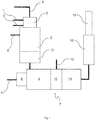
- Fig. 1 is a schematic layout of a reduction apparatus suitable for carrying out the method according to the invention.
- the present invention is based on the finding that the hydrogen-rich waste gas stream obtained during the hydrogenation of the organic nitro compounds can be separated out and reacted with the NO x -containing waste gas stream.
- the nitrogen oxides such as NO, NO 2 and N 2 O
- the hydrogen-containing waste gas stream often comprises other volatile by-products of the hydrogenation reaction in addition to hydrogen, such as e.g. ammonia or aliphatic amines, which can also react with the nitrogen oxides at the reaction temperatures according to the invention.
- the method according to the invention can be implemented without the use of additional sources of energy, such as natural gas, although it is quite possible to use additional fuels of this type, particularly in order to improve the reduction of the nitrogen oxides further.
- any externally supplied hydrogen stream consists of hydrogen.
- the hydrogen stream consists of at least 70 vol.% pure hydrogen, preferably at least 80 vol.%, in particular at least 95 vol.% or even at least 98 vol.%.
- the hydrogen stream consists of at least 70 vol.% pure hydrogen, preferably at least 80 vol.%, in particular at least 95 vol.% or even at least 98 vol.%.
- the hydrogen-containing waste gas stream consists of at least 70 vol.% pure hydrogen, preferably at least 80 vol.%.
- the organic compound is an aromatic compound, in particular aniline, benzene, monochlorobenzene, toluidine, nitrobenzene, mononitrotoluene and/or dinitrotoluene, the amino compounds produced in the method being used in particular for the production of isocyanate compounds, preferably for the production of aromatic polyisocyanates.
- the hydrogen-containing waste gas stream encompasses by-products carrying amino groups, in particular aliphatic and/or aromatic amines and/or ammonia.
- the said by-products also react with nitrogen oxides at the reaction temperatures according to the invention and reduce them, and so not only are these by-products used for reducing the concentration of nitrogen oxides but also, at the same time, the need to dispose of them is avoided.
- the reduction of the nitrogen oxides can take place by the hydrogen-containing waste gas stream and any externally supplied hydrogen.
- one or more hydrocarbon compounds in particular a hydrocarbon-containing gas, are added to the NO x -containing waste gas stream before or during step (2) or during or after step (3) for the further reduction of the NO x concentration, i.e., the hydrocarbon compound can be added before, during and/or after the reaction of the NO x -containing waste gas stream with the hydrogen-containing waste gas stream and any externally supplied hydrogen stream.
- the hydrocarbon compound can be added to one or more of the feed lines for the hydrogen-containing waste gas stream and any externally supplied hydrogen stream. It is, however, also possible to add the hydrocarbon compound via a separate feed line.
- air, oxygen-containing waste gases and/or oxygen are fed in in addition to the hydrocarbon compound and hydrogen-containing gas. This can be carried out either through one or more of the feed lines for the NO x -containing waste gas stream. It is, however, preferred to feed in the air, oxygen-containing waste gases and/or oxygen through separate feed lines.
- the NO x concentration can be determined during the reaction of the NO x -containing waste gas stream with the hydrogen-containing waste gas stream and any externally supplied hydrogen stream and optionally the hydrocarbon compound, and the metering of the hydrocarbon compound can be controlled as a function of the measured reaction temperature and/or the NO x concentration.
- sensing probes that are known per se are used, the measurement signals of which are processed in an evaluation unit and used to control regulators for the metering.
- a temperature of 1000 to 1700°C is set for NO x reduction.
- the reaction of the NO x -containing waste gas stream with the hydrogen-containing waste gas stream and any externally supplied hydrogen stream and optionally the hydrocarbon compound preferably takes place at a temperature of 1100 to 1600°C, more preferably at 1300 to 1600°C.
- the reaction of the NO x -containing waste gas stream with the hydrogen-containing waste gas stream and any externally supplied hydrogen stream takes place with a hyperstoichiometric amount of substance of hydrogen, the excess hydrogen then being partially or completely oxidised with air and/or oxygen.
- hyperstoichiometric is understood to mean that the quantity of hydrogen fed in is about 10 to 70 mole % more than the amount of substance theoretically needed for complete reduction. In this way, the chemical equilibrium can be shifted more strongly to the side of reduction. Furthermore, the hydrogen excess also has a positive effect on the reaction kinetics in terms of reduction. Under these hyperstoichiometric conditions in relation to hydrogen, reactive nitrogen-containing intermediates are formed (e.g.
- the heat of reaction released during the reaction of the NO x -containing waste gas stream with the hydrogen-containing waste gas stream and any externally supplied hydrogen stream, and/or the heat of reaction released while the excess hydrogen is reacted off can be recovered. This can take place e.g. with the aid of heat exchangers.
- a reduction apparatus suitable for reducing the concentration of nitrogen oxides in waste gases released during the production of organic amino compounds according the method of the invention is also described, wherein the reduction apparatus can be connected to a production apparatus for the production of organic amino compounds encompassing a first reaction device for reacting an organic compound with NO x and/or nitric acid to form an organic nitro compound with the formation of an NO x -containing waste gas stream and the organic nitro compound can be discharged via an intermediate product line exiting the first reaction device and the NO x -containing waste gas stream can be discharged via a nitrogen oxide line exiting the first reaction device, wherein the intermediate product line leads into a second reaction device, in which the organic nitro compound can be reduced by means of a hydrogen-containing reaction gas to form the organic amino compound with the formation of a hydrogen-containing waste gas stream, the reduction apparatus being characterised in that the reduction apparatus encompasses a reduction chamber connected to the nitrogen oxide line, in which the NO x -containing waste gas stream can be combined with the hydrogen-containing waste gas stream fed in via
- a hydrocarbon compound, air, oxygen-containing waste gases and/or oxygen is fed into the reduction chamber, in particular via the reducing agent line or a separate feed line.
- an appropriate measuring and control arrangement can be used.
- the reduction chamber is equipped with a burner or a burner is provided upstream of the reduction chamber, wherein the reducing agent line and/or the feed line for hydrocarbon compound, air and/or oxygen preferably leads into the burner.
- the specified temperatures for the reduction can be achieved with the aid of the burner.
- a burner device can be provided upstream of the reduction chamber, encompassing a burner, a combustion chamber and optionally a reduction device, wherein air, oxygen-containing waste gases and/or oxygen can be supplied to the burner of the burner device via a combustion air line.
- the reduction chamber and the burner device can be directly connected in series or can also be coupled together by a connecting line.
- intermediate cooling can be provided which makes it possible to utilise the heat of reaction by means of a connected heat exchanger and/or steam generator.
- the reduction device can advantageously encompass an SNCR stage, in which case an ammonia line also leads into the reduction device, through which ammonia, urea and/or another ammonia-releasing substance can be fed.
- an ammonia line also leads into the reduction device, through which ammonia, urea and/or another ammonia-releasing substance can be fed.
- any nitrogen oxides formed as by-products during hydrogen oxidation can be removed again.
- a downstream SCR stage can be provided. This is typically operated at lower temperatures but requires the use of an appropriate catalyst.
- a waste heat utilisation device in particular a heat exchanger, is assigned to the reduction chamber and/or the burner device.
- the heat of reaction released can be utilised in a meaningful way by being used e.g. for steam generation, preheating the substances used or for other processes.
- a gas scrubbing device can be provided downstream of the burner device, in which the waste gases are scrubbed before being discharged via a chimney.
- final residues of harmful substances such as traces of ammonia, nitrogen oxides and the like, can be removed from the waste gas stream.
- the present invention thus describes the use of a hydrogen-containing waste gas stream and optionally of hydrogen for reducing the concentration of nitrogen oxides in waste gases released during the production of organic amino compounds, in particular in a method for the production of aromatic polyisocyanates.
- the hydrogen-containing waste gas stream is formed partially or completely by a hydrogen-containing waste gas stream that develops during the conversion of an organic nitro compound to an organic amino compound by means of a hydrogen-containing reaction gas.
- FIG. 1 The schematic layout of a reduction apparatus suitable for carrying out the method according to the invention is shown in Fig. 1 .
- the reduction apparatus is used for reducing the concentration of nitrogen oxides in waste gases released during the production of organic amino compounds, with the possibility of the reduction apparatus being connected to a production apparatus for the production of organic amino compounds, which is not illustrated here.
- This production apparatus which encompasses e.g.
- a first reaction device for reacting an organic compound with NO x and/or nitric acid to form an organic nitro compound with the formation of an NO x -containing waste gas stream, wherein the organic nitro compound can be discharged via an intermediate product line exiting the first reaction device and the NO x -containing waste gas stream can be discharged via a nitrogen oxide line 1 exiting the first reaction device.
- the intermediate product line leads into a second reaction device (not illustrated here), in which the organic nitro compound can be reduced by means of a hydrogen-containing reaction gas to form the organic amino compound with the formation of a hydrogen-containing waste gas stream.
- the reduction apparatus Connected to the nitrogen oxide line 1, the reduction apparatus encompasses a reduction chamber 2 in which the NO x -containing waste gas stream can be combined with the hydrogen-containing waste gas stream fed in via a reducing agent line 3 leading into the reduction chamber 2 and optionally with an externally supplied hydrogen stream, and reacted at a temperature of 1000 to 1700°C for the at least partial reduction of the NO x concentration.
- a hydrocarbon compound, air, oxygen-containing waste gases and/or oxygen can be fed into the reduction chamber 2. This takes place here via a separate feed line 6 and optionally via a combustion air line 4.
- a burner 5 is provided upstream of the reduction chamber 2, the reducing agent line 3 and/or the feed line 4 for hydrocarbon compound, air and/or oxygen leading into the burner 5.
- the reduction chamber 2 additionally encompasses a waste heat utilisation device 13 in the form of a heat exchanger arranged at the outlet side thereof to recover the heat released during the reaction.
- a burner device 7 Downstream of the reduction chamber 2 and connected thereto, a burner device 7 is arranged which encompasses a burner 8, a combustion chamber 9 and a reduction device 10. Air, oxygen-containing waste gases and/or oxygen can be supplied to the burner 8 of the burner device 7 via a combustion air line 11.
- a gas scrubbing device 15 Downstream of the burner device 7, a gas scrubbing device 15 is provided, from where the waste gases that have been purified and freed from nitrogen oxides are discharged into the environment through a chimney 16.
Landscapes
- Chemical & Material Sciences (AREA)
- Organic Chemistry (AREA)
- Engineering & Computer Science (AREA)
- Chemical Kinetics & Catalysis (AREA)
- Environmental & Geological Engineering (AREA)
- Biomedical Technology (AREA)
- Health & Medical Sciences (AREA)
- Analytical Chemistry (AREA)
- General Chemical & Material Sciences (AREA)
- Oil, Petroleum & Natural Gas (AREA)
- Dispersion Chemistry (AREA)
- Treating Waste Gases (AREA)
- Organic Low-Molecular-Weight Compounds And Preparation Thereof (AREA)
Description
- The invention relates to a method for reducing the concentration of nitrogen oxides in waste gases released during the production of organic amino compounds, wherein an organic compound is first reacted with NOx and/or nitric acid to form an organic nitro compound with the formation of an NOx-containing waste gas stream and the organic nitro compound is converted to the organic amino compound by means of a hydrogen-containing reaction gas, the reaction of the organic nitro compound with the hydrogen-containing reduction gas taking place with the formation of a hydrogen-containing waste gas stream.
- Amines are typical precursors of isocyanates, which are used in the production of formulations for PUR/PIR foams. They are produced by nitration of hydrocarbons, followed by catalytic reduction with hydrogen. In the production of aromatic amines, the nitration of the aromatics used as starting substance is generally carried out with nitric acid. Nitrogen oxides such as NO, NO2 and also N2O, referred to below for the sake of simplicity as NOx, for which very low emission limits have to be observed, are obtained as a by-product here as a result of oxidation reactions. These waste gases therefore have to be treated before they can be released into the environment.
-
US 2013/0197268 A1 relates to a process for the continuous production of nitrobenzene by nitration of benzene with a mixture of nitric acid and sulphuric acid under adiabatic conditions, in which unreacted benzene is separated by distillation from the crude product obtained after phase separation before washing thereof, using the adiabatic heat of reaction. The application discloses that nitric oxides that are present in the crude nitrobenzene can be discharged effectively in the distillation stage if an inert gas is fed into the distillation column. The application does not teach how to reduce nitric oxides in the contaminated inert gas stream inevitably produced thereby. -
EP 0 379 307 A2 describes a gas desulfurization process in which a gaseous mixture comprising sulphur oxides is contacted in an absorption zone at absorption conditions with an aqueous composition comprising ammonium carbonate, or ammonium bicarbonate or mixtures thereof, in an amount such that the product of the partial pressures of the sulphur oxides and ammonia over said aqueous composition is below a specified limit, to produce a gaseous product having a decreased content of sulphur oxides and a decreased appearance of blue haze. A combination of nitrogen oxides removal (deNOx) and desulfurization (deSOx) is also provided. In this respect, an embodiment is disclosed in which a gaseous mixture comprising nitrogen oxides and sulphur oxides is contacted with ammonia and with an additional reducing agent and wherein the temperature in the nitrogen oxides removal step ranges from about 704.4 to 871.1°C. - The thermal reduction of nitrogen oxides with natural gas is known from the fuel staging process and is described in Kolb, T., Jansohn, P., & Leuckel, W. (1988). Reduction of NOx Emissions in Turbulent Combustion by Fuel-Staging / Effects of Mixing and Stoichiometry in the Reduction Zone, Proceedings of the Combustion Institute, 22, p. 1193, and in Greul, U. (1998), Experimentelle Untersuchung feuerungstechnischer NOx-MinderungsmaBnahmen bei der Kohlenstaubverbrennung. Düsseldorf: VDI Verlag GmbH. In this process, natural gas is generally added to a flue gas that has significant concentrations of NOx. The nitrogen oxides obtained during combustion are converted to molecular nitrogen and intermediate components (HCN and NH3) here by adding a fuel (generally methane, natural gas or coal) under reducing conditions. Burnout then takes place by a further addition of combustion air. Depending on process control, the optimum process conditions, such as the degree of the reducing conditions relative to the required residence time, vary with air-fuel ratios of 0.7 to 0.95 being established in the reduction zone in relation to the main combustion zone (Greul, 1998, see above).
- Another method for the treatment of waste gases from nitration is oxidation with air and parallel absorption in water of the NO2 formed to give aqueous nitric acid (Reference Document on Best Available Techniques for the Manufacture of Large Volume Inorganic Chemicals - Ammonia, Acids and Fertilisers, European Commission, August 2007). This process is used for the production of nitric acid on an industrial scale, but is costly and, because of the volatile compounds comprised in the waste gas from nitration, is only suitable when combined with an oxidising combustion. The nitric acid obtained is advantageously recycled into the nitration process.
- A less technically complex alternative is absorption in more chemically reactive systems, such as dilute sodium hydroxide solution, but this has the disadvantage that an additional waste substance is obtained which requires treatment.
- Furthermore, the selective non-catalytic reduction (SNCR) of nitrogen oxides with ammonia or urea at temperatures of 800 - 1100°C is known (Reference Document on Best Available Techniques for Large Combustion Plants, European Commission, July 2006). However, this method cannot be used efficiently for the waste gases from nitration in question since, with the high NOx concentrations in the waste gases, the exothermicity of the reduction reaction, e.g. according to the following reaction equation
4 NO + 4 NH3 + O2 --> 4 N2 + 6 H2O,
requires a multi-stage reduction with intermediate cooling. In addition, the desired limit values cannot be reliably met because of the limited efficiency of the SNCR method. As a result of the high exothermicity and the associated temperature increase, undesirable secondary reactions, such as thereaction 4 NH3 + 5 O2 --> 4 NO + 6 H2O, gain significance and mean that this method cannot be applied efficiently. This method can therefore only be used for low NOx concentrations but not for waste gases from nitration. - Finally, it is known that tail gases occurring during nitric acid production, which still comprise traces of NOx, can be reduced catalytically with ammonia. This method is referred to as "Selective Catalytic Reduction" (SCR). In order to obtain adequate catalytic activity, the catalyst has to be operated at an elevated temperature. It should be borne in mind that the reduction is strongly exothermic, and so this technique has to be used with the customary adiabatic fixed bed reactors only at NOx concentrations that are significantly lower than those in waste gases from a nitration process. A multi-stage execution with intermediate cooling is costly in terms of apparatus and is therefore uneconomical for the present application.
- The object of the present invention consisted in providing a more cost-effective method for the at least partial elimination of nitrogen oxides that are formed during the production of nitroaromatics.
- The present invention relates to a method for reducing the concentration of nitrogen oxides in waste gases released during the production of organic amino compounds, comprising:
- (1) reacting an organic compound with NOx and/or nitric acid to form an organic nitro compound wherein an NOx-containing waste gas stream is formed and the organic nitro compound is converted to the organic amino compound by means of a hydrogen-containing reaction gas, the reaction of the organic nitro compound with the hydrogen-containing reduction gas taking place with the formation of a hydrogen-containing waste gas stream,
- (2) combining the NOx-containing waste gas stream with the hydrogen-containing waste gas stream and optionally an externally supplied hydrogen stream and
- (3) reacting the NOx-containing waste gas stream with the hydrogen-containing waste gas stream and any externally supplied hydrogen stream at a temperature of 1000 to 1700°C for the at least partial reduction of the NOx concentration.
-
Fig. 1 is a schematic layout of a reduction apparatus suitable for carrying out the method according to the invention. - The present invention is based on the finding that the hydrogen-rich waste gas stream obtained during the hydrogenation of the organic nitro compounds can be separated out and reacted with the NOx-containing waste gas stream. In this way, not only are the nitrogen oxides, such as NO, NO2 and N2O, eliminated from the NOx-containing waste gas stream but at the same time the quantity of the hydrogen-containing waste gas stream obtained, which would otherwise require separate disposal, e.g. by combustion, is reduced. The hydrogen-containing waste gas stream often comprises other volatile by-products of the hydrogenation reaction in addition to hydrogen, such as e.g. ammonia or aliphatic amines, which can also react with the nitrogen oxides at the reaction temperatures according to the invention.
- Depending on how high the hydrogen concentration is in the hydrogen-containing waste gas stream, the method according to the invention can be implemented without the use of additional sources of energy, such as natural gas, although it is quite possible to use additional fuels of this type, particularly in order to improve the reduction of the nitrogen oxides further.
- In a further embodiment of the method according to the invention, any externally supplied hydrogen stream consists of hydrogen. Within the framework of the present invention, this is understood to mean that the hydrogen stream consists of at least 70 vol.% pure hydrogen, preferably at least 80 vol.%, in particular at least 95 vol.% or even at least 98 vol.%. For this purpose it is possible to use e.g. technical-grade hydrogen.
- Advantageously, the hydrogen-containing waste gas stream consists of at least 70 vol.% pure hydrogen, preferably at least 80 vol.%.
- In a further embodiment of the method according to the invention, the organic compound is an aromatic compound, in particular aniline, benzene, monochlorobenzene, toluidine, nitrobenzene, mononitrotoluene and/or dinitrotoluene, the amino compounds produced in the method being used in particular for the production of isocyanate compounds, preferably for the production of aromatic polyisocyanates.
- It is further provided in the method according to the invention that the hydrogen-containing waste gas stream encompasses by-products carrying amino groups, in particular aliphatic and/or aromatic amines and/or ammonia. This is advantageous because the said by-products also react with nitrogen oxides at the reaction temperatures according to the invention and reduce them, and so not only are these by-products used for reducing the concentration of nitrogen oxides but also, at the same time, the need to dispose of them is avoided.
- As already set out above, the reduction of the nitrogen oxides can take place by the hydrogen-containing waste gas stream and any externally supplied hydrogen. In an advantageous embodiment, however, one or more hydrocarbon compounds, in particular a hydrocarbon-containing gas, are added to the NOx-containing waste gas stream before or during step (2) or during or after step (3) for the further reduction of the NOx concentration, i.e., the hydrocarbon compound can be added before, during and/or after the reaction of the NOx-containing waste gas stream with the hydrogen-containing waste gas stream and any externally supplied hydrogen stream. To this end, the hydrocarbon compound can be added to one or more of the feed lines for the hydrogen-containing waste gas stream and any externally supplied hydrogen stream. It is, however, also possible to add the hydrocarbon compound via a separate feed line.
- In addition, it can be provided that air, oxygen-containing waste gases and/or oxygen are fed in in addition to the hydrocarbon compound and hydrogen-containing gas. This can be carried out either through one or more of the feed lines for the NOx-containing waste gas stream. It is, however, preferred to feed in the air, oxygen-containing waste gases and/or oxygen through separate feed lines.
- In this embodiment, in a further preferred manner, the NOx concentration can be determined during the reaction of the NOx-containing waste gas stream with the hydrogen-containing waste gas stream and any externally supplied hydrogen stream and optionally the hydrocarbon compound, and the metering of the hydrocarbon compound can be controlled as a function of the measured reaction temperature and/or the NOx concentration. For this purpose, sensing probes that are known per se are used, the measurement signals of which are processed in an evaluation unit and used to control regulators for the metering.
- In the method according to the invention, a temperature of 1000 to 1700°C is set for NOx reduction. The reaction of the NOx-containing waste gas stream with the hydrogen-containing waste gas stream and any externally supplied hydrogen stream and optionally the hydrocarbon compound preferably takes place at a temperature of 1100 to 1600°C, more preferably at 1300 to 1600°C.
- In a further embodiment of the method according to the invention, the reaction of the NOx-containing waste gas stream with the hydrogen-containing waste gas stream and any externally supplied hydrogen stream takes place with a hyperstoichiometric amount of substance of hydrogen, the excess hydrogen then being partially or completely oxidised with air and/or oxygen. In the present case, hyperstoichiometric is understood to mean that the quantity of hydrogen fed in is about 10 to 70 mole % more than the amount of substance theoretically needed for complete reduction. In this way, the chemical equilibrium can be shifted more strongly to the side of reduction. Furthermore, the hydrogen excess also has a positive effect on the reaction kinetics in terms of reduction. Under these hyperstoichiometric conditions in relation to hydrogen, reactive nitrogen-containing intermediates are formed (e.g. NH3 or, if hydrocarbons are added, also HCN), some of which are converted to nitrogen oxides during the subsequent oxidation of the excess hydrogen but at concentrations well below the initial concentration of the nitrogen oxides in the waste gas from nitration. In a downstream step, a reduction of these residual concentrations can take place by adding ammonia, ammonium hydroxide or urea; this partial step can be carried out by means of the known SNCR or SCR method.
- Furthermore in the method according to the invention, the heat of reaction released during the reaction of the NOx-containing waste gas stream with the hydrogen-containing waste gas stream and any externally supplied hydrogen stream, and/or the heat of reaction released while the excess hydrogen is reacted off, can be recovered. This can take place e.g. with the aid of heat exchangers.
- A reduction apparatus suitable for reducing the concentration of nitrogen oxides in waste gases released during the production of organic amino compounds according the method of the invention is also described, wherein the reduction apparatus can be connected to a production apparatus for the production of organic amino compounds encompassing a first reaction device for reacting an organic compound with NOx and/or nitric acid to form an organic nitro compound with the formation of an NOx-containing waste gas stream and the organic nitro compound can be discharged via an intermediate product line exiting the first reaction device and the NOx-containing waste gas stream can be discharged via a nitrogen oxide line exiting the first reaction device, wherein the intermediate product line leads into a second reaction device, in which the organic nitro compound can be reduced by means of a hydrogen-containing reaction gas to form the organic amino compound with the formation of a hydrogen-containing waste gas stream, the reduction apparatus being characterised in that the reduction apparatus encompasses a reduction chamber connected to the nitrogen oxide line, in which the NOx-containing waste gas stream can be combined with the hydrogen-containing waste gas stream fed in via a reducing agent line leading into the reduction chamber and optionally with an externally supplied hydrogen stream and reacted at a temperature of 1000 to 1700°C for the at least partial reduction of the NOx concentration.
- According to a preferred embodiment of the reduction apparatus, in addition to the NOx-containing waste gas stream to be reduced, a hydrocarbon compound, air, oxygen-containing waste gases and/or oxygen is fed into the reduction chamber, in particular via the reducing agent line or a separate feed line. To control the metering of the hydrocarbon compound, as mentioned above, an appropriate measuring and control arrangement can be used.
- According to a development of the reduction apparatus, the reduction chamber is equipped with a burner or a burner is provided upstream of the reduction chamber, wherein the reducing agent line and/or the feed line for hydrocarbon compound, air and/or oxygen preferably leads into the burner. The specified temperatures for the reduction can be achieved with the aid of the burner.
- A burner device can be provided upstream of the reduction chamber, encompassing a burner, a combustion chamber and optionally a reduction device, wherein air, oxygen-containing waste gases and/or oxygen can be supplied to the burner of the burner device via a combustion air line. The reduction chamber and the burner device can be directly connected in series or can also be coupled together by a connecting line. Between the reduction chamber and the burner device, intermediate cooling can be provided which makes it possible to utilise the heat of reaction by means of a connected heat exchanger and/or steam generator.
- The reduction device can advantageously encompass an SNCR stage, in which case an ammonia line also leads into the reduction device, through which ammonia, urea and/or another ammonia-releasing substance can be fed. As a result of this measure, any nitrogen oxides formed as by-products during hydrogen oxidation can be removed again. As an alternative to the SNCR stage, a downstream SCR stage can be provided. This is typically operated at lower temperatures but requires the use of an appropriate catalyst.
- In a particularly advantageous embodiment of the reduction apparatus, a waste heat utilisation device, in particular a heat exchanger, is assigned to the reduction chamber and/or the burner device. As a result, the heat of reaction released can be utilised in a meaningful way by being used e.g. for steam generation, preheating the substances used or for other processes.
- Finally, a gas scrubbing device can be provided downstream of the burner device, in which the waste gases are scrubbed before being discharged via a chimney. As a result, final residues of harmful substances, such as traces of ammonia, nitrogen oxides and the like, can be removed from the waste gas stream.
- The present invention thus describes the use of a hydrogen-containing waste gas stream and optionally of hydrogen for reducing the concentration of nitrogen oxides in waste gases released during the production of organic amino compounds, in particular in a method for the production of aromatic polyisocyanates.
- In an advantageous embodiment of this use, the hydrogen-containing waste gas stream is formed partially or completely by a hydrogen-containing waste gas stream that develops during the conversion of an organic nitro compound to an organic amino compound by means of a hydrogen-containing reaction gas.
- The present invention is explained in more detail below with the aid of an exemplary embodiment illustrated in
Fig. 1 , wherein - Fig. 1
- shows a schematic layout of a reduction apparatus suitable for carrying out the method according to the invention.
- The schematic layout of a reduction apparatus suitable for carrying out the method according to the invention is shown in
Fig. 1 . The reduction apparatus is used for reducing the concentration of nitrogen oxides in waste gases released during the production of organic amino compounds, with the possibility of the reduction apparatus being connected to a production apparatus for the production of organic amino compounds, which is not illustrated here. This production apparatus, which encompasses e.g. a first reaction device (not illustrated here) for reacting an organic compound with NOx and/or nitric acid to form an organic nitro compound with the formation of an NOx-containing waste gas stream, wherein the organic nitro compound can be discharged via an intermediate product line exiting the first reaction device and the NOx-containing waste gas stream can be discharged via anitrogen oxide line 1 exiting the first reaction device. The intermediate product line leads into a second reaction device (not illustrated here), in which the organic nitro compound can be reduced by means of a hydrogen-containing reaction gas to form the organic amino compound with the formation of a hydrogen-containing waste gas stream. - Connected to the
nitrogen oxide line 1, the reduction apparatus encompasses areduction chamber 2 in which the NOx-containing waste gas stream can be combined with the hydrogen-containing waste gas stream fed in via a reducingagent line 3 leading into thereduction chamber 2 and optionally with an externally supplied hydrogen stream, and reacted at a temperature of 1000 to 1700°C for the at least partial reduction of the NOx concentration. - Furthermore, a hydrocarbon compound, air, oxygen-containing waste gases and/or oxygen can be fed into the
reduction chamber 2. This takes place here via aseparate feed line 6 and optionally via acombustion air line 4. Aburner 5 is provided upstream of thereduction chamber 2, the reducingagent line 3 and/or thefeed line 4 for hydrocarbon compound, air and/or oxygen leading into theburner 5. Thereduction chamber 2 additionally encompasses a wasteheat utilisation device 13 in the form of a heat exchanger arranged at the outlet side thereof to recover the heat released during the reaction. - Downstream of the
reduction chamber 2 and connected thereto, aburner device 7 is arranged which encompasses aburner 8, acombustion chamber 9 and areduction device 10. Air, oxygen-containing waste gases and/or oxygen can be supplied to theburner 8 of theburner device 7 via acombustion air line 11. Anammonia line 12, through which ammonia, urea and/or another ammonia-releasing substance can be fed, leads into thereduction device 10. A wasteheat utilisation device 14, here a heat exchanger, is assigned to theburner device 7 on the outlet side. - Downstream of the
burner device 7, agas scrubbing device 15 is provided, from where the waste gases that have been purified and freed from nitrogen oxides are discharged into the environment through achimney 16. -
- (1)
- Nitrogen oxide line
- (2)
- Reduction chamber
- (3)
- Reducing agent line
- (4)
- Combustion air line / Separate feed line
- (5)
- Burner
- (6)
- Separate feed line
- (7)
- Burner device
- (8)
- Burner
- (9)
- Combustion chamber
- (10)
- Reduction device
- (11)
- Combustion air line
- (12)
- Ammonia line
- (13)
- Waste heat utilisation device
- (14)
- Waste heat utilisation device
- (15)
- Gas scrubbing device
- (16)
- Chimney
Claims (13)
- A method for reducing the concentration of nitrogen oxides in waste gases released during the production of organic amino compounds, comprising:(1) reacting an organic compound with NOx and/or nitric acid to form an organic nitro compound wherein an NOx-containing waste gas stream is formed and the organic nitro compound is converted to the organic amino compound by means of a hydrogen-containing reaction gas, the reaction of the organic nitro compound with the hydrogen-containing reduction gas taking place with the formation of a hydrogen-containing waste gas stream,(2) combining the NOx-containing waste gas stream with the hydrogen-containing waste gas stream, and optionally an externally supplied hydrogen stream, and(3) reacting the NOx-containing waste gas stream with the hydrogen-containing waste gas stream, and any externally supplied hydrogen stream, at a temperature of 1000 to 1700°C for the at least partial reduction of the NOx concentration.
- The method according to claim 1, comprising the use of the externally supplied hydrogen stream, wherein the externally supplied hydrogen stream consists of at least 70 vol.% pure hydrogen, the externally supplied hydrogen stream comprising technical-grade hydrogen.
- The method according to claim 1 or 2, wherein the hydrogen-containing waste gas stream consists of at least 70 vol.% pure hydrogen.
- The method according to any one of the preceding claims, wherein the organic compound is an aromatic compound.
- The method according to claim 4, wherein the organic compound is selected from the group consisting of aniline, benzene, monochlorobenzene, toluidine, nitrobenzene, mononitrotoluene and dinitrotoluene.
- The method according to any one of the preceding claims, wherein the hydrogen-containing waste gas stream comprises by-products carrying amino groups.
- The method according any one of the preceding claims, further comprising reducing the NOx concentration further by adding one or more hydrocarbon compounds to the NOx-containing waste gas stream before or during step (2) or during or after step (3).
- The method according to claim 7, further comprising determining the NOx concentration during the reaction of the NOx-containing waste gas stream with the hydrogen-containing waste gas stream and any externally supplied hydrogen stream and optionally the hydrocarbon compound, and controlling the metering of the hydrocarbon compound as a function of the measured reaction temperature and/or the NOx concentration.
- The method according to any one of the preceding claims, further comprising adding air, oxygen-containing waste gases and/or oxygen to the NOx-containing waste gas stream before or during step (2) or during or after step (3).
- The method according to any one of the preceding claims, wherein the reaction of the NOx-containing waste gas stream with the hydrogen-containing waste gas stream and any externally supplied hydrogen stream takes place with a hyperstoichiometric amount of substance of hydrogen and further comprising at least partially oxidizing the excess hydrogen with air and/or oxygen.
- The method according to claim 10, further comprising adding a compound selected from the group consisting of ammonia, urea and/or another ammonia-releasing compound to the NOx-containing waste gas stream.
- The method according to claim 10 or 11, further comprising recovering at least a portion of heat of reaction released while the excess hydrogen is reacted off, with the aid of heat exchangers.
- The method according to any one of the preceding claims, further comprising recovering at least a portion of any heat of reaction released during the reaction of the NOx-containing waste gas stream with the hydrogen-containing waste gas stream and any externally supplied hydrogen stream, with the aid of heat exchangers.
Applications Claiming Priority (2)
| Application Number | Priority Date | Filing Date | Title |
|---|---|---|---|
| US14/300,504 US9346012B2 (en) | 2014-06-10 | 2014-06-10 | Method and apparatus for denenoxing waste gases from nitration |
| PCT/EP2015/062879 WO2015189235A1 (en) | 2014-06-10 | 2015-06-10 | Method and apparatus for denoxing waste gases from nitration |
Publications (2)
| Publication Number | Publication Date |
|---|---|
| EP3154932A1 EP3154932A1 (en) | 2017-04-19 |
| EP3154932B1 true EP3154932B1 (en) | 2020-05-27 |
Family
ID=53433176
Family Applications (1)
| Application Number | Title | Priority Date | Filing Date |
|---|---|---|---|
| EP15729786.2A Active EP3154932B1 (en) | 2014-06-10 | 2015-06-10 | Method for denoxing waste gases from nitration |
Country Status (7)
| Country | Link |
|---|---|
| US (1) | US9346012B2 (en) |
| EP (1) | EP3154932B1 (en) |
| JP (1) | JP2017520546A (en) |
| KR (1) | KR20170015484A (en) |
| CN (1) | CN107207405A (en) |
| HU (1) | HUE051438T2 (en) |
| WO (1) | WO2015189235A1 (en) |
Families Citing this family (6)
| Publication number | Priority date | Publication date | Assignee | Title |
|---|---|---|---|---|
| US8951487B2 (en) | 2010-10-25 | 2015-02-10 | ADA-ES, Inc. | Hot-side method and system |
| US8496894B2 (en) | 2010-02-04 | 2013-07-30 | ADA-ES, Inc. | Method and system for controlling mercury emissions from coal-fired thermal processes |
| US8845986B2 (en) * | 2011-05-13 | 2014-09-30 | ADA-ES, Inc. | Process to reduce emissions of nitrogen oxides and mercury from coal-fired boilers |
| US8883099B2 (en) | 2012-04-11 | 2014-11-11 | ADA-ES, Inc. | Control of wet scrubber oxidation inhibitor and byproduct recovery |
| US9957454B2 (en) | 2012-08-10 | 2018-05-01 | ADA-ES, Inc. | Method and additive for controlling nitrogen oxide emissions |
| US9889451B2 (en) | 2013-08-16 | 2018-02-13 | ADA-ES, Inc. | Method to reduce mercury, acid gas, and particulate emissions |
Family Cites Families (18)
| Publication number | Priority date | Publication date | Assignee | Title |
|---|---|---|---|---|
| CA1097487A (en) | 1976-04-20 | 1981-03-17 | David W. Turner | Method and apparatus for reducing no.sub.x emission to the atmosphere |
| JPS52130473A (en) * | 1976-04-26 | 1977-11-01 | Mitsubishi Chem Ind Ltd | Decomposition of nitrogen oxides |
| JPS5326270A (en) * | 1976-08-23 | 1978-03-10 | Kobe Steel Ltd | Denitrating method by nonselective reduction without use of catalyst |
| JPS5431082A (en) * | 1977-06-30 | 1979-03-07 | Mitsubishi Chem Ind Ltd | Treating method for waste gas containing nitrogen oxides |
| US4740621A (en) | 1985-11-01 | 1988-04-26 | First Chemical Corporation | Co-production of an aromatic monoamine and an aromatic diamine directly from benzene or a benzene derivative through controlled nitration |
| US4956161A (en) | 1989-01-13 | 1990-09-11 | Exxon Research And Engineering Company | Process for removing SO from a gaseous mixture (OP-3409) |
| JPH0571334A (en) * | 1991-09-13 | 1993-03-23 | Toyota Central Res & Dev Lab Inc | Method and apparatus for reducing nitrogen oxides in combustion apparatus for continuous combustion |
| DE4428018A1 (en) * | 1994-08-08 | 1996-02-15 | Bayer Ag | Process for the preparation of aromatic amines |
| EP0803278B2 (en) | 1996-04-22 | 2004-01-02 | Applied Utility Systems, Inc. | Integrated catalytic/non-catalytic process for selective reduction of nitrogen oxides |
| DE10047163A1 (en) * | 2000-09-22 | 2002-04-11 | Basf Ag | Process for the nitration of aromatic hydrocarbons |
| DE10105277A1 (en) * | 2001-02-02 | 2002-08-14 | Basf Ag | Process for the hydrogenation of liquid organic compounds |
| US20060198779A1 (en) | 2002-06-05 | 2006-09-07 | Hurst Boyd E | Selective non-catalytic reduction of NOx |
| US8404898B2 (en) | 2008-12-18 | 2013-03-26 | E I Du Pont De Nemours And Company | Integrated process for the preparation of polybenzimidazole precursors |
| EP2512993B1 (en) | 2009-12-16 | 2013-11-27 | Basf Se | Method for treating nox-containing exhaust gas from process wastewater from nitration facilities |
| CN102811996B (en) * | 2010-03-18 | 2014-10-01 | 亨茨曼国际有限公司 | Process For The Conversion Of Aromatic Nitro Compound Into Amines |
| DE102010038519A1 (en) | 2010-07-28 | 2012-02-02 | Bayer Materialscience Ag | Process for the preparation of nitrobenzene by adiabatic nitration |
| EP2877443B1 (en) * | 2012-07-27 | 2016-05-11 | Covestro Deutschland AG | Method for manufacturing nitrobenzol through adiabatic nitration |
| CN103752160B (en) * | 2014-01-28 | 2016-03-16 | 上海交通大学 | Realize the method for CFBB ultra-low emission of NOx |
-
2014
- 2014-06-10 US US14/300,504 patent/US9346012B2/en not_active Expired - Fee Related
-
2015
- 2015-06-10 CN CN201580030899.4A patent/CN107207405A/en active Pending
- 2015-06-10 JP JP2016572572A patent/JP2017520546A/en active Pending
- 2015-06-10 EP EP15729786.2A patent/EP3154932B1/en active Active
- 2015-06-10 HU HUE15729786A patent/HUE051438T2/en unknown
- 2015-06-10 KR KR1020177000338A patent/KR20170015484A/en not_active Withdrawn
- 2015-06-10 WO PCT/EP2015/062879 patent/WO2015189235A1/en not_active Ceased
Non-Patent Citations (1)
| Title |
|---|
| None * |
Also Published As
| Publication number | Publication date |
|---|---|
| KR20170015484A (en) | 2017-02-08 |
| HUE051438T2 (en) | 2021-03-01 |
| US9346012B2 (en) | 2016-05-24 |
| US20150352488A1 (en) | 2015-12-10 |
| JP2017520546A (en) | 2017-07-27 |
| EP3154932A1 (en) | 2017-04-19 |
| CN107207405A (en) | 2017-09-26 |
| WO2015189235A1 (en) | 2015-12-17 |
Similar Documents
| Publication | Publication Date | Title |
|---|---|---|
| US9346012B2 (en) | Method and apparatus for denenoxing waste gases from nitration | |
| NZ505573A (en) | Reduction of toxic substances, nitrogen oxides, in waste gas emissions | |
| JPS63178829A (en) | Method and apparatus for recovering ammonia during separation of nitrogen oxides from waste gas | |
| CN103443070B (en) | Zero discharge urea method and apparatus | |
| US20120237422A1 (en) | Method and plant for flue gas de-noxing | |
| NL2030905B1 (en) | Hybrid ammonia decomposition system | |
| US20200368684A1 (en) | Process for the removal of dinitrogen oxide in process off-gas | |
| US20100140543A1 (en) | Process and Plant for the Production of an Aqueous Solution Comprising Urea | |
| Clarke et al. | Nitric acid | |
| WO2011089635A1 (en) | Integrated process for treating refinery waste water, containing ammonia and hydrogen sulphide, and refinery exhaust acid gas containing hydrogen sulphide | |
| CN109320423A (en) | A kind of method of micro passage reaction synthesizing nitryl compound | |
| US20210261424A1 (en) | Method for avoiding voc and hap emissions from synthesis gas-processing systems | |
| AU2003252836A1 (en) | Method for abatement of waste oxide gas emissions | |
| US3567367A (en) | Method of removing nitrogen oxides from gases | |
| WO2021198150A1 (en) | A PROCESS FOR THE REMOVAL OF NOx AND DINITROGEN OXIDE IN PROCESS OFF-GAS | |
| US20150175533A1 (en) | Use of urea synthesis purge gas in an integrated ammonia-urea process and related plant | |
| RU2793746C2 (en) | REMOVAL OF NITROGEN OXIDES (NOx) FROM GASEOUS EFFLUENTS | |
| US4218397A (en) | Method for eliminating the explosibility of tail gas from the urea synthesis plant | |
| CN111936221B (en) | Removal of NOx from gaseous exhaust | |
| CN105983305B (en) | The treatment process of height sulfur-containing tail gas containing ammonia | |
| CN103964471A (en) | Operational controls for inert gas blanketing for Andrussow process | |
| JP2025512105A (en) | How to Decompose Ammonia | |
| CN105983333A (en) | Ammonia-containing tail gas treatment technology | |
| Ondrey | Nitric Acid in the Spotlight: Efforts continue to make nitric-acid production more efficient with lower emissions of greenhouse gases. | |
| BR112020020038B1 (en) | NOx Removal from Gaseous Effluents |
Legal Events
| Date | Code | Title | Description |
|---|---|---|---|
| STAA | Information on the status of an ep patent application or granted ep patent |
Free format text: STATUS: THE INTERNATIONAL PUBLICATION HAS BEEN MADE |
|
| PUAI | Public reference made under article 153(3) epc to a published international application that has entered the european phase |
Free format text: ORIGINAL CODE: 0009012 |
|
| STAA | Information on the status of an ep patent application or granted ep patent |
Free format text: STATUS: REQUEST FOR EXAMINATION WAS MADE |
|
| 17P | Request for examination filed |
Effective date: 20170110 |
|
| AK | Designated contracting states |
Kind code of ref document: A1 Designated state(s): AL AT BE BG CH CY CZ DE DK EE ES FI FR GB GR HR HU IE IS IT LI LT LU LV MC MK MT NL NO PL PT RO RS SE SI SK SM TR |
|
| AX | Request for extension of the european patent |
Extension state: BA ME |
|
| DAV | Request for validation of the european patent (deleted) | ||
| DAX | Request for extension of the european patent (deleted) | ||
| STAA | Information on the status of an ep patent application or granted ep patent |
Free format text: STATUS: EXAMINATION IS IN PROGRESS |
|
| 17Q | First examination report despatched |
Effective date: 20190206 |
|
| GRAP | Despatch of communication of intention to grant a patent |
Free format text: ORIGINAL CODE: EPIDOSNIGR1 |
|
| STAA | Information on the status of an ep patent application or granted ep patent |
Free format text: STATUS: GRANT OF PATENT IS INTENDED |
|
| INTG | Intention to grant announced |
Effective date: 20191121 |
|
| GRAJ | Information related to disapproval of communication of intention to grant by the applicant or resumption of examination proceedings by the epo deleted |
Free format text: ORIGINAL CODE: EPIDOSDIGR1 |
|
| STAA | Information on the status of an ep patent application or granted ep patent |
Free format text: STATUS: EXAMINATION IS IN PROGRESS |
|
| GRAR | Information related to intention to grant a patent recorded |
Free format text: ORIGINAL CODE: EPIDOSNIGR71 |
|
| GRAS | Grant fee paid |
Free format text: ORIGINAL CODE: EPIDOSNIGR3 |
|
| STAA | Information on the status of an ep patent application or granted ep patent |
Free format text: STATUS: GRANT OF PATENT IS INTENDED |
|
| INTC | Intention to grant announced (deleted) | ||
| GRAA | (expected) grant |
Free format text: ORIGINAL CODE: 0009210 |
|
| STAA | Information on the status of an ep patent application or granted ep patent |
Free format text: STATUS: THE PATENT HAS BEEN GRANTED |
|
| INTG | Intention to grant announced |
Effective date: 20200331 |
|
| RAP1 | Party data changed (applicant data changed or rights of an application transferred) |
Owner name: COVESTRO DEUTSCHLAND AG |
|
| AK | Designated contracting states |
Kind code of ref document: B1 Designated state(s): AL AT BE BG CH CY CZ DE DK EE ES FI FR GB GR HR HU IE IS IT LI LT LU LV MC MK MT NL NO PL PT RO RS SE SI SK SM TR |
|
| REG | Reference to a national code |
Ref country code: GB Ref legal event code: FG4D |
|
| REG | Reference to a national code |
Ref country code: CH Ref legal event code: EP |
|
| REG | Reference to a national code |
Ref country code: AT Ref legal event code: REF Ref document number: 1274412 Country of ref document: AT Kind code of ref document: T Effective date: 20200615 |
|
| REG | Reference to a national code |
Ref country code: DE Ref legal event code: R096 Ref document number: 602015053337 Country of ref document: DE |
|
| RAP2 | Party data changed (patent owner data changed or rights of a patent transferred) |
Owner name: COVESTRO DEUTSCHLAND AG |
|
| RAP2 | Party data changed (patent owner data changed or rights of a patent transferred) |
Owner name: COVESTRO INTELLECTUAL PROPERTY GMBH & CO. KG |
|
| REG | Reference to a national code |
Ref country code: LT Ref legal event code: MG4D |
|
| PG25 | Lapsed in a contracting state [announced via postgrant information from national office to epo] |
Ref country code: SE Free format text: LAPSE BECAUSE OF FAILURE TO SUBMIT A TRANSLATION OF THE DESCRIPTION OR TO PAY THE FEE WITHIN THE PRESCRIBED TIME-LIMIT Effective date: 20200527 Ref country code: LT Free format text: LAPSE BECAUSE OF FAILURE TO SUBMIT A TRANSLATION OF THE DESCRIPTION OR TO PAY THE FEE WITHIN THE PRESCRIBED TIME-LIMIT Effective date: 20200527 Ref country code: PT Free format text: LAPSE BECAUSE OF FAILURE TO SUBMIT A TRANSLATION OF THE DESCRIPTION OR TO PAY THE FEE WITHIN THE PRESCRIBED TIME-LIMIT Effective date: 20200928 Ref country code: IS Free format text: LAPSE BECAUSE OF FAILURE TO SUBMIT A TRANSLATION OF THE DESCRIPTION OR TO PAY THE FEE WITHIN THE PRESCRIBED TIME-LIMIT Effective date: 20200927 Ref country code: GR Free format text: LAPSE BECAUSE OF FAILURE TO SUBMIT A TRANSLATION OF THE DESCRIPTION OR TO PAY THE FEE WITHIN THE PRESCRIBED TIME-LIMIT Effective date: 20200828 Ref country code: NO Free format text: LAPSE BECAUSE OF FAILURE TO SUBMIT A TRANSLATION OF THE DESCRIPTION OR TO PAY THE FEE WITHIN THE PRESCRIBED TIME-LIMIT Effective date: 20200827 Ref country code: FI Free format text: LAPSE BECAUSE OF FAILURE TO SUBMIT A TRANSLATION OF THE DESCRIPTION OR TO PAY THE FEE WITHIN THE PRESCRIBED TIME-LIMIT Effective date: 20200527 |
|
| REG | Reference to a national code |
Ref country code: NL Ref legal event code: MP Effective date: 20200527 |
|
| PG25 | Lapsed in a contracting state [announced via postgrant information from national office to epo] |
Ref country code: LV Free format text: LAPSE BECAUSE OF FAILURE TO SUBMIT A TRANSLATION OF THE DESCRIPTION OR TO PAY THE FEE WITHIN THE PRESCRIBED TIME-LIMIT Effective date: 20200527 Ref country code: HR Free format text: LAPSE BECAUSE OF FAILURE TO SUBMIT A TRANSLATION OF THE DESCRIPTION OR TO PAY THE FEE WITHIN THE PRESCRIBED TIME-LIMIT Effective date: 20200527 Ref country code: BG Free format text: LAPSE BECAUSE OF FAILURE TO SUBMIT A TRANSLATION OF THE DESCRIPTION OR TO PAY THE FEE WITHIN THE PRESCRIBED TIME-LIMIT Effective date: 20200827 Ref country code: RS Free format text: LAPSE BECAUSE OF FAILURE TO SUBMIT A TRANSLATION OF THE DESCRIPTION OR TO PAY THE FEE WITHIN THE PRESCRIBED TIME-LIMIT Effective date: 20200527 |
|
| REG | Reference to a national code |
Ref country code: AT Ref legal event code: MK05 Ref document number: 1274412 Country of ref document: AT Kind code of ref document: T Effective date: 20200527 |
|
| PG25 | Lapsed in a contracting state [announced via postgrant information from national office to epo] |
Ref country code: AL Free format text: LAPSE BECAUSE OF FAILURE TO SUBMIT A TRANSLATION OF THE DESCRIPTION OR TO PAY THE FEE WITHIN THE PRESCRIBED TIME-LIMIT Effective date: 20200527 Ref country code: NL Free format text: LAPSE BECAUSE OF FAILURE TO SUBMIT A TRANSLATION OF THE DESCRIPTION OR TO PAY THE FEE WITHIN THE PRESCRIBED TIME-LIMIT Effective date: 20200527 |
|
| PG25 | Lapsed in a contracting state [announced via postgrant information from national office to epo] |
Ref country code: RO Free format text: LAPSE BECAUSE OF FAILURE TO SUBMIT A TRANSLATION OF THE DESCRIPTION OR TO PAY THE FEE WITHIN THE PRESCRIBED TIME-LIMIT Effective date: 20200527 Ref country code: IT Free format text: LAPSE BECAUSE OF FAILURE TO SUBMIT A TRANSLATION OF THE DESCRIPTION OR TO PAY THE FEE WITHIN THE PRESCRIBED TIME-LIMIT Effective date: 20200527 Ref country code: CZ Free format text: LAPSE BECAUSE OF FAILURE TO SUBMIT A TRANSLATION OF THE DESCRIPTION OR TO PAY THE FEE WITHIN THE PRESCRIBED TIME-LIMIT Effective date: 20200527 Ref country code: ES Free format text: LAPSE BECAUSE OF FAILURE TO SUBMIT A TRANSLATION OF THE DESCRIPTION OR TO PAY THE FEE WITHIN THE PRESCRIBED TIME-LIMIT Effective date: 20200527 Ref country code: AT Free format text: LAPSE BECAUSE OF FAILURE TO SUBMIT A TRANSLATION OF THE DESCRIPTION OR TO PAY THE FEE WITHIN THE PRESCRIBED TIME-LIMIT Effective date: 20200527 Ref country code: SM Free format text: LAPSE BECAUSE OF FAILURE TO SUBMIT A TRANSLATION OF THE DESCRIPTION OR TO PAY THE FEE WITHIN THE PRESCRIBED TIME-LIMIT Effective date: 20200527 Ref country code: EE Free format text: LAPSE BECAUSE OF FAILURE TO SUBMIT A TRANSLATION OF THE DESCRIPTION OR TO PAY THE FEE WITHIN THE PRESCRIBED TIME-LIMIT Effective date: 20200527 Ref country code: DK Free format text: LAPSE BECAUSE OF FAILURE TO SUBMIT A TRANSLATION OF THE DESCRIPTION OR TO PAY THE FEE WITHIN THE PRESCRIBED TIME-LIMIT Effective date: 20200527 |
|
| REG | Reference to a national code |
Ref country code: CH Ref legal event code: PL |
|
| PG25 | Lapsed in a contracting state [announced via postgrant information from national office to epo] |
Ref country code: SK Free format text: LAPSE BECAUSE OF FAILURE TO SUBMIT A TRANSLATION OF THE DESCRIPTION OR TO PAY THE FEE WITHIN THE PRESCRIBED TIME-LIMIT Effective date: 20200527 Ref country code: MC Free format text: LAPSE BECAUSE OF FAILURE TO SUBMIT A TRANSLATION OF THE DESCRIPTION OR TO PAY THE FEE WITHIN THE PRESCRIBED TIME-LIMIT Effective date: 20200527 Ref country code: PL Free format text: LAPSE BECAUSE OF FAILURE TO SUBMIT A TRANSLATION OF THE DESCRIPTION OR TO PAY THE FEE WITHIN THE PRESCRIBED TIME-LIMIT Effective date: 20200527 |
|
| REG | Reference to a national code |
Ref country code: HU Ref legal event code: AG4A Ref document number: E051438 Country of ref document: HU |
|
| REG | Reference to a national code |
Ref country code: DE Ref legal event code: R097 Ref document number: 602015053337 Country of ref document: DE |
|
| PG25 | Lapsed in a contracting state [announced via postgrant information from national office to epo] |
Ref country code: LU Free format text: LAPSE BECAUSE OF NON-PAYMENT OF DUE FEES Effective date: 20200610 |
|
| PLBE | No opposition filed within time limit |
Free format text: ORIGINAL CODE: 0009261 |
|
| STAA | Information on the status of an ep patent application or granted ep patent |
Free format text: STATUS: NO OPPOSITION FILED WITHIN TIME LIMIT |
|
| REG | Reference to a national code |
Ref country code: BE Ref legal event code: MM Effective date: 20200630 |
|
| GBPC | Gb: european patent ceased through non-payment of renewal fee |
Effective date: 20200827 |
|
| PG25 | Lapsed in a contracting state [announced via postgrant information from national office to epo] |
Ref country code: FR Free format text: LAPSE BECAUSE OF NON-PAYMENT OF DUE FEES Effective date: 20200727 Ref country code: LI Free format text: LAPSE BECAUSE OF NON-PAYMENT OF DUE FEES Effective date: 20200630 Ref country code: CH Free format text: LAPSE BECAUSE OF NON-PAYMENT OF DUE FEES Effective date: 20200630 Ref country code: IE Free format text: LAPSE BECAUSE OF NON-PAYMENT OF DUE FEES Effective date: 20200610 |
|
| 26N | No opposition filed |
Effective date: 20210302 |
|
| PG25 | Lapsed in a contracting state [announced via postgrant information from national office to epo] |
Ref country code: BE Free format text: LAPSE BECAUSE OF NON-PAYMENT OF DUE FEES Effective date: 20200630 Ref country code: SI Free format text: LAPSE BECAUSE OF FAILURE TO SUBMIT A TRANSLATION OF THE DESCRIPTION OR TO PAY THE FEE WITHIN THE PRESCRIBED TIME-LIMIT Effective date: 20200527 |
|
| PG25 | Lapsed in a contracting state [announced via postgrant information from national office to epo] |
Ref country code: GB Free format text: LAPSE BECAUSE OF NON-PAYMENT OF DUE FEES Effective date: 20200827 |
|
| PG25 | Lapsed in a contracting state [announced via postgrant information from national office to epo] |
Ref country code: TR Free format text: LAPSE BECAUSE OF FAILURE TO SUBMIT A TRANSLATION OF THE DESCRIPTION OR TO PAY THE FEE WITHIN THE PRESCRIBED TIME-LIMIT Effective date: 20200527 Ref country code: MT Free format text: LAPSE BECAUSE OF FAILURE TO SUBMIT A TRANSLATION OF THE DESCRIPTION OR TO PAY THE FEE WITHIN THE PRESCRIBED TIME-LIMIT Effective date: 20200527 Ref country code: CY Free format text: LAPSE BECAUSE OF FAILURE TO SUBMIT A TRANSLATION OF THE DESCRIPTION OR TO PAY THE FEE WITHIN THE PRESCRIBED TIME-LIMIT Effective date: 20200527 |
|
| PG25 | Lapsed in a contracting state [announced via postgrant information from national office to epo] |
Ref country code: MK Free format text: LAPSE BECAUSE OF FAILURE TO SUBMIT A TRANSLATION OF THE DESCRIPTION OR TO PAY THE FEE WITHIN THE PRESCRIBED TIME-LIMIT Effective date: 20200527 |
|
| PGFP | Annual fee paid to national office [announced via postgrant information from national office to epo] |
Ref country code: DE Payment date: 20250521 Year of fee payment: 11 |
|
| PGFP | Annual fee paid to national office [announced via postgrant information from national office to epo] |
Ref country code: HU Payment date: 20250610 Year of fee payment: 11 |