EP3154922B1 - Process for preparing dialkylbiphenyl isomer mixtures - Google Patents
Process for preparing dialkylbiphenyl isomer mixtures Download PDFInfo
- Publication number
- EP3154922B1 EP3154922B1 EP15805903.0A EP15805903A EP3154922B1 EP 3154922 B1 EP3154922 B1 EP 3154922B1 EP 15805903 A EP15805903 A EP 15805903A EP 3154922 B1 EP3154922 B1 EP 3154922B1
- Authority
- EP
- European Patent Office
- Prior art keywords
- isomers
- product
- transalkylation
- produce
- reacting
- Prior art date
- Legal status (The legal status is an assumption and is not a legal conclusion. Google has not performed a legal analysis and makes no representation as to the accuracy of the status listed.)
- Not-in-force
Links
- 239000000203 mixture Substances 0.000 title claims description 44
- 238000004519 manufacturing process Methods 0.000 title description 7
- YXFVVABEGXRONW-UHFFFAOYSA-N Toluene Chemical compound CC1=CC=CC=C1 YXFVVABEGXRONW-UHFFFAOYSA-N 0.000 claims description 114
- 238000000034 method Methods 0.000 claims description 87
- 230000008569 process Effects 0.000 claims description 80
- 238000010555 transalkylation reaction Methods 0.000 claims description 65
- 239000003054 catalyst Substances 0.000 claims description 57
- RZTDESRVPFKCBH-UHFFFAOYSA-N 1-methyl-4-(4-methylphenyl)benzene Chemical group C1=CC(C)=CC=C1C1=CC=C(C)C=C1 RZTDESRVPFKCBH-UHFFFAOYSA-N 0.000 claims description 53
- HHNHBFLGXIUXCM-GFCCVEGCSA-N cyclohexylbenzene Chemical class [CH]1CCCC[C@@H]1C1=CC=CC=C1 HHNHBFLGXIUXCM-GFCCVEGCSA-N 0.000 claims description 53
- 238000005984 hydrogenation reaction Methods 0.000 claims description 47
- 238000006356 dehydrogenation reaction Methods 0.000 claims description 41
- 238000006243 chemical reaction Methods 0.000 claims description 29
- 239000002808 molecular sieve Substances 0.000 claims description 26
- URGAHOPLAPQHLN-UHFFFAOYSA-N sodium aluminosilicate Chemical compound [Na+].[Al+3].[O-][Si]([O-])=O.[O-][Si]([O-])=O URGAHOPLAPQHLN-UHFFFAOYSA-N 0.000 claims description 26
- QPFDYHDUFKORSP-UHFFFAOYSA-N (1-methylcyclohexyl)methylbenzene Chemical class C=1C=CC=CC=1CC1(C)CCCCC1 QPFDYHDUFKORSP-UHFFFAOYSA-N 0.000 claims description 23
- 150000001875 compounds Chemical class 0.000 claims description 22
- 125000000217 alkyl group Chemical group 0.000 claims description 16
- 229910021536 Zeolite Inorganic materials 0.000 claims description 14
- HNPSIPDUKPIQMN-UHFFFAOYSA-N dioxosilane;oxo(oxoalumanyloxy)alumane Chemical compound O=[Si]=O.O=[Al]O[Al]=O HNPSIPDUKPIQMN-UHFFFAOYSA-N 0.000 claims description 14
- 239000001257 hydrogen Substances 0.000 claims description 14
- 229910052739 hydrogen Inorganic materials 0.000 claims description 14
- SYSQUGFVNFXIIT-UHFFFAOYSA-N n-[4-(1,3-benzoxazol-2-yl)phenyl]-4-nitrobenzenesulfonamide Chemical class C1=CC([N+](=O)[O-])=CC=C1S(=O)(=O)NC1=CC=C(C=2OC3=CC=CC=C3N=2)C=C1 SYSQUGFVNFXIIT-UHFFFAOYSA-N 0.000 claims description 14
- 239000010457 zeolite Substances 0.000 claims description 14
- UFHFLCQGNIYNRP-UHFFFAOYSA-N Hydrogen Chemical compound [H][H] UFHFLCQGNIYNRP-UHFFFAOYSA-N 0.000 claims description 13
- 239000011973 solid acid Substances 0.000 claims description 13
- 229910052680 mordenite Inorganic materials 0.000 claims description 10
- 125000002496 methyl group Chemical group [H]C([H])([H])* 0.000 claims description 9
- 239000000463 material Substances 0.000 claims description 7
- 239000000047 product Substances 0.000 description 70
- PSHNPTLDAYUIBE-UHFFFAOYSA-N 2-cyclohexyl-1,3-dimethylbenzene Chemical compound CC1=CC=CC(C)=C1C1CCCCC1 PSHNPTLDAYUIBE-UHFFFAOYSA-N 0.000 description 26
- VYPSYNLAJGMNEJ-UHFFFAOYSA-N Silicium dioxide Chemical compound O=[Si]=O VYPSYNLAJGMNEJ-UHFFFAOYSA-N 0.000 description 14
- UHOVQNZJYSORNB-UHFFFAOYSA-N Benzene Chemical compound C1=CC=CC=C1 UHOVQNZJYSORNB-UHFFFAOYSA-N 0.000 description 12
- KDLHZDBZIXYQEI-UHFFFAOYSA-N Palladium Chemical compound [Pd] KDLHZDBZIXYQEI-UHFFFAOYSA-N 0.000 description 11
- 238000010544 hydroalkylation process reaction Methods 0.000 description 11
- 239000007788 liquid Substances 0.000 description 9
- ZUOUZKKEUPVFJK-UHFFFAOYSA-N phenylbenzene Natural products C1=CC=CC=C1C1=CC=CC=C1 ZUOUZKKEUPVFJK-UHFFFAOYSA-N 0.000 description 9
- BASFCYQUMIYNBI-UHFFFAOYSA-N platinum Chemical compound [Pt] BASFCYQUMIYNBI-UHFFFAOYSA-N 0.000 description 9
- 239000004215 Carbon black (E152) Substances 0.000 description 8
- 229930195733 hydrocarbon Natural products 0.000 description 8
- 150000002430 hydrocarbons Chemical group 0.000 description 8
- 239000000543 intermediate Substances 0.000 description 8
- 239000006227 byproduct Substances 0.000 description 7
- 238000004821 distillation Methods 0.000 description 7
- 229910052751 metal Inorganic materials 0.000 description 7
- 239000002184 metal Substances 0.000 description 7
- IJGRMHOSHXDMSA-UHFFFAOYSA-N Atomic nitrogen Chemical compound N#N IJGRMHOSHXDMSA-UHFFFAOYSA-N 0.000 description 6
- ATJFFYVFTNAWJD-UHFFFAOYSA-N Tin Chemical compound [Sn] ATJFFYVFTNAWJD-UHFFFAOYSA-N 0.000 description 6
- PNEYBMLMFCGWSK-UHFFFAOYSA-N aluminium oxide Inorganic materials [O-2].[O-2].[O-2].[Al+3].[Al+3] PNEYBMLMFCGWSK-UHFFFAOYSA-N 0.000 description 6
- 235000010290 biphenyl Nutrition 0.000 description 6
- 239000003085 diluting agent Substances 0.000 description 6
- 238000009826 distribution Methods 0.000 description 6
- 229910052763 palladium Inorganic materials 0.000 description 6
- 229910052697 platinum Inorganic materials 0.000 description 6
- 229910052718 tin Inorganic materials 0.000 description 6
- MCMNRKCIXSYSNV-UHFFFAOYSA-N Zirconium dioxide Chemical compound O=[Zr]=O MCMNRKCIXSYSNV-UHFFFAOYSA-N 0.000 description 5
- 239000004305 biphenyl Substances 0.000 description 5
- 238000006317 isomerization reaction Methods 0.000 description 5
- 239000000377 silicon dioxide Substances 0.000 description 5
- OKTJSMMVPCPJKN-UHFFFAOYSA-N Carbon Chemical compound [C] OKTJSMMVPCPJKN-UHFFFAOYSA-N 0.000 description 4
- CTQNGGLPUBDAKN-UHFFFAOYSA-N O-Xylene Chemical compound CC1=CC=CC=C1C CTQNGGLPUBDAKN-UHFFFAOYSA-N 0.000 description 4
- 230000029936 alkylation Effects 0.000 description 4
- 238000005804 alkylation reaction Methods 0.000 description 4
- 125000004432 carbon atom Chemical group C* 0.000 description 4
- 238000002474 experimental method Methods 0.000 description 4
- UAEPNZWRGJTJPN-UHFFFAOYSA-N methylcyclohexane Chemical compound CC1CCCCC1 UAEPNZWRGJTJPN-UHFFFAOYSA-N 0.000 description 4
- 239000004014 plasticizer Substances 0.000 description 4
- 239000011148 porous material Substances 0.000 description 4
- 239000002243 precursor Substances 0.000 description 4
- 239000010453 quartz Substances 0.000 description 4
- 238000012360 testing method Methods 0.000 description 4
- 239000008096 xylene Substances 0.000 description 4
- GWEVSGVZZGPLCZ-UHFFFAOYSA-N Titan oxide Chemical compound O=[Ti]=O GWEVSGVZZGPLCZ-UHFFFAOYSA-N 0.000 description 3
- 125000003118 aryl group Chemical group 0.000 description 3
- 239000011230 binding agent Substances 0.000 description 3
- 230000015572 biosynthetic process Effects 0.000 description 3
- -1 biphenyl ester Chemical class 0.000 description 3
- 239000007795 chemical reaction product Substances 0.000 description 3
- 238000002347 injection Methods 0.000 description 3
- 239000007924 injection Substances 0.000 description 3
- NLYAJNPCOHFWQQ-UHFFFAOYSA-N kaolin Chemical compound O.O.O=[Al]O[Si](=O)O[Si](=O)O[Al]=O NLYAJNPCOHFWQQ-UHFFFAOYSA-N 0.000 description 3
- 229910044991 metal oxide Inorganic materials 0.000 description 3
- 150000004706 metal oxides Chemical class 0.000 description 3
- 229910052757 nitrogen Inorganic materials 0.000 description 3
- 238000011084 recovery Methods 0.000 description 3
- 229920006395 saturated elastomer Polymers 0.000 description 3
- PCMIWASLPQNSCD-UHFFFAOYSA-N 1-cyclohexyl-2-methylbenzene Chemical compound CC1=CC=CC=C1C1CCCCC1 PCMIWASLPQNSCD-UHFFFAOYSA-N 0.000 description 2
- PXHVJJICTQNCMI-UHFFFAOYSA-N Nickel Chemical compound [Ni] PXHVJJICTQNCMI-UHFFFAOYSA-N 0.000 description 2
- 238000002441 X-ray diffraction Methods 0.000 description 2
- 235000012211 aluminium silicate Nutrition 0.000 description 2
- 238000004458 analytical method Methods 0.000 description 2
- 230000001588 bifunctional effect Effects 0.000 description 2
- 229910052799 carbon Inorganic materials 0.000 description 2
- 239000002041 carbon nanotube Substances 0.000 description 2
- 229910021393 carbon nanotube Inorganic materials 0.000 description 2
- 230000008859 change Effects 0.000 description 2
- 239000013078 crystal Substances 0.000 description 2
- WVIIMZNLDWSIRH-UHFFFAOYSA-N cyclohexylcyclohexane Chemical compound C1CCCCC1C1CCCCC1 WVIIMZNLDWSIRH-UHFFFAOYSA-N 0.000 description 2
- 238000010586 diagram Methods 0.000 description 2
- 150000002148 esters Chemical class 0.000 description 2
- 238000002290 gas chromatography-mass spectrometry Methods 0.000 description 2
- 239000001307 helium Substances 0.000 description 2
- 229910052734 helium Inorganic materials 0.000 description 2
- SWQJXJOGLNCZEY-UHFFFAOYSA-N helium atom Chemical compound [He] SWQJXJOGLNCZEY-UHFFFAOYSA-N 0.000 description 2
- 239000010410 layer Substances 0.000 description 2
- GYNNXHKOJHMOHS-UHFFFAOYSA-N methyl-cycloheptane Natural products CC1CCCCCC1 GYNNXHKOJHMOHS-UHFFFAOYSA-N 0.000 description 2
- 230000000737 periodic effect Effects 0.000 description 2
- 229920000728 polyester Polymers 0.000 description 2
- 229910052707 ruthenium Inorganic materials 0.000 description 2
- 229910052723 transition metal Inorganic materials 0.000 description 2
- 150000003624 transition metals Chemical class 0.000 description 2
- 238000011144 upstream manufacturing Methods 0.000 description 2
- 230000035899 viability Effects 0.000 description 2
- GKEUODMJRFDLJY-UHFFFAOYSA-N 1-Methylfluorene Chemical compound C12=CC=CC=C2CC2=C1C=CC=C2C GKEUODMJRFDLJY-UHFFFAOYSA-N 0.000 description 1
- HUILBRQVJCTEEY-UHFFFAOYSA-N 1-methyl-1-(1-methylcyclohexyl)cyclohexane Chemical class C1CCCCC1(C)C1(C)CCCCC1 HUILBRQVJCTEEY-UHFFFAOYSA-N 0.000 description 1
- 239000005995 Aluminium silicate Substances 0.000 description 1
- RYGMFSIKBFXOCR-UHFFFAOYSA-N Copper Chemical compound [Cu] RYGMFSIKBFXOCR-UHFFFAOYSA-N 0.000 description 1
- XDTMQSROBMDMFD-UHFFFAOYSA-N Cyclohexane Chemical compound C1CCCCC1 XDTMQSROBMDMFD-UHFFFAOYSA-N 0.000 description 1
- LFQSCWFLJHTTHZ-UHFFFAOYSA-N Ethanol Chemical compound CCO LFQSCWFLJHTTHZ-UHFFFAOYSA-N 0.000 description 1
- 208000033962 Fontaine progeroid syndrome Diseases 0.000 description 1
- DGAQECJNVWCQMB-PUAWFVPOSA-M Ilexoside XXIX Chemical compound C[C@@H]1CC[C@@]2(CC[C@@]3(C(=CC[C@H]4[C@]3(CC[C@@H]5[C@@]4(CC[C@@H](C5(C)C)OS(=O)(=O)[O-])C)C)[C@@H]2[C@]1(C)O)C)C(=O)O[C@H]6[C@@H]([C@H]([C@@H]([C@H](O6)CO)O)O)O.[Na+] DGAQECJNVWCQMB-PUAWFVPOSA-M 0.000 description 1
- OFOBLEOULBTSOW-UHFFFAOYSA-N Malonic acid Chemical compound OC(=O)CC(O)=O OFOBLEOULBTSOW-UHFFFAOYSA-N 0.000 description 1
- 239000012494 Quartz wool Substances 0.000 description 1
- KJTLSVCANCCWHF-UHFFFAOYSA-N Ruthenium Chemical compound [Ru] KJTLSVCANCCWHF-UHFFFAOYSA-N 0.000 description 1
- HCHKCACWOHOZIP-UHFFFAOYSA-N Zinc Chemical compound [Zn] HCHKCACWOHOZIP-UHFFFAOYSA-N 0.000 description 1
- 238000010306 acid treatment Methods 0.000 description 1
- 230000004913 activation Effects 0.000 description 1
- 150000001335 aliphatic alkanes Chemical class 0.000 description 1
- HPTYUNKZVDYXLP-UHFFFAOYSA-N aluminum;trihydroxy(trihydroxysilyloxy)silane;hydrate Chemical group O.[Al].[Al].O[Si](O)(O)O[Si](O)(O)O HPTYUNKZVDYXLP-UHFFFAOYSA-N 0.000 description 1
- 150000001491 aromatic compounds Chemical class 0.000 description 1
- 150000004945 aromatic hydrocarbons Chemical class 0.000 description 1
- 125000004429 atom Chemical group 0.000 description 1
- 125000001743 benzylic group Chemical group 0.000 description 1
- LTPBRCUWZOMYOC-UHFFFAOYSA-N beryllium oxide Inorganic materials O=[Be] LTPBRCUWZOMYOC-UHFFFAOYSA-N 0.000 description 1
- 150000004074 biphenyls Chemical class 0.000 description 1
- 238000009835 boiling Methods 0.000 description 1
- 238000001354 calcination Methods 0.000 description 1
- 239000012159 carrier gas Substances 0.000 description 1
- 230000003197 catalytic effect Effects 0.000 description 1
- 238000001311 chemical methods and process Methods 0.000 description 1
- 238000007385 chemical modification Methods 0.000 description 1
- 239000003795 chemical substances by application Substances 0.000 description 1
- 239000004927 clay Substances 0.000 description 1
- 229910052570 clay Inorganic materials 0.000 description 1
- 229910017052 cobalt Inorganic materials 0.000 description 1
- 239000010941 cobalt Substances 0.000 description 1
- GUTLYIVDDKVIGB-UHFFFAOYSA-N cobalt atom Chemical compound [Co] GUTLYIVDDKVIGB-UHFFFAOYSA-N 0.000 description 1
- 239000012141 concentrate Substances 0.000 description 1
- 230000001143 conditioned effect Effects 0.000 description 1
- 239000000470 constituent Substances 0.000 description 1
- 229910052802 copper Inorganic materials 0.000 description 1
- 239000010949 copper Substances 0.000 description 1
- 229910052593 corundum Inorganic materials 0.000 description 1
- 125000004122 cyclic group Chemical group 0.000 description 1
- IGARGHRYKHJQSM-UHFFFAOYSA-N cyclohexylbenzene Chemical class C1CCCCC1C1=CC=CC=C1 IGARGHRYKHJQSM-UHFFFAOYSA-N 0.000 description 1
- DIOQZVSQGTUSAI-NJFSPNSNSA-N decane Chemical compound CCCCCCCCC[14CH3] DIOQZVSQGTUSAI-NJFSPNSNSA-N 0.000 description 1
- 238000000354 decomposition reaction Methods 0.000 description 1
- GUJOJGAPFQRJSV-UHFFFAOYSA-N dialuminum;dioxosilane;oxygen(2-);hydrate Chemical compound O.[O-2].[O-2].[O-2].[Al+3].[Al+3].O=[Si]=O.O=[Si]=O.O=[Si]=O.O=[Si]=O GUJOJGAPFQRJSV-UHFFFAOYSA-N 0.000 description 1
- 229910001649 dickite Inorganic materials 0.000 description 1
- 238000007323 disproportionation reaction Methods 0.000 description 1
- 238000001035 drying Methods 0.000 description 1
- 230000000694 effects Effects 0.000 description 1
- 230000002708 enhancing effect Effects 0.000 description 1
- 238000011067 equilibration Methods 0.000 description 1
- 230000032050 esterification Effects 0.000 description 1
- 238000005886 esterification reaction Methods 0.000 description 1
- 230000002349 favourable effect Effects 0.000 description 1
- 239000000446 fuel Substances 0.000 description 1
- 239000007789 gas Substances 0.000 description 1
- 238000004817 gas chromatography Methods 0.000 description 1
- 239000000499 gel Substances 0.000 description 1
- 229910052621 halloysite Inorganic materials 0.000 description 1
- 238000010438 heat treatment Methods 0.000 description 1
- 150000002431 hydrogen Chemical class 0.000 description 1
- 238000011065 in-situ storage Methods 0.000 description 1
- 229910052500 inorganic mineral Inorganic materials 0.000 description 1
- 229910052741 iridium Inorganic materials 0.000 description 1
- 230000001788 irregular Effects 0.000 description 1
- 229910052622 kaolinite Inorganic materials 0.000 description 1
- 239000000395 magnesium oxide Substances 0.000 description 1
- CPLXHLVBOLITMK-UHFFFAOYSA-N magnesium oxide Inorganic materials [Mg]=O CPLXHLVBOLITMK-UHFFFAOYSA-N 0.000 description 1
- 238000005259 measurement Methods 0.000 description 1
- 150000002739 metals Chemical class 0.000 description 1
- 239000011707 mineral Substances 0.000 description 1
- 150000002762 monocarboxylic acid derivatives Chemical class 0.000 description 1
- 229910052901 montmorillonite Inorganic materials 0.000 description 1
- DIOQZVSQGTUSAI-UHFFFAOYSA-N n-butylhexane Natural products CCCCCCCCCC DIOQZVSQGTUSAI-UHFFFAOYSA-N 0.000 description 1
- 229910052759 nickel Inorganic materials 0.000 description 1
- 230000003647 oxidation Effects 0.000 description 1
- 238000007254 oxidation reaction Methods 0.000 description 1
- 238000012856 packing Methods 0.000 description 1
- 230000037361 pathway Effects 0.000 description 1
- 229920000642 polymer Polymers 0.000 description 1
- 229920006389 polyphenyl polymer Polymers 0.000 description 1
- 239000002244 precipitate Substances 0.000 description 1
- 238000002360 preparation method Methods 0.000 description 1
- 238000011027 product recovery Methods 0.000 description 1
- 230000005855 radiation Effects 0.000 description 1
- 239000011541 reaction mixture Substances 0.000 description 1
- 230000009467 reduction Effects 0.000 description 1
- 239000011369 resultant mixture Substances 0.000 description 1
- 229910052703 rhodium Inorganic materials 0.000 description 1
- 238000000926 separation method Methods 0.000 description 1
- 239000002356 single layer Substances 0.000 description 1
- 239000002002 slurry Substances 0.000 description 1
- 229910052708 sodium Inorganic materials 0.000 description 1
- 239000011734 sodium Substances 0.000 description 1
- 238000010561 standard procedure Methods 0.000 description 1
- 238000006467 substitution reaction Methods 0.000 description 1
- CBXCPBUEXACCNR-UHFFFAOYSA-N tetraethylammonium Chemical compound CC[N+](CC)(CC)CC CBXCPBUEXACCNR-UHFFFAOYSA-N 0.000 description 1
- 239000011135 tin Substances 0.000 description 1
- 150000003606 tin compounds Chemical class 0.000 description 1
- 239000006200 vaporizer Substances 0.000 description 1
- 229910001845 yogo sapphire Inorganic materials 0.000 description 1
- 229910052725 zinc Inorganic materials 0.000 description 1
- 239000011701 zinc Substances 0.000 description 1
Images


Classifications
-
- C—CHEMISTRY; METALLURGY
- C07—ORGANIC CHEMISTRY
- C07C—ACYCLIC OR CARBOCYCLIC COMPOUNDS
- C07C5/00—Preparation of hydrocarbons from hydrocarbons containing the same number of carbon atoms
- C07C5/32—Preparation of hydrocarbons from hydrocarbons containing the same number of carbon atoms by dehydrogenation with formation of free hydrogen
- C07C5/367—Formation of an aromatic six-membered ring from an existing six-membered ring, e.g. dehydrogenation of ethylcyclohexane to ethylbenzene
-
- C—CHEMISTRY; METALLURGY
- C07—ORGANIC CHEMISTRY
- C07C—ACYCLIC OR CARBOCYCLIC COMPOUNDS
- C07C2/00—Preparation of hydrocarbons from hydrocarbons containing a smaller number of carbon atoms
- C07C2/74—Preparation of hydrocarbons from hydrocarbons containing a smaller number of carbon atoms by addition with simultaneous hydrogenation
-
- C—CHEMISTRY; METALLURGY
- C07—ORGANIC CHEMISTRY
- C07C—ACYCLIC OR CARBOCYCLIC COMPOUNDS
- C07C5/00—Preparation of hydrocarbons from hydrocarbons containing the same number of carbon atoms
- C07C5/02—Preparation of hydrocarbons from hydrocarbons containing the same number of carbon atoms by hydrogenation
- C07C5/10—Preparation of hydrocarbons from hydrocarbons containing the same number of carbon atoms by hydrogenation of aromatic six-membered rings
- C07C5/11—Partial hydrogenation
-
- C—CHEMISTRY; METALLURGY
- C07—ORGANIC CHEMISTRY
- C07C—ACYCLIC OR CARBOCYCLIC COMPOUNDS
- C07C6/00—Preparation of hydrocarbons from hydrocarbons containing a different number of carbon atoms by redistribution reactions
- C07C6/08—Preparation of hydrocarbons from hydrocarbons containing a different number of carbon atoms by redistribution reactions by conversion at a saturated carbon-to-carbon bond
-
- C—CHEMISTRY; METALLURGY
- C07—ORGANIC CHEMISTRY
- C07C—ACYCLIC OR CARBOCYCLIC COMPOUNDS
- C07C7/00—Purification; Separation; Use of additives
- C07C7/04—Purification; Separation; Use of additives by distillation
-
- C—CHEMISTRY; METALLURGY
- C07—ORGANIC CHEMISTRY
- C07C—ACYCLIC OR CARBOCYCLIC COMPOUNDS
- C07C2523/00—Catalysts comprising metals or metal oxides or hydroxides, not provided for in group C07C2521/00
- C07C2523/38—Catalysts comprising metals or metal oxides or hydroxides, not provided for in group C07C2521/00 of noble metals
- C07C2523/40—Catalysts comprising metals or metal oxides or hydroxides, not provided for in group C07C2521/00 of noble metals of the platinum group metals
- C07C2523/42—Platinum
-
- C—CHEMISTRY; METALLURGY
- C07—ORGANIC CHEMISTRY
- C07C—ACYCLIC OR CARBOCYCLIC COMPOUNDS
- C07C2523/00—Catalysts comprising metals or metal oxides or hydroxides, not provided for in group C07C2521/00
- C07C2523/38—Catalysts comprising metals or metal oxides or hydroxides, not provided for in group C07C2521/00 of noble metals
- C07C2523/40—Catalysts comprising metals or metal oxides or hydroxides, not provided for in group C07C2521/00 of noble metals of the platinum group metals
- C07C2523/44—Palladium
-
- C—CHEMISTRY; METALLURGY
- C07—ORGANIC CHEMISTRY
- C07C—ACYCLIC OR CARBOCYCLIC COMPOUNDS
- C07C2529/00—Catalysts comprising molecular sieves
- C07C2529/04—Catalysts comprising molecular sieves having base-exchange properties, e.g. crystalline zeolites, pillared clays
- C07C2529/06—Crystalline aluminosilicate zeolites; Isomorphous compounds thereof
- C07C2529/08—Crystalline aluminosilicate zeolites; Isomorphous compounds thereof of the faujasite type, e.g. type X or Y
- C07C2529/10—Crystalline aluminosilicate zeolites; Isomorphous compounds thereof of the faujasite type, e.g. type X or Y containing iron group metals, noble metals or copper
-
- C—CHEMISTRY; METALLURGY
- C07—ORGANIC CHEMISTRY
- C07C—ACYCLIC OR CARBOCYCLIC COMPOUNDS
- C07C2601/00—Systems containing only non-condensed rings
- C07C2601/12—Systems containing only non-condensed rings with a six-membered ring
- C07C2601/14—The ring being saturated
Definitions
- This invention relates to a process for preparing a mixture of dialkylbiphenyl isomers, particularly a mixture of dimethylbiphenyl isomers having an increased concentration of the 3,3', 3,4', and 4,4' isomers.
- Dimethylbiphenyl (DMBP) and other dialkylbiphenyls are useful intermediates in the production of a variety of commercially valuable products, including polyesters and plasticizers for PVC and other polymer compositions.
- DMBP can readily be converted to an ester plasticizer by a process comprising oxidation of the DMBP to produce the corresponding mono- or dicarboxylic acid followed by esterification with a long chain alcohol.
- 2,X' DMBP where X' is 2', 3' and 4' isomers in the product since, for example, diphenate esters having substitution on the 2-carbons tend to be too volatile for use as plasticizers.
- dimethylbiphenyl may be produced by hydroalkylation of toluene followed by dehydrogenation of the resulting (methylcyclohexyl)toluene (MCHT).
- MCHT methylcyclohexyl
- this process tends to yield a mixture of all six DMBP isomers, namely 2,2', 2,3' 2,4', 3,3', 3,4' and 4,4' DMBP, in which the 2,X' DMBP isomer content may be 20% by weight or more of the total DMBP product.
- 2,2', 2,3' and 2,4' DMBP cannot be completely separated from unreacted MCHT by distillation due to an overlap in their vapor-liquid equilibrium properties.
- biphenylesters is based on the initial steps of aromatic hydroalkylation (see US 2014/0275606 A1 , US 2014/0275609 A1 and 2014/0275605 A1 ), followed by dehydrogenation to produce biphenyls or alkylbiphenyls (see US 2014/0212666 A1 , US 2014/0275609 A1 , and US 2014/0275607 A1 ).
- US patent 3,928,481 relates to the preparation of polyphenyls by selective dehydrogenation of cyclohexyl benzenes. It disclosed the dehydrogenation of products of hydroalkylation to form desired aromatic hydrocarbons.
- the amount of 2,X' DMBP isomers in a DMBP isomer mixture can be reduced by a combination of hydrogenation of the DMBP back to MCHT, followed by transalkylation of the MCHT with toluene and then dehydrogenation of the transalkylation product back to DMBP.
- the invention resides in a process for producing dialkylbiphenyl compounds, the process comprising:
- the invention resides in a process for reducing the amount of 2,X' dialkylbiphenyl isomers (where X' is 2', 3' and/or 4') in a first mixture containing the same, the process comprising:
- the invention resides in a process for producing dimethylbiphenyl compounds, the process comprising:
- Described herein is a process for producing dialkylbiphenyl compounds useful as precursors in the manufacture of polyesters and biphenyl ester plasticizers.
- the present process provides a route for the production of a mixture of dialkylbiphenyl isomers in which the amount of the 3,3', 3,4' and 4,4'-dialkylbiphenyl isomerizers is maximized and the amount of the 2,X' dialkylbiphenyl isomers (where X' is 2', 3' and/or 4') is minimized.
- the present process starts with a feed comprising a first mixture of substituted cyclohexylbenzene isomers having the formula (I): wherein each of R 1 and R 2 is an alkyl group and wherein the feed comprises m % by weight of isomers in which R 1 is in the 2-position, based on the total weight of substituted cyclohexylbenzene isomers in the feed.
- the number of carbon atoms in each alkyl group can be the same or different, but in most embodiments will be the same and will be less than 10, such as from 1 to 5. Normal alkyl groups are preferred and most preferably each of R 1 and R 2 is a methyl group.
- the feed comprising the mixture of substituted cyclohexylbenzene isomers having the formula (I) is initially transalkylated with a compound of formula (II): where R 1* is an alkyl group (preferably having 1 to 10 carbon atoms, preferably 1 to 5 carbon atoms, preferably R 1* is methyl), to produce a transalkylation product comprising a second mixture of substituted cyclohexylbenzene isomers having the formula (I) and including n % by weight of isomers in which R 1 is in the 2-position, based on the total weight of substituted cyclohexylbenzene isomers in the transalkylation product.
- R 1* is an alkyl group (preferably having 1 to 10 carbon atoms, preferably 1 to 5 carbon atoms, preferably R 1* is methyl)
- n is at least 1%, such as at least 15%, for example, from 15% to 30% and n is less than 99%, such as less than 60%, for example from 1% to 15%. In an alternate embodiment, m is at least 5 wt% and n is less than 75 wt%.
- the transalkylation reaction can be conducted over a wide range of conditions but in most embodiments is effected at a temperature from 75°C to 250°C, such as from 100°C to 200°C, for example 125°C to 160°C and a pressure from 100 to 3550 kPa-absolute, such as from 1000 to 1500 kPa-absolute.
- the reaction is normally conducted in the presence of a solid acid catalyst, such as a molecular sieve and in particular a molecular sieve having a large pore molecular sieve having a Constraint Index (as defined in US 4,016,218 ) less than 2.
- Suitable large pore molecular sieves include zeolite beta, zeolite Y, Ultrastable Y (USY), Dealuminized Y (Deal Y), mordenite, ZSM-3, ZSM-4, ZSM-18, ZSM-20, and mixtures thereof.
- molecular sieves include molecular sieves of the MCM-22 family, including MCM-22 (described in US 4,954,325 ), PSH-3 (described in US 4,439,409 ), SSZ-25 (described in US 4,826,667 ), ERB-1 (described in EP 0293032 ), ITQ-1 (described in US 6,077,498 ), ITQ-2 (described in WO 97/17290 ), MCM-36 (described in US 5,250,277 ), MCM-49 (described in US 5,236,575 ), MCM-56 (described in US 5,362,697 ) and mixtures thereof.
- MCM-22 described in US 4,954,325
- PSH-3 described in US 4,439,409
- SSZ-25 described in US 4,826,667
- ERB-1 described in EP 0293032
- ITQ-1 described in US 6,077,498
- ITQ-2 described in WO 97/17290
- the catalyst employed in the dehydrogenation process is not critical but, in some embodiments, comprises (i) an element or compound thereof from Group 10 of the Periodic Table of Elements, for example platinum, and (ii) tin or a compound of tin, both mounted on a refractory support, such as silica, alumina or carbon nanotubes.
- Suitable catalysts comprise a Group 10 element in an amount from 0.1 to 5 wt% of the catalyst and tin in an amount from 0.05 to 2.5 wt% of the catalyst.
- the dehydrogenation is conveniently conducted at a temperature from about 200°C to about 600°C and a pressure from about 100 kPa-absolute to about 3550 kPa-absolute (atmospheric to about 500 psig).
- the amount of 2,X' isomers in the resultant mixture of dialkylbiphenyl isomers will of course depend on the value of n in the substituted cyclohexylbenzene isomers produced by the transalkylation step and the level of conversion of each MCHT isomer in the dehydrogenation step.
- the dehydrogenation product contains less than 30%, for example from 10 to 25% of 2,X'-dialkylbiphenyl isomers based on the total weight of dialkylbiphenyl compounds in the dehydrogenation product.
- the feed is produced by hydrogenation of a precursor mixture of dialkylbiphenyl isomers.
- the overall process can be summarized as follows:
- the present process effectively provides a three-step method of isomerizing a mixture of dialkylbiphenyl isomers so as to reduce the level of 2,X' isomers in the mixture.
- each of R 1 and R 2 in formula (I) is a methyl group
- the present process forms part of the product recovery system of an integrated process for selectively converting toluene to 3,3', 3,4' and 4,4' dimethylbiphenyl.
- toluene is initially converted to (methylcyclohexyl)toluenes over a hydroalkylation catalyst according to the following reaction:
- the catalyst employed in the hydroalkylation reaction is a bifunctional catalyst comprising a hydrogenation component and a solid acid alkylation component, typically a molecular sieve.
- the catalyst may also include a binder such as clay, alumina, silica and/or metal oxides.
- the latter may be either naturally occurring or in the form of gelatinous precipitates or gels including mixtures of silica and metal oxides.
- Naturally occurring clays which can be used as a binder include those of the montmorillonite and kaolin families, which families include the subbentonites and the kaolins commonly known as Dixie, McNamee, Georgia and Florida clays or others in which the main mineral constituent is halloysite, kaolinite, dickite, nacrite or anauxite.
- Suitable metal oxide binders include silica, alumina, zirconia, titania, silica-alumina, silica-magnesia, silica-zirconia, silica-thoria, silica-beryllia, silica-titania as well as ternary compositions such as silica-alumina-thoria, silica-alumina-zirconia, silica-alumina-magnesia and silica-magnesia-zirconia.
- any known hydrogenation metal or compound thereof can be employed as the hydrogenation component of the catalyst, although suitable metals include palladium, ruthenium, nickel, zinc, tin, and cobalt, with palladium being particularly advantageous.
- the amount of hydrogenation metal present in the catalyst is between about 0.05 and about 10 wt%, such as between about 0.1 and about 5 wt%, of the catalyst.
- the hydrogenation catalyst (used in step (b1)) is a transition metal, preferably a Group 3, 4, 5, 6, 7, 8, 9, 10, 11, or 12 metal, preferably Ru, Rh, Pd, Ag, Os, Ir, Pt, A, or preferably Pt or Pd.
- the solid acid alkylation component comprises a large pore molecular sieve having a Constraint Index (as defined in US 4,016,218 ) less than 2.
- Suitable large pore molecular sieves include zeolite beta, zeolite Y, Ultrastable Y (USY), Dealuminized Y (Deal Y), mordenite, ZSM-3, ZSM-4, ZSM-18, and ZSM-20.
- Zeolite ZSM-4 is described in US 4,021,447 .
- Zeolite ZSM-20 is described in US 3,972,983 .
- Zeolite Beta is described in US 3,308,069 , and Re. 28,341 .
- Low sodium Ultrastable Y molecular sieve US 3,293,192 and 3,449,070 .
- Dealuminized Y zeolite (Deal Y) may be prepared by the method found in US 3,442,795 .
- Zeolite UHP-Y is described in US 4,401,556 .
- Mordenite is a naturally occurring material but is also available in synthetic forms, such as TEA-mordenite (i.e., synthetic mordenite prepared from a reaction mixture comprising a tetraethylammonium directing agent).
- TEA-mordenite is disclosed in US 3,766,093 and 3,894,104 .
- the solid acid alkylation component comprises a molecular sieve of the MCM-22 family.
- MCM-22 family material includes one or more of:
- Molecular sieves of MCM-22 family generally have an X-ray diffraction pattern including d-spacing maxima at 12.4 ⁇ 0.25, 6.9 ⁇ 0.15, 3.57 ⁇ 0.07 and 3.42 ⁇ 0.07 Angstrom.
- the X-ray diffraction data used to characterize the material are obtained by standard techniques using the K-alpha doublet of copper as the incident radiation and a diffractometer equipped with a scintillation counter and associated computer as the collection system.
- MCM-22 (described in US 4,954,325 ), PSH-3 (described in US 4,439,409 ), SSZ-25 (described in US 4,826,667 ), ERB-1 (described in EP 0293032 ), ITQ-1 (described in US 6,077,498 ), ITQ-2 (described in WO 97/17290 ), MCM-36 (described in US 5,250,277 ), MCM-49 (described in US 5,236,575 ), MCM-56 (described in US 5,362,697 ) and mixtures thereof.
- a diluent which is substantially inert under hydroalkylation conditions, may be included in the feed to the hydroalkylation reaction.
- the diluent is a hydrocarbon, in which the desired cycloalkylaromatic product is soluble, such as a straight chain paraffinic hydrocarbon, a branched chain paraffinic hydrocarbon, and/or a cyclic paraffinic hydrocarbon. Examples of suitable diluents are decane and cyclohexane.
- the amount of diluent is not narrowly defined, desirably the diluent is added in an amount such that the weight ratio of the diluent to the aromatic compound is at least 1:100; for example at least 1:10, but no more than 10:1, desirably no more than 4:1.
- the hydroalkylation reaction can be conducted in a wide range of reactor configurations including fixed bed, slurry reactors, and/or catalytic distillation towers.
- the hydroalkylation reaction can be conducted in a single reaction zone or in a plurality of reaction zones, in which at least the hydrogen is introduced to the reaction in stages.
- Suitable reaction temperatures are between about 100°C and about 400°C, such as between about 125°C and about 250°C, while suitable reaction pressures are between about 100 and about 7,000 kPa, such as between about 500 and about 5,000 kPa.
- the molar ratio of hydrogen to aromatic feed is typically from about 0.15:1 to about 15:1.
- MCM-22 family molecular sieves are particularly active and stable catalysts for the hydroalkylation of toluene or xylene.
- catalysts containing MCM-22 family molecular sieves exhibit improved selectivity to the 3,3'-dimethyl, the 3,4'-dimethyl, the 4,3'-dimethyl and the 4,4'-dimethyl isomers in the hydroalkylation product, while at the same time reducing the formation of fully saturated and heavy by-products.
- the hydroalkylation reaction product may comprise:
- the hydroalkylation reaction product may also contain significant amounts of residual toluene, for example, up to 50 wt%, such as up to 90 wt%, typically from 60 to 80 wt% of residual toluene based on the total weight of the hydroalkylation reaction product.
- the major components of the hydroalkylation reaction effluent are (methylcyclohexyl)toluenes, residual toluene and fully saturated single ring by-product (methylcyclohexane).
- the residual toluene and light by-products can readily be removed from the reaction effluent by, for example, distillation.
- the residual toluene can then be recycled to the hydroalkylation reactor, while the saturated by-products can be dehydrogenated to produce additional recyclable feed.
- the remainder of the hydroalkylation reaction effluent composed mainly of (methylcyclohexyl)toluenes, is then dehydrogenated to convert the (methylcyclohexyl)toluenes to the corresponding methyl-substituted biphenyl compounds.
- the dehydrogenation is conveniently conducted at a temperature from about 200°C to about 600°C and a pressure from about 100 kPa to about 3550 kPa (atmospheric to about 500 psig) in the presence of dehydrogenation catalyst.
- a suitable dehydrogenation catalyst comprises one or more elements or compounds thereof selected from Group 10 of the Periodic Table of Elements, for example platinum, on a support, such as silica, alumina or carbon nanotubes.
- the Group 10 element is present in amounts from 0.1 to 5 wt% of the catalyst.
- the dehydrogenation catalyst may also include tin or a tin compound to improve the selectivity to the desired methyl-substituted biphenyl product.
- the tin is present in amounts from 0.05 to 2.5 wt% of the catalyst.
- the product of the dehydrogenation step comprises dimethylbiphenyl compounds in which the concentration of the 3,3'-, 3,4'- and 4,4' isomers is at least 50 wt%, such as at least 60 wt%, for example at least 70 wt% based on the total weight of dimethylbiphenyl compounds.
- concentration of the 2,X'-dimethylbiphenyl isomers in the dehydrogenation product is less than 50 wt%, such as less than 30 wt%, for example from 5 to 25 wt% based on the total weight of dimethylbiphenyl compounds.
- the 3,3'-, 3,4'- and 4,4'-dimethylbiphenyl isomers can readily be separated from the hydrogenation product by distillation, but 2,2', 2,3' and 2,4' isomers cannot be completely separated from residual (methylcyclohexyl)toluenes by distillation due to an overlap in their vapor-liquid equilibrium properties.
- this problem is alleviated in that, after recovery of at least some of the 3,3'-, 3,4'- and 4,4' isomers, part or all of the remaining dehydrogenation product is subjected to the three-step "isomerization" process, described above, namely hydrogenation, followed by transalkylation followed by dehydrogenation, to convert at least some of 2,X' isomers to their 3,3'-, 3,4'- and 4,4'-counterparts.
- This process can be repeated effectively to convert all the 2,X'-dimethylbiphenyl compounds to their more desirable 3,3'-, 3,4'- and 4,4' isomers.
- FIG. 1 One embodiment of such an integrated process is illustrated in Figure 1 , in which toluene and hydrogen are fed by a single line 11 or, if preferred by separate lines (not shown), to a hydroalkylation unit 12.
- the hydroalkylation unit 12 contains a bed of a bifunctional catalyst which comprises a hydrogenation component and a solid acid alkylation component and which converts the toluene to (methylcyclohexyl)toluene (MCHT).
- MCHT methylcyclohexyl)toluene
- the effluent from the hydroalkylation unit 12, composed mainly of MCHT and unreacted toluene, is then fed via line 13 to a dehydrogenation unit 14 where the MCHT is dehydrogenated to produce dimethyldiphenyl (DMBP) and hydrogen.
- DMBP dimethyldiphenyl
- distillation or other separation techniques can be implemented to concentrate the MCHT or remove hydroalkylation byproducts prior to the dehydrogenation
- the effluent from the dehydrogenation unit 14 is then supplied by line 15 to a DMBP recovery system 16, including one or more distillation columns, where hydrogen and unreacted toluene are removed as overhead and recycled via line 17 to the hydroalkylation unit 12. Also removed from the dehydrogenation effluent by DMBP recovery system 16 are a first intermediate stream rich in 3,3'-, 3,4'- and 4,4'-DMBP isomers, which is recovered as product via line 18, and a second intermediate stream rich in 2,X'-DMBP isomers and residual MCHT, which is removed via line 19.
- Heavies in the dehydrogenation effluent containing, for example, C 21 + compounds from polyalkylation reactions occurring in the hydroalkylation unit 12 or methylfluorene byproduct from the dehydrogenation reactions, are collected in line 21 and recovered for use as fuel or as feedstock to other chemical processes.
- the second intermediate stream rich in 2,X'-DMBP isomers and residual MCHT
- a separate isomerization section comprising a hydrogenation unit, then a transalkylation unit and finally a second dehydrogenation unit.
- the hydrogenation unit converts the 2,X'-DMBP isomers back to the corresponding MCHT isomers
- the transalkylation unit reacts the MCHT (both converted from, and residual in, the second intermediate stream) with toluene to produce a transalkylation product having a different MCHT isomer distribution that the second intermediate stream.
- the second dehydrogenation unit then converts the MCHT in the transalkylation product to DMBP having a different isomer distribution than that in line 15.
- the hydrogenation unit and the transalkylation unit can be combined as a single reactor.
- FIG. 2 A second embodiment of a process for selectively converting toluene to 3,3'-, 3,4'- and 4,4'-DMBP is shown in Figure 2 , in which like numerals indicate like components to the process shown in Figure 1 .
- the second intermediate stream rich in 2,X'-DMBP isomers and residual MCHT, is recycled by line 19 to the hydroalkylation unit 12.
- the hydrogenation of the 2,X'-DMBP isomers in the second intermediate stream and transalkylation of the resulting MCHT are conducted in the same reactor as that used to hydroalkylate the toluene feed.
- a transalkylation catalyst can be included in the hydroalkylation unit 12 in addition to the hydroalkylation catalyst.
- This invention further relates to:
- the experiments described in Examples 1 and 2 utilized a reactor unit with 8 parallel reactors heated by furnace. For different tests anywhere from 1-8 reactors could be utilized.
- the reactors used in these experiments consisted of quartz tubes of 9 mm in diameter. Annular N 2 flow on the outside of the quartz reactor allowed for pressure equilibration between the inside and outside of each reactor channel.
- Catalyst extrudates were crushed to 20/40 mesh loaded in quantities ranging from 0.25-2g (to vary corresponding weight based space velocity) after being diluted up to 4g in crushed quartz.
- a quartz wool plug was used at the top and bottom of the catalyst bed to keep catalyst in place.
- Two sets of 4 parallel reactors were placed in heated furnaces to control isothermal reaction temperature. Each reactor contained an internal thermocouple in the catalyst bed in a 1/8" (3.175 mm) thermowell. The reactors were topped off with the same quartz chips.
- the catalysts in all reactors were pre-conditioned in situ as described in the subsequent Examples.
- An ISCO syringe pump was used to introduce the feed to the reactor.
- the feed was pumped through a vaporizer before being mixed in-line with H 2 and/or N 2 at a molar ratio of between 0 and 2 (gas to hydrocarbon liquid).
- the products exiting the reactor were condensed and collected in intervals (1-2 samples per day per reactor) and analyzed offline by GC or GCMS.
- GC analysis was conducted on an Agilent 7890 GC equipped with FID detector and an Automatic liquid sampler (ALS). Typical injection size was about 0.2 ⁇ l.
- the columns used were from Supelco of the Dex type. A Gamma DEX column was joined together with a Beta Dex column to give a total length of 120m (60m for each type). The ID of the columns was 0.25mm.
- the GC was operated in constant flow mode with an I ⁇ initial pressure of about 78psi (538 kPa) and column flow of about 3.0ml/min using helium as carrier gas. The following oven procedure was employed:
- Example 1 one reactor of the reactor unit described above was utilized to study the transalkylation of cyclohexylbenzene (CHB) with toluene.
- CHB cyclohexylbenzene
- 1 gram of a commercial USY catalyst was loaded into the reactor channel and the catalyst was dried in N 2 overnight at 260°C.
- a liquid feed consisting of 33% cyclohexylbenzene and 67% toluene by weight was fed to the reactor at 1 WHSV with a co-feed of nitrogen at a 0.7:1 nitrogen to hydrocarbon molar ratio.
- Example 1 CHB is used as a surrogate for MCHT to test the viability of transalkylation to change the isomer distribution of MCHT.
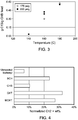
- Figure 3 shows the yield of C 13 products (g produced per g CHB fed) as a function of temperature and pressure. The rates at 140°C are low, but significant. The yield increases with temperature as is seen in Table 1 and Figure 3 .
- Undesired products include CHB decomposition to benzene and alkanes as well as xylene formation and the formation of heavier species. In these experiments, the xylene yield was less than 0.001g/g in all cases. This means that transalkylation of toluene at the benzylic carbon of CHB is much more favorable than methyl disproportionation.
- Example 1 The procedure and apparatus of Example 1 were employed but with one reactor channel being utilized to study the sequential hydrogenation and transalkylation of biphenyl in a stacked bed configuration.
- 1 gram each of a commercial platinum/palladium hydrogenation catalyst and a commercial USY catalyst were loaded in a stacked bed configuration with the hydrogenation catalyst upstream of the zeolite catalyst.
- the catalysts were dried in N 2 overnight at 260°C and then a reduction procedure followed where 5 sccm H 2 was flowed over the bed at 50 psig (345 kPa) and the temperature was ramped at 5°C/min to 290°C. This temperature was held for 3 hours and then the reactor was cooled to the starting reaction temperature of 200°C.
- a liquid feed consisting of 10% biphenyl and 90% toluene by weight was fed to the reactor at 1 WHSV (total) with a co-feed of hydrogen at a 2:1 hydrogen to hydrocarbon molar ratio.
- the liquid feed used in this test was a mixture of 90% anhydrous toluene and 10% 2,3' DMBP. Hydrogen to hydrocarbon ratio of 2:1 (molar) was used. The total WHSV used in this experiment was 1, the reaction pressure was 175 psig (1308 kPa-absolute) and the temperature was 165°C or 185°C.
- Table 2 Ratio USY:Pd/MCM-49 1 1 3 Time on stream (days) 3 6 3 Temperature (°C) 165 185 165 Pressure (psig (kPa)) 175 (1207) 175 (1207) 175 (1207) 2,3' DMBP conversion 38% 57% 53% Toluene conversion 47% 24% 28% g 2,3' DMBP/ g product 6% 4% 5% g 2,X' MCHT/ g product 5% 4% 5% g bimethylcyclohexane (BCMH)/ g product 2% 1% 1% 1%
Landscapes
- Chemical & Material Sciences (AREA)
- Organic Chemistry (AREA)
- Engineering & Computer Science (AREA)
- Analytical Chemistry (AREA)
- Oil, Petroleum & Natural Gas (AREA)
- Water Supply & Treatment (AREA)
- Chemical Kinetics & Catalysis (AREA)
- Organic Low-Molecular-Weight Compounds And Preparation Thereof (AREA)
- Catalysts (AREA)
Description
- This invention relates to a process for preparing a mixture of dialkylbiphenyl isomers, particularly a mixture of dimethylbiphenyl isomers having an increased concentration of the 3,3', 3,4', and 4,4' isomers.
- Dimethylbiphenyl (DMBP) and other dialkylbiphenyls are useful intermediates in the production of a variety of commercially valuable products, including polyesters and plasticizers for PVC and other polymer compositions. For example, DMBP can readily be converted to an ester plasticizer by a process comprising oxidation of the DMBP to produce the corresponding mono- or dicarboxylic acid followed by esterification with a long chain alcohol. However, for certain uses, it is important to reduce the level of 2,X' DMBP (where X' is 2', 3' and 4') isomers in the product since, for example, diphenate esters having substitution on the 2-carbons tend to be too volatile for use as plasticizers.
- As disclosed in
US 2014/0275609 A1 andUS 2014/0275605 A1 , dimethylbiphenyl may be produced by hydroalkylation of toluene followed by dehydrogenation of the resulting (methylcyclohexyl)toluene (MCHT). However, even using a selective molecular sieve catalyst for the hydroalkylation step, this process tends to yield a mixture of all six DMBP isomers, namely 2,2', 2,3' 2,4', 3,3', 3,4' and 4,4' DMBP, in which the 2,X' DMBP isomer content may be 20% by weight or more of the total DMBP product. Moreover, 2,2', 2,3' and 2,4' DMBP cannot be completely separated from unreacted MCHT by distillation due to an overlap in their vapor-liquid equilibrium properties. There is, therefore, interest in developing a process for converting 2,X' DMBP isomers into 3,3', 3,4' and 4,4' DMBP and especially a process which effects such a conversion with minimal loss of any unconverted MCHT which may be present in the DMBP feed. - The production of biphenylesters is based on the initial steps of aromatic hydroalkylation (see
US 2014/0275606 A1 ,US 2014/0275609 A1 and2014/0275605 A1 ), followed by dehydrogenation to produce biphenyls or alkylbiphenyls (seeUS 2014/0212666 A1 ,US 2014/0275609 A1 , andUS 2014/0275607 A1 ).US patent 3,928,481 relates to the preparation of polyphenyls by selective dehydrogenation of cyclohexyl benzenes. It disclosed the dehydrogenation of products of hydroalkylation to form desired aromatic hydrocarbons. - According to the present invention, it has now been found that the amount of 2,X' DMBP isomers in a DMBP isomer mixture can be reduced by a combination of hydrogenation of the DMBP back to MCHT, followed by transalkylation of the MCHT with toluene and then dehydrogenation of the transalkylation product back to DMBP. In particular, it is found that steric issues favor the transalkylation of 1-methyl-2-(X-methylcyclohexyl)benzene (where X = 2, 3 or 4) with toluene to produce 1-methyl-Y-(X-methylcyclohexyl)benzene (where Y= 3 or 4 and X is the same position as the feed).
- In one aspect, the invention resides in a process for producing dialkylbiphenyl compounds, the process comprising:
- (a1) providing a feed comprising substituted cyclohexylbenzene isomers having the formula (I):

- (a2) reacting the feed under transalkylation conditions with a compound of formula (II):

- wherein R1* is an alkyl group,
- to produce a transalkylation product comprising substituted cyclohexylbenzene isomers having the formula (I) and including n % by weight of isomers in which R1 is in the 2-position, based on the total weight of substituted cyclohexylbenzene isomers in the transalkylation product, wherein n<m; and
- (a3) dehydrogenating at least part of the transalkylation product under conditions effective to convert at least part of the substituted cyclohexylbenzene isomers in the transalkylation product to dialkylbiphenyl compounds.
- In a further aspect, the invention resides in a process for reducing the amount of 2,X' dialkylbiphenyl isomers (where X' is 2', 3' and/or 4') in a first mixture containing the same, the process comprising:
- (b1) hydrogenating the first mixture under conditions effective to produce a hydrogenation product comprising substituted cyclohexylbenzene isomers having the formula (I):

- (b2) reacting the hydrogenation product under transalkylation conditions with a compound of formula (II):

- where R1* is an alkyl group,
- to produce a transalkylation product comprising substituted cyclohexylbenzene isomers having the formula (I) and including n % by weight of isomers in which R1 is in the 2-position, based on the total weight of substituted cyclohexylbenzene isomers in the transalkylation product, wherein n<m; and
- (b3) dehydrogenating at least part of the substituted cyclohexylbenzene isomers in the transalkylation product to produce a product mixture containing less 2,3' and 2,4' dialkylbiphenyl isomers than the first mixture.
- In yet a further aspect, the invention resides in a process for producing dimethylbiphenyl compounds, the process comprising:
- (c1) contacting toluene with hydrogen under hydroalkylation conditions effective to produce a hydroalkylation product comprising (methylcyclohexyl)toluenes;
- (c2) dehydrogenating at least part of the hydroalkylation product under conditions effective to produce a first dehydrogenation product comprising dimethylbiphenyl isomers and unreacted (methylcyclohexyl)toluenes;
- (c3) separating the first dehydrogenation product into a first fraction comprising one or more 3,3', 3,4' and 4,4' dimethylbiphenyl isomers and a second fraction comprising one or more 2,X'-dimethylbiphenyl isomers (where X' is 2, 3 or 4) and at least part of the unreacted (methylcyclohexyl)toluenes;
- (c4) hydrogenating at least part of the dimethylbiphenyl isomers in the second fraction to the corresponding (methylcyclohexyl)toluene isomers and produce a hydrogenation effluent;
- (c5) reacting at least part of the hydrogenation effluent from (c4) with toluene under transalkylation conditions effective to produce a transalkylation product containing less material represented by Formula (X) than the hydrogenation effluent, where Formula (X) is

- (c6) dehydrogenating at least part of the transalkylation product to produce a second dehydrogenation product comprising less 2,X'-dimethylbiphenyl isomers than the first dehydrogenation product.
-
-
Figure 1 is a flow diagram of a process for producing a mixture of dimethylbiphenyl isomers according to one embodiment of the invention. -
Figure 2 is a flow diagram of a process for producing a mixture of dimethylbiphenyl isomers according to a further embodiment of the invention. -
Figure 3 is a graph of C13 yield as a function of temperature at different pressures in the translkylation of cyclohexylbenzene with toluene according to Example 1. -
Figure 4 is bar graph showing the normalized weight percent of major reactor effluent liquid species ofcarbon number 12 or higher for the sequential hydrogenation and transalkylation process of Example 2. - Described herein is a process for producing dialkylbiphenyl compounds useful as precursors in the manufacture of polyesters and biphenyl ester plasticizers. In particular, the present process provides a route for the production of a mixture of dialkylbiphenyl isomers in which the amount of the 3,3', 3,4' and 4,4'-dialkylbiphenyl isomerizers is maximized and the amount of the 2,X' dialkylbiphenyl isomers (where X' is 2', 3' and/or 4') is minimized.
- By way of illustration, the 3,3', 3,4' and 4,4'-isomers of dimethylbiphenyl are shown below in formulas (III) to (V) respectively, whereas the 2,2', 2,3' and 2,4'-isomers are shown in formulas (VI) to (VIII) respectively:


- In its simplest form, the present process starts with a feed comprising a first mixture of substituted cyclohexylbenzene isomers having the formula (I):

- In the present process, the feed comprising the mixture of substituted cyclohexylbenzene isomers having the formula (I) is initially transalkylated with a compound of formula (II):

- The transalkylation reaction can be conducted over a wide range of conditions but in most embodiments is effected at a temperature from 75°C to 250°C, such as from 100°C to 200°C, for example 125°C to 160°C and a pressure from 100 to 3550 kPa-absolute, such as from 1000 to 1500 kPa-absolute. The reaction is normally conducted in the presence of a solid acid catalyst, such as a molecular sieve and in particular a molecular sieve having a large pore molecular sieve having a Constraint Index (as defined in
US 4,016,218 ) less than 2. Suitable large pore molecular sieves include zeolite beta, zeolite Y, Ultrastable Y (USY), Dealuminized Y (Deal Y), mordenite, ZSM-3, ZSM-4, ZSM-18, ZSM-20, and mixtures thereof. Other suitable molecular sieves include molecular sieves of the MCM-22 family, including MCM-22 (described inUS 4,954,325 ), PSH-3 (described inUS 4,439,409 ), SSZ-25 (described inUS 4,826,667 ), ERB-1 (described inEP 0293032 ), ITQ-1 (described inUS 6,077,498 ), ITQ-2 (described inWO 97/17290 US 5,250,277 ), MCM-49 (described inUS 5,236,575 ), MCM-56 (described inUS 5,362,697 ) and mixtures thereof. - According to the present process, at least part of the transalkylation product is then catalytically dehydrogenated to produce the desired mixture of dialkylbiphenyl isomers. The catalyst employed in the dehydrogenation process is not critical but, in some embodiments, comprises (i) an element or compound thereof from
Group 10 of the Periodic Table of Elements, for example platinum, and (ii) tin or a compound of tin, both mounted on a refractory support, such as silica, alumina or carbon nanotubes. Suitable catalysts comprise aGroup 10 element in an amount from 0.1 to 5 wt% of the catalyst and tin in an amount from 0.05 to 2.5 wt% of the catalyst. The dehydrogenation is conveniently conducted at a temperature from about 200°C to about 600°C and a pressure from about 100 kPa-absolute to about 3550 kPa-absolute (atmospheric to about 500 psig). - The amount of 2,X' isomers in the resultant mixture of dialkylbiphenyl isomers will of course depend on the value of n in the substituted cyclohexylbenzene isomers produced by the transalkylation step and the level of conversion of each MCHT isomer in the dehydrogenation step. However, in representative embodiments, the dehydrogenation product contains less than 30%, for example from 10 to 25% of 2,X'-dialkylbiphenyl isomers based on the total weight of dialkylbiphenyl compounds in the dehydrogenation product.
- Although any known method can be used to produce the mixture of substituted cyclohexylbenzene isomers having the formula (I) employed as the feed in the above-described process, in one embodiment the feed is produced by hydrogenation of a precursor mixture of dialkylbiphenyl isomers. In this case, the overall process can be summarized as follows:
- (i) Hydrogenation of a precursor dialkylbiphenyl isomer mixture to produce a first mixture of substituted cyclohexylbenzene isomers having the formula (I).
- (ii) Transalkylation of the product of (i) with a compound of formula (II) to produce a second mixture of substituted cyclohexylbenzene isomers having a different isomer distribution than the first mixture.
- (iii) Dehydrogenation of the product of (ii) to produce a further dialkylbiphenyl isomer mixture having a different isomer distribution than the precursor mixture.
- In the above embodiment, the present process effectively provides a three-step method of isomerizing a mixture of dialkylbiphenyl isomers so as to reduce the level of 2,X' isomers in the mixture.
- In one preferred embodiment, where each of R1 and R2 in formula (I) is a methyl group, the present process forms part of the product recovery system of an integrated process for selectively converting toluene to 3,3', 3,4' and 4,4' dimethylbiphenyl. In such a process, toluene is initially converted to (methylcyclohexyl)toluenes over a hydroalkylation catalyst according to the following reaction:

- The catalyst employed in the hydroalkylation reaction is a bifunctional catalyst comprising a hydrogenation component and a solid acid alkylation component, typically a molecular sieve. The catalyst may also include a binder such as clay, alumina, silica and/or metal oxides. The latter may be either naturally occurring or in the form of gelatinous precipitates or gels including mixtures of silica and metal oxides. Naturally occurring clays which can be used as a binder include those of the montmorillonite and kaolin families, which families include the subbentonites and the kaolins commonly known as Dixie, McNamee, Georgia and Florida clays or others in which the main mineral constituent is halloysite, kaolinite, dickite, nacrite or anauxite. Such clays can be used in the raw state as originally mined or initially subjected to calcination, acid treatment or chemical modification. Suitable metal oxide binders include silica, alumina, zirconia, titania, silica-alumina, silica-magnesia, silica-zirconia, silica-thoria, silica-beryllia, silica-titania as well as ternary compositions such as silica-alumina-thoria, silica-alumina-zirconia, silica-alumina-magnesia and silica-magnesia-zirconia.
- Any known hydrogenation metal or compound thereof can be employed as the hydrogenation component of the catalyst, although suitable metals include palladium, ruthenium, nickel, zinc, tin, and cobalt, with palladium being particularly advantageous. In certain embodiments, the amount of hydrogenation metal present in the catalyst is between about 0.05 and about 10 wt%, such as between about 0.1 and about 5 wt%, of the catalyst. In an embodiment, the hydrogenation catalyst (used in step (b1)) is a transition metal, preferably a
Group - In one embodiment, the solid acid alkylation component comprises a large pore molecular sieve having a Constraint Index (as defined in
US 4,016,218 ) less than 2. Suitable large pore molecular sieves include zeolite beta, zeolite Y, Ultrastable Y (USY), Dealuminized Y (Deal Y), mordenite, ZSM-3, ZSM-4, ZSM-18, and ZSM-20. Zeolite ZSM-4 is described inUS 4,021,447 . Zeolite ZSM-20 is described inUS 3,972,983 . Zeolite Beta is described inUS 3,308,069 , andRe. 28,341 . Low sodium Ultrastable Y molecular sieve (USY) is described inUS 3,293,192 and3,449,070 . Dealuminized Y zeolite (Deal Y) may be prepared by the method found inUS 3,442,795 . Zeolite UHP-Y is described inUS 4,401,556 . Mordenite is a naturally occurring material but is also available in synthetic forms, such as TEA-mordenite (i.e., synthetic mordenite prepared from a reaction mixture comprising a tetraethylammonium directing agent). TEA-mordenite is disclosed inUS 3,766,093 and3,894,104 . - In another more preferred embodiment, the solid acid alkylation component comprises a molecular sieve of the MCM-22 family. The term "MCM-22 family material" (or "material of the MCM-22 family" or "molecular sieve of the MCM-22 family"), as used herein, includes one or more of:
- molecular sieves made from a common first degree crystalline building block unit cell, which unit cell has the MWW framework topology. (A unit cell is a spatial arrangement of atoms which if tiled in three-dimensional space describes the crystal structure. Such crystal structures are discussed in the "Atlas of Zeolite Framework Types", Fifth edition, 2001);
- molecular sieves made from a common second degree building block, being a 2-dimensional tiling of such MWW framework topology unit cells, forming a monolayer of one unit cell thickness, preferably one c-unit cell thickness;
- molecular sieves made from common second degree building blocks, being layers of one or more than one unit cell thickness, wherein the layer of more than one unit cell thickness is made from stacking, packing, or binding at least two monolayers of one unit cell thickness. The stacking of such second degree building blocks can be in a regular fashion, an irregular fashion, a random fashion, or any combination thereof; and
- molecular sieves made by any regular or random 2-dimensional or 3-dimensional combination of unit cells having the MWW framework topology.
- Molecular sieves of MCM-22 family generally have an X-ray diffraction pattern including d-spacing maxima at 12.4±0.25, 6.9±0.15, 3.57±0.07 and 3.42±0.07 Angstrom. The X-ray diffraction data used to characterize the material are obtained by standard techniques using the K-alpha doublet of copper as the incident radiation and a diffractometer equipped with a scintillation counter and associated computer as the collection system. Molecular sieves of MCM-22 family include MCM-22 (described in
US 4,954,325 ), PSH-3 (described inUS 4,439,409 ), SSZ-25 (described inUS 4,826,667 ), ERB-1 (described inEP 0293032 ), ITQ-1 (described inUS 6,077,498 ), ITQ-2 (described inWO 97/17290 US 5,250,277 ), MCM-49 (described inUS 5,236,575 ), MCM-56 (described inUS 5,362,697 ) and mixtures thereof. - In addition to the toluene, benzene and/or xylene and hydrogen, a diluent, which is substantially inert under hydroalkylation conditions, may be included in the feed to the hydroalkylation reaction. In certain embodiments, the diluent is a hydrocarbon, in which the desired cycloalkylaromatic product is soluble, such as a straight chain paraffinic hydrocarbon, a branched chain paraffinic hydrocarbon, and/or a cyclic paraffinic hydrocarbon. Examples of suitable diluents are decane and cyclohexane. Although the amount of diluent is not narrowly defined, desirably the diluent is added in an amount such that the weight ratio of the diluent to the aromatic compound is at least 1:100; for example at least 1:10, but no more than 10:1, desirably no more than 4:1.
- The hydroalkylation reaction can be conducted in a wide range of reactor configurations including fixed bed, slurry reactors, and/or catalytic distillation towers. In addition, the hydroalkylation reaction can be conducted in a single reaction zone or in a plurality of reaction zones, in which at least the hydrogen is introduced to the reaction in stages. Suitable reaction temperatures are between about 100°C and about 400°C, such as between about 125°C and about 250°C, while suitable reaction pressures are between about 100 and about 7,000 kPa, such as between about 500 and about 5,000 kPa. The molar ratio of hydrogen to aromatic feed is typically from about 0.15:1 to about 15:1.
- In the present process, it is found that MCM-22 family molecular sieves are particularly active and stable catalysts for the hydroalkylation of toluene or xylene. In addition, catalysts containing MCM-22 family molecular sieves exhibit improved selectivity to the 3,3'-dimethyl, the 3,4'-dimethyl, the 4,3'-dimethyl and the 4,4'-dimethyl isomers in the hydroalkylation product, while at the same time reducing the formation of fully saturated and heavy by-products. For example, using an MCM-22 family molecular sieve with a toluene feed, it is found that the hydroalkylation reaction product may comprise:
- at least 60 wt%, such as at least 70 wt%, for example at least 80 wt% of the 3,3', 3,4', 4,3' and 4,4'-isomers of (methylcyclohexyl)toluene based on the total weight of all the (methylcyclohexyl)toluene isomers;
- less than 40 wt%, such as less than 30 wt%, for example from 15 to 25 wt% of the 2,2', 2,3', and 2,4'-isomers of (methylcyclohexyl)toluene based on the total weight of all the (methylcyclohexyl)toluene isomers;
- less than 30 wt% of methylcyclohexane and less than 2% of dimethylbicyclohexane compounds; and
- less than 1 wt% of compounds containing in excess of 14 carbon atoms.
- The hydroalkylation reaction product may also contain significant amounts of residual toluene, for example, up to 50 wt%, such as up to 90 wt%, typically from 60 to 80 wt% of residual toluene based on the total weight of the hydroalkylation reaction product. Thus, the major components of the hydroalkylation reaction effluent are (methylcyclohexyl)toluenes, residual toluene and fully saturated single ring by-product (methylcyclohexane). The residual toluene and light by-products can readily be removed from the reaction effluent by, for example, distillation. The residual toluene can then be recycled to the hydroalkylation reactor, while the saturated by-products can be dehydrogenated to produce additional recyclable feed.
- The remainder of the hydroalkylation reaction effluent, composed mainly of (methylcyclohexyl)toluenes, is then dehydrogenated to convert the (methylcyclohexyl)toluenes to the corresponding methyl-substituted biphenyl compounds. The dehydrogenation is conveniently conducted at a temperature from about 200°C to about 600°C and a pressure from about 100 kPa to about 3550 kPa (atmospheric to about 500 psig) in the presence of dehydrogenation catalyst. A suitable dehydrogenation catalyst comprises one or more elements or compounds thereof selected from
Group 10 of the Periodic Table of Elements, for example platinum, on a support, such as silica, alumina or carbon nanotubes. In one embodiment, theGroup 10 element is present in amounts from 0.1 to 5 wt% of the catalyst. In some cases, the dehydrogenation catalyst may also include tin or a tin compound to improve the selectivity to the desired methyl-substituted biphenyl product. In one embodiment, the tin is present in amounts from 0.05 to 2.5 wt% of the catalyst. - Particularly using an MCM-22 family-based catalyst for the upstream hydroalkylation reaction, the product of the dehydrogenation step comprises dimethylbiphenyl compounds in which the concentration of the 3,3'-, 3,4'- and 4,4' isomers is at least 50 wt%, such as at least 60 wt%, for example at least 70 wt% based on the total weight of dimethylbiphenyl compounds. Typically, the concentration of the 2,X'-dimethylbiphenyl isomers in the dehydrogenation product is less than 50 wt%, such as less than 30 wt%, for example from 5 to 25 wt% based on the total weight of dimethylbiphenyl compounds.
- By virtue of their higher boiling point, the 3,3'-, 3,4'- and 4,4'-dimethylbiphenyl isomers can readily be separated from the hydrogenation product by distillation, but 2,2', 2,3' and 2,4' isomers cannot be completely separated from residual (methylcyclohexyl)toluenes by distillation due to an overlap in their vapor-liquid equilibrium properties. In the present process, this problem is alleviated in that, after recovery of at least some of the 3,3'-, 3,4'- and 4,4' isomers, part or all of the remaining dehydrogenation product is subjected to the three-step "isomerization" process, described above, namely hydrogenation, followed by transalkylation followed by dehydrogenation, to convert at least some of 2,X' isomers to their 3,3'-, 3,4'- and 4,4'-counterparts. This process can be repeated effectively to convert all the 2,X'-dimethylbiphenyl compounds to their more desirable 3,3'-, 3,4'- and 4,4' isomers. In addition, it is found that the loss in dimethylbiphenyl yield through conversion to unwanted by-products during the three-step "isomerization" process is very low thereby enhancing the overall selectivity and yield of the integrated process for converting toluene to 3,3'-, 3,4'- and 4,4'-dimethylbiphenyl compounds.
- One embodiment of such an integrated process is illustrated in
Figure 1 , in which toluene and hydrogen are fed by a single line 11 or, if preferred by separate lines (not shown), to ahydroalkylation unit 12. Thehydroalkylation unit 12 contains a bed of a bifunctional catalyst which comprises a hydrogenation component and a solid acid alkylation component and which converts the toluene to (methylcyclohexyl)toluene (MCHT). The effluent from thehydroalkylation unit 12, composed mainly of MCHT and unreacted toluene, is then fed vialine 13 to adehydrogenation unit 14 where the MCHT is dehydrogenated to produce dimethyldiphenyl (DMBP) and hydrogen. If preferred, distillation or other separation techniques can be implemented to concentrate the MCHT or remove hydroalkylation byproducts prior to the dehydrogenation step (stream 13). - The effluent from the
dehydrogenation unit 14 is then supplied byline 15 to aDMBP recovery system 16, including one or more distillation columns, where hydrogen and unreacted toluene are removed as overhead and recycled vialine 17 to thehydroalkylation unit 12. Also removed from the dehydrogenation effluent byDMBP recovery system 16 are a first intermediate stream rich in 3,3'-, 3,4'- and 4,4'-DMBP isomers, which is recovered as product vialine 18, and a second intermediate stream rich in 2,X'-DMBP isomers and residual MCHT, which is removed vialine 19. Heavies in the dehydrogenation effluent containing, for example, C21+ compounds from polyalkylation reactions occurring in thehydroalkylation unit 12 or methylfluorene byproduct from the dehydrogenation reactions, are collected inline 21 and recovered for use as fuel or as feedstock to other chemical processes. - Although not shown in
Figure 1 , the second intermediate stream, rich in 2,X'-DMBP isomers and residual MCHT, is supplied byline 19 to a separate isomerization section comprising a hydrogenation unit, then a transalkylation unit and finally a second dehydrogenation unit. As discussed above, the hydrogenation unit converts the 2,X'-DMBP isomers back to the corresponding MCHT isomers, then the transalkylation unit reacts the MCHT (both converted from, and residual in, the second intermediate stream) with toluene to produce a transalkylation product having a different MCHT isomer distribution that the second intermediate stream. The second dehydrogenation unit then converts the MCHT in the transalkylation product to DMBP having a different isomer distribution than that inline 15. In some embodiments, the hydrogenation unit and the transalkylation unit can be combined as a single reactor. - A second embodiment of a process for selectively converting toluene to 3,3'-, 3,4'- and 4,4'-DMBP is shown in
Figure 2 , in which like numerals indicate like components to the process shown inFigure 1 . In the process shown inFigure 2 , rather than being supplied to a separate isomerization section, the second intermediate stream, rich in 2,X'-DMBP isomers and residual MCHT, is recycled byline 19 to thehydroalkylation unit 12. In this way, the hydrogenation of the 2,X'-DMBP isomers in the second intermediate stream and transalkylation of the resulting MCHT are conducted in the same reactor as that used to hydroalkylate the toluene feed. To assist this combination of reactions, a transalkylation catalyst can be included in thehydroalkylation unit 12 in addition to the hydroalkylation catalyst. - The invention will now be more particularly described with reference to the following non-limiting Examples and
Figures 3 and 4 of the accompanying drawings. - This invention further relates to:
- 1. A process for producing dialkylbiphenyl compounds, the process comprising:
- (a1) providing a feed comprising substituted cyclohexylbenzene isomers having the formula (I):

- (a2) reacting the feed under transalkylation conditions with a compound of formula (II):

- (a3) dehydrogenating at least part of the transalkylation product under conditions effective to convert at least part of the substituted cyclohexylbenzene isomers in the transalkylation product to dialkylbiphenyl compounds.
- (a1) providing a feed comprising substituted cyclohexylbenzene isomers having the formula (I):
- 2. The process of paragraph 1, wherein each of R1*, R1 and R2 is a methyl group.
- 3. The process of
paragraph 1 or 2, wherein the reacting (a2) is conducted at a temperature of 75 to 250°C. - 4. The process of any of paragraphs 1 to 3, wherein the reacting (a2) is conducted in the presence of a solid acid catalyst.
- 5. The process of any of paragraphs 1 to 4, wherein the reacting (a2) is conducted in the presence of a solid acid catalyst comprising zeolite Y, beta or mordenite.
- 6. The process of any of paragraphs 1 to 5, wherein m is at least 15 wt% and n is less than 60 wt%.
- 7. A process for reducing the amount of 2,X' dialkylbiphenyl isomers (where X' is 2', 3' and/or 4') in a first mixture containing the same, the process comprising:
- (b1) hydrogenating the first mixture under conditions effective to produce a hydrogenation product comprising substituted cyclohexylbenzene isomers having the formula (I):

- (b2) reacting the hydrogenation product under transalkylation conditions with a compound of formula (II):

- (b3) dehydrogenating at least part of the substituted cyclohexylbenzene isomers in the transalkylation product to produce a product mixture containing less 2,3' and 2,4' dialkylbiphenyl isomers than the first mixture.
- (b1) hydrogenating the first mixture under conditions effective to produce a hydrogenation product comprising substituted cyclohexylbenzene isomers having the formula (I):
- 8. The process of
paragraph 7, wherein each of R1*, R1 and R2 is a methyl group. - 9. The process of
paragraph 7 or 8, wherein the reacting (b2) is conducted at a temperature of 75 to 250°C. - 10. The process of any one of
paragraphs 7 to 9, wherein the reacting (b2) is conducted in the presence of a solid acid catalyst. - 11. The process of any one of
paragraphs 7 to 10, wherein the reacting (b2) is conducted in the presence of a solid acid catalyst comprising zeolite Y, beta or mordenite. - 12. The process of any one of
paragraphs 7 to 11, wherein m is at least 15 wt% and n is less than 60 wt%. - 13. A process for producing dimethylbiphenyl compounds, the process comprising:
- (c1) contacting toluene with hydrogen under hydroalkylation conditions effective to produce a hydroalkylation product comprising (methylcyclohexyl)toluenes;
- (c2) dehydrogenating at least part of the hydroalkylation product under conditions effective to produce a first dehydrogenation product comprising dimethylbiphenyl isomers and unreacted (methylcyclohexyl)toluenes;
- (c3) separating the first dehydrogenation product into a first fraction comprising one or more 3,3', 3,4' and 4,4' dimethylbiphenyl isomers and a second fraction comprising one or more 2,X'-dimethylbiphenyl isomers (where X' is 2, 3, or 4) and at least part of the unreacted (methylcyclohexyl)toluenes;
- (c4) hydrogenating at least part of the dimethylbiphenyl isomers in the second fraction to the corresponding (methylcyclohexyl)toluene isomers and produce a hydrogenation effluent;
- (c5) reacting at least part of the hydrogenation effluent from (c4) with toluene under transalkylation conditions affective to produce a transalkylation product containing less material represented by Formula (X) than the hydrogenation effluent, where Formula (X) is

- (c6) dehydrogenating at least part of the transalkylation product to produce a second dehydrogenation product comprising less 2,X'-dimethylbiphenyl isomers than the first dehydrogenation product.
- 14. The process of
paragraph 13, wherein the contacting (c1) and the reacting (c5) are conducted in sequential reaction zones. - 15. The process of
paragraph 13, wherein the contacting (c1) and the reacting (c5) are conducted in the same reaction zone. - 16. The process of any one of
paragraphs 13 to 15, wherein the hydrogenating (c4) and the reacting (c5) are conducted in sequential reaction zones. - 17. The process of any one of
paragraphs 13 to 15, wherein the hydrogenating (c4) and the reacting (c5) are conducted in the same reaction zone. - 18. The process of
paragraph 13, wherein the contacting (c1), the hydrogenating (c4) and the reacting (c5) are conducted in the same reaction zone. - 19. The process of
paragraph 18, wherein the reaction zone contains a catalyst composition comprising a molecular sieve of the MCM-22 family, a FAU-type molecular sieve and a hydrogenation/dehydrogenation component. - 20. The process of any preceding paragraph, wherein m is at least 5 wt% and n is less than 75 wt%.
- 21. The process of any of paragraphs 1 to 20, wherein the catalyst used for hydrogenation in step (b1) comprises a transition metal.
- 22. The process of
paragraph 21, wherein the metal is aGroup - 23. The process of paragraph 22, wherein the metal is Pt or Pd.
- The experiments described in Examples 1 and 2 utilized a reactor unit with 8 parallel reactors heated by furnace. For different tests anywhere from 1-8 reactors could be utilized. The reactors used in these experiments consisted of quartz tubes of 9 mm in diameter. Annular N2 flow on the outside of the quartz reactor allowed for pressure equilibration between the inside and outside of each reactor channel. Catalyst extrudates were crushed to 20/40 mesh loaded in quantities ranging from 0.25-2g (to vary corresponding weight based space velocity) after being diluted up to 4g in crushed quartz. A quartz wool plug was used at the top and bottom of the catalyst bed to keep catalyst in place. Two sets of 4 parallel reactors were placed in heated furnaces to control isothermal reaction temperature. Each reactor contained an internal thermocouple in the catalyst bed in a 1/8" (3.175 mm) thermowell. The reactors were topped off with the same quartz chips.
- The catalysts in all reactors were pre-conditioned in situ as described in the subsequent Examples. An ISCO syringe pump was used to introduce the feed to the reactor. The feed was pumped through a vaporizer before being mixed in-line with H2 and/or N2 at a molar ratio of between 0 and 2 (gas to hydrocarbon liquid). The products exiting the reactor were condensed and collected in intervals (1-2 samples per day per reactor) and analyzed offline by GC or GCMS.
- GC analysis was conducted on an Agilent 7890 GC equipped with FID detector and an Automatic liquid sampler (ALS). Typical injection size was about 0.2µl. The columns used were from Supelco of the Dex type. A Gamma DEX column was joined together with a Beta Dex column to give a total length of 120m (60m for each type). The ID of the columns was 0.25mm. The GC was operated in constant flow mode with an I\initial pressure of about 78psi (538 kPa) and column flow of about 3.0ml/min using helium as carrier gas. The following oven procedure was employed:
- Initial temperature of 140°C, hold for 30 minutes
- Ramp 1 at 2°C/min to 180°C, hold for 20 minutes
-
Ramp 2 at 3°C/min to 220°C, hold for 7 minutes - Total analysis time of 90.33 minutes.
- A similar method was used for the GC-MS measurements. The instrument was an Agilent 7890 GC equipped with a 5975C MSD detector and FID. The main difference is that this setup had a purged 2-way splitter that enabled a sample to be simultaneously analyzed on two detectors using a single injection. The injection size was about 0.5µl. Additionally, an auxiliary helium pressure of 6 psi (41 kPa) was used for the purged splitter. The final oven time was extended by 20 minutes for a total analysis time of 110 minutes.
- In Example 1, one reactor of the reactor unit described above was utilized to study the transalkylation of cyclohexylbenzene (CHB) with toluene. 1 gram of a commercial USY catalyst was loaded into the reactor channel and the catalyst was dried in N2 overnight at 260°C. A liquid feed consisting of 33% cyclohexylbenzene and 67% toluene by weight was fed to the reactor at 1 WHSV with a co-feed of nitrogen at a 0.7:1 nitrogen to hydrocarbon molar ratio.
- The results are shown in
Figure 3 and Table 1 below.Table 1 Temperature (°C) 180 160 160 180 Pressure (psig (kPa)) 200 (1379) 200 (1379) 175 (1207) 175 (1207) Cyclohexylbenzene (CHB) conversion 87% 44% 28% 86% Moles C13H18/Moles CHB consumed 59% 88% 100% 62% - In Example 1, CHB is used as a surrogate for MCHT to test the viability of transalkylation to change the isomer distribution of MCHT.
Figure 3 shows the yield of C13 products (g produced per g CHB fed) as a function of temperature and pressure. The rates at 140°C are low, but significant. The yield increases with temperature as is seen in Table 1 andFigure 3 . These results prove the concept that MCHT transalkylation with toluene can be used to effectively change the methyl group position on the aromatic ring of the molecules. Undesired products include CHB decomposition to benzene and alkanes as well as xylene formation and the formation of heavier species. In these experiments, the xylene yield was less than 0.001g/g in all cases. This means that transalkylation of toluene at the benzylic carbon of CHB is much more favorable than methyl disproportionation. - The procedure and apparatus of Example 1 were employed but with one reactor channel being utilized to study the sequential hydrogenation and transalkylation of biphenyl in a stacked bed configuration. 1 gram each of a commercial platinum/palladium hydrogenation catalyst and a commercial USY catalyst were loaded in a stacked bed configuration with the hydrogenation catalyst upstream of the zeolite catalyst. The catalysts were dried in N2 overnight at 260°C and then a reduction procedure followed where 5 sccm H2 was flowed over the bed at 50 psig (345 kPa) and the temperature was ramped at 5°C/min to 290°C. This temperature was held for 3 hours and then the reactor was cooled to the starting reaction temperature of 200°C. A liquid feed consisting of 10% biphenyl and 90% toluene by weight was fed to the reactor at 1 WHSV (total) with a co-feed of hydrogen at a 2:1 hydrogen to hydrocarbon molar ratio.
- In this example, at 200°C and 200 psig (1480 kPa-absolute), greater than 90% of the biphenyl in the feed was converted. The major C12 or greater products were cyclohexylbenzene (CHB) and bicyclohexane (BCH) from hydrogenation of the biphenyl, cyclohexyltoluene (CHT, C13H18) from the desired sequence of hydrogenation and transalkylation, and methylcyclohexyltoluene (MCHT) which was likely a result of toluene hydroalkylation over the multiple catalyst functions. The normalized distribution of these products in the reactor effluent liquid is shown in Figure 5.
- In this Example, a study was conducted on the sequential hydrogenation and toluene transalkylation of dimethylbiphenyl in a mixed bed configuration with simultaneous toluene transalkylation. The reaction test was carried out in a fixed bed down-flow reactor having a diameter of 0.5 inch (1.3 cm). The catalysts used in the study were a mixed bed of commercial USY/Al2O3 and Pd/MCM-49 hydroalkylation catalyst (in varying ratio). The catalyst charge was 4 g. The catalyst was activated by heating up the catalyst bed to 260°C under nitrogen and drying overnight. The catalyst was then reduced in hydrogen at 290°C (ramp rate of 5°C/min) for 3 hours. Hydrogen flow rate was 50 sccm. Reactor pressure was maintained constant, at 50 psig (346 kPa-absolute), throughout catalyst activation.
- The liquid feed used in this test was a mixture of 90% anhydrous toluene and 10% 2,3' DMBP. Hydrogen to hydrocarbon ratio of 2:1 (molar) was used. The total WHSV used in this experiment was 1, the reaction pressure was 175 psig (1308 kPa-absolute) and the temperature was 165°C or 185°C. The results are shown in Table 2 below:
Table 2 Ratio USY:Pd/MCM-49 1 1 3 Time on stream (days) 3 6 3 Temperature (°C) 165 185 165 Pressure (psig (kPa)) 175 (1207) 175 (1207) 175 (1207) 2,3' DMBP conversion 38% 57% 53% Toluene conversion 47% 24% 28 % g 2,3' DMBP/ g product 6% 4% 5 % g 2,X' MCHT/ g product 5% 4% 5% g bimethylcyclohexane (BCMH)/ g product 2% 1% 1% - As is seen in Table 2, this configuration allows for the consumption of 2,3' DMBP with simultaneous hydroalkylation. It also shows the viability of consuming 2,X' DMBP and 2,X' MCHT at the same rate as 2,X' MCHT is being produced by the hydroalkylation reaction. It should be noted that direct isomerization of the 2,3' DMBP is also a possible reaction pathway for consumption in addition to the sequential hydrogenation and transalkylation described here.
- While the present invention has been described and illustrated by reference to particular embodiments, those of ordinary skill in the art will appreciate that the invention lends itself to variations not necessarily illustrated herein. For this reason, then, reference should be made solely to the appended claims for purposes of determining the true scope of the present invention.
Claims (15)
- A process for producing dialkylbiphenyl compounds, the process comprising:(a1) providing a feed comprising substituted cyclohexylbenzene isomers having the formula (I):
 (a2) reacting the feed under transalkylation conditions with a compound of formula (II):
 where R1* is an alkyl group,to produce a transalkylation product comprising substituted cyclohexylbenzene isomers having the formula (I) and including n % by weight of isomers in which R1 is in the 2-position, based on the total weight of substituted cyclohexylbenzene isomers in the transalkylation product, wherein n<m; and(a3) dehydrogenating at least part of the transalkylation product under conditions effective to convert at least part of the substituted cyclohexylbenzene isomers in the transalkylation product to dialkylbiphenyl compounds.
 - The process of claim 1, wherein each of R1*, R1 and R2 is a methyl group.
- The process of claim 1 or 2, wherein the reacting (a2) is conducted at a temperature of 75 to 250°C.
- The process of any of claims 1 to 3, wherein the reacting (a2) is conducted in the presence of a solid acid catalyst.
- The process of any of claims 1 to 4, wherein the reacting (a2) is conducted in the presence of a solid acid catalyst comprising zeolite Y, beta or mordenite.
- The process of any of claims 1 to 5, wherein m is at least 15 wt% and n is less than 60 wt%.
- A process for reducing the amount of 2,X' dialkylbiphenyl isomers (where X' is 2', 3', and/or 4') in a first mixture containing the same, the process comprising:(b1) hydrogenating the first mixture under conditions effective to produce a hydrogenation product comprising substituted cyclohexylbenzene isomers having the formula (I):
 (b2) reacting the hydrogenation product under transalkylation conditions with a compound of formula (II):
 where R1* is an alkyl group,to produce a transalkylation product comprising substituted cyclohexylbenzene isomers having the formula (I) and including n % by weight of isomers in which R1 is in the 2-position, based on the total weight of substituted cyclohexylbenzene isomers in the transalkylation product, wherein n<m; and(b3) dehydrogenating at least part of the substituted cyclohexylbenzene isomers in the transalkylation product to produce a product mixture containing less 2,3' and 2,4' dialkylbiphenyl isomers than the first mixture.
 - The process of claim 7, wherein each of R1*, R1 and R2 is a methyl group.
- The process of claim 7 or 8, wherein the reacting (b2) is conducted at a temperature of 75 to 250°C.
- The process of any of claims 7 to 9, wherein the reacting (b2) is conducted in the presence of a solid acid catalyst.
- The process of any of claims 7 to 10, wherein the reacting (b2) is conducted in the presence of a solid acid catalyst comprising zeolite Y, beta or mordenite.
- The process of any of claims 7 to 11, wherein m is at least 15 wt% and n is less than 60 wt%.
- A process for producing dimethylbiphenyl compounds, the process comprising:(c1) contacting toluene with hydrogen under hydroalkylation conditions effective to produce a hydroalkylation product comprising (methylcyclohexyl)toluenes;(c2) dehydrogenating at least part of the hydroalkylation product under conditions effective to produce a first dehydrogenation product comprising dimethylbiphenyl isomers and unreacted (methylcyclohexyl)toluenes;(c3) separating the first dehydrogenation product into a first fraction comprising one or more 3,3', 3,4' and 4,4' dimethylbiphenyl isomers and a second fraction comprising one or more 2,X'-dimethylbiphenyl isomers (where X' is 2, 3 or 4) and at least part of the unreacted (methylcyclohexyl)toluenes;(c4) hydrogenating at least part of the dimethylbiphenyl isomers in the second fraction to the corresponding (methylcyclohexyl)toluene isomers and produce a hydrogenation effluent;(c5) reacting at least part of the hydrogenation effluent from (c4) with toluene under transalkylation conditions effective to produce a transalkylation product containing less material represented by Formula (X) than the hydrogenation effluent, where Formula (X) is
 (c6) dehydrogenating at least part of the transalkylation product to produce a second dehydrogenation product comprising less 2,X'-dimethylbiphenyl isomers than the first dehydrogenation product.
 - The process of claim 13, wherein the contacting (c1), the hydrogenating (c4) and the reacting (c5) are conducted in the same reaction zone.
- The process of claim 14, wherein the reaction zone contains a catalyst composition comprising a molecular sieve of the MCM-22 family, a FAU-type molecular sieve and a hydrogenation/dehydrogenation component.
Applications Claiming Priority (3)
| Application Number | Priority Date | Filing Date | Title |
|---|---|---|---|
| US201462012024P | 2014-06-13 | 2014-06-13 | |
| EP14177011 | 2014-07-15 | ||
| PCT/US2015/032795 WO2015191289A1 (en) | 2014-06-13 | 2015-05-28 | Process for preparing dialkylbiphenyl isomer mixtures |
Publications (3)
| Publication Number | Publication Date |
|---|---|
| EP3154922A1 EP3154922A1 (en) | 2017-04-19 |
| EP3154922A4 EP3154922A4 (en) | 2017-06-21 |
| EP3154922B1 true EP3154922B1 (en) | 2018-12-19 |
Family
ID=51176256
Family Applications (1)
| Application Number | Title | Priority Date | Filing Date |
|---|---|---|---|
| EP15805903.0A Not-in-force EP3154922B1 (en) | 2014-06-13 | 2015-05-28 | Process for preparing dialkylbiphenyl isomer mixtures |
Country Status (3)
| Country | Link |
|---|---|
| EP (1) | EP3154922B1 (en) |
| CN (1) | CN106414381B (en) |
| WO (1) | WO2015191289A1 (en) |
Families Citing this family (5)
| Publication number | Priority date | Publication date | Assignee | Title |
|---|---|---|---|---|
| US10550050B2 (en) | 2017-02-01 | 2020-02-04 | Exxonmobil Research And Engineering Company | Processes for separating dimethyl biphenyl isomers using zeolite adsorbents |
| US10093597B1 (en) | 2018-02-01 | 2018-10-09 | Exxonmobil Research And Engineering Company | Processes for separating dimethyl biphenyl isomers using zeolite adsorbents |
| US10676412B2 (en) | 2018-03-30 | 2020-06-09 | Exxonmobil Research & Engineering Company | Production and separation of dimethyl biphenyl isomers |
| US10676413B2 (en) | 2018-03-30 | 2020-06-09 | Exxonmobil Research & Engineering Company | Production and separation of dimethyl biphenyl isomers |
| US10858298B2 (en) | 2018-04-12 | 2020-12-08 | Exxonmobil Research And Engineering Company | Preparation of diphenyl compounds |
Family Cites Families (6)
| Publication number | Priority date | Publication date | Assignee | Title |
|---|---|---|---|---|
| US3928481A (en) * | 1974-07-05 | 1975-12-23 | Texaco Inc | Preparation of polyphenyls |
| US4123470A (en) * | 1977-06-06 | 1978-10-31 | Phillips Petroleum Company | Biaryl production |
| JP2614329B2 (en) * | 1989-09-19 | 1997-05-28 | 新日鐵化学株式会社 | Method for producing 4,4'-dialkylbiphenyl |
| JPH07173086A (en) * | 1993-12-16 | 1995-07-11 | Cosmo Sogo Kenkyusho:Kk | Method for producing dialkylbiphenyls |
| US6433236B1 (en) * | 2000-03-21 | 2002-08-13 | Arteva North America S.A.R.L. | Acid catalyzed isomerization of substituted diaryls |
| RU2003133192A (en) * | 2003-11-12 | 2005-05-10 | Дженерал Электрик Компани (US) | CONTINUOUS PRODUCTION OF 4, 4-DIISOPROPYLBIPHENIL |
-
2015
- 2015-05-28 WO PCT/US2015/032795 patent/WO2015191289A1/en not_active Ceased
- 2015-05-28 CN CN201580024957.2A patent/CN106414381B/en not_active Expired - Fee Related
- 2015-05-28 EP EP15805903.0A patent/EP3154922B1/en not_active Not-in-force
Non-Patent Citations (1)
| Title |
|---|
| None * |
Also Published As
| Publication number | Publication date |
|---|---|
| WO2015191289A1 (en) | 2015-12-17 |
| EP3154922A4 (en) | 2017-06-21 |
| CN106414381B (en) | 2018-12-28 |
| CN106414381A (en) | 2017-02-15 |
| EP3154922A1 (en) | 2017-04-19 |
Similar Documents
| Publication | Publication Date | Title |
|---|---|---|
| US9896393B2 (en) | Process for preparing dialkylbiphenyl isomer mixtures | |
| US7579511B1 (en) | Process for making cyclohexylbenzene | |
| US9556087B2 (en) | Methyl-substituted biphenyl compounds, their production and their use in the manufacture of plasticizers | |
| US9856186B2 (en) | Production and use of dialkylbiphenyl isomer mixtures | |
| KR20150119091A (en) | Methyl-substituted biphenyl compounds, their production and their use in the manufacture of plasticizers | |
| WO2015191289A1 (en) | Process for preparing dialkylbiphenyl isomer mixtures | |
| US9708230B2 (en) | Production of biphenyl compounds | |
| EP3277649B1 (en) | Transalkylated cyclohexylbenzyl and biphenyl compounds | |
| US10787399B2 (en) | Preparation and use of phenylstyrene | |
| EP3442932B1 (en) | Production of methyl-substituted biphenyl compounds | |
| EP3274318B1 (en) | Production of biphenyl compounds | |
| US11198660B2 (en) | Production of methyl-substituted biphenyl compounds | |
| US20200325096A1 (en) | Oxidation of Methyl-substituted Biphenyl Compounds | |
| TWI615382B (en) | Manufacture and use of phenyl styrene | |
| TWI600640B (en) | Transalkylated cyclohexylbenzyl and biphenyl compounds | |
| CN107001184A (en) | The production of dialkyl group biphenyl isomer mixture and purposes |
Legal Events
| Date | Code | Title | Description |
|---|---|---|---|
| STAA | Information on the status of an ep patent application or granted ep patent |
Free format text: STATUS: THE INTERNATIONAL PUBLICATION HAS BEEN MADE |
|
| PUAI | Public reference made under article 153(3) epc to a published international application that has entered the european phase |
Free format text: ORIGINAL CODE: 0009012 |
|
| STAA | Information on the status of an ep patent application or granted ep patent |
Free format text: STATUS: REQUEST FOR EXAMINATION WAS MADE |
|
| 17P | Request for examination filed |
Effective date: 20161227 |
|
| AK | Designated contracting states |
Kind code of ref document: A1 Designated state(s): AL AT BE BG CH CY CZ DE DK EE ES FI FR GB GR HR HU IE IS IT LI LT LU LV MC MK MT NL NO PL PT RO RS SE SI SK SM TR |
|
| AX | Request for extension of the european patent |
Extension state: BA ME |
|
| REG | Reference to a national code |
Ref country code: DE Ref legal event code: R079 Ref document number: 602015022009 Country of ref document: DE Free format text: PREVIOUS MAIN CLASS: C07C0005320000 Ipc: C07C0002740000 |
|
| A4 | Supplementary search report drawn up and despatched |
Effective date: 20170522 |
|
| RIC1 | Information provided on ipc code assigned before grant |
Ipc: C07C 15/16 20060101ALI20170516BHEP Ipc: C07C 7/04 20060101ALI20170516BHEP Ipc: C07C 13/28 20060101ALI20170516BHEP Ipc: C07C 5/367 20060101ALI20170516BHEP Ipc: C07C 5/11 20060101ALI20170516BHEP Ipc: C07C 6/08 20060101ALI20170516BHEP Ipc: C07C 2/74 20060101AFI20170516BHEP |
|
| DAV | Request for validation of the european patent (deleted) | ||
| DAX | Request for extension of the european patent (deleted) | ||
| GRAP | Despatch of communication of intention to grant a patent |
Free format text: ORIGINAL CODE: EPIDOSNIGR1 |
|
| STAA | Information on the status of an ep patent application or granted ep patent |
Free format text: STATUS: GRANT OF PATENT IS INTENDED |
|
| INTG | Intention to grant announced |
Effective date: 20180712 |
|
| GRAS | Grant fee paid |
Free format text: ORIGINAL CODE: EPIDOSNIGR3 |
|
| GRAA | (expected) grant |
Free format text: ORIGINAL CODE: 0009210 |
|
| STAA | Information on the status of an ep patent application or granted ep patent |
Free format text: STATUS: THE PATENT HAS BEEN GRANTED |
|
| AK | Designated contracting states |
Kind code of ref document: B1 Designated state(s): AL AT BE BG CH CY CZ DE DK EE ES FI FR GB GR HR HU IE IS IT LI LT LU LV MC MK MT NL NO PL PT RO RS SE SI SK SM TR |
|
| REG | Reference to a national code |
Ref country code: GB Ref legal event code: FG4D |
|
| REG | Reference to a national code |
Ref country code: CH Ref legal event code: EP |
|
| REG | Reference to a national code |
Ref country code: IE Ref legal event code: FG4D |
|
| REG | Reference to a national code |
Ref country code: DE Ref legal event code: R096 Ref document number: 602015022009 Country of ref document: DE |
|
| REG | Reference to a national code |
Ref country code: AT Ref legal event code: REF Ref document number: 1078524 Country of ref document: AT Kind code of ref document: T Effective date: 20190115 |
|
| REG | Reference to a national code |
Ref country code: NL Ref legal event code: MP Effective date: 20181219 |
|
| PG25 | Lapsed in a contracting state [announced via postgrant information from national office to epo] |
Ref country code: BG Free format text: LAPSE BECAUSE OF FAILURE TO SUBMIT A TRANSLATION OF THE DESCRIPTION OR TO PAY THE FEE WITHIN THE PRESCRIBED TIME-LIMIT Effective date: 20190319 Ref country code: FI Free format text: LAPSE BECAUSE OF FAILURE TO SUBMIT A TRANSLATION OF THE DESCRIPTION OR TO PAY THE FEE WITHIN THE PRESCRIBED TIME-LIMIT Effective date: 20181219 Ref country code: HR Free format text: LAPSE BECAUSE OF FAILURE TO SUBMIT A TRANSLATION OF THE DESCRIPTION OR TO PAY THE FEE WITHIN THE PRESCRIBED TIME-LIMIT Effective date: 20181219 Ref country code: LV Free format text: LAPSE BECAUSE OF FAILURE TO SUBMIT A TRANSLATION OF THE DESCRIPTION OR TO PAY THE FEE WITHIN THE PRESCRIBED TIME-LIMIT Effective date: 20181219 Ref country code: LT Free format text: LAPSE BECAUSE OF FAILURE TO SUBMIT A TRANSLATION OF THE DESCRIPTION OR TO PAY THE FEE WITHIN THE PRESCRIBED TIME-LIMIT Effective date: 20181219 Ref country code: NO Free format text: LAPSE BECAUSE OF FAILURE TO SUBMIT A TRANSLATION OF THE DESCRIPTION OR TO PAY THE FEE WITHIN THE PRESCRIBED TIME-LIMIT Effective date: 20190319 |
|
| REG | Reference to a national code |
Ref country code: LT Ref legal event code: MG4D |
|
| REG | Reference to a national code |
Ref country code: AT Ref legal event code: MK05 Ref document number: 1078524 Country of ref document: AT Kind code of ref document: T Effective date: 20181219 |
|
| PG25 | Lapsed in a contracting state [announced via postgrant information from national office to epo] |
Ref country code: GR Free format text: LAPSE BECAUSE OF FAILURE TO SUBMIT A TRANSLATION OF THE DESCRIPTION OR TO PAY THE FEE WITHIN THE PRESCRIBED TIME-LIMIT Effective date: 20190320 Ref country code: RS Free format text: LAPSE BECAUSE OF FAILURE TO SUBMIT A TRANSLATION OF THE DESCRIPTION OR TO PAY THE FEE WITHIN THE PRESCRIBED TIME-LIMIT Effective date: 20181219 Ref country code: SE Free format text: LAPSE BECAUSE OF FAILURE TO SUBMIT A TRANSLATION OF THE DESCRIPTION OR TO PAY THE FEE WITHIN THE PRESCRIBED TIME-LIMIT Effective date: 20181219 Ref country code: AL Free format text: LAPSE BECAUSE OF FAILURE TO SUBMIT A TRANSLATION OF THE DESCRIPTION OR TO PAY THE FEE WITHIN THE PRESCRIBED TIME-LIMIT Effective date: 20181219 |
|
| PG25 | Lapsed in a contracting state [announced via postgrant information from national office to epo] |
Ref country code: NL Free format text: LAPSE BECAUSE OF FAILURE TO SUBMIT A TRANSLATION OF THE DESCRIPTION OR TO PAY THE FEE WITHIN THE PRESCRIBED TIME-LIMIT Effective date: 20181219 |
|
| PG25 | Lapsed in a contracting state [announced via postgrant information from national office to epo] |
Ref country code: PL Free format text: LAPSE BECAUSE OF FAILURE TO SUBMIT A TRANSLATION OF THE DESCRIPTION OR TO PAY THE FEE WITHIN THE PRESCRIBED TIME-LIMIT Effective date: 20181219 Ref country code: IT Free format text: LAPSE BECAUSE OF FAILURE TO SUBMIT A TRANSLATION OF THE DESCRIPTION OR TO PAY THE FEE WITHIN THE PRESCRIBED TIME-LIMIT Effective date: 20181219 Ref country code: CZ Free format text: LAPSE BECAUSE OF FAILURE TO SUBMIT A TRANSLATION OF THE DESCRIPTION OR TO PAY THE FEE WITHIN THE PRESCRIBED TIME-LIMIT Effective date: 20181219 Ref country code: PT Free format text: LAPSE BECAUSE OF FAILURE TO SUBMIT A TRANSLATION OF THE DESCRIPTION OR TO PAY THE FEE WITHIN THE PRESCRIBED TIME-LIMIT Effective date: 20190419 Ref country code: ES Free format text: LAPSE BECAUSE OF FAILURE TO SUBMIT A TRANSLATION OF THE DESCRIPTION OR TO PAY THE FEE WITHIN THE PRESCRIBED TIME-LIMIT Effective date: 20181219 |
|
| PG25 | Lapsed in a contracting state [announced via postgrant information from national office to epo] |
Ref country code: SK Free format text: LAPSE BECAUSE OF FAILURE TO SUBMIT A TRANSLATION OF THE DESCRIPTION OR TO PAY THE FEE WITHIN THE PRESCRIBED TIME-LIMIT Effective date: 20181219 Ref country code: IS Free format text: LAPSE BECAUSE OF FAILURE TO SUBMIT A TRANSLATION OF THE DESCRIPTION OR TO PAY THE FEE WITHIN THE PRESCRIBED TIME-LIMIT Effective date: 20190419 Ref country code: EE Free format text: LAPSE BECAUSE OF FAILURE TO SUBMIT A TRANSLATION OF THE DESCRIPTION OR TO PAY THE FEE WITHIN THE PRESCRIBED TIME-LIMIT Effective date: 20181219 Ref country code: SM Free format text: LAPSE BECAUSE OF FAILURE TO SUBMIT A TRANSLATION OF THE DESCRIPTION OR TO PAY THE FEE WITHIN THE PRESCRIBED TIME-LIMIT Effective date: 20181219 Ref country code: RO Free format text: LAPSE BECAUSE OF FAILURE TO SUBMIT A TRANSLATION OF THE DESCRIPTION OR TO PAY THE FEE WITHIN THE PRESCRIBED TIME-LIMIT Effective date: 20181219 |
|
| REG | Reference to a national code |
Ref country code: DE Ref legal event code: R097 Ref document number: 602015022009 Country of ref document: DE |
|
| PLBE | No opposition filed within time limit |
Free format text: ORIGINAL CODE: 0009261 |
|
| STAA | Information on the status of an ep patent application or granted ep patent |
Free format text: STATUS: NO OPPOSITION FILED WITHIN TIME LIMIT |
|
| PG25 | Lapsed in a contracting state [announced via postgrant information from national office to epo] |
Ref country code: AT Free format text: LAPSE BECAUSE OF FAILURE TO SUBMIT A TRANSLATION OF THE DESCRIPTION OR TO PAY THE FEE WITHIN THE PRESCRIBED TIME-LIMIT Effective date: 20181219 Ref country code: DK Free format text: LAPSE BECAUSE OF FAILURE TO SUBMIT A TRANSLATION OF THE DESCRIPTION OR TO PAY THE FEE WITHIN THE PRESCRIBED TIME-LIMIT Effective date: 20181219 |
|
| 26N | No opposition filed |
Effective date: 20190920 |
|
| REG | Reference to a national code |
Ref country code: CH Ref legal event code: PL |
|
| GBPC | Gb: european patent ceased through non-payment of renewal fee |
Effective date: 20190528 |
|
| PG25 | Lapsed in a contracting state [announced via postgrant information from national office to epo] |
Ref country code: MC Free format text: LAPSE BECAUSE OF FAILURE TO SUBMIT A TRANSLATION OF THE DESCRIPTION OR TO PAY THE FEE WITHIN THE PRESCRIBED TIME-LIMIT Effective date: 20181219 Ref country code: CH Free format text: LAPSE BECAUSE OF NON-PAYMENT OF DUE FEES Effective date: 20190531 Ref country code: LI Free format text: LAPSE BECAUSE OF NON-PAYMENT OF DUE FEES Effective date: 20190531 |
|
| REG | Reference to a national code |
Ref country code: BE Ref legal event code: MM Effective date: 20190531 |
|
| PG25 | Lapsed in a contracting state [announced via postgrant information from national office to epo] |
Ref country code: SI Free format text: LAPSE BECAUSE OF FAILURE TO SUBMIT A TRANSLATION OF THE DESCRIPTION OR TO PAY THE FEE WITHIN THE PRESCRIBED TIME-LIMIT Effective date: 20181219 Ref country code: LU Free format text: LAPSE BECAUSE OF NON-PAYMENT OF DUE FEES Effective date: 20190528 |
|
| PG25 | Lapsed in a contracting state [announced via postgrant information from national office to epo] |
Ref country code: TR Free format text: LAPSE BECAUSE OF FAILURE TO SUBMIT A TRANSLATION OF THE DESCRIPTION OR TO PAY THE FEE WITHIN THE PRESCRIBED TIME-LIMIT Effective date: 20181219 |
|
| PG25 | Lapsed in a contracting state [announced via postgrant information from national office to epo] |
Ref country code: IE Free format text: LAPSE BECAUSE OF NON-PAYMENT OF DUE FEES Effective date: 20190528 Ref country code: GB Free format text: LAPSE BECAUSE OF NON-PAYMENT OF DUE FEES Effective date: 20190528 |
|
| PG25 | Lapsed in a contracting state [announced via postgrant information from national office to epo] |
Ref country code: BE Free format text: LAPSE BECAUSE OF NON-PAYMENT OF DUE FEES Effective date: 20190531 |
|
| PG25 | Lapsed in a contracting state [announced via postgrant information from national office to epo] |
Ref country code: FR Free format text: LAPSE BECAUSE OF NON-PAYMENT OF DUE FEES Effective date: 20190531 |
|
| PGFP | Annual fee paid to national office [announced via postgrant information from national office to epo] |
Ref country code: DE Payment date: 20200417 Year of fee payment: 6 |
|
| PG25 | Lapsed in a contracting state [announced via postgrant information from national office to epo] |
Ref country code: CY Free format text: LAPSE BECAUSE OF FAILURE TO SUBMIT A TRANSLATION OF THE DESCRIPTION OR TO PAY THE FEE WITHIN THE PRESCRIBED TIME-LIMIT Effective date: 20181219 |
|
| PG25 | Lapsed in a contracting state [announced via postgrant information from national office to epo] |
Ref country code: HU Free format text: LAPSE BECAUSE OF FAILURE TO SUBMIT A TRANSLATION OF THE DESCRIPTION OR TO PAY THE FEE WITHIN THE PRESCRIBED TIME-LIMIT; INVALID AB INITIO Effective date: 20150528 Ref country code: MT Free format text: LAPSE BECAUSE OF FAILURE TO SUBMIT A TRANSLATION OF THE DESCRIPTION OR TO PAY THE FEE WITHIN THE PRESCRIBED TIME-LIMIT Effective date: 20181219 |
|
| REG | Reference to a national code |
Ref country code: DE Ref legal event code: R119 Ref document number: 602015022009 Country of ref document: DE |
|
| PG25 | Lapsed in a contracting state [announced via postgrant information from national office to epo] |
Ref country code: DE Free format text: LAPSE BECAUSE OF NON-PAYMENT OF DUE FEES Effective date: 20211201 |
|
| PG25 | Lapsed in a contracting state [announced via postgrant information from national office to epo] |
Ref country code: MK Free format text: LAPSE BECAUSE OF FAILURE TO SUBMIT A TRANSLATION OF THE DESCRIPTION OR TO PAY THE FEE WITHIN THE PRESCRIBED TIME-LIMIT Effective date: 20181219 |