EP3153496B1 - Method for preparing azetidinone compound and intermediate of azetidinone compound - Google Patents
Method for preparing azetidinone compound and intermediate of azetidinone compound Download PDFInfo
- Publication number
- EP3153496B1 EP3153496B1 EP15805807.3A EP15805807A EP3153496B1 EP 3153496 B1 EP3153496 B1 EP 3153496B1 EP 15805807 A EP15805807 A EP 15805807A EP 3153496 B1 EP3153496 B1 EP 3153496B1
- Authority
- EP
- European Patent Office
- Prior art keywords
- formula
- compound
- acid
- reaction
- molar ratio
- Prior art date
- Legal status (The legal status is an assumption and is not a legal conclusion. Google has not performed a legal analysis and makes no representation as to the accuracy of the status listed.)
- Active
Links
- 0 *OC(C(c(cc1)ccc1F)=CCCC(O)=O)=O Chemical compound *OC(C(c(cc1)ccc1F)=CCCC(O)=O)=O 0.000 description 11
- CKNBXFUUQFNYAS-WTDSWWLTSA-N OC/C(/c(cc1)ccc1F)=C\CCC(O)=O Chemical compound OC/C(/c(cc1)ccc1F)=C\CCC(O)=O CKNBXFUUQFNYAS-WTDSWWLTSA-N 0.000 description 2
- FHDWVXHGPUGMEE-WAESOBOISA-N C[C@](C(C1=O)C#CC/C=C(\CO)/c(cc2)ccc2F)(c(cc2)ccc2O)N1c(cc1)ccc1F Chemical compound C[C@](C(C1=O)C#CC/C=C(\CO)/c(cc2)ccc2F)(c(cc2)ccc2O)N1c(cc1)ccc1F FHDWVXHGPUGMEE-WAESOBOISA-N 0.000 description 1
- KNVHOHPTYTUXBZ-AWEZNQCLSA-N Oc1ccc([C@H](CC2=O)N2c(cc2)ccc2F)cc1 Chemical compound Oc1ccc([C@H](CC2=O)N2c(cc2)ccc2F)cc1 KNVHOHPTYTUXBZ-AWEZNQCLSA-N 0.000 description 1
- NXTNASSYJUXJDV-UHFFFAOYSA-N [O-][N+](c1cccc(C(Cl)=O)c1)=O Chemical compound [O-][N+](c1cccc(C(Cl)=O)c1)=O NXTNASSYJUXJDV-UHFFFAOYSA-N 0.000 description 1
- UEYVUROLYPLUTI-SYZQJQIISA-N [O-][N+](c1cccc(C(OC/C(/c(cc2)ccc2F)=C\CCC(O)=O)=O)c1)=O Chemical compound [O-][N+](c1cccc(C(OC/C(/c(cc2)ccc2F)=C\CCC(O)=O)=O)c1)=O UEYVUROLYPLUTI-SYZQJQIISA-N 0.000 description 1
Classifications
-
- C—CHEMISTRY; METALLURGY
- C07—ORGANIC CHEMISTRY
- C07D—HETEROCYCLIC COMPOUNDS
- C07D205/00—Heterocyclic compounds containing four-membered rings with one nitrogen atom as the only ring hetero atom
- C07D205/02—Heterocyclic compounds containing four-membered rings with one nitrogen atom as the only ring hetero atom not condensed with other rings
- C07D205/06—Heterocyclic compounds containing four-membered rings with one nitrogen atom as the only ring hetero atom not condensed with other rings having one double bond between ring members or between a ring member and a non-ring member
- C07D205/08—Heterocyclic compounds containing four-membered rings with one nitrogen atom as the only ring hetero atom not condensed with other rings having one double bond between ring members or between a ring member and a non-ring member with one oxygen atom directly attached in position 2, e.g. beta-lactams
-
- A—HUMAN NECESSITIES
- A61—MEDICAL OR VETERINARY SCIENCE; HYGIENE
- A61P—SPECIFIC THERAPEUTIC ACTIVITY OF CHEMICAL COMPOUNDS OR MEDICINAL PREPARATIONS
- A61P3/00—Drugs for disorders of the metabolism
- A61P3/06—Antihyperlipidemics
-
- A—HUMAN NECESSITIES
- A61—MEDICAL OR VETERINARY SCIENCE; HYGIENE
- A61P—SPECIFIC THERAPEUTIC ACTIVITY OF CHEMICAL COMPOUNDS OR MEDICINAL PREPARATIONS
- A61P9/00—Drugs for disorders of the cardiovascular system
- A61P9/10—Drugs for disorders of the cardiovascular system for treating ischaemic or atherosclerotic diseases, e.g. antianginal drugs, coronary vasodilators, drugs for myocardial infarction, retinopathy, cerebrovascula insufficiency, renal arteriosclerosis
-
- C—CHEMISTRY; METALLURGY
- C07—ORGANIC CHEMISTRY
- C07C—ACYCLIC OR CARBOCYCLIC COMPOUNDS
- C07C51/00—Preparation of carboxylic acids or their salts, halides or anhydrides
- C07C51/347—Preparation of carboxylic acids or their salts, halides or anhydrides by reactions not involving formation of carboxyl groups
- C07C51/367—Preparation of carboxylic acids or their salts, halides or anhydrides by reactions not involving formation of carboxyl groups by introduction of functional groups containing oxygen only in singly bound form
-
- C—CHEMISTRY; METALLURGY
- C07—ORGANIC CHEMISTRY
- C07C—ACYCLIC OR CARBOCYCLIC COMPOUNDS
- C07C59/00—Compounds having carboxyl groups bound to acyclic carbon atoms and containing any of the groups OH, O—metal, —CHO, keto, ether, groups, groups, or groups
- C07C59/40—Unsaturated compounds
- C07C59/42—Unsaturated compounds containing hydroxy or O-metal groups
- C07C59/56—Unsaturated compounds containing hydroxy or O-metal groups containing halogen
-
- C—CHEMISTRY; METALLURGY
- C07—ORGANIC CHEMISTRY
- C07C—ACYCLIC OR CARBOCYCLIC COMPOUNDS
- C07C67/00—Preparation of carboxylic acid esters
- C07C67/30—Preparation of carboxylic acid esters by modifying the acid moiety of the ester, such modification not being an introduction of an ester group
-
- C—CHEMISTRY; METALLURGY
- C07—ORGANIC CHEMISTRY
- C07C—ACYCLIC OR CARBOCYCLIC COMPOUNDS
- C07C67/00—Preparation of carboxylic acid esters
- C07C67/30—Preparation of carboxylic acid esters by modifying the acid moiety of the ester, such modification not being an introduction of an ester group
- C07C67/317—Preparation of carboxylic acid esters by modifying the acid moiety of the ester, such modification not being an introduction of an ester group by splitting-off hydrogen or functional groups; by hydrogenolysis of functional groups
- C07C67/327—Preparation of carboxylic acid esters by modifying the acid moiety of the ester, such modification not being an introduction of an ester group by splitting-off hydrogen or functional groups; by hydrogenolysis of functional groups by elimination of functional groups containing oxygen only in singly bound form
-
- C—CHEMISTRY; METALLURGY
- C07—ORGANIC CHEMISTRY
- C07C—ACYCLIC OR CARBOCYCLIC COMPOUNDS
- C07C67/00—Preparation of carboxylic acid esters
- C07C67/30—Preparation of carboxylic acid esters by modifying the acid moiety of the ester, such modification not being an introduction of an ester group
- C07C67/333—Preparation of carboxylic acid esters by modifying the acid moiety of the ester, such modification not being an introduction of an ester group by isomerisation; by change of size of the carbon skeleton
- C07C67/343—Preparation of carboxylic acid esters by modifying the acid moiety of the ester, such modification not being an introduction of an ester group by isomerisation; by change of size of the carbon skeleton by increase in the number of carbon atoms
-
- C—CHEMISTRY; METALLURGY
- C07—ORGANIC CHEMISTRY
- C07C—ACYCLIC OR CARBOCYCLIC COMPOUNDS
- C07C69/00—Esters of carboxylic acids; Esters of carbonic or haloformic acids
- C07C69/62—Halogen-containing esters
- C07C69/65—Halogen-containing esters of unsaturated acids
-
- C—CHEMISTRY; METALLURGY
- C07—ORGANIC CHEMISTRY
- C07C—ACYCLIC OR CARBOCYCLIC COMPOUNDS
- C07C69/00—Esters of carboxylic acids; Esters of carbonic or haloformic acids
- C07C69/66—Esters of carboxylic acids having esterified carboxylic groups bound to acyclic carbon atoms and having any of the groups OH, O—metal, —CHO, keto, ether, acyloxy, groups, groups, or in the acid moiety
- C07C69/73—Esters of carboxylic acids having esterified carboxylic groups bound to acyclic carbon atoms and having any of the groups OH, O—metal, —CHO, keto, ether, acyloxy, groups, groups, or in the acid moiety of unsaturated acids
- C07C69/732—Esters of carboxylic acids having esterified carboxylic groups bound to acyclic carbon atoms and having any of the groups OH, O—metal, —CHO, keto, ether, acyloxy, groups, groups, or in the acid moiety of unsaturated acids of unsaturated hydroxy carboxylic acids
Definitions
- the present invention relates to the field of chemistry, especially to a new preparation method of a cholesterol absorption inhibiting agent, the compound of formula (I), i.e. (3R, 4S)-4-(4-hydroxyphenyl)-3-[3-(4-fluorophenyl)-4-hydroxybut-2(Z)-enyl]-1-(4-fluorophenyl) azetidin-2-one and the synthesized intermediate thereof.
- a cholesterol absorption inhibiting agent the compound of formula (I), i.e. (3R, 4S)-4-(4-hydroxyphenyl)-3-[3-(4-fluorophenyl)-4-hydroxybut-2(Z)-enyl]-1-(4-fluorophenyl) azetidin-2-one and the synthesized intermediate thereof.
- the side chain at the 3-position carbon of the azetidinone is a chiral benzyl alcohol, and the chiral carbon is of S configuration.
- the structure-activity relationship shows that the pharmacodynamic properties of S configuration is better than the R configuration, which indicates that the stereochemistry of the carbon of the benzyl is very important.
- WO2011/017907 discloses a new kind of azetidinone compounds, which can also effectively inhibit the absorption of cholesterol, but the side chain on the 3-carbon of the azetidinone is not a chiral benzyl alcohol but an achiral allyl alcohol, and the pharmacodynamic properties of the double bonds of Z configuration is much better than the double bonds of E configuration.
- the present invention provides a new method for preparing this kind of azetidinone.
- the raw materials of the new process are easily obtained, and the process has a few synthetic steps, the double bond of Z configuration can be produced stereoselectively, and the operation is simple, the yield is high, the cost is low, and the process can be used for industrial production.
- One of the objects of the present invention is to provide new key intermediates (the compounds of formula III, IV and V) for the preparation of the compound of formula (I) and the preparation methods thereof:
- R 1 is C 1 -C 6 alkyl, preferably methyl, ethyl or isopropyl, more preferably methyl.
- a method for preparing the compound of formula III comprising: carrying out a Grignard addition selectively to the ketone of formula II with 4- fluorophenyl magnesium halide which is used as a Grignard reagent to obtain the tertiary alcohol of formula III: wherein, R 1 is C 1 -C 6 alkyl, preferably methyl, ethyl or isopropyl, more preferably methyl; X is a halogen, preferably chlorine, bromine or iodine.
- 4-fluorophenyl magnesium halide is preferably 4-fluorophenyl magnesium bromide.
- the molar ratio of the compound of formula II to 4-fluorophenyl magnesium halide in the reaction is 1:1.0 ⁇ 5.0, preferably 1:1.1 ⁇ 3.0.
- the temperature of the reaction is controlled between -78°C ⁇ -5°C, preferably -50°C ⁇ -10°C.
- a method for preparing the compound of formula IV comprising the following step: under the action of a dehydrating agent, the tertiary alcohol of formula III is dehydrated stereoselectively to obtain the (Z)- ⁇ , ⁇ - unsaturated ester of formula IV: wherein, R 1 is C 1 -C 6 alkyl, preferably methyl, ethyl or isopropyl, more preferably methyl.
- the dehydrating agent is selected from concentrated sulfuric acid, p-toluenesulfonic acid, phosphoric acid, triflic anhydride or methanesulfonic acid, preferably triflic anhydride.
- the molar ratio of the compound of formula III to the dehydrating agent is 1:1.0 ⁇ 3.0, preferably 1:1.0 ⁇ 1.5.
- the solvent of the reaction is selected from dichloromethane or toluene, preferably dichloromethane.
- a method for preparing the compound of formula V comprising: selectively reducing the ester of formula IV to the alcohol of formula V under the action of a reducing agent: wherein, R 1 is C 1 -C 6 alkyl, preferably methyl, ethyl or isopropyl, more preferably methyl.
- the reducing agent of the reaction is preferably diisobutylaluminium hydride (DIBAH).
- the solvent of the reaction is selected from dichloromethane, tetrahydrofuran, toluene or dioxane, preferably toluene.
- the molar ratio of the compound of formula IV to the reducing agent is 1:2.5 ⁇ 5.0, preferably 1:3.0 ⁇ 4.0.
- Another object of the present invention is to provide a new method for preparing the compound of formula (I) according to the above intermediates, to further provide an improved and simple method for preparing compound of formula (I) with good selectivity and high yield.
- the method comprising the following steps:
- R 1 is C 1 -C 6 alkyl, preferably methyl, ethyl or isopropyl, more preferably methyl;
- R 2 and R 3 are all hydroxyl protecting groups, such as: acetyl, substituted or unsubstituted benzoyl (the "substituted” comprises halogen, alkyl, nitro substituted) etc., R 2 and R 3 can be the same or different.
- step (1) the molar ratio of the compound of formula II to 4- fluorophenyl magnesium halide is 1:1.0 ⁇ 5.0, preferably 1:1.1 ⁇ 3.0; 4-fluorophenyl magnesium halide is preferably 4-fluorophenyl magnesium bromide.
- the reaction temperature is controlled between -78°C ⁇ -5°C, preferably -50°C ⁇ -10°C.
- the dehydrating agent is selected from concentrated sulfuric acid, p-toluenesulfonic acid, phosphoric acid, triflic anhydride or methanesulfonic acid, preferably triflic anhydride.
- the molar ratio of the compound of formula III to the dehydrating agent is 1:1.0 ⁇ 3.0, preferably 1:1.0 ⁇ 1.5.
- the solvent of the reaction is selected from dichloromethane or toluene, preferably dichloromethane.
- the molar ratio of the compound of formula IV to the reducing agent is 1:2.5 ⁇ 5.0, preferably 1:3.0 ⁇ 4.0.
- the reducing agent is preferably diisobutylaluminium hydride (DIBAH).
- DIBAH diisobutylaluminium hydride
- the solvent of the reaction is selected from dichloromethane, tetrahydrofuran, toluene or dioxane, preferably toluene.
- the alcoholic hydroxyl protecting group R 2 is preferably substituted or unsubstituted benzoyl, more preferably substituted benzoyl, wherein the "substituted” is preferably substituted by nitro, more preferably substituted by nitro at the 3-position.
- the solvent of the reaction is selected from N,N-dimethylformamide (DMF), N,N-dimethylacetamide (DMA), dimethylsulfoxide (DMSO), 1,3-dimethylpropyleneurea (DMPU) or hexamethylphosphoramide (HMPA), preferably N,N-dimethylacetamide (DMA).
- the molar ratio of the compound V to the hydroxyl protecting agent is 1:1.0 ⁇ 3.0, preferably 1:1.2 ⁇ 2.3.
- the acylating agent is selected from pivaloyl chloride, 3-nitrobenzoyl chloride or isobutyl chloroformate, preferably pivaloyl chloride or 3-nitrobenzoyl chloride.
- the molar ratio of the compound of formula VI to the acylating agent is 1:1.0 ⁇ 2.0, preferably 1:1.1 ⁇ 1.6.
- the molar ratio of the compound of formula VI to (S)-4-phenyl-2-oxazolidone of formula VII is 1:0.5 ⁇ 1.5, preferably 1:0.8 ⁇ 1.1.
- the alcoholic hydroxyl protecting group R 2 is preferably substituted or unsubstituted benzoyl, more preferably substituted benzoyl, wherein the "substituted” is preferably substituted by nitro, more preferably substituted by nitro at the 3-position.
- the solvent is selected from N,N-dimethyl formamide (DMF), N,N-dimethylacetamide (DMA), dimethylsulfoxide (DMSO), 1,3-dimethylpropyleneurea (DMPU) or hexamethylphosphoramide (HMPA), preferably N,N-dimethylacetamide (DMA).
- the molar ratio of the compound V to the alcoholic hydroxyl protecting agent is 1:1.0 ⁇ 3.0, preferably 1:1.0 ⁇ 1.5.
- the acylating agent is selected from pivaloyl chloride, 3- nitrobenzoyl chloride or isobutyl chloroformate, preferably pivaloyl chloride or 3- nitrobenzoyl chloride.
- the molar ratio of the compound of formula V to the acylating agent is 1:1.0 ⁇ 2.0, preferably 1:1.0 ⁇ 1.5.
- the molar ratio of the compound of formula V to (S)-4-phenyl-2-oxazolidone is 1:0.5 ⁇ 1.5, preferably 1:0.7 ⁇ 1.1.
- the phenolic hydroxyl protecting group R 3 is preferably substituted or unsubstituted benzoyl, more preferably substituted benzoyl, wherein the "substituted" is preferably substituted by nitro, more preferably substituted by nitro at the 3-position.
- the tertiary amine is preferably diisopropylethylamine (DIPEA).
- the molar ratio of the compound of formula VIII to the imine (the compound of formula IX) is 1:1.0 ⁇ 2.0, preferably 1:1.0 ⁇ 1.2; wherein the reaction temperature is controlled between -90°C ⁇ 0°C, preferably -80°C ⁇ -20°C; wherein alcohols, acids or mixed liquids of acids diluted by organic solvents can be used in the post-processing quenching reaction; wherein the alcohols are selected from methanol, ethanol, propanol, isopropanol, tertiary butanol, preferably isopropanol; wherein the acids are selected from inorganic acids and organic acids, comprising hydrochloric acid, sulfuric acid, nitric acid, hydrobromic acid, formic acid, acetic acid, trifluoroacetic acid, methanesulfonic acid, trifluoromethanesulfonic acid, benzoic acid, benzenesulfonic acid, p-toluenesulfonic acid, citric acid
- the solvent of the reaction is selected from acetonitrile or toluene, preferably toluene.
- the molar ratio of the compound of formula XI to N,O-bis(trimethylsilyl)acetamide (BSA) is 1:1.0 ⁇ 5.0, preferably 1:2.0 ⁇ 4.0; and the molar ratio of the compound of formula XI to tetrabutylammonium fluoride trihydrate (TBAF) is 1:0.1 ⁇ 0.5, preferably 1:0.1 ⁇ 0.3.
- the solvent used for the deprotection of the compounds of formula XII, XIII and XIV is preferably acetone, the alkali is preferably aqueous lithium hydroxide.
- the molar ratio of the alkali to the compound XI in step (7) is 3.0 ⁇ 5.0:1.
- the present invention also relates to the protection of the intermediates of formula III, IV and V.
- Tf 2 O is triflic anhydride
- DIBAH is diisobutylaluminium hydride
- DMAP is 4-dimethylamino-pyridine
- DIPEA is diisopropylethylamine
- BSA is N,O-bis(trimethylsilyl)acetamide
- TBAF is tetrabutylammonium fluoride, wherein R 1 is C 1 -C 6 alkyl, preferably methyl, ethyl or isopropyl, more preferably methyl
- R 2 and R 3 are all hydroxyl protecting groups, such as: acetyl, substituted or unsubstituted benzoyl (the "substituted” comprises halogen, alkyl, nitro substituted) etc., R 2 and R 3 can be the same or different.
- step (1) the alcohol of formula III is produced via the addition of the keto-carbonyl of formula II and a Grignard reagent.
- the reaction process is as follows: the compound of formula II (1 equivalent) is added into an anhydrous solvent (such as tetrahydrofuran or diethyl ether, preferably tetrahydrofuran), the temperature is decreased to between -78°C ⁇ -5°C (preferably -50°C ⁇ -10°C), 1.0 ⁇ 5.0 equivalents (preferably 1.1 ⁇ 3.0 equivalents) Grignard reagent (such as 4- fluorophenyl magnesium halide, preferably 4-fluorophenyl magnesium bromide) is added, then the temperature is kept for the reaction for 1 ⁇ 2 hours under stirring, the reaction is terminated by aqueous ammonium chloride.
- the product, the compound of formula III is separated via extraction and is purified via crystallization.
- the raw material, carboxylic ketoester (the compound of formula II) can be obtained via the synthesis method in the document, Tetrahedron Letters, 1994, 35, 6089-6092 , i.e. in the acetonitrile solvent, the ketone of formula II is obtained via the oxidation and ring-opening of cyclopentanone-2-carboxylate under the catalyzation of cupric salt (such as CuCl 2 • 2H 2 O, CuSO 4 • 5H 2 O, Cu(OAc) 2 • H 2 O or Cu(ClO 4 ) 2 • 6H 2 O).
- cupric salt such as CuCl 2 • 2H 2 O, CuSO 4 • 5H 2 O, Cu(OAc) 2 • H 2 O or Cu(ClO 4 ) 2 • 6H 2 O.
- step (2) the (Z)- ⁇ , ⁇ -unsaturated ester of formula IV is produced via the stereoselective dehydration of the tertiary alcohol of formula III. It is reported in J.Org.Chem.2006, 71, 5039-5042 that (Z)- ⁇ -aryl- ⁇ , ⁇ -unsaturated ester is obtained via selective dehydration of ⁇ -aryl- ⁇ -hydroxyl ester under the action of dehydrating agent (triflic anhydride) and alkali (such as pyridine or DMAP). The reaction time reported in the literature is long (the reaction lasts 10 ⁇ 12 hours at room temperature), and it is not reported whether ⁇ -carbonyl- ⁇ -aryl- ⁇ -hydroxyl ester is suitable for the reaction.
- dehydrating agent triflic anhydride
- alkali such as pyridine or DMAP
- the reaction of the prior art is improved by the method of the present invention to increase the efficiency and selectivity of producing (Z)- ⁇ -carbonyl- ⁇ -aryl- ⁇ , ⁇ -unsaturated ester.
- the reaction time is shortened, the selectivity is improved and alkali (pyridine or DMAP) catalyzation is no longer needed.
- Carboxylic acid hydroxyl ester (the compound of formula III, 1 equivalent) is dissolved in a non-polar anhydrous solvent (such as dichloromethane), 1.0 ⁇ 3.0 equivalents (preferably 1.0 ⁇ 1.5 equivalents) dehydrating agent (preferably triflic anhydride) is added at 5°C ⁇ 15°C, the reaction was refluxed for 1 ⁇ 2 hours and then is terminated by water.
- the product, the compound of formula IV is separated via extraction.
- step (3) the ester group of the compound of formula IV is reduced selectively and the carbonyl group is retained.
- the compound of formula IV (1 equivalent) is dissolved in a suitable solvent (preferably toluene), alkali (such as triethylamine or diisopropylethylamine) is added at room temperature to allow the carbonyl group to form a salt, then the temperature is decreased, 2.5 ⁇ 5.0 equivalents (preferably 3.0 ⁇ 4.0 equivalents) reducing agent (preferably diisobutylaluminium hydride) is added slowly at the temperature of -30°C ⁇ -5°C, the reaction is stirred for 20 ⁇ 60 minutes.
- a suitable solvent preferably toluene
- alkali such as triethylamine or diisopropylethylamine
- 2.5 ⁇ 5.0 equivalents preferably 3.0 ⁇ 4.0 equivalents
- reducing agent preferably diisobutylaluminium hydride
- the reaction solution is added slowly to alkali (such as aqueous potassium hydroxide, lithium hydroxide or sodium hydroxide, preferably aqueous sodium hydroxide) at the temperature of t ⁇ 15°C, stirred, layered, the water phase is extracted by a suitable solvent (such as dichloromethane) to remove organic impurities, then is acidified by an acid (such as hydrochloric acid), then it is extracted by a suitable solvent (such as ethyl acetate), the product is separated and purified via crystallization to obtain (Z)-5-(4-fluorophenyl)-6-hydroxyl-hex-4-enoic acid (the compound of formula V).
- alkali such as aqueous potassium hydroxide, lithium hydroxide or sodium hydroxide, preferably aqueous sodium hydroxide
- step (4) the hydroxyl group of the compound of formula V is protected selectively and the carbonyl group is retained.
- the compound of formula V (1 equivalent) is dissolved in a suitable anhydrous solvent (preferably N,N-dimethylacetamide), 1.0 ⁇ 3.0 equivalents (preferably 1.2 ⁇ 2.3 equivalents) hydroxyl protecting agent (preferably nitrobenzoyl chloride, more preferably 3-nitrobenzoyl chloride) is added at -5°C ⁇ 40°C and reacted for 5-6 hours.
- Suitable alkali such as pyridine
- alkali such as imidazole
- the product, the compound of formula VI is separated via extraction.
- step (5) the compound of formula VI (1 equivalent) is dissolved in an anhydrous inert solvent (such as tetrahydrofuran or dichloromethane, preferably dichloromethane), 1.0 ⁇ 2.0 equivalents (preferably 1.1 ⁇ 1.6 equivalents) acylating agent (such as pivaloyl chloride, isobutyl chloroformate or 3-nitrobenzoyl chloride, preferably pivaloyl chloride or 3-nitrobenzoyl chloride) is added, at the same time, the mixture is reacted for 3-4 hours at room temperature in the presence of alkali (such as triethylamine) to obtain the mixed anhydride.
- anhydrous inert solvent such as tetrahydrofuran or dichloromethane, preferably dichloromethane
- acylating agent such as pivaloyl chloride, isobutyl chloroformate or 3-nitrobenzoyl chloride, preferably pivaloyl chloride or 3-nitrobenzoyl chloride
- step (4) can be combined with step (5), the compound of formula VIII can be produced from the compound of formula V through an one-pot method.
- the compound of formula V (1 equivalent) is dissolved in a suitable anhydrous solvent (preferably N,N-dimethylacetamide), 1.0 ⁇ 3.0 equivalents (preferably 1.0 ⁇ 1.5 equivalents) hydroxyl protecting agent (preferably nitrobenzoyl chloride, preferably 3- nitrobenzoyl chloride) is added at -5°C ⁇ 40°C, after the completion of the reaction, the reaction solution is added to the solution of 1.0 ⁇ 2.0 equivalents (preferably 1.0 ⁇ 1.5 equivalents) acylating agent (such as pivaloyl chloride, isobutyl chloroformate or 3-nitrobenzoyl chloride, preferably pivaloyl chloride or 3-nitrobenzoyl chloride, more preferably 3-nitrobenzoyl chloride) and alkali (such as triethylamine) dissolved in the anhydrous inert solvent (such as tetrahydrofur
- step (6) the temperature is decreased at the presence of a suitable anhydrous solvent (such as anhydrous dichloromethane) and the protection of a dry inert gas flow (such as nitrogen), Lewis acids TiCl 4 (1.1 ⁇ 1.5 equivalents) and tetraisopropyl titanate (0.3 ⁇ 0.5 equivalent) are added at the temperature of -5°C ⁇ 0°C to react under stirring for 20 ⁇ 40 minutes to produce titanium reagent, which is retained to be used.
- a suitable anhydrous solvent such as anhydrous dichloromethane
- a dry inert gas flow such as nitrogen
- the acylated derivative of oxazolidone of formula VIII (1 equivalent), the protected imine compound of formula IX (1.0 ⁇ 2.0 equivalents, preferably 1.0 ⁇ 1.2 equivalents) are dissolved in anhydrous solvent (such as anhydrous dichloromethane), tertiary amine (such as diisopropylethylamine) is added, stirred for 10 minutes, the temperature is decreased, the titanium reagent produced above is added slowly drop by drop at the temperature of -90°C ⁇ 0°C (preferably -80°C ⁇ -20°C), the temperature was kept for the reaction continuously, after the completion of the reaction, a suitable amount of acid (preferably acetic acid or trifluoroacetic acid) is added to quench the reaction. Meanwhile, the titanium salt is removed by adding dilute sulphuric acid, then the compound of formula XI is separated via extraction and purified via crystallization.
- anhydrous solvent such as anhydrous dichloromethane
- tertiary amine such as diisopropyleth
- step (7) the compound of formula XI (1 equivalent) is dissolved in a suitable solvent (such as toluene), 1.0 ⁇ 5.0 equivalents (preferably 2.0 ⁇ 4.0 equivalents) N,O-bis(trimethylsilyl)acetamide (BSA) is added, and reacted for 2 ⁇ 3 hours at the temperature of 50°C ⁇ 70°C, then 0.1 ⁇ 0.5 equivalent (preferably 0.1 ⁇ 0.3 equivalent) tetrabutylammonium fluoride (TBAF) is added, reacted for 2-5 hours at the temperature, the mixture of the compounds of formula XII, XIII and XIV are produced via cyclization.
- a suitable solvent such as toluene
- BSA N,O-bis(trimethylsilyl)acetamide
- TBAF tetrabutylammonium fluoride
- step (8) the mixture of the compounds of formula XII, XIII and XIV is dissolved in a suitable solvent (preferably acetone), 3 ⁇ 5 equivalents (it is calculated based on that the feed amount of the compound XI in step 7 as 1 equivalent) alikali (preferably aqueous lithium hydroxide) is added at room temperature to hydrolyze the hydroxyl protecting group, the mixture is reacted under stirring for 2 ⁇ 3 hours, then acidified with a weak acid (such as diluted sulphuric acid or diluted hydrochloric acid), extracted, concentrated and separated via column chromatography to obtain the compound of formula I, which is purified via recrystallization.
- a suitable solvent preferably acetone
- 3 ⁇ 5 equivalents it is calculated based on that the feed amount of the compound XI in step 7 as 1 equivalent
- alikali preferably aqueous lithium hydroxide
- the carboxylic ketoester represented by formula (II) is used as the raw material and is subjected to Grignard addition, stereoselective dehydration, ester group reduction, hydroxyl group protection, addition with imine after condensation with a chiral auxiliary, cyclization and deprotection to obtain the compound represented by formula (I).
- the present invention has advantages of easily available raw materials, a few synthetic steps, simple operation, high yield, good stereoselectivity and low cost, and can be used for industrial production.
- a solution of 25% aqueous ammonium chloride (60g ammonium chloride dissolved in 180mL water) was added at the temperature of -20°C ⁇ 0°C and was stirred for 5 minutes, then the pH was adjusted to 3 ⁇ 5 by 4M hydrochloric acid at the temperature of 0°C ⁇ 30°C, then 600mL n-heptane was added and stirred for 5 minutes, the solution was settled into layers, the organic phase was collected, the water phase was extracted with ethyl acetate (140mL ⁇ 2 times), the organic phases were combined and then washed 2 times with saturated salt water, dried over anhydrous sodium sulfate, filtered and evaporated to dryness under reduced pressure, the crude product was recrystallized in toluene, filtered and dried to obtain 64.6g compound IIIa (HPLC purity: 93.2%; yield: 39.6%).
- the reaction mixture was added slowly to aqueous sodium hydroxide (72.2g sodium hydroxide dissolved in 300mL water) drop by drop, then the solution was stirred for 30 minutes; settled into layers, the water phase was collected, the water phase was extracted with dichloromethane (60mL ⁇ 2 times), the dichloromethane phase was discarded.
- the pH of the water phase was adjusted to 1 ⁇ 2 with 4M hydrochloric acid below the temperature of 25°C, 240mL ethyl acetate was added, the solution was stirred for 5 minutes then was settled into layers, the organic phase was collected, and the water phase was extracted with ethyl acetate (100mL ⁇ 3 times).
- aqueous pyridine 13.0g pyridine dissolved in 30mL water
- aqueous imidazole 22.5g imidazole dissolved in 50mL water
- the solution was extracted with 120mL ethyl acetate and settled into layers
- the organic phase was collected, and the water phase was extracted with ethyl acetate (20mL ⁇ 3 times), the organic phases were combined, and the organic phase was washed with water, the pH was adjusted to 3 ⁇ 5 with 2M hydrochloric acid, then the organic phase was washed 1 time with saturated salt water, dried over anhydrous sodium sulfate, filtered and evaporated to dryness under reduced pressure to obtain 24.0g compound VIa (HPLC purity: 92.6%; yield: 77.0%).
- the pH was adjusted to 4-6 by 2M hydrochloric acid at room temperature, then the solution was concentrated under vacuum (30 ⁇ 40°C) to small volume, 100mL ethyl acetate was added and stirred for 5 minutes, the solution was settled into layers, the organic phase was collected, the water phase was extracted with ethyl acetate (20mL ⁇ 2 times), the organic phases were combined, aqueous sodium hydrogen carbonate (3.8g sodium hydrogen carbonate dissolved in 40mL water) was added and stirred for 30 minutes, the solution was settled into layers.
- the pH of the organic phase was adjusted to about 6 with 2M hydrochloric acid, settled into layers, the organic phase was washed 1 time with saturated salt water, dried over anhydrous sodium sulfate, filtered, the filtrate was concentrated to dry under reduced pressure.
- the residue was purified by column chromatography, recrystallized twice in the mixed solvent of ethyl acetate and n-heptane, filtered and dried to obtain 4.3g compound I (HPLC purity: 99.2%; yield: 44.7% calculated according to the feeding amount of compound XIa of example 10).
- a solution of 25% aqueous ammonium chloride (30Kg ammonium chloride dissolved in 90L water) was added at the temperature of -20°C ⁇ 0°C and was stirred for 5 minutes, then the pH was adjusted to 3 ⁇ 5 with 4M hydrochloric acid at the temperature of 0°C ⁇ 30°C, then 400L n-heptane was added and stirred for 5 minutes, the solution was settled into layers, the organic phase was collected, the water phase was extracted with ethyl acetate (80L ⁇ 2 times), the organic phases were combined and were washed 2 times with saturated salt water, dried over anhydrous sodium sulfate, filtered and evaporated to dryness under reduced pressure. The crude product was recrystallized in toluene, filtered and dried to obtain 45.6Kg compound IIIa (HPLC purity: 70.8%; yield: 35.4%).
- the reaction mixture was added slowly drop by drop to aqueous sodium hydroxide (30.2Kg sodium hydroxide dissolved in 140L water) below the temperature of 15°C and was stirred for 30 minutes.
- aqueous sodium hydroxide 30.2Kg sodium hydroxide dissolved in 140L water
- the solution was settled into layers, the water phase was collected and extracted with 50L dichloromethane, the dichloromethane phase was discarded, the pH of the water phase was adjusted to 1 ⁇ 2 below 25°C with 6M hydrochloric acid, 100L ethyl acetate was added and stirred for 5 minutes.
- Aqueous pyridine was added (10.4Kg pyridine dissolved in 30L water) at the temperature of 0°C ⁇ 10°C and was stirred for 30 minutes.
- aqueous imidazole (18.0Kg imidazole dissolved in 50L water) was added at the temperature of 0°C ⁇ 10°C and was stirred for 1 ⁇ 2hours, then 100L ethyl acetate was added and was stirred for 5 minutes.
- the pH was adjusted to 4-6 with 2M hydrochloric acid at room temperature, then the solution was concentrated under vacuum (at 30°C ⁇ 40°C) to small volume, 60L ethyl acetate was added and stirred for 5 minutes, then the solution was settled into layers, the organic phase was collected, the water phase was extracted with ethyl acetate (10L ⁇ 2times).
Landscapes
- Chemical & Material Sciences (AREA)
- Organic Chemistry (AREA)
- Health & Medical Sciences (AREA)
- Engineering & Computer Science (AREA)
- Chemical Kinetics & Catalysis (AREA)
- Oil, Petroleum & Natural Gas (AREA)
- Bioinformatics & Cheminformatics (AREA)
- Medicinal Chemistry (AREA)
- Animal Behavior & Ethology (AREA)
- Veterinary Medicine (AREA)
- Public Health (AREA)
- General Chemical & Material Sciences (AREA)
- General Health & Medical Sciences (AREA)
- Nuclear Medicine, Radiotherapy & Molecular Imaging (AREA)
- Pharmacology & Pharmacy (AREA)
- Life Sciences & Earth Sciences (AREA)
- Urology & Nephrology (AREA)
- Vascular Medicine (AREA)
- Heart & Thoracic Surgery (AREA)
- Cardiology (AREA)
- Diabetes (AREA)
- Hematology (AREA)
- Obesity (AREA)
- Pharmaceuticals Containing Other Organic And Inorganic Compounds (AREA)
- Organic Low-Molecular-Weight Compounds And Preparation Thereof (AREA)
- Heterocyclic Carbon Compounds Containing A Hetero Ring Having Nitrogen And Oxygen As The Only Ring Hetero Atoms (AREA)
Description
- The present invention relates to the field of chemistry, especially to a new preparation method of a cholesterol absorption inhibiting agent, the compound of formula (I), i.e. (3R, 4S)-4-(4-hydroxyphenyl)-3-[3-(4-fluorophenyl)-4-hydroxybut-2(Z)-enyl]-1-(4-fluorophenyl) azetidin-2-one and the synthesized intermediate thereof.
- In western countries, coronary atherosclerotic heart disease (coronary heart disease) is the leading cause of death, and cholesterol is one of the risk factors that cause this disease. At present, there are two kinds of medicines that are used to the reduction of plasma cholesterol levels. One is Statins, which is a HMG-CoA reductase inhibitor, and can effectively inhibit the biosynthesis of cholesterol in vivo. Another kind of role is to prevent the absorption of cholesterol from small intestine, and Ezetimibe is a common cholesterol absorption inhibitor. US patent (
US 5846966 ) describes Ezetimibe, the chemical structure is as follows:
- The side chain at the 3-position carbon of the azetidinone is a chiral benzyl alcohol, and the chiral carbon is of S configuration. The structure-activity relationship shows that the pharmacodynamic properties of S configuration is better than the R configuration, which indicates that the stereochemistry of the carbon of the benzyl is very important.
WO2011/017907 discloses a new kind of azetidinone compounds, which can also effectively inhibit the absorption of cholesterol, but the side chain on the 3-carbon of the azetidinone is not a chiral benzyl alcohol but an achiral allyl alcohol, and the pharmacodynamic properties of the double bonds of Z configuration is much better than the double bonds of E configuration. Among this kind of compounds, the chemical structure of the compound with the best pharmacodynamic properties, i.e. (3R, 4S)-4-(4-hydroxyphenyl)-3-[3-(4-fluorophenyl)-4-hydroxybut-2(Z)-enyl]-1-(4-fluorophenyl) azetidin-2-one is as follows:
- Because the synthetic route for the preparation of the new azetidinone compounds mentioned in
WO2011/017907 is too long, and double bonds of Z configuration cannot be produced stereoselectively, some of the steps are not suitable for industrial production, therefore, it is necessary to develop a new process route. The present invention provides a new method for preparing this kind of azetidinone. The raw materials of the new process are easily obtained, and the process has a few synthetic steps, the double bond of Z configuration can be produced stereoselectively, and the operation is simple, the yield is high, the cost is low, and the process can be used for industrial production. - One of the objects of the present invention is to provide new key intermediates (the compounds of formula III, IV and V) for the preparation of the compound of formula (I) and the preparation methods thereof:

- From one aspect of the present invention, new intermediates of formula III, IV and V that can be used to prepare the compound of formula (I) are provided:


carrying out a Grignard addition selectively to the ketone of formula II with 4- fluorophenyl magnesium halide which is used as a Grignard reagent to obtain the tertiary alcohol of formula III:
- 4-fluorophenyl magnesium halide is preferably 4-fluorophenyl magnesium bromide.
- The molar ratio of the compound of formula II to 4-fluorophenyl magnesium halide in the reaction is 1:1.0∼5.0, preferably 1:1.1∼3.0.
- The temperature of the reaction is controlled between -78°C∼-5°C, preferably -50°C∼-10°C.
- From another aspect of the present invention, a method for preparing the compound of formula IV is provided, the method comprising the following step: under the action of a dehydrating agent, the tertiary alcohol of formula III is dehydrated stereoselectively to obtain the (Z)-α,β- unsaturated ester of formula IV:

- In the reaction, the molar ratio of the compound of formula III to the dehydrating agent is 1:1.0∼3.0, preferably 1:1.0∼1.5.
- The solvent of the reaction is selected from dichloromethane or toluene, preferably dichloromethane.
- From another aspect of the invention, a method for preparing the compound of formula V is provided, the method comprising: selectively reducing the ester of formula IV to the alcohol of formula V under the action of a reducing agent:

- The solvent of the reaction is selected from dichloromethane, tetrahydrofuran, toluene or dioxane, preferably toluene.
- The molar ratio of the compound of formula IV to the reducing agent is 1:2.5∼5.0, preferably 1:3.0∼4.0.
- Another object of the present invention is to provide a new method for preparing the compound of formula (I) according to the above intermediates, to further provide an improved and simple method for preparing compound of formula (I) with good selectivity and high yield.

- That is to say, a method for preparing the compound (3R, 4S)-4-(4-hydroxyphenyl)-3-[3-(4-fluorophenyl)-4-hydroxybut-2(Z)-enyl]-1-(4-fluorophenyl) azetidin-2-one, wherein the compound of formula (I) is a new azetidinone compound that can reduce blood cholesterol.
- The method comprising the following steps:
- (1) Carrying out a Grignard addition selectively to the ketone of formula II with 4-fluorophenyl magnesium halide which is used as a Grignard reagent to obtain the tertiary alcohol of formula III:

- (2) Under the action of a dehydrating agent, the tertiary alcohol of formula III is dehydrated stereoselectively to obtain the (Z)-α,β- unsaturated ester of formula IV:

- (3) Under the action of a reducing agent, the ester of formula IV is reduced selectively to the alcohol of formula V:

- (4) Reacting the compound of formula V with a hydroxyl protectant to obtain the compound of formula VI:

- (5) Converting the carboxylic acid of formula VI into mixed anhydride or acyl halide, then reacting with (S)-4-phenyl-2-oxazolidone of formula VII which is used as a chiral auxiliary to obtain a derivative of oxazolidone of formula VIII:

In addition, step (4) and step (5) can be combined i.e. the compound of formula VIII can be prepared from the compound of formula V through a one-pot method, the method comprises the following steps: protecting the alcoholic hydroxyl of formula V in a suitable solvent to obtain the compound of formula VI, further converting the carboxylic acid of formula VI into mixed anhydride or acyl halide without separation and purification, then reacting with (S)-4-phenyl-2-oxazolidone of formula VII which is used as a chiral auxiliary to obtain a derivative of oxazolidone of formula VIII:
- (6) Under the presence of Lewis acids (titanium tetrachloride (TiCl4) and tetraisopropyl titanate) and tertiary amine, reacting the derivative of oxazolidone of formula VIII with the imine of formula IX to obtain an addition product of formula XI:

- (7) Carrying out a cyclization for the addition product of formula XI by using N,O-bis(trimethylsilyl)acetamide (BSA) and tetrabutylammonium fluoride (TBAF) to obtain the β-lactams of formula XII, XIII and XIV:

- (8) Obtaining the compound of formula (I) via the deprotection of the mixture of the compounds of formula XII, XIII and XIV in step (7) under the action of alkali:

- In the above reaction steps, wherein, R1 is C1-C6 alkyl, preferably methyl, ethyl or isopropyl, more preferably methyl; R2 and R3 are all hydroxyl protecting groups, such as: acetyl, substituted or unsubstituted benzoyl (the "substituted" comprises halogen, alkyl, nitro substituted) etc., R2 and R3 can be the same or different.
- In step (1), the molar ratio of the compound of formula II to 4- fluorophenyl magnesium halide is 1:1.0∼5.0, preferably 1:1.1∼3.0; 4-fluorophenyl magnesium halide is preferably 4-fluorophenyl magnesium bromide. The reaction temperature is controlled between -78°C∼-5°C, preferably -50°C∼-10°C.
- In step (2), the dehydrating agent is selected from concentrated sulfuric acid, p-toluenesulfonic acid, phosphoric acid, triflic anhydride or methanesulfonic acid, preferably triflic anhydride. The molar ratio of the compound of formula III to the dehydrating agent is 1:1.0∼3.0, preferably 1:1.0∼1.5. The solvent of the reaction is selected from dichloromethane or toluene, preferably dichloromethane.
- In step (3), the molar ratio of the compound of formula IV to the reducing agent is 1:2.5∼5.0, preferably 1:3.0∼4.0. The reducing agent is preferably diisobutylaluminium hydride (DIBAH). The solvent of the reaction is selected from dichloromethane, tetrahydrofuran, toluene or dioxane, preferably toluene.
- In step (4), the alcoholic hydroxyl protecting group R2 is preferably substituted or unsubstituted benzoyl, more preferably substituted benzoyl, wherein the "substituted" is preferably substituted by nitro, more preferably substituted by nitro at the 3-position. The solvent of the reaction is selected from N,N-dimethylformamide (DMF), N,N-dimethylacetamide (DMA), dimethylsulfoxide (DMSO), 1,3-dimethylpropyleneurea (DMPU) or hexamethylphosphoramide (HMPA), preferably N,N-dimethylacetamide (DMA). The molar ratio of the compound V to the hydroxyl protecting agent is 1:1.0∼3.0, preferably 1:1.2∼2.3.
- In step (5), the acylating agent is selected from pivaloyl chloride, 3-nitrobenzoyl chloride or isobutyl chloroformate, preferably pivaloyl chloride or 3-nitrobenzoyl chloride. The molar ratio of the compound of formula VI to the acylating agent is 1:1.0∼2.0, preferably 1:1.1∼1.6. The molar ratio of the compound of formula VI to (S)-4-phenyl-2-oxazolidone of formula VII is 1:0.5∼1.5, preferably 1:0.8∼1.1.
- When the step (4) is combined with the step (5), i.e., the compound of formula VIII is prepared from the compound of formula V through a one-pot method, the alcoholic hydroxyl protecting group R2 is preferably substituted or unsubstituted benzoyl, more preferably substituted benzoyl, wherein the "substituted" is preferably substituted by nitro, more preferably substituted by nitro at the 3-position. The solvent is selected from N,N-dimethyl formamide (DMF), N,N-dimethylacetamide (DMA), dimethylsulfoxide (DMSO), 1,3-dimethylpropyleneurea (DMPU) or hexamethylphosphoramide (HMPA), preferably N,N-dimethylacetamide (DMA). The molar ratio of the compound V to the alcoholic hydroxyl protecting agent is 1:1.0∼3.0, preferably 1:1.0∼1.5. The acylating agent is selected from pivaloyl chloride, 3- nitrobenzoyl chloride or isobutyl chloroformate, preferably pivaloyl chloride or 3- nitrobenzoyl chloride. The molar ratio of the compound of formula V to the acylating agent is 1:1.0∼2.0, preferably 1:1.0∼1.5. The molar ratio of the compound of formula V to (S)-4-phenyl-2-oxazolidone is 1:0.5∼1.5, preferably 1:0.7∼1.1.
- In step (6), the phenolic hydroxyl protecting group R3 is preferably substituted or unsubstituted benzoyl, more preferably substituted benzoyl, wherein the "substituted" is preferably substituted by nitro, more preferably substituted by nitro at the 3-position. The tertiary amine is preferably diisopropylethylamine (DIPEA). The molar ratio of the compound of formula VIII to the imine (the compound of formula IX) is 1:1.0∼2.0, preferably 1:1.0∼1.2; wherein the reaction temperature is controlled between -90°C∼0°C, preferably -80°C∼-20°C; wherein alcohols, acids or mixed liquids of acids diluted by organic solvents can be used in the post-processing quenching reaction; wherein the alcohols are selected from methanol, ethanol, propanol, isopropanol, tertiary butanol, preferably isopropanol; wherein the acids are selected from inorganic acids and organic acids, comprising hydrochloric acid, sulfuric acid, nitric acid, hydrobromic acid, formic acid, acetic acid, trifluoroacetic acid, methanesulfonic acid, trifluoromethanesulfonic acid, benzoic acid, benzenesulfonic acid, p-toluenesulfonic acid, citric acid, maleic acid or tartaric acid, preferably organic acids, comprising formic acid, acetic acid, trifluoroacetic acid, methanesulfonic acid, trifluoromethanesulfonic acid, benzoic acid, benzenesulfonic acid, p-toluenesulfonic acid, citric acid, maleic acid or tartaric acid, more preferably acetic acid or trifluoroacetic acid.
- In step (7), the solvent of the reaction is selected from acetonitrile or toluene, preferably toluene. The molar ratio of the compound of formula XI to N,O-bis(trimethylsilyl)acetamide (BSA) is 1:1.0∼5.0, preferably 1:2.0∼4.0; and the molar ratio of the compound of formula XI to tetrabutylammonium fluoride trihydrate (TBAF) is 1:0.1∼0.5, preferably 1:0.1∼0.3.
- In step (8), the solvent used for the deprotection of the compounds of formula XII, XIII and XIV is preferably acetone, the alkali is preferably aqueous lithium hydroxide. The molar ratio of the alkali to the compound XI in step (7) is 3.0∼5.0:1.
- In another aspect, the present invention also relates to the protection of the intermediates of formula III, IV and V.
- Some of the terms used in the present invention are defined as follows:
- The "halogen" refers to fluorine, chlorine, bromine and iodine.
- The "alkyl", when it is a group or a part of a group, it refers to a linear or branched aliphatic hydrocarbon group. Most preferably, it is a C1∼C6 alkyl, unless otherwise stated, the examples of a linear or branched C1∼C6 alkyl comprising, but is not limited to: methyl, ethyl, n-propyl, 2-propyl, n-butyl, isobutyl, tertiary butyl, hexyl and so on.
- The "room temperature" refers to 20∼30°C.
- The preferred reaction conditions of the present invention are listed in the following schemes:
- Step(1):

- Step (2):

- Step (3):

- Step (4):

- Step (5):

- Step (6):

- Step (7):

- Step (8):

- In the above reaction schemes, Tf2O is triflic anhydride, DIBAH is diisobutylaluminium hydride, DMAP is 4-dimethylamino-pyridine, DIPEA is diisopropylethylamine, BSA is N,O-bis(trimethylsilyl)acetamide, and TBAF is tetrabutylammonium fluoride, wherein R1 is C1-C6 alkyl, preferably methyl, ethyl or isopropyl, more preferably methyl; R2 and R3 are all hydroxyl protecting groups, such as: acetyl, substituted or unsubstituted benzoyl (the "substituted" comprises halogen, alkyl, nitro substituted) etc., R2 and R3 can be the same or different.
- The preparation method will be further illustrated with the combination of the above reaction steps (1)∼(8) below.
- In step (1), the alcohol of formula III is produced via the addition of the keto-carbonyl of formula II and a Grignard reagent. The reaction process is as follows: the compound of formula II (1 equivalent) is added into an anhydrous solvent (such as tetrahydrofuran or diethyl ether, preferably tetrahydrofuran), the temperature is decreased to between -78°C∼-5°C (preferably -50°C∼-10°C), 1.0∼5.0 equivalents (preferably 1.1∼3.0 equivalents) Grignard reagent (such as 4- fluorophenyl magnesium halide, preferably 4-fluorophenyl magnesium bromide) is added, then the temperature is kept for the reaction for 1∼2 hours under stirring, the reaction is terminated by aqueous ammonium chloride. The product, the compound of formula III is separated via extraction and is purified via crystallization.
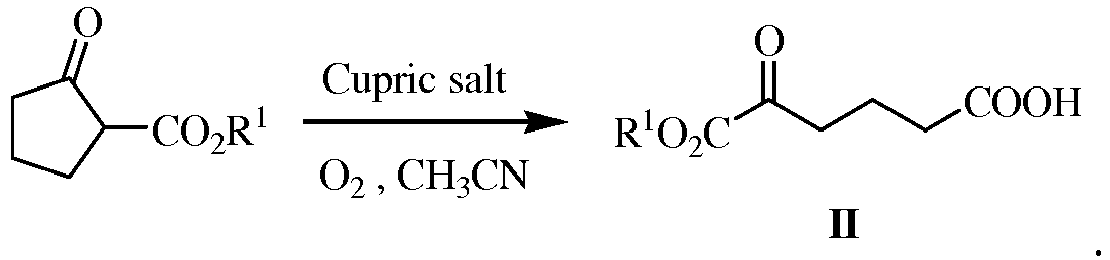
- In the reaction, the raw material, carboxylic ketoester (the compound of formula II) can be obtained via the synthesis method in the document, Tetrahedron Letters, 1994, 35, 6089-6092, i.e. in the acetonitrile solvent, the ketone of formula II is obtained via the oxidation and ring-opening of cyclopentanone-2-carboxylate under the catalyzation of cupric salt (such as CuCl2 • 2H2O, CuSO4 • 5H2O, Cu(OAc)2 • H2O or Cu(ClO4)2 • 6H2O). The equation is as follows:
- In step (2), the (Z)-α,β-unsaturated ester of formula IV is produced via the stereoselective dehydration of the tertiary alcohol of formula III. It is reported in J.Org.Chem.2006, 71, 5039-5042 that (Z)-α-aryl-α,β-unsaturated ester is obtained via selective dehydration of α-aryl-α-hydroxyl ester under the action of dehydrating agent (triflic anhydride) and alkali (such as pyridine or DMAP). The reaction time reported in the literature is long (the reaction lasts 10∼12 hours at room temperature), and it is not reported whether ω-carbonyl-α-aryl-α-hydroxyl ester is suitable for the reaction. The reaction of the prior art is improved by the method of the present invention to increase the efficiency and selectivity of producing (Z)-ω-carbonyl-α-aryl-α,β-unsaturated ester. After the improvement, the reaction time is shortened, the selectivity is improved and alkali (pyridine or DMAP) catalyzation is no longer needed. Carboxylic acid hydroxyl ester (the compound of formula III, 1 equivalent) is dissolved in a non-polar anhydrous solvent (such as dichloromethane), 1.0∼3.0 equivalents (preferably 1.0∼1.5 equivalents) dehydrating agent (preferably triflic anhydride) is added at 5°C∼15°C, the reaction was refluxed for 1∼2 hours and then is terminated by water. The product, the compound of formula IV is separated via extraction.
- In step (3), the ester group of the compound of formula IV is reduced selectively and the carbonyl group is retained. The compound of formula IV (1 equivalent) is dissolved in a suitable solvent (preferably toluene), alkali (such as triethylamine or diisopropylethylamine) is added at room temperature to allow the carbonyl group to form a salt, then the temperature is decreased, 2.5∼5.0 equivalents (preferably 3.0∼4.0 equivalents) reducing agent (preferably diisobutylaluminium hydride) is added slowly at the temperature of -30°C∼-5°C, the reaction is stirred for 20∼60 minutes. After completion of the reaction, the reaction solution is added slowly to alkali (such as aqueous potassium hydroxide, lithium hydroxide or sodium hydroxide, preferably aqueous sodium hydroxide) at the temperature of t<15°C, stirred, layered, the water phase is extracted by a suitable solvent (such as dichloromethane) to remove organic impurities, then is acidified by an acid (such as hydrochloric acid), then it is extracted by a suitable solvent (such as ethyl acetate), the product is separated and purified via crystallization to obtain (Z)-5-(4-fluorophenyl)-6-hydroxyl-hex-4-enoic acid (the compound of formula V).
- In step (4), the hydroxyl group of the compound of formula V is protected selectively and the carbonyl group is retained. The compound of formula V (1 equivalent) is dissolved in a suitable anhydrous solvent (preferably N,N-dimethylacetamide), 1.0∼3.0 equivalents (preferably 1.2∼2.3 equivalents) hydroxyl protecting agent (preferably nitrobenzoyl chloride, more preferably 3-nitrobenzoyl chloride) is added at -5°C∼40°C and reacted for 5-6 hours. Suitable alkali (such as pyridine) is added to hydrolyze the resulting mixed anhydride, then alkali (such as imidazole) is added to remove the carboxylic acid of the protecting agent liberated from hydrolysis by forming a salt. The product, the compound of formula VI is separated via extraction.
- In step (5), the compound of formula VI (1 equivalent) is dissolved in an anhydrous inert solvent (such as tetrahydrofuran or dichloromethane, preferably dichloromethane), 1.0∼2.0 equivalents (preferably 1.1∼1.6 equivalents) acylating agent (such as pivaloyl chloride, isobutyl chloroformate or 3-nitrobenzoyl chloride, preferably pivaloyl chloride or 3-nitrobenzoyl chloride) is added, at the same time, the mixture is reacted for 3-4 hours at room temperature in the presence of alkali (such as triethylamine) to obtain the mixed anhydride. Then 0.5∼1.5 equivalents (preferably 0.8∼1.1 equivalents) (S)-4-phenyl-2-oxazolidone of formula VII is added to the obtained mixed anhydride solution, 0.1∼0.3 equivalent suitable catalyst (such as 4-dimethylaminopyridine) is added and stirred for 3∼5 hours at room temperature to form an acylated derivative of oxazolidone of formula VIII via condensation. The product is separated via extraction and is purified via crystallization.
- In addition, step (4) can be combined with step (5), the compound of formula VIII can be produced from the compound of formula V through an one-pot method. The compound of formula V (1 equivalent) is dissolved in a suitable anhydrous solvent (preferably N,N-dimethylacetamide), 1.0∼3.0 equivalents (preferably 1.0∼1.5 equivalents) hydroxyl protecting agent (preferably nitrobenzoyl chloride, preferably 3- nitrobenzoyl chloride) is added at -5°C∼40°C, after the completion of the reaction, the reaction solution is added to the solution of 1.0∼2.0 equivalents (preferably 1.0∼1.5 equivalents) acylating agent (such as pivaloyl chloride, isobutyl chloroformate or 3-nitrobenzoyl chloride, preferably pivaloyl chloride or 3-nitrobenzoyl chloride, more preferably 3-nitrobenzoyl chloride) and alkali (such as triethylamine) dissolved in the anhydrous inert solvent (such as tetrahydrofuran or dichloromethane, preferably dichloromethane), then 0.5∼1.5 equivalents (preferably 0.7∼1.1 equivalents) chiral auxiliary ((S)-4-phenyl-2-oxazolidone) of formula VII and 0.1∼0.5 equivalent suitable catalyst (such as 4-dimethylamino-pyridine) are added, the temperature was kept for the reaction for 6∼7 hours, the acylated derivative of oxazolidone of formula VIII is produced via condensation. The product is separated via extraction and is purified via crystallization.
- In step (6), the temperature is decreased at the presence of a suitable anhydrous solvent (such as anhydrous dichloromethane) and the protection of a dry inert gas flow (such as nitrogen), Lewis acids TiCl4 (1.1∼1.5 equivalents) and tetraisopropyl titanate (0.3∼0.5 equivalent) are added at the temperature of -5°C∼0°C to react under stirring for 20∼40 minutes to produce titanium reagent, which is retained to be used. The acylated derivative of oxazolidone of formula VIII (1 equivalent), the protected imine compound of formula IX (1.0∼2.0 equivalents, preferably 1.0∼1.2 equivalents) are dissolved in anhydrous solvent (such as anhydrous dichloromethane), tertiary amine (such as diisopropylethylamine) is added, stirred for 10 minutes, the temperature is decreased, the titanium reagent produced above is added slowly drop by drop at the temperature of -90°C∼0°C (preferably -80°C∼-20°C), the temperature was kept for the reaction continuously, after the completion of the reaction, a suitable amount of acid (preferably acetic acid or trifluoroacetic acid) is added to quench the reaction. Meanwhile, the titanium salt is removed by adding dilute sulphuric acid, then the compound of formula XI is separated via extraction and purified via crystallization.
- In step (7), the compound of formula XI (1 equivalent) is dissolved in a suitable solvent (such as toluene), 1.0∼5.0 equivalents (preferably 2.0∼4.0 equivalents) N,O-bis(trimethylsilyl)acetamide (BSA) is added, and reacted for 2∼3 hours at the temperature of 50°C∼70°C, then 0.1∼0.5 equivalent (preferably 0.1∼0.3 equivalent) tetrabutylammonium fluoride (TBAF) is added, reacted for 2-5 hours at the temperature, the mixture of the compounds of formula XII, XIII and XIV are produced via cyclization.
- In step (8), the mixture of the compounds of formula XII, XIII and XIV is dissolved in a suitable solvent (preferably acetone), 3∼5 equivalents (it is calculated based on that the feed amount of the compound XI in step 7 as 1 equivalent) alikali (preferably aqueous lithium hydroxide) is added at room temperature to hydrolyze the hydroxyl protecting group, the mixture is reacted under stirring for 2∼3 hours, then acidified with a weak acid (such as diluted sulphuric acid or diluted hydrochloric acid), extracted, concentrated and separated via column chromatography to obtain the compound of formula I, which is purified via recrystallization.
- In the present invention, the carboxylic ketoester represented by formula (II) is used as the raw material and is subjected to Grignard addition, stereoselective dehydration, ester group reduction, hydroxyl group protection, addition with imine after condensation with a chiral auxiliary, cyclization and deprotection to obtain the compound represented by formula (I). The advantages of the present invention can be summarized as follows:
- a) Compared with the preparation method reported in
WO 2011/017907 , the number of synthetic steps are significantly decreased, from 14 steps to 8 steps; at the same time, the column chromatography is replaced by multiple times of recrystallization to simplify the purification operation and decrease the cost. - b) In step 2 of the present method, the Z alkene is obtained via stereoselection, allowing the subsequent multistep reactions to start with a single isomer, which simplify the separation operation and decrease the cost.
- c) In order to protect the hydroxyl groups (including alcoholic hydroxyl groups and phenolic hydroxyl groups), nitro substituted benzoyl is used, preferably the benzoyl with nitro substituted at 3-position is used. From one aspect, the ability of crystallization of the key intermediate is enhanced so that it can be purified effectively in a simple crystallization operation; from another aspect, it is advantageous for the deprotection under mild environment subsequently and prevent the occurrence of the accompanied side reactions (such as the open of the β- lactam ring) under alkaline condition.
- d) The method of the present invention is suitable for industrialized production and the yield is high.
- In summary, the present invention has advantages of easily available raw materials, a few synthetic steps, simple operation, high yield, good stereoselectivity and low cost, and can be used for industrial production.
- The following examples are solely for the illustration of the present invention, the present invention is not limited by those examples.
-

- Step 1: 12Kg 4-hydroxybenzaldehyde and 60L methanol were added to a 100L reaction tank and were dissolved under stirring, 12Kg 4-fluoroaniline was added drop by drop at room temperature, the mixture was reacted continuously for 2∼3 hours after the addition. The reaction was monitored by TLC until the spots of the raw material (4-hydroxylbenzaldehyde) disappeared, the solid produced by the reaction was filtered, dried and weighted 19 Kg (yield: 90%).
1H NMR (400 MHz, DMSO-d 6): δ 6.88 (d, 2 H, J = 8.4 Hz), 7.18-7.27 (m, 4 H), 7.76 (d, 2 H, J = 8.4 Hz), 8.46 (s, 1 H), 10.11 (s, 1 H). - Step 2: The product obtained in step 1 and 200L dichloromethane were added to a 500L reaction tank and were dissolved under stirring, 22Kg triethylamine, 1.8Kg 4-dimethylamino-pyridine (DMAP) were added at room temperature, 50L dichloromethane solution with 20Kg 3-nitrobenzoyl chloride dissolved were added drop by drop, the mixture was reacted continuously for 2-3 hours after the addition and monitored by TLC until the spots of the raw material (the product obtained from step 1) disappeared. The pH was adjusted to 4-6 by 2M hydrochloric acid, the solution was settled into layers, the organic phase was collected, the water phase was extracted by dichloromethane (30L × 2 times), the organic phases were combined and then washed 1 time with brine, dried over anhydrous sodium sulfate, filtered and evaporated to dryness under reduced pressure, the crude product was recrystallized in anhydrous ethanol, filtered and dried to obtain 19Kg imine IXa (yield: 59%).
1H NMR (400 MHz, DMSO-d 6): δ 7.23 (t, 2 H, J = 8.8 Hz), 7.31-7.35 (m, 2 H), 7.49 (d, 2 H, J = 8.4 Hz), 7.90 (t, 1 H, J = 8.0 Hz), 8.03 (d, 2 H, J = 8.4 Hz), 8.52-8.58 (m, 2 H), 8.65 (s, 1 H), 8.78 (s, 1 H). -

- 100g (0.563mol) 6-methoxy-5,6-dioxo-hexanoic acid (compound IIa) and 300mL tetrahydrofuran were added to a 3L reaction flask, the mixture was protected under nitrogen and was dissolved under stirring, the temperature was decreased to -20°C∼-10°C, 1M solution of 4-fluorophenyl magnesium bromide in THF (1.4L, 1.4mol) was added slowly drop by drop, the temperature was kept for the reaction for 1∼2 hours after the addition. The reaction was monitored by TLC until the spots of the raw material (compound IIa) disappeared.
- A solution of 25% aqueous ammonium chloride (60g ammonium chloride dissolved in 180mL water) was added at the temperature of -20°C∼0°C and was stirred for 5 minutes, then the pH was adjusted to 3∼5 by 4M hydrochloric acid at the temperature of 0°C ∼30°C, then 600mL n-heptane was added and stirred for 5 minutes, the solution was settled into layers, the organic phase was collected, the water phase was extracted with ethyl acetate (140mL×2 times), the organic phases were combined and then washed 2 times with saturated salt water, dried over anhydrous sodium sulfate, filtered and evaporated to dryness under reduced pressure, the crude product was recrystallized in toluene, filtered and dried to obtain 64.6g compound IIIa (HPLC purity: 93.2%; yield: 39.6%).
- 1H NMR (DMSO-d 6): 1.33-1.43 (m, 2 H), 1.89-1.96 (m, 1 H), 1.99-2.04 (m, 1 H), 2.15 (t, 2 H, J=7.6 Hz), 3.61 (s, 3 H), 5.99 (s, 1 H), 7.12-7.17 (m, 2 H), 7.47-7.51 (m, 2 H), 12.02 (s, 1 H); MS (m/z): 269 [M-H]-.
-

- 64.0g (0.221 mol) 5-(4-fluorophenyl)-5-hydroxy-6-methoxy-6-oxo-hexanoic acid (compound IIIa) and 300mL dichloromethane were added to a 500mL reaction flask, the mixture was dissolved under stirring and was protected under nitrogen, the temperature was decreased, 65.6g (0.233mol) triflic anhydride was added at the temperature of 5°C ∼15°C, then the reaction mixture was refluxed for 1∼2 hours and monitored by TLC until the spots of the raw material (compound IIIa) disappeared.
- The temperature was decreased, 100mL water was added at the temperature of 5°C ∼15°C to quench the reaction, the solution was settled into layers, the organic phase was collected, the water phase was extracted with dichloromethane (60mL×2 times), the organic phases were combined and then washed 3 times with saturated salt water, dried over anhydrous sodium sulfate, filtered and evaporated to dryness under reduced pressure to obtain 54.4g compound IVa (HPLC purity: 95.6%; yield: 93.4%).
- 1H NMR (DMSO-d 6): 2.42 (t, 2 H, J=7.3 Hz), 2.56 (q, 2 H, J=7.3 Hz), 3.74 (s, 3 H), 6.27 (t, 1 H, J = 7.4 Hz), 7.18 (t, 2 H, J = 8.8 Hz), 7.32-7.36 (m, 2 H), 12.19 (s, 1 H).
-

- 54.0g (0.205mol) (Z)-5-(4-fluorophenyl)-6-methoxy-6-oxo-hex-4-enoic acid (compound IVa) and 240mL toluene were added to a 1L reaction flask, the mixture was dissolved under stirring and was protected under nitrogen, 31.0g (0.240mol) diisopropylethylamine was added and was dissolved under stirring, the temperature was decreased to -20°C ∼-15°C, 382.0g (0.673mol) DIBAH toluene solution (25%) was added slowly drop by drop, the temperature was kept for the reaction for 20∼40 minutes after the addition. The reaction was monitored by TLC until the raw material (compound IVa) reacted completely.
- Below the temperature of 15°C, the reaction mixture was added slowly to aqueous sodium hydroxide (72.2g sodium hydroxide dissolved in 300mL water) drop by drop, then the solution was stirred for 30 minutes; settled into layers, the water phase was collected, the water phase was extracted with dichloromethane (60mL × 2 times), the dichloromethane phase was discarded. The pH of the water phase was adjusted to 1∼2 with 4M hydrochloric acid below the temperature of 25°C, 240mL ethyl acetate was added, the solution was stirred for 5 minutes then was settled into layers, the organic phase was collected, and the water phase was extracted with ethyl acetate (100mL × 3 times). The organic phases were combined and washed 2 times with saturated salt water, dried over anhydrous sodium sulfate, filtered and evaporated to dryness under reduced pressure, the crude product was recrystallized in toluene, filtered and dried to obtain 36.4g compound V (HPLC purity: 96.3%; yield: 76.4%).
- 1H NMR (DMSO-d 6): 2.38 (t, 2 H, J = 7.1 Hz), 2.47 (q, 2 H, J = 7.0 Hz), 4.34 (s, 2 H), 4.75 (br s, 1 H), 5.78 (t, 1 H, J = 7.2 Hz), 7.13 (t, 2 H, J = 8.9 Hz), 7.45-7.48 (m, 2 H), 12.13 (br s, 1H).
-

- 18.0g (0.077mol) (Z)-5-(4-fluorophenyl)-6-hydroxy-hex-4-enoic acid (compound V) and 60mL N,N-dimethylacetamide were added to a 250mL reaction flask, the mixture was dissolved under stirring and was protected under nitrogen, the temperature was decreased, 31.2g (0.168mol) 3- nitrobenzoyl chloride was added at the temperature of -5°C ∼5°C, then the reaction mixture was reacted for 5∼6 hours at the temperature of -5°C ∼5°C and monitored by TLC until the spots of the raw material (compound V) disappeared.
- At the temperature of 0∼10°C, aqueous pyridine (13.0g pyridine dissolved in 30mL water) was added and stirred for 30 minutes, then at the temperature of 0∼10°C, aqueous imidazole (22.5g imidazole dissolved in 50mL water) was added, stirred for 1∼2 hours, then the solution was extracted with 120mL ethyl acetate and settled into layers, the organic phase was collected, and the water phase was extracted with ethyl acetate (20mL × 3 times), the organic phases were combined, and the organic phase was washed with water, the pH was adjusted to 3∼5 with 2M hydrochloric acid, then the organic phase was washed 1 time with saturated salt water, dried over anhydrous sodium sulfate, filtered and evaporated to dryness under reduced pressure to obtain 24.0g compound VIa (HPLC purity: 92.6%; yield: 77.0%).
- 1H NMR (DMSO-d6): 2.45 (t, 2 H, J = 7.1 Hz), 2.59 (q, 2 H, J = 7.3 Hz), 5.36 (s, 2 H), 6.09(t, 1 H, J = 7.4 Hz), 7.18 (t, 2 H, J = 8.8 Hz), 7.51-7.54 (m, 2 H), 7.80 (t, 1 H, J = 7.8 Hz), 8.23(d, 1 H, J = 7.8 Hz), 8.46-8.48 (m, 2 H), 12.17 (s, 1 H).
-

- 24.0g (0.060mol) (Z)-5-(4-fluorophenyl)-6-(3-nitrobenzoyloxy)-hex-4-enoic acid (compound VIa) and 100mL dichloromethane were added to a 250mL reaction flask, the mixture was dissolved under stirring and was protected under nitrogen. 8.9g (0.074mol) pivaloyl chloride was added. At room temperature, 15.6g (0.154mol) triethylamine was added slowly drop by drop, the reaction mixture was reacted for 3-4 hours at room temperature after the addition. Then 7.8g (0.048mol) (S)-4-phenyl-2-oxazolidinone (compound VII) and 2.2g (0.018mol) 4-dimethylaminopyridine were added and reacted at room temperature for 3∼4 hours. The reaction was monitored by TLC until the spots of the raw material (compound VIa) disappeared.
- The pH was adjusted to 4∼6 with 2M hydrochloric acid, the solution was settled into layers, the organic phase was collected and the water phase was extracted with dichloromethane (30mL × 2times), the organic phases were combined. Aqueous imidazole (11.1 g imidazole dissolve in 30 mL water) was added and stirred for 1∼2 hours, then was washed 1 time with saturated salt water, dried over anhydrous sodium sulfate, filtered and evaporated to dryness under reduced pressure. The crude product was recrystallized in toluene, filtered and dried to obtain 25.3g compound VIIIa (HPLC purity: 95.1%; yield: 78.0%).
- 1H NMR (DMSO-d6): 2.59 (q, 2 H, J = 7.2 Hz), 3.00-3.18 (m, 2 H), 4.15 (dd, 1 H, J = 8.8, 3.6 Hz), 4.72 (t, 1 H, J = 8.7 Hz), 5.29 (d, 1 H, J = 13.2 Hz), 5.32 (d, 1 H, J = 13.2 Hz), 5.45 (dd, 1 H, J = 8.6, 3.6 Hz), 6.05 (t, 1 H, J = 7.5 Hz), 7.17 (t, 2 H, J = 8.9 Hz), 7.26-7.36 (m, 5 H), 7.46-7.50 (m, 2 H), 7.76-7.80 (m, 1 H), 8.19-8.21 (m, 1 H), 8.45-8.47 (m, 2 H).
-

- Step 1: 18g (0.080mol) (Z)-5-(4-fluorophenyl)-6- hydroxy-hex-4-enoic acid (compound V) and 90mL N,N-dimethylacetamide were added to a 250mL reaction flask, the mixture was dissolved under stirring and was protected under nitrogen. 17.8g (0.096mol) 3-nitrobenzoyl chloride was added at 25°C∼30°C, the temperature was kept for the reaction for 2 hours, the reaction was determined to be complete by HPLC, the reaction mixture was retained to be used.
- Step 2: 180mL dichloromethane and 16.3g (0.088mol) 3-nitrobenzoyl chloride were added to a 500mL reaction flask and were protected under nitrogen, 32.4g (0.32mol) triethylamine was added drop by drop at the temperature of 25°C∼30°C, then the reaction mixture of step 1 was added drop by drop at the temperature of 25°C∼30°C (the mixture was added within 1∼2 hours), then the temperature was kept for the reaction for 5 minutes after the addition, then 11.75g (0.072mol) (S)-4-phenyl-2-oxazolidinone and 4.4g (0.036mol) 4-dimethylamino-pyridine were added, the temperature was kept for the reaction for 6∼7 hours, the reaction was determined to be complete by HPLC.
- 90mL water was added to the reaction mixture, the solution was settled into layers, the organic phase was collected and the water phase was extracted with dichloromethane (50mL × 2 times), the organic phases were combined. The pH of the organic phase was adjusted to 4∼6 with 2M hydrochloric acid, then the organic phase was washed with 90mL water until it is neutral, then aqueous imidazole (27g imidazole dissolved in 50mL water) was added, stirred for 30 minutes and settled into layers, the organic phase was collected and was washed with saturated salt water, dried over anhydrous sodium sulfate, filtered and evaporated to dryness under reduced pressure. The crude product was recrystallized in the mixed solvent of ethyl acetate/petroleum ether (2/3), filtered and dried to obtain 30g compound VIIIa (HPLC purity: 97.5%; yield: 74.0%).
-

- 80mL dichloromethane and 10.5g (0.055mol) titanium tetrachloride were added to a 250mL reaction flask and were protected under nitrogen, the temperature was decreased, 5.2g (0.018mol) titanium isopropylate was added drop by drop at the temperature of -5°C∼0°C, then the solution was stirred for 30 minutes at the temperature of -5°C∼0°C to obtain titanium reagent. 25.0g (0.046mol) compound of formula VIIIa, 18.3g (0.050mol) imine of formula IXa and 350mL dichloromethane were added to a 1L reaction flask and were dissolved under stirring, 14.3g (0.111 mol) diisopropylethylamine was added and stirred, the temperature was decreased, the titanium reagent was added slowly drop by drop at the temperature of -25°C∼-20°C, then the mixture was reacted for 1∼2 hours at the temperature of -25°C∼-20°C, the reaction was monitored by HPLC until the content of the raw material (compound VIIIa) was <5%.
- 30mL acetic acid was added drop by drop at the temperature of -25°C∼-20°C and stirred for 5 minutes; 150mL sulfuric acid (2M) was added drop by drop below 10°C and stirred for 10 minutes; the solution was settled into layers, the organic phase was collected, the water phase was extracted with dichloromethane (25mL × 2 times), the organic phases were combined and washed 3 times with saturated salt water, dried over anhydrous sodium sulfate, filtered and evaporated to dryness under reduced pressure. The crude product was recrystallized in toluene, filtered and dried to obtain 21.4g compound XIa (HPLC purity: 95.3%; yield: 50.4%).
- 1H NMR (DMSO-d 6): 2.38-2.45 (m, 1 H), 2.56-2.64 (m, 1 H), 4.11 (dd, 1 H, J = 8.8, 4.7 Hz), 4.62-4.75 (m, 3 H), 5.15 (s, 2 H), 5.51 (dd, 1 H, J = 8.5, 4.6 Hz), 5.98 (t, 1 H, J = 7.4 Hz), 6.34 (d, 1 H, J = 9.8 Hz), 6.58-6.62 (m, 2 H), 6.80 (t, 2 H, J = 8.9 Hz), 7.13-7.28 (m, 9 H), 7.45-7.48 (m, 2 H), 7.54 (d, 2 H, J = 8.5 Hz), 7.79 (t, 1 H, J = 7.9 Hz), 7.91 (t, 1 H, J = 8.0 Hz), 8.18 (d, 1 H, J = 7.8 Hz), 8.43-8.49 (m, 3 H), 8.57-8.60 (m, 1 H), 8.74 (t, 1 H, J = 1.8 Hz); MS (m/z): 883 [M+H]+.
-

- 150mL dichloromethane and 13.2g (0.069mol) titanium tetrachloride were added to a 500mL reaction flask, were protected under nitrogen and were stirred, the temperature was decreased, 60mL dichloromethane solution with 6.6g (0.023mol) titanium isopropylate dissolved was added drop by drop at the temperature of -5°C∼0°C, then the solution was stirred for 30 minutes at the temperature of -5°C∼0°C to obtain titanium reagent. 30g (0.058mol) compound of formula VIIIa, 23.2g (0.064mol) imine of formula IXa and 900mL dichloromethane were added to a 2L reaction flask and were protected under nitrogen and were dissolved under stirring, 19.5g diisopropylethylamine was added, the temperature was decreased, the titanium reagent prepared above was added slowly drop by drop at the temperature of -75°C∼-70°C, the addition was terminated within about 2 hours, then the reaction mixture was reacted for 5 minutes at the temperature of -75°C∼-70°C and monitored by HPLC until the spots of the raw material (compound VIIIa) disappeared.
- A solution of 135mL 20% trifluoroacetic acid in dichlormethane was added quickly below the temperature of -70°C and was stirred for 1 minute; 240mL aqueous sulfuric acid (2M) was added quickly drop by drop below -30°C, then the solution was stirred and was warmed to room temperature; the solution was settled into layers, the organic phase was collected, the water phase was extracted with dichloromethane (100ml × 2 times), the organic phases were combined and washed with saturated salt water until it is neutral, dried over anhydrous sodium sulfate, filtered and evaporated to dryness under reduced pressure to obtain crude product. The crude product was recrystallized in the mixed solvent of ethyl acetate/petroleum ether (1/1), filtered and dried to obtain 35g compound XIa (HPLC purity: 98.9%; yield: 68.7%).
-

- 21.0g (0.025mol) compound of formula XIa and 200mL toluene were added to a 500mL reaction flask, the mixture was stirred and heated, 18.4g (0.090mol) N,O-bis(trimethylsilyl)acetamide (BSA) was added at the temperature of 50°C∼60°C, then reacted for 2 hours at this temperature; then 1.0g (0.003mol) tetrabutylammonium fluoride trihydrate was added at the temperature of 50°C∼60°C and reacted for 2-3 hours at that temperature. The reaction was monitored by HPLC until the content of the raw material (compound XIa) was <1.0%.
- The temperature was decreased below 25°C, 50mL ice water was added drop by drop and stirred for 10 minutes, then 180mL n-heptane was added and stirred continuously for 30 minutes, the solid was precipitated and filtered, and the filtrate was settled into layers, the organic phase was collected, the water phase was extracted with toluene (15mL × 2 times), the organic phases were combined and were concentrated to dry under vacuum, a mixture was obtained. A few of the mixture was taken to be separated to obtain three products, i.e. compounds XIIa, XIIIa, XIVa.
- Compound XIIa: 1H NMR (400 MHz, DMSO-d 6): 2.91-3.08 (m, 2 H), 3.41 (td, 1 H, J= 8.5, 2.1 Hz), 5.14 (d, 1 H, J = 2.0 Hz), 5.42 (d, 1 H, J =13.1 Hz), 5.46 (d, 1 H, J =13.1 Hz), 6.17 (t, 1 H, J = 7.5 Hz), 7.13-7.26 (m, 6 H), 7.35 (d, 2 H, J = 8.5 Hz), 7.48-7.53 (m, 4 H), 7.78 (t, 1 H, J = 8.0 Hz), 7.91 (t, 1 H, J = 8.0 Hz), 8.21 (d, 1 H, J = 7.8 Hz), 8.44-8.47 (m, 2 H), 8.51 (d, 1 H, J = 7.9 Hz), 8.56-8.59 (m, 1 H), 8.76 (t, 1 H, J = 1.7 Hz); MS (m/z): 720 [M+H]+, 742 [M+Na]+.
- Compound XIIIa: 1H NMR (400 MHz, DMSO-d 6): 2.85-2.98 (m, 2 H), 3.30 (td, 1 H, J= 8.5, 2.2 Hz), 4.92 (d, 1 H, J = 2.2 Hz), 5.40 (d, 1 H, J = 13.1 Hz), 5.44 (d, 1 H, J =13.1 Hz), 6.13 (t, 1 H, J = 7.5 Hz), 6.73 (d, 2 H, J = 8.5 Hz), 7.12 (t, 2 H, J = 8.8 Hz), 7.16-7.21 (m, 6 H), 7.47-7.50 (m, 2 H), 7.79 (td, 1 H, J = 7.7, 0.9 Hz), 8.21 (d, 1 H, J = 7.8 Hz), 8.45-8.47 (m, 2 H), 9.52 (s, 1 H); MS (m/z): 571 [M+H]+.
- Compound XIVa: 1H NMR (400 MHz, CDCl3): 0.28 (s, 9 H), 2.97-3.01 (m, 2 H), 3.30 (td, 1 H, J = 7.9, 2.2 Hz), 4.72 (d, 1 H, J = 2.1 Hz), 5.37 (s, 2 H), 6.07 (t, 1 H, J = 7.6 Hz), 6.83 (d, 2 H, J = 8.5 Hz), 6.94 (t, 2 H, J = 8.6 Hz), 7.03 (t, 2 H, J = 8.6 Hz), 7.20 (d, 2 H, J = 8.5 Hz), 7.24-7.28 (m, 2 H), 7.35-7.38 (m, 2 H), 7.61 (t, 1 H, J = 8.0 Hz), 8.23 (d, 1 H, J = 7.8 Hz), 8.38-8.41 (m, 1 H), 8.75 (t, 1 H, J= 1.7 Hz); MS (m/z): 643 [M+H]+.
-
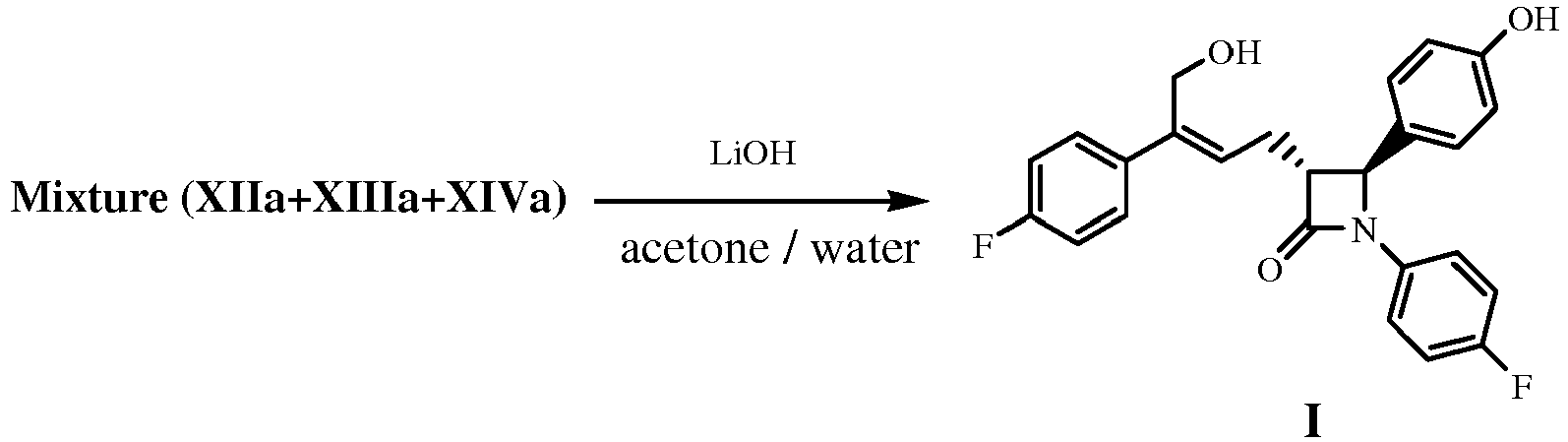
- The mixture of the compounds of formula XIIa, XIIIa XIVa obtained in example 10 and 90mL acetone were added to a 250mL reaction flask and were dissolved under stirring, 23mL (0.069mol) aqueous lithium hydroxide (3M) was added at room temperature and the reaction mixture was reacted for 2-3 hours under stirring and monitored by TLC until the spots of the raw material (compounds XIIa, XIIIa XIVa) disappeared.
- The pH was adjusted to 4-6 by 2M hydrochloric acid at room temperature, then the solution was concentrated under vacuum (30∼40°C) to small volume, 100mL ethyl acetate was added and stirred for 5 minutes, the solution was settled into layers, the organic phase was collected, the water phase was extracted with ethyl acetate (20mL × 2 times), the organic phases were combined, aqueous sodium hydrogen carbonate (3.8g sodium hydrogen carbonate dissolved in 40mL water) was added and stirred for 30 minutes, the solution was settled into layers. The pH of the organic phase was adjusted to about 6 with 2M hydrochloric acid, settled into layers, the organic phase was washed 1 time with saturated salt water, dried over anhydrous sodium sulfate, filtered, the filtrate was concentrated to dry under reduced pressure. The residue was purified by column chromatography, recrystallized twice in the mixed solvent of ethyl acetate and n-heptane, filtered and dried to obtain 4.3g compound I (HPLC purity: 99.2%; yield: 44.7% calculated according to the feeding amount of compound XIa of example 10).
- 1H NMR (400 MHz, DMSO-d 6): δ 2.71-2.84 (m, 2 H), 3.23 (td, 1 H, J = 6.4, 2.0 Hz), 4.40 (d, 2 H, J = 5.3 Hz), 4.87 (t, 1 H, J = 5.3 Hz), 4.94 (d, 1 H, J = 2.1 Hz), 5.80 (t, 1 H, J = 7.5 Hz), 6.74 (d, 2 H, J = 8.5 Hz), 7.11-7.17 (m, 4 H), 7.20-7.25 (m, 4 H), 7.39-7.43 (m, 2 H), 9.50 (s, 1 H); MS (m/z): 422 [M+H]+.
-

- 60Kg (337.9mol) 6-methoxy-5,6-dioxo-hexanoic acid (compound IIa) and 180L tetrahydrofuran were added to a 2000L reaction tank, the mixture was protected under nitrogen and dissolved under stirring, the temperature was decreased to -20°C∼-10°C, 1M solution of 4-fluorophenyl magnesium bromide in THF (800L, 800mol) was added slowly drop by drop and the temperature was kept for the reaction for 1∼2 hours after the addition. The reaction was monitored by TLC until the spots of the raw material (compound IIa) disappeared.
- A solution of 25% aqueous ammonium chloride (30Kg ammonium chloride dissolved in 90L water) was added at the temperature of -20°C∼0°C and was stirred for 5 minutes, then the pH was adjusted to 3∼5 with 4M hydrochloric acid at the temperature of 0°C ∼30°C, then 400L n-heptane was added and stirred for 5 minutes, the solution was settled into layers, the organic phase was collected, the water phase was extracted with ethyl acetate (80L × 2 times), the organic phases were combined and were washed 2 times with saturated salt water, dried over anhydrous sodium sulfate, filtered and evaporated to dryness under reduced pressure. The crude product was recrystallized in toluene, filtered and dried to obtain 45.6Kg compound IIIa (HPLC purity: 70.8%; yield: 35.4%).
- 1H NMR (DMSO-d 6): 1.33-1.43 (m, 2 H), 1.89-1.96 (m, 1 H), 1.99-2.04 (m, 1 H), 2.15 (t, 2 H, J= 7.6 Hz), 3.61 (s, 3 H), 5.99 (s, 1 H), 7.12-7.17 (m, 2 H), 7.47-7.51 (m, 2 H), 12.02 (s, 1 H); MS (m/z): 269 [M-H]-.
-

- 40.0Kg (104.9mol) 5-(4-fluorophenyl)-5-hydroxy-6-methoxy-6-oxo-hexanoic acid (compound IIIa) and 200L dichloromethane were added to a 300L reaction tank, the mixture was dissolved under stirring and was protected by nitrogen, the temperature was decreased, 31.2Kg (110.6mol) triflic anhydride was added at the temperature of 5∼15°C, then the reaction mixture was refluxed for 1-2 hours and monitored by TLC until the spots of the raw material (compound IIIa) disappeared.
- The temperature was decreased, the reaction was stopped by adding 50L water under the temperature of 5°C∼15°C, stirred for 5 minutes and settled into layers, the organic phase was collected, the water phase was extracted with dichloromethane (40L × 2 times), the organic phases were combined and was washed 3 times with saturated salt water, dried over anhydrous sodium sulfate, filtered and evaporated to dryness under reduced pressure to obtain 25.2Kg compound IVa (HPLC purity: 86.3%; yield: 82.3%).
- 1H NMR (DMSO-d 6): 2.42 (t, 2 H, J = 7.3 Hz), 2.56 (q, 2 H, J = 7.3 Hz), 3.74 (s, 3 H), 6.27 (t, 1 H, J = 7.4 Hz), 7.18 (t, 2 H, J = 8.8 Hz), 7.32-7.36 (m, 2 H), 12.19 (s, 1 H).
-

- 25.0Kg (85.6mol) (Z)-5-(4-fluorophenyl)-6-methoxy-6-oxo-hex-4-enoic acid (compound IVa) and 100L toluene were added to a 500L reaction tank, the mixture was dissolved under stirring and were protected by nitrogen, 13.0Kg (100.8mol) diisopropylethylamine was added, stirred for 5 minutes. The temperature was decreased to -20°C∼-15°C, 159.7Kg (281.2mol) DIBAH toluene solution (25%) was added slowly drop by drop and the temperature was kept for the reaction for 20∼40 minutes after the addition. The reaction was monitored by TLC until the raw material (compound IVa) was reacted completely.
- The reaction mixture was added slowly drop by drop to aqueous sodium hydroxide (30.2Kg sodium hydroxide dissolved in 140L water) below the temperature of 15°C and was stirred for 30 minutes. The solution was settled into layers, the water phase was collected and extracted with 50L dichloromethane, the dichloromethane phase was discarded, the pH of the water phase was adjusted to 1∼2 below 25°C with 6M hydrochloric acid, 100L ethyl acetate was added and stirred for 5 minutes. The solution was settled into layers, the organic phase was collected, the water phase was extracted with ethyl acetate (40L × 3 times), the organic phases were combined and washed 2 times with saturated salt water, dried over anhydrous sodium sulfate, filtered and evaporated to dryness under reduced pressure. The crude product was recrystallized in toluene, filtered and dried to obtain 15.0 Kg compound V (HPLC purity: 92.1%; yield: 72.0%).
- 1H NMR (DMSO-d 6): 2.38 (t, 2 H, J = 7.1 Hz), 2.47 (q, 2 H, J = 7.0 Hz), 4.34 (s, 2 H), 4.75 (br s, 1H), 5.78 (t, 1 H, J = 7.2 Hz), 7.13 (t, 2 H, J = 8.9 Hz), 7.45-7.48 (m, 2 H), 12.13 (br s, 1H).
-

- 15.0Kg (61.7mol) (Z)-5-(4-fluorophenyl)-6-hydroxy-hex-4-enoic acid (compound V) and 50L N, N-dimethylacetamide were added to a 300L reaction tank, the mixture was dissolved under stirring and were protected by nitrogen. The temperature was decreased to -5°C∼5°C, 24.9Kg (134.2mol) 3-nitrobenzoyl chloride was added and the temperature was kept for the reaction for 5-6 hours. The reaction was monitored by TLC until the spots of the raw material (compound V) disappeared.
- Aqueous pyridine was added (10.4Kg pyridine dissolved in 30L water) at the temperature of 0°C∼10°C and was stirred for 30 minutes. Then aqueous imidazole (18.0Kg imidazole dissolved in 50L water) was added at the temperature of 0°C∼10°C and was stirred for 1∼2hours, then 100L ethyl acetate was added and was stirred for 5 minutes. The solution was settled into layers, the organic phase was collected, the water phase was extracted with ethyl acetate (20L × 3 times), the organic phases were combined and were washed with water, the pH was adjusted to 3∼5 with 2M hydrochloric acid, washed 1 time with saturated salt water, dried over anhydrous sodium sulfate, filtered and evaporated to dryness under reduced pressure to obtain 20.2Kg compound VIa (HPLC purity: 85.6%; yield: 75.2%).
- 1H NMR (DMSO-d 6): 2.45 (t, 2 H, J = 7.1 Hz), 2.59 (q, 2 H, J = 7.3 Hz), 5.36 (s, 2 H), 6.09(t, 1 H, J = 7.4 Hz), 7.18 (t, 2 H, J = 8.8 Hz), 7.51-7.54 (m, 2 H), 7.80 (t, 1 H, J = 7.8 Hz), 8.23(d, 1 H, J = 7.8 Hz), 8.46-8.48 (m, 2 H), 12.17 (s, 1 H).
-

- 20.0Kg (45.9mol) (Z)-5-(4-fluorophenyl)-6-(3-nitrobenzoyloxy)-hex-4-enoic acid (compound VIa) and 100L dichloromethane were added to a 300L reaction tank, the mixture was dissolved under stirring and were protected by nitrogen. 6.8Kg (56.4mol) pivaloyl chloride was added. At room temperature, 12.0Kg (118.8mol) triethylamine was added slowly drop by drop, the reaction mixture was reacted at room temperature for 3∼4 hours after the addition, then 6.0Kg (36.8mol) (S)-4-phenyl-2-oxazolidinone (compound VII) and 1.7Kg (13.9mol) 4-dimethylaminopyridine were added and reacted at room temperature for 4∼5 hours. The reaction was monitored by TLC until the spots of the raw material (compound VIa) disappeared.
- The pH was adjusted to 4∼6 with 2M hydrochloric acid, the solution was settled into layers, the organic phase was collected, and the water phase was extracted with dichloromethane (25L × 2 time), the organic phases were combined, aqueous imidazole (8.6Kg imidazole dissolved in 30L water) was added and stirred for 2-3 hours, then was washed 1 time with saturated salt water, dried over anhydrous sodium sulfate, filtered and evaporated to dryness under reduced pressure. The crude product was recrystallized in toluene, filtered and dried to obtain 15.2Kg compound VIIIa (HPLC purity: 91.7%; yield: 58.6%).
- 1H NMR (DMSO-d 6): 2.59 (q, 2 H, J = 7.2 Hz), 3.00-3.18 (m, 2 H), 4.15 (dd, 1 H, J = 8.8, 3.6 Hz), 4.72 (t, 1 H, J = 8.7 Hz), 5.29 (d, 1 H, J = 13.2 Hz), 5.32 (d, 1 H, J = 13.2 Hz), 5.45 (dd, 1 H, J = 8.6, 3.6 Hz), 6.05 (t, 1 H, J = 7.5 Hz), 7.17 (t, 2 H, J = 8.9 Hz), 7.26-7.36 (m, 5 H), 7.46-7.50 (m, 2 H), 7.76-7.80 (m, 1 H), 8.19-8.21 (m, 1 H), 8.45-8.47 (m, 2 H).
-

- 60L dichloromethane and 6.0Kg (31.6mol) titanium tetrachloride were added to a 100L reaction tank and were protected under nitrogen, stirred, the temperature was decreased, 3.0Kg (10.6mol) tetraisopropyl titanate was added at the temperature of -5°C∼0°C, then stirred for 30 minutes at the temperature of -5°C∼0°C to obtain titanium reagent. 15.0Kg (26.6mol) compound of formula VIIIa, 10.6 Kg (29.1 mol) imine of formula IXa and 220L dichloromethane were added to a 500L reaction tank and were dissolved under stirring, 8.3Kg (64.3mol) diisopropylethylamine was added and stirred for 10 minutes, the temperature was decreased, the titanium reagent was added slowly drop by drop at the temperature of -25°C∼-20°C, the temperature was kept to react for 1∼2 hours after the addition. The reaction was monitored by HPLC until the content of the raw material (compound VIIIa) was <5%.
- 18L acetic acid was added at the temperature of -25°C∼-20°C, then was stirred for 5 minutes; 90L sulfuric acid (2M) was added drop by drop below 10°C, then was stirred for 10 minutes. The solution was settled into layers, the organic phase was collected, and the water phase was extracted with 30L dichloromethane. The organic phases were combined and washed 3 times with saturated salt water, dried over anhydrous sodium sulfate, filtered and evaporated to dryness under reduced pressure. The crude product was recrystallized in toluene, filtered and dried to obtain 12.3Kg compound XIa (HPLC purity: 92.1%; yield: 48.4%).
1H NMR (DMSO-d 6): 2.38-2.45 (m, 1 H), 2.56-2.64 (m, 1 H), 4.11 (dd, 1 H, J = 8.8, 4.7 Hz), 4.62-4.75 (m, 3 H), 5.15 (s, 2 H), 5.51 (dd, 1 H, J = 8.5, 4.6 Hz), 5.98 (t, 1 H, J = 7.4 Hz), 6.34 (d, 1 H, J = 9.8 Hz), 6.58-6.62 (m, 2 H), 6.80 (t, 2 H, J = 8.9 Hz), 7.13-7.28 (m, 9 H), 7.45-7.48 (m, 2 H), 7.54 (d, 2 H, J = 8.5 Hz), 7.79 (t, 1 H, J = 7.9 Hz), 7.91 (t, 1 H, J = 8.0 Hz), 8.18 (d, 1 H, J = 7.8 Hz), 8.43-8.49 (m, 3 H), 8.57-8.60 (m, 1 H), 8.74 (t, 1 H, J = 1.8 Hz); MS (m/z): 883 [M+H]+. -

- 12.0Kg (12.5mol) compound of formula XIa and 120L toluene were added to a 300L reaction tank and were stirred and heated, 10.2Kg (50.0mol) N,O-bis(trimethylsilyl)acetamide (BSA) was added at 50°C∼60°C, reacted for 2∼3 hours at said temperature; then 0.6Kg (1.9mol) tetrabutylammonium fluoride trihydrate was added and the temperature was kept for the reaction for 2∼3 hours. The reaction was monitored by HPLC until the content of the raw material (compound XIa) was <1.0%.
- The temperature was decreased, 30L ice water was added drop by drop below 25°C, the solution was stirred for 10 minutes, then 100L n-heptane was added and stirred for 30 minutes, the solids were precipitated and filtered, the filtrate was settled into layers, the organic phase was collected, and the water phase was extracted with toluene (10L × 2 times). The organic phases were combined and were concentrated to dry under vacuum to obtain a mixture. A few of the mixture was taken to be separated to obtain three products, i.e. compound XIIa, XIIIa, XIVa.
- Compound XIIa: 1H NMR (400 MHz, DMSO-d 6): 2.91-3.08 (m, 2 H), 3.41 (td, 1 H, J= 8.5, 2.1 Hz), 5.14 (d, 1 H, J = 2.0 Hz), 5.42 (d, 1 H, J = 13.1 Hz), 5.46 (d, 1 H, J = 13.1 Hz), 6.17 (t, 1 H, J = 7.5 Hz), 7.13-7.26 (m, 6 H), 7.35 (d, 2 H, J = 8.5 Hz), 7.48-7.53 (m, 4 H), 7.78 (t, 1 H, J = 8.0 Hz), 7.91 (t, 1 H, J = 8.0 Hz), 8.21 (d, 1 H, J = 7.8 Hz), 8.44-8.47 (m, 2 H), 8.51 (d, 1 H, J = 7.9 Hz), 8.56-8.59 (m, 1 H), 8.76 (t, 1 H, J = 1.7 Hz); MS (m/z): 720 [M+H]+, 742 [M+Na]+.
- Compound XIIIa: 1H NMR (400 MHz, DMSO-d 6): 2.85-2.98 (m, 2 H), 3.30 (td, 1 H, J= 8.5, 2.2 Hz), 4.92 (d, 1 H, J = 2.2 Hz), 5.40 (d, 1 H, J = 13.1 Hz), 5.44 (d, 1 H, J = 13.1 Hz), 6.13 (t, 1 H, J = 7.5 Hz), 6.73 (d, 2 H, J = 8.5 Hz), 7.12 (t, 2 H, J = 8.8 Hz), 7.16-7.21 (m, 6 H), 7.47-7.50 (m, 2 H), 7.79 (td, 1 H, J = 7.7, 0.9 Hz), 8.21 (d, 1 H, J = 7.8 Hz), 8.45-8.47 (m, 2 H), 9.52 (s, 1 H); MS (m/z): 571 [M+H]+.
- Compound XIVa: 1H NMR (400 MHz, CDCl3): 0.28 (s, 9 H), 2.97-3.01 (m, 2 H), 3.30 (td, 1 H, J = 7.9, 2.2 Hz), 4.72 (d, 1 H, J = 2.1 Hz), 5.37 (s, 2 H), 6.07 (t, 1 H, J = 7.6 Hz), 6.83 (d, 2 H, J = 8.5 Hz), 6.94 (t, 2 H, J = 8.6 Hz), 7.03 (t, 2 H, J = 8.6 Hz), 7.20 (d, 2 H, J = 8.5 Hz), 7.24-7.28 (m, 2 H), 7.35-7.38 (m, 2 H), 7.61 (t, 1 H, J = 8.0 Hz), 8.23 (d, 1 H, J = 7.8 Hz), 8.38-8.41 (m, 1 H), 8.75 (t, 1 H, J= 1.7 Hz); MS (m/z): 643 [M+H]+.
-

- The mixture of compounds XIIa, XIIIa, XIVa obtained in example 18 and 50L acetone were added to a 100L reaction tank and were dissolved under stirring, 13L (39.0mol) aqueous lithium hydroxide (3M) was added at room temperature and was reacted for 0.5-1 hour under stirring. The reaction was monitored by TLC until the spots of the raw material (compound XIIa, XIIIa, XIVa) disappeared.
- The pH was adjusted to 4-6 with 2M hydrochloric acid at room temperature, then the solution was concentrated under vacuum (at 30°C∼40°C) to small volume, 60L ethyl acetate was added and stirred for 5 minutes, then the solution was settled into layers, the organic phase was collected, the water phase was extracted with ethyl acetate (10L × 2times). The organic phases were combined, aqueous sodium bicarbonate (2.0Kg sodium bicarbonate dissolved in 20L water) was added, stirred for 30 minutes, the solution was settled into layers, the pH of the organic phase was adjusted to about 6 with 2M hydrochloric acid, the solution was settled into layers, the organic phase was washed 1 time with saturated salt water, dried over anhydrous sodium sulfate, filtered, the filtrate was concentrated to dry under reduced pressure. The residue was purified by column chromatography, crystallized twice in the mixed solvent of ethyl acetate and n-heptane, filtered and dried to obtain 2.1Kg compound I (HPLC purity: 98.9%; yield: 39.4% calculated according to the feeding amount of compound XIa of example 18).
- 1H NMR (400 MHz, DMSO-d 6): δ 2.71-2.84 (m, 2 H), 3.23 (td, 1 H, J = 6.4, 2.0 Hz), 4.40 (d, 2 H, J = 5.3 Hz), 4.87 (t, 1 H, J = 5.3 Hz), 4.94 (d, 1 H, J = 2.1 Hz), 5.80 (t, 1 H, J = 7.5 Hz), 6.74 (d, 2 H, J = 8.5 Hz), 7.11-7.17 (m, 4 H), 7.20-7.25 (m, 4 H), 7.39-7.43 (m, 2 H), 9.50 (s, 1 H); MS (m/z): 422 [M+H]+.
Claims (24)
- A compound of formula V:

- A method for preparing the compound represented by formula V comprising: selectively reducing the ester of formula IV to the alcohol of formula V under the action of a reducing agent:

- The method according to claim 2, characterized in that the solvent of the reaction is toluene; the reducing agent is diisobutylaluminium hydride (DIBAH); the molar ratio of the compound of formula IV to the reducing agent is 1:3.0∼4.0.
- A compound of formula IV:

- A method for preparing the compound represented by formula IV comprising: carrying out a stereoselective dehydration of the tertiary alcohol of formula III to obtain the (Z)-α,β-unsaturated ester of formula IV under the action of a dehydrating agent:

- The method according to claim 5, characterized in that the dehydrating agent is triflic anhydride; the molar ratio of the compound of formula III to the dehydrating agent is 1:1.0∼1.5; the solvent of the reaction is dichloromethane.
- A compound of formula III:

- A method for preparing the compound represented by formula III comprising: carrying out a Grignard addition selectively to the ketone of formula II with 4-fluorophenyl magnesium halide which is used as a Grignard reagent to obtain the tertiary alcohol of formula III:

- A method for preparing the compound represented by formula (I),
 (a) reacting the compound of formula V with a hydroxyl protectant to obtain the compound of formula VI:
 (b) converting the carboxylic acid of formula VI into mixed anhydride or acyl halide, then reacting with (S)-4-phenyl-2-oxazolidone of formula VII which is used as a chiral auxiliary to obtain a derivative of oxazolidone of formula VIII:
or the above step (a) and step (b) can be carried out in one step, the compound of formula VIII can be prepared from the compound of formula V through a one-pot method with the following specific steps:
(ab) reacting the compound of formula V with a hydroxyl protecting agent to obtain the compound of formula VI, further converting the carboxylic acid of formula VI into mixed anhydride or acyl halide without separation and purification, then reacting with (S)-4-phenyl-2-oxazolidone of formula VII which is used as a chiral auxiliary to obtain a derivative of oxazolidone of formula VIII: wherein R2 is an alcoholic hydroxyl protecting group; andwherein the carboxylic acid of formula VI is reacted with an acylating agent to produce mixed anhydride; or the carboxylic acid of formula VI is reacted with phosphorus trihalide, phosphorus pentahalide, dichlorosulfane (SOCl2), oxalyl chloride((COCl)2) or phosgene (COCl2) to produce acyl halide; X is chlorine or bromine;(c) under the presence of Lewis acids (titanium tetrachloride (TiCl4) and tetraisopropyl titanate) and tertiary amine, reacting the oxazolidone derivative of formula VIII with an imine of formula IX to obtain an addition product of formula XI:
 (d) Cyclizing the addition product of formula XI with N,O-bis(trimethylsilyl)acetamide (BSA) and tetrabutylammonium fluoride (TBAF) to obtain the β-lactams of formula XII, XIII and XIV:
 (e) obtaining the compound of formula (I) via the deprotection of the mixture of the compounds of formula XII, XIII and XIV obtained in step (d):
- The method according to claim 9, characterized in that the method further comprises the following step before step (a) or (ab):(a') carrying out a Grignard addition selectively to the ketone of formula II with 4-fluorophenyl magnesium halide to obtain the tertiary alcohol of formula III:
 (a") under the action of a dehydrating agent, the tertiary alcohol of formula III is dehydrated stereoselectively to obtain the (Z)-α,β- unsaturated ester of formula IV:
 (a'") under the action of a reducing agent, the ester of formula IV is reduced selectively to the alcohol of formula V:
- The method according to any one of claims 9-10, characterized in that in step (a) or (ab), the alcoholic hydroxyl protecting group R2 is selected from the following groups:acetyl, substituted or unsubstituted benzoyl; wherein the substituted is substituted by halogen, alkyl or nitro, ;in step (a), the molar ratio of the compound V to the hydroxyl protecting agent is 1:1.0∼3.0;in step (ab), the molar ratio of the compound V to the hydroxyl protecting agent is 1:1.0∼3.0;the solvent of the reaction in step (a) or the solvent of the reaction of synthesizing compound of formula VI from the compound of formula V in step (ab) is selected from N,N-dimethylformamide (DMF), N,N-dimethylacetamide (DMA), dimethylsulfoxide (DMSO), 1,3-dimethylpropyleneurea (DMPU) or hexamethylphosphoramide (HMPA).
- The method according to any one of claims 9-11, characterized in that in step (b) or step (ab), the acylating agent used for forming the mixed anhydride is selected from pivaloyl chloride, 3-nitrobenzoyl chloride or isobutyl chloroformate;
in step (b), the molar ratio of the compound of formula VI to the acylating agent is 1:1.0∼2.0; the molar ratio of the compound of formula VI to (S)-4-phenyl-2-oxazolidone is 1:0.5∼1.5;
in step (ab), the molar ratio of the compound of formula V to the acylating agent is 1:1.0∼2.0; the molar ratio of the compound of formula V to (S)-4-phenyl-2-oxazolidone is 1:0.5∼1.5. - The method according to any one of claims 9-12, characterized in that in step (c),
R2 is defined as in claim 11;
R3 is selected from the following groups: acetyl, substituted or unsubstituted benzoyl; wherein the substituted is substituted by halogen, alkyl or nitro, ; and
the tertiary amine is diisopropylethylamine (DIPEA);
the molar ratio of the compound of formula VIII to the imine of formula IX is 1:1.0∼2.0; wherein the reaction temperature is controlled between -90°C∼0°C ;
wherein after the completion of the reaction in the step (c), a post-processing quenching reaction is carried out, and alcohols, acids or mixed liquids of acids diluted by organic solvents can be used in the post-processing quenching reaction; wherein the alcohols are selected from methanol, ethanol, propanol, isopropanol, tertiary butanol; wherein the acids are selected from inorganic acids and organic acids, comprising hydrochloric acid, sulfuric acid, nitric acid, hydrobromic acid, formic acid, acetic acid, trifluoroacetic acid, methanesulfonic acid, trifluoromethanesulfonic acid, benzoic acid, benzenesulfonic acid, p-toluenesulfonic acid, citric acid, maleic acid or tartaric acid. - The method according to any one of claims 9-13, wherein, the solvent of the reaction of step (d) is selected from acetonitrile or toluene; the molar ratio of the compound of formula XI to N,O-bis(trimethylsilyl)acetamide (BSA) is 1:1.0∼5.0; and the molar ratio of the compound of formula XI to tetrabutylammonium fluoride trihydrate (TBAF) is 1:0.1∼0.5.
- The method according to any one of claims 9-14, characterized in that in step (e), the solvent used for the deprotection of the mixture of the compounds of formula XII, XIII and XIV is selected from tetrahydrofuran or acetone; the reaction is conducted under the action of an alkali which is selected from aqueous lithium hydroxide, aqueous sodium hydroxide or aqueous potassium hydroxide; the molar ratio of the alkali to the compound of formula XI in step (d) is 3.0∼5.0:1.
- The method according to claim 10, characterized in that in step (a'), the molar ratio of the compound of formula II to 4- fluorophenyl magnesium halide is 1:1.1∼3.0; 4-fluorophenyl magnesium halide is 4-fluorophenyl magnesium bromide; the reaction temperature is controlled between -50°C∼-10°C;
in step (a"), the molar ratio of the compound of formula III to the dehydrating agent is 1:1.0∼1.5; the dehydrating agent is triflic anhydride; the solvent of the reaction is dichloromethane;
in step (a'"), the molar ratio of the compound of formula IV to the reducing agent is 1:3.0∼4.0; the reducing agent is selected from diisobutylaluminium hydride (DIBAH); the solvent of the reaction is toluene. - A method for preparing the compound represented by formula (I)
 (1) in a tetrahydrofuran solvent, carrying out a Grignard addition selectively to the ketone of formula II with 4-fluorophenyl magnesium bromide which is used as a Grignard reagent to obtain the tertiary alcohol of formula III:
 (2) in a dichloromethane solvent, the tertiary alcohol of formula III is dehydrated stereoselectively under the action of triflic anhydride which is used as a dehydrating agent to obtain the (Z)-α,β-unsaturated ester of fomula IV:
 (3) in a toluene solvent, the carboxyl group of formula IV forms a salt with diisopropylethylamine (DIPEA), then the ester group of formula IV is reduced selectively to the alcohol of formula V under the action of diisobutylaluminium hydride (DIBAH) which is used as a reducing agent:
 (4) in a N,N-dimethylacetamide solvent, reacting the compound of formula V with a hydroxyl protectant (R2Cl) to obtain the compound of formula VI:
 (5) reacting the carboxylic acid of formula VI with an acylating agent to produce mixed anhydride, then reacting the produced mixed anhydride with (S)-4-phenyl-2-oxazolidone of formula VII which is used as a chiral auxiliary under the catalyzation of 4-dimethylamino-pyridine (DMAP) to obtain a derivative of oxazolidone of formula VIII:
 (6) under the presence of Lewis acids (titanium tetrachloride (TiCl4) and tetraisopropyl titanate) and tertiary amine, diisopropylethylamine (DIPEA), reacting the oxazolidone derivative of formula VIII with the imine of formula IX to obtain an addition product of formula XI:
 (7) in a toluene solvent, carrying out a cyclization for the compound of formula XI by using N,O-bis(trimethylsilyl)acetamide (BSA) and tetrabutylammonium fluoride (TBAF) to obtain the β-lactams of formula XII, XIII and XIV:
 (8) in an acetone solvent, obtaining the compound of formula (I) via the deprotection of the mixture of the compounds of formula XII, XIII and XIV obtained in step (7) under the action of aqueous lithium hydroxide:
- The method according to claim 11, wherein the alcoholic hydroxyl protecting group R2 is nitro-substituted benzoyl;
in step (a), the molar ratio of the compound V to the hydroxyl protecting agent is 1:1.2∼2.3;
in step (ab), the molar ratio of the compound V to the hydroxyl protecting agent is 1:1.0∼1.5;
the solvent of the reaction in step (a) or the solvent of the reaction of synthesizing compound of formula VI from the compound of formula V in step (ab) is N,N-dimethylacetamide (DMA). - The method according to claim 18, wherein the alcoholic hydroxyl protecting group R2 is 3-nitrobenzoyl.
- The method according to claim 12, wherein in step (b) or step (ab), the acylating agent used for forming the mixed anhydride is pivaloyl chloride or 3-nitrobenzoyl chloride; in step (b), the molar ratio of the compound of formula VI to the acylating agent is 1:1.1∼1.6; the molar ratio of the compound of formula VI to (S)-4-phenyl-2-oxazolidone is 1:0.8∼1.1;
in step (ab), the molar ratio of the compound of formula V to the acylating agent is 1:1.0∼1.5; the molar ratio of the compound of formula V to (S)-4-phenyl-2-oxazolidone is 1:0.7∼1.1. - The method according to claim 13, wherein R2 or R3 is nitro-substituted benzoyl;
the molar ratio of the compound of formula VIII to the imine of formula IX is 1:1.0∼1.2; the reaction temperature is controlled between -80°C∼-20°C;
the alcohol used in the post-processing quenching reaction after the completion of the reaction in the step (c) is isopropanol;
the acids used in the post-processing quenching reaction after the completion of the reaction in the step (c) are organic acids, comprising formic acid, acetic acid, trifluoroacetic acid, methanesulfonic acid, trifluoromethanesulfonic acid, benzoic acid, benzenesulfonic acid, p-toluenesulfonic acid, citric acid, maleic acid or tartaric acid. - The method according to claim 21, wherein R2 or R3 is 3-nitrobenzoyl;
the acid used in the post-processing quenching reaction after the completion of the reaction in the step (c) is acetic acid or trifluoroacetic acid. - The method according to claim 14, wherein the solvent of the reaction of step (d) is toluene; the molar ratio of the compound of formula XI to N,O-bis(trimethylsilyl)acetamide (BSA) is 1:2.0∼4.0; and the molar ratio of the compound of formula XI to tetrabutylammonium fluoride trihydrate (TBAF) is 1:0.1∼0.3.
- The method according to claim 15, wherein in step (e), the solvent used for the deprotection of the mixture of the compounds of formula XII, XIII and XIV is acetone; the alkali is aqueous lithium hydroxide.
Applications Claiming Priority (2)
| Application Number | Priority Date | Filing Date | Title |
|---|---|---|---|
| CN201410251262.5A CN105294426B (en) | 2014-06-09 | 2014-06-09 | Preparation method of azetidinone compound and intermediate thereof |
| PCT/CN2015/080893 WO2015188727A1 (en) | 2014-06-09 | 2015-06-05 | Method for preparing azetidinone compound and intermediate of azetidinone compound |
Publications (3)
| Publication Number | Publication Date |
|---|---|
| EP3153496A1 EP3153496A1 (en) | 2017-04-12 |
| EP3153496A4 EP3153496A4 (en) | 2018-01-24 |
| EP3153496B1 true EP3153496B1 (en) | 2019-05-01 |
Family
ID=54832903
Family Applications (1)
| Application Number | Title | Priority Date | Filing Date |
|---|---|---|---|
| EP15805807.3A Active EP3153496B1 (en) | 2014-06-09 | 2015-06-05 | Method for preparing azetidinone compound and intermediate of azetidinone compound |
Country Status (6)
| Country | Link |
|---|---|
| US (2) | US9926268B2 (en) |
| EP (1) | EP3153496B1 (en) |
| JP (1) | JP6321829B2 (en) |
| CN (1) | CN105294426B (en) |
| RU (1) | RU2650687C1 (en) |
| WO (1) | WO2015188727A1 (en) |
Families Citing this family (7)
| Publication number | Priority date | Publication date | Assignee | Title |
|---|---|---|---|---|
| CN107382698A (en) * | 2016-05-14 | 2017-11-24 | 深圳瀜新生物科技有限公司 | A kind of preparation method of the compound as neuroprotective agent |
| CN110790689B (en) * | 2019-11-11 | 2022-04-01 | 江西师范大学 | Synthetic method of 1, 1-difluoro-2-isonitrile-ethyl phenyl sulfone compound |
| CN113185455B (en) * | 2020-01-14 | 2022-11-22 | 新发药业有限公司 | Preparation method of 2-hydroxy-6-trifluoromethylpyridine |
| EP4357333A4 (en) * | 2021-06-17 | 2025-08-27 | Zhejiang Hisun Pharm Co Ltd | HYBUTIMINIB INTERMEDIATE AND MANUFACTURING PROCESS THEREOF |
| CN114957207B (en) * | 2022-04-18 | 2023-10-03 | 中国人民解放军海军军医大学 | Application of a water-soluble photocatalyst in photocatalytic reactions |
| CN117186018B (en) * | 2023-09-07 | 2024-07-19 | 浙江海正药业股份有限公司 | A new method for synthesizing the key intermediate of Hebomib |
| CN120398677B (en) * | 2025-06-27 | 2025-11-11 | 顺毅宜昌化工有限公司 | A method for preparing a mandelic acid derivative |
Family Cites Families (12)
| Publication number | Priority date | Publication date | Assignee | Title |
|---|---|---|---|---|
| US5631365A (en) | 1993-09-21 | 1997-05-20 | Schering Corporation | Hydroxy-substituted azetidinone compounds useful as hypocholesterolemic agents |
| US5627176A (en) | 1994-03-25 | 1997-05-06 | Schering Corporation | Substituted azetidinone compounds useful as hypocholesterolemic agents |
| AU7472896A (en) * | 1995-11-02 | 1997-05-22 | Schering Corporation | Process for preparing 1-(4-fluorophenyl)-3(r)-(3(s)-hydroxy-3-({phenyl or 4-fluorophenyl})-propyl)-4(s)-(4-hydroxyphenyl)-2-azetidinon |
| US5789413A (en) * | 1996-02-01 | 1998-08-04 | Merck Frosst Canada, Inc. | Alkylated styrenes as prodrugs to COX-2 inhibitors |
| US6207822B1 (en) * | 1998-12-07 | 2001-03-27 | Schering Corporation | Process for the synthesis of azetidinones |
| WO2005062824A2 (en) * | 2003-12-23 | 2005-07-14 | Merck & Co., Inc. | Anti-hypercholesterolemic compounds |
| SE0403003D0 (en) * | 2004-12-09 | 2004-12-09 | Astrazeneca Ab | Chemical compound 1 |
| EA017349B1 (en) * | 2007-01-24 | 2012-11-30 | Крка | Process for the preparation of ezetimibe and derivatives thereof |
| EP2149547A1 (en) * | 2008-07-30 | 2010-02-03 | LEK Pharmaceuticals D.D. | Process for the synthesis of ezetimibe and intermediates useful therefor |
| CN101993403B (en) * | 2009-08-11 | 2012-07-11 | 浙江海正药业股份有限公司 | Azetidinone compound and medical applications thereof |
| EP2905276A4 (en) | 2012-09-05 | 2016-03-09 | Zhejiang Hisun Pharm Co Ltd | CRYSTALLINE FORMS OF AZETIDINONE COMPOUNDS AND METHODS FOR PREPARING THE SAME |
| CN104780918B (en) | 2013-03-01 | 2017-03-08 | 浙江海正药业股份有限公司 | For preventing and/or treating azetidinone compounds of hepatitis C and combinations thereof |
-
2014
- 2014-06-09 CN CN201410251262.5A patent/CN105294426B/en active Active
-
2015
- 2015-06-05 US US15/317,297 patent/US9926268B2/en active Active
- 2015-06-05 RU RU2016151618A patent/RU2650687C1/en active
- 2015-06-05 WO PCT/CN2015/080893 patent/WO2015188727A1/en not_active Ceased
- 2015-06-05 JP JP2016571411A patent/JP6321829B2/en active Active
- 2015-06-05 EP EP15805807.3A patent/EP3153496B1/en active Active
-
2017
- 2017-12-08 US US15/835,649 patent/US10364219B2/en active Active
Non-Patent Citations (1)
| Title |
|---|
| None * |
Also Published As
| Publication number | Publication date |
|---|---|
| CN105294426B (en) | 2019-05-14 |
| JP2017523137A (en) | 2017-08-17 |
| US9926268B2 (en) | 2018-03-27 |
| US20170121281A1 (en) | 2017-05-04 |
| US10364219B2 (en) | 2019-07-30 |
| EP3153496A1 (en) | 2017-04-12 |
| CN105294426A (en) | 2016-02-03 |
| JP6321829B2 (en) | 2018-05-09 |
| EP3153496A4 (en) | 2018-01-24 |
| US20180099930A1 (en) | 2018-04-12 |
| WO2015188727A1 (en) | 2015-12-17 |
| RU2650687C1 (en) | 2018-04-17 |
Similar Documents
| Publication | Publication Date | Title |
|---|---|---|
| US10364219B2 (en) | Method for preparing azetidinone compound and intermediate of azetidinone compound | |
| CA2698245C (en) | Process and intermediates for preparing integrase inhibitors | |
| EP3766869B1 (en) | Simple preparation method for avibactam | |
| US8877931B2 (en) | Process and intermediates for preparing integrase inhibitors | |
| EP2906531B1 (en) | Compounds useful in the synthesis of benzamide compounds | |
| US20200385355A1 (en) | Method for synthesis of roxadustat and intermediate compounds thereof | |
| EP3802515B1 (en) | Process for the preparation of apalutamide | |
| EP3481201A1 (en) | Processes for the preparation of 4-alkoxy-3-(acyl or alkyl)oxypicolinamides | |
| CN113874359B (en) | Method for preparing 1-deoxy-1-methylamino-D-glucitol 2-(3,5-dichlorophenyl)-6-benzoxazole carboxylate | |
| KR100672790B1 (en) | Process for preparing erythro-3-amino-2-hydroxybutyric acid derivative | |
| JP2008531496A (en) | Tin-mediated regioselective synthesis of sucrose-6-ester | |
| HK1232517A1 (en) | Method for preparing azetidinone compound and intermediate of azetidinone compound | |
| CN105294501B (en) | A kind of preparation method of Carfilzomib midbody compound | |
| JP5154546B2 (en) | Preparation of taxane derivatives | |
| WO2015121452A1 (en) | A new method for producing nebivolol hydrochloride of high purity | |
| JP2013119518A (en) | Method for producing (s)-2-benzyl-3-(cis-hexahydro-2-isoindonilylcarbonyl)benzyl propionate | |
| CA3030555C (en) | Intermediates in processes for the preparation of 4-alkoxy-3-(acyl or alkyl)oxypicolinamides | |
| KR101868618B1 (en) | Novel process for making compound of (5-hydroxy-4-oxo-4h-pyran-2-yl)methyl(2e)-3-(1,3-benzodioxol-5-yl)acrylate and novel intermediate used therein | |
| JPWO2017209035A1 (en) | Method for producing biphenyl benzimidazole derivative | |
| CN101687859A (en) | Process for the preparation of alfuzosin and salts thereof | |
| EP2014650A1 (en) | Process and intermediate for the production of an intermediate in the production of montelukast | |
| JPH11209365A (en) | Production of beta,gamma-unsaturated carboxylic acid derivative | |
| HK1207623B (en) | Compounds useful in the synthesis of benzamide compounds |
Legal Events
| Date | Code | Title | Description |
|---|---|---|---|
| STAA | Information on the status of an ep patent application or granted ep patent |
Free format text: STATUS: THE INTERNATIONAL PUBLICATION HAS BEEN MADE |
|
| PUAI | Public reference made under article 153(3) epc to a published international application that has entered the european phase |
Free format text: ORIGINAL CODE: 0009012 |
|
| STAA | Information on the status of an ep patent application or granted ep patent |
Free format text: STATUS: REQUEST FOR EXAMINATION WAS MADE |
|
| 17P | Request for examination filed |
Effective date: 20170104 |
|
| AK | Designated contracting states |
Kind code of ref document: A1 Designated state(s): AL AT BE BG CH CY CZ DE DK EE ES FI FR GB GR HR HU IE IS IT LI LT LU LV MC MK MT NL NO PL PT RO RS SE SI SK SM TR |
|
| AX | Request for extension of the european patent |
Extension state: BA ME |
|
| DAV | Request for validation of the european patent (deleted) | ||
| DAX | Request for extension of the european patent (deleted) | ||
| REG | Reference to a national code |
Ref country code: HK Ref legal event code: DE Ref document number: 1232517 Country of ref document: HK |
|
| A4 | Supplementary search report drawn up and despatched |
Effective date: 20180102 |
|
| RIC1 | Information provided on ipc code assigned before grant |
Ipc: C07C 67/30 20060101ALI20171219BHEP Ipc: C07C 67/343 20060101ALI20171219BHEP Ipc: C07C 51/367 20060101ALI20171219BHEP Ipc: C07D 205/08 20060101ALI20171219BHEP Ipc: C07C 59/56 20060101AFI20171219BHEP Ipc: C07C 69/732 20060101ALI20171219BHEP Ipc: C07C 69/65 20060101ALI20171219BHEP |
|
| RIN1 | Information on inventor provided before grant (corrected) |
Inventor name: BAI, HUA Inventor name: LI, XUFEI Inventor name: XU, DEZHOU Inventor name: ZHANG, LI Inventor name: ZHANG, YUNCAI Inventor name: WANG, XIAOMING Inventor name: ZHONG, ZEHUA Inventor name: ZHAO, XUYANG Inventor name: ZHU, QIFENG Inventor name: ZHANG, YONG Inventor name: XU, XIAOJIE Inventor name: ZHANG, JIAN Inventor name: YANG, ZHIQING |
|
| GRAP | Despatch of communication of intention to grant a patent |
Free format text: ORIGINAL CODE: EPIDOSNIGR1 |
|
| STAA | Information on the status of an ep patent application or granted ep patent |
Free format text: STATUS: GRANT OF PATENT IS INTENDED |
|
| INTG | Intention to grant announced |
Effective date: 20181127 |
|
| GRAS | Grant fee paid |
Free format text: ORIGINAL CODE: EPIDOSNIGR3 |
|
| GRAA | (expected) grant |
Free format text: ORIGINAL CODE: 0009210 |
|
| STAA | Information on the status of an ep patent application or granted ep patent |
Free format text: STATUS: THE PATENT HAS BEEN GRANTED |
|
| AK | Designated contracting states |
Kind code of ref document: B1 Designated state(s): AL AT BE BG CH CY CZ DE DK EE ES FI FR GB GR HR HU IE IS IT LI LT LU LV MC MK MT NL NO PL PT RO RS SE SI SK SM TR |
|
| REG | Reference to a national code |
Ref country code: GB Ref legal event code: FG4D |
|
| REG | Reference to a national code |
Ref country code: CH Ref legal event code: EP Ref country code: AT Ref legal event code: REF Ref document number: 1126727 Country of ref document: AT Kind code of ref document: T Effective date: 20190515 |
|
| REG | Reference to a national code |
Ref country code: DE Ref legal event code: R096 Ref document number: 602015029439 Country of ref document: DE |
|
| REG | Reference to a national code |
Ref country code: IE Ref legal event code: FG4D |
|
| REG | Reference to a national code |
Ref country code: NL Ref legal event code: MP Effective date: 20190501 |
|
| REG | Reference to a national code |
Ref country code: LT Ref legal event code: MG4D |
|
| PG25 | Lapsed in a contracting state [announced via postgrant information from national office to epo] |
Ref country code: NO Free format text: LAPSE BECAUSE OF FAILURE TO SUBMIT A TRANSLATION OF THE DESCRIPTION OR TO PAY THE FEE WITHIN THE PRESCRIBED TIME-LIMIT Effective date: 20190801 Ref country code: LT Free format text: LAPSE BECAUSE OF FAILURE TO SUBMIT A TRANSLATION OF THE DESCRIPTION OR TO PAY THE FEE WITHIN THE PRESCRIBED TIME-LIMIT Effective date: 20190501 Ref country code: FI Free format text: LAPSE BECAUSE OF FAILURE TO SUBMIT A TRANSLATION OF THE DESCRIPTION OR TO PAY THE FEE WITHIN THE PRESCRIBED TIME-LIMIT Effective date: 20190501 Ref country code: SE Free format text: LAPSE BECAUSE OF FAILURE TO SUBMIT A TRANSLATION OF THE DESCRIPTION OR TO PAY THE FEE WITHIN THE PRESCRIBED TIME-LIMIT Effective date: 20190501 Ref country code: HR Free format text: LAPSE BECAUSE OF FAILURE TO SUBMIT A TRANSLATION OF THE DESCRIPTION OR TO PAY THE FEE WITHIN THE PRESCRIBED TIME-LIMIT Effective date: 20190501 Ref country code: AL Free format text: LAPSE BECAUSE OF FAILURE TO SUBMIT A TRANSLATION OF THE DESCRIPTION OR TO PAY THE FEE WITHIN THE PRESCRIBED TIME-LIMIT Effective date: 20190501 Ref country code: PT Free format text: LAPSE BECAUSE OF FAILURE TO SUBMIT A TRANSLATION OF THE DESCRIPTION OR TO PAY THE FEE WITHIN THE PRESCRIBED TIME-LIMIT Effective date: 20190901 Ref country code: ES Free format text: LAPSE BECAUSE OF FAILURE TO SUBMIT A TRANSLATION OF THE DESCRIPTION OR TO PAY THE FEE WITHIN THE PRESCRIBED TIME-LIMIT Effective date: 20190501 Ref country code: NL Free format text: LAPSE BECAUSE OF FAILURE TO SUBMIT A TRANSLATION OF THE DESCRIPTION OR TO PAY THE FEE WITHIN THE PRESCRIBED TIME-LIMIT Effective date: 20190501 |
|
| PG25 | Lapsed in a contracting state [announced via postgrant information from national office to epo] |
Ref country code: BG Free format text: LAPSE BECAUSE OF FAILURE TO SUBMIT A TRANSLATION OF THE DESCRIPTION OR TO PAY THE FEE WITHIN THE PRESCRIBED TIME-LIMIT Effective date: 20190801 Ref country code: RS Free format text: LAPSE BECAUSE OF FAILURE TO SUBMIT A TRANSLATION OF THE DESCRIPTION OR TO PAY THE FEE WITHIN THE PRESCRIBED TIME-LIMIT Effective date: 20190501 Ref country code: LV Free format text: LAPSE BECAUSE OF FAILURE TO SUBMIT A TRANSLATION OF THE DESCRIPTION OR TO PAY THE FEE WITHIN THE PRESCRIBED TIME-LIMIT Effective date: 20190501 Ref country code: GR Free format text: LAPSE BECAUSE OF FAILURE TO SUBMIT A TRANSLATION OF THE DESCRIPTION OR TO PAY THE FEE WITHIN THE PRESCRIBED TIME-LIMIT Effective date: 20190802 |
|
| REG | Reference to a national code |
Ref country code: AT Ref legal event code: MK05 Ref document number: 1126727 Country of ref document: AT Kind code of ref document: T Effective date: 20190501 |
|
| PG25 | Lapsed in a contracting state [announced via postgrant information from national office to epo] |
Ref country code: IS Free format text: LAPSE BECAUSE OF FAILURE TO SUBMIT A TRANSLATION OF THE DESCRIPTION OR TO PAY THE FEE WITHIN THE PRESCRIBED TIME-LIMIT Effective date: 20190901 |
|
| PG25 | Lapsed in a contracting state [announced via postgrant information from national office to epo] |
Ref country code: SK Free format text: LAPSE BECAUSE OF FAILURE TO SUBMIT A TRANSLATION OF THE DESCRIPTION OR TO PAY THE FEE WITHIN THE PRESCRIBED TIME-LIMIT Effective date: 20190501 Ref country code: MC Free format text: LAPSE BECAUSE OF FAILURE TO SUBMIT A TRANSLATION OF THE DESCRIPTION OR TO PAY THE FEE WITHIN THE PRESCRIBED TIME-LIMIT Effective date: 20190501 Ref country code: DK Free format text: LAPSE BECAUSE OF FAILURE TO SUBMIT A TRANSLATION OF THE DESCRIPTION OR TO PAY THE FEE WITHIN THE PRESCRIBED TIME-LIMIT Effective date: 20190501 Ref country code: AT Free format text: LAPSE BECAUSE OF FAILURE TO SUBMIT A TRANSLATION OF THE DESCRIPTION OR TO PAY THE FEE WITHIN THE PRESCRIBED TIME-LIMIT Effective date: 20190501 Ref country code: EE Free format text: LAPSE BECAUSE OF FAILURE TO SUBMIT A TRANSLATION OF THE DESCRIPTION OR TO PAY THE FEE WITHIN THE PRESCRIBED TIME-LIMIT Effective date: 20190501 Ref country code: CZ Free format text: LAPSE BECAUSE OF FAILURE TO SUBMIT A TRANSLATION OF THE DESCRIPTION OR TO PAY THE FEE WITHIN THE PRESCRIBED TIME-LIMIT Effective date: 20190501 Ref country code: RO Free format text: LAPSE BECAUSE OF FAILURE TO SUBMIT A TRANSLATION OF THE DESCRIPTION OR TO PAY THE FEE WITHIN THE PRESCRIBED TIME-LIMIT Effective date: 20190501 |
|
| REG | Reference to a national code |
Ref country code: CH Ref legal event code: PL |
|
| REG | Reference to a national code |
Ref country code: DE Ref legal event code: R097 Ref document number: 602015029439 Country of ref document: DE |
|
| PG25 | Lapsed in a contracting state [announced via postgrant information from national office to epo] |
Ref country code: SM Free format text: LAPSE BECAUSE OF FAILURE TO SUBMIT A TRANSLATION OF THE DESCRIPTION OR TO PAY THE FEE WITHIN THE PRESCRIBED TIME-LIMIT Effective date: 20190501 Ref country code: IT Free format text: LAPSE BECAUSE OF FAILURE TO SUBMIT A TRANSLATION OF THE DESCRIPTION OR TO PAY THE FEE WITHIN THE PRESCRIBED TIME-LIMIT Effective date: 20190501 |
|
| PLBE | No opposition filed within time limit |
Free format text: ORIGINAL CODE: 0009261 |
|
| STAA | Information on the status of an ep patent application or granted ep patent |
Free format text: STATUS: NO OPPOSITION FILED WITHIN TIME LIMIT |
|
| REG | Reference to a national code |
Ref country code: BE Ref legal event code: MM Effective date: 20190630 |
|
| PG25 | Lapsed in a contracting state [announced via postgrant information from national office to epo] |
Ref country code: TR Free format text: LAPSE BECAUSE OF FAILURE TO SUBMIT A TRANSLATION OF THE DESCRIPTION OR TO PAY THE FEE WITHIN THE PRESCRIBED TIME-LIMIT Effective date: 20190501 |
|
| 26N | No opposition filed |
Effective date: 20200204 |
|
| GBPC | Gb: european patent ceased through non-payment of renewal fee |
Effective date: 20190801 |
|
| PG25 | Lapsed in a contracting state [announced via postgrant information from national office to epo] |
Ref country code: PL Free format text: LAPSE BECAUSE OF FAILURE TO SUBMIT A TRANSLATION OF THE DESCRIPTION OR TO PAY THE FEE WITHIN THE PRESCRIBED TIME-LIMIT Effective date: 20190501 Ref country code: IE Free format text: LAPSE BECAUSE OF NON-PAYMENT OF DUE FEES Effective date: 20190605 |
|
| PG25 | Lapsed in a contracting state [announced via postgrant information from national office to epo] |
Ref country code: LI Free format text: LAPSE BECAUSE OF NON-PAYMENT OF DUE FEES Effective date: 20190630 Ref country code: LU Free format text: LAPSE BECAUSE OF NON-PAYMENT OF DUE FEES Effective date: 20190605 Ref country code: BE Free format text: LAPSE BECAUSE OF NON-PAYMENT OF DUE FEES Effective date: 20190630 Ref country code: CH Free format text: LAPSE BECAUSE OF NON-PAYMENT OF DUE FEES Effective date: 20190630 Ref country code: SI Free format text: LAPSE BECAUSE OF FAILURE TO SUBMIT A TRANSLATION OF THE DESCRIPTION OR TO PAY THE FEE WITHIN THE PRESCRIBED TIME-LIMIT Effective date: 20190501 |
|
| PG25 | Lapsed in a contracting state [announced via postgrant information from national office to epo] |
Ref country code: FR Free format text: LAPSE BECAUSE OF NON-PAYMENT OF DUE FEES Effective date: 20190701 |
|
| PG25 | Lapsed in a contracting state [announced via postgrant information from national office to epo] |
Ref country code: GB Free format text: LAPSE BECAUSE OF NON-PAYMENT OF DUE FEES Effective date: 20190801 |
|
| PG25 | Lapsed in a contracting state [announced via postgrant information from national office to epo] |
Ref country code: CY Free format text: LAPSE BECAUSE OF FAILURE TO SUBMIT A TRANSLATION OF THE DESCRIPTION OR TO PAY THE FEE WITHIN THE PRESCRIBED TIME-LIMIT Effective date: 20190501 |
|
| PG25 | Lapsed in a contracting state [announced via postgrant information from national office to epo] |
Ref country code: HU Free format text: LAPSE BECAUSE OF FAILURE TO SUBMIT A TRANSLATION OF THE DESCRIPTION OR TO PAY THE FEE WITHIN THE PRESCRIBED TIME-LIMIT; INVALID AB INITIO Effective date: 20150605 Ref country code: MT Free format text: LAPSE BECAUSE OF FAILURE TO SUBMIT A TRANSLATION OF THE DESCRIPTION OR TO PAY THE FEE WITHIN THE PRESCRIBED TIME-LIMIT Effective date: 20190501 |
|
| PG25 | Lapsed in a contracting state [announced via postgrant information from national office to epo] |
Ref country code: MK Free format text: LAPSE BECAUSE OF FAILURE TO SUBMIT A TRANSLATION OF THE DESCRIPTION OR TO PAY THE FEE WITHIN THE PRESCRIBED TIME-LIMIT Effective date: 20190501 |
|
| REG | Reference to a national code |
Ref country code: HK Ref legal event code: WD Ref document number: 1232517 Country of ref document: HK |
|
| PGFP | Annual fee paid to national office [announced via postgrant information from national office to epo] |
Ref country code: DE Payment date: 20250617 Year of fee payment: 11 |