EP3151250A1 - Non-halogen multilayer insulating wire - Google Patents
Non-halogen multilayer insulating wire Download PDFInfo
- Publication number
- EP3151250A1 EP3151250A1 EP16191464.3A EP16191464A EP3151250A1 EP 3151250 A1 EP3151250 A1 EP 3151250A1 EP 16191464 A EP16191464 A EP 16191464A EP 3151250 A1 EP3151250 A1 EP 3151250A1
- Authority
- EP
- European Patent Office
- Prior art keywords
- halogen
- insulating
- layer
- insulating wire
- resin
- Prior art date
- Legal status (The legal status is an assumption and is not a legal conclusion. Google has not performed a legal analysis and makes no representation as to the accuracy of the status listed.)
- Granted
Links
Images
Classifications
-
- H—ELECTRICITY
- H01—ELECTRIC ELEMENTS
- H01B—CABLES; CONDUCTORS; INSULATORS; SELECTION OF MATERIALS FOR THEIR CONDUCTIVE, INSULATING OR DIELECTRIC PROPERTIES
- H01B7/00—Insulated conductors or cables characterised by their form
- H01B7/17—Protection against damage caused by external factors, e.g. sheaths or armouring
- H01B7/18—Protection against damage caused by wear, mechanical force or pressure; Sheaths; Armouring
-
- H—ELECTRICITY
- H01—ELECTRIC ELEMENTS
- H01B—CABLES; CONDUCTORS; INSULATORS; SELECTION OF MATERIALS FOR THEIR CONDUCTIVE, INSULATING OR DIELECTRIC PROPERTIES
- H01B7/00—Insulated conductors or cables characterised by their form
- H01B7/17—Protection against damage caused by external factors, e.g. sheaths or armouring
- H01B7/18—Protection against damage caused by wear, mechanical force or pressure; Sheaths; Armouring
- H01B7/182—Protection against damage caused by wear, mechanical force or pressure; Sheaths; Armouring comprising synthetic filaments
- H01B7/183—Protection against damage caused by wear, mechanical force or pressure; Sheaths; Armouring comprising synthetic filaments forming part of an outer sheath
-
- C—CHEMISTRY; METALLURGY
- C08—ORGANIC MACROMOLECULAR COMPOUNDS; THEIR PREPARATION OR CHEMICAL WORKING-UP; COMPOSITIONS BASED THEREON
- C08K—Use of inorganic or non-macromolecular organic substances as compounding ingredients
- C08K3/00—Use of inorganic substances as compounding ingredients
- C08K3/18—Oxygen-containing compounds, e.g. metal carbonyls
- C08K3/20—Oxides; Hydroxides
- C08K3/22—Oxides; Hydroxides of metals
-
- C—CHEMISTRY; METALLURGY
- C09—DYES; PAINTS; POLISHES; NATURAL RESINS; ADHESIVES; COMPOSITIONS NOT OTHERWISE PROVIDED FOR; APPLICATIONS OF MATERIALS NOT OTHERWISE PROVIDED FOR
- C09D—COATING COMPOSITIONS, e.g. PAINTS, VARNISHES OR LACQUERS; FILLING PASTES; CHEMICAL PAINT OR INK REMOVERS; INKS; CORRECTING FLUIDS; WOODSTAINS; PASTES OR SOLIDS FOR COLOURING OR PRINTING; USE OF MATERIALS THEREFOR
- C09D123/00—Coating compositions based on homopolymers or copolymers of unsaturated aliphatic hydrocarbons having only one carbon-to-carbon double bond; Coating compositions based on derivatives of such polymers
- C09D123/02—Coating compositions based on homopolymers or copolymers of unsaturated aliphatic hydrocarbons having only one carbon-to-carbon double bond; Coating compositions based on derivatives of such polymers not modified by chemical after-treatment
- C09D123/18—Homopolymers or copolymers of hydrocarbons having four or more carbon atoms
- C09D123/20—Homopolymers or copolymers of hydrocarbons having four or more carbon atoms having four to nine carbon atoms
- C09D123/22—Copolymers of isobutene; Butyl rubber ; Homo- or copolymers of other iso-olefines
-
- C—CHEMISTRY; METALLURGY
- C09—DYES; PAINTS; POLISHES; NATURAL RESINS; ADHESIVES; COMPOSITIONS NOT OTHERWISE PROVIDED FOR; APPLICATIONS OF MATERIALS NOT OTHERWISE PROVIDED FOR
- C09D—COATING COMPOSITIONS, e.g. PAINTS, VARNISHES OR LACQUERS; FILLING PASTES; CHEMICAL PAINT OR INK REMOVERS; INKS; CORRECTING FLUIDS; WOODSTAINS; PASTES OR SOLIDS FOR COLOURING OR PRINTING; USE OF MATERIALS THEREFOR
- C09D167/00—Coating compositions based on polyesters obtained by reactions forming a carboxylic ester link in the main chain; Coating compositions based on derivatives of such polymers
- C09D167/02—Polyesters derived from dicarboxylic acids and dihydroxy compounds
-
- C—CHEMISTRY; METALLURGY
- C09—DYES; PAINTS; POLISHES; NATURAL RESINS; ADHESIVES; COMPOSITIONS NOT OTHERWISE PROVIDED FOR; APPLICATIONS OF MATERIALS NOT OTHERWISE PROVIDED FOR
- C09D—COATING COMPOSITIONS, e.g. PAINTS, VARNISHES OR LACQUERS; FILLING PASTES; CHEMICAL PAINT OR INK REMOVERS; INKS; CORRECTING FLUIDS; WOODSTAINS; PASTES OR SOLIDS FOR COLOURING OR PRINTING; USE OF MATERIALS THEREFOR
- C09D179/00—Coating compositions based on macromolecular compounds obtained by reactions forming in the main chain of the macromolecule a linkage containing nitrogen, with or without oxygen, or carbon only, not provided for in groups C09D161/00 - C09D177/00
- C09D179/04—Polycondensates having nitrogen-containing heterocyclic rings in the main chain; Polyhydrazides; Polyamide acids or similar polyimide precursors
- C09D179/08—Polyimides; Polyester-imides; Polyamide-imides; Polyamide acids or similar polyimide precursors
-
- H—ELECTRICITY
- H01—ELECTRIC ELEMENTS
- H01B—CABLES; CONDUCTORS; INSULATORS; SELECTION OF MATERIALS FOR THEIR CONDUCTIVE, INSULATING OR DIELECTRIC PROPERTIES
- H01B3/00—Insulators or insulating bodies characterised by the insulating materials; Selection of materials for their insulating or dielectric properties
- H01B3/18—Insulators or insulating bodies characterised by the insulating materials; Selection of materials for their insulating or dielectric properties mainly consisting of organic substances
- H01B3/28—Insulators or insulating bodies characterised by the insulating materials; Selection of materials for their insulating or dielectric properties mainly consisting of organic substances natural or synthetic rubbers
-
- H—ELECTRICITY
- H01—ELECTRIC ELEMENTS
- H01B—CABLES; CONDUCTORS; INSULATORS; SELECTION OF MATERIALS FOR THEIR CONDUCTIVE, INSULATING OR DIELECTRIC PROPERTIES
- H01B3/00—Insulators or insulating bodies characterised by the insulating materials; Selection of materials for their insulating or dielectric properties
- H01B3/18—Insulators or insulating bodies characterised by the insulating materials; Selection of materials for their insulating or dielectric properties mainly consisting of organic substances
- H01B3/30—Insulators or insulating bodies characterised by the insulating materials; Selection of materials for their insulating or dielectric properties mainly consisting of organic substances plastics; resins; waxes
- H01B3/42—Insulators or insulating bodies characterised by the insulating materials; Selection of materials for their insulating or dielectric properties mainly consisting of organic substances plastics; resins; waxes polyesters; polyethers; polyacetals
- H01B3/421—Polyesters
-
- H—ELECTRICITY
- H01—ELECTRIC ELEMENTS
- H01B—CABLES; CONDUCTORS; INSULATORS; SELECTION OF MATERIALS FOR THEIR CONDUCTIVE, INSULATING OR DIELECTRIC PROPERTIES
- H01B3/00—Insulators or insulating bodies characterised by the insulating materials; Selection of materials for their insulating or dielectric properties
- H01B3/18—Insulators or insulating bodies characterised by the insulating materials; Selection of materials for their insulating or dielectric properties mainly consisting of organic substances
- H01B3/30—Insulators or insulating bodies characterised by the insulating materials; Selection of materials for their insulating or dielectric properties mainly consisting of organic substances plastics; resins; waxes
- H01B3/42—Insulators or insulating bodies characterised by the insulating materials; Selection of materials for their insulating or dielectric properties mainly consisting of organic substances plastics; resins; waxes polyesters; polyethers; polyacetals
- H01B3/427—Polyethers
-
- H—ELECTRICITY
- H01—ELECTRIC ELEMENTS
- H01B—CABLES; CONDUCTORS; INSULATORS; SELECTION OF MATERIALS FOR THEIR CONDUCTIVE, INSULATING OR DIELECTRIC PROPERTIES
- H01B3/00—Insulators or insulating bodies characterised by the insulating materials; Selection of materials for their insulating or dielectric properties
- H01B3/18—Insulators or insulating bodies characterised by the insulating materials; Selection of materials for their insulating or dielectric properties mainly consisting of organic substances
- H01B3/30—Insulators or insulating bodies characterised by the insulating materials; Selection of materials for their insulating or dielectric properties mainly consisting of organic substances plastics; resins; waxes
- H01B3/44—Insulators or insulating bodies characterised by the insulating materials; Selection of materials for their insulating or dielectric properties mainly consisting of organic substances plastics; resins; waxes vinyl resins; acrylic resins
- H01B3/441—Insulators or insulating bodies characterised by the insulating materials; Selection of materials for their insulating or dielectric properties mainly consisting of organic substances plastics; resins; waxes vinyl resins; acrylic resins from alkenes
-
- H—ELECTRICITY
- H01—ELECTRIC ELEMENTS
- H01B—CABLES; CONDUCTORS; INSULATORS; SELECTION OF MATERIALS FOR THEIR CONDUCTIVE, INSULATING OR DIELECTRIC PROPERTIES
- H01B3/00—Insulators or insulating bodies characterised by the insulating materials; Selection of materials for their insulating or dielectric properties
- H01B3/18—Insulators or insulating bodies characterised by the insulating materials; Selection of materials for their insulating or dielectric properties mainly consisting of organic substances
- H01B3/30—Insulators or insulating bodies characterised by the insulating materials; Selection of materials for their insulating or dielectric properties mainly consisting of organic substances plastics; resins; waxes
- H01B3/44—Insulators or insulating bodies characterised by the insulating materials; Selection of materials for their insulating or dielectric properties mainly consisting of organic substances plastics; resins; waxes vinyl resins; acrylic resins
- H01B3/442—Insulators or insulating bodies characterised by the insulating materials; Selection of materials for their insulating or dielectric properties mainly consisting of organic substances plastics; resins; waxes vinyl resins; acrylic resins from aromatic vinyl compounds
-
- H—ELECTRICITY
- H01—ELECTRIC ELEMENTS
- H01B—CABLES; CONDUCTORS; INSULATORS; SELECTION OF MATERIALS FOR THEIR CONDUCTIVE, INSULATING OR DIELECTRIC PROPERTIES
- H01B7/00—Insulated conductors or cables characterised by their form
- H01B7/02—Disposition of insulation
- H01B7/0208—Cables with several layers of insulating material
- H01B7/0216—Two layers
-
- H—ELECTRICITY
- H01—ELECTRIC ELEMENTS
- H01B—CABLES; CONDUCTORS; INSULATORS; SELECTION OF MATERIALS FOR THEIR CONDUCTIVE, INSULATING OR DIELECTRIC PROPERTIES
- H01B7/00—Insulated conductors or cables characterised by their form
- H01B7/02—Disposition of insulation
- H01B7/0208—Cables with several layers of insulating material
- H01B7/0225—Three or more layers
-
- H—ELECTRICITY
- H01—ELECTRIC ELEMENTS
- H01B—CABLES; CONDUCTORS; INSULATORS; SELECTION OF MATERIALS FOR THEIR CONDUCTIVE, INSULATING OR DIELECTRIC PROPERTIES
- H01B7/00—Insulated conductors or cables characterised by their form
- H01B7/17—Protection against damage caused by external factors, e.g. sheaths or armouring
- H01B7/29—Protection against damage caused by extremes of temperature or by flame
- H01B7/295—Protection against damage caused by extremes of temperature or by flame using material resistant to flame
-
- C—CHEMISTRY; METALLURGY
- C08—ORGANIC MACROMOLECULAR COMPOUNDS; THEIR PREPARATION OR CHEMICAL WORKING-UP; COMPOSITIONS BASED THEREON
- C08K—Use of inorganic or non-macromolecular organic substances as compounding ingredients
- C08K3/00—Use of inorganic substances as compounding ingredients
- C08K3/18—Oxygen-containing compounds, e.g. metal carbonyls
- C08K3/20—Oxides; Hydroxides
- C08K3/22—Oxides; Hydroxides of metals
- C08K2003/2217—Oxides; Hydroxides of metals of magnesium
- C08K2003/2224—Magnesium hydroxide
Definitions
- the present invention relates to a non-halogen multilayer insulating wire.
- a polymer with high crystallinity such as HDPE
- a halogen-based flame retardant or a phosphorus-based flame retardant such as red phosphorus which has the effect for the flame resistance with a small amount of addition, has to be used.
- the halogen-based flame retardant generates halogen gas at the time of combustion, there is a lack of consideration for environmental problems that has been increasingly demanded worldwide.
- the phosphorous-based flame retardant such as red phosphorous also has problems of generating phosphine at the time of combustion and generating phosphate at the time of disposal to pollute underground water vein.
- Patent Document 1 Japanese Patent Application Laid-Open Publication No. 2013-214487
- the metal hydroxide does not cause the problems as described above as compared with the halogen-based flame retardant and the phosphorous-based flame retardant.
- the metal hydroxide is normally required to be highly filled, and therefore, has problems of degrading mechanical characteristics and electrical insulation characteristics.
- an object of the present invention is to provide a non-halogen insulating wire with excellent flame resistance as well as high mechanical characteristics (wear resistance) and electrical insulation characteristics.
- the following non-halogen insulating wire is provided according to the present invention.
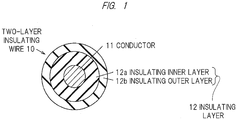
- FIG. 1 is a cross-sectional view illustrating an embodiment of a non-halogen multilayer insulating wire of the present invention.
- FIG. 1 is a cross-sectional view illustrating an example of a non-halogen two-layer insulating wire, which is an embodiment of the non-halogen multilayer insulating wire of the present invention.
- a non-halogen two-layer insulating wire 10 according to the present invention illustrated in FIG. 1 includes a conductor 11 made of a general-purpose material such as tin-plated copper, and an insulating layer 12 having an insulating inner layer 12a which covers the outer circumference of the conductor 11 and an insulating outer layer 12b which covers the outer circumference of the insulating inner layer 12a.
- the insulating inner layer 12a is made of a first non-halogen resin composition which contains a metal hydroxide and a base polymer (A) including polyolefin, and has a thickness of 20% to 58% of an entire thickness of the insulating layer 12.
- the insulating outer layer 12b is made of a second non-halogen resin composition which contains a metal hydroxide and a base polymer (B) including polyester resin and/or polyester elastomer resin.
- the base polymer (A) for use in the first non-halogen resin composition is not particularly limited as long as it is polyolefin not including halogen.
- high-density polyethylene, medium-density polyethylene, low-density polyethylene, very low-density polyethylene, linear low-density polyethylene, ethylene-acrylic acid ester copolymer, and copolymer of ⁇ -olefin and ethylene are cited.
- the ⁇ -olefin may be in a liner or branch form.
- the ⁇ -olefin for example, propylene, 1-butene, 1-pentene, 1-hexene, 4-methyl pentene, 1-heptene, 1-octene, and others are cited.
- Single use may be applied to these materials, or two or more of these materials may be used together. Also, in order to obtain the more enhanced electrical characteristics, polyolefin modified by the grafting, the copolymerization, or others using maleic anhydride or others may be applied.
- metal hydroxide is added in order to provide the flame resistance.
- the metal hydroxide magnesium hydroxide, aluminum hydroxide, calcium hydroxide, and others are cited. Single use of these materials may be applied, or two or more of these materials may be used together.
- the magnesium hydroxide is preferable because of its high dehydration temperature and high flame resistance.
- the metal hydroxide may be subjected to surface treatment.
- an addition amount of the metal hydroxide it is preferred to contain 20 to 100 parts by mass with respect to 100 parts by mass of the base polymer (A) for easily achieving both of the enhanced flame resistance and electrical characteristics. If the addition amount is smaller than 20 parts by mass, there is a risk that does not cause the flame resistance. If the addition amount exceeds 100 parts by mass, there is a risk that does not cause the favorable electrical characteristics.
- An upper-limit value of the addition amount of the metal hydroxide is preferably 90 parts by mass, more preferably 85 parts by mass, and most preferably 80 parts by mass, with respect to 100 parts by mass of the base polymer (A).
- a lower-limit value of the addition amount of the metal hydroxide is preferably 25 parts by mass and more preferably 30 parts by mass, with respect to 100 parts by mass of the base polymer (A).
- another non-halogen flame retardant may be used together.
- clay, silica, zinc stannate, zinc borate, calcium borate, dolomite hydroxide, and silicone are cited.
- a phosphorous-based flame retardant such as red phosphorous and a triazine-based flame retardant such as melamine cyanurate generate phosphine gas or cyanide gas, respectively, which are toxic to humans, and therefore, are inappropriate.
- polyester elastomer resin for example, a polyester block copolymer is cited, the polyester block copolymer having a hard segment taking an aromatic polyester unit made of a glycol component and an acid component such as polybutylene terephthalate (PBT), polybutylene naphthalate (PBN), or polyethylene terephthalate (PET) and having a soft segment taking polyether such as poly tetra methylene glycol and an aliphatic polyester such as poly tetra methylene adipate or ⁇ -caprolactone.
- PBT polybutylene terephthalate
- PBN polybutylene naphthalate
- PET polyethylene terephthalate
- a blend ratio of these materials is not particularly limited as long as the carbonized layer is generated and the high flame resistance is obtained.
- metal hydroxide is added in order to provide the flame resistance.
- the metal hydroxide magnesium hydroxide, aluminum hydroxide, calcium hydroxide, and others are cited. And, single use of these materials may be applied, or two or more of these materials may be used together.
- the magnesium hydroxide is preferable because of its high dehydration temperature and high flame resistance.
- the metal hydroxide may be subjected to surface treatment.
- the metal hydroxide it is preferable to contain 5 to 50 parts by mass with respect to 100 parts by mass of the base polymer (B) for achieving both of the flame resistance and the favorable electrical characteristics. If the addition amount is smaller than 5 parts by mass, there is a risk that does not cause the flame resistance. If the addition amount exceeds 50 parts by mass, there is a risk that does not cause the favorable electrical characteristics.
- a cross-linker As required, a cross-linker, a cross-linking promoter, a flame retardant promoter, an ultraviolet absorber, a light stabilizer, a softener, a lubricant, a coloring agent, a reinforcing agent, a surface-active agent, an inorganic filler, a plasticizer, a metal chelator, a blowing agent, a compatibilizing agent, a processing aid, a stabilizer, or others can be added to the first and/or second non-halogen resin composition.
- the insulating layer 12 may have a structure in which a plurality of insulating inner layers 12a are provided immediately above the conductor 11, or may have a multilayer structure in which a plurality of insulating outer layers 12b are provided on the insulating inner layer 12a.
- the insulating inner layer 12a is provided immediately above the conductor and the insulating outer layer 12b is provided in the outermost layer, there is no problem in presence of a different resin composition layer between them.
- the insulating inner layer 12a is required to have a thickness of 20% to 58% of an entire thickness of the insulating layer 12. If the thickness is smaller than 20%, the sufficient electrical characteristics cannot be obtained. If the thickness exceeds 58%, the wear resistance cannot be ensured.
- the thickness of the insulating inner layer 12a is preferably 25% or more of the entire thickness of the insulating layer 12, more preferably 30% or more thereof, and still more preferably 35% or more thereof. Also, the thickness of the insulating inner layer 12a is preferably 55% or less of the entire thickness of the insulating layer 12, more preferably 50% or less thereof, and still more preferably 45% or less thereof. Note that the entire thickness of the insulating layer 12 described here means a thickness of the entire insulating layer including, if any, an insulating layer other than the insulating inner layer 12a and the insulating outer layer 12b.
- the insulating layer 12 can be provided by, for example, two-layer coextrusion molding, and is subjected to a cross-linking treatment after the molding.
- the insulating layer 12 is not required to be subjected to a cross-linking treatment, it is preferable to perform the cross-linking treatment in a specification which requires the heat resistance.
- a chemical cross-linking treatment using organic peroxide, sulfur compound, silane, or others, a radiation cross-linking treatment using electron ray, radioactive ray, or others, and a cross-linking treatment using other chemical reactions, and others are cited as the cross-linking treatment. And, any cross-linking treatment is applicable.
- the two-layer insulating wire 10 may include a braided wire or others as required.
- the two-layer insulating wire 10 illustrated in FIG. 1 was produced as follows.
- thermogravimetric mass loss (TG) of the obtained insulating wire was measured by using the following method. The measurement results are shown in Table 1.
- the obtained insulating outer layer 12b of the insulating wire was heated from 40°C at a temperature increase rate of 10°C/min under purge gas of dried air in the thermogravimetric analysis method.
- the TG obtained when the temperature reaches 430°C is desirably -60% or more.
- the obtained insulating wire was evaluated by various evaluation tests as described below. The evaluation results are shown in Table 1.
- An insulating wire having a length of 600 mm was vertically held, and the insulating wire was flamed for sixty seconds. An insulating wire which was extinguished within sixty seconds after the flame is removed was evaluated as "passed” ( ⁇ ), and an insulating wire which was not extinguished within sixty seconds was evaluated as “failed” ( ⁇ ).
Landscapes
- Chemical & Material Sciences (AREA)
- Physics & Mathematics (AREA)
- Spectroscopy & Molecular Physics (AREA)
- Organic Chemistry (AREA)
- Materials Engineering (AREA)
- Engineering & Computer Science (AREA)
- Life Sciences & Earth Sciences (AREA)
- Wood Science & Technology (AREA)
- Chemical Kinetics & Catalysis (AREA)
- Health & Medical Sciences (AREA)
- Medicinal Chemistry (AREA)
- Polymers & Plastics (AREA)
- Insulated Conductors (AREA)
- Organic Insulating Materials (AREA)
- Compositions Of Macromolecular Compounds (AREA)
Abstract
Description
- The present invention relates to a non-halogen multilayer insulating wire.
- High wear resistance, low temperature property, flame resistance, and others are demanded for wires and cables applied to railway vehicle, automobile, and equipment, etc., as needed.
- It has been known that a polymer with high crystallinity (such as HDPE) is basically used in order to obtain high wear resistance. However, since the polymer has low filler receptivity, a halogen-based flame retardant or a phosphorus-based flame retardant such as red phosphorus, which has the effect for the flame resistance with a small amount of addition, has to be used.
- However, since the halogen-based flame retardant generates halogen gas at the time of combustion, there is a lack of consideration for environmental problems that has been increasingly demanded worldwide. Moreover, the phosphorous-based flame retardant such as red phosphorous also has problems of generating phosphine at the time of combustion and generating phosphate at the time of disposal to pollute underground water vein.
- Thus, a non-halogen insulating wire using a metal hydroxide as a flame retardant have been developed (see, for example, Japanese Patent Application Laid-Open Publication No.
2013-214487 - The metal hydroxide does not cause the problems as described above as compared with the halogen-based flame retardant and the phosphorous-based flame retardant. However, the metal hydroxide is normally required to be highly filled, and therefore, has problems of degrading mechanical characteristics and electrical insulation characteristics.
- Thus, an object of the present invention is to provide a non-halogen insulating wire with excellent flame resistance as well as high mechanical characteristics (wear resistance) and electrical insulation characteristics.
- In order to achieve the above-described object, the following non-halogen insulating wire is provided according to the present invention.
- [1] A non-halogen multilayer insulating wire has a feature including: a conductor; and an insulating layer having an insulating inner layer which covers an outer circumference of the conductor and an insulating outer layer which covers an outer circumference of the insulating inner layer, a feature in which the insulating inner layer is formed of a first non-halogen resin composition containing a metal hydroxide and a base polymer (A) including polyolefin, and the insulating inner layer has a thickness of 20% to 58% of an entire thickness of the insulating layer, and a feature in which the insulating outer layer is formed of a second non-halogen resin composition containing a metal hydroxide and a base polymer (B) including a polyester resin and/or polyester elastomer resin.
- [2] The non-halogen multilayer insulating wire described above in [1], has a feature in which the polyester resin is a polybutylene terephthalate (PBT) and/or polybutylene naphthalate (PBN).
- [3] The non-halogen multilayer insulating wire described above in [1] or [2], has a feature in which the polyester elastomer resin is a polybutylene elastomer.
- [4] The non-halogen multilayer insulating wire described above in any one of [1] to [3], has a feature in which the base polymer (B) contains a resin having an aromatic structure in a main chain.
- [5] The non-halogen multilayer insulating wire described above in [4], has a feature in which the resin having the aromatic structure in the main chain is one or more selected from polyether imide, silicone modified polyether imide, polyphenylene ether, modified polyphenylene ether, and polyether ether ketone.
- [6] The non-halogen multilayer insulating wire described above in [4], has a feature in which the resin having the aromatic structure in the main chain is polyether imide and/or silicone modified polyether imide.
- [7] The non-halogen multilayer insulating wire described above in any one of [1] to [6], has a feature in which the second non-halogen resin composition has a thermogravimetric mass loss (TG) of -60% or more when heated from 40°C to reach 430°C at a temperature increase rate of 10°C/min under purge gas of dried air in a thermogravimetric analysis method.
- [8] The non-halogen multilayer insulating wire described above in any one of [1] to [7], has a feature in which the first non-halogen resin composition contains 20 to 100 parts by mass of the metal hydroxide with respect to 100 parts by mass of the base polymer (A).
- [9] The non-halogen multilayer insulating wire described above in any one of [1] to [8], has a feature in which the second non-halogen resin composition contains 5 to 50 parts by mass of the metal hydroxide with respect to 100 parts by mass of the base polymer (B).
- [10] The non-halogen multilayer insulating wire described above in any one of [1] to [9], has a feature in which the metal hydroxide contained in the first and/or second non-halogen resin composition is a magnesium hydroxide.
- According to the present invention, a non-halogen insulating wire with excellent flame resistance as well as high mechanical characteristics (wear resistance) and electrical insulation characteristics is provided.
-
FIG. 1 is a cross-sectional view illustrating an embodiment of a non-halogen multilayer insulating wire of the present invention. -
FIG. 1 is a cross-sectional view illustrating an example of a non-halogen two-layer insulating wire, which is an embodiment of the non-halogen multilayer insulating wire of the present invention. - A non-halogen two-layer
insulating wire 10 according to the present invention illustrated inFIG. 1 includes aconductor 11 made of a general-purpose material such as tin-plated copper, and aninsulating layer 12 having an insulatinginner layer 12a which covers the outer circumference of theconductor 11 and an insulatingouter layer 12b which covers the outer circumference of the insulatinginner layer 12a. - In the non-halogen two-layer
insulating wire 10, the insulatinginner layer 12a is made of a first non-halogen resin composition which contains a metal hydroxide and a base polymer (A) including polyolefin, and has a thickness of 20% to 58% of an entire thickness of theinsulating layer 12. - Also, in the non-halogen two-layer
insulating wire 10, the insulatingouter layer 12b is made of a second non-halogen resin composition which contains a metal hydroxide and a base polymer (B) including polyester resin and/or polyester elastomer resin. - The base polymer (A) for use in the first non-halogen resin composition is not particularly limited as long as it is polyolefin not including halogen. Specifically, high-density polyethylene, medium-density polyethylene, low-density polyethylene, very low-density polyethylene, linear low-density polyethylene, ethylene-acrylic acid ester copolymer, and copolymer of α-olefin and ethylene are cited. The α-olefin may be in a liner or branch form. As the α-olefin, for example, propylene, 1-butene, 1-pentene, 1-hexene, 4-methyl pentene, 1-heptene, 1-octene, and others are cited. Single use may be applied to these materials, or two or more of these materials may be used together. Also, in order to obtain the more enhanced electrical characteristics, polyolefin modified by the grafting, the copolymerization, or others using maleic anhydride or others may be applied.
- To the first non-halogen resin composition, metal hydroxide is added in order to provide the flame resistance. As the metal hydroxide, magnesium hydroxide, aluminum hydroxide, calcium hydroxide, and others are cited. Single use of these materials may be applied, or two or more of these materials may be used together. Particularly, the magnesium hydroxide is preferable because of its high dehydration temperature and high flame resistance. The metal hydroxide may be subjected to surface treatment.
- As an addition amount of the metal hydroxide, it is preferred to contain 20 to 100 parts by mass with respect to 100 parts by mass of the base polymer (A) for easily achieving both of the enhanced flame resistance and electrical characteristics. If the addition amount is smaller than 20 parts by mass, there is a risk that does not cause the flame resistance. If the addition amount exceeds 100 parts by mass, there is a risk that does not cause the favorable electrical characteristics. An upper-limit value of the addition amount of the metal hydroxide is preferably 90 parts by mass, more preferably 85 parts by mass, and most preferably 80 parts by mass, with respect to 100 parts by mass of the base polymer (A). A lower-limit value of the addition amount of the metal hydroxide is preferably 25 parts by mass and more preferably 30 parts by mass, with respect to 100 parts by mass of the base polymer (A).
- Also, as required, another non-halogen flame retardant may be used together. Specifically, clay, silica, zinc stannate, zinc borate, calcium borate, dolomite hydroxide, and silicone are cited. A phosphorous-based flame retardant such as red phosphorous and a triazine-based flame retardant such as melamine cyanurate generate phosphine gas or cyanide gas, respectively, which are toxic to humans, and therefore, are inappropriate.
- The base polymer (B) for use in the second non-halogen resin composition is a polyester resin and/or a polyester elastomer resin not including halogen. Particularly, as the polyester resin, it is preferred to include polybutylene terephthalate (PBT) and/or polybutylene naphthalate (PBN). These materials are excellent in mechanical strength and have relatively low melting points, and therefore, are preferable because of being easily shaped. In a case of usage for providing flexibility, a polyester elastomer resin may be applied. As the polyester elastomer resin, for example, a polyester block copolymer is cited, the polyester block copolymer having a hard segment taking an aromatic polyester unit made of a glycol component and an acid component such as polybutylene terephthalate (PBT), polybutylene naphthalate (PBN), or polyethylene terephthalate (PET) and having a soft segment taking polyether such as poly tetra methylene glycol and an aliphatic polyester such as poly tetra methylene adipate or ε-caprolactone.
- To the base polymer (B), not only the polyester resin or the polyester elastomer resin but also a resin having an aromatic structure in a main chain (hereinafter, referred to as an aromatic resin) may be added. The aromatic resin can easily generate a carbonized layer at the time of combustion, and therefore, can provide the high flame resistance. Particularly, polyether imide, silicone modified polyether imide, polyphenylene ether, modified polyphenylene ether, and polyether ether ketone can easily exert the effects. Also, in consideration of formability and versatility, polyether imide and silicone modified polyether imide are preferable. Single use of these materials may be applied, or two or more of these materials may be used together. A blend ratio of these materials is not particularly limited as long as the carbonized layer is generated and the high flame resistance is obtained. For example, a relation of " (a total amount of the polyester resin and the polyester elastomer resin) : (the aromatic resin) = 4:6 to 6:4" is preferable.
- The second non-halogen resin composition may have a thermogravimetric mass loss (TG) of -60% or more when heated from 40°C to reach 430°C at a temperature increase rate of 10°C/min under purge gas of dried air in a thermogravimetric analysis method. When an organic material is heated to a temperature near 430°C in the thermogravimetric analysis method, its TG is occupied mostly by combustible gas. Since the combustion advances when the amount of the combustible gas is large, the material having the less decrease in weight is excellent in the flame resistance. Also, when a carbonized layer is formed at the time of combustion, a heat insulation effect is exerted, so that this manner is effective for the flame resistance. When a carbonized layer is formed, a change in weight is decreased, and the amount of the combustible gas is also decreased. Therefore, the high flame resistance can be achieved.
- To the second non-halogen resin composition, metal hydroxide is added in order to provide the flame resistance. As the metal hydroxide, magnesium hydroxide, aluminum hydroxide, calcium hydroxide, and others are cited. And, single use of these materials may be applied, or two or more of these materials may be used together. Particularly, the magnesium hydroxide is preferable because of its high dehydration temperature and high flame resistance. The metal hydroxide may be subjected to surface treatment.
- As an additional amount of the metal hydroxide, it is preferable to contain 5 to 50 parts by mass with respect to 100 parts by mass of the base polymer (B) for achieving both of the flame resistance and the favorable electrical characteristics. If the addition amount is smaller than 5 parts by mass, there is a risk that does not cause the flame resistance. If the addition amount exceeds 50 parts by mass, there is a risk that does not cause the favorable electrical characteristics.
- As required, a cross-linker, a cross-linking promoter, a flame retardant promoter, an ultraviolet absorber, a light stabilizer, a softener, a lubricant, a coloring agent, a reinforcing agent, a surface-active agent, an inorganic filler, a plasticizer, a metal chelator, a blowing agent, a compatibilizing agent, a processing aid, a stabilizer, or others can be added to the first and/or second non-halogen resin composition.
- While the insulating
layer 12 according to the embodiment of the present invention illustrated inFIG. 1 is configured of two layers, the insulatinglayer 12 may have a structure in which a plurality of insulatinginner layers 12a are provided immediately above theconductor 11, or may have a multilayer structure in which a plurality of insulatingouter layers 12b are provided on the insulatinginner layer 12a. - Also, as long as the insulating
inner layer 12a is provided immediately above the conductor and the insulatingouter layer 12b is provided in the outermost layer, there is no problem in presence of a different resin composition layer between them. - The insulating
inner layer 12a is required to have a thickness of 20% to 58% of an entire thickness of the insulatinglayer 12. If the thickness is smaller than 20%, the sufficient electrical characteristics cannot be obtained. If the thickness exceeds 58%, the wear resistance cannot be ensured. The thickness of the insulatinginner layer 12a is preferably 25% or more of the entire thickness of the insulatinglayer 12, more preferably 30% or more thereof, and still more preferably 35% or more thereof. Also, the thickness of the insulatinginner layer 12a is preferably 55% or less of the entire thickness of the insulatinglayer 12, more preferably 50% or less thereof, and still more preferably 45% or less thereof. Note that the entire thickness of the insulatinglayer 12 described here means a thickness of the entire insulating layer including, if any, an insulating layer other than the insulatinginner layer 12a and the insulatingouter layer 12b. - The insulating
layer 12 can be provided by, for example, two-layer coextrusion molding, and is subjected to a cross-linking treatment after the molding. - Although the insulating
layer 12 is not required to be subjected to a cross-linking treatment, it is preferable to perform the cross-linking treatment in a specification which requires the heat resistance. A chemical cross-linking treatment using organic peroxide, sulfur compound, silane, or others, a radiation cross-linking treatment using electron ray, radioactive ray, or others, and a cross-linking treatment using other chemical reactions, and others are cited as the cross-linking treatment. And, any cross-linking treatment is applicable. - The two-
layer insulating wire 10 may include a braided wire or others as required. - In the following, the present invention is further specifically described with reference to examples. Note that the present invention is not limited at all by the following examples.
- The two-
layer insulating wire 10 illustrated inFIG. 1 was produced as follows. - (1) As the
conductor 11, a composition of 37 tin plated conductors per 0.18 mm was used. - (2) A resin composition obtained by kneading each composition in examples and comparative examples shown in Table 1 by a 35 mm twin-screw extruder was pelletized by using a granulator to obtain a material for the insulating inner layer and a material for the insulating outer layer.
- (3) By using the obtained materials for the insulating inner layer and the insulating outer layer, two-layer coextrusion using a 40 mm extruder was performed so that the thicknesses of the inner and outer layers immediately above the tin plated conductor are as shown in Table 1 to coat the
conductor 11 with the insulatinginner layer 12a and coat the insulatinginner layer 12a with the insulatingouter layer 12b. - (4) The obtained insulating wire was irradiated with electron ray to perform the cross-linking treatment. An irradiation amount is as shown in Table 1.
- A thermogravimetric mass loss (TG) of the obtained insulating wire was measured by using the following method. The measurement results are shown in Table 1.
- The obtained insulating
outer layer 12b of the insulating wire was heated from 40°C at a temperature increase rate of 10°C/min under purge gas of dried air in the thermogravimetric analysis method. The TG obtained when the temperature reaches 430°C is desirably -60% or more. - The obtained insulating wire was evaluated by various evaluation tests as described below. The evaluation results are shown in Table 1.
- An insulating wire having a length of 600 mm was vertically held, and the insulating wire was flamed for sixty seconds. An insulating wire which was extinguished within sixty seconds after the flame is removed was evaluated as "passed" (○), and an insulating wire which was not extinguished within sixty seconds was evaluated as "failed" (×).
- In compliance with EN 50305.5.2, the wear resistance was evaluated. An insulating wire whose wear resistance cycle is equal to or more than 150 was evaluated as "passed" (○), and an insulating wire whose wear resistance cycle is less than 150 was evaluated as "failed" (×). Noted that an insulating wire whose wear resistance cycle exceeds 300 was not further evaluated.
- In compliance with EN 50305.6.7, a 300-V direct-current stability test was performed. An insulating wire which was not short-circuited for 240 hours was evaluated as "passed" (○), an insulating wire which was short-circuited within hours equal to or more than 100 hours and less than 240 hours was evaluated as "passed" (Δ), and an insulating wire which was short-circuited within hours less than 100 hours was evaluated as "failed" (x).
- As a comprehensive evaluation, an insulating wire for which all of the above-described test evaluations are "○" was evaluated as "passed" (⊚), an insulating wire with the evaluation including "Δ" was evaluated as "passed" (o), and an insulating wire with the evaluation including "×" was evaluated as "failed" (x).
[TABLE 1]
- As shown in Table 1, all evaluations were "○" in first to seventh and tenth examples, and therefore, their comprehensive evaluations were "passed" (⊚). Also, in eighth and ninth examples, the electrical characteristics were "Δ", and therefore, their comprehensive evaluations were "passed" (○).
- As shown in Table 1, in the first comparative example, the thickness of the insulating inner layer was small, and the electrical characteristics were failed, and therefore, its comprehensive evaluation was "failed" (x).
- As shown in Table 1, in the second comparative example, the material thickness of the insulating outer layer was small, and the wear resistance was failed, and therefore, its comprehensive evaluation was "failed" (x).
Claims (10)
- A non-halogen multilayer insulating wire comprising:a conductor; andan insulating layer having an insulating inner layer which covers an outer circumference of the conductor and an insulating outer layer which covers an outer circumference of the insulating inner layer, characterized in thatthe insulating inner layer is made of a first non-halogen resin composition which contains metal hydroxide and a base polymer (A) including polyolefin, and has a thickness of 20% to 58% of an entire thickness of the insulating layer, and
the insulating outer layer is made of a second non-halogen resin composition which contains metal hydroxide and a base polymer (B) including polyester resin and/or polyester elastomer resin. - The non-halogen multilayer insulating wire according to claim 1,
wherein the polyester resin is polybutylene terephthalate (PBT) and/or polybutylene naphthalate (PBN). - The non-halogen multilayer insulating wire according to claim 1 or 2,
wherein the polyester elastomer resin is polybutylene elastomer. - The non-halogen multilayer insulating wire according to any one of claims 1 to 3,
wherein the base polymer (B) includes a resin having an aromatic structure in a main chain. - The non-halogen multilayer insulating wire according to claim 4,
wherein the resin having the aromatic structure in the main chain is one or more selected frompolyether imide, silicone modified polyether imide, polyphenylene ether, modified polyphenylene ether, and polyether ether ketone. - The non-halogen multilayer insulating wire according to claim 4,
wherein the resin having the aromatic structure in the main chain is polyether imide and/or silicone modified polyether imide. - The non-halogen multilayer insulating wire according to any one of claims 1 to 6,
wherein the second non-halogen resin composition has a thermogravimetric mass loss (TG) of -60% or more when heated from 40°C to reach 430°C at a temperature increase rate of 10°C/min under purge gas of dried air in a thermogravimetric analysis method. - The non-halogen multilayer insulating wire according to any one of claims 1 to 7,
wherein the first non-halogen resin composition contains 20 to 100 parts by mass of the metal hydroxide with respect to 100 parts by mass of the base polymer (A). - The non-halogen multilayer insulating wire according to any one of claims 1 to 8,
wherein the second non-halogen resin composition contains 5 to 50 parts by mass of the metal hydroxide with respect to 100 parts by mass of the base polymer (B). - The non-halogen multilayer insulating wire according to any one of claims 1 to 9,
wherein the metal hydroxide contained in the first and/or second non-halogen resin composition is magnesium hydroxide.
Applications Claiming Priority (1)
| Application Number | Priority Date | Filing Date | Title |
|---|---|---|---|
| JP2015196738A JP6796251B2 (en) | 2015-10-02 | 2015-10-02 | Non-halogen multilayer insulated wire |
Publications (2)
| Publication Number | Publication Date |
|---|---|
| EP3151250A1 true EP3151250A1 (en) | 2017-04-05 |
| EP3151250B1 EP3151250B1 (en) | 2019-04-17 |
Family
ID=57189745
Family Applications (1)
| Application Number | Title | Priority Date | Filing Date |
|---|---|---|---|
| EP16191464.3A Active EP3151250B1 (en) | 2015-10-02 | 2016-09-29 | Non-halogen multilayer insulating wire |
Country Status (4)
| Country | Link |
|---|---|
| US (1) | US9984793B2 (en) |
| EP (1) | EP3151250B1 (en) |
| JP (1) | JP6796251B2 (en) |
| CN (1) | CN106560900A (en) |
Families Citing this family (3)
| Publication number | Priority date | Publication date | Assignee | Title |
|---|---|---|---|---|
| DE102016224415A1 (en) * | 2016-12-08 | 2018-06-14 | Leoni Kabel Gmbh | Line and method for producing such |
| JP7163034B2 (en) * | 2018-02-07 | 2022-10-31 | 日立金属株式会社 | Multilayer insulated wire and manufacturing method thereof |
| CN111959048A (en) * | 2020-08-27 | 2020-11-20 | 东莞市鹏园电子材料有限公司 | Double-layer heat-shrinkable sleeve for insulation protection of new energy automobile and preparation method thereof |
Citations (4)
| Publication number | Priority date | Publication date | Assignee | Title |
|---|---|---|---|---|
| EP1655741A1 (en) * | 2003-07-30 | 2006-05-10 | Sumitomo Electric Industries, Ltd. | Nonhalogenated flame resistant cable |
| JP2013214487A (en) | 2012-03-05 | 2013-10-17 | Hitachi Cable Ltd | Multilayer insulated cable |
| US20140011028A1 (en) * | 2012-07-03 | 2014-01-09 | Hitachi Cable, Ltd. | Insulated wire for vehicle use and cable for vehicle use |
| US20150060107A1 (en) * | 2013-08-30 | 2015-03-05 | Hitachi Metals, Ltd. | Halogen-free resin composition, insulated wire and cable |
Family Cites Families (14)
| Publication number | Priority date | Publication date | Assignee | Title |
|---|---|---|---|---|
| GB9310146D0 (en) * | 1993-05-17 | 1993-06-30 | Raychem Ltd | Polymer composition and electrical wire insulation |
| ATE389940T1 (en) * | 2003-12-24 | 2008-04-15 | Prysmian Cavi Sistemi Energia | PROCESS FOR MAKING A SELF-EXTINGUISHING CABLE |
| JP2007045952A (en) * | 2005-08-10 | 2007-02-22 | Daicel Chem Ind Ltd | Flame retardant polyester resin composition and covered electric wire using the same |
| CA2627269C (en) * | 2005-10-27 | 2014-05-06 | Prysmian Cavi E Sistemi Energia S.R.L. | Low-smoke self-extinguishing cable and flame-retardant composition comprising natural magnesium hydroxide |
| WO2009047353A1 (en) * | 2007-10-11 | 2009-04-16 | Dsm Ip Assets B.V. | Flexible flame retardant insulated wires for use in electronic equipment |
| CN201340753Y (en) * | 2009-01-14 | 2009-11-04 | 安徽五洲特种电缆集团有限公司 | Environmental-friendly locomotive vehicle cable for railway transportation |
| JP5598863B2 (en) * | 2010-10-18 | 2014-10-01 | 古河電気工業株式会社 | Non-halogen flame retardant multilayer insulated wire |
| WO2012124589A1 (en) * | 2011-03-17 | 2012-09-20 | 住友電気工業株式会社 | Non-halogen flame-retardant resin composition, and insulating wire and tube in which same is used |
| JP5742034B2 (en) * | 2012-11-19 | 2015-07-01 | 日立金属株式会社 | Non-halogen multilayer insulated wire |
| JP5617903B2 (en) * | 2012-11-20 | 2014-11-05 | 日立金属株式会社 | Vehicle wires, vehicle cables |
| JP5742821B2 (en) * | 2012-11-20 | 2015-07-01 | 日立金属株式会社 | Non-halogen multilayer insulated wire |
| JP2015060733A (en) * | 2013-09-19 | 2015-03-30 | 住友電気工業株式会社 | Halogen-free flame-retardant insulated wire and flame-retardant insulated tube |
| JP2015072752A (en) * | 2013-10-02 | 2015-04-16 | 日立金属株式会社 | Multilayer insulated wire |
| JP6123666B2 (en) * | 2013-12-19 | 2017-05-10 | 日立金属株式会社 | Non-halogen flame retardant polyester insulated wire |
-
2015
- 2015-10-02 JP JP2015196738A patent/JP6796251B2/en active Active
-
2016
- 2016-09-26 CN CN201610852361.8A patent/CN106560900A/en active Pending
- 2016-09-29 EP EP16191464.3A patent/EP3151250B1/en active Active
- 2016-09-30 US US15/281,180 patent/US9984793B2/en active Active
Patent Citations (4)
| Publication number | Priority date | Publication date | Assignee | Title |
|---|---|---|---|---|
| EP1655741A1 (en) * | 2003-07-30 | 2006-05-10 | Sumitomo Electric Industries, Ltd. | Nonhalogenated flame resistant cable |
| JP2013214487A (en) | 2012-03-05 | 2013-10-17 | Hitachi Cable Ltd | Multilayer insulated cable |
| US20140011028A1 (en) * | 2012-07-03 | 2014-01-09 | Hitachi Cable, Ltd. | Insulated wire for vehicle use and cable for vehicle use |
| US20150060107A1 (en) * | 2013-08-30 | 2015-03-05 | Hitachi Metals, Ltd. | Halogen-free resin composition, insulated wire and cable |
Also Published As
| Publication number | Publication date |
|---|---|
| EP3151250B1 (en) | 2019-04-17 |
| US9984793B2 (en) | 2018-05-29 |
| CN106560900A (en) | 2017-04-12 |
| US20170098492A1 (en) | 2017-04-06 |
| JP6796251B2 (en) | 2020-12-09 |
| JP2017069157A (en) | 2017-04-06 |
Similar Documents
| Publication | Publication Date | Title |
|---|---|---|
| US7586043B2 (en) | Non-halogenous insulated wire and a wiring harness | |
| JP6745093B2 (en) | Heat resistant wire and heat resistant cable | |
| JP2014101454A (en) | Non-halogen crosslinked resin composition and insulated wire, cable | |
| EP3104372B1 (en) | Halogen-free flame-retardant insulated wire and halogen-free flame-retardant cable | |
| CN104893078A (en) | Halogen-free flame-retardant resin composition and insulated wire and cable using same | |
| US10439384B2 (en) | Heat-recoverable article, method for manufacturing heat-recoverable article, wire splice, and wire harness | |
| US9624366B2 (en) | Crosslinkable halogen-free resin composition, cross-linked insulated wire and cable | |
| JP5771340B1 (en) | Heat recovery article, wire splice and wire harness | |
| CA2748194A1 (en) | Polymer compositions and their use as cable coverings | |
| US6995198B2 (en) | Flame retardant ethylene family resin composite and flame retardant electric wire or cable | |
| EP3151250B1 (en) | Non-halogen multilayer insulating wire | |
| JP2020125459A (en) | Non-halogen resin composition, electric wire and cable | |
| US10381128B2 (en) | Flame-retardant flexible polymer composition, and polymer tube and insulated wire formed from the polymer composition | |
| US9624365B2 (en) | Halogen-free crosslinkable resin composition, cross-linked insulation wire and cable | |
| CN105670195B (en) | Halogen crosslinkable resin composition, cross linked insulation electric wire and cable | |
| EP3524428B1 (en) | Multi-layer insulated wire and method of manufacturing the same | |
| JP2024164812A (en) | Halogen-free resin composition, electric wire and cable | |
| JP2024025002A (en) | Non-halogen flame retardant resin compositions, electric wires and cables | |
| KR0158438B1 (en) | Heat-proof lead wire for high dc voltage | |
| JP7619512B2 (en) | LAN cable | |
| CN111499950A (en) | Halogen-free resin composition, electric wire and cable | |
| EP4442753A1 (en) | Resin composition, resinous coating material, insulated electric wire, automotive wire harness, and method for producing insulated electric wire for use in automotive wire harness |
Legal Events
| Date | Code | Title | Description |
|---|---|---|---|
| PUAI | Public reference made under article 153(3) epc to a published international application that has entered the european phase |
Free format text: ORIGINAL CODE: 0009012 |
|
| STAA | Information on the status of an ep patent application or granted ep patent |
Free format text: STATUS: THE APPLICATION HAS BEEN PUBLISHED |
|
| AK | Designated contracting states |
Kind code of ref document: A1 Designated state(s): AL AT BE BG CH CY CZ DE DK EE ES FI FR GB GR HR HU IE IS IT LI LT LU LV MC MK MT NL NO PL PT RO RS SE SI SK SM TR |
|
| AX | Request for extension of the european patent |
Extension state: BA ME |
|
| STAA | Information on the status of an ep patent application or granted ep patent |
Free format text: STATUS: REQUEST FOR EXAMINATION WAS MADE |
|
| 17P | Request for examination filed |
Effective date: 20171002 |
|
| RBV | Designated contracting states (corrected) |
Designated state(s): AL AT BE BG CH CY CZ DE DK EE ES FI FR GB GR HR HU IE IS IT LI LT LU LV MC MK MT NL NO PL PT RO RS SE SI SK SM TR |
|
| STAA | Information on the status of an ep patent application or granted ep patent |
Free format text: STATUS: EXAMINATION IS IN PROGRESS |
|
| 17Q | First examination report despatched |
Effective date: 20180622 |
|
| GRAP | Despatch of communication of intention to grant a patent |
Free format text: ORIGINAL CODE: EPIDOSNIGR1 |
|
| STAA | Information on the status of an ep patent application or granted ep patent |
Free format text: STATUS: GRANT OF PATENT IS INTENDED |
|
| RIC1 | Information provided on ipc code assigned before grant |
Ipc: C09D 179/08 20060101ALI20181211BHEP Ipc: H01B 3/44 20060101ALI20181211BHEP Ipc: C08K 3/22 20060101ALI20181211BHEP Ipc: C09D 167/02 20060101ALI20181211BHEP Ipc: H01B 7/18 20060101ALI20181211BHEP Ipc: H01B 7/02 20060101ALI20181211BHEP Ipc: C09D 123/22 20060101ALI20181211BHEP Ipc: H01B 3/28 20060101ALI20181211BHEP Ipc: H01B 3/42 20060101ALI20181211BHEP Ipc: H01B 7/295 20060101AFI20181211BHEP |
|
| INTG | Intention to grant announced |
Effective date: 20190107 |
|
| GRAS | Grant fee paid |
Free format text: ORIGINAL CODE: EPIDOSNIGR3 |
|
| GRAA | (expected) grant |
Free format text: ORIGINAL CODE: 0009210 |
|
| STAA | Information on the status of an ep patent application or granted ep patent |
Free format text: STATUS: THE PATENT HAS BEEN GRANTED |
|
| AK | Designated contracting states |
Kind code of ref document: B1 Designated state(s): AL AT BE BG CH CY CZ DE DK EE ES FI FR GB GR HR HU IE IS IT LI LT LU LV MC MK MT NL NO PL PT RO RS SE SI SK SM TR |
|
| REG | Reference to a national code |
Ref country code: GB Ref legal event code: FG4D |
|
| REG | Reference to a national code |
Ref country code: CH Ref legal event code: EP |
|
| REG | Reference to a national code |
Ref country code: DE Ref legal event code: R096 Ref document number: 602016012490 Country of ref document: DE |
|
| REG | Reference to a national code |
Ref country code: AT Ref legal event code: REF Ref document number: 1122452 Country of ref document: AT Kind code of ref document: T Effective date: 20190515 Ref country code: IE Ref legal event code: FG4D |
|
| REG | Reference to a national code |
Ref country code: NL Ref legal event code: MP Effective date: 20190417 |
|
| REG | Reference to a national code |
Ref country code: LT Ref legal event code: MG4D |
|
| PG25 | Lapsed in a contracting state [announced via postgrant information from national office to epo] |
Ref country code: NL Free format text: LAPSE BECAUSE OF FAILURE TO SUBMIT A TRANSLATION OF THE DESCRIPTION OR TO PAY THE FEE WITHIN THE PRESCRIBED TIME-LIMIT Effective date: 20190417 |
|
| PG25 | Lapsed in a contracting state [announced via postgrant information from national office to epo] |
Ref country code: AL Free format text: LAPSE BECAUSE OF FAILURE TO SUBMIT A TRANSLATION OF THE DESCRIPTION OR TO PAY THE FEE WITHIN THE PRESCRIBED TIME-LIMIT Effective date: 20190417 Ref country code: PT Free format text: LAPSE BECAUSE OF FAILURE TO SUBMIT A TRANSLATION OF THE DESCRIPTION OR TO PAY THE FEE WITHIN THE PRESCRIBED TIME-LIMIT Effective date: 20190817 Ref country code: NO Free format text: LAPSE BECAUSE OF FAILURE TO SUBMIT A TRANSLATION OF THE DESCRIPTION OR TO PAY THE FEE WITHIN THE PRESCRIBED TIME-LIMIT Effective date: 20190717 Ref country code: FI Free format text: LAPSE BECAUSE OF FAILURE TO SUBMIT A TRANSLATION OF THE DESCRIPTION OR TO PAY THE FEE WITHIN THE PRESCRIBED TIME-LIMIT Effective date: 20190417 Ref country code: SE Free format text: LAPSE BECAUSE OF FAILURE TO SUBMIT A TRANSLATION OF THE DESCRIPTION OR TO PAY THE FEE WITHIN THE PRESCRIBED TIME-LIMIT Effective date: 20190417 Ref country code: HR Free format text: LAPSE BECAUSE OF FAILURE TO SUBMIT A TRANSLATION OF THE DESCRIPTION OR TO PAY THE FEE WITHIN THE PRESCRIBED TIME-LIMIT Effective date: 20190417 Ref country code: ES Free format text: LAPSE BECAUSE OF FAILURE TO SUBMIT A TRANSLATION OF THE DESCRIPTION OR TO PAY THE FEE WITHIN THE PRESCRIBED TIME-LIMIT Effective date: 20190417 Ref country code: LT Free format text: LAPSE BECAUSE OF FAILURE TO SUBMIT A TRANSLATION OF THE DESCRIPTION OR TO PAY THE FEE WITHIN THE PRESCRIBED TIME-LIMIT Effective date: 20190417 |
|
| PG25 | Lapsed in a contracting state [announced via postgrant information from national office to epo] |
Ref country code: RS Free format text: LAPSE BECAUSE OF FAILURE TO SUBMIT A TRANSLATION OF THE DESCRIPTION OR TO PAY THE FEE WITHIN THE PRESCRIBED TIME-LIMIT Effective date: 20190417 Ref country code: BG Free format text: LAPSE BECAUSE OF FAILURE TO SUBMIT A TRANSLATION OF THE DESCRIPTION OR TO PAY THE FEE WITHIN THE PRESCRIBED TIME-LIMIT Effective date: 20190717 Ref country code: LV Free format text: LAPSE BECAUSE OF FAILURE TO SUBMIT A TRANSLATION OF THE DESCRIPTION OR TO PAY THE FEE WITHIN THE PRESCRIBED TIME-LIMIT Effective date: 20190417 Ref country code: PL Free format text: LAPSE BECAUSE OF FAILURE TO SUBMIT A TRANSLATION OF THE DESCRIPTION OR TO PAY THE FEE WITHIN THE PRESCRIBED TIME-LIMIT Effective date: 20190417 Ref country code: GR Free format text: LAPSE BECAUSE OF FAILURE TO SUBMIT A TRANSLATION OF THE DESCRIPTION OR TO PAY THE FEE WITHIN THE PRESCRIBED TIME-LIMIT Effective date: 20190718 |
|
| REG | Reference to a national code |
Ref country code: AT Ref legal event code: MK05 Ref document number: 1122452 Country of ref document: AT Kind code of ref document: T Effective date: 20190417 |
|
| PG25 | Lapsed in a contracting state [announced via postgrant information from national office to epo] |
Ref country code: IS Free format text: LAPSE BECAUSE OF FAILURE TO SUBMIT A TRANSLATION OF THE DESCRIPTION OR TO PAY THE FEE WITHIN THE PRESCRIBED TIME-LIMIT Effective date: 20190817 |
|
| REG | Reference to a national code |
Ref country code: DE Ref legal event code: R097 Ref document number: 602016012490 Country of ref document: DE |
|
| PG25 | Lapsed in a contracting state [announced via postgrant information from national office to epo] |
Ref country code: CZ Free format text: LAPSE BECAUSE OF FAILURE TO SUBMIT A TRANSLATION OF THE DESCRIPTION OR TO PAY THE FEE WITHIN THE PRESCRIBED TIME-LIMIT Effective date: 20190417 Ref country code: SK Free format text: LAPSE BECAUSE OF FAILURE TO SUBMIT A TRANSLATION OF THE DESCRIPTION OR TO PAY THE FEE WITHIN THE PRESCRIBED TIME-LIMIT Effective date: 20190417 Ref country code: RO Free format text: LAPSE BECAUSE OF FAILURE TO SUBMIT A TRANSLATION OF THE DESCRIPTION OR TO PAY THE FEE WITHIN THE PRESCRIBED TIME-LIMIT Effective date: 20190417 Ref country code: EE Free format text: LAPSE BECAUSE OF FAILURE TO SUBMIT A TRANSLATION OF THE DESCRIPTION OR TO PAY THE FEE WITHIN THE PRESCRIBED TIME-LIMIT Effective date: 20190417 Ref country code: DK Free format text: LAPSE BECAUSE OF FAILURE TO SUBMIT A TRANSLATION OF THE DESCRIPTION OR TO PAY THE FEE WITHIN THE PRESCRIBED TIME-LIMIT Effective date: 20190417 Ref country code: AT Free format text: LAPSE BECAUSE OF FAILURE TO SUBMIT A TRANSLATION OF THE DESCRIPTION OR TO PAY THE FEE WITHIN THE PRESCRIBED TIME-LIMIT Effective date: 20190417 |
|
| PLBE | No opposition filed within time limit |
Free format text: ORIGINAL CODE: 0009261 |
|
| STAA | Information on the status of an ep patent application or granted ep patent |
Free format text: STATUS: NO OPPOSITION FILED WITHIN TIME LIMIT |
|
| PG25 | Lapsed in a contracting state [announced via postgrant information from national office to epo] |
Ref country code: IT Free format text: LAPSE BECAUSE OF FAILURE TO SUBMIT A TRANSLATION OF THE DESCRIPTION OR TO PAY THE FEE WITHIN THE PRESCRIBED TIME-LIMIT Effective date: 20190417 Ref country code: SM Free format text: LAPSE BECAUSE OF FAILURE TO SUBMIT A TRANSLATION OF THE DESCRIPTION OR TO PAY THE FEE WITHIN THE PRESCRIBED TIME-LIMIT Effective date: 20190417 |
|
| 26N | No opposition filed |
Effective date: 20200120 |
|
| PG25 | Lapsed in a contracting state [announced via postgrant information from national office to epo] |
Ref country code: TR Free format text: LAPSE BECAUSE OF FAILURE TO SUBMIT A TRANSLATION OF THE DESCRIPTION OR TO PAY THE FEE WITHIN THE PRESCRIBED TIME-LIMIT Effective date: 20190417 |
|
| PG25 | Lapsed in a contracting state [announced via postgrant information from national office to epo] |
Ref country code: SI Free format text: LAPSE BECAUSE OF FAILURE TO SUBMIT A TRANSLATION OF THE DESCRIPTION OR TO PAY THE FEE WITHIN THE PRESCRIBED TIME-LIMIT Effective date: 20190417 Ref country code: MC Free format text: LAPSE BECAUSE OF FAILURE TO SUBMIT A TRANSLATION OF THE DESCRIPTION OR TO PAY THE FEE WITHIN THE PRESCRIBED TIME-LIMIT Effective date: 20190417 |
|
| PG25 | Lapsed in a contracting state [announced via postgrant information from national office to epo] |
Ref country code: IE Free format text: LAPSE BECAUSE OF NON-PAYMENT OF DUE FEES Effective date: 20190929 Ref country code: LU Free format text: LAPSE BECAUSE OF NON-PAYMENT OF DUE FEES Effective date: 20190929 |
|
| REG | Reference to a national code |
Ref country code: BE Ref legal event code: MM Effective date: 20190930 |
|
| PG25 | Lapsed in a contracting state [announced via postgrant information from national office to epo] |
Ref country code: BE Free format text: LAPSE BECAUSE OF NON-PAYMENT OF DUE FEES Effective date: 20190930 |
|
| PG25 | Lapsed in a contracting state [announced via postgrant information from national office to epo] |
Ref country code: FR Free format text: LAPSE BECAUSE OF NON-PAYMENT OF DUE FEES Effective date: 20190930 |
|
| PG25 | Lapsed in a contracting state [announced via postgrant information from national office to epo] |
Ref country code: CY Free format text: LAPSE BECAUSE OF FAILURE TO SUBMIT A TRANSLATION OF THE DESCRIPTION OR TO PAY THE FEE WITHIN THE PRESCRIBED TIME-LIMIT Effective date: 20190417 |
|
| PG25 | Lapsed in a contracting state [announced via postgrant information from national office to epo] |
Ref country code: MT Free format text: LAPSE BECAUSE OF FAILURE TO SUBMIT A TRANSLATION OF THE DESCRIPTION OR TO PAY THE FEE WITHIN THE PRESCRIBED TIME-LIMIT Effective date: 20190417 Ref country code: HU Free format text: LAPSE BECAUSE OF FAILURE TO SUBMIT A TRANSLATION OF THE DESCRIPTION OR TO PAY THE FEE WITHIN THE PRESCRIBED TIME-LIMIT; INVALID AB INITIO Effective date: 20160929 |
|
| PG25 | Lapsed in a contracting state [announced via postgrant information from national office to epo] |
Ref country code: MK Free format text: LAPSE BECAUSE OF FAILURE TO SUBMIT A TRANSLATION OF THE DESCRIPTION OR TO PAY THE FEE WITHIN THE PRESCRIBED TIME-LIMIT Effective date: 20190417 |
|
| REG | Reference to a national code |
Ref country code: CH Ref legal event code: U11 Free format text: ST27 STATUS EVENT CODE: U-0-0-U10-U11 (AS PROVIDED BY THE NATIONAL OFFICE) Effective date: 20251001 |
|
| PGFP | Annual fee paid to national office [announced via postgrant information from national office to epo] |
Ref country code: DE Payment date: 20250805 Year of fee payment: 10 |
|
| PGFP | Annual fee paid to national office [announced via postgrant information from national office to epo] |
Ref country code: GB Payment date: 20250807 Year of fee payment: 10 |
|
| PGFP | Annual fee paid to national office [announced via postgrant information from national office to epo] |
Ref country code: CH Payment date: 20251001 Year of fee payment: 10 |