EP3148551B1 - Volatile applications against pathogens - Google Patents
Volatile applications against pathogens Download PDFInfo
- Publication number
- EP3148551B1 EP3148551B1 EP15720174.0A EP15720174A EP3148551B1 EP 3148551 B1 EP3148551 B1 EP 3148551B1 EP 15720174 A EP15720174 A EP 15720174A EP 3148551 B1 EP3148551 B1 EP 3148551B1
- Authority
- EP
- European Patent Office
- Prior art keywords
- antimicrobial compound
- volatile antimicrobial
- compound
- volatile
- pathogens
- Prior art date
- Legal status (The legal status is an assumption and is not a legal conclusion. Google has not performed a legal analysis and makes no representation as to the accuracy of the status listed.)
- Not-in-force
Links
- 0 CB1OCc2cc(Oc3nc(*=C)c(*)cn3)ccc12 Chemical compound CB1OCc2cc(Oc3nc(*=C)c(*)cn3)ccc12 0.000 description 3
- FPCMNZAYCORRTB-HYXAFXHYSA-N C/C=C\C(B(O)OC1)=C1C=C Chemical compound C/C=C\C(B(O)OC1)=C1C=C FPCMNZAYCORRTB-HYXAFXHYSA-N 0.000 description 1
- XBLOSMDTTAEVRJ-UHFFFAOYSA-N C[N]([B](CCc1c2)(c1ccc2F)O)(C)N Chemical compound C[N]([B](CCc1c2)(c1ccc2F)O)(C)N XBLOSMDTTAEVRJ-UHFFFAOYSA-N 0.000 description 1
- RNNWJGXRNCCBGU-UHFFFAOYSA-N ICOCCCOB1OCc2ccccc12 Chemical compound ICOCCCOB1OCc2ccccc12 RNNWJGXRNCCBGU-UHFFFAOYSA-N 0.000 description 1
- SDNZRUXNORRAOJ-UHFFFAOYSA-N NCCCOB1OCc2cc(F)ccc12 Chemical compound NCCCOB1OCc2cc(F)ccc12 SDNZRUXNORRAOJ-UHFFFAOYSA-N 0.000 description 1
- GXIVCBBCXPFFEY-UHFFFAOYSA-N OB(c1ccccc11)OC1N1CCOCC1 Chemical compound OB(c1ccccc11)OC1N1CCOCC1 GXIVCBBCXPFFEY-UHFFFAOYSA-N 0.000 description 1
- HMAFTPZYFJFEHK-UHFFFAOYSA-N OB1OCc2cc(Cl)ccc12 Chemical compound OB1OCc2cc(Cl)ccc12 HMAFTPZYFJFEHK-UHFFFAOYSA-N 0.000 description 1
- KPROJCLOBBGOAP-UHFFFAOYSA-N OS1OCc2c1cccc2F Chemical compound OS1OCc2c1cccc2F KPROJCLOBBGOAP-UHFFFAOYSA-N 0.000 description 1
Classifications
-
- A—HUMAN NECESSITIES
- A61—MEDICAL OR VETERINARY SCIENCE; HYGIENE
- A61K—PREPARATIONS FOR MEDICAL, DENTAL OR TOILETRY PURPOSES
- A61K31/00—Medicinal preparations containing organic active ingredients
- A61K31/69—Boron compounds
-
- A—HUMAN NECESSITIES
- A01—AGRICULTURE; FORESTRY; ANIMAL HUSBANDRY; HUNTING; TRAPPING; FISHING
- A01N—PRESERVATION OF BODIES OF HUMANS OR ANIMALS OR PLANTS OR PARTS THEREOF; BIOCIDES, e.g. AS DISINFECTANTS, AS PESTICIDES OR AS HERBICIDES; PEST REPELLANTS OR ATTRACTANTS; PLANT GROWTH REGULATORS
- A01N43/00—Biocides, pest repellants or attractants, or plant growth regulators containing heterocyclic compounds
- A01N43/02—Biocides, pest repellants or attractants, or plant growth regulators containing heterocyclic compounds having rings with one or more oxygen or sulfur atoms as the only ring hetero atoms
- A01N43/04—Biocides, pest repellants or attractants, or plant growth regulators containing heterocyclic compounds having rings with one or more oxygen or sulfur atoms as the only ring hetero atoms with one hetero atom
- A01N43/06—Biocides, pest repellants or attractants, or plant growth regulators containing heterocyclic compounds having rings with one or more oxygen or sulfur atoms as the only ring hetero atoms with one hetero atom five-membered rings
- A01N43/08—Biocides, pest repellants or attractants, or plant growth regulators containing heterocyclic compounds having rings with one or more oxygen or sulfur atoms as the only ring hetero atoms with one hetero atom five-membered rings with oxygen as the ring hetero atom
-
- A—HUMAN NECESSITIES
- A01—AGRICULTURE; FORESTRY; ANIMAL HUSBANDRY; HUNTING; TRAPPING; FISHING
- A01N—PRESERVATION OF BODIES OF HUMANS OR ANIMALS OR PLANTS OR PARTS THEREOF; BIOCIDES, e.g. AS DISINFECTANTS, AS PESTICIDES OR AS HERBICIDES; PEST REPELLANTS OR ATTRACTANTS; PLANT GROWTH REGULATORS
- A01N43/00—Biocides, pest repellants or attractants, or plant growth regulators containing heterocyclic compounds
- A01N43/02—Biocides, pest repellants or attractants, or plant growth regulators containing heterocyclic compounds having rings with one or more oxygen or sulfur atoms as the only ring hetero atoms
- A01N43/04—Biocides, pest repellants or attractants, or plant growth regulators containing heterocyclic compounds having rings with one or more oxygen or sulfur atoms as the only ring hetero atoms with one hetero atom
- A01N43/06—Biocides, pest repellants or attractants, or plant growth regulators containing heterocyclic compounds having rings with one or more oxygen or sulfur atoms as the only ring hetero atoms with one hetero atom five-membered rings
- A01N43/12—Biocides, pest repellants or attractants, or plant growth regulators containing heterocyclic compounds having rings with one or more oxygen or sulfur atoms as the only ring hetero atoms with one hetero atom five-membered rings condensed with a carbocyclic ring
-
- A—HUMAN NECESSITIES
- A01—AGRICULTURE; FORESTRY; ANIMAL HUSBANDRY; HUNTING; TRAPPING; FISHING
- A01N—PRESERVATION OF BODIES OF HUMANS OR ANIMALS OR PLANTS OR PARTS THEREOF; BIOCIDES, e.g. AS DISINFECTANTS, AS PESTICIDES OR AS HERBICIDES; PEST REPELLANTS OR ATTRACTANTS; PLANT GROWTH REGULATORS
- A01N55/00—Biocides, pest repellants or attractants, or plant growth regulators, containing organic compounds containing elements other than carbon, hydrogen, halogen, oxygen, nitrogen and sulfur
- A01N55/08—Biocides, pest repellants or attractants, or plant growth regulators, containing organic compounds containing elements other than carbon, hydrogen, halogen, oxygen, nitrogen and sulfur containing boron
-
- A—HUMAN NECESSITIES
- A61—MEDICAL OR VETERINARY SCIENCE; HYGIENE
- A61K—PREPARATIONS FOR MEDICAL, DENTAL OR TOILETRY PURPOSES
- A61K9/00—Medicinal preparations characterised by special physical form
- A61K9/48—Preparations in capsules, e.g. of gelatin, of chocolate
- A61K9/50—Microcapsules having a gas, liquid or semi-solid filling; Solid microparticles or pellets surrounded by a distinct coating layer, e.g. coated microspheres, coated drug crystals
-
- A—HUMAN NECESSITIES
- A61—MEDICAL OR VETERINARY SCIENCE; HYGIENE
- A61P—SPECIFIC THERAPEUTIC ACTIVITY OF CHEMICAL COMPOUNDS OR MEDICINAL PREPARATIONS
- A61P15/00—Drugs for genital or sexual disorders; Contraceptives
- A61P15/02—Drugs for genital or sexual disorders; Contraceptives for disorders of the vagina
-
- A—HUMAN NECESSITIES
- A61—MEDICAL OR VETERINARY SCIENCE; HYGIENE
- A61P—SPECIFIC THERAPEUTIC ACTIVITY OF CHEMICAL COMPOUNDS OR MEDICINAL PREPARATIONS
- A61P17/00—Drugs for dermatological disorders
-
- A—HUMAN NECESSITIES
- A61—MEDICAL OR VETERINARY SCIENCE; HYGIENE
- A61P—SPECIFIC THERAPEUTIC ACTIVITY OF CHEMICAL COMPOUNDS OR MEDICINAL PREPARATIONS
- A61P31/00—Antiinfectives, i.e. antibiotics, antiseptics, chemotherapeutics
-
- A—HUMAN NECESSITIES
- A61—MEDICAL OR VETERINARY SCIENCE; HYGIENE
- A61P—SPECIFIC THERAPEUTIC ACTIVITY OF CHEMICAL COMPOUNDS OR MEDICINAL PREPARATIONS
- A61P31/00—Antiinfectives, i.e. antibiotics, antiseptics, chemotherapeutics
- A61P31/02—Local antiseptics
-
- A—HUMAN NECESSITIES
- A61—MEDICAL OR VETERINARY SCIENCE; HYGIENE
- A61P—SPECIFIC THERAPEUTIC ACTIVITY OF CHEMICAL COMPOUNDS OR MEDICINAL PREPARATIONS
- A61P31/00—Antiinfectives, i.e. antibiotics, antiseptics, chemotherapeutics
- A61P31/04—Antibacterial agents
-
- A—HUMAN NECESSITIES
- A61—MEDICAL OR VETERINARY SCIENCE; HYGIENE
- A61P—SPECIFIC THERAPEUTIC ACTIVITY OF CHEMICAL COMPOUNDS OR MEDICINAL PREPARATIONS
- A61P31/00—Antiinfectives, i.e. antibiotics, antiseptics, chemotherapeutics
- A61P31/10—Antimycotics
Definitions
- This invention is related to volatile antimicrobial compounds for use against pathogens affecting humans where said use comprises contacting infected areas with an atmosphere containing an effective amount of a volatile antimicrobial compound in gaseous form.
- the volatile antimicrobial compounds provided include certain oxaborole compounds, for example benzoxaboroles. Delivery systems are provided to take advantage of the volatile nature of these antimicrobial compounds.
- the use disclosed can be combined with other volatile compounds.
- a volatile antimicrobial compound for use against pathogens including human pathogens.
- the use comprises contacting areas infected by the pathogens with an atmosphere containing an effective amount of the volatile antimicrobial compound in gaseous form, the volatile antimicrobial compound having a structure of formula (VI):
- the pathogens comprise Candida spp. including C . lbicans, C. tropicalis, C. glabrata, C. krusei, C. parapsilosis, C. dubliniensis, and C . lusitaniae, Epidermophyton flocoosum, Trichiphyton rubrum, Trichophyton mentagrophytes, or combinations thereof.
- the pathogens are selected from the group consisting of Candida albicans, C. tropicalis, C. glabrata, C. krusei, C. parapsilosis, C . dubliniensis, C. lusitaniae, Epidermophyton flocoosum, Trichiphyton rubrum, Trichophyton mentagrophytes, or combinations thereof.
- the use provided further comprises impregnating, microencapsulating, or coating a material for releasing the volatile antimicrobial compound in a gaseous form.
- the matrix comprises a slow release mechanism.
- the matrix comprises an absorbent material.
- the matrix comprises a fabric.
- the absorbent material or fabric comprises materials made of cellulose, glass, polymer, nylon, or plastic fibers.
- the volatile antimicrobial compound has a structure of
- a volatile antimicrobial compound for use against pathogens including human pathogens wherein the use comprises contacting areas infected by the pathogens with an atmosphere containing an effective amount of the volatile antimicrobial compound in gaseous form, the volatile antimicrobial compound having a structure of formula (A): R A -L A -G-L B - R B (A), wherein
- G is selected from -CH 2 -, -CH 2 -CH 2 -, -CH 2 -CH 2 -CH 2 -, -CH(CH 3 )-CH 2 -, -C(CH 3 ) 2 -C(CH 3 ) 2 -, and -CH 2 -C(CH 3 ) 2 -CH 2 -.
- G is selected from -CH 2 -, -CH 2 -CH 2 -, and -CH 2 -CH 2 -CH 2 -.
- each of R A and R B is independently
- the compound has the structure of
- the pathogens comprise Candida spp. including C . lbicans, C. tropicalis, C. glabrata, C. krusei, C. parapsilosis, C. dubliniensis, and C . lusitaniae, Epidermophyton flocoosum, Trichiphyton rubrum, Trichophyton mentagrophytes, or combinations thereof.
- the pathogens are selected from the group consisting of Candida albicans, C. tropicalis, C. glabrata, C. krusei, C. parapsilosis, C. dubliniensis, C. lusitaniae, Epidermophyton flocoosum, Trichiphyton rubrum, Trichophyton mentagrophytes, or combinations thereof.
- the use provided further comprises impregnating, microencapsulating, or coating a material for releasing the volatile antimicrobial compound in a gaseous form.
- the matrix comprises a slow release mechanism.
- the matrix comprises an absorbent material.
- the matrix comprises a fabric.
- the absorbent material or fabric comprises materials made of cellulose, glass, polymer, nylon, or plastic fibers.
- a volatile antimicrobial compound against for use pathogens including human pathogens comprising:
- the pathogens comprise Candida spp. including C . lbicans, C . tropicalis, C. glabrata, C. krusei, C. parapsilosis, C. dubliniensis, and C . lusitaniae, Epidermophyton flocoosum, Trichiphyton rubrum, Trichophyton mentagrophytes, or combinations thereof.
- the pathogens are selected from the group consisting of Candida albicans, C. tropicalis, C. glabrata, C. krusei, C. parapsilosis, C . dubliniensis, C. lusitaniae, Epidermophyton flocoosum, Trichiphyton rubrum, Trichophyton mentagrophytes, or combinations thereof.
- the heating step is performed at a temperature between 30 °C and 300 °C; between 35 °C and 200 °C; between 35 °C and 150 °C; between 30 °C and 50 °C; or between 35 °C and 45 °C.
- the contacting step is performed at a temperature between 10 °C and 50 °C; between 1 °C and 10 °C; between 20 °C and 50 °C; between 2 °C and 30 °C; or between 35 °C and 45 °C.
- the organic solvent comprises acetone or ethanol.
- the volatile antimicrobial compound remains in its gaseous form for two days, seven days, ten days, fourteen days, thirty days, forty days, or sixty days.
- volatile compounds based on a discovery that benzoxaborole compounds have volatility at room temperature, a cold storage temperature (for example 1 °C to 10 °C), or a human body temperature.
- the invention is related to the unique application of volatile fungicidal and anti-microbial compounds to control human diseases. Delivery of the active ingredient may depend on impregnating a matrix which will release the active ingredient in a volatile form slowly over time in the vicinity of the infected area.
- Examples may include the release of the benzoxaborole active ingredient from bed liners of shoes and shoe inserts, cotton, nylon, or material blend fabrics utilized in socks, from an insert that fits between the toes and sock, a bandage-like system with wraps and adhesives to secure the matrix for athlete's foot.
- the benzoxaborole active ingredient may be imbedded into panty liner pads or within the cotton, nylon, or material blend fabric utilized in underwear for vaginal yeast infections.
- Matrixes in both cases may be made of all sorts of materials from aramid fiber, cellulosic fiber, cotton fiber, fiberglass fiber, silica fiber, coated or impregnated polymers, to PTFE-, vinyl-, acrylic-, silicone-coated fibers, to plastic or nylon materials and fibers.
- moiety refers to a specific segment or functional group of a molecule. Chemical moieties are often recognized chemical entities embedded in or appended to a molecule.
- heteroatom and “hetero-” refer to atoms other than carbon (C) and hydrogen (H).
- heteroatoms include oxygen (O), nitrogen (N) sulfur (S), silicon (Si), germanium (Ge), aluminum (Al) and boron (B).
- halo and halogen are interchangeable and refer to fluoro (-F), chloro (-Cl), bromo (-Br), and iodo (-I).
- alkyl refers to an unsubstituted or substituted, hydrocarbon group and can include straight, branched, cyclic, saturated and/or unsaturated features.
- the alkyl moiety may be an "unsaturated alkyl” moiety, which means that it contains at least one alkene or alkyne moiety, typically, the alkyl moiety is a "saturated alkyl” group, which means that it does not contain any alkene or alkyne moieties.
- the alkyl moiety may be cyclic, the alkyl moiety typically is acyclic group.
- alkyl refers to an optionally substituted straight-chain, or optionally substituted branched-chain saturated hydrocarbon monoradical having from one to thirty carbon atoms in some embodiments, from one to fifteen carbon atoms in some embodiments, and from one to six carbon atoms in further embodiments.
- saturated alkyl radicals include, but are not limited to, methyl, ethyl, n -propyl, isopropyl, 2-methyl-1-propyl, 2-methyl-2-propyl, 2-methyl-1-butyl, 3-methyl-1-butyl, 2-methyl-3-butyl, 2,2-dimethyl-1-propyl, 2-methyl-1-pentyl, 3-methyl-1-pentyl, 4-methyl-1-pentyl, 2-methyl-2-pentyl, 3-methyl-2-pentyl, 4-methyl-2-pentyl, 2,2-dimethyl-1-butyl, 3,3-dimethyl-1-butyl, 2-ethyl-1-butyl, butyl, isobutyl, sec- butyl, tert-butyl, n -pentyl, isopentyl, neopentyl, and n -hexyl, and longer alkyl groups, such as heptyl, and oct
- a numerical range such as “1 to 6” refers to each integer in the given range; e.g., “1 to 6 carbon atoms” or “C 1-6 " or “C 1 -C 6 " means that the alkyl group may consist of 1 carbon atom, 2 carbon atoms, 3 carbon atoms, 4 carbon atoms, 5 carbon atoms, and/or 6 carbon atoms, although the present definition also covers the occurrence of the term "alkyl” where no numerical range is designated.
- substituted alkyl refers to an alkyl group, as defined herein, in which one or more (up to five, preferably up to three) hydrogen atoms is replaced by a substituent independently selected from the substituent group defined herein.
- substituted refers to groups which may be used to replace another group on a molecule.
- alkoxy refers to the group -O-alkyl, where alkyl is as defined herein.
- alkoxy groups include, e.g., methoxy, ethoxy, n- propoxy, isopropoxy, n -butoxy, tert -butoxy, sec -butoxy, n -pentoxy, n -hexoxy, 1,2-dimethylbutoxy, and the like.
- the alkoxy can be unsubstituted or substituted.
- cyclic and “membered ring” refer to any cyclic structure, including alicyclic, heterocyclic, aromatic, heteroaromatic and polycyclic fused or non-fused ring systems as described herein.
- the term “membered” is meant to denote the number of skeletal atoms that constitute the ring.
- pyridine, pyran, and pyrimidine are six-membered rings and pyrrole, tetrahydrofuran, and thiophene are fivemembered rings.
- aromatic refers to a cyclic or polycyclic moiety having a conjugated unsaturated (4n+2) ⁇ electron system (where n is a positive integer), sometimes referred to as a delocalized ⁇ electron system.
- aryl refers to an optionally substituted, aromatic, cyclic, hydrocarbon monoradical of from six to twenty ring atoms, preferably from six to ten carbon atoms and includes fused (or condensed) and non-fused aromatic rings.
- a fused aromatic ring radical contains from two to four fused rings where the ring of attachment is an aromatic ring, and the other individual rings within the fused ring may be cycloalkyl, cycloalkenyl, cycloalkynyl, heterocycloalkyl, heterocycloalkenyl, heterocycloalkynyl, aromatic, heteroaromatic or any combination thereof.
- a non-limiting example of a single ring aryl group includes phenyl; a fused ring aryl group includes naphthyl, anthryl, azulenyl; and a non-fused bi-aryl group includes biphenyl.
- substituted aryl refers to an aryl group, as defined herein, in which one or more (up to five, preferably up to three) hydrogen atoms is replaced by a substituent independently selected from the group defined herein, (except as otherwise constrained by the definition for the aryl substituent).
- heteroaryl refers to an optionally substituted, aromatic, cyclic monoradical containing from five to twenty skeletal ring atoms, preferably from five to ten ring atoms and includes fused (or condensed) and non-fused aromatic rings, and which have one or more (one to ten, preferably one to four) ring atoms selected from an atom other than carbon ( i.e., a heteroatom) such as, for example, oxygen, nitrogen, sulfur, selenium, phosphorus or combinations thereof.
- heteroaryl includes optionally substituted fused and non-fused heteroaryl radicals having at least one heteroatom.
- a fused heteroaryl radical may contain from two to four fused rings where the ring of attachment is a heteroaromatic ring and the other individual rings within the fused ring system may be alicyclic, heterocyclic, aromatic, heteroaromatic or any combination thereof.
- heteroaryl also includes fused and non-fused heteroaryls having from five to twelve skeletal ring atoms, as well as those having from five to ten skeletal ring atoms.
- heteroaryl groups include, but are not limited to, acridinyl, benzo[1,3]dioxole, benzimidazolyl, benzindazolyl, benzoisooxazolyl, benzokisazolyl, benzofuranyl, benzofurazanyl, benzopyranyl, benzothiadiazolyl, benzothiazolyl, benzo[b]thienyl, benzothiophenyl, benzothiopyranyl, benzotriazolyl, benzoxazolyl, carbazolyl, carbolinyl, chromenyl, cinnolinyl, furanyl, furazanyl, furopyridinyl, furyl, imidazolyl, indazolyl, indolyl, indolidinyl, indolizinyl, isobenzofuranyl, isoindolyl, isoxazolyl, isoquinolinyl, isothiazoly
- substituted heteroaryl refers to a heteroaryl group, as defined herein, in which one or more (up to five, preferably up to three) hydrogen atoms is replaced by a substituent independently selected from the group defined herein.
- leaving group refers to a group with the meaning conventionally associated with it in synthetic organic chemistry, i.e., an atom or group displaceable under substitution reaction conditions.
- leaving groups include, but are not limited to, halogen, alkane- or arylenesulfonyloxy, such as methanesulfonyloxy, ethanesulfonyloxy, thiomethyl, benzenesulfonyloxy, tosyloxy, and thienyloxy, dihalophosphinoyloxy, optionally substituted benzyloxy, isopropyloxy, acyloxy, and the like.
- a leaving group can be HC(O)-COOH or RC(O)-COOH, wherein R is a C 1 -C 6 alkyl or substituted C 1 -C 6 alkyl.
- the compounds of the invention as described herein may be synthesized using standard synthetic techniques known to those of skill in the art or using methods known in the art in combination with methods described herein.
- the starting materials used for the synthesis of the compounds of the invention as described herein can be obtained from commercial sources, such as Aldrich Chemical Co. (Milwaukee, Wis.), Sigma Chemical Co. (St. Louis, Mo.), or the starting materials can be synthesized.
- the compounds described herein, and other related compounds having different substituents can be synthesized using techniques and materials known to those of skill in the art, such as described, for example, in March, Advanced Organic Chemistry 4th Ed.
- the volatile antimicrobial compound of the invention has the structure of formula (VI):
- the volatile antimicrobial compound has a structure of
- the volatile antimicrobial compound for use of the invention has the structure of formula (A): R A - L A - G - L B - R B (A), wherein
- each of R A and R B is independently derived from the group consisting of 5-fluoro-1,3-dihydro-1-hydroxy-2,1-benzoxaborole; 5-chloro-1,3-dihydro-1-hydroxy-2,1-benzoxaborole; 1,3-dihydro-1-hydroxy-2,1-benzoxaborole; and combinations thereof.
- R A and R B are identical. In another embodiment, R A and R B are different.
- At least one of R A and R B is selected from formula (B), (C), or (D):
- At least one of R A and R B has a structure of formula (F):
- At least one of R A and R B is selected from formula (E) or (G):
- R 9 is CN and R 10 is R b .
- At least one of R A and R B has a structure selected from:
- At least one of R A and R B has a structure selected from:
- At least one of R A and R B has a structure selected from: or
- R 9 is -COOR 3 and R 10 is R b .
- At least one of R A and R B has a structure selected from:
- At least one of R A and R B has a structure selected from:
- At least one of R A and R B has a structure selected from: or
- R 9 is -CONR 1 R 2 and R 10 is R b .
- each of R A and R B is independently selected from formula (B), (C), (D), (E), (F), or (G).
- the volatile compound of the invention is selected from:
- the volatile compound of the invention is selected from:
- the volatile compound of the invention is selected from: and
- R b is selected from fluorine and chlorine. In another embodiment, R b is selected from OR 20 and NR 21 R 22 . In another embodiment when R b is OR 20 , R 20 is selected from H, substituted or unsubstituted alkyl, substituted or unsubstituted heteroalkyl, substituted or unsubstituted cycloalkyl, substituted or unsubstituted heterocycloalkyl, substituted or unsubstituted aryl, and substituted or unsubstituted heteroaryl.
- R 20 is selected from H, substituted or unsubstituted alkyl, substituted or unsubstituted heteroalkyl and substituted or unsubstituted cycloalkyl. In another embodiment when R b is OR 20 , R 20 is unsubstituted C 1-6 alkyl. In another embodiment when R b is OR 20 , R 20 is unsubstituted cycloalkyl. In another embodiment when R b is OR 20 , R 20 is alkyl, substituted with a member selected from substituted or unsubstituted C 1-6 alkoxy. In another embodiment when R b is OR 20 , R 20 is alkyl, substituted with at least one halogen. In another embodiment when R b OR 20 , R 20 is alkyl, substituted with at least one oxo moiety.
- R 20 is a member selected from -CH 3 , - CH 2 CH 3 , -(CH 2 ) 2 CH 3 , -CH(CH 3 ) 2 , -CH 2 CF 3 , -CH 2 CHF 2 , -CH 2 CH 2 (OH), -CH 2 CH 2 (OCH 3 ), - CH 2 CH 2 (OC(CH 3 ) 2 ), -C(O)CH 3 , -CH 2 CH 2 OC(O)CH 3 , -CH 2 C(O)OCH 2 CH 3 , - CH 2 C(O)OC(CH 3 ) 3 , -(CH2) 3 C(O)CH 3 , -CH 2 C(O)OC(CH 3 ) 3 , cyclopentyl, cyclohexyl,
- R 21 and R 22 are members independently selected from H, substituted or unsubstituted alkyl, substituted or unsubstituted heteroalkyl, substituted or unsubstituted cycloalkyl, substituted or unsubstituted heterocycloalkyl, substituted or unsubstituted aryl, and substituted or unsubstituted heteroaryl.
- R 21 is H or unsubstituted alkyl; and R 22 is unsubstituted alkyl or alkyl substituted with a member selected from hydroxyl, phenyl, unsubstituted alkoxy and alkoxy substituted with a phenyl.
- R 21 is H or CH 3 .
- R 21 and R 22 are independently selected from substituted or unsubstituted alkyl. In another embodiment when R b is NR 21 R 22 , R 21 is unsubstituted alkyl; and R 22 is substituted or unsubstituted alkyl. In another embodiment when R b is NR 21 R 22 , R 21 is unsubstituted alkyl; and R 22 is alkyl, substituted with a member selected from substituted or unsubstituted alkoxy and hydroxyl. In another embodiment when R b is NR 21 R 22 , R 21 is unsubstituted alkyl; and R 22 is alkyl, substituted with unsubstituted alkoxy.
- R b is NR 21 R 22
- R 21 is unsubstituted alkyl; and R 22 is alkyl, substituted with alkoxy, substituted with phenyl.
- R 21 is unsubstituted alkyl; and R 22 is alkyl, substituted with unsubstituted alkoxy.
- R b is NR 21 R 22
- R 21 and R 22 together with the nitrogen to which they are attached are combined to form a 4- to 8-membered substituted or unsubstituted heterocycloalkyl ring.
- R b is NR 21 R 22
- R 21 and R 22 together with the nitrogen to which they are attached are combined to form a 5- or 6-membered substituted or unsubstituted heterocycloalkyl ring.
- R b is selected from N(CH 3 ) 2 , N(CH 3 )(CH 2 CH 2 (OCH 3 )), N(CH 3 )(CH 2 CH 2 OH), NH 2 , NHCH 3 , NH(CH 2 CH 2 (OCH 3 )), NH(CH 2 CH 2 (OCH 2 Ph), NH(CH 2 Ph), NH(C(CH 3 ) 3 ) and NH(CH 2 CH 2 OH).
- R b is selected from N(CH 3 ) 2 , N(CH 3 )(CH 2 CH 2 (OCH 3 )), N(CH 3 )(CH 2 CH 2 OH), NH 2 , NHCH 3 , NH(CH 2 CH 2 OH).
- R b is selected from N(CH 3 ) 2 , N(CH 3 )(CH 2 CH 2 (OCH 3 )), N(CH 3 )(CH 2 CH 2 OH), NH 2 , NHCH 3 , NH(CH 2 CH 2 OH
- the compound provided has a structure of formula (A1) or (A2):
- each of R A and R B is independently
- the compound provided has the structure of
- Additional oxaborole moieties are also disclosed previously in U.S. Patent No. 5,880,188 .Described hereinn are methods for treating human infections, methods for using a volatile antimicrobial compound against human pathogens, and/or methods for treating human diseases.
- the method provided comprises
- the method provided comprises
- the method provided comprises contacting or treating the affected areas with an atmosphere comprising an effective amount of the volatile compound as provided herein in gaseous form.
- the contacting comprises applying the volatile antimicrobial compound to the surface of a material or absorbing or imbedding it into a material by ways selected from the group consisting of spray, mist, drench, or direct gaseous treatment, and combinations thereof.
- the gas treatment is released from the group consisting of release from a sachet, release from a synthetic or natural film, fibrous material, and/or release from a liner or powder and combinations thereof.
- Vaginal yeast infections most women have a vaginal yeast infection at some time.
- Candida albicans the causal agent of candidiasis, is a common type of fungus. It is often found in small amounts in the vagina, mouth, digestive tract, and on the skin. Usually it does not cause disease or symptoms.
- Candida and the many other germs that normally live in the vagina keep each other in balance. However, sometimes the number of Candida albicans increases, leading to a yeast infection.
- Vaginosis can be treated with antibiotics metronidazole (for example Flagyl and MetroGel), clindamycin (for example Cleocin and Clindesse), and tinidazile (for example Tindamax), which can be taken orally (by mouth) or vaginally.
- antibiotics metronidazole for example Flagyl and MetroGel
- clindamycin for example Cleocin and Clindesse
- tinidazile for example Tindamax
- Athlete's foot (otherwise known as ringworm of the foot, tinea pedis, tinea pedum, or moccasin foot) is a common and contagious dermatophytic fungal infection of the skin that causes scaling, flaking, and itching of the affected areas. Symptoms are caused by fungi for example Epidermophyton floccosum, or fungi of the Trichophyton genus including T. rubrum or T. mentagrophytes. The disease is typically transmitted in moist communal areas where people walk barefoot, such as showers or bathhouses, and requires a warm moist environment, (e.g., the inside of a shoe) to incubate.
- moist communal areas where people walk barefoot, such as showers or bathhouses, and requires a warm moist environment, (e.g., the inside of a shoe) to incubate.
- the condition typically affects the feet, but may infect or spread to other areas of the body such as the groin and tends to spread to areas of skin that are kept hot and moist, for example with insulation, body heat, and sweat.
- the fungal agents responsible for infection may be picked up by walking barefoot in an infected area or using an infected towel. Infection can be prevented by limiting the use of occlusive footwear and remaining barefoot.
- Tinea is the name of a group of diseases caused by a fungus. Types of tinea include ringworm, athlete's foot and jock itch. These infections are usually not serious, but they can be uncomfortable.
- Affected areas may include skin (red skin rash that forms a ring around normal-looking skin); head (scalp ringworm causes itchy, red patches on your head - it can leave bald spots); foot and/or toes (Athlete's foot may cause itching, burning and cracked skin between your toes); and groin (jock itch causes an itchy, burning rash in your groin area).
- an in vitro inhibition assay for volatile antimicrobial compounds is developed using 12-Well (7 milliliter (mL) volume per well) microtiter plates. A 3-mL volume of full-strength Potato Dextrose Agar (PDA) is added to each well. After cooling, 1 microliter ( ⁇ L) of 1 ⁇ 10 6 per mL Botrytis cinerea spore suspension is spot pipetted to the center of the agar. For the first experiment, inoculated plates are allowed to germinate for 5 days at 4 °C. For the second experiment, plates are inoculated immediately prior to volatile fungicide treatment. Small Whatman #1 filter disks (Cat. No. 1001-0155) are placed, in duplicate, on the underside of a polyethylene PCR plate sealing film.
- PDA Potato Dextrose Agar
- Compound A (5-fluoro-1,3-dihydro-1-hydroxy-2,1-benzoxaborole) is diluted in acetone, and the appropriate amount of compound is added to disks in a dose dependent manner (1.25 to 0.0006 milligrams per disk (mg/disk)). The acetone is permitted to evaporate for 5 minutes. The headspace around the Botrytis cinerea inoculum is then sealed inside the well by the film with the adhering disk containing the fungicide. Plates are inverted, placed over the treated disks and sealed to prevent any of the chemical from flaking from the disk and falling onto the inoculated agar.
- Compound B (2-(hydroxymethyl)phenylboronic acid cyclic monoester, a des fluoro analogue of Compound A), is evaluated in a similar manner. The compound is applied to the Whatman filter paper at rates from 0.5 mg to 0.0039 mg/disk. Results show that Compound B inhibits 100% Botrytis cinerea at a rate of 0.0078 mg/disk.
- 12-Well (7 mL volume per well) microtiter plates are used for the in vitro inhibition assay for volatile antimicrobial compounds.
- a 3-mL volume of full-strength LB Agar is added to each well.
- 15 ⁇ L of Escherichia coli, adjusted to an optical density of 0.02 to 0.035, and further diluted 1/10 is pipetted to the center of the agar and tilted to distribute uniformly.
- Small Whatman #1 filter disks (Cat. No. 1001-0155) are placed, in duplicate, on the underside of a polyethylene polymerase chain reaction (PCR) plate sealing film.
- PCR polyethylene polymerase chain reaction
- MIC minimum inhibitory concentration
- Compound A is diluted in acetone, and 5 mg of compound is added to the disks. The acetone is permitted to evaporate for 5 minutes. The headspace around the Escherichia coli inoculum is then sealed inside the well by the film with the adhering disk containing the fungicide. Plates are inverted, placed over the treated disks and sealed to prevent any of the chemical from flaking from the disk and falling onto the inoculated agar. After 3 days of storage at 4 °C, cultures are transferred to 23 °C for an additional 2 days, and then evaluated for colony growth relative to control. Experimental results are summarized in Table 2. The results suggest that Compound A is able to inhibit Escherichia coli. Table 2. Results of in vitro assay for volatile fungicide Rate of Compound A (mg per disk) Colony Rating 5.00 1 Untreated 3 Not Inoculated 0
- 12-Well (6.5 mL volume per well) microtiter plates are used for the in vitro inhibition assay for volatile antimicrobial compounds.
- a 3-mL volume of full-strength Potato Dextrose Agar (PDA) is added to each well.
- PDA Potato Dextrose Agar
- 1 ⁇ L of 1 ⁇ 10 5 per mL Botrytis cinerea, Penicillium expansum, Alternaria alternata, Monilinia fructicola or Glomerella cingulata spore suspension is spot-pipetted to the center of the agar. Plates are inoculated immediately prior to volatile fungicide treatment.
- a Whatman #1 filter disk Cat. No.
- MIC minimum inhibitory concentration
- compounds are diluted in acetone, and the appropriate amount of compound is added to the disks in a dose dependent manner to achieve a final headspace concentration of 1142.9 to 0.6 mg/L.
- the acetone is permitted to evaporate for 5 minutes.
- the headspace around the inoculum is then sealed inside the well by the film with the adhering disk containing the fungicide by inverting the plates over the treated disks and sealing to prevent any of the chemical from flaking from the disk and falling onto the inoculated agar.
- 12-Well (6.5 mL volume per well) microtiter plates are used for the in vitro inhibition assay for volatile antimicrobial compounds.
- a 3-mL volume of full-strength Potato Dextrose Agar (PDA) is added to each well. After cooling, 1 ⁇ L of 1 ⁇ 10 5 per mL Botrytis cinerea and Penicillium expansum spore suspension is spot-pipetted to the center of the agar. Plates are inoculated immediately prior to volatile fungicide treatment.
- a Whatman #1 filter disk (Cat. No. 1001-0155) is placed, in duplicate, on the underside of a polyethylene PCR plate sealing film.
- MIC minimum inhibitory concentration
- compounds are diluted in acetone, and the appropriate amount of compound is added to the disks in a dose dependent manner to achieve a final headspace concentration of 35.7 to 0.03 mg/L.
- the acetone is permitted to evaporate for 5 minutes.
- the headspace around the inoculum is then sealed inside the well by the film with the adhering disk containing the fungicide by inverting the plates over the treated disks and sealing to prevent any of the chemical from flaking from the disk and falling onto the inoculated agar. After 3 days of storage at 23 °C, the cultures are evaluated for percent growth relative to control based on measurement of fungal colony diameter. Experimental results are summarized in Table 4.
- 12-Well (6.5 mL volume per well) microtiter plates are used for the in vitro inhibition assay for volatile antimicrobial compounds A and B against additional fungal pathogens.
- a 3-mL volume of full-strength Potato Dextrose Agar (PDA) is added to each well.
- PDA Potato Dextrose Agar
- a Whatman #1 filter disk (Cat. No. 1001-0155) is placed, in duplicate, on the underside of a polyethylene PCR plate sealing film.
- MIC minimum inhibitory concentration
- test compounds are diluted in acetone, and the appropriate amount of compound is added to the disks in a dose dependent manner to achieve a final headspace concentration of 35.7 to 0.03 mg/L.
- the acetone is permitted to evaporate for five minutes.
- the headspace around the inoculum is then sealed inside the well by the film with the adhering disk containing the fungicide by inverting the plates over the treated disks and sealing to prevent any of the chemical from flaking from the disk and falling onto the inoculated agar.
- 12-Well (6.5 mL volume per well) microtiter plates are used for the in vitro inhibition assay for volatile antimicrobial Compound A against additional bacterial pathogens.
- a 3-mL volume of Nutrient agar is added to each well and allowed to dry before introducing the pathogen.
- Escherichia coli, Pectobacterium carotovorum, Xanthomonas axonopodis and Salmonella enterica cell suspensions are adjusted to an optical density of 0.2 to 0.35, and further diluted 1/10, and 15 ⁇ L is pipetted to the center of each well and tilted to distribute uniformly.
- a Whatman #1 filter paper (CAT 1001-0155) is placed on the underside of a polyethylene PCR plate sealing film.
- MBC minimum bactericidal concentration
- Compound A is diluted in acetone, and 50 ⁇ L are applied to the disks, in duplicate, in a dose dependent manner in order to achieve a final headspace concentration of 71.4 to 0.03 mg/L.
- the acetone is permitted to evaporate for 5 minutes.
- the films with the treated disks are then applied over the inoculated plates and sealed. Plates are inverted, and incubated at 23 °C for 48 hours. After the incubation period, the bacteria colonies are dislodged in sterile water containing tween 80 (0.001%) and the optical density (OD; 600 nm) is determined. Results are summarized in Table 6, where the headspace concentration required to control at least 80% of bacterial growth is reported.
- Compound A shows good antimicrobial activity against numerous bacteria in this in vitro assay.
- PTFE-Coated Fiberglass 8577K81
- Fiberglass 8816K1
- Silica 8799K3
- Aramid and Fiberglass blend 8821K4
- Vinyl-Coated Polyester 8843K31
- Acrylic-Coated Fiberglass 8838K2
- Silicone-Coated Fiberglass 87815K1
- Aramid (1206T1) All McMaster-Carr, Santa Fe Springs, CA
- Polyethylene PCR sealing film Cellulose (Whatman #1, Cat no. 1001-0155)
- PTFE Cold Parmer, Cat no. 36229-32
- Category-1 cardboard were cut into disks of 15 mm diameter.
- 12-Well (6.5 mL volume per well) microtiter plates are used for the in vitro inhibition assay for volatile antimicrobial compounds.
- a 3-mL volume of full-strength Potato Dextrose Agar (PDA) is added to each well. After cooling, 1 ⁇ L of 1 ⁇ 10 5 per mL Botrytis cinerea spore suspension is spot-pipetted to the centre of the agar. Plates are inoculated immediately prior to volatile fungicide treatment.
- the various materials are placed, in duplicate, on the underside of a polyethylene PCR plate sealing film.
- MIC minimum inhibitory concentration
- compounds are diluted in acetone, and the appropriate amount of compound is added to the materials in a dose dependent manner to achieve a final headspace concentration of 35.7 to 0.03 mg/L.
- the acetone is permitted to evaporate for five minutes.
- the headspace around the Botrytis cinerea inoculum is then sealed inside the well by the film with the adhering disk of material containing the fungicide. Plates are inverted, placed over the treated disks and sealed to prevent any of the chemical from flaking from the disk and falling onto the inoculated agar.
- An in vitro assay is used to evaluate the ability of compound A to volatilize from different materials and control fungal growth.
- Cardboard box Category 1
- PET plastic Polyethylene terepthalate -PET
- Polyethylene Polyethylene
- the materials are cut into equal dimensions (10 X 19cm 2 ) and placed inside a 36-L acrylic desiccator cabinet (Fisher Scientific, cat no. 08-642-23C) in duplicate.
- Table 8 Effects of different materials on the volatile release of Compound A and the subsequent in vitro inhibition of Botrytis cinerea Incidence (%) Material Clamshell Cardboard Polyethylene Rate (mg/L) 0.3 4.1 9.3 4.9 0.06 100.0 91.7 86.7 0.012 100.0 100.0 99.0
- Compound A is dissolved in acetone and 100 ⁇ L of the solution pipetted into a glass tube. The acetone is allowed to evaporate for 1 minute at 60 °C. Compound A is then introduced as a gas into the cabinets by a sublimation device (copper tube heated to 180 °C with fan flow at 0.5 L/min) to achieve a final headspace concentration of 0.3, 0.06 and 0.012mg/L). The chambers are then incubated at 23 °C for 24 hours, then treated materials are carefully removed and placed inside a clean 10.8 cup SnapWare airtight container (Model # 109842) containing a 10-cm diameter Petri dish with PDA and inoculated with 1 ⁇ L of 1x10 spores/mL of B. cinerea. The containers are then tightly sealed for 3 days at 23 °C. After 3 days of storage, cultures are evaluated for percent growth relative to control. Table 8 demonstrates the ability of benzoxaborole compounds A to control the growth of B. cinerea through volatile activity.
- Whatman #1 filter disks (1.5 cm; Cat. No. 1001-0155) are placed on the underside of a polyethylene PCR plate sealing film.
- MIC minimum inhibitory concentration
- test compounds are diluted in acetone, in duplicate, and 50 ⁇ l of the compound solution is added to disks at concentrations that can vary from 0.001 mg/l to 1142.9 mg/l.
- 12-well (6.5 ml volume per well) microtiter plates are used for the in vitro inhibition assay for volatile antimicrobial compounds.
- a 3-ml volume of full-strength LB Agar is added to each well.
- 15 ⁇ L of Escherichia coli (ATCC #25922) adjusted to an optical density of 0.02 to 0.035, and further diluted 1/10 is pipetted to the centre of the agar.
- the plate is tilted to distribute bacteria uniformly. Whatman #1 filter disks (1.5 cm; Cat. No. 1001-0155) are placed on the underside of a polyethylene PCR plate sealing film.
- test compounds are diluted in acetone, in duplicate, and 50 ⁇ l of compound is added to disks at concentrations that can vary from 0.015 to 35.7 mg/l.
- the acetone is permitted to evaporate for 5 minutes.
- the headspace around the Escherichia coli inoculum is then sealed inside the well by the film with the adhering disk containing the fungicide. Plates are inverted, placed over the treated disks and sealed to prevent any of the chemical from flaking from the disk and falling onto the inoculated agar. After 2 days of incubation at 23 °C, cultures were evaluated for colony growth relative to control. Samples 1-4 show good antimicrobial activity against Escherichia coli in this in vitro analysis.
- Two identically prepared clamshells per repetition and treatment are then placed at the bottom of a 36-L acrylic desiccator cabinet (Fisher Scientific, No. 08-642-23C), and pre-cooled for 2 hours at 1 °C prior to treatment application.
- Compound A is then mixed with acetone and 100 ⁇ L of the mixture is pipetted into a small glass tube. This tube is then placed inside a pre-heated sublimation device (0.5" OD by 6" long thermostatically heated copper tube mounted to a 0.5 L/min low flow fan) set at 60 °C for 1-minute to allow the acetone to evaporate.
- a pre-heated sublimation device 0.5" OD by 6" long thermostatically heated copper tube mounted to a 0.5 L/min low flow fan
- Compound A is then introduced into the cabinet containing the clamshell by using the sublimation device set at 180 °C to achieve a final headspace concentration of 0.1 mg/L and equilibrated at 1 °C for 0.5 or 1 hour.
- Table 11. Valatile application of Compound A to control B. cinerea infection Clamshell Condition Treatment Time (hour) Disease Severity (0 to 4) Day 1 Day 3 Day 5 Untreated 0 1.3 3.5 4.0 Treated 0.5 0.0 0.1 2.3 1 0.0 0.0 0.4 Untreated (fruit transfer) 0.5 0.0 2.7 3.4 1 0.0 0.1 1.6
- both clamshells are removed from the treatment chamber.
- One clamshell is undisturbed while the fruit from the second clamshell are immediately transferred into a new untreated clamshell.
- All clamshells are then held at 1 °C for 5 days and then evaluated during an additional 5 days at 21 °C.
- the fruits are evaluated for gray mold severity (scale 0 to 4, with ⁇ 1 indicating marketable fruit and 4 indicating ⁇ 50% of fruit surface covered by pathogen).
- the results from Table 11 demonstrate the unexpected volatility of Compound A applied to clamshells and its ability to control B. cinerea development on strawberry throughout the 5 days of simulated marketing at 21 °C.
- the treated clamshell produces marketable fruit up to 3 days with 0.5 hour treatment (0.1), whereas fruits in new clamshells are unmarketable (2.7). Similarly, the treated clamshell produces marketable fruit up to 5 days with 1 hour treatment (0.4), whereas fruits in new clamshells are unmarketable (1.6). Thus, treatments where berries remain in the treated clamshells have the best level of control due to the compound further volatilizing over time off of the clamshell surface.
- gray mold Botrytis cinerea
- Eight strawberries (per repetition, in triplicate) are placed in an industry standard 1-lb PET clamshell with the stem-end facing down. A fresh wound on the upwards facing tip of the fruit is then inoculated with 20 ⁇ L of 1 ⁇ 10 5 spores per mL suspension of B. cinerea. The inoculum is allowed to dry for two hours prior to treatment application as a volatile or contact. Table 13.
- the chambers are then incubated at 1 °C for 5 days. After incubation, fruits are evaluated for disease (scale 0 to 4, with ⁇ 1 indicating marketable fruit and 4 indicating ⁇ 50% of fruit surface covered by pathogen) up to 4 days at 21 °C.
- Volatile assay 12-well (6.5 mL volume per well) microtiter plates are used. A 3-mL volume of half strength PDA is added to each well. After cooling, 1 ⁇ L of 1 ⁇ 10 5 spores per mL of Botrytis cinerea or Penicillium expansum suspension is spotted to the center of the agar. A Whatman #1 filter disk (Cat. No. 1001-0155) is placed, in duplicate, on the underside of a polyethylene PCR plate sealing film. Test compounds are mixed with acetone and the mixtures are added to disks in a dose dependent manner to achieve a final headspace concentration of 35.7 to 0.03 mg/L. The acetone is permitted to evaporate for 5 minutes.
- the headspace around the inoculum is then sealed inside the well by the film with the adhering disk containing the fungicide. Plates are inverted, placed over the treated disks, and sealed to prevent any of the chemical from flaking from the disk and falling onto the inoculated agar. After 3 days of incubation at 23 °C, cultures are evaluated for percent growth relative to the acetone only control.
- Results are reported as the minimum inhibitory concentration (MIC) required for 100% control of pathogen growth.
- Table 14 shows the MIC results of numerous benzoxaboroles assayed for both contact and volatile activity. Results demonstrate that numerous structures in the benzoxaborole class of compounds have both contact and volatile activity.
- Table 15 Compounds used in this example Compound ID Benzoxaborole structure 6 10* 11* 31 33 34 121 124 130 132 135 *Compound 10 is identical to Compound A; Compound 11 is identical to Compound B
- Compound A is dissolved in 5% propylene glycol, whereas all other actives are dissolved in 85% methanol at a rate to achieve a final concentration of 250, 50, 10, or 2 mg/L (Compound A is not soluble in methanol at room temperature).
- a 250 mL solution of each concentration is used to dip two inoculated fruits, one minute per fruit, performed in triplicate per rate. The dipped fruits are then placed back into the clamshells and then into the SnapWare container and incubated at 1 °C for 5 days. The containers are then incubated at 1 °C for 5 days, removed to 21 °C, and evaluated on day 3 by determining the diameter (mm) of rot development (browning) or sporulation.
- Table 16 demonstrates the unexpected volatility of Compound A to control Penicillium expansum on apples and pears, as well as Penicillium digitatum on oranges. Volatile application of Compound A results in excellent inhibition of browning and sporulation, whereas all other active ingredients result in no or little inhibition. However, contact application of Compound A does not provide good inhibition of browning and sporulation as compared to other fungicides, demonstrating that the volatile application is important for the fungicidal activity of Compound A.
- a mycelial plug (5 mm diameter) is aseptically obtained from actively growing cultures of Epidermophyton floccus, Trichophyton rubrum, or Trichophyton mentagrophytes and placed at the center of the plate with the mycelial side in contact with the agar.
- the plates are sealed with a clear film and incubated inverted for 5 days at 28 °C. After incubation, cultures are evaluated (mm diameter growth) for percent growth relative to control with results expressed as minimum inhibitory concentration (MIC) required to control 100% of pathogen growth.
- Table 17 minimum inhibitory concentration
- Volatile assay 6-well (16.5 mL volume per well) microtiter plates are used in an in vitro inhibition assay for Compounds A and 31, and compared to other registered fungicides (5-fluorocytosine, Amphotericin B, aspofungin diacetate, Fluconazole and Itraconazole). A 7.5-mL volume of half strength PDA is added to each well. After drying, a mycelial plug (5 mm diameter) is aseptically obtained from actively growing cultures of Epidermophyton floccus, Trichophyton rubrum, or Trichophyton mentagrophytes and placed at the center of the plate with the mycelial side in contact with the agar. A Whatman #1 filter disk (Cat. No.
- test compounds are mixed with acetone or methanol, and then added to disks in a dose dependent manner to achieve a final headspace concentration of 50, 10, 2, 0.4 or 0.08 mg/L.
- the acetone/ methanol is permitted to evaporate for 5 minutes.
- the headspace around the inoculum is then sealed inside the well by the film with the adhering disk containing the fungicide and incubated inverted for 5 days at 28 °C. After incubation, cultures are evaluated for percent growth relative to control with results expressed as minimum inhibitory concentration (MIC) required to control 100% of pathogen growth.
- MIC minimum inhibitory concentration
Landscapes
- Health & Medical Sciences (AREA)
- Life Sciences & Earth Sciences (AREA)
- General Health & Medical Sciences (AREA)
- Veterinary Medicine (AREA)
- Chemical & Material Sciences (AREA)
- Public Health (AREA)
- Medicinal Chemistry (AREA)
- Animal Behavior & Ethology (AREA)
- Pharmacology & Pharmacy (AREA)
- Engineering & Computer Science (AREA)
- Organic Chemistry (AREA)
- Nuclear Medicine, Radiotherapy & Molecular Imaging (AREA)
- General Chemical & Material Sciences (AREA)
- Chemical Kinetics & Catalysis (AREA)
- Epidemiology (AREA)
- Oncology (AREA)
- Communicable Diseases (AREA)
- Wood Science & Technology (AREA)
- Zoology (AREA)
- Environmental Sciences (AREA)
- Dentistry (AREA)
- Plant Pathology (AREA)
- Agronomy & Crop Science (AREA)
- Pest Control & Pesticides (AREA)
- Bioinformatics & Cheminformatics (AREA)
- Reproductive Health (AREA)
- Endocrinology (AREA)
- Dermatology (AREA)
- Gynecology & Obstetrics (AREA)
- Pharmaceuticals Containing Other Organic And Inorganic Compounds (AREA)
- Agricultural Chemicals And Associated Chemicals (AREA)
- Medicinal Preparation (AREA)
- Heterocyclic Carbon Compounds Containing A Hetero Ring Having Nitrogen And Oxygen As The Only Ring Hetero Atoms (AREA)
Description
- A number of compounds containing an oxaborole ring have been disclosed previously. However, there has been no teaching that these oxaborole compounds are volatile antimicrobial agents. Current treatments of Athlete's foot and Vaginosis are accomplished via topical applications of anti-biotic or anti-fungal drugs. In the case of vaginosis, there are also oral anti-biotics.
US 2013/0244980 A1 relates to benzoxaboroles for treating fungal infections. - Thus, there remains a need to develop new uses of various volatile antimicrobial agents and/or combinations with other volatile compounds.
- This invention is related to volatile antimicrobial compounds for use against pathogens affecting humans where said use comprises contacting infected areas with an atmosphere containing an effective amount of a volatile antimicrobial compound in gaseous form. The volatile antimicrobial compounds provided include certain oxaborole compounds, for example benzoxaboroles. Delivery systems are provided to take advantage of the volatile nature of these antimicrobial compounds. The use disclosed can be combined with other volatile compounds.
- In one aspect, provided is a volatile antimicrobial compound for use against pathogens including human pathogens. The use comprises contacting areas infected by the pathogens with an atmosphere containing an effective amount of the volatile antimicrobial compound in gaseous form, the volatile antimicrobial compound having a structure of formula (VI):

- wherein each R is independently hydrogen, alkyl, alkene, alkyne, haloalkyl, haloalkene, haloalkyne, alkoxy, alkeneoxy, haloalkoxy, aryl, heteroaryl, arylalkyl, arylalkene, arylalkyne, heteroarylalkyl, heteroarylalkene, heteroarylalkyne, halogen, hydroxyl, nitrile, amine, ester, carboxylic acid, ketone, alcohol, sulfide, sulfoxide, sulfone, sulfoximine, sulfilimine, sulfonamide, sulfate, sulfonate, nitroalkyl, amide, oxime, imine, hydroxylamine, hydrazine, hydrazone, carbamate, thiocarbamate, urea, thiourea, carbonate, aryloxy, or heteroaryloxy;
- n = 1, 2, 3, or 4;
- B is boron;
- X = (CR2)m where m = 1, 2, 3, or 4;
- Y is alkyl, alkene, alkyne, haloalkyl, haloalkene, haloalkyne, alkoxy, alkeneoxy, haloalkoxy, aryl, heteroaryl, arylalkyl, arylalkene, arylalkyne, heteroarylalkyl, heteroarylalkene, heteroarylalkyne, hydroxyl, nitrile, amine, ester, carboxylic acid, ketone, alcohol, sulfide, sulfoxide, sulfone, sulfoximine, sulfilimine, sulfonamide, sulfate, sulfonate, nitroalkyl, amide, oxime, imine, hydroxylamine, hydrazine, hydrazone, carbamate, thiocarbamate, urea, thiourea, carbonate, aryloxy, or heteroaryloxy;
- with a proviso that R is not aryloxy or heteroaryloxy when Y is hydroxyl;
- and pharmaceutically or agriculturally acceptable salts thereof, and wherein the areas affected by the pathogens are selected from the group consisting of vaginal yeast infections, athlete's foot, tinea, or combinations thereof.
- In another embodiment, the pathogens comprise Candida spp. including C. lbicans, C. tropicalis, C. glabrata, C. krusei, C. parapsilosis, C. dubliniensis, and C. lusitaniae, Epidermophyton flocoosum, Trichiphyton rubrum, Trichophyton mentagrophytes, or combinations thereof. In another embodiment, the pathogens are selected from the group consisting of Candida albicans, C. tropicalis, C. glabrata, C. krusei, C. parapsilosis, C. dubliniensis, C. lusitaniae, Epidermophyton flocoosum, Trichiphyton rubrum, Trichophyton mentagrophytes, or combinations thereof.
- In another embodiment, the use provided further comprises impregnating, microencapsulating, or coating a material for releasing the volatile antimicrobial compound in a gaseous form. In a further embodiment, the matrix comprises a slow release mechanism. In another embodiment, the matrix comprises an absorbent material. In another embodiment, the matrix comprises a fabric. In a further embodiment, the absorbent material or fabric comprises materials made of cellulose, glass, polymer, nylon, or plastic fibers. In another embodiment, the volatile antimicrobial compound has a structure of

- In another aspect, provided is a volatile antimicrobial compound for use against pathogens including human pathogens wherein the use comprises contacting areas infected by the pathogens with an atmosphere containing an effective amount of the volatile antimicrobial compound in gaseous form, the volatile antimicrobial compound having a structure of formula (A):
RA-LA-G-LB- RB (A),
wherein - each of RA and RB is independently a radical comprising an oxaborole moiety;
- the - LA - G - LB- portion of formula (A) is selected from a diol or diamine compound;
- where the diol compound is selected from the group consisting of 1,2-ethylene glycol; 1,2-propylene glycol; 1,3-propylene glycol; 1,1,2,2-tetramethyl-1,2-ethylene glycol; 2,2-dimethyl-1,3-propylene glycol; 1,6-hexanediol; 1,10-decanediol; and combinations thereof; and the diamine compound is 1,2-ethylene diamine; 1,3-propylene diamine; or combinations thereof; G is a substituted or unsubstituted C1-8 -alkylene;
- and pharmaceutically or agriculturally acceptable salts thereof, and wherein the areas affected by the pathogens are selected from the group consisting of vaginal yeast infections, athlete's foot, tinea, or combinations thereof.
- In another embodiment, G is selected from -CH2-, -CH2-CH2-, -CH2-CH2-CH2-, -CH(CH3)-CH2-, -C(CH3)2-C(CH3)2-, and -CH2-C(CH3)2-CH2-. In another embodiment, G is selected from -CH2-, -CH2-CH2-, and -CH2-CH2-CH2-.
- In another embodiment, each of RA and RB is independently

- In another embodiment, the compound has the structure of

- In another embodiment, the pathogens comprise Candida spp. including C. lbicans, C. tropicalis, C. glabrata, C. krusei, C. parapsilosis, C. dubliniensis, and C. lusitaniae, Epidermophyton flocoosum, Trichiphyton rubrum, Trichophyton mentagrophytes, or combinations thereof. In another embodiment, the pathogens are selected from the group consisting of Candida albicans, C. tropicalis, C. glabrata, C. krusei, C. parapsilosis, C. dubliniensis, C. lusitaniae, Epidermophyton flocoosum, Trichiphyton rubrum, Trichophyton mentagrophytes, or combinations thereof.
- In another embodiment, the use provided further comprises impregnating, microencapsulating, or coating a material for releasing the volatile antimicrobial compound in a gaseous form. In a further embodiment, the matrix comprises a slow release mechanism. In another embodiment, the matrix comprises an absorbent material. In another embodiment, the matrix comprises a fabric. In a further embodiment, the absorbent material or fabric comprises materials made of cellulose, glass, polymer, nylon, or plastic fibers.
- In one aspect, provided is a volatile antimicrobial compound against for use pathogens including human pathogens. The use comprises:
- (a) mixing a volatile antimicrobial compound with an organic solvent;
- (b) heating the mixture from step (a) to evaporate the organic solvent and render the volatile antimicrobial compound into its gaseous form; and
- (c) contacting areas infected by the pathogens with an atmosphere containing an effective amount of the volatile antimicrobial compound in gaseous form at a temperature between 1 °C and 50 °C;
- In another embodiment, the pathogens comprise Candida spp. including C. lbicans, C. tropicalis, C. glabrata, C. krusei, C. parapsilosis, C. dubliniensis, and C. lusitaniae, Epidermophyton flocoosum, Trichiphyton rubrum, Trichophyton mentagrophytes, or combinations thereof. In another embodiment, the pathogens are selected from the group consisting of Candida albicans, C. tropicalis, C. glabrata, C. krusei, C. parapsilosis, C. dubliniensis, C. lusitaniae, Epidermophyton flocoosum, Trichiphyton rubrum, Trichophyton mentagrophytes, or combinations thereof.
- In another embodiment, the heating step is performed at a temperature between 30 °C and 300 °C; between 35 °C and 200 °C; between 35 °C and 150 °C; between 30 °C and 50 °C; or between 35 °C and 45 °C.
- In another embodiment, the contacting step is performed at a temperature between 10 °C and 50 °C; between 1 °C and 10 °C; between 20 °C and 50 °C; between 2 °C and 30 °C; or between 35 °C and 45 °C. In another embodiment, the organic solvent comprises acetone or ethanol. In another embodiment, the volatile antimicrobial compound remains in its gaseous form for two days, seven days, ten days, fourteen days, thirty days, forty days, or sixty days.
- Provided are methods and new uses of volatile compounds based on a discovery that benzoxaborole compounds have volatility at room temperature, a cold storage temperature (for example 1 °C to 10 °C), or a human body temperature. The invention is related to the unique application of volatile fungicidal and anti-microbial compounds to control human diseases. Delivery of the active ingredient may depend on impregnating a matrix which will release the active ingredient in a volatile form slowly over time in the vicinity of the infected area. Examples may include the release of the benzoxaborole active ingredient from bed liners of shoes and shoe inserts, cotton, nylon, or material blend fabrics utilized in socks, from an insert that fits between the toes and sock, a bandage-like system with wraps and adhesives to secure the matrix for athlete's foot. For vaginal yeast infections the benzoxaborole active ingredient may be imbedded into panty liner pads or within the cotton, nylon, or material blend fabric utilized in underwear for vaginal yeast infections. Matrixes in both cases may be made of all sorts of materials from aramid fiber, cellulosic fiber, cotton fiber, fiberglass fiber, silica fiber, coated or impregnated polymers, to PTFE-, vinyl-, acrylic-, silicone-coated fibers, to plastic or nylon materials and fibers.
- Unless otherwise stated, the following terms used in this application, including the specification and claims, have the definitions given below. It must be noted that, as used in the specification and the appended claims, the singular forms "a," "an" and "the" include plural referents unless the context clearly dictates otherwise. Definition of standard chemistry terms may be found in reference works, including Carey and Sundberg, Advanced Organic Chemistry 4th Ed., Vols. A (2000) and B (2001), Plenum Press, New York, N.Y.
- As used herein, the phrase "moiety" refers to a specific segment or functional group of a molecule. Chemical moieties are often recognized chemical entities embedded in or appended to a molecule.
- As used herein, the phrases "heteroatom" and "hetero-" refer to atoms other than carbon (C) and hydrogen (H). Examples of heteroatoms include oxygen (O), nitrogen (N) sulfur (S), silicon (Si), germanium (Ge), aluminum (Al) and boron (B).
- As used herein, the phrases "halo" and "halogen" are interchangeable and refer to fluoro (-F), chloro (-Cl), bromo (-Br), and iodo (-I).
- As used herein, the phrase "alkyl" refers to an unsubstituted or substituted, hydrocarbon group and can include straight, branched, cyclic, saturated and/or unsaturated features. Although the alkyl moiety may be an "unsaturated alkyl" moiety, which means that it contains at least one alkene or alkyne moiety, typically, the alkyl moiety is a "saturated alkyl" group, which means that it does not contain any alkene or alkyne moieties. Likewise, although the alkyl moiety may be cyclic, the alkyl moiety typically is acyclic group. Thus, in some embodiments, "alkyl" refers to an optionally substituted straight-chain, or optionally substituted branched-chain saturated hydrocarbon monoradical having from one to thirty carbon atoms in some embodiments, from one to fifteen carbon atoms in some embodiments, and from one to six carbon atoms in further embodiments. Examples of saturated alkyl radicals include, but are not limited to, methyl, ethyl, n-propyl, isopropyl, 2-methyl-1-propyl, 2-methyl-2-propyl, 2-methyl-1-butyl, 3-methyl-1-butyl, 2-methyl-3-butyl, 2,2-dimethyl-1-propyl, 2-methyl-1-pentyl, 3-methyl-1-pentyl, 4-methyl-1-pentyl, 2-methyl-2-pentyl, 3-methyl-2-pentyl, 4-methyl-2-pentyl, 2,2-dimethyl-1-butyl, 3,3-dimethyl-1-butyl, 2-ethyl-1-butyl, butyl, isobutyl, sec-butyl, tert-butyl, n-pentyl, isopentyl, neopentyl, and n-hexyl, and longer alkyl groups, such as heptyl, and octyl. It should be noted that whenever it appears herein, a numerical range such as "1 to 6" refers to each integer in the given range; e.g., "1 to 6 carbon atoms" or "C1-6" or "C1-C6" means that the alkyl group may consist of 1 carbon atom, 2 carbon atoms, 3 carbon atoms, 4 carbon atoms, 5 carbon atoms, and/or 6 carbon atoms, although the present definition also covers the occurrence of the term "alkyl" where no numerical range is designated.
- As used herein, the phrase "substituted alkyl" refers to an alkyl group, as defined herein, in which one or more (up to five, preferably up to three) hydrogen atoms is replaced by a substituent independently selected from the substituent group defined herein.
- As used herein, the phrases "substituents" and "substituted" refer to groups which may be used to replace another group on a molecule. Such groups are known to those of skill in the chemical arts and may include, without limitation, one or more of the following independently selected groups, or designated subsets thereof: halogen, -CN, -OH, -NO2, -N3, =O, =S, =NH, -SO2, -NH2, -COOH, nitroalkyl, amino, including mono- and di-substituted amino groups, cyanato, isocyanato, thiocyanato, isothiocyanato, guanidinyl, O-carbamyl, N-carbamyl, thiocarbamyl, uryl, isouryl, thiouryl, isothiouryl, mercapto, sulfanyl, sulfinyl, sulfonyl, sulfonamidyl, phosphonyl, phosphatidyl, phosphoramidyl, dialkylamino, diarylamino, diarylalkylamino; and the protected compounds thereof. The protecting groups that may form the protected compounds of the above substituents are known to those of skill in the art and may be found in references such as Greene and Wuts, Protective Groups in Organic Synthesis, 3rd ed.; John Wiley & Sons, New York, N.Y. (1999) and Kocienski, Protective Groups; Thieme Verlag, New York, N.Y. (1994).
- As used herein, the phrase "alkoxy" refers to the group -O-alkyl, where alkyl is as defined herein. In one embodiment, alkoxy groups include, e.g., methoxy, ethoxy, n-propoxy, isopropoxy, n-butoxy, tert-butoxy, sec-butoxy, n-pentoxy, n-hexoxy, 1,2-dimethylbutoxy, and the like. The alkoxy can be unsubstituted or substituted.
- As used herein, the phrases "cyclic" and "membered ring" refer to any cyclic structure, including alicyclic, heterocyclic, aromatic, heteroaromatic and polycyclic fused or non-fused ring systems as described herein. The term "membered" is meant to denote the number of skeletal atoms that constitute the ring. Thus, for example, pyridine, pyran, and pyrimidine are six-membered rings and pyrrole, tetrahydrofuran, and thiophene are fivemembered rings.
- As used herein, the phrase "aromatic" refers to a cyclic or polycyclic moiety having a conjugated unsaturated (4n+2)π electron system (where n is a positive integer), sometimes referred to as a delocalized π electron system.
- As used herein, the phrase "aryl" refers to an optionally substituted, aromatic, cyclic, hydrocarbon monoradical of from six to twenty ring atoms, preferably from six to ten carbon atoms and includes fused (or condensed) and non-fused aromatic rings. A fused aromatic ring radical contains from two to four fused rings where the ring of attachment is an aromatic ring, and the other individual rings within the fused ring may be cycloalkyl, cycloalkenyl, cycloalkynyl, heterocycloalkyl, heterocycloalkenyl, heterocycloalkynyl, aromatic, heteroaromatic or any combination thereof. A non-limiting example of a single ring aryl group includes phenyl; a fused ring aryl group includes naphthyl, anthryl, azulenyl; and a non-fused bi-aryl group includes biphenyl.
- As used herein, the phrase "substituted aryl" refers to an aryl group, as defined herein, in which one or more (up to five, preferably up to three) hydrogen atoms is replaced by a substituent independently selected from the group defined herein, (except as otherwise constrained by the definition for the aryl substituent).
- As used herein, the phrase "heteroaryl" refers to an optionally substituted, aromatic, cyclic monoradical containing from five to twenty skeletal ring atoms, preferably from five to ten ring atoms and includes fused (or condensed) and non-fused aromatic rings, and which have one or more (one to ten, preferably one to four) ring atoms selected from an atom other than carbon (i.e., a heteroatom) such as, for example, oxygen, nitrogen, sulfur, selenium, phosphorus or combinations thereof. The term heteroaryl includes optionally substituted fused and non-fused heteroaryl radicals having at least one heteroatom. A fused heteroaryl radical may contain from two to four fused rings where the ring of attachment is a heteroaromatic ring and the other individual rings within the fused ring system may be alicyclic, heterocyclic, aromatic, heteroaromatic or any combination thereof. The term heteroaryl also includes fused and non-fused heteroaryls having from five to twelve skeletal ring atoms, as well as those having from five to ten skeletal ring atoms. Examples of heteroaryl groups include, but are not limited to, acridinyl, benzo[1,3]dioxole, benzimidazolyl, benzindazolyl, benzoisooxazolyl, benzokisazolyl, benzofuranyl, benzofurazanyl, benzopyranyl, benzothiadiazolyl, benzothiazolyl, benzo[b]thienyl, benzothiophenyl, benzothiopyranyl, benzotriazolyl, benzoxazolyl, carbazolyl, carbolinyl, chromenyl, cinnolinyl, furanyl, furazanyl, furopyridinyl, furyl, imidazolyl, indazolyl, indolyl, indolidinyl, indolizinyl, isobenzofuranyl, isoindolyl, isoxazolyl, isoquinolinyl, isothiazolyl, naphthylidinyl, naphthyridinyl, oxadiazolyl, oxazolyl, phenoxazinyl, phenothiazinyl, phenazinyl, phenoxathiynyl, thianthrenyl, phenathridinyl, phenathrolinyl, phthalazinyl, pteridinyl, purinyl, puteridinyl, pyrazyl, pyrazolyl, pyridyl, pyridinyl, pyridazinyl, pyrazinyl, pyrimidinyl, pyrimidyl, pyrrolyl, quinazolinyl, quinolinyl, quinoxalinyl, tetrazolyl, thiadiazolyl, thiazolyl, thienyl, triazinyl, (1,2,3,)- and (1,2,4)-triazolyl and the like, and their oxides where appropriate, such as for example pyridyl-N-oxide.
- As used herein, the phrase "substituted heteroaryl" refers to a heteroaryl group, as defined herein, in which one or more (up to five, preferably up to three) hydrogen atoms is replaced by a substituent independently selected from the group defined herein.
- As used herein, the phrase "leaving group" refers to a group with the meaning conventionally associated with it in synthetic organic chemistry, i.e., an atom or group displaceable under substitution reaction conditions. Examples of leaving groups include, but are not limited to, halogen, alkane- or arylenesulfonyloxy, such as methanesulfonyloxy, ethanesulfonyloxy, thiomethyl, benzenesulfonyloxy, tosyloxy, and thienyloxy, dihalophosphinoyloxy, optionally substituted benzyloxy, isopropyloxy, acyloxy, and the like. In some embodiments, a leaving group can be HC(O)-COOH or RC(O)-COOH, wherein R is a C1-C6 alkyl or substituted C1-C6 alkyl.
- The compounds of the invention as described herein may be synthesized using standard synthetic techniques known to those of skill in the art or using methods known in the art in combination with methods described herein. The starting materials used for the synthesis of the compounds of the invention as described herein, can be obtained from commercial sources, such as Aldrich Chemical Co. (Milwaukee, Wis.), Sigma Chemical Co. (St. Louis, Mo.), or the starting materials can be synthesized. The compounds described herein, and other related compounds having different substituents can be synthesized using techniques and materials known to those of skill in the art, such as described, for example, in March, Advanced Organic Chemistry 4th Ed. (1992) John Wiley & Sons, New York, N.Y.; Carey and Sundberg, Advanced Organic Chemistry 4th Ed., Vols. A (2000) and B (2001) Plenum Press, New York, N.Y. and Greene and Wuts, Protective Groups in Organic Synthesis, 3rd Ed. (1999) John Wiley & Sons, New York, N.Y.. General methods for the preparation of compounds as disclosed herein may be derived from known reactions in the field, and the reactions may be modified by the use of appropriate reagents and conditions, as would be recognized by the skilled person, for the introduction of the various moieties found in the formulae as provided herein. For example, the compounds described herein can be modified using various electrophiles or nucleophiles to form new functional groups or substituents.
- In another aspect, the volatile antimicrobial compound of the invention has the structure of formula (VI):

- wherein each R is independently hydrogen, alkyl, alkene, alkyne, haloalkyl, haloalkene, haloalkyne, alkoxy, alkeneoxy, haloalkoxy, aryl, heteroaryl, arylalkyl, arylalkene, arylalkyne, heteroarylalkyl, heteroarylalkene, heteroarylalkyne, halogen, hydroxyl, nitrile, amine, ester, carboxylic acid, ketone, alcohol, sulfide, sulfoxide, sulfone, sulfoximine, sulfilimine, sulfonamide, sulfate, sulfonate, nitroalkyl, amide, oxime, imine, hydroxylamine, hydrazine, hydrazone, carbamate, thiocarbamate, urea, thiourea, carbonate, aryloxy, or heteroaryloxy;
- n = 1, 2, 3, or 4;
- B is boron;
- X = (CR2)m where m = 1, 2, 3, or 4;
- Y is alkyl, alkene, alkyne, haloalkyl, haloalkene, haloalkyne, alkoxy, alkeneoxy, haloalkoxy, aryl, heteroaryl, arylalkyl, arylalkene, arylalkyne, heteroarylalkyl, heteroarylalkene, heteroarylalkyne, hydroxyl, nitrile, amine, ester, carboxylic acid, ketone, alcohol, sulfide, sulfoxide, sulfone, sulfoximine, sulfilimine, sulfonamide, sulfate, sulfonate, nitroalkyl, amide, oxime, imine, hydroxylamine, hydrazine, hydrazone, carbamate, thiocarbamate, urea, thiourea, carbonate, aryloxy, or heteroaryloxy;
- with a proviso that R is not aryloxy or heteroaryloxy when Y is hydroxyl;
- and pharmaceutically or agriculturally acceptable salts thereof.
- In another embodiment, the volatile antimicrobial compound has a structure of

- Additional antimicrobial compounds are also disclosed previously in
U.S. Patent No. 8,039,450 , and patent application publicationUS 2009/0291917 . - In one aspect, the volatile antimicrobial compound for use of the invention has the structure of formula (A):
RA - LA - G - LB - RB (A),
wherein - each of RA and RB is independently a radical comprising an oxaborole moiety;
- the - LA - G - LB - portion of formula (A) is derived from a diol or diamine compound; where the diol compound is selected from the group consisting of 1,2-ethylene glycol; 1,2-propylene glycol; 1,3-propylene glycol; 1,1,2,2-tetramethyl-1,2-ethylene glycol; 2,2-dimethyl-1,3-propylene glycol; 1,6-hexanediol; 1,10-decanediol; and combinations thereof; and the diamine compound is 1,2-ethylene diamine; 1,3-propylene diamine; or combinations thereof; G is a substituted or unsubstituted C1-8 -alkylene; and pharmaceutically or agriculturally acceptable salts thereof. In a further embodiment, G is a substituted or unsubstituted C1-4-alkylene. In a further embodiment, G is selected from -CH2-, -CH2-CH2-, and -CH2-CH2-CH2-.
- In another embodiment, each of RA and RB is independently derived from the group consisting of 5-fluoro-1,3-dihydro-1-hydroxy-2,1-benzoxaborole; 5-chloro-1,3-dihydro-1-hydroxy-2,1-benzoxaborole; 1,3-dihydro-1-hydroxy-2,1-benzoxaborole; and combinations thereof. In another embodiment, RA and RB are identical. In another embodiment, RA and RB are different.
- In another embodiment, at least one of RA and RB is selected from formula (B), (C), or (D):

- wherein q1 and q2 are independently 1, 2, or 3;
- q3 = 0, 1, 2, 3, or 4;
- B is boron;
- M is hydrogen, halogen, -OCH3, or -CH2-O-CH2-O-CH3;
- M1 is halogen, -CH2OH, or -OCH3;
- X is O, S, or NR1c, wherein R1c is hydrogen, substituted alkyl, or unsubstituted alkyl;
- R1, R1a, R1b, R2, and R5 are independently hydrogen, OH, NH2, SH, CN, NO2, SO2, OSO2OH, OSO2NH2, substituted or unsubstituted cycloalkyl, substituted or unsubstituted heterocycloalkyl, substituted or unsubstituted aryl, or substituted or unsubstituted heteroaryl;
- and pharmaceutically or agriculturally acceptable salts thereof.
- In another embodiment, at least one of RA and RB has a structure of formula (F):

- wherein A and D together with the carbon atoms to which they are attached form a 5, 6, or 7-membered fused ring which may be substituted by C1-6 -alkyl, C1-6 -alkoxy, hydroxy, halogen, nitro, nitrile, amino, amino substituted by one or more C1-6 -alkyl groups, carboxy, acyl, aryloxy, carbonamido, carbonamido substituted by C1-6 -alkyl, sulphonamido or trifluoromethyl or the fused ring may link two oxaborole rings; B is boron;
- X1 is a group -CR7R8 wherein R7 and R8 are each independently hydrogen, C1-6 - alkyl, nitrile, nitro, aryl, aralkyl or R7 and R8 together with the carbon atom to which they are attached form an alicyclic ring; and
- and pharmaceutically or agriculturally acceptable salts thereof.
- In another embodiment, at least one of RA and RB is selected from formula (E) or (G):

- wherein each R6 is independently hydrogen, alkyl, alkene, alkyne, haloalkyl, haloalkene, haloalkyne, alkoxy, alkeneoxy, haloalkoxy, aryl, heteroaryl, arylalkyl, arylalkene, arylalkyne, heteroarylalkyl, heteroarylalkene, heteroarylalkyne, halogen, hydroxyl, nitrile, amine, ester, carboxylic acid, ketone, alcohol, sufide, sulfoxide, sulfone, sulfoximine, sulfilimine, sulfonamide, sulfate, sulfonate, nitroalkyl, amide, oxime, imine, hydroxylamine, hydrazine, hydrazone, carbamate, thiocarbamate, urea, thiourea, carbonate, aryloxy, or heteroaryloxy;
- n = 1, 2, 3, or 4;
- B is boron;
- X2 = (CR6 2)m where m = 1, 2, 3, or 4; or
- wherein R9 is CN, C(O)NR11R12, or C(O)OR3 wherein R3 is hydrogen, substituted alkyl, or unsubstituted alkyl,
- X3 is N, CH and CR10;
- R10 is halogen, substituted or unsubstituted alkyl, C(O)R14, C(O)OR14, OR14, NR14R15, wherein each of R11, R12, R14, and R15 is independently hydrogen, substituted or unsubstituted alkyl, substituted or unsubstituted heteroalkyl, substituted or unsubstituted cycloalkyl, substituted or unsubstituted heterocycloalkyl, substituted or unsubstituted aryl, or substituted or unsubstituted heteroaryl;
- and pharmaceutically or agriculturally acceptable salts thereof.
- In a further embodiment when at least one of RA and RB has a structure of formula (G), R9 is CN and R10 is Rb.
- In another embodiment, at least one of RA and RB has a structure selected from:


- In another embodiment, at least one of RA and RB has a structure selected from:

- In another embodiment, at least one of RA and RB has a structure selected from:


- In another embodiment when at least one of RA and RB has a structure of formula (G), R9 is -COOR3 and R10 is Rb.
- In another embodiment, at least one of RA and RB has a structure selected from:


- In another embodiment, at least one of RA and RB has a structure selected from:

- In another embodiment, at least one of RA and RB has a structure selected from:


- In another embodiment when at least one of RA and RB has a structure of formula (G), R9 is -CONR1R2 and R10 is Rb.
- In another embodiment, each of RA and RB is independently selected from formula (B), (C), (D), (E), (F), or (G).
- In another embodiment, the volatile compound of the invention is selected from:


- In another embodiment, the volatile compound of the invention is selected from:

- In another embodiment, the volatile compound of the invention is selected from:


- In one embodiment, Rb is selected from fluorine and chlorine. In another embodiment, Rb is selected from OR20 and NR21R22. In another embodiment when Rb is OR20, R20 is selected from H, substituted or unsubstituted alkyl, substituted or unsubstituted heteroalkyl, substituted or unsubstituted cycloalkyl, substituted or unsubstituted heterocycloalkyl, substituted or unsubstituted aryl, and substituted or unsubstituted heteroaryl. In another embodiment when Rb is OR20, R20 is selected from H, substituted or unsubstituted alkyl, substituted or unsubstituted heteroalkyl and substituted or unsubstituted cycloalkyl. In another embodiment when Rb is OR20, R20 is unsubstituted C1-6 alkyl. In another embodiment when Rb is OR20, R20 is unsubstituted cycloalkyl. In another embodiment when Rb is OR20, R20 is alkyl, substituted with a member selected from substituted or unsubstituted C1-6 alkoxy. In another embodiment when Rb is OR20, R20 is alkyl, substituted with at least one halogen. In another embodiment when Rb OR20, R20 is alkyl, substituted with at least one oxo moiety.
- In another embodiment when Rb is OR20, R20 is a member selected from -CH3, - CH2CH3, -(CH2)2CH3, -CH(CH3)2, -CH2CF3, -CH2CHF2, -CH2CH2(OH), -CH2CH2(OCH3), - CH2CH2(OC(CH3)2), -C(O)CH3, -CH2CH2OC(O)CH3, -CH2C(O)OCH2CH3, - CH2C(O)OC(CH3)3, -(CH2)3C(O)CH3, -CH2C(O)OC(CH3)3, cyclopentyl, cyclohexyl,

- In another embodiment when Rb is NR21R22, R21 and R22 are members independently selected from H, substituted or unsubstituted alkyl, substituted or unsubstituted heteroalkyl, substituted or unsubstituted cycloalkyl, substituted or unsubstituted heterocycloalkyl, substituted or unsubstituted aryl, and substituted or unsubstituted heteroaryl. In another embodiment when Rb is NR21R22, R21 is H or unsubstituted alkyl; and R22 is unsubstituted alkyl or alkyl substituted with a member selected from hydroxyl, phenyl, unsubstituted alkoxy and alkoxy substituted with a phenyl. In a further embodiment when Rb is NR21R22, R21 is H or CH3.
- In another embodiment when Rb is NR21R22, R21 and R22 are independently selected from substituted or unsubstituted alkyl. In another embodiment when Rb is NR21R22, R21 is unsubstituted alkyl; and R22 is substituted or unsubstituted alkyl. In another embodiment when Rb is NR21R22, R21 is unsubstituted alkyl; and R22 is alkyl, substituted with a member selected from substituted or unsubstituted alkoxy and hydroxyl. In another embodiment when Rb is NR21R22, R21 is unsubstituted alkyl; and R22 is alkyl, substituted with unsubstituted alkoxy. In another embodiment when Rb is NR21R22, R21 is unsubstituted alkyl; and R22 is alkyl, substituted with alkoxy, substituted with phenyl. In another embodiment when Rb is NR21R22, R21 is unsubstituted alkyl; and R22 is alkyl, substituted with unsubstituted alkoxy. In another embodiment when Rb is NR21R22, R21 and R22 together with the nitrogen to which they are attached, are combined to form a 4- to 8-membered substituted or unsubstituted heterocycloalkyl ring. In another embodiment when Rb is NR21R22, R21 and R22 together with the nitrogen to which they are attached, are combined to form a 5- or 6-membered substituted or unsubstituted heterocycloalkyl ring.
- In another embodiment, Rb is selected from N(CH3)2, N(CH3)(CH2CH2(OCH3)), N(CH3)(CH2CH2OH), NH2, NHCH3, NH(CH2CH2(OCH3)), NH(CH2CH2(OCH2Ph), NH(CH2Ph), NH(C(CH3)3) and NH(CH2CH2OH). In another embodiment, Rb is selected from

- Additional oxaborole moieties are also disclosed previously in
U.S. patent No. 8,039,450 , and patent application publicationUS 2009/0291917 . In another embodiment, the compound provided has a structure of formula (A1) or (A2):

- wherein each of A1, A2, D1, and D2 is independently hydrogen, substituted or unsubstituted C1-18 -alkyl, arylalkyl, aryl, or heterocyclic; or A1 and D1, or A2 and D2 together form a 5, 6, or 7-membered fused ring which is substituted or unsubstituted;
- each of R13, R16, R17, R18, and R19 is independently hydrogen, substituted or unsubstituted C1-6 -alkyl, nitrile, nitro, aryl or aryl alkyl; or R16 and R17, or R18 and R19 together form an alicyclic ring which is substituted or unsubstituted;
- B is boron; and
- G is a substituted or unsubstituted C1-8 -alkylene.
- In another embodiment, each of RA and RB is independently
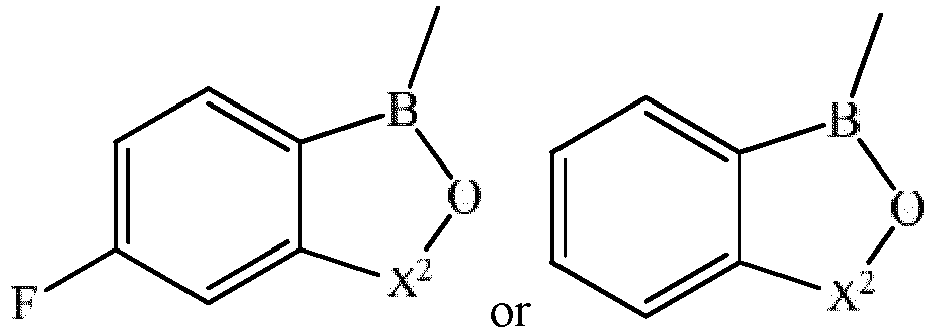
- In another embodiment, each of RA and RB is independently
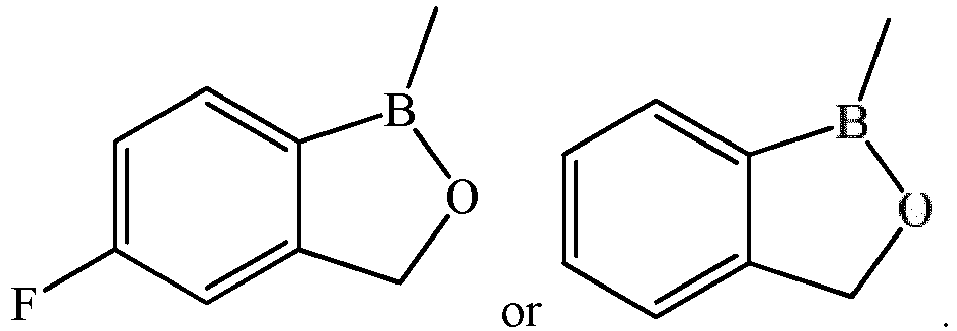
- In another embodiment, the compound provided has the structure of

- Additional oxaborole moieties are also disclosed previously in
U.S. Patent No. 5,880,188 .Described hereinn are methods for treating human infections, methods for using a volatile antimicrobial compound against human pathogens, and/or methods for treating human diseases. - As described herein, the method provided comprises
- (a) providing a volatile compound as provided herein in gaseous form; and
- (b) contacting or treating affected areas with an effective amount of the volatile compound as provided herein in gaseous form.
- As described herein, the method provided comprises
- (a) placing affected areas in a container, confined or closed environment; and
- (b) introducing into the container, confined or closed environment and in contact with the affected areas an effective amount of the volatile compound as provided herein in gaseous form.
- As described herein, the method provided comprises contacting or treating the affected areas with an atmosphere comprising an effective amount of the volatile compound as provided herein in gaseous form.
- In one embodiment, the contacting comprises applying the volatile antimicrobial compound to the surface of a material or absorbing or imbedding it into a material by ways selected from the group consisting of spray, mist, drench, or direct gaseous treatment, and combinations thereof. In a further embodiment, the gas treatment is released from the group consisting of release from a sachet, release from a synthetic or natural film, fibrous material, and/or release from a liner or powder and combinations thereof.
- Description of common human infections. Vaginal yeast infections - most women have a vaginal yeast infection at some time. Candida albicans, the causal agent of candidiasis, is a common type of fungus. It is often found in small amounts in the vagina, mouth, digestive tract, and on the skin. Usually it does not cause disease or symptoms. Candida and the many other germs that normally live in the vagina keep each other in balance. However, sometimes the number of Candida albicans increases, leading to a yeast infection.
- Vaginosis can be treated with antibiotics metronidazole (for example Flagyl and MetroGel), clindamycin (for example Cleocin and Clindesse), and tinidazile (for example Tindamax), which can be taken orally (by mouth) or vaginally. Combinations of these agents and the volatile compounds disclosed herein (for example benzoxaborole) are also provided.
- Athlete's foot (otherwise known as ringworm of the foot, tinea pedis, tinea pedum, or moccasin foot) is a common and contagious dermatophytic fungal infection of the skin that causes scaling, flaking, and itching of the affected areas. Symptoms are caused by fungi for example Epidermophyton floccosum, or fungi of the Trichophyton genus including T. rubrum or T. mentagrophytes. The disease is typically transmitted in moist communal areas where people walk barefoot, such as showers or bathhouses, and requires a warm moist environment, (e.g., the inside of a shoe) to incubate. The condition typically affects the feet, but may infect or spread to other areas of the body such as the groin and tends to spread to areas of skin that are kept hot and moist, for example with insulation, body heat, and sweat. The fungal agents responsible for infection may be picked up by walking barefoot in an infected area or using an infected towel. Infection can be prevented by limiting the use of occlusive footwear and remaining barefoot. Tinea is the name of a group of diseases caused by a fungus. Types of tinea include ringworm, athlete's foot and jock itch. These infections are usually not serious, but they can be uncomfortable. Affected areas may include skin (red skin rash that forms a ring around normal-looking skin); head (scalp ringworm causes itchy, red patches on your head - it can leave bald spots); foot and/or toes (Athlete's foot may cause itching, burning and cracked skin between your toes); and groin (jock itch causes an itchy, burning rash in your groin area).
- Most cases of athlete's foot can be cured with over-the-counter antifungal products and basic good hygiene. Products are applied as antifungal powder, antifungal creams, and sprays applied directly to the infected area. Continue treatment for one to two weeks after the infection has cleared to prevent it from recurring. Combinations of these commonly used agents and the volatile compounds disclosed herein (for example benzoxaborole) are also provided.
- For testing activity against fungi pathogens, an in vitro inhibition assay for volatile antimicrobial compounds is developed using 12-Well (7 milliliter (mL) volume per well) microtiter plates. A 3-mL volume of full-strength Potato Dextrose Agar (PDA) is added to each well. After cooling, 1 microliter (µL) of 1 × 10⁶ per mL Botrytis cinerea spore suspension is spot pipetted to the center of the agar. For the first experiment, inoculated plates are allowed to germinate for 5 days at 4 °C. For the second experiment, plates are inoculated immediately prior to volatile fungicide treatment. Small Whatman #1 filter disks (Cat. No. 1001-0155) are placed, in duplicate, on the underside of a polyethylene PCR plate sealing film.
- For determination of the minimum inhibitory concentration (MIC), Compound A (5-fluoro-1,3-dihydro-1-hydroxy-2,1-benzoxaborole) is diluted in acetone, and the appropriate amount of compound is added to disks in a dose dependent manner (1.25 to 0.0006 milligrams per disk (mg/disk)). The acetone is permitted to evaporate for 5 minutes. The headspace around the Botrytis cinerea inoculum is then sealed inside the well by the film with the adhering disk containing the fungicide. Plates are inverted, placed over the treated disks and sealed to prevent any of the chemical from flaking from the disk and falling onto the inoculated agar. After 14 days of storage at 4 °C, cultures are evaluated for percent growth relative to control. Regardless of whether the spores had germinated for 5 days, or if the treatment commenced soon after inoculation of the plates (∼15 minutes); there is 100% control of the fungal pathogen down to 0.005 mg.
Table 1. Results of in vitro assay for volatile fungicide Rate of Compound A
(mg per disk)Botrytis inhibition % (in vitro) 1.25 100% 0.63 100% 0.31 100% 0.16 100% 0.08 100% 0.04 100% 0.023 100% 0.01 100% 0.005 100% 0.0024 85% 0.001 69% 0.0006 46% Control 0% - Experimental results are summarized in Table 1. The results suggest that Compound A is able to kill Botrytis cinerea spores and inhibit mycelial growth at the same concentration. Thus, Compound A shows 100% efficacy in the in vitro inhibition of fungal growth at a rate of 0.005 mg/disk.
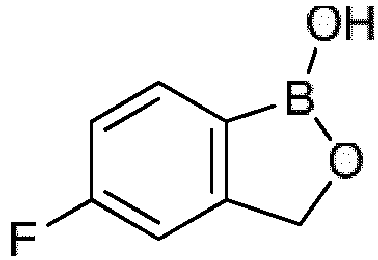

- Compound B (2-(hydroxymethyl)phenylboronic acid cyclic monoester, a desfluoro analogue of Compound A), is evaluated in a similar manner. The compound is applied to the Whatman filter paper at rates from 0.5 mg to 0.0039 mg/disk. Results show that Compound B inhibits 100% Botrytis cinerea at a rate of 0.0078 mg/disk.
- For testing activity against bacteria pathogens, 12-Well (7 mL volume per well) microtiter plates are used for the in vitro inhibition assay for volatile antimicrobial compounds. A 3-mL volume of full-strength LB Agar is added to each well. After cooling, 15 µL of Escherichia coli, adjusted to an optical density of 0.02 to 0.035, and further diluted 1/10 is pipetted to the center of the agar and tilted to distribute uniformly. Small Whatman #1 filter disks (Cat. No. 1001-0155) are placed, in duplicate, on the underside of a polyethylene polymerase chain reaction (PCR) plate sealing film. For determination of the minimum inhibitory concentration (MIC), Compound A is diluted in acetone, and 5 mg of compound is added to the disks. The acetone is permitted to evaporate for 5 minutes. The headspace around the Escherichia coli inoculum is then sealed inside the well by the film with the adhering disk containing the fungicide. Plates are inverted, placed over the treated disks and sealed to prevent any of the chemical from flaking from the disk and falling onto the inoculated agar. After 3 days of storage at 4 °C, cultures are transferred to 23 °C for an additional 2 days, and then evaluated for colony growth relative to control. Experimental results are summarized in Table 2. The results suggest that Compound A is able to inhibit Escherichia coli.
Table 2. Results of in vitro assay for volatile fungicide Rate of Compound A
(mg per disk)Colony Rating 5.00 1 Untreated 3 Not Inoculated 0 -
- 0 = No colonies
- 1 = Micro colonies not connected
- 2 = Small colonies with some merging
- 3 = Large colonies merging together
- For testing activities against additional fungi pathogens, 12-Well (6.5 mL volume per well) microtiter plates are used for the in vitro inhibition assay for volatile antimicrobial compounds. A 3-mL volume of full-strength Potato Dextrose Agar (PDA) is added to each well. After cooling, 1 µL of 1 × 10⁵ per mL Botrytis cinerea, Penicillium expansum, Alternaria alternata, Monilinia fructicola or Glomerella cingulata spore suspension is spot-pipetted to the center of the agar. Plates are inoculated immediately prior to volatile fungicide treatment. A Whatman #1 filter disk (Cat. No. 1001-0155) is placed, in duplicate, on the underside of a polyethylene PCR plate sealing film. For determination of the minimum inhibitory concentration (MIC), compounds are diluted in acetone, and the appropriate amount of compound is added to the disks in a dose dependent manner to achieve a final headspace concentration of 1142.9 to 0.6 mg/L. The acetone is permitted to evaporate for 5 minutes. The headspace around the inoculum is then sealed inside the well by the film with the adhering disk containing the fungicide by inverting the plates over the treated disks and sealing to prevent any of the chemical from flaking from the disk and falling onto the inoculated agar. After 3 days of storage at 23 °C, the cultures are evaluated for percent growth relative to control based on measurement of fungal colony diameter. Experimental results are summarized in Table 3. The results indicate that benzoxaborole compounds have excellent in vitro activity against five selected fungal pathogens.
Table 3. MIC (mg/L, headspace concentration) of numerous benzoxaborole compounds applied as a volatile treatment against numerous fungal pathogens (Compound 10 is the same as Compound A, and Compound 11 is the same as Compound B). Structure Cmpd # MIC (mg/L) BOTRCI PENIEX ALTEAL MONIFC GLOMCI 
6 2.2 17.9 4.5 8.9 17.9 
7 2.2 17.9 8.9 8.9 71.4 
8 2.2 35.7 8.9 4.5 71.4 
9 2.2 8.9 8.9 8.9 35.7 
10 2.2 2.2 <0.6 <0.6 <0.6 
11 4.5 17.9 4.5 2.2 35.7 
30 2.2 8.9 2.2 2.2 n/a 
34 <0.6 2.2 2.2 n/a n/a 
200 10.6 68.3 7.3 6.3 n/a 
201 3.8 29.5 16.1 8.5 9.3 BOTRCI = Botrytis cinerea
PENIEX = Penicillium expansum
ALTEAL = Alternaria alternata
MONIFC = Monilinia fructicola
GLOMCI = Glomerella cingulata - 12-Well (6.5 mL volume per well) microtiter plates are used for the in vitro inhibition assay for volatile antimicrobial compounds. A 3-mL volume of full-strength Potato Dextrose Agar (PDA) is added to each well. After cooling, 1 µL of 1 × 10⁵ per mL Botrytis cinerea and Penicillium expansum spore suspension is spot-pipetted to the center of the agar. Plates are inoculated immediately prior to volatile fungicide treatment. A Whatman #1 filter disk (Cat. No. 1001-0155) is placed, in duplicate, on the underside of a polyethylene PCR plate sealing film. For determination of the minimum inhibitory concentration (MIC), compounds are diluted in acetone, and the appropriate amount of compound is added to the disks in a dose dependent manner to achieve a final headspace concentration of 35.7 to 0.03 mg/L. The acetone is permitted to evaporate for 5 minutes. The headspace around the inoculum is then sealed inside the well by the film with the adhering disk containing the fungicide by inverting the plates over the treated disks and sealing to prevent any of the chemical from flaking from the disk and falling onto the inoculated agar. After 3 days of storage at 23 °C, the cultures are evaluated for percent growth relative to control based on measurement of fungal colony diameter. Experimental results are summarized in Table 4. The results indicate that numerous benzoxaborole compounds have excellent in vitro activity against two selected fungal pathogens.
Table 4. MIC (mg/L) of numerous benzoxaborole compounds applied as a volatile treatment against Botrytis cinerea and Penicillium expansum fungal pathogens. Structure Cmpd # MIC (mg/L) BOTRCI PENIEX 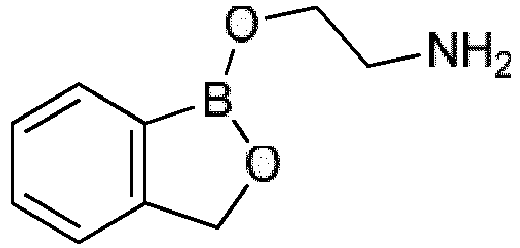
21 1.1 35.7 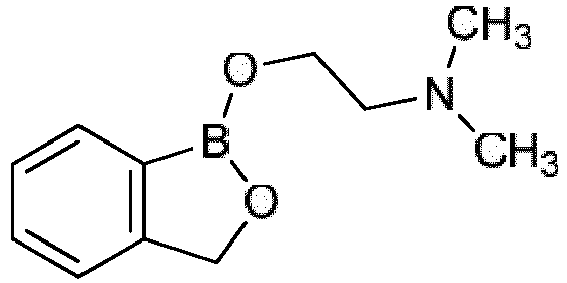
22 4.5 35.7 
38 0.6 8.9 
39 0.6 8.9 
54 0.6 4.5 
55 4.5 >35.7 
62 2.2 8.9 
63 1.1 17.9 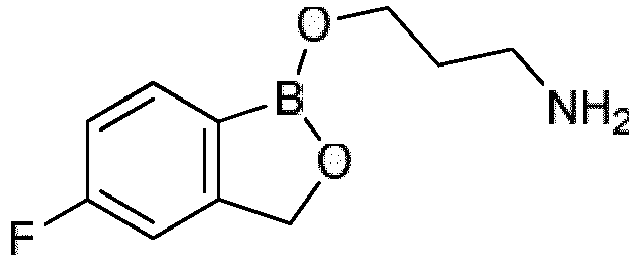
64 1.1 8.9 
72 35.7 >35.7 
73 35.7 >35.7 
74 2.2 35.7 
86 0.6 8.9 
87 0.6 8.9 
105 0.6 4.5 
114 17.9 >35.7 
115 0.6 8.9 
116 1.1 8.9 
121 4.5 17.9 
122 2.2 17.9 
124 4.5 8.9 
127 2.2 4.5 
129 4.5 8.9 
130 1.1 4.5 
132 1.1 4.5 
133 8.9 35.7 
134 17.9 >35.7 
135 17.9 >35.7 
136 8.9 >35.7 
137 0.3 1.1 
202 35.7 142.9 
203 8.9 142.9 
204 8.9 >35.7 BOTRCI = Botrytis cinerea (gray mold)
PENIEX = Penicillium expansum (blue mold) - 12-Well (6.5 mL volume per well) microtiter plates are used for the in vitro inhibition assay for volatile antimicrobial compounds A and B against additional fungal pathogens.
- A 3-mL volume of full-strength Potato Dextrose Agar (PDA) is added to each well. After cooling, 1 µL of 1 × 10⁵ spores per mL of Botrytis cinerea, Penicillium expansum, Alternaria alternata, Glomerella cingulata, Penicillium digitatum, Monilinia fruticola, Aspergillus brasiliensis, Colletotrichum acutatum, Fusarium sambucinum, Phytophthora capsici, Geotrichum candidum, Aspergillus niger, Diplodia gossypina or Diaporthe citrii suspension is spotted onto the center of the agar. A Whatman #1 filter disk (Cat. No. 1001-0155) is placed, in duplicate, on the underside of a polyethylene PCR plate sealing film. For determination of the minimum inhibitory concentration (MIC), test compounds are diluted in acetone, and the appropriate amount of compound is added to the disks in a dose dependent manner to achieve a final headspace concentration of 35.7 to 0.03 mg/L. The acetone is permitted to evaporate for five minutes. The headspace around the inoculum is then sealed inside the well by the film with the adhering disk containing the fungicide by inverting the plates over the treated disks and sealing to prevent any of the chemical from flaking from the disk and falling onto the inoculated agar. After 3 days of storage at 23 °C, cultures are evaluated for percent growth relative to control. Results shown in Table 5 demonstrate the ability of benzoxaborole compounds A and B to control the growth of numerous fungal pathogens through volatile activity.
Table 5. MIC (mg/L) of Compounds A and B applied as a volatile against numerous fungal pathogens Pathogens Compound A Compound B MIC MIC B. cinerea 2.2 4.5 P. expansum 1.1 8.9 M. fruticola 2.2 1.1 A. alternata 2.2 2.2 G. cingulata 17.9 35.7 P. digitatum 2.2 4.5 A. brasiliensis 2.2 0.6 C. acutatum 4.4 8.9 F. sambucinum 1.1 4.5 P. capsici 1.1 n/a G. candidum 8.9 8.9 A. niger 2.2 1.1 M. piriformis 1.1 2.2 D. gossypina 1.1 4.5 D. citrii 2.2 17.9 - 12-Well (6.5 mL volume per well) microtiter plates are used for the in vitro inhibition assay for volatile antimicrobial Compound A against additional bacterial pathogens. A 3-mL volume of Nutrient agar is added to each well and allowed to dry before introducing the pathogen. Escherichia coli, Pectobacterium carotovorum, Xanthomonas axonopodis and Salmonella enterica cell suspensions are adjusted to an optical density of 0.2 to 0.35, and further diluted 1/10, and 15µL is pipetted to the center of each well and tilted to distribute uniformly. A Whatman #1 filter paper (CAT 1001-0155) is placed on the underside of a polyethylene PCR plate sealing film. For determination of minimum bactericidal concentration (MBC), Compound A is diluted in acetone, and 50 µL are applied to the disks, in duplicate, in a dose dependent manner in order to achieve a final headspace concentration of 71.4 to 0.03 mg/L. The acetone is permitted to evaporate for 5 minutes. The films with the treated disks are then applied over the inoculated plates and sealed. Plates are inverted, and incubated at 23 °C for 48 hours. After the incubation period, the bacteria colonies are dislodged in sterile water containing tween 80 (0.001%) and the optical density (OD; 600 nm) is determined. Results are summarized in Table 6, where the headspace concentration required to control at least 80% of bacterial growth is reported. Compound A shows good antimicrobial activity against numerous bacteria in this in vitro assay.
Table 6. Rate (mg/L) of Compound A offering at least 80% control against bacterial pathogens E. coli P. carotovorum X axonopodis S. enterica 35.7 2.2 4.5 17.9 - An in vitro assay is used to evaluate the ability of Compound A to volatilize from different materials and control fungal growth. PTFE-Coated Fiberglass (8577K81), Fiberglass (8816K1), Silica (8799K3), Aramid and Fiberglass blend (8821K4), Vinyl-Coated Polyester (8843K31), Acrylic-Coated Fiberglass (8838K2), Silicone-Coated Fiberglass (87815K1), Aramid (1206T1) (all McMaster-Carr, Santa Fe Springs, CA), Polyethylene PCR sealing film, Cellulose (Whatman #1, Cat no. 1001-0155), PTFE (Cole Parmer, Cat no. 36229-32), and Category-1 cardboard were cut into disks of 15 mm diameter. 12-Well (6.5 mL volume per well) microtiter plates are used for the in vitro inhibition assay for volatile antimicrobial compounds. A 3-mL volume of full-strength Potato Dextrose Agar (PDA) is added to each well. After cooling, 1 µL of 1 × 10⁵ per mL Botrytis cinerea spore suspension is spot-pipetted to the centre of the agar. Plates are inoculated immediately prior to volatile fungicide treatment.
- The various materials are placed, in duplicate, on the underside of a polyethylene PCR plate sealing film. For determination of the minimum inhibitory concentration (MIC), compounds are diluted in acetone, and the appropriate amount of compound is added to the materials in a dose dependent manner to achieve a final headspace concentration of 35.7 to 0.03 mg/L. The acetone is permitted to evaporate for five minutes. The headspace around the Botrytis cinerea inoculum is then sealed inside the well by the film with the adhering disk of material containing the fungicide. Plates are inverted, placed over the treated disks and sealed to prevent any of the chemical from flaking from the disk and falling onto the inoculated agar. After three days of storage at 23 °C, the cultures are evaluated for percent growth relative to control based on measurement of fungal colony diameter. Experimental results are summarized in Table 7. The results indicate that Compound A can volatilize from numerous materials to inhibit the in vitro growth of Botrytis cinerea with similar levels of control.
Table 7. Effects of different materials on the volatile release of Compound A and the subsequent in vitro inhibition (MIC) of Botrytis cinerea. Material MIC (mg/L) Polyethylene PCR Film 0.28 PTFE- Coated Fiberglass 0.56 Fiberglass 0.56 Cellulose 0.56 Silica 0.56 Aramid and Fiberglass 0.56 Vinyl-Coated Polyester 0.56 Acrylic-Coated Fiberglass 0.56 Silicone- Coated Fiberglass 0.56 PTFE 1.1 Cardboard 2.2 Aramid 2.2 - An in vitro assay is used to evaluate the ability of compound A to volatilize from different materials and control fungal growth. Cardboard box (Category 1), PET plastic (Polyethylene terepthalate -PET) and Polyethylene are used. The materials are cut into equal dimensions (10 X 19cm2) and placed inside a 36-L acrylic desiccator cabinet (Fisher Scientific, cat no. 08-642-23C) in duplicate.
Table 8. Effects of different materials on the volatile release of Compound A and the subsequent in vitro inhibition of Botrytis cinerea Incidence (%) Material Clamshell Cardboard Polyethylene Rate (mg/L) 0.3 4.1 9.3 4.9 0.06 100.0 91.7 86.7 0.012 100.0 100.0 99.0 - Compound A is dissolved in acetone and 100µL of the solution pipetted into a glass tube. The acetone is allowed to evaporate for 1 minute at 60 °C. Compound A is then introduced as a gas into the cabinets by a sublimation device (copper tube heated to 180 °C with fan flow at 0.5 L/min) to achieve a final headspace concentration of 0.3, 0.06 and 0.012mg/L). The chambers are then incubated at 23 °C for 24 hours, then treated materials are carefully removed and placed inside a clean 10.8 cup SnapWare airtight container (Model # 109842) containing a 10-cm diameter Petri dish with PDA and inoculated with 1 µL of 1x10 spores/mL of B. cinerea. The containers are then tightly sealed for 3 days at 23 °C. After 3 days of storage, cultures are evaluated for percent growth relative to control. Table 8 demonstrates the ability of benzoxaborole compounds A to control the growth of B. cinerea through volatile activity.
- 3.20 g of 5-fluoro-1,3-dihydro-1-hydroxy-2,1-benzoxaborole (21.2 mmol) and 3.20 g of ethylene glycol (51.6 mmol) are heated in 40 g of toluene. The toluene water azeotrope is distilled out of the system until the head temperature reached 110 °C. The toluene is removed via rotary evaporator and the excess ethylene glycol is removed by kugelrohr distillation at about20 torr and 100 °C bath temperature. Recrystallization from toluene generates 2.95 g of white crystals, mp 145-149 °C. Proton nmr shows spectra and integration consistent with the two to one product below:

- 3.00 g of 1,3-dihydro-1-hydroxy-2,1-benzoxaborole (22.4 mmol) and 3.00 g of ethylene glycol (46.9 mmol) are heated in 40 g of toluene. The toluene water azeotrope is distilled out of the system until the head temperature reached 110 °C. The toluene is removed via rotary evaporator and the excess ethylene glycol is removed by kugelrohr distillation at about20 torr and 100 °C bath temperature. Recrystallization from toluene generates 2.49 g of white crystals, mp 118 - 120.5 °C. Proton NMR shows spectra and integration consistent with the two to one product.
- 3.17 g of 5-fluoro-1,3-dihydro-1-hydroxy-2,1-benzoxaborole (21.0 mmol) and 3.22 g of pinacol (27.3 mmol) are heated in 40 g of toluene. The toluene water azeotrope is distilled out of the system until the head temperature reached 110 °C. The toluene is removed via rotary evaporator and the excess pinacol is removed by kugelrohr distillation at about 20 torr and 120 °C bath temperature. Recrystallization from hexane generates 3.21 g of white crystals, mp 81-89 °C. Proton NMR shows spectra and integration consistent with the two to one product.
- 3.0 g of 5-fluoro-1,3-dihydro-1-hydroxy-2,1-benzoxaborole (19.9 mmol) and 2.5 g of 1,2-propanediol (propylene glycol; 32.9 mmol) are heated in 40 g of toluene. The toluene water azeotrope is distilled out of the system until the head temperature reached 110 °C. The toluene is removed via rotary evaporator and the excess propylene glycol is removed by kugelrohr distillation at about20 torr and 110 °C bath temperature. Recrystallization from hexane generates 3.49 g of white crystals, mp 65.5-68.5 °C. Proton NMR shows spectra and integration consistent with the two to one product.
- 12-well (6.5 ml volume per well) microtiter plates are used for the in vitro inhibition assay for volatile antimicrobial compounds. A 3-ml volume of full-strength Potato Dextrose Agar (PDA) is added to each well. After cooling, 1 µL of 1 × 10⁵ spores per ml Botrytis cinerea (ATCC #204446) spore suspension is spot pipetted to the agar in the centre of the well.
Table 9. Antimicrobial activities of Samples 1-4 (50 µl/disk) MIC mg/l ID Botrytis cinerea Penicillium expansum Alternaria alternata Monilinia fructicola Glomerella cingulata Sample 1 <0.6 8.9 2.2 --- --- Sample 2 <0.6 8.9 8.9 35.7 142.9 Sample 3 <0.6 4.5 2.2 --- --- Sample 4 <0.6 8.9 1.1 --- --- - Whatman #1 filter disks (1.5 cm; Cat. No. 1001-0155) are placed on the underside of a polyethylene PCR plate sealing film. For determination of the minimum inhibitory concentration (MIC), test compounds are diluted in acetone, in duplicate, and 50 µl of the compound solution is added to disks at concentrations that can vary from 0.001 mg/l to 1142.9 mg/l.
- The acetone is permitted to evaporate for 5 minutes. The headspace around the Botrytis cinerea inoculum is then sealed inside the well by the film with the adhering disk containing the fungicide. Plates are inverted to prevent any possibility of the chemical from flaking from the disk and falling onto the inoculated agar. After 3 days of incubation at 23 °C, cultures are evaluated for percent growth relative to control and determination of MIC. Samples 1-4 show good antimicrobial activity against Botrytis cinerea and/or other pathogens in this in vitro analysis. Minimum inhibitory concentrations (MIC) are shown in Tables 9 and 10 for results from two separate tests.
Table 10. Antimicrobial activities of Samples 1-4 (repeat test; 50 µl/disk) MIC mg/l ID Botrytis cinerea Penicillium expansum Alternaria alternata Monilinia fructicola Glomerella cingulata Sample 1 0.6 8.9 >2.2 2.2 --- Sample 2 2.2 8.9 --- --- --- Sample 3 1.1 8.9 >2.2 1.1 --- Sample 4 0.6 8.9 >2.2 1.1 --- - 12-well (6.5 ml volume per well) microtiter plates are used for the in vitro inhibition assay for volatile antimicrobial compounds. A 3-ml volume of full-strength LB Agar is added to each well. After cooling, 15 µL of Escherichia coli (ATCC #25922) adjusted to an optical density of 0.02 to 0.035, and further diluted 1/10 is pipetted to the centre of the agar. The plate is tilted to distribute bacteria uniformly. Whatman #1 filter disks (1.5 cm; Cat. No. 1001-0155) are placed on the underside of a polyethylene PCR plate sealing film. For determination of the minimum inhibitory concentration (MIC), test compounds are diluted in acetone, in duplicate, and 50 µl of compound is added to disks at concentrations that can vary from 0.015 to 35.7 mg/l. The acetone is permitted to evaporate for 5 minutes. The headspace around the Escherichia coli inoculum is then sealed inside the well by the film with the adhering disk containing the fungicide. Plates are inverted, placed over the treated disks and sealed to prevent any of the chemical from flaking from the disk and falling onto the inoculated agar. After 2 days of incubation at 23 °C, cultures were evaluated for colony growth relative to control. Samples 1-4 show good antimicrobial activity against Escherichia coli in this in vitro analysis.
- In order to demonstrate unexpected volatility of compound A (1-hydroxy-5-fluoro-1, 3-dihydro-2, 1-benzoxaborole) and a new method to apply the volatile compound A, another in vivo assay is developed to control Botrytis cinerea on strawberry. Eight strawberries (per repetition, in triplicate) are placed in an industry standard 1-lb PET clamshell with the stem-end facing down. A fresh wound on the upwards facing tip of the fruit is then inoculated with 20 µL of 1 × 10⁵ spores per mL suspension of B. cinerea.
- Two identically prepared clamshells per repetition and treatment are then placed at the bottom of a 36-L acrylic desiccator cabinet (Fisher Scientific, No. 08-642-23C), and pre-cooled for 2 hours at 1 °C prior to treatment application. Compound A is then mixed with acetone and 100 µL of the mixture is pipetted into a small glass tube. This tube is then placed inside a pre-heated sublimation device (0.5" OD by 6" long thermostatically heated copper tube mounted to a 0.5 L/min low flow fan) set at 60 °C for 1-minute to allow the acetone to evaporate. Compound A is then introduced into the cabinet containing the clamshell by using the sublimation device set at 180 °C to achieve a final headspace concentration of 0.1 mg/L and equilibrated at 1 °C for 0.5 or 1 hour.
Table 11. Valatile application of Compound A to control B. cinerea infection Clamshell Condition Treatment Time (hour) Disease Severity (0 to 4) Day 1 Day 3 Day 5 Untreated 0 1.3 3.5 4.0 Treated 0.5 0.0 0.1 2.3 1 0.0 0.0 0.4 Untreated (fruit transfer) 0.5 0.0 2.7 3.4 1 0.0 0.1 1.6 - After incubation, both clamshells are removed from the treatment chamber. One clamshell is undisturbed while the fruit from the second clamshell are immediately transferred into a new untreated clamshell. All clamshells are then held at 1 °C for 5 days and then evaluated during an additional 5 days at 21 °C. During the 5 days at 21 °C, the fruits are evaluated for gray mold severity (scale 0 to 4, with ≤1 indicating marketable fruit and 4 indicating ≥50% of fruit surface covered by pathogen). The results from Table 11 demonstrate the unexpected volatility of Compound A applied to clamshells and its ability to control B. cinerea development on strawberry throughout the 5 days of simulated marketing at 21 °C. The treated clamshell produces marketable fruit up to 3 days with 0.5 hour treatment (0.1), whereas fruits in new clamshells are unmarketable (2.7). Similarly, the treated clamshell produces marketable fruit up to 5 days with 1 hour treatment (0.4), whereas fruits in new clamshells are unmarketable (1.6). Thus, treatments where berries remain in the treated clamshells have the best level of control due to the compound further volatilizing over time off of the clamshell surface.
- Furthermore, berries that are placed into a new clamshell still benefit from the initial volatile treatment and demonstrated better control of Botrytis cinerea than untreated fruit, but the control is less than the treated clamshell since there is no longer any new exposure to the volatile substance off of the treated clamshell surface. Therefore, the results from this study provide evidence that a volatile application of Compound A provides control of fungal pathogen growth (untreated fruit transfer) and that Compound A deposited on clamshell surfaces will subsequently volatilize during 5 days at 21 °C, providing additional useful control of Botrytis cinerea growth (treated).
- In order to demonstrate unexpected volatility of Compound A, another in vivo assay is developed to evaluate blue mold (Penicillium expansum) control on apple. Two apples are placed in a clamshell, and three fresh wounds are made near the equatorial region of each fruit. Each fruit wound is then inoculated with 20 µL of 1 × 10⁶ spores per mL of Penicillium expansum suspension. The inoculum is allowed to dry for two hours prior to treatment application as a volatile or contact.
Table 12. Comparison of volatile and contact fungicidal activity of Compound A to control Penicillim expansum infection Assay Treatment rate (mg/L) Browning Rot (diameter; mm) Day 0 Day 2 Day 4 Day 7 Contact 0 0.0 6.4 15.7 29.6 2 0.0 3.7 15.5 23.3 10 0.0 2.2 8.0 20.2 50 0.0 0.7 5.7 15.0 250 0.0 0.0 4.3 11.8 Volatile 0 0.0 6.6 16.1 30.5 0.02 0.0 0.9 2.8 6.9 0.1 0.0 0.0 0.3 2.0 0.5 0.0 0.0 0.0 0.4 2.5 0.0 0.0 0.0 0.0 - Volatile Assay: Clamshells are then placed at the bottom of a 36-L acrylic desiccator cabinet (Fisher Scientific, No. 08-642-23C). Compound A is mixed with acetone and 250 µL of the mixture is pipetted into a small glass tube. This tube is then placed inside a pre-heated sublimation device (0.5" OD by 6" long thermostatically heated copper tube mounted to a 0.5 L/min low flow fan) set at 60 °C for 1 minute to allow the acetone to evaporate. Compound A is then introduced into the cabinets containing the clamshells by using the sublimation device set at 180 °C to achieve a final headspace concentration of 2.5, 0.5, 0.1 or 0.02 mg/L. The chambers are then incubated at 1 °C for 5 days. After incubation, fruits are evaluated by measuring the diameter (mm) of rot development (browning) up to 7 days at 21 °C.
- Contact Assay: Compound A is dissolved in 85% methanol to achieve a final concentration of 250, 50, 10, or 2 mg/L. A 250 mL solution of each concentration is used to dip two inoculated apples, one minute per apple, performed in triplicate per rate. The dipped fruits are then placed back into the clamshells, which are then placed in a secondary container and incubated at 1 °C for 5 days. After incubation, fruits are evaluated for diameter (mm) of rot development (browning) up to 7 days at 21 °C. Table 12 demonstrates the unexpected volatility of Compound A to control Penicillium expansum on apples during storage even when applied at 100x lower rate (v/v) than as a contact.
- In order to demonstrate unexpected volatility of Compound A, another in vivo assay is developed to evaluate gray mold (Botrytis cinerea) control on strawberry. Eight strawberries (per repetition, in triplicate) are placed in an industry standard 1-lb PET clamshell with the stem-end facing down. A fresh wound on the upwards facing tip of the fruit is then inoculated with 20 µL of 1 × 10⁵ spores per mL suspension of B. cinerea. The inoculum is allowed to dry for two hours prior to treatment application as a volatile or contact.
Table 13. Comparison of volatile and contact fungicidal activity of Compound A to control Botrytis cinerea infection Assay Treatment rate (mg/L) Disease Severity (0 to 4) Day 0 Day 1 Day 2 Day 3 Day 4 Contact 0 0.0 0.0 0.8 1.1 2.0 2 0.0 0.0 0.6 1.1 1.9 10 0.0 0.0 0.0 0.3 1.0 50 0.0 0.0 0.0 0.0 0.0 250 0.0 0.0 0.0 0.0 0.0 Volatile 0 0.0 0.1 0.9 1.4 2.3 0.02 0.0 0.0 0.1 0.2 0.7 0.1 0.0 0.0 0.0 0.0 0.0 0.5 0.0 0.0 0.0 0.0 0.0 2.5 0.0 0.0 0.0 0.0 0.0 - Volatile Assay: Clamshells are then placed at the bottom of a 36-L acrylic desiccator cabinet (Fisher Scientific, No. 08-642-23C). Compound A is mixed acetone and 250 µL of the mixture is pipetted into a small glass tube. This tube is then placed inside a pre-heated sublimation device (0.5" OD by 6" long thermostatically heated copper tube mounted to a 0.5 L/min low flow fan) set at 60 °C for 1-minute to allow the acetone to evaporate. Compound A is then introduced into the cabinets containing the clamshells by using the sublimation device set at 180 °C to achieve a final headspace concentration of 2.5, 0.5, 0.1 or 0.02 mg/L. The chambers are then incubated at 1 °C for 5 days. After incubation, fruits are evaluated for disease (scale 0 to 4, with ≤1 indicating marketable fruit and 4 indicating ≥50% of fruit surface covered by pathogen) up to 4 days at 21 °C.
- Contact Assay: Compound A is dissolved in 85% methanol to achieve a final concentration of 250, 50, 10, or 2 mg/L. A 250 mL solution of each concentration is used to dip eight inoculated strawberry fruit for one-minute, performed in triplicate per rate. The dipped fruits are then placed back into the clamshells, which are then placed in a secondary container and incubated at 1 °C for 5 days. After incubation, fruits are evaluated for disease severity (scale 0 to 4, with ≤1 indicating marketable fruit and 4 indicating ≥50% of fruit surface covered by pathogen) up to 4 days at 21 °C. Table 13 demonstrates the unexpected volatility of Compound A to control Botrytis cinerea on strawberries during storage even when applied at 100x lower rate (v/v) than as a contact.
- An in vitro assay was performed comparing the volatile and contact activity of various benzoxaborole compounds to demonstrate the activity of compound 10 relative to other similar structures from the chemical class.
Table 14. Comparison of contact and volatile activity of selected benzoxaborole compounds Compound ID Contact MIC (mg/L) Volatile MIC (mg/L) B. cinerea P. expansum B. cinerea P. expansum 6 2.0 2.0 4.5 17.9 10* < 0.08 0.4 0.3 2.2 11* 10 2.0 4.5 17.9 31 0.4 2.0 0.6 8.9 33 0.4 2.0 0.6 8.9 34 2.0 0.4 0.6 2.2 121 10.0 10.0 4.5 17.9 124 2.0 2.0 4.5 8.9 130 2.0 0.4 1.1 4.5 132 2.0 2.0 1.1 4.5 135 2.0 2.0 17.9 > 35.7 *Compound 10 is identical to Compound A; Compound 11 is identical to Compound B - Volatile assay: 12-well (6.5 mL volume per well) microtiter plates are used. A 3-mL volume of half strength PDA is added to each well. After cooling, 1 µL of 1 × 10⁵ spores per mL of Botrytis cinerea or Penicillium expansum suspension is spotted to the center of the agar. A Whatman #1 filter disk (Cat. No. 1001-0155) is placed, in duplicate, on the underside of a polyethylene PCR plate sealing film. Test compounds are mixed with acetone and the mixtures are added to disks in a dose dependent manner to achieve a final headspace concentration of 35.7 to 0.03 mg/L. The acetone is permitted to evaporate for 5 minutes. The headspace around the inoculum is then sealed inside the well by the film with the adhering disk containing the fungicide. Plates are inverted, placed over the treated disks, and sealed to prevent any of the chemical from flaking from the disk and falling onto the inoculated agar. After 3 days of incubation at 23 °C, cultures are evaluated for percent growth relative to the acetone only control.
- Contact assay: 6-well (16.5 mL volume per well) microtiter plates are used for an in vitro inhibition assay. Half-strength Potato Dextrose Agar (PDA) is amended with a mixture of one of the test compounds with acetone or methanol to a final concentration of 50 to 0.08 mg/L. A 7.5-mL volume of the amended media is added to each well of the microtiter plate. After drying, 1 µL of 1 × 10⁵ spores per mL of B. cinerea or P. expansum suspension is spotted to the center of the agar. The plates are sealed with a clear film and incubated for 3 days at 23 °C. After incubation, plates are evaluate for percent growth relative to acetone only control. Results are reported as the minimum inhibitory concentration (MIC) required for 100% control of pathogen growth. Table 14 shows the MIC results of numerous benzoxaboroles assayed for both contact and volatile activity. Results demonstrate that numerous structures in the benzoxaborole class of compounds have both contact and volatile activity.
Table 15. Compounds used in this example Compound ID Benzoxaborole structure 6 
10* 
11* 
31 
33 
34 
121 
124 
130 
132 
135 
*Compound 10 is identical to Compound A; Compound 11 is identical to Compound B - In order to demonstrate unexpected volatility of Compound A, another in vivo assay is developed to evaluate blue mold (Penicillium expansum) control on apple and pear, as well as green mold (Penicillium digitatum) control on orange. Two apples, pears or oranges are placed in a clamshell, and three fresh wounds are made near the equatorial region of each fruit. Each fruit wound is then inoculated with 20 µL of 1 × 10⁶ spores per mL of Penicillium expansum or digitatum suspension, respectively. The inoculum is allowed to dry for two hours prior to treatment application as a volatile or contact.
Table 16. Comparison of Compound A with other fungicides in volatile and contact assays Assay Test Compound Apple Pear Orange Browning (mm) Sporulation (mm) Browning (mm) Sporulation (mm) Sporulation (mm) Volatile Control (acetone only) 11.1 2.2 14.9 4.0 44.9 Compound A 0.4 0.0 5.7 0.0 0.0 Control (ethanol only) 9.7 2.3 13.4 4.4 39.3 Boscalid 10.3 2.4 14.3 3.6 30.3 Fludioxonil 11.2 3.1 12.8 2.8 40.8 Imazalil 11.1 3.0 14.3 3.4 41.4 Pyrimethanil 11.3 2.6 14.0 6.5 22.3 Thiabendazole 8.4 2.0 12.9 3.0 > 50 Contact Control (5% PG only) 10.3 2.6 15.1 5.4 > 50 Compound A 9.9 2.3 18.9 8.4 > 50 Control (ethanol only) 9.2 5.1 8.9 1.9 9.7 Boscalid 7.0 0.8 8.6 2.3 > 50 Fludioxonil 2.9 0.0 3.3 0.0 8.3 Imazalil 6.9 0.9 7.9 1.0 0.0 Pyrimethanil 8.1 2.4 8.9 5.2 0.0 Thiabendazole 8.2 1.9 9.1 5.4 0.0 - Volatile Assay: Clamshells are then placed at the bottom of a 2.55-L SnapWare airtight container (Model #109842). An appropriate amount of Compound A (dissolved in acetone), Boscalid, Fludioxinil, Imazalil, Pyrimethanil or Thiabendazole (methanol) is solubilized to achieve a treatment rate of 50 mg/L. (Compound A is not soluble in methanol at room temperature). The solutions are pipetted into Whatman filter disks mounted to the inside lid of the container. The chambers are then incubated at 1 °C for 5 days, removed to 21 °C, and evaluated on day 3 by determining the diameter (mm) of rot development (browning) or sporulation.
- Contact Assay: Compound A is dissolved in 5% propylene glycol, whereas all other actives are dissolved in 85% methanol at a rate to achieve a final concentration of 250, 50, 10, or 2 mg/L (Compound A is not soluble in methanol at room temperature). A 250 mL solution of each concentration is used to dip two inoculated fruits, one minute per fruit, performed in triplicate per rate. The dipped fruits are then placed back into the clamshells and then into the SnapWare container and incubated at 1 °C for 5 days. The containers are then incubated at 1 °C for 5 days, removed to 21 °C, and evaluated on day 3 by determining the diameter (mm) of rot development (browning) or sporulation. Table 16 demonstrates the unexpected volatility of Compound A to control Penicillium expansum on apples and pears, as well as Penicillium digitatum on oranges. Volatile application of Compound A results in excellent inhibition of browning and sporulation, whereas all other active ingredients result in no or little inhibition. However, contact application of Compound A does not provide good inhibition of browning and sporulation as compared to other fungicides, demonstrating that the volatile application is important for the fungicidal activity of Compound A.
- In order to demonstrate the volatile activity of Compound A and Compound 31 relative to commercially registered fungicides, an in vitro assay is performed comparing the volatile and contact activity of the active ingredients.
- Contact Assay: 12-well (6.5 mL volume per well) microtiter plates are used for the in vitro inhibition assay for Compounds A and 31, and compared to other registered fungicides (5-fluorocytosine, Amphotericin B, Caspofungin diacetate, Fluconazole and Itraconazole). Half-strength Potato Dextrose Agar (PDA) is amended with a mixture of one of the test compounds in acetone or methanol to a final concentration of 50, 10, 2, 0.4 or 0.08 mg/L. A 3-mL volume of the amended media is added to each well of the microtiter plate. After drying, a mycelial plug (5 mm diameter) is aseptically obtained from actively growing cultures of Epidermophyton floccus, Trichophyton rubrum, or Trichophyton mentagrophytes and placed at the center of the plate with the mycelial side in contact with the agar. The plates are sealed with a clear film and incubated inverted for 5 days at 28 °C. After incubation, cultures are evaluated (mm diameter growth) for percent growth relative to control with results expressed as minimum inhibitory concentration (MIC) required to control 100% of pathogen growth.
Table 17. Comparison of Compounds A and 31 together with other fungicide to control selected fungal pathogens Assay Test Compound MIC (mg/L) Epidermophyton floccus Trichophyton rubrum Trichophyton mentagrophytes Contact Compound A 2.0 2.0 2.0 Compound 31 n.d. 10.0 2.0 5-Fluorocytosine > 50 > 50 > 50 Amphotericin B 50.0 > 50 > 50 Caspofungin Diacetate 2.0 10.0 50.0 Fluconazole 10.0 50.0 > 50 Itraconazole > 50 > 50 > 50 Volatile Compound A 2.0 2.0 2.0 Compound 31 n.d. 2.0 2.0 5-Fluorocytosine > 50 > 50 > 50 Amphotericin B > 50 > 50 > 50 Caspofungin Diacetate > 50 > 50 > 50 Fluconazole > 50 > 50 > 50 Itraconazole > 50 > 50 > 50 n.d. = not determined. - Volatile assay: 6-well (16.5 mL volume per well) microtiter plates are used in an in vitro inhibition assay for Compounds A and 31, and compared to other registered fungicides (5-fluorocytosine, Amphotericin B, aspofungin diacetate, Fluconazole and Itraconazole). A 7.5-mL volume of half strength PDA is added to each well. After drying, a mycelial plug (5 mm diameter) is aseptically obtained from actively growing cultures of Epidermophyton floccus, Trichophyton rubrum, or Trichophyton mentagrophytes and placed at the center of the plate with the mycelial side in contact with the agar. A Whatman #1 filter disk (Cat. No. 1001-325) is placed, in duplicate, on the underside of a polyethylene PCR plate sealing film. For determination of unexpected volatility, test compounds are mixed with acetone or methanol, and then added to disks in a dose dependent manner to achieve a final headspace concentration of 50, 10, 2, 0.4 or 0.08 mg/L. The acetone/ methanol is permitted to evaporate for 5 minutes. The headspace around the inoculum is then sealed inside the well by the film with the adhering disk containing the fungicide and incubated inverted for 5 days at 28 °C. After incubation, cultures are evaluated for percent growth relative to control with results expressed as minimum inhibitory concentration (MIC) required to control 100% of pathogen growth.
- Volatile application of benzoxaboroles of Compounds A and 31 show significant fungicidal activities. Table 17 demonstrates the unexpected volatile activity of Compounds A and 31 with a minimum inhibitory concentration (MIC) of 2 mg/L for both Compound A and 31. In comparison, none of the commercial fungicide standards demonstrated any significant volatile activity where little or no fungicidal activity after volatile applications.
wherein the areas affected by the pathogens comprise vaginal yeast infections, athlete's foot, tinea, or combinations thereof.

Claims (15)
- A volatile antimicrobial compound for use against pathogens, wherein the use comprises: contacting areas infected by the pathogens with an atmosphere containing an effective amount of the volatile antimicrobial compound in gaseous form, wherein the volatile antimicrobial compound has a structure of formula (VI):
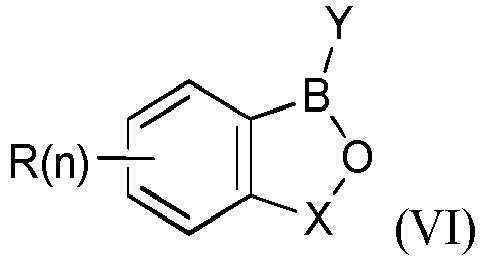 wherein each R is independently hydrogen, alkyl, alkene, alkyne, haloalkyl, haloalkene, haloalkyne, alkoxy, alkeneoxy, haloalkoxy, aryl, heteroaryl, arylalkyl, arylalkene, arylalkyne, heteroarylalkyl, heteroarylalkene, heteroarylalkyne, halogen, hydroxyl, nitrile, amine, ester, carboxylic acid, ketone, alcohol, sulfide, sulfoxide, sulfone, sulfoximine, sulfilimine, sulfonamide, sulfate, sulfonate, nitroalkyl, amide, oxime, imine, hydroxylamine, hydrazine, hydrazone, carbamate, thiocarbamate, urea, thiourea, carbonate, aryloxy, or heteroaryloxy;n = 1, 2, 3, or 4;B is boron;X = (CR2)m where m = 1, 2, 3, or 4;Y is alkyl, alkene, alkyne, haloalkyl, haloalkene, haloalkyne, alkoxy, alkeneoxy, haloalkoxy, aryl, heteroaryl, arylalkyl, arylalkene, arylalkyne, heteroarylalkyl, heteroarylalkene, heteroarylalkyne, hydroxyl, nitrile, amine, ester, carboxylic acid, ketone, alcohol, sulfide, sulfoxide, sulfone, sulfoximine, sulfilimine, sulfonamide, sulfate, sulfonate, nitroalkyl, amide, oxime, imine, hydroxylamine, hydrazine, hydrazone, carbamate, thiocarbamate, urea, thiourea, carbonate, aryloxy, or heteroaryloxy;wherein each of alkyl, alkoxy, aryl and heteroaryl is optionally substituted;with a proviso that R is not aryloxy or heteroaryloxy when Y is hydroxyl;and pharmaceutically or agriculturally acceptable salts thereof, andwherein the areas affected by the pathogens are selected from the group consisting of vaginal yeast infections, athlete's foot, tinea, or combinations thereof.
 - The volatile antimicrobial compound for the use according to claim 1, wherein the pathogens are selected from the group consisting of Candida albicans, C. tropicalis, C. glabrata, C. krusei, C. parapsilosis, C. dubliniensis, C. lusitaniae, Epidermophyton flocoosum, Trichiphyton rubrum, Trichophyton mentagrophytes, or combinations thereof.
- The volatile antimicrobial compound for the use according to claim 1, further comprising impregnating, microencapsulating, or coating a material for releasing the volatile antimicrobial compound in a gaseous form.
- The volatile antimicrobial compound for the use according to claim 1, wherein the volatile antimicrobial compound remains in its gaseous form for seven days.
- The volatile antimicrobial compound for the use according to claim 1, wherein the volatile antimicrobial compound has a structure of

- A volatile antimicrobial compound for use against pathogens, wherein the use comprises:(a) mixing a volatile antimicrobial compound with an organic solvent;(b) heating the mixture from step (a) to evaporate the organic solvent and render the volatile antimicrobial compound into its gaseous form; and(c) contacting areas infected by the pathogens with an atmosphere containing an effective amount of the volatile antimicrobial compound in gaseous form at a temperature between 1 °C and 50 °C;wherein the volatile antimicrobial compound has a structure of formula (VI):
 each R is independently hydrogen, alkyl, alkene, alkyne, haloalkyl, haloalkene, haloalkyne, alkoxy, alkeneoxy, haloalkoxy, aryl, heteroaryl, arylalkyl, arylalkene, arylalkyne, heteroarylalkyl, heteroarylalkene, heteroarylalkyne, halogen, hydroxyl, nitrile, amine, ester, carboxylic acid, ketone, alcohol, sulfide, sulfoxide, sulfone, sulfoximine, sulfilimine, sulfonamide, sulfate, sulfonate, nitroalkyl, amide, oxime, imine, hydroxylamine, hydrazine, hydrazone, carbamate, thiocarbamate, urea, thiourea, carbonate, aryloxy, or heteroaryloxy;n = 1, 2, 3, or 4;B is boron;X = (CR2)m where m = 1, 2, 3, or 4;Y is alkyl, alkene, alkyne, haloalkyl, haloalkene, haloalkyne, alkoxy, alkeneoxy, haloalkoxy, aryl, heteroaryl, arylalkyl, arylalkene, arylalkyne, heteroarylalkyl, heteroarylalkene, heteroarylalkyne, hydroxyl, nitrile, amine, ester, carboxylic acid, ketone, alcohol, sulfide, sulfoxide, sulfone, sulfoximine, sulfilimine, sulfonamide, sulfate, sulfonate, nitroalkyl, amide, oxime, imine, hydroxylamine, hydrazine, hydrazone, carbamate, thiocarbamate, urea, thiourea, carbonate, aryloxy, or heteroaryloxy;wherein each of alkyl, alkoxy, aryl and heteroaryl is optionally substituted;with a proviso that R is not aryloxy or heteroaryloxy when Y is hydroxyl;and pharmaceutically or agriculturally acceptable salts thereof, andwherein the areas affected by the pathogens are selected from the group consisting of vaginal yeast infections, athlete's foot, tinea, or combinations thereof.
 - The volatile antimicrobial compound for the use according to claim 6, wherein the pathogens are selected from the group consisting of Candida albicans, C. tropicalis, C. glabrata, C. krusei, C. parapsilosis, C. dubliniensis, C. lusitaniae, Epidermophyton flocoosum, Trichiphyton rubrum, Trichophyton mentagrophytes, or combinations thereof.
- The volatile antimicrobial compound for the use according to claim 6, wherein the volatile antimicrobial compound remains in its gaseous form for seven days.
- The volatile antimicrobial compound for the use according to claim 6, wherein the volatile antimicrobial compound has a structure of

- The volatile antimicrobial compound for the use according to claim 6, wherein the organic solvent comprises acetone or ethanol.
- A volatile antimicrobial compound for use against pathogens, wherein the use comprises: contacting areas infected by the pathogens with an atmosphere containing an effective amount of the volatile antimicrobial compound in gaseous form, wherein the volatile antimicrobial compound has a structure of formula (A):
RA - LA - G - LB - RB (A),
whereineach of RA and RB is independently a radical comprising an oxaborole moiety;the - LA - G - LB - portion of formula (A) is selected from a diol or diamine compound; where the diol compound is selected from the group consisting of 1,2-ethylene glycol; 1,2-propylene glycol; 1,3-propylene glycol; 1,1,2,2-tetramethyl-1,2-ethylene glycol; 2,2-dimethyl-1,3-propylene glycol; 1,6-hexanediol; 1,10-decanediol; and combinations thereof; and the diamine compound is 1,2-ethylene diamine; 1,3-propylene diamine; or combinations thereof; G is a substituted or unsubstituted C1-8 -alkylene;and pharmaceutically or agriculturally acceptable salts thereof, and wherein the areas affected by the pathogens are selected from the group consisting of vaginal yeast infections, athlete's foot, tinea, or combinations thereof. - The volatile antimicrobial compound for the use according to claim 11, wherein the pathogens are selected from the group consisting of Candida albicans, C. tropicalis, C. glabrata, C. krusei, C. parapsilosis, C. dubliniensis, C. lusitaniae, Epidermophyton flocoosum, Trichiphyton rubrum, Trichophyton mentagrophytes, or combinations thereof.
- The volatile antimicrobial compound for the use according to claim 11, further comprising impregnating, microencapsulating, or coating a material for releasing the volatile antimicrobial compound in a gaseous form.
- The volatile antimicrobial compound for the use according to claim 11, wherein the volatile antimicrobial compound remains in its gaseous form for seven days.
- The volatile antimicrobial compound for the use according to claim 11, wherein each of RA and RB is independently

wherein the volatile antimicrobial compound has a structure of
Applications Claiming Priority (2)
| Application Number | Priority Date | Filing Date | Title |
|---|---|---|---|
| US201461991821P | 2014-05-12 | 2014-05-12 | |
| PCT/US2015/026639 WO2015175157A1 (en) | 2014-05-12 | 2015-04-20 | Volatile applications against pathogens |
Publications (2)
| Publication Number | Publication Date |
|---|---|
| EP3148551A1 EP3148551A1 (en) | 2017-04-05 |
| EP3148551B1 true EP3148551B1 (en) | 2021-09-29 |
Family
ID=53039991
Family Applications (1)
| Application Number | Title | Priority Date | Filing Date |
|---|---|---|---|
| EP15720174.0A Not-in-force EP3148551B1 (en) | 2014-05-12 | 2015-04-20 | Volatile applications against pathogens |
Country Status (15)
| Country | Link |
|---|---|
| EP (1) | EP3148551B1 (en) |
| JP (1) | JP6682454B2 (en) |
| KR (1) | KR20170007347A (en) |
| CN (1) | CN106413720B (en) |
| AR (1) | AR100407A1 (en) |
| AU (1) | AU2015259744B2 (en) |
| BR (1) | BR102015010681A2 (en) |
| CA (1) | CA2954803A1 (en) |
| CL (1) | CL2016002850A1 (en) |
| MX (1) | MX382705B (en) |
| SG (1) | SG11201609020VA (en) |
| TW (1) | TW201622730A (en) |
| UY (1) | UY36116A (en) |
| WO (1) | WO2015175157A1 (en) |
| ZA (1) | ZA201608517B (en) |
Families Citing this family (8)
| Publication number | Priority date | Publication date | Assignee | Title |
|---|---|---|---|---|
| CA2974396C (en) * | 2015-02-12 | 2024-04-30 | Agrofresh Inc. | Fungicidal compounds and compositions |
| NZ745681A (en) * | 2016-03-07 | 2022-05-27 | Agrofresh Inc | Synergistic methods of using benzoxaborole compounds and preservative gases as an antimicrobial for crops |
| BR112020010927A2 (en) | 2017-11-30 | 2020-12-01 | Boragen, Inc. | benzoxaborol compounds and formulations thereof |
| WO2020041200A1 (en) | 2018-08-18 | 2020-02-27 | Boragen Inc. | Solid forms of substituted benzoxaborole and compositions thereof |
| CN110183477B (en) * | 2019-07-03 | 2022-03-04 | 石家庄诚志永华显示材料有限公司 | Organic electroluminescent compounds and their applications |
| AR120504A1 (en) * | 2019-11-22 | 2022-02-16 | Agrofresh Inc | COMPOSITION AND METHOD FOR TREATMENT OF PLANTS AND PARTS OF PLANTS WITH VOLATILE ASSETS FOR THE CONTROL OF DECOMPOSITION ORGANISMS |
| WO2023288294A1 (en) | 2021-07-16 | 2023-01-19 | Novozymes A/S | Compositions and methods for improving the rainfastness of proteins on plant surfaces |
| US20250311734A1 (en) | 2022-05-14 | 2025-10-09 | Novozymes A/S | Compositions and Methods for Preventing, Treating, Suppressing and/or Eliminatting Phytopathogenic Infestations and Infections |
Family Cites Families (6)
| Publication number | Priority date | Publication date | Assignee | Title |
|---|---|---|---|---|
| US7767657B2 (en) * | 2005-02-16 | 2010-08-03 | Anacor Pharmaceuticals, Inc. | Boron-containing small molecules |
| JP5038912B2 (en) * | 2005-02-16 | 2012-10-03 | アナコール ファーマシューティカルズ,インコーポレイテッド | Boron-containing small molecule |
| CA2651212A1 (en) * | 2006-05-02 | 2007-11-15 | Anacor Pharmaceuticals, Inc. | Hydrolytically-resistant boron-containing therapeutics and methods of use |
| US20070286822A1 (en) * | 2006-06-12 | 2007-12-13 | Anacor Pharmaceuticals Inc. | Compounds for the Treatment of Periodontal Disease |
| US20110212918A1 (en) * | 2009-11-11 | 2011-09-01 | Anacor Pharmaceuticals, Inc. | Boron-containing small molecules |
| US8669207B1 (en) * | 2013-01-30 | 2014-03-11 | Dow Agrosciences, Llc. | Compounds and compositions |
-
2015
- 2015-04-20 MX MX2016014853A patent/MX382705B/en unknown
- 2015-04-20 EP EP15720174.0A patent/EP3148551B1/en not_active Not-in-force
- 2015-04-20 AU AU2015259744A patent/AU2015259744B2/en not_active Ceased
- 2015-04-20 WO PCT/US2015/026639 patent/WO2015175157A1/en not_active Ceased
- 2015-04-20 CA CA2954803A patent/CA2954803A1/en not_active Abandoned
- 2015-04-20 JP JP2016567600A patent/JP6682454B2/en not_active Expired - Fee Related
- 2015-04-20 CN CN201580026228.0A patent/CN106413720B/en not_active Expired - Fee Related
- 2015-04-20 SG SG11201609020VA patent/SG11201609020VA/en unknown
- 2015-04-20 KR KR1020167034164A patent/KR20170007347A/en not_active Ceased
- 2015-05-08 UY UY0001036116A patent/UY36116A/en not_active Application Discontinuation
- 2015-05-08 TW TW104114734A patent/TW201622730A/en unknown
- 2015-05-11 BR BR102015010681A patent/BR102015010681A2/en not_active Application Discontinuation
- 2015-05-12 AR ARP150101457A patent/AR100407A1/en unknown
-
2016
- 2016-11-09 CL CL2016002850A patent/CL2016002850A1/en unknown
- 2016-12-09 ZA ZA2016/08517A patent/ZA201608517B/en unknown
Also Published As
| Publication number | Publication date |
|---|---|
| AR100407A1 (en) | 2016-10-05 |
| WO2015175157A8 (en) | 2016-12-15 |
| MX2016014853A (en) | 2017-04-06 |
| JP2017521360A (en) | 2017-08-03 |
| CL2016002850A1 (en) | 2017-12-01 |
| SG11201609020VA (en) | 2016-11-29 |
| AU2015259744B2 (en) | 2020-04-30 |
| AU2015259744A1 (en) | 2016-11-17 |
| JP6682454B2 (en) | 2020-04-15 |
| CN106413720B (en) | 2020-09-04 |
| UY36116A (en) | 2016-01-29 |
| TW201622730A (en) | 2016-07-01 |
| ZA201608517B (en) | 2020-05-27 |
| CA2954803A1 (en) | 2015-11-19 |
| WO2015175157A1 (en) | 2015-11-19 |
| EP3148551A1 (en) | 2017-04-05 |
| BR102015010681A2 (en) | 2015-12-15 |
| CN106413720A (en) | 2017-02-15 |
| MX382705B (en) | 2025-03-13 |
| KR20170007347A (en) | 2017-01-18 |
Similar Documents
| Publication | Publication Date | Title |
|---|---|---|
| US9585396B2 (en) | Volatile applications against pathogens | |
| US11917997B2 (en) | Volatile applications against pathogens | |
| JP6682454B2 (en) | Volatile application to pathogens | |
| EP2950644B1 (en) | Use of benzoxaboroles as volatile antimicrobial agents on meats, plants, or plant parts | |
| US12329158B2 (en) | Large-scale methods of uniformly coating packaging surfaces with a volatile antimicrobial to preserve food freshness | |
| JP6807741B2 (en) | Antibacterial compounds and compositions | |
| CN107616178B (en) | A composition containing ZJ10520 and a biogenic fungicide | |
| CN101889570A (en) | Application of hibiscus bark acetic acid in the control of plant diseases | |
| WO2010136804A1 (en) | Pyrimidine derivatives for use as antibiotics | |
| CN115768517B (en) | Antimicrobial agent for non-human animals | |
| US3629438A (en) | Benzothiophene-1 1-dioxide derivatives as fungicides and bactericides | |
| CN106172415B (en) | A kind of composition pesticide of alkene containing benzo fluorine bacterium azoles and metrafenone | |
| CN107616180B (en) | Composition containing ZJ10520 and oxazole bactericide | |
| CN115245170A (en) | Application of Aldisin and alkaloid derivatives thereof in preventing and treating plant viruses, killing insects and killing bacteria | |
| CN110476989A (en) | Application of the Kealiinine Alkaloid in prevention and treatment plant virus germ disease |
Legal Events
| Date | Code | Title | Description |
|---|---|---|---|
| STAA | Information on the status of an ep patent application or granted ep patent |
Free format text: STATUS: THE INTERNATIONAL PUBLICATION HAS BEEN MADE |
|
| PUAI | Public reference made under article 153(3) epc to a published international application that has entered the european phase |
Free format text: ORIGINAL CODE: 0009012 |
|
| STAA | Information on the status of an ep patent application or granted ep patent |
Free format text: STATUS: REQUEST FOR EXAMINATION WAS MADE |
|
| 17P | Request for examination filed |
Effective date: 20161207 |
|
| AK | Designated contracting states |
Kind code of ref document: A1 Designated state(s): AL AT BE BG CH CY CZ DE DK EE ES FI FR GB GR HR HU IE IS IT LI LT LU LV MC MK MT NL NO PL PT RO RS SE SI SK SM TR |
|
| AX | Request for extension of the european patent |
Extension state: BA ME |
|
| DAV | Request for validation of the european patent (deleted) | ||
| DAX | Request for extension of the european patent (deleted) | ||
| REG | Reference to a national code |
Ref country code: HK Ref legal event code: DE Ref document number: 1235312 Country of ref document: HK |
|
| RAP1 | Party data changed (applicant data changed or rights of an application transferred) |
Owner name: AGROFRESH INC. |
|
| STAA | Information on the status of an ep patent application or granted ep patent |
Free format text: STATUS: EXAMINATION IS IN PROGRESS |
|
| 17Q | First examination report despatched |
Effective date: 20190211 |
|
| GRAP | Despatch of communication of intention to grant a patent |
Free format text: ORIGINAL CODE: EPIDOSNIGR1 |
|
| STAA | Information on the status of an ep patent application or granted ep patent |
Free format text: STATUS: GRANT OF PATENT IS INTENDED |
|
| INTG | Intention to grant announced |
Effective date: 20201113 |
|
| GRAJ | Information related to disapproval of communication of intention to grant by the applicant or resumption of examination proceedings by the epo deleted |
Free format text: ORIGINAL CODE: EPIDOSDIGR1 |
|
| STAA | Information on the status of an ep patent application or granted ep patent |
Free format text: STATUS: EXAMINATION IS IN PROGRESS |
|
| INTC | Intention to grant announced (deleted) | ||
| GRAP | Despatch of communication of intention to grant a patent |
Free format text: ORIGINAL CODE: EPIDOSNIGR1 |
|
| STAA | Information on the status of an ep patent application or granted ep patent |
Free format text: STATUS: GRANT OF PATENT IS INTENDED |
|
| INTG | Intention to grant announced |
Effective date: 20210503 |
|
| GRAS | Grant fee paid |
Free format text: ORIGINAL CODE: EPIDOSNIGR3 |
|
| GRAA | (expected) grant |
Free format text: ORIGINAL CODE: 0009210 |
|
| STAA | Information on the status of an ep patent application or granted ep patent |
Free format text: STATUS: THE PATENT HAS BEEN GRANTED |
|
| AK | Designated contracting states |
Kind code of ref document: B1 Designated state(s): AL AT BE BG CH CY CZ DE DK EE ES FI FR GB GR HR HU IE IS IT LI LT LU LV MC MK MT NL NO PL PT RO RS SE SI SK SM TR |
|
| REG | Reference to a national code |
Ref country code: GB Ref legal event code: FG4D |
|
| REG | Reference to a national code |
Ref country code: CH Ref legal event code: EP Ref country code: AT Ref legal event code: REF Ref document number: 1433609 Country of ref document: AT Kind code of ref document: T Effective date: 20211015 |
|
| REG | Reference to a national code |
Ref country code: DE Ref legal event code: R096 Ref document number: 602015073682 Country of ref document: DE |
|
| REG | Reference to a national code |
Ref country code: IE Ref legal event code: FG4D |
|
| REG | Reference to a national code |
Ref country code: LT Ref legal event code: MG9D |
|
| PG25 | Lapsed in a contracting state [announced via postgrant information from national office to epo] |
Ref country code: RS Free format text: LAPSE BECAUSE OF FAILURE TO SUBMIT A TRANSLATION OF THE DESCRIPTION OR TO PAY THE FEE WITHIN THE PRESCRIBED TIME-LIMIT Effective date: 20210929 Ref country code: SE Free format text: LAPSE BECAUSE OF FAILURE TO SUBMIT A TRANSLATION OF THE DESCRIPTION OR TO PAY THE FEE WITHIN THE PRESCRIBED TIME-LIMIT Effective date: 20210929 Ref country code: HR Free format text: LAPSE BECAUSE OF FAILURE TO SUBMIT A TRANSLATION OF THE DESCRIPTION OR TO PAY THE FEE WITHIN THE PRESCRIBED TIME-LIMIT Effective date: 20210929 Ref country code: FI Free format text: LAPSE BECAUSE OF FAILURE TO SUBMIT A TRANSLATION OF THE DESCRIPTION OR TO PAY THE FEE WITHIN THE PRESCRIBED TIME-LIMIT Effective date: 20210929 Ref country code: NO Free format text: LAPSE BECAUSE OF FAILURE TO SUBMIT A TRANSLATION OF THE DESCRIPTION OR TO PAY THE FEE WITHIN THE PRESCRIBED TIME-LIMIT Effective date: 20211229 Ref country code: BG Free format text: LAPSE BECAUSE OF FAILURE TO SUBMIT A TRANSLATION OF THE DESCRIPTION OR TO PAY THE FEE WITHIN THE PRESCRIBED TIME-LIMIT Effective date: 20211229 Ref country code: LT Free format text: LAPSE BECAUSE OF FAILURE TO SUBMIT A TRANSLATION OF THE DESCRIPTION OR TO PAY THE FEE WITHIN THE PRESCRIBED TIME-LIMIT Effective date: 20210929 |
|
| REG | Reference to a national code |
Ref country code: NL Ref legal event code: MP Effective date: 20210929 |
|
| REG | Reference to a national code |
Ref country code: AT Ref legal event code: MK05 Ref document number: 1433609 Country of ref document: AT Kind code of ref document: T Effective date: 20210929 |
|
| PG25 | Lapsed in a contracting state [announced via postgrant information from national office to epo] |
Ref country code: LV Free format text: LAPSE BECAUSE OF FAILURE TO SUBMIT A TRANSLATION OF THE DESCRIPTION OR TO PAY THE FEE WITHIN THE PRESCRIBED TIME-LIMIT Effective date: 20210929 Ref country code: GR Free format text: LAPSE BECAUSE OF FAILURE TO SUBMIT A TRANSLATION OF THE DESCRIPTION OR TO PAY THE FEE WITHIN THE PRESCRIBED TIME-LIMIT Effective date: 20211230 |
|
| PG25 | Lapsed in a contracting state [announced via postgrant information from national office to epo] |
Ref country code: AT Free format text: LAPSE BECAUSE OF FAILURE TO SUBMIT A TRANSLATION OF THE DESCRIPTION OR TO PAY THE FEE WITHIN THE PRESCRIBED TIME-LIMIT Effective date: 20210929 |
|
| PG25 | Lapsed in a contracting state [announced via postgrant information from national office to epo] |
Ref country code: IS Free format text: LAPSE BECAUSE OF FAILURE TO SUBMIT A TRANSLATION OF THE DESCRIPTION OR TO PAY THE FEE WITHIN THE PRESCRIBED TIME-LIMIT Effective date: 20220129 Ref country code: SK Free format text: LAPSE BECAUSE OF FAILURE TO SUBMIT A TRANSLATION OF THE DESCRIPTION OR TO PAY THE FEE WITHIN THE PRESCRIBED TIME-LIMIT Effective date: 20210929 Ref country code: RO Free format text: LAPSE BECAUSE OF FAILURE TO SUBMIT A TRANSLATION OF THE DESCRIPTION OR TO PAY THE FEE WITHIN THE PRESCRIBED TIME-LIMIT Effective date: 20210929 Ref country code: PT Free format text: LAPSE BECAUSE OF FAILURE TO SUBMIT A TRANSLATION OF THE DESCRIPTION OR TO PAY THE FEE WITHIN THE PRESCRIBED TIME-LIMIT Effective date: 20220131 Ref country code: PL Free format text: LAPSE BECAUSE OF FAILURE TO SUBMIT A TRANSLATION OF THE DESCRIPTION OR TO PAY THE FEE WITHIN THE PRESCRIBED TIME-LIMIT Effective date: 20210929 Ref country code: NL Free format text: LAPSE BECAUSE OF FAILURE TO SUBMIT A TRANSLATION OF THE DESCRIPTION OR TO PAY THE FEE WITHIN THE PRESCRIBED TIME-LIMIT Effective date: 20210929 Ref country code: ES Free format text: LAPSE BECAUSE OF FAILURE TO SUBMIT A TRANSLATION OF THE DESCRIPTION OR TO PAY THE FEE WITHIN THE PRESCRIBED TIME-LIMIT Effective date: 20210929 Ref country code: EE Free format text: LAPSE BECAUSE OF FAILURE TO SUBMIT A TRANSLATION OF THE DESCRIPTION OR TO PAY THE FEE WITHIN THE PRESCRIBED TIME-LIMIT Effective date: 20210929 Ref country code: CZ Free format text: LAPSE BECAUSE OF FAILURE TO SUBMIT A TRANSLATION OF THE DESCRIPTION OR TO PAY THE FEE WITHIN THE PRESCRIBED TIME-LIMIT Effective date: 20210929 Ref country code: AL Free format text: LAPSE BECAUSE OF FAILURE TO SUBMIT A TRANSLATION OF THE DESCRIPTION OR TO PAY THE FEE WITHIN THE PRESCRIBED TIME-LIMIT Effective date: 20210929 |
|
| REG | Reference to a national code |
Ref country code: DE Ref legal event code: R097 Ref document number: 602015073682 Country of ref document: DE |
|
| PG25 | Lapsed in a contracting state [announced via postgrant information from national office to epo] |
Ref country code: DK Free format text: LAPSE BECAUSE OF FAILURE TO SUBMIT A TRANSLATION OF THE DESCRIPTION OR TO PAY THE FEE WITHIN THE PRESCRIBED TIME-LIMIT Effective date: 20210929 |
|
| PLBE | No opposition filed within time limit |
Free format text: ORIGINAL CODE: 0009261 |
|
| STAA | Information on the status of an ep patent application or granted ep patent |
Free format text: STATUS: NO OPPOSITION FILED WITHIN TIME LIMIT |
|
| 26N | No opposition filed |
Effective date: 20220630 |
|
| REG | Reference to a national code |
Ref country code: DE Ref legal event code: R119 Ref document number: 602015073682 Country of ref document: DE |
|
| PG25 | Lapsed in a contracting state [announced via postgrant information from national office to epo] |
Ref country code: SI Free format text: LAPSE BECAUSE OF FAILURE TO SUBMIT A TRANSLATION OF THE DESCRIPTION OR TO PAY THE FEE WITHIN THE PRESCRIBED TIME-LIMIT Effective date: 20210929 |
|
| REG | Reference to a national code |
Ref country code: CH Ref legal event code: PL |
|
| GBPC | Gb: european patent ceased through non-payment of renewal fee |
Effective date: 20220420 |
|
| REG | Reference to a national code |
Ref country code: BE Ref legal event code: MM Effective date: 20220430 |
|
| PG25 | Lapsed in a contracting state [announced via postgrant information from national office to epo] |
Ref country code: MC Free format text: LAPSE BECAUSE OF FAILURE TO SUBMIT A TRANSLATION OF THE DESCRIPTION OR TO PAY THE FEE WITHIN THE PRESCRIBED TIME-LIMIT Effective date: 20210929 Ref country code: LU Free format text: LAPSE BECAUSE OF NON-PAYMENT OF DUE FEES Effective date: 20220420 Ref country code: LI Free format text: LAPSE BECAUSE OF NON-PAYMENT OF DUE FEES Effective date: 20220430 Ref country code: IT Free format text: LAPSE BECAUSE OF FAILURE TO SUBMIT A TRANSLATION OF THE DESCRIPTION OR TO PAY THE FEE WITHIN THE PRESCRIBED TIME-LIMIT Effective date: 20210929 Ref country code: GB Free format text: LAPSE BECAUSE OF NON-PAYMENT OF DUE FEES Effective date: 20220420 Ref country code: FR Free format text: LAPSE BECAUSE OF NON-PAYMENT OF DUE FEES Effective date: 20220430 Ref country code: DE Free format text: LAPSE BECAUSE OF NON-PAYMENT OF DUE FEES Effective date: 20221103 Ref country code: CH Free format text: LAPSE BECAUSE OF NON-PAYMENT OF DUE FEES Effective date: 20220430 |
|
| PG25 | Lapsed in a contracting state [announced via postgrant information from national office to epo] |
Ref country code: BE Free format text: LAPSE BECAUSE OF NON-PAYMENT OF DUE FEES Effective date: 20220430 |
|
| PG25 | Lapsed in a contracting state [announced via postgrant information from national office to epo] |
Ref country code: IE Free format text: LAPSE BECAUSE OF NON-PAYMENT OF DUE FEES Effective date: 20220420 |
|
| REG | Reference to a national code |
Ref country code: HK Ref legal event code: WD Ref document number: 1235312 Country of ref document: HK |
|
| PG25 | Lapsed in a contracting state [announced via postgrant information from national office to epo] |
Ref country code: HU Free format text: LAPSE BECAUSE OF FAILURE TO SUBMIT A TRANSLATION OF THE DESCRIPTION OR TO PAY THE FEE WITHIN THE PRESCRIBED TIME-LIMIT; INVALID AB INITIO Effective date: 20150420 |
|
| PG25 | Lapsed in a contracting state [announced via postgrant information from national office to epo] |
Ref country code: SM Free format text: LAPSE BECAUSE OF FAILURE TO SUBMIT A TRANSLATION OF THE DESCRIPTION OR TO PAY THE FEE WITHIN THE PRESCRIBED TIME-LIMIT Effective date: 20210929 Ref country code: MK Free format text: LAPSE BECAUSE OF FAILURE TO SUBMIT A TRANSLATION OF THE DESCRIPTION OR TO PAY THE FEE WITHIN THE PRESCRIBED TIME-LIMIT Effective date: 20210929 Ref country code: CY Free format text: LAPSE BECAUSE OF FAILURE TO SUBMIT A TRANSLATION OF THE DESCRIPTION OR TO PAY THE FEE WITHIN THE PRESCRIBED TIME-LIMIT Effective date: 20210929 |
|
| PG25 | Lapsed in a contracting state [announced via postgrant information from national office to epo] |
Ref country code: MT Free format text: LAPSE BECAUSE OF FAILURE TO SUBMIT A TRANSLATION OF THE DESCRIPTION OR TO PAY THE FEE WITHIN THE PRESCRIBED TIME-LIMIT Effective date: 20210929 |
|
| PG25 | Lapsed in a contracting state [announced via postgrant information from national office to epo] |
Ref country code: TR Free format text: LAPSE BECAUSE OF FAILURE TO SUBMIT A TRANSLATION OF THE DESCRIPTION OR TO PAY THE FEE WITHIN THE PRESCRIBED TIME-LIMIT Effective date: 20210929 |