EP3147861A1 - Method and apparatus for determining a normal of a 3d planar surface - Google Patents
Method and apparatus for determining a normal of a 3d planar surface Download PDFInfo
- Publication number
- EP3147861A1 EP3147861A1 EP15306507.3A EP15306507A EP3147861A1 EP 3147861 A1 EP3147861 A1 EP 3147861A1 EP 15306507 A EP15306507 A EP 15306507A EP 3147861 A1 EP3147861 A1 EP 3147861A1
- Authority
- EP
- European Patent Office
- Prior art keywords
- planar surface
- multiple images
- normal
- determining
- point
- Prior art date
- Legal status (The legal status is an assumption and is not a legal conclusion. Google has not performed a legal analysis and makes no representation as to the accuracy of the status listed.)
- Withdrawn
Links
Images


Classifications
-
- G—PHYSICS
- G06—COMPUTING OR CALCULATING; COUNTING
- G06T—IMAGE DATA PROCESSING OR GENERATION, IN GENERAL
- G06T7/00—Image analysis
- G06T7/50—Depth or shape recovery
- G06T7/55—Depth or shape recovery from multiple images
Definitions
- a method and an apparatus for determining a normal of a 3D planar surface are described, which are particularly applied in the technical field of 3D visual reconstruction that is generally understood as a process to create a 3D model from a set of 2D images.
- a computer readable medium suitable for such a method and an apparatus is also presented.
- one specific and essential procedure is the estimation of the normal of a 3D planar surface in the scene using available 2D images.
- Some techniques analyse the local distribution of a cloud of 3D points in the 3D space, and attempt to infer the local normal directly from the 3D points to fit a sort of moving plane.
- Most of the available algorithms and methods differentiate the formulation of the fitting geometrical model and introduce a regularization constraint enabling the recovery of a smooth surface.
- the input data of such methods is commonly assumed to be from a 3D range sensor [I, II].
- [I], [II] are two of references [I] through [IV] included in this specification and listed in a "Reference" section provided at the end of this specification.)
- a 3D range sensor is expensive and cannot always be integrated within a vision system.
- it can be prone to frequent failure when a similar technique is applied to 3D point cloud reconstructed from merely visual data.
- the data used in a general Structure from Motion technique can have irregular and often insufficient density. This problem might be improved by exploitation of dense matching techniques, which however would introduce a higher level of noise.
- the proposed solution determines the local normal of a 3D planar surface using data directly sampled from the 2D images content, e.g., the image gradient, and some additional data typically available within a Structure from Motion pipeline, e.g., the camera poses.
- a method for determining a normal of a 3D planar surface is proposed.
- Multiple images of a 3D scene including a 3D planar surface are received.
- Each of the multiple images shows a different view of the 3D scene.
- a set of point correspondences is extracted from the multiple images and includes corresponding points in the multiple images with respect to a 3D point located on the 3D planar surface.
- Image gradients are determined for the multiple images based on the set of point correspondences, and a normal of the 3D planar surface is determined using the determined image gradients.
- the method further comprises: transforming each of the multiple images as a function defined on a unit-sphere; determining spherical image gradients corresponding to the functions of the multiple images; and determining the normal of the 3D planar surface using the determined spherical image gradient.
- the proposed method can be applied and integrated in a Structure from Motion process.
- an apparatus for determining a normal of a 3D planar surface which comprises a reception unit and an operation unit.
- the reception unit is configured to receive multiple images of a 3D scene including a 3D planar surface, where each of the multiple images shows a different view of the 3D scene.
- the operation unit is configured to extract a set of point correspondences from the multiple images, determine image gradients for the multiple images based on the set of point correspondence, and determine a normal of the 3D planar surface using the determined image gradients.
- the extracted set of point correspondences includes corresponding points in the multiple images with respect to a 3D point located on the 3D planar surface.
- the operation unit is further configured to transform each of the multiple images as a function defined on a unit-sphere, determine spherical image gradients corresponding to the functions of the multiple images, and determine the normal of the 3D planar surface using the determined spherical image gradient.
- a computer readable storage medium has stored therein instructions for determining a normal of a 3D planar surface, which, when executed by the computer, cause the computer to: receive multiple images of a 3D scene including a 3D planar surface, each of the multiple images showing a different view of the 3D scene; extract a set of point correspondences from the multiple images, the set of point correspondences including corresponding points in the multiple images with respect to a 3D point located on the 3D planar surface; determine image gradients for the multiple images based on the set of point correspondence; and determine a normal of the 3D planar surface using the determined image gradients.
- the computer readable storage medium can be a non-transitory volatile or non-volatile storage medium, such as, for example, a hard disk, an optical or magnetic disk or tape, a solid state memory device, etc.
- the storage medium thus tangibly embodies a program of instructions executable by a computer or a processing device to perform program steps as described herein.
- the proposed methods provide improved solutions for determining a normal of a 3D planar surface.
- the method relies on visual data, e.g., image gradient, and does not require an additional scanning sensor.
- the methods determine a normal of a 3D planar surface in a closed form, which significantly reduce the computational effort and cost compared to other iterative approaches.
- local image gradients to derive the local surface normal directly, as performed in the proposed methods, it is no longer necessary to make the general assumption that a large image area corresponds to a 3D planar surface, which is normally used for a robust estimation of an inter-view planar homography.
- This makes the proposed methods directly exploitable also for the reconstruction of a general 3D surface.
- Such proposed methods can be convenient and efficient for various demands or purposes.
- the proposed methods can also be integrated within a general 3D reconstruction tool or procedure and thus improve the same.
- a general 3D reconstruction tool or procedure For example, within a Structure from Motion (SfM) framework, a large set of feature matches is normally built across a multi-view dataset and is used to estimate a corresponding cloud of 3D points and the pose of each contributing view.
- the surfaces of a real scene can be assumed locally planar as long as the observation area remains sufficiently small.
- the above proposed methods can be employed in a general SfM framework to extend the reconstructed scene also with the local 3D normal vector of the observed surface associated with each point in the 3D cloud.
- the local normal vectors that can be produced and made available by the use of the improved solutions for determining normals of 3D planar surfaces can provide a noticeable advantage when these improved solutions are applied to such further uses.
- Fig. 1 schematically illustrates in a diagram that a normal of a 3D planar surface ( n ) can be estimated and determined using image patches, which are given by the neighborhoods of a set of corresponding points extracted from multiple images (Ia, Ib and Ic).
- the 3D planar surface can be considered a tangent plane to a point on the surface of the object, e.g. the plane P of the object shown in Fig. 1 .
- the multiple images can be separate 2D images of the object at one point in time intended to provide the actual object contour or can be a stereoscopic image pair at different points in time or from different perspectives.
- the plane normal is inferred in closed form using an image-based approach, which is based on the analysis of the underlying transformation relating the image gradient sampled from the target images on the matched image points.
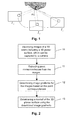
- Fig. 2 schematically illustrates a preferred embodiment of the method for determining a normal of a 3D planar surface.
- the 3D scene means a 3D scenario at one point in time which includes a 3D planar surface that is captured in multiple images.
- a set of point correspondences is extracted 11 by performing pairwise images matching on the multiple images.
- the Point correspondences are propagated to build clusters of corresponding points in the multiple images that correspond to a same 3D point.
- one corresponding point per image of the multiple images are extracted, where all the corresponding points are projected from a same physical 3D point.
- Each 3D point is assumed to belong to a 3D planar patch.
- Image gradients for the multiple images are determined 12 based on the set of point correspondences, which will be explained in detail below.
- a normal of the 3D planar surface is determined 13 using the determined image gradients.
- the received multiple images can be captured by any kind of camera that is feasible in different situations and for different demands.
- the point correspondences of the multiple images can be optionally extracted 11 using any suitable methods and techniques known in the field.
- the proposed method further comprises transforming each of the multiple images as a function defined on a unit-sphere.
- Spherical image gradients are then determined corresponding to the functions of the multiple images, and accordingly, the normal of the 3D planar surface is determined 13 using the determined spherical image gradient.
- One embodiment of the proposed method for determining a normal of a 3D planar surface will be described and explained in the following in detail. It is preferably performed with the assumption of a calibrated camera condition and with known camera poses.
- the image points on the received multiple images are represented by the pixel coordinates of the 2D images.
- This transformation converts 3D point coordinates from the world reference frame to the 3D Euclidean space aligned with N cameras.
- each of the received images can be regarded as a function defined on a unit-sphere: I ⁇ x : S 2 ⁇ R . m
- a pre-processing step on the input image set to realize the undistorted warp can be performed, which is a standard operation for calibrated camera images.
- This pre-processing step can simplify the gradient transformation and ease the analytical handling of the gradient transformation, and thus the received 2D images can be assumed to be distortion-free.
- the spherical gradient of the received 2D images can also be directly obtained with consideration of the distortion model during determination and computation of the Jacobian of the coordinated transformation as shown in equation (1).
- a geometrical relation among the received multiple images observing the planar surface can be described.
- the unknown plane normal n ⁇ can be calculated and determined.
- equation (8) there would be a unique solution for equation (8) when two images and two image point correspondences are given.
- the resulting over-constrained data can be solved in least square sense by means of Singular Value Decomposition.
- Each camera is modeled as a 640 ⁇ 480 pixel sensor with a 50° horizontal field of view.
- Some 3D points are randomly sampled on the planar surface in a small neighborhood, and then the corresponding image points are analytically calculated via perspective projection and corrupted with a Gaussian noise.
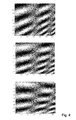
- Fig. 4 shows three samples of the dataset of the synthetic views observed from different viewpoints.
- the marked points on the images are the corresponding image points used to sample an image gradient.
- the standard deviation of the image projection noise ranges in the interval of [0;1] pixels.
- a new scene is generated 100 times, and the median and variance of the estimation error of the plane normal are taken for an accuracy measure.
- Fig. 5 shows the results obtained from this first test with increasing level of image projection noise.
- a second test the image noise intensity is kept fixed whereas the number of sampled points ranges in the interval of [2;5] pixels. Similar to the first test, 100 different scenes are randomly generated for each size of point set, and the same error measure is collected. Fig. 6 shows the results obtained from this second test with increasing size of the dataset of point correspondences.
- Fig. 7 schematically depicts an apparatus 20 configured to perform a method for determining a normal of a 3D planar surface.
- the apparatus 20 comprises a reception unit 21 and an operation unit 22.
- the reception unit 21 is configured to receive 10 multiple images of a 3D scene including a 3D planar surface in which each of the multiple images shows a different view of the 3D scene.
- the operation unit 22 is configured to extract 11 a set of point correspondences from the multiple images, to determine 12 image gradients for the multiple images based on the set of point correspondence, and to determine 13 a normal of the 3D planar surface using the determined image gradients.
- the set of the point correspondences includes corresponding points in the multiple images with respect to a 3D point located on the 3D planar surface.
- the operation unit 22 can further be configured to transform each of the multiple images as a function defined on a unit-sphere, determine spherical image gradients corresponding to the functions of the multiple images, and determine the normal of the 3D planar surface using the determined spherical image gradient.
- the apparatus 20 can further comprise a display device and a user interface (not shown) that are configured to show and illustrate the received image including the 3D planar surface and the determined normal of the 3D planar surface.
Landscapes
- Engineering & Computer Science (AREA)
- Computer Vision & Pattern Recognition (AREA)
- Physics & Mathematics (AREA)
- General Physics & Mathematics (AREA)
- Theoretical Computer Science (AREA)
- Image Analysis (AREA)
- Image Processing (AREA)
Abstract
A method and an apparatus for determining a normal of a 3D planar surface are described. For a 3D scene including a 3D planar surface, multiple images that show different views of the 3D scene are received (10). A set of point correspondences from the multiple images are extracted (11). Image gradients for the multiple images are determined (12) based on the set of point correspondences, and a normal of the 3D planar surface is then determined (13) using the image gradients.
Description
- A method and an apparatus for determining a normal of a 3D planar surface are described, which are particularly applied in the technical field of 3D visual reconstruction that is generally understood as a process to create a 3D model from a set of 2D images. In addition, a computer readable medium suitable for such a method and an apparatus is also presented.
- Within the pipeline of 3D visual reconstruction, one specific and essential procedure is the estimation of the normal of a 3D planar surface in the scene using available 2D images.
- Some techniques analyse the local distribution of a cloud of 3D points in the 3D space, and attempt to infer the local normal directly from the 3D points to fit a sort of moving plane. Most of the available algorithms and methods differentiate the formulation of the fitting geometrical model and introduce a regularization constraint enabling the recovery of a smooth surface. The input data of such methods is commonly assumed to be from a 3D range sensor [I, II]. ([I], [II] are two of references [I] through [IV] included in this specification and listed in a "Reference" section provided at the end of this specification.)
- However, a 3D range sensor is expensive and cannot always be integrated within a vision system. In addition, it can be prone to frequent failure when a similar technique is applied to 3D point cloud reconstructed from merely visual data. For example, the data used in a general Structure from Motion technique can have irregular and often insufficient density. This problem might be improved by exploitation of dense matching techniques, which however would introduce a higher level of noise.
- Another approach generally known as "photometric stereo" is purely based on visual data. Methods and algorithms attempt to recover 3D properties of a scene, e.g., the surface normal, from a perceived illuminance under the assumption of diffuse reflection and a lambertian behavior of the surface [III]. This approach is however strongly dependent on the illumination condition of the 3D scene and thus is hard and impractical to be employed as a general solution in a vision system.
- There is a third approach including methods and algorithms derived from 3D computer vision theory. It can be shown that views of a planar surface taken from different camera poses are related to a 2D homography. Estimating the underlying homography and factorizing the homography matrix are thus typical approaches for recovering a 3D normal of a target surface [IV]. This approach is however merely suitable for 3D scenes comprised of one single plane or at least a few broad planar surfaces. For a general 3D scene, different homographies should be estimated for each image feature, which is quite difficult in practice because the image patch that can be safely assumed associated to a planar surface in a 3D scene is generally insufficient.
- Therefore, it is an object among others to present an improved solution for determining a normal of a 3D planar surface in a scene using available 2D images of the scene. In particular, the proposed solution determines the local normal of a 3D planar surface using data directly sampled from the 2D images content, e.g., the image gradient, and some additional data typically available within a Structure from Motion pipeline, e.g., the camera poses.
- According to one embodiment, a method for determining a normal of a 3D planar surface is proposed. Multiple images of a 3D scene including a 3D planar surface are received. Each of the multiple images shows a different view of the 3D scene. A set of point correspondences is extracted from the multiple images and includes corresponding points in the multiple images with respect to a 3D point located on the 3D planar surface. Image gradients are determined for the multiple images based on the set of point correspondences, and a normal of the 3D planar surface is determined using the determined image gradients.
- In one embodiment, the method further comprises: transforming each of the multiple images as a function defined on a unit-sphere; determining spherical image gradients corresponding to the functions of the multiple images; and determining the normal of the 3D planar surface using the determined spherical image gradient.
- In one embodiment, the proposed method can be applied and integrated in a Structure from Motion process.
- In addition, in the embodiments, the determination of the normal of a 3D planar surface can be performed with a calibrated camera condition and with known camera poses. According to one embodiment, an apparatus for determining a normal of a 3D planar surface is introduced, which comprises a reception unit and an operation unit. The reception unit is configured to receive multiple images of a 3D scene including a 3D planar surface, where each of the multiple images shows a different view of the 3D scene. The operation unit is configured to extract a set of point correspondences from the multiple images, determine image gradients for the multiple images based on the set of point correspondence, and determine a normal of the 3D planar surface using the determined image gradients. The extracted set of point correspondences includes corresponding points in the multiple images with respect to a 3D point located on the 3D planar surface.
- In one embodiment, the operation unit is further configured to transform each of the multiple images as a function defined on a unit-sphere, determine spherical image gradients corresponding to the functions of the multiple images, and determine the normal of the 3D planar surface using the determined spherical image gradient.
- Also, a computer readable storage medium has stored therein instructions for determining a normal of a 3D planar surface, which, when executed by the computer, cause the computer to: receive multiple images of a 3D scene including a 3D planar surface, each of the multiple images showing a different view of the 3D scene; extract a set of point correspondences from the multiple images, the set of point correspondences including corresponding points in the multiple images with respect to a 3D point located on the 3D planar surface; determine image gradients for the multiple images based on the set of point correspondence; and determine a normal of the 3D planar surface using the determined image gradients.
- The computer readable storage medium can be a non-transitory volatile or non-volatile storage medium, such as, for example, a hard disk, an optical or magnetic disk or tape, a solid state memory device, etc. The storage medium thus tangibly embodies a program of instructions executable by a computer or a processing device to perform program steps as described herein.
- The proposed methods provide improved solutions for determining a normal of a 3D planar surface. The method relies on visual data, e.g., image gradient, and does not require an additional scanning sensor. By formulating the normal estimation problem as a linear system, the methods determine a normal of a 3D planar surface in a closed form, which significantly reduce the computational effort and cost compared to other iterative approaches. By using local image gradients to derive the local surface normal directly, as performed in the proposed methods, it is no longer necessary to make the general assumption that a large image area corresponds to a 3D planar surface, which is normally used for a robust estimation of an inter-view planar homography. This makes the proposed methods directly exploitable also for the reconstruction of a general 3D surface. Such proposed methods can be convenient and efficient for various demands or purposes.
- In addition to the direct application of the proposed methods on planar scene reconstruction, the proposed methods can also be integrated within a general 3D reconstruction tool or procedure and thus improve the same. For example, within a Structure from Motion (SfM) framework, a large set of feature matches is normally built across a multi-view dataset and is used to estimate a corresponding cloud of 3D points and the pose of each contributing view. In general, the surfaces of a real scene can be assumed locally planar as long as the observation area remains sufficiently small. Under this condition, the above proposed methods can be employed in a general SfM framework to extend the reconstructed scene also with the local 3D normal vector of the observed surface associated with each point in the 3D cloud. Because it is common to apply the reconstructed model from SfM framework for further uses, such as estimation of a dense surface, the local normal vectors that can be produced and made available by the use of the improved solutions for determining normals of 3D planar surfaces can provide a noticeable advantage when these improved solutions are applied to such further uses.
- For a better understanding of the present principles, the proposed solutions shall now be explained in more detail in the following description with reference to the figures. It is understood that the solutions are not limited to the disclosed exemplary embodiments and that specified features can also expediently be combined and/or modified without departing from the scope of the proposed solutions as defined in the appended claims and exhibited in the figures, which are introduced as follows:
- Fig. 1
- schematically shows that a normal of a 3D planar surface can be determined using image patches given by the neighborhoods of a set of corresponding points extracted from multiple images;
- Fig. 2
- is a flow chart illustrating one embodiment of a method for determining a normal of a 3D planar surface;
- Fig. 3
- schematically illustrates a geometrical interpretation of a Jacobian

- Fig. 4
- shows several samples of synthetic views on a planar surface in one embodiment of the proposed method;
- Figs. 5-6
- show the evaluation results of one embodiment of the proposed method; and
- Fig. 7
- is a schematic diagram illustrating a preferred embodiment of an apparatus configured to perform the embodiments of a method for determining a normal of a 3D planar surface.
-
Fig. 1 schematically illustrates in a diagram that a normal of a 3D planar surface (n) can be estimated and determined using image patches, which are given by the neighborhoods of a set of corresponding points extracted from multiple images (Ia, Ib and Ic). The 3D planar surface can be considered a tangent plane to a point on the surface of the object, e.g. the plane P of the object shown inFig. 1 . The multiple images can be separate 2D images of the object at one point in time intended to provide the actual object contour or can be a stereoscopic image pair at different points in time or from different perspectives. More specifically, the plane normal is inferred in closed form using an image-based approach, which is based on the analysis of the underlying transformation relating the image gradient sampled from the target images on the matched image points. - Accordingly,
Fig. 2 schematically illustrates a preferred embodiment of the method for determining a normal of a 3D planar surface. First, multiple images of a 3D scene is received 10. The 3D scene means a 3D scenario at one point in time which includes a 3D planar surface that is captured in multiple images. A set of point correspondences is extracted 11 by performing pairwise images matching on the multiple images. The Point correspondences are propagated to build clusters of corresponding points in the multiple images that correspond to a same 3D point. Preferably, one corresponding point per image of the multiple images are extracted, where all the corresponding points are projected from a same physical 3D point. Each 3D point is assumed to belong to a 3D planar patch. Image gradients for the multiple images are determined 12 based on the set of point correspondences, which will be explained in detail below. Then a normal of the 3D planar surface is determined 13 using the determined image gradients. - In most circumstances, the received multiple images can be captured by any kind of camera that is feasible in different situations and for different demands. The point correspondences of the multiple images can be optionally extracted 11 using any suitable methods and techniques known in the field.
- Preferably, the proposed method further comprises transforming each of the multiple images as a function defined on a unit-sphere. Spherical image gradients are then determined corresponding to the functions of the multiple images, and accordingly, the normal of the 3D planar surface is determined 13 using the determined spherical image gradient.
- One embodiment of the proposed method for determining a normal of a 3D planar surface will be described and explained in the following in detail. It is preferably performed with the assumption of a calibrated camera condition and with known camera poses.
- In general, the image points on the received multiple images are represented by the pixel coordinates of the 2D images. In a calibrated camera condition, this representation can be converted onto a 3D unit-
sphere 
which provides a convenient space for the formalization of 3D estimation problems. The image point conversion can be performed by inverting a camera projection model as expressed in equation (1), which is preliminarily characterized in a general calibration process:
where Π(x; θc ): R3→P2 is the camera projection mapping from a 3D Euclidean camera space to a 2D projective space of the camera retinal plane and is parameterized by the vector θc , m is an image point expressed in pixel coordinates, Π-1)(m; θc ) is the under-constrained inversion of the projection function Π, and η(.) is a unit-norm normalization of a n-D vector. - With the assumption of pre-known camera poses, a set of Euclidean transformation T = {Rw,i ∈ S0(3), ti ∈ R3 }i=1,...,N can be implied as a pre-known condition for the proposed method. This transformation converts 3D point coordinates from the world reference frame to the 3D Euclidean space aligned with N cameras. In other words, a 3D point X ∈ R3 can be converted in the Euclidean space of an i-th camera as follows:

and the corresponding image point is given by
where λ is the projective depth. - Using the above notation, each of the received images can be regarded as a function defined on a unit-sphere:

- Knowing an image gradient


where
- Optionally, a pre-processing step on the input image set to realize the undistorted warp can be performed, which is a standard operation for calibrated camera images. This pre-processing step can simplify the gradient transformation and ease the analytical handling of the gradient transformation, and thus the received 2D images can be assumed to be distortion-free. In this case, the camera projection model is reduced to a simple 3x3 upper triangular matrix κ representing a pinhole perspective projection, and the equation (3) can thus be expressed in equation (4) as follows:

where
- It should be noted that the above pre-processing step is optional. The spherical gradient of the received 2D images can also be directly obtained with consideration of the distortion model during determination and computation of the Jacobian of the coordinated transformation as shown in equation (1).
- Subsequently, a geometrical relation among the received multiple images observing the planar surface can be described. In general, a 3D plane can be defined by an equation XTn + d = 0, where n is the plane normal and d is its distance from the original of the reference frame. In this embodiment, by denoting (xa, xb ) ∈ S2 as the two projections of a 3D point X on two images A and B, with (Xa, Xb ) the corresponding 3D points expressed in the two camera spaces, and by denoting {Ra,b, ta,b } as the underlying Euclidean transformation with Xb = Ra,bXa + ta,b , it can be shown that (xa, xb ) are related on the projective space by the following equation (5):

where na = Rw,a n is the plane normal expressed in the Euclidean reference of the image A, and x̃ is the 3D vector of the homogeneous coordinates corresponding to the image point x, where
- The equation (5) essentially shows that any two views of a same planar surface are related by a homography, using the conversion of 2D images onto a 3D unit-sphere, i.e., Ĩb (x̃b ) = Ĩa (x̃a ). By differentiating both sides of the previous equation, one obtains:

which relates the spherical gradients to the corresponding image gradient filed. - Calculating the differential variation of xb corresponding to a differential variation of xa , the Jacobian of the spherical coordinates in the case of homography transformation is given as follows:

where Px = I3 - xxT is the orthogonal-projection matrix projecting a 3D vector on the plane orthogonal to x, and
Fig. 3 shows the geometrical interpretation of equation (7). - Substituting equation (7) in equation (6) yields equation (8) as follows:

- Therefore, given a set of point correspondences induced by 3D points located on a planar surface, equations of the same form as equation (8) can be stacked and a homogeneous linear system Añ = 0 with the unknown plane normal, n̂, can be built. In equation (8), with the available data of the camera poses, the spherical coordinates of point correspondences and the corresponding spherical gradients, the unknown plane normal n̂ can be calculated and determined. The 3D point
x̅ a can be any point located on the 3D planar surface, as
- The above described embodiment of the method for determining a normal of a 3D planar surface is evaluated on simulated data.
- A virtual scene is generated tacking the plane Z = 0 as a reference which is textured with a 2D sinusoidal periodic pattern. A set of cameras is dislocated uniformly along a horizontal circular trajectory at height Z = 10, with the optical axis pointing towards the origin. Each camera is modeled as a 640 × 480 pixel sensor with a 50° horizontal field of view. Some 3D points are randomly sampled on the planar surface in a small neighborhood, and then the corresponding image points are analytically calculated via perspective projection and corrupted with a Gaussian noise.
-
Fig. 4 shows three samples of the dataset of the synthetic views observed from different viewpoints. The marked points on the images are the corresponding image points used to sample an image gradient. - In a first test, the standard deviation of the image projection noise ranges in the interval of [0;1] pixels. For each noise intensity values, a new scene is generated 100 times, and the median and variance of the estimation error of the plane normal are taken for an accuracy measure. The error measure is provided by the angle expressed in degrees between the actual plane normal, z = [0 0 1], and the estimated one.
Fig. 5 shows the results obtained from this first test with increasing level of image projection noise. - In a second test, the image noise intensity is kept fixed whereas the number of sampled points ranges in the interval of [2;5] pixels. Similar to the first test, 100 different scenes are randomly generated for each size of point set, and the same error measure is collected.
Fig. 6 shows the results obtained from this second test with increasing size of the dataset of point correspondences. - These results show that, under the assumption of known camera poses, the normal of a 3D planar surface can be recovered with a high accuracy, using merely a few samples of the image gradient of the multiple images. In other words, it is shown that a few samples within the image patch of each triangulated feature is enough to constrain a system according to equation (8) and also achieve a good estimation accuracy. It also shows that the proposed method is suitable and can be integrated within a 3D reconstruction pipeline to improve the reconstruction result.
-
Fig. 7 schematically depicts anapparatus 20 configured to perform a method for determining a normal of a 3D planar surface. Theapparatus 20 comprises areception unit 21 and anoperation unit 22. Thereception unit 21 is configured to receive 10 multiple images of a 3D scene including a 3D planar surface in which each of the multiple images shows a different view of the 3D scene. Theoperation unit 22 is configured to extract 11 a set of point correspondences from the multiple images, to determine 12 image gradients for the multiple images based on the set of point correspondence, and to determine 13 a normal of the 3D planar surface using the determined image gradients. The set of the point correspondences includes corresponding points in the multiple images with respect to a 3D point located on the 3D planar surface. - The
operation unit 22 can further be configured to transform each of the multiple images as a function defined on a unit-sphere, determine spherical image gradients corresponding to the functions of the multiple images, and determine the normal of the 3D planar surface using the determined spherical image gradient. - In addition, the
apparatus 20 can further comprise a display device and a user interface (not shown) that are configured to show and illustrate the received image including the 3D planar surface and the determined normal of the 3D planar surface. - The foregoing illustrates the principles of the disclosure and it will thus be appreciated that those skilled in the art will be able to devise numerous alternative arrangements which, although not explicitly described herein, embody the principles and are within its scope. It is therefore to be understood that numerous modifications can be made to the illustrative embodiments and that other arrangements can be devised without departing from the scope of the present principle as defined by the appended claims.
-
- [I] R. B. Rusu, "Semantic 3D object maps for everyday manipulation in human living environments", Kunstliche Intelligenz, November 2010, Volume 24, Issue 4, pp 345-348
- [II] S. Holzert, et al., "Adaptive neighborhood selection for real-time surface normal estimation from organized point cloud data using integral images", 2012 IEEE/RSJ International Conference on Intelligent Robots and Systems (IROS), pp 2684-2689, October 2012
- [III] Q. Yang and N. Ahuja, "Surface reflectance and normal estimation from photometric stereo", Computer vision and Image Understanding, Volume 116, Issue 7, pp 793-802, July 2012
- [IV] R. Hartley and A. Zisserman, Multiple View Geometry in Computer Vision (2 ed.). Cambridge University Press, New York, NY, USA, pp. 155-157, 2003
Claims (11)
- A method for determining a normal of a 3D planar surface, comprising:- receiving (10) multiple images of a 3D scene including a 3D planar surface, each of the multiple images showing a different view of the 3D scene;- extracting (11) a set of point correspondences from the multiple images, the set of point correspondences including corresponding points in the multiple images with respect to a 3D point located on the 3D planar surface;- determining (12) image gradients for the multiple images based on the set of point correspondences; and- determining (13) a normal of the 3D planar surface using the determined image gradients.
- The method of claim 1, further comprising:- transforming each of the multiple images as a function defined on a unit-sphere;- determining spherical image gradients corresponding to the functions of the multiple images; and- determining the normal of the 3D planar surface using the determined spherical image gradient.
- The method of claim 2, wherein the spherical image gradient is defined as

where Ĩ(x) : S2 → R is a unit-sphere on which a 2D image can be transformed as a function, m is an image point expressed in pixel coordinates,

- The method of claim 3, wherein the normal of the 3D planar surface is determined using

where

- The method of one of the preceding claims, wherein the method is applied and integrated in a Structure from Motion process.
- The method of one of the preceding claims, wherein determining the normal of a 3D planar surface is performed with a calibrated camera condition and with known camera poses.
- An apparatus for determining a normal of a 3D planar surface, comprising:- a reception unit (21) configured to receive multiple images of a 3D scene including a 3D planar surface, each of the multiple images showing a different view of the 3D scene; and- an operation unit (22) configured to
extract (11) a set of point correspondences from the multiple images, the set of point correspondences including corresponding points in the multiple images with respect to a 3D point located on the 3D planar surface,
determine (12) image gradients for the multiple images based on the set of point correspondence, and
determine (13) a normal of the 3D planar surface using the determined image gradients. - The apparatus of claim 7, wherein the operation unit (22) is further configured to
transform each of the multiple images as a function defined on a unit-sphere,
determine spherical image gradients corresponding to the functions of the multiple images, and
determine the normal of the 3D planar surface using the determined spherical image gradient. - The apparatus of claim 7 or 8, wherein the reception unit receives the images from at least one camera, and wherein determining the normal of a 3D planar surface is performed with calibrated camera conditions and with known camera poses.
- A computer readable storage medium having stored therein instructions for determining a normal of a planar surface, which when executed by a computer, cause the computer to:- receive multiple images of a 3D scene including a 3D planar surface, each of the multiple images showing a different view of the 3D scene;- extract a set of point correspondences from the multiple images, the set of point correspondences including corresponding points in the multiple images with respect to a 3D point located on the 3D planar surface;- determine image gradients for the multiple images based on the set of point correspondence; and- determine a normal of the 3D planar surface using the determined image gradients.
- The computer readable storage medium of claim 10,
wherein determining the normal of a 3D planar surface is performed with a calibrated camera condition and with known camera poses.
Priority Applications (1)
| Application Number | Priority Date | Filing Date | Title |
|---|---|---|---|
| EP15306507.3A EP3147861A1 (en) | 2015-09-28 | 2015-09-28 | Method and apparatus for determining a normal of a 3d planar surface |
Applications Claiming Priority (1)
| Application Number | Priority Date | Filing Date | Title |
|---|---|---|---|
| EP15306507.3A EP3147861A1 (en) | 2015-09-28 | 2015-09-28 | Method and apparatus for determining a normal of a 3d planar surface |
Publications (1)
| Publication Number | Publication Date |
|---|---|
| EP3147861A1 true EP3147861A1 (en) | 2017-03-29 |
Family
ID=54337215
Family Applications (1)
| Application Number | Title | Priority Date | Filing Date |
|---|---|---|---|
| EP15306507.3A Withdrawn EP3147861A1 (en) | 2015-09-28 | 2015-09-28 | Method and apparatus for determining a normal of a 3d planar surface |
Country Status (1)
| Country | Link |
|---|---|
| EP (1) | EP3147861A1 (en) |
Cited By (1)
| Publication number | Priority date | Publication date | Assignee | Title |
|---|---|---|---|---|
| CN116843919A (en) * | 2023-06-30 | 2023-10-03 | 南京理工大学 | A RGB-D surface normal vector estimation method based on fractional differential |
-
2015
- 2015-09-28 EP EP15306507.3A patent/EP3147861A1/en not_active Withdrawn
Non-Patent Citations (7)
| Title |
|---|
| ANONYMOUS: "Jacobians and spherical polar gradient < Peeter Joot's (OLD) Blog.", 8 December 2009 (2009-12-08), XP055261798, Retrieved from the Internet <URL:https://peeterjoot.wordpress.com/2009/12/08/jacobians-and-spherical-polar-gradient/> [retrieved on 20160331] * |
| DEMONCEAUX C ET AL: "Omnidirectional image processing using geodesic metric", IMAGE PROCESSING (ICIP), 2009 16TH IEEE INTERNATIONAL CONFERENCE ON, IEEE, PISCATAWAY, NJ, USA, 7 November 2009 (2009-11-07), pages 221 - 224, XP031629149, ISBN: 978-1-4244-5653-6 * |
| GUILLAUME CARON ET AL: "Tracking planes in omnidirectional stereovision", ROBOTICS AND AUTOMATION (ICRA), 2011 IEEE INTERNATIONAL CONFERENCE ON, IEEE, 9 May 2011 (2011-05-09), pages 6306 - 6311, XP032033611, ISBN: 978-1-61284-386-5, DOI: 10.1109/ICRA.2011.5979739 * |
| Q. YANG; N. AHUJA: "Surface reflectance and normal estimation from photometric stereo", COMPUTER VISION AND IMAGE UNDERSTANDING, vol. 116, no. 7, July 2012 (2012-07-01), pages 793 - 802 |
| R. B. RUSU: "Semantic 3D object maps for everyday manipulation in human living environments", KIINSTLICHE INTELLIGENZ, vol. 24, no. 4, November 2010 (2010-11-01), pages 345 - 348 |
| R. HARTLEY; A. ZISSERMAN: "Multiple View Geometry in Computer Vision", 2003, CAMBRIDGE UNIVERSITY PRESS, pages: 155 - 157 |
| S. HOLZERT ET AL.: "Adaptive neighborhood selection for real-time surface normal estimation from organized point cloud data using integral images", 2012 IEEE/RSJ INTERNATIONAL CONFERENCE ON INTELLIGENT ROBOTS AND SYSTEMS (IROS, October 2012 (2012-10-01), pages 2684 - 2689 |
Cited By (1)
| Publication number | Priority date | Publication date | Assignee | Title |
|---|---|---|---|---|
| CN116843919A (en) * | 2023-06-30 | 2023-10-03 | 南京理工大学 | A RGB-D surface normal vector estimation method based on fractional differential |
Similar Documents
| Publication | Publication Date | Title |
|---|---|---|
| Whelan et al. | Deformation-based loop closure for large scale dense RGB-D SLAM | |
| EP2132680B1 (en) | Efficient and accurate 3d object tracking | |
| Visentini-Scarzanella et al. | Metric depth recovery from monocular images using shape-from-shading and specularities | |
| CN106910242B (en) | Method and system for 3D reconstruction of indoor complete scene based on depth camera | |
| CN105205858B (en) | A kind of indoor scene three-dimensional rebuilding method based on single deep vision sensor | |
| CN103247045B (en) | A kind of method obtaining artificial scene principal direction and image border from multi views | |
| CN106228507A (en) | A kind of depth image processing method based on light field | |
| EP3249613A1 (en) | Data processing method and apparatus | |
| US10460471B2 (en) | Camera pose estimating method and system | |
| WO2018133119A1 (en) | Method and system for three-dimensional reconstruction of complete indoor scene based on depth camera | |
| CN101866497A (en) | Intelligent 3D face reconstruction method and system based on binocular stereo vision | |
| CN101101672A (en) | Stereo vision 3D face modeling method based on virtual image correspondence | |
| Chhatkuli et al. | Stable template-based isometric 3D reconstruction in all imaging conditions by linear least-squares | |
| CN107492107B (en) | Object identification and reconstruction method based on plane and space information fusion | |
| Khilar et al. | 3D image reconstruction: Techniques, applications and challenges | |
| EP3185212A1 (en) | Dynamic particle filter parameterization | |
| CN101661623B (en) | Three-dimensional tracking method of deformable body based on linear programming | |
| Fontan et al. | Model for multi-view residual covariances based on perspective deformation | |
| Pedersini et al. | 3D area matching with arbitrary multiview geometry | |
| Ward et al. | A model-based approach to recovering the structure of a plant from images | |
| EP3136340A1 (en) | Method for estimating a unified projection model for a camera and apparatus performing the same | |
| Ribnick et al. | 3D reconstruction of periodic motion from a single view | |
| Calderon et al. | Depth map estimation in light fields using an stereo-like taxonomy | |
| Afzal et al. | Kinect Deform: enhanced 3d reconstruction of non-rigidly deforming objects | |
| Herrera et al. | A learned joint depth and intensity prior using Markov random fields |
Legal Events
| Date | Code | Title | Description |
|---|---|---|---|
| PUAI | Public reference made under article 153(3) epc to a published international application that has entered the european phase |
Free format text: ORIGINAL CODE: 0009012 |
|
| AK | Designated contracting states |
Kind code of ref document: A1 Designated state(s): AL AT BE BG CH CY CZ DE DK EE ES FI FR GB GR HR HU IE IS IT LI LT LU LV MC MK MT NL NO PL PT RO RS SE SI SK SM TR |
|
| AX | Request for extension of the european patent |
Extension state: BA ME |
|
| STAA | Information on the status of an ep patent application or granted ep patent |
Free format text: STATUS: THE APPLICATION IS DEEMED TO BE WITHDRAWN |
|
| 18D | Application deemed to be withdrawn |
Effective date: 20170930 |